EP3136474A1 - Negative electrode active material and lithium secondary battery comprising same - Google Patents
Negative electrode active material and lithium secondary battery comprising same Download PDFInfo
- Publication number
- EP3136474A1 EP3136474A1 EP15782943.3A EP15782943A EP3136474A1 EP 3136474 A1 EP3136474 A1 EP 3136474A1 EP 15782943 A EP15782943 A EP 15782943A EP 3136474 A1 EP3136474 A1 EP 3136474A1
- Authority
- EP
- European Patent Office
- Prior art keywords
- silicon
- active material
- negative active
- particles
- silicon particles
- Prior art date
- Legal status (The legal status is an assumption and is not a legal conclusion. Google has not performed a legal analysis and makes no representation as to the accuracy of the status listed.)
- Granted
Links
Images




Classifications
-
- H—ELECTRICITY
- H01—ELECTRIC ELEMENTS
- H01M—PROCESSES OR MEANS, e.g. BATTERIES, FOR THE DIRECT CONVERSION OF CHEMICAL ENERGY INTO ELECTRICAL ENERGY
- H01M4/00—Electrodes
- H01M4/02—Electrodes composed of, or comprising, active material
- H01M4/36—Selection of substances as active materials, active masses, active liquids
- H01M4/38—Selection of substances as active materials, active masses, active liquids of elements or alloys
-
- H—ELECTRICITY
- H01—ELECTRIC ELEMENTS
- H01M—PROCESSES OR MEANS, e.g. BATTERIES, FOR THE DIRECT CONVERSION OF CHEMICAL ENERGY INTO ELECTRICAL ENERGY
- H01M10/00—Secondary cells; Manufacture thereof
- H01M10/05—Accumulators with non-aqueous electrolyte
- H01M10/052—Li-accumulators
-
- H—ELECTRICITY
- H01—ELECTRIC ELEMENTS
- H01M—PROCESSES OR MEANS, e.g. BATTERIES, FOR THE DIRECT CONVERSION OF CHEMICAL ENERGY INTO ELECTRICAL ENERGY
- H01M10/00—Secondary cells; Manufacture thereof
- H01M10/05—Accumulators with non-aqueous electrolyte
- H01M10/052—Li-accumulators
- H01M10/0525—Rocking-chair batteries, i.e. batteries with lithium insertion or intercalation in both electrodes; Lithium-ion batteries
-
- H—ELECTRICITY
- H01—ELECTRIC ELEMENTS
- H01M—PROCESSES OR MEANS, e.g. BATTERIES, FOR THE DIRECT CONVERSION OF CHEMICAL ENERGY INTO ELECTRICAL ENERGY
- H01M4/00—Electrodes
-
- H—ELECTRICITY
- H01—ELECTRIC ELEMENTS
- H01M—PROCESSES OR MEANS, e.g. BATTERIES, FOR THE DIRECT CONVERSION OF CHEMICAL ENERGY INTO ELECTRICAL ENERGY
- H01M4/00—Electrodes
- H01M4/02—Electrodes composed of, or comprising, active material
- H01M4/13—Electrodes for accumulators with non-aqueous electrolyte, e.g. for lithium-accumulators; Processes of manufacture thereof
- H01M4/134—Electrodes based on metals, Si or alloys
-
- H—ELECTRICITY
- H01—ELECTRIC ELEMENTS
- H01M—PROCESSES OR MEANS, e.g. BATTERIES, FOR THE DIRECT CONVERSION OF CHEMICAL ENERGY INTO ELECTRICAL ENERGY
- H01M4/00—Electrodes
- H01M4/02—Electrodes composed of, or comprising, active material
- H01M4/36—Selection of substances as active materials, active masses, active liquids
- H01M4/362—Composites
- H01M4/366—Composites as layered products
-
- H—ELECTRICITY
- H01—ELECTRIC ELEMENTS
- H01M—PROCESSES OR MEANS, e.g. BATTERIES, FOR THE DIRECT CONVERSION OF CHEMICAL ENERGY INTO ELECTRICAL ENERGY
- H01M4/00—Electrodes
- H01M4/02—Electrodes composed of, or comprising, active material
- H01M4/36—Selection of substances as active materials, active masses, active liquids
- H01M4/38—Selection of substances as active materials, active masses, active liquids of elements or alloys
- H01M4/386—Silicon or alloys based on silicon
-
- H—ELECTRICITY
- H01—ELECTRIC ELEMENTS
- H01M—PROCESSES OR MEANS, e.g. BATTERIES, FOR THE DIRECT CONVERSION OF CHEMICAL ENERGY INTO ELECTRICAL ENERGY
- H01M4/00—Electrodes
- H01M4/02—Electrodes composed of, or comprising, active material
- H01M2004/021—Physical characteristics, e.g. porosity, surface area
-
- H—ELECTRICITY
- H01—ELECTRIC ELEMENTS
- H01M—PROCESSES OR MEANS, e.g. BATTERIES, FOR THE DIRECT CONVERSION OF CHEMICAL ENERGY INTO ELECTRICAL ENERGY
- H01M4/00—Electrodes
- H01M4/02—Electrodes composed of, or comprising, active material
- H01M2004/026—Electrodes composed of, or comprising, active material characterised by the polarity
- H01M2004/027—Negative electrodes
-
- H—ELECTRICITY
- H01—ELECTRIC ELEMENTS
- H01M—PROCESSES OR MEANS, e.g. BATTERIES, FOR THE DIRECT CONVERSION OF CHEMICAL ENERGY INTO ELECTRICAL ENERGY
- H01M2220/00—Batteries for particular applications
- H01M2220/10—Batteries in stationary systems, e.g. emergency power source in plant
-
- H—ELECTRICITY
- H01—ELECTRIC ELEMENTS
- H01M—PROCESSES OR MEANS, e.g. BATTERIES, FOR THE DIRECT CONVERSION OF CHEMICAL ENERGY INTO ELECTRICAL ENERGY
- H01M2220/00—Batteries for particular applications
- H01M2220/20—Batteries in motive systems, e.g. vehicle, ship, plane
-
- H—ELECTRICITY
- H01—ELECTRIC ELEMENTS
- H01M—PROCESSES OR MEANS, e.g. BATTERIES, FOR THE DIRECT CONVERSION OF CHEMICAL ENERGY INTO ELECTRICAL ENERGY
- H01M2220/00—Batteries for particular applications
- H01M2220/30—Batteries in portable systems, e.g. mobile phone, laptop
-
- H—ELECTRICITY
- H01—ELECTRIC ELEMENTS
- H01M—PROCESSES OR MEANS, e.g. BATTERIES, FOR THE DIRECT CONVERSION OF CHEMICAL ENERGY INTO ELECTRICAL ENERGY
- H01M4/00—Electrodes
- H01M4/02—Electrodes composed of, or comprising, active material
- H01M4/62—Selection of inactive substances as ingredients for active masses, e.g. binders, fillers
- H01M4/624—Electric conductive fillers
- H01M4/625—Carbon or graphite
-
- H—ELECTRICITY
- H01—ELECTRIC ELEMENTS
- H01M—PROCESSES OR MEANS, e.g. BATTERIES, FOR THE DIRECT CONVERSION OF CHEMICAL ENERGY INTO ELECTRICAL ENERGY
- H01M4/00—Electrodes
- H01M4/02—Electrodes composed of, or comprising, active material
- H01M4/62—Selection of inactive substances as ingredients for active masses, e.g. binders, fillers
- H01M4/624—Electric conductive fillers
- H01M4/626—Metals
-
- Y—GENERAL TAGGING OF NEW TECHNOLOGICAL DEVELOPMENTS; GENERAL TAGGING OF CROSS-SECTIONAL TECHNOLOGIES SPANNING OVER SEVERAL SECTIONS OF THE IPC; TECHNICAL SUBJECTS COVERED BY FORMER USPC CROSS-REFERENCE ART COLLECTIONS [XRACs] AND DIGESTS
- Y02—TECHNOLOGIES OR APPLICATIONS FOR MITIGATION OR ADAPTATION AGAINST CLIMATE CHANGE
- Y02E—REDUCTION OF GREENHOUSE GAS [GHG] EMISSIONS, RELATED TO ENERGY GENERATION, TRANSMISSION OR DISTRIBUTION
- Y02E60/00—Enabling technologies; Technologies with a potential or indirect contribution to GHG emissions mitigation
- Y02E60/10—Energy storage using batteries
Definitions
- the present invention relates to a secondary battery technology, and more particularly, to a negative active material and a lithium secondary battery including the negative active material.
- Lithium secondary batteries are rechargeable and dischargeable by using an electrode material having excellent reversibility, and lithium secondary batteries have been commercialized representatively. Lithium secondary batteries are expected to be provided in moveable units such as vehicles or to be applied as medium and large sized power source used in a power storage of a power supply network such as a smart grid, as well as small sized power source of small information technology (IT) appliances such as smart phones, portable computers, and electronic paper.
- a power supply network such as a smart grid
- IT small sized power source of small information technology
- crystalline carbon such as graphite and artificial graphite or carbon based active material such as soft carbon or hard carbon capable of intercalating and deintercalating lithium ions has been mainly used as a negative.
- non-carbon based negative materials capable of generating an alloy with lithium, for example, silicon (Si), tin (Sn), or aluminum (Al) having a capacity of 500 mAh/g or greater that may replace the carbon based negative material having a theoretical capacity of 372mAh/g, have drawn attention.
- silicon has a theoretical capacity of about 4200 mAh/g that is the largest among those materials, and thus, applications of silicon are considered to be important in view of capacity.
- silicon expands about four times greater in volume during a charging operation than during a discharging operation, an electric connection between active materials may break or an active material may be isolated from a current collector due to a volume variation during charging and discharging processes, and an irreversible reaction such as forming of a solid electrolyte interface (SEI) layer such as Li 2 O may occur and lifespan may degrade because of an erosion of the active material due to an electrolyte. Therefore, there is a barrier in commercializing the silicon as the negative material.
- SEI solid electrolyte interface
- the present invention provides a negative active material capable of improving an irreversible capacity and reducing a volume variation during charging and discharging to have a high energy density, high capacity, and longer lifespan, by using silicon.
- the present invention provides a secondary battery using the negative active material having the above advantages.
- the circularities of the silicon particles may be 0.6 or greater and 0.8 or less.
- the silicon particles may include solid type, fiber type, or tubular type silicon particles.
- an area of a (110) surface of each of the silicon particles may be greater than an area of a (100) surface and an area of a (111) surface.
- the (110) surface of the silicon particle may be a fractured surface or a polished surface.
- an average diameter of the silicon particles may range from 30 nm to 300 nm.
- the silicon particles may have a purity of 99% or greater.
- the negative active material may further include a silicon oxide layer formed on the silicon particles.
- the negative active material may further include a silicon carbide layer on the silicon oxide layer.
- the negative active material may further include a conductive layer formed on the silicon particles.
- the conductive layer may include an amorphous carbon layer or conductive metal oxide particles.
- a lithium secondary battery including the above negative active material.
- Embodiments of the present invention provide a silicon negative active material and a lithium secondary battery.
- silicon particles are adjusted to have circularities of 0.5 to 0.9 so as to suppress or reduce tensile hoop stress applied to lithiated silicon during charging a battery, and thus, an irreversible reaction caused from crack and/or fracture due to a volume variation of the silicon particles may be restrained. Accordingly, lifespan and capacity of the battery may be improved.
- tensile hoop stress is applied to the lithium alloy layer. It is also known that the tensile hoop stress is a main cause of crack and fracture in a surface of the silicon particle.
- the present inventors have derived the present inventive concept that is capable of preventing surface crack of silicon particles by preventing or reducing the tensile hoop stress applied to the surface during the lithiation process, based on a factor that crack or damage to the surface of the silicon particle rarely occurs even if compression stress 10 times or more greater than the tensile hoop stress is applied because the compression stress is more intensive than the tensile stress.
- the tensile hoop stress may be suppressed or reduced by controlling a circularity of the silicon particle, and thus, crack caused by volume expansion during the lithiation process and irreversible lifespan degradation may be effectively improved.
- Embodiments below are related to a lithium secondary battery using silicon particles as a negative active material, wherein a capacity and lifespan of the lithium secondary battery may be improved by controlling shapes of the silicon particles, and a secondary battery using thereof.
- FIGS. 1A and 1B are cross-sectional views respectively showing silicon particles 100A_1 and 100A_2 having circularities according to various embodiments
- FIG. 2 is a cross-sectional view of a spherical silicon particle 100B according to a comparative example.
- the silicon particles according to the embodiment of the present invention have irregular shapes such as a potato type (100A_1) as shown in FIG. 1A or a flake type having a planarized surface PS as shown in FIG. 1B .
- the silicon particles 100A_1 and 100A_2 having the above irregular shapes may be collectively used as a negative active material of a lithium secondary battery.
- FIGS. 1A and 1B exemplarily show solid type particles of kernel shapes, but the silicon particles according to the embodiment of the present invention may include silicon particles of three-dimensional irregular shapes, which do not have radial shape that is symmetric in an axial direction in a hollow type tubular structure or fiber structure.
- the silicon particles may be polysilicon or single crystalline silicon, and moreover, may have a low degree of crystallization or may be amorphous.
- the silicon particles may include a compound of the silicon and one, two, or more metals selected from the group consisting of tin (Sn), antimony (Sb), zinc (Zn), germanium (Ge), aluminium (Al), copper (Cu), bismuth (Bi), cadmium (Cd), magnesium (Mg), arsenic (As), gallium (Ga), lead (Pb), and iron (Fe), as well as the silicon particles having a purity of 99% or greater capable of maximizing capacity.
- the planarized surface PS of the silicon particle 100A_2 may be a dominant surface in entire external surfaces of the silicon particle 100A_2, and the dominant surface may be a ⁇ 110 ⁇ surface. Quantitatively, an area of the (110) surface of the silicon particle 100A_2 may be greater than that of another (110) surface and a (111) surface.
- a degree how much the silicon particles 100A_1 and 100A_2 are different from spherical shape may be evaluated based on a circularity expressed by Equation 1 below.
- the circularity is determined as a ratio of a projected area of the particle with respect to a circumferential length of the particle.
- the circularity may be measured by using a longest length of the particle and a projected area of a cross-section of the particle including the longest length.
- the circularity may be measured by using a projected area of a cross-section perpendicular to an extension direction of the tube or fiber, that is, longer axis direction.
- Circularity 2 pi ⁇ A 1 / 2 / P
- A denotes a projected area of a silicon particle that is two-dimensionally projected
- P denotes a circumferential length of the silicon particle that is two-dimensionally projected.
- the circularity of silicon particles may be measured from an image obtained by a scanning electron microscope by using commercialized software, e.g., ImageJ(R), for example, Imagej136. Otherwise, the circularity may be measured by a flow particle image analyser, e.g., FPIA-3000® of SYSMEX, Inc. (Kobe, Japan).
- An average grain size of the silicon particles 100A_1 and 100A_2 may range from 30 nm to 300 nm, and more preferably, from 30 nm to 200 nm.
- the average grain size of the silicon particles 100A_1 and 100A_2 is less than 30 nm, a relative ratio of a conductive layer or a conductive material of particle type in an active material slurry becomes greater, and thus, a capacity of a battery is decreased.
- the average grain size of the particles exceeds 300 nm, the circularity may be increased in order to minimize surface energy or may not be easily adjusted.
- the silicon active material particle 100B that is nearly a complete sphere according to the comparative example of FIG. 2 has a circularity that is substantially 1.
- the circularity of the silicon particles 100A_1 and 100A_2 according to the embodiment of the present invention as shown in FIGS. 1A and 1B ranges from 0.5 to 0.9, and more preferably, from 0.6 to 0.8.
- the particles having the circularity less than 0.5 may be pulverized from edges that are thin, due to a multiple times of charging and discharging operations, and lifespan thereof may deteriorate.
- the circularity exceeds 0.9 crack or fracture is likely to occur due to the tensile stress applied to a lithiated layer, as will be described later.
- pulverization of the silicon particles may be prevented even when the average diameter is within a sub-micron range, e.g., 30 nm to 300 nm, and forming of the SEI may be prevented. Therefore, deterioration of lifespan caused by the volume variation according to the charging and discharging operations may be prevented.
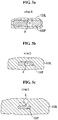
- FIGS. 3A to 3C illustrate growth steps of a lithiated layer, which a silicon particle having a dominant planarized surface experiences as being lithiated during a charging operation, according to an embodiment of the present invention
- FIG. 3D is a graph illustrating stress variation in corresponding growth steps
- FIG. 3E is a schematic diagram of a hypothetical stress distribution for illustrating the above graph qualitatively.
- a transverse axis of the graph denotes a charging time in which lithium intercalation occurs, and a longitudinal axis denotes stress.
- compression stress is applied to the representative stress element M located at a front end of lithiation moving toward the silicon core 100P.
- the compression stress is still applied to the representative stress element M located in the lithiation layer 100L, where the corresponding region is a region at which the lithiated layer 100L still experiences an elastic behavior with respect to the compression stress. Therefore, no crack or fracture occurs in the lithiated layer.
- change in the dominant stress in the silicon particles shown in the graph includes tensile stress SA in the step A and compression stress SB in the step B.
- compression stress SC1 consecutively or subtle tensile stress SC2 is applied.
- 3E hypothetically illustrates transferring of lithium ions Li+ in one direction, even if lithium ions Li+ are omni-directionally transferred to a surface of a silicon particle and the lithiated layer 100L grows as a shell, magnitude of tensile hoop stress applied to the shell may be reduced or eliminated throughout the entire shell due to the compression stress ⁇ comp due to the interface between flat surface elements based on a controlled circularity. Therefore, formation of crack on a surface of the lithiated layer 100L may be suppressed.
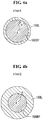
- FIGS. 4A to 4C are diagrams showing growth steps of a lithiated layer that a silicon particle of a spherical shape according to a comparative embodiment as being lithiated during a charging operation
- FIG. 4D is a graph of a stress variation in corresponding growth steps.
- a transverse axis of the graph denotes a charging time in which lithium intercalation occurs
- a longitudinal axis denotes stress.
- a representative stress element M located in a silicon core 100BP that is not yet lithiated experiences small tensile stress due to the expanding lithiated layer 100L like in the silicon particle having the circularity according to the embodiment of the present invention.
- compression stress is applied to the representative stress element M located at a front edge of lithiation moving toward the silicon core 100BP.
- a step C as elastic deformation is gradually removed at the representative stress element M located in the lithiated layer 100L, the lithiated layer 100L dominantly grows in a radial shape (or, in radial directions), thereby inducing hoop stress of tensile stress equal to or greater than critical tensile stress ⁇ plastic . Accordingly, a surface of the lithiated layer 100L weakened due to volume expansion is cracked or fractured.
- Development profile of the stress shown in FIG. 4D may be equivalently shown in a fiber shape having a three-dimensional symmetric radial shape or a three-dimensional tube, as well as in the silicon particle having substantially spherical shape provided exemplarily.
- the above description about the stress variation depending on the lithiation is simply provided as a theoretical basis, and the inventive concept is not limited to the above theory.
- volume expansion during the lithiation of the silicon particle is performed anisotropically.
- volume expansion of silicon in the ⁇ 110> direction is dominantly shown during the lithiation, and volume expansion in the ⁇ 111> direction is small enough to be ignorable.
- spreading path of lithium is related to variation of morphology depending on elasto-plastic deformation of silicon due to the lithiation.
- the volume expansion occurs more in a direction in which the lithium is rapidly spread, and it is desirable that the dominant planarized surface of the silicon particle is the (110) surface as a method of minimizing tensile hoop stress in the expanding lithiated layer.
- an area of the (110) surface of the silicon particle may be greater than that of another (110) surface and that of the (111) surface.
- Controlling of a crystallization surface on the surface of the silicon particle may be adjusted by physical etching such as milling, chemical etching such as removal of oxide after oxidation, or a combination thereof, or may be adjusted according to a method of forming silicon particles, e.g., electric explosion, milling, or fracturing, based on well-known arts.
- the silicon particles are manufactured to have a reduced circularity, e.g., 0.5 to 0.9, and thus, irreversible reactions caused by crack or fracturing of the silicon particles during the charging operation of a battery may be supressed or reduced. Also, as the circularity of the silicon particle becomes closer to 1, silicon particles are actually in point-contact with one another. As a result, electronic conductivity between the silicon particles degrades, and thus, an output voltage may be reduced due to an increase in an internal resistance of the battery.
- the silicon particles may be in surface-contact with one another, it may be expected to increase an output of the battery due to reduction in the internal resistance.
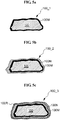
- FIGS. 5A to 5C are cross-sectional views showing structures of silicon negative active materials according to various embodiments of the present invention.
- a silicon negative active material 100_1 may include a core 100C of a silicon particle and a shell 100M of silicon oxide surrounding the core 100C.
- the core 100C of the silicon particle may be single-crystalline, polycrystalline, or may be amorphous.
- the core 100C of the silicon particle may include closed pores therein.
- a silicon negative active material 100_2 may further include a silicon carbide layer 100N on the shell 100M of silicon oxide.
- the shell 100M of silicon oxide or a dual shell (100M and 100N) including silicon oxide and silicon carbide may function as a clamping layer for restraining volume expansion caused by lithiation of the core 100C of the silicon particle, and thus, lifespan of a battery may increase.
- the silicon oxide and silicon carbide have a less capacity than that of silicon, and thus may have an appropriate thickness within a range in which energy density is not decreased. In one embodiment, the thickness of the silicon oxide and the silicon carbide may range from 0.5 nm to 20 nm.
- the shell 100M of silicon oxide may include a native oxide layer, chemical silicon oxide that is artificially grown by using a solvent containing oxygen, e.g., alcohol, distilled water, or peroxide compound, or thermal oxide.
- the shell 100N of silicon carbide may be manufactured by dispersing silicon active material particles in a liquid organic compound including hydrocarbon, alcohol, ether, or ester compound, obtaining and drying the silicon active material particles again, and performing a thermal treatment at a high temperature ranging from 600°C to 1300°C.
- the above preparation methods are examples, and the present invention is not limited thereto.
- the shell of silicon carbide may be manufactured by coating an organic solid layer including synthetic or organic polymer that is a carbon precursor on intermediate particles by a high temperature spraying method or a misting method, and performing a thermal treatment after passing through an appropriate decompression or cooling process.
- a conductive layer 100R may be further formed at an outermost part of the silicon negative active material.
- the conductive material 100R may include a carbon-based conductive layer such as graphite, soft carbon, or graphene.
- the conductive layer 100R is provided for electrically connecting the silicon negative active materials in contact with each other, and reduces an internal resistance to a current collector (not shown).
- the carbon-based conductive layer may be crystalline or at least partially amorphous carbon layer. If the carbon-based conductive layer is highly crystalline, the carbon-based conductive layer may include graphite, but in this case, the graphite may react with electrolyte at a surface thereof. However, a low-crystalline or an amorphous carbon layer has a chemical corrosion resistance with respect to the electrolyte, decomposition of the electrolyte is restrained during charging and discharging, and thereby improving lifespan of a negative electrode. Also, the carbon-based conductive layer may have SP 2 graphite structure having conductivity and SP 3 diamond structure having an insulating property together. In order for the carbon-based conductive layer to have conductivity, SP 2 may have a mole fraction that is greater than that of SP 3 , and the mole fraction may be adjusted through a thermal treatment process.
- the outermost portion of the silicon composite active material 100_3 may include nano-scale particles of conductive metal oxide such as antimony tin oxide or antimony zinc oxide, or another conductive layer such as a layer of the nano-scale particles.
- the conductive layer 100R may be additionally provided on the silicon active material composite 100A_2.
- Polysilicon coarse particles having an average diameter of about 5 ⁇ m are processed by a ball milling process, in which a magnitude and time of shearing stress are controlled, to manufacture silicon particles respectively having circularities of about 0.4, 0.5, 0.6, 0.7, 0.8, and 0.9, and silicon particles having circularity of 0.95 or greater are manufactured from a silicon precursor by using a liquid pyrolysis method.
- FIG. 6 is a scanning electron microscope image of a silicon particle having circularity of about 0.8. Analysed purity of silicon in the silicon particles is 99% or greater.
- the above method is an example, and the silicon particles may be prepared by another polishing process, or by electrically exploding a bulk silicon material such as a silicon rod or a wafer. An average grain size of the silicon particles is about 220 nm.
- Table 1 illustrates an initial efficiency and a capacity retention rate of a half cell, after manufacturing a negative electrode by making the silicon particles having the respective circularities as a slurry.
- the capacity retention rate is measured after performing charging and discharging operations 50 times.
- An initial capacity that becomes a reference was 4,200 mAh/g, that is, a theoretical capacity of silicon.
- [Table 1] Circularity Battery characteristics Initial efficiency Weight specific capacity Retention@ 50 times 0.4 81% 2040 mAh/g 73% 0.5 84% 2110 mAh/g 85% 0.6 88% 2290 mAh/g 93% 0.7 89% 2320 mAh/g 98% 0.8 90% 2341 mAh/g 98% 0.9 90% 2343 mAh/g 81% 0.95 90% 2342 mAh/g 60%
- the initial efficiency is gradually reduced as the circularity decreases.
- the initial efficiencies are all 80% or greater, that is, commercialization is possible.
- the capacity retention when the circularity is less than 0.5, a remaining capacity is decreased less than 80% due to an increase in irreversibility according to the volume expansion.
- the remaining capacity maintains at 80% or greater that may be applied in practical use, and within a range of 0.6 to 0.8, the remaining capacity maintains at 90% or greater.
Landscapes
- Chemical & Material Sciences (AREA)
- Chemical Kinetics & Catalysis (AREA)
- Electrochemistry (AREA)
- General Chemical & Material Sciences (AREA)
- Engineering & Computer Science (AREA)
- Materials Engineering (AREA)
- Composite Materials (AREA)
- Manufacturing & Machinery (AREA)
- Battery Electrode And Active Subsutance (AREA)
- Secondary Cells (AREA)
Abstract
Description
- The present invention relates to a secondary battery technology, and more particularly, to a negative active material and a lithium secondary battery including the negative active material.
- Secondary batteries are rechargeable and dischargeable by using an electrode material having excellent reversibility, and lithium secondary batteries have been commercialized representatively. Lithium secondary batteries are expected to be provided in moveable units such as vehicles or to be applied as medium and large sized power source used in a power storage of a power supply network such as a smart grid, as well as small sized power source of small information technology (IT) appliances such as smart phones, portable computers, and electronic paper.
- When lithium metal is used as n negative material of a lithium secondary battery, dendrites may be formed, and thereby causing shorting of the battery or a risk of explosion. Thus, instead of using the lithium metal, crystalline carbon such as graphite and artificial graphite or carbon based active material such as soft carbon or hard carbon capable of intercalating and deintercalating lithium ions has been mainly used as a negative. However, as applications of secondary batteries have increased, demands for secondary batteries having high capacity and high output have increased more, and accordingly, non-carbon based negative materials capable of generating an alloy with lithium, for example, silicon (Si), tin (Sn), or aluminum (Al) having a capacity of 500 mAh/g or greater that may replace the carbon based negative material having a theoretical capacity of 372mAh/g, have drawn attention.
- Among the above non-carbon based negative materials, silicon has a theoretical capacity of about 4200 mAh/g that is the largest among those materials, and thus, applications of silicon are considered to be important in view of capacity. However, since silicon expands about four times greater in volume during a charging operation than during a discharging operation, an electric connection between active materials may break or an active material may be isolated from a current collector due to a volume variation during charging and discharging processes, and an irreversible reaction such as forming of a solid electrolyte interface (SEI) layer such as Li2O may occur and lifespan may degrade because of an erosion of the active material due to an electrolyte. Therefore, there is a barrier in commercializing the silicon as the negative material.
- There have been suggested many kinds of techniques for implementing a battery having a relatively high capacity, while minimizing expansion and contraction in a volume of an active material and improving lifespan, and among those, an active material obtained by generating nanosilicon by using SiOx as a matrix is highly possible to be commercialized. An active material using SiOx material as a matrix has lifespan and capacity that have been improved to some degree, but there are actual limitations in using the above active material because of a large irreversible capacity of SiOx. As another approach, there is provided a method of generating nano-sized silicon particles. However, even nano-sized silicon particles have not reached a level of practical use yet, due to damage to particles caused by volume expansion/contraction and rapid degradation of lifespan even though a degree of expansion/contraction is smaller. In addition, reduced size of silicon particles results in reduction in capacity, and thus, there is a limitation in using the silicon particles. Therefore, in order to commercialize the silicon material, it is necessary to restrain the volume variation during the charging and discharging and to maximize a capacity of a battery.
- The present invention provides a negative active material capable of improving an irreversible capacity and reducing a volume variation during charging and discharging to have a high energy density, high capacity, and longer lifespan, by using silicon.
- The present invention provides a secondary battery using the negative active material having the above advantages.
- According to an aspect of the present invention, there is provided a negative active material for a secondary battery, the negative active material comprising silicon particles, wherein circularities of the particles are determined by
equation 1 below, and the circularities are 0.5 or greater and 0.9 or less,
- The circularities of the silicon particles may be 0.6 or greater and 0.8 or less. The silicon particles may include solid type, fiber type, or tubular type silicon particles.
- In some embodiments, an area of a (110) surface of each of the silicon particles may be greater than an area of a (100) surface and an area of a (111) surface. The (110) surface of the silicon particle may be a fractured surface or a polished surface.
- In one embodiment, an average diameter of the silicon particles may range from 30 nm to 300 nm. The silicon particles may have a purity of 99% or greater.
- The negative active material may further include a silicon oxide layer formed on the silicon particles. The negative active material may further include a silicon carbide layer on the silicon oxide layer. In another embodiment, the negative active material may further include a conductive layer formed on the silicon particles. In this case, the conductive layer may include an amorphous carbon layer or conductive metal oxide particles.
- According to an aspect of the inventive concept, there is provided a lithium secondary battery including the above negative active material.
- Embodiments of the present invention provide a silicon negative active material and a lithium secondary battery. According to the embodiments of the present invention, silicon particles are adjusted to have circularities of 0.5 to 0.9 so as to suppress or reduce tensile hoop stress applied to lithiated silicon during charging a battery, and thus, an irreversible reaction caused from crack and/or fracture due to a volume variation of the silicon particles may be restrained. Accordingly, lifespan and capacity of the battery may be improved.
-
-
FIGS. 1A and 1B are cross-sectional views respectively showing shapes of silicon particles having circularities according to various embodiments of the inventive concept; -
FIG. 2 is a cross-sectional view showing a shape of a spherical silicon particle according to a comparative example; -
FIGS. 3A to 3C illustrate growth steps of a lithiated layer, which a silicon particle having a dominant planarized surface experiences as being lithiated during a charging operation;FIG. 3D is a graph showing a stress variation during the growing steps, andFIG. 3E is a schematic diagram of a hypothetic stress distribution for qualitatively illustrating the above graphs; -
FIGS. 4A to 4C are diagrams showing steps of growing a lithiated layer that a spherical silicon particle according to a comparative example experiences as being lithiated during a charging operation, andFIG. 4D is a graph of a stress variation during the corresponding growing steps; -
FIGS. 5A to 5C are cross-sectional views showing silicon negative active materials according to various embodiments of the inventive concept; and -
FIG. 6 is a scanning electron microscope image of a silicon particle having a circularity of about 0.8. - Hereinafter, preferred embodiments of the inventive concept will be described in detail with reference to accompanying drawings.
- Embodiments of the inventive concept will be described more fully with reference to the accompanying drawings, in which exemplary embodiments of the invention are shown. This invention may, however, be embodied in many different forms and should not be construed as limited to the exemplary embodiments set forth herein. Rather, these embodiments are provided so that this disclosure will be thorough and complete, and will fully convey the scope of the invention to those skilled in the art.
- In the drawings, lengths and sizes of layers and regions may be exaggerated for convenience of description and clarity, and like reference numerals in the drawings denote like elements. As used herein, the term "and/or" includes any and all combinations of one or more of the associated listed items.
- The terms used in the present specification are merely used to describe particular embodiments, and are not intended to limit the inventive concept. An expression used in the singular encompasses the expression of the plural, unless it has a clearly different meaning in the context. In the present specification, it is to be understood that the terms such as "comprise" and "comprising" are intended to indicate the existence of the features, numbers, steps, actions, components, parts, or combinations thereof disclosed in the specification, and are not intended to preclude the possibility that one or more other features, numbers, steps, actions, components, parts, or combinations thereof may exist or may be added.
- It has been known that rapid degradation of lifespan and increase in an irreversible capacity while a silicon particle is applied to a secondary battery negative is caused by large expansion and contraction in a volume of the silicon particle. A reaction between lithium ions and silicon particles for generating a LixSi alloy due to an electrochemical reaction starts from surfaces of the silicon particles. In this case, a sharp boundary exists at an interface between inside of silicon (pristine-Si) that has not reacted yet and a lithium alloy layer LixSi. As lithiation proceeds, the lithium alloy layer becomes greater, and finally, the entire silicon particle is converted to LixSi alloy and then the electrochemical reaction finishes. During the lithiation process, inside of the silicon that has not reacted and the lithium alloy layer co-exist, and from the moment when the lithium alloy layer surrounds the silicon particle therein, tensile hoop stress is applied to the lithium alloy layer. It is also known that the tensile hoop stress is a main cause of crack and fracture in a surface of the silicon particle.
- However, the present inventors have derived the present inventive concept that is capable of preventing surface crack of silicon particles by preventing or reducing the tensile hoop stress applied to the surface during the lithiation process, based on a factor that crack or damage to the surface of the silicon particle rarely occurs even if compression stress 10 times or more greater than the tensile hoop stress is applied because the compression stress is more intensive than the tensile stress.
- According to embodiments of the present invention, the tensile hoop stress may be suppressed or reduced by controlling a circularity of the silicon particle, and thus, crack caused by volume expansion during the lithiation process and irreversible lifespan degradation may be effectively improved. Embodiments below are related to a lithium secondary battery using silicon particles as a negative active material, wherein a capacity and lifespan of the lithium secondary battery may be improved by controlling shapes of the silicon particles, and a secondary battery using thereof.
-
FIGS. 1A and 1B are cross-sectional views respectively showing silicon particles 100A_1 and 100A_2 having circularities according to various embodiments, andFIG. 2 is a cross-sectional view of aspherical silicon particle 100B according to a comparative example. - The silicon particles according to the embodiment of the present invention have irregular shapes such as a potato type (100A_1) as shown in
FIG. 1A or a flake type having a planarized surface PS as shown inFIG. 1B . The silicon particles 100A_1 and 100A_2 having the above irregular shapes may be collectively used as a negative active material of a lithium secondary battery. Regarding the silicon particles 100A_1 and 100A_2 having the irregular shapes,FIGS. 1A and 1B exemplarily show solid type particles of kernel shapes, but the silicon particles according to the embodiment of the present invention may include silicon particles of three-dimensional irregular shapes, which do not have radial shape that is symmetric in an axial direction in a hollow type tubular structure or fiber structure. - The silicon particles may be polysilicon or single crystalline silicon, and moreover, may have a low degree of crystallization or may be amorphous. In addition, the silicon particles may include a compound of the silicon and one, two, or more metals selected from the group consisting of tin (Sn), antimony (Sb), zinc (Zn), germanium (Ge), aluminium (Al), copper (Cu), bismuth (Bi), cadmium (Cd), magnesium (Mg), arsenic (As), gallium (Ga), lead (Pb), and iron (Fe), as well as the silicon particles having a purity of 99% or greater capable of maximizing capacity.
- The planarized surface PS of the silicon particle 100A_2 may be a dominant surface in entire external surfaces of the silicon particle 100A_2, and the dominant surface may be a {110} surface. Quantitatively, an area of the (110) surface of the silicon particle 100A_2 may be greater than that of another (110) surface and a (111) surface.
- A degree how much the silicon particles 100A_1 and 100A_2 are different from spherical shape may be evaluated based on a circularity expressed by
Equation 1 below. The circularity is determined as a ratio of a projected area of the particle with respect to a circumferential length of the particle. In a case of the solid type, the circularity may be measured by using a longest length of the particle and a projected area of a cross-section of the particle including the longest length. In a case of the hollow type tubular structure or fiber structure, the circularity may be measured by using a projected area of a cross-section perpendicular to an extension direction of the tube or fiber, that is, longer axis direction.
- Here, A denotes a projected area of a silicon particle that is two-dimensionally projected, and P denotes a circumferential length of the silicon particle that is two-dimensionally projected. The circularity of silicon particles may be measured from an image obtained by a scanning electron microscope by using commercialized software, e.g., ImageJ(R), for example, Imagej136. Otherwise, the circularity may be measured by a flow particle image analyser, e.g., FPIA-3000® of SYSMEX, Inc. (Kobe, Japan).
- An average grain size of the silicon particles 100A_1 and 100A_2 may range from 30 nm to 300 nm, and more preferably, from 30 nm to 200 nm. When the average grain size of the silicon particles 100A_1 and 100A_2 is less than 30 nm, a relative ratio of a conductive layer or a conductive material of particle type in an active material slurry becomes greater, and thus, a capacity of a battery is decreased. Also, when the average grain size of the particles exceeds 300 nm, the circularity may be increased in order to minimize surface energy or may not be easily adjusted.
- The silicon
active material particle 100B that is nearly a complete sphere according to the comparative example ofFIG. 2 has a circularity that is substantially 1. On the contrary, the circularity of the silicon particles 100A_1 and 100A_2 according to the embodiment of the present invention as shown inFIGS. 1A and 1B ranges from 0.5 to 0.9, and more preferably, from 0.6 to 0.8. The particles having the circularity less than 0.5 may be pulverized from edges that are thin, due to a multiple times of charging and discharging operations, and lifespan thereof may deteriorate. On the other hand, when the circularity exceeds 0.9, crack or fracture is likely to occur due to the tensile stress applied to a lithiated layer, as will be described later. Forming of a solid electrolyte interface (SEI) layer in an internal surface of the silicon particle, which is exposed due to the crack or fracture, is accelerated, and thus lifespan of the battery deteriorates. According to the embodiment of the present invention, pulverization of the silicon particles may be prevented even when the average diameter is within a sub-micron range, e.g., 30 nm to 300 nm, and forming of the SEI may be prevented. Therefore, deterioration of lifespan caused by the volume variation according to the charging and discharging operations may be prevented. -
FIGS. 3A to 3C illustrate growth steps of a lithiated layer, which a silicon particle having a dominant planarized surface experiences as being lithiated during a charging operation, according to an embodiment of the present invention,FIG. 3D is a graph illustrating stress variation in corresponding growth steps, andFIG. 3E is a schematic diagram of a hypothetical stress distribution for illustrating the above graph qualitatively. A transverse axis of the graph denotes a charging time in which lithium intercalation occurs, and a longitudinal axis denotes stress. - Referring to
FIGS. 3A to 3C , regarding a step A, in which lithiation starts on the surface of the silicon particle having the planarized surface (see PS ofFIG. 1B ) of the circularity from 0.5 to 0.9 according to the embodiment of the present invention, a representative stress element M located in asilicon core 100P that is not lithiated yet experiences small tensile stress due to expandinglithiated layer 100L. As the lithiation progresses to a step B, compression stress is applied to the representative stress element M located at a front end of lithiation moving toward thesilicon core 100P. However, even the lithiation goes to a step C, the compression stress is still applied to the representative stress element M located in thelithiation layer 100L, where the corresponding region is a region at which thelithiated layer 100L still experiences an elastic behavior with respect to the compression stress. Therefore, no crack or fracture occurs in the lithiated layer. - Referring to
FIG. 3D , change in the dominant stress in the silicon particles shown in the graph includes tensile stress SA in the step A and compression stress SB in the step B. In the step C where thelithiated layer 100L is dominant, compression stress SC1 consecutively or subtle tensile stress SC2 is applied. - Referring to
FIG. 3E , regarding the step C, if thecore 100P of the active material particle having a ratio (L/T) between a length L of a projected area and a thickness T of about 4.28 and a circularity of about 0.7, that is, within a range between equal to or greater than 0.5 and less than or equal to 0.9, has thelithiated layer 100L formed on a flat surface and an interface of a flat structure (linear), compression stress σcomp is applied to a surface of thelithiated layer 100L configuring the surface of the silicon particle. Under the compression stress σcomp, thelithiated layer 100L is a region experiencing an elastic behavior, and thus no crack or fracture occurs in thelithiated layer 100L. AlthoughFIG. 3E hypothetically illustrates transferring of lithium ions Li+ in one direction, even if lithium ions Li+ are omni-directionally transferred to a surface of a silicon particle and thelithiated layer 100L grows as a shell, magnitude of tensile hoop stress applied to the shell may be reduced or eliminated throughout the entire shell due to the compression stress σcomp due to the interface between flat surface elements based on a controlled circularity. Therefore, formation of crack on a surface of thelithiated layer 100L may be suppressed. -
FIGS. 4A to 4C are diagrams showing growth steps of a lithiated layer that a silicon particle of a spherical shape according to a comparative embodiment as being lithiated during a charging operation, andFIG. 4D is a graph of a stress variation in corresponding growth steps. A transverse axis of the graph denotes a charging time in which lithium intercalation occurs, and a longitudinal axis denotes stress. - Referring to
FIGS. 4A to 4C and4D , in a step A where lithiation begins on a surface of the silicon particle, the circularity of which is substantially 1, according to the comparative embodiment, a representative stress element M located in a silicon core 100BP that is not yet lithiated experiences small tensile stress due to the expandinglithiated layer 100L like in the silicon particle having the circularity according to the embodiment of the present invention. Also, as lithiation progresses as in a step B, compression stress is applied to the representative stress element M located at a front edge of lithiation moving toward the silicon core 100BP. However, in a step C, as elastic deformation is gradually removed at the representative stress element M located in thelithiated layer 100L, thelithiated layer 100L dominantly grows in a radial shape (or, in radial directions), thereby inducing hoop stress of tensile stress equal to or greater than critical tensile stress σplastic. Accordingly, a surface of thelithiated layer 100L weakened due to volume expansion is cracked or fractured. - Development profile of the stress shown in
FIG. 4D may be equivalently shown in a fiber shape having a three-dimensional symmetric radial shape or a three-dimensional tube, as well as in the silicon particle having substantially spherical shape provided exemplarily. The above description about the stress variation depending on the lithiation is simply provided as a theoretical basis, and the inventive concept is not limited to the above theory. - It is identified that volume expansion during the lithiation of the silicon particle is performed anisotropically. In detail, volume expansion of silicon in the <110> direction is dominantly shown during the lithiation, and volume expansion in the <111> direction is small enough to be ignorable. Although there is no specific theory for that, it is estimated that spreading path of lithium is related to variation of morphology depending on elasto-plastic deformation of silicon due to the lithiation.
- According to the above experimental results, the volume expansion occurs more in a direction in which the lithium is rapidly spread, and it is desirable that the dominant planarized surface of the silicon particle is the (110) surface as a method of minimizing tensile hoop stress in the expanding lithiated layer. Quantatively, an area of the (110) surface of the silicon particle may be greater than that of another (110) surface and that of the (111) surface. Controlling of a crystallization surface on the surface of the silicon particle may be adjusted by physical etching such as milling, chemical etching such as removal of oxide after oxidation, or a combination thereof, or may be adjusted according to a method of forming silicon particles, e.g., electric explosion, milling, or fracturing, based on well-known arts.
- According to the embodiment, the silicon particles are manufactured to have a reduced circularity, e.g., 0.5 to 0.9, and thus, irreversible reactions caused by crack or fracturing of the silicon particles during the charging operation of a battery may be supressed or reduced. Also, as the circularity of the silicon particle becomes closer to 1, silicon particles are actually in point-contact with one another. As a result, electronic conductivity between the silicon particles degrades, and thus, an output voltage may be reduced due to an increase in an internal resistance of the battery. However, according to the embodiment of the inventive concept, the silicon particles may be in surface-contact with one another, it may be expected to increase an output of the battery due to reduction in the internal resistance.
-
FIGS. 5A to 5C are cross-sectional views showing structures of silicon negative active materials according to various embodiments of the present invention. - Referring to
FIG. 5A , a silicon negative active material 100_1 may include a core 100C of a silicon particle and ashell 100M of silicon oxide surrounding the core 100C. The core 100C of the silicon particle may be single-crystalline, polycrystalline, or may be amorphous. In another embodiment, the core 100C of the silicon particle may include closed pores therein. - Referring to
FIG. 5B , in another embodiment, a silicon negative active material 100_2 may further include asilicon carbide layer 100N on theshell 100M of silicon oxide. Theshell 100M of silicon oxide or a dual shell (100M and 100N) including silicon oxide and silicon carbide may function as a clamping layer for restraining volume expansion caused by lithiation of the core 100C of the silicon particle, and thus, lifespan of a battery may increase. However, since the silicon oxide and silicon carbide have a less capacity than that of silicon, and thus may have an appropriate thickness within a range in which energy density is not decreased. In one embodiment, the thickness of the silicon oxide and the silicon carbide may range from 0.5 nm to 20 nm. - The
shell 100M of silicon oxide may include a native oxide layer, chemical silicon oxide that is artificially grown by using a solvent containing oxygen, e.g., alcohol, distilled water, or peroxide compound, or thermal oxide. Theshell 100N of silicon carbide may be manufactured by dispersing silicon active material particles in a liquid organic compound including hydrocarbon, alcohol, ether, or ester compound, obtaining and drying the silicon active material particles again, and performing a thermal treatment at a high temperature ranging from 600°C to 1300°C. The above preparation methods are examples, and the present invention is not limited thereto. For example, the shell of silicon carbide may be manufactured by coating an organic solid layer including synthetic or organic polymer that is a carbon precursor on intermediate particles by a high temperature spraying method or a misting method, and performing a thermal treatment after passing through an appropriate decompression or cooling process. - In some embodiments, as shown in
FIG. 5C , aconductive layer 100R may be further formed at an outermost part of the silicon negative active material. Theconductive material 100R may include a carbon-based conductive layer such as graphite, soft carbon, or graphene. Theconductive layer 100R is provided for electrically connecting the silicon negative active materials in contact with each other, and reduces an internal resistance to a current collector (not shown). - In some embodiments, the carbon-based conductive layer may be crystalline or at least partially amorphous carbon layer. If the carbon-based conductive layer is highly crystalline, the carbon-based conductive layer may include graphite, but in this case, the graphite may react with electrolyte at a surface thereof. However, a low-crystalline or an amorphous carbon layer has a chemical corrosion resistance with respect to the electrolyte, decomposition of the electrolyte is restrained during charging and discharging, and thereby improving lifespan of a negative electrode. Also, the carbon-based conductive layer may have SP2 graphite structure having conductivity and SP3 diamond structure having an insulating property together. In order for the carbon-based conductive layer to have conductivity, SP2 may have a mole fraction that is greater than that of SP3, and the mole fraction may be adjusted through a thermal treatment process.
- The above carbon-based conductive layer is an example, and the present invention is not limited thereto. For example, the outermost portion of the silicon composite active material 100_3 may include nano-scale particles of conductive metal oxide such as antimony tin oxide or antimony zinc oxide, or another conductive layer such as a layer of the nano-scale particles. Although not shown in
FIG. 1B , theconductive layer 100R may be additionally provided on the silicon active material composite 100A_2. - Polysilicon coarse particles having an average diameter of about 5 µm are processed by a ball milling process, in which a magnitude and time of shearing stress are controlled, to manufacture silicon particles respectively having circularities of about 0.4, 0.5, 0.6, 0.7, 0.8, and 0.9, and silicon particles having circularity of 0.95 or greater are manufactured from a silicon precursor by using a liquid pyrolysis method.
FIG. 6 is a scanning electron microscope image of a silicon particle having circularity of about 0.8. Analysed purity of silicon in the silicon particles is 99% or greater. The above method is an example, and the silicon particles may be prepared by another polishing process, or by electrically exploding a bulk silicon material such as a silicon rod or a wafer. An average grain size of the silicon particles is about 220 nm. - Table 1 below illustrates an initial efficiency and a capacity retention rate of a half cell, after manufacturing a negative electrode by making the silicon particles having the respective circularities as a slurry. The capacity retention rate is measured after performing charging and discharging operations 50 times. An initial capacity that becomes a reference was 4,200 mAh/g, that is, a theoretical capacity of silicon.
[Table 1] Circularity Battery characteristics Initial efficiency Weight specific capacity Retention@ 50 times 0.4 81% 2040 mAh/g 73% 0.5 84% 2110 mAh/g 85% 0.6 88% 2290 mAh/g 93% 0.7 89% 2320 mAh/g 98% 0.8 90% 2341 mAh/g 98% 0.9 90% 2343 mAh/g 81% 0.95 90% 2342 mAh/g 60% - Referring to Table 1 above, when the circularity is equal to or less than 0.8, the initial efficiency is gradually reduced as the circularity decreases. However, when the circularity is 0.4 or greater, the initial efficiencies are all 80% or greater, that is, commercialization is possible. In view of the capacity retention, when the circularity is less than 0.5, a remaining capacity is decreased less than 80% due to an increase in irreversibility according to the volume expansion. However, in a case of the circularity in a range of 0.5 to 0.9, the remaining capacity maintains at 80% or greater that may be applied in practical use, and within a range of 0.6 to 0.8, the remaining capacity maintains at 90% or greater.
- While the inventive concept has been particularly shown and described with reference to exemplary embodiments thereof, it will be understood that various changes in form and details may be made therein without departing from the spirit and scope of the following claims.
Claims (12)
- A negative active material for a secondary battery, the negative active material comprising silicon particles,
wherein circularities of the particles are determined by equation 1 below, and the circularities are 0.5 or greater and 0.9 or less,
- The negative active material of claim 1, wherein the silicon particles comprise solid type, fiber type, or tubular type silicon particles.
- The negative active material of claim 1, wherein the circularities of the silicon particles are 0.6 or greater and 0.8 or less.
- The negative active material of claim 1, wherein an area of a (110) surface of each of the silicon particles is greater than an area of a (100) surface and an area of a (111) surface.
- The negative active material of claim 4, wherein the (110) surface of the silicon particle is a fractured surface or a polished surface.
- The negative active material of claim 1, wherein the average diameters of the silicon particles are 30 nm or greater and 300 nm or less.
- The negative active material of claim 1, further comprising a silicon oxide layer formed on the silicon particles.
- The negative active material of claim 7, further comprising a silicon carbide layer on the silicon oxide layer.
- The negative active material of claim 1, further comprising a conductive layer formed on the silicon particles.
- The negative active material of claim 9, wherein the conductive layer comprises an amorphous carbon layer or conductive metal oxide particles.
- The negative active material of claim 1, wherein the silicon particles have a purity of 99% or greater.
- A lithium secondary battery comprising the negative active material of claim 1.
Applications Claiming Priority (2)
| Application Number | Priority Date | Filing Date | Title |
|---|---|---|---|
| KR1020140048385A KR101604352B1 (en) | 2014-04-22 | 2014-04-22 | Negative electrode active material and rechargeable battery having the same |
| PCT/KR2015/004029 WO2015163695A1 (en) | 2014-04-22 | 2015-04-22 | Negative electrode active material and lithium secondary battery comprising same |
Publications (3)
| Publication Number | Publication Date |
|---|---|
| EP3136474A1 true EP3136474A1 (en) | 2017-03-01 |
| EP3136474A4 EP3136474A4 (en) | 2017-09-27 |
| EP3136474B1 EP3136474B1 (en) | 2019-07-24 |
Family
ID=54332784
Family Applications (1)
| Application Number | Title | Priority Date | Filing Date |
|---|---|---|---|
| EP15782943.3A Active EP3136474B1 (en) | 2014-04-22 | 2015-04-22 | Negative electrode active material and lithium secondary battery comprising same |
Country Status (6)
| Country | Link |
|---|---|
| US (1) | US10586976B2 (en) |
| EP (1) | EP3136474B1 (en) |
| JP (1) | JP6498697B2 (en) |
| KR (1) | KR101604352B1 (en) |
| CN (1) | CN106233509B (en) |
| WO (1) | WO2015163695A1 (en) |
Families Citing this family (24)
| Publication number | Priority date | Publication date | Assignee | Title |
|---|---|---|---|---|
| GB2492167C (en) | 2011-06-24 | 2018-12-05 | Nexeon Ltd | Structured particles |
| JP2015510666A (en) | 2012-01-30 | 2015-04-09 | ネクソン リミテッドNexeon Limited | Si / C electroactive material composition |
| KR101567203B1 (en) | 2014-04-09 | 2015-11-09 | (주)오렌지파워 | Negative electrode material for rechargeable battery and method of fabricating the same |
| KR101604352B1 (en) | 2014-04-22 | 2016-03-18 | (주)오렌지파워 | Negative electrode active material and rechargeable battery having the same |
| KR101550781B1 (en) | 2014-07-23 | 2015-09-08 | (주)오렌지파워 | Method of forming silicon based active material for rechargeable battery |
| CN105489870B (en) * | 2014-10-03 | 2019-01-08 | Tdk株式会社 | stabilized lithium powder |
| GB2533161C (en) | 2014-12-12 | 2019-07-24 | Nexeon Ltd | Electrodes for metal-ion batteries |
| WO2016137024A1 (en) | 2015-02-24 | 2016-09-01 | (주)오렌지파워 | Silicon anode active material and preparation method therefor |
| KR101726037B1 (en) | 2015-03-26 | 2017-04-11 | (주)오렌지파워 | Silicon based negative electrode material for rechargeable battery and method of fabricating the same |
| JP6353517B2 (en) | 2015-12-30 | 2018-07-04 | 友達晶材股▲ふん▼有限公司AUO Crystal Corporation | Lithium battery negative electrode material and manufacturing method thereof |
| KR101969484B1 (en) * | 2016-03-24 | 2019-04-16 | 주식회사 엘지화학 | Negative electrode active material, method of preparing the same, and lithium secondary battery comprising the same |
| KR101773719B1 (en) | 2016-08-23 | 2017-09-01 | (주)오렌지파워 | Silicon based active material for rechargeable battery and method of fabricating the same |
| KR101918815B1 (en) * | 2016-08-23 | 2018-11-15 | 넥시온 엘티디. | Anode Active Material for Rechargeable Battery and Preparing Method thereof |
| CN109643789B (en) | 2016-08-30 | 2023-06-02 | 瓦克化学股份公司 | Anode of lithium ion battery |
| GB2563455B (en) | 2017-06-16 | 2019-06-19 | Nexeon Ltd | Particulate electroactive materials for use in metal-ion batteries |
| KR102211835B1 (en) * | 2018-04-05 | 2021-02-02 | 삼성에스디아이 주식회사 | Negative active material for recahrgeable lithium battery and recahrgeable lithium battery including the same |
| US11450849B2 (en) | 2018-06-15 | 2022-09-20 | Umicore | Active material powder for use in a negative electrode of a battery and a battery comprising such an active material powder |
| US11063253B2 (en) * | 2018-11-30 | 2021-07-13 | National Cheng Kung University | Composite particle for electrode |
| US12275641B2 (en) | 2019-10-29 | 2025-04-15 | Battelle Memorial Institute | Stabilized porous silicon structure for highly stable silicon anode and methods of making |
| US12068477B2 (en) * | 2019-11-11 | 2024-08-20 | International Business Machines Corporation | Solid state lithium ion rechargeable battery |
| JP7596526B2 (en) * | 2020-10-16 | 2024-12-09 | エルジー エナジー ソリューション リミテッド | Negative electrodes for lithium-ion secondary batteries |
| KR20220098896A (en) * | 2021-01-05 | 2022-07-12 | 에스케이이노베이션 주식회사 | High Heat Spreading Separator and Electrochemical Device using the same |
| CN119585884A (en) * | 2022-12-08 | 2025-03-07 | 株式会社Lg新能源 | Negative electrode active material, method for manufacturing negative electrode active material, negative electrode composition, negative electrode for lithium secondary battery comprising the negative electrode composition, and lithium secondary battery comprising the negative electrode |
| KR102590272B1 (en) * | 2023-02-17 | 2023-10-17 | (주)아이엠혁신소재 | Method of manufacturing cathode active material, method of manufacturing cathode material by using cathode active material, and second battery having the cathode material |
Family Cites Families (287)
| Publication number | Priority date | Publication date | Assignee | Title |
|---|---|---|---|---|
| GB980513A (en) | 1961-11-17 | 1965-01-13 | Licentia Gmbh | Improvements relating to the use of silicon in semi-conductor devices |
| US4002541A (en) | 1972-11-03 | 1977-01-11 | Design Systems, Inc. | Solar energy absorbing article and method of making same |
| AU516584B2 (en) | 1977-06-01 | 1981-06-11 | Bicc Limited | Fabrication of copper |
| US4192720A (en) | 1978-10-16 | 1980-03-11 | Exxon Research & Engineering Co. | Electrodeposition process for forming amorphous silicon |
| DE3020012C2 (en) | 1980-05-24 | 1983-03-03 | Daimler-Benz Ag, 7000 Stuttgart | Method of exposing the silicon crystals on the surface of a body made of an aluminum alloy with a high silicon content |
| US4686013A (en) | 1986-03-14 | 1987-08-11 | Gates Energy Products, Inc. | Electrode for a rechargeable electrochemical cell and method and apparatus for making same |
| JPS63215041A (en) | 1987-03-04 | 1988-09-07 | Toshiba Corp | Etching liquid for crystal defect evaluation |
| JP2997741B2 (en) | 1992-07-29 | 2000-01-11 | セイコーインスツルメンツ株式会社 | Non-aqueous electrolyte secondary battery and method of manufacturing the same |
| WO1995000977A1 (en) | 1993-06-23 | 1995-01-05 | Toray Industries, Inc. | Cell electrode, secondary cell using the cell electrode, and method for manufacturing the cell electrode |
| DE4326944A1 (en) | 1993-08-11 | 1995-02-16 | Varta Batterie | Negative electrode for gas-tight alkaline batteries, which has a gas-absorbing layer containing soot |
| DE69429668T2 (en) | 1993-12-06 | 2002-09-12 | Qinetiq Ltd., London | POROUS SEMICONDUCTOR MATERIAL |
| JPH097638A (en) | 1995-06-22 | 1997-01-10 | Seiko Instr Inc | Nonaqueous electrolytic secondary battery |
| GB9611437D0 (en) | 1995-08-03 | 1996-08-07 | Secr Defence | Biomaterial |
| US8568684B2 (en) | 2000-10-17 | 2013-10-29 | Nanogram Corporation | Methods for synthesizing submicron doped silicon particles |
| US6337156B1 (en) | 1997-12-23 | 2002-01-08 | Sri International | Ion battery using high aspect ratio electrodes |
| JPH11250896A (en) | 1998-02-27 | 1999-09-17 | Sii Micro Parts:Kk | Chemical battery |
| US6132724A (en) | 1998-04-29 | 2000-10-17 | City Of Hope National Medical Center | Allelic polygene diagnosis of reward deficiency syndrome and treatment |
| US6376063B1 (en) | 1998-06-15 | 2002-04-23 | The Boeing Company | Making particulates of controlled dimensions by electroplating |
| JP2000022162A (en) | 1998-07-06 | 2000-01-21 | Advanced Display Inc | Manufacturing method of liquid crystal display |
| GB9815819D0 (en) | 1998-07-22 | 1998-09-16 | Secr Defence | Transferring materials into cells and a microneedle array |
| US6413672B1 (en) | 1998-12-03 | 2002-07-02 | Kao Corporation | Lithium secondary cell and method for manufacturing the same |
| US6809229B2 (en) | 1999-01-12 | 2004-10-26 | Hyperion Catalysis International, Inc. | Method of using carbide and/or oxycarbide containing compositions |
| CA2305837C (en) | 1999-04-14 | 2011-05-31 | Sony Corporation | Material for negative electrode and nonaqueous-electrolyte battery incorporating the same |
| DE60128411T2 (en) | 2000-02-16 | 2008-01-17 | Nisshinbo Industries, Inc. | Multilayer electrode structure and method for its production |
| JP2001266866A (en) | 2000-03-21 | 2001-09-28 | Nippon Steel Corp | Anode active material for lithium ion secondary battery and lithium ion secondary battery |
| US6334939B1 (en) | 2000-06-15 | 2002-01-01 | The University Of North Carolina At Chapel Hill | Nanostructure-based high energy capacity material |
| EP1184918B1 (en) | 2000-08-28 | 2009-10-14 | Nissan Motor Co., Ltd. | Rechargeable lithium ion battery |
| JP4626105B2 (en) | 2000-08-28 | 2011-02-02 | 日産自動車株式会社 | Lithium ion secondary battery |
| CA2420104C (en) | 2000-09-01 | 2012-10-30 | Sanyo Electric Co., Ltd. | Negative electrode for lithium secondary cell and method for producing the same |
| US6733922B2 (en) | 2001-03-02 | 2004-05-11 | Samsung Sdi Co., Ltd. | Carbonaceous material and lithium secondary batteries comprising same |
| KR100542184B1 (en) | 2001-07-19 | 2006-01-10 | 삼성에스디아이 주식회사 | Battery active material and its manufacturing method |
| JP4136344B2 (en) | 2001-09-05 | 2008-08-20 | アオイ電子株式会社 | Lithium secondary battery and manufacturing method thereof |
| KR100416140B1 (en) * | 2001-09-27 | 2004-01-28 | 삼성에스디아이 주식회사 | Negative active material for lithium secondary battery and method of preparing same |
| US20030099883A1 (en) | 2001-10-10 | 2003-05-29 | Rosibel Ochoa | Lithium-ion battery with electrodes including single wall carbon nanotubes |
| EP1313158A3 (en) | 2001-11-20 | 2004-09-08 | Canon Kabushiki Kaisha | Electrode material for rechargeable lithium battery, electrode comprising said electrode material, rechargeable lithium battery having said electrode , and process for the production thereof |
| JP3714665B2 (en) | 2002-01-25 | 2005-11-09 | Necトーキン栃木株式会社 | Method for producing lithium ion secondary battery |
| US7105053B2 (en) | 2002-02-14 | 2006-09-12 | Rec Silicon Inc. | Energy efficient method for growing polycrystalline silicon |
| AU2003221365A1 (en) | 2002-03-15 | 2003-09-29 | Canon Kabushiki Kaisha | Porous material and process for producing the same |
| JP3896025B2 (en) | 2002-04-10 | 2007-03-22 | 三洋電機株式会社 | Secondary battery electrode |
| CN100414743C (en) | 2002-05-08 | 2008-08-27 | 株式会社杰士汤浅 | A non-aqueous electrolyte secondary battery |
| TWI278429B (en) | 2002-05-17 | 2007-04-11 | Shinetsu Chemical Co | Conductive silicon composite, preparation thereof, and negative electrode material for non-aqueous electrolyte secondary cell |
| JP2004022507A (en) | 2002-06-20 | 2004-01-22 | Sony Corp | Electrode and battery using the same |
| US20040140222A1 (en) | 2002-09-12 | 2004-07-22 | Smedley Stuart I. | Method for operating a metal particle electrolyzer |
| KR100484642B1 (en) | 2002-09-23 | 2005-04-20 | 삼성에스디아이 주식회사 | Positive active material for lithium-sulfur battery and method for preparing the same |
| GB2395059B (en) | 2002-11-05 | 2005-03-16 | Imp College Innovations Ltd | Structured silicon anode |
| JP3664252B2 (en) | 2002-11-19 | 2005-06-22 | ソニー株式会社 | Negative electrode and battery using the same |
| EP1573835B1 (en) | 2002-11-26 | 2017-05-03 | Showa Denko K.K. | Electrode material comprising silicon and/or tin particles and production method and use thereof |
| JP4046601B2 (en) | 2002-12-03 | 2008-02-13 | 大阪瓦斯株式会社 | Negative electrode material for lithium secondary battery and lithium secondary battery using the same |
| JP3827642B2 (en) | 2003-01-06 | 2006-09-27 | 三星エスディアイ株式会社 | Negative electrode active material for lithium secondary battery, method for producing the same, and lithium secondary battery |
| US20040214085A1 (en) | 2003-01-06 | 2004-10-28 | Kyou-Yoon Sheem | Negative active material for rechargeable lithium battery, method of preparing same, and rechargeable lithium battery |
| US7244513B2 (en) | 2003-02-21 | 2007-07-17 | Nano-Proprietary, Inc. | Stain-etched silicon powder |
| JP2004281317A (en) | 2003-03-18 | 2004-10-07 | Matsushita Electric Ind Co Ltd | Electrode material for non-aqueous electrolyte secondary battery, method for producing the same, and non-aqueous electrolyte secondary battery using the same |
| US20060040182A1 (en) | 2003-03-26 | 2006-02-23 | Canon Kabushiki Kaisha | Electrode material for lithium secondary battery and electrode structure having the electrode material |
| JP3930002B2 (en) | 2003-07-28 | 2007-06-13 | 昭和電工株式会社 | High density electrode and battery using the electrode |
| WO2005011027A2 (en) | 2003-07-28 | 2005-02-03 | Showa Denko K.K. | High density electrode and battery using the electrode |
| JP4171904B2 (en) | 2003-08-05 | 2008-10-29 | 信越化学工業株式会社 | Lithium ion secondary battery negative electrode material and method for producing the same |
| US7479351B2 (en) | 2003-10-09 | 2009-01-20 | Samsung Sdi Co., Ltd. | Electrode material for a lithium secondary battery, lithium secondary battery, and preparation method for the electrode material for a lithium secondary battery |
| US20110039690A1 (en) | 2004-02-02 | 2011-02-17 | Nanosys, Inc. | Porous substrates, articles, systems and compositions comprising nanofibers and methods of their use and production |
| US7553371B2 (en) | 2004-02-02 | 2009-06-30 | Nanosys, Inc. | Porous substrates, articles, systems and compositions comprising nanofibers and methods of their use and production |
| US8025960B2 (en) | 2004-02-02 | 2011-09-27 | Nanosys, Inc. | Porous substrates, articles, systems and compositions comprising nanofibers and methods of their use and production |
| CN100338800C (en) | 2004-02-17 | 2007-09-19 | 比亚迪股份有限公司 | Lithium cell plus plate and its preparation method and lithium ion secondary battery |
| US20050186378A1 (en) | 2004-02-23 | 2005-08-25 | Bhatt Sanjiv M. | Compositions comprising carbon nanotubes and articles formed therefrom |
| JP4401984B2 (en) | 2004-03-08 | 2010-01-20 | 三星エスディアイ株式会社 | Negative electrode active material for lithium secondary battery, negative electrode active material for lithium secondary battery, and lithium secondary battery |
| DE102004016766A1 (en) | 2004-04-01 | 2005-10-20 | Degussa | Nanoscale silicon particles in negative electrode materials for lithium-ion batteries |
| CN1263677C (en) | 2004-04-22 | 2006-07-12 | 华中师范大学 | Preparation for composite material with nanometal or metal oxide distributed on surface of carbon nanotube uniformly |
| JP3799049B2 (en) | 2004-05-12 | 2006-07-19 | 三井金属鉱業株式会社 | Negative electrode for non-aqueous electrolyte secondary battery and method for producing the same |
| JP4450192B2 (en) | 2004-07-01 | 2010-04-14 | 信越化学工業株式会社 | Silicon composite, method for producing the same, and negative electrode material for non-aqueous electrolyte secondary battery |
| JP4967268B2 (en) | 2004-07-20 | 2012-07-04 | 三菱化学株式会社 | Negative electrode material for lithium secondary battery, production method thereof, and negative electrode for lithium secondary battery and lithium secondary battery using the same |
| CN100481581C (en) | 2004-07-20 | 2009-04-22 | 三菱化学株式会社 | Negative electrode material for lithium secondary battery, method for producing same, negative electrode for lithium secondary battery using same, and lithium secondary battery |
| JP4999292B2 (en) | 2004-07-21 | 2012-08-15 | 三洋電機株式会社 | Non-aqueous electrolyte battery |
| US20070207318A1 (en) | 2004-07-21 | 2007-09-06 | Sungho Jin | Catalytically Grown Mano-Bent Nanostructure and Method for Making the Same |
| US7713849B2 (en) | 2004-08-20 | 2010-05-11 | Illuminex Corporation | Metallic nanowire arrays and methods for making and using same |
| JP5256403B2 (en) | 2004-09-06 | 2013-08-07 | 有限会社ジーイーエム | Negative electrode active material particles for lithium secondary battery, negative electrode, and production method thereof |
| GB2418144A (en) | 2004-09-17 | 2006-03-22 | Psimedica Ltd | Medical device for delivery of beneficial substance |
| JP2006134770A (en) | 2004-11-08 | 2006-05-25 | Sony Corp | Positive electrode and battery |
| US7955735B2 (en) | 2004-11-15 | 2011-06-07 | Panasonic Corporation | Non-aqueous electrolyte secondary battery |
| JP4646612B2 (en) | 2004-12-08 | 2011-03-09 | パナソニック株式会社 | Negative electrode for nonaqueous electrolyte secondary battery, method for producing the same, and nonaqueous electrolyte secondary battery |
| JP2006172860A (en) | 2004-12-15 | 2006-06-29 | Matsushita Electric Ind Co Ltd | Negative electrode for lithium secondary battery, method for producing the same, and lithium secondary battery |
| JP4824394B2 (en) | 2004-12-16 | 2011-11-30 | パナソニック株式会社 | Negative electrode for lithium ion secondary battery, method for producing the same, and lithium ion secondary battery using the same |
| KR100855166B1 (en) | 2004-12-24 | 2008-08-29 | 마쯔시다덴기산교 가부시키가이샤 | Composite electrode active material for nonaqueous electrolyte secondary battery or nonaqueous electrolyte electrochemical capacitor and method for manufacturing same |
| US20060147802A1 (en) | 2005-01-05 | 2006-07-06 | Kiyotaka Yasuda | Anode for nonaqueous secondary battery, process of producing the anode, and nonaqueous secondary battery |
| CN100536201C (en) | 2005-01-11 | 2009-09-02 | 松下电器产业株式会社 | Material of negative electrode for lithium secondary battery, negative electrode utilizing the material, lithium secondary battery utilizing the negative electrode, and process for producing the mater |
| DE102005011940A1 (en) | 2005-03-14 | 2006-09-21 | Degussa Ag | Process for the preparation of coated carbon particles and their use in anode materials for lithium-ion batteries |
| JP4024254B2 (en) | 2005-03-23 | 2007-12-19 | 三井金属鉱業株式会社 | Non-aqueous electrolyte secondary battery |
| US20060216603A1 (en) | 2005-03-26 | 2006-09-28 | Enable Ipc | Lithium-ion rechargeable battery based on nanostructures |
| WO2007037787A1 (en) | 2005-05-09 | 2007-04-05 | Vesta Research, Ltd. | Porous silicon particles |
| JP2006339092A (en) | 2005-06-06 | 2006-12-14 | Matsushita Electric Ind Co Ltd | Nonaqueous electrolyte secondary battery and negative electrode thereof |
| JP2007019638A (en) | 2005-07-05 | 2007-01-25 | Toshiba Corp | Key management apparatus and method |
| US7851085B2 (en) | 2005-07-25 | 2010-12-14 | 3M Innovative Properties Company | Alloy compositions for lithium ion batteries |
| US8080334B2 (en) | 2005-08-02 | 2011-12-20 | Panasonic Corporation | Lithium secondary battery |
| JP4942319B2 (en) | 2005-09-07 | 2012-05-30 | 三洋電機株式会社 | Lithium secondary battery |
| KR100745733B1 (en) | 2005-09-23 | 2007-08-02 | 삼성에스디아이 주식회사 | Negative electrode active material, manufacturing method thereof and lithium battery employing same |
| JP2007128766A (en) | 2005-11-04 | 2007-05-24 | Sony Corp | Negative electrode active material and battery |
| CN100456533C (en) | 2005-11-14 | 2009-01-28 | 松下电器产业株式会社 | Negative electrode for non-aqueous electrolyte secondary battery, method for producing same, and secondary battery |
| JP5162825B2 (en) | 2005-12-13 | 2013-03-13 | パナソニック株式会社 | Negative electrode for non-aqueous electrolyte secondary battery and non-aqueous electrolyte secondary battery using the same |
| GB0526332D0 (en) | 2005-12-23 | 2006-02-01 | Psimedica Ltd | Pharmaceutical product |
| FR2895572B1 (en) | 2005-12-23 | 2008-02-15 | Commissariat Energie Atomique | MATERIAL BASED ON CARBON AND SILICON NANOTUBES FOR USE IN NEGATIVE ELECTRODES FOR LITHIUM ACCUMULATOR |
| WO2007077870A1 (en) | 2005-12-27 | 2007-07-12 | Matsushita Electric Industrial Co., Ltd. | Electrode for lithium secondary battery and lithium secondary battery using same |
| GB0601318D0 (en) | 2006-01-23 | 2006-03-01 | Imp Innovations Ltd | Method of etching a silicon-based material |
| GB0601319D0 (en) | 2006-01-23 | 2006-03-01 | Imp Innovations Ltd | A method of fabricating pillars composed of silicon-based material |
| CA2535064A1 (en) | 2006-02-01 | 2007-08-01 | Hydro Quebec | Multi-layer material, production and use thereof as an electrode |
| TWI368347B (en) | 2006-02-16 | 2012-07-11 | Lg Chemical Ltd | Electrode including organic/inorganic composite coating layer and electrochemical device prepared thereby |
| JP4208034B2 (en) | 2006-02-17 | 2009-01-14 | パナソニック株式会社 | Method for producing conductive composite particles |
| JP4985949B2 (en) | 2006-03-27 | 2012-07-25 | 信越化学工業株式会社 | Method for producing silicon-silicon oxide-lithium composite, and negative electrode material for non-aqueous electrolyte secondary battery |
| US7776473B2 (en) | 2006-03-27 | 2010-08-17 | Shin-Etsu Chemical Co., Ltd. | Silicon-silicon oxide-lithium composite, making method, and non-aqueous electrolyte secondary cell negative electrode material |
| JP5003047B2 (en) | 2006-04-28 | 2012-08-15 | 東ソー株式会社 | Etching composition and etching method |
| EP2021280A4 (en) | 2006-05-09 | 2011-08-24 | Norsk Hydro As | Method for the manufacture of silicon tetrachloride |
| JP2007335198A (en) | 2006-06-14 | 2007-12-27 | Matsushita Electric Ind Co Ltd | Non-aqueous electrolyte secondary battery composite active material and non-aqueous electrolyte secondary battery using the same |
| JP5200339B2 (en) | 2006-06-16 | 2013-06-05 | パナソニック株式会社 | Nonaqueous electrolyte secondary battery |
| JP5210503B2 (en) | 2006-06-26 | 2013-06-12 | Necエナジーデバイス株式会社 | Nonaqueous electrolyte secondary battery |
| JP5398962B2 (en) | 2006-06-30 | 2014-01-29 | 三洋電機株式会社 | Lithium secondary battery and manufacturing method thereof |
| US7615206B2 (en) | 2006-08-11 | 2009-11-10 | Georgia Tech Research Corporation | Methods of fabricating nanoscale-to-microscale structures |
| CN101496199B (en) | 2006-10-10 | 2010-12-22 | 松下电器产业株式会社 | Negative electrode for nonaqueous electrolyte secondary battery |
| CN101188281A (en) | 2006-11-16 | 2008-05-28 | 吴乃立 | Cathode active material for lithium ion secondary battery, its making method and lithium ion secondary battery including this cathode active material |
| WO2008067391A2 (en) | 2006-11-28 | 2008-06-05 | Cima Nano Tech Israel Ltd. | Process for producing ultra-fine powder of crystalline silicon |
| JP2008171802A (en) | 2006-12-13 | 2008-07-24 | Matsushita Electric Ind Co Ltd | Negative electrode for non-aqueous electrolyte secondary battery, method for producing the same, and non-aqueous electrolyte secondary battery using the same |
| KR100818263B1 (en) | 2006-12-19 | 2008-03-31 | 삼성에스디아이 주식회사 | Porous anode active material, manufacturing method thereof and anode and lithium battery employing the same |
| JP2008166013A (en) | 2006-12-27 | 2008-07-17 | Matsushita Electric Ind Co Ltd | Composite active material and electrochemical device using the same |
| JP5143437B2 (en) | 2007-01-30 | 2013-02-13 | 日本カーボン株式会社 | Method for producing negative electrode active material for lithium ion secondary battery, negative electrode active material, and negative electrode |
| JP5162934B2 (en) | 2007-03-23 | 2013-03-13 | Jsr株式会社 | Composition for forming upper antireflection film and method for forming resist pattern |
| KR101400994B1 (en) | 2007-04-10 | 2014-05-29 | 한국과학기술원 | Electrodes for high capacity lithium secondary batteries and lithium secondary batteries containing the same |
| JP2008269827A (en) | 2007-04-17 | 2008-11-06 | Matsushita Electric Ind Co Ltd | Electrode element electrode material, method for producing the same, electrode plate using the same, and electrochemical element |
| GB0709165D0 (en) | 2007-05-11 | 2007-06-20 | Nexeon Ltd | A silicon anode for a rechargeable battery |
| US20080286654A1 (en) | 2007-05-17 | 2008-11-20 | Sanyo Electric Co., Ltd. | Non-aqueous electrolyte secondary battery |
| JP4501963B2 (en) | 2007-05-28 | 2010-07-14 | ソニー株式会社 | Negative electrode for lithium ion secondary battery and lithium ion secondary battery |
| US20080305395A1 (en) | 2007-06-05 | 2008-12-11 | Sony Corporation | Anode and secondary battery |
| JP5218808B2 (en) | 2007-06-11 | 2013-06-26 | トヨタ自動車株式会社 | Lithium ion battery |
| GB0713896D0 (en) | 2007-07-17 | 2007-08-29 | Nexeon Ltd | Method |
| GB0713895D0 (en) | 2007-07-17 | 2007-08-29 | Nexeon Ltd | Production |
| GB0713898D0 (en) | 2007-07-17 | 2007-08-29 | Nexeon Ltd | A method of fabricating structured particles composed of silcon or a silicon-based material and their use in lithium rechargeable batteries |
| JP2009164104A (en) | 2007-09-06 | 2009-07-23 | Canon Inc | NEGATIVE ELECTRODE MATERIAL, ITS MANUFACTURING METHOD, ELECTRODE STRUCTURE USING THE MATERIAL, AND ELECTRIC STORAGE DEVICE |
| JP2010537793A (en) | 2007-09-06 | 2010-12-09 | ボストン サイエンティフィック リミテッド | Medical devices containing silicate and carbon particles |
| ES2379900T3 (en) | 2007-09-14 | 2012-05-04 | Hong Fu Jin Precision Industry (Shenzhen) Co., (Shenzhen) Co., Ltd. | Lithium battery and method to manufacture an anode from it |
| WO2009089018A2 (en) | 2008-01-08 | 2009-07-16 | Sion Power Corporation | Porous electrodes and associated methods |
| JP2009099495A (en) | 2007-10-19 | 2009-05-07 | Toyota Motor Corp | Lithium secondary battery |
| JP5143700B2 (en) | 2007-10-24 | 2013-02-13 | パナソニック株式会社 | Electrode for electrochemical element and electrochemical element using the same |
| KR101522963B1 (en) | 2007-11-12 | 2015-05-26 | 산요덴키가부시키가이샤 | Negative electrode material for rechargeable battery with nonaqueous electrolyte, negative electrode for rechargeable battery with nonaqueous electrolyte, rechargeable battery with nonaqueous electrolyte, and process for producing polycrystalline silicon particles for active material for negative electrode material for rechargeable battery with nonaqueous electrolyte |
| CN101442124B (en) | 2007-11-19 | 2011-09-07 | 比亚迪股份有限公司 | Method for preparing composite material of lithium ion battery cathode, and cathode and battery |
| JP2009176719A (en) | 2007-12-26 | 2009-08-06 | Sony Corp | Electrolyte, secondary battery and sulfone compound |
| US20090186267A1 (en) | 2008-01-23 | 2009-07-23 | Tiegs Terry N | Porous silicon particulates for lithium batteries |
| US20110104480A1 (en) | 2008-02-19 | 2011-05-05 | Steven Malekos | Targets and processes for fabricating same |
| GB2457664A (en) | 2008-02-19 | 2009-08-26 | Science Technology Res Partner | Electrolyte composition for a dye sensitized solar cell |
| US8105718B2 (en) | 2008-03-17 | 2012-01-31 | Shin-Etsu Chemical Co., Ltd. | Non-aqueous electrolyte secondary battery, negative electrode material, and making method |
| JP5266839B2 (en) * | 2008-03-28 | 2013-08-21 | ソニー株式会社 | Negative electrode for secondary battery, secondary battery and electronic device |
| JP4998358B2 (en) | 2008-04-08 | 2012-08-15 | ソニー株式会社 | Negative electrode for lithium ion secondary battery and lithium ion secondary battery |
| WO2009128800A1 (en) | 2008-04-17 | 2009-10-22 | The Board Of Trustees Of The University Of Illinois | Silicon nanowire and composite formation and highly pure and uniform length silicon nanowires |
| CN101591478B (en) | 2008-05-26 | 2013-03-20 | 连云港东海硅微粉有限责任公司 | Dry surface modification method for electronic grade super-fine silicon micro-powder |
| JP4511631B2 (en) | 2008-07-07 | 2010-07-28 | パナソニック株式会社 | Thin film manufacturing method and silicon material usable in the method |
| JP5245592B2 (en) | 2008-07-14 | 2013-07-24 | 信越化学工業株式会社 | Negative electrode material for non-aqueous electrolyte secondary battery, lithium ion secondary battery and electrochemical capacitor |
| US8945431B2 (en) | 2008-07-15 | 2015-02-03 | Universität Duisburg-Essen | Intercalation of silicon and/or tin into porous carbon substrates |
| CN101335342A (en) | 2008-07-30 | 2008-12-31 | 郑力 | Accumulator electrode with internal particle movable and producing process thereof |
| FR2935546B1 (en) | 2008-09-02 | 2010-09-17 | Arkema France | ELECTRODE COMPOSITE MATERIAL, BATTERY ELECTRODE CONSISTING OF SAID MATERIAL AND LITHIUM BATTERY COMPRISING SUCH AN ELECTRODE. |
| JP5172564B2 (en) | 2008-09-25 | 2013-03-27 | 株式会社東芝 | Nonaqueous electrolyte secondary battery |
| GB0817936D0 (en) | 2008-09-30 | 2008-11-05 | Intrinsiq Materials Global Ltd | Porous materials |
| GB2464157B (en) | 2008-10-10 | 2010-09-01 | Nexeon Ltd | A method of fabricating structured particles composed of silicon or a silicon-based material |
| GB2464158B (en) | 2008-10-10 | 2011-04-20 | Nexeon Ltd | A method of fabricating structured particles composed of silicon or a silicon-based material and their use in lithium rechargeable batteries |
| JP2010135170A (en) | 2008-12-04 | 2010-06-17 | Hitachi Vehicle Energy Ltd | Lithium secondary battery, secondary battery module, and secondary battery pack |
| US8580432B2 (en) | 2008-12-04 | 2013-11-12 | Nanotek Instruments, Inc. | Nano graphene reinforced nanocomposite particles for lithium battery electrodes |
| WO2010071166A1 (en) | 2008-12-19 | 2010-06-24 | Necトーキン株式会社 | Negative electrode for nonaqueous electrolyte solution secondary cell and nonaqueous electrolyte solution secondary cell using the same, and method for producing negative electrode for nonaqueous electrolyte solution secondary cell |
| MY152442A (en) | 2008-12-26 | 2014-09-30 | Sekisui Chemical Co Ltd | Process for producing carbon particles for electrode, carbon particles for electrode, and negative-electrode material for lithium-ion secondary battery |
| WO2010086961A1 (en) | 2009-01-28 | 2010-08-05 | 東洋アルミニウム株式会社 | Carbon-coated aluminum member and method for producing the same |
| JP2010177033A (en) | 2009-01-29 | 2010-08-12 | Sony Corp | Negative electrode and secondary battery |
| JP2010205609A (en) | 2009-03-04 | 2010-09-16 | Nissan Motor Co Ltd | Electrode and battery using this |
| JP5603018B2 (en) | 2009-03-16 | 2014-10-08 | 古河電気工業株式会社 | Negative electrode for lithium ion secondary battery, lithium ion secondary battery using the same, method for producing negative electrode for lithium ion secondary battery, and slurry used for production |
| JP2010225494A (en) | 2009-03-25 | 2010-10-07 | Shin-Etsu Chemical Co Ltd | Negative electrode material for non-aqueous electrolyte secondary battery, method for producing the same, and lithium ion secondary battery |
| JP4835881B2 (en) | 2009-03-31 | 2011-12-14 | 宇部興産株式会社 | Lithium ion battery electrode and method for producing the same |
| WO2010129545A2 (en) | 2009-05-04 | 2010-11-11 | Psivida Us, Inc. | Porous silicon drug-eluting particles |
| US20100285358A1 (en) | 2009-05-07 | 2010-11-11 | Amprius, Inc. | Electrode Including Nanostructures for Rechargeable Cells |
| GB2470056B (en) | 2009-05-07 | 2013-09-11 | Nexeon Ltd | A method of making silicon anode material for rechargeable cells |
| JP2010262862A (en) | 2009-05-08 | 2010-11-18 | Panasonic Corp | Negative electrode active material for nonaqueous electrolyte secondary battery, method for producing the same, and nonaqueous electrolyte secondary battery |
| GB0908089D0 (en) | 2009-05-11 | 2009-06-24 | Nexeon Ltd | A binder for lithium ion rechargaable battery cells |
| GB2495951B (en) | 2011-10-26 | 2014-07-16 | Nexeon Ltd | A composition for a secondary battery cell |
| GB2470190B (en) | 2009-05-11 | 2011-07-13 | Nexeon Ltd | A binder for lithium ion rechargeable battery cells |
| FR2945378B1 (en) | 2009-05-11 | 2011-10-14 | Commissariat Energie Atomique | HIGH TEMPERATURE FUEL CELL CELL WITH INTERNAL HYDROCARBON REFORM. |
| HUE054466T2 (en) | 2009-05-19 | 2021-09-28 | Oned Mat Inc | Nanostructured materials for battery applications |
| GB0909460D0 (en) | 2009-06-02 | 2009-07-15 | Intrinsiq Materials Global Ltd | Mesoporus material |
| TW201106524A (en) | 2009-06-29 | 2011-02-16 | Applied Materials Inc | Passivation film for solid electrolyte interface of three dimensional copper containing electrode in energy storage device |
| CN101938013B (en) | 2009-06-30 | 2014-07-02 | 比亚迪股份有限公司 | Polymer electrolyte and preparation method thereof and polymer lithium secondary battery |
| WO2011002013A1 (en) | 2009-06-30 | 2011-01-06 | 日本ゼオン株式会社 | Active material for electrode for nonaqueous-electrolyte secondary battery, and nonaqueous-electrolyte secondary battery |
| WO2011031297A2 (en) | 2009-08-28 | 2011-03-17 | Sion Power Corporation | Electrochemical cells comprising porous structures comprising sulfur |
| MX2012002732A (en) | 2009-09-03 | 2012-10-09 | Molecular Nanosystems Inc | Methods and systems for making electrodes having at least one functional gradient therein and devices resulting therefrom. |
| GB0917635D0 (en) | 2009-10-08 | 2009-11-25 | Intrinsiq Materials Global Ltd | Process for the preparation of nano-scale particulate silicon |
| US7964172B2 (en) | 2009-10-13 | 2011-06-21 | Alexander Mukasyan | Method of manufacturing high-surface-area silicon |
| KR20120128125A (en) | 2009-11-03 | 2012-11-26 | 엔비아 시스템즈 인코포레이티드 | High capacity anode materials for lithium ion batteries |
| US20110111279A1 (en) | 2009-11-09 | 2011-05-12 | Florida State University Research Foundation Inc. | Binder-free nanocomposite material and method of manufacture |
| JP5175826B2 (en) | 2009-12-02 | 2013-04-03 | トヨタ自動車株式会社 | Active material particles and use thereof |
| JP5573146B2 (en) | 2009-12-21 | 2014-08-20 | パナソニック株式会社 | Electrochemical element |
| KR20110072917A (en) | 2009-12-23 | 2011-06-29 | 삼성전자주식회사 | Carbon-based conductive material, electrode composition comprising the same, electrode and secondary battery prepared therefrom |
| JP5379026B2 (en) | 2010-01-07 | 2013-12-25 | 信越化学工業株式会社 | Non-aqueous electrolyte secondary battery negative electrode silicon oxide, non-aqueous electrolyte secondary battery negative electrode manufacturing method of silicon oxide, lithium ion secondary battery and electrochemical capacitor |
| JP5617265B2 (en) | 2010-02-05 | 2014-11-05 | ソニー株式会社 | Negative electrode for lithium ion secondary battery, lithium ion secondary battery, electric tool, electric vehicle and power storage system |
| WO2011101930A1 (en) | 2010-02-19 | 2011-08-25 | パナソニック株式会社 | Coin-shaped lithium secondary battery |
| US9172088B2 (en) | 2010-05-24 | 2015-10-27 | Amprius, Inc. | Multidimensional electrochemically active structures for battery electrodes |
| JP5557003B2 (en) | 2010-03-19 | 2014-07-23 | 株式会社豊田自動織機 | Negative electrode material, non-aqueous electrolyte secondary battery, and negative electrode material manufacturing method |
| ES2350334B1 (en) | 2010-03-24 | 2011-11-11 | Alberto Muñoz Herencia | PROCESS FOR MEASURING THE QUALITY OF THE SEXUAL STIMULATION OFFERED. |
| GB201005979D0 (en) | 2010-04-09 | 2010-05-26 | Nexeon Ltd | A method of fabricating structured particles composed of silicon or a silicon-based material and their use in lithium rechargeable batteries |
| KR101378125B1 (en) | 2010-04-19 | 2014-03-25 | 주식회사 엘지화학 | Negative active material for rechargeable lithium battery, method of preparing the same, and rechargeable lithium battery including the same |
| KR101510510B1 (en) | 2010-04-26 | 2015-04-08 | 도요타지도샤가부시키가이샤 | Method of producing electrode active substance |
| US9876221B2 (en) | 2010-05-14 | 2018-01-23 | Samsung Sdi Co., Ltd. | Negative active material for rechargeable lithium battery and rechargeable lithium battery including same |
| JP5666378B2 (en) | 2010-05-24 | 2015-02-12 | 信越化学工業株式会社 | Method for producing negative electrode active material for nonaqueous electrolyte secondary battery, negative electrode active material for nonaqueous electrolyte secondary battery, negative electrode material for nonaqueous electrolyte secondary battery, negative electrode for nonaqueous electrolyte secondary battery, nonaqueous electrolyte secondary battery |
| KR101120053B1 (en) | 2010-06-04 | 2012-03-22 | 삼화콘덴서공업주식회사 | Hybrid super capacitor using composite electrode |
| WO2012000858A1 (en) | 2010-06-29 | 2012-01-05 | Umicore | Submicron sized silicon powder with low oxygen content |
| JP5406799B2 (en) | 2010-07-29 | 2014-02-05 | 信越化学工業株式会社 | Anode material for non-aqueous electrolyte secondary battery, method for producing the same, and lithium ion secondary battery |
| JP5676173B2 (en) | 2010-08-09 | 2015-02-25 | 日本電気株式会社 | Method for producing negative electrode for secondary battery |
| US8526166B2 (en) | 2010-08-31 | 2013-09-03 | Samsung Electro-Mechanics Co., Ltd. | Lithium ion capacitor |
| GB201014707D0 (en) | 2010-09-03 | 2010-10-20 | Nexeon Ltd | Electroactive material |
| GB201014706D0 (en) | 2010-09-03 | 2010-10-20 | Nexeon Ltd | Porous electroactive material |
| CN103118976B (en) | 2010-09-17 | 2016-07-06 | 古河电气工业株式会社 | Porous silicon particles, porous silicon composite particles, and methods for producing them |
| JP5809897B2 (en) | 2010-09-17 | 2015-11-11 | 古河電気工業株式会社 | Porous silicon particles, production method thereof, negative electrode for lithium ion secondary battery, and lithium ion secondary battery |
| JP5535158B2 (en) | 2010-09-17 | 2014-07-02 | 古河電気工業株式会社 | Negative electrode for lithium ion secondary battery, lithium ion secondary battery, and method for producing negative electrode for lithium ion secondary battery |
| US9397368B2 (en) | 2010-10-19 | 2016-07-19 | Daikin Industries, Ltd. | Non-aqueous electrolyte solution |
| EP2630684A4 (en) | 2010-10-22 | 2015-12-23 | Amprius Inc | COMPOSITE STRUCTURES CONTAINING POROUS ACTIVE MATERIALS HIGH CAPACITY CONTRAINTS IN ENVELOPES |
| KR101191625B1 (en) | 2010-12-01 | 2012-10-17 | 삼성에스디아이 주식회사 | Rechargeable Lithium Battery Including Negative Active Material |
| KR101253494B1 (en) | 2010-12-13 | 2013-04-15 | 한양대학교 산학협력단 | Negative Active Material, Method for Preparing Same and Rechargeable Lithium Battery Including Same |
| DE102010063815A1 (en) | 2010-12-21 | 2012-06-21 | Sgl Carbon Se | Carbon-silicon multilayer systems |
| FR2970245B1 (en) | 2011-01-07 | 2013-01-25 | Commissariat Energie Atomique | SILICON / CARBON COMPOSITE MATERIAL, PROCESS FOR THE SYNTHESIS AND USE OF SUCH A MATERIAL |
| US9786947B2 (en) | 2011-02-07 | 2017-10-10 | Sila Nanotechnologies Inc. | Stabilization of Li-ion battery anodes |
| JP5598723B2 (en) | 2011-02-25 | 2014-10-01 | 株式会社豊田自動織機 | Negative electrode active material for lithium ion secondary battery, and lithium ion secondary battery using the negative electrode active material |
| CN102157731B (en) | 2011-03-18 | 2015-03-04 | 上海交通大学 | Silicon and carbon compound anode material of lithium ion battery and preparation method of silicon and carbon compound anode material |
| KR101358867B1 (en) | 2011-04-20 | 2014-02-06 | 한양대학교 산학협력단 | SiOx-based complex powder, preparation method thereof and the use of the same |
| GB2492167C (en) | 2011-06-24 | 2018-12-05 | Nexeon Ltd | Structured particles |
| JP2013008585A (en) * | 2011-06-24 | 2013-01-10 | Sony Corp | Lithium ion secondary battery, negative electrode for lithium ion secondary battery, battery pack, electric vehicle, power storage system, electric power tool, and electronic device |
| KR101342601B1 (en) | 2011-06-30 | 2013-12-19 | 삼성에스디아이 주식회사 | Negative active material, manufacturing method thereof, and lithium battery containing the material |
| JP2014199714A (en) | 2011-08-09 | 2014-10-23 | パナソニック株式会社 | Negative electrode for nonaqueous electrolyte secondary battery and nonaqueous electrolyte secondary battery |
| GB2500163B (en) | 2011-08-18 | 2016-02-24 | Nexeon Ltd | Method |
| CA2752844A1 (en) | 2011-09-19 | 2013-03-19 | Hydro-Quebec | Method for preparing a particulate of si or siox-based anode material, and material thus obtained |
| US11502326B2 (en) | 2011-09-21 | 2022-11-15 | Samsung Sdi Co., Ltd. | Negative active material for rechargeable lithium battery, method of preparing the same and rechargeable lithium battery including the same |
| JP5601536B2 (en) | 2011-10-07 | 2014-10-08 | 株式会社Gsユアサ | Nonaqueous electrolyte secondary battery |
| KR101772113B1 (en) | 2011-11-08 | 2017-08-29 | 삼성에스디아이 주식회사 | anode electrode material, preparation method thereof, electrode comprising the material, and lithium battery comprising the electrode |
| CN103107315B (en) | 2011-11-10 | 2016-03-30 | 北京有色金属研究总院 | A kind of nano-silicone wire/carbon composite material and preparation method thereof |
| CN103165870B (en) | 2011-12-13 | 2016-03-16 | 上海杉杉科技有限公司 | A kind of silicon based composite material, lithium ion battery and its preparation method and application |
| JP5861444B2 (en) | 2011-12-20 | 2016-02-16 | ソニー株式会社 | Secondary battery active material, secondary battery and electronic equipment |
| US9139441B2 (en) | 2012-01-19 | 2015-09-22 | Envia Systems, Inc. | Porous silicon based anode material formed using metal reduction |
| JP2015510666A (en) | 2012-01-30 | 2015-04-09 | ネクソン リミテッドNexeon Limited | Si / C electroactive material composition |
| GB2499984B (en) | 2012-02-28 | 2014-08-06 | Nexeon Ltd | Composite particles comprising a removable filler |
| KR101368474B1 (en) | 2012-03-23 | 2014-03-03 | 강원대학교산학협력단 | Negative active material for rechargeable lithium battery, method of preparing the same, and rechargeable lithium battery including the same |
| GB201205178D0 (en) | 2012-03-23 | 2012-05-09 | Nexeon Ltd | Etched silicon structures, method of forming etched silicon structures and uses thereof |
| CN103733393B (en) | 2012-03-26 | 2016-03-02 | 古河电气工业株式会社 | Anode material for lithium-ion secondary battery and manufacture method thereof and use lithium ion secondary battery cathode and the lithium rechargeable battery of this negative material |
| US9123955B2 (en) | 2012-04-06 | 2015-09-01 | Samsung Sdi Co., Ltd. | Negative active material, lithium battery including the material, and method for manufacturing the material |
| GB2502625B (en) | 2012-06-06 | 2015-07-29 | Nexeon Ltd | Method of forming silicon |
| KR101363549B1 (en) | 2012-06-13 | 2014-02-14 | 주식회사 예일전자 | Manufacturing method of silicon oxide, in use of anode material for secondary battery |
| JP2014002890A (en) | 2012-06-18 | 2014-01-09 | Toshiba Corp | Negative electrode material for nonaqueous electrolyte secondary battery, negative electrode active material for nonaqueous electrolyte secondary battery, negative electrode for nonaqueous electrolyte secondary battery, nonaqueous electrolyte secondary battery, and battery pack |
| KR20150036132A (en) * | 2012-07-06 | 2015-04-07 | 도레이 카부시키가이샤 | Negative electrode material for lithium ion secondary batteries, composite negative electrode material for lithium ion secondary batteries, resin composition for negative electrodes of lithium ion secondary batteries, negative electrode for lithium ion secondary batteries, and lithium ion secondary battery |
| KR101430709B1 (en) * | 2012-07-19 | 2014-08-14 | 엠케이전자 주식회사 | Anode active material for secondary battery and secondary battery including the same |
| KR101476043B1 (en) | 2012-07-20 | 2014-12-24 | 주식회사 엘지화학 | Carbon-silicone composite, preparation method thereof, and anode active material comprising the same |
| KR101341951B1 (en) | 2012-07-23 | 2013-12-16 | 동국대학교 산학협력단 | Silicon-carbon composite for negative electrode of lithium secondary battery |
| KR101634843B1 (en) | 2012-07-26 | 2016-06-29 | 주식회사 엘지화학 | Electrode active material for secondary battery |
| KR101473968B1 (en) | 2012-08-14 | 2014-12-18 | 국립대학법인 울산과학기술대학교 산학협력단 | Negative electrode active material for rechargeable lithium battery, method for preparing the same, and rechargeable lithium battery including the same |
| CN103633295B (en) | 2012-08-23 | 2018-03-02 | 上海杉杉科技有限公司 | A kind of Si-C composite material, lithium ion battery and its preparation method and application |
| KR101730956B1 (en) | 2012-10-11 | 2017-04-27 | 삼성에스디아이 주식회사 | Negative active material, manufacturing method thereof, and lithium battery containing the material |
| GB2507535B (en) | 2012-11-02 | 2015-07-15 | Nexeon Ltd | Multilayer electrode |
| CN103840140B (en) | 2012-11-21 | 2017-12-26 | 清华大学 | porous carbon-silicon composite material and preparation method thereof |
| KR101494715B1 (en) | 2012-11-30 | 2015-02-23 | 강원대학교산학협력단 | Negative active material for rechargeable lithium battery, method of preparing the same, and negative electrode and rechargeable lithium battery including the same |
| WO2014107704A1 (en) | 2013-01-07 | 2014-07-10 | William Marsh Rice University | Combined electrochemical and chemical etching processes for generation of porous silicon particulates |
| US20140235884A1 (en) | 2013-02-20 | 2014-08-21 | The Governors Of The University Of Alberta | Method of preparing silicon nanocrystals |
| CN104103807A (en) | 2013-04-12 | 2014-10-15 | 华为技术有限公司 | Silicon-carbon composite anode material, preparation method thereof and lithium ion battery |
| DE102013211388A1 (en) | 2013-06-18 | 2014-12-18 | Wacker Chemie Ag | Electrode material and its use in lithium-ion batteries |
| HUE068327T2 (en) | 2013-07-10 | 2024-12-28 | Umicore Nv | Silicon-based powder and electrode containing the same |
| GB2516895C (en) | 2013-08-05 | 2019-05-15 | Nexeon Ltd | Structured particles |
| EP2873646B1 (en) | 2013-09-02 | 2019-04-03 | LG Chem, Ltd. | Porous silicon based particles, method for preparing same and anode active material comprising same |
| TWI504047B (en) * | 2013-09-16 | 2015-10-11 | Auo Crystal Corp | Battery coffin and its preparation method |
| KR101704103B1 (en) | 2013-09-17 | 2017-02-07 | 주식회사 엘지화학 | Porous silicon based anode active material and lithium secondary battery comprising the same |
| JP6239326B2 (en) | 2013-09-20 | 2017-11-29 | 株式会社東芝 | Negative electrode material for nonaqueous electrolyte secondary battery, negative electrode for nonaqueous electrolyte secondary battery, nonaqueous electrolyte secondary battery, and battery pack |
| GB2520946A (en) | 2013-12-03 | 2015-06-10 | Nexeon Ltd | Electrodes for Metal-Ion Batteries |
| KR101835445B1 (en) | 2014-01-09 | 2018-03-08 | 쇼와 덴코 가부시키가이샤 | Negative electrode active material for lithium-ion secondary cell |
| US20150221936A1 (en) | 2014-02-05 | 2015-08-06 | GM Global Technology Operations LLC | Negative electrode material for a lithium ion battery |
| US20170047581A1 (en) | 2014-02-11 | 2017-02-16 | Batelle Memorial Institute | Additives to enhance electrode wetting and performance and methods of making electrodes comprising the same |
| US9637031B2 (en) | 2014-04-08 | 2017-05-02 | Hypnap LLC | Bodyrest |
| KR101567203B1 (en) | 2014-04-09 | 2015-11-09 | (주)오렌지파워 | Negative electrode material for rechargeable battery and method of fabricating the same |
| JP5956690B2 (en) | 2014-04-16 | 2016-07-27 | 昭和電工株式会社 | Negative electrode material for lithium ion battery and its use |
| KR20150120795A (en) | 2014-04-18 | 2015-10-28 | 삼성에스디아이 주식회사 | Negative electrode composition, and negative electrode and lithium battery containing the same |
| KR101604352B1 (en) | 2014-04-22 | 2016-03-18 | (주)오렌지파워 | Negative electrode active material and rechargeable battery having the same |
| EP2966037A1 (en) | 2014-07-08 | 2016-01-13 | Umicore SA | A composite particle comprising a carbon-based matrix and silicon particles embedded therein, a powder consisting of such composite particles, use of such composite particles and an electrode for a battery |
| KR101550781B1 (en) | 2014-07-23 | 2015-09-08 | (주)오렌지파워 | Method of forming silicon based active material for rechargeable battery |
| GB2529411A (en) | 2014-08-18 | 2016-02-24 | Nexeon Ltd | Electroactive materials for metal-ion batteries |
| GB2529410A (en) | 2014-08-18 | 2016-02-24 | Nexeon Ltd | Electroactive materials for metal-ion batteries |
| GB2533161C (en) | 2014-12-12 | 2019-07-24 | Nexeon Ltd | Electrodes for metal-ion batteries |
| JP6625646B2 (en) | 2014-12-23 | 2019-12-25 | ユミコア | Powders, electrodes and batteries containing such powders |
| US10483529B2 (en) | 2014-12-23 | 2019-11-19 | Umicore | Composite powder for use in an anode of a lithium ion battery, method of preparing such a composite powder and method for analysing such a composite powder |
| KR101614016B1 (en) | 2014-12-31 | 2016-04-20 | (주)오렌지파워 | Silicon based negative electrode material for rechargeable battery and method of fabricating the same |
| WO2016137024A1 (en) | 2015-02-24 | 2016-09-01 | (주)오렌지파워 | Silicon anode active material and preparation method therefor |
| GB2536435B (en) | 2015-03-16 | 2018-02-28 | Nexeon Ltd | Electroactive materials for metal-ion batteries |
| KR101726037B1 (en) | 2015-03-26 | 2017-04-11 | (주)오렌지파워 | Silicon based negative electrode material for rechargeable battery and method of fabricating the same |
| TWI594487B (en) | 2015-04-28 | 2017-08-01 | 烏明克公司 | Composite powder for use in anode of lithium ion battery, method for manufacturing composite powder, and lithium ion battery |
| CN105742611B (en) | 2016-05-06 | 2018-09-21 | 中国科学院宁波材料技术与工程研究所 | A kind of lithium ion battery negative material, preparation method and lithium ion battery |
| EP3469644B1 (en) | 2016-06-14 | 2022-11-09 | Nexeon Limited | Electrodes for metal-ion batteries |
| KR101918815B1 (en) | 2016-08-23 | 2018-11-15 | 넥시온 엘티디. | Anode Active Material for Rechargeable Battery and Preparing Method thereof |
| KR101773719B1 (en) | 2016-08-23 | 2017-09-01 | (주)오렌지파워 | Silicon based active material for rechargeable battery and method of fabricating the same |
-
2014
- 2014-04-22 KR KR1020140048385A patent/KR101604352B1/en active Active
-
2015
- 2015-04-22 US US15/305,763 patent/US10586976B2/en active Active
- 2015-04-22 WO PCT/KR2015/004029 patent/WO2015163695A1/en not_active Ceased
- 2015-04-22 EP EP15782943.3A patent/EP3136474B1/en active Active
- 2015-04-22 CN CN201580020805.5A patent/CN106233509B/en active Active
- 2015-04-22 JP JP2016563932A patent/JP6498697B2/en active Active
Also Published As
| Publication number | Publication date |
|---|---|
| CN106233509B (en) | 2020-09-04 |
| CN106233509A (en) | 2016-12-14 |
| EP3136474B1 (en) | 2019-07-24 |
| US10586976B2 (en) | 2020-03-10 |
| EP3136474A4 (en) | 2017-09-27 |
| KR20150129867A (en) | 2015-11-23 |
| US20170047580A1 (en) | 2017-02-16 |
| KR101604352B1 (en) | 2016-03-18 |
| JP2017514280A (en) | 2017-06-01 |
| WO2015163695A1 (en) | 2015-10-29 |
| JP6498697B2 (en) | 2019-04-10 |
Similar Documents
| Publication | Publication Date | Title |
|---|---|---|
| EP3136474B1 (en) | Negative electrode active material and lithium secondary battery comprising same | |
| US11196042B2 (en) | Method for preparing silicon-based active material particles for secondary battery and silicon-based active material particles | |
| US10693134B2 (en) | Negative electrode active material for secondary battery and method for manufacturing same | |
| US10164253B2 (en) | Conductive single crystal silicon particles coated with highly conductive carbon containing nanopores and ultrathin metal film, high capacity lithium anode material including the same, and preparing method thereof | |
| US10411253B2 (en) | Composite electrode material and method for manufacturing the same | |
| US8940437B2 (en) | Method of fabricating structured particles composed of silicon or a silicon-based material and their use in lithium rechargeable batteries | |
| EP3021385A1 (en) | Anode active material for lithium secondary battery, composition for anode including same, and lithium secondary battery | |
| CN101790804A (en) | Manufacture of | |
| JP2004055505A (en) | Lithium secondary battery and negative electrode material therefor | |
| JP2025533110A (en) | Electrode assembly, secondary battery and electric device | |
| KR20200145296A (en) | A composite anode, and lithium secondary battery comprising the anode | |
| CN101297420B (en) | High-capacity electrode active materials for secondary batteries | |
| CN121368817A (en) | Negative electrode active material of lithium secondary battery and preparation method thereof |
Legal Events
| Date | Code | Title | Description |
|---|---|---|---|
| STAA | Information on the status of an ep patent application or granted ep patent |
Free format text: STATUS: THE INTERNATIONAL PUBLICATION HAS BEEN MADE |
|
| PUAI | Public reference made under article 153(3) epc to a published international application that has entered the european phase |
Free format text: ORIGINAL CODE: 0009012 |
|
| STAA | Information on the status of an ep patent application or granted ep patent |
Free format text: STATUS: REQUEST FOR EXAMINATION WAS MADE |
|
| 17P | Request for examination filed |
Effective date: 20161121 |
|
| AK | Designated contracting states |
Kind code of ref document: A1 Designated state(s): AL AT BE BG CH CY CZ DE DK EE ES FI FR GB GR HR HU IE IS IT LI LT LU LV MC MK MT NL NO PL PT RO RS SE SI SK SM TR |
|
| AX | Request for extension of the european patent |
Extension state: BA ME |
|
| DAV | Request for validation of the european patent (deleted) | ||
| DAX | Request for extension of the european patent (deleted) | ||
| A4 | Supplementary search report drawn up and despatched |
Effective date: 20170829 |
|
| RIC1 | Information provided on ipc code assigned before grant |
Ipc: H01M 10/052 20100101ALI20170823BHEP Ipc: H01M 4/38 20060101AFI20170823BHEP Ipc: H01M 4/36 20060101ALI20170823BHEP Ipc: H01M 4/02 20060101ALN20170823BHEP Ipc: H01M 4/62 20060101ALN20170823BHEP Ipc: H01M 4/134 20100101ALI20170823BHEP |
|
| RAP1 | Party data changed (applicant data changed or rights of an application transferred) |
Owner name: NEXEON LTD |
|
| STAA | Information on the status of an ep patent application or granted ep patent |
Free format text: STATUS: EXAMINATION IS IN PROGRESS |
|
| 17Q | First examination report despatched |
Effective date: 20180831 |
|
| REG | Reference to a national code |
Ref country code: DE Ref legal event code: R079 Ref document number: 602015034402 Country of ref document: DE Free format text: PREVIOUS MAIN CLASS: H01M0004134000 Ipc: H01M0004380000 |
|
| GRAP | Despatch of communication of intention to grant a patent |
Free format text: ORIGINAL CODE: EPIDOSNIGR1 |
|
| STAA | Information on the status of an ep patent application or granted ep patent |
Free format text: STATUS: GRANT OF PATENT IS INTENDED |
|
| RIC1 | Information provided on ipc code assigned before grant |
Ipc: H01M 4/36 20060101ALI20190313BHEP Ipc: H01M 4/134 20100101ALI20190313BHEP Ipc: H01M 4/62 20060101ALN20190313BHEP Ipc: H01M 4/02 20060101ALN20190313BHEP Ipc: H01M 10/052 20100101ALI20190313BHEP Ipc: H01M 4/38 20060101AFI20190313BHEP |
|
| INTG | Intention to grant announced |
Effective date: 20190328 |
|
| GRAS | Grant fee paid |
Free format text: ORIGINAL CODE: EPIDOSNIGR3 |
|
| GRAA | (expected) grant |
Free format text: ORIGINAL CODE: 0009210 |
|
| STAA | Information on the status of an ep patent application or granted ep patent |
Free format text: STATUS: THE PATENT HAS BEEN GRANTED |
|
| AK | Designated contracting states |
Kind code of ref document: B1 Designated state(s): AL AT BE BG CH CY CZ DE DK EE ES FI FR GB GR HR HU IE IS IT LI LT LU LV MC MK MT NL NO PL PT RO RS SE SI SK SM TR |
|
| REG | Reference to a national code |
Ref country code: GB Ref legal event code: FG4D |
|
| REG | Reference to a national code |
Ref country code: CH Ref legal event code: EP |
|
| REG | Reference to a national code |
Ref country code: DE Ref legal event code: R096 Ref document number: 602015034402 Country of ref document: DE |
|
| REG | Reference to a national code |
Ref country code: AT Ref legal event code: REF Ref document number: 1159282 Country of ref document: AT Kind code of ref document: T Effective date: 20190815 |
|
| REG | Reference to a national code |
Ref country code: IE Ref legal event code: FG4D |
|
| REG | Reference to a national code |
Ref country code: NL Ref legal event code: FP |
|
| REG | Reference to a national code |
Ref country code: LT Ref legal event code: MG4D |
|
| REG | Reference to a national code |
Ref country code: AT Ref legal event code: MK05 Ref document number: 1159282 Country of ref document: AT Kind code of ref document: T Effective date: 20190724 |
|
| PG25 | Lapsed in a contracting state [announced via postgrant information from national office to epo] |
Ref country code: LT Free format text: LAPSE BECAUSE OF FAILURE TO SUBMIT A TRANSLATION OF THE DESCRIPTION OR TO PAY THE FEE WITHIN THE PRESCRIBED TIME-LIMIT Effective date: 20190724 Ref country code: PT Free format text: LAPSE BECAUSE OF FAILURE TO SUBMIT A TRANSLATION OF THE DESCRIPTION OR TO PAY THE FEE WITHIN THE PRESCRIBED TIME-LIMIT Effective date: 20191125 Ref country code: BG Free format text: LAPSE BECAUSE OF FAILURE TO SUBMIT A TRANSLATION OF THE DESCRIPTION OR TO PAY THE FEE WITHIN THE PRESCRIBED TIME-LIMIT Effective date: 20191024 Ref country code: SE Free format text: LAPSE BECAUSE OF FAILURE TO SUBMIT A TRANSLATION OF THE DESCRIPTION OR TO PAY THE FEE WITHIN THE PRESCRIBED TIME-LIMIT Effective date: 20190724 Ref country code: AT Free format text: LAPSE BECAUSE OF FAILURE TO SUBMIT A TRANSLATION OF THE DESCRIPTION OR TO PAY THE FEE WITHIN THE PRESCRIBED TIME-LIMIT Effective date: 20190724 Ref country code: HR Free format text: LAPSE BECAUSE OF FAILURE TO SUBMIT A TRANSLATION OF THE DESCRIPTION OR TO PAY THE FEE WITHIN THE PRESCRIBED TIME-LIMIT Effective date: 20190724 Ref country code: NO Free format text: LAPSE BECAUSE OF FAILURE TO SUBMIT A TRANSLATION OF THE DESCRIPTION OR TO PAY THE FEE WITHIN THE PRESCRIBED TIME-LIMIT Effective date: 20191024 Ref country code: FI Free format text: LAPSE BECAUSE OF FAILURE TO SUBMIT A TRANSLATION OF THE DESCRIPTION OR TO PAY THE FEE WITHIN THE PRESCRIBED TIME-LIMIT Effective date: 20190724 |
|
| PG25 | Lapsed in a contracting state [announced via postgrant information from national office to epo] |
Ref country code: IS Free format text: LAPSE BECAUSE OF FAILURE TO SUBMIT A TRANSLATION OF THE DESCRIPTION OR TO PAY THE FEE WITHIN THE PRESCRIBED TIME-LIMIT Effective date: 20191124 Ref country code: LV Free format text: LAPSE BECAUSE OF FAILURE TO SUBMIT A TRANSLATION OF THE DESCRIPTION OR TO PAY THE FEE WITHIN THE PRESCRIBED TIME-LIMIT Effective date: 20190724 Ref country code: GR Free format text: LAPSE BECAUSE OF FAILURE TO SUBMIT A TRANSLATION OF THE DESCRIPTION OR TO PAY THE FEE WITHIN THE PRESCRIBED TIME-LIMIT Effective date: 20191025 Ref country code: RS Free format text: LAPSE BECAUSE OF FAILURE TO SUBMIT A TRANSLATION OF THE DESCRIPTION OR TO PAY THE FEE WITHIN THE PRESCRIBED TIME-LIMIT Effective date: 20190724 Ref country code: ES Free format text: LAPSE BECAUSE OF FAILURE TO SUBMIT A TRANSLATION OF THE DESCRIPTION OR TO PAY THE FEE WITHIN THE PRESCRIBED TIME-LIMIT Effective date: 20190724 Ref country code: AL Free format text: LAPSE BECAUSE OF FAILURE TO SUBMIT A TRANSLATION OF THE DESCRIPTION OR TO PAY THE FEE WITHIN THE PRESCRIBED TIME-LIMIT Effective date: 20190724 |
|
| PG25 | Lapsed in a contracting state [announced via postgrant information from national office to epo] |
Ref country code: TR Free format text: LAPSE BECAUSE OF FAILURE TO SUBMIT A TRANSLATION OF THE DESCRIPTION OR TO PAY THE FEE WITHIN THE PRESCRIBED TIME-LIMIT Effective date: 20190724 |
|
| PG25 | Lapsed in a contracting state [announced via postgrant information from national office to epo] |
Ref country code: DK Free format text: LAPSE BECAUSE OF FAILURE TO SUBMIT A TRANSLATION OF THE DESCRIPTION OR TO PAY THE FEE WITHIN THE PRESCRIBED TIME-LIMIT Effective date: 20190724 Ref country code: PL Free format text: LAPSE BECAUSE OF FAILURE TO SUBMIT A TRANSLATION OF THE DESCRIPTION OR TO PAY THE FEE WITHIN THE PRESCRIBED TIME-LIMIT Effective date: 20190724 Ref country code: RO Free format text: LAPSE BECAUSE OF FAILURE TO SUBMIT A TRANSLATION OF THE DESCRIPTION OR TO PAY THE FEE WITHIN THE PRESCRIBED TIME-LIMIT Effective date: 20190724 Ref country code: EE Free format text: LAPSE BECAUSE OF FAILURE TO SUBMIT A TRANSLATION OF THE DESCRIPTION OR TO PAY THE FEE WITHIN THE PRESCRIBED TIME-LIMIT Effective date: 20190724 Ref country code: IT Free format text: LAPSE BECAUSE OF FAILURE TO SUBMIT A TRANSLATION OF THE DESCRIPTION OR TO PAY THE FEE WITHIN THE PRESCRIBED TIME-LIMIT Effective date: 20190724 |
|
| PG25 | Lapsed in a contracting state [announced via postgrant information from national office to epo] |
Ref country code: SK Free format text: LAPSE BECAUSE OF FAILURE TO SUBMIT A TRANSLATION OF THE DESCRIPTION OR TO PAY THE FEE WITHIN THE PRESCRIBED TIME-LIMIT Effective date: 20190724 Ref country code: CZ Free format text: LAPSE BECAUSE OF FAILURE TO SUBMIT A TRANSLATION OF THE DESCRIPTION OR TO PAY THE FEE WITHIN THE PRESCRIBED TIME-LIMIT Effective date: 20190724 Ref country code: IS Free format text: LAPSE BECAUSE OF FAILURE TO SUBMIT A TRANSLATION OF THE DESCRIPTION OR TO PAY THE FEE WITHIN THE PRESCRIBED TIME-LIMIT Effective date: 20200224 Ref country code: SM Free format text: LAPSE BECAUSE OF FAILURE TO SUBMIT A TRANSLATION OF THE DESCRIPTION OR TO PAY THE FEE WITHIN THE PRESCRIBED TIME-LIMIT Effective date: 20190724 |
|
| REG | Reference to a national code |
Ref country code: DE Ref legal event code: R097 Ref document number: 602015034402 Country of ref document: DE |
|
| PLBE | No opposition filed within time limit |
Free format text: ORIGINAL CODE: 0009261 |
|
| STAA | Information on the status of an ep patent application or granted ep patent |
Free format text: STATUS: NO OPPOSITION FILED WITHIN TIME LIMIT |
|
| PG2D | Information on lapse in contracting state deleted |
Ref country code: IS |
|
| 26N | No opposition filed |
Effective date: 20200603 |
|
| PG25 | Lapsed in a contracting state [announced via postgrant information from national office to epo] |
Ref country code: SI Free format text: LAPSE BECAUSE OF FAILURE TO SUBMIT A TRANSLATION OF THE DESCRIPTION OR TO PAY THE FEE WITHIN THE PRESCRIBED TIME-LIMIT Effective date: 20190724 |
|
| PG25 | Lapsed in a contracting state [announced via postgrant information from national office to epo] |
Ref country code: MC Free format text: LAPSE BECAUSE OF FAILURE TO SUBMIT A TRANSLATION OF THE DESCRIPTION OR TO PAY THE FEE WITHIN THE PRESCRIBED TIME-LIMIT Effective date: 20190724 |
|
| REG | Reference to a national code |
Ref country code: CH Ref legal event code: PL |
|
| PG25 | Lapsed in a contracting state [announced via postgrant information from national office to epo] |
Ref country code: LU Free format text: LAPSE BECAUSE OF NON-PAYMENT OF DUE FEES Effective date: 20200422 Ref country code: LI Free format text: LAPSE BECAUSE OF NON-PAYMENT OF DUE FEES Effective date: 20200430 Ref country code: CH Free format text: LAPSE BECAUSE OF NON-PAYMENT OF DUE FEES Effective date: 20200430 |
|
| REG | Reference to a national code |
Ref country code: BE Ref legal event code: MM Effective date: 20200430 |
|
| PG25 | Lapsed in a contracting state [announced via postgrant information from national office to epo] |
Ref country code: BE Free format text: LAPSE BECAUSE OF NON-PAYMENT OF DUE FEES Effective date: 20200430 |
|
| PG25 | Lapsed in a contracting state [announced via postgrant information from national office to epo] |
Ref country code: IE Free format text: LAPSE BECAUSE OF NON-PAYMENT OF DUE FEES Effective date: 20200422 |
|
| PG25 | Lapsed in a contracting state [announced via postgrant information from national office to epo] |
Ref country code: MT Free format text: LAPSE BECAUSE OF FAILURE TO SUBMIT A TRANSLATION OF THE DESCRIPTION OR TO PAY THE FEE WITHIN THE PRESCRIBED TIME-LIMIT Effective date: 20190724 Ref country code: CY Free format text: LAPSE BECAUSE OF FAILURE TO SUBMIT A TRANSLATION OF THE DESCRIPTION OR TO PAY THE FEE WITHIN THE PRESCRIBED TIME-LIMIT Effective date: 20190724 |
|
| PG25 | Lapsed in a contracting state [announced via postgrant information from national office to epo] |
Ref country code: MK Free format text: LAPSE BECAUSE OF FAILURE TO SUBMIT A TRANSLATION OF THE DESCRIPTION OR TO PAY THE FEE WITHIN THE PRESCRIBED TIME-LIMIT Effective date: 20190724 |
|
| P01 | Opt-out of the competence of the unified patent court (upc) registered |
Effective date: 20230517 |
|
| PGFP | Annual fee paid to national office [announced via postgrant information from national office to epo] |
Ref country code: DE Payment date: 20250305 Year of fee payment: 11 |
|
| PGFP | Annual fee paid to national office [announced via postgrant information from national office to epo] |
Ref country code: GB Payment date: 20260313 Year of fee payment: 12 |
|
| PGFP | Annual fee paid to national office [announced via postgrant information from national office to epo] |
Ref country code: NL Payment date: 20260317 Year of fee payment: 12 |
|
| PGFP | Annual fee paid to national office [announced via postgrant information from national office to epo] |
Ref country code: FR Payment date: 20260309 Year of fee payment: 12 |