EP3119829B1 - Réticulation régulée de polymères de latex avec des amines polyfonctionnelles - Google Patents
Réticulation régulée de polymères de latex avec des amines polyfonctionnelles Download PDFInfo
- Publication number
- EP3119829B1 EP3119829B1 EP15764165.5A EP15764165A EP3119829B1 EP 3119829 B1 EP3119829 B1 EP 3119829B1 EP 15764165 A EP15764165 A EP 15764165A EP 3119829 B1 EP3119829 B1 EP 3119829B1
- Authority
- EP
- European Patent Office
- Prior art keywords
- amine
- tri
- tetra
- diamine
- glycidyl
- Prior art date
- Legal status (The legal status is an assumption and is not a legal conclusion. Google has not performed a legal analysis and makes no representation as to the accuracy of the status listed.)
- Active
Links
Images

Classifications
-
- C—CHEMISTRY; METALLURGY
- C09—DYES; PAINTS; POLISHES; NATURAL RESINS; ADHESIVES; COMPOSITIONS NOT OTHERWISE PROVIDED FOR; APPLICATIONS OF MATERIALS NOT OTHERWISE PROVIDED FOR
- C09D—COATING COMPOSITIONS, e.g. PAINTS, VARNISHES OR LACQUERS; FILLING PASTES; CHEMICAL PAINT OR INK REMOVERS; INKS; CORRECTING FLUIDS; WOODSTAINS; PASTES OR SOLIDS FOR COLOURING OR PRINTING; USE OF MATERIALS THEREFOR
- C09D7/00—Features of coating compositions, not provided for in group C09D5/00; Processes for incorporating ingredients in coating compositions
- C09D7/40—Additives
- C09D7/45—Anti-settling agents
-
- C—CHEMISTRY; METALLURGY
- C07—ORGANIC CHEMISTRY
- C07C—ACYCLIC OR CARBOCYCLIC COMPOUNDS
- C07C209/00—Preparation of compounds containing amino groups bound to a carbon skeleton
- C07C209/68—Preparation of compounds containing amino groups bound to a carbon skeleton from amines, by reactions not involving amino groups, e.g. reduction of unsaturated amines, aromatisation, or substitution of the carbon skeleton
-
- C—CHEMISTRY; METALLURGY
- C07—ORGANIC CHEMISTRY
- C07C—ACYCLIC OR CARBOCYCLIC COMPOUNDS
- C07C215/00—Compounds containing amino and hydroxy groups bound to the same carbon skeleton
- C07C215/02—Compounds containing amino and hydroxy groups bound to the same carbon skeleton having hydroxy groups and amino groups bound to acyclic carbon atoms of the same carbon skeleton
- C07C215/04—Compounds containing amino and hydroxy groups bound to the same carbon skeleton having hydroxy groups and amino groups bound to acyclic carbon atoms of the same carbon skeleton the carbon skeleton being saturated
- C07C215/06—Compounds containing amino and hydroxy groups bound to the same carbon skeleton having hydroxy groups and amino groups bound to acyclic carbon atoms of the same carbon skeleton the carbon skeleton being saturated and acyclic
- C07C215/08—Compounds containing amino and hydroxy groups bound to the same carbon skeleton having hydroxy groups and amino groups bound to acyclic carbon atoms of the same carbon skeleton the carbon skeleton being saturated and acyclic with only one hydroxy group and one amino group bound to the carbon skeleton
-
- C—CHEMISTRY; METALLURGY
- C07—ORGANIC CHEMISTRY
- C07C—ACYCLIC OR CARBOCYCLIC COMPOUNDS
- C07C227/00—Preparation of compounds containing amino and carboxyl groups bound to the same carbon skeleton
- C07C227/02—Formation of carboxyl groups in compounds containing amino groups, e.g. by oxidation of amino alcohols
-
- C—CHEMISTRY; METALLURGY
- C07—ORGANIC CHEMISTRY
- C07C—ACYCLIC OR CARBOCYCLIC COMPOUNDS
- C07C229/00—Compounds containing amino and carboxyl groups bound to the same carbon skeleton
- C07C229/02—Compounds containing amino and carboxyl groups bound to the same carbon skeleton having amino and carboxyl groups bound to acyclic carbon atoms of the same carbon skeleton
- C07C229/04—Compounds containing amino and carboxyl groups bound to the same carbon skeleton having amino and carboxyl groups bound to acyclic carbon atoms of the same carbon skeleton the carbon skeleton being acyclic and saturated
- C07C229/06—Compounds containing amino and carboxyl groups bound to the same carbon skeleton having amino and carboxyl groups bound to acyclic carbon atoms of the same carbon skeleton the carbon skeleton being acyclic and saturated having only one amino and one carboxyl group bound to the carbon skeleton
- C07C229/10—Compounds containing amino and carboxyl groups bound to the same carbon skeleton having amino and carboxyl groups bound to acyclic carbon atoms of the same carbon skeleton the carbon skeleton being acyclic and saturated having only one amino and one carboxyl group bound to the carbon skeleton the nitrogen atom of the amino group being further bound to acyclic carbon atoms or to carbon atoms of rings other than six-membered aromatic rings
- C07C229/16—Compounds containing amino and carboxyl groups bound to the same carbon skeleton having amino and carboxyl groups bound to acyclic carbon atoms of the same carbon skeleton the carbon skeleton being acyclic and saturated having only one amino and one carboxyl group bound to the carbon skeleton the nitrogen atom of the amino group being further bound to acyclic carbon atoms or to carbon atoms of rings other than six-membered aromatic rings to carbon atoms of hydrocarbon radicals substituted by amino or carboxyl groups, e.g. ethylenediamine-tetra-acetic acid, iminodiacetic acids
-
- C—CHEMISTRY; METALLURGY
- C07—ORGANIC CHEMISTRY
- C07D—HETEROCYCLIC COMPOUNDS
- C07D251/00—Heterocyclic compounds containing 1,3,5-triazine rings
- C07D251/02—Heterocyclic compounds containing 1,3,5-triazine rings not condensed with other rings
- C07D251/12—Heterocyclic compounds containing 1,3,5-triazine rings not condensed with other rings having three double bonds between ring members or between ring members and non-ring members
- C07D251/26—Heterocyclic compounds containing 1,3,5-triazine rings not condensed with other rings having three double bonds between ring members or between ring members and non-ring members with only hetero atoms directly attached to ring carbon atoms
- C07D251/30—Only oxygen atoms
-
- C—CHEMISTRY; METALLURGY
- C07—ORGANIC CHEMISTRY
- C07D—HETEROCYCLIC COMPOUNDS
- C07D403/00—Heterocyclic compounds containing two or more hetero rings, having nitrogen atoms as the only ring hetero atoms, not provided for by group C07D401/00
- C07D403/14—Heterocyclic compounds containing two or more hetero rings, having nitrogen atoms as the only ring hetero atoms, not provided for by group C07D401/00 containing three or more hetero rings
-
- C—CHEMISTRY; METALLURGY
- C08—ORGANIC MACROMOLECULAR COMPOUNDS; THEIR PREPARATION OR CHEMICAL WORKING-UP; COMPOSITIONS BASED THEREON
- C08F—MACROMOLECULAR COMPOUNDS OBTAINED BY REACTIONS ONLY INVOLVING CARBON-TO-CARBON UNSATURATED BONDS
- C08F220/00—Copolymers of compounds having one or more unsaturated aliphatic radicals, each having only one carbon-to-carbon double bond, and only one being terminated by only one carboxyl radical or a salt, anhydride ester, amide, imide or nitrile thereof
- C08F220/02—Monocarboxylic acids having less than ten carbon atoms; Derivatives thereof
- C08F220/10—Esters
- C08F220/12—Esters of monohydric alcohols or phenols
- C08F220/14—Methyl esters, e.g. methyl (meth)acrylate
-
- C—CHEMISTRY; METALLURGY
- C08—ORGANIC MACROMOLECULAR COMPOUNDS; THEIR PREPARATION OR CHEMICAL WORKING-UP; COMPOSITIONS BASED THEREON
- C08G—MACROMOLECULAR COMPOUNDS OBTAINED OTHERWISE THAN BY REACTIONS ONLY INVOLVING UNSATURATED CARBON-TO-CARBON BONDS
- C08G59/00—Polycondensates containing more than one epoxy group per molecule; Macromolecules obtained by polymerising compounds containing more than one epoxy group per molecule using curing agents or catalysts which react with the epoxy groups
- C08G59/14—Polycondensates modified by chemical after-treatment
- C08G59/1433—Polycondensates modified by chemical after-treatment with organic low-molecular-weight compounds
- C08G59/1477—Polycondensates modified by chemical after-treatment with organic low-molecular-weight compounds containing nitrogen
-
- C—CHEMISTRY; METALLURGY
- C08—ORGANIC MACROMOLECULAR COMPOUNDS; THEIR PREPARATION OR CHEMICAL WORKING-UP; COMPOSITIONS BASED THEREON
- C08G—MACROMOLECULAR COMPOUNDS OBTAINED OTHERWISE THAN BY REACTIONS ONLY INVOLVING UNSATURATED CARBON-TO-CARBON BONDS
- C08G73/00—Macromolecular compounds obtained by reactions forming a linkage containing nitrogen with or without oxygen or carbon in the main chain of the macromolecule, not provided for in groups C08G12/00 - C08G71/00
- C08G73/02—Polyamines
- C08G73/0206—Polyalkylene(poly)amines
-
- C—CHEMISTRY; METALLURGY
- C08—ORGANIC MACROMOLECULAR COMPOUNDS; THEIR PREPARATION OR CHEMICAL WORKING-UP; COMPOSITIONS BASED THEREON
- C08K—Use of inorganic or non-macromolecular organic substances as compounding ingredients
- C08K5/00—Use of organic ingredients
- C08K5/16—Nitrogen-containing compounds
- C08K5/34—Heterocyclic compounds having nitrogen in the ring
- C08K5/3467—Heterocyclic compounds having nitrogen in the ring having more than two nitrogen atoms in the ring
- C08K5/3477—Six-membered rings
- C08K5/3492—Triazines
-
- C—CHEMISTRY; METALLURGY
- C08—ORGANIC MACROMOLECULAR COMPOUNDS; THEIR PREPARATION OR CHEMICAL WORKING-UP; COMPOSITIONS BASED THEREON
- C08K—Use of inorganic or non-macromolecular organic substances as compounding ingredients
- C08K5/00—Use of organic ingredients
- C08K5/16—Nitrogen-containing compounds
- C08K5/34—Heterocyclic compounds having nitrogen in the ring
- C08K5/3467—Heterocyclic compounds having nitrogen in the ring having more than two nitrogen atoms in the ring
- C08K5/3477—Six-membered rings
- C08K5/3492—Triazines
- C08K5/34924—Triazines containing cyanurate groups; Tautomers thereof
-
- C—CHEMISTRY; METALLURGY
- C08—ORGANIC MACROMOLECULAR COMPOUNDS; THEIR PREPARATION OR CHEMICAL WORKING-UP; COMPOSITIONS BASED THEREON
- C08K—Use of inorganic or non-macromolecular organic substances as compounding ingredients
- C08K5/00—Use of organic ingredients
- C08K5/16—Nitrogen-containing compounds
- C08K5/34—Heterocyclic compounds having nitrogen in the ring
- C08K5/3467—Heterocyclic compounds having nitrogen in the ring having more than two nitrogen atoms in the ring
- C08K5/3477—Six-membered rings
- C08K5/3492—Triazines
- C08K5/34926—Triazines also containing heterocyclic groups other than triazine groups
-
- C—CHEMISTRY; METALLURGY
- C09—DYES; PAINTS; POLISHES; NATURAL RESINS; ADHESIVES; COMPOSITIONS NOT OTHERWISE PROVIDED FOR; APPLICATIONS OF MATERIALS NOT OTHERWISE PROVIDED FOR
- C09D—COATING COMPOSITIONS, e.g. PAINTS, VARNISHES OR LACQUERS; FILLING PASTES; CHEMICAL PAINT OR INK REMOVERS; INKS; CORRECTING FLUIDS; WOODSTAINS; PASTES OR SOLIDS FOR COLOURING OR PRINTING; USE OF MATERIALS THEREFOR
- C09D133/00—Coating compositions based on homopolymers or copolymers of compounds having one or more unsaturated aliphatic radicals, each having only one carbon-to-carbon double bond, and at least one being terminated by only one carboxyl radical, or of salts, anhydrides, esters, amides, imides, or nitriles thereof; Coating compositions based on derivatives of such polymers
- C09D133/04—Homopolymers or copolymers of esters
- C09D133/06—Homopolymers or copolymers of esters of esters containing only carbon, hydrogen and oxygen, the oxygen atom being present only as part of the carboxyl radical
- C09D133/10—Homopolymers or copolymers of methacrylic acid esters
- C09D133/12—Homopolymers or copolymers of methyl methacrylate
-
- C—CHEMISTRY; METALLURGY
- C09—DYES; PAINTS; POLISHES; NATURAL RESINS; ADHESIVES; COMPOSITIONS NOT OTHERWISE PROVIDED FOR; APPLICATIONS OF MATERIALS NOT OTHERWISE PROVIDED FOR
- C09D—COATING COMPOSITIONS, e.g. PAINTS, VARNISHES OR LACQUERS; FILLING PASTES; CHEMICAL PAINT OR INK REMOVERS; INKS; CORRECTING FLUIDS; WOODSTAINS; PASTES OR SOLIDS FOR COLOURING OR PRINTING; USE OF MATERIALS THEREFOR
- C09D153/00—Coating compositions based on block copolymers containing at least one sequence of a polymer obtained by reactions only involving carbon-to-carbon unsaturated bonds; Coating compositions based on derivatives of such polymers
- C09D153/02—Vinyl aromatic monomers and conjugated dienes
-
- C—CHEMISTRY; METALLURGY
- C09—DYES; PAINTS; POLISHES; NATURAL RESINS; ADHESIVES; COMPOSITIONS NOT OTHERWISE PROVIDED FOR; APPLICATIONS OF MATERIALS NOT OTHERWISE PROVIDED FOR
- C09D—COATING COMPOSITIONS, e.g. PAINTS, VARNISHES OR LACQUERS; FILLING PASTES; CHEMICAL PAINT OR INK REMOVERS; INKS; CORRECTING FLUIDS; WOODSTAINS; PASTES OR SOLIDS FOR COLOURING OR PRINTING; USE OF MATERIALS THEREFOR
- C09D5/00—Coating compositions, e.g. paints, varnishes or lacquers, characterised by their physical nature or the effects produced; Filling pastes
- C09D5/02—Emulsion paints including aerosols
- C09D5/024—Emulsion paints including aerosols characterised by the additives
-
- C—CHEMISTRY; METALLURGY
- C09—DYES; PAINTS; POLISHES; NATURAL RESINS; ADHESIVES; COMPOSITIONS NOT OTHERWISE PROVIDED FOR; APPLICATIONS OF MATERIALS NOT OTHERWISE PROVIDED FOR
- C09D—COATING COMPOSITIONS, e.g. PAINTS, VARNISHES OR LACQUERS; FILLING PASTES; CHEMICAL PAINT OR INK REMOVERS; INKS; CORRECTING FLUIDS; WOODSTAINS; PASTES OR SOLIDS FOR COLOURING OR PRINTING; USE OF MATERIALS THEREFOR
- C09D5/00—Coating compositions, e.g. paints, varnishes or lacquers, characterised by their physical nature or the effects produced; Filling pastes
- C09D5/14—Paints containing biocides, e.g. fungicides, insecticides or pesticides
-
- C—CHEMISTRY; METALLURGY
- C09—DYES; PAINTS; POLISHES; NATURAL RESINS; ADHESIVES; COMPOSITIONS NOT OTHERWISE PROVIDED FOR; APPLICATIONS OF MATERIALS NOT OTHERWISE PROVIDED FOR
- C09D—COATING COMPOSITIONS, e.g. PAINTS, VARNISHES OR LACQUERS; FILLING PASTES; CHEMICAL PAINT OR INK REMOVERS; INKS; CORRECTING FLUIDS; WOODSTAINS; PASTES OR SOLIDS FOR COLOURING OR PRINTING; USE OF MATERIALS THEREFOR
- C09D7/00—Features of coating compositions, not provided for in group C09D5/00; Processes for incorporating ingredients in coating compositions
- C09D7/40—Additives
- C09D7/60—Additives non-macromolecular
- C09D7/63—Additives non-macromolecular organic
-
- E—FIXED CONSTRUCTIONS
- E01—CONSTRUCTION OF ROADS, RAILWAYS, OR BRIDGES
- E01F—ADDITIONAL WORK, SUCH AS EQUIPPING ROADS OR THE CONSTRUCTION OF PLATFORMS, HELICOPTER LANDING STAGES, SIGNS, SNOW FENCES, OR THE LIKE
- E01F9/00—Arrangement of road signs or traffic signals; Arrangements for enforcing caution
- E01F9/50—Road surface markings; Kerbs or road edgings, specially adapted for alerting road users
- E01F9/506—Road surface markings; Kerbs or road edgings, specially adapted for alerting road users characterised by the road surface marking material, e.g. comprising additives for improving friction or reflectivity; Methods of forming, installing or applying markings in, on or to road surfaces
- E01F9/518—Road surface markings; Kerbs or road edgings, specially adapted for alerting road users characterised by the road surface marking material, e.g. comprising additives for improving friction or reflectivity; Methods of forming, installing or applying markings in, on or to road surfaces formed in situ, e.g. by painting, by casting into the road surface or by deforming the road surface
-
- C—CHEMISTRY; METALLURGY
- C08—ORGANIC MACROMOLECULAR COMPOUNDS; THEIR PREPARATION OR CHEMICAL WORKING-UP; COMPOSITIONS BASED THEREON
- C08K—Use of inorganic or non-macromolecular organic substances as compounding ingredients
- C08K5/00—Use of organic ingredients
- C08K5/04—Oxygen-containing compounds
- C08K5/10—Esters; Ether-esters
- C08K5/101—Esters; Ether-esters of monocarboxylic acids
- C08K5/103—Esters; Ether-esters of monocarboxylic acids with polyalcohols
-
- C—CHEMISTRY; METALLURGY
- C08—ORGANIC MACROMOLECULAR COMPOUNDS; THEIR PREPARATION OR CHEMICAL WORKING-UP; COMPOSITIONS BASED THEREON
- C08K—Use of inorganic or non-macromolecular organic substances as compounding ingredients
- C08K5/00—Use of organic ingredients
- C08K5/16—Nitrogen-containing compounds
- C08K5/17—Amines; Quaternary ammonium compounds
-
- C—CHEMISTRY; METALLURGY
- C08—ORGANIC MACROMOLECULAR COMPOUNDS; THEIR PREPARATION OR CHEMICAL WORKING-UP; COMPOSITIONS BASED THEREON
- C08K—Use of inorganic or non-macromolecular organic substances as compounding ingredients
- C08K5/00—Use of organic ingredients
- C08K5/16—Nitrogen-containing compounds
- C08K5/17—Amines; Quaternary ammonium compounds
- C08K5/175—Amines; Quaternary ammonium compounds containing COOH-groups; Esters or salts thereof
-
- C—CHEMISTRY; METALLURGY
- C09—DYES; PAINTS; POLISHES; NATURAL RESINS; ADHESIVES; COMPOSITIONS NOT OTHERWISE PROVIDED FOR; APPLICATIONS OF MATERIALS NOT OTHERWISE PROVIDED FOR
- C09D—COATING COMPOSITIONS, e.g. PAINTS, VARNISHES OR LACQUERS; FILLING PASTES; CHEMICAL PAINT OR INK REMOVERS; INKS; CORRECTING FLUIDS; WOODSTAINS; PASTES OR SOLIDS FOR COLOURING OR PRINTING; USE OF MATERIALS THEREFOR
- C09D5/00—Coating compositions, e.g. paints, varnishes or lacquers, characterised by their physical nature or the effects produced; Filling pastes
Definitions
- This disclosure covers the field of emulsion chemistry.
- it relates to distinct solution based polymerized latex compositions that are initially shelf stable emulsions prior to being used as coatings and/or paints. More specifically these latex compositions are kept shelf stable in the presence of a specific amount of ammonium hydroxide to maintain high pH in order to avoid premature interaction (pre-gelling) between latex particles leading to settling, and both inter and/or intraparticle crosslinking of the latex binders.
- These solutions are ammonia (NH3) rich (using ammonium hydroxide) and thus highly basic; therefore, when the NH3 evaporates quickly, the pH of the solutions are reduced as they are applied to surfaces.
- This process serves as a trigger for controlled crosslinking of the latex (binder) as it interacts with the polyfunctional amines of the present disclosure during application and drying.
- the pursuit of fast drying aqueous traffic paints requires there be strong and effective interactions between the latex binder and water-soluble polyfunctional amine crosslinkers, to ensure fast hardening at proper high build (in a single coat thick application) translating into corresponding water resistance.
- aqueous coating compositions continue to replace traditional organic solvent-based coating compositions. Paints, inks, sealants, and adhesives, for example, previously formulated with organic solvents are now formulated as aqueous compositions. This reduces potentially harmful exposure to volatile organic compounds (VOC's) commonly found in solvent-based compositions. Migration from organic solvent-based to aqueous compositions allows for health and safety benefits, however, the aqueous coating compositions must meet or exceed the performance standards expected from solvent-based compositions. The need to meet or exceed the organic solvent based performance standards places a premium on the characteristics and properties of waterborne polymer compositions used in aqueous coating compositions.
- VOC's volatile organic compounds
- the latex industry and specifically the latex-based traffic paint products have historically held a long established goal of developing effective "one-pack" (proper high build -in a single coat thick application) - or single step crosslinking systems.
- the ideal system allows for film formation prior to substantial crosslinking as the latex is applied to surfaces.
- the nature of this coating technology requires that it is stable when being stored and fast drying only when being applied.
- the structural make-up of these aqueous systems must be unreactive in the wet state, but very capable of ionic bonding (in ambient conditions) in the dry state; referred to hereinafter as latent crosslinking.
- latent crosslinking The result of latent crosslinking would be a good film-forming latex with excellent hardness that is very resistant to water wash-off.
- compositions containing acetoacetate and amine groups In order to increase the potlife (or shelf stability) of compositions containing acetoacetate and amine groups it has been known to block the amine groups of the polyamine with a ketone or aldehyde to form corresponding ketimine or aldimine compounds prior to mixing with an acetoacetate-functional polymer.
- non-aqueous compositions are disclosed in U.S. Pat. No. 4,772,680 .
- improved stability may be achieved by specific aromatic aldimines, volatile by-products are still formed and the compositions have no application in waterborne coatings and are restricted to coatings using organic solvents as the carrier.
- WO 95/09209 describes a crosslinkable coating composition
- a crosslinkable coating composition comprising an aqueous film forming dispersion of addition polymer comprising acetoacetate functional groups and an essentially non-volatile polyamine having at least two primary amine groups and wherein the mole ratio of acetoacetate to primary amine groups is between 1:4 to 40:1.
- EP 555,774 and WO 96/16998 describe the use of carboxylated acetoacetoxyethyl methacrylate latexes mixed with multifunctional amines (such as diethylene triamine) for a shelf-stable, one-component system.
- the system is stabilized by using vinyl acid polymerized with AAEM and the latex is "neutralized" with a polyamine.
- the patent teaches that the carboxyl groups should be 70 to 96 mol percent relative to the acetoacetoxy groups.
- WO 96/16998 similarly describes a polymerization process with the vinyl acid and AAEM being polymerized in the first stage.
- EP 744,450 describes aqueous coating compositions containing acetoacetate functional polymers with a weight-averaged molecular weight of 100,000 or greater and which contain acetoacetate functional groups and acidic functional groups, and multifunctional amine.
- EP 778,317 describes an aqueous self-crosslinkable polymeric dispersion comprising a polymeric component (a relatively hydrophobic polymer having a Hansch number >1.5, at least 5% of a carbonyl functional group capable of reacting with a nitrogen moiety, and at least 1 % of a non-acidic functional group having hydrogen-bondable moieties); and a crosslinking agent comprising a nitrogen-containing compound having at least two nitrogen functional groups capable of reacting with a carbonyl functional moiety. Again it is reported that no gelation has taken place after ten days at 60° C.
- U.S. Pat. No. 5,498,659 discloses a single-package aqueous polymeric formulation consisting essentially of an evaporable aqueous carrier, at least one polymeric ingredient having acid-functional pendant moieties able to form stable enamine structures, a non-polymeric polyfunctional amine having at least two amine functional moieties, and an effective amount of base for inhibiting gelation. It is stated in the patent that at least some of the crosslinking of the composition may take place in the liquid phase, possibly within one to four hours of adding the non-polymeric polyfunctional amine.
- EP0409459 discloses an aqueous coating composition comprising an anionically stabilized latex, a polyfunctional amine and a volatile base may be used in or as a road or pavement-marking paint.
- a first aspect of the present disclosure includes polyfunctional amine crosslinkers comprising recurring units derived from the reaction of one tri-glycidyl moiety and a single di-, or tri-functional amino monomers, or combination of mono/bi, mono/tri, mono/tetra, bi/bi, bi/tri, bi/tetra, tri/tri, tri/tetra, and tetra/tetra functional amino monomers resulting in a polyfunctional amine of formula (I-x):
- R1 is selected from the group consisting of: dimethyl amine, diethyl amine, diethanol amine, dipropyl amine, pyrrolidine, piperidine, 1-methyl piperazine, N,N,N-trimethyl-1,2-ethane diamine, N,N,N-triethyl-1,2-ethane diamine, N-methyl-N,N-diethyl-1,2-ethane diamine, N-ethyl-N,N-dimethyl-1,2-ethane diamine, N-methyl-N,N-diethyl-1,3-propane diamine, N-ethyl-N,N-dimethyl-1,3-propane diamine, methyl amine, ethyl amine, 1-propyl amine, ethanol amine, 2-propyl amine, 1-butyl
- polyfunctional amines are selected from one of the general structures of formulae (I-x) and/or (I-x-a) to (I-x-f):
- any polyfunctional amine shown above can be used in latex paint formulas as crosslinkers.
- the polyfunctional amine crosslinker of any type formula (I-x) bearing -NH or-NH 2 groups with repeating units, n can be further treated with glycidyl alkenyl compounds, favorably allyl glycidyl ether, and the polyfunctional amine of any formulae (I-x) and/or (I-x-a) to (I-x-f) must carry a -NH or -NH2 group, for further reaction with a glycidyl alkenyl compound for the introduction of an alkene group as shown below;
- the polyfunctional amine crosslinkers are capable of providing the structure of formula (I-x-ene) which when reacted with MAA and ACR forms copolymers of formula II-x;
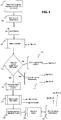
- the polyfunctional amine latex crosslinker compositions are selected from at least one compound from the group consisting of Formulae (I-x) and/or (I-x-a to-I-x-f) [102], composed of a bi- or tri-glycidyl moiety [104] and amine(s) [106].
- the one-step (I-x) products can be used with no further treatment.
- Polyfunctional amine (I-x) products [108] containing an -NH or -NH 2 moiety [110] can be further treated to form final two-step process products [124] or be used without further treatment as a final _-NH or -NH 2 containing one-step product [116].
- Polyfunctional amine (I-x) products [108] without an-NH or -NH2 moiety [110] can only be used as a final one-step product [118].
- I-x-ene intermediate structure [114] (represented as I-x-ene), but can be prepared from any of the I-x and/or I-x-a to I-x-f structures [102] shown that include either the -NH or -NH 2 moieties [110].
- the I-x-ene intermediate structure [114] is prepared so that one can add MAA and ACR (or derivatives thereof) [120] to increase molecular weight.
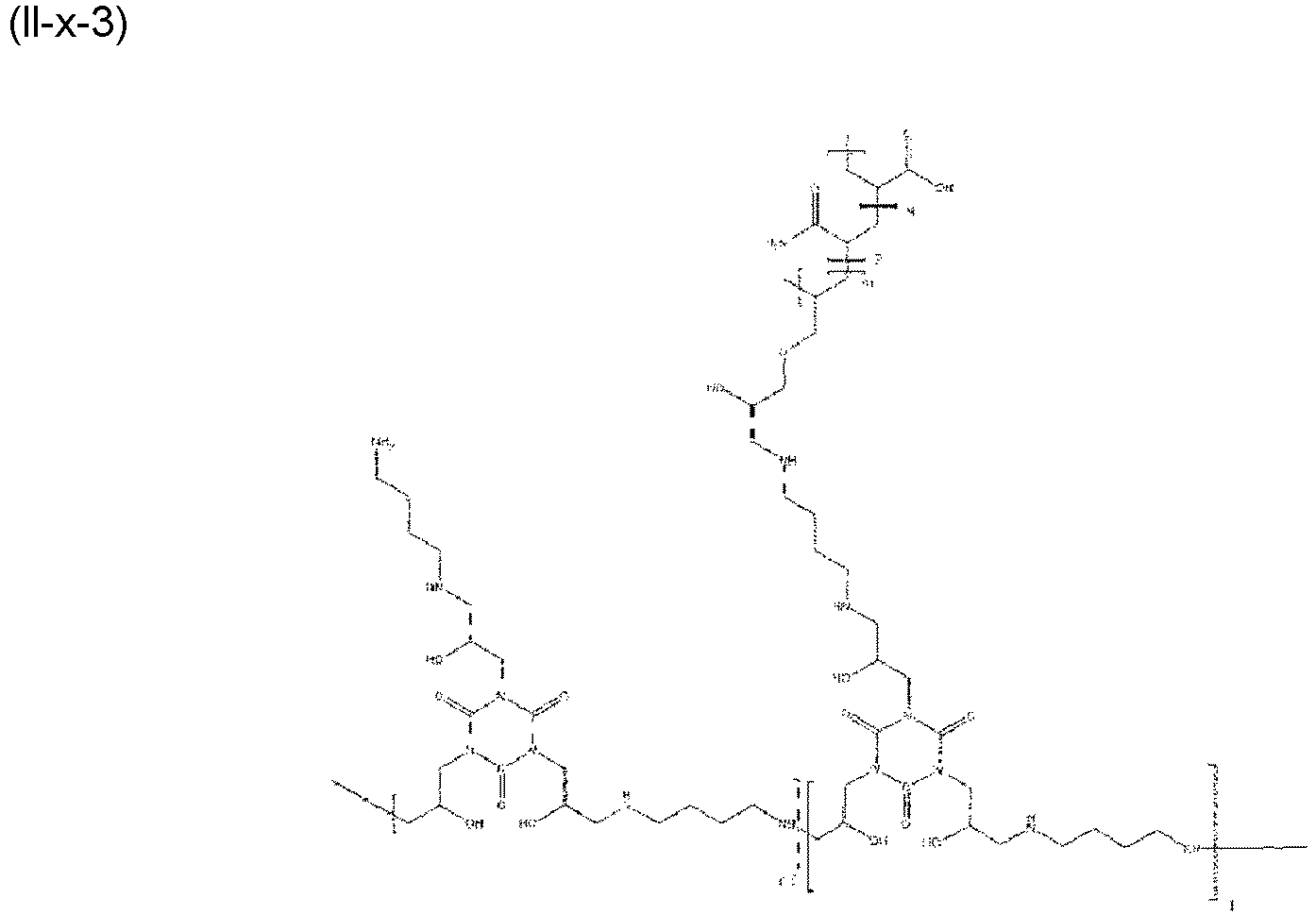
- a two-step process which forms the crosslinker structural compounds II-x-1 and II-x-3 requires the formation of the one step products (I-x-1 or I-x-3) that include -NH or - NH 2 moieties (side groups) [110] and the addition of AGE (or other glycidyl alkenyl compounds) [112] resulting in the intermediate I-x-ene product [114].
- This I-x-ene product [114] is followed by the addition of acrylamide and MAA or (derivatives of either) [120] to provide the (II-x) products [122] which are examples of final two-step process products [124].
- the structural features of each of these compounds are provided below;
- polyfunctional amine latex crosslinker compositions can also be an intermediate formed prior to the polymerization prepared with the addition of allyl glycidyl ether (AGE) comprising formula (I-x-1);
- AGE allyl glycidyl ether
- polyfunctional amine latex crosslinker intermediate composition when reacted with both methyl acrylic acid (MAA) and acrylamide (ACR) results in polymers of structures (II-x-1) and (II-x-3).
- the structures (II-x-1) and (II-x-3) can also result in producing polymeric structures with molecular weights higher than those of the oligomers of the same compositional structures of (II-x-1) and (II-x-3).
- the paint additionally includes at least one dispersant, defoamer, surfactant, biocide, ammonia, rheology agent, pigment, solvent, coalescent, and water.
- the paint can be used as traffic paint for a pavement surface. Additionally, when the paint formulation is applied to pavement surfaces crosslinking of the paint occurs and early water resistance at 15-45 minutes can occur.
- the present invention provides polyfunctional amine crosslinkers for use in latex polymer compositions and the latex polymer compositions containing them.
- the latex polymer compositions of the present invention typically include, but are not limited to, latexes, dispersions, microemulsions, or suspensions.
- the latex polymer compositions of the present invention may be stored at room temperature or moderately above room temperature (e.g., about 50 to 60°C) and provide adhesion and crosslinking upon film formation when applied to a substrate.
- a film or coating formed with polymers of the present invention may be cured at room temperature (ambient cure) or at elevated temperatures (thermal cure).
- the latex polymer binders used to prepare the waterborne polymer composition of the present disclosure are generally prepared as particles.
- the particles may be structured or unstructured. Structured particles include, but are not limited to, core/shell particles and gradient particles.
- the average polymer particle size may range from about 100 to about 300 nm.
- the polymer particles have a spherical shape.
- the spherical polymeric particle may have a core portion and a shell portion.
- the core/shell polymer particles may also be prepared in a multi-lobe form, a peanut shell, an acorn form, or a raspberry form. It is further preferred in such particles that the core portion comprises about 20 to about 80 of the total weight of said particle and the shell portion comprises about 80 to about 20 of the total weight volume of the particle.
- the present disclosure includes compositions and methods for the preparation of water soluble polymeric and oligomeric polyfunctional amines for use as crosslinking agents in solutions of fast drying latex emulsions.
- the oligomeric/polymeric polyfunctional amine synthesized in a single step reaction by reacting bi- or tri- functional glycidyl and/or glycidyl isocyanurate groups with water soluble bi-, tri- and tetra-amines as the starting materials (reactants) serve as crosslinkers for latex paints.
- Oligomeric/polymeric polyfunctional amines with lower molecular weight can be prepared from the same chemistry and the resulted product can be combined with glycidyl alkenyl compounds, allyl glycidyl ethers (AGE) is most favorable, in a two-step reaction process to form additional oligomers which are capable of molecular weight building via free radical initiated polymerization.
- AGE allyl glycidyl ethers
- the definition of whether the chemical structure is an oligomer or polymer depends on the final weight average molecular weight (as determined primarily by the number and molecular weight) of the repeating structural monomeric chains.
- the fast drying and proper curing due to crosslinking of the latex emulsion is triggered by rapid evaporation of NH 3 in the paint formulation concurrent with a rise in the pH of the emulsion during and after being applied to the intended surface.
- the interaction of the latex binder together with the crosslinking polyfunctional amine (primarily) oligomers results in fast dry traffic latex polymers (as paint or coatings) which harden quickly.
- These polymeric/oligomeric amines provide for excellent water (especially rain water) resistant films due in part due to their rapid cure times.
- the waterborne fast dry paint serves as road and pavement marking paint which can be used to mark lines or symbols on roads, parking lots, and walkways etc.
- the polyfunctional oligomeric amines possess structural chain extending groups that allow for tailoring the molecular weight of the crosslinker. More specifically, the polyfunctional oligomeric/polymeric amine examples of this disclosure are comprised of di or tri glycidyl monomers, or combination of di/di, di/tri, or tri/tri glycidyl monomers and either of bi, tri or tetra amino monomers, and combination of bi/bi, bi/tri, bi/tetra, mono/bi, mono/tri, mono/tetra, bi/tetra, tri/tetra functional amino monomers.
- the synthesis of the final crosslinker can be completed as a one-step or two-step process.
- the one-step process provides novel crosslinkers resulting from glycidyl monomer/glycidyl monomers and amino monomer/amino monomers.
- the two-step process provides the crosslinkers of the one-step process that have been further reacted with AGE and polymerized or copolymerized with methacrylic acid (MAA) and an acrylamide, forming complex structures with pendant polyfunctional polymeric/oligomeric amine groups
- Triglycidyl isocyanurate is the only trifunctional glycidyl monomer used in this disclosure.
- Diglycidyl monomers include: poly(propylene glycol) diglycidyl ether, poly(ethylene glycol) diglycidyl ether, resorcinol glycidyl ether, neopentyl diglycidyl ether, and butanediol diglycidyl ether.
- the glycidyl monomer(s) employed in the disclosure can be single or in combination.
- Amine monomers employed in this work can be bi-, tri- or tetra- monomers or combinations of mono/bi, mono/tri, mono/tetra, bi/bi, bi/tri, bi/tetra, tri/tri, tri/tetra and tetra/tetra functional monomers.
- the number of functionalities is defined by the number of N-H bonds.
- a full list of mono-functional amine monomers include: dimethyl amine, diethyl amine, diethanol amine, dipropyl amine, pyrrolidine, piperidine, 1-methyl piperazine, N,N,N-trimethyl-1,2-ethane diamine, N,N,N, triethyl-1,2-ethane diamine, N-methyl-N,N-diethyl-1,2-ethane diamine, N-ethyl-N,N-dimethyl-1,2-ethane diamine, N-methyl-N,N-diethyl-1,3-propane diamine, and N-ethyl-N,N-dimethyl-1,3-propane diamine,
- a full list of bi-functional amine monomers includes: methyl amine, ethyl amine, 1-propyl amine, ethanol amine, 2-propyl amine, 1-butyl amine, 2-butyl amine, 2-methyl-2-propyl amine, piperazine, N,N-dimethyl-ethyl diamine, N,N-diethyl-ethyl diamine, N,N-dimethyl propyl diamine, N,N-diethyl-propyl diamine, N,N-dimethyl amino propylene amine, N,N-dimethyl ethylene amine, N,N-diethyl amino propylene amine, and N,N-diethylamino ethylene amine.
- a full list of tri-functional amine monomers includes: amino ethyl-piperazine, N-methyl-1,2-ethane diamine, N-ethyl-1,2-ethane diamine, N-methyl-1,3-propane diamine, and N-ethyl-1,3-propane diamine.
- a full list of tetra-functional amine monomers includes: 1,2-diamine ethane, 1,3-diamino propane, 1,4-diamino butane, cadaverine, cystamine, 1,6-diamino hexane, 1,2-diamine benzene, 1,3-diamino benzene, 1,4-diamino benzene, 1,4-diamino butanol, 4,4-diamino-3-hydroxy butanoic acid, 5-amino-1,3,3-trimethylcyclohexanemethylamine,2,2'-oxybis ethanamine, alanine, and lysine.
- a full list of glycidyl alkenyl compounds includes: allyl glycidyl ether, vinyl glycidyl ether, vinyl cyclohexene oxide, glycidyl methacrylate, glycidyl acrylate, glycidyl acrylamide, glycidyl methacrylamide.
- a first aspect of the present disclosure concerns polyfunctional amine crosslinkers comprising recurring units derived from the reaction of one tri-glycidyl moiety and a single di-, or tri-functional amino monomers, or combination of mono/bi, mono/tri, mono/tetra, bi/bi, bi/tri, bi/tetra, tri/tri, tri/tetra and tetra/tetra functional amino monomers resulting in a polyfunctional amine of formula (I-x):
- substituent J is the result of a ring-opening reaction during nucleophilic substitution of a bi- or tri-glycidyl moiety; and wherein R1 is selected from the group consisting of all possible mono-functional, bi-functional, tri-functional or tetra-functional amines, as provided above; and wherein R2 is selected from the group of all possible bi-functional, tri-functional or tetra-functional amines; and where R1 is equal to or different than R2; and where n is an number 10 to 100.
- substitiuents J, J1, and J2 are the result of a ring-opening reaction during nucleophilic substitution of a bi- or tri-glycidyl moiety, and wherein J is equal to or different than J1 and J2; and wherein J1 is equal to or different than J2; and wherein R1 is selected from the group consisting of all possible mono-functional, bi-functional, tri-functional or tetra-functional amines; and wherein R2 and R3 are selected from group consisting of all possible bi-functional, tri-functional or tetra-functional amines and wherein R1 is equal to or different than R2 and R3; and wherein R2 is equal to or different than R3; and wherein in formula (I-x-a) R is R2 and where n is an number 10 to 100; and where m is an number equal to or different than n.
- the combination can be mono/bi, mono/tri, mono/tetra or bi/bi, bi/tri, bi/tetra, tri/tri, tri/tetra and tetra/tetra for tri-glycidyl monomer, and can be bi/bi, bi/tri, bi/tetra, tri/tri, tri/tetra and tetra/tetra for bi-glycidyl monomer. Combinations of mono/mono will not provide the required moieties for the present disclosure.
- Oligomeric one step polyfunctional amines prepared from the reaction between tri-glycidyl monomer and a bi, a, tri-, and a tetra functional amine, or combinations of bi/bi, bi/tri, bi/tetra, tri/tri, tri/tetra and tetra/tetra amines, or between bi glycidyl monomer and a tri or tetra amine, or combinations of bi/tri, bi/tetra, tri/tri, tri/tetra or tetra/tetra amines carry-NH or- NH 2 groups.
- a further aspect of the present disclosure include treatment of the obtained oligomeric with glycidyl alkenyl compounds to prepare alkenyl functional oligomeric polyamine (I-x-ene), and copolymerization of I-x-ene with other water soluble alkenyl monomers lead to two-step polyfunctional amine with increased molecular weight, generalized by formula (II-x).
- R1 and R2 are selected from the group consisting of a full list of bi, tri or tetra functional amines, or combination of bi/bi, bi/tri, bi/tetra, tri/tri, tri/tetra and tetra/tetra amines for triglycidyl monomer, and are selected from the group consisting of a full list of tri or tetra functional amines, or combination of bi/tri, bi/tetra, tri/tri, tri/tetra and tetra/tetra amines for diglycidyl monomers; and wherein proton loss of R1 in its -NH or -NH 2 site results in Rl'; and wherein R4 is the connecting group between polyamine body and the alkene functionality.
- the connecting group is - CH 2 CH(OH)CH 2 O-.
- Variations in R4 may be created from each different connecting glycidyl alkenyl compound.
- the connecting glycidyl alkenyl compound can be selected from one of the following: allyl glycidyl ether, vinyl glycidyl ether, vinyl cyclohexene oxide, glycidyl methacrylate, glycidyl acrylate, glycidyl acrylamide, and glycidyl methacrylamide.
- An extension list for water soluble alkenyl co-monomer includes: acrylamide, methacrylamide vinyl acetate, acrylic acid, methacrylic acid, ethacrylic acid, maleic acid, fumaric acid, styrene sulfonic acid, methyl acrylate, methyl methacrylate, ethyl acrylate, 2-acrylamido-2-methylpropane sulfonic acid, N-isopropylacrylamide, hydroxyethyl methacrylate, N,N-dimethylaminoethyl methacrylate, N,N-dimethylpropyl methacrylate, N,N-dimethylbutyl methacrylate, aminoethyl methacrylate.
- the anionically stabilized latex binders used to provide the crosslinkable polymer latexes of the present disclosure are primarily formed by the reaction of three separate acrylic (styrene free) monomers - butyl acrylate (BA), methyl methacrylate (MMA) and methacrylic acid (MAA). Preparation of the latex binders were performed as discussed in the appropriate section on preparation of crosslinkable polymer latexes below.
- the full, final, shelf-stable aqueous polymer latex coating composition comprises anionically stabilized latex binders derived from the seed of Table 1 (shown below in the Method of Making Crosslinkable Latex Polymers Section below), exhibiting a glass transition temperature (Tg) of 20 to 40° C.; more preferably, 25 to 30° C, and most preferably 25 to 27° C.
- Tg glass transition temperature
- the ammonium hydroxide is added in an amount that effectively raises the pH of the aqueous composition immediately after the latex is prepared.
- the pH of the final latex composition reaches a range of 9.5 to 10.5
- the addition of the polyfunctional oligomeric/polymeric amine crosslinker occurs, therefore preventing the trigger of the crosslinking activity with the final latex paint formulation during storage.
- the final latex polymer emulsion composition of the present disclosure comprises;
- the present disclosure describes a high build, fast drying, and fast hardening aqueous coating composition
- aqueous coating composition comprising: (a) an anionically stabilized polymer latex binder comprising: (i) 35 to 65% by weight, based on the latex binder weight,; (ii) 25 to 55% by weight, based on the latex binder weight,; and (iii) 0.5 to 15% by weight, based on the latex binder weight, r; (iv) 0.1% to 4% by weight, based on the latex binder weight, of at least one anionic surfactant; and the use of (v) 0.5 and 1.5% polyfunctional amine crosslinker, wherein the latex binder has a glass transition temperature less than 45 degrees Centigrade, when the latex binder has been applied to the appropriate surface and has an average particle diameter size of between 100 nanometers and 300 nanometers.
- Formation of the water soluble polyfunctional amines is accomplished by the nucleophilic substitution ring opening reaction between glycidyl monomers and amino monomers.
- composition of the bi- and/or tri-glycidyl monomers can include each of the following reactants and subsequent moieties; triglycidyl isocyanurate (TGIC), poly(propylene glycol) diglycidyl ether, poly(ethylene glycol) diglycidyl ether, resorcinol glycidyl ether, neopentyl diglycidyl ether, butanediol diglycidyl ether.
- TGIC triglycidyl isocyanurate
- poly(propylene glycol) diglycidyl ether poly(ethylene glycol) diglycidyl ether
- resorcinol glycidyl ether poly(ethylene glycol) diglycidyl ether
- neopentyl diglycidyl ether butanediol diglycidyl ether
- Both the molecular weight and the molecular structure of the polyfunctional oligomeric amines are controlled by the stoichiometric ratio of the total amount of glycidyl groups to that of the amino functional groups. This is also the ratio of each amine among amine combinations, and the ratio of each glycidyl monomer among combinations of glycidyl monomers.
- mono-functional, bi-functional, tri-functional and tetra-functional amines or combinations of these may be used for the preparations shown. A complete listing of possible amines has been presented above.
- a proper stoichiometric ratio between amine functional monomers and epoxy functional monomers needs to be controlled.
- the ratio of glycidyl compounds to di-amine compounds is n: (2n+1).
- the ratio of glycidyl to mono to di-amine compounds is n: (n+1): n.
- the ratio of glycidyl to diamine compounds is n: (2n+1).
- kinetic factors also play a role in the reactions between trifunctional glycidyl monomers and tetra functional amines when attempting to ensure full water solubility of these compounds.
- polyfunctional amine structures Polymerization between glycidyl monomers and amine monomers gives rise to polyfunctional amine structures.
- functional groups for building molecular weight associated with these polyfunctional amines.
- the amino groups in the polyfunctional amine can themselves be categorized as two separate groups.
- the structural amine and/or amino groups which can be secondary or tertiary, stem from the glycidyl ring opening reaction resulting from the monomeric amine in a nucleophilic substitution reaction.
- the functional amine groups allow for ionic interaction between the latex binder particles and the polyfunctional amine crosslinkers.
- Structural amino groups are sterically hindered and always exhibit decreased pKb compared to what they would normally exhibit in their simple monomeric state.
- the present disclosure involves the use of crosslinkers for final latex polymer compositions containing at least one polyfunctional amine primarily acting as a physical interaction component for ionic bonding.
- the structural components may also act as interactive components if the structure of the polyfunctional amine is strictly linear. Examples of the resulting polyfunctional amines of the present disclosure are schematically represented below;
- a general method for achieving the reaction leading to the oligomeric polyfunctional amine as represented above is as follows;
- a solution of piperazine is charged to a 2 liter reactor and an appropriate amount of rinsing water is used to ensure that no residual remains. This solution is heated to 40 C.
- TGIC is added and rinsing water is used to ensure full completion.
- the TGIC as a white powder, is dissolved gradually into the piperazine solution at a temperature range of between 10 and 100 C and most preferably at or above 40 C. The reaction temperature was maintained at 39 C for another hour. AGE was added to the reactor in one portion and at one time. The reaction was allowed to remain at room temperature for another 20 minutes.
- reaction 1 More specifically, for the synthesis of the structure of oligomer (I-x-1), the following reaction (Reaction 1) was performed; (A)+ (B) ⁇ (I-x-1), where (A) is triglycidyl isocyanurate (TGIC)
- a solution of 12.2 g piperazine in 200.0 g water was added to a 1 liter reactor. 42.6 g water was used to rinse the addition funnel and the beaker to ensure full addition.
- the aqueous solution was heated to 40 C, and 20.0 g of TGIC was poured in one portion into this reactor. Some TGIC remains attached to the addition funnel and the beaker charging it, therefore 107.7 g water was added to rinse the funnel and the beaker to ensure full addition.
- An exothermic reaction occurred over the next 5-10 minutes to raise the temperature to 47 C. The reaction was allowed continue for 160 minutes, resulting in a clear solution that was later released from the reactor without further treatment.
- the addition of the monofunctional allyl glycidyl ethers (AGEs) is in a molar amount that is always 1/n of that of the TGIC amount used in this preparation.
- Monofunctional allyl glycidyl ethers (AGEs) are also considered a member of the glycidyl reactive (functional) monomer groups that as the molecule introduces a site for orthogonal polymerization in the second step, as used for molecular weight expansion.
- Use of the AGEs allows for introducing an ⁇ , ⁇ unsaturated ethylene to the resulting oligomeric polyamine.
- This product is then available for a subsequent reaction with methyl acrylic acid (MAA), acrylamide (ACR), and an initiator (normally APS - ammonium persulfate) that is schematically depicted below, leading to free radical polymerization which provides a water soluble copolymer with a chain length of between 50,000 and 500,000 Dalton.
- MAA methyl acrylic acid
- ACR acrylamide
- initiator normally APS - ammonium persulfate
- This copolymer structure (II-x-1) shown above is representative of one of a group of polyfunctional polymeric amines which possess the necessary cationic charge and molecular weight so that when placed in solution with the latex binder allows for providing a final aqueous based crosslinked polymer latex coating that forms proper films is quick drying and exhibits increased wash-off.
- the following copolymer structures are also possible.
- the pH of the solution (adjusted by adding ammonium hydroxide) should be at least 9.6 and preferably no greater than 10.5.
- This solution is a volatile basic solution in that the water and ammonium hydroxide will rapidly evaporate when the solution is applied to a substrate in the open atmosphere. After application, ammonia (as the volatile base) evaporates quickly from the paint film and the polyamine becomes protonated gradually. With water loss, the interaction between anionic latex particle and cationic polyamine is activated causing clustering of the latex particles which results in fast film formation.
- the volatile base specifically ammonium hydroxide, prevents a crosslinking of the polyfunctional co-polymeric amines with the latex binder to take place prior to substrate application.
- the ammonium hydroxide addition provides at least two functions - it stabilizes the polyfunctional amine copolymer crosslinkers and helps to neutralize the anionic (negative) surface charge of the latex binder. As the ammonia leaves due to volatility, it triggers electrostatic interaction between the anionically charged latex binder and the cationic polyfunctional amines.
- the polymer latex formulae of the present disclosure have been modified to meet the storage and fast drying film requirements described above where interaction between polyfunctional amine crosslinker and latex binder provides rapid crosslinking when applied to surfaces.
- the anionically stabilized fast dry latex formulae have been prepared from semi-continuous process, which allows better control of the particle size and zeta potential.
- the latex polymer compositions of the present invention exhibit latent crosslinking properties.
- the rate of crosslinking is controlled by stabilizing the polyfunctional amines using the volatile (ammonium hydroxide) base.
- amine and amino groups include, but are not limited to: dimethyl amine, diethyl amine, diethanol amine, dipropyl amine, pyrrolidine, piperidine, 1-methyl piperazine, N,N,N-trimethyl-1,2-ethane diamine, N,N,N, triethyl-1,2-ethane diamine, N-methyl-N,N-diethyl-1,2-ethane diamine, N-ethyl-N,N-dimethyl-1,2-ethane diamine, N-methyl-N,N-diethyl-1,3-propane diamine, N-ethyl-N,N-dimethyl-1,3-propane diamine, methyl amine, ethyl amine, 1-propyl amine, ethanol amine, 2-propyl amine, 1-butyl amine, 2-butyl amine, 2-butyl
- Bi- and/or tri- glycidyl monomers can include each of the following reactants and subsequent moieties; triglycidyl isocyanurate (TGIC), poly(propylene glycol) diglycidyl ether, poly(ethylene glycol) diglycidyl ether, resorcinol glycidyl ether, neopentyl diglycidyl ether, and butanediol diglycidyl ether.
- TGIC triglycidyl isocyanurate
- poly(propylene glycol) diglycidyl ether poly(ethylene glycol) diglycidyl ether
- resorcinol glycidyl ether poly(ethylene glycol) diglycidyl ether
- neopentyl diglycidyl ether neopentyl diglycidyl ether
- butanediol diglycidyl ether butanediol diglycidy
- Both the molecular weight and the molecular structure of the polyfunctional oligomeric amines are controlled by the stoichiometric ratio of total glycidyl reactive groups to amino functional groups, the ratio of each amine among amine combinations, and the ratio of each glycidyl monomer among combinations of glycidyl monomers.
- the monofunctional amines include the following ones: dimethyl amine, diethyl amine, diethanol amine, dipropyl amine, pyrrolidine, piperidine, 1-methyl piperazine, N,N,N-trimethyl-1,2-ethane diamine, N,N,N, triethyl-1,2-ethane diamine, N-methyl-N,N-diethyl-1,2-ethane diamine, N-ethyl-N,N-dimethyl-1,2-ethane diamine, N-methyl-N,N-diethyl-1,3-propane diamine, N-ethyl-N,N-dimethyl-1,3-propane diamine, N-ethyl-N,N-dimethyl-1,3-propane diamine, N-ethyl-N,N-dimethyl-1,3-propane diamine, N-ethyl-N,N-dimethyl-1,3-propane diamine,
- the trifunctional amines include the following ones: amino ethyl-piperazine, N-methyl-1,2-ethane diamine, N-ethyl-1,2-ethane diamine, N-methyl-1,3-propane diamine, N-ethyl-1,3-propane diamine.
- the tetra functional amine include these ones: 1,2-diamine ethane, 1,3-diamino propane, 1,4-diamino butane, cadaverine, cystamine, 1,6-diamino hexane, 1,2-diamine benzene, 1,3-diamino benzene, 1,4-diamino benzene, 1,4-diamino butanol, 4,4-diamino-3-hydroxy butanoic acid, 5-amino-1,3,3-trimethylcyclohexanemethylamine,2,2'-oxybis ethanamine, alanine, and lysine.
- a combination of amines can be used.
- the combination can be mono/bi, mono/tetra, mono/tri, bi/bi, bi/tri, bi/tetra, tri/tri, tri/tetra, tetra/tetra for tri-functional glycidyl monomers, such as TGIC; the combination can be mono/tri, mono/tetra, bi/bi, bi/tri, bi/tetra, tri/tri, tri/tetra and tetra/tetra for bi-functional glycidyl monomers.
- the combination of mono/mono does not provide the necessary crosslinker formulations for the present disclosure.
- the latex polymer compositions of the present invention may vary in properties, depending on the end-use application.
- the polymer component may have glass transition temperature (Tg) of 15 to 40°C and more preferably 20 to 30°C.
- the weight average molecular weight of the latex polymer compositions may vary from about 5,000 to 5,000,000 Daltons; more preferably from 20,000 to 2,000,000 and most preferably from 40,000 to 100,000. Since the polymers of the present invention become highly crosslinked upon drying, there is no substantial disadvantage to starting with very low molecular weight polymers.
- a waterborne polymer composition may be prepared using the latex polymer composition of the present invention along with other known additives and may use other emulsion polymerization methodologies.
- Table 1 provides the constituents of the example of one of the procedures used that follows: A 2 liter reactor was charged 210.9 g SDS solution (14% of the total solution), 4.6 g NaHCO 3 503.3 g water, 158.0 g BA, 189.5 g MMA, 6.8 g MAA and 16.2 g APS. The solution was mechanically stirred and heated to 65 C. Radical polymerization occurred immediately to raise the temperature quickly. The exotherm was controlled using 410.1 g water which was added gradually over a period of four minutes. The seed solution was allowed to react for another 130 minutes to ensure the reaction proceeds to completion. The latex particle size obtained was determined to be 51 nm. Table 1: Constituents of Typical Latex Seed for Polymerization and Eventual Crosslinking BA 315.9 MMA 379 MAA 13.5 NaHCO3 0.8 SDS solution (14%) 81.92 IGEPAL CA 407 10.2 Water 270
- Latexes or other waterborne compositions contain small particle size seed polymers, those ranging from about 25 to about 700 nm, preferably from about 50 to about 500 nm and more preferably from about 75 to about 300 nm, represent one embodiment of the invention.
- Table 2 summarizes the contents of the described procedure and resulting latex paint solutions; Table 2: Constituents of Two Latex Paints with and without Crosslinkers: Example 1 and Comparative Example 1 Components of Latex Example 1 Comparative example 1 Latex 460.0 460.0 Crosslinker --- 30.0 Dispersant (226/35) 8.0 8.0 Defoamer ( L-475) 5.0 5.0 Surfactant (CA-407) 3.0 3.0 Biocide (Proxel GXL) 0.2 0.2 Ammonia 0.8 0.8 Rheology agent (Natrosol 250 HBR) 0.4 0.4 Water 30.0 5.0 Pigment TiO2 150.0 150.0 Pigment Extenders 710.0 710.0 Solvent (Methanol) 30.0 30.0 Coalescent (Texanol) 20.0 20.0 20.0
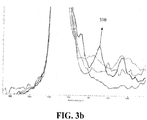
- Figure 3a provides a complete visual comparison utilizing the full FTIR spectrum [300] from a standard FTIR analyzer, the Thermo Nicolet 380 for four different latex paint compositions. Three of these compositions are commercially available and the fourth represents a paint utilizing the polyfunctional amines of the present disclosure.
- Figure 3b dashed range and enlarged
- Resistance minimum film forming temperature is determined by casting a wet latex film with a 1-mil applicator cube on an MFFT bar set at a temperature range in which the film will coalesce during drying, pulling the edge of a brass spatula blade through the film from cold to hot end on the MFFT bar after 30 minutes, and recording the temperature at which the film offers significant resistance to the spatula.
- the water wash-off procedure generally follows ASTM D7377-08 and is modified by using section 4.6.2 of ASTM D711-10 for controlled air flow. Paint viscosity is determined by measuring Krebs Units (KU) using a paddle type viscometer. Viscosities of 80 to 90 KU are considered suitable for testing.
- KU Krebs Units
- a sample of paint is drawn to 15 mil wet film thickness onto to a clean black scrub test panel and allowed to dry horizontally for 15 to 60 minutes in a conditioned room at 23°C ⁇ 2°C and 50 to 55% relative humidity under a constant 2 mph air flow.
- the samples are placed under a stream of 25°C tap water flowing at a rate of 1.5 gal/min and allowed to remain there for 5 minutes, during which the time of film break through is recorded. After completion of the test, the samples are then removed from the flowing water and observed noting the percentage of wash off.
- an anionic surfactant in the present disclosure, a combination of an anionic surfactant and a non-ionic surfactant is used.
- the anionic surfactant included are provided but not limited to: sodium dodecyl sulfate (SDS), ammonium dodecylsulfate (ADS), disodium salt of ethoxylated lauryl sulfosuccinate and sodium benzyl dodecyl sulfate.
- the nonionic surfactant includes but is not limited to IGEPAL CA-407®, TritonTM X-100 (Dow), TritonTM X-405 (Dow) and E-Sperse® 703 (Ethox).
- the polymers and waterborne polymer compositions of the invention are useful in a variety of coating formulations such as architectural coatings, metal coatings, wood coatings, plastic coatings, textile coatings, cementitious coatings, paper coatings, inks, and adhesives.
- coating formulations adapted for particular uses include, but are not limited to, corrosion inhibitors, concrete coatings, maintenance coatings, latex paints, industrial coatings, automotive coatings, textile backcoatings, surface printing inks and laminating inks.
- the present invention relates to such coating formulations containing a waterborne polymer composition of the invention, preferably a water-based latex.
- the polymers and waterborne polymer compositions of the invention may be incorporated in those coating formulations in the same manner as known polymer latexes and used with the conventional components and or additives of such compositions.
- the coating formulations may be clear or pigmented. With their crosslinking ability, adhesion properties, and resistance properties, the water-based latexes of the invention impart new and/or improved properties to the various coating formulations.
- a coating formulation containing a latex polymer or waterborne polymer composition of the invention may then be applied to a variety of surfaces, substrates, or articles, e.g., paper, plastic, steel, aluminum, wood, gypsum board, concrete, brick, masonry, or galvanized sheeting (either primed or unprimed).
- the type of surface, substrate, or article to be coated generally determines the type of coating formulation used.
- the coating formulation may be applied using means known in the art.
- a coating formulation may be applied by spraying or by coating a substrate.
- the coating may be dried by heating but preferably is allowed to air dry.
- a coating employing a polymer of the invention may be thermally or ambiently cured.
- the present invention relates to a shaped or formed article which has been coated with coating formulations of the present invention.
- a waterborne polymer composition according to the invention may further comprise water, along with a solvent, a pigment (organic or inorganic) and/or other additives and fillers known in the art, and enumerated below. When a solvent is used, water-miscible solvents are preferred.
- a latex paint composition of the invention may comprise a waterborne polymer composition of the invention, a pigment and one or more additives or fillers used in latex paints.
- Additives or fillers used in formulating coatings include, but are not limited to, leveling, rheology, and flow control agents such as silicones, fluorocarbons, urethanes, or cellulosics; extenders; curing agents such as multifunctional isocyanates, multifunctional carbonates, multifunctional epoxides, or multifunctional acrylates; reactive coalescing aids such as those described in U.S. Pat. No.
- a polymer or waterborne polymer composition of the present invention can be utilized alone or in conjunction with other conventional waterborne polymers.
- Such polymers include, but are not limited to, water dispersible polymers such as consisting of polyesters, polyesteramides, cellulose esters, alkyds, polyurethanes, epoxy resins, polyamides, acrylics, vinyl polymers, polymers having pendant allyl groups such as described in U.S. Pat. No. 5,539,073 , styrene-butadiene polymers, vinyl-acetate-ethylene copolymers, and the like.
Landscapes
- Chemical & Material Sciences (AREA)
- Organic Chemistry (AREA)
- Chemical Kinetics & Catalysis (AREA)
- Engineering & Computer Science (AREA)
- Life Sciences & Earth Sciences (AREA)
- Wood Science & Technology (AREA)
- Materials Engineering (AREA)
- Polymers & Plastics (AREA)
- Medicinal Chemistry (AREA)
- Health & Medical Sciences (AREA)
- Dispersion Chemistry (AREA)
- General Chemical & Material Sciences (AREA)
- Structural Engineering (AREA)
- Architecture (AREA)
- Civil Engineering (AREA)
- Plant Pathology (AREA)
- Paints Or Removers (AREA)
- Polyamides (AREA)
- Organic Low-Molecular-Weight Compounds And Preparation Thereof (AREA)
- Processes Of Treating Macromolecular Substances (AREA)
- Epoxy Resins (AREA)
Claims (14)
- Amine polyfonctionnelle comprenant des motifs récurrents dérivés de la réaction d'une fraction bi- ou tri-glycidylique et d'un ou plusieurs monomères aminés simples, di- ou tri-fonctionnels, ou d'une combinaison de monomères aminés mono/bi, mono/tri, mono/tétra, bi/bi, bi/tri, bi/tétra, tri/tri, tri/tétra et tétra/tétra fonctionnels, donnant lieu à une ou plusieurs amines polyfonctionnelles de formules (I-x) à (I-x-f) : (I-x)


 dans lesquelles formules les substituants J, J1 et J2 sont le résultat d'une réaction d'ouverture de cycle pendant la substitution nucléophile d'une fraction bi- ou tri-glycidylique,J est égal à ou différent de J1 et de J2,et J1 est égal à ou différent de J2 ;où R1 est sélectionné dans le groupe constitué de : diméthylamine, diéthylamine, diéthanolamine, dipropylamine, pyrrolidine, pipéridine, 1-méthyl-5-pipérazine, N,N,N-triméthyl-1,2-éthanediamine, N,N, N, triéthyl-1,2-éthane diamine, N-méthyl-N,N-diéthyl-1,2-éthane diamine, N-éthyl-N,N-diméthyl-1,2-éthane diamine, N-méthyl-N,N-diéthyl-1,3-propane diamine, N-éthyl-N,N-diméthyl-1,3-propane diamine, méthylamine, éthylamine, 1-propylamine, éthanolamine, 2-propylamine, 1-butylamine, 2-butylamine, 2-méthyl-2-propylamine, pipérazine, N,N-diméthyl-éthyl diamine, N,N-diéthyl-éthyl diamine, N,N-diméthyl propyl diamine, N,N-diéthyl-propyl diamine, N,N-diméthyl amino propylène amine, N,N-diméthyl éthylène amine, N,N-diéthyl amino propylène amine, N,N-diéthylamino éthylène amine, amino éthyl pipérazine, N-méthyl-1,2-éthane diamine, N-éthyl-1,2-éthane diamine, N-méthyl-1,3-propane diamine, N-éthyl-1,3-propane diamine, 1,2-diamine éthane, 1, 3-diamino propane, 1,4-diamino butane, cadavérine, cystamine, 1,6-diamino hexane, 1,2-diamine benzène, 1,3-diamino benzène, 1,4-diamino benzène, 1,4-diamino butanol, acide 4,4-diamino-3-hydroxy butanoïque, 5-amino-1,3,3-triméthylcyclohexaneméthylamine, 2,2'-oxybis éthanamine, alanine et lysine ;dans lesquelles formules R2 et R3 sont sélectionnés dans les groupes constitués de la méthylamine, de l'éthylamine, de la 1-propylamine, de l'éthanolamine, de la 2-propylamine, de la 1-butylamine, de la 2-butylamine, de la 2-lycméthyl-2-propylamine, de la pipérazine, de la N,N-diméthyl-éthyldiamine, de la N,N-diéthyl-éthyl diamine, de la N,N-diméthyl propyl diamine, de la N,N-diéthyl-propyl diamine, N,N-diméthyl amino propylène amine, de la N,N-diméthyl éthylène amine, de la N,N-diéthyl amino propylène amine, de la N,N-diéthylamino éthylène amine, de l'aminoéthyl-pipérazine, de la N-méthyl-1,2-éthane-diamine, de la N-éthyl-1,2-éthane-diamine, de la N-méthyl-1,3-propanediamine, de la N-éthyl-1,3-propanediamine, de la 1,2-diaminoéthane, de la 1,3-diamino-propane, du 1,4-diamino-butane, de la cadavérine, de la cystamine, du 1,6-diamino hexane, du 1,2-diamine benzène, du 1,3-diamino benzène, du 1,4-diamino benzène, du 1,4-diamino butanol, de l'acide 4,4-diamino-3-hydroxy butanoïque, de la 5-amino-1,3,3-triméthylcyclohexanemethylamine, de la 2,2'-oxybiséthanamine, de l'alanine et de la lysine ;dans lesquelles formules R1 est égal à ou différent de R2 et R3 et R2 est égal à ou différent de R3 ;où n représente un nombre compris entre 10 et 100 ;où m représente un nombre égal à ou différent de n ;dans lesquelles formules l'amine polyfonctionnelle de formule type (l-x) est un agent de réticulation portant des groupes -NH ou -NH2 avec des motifs récurrents, n, configuré pour être traités avec des éthers allyglycidyliques ;et dans lesquelles formules l'amine polyfonctionnelle de l'une quelconque des formules (l-x) à (l-x-f) doit comprendre un groupe -NH ou -NH2 pour une réaction ultérieure avec un composé glycidyl-alcényle qui introduit un groupe alcène, formant ainsi la structure intermédiaire de formule (l-x-ène) ;
- Amine polyfonctionnelle selon la revendication 1, dans laquelle ladite structure intermédiaire de formule (I-x-ène), lorsqu'elle réagit avec l'acide méthacrylique et l'acrylamide, forme des copolymères de formules (II-x) :
 dans laquelle formule R1' est le R1 déprotoné avec perte de protons au niveau de son site NH ou NH2 ;dans laquelle formule R4 est le groupe de liaison entre le corps polyaminé de (II-x) et la fonctionnalité alcène et n-1 est un nombre allant de quatre à dix-neuf ;dans laquelle formule m représente un nombre allant de 1 à 100, o est un nombre allant de 1 à 100, et p est un nombre allant de 1 à 100 ;dans laquelle formule, le motif récurrent R5 résulte de la polymérisation d'un monomère hydrosoluble ayant une double liaison carbone-carbone, C = C ;dans laquelle formule le motif récurrent R6 résulte de la polymérisation d'un monomère hydrosoluble ayant une double liaison carbone-carbone, C = C ;et dans laquelle formule la structure résultante présente une masse atomique supérieure ou égale à 50.000 daltons.
 - Amine polyfonctionnelle selon la revendication 2, dans laquelle, lorsque l'éther allylique de glycidyle est présent pendant la synthèse, ledit groupe de liaison est -CH2CH(OH)CH2O-, et dans laquelle ledit groupe de liaison peut également être un composé glycidylalcényle de liaison qui est sélectionné dans le groupe constitué de : l'éther allylique de glycidyle, l'éther vinylique de glycidyle, l'oxyde de vinylcyclohexène, le méthacrylate de glycidyle, l'acrylate de glycidyle, l'acrylamide de glycidyle et le méthacrylamide de glycidyle.
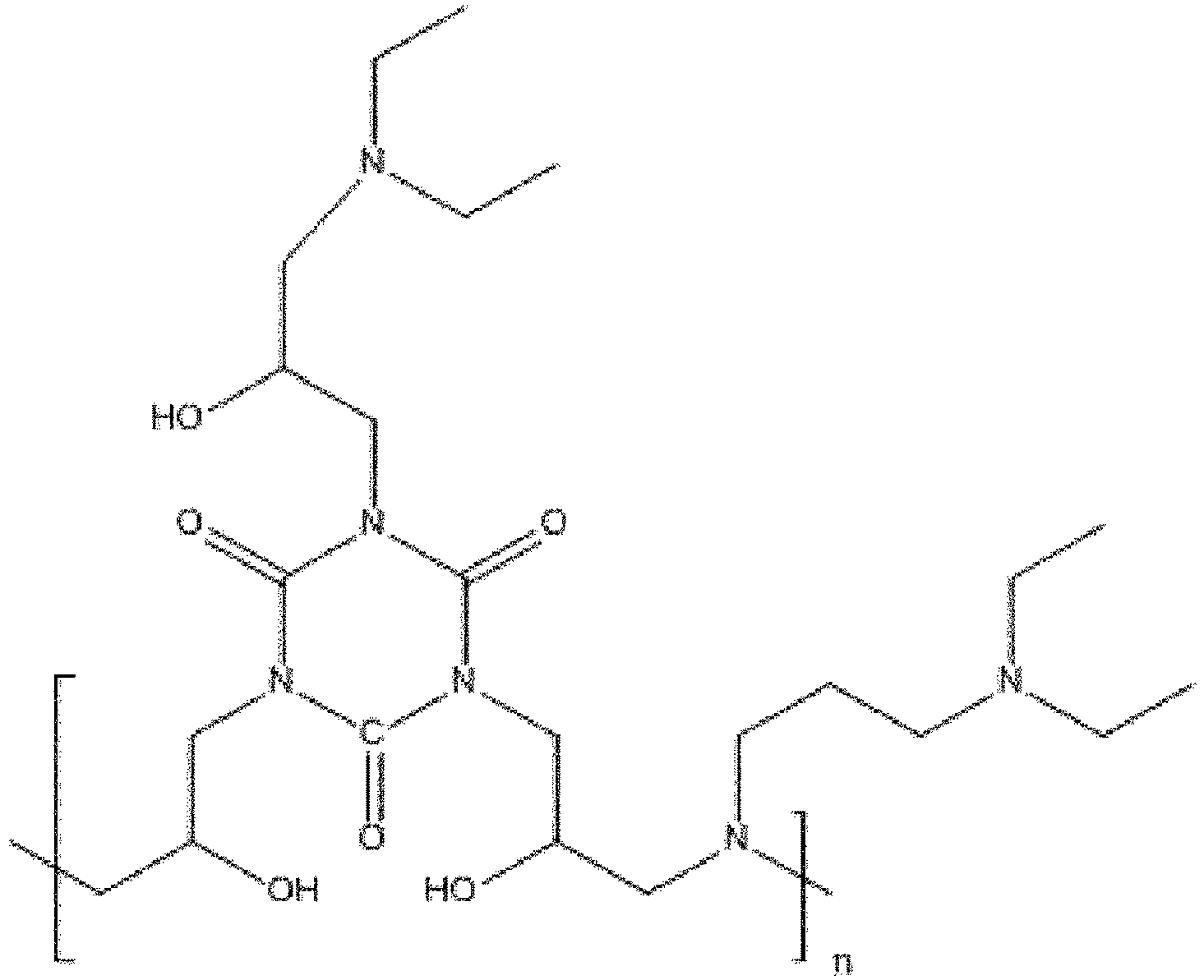
- Amine polyfonctionnelle selon l'une quelconque des revendications précédentes, dans laquelle ladite amine est sélectionnée parmi au moins un composé du groupe constitué de (I-x-1), (I-x-2) et (I-x-3):



- Amine polyfonctionnelle selon l'une quelconque des revendications précédentes, dans laquelle l'intermédiaire (I-x-1-ène) est formé avant la polymérisation préparée avec l'addition d'éther allylique de glycidyle qui aboutit à la formule (I-x-1) :

- Amine polyfonctionnelle selon la revendication 5, dans laquelle la réaction dudit intermédiaire (I-x-1-ène) avec à la fois l'acide méthacrylique et l'acrylamide donne lieu à des structures oligomères (II-x -1) ou (II-x-3) ou des structures modifiées de celles-ci :

- Synthèse de l'amine polyfonctionnelle selon la revendication 6, dans laquelle ledit intermédiaire (I-x-1-ène) est mis à réagir avec une combinaison constituée de mono/bi, mono/tri, mono/tétra ou bi/bi, bi/tri, bi/tétra, tri/tri, tri/tétra et tétra/tétra pour les monomères tri-glycidyliques, et bi/bi, bi/tri, bi/tétra, tri/tri, tri/tétra et tétra/tétra pour les monomères bi-glycidyliques.
- Synthèse de l'amine polyfonctionnelle selon la revendication 6 ou la revendication 7, dans laquelle les rapports entre les monomères glycidyliques et les monomères aminés sont :(i) Ma/Mg = 2n + 1, pour la réaction entre le monomère triglycidylique et des bi, tri et tétra amines simples ou des combinaisons de bi/bi, bi/tri, bi/tétra, tri/tri, tri/tétra et tétra/tétra amines ;(ii) Ma/Mg = 2n + 1, et Mbia/Mg >= 1-1/n, pour la réaction entre le monomère triglycidylique et une combinaison de mono/bi amines ;(iii) Ma/Mg = 2n + 1, et 2Mtria/Mg >= 1-1/n, pour la réaction entre un monomère triglycidylique et une combinaison de mono/tri amines ;(iv) Ma/Mg = 2n+1, et 3Mtétra/Mg >= 1-1/n, pour la réaction entre un monomère triglycidylique et une combinaison de mono/tétra amines ;(v) Ma/Mg = n+1, pour la réaction entre un monomère biglycidylique / une combinaison de monomères biglycidyliques et des bi, tri, tétra amines simples ou des combinaisons de bi/bi, bi/tri, bi/tétra, tri/tri, tri/tétra et tétra/tétra amines ;(vi) Ma/Mg = n+1, et 2Mtria/Mg >= 1-1/n, pour la réaction entre un monomère biglycidylique/une combinaison de monomères biglycidyliques et une combinaison de mono/tri amines ;(vii) Ma/Mg = n+1, et 3Mtetraa/Mg >= 1-1/n, pour la réaction entre le monomère biglycidyle/une combinaison de monomères biglycidyliques et la combinaison de mono/tétra amines ;
dans lesquelles formules Ma représente la quantité molaire d'amine totale utilisée dans ladite réaction, Mg représente la quantité molaire de monomère glycidylique total utilisée dans ladite réaction, Mbia représente la quantité molaire de biamine totale utilisée dans ladite réaction, Mtria représente la quantité molaire de triamine totale utilisée dans ladite réaction et Mtetraa représente la quantité molaire de tétra-amine totale utilisée dans ladite réaction ; et
dans lesquelles formules n est le degré désigné de polymérisation de ladite amine polyfonctionnelle. - Amines polyfonctionnelles selon l'une quelconque des revendications précédentes, dans lesquelles lesdites amines polyfonctionnelles sont des agents de réticulation.
- Amine polyfonctionnelle selon l'une quelconque des revendications précédentes, dans laquelle ladite amine est sélectionnée parmi au moins un composé du groupe constitué des formules (I-x) à (I-x-f) comprenant également des fractions bi- ou tri-glycidyliques et amines supplémentaires,
dans lesquelles formules Ib desdites formules forme des composés structuraux (I-x-1), (I-x-2) et (I-x-3), et
dans lesquelles formules lesdits composés structuraux sont dérivés d'un produit de synthèse en une étape excluant toute liaison C = C et dans lesquelles lesdites amines contenant également une fraction -NH ou -NH2 qui peut soit être configurée pour être traitée afin de former des produits de synthèse finals en deux étapes, soit être utilisée sans autre traitement pour former des produits de synthèse finals contenant une fraction-NH ou -NH2 en une étape. - Formulation de latex comprenant l'amine polyfonctionnelle selon l'une des revendications 1 à 10.
- Formulation de latex selon la revendication 11, dans laquelle lesdites amines sont des agents de réticulation représentés par la formule (I-x) qui, lorsqu'ils portent des groupes-NH ou -NH2 avec des motifs récurrents, n, sont configurés pour être traités avec des composés glycidyl-alcényles, et
dans laquelle l'amine polyfonctionnelle selon l'une quelconque des formules (I-x) à (I-x-f) doit porter un groupe -NH ou -NH2, pour une réaction ultérieure avec un composé glycidyl-alcényle de telle sorte que l'introduction d'un groupe alcène formant la structure intermédiaire de la formule (I-x-ène) puisse se produire ;

- Formulation de latex selon la revendication 11 ou 12, dans laquelle ladite structure intermédiaire de formule (I-x-ène), lorsqu'elle est mise à réagir avec l'acide méthacrylique et l'acrylamide, forme des oligomères ou des copolymères de formule (II-x) :

 dans laquelle formule R1' est le R1 déprotoné avec perte de protons au niveau de son site NH ou NH2 ;dans laquelle formule R4 est le groupe de liaison entre le corps de polyamine et la fonctionnalité alcène ;dans laquelle formule n-1 représente un nombre compris entre quatre et dix-neuf ;dans laquelle formule m représente un nombre compris entre 1 et 100 ;dans laquelle formule o représente un nombre compris entre 1 et 100 ;dans laquelle formule p représente un nombre compris entre 1 et 100 ;dans laquelle formule le motif récurrent R5 résulte de la polymérisation d'un monomère hydrosoluble ayant une double liaison carbone, C = C, qui est de préférence un acide acrylique ou un dérivé d'acide acrylique ;dans laquelle formule le motif récurrent R6 résulte de la polymérisation d'un monomère hydrosoluble ayant une double liaison carbone, carbone, C = C, qui est de préférence l'acrylamide ou un dérivé de l'acrylamide ; etdans laquelle formule la structure résultante est supérieure ou égale à un nombre atomique de 50.000 daltons.
 - Formulation de latex selon l'une quelconque des revendications 11 à 13, dans laquelle lesdites compositions sont sélectionnées parmi au moins un composé du groupe constitué de (I-x-1), (I-x-2) et (I-x-3):


Priority Applications (1)
| Application Number | Priority Date | Filing Date | Title |
|---|---|---|---|
| PL15764165T PL3119829T3 (pl) | 2013-03-15 | 2015-01-20 | Kontrolowane sieciowanie polimerów lateksowych aminami wielofunkcyjnymi |
Applications Claiming Priority (3)
| Application Number | Priority Date | Filing Date | Title |
|---|---|---|---|
| US13/841,888 US11535762B2 (en) | 2012-09-18 | 2013-03-15 | Fast drying aqueous amine free coating composition(s) |
| PCT/US2014/030265 WO2014172050A1 (fr) | 2013-03-15 | 2014-03-17 | Composition(s) à séchage rapide exemptes d'amine |
| PCT/US2015/012052 WO2015142416A1 (fr) | 2013-03-15 | 2015-01-20 | Réticulation régulée de polymères de latex avec des amines polyfonctionnelles |
Publications (3)
| Publication Number | Publication Date |
|---|---|
| EP3119829A1 EP3119829A1 (fr) | 2017-01-25 |
| EP3119829A4 EP3119829A4 (fr) | 2017-11-01 |
| EP3119829B1 true EP3119829B1 (fr) | 2020-08-19 |
Family
ID=50274760
Family Applications (2)
| Application Number | Title | Priority Date | Filing Date |
|---|---|---|---|
| EP15764165.5A Active EP3119829B1 (fr) | 2013-03-15 | 2015-01-20 | Réticulation régulée de polymères de latex avec des amines polyfonctionnelles |
| EP15879225.9A Withdrawn EP3247756A4 (fr) | 2013-03-15 | 2015-11-17 | Amines polyfonctionnelles présentant une modification hydrophobe pour la réticulation contrôlée des polymères de latex |
Family Applications After (1)
| Application Number | Title | Priority Date | Filing Date |
|---|---|---|---|
| EP15879225.9A Withdrawn EP3247756A4 (fr) | 2013-03-15 | 2015-11-17 | Amines polyfonctionnelles présentant une modification hydrophobe pour la réticulation contrôlée des polymères de latex |
Country Status (11)
| Country | Link |
|---|---|
| US (4) | US11535762B2 (fr) |
| EP (2) | EP3119829B1 (fr) |
| CN (1) | CN106536590B (fr) |
| AU (1) | AU2015231936B2 (fr) |
| CA (2) | CA2943195C (fr) |
| ES (1) | ES2844943T3 (fr) |
| MX (1) | MX387234B (fr) |
| NZ (1) | NZ724520A (fr) |
| PL (1) | PL3119829T3 (fr) |
| PT (1) | PT3119829T (fr) |
| WO (2) | WO2014172050A1 (fr) |
Families Citing this family (16)
| Publication number | Priority date | Publication date | Assignee | Title |
|---|---|---|---|---|
| US11535762B2 (en) | 2012-09-18 | 2022-12-27 | Ennis Flint | Fast drying aqueous amine free coating composition(s) |
| US10717800B2 (en) * | 2015-09-17 | 2020-07-21 | Ennis Paint, Inc. | Controlled crosslinking of latex polymers with polyfunctional amines |
| US10450475B2 (en) | 2015-11-17 | 2019-10-22 | Ennis Paint, Inc. | Traffic marking compositions containing polyfunctional amines |
| WO2017132089A1 (fr) * | 2016-01-29 | 2017-08-03 | Ennis Paint, Inc. | Compositions de marquage de trafic contenant des amines polyfonctionnelles |
| US9932486B1 (en) * | 2016-10-05 | 2018-04-03 | Eastman Chemical Company | Coalescent and non-ionic surfactant blend |
| TWI610968B (zh) | 2016-11-07 | 2018-01-11 | National Taiwan University Of Science And Technology | 寡聚物及鋰電池 |
| CN106893150B (zh) * | 2017-03-27 | 2018-01-23 | 南京露泰交通设施有限公司 | 一体成型道路隔离栏的制备方法 |
| CN107722293B (zh) * | 2017-11-10 | 2020-11-17 | 中国人民武装警察部队学院 | 一种含氮超支化阻燃剂及其制备方法和应用 |
| TWI865571B (zh) * | 2019-09-03 | 2024-12-11 | 美商羅門哈斯公司 | 黏著劑組成物 |
| CN112898903A (zh) * | 2019-11-19 | 2021-06-04 | 湖南崀山家俱有限公司 | 家具板材防腐防开裂工艺 |
| CA3175616A1 (fr) | 2020-04-16 | 2021-10-21 | Donovan K. Lujan | Compositions de revetement aqueuses a durcissement rapide contenant un copolymere greffe de polyamine et des monomeres vinyliques |
| WO2022066546A1 (fr) | 2020-09-22 | 2022-03-31 | Swimc Llc | Compositions de revêtement contenant du chitosane |
| IT202000028805A1 (it) * | 2020-11-27 | 2022-05-27 | Team Segnal S R L | Composizione verniciante acquosa a rapido indurimento |
| CN114806309B (zh) * | 2022-05-09 | 2022-11-22 | 东莞市迅杰通新材料有限公司 | 一种适合低温烘烤的抗石击型水性阻尼涂料的制备方法 |
| IT202200010901A1 (it) * | 2022-05-25 | 2023-11-25 | Team Segnal S R L | Sistema verniciante multicomponente a base acquosa |
| EP4594563A1 (fr) | 2022-09-29 | 2025-08-06 | Basf Se | Amélioration de l'adhérence de matériaux fibreux dans des composites de caoutchouc |
Family Cites Families (45)
| Publication number | Priority date | Publication date | Assignee | Title |
|---|---|---|---|---|
| DE1720911B2 (de) * | 1967-09-02 | 1976-10-14 | Henkel & Cie GmbH, 4000 Düsseldorf | Pressmassen auf basis von epoxidverbindungen |
| US3673022A (en) * | 1968-06-04 | 1972-06-27 | Bridgestone Tire Co Ltd | Process for adhering a polyester fibrous material with a rubber |
| US4150005A (en) | 1977-03-17 | 1979-04-17 | Rohm And Haas Company | Internally plasticized polymer latex |
| US4265745A (en) | 1977-05-25 | 1981-05-05 | Teijin Limited | Permselective membrane |
| JPS58210921A (ja) * | 1982-06-03 | 1983-12-08 | Dainippon Ink & Chem Inc | アミン系硬化剤組成物 |
| US4755623A (en) | 1983-09-06 | 1988-07-05 | American Cyanamid Company | Polyfunctional amine crosslinker, process for making same, and compositions containing same |
| DE3661834D1 (en) | 1985-03-29 | 1989-02-23 | Akzo Nv | A liquid coating composition and a process for coating a substrate with such coating composition |
| US5084505A (en) | 1989-06-08 | 1992-01-28 | Union Oil Company Of California | Gloss latex paints and polymeric compositions for use therein |
| CA2020629C (fr) * | 1989-07-21 | 2000-02-01 | Frank Landy | Revetement aqueux de longue conservation a cure rapide |
| CA2045366C (fr) | 1990-07-05 | 1998-11-24 | John M. Friel | Eliminer le besoin d'avoir des agents de coalescence pour solvants organiques volatiles dans les compositions de revetement aqueuses |
| US5391624A (en) | 1992-02-10 | 1995-02-21 | S. C. Johnson & Son, Inc. | Thermosettable compositions |
| AT396934B (de) | 1992-02-14 | 1993-12-27 | Vianova Kunstharz Ag | Verfahren zur herstellung von wässrigen, selbstvernetzenden polymerdispersionen und ihre verwendung als bindemittel für lagerstabile einkomponentenlacke |
| US5349026A (en) | 1992-11-20 | 1994-09-20 | Rohm And Haas Company | Reactive coalescents |
| ZA947536B (en) | 1993-09-29 | 1995-05-26 | Ici Australia Operations | Crosslinkable aqueous coating compositions |
| DE4439457A1 (de) | 1994-11-04 | 1995-04-27 | Basf Ag | Wäßrige Polymerisatdispersion |
| US5539073A (en) | 1995-04-12 | 1996-07-23 | Eastman Chemical Company | Waterborne polymers having pendant allyl groups |
| JPH08311407A (ja) | 1995-05-24 | 1996-11-26 | Rohm & Haas Co | アセトアセテート官能性ポリマー及び多官能性アミンを含有する水性組成物 |
| DE59505090D1 (de) | 1995-05-22 | 1999-03-25 | Porsche Ag | Absperreinrichtung für einzelne oder mehrere Saugrohre einer Saugrohranlage für eine Mehrzylinder-Brennkraftmaschine |
| AU720104B2 (en) | 1995-12-04 | 2000-05-25 | Rohm And Haas Company | Waterborne crosslinkable coating compositions |
| US5681907A (en) * | 1996-01-04 | 1997-10-28 | Air Products And Chemicals, Inc. | Fast cure amines for ambient and subambient cure of epoxy resins comprising methylamine adducts |
| AU709278B2 (en) | 1996-03-06 | 1999-08-26 | Rohm And Haas Company | Quick-drying aqueous coating compositions |
| WO1997049687A1 (fr) | 1996-06-24 | 1997-12-31 | Cytec Technology Corp. | Derives d'acylimidazolidinone a fonctions de reticulation multiples |
| US5939514A (en) | 1996-09-26 | 1999-08-17 | Rohm And Haas Company | Coating composition having extended storage stability and method for producing wear resistant coatings therefrom |
| US6262169B1 (en) | 1998-05-14 | 2001-07-17 | Eastman Chemical Company | Protonated amines for controlled crosslinking of latex polymers |
| US6090882A (en) * | 1997-05-30 | 2000-07-18 | S. C. Johnson Commercial Markets, Inc. | Crosslinkable surface coatings and process of preparation |
| US6191211B1 (en) * | 1998-09-11 | 2001-02-20 | The Dow Chemical Company | Quick-set film-forming compositions |
| US6437059B1 (en) | 1999-02-11 | 2002-08-20 | Reichhold, Inc. | Composition of epoxy, urethane polyacrylate and polyamine |
| EP1317494B1 (fr) | 2000-09-14 | 2006-08-02 | Rohm and Haas Company | Methode de preparation de copolymeres greffes et compositions obtenues a partir de cette preparation |
| GB0025211D0 (en) | 2000-10-14 | 2000-11-29 | Avecia Bv | Hyperbranched compositions |
| DE60104072T2 (de) | 2000-11-01 | 2005-06-30 | Rohm And Haas Co. | Wässerige Überzugsmischung mit verbesserter Haftung auf bröckligen Oberflächen |
| US6875834B2 (en) | 2001-01-30 | 2005-04-05 | Rohm And Haas Company | Two-component coating composition and method of preparation |
| US20030114631A1 (en) * | 2001-03-12 | 2003-06-19 | Walton Cynthia D. | Resins acting as wet strength agents and creping aids and processes for preparing and using the same |
| GB0124280D0 (en) * | 2001-10-10 | 2001-11-28 | Avecia Bv | Aqueous Coating Compositions |
| US6930143B2 (en) | 2001-11-01 | 2005-08-16 | Arco Chemical Technology, L.P. | Acrylic latex composition |
| JP4145261B2 (ja) | 2003-08-04 | 2008-09-03 | ローム アンド ハース カンパニー | 水性トラフィックペイントおよび塗布方法 |
| US7985424B2 (en) | 2004-04-20 | 2011-07-26 | Dendritic Nanotechnologies Inc. | Dendritic polymers with enhanced amplification and interior functionality |
| US7470751B2 (en) * | 2004-09-21 | 2008-12-30 | Basf Corporation | Stabilized water-borne polymer compositions for use as water-based coatings |
| US20070148357A1 (en) | 2005-10-03 | 2007-06-28 | The Sherwin-Williams Company | Fast Hardening Aqueous Coating Composition |
| US20080058473A1 (en) * | 2006-08-31 | 2008-03-06 | Yakov Freidzon | Latex for low VOC paint having improved block resistance, open time and water-softening resistance |
| EP2133378A1 (fr) * | 2008-06-13 | 2009-12-16 | Sika Technology AG | Polyamine à formation de voile réduite et son utilisation en tant que durcisseur pour résine d'époxy |
| WO2010102072A2 (fr) * | 2009-03-06 | 2010-09-10 | Enventiv, Inc. | Revêtements temporaires |
| EP2333022B1 (fr) * | 2009-12-09 | 2012-06-27 | Rohm and Haas Company | Compositions aqueuses à haute CPV à séchage rapide dotées de liants de petites particules et marquages routiers fabriqués avec celles-ci |
| CA2832105A1 (fr) * | 2011-05-17 | 2012-11-22 | Benjamin Moore & Co. | Latex autocoalescent |
| CN102295824B (zh) | 2011-07-08 | 2013-01-30 | 蓝星(北京)化工机械有限公司 | 一份式拉挤用高性能环氧树脂组合物 |
| US11535762B2 (en) | 2012-09-18 | 2022-12-27 | Ennis Flint | Fast drying aqueous amine free coating composition(s) |
-
2013
- 2013-03-15 US US13/841,888 patent/US11535762B2/en active Active
-
2014
- 2014-03-17 WO PCT/US2014/030265 patent/WO2014172050A1/fr not_active Ceased
-
2015
- 2015-01-20 CN CN201580020138.0A patent/CN106536590B/zh active Active
- 2015-01-20 PL PL15764165T patent/PL3119829T3/pl unknown
- 2015-01-20 AU AU2015231936A patent/AU2015231936B2/en active Active
- 2015-01-20 PT PT157641655T patent/PT3119829T/pt unknown
- 2015-01-20 ES ES15764165T patent/ES2844943T3/es active Active
- 2015-01-20 NZ NZ724520A patent/NZ724520A/en unknown
- 2015-01-20 WO PCT/US2015/012052 patent/WO2015142416A1/fr not_active Ceased
- 2015-01-20 MX MX2016012138A patent/MX387234B/es unknown
- 2015-01-20 US US14/600,822 patent/US9499714B2/en active Active
- 2015-01-20 CA CA2943195A patent/CA2943195C/fr active Active
- 2015-01-20 EP EP15764165.5A patent/EP3119829B1/fr active Active
- 2015-11-17 EP EP15879225.9A patent/EP3247756A4/fr not_active Withdrawn
- 2015-11-17 CA CA2975231A patent/CA2975231A1/fr active Pending
- 2015-11-17 US US14/943,903 patent/US10246571B2/en active Active
-
2016
- 2016-10-04 US US15/284,700 patent/US10377878B2/en active Active
Non-Patent Citations (1)
| Title |
|---|
| None * |
Also Published As
| Publication number | Publication date |
|---|---|
| EP3119829A1 (fr) | 2017-01-25 |
| EP3247756A1 (fr) | 2017-11-29 |
| CA2943195A1 (fr) | 2015-09-24 |
| CA2975231A1 (fr) | 2016-07-28 |
| ES2844943T3 (es) | 2021-07-23 |
| MX387234B (es) | 2025-03-18 |
| EP3247756A4 (fr) | 2018-12-12 |
| US9499714B2 (en) | 2016-11-22 |
| US10246571B2 (en) | 2019-04-02 |
| US10377878B2 (en) | 2019-08-13 |
| WO2014172050A1 (fr) | 2014-10-23 |
| US20150259562A1 (en) | 2015-09-17 |
| NZ724520A (en) | 2022-02-25 |
| EP3119829A4 (fr) | 2017-11-01 |
| CA2943195C (fr) | 2023-09-19 |
| PL3119829T3 (pl) | 2021-03-08 |
| US20140079888A1 (en) | 2014-03-20 |
| PT3119829T (pt) | 2020-11-24 |
| US20170088694A1 (en) | 2017-03-30 |
| WO2015142416A1 (fr) | 2015-09-24 |
| CN106536590B (zh) | 2020-06-09 |
| AU2015231936B2 (en) | 2018-11-08 |
| CN106536590A (zh) | 2017-03-22 |
| US20160208129A1 (en) | 2016-07-21 |
| US11535762B2 (en) | 2022-12-27 |
| AU2015231936A1 (en) | 2016-10-13 |
| MX2016012138A (es) | 2017-10-11 |
Similar Documents
| Publication | Publication Date | Title |
|---|---|---|
| US10377878B2 (en) | Controlled crosslinking of latex polymers with polyfunctional amines | |
| US6262169B1 (en) | Protonated amines for controlled crosslinking of latex polymers | |
| US10829591B2 (en) | Latex products having polymers and polymer adducts as quick-setting additives | |
| US10442954B2 (en) | Linear polyglycidyl amine additives for controlled crosslinking of latex polymers | |
| WO2010035641A1 (fr) | Composition de revêtement aqueux | |
| CN103384688B (zh) | 制备赋予色彩和/或效果的多层涂漆的方法 | |
| US10584207B2 (en) | Quick-setting coating compositions with low pH stability and water resistance | |
| WO1994024212A1 (fr) | Composition durcissable et procede pour produire un film a partir de cette composition | |
| US10717800B2 (en) | Controlled crosslinking of latex polymers with polyfunctional amines | |
| WO2017135925A1 (fr) | Additifs d'amines polyglycidyliques linéaires pour la réticulation contrôlée de polymères de latex | |
| WO2016118221A1 (fr) | Amines polyfonctionnelles présentant une modification hydrophobe pour la réticulation contrôlée des polymères de latex | |
| HU212245B (en) | Coating composition and process for producing its binding component | |
| EP3601391B1 (fr) | Résines hybrides époxy-acryliques | |
| JPH0310671B2 (fr) |
Legal Events
| Date | Code | Title | Description |
|---|---|---|---|
| STAA | Information on the status of an ep patent application or granted ep patent |
Free format text: STATUS: THE INTERNATIONAL PUBLICATION HAS BEEN MADE |
|
| PUAI | Public reference made under article 153(3) epc to a published international application that has entered the european phase |
Free format text: ORIGINAL CODE: 0009012 |
|
| STAA | Information on the status of an ep patent application or granted ep patent |
Free format text: STATUS: REQUEST FOR EXAMINATION WAS MADE |
|
| 17P | Request for examination filed |
Effective date: 20161014 |
|
| AK | Designated contracting states |
Kind code of ref document: A1 Designated state(s): AL AT BE BG CH CY CZ DE DK EE ES FI FR GB GR HR HU IE IS IT LI LT LU LV MC MK MT NL NO PL PT RO RS SE SI SK SM TR |
|
| AX | Request for extension of the european patent |
Extension state: BA ME |
|
| DAX | Request for extension of the european patent (deleted) | ||
| A4 | Supplementary search report drawn up and despatched |
Effective date: 20171004 |
|
| RIC1 | Information provided on ipc code assigned before grant |
Ipc: C08G 59/50 20060101AFI20170927BHEP Ipc: C09D 5/14 20060101ALI20170927BHEP Ipc: C07C 229/16 20060101ALI20170927BHEP Ipc: C09D 133/12 20060101ALI20170927BHEP Ipc: C08G 59/14 20060101ALI20170927BHEP Ipc: C07D 251/30 20060101ALI20170927BHEP Ipc: C08K 5/3492 20060101ALI20170927BHEP Ipc: C07C 215/08 20060101ALI20170927BHEP Ipc: C09D 153/02 20060101ALI20170927BHEP Ipc: C07C 227/02 20060101ALI20170927BHEP Ipc: C08K 5/103 20060101ALI20170927BHEP Ipc: C09D 7/12 20060101ALI20170927BHEP Ipc: C07C 209/68 20060101ALI20170927BHEP Ipc: E01F 9/518 20160101ALI20170927BHEP Ipc: C08K 5/17 20060101ALI20170927BHEP Ipc: C09D 5/02 20060101ALI20170927BHEP Ipc: C08F 220/14 20060101ALI20170927BHEP Ipc: C09D 5/00 20060101ALI20170927BHEP Ipc: C07D 403/14 20060101ALI20170927BHEP |
|
| GRAP | Despatch of communication of intention to grant a patent |
Free format text: ORIGINAL CODE: EPIDOSNIGR1 |
|
| STAA | Information on the status of an ep patent application or granted ep patent |
Free format text: STATUS: GRANT OF PATENT IS INTENDED |
|
| RIC1 | Information provided on ipc code assigned before grant |
Ipc: C08K 5/17 20060101ALI20200130BHEP Ipc: C07C 229/16 20060101ALI20200130BHEP Ipc: C09D 7/63 20180101ALI20200130BHEP Ipc: C09D 5/02 20060101ALI20200130BHEP Ipc: C08G 59/50 20060101AFI20200130BHEP Ipc: C08K 5/103 20060101ALI20200130BHEP Ipc: C09D 133/12 20060101ALI20200130BHEP Ipc: C07C 209/68 20060101ALI20200130BHEP Ipc: E01F 9/518 20160101ALI20200130BHEP Ipc: C09D 5/14 20060101ALI20200130BHEP Ipc: C09D 5/00 20060101ALI20200130BHEP Ipc: C09D 153/02 20060101ALI20200130BHEP Ipc: C08G 59/14 20060101ALI20200130BHEP Ipc: C07D 403/14 20060101ALI20200130BHEP Ipc: C07C 215/08 20060101ALI20200130BHEP Ipc: C08F 220/14 20060101ALI20200130BHEP Ipc: C08G 73/02 20060101ALI20200130BHEP Ipc: C08G 73/00 20060101ALI20200130BHEP Ipc: C08K 5/3492 20060101ALI20200130BHEP Ipc: C07D 251/30 20060101ALI20200130BHEP Ipc: C07C 227/02 20060101ALI20200130BHEP |
|
| INTG | Intention to grant announced |
Effective date: 20200303 |
|
| GRAS | Grant fee paid |
Free format text: ORIGINAL CODE: EPIDOSNIGR3 |
|
| GRAA | (expected) grant |
Free format text: ORIGINAL CODE: 0009210 |
|
| STAA | Information on the status of an ep patent application or granted ep patent |
Free format text: STATUS: THE PATENT HAS BEEN GRANTED |
|
| RAP1 | Party data changed (applicant data changed or rights of an application transferred) |
Owner name: ENNIS PAINT, INC. |
|
| AK | Designated contracting states |
Kind code of ref document: B1 Designated state(s): AL AT BE BG CH CY CZ DE DK EE ES FI FR GB GR HR HU IE IS IT LI LT LU LV MC MK MT NL NO PL PT RO RS SE SI SK SM TR |
|
| REG | Reference to a national code |
Ref country code: CH Ref legal event code: EP |
|
| REG | Reference to a national code |
Ref country code: DE Ref legal event code: R096 Ref document number: 602015057728 Country of ref document: DE |
|
| REG | Reference to a national code |
Ref country code: AT Ref legal event code: REF Ref document number: 1303867 Country of ref document: AT Kind code of ref document: T Effective date: 20200915 |
|
| REG | Reference to a national code |
Ref country code: IE Ref legal event code: FG4D |
|
| REG | Reference to a national code |
Ref country code: PT Ref legal event code: SC4A Ref document number: 3119829 Country of ref document: PT Date of ref document: 20201124 Kind code of ref document: T Free format text: AVAILABILITY OF NATIONAL TRANSLATION Effective date: 20201118 |
|
| REG | Reference to a national code |
Ref country code: SE Ref legal event code: TRGR |
|
| REG | Reference to a national code |
Ref country code: NL Ref legal event code: FP |
|
| REG | Reference to a national code |
Ref country code: LT Ref legal event code: MG4D |
|
| PG25 | Lapsed in a contracting state [announced via postgrant information from national office to epo] |
Ref country code: NO Free format text: LAPSE BECAUSE OF FAILURE TO SUBMIT A TRANSLATION OF THE DESCRIPTION OR TO PAY THE FEE WITHIN THE PRESCRIBED TIME-LIMIT Effective date: 20201119 Ref country code: BG Free format text: LAPSE BECAUSE OF FAILURE TO SUBMIT A TRANSLATION OF THE DESCRIPTION OR TO PAY THE FEE WITHIN THE PRESCRIBED TIME-LIMIT Effective date: 20201119 Ref country code: HR Free format text: LAPSE BECAUSE OF FAILURE TO SUBMIT A TRANSLATION OF THE DESCRIPTION OR TO PAY THE FEE WITHIN THE PRESCRIBED TIME-LIMIT Effective date: 20200819 Ref country code: GR Free format text: LAPSE BECAUSE OF FAILURE TO SUBMIT A TRANSLATION OF THE DESCRIPTION OR TO PAY THE FEE WITHIN THE PRESCRIBED TIME-LIMIT Effective date: 20201120 Ref country code: LT Free format text: LAPSE BECAUSE OF FAILURE TO SUBMIT A TRANSLATION OF THE DESCRIPTION OR TO PAY THE FEE WITHIN THE PRESCRIBED TIME-LIMIT Effective date: 20200819 Ref country code: FI Free format text: LAPSE BECAUSE OF FAILURE TO SUBMIT A TRANSLATION OF THE DESCRIPTION OR TO PAY THE FEE WITHIN THE PRESCRIBED TIME-LIMIT Effective date: 20200819 |
|
| REG | Reference to a national code |
Ref country code: AT Ref legal event code: MK05 Ref document number: 1303867 Country of ref document: AT Kind code of ref document: T Effective date: 20200819 |
|
| PG25 | Lapsed in a contracting state [announced via postgrant information from national office to epo] |
Ref country code: IS Free format text: LAPSE BECAUSE OF FAILURE TO SUBMIT A TRANSLATION OF THE DESCRIPTION OR TO PAY THE FEE WITHIN THE PRESCRIBED TIME-LIMIT Effective date: 20201219 Ref country code: LV Free format text: LAPSE BECAUSE OF FAILURE TO SUBMIT A TRANSLATION OF THE DESCRIPTION OR TO PAY THE FEE WITHIN THE PRESCRIBED TIME-LIMIT Effective date: 20200819 Ref country code: RS Free format text: LAPSE BECAUSE OF FAILURE TO SUBMIT A TRANSLATION OF THE DESCRIPTION OR TO PAY THE FEE WITHIN THE PRESCRIBED TIME-LIMIT Effective date: 20200819 |
|
| PG25 | Lapsed in a contracting state [announced via postgrant information from national office to epo] |
Ref country code: EE Free format text: LAPSE BECAUSE OF FAILURE TO SUBMIT A TRANSLATION OF THE DESCRIPTION OR TO PAY THE FEE WITHIN THE PRESCRIBED TIME-LIMIT Effective date: 20200819 Ref country code: SM Free format text: LAPSE BECAUSE OF FAILURE TO SUBMIT A TRANSLATION OF THE DESCRIPTION OR TO PAY THE FEE WITHIN THE PRESCRIBED TIME-LIMIT Effective date: 20200819 Ref country code: RO Free format text: LAPSE BECAUSE OF FAILURE TO SUBMIT A TRANSLATION OF THE DESCRIPTION OR TO PAY THE FEE WITHIN THE PRESCRIBED TIME-LIMIT Effective date: 20200819 Ref country code: CZ Free format text: LAPSE BECAUSE OF FAILURE TO SUBMIT A TRANSLATION OF THE DESCRIPTION OR TO PAY THE FEE WITHIN THE PRESCRIBED TIME-LIMIT Effective date: 20200819 Ref country code: DK Free format text: LAPSE BECAUSE OF FAILURE TO SUBMIT A TRANSLATION OF THE DESCRIPTION OR TO PAY THE FEE WITHIN THE PRESCRIBED TIME-LIMIT Effective date: 20200819 |
|
| REG | Reference to a national code |
Ref country code: DE Ref legal event code: R097 Ref document number: 602015057728 Country of ref document: DE |
|
| PG25 | Lapsed in a contracting state [announced via postgrant information from national office to epo] |
Ref country code: AT Free format text: LAPSE BECAUSE OF FAILURE TO SUBMIT A TRANSLATION OF THE DESCRIPTION OR TO PAY THE FEE WITHIN THE PRESCRIBED TIME-LIMIT Effective date: 20200819 Ref country code: AL Free format text: LAPSE BECAUSE OF FAILURE TO SUBMIT A TRANSLATION OF THE DESCRIPTION OR TO PAY THE FEE WITHIN THE PRESCRIBED TIME-LIMIT Effective date: 20200819 |
|
| PLBE | No opposition filed within time limit |
Free format text: ORIGINAL CODE: 0009261 |
|
| STAA | Information on the status of an ep patent application or granted ep patent |
Free format text: STATUS: NO OPPOSITION FILED WITHIN TIME LIMIT |
|
| PG25 | Lapsed in a contracting state [announced via postgrant information from national office to epo] |
Ref country code: SK Free format text: LAPSE BECAUSE OF FAILURE TO SUBMIT A TRANSLATION OF THE DESCRIPTION OR TO PAY THE FEE WITHIN THE PRESCRIBED TIME-LIMIT Effective date: 20200819 |
|
| REG | Reference to a national code |
Ref country code: ES Ref legal event code: FG2A Ref document number: 2844943 Country of ref document: ES Kind code of ref document: T3 Effective date: 20210723 |
|
| 26N | No opposition filed |
Effective date: 20210520 |
|
| PG25 | Lapsed in a contracting state [announced via postgrant information from national office to epo] |
Ref country code: MC Free format text: LAPSE BECAUSE OF FAILURE TO SUBMIT A TRANSLATION OF THE DESCRIPTION OR TO PAY THE FEE WITHIN THE PRESCRIBED TIME-LIMIT Effective date: 20200819 Ref country code: SI Free format text: LAPSE BECAUSE OF FAILURE TO SUBMIT A TRANSLATION OF THE DESCRIPTION OR TO PAY THE FEE WITHIN THE PRESCRIBED TIME-LIMIT Effective date: 20200819 |
|
| REG | Reference to a national code |
Ref country code: CH Ref legal event code: PL |
|
| PG25 | Lapsed in a contracting state [announced via postgrant information from national office to epo] |
Ref country code: LU Free format text: LAPSE BECAUSE OF NON-PAYMENT OF DUE FEES Effective date: 20210120 |
|
| PG25 | Lapsed in a contracting state [announced via postgrant information from national office to epo] |
Ref country code: LI Free format text: LAPSE BECAUSE OF NON-PAYMENT OF DUE FEES Effective date: 20210131 Ref country code: CH Free format text: LAPSE BECAUSE OF NON-PAYMENT OF DUE FEES Effective date: 20210131 |
|
| PG25 | Lapsed in a contracting state [announced via postgrant information from national office to epo] |
Ref country code: IE Free format text: LAPSE BECAUSE OF NON-PAYMENT OF DUE FEES Effective date: 20210120 |
|
| PG25 | Lapsed in a contracting state [announced via postgrant information from national office to epo] |
Ref country code: HU Free format text: LAPSE BECAUSE OF FAILURE TO SUBMIT A TRANSLATION OF THE DESCRIPTION OR TO PAY THE FEE WITHIN THE PRESCRIBED TIME-LIMIT; INVALID AB INITIO Effective date: 20150120 |
|
| PG25 | Lapsed in a contracting state [announced via postgrant information from national office to epo] |
Ref country code: CY Free format text: LAPSE BECAUSE OF FAILURE TO SUBMIT A TRANSLATION OF THE DESCRIPTION OR TO PAY THE FEE WITHIN THE PRESCRIBED TIME-LIMIT Effective date: 20200819 |
|
| P01 | Opt-out of the competence of the unified patent court (upc) registered |
Effective date: 20230528 |
|
| PG25 | Lapsed in a contracting state [announced via postgrant information from national office to epo] |
Ref country code: MK Free format text: LAPSE BECAUSE OF FAILURE TO SUBMIT A TRANSLATION OF THE DESCRIPTION OR TO PAY THE FEE WITHIN THE PRESCRIBED TIME-LIMIT Effective date: 20200819 |
|
| PG25 | Lapsed in a contracting state [announced via postgrant information from national office to epo] |
Ref country code: TR Free format text: LAPSE BECAUSE OF FAILURE TO SUBMIT A TRANSLATION OF THE DESCRIPTION OR TO PAY THE FEE WITHIN THE PRESCRIBED TIME-LIMIT Effective date: 20200819 |
|
| PG25 | Lapsed in a contracting state [announced via postgrant information from national office to epo] |
Ref country code: MT Free format text: LAPSE BECAUSE OF FAILURE TO SUBMIT A TRANSLATION OF THE DESCRIPTION OR TO PAY THE FEE WITHIN THE PRESCRIBED TIME-LIMIT Effective date: 20200819 |
|
| PGFP | Annual fee paid to national office [announced via postgrant information from national office to epo] |
Ref country code: NL Payment date: 20260126 Year of fee payment: 12 |
|
| PGFP | Annual fee paid to national office [announced via postgrant information from national office to epo] |
Ref country code: SE Payment date: 20260127 Year of fee payment: 12 |
|
| PGFP | Annual fee paid to national office [announced via postgrant information from national office to epo] |
Ref country code: GB Payment date: 20260127 Year of fee payment: 12 |
|
| PGFP | Annual fee paid to national office [announced via postgrant information from national office to epo] |
Ref country code: ES Payment date: 20260202 Year of fee payment: 12 |
|
| PGFP | Annual fee paid to national office [announced via postgrant information from national office to epo] |
Ref country code: DE Payment date: 20260128 Year of fee payment: 12 |
|
| PGFP | Annual fee paid to national office [announced via postgrant information from national office to epo] |
Ref country code: BE Payment date: 20260127 Year of fee payment: 12 Ref country code: IT Payment date: 20260121 Year of fee payment: 12 |
|
| PGFP | Annual fee paid to national office [announced via postgrant information from national office to epo] |
Ref country code: FR Payment date: 20260126 Year of fee payment: 12 |
|
| PGFP | Annual fee paid to national office [announced via postgrant information from national office to epo] |
Ref country code: PT Payment date: 20260106 Year of fee payment: 12 |
|
| PGFP | Annual fee paid to national office [announced via postgrant information from national office to epo] |
Ref country code: PL Payment date: 20260102 Year of fee payment: 12 |