EP3107964B1 - Thermoplastische zusammensetzung und artikel - Google Patents
Thermoplastische zusammensetzung und artikel Download PDFInfo
- Publication number
- EP3107964B1 EP3107964B1 EP15710003.3A EP15710003A EP3107964B1 EP 3107964 B1 EP3107964 B1 EP 3107964B1 EP 15710003 A EP15710003 A EP 15710003A EP 3107964 B1 EP3107964 B1 EP 3107964B1
- Authority
- EP
- European Patent Office
- Prior art keywords
- weight percent
- composition
- styrene
- repeat units
- copolyester
- Prior art date
- Legal status (The legal status is an assumption and is not a legal conclusion. Google has not performed a legal analysis and makes no representation as to the accuracy of the status listed.)
- Active
Links
- 0 CC(C)(C(C1(C)C)O*(*)*)C1O[N+](c(cc1)ccc1[N+](*(*)*)[O-])[O-] Chemical compound CC(C)(C(C1(C)C)O*(*)*)C1O[N+](c(cc1)ccc1[N+](*(*)*)[O-])[O-] 0.000 description 1
- LAYUVRDIRNCTGR-UHFFFAOYSA-N CC(Cc1cccc(C(OCC2CCC(COC)CC2)=O)c1)=O Chemical compound CC(Cc1cccc(C(OCC2CCC(COC)CC2)=O)c1)=O LAYUVRDIRNCTGR-UHFFFAOYSA-N 0.000 description 1
Classifications
-
- C—CHEMISTRY; METALLURGY
- C08—ORGANIC MACROMOLECULAR COMPOUNDS; THEIR PREPARATION OR CHEMICAL WORKING-UP; COMPOSITIONS BASED THEREON
- C08G—MACROMOLECULAR COMPOUNDS OBTAINED OTHERWISE THAN BY REACTIONS ONLY INVOLVING UNSATURATED CARBON-TO-CARBON BONDS
- C08G63/00—Macromolecular compounds obtained by reactions forming a carboxylic ester link in the main chain of the macromolecule
- C08G63/02—Polyesters derived from hydroxycarboxylic acids or from polycarboxylic acids and polyhydroxy compounds
- C08G63/12—Polyesters derived from hydroxycarboxylic acids or from polycarboxylic acids and polyhydroxy compounds derived from polycarboxylic acids and polyhydroxy compounds
- C08G63/16—Dicarboxylic acids and dihydroxy compounds
- C08G63/18—Dicarboxylic acids and dihydroxy compounds the acids or hydroxy compounds containing carbocyclic rings
- C08G63/199—Acids or hydroxy compounds containing cycloaliphatic rings
-
- C—CHEMISTRY; METALLURGY
- C08—ORGANIC MACROMOLECULAR COMPOUNDS; THEIR PREPARATION OR CHEMICAL WORKING-UP; COMPOSITIONS BASED THEREON
- C08K—Use of inorganic or non-macromolecular organic substances as compounding ingredients
- C08K3/00—Use of inorganic substances as compounding ingredients
- C08K3/02—Elements
- C08K3/04—Carbon
-
- C—CHEMISTRY; METALLURGY
- C08—ORGANIC MACROMOLECULAR COMPOUNDS; THEIR PREPARATION OR CHEMICAL WORKING-UP; COMPOSITIONS BASED THEREON
- C08L—COMPOSITIONS OF MACROMOLECULAR COMPOUNDS
- C08L51/00—Compositions of graft polymers in which the grafted component is obtained by reactions only involving carbon-to-carbon unsaturated bonds; Compositions of derivatives of such polymers
- C08L51/04—Compositions of graft polymers in which the grafted component is obtained by reactions only involving carbon-to-carbon unsaturated bonds; Compositions of derivatives of such polymers grafted on to rubbers
-
- C—CHEMISTRY; METALLURGY
- C08—ORGANIC MACROMOLECULAR COMPOUNDS; THEIR PREPARATION OR CHEMICAL WORKING-UP; COMPOSITIONS BASED THEREON
- C08L—COMPOSITIONS OF MACROMOLECULAR COMPOUNDS
- C08L55/00—Compositions of homopolymers or copolymers, obtained by polymerisation reactions only involving carbon-to-carbon unsaturated bonds, not provided for in groups C08L23/00 - C08L53/00
- C08L55/02—ABS [Acrylonitrile-Butadiene-Styrene] polymers
-
- C—CHEMISTRY; METALLURGY
- C08—ORGANIC MACROMOLECULAR COMPOUNDS; THEIR PREPARATION OR CHEMICAL WORKING-UP; COMPOSITIONS BASED THEREON
- C08L—COMPOSITIONS OF MACROMOLECULAR COMPOUNDS
- C08L67/00—Compositions of polyesters obtained by reactions forming a carboxylic ester link in the main chain; Compositions of derivatives of such polymers
- C08L67/02—Polyesters derived from dicarboxylic acids and dihydroxy compounds
-
- C—CHEMISTRY; METALLURGY
- C08—ORGANIC MACROMOLECULAR COMPOUNDS; THEIR PREPARATION OR CHEMICAL WORKING-UP; COMPOSITIONS BASED THEREON
- C08L—COMPOSITIONS OF MACROMOLECULAR COMPOUNDS
- C08L69/00—Compositions of polycarbonates; Compositions of derivatives of polycarbonates
-
- C—CHEMISTRY; METALLURGY
- C08—ORGANIC MACROMOLECULAR COMPOUNDS; THEIR PREPARATION OR CHEMICAL WORKING-UP; COMPOSITIONS BASED THEREON
- C08L—COMPOSITIONS OF MACROMOLECULAR COMPOUNDS
- C08L69/00—Compositions of polycarbonates; Compositions of derivatives of polycarbonates
- C08L69/005—Polyester-carbonates
-
- C—CHEMISTRY; METALLURGY
- C08—ORGANIC MACROMOLECULAR COMPOUNDS; THEIR PREPARATION OR CHEMICAL WORKING-UP; COMPOSITIONS BASED THEREON
- C08L—COMPOSITIONS OF MACROMOLECULAR COMPOUNDS
- C08L2205/00—Polymer mixtures characterised by other features
- C08L2205/02—Polymer mixtures characterised by other features containing two or more polymers of the same C08L -group
-
- C—CHEMISTRY; METALLURGY
- C08—ORGANIC MACROMOLECULAR COMPOUNDS; THEIR PREPARATION OR CHEMICAL WORKING-UP; COMPOSITIONS BASED THEREON
- C08L—COMPOSITIONS OF MACROMOLECULAR COMPOUNDS
- C08L2205/00—Polymer mixtures characterised by other features
- C08L2205/03—Polymer mixtures characterised by other features containing three or more polymers in a blend
Definitions
- Black-colored plastics are commonly used for consumer electronics parts, including flat screen television bezels and mobile phone backs. Deep black polycarbonate compositions can be prepared, but they exhibit inadequate impact strength for some applications.
- the impact strength of polycarbonate can be increased by the addition of a rubber-containing impact modifier.
- the addition of impact modifier typically increases the haze and decreases the gloss of molded parts, making them unsuitable for product applications requiring a glossy black appearance.
- WO 00/26274 relates to block copolyestercarbonates having improved weatherability and compositions that are used to improve the gloss of the resulting product.
- US2010/168314 discloses specific thermoplastic compositions with improved low temperature ductility containing a polyester or a blend of polyester and polycarbonate, an impact modifier and a block copolyestercarbonate.
- One embodiment is a composition comprising, based on the total weight of the composition: 40 to 93.9 weight percent of an aromatic polycarbonate; 3 to 35 weight percent of a copolyester comprising cyclohexanedimethylene isophthalate/terephthalate repeat units having the structure and 2,2,4,4-tetramethylcyclobutylene isophthalate/terephthalate repeat units having the structure a block polyestercarbonate comprising a polyester block comprising resorcinol ester repeat units having the structure and a polycarbonate block comprising carbonate repeat units having the structure wherein at least 60 percent of the total number of R 1 groups are aromatic; or a combination of the copolyester and the block polyestercarbonate; 3 to 35 weight percent of an impact modifier; and 0.1 to 3 weight percent of a black colorant.
- Another embodiment is an article comprising the composition.
- the present inventors have determined that increased gloss and reduced haze are exhibited by an impact-modified polycarbonate composition comprising specific amounts of an aromatic polycarbonate, a specific copolyester or a specific block polyestercarbonate or a combination thereof, an impact modifier, and a black colorant.
- the increased gloss and reduced haze are attained without compromising impact strength
- one embodiment is a composition
- a composition comprising, based on the total weight of the composition: 40 to 93.9 weight percent of an aromatic polycarbonate; 3 to 35 weight percent of a copolyester comprising cyclohexanedimethylene isophthalate/terephthalate repeat units having the structure and 2,2,4,4-tetramethylcyclobutylene isophthalate/terephthalate repeat units having the structure 3 to 35 weight percent of an impact modifier; and 0.1 to 3 weight percent of a black colorant.
- the composition includes an aromatic polycarbonate.
- Polycarbonate as used herein means a polymer or copolymer having repeating structural carbonate units of the formula wherein at least 60 percent of the total number of R 1 groups are aromatic.
- each R 1 can be derived from a dihydroxy compound such as an aromatic dihydroxy compound of the formula wherein n, p, and q are each independently 0, 1, 2, 3, or 4;
- R a is independently at each occurrence halogen, or unsubstituted or substituted C 1-10 hydrocarbyl;
- X a is a single bond, -O-, -S-, -S(O)-, -S(O) 2 -, -C(O)-, or a C 1-18 hydrocarbylene, which can be cyclic or acyclic, aromatic or non-aromatic, and can further comprise one or more heteroatoms selected from halogens, oxygen, nitrogen, sulfur, silicon, or phosphorous.
- hydrocarbyl refers to a residue that contains only carbon and hydrogen unless it is specifically identified as "substituted hydrocarbyl".
- the hydrocarbyl residue can be aliphatic or aromatic, straight-chain, cyclic, bicyclic, branched, saturated, or unsaturated. It can also contain combinations of aliphatic, aromatic, straight chain, cyclic, bicyclic, branched, saturated, and unsaturated hydrocarbon moieties.
- substituted means including at least one substituent such as a halogen (i.e., F, Cl, Br, I), hydroxyl, amino, thiol, carboxyl, carboxylate, amide, nitrile, sulfide, disulfide, nitro, C 1-18 alkyl, C 1-18 alkoxyl, C 6-18 aryl, C 6-18 aryloxyl, C 7-18 alkylaryl, or C 7-18 alkylaryloxyl. So, when the hydrocarbyl residue is described as substituted, it can contain heteroatoms in addition to carbon and hydrogen.
- a halogen i.e., F, Cl, Br, I
- dihydroxy compounds include the following: bisphenol compounds such as 4,4'-dihydroxybiphenyl, 1,6-dihydroxynaphthalene, 2,6-dihydroxynaphthalene, bis(4-hydroxyphenyl)methane, bis(4-hydroxyphenyl)diphenylmethane, bis(4-hydroxyphenyl)-1-naphthylmethane, 1,2-bis(4-hydroxyphenyl)ethane, 1,1-bis(4-hydroxyphenyl)-1-phenylethane, 2-(4-hydroxyphenyl)-2-(3-hydroxyphenyl)propane, bis(4-hydroxyphenyl)phenylmethane, 2,2-bis(4-hydroxy-3-bromophenyl)propane, 1,1-bis(hydroxyphenyl)cyclopentane, 1,1-bis(4-hydroxyphenyl)cyclohexane, 1,1-bis(4-hydroxyphenyl)isobuten
- dihydroxy compounds include resorcinol, 2,2-bis(4-hydroxyphenyl) propane (“bisphenol A” or "BPA”), 3,3-bis(4-hydroxyphenyl)phthalimidine, 2-phenyl-3,3'-bis(4-hydroxyphenyl) phthalimidine (also known as N-phenyl phenolphthalein bisphenol, "PPPBP”, or 3,3-bis(4-hydroxyphenyl)-2-phenylisoindolin-1-one), 1,1-bis(4-hydroxy-3-methylphenyl)cyclohexane (DMBPC), 1,1-bis(4-hydroxy-3-methylphenyl)-3,3,5-trimethylcyclohexane (isophorone bisphenol), and combinations thereof.
- BPA 2,2-bis(4-hydroxyphenyl) propane
- PPPBP 3,3-bis(4-hydroxyphenyl)phthalimidine
- 2-phenyl-3,3'-bis(4-hydroxyphenyl) phthalimidine also known as N-phenyl
- the polycarbonate comprises or consists of bisphenol A polycarbonate resin.
- the composition can comprise a first polycarbonate having a weight average molecular weight of 18,000 to 25,000 atomic mass units and a second polycarbonate having a weight average molecular weight of 27,000 to 35,000 atomic mass units.
- the composition comprises the polycarbonate in an amount of 40 to 93.9 weight percent, based on the total weight of the composition. Within this range, the polycarbonate amount can be 50 to 80 weight percent, specifically 55 to 70 weight percent.
- the composition comprises a specific copolyester, a specific block polyestercarbonate, or a combination of the specific copolymer and the specific block polyestercarbonate.
- the specific copolyester is a copolyester comprising cyclohexanedimethylene isophthalate/terephthalate repeat units having the structure and 2,2,4,4-tetramethylcyclobutylene isophthalate/terephthalate repeat units having the structure
- isophthalate/terephthalate means iosphthalate, or terephthalate, or a combination of isophthalate and terephthalate.
- the copolyester comprises cyclohexanedimethylene terephthalate repeat units having the structure and 2,2,4,4-tetramethylcyclobutylene terephthalate repeat units having the structure
- the copolyester comprises, based on the weight of the copolyester, 10 to 90 weight percent of the cyclohexanedimethylene isophthalate/terephthalate repeat units and 10 to 90 weight percent of the 2,2,4,4-tetramethylcyclobutylene isophthalate/terephthalate repeat units.
- the specific block polyester carbonate is a block polyestercarbonate comprising a polyester block comprising resorcinol ester repeat units having the structure and a polycarbonate block comprising carbonate repeat units having the structure wherein at least 60 percent of the total number of R 1 groups are aromatic.
- the polyester block comprises resorcinol ester repeat units having the structures and and the polycarbonate block comprises carbonate repeat units having the structure
- the composition can comprise the copolyester, the block polyestercarbonate, or a combination of the copolyester and the block polyestercarbonate.
- the weight ratio of the copolyester to the block polyestercarbonate can be 1:99 to 99:1, specifically 10:90 to 90:10.
- the amount of the copolyester, the block polyestercarbonate, or a combination of the copolyester and the block polyestercarbonate is 3 to 35 weight percent, based on the total weight of the composition. Within this range, the component amount can be 5 to 25 weight percent, specifically 7 to 20 weight percent.
- the composition further comprises an impact modifier.
- Suitable impact modifiers include, for example, natural rubber, a fluoroelastomer, an ethylene-propylene rubber (EPR), an ethylene-butene rubber, an ethylene-propylene-diene monomer rubber (EPDM), an acrylate rubber, a hydrogenated nitrile rubber (HNBR), a silicone elastomer, a styrene-butadiene-styrene block copolymer (SBS), a styrene-butadiene rubber (SBR), a styrene-(ethylene-butene)-styrene block copolymer (SEBS), a styrene-isoprene-styrene block copolymer (SIS), a styrene-(ethylene-propylene)-styrene block copolymer (SEPS), an acrylonitrile-butadiene-styrene cop
- the composition comprises the impact modifier in an amount of 3 to 35 weight percent, based on the total weight of the composition.
- the impact modifier amount can be 10 to 35 weight percent, specifically 20 to 30 weight percent.
- the impact modifier amount can be 3 to 20 weight percent, specifically 3 to 13 weight percent.
- the composition further comprises a black colorant.
- Suitable black colorants include dyes, pigments, and mixtures thereof.
- the black colorant comprises carbon black. Suitable carbon blacks are commercially available and include, for example, MONARCHTM 800, MONARCHTM 900, MONARCHTM 1000, and MONARCHTM 1400 from Cabot; SATIN BLACKTM SBX452, SATIN BLACKTM SBX552, and SATIN BLACKTM SBX652 from NYC Carbon; RAVENTM 2500 from Columbian Chemicals; and PRINTEXTM 85 from Degussa.
- the black colorant comprises at least two organic dyes.
- Suitable dye classes from which the at least two organic dyes can be selected include anthraquinones, anthrapyridones, perylenes, anthracenes, perinones, indanthrones, quinacridones, xanthenes, thioxanthenes, oxazines, oxazolines, indigoids, thioindigoids, quinophthalones, naphthalimides, cyanines, methines, pyrazolones, lactones, coumarins, bis-benzoxazolylthiophenes, naphthalenetetracarboxylic acids, phthalocyanines, triarylmethanes, aminoketones, bis(styryl)biphenyls, azines, rhodamines, derivatives of the foregoing, and combinations thereof.
- organic dyes suitable for use among the at least two organic dyes include Disperse Yellow 201, Solvent Green 3, Solvent Red 52, Solvent Red 135, Solvent Violet 13, Disperse Orange 47, Solvent Orange 60, and Solvent Blue 104.
- the colorant includes organic dyes and particularly when the colorant consists of organic dyes, at least two dyes of different colors can be employed to produce a black color.
- black color can be provided by a combination of a red and green dye, or a combination of a blue dye and an orange dye, or a combination of a purple dye and a yellow dye.
- the black colorant comprises carbon black, at least two dyes, or a combination thereof.
- the composition comprises the black colorant in an amount of 0.1 to 3 weight percent, based on the total weight of the composition. Within this range, the black colorant amount can be 0.2 to 2 weight percent, specifically 0.2 to 1.5 weight percent.
- the composition can, optionally, further comprise a styrene-acrylonitrile copolymer (SAN).
- SAN styrene-acrylonitrile copolymer
- the styrene-acrylonitrile copolymer can be used in an amount of 5 to 20 weight percent, based on the total weight of the composition. Within this range, the styrene-acrylonitrile copolymer amount can be 9 to 15 weight percent.
- the composition can, optionally, further comprise a flame retardant.
- a flame retardant is a chemical compound or mixture of chemical compounds capable of improving the flame retardancy of the thermoplastic composition. Suitable flame retardants include organophosphate esters, metal dialkylphosphinates, melamine-containing flame retardants, metal hydroxides, and combinations thereof.
- the flame retardant comprises an organophosphate ester.
- organophosphate ester flame retardants include phosphate esters comprising phenyl groups, substituted phenyl groups, or a combination of phenyl groups and substituted phenyl groups, bis-aryl phosphate esters based upon resorcinol such as, for example, resorcinol bis(diphenyl phosphate), as well as those based upon bisphenols such as, for example, bisphenol A bis(diphenyl phosphate).
- the organophosphate ester is selected from tris(alkylphenyl) phosphates (for example, CAS Reg. No. 89492-23-9 or CAS Reg. No.
- resorcinol bis(diphenyl phosphate) (CAS Reg. No. 57583-54-7 ), bisphenol A bis(diphenyl phosphate) ( CAS Reg. No. 181028-79-5 ), triphenyl phosphate ( CAS Reg. No. 115-86-6 ), tris(isopropylphenyl) phosphates (for example, CAS Reg. No. 68937-41-7 ), t-butylphenyl diphenyl phosphates ( CAS Reg. No. 56803-37-3 ), bis(t-butylphenyl) phenyl phosphates ( CAS Reg. No.
- the flame retardant comprises bisphenol A bis(diphenyl phosphate).
- the flame retardant comprises a metal dialkylphosphinate.
- metal dialkylphosphinate refers to a salt comprising at least one metal cation and at least one dialkylphosphinate anion.
- the metal dialkylphosphinate has the formula wherein R a and R b are each independently C 1 -C 6 alkyl; M is calcium, magnesium, aluminum, or zinc; and d is 2 or 3. Examples of R a and R b include methyl, ethyl, n-propyl, isopropyl, n-butyl, tert-butyl, and n-pentyl. In some embodiments, R a and R b are ethyl, M is aluminum, and d is 3 (that is, the metal dialkylphosphinate is aluminum tris(diethylphosphinate)).
- the flame retardant comprises a melamine-containing flame retardant.
- Melamine-containing flame retardants include those comprising a melamine-containing heterocyclic base and a phosphate or pyrophosphate or polyphosphate acid.
- the melamine-containing flame retardant has the formula wherein g is 1 to 10,000, and the ratio of f to g is 0.5:1 to 1.7:1, specifically 0.7:1 to 1.3:1, more specifically 0.9:1 to 1.1:1. It will be understood that this formula includes species in which one or more protons are transferred from the phosphate group(s) to the melamine group(s).
- the melamine-containing flame retardant is melamine phosphate ( CAS Reg. No.
- the melamine-containing flame retardant is melamine pyrophosphate ( CAS Reg. No. 15541 60-3 ).
- the melamine-containing flame retardant is a melamine polyphosphate ( CAS Reg. No. 56386-64-2 ).
- the melamine-containing flame retardant is melamine pyrophosphate, melamine polyphosphate, or a mixture thereof.
- g has an average value of greater than 2 to 10,000, specifically 5 to 1,000, more specifically 10 to 500.
- g has an average value of greater than 2 to 500.
- Methods for preparing melamine phosphate, melamine pyrophosphate, and melamine polyphosphate are known in the art, and all are commercially available.
- melamine polyphosphates may be prepared by reacting polyphosphoric acid and melamine, as described, for example, in U.S. Pat. No. 6,025,419 to Kasowski et al. , or by heating melamine pyrophosphate under nitrogen at 290°C to constant weight, as described in U.S. Patent No. 6,015,510 to Jacobson et al.
- the melamine-containing flame retardant comprises melamine cyanurate.
- the flame retardant comprises a metal hydroxide.
- Suitable metal hydroxides include all those capable of providing fire retardancy, as well as combinations of such metal hydroxides.
- the metal hydroxide can be chosen to have substantially no decomposition during processing of the fire additive composition and/or flame retardant thermoplastic composition. Substantially no decomposition is defined herein as amounts of decomposition that do not prevent the flame retardant additive composition from providing the desired level of fire retardancy.
- Exemplary metal hydroxides include, but are not limited to, magnesium hydroxide (for example, CAS Reg. No. 1309-42-8 ), aluminum hydroxide (for example, CAS Reg. No. 21645-51-2 ), cobalt hydroxide (for example, CAS Reg. No.
- the metal hydroxide comprises magnesium hydroxide.
- the metal hydroxide has an average particle size less than or equal to 10 micrometers and/or a purity greater than or equal to 90 weight percent.
- the metal hydroxide can be coated, for example, with stearic acid or other fatty acid.
- the flame retardant is used in an amount of 2 to 25 weight percent, based on the total weight of the composition. Within this range, the flame retardant amount can be 10 to 15 weight percent.
- the composition comprises an organophosphate ester in an amount of 5 to 20 weight percent, specifically 10 to 15 weight percent.
- the composition can, optionally, further comprise one or more additives, including flow modifiers, fillers (including fibrous and scale-like fillers), antioxidants, heat stabilizers, light stabilizers, ultraviolet (UV) light stabilizers, UV absorbing additives, plasticizers, lubricants, mold release agents, antistatic agents, anti-fog agents, antimicrobial agents, surface effect additives, radiation stabilizers, anti-drip agents (e.g., a styrene-acrylonitrile copolymer-encapsulated polytetrafluoroethylene (TSAN)), and combinations thereof.
- the additives when present, are used in a total amount of less than or equal to 5 weight percent, based on the total weight of the composition. Within this limit, the additives can be used in a total amount of less than or equal to 2 weight percent, specifically less than or equal to 1.5 weight percent.
- the composition comprises 0 to 1 weight percent of fillers, including reinforcing fillers such as glass fibers and talc, and non-reinforcing fillers such as silica and alumina. In some embodiments, the composition excludes fillers.
- the composition comprises 55 to 70 weight percent of the aromatic polycarbonate, 5 to 15 weight percent of the copolyester, 20 to 30 weight percent of the impact modifier, and 0.2 to 2 weight percent of the black colorant.
- the composition comprises 55 to 70 weight percent of the aromatic polycarbonate, 10 to 20 weight percent of the block polyestercarbonate, 3 to 13 weight percent of the impact modifier, and 0.2 to 2 weight percent of the black colorant.
- the aromatic polycarbonate comprises repeat units having the structure
- the copolyester comprises cyclohexanedimethylene terephthalate repeat units having the structure and 2,2,4,4-tetramethylcyclobutylene terephthalate repeat units having the structure
- the impact modifier comprises a copolymer of acrylonitrile, butadiene, and styrene; and the composition comprises 55 to 70 weight percent of the aromatic polycarbonate, 5 to 15 weight percent of the copolyester, 20 to 30 weight percent of the impact modifier, and 0.2 to 2 weight percent of the black colorant.
- the aromatic polycarbonate comprises repeat units having the structure the polyester block of the block polyestercarbonate comprises resorcinol ester repeat units having the structures and and the polycarbonate block of the block polyestercarbonate comprises carbonate repeat units having the structure the impact modifier comprises a copolymer of acrylonitrile, butadiene, and styrene; and the composition comprises 55 to 70 weight percent of the aromatic polycarbonate, 10 to 20 weight percent of the block polyestercarbonate, 3 to 13 weight percent of the impact modifier, and 0.2 to 2 weight percent of the black colorant.
- the composition is useful for fabricating articles, including television bezels, covers of computer gaming consoles, and mobile phone front bezels and back covers.
- the composition is also suitable for forming single-wall and multi-wall sheets. Suitable methods of forming such articles include single layer and multilayer sheet extrusion, injection molding, blow molding, film extrusion, profile extrusion, pultrusion, compression molding, thermoforming, pressure forming, hydroforming, vacuum forming, and the like. Combinations of the foregoing article fabrication methods can be used.
- the aromatic polycarbonate comprises repeat units having the structure
- the copolyester comprises cyclohexanedimethylene terephthalate repeat units having the structure and 2,2,4,4-tetramethylcyclobutylene terephthalate repeat units having the structure
- the impact modifier comprises a copolymer of acrylonitrile, butadiene, and styrene; and the composition comprises 55 to 70 weight percent of the aromatic polycarbonate, 5 to 15 weight percent of the copolyester, 20 to 30 weight percent of the impact modifier, and 0.2 to 2 weight percent of the black colorant.
- the aromatic polycarbonate comprises repeat units having the structure the polyester block of the block polyestercarbonate comprises resorcinol ester repeat units having the structures and and the polycarbonate block of the block polyestercarbonate comprises carbonate repeat units having the structure the impact modifier comprises a copolymer of acrylonitrile, butadiene, and styrene; and the composition comprises 55 to 70 weight percent of the aromatic polycarbonate, 10 to 20 weight percent of the block polyestercarbonate, 3 to 13 weight percent of the impact modifier, and 0.2 to 2 weight percent of the black colorant.
- the invention includes at least the following embodiments.
- compositions were prepared using the components summarized in Table 1.
- Table 1 Component Description Polycarbonate 1 Bisphenol A polycarbonate, CAS Reg. No. 11211-39-3 , having a melt flow rate of about 30 grams per 10 minutes at 300 °C and 1.2 kilogram load; obtained from Sabic Innovative Plastics.
- Polycarbonate 2 Bisphenol A polycarbonate, CAS Reg. No. 11211-39-3 , having a melt flow rate of about 6 grams per 10 minutes at 300 °C and 1.2 kilogram load; obtained from Sabic Innovative Plastics.
- Polycarbonate 3 Bisphenol A polycarbonate, CAS Reg. No. 11211-39-3 , having a melt flow rate of about 60 to about 80 grams per 10 minutes at 300 °C and 1.2 kilogram load; obtained from Sabic Strategic Plastics.
- Copolyester 1 Copolymer of dimethyl terephthalate (DMT), 1,4-cyclohexanedimethanol (CHDM), and 2,2,4,4-tetramethyl-1,3-cyclobutanediol (TMCD), CAS Reg. No. 261716-94-3 , with a melt volume flow rate of about 9 centimeter 3 /10 minutes at 265 °C and 2.16 kilogram load, and a heat deflection temperature of 84 °C at 3.2 millimeter thickness and 1.82 megapascals; obtained as TRITANTM Copolyester TX1000 from Eastman Chemical Company.
- DMT dimethyl terephthalate
- CHDM 1,4-cyclohexanedimethanol
- TMCD 2,2,4,4-tetramethyl-1,3-cyclobutanediol
- Copolyester 2 Copolymer of dimethyl terephthalate (DMT), 1,4-cyclohexanedimethanol (CHDM), and 2,2,4,4-tetramethyl-1,3-cyclobutanediol (TMCD), copolymer CAS Reg. No. 261716-94-3 , with a melt volume flow rate of about 15 centimeter 3 /10 minutes at 265 °C and 2.16 kilogram load, and a heat deflection temperature of 92 °C at 3.2 millimeter thickness and 1.82 megapascals; obtained as TRITANTM Copolyester TX2000 from Eastman Chemical Company.
- PC-ITR A block polyestercarbonate, CAS Reg. No.
- 235420-85-6 comprising about 19 mole percent resorcinol isophthalate/terephthalate ester linkages, about 6 mole % resorcinol carbonate linkages, and about 75 mole % bisphenol A carbonate linkages, having a glass transition temperature of about 136° C; obtained as LEXANTM SLX 8020 Resin from Sabic Innovative Plastics.
- ABS 1 Acrylonitrile-butadiene-styrene copolymer, CAS Reg. No. 9003-56-9 prepared by bulk polymerization and having about 15-17 weight percent butadiene and about 12-19 weight percent acrylonitrile; obtained as AT07from NIPPON A&L.
- SAN Acrylonitrile-styrene copolymer, CAS Reg. No. 9003-56-9 prepared by bulk polymerization and having about 25 weight percent acrylonitrile; obtained as Bulk SAN C0581 from Sabic Innovative Plastics.
- ABS 2 Acrylonitrile-butadiene-styrene copolymer, CAS Reg. No. 9003-56-9 prepared by emulsion polymerization and having about 50 weight percent butadiene and about 42 weight percent acrylonitrile; obtained as HRG 181 from KUMHO Petrochemical.
- ABS 3 Acrylonitrile-butadiene-styrene copolymer, CAS Reg. No.
- compositions were prepared by dry-blending all components but BPADP, then compounding them in a twin-screw extruder at 250 °C. When utilized, BPADP was fed to the extruder in a middle zone. The extrudate was pelletized, and the pellets were dried in a vacuum oven for 2-4 hours at 80-90 ° C before use for injection molding.
- Samples for property testing were injection molded using a barrel temperature of 260-270 ° C and a mold temperature of 70 ° C.
- Melt flow rate values expressed in units of grams per ten minutes, were determined according to ASTM D1238-13 at 260 °C and 2.16 kilogram load; stated values are an average of three measurements per composition.
- Flexural modulus and flexural strength values expressed in units of megapascals, were determined according to ASTM D790-10 at 23 °C using test sample cross-sectional dimensions of 3.2 by 12.7 millimeters and a test speed of 1.27 millimeters/minute; stated values are an average of five measurements per composition.
- Tensile strength at yield values expressed in units of megapascals, and tensile elongation at break values, expressed in units of percent, were determined according to ASTM D638-10 at 23 °C using a Type I bar having a thickness of 3.2 millimeters and a test speed of 5.5 millimeters per minute; stated values are the average of five measurements per composition.
- Notched Izod impact strength values expressed in units of joules per meter, were determined according to ASTM D256-10 at 23 °C using test sample cross-sectional dimensions of 3.2 by 12.7 millimeters, and a pendulum energy of 5.5 joules; stated values are the average of five measurements per composition.
- Ductile failure (%) refers to the percent of samples exhibiting ductile failure rather than brittle failure.
- Heat deflection temperature values expressed in units of degrees centigrade, were determined according to ASTM D648-07 using bar cross-section dimensions of 3.2 millimeters ⁇ 12.5 millimeters, a loading fiber stress of 1.82 megapascals, a heating rate of 2.0 °C per minute, and a deflection at reading of 0.25 millimeter; stated values are the average of three measurements per composition.
- CIE1976 LAB color data and reflection curves were acquired on an X-Rite ColorEyeTM 7000A with D65 illumination, 10° observer, UV included, reflection mode, and a 2.5 millimeter sample thickness. SCI mode was used to include specular reflected light and give results that were dependent on surface gloss. Haze and gloss were determined according to ASTM D523-08 using a BYK-Gardner Micro-Haze instrument, a 2.5 millimeter sample thickness, and an angle of 60 degrees.
- Table 2 illustrate the effect of adding a copolyester to an impact-modified polycarbonate composition.
- the results show that Examples 1 and 2, containing the copolyester, exhibit substantially lower haze and higher gloss while largely maintaining other properties relative to corresponding Comparative Examples 1 and 2 without copolyester.
- Flame retardancy of injection molded flame bars was determined according to Underwriter's Laboratory Bulletin 94 "Tests for Flammability of Plastic Materials, UL 94", 20 mm Vertical Burning Flame Test. Before testing, flame bars with a thickness of 0.6 millimeters were conditioned at 23°C and 50% relative humidity for at least 48 hours. In the UL 94 20 mm Vertical Burning Flame Test, a set of five flame bars was tested. For each bar, a flame was applied to the bar then removed, and the time required for the bar to self-extinguish (first afterflame time, t1) was noted.
- the flame was then reapplied and removed, and the time required for the bar to self-extinguish (second afterflame time, t2) and the post-flame glowing time (afterglow time, t3) were noted.
- the afterflame times t1 and t2 for each individual specimen must have been less than or equal to 10 seconds; and the total afterflame time for all five specimens (t1 plus t2 for all five specimens) must have been less than or equal to 50 seconds; and the second afterflame time plus the afterglow time for each individual specimen (t2 + t3) must have been less than or equal to 30 seconds; and no specimen can have flamed or glowed up to the holding clamp; and the cotton indicator cannot have been ignited by flaming particles or drops.
- the "UL 94 Flame-out time (sec)" values in Tables 3 and 4 are average second afterflame times t2.
- Example 3 and 5 incorporating copolyester, exhibited lower haze and higher gloss than corresponding Comparative Examples 3 and 5.
- Example 4 and Comparative Example 4 are not rigorously comparable, the difference between them in polycarbonate composition should have little effect on haze and gloss. So the observed improvement in haze and gloss for Example 4 relative to Comparative Example 4 can be attributed to the presence of Copolyester 1 in Example 4.
- Example 6 can be directly compared. Table 3 C. Ex. 3 Ex. 3 C. Ex. 4 Ex.
Landscapes
- Chemical & Material Sciences (AREA)
- Health & Medical Sciences (AREA)
- Chemical Kinetics & Catalysis (AREA)
- Medicinal Chemistry (AREA)
- Polymers & Plastics (AREA)
- Organic Chemistry (AREA)
- Compositions Of Macromolecular Compounds (AREA)
- Manufacture Of Macromolecular Shaped Articles (AREA)
Claims (14)
- Eine Zusammensetzung, die basierend auf dem Gesamtgewicht der Zusammensetzung Folgendes umfasst:40 bis 93,9 Gewichts% eines aromatischen Polycarbonats;3 bis 35 Gewichts% eines Copolyesters umfassend Cyclohexandimethylenisophthalat/Terephthalat - Wiederholungseinheiten mit der Struktur
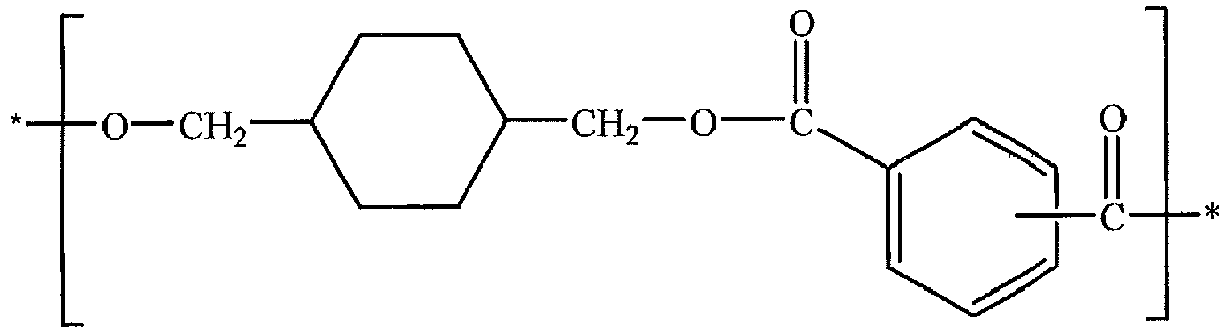
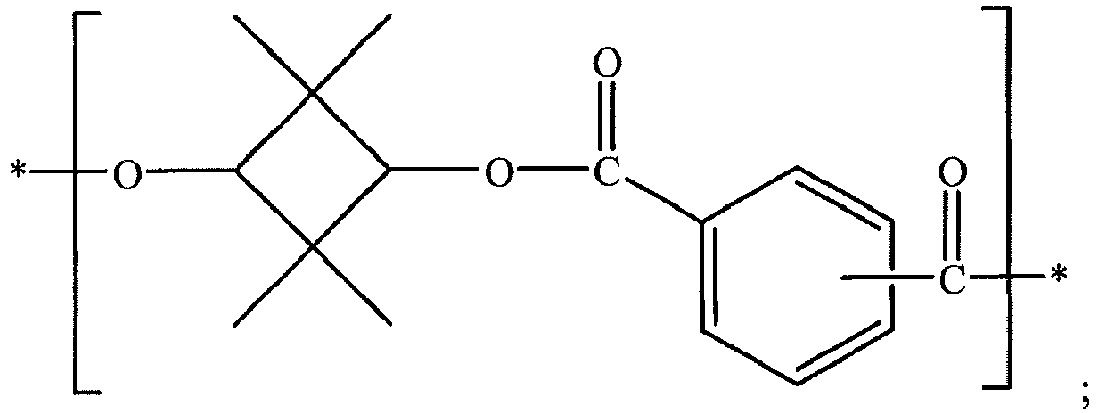 3 bis 35 Gewichts% eines Schlagzähmodifiers; und0,1 bis 3 Gewichts% eines schwarzen Farbstoffs.
 - Die Zusammensetzung gemäß Anspruch 1, worin das aromatische Polycarbonat Wiederholungseinheiten umfasst mit der Struktur

- Die Zusammensetzung gemäß Anspruch 1, worin das aromatische Polycarbonat Wiederholungseinheiten umfasst mit der Struktur

- Die Zusammensetzung gemäß Anspruch 1, worin der Copolyester Cyclohexandimethylenterephthalat -Wiederholungseinheiten umfasst mit der Struktur

2,2,4,4-Tetramethylcyclobutylenterephthalat - Wiederholungseinheiten mit der Struktur
- Die Zusammensetzung gemäß Anspruch 4, worin der Copolyester basierend auf dem Gewicht des Copolyesters 10 bis 90 Gewichts% der Cyclohexandimethylenisophthalat/Terephthalat - Wiederholungseinheiten und 10 bis 90 Gewichts% der 2,2,4,4-Tetramethylcyclobutylenisophthalat/Terephthalat - Wiederholungseinheiten umfasst.
- Die Zusammensetzung gemäß irgendeinem der Ansprüche 1-5, umfassend 55 bis 70 Gewichts% des aromatischen Polycarbonats, 5 bis 15 Gewichts% des Copolyesters, 20 bis 30 Gewichts% des Schlagzähmodifiers, und 0,2 bis 2 Gewichts% des schwarzen Farbstoffs.
- Die Zusammensetzung gemäß irgendeinem der Ansprüche 1-6, worin der Schlagzähmodifier natürlichen Gummi, ein Fluorelastomer, einen Ethylen-Propylen-Gummi (EPR), einen Ethylen-Buten-Gummi, einen Ethylen-Propylen-Dien Monomer-Gummi (EPDM), einen Acrylatgummi, einen hydrierten Nitrilgummi (HNBR), ein Silikonelastomer, ein Styren-Butadien-Styren-Block-Copolymer (SBS), einen Styren-Butadiengummi (SBR), ein Styren-(Ethylen-Buten)-Styren-Block-Copolymer (SEBS), ein Styren-Isopren-Styren-Block-Copolymer (SIS), ein Styren-(Ethylen-Propylen)-Styren-Block-Copolymer (SEPS), ein Acrylonitril-Butadien-Styren-Copolymer (ABS), ein Acrylonitril-Ethylen-Propylen-Dien-Styren-Copolymer (AES), ein Methylmethacrylat-Butadien-Styren-Block-Copolymer (MBS), oder eine Kombination daraus umfasst.
- Die Zusammensetzung gemäß irgendeinem der Ansprüche 1-7, worin der Schlagzähmodifier ein Copolymer von Acrylonitril, Butadien und Styren umfasst.
- Die Zusammensetzung gemäß irgendeinem der Ansprüche 1-8, weiter umfassend 5 bis 20 Gewichts% eines Styren-Acrylonitril-Copolymers.
- Die Zusammensetzung gemäß irgendeinem der Ansprüche 1-9, weiter umfassend 5 bis 20 Gewichts% eines Organophosphatesters.
- Die Zusammensetzung gemäß Anspruch 1, worin das aromatische Polycarbonat Wiederholungseinheiten mit der Struktur

worin der Copolyester Cyclohexandimethylenterephthalat - Wiederholungseinheiten mit der Struktur
2,2,4,4-Tetramethylcyclobutylenterephthalat - Wiederholungseinheiten mit der Struktur worin der Schlagzähmodifier ein Copolymer von Acrylonitril, Butadien, und Styren umfasst; undworin die Zusammensetzung 55 bis 70 Gewichts% des aromatischen Polycarbonats, 5 bis 15 Gewichts% des Copolyesters, 20 bis 30 Gewichts% des Schlagzähmodifiers, und 0,2 bis 2 Gewichts% des schwarzen Farbstoffs umfasst.
 - Ein Artikel umfassend die Zusammensetzung gemäß irgendeinem der Ansprüche 1-11.
- Der Artikel gemäß Anspruch 12, gewählt aus Fernsehereinfassungen, Abdeckungen von Computerspielkonsolen, und Mobiltelefon -Vordereinfassungen und -Rückenabdeckungen.
- Der Artikel gemäß Anspruch 12 oder 13,
worin das aromatische Polycarbonat Wiederholungseinheiten mit der Struktur
worin der Copolyester Cyclohexandimethylenterephthalat-Wiederholungseinheiten mit der Struktur
2,2,4,4-Tetramethylcyclobutylenterephthalat - Wiederholungseinheiten mit der Struktur worin der Schlagzähmodifier ein Copolymer von Acrylonitril, Butadien, und Styren umfasst; undworin die Zusammensetzung 55 bis 70 Gewichts% des aromatischen Polycarbonats, 5 bis 15 Gewichts% des Copolyesters, 20 bis 30 Gewichts% des Schlagzähmodifiers, und 0,2 bis 2 Gewichts% des schwarzen Farbstoffs umfasst.
Applications Claiming Priority (2)
| Application Number | Priority Date | Filing Date | Title |
|---|---|---|---|
| US14/185,063 US20150232661A1 (en) | 2014-02-20 | 2014-02-20 | Thermoplastic composition and article |
| PCT/IB2015/051064 WO2015125050A1 (en) | 2014-02-20 | 2015-02-12 | Thermoplastic composition and article |
Publications (2)
| Publication Number | Publication Date |
|---|---|
| EP3107964A1 EP3107964A1 (de) | 2016-12-28 |
| EP3107964B1 true EP3107964B1 (de) | 2018-10-03 |
Family
ID=52682785
Family Applications (1)
| Application Number | Title | Priority Date | Filing Date |
|---|---|---|---|
| EP15710003.3A Active EP3107964B1 (de) | 2014-02-20 | 2015-02-12 | Thermoplastische zusammensetzung und artikel |
Country Status (5)
| Country | Link |
|---|---|
| US (1) | US20150232661A1 (de) |
| EP (1) | EP3107964B1 (de) |
| KR (1) | KR102150721B1 (de) |
| CN (2) | CN106068294A (de) |
| WO (1) | WO2015125050A1 (de) |
Families Citing this family (10)
| Publication number | Priority date | Publication date | Assignee | Title |
|---|---|---|---|---|
| KR20180127532A (ko) * | 2014-12-23 | 2018-11-28 | 사빅 글로벌 테크놀러지스 비.브이. | 도금가능 수지 조성물 |
| KR20160129974A (ko) | 2015-04-30 | 2016-11-10 | 롯데첨단소재(주) | 폴리카보네이트 수지 조성물 및 이를 이용한 성형품 |
| KR102637930B1 (ko) * | 2015-09-09 | 2024-02-20 | 솔베이 스페셜티 폴리머즈 유에스에이, 엘.엘.씨. | 폴리에스테르 조성물 및 이로 제조된 휴대용 전자 장치 성분 |
| TWI554544B (zh) * | 2015-10-26 | 2016-10-21 | 財團法人工業技術研究院 | 聚酯及其製造方法與聚酯薄片之製造方法 |
| CN109721994B (zh) * | 2018-12-26 | 2021-03-26 | 金旸(厦门)新材料科技有限公司 | 一种高光泽抗划伤聚碳酸酯及其制备方法和应用 |
| TWI731327B (zh) * | 2019-04-25 | 2021-06-21 | 多鏈科技股份有限公司 | 具有碳酸酯鏈段化學結構之寡聚物或聚合物 |
| EP4347687B1 (de) * | 2021-05-31 | 2025-02-19 | Covestro Deutschland AG | Thermoplastische polycarbonatzusammensetzung |
| CN114133690B (zh) * | 2021-10-20 | 2023-05-09 | 金发科技股份有限公司 | 一种透光颜色随厚度变化的透红外黑色材料及其制备方法和应用 |
| EP4249561B1 (de) * | 2022-03-25 | 2024-12-18 | Covestro Deutschland AG | Polycarbonatzusammensetzung |
| WO2023180190A1 (en) * | 2022-03-25 | 2023-09-28 | Covestro Deutschland Ag | Polycarbonate composition |
Family Cites Families (14)
| Publication number | Priority date | Publication date | Assignee | Title |
|---|---|---|---|---|
| US3956008A (en) * | 1974-02-27 | 1976-05-11 | Kark Finke Ohg | Liquid colorant dispersions for plastics |
| US5019536A (en) * | 1987-03-30 | 1991-05-28 | E. I. Du Pont De Nemours And Company | Lower gloss protective covering |
| EP0460456A1 (de) * | 1990-06-04 | 1991-12-11 | General Electric Company | Polycarbonatpfropf-ABS-SAN-Mischpolymer-Mischungen mit verbesserter Schlagzähigkeit |
| US6015510A (en) | 1996-08-29 | 2000-01-18 | E. I. Du Pont De Nemours And Company | Polymer flame retardant |
| US6025419A (en) | 1997-04-07 | 2000-02-15 | E. I. Du Pont De Nemours And Company | Flame retardant resin compositions |
| ATE258199T1 (de) * | 1998-10-29 | 2004-02-15 | Gen Electric | Witterungsbeständige blockcopolyestercarbonate und diese enthaltende polymerlegierungen |
| US6861481B2 (en) * | 2000-09-29 | 2005-03-01 | Solvay Engineered Polymers, Inc. | Ionomeric nanocomposites and articles therefrom |
| US6989190B2 (en) * | 2000-10-17 | 2006-01-24 | General Electric Company | Transparent polycarbonate polyester composition and process |
| US20050164023A1 (en) * | 2004-01-26 | 2005-07-28 | Davis Scott M. | Structurally reinforced resinous article and method of making |
| US7649057B2 (en) * | 2005-12-14 | 2010-01-19 | Sabic Innovative Plastics Ip B.V. | Thermoplastic polycarbonate compositions with low gloss, articles made therefrom and method of manufacture |
| EP2010604B1 (de) * | 2006-04-14 | 2015-02-18 | PolyOne Corporation | Flüssiges farbkonzentrat |
| US20090186966A1 (en) * | 2008-01-22 | 2009-07-23 | Sabic Innovative Plastics Ip B.V. | Thermoplastic polyestercarbonate composition |
| US20100168314A1 (en) * | 2008-12-29 | 2010-07-01 | Sabic Innovative Plastics Ip B.V. | Thermoplastic composition with improved low temperature ductility |
| WO2010101562A1 (en) * | 2009-03-02 | 2010-09-10 | Eastman Chemical Company | Molded articles made from blends of polyesters and bisphenol a polycarbonates |
-
2014
- 2014-02-20 US US14/185,063 patent/US20150232661A1/en not_active Abandoned
-
2015
- 2015-02-12 CN CN201580009890.5A patent/CN106068294A/zh active Pending
- 2015-02-12 CN CN201810169357.0A patent/CN108276754A/zh active Pending
- 2015-02-12 WO PCT/IB2015/051064 patent/WO2015125050A1/en not_active Ceased
- 2015-02-12 KR KR1020167015952A patent/KR102150721B1/ko active Active
- 2015-02-12 EP EP15710003.3A patent/EP3107964B1/de active Active
Non-Patent Citations (1)
| Title |
|---|
| None * |
Also Published As
| Publication number | Publication date |
|---|---|
| CN106068294A (zh) | 2016-11-02 |
| KR20160124740A (ko) | 2016-10-28 |
| EP3107964A1 (de) | 2016-12-28 |
| WO2015125050A1 (en) | 2015-08-27 |
| KR102150721B1 (ko) | 2020-09-02 |
| CN108276754A (zh) | 2018-07-13 |
| US20150232661A1 (en) | 2015-08-20 |
Similar Documents
| Publication | Publication Date | Title |
|---|---|---|
| KR102150721B1 (ko) | 열가소성 조성물 및 물품 | |
| CN101874073B (zh) | 具有改善的抗冲性、阻燃性和表面外观的聚碳酸酯组合物,其制备方法以及由其制成的制品 | |
| US9790363B2 (en) | Polyester-polycarbonate composition and article | |
| KR101577381B1 (ko) | 수지 조성물 및 수지 성형체 | |
| JP2008516013A (ja) | 難燃性熱可塑性ポリカーボネート組成物、その使用及びその製造方法 | |
| US20140370213A1 (en) | Interior aircraft components and methods of manufacture | |
| JP2006052401A (ja) | 難燃性の熱可塑性ポリカーボネート組成物、その用途及び製造方法 | |
| JP6860462B2 (ja) | 光学部品用ポリカーボネート樹脂組成物及びそれからなる成形品 | |
| EP3049480B1 (de) | Verstärkte flammhemmende polycarbonatzusammensetzung und formartikel damit | |
| KR20150013814A (ko) | 난연성 폴리카보네이트 조성물, 그것의 제조 방법 및 그것을 포함하는 물품 | |
| US20170247539A1 (en) | Polycarbonate/polyester composition and article prepared therefrom | |
| CN105452378A (zh) | 高模量和超高延展性共混热塑性组合物 | |
| KR20160123299A (ko) | 폴리카보네이트 수지 조성물 | |
| KR20170088943A (ko) | 폴리카르보네이트 수지 조성물 및 광학용 성형품 | |
| US20170190904A1 (en) | Polycarbonate-polyester composition and article | |
| TWI516543B (zh) | Polycarbonate resin composition | |
| JP5369296B2 (ja) | 芳香族ポリカーボネート樹脂組成物、及び成形品 | |
| EP3107963B1 (de) | Thermoplastische zusammensetzung und artikel | |
| EP4244272B1 (de) | Thermoplastische polycarbonatzusammensetzungen und daraus geformte gegenstände | |
| US20250002717A1 (en) | Thermoplastic compositions and uses thereof | |
| US20230038482A1 (en) | Polycarbonate compositions containing fillers and triacylglycerol containing epoxy groups | |
| WO2015051508A1 (en) | Glass-filled polycarbonate-poly(ethylene terephthalate) composition and associated article | |
| KR20160121529A (ko) | 폴리카보네이트 수지 조성물 | |
| EP3990546B1 (de) | Transparente polycarbonat-zusammensetzungen mit ultraniedrigem halogenflammschutz mit v0 bei 0,6 mm | |
| CN118119666A (zh) | 热塑性组合物及其用途 |
Legal Events
| Date | Code | Title | Description |
|---|---|---|---|
| PUAI | Public reference made under article 153(3) epc to a published international application that has entered the european phase |
Free format text: ORIGINAL CODE: 0009012 |
|
| STAA | Information on the status of an ep patent application or granted ep patent |
Free format text: STATUS: REQUEST FOR EXAMINATION WAS MADE |
|
| 17P | Request for examination filed |
Effective date: 20151111 |
|
| AK | Designated contracting states |
Kind code of ref document: A1 Designated state(s): AL AT BE BG CH CY CZ DE DK EE ES FI FR GB GR HR HU IE IS IT LI LT LU LV MC MK MT NL NO PL PT RO RS SE SI SK SM TR |
|
| AX | Request for extension of the european patent |
Extension state: BA ME |
|
| DAX | Request for extension of the european patent (deleted) | ||
| STAA | Information on the status of an ep patent application or granted ep patent |
Free format text: STATUS: EXAMINATION IS IN PROGRESS |
|
| 17Q | First examination report despatched |
Effective date: 20170531 |
|
| GRAP | Despatch of communication of intention to grant a patent |
Free format text: ORIGINAL CODE: EPIDOSNIGR1 |
|
| STAA | Information on the status of an ep patent application or granted ep patent |
Free format text: STATUS: GRANT OF PATENT IS INTENDED |
|
| RAP3 | Party data changed (applicant data changed or rights of an application transferred) |
Owner name: SABIC GLOBAL TECHNOLOGIES B.V. |
|
| INTG | Intention to grant announced |
Effective date: 20180417 |
|
| GRAS | Grant fee paid |
Free format text: ORIGINAL CODE: EPIDOSNIGR3 |
|
| GRAA | (expected) grant |
Free format text: ORIGINAL CODE: 0009210 |
|
| STAA | Information on the status of an ep patent application or granted ep patent |
Free format text: STATUS: THE PATENT HAS BEEN GRANTED |
|
| AK | Designated contracting states |
Kind code of ref document: B1 Designated state(s): AL AT BE BG CH CY CZ DE DK EE ES FI FR GB GR HR HU IE IS IT LI LT LU LV MC MK MT NL NO PL PT RO RS SE SI SK SM TR |
|
| REG | Reference to a national code |
Ref country code: GB Ref legal event code: FG4D |
|
| REG | Reference to a national code |
Ref country code: CH Ref legal event code: EP Ref country code: AT Ref legal event code: REF Ref document number: 1048548 Country of ref document: AT Kind code of ref document: T Effective date: 20181015 |
|
| REG | Reference to a national code |
Ref country code: IE Ref legal event code: FG4D Ref country code: DE Ref legal event code: R096 Ref document number: 602015017461 Country of ref document: DE |
|
| REG | Reference to a national code |
Ref country code: NL Ref legal event code: MP Effective date: 20181003 |
|
| REG | Reference to a national code |
Ref country code: LT Ref legal event code: MG4D |
|
| REG | Reference to a national code |
Ref country code: AT Ref legal event code: MK05 Ref document number: 1048548 Country of ref document: AT Kind code of ref document: T Effective date: 20181003 |
|
| PG25 | Lapsed in a contracting state [announced via postgrant information from national office to epo] |
Ref country code: NL Free format text: LAPSE BECAUSE OF FAILURE TO SUBMIT A TRANSLATION OF THE DESCRIPTION OR TO PAY THE FEE WITHIN THE PRESCRIBED TIME-LIMIT Effective date: 20181003 |
|
| PG25 | Lapsed in a contracting state [announced via postgrant information from national office to epo] |
Ref country code: CZ Free format text: LAPSE BECAUSE OF FAILURE TO SUBMIT A TRANSLATION OF THE DESCRIPTION OR TO PAY THE FEE WITHIN THE PRESCRIBED TIME-LIMIT Effective date: 20181003 Ref country code: FI Free format text: LAPSE BECAUSE OF FAILURE TO SUBMIT A TRANSLATION OF THE DESCRIPTION OR TO PAY THE FEE WITHIN THE PRESCRIBED TIME-LIMIT Effective date: 20181003 Ref country code: IS Free format text: LAPSE BECAUSE OF FAILURE TO SUBMIT A TRANSLATION OF THE DESCRIPTION OR TO PAY THE FEE WITHIN THE PRESCRIBED TIME-LIMIT Effective date: 20190203 Ref country code: AT Free format text: LAPSE BECAUSE OF FAILURE TO SUBMIT A TRANSLATION OF THE DESCRIPTION OR TO PAY THE FEE WITHIN THE PRESCRIBED TIME-LIMIT Effective date: 20181003 Ref country code: LV Free format text: LAPSE BECAUSE OF FAILURE TO SUBMIT A TRANSLATION OF THE DESCRIPTION OR TO PAY THE FEE WITHIN THE PRESCRIBED TIME-LIMIT Effective date: 20181003 Ref country code: NO Free format text: LAPSE BECAUSE OF FAILURE TO SUBMIT A TRANSLATION OF THE DESCRIPTION OR TO PAY THE FEE WITHIN THE PRESCRIBED TIME-LIMIT Effective date: 20190103 Ref country code: LT Free format text: LAPSE BECAUSE OF FAILURE TO SUBMIT A TRANSLATION OF THE DESCRIPTION OR TO PAY THE FEE WITHIN THE PRESCRIBED TIME-LIMIT Effective date: 20181003 Ref country code: ES Free format text: LAPSE BECAUSE OF FAILURE TO SUBMIT A TRANSLATION OF THE DESCRIPTION OR TO PAY THE FEE WITHIN THE PRESCRIBED TIME-LIMIT Effective date: 20181003 Ref country code: BG Free format text: LAPSE BECAUSE OF FAILURE TO SUBMIT A TRANSLATION OF THE DESCRIPTION OR TO PAY THE FEE WITHIN THE PRESCRIBED TIME-LIMIT Effective date: 20190103 Ref country code: PL Free format text: LAPSE BECAUSE OF FAILURE TO SUBMIT A TRANSLATION OF THE DESCRIPTION OR TO PAY THE FEE WITHIN THE PRESCRIBED TIME-LIMIT Effective date: 20181003 Ref country code: HR Free format text: LAPSE BECAUSE OF FAILURE TO SUBMIT A TRANSLATION OF THE DESCRIPTION OR TO PAY THE FEE WITHIN THE PRESCRIBED TIME-LIMIT Effective date: 20181003 |
|
| PG25 | Lapsed in a contracting state [announced via postgrant information from national office to epo] |
Ref country code: AL Free format text: LAPSE BECAUSE OF FAILURE TO SUBMIT A TRANSLATION OF THE DESCRIPTION OR TO PAY THE FEE WITHIN THE PRESCRIBED TIME-LIMIT Effective date: 20181003 Ref country code: PT Free format text: LAPSE BECAUSE OF FAILURE TO SUBMIT A TRANSLATION OF THE DESCRIPTION OR TO PAY THE FEE WITHIN THE PRESCRIBED TIME-LIMIT Effective date: 20190203 Ref country code: SE Free format text: LAPSE BECAUSE OF FAILURE TO SUBMIT A TRANSLATION OF THE DESCRIPTION OR TO PAY THE FEE WITHIN THE PRESCRIBED TIME-LIMIT Effective date: 20181003 Ref country code: RS Free format text: LAPSE BECAUSE OF FAILURE TO SUBMIT A TRANSLATION OF THE DESCRIPTION OR TO PAY THE FEE WITHIN THE PRESCRIBED TIME-LIMIT Effective date: 20181003 Ref country code: GR Free format text: LAPSE BECAUSE OF FAILURE TO SUBMIT A TRANSLATION OF THE DESCRIPTION OR TO PAY THE FEE WITHIN THE PRESCRIBED TIME-LIMIT Effective date: 20190104 |
|
| REG | Reference to a national code |
Ref country code: DE Ref legal event code: R097 Ref document number: 602015017461 Country of ref document: DE |
|
| PG25 | Lapsed in a contracting state [announced via postgrant information from national office to epo] |
Ref country code: DK Free format text: LAPSE BECAUSE OF FAILURE TO SUBMIT A TRANSLATION OF THE DESCRIPTION OR TO PAY THE FEE WITHIN THE PRESCRIBED TIME-LIMIT Effective date: 20181003 Ref country code: IT Free format text: LAPSE BECAUSE OF FAILURE TO SUBMIT A TRANSLATION OF THE DESCRIPTION OR TO PAY THE FEE WITHIN THE PRESCRIBED TIME-LIMIT Effective date: 20181003 |
|
| PLBE | No opposition filed within time limit |
Free format text: ORIGINAL CODE: 0009261 |
|
| STAA | Information on the status of an ep patent application or granted ep patent |
Free format text: STATUS: NO OPPOSITION FILED WITHIN TIME LIMIT |
|
| PG25 | Lapsed in a contracting state [announced via postgrant information from national office to epo] |
Ref country code: EE Free format text: LAPSE BECAUSE OF FAILURE TO SUBMIT A TRANSLATION OF THE DESCRIPTION OR TO PAY THE FEE WITHIN THE PRESCRIBED TIME-LIMIT Effective date: 20181003 Ref country code: SM Free format text: LAPSE BECAUSE OF FAILURE TO SUBMIT A TRANSLATION OF THE DESCRIPTION OR TO PAY THE FEE WITHIN THE PRESCRIBED TIME-LIMIT Effective date: 20181003 Ref country code: RO Free format text: LAPSE BECAUSE OF FAILURE TO SUBMIT A TRANSLATION OF THE DESCRIPTION OR TO PAY THE FEE WITHIN THE PRESCRIBED TIME-LIMIT Effective date: 20181003 Ref country code: SK Free format text: LAPSE BECAUSE OF FAILURE TO SUBMIT A TRANSLATION OF THE DESCRIPTION OR TO PAY THE FEE WITHIN THE PRESCRIBED TIME-LIMIT Effective date: 20181003 |
|
| 26N | No opposition filed |
Effective date: 20190704 |
|
| REG | Reference to a national code |
Ref country code: CH Ref legal event code: PL |
|
| GBPC | Gb: european patent ceased through non-payment of renewal fee |
Effective date: 20190212 |
|
| PG25 | Lapsed in a contracting state [announced via postgrant information from national office to epo] |
Ref country code: LU Free format text: LAPSE BECAUSE OF NON-PAYMENT OF DUE FEES Effective date: 20190212 Ref country code: MC Free format text: LAPSE BECAUSE OF FAILURE TO SUBMIT A TRANSLATION OF THE DESCRIPTION OR TO PAY THE FEE WITHIN THE PRESCRIBED TIME-LIMIT Effective date: 20181003 Ref country code: SI Free format text: LAPSE BECAUSE OF FAILURE TO SUBMIT A TRANSLATION OF THE DESCRIPTION OR TO PAY THE FEE WITHIN THE PRESCRIBED TIME-LIMIT Effective date: 20181003 |
|
| REG | Reference to a national code |
Ref country code: BE Ref legal event code: MM Effective date: 20190228 |
|
| REG | Reference to a national code |
Ref country code: IE Ref legal event code: MM4A |
|
| PG25 | Lapsed in a contracting state [announced via postgrant information from national office to epo] |
Ref country code: CH Free format text: LAPSE BECAUSE OF NON-PAYMENT OF DUE FEES Effective date: 20190228 Ref country code: LI Free format text: LAPSE BECAUSE OF NON-PAYMENT OF DUE FEES Effective date: 20190228 |
|
| PG25 | Lapsed in a contracting state [announced via postgrant information from national office to epo] |
Ref country code: GB Free format text: LAPSE BECAUSE OF NON-PAYMENT OF DUE FEES Effective date: 20190212 Ref country code: IE Free format text: LAPSE BECAUSE OF NON-PAYMENT OF DUE FEES Effective date: 20190212 |
|
| PG25 | Lapsed in a contracting state [announced via postgrant information from national office to epo] |
Ref country code: BE Free format text: LAPSE BECAUSE OF NON-PAYMENT OF DUE FEES Effective date: 20190228 |
|
| PG25 | Lapsed in a contracting state [announced via postgrant information from national office to epo] |
Ref country code: TR Free format text: LAPSE BECAUSE OF FAILURE TO SUBMIT A TRANSLATION OF THE DESCRIPTION OR TO PAY THE FEE WITHIN THE PRESCRIBED TIME-LIMIT Effective date: 20181003 |
|
| PG25 | Lapsed in a contracting state [announced via postgrant information from national office to epo] |
Ref country code: MT Free format text: LAPSE BECAUSE OF NON-PAYMENT OF DUE FEES Effective date: 20190212 |
|
| PG25 | Lapsed in a contracting state [announced via postgrant information from national office to epo] |
Ref country code: CY Free format text: LAPSE BECAUSE OF FAILURE TO SUBMIT A TRANSLATION OF THE DESCRIPTION OR TO PAY THE FEE WITHIN THE PRESCRIBED TIME-LIMIT Effective date: 20181003 |
|
| PG25 | Lapsed in a contracting state [announced via postgrant information from national office to epo] |
Ref country code: HU Free format text: LAPSE BECAUSE OF FAILURE TO SUBMIT A TRANSLATION OF THE DESCRIPTION OR TO PAY THE FEE WITHIN THE PRESCRIBED TIME-LIMIT; INVALID AB INITIO Effective date: 20150212 |
|
| PG25 | Lapsed in a contracting state [announced via postgrant information from national office to epo] |
Ref country code: MK Free format text: LAPSE BECAUSE OF FAILURE TO SUBMIT A TRANSLATION OF THE DESCRIPTION OR TO PAY THE FEE WITHIN THE PRESCRIBED TIME-LIMIT Effective date: 20181003 |
|
| P01 | Opt-out of the competence of the unified patent court (upc) registered |
Effective date: 20230529 |
|
| PGFP | Annual fee paid to national office [announced via postgrant information from national office to epo] |
Ref country code: DE Payment date: 20260227 Year of fee payment: 12 |
|
| PGFP | Annual fee paid to national office [announced via postgrant information from national office to epo] |
Ref country code: FR Payment date: 20260225 Year of fee payment: 12 |