EP3071248B1 - Tissue scaffold materials for tissue regeneration and methods of making - Google Patents
Tissue scaffold materials for tissue regeneration and methods of making Download PDFInfo
- Publication number
- EP3071248B1 EP3071248B1 EP14863949.5A EP14863949A EP3071248B1 EP 3071248 B1 EP3071248 B1 EP 3071248B1 EP 14863949 A EP14863949 A EP 14863949A EP 3071248 B1 EP3071248 B1 EP 3071248B1
- Authority
- EP
- European Patent Office
- Prior art keywords
- collagen
- microspheres
- tissue
- scaffolds
- tissue scaffold
- Prior art date
- Legal status (The legal status is an assumption and is not a legal conclusion. Google has not performed a legal analysis and makes no representation as to the accuracy of the status listed.)
- Active
Links
Images






Classifications
-
- A—HUMAN NECESSITIES
- A61—MEDICAL OR VETERINARY SCIENCE; HYGIENE
- A61L—METHODS OR APPARATUS FOR STERILISING MATERIALS OR OBJECTS IN GENERAL; DISINFECTION, STERILISATION OR DEODORISATION OF AIR; CHEMICAL ASPECTS OF BANDAGES, DRESSINGS, ABSORBENT PADS OR SURGICAL ARTICLES; MATERIALS FOR BANDAGES, DRESSINGS, ABSORBENT PADS OR SURGICAL ARTICLES
- A61L27/00—Materials for grafts or prostheses or for coating grafts or prostheses
- A61L27/50—Materials characterised by their function or physical properties, e.g. injectable or lubricating compositions, shape-memory materials, surface modified materials
- A61L27/56—Porous materials, e.g. foams or sponges
-
- A—HUMAN NECESSITIES
- A61—MEDICAL OR VETERINARY SCIENCE; HYGIENE
- A61L—METHODS OR APPARATUS FOR STERILISING MATERIALS OR OBJECTS IN GENERAL; DISINFECTION, STERILISATION OR DEODORISATION OF AIR; CHEMICAL ASPECTS OF BANDAGES, DRESSINGS, ABSORBENT PADS OR SURGICAL ARTICLES; MATERIALS FOR BANDAGES, DRESSINGS, ABSORBENT PADS OR SURGICAL ARTICLES
- A61L27/00—Materials for grafts or prostheses or for coating grafts or prostheses
- A61L27/40—Composite materials, i.e. containing one material dispersed in a matrix of the same or different material
- A61L27/44—Composite materials, i.e. containing one material dispersed in a matrix of the same or different material having a macromolecular matrix
- A61L27/48—Composite materials, i.e. containing one material dispersed in a matrix of the same or different material having a macromolecular matrix with macromolecular fillers
-
- A—HUMAN NECESSITIES
- A61—MEDICAL OR VETERINARY SCIENCE; HYGIENE
- A61K—PREPARATIONS FOR MEDICAL, DENTAL OR TOILETRY PURPOSES
- A61K9/00—Medicinal preparations characterised by special physical form
- A61K9/0012—Galenical forms characterised by the site of application
- A61K9/0019—Injectable compositions; Intramuscular, intravenous, arterial, subcutaneous administration; Compositions to be administered through the skin in an invasive manner
- A61K9/0024—Solid, semi-solid or solidifying implants, which are implanted or injected in body tissue
-
- A—HUMAN NECESSITIES
- A61—MEDICAL OR VETERINARY SCIENCE; HYGIENE
- A61K—PREPARATIONS FOR MEDICAL, DENTAL OR TOILETRY PURPOSES
- A61K9/00—Medicinal preparations characterised by special physical form
- A61K9/14—Particulate form, e.g. powders, Processes for size reducing of pure drugs or the resulting products, Pure drug nanoparticles
- A61K9/16—Agglomerates; Granulates; Microbeadlets ; Microspheres; Pellets; Solid products obtained by spray drying, spray freeze drying, spray congealing,(multiple) emulsion solvent evaporation or extraction
-
- A—HUMAN NECESSITIES
- A61—MEDICAL OR VETERINARY SCIENCE; HYGIENE
- A61K—PREPARATIONS FOR MEDICAL, DENTAL OR TOILETRY PURPOSES
- A61K9/00—Medicinal preparations characterised by special physical form
- A61K9/14—Particulate form, e.g. powders, Processes for size reducing of pure drugs or the resulting products, Pure drug nanoparticles
- A61K9/16—Agglomerates; Granulates; Microbeadlets ; Microspheres; Pellets; Solid products obtained by spray drying, spray freeze drying, spray congealing,(multiple) emulsion solvent evaporation or extraction
- A61K9/1605—Excipients; Inactive ingredients
- A61K9/1629—Organic macromolecular compounds
- A61K9/1635—Organic macromolecular compounds obtained by reactions only involving carbon-to-carbon unsaturated bonds, e.g. polyvinyl pyrrolidone, poly(meth)acrylates
-
- A—HUMAN NECESSITIES
- A61—MEDICAL OR VETERINARY SCIENCE; HYGIENE
- A61K—PREPARATIONS FOR MEDICAL, DENTAL OR TOILETRY PURPOSES
- A61K9/00—Medicinal preparations characterised by special physical form
- A61K9/14—Particulate form, e.g. powders, Processes for size reducing of pure drugs or the resulting products, Pure drug nanoparticles
- A61K9/16—Agglomerates; Granulates; Microbeadlets ; Microspheres; Pellets; Solid products obtained by spray drying, spray freeze drying, spray congealing,(multiple) emulsion solvent evaporation or extraction
- A61K9/1605—Excipients; Inactive ingredients
- A61K9/1629—Organic macromolecular compounds
- A61K9/1641—Organic macromolecular compounds obtained otherwise than by reactions only involving carbon-to-carbon unsaturated bonds, e.g. polyethylene glycol, poloxamers
- A61K9/1647—Polyesters, e.g. poly(lactide-co-glycolide)
-
- A—HUMAN NECESSITIES
- A61—MEDICAL OR VETERINARY SCIENCE; HYGIENE
- A61L—METHODS OR APPARATUS FOR STERILISING MATERIALS OR OBJECTS IN GENERAL; DISINFECTION, STERILISATION OR DEODORISATION OF AIR; CHEMICAL ASPECTS OF BANDAGES, DRESSINGS, ABSORBENT PADS OR SURGICAL ARTICLES; MATERIALS FOR BANDAGES, DRESSINGS, ABSORBENT PADS OR SURGICAL ARTICLES
- A61L26/00—Chemical aspects of, or use of materials for, wound dressings or bandages in liquid, gel or powder form
- A61L26/0009—Chemical aspects of, or use of materials for, wound dressings or bandages in liquid, gel or powder form containing macromolecular materials
- A61L26/0052—Mixtures of macromolecular compounds
-
- A—HUMAN NECESSITIES
- A61—MEDICAL OR VETERINARY SCIENCE; HYGIENE
- A61L—METHODS OR APPARATUS FOR STERILISING MATERIALS OR OBJECTS IN GENERAL; DISINFECTION, STERILISATION OR DEODORISATION OF AIR; CHEMICAL ASPECTS OF BANDAGES, DRESSINGS, ABSORBENT PADS OR SURGICAL ARTICLES; MATERIALS FOR BANDAGES, DRESSINGS, ABSORBENT PADS OR SURGICAL ARTICLES
- A61L26/00—Chemical aspects of, or use of materials for, wound dressings or bandages in liquid, gel or powder form
- A61L26/0061—Use of materials characterised by their function or physical properties
- A61L26/008—Hydrogels or hydrocolloids
-
- A—HUMAN NECESSITIES
- A61—MEDICAL OR VETERINARY SCIENCE; HYGIENE
- A61L—METHODS OR APPARATUS FOR STERILISING MATERIALS OR OBJECTS IN GENERAL; DISINFECTION, STERILISATION OR DEODORISATION OF AIR; CHEMICAL ASPECTS OF BANDAGES, DRESSINGS, ABSORBENT PADS OR SURGICAL ARTICLES; MATERIALS FOR BANDAGES, DRESSINGS, ABSORBENT PADS OR SURGICAL ARTICLES
- A61L27/00—Materials for grafts or prostheses or for coating grafts or prostheses
- A61L27/14—Macromolecular materials
- A61L27/22—Polypeptides or derivatives thereof, e.g. degradation products
- A61L27/24—Collagen
-
- A—HUMAN NECESSITIES
- A61—MEDICAL OR VETERINARY SCIENCE; HYGIENE
- A61L—METHODS OR APPARATUS FOR STERILISING MATERIALS OR OBJECTS IN GENERAL; DISINFECTION, STERILISATION OR DEODORISATION OF AIR; CHEMICAL ASPECTS OF BANDAGES, DRESSINGS, ABSORBENT PADS OR SURGICAL ARTICLES; MATERIALS FOR BANDAGES, DRESSINGS, ABSORBENT PADS OR SURGICAL ARTICLES
- A61L27/00—Materials for grafts or prostheses or for coating grafts or prostheses
- A61L27/14—Macromolecular materials
- A61L27/26—Mixtures of macromolecular compounds
-
- A—HUMAN NECESSITIES
- A61—MEDICAL OR VETERINARY SCIENCE; HYGIENE
- A61L—METHODS OR APPARATUS FOR STERILISING MATERIALS OR OBJECTS IN GENERAL; DISINFECTION, STERILISATION OR DEODORISATION OF AIR; CHEMICAL ASPECTS OF BANDAGES, DRESSINGS, ABSORBENT PADS OR SURGICAL ARTICLES; MATERIALS FOR BANDAGES, DRESSINGS, ABSORBENT PADS OR SURGICAL ARTICLES
- A61L27/00—Materials for grafts or prostheses or for coating grafts or prostheses
- A61L27/40—Composite materials, i.e. containing one material dispersed in a matrix of the same or different material
- A61L27/44—Composite materials, i.e. containing one material dispersed in a matrix of the same or different material having a macromolecular matrix
-
- A—HUMAN NECESSITIES
- A61—MEDICAL OR VETERINARY SCIENCE; HYGIENE
- A61L—METHODS OR APPARATUS FOR STERILISING MATERIALS OR OBJECTS IN GENERAL; DISINFECTION, STERILISATION OR DEODORISATION OF AIR; CHEMICAL ASPECTS OF BANDAGES, DRESSINGS, ABSORBENT PADS OR SURGICAL ARTICLES; MATERIALS FOR BANDAGES, DRESSINGS, ABSORBENT PADS OR SURGICAL ARTICLES
- A61L27/00—Materials for grafts or prostheses or for coating grafts or prostheses
- A61L27/50—Materials characterised by their function or physical properties, e.g. injectable or lubricating compositions, shape-memory materials, surface modified materials
- A61L27/52—Hydrogels or hydrocolloids
-
- A—HUMAN NECESSITIES
- A61—MEDICAL OR VETERINARY SCIENCE; HYGIENE
- A61L—METHODS OR APPARATUS FOR STERILISING MATERIALS OR OBJECTS IN GENERAL; DISINFECTION, STERILISATION OR DEODORISATION OF AIR; CHEMICAL ASPECTS OF BANDAGES, DRESSINGS, ABSORBENT PADS OR SURGICAL ARTICLES; MATERIALS FOR BANDAGES, DRESSINGS, ABSORBENT PADS OR SURGICAL ARTICLES
- A61L27/00—Materials for grafts or prostheses or for coating grafts or prostheses
- A61L27/50—Materials characterised by their function or physical properties, e.g. injectable or lubricating compositions, shape-memory materials, surface modified materials
- A61L27/54—Biologically active materials, e.g. therapeutic substances
-
- A—HUMAN NECESSITIES
- A61—MEDICAL OR VETERINARY SCIENCE; HYGIENE
- A61L—METHODS OR APPARATUS FOR STERILISING MATERIALS OR OBJECTS IN GENERAL; DISINFECTION, STERILISATION OR DEODORISATION OF AIR; CHEMICAL ASPECTS OF BANDAGES, DRESSINGS, ABSORBENT PADS OR SURGICAL ARTICLES; MATERIALS FOR BANDAGES, DRESSINGS, ABSORBENT PADS OR SURGICAL ARTICLES
- A61L27/00—Materials for grafts or prostheses or for coating grafts or prostheses
- A61L27/50—Materials characterised by their function or physical properties, e.g. injectable or lubricating compositions, shape-memory materials, surface modified materials
- A61L27/60—Materials for use in artificial skin
-
- C—CHEMISTRY; METALLURGY
- C08—ORGANIC MACROMOLECULAR COMPOUNDS; THEIR PREPARATION OR CHEMICAL WORKING-UP; COMPOSITIONS BASED THEREON
- C08L—COMPOSITIONS OF MACROMOLECULAR COMPOUNDS
- C08L89/00—Compositions of proteins; Compositions of derivatives thereof
- C08L89/04—Products derived from waste materials, e.g. horn, hoof or hair
- C08L89/06—Products derived from waste materials, e.g. horn, hoof or hair derived from leather or skin, e.g. gelatin
-
- A—HUMAN NECESSITIES
- A61—MEDICAL OR VETERINARY SCIENCE; HYGIENE
- A61L—METHODS OR APPARATUS FOR STERILISING MATERIALS OR OBJECTS IN GENERAL; DISINFECTION, STERILISATION OR DEODORISATION OF AIR; CHEMICAL ASPECTS OF BANDAGES, DRESSINGS, ABSORBENT PADS OR SURGICAL ARTICLES; MATERIALS FOR BANDAGES, DRESSINGS, ABSORBENT PADS OR SURGICAL ARTICLES
- A61L2300/00—Biologically active materials used in bandages, wound dressings, absorbent pads or medical devices
- A61L2300/40—Biologically active materials used in bandages, wound dressings, absorbent pads or medical devices characterised by a specific therapeutic activity or mode of action
- A61L2300/412—Tissue-regenerating or healing or proliferative agents
-
- A—HUMAN NECESSITIES
- A61—MEDICAL OR VETERINARY SCIENCE; HYGIENE
- A61L—METHODS OR APPARATUS FOR STERILISING MATERIALS OR OBJECTS IN GENERAL; DISINFECTION, STERILISATION OR DEODORISATION OF AIR; CHEMICAL ASPECTS OF BANDAGES, DRESSINGS, ABSORBENT PADS OR SURGICAL ARTICLES; MATERIALS FOR BANDAGES, DRESSINGS, ABSORBENT PADS OR SURGICAL ARTICLES
- A61L2300/00—Biologically active materials used in bandages, wound dressings, absorbent pads or medical devices
- A61L2300/60—Biologically active materials used in bandages, wound dressings, absorbent pads or medical devices characterised by a special physical form
- A61L2300/602—Type of release, e.g. controlled, sustained, slow
-
- A—HUMAN NECESSITIES
- A61—MEDICAL OR VETERINARY SCIENCE; HYGIENE
- A61L—METHODS OR APPARATUS FOR STERILISING MATERIALS OR OBJECTS IN GENERAL; DISINFECTION, STERILISATION OR DEODORISATION OF AIR; CHEMICAL ASPECTS OF BANDAGES, DRESSINGS, ABSORBENT PADS OR SURGICAL ARTICLES; MATERIALS FOR BANDAGES, DRESSINGS, ABSORBENT PADS OR SURGICAL ARTICLES
- A61L2430/00—Materials or treatment for tissue regeneration
- A61L2430/34—Materials or treatment for tissue regeneration for soft tissue reconstruction
Definitions
- acellular dermal replacements can be categorized into two broad groups: products derived from decellularized dermis, and synthetic products based on naturally-derived hydrogels ( Truong et al. J. Burns Wounds 4:e4 (2005 )).
- decellularized dermal products are made of decellularized cadaveric porcine or human dermis. As a result of the decellularization process, these products contain an internal network of microchannels with an intact basement membrane that are the remnants of the native dermal microvasculature.
- INTEGRA Integra LifeSciences, Plainsboro, NJ
- another commonly applied dermal regeneration template is comprised of a synthetic "dermal" porous layer of cross-linked type I bovine collagen and chondroitin-6-sulfate covered by an "epidermal” semi-permeable silicone sheet. Following implantation, the silicone sheet is replaced with split-thickness autograft once the dermal layer has vascularized ( Yannas et al., Science 215:174-176 (1982 )).
- INTEGRA is representative of products without an internal vascular structure and is instead characterized by its random porosity (mean pore diameter 30-120 ⁇ m) ( van der Veen et al., Burns 36:305-321 (2010 )).
- tissue replacement scaffolds are not without substantial associated cost.
- the production of decellularized dermal products requires tissue acquisition and harvesting, as well as decellularization and sterilization processes ( Ng et al., Biomaterials 25:2807-2818 (2004 )).
- tissue scaffolds are avascular and prone to high failure rates when used in complex settings, such as irradiated wounds or those with exposed hardware or bone. In such complex settings, neovascularization is insufficient using existing tissue replacement products.
- WO 2011/089173 relates to a composition comprising a suspension of microspheres with a diameter of 5 to 50 ⁇ m.
- EP-A-0648 480 discloses a wound implant material comprising bioabsorbable microspheres and a bioabsorbable matrix.
- tissue scaffold material made of a hydrogel with embedded microspheres.
- the microspheres have a different or greater density (w/v) of polymer relative to the density of the hydrogel, which differential density facilitates cellular invasion into the tissue scaffold.
- the tissue scaffold material has microspheres with 1.0% w/v collagen, embedded in a hydrogel containing 0.3% w/v collagen.
- the disclosed tissue scaffold materials can be used in a method of wound healing or tissue regeneration in a subject.
- the methods involve the steps of: (a) providing a first composition with microspheres, and a second composition with a polymer material, the first composition having a different density than the second composition; (b) mixing the first and second compositions; and (c) causing crosslinking of the polymer material in said mixture, to form a hydrogel with embedded microspheres.
- the first and second compositions each contain collagen, such as human or bovine collagen, as a polymer.
- the collagen can be neutralized collagen.
- the microspheres contain 1.0% w/v of collagen.
- Crosslinking can be accomplished, for example, by thermal methods.
- tissue scaffold materials produced by the methods provided above and further disclosed herein, and wound dressings comprising such tissue scaffold materials.
- tissue scaffold materials with improved ability to facilitate cellular invasion and vascularization for wound healing and tissue regeneration.
- the inventors have found that materials having components with different densities promotes invasion of cells, including desirable cells such as fibroblasts and endothelial precursor cells, into the material.
- tissue scaffold tissue scaffold material
- tissue scaffold material tissue scaffold material
- skin substitute tissue substitute material
- material material
- the tissue scaffold materials disclosed herein are composed of a hydrogel support, which is filled with microspheres.
- the microspheres have a density (the density being measured as weight by volume or w/v) that differs from the density of the hydrogel in which the microspheres are embedded.
- the microspheres have a greater density than the hydrogel.
- the microspheres can have a lower density than the hydrogel.
- the terms "about” and “approximately” indicate that a value includes the inherent variation of error for the device, the method being employed to determine the value, or the variation that exists among the study subjects. In one non-limiting embodiment the terms are defined to be within 10%, preferably within 5%, more preferably within 1%, and most preferably within 0.5%.
- microspheres, hydrogels, and compositions disclosed herein contain collagen. Particularly preferred for use in human subjects are human and bovine collagens, such as human or bovine type I collagen.
- Microspheres are small particles, made of a polymer.
- the term "microspheres” as used herein encompasses small particles that can be spherical or non-spherical; accordingly, any reference to “microspheres” in this application can be used interchangeably with the term “microstructures”, as the microspheres disclosed herein include both spherical and non-spherical small particles.
- microspheres can encompass any diameter from 1 ⁇ m- 1 mm, microspheres as disclosed herein have a diameter of between 50-150 ⁇ m in diameter
- hydrogel refers to a broad class of polymeric materials which are swollen extensively in water, but which do not dissolve in water. Generally, hydrogels are formed by polymerizing a hydrophilic monomer in an aqueous solution under conditions where the polymer becomes crosslinked so that a three dimensional polymer network is formed which is sufficient to gel the solution. Hydrogels are described in more detail in Hoffman, D. S., “Polymers in Medicine and Surgery,” Plenum Press, New York, pp 33-44 (1974 ).
- the methods involve the steps of: (a) providing a first composition with microspheres, and a second composition with a polymer material, the first composition having a different density than the second composition; (b) mixing the first and second compositions; and (c) causing crosslinking of the polymer material in said mixture, to form a hydrogel with embedded microspheres.
- Collagen can be derived from various sources, such as human or bovine tissue. Collagen can be autologous to the subject for whom the tissue scaffold is to be administered, and can be extracted, for example, from the skin of the subject. Once a suitable biological sample (such as skin, placenta, tendon, or cultured cells) is procured, collagen can be extracted from the sample by known techniques to form a stock solution. See, for example, Epstein, J. Biol. Chem. 249:3225-3231 (1974 ). Stock solutions of collagen can include collagen in a suitable solution, containing, for example, 0.1% acetic acid, or Earle's or Hank's salts, L-glutamine, HEPES, and sodium bicarbonate.
- suitable biological sample such as skin, placenta, tendon, or cultured cells
- M199 Medium 199
- Such media are commercially available, for example, from Sigma-Aldrich, Life Technologies, and other cell culture media vendors.
- Collagen is generally kept at a stock concentration higher than the final concentration, such as concentrations of 0.2%-1.6% collagen, preferably 0.3-0.5% collagen for the hydrogel, and 0.6-2.0% collagen for the microspheres.
- Collagen suitable for use in the disclosed methods is also commercially available.
- collagen is neutralized before use.
- Collagen can be neutralized by mixing a stock solution of collagen with sodium hydroxide to reach a pH of 7.2-7.6, preferably pH 7.4. This mixture can be overlayed with oil, such as mineral oil, preferably at least 5 volumes of oil per volume of collagen with NaOH, and stored with refrigeration until use.
- oil such as mineral oil, preferably at least 5 volumes of oil per volume of collagen with NaOH, and stored with refrigeration until use.
- a polymer (collagen) composition with oil overlay is mixed at high speed to form an oil-in water emulsion.
- the emulsion is then subject to repeated washings with increasing concentrations of ethanol, for example, a first wash with 50% ethanol, a second wash with 80% ethanol, and a third through fifth wash with 100% ethanol.
- the first wash comprises mixing (such as by stirring at 800-1500 rpm for 20-40 minutes) with at least 5 volumes of ethanol per volume of collagen solution, centrifuging the mixture at 2500-3500 rpm for 5-10 minutes, and removing the oil and alcohol layers.
- Subsequent washes include mixing with at least 5 volumes of ethanol per volume of collagen solution, centrifuging the mixture at 2500-3500 rpm for 5-10 minutes, and removing the alcohol layer. After the alcohol washes, the collagen is then washed three to five times with at least 5 volumes of cold saline, such as phosphate buffered saline (PBS). After removal of the final saline wash, the collagen microsphere composition formed by the washes is ready for use.
- cold saline such as phosphate buffered saline (PBS).
- a collagen stock solution is mixed with sodium hydroxide to reach a pH of 7.2-7.6, preferably pH 7.4. This collagen composition is then ready for use.
- the first composition containing microspheres
- the second composition that will form the hydrogel, containing a polymer material is added to the first composition.
- the compositions are mixed, such as by stirring or pipetting, to achieve uniform mixing.
- the mixture is then cross-linked by standard methods suitable for crosslinking polymers, such as by thermal (incubating at 35-45° C, preferably 37° C, for 20-40 minutes) or chemical methods.
- the tissue scaffold material can be used immediately or stored for future use.
- tissue scaffold materials produced by the methods provided herein.
- the microspheres and hydrogel making the tissue scaffold each contain collagen.
- the microspheres and hydrogel of the disclosed tissue scaffold material each contain human or bovine collagen, as a polymer.
- the collagen can be neutralized collagen.
- the tissue scaffold material can be in a flowable form suitable for injection into a subject, or in a sheet form.
- Microspheres have a density different from, typically great than, that of the hydrogel.
- the difference between the densities should be at least 25%. In some embodiments, the difference is at least 30%, 40%, 50%, 60%, 70%, 80%, 90%, 100%, 150%, 200%, or more, when comparing the density of microspheres relative to the density of collagen. In one embodiment, the microspheres fill at least about 50%, 60% or 70% of the volume of the tissue scaffold material.
- tissue scaffold material may be embedded into the dressing, or deposited on one side of the dressing.
- the dressing can further include one or more of silicone, gauze, or other covering, and/or an antibiotic, anti-inflammatory or pain reducing agent or other ointment to facilitate healing or reduce pain.
- the tissue scaffold product can be further suitably packaged, such as in sterile packaging, for use in wound healing or tissue regeneration.
- subject and “patient” are used interchangeably and refer to an animal, including mammals such as non-primates (e.g., cows, pigs, horses, cats, dogs, rats etc.) and primates (e.g., monkey and human).
- mammals such as non-primates (e.g., cows, pigs, horses, cats, dogs, rats etc.) and primates (e.g., monkey and human).
- Example 1 Production of microsphere/hydrogel scaffolds.
- Collagen type I was extracted from rat tail samples using standard techniques. Skin was removed from rat tails using sharp dissection and discarded. Then, starting from the distal end of the tail, tendons were extracted by breaking a joint within the vertebrae and pulling upward on the distal vertebrae until the distal vertebrae with attached tendon separated from the remaining proximal tail. The vertebrae was then sharply dissected from the tendon and discarded. Next, the tendon was placed in 70% ethanol. This was repeated until all joints within the tail were broken and tendons extracted. The extracted tendons were collected, weighed and placed in a sterile 1 L container.
- acetic acid was added to the tendons to reach a final concentration of 75 ml of acetic acid/ g of tendon in order to arrive at a stock collagen solution of 15 mg/mL (1.5% w/v) type I collagen.
- the collagen stock was then stored at 4 C and agitated for approximately 1 minute daily for at least 72 hours.
- the collagen stock was aliquoted into 50 mL conical tubes, centrifuged at 4° C and 8800 rpm for 90 minutes, and any pellet removed and discarded.
- the final 15 mg/mL (1.5 % w/v) collagen stock was then placed in a standard lyophilizer and lyophilized for at least 72 hours. Following lyophilization, collagen stock was stored at -4° C until use. Upon use, this lyophilized collagen was resuspended in 0.1% acetic acid to a concentration of 10 mg/mL (1% w/v). This resuspended collagen was agitated daily (for approximately 1 min) for 3 days prior to use. Stock solutions of 1.5% (w/v) collagen and 0.384% (w/v) collagen were used to create microspheres and 0.3% hydrogels, respectively.
- the oil and alcohol layers were removed, the collagen layer was washed with 5 volumes of 80% ethanol, vortexed and centrifuged as above, alcohol layer removed, washed with 5 volumes of 100% ethanol, vortexed and centrifuged, and the alcohol layer removed.
- the collagen was then washed for three rounds with 5 volumes of cold PBS, vortexed and centrifuged, and PBS removed. During this process, collagen microspheres are formed.
- microsphere scaffolds were used with a diameter of 7 mm and a depth of 2.5 mm to create a scaffold of approximately 96 mm 3 .
- microsphere scaffolds produced by the methods above were pipetted into each well to fill each well about half full.
- One drop of the collagen bulk was added to each well, and mixed with the microspheres by stirring, to form a hydrogel embedded with microspheres.
- the scaffolds were then cured at 37° C for 30 minutes.
- Phosphate buffered saline (PBS) was overlayed on the cured scaffolds to prevent further drying.
- PBS Phosphate buffered saline
- To make "bulk” scaffolds collagen bulk was added to the molds, without microspheres, to approximately the same level as the scaffolds with microspheres. The scaffolds were cured as above and overlayed with PBS.
- Example 2 Microsphere containing scaffolds promote cellular infiltration.
- Scaffolds were produced one day prior to implantation. Scaffolds were implanted subcutaneously in the dorsa of 8 week old wild-type C57b1/6 mice. 3 mice were implanted with 4 total scaffolds as follows: Two 1% microspheres in 0.3% bulk scaffolds; one 1% bulk scaffold as a control; one 0.3% bulk scaffold as a control. All mice were sacrificed and harvested for histological analysis after 7 or 14 days. Hematoxylin and eosin (H&E) staining was performed on tissue samples embedded in optimal cutting temperature compound (OCT) medium, to identify cellular infiltration into scaffolds.
- H&E Hematoxylin and eosin staining was performed on tissue samples embedded in optimal cutting temperature compound (OCT) medium, to identify cellular infiltration into scaffolds.
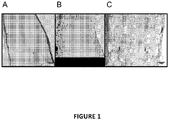
- microsphere scaffolds show substantial and uniform cellular invasion spanning the entire depth of the scaffold ( FIG. 1C ). Comparatively, cells sporadically and only partially invaded the 0.3% control scaffolds ( FIG. 1B ), and failed to invade the 1% control scaffolds, instead proliferating along the periphery of the scaffolds ( FIG. 1A ).
- MSS revealed robust cellular invasion spanning the scaffold depth ( FIG. 2C ). Comparatively, cells sporadically invaded 0.3% (w/v) collagen scaffolds ( FIG. 2B ) and failed to invade 1% (w/v) collagen scaffolds altogether, instead remaining confined to the periphery ( FIG. 2A ).
- Example 3 Different densities of microspheres relative to hydrogel density promote cellular infiltration.
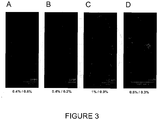
- Microsphere scaffolds with different densities (w/v) of collagen in microsphere (MS) and hydrogel (H) were prepared as follows: (A) 1% collagen MS in 0.3% H; (B) 0.6% MS/ 0.3% H; (C) 0.4% MS/0.2% H; (D) 0.4% MS/0.6% H. See, Table 1. Scaffolds comprising 1% w/v collagen microspheres embedded in 0.3% w/v collagen hydrogel are part of the claimed invention. The other microspheres are for reference. Table 1. Densities of Microsphere Scaffolds Microsphere Collagen Density (w/v) Bulk Collagen Density (w/v) 1% 0.3% 0.6% 0.3% 0.4% 0.2% 0.4% 0.6%
- MSS were implanted subcutaneously in the dorsa of adult mice and harvested for immunohistochemistry at 7 and 14 days after implantation.
- Immunohistochemical analysis identified cellular infiltration in all MSS ( FIGS. 3A-3D ), with greatest infiltration seen in 1% MS/ 0.3% H, and 0.6% MS 0.3% H ( FIGS. 3C- 3D ).
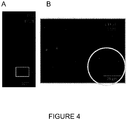
- CD31 expression was seen in all MSS after 7 and 14 days of implantation ( FIGS 4A-4B ), indicative of invading endothelial precursors and the formation of neovasculature.
- Example 4 MSS promotes cellular infiltration over 28 day implantation.
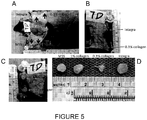
- FIGS. 5A-5D At 7 days after implantation ( FIGS. 5A-5D ), MSS, 1% collagen control, and INTEGRA scaffolds retained similar size and morphology relative to pre-implantation, while 0.3% collagen control was noticeably reduced in size ( FIG. 5D ).
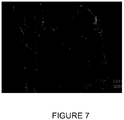
- H&E staining of MSS 1 week after implantation reveals invasion of cells all the way to the center of the scaffold ( FIG. 6A ). By comparison, there is no invasion of the 1% collagen scaffolds ( FIG. 6B ), except along cracks where the material has split. There was also minimal invasion into the shrunken 0.3% collagen scaffold ( FIG. 6C ).
- FIGS. 8A-8E After 14 days ( FIGS. 8A-8E ), the MSS, 1% collagen control, and INTEGRA scaffolds are still close to pre-implantation size, while 0.3% collagen control is dramatically reduced in size ( FIG. 8E ).
- the MSS scaffold shows significant cellular invasion ( FIG. 9A ), the 1% collagen displays minimal invasion except along fissures ( FIG. 9B ), and the 0.3% collagen scaffold shows sparse invasion ( FIG. 9C ).
- the INTEGRA scaffold showed less robust invasion than in the MSS scaffold ( FIG. 9D ); the dense structure of the INTEGRA scaffold led to shearing of the scaffold during sectioning for H&E staining.
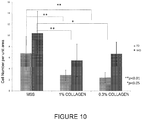
- FIG. 10 A comparison of cell count per unit scaffold area ( FIG. 10 ) shows that significantly more cells invaded the MSS scaffold at 7 and 14 days (approximately 7 cells and 10 cells per area, respectively) relative to 1% hydrogel (approximately 3 and 5 cells per unit area) and 0.3% hydrogel (approximately 3 and 7 cells per unit area).
- the MSS, 1% collagen control, and INTEGRA scaffolds are slightly smaller than pre-implantation size, while 0.3% collagen control is smaller than at 7 or 14 days ( FIG. 11D ).
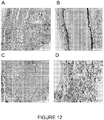
- the MSS scaffold at 28 days shows good cellular invasion ( FIG. 12A ), the 1% collagen displays essentially no invasion ( FIG. 12B ), and the 0.3% collagen scaffold shows invasion despite its small size ( FIG. 12C ).
- the INTEGRA scaffold showed some invasion as well ( FIG. 12D ).
- Example 5 Scanning electron microscopy of microspheres.
- Microspheres were prepared as in Example 1 and prepared for scanning electron microscopy (SEM). As seen in FIG. 13 , microspheres can vary in size (between 50-300 ⁇ m) and in shape (some are highly spherical, while others are irregular in morphology).
Landscapes
- Health & Medical Sciences (AREA)
- Chemical & Material Sciences (AREA)
- Life Sciences & Earth Sciences (AREA)
- Public Health (AREA)
- Veterinary Medicine (AREA)
- Epidemiology (AREA)
- Animal Behavior & Ethology (AREA)
- General Health & Medical Sciences (AREA)
- Medicinal Chemistry (AREA)
- Engineering & Computer Science (AREA)
- Dermatology (AREA)
- Oral & Maxillofacial Surgery (AREA)
- Transplantation (AREA)
- Bioinformatics & Cheminformatics (AREA)
- Materials Engineering (AREA)
- Pharmacology & Pharmacy (AREA)
- Dispersion Chemistry (AREA)
- Composite Materials (AREA)
- Biomedical Technology (AREA)
- Molecular Biology (AREA)
- Neurosurgery (AREA)
- Chemical Kinetics & Catalysis (AREA)
- Polymers & Plastics (AREA)
- Organic Chemistry (AREA)
- Biophysics (AREA)
- Materials For Medical Uses (AREA)
- Medicinal Preparation (AREA)
- Apparatus Associated With Microorganisms And Enzymes (AREA)
Priority Applications (2)
| Application Number | Priority Date | Filing Date | Title |
|---|---|---|---|
| EP20189470.6A EP3785742A1 (en) | 2013-11-19 | 2014-11-19 | Tissue scaffold materials for tissue regeneration and methods of making |
| PL14863949T PL3071248T3 (pl) | 2013-11-19 | 2014-11-19 | Materiały rusztowania tkankowego do regeneracji tkanki i sposoby ich wytwarzania |
Applications Claiming Priority (2)
| Application Number | Priority Date | Filing Date | Title |
|---|---|---|---|
| US201361906131P | 2013-11-19 | 2013-11-19 | |
| PCT/US2014/066344 WO2015077300A1 (en) | 2013-11-19 | 2014-11-19 | Tissue scaffold materials for tissue regeneration and methods of making |
Related Child Applications (1)
| Application Number | Title | Priority Date | Filing Date |
|---|---|---|---|
| EP20189470.6A Division EP3785742A1 (en) | 2013-11-19 | 2014-11-19 | Tissue scaffold materials for tissue regeneration and methods of making |
Publications (3)
| Publication Number | Publication Date |
|---|---|
| EP3071248A1 EP3071248A1 (en) | 2016-09-28 |
| EP3071248A4 EP3071248A4 (en) | 2017-07-12 |
| EP3071248B1 true EP3071248B1 (en) | 2020-08-05 |
Family
ID=53180089
Family Applications (2)
| Application Number | Title | Priority Date | Filing Date |
|---|---|---|---|
| EP14863949.5A Active EP3071248B1 (en) | 2013-11-19 | 2014-11-19 | Tissue scaffold materials for tissue regeneration and methods of making |
| EP20189470.6A Withdrawn EP3785742A1 (en) | 2013-11-19 | 2014-11-19 | Tissue scaffold materials for tissue regeneration and methods of making |
Family Applications After (1)
| Application Number | Title | Priority Date | Filing Date |
|---|---|---|---|
| EP20189470.6A Withdrawn EP3785742A1 (en) | 2013-11-19 | 2014-11-19 | Tissue scaffold materials for tissue regeneration and methods of making |
Country Status (12)
| Country | Link |
|---|---|
| US (4) | US9968708B2 (da) |
| EP (2) | EP3071248B1 (da) |
| JP (2) | JP6618898B2 (da) |
| KR (1) | KR102180497B1 (da) |
| CN (1) | CN105916528A (da) |
| AU (1) | AU2014353110B2 (da) |
| CA (1) | CA2929611C (da) |
| DK (1) | DK3071248T3 (da) |
| ES (1) | ES2826392T3 (da) |
| IL (2) | IL273135B2 (da) |
| PL (1) | PL3071248T3 (da) |
| WO (1) | WO2015077300A1 (da) |
Families Citing this family (16)
| Publication number | Priority date | Publication date | Assignee | Title |
|---|---|---|---|---|
| DK3071248T3 (da) * | 2013-11-19 | 2020-11-09 | Univ Cornell | Vævsstilladsmateriale til vævsregenerering og fremgangsmåder til fremstilling |
| CA2994222C (en) | 2014-08-20 | 2020-09-08 | Silk Technologies, Ltd. | Fibroin-derived protein composition |
| KR101818007B1 (ko) * | 2015-06-12 | 2018-02-21 | 서울대학교산학협력단 | 귀 재건 및 재건의 필요성을 위한 장치 및 방법 |
| EP3165240A1 (en) * | 2015-11-05 | 2017-05-10 | Ecole Polytechnique Federale De Lausanne (Epfl) | Natural polymer-derived scaffold material and methods for production thereof |
| HK1257499A1 (zh) | 2015-11-12 | 2019-10-25 | Graybug Vision, Inc. | 用於治疗的聚集性微粒 |
| EP3433297B1 (en) * | 2016-03-23 | 2022-05-11 | Universiteit Gent | Use of poly(alkylene terephthalates) and methods for their preparation |
| SG11201808804TA (en) | 2016-04-08 | 2018-11-29 | Univ Cornell | A method to enhance wound healing using silk-derived protein |
| US11242367B2 (en) | 2016-08-12 | 2022-02-08 | Silk Technologies, Ltd. | Silk-derived protein for treating inflammation |
| EP3600324A4 (en) | 2017-03-23 | 2020-12-09 | Graybug Vision, Inc. | COMPOUNDS AND COMPOSITIONS FOR THE TREATMENT OF EYE DISORDERS |
| AU2018265415A1 (en) | 2017-05-10 | 2019-10-31 | Graybug Vision, Inc. | Extended release microparticles and suspensions thereof for medical therapy |
| WO2018219987A1 (en) * | 2017-05-30 | 2018-12-06 | Aqpha Ip B.V. | Resorbable biodegradable medical and cosmetic composition comprising poly(1,3-trimethylene carbonate) |
| CN108144127B (zh) * | 2018-01-25 | 2020-12-22 | 南京医科大学附属口腔医院 | 纤维蛋白凝胶/聚乳酸-羟基乙酸微球支架及其制备方法和应用 |
| CN110559474A (zh) * | 2019-09-09 | 2019-12-13 | 苏州汇涵医用科技发展有限公司 | 液体伤口敷料及其制备方法和使用 |
| CN111166934A (zh) * | 2020-01-13 | 2020-05-19 | 山东建筑大学 | 一种用于体内杀菌且提高生物软骨组织修复性能的方法 |
| CN113144275B (zh) * | 2020-01-22 | 2023-02-28 | 鸡西代悦科技有限公司 | 一种水凝胶粘合剂及其制备方法和应用 |
| GB202016456D0 (en) * | 2020-10-16 | 2020-12-02 | Colzyx Ab | Novel bioactive peptide combinations and uses thereof |
Family Cites Families (10)
| Publication number | Priority date | Publication date | Assignee | Title |
|---|---|---|---|---|
| GB2281861B (en) * | 1993-09-21 | 1997-08-20 | Johnson & Johnson Medical | Bioabsorbable wound implant materials containing microspheres |
| FR2780730B1 (fr) * | 1998-07-01 | 2000-10-13 | Corneal Ind | Compositions biphasiques injectables, notamment utiles en chirurgies reparatrice et esthetique |
| US8070827B2 (en) * | 2007-07-03 | 2011-12-06 | Histogenics Corporation | Method for use of a double-structured tissue implant for treatment of tissue defects |
| US9782300B2 (en) * | 2008-02-01 | 2017-10-10 | Kci Licensing, Inc. | Fiber-microsphere bioresorbable composite scaffold for wound healing |
| US20090202642A1 (en) | 2008-02-08 | 2009-08-13 | Xiao Huang | Drug Delivery System Comprising Microparticles and Gelation System |
| US8652500B2 (en) * | 2009-07-22 | 2014-02-18 | Acell, Inc. | Particulate tissue graft with components of differing density and methods of making and using the same |
| FR2955258A1 (fr) * | 2010-01-20 | 2011-07-22 | Biopharmex Holding Ltd | Composition injectable |
| US8805418B2 (en) | 2011-12-23 | 2014-08-12 | United Video Properties, Inc. | Methods and systems for performing actions based on location-based rules |
| WO2013126294A1 (en) | 2012-02-23 | 2013-08-29 | The Board Of Trustees Of The Leland Stanford Junior University | Injectable hydrogel system to modulate host response at bone implant interface |
| DK3071248T3 (da) * | 2013-11-19 | 2020-11-09 | Univ Cornell | Vævsstilladsmateriale til vævsregenerering og fremgangsmåder til fremstilling |
-
2014
- 2014-11-19 DK DK14863949.5T patent/DK3071248T3/da active
- 2014-11-19 US US15/037,417 patent/US9968708B2/en active Active
- 2014-11-19 IL IL273135A patent/IL273135B2/en unknown
- 2014-11-19 CA CA2929611A patent/CA2929611C/en active Active
- 2014-11-19 EP EP14863949.5A patent/EP3071248B1/en active Active
- 2014-11-19 WO PCT/US2014/066344 patent/WO2015077300A1/en not_active Ceased
- 2014-11-19 AU AU2014353110A patent/AU2014353110B2/en active Active
- 2014-11-19 EP EP20189470.6A patent/EP3785742A1/en not_active Withdrawn
- 2014-11-19 KR KR1020167012728A patent/KR102180497B1/ko active Active
- 2014-11-19 PL PL14863949T patent/PL3071248T3/pl unknown
- 2014-11-19 JP JP2016528093A patent/JP6618898B2/ja active Active
- 2014-11-19 ES ES14863949T patent/ES2826392T3/es active Active
- 2014-11-19 CN CN201480073519.0A patent/CN105916528A/zh active Pending
-
2016
- 2016-05-03 IL IL245449A patent/IL245449B/en active IP Right Grant
-
2018
- 2018-04-12 US US15/951,401 patent/US10953135B2/en active Active
-
2019
- 2019-07-19 JP JP2019133223A patent/JP7340374B2/ja active Active
-
2021
- 2021-03-04 US US17/192,111 patent/US12029833B2/en active Active
-
2024
- 2024-05-24 US US18/673,731 patent/US20250025605A1/en active Pending
Non-Patent Citations (1)
| Title |
|---|
| None * |
Also Published As
| Publication number | Publication date |
|---|---|
| US20220016319A1 (en) | 2022-01-20 |
| EP3071248A4 (en) | 2017-07-12 |
| AU2014353110B2 (en) | 2018-05-10 |
| US20160287755A1 (en) | 2016-10-06 |
| US20250025605A1 (en) | 2025-01-23 |
| JP7340374B2 (ja) | 2023-09-07 |
| WO2015077300A1 (en) | 2015-05-28 |
| US20180289863A1 (en) | 2018-10-11 |
| DK3071248T3 (da) | 2020-11-09 |
| CA2929611C (en) | 2021-08-03 |
| US9968708B2 (en) | 2018-05-15 |
| US10953135B2 (en) | 2021-03-23 |
| IL245449B (en) | 2020-03-31 |
| IL245449A0 (en) | 2016-06-30 |
| EP3071248A1 (en) | 2016-09-28 |
| IL273135B2 (en) | 2023-11-01 |
| IL273135B1 (en) | 2023-07-01 |
| ES2826392T3 (es) | 2021-05-18 |
| JP6618898B2 (ja) | 2019-12-11 |
| CA2929611A1 (en) | 2015-05-28 |
| PL3071248T3 (pl) | 2021-03-08 |
| IL273135A (en) | 2020-04-30 |
| US12029833B2 (en) | 2024-07-09 |
| KR102180497B1 (ko) | 2020-11-18 |
| JP2016538035A (ja) | 2016-12-08 |
| JP2019195675A (ja) | 2019-11-14 |
| KR20160110935A (ko) | 2016-09-23 |
| EP3785742A1 (en) | 2021-03-03 |
| CN105916528A (zh) | 2016-08-31 |
| AU2014353110A1 (en) | 2016-05-26 |
Similar Documents
| Publication | Publication Date | Title |
|---|---|---|
| EP3071248B1 (en) | Tissue scaffold materials for tissue regeneration and methods of making | |
| US20050129730A1 (en) | Tissue composites and uses thereof | |
| EP2603248B1 (en) | Regenerative tissue scaffolds | |
| JP6362540B2 (ja) | 注射可能なシルクフィブロイン粒子およびその使用 | |
| JP2834155B2 (ja) | コラーゲンフレーク体 | |
| KR101056069B1 (ko) | 동물조직 분말을 이용한 다공성 3차원 지지체의 제조방법 | |
| EP2019653B1 (en) | Bioengineered intervertebral discs and methods for their preparation | |
| US20060135921A1 (en) | Porous particulate collagen sponges | |
| US20020022883A1 (en) | Tissue engineering composite | |
| JP7710206B2 (ja) | 創傷治癒薬 | |
| JP2004531297A (ja) | 組織修復のための方法および装具 | |
| US20120134949A1 (en) | Polymeric collagen biomaterials | |
| JP2007500520A (ja) | ニューロンの製造方法 | |
| CN114931670B (zh) | 活性物质及其自愈合水凝胶在修复软骨中的应用 | |
| JP4464056B2 (ja) | 発毛促進用複合材料 | |
| KR20250158696A (ko) | 피로갈롤기로 수식된 탈세포 조직 유래 지지체 |
Legal Events
| Date | Code | Title | Description |
|---|---|---|---|
| PUAI | Public reference made under article 153(3) epc to a published international application that has entered the european phase |
Free format text: ORIGINAL CODE: 0009012 |
|
| 17P | Request for examination filed |
Effective date: 20160517 |
|
| AK | Designated contracting states |
Kind code of ref document: A1 Designated state(s): AL AT BE BG CH CY CZ DE DK EE ES FI FR GB GR HR HU IE IS IT LI LT LU LV MC MK MT NL NO PL PT RO RS SE SI SK SM TR |
|
| AX | Request for extension of the european patent |
Extension state: BA ME |
|
| DAX | Request for extension of the european patent (deleted) | ||
| REG | Reference to a national code |
Ref country code: DE Ref legal event code: R079 Ref document number: 602014068732 Country of ref document: DE Free format text: PREVIOUS MAIN CLASS: A61L0027520000 Ipc: A61L0027440000 |
|
| A4 | Supplementary search report drawn up and despatched |
Effective date: 20170613 |
|
| RIC1 | Information provided on ipc code assigned before grant |
Ipc: A61L 27/44 20060101AFI20170607BHEP Ipc: A61L 27/52 20060101ALI20170607BHEP Ipc: A61L 27/60 20060101ALI20170607BHEP Ipc: A61L 27/54 20060101ALI20170607BHEP Ipc: A61L 27/48 20060101ALI20170607BHEP |
|
| STAA | Information on the status of an ep patent application or granted ep patent |
Free format text: STATUS: EXAMINATION IS IN PROGRESS |
|
| 17Q | First examination report despatched |
Effective date: 20180524 |
|
| GRAP | Despatch of communication of intention to grant a patent |
Free format text: ORIGINAL CODE: EPIDOSNIGR1 |
|
| STAA | Information on the status of an ep patent application or granted ep patent |
Free format text: STATUS: GRANT OF PATENT IS INTENDED |
|
| INTG | Intention to grant announced |
Effective date: 20200224 |
|
| GRAS | Grant fee paid |
Free format text: ORIGINAL CODE: EPIDOSNIGR3 |
|
| GRAA | (expected) grant |
Free format text: ORIGINAL CODE: 0009210 |
|
| STAA | Information on the status of an ep patent application or granted ep patent |
Free format text: STATUS: THE PATENT HAS BEEN GRANTED |
|
| AK | Designated contracting states |
Kind code of ref document: B1 Designated state(s): AL AT BE BG CH CY CZ DE DK EE ES FI FR GB GR HR HU IE IS IT LI LT LU LV MC MK MT NL NO PL PT RO RS SE SI SK SM TR |
|
| REG | Reference to a national code |
Ref country code: GB Ref legal event code: FG4D |
|
| REG | Reference to a national code |
Ref country code: CH Ref legal event code: EP |
|
| REG | Reference to a national code |
Ref country code: AT Ref legal event code: REF Ref document number: 1297803 Country of ref document: AT Kind code of ref document: T Effective date: 20200815 |
|
| REG | Reference to a national code |
Ref country code: DE Ref legal event code: R096 Ref document number: 602014068732 Country of ref document: DE |
|
| REG | Reference to a national code |
Ref country code: IE Ref legal event code: FG4D |
|
| REG | Reference to a national code |
Ref country code: CH Ref legal event code: NV Representative=s name: BOVARD AG PATENT- UND MARKENANWAELTE, CH |
|
| REG | Reference to a national code |
Ref country code: SE Ref legal event code: TRGR |
|
| REG | Reference to a national code |
Ref country code: DK Ref legal event code: T3 Effective date: 20201102 |
|
| REG | Reference to a national code |
Ref country code: NO Ref legal event code: T2 Effective date: 20200805 |
|
| REG | Reference to a national code |
Ref country code: LT Ref legal event code: MG4D |
|
| REG | Reference to a national code |
Ref country code: NL Ref legal event code: MP Effective date: 20200805 |
|
| PG25 | Lapsed in a contracting state [announced via postgrant information from national office to epo] |
Ref country code: PT Free format text: LAPSE BECAUSE OF FAILURE TO SUBMIT A TRANSLATION OF THE DESCRIPTION OR TO PAY THE FEE WITHIN THE PRESCRIBED TIME-LIMIT Effective date: 20201207 Ref country code: FI Free format text: LAPSE BECAUSE OF FAILURE TO SUBMIT A TRANSLATION OF THE DESCRIPTION OR TO PAY THE FEE WITHIN THE PRESCRIBED TIME-LIMIT Effective date: 20200805 Ref country code: GR Free format text: LAPSE BECAUSE OF FAILURE TO SUBMIT A TRANSLATION OF THE DESCRIPTION OR TO PAY THE FEE WITHIN THE PRESCRIBED TIME-LIMIT Effective date: 20201106 Ref country code: LT Free format text: LAPSE BECAUSE OF FAILURE TO SUBMIT A TRANSLATION OF THE DESCRIPTION OR TO PAY THE FEE WITHIN THE PRESCRIBED TIME-LIMIT Effective date: 20200805 Ref country code: HR Free format text: LAPSE BECAUSE OF FAILURE TO SUBMIT A TRANSLATION OF THE DESCRIPTION OR TO PAY THE FEE WITHIN THE PRESCRIBED TIME-LIMIT Effective date: 20200805 Ref country code: BG Free format text: LAPSE BECAUSE OF FAILURE TO SUBMIT A TRANSLATION OF THE DESCRIPTION OR TO PAY THE FEE WITHIN THE PRESCRIBED TIME-LIMIT Effective date: 20201105 |
|
| PG25 | Lapsed in a contracting state [announced via postgrant information from national office to epo] |
Ref country code: RS Free format text: LAPSE BECAUSE OF FAILURE TO SUBMIT A TRANSLATION OF THE DESCRIPTION OR TO PAY THE FEE WITHIN THE PRESCRIBED TIME-LIMIT Effective date: 20200805 Ref country code: LV Free format text: LAPSE BECAUSE OF FAILURE TO SUBMIT A TRANSLATION OF THE DESCRIPTION OR TO PAY THE FEE WITHIN THE PRESCRIBED TIME-LIMIT Effective date: 20200805 Ref country code: NL Free format text: LAPSE BECAUSE OF FAILURE TO SUBMIT A TRANSLATION OF THE DESCRIPTION OR TO PAY THE FEE WITHIN THE PRESCRIBED TIME-LIMIT Effective date: 20200805 Ref country code: IS Free format text: LAPSE BECAUSE OF FAILURE TO SUBMIT A TRANSLATION OF THE DESCRIPTION OR TO PAY THE FEE WITHIN THE PRESCRIBED TIME-LIMIT Effective date: 20201205 |
|
| PG25 | Lapsed in a contracting state [announced via postgrant information from national office to epo] |
Ref country code: SM Free format text: LAPSE BECAUSE OF FAILURE TO SUBMIT A TRANSLATION OF THE DESCRIPTION OR TO PAY THE FEE WITHIN THE PRESCRIBED TIME-LIMIT Effective date: 20200805 Ref country code: RO Free format text: LAPSE BECAUSE OF FAILURE TO SUBMIT A TRANSLATION OF THE DESCRIPTION OR TO PAY THE FEE WITHIN THE PRESCRIBED TIME-LIMIT Effective date: 20200805 Ref country code: EE Free format text: LAPSE BECAUSE OF FAILURE TO SUBMIT A TRANSLATION OF THE DESCRIPTION OR TO PAY THE FEE WITHIN THE PRESCRIBED TIME-LIMIT Effective date: 20200805 Ref country code: CZ Free format text: LAPSE BECAUSE OF FAILURE TO SUBMIT A TRANSLATION OF THE DESCRIPTION OR TO PAY THE FEE WITHIN THE PRESCRIBED TIME-LIMIT Effective date: 20200805 |
|
| REG | Reference to a national code |
Ref country code: DE Ref legal event code: R097 Ref document number: 602014068732 Country of ref document: DE |
|
| REG | Reference to a national code |
Ref country code: ES Ref legal event code: FG2A Ref document number: 2826392 Country of ref document: ES Kind code of ref document: T3 Effective date: 20210518 |
|
| PG25 | Lapsed in a contracting state [announced via postgrant information from national office to epo] |
Ref country code: AL Free format text: LAPSE BECAUSE OF FAILURE TO SUBMIT A TRANSLATION OF THE DESCRIPTION OR TO PAY THE FEE WITHIN THE PRESCRIBED TIME-LIMIT Effective date: 20200805 |
|
| PLBE | No opposition filed within time limit |
Free format text: ORIGINAL CODE: 0009261 |
|
| STAA | Information on the status of an ep patent application or granted ep patent |
Free format text: STATUS: NO OPPOSITION FILED WITHIN TIME LIMIT |
|
| PG25 | Lapsed in a contracting state [announced via postgrant information from national office to epo] |
Ref country code: MC Free format text: LAPSE BECAUSE OF FAILURE TO SUBMIT A TRANSLATION OF THE DESCRIPTION OR TO PAY THE FEE WITHIN THE PRESCRIBED TIME-LIMIT Effective date: 20200805 Ref country code: SK Free format text: LAPSE BECAUSE OF FAILURE TO SUBMIT A TRANSLATION OF THE DESCRIPTION OR TO PAY THE FEE WITHIN THE PRESCRIBED TIME-LIMIT Effective date: 20200805 |
|
| 26N | No opposition filed |
Effective date: 20210507 |
|
| PG25 | Lapsed in a contracting state [announced via postgrant information from national office to epo] |
Ref country code: LU Free format text: LAPSE BECAUSE OF NON-PAYMENT OF DUE FEES Effective date: 20201119 |
|
| PG25 | Lapsed in a contracting state [announced via postgrant information from national office to epo] |
Ref country code: SI Free format text: LAPSE BECAUSE OF FAILURE TO SUBMIT A TRANSLATION OF THE DESCRIPTION OR TO PAY THE FEE WITHIN THE PRESCRIBED TIME-LIMIT Effective date: 20200805 |
|
| REG | Reference to a national code |
Ref country code: AT Ref legal event code: UEP Ref document number: 1297803 Country of ref document: AT Kind code of ref document: T Effective date: 20200805 |
|
| PG25 | Lapsed in a contracting state [announced via postgrant information from national office to epo] |
Ref country code: TR Free format text: LAPSE BECAUSE OF FAILURE TO SUBMIT A TRANSLATION OF THE DESCRIPTION OR TO PAY THE FEE WITHIN THE PRESCRIBED TIME-LIMIT Effective date: 20200805 Ref country code: MT Free format text: LAPSE BECAUSE OF FAILURE TO SUBMIT A TRANSLATION OF THE DESCRIPTION OR TO PAY THE FEE WITHIN THE PRESCRIBED TIME-LIMIT Effective date: 20200805 Ref country code: CY Free format text: LAPSE BECAUSE OF FAILURE TO SUBMIT A TRANSLATION OF THE DESCRIPTION OR TO PAY THE FEE WITHIN THE PRESCRIBED TIME-LIMIT Effective date: 20200805 |
|
| PG25 | Lapsed in a contracting state [announced via postgrant information from national office to epo] |
Ref country code: MK Free format text: LAPSE BECAUSE OF FAILURE TO SUBMIT A TRANSLATION OF THE DESCRIPTION OR TO PAY THE FEE WITHIN THE PRESCRIBED TIME-LIMIT Effective date: 20200805 |
|
| P01 | Opt-out of the competence of the unified patent court (upc) registered |
Effective date: 20230818 |
|
| REG | Reference to a national code |
Ref country code: CH Ref legal event code: U11 Free format text: ST27 STATUS EVENT CODE: U-0-0-U10-U11 (AS PROVIDED BY THE NATIONAL OFFICE) Effective date: 20251201 |
|
| PGFP | Annual fee paid to national office [announced via postgrant information from national office to epo] |
Ref country code: DE Payment date: 20251128 Year of fee payment: 12 |
|
| PGFP | Annual fee paid to national office [announced via postgrant information from national office to epo] |
Ref country code: GB Payment date: 20251127 Year of fee payment: 12 |
|
| PGFP | Annual fee paid to national office [announced via postgrant information from national office to epo] |
Ref country code: NO Payment date: 20251128 Year of fee payment: 12 |
|
| PGFP | Annual fee paid to national office [announced via postgrant information from national office to epo] |
Ref country code: AT Payment date: 20251128 Year of fee payment: 12 |
|
| PGFP | Annual fee paid to national office [announced via postgrant information from national office to epo] |
Ref country code: DK Payment date: 20251125 Year of fee payment: 12 Ref country code: IT Payment date: 20251119 Year of fee payment: 12 |
|
| PGFP | Annual fee paid to national office [announced via postgrant information from national office to epo] |
Ref country code: FR Payment date: 20251125 Year of fee payment: 12 |
|
| PGFP | Annual fee paid to national office [announced via postgrant information from national office to epo] |
Ref country code: BE Payment date: 20251127 Year of fee payment: 12 |
|
| PGFP | Annual fee paid to national office [announced via postgrant information from national office to epo] |
Ref country code: SE Payment date: 20251127 Year of fee payment: 12 Ref country code: CH Payment date: 20251201 Year of fee payment: 12 |
|
| PGFP | Annual fee paid to national office [announced via postgrant information from national office to epo] |
Ref country code: IE Payment date: 20251127 Year of fee payment: 12 |
|
| PGFP | Annual fee paid to national office [announced via postgrant information from national office to epo] |
Ref country code: PL Payment date: 20251104 Year of fee payment: 12 |
|
| PGFP | Annual fee paid to national office [announced via postgrant information from national office to epo] |
Ref country code: ES Payment date: 20251201 Year of fee payment: 12 |