EP3058592B1 - Compact laser device - Google Patents
Compact laser device Download PDFInfo
- Publication number
- EP3058592B1 EP3058592B1 EP14783863.5A EP14783863A EP3058592B1 EP 3058592 B1 EP3058592 B1 EP 3058592B1 EP 14783863 A EP14783863 A EP 14783863A EP 3058592 B1 EP3058592 B1 EP 3058592B1
- Authority
- EP
- European Patent Office
- Prior art keywords
- mesas
- semiconductor chip
- vcsel device
- optical power
- laser light
- Prior art date
- Legal status (The legal status is an assumption and is not a legal conclusion. Google has not performed a legal analysis and makes no representation as to the accuracy of the status listed.)
- Active
Links
Images

Classifications
-
- H—ELECTRICITY
- H01—ELECTRIC ELEMENTS
- H01S—DEVICES USING THE PROCESS OF LIGHT AMPLIFICATION BY STIMULATED EMISSION OF RADIATION [LASER] TO AMPLIFY OR GENERATE LIGHT; DEVICES USING STIMULATED EMISSION OF ELECTROMAGNETIC RADIATION IN WAVE RANGES OTHER THAN OPTICAL
- H01S5/00—Semiconductor lasers
- H01S5/02—Structural details or components not essential to laser action
- H01S5/028—Coatings ; Treatment of the laser facets, e.g. etching, passivation layers or reflecting layers
-
- H—ELECTRICITY
- H01—ELECTRIC ELEMENTS
- H01S—DEVICES USING THE PROCESS OF LIGHT AMPLIFICATION BY STIMULATED EMISSION OF RADIATION [LASER] TO AMPLIFY OR GENERATE LIGHT; DEVICES USING STIMULATED EMISSION OF ELECTROMAGNETIC RADIATION IN WAVE RANGES OTHER THAN OPTICAL
- H01S5/00—Semiconductor lasers
- H01S5/04—Processes or apparatus for excitation, e.g. pumping, e.g. by electron beams
- H01S5/042—Electrical excitation ; Circuits therefor
-
- H—ELECTRICITY
- H01—ELECTRIC ELEMENTS
- H01S—DEVICES USING THE PROCESS OF LIGHT AMPLIFICATION BY STIMULATED EMISSION OF RADIATION [LASER] TO AMPLIFY OR GENERATE LIGHT; DEVICES USING STIMULATED EMISSION OF ELECTROMAGNETIC RADIATION IN WAVE RANGES OTHER THAN OPTICAL
- H01S5/00—Semiconductor lasers
- H01S5/10—Construction or shape of the optical resonator, e.g. extended or external cavity, coupled cavities, bent-guide, varying width, thickness or composition of the active region
- H01S5/18—Surface-emitting [SE] lasers, e.g. having both horizontal and vertical cavities
- H01S5/183—Surface-emitting [SE] lasers, e.g. having both horizontal and vertical cavities having only vertical cavities, e.g. vertical cavity surface-emitting lasers [VCSEL]
- H01S5/18308—Surface-emitting [SE] lasers, e.g. having both horizontal and vertical cavities having only vertical cavities, e.g. vertical cavity surface-emitting lasers [VCSEL] having a special structure for lateral current or light confinement
- H01S5/18322—Position of the structure
- H01S5/18327—Structure being part of a DBR
-
- H—ELECTRICITY
- H01—ELECTRIC ELEMENTS
- H01S—DEVICES USING THE PROCESS OF LIGHT AMPLIFICATION BY STIMULATED EMISSION OF RADIATION [LASER] TO AMPLIFY OR GENERATE LIGHT; DEVICES USING STIMULATED EMISSION OF ELECTROMAGNETIC RADIATION IN WAVE RANGES OTHER THAN OPTICAL
- H01S5/00—Semiconductor lasers
- H01S5/20—Structure or shape of the semiconductor body to guide the optical wave ; Confining structures perpendicular to the optical axis, e.g. index or gain guiding, stripe geometry, broad area lasers, gain tailoring, transverse or lateral reflectors, special cladding structures, MQW barrier reflection layers
- H01S5/22—Structure or shape of the semiconductor body to guide the optical wave ; Confining structures perpendicular to the optical axis, e.g. index or gain guiding, stripe geometry, broad area lasers, gain tailoring, transverse or lateral reflectors, special cladding structures, MQW barrier reflection layers having a ridge or stripe structure
-
- H—ELECTRICITY
- H01—ELECTRIC ELEMENTS
- H01S—DEVICES USING THE PROCESS OF LIGHT AMPLIFICATION BY STIMULATED EMISSION OF RADIATION [LASER] TO AMPLIFY OR GENERATE LIGHT; DEVICES USING STIMULATED EMISSION OF ELECTROMAGNETIC RADIATION IN WAVE RANGES OTHER THAN OPTICAL
- H01S5/00—Semiconductor lasers
- H01S5/40—Arrangement of two or more semiconductor lasers, not provided for in groups H01S5/02 - H01S5/30
- H01S5/42—Arrays of surface emitting lasers
- H01S5/423—Arrays of surface emitting lasers having a vertical cavity
-
- H—ELECTRICITY
- H10—SEMICONDUCTOR DEVICES; ELECTRIC SOLID-STATE DEVICES NOT OTHERWISE PROVIDED FOR
- H10F—INORGANIC SEMICONDUCTOR DEVICES SENSITIVE TO INFRARED RADIATION, LIGHT, ELECTROMAGNETIC RADIATION OF SHORTER WAVELENGTH OR CORPUSCULAR RADIATION
- H10F55/00—Radiation-sensitive semiconductor devices covered by groups H10F10/00, H10F19/00 or H10F30/00 being structurally associated with electric light sources and electrically or optically coupled thereto
- H10F55/20—Radiation-sensitive semiconductor devices covered by groups H10F10/00, H10F19/00 or H10F30/00 being structurally associated with electric light sources and electrically or optically coupled thereto wherein the electric light source controls the radiation-sensitive semiconductor devices, e.g. optocouplers
-
- H—ELECTRICITY
- H10—SEMICONDUCTOR DEVICES; ELECTRIC SOLID-STATE DEVICES NOT OTHERWISE PROVIDED FOR
- H10W—GENERIC PACKAGES, INTERCONNECTIONS, CONNECTORS OR OTHER CONSTRUCTIONAL DETAILS OF DEVICES COVERED BY CLASS H10
- H10W46/00—Marks applied to devices, e.g. for alignment or identification
-
- H—ELECTRICITY
- H10—SEMICONDUCTOR DEVICES; ELECTRIC SOLID-STATE DEVICES NOT OTHERWISE PROVIDED FOR
- H10P—GENERIC PROCESSES OR APPARATUS FOR THE MANUFACTURE OR TREATMENT OF DEVICES COVERED BY CLASS H10
- H10P74/00—Testing or measuring during manufacture or treatment of wafers, substrates or devices
- H10P74/27—Structural arrangements therefor
-
- H—ELECTRICITY
- H10—SEMICONDUCTOR DEVICES; ELECTRIC SOLID-STATE DEVICES NOT OTHERWISE PROVIDED FOR
- H10W—GENERIC PACKAGES, INTERCONNECTIONS, CONNECTORS OR OTHER CONSTRUCTIONAL DETAILS OF DEVICES COVERED BY CLASS H10
- H10W46/00—Marks applied to devices, e.g. for alignment or identification
- H10W46/101—Marks applied to devices, e.g. for alignment or identification characterised by the type of information, e.g. logos or symbols
- H10W46/106—Marks applied to devices, e.g. for alignment or identification characterised by the type of information, e.g. logos or symbols digital information, e.g. bar codes
-
- H—ELECTRICITY
- H10—SEMICONDUCTOR DEVICES; ELECTRIC SOLID-STATE DEVICES NOT OTHERWISE PROVIDED FOR
- H10W—GENERIC PACKAGES, INTERCONNECTIONS, CONNECTORS OR OTHER CONSTRUCTIONAL DETAILS OF DEVICES COVERED BY CLASS H10
- H10W46/00—Marks applied to devices, e.g. for alignment or identification
- H10W46/401—Marks applied to devices, e.g. for alignment or identification for identification or tracking
-
- H—ELECTRICITY
- H10—SEMICONDUCTOR DEVICES; ELECTRIC SOLID-STATE DEVICES NOT OTHERWISE PROVIDED FOR
- H10W—GENERIC PACKAGES, INTERCONNECTIONS, CONNECTORS OR OTHER CONSTRUCTIONAL DETAILS OF DEVICES COVERED BY CLASS H10
- H10W46/00—Marks applied to devices, e.g. for alignment or identification
- H10W46/601—Marks applied to devices, e.g. for alignment or identification for use after dicing
- H10W46/603—Formed on wafers or substrates before dicing and remaining on chips after dicing
Definitions
- the invention relates to a VCSEL device wherein the VCSEL device is especially suited for sensing applications.
- the invention further relates to a method of marking semiconductor chips in a unique way.
- VCSEL Vertically Cavity Surface Emitting Lasers
- Next generation require an optical output power of at least 6 mW.
- State of the art VCSELs with such high output power are realized by increasing the diameter of the aperture or active diameter of the VCSELs ( ⁇ 14um).
- the total die size needs to be as small as possible and yield of the laser device has to be high in order to meet the cost targets.
- WO 2011/018734 A1 vertical cavity surface emitting laser (VCSEL)with active carrier confinement. It is proposed to integrate a phototransistor layer structure into the layer stack of the VCSEL.
- VCSEL vertical cavity surface emitting laser
- US 2013/0266326 A1 discloses microlenses for multibeam arrays of optoelectronic devices for high frequency operation.
- US 2012/0051685 A1 discloses flip-chip assembly comprising an array of vertical cavity surface emitting lasers (VCSELs).
- VCSELs vertical cavity surface emitting lasers
- JP S55 87452 A dislcoses a method for semiconductor device manufaturing wherein an indexing mark is provided on each chip inside one wafer and read out by an electron beam irradiation to identify the chip.
- WO 2002/005397 A2 discloses a VCSEL and VCSEL array having integrated microlenses for use in a semiconductor laser pumped solid state laser system.
- US 2009/0296752 A1 discloses a mulitple emitter VCSEL.
- An extended cavity surface emitting laser is proposed that has a first laser die with a first cavity and a first gain element and a second laser die with a second cavity and a second gain element.
- the first and second gain elements are in series to provide optical gain and optical feedback in an extended optical cavity configuration.
- the first and second gain elements provide optical gain and optical feedback in a common extended cavity with the first and second gain elements operating serially as a common extended cavity optical mode.
- a laser device comprising between two and six mesas provided on one semiconductor chip.
- the mesas are electrically connected in parallel such that the mesas are adapted to emit laser light if a defined threshold voltage is provided to the mesas.
- the laser device further comprises a driver for electrically driving the mesas, wherein the driver is adapted to provide the defined threshold voltage to the mesas.
- the semiconductor chip has a side length of less than 250 ⁇ m.
- the laser device is adapted to emit laser light of an optical power between 4 mW and 10 mW.
- Each mesa comprises an active diameter between 5 ⁇ m and 9 ⁇ m
- a laser device comprising only one mesa with increased diameter of the aperture may have the advantage that the size of device is small. Size is an essential factor because the chip area determines the number of semiconductor chips per wafer which can be manufactured in one run and therefore the prize of the laser device. Tests have shown that the production yield meaning the number of laser chips per wafer meeting the quality targets of such laser devices with one mesa is unsatisfactory. The production spread is high because of the tight process window. Further investigations have shown that providing between two and six mesas with smaller aperture and thus smaller optical power output per mesa on one semiconductor chip increases the yield and enables a lower temperature sensibility of the laser devices. The mesas are electrically connected in parallel such that in operation all mesas are provided with electrical power at the same time.
- All mesas on one semiconductor chip thus emit laser light at the same time.
- the lower temperature sensibility may be caused or at least positively influenced by the heat distribution when operating the two to six mesas in parallel in comparison to the concentrated heat dissipation in case of only one mesa per laser device.
- the latter effect may be even improved by distributing the between two and six mesas in a way that an even heat distribution is enabled across the laser device.
- the distance between the mesas may be maximized in relation to the available area on the semiconductor ship. Process steps like dicing and the like may require a minimum distance between a mesa and the edges of the semiconductor chip thus limiting the available area.
- the form of the chip may thus influence positioning of the mesas. In most cases quadratic semiconductor chips may be preferred. Despite of the fact that semiconductor chips with one mesa are smaller and enable more semiconductor chips the improved yield overcompensates the bigger size of the laser devices caused by the increased number of mesas.
- the investigations have further shown that three mesas per laser device result in the highest yield.
- the three mesas may be preferably arranged on the available area of the semiconductor chip such that the centers of the mesas build an equilateral triangle in order to maximize the distance between the mesas. This arrangement of the mesas may enable an even distribution of the heat generated in each mesa across the semiconductor chip.
- the semiconductor chip of the laser device has a side length of less than 250 ⁇ m.
- the size of the semiconductor chip determines the number of chips per wafer and thus strongly influences the prize of the laser device. It's the intention to provide semiconductor chips which are as small as possible. At the same time the requested optical power which has to be emitted by the laser devices increases, which would be easier if the chip size would be larger.
- the side length of the semiconductor chips may be even smaller than 250 ⁇ m like 200 ⁇ m or even smaller than 150 ⁇ m further decreasing the processing window.
- the laser devices are adapted to emit laser light of an optical power between 4 mW and 10 mW if they are connected to a corresponding driver and power source.
- the power source may be a conventional AC-line, a battery or any other power source being able to power the laser device and the corresponding driver.
- the kind of power source may depend on the application. Batteries which are preferably rechargeable may be used in mobile applications like, for example, proximity detection in mobile devices like mobile phones, smartphones, laptops and the like.
- the laser device is preferably adapted to be driven at a voltage between 1.6 V and 2.2 V at an electrical current of 12 mA when emitting laser light of an optical power between 4 mW and 10 mW.
- the laser device may be adapted to emit laser light of an optical power between 4 mW and 10 mW at a temperature of 60°C of the semiconductor chip.
- the temperature of the devices may often reach 60°C in operation. It's thus essential that the optical power doesn't drop below 4 mW in order to fulfill quality requirements.
- the temperature of the semiconductor chip is the temperature of the substrate of the semiconductor chip and not the local temperature in the active layer of the laser which may be considerably higher.
- the laser device is preferably adapted to emit laser light of an optical power at a temperature of 25°C of the semiconductor chip deviating less than 20% from the laser power emitted at 60°C of the semiconductor chip when driven at an electrical current of 12 mA.
- the deviation is most preferably even less than 10%.
- the laser device is preferably adapted to emit laser light with an optical power, wherein the optical power linearly depends on the provided electrical current when driven at an electrical current between 3 mA and 12 mA.
- the linear dependence of the optical power from the electrical driving current may simplify the control of the optical output power in applications requesting such power control.
- the mesas comprise an active diameter between 5 ⁇ m and 9 ⁇ m in order to provide an optical power between 4 mW and 10 mW. In case of 2 - 4 mesas an active diameter between 7 ⁇ m and 9 ⁇ m may be preferred, whereby most efficient device may comprise mesas with an active diameter of 8 ⁇ m. In case of 5 - 6 mesas an active diameter between 5 ⁇ m and 7 ⁇ m may be preferred.
- the active diameter of a mesa is determined by means of an oxidation of a confinement layer within the mesas during processing of the wafer comprising the semiconductor chips. The active diameter restricts the electrical current to a defined area of an active layer within each mesa provided between a bottom and a top Distributed Bragg Reflector (DBR) with respect to the substrate of the semiconductor chip.
- DBR Distributed Bragg Reflector
- the semiconductor chip may preferably comprise a functional layer with a coding for identifying the laser device.
- a functional layer may thus be provided comprising a coding enabling an identification of each chip.
- the coding may be a bar-code provided in the functional layer such that the chip can be optically identified.
- the functional layer has thus to be visible after processing the semiconductor chip or the laser device.
- the functional layer may preferably be one of the layers needed for operating the laser device.
- One of the metallization layers may, for example, be etched such that besides the structure needed to manufacture and finally drive the laser device (e.g.
- a bar-code like structure may be visible at one or more edges of the metallization layer.
- Such a binary code may be used to enable tracing of each laser device.
- the metallization layer used for tracing the laser device may, for example, additionally be used for bonding and contacting.
- Optical sensors for, for example, proximity detection may comprise one or more of the described laser devices.
- arrays comprising a multitude of mesas which can be individually addressed is known for power applications like printing and heating. These applications require high power laser devices providing an optical or laser power of several Watt or even several hundreds of Watt.
- the array of individually addressable mesas enables a simple switching of the emitted laser power.
- Optical sensors emit laser light with an optical power of only some mW such that more than one mesa per semiconductor chip seems to be undesirable. Anyhow, the improved yield and temperature stability of laser devices comprising between 2 and six mesas enable improved optical sensors like proximity sensors at reduced costs.
- the method comprises the steps of:
- the method may enable an unambiguous marking of semiconductor chips or laser devices such that tracing of single, for example, laser devices is enabled.
- the tracing may be needed for quality management. Structuring of a functional layer like a metallization layer needed for, for example, electrically contacting avoids an additional manufacturing step like printing a serial number on top of the semiconductor chip. Marking of semiconductor chips may thus be simplified.
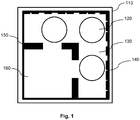
- Fig. 1 shows a semiconductor ship 110 comprising three mesas 120. Each of the mesas comprises an optical resonator. A principal sketch of such an optical resonator is shown in Fig. 2 .
- a metallization layer 130 is structured such that a bonding area 160 for electrically contacting the semiconductor chip 110 of the layer device is provided. Furthermore, alignment marks are provided in the metallization layer 130 for aligning the semiconductor chips 110 in the bonding process.
- the metallization layer 130 further comprises at the upper edge and the right edge a binary code 140 which comprises a number of extensions of different width. The extensions provide a binary code like a bar-code uniquely identifying each semiconductor chip 110. The binary code can be read out by means of optical inspection of the semiconductor chips 110.
- Fig. 2 shows a cross section of a VCSEL showing the optical resonator which is embedded in one of the mesas 120.
- the optical resonator comprises a bottom DBR 230 and a top DBR 240 and an active layer 260 sandwiched in between the bottom DBR 230 and the top DBR 240.
- the bottom DBR 230 is highly reflective (>99%) and the top DBR 240 does have a somewhat smaller reflectivity (>95%) in order to enable laser emission via the top DBR 240.
- the VCSEL is thus a so called top emitter.
- the active layer 260 comprises a number of layers building the Quantum Well structure.
- the bottom DBR 230 is arranged on a substrate like a GaAs-Substrate.
- the VCSEL is contacted by means of a bottom electrode 210 and a ring electrode 220.
- the bottom electrode 210 is provided on the side of the substrate opposite to the bottom DBR 230.
- the ring electrode 220 is provided on top of the top DBR 240.
- a confinement layer 250 is used to restrict the current flow through active area to a defined in this case circular area of the active layer.
- the confinement layer 250 comprises an electrically essentially nonconductive oxide area with a circular hole processed by lateral oxidization of the confinement layer 250 after etching the mesa.
- the confinement layer 250 is in this case arranged on top of the active layer 260.
- the confinement layer may also be positioned within the bottom DBR 230 or the top DBR 240. Variations of the arrangement of the layers without affecting the functionality of the layers are well known to those skilled in the art.
- Fig. 3 shows a principal sketch of a wafer 310 used to manufacture the semiconductor chips 110 of the laser device.
- the semiconductor chips 110 are delivered in sawn condition on UV tape.
- electronic-mapping is used instead of marking e.g. the bad dies or semiconductor chips 110 by means of inking.
- Reference dies 320 are positioned across the wafer such that good and bad semiconductor chips 110 can be detected by means of the electronic map aligned to the reference dies 320.
- the wafer further comprises test structures 330 which are provided in order to monitor the oxidation of the devices.
- the test structures 330 are, for example, VCSEL-like devices on some positions on the wafer that should just be completely oxidized or just be not completely oxidized.
- full contact mesas with outer diameter ranging from 18 ⁇ m to 22 ⁇ m in steps of 0.1um may be used as test structures 330.
- a mesa with a diameter of 20 ⁇ m should just be completely oxidized at a target oxidation width of 10 ⁇ m such that no electrical current is flows though the active layer.
- target oxidation width for example 9.5 ⁇ m actual oxidation width
- the confinement layer of the mesa shown in Fig. 2 would be completely oxidized in this case.
- the test structures 330 are integrated in the process such the test mesas are processed with normal bondpads and measured at the same time when 100% of the VCSELs or semiconductor chips are tested on the wafer prober. As each devices on the waferprober is measured much faster than a second, it is only very little additional time needed to measure the test structures 330 at this time in the process in order to control the lateral oxidation of the confinement layer of the mesas.
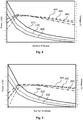
- Fig. 4 shows simulated performance data at 25°C depending on the number of mesas provided on the semiconductor chip 110.
- the applied electrical current is 12 mA.
- Line 410 shows the simulated voltage of laser devices depending on the number of mesas provided on the semiconductor chip 110.
- the production spread of the mesas is nominal - 1 Sigma meaning the active diameter of the mesas is smaller than the nominal active diameter.
- Line 420 shows the simulated voltage at the nominal value of the active diameter and line 430 the simulated voltage at the production spread of nominal + 1 Sigma.
- Lines 440, 450 and 460 show the respective simulated optical power emitted by the laser devices at a production spread of nominal - 1 Sigma, nominal and nominal + 1 Sigma depending on the number of mesas provided on the semiconductor chip 110 at 25°C.
- the spread of the emitted optical power is acceptable when between 2 and 6 mesas are provided on the semiconductor chip 110.
- One mesa causes a broad spread and the applied voltage is too high.
- the power spread is minimal if three mesas are provided and gets again unacceptable if more than six mesas are provided.
- the voltage decreases such that the voltage requirements are not fulfilled.
- Fig. 5 shows simulated performance data at 60°C depending on the number of mesas provided on the semiconductor chip 110.
- the applied electrical current is 12 mA.
- Line 510 shows the simulated voltage of laser devices depending on the number of mesas provided on the semiconductor chip 110.
- the production spread of the mesas is nominal - 1 Sigma.
- Line 520 shows the simulated voltage at the nominal value of the active diameter and line 530 the simulated voltage at the production spread of nominal + 1 Sigma.
- Lines 540, 550 and 560 show the respective simulated optical power at a production spread of nominal - 1 Sigma, nominal and nominal + 1 Sigma depending on the number of mesas provided on the semiconductor chip 110 at 60°C.
- the spread of the emitted optical power is acceptable when between 2 and 6 mesas are provided on the semiconductor chip.
- One mesa causes a broad spread and the applied voltage is too high.
- the power spread is minimal if three mesas are provided and gets unacceptable if more than six mesas are provided.
- the voltage decreases such that the voltage requirements are not fulfilled.
- Laser devices with semiconductor chips 110 with 2 to 6 mesas provided on the semiconductor chip 110 within the production spread of nominal +/- 1 Sigma thus fulfill the quality requirements within a temperature range of 25°C to 60°C and also in the temperature range between -10°C to 60°C.
- the latter temperature range is the temperature range of most applications and the spread empirically decreases at lower temperatures at least at moderate temperatures like -10°C.
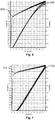
- Figs. 6 and 8 show the optical power and the electrical voltage of measured laser devices with a semiconductor chip comprising one mesa at 25°C and 60°C respectively.
- the applied electrical current was varied between 0 mA and 12 mA.
- the optical power versus current line 620 of several laser devices measured at 25°C is depicted in Fig. 6 .
- the emitted optical power depends essentially linearly from the applied electrical current in a range between 2 mA and around 7 mA. Additionally, the spread of the emitted optical power of the individual devices increases above an applied electrical current of around 8 mA. This behavior is even more pronounced at a substrate temperature of 60°C.
- the emitted optical power depends linearly on the applied electrical current only in a current range between 1 mA and around 6 mA as depicted by line 820.
- the spread of the emitted optical power increases and is much broader in comparison to the spread of 25°C.
- most of the measured laser devices emit less than 4 mW at 60°C
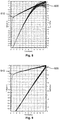
- Figs. 7 and 9 show the optical power and the electrical voltage of measured laser devices with a semiconductor chip comprising three mesas at 25°C and 60°C respectively.
- the applied electrical current was again varied between 0 mA and 12 mA.
- the optical power versus current line 720 of several laser devices measured at 25°C is depicted in Fig. 7 .
- the emitted optical power depends essentially linearly from the applied electrical current in a range between 2 mA and 12 mA. Additionally, the spread of the emitted optical power of the individual devices is low across the whole current range and doesn't increases above a threshold current. Furthermore, the behavior of the laser devices with three mesas is essentially the same at a substrate temperature of 60°C.
- the emitted optical power depends linearly on the applied electrical current in a current range between 2 mA and 12 mA. Only a minimum spread of the emitted optical power can be observed above 10 mA applied electrical current.
- the measured data shown in Figs. 6 - 9 thus impressively confirm the simulation data shown in Figs. 4 and 5 .
- the spread of emitted optical power at an applied electrical current of 12 mA is much lower for laser device comprising a semiconductor chip 110 with 3 mesas and reduced active diameter in comparison to a conventional semiconductor chip 110 with 1 mesa and increased active diameter.
- Most of the measured laser devices with one mesa even miss the specification of emitting at least 4 mW optical power at 12 mA and a substrate temperature of 60°C.
Landscapes
- Physics & Mathematics (AREA)
- Condensed Matter Physics & Semiconductors (AREA)
- General Physics & Mathematics (AREA)
- Electromagnetism (AREA)
- Optics & Photonics (AREA)
- Geometry (AREA)
- Semiconductor Lasers (AREA)
Priority Applications (1)
| Application Number | Priority Date | Filing Date | Title |
|---|---|---|---|
| EP14783863.5A EP3058592B1 (en) | 2013-10-16 | 2014-10-14 | Compact laser device |
Applications Claiming Priority (3)
| Application Number | Priority Date | Filing Date | Title |
|---|---|---|---|
| EP13188872 | 2013-10-16 | ||
| PCT/EP2014/071938 WO2015055600A1 (en) | 2013-10-16 | 2014-10-14 | Compact laser device |
| EP14783863.5A EP3058592B1 (en) | 2013-10-16 | 2014-10-14 | Compact laser device |
Publications (2)
| Publication Number | Publication Date |
|---|---|
| EP3058592A1 EP3058592A1 (en) | 2016-08-24 |
| EP3058592B1 true EP3058592B1 (en) | 2021-12-29 |
Family
ID=49356317
Family Applications (1)
| Application Number | Title | Priority Date | Filing Date |
|---|---|---|---|
| EP14783863.5A Active EP3058592B1 (en) | 2013-10-16 | 2014-10-14 | Compact laser device |
Country Status (6)
| Country | Link |
|---|---|
| US (2) | US10116119B2 (enExample) |
| EP (1) | EP3058592B1 (enExample) |
| JP (1) | JP6550381B2 (enExample) |
| CN (1) | CN105637634A (enExample) |
| RU (1) | RU2672155C2 (enExample) |
| WO (1) | WO2015055600A1 (enExample) |
Families Citing this family (5)
| Publication number | Priority date | Publication date | Assignee | Title |
|---|---|---|---|---|
| JP6550381B2 (ja) * | 2013-10-16 | 2019-07-24 | コーニンクレッカ フィリップス エヌ ヴェKoninklijke Philips N.V. | コンパクトなレーザーデバイス |
| BR112017021395A2 (pt) | 2015-04-10 | 2018-07-03 | Koninklijke Philips Nv | dispositivo de laser, módulo de laser, sensor óptico, dispositivo de comunicação móvel, e método de fabricação de um dispositivo de laser |
| EP3217428B1 (de) * | 2016-03-07 | 2022-09-07 | Infineon Technologies AG | Mehrfachsubstrat sowie verfahren zu dessen herstellung |
| JP2017204640A (ja) | 2016-05-11 | 2017-11-16 | 晶元光電股▲ふん▼有限公司Epistar Corporation | 発光デバイス及びその製造方法 |
| EP3392290B8 (de) * | 2017-04-18 | 2020-11-11 | Ems-Chemie Ag | Polyamidformmasse und daraus hergestellter formkörper |
Citations (2)
| Publication number | Priority date | Publication date | Assignee | Title |
|---|---|---|---|---|
| WO2002005397A2 (en) * | 2000-07-12 | 2002-01-17 | Princeton Optronics, Inc. | Vcsel and vcsel array having integrated microlenses for use in a semiconductor laser pumped solid state laser system |
| US20090296752A1 (en) * | 2007-06-14 | 2009-12-03 | Giorgio Giaretta | Multiple emitter vecsel |
Family Cites Families (28)
| Publication number | Priority date | Publication date | Assignee | Title |
|---|---|---|---|---|
| JPS5587452A (en) * | 1978-12-26 | 1980-07-02 | Fujitsu Ltd | Manufacture of semiconductor device |
| US6272160B1 (en) * | 1998-02-03 | 2001-08-07 | Applied Micro Circuits Corporation | High-speed CMOS driver for vertical-cavity surface-emitting lasers |
| US6465744B2 (en) * | 1998-03-27 | 2002-10-15 | Tessera, Inc. | Graded metallic leads for connection to microelectronic elements |
| DE19954093A1 (de) | 1999-11-10 | 2001-05-23 | Infineon Technologies Ag | Anordnung für Hochleistungslaser |
| US6465774B1 (en) * | 2000-06-30 | 2002-10-15 | Honeywell International Inc. | Method and system for versatile optical sensor package |
| US6415977B1 (en) * | 2000-08-30 | 2002-07-09 | Micron Technology, Inc. | Method and apparatus for marking and identifying a defective die site |
| US7085300B2 (en) * | 2001-12-28 | 2006-08-01 | Finisar Corporation | Integral vertical cavity surface emitting laser and power monitor |
| US7164702B1 (en) * | 2003-08-29 | 2007-01-16 | The United States Of America As Represented By The Secretary Of The Army | Optical transmitters and interconnects using surface-emitting lasers and micro-optical elements |
| JP2005158945A (ja) * | 2003-11-25 | 2005-06-16 | Fanuc Ltd | 半導体レーザ装置 |
| JP4584066B2 (ja) * | 2004-12-10 | 2010-11-17 | 韓國電子通信研究院 | 光感知器を備えた面発光レーザ素子及びこれを用いた光導波路素子 |
| JP4839662B2 (ja) * | 2005-04-08 | 2011-12-21 | 富士ゼロックス株式会社 | 面発光半導体レーザアレイおよびそれを用いた光伝送システム |
| JP5055717B2 (ja) | 2005-06-20 | 2012-10-24 | 富士ゼロックス株式会社 | 面発光型半導体レーザ |
| US7233025B2 (en) * | 2005-11-10 | 2007-06-19 | Microsoft Corporation | Electronic packaging for optical emitters and sensors |
| JP5034662B2 (ja) | 2006-06-20 | 2012-09-26 | ソニー株式会社 | 面発光型半導体レーザおよびその製造方法 |
| CN102136677B (zh) * | 2006-08-23 | 2015-06-17 | 株式会社理光 | 表面发射激光器阵列、光学扫描装置及图像形成装置 |
| JP4858032B2 (ja) * | 2006-09-15 | 2012-01-18 | 日亜化学工業株式会社 | 発光装置 |
| KR101360294B1 (ko) * | 2008-05-21 | 2014-02-11 | 광주과학기술원 | 반사형 광학 센서장치 |
| JP5261754B2 (ja) * | 2008-11-27 | 2013-08-14 | 株式会社リコー | 面発光レーザ素子、面発光レーザアレイ、光走査装置及び画像形成装置 |
| US8995493B2 (en) | 2009-02-17 | 2015-03-31 | Trilumina Corp. | Microlenses for multibeam arrays of optoelectronic devices for high frequency operation |
| US7949024B2 (en) | 2009-02-17 | 2011-05-24 | Trilumina Corporation | Multibeam arrays of optoelectronic devices for high frequency operation |
| US8611382B2 (en) | 2009-02-25 | 2013-12-17 | Koninklijke Philips N.V. | Output power stabilization for laser diodes using the photon-cooling dependent laser voltage |
| JP6026884B2 (ja) * | 2009-08-10 | 2016-11-16 | コーニンクレッカ フィリップス エヌ ヴェKoninklijke Philips N.V. | 能動的なキャリヤの閉じ込めを伴う垂直共振器型面発光レーザ |
| US9620934B2 (en) * | 2010-08-31 | 2017-04-11 | Avago Technologies General Ip (Singapore) Pte. Ltd. | Flip-chip assembly comprising an array of vertical cavity surface emitting lasers (VCSELs) |
| JP5874227B2 (ja) * | 2011-07-22 | 2016-03-02 | 富士ゼロックス株式会社 | 面発光型半導体レーザアレイ、面発光型半導体レーザ装置、光伝送装置および情報処理装置 |
| WO2013016676A2 (en) * | 2011-07-27 | 2013-01-31 | MYTEK, LLC (doing business as VIXAR) | Method and apparatus including improved vertical-cavity surface-emitting lasers |
| KR20140134701A (ko) | 2012-03-14 | 2014-11-24 | 코닌클리케 필립스 엔.브이. | Vcsel 모듈 및 그것의 제조 |
| JP5477728B2 (ja) * | 2013-05-13 | 2014-04-23 | 株式会社リコー | 面発光レーザアレイ |
| JP6550381B2 (ja) * | 2013-10-16 | 2019-07-24 | コーニンクレッカ フィリップス エヌ ヴェKoninklijke Philips N.V. | コンパクトなレーザーデバイス |
-
2014
- 2014-10-14 JP JP2016522763A patent/JP6550381B2/ja active Active
- 2014-10-14 CN CN201480056961.2A patent/CN105637634A/zh active Pending
- 2014-10-14 EP EP14783863.5A patent/EP3058592B1/en active Active
- 2014-10-14 US US15/028,546 patent/US10116119B2/en active Active
- 2014-10-14 WO PCT/EP2014/071938 patent/WO2015055600A1/en not_active Ceased
- 2014-10-14 RU RU2016118623A patent/RU2672155C2/ru not_active IP Right Cessation
-
2018
- 2018-10-18 US US16/164,209 patent/US10707646B2/en active Active
Patent Citations (2)
| Publication number | Priority date | Publication date | Assignee | Title |
|---|---|---|---|---|
| WO2002005397A2 (en) * | 2000-07-12 | 2002-01-17 | Princeton Optronics, Inc. | Vcsel and vcsel array having integrated microlenses for use in a semiconductor laser pumped solid state laser system |
| US20090296752A1 (en) * | 2007-06-14 | 2009-12-03 | Giorgio Giaretta | Multiple emitter vecsel |
Also Published As
| Publication number | Publication date |
|---|---|
| CN105637634A (zh) | 2016-06-01 |
| US10116119B2 (en) | 2018-10-30 |
| EP3058592A1 (en) | 2016-08-24 |
| JP2016533639A (ja) | 2016-10-27 |
| RU2016118623A (ru) | 2017-11-20 |
| US10707646B2 (en) | 2020-07-07 |
| US20160254640A1 (en) | 2016-09-01 |
| RU2672155C2 (ru) | 2018-11-12 |
| WO2015055600A1 (en) | 2015-04-23 |
| JP6550381B2 (ja) | 2019-07-24 |
| US20190052048A1 (en) | 2019-02-14 |
| RU2016118623A3 (enExample) | 2018-05-15 |
Similar Documents
| Publication | Publication Date | Title |
|---|---|---|
| US10707646B2 (en) | Compact laser device | |
| EP4111559B1 (en) | 3d and lidar sensing modules | |
| US11271365B2 (en) | Laser element | |
| US8624614B2 (en) | Burn-in method for surface emitting semiconductor laser device | |
| US12027510B2 (en) | Light-emitting element array chip, light-emitting device, optical device, and information processing device | |
| CN112335143A (zh) | 具有小脉冲延迟的vcsel阵列 | |
| CN104488148A (zh) | 具有腔内接触件的vcsel | |
| CN114204404A (zh) | 激光器封装结构 | |
| US20260066619A1 (en) | Vcsel array with improved optical properties | |
| JP4877471B2 (ja) | 面発光半導体レーザの製造方法 | |
| JP4821967B2 (ja) | 半導体レーザ装置およびこれを用いた光送信装置 | |
| CN118091379B (zh) | 老化测试方法 | |
| CN113594853A (zh) | 多通道发射器阵列的多层金属化 | |
| EP3742563A1 (en) | Vertical cavity surface emitting laser device, laser light source and method of operating a laser light source | |
| EP4092848A1 (en) | Densely packed vcsel array | |
| JP4501404B2 (ja) | 半導体発光素子の評価方法 | |
| KR102734169B1 (ko) | 제조 공정이 원활히 진행될 수 있도록 한 마이크로 vcsel 및 마이크로 vcsel 어레이 | |
| US20240332900A1 (en) | Bottom surface emitting vertical cavity surface emitting laser | |
| KR102664635B1 (ko) | 마이크로 vcsel 및 마이크로 vcsel 어레이 | |
| US11588301B2 (en) | Vertical cavity surface emitting laser device | |
| WO2026037530A1 (en) | Laser devices and methods for producing thereof | |
| CN119542916A (zh) | 锥形台面垂直腔面发射激光器 | |
| Geib et al. | Fabrication and performance of large (64x64) arrays of integrated VCSELs and detectors | |
| CN118380866A (zh) | 激光器模组及其制作方法 | |
| Geib et al. | High-density interleaved VCSEL-RCPD arrays for optical information processing |
Legal Events
| Date | Code | Title | Description |
|---|---|---|---|
| PUAI | Public reference made under article 153(3) epc to a published international application that has entered the european phase |
Free format text: ORIGINAL CODE: 0009012 |
|
| 17P | Request for examination filed |
Effective date: 20160517 |
|
| AK | Designated contracting states |
Kind code of ref document: A1 Designated state(s): AL AT BE BG CH CY CZ DE DK EE ES FI FR GB GR HR HU IE IS IT LI LT LU LV MC MK MT NL NO PL PT RO RS SE SI SK SM TR |
|
| AX | Request for extension of the european patent |
Extension state: BA ME |
|
| DAX | Request for extension of the european patent (deleted) | ||
| STAA | Information on the status of an ep patent application or granted ep patent |
Free format text: STATUS: EXAMINATION IS IN PROGRESS |
|
| 17Q | First examination report despatched |
Effective date: 20190614 |
|
| RAP1 | Party data changed (applicant data changed or rights of an application transferred) |
Owner name: KONINKLIJKE PHILIPS N.V. |
|
| RAP1 | Party data changed (applicant data changed or rights of an application transferred) |
Owner name: TRUMPF PHOTONIC COMPONENTS GMBH |
|
| GRAP | Despatch of communication of intention to grant a patent |
Free format text: ORIGINAL CODE: EPIDOSNIGR1 |
|
| STAA | Information on the status of an ep patent application or granted ep patent |
Free format text: STATUS: GRANT OF PATENT IS INTENDED |
|
| INTG | Intention to grant announced |
Effective date: 20210726 |
|
| GRAS | Grant fee paid |
Free format text: ORIGINAL CODE: EPIDOSNIGR3 |
|
| GRAA | (expected) grant |
Free format text: ORIGINAL CODE: 0009210 |
|
| STAA | Information on the status of an ep patent application or granted ep patent |
Free format text: STATUS: THE PATENT HAS BEEN GRANTED |
|
| AK | Designated contracting states |
Kind code of ref document: B1 Designated state(s): AL AT BE BG CH CY CZ DE DK EE ES FI FR GB GR HR HU IE IS IT LI LT LU LV MC MK MT NL NO PL PT RO RS SE SI SK SM TR |
|
| REG | Reference to a national code |
Ref country code: GB Ref legal event code: FG4D |
|
| REG | Reference to a national code |
Ref country code: CH Ref legal event code: EP |
|
| REG | Reference to a national code |
Ref country code: AT Ref legal event code: REF Ref document number: 1459327 Country of ref document: AT Kind code of ref document: T Effective date: 20220115 |
|
| REG | Reference to a national code |
Ref country code: IE Ref legal event code: FG4D |
|
| REG | Reference to a national code |
Ref country code: DE Ref legal event code: R096 Ref document number: 602014081919 Country of ref document: DE |
|
| REG | Reference to a national code |
Ref country code: LT Ref legal event code: MG9D |
|
| PG25 | Lapsed in a contracting state [announced via postgrant information from national office to epo] |
Ref country code: RS Free format text: LAPSE BECAUSE OF FAILURE TO SUBMIT A TRANSLATION OF THE DESCRIPTION OR TO PAY THE FEE WITHIN THE PRESCRIBED TIME-LIMIT Effective date: 20211229 Ref country code: LT Free format text: LAPSE BECAUSE OF FAILURE TO SUBMIT A TRANSLATION OF THE DESCRIPTION OR TO PAY THE FEE WITHIN THE PRESCRIBED TIME-LIMIT Effective date: 20211229 Ref country code: FI Free format text: LAPSE BECAUSE OF FAILURE TO SUBMIT A TRANSLATION OF THE DESCRIPTION OR TO PAY THE FEE WITHIN THE PRESCRIBED TIME-LIMIT Effective date: 20211229 Ref country code: BG Free format text: LAPSE BECAUSE OF FAILURE TO SUBMIT A TRANSLATION OF THE DESCRIPTION OR TO PAY THE FEE WITHIN THE PRESCRIBED TIME-LIMIT Effective date: 20220329 |
|
| REG | Reference to a national code |
Ref country code: NL Ref legal event code: MP Effective date: 20211229 |
|
| PG25 | Lapsed in a contracting state [announced via postgrant information from national office to epo] |
Ref country code: SE Free format text: LAPSE BECAUSE OF FAILURE TO SUBMIT A TRANSLATION OF THE DESCRIPTION OR TO PAY THE FEE WITHIN THE PRESCRIBED TIME-LIMIT Effective date: 20211229 Ref country code: NO Free format text: LAPSE BECAUSE OF FAILURE TO SUBMIT A TRANSLATION OF THE DESCRIPTION OR TO PAY THE FEE WITHIN THE PRESCRIBED TIME-LIMIT Effective date: 20220329 Ref country code: LV Free format text: LAPSE BECAUSE OF FAILURE TO SUBMIT A TRANSLATION OF THE DESCRIPTION OR TO PAY THE FEE WITHIN THE PRESCRIBED TIME-LIMIT Effective date: 20211229 Ref country code: HR Free format text: LAPSE BECAUSE OF FAILURE TO SUBMIT A TRANSLATION OF THE DESCRIPTION OR TO PAY THE FEE WITHIN THE PRESCRIBED TIME-LIMIT Effective date: 20211229 Ref country code: GR Free format text: LAPSE BECAUSE OF FAILURE TO SUBMIT A TRANSLATION OF THE DESCRIPTION OR TO PAY THE FEE WITHIN THE PRESCRIBED TIME-LIMIT Effective date: 20220330 |
|
| PG25 | Lapsed in a contracting state [announced via postgrant information from national office to epo] |
Ref country code: NL Free format text: LAPSE BECAUSE OF FAILURE TO SUBMIT A TRANSLATION OF THE DESCRIPTION OR TO PAY THE FEE WITHIN THE PRESCRIBED TIME-LIMIT Effective date: 20211229 |
|
| PG25 | Lapsed in a contracting state [announced via postgrant information from national office to epo] |
Ref country code: SM Free format text: LAPSE BECAUSE OF FAILURE TO SUBMIT A TRANSLATION OF THE DESCRIPTION OR TO PAY THE FEE WITHIN THE PRESCRIBED TIME-LIMIT Effective date: 20211229 Ref country code: SK Free format text: LAPSE BECAUSE OF FAILURE TO SUBMIT A TRANSLATION OF THE DESCRIPTION OR TO PAY THE FEE WITHIN THE PRESCRIBED TIME-LIMIT Effective date: 20211229 Ref country code: RO Free format text: LAPSE BECAUSE OF FAILURE TO SUBMIT A TRANSLATION OF THE DESCRIPTION OR TO PAY THE FEE WITHIN THE PRESCRIBED TIME-LIMIT Effective date: 20211229 Ref country code: PT Free format text: LAPSE BECAUSE OF FAILURE TO SUBMIT A TRANSLATION OF THE DESCRIPTION OR TO PAY THE FEE WITHIN THE PRESCRIBED TIME-LIMIT Effective date: 20220429 Ref country code: ES Free format text: LAPSE BECAUSE OF FAILURE TO SUBMIT A TRANSLATION OF THE DESCRIPTION OR TO PAY THE FEE WITHIN THE PRESCRIBED TIME-LIMIT Effective date: 20211229 Ref country code: EE Free format text: LAPSE BECAUSE OF FAILURE TO SUBMIT A TRANSLATION OF THE DESCRIPTION OR TO PAY THE FEE WITHIN THE PRESCRIBED TIME-LIMIT Effective date: 20211229 Ref country code: CZ Free format text: LAPSE BECAUSE OF FAILURE TO SUBMIT A TRANSLATION OF THE DESCRIPTION OR TO PAY THE FEE WITHIN THE PRESCRIBED TIME-LIMIT Effective date: 20211229 |
|
| PG25 | Lapsed in a contracting state [announced via postgrant information from national office to epo] |
Ref country code: PL Free format text: LAPSE BECAUSE OF FAILURE TO SUBMIT A TRANSLATION OF THE DESCRIPTION OR TO PAY THE FEE WITHIN THE PRESCRIBED TIME-LIMIT Effective date: 20211229 |
|
| PG25 | Lapsed in a contracting state [announced via postgrant information from national office to epo] |
Ref country code: IS Free format text: LAPSE BECAUSE OF FAILURE TO SUBMIT A TRANSLATION OF THE DESCRIPTION OR TO PAY THE FEE WITHIN THE PRESCRIBED TIME-LIMIT Effective date: 20220429 |
|
| REG | Reference to a national code |
Ref country code: DE Ref legal event code: R097 Ref document number: 602014081919 Country of ref document: DE |
|
| PG25 | Lapsed in a contracting state [announced via postgrant information from national office to epo] |
Ref country code: DK Free format text: LAPSE BECAUSE OF FAILURE TO SUBMIT A TRANSLATION OF THE DESCRIPTION OR TO PAY THE FEE WITHIN THE PRESCRIBED TIME-LIMIT Effective date: 20211229 Ref country code: AL Free format text: LAPSE BECAUSE OF FAILURE TO SUBMIT A TRANSLATION OF THE DESCRIPTION OR TO PAY THE FEE WITHIN THE PRESCRIBED TIME-LIMIT Effective date: 20211229 |
|
| PLBE | No opposition filed within time limit |
Free format text: ORIGINAL CODE: 0009261 |
|
| STAA | Information on the status of an ep patent application or granted ep patent |
Free format text: STATUS: NO OPPOSITION FILED WITHIN TIME LIMIT |
|
| 26N | No opposition filed |
Effective date: 20220930 |
|
| PG25 | Lapsed in a contracting state [announced via postgrant information from national office to epo] |
Ref country code: SI Free format text: LAPSE BECAUSE OF FAILURE TO SUBMIT A TRANSLATION OF THE DESCRIPTION OR TO PAY THE FEE WITHIN THE PRESCRIBED TIME-LIMIT Effective date: 20211229 |
|
| REG | Reference to a national code |
Ref country code: AT Ref legal event code: UEP Ref document number: 1459327 Country of ref document: AT Kind code of ref document: T Effective date: 20211229 |
|
| PG25 | Lapsed in a contracting state [announced via postgrant information from national office to epo] |
Ref country code: MC Free format text: LAPSE BECAUSE OF FAILURE TO SUBMIT A TRANSLATION OF THE DESCRIPTION OR TO PAY THE FEE WITHIN THE PRESCRIBED TIME-LIMIT Effective date: 20211229 Ref country code: IT Free format text: LAPSE BECAUSE OF FAILURE TO SUBMIT A TRANSLATION OF THE DESCRIPTION OR TO PAY THE FEE WITHIN THE PRESCRIBED TIME-LIMIT Effective date: 20211229 |
|
| REG | Reference to a national code |
Ref country code: CH Ref legal event code: PL |
|
| REG | Reference to a national code |
Ref country code: BE Ref legal event code: MM Effective date: 20221031 |
|
| PG25 | Lapsed in a contracting state [announced via postgrant information from national office to epo] |
Ref country code: LU Free format text: LAPSE BECAUSE OF NON-PAYMENT OF DUE FEES Effective date: 20221014 |
|
| PG25 | Lapsed in a contracting state [announced via postgrant information from national office to epo] |
Ref country code: LI Free format text: LAPSE BECAUSE OF NON-PAYMENT OF DUE FEES Effective date: 20221031 Ref country code: CH Free format text: LAPSE BECAUSE OF NON-PAYMENT OF DUE FEES Effective date: 20221031 |
|
| PG25 | Lapsed in a contracting state [announced via postgrant information from national office to epo] |
Ref country code: BE Free format text: LAPSE BECAUSE OF NON-PAYMENT OF DUE FEES Effective date: 20221031 |
|
| PG25 | Lapsed in a contracting state [announced via postgrant information from national office to epo] |
Ref country code: IE Free format text: LAPSE BECAUSE OF NON-PAYMENT OF DUE FEES Effective date: 20221014 |
|
| PG25 | Lapsed in a contracting state [announced via postgrant information from national office to epo] |
Ref country code: HU Free format text: LAPSE BECAUSE OF FAILURE TO SUBMIT A TRANSLATION OF THE DESCRIPTION OR TO PAY THE FEE WITHIN THE PRESCRIBED TIME-LIMIT; INVALID AB INITIO Effective date: 20141014 |
|
| PG25 | Lapsed in a contracting state [announced via postgrant information from national office to epo] |
Ref country code: CY Free format text: LAPSE BECAUSE OF FAILURE TO SUBMIT A TRANSLATION OF THE DESCRIPTION OR TO PAY THE FEE WITHIN THE PRESCRIBED TIME-LIMIT Effective date: 20211229 |
|
| PG25 | Lapsed in a contracting state [announced via postgrant information from national office to epo] |
Ref country code: MK Free format text: LAPSE BECAUSE OF FAILURE TO SUBMIT A TRANSLATION OF THE DESCRIPTION OR TO PAY THE FEE WITHIN THE PRESCRIBED TIME-LIMIT Effective date: 20211229 |
|
| PG25 | Lapsed in a contracting state [announced via postgrant information from national office to epo] |
Ref country code: MT Free format text: LAPSE BECAUSE OF FAILURE TO SUBMIT A TRANSLATION OF THE DESCRIPTION OR TO PAY THE FEE WITHIN THE PRESCRIBED TIME-LIMIT Effective date: 20211229 |
|
| REG | Reference to a national code |
Ref country code: DE Ref legal event code: R079 Ref document number: 602014081919 Country of ref document: DE Free format text: PREVIOUS MAIN CLASS: H01L0023544000 Ipc: H10W0046000000 |
|
| PG25 | Lapsed in a contracting state [announced via postgrant information from national office to epo] |
Ref country code: TR Free format text: LAPSE BECAUSE OF FAILURE TO SUBMIT A TRANSLATION OF THE DESCRIPTION OR TO PAY THE FEE WITHIN THE PRESCRIBED TIME-LIMIT Effective date: 20211229 |
|
| PGFP | Annual fee paid to national office [announced via postgrant information from national office to epo] |
Ref country code: DE Payment date: 20251028 Year of fee payment: 12 |
|
| PGFP | Annual fee paid to national office [announced via postgrant information from national office to epo] |
Ref country code: GB Payment date: 20251023 Year of fee payment: 12 |
|
| PGFP | Annual fee paid to national office [announced via postgrant information from national office to epo] |
Ref country code: AT Payment date: 20251020 Year of fee payment: 12 |
|
| PGFP | Annual fee paid to national office [announced via postgrant information from national office to epo] |
Ref country code: FR Payment date: 20251027 Year of fee payment: 12 |
|
| REG | Reference to a national code |
Ref country code: GB Ref legal event code: 732E Free format text: REGISTERED BETWEEN 20260423 AND 20260429 |