EP3052897B1 - Measurement encoder - Google Patents
Measurement encoder Download PDFInfo
- Publication number
- EP3052897B1 EP3052897B1 EP14792751.1A EP14792751A EP3052897B1 EP 3052897 B1 EP3052897 B1 EP 3052897B1 EP 14792751 A EP14792751 A EP 14792751A EP 3052897 B1 EP3052897 B1 EP 3052897B1
- Authority
- EP
- European Patent Office
- Prior art keywords
- scale
- readhead
- light
- light source
- features
- Prior art date
- Legal status (The legal status is an assumption and is not a legal conclusion. Google has not performed a legal analysis and makes no representation as to the accuracy of the status listed.)
- Active
Links
Images



Classifications
-
- G—PHYSICS
- G01—MEASURING; TESTING
- G01D—MEASURING NOT SPECIALLY ADAPTED FOR A SPECIFIC VARIABLE; ARRANGEMENTS FOR MEASURING TWO OR MORE VARIABLES NOT COVERED IN A SINGLE OTHER SUBCLASS; TARIFF METERING APPARATUS; MEASURING OR TESTING NOT OTHERWISE PROVIDED FOR
- G01D5/00—Mechanical means for transferring the output of a sensing member; Means for converting the output of a sensing member to another variable where the form or nature of the sensing member does not constrain the means for converting; Transducers not specially adapted for a specific variable
- G01D5/26—Mechanical means for transferring the output of a sensing member; Means for converting the output of a sensing member to another variable where the form or nature of the sensing member does not constrain the means for converting; Transducers not specially adapted for a specific variable characterised by optical transfer means, i.e. using infrared, visible, or ultraviolet light
- G01D5/32—Mechanical means for transferring the output of a sensing member; Means for converting the output of a sensing member to another variable where the form or nature of the sensing member does not constrain the means for converting; Transducers not specially adapted for a specific variable characterised by optical transfer means, i.e. using infrared, visible, or ultraviolet light with attenuation or whole or partial obturation of beams of light
- G01D5/34—Mechanical means for transferring the output of a sensing member; Means for converting the output of a sensing member to another variable where the form or nature of the sensing member does not constrain the means for converting; Transducers not specially adapted for a specific variable characterised by optical transfer means, i.e. using infrared, visible, or ultraviolet light with attenuation or whole or partial obturation of beams of light the beams of light being detected by photocells
- G01D5/347—Mechanical means for transferring the output of a sensing member; Means for converting the output of a sensing member to another variable where the form or nature of the sensing member does not constrain the means for converting; Transducers not specially adapted for a specific variable characterised by optical transfer means, i.e. using infrared, visible, or ultraviolet light with attenuation or whole or partial obturation of beams of light the beams of light being detected by photocells using displacement encoding scales
- G01D5/34707—Scales; Discs, e.g. fixation, fabrication, compensation
- G01D5/34715—Scale reading or illumination devices
-
- G—PHYSICS
- G01—MEASURING; TESTING
- G01D—MEASURING NOT SPECIALLY ADAPTED FOR A SPECIFIC VARIABLE; ARRANGEMENTS FOR MEASURING TWO OR MORE VARIABLES NOT COVERED IN A SINGLE OTHER SUBCLASS; TARIFF METERING APPARATUS; MEASURING OR TESTING NOT OTHERWISE PROVIDED FOR
- G01D5/00—Mechanical means for transferring the output of a sensing member; Means for converting the output of a sensing member to another variable where the form or nature of the sensing member does not constrain the means for converting; Transducers not specially adapted for a specific variable
- G01D5/12—Mechanical means for transferring the output of a sensing member; Means for converting the output of a sensing member to another variable where the form or nature of the sensing member does not constrain the means for converting; Transducers not specially adapted for a specific variable using electric or magnetic means
- G01D5/244—Mechanical means for transferring the output of a sensing member; Means for converting the output of a sensing member to another variable where the form or nature of the sensing member does not constrain the means for converting; Transducers not specially adapted for a specific variable using electric or magnetic means influencing characteristics of pulses or pulse trains; generating pulses or pulse trains
- G01D5/245—Mechanical means for transferring the output of a sensing member; Means for converting the output of a sensing member to another variable where the form or nature of the sensing member does not constrain the means for converting; Transducers not specially adapted for a specific variable using electric or magnetic means influencing characteristics of pulses or pulse trains; generating pulses or pulse trains using a variable number of pulses in a train
- G01D5/2454—Encoders incorporating incremental and absolute signals
- G01D5/2455—Encoders incorporating incremental and absolute signals with incremental and absolute tracks on the same encoder
- G01D5/2457—Incremental encoders having reference marks
-
- G—PHYSICS
- G01—MEASURING; TESTING
- G01D—MEASURING NOT SPECIALLY ADAPTED FOR A SPECIFIC VARIABLE; ARRANGEMENTS FOR MEASURING TWO OR MORE VARIABLES NOT COVERED IN A SINGLE OTHER SUBCLASS; TARIFF METERING APPARATUS; MEASURING OR TESTING NOT OTHERWISE PROVIDED FOR
- G01D5/00—Mechanical means for transferring the output of a sensing member; Means for converting the output of a sensing member to another variable where the form or nature of the sensing member does not constrain the means for converting; Transducers not specially adapted for a specific variable
- G01D5/26—Mechanical means for transferring the output of a sensing member; Means for converting the output of a sensing member to another variable where the form or nature of the sensing member does not constrain the means for converting; Transducers not specially adapted for a specific variable characterised by optical transfer means, i.e. using infrared, visible, or ultraviolet light
- G01D5/32—Mechanical means for transferring the output of a sensing member; Means for converting the output of a sensing member to another variable where the form or nature of the sensing member does not constrain the means for converting; Transducers not specially adapted for a specific variable characterised by optical transfer means, i.e. using infrared, visible, or ultraviolet light with attenuation or whole or partial obturation of beams of light
- G01D5/34—Mechanical means for transferring the output of a sensing member; Means for converting the output of a sensing member to another variable where the form or nature of the sensing member does not constrain the means for converting; Transducers not specially adapted for a specific variable characterised by optical transfer means, i.e. using infrared, visible, or ultraviolet light with attenuation or whole or partial obturation of beams of light the beams of light being detected by photocells
- G01D5/36—Forming the light into pulses
- G01D5/366—Particular pulse shapes
-
- G—PHYSICS
- G01—MEASURING; TESTING
- G01D—MEASURING NOT SPECIALLY ADAPTED FOR A SPECIFIC VARIABLE; ARRANGEMENTS FOR MEASURING TWO OR MORE VARIABLES NOT COVERED IN A SINGLE OTHER SUBCLASS; TARIFF METERING APPARATUS; MEASURING OR TESTING NOT OTHERWISE PROVIDED FOR
- G01D5/00—Mechanical means for transferring the output of a sensing member; Means for converting the output of a sensing member to another variable where the form or nature of the sensing member does not constrain the means for converting; Transducers not specially adapted for a specific variable
- G01D5/26—Mechanical means for transferring the output of a sensing member; Means for converting the output of a sensing member to another variable where the form or nature of the sensing member does not constrain the means for converting; Transducers not specially adapted for a specific variable characterised by optical transfer means, i.e. using infrared, visible, or ultraviolet light
- G01D5/32—Mechanical means for transferring the output of a sensing member; Means for converting the output of a sensing member to another variable where the form or nature of the sensing member does not constrain the means for converting; Transducers not specially adapted for a specific variable characterised by optical transfer means, i.e. using infrared, visible, or ultraviolet light with attenuation or whole or partial obturation of beams of light
- G01D5/34—Mechanical means for transferring the output of a sensing member; Means for converting the output of a sensing member to another variable where the form or nature of the sensing member does not constrain the means for converting; Transducers not specially adapted for a specific variable characterised by optical transfer means, i.e. using infrared, visible, or ultraviolet light with attenuation or whole or partial obturation of beams of light the beams of light being detected by photocells
- G01D5/36—Forming the light into pulses
- G01D5/38—Forming the light into pulses by diffraction gratings
Definitions
- a measurement encoder typically comprises a scale comprising features and a readhead for reading the features so as to be able to determine relative position of the readhead and scale.
- the scale and readhead are moveable relative to each other.
- Encoders are known wherein the scale comprises a series of generally periodic features which the readhead can read to determine and measure relative motion.
- Various types of encoder exist, including incremental encoders and absolute encoders.
- incremental encoders comprise a scale comprising series of periodic markings which are "read" by a readhead. For example, they can operate by the scale (and often one or more diffraction gratings within the readhead) interacting with light from a source within the readhead to generate at a detector a resultant field (e.g. modulated spot(s) or interference fringes) which changes with relative movement of the scale and readhead.
- one or more reference marks are provided (e.g. embedded within or next to the series of features) such that relative position can be determined with respect to known reference positions defined by the reference marks.
- An example of an incremental encoder is described in WO2005/124282 .
- US3586665 discloses an apparatus for producing phase-shifted electric signals representing the positions of a moving element.
- Light from a source passes through similar first and second gratings, at least one of which moves back and forth in line with the direction of the widths of the grating slits in correspondence with movements of the moving element, and through a lens that focusses the resulting diffraction image on a row of photoelectric receivers in the focal plane of the lens.
- EP0350586 discloses a position-measuring device for measuring the relative position of two objects, the graduation of a graduation carrier which is connected to the one object is scanned by a scanning device connected to the other object.
- the scanning device has three light sources with a mutual spacing in the measurement direction, a condenser, a scanning graduation and a photoelement.
- the three periodic supply voltages of respectively adjacent light sources possess a mutual phase shift of 120 DEG, and the adjacent beams of light rays emerging from the condenser enclose an angle alpha with one another.
- US4792679 discloses an incremental length apparatus in which a light source throws a light beam through a transparent scale provided with graduation lines.
- the light beam is focused by means of an aperture in such a way that it is disposed at an inclined angle with respect to the graduation lines.
- that arrangement Upon relative displacement as between the scale and the aperture, that arrangement provides that a constantly changing light beam is projected onto a photosensitive receiving means.
- US7227124 discloses an imaging-type optical encoder. This document identifies light sources having electrode structures that cover the centre of the LED die as being undesirable.
- US2003/0076507 discloses an optical encoder. This document discloses that wiring and lead electrode can be made transparent to avoid shading on the light sensor.
- absolute encoders operate by the scale defining unique patterns (e.g. codes) which can be read by a readhead. Examples of absolute encoders are described in WO2002/084223 and WO2010/049682 . As with incremental encoders, absolute encoders can comprise a light source for illuminating the scale during reading of the scale.
- an encoder comprising a scale comprising a series of incremental or absolute scale features defining at least one incremental or absolute scale track and a readhead for reading the scale's features, the readhead comprising at least one light source for illuminating the scale and at least one photodetector, in which the configuration of at least one light source is such that it comprises at least one bond pad and/or current spreader at or near its surface which imparts a structure (e.g.
- the readhead is configured such that the structure as projected toward the scale is angled so that it is substantially misaligned with respect to the incremental or absolute scale's features so as to reduce measurement error in the signal output by the readhead.
- the invention has identified that the negative effect of adverse structures in the light from the source can be reduced or even eliminated by configuring the readhead such that the structure as projected toward the scale is angled so that it is substantially misaligned with respect to the scale's features (or as explained in more detail below with respect to the readhead's array of sensing channels) so as to reduce measurement error in the signal output by the readhead
- the structure can be within the field of light projected from the at least one light source.
- it could comprise a variation in the intensity of light within the field of light projected from the at least one light source.
- the structure could be configured to be misaligned by positioning/orienting the at least light source such that the structure from the emission point is misaligned (e.g. such that the light source is angled).
- one or more optical components could be used to cause the structure to be misaligned. Accordingly, in this case, at point of emission, the structure could be aligned.
- the structure can comprise predominant elongate components.
- any such predominant elongate components of the structure in the light are angled/misaligned with respect to the scale's features, in particular with respect to the longitudinal extent of the scale's features (for example, by at least 5 degrees, for instance at least 10 degrees, optionally by at least 15 degrees).
- the at least one light source can impart periodicity in the structure of the light projected, in at least one direction.
- the readhead is configured such that the direction of periodicity is angled so that it is substantially misaligned with respect to the scale's features, in particular, angled with respect to the direction of periodicity of the scale's features, and optionally with respect to the measurement direction of the scale.
- the structure can be such that there is more than one direction of periodicity. In which case, it can be preferred that all directions of periodicity are angled so as to be misaligned with respect to the scale's features.
- the at least one light source can be configured such that the intensity distribution of light projected toward the scale, as measured in the measuring dimension, has a modulation depth of no more than 0.5, for example no more than 0.4, for instance, no more than 0.35
- the structure in the light can comprise an array of features.
- the readhead can be configured such that the array of features is angled with respect to the scale's features.
- an array can comprise two or more features.
- the features are substantially elongate.
- the features are substantially parallel. As will be understood, such features need not necessarily be straight, for example they can comprise curved and/or wavy elongate, parallel features.
- the at least one light source comprises at least one feature at or near its emission surface which impart the structure into the projected light.
- the at least one feature comprises a part integral to the at least one light source.
- the at least one feature comprises at least one current spreader and/or a bond pad.
- the at least one light source can comprises a light emitting diode (LED).
- the LED can comprise feature(s) (for example at or near the emission surface of the LED) which impart the structure into the projected light.
- the detector can comprise a photodetector array.
- a photodetector array can define a plurality of sensing channels extending in an array. The direction of such an array can extend substantially parallel to the reading direction of the readhead.
- the readhead can be configured such that the structure in the light as it is projected from the light source toward the scale is angled with respect to the plurality of sensing channels.
- the readhead can comprise at least one diffraction grating.
- the readhead can comprise at least one lens.
- the at least one lens can be used to interact with light travelling from the scale toward the detector.
- the at least one lens can be used to form an image of the scale on the detector.
- the encoder apparatus can comprise an incremental encoder apparatus.
- the scale can comprise a series of incremental scale marks, for example a series of generally periodic features.
- the encoder apparatus for example the readhead, can be configured such that the structure (in the light) is angled so that it is substantially misaligned with respect to the scale's series of incremental marks.
- the scale can be a phase scale or an amplitude scale. That is the scale's features can comprise features configured to manipulate the phase or amplitude of the light leaving the scale toward the readhead. As will be understood, typically the period of the scale's features is less than 500 ⁇ m (microns), optionally less than 200 ⁇ m (microns), for example less than 100 ⁇ m (microns), for instance less than 50 ⁇ m (microns). At least one reference mark can be provided on or next to the scale. The reference mark can be embedded within the scale's incremental scale features.
- the readhead can comprise at least one reference mark photodetector for detecting the at least one reference mark.
- the encoder apparatus for example the readhead, can be configured such that the structure (in the light) is angled so that it is substantially misaligned with respect to the reference mark.
- the encoder apparatus can comprise an absolute encoder apparatus.
- the scale can comprise features defining a series of uniquely identifiable positions, preferably a continuous series of uniquely identifiable positions.
- the encoder apparatus can be configured to obtain snapshot representations (e.g. images) of the scale's features.
- a light source could comprise one or more light emission components.
- the optical power (in dioptres, m -1 ) of any optical component in the optical path between the light emission component and the at least one detector (for example in the part of the optical path within readhead) can be between -100 and 100, for example between -50 and 50, for instance between -10 and 10, in particular between -5 and 5.
- the optical power (in dioptres, m -1 ) of any optical component in the optical path between the light emission component and the at least one detector (for example in the part of the optical path within readhead) is substantially 0. Accordingly, optionally, no lens is provided in the optical path between the light emission component(s) of the light source and the at least one detector (for example in the part of the optical path within readhead).
- the optical power (in dioptres, m -1 ) of any optical components in the readhead is between -100 and 100, for example between -50 and 50, for instance between -10 and 10, in particular between -5 and 5, for example substantially 0.
- the light source can comprise a divergent light source (e.g. can produce a divergent light beam).
- a divergent light source e.g. can produce a divergent light beam.
- the light beam's divergence can remain substantially unaltered throughout the above mentioned optical path.
- Light from the at least one light source can interacts with the scale and at least one diffraction grating within the readhead to produce an resultant field at the detector which changes with relative movement of the scale and readhead.
- Such changes in the resultant field can be used to determine the relative position of the readhead and scale.
- the resultant field can comprise at least one region of light which modulates with relative movement of the readhead and scale (e.g. the resultant field can comprise a modulated spot).
- the resultant field comprises an interference fringe.
- the readhead can comprise a diffraction grating.
- the encoder apparatus can be configured such that the light from the at least one light source interacts first with the scale to produce a first set of diffraction orders which then in turn interact with the diffraction grating in the readhead to produce further diffraction orders which then combine to produce an interference fringe at the detector which changes with relative movement of the scale and readhead.
- the structure in the light projected
- the at least one light source could emit light in the visible range.
- suitable light sources include those that emit light anywhere in the infra-red to the ultraviolet range of the electromagnetic spectrum.
- the light source emits light in the infra-red range.
- an encoder readhead for reading a scale to determine the relative position between them, the readhead comprising: at least one light source for illuminating a scale, in which the configuration of the light source is such that it comprises at least one bond pad and/or current spreader at or near its surface which imparts a structure (e.g. a pattern) into the light it projects; and an array of photodetectors defining a plurality of sensing channels, in which the direction of the array extends substantially parallel to the reading direction of the readhead; in which the readhead is configured such that the structure in the light as it is projected from the light source toward the scale is angled with respect to the plurality of sensing channels.
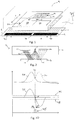
- the encoder apparatus comprises a readhead 4 and a scale 6. Although not shown, typically in practice the readhead 4 will fastened to one part of a machine and the scale 6 to another part of the machine which are movable relative to each other.
- the readhead 4 is used to measure the relative position of itself and the scale 6 and hence can be used to provide a measure of the relative position of the two movable parts of the machine.
- the readhead 4 communicates with a processor such as a controller 8 via a wired (as shown) and/or wireless communication channel.
- the readhead 4 can report the signals from its detectors (described in more detail below) to the controller 8 which then processes them to determine position information and/or the readhead 4 can itself process the signals from its detectors and send position information to the controller 8.
- the scale 6 comprises a plurality of scale markings defining an incremental track 10, and a reference track 12.
- the incremental track 10 comprises a series of periodic scale marks 14 which control the light transmitted toward the readhead to effectively form a diffraction grating.
- the incremental track 10 could be what is commonly referred to as an amplitude scale or a phase scale.
- the features are configured to control the amplitude of light transmitted toward the readhead's incremental detector (e.g. by selectively absorbing, scattering and/or reflecting the light).
- the features are configured to control the phase of light transmitted toward the readhead's incremental detector (e.g. by retarding the phase of the light).
- the incremental track 10 is an amplitude scale, but in either case, as explained in more detail below, the light interacts with the periodic scale marks 14 to generate diffracted orders.
- Reference positions can be useful to enable the readhead 4 to be able to determine exactly where it is relative to the scale 6. Accordingly, the incremental position can be counted from the reference position. Furthermore, such reference positions can be what are also referred to as "limit positions” in that they can be used to define the limits or ends of the scale 6 between which the readhead 4 is permitted to travel.
- the reference track 12 defines a reference position by having at least one feature 16 which permits a relatively greater amount of light from the source 18 to reach the reference detector 24 compared to the rest of the reference track.
- the scale 6 (and in particular the reference track 12) comprises markings in the form of light restrictor markings 40 which extend along the length of the reference track 12. These light restrictor markings 40 need not necessarily completely stop the light from reaching the reference detector 24. Rather they could, for example, merely reduce the amount of light reaching the reference detector 24 compared to the reference mark feature 16.
- the encoder apparatus is a reflective encoder in that it comprises an electromagnetic radiation (EMR) source 18, e.g. an infra-red light source 18, and at least one detector (described in more detail below) on the same side of the scale 6.
- EMR electromagnetic radiation
- infra-red from the light source 18 is configured to be reflected by the scale 6 back toward the readhead.
- the light source 18 is divergent and the light source's illumination footprint falls on both the incremental track 10 and the reference track 12.
- the light source 18 emits EMR in the infra-red range, however as will be understood, this need not necessarily be the case and could emit EMR in other ranges, for example anywhere in the infra-red to the ultra-violet.
- the choice of a suitable wavelength for the light source 18 can depend on many factors, including the availability of suitable gratings and detectors that work at the EMR wavelength.
- the readhead 4 also comprises a diffraction grating 20 (also commonly referred to as an index grating), an incremental photodetector 22 and a reference photodetector 24.
- the infra-red light source 18 is a Light Emitting Diode ("LED").
- the infra-red light source 18 is positioned between the incremental photodetector 22 and the reference photodetector 24, in a direction (illustrated by arrow A) transverse to the reading direction (illustrated by arrow B) of the readhead.
- the light source 18 is positioned substantially equidistantly between the incremental photodetector 22 and the reference photodetector 24, and is contained within an area 25 defined by the outer extents of the readhead's 4 incremental 22 and reference 24 photodetectors (schematically illustrated by the dashed line 27).
- the light source 18 is angled, the reasons for which are explained in more detail below.
- the infra-red light from the from the light source 18 is emitted from the readhead 4 toward the scale 6, where part of the light source's 18 footprint interacts with the reference track 12 and part of the light source's footprint interacts with the incremental track 10.
- the reference position is defined by a feature 16 in the reference track 12 which reflects more of the light from the light source 18 back toward the reference photodetector 24 compared to the rest of the track. This could be achieved, for example, by the light restrictive features 40 absorbing, transmitting and/or scattering more infra-red light than the feature 16 itself.
- a shadow/non-imaged representation of the scale's mark(s) defining the reference position (in this case a shadow of the light restrictive features 40) is therefore cast on the reference detector 24 as the readhead 4 passes along the scale 6.
- feature 16 increases the amount of light from the source 18 reaching the reference photodetector 24.
- the readhead 4 is aligned with the reference position and so the light is shown as being reflected back toward the reference photodetector 24.
- the readhead 4, and/or controller 8 can be configured to look for a change (in this case an increase) in the intensity of light received at the reference photodetector 24.
- the reference photodetector 24 is actually a "split detector" which comprises first 28 and second 30 separate detector channels offset relative to each other in the measuring direction. Each of these two separate detecting channels measure the intensity of light falling on it, and provides an output proportional to the intensity measured.
- the scale marking's i.e. the light restrictor markings 40
- the reference detector 24 is in the light restrictor marking's 40 shadow for most of the length of the scale.
- the reference mark feature 16 reflects light from the source 18 back toward the first 28 and second 30 detector channels of the reference detector 24.
- the outputs of the first 28 and second 30 detecting channels therefore peak as the readhead 4 passes the reference position, which is illustrated by the top portion of the graph in Figure 10 .
- the feature 16 and the first 28 and second 30 detector channels are configured such that the reference position can be determined by determining when a difference signal 38 of the outputs of the first 28 and second 30 detector channels (e.g. obtained via a differential amplifier) crosses between upper 41 and lower 43 threshold levels.
- this "zone" defined by the two threshold levels 43 contains the point at which the two signals 28, 30 cross (at the point illustrated by line 34) and hence also contains the point at which the difference signal 38 crosses a zero value (e.g. at point 36).
- the reference position is actually determined as a reference "zone” 39 between two threshold levels 41, 43.
- a reference pulse schematically illustrated by pulse 45 is output by the readhead 4 to the controller/processor device 8.
- the width of the reference pulse is not greater than one lissajous cycle of a lissajous which can be determined from the incremental quadrature signals. More details on detecting a reference position by obtaining the difference between outputs of two detecting channels is described in US7624513 and US7289042 .
- the diffraction grating 20 is a phase grating.
- the light is then further diffracted by the diffraction grating 20 into orders which then interfere at the incremental photodetector 22 to form a resultant field, in this case an interference fringe.
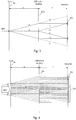
- Figure 3 is a very simplified illustration of the real optical situation encountered in an encoder apparatus.
- the situation is shown for only one light ray from the source whereas in fact an area of the incremental track 10 is illuminated by the source.
- the optical situation shown in Figure 3 is repeated many times over along the length of the scale (i.e. over the area that is illuminated by the source), hence producing a long interference pattern at the detector, which is schematically illustrated in Figure 4 .
- the +/- 1 st orders are shown (e.g. as will be understood the light will be diffracted into multiple orders, e.g.
- the resultant field 26 is produced by the recombination of diffracted orders of light from the diffraction grating 20 and scale 6.
- the ray diagrams in Figures 3 and 4 are shown as transmissive ray diagrams (that is the light is shown as being transmitted through each of the scale and diffraction grating), whereas in reality at least one of these could be reflective. For example, with the embodiment of Figures 1 and 2 , the rays would be reflected from the scale 6.
- the incremental detector 22 detects the resultant field 26 (e.g. the interference fringes) to produce a signal which is output by the readhead 4 to an external device such as controller 8.
- the resultant field 26 e.g. movement of the interference fringes relative to the detector 22 or a change in intensity of the modulated spot(s)
- the output of which can be processed to provide an incremental up/down count which enables an incremental measurement of displacement.
- the incremental detector 22 can comprise a plurality of photodiodes, for example.
- the incremental detector 22 can be in the form of an electro-grating, which in other words is a photo-sensor array which can for example comprise two or more sets of interdigitated/interlaced photo-sensitive sensors, each set detecting a different phase of the interference fringe 26 at the detector 22.
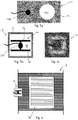
- FIG. 7 An example is illustrated in Figure 7 , in which a part of an incremental detector 22 is shown, and in which the photodiodes of four sets of photodiodes A, B, C and D are interdigitated, and the outputs from each photodiode in a set are combined to provide a single output, A', B', C' and D'. These outputs are then used to provide quadrature signals.
- A'-C' could be used to provide a first signal
- B'-D' could be used to provide a second signal which is 90 degrees out of phase from the first signal (e.g. Cos and Sin signals).
- all the photodiodes in any one set detect the intensity of same phase of the interference fringe (if the fringe period and sensor period are the same).
- This arrangement has the advantage that due to a filtering effect of the optics, the readhead 4 is largely immune to a disruption to the periodicity of the periodic scale marks 14. Thus, the presence of contamination and/or an embedded reference mark does not significantly affect the interference fringe detected by the incremental detector 22.
- the electrograting/photo-sensor array can take other forms, such as comprising only three sets of photodiodes that are interdigitated, and different layouts can be used.
- Figure 7 shows the ideal case in which a clean interference fringe having an intensity which varies sinusoidally in-phase with the periodicity of the interlaced photo-sensitive sensors A, B, C, D as illustrated by line 26.
- a clean interference fringe having an intensity which varies sinusoidally in-phase with the periodicity of the interlaced photo-sensitive sensors A, B, C, D as illustrated by line 26.
- noise there will often be noise present in the interference fringe caused by various factors.
- Figure 5a illustrates an LED 100, comprising a circular emission area 104 and a wire bond 106.
- FIG 5b and 5c One particular type of light source the inventors have chosen to use is illustrated in Figure 5b and 5c .
- This light source 18 has a wire bond 50 is provided on the surface of the emission area 52.
- current spreaders 54 are provided on the emission area 52 surface.
- the wire bond 50 is centrally mounted within the square-shaped emission area 52 and the current spreaders predominantly comprises first 56 and second 58 elongate arms, extending parallel to each other, together defining a substantially H-shaped pattern/formation (which is imparted into the light projected from the light source).
- these wire bond 50 and current spreader 54 features impart an adverse (e.g. unwanted/harmful) structure into the light projected from the light source 18, in this case in the form of a substantially H-shaped pattern/formation.
- Figure 8 shows a graph of a Fourier Transform of an interference fringe generated using a set up such as that shown in Figure 6 .
- the Fourier Transform only comprises components at the fundamental frequency f o .
- the interference fringe will become distorted because it contains significant unwanted/adverse non-integer harmonic (e.g. sub-harmonic) components (in this case, as shown 0.55 f o and 1.55 f o ) , and hence significantly reduces the accuracy of the readhead 4.
- any predominant elongate structures of the light source 18 are angled relative to the plurality of sensing channels A, B, C, D of the incremental photodetector 22, the amplitude of such non-integer harmonic components (e.g. in the embodiment described above, the amplitude of the components 0.55 f o and 1.55 f o ) is reduced, thereby improving the quality of the interference fringe.
- the intensity distribution profile as measured in the encoder's measuring dimension B has a modulation depth (highlighted by the dashed lines) of over 0.5, for example about 0.6.
- the modulation depth is the difference between the maximum peak and minimum trough values of the modulated intensity distribution profile (in this case as measured in the measurement dimension), divided by the sum of the peak and trough values).
- Figure 14b illustrates an example in which the LED of the embodiment of Figure 14a has been rotated by approximately 16 degrees, the graph illustrating the intensity distribution of light from the angled source as measured in the encoder's measuring dimension B. As can be seen the depth of any troughs in the intensity distribution taken the measuring direction has been reduced and hence the modulation depth is significantly reduced. In this embodiment, the modulation depth has been approximately halved to about 0.3.
- Such a configuration reduces the amplitude of the above described secondary interference fringes, thereby reducing the amplitude of non-integer harmonic components in the interference fringe (i.e. at least halved), and hence lessening their distorting impact on the interference fringe 26.
- the optimum angle at which the light source 18 should be placed will vary from encoder to encoder, depending on factors such as the shape of the structure imparted in the light projected from the light source 18, and/or the period of the incremental scale marks 14 and/or the period of the diffraction grating 20. Also, practical limitations, such as space, might restrict the angle at which the light source can be oriented. Nevertheless, our inventors have found that with the configuration described above, a significant reduction in the distortion can be achieved by angling the light source 18 by a value of somewhere between 10 and 20 degrees, for example approximately 16 degrees (e.g.
- the angle ⁇ between the first elongate arm 56 (and/or second elongate arm 58) of the current spreader 54 and the periodic scale features (and also the periodically arranged photodetector elements A, B, C, D of the incremental photodetector 22 as illustrated in Figure 9 ) is at a value of somewhere between 10 and 20 degrees, for example approximately 16 degrees).
- a reduction in the distortion can be achieved with the light source at any angle other than 0 and 180 degrees, although significant distortion can be achieved by angling it by between 5 and 175 degrees, in particular between 10 and 170 degrees.
- the invention is applicable to other types of light sources having features (such as wire bonds, current spreaders) which impart a structure into the light projected.
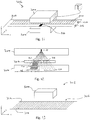
- the encoder apparatus 2 is a reflective encoder apparatus. However, as will be understood, this need not necessarily be the case and the invention is equally applicable to transmissive encoder apparatus 202, as illustrated in Figures 11 and 12 .
- the scale 206 is primarily configured to allow light from the readhead's 204 light source 18 through it toward the incremental 22 and reference 24 photodetectors in the readhead 204 which are located on the opposite side of the scale 206 to the light source 18.
- the readhead 204 comprises a light source 18, an incremental detector 22, and a reference detector 24 (comprising first 28 and second 30 detector channels offset in the measuring direction (not shown)).
- readhead components are substantially the same as that described in connection with the embodiments of Figures 1 to 11 , and operate in the same way, the only difference being that the incremental 22 and reference 24 detectors are positioned on the opposite side of the scale 206 to the light source 18. Accordingly, an interference fringe (not shown) is created and detected at the incremental detector 22 in the same manner as described in connection with Figures 3 and 4 .
- the reference position is determined in the same way, that is, by finding the reference mark zone at which a difference signal (obtained by differentially amplifying the output of the first 28 and second 30 detector channels of the reference detector 24) is contained between upper and lower thresholds.
- the reference track 212 is mostly transmissive, but at a reference position comprises a feature 216 which blocks the light from reaching the reference photodetector 24. Accordingly, the reference position can be determined in much the same way as that described above in connection with Figure 10 , except that as will be understood, the signals will be inverted (i.e. the signals output from the first 28 and second 30 detector channels will dip as the readhead passes the reference position).
- a reference mark track separate to an incremental track is provided. Nevertheless, as will be understood, this need not necessarily be the case and for instance the reference position could be defined by at least one feature embedded within the incremental scale track. Furthermore, as will be understood, the invention is equally applicable to encoders in which the scale does not comprise any features defining a reference position, e.g. as illustrated by Figure 13 which illustrates an encoder apparatus 302 comprising a readhead 304 and an incremental scale 306 comprising incremental scale features 314.
- the encoders are incremental encoders. However, as will be understood, this need not necessarily be the case.
- the invention is also of use with absolute encoders.
- absolute encoders comprise scales having features which uniquely identify the position along the scale.
- the scale features could define a series of uniquely identifiable codes.
- a readhead could be configured to obtain a snapshot representation (e.g. an image) of the scale which is analysed to identify a position code. The presence of the structured light on the scale could interfere with the detection and analysis of the code, but the effect can be reduced if the structure of the light is misaligned with the scale's features.
- absolute encoders apparatus read the scale in the same or a similar manner to that as described above in connection with the illustrated embodiments of the invention.
- an encoder apparatus can in addition to reading a scale to find a unique position code, can also read the scale to obtain incremental information, e.g. by analysing a resultant field/interference fringe generated by the diffraction of EMR. This could be done in the same or a different readhead.
- this could be achieved by the use of single scale track (e.g. as described in WO2002/084223 ) or by having a dedicated incremental scale track that runs alongside any absolute scale tracks. Accordingly, as will be understood, what was described above in connection with the incremental only embodiments, equally applies to at least the incremental side of such absolute encoder apparatus.
- no lenses or other optical components which alter the wavefront curvature of light from the light source are provided in the readhead.
- a lens could be used to collimate light from the light source 18.
- a lens could be used for form an image of the scale. Nevertheless, as will be understood, the omission of such optical components (or the use of only very weak optical components) enables a very compact readhead to be provided.
- our inventors have been able to provide a readhead for use in a reflective encoder, the readhead having a total height of no more than 10mm, and for example no more than 6.7mm, with a total system height (top of readhead to top surface of scale) of less than 14mm, and for example no more than 7.8mm.
- the inventors it has enabled the inventors to reduce the height between the incremental photodetector 22 and the diffraction/index grating 20 to no more than 2.3mm.
Landscapes
- Physics & Mathematics (AREA)
- General Physics & Mathematics (AREA)
- Optical Transform (AREA)
Priority Applications (1)
| Application Number | Priority Date | Filing Date | Title |
|---|---|---|---|
| EP14792751.1A EP3052897B1 (en) | 2013-10-01 | 2014-09-26 | Measurement encoder |
Applications Claiming Priority (3)
| Application Number | Priority Date | Filing Date | Title |
|---|---|---|---|
| EP13275238 | 2013-10-01 | ||
| EP14792751.1A EP3052897B1 (en) | 2013-10-01 | 2014-09-26 | Measurement encoder |
| PCT/EP2014/070617 WO2015049174A1 (en) | 2013-10-01 | 2014-09-26 | Measurement encoder |
Publications (2)
| Publication Number | Publication Date |
|---|---|
| EP3052897A1 EP3052897A1 (en) | 2016-08-10 |
| EP3052897B1 true EP3052897B1 (en) | 2019-07-17 |
Family
ID=49263260
Family Applications (1)
| Application Number | Title | Priority Date | Filing Date |
|---|---|---|---|
| EP14792751.1A Active EP3052897B1 (en) | 2013-10-01 | 2014-09-26 | Measurement encoder |
Country Status (5)
| Country | Link |
|---|---|
| US (1) | US10823587B2 (enExample) |
| EP (1) | EP3052897B1 (enExample) |
| JP (1) | JP7032045B2 (enExample) |
| CN (1) | CN105814408B (enExample) |
| WO (1) | WO2015049174A1 (enExample) |
Families Citing this family (12)
| Publication number | Priority date | Publication date | Assignee | Title |
|---|---|---|---|---|
| CN105723179B (zh) * | 2013-10-18 | 2019-05-31 | 上海交通大学 | 主动式位置编码器及其操作方法 |
| DE102014209004A1 (de) * | 2014-05-13 | 2015-11-19 | Dr. Johannes Heidenhain Gmbh | Positionsmesseinrichtung |
| EP3289314B1 (en) | 2015-04-29 | 2019-06-05 | Renishaw PLC | Method of determining sub-divisional error |
| CN108351229B (zh) | 2015-09-09 | 2021-03-26 | 瑞尼斯豪公司 | 编码器装置 |
| US10295378B2 (en) * | 2017-06-29 | 2019-05-21 | Mitutoyo Corporation | Contamination and defect resistant optical encoder configuration outputting structured illumination to a scale plane for providing displacement signals |
| JP7114371B2 (ja) * | 2018-07-03 | 2022-08-08 | 株式会社ミツトヨ | 光電式エンコーダの信号処理方法 |
| EP3623769A1 (en) * | 2018-09-12 | 2020-03-18 | Renishaw PLC | Measurement device |
| JP7120200B2 (ja) * | 2019-10-15 | 2022-08-17 | 株式会社デンソー | 回転角検出装置 |
| JPWO2022044753A1 (enExample) * | 2020-08-25 | 2022-03-03 | ||
| US11828629B2 (en) * | 2021-05-28 | 2023-11-28 | Pixart Imaging (Penang) Sdn. Bhd. | Multi-track optical encoder |
| EP4390328A1 (en) * | 2022-12-21 | 2024-06-26 | Renishaw plc | Encoder apparatus |
| EP4639090A1 (en) * | 2022-12-20 | 2025-10-29 | Renishaw plc | Encoder apparatus |
Family Cites Families (33)
| Publication number | Priority date | Publication date | Assignee | Title |
|---|---|---|---|---|
| DE1921507C2 (de) | 1969-04-26 | 1971-02-11 | Zeiss Carl Fa | Einrichtung zur Erzeugung phasenverschobener elektrischer Signale |
| ATE51445T1 (de) * | 1986-02-07 | 1990-04-15 | Saphirwerk Ind Prod | Vorrichtung zur inkrementalen laengenmessung. |
| US4912322A (en) | 1986-08-15 | 1990-03-27 | Mitutoyo Mfg. Co., Ltd. | Optical type displacement detecting device |
| JPH01173829U (enExample) | 1988-05-13 | 1989-12-11 | ||
| DE3823314A1 (de) | 1988-07-09 | 1990-01-11 | Heidenhain Gmbh Dr Johannes | Lichtelektrische positionsmesseinrichtung |
| JP2586121B2 (ja) | 1988-09-30 | 1997-02-26 | キヤノン株式会社 | ロータリーエンコーダの原点検出系 |
| JPH0313901A (ja) | 1989-06-13 | 1991-01-22 | Mitsubishi Electric Corp | 発光ダイオード |
| JPH03128418A (ja) | 1989-07-20 | 1991-05-31 | Yokogawa Electric Corp | 光学式エンコーダ |
| JP2670457B2 (ja) | 1989-09-29 | 1997-10-29 | キヤノン株式会社 | 零点位置検出装置 |
| CN1022776C (zh) | 1990-10-25 | 1993-11-17 | 刘光万 | 采用光传感方式的位移检测方法及装置 |
| JP3530573B2 (ja) | 1994-04-27 | 2004-05-24 | キヤノン株式会社 | 光学式変位センサ |
| GB9424969D0 (en) | 1994-12-10 | 1995-02-08 | Renishaw Plc | Opto-electronic scale reading apparatus |
| JP3471971B2 (ja) * | 1995-05-10 | 2003-12-02 | キヤノン株式会社 | 複合型のロータリーエンコーダ |
| JP3631551B2 (ja) * | 1996-01-23 | 2005-03-23 | 株式会社ミツトヨ | 光学式エンコーダ |
| DE19854733A1 (de) | 1998-11-27 | 2000-05-31 | Heidenhain Gmbh Dr Johannes | Abtasteinheit einer Positionsmeßeinrichtung |
| DE60033075T3 (de) | 1999-04-16 | 2012-08-30 | Canon K.K. | Kodierer |
| JP4697359B2 (ja) | 2000-06-20 | 2011-06-08 | 株式会社安川電機 | 光学式エンコーダ |
| GB0109057D0 (en) | 2001-04-11 | 2001-05-30 | Renishaw Plc | Absolute postition measurement |
| JP3720751B2 (ja) * | 2001-10-23 | 2005-11-30 | オリンパス株式会社 | 光学式エンコーダ |
| JP2004271453A (ja) | 2003-03-11 | 2004-09-30 | Yaskawa Electric Corp | 光学式エンコーダ |
| GB0316921D0 (en) | 2003-07-19 | 2003-08-27 | Renishaw Plc | Reader for a scale marking |
| US7126696B2 (en) * | 2003-09-30 | 2006-10-24 | Mitutoyo Corporation | Interferometric miniature grating encoder readhead using fiber optic receiver channels |
| GB0413710D0 (en) | 2004-06-21 | 2004-07-21 | Renishaw Plc | Scale reading apparatus |
| US7227124B2 (en) | 2005-06-20 | 2007-06-05 | Mitutoyo Corporation | Illumination configuration for imaging-type optical encoders |
| JP4803644B2 (ja) | 2005-06-20 | 2011-10-26 | オリンパス株式会社 | 光学式エンコーダ |
| GB0522651D0 (en) | 2005-11-07 | 2005-12-14 | Renishaw Plc | Scale and readhead system |
| GB0621487D0 (en) * | 2006-10-28 | 2006-12-06 | Renishaw Plc | Opto-electronic read head |
| US8384115B2 (en) | 2008-08-01 | 2013-02-26 | Cree, Inc. | Bond pad design for enhancing light extraction from LED chips |
| GB0819767D0 (en) | 2008-10-28 | 2008-12-03 | Renishaw Plc | Absolute encoder setup indication |
| JP5679643B2 (ja) * | 2009-09-11 | 2015-03-04 | キヤノン株式会社 | 光学式エンコーダ |
| US9362455B2 (en) * | 2011-02-24 | 2016-06-07 | Cree, Inc. | Semiconductor light emitting diodes having multiple bond pads and current spreading structures |
| US8878204B2 (en) * | 2012-05-04 | 2014-11-04 | Cree, Inc. | Submount based light emitter components and methods |
| JP6732366B2 (ja) * | 2015-12-21 | 2020-07-29 | 株式会社ミツトヨ | 光電式エンコーダおよび測定器 |
-
2014
- 2014-09-26 EP EP14792751.1A patent/EP3052897B1/en active Active
- 2014-09-26 US US15/024,519 patent/US10823587B2/en active Active
- 2014-09-26 CN CN201480065266.2A patent/CN105814408B/zh active Active
- 2014-09-26 JP JP2016519754A patent/JP7032045B2/ja active Active
- 2014-09-26 WO PCT/EP2014/070617 patent/WO2015049174A1/en not_active Ceased
Non-Patent Citations (1)
| Title |
|---|
| None * |
Also Published As
| Publication number | Publication date |
|---|---|
| CN105814408B (zh) | 2018-06-12 |
| EP3052897A1 (en) | 2016-08-10 |
| US10823587B2 (en) | 2020-11-03 |
| WO2015049174A1 (en) | 2015-04-09 |
| US20160245673A1 (en) | 2016-08-25 |
| CN105814408A (zh) | 2016-07-27 |
| JP7032045B2 (ja) | 2022-03-08 |
| JP2016532095A (ja) | 2016-10-13 |
Similar Documents
| Publication | Publication Date | Title |
|---|---|---|
| EP3052897B1 (en) | Measurement encoder | |
| JP7153997B2 (ja) | 基準マーク検出器配列 | |
| KR102697708B1 (ko) | 인코더 장치 | |
| US10768026B2 (en) | Optical element | |
| US20160231143A1 (en) | Position measurement encoder | |
| JP2004534247A (ja) | 位置測定装置 | |
| JP6465950B2 (ja) | 光学式エンコーダ | |
| KR102632134B1 (ko) | 인코더 장치 | |
| CN204575098U (zh) | 光电编码器 | |
| CN101303222A (zh) | 光学尺 | |
| JP2014098666A (ja) | インクリメンタルエンコーダ |
Legal Events
| Date | Code | Title | Description |
|---|---|---|---|
| PUAI | Public reference made under article 153(3) epc to a published international application that has entered the european phase |
Free format text: ORIGINAL CODE: 0009012 |
|
| 17P | Request for examination filed |
Effective date: 20160414 |
|
| AK | Designated contracting states |
Kind code of ref document: A1 Designated state(s): AL AT BE BG CH CY CZ DE DK EE ES FI FR GB GR HR HU IE IS IT LI LT LU LV MC MK MT NL NO PL PT RO RS SE SI SK SM TR |
|
| AX | Request for extension of the european patent |
Extension state: BA ME |
|
| STAA | Information on the status of an ep patent application or granted ep patent |
Free format text: STATUS: REQUEST FOR EXAMINATION WAS MADE |
|
| DAX | Request for extension of the european patent (deleted) | ||
| REG | Reference to a national code |
Ref country code: DE Ref legal event code: R079 Ref document number: 602014050202 Country of ref document: DE Free format text: PREVIOUS MAIN CLASS: G01D0005347000 Ipc: G01D0005245000 |
|
| GRAP | Despatch of communication of intention to grant a patent |
Free format text: ORIGINAL CODE: EPIDOSNIGR1 |
|
| STAA | Information on the status of an ep patent application or granted ep patent |
Free format text: STATUS: GRANT OF PATENT IS INTENDED |
|
| RIC1 | Information provided on ipc code assigned before grant |
Ipc: G01D 5/38 20060101ALI20190201BHEP Ipc: G01D 5/245 20060101AFI20190201BHEP Ipc: G01D 5/36 20060101ALI20190201BHEP Ipc: G01D 5/347 20060101ALI20190201BHEP |
|
| INTG | Intention to grant announced |
Effective date: 20190306 |
|
| GRAS | Grant fee paid |
Free format text: ORIGINAL CODE: EPIDOSNIGR3 |
|
| GRAA | (expected) grant |
Free format text: ORIGINAL CODE: 0009210 |
|
| STAA | Information on the status of an ep patent application or granted ep patent |
Free format text: STATUS: THE PATENT HAS BEEN GRANTED |
|
| AK | Designated contracting states |
Kind code of ref document: B1 Designated state(s): AL AT BE BG CH CY CZ DE DK EE ES FI FR GB GR HR HU IE IS IT LI LT LU LV MC MK MT NL NO PL PT RO RS SE SI SK SM TR |
|
| REG | Reference to a national code |
Ref country code: GB Ref legal event code: FG4D |
|
| REG | Reference to a national code |
Ref country code: CH Ref legal event code: EP |
|
| REG | Reference to a national code |
Ref country code: DE Ref legal event code: R096 Ref document number: 602014050202 Country of ref document: DE |
|
| REG | Reference to a national code |
Ref country code: IE Ref legal event code: FG4D |
|
| REG | Reference to a national code |
Ref country code: AT Ref legal event code: REF Ref document number: 1156278 Country of ref document: AT Kind code of ref document: T Effective date: 20190815 |
|
| REG | Reference to a national code |
Ref country code: NL Ref legal event code: MP Effective date: 20190717 |
|
| REG | Reference to a national code |
Ref country code: LT Ref legal event code: MG4D |
|
| PG25 | Lapsed in a contracting state [announced via postgrant information from national office to epo] |
Ref country code: FI Free format text: LAPSE BECAUSE OF FAILURE TO SUBMIT A TRANSLATION OF THE DESCRIPTION OR TO PAY THE FEE WITHIN THE PRESCRIBED TIME-LIMIT Effective date: 20190717 Ref country code: PT Free format text: LAPSE BECAUSE OF FAILURE TO SUBMIT A TRANSLATION OF THE DESCRIPTION OR TO PAY THE FEE WITHIN THE PRESCRIBED TIME-LIMIT Effective date: 20191118 Ref country code: NO Free format text: LAPSE BECAUSE OF FAILURE TO SUBMIT A TRANSLATION OF THE DESCRIPTION OR TO PAY THE FEE WITHIN THE PRESCRIBED TIME-LIMIT Effective date: 20191017 Ref country code: BG Free format text: LAPSE BECAUSE OF FAILURE TO SUBMIT A TRANSLATION OF THE DESCRIPTION OR TO PAY THE FEE WITHIN THE PRESCRIBED TIME-LIMIT Effective date: 20191017 Ref country code: SE Free format text: LAPSE BECAUSE OF FAILURE TO SUBMIT A TRANSLATION OF THE DESCRIPTION OR TO PAY THE FEE WITHIN THE PRESCRIBED TIME-LIMIT Effective date: 20190717 Ref country code: NL Free format text: LAPSE BECAUSE OF FAILURE TO SUBMIT A TRANSLATION OF THE DESCRIPTION OR TO PAY THE FEE WITHIN THE PRESCRIBED TIME-LIMIT Effective date: 20190717 Ref country code: LT Free format text: LAPSE BECAUSE OF FAILURE TO SUBMIT A TRANSLATION OF THE DESCRIPTION OR TO PAY THE FEE WITHIN THE PRESCRIBED TIME-LIMIT Effective date: 20190717 Ref country code: HR Free format text: LAPSE BECAUSE OF FAILURE TO SUBMIT A TRANSLATION OF THE DESCRIPTION OR TO PAY THE FEE WITHIN THE PRESCRIBED TIME-LIMIT Effective date: 20190717 |
|
| PG25 | Lapsed in a contracting state [announced via postgrant information from national office to epo] |
Ref country code: IS Free format text: LAPSE BECAUSE OF FAILURE TO SUBMIT A TRANSLATION OF THE DESCRIPTION OR TO PAY THE FEE WITHIN THE PRESCRIBED TIME-LIMIT Effective date: 20191117 Ref country code: GR Free format text: LAPSE BECAUSE OF FAILURE TO SUBMIT A TRANSLATION OF THE DESCRIPTION OR TO PAY THE FEE WITHIN THE PRESCRIBED TIME-LIMIT Effective date: 20191018 Ref country code: RS Free format text: LAPSE BECAUSE OF FAILURE TO SUBMIT A TRANSLATION OF THE DESCRIPTION OR TO PAY THE FEE WITHIN THE PRESCRIBED TIME-LIMIT Effective date: 20190717 Ref country code: ES Free format text: LAPSE BECAUSE OF FAILURE TO SUBMIT A TRANSLATION OF THE DESCRIPTION OR TO PAY THE FEE WITHIN THE PRESCRIBED TIME-LIMIT Effective date: 20190717 Ref country code: AL Free format text: LAPSE BECAUSE OF FAILURE TO SUBMIT A TRANSLATION OF THE DESCRIPTION OR TO PAY THE FEE WITHIN THE PRESCRIBED TIME-LIMIT Effective date: 20190717 Ref country code: LV Free format text: LAPSE BECAUSE OF FAILURE TO SUBMIT A TRANSLATION OF THE DESCRIPTION OR TO PAY THE FEE WITHIN THE PRESCRIBED TIME-LIMIT Effective date: 20190717 |
|
| PG25 | Lapsed in a contracting state [announced via postgrant information from national office to epo] |
Ref country code: TR Free format text: LAPSE BECAUSE OF FAILURE TO SUBMIT A TRANSLATION OF THE DESCRIPTION OR TO PAY THE FEE WITHIN THE PRESCRIBED TIME-LIMIT Effective date: 20190717 |
|
| PG25 | Lapsed in a contracting state [announced via postgrant information from national office to epo] |
Ref country code: EE Free format text: LAPSE BECAUSE OF FAILURE TO SUBMIT A TRANSLATION OF THE DESCRIPTION OR TO PAY THE FEE WITHIN THE PRESCRIBED TIME-LIMIT Effective date: 20190717 Ref country code: PL Free format text: LAPSE BECAUSE OF FAILURE TO SUBMIT A TRANSLATION OF THE DESCRIPTION OR TO PAY THE FEE WITHIN THE PRESCRIBED TIME-LIMIT Effective date: 20190717 Ref country code: DK Free format text: LAPSE BECAUSE OF FAILURE TO SUBMIT A TRANSLATION OF THE DESCRIPTION OR TO PAY THE FEE WITHIN THE PRESCRIBED TIME-LIMIT Effective date: 20190717 Ref country code: RO Free format text: LAPSE BECAUSE OF FAILURE TO SUBMIT A TRANSLATION OF THE DESCRIPTION OR TO PAY THE FEE WITHIN THE PRESCRIBED TIME-LIMIT Effective date: 20190717 |
|
| PG25 | Lapsed in a contracting state [announced via postgrant information from national office to epo] |
Ref country code: SK Free format text: LAPSE BECAUSE OF FAILURE TO SUBMIT A TRANSLATION OF THE DESCRIPTION OR TO PAY THE FEE WITHIN THE PRESCRIBED TIME-LIMIT Effective date: 20190717 Ref country code: IS Free format text: LAPSE BECAUSE OF FAILURE TO SUBMIT A TRANSLATION OF THE DESCRIPTION OR TO PAY THE FEE WITHIN THE PRESCRIBED TIME-LIMIT Effective date: 20200224 Ref country code: CZ Free format text: LAPSE BECAUSE OF FAILURE TO SUBMIT A TRANSLATION OF THE DESCRIPTION OR TO PAY THE FEE WITHIN THE PRESCRIBED TIME-LIMIT Effective date: 20190717 Ref country code: MC Free format text: LAPSE BECAUSE OF FAILURE TO SUBMIT A TRANSLATION OF THE DESCRIPTION OR TO PAY THE FEE WITHIN THE PRESCRIBED TIME-LIMIT Effective date: 20190717 Ref country code: SM Free format text: LAPSE BECAUSE OF FAILURE TO SUBMIT A TRANSLATION OF THE DESCRIPTION OR TO PAY THE FEE WITHIN THE PRESCRIBED TIME-LIMIT Effective date: 20190717 |
|
| REG | Reference to a national code |
Ref country code: CH Ref legal event code: PL |
|
| REG | Reference to a national code |
Ref country code: DE Ref legal event code: R097 Ref document number: 602014050202 Country of ref document: DE |
|
| REG | Reference to a national code |
Ref country code: AT Ref legal event code: UEP Ref document number: 1156278 Country of ref document: AT Kind code of ref document: T Effective date: 20190717 |
|
| PLBE | No opposition filed within time limit |
Free format text: ORIGINAL CODE: 0009261 |
|
| STAA | Information on the status of an ep patent application or granted ep patent |
Free format text: STATUS: NO OPPOSITION FILED WITHIN TIME LIMIT |
|
| PG2D | Information on lapse in contracting state deleted |
Ref country code: IS |
|
| PG25 | Lapsed in a contracting state [announced via postgrant information from national office to epo] |
Ref country code: LI Free format text: LAPSE BECAUSE OF NON-PAYMENT OF DUE FEES Effective date: 20190930 Ref country code: LU Free format text: LAPSE BECAUSE OF NON-PAYMENT OF DUE FEES Effective date: 20190926 Ref country code: IE Free format text: LAPSE BECAUSE OF NON-PAYMENT OF DUE FEES Effective date: 20190926 Ref country code: CH Free format text: LAPSE BECAUSE OF NON-PAYMENT OF DUE FEES Effective date: 20190930 |
|
| 26N | No opposition filed |
Effective date: 20200603 |
|
| REG | Reference to a national code |
Ref country code: BE Ref legal event code: MM Effective date: 20190930 |
|
| PG25 | Lapsed in a contracting state [announced via postgrant information from national office to epo] |
Ref country code: SI Free format text: LAPSE BECAUSE OF FAILURE TO SUBMIT A TRANSLATION OF THE DESCRIPTION OR TO PAY THE FEE WITHIN THE PRESCRIBED TIME-LIMIT Effective date: 20190717 Ref country code: BE Free format text: LAPSE BECAUSE OF NON-PAYMENT OF DUE FEES Effective date: 20190930 |
|
| PG25 | Lapsed in a contracting state [announced via postgrant information from national office to epo] |
Ref country code: FR Free format text: LAPSE BECAUSE OF NON-PAYMENT OF DUE FEES Effective date: 20190930 |
|
| PG25 | Lapsed in a contracting state [announced via postgrant information from national office to epo] |
Ref country code: CY Free format text: LAPSE BECAUSE OF FAILURE TO SUBMIT A TRANSLATION OF THE DESCRIPTION OR TO PAY THE FEE WITHIN THE PRESCRIBED TIME-LIMIT Effective date: 20190717 |
|
| PG25 | Lapsed in a contracting state [announced via postgrant information from national office to epo] |
Ref country code: MT Free format text: LAPSE BECAUSE OF FAILURE TO SUBMIT A TRANSLATION OF THE DESCRIPTION OR TO PAY THE FEE WITHIN THE PRESCRIBED TIME-LIMIT Effective date: 20190717 Ref country code: HU Free format text: LAPSE BECAUSE OF FAILURE TO SUBMIT A TRANSLATION OF THE DESCRIPTION OR TO PAY THE FEE WITHIN THE PRESCRIBED TIME-LIMIT; INVALID AB INITIO Effective date: 20140926 |
|
| PG25 | Lapsed in a contracting state [announced via postgrant information from national office to epo] |
Ref country code: MK Free format text: LAPSE BECAUSE OF FAILURE TO SUBMIT A TRANSLATION OF THE DESCRIPTION OR TO PAY THE FEE WITHIN THE PRESCRIBED TIME-LIMIT Effective date: 20190717 |
|
| P01 | Opt-out of the competence of the unified patent court (upc) registered |
Effective date: 20230602 |
|
| PGFP | Annual fee paid to national office [announced via postgrant information from national office to epo] |
Ref country code: DE Payment date: 20250926 Year of fee payment: 12 |
|
| PGFP | Annual fee paid to national office [announced via postgrant information from national office to epo] |
Ref country code: IT Payment date: 20250922 Year of fee payment: 12 |
|
| PGFP | Annual fee paid to national office [announced via postgrant information from national office to epo] |
Ref country code: GB Payment date: 20250923 Year of fee payment: 12 |
|
| PGFP | Annual fee paid to national office [announced via postgrant information from national office to epo] |
Ref country code: AT Payment date: 20250917 Year of fee payment: 12 |