EP3044331B1 - Méthode de diagnostic des hémopathies malignes et kit associé - Google Patents
Méthode de diagnostic des hémopathies malignes et kit associé Download PDFInfo
- Publication number
- EP3044331B1 EP3044331B1 EP14781927.0A EP14781927A EP3044331B1 EP 3044331 B1 EP3044331 B1 EP 3044331B1 EP 14781927 A EP14781927 A EP 14781927A EP 3044331 B1 EP3044331 B1 EP 3044331B1
- Authority
- EP
- European Patent Office
- Prior art keywords
- dna
- primer
- artificial sequence
- probes
- seq
- Prior art date
- Legal status (The legal status is an assumption and is not a legal conclusion. Google has not performed a legal analysis and makes no representation as to the accuracy of the status listed.)
- Active
Links
Images











Classifications
-
- C—CHEMISTRY; METALLURGY
- C12—BIOCHEMISTRY; BEER; SPIRITS; WINE; VINEGAR; MICROBIOLOGY; ENZYMOLOGY; MUTATION OR GENETIC ENGINEERING
- C12Q—MEASURING OR TESTING PROCESSES INVOLVING ENZYMES, NUCLEIC ACIDS OR MICROORGANISMS; COMPOSITIONS OR TEST PAPERS THEREFOR; PROCESSES OF PREPARING SUCH COMPOSITIONS; CONDITION-RESPONSIVE CONTROL IN MICROBIOLOGICAL OR ENZYMOLOGICAL PROCESSES
- C12Q1/00—Measuring or testing processes involving enzymes, nucleic acids or microorganisms; Compositions therefor; Processes of preparing such compositions
- C12Q1/68—Measuring or testing processes involving enzymes, nucleic acids or microorganisms; Compositions therefor; Processes of preparing such compositions involving nucleic acids
- C12Q1/6876—Nucleic acid products used in the analysis of nucleic acids, e.g. primers or probes
- C12Q1/6883—Nucleic acid products used in the analysis of nucleic acids, e.g. primers or probes for diseases caused by alterations of genetic material
- C12Q1/6886—Nucleic acid products used in the analysis of nucleic acids, e.g. primers or probes for diseases caused by alterations of genetic material for cancer
-
- C—CHEMISTRY; METALLURGY
- C12—BIOCHEMISTRY; BEER; SPIRITS; WINE; VINEGAR; MICROBIOLOGY; ENZYMOLOGY; MUTATION OR GENETIC ENGINEERING
- C12Q—MEASURING OR TESTING PROCESSES INVOLVING ENZYMES, NUCLEIC ACIDS OR MICROORGANISMS; COMPOSITIONS OR TEST PAPERS THEREFOR; PROCESSES OF PREPARING SUCH COMPOSITIONS; CONDITION-RESPONSIVE CONTROL IN MICROBIOLOGICAL OR ENZYMOLOGICAL PROCESSES
- C12Q2600/00—Oligonucleotides characterized by their use
- C12Q2600/156—Polymorphic or mutational markers
-
- C—CHEMISTRY; METALLURGY
- C12—BIOCHEMISTRY; BEER; SPIRITS; WINE; VINEGAR; MICROBIOLOGY; ENZYMOLOGY; MUTATION OR GENETIC ENGINEERING
- C12Q—MEASURING OR TESTING PROCESSES INVOLVING ENZYMES, NUCLEIC ACIDS OR MICROORGANISMS; COMPOSITIONS OR TEST PAPERS THEREFOR; PROCESSES OF PREPARING SUCH COMPOSITIONS; CONDITION-RESPONSIVE CONTROL IN MICROBIOLOGICAL OR ENZYMOLOGICAL PROCESSES
- C12Q2600/00—Oligonucleotides characterized by their use
- C12Q2600/158—Expression markers
Definitions
- the present invention relates to a method for diagnosing cancer in a subject, comprising an RT-MLPA step carried out on a biological sample obtained from said subject, in particular for the purpose of searching for fusion transcripts, using using the SEQ ID NO probes: 1 to 25, 30, 31 and 113 to 120, and / or using the SEQ ID NO probes: 374 to 405, and / or using at least the probes SEQ ID NO: 524 to 559, each of the probes being fused, at at least one end, with a priming sequence.
- the present invention also relates to a kit comprising at least the SEQ ID NO probes: 1 to 25, 30, 31 and 113 to 120, and / or at least the SEQ ID NO probes: 374 to 405, and / or at least the probes SEQ ID NO: 524 to 559, each of the probes being fused, at at least one end, with a priming sequence.
- Cancers are caused by an accumulation of genetic abnormalities by tumor cells. Among these anomalies are numerous chromosomal rearrangements (translocations, deletions and inversions) which lead to the formation of fusion genes. These fusion genes are often associated with particular forms of tumor, and their identification can significantly contribute to the diagnosis (The impact of translocations and gene fusions on cancer causation. Mitelman F, Johansson B, Mertens F., Nat Rev Cancer. 2007 Apr; 7 (4): 233-45 .).
- Cytogenetics consists in establishing the karyotype of cancer cells to look for possible anomalies in the number and / or structure of chromosomes. It has the advantage of providing a global vision of the whole genome. It is, however, relatively insensitive, its effectiveness depending strongly on the percentage of tumor cells in the sample to be analyzed and on the possibility of obtaining viable cell cultures. Another of its drawbacks is its low resolution which does not allow certain rearrangements to be detected (in particular small inversions and deletions). Finally, some tumors are associated with major genomic instability which masks pathognomonic genetic abnormalities. The analysis of karyotypes is therefore often difficult and can only be carried out by personnel with excellent expertise.
- RT-PCR The second technique, RT-PCR, is carried out using RNA extracted from tumor cells. It has excellent sensitivity, far superior to cytogenetics. This sensitivity makes it the reference technique for analyzing biological samples where the percentage of tumor cells is low, which makes it possible to control the effectiveness of the treatments or to anticipate very early any relapses.
- its main limitation is linked to the fact that it is extremely difficult to multiplex this type of analysis. Each translocation must generally be sought by a specific test, only a few recurrent mergers among the very numerous which are known today are sought in routine analysis laboratories.
- International demand WO03 / 044486 also describes a method of diagnosing cancer comprising the detection of a chromosomal translocation, and requiring the prior amplification of the translocation to be detected.
- the inventors have succeeded in implementing a test making it possible to diagnose a specific cancer, in particular a solid tumor (for example sarcoma or carcinoma) or leukemia.
- This test makes it possible to search simultaneously for a very large number of chromosomal rearrangements in many forms of cancer, and this in an economical and rapid manner (the test can be carried out in one day).
- its simplicity of implementation allows a person mastering the classical techniques of molecular biology to carry out all of the steps without specific training, using equipment already available in most routine diagnostic laboratories.
- the invention therefore relates to a molecular test comprising in particular an RT-MLPA (Reverse Transcriptase Ligation-Dependent Probe Amplification) step, carried out in multiplex mode.
- RT-MLPA Reverse Transcriptase Ligation-Dependent Probe Amplification
- the multiplex mode saves time, because it is faster than several monoplex, and is economically advantageous. It also makes it possible to simultaneously search for a much higher number of anomalies than the techniques currently available.
- the present invention relates to a method for diagnosing cancer associated with the formation of fusion genes in a subject, comprising an RT-MLPA step carried out on a biological sample obtained from said subject using SEQ probes ID NO: 1 to 25, 30, 31 and 113 to 120, and / or using the probes SEQ ID NO: 374 to 405, and / or at least the probes SEQ ID NO: 524 to 559, each of the probes being merged, at least at one end, with a boot sequence.
- the present invention also relates to a kit comprising at least the SEQ ID NO probes: 1 to 25, 30, 31 and 113 to 120, and / or the SEQ ID NO probes: 374 to 405, and / or at least the probes SEQ ID NO: 524 to 559, preferably further comprising the SEQ ID NO probes: 26 to 29, 66 to 112 and 121 to 219, and / or the SEQ ID NO probes: 438 to 480, and / or the SEQ probes ID NO: 616 to 674, and / or the probes SEQ ID NO: 734 to 741, and / or the probes SEQ ID NO: 750 to 774, each of the probes being fused, at at least one end, with a sequence of priming.
- the kit comprises at least the SEQ ID NO probes: 35 to 59, 64, 65 and 267 to 274, and / or the SEQ ID NO probes: 406 to 437, and / or the SEQ ID NO probes: 560 to 595, preferably it further comprises the probes SEQ ID NO: 60 to 63, 220 to 266 and 275 to 373, and / or the probes SEQ ID NO: 675 to 733, and / or the probes SEQ ID NO: 775 to 799, and / or the probes SEQ ID NO: 742 to 749.
- MLPA Multiplex Ligation-Dependent Probe Amplification, which allows the simultaneous amplification of several targets of interest contiguous to each other, using one or more specific probes. This technique is very advantageous, in the context of the present invention, for determining the presence of translocations, which are frequent in malignant tumors.
- RT-MLPA Multiplex Ligation-Dependent Probe Amplification preceded by a Reverse Transcription (RT), which allows, in the framework of the present invention, starting from the RNA of a subject to amplify and characterize the fusion genes of interest.
- RT Reverse Transcription
- subject is meant an individual who is healthy or susceptible to cancer or who is seeking screening, diagnosis or follow-up.
- biological sample is meant a sample containing biological material. More preferably, any sample containing RNA is understood.
- This sample can come from a biological sample taken from a living being (human, animal, plant patient).
- the biological samples according to the invention are chosen from whole blood, bone marrow and a biopsy obtained from a subject, in particular human.
- sensitivity is meant the proportion of positive tests in subjects suffering from cancer and carrying the desired abnormalities.
- cancer is meant a disease characterized by abnormally large cell proliferation within normal body tissue, so that the survival of the latter is threatened.
- the cancer is preferably chosen from leukemias, sarcomas and carcinomas.
- Leukemias are cancers of the cells of the bone marrow, lymphoid and myeloid systems.
- Sarcomas are malignant tumors developed at the expense of extra-skeletal common connective tissue such as adipose tissue, muscle tissue, vessels and the peripheral nervous system.
- Carcinomas are malignant tumors developed at the expense of epithelial tissue.
- probe is meant a nucleic acid sequence of length between 15 and 40 nucleotides, preferably between 20 and 25 nucleotides, and complementary to a cDNA sequence from an RNA of the subject (endogenous) . It is therefore capable of hybridizing with said cDNA sequence originating from a RNA of the subject.
- priming sequence is meant a nucleic acid sequence of length between 15 and 30 nucleotides, preferably between 20 and 25 nucleotides, and not complementary to the cDNA sequences derived from the subject's RNA. It is therefore not complementary to the cDNA corresponding to the endogenous RNA. She does not therefore cannot hybridize with said cDNA sequences.
- the priming sequence is chosen from the sequences SEQ ID NO: 33 and SEQ ID NO: 34.
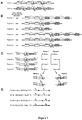
- the inventors have identified specific probes for each type of translocation observed in certain cancers. This identification is based on the analysis of the intron-exon structure of the genes involved in translocations, as shown in figure 1 . In particular, the breakpoints likely to lead to the expression of functional chimeric proteins are sought ( figure 1B ). From these results, DNA sequences of 25 to 40 base pairs are defined, corresponding precisely to the 5 ′ and 3 ′ ends of the exons of the two genes juxtaposed after splicing of the hybrid transcripts ( figure 1C ).
- a set of probes is then defined as follows: a priming sequence (S A on the figure 1 ) of about twenty base pairs is added 5 'to all the complementary probes of the exons of the genes forming the 5' part of the fusion transcripts.
- a second boot sequence (S B on the figure 1 ) is added to the 3 'ends of all the probes complementary to the exons of the genes forming the 3' part of the fusion transcripts ( figure 1D ).
- S A on the figure 1 a priming sequence of about twenty base pairs is added 5 'to all the complementary probes of the exons of the genes forming the 5' part of the fusion transcripts.
- S B on the figure 1 also of about twenty base pairs but different from S A , is added to the 3 'ends of all the probes complementary to the exons of the genes forming the 3' part of the fusion transcripts ( figure 1D ).
- the probes used in the invention are therefore capable of hybridizing either with the last nucleotides of the last exon in 5 'of the translocation, or with the first nucleotides of the first exon in 3' of the translocation.
- the probes used in the invention capable of hybridizing with the first nucleotides of the first exon in 3 'of the translocation, are phosphorylated in 5' before their use.
- the probes according to the invention are the sequences SEQ ID NO: 1 to 25, 30, 31 and 113 to 120, optionally combined with the probes SEQ ID NO: 26 to 29, 66 to 112 and 121 to 219 and / or with the probes SEQ ID NO: 616 to 674.
- the probes according to the invention are the sequences SEQ ID NO: 374 to 405, optionally combined with the probes SEQ ID NO: 438 to 480 and / or at least with the probes SEQ ID NO: 750 to 774.
- the probes according to the invention are the sequences SEQ ID NO: 524 to 559, optionally combined with the probes SEQ ID NO: 438 to 480 and / or at least with the probes SEQ ID NO: 374 to 405 and / or with the probes SEQ ID NO: 734 to 741.
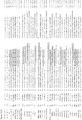
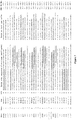
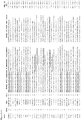
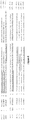
- each probe has a position (ie if they are 5 '(G) or 3' (D) from the abnormal junction), their structure (presence or not of a priming sequence, and characteristics of this sequence), as well as the gene and exon to which each probe hybridizes.
- each of the probes SEQ ID NO: 3 to SEQ ID NO: 8; SEQ ID NO: 10 to SEQ ID NO: 12; SEQ ID NO: 20, SEQ ID NO: 22, SEQ ID NO: 23, SEQ ID NO: 26 and SEQ ID NO: 30 is merged in 5 'with a boot sequence, and each of the probes SEQ ID NO: 1, SEQ ID NO: 2, SEQ ID NO: 9, SEQ ID NO: 13 to SEQ ID NO: 19; SEQ ID NO: 21, SEQ ID NO: 24, SEQ ID NO: 25, SEQ ID NO: 27 to SEQ ID NO: 29; and SEQ ID NO: 31 is merged in 3 ′ with a different priming sequence.
- the probes fused to the priming sequences which can be used according to the invention are the sequences SEQ ID NO: 35 to 59, 64, 65 and 267 to 274, optionally combined with the probes SEQ ID NO: 60 to 63, 220 to 266 and 275 to 373 and / or to probes SEQ ID NO: 675 to 733.
- the probes fused to the priming sequences which can be used according to the invention are the sequences SEQ ID NO: 406 to 437, optionally combined with the probes SEQ ID NO: 481 to 523 and / or to the probes SEQ ID NO: 775 to 799 .
- the probes fused to the priming sequences which can be used according to the invention are the sequences SEQ ID NO: 560 to 595, optionally combined with the probes SEQ ID NO: 481 to 523 and / or to the probes SEQ ID NO: 742 to 749 .
- the pair of probes can be chosen from the probes of specific sequence described above, and as explained in figures 4 , 7 and 9 .
- “pair of probes” is meant a set of two probes, one being located at 5 '(“G” on the figures 4-5 , and 7 to 9 ) translocation or gene mutation, the other being located 3 '("D" on the figures 4-5 , and 7 to 9 ) gene translocation or mutation.
- the diagnostic method according to the invention relates to the diagnosis of leukemias, and comprises an RT-MLPA stage carried out on a biological sample obtained from said subject using the probes SEQ ID NO: 1 to 25, 30, 31 and 113 to 120, each of the probes being fused, at at least one end, with a priming sequence.
- the leukemias are preferably chosen from acute lymphoblastic leukemias B, acute lymphoblastic leukemias T, acute myeloblastic leukemias, chronic myeloid leukemias, lymphomas and myelomas.
- the diagnostic method according to the invention also uses the probes SEQ ID NO: 26 to 29, 66 to 112 and 121 to 219, and / or the probes SEQ ID NO: 616 to 674, for the RT-MLPA step, each of the probes being fused, at at least one end, with a priming sequence.
- a mixture of the probes SEQ ID NO: 1 to 25, 30, 31 and 113 to 120, and SEQ ID NO 26 to 29, 66 to 112 and 121 to 219 and / or SEQ ID NO: 616 to 674 is used, each of the probes being fused, at at least one end, with a priming sequence.
- the invention relates to a leukemia diagnosis kit comprising the probes SEQ ID NO: 1 to 25, 30, 31 and 113 to 120, and 26 to 29, 66 to 112 and 121 to 219, and / or SEQ ID NO: 616 to 674, each of the probes being fused, at at least one end, with a priming sequence.
- said kit comprises the probes SEQ ID NO: 35 to 59, 64, 65 and 267 to 274, and preferably also the probes SEQ ID NO: 60 to 63, 220 to 266 and 275 to 373, and / or preferably also the probes SEQ ID NO: 675 to 733.
- the diagnostic method according to the invention relates to the diagnosis of sarcomas, and comprises an RT-MLPA step in a biological sample obtained from said subject using the probes SEQ ID NO: 374 to 405, each of the probes being fused , at at least one end, with a boot sequence.
- the sarcomas are preferably chosen from Ewing's sarcomas, rhabdomyosarcomas, desmoplastic round cell tumors, synovialosarcomas and mixoid liposarcomas.
- the diagnostic method according to the invention also uses the probes SEQ ID NO: 438 to 480 and / or the probes SEQ ID NO: 750 to 774, for the RT-MLPA step, each of the probes being fused, at least at one end, with a priming sequence.
- a mixture of the probes SEQ ID NO: 374 to 405, and 438 to 480 and / or 750 to 774 is used, each of the probes being fused, at at least one end, with a priming sequence .
- the invention relates to a sarcoma diagnostic kit comprising the probes SEQ ID NO: 374 to 405, each of the probes being fused, at at least one end, with a priming sequence.
- said kit comprises the probes SEQ ID NO: 406 to 437, and preferably also the probes SEQ ID NO: 481 to 523, and / or preferably also the probes SEQ ID NO: 775 to 799.
- the diagnostic method according to the invention relates to the diagnosis of carcinomas, and comprises an RT-MLPA step in a biological sample obtained from said subject using the probes SEQ ID NO: 524 to 559, each of the probes being fused , at at least one end, with a boot sequence.
- Carcinomas are preferably chosen from non-small cell bronchopulmonary carcinomas, prostatic adenocarcinomas, carcinomas of the kidney, thyroid and breast.
- the diagnostic method according to the invention also uses the probes SEQ ID NO: 438 to 480 and / or the probes SEQ ID NO: 734 to 741, for the RT-MLPA step, each of the probes being merged, at least one end, with a boot sequence.
- a mixture of the probes SEQ ID NO: 524 to 559, and 438 to 480 and / or 734 to 741 is used, each of the probes being fused, at at least one end, with a priming sequence .
- the invention relates to a kit for diagnosing carcinomas comprising the probes SEQ ID NO: 524 to 559, each of the probes being fused, at at least one end, with a priming sequence.
- said kit comprises the probes SEQ ID NO: 560 to 595, and preferably also the probes SEQ ID NO: 481 to 523, and / or preferably also the probes SEQ ID NO: 742 to 749.
- the method of the invention uses a biological sample chosen from whole blood, bone marrow and a biopsy obtained from the subject.
- the RT-MLPA stage is derived from MLPA (Multiplex Ligation-Dépendent Probe Amplification), described in particular in the patent US 6,955,901 . It allows the detection and simultaneous determination of a large number of different oligonucleotide sequences.
- the principle is as follows (see figure 2 ): the RNA extracted from the tumor tissue is first converted into complementary DNA (cDNA) by reverse transcription. This cDNA is then incubated with the mixture of suitable probes, each of which can then hybridize to the sequences of the exons to which they correspond. If one of the fusion transcripts sought is present in the sample, two probes are fixed side by side on the corresponding cDNA.
- a ligation reaction is then carried out using an enzyme with DNA ligase activity, which establishes a covalent bond between the two contiguous probes.
- a PCR reaction Polymerase Chain Reaction
- primers corresponding to the priming sequences S A and S B on the figure 2 , which specifically amplifies the two ligated probes.
- Obtaining an amplification product after the RT-MLPA stage indicates that one of the sought-after translocations is present in the sample analyzed.
- RNA from the biological sample according to step a) is carried out according to conventional techniques, well known to those skilled in the art.
- this extraction can be carried out by cell lysis of cells from the biological sample.
- This lysis can be chemical, physical or thermal.
- This cell lysis is generally followed by a purification step allowing the nucleic acids to be separated and concentrated from other cellular debris.
- commercial kits of the QIAGEN and Zymo Research type, or those marketed by Invitrogen can be used.
- the relevant techniques differ depending on the nature of the biological sample tested. The knowledge of a person skilled in the art allows him easily to adapt these lysis and purification steps to said biological sample tested.
- the RNA extracted in step a) is then converted by reverse transcription into cDNA; this is step b) (see figure 2B ).
- This step b) can be carried out using any reverse transcription technique known from the prior art. It can in particular be done using reverse transcriptase marketed by Qiagen, Promega or Ambion, depending on the standard conditions of use, or using M-MLV Reverse Transcriptase from Invitrogen.
- a DNA ligase is typically added to covalently bind only the contiguous probes; this is step d) (see 2D figure ).
- the DNA ligase is in particular ligase 65, sold by MRC-Holland, Amsterdam, Netherlands (SALSA Ligase-65).
- This step d) is typically carried out using the Lig-5a, Lig-10 or Lig-50 kits from MRC-Holland, Amsterdam, Netherlands. It is typically carried out by incubating the DNA ligase and the mixture obtained in step c) at a temperature between 50 ° C and 60 ° C, for a period of 10 to 20 minutes, then for a period of 2 to 10 minutes at a temperature between 95 ° C and 100 ° C.
- each pair of contiguous probes G and D is covalently linked, and the priming sequence of each probe is always present in 5 ′ and 3 ′.
- the method also comprises a step e) of PCR amplification of the contiguous covalently linked probes obtained in d) (see figure 2E ).
- This PCR step is carried out using a pair of primers, one of the primers being identical to the 5 'priming sequence, the other primer being complementary to the 3' priming sequence.
- the PCR amplification of step e) is carried out using the primers SEQ ID NO: 32 and 33, preferably one being labeled at its 5 ′ end with a biotin, in order to allow the 'step (f).
- PCR is typically performed using commercial kits, such as ready-to-use kits sold by Eurogentec (Red'y'Star Mix).
- the PCR takes place in a first initial denaturation phase at a temperature between 90 ° C and 100 ° C, typically around 94 ° C, for a time of 5 to 8 minutes; then a second amplification phase comprising several cycles, typically 35 cycles, each cycle comprising 30 seconds at 94 ° C, then 30 seconds at 58 ° C, then 30 seconds at 72 ° C; and a final phase of return to 72 ° C for about 4 minutes.
- the amplicons are preferably stored at 4 ° C.
- the primers that can be used in step e) of PCR are the following: SEQ ID NO: Primer 596 CMV Forward: CGC AAA TGG GCG GTA GGC GTG 597 CMV Reverse: CGC CAT CCA CGC TGT TTT G 598 pcDNA3 Forward: GGC TAA CTA GAG AAC CCA CTG 599 pcDNA3 Reverse: GGC AAC TAG AAG GCA CAG TC 600 pCEP Forward: AGA GCT CGT TTA GTG AAC CG 601 pCEP Reverse: GTG GTT TGT CCA AAC TCA TC 602 pEGFPC 1 Forward: GAT CAC TCT CGG CAT GGA C 603 pEGFPC 1 Reverse: CAT TTT ATG TTT CAG GTT CAG GG 604 pEGFPN 1 Forward: GTC GTA ACA ACT CCG CCC 605 pEGFPN 1 Reverse: GTC CAG CTC GAC CAG GAT GAT
- the method according to the invention comprises a step f) of analyzing the results of the PCR of step e), preferably by pyrosequencing.
- a pyrosequencer such as the pyroMark Q24 pyrosequencer sold by the company Qiagen, using the commercial Pyromark Gold Q24 Reagent kit and one of the priming oligonucleotides.
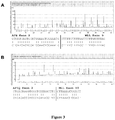
- This analysis step allows an immediate reading of the result, and directly indicates whether the subject's sample carries a specific translocation identified or not. This is particularly demonstrated in the figure 3 .
- step f) if, for a biological sample of a subject, an amplification by PCR is obtained in step e) following hybridization with a pair of probes, then the subject is carrying the cancer linked to the chromosomal rearrangement corresponding to the pair of identified probes.
- Cells obtained from blood or bone marrow or biopsy fragments are stored at -80 ° C in 1 ml of trizol (Life Technologies, Carlsbad, CA, USA).
- the mixture is homogenized before being incubated for approximately 5 min in ice and then centrifuged for 15 min at 12,000 rpm and at 4 ° C.
- the mixture is homogenized before being incubated for approximately 10 min in ice and centrifuged for 10 min at 12,000 rpm and at 4 ° C.
- the pellets are washed with approximately 1 ml of 70% ethanol and centrifuged for 5 min at 7500 rpm and at 4 ° C.
- the pellets are decanted and dried before being taken up in approximately 100 ⁇ L of water.
- RNAs are then incubated in a water bath at approximately 55 ° C for 5 to 10 min.
- the concentration of RNA obtained is adjusted between 50 and 250 ng / ⁇ L
- RNA (200-1000ng) are incubated with 2.5 ⁇ L Buffer 5x (Thermo Fisher Scientific, Waltham, MA, USA), 1 ⁇ l DTT 100mM (Thermo Fisher Scientific, Waltham, MA, USA) 2 ⁇ l dNTPs 10mM (Thermo Fisher Scientific, Waltham, MA, USA) and 2 ⁇ l of hexamers at 100 pmol / ⁇ l (Thermo Fisher Scientific, Waltham, MA, USA), for 2 minutes at 80 ° C, then 5 minutes at 37 ° C, then samples are stored at 4 ° C.
- RT Reverse transcriptase
- step b) 5 ⁇ l of the previous mixture ( ⁇ half of the initial reaction) obtained in step b) is incubated with 1.5 ⁇ L MLPA Buffer (Old Salsa MLPA Buffer. MRC Holland, Amsterdam, Netherlands) and 1.5 ⁇ L of the mixture of probes described below, for 2 minutes at 95 ° C, then at least 1 hour at 60 ° C.
- MLPA Buffer Oled Salsa MLPA Buffer. MRC Holland, Amsterdam, Netherlands
- the probe mixture from step c) is mixed at 54 ° C with 32 ⁇ L of this ligase mix, then incubated for 15 minutes at 54 ° C, and 5 minutes at 98 ° C, then stored at 4 ° C.
- Control (optional): 8% acrylamide gel (Acrykrrride / Bis-Acrylamide 29: 1, 40%, Biosolve BV, Valkenswaard, Netherlands) 20 ⁇ l of the product amplified by PCR is analyzed by pyrosequencer.
- the sample is positive, and the diagnosis of the disease is immediate.
- the cDNA samples obtained from leukemic cells are first incubated with a mixture of oligonucleotide probes which are complementary to the ends of the exons, at the abnormal junctions on the fusion mRNAs.
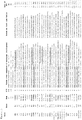
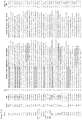
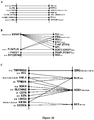
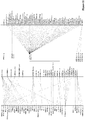
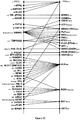
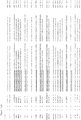
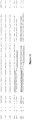
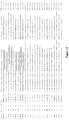
- These probes correspond to the fusion transcripts listed in Figure 16 , and have the sequence SEQ ID NO: 1 to 31, 66 to 167, 169 to 182, 628, 657 to 659 and 662.
- different probes have been designed to detect different transcripts resulting from alternative genomic recombinations (for example on exons 1, 13, 14 and 19 for the BCR gene, and on exons 2 and 3 for the ABL gene).
- the mixture thus brings together more than 150 probes and targets more than 400 different fusion transcripts.
- All the left probes have a common tail (S A ) at their 5 'end, all the right probes have a common tail (S B ) at their 3' end (cf. Figures 2A to E ). Additional probes have also been included to detect the most common mutations in the NPM1 gene (A, B, D). If a translocation is present in the sample, the two probes hybridize side by side on the fusion cDNA. A DNA ligase is then used to create a covalent bond between these probes, which allows their amplification by PCR with the primers S A and S B. Yes a PCR product is amplified, the two partners are identified by sequence analysis.
- the method according to the invention is a simple multiplex test which can reveal a very large number of recurrent gene fusions in leukemia. Its short turnaround time (up to 40 patients can be tested in parallel and results can be obtained in less than a day) and its low cost (only a PCR device, a pyrosequencer and basic molecular biology reagents are necessary) make it particularly suitable for daily practice. Its ability to detect many anomalies that are almost never tested in everyday practice could provide a lot of diagnostics and prognoses, and allow patient stratification in prospective clinical trials.
Landscapes
- Chemical & Material Sciences (AREA)
- Life Sciences & Earth Sciences (AREA)
- Health & Medical Sciences (AREA)
- Organic Chemistry (AREA)
- Proteomics, Peptides & Aminoacids (AREA)
- Engineering & Computer Science (AREA)
- Immunology (AREA)
- Pathology (AREA)
- Analytical Chemistry (AREA)
- Zoology (AREA)
- Genetics & Genomics (AREA)
- Wood Science & Technology (AREA)
- Physics & Mathematics (AREA)
- Biotechnology (AREA)
- Microbiology (AREA)
- Molecular Biology (AREA)
- Hospice & Palliative Care (AREA)
- Biophysics (AREA)
- Oncology (AREA)
- Biochemistry (AREA)
- Bioinformatics & Cheminformatics (AREA)
- General Engineering & Computer Science (AREA)
- General Health & Medical Sciences (AREA)
- Measuring Or Testing Involving Enzymes Or Micro-Organisms (AREA)
- Testing And Monitoring For Control Systems (AREA)
Priority Applications (2)
| Application Number | Priority Date | Filing Date | Title |
|---|---|---|---|
| HRP20200747TT HRP20200747T1 (hr) | 2013-09-11 | 2014-09-11 | Metoda dijagnosticiranja hematoloških malignacija i pridruženi kit |
| PL14781927T PL3044331T3 (pl) | 2013-09-11 | 2014-09-11 | Sposób diagnostyki hemopatii złośliwych i powiązany zestaw |
Applications Claiming Priority (2)
| Application Number | Priority Date | Filing Date | Title |
|---|---|---|---|
| FR1358721A FR3010530B1 (fr) | 2013-09-11 | 2013-09-11 | Methode de diagnostic des hemopathies malignes et kit associe |
| PCT/FR2014/052255 WO2015036705A1 (fr) | 2013-09-11 | 2014-09-11 | Méthode de diagnostic des hémopathies malignes et kit associé |
Publications (2)
| Publication Number | Publication Date |
|---|---|
| EP3044331A1 EP3044331A1 (fr) | 2016-07-20 |
| EP3044331B1 true EP3044331B1 (fr) | 2020-03-11 |
Family
ID=49551641
Family Applications (1)
| Application Number | Title | Priority Date | Filing Date |
|---|---|---|---|
| EP14781927.0A Active EP3044331B1 (fr) | 2013-09-11 | 2014-09-11 | Méthode de diagnostic des hémopathies malignes et kit associé |
Country Status (11)
| Country | Link |
|---|---|
| US (2) | US20160319362A1 (pl) |
| EP (1) | EP3044331B1 (pl) |
| CA (1) | CA2923116C (pl) |
| DK (1) | DK3044331T3 (pl) |
| ES (1) | ES2788652T3 (pl) |
| FR (1) | FR3010530B1 (pl) |
| HR (1) | HRP20200747T1 (pl) |
| HU (1) | HUE048794T2 (pl) |
| PL (1) | PL3044331T3 (pl) |
| PT (1) | PT3044331T (pl) |
| WO (1) | WO2015036705A1 (pl) |
Families Citing this family (3)
| Publication number | Priority date | Publication date | Assignee | Title |
|---|---|---|---|---|
| FR3088077B1 (fr) * | 2018-11-05 | 2023-04-21 | Centre Henri Becquerel | Methode de diagnostic d'un cancer et kit associe |
| AU2019375136B2 (en) * | 2018-11-05 | 2025-10-16 | Centre Henri Becquerel | Method for diagnosing a cancer and associated kit |
| CA3176089A1 (en) * | 2020-03-31 | 2021-10-07 | Nissui Pharmaceutical Co., Ltd. | Medium for bacillus cereus group detection |
Citations (1)
| Publication number | Priority date | Publication date | Assignee | Title |
|---|---|---|---|---|
| WO2003044486A2 (en) * | 2001-11-20 | 2003-05-30 | The Regents Of The University Of California | Early leukemia diagnostics using microsphere arrays |
Family Cites Families (5)
| Publication number | Priority date | Publication date | Assignee | Title |
|---|---|---|---|---|
| DE69739909D1 (de) * | 1996-03-26 | 2010-07-29 | Michael S Kopreski | Methoden aus plasma oder serum extrahierte extrazelluraere rna zur diagnoseüberwachung oder evaluation von krebs verwenden |
| EP1130113A1 (en) | 2000-02-15 | 2001-09-05 | Johannes Petrus Schouten | Multiplex ligation dependent amplification assay |
| CA2577623A1 (en) * | 2004-08-20 | 2006-02-23 | University Of Manitoba | Methods of diagnosis or detection using three-dimensional analysis |
| CA2692793C (en) * | 2007-07-06 | 2014-05-20 | The Regents Of The University Of Michigan | Mipol1-etv1 gene rearrangements |
| AU2008323649A1 (en) * | 2007-11-08 | 2009-05-14 | University Of Washington | DNA microarray based identification and mapping of balanced translocation breakpoints |
-
2013
- 2013-09-11 FR FR1358721A patent/FR3010530B1/fr active Active
-
2014
- 2014-09-11 ES ES14781927T patent/ES2788652T3/es active Active
- 2014-09-11 WO PCT/FR2014/052255 patent/WO2015036705A1/fr not_active Ceased
- 2014-09-11 DK DK14781927.0T patent/DK3044331T3/da active
- 2014-09-11 PL PL14781927T patent/PL3044331T3/pl unknown
- 2014-09-11 US US14/917,087 patent/US20160319362A1/en not_active Abandoned
- 2014-09-11 HR HRP20200747TT patent/HRP20200747T1/hr unknown
- 2014-09-11 HU HUE14781927A patent/HUE048794T2/hu unknown
- 2014-09-11 PT PT147819270T patent/PT3044331T/pt unknown
- 2014-09-11 CA CA2923116A patent/CA2923116C/fr active Active
- 2014-09-11 EP EP14781927.0A patent/EP3044331B1/fr active Active
-
2024
- 2024-06-28 US US18/757,985 patent/US20240417809A1/en active Pending
Patent Citations (1)
| Publication number | Priority date | Publication date | Assignee | Title |
|---|---|---|---|---|
| WO2003044486A2 (en) * | 2001-11-20 | 2003-05-30 | The Regents Of The University Of California | Early leukemia diagnostics using microsphere arrays |
Non-Patent Citations (2)
| Title |
|---|
| C.F. TAYLOR ET AL: "Genomic deletions inMSH2 orMLH1 are a frequent cause of hereditary non-polyposis colorectal cancer: Identification of novel and recurrent deletions by MLPA", HUMAN MUTATION, vol. 22, no. 6, 17 December 2003 (2003-12-17), US, pages 428 - 433, XP055385667, ISSN: 1059-7794, DOI: 10.1002/humu.10291 * |
| MARTINEZ-GLEZ ET AL: "Multiplex ligation-dependent probe amplification (MLPA) screening in meningioma", CANCER GENETICS AND CYTOGENET, ELSEVIER SCIENCE PUBLISHING, NEW YORK, NY, US, vol. 173, no. 2, 22 February 2007 (2007-02-22), pages 170 - 172, XP005899960, ISSN: 0165-4608, DOI: 10.1016/J.CANCERGENCYTO.2006.09.011 * |
Also Published As
| Publication number | Publication date |
|---|---|
| HUE048794T2 (hu) | 2020-08-28 |
| HRP20200747T1 (hr) | 2020-10-16 |
| US20240417809A1 (en) | 2024-12-19 |
| DK3044331T3 (da) | 2020-05-11 |
| US20160319362A1 (en) | 2016-11-03 |
| ES2788652T3 (es) | 2020-10-22 |
| WO2015036705A1 (fr) | 2015-03-19 |
| FR3010530A1 (fr) | 2015-03-13 |
| PT3044331T (pt) | 2020-05-06 |
| EP3044331A1 (fr) | 2016-07-20 |
| CA2923116A1 (fr) | 2015-03-19 |
| PL3044331T3 (pl) | 2020-10-19 |
| CA2923116C (fr) | 2022-03-29 |
| FR3010530B1 (fr) | 2015-10-09 |
Similar Documents
| Publication | Publication Date | Title |
|---|---|---|
| EP1704249B1 (fr) | Procede d'evaluation quantitative d'un rearrangement ou d'une recombinaison genetique ciblee d'un individu et ses applications | |
| EP2220255B1 (fr) | Procede d'etude de la diversite combinatoire v(d)j | |
| AU2014295980B2 (en) | Methods for the detection and treatment of leukemias that are responsive to DOT1L inhibition | |
| CN110719957B (zh) | 用于核酸靶向富集的方法和试剂盒 | |
| US20240417809A1 (en) | Method for diagnosing hematological malignancies and associated kit | |
| US20210332440A1 (en) | Detection of advanced adenoma and/or early stage colorectal cancer | |
| CA2442820A1 (en) | Microarray gene expression profiling in clear cell renal cell carcinoma: prognosis and drug target identification | |
| CA2404448C (fr) | Genes impliques dans les maladies inflammatoires de l'intestin et leur utilisation | |
| AU2008203227A1 (en) | Colorectal cancer prognostics | |
| CN117813403A (zh) | 用于疾病检测的方法 | |
| TW202307218A (zh) | 用於疾病偵測的方法 | |
| JP7392048B2 (ja) | 分析方法及びキット | |
| KR102115948B1 (ko) | 대사증후군의 위험인자 예측용 단일염기다형성 및 이의 용도 | |
| KR20110004918A (ko) | 비만 유전자 증폭용 프라이머 세트, 그것을 포함하는 비만 유전자 증폭용 시약 및 그 용도 | |
| KR20110113642A (ko) | 유방 종양의 하위분류 방법 | |
| JP7346533B2 (ja) | 分析方法及びキット | |
| FR2842534A1 (fr) | Amplification multiplex quantitative a l'echelle d'un genome, et applications a la detection de remaniements genomiques | |
| KR102115941B1 (ko) | 대사증후군의 위험인자 예측용 단일염기다형성 및 이의 용도 | |
| KR102039529B1 (ko) | 대사증후군의 위험인자 예측용 단일염기다형성 및 이의 용도 | |
| WO2021152257A1 (fr) | Procede de genotypage hla simple et rapide | |
| WO2014042497A1 (fr) | Sondes et amorces pour la détection du gène bcr-abl en réaction duplex | |
| KR102115938B1 (ko) | 대사증후군의 위험인자 예측용 단일염기다형성 및 이의 용도 | |
| KR20210042614A (ko) | 고양이의 골연골이형성증을 예측 또는 진단하기 위한 단일염기 다형성 마커 조성물 및 이를 이용한 예측 또는 진단 방법 | |
| KR102115933B1 (ko) | 대사증후군의 위험인자 예측용 단일염기다형성 및 이의 용도 | |
| EP2252709B1 (fr) | Methode, procede, et utilisation de diagnostic, pronostic, suivi d'un cancer bases sur l'arn extracellulaire de ca9 |
Legal Events
| Date | Code | Title | Description |
|---|---|---|---|
| PUAI | Public reference made under article 153(3) epc to a published international application that has entered the european phase |
Free format text: ORIGINAL CODE: 0009012 |
|
| 17P | Request for examination filed |
Effective date: 20160311 |
|
| AK | Designated contracting states |
Kind code of ref document: A1 Designated state(s): AL AT BE BG CH CY CZ DE DK EE ES FI FR GB GR HR HU IE IS IT LI LT LU LV MC MK MT NL NO PL PT RO RS SE SI SK SM TR |
|
| AX | Request for extension of the european patent |
Extension state: BA ME |
|
| DAX | Request for extension of the european patent (deleted) | ||
| STAA | Information on the status of an ep patent application or granted ep patent |
Free format text: STATUS: EXAMINATION IS IN PROGRESS |
|
| 17Q | First examination report despatched |
Effective date: 20170113 |
|
| REG | Reference to a national code |
Ref country code: DE Ref legal event code: R079 Ref document number: 602014062220 Country of ref document: DE Free format text: PREVIOUS MAIN CLASS: C12Q0001680000 Ipc: C12Q0001688600 |
|
| RIC1 | Information provided on ipc code assigned before grant |
Ipc: C12Q 1/6886 20180101AFI20190801BHEP |
|
| GRAP | Despatch of communication of intention to grant a patent |
Free format text: ORIGINAL CODE: EPIDOSNIGR1 |
|
| STAA | Information on the status of an ep patent application or granted ep patent |
Free format text: STATUS: GRANT OF PATENT IS INTENDED |
|
| INTG | Intention to grant announced |
Effective date: 20190930 |
|
| GRAS | Grant fee paid |
Free format text: ORIGINAL CODE: EPIDOSNIGR3 |
|
| GRAA | (expected) grant |
Free format text: ORIGINAL CODE: 0009210 |
|
| STAA | Information on the status of an ep patent application or granted ep patent |
Free format text: STATUS: THE PATENT HAS BEEN GRANTED |
|
| AK | Designated contracting states |
Kind code of ref document: B1 Designated state(s): AL AT BE BG CH CY CZ DE DK EE ES FI FR GB GR HR HU IE IS IT LI LT LU LV MC MK MT NL NO PL PT RO RS SE SI SK SM TR |
|
| REG | Reference to a national code |
Ref country code: GB Ref legal event code: FG4D Free format text: NOT ENGLISH |
|
| REG | Reference to a national code |
Ref country code: CH Ref legal event code: EP |
|
| REG | Reference to a national code |
Ref country code: AT Ref legal event code: REF Ref document number: 1243195 Country of ref document: AT Kind code of ref document: T Effective date: 20200315 |
|
| REG | Reference to a national code |
Ref country code: IE Ref legal event code: FG4D Free format text: LANGUAGE OF EP DOCUMENT: FRENCH |
|
| REG | Reference to a national code |
Ref country code: DE Ref legal event code: R096 Ref document number: 602014062220 Country of ref document: DE |
|
| REG | Reference to a national code |
Ref country code: PT Ref legal event code: SC4A Ref document number: 3044331 Country of ref document: PT Date of ref document: 20200506 Kind code of ref document: T Free format text: AVAILABILITY OF NATIONAL TRANSLATION Effective date: 20200427 |
|
| REG | Reference to a national code |
Ref country code: HR Ref legal event code: TUEP Ref document number: P20200747T Country of ref document: HR |
|
| REG | Reference to a national code |
Ref country code: DK Ref legal event code: T3 Effective date: 20200507 Ref country code: FI Ref legal event code: FGE |
|
| REG | Reference to a national code |
Ref country code: NL Ref legal event code: FP |
|
| REG | Reference to a national code |
Ref country code: CH Ref legal event code: NV Representative=s name: VALIPAT S.A. C/O BOVARD SA NEUCHATEL, CH |
|
| REG | Reference to a national code |
Ref country code: SE Ref legal event code: TRGR |
|
| REG | Reference to a national code |
Ref country code: NO Ref legal event code: T2 Effective date: 20200311 |
|
| REG | Reference to a national code |
Ref country code: GR Ref legal event code: EP Ref document number: 20200401263 Country of ref document: GR Effective date: 20200716 |
|
| PG25 | Lapsed in a contracting state [announced via postgrant information from national office to epo] |
Ref country code: RS Free format text: LAPSE BECAUSE OF FAILURE TO SUBMIT A TRANSLATION OF THE DESCRIPTION OR TO PAY THE FEE WITHIN THE PRESCRIBED TIME-LIMIT Effective date: 20200311 |
|
| REG | Reference to a national code |
Ref country code: HU Ref legal event code: AG4A Ref document number: E048794 Country of ref document: HU |
|
| PG25 | Lapsed in a contracting state [announced via postgrant information from national office to epo] |
Ref country code: BG Free format text: LAPSE BECAUSE OF FAILURE TO SUBMIT A TRANSLATION OF THE DESCRIPTION OR TO PAY THE FEE WITHIN THE PRESCRIBED TIME-LIMIT Effective date: 20200611 Ref country code: LV Free format text: LAPSE BECAUSE OF FAILURE TO SUBMIT A TRANSLATION OF THE DESCRIPTION OR TO PAY THE FEE WITHIN THE PRESCRIBED TIME-LIMIT Effective date: 20200311 |
|
| REG | Reference to a national code |
Ref country code: LT Ref legal event code: MG4D |
|
| REG | Reference to a national code |
Ref country code: HR Ref legal event code: ODRP Ref document number: P20200747 Country of ref document: HR Payment date: 20200818 Year of fee payment: 7 |
|
| REG | Reference to a national code |
Ref country code: HR Ref legal event code: T1PR Ref document number: P20200747 Country of ref document: HR |
|
| REG | Reference to a national code |
Ref country code: ES Ref legal event code: FG2A Ref document number: 2788652 Country of ref document: ES Kind code of ref document: T3 Effective date: 20201022 |
|
| PG25 | Lapsed in a contracting state [announced via postgrant information from national office to epo] |
Ref country code: SM Free format text: LAPSE BECAUSE OF FAILURE TO SUBMIT A TRANSLATION OF THE DESCRIPTION OR TO PAY THE FEE WITHIN THE PRESCRIBED TIME-LIMIT Effective date: 20200311 Ref country code: EE Free format text: LAPSE BECAUSE OF FAILURE TO SUBMIT A TRANSLATION OF THE DESCRIPTION OR TO PAY THE FEE WITHIN THE PRESCRIBED TIME-LIMIT Effective date: 20200311 Ref country code: LT Free format text: LAPSE BECAUSE OF FAILURE TO SUBMIT A TRANSLATION OF THE DESCRIPTION OR TO PAY THE FEE WITHIN THE PRESCRIBED TIME-LIMIT Effective date: 20200311 Ref country code: CZ Free format text: LAPSE BECAUSE OF FAILURE TO SUBMIT A TRANSLATION OF THE DESCRIPTION OR TO PAY THE FEE WITHIN THE PRESCRIBED TIME-LIMIT Effective date: 20200311 Ref country code: SK Free format text: LAPSE BECAUSE OF FAILURE TO SUBMIT A TRANSLATION OF THE DESCRIPTION OR TO PAY THE FEE WITHIN THE PRESCRIBED TIME-LIMIT Effective date: 20200311 |
|
| REG | Reference to a national code |
Ref country code: DE Ref legal event code: R097 Ref document number: 602014062220 Country of ref document: DE |
|
| PLBE | No opposition filed within time limit |
Free format text: ORIGINAL CODE: 0009261 |
|
| STAA | Information on the status of an ep patent application or granted ep patent |
Free format text: STATUS: NO OPPOSITION FILED WITHIN TIME LIMIT |
|
| 26N | No opposition filed |
Effective date: 20201214 |
|
| PG25 | Lapsed in a contracting state [announced via postgrant information from national office to epo] |
Ref country code: SI Free format text: LAPSE BECAUSE OF FAILURE TO SUBMIT A TRANSLATION OF THE DESCRIPTION OR TO PAY THE FEE WITHIN THE PRESCRIBED TIME-LIMIT Effective date: 20200311 |
|
| REG | Reference to a national code |
Ref country code: AT Ref legal event code: UEP Ref document number: 1243195 Country of ref document: AT Kind code of ref document: T Effective date: 20200311 |
|
| PG25 | Lapsed in a contracting state [announced via postgrant information from national office to epo] |
Ref country code: MC Free format text: LAPSE BECAUSE OF FAILURE TO SUBMIT A TRANSLATION OF THE DESCRIPTION OR TO PAY THE FEE WITHIN THE PRESCRIBED TIME-LIMIT Effective date: 20200311 |
|
| REG | Reference to a national code |
Ref country code: HR Ref legal event code: ODRP Ref document number: P20200747 Country of ref document: HR Payment date: 20210819 Year of fee payment: 8 |
|
| PG25 | Lapsed in a contracting state [announced via postgrant information from national office to epo] |
Ref country code: TR Free format text: LAPSE BECAUSE OF FAILURE TO SUBMIT A TRANSLATION OF THE DESCRIPTION OR TO PAY THE FEE WITHIN THE PRESCRIBED TIME-LIMIT Effective date: 20200311 Ref country code: MT Free format text: LAPSE BECAUSE OF FAILURE TO SUBMIT A TRANSLATION OF THE DESCRIPTION OR TO PAY THE FEE WITHIN THE PRESCRIBED TIME-LIMIT Effective date: 20200311 Ref country code: CY Free format text: LAPSE BECAUSE OF FAILURE TO SUBMIT A TRANSLATION OF THE DESCRIPTION OR TO PAY THE FEE WITHIN THE PRESCRIBED TIME-LIMIT Effective date: 20200311 |
|
| PG25 | Lapsed in a contracting state [announced via postgrant information from national office to epo] |
Ref country code: MK Free format text: LAPSE BECAUSE OF FAILURE TO SUBMIT A TRANSLATION OF THE DESCRIPTION OR TO PAY THE FEE WITHIN THE PRESCRIBED TIME-LIMIT Effective date: 20200311 Ref country code: AL Free format text: LAPSE BECAUSE OF FAILURE TO SUBMIT A TRANSLATION OF THE DESCRIPTION OR TO PAY THE FEE WITHIN THE PRESCRIBED TIME-LIMIT Effective date: 20200311 |
|
| REG | Reference to a national code |
Ref country code: HR Ref legal event code: ODRP Ref document number: P20200747 Country of ref document: HR Payment date: 20220902 Year of fee payment: 9 |
|
| REG | Reference to a national code |
Ref country code: HR Ref legal event code: ODRP Ref document number: P20200747 Country of ref document: HR Payment date: 20230901 Year of fee payment: 10 |
|
| REG | Reference to a national code |
Ref country code: HR Ref legal event code: ODRP Ref document number: P20200747 Country of ref document: HR Payment date: 20240829 Year of fee payment: 11 |
|
| REG | Reference to a national code |
Ref country code: HR Ref legal event code: ODRP Ref document number: P20200747 Country of ref document: HR Payment date: 20250829 Year of fee payment: 12 |
|
| REG | Reference to a national code |
Ref country code: CH Ref legal event code: U11 Free format text: ST27 STATUS EVENT CODE: U-0-0-U10-U11 (AS PROVIDED BY THE NATIONAL OFFICE) Effective date: 20251001 |
|
| PGFP | Annual fee paid to national office [announced via postgrant information from national office to epo] |
Ref country code: FI Payment date: 20250929 Year of fee payment: 12 Ref country code: PT Payment date: 20250828 Year of fee payment: 12 |
|
| PGFP | Annual fee paid to national office [announced via postgrant information from national office to epo] |
Ref country code: DK Payment date: 20250923 Year of fee payment: 12 Ref country code: DE Payment date: 20250919 Year of fee payment: 12 |
|
| PGFP | Annual fee paid to national office [announced via postgrant information from national office to epo] |
Ref country code: GR Payment date: 20250922 Year of fee payment: 12 Ref country code: NO Payment date: 20250923 Year of fee payment: 12 |
|
| PGFP | Annual fee paid to national office [announced via postgrant information from national office to epo] |
Ref country code: IT Payment date: 20250923 Year of fee payment: 12 Ref country code: LU Payment date: 20250919 Year of fee payment: 12 Ref country code: PL Payment date: 20250826 Year of fee payment: 12 Ref country code: NL Payment date: 20250918 Year of fee payment: 12 |
|
| PGFP | Annual fee paid to national office [announced via postgrant information from national office to epo] |
Ref country code: BE Payment date: 20250918 Year of fee payment: 12 Ref country code: HU Payment date: 20250922 Year of fee payment: 12 Ref country code: GB Payment date: 20250919 Year of fee payment: 12 |
|
| PGFP | Annual fee paid to national office [announced via postgrant information from national office to epo] |
Ref country code: HR Payment date: 20250829 Year of fee payment: 12 |
|
| PGFP | Annual fee paid to national office [announced via postgrant information from national office to epo] |
Ref country code: AT Payment date: 20250919 Year of fee payment: 12 Ref country code: FR Payment date: 20250922 Year of fee payment: 12 |
|
| PGFP | Annual fee paid to national office [announced via postgrant information from national office to epo] |
Ref country code: SE Payment date: 20250918 Year of fee payment: 12 |
|
| PGFP | Annual fee paid to national office [announced via postgrant information from national office to epo] |
Ref country code: IE Payment date: 20250918 Year of fee payment: 12 |
|
| PGFP | Annual fee paid to national office [announced via postgrant information from national office to epo] |
Ref country code: RO Payment date: 20250901 Year of fee payment: 12 |
|
| PGFP | Annual fee paid to national office [announced via postgrant information from national office to epo] |
Ref country code: IS Payment date: 20250911 Year of fee payment: 12 |
|
| PGFP | Annual fee paid to national office [announced via postgrant information from national office to epo] |
Ref country code: CH Payment date: 20251001 Year of fee payment: 12 |
|
| PGFP | Annual fee paid to national office [announced via postgrant information from national office to epo] |
Ref country code: ES Payment date: 20251028 Year of fee payment: 12 |