EP3023786B1 - Blutanalyseverfahren, steuerungsvorrichtung und blutzellenanalysator - Google Patents
Blutanalyseverfahren, steuerungsvorrichtung und blutzellenanalysator Download PDFInfo
- Publication number
- EP3023786B1 EP3023786B1 EP14825897.3A EP14825897A EP3023786B1 EP 3023786 B1 EP3023786 B1 EP 3023786B1 EP 14825897 A EP14825897 A EP 14825897A EP 3023786 B1 EP3023786 B1 EP 3023786B1
- Authority
- EP
- European Patent Office
- Prior art keywords
- sample
- testing sample
- detection
- reagent
- blood
- Prior art date
- Legal status (The legal status is an assumption and is not a legal conclusion. Google has not performed a legal analysis and makes no representation as to the accuracy of the status listed.)
- Active
Links
Images


Classifications
-
- G—PHYSICS
- G01—MEASURING; TESTING
- G01N—INVESTIGATING OR ANALYSING MATERIALS BY DETERMINING THEIR CHEMICAL OR PHYSICAL PROPERTIES
- G01N33/00—Investigating or analysing materials by specific methods not covered by groups G01N1/00 - G01N31/00
- G01N33/48—Biological material, e.g. blood, urine; Haemocytometers
- G01N33/50—Chemical analysis of biological material, e.g. blood, urine; Testing involving biospecific ligand binding methods; Immunological testing
- G01N33/5005—Chemical analysis of biological material, e.g. blood, urine; Testing involving biospecific ligand binding methods; Immunological testing involving human or animal cells
- G01N33/5094—Chemical analysis of biological material, e.g. blood, urine; Testing involving biospecific ligand binding methods; Immunological testing involving human or animal cells for blood cell populations
-
- G—PHYSICS
- G01—MEASURING; TESTING
- G01N—INVESTIGATING OR ANALYSING MATERIALS BY DETERMINING THEIR CHEMICAL OR PHYSICAL PROPERTIES
- G01N1/00—Sampling; Preparing specimens for investigation
- G01N1/02—Devices for withdrawing samples
- G01N1/10—Devices for withdrawing samples in the liquid or fluent state
- G01N1/18—Devices for withdrawing samples in the liquid or fluent state with provision for splitting samples into portions
-
- G—PHYSICS
- G01—MEASURING; TESTING
- G01N—INVESTIGATING OR ANALYSING MATERIALS BY DETERMINING THEIR CHEMICAL OR PHYSICAL PROPERTIES
- G01N1/00—Sampling; Preparing specimens for investigation
- G01N1/28—Preparing specimens for investigation including physical details of (bio-)chemical methods covered elsewhere, e.g. G01N33/50, C12Q
- G01N1/38—Diluting, dispersing or mixing samples
-
- G—PHYSICS
- G01—MEASURING; TESTING
- G01N—INVESTIGATING OR ANALYSING MATERIALS BY DETERMINING THEIR CHEMICAL OR PHYSICAL PROPERTIES
- G01N15/00—Investigating characteristics of particles; Investigating permeability, pore-volume or surface-area of porous materials
- G01N15/10—Investigating individual particles
-
- G—PHYSICS
- G01—MEASURING; TESTING
- G01N—INVESTIGATING OR ANALYSING MATERIALS BY DETERMINING THEIR CHEMICAL OR PHYSICAL PROPERTIES
- G01N15/00—Investigating characteristics of particles; Investigating permeability, pore-volume or surface-area of porous materials
- G01N15/10—Investigating individual particles
- G01N15/14—Optical investigation techniques, e.g. flow cytometry
-
- G—PHYSICS
- G01—MEASURING; TESTING
- G01N—INVESTIGATING OR ANALYSING MATERIALS BY DETERMINING THEIR CHEMICAL OR PHYSICAL PROPERTIES
- G01N33/00—Investigating or analysing materials by specific methods not covered by groups G01N1/00 - G01N31/00
- G01N33/48—Biological material, e.g. blood, urine; Haemocytometers
- G01N33/50—Chemical analysis of biological material, e.g. blood, urine; Testing involving biospecific ligand binding methods; Immunological testing
- G01N33/72—Chemical analysis of biological material, e.g. blood, urine; Testing involving biospecific ligand binding methods; Immunological testing involving blood pigments, e.g. haemoglobin, bilirubin or other porphyrins; involving occult blood
- G01N33/721—Haemoglobin
-
- G—PHYSICS
- G01—MEASURING; TESTING
- G01N—INVESTIGATING OR ANALYSING MATERIALS BY DETERMINING THEIR CHEMICAL OR PHYSICAL PROPERTIES
- G01N33/00—Investigating or analysing materials by specific methods not covered by groups G01N1/00 - G01N31/00
- G01N33/48—Biological material, e.g. blood, urine; Haemocytometers
- G01N33/50—Chemical analysis of biological material, e.g. blood, urine; Testing involving biospecific ligand binding methods; Immunological testing
- G01N33/72—Chemical analysis of biological material, e.g. blood, urine; Testing involving biospecific ligand binding methods; Immunological testing involving blood pigments, e.g. haemoglobin, bilirubin or other porphyrins; involving occult blood
- G01N33/721—Haemoglobin
- G01N33/726—Devices
-
- G—PHYSICS
- G01—MEASURING; TESTING
- G01N—INVESTIGATING OR ANALYSING MATERIALS BY DETERMINING THEIR CHEMICAL OR PHYSICAL PROPERTIES
- G01N35/00—Automatic analysis not limited to methods or materials provided for in any single one of groups G01N1/00 - G01N33/00; Handling materials therefor
- G01N35/00584—Control arrangements for automatic analysers
- G01N35/00722—Communications; Identification
- G01N35/00871—Communications between instruments or with remote terminals
-
- G—PHYSICS
- G01—MEASURING; TESTING
- G01N—INVESTIGATING OR ANALYSING MATERIALS BY DETERMINING THEIR CHEMICAL OR PHYSICAL PROPERTIES
- G01N35/00—Automatic analysis not limited to methods or materials provided for in any single one of groups G01N1/00 - G01N33/00; Handling materials therefor
- G01N35/10—Devices for transferring samples or any liquids to, in, or from, the analysis apparatus, e.g. suction devices, injection devices
- G01N35/1095—Devices for transferring samples or any liquids to, in, or from, the analysis apparatus, e.g. suction devices, injection devices for supplying the samples to flow-through analysers
- G01N35/1097—Devices for transferring samples or any liquids to, in, or from, the analysis apparatus, e.g. suction devices, injection devices for supplying the samples to flow-through analysers characterised by the valves
-
- G—PHYSICS
- G01—MEASURING; TESTING
- G01N—INVESTIGATING OR ANALYSING MATERIALS BY DETERMINING THEIR CHEMICAL OR PHYSICAL PROPERTIES
- G01N15/00—Investigating characteristics of particles; Investigating permeability, pore-volume or surface-area of porous materials
- G01N15/10—Investigating individual particles
- G01N15/14—Optical investigation techniques, e.g. flow cytometry
- G01N15/1456—Optical investigation techniques, e.g. flow cytometry without spatial resolution of the texture or inner structure of the particle, e.g. processing of pulse signals
- G01N15/1459—Optical investigation techniques, e.g. flow cytometry without spatial resolution of the texture or inner structure of the particle, e.g. processing of pulse signals the analysis being performed on a sample stream
-
- G—PHYSICS
- G01—MEASURING; TESTING
- G01N—INVESTIGATING OR ANALYSING MATERIALS BY DETERMINING THEIR CHEMICAL OR PHYSICAL PROPERTIES
- G01N15/00—Investigating characteristics of particles; Investigating permeability, pore-volume or surface-area of porous materials
- G01N15/01—Investigating characteristics of particles; Investigating permeability, pore-volume or surface-area of porous materials specially adapted for biological cells, e.g. blood cells
- G01N2015/011—Investigating characteristics of particles; Investigating permeability, pore-volume or surface-area of porous materials specially adapted for biological cells, e.g. blood cells with lysing, e.g. of erythrocytes
-
- G—PHYSICS
- G01—MEASURING; TESTING
- G01N—INVESTIGATING OR ANALYSING MATERIALS BY DETERMINING THEIR CHEMICAL OR PHYSICAL PROPERTIES
- G01N15/00—Investigating characteristics of particles; Investigating permeability, pore-volume or surface-area of porous materials
- G01N15/01—Investigating characteristics of particles; Investigating permeability, pore-volume or surface-area of porous materials specially adapted for biological cells, e.g. blood cells
- G01N2015/016—White blood cells
-
- G—PHYSICS
- G01—MEASURING; TESTING
- G01N—INVESTIGATING OR ANALYSING MATERIALS BY DETERMINING THEIR CHEMICAL OR PHYSICAL PROPERTIES
- G01N15/00—Investigating characteristics of particles; Investigating permeability, pore-volume or surface-area of porous materials
- G01N15/04—Investigating sedimentation of particle suspensions
- G01N15/05—Investigating sedimentation of particle suspensions in blood
- G01N2015/055—Investigating sedimentation of particle suspensions in blood for hematocrite determination
-
- G—PHYSICS
- G01—MEASURING; TESTING
- G01N—INVESTIGATING OR ANALYSING MATERIALS BY DETERMINING THEIR CHEMICAL OR PHYSICAL PROPERTIES
- G01N15/00—Investigating characteristics of particles; Investigating permeability, pore-volume or surface-area of porous materials
- G01N15/10—Investigating individual particles
- G01N2015/1006—Investigating individual particles for cytology
-
- G—PHYSICS
- G01—MEASURING; TESTING
- G01N—INVESTIGATING OR ANALYSING MATERIALS BY DETERMINING THEIR CHEMICAL OR PHYSICAL PROPERTIES
- G01N15/00—Investigating characteristics of particles; Investigating permeability, pore-volume or surface-area of porous materials
- G01N15/10—Investigating individual particles
- G01N2015/1024—Counting particles by non-optical means
-
- G—PHYSICS
- G01—MEASURING; TESTING
- G01N—INVESTIGATING OR ANALYSING MATERIALS BY DETERMINING THEIR CHEMICAL OR PHYSICAL PROPERTIES
- G01N15/00—Investigating characteristics of particles; Investigating permeability, pore-volume or surface-area of porous materials
- G01N15/10—Investigating individual particles
- G01N15/14—Optical investigation techniques, e.g. flow cytometry
- G01N2015/1486—Counting the particles
-
- G—PHYSICS
- G01—MEASURING; TESTING
- G01N—INVESTIGATING OR ANALYSING MATERIALS BY DETERMINING THEIR CHEMICAL OR PHYSICAL PROPERTIES
- G01N2333/00—Assays involving biological materials from specific organisms or of a specific nature
- G01N2333/795—Porphyrin- or corrin-ring-containing peptides
- G01N2333/805—Haemoglobins; Myoglobins
-
- G—PHYSICS
- G01—MEASURING; TESTING
- G01N—INVESTIGATING OR ANALYSING MATERIALS BY DETERMINING THEIR CHEMICAL OR PHYSICAL PROPERTIES
- G01N35/00—Automatic analysis not limited to methods or materials provided for in any single one of groups G01N1/00 - G01N33/00; Handling materials therefor
- G01N35/10—Devices for transferring samples or any liquids to, in, or from, the analysis apparatus, e.g. suction devices, injection devices
- G01N35/1095—Devices for transferring samples or any liquids to, in, or from, the analysis apparatus, e.g. suction devices, injection devices for supplying the samples to flow-through analysers
Definitions
- the present disclosure relates to the field of medical technology, more particularly to a blood analyzer, control devices and blood analysis methods.
- a blood analyzer is used to analyze components in a blood sample, for example counting and classifying leukocytes in the blood sample, measuring hemoglobin (HGB) concentration and so on.
- Leukocytes in human blood have five groups: lymphocyte, monocyte, neutrophil, basophil and eosinophil, which can be counting and classified into these five groups by the blood analyzer.
- single-channel method there are two methods for classifying leukocytes into five groups.
- One is single-channel method and the other is two-channel method.
- single-channel method there is only one detection channel for leukocyte classification, and a blood sample reacts with a reagent in one reaction cell to obtain a testing sample, which is transferred to a detection apparatus for obtaining five-group classification information by single detection.
- two-channel method there are one DIFF channel for cell counting & differentiation and one independent BASO channel for basophil detection only.
- One blood sample is divided into two aliquots, and these two aliquots are reacted with reagents in two reaction cells and detected by two channels respectively, and leukocyte four-group classification result (ie.
- Leukocytes are classified into four groups, lymphocyte group, monocyte group, neutrophil & basophil group and eosinophil group) is obtained by DIFF channel, and basophil result is obtained by BASO channel and then these two results are combined to obtained five-group classification result.
- the single-channel method might have unsatisfied reliability because it might be difficult to differentiate basophils from other cells of leukocytes when other cells are not damaged.
- a blood analyzer using the single-channel method might still have independent channel to meet requirement of HGB measurement. So, this kind of analyzer might still have two channels and/or two reaction cells for two reactions.
- the two-channel method might need more blood sample amount and more kinds of regents because of two independent reactions. And this method might have unsatisfied test speed, because two detections might be carried out in sequence. Moreover, a blood analyzer using this method might have more complex structure and larger size because it has two reaction cells, two sets of sample transferring apparatuses.
- US 2009/068726 A1 discloses an optical device (200) for blood analysis, which is in particular designed for the counting and differentiation of leucocytes in an automatic blood analysis apparatus and includes a light source (201) of the electroluminescent diode type in order to illuminate a blood sample (311) circulating in an optical tank.
- the device comprises a dilution device (10) contrived to receive the sample to be analysed; a syringe assembly (12) comprising a plurality of syringes (26, 38, 46, 52, 60) and contrived to prepare, inject and meter the sample to be analysed originating from the dilution assembly; a distribution assembly (14) connected to the syringe assembly (12) and contrived to make the sample and at least one other fluid circulate in the conduits; and a measuring assembly (16) connected to the distribution assembly and contrived to analyse the sample injected.
- US 2006/210438 A1 discloses a sample analyzer capable of operating in a first measuring mode for measuring a sample and a second measuring mode for measuring a sample, comprising: a sample provider for providing a sample; a common reagent provider for providing a common reagent used in the first measuring mode and the second measuring mode; a special reagent provider for providing a special reagent used in the second measuring mode; a mode selector for selecting one of the first measuring mode and the second measuring mode; a measuring section for measuring the sample; and wherein in the first measuring mode, the sample provider and the common reagent provider operate so as to make a first mode sample comprising the sample and the common reagent, and the measuring section operates so as to measure the first mode sample, and in the second measuring mode, the sample provider, the common reagent provider and the special reagent provider operate so as to make a second mode sample comprising the sample, the common reagent and the special reagent, and the measuring section operates so as to measure the second mode sample.
- WO 91/18086 A1 discloses a method and apparatus (900) for screening obscured or partially obscured cells to enumerate one or more cell population subsets.
- a white blood cell population is counted (912), along with a standard population.
- the standard population can be one of the total number of white blood cell populations, a white blood cell population which does not obscure the shifted or non-shifted sensed characteristic of the subset of interest, an artificial population formed by microspheres which does not obscure the shifted or non-shifted sensed characteristic of the subset of interest or a white blood cell population into which the sensed characteristic of the subset will be wholly or partially shifted.
- the sensed characteristic of the subset of interest is then shifted by binding to microspheres having monoclonal antibodies specific to the subset of interest (916).
- the white blood cell population and the standard population are recounted (912) and compared to (922) to the original counts.
- a blood analysis method for a blood cell analyzer defined in claim 1.
- control device for a blood cell analyzer defined in claim 8.
- control device for a blood cell analyzer defined in claim 10.
- a testing sample for leukocyte classification could be further used for basophil classification.
- a second reagent is added for further reaction to obtain a testing sample for basophil classification or HGB measurement. Therefore, a blood sample may be tested in one reaction cell through time-division multiplexing technology to obtain leukocyte five-group classification result and HGB result by single measurement channel.
- the structure of the analyzer may be greatly simplified on the premise of guaranteeing the performance of the analyzer, the volume and cost of the analyzer may reduce and a price-performance ratio of the analyzer may increase.
- a blood analyzer includes one set of leukocyte detection channel, which executes two reactions and detections.
- There is single reaction cell where a testing sample is prepared from a blood sample, single detection apparatus which detects the testing sample for leukocyte detection, a sample injecting apparatus which injects the blood sample into the reaction cell, a reagent injecting apparatus which injects a reagent into the reaction cell, a transferring apparatus and a control device which transfers the testing sample from the reaction cell to the detection apparatus.
- the control device couples to the sample injecting apparatus, the reagent injecting apparatus and the transferring apparatus respectively.
- a leukocyte detection flowchart is shown in FIG.1 , which includes following steps:
- the second testing sample could be detected for hemoglobin measurement.
- leukocyte counting and classification may be executed simultaneously; in another word, a signal acquired in leukocyte classification detection could be used in leukocyte counting, because difference between subgroups of leukocyte does not influence leukocyte counting.
- leukocyte counting may be executed based on basophil classification result. Schematic diagrams of leukocyte counting and hemoglobin measurement are shown in FIG.2 and FIG.3 .
- components or concentrations of the first reagent and second reagent may be irrelative.
- the first reagent may be single reagent or multi-component reagent whose components are injected into the reaction cell according to a set sequence.
- the blood sample reacts with the first reagent to obtain the first testing sample. Different first testing sample may be obtained according to different first reagent.
- the second reagent may be single reagent or multi-component reagent. Any reagent which can be used for leukocyte four-group or five-group classification could be named as a first reagent, and any reagent which can be used for basophil classification could be used as a second reagent.
- the transferring apparatus includes a syringe and a transfer pipeline which connects to the syringe, and the syringe, a testing sample outlet of the reaction cell and an inlet of the detection apparatus are connected by the transfer pipeline.
- leukocytes are classified as follows after the blood sample is tested: Lymphocyte (LYM) 23.8% Monocyte (MON) 6.7% Neutrophil (NEU) 65.4% Eosinophil (ESO) 3.4% Basophil (BASO) 0.7%
- Lymphocyte 24% Monocyte (MON) 7% Neutrophil (NEU) 65% Eosinophil (ESO) 3% Basophil (BASO) 1%
- two reactions and two detections are executed by single set leukocyte detection channel.
- the first reaction is executed by mixing the blood sample and a reagent for leukocyte classification
- the second reaction is executed by mixing the first testing sample and a reagent for basophil classification. These two reactions may be executed simultaneously.
- the first detection is leukocyte four-group classification detection and the second detection is basophil classification detection. After two detections, the results of leukocyte four-group classification and basophil classification are obtained, whose accuracy and reliability could meet requirement. So the method of present disclosure retains advantages of two-channel method.
- the analyzer since there is single set leukocyte detection channel in the blood analyzer of the present disclosure, one reaction cell and its correlative injecting, cleaning, discharging, and mixing pipeline may be saved, so that the analyzer may has more simple structure, smaller size and less manufacturing cost in the premise of ensuring analyzer performance. Thus the analyzer has better performance-price ratio.
- the blood sample needs to be used in two detection channels in conventional two-channel method.
- the first testing sample is used for further reaction in the method of the present disclosure, so volume of blood sample may decrease and utilization rate of the sample may be improved.
- a blood sample usually undergoes a sampling process, reaction process, sample-preparing process, detection process and cleaning process in a blood analyzer after it is acquired.
- a blood analyzer has suitable pipelines and valves, and then two kinds of reagent are injected into single reaction cell and a testing sample is transferred successively to a detection apparatus for blood analysis.
- a blood analyzer includes a reaction cell 4, a detection apparatus 3, a sample injecting apparatus, a reagent injecting apparatus, a transferring apparatus, a cleaning pipeline 203 and a control device (not shown in the drawing).
- the sample injecting apparatus injects a blood sample into a reaction cell.
- the sample injecting apparatus is sample probe 6.
- the sample injecting apparatus may have other structure.
- the reagent injecting apparatus injects a reagent into a reaction cell.
- the reagent injecting apparatus has two sets of injecting apparatus, such as a first reagent injecting apparatus 1 and a second reagent injecting apparatus 2.
- the first reagent injecting apparatus 1 and the second reagent injecting apparatus 2 may be a constant flow pump, a pressure source or a syringe.
- the first reagent injecting apparatus 1 is connected with the reaction cell 4 through a sixth controllable valve 16, and draws a certain amount of reagent from a reagent container 8.
- the first reagent injecting apparatus 1 may further include a reagent heating apparatus 7 in pipeline between the first reagent injecting apparatus 1 and the reaction cell 4.
- the second reagent injecting apparatus 2 is connected with the reaction cell 4 by a seventh controllable valve 17, and draws a certain amount of reagent from a reagent container 9.
- the reagent injecting apparatus may have single set injecting apparatus.
- the transferring apparatus transfers a testing sample from the reaction cell to the detection apparatus.
- the transferring apparatus includes a syringe and a transfer pipeline which connects to the syringe. And the syringe, a testing sample outlet of the reaction cell and an inlet of the detection apparatus are connected by the transfer pipeline, and the testing sample outlet has a first controllable valve 11 for controlling "on-off" of the outlet.
- the syringe may be multiple syringes, which executes drawing and discharging movement based on control of the control device.
- a first end of the cleaning pipeline 203 connects to the transfer pipeline and the testing sample outlet 41 of the reaction cell, and a second end of the cleaning pipeline 203 connects to a waste collecting apparatus 19, and the cleaning pipeline has a second controllable valve 12 for controlling "on-off" of the cleaning pipeline.
- the control device couples to the first controllable valve 11 and the second controllable valve 12 respectively for controlling their "on-off". Controlling process of the control device includes steps as follows.
- the control device controls the syringe to move after the reaction between the blood sample and the first reagent is finished, to transfer a part of a first testing sample which is prepared by a blood sample and a first reagent from the reaction cell 4 to the detection apparatus 3 by the transfer pipeline.
- the control device controls the first controllable valve 11 as "on” and the second controllable valve 12 as “off” during the part of the first testing sample is drawn, and controls the first controllable valve 11 as "off” and the second controllable valve 12 keeping “off” after drawing of the part of the first testing sample is finished.
- the control device controls the first controllable valve 11 keeping “off” and the second controllable valve 12 as “on” after the leukocyte classification detection is finished, and controls the syringe to draw a cleaning solution to clean the transfer pipeline and the detection apparatus 3 and discharge the cleaning solution through the cleaning pipeline.
- the control device controls the first controllable valve 11 as “on” and the second controllable valve 12 as “off” after both the cleaning and the reaction between the reminder of the first testing sample and the second reagent are finished, and controls the syringe to transfer part of the second testing sample through the transfer pipeline from the reaction cell 4 to the detection apparatus 3.
- the control device controls the first controllable valve 11 as "off” and the second controllable valve 12 keeping “off” after the drawing of part of the second testing sample is finished.
- the control device includes a first control unit, a second control unit, a third control unit and a fourth control unit.
- the first control unit controls the sample injecting apparatus to inject an amount of blood sample sufficient for leukocyte detection and basophil detection into the reaction cell, controls the reagent injecting apparatus to inject a first reagent for leukocyte classification into the reaction cell, where the blood sample reacts with the first reagent to obtain a first testing sample.
- the second control unit controls the transferring apparatus to transfer a part of the first testing sample from the reaction cell to the detection apparatus for leukocyte four-group classification detection, after the reaction between the blood sample and the first reagent is finished.
- the third control unit controls the reagent injecting apparatus to inject a second reagent into the reaction cell having a reminder of the first testing sample during the leukocyte four-group classification detection, wherein the reminder of the first testing sample reacts with the second reagent to obtain a second testing sample and the second shrinks the other cells except for basophils.
- the fourth control device controls the transferring apparatus to transfer the second testing sample to the detection apparatus for basophil classification detection when both leukocyte four-group classification detection and reaction of the second reagent are finished.
- a transferring apparatus includes a syringe 5 and a transfer pipeline which connects to the syringe.
- the syringe 5 includes two syringes; one is a first syringe 51 which is a larger discharge syringe, the other is a second syringe 52 which is a smaller discharge syringe.
- the transfer pipeline includes sample acquiring pipeline 205, a first sample preparing pipeline 201, a second sample preparing pipeline 202, a second connecting pipeline 204, a first connecting pipeline 207, an auxiliary pushing pipeline 206 and a sheath fluid pipeline 208.
- the first sample preparing pipeline 201 and the second sample preparing pipeline 202 have a first end and a second end respectively.
- the first end of the first sample preparing pipeline 201 connects to a testing sample outlet 41 of the reaction cell which has the first controllable valve 11.
- the second end of the first sample preparing pipeline 201 connects to the first end of the second sample preparing pipeline 202.
- the first sample preparing pipeline 201 and the second sample preparing pipeline 202 connect to the inlet of the detection apparatus 3 by a three-way valve which is set in a junction of the first sample preparing pipeline 201 and the second sample preparing pipeline 202.
- the sample acquiring pipeline 205 has a first end a second end, and the first end of the sample acquiring pipeline 205 connects to the sample probe 6.
- the second connecting pipeline 204 has a first end and a second end, and the first end of the second connecting pipeline 204 connects to the second syringe 52, the second end of the second connecting pipeline 204 connects to the second end of the sample acquiring pipeline 205 and the second end of the second sample preparing pipeline 202 respectively by a third controllable valve 13.
- the first connecting pipeline 207 has a first end and a second end, and the first end of the first connecting pipeline 207 connects to the first syringe 51, the second end connects to an inlet 10 for a diluent input.
- the auxiliary pushing pipeline 206 has a first end, a second end and a fourth controllable valve 14, and the first end of the auxiliary pushing pipeline 206 connects to the second connecting pipeline 204, the second end connects to the first connecting pipeline 207.
- the sheath fluid pipeline 208 has a first end, a second end and a fifth controllable valve 15, and the first end of the sheath fluid pipeline 208 connects to the first connecting pipeline 207, and the second end connects to the detection apparatus 3.
- a workflow of a blood cell analyzer according to the present disclosure is as follows.
- a blood sample is transferred to the reaction cell 4 by the sample probe 6 under action of the syringe 5, and diluted by a diluent in a certain dilution ratio.
- the diluent is transferred into the reaction cell 4 through a fourth controllable valve 14, the second sample preparing pipeline 202, the first sample preparing pipeline 201 and the first controllable valve 11.
- the first reagent is transferred into the reaction cell 4 through a reagent container 8, the sixth controllable valve 16 and the reagent heating apparatus by the first reagent transferring apparatus 1.
- the first reagent reacts with the solution in the reaction cell 4 for white blood cell (WBC) classification reaction to obtain the first testing sample.
- WBC white blood cell
- the control device controls the third controllable valve 13 to connect the second sample preparing pipeline 202 with the second connecting pipeline 204, and the third controllable valve 13 keeps them connecting after sampling and dividing are finished.
- a part of the first reaction solution is drawn into the first sample preparing pipeline 201 and the second sample preparing pipeline 202 under drawing action of the syringe 5 for sample preparation.
- a second reagent is transferred into the reaction cell 4 through reagent container 9 and the seventh controllable valve 17 by the second reagent injecting apparatus 2.
- the second reagent reacts with a reminder of the first testing sample in the reaction cell for basophil (BASO) reaction to obtain a second testing sample.
- BASO basophil
- HGB hemoglobin
- a cleaning pipeline 203 and a second controllable valve 12 are set for cleaning those pipelines through which the sample has passed.
- a waste sample is discharged into the waste collecting apparatus 19.
- the reaction solution for basophil detection in the reaction cell may not affected by the cleaning process.
- a diluent could be transferred into the detection apparatus 3 for cleaning through the fourth controllable valve 14 and the fifth controllable valve 15.
- part of the second testing sample is drawn into the first sample preparing pipeline 201 and the second sample preparing pipeline 202 under drawing action of the syringe 5 for sample preparation. Then the basophil detection is executed in similar manner of the leukocyte classification detection.
- the diluent is wrapping and carrying the second testing sample in the second sample preparing pipeline 202 into the detection apparatus 3 for basophil detection, when the diluent is being transferred under pushing action of the syringe 5.
- Leukocyte counting result may be obtained by leukocyte classification detection or basophil detection.
- the transferring apparatus only has one first syringe and one second syringe.
- the first syringe could be used in providing sheath fluid, drawing testing sample from the reaction cell or providing cleaning solution.
- the second syringe could be used in acquiring sample or providing sample fluid in detection. So the syringes are repetitive-used.
- number of controllable valve may be reduced and structure of fluid road may be simplified under the premise of ensuring performances of sample acquiring, sample preparing, cell detection in flow cytometry, cleaning and etc.
- the first syringe and the second syringe may be joined syringe having a common drive.
- the common drive makes the first and second syringes drawing and discharging simultaneously, so one set of electric motor and drive mechanism may be saved.
- the fourth controllable valve 14 should be off status so that the sample probe would not be affected by the first syringe 51 when they draw liquid.
- the first syringe and second syringe may also be driven by two independent drives.
- the transferring apparatus may have other fluid road structure.
- the first syringe and second syringe may have single use.
- the first syringe for providing sheath fluid may be independent of that for drawing testing sample, or that of providing cleaning solution.
- the second syringe for acquiring sample may be independent of that of providing sample fluid in detection.
- the transferring apparatus may have a plurality of first syringe and second syringe, and fluid road structure may be different according to different usage of these syringes.
- a first testing sample is detected for leukocyte five-group classification and is mixed with a second reagent for further reaction for HGB measurement.
- leukocyte five-group classification and HGB measurement may be also achieved by one channel through time-division multiplexing technology. So structure of the blood analyzer may be simplified and size may be smaller.
- a detection flowchart is shown in FIG.5 , which includes following steps:
- Leukocyte counting may be executed beside hemoglobin measurement.
- the leukocyte counting may be executed based on signs acquired during leukocyte five-group classification detection, as shown in FIG.6 .
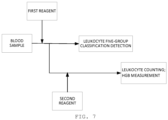
- the testing sample mixed with a second reagent may be detected for leukocyte counting, as shown in FIG.7 .
- the control device includes a first control unit, a second control unit, a third control unit and a fifth control unit.
- the first control unit controls the sample injecting apparatus to inject an amount of blood sample sufficient for leukocyte detection and basophil detection into the reaction cell, controls the reagent injecting apparatus to inject a first reagent for leukocyte classification into the reaction cell, wherein the first reagent reacts with leukocytes in the blood sample to obtain a first testing sample.
- the second control unit controls the transferring apparatus to transfer a part of the first testing sample from the reaction cell to the detection apparatus for leukocyte five-group classification detection, after the reaction between the blood sample and the first reagent is finished.
- the third control unit controls the reagent injecting apparatus to inject a second reagent into the reaction cell having a reminder of the first testing sample during the leukocyte classification detection, wherein the reminder of the first testing sample reacts with the second reagent to obtain a second testing sample.
- the fifth control unit controls the hemoglobin measurement apparatus to measure hemoglobin while the reminder of first testing sample reacts with the second reagent.
- the second reagent is a reagent that could react with the first testing sample to obtain the second testing sample for hemoglobin measurement.
- the second reagent may be single reagent or multi-component reagent whose components are injected into the reaction cell according to a set sequence.
- a reagent for hemoglobin measurement may be the same as or different from that for basophil classification.
- the blood analyzer of the present disclosure may save a set of reaction cell and pipelines thereof. Moreover, the blood analyzer may maintain the same or similar performance of a blood analyzer using the two-channel method. So the blood analyzer may have better performance-price ratio than conventional analyzer.
Landscapes
- Health & Medical Sciences (AREA)
- Life Sciences & Earth Sciences (AREA)
- Chemical & Material Sciences (AREA)
- Immunology (AREA)
- Physics & Mathematics (AREA)
- Analytical Chemistry (AREA)
- Biochemistry (AREA)
- General Health & Medical Sciences (AREA)
- General Physics & Mathematics (AREA)
- Pathology (AREA)
- Engineering & Computer Science (AREA)
- Hematology (AREA)
- Urology & Nephrology (AREA)
- Biomedical Technology (AREA)
- Molecular Biology (AREA)
- Cell Biology (AREA)
- Biotechnology (AREA)
- Microbiology (AREA)
- Food Science & Technology (AREA)
- Medicinal Chemistry (AREA)
- Dispersion Chemistry (AREA)
- Ecology (AREA)
- Tropical Medicine & Parasitology (AREA)
- Hydrology & Water Resources (AREA)
- Investigating Or Analysing Biological Materials (AREA)
Claims (15)
- Blutanalyseverfahren für ein Blutzellenanalysegerät mit einer einzelnen Reaktionskammer für den Leukozytennachweis, in der eine Testprobe aus einer Blutprobe hergestellt wird, und einer einzelnen Nachweisvorrichtung für den Leukozytennachweis, die die Testprobe erfasst, dadurch gekennzeichnet, dass das Verfahren Folgendes umfasst:Einspritzen (1001) einer Blutprobe und eines ersten Reagens in die Reaktionskammer, wobei das erste Reagens die Erythrozyten in der Blutprobe lysiert und mit den Leukozyten in der Blutprobe reagiert, um jede Unterklasse der Leukozyten zu clustern und somit eine erste Testprobe zu erhalten;Übertragen (1002) eines Teils der ersten Testprobe von der Reaktionskammer zur Nachweisvorrichtung, um eine Erfassung der Leukozyten-Vier-Gruppen-Einstufung (1003a) durchzuführen, wobei der andere Teil der ersten Testprobe in der Reaktionskammer verbleibt, und die Vier-Gruppen-Einstufung die Einstufung von Neutrophilen und Basophilen als eine Gruppe beinhaltet;Einspritzen (1003b) eines zweiten Reagens in die Reaktionskammer, die einen Rest der ersten Testprobe enthält, nachdem der Teil der ersten Testprobe übertragen wurde, wobei das zweite Reagens weiterhin mit Leukozyten in dem Rest der ersten Testprobe reagiert, um andere Leukozyten außer Basophilen zu schrumpfen, um damit eine zweite Testprobe zu erhalten; undÜbertragen (1004) der zweiten Testprobe an die Nachweisvorrichtung, um einen Nachweis für die Einstufung der Basophilen durchzuführen (1005) und somit ein Ergebnis für die Einstufung der Basophilen zu erhalten; und/oderMessung (2004) der zweiten Testprobe zur Messung des Hämoglobins.
- Verfahren nach Anspruch 1, das ferner das Auszählen von Leukozyten anhand eines Signals, das während der Erfassung der Leukozyten-Vier-Gruppen-Einstufungsnachweis erfasst wird, oder eines Signals, das während dem Basophilen-Einstufungsnachweis erfasst wird, beinhaltet.
- Verfahren nach einem der Ansprüche 1 bis 2, wobei das Analysegerät Rohrleitungen aufweist und das Verfahren ferner die Reinigung der Rohrleitungen und der Nachweisvorrichtung, durch die die erste Testprobe hindurchgelaufen ist, umfasst, nachdem der Leukozyten-Vier-Gruppen-Einstufungsnachweis beendet ist und bevor der Basophilen-Einstufungsnachweis begonnen wird.
- Verfahren nach einem der Ansprüche 1 bis 3, wobei der Leukozyten-Vier-Gruppen-Einstufungsnachweis und die Reaktion zwischen der Restprobe an die erste Testprobe und dem zweiten Reagenz gleichzeitig beginnen oder der Leukozyten-Vier-Gruppen-Einstufungsnachweis sich zumindest teilweise mit der Reaktion zwischen der Restprobe an die erste Testprobe und dem zweiten Reagenz überlappt.
- Blutanalyseverfahren für ein Blutzellenanalysegerät mit einer einzelnen Reaktionskammer für den Leukozytennachweis umfasst, in der eine Testprobe aus einer Blutprobe hergestellt wird, und einer einzelnen Nachweisvorrichtung für den Leukozytennachweis, die die Testprobe erfasst, dadurch gekennzeichnet, dass das Verfahren Folgendes umfasst:Einspritzen (2001) einer Blutprobe und eines ersten Reagens in die Reaktionskammer, wobei das erste Reagens die Erythrozyten in der Blutprobe lysiert und mit den Leukozyten in der Blutprobe reagiert, um jede Unterklasse der Leukozyten zu bündeln und somit eine erste Testprobe zu erhalten;Übertragen (2002) eines Teils der ersten Testprobe aus der Reaktionskammer in die Nachweisvorrichtung, um einen Nachweis für die Leukozyten-Fünf-Gruppen-Einstufung (2003a) durchzuführen, wobei der andere Teil der ersten Testprobe in der Reaktionskammer verbleibt;Einspritzen (2003b) eines zweiten Reagens in die Reaktionszelle, die einen Rest der ersten Testprobe enthält, nachdem der Teil der ersten Testprobe übertragen wurde, wobei das zweite Reagens weiterhin mit Leukozyten in dem Rest der ersten Testprobe reagiert, um eine zweite Testprobe zu erhalten; undMessung (2004) der zweiten Testprobe zur Messung des Hämoglobins.
- Verfahren nach Anspruch 5, das ferner das Auszählen von Leukozyten anhand eines Signals, das während der Erfassung der Leukozyten-Fünf-Gruppen-Einstufungsnachweis erfasst wird, oder das Übertragen eines Teils der zweiten Testprobe in die Nachweisvorrichtung für den Leukozyten-Zählnachweis.
- Verfahren nach einem der Ansprüche 5 oder 6, wobei der Leukozyten-Fünf-Gruppen-Einstufungsnachweis und die Reaktion zwischen der Restprobe an die erste Testprobe und dem zweiten Reagenz gleichzeitig beginnen oder der Leukozyten-Fünf-Gruppen-Einstufungsnachweis sich zumindest teilweise mit der Reaktion zwischen der Restprobe an die erste Testprobe und dem zweiten Reagenz überlappt.
- Steuervorrichtung für ein Blutzellenanalysegerät mit einer einzelnen Reaktionskammer für den Leukozytennachweis, in der eine Testprobe aus einer Blutprobe hergestellt wird, und einer einzelnen Nachweisvorrichtung (3) für den Leukozytennachweis, die die Testprobe erfasst, dadurch gekennzeichnet, dass das Verfahren Folgendes umfasst:eine erste Steuereinheit, die eine Probeneinspritzvorrichtung steuert, um eine Blutprobe in die Reaktionskammer (4) einzuspritzen, eine Reagenzieneinspritzvorrichtung (1, 2) steuert, um ein erstes Reagenz zur Leukozyteneinstufung in die Reaktionskammer (4) einzuspritzen, wobei das erste Reagenz Erythrozyten in der Blutprobe lysiert und mit Leukozyten in der Blutprobe reagiert, um jede Unterklasse der Leukozyten zu bündeln und eine erste Testprobe zu erhalten;eine zweite Steuereinheit, die eine Übertragungsvorrichtung steuert, um einen Teil der ersten Testprobe von der Reaktionskammer (4) zur Nachweisvorrichtung (3) zu übertragen, um einen Nachweis für den Leukozyten-Vier-Gruppen-Einstufungsnachweis durchzuführen, und um den anderen Teil der ersten Testprobe in der Reaktionskammer zu belassen, wobei die Vier-Gruppen-Einstufung die Einstufung von Neutrophilen und Basophilen als eine Gruppe umfasst, nachdem die Reaktion zwischen der Blutprobe und dem ersten Reagenz beendet ist;eine dritte Steuereinheit, die die Reagenzieneinspritzvorrichtung (1, 2) so ansteuert, dass sie ein zweites Reagenz in die Reaktionskammer (4) injiziert, die einen Rest der ersten Testprobe enthält, nachdem der Teil der ersten Testprobe übertragen wurde, wobei das zweite Reagenz ferner mit Leukozyten in dem Rest der ersten Testprobe reagiert, um andere Leukozyten mit Ausnahme der Basophilen zu schrumpfen und eine zweite Testprobe zu erhalten; undeine vierte Steuereinheit, die die Übertragungsvorrichtung steuert, um die zweite Testprobe an die Nachweisvorrichtung zu übertragen, um einen Nachweis für den Basophilen-Einstufungsnachweis durchzuführen, wenn sowohl der Leukozyten-Vier-Gruppen-Einstufungsnachweis als auch die Reaktion zwischen der Restprobe an die erste Testprobe und dem zweiten Reagenz beendet sind, um ein Basophilen-Einstufungsergebnis zu erhalten, und/odereine fünfte Steuereinheit, die ein Hämoglobin-Messgerät steuert, um Hämoglobin zu messen, während die Restprobe an die erste Testprobe mit dem zweiten Reagenz reagiert.
- Steuervorrichtung nach Anspruch 8, wobei der Leukozyten-Vier-Gruppen-Einstufungsnachweis und die Reaktion zwischen der Restprobe an die erste Testprobe und dem zweiten Reagenz gleichzeitig beginnen, oder der Leukozyten-Vier-Gruppen-Einstufungsnachweis sich zumindest teilweise mit der Reaktion zwischen der Restprobe an die erste Testprobe und dem zweiten Reagenz überlappt.
- Steuervorrichtung für ein Blutzellenanalysegerät mit einer einzelnen Reaktionskammer (4) für den Leukozytennachweis, wobei eine Testprobe aus einer Blutprobe hergestellt wird, und einer einzelnen Nachweisvorrichtung (3) für den Leukozytennachweis, die die Testprobe nachweist, wobei die Steuervorrichtung Folgendes umfasst:eine erste Steuereinheit, die ein Gerät zur Probeneinspritzung steuert, um eine Blutprobe in die Reaktionskammer (4) einzuspritzen, ein Gerät zur Reagenzieneinspritzung (1, 2) steuert, um ein erstes Reagenz zur Leukozyteneinstufung in die Reaktionskammer (4) eienzuspritzen, wobei das erste Reagenz Erythrozyten in der Blutprobe lysiert und mit Leukozyten in der Blutprobe reagiert, um jede Unterklasse der Leukozyten zu bündeln und so eine erste Testprobe zu erhalten;eine zweite Steuereinheit, die eine Übertragungsvorrichtung steuert, um einen Teil der ersten Testprobe von der Reaktionskammer (4) zu der Nachweisvorrichtung (3) zu übertragen, um einen Nachweis für die Leukozyten-Fünf-Gruppen-Einstufung durchzuführen, und um den anderen Teil der ersten Testprobe in der Reaktionskammer zu belassen, nachdem die Reaktion zwischen der Blutprobe und dem ersten Reagenz beendet ist;eine dritte Steuereinheit, die das Gerät zur Reagenzieneinspritzung (1, 2) steuert, um ein zweites Reagenz in die Reaktionskammer (4) einzuspritzen, die einen Rest der ersten Testprobe enthält, nachdem der Teil der ersten Testprobe übertragen wurde, wobei das zweite Reagenz weiterhin mit Leukozyten in dem Rest der ersten Testprobe reagiert und so eine zweite Testprobe erhält; undeine fünfte Steuereinheit, die ein Hämoglobin-Messgerät steuert, um Hämoglobin zu messen, während die Restprobe der ersten Testprobe mit dem zweiten Reagenz reagiert.
- Blutanalysegerät, das Folgendes umfasst:eine einzelne Reaktionskammer (4) zum Leukozytennachweis, wobei eine Testprobe aus einer Blutprobe hergestellt wird;ein Einzelnachweisgerät (3) zum Leukozytennachweis, das die Testprobe zum Leukozytennachweis erfasst;eine Vorrichtung zur Probeneinspritzung, die die Blutprobe in die Reaktionskammer (4) einspritzt;eine Vorrichtung zum Einspritzen von Reagenzien (1, 2), die ein Reagenz in die Reaktionskammer (4) einspritzt;eine Übertragungsvorrichtung, die die Testprobe von der Reaktionskammer (4) zum Nachweisgerät überträgt;eine Steuervorrichtung, die mit der Probeneinspritzvorrichtung, dem Reagenzeinspritzgerät (1, 2) bzw. dem Übertragungsgerät verbunden ist;wobeidie Steuervorrichtung die Probeneinspritzvorrichtung steuert, um eine Blutprobe in die Reaktionskammer einzuspritzen, die Reagenzeinspritzvorrichtung steuert, um ein erstes Reagenz (1) zur Leukozyteneinstufung in die Reaktionskammer einzuspritzen, wobei das erste Reagenz die Erythrozyten in der Blutprobe lysiert und mit den Leukozyten in der Blutprobe reagiert, um jede Unterklasse der Leukozyten zu bündeln und so eine erste Testprobe zu erhalten;die Steuervorrichtung die Übertragungsvorrichtung steuert, um einen Teil der ersten Testprobe von der Reaktionskammer (4) zu der Nachweisvorrichtung zu übertragen, um einen Nachweis für einen Leukozyten-Vier-Gruppen-Einstufungsnachweis durchzuführen, und um den anderen Teil der ersten Testprobe in der Reaktionskammer zu belassen, nachdem die Reaktion zwischen der Blutprobe und dem ersten Reagenz beendet ist;die Steuervorrichtung die Reagenzeinspritzvorrichtung steuert, um ein zweites Reagenz (2) in die Reaktionskammer (4) mit einem Rest der ersten Testprobe einzuspritzen, nachdem der Teil der ersten Testprobe übertragen wurde, wobei das zweite Reagenz weiterhin mit Leukozyten in dem Rest der ersten Testprobe reagiert, um andere Leukozyten außer Basophilen zu schrumpfen und so eine zweite Testprobe zu erhalten; unddie Steuervorrichtung die Übertragungsvorrichtung steuert, um die zweite Testprobe an die Nachweisvorrichtung zu übertragen, um einen Nachweis durchzuführen und ein Basophilen-Einstufungsergebnis zu erhalten, oder an eine Hämoglobin-Messvorrichtung, nachdem der Nachweis der Leukozyten-Vier-Gruppen-Einstufung abgeschlossen ist.
- Blutanalysegerät nach Anspruch 11, wobei die Übertragungsvorrichtung eine Spritze (5), die mit der Steuervorrichtung verbunden ist, und eine an die Spritze (5) angeschlossene Übertragungsleitung umfasst; die Spritze (5), ein Testprobenausgang (41) der Reaktionskammer (4) und ein Einlass des Nachweisgeräts durch die Übertragungsleitung verbunden sind, und der Testprobenausgang (41) ein erstes steuerbares Ventil (11) zur "On-Off"-Steuerung des Ausgangs aufweist.
- Blutanalysegerät nach Anspruch 12, wobei dieses ferner eine Reinigungsleitung (203) umfasst, wobeiein erstes Ende der Reinigungsleitung (203) mit der Übertragungsleitung und dem Testprobenausgang (41) der Reaktionskammer (4) verbunden ist, und ein zweites Ende der Reinigungsleitung mit einer Abfallsammelvorrichtung (19) verbunden ist, und die Reinigungsleitung (203) ein zweites steuerbares Ventil (12) zur "On-Off"-Steuerung der Reinigungsleitung (203) aufweist;die Steuervorrichtung mit dem ersten steuerbaren Ventil (11) bzw. dem zweiten steuerbaren Ventil (12) gekoppelt ist, das die Spritze (5) steuert, um den Teil der ersten Testprobe, der durch die Blutprobe und das erste Reagenz hergestellt wird, von der Reaktionskammer zu der Nachweisvorrichtung (3) zu übertragen, nachdem die Reaktion zwischen der Blutprobe und dem ersten Reagenz beendet ist, das erste steuerbare Ventil (11) auf "On" und das zweite steuerbare Ventil (12) auf "Off" schaltet, während der Teil der ersten Testprobe entnommen wird, und das erste steuerbare Ventil (11) auf "Off" und das zweite steuerbare Ventil (12) auf "OFF" schaltet, nachdem die Entnahme des Teils der ersten Testprobe beendet ist;die Steuervorrichtung das erste steuerbare Ventil (11) auf "Off" und das zweite steuerbare Ventil (12) auf "On" schaltet, nachdem der Leukozyten-Vier-Gruppen- Einstufungsnachweis beendet ist, und die Spritze (5) steuert, um eine Reinigungslösung zum Reinigen der Übertragungsleitung und der Nachweisvorrichtung (3) zu ziehen und die Reinigungslösung aus der Reinigungsleitung (203) abzugeben;die Steuervorrichtung das erste steuerbare Ventil (11) auf "On" und das zweite steuerbare Ventil (12) auf "Off" schaltet, nachdem sowohl die Reinigung als auch die Reaktion zwischen dem Rest der ersten Testprobe und dem zweiten Reagenz beendet sind, und die Spritze (5) steuert, um einen Teil der zweiten Testprobe durch die Übertragungsleitung von der Reaktionskammer (4) zu dem Nachweisgerät (3) zu übertragen; unddie Steuervorrichtung das erste steuerbare Ventil (11) auf "Off" und das zweite steuerbare Ventil (12) auf "Off" schaltet, nachdem die Entnahme des Teils der zweiten Testprobe beendet ist.
- Blutanalysegerät nach Anspruch 12, wobei die Spritze (5) eine erste Spritze (51) und eine zweite Spritze (52) umfasst, die Probeneinspritzvorrichtung eine Probensonde (6) umfasst, und die Übertragungsleitung Folgendes umfasst:eine Probenerfassungsleitung (205) mit einem ersten Ende und einem zweiten Ende, wobei das erste Ende der Probenerfassungsleitung (205) mit der Probensonde (6) verbunden ist;eine erste Probenvorbereitungsleitung (201) mit einem ersten Ende und einem zweiten Ende, wobei das erste Ende der ersten Probenvorbereitungsleitung (201) mit dem Testprobenausgang (41) der Reaktionskammer (4) verbunden ist;eine zweite Probenvorbereitungsleitung (202) mit ein einem ersten und einem zweiten Ende, wobei das erste Ende der zweiten Probenvorbereitungsleitung (202) mit dem zweiten Ende der ersten Probenvorbereitungsleitung (201) und dem Einlass der Nachweisvorrichtung (3) verbunden ist;eine erste Verbindungsleitung (207) mit einem ersten und einem zweiten Ende, wobei das erste Ende der ersten Verbindungsleitung (207) mit der ersten Spritze (51) verbunden ist und das zweite Ende der ersten Verbindungsleitung (207) mit einem Einlass (10) für die Zufuhr eines Verdünnungsmittels verbunden ist;eine zweite Verbindungsleitung (204) mit einem ersten und einem zweiten Ende, wobei das erste Ende der zweiten Verbindungsleitung (204) mit der zweiten Spritze (52) verbunden ist und das zweite Ende der zweiten Verbindungsleitung (204) mit dem zweiten Ende der Probenerfassungsleitung (205) bzw. dem zweiten Ende der zweiten Probenvorbereitungsleitung (202) über ein drittes steuerbares Ventil (13) verbunden ist;eine zusätzliche Druckrohrleitung (206) mit einem ersten Ende, einem zweiten Ende und einem vierten steuerbaren Ventil (14), wobei das erste Ende der zusätzlichen Druckrohrleitung (206) mit der zweiten Verbindungsrohrleitung (204) verbunden ist und das zweite Ende der zusätzlichen Druckrohrleitung (206) mit der ersten Verbindungsrohrleitung (207) verbunden ist; undeine Hüllflüssigkeitsleitung (208) mit einem ersten und einem zweiten Ende und einem fünften steuerbaren Ventil (15), wobei das erste Ende der Hüllflüssigkeitsleitung (208) mit der ersten Verbindungsleitung (207) verbunden ist und das zweite Ende der Hüllflüssigkeitsleitung (208) mit der Nachweisvorrichtung (3) verbunden ist.
- Blutanalysegerät nach einem der Ansprüche 11 bis 14, wobei das Blutanalysegerät ferner eine Hämoglobin-Messvorrichtung umfasst, die mit der Steuervorrichtung gekoppelt ist und so gesteuert wird, dass sie die zweite Testprobe zur Hämoglobinmessung misst, während der Rest der ersten Testprobe mit dem zweiten Reagenz reagiert.
Priority Applications (1)
| Application Number | Priority Date | Filing Date | Title |
|---|---|---|---|
| EP24189601.8A EP4435407A3 (de) | 2013-07-16 | 2014-03-25 | Blutanalyseverfahren, steuerungsvorrichtung und blutzellenanalysegerät |
Applications Claiming Priority (2)
| Application Number | Priority Date | Filing Date | Title |
|---|---|---|---|
| CN201310298749.4A CN104297497B (zh) | 2013-07-16 | 2013-07-16 | 血液分析方法、控制装置和血液细胞分析仪 |
| PCT/CN2014/074059 WO2015007102A1 (zh) | 2013-07-16 | 2014-03-25 | 血液分析方法、控制装置和血液细胞分析仪 |
Related Child Applications (2)
| Application Number | Title | Priority Date | Filing Date |
|---|---|---|---|
| EP24189601.8A Division EP4435407A3 (de) | 2013-07-16 | 2014-03-25 | Blutanalyseverfahren, steuerungsvorrichtung und blutzellenanalysegerät |
| EP24189601.8A Division-Into EP4435407A3 (de) | 2013-07-16 | 2014-03-25 | Blutanalyseverfahren, steuerungsvorrichtung und blutzellenanalysegerät |
Publications (4)
| Publication Number | Publication Date |
|---|---|
| EP3023786A1 EP3023786A1 (de) | 2016-05-25 |
| EP3023786A4 EP3023786A4 (de) | 2017-03-29 |
| EP3023786C0 EP3023786C0 (de) | 2024-08-28 |
| EP3023786B1 true EP3023786B1 (de) | 2024-08-28 |
Family
ID=52317313
Family Applications (2)
| Application Number | Title | Priority Date | Filing Date |
|---|---|---|---|
| EP14825897.3A Active EP3023786B1 (de) | 2013-07-16 | 2014-03-25 | Blutanalyseverfahren, steuerungsvorrichtung und blutzellenanalysator |
| EP24189601.8A Pending EP4435407A3 (de) | 2013-07-16 | 2014-03-25 | Blutanalyseverfahren, steuerungsvorrichtung und blutzellenanalysegerät |
Family Applications After (1)
| Application Number | Title | Priority Date | Filing Date |
|---|---|---|---|
| EP24189601.8A Pending EP4435407A3 (de) | 2013-07-16 | 2014-03-25 | Blutanalyseverfahren, steuerungsvorrichtung und blutzellenanalysegerät |
Country Status (4)
| Country | Link |
|---|---|
| US (5) | US10215750B2 (de) |
| EP (2) | EP3023786B1 (de) |
| CN (1) | CN104297497B (de) |
| WO (1) | WO2015007102A1 (de) |
Families Citing this family (29)
| Publication number | Priority date | Publication date | Assignee | Title |
|---|---|---|---|---|
| US9835640B2 (en) | 2015-02-13 | 2017-12-05 | Abbott Laboratories | Automated storage modules for diagnostic analyzer liquids and related systems and methods |
| CN105699635A (zh) * | 2016-01-28 | 2016-06-22 | 深圳市帝迈生物技术有限公司 | 一种简单可靠的血细胞五分类分析方法、系统及装置 |
| CN107153120B (zh) * | 2016-03-02 | 2021-08-10 | 深圳迈瑞生物医疗电子股份有限公司 | 样本分析仪及样本分析仪的样本载入控制方法 |
| CN105699380A (zh) * | 2016-03-23 | 2016-06-22 | 深圳市帝迈生物技术有限公司 | 一种可同时测量crp和血常规的分析设备和方法 |
| CN105802847A (zh) * | 2016-04-13 | 2016-07-27 | 深圳市锦瑞生物科技有限公司 | 一种细胞分析仪 |
| CN106525696A (zh) * | 2016-11-24 | 2017-03-22 | 张雪 | 一种便携式血液细胞分析仪 |
| CN108303363B (zh) * | 2017-01-12 | 2023-08-22 | 长春市布拉泽医疗科技有限公司 | 一种血细胞分析方法及使用该方法的血细胞分析仪 |
| CN108732338A (zh) * | 2017-04-17 | 2018-11-02 | 深圳市帝迈生物技术有限公司 | 一种可兼容白细胞五分类和白细胞三分群的血细胞分析仪及测试方法 |
| CN109211737B (zh) * | 2017-06-30 | 2024-07-16 | 深圳迈瑞生物医疗电子股份有限公司 | 样本检测装置、样本分析仪及样本检测方法 |
| WO2020252701A1 (zh) | 2019-06-19 | 2020-12-24 | 深圳迈瑞生物医疗电子股份有限公司 | 白细胞分类和计数的方法、血液分析仪和计算机可读存储介质 |
| CN112345433A (zh) * | 2019-08-08 | 2021-02-09 | 重庆中元汇吉生物技术有限公司 | 一种液体路径系统及其血细胞分析仪 |
| CN112444620A (zh) * | 2019-08-30 | 2021-03-05 | 深圳迈瑞生物医疗电子股份有限公司 | 血液细胞分析仪及其计数方法 |
| CN111712703B (zh) * | 2019-11-18 | 2024-04-12 | 深圳迈瑞生物医疗电子股份有限公司 | 样本分析仪及样本分析方法 |
| CN113030480B (zh) * | 2019-12-25 | 2024-04-05 | 深圳迈瑞生物医疗电子股份有限公司 | 试剂预热装置及样本分析仪 |
| CN113030478A (zh) * | 2019-12-25 | 2021-06-25 | 深圳迈瑞生物医疗电子股份有限公司 | 一种特定蛋白反应池及特定蛋白的检测系统 |
| CN113030477B (zh) * | 2019-12-25 | 2024-01-26 | 深圳迈瑞生物医疗电子股份有限公司 | 一种测量方法及特定蛋白的测量装置、存储介质 |
| JP7470970B2 (ja) * | 2020-04-28 | 2024-04-19 | マッスル株式会社 | ピペット装置および分析装置 |
| CN113702267B (zh) * | 2020-05-22 | 2025-08-12 | 深圳迈瑞动物医疗科技股份有限公司 | 血红蛋白浓度的检测方法及血液细胞分析仪 |
| CN111812343B (zh) * | 2020-07-02 | 2023-03-03 | 桂林优利特医疗电子有限公司 | 一种基于免疫比浊法测量的液路系统及其控制方法 |
| CN114112806B (zh) * | 2020-09-01 | 2025-09-12 | 深圳迈瑞生物医疗电子股份有限公司 | 细胞分析仪及其检测方法 |
| CN114689893A (zh) * | 2020-12-31 | 2022-07-01 | 中元汇吉生物技术股份有限公司 | 血液分析仪、血样采集分配方法及血液分析方法 |
| CN115046993B (zh) * | 2021-03-09 | 2026-01-16 | 深圳市帝迈生物技术有限公司 | 一种血液检测仪 |
| JP2024518755A (ja) * | 2021-04-23 | 2024-05-02 | ベクトン・ディキンソン・アンド・カンパニー | 分析器及び/又は選別器式のフロー式粒子分析器用の流体管理システム |
| CN115248326B (zh) * | 2021-04-26 | 2025-03-07 | 深圳市帝迈生物技术有限公司 | Poct血细胞分析仪及其使用方法 |
| CN113640194A (zh) * | 2021-08-06 | 2021-11-12 | 天津迈科隆生物科技有限公司 | 一种血液分析装置 |
| CN116026747A (zh) * | 2021-10-27 | 2023-04-28 | 深圳市理邦精密仪器股份有限公司 | 白细胞分类方法和样本分析仪 |
| CN114152558A (zh) * | 2021-12-30 | 2022-03-08 | 天津迈科隆生物科技有限公司 | 血液分析仪 |
| CN115406816A (zh) * | 2022-07-13 | 2022-11-29 | 深圳市帝迈生物技术有限公司 | 网织红细胞的测量方法、样本分析仪及存储介质 |
| CN118795127A (zh) * | 2023-04-13 | 2024-10-18 | 深圳市帝迈生物技术有限公司 | 血液分析仪 |
Citations (1)
| Publication number | Priority date | Publication date | Assignee | Title |
|---|---|---|---|---|
| WO1991018086A1 (en) * | 1990-05-17 | 1991-11-28 | Coulter Electronics, Inc. | Method and apparatus for screening obscured or partially obscured cells |
Family Cites Families (28)
| Publication number | Priority date | Publication date | Assignee | Title |
|---|---|---|---|---|
| US4683212A (en) * | 1982-09-30 | 1987-07-28 | Technicon Instruments Corporation | Random access single channel sheath stream apparatus |
| US5260192A (en) * | 1987-03-13 | 1993-11-09 | Coulter Corporation | Method and apparatus for screening cells or formed bodies with populations expressing selected characteristics utilizing at least one sensing parameter |
| JPH087222B2 (ja) * | 1990-01-18 | 1996-01-29 | 持田製薬株式会社 | 自動分注希釈装置 |
| US5656499A (en) * | 1994-08-01 | 1997-08-12 | Abbott Laboratories | Method for performing automated hematology and cytometry analysis |
| JP4035199B2 (ja) * | 1997-04-22 | 2008-01-16 | ロッシュ ディアグノスティクス ゲゼルシャフト ミット ベシュレンクテル ハフツング | 試料分析装置 |
| JP2000214070A (ja) * | 1999-01-21 | 2000-08-04 | Sysmex Corp | シ―スフロ―セルとそれを用いた血液分析装置 |
| US6232125B1 (en) * | 1999-08-09 | 2001-05-15 | Coulter International Corp. | Method and apparatus for differentiating and enumerating leukocytes |
| US6979570B2 (en) * | 2001-07-26 | 2005-12-27 | Sysmex Corporation | Particle analyzer and particle analyzing method |
| JP3815322B2 (ja) * | 2001-12-27 | 2006-08-30 | 株式会社島津製作所 | 試料導入装置 |
| FR2841653B1 (fr) * | 2002-06-26 | 2005-05-27 | Abx Sa | Procede et dispositif d'analyse d'un echantillon de sang |
| EP1891413B1 (de) * | 2005-02-10 | 2018-01-24 | Koninklijke Philips N.V. | Doppelprobenkassette und verfahren zur charakterisierung von partikeln in flüssigkeit |
| US9243993B2 (en) * | 2005-03-17 | 2016-01-26 | Sysmex Corporation | Sample analyzer and sample analyzing method |
| CN1834659A (zh) * | 2005-03-17 | 2006-09-20 | 希森美康株式会社 | 试料分析装置和试料分析方法以及血液分析装置 |
| FR2883971B1 (fr) * | 2005-03-31 | 2007-11-16 | C2 Diagnostics Sa | Dispositif optique d'analyse sanguine, appareil d'analyse equipe d'un tel dispositif |
| JP4922682B2 (ja) * | 2006-06-29 | 2012-04-25 | シスメックス株式会社 | 分析装置 |
| JP4817450B2 (ja) * | 2007-01-31 | 2011-11-16 | シスメックス株式会社 | 血液分析装置、血液分析方法およびコンピュータプログラム |
| KR101244501B1 (ko) * | 2007-09-27 | 2013-03-18 | 시스멕스 가부시키가이샤 | 시료 분석용 시약 키트 및 시료 분석 방법 |
| CN101470108B (zh) * | 2007-12-24 | 2013-11-27 | 深圳迈瑞生物医疗电子股份有限公司 | 一种对白细胞进行分类的试剂和方法 |
| EP2280278A4 (de) * | 2008-05-09 | 2015-04-08 | Sysmex Corp | Blutanalysator, blutanalyseverfahren und hämolytikum |
| JP2009276214A (ja) * | 2008-05-15 | 2009-11-26 | Hitachi High-Technologies Corp | 免疫分析装置 |
| US8349256B2 (en) * | 2008-11-21 | 2013-01-08 | Sysmex Corporation | Blood cell analyzer, blood cell analyzing method, and computer program product |
| EP2216095A1 (de) * | 2009-01-27 | 2010-08-11 | Koninklijke Philips Electronics N.V. | Mikrofluidische Vorrichtung für die Vollblutzählung |
| US20100329927A1 (en) * | 2009-06-26 | 2010-12-30 | Perez Carlos A | Pipelining Assembly For A Blood Analyzing Instrument |
| DE102009027598A1 (de) | 2009-07-09 | 2011-01-13 | Ge Sensing & Inspection Technologies Gmbh | Verbesserte zerstörungsfreie Untersuchung von Hochdruckleitungen |
| CN101825559B (zh) * | 2010-05-04 | 2012-01-04 | 中国科学院南海海洋研究所 | 一种自动进样装置 |
| JP5393608B2 (ja) * | 2010-07-20 | 2014-01-22 | 株式会社日立ハイテクノロジーズ | 自動分析装置 |
| CN102393471B (zh) * | 2011-08-16 | 2013-04-17 | 杨晓勇 | 一种移液装置装吸样头、液面接触及吸样检测系统以及使用该系统进行检测的方法 |
| JP6027742B2 (ja) * | 2011-12-28 | 2016-11-16 | シスメックス株式会社 | 血球分析装置、血球分析方法、及びコンピュータプログラム |
-
2013
- 2013-07-16 CN CN201310298749.4A patent/CN104297497B/zh active Active
-
2014
- 2014-03-25 EP EP14825897.3A patent/EP3023786B1/de active Active
- 2014-03-25 EP EP24189601.8A patent/EP4435407A3/de active Pending
- 2014-03-25 WO PCT/CN2014/074059 patent/WO2015007102A1/zh not_active Ceased
-
2016
- 2016-01-14 US US14/996,136 patent/US10215750B2/en active Active
-
2019
- 2019-02-15 US US16/277,464 patent/US11215609B2/en active Active
- 2019-02-15 US US16/277,519 patent/US11327070B2/en active Active
-
2021
- 2021-12-24 US US17/561,823 patent/US11959911B2/en active Active
-
2022
- 2022-04-29 US US17/733,570 patent/US12216115B2/en active Active
Patent Citations (1)
| Publication number | Priority date | Publication date | Assignee | Title |
|---|---|---|---|---|
| WO1991018086A1 (en) * | 1990-05-17 | 1991-11-28 | Coulter Electronics, Inc. | Method and apparatus for screening obscured or partially obscured cells |
Also Published As
| Publication number | Publication date |
|---|---|
| US20190178875A1 (en) | 2019-06-13 |
| US20220113302A1 (en) | 2022-04-14 |
| US20160202246A1 (en) | 2016-07-14 |
| US11327070B2 (en) | 2022-05-10 |
| EP4435407A3 (de) | 2024-11-27 |
| EP3023786A1 (de) | 2016-05-25 |
| US12216115B2 (en) | 2025-02-04 |
| US20220260554A1 (en) | 2022-08-18 |
| CN104297497B (zh) | 2016-02-24 |
| EP4435407A2 (de) | 2024-09-25 |
| EP3023786C0 (de) | 2024-08-28 |
| US11215609B2 (en) | 2022-01-04 |
| EP3023786A4 (de) | 2017-03-29 |
| US11959911B2 (en) | 2024-04-16 |
| WO2015007102A1 (zh) | 2015-01-22 |
| US20190178874A1 (en) | 2019-06-13 |
| US10215750B2 (en) | 2019-02-26 |
| CN104297497A (zh) | 2015-01-21 |
Similar Documents
| Publication | Publication Date | Title |
|---|---|---|
| US11959911B2 (en) | Blood analysis method, control device and blood cell analyzer | |
| CN110579613A (zh) | 一种血液分析仪 | |
| EP1953527B2 (de) | Probenanalysegerät und Computerprogrammprodukt | |
| CN107003223B (zh) | 用于使流体样品成像的系统和方法 | |
| US11536734B2 (en) | Method and particle analyzer for measuring a low concentration particle sample | |
| US20150293130A1 (en) | Method for testing microfluids by a multichannel system with a multichannel disc | |
| CN205538976U (zh) | 一种简单可靠的血细胞五分类分析装置 | |
| CN109270281A (zh) | 提高白细胞分类结果准确性和计数结果重复性的方法及设备 | |
| CN105378478A (zh) | 一种全血样本检测方法及血液检测仪 | |
| CN105699635A (zh) | 一种简单可靠的血细胞五分类分析方法、系统及装置 | |
| CN108732338A (zh) | 一种可兼容白细胞五分类和白细胞三分群的血细胞分析仪及测试方法 | |
| CN105980852A (zh) | 细胞分析方法和系统、装置 | |
| CN102539291A (zh) | 粒子分析装置及方法 | |
| CN207366563U (zh) | 一种可兼容白细胞五分类和白细胞三分群的血细胞分析仪 | |
| CN108303363B (zh) | 一种血细胞分析方法及使用该方法的血细胞分析仪 | |
| US20250052680A1 (en) | Blood cell analyzer for detecting archaeocyte and detection method | |
| CN110967322A (zh) | 血细胞分析仪及血细胞分析方法 | |
| CN105004641A (zh) | 一种血液分析仪及分析方法 | |
| CN209416919U (zh) | 血细胞分析仪 | |
| CN113466473A (zh) | 一种样本分析仪及样本分析方法、系统 | |
| US20220326271A1 (en) | Methods for onboard dilutions using automated analyzer | |
| CN115144322A (zh) | 细胞分类及计数方法、系统及样本分析仪 | |
| CN113466474A (zh) | 一种样本分析仪及样本分析方法、系统 | |
| Watson et al. | Evaluation of the Technicon H. 1 Hematology System | |
| CN212059831U (zh) | 一种多功能细胞-蛋白检测装置 |
Legal Events
| Date | Code | Title | Description |
|---|---|---|---|
| PUAI | Public reference made under article 153(3) epc to a published international application that has entered the european phase |
Free format text: ORIGINAL CODE: 0009012 |
|
| 17P | Request for examination filed |
Effective date: 20160216 |
|
| AK | Designated contracting states |
Kind code of ref document: A1 Designated state(s): AL AT BE BG CH CY CZ DE DK EE ES FI FR GB GR HR HU IE IS IT LI LT LU LV MC MK MT NL NO PL PT RO RS SE SI SK SM TR |
|
| AX | Request for extension of the european patent |
Extension state: BA ME |
|
| DAX | Request for extension of the european patent (deleted) | ||
| A4 | Supplementary search report drawn up and despatched |
Effective date: 20170301 |
|
| RIC1 | Information provided on ipc code assigned before grant |
Ipc: G01N 33/50 20060101AFI20170223BHEP Ipc: G01N 15/10 20060101ALI20170223BHEP Ipc: G01N 33/72 20060101ALI20170223BHEP Ipc: G01N 1/18 20060101ALI20170223BHEP Ipc: G01N 35/00 20060101ALI20170223BHEP Ipc: G01N 1/38 20060101ALI20170223BHEP Ipc: G01N 15/05 20060101ALI20170223BHEP Ipc: G01N 35/10 20060101ALI20170223BHEP Ipc: G01N 15/00 20060101ALI20170223BHEP Ipc: G01N 15/14 20060101ALI20170223BHEP |
|
| STAA | Information on the status of an ep patent application or granted ep patent |
Free format text: STATUS: EXAMINATION IS IN PROGRESS |
|
| 17Q | First examination report despatched |
Effective date: 20210407 |
|
| REG | Reference to a national code |
Ref country code: DE Ref legal event code: R079 Free format text: PREVIOUS MAIN CLASS: G01N0033500000 Ipc: G01N0015010000 Ref country code: DE Ref legal event code: R079 Ref document number: 602014090771 Country of ref document: DE Free format text: PREVIOUS MAIN CLASS: G01N0033500000 Ipc: G01N0015010000 |
|
| GRAP | Despatch of communication of intention to grant a patent |
Free format text: ORIGINAL CODE: EPIDOSNIGR1 |
|
| STAA | Information on the status of an ep patent application or granted ep patent |
Free format text: STATUS: GRANT OF PATENT IS INTENDED |
|
| RIC1 | Information provided on ipc code assigned before grant |
Ipc: G01N 15/05 20060101ALI20240229BHEP Ipc: G01N 35/00 20060101ALI20240229BHEP Ipc: G01N 33/72 20060101ALI20240229BHEP Ipc: G01N 35/10 20060101ALI20240229BHEP Ipc: G01N 15/00 20060101ALI20240229BHEP Ipc: G01N 15/10 20060101ALI20240229BHEP Ipc: G01N 15/14 20060101ALI20240229BHEP Ipc: G01N 1/38 20060101ALI20240229BHEP Ipc: G01N 33/50 20060101ALI20240229BHEP Ipc: G01N 1/18 20060101ALI20240229BHEP Ipc: G01N 15/01 20240101AFI20240229BHEP |
|
| INTG | Intention to grant announced |
Effective date: 20240318 |
|
| GRAS | Grant fee paid |
Free format text: ORIGINAL CODE: EPIDOSNIGR3 |
|
| GRAA | (expected) grant |
Free format text: ORIGINAL CODE: 0009210 |
|
| STAA | Information on the status of an ep patent application or granted ep patent |
Free format text: STATUS: THE PATENT HAS BEEN GRANTED |
|
| AK | Designated contracting states |
Kind code of ref document: B1 Designated state(s): AL AT BE BG CH CY CZ DE DK EE ES FI FR GB GR HR HU IE IS IT LI LT LU LV MC MK MT NL NO PL PT RO RS SE SI SK SM TR |
|
| RAP3 | Party data changed (applicant data changed or rights of an application transferred) |
Owner name: SHENZHEN MINDRAY BIO-MEDICAL ELECTRONICS CO., LTD. Owner name: CHENGDU SHEN MINDRAY MEDICAL ELECTRONICSTECHNOLOGY RESEARCH INSTITUTE CO. LTD. |
|
| REG | Reference to a national code |
Ref country code: GB Ref legal event code: FG4D |
|
| REG | Reference to a national code |
Ref country code: CH Ref legal event code: EP |
|
| REG | Reference to a national code |
Ref country code: DE Ref legal event code: R096 Ref document number: 602014090771 Country of ref document: DE |
|
| REG | Reference to a national code |
Ref country code: IE Ref legal event code: FG4D |
|
| U01 | Request for unitary effect filed |
Effective date: 20240913 |
|
| U07 | Unitary effect registered |
Designated state(s): AT BE BG DE DK EE FI FR IT LT LU LV MT NL PT RO SE SI Effective date: 20241004 |
|
| PG25 | Lapsed in a contracting state [announced via postgrant information from national office to epo] |
Ref country code: NO Free format text: LAPSE BECAUSE OF FAILURE TO SUBMIT A TRANSLATION OF THE DESCRIPTION OR TO PAY THE FEE WITHIN THE PRESCRIBED TIME-LIMIT Effective date: 20241128 |
|
| PG25 | Lapsed in a contracting state [announced via postgrant information from national office to epo] |
Ref country code: GR Free format text: LAPSE BECAUSE OF FAILURE TO SUBMIT A TRANSLATION OF THE DESCRIPTION OR TO PAY THE FEE WITHIN THE PRESCRIBED TIME-LIMIT Effective date: 20241129 Ref country code: PL Free format text: LAPSE BECAUSE OF FAILURE TO SUBMIT A TRANSLATION OF THE DESCRIPTION OR TO PAY THE FEE WITHIN THE PRESCRIBED TIME-LIMIT Effective date: 20240828 |
|
| PG25 | Lapsed in a contracting state [announced via postgrant information from national office to epo] |
Ref country code: IS Free format text: LAPSE BECAUSE OF FAILURE TO SUBMIT A TRANSLATION OF THE DESCRIPTION OR TO PAY THE FEE WITHIN THE PRESCRIBED TIME-LIMIT Effective date: 20241228 |
|
| PG25 | Lapsed in a contracting state [announced via postgrant information from national office to epo] |
Ref country code: HR Free format text: LAPSE BECAUSE OF FAILURE TO SUBMIT A TRANSLATION OF THE DESCRIPTION OR TO PAY THE FEE WITHIN THE PRESCRIBED TIME-LIMIT Effective date: 20240828 |
|
| PG25 | Lapsed in a contracting state [announced via postgrant information from national office to epo] |
Ref country code: RS Free format text: LAPSE BECAUSE OF FAILURE TO SUBMIT A TRANSLATION OF THE DESCRIPTION OR TO PAY THE FEE WITHIN THE PRESCRIBED TIME-LIMIT Effective date: 20241128 Ref country code: ES Free format text: LAPSE BECAUSE OF FAILURE TO SUBMIT A TRANSLATION OF THE DESCRIPTION OR TO PAY THE FEE WITHIN THE PRESCRIBED TIME-LIMIT Effective date: 20240828 |
|
| PG25 | Lapsed in a contracting state [announced via postgrant information from national office to epo] |
Ref country code: RS Free format text: LAPSE BECAUSE OF FAILURE TO SUBMIT A TRANSLATION OF THE DESCRIPTION OR TO PAY THE FEE WITHIN THE PRESCRIBED TIME-LIMIT Effective date: 20241128 Ref country code: PL Free format text: LAPSE BECAUSE OF FAILURE TO SUBMIT A TRANSLATION OF THE DESCRIPTION OR TO PAY THE FEE WITHIN THE PRESCRIBED TIME-LIMIT Effective date: 20240828 Ref country code: NO Free format text: LAPSE BECAUSE OF FAILURE TO SUBMIT A TRANSLATION OF THE DESCRIPTION OR TO PAY THE FEE WITHIN THE PRESCRIBED TIME-LIMIT Effective date: 20241128 Ref country code: IS Free format text: LAPSE BECAUSE OF FAILURE TO SUBMIT A TRANSLATION OF THE DESCRIPTION OR TO PAY THE FEE WITHIN THE PRESCRIBED TIME-LIMIT Effective date: 20241228 Ref country code: HR Free format text: LAPSE BECAUSE OF FAILURE TO SUBMIT A TRANSLATION OF THE DESCRIPTION OR TO PAY THE FEE WITHIN THE PRESCRIBED TIME-LIMIT Effective date: 20240828 Ref country code: GR Free format text: LAPSE BECAUSE OF FAILURE TO SUBMIT A TRANSLATION OF THE DESCRIPTION OR TO PAY THE FEE WITHIN THE PRESCRIBED TIME-LIMIT Effective date: 20241129 Ref country code: ES Free format text: LAPSE BECAUSE OF FAILURE TO SUBMIT A TRANSLATION OF THE DESCRIPTION OR TO PAY THE FEE WITHIN THE PRESCRIBED TIME-LIMIT Effective date: 20240828 |
|
| PG25 | Lapsed in a contracting state [announced via postgrant information from national office to epo] |
Ref country code: SM Free format text: LAPSE BECAUSE OF FAILURE TO SUBMIT A TRANSLATION OF THE DESCRIPTION OR TO PAY THE FEE WITHIN THE PRESCRIBED TIME-LIMIT Effective date: 20240828 |
|
| PG25 | Lapsed in a contracting state [announced via postgrant information from national office to epo] |
Ref country code: CZ Free format text: LAPSE BECAUSE OF FAILURE TO SUBMIT A TRANSLATION OF THE DESCRIPTION OR TO PAY THE FEE WITHIN THE PRESCRIBED TIME-LIMIT Effective date: 20240828 |
|
| PG25 | Lapsed in a contracting state [announced via postgrant information from national office to epo] |
Ref country code: SK Free format text: LAPSE BECAUSE OF FAILURE TO SUBMIT A TRANSLATION OF THE DESCRIPTION OR TO PAY THE FEE WITHIN THE PRESCRIBED TIME-LIMIT Effective date: 20240828 |
|
| U20 | Renewal fee for the european patent with unitary effect paid |
Year of fee payment: 12 Effective date: 20250325 |
|
| PLBE | No opposition filed within time limit |
Free format text: ORIGINAL CODE: 0009261 |
|
| STAA | Information on the status of an ep patent application or granted ep patent |
Free format text: STATUS: NO OPPOSITION FILED WITHIN TIME LIMIT |
|
| 26N | No opposition filed |
Effective date: 20250530 |
|
| PG25 | Lapsed in a contracting state [announced via postgrant information from national office to epo] |
Ref country code: MC Free format text: LAPSE BECAUSE OF FAILURE TO SUBMIT A TRANSLATION OF THE DESCRIPTION OR TO PAY THE FEE WITHIN THE PRESCRIBED TIME-LIMIT Effective date: 20240828 |
|
| REG | Reference to a national code |
Ref country code: CH Ref legal event code: H13 Free format text: ST27 STATUS EVENT CODE: U-0-0-H10-H13 (AS PROVIDED BY THE NATIONAL OFFICE) Effective date: 20251023 |
|
| GBPC | Gb: european patent ceased through non-payment of renewal fee |
Effective date: 20250325 |
|
| PG25 | Lapsed in a contracting state [announced via postgrant information from national office to epo] |
Ref country code: GB Free format text: LAPSE BECAUSE OF NON-PAYMENT OF DUE FEES Effective date: 20250325 |
|
| PG25 | Lapsed in a contracting state [announced via postgrant information from national office to epo] |
Ref country code: CH Free format text: LAPSE BECAUSE OF NON-PAYMENT OF DUE FEES Effective date: 20250331 |
|
| PG25 | Lapsed in a contracting state [announced via postgrant information from national office to epo] |
Ref country code: IE Free format text: LAPSE BECAUSE OF NON-PAYMENT OF DUE FEES Effective date: 20250325 |
|
| U20 | Renewal fee for the european patent with unitary effect paid |
Year of fee payment: 13 Effective date: 20260326 |