EP3009420A1 - Verfahren zum Herstellen von Biphenylaminen aus Aniliden durch Rutheniumkatalyse - Google Patents
Verfahren zum Herstellen von Biphenylaminen aus Aniliden durch Rutheniumkatalyse Download PDFInfo
- Publication number
- EP3009420A1 EP3009420A1 EP14189192.9A EP14189192A EP3009420A1 EP 3009420 A1 EP3009420 A1 EP 3009420A1 EP 14189192 A EP14189192 A EP 14189192A EP 3009420 A1 EP3009420 A1 EP 3009420A1
- Authority
- EP
- European Patent Office
- Prior art keywords
- formula
- iii
- stands
- alkyl
- alkoxy
- Prior art date
- Legal status (The legal status is an assumption and is not a legal conclusion. Google has not performed a legal analysis and makes no representation as to the accuracy of the status listed.)
- Withdrawn
Links
- 0 CC(C)(C=C1)C=CC(NC(*)=O)=C1c1cc(*)c(*)c(*)c1 Chemical compound CC(C)(C=C1)C=CC(NC(*)=O)=C1c1cc(*)c(*)c(*)c1 0.000 description 2
- XZDVDOSVSPYZET-UHFFFAOYSA-N CC(Nc(c(-c1ccccc1)c1)ccc1OC)=O Chemical compound CC(Nc(c(-c1ccccc1)c1)ccc1OC)=O XZDVDOSVSPYZET-UHFFFAOYSA-N 0.000 description 1
- KCJSROIEMGYGTA-UHFFFAOYSA-N CC(Nc(ccc(C)c1)c1-c1ccccc1)=O Chemical compound CC(Nc(ccc(C)c1)c1-c1ccccc1)=O KCJSROIEMGYGTA-UHFFFAOYSA-N 0.000 description 1
- AXJVTIXMCNXNFH-UHFFFAOYSA-N CC(Nc(ccc(F)c1)c1-c(cc1Cl)ccc1Cl)=O Chemical compound CC(Nc(ccc(F)c1)c1-c(cc1Cl)ccc1Cl)=O AXJVTIXMCNXNFH-UHFFFAOYSA-N 0.000 description 1
Classifications
-
- C—CHEMISTRY; METALLURGY
- C07—ORGANIC CHEMISTRY
- C07C—ACYCLIC OR CARBOCYCLIC COMPOUNDS
- C07C231/00—Preparation of carboxylic acid amides
- C07C231/12—Preparation of carboxylic acid amides by reactions not involving the formation of carboxamide groups
-
- B—PERFORMING OPERATIONS; TRANSPORTING
- B01—PHYSICAL OR CHEMICAL PROCESSES OR APPARATUS IN GENERAL
- B01J—CHEMICAL OR PHYSICAL PROCESSES, e.g. CATALYSIS OR COLLOID CHEMISTRY; THEIR RELEVANT APPARATUS
- B01J27/00—Catalysts comprising the elements or compounds of halogens, sulfur, selenium, tellurium, phosphorus or nitrogen; Catalysts comprising carbon compounds
- B01J27/06—Halogens; Compounds thereof
- B01J27/08—Halides
- B01J27/12—Fluorides
-
- B—PERFORMING OPERATIONS; TRANSPORTING
- B01—PHYSICAL OR CHEMICAL PROCESSES OR APPARATUS IN GENERAL
- B01J—CHEMICAL OR PHYSICAL PROCESSES, e.g. CATALYSIS OR COLLOID CHEMISTRY; THEIR RELEVANT APPARATUS
- B01J31/00—Catalysts comprising hydrides, coordination complexes or organic compounds
- B01J31/02—Catalysts comprising hydrides, coordination complexes or organic compounds containing organic compounds or metal hydrides
- B01J31/0215—Sulfur-containing compounds
- B01J31/0225—Sulfur-containing compounds comprising sulfonic acid groups or the corresponding salts
- B01J31/0227—Sulfur-containing compounds comprising sulfonic acid groups or the corresponding salts being perfluorinated, i.e. comprising at least one perfluorinated moiety as substructure in case of polyfunctional compounds
-
- B—PERFORMING OPERATIONS; TRANSPORTING
- B01—PHYSICAL OR CHEMICAL PROCESSES OR APPARATUS IN GENERAL
- B01J—CHEMICAL OR PHYSICAL PROCESSES, e.g. CATALYSIS OR COLLOID CHEMISTRY; THEIR RELEVANT APPARATUS
- B01J31/00—Catalysts comprising hydrides, coordination complexes or organic compounds
- B01J31/16—Catalysts comprising hydrides, coordination complexes or organic compounds containing coordination complexes
- B01J31/22—Organic complexes
- B01J31/2282—Unsaturated compounds used as ligands
- B01J31/2295—Cyclic compounds, e.g. cyclopentadienyls
-
- B—PERFORMING OPERATIONS; TRANSPORTING
- B01—PHYSICAL OR CHEMICAL PROCESSES OR APPARATUS IN GENERAL
- B01J—CHEMICAL OR PHYSICAL PROCESSES, e.g. CATALYSIS OR COLLOID CHEMISTRY; THEIR RELEVANT APPARATUS
- B01J31/00—Catalysts comprising hydrides, coordination complexes or organic compounds
- B01J31/26—Catalysts comprising hydrides, coordination complexes or organic compounds containing in addition, inorganic metal compounds not provided for in groups B01J31/02 - B01J31/24
-
- B—PERFORMING OPERATIONS; TRANSPORTING
- B01—PHYSICAL OR CHEMICAL PROCESSES OR APPARATUS IN GENERAL
- B01J—CHEMICAL OR PHYSICAL PROCESSES, e.g. CATALYSIS OR COLLOID CHEMISTRY; THEIR RELEVANT APPARATUS
- B01J2231/00—Catalytic reactions performed with catalysts classified in B01J31/00
- B01J2231/40—Substitution reactions at carbon centres, e.g. C-C or C-X, i.e. carbon-hetero atom, cross-coupling, C-H activation or ring-opening reactions
- B01J2231/46—C-H or C-C activation
-
- B—PERFORMING OPERATIONS; TRANSPORTING
- B01—PHYSICAL OR CHEMICAL PROCESSES OR APPARATUS IN GENERAL
- B01J—CHEMICAL OR PHYSICAL PROCESSES, e.g. CATALYSIS OR COLLOID CHEMISTRY; THEIR RELEVANT APPARATUS
- B01J2531/00—Additional information regarding catalytic systems classified in B01J31/00
- B01J2531/80—Complexes comprising metals of Group VIII as the central metal
- B01J2531/82—Metals of the platinum group
- B01J2531/821—Ruthenium
Definitions
- the present invention relates to a novel process for preparing substituted biphenylamides and in a further optional step biphenylamines.
- Biaryl compounds in particular biphenyl compounds, have industrial significance as fine chemicals, intermediates for pharmaceuticals, optical brighteners and agrochemicals.
- biphenyl derivatives of phenylboronic acids and phenyl halides can be prepared by a Suzuki or Stille coupling, ie by a palladium-catalyzed reaction (cf., for example, US Pat WO 01/42223 . WO 03/070705 . WO 07/138089 , WO 09/003650 . WO 09/135598 ).
- biphenyl derivatives are obtained by reacting aryl zinc halides with aryl halides ( Bull. Korean Chem. Soc. 2000, 21, 165-166 ).
- biphenyl derivatives are obtained by reacting acetanilides with aromatic boronic acids in the presence of palladium catalysts, copper (II) triflate (Cu (OTf) 2 ) and silver oxide (Ag 2 O) ( Z.Shi et al., Ange. Chem. Int. Ed. 46 (2007) 5554-8 ). Again, the high cost of the Palladiumkataylsator disadvantageous.
- biphenyl derivatives are obtained by reacting acetanilides with aromatic boronic acids in the presence of ruthenium (II) complexes, silver hexafluoroantimonate (AgSbF 6 ), Cu (OTf) 2 and Ag 2 O ( RK Chinnagolla and M. Jeganmohan, Chemical Communication, January 2014 , accepted for publication).
- the object of the present invention was therefore to provide a new process by which biphenylamines can be obtained with high overall yield and high purity without the use of expensive palladium catalysts and under technically preferred reaction conditions, in particular with technically preferred Lösunsgstoffn.
- the thus obtained anilides of the formula (V) in which R 1 , R 2, X 1 , X 2 and X 3 have the meanings given above, according to known methods of organic chemistry saponified or basic saponified (removal of the protective group [-C ( O) R 2 ] on the nitrogen).
- the protecting group on the nitrogen is removed in the second stage.
- C 1 -C 4 alkyl includes methyl, ethyl, propyl and isopropyl, butyl, isobutyl and tert-butyl, and is most preferably methyl.
- C 1 -C 4 alkoxy includes methoxy, ethoxy, propoxy, isopropoxy and butoxy, and is more preferably methoxy.
- the catalyst system consists of a ruthenium catalyst, an activating agent, an oxidizing agent and a metal sulfate, the metal preferably being selected from the group consisting of Mn (II), Fe (III), Co (II), Ni (II) , Cu (II), Zn (II) Mg (II), Ca (II) and Al (III), more preferably from the group comprising Fe (II) and Cu (II), and particularly preferably Cu (II) includes.
- Mn (II), Fe (III), Co (II), Ni (II) , Cu (II), Zn (II) Mg (II), Ca (II) and Al (III) more preferably from the group comprising Fe (II) and Cu (II), and particularly preferably Cu (II) includes.
- the activator of the catalyst system is selected from the group comprising Cu (I) oxide and Cu (II) oxide.
- the biphenylamines of the formula (I) can be prepared in good yields without the use of halogenated anilides, without the use of expensive palladium catalysts and under technically advantageous reaction conditions, in particular with regard to the solvents used, which in contrast to tetrahydrofurans do not tend to peroxide formation ,
- organoboron compounds of the formula (III) are known in principle and can be prepared by known methods.
- one of the substituents X 1 , X 2 or X 3 is hydrogen, with particularly preferred adjacent substituents not both equal to hydrogen.
- Preferred embodiments of compounds of the formula (V) for the purposes of the present invention are (the numbers for R 1 in each case indicate the position): R 1 R 2 X 1 X 2 X 3 V1 H me Cl Cl H V2 H me H Cl H V3 F (4) me Cl Cl H V4 F (3) me Cl Cl H V5 F (5) me Cl Cl H V6 Cl (4) me Cl Cl H V7 Cl (3) me Cl Cl H V8 Cl (5) me Cl Cl H V9 Me (4) me Cl Cl H V10 Me (5) me Cl Cl H V11 F (4) me Cl Cl Cl V12 H me H H H V13 H me F F F V14 OH (5) me H H H V15 Et (5) me H H H V16 OMe (4) me H H H V17 H me H OMe H V18 H me H me H V19 H iPr H H H V20 H Bu H H H H H
- the anilides of the formula (II) to be used as starting materials for carrying out the process according to the invention in the first stage are known or can be obtained by known processes.
- the first step of the process according to the invention is carried out in the presence of a ruthenium catalyst.
- the amount of ruthenium catalyst can be varied within wide limits. Usually, amounts of from 0.1 to 20 mole percent of the corresponding complex are used. Preference is given to using 1 to 10 mole percent of the corresponding complex.
- an activating agent which generates the actually active catalyst from the ruthenium complex used.
- activating agents usually AgSbF 6 , KPF 6 , NaPF 6 , AgF, AgBF 4 are used. Preference is given to using AgSbF 6 , AgBF 4 and KPF 6 , more preferably AgSbF 6 .
- the activating agent is used in amounts of from 1 to 4 molar equivalents, based on the ruthenium complex. Preferably, 1.5 to 3 equivalents are used.
- At least one oxidizing agent is used in the presence of preferably Ag 2 O as the oxidizing agent.
- the oxidizing agent is used in amounts of from 0.5 to 2 molar equivalents, based on the anilide of the formula (II). Preferably 1 to 2 equivalents are used.
- Suitable metal triflates are compounds such as, for example, copper (II) triflate, manganese (II) triflate, cobalt (II) triflate, nickel (II) triflate, zinc (II) triflate, iron (II) triflate, iron (III) triflate, lithium triflate , Sodium triflate, potassium triflate, magnesium triflate or calcium triflate.
- the metal triflate (or metal sulfate or copper (I) or copper (II) oxide) is used in amounts of 1 to 4 molar equivalents, based on the ruthenium complex. Preferably, 1.5 to 3 equivalents are used.
- solvents or solvent mixtures selected from the group consisting of N, N-dialkylalkanamides, e.g. N-methylpyrrolidone (NMP), dimethylformamide (DMF) and dimethylacetamide (DMA), dimethoxyethane (DME), methanol, ethyl acetate and water and mixtures of these solvents.
- NMP N-methylpyrrolidone
- DMF dimethylformamide
- DMA dimethylacetamide
- DME dimethoxyethane
- methanol ethyl acetate and water and mixtures of these solvents.
- Preferred solvents or solvent mixtures are those selected from the group consisting of N, N-dialkylalkanamides, more preferably N-methylpyrrolidone (NMP), dimethylformamide (DMF) and dimethylacetamide (DMA), and particularly preferably DMF, very particularly preferably dried DMF (storage over Molecular sieve 4 angstroms).
- NMP N-methylpyrrolidone
- DMF dimethylformamide
- DMA dimethylacetamide
- DMF very particularly preferably dried DMF (storage over Molecular sieve 4 angstroms).
- water is a preferred solvent that surprisingly provides the product in a relatively good yield.
- THF can also be used as solvent in good yields.
- organoboron compound of the formula (III) is generally employed per mole of anilide of the formula (II).
- the second stage of the process according to the invention ie the removal of the protective group [-C (OO) R 2 ] on the nitrogen; can be either basic or acidic by known methods (cf., eg TW Greene, PGM Wuts, Protective Groups in Organic Synthesis, Ed. 3, New York, Wiley & Sons, 1999 ).
- both stages of the process according to the invention are generally carried out under atmospheric pressure. However, it is also possible to work under elevated or reduced pressure.
- the solvent is an N, N-dialkylalkanamide and the triflate is selected from the group comprising iron (III) triflate and nickel (II) triflate, more preferably iron (III) triflate.
- the catalyst [ ⁇ RuCl 2 (p-cymene) ⁇ 2 ].
- the activator is AgSbF 6 and the oxidizing agent is Ag 2 O.
- the biphenylamines of the formula (I) are valuable intermediates for the preparation of fungicidal active compounds (cf. WO 03/070705 ).
- a heated closable reaction vessel was a suspension consisting of Acetanilide (135 mg, 1.0 mmol), [ ⁇ RuCl 2 (p-cymene) ⁇ 2 ] (30.6 mg, 5.0 mol%), AgSbF 6 (68.7 mg, 0.2 mmol), Ag 2 O (232 mg, 1.0 mmol) , Cu (OTf) 2 (72.3 mg, 0.2 mmol) and phenylboronic acid (183 mg, 1.5 mmol) in dry DMF (3.0 mL) at 110 ° C for 20 h in a nitrogen atmosphere.
- the reaction mixture was then diluted at room temperature with EtOAc (75 mL), filtered through Celite and silica gel, and the filtrate was concentrated.
- a heated closable reaction vessel was a suspension consisting of Acetanilide (135 mg, 1.0 mmol), [ ⁇ RuCl 2 (p-cymene) ⁇ 2 ] (30.6 mg, 5.0 mol%), AgSbF 6 (68.7 mg, 0.2 mmol), Ag 2 O (232 mg, 1.0 mmol) , Fe (OTf) 3 (101 mg, 0.2 mmol) and phenyl boronic acid (183 mg, 1.5 mmol) in dry DMF (3.0 mL) at 110 ° C for 20 h in a nitrogen atmosphere.
- the reaction mixture was then diluted at room temperature with EtOAc (75 mL), filtered through Celite and silica gel, and the filtrate was concentrated.
- a suspension consisting of N- (m-tolyl) acetamide (149 mg, 1.0 mmol), [ ⁇ RuCl 2 (p-cymene) ⁇ 2 ] (30.6 mg, 5.0 mol%), AgSbF 6 (A) was prepared in a heated, sealable reaction vessel. 68.7 mg, 0.2 mmol), Ag 2 O (232 mg, 1.0 mmol), Cu (OTf) 2 (72.3 mg, 0.2 mmol) and phenyl boronic acid (183 mg, 1.5 mmol) in dry DMF (3.0 mL) at 110 ° C stirred for 20 h in a nitrogen atmosphere.
- a heated closable reaction vessel was a suspension consisting of N- (p-Tolyl) acetamide (149 mg, 1.0 mmol), [ ⁇ RuCl 2 (p-cymene) ⁇ 2 ] (30.6 mg, 5.0 mol%), AgSbF 6 (68.7 mg, 0.2 mmol), Ag 2 O (232 mg, 1.0 mmol), Cu (OTf) 2 (72.3 mg, 0.2 mmol) and phenylboronic acid (183 mg, 1.5 mmol) in dry DMF (3.0 mL) at 110 ° C for 20 h in a nitrogen atmosphere.
- a suspension consisting of N- (4-fluorophenyl) acetamide (153 mg, 1.0 mmol), [ ⁇ RuCl 2 (p-cymene) ⁇ 2 ] (30.6 mg, 5.0 mol%), AgSbF 6 (A) was prepared in a heated, sealable reaction vessel. 68.7 mg, 0.2 mmol), Ag 2 O (232 mg, 1.0 mmol), Cu (OTf) 2 (72.3 mg, 0.2 mmol) and 3,4-dichlorophenylboronic acid (286 mg, 1.5 mmol) in dry DMF (3.0 mL). at 110 ° C for 20 h in one Nitrogen atmosphere stirred.
- a heated closable reaction vessel was a suspension consisting of Acetanilide (135 mg, 1.0 mmol), [ ⁇ RuCl 2 (p-cymene) ⁇ 2 ] (30.6 mg, 5.0 mol%), AgSbF 6 (68.7 mg, 0.2 mmol), Ag 2 O (232 mg, 1.0 mmol) , CuSO 4 (31.9 mg, 0.2 mmol) and phenylboronic acid (183 mg, 1.5 mmol) in dry DMF (3.0 mL) at 110 ° C for 20 h in a nitrogen atmosphere. The reaction mixture was then diluted at room temperature with EtOAc (75 mL), filtered through Celite and silica gel, and the filtrate was concentrated.
- a heated closable reaction vessel was a suspension consisting of Acetanilide (135 mg, 1.0 mmol), [ ⁇ RuCl 2 (p-cymene) ⁇ 2 ] (30.6 mg, 5.0 mol%), AgSbF 6 (68.7 mg, 0.2 mmol), Ag 2 O (232 mg, 1.0 mmol) , Cu (OTf) 2 (72.3 mg, 0.2 mmol) and 3,4,5-trifluoro-phenylboronic acid (264 mg, 1.5 mmol) in dry DMF (3.0 mL) at 110 ° C for 20 h in a nitrogen atmosphere.
- a heated closable reaction vessel was a suspension consisting of Acetanilide (135 mg, 1.0 mmol), [ ⁇ RuCl 2 (p-cymene) ⁇ 2 ] (30.6 mg, 5.0 mol%), AgSbF 6 (68.7 mg, 0.2 mmol), Ag 2 O (232 mg, 1.0 mmol) , Cu (OTf) 2 (72.3 mg, 0.2 mmol) and 4-chlorophenylboronic acid (234 mg, 1.5 mmol) in dry DMF (3.0 mL) at 110 ° C for 20 h in a nitrogen atmosphere. The reaction mixture was then diluted at room temperature with EtOAc (75 mL), filtered through Celite and silica gel, and the filtrate was concentrated.
- a heated closable reaction vessel was a suspension consisting of 4-methoxy-acetanilide (165 mg, 1.0 mmol), [ ⁇ RuCl 2 (p-cymene) ⁇ 2 ] (30.6 mg, 5.0 mol%), AgSbF 6 (68.7 mg, 0.2 mmol), Ag 2 O (232 mg , 1.0 mmol), Cu (OTf) 2 (72.3 mg, 0.2 mmol) and 4-chlorophenylboronic acid (234 mg, 1.5 mmol) in dry DMF (3.0 mL) at 110 ° C for 20 h in a nitrogen atmosphere.
- a heated closable reaction vessel was a suspension consisting of 3-methoxy-acetanilide (165 mg, 1.0 mmol), [ ⁇ RuCl 2 (p-cymene) ⁇ 2 ] (30.6 mg, 5.0 mol%), AgSbF 6 (68.7 mg, 0.2 mmol), Ag 2 O (232 mg , 1.0 mmol), Cu (OTf) 2 (72.3 mg, 0.2 mmol) and 4-chlorophenylboronic acid (234 mg, 1.5 mmol) in dry DMF (3.0 mL) at 110 ° C for 20 h in a nitrogen atmosphere.
- a heated closable reaction vessel was a suspension consisting of 4-Ethyl-acetanilide (163 mg, 1.0 mmol), [ ⁇ RuCl 2 (p-cymene) ⁇ 2 ] (30.6 mg, 5.0 mol%), AgSbF 6 (68.7 mg, 0.2 mmol), Ag 2 O (232 mg , 1.0 mmol), Cu (OTf) 2 (72.3 mg, 0.2 mmol) and phenyl boronic acid (183 mg, 1.5 mmol) in dry DMF (3.0 mL) at 110 ° C for 20 h in a nitrogen atmosphere.
- a heated closable reaction vessel was a suspension consisting of 4-Hydroxy-acetanilide (151 mg, 1.0 mmol), [ ⁇ RuCl 2 (p-cymene) ⁇ 2 ] (30.6 mg, 5.0 mol%), AgSbF 6 (68.7 mg, 0.2 mmol), Ag 2 O (232 mg , 1.0 mmol), Cu (OTf) 2 (72.3 mg, 0.2 mmol) and phenyl boronic acid (183 mg, 1.5 mmol) in dry DMF (3.0 mL) at 110 ° C for 20 h in a nitrogen atmosphere.
- a heated closable reaction vessel was a suspension consisting of Acetanilide (135 mg, 1.0 mmol), [ ⁇ RuCl 2 (p-cymene) ⁇ 2 ] (30.6 mg, 5.0 mol%), AgSbF 6 (68.7 mg, 0.2 mmol), Ag 2 O (232 mg, 1.0 mmol) , Cu (OTf) 2 (72.3 mg, 0.2 mmol) and 4-methylphenylboronic acid (204 mg, 1.5 mmol) in dry DMF (3.0 mL) at 110 ° C for 20 h in a nitrogen atmosphere. The reaction mixture was then diluted at room temperature with EtOAc (75 mL), filtered through Celite and silica gel, and the filtrate was concentrated.
- a heated closable reaction vessel was a suspension consisting of Acetanilide (135 mg, 1.0 mmol), [ ⁇ RuCl 2 (p-cymene) ⁇ 2 ] (30.6 mg, 5.0 mol%), AgSbF 6 (68.7 mg, 0.2 mmol), Ag 2 O (232 mg, 1.0 mmol) , Cu (OTf) 2 (72.3 mg, 0.2 mmol) and 4-methoxyphenylboronic acid (228 mg, 1.5 mmol) in dry DMF (3.0 mL) at 110 ° C for 20 h in a nitrogen atmosphere. The reaction mixture was then diluted at room temperature with EtOAc (75 mL), celite and Silica gel filtered and the filtrate was concentrated.
- a heated closable reaction vessel was a suspension consisting of 2,2-Dimethyl-N-phenylpropanamide (177 mg, 1.0 mmol), [ ⁇ RuCl 2 (p-cymene) ⁇ 2 ] (30.6 mg, 5.0 mol%), AgSbF 6 (68.7 mg, 0.2 mmol), Ag 2 O (232 mg, 1.0 mmol), Cu (OTf) 2 (72.3 mg, 0.2 mmol) and phenyl boronic acid (183 mg, 1.5 mmol) in dry DMF (3.0 mL) were stirred at 110 ° C for 20 h in a nitrogen atmosphere.
Landscapes
- Chemical & Material Sciences (AREA)
- Organic Chemistry (AREA)
- Chemical Kinetics & Catalysis (AREA)
- Engineering & Computer Science (AREA)
- Materials Engineering (AREA)
- Inorganic Chemistry (AREA)
- Organic Low-Molecular-Weight Compounds And Preparation Thereof (AREA)
Abstract
Die vorliegende Erfindung betrifft ein neues Verfahren zum Herstellen von substituierten Biphenylamiden der allgemeinen Formel (V)
dadurch gekennzeichnet, dass man
Anilide der Formel (II)
in einem von Tetrahydrofuran verschiedenen Lösungsmittel
mit einer Organoborverbindung der Formel (III)
in Gegenwart eines Katalysatorsystems bestehend aus einem Rutheniumkatalysator, einem Aktivierungsmittel, einem Oxidationsmittel und einem Metalltriflat umsetzt.
Description
- Die vorliegende Erfindung betrifft ein neues Verfahren zum Herstellen von substituierten Biphenylamiden und in einer weiteren optionalen Stufe Biphenylaminen.
- Biarylverbindungen, insbesondere Biphenylverbindungen, haben technische Bedeutung als Feinchemikalien, Zwischenprodukte für Pharmazeutika, optische Aufheller und Agrochemikalien.
- Eine grundsätzlich mögliche Methode zur Herstellung von Biarylverbindungen ist in der übergangsmetallkatalysierten Kreuzkupplung unter doppelter C-H-Aktivierung zu sehen (siehe beispielsweise S. L. Buchwald et al, Org. Lett. 2008, 10(11), 2207-10; F. Glorius et al., Angew. Chem. Int. Ed. 2012, 51, 2247-51;
WO 2014/019995 ). Diese Methoden ersparen zwar die Synthese beispielsweise einer Boronsäure als Ausgangsverbindung, haben aber schwerwiegende Nachteile. So werden üblicherweise teure Palladium- oder Rhodiumkomplexe als Katalysatoren eingesetzt. Weiterhin führt die allgemein geringe Reaktivität von C-H Bindungen häufig zu Selektivitätsproblemen (Funktionalisierung einer C-H Bindung in Gegenwart von anderen C-H Bindungen. Außerdem gibt es eine Konkurrenz zwischen Hetero- und Homokupplung. - Weiterhin ist bereits bekannt, dass sich Biphenyl-Derivate aus Phenylboronsäuren und Phenylhalogeniden durch eine Suzuki- oder Stille-Kupplung, d.h. durch eine palladiumkatalysierte Reaktion, herstellen lassen (vgl. z.B.
WO 01/42223 WO 03/070705 WO 07/138089 WO 09/003650 WO 09/135598 - Weiterhin ist bekannt, dass man Biphenyl-Derivate erhält, indem man Aryl-Zink-Halogenide mit Arylhalogeniden umsetzt (Bull. Korean Chem. Soc. 2000, 21, 165-166).
- Nachteilig bei diesen Verfahren sind die hohen Herstellkosten. Die übergangsmetallkatalysierten Kreuzkupplungen (z.B. nach Suzuki) erfordern relativ hohe Mengen an teuren Palladiumkatalysatoren oder aber (Bull. Korean Chem. Soc. 2000, 21, 165-166) die Verwendung von nahezu äquivalenten Mengen Zink, das als Abfall entsorgt werden muss. Zur Aktivierung des Zinks wird überdies das cancerogene Dibrommethan benötigt.
- Weiterhin ist bekannt, dass man Biphenylderivate erhält, indem man Acetanilide mit aromatischen Boronsäuren in Gegenwart von Palladiumkatalysatoren, Kupfer(II)-triflat (Cu(OTf)2) und Silberoxid (Ag2O) umsetzt (Z.Shi et al., Angew.Chem. Int. Ed. 46 (2007) 5554-8). Auch hier sind die hohen Kosten für den Palladiumkataylsator von Nachteil.
- Ebenfalls ist bekannt, dass man Biphenylderivate erhält, indem man Arylharnstoff Verbindungen mit aromatischen Boronsäuren in Gegenwart von Palladiumkatalysatoren und Benzochinon umsetzt (B.H.Lipshutz et al., J.Amer.Chem.Soc. 132 (2010) 4978-9). Wiederum sind die hohen Kosten für den Palladiumkataylsator von Nachteil.
- Weiterhin ist bekannt, dass man Biphenylderivate erhält, indem man Acetanilide mit aromatischen Boronsäuren in Gegenwart von Ruthenium(II)-Komplexen, Silberhexafluoroantimonat (AgSbF6), Cu(OTf)2 und Ag2O umsetzt (R.K.Chinnagolla und M.Jeganmohan, Chemical Communication, Januar 2014, accepted for publication).
- Die Autoren geben jedoch an, daß als Lösungsmittel lediglich Tetrahydrofuran geeignet ist, während andere genannte technisch bevorzugte Lösungsmittel wie beispielsweise Methanol, Toluol oder Dimethylformamid, als völlig ineffektiv, d.h. im Sinne der Offenbarung ohne Umsatz beschrieben werden, so daß die Reaktion für den Fachmann nicht ausführbar und somit auch nicht offenbart ist.
- Die Aufgabe der vorliegenden Erfindung bestand also in der Bereitstellung eines neuen Verfahrens, durch das Biphenylamine mit hoher Gesamtausbeute und hoher Reinheit ohne die Verwendung von teuren Palladiumkatalysatoren und unter technisch bevorzugten Reaktionsbedingungen, insbesondere mit technisch bevorzugten Lösunsgmitteln, erhalten werden können.
- Gegenstand der vorliegenden Erfindung ist demnach ein Verfahren zur Herstellung von Biphenylamiden der allgemeinen Formel (V) und nachfolgend in einer optionalen zweiten Stufe Biphenylaminen der allgemeinen Formel (I)

- R1
- für Wasserstoff, Hydroxy, Fluor, Chlor, C1-C4-Alkyl, C1-C4-Alkoxy, C1-C4-Alkylthio oder C1-C4-Halogenalkyl steht,
- R2
- für C1-C4-Alkyl, C6-C10-Aryl oder C6-C10-Aryl-CH2- steht, und
- X1
- für Wasserstoff, C1-C4-Alkyl, C1-C4-Alkoxy, Fluor oder Chlor steht,
- X2
- für Wasserstoff, C1-C4-Alkyl, C1-C4-Alkoxy, Fluor oder Chlor steht,
- X3
- für Wasserstoff, C1-C4-Alkyl, C1-C4-Alkoxy, Fluor oder Chlor steht,
- R1 und R2
- die oben angegebenen Bedeutungen haben,
- (I) Boronsäuren der Formel (III), in der
- Q für eine Hydroxygruppe steht,
- m für die Zahl 2 steht,
- p für die Zahl 1 steht,
- oder den Anhydriden, Dimeren oder Trimeren dieser Boronsäuren;
- (II) Boronsäurederivaten der Formel (III), in der
- Q für F, Cl, Br, I, C1-C4-Alkyl, C6-C10-Aryl, C1-C4-Alkoxy oder C6-C10-Aryloxy steht, m für die Zahl 2 steht,
- p für die Zahl 1 steht;
- (III) Borinsäuren der Formel (III), in der
- Q für OH, F, Cl, Br, I, C1-C4-Alkyl, C6-C10-Aryl, C1-C4-Alkoxy oder C6-C10-Aryloxy steht,
- m für die Zahl 1 steht,
- p für die Zahl 2 steht;
- (IV) cyclische Boronsäureester der Formel (III), in der
- Q für einen C2-C3-Alkyldioxy-Rest steht, der zusammen mit dem Boratom, an das er gebunden ist, einen 5- oder 6-gliedrigen Ring bildet, der gegebenfalls durch einen oder mehrere C1-C4-Alkyl-Reste substituiert ist,
- m für die Zahl 2 steht,
- p für die Zahl 1 steht;
- (V) Boronate der Formel (III), in der
- Q für OH, F, Cl, Br, I, C1-C4-Alkyl, C6-C10-Aryl, C1-C4-Alkoxy oder C6-C10-Aryloxy steht,
- m für die Zahl 3 steht,
- p für die Zahl 1 steht
- und die negative Ladung des Boronatanions durch ein Kation ausgeglichen wird, vorzugsweise durch ein Metallkation, wobei das Metall weiter bevorzugt ausgewählt ist aus den Metallen der 1. und 2. Hauptgruppe sowie Aluminium, Eisen und Kupfer.
- (VI) Triarylborane der Formel (III), in der
- m für die Zahl 0 steht,
- p für die Zahl 3 steht;
- (VII) Tetraarylborate der Formel (IV), in der
- m für die Zahl 0 steht,
- p für die Zahl 4 steht,
- und die negative Ladung des Tetraarylboratanions durch ein Kation ausgeglichen wird, vorzugsweise durch ein Metallkation, wobei das Metall weiter bevorzugt ausgewählt ist aus den Metallen der 1. und 2. Hauptgruppe sowie Aluminium, Eisen und Kupfer,
- In einer optionalen zweiten Stufe können die so erhaltenen Anilide der Formel (V)

nach bekannten Methoden der organischen Chemie sauer oder basisch verseift (Entfernung der Schutzgruppe [-C(=O)R2] am Stickstoff) werden.
Vorzugsweise wird die Schutzgruppe am Stickstoff in der zweiten Stufe entfernt. - In einer bevorzugten Ausführungsform werden Boronsäuren als Komponente der Formel (III) eingesetzt, wobei besonders bevorzugt Q=OH, m=2 und p=1 ist.
- C1-C4-Alkyl umfaßt Methyl, Ethyl, Propyl und Isopropyl, Butyl, Isobutyl und tert.-Butyl und ist besonders bevorzugt Methyl.
C1-C4-Alkoxy umfaßt Methoxy, Ethoxy, Propoxy , Isopropoxy und Butoxy und ist besonders bevorzugt Methoxy. - In einer alternativen Ausführungsform besteht das Katalysatorsystems aus einem Rutheniumkatalysator, einem Aktivierungsmittel, einem Oxidationsmittel und einem Metallsulfat, wobei das Metall vorzugsweise ausgewählt ist aus der Gruppe, die Mn(II), Fe(III), Co(II), Ni(II), Cu(II), Zn(II) Mg(II), Ca(II) und Al(III) umfaßt, weiter bevorzugt aus der Gruppe die Fe(II) und Cu(II) umfaßt, und besonders bevorzugt Cu(II) umfaßt.
Der Vorteil dieser Ausführungsform besteht darin, daß bei nur wenig verringerter Ausbeute gegenüber den Triflaten die deutlich preisgünstigeren und somit wirtschaftlich interessanteren Sulfate verwendet werden können. - In einer weiteren alternativen Ausführungsform ist der Aktivator des Katalysatorsystems ausgewählt aus der Gruppe die Cu(I)-Oxid und Cu(II)-Oxid umfaßt.
- Während sich die alternativen Ausführungsformen in der o.g. Art des Metallsalzes unterscheiden, gelten desweiteren für die übrigen Raktionsparameter und Reaktionspartner die Vorgaben der vorliegenden Beschreibung. Ausgenommen hiervon ist, daß bei Reaktionen ohne Metalltriflat auch THF als Lösungsmittel mit guten Ausbeuten verwendet werden kann.
- Überraschenderweise lassen sich durch diese Reaktionssequenz die Biphenylamine der Formel (I) in guten Ausbeuten ohne die Verwendung von halogenierten Aniliden, ohne Verwendung teurer Palladiumkatalysatoren und unter technisch vorteilhaften Reaktionsbedingungen, insbesonders hinsichtlich der verwendeten Lösungsmittel, herstellen, die im Gegensatz zu Tetrahydrofuranen nicht zur Peroxidbildung neigen.
- Verwendet man N-(4-Fluorphenyl)acetamid und Phenylboronsäure als Ausgangsstoffe, so kann das erfindungsgemäße Verfahren durch das folgenden Formelschema beispielhaft veranschaulicht werden.

- Verwendet man N-(4-Fluorphenyl)acetamid und beispielsweise Phenylborinsäure als Ausgangsstoffe, so kann des erfindungsgemäße Verfahren durch das folgende Formelschema beispielhaft veranschaulicht werden.

- Die Organoborverbindungen der Formel (III) sind prinzipiell bekannt und können nach bekannten Methoden hergestellt werden.
- Bevorzugt ist die Durchführung des erfindungsgemäßen Verfahrens unter Verwendung von Ausgangsstoffen, in denen die angegeben Reste jeweils folgende Bedeutungen haben. Die bevorzugten, besonders bevorzugten und ganz besonders bevorzugten Bedeutungen gelten für alle Verbindungen, in denen die jeweiligen Reste vorkommen:
- R1
- steht bevorzugt für Wasserstoff, Fluor und Chlor.
- R1
- steht weiter bevorzugt für Fluor oder Chlor. wobei der Substituent bevorzugt in in 3-, 4- oder 5-Position, weiter bevorzugt in 4- oder 5-Position und besonders bevorzugt in 5- Position steht [vgl. z.B. Formel (I)].
- R1
- steht besonders bevorzugt für Fluor in den oben genannten Positionen, ganz besonders bevorzugt in 4- Position.
- In einer alternativen Ausführungsform steht
- R1
- bevorzugt für Trifluormethyl, wobei Trifluormethyl bevorzugt in 4- oder 5-Position, weiter bevorzugt in 5- Position der jeweiligen Verbindung steht.
- In einer weiteren alternativen Ausführungsform steht
- R1
- bevorzugt für Methoxy oder Methylthio, bevorzugt in 4-, 5- oder 6-Position, weiter bevorzugt in 5- Position der jeweiligen Verbindung stehen.
- R2
- steht bevorzugt für Methyl, Ethyl, iso-Propyl, tert-Butyl, Phenyl oder Benzyl.
- R2
- steht weiter bevorzugt für Methyl, Phenyl oder Benzyl.
- R2
- steht besonders bevorzugt für Methyl.
- X1
- steht bevorzugt für Wasserstoff, Methyl, Fluor oder Chlor.
- X1
- steht weiter bevorzugt für Fluor oder Chlor.
- X1
- steht besonders bevorzugt für Chlor.
- X2
- steht bevorzugt für Wasserstoff ,Methyl, Fluor oder Chlor.
- X2
- steht weiter bevorzugt für Fluor oder Chlor.
- X2
- steht besonders bevorzugt für Chlor.
- X3
- steht bevorzugt für Wasserstoff ,Methyl, Fluor oder Chlor.
- X3
- steht weiter bevorzugt für Fluor oder Chlor.
- X3
- steht besonders bevorzugt für Chlor.
- In einer besonders bevorzugten Ausführungsform steht einer der Substituenten X1, X2 oder X3 für Wasserstoff, wobei besonders bevorzugt benachbarte Substituenten nicht beide gleich Wasserstoff sind.
- Bevorzugte Ausführungsformen von Verbindungen der Formel (V) im Sinne der vorliegenden Erfindung sind (die Zahlen zu R1 geben jeweils die Position an):
R1 R2 X1 X2 X3 V1 H Me Cl Cl H V2 H Me H Cl H V3 F (4) Me Cl Cl H V4 F (3) Me Cl Cl H V5 F (5) Me Cl Cl H V6 Cl (4) Me Cl Cl H V7 Cl (3) Me Cl Cl H V8 Cl (5) Me Cl Cl H V9 Me (4) Me Cl Cl H V10 Me (5) Me Cl Cl H V11 F(4) Me Cl Cl Cl V12 H Me H H H V13 H Me F F F V14 OH (5) Me H H H V15 Et (5) Me H H H V16 OMe (4) Me H H H V17 H Me H OMe H V18 H Me H Me H V19 H iPr H H H V20 H tBu H H H - Die bei der Durchführung des erfindungsgemäßen Verfahrens in der ersten Stufe als Ausgangsstoffe zu verwendenden Anilide der Formel (II) sind bekannt oder können nach bekannten Verfahren erhalten werden.
- Die erste Stufe des erfindungsgemäßen Verfahrens wird in Gegenwart eines Rutheniumkatalysators durchgeführt. Als Rutheniumkatalysator werden beispielsweise Rutheniumkomplexe wie [{RuCl2(p-Cymol)}2], [{RuCl2(Cumol)}2], [{RuCl2(Benzol)}2], [{RuCl2(C6Me6)}2], [Cp*Ru(PPh3)2Cl] (Cp*=Pentamethylcyclopentadienyl) eingesetzt. Bevorzugt verwendet man [{RuCl2(p-Cymol)}2].
- Die Menge an Rutheniumkatalysator kann in weiten Grenzen variiert werden. Üblicherweise setzt man Mengen von 0,1 bis 20 Molprozent des entsprechenden Komplexes ein. Bevorzugt setzt man 1 bis 10 Molprozent des entsprechenden Komplexes ein.
- Bei der Durchführung der ersten Stufe des erfindungsgemäßen Verfahrens wird in Gegenwart eines Aktivierungsmittels gearbeitet, das aus dem eingesetzten Rutheniumkomplex den eigentlich aktiven Katalysator generiert. Als solche Aktivierungsmittel werden üblicherweise AgSbF6, KPF6, NaPF6, AgF, AgBF4 eingesetzt. Bevorzugt verwendet man AgSbF6, AgBF4 und KPF6, besonders bevorzugt AgSbF6.
- Das Aktivierungsmittel wird in Mengen von 1 bis 4 molaren Äquivalenten, bezogen auf den Rutheniumkomplex, eingesetzt. Bevorzugt werden 1,5 bis 3 Äquivalente eingesetzt.
- Bei der Durchführung der ersten Stufe des erfindungsgemäßen Verfahrens wird in Gegenwart mindestens eines Oxidationsmittels gearbeitet, wobei als Oxidationsmittel bevorzugt Ag2O verwendet wird.
- Das Oxidationsmittel wird in Mengen von 0,5 bis 2 molaren Äquivalenten, bezogen auf das Anilid der Formel (II), eingesetzt. Bevorzugt werden 1 bis 2 Äquivalente eingesetzt.
- Bei der Durchführung der ersten Stufe des erfindungsgemäßen Verfahrens wird in Gegenwart eines Metalltriflates oder in Gegenwart von Kupfer(II)sulfat oder Kupfer(I)- oder Kupfer(II)oxid gearbeitet. Als Metalltriflate werden Verbindungen wie beispielsweise Kupfer(II)triflat, Mangan(II)triflat, Kobalt(II)triflat), Nickel(II)triflat, Zink(II)triflat, Eisen(II)triflat, Eisen(III)triflat, Lithiumtriflat, Natriumtriflat, Kaliumtriflat, Magnesiumtriflat oder Calciumtriflat eingesetzt. Bevorzugt werden die weiter oben genannten Verbindungen eingesetzt, insbesondere Natriumtriflat, Kaliumtriflat, Mangantriflat, Zinktriflat, Nickel(II)triflat, Eisen(II)triflat und Eisen(III)triflat. Ganz besonders bevorzugt werden Eisentriflate und Nickel(II)triflat verwendet.
- Das Metalltriflat (oder Metallsulfat oder Kupfer(I)- oder Kupfer(II)oxid) wird in Mengen von 1 bis 4 molaren Äquivalenten, bezogen auf den Rutheniumkomplex, eingesetzt. Bevorzugt werden 1,5 bis 3 Äquivalente eingesetzt.
- Bei der Durchführung der ersten Stufe des erfindungsgemäßen Verfahrens arbeitet man in Lösungsmitteln oder Lösungsmittelgemischen ausgewählt aus der Gruppe, die N,N-Dialkylalkanamide, z.B. N-Methylpyrrolidon (NMP), Dimethylformamid (DMF) und Dimethylacetamid (DMA), Dimethoxyethan (DME), Methanol, Essigsäureethylester und Wasser sowie Mischungen dieser Lösungmittel umfaßt.
- Bevorzugte Lösungsmittel oder Lösungsmittelgemische sind solche ausgewählt aus der Gruppe die N,N-Dialkylalkanamide, weiter bevorzugt hieraus N-Methylpyrrolidon (NMP), Dimethylformamid (DMF) und Dimethylacetamid (DMA), und besonders bevorzugt DMF, ganz besonders bevorzugt getrocknetes DMF (Lagerung über Molsieb 4 Angström) umfaßt.
- Unter ökologischen Aspekten ist Wasser ein bevorzugtes Lösungsmittel, daß überraschender Weise das Produkt in einer relativ guten Ausbeute lieferte.
- Für nicht Triflat-aktivierte Reaktionen alternativer Ausführungsformen kann ebenso THF als Lösungsmittel mit guten Ausbeuten verwendet werden.
- Bei der Durchführung der ersten Stufe des erfindungsgemäßen Verfahrens arbeitet man im Allgemeinen bei Temperaturen im Bereich von 20°C bis 200°C, vorzugsweise im Bereich von 50°C bis 150°C.
- Bei der Durchführung der ersten Stufe des erfindungsgemäßen Verfahrens setzt man auf 1 Mol an Anilid der Formel (II) im Allgemeinen einen Überschuss an Organoborverbindung der Formel (III) ein.
- Die zweite Stufe des erfindungsgemäßen Verfahrens, d.h. die Abspaltung der Schutzgruppe [-C(=O)R2] am Stickstoff; kann entweder basisch oder sauer nach bekannten Methoden erfolgen (vgl. z.B. T.W. Greene, P.G.M. Wuts, Protective Groups in Organic Synthesis, Ed. 3, New York, Wiley & Sons, 1999).
- Beide Stufen des erfindungsgemäßen Verfahrens werden, wenn nicht anders angegeben, im Allgemeinen unter Normaldruck durchgeführt. Es ist jedoch auch möglich, unter erhöhtem oder unter vermindertem Druck zu arbeiten.
- In einer bevorzugten Ausführungsform des Erfindungsgemäßen Verfahrens ist das Lösemittel ein N,N-Dialkylalkanamid und der das Triflat ist ausgewählt aus der Gruppe die Eisen(III)triflat und Nickel(II)triflat, besonders bevorzugt Eisen(III)triflat umfaßt. Weiterhin ist in dieser Kombination bevorzugt, daß der Katalysator [{RuCl2(p-Cymol)}2]. Noch weiter bevorzugt ist der Aktivator AgSbF6 und das Oxidationsmittel Ag2O.
- Die Biphenylamine der Formel (I) sind wertvolle Zwischenprodukte zur Herstellung fungizider Wirkstoffe (vgl.
WO 03/070705 - Das erfindungsgemäße Verfahren soll durch folgende Beispiele veranschaulicht werden, ohne auf diese eingeschränkt zu sein.
- Beispiel 1:
-

- In einem ausgeheizten verschließbaren Reaktionsgefäß wurde eine Suspension bestehend aus
Acetanilid (135 mg, 1.0 mmol), [{RuCl2(p-Cymol)}2] (30.6 mg, 5.0 mol %), AgSbF6(68.7 mg, 0.2 mmol), Ag2O (232 mg, 1.0 mmol), Cu(OTf)2 (72.3 mg, 0.2 mmol) und Phenylboronsäure (183 mg, 1.5 mmol) in trockenem DMF (3.0 mL) bei 110 °C für 20 h in einer Stickstoffatmosphäre gerührt. Das Reaktionsgemisch wurde dann bei Raumtemperatur mit EtOAc (75 mL) verdünnt, über Celite und Kieselgel filtriert und das Filtrat eingeengt. Das so erhaltene Rohprodukt wurde durch Chromatografie an Kieselgel gereinigt (n-Hexan/EtOAc: 7/3). Es wurden 162 mg N-([1,1'-Biphenyl]-2-yl)acetamid als farbloser Feststoff erhalten (77% der Theorie). Smp. = 113-115 °C. 1H-NMR (CDCl3, 300 MHz): δ = 8.21 (d, J = 8.2 Hz, 1H), 7.51-7.30 (m, 6H), 7.24-7.13 (m, 3H), 1.98 (s, 3H). 13C-NMR (CDCl3, 75 MHz): δ = 168.2 (Cq), 138.1 (Cq), 134.6 (Cq), 132.2 (Cq), 130.0 (CH), 129.1 (CH), 129.0 (CH), 128.2 (CH), 127.9 (CH), 124.3 (CH), 121.7 (CH), 24.4 (CH3). IR (neat): 3284, 3230, 3054, 3027, 1658, 1531, 1433, 1301, 755, 741, 703, 662, 520 cm-1. MS (EI) m/z (relative Intensität): 211 ([M+] 34), 169 (100), 139 (7), 115 (5), 43 (15). HR-MS (ESI) m/z berechnet für C14H13NO [M+] 211.0997, gefunden 211.0996. -
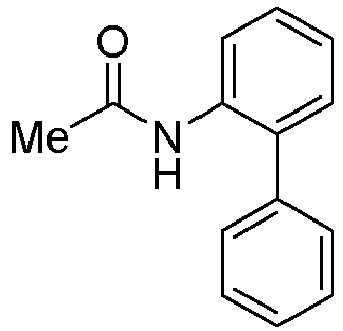
- Es wurde vorgegangen wie in Beispiel1 beschrieben, jedoch wurde die Reaktion in THF anstatt in DMF durchgeführt. Es wurden 116 mg N-([1,1'-Biphenyl]-2-yl)acetamid als farbloser Feststoff erhalten (55% der Theorie).
-

- Es wurde vorgegangen wie in Beispiel 1 beschrieben, jedoch wurde die Reaktion in Essigester anstatt in DMF durchgeführt. Es wurden N-([1,1'-Biphenyl]-2-yl)acetamid als farbloser Feststoff erhalten (55% der Theorie).
-
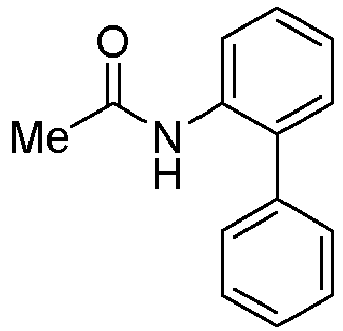
- Es wurde vorgegangen wie in Beispiel 1 beschrieben, jedoch wurde die Reaktion in Methanol anstatt in DMF durchgeführt. Es wurden N-([1,1'-Biphenyl]-2-yl)acetamid als farbloser Feststoff erhalten (70% der Theorie).
-

- Es wurde vorgegangen wie in Beispiel 1 beschrieben, jedoch wurde die Reaktion in Dichlorethan anstatt in DMF durchgeführt. Es wurden N-([1,1'-Biphenyl]-2-yl)acetamid als farbloser Feststoff erhalten (57% der Theorie).
-

- Es wurde vorgegangen wie in Beispiel 1 beschrieben, jedoch wurde die Reaktion in Wasser anstatt in DMF durchgeführt. Es wurden N-([1,1'-Biphenyl]-2-yl)acetamid als farbloser Feststoff erhalten (43% der Theorie).
-

- Es wurde vorgegangen wie in Beispiel 1 beschrieben, jedoch wurde die Reaktion in DMA anstatt in DMF durchgeführt. Es wurden N-([1,1'-Biphenyl]-2-yl)acetamid als farbloser Feststoff erhalten (46% der Theorie).
-
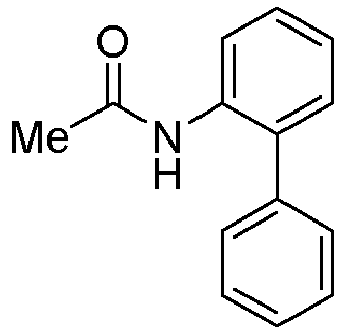
- Es wurde vorgegangen wie in Beispiel 1 beschrieben, jedoch wurde die Reaktion in DME anstatt in DMF durchgeführt. Es wurden N-([1,1'-Biphenyl]-2-yl)acetamid als farbloser Feststoff erhalten (50% der Theorie).
-

- Es wurde vorgegangen wie in Beispiel 1 beschrieben, jedoch wurde die Reaktion in einem 1:1-Gemisch aus DMF und THF anstatt in DMF durchgeführt. Es wurden N-([1,1'-Biphenyl]-2-yl)acetamid als farbloser Feststoff erhalten (65% der Theorie).
-

- In einem ausgeheizten verschließbaren Reaktionsgefäß wurde eine Suspension bestehend aus
Acetanilid (135 mg, 1.0 mmol), [{RuCl2(p-Cymol)}2] (30.6 mg, 5.0 mol %), AgSbF6 (68.7 mg, 0.2 mmol), Ag2O (232 mg, 1.0 mmol), Fe(OTf)3 (101 mg, 0.2 mmol) und Phenylboronsäure (183 mg, 1.5 mmol) in trockenem DMF (3.0 mL) bei 110 °C für 20 h in einer Stickstoffatmosphäre gerührt. Das Reaktionsgemisch wurde dann bei Raumtemperatur mit EtOAc (75 mL) verdünnt, über Celite und Kieselgel filtriert und das Filtrat eingeengt. Das so erhaltene Rohprodukt wurde durch Chromatografie an Kieselgel gereinigt (n-Hexan/EtOAc: 7/3). Es wurden 171 mg N-([1,1'-Biphenyl]-2-yl)acetamid als farbloser Feststoff erhalten (81% der Theorie). -

- Es wurde vorgegangen wie in Beispiel 3a beschrieben, jedoch wurde die Reaktion in THF anstatt in DMF durchgeführt. Es wurde N-([1,1'-Biphenyl]-2-yl)acetamid in einer Ausbeute von 56% der Theorie erhalten.
-

- In einem ausgeheizten verschließbaren Reaktionsgefäß wurde eine Suspension bestehend aus Acetanilid (135 mg, 1.0 mmol), [{RuCl2(p-Cymol)}2] (30.6 mg, 5.0 mol %), AgSbF6 (68.7 mg, 0.2 mmol), Ag2O (232 mg, 1.0 mmol), Cu(OTf)2 (72.3 mg, 0.2 mmol) und Diphenylborinsäure (137 mg, 0.75 mmol) in trockenem DMF (3.0 mL) bei 110 °C für 20 h in einer Stickstoffatmosphäre gerührt. Das Reaktionsgemisch wurde dann bei Raumtemperatur mit EtOAc (75 mL) verdünnt, über Celite und Kieselgel filtriert und das Filtrat eingeengt. Das so erhaltene Rohprodukt wurde durch Chromatografie an Kieselgel gereinigt (n-Hexan/EtOAc: 7/3). Es wurden 84.4 mg N-([1,1'-Biphenyl]-2-yl)acetamid als farbloser Feststoff erhalten (40% der Theorie).
-

- In einem ausgeheizten verschließbaren Reaktionsgefäß wurde eine Suspension bestehend aus N-(m-Tolyl)acetamid (149 mg, 1.0 mmol), [{RuCl2(p-Cymol)}2] (30.6 mg, 5.0 mol %), AgSbF6 (68.7 mg, 0.2 mmol), Ag2O (232 mg, 1.0 mmol), Cu(OTf)2 (72.3 mg, 0.2 mmol) und Phenylboronsäure (183 mg, 1.5 mmol) in trockenem DMF (3.0 mL) bei 110 °C für 20 h in einer Stickstoffatmosphäre gerührt. Das Reaktionsgemisch wurde dann bei Raumtemperatur mit EtOAc (75 mL) verdünnt, über Celite und Kieselgel filtriert und das Filtrat eingeengt. Das so erhaltene Rohprodukt wurde durch Chromatografie an Kieselgel gereinigt (n-Hexan/EtOAc: 7/3). Es wurden 175 mg N-(4-Methyl-[1,1'-biphenyl]-2-yl)acetamid als farbloser Feststoff erhalten (78% der Theorie). Smp. = 139-141 °C. 1H-NMR (CDCl3, 300 MHz): δ = 8.04 (s, 1H), 7.50-7.28 (m, 5H), 7.21-7.08 (m, 2H), 6.98 (d, J = 7.6 Hz, 1H), 2.38 (s, 3H), 1.98 (s, 3H). 13C-NMR (CDCl3, 125 MHz): δ = 168.0 (Cq), 138.3 (Cq), 138.1 (Cq), 134.3 (Cq), 129.7 (CH), 129.4 (Cq), 129.2 (CH), 128.9 (CH), 127.6 (CH), 125.1 (CH), 122.2 (CH), 24.6 (CH3), 21.5 (CH3). IR (neat): 3224, 3029, 2916, 1652, 1539, 1476, 1412, 1297, 820, 763, 724, 700, 611, 524 cm-1. MS (EI) m/z (relative Intensität): 225 ([M+] 54), 183 (100), 167 (30), 43 (20). HR-MS (ESI) m/z berechnet für C15H15NO [M+] 225.1154, gefunden 225.1159.
-

- In einem ausgeheizten verschließbaren Reaktionsgefäß wurde eine Suspension bestehend aus
N-(p-Tolyl)acetamid (149 mg, 1.0 mmol), [{RuCl2(p-Cymol)}2] (30.6 mg, 5.0 mol %), AgSbF6 (68.7 mg, 0.2 mmol), Ag2O (232 mg, 1.0 mmol), Cu(OTf)2 (72.3 mg, 0.2 mmol) und Phenylboronsäure (183 mg, 1.5 mmol) in trockenem DMF (3.0 mL) bei 110 °C für 20 h in einer Stickstoffatmosphäre gerührt. Das Reaktionsgemisch wurde dann bei Raumtemperatur mit EtOAc (75 mL) verdünnt, über Celite und Kieselgel filtriert und das Filtrat eingeengt. Das so erhaltene Rohprodukt wurde durch Chromatografie an Kieselgel gereinigt (n-Hexan/EtOAc: 7/3). Es wurden 178 mg N-(5-Methyl-[1,1'-biphenyl]-2-yl)acetamid als farbloser Feststoff erhalten (79% der Theorie). Smp. = 107-109 °C. 1H-NMR (CDCl3, 300 MHz): δ = 8.06 (d, J = 8.3 Hz, 1H), 7.50-7.31 (m, 5H), 7.16 (dd, J = 8.3, 2.2 Hz, 1H), 7.04 (m, 2H), 2.33 (s, 3H), 1.99 (s, 3H). 13C-NMR (CDCl3, 126 MHz): δ = 168.0 (Cq), 138.3 (Cq), 134.0 (Cq), 132.3 (Cq), 132.0 (Cq), 131.0 (CH), 129.1 (CH), 128.9 (CH), 128.8 (CH), 127.7 (CH), 121.9 (CH), 24.5 (CH3), 20.9 (CH3). IR (neat): 3235, 3057, 3029, 2922, 1655, 1524, 1505, 1488, 1366, 761, 734, 691, 603, 580 cm-1. MS (EI) m/z (relative Intensität): 225 ([M+] 54), 183 (100), 167 (18), 43 (22). HR-MS (ESI) m/z berechnet für C15H15NO [M+] 225.1154, gefunden 225.1154. -

- In einem ausgeheizten verschließbaren Reaktionsgefäß wurde eine Suspension bestehend aus N-(4-Fluorphenyl)acetamid (153 mg, 1.0 mmol), [{RuCl2(p-Cymol)}2] (30.6 mg, 5.0 mol %), AgSbF6 (68.7 mg, 0.2 mmol), Ag2O (232 mg, 1.0 mmol), Cu(OTf)2 (72.3 mg, 0.2 mmol) und 3,4-Dichlorphenylboronsäure (286 mg, 1.5 mmol) in trockenem DMF (3.0 mL) bei 110 °C für 20 h in einer Stickstoffatmosphäre gerührt. Das Reaktionsgemisch wurde dann bei Raumtemperatur mit EtOAc (75 mL) verdünnt, über Celite und Kieselgel filtriert und das Filtrat eingeengt. Das so erhaltene Rohprodukt wurde durch Chromatografie an Kieselgel gereinigt (n-Hexan/EtOAc: 7/3). Es wurden 188 mg N-(3',4'-Dichlor-5-fluor-[1,1'-biphenyl]-2-yl)acetamid als farbloser Feststoff erhalten (63% der Theorie). Smp. = 146-148 °C. 1H-NMR (CDCl3, 300 MHz): δ = 8.02-7.94 (m, 1H), 7.53 (d, J = 8.2 Hz, 1H), 7.44 (d, J = 2.0 Hz, 1H), 7.18 (dd, J = 8.2, 2.1 Hz, 1H), 7.12-7.01 (m, 1H), 6.96-6.93 (m, 2H), 2.02 (s, 3H). 13C-NMR (CDCl3, 75 MHz): δ = 168.5 (Cq), 159.5 (Cq, JC-F = 246.4 Hz), 137.2 (Cq, JC-F = 1.6 Hz), 133.3 (Cq), 133.0 (Cq, JC-F = 7.6 Hz), 132.8 (Cq), 131.0 (CH), 130.9 (CH), 130.4 (Cq, JC-F = 2.7 Hz), 128.2 (CH), 125.4 (CH, JC-F = 8.0 Hz), 116.5 (CH, JC-F = 23.2 Hz), 115.7 (CH, JC-F = 21.9 Hz), 24.2 (CH3). 19F-NMR (282 MHz, CDCl3) δ = -116.6 (s). IR (neat): 3242, 3190, 1652, 1529, 1472, 1371, 1183, 863, 823, 702, 685, 607, 501 cm-1. MS (EI) m/z (relative Intensität): 297 ([M+] 48), 255 (100), 219 (40), 185 (52), 157 (17), 43 (60). HR-MS (ESI) m/z berechnet für C14H10Cl2FNO [M+] 297.0123, gefunden 297.0128.
-

- In einem ausgeheizten verschließbaren Reaktionsgefäß wurde eine Suspension bestehend aus
Acetanilid (135 mg, 1.0 mmol), [{RuCl2(p-Cymol)}2] (30.6 mg, 5.0 mol %), AgSbF6 (68.7 mg, 0.2 mmol), Ag2O (232 mg, 1.0 mmol), Na(OTf) (34,4 mg, 0.2 mmol) und Phenylboronsäure (183 mg, 1.5 mmol) in trockenem DMF (3.0 mL) bei 110 °C für 20 h in einer Stickstoffatmosphäre gerührt. Das Reaktionsgemisch wurde dann bei Raumtemperatur mit EtOAc (75 mL) verdünnt, über Celite und Kieselgel filtriert und das Filtrat eingeengt. Das so erhaltene Rohprodukt enthielt lt. NMR-Analyse 65% der Theorie an N-([1,1'-Biphenyl]-2-yl)acetamid. -

- Es wurde vorgegangen wie in Beispiel 8 beschrieben, jedoch wurde die Reaktion in Gegenwart von 0,2 mmol Zn(OTf)2 anstatt NaOTf durchgeführt. Es wurde N-([1,1'-Biphenyl]-2-yl)acetamid in einer Ausbeute von 74% der Theorie erhalten.
-

- Es wurde vorgegangen wie in Beispiel 8 beschrieben, jedoch wurde die Reaktion in Gegenwart von 0,2 mmol Mn(OTf)2 anstatt NaOTf durchgeführt. Es wurde N-([1,1'-Biphenyl]-2-yl)acetamid in einer Ausbeute von 76% der Theorie erhalten.
-

- Es wurde vorgegangen wie in Beispiel 8 beschrieben, jedoch wurde die Reaktion in Gegenwart von 0,2 mmol Ni(OTf)2 anstatt NaOTf durchgeführt. Es wurde N-([1,1'-Biphenyl]-2-yl)acetamid in einer Ausbeute von 82% der Theorie erhalten.
-
- In einem ausgeheizten verschließbaren Reaktionsgefäß wurde eine Suspension bestehend aus
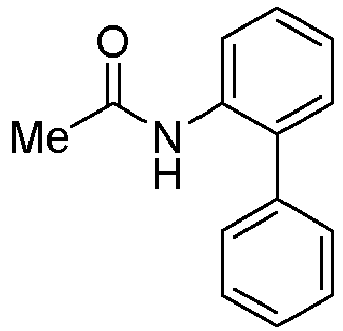
Acetanilid (135 mg, 1.0 mmol), [{RuCl2(p-Cymol)}2] (30.6 mg, 5.0 mol %), AgSbF6 (68.7 mg, 0.2 mmol), Ag2O (232 mg, 1.0 mmol), CuSO4 (31,9 mg, 0.2 mmol) und Phenylboronsäure (183 mg, 1.5 mmol) in trockenem DMF (3.0 mL) bei 110 °C für 20 h in einer Stickstoffatmosphäre gerührt. Das Reaktionsgemisch wurde dann bei Raumtemperatur mit EtOAc (75 mL) verdünnt, über Celite und Kieselgel filtriert und das Filtrat eingeengt. Das so erhaltene Rohprodukt wurde durch Chromatografie an Kieselgel gereinigt (n-Hexan/EtOAc: 7/3). Es wurden 91 mg N-([1,1'-Biphenyl]-2-yl)acetamid als farbloser Feststoff erhalten (43% der Theorie -

- In einem ausgeheizten verschließbaren Reaktionsgefäß wurde eine Suspension bestehend aus
Acetanilid (135 mg, 1.0 mmol), [{RuCl2(p-Cymol)}2] (30.6 mg, 5.0 mol %), AgSbF6 (68.7 mg, 0.2 mmol), Ag2O (232 mg, 1.0 mmol), Cu(OTf)2 (72.3 mg, 0.2 mmol) und 3,4,5-Trifluorhenylboronsäure (264 mg, 1.5 mmol) in trockenem DMF (3.0 mL) bei 110 °C für 20 h in einer Stickstoffatmosphäre gerührt. Das Reaktionsgemisch wurde dann bei Raumtemperatur mit EtOAc (75 mL) verdünnt, über Celite und Kieselgel filtriert und das Filtrat eingeengt. Das so erhaltene Rohprodukt wurde durch Chromatografie an Kieselgel gereinigt (n-Hexan/EtOAc: 7/3). Es wurden 180 mg N-(3',4',5'-Trifluor-[1,1'-biphenyl]-2-yl)acetamid als farbloser Feststoff erhalten (68% der Theorie). M.p. = 140-141 °C. 1H-NMR (CDCl3, 300 MHz): δ = 8.08 (d, J = 8.1 Hz, 1H), 7.40 (ddd, J = 8.5, 5.9, 3.1 Hz, 1H), 7.24-7.17 (m, 2H), 7.06-6.97 (m, 2H), 6.93 (s, 1H), 2.07 (s, 3H). 13C-NMR (CDCl3, 126 MHz): δ = 168.1 (Cq) ,151.39 (ddd, J C-F = 251.6, 10.0, 4.2 Hz) (Cq), 139.5 (dt, J C-F = 253.1, 15.0 Hz) (Cq), 134.5 (Cq), 134.5 (Cq), 130.5 (Cq), 129.8 (CH), 129.5 (CH), 125.1 (CH), 123.3 (CH), 113.5 (dd, J C-F = 16.1, 5.4 Hz) (CH), 24.3 (CH3). 19F-NMR (282 MHz, CDCl3) δ = -132-8-133.0 (m), -161.0 (tt, J C-F = 20.6, 6.5 Hz). IR (neat): 3263, 3040, 2934, 2864, 1660, 1526, 1483, 1417, 1359, 1278, 1241, 1036, 872, 857, 762, 695, 669, 634, 606, 547, 465 cm-1. MS (EI) m/z (relative Intensität): 265 ([M+] 29), 223 (100), 203 (16), 175 (5), 169 (5), 84 (6), 43 (41). HR-MS (ESI) m/z berechnet für C14H10F3NO [M+] 265.0714, gefunden 265.0718. -

- In einem ausgeheizten verschließbaren Reaktionsgefäß wurde eine Suspension bestehend aus
Acetanilid (135 mg, 1.0 mmol), [{RuCl2(p-Cymol)}2] (30.6 mg, 5.0 mol %), AgSbF6 (68.7 mg, 0.2 mmol), Ag2O (232 mg, 1.0 mmol), Cu(OTf)2 (72.3 mg, 0.2 mmol) und 4-Chlorphenylboronsäure (234 mg, 1.5 mmol) in trockenem DMF (3.0 mL) bei 110 °C für 20 h in einer Stickstoffatmosphäre gerührt. Das Reaktionsgemisch wurde dann bei Raumtemperatur mit EtOAc (75 mL) verdünnt, über Celite und Kieselgel filtriert und das Filtrat eingeengt. Das so erhaltene Rohprodukt wurde durch Chromatografie an Kieselgel gereinigt (n-Hexan/EtOAc: 7/3). Es wurden 172 mg N-(4'-Chlor-[1,1'-biphenyl]-2-yl)acetamid als farbloser Feststoff erhalten (70% der Theorie).
M.p. = 114-116 °C. 1H-NMR (CDCl3, 300 MHz): δ=8.16 (d, J = 8.2 Hz, 1H), 7.46-7.40 (m, 2H), 7.39-7.32 (m, 1H), 7.31-7.26 (m, 2H), 7.20-7.17 (m, 2H), 7.01 (s, 1H), 2.01 (s, 3H). 13C-NMR (CDCl3, 126 MHz): δ = 168.1 (Cq), 136.5 (Cq), 134.4 (Cq), 134.0 (Cq), 131.3 (Cq), 130.5 (CH), 129.9 (CH), 129.1 (CH), 128.6 (CH), 124.6 (CH), 122.2 (CH), 24.6 (CH3). IR (neat): 3247, 3031, 2924, 2854, 1635, 1527, 1369, 1283, 1086, 828, 756, 607, 530, 489 cm-1. MS (EI) m/z (relative Intensität): 245 ([M+] 35), 203 (100), 167 (43), 139 (12), 84 (17), 43 (36). HR-MS (ESI) m/z berechnet für C14H12ClNO [M+] 245.0607, gefunden 245.0599. -

- In einem ausgeheizten verschließbaren Reaktionsgefäß wurde eine Suspension bestehend aus
4-Methoxy-acetanilid (165 mg, 1.0 mmol), [{RuCl2(p-Cymol)}2] (30.6 mg, 5.0 mol %), AgSbF6 (68.7 mg, 0.2 mmol), Ag2O (232 mg, 1.0 mmol), Cu(OTf)2 (72.3 mg, 0.2 mmol) und 4-Chlorphenylboronsäure (234 mg, 1.5 mmol) in trockenem DMF (3.0 mL) bei 110 °C für 20 h in einer Stickstoffatmosphäre gerührt. Das Reaktionsgemisch wurde dann bei Raumtemperatur mit EtOAc (75 mL) verdünnt, über Celite und Kieselgel filtriert und das Filtrat eingeengt. Das so erhaltene Rohprodukt wurde durch Chromatografie an Kieselgel gereinigt (n-Hexan/EtOAc: 7/3). Es wurden 183 mg N-(5-Methoxy-[1,1'-biphenyl]-2-yl)acetamid als farbloser Feststoff erhalten (76% der Theorie). M.p. = 112-114 °C. 1H-NMR (CDCl3, 300 MHz): δ = 7.95 (d, J = 8.9 Hz, 1H), 7.50-7.28 (m, 5H), 6.98 (s, 1H), 6.88 (dd, J = 8.9, 3.0 Hz, 1H), 6.78 (d, J = 3.0 Hz, 1H), 3.78 (s, 3H), 1.97 (s, 3H). 13C-NMR (CDCl3, 126 MHz): δ = 168.2 (Cq), 156.3 (Cq), 138.1 (Cq), 134.7 (Cq), 128.9 (CH), 128.8 (CH), 127.8 (CH), 127.6 (Cq), 124.3 (CH), 115.3 (CH), 113.3 (CH), 55.5 (CH3), 24.2 (CH3). - IR (neat): 3263, 3058, 2969, 2939, 2838, 1664, 1480, 1270, 1207, 1178, 1033, 701, 599, 512 cm-1. MS (EI) m/z (relative Intensität): 241 ([M+] 71), 199 (76), 184 (100), 154 (21), 128 (11), 43 (34). HR-MS (ESI) m/z berechnet für C15H15NO2 [M+] 241.1103, gefunden 241.1106.
-
- In einem ausgeheizten verschließbaren Reaktionsgefäß wurde eine Suspension bestehend aus
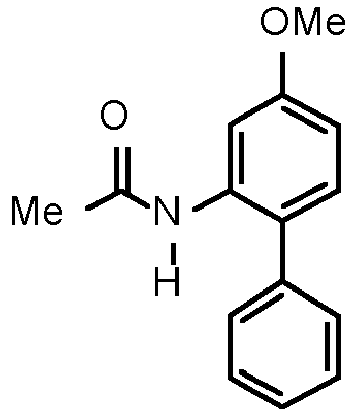
3-Methoxy-acetanilid (165 mg, 1.0 mmol), [{RuCl2(p-Cymol)}2] (30.6 mg, 5.0 mol %), AgSbF6 (68.7 mg, 0.2 mmol), Ag2O (232 mg, 1.0 mmol), Cu(OTf)2 (72.3 mg, 0.2 mmol) und 4-Chlorphenylboronsäure (234 mg, 1.5 mmol) in trockenem DMF (3.0 mL) bei 110 °C für 20 h in einer Stickstoffatmosphäre gerührt. Das Reaktionsgemisch wurde dann bei Raumtemperatur mit EtOAc (75 mL) verdünnt, über Celite und Kieselgel filtriert und das Filtrat eingeengt. Das so erhaltene Rohprodukt wurde durch Chromatografie an Kieselgel gereinigt (n-Hexan/EtOAc: 7/3). Es wurden 174 mg N-(4-Methoxy-[1,1'-biphenyl]-2-yl)acetamid als farbloser Feststoff erhalten (72% der Theorie). M.p. = 91-93 °C. 1H-NMR (CDCl3, 300 MHz): δ = 7.98 (d, J = 2.6 Hz, 1H), 7.49-7.42 (m, 2H), 7.40-7.36 (m, 1H), 7.35-7.32 (m, 1H), 7.32-7.29 (m, 1H), 7.17 (s, 1H), 7.12 (d, J = 8.5 Hz, 1H), 6.72 (dd, J = 8.5, 2.6 Hz, 1H), 3.84 (s, 3H), 2.00 (s, 3H). 13C-NMR (CDCl3, 126 MHz): δ = 168.1 (Cq), 159.4 (Cq), 137.9 (Cq), 135.6 (Cq), 130.6 (CH), 129.3 (CH), 129.0 (CH), 127.6 (CH), 124.2 (Cq), 110.5 (CH), 106.2 (CH), 55.5 (CH3), 24.8 (CH3). IR (neat): 3415, 3241, 3033, 2953, 2831, 1652, 1309, 1233, 762, 724, 698, 621, 525 cm-1. MS (EI) m/z (relative Intensität): 241 ([M+] 74), 199 (100), 170 (16), 156 (19), 84 (9), 43 (34). HR-MS (ESI) m/z berechnet für C15H15NO2 [M+] 241.1103, found 241.1107. -

- In einem ausgeheizten verschließbaren Reaktionsgefäß wurde eine Suspension bestehend aus
4-Ethyl-acetanilid (163 mg, 1.0 mmol), [{RuCl2(p-Cymol)}2] (30.6 mg, 5.0 mol %), AgSbF6 (68.7 mg, 0.2 mmol), Ag2O (232 mg, 1.0 mmol), Cu(OTf)2 (72.3 mg, 0.2 mmol) und Phenylboronsäure (183 mg, 1.5 mmol) in trockenem DMF (3.0 mL) bei 110 °C für 20 h in einer Stickstoffatmosphäre gerührt. Das Reaktionsgemisch wurde dann bei Raumtemperatur mit EtOAc (75 mL) verdünnt, über Celite und Kieselgel filtriert und das Filtrat eingeengt. Das so erhaltene Rohprodukt wurde durch Chromatografie an Kieselgel gereinigt (n-Hexan/EtOAc: 7/3). Es wurden 151 mg N-(5-Ethyl-[1,1'-biphenyl]-2-yl)acetamid als farbloser Feststoff erhalten (63% der Theorie). M.p. = 64-65 °C. 1H-NMR (CDCl3, 300 MHz): δ = 8.07 (d, J = 8.3 Hz, 1H), 7.54-7.31 (m, 5H), 7.20 (dd, J = 8.3, 2.3 Hz, 1H), 7.13 (s, 1H), 7.09 (d, J = 2.3 Hz, 1H), 2.65 (q, J = 7.6 Hz, 2H), 2.00 (s, 3H), 1.25 (t, J = 7.6 Hz, 3H). 13C-NMR (CDCl3, 126 MHz): δ = 168.0 (Cq), 140.3 (Cq), 138.3 (Cq), 132.5 (Cq), 132.1 (Cq), 129.3 (CH), 129.0 (CH), 128.8 (CH), 127.6 (CH), 127.5 (CH), 122.2 (CH), 28.3 (CH2), 24.4 (CH3), 15.6 (CH3). IR (neat): 3424, 3267, 3027, 2964, 2930, 2871, 1659, 1513, 1487, 1410, 1368, 1297, 767, 699, 509 cm-1. MS (EI) m/z (relative Intensität): 239 ([M+] 58), 197 (58), 182 (100), 180 (19), 167 (16), 43 (37). HR-MS (ESI) m/z berechnet für C16H17NO [M+] 239.1310, gefunden 239.1306. -

- In einem ausgeheizten verschließbaren Reaktionsgefäß wurde eine Suspension bestehend aus
4-Hydroxy-acetanilid (151 mg, 1.0 mmol), [{RuCl2(p-Cymol)}2] (30.6 mg, 5.0 mol %), AgSbF6 (68.7 mg, 0.2 mmol), Ag2O (232 mg, 1.0 mmol), Cu(OTf)2 (72.3 mg, 0.2 mmol) und Phenylboronsäure (183 mg, 1.5 mmol) in trockenem DMF (3.0 mL) bei 110 °C für 20 h in einer Stickstoffatmosphäre gerührt. Das Reaktionsgemisch wurde dann bei Raumtemperatur mit EtOAc (75 mL) verdünnt, über Celite und Kieselgel filtriert und das Filtrat eingeengt. Das so erhaltene Rohprodukt wurde durch Chromatografie an Kieselgel gereinigt (n-Hexan/EtOAc: 7/3). Es wurden 157 mg N-(5-Hydroxy-[1,1'-biphenyl]-2-yl)acetamid als farbloser Feststoff erhalten (69% der Theorie). 1H-NMR (CDCl3, 300 MHz): δ = 7.59 (d, J = 9.5 Hz, 1H), 7.53 (s, 1H), 7.43-7.32 (m, 3H), 7.30-7.24 (m, 2H), 7.05 (s, 1H), 6.73-6.67 (m, 2H), 1.99 (s, 3H). 13C-NMR (CDCl3, 126 MHz): δ = 169.7 (Cq), 154.1 (Cq), 138.1 (Cq), 136.1 (Cq), 128.8 (CH), 128.6 (CH), 127.6 (CH), 126.0 (Cq), 125.7 (CH), 117.1 (CH), 115.3 (CH), 23.9 (CH3). IR (neat): 3268, 3057, 2959, 2926, 2795, 1524, 1488, 1433, 1299, 1199, 726, 699, 646, 506 cm-1. MS (EI) m/z (relative Intensität): 227 ([M+] 44), 185 (100), 154 (11), 43 (14). HR-MS (ESI) m/z berechnet für C14H13NO2 [M+] 227.0946, gefunden 227.0945. -

- In einem ausgeheizten verschließbaren Reaktionsgefäß wurde eine Suspension bestehend aus
Acetanilid (135 mg, 1.0 mmol), [{RuCl2(p-Cymol)}2] (30.6 mg, 5.0 mol %), AgSbF6 (68.7 mg, 0.2 mmol), Ag2O (232 mg, 1.0 mmol), Cu(OTf)2 (72.3 mg, 0.2 mmol) und 4-Methylphenylboronsäure (204 mg, 1.5 mmol) in trockenem DMF (3.0 mL) bei 110 °C für 20 h in einer Stickstoffatmosphäre gerührt. Das Reaktionsgemisch wurde dann bei Raumtemperatur mit EtOAc (75 mL) verdünnt, über Celite und Kieselgel filtriert und das Filtrat eingeengt. Das so erhaltene Rohprodukt wurde durch Chromatografie an Kieselgel gereinigt (n-Hexan/EtOAc: 7/3). Es wurden 185 mg N-(4'-Methyl-[1,1'-biphenyl]-2-yl)acetamid als farbloser Feststoff erhalten (82% der Theorie). M.p. = 106-108 °C. 1H-NMR (CDCl3, 300 MHz): δ = 8.24 (d, J = 8.2 Hz, 1H), 7.44-7.06 (m, 8H), 2.41 (s, 3H), 2.01 (s, 3H). 13C-NMR (CDCl3, 126 MHz): δ = 168.0 (Cq), 137.6 (Cq), 135.0 (Cq), 134.6 (Cq), 132.0 (Cq), 130.0 (CH), 129.7 (CH), 128.9 (CH), 128.1 (CH), 124.1 (CH), 121.4 (CH), 24.6 (CH3), 21.2 (CH3). IR (neat): 3340, 2956, 2921, 2853, 1515, 1442, 1282, 817, 756, 680, 598, 522, 488 cm-1. MS (EI) m/z (relative Intensität): 225 ([M+] 55), 183 (100), 167 (37), 43 (26). HR-MS (ESI) m/z berechnet für C15H15NO [M+] 225.1154, gefunden 225.1149. -

- In einem ausgeheizten verschließbaren Reaktionsgefäß wurde eine Suspension bestehend aus
Acetanilid (135 mg, 1.0 mmol), [{RuCl2(p-Cymol)}2] (30.6 mg, 5.0 mol %), AgSbF6 (68.7 mg, 0.2 mmol), Ag2O (232 mg, 1.0 mmol), Cu(OTf)2 (72.3 mg, 0.2 mmol) und 4-Methoxyphenylboronsäure (228 mg, 1.5 mmol) in trockenem DMF (3.0 mL) bei 110 °C für 20 h in einer Stickstoffatmosphäre gerührt. Das Reaktionsgemisch wurde dann bei Raumtemperatur mit EtOAc (75 mL) verdünnt, über Celite und Kieselgel filtriert und das Filtrat eingeengt. Das so erhaltene Rohprodukt wurde durch Chromatografie an Kieselgel gereinigt (n-Hexan/EtOAc: 7/3). Es wurden 200 mg N-(4'-Methyl-[1,1'-biphenyl]-2-yl)acetamid als farbloser Feststoff erhalten (83% der Theorie). M.p. = 135-137 °C. 1H-NMR (CDCl3, 300 MHz): δ = 8.20 (d, J = 8.2 Hz, 1H), 7.34-7.24 (m, 3H), 7.23-7.09 (m, 3H), 6.98 (d, J = 8.6 Hz, 2H), 3.84 (s, 3H), 2.00 (s, 3H). 13C-NMR (CDCl3, 126 MHz): δ = 168.3 (Cq), 159.3 (Cq), 134.8 (Cq), 132.0 (Cq), 130.3 (CH), 130.2 (Cq), 130.1 (CH), 128.0 (CH), 124.3 (CH), 121.6 (CH), 114.4 (CH), 55.2 (CH3), 24.4 (CH3). IR (neat): 3351, 3012, 2921, 2842, 1690, 1602, 1512, 1439, 1362, 1294, 1239, 1175, 1031, 832, 800, 770, 663, 581, 560, 534 cm-1. MS (EI) m/z (relative Intensität): 241 ([M+] 54), 199 (100), 184 (37), 154 (24), 128 (12), 43 (30). HR-MS (ESI) m/z berechnet für C15H15NO2 [M+] 241.1103, gefunden 241.1110. -

- In einem ausgeheizten verschließbaren Reaktionsgefäß wurde eine Suspension bestehend aus
2-Methyl-N-phenylpropanamid (163 mg, 1.0 mmol), [{RuCl2(p-Cymol)}2] (30.6 mg, 5.0 mol %), AgSbF6 (68.7 mg, 0.2 mmol), Ag2O (232 mg, 1.0 mmol), Cu(OTf)2 (72.3 mg, 0.2 mmol) und Phenylboronsäure (183 mg, 1.5 mmol) in trockenem DMF (3.0 mL) bei 110 °C für 20 h in einer Stickstoffatmosphäre gerührt. Das Reaktionsgemisch wurde dann bei Raumtemperatur mit EtOAc (75 mL) verdünnt, über Celite und Kieselgel filtriert und das Filtrat eingeengt. Das so erhaltene Rohprodukt wurde durch Chromatografie an Kieselgel gereinigt (n-Hexan/EtOAc: 7/3). Es wurden 131 mg N-(Biphenyl-2-yl)-2-methylpropanamid als farbloser Feststoff erhalten (55% der Theorie). M.p. = 126-128 °C. 1H-NMR (CDCl3, 300 MHz): δ = 8.33 (d, J = 8.2 Hz, 1H), 7.54-7.33 (m, 6H), 7.28-7.13 (m, 3H), 2.4 (hept, J = 6.8 Hz, 1H), 1.2 (d, J = 6.8 Hz, 6H). 13C-NMR (CDCl3, 126 MHz): δ = 174.8 (Cq), 138.1 (Cq), 134.9 (Cq), 132.1 (Cq), 129.9 (CH), 129.3 (CH), 129.0 (CH), 128.4 (CH), 128.0 (CH), 124.0 (CH), 121.3 (CH), 36.7 (CH), 19.3 (CH3). IR (neat): 3218, 2964, 1649, 1520, 1480, 1239, 1203, 1099, 776, 748, 726, 702, 542 cm-1. MS (EI) m/z (relative Intensität): 239 ([M+] 29), 169 (100), 71 (6), 43 (30). HR-MS (ESI) m/z berechnet für C16H17NO [M+] 239.1310, gefunden 239.1314. -

- In einem ausgeheizten verschließbaren Reaktionsgefäß wurde eine Suspension bestehend aus
2,2-Dimethyl-N-phenylpropanamid (177 mg, 1.0 mmol), [{RuCl2(p-Cymol)}2] (30.6 mg, 5.0 mol %), AgSbF6 (68.7 mg, 0.2 mmol), Ag2O (232 mg, 1.0 mmol), Cu(OTf)2 (72.3 mg, 0.2 mmol) und Phenylboronsäure (183 mg, 1.5 mmol) in trockenem DMF (3.0 mL) bei 110 °C für 20 h in einer Stickstoffatmosphäre gerührt. Das Reaktionsgemisch wurde dann bei Raumtemperatur mit EtOAc (75 mL) verdünnt, über Celite und Kieselgel filtriert und das Filtrat eingeengt. Das so erhaltene Rohprodukt wurde durch Chromatografie an Kieselgel gereinigt (n-Hexan/EtOAc: 7/3). Es wurden 114 mg N-(Biphenyl-2-yl)-2,2-dimethylpropanamid als farbloser Feststoff erhalten (45% der Theorie). M.p. = 68-69 °C. 1H-NMR (CDCl3, 300 MHz): δ = 8.37 (dd, J= 8.2, 1.2 Hz, 1H), 7.54-7.33 (m, 7H), 7.24 (dd, J= 7.4, 1.7 Hz, 1H), 7.17 (dd, J = 7.4, 1.7 Hz, 1H), 1.09 (s, 9H). 13C-NMR (CDCl3, 126 MHz): δ = 176.1 (Cq), 138.0 (Cq), 135.0 (Cq), 132.0 (Cq), 129.6 (CH), 129.2 (CH), 128.9 (CH), 128.4 (CH), 127.9 (CH), 123.8 (CH), 120.8 (CH), 39.8 (Cq), 27.4 (CH3). IR (neat): 3259, 3056, 2970, 2904, 2868, 1646, 1503, 1477, 771, 743, 700, 647 cm-1. MS (EI) m/z (relative Intensität): 253 ([M+] 53), 169 (60), 57 (100), 41 (17). HR-MS (ESI) m/z berechnet für C17H19NO [M+] 253.1467, gefunden 253.1472.
(1) in einem ersten Schritt
Anilide der Formel (II)
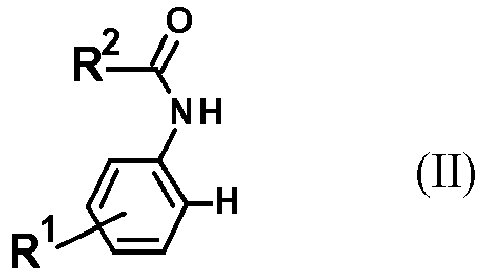
mit einer Organoborverbindung der Formel (III)

X1, X2 und X3 die oben angegebenen Bedeutungen haben,
und die aus einer der folgenden Gruppen gewählt ist, bestehend aus
Claims (13)
- Verfahren zur Herstellung von Biphenylamiden der allgemeinen Formel (V)
 R1 für Wasserstoff, Hydroxy, Fluor, Chlor, C1-C4-Alkyl, C1-C4-Alkoxy, C1-C4-Alkylthio oder C1-C4-Halogenalkyl steht,R2 für für C1-C4-Alkyl, C6-C10-Aryl oder C6-C10-Aryl-CH2- steht, undX1 für Wasserstoff, C1-C4-Alkyl, C1-C4-Alkoxy, Fluor oder Chlor steht,X2 für Wasserstoff, C1-C4-Alkyl, C1-C4-Alkoxy, Fluor oder Chlor steht,X3 für Wasserstoff, C1-C4-Alkyl, C1-C4-Alkoxy, Fluor oder Chlor steht,dadurch gekennzeichnet, dass man
Anilide der Formel (II) R1 und R2 die oben angegebenen Bedeutungen haben,in einem von Tetrahydrofuran verschiedenen Lösungsmittel
mit einer Organoborverbindung der Formel (III)
X1, X2 und X3 die oben angegebenen Bedeutungen haben,
und die aus einer der folgenden Gruppen gewählt ist, bestehend aus(I) Boronsäuren der Formel (III), in derQ für eine Hydroxygruppe steht,m für die Zahl 2 steht,p für die Zahl 1 steht,oder den Anhydriden, Dimeren oder Trimeren dieser Boronsäuren;(II) Boronsäurederivaten der Formel (III), in derQ für F, Cl, Br, I, C1-C4-Alkyl, C6-C10-Aryl, C1-C4-Alkoxy oder C6-C10-Aryloxy steht,m für die Zahl 2 steht,p für die Zahl 1 steht;(III) Borinsäuren der Formel (III), in derQ für OH, F, Cl, Br, I, C1-C4-Alkyl, C6-C10-Aryl, C1-C4-Alkoxy oder C6-C10-Aryloxy steht,m für die Zahl 1 steht,p für die Zahl 2 steht;(IV) cyclische Boronsäureester der Formel (III), in derQ für einen C2-C3-Alkyldioxy-Rest steht, der zusammen mit dem Boratom, an das er gebunden ist, einen 5- oder 6-gliedrigen Ring bildet, der gegebenfalls durch einen oder mehrere C1-C4-AlkylReste substituiert ist,m für die Zahl 2 steht,p für die Zahl 1 steht;(V) Boronate der Formel (III), in derQ für OH, F, Cl, Br, I, C1-C4-Alkyl, C6-C10-Aryl, C1-C4-Alkoxy oder C6-C10-Aryloxy steht,m für die Zahl 3 steht,p für die Zahl 1 stehtund die negative Ladung des Boronatanions durch ein Kation ausgeglichen wird,(VI) Triarylborane der Formel (III), in derm für die Zahl 0 steht,p für die Zahl 3 steht;(VII) Tetraarylborate der Formel (IV), in derin Gegenwart eines Katalysatorsystems bestehend aus einem Rutheniumkatalysator, einem Aktivierungsmittel, einem Oxidationsmittel und einem Metalltriflat umsetzt.m für die Zahl 0 steht,p für die Zahl 4 stehtund die negative Ladung des Tetraarylboratanions durch ein Kation ausgeglichen wird, - Verfahren nach Anspruch 1, dadurch gekennzeichnet, daß in einer zweiten Stufe das Amid der Formel (Ia) zum freien Amin der allgemeinen Formel (I) entschützt wird.
- Verfahren nach Anspruch 1 oder 2, dadurch gekennzeichnet, daß das Lösungsmittel ausgewählt ist aus der Gruppe, die N,N-Dialkylalkanamide, Dimethoxyethan (DME), Methanol, Essigsäureethylester und Wasser sowie Mischungen dieser Lösungmittel umfaßt.
- Verfahren nach einem der vorhergehenden Ansprüche, dadurch gekennzeichnet, dass das Lösungsmittel ausgewählt ist aus der Gruppe, die N,N-Dialkylalkanamide sowie Mischungen dieser Lösungmittel umfasst.
- Verfahren nach einem der vorhergehenden Ansprüche, dadurch gekennzeichnet, dass der Katalysator [{RuCl2(p-Cymol)}2] ist.
- Verfahren nach einem der vorhergehenden Ansprüche, dadurch gekennzeichnet, dass das Oxidationsmittel Ag2O ist.
- Verfahren nach einem der vorhergehenden Ansprüche, dadurch gekennzeichnet, daß das Metalltriflat ausgewählt ist aus der Gruppe, die Li, Na, K, Mg, Ca, Mn, Fe, Co, Ni, Cu und Zn umfaßt.
- Verfahren nach einem der vorhergehenden Ansprüche, dadurch gekennzeichnet, daß das Metalltriflat ausgewählt ist aus der Gruppe, die Natrium, Kalium, Mangan, Zink und Eisen und Nickel umfasst.
- Verfahren nach einem der vorhergehenden Ansprüche, dadurch gekennzeichnet, daß das Aktivierungsmittel ausgewählt ist aus der Gruppe, die AgSbF6, KPF6, NaPF6, AgF und AgBF4 umfasst.
- Verfahren nach einem der vorhergehenden Ansprüche, dadurch gekennzeichnet, dass die Boronsäure eine Boronsäure der Formel (III) mit Q=OH, M=2 und P=1 ist.
- Verfahren nach einem der vorhergehenden Ansprüche, dadurch gekennzeichnet, daß die Boronsäure eine Boronsäure der Formel (III) mit Q=OH, M=2 und P=1, das Lösungsmittel DMF, der Katalysator [{RuCl2(p-Cymol)}2], das Metalltriflat Eisen(III)triflat, das Oxidationsmittel Ag2O und der Aktivator AgSbF6 ist.
- Verfahren zur Herstellung von Biphenylamiden der allgemeinen Formel (Ia)
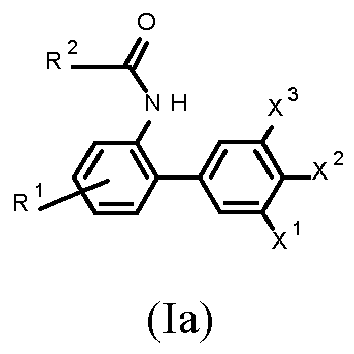 R1 für Wasserstoff, Hydroxy, Fluor, Chlor, C1-C4-Alkyl, C1-C4-Alkoxy, C1-C4-Alkylthio oder C1-C4-Halogenalkyl steht,R2 für für C1-C4-Alkyl, C6-C10-Aryl oder C6-C10-Aryl-CH2- steht, undX1 für Wasserstoff, C1-C3-Alkyl, C1-C4-Alkoxy, Fluor oder Chlor steht,X2 für Wasserstoff, C1-C3-Alkyl, C1-C4-Alkoxy, Fluor oder Chlor steht,X3 für Wasserstoff, C1-C3-Alkyl, C1-C4-Alkoxy, Fluor oder Chlor steht,dadurch gekennzeichnet, dass man
Anilide der Formel (II)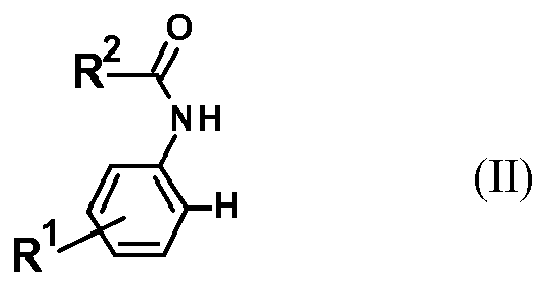 R1 und R2 die oben angegebenen Bedeutungen haben,mit einer Organoborverbindung der Formel (III)
X1, X2 und X3 die oben angegebenen Bedeutungen haben,
und die aus einer der folgenden Gruppen gewählt ist, bestehend aus(I) Boronsäuren der Formel (III), in derQ für eine Hydroxygruppe steht,m für die Zahl 2 steht,p für die Zahl 1 steht,oder den Anhydriden, Dimeren oder Trimeren dieser Boronsäuren;(II) Boronsäurederivaten der Formel (III), in derQ für F, Cl, Br, I, C1-C4-Alkyl, C6-C10-Aryl, C1-C4-Alkoxy oder C6-C10-Aryloxy steht,m für die Zahl 2 steht,p für die Zahl 1 steht;(III) Borinsäuren der Formel (III), in derQ für OH, F, Cl, Br, I, C1-C4-Alkyl, C6-C10-Aryl, C1-C4-Alkoxy oder C6-C10-Aryloxy steht,m für die Zahl 1 steht,p für die Zahl 2 steht;(IV) cyclische Boronsäureester der Formel (III), in derQ für einen C2-C3-Alkyldioxy-Rest steht, der zusammen mit dem Boratom, an das er gebunden ist, einen 5- oder 6-gliedrigen Ring bildet, der gegebenfalls durch einen oder mehrere C1-C4-AlkylReste substituiert ist,m für die Zahl 2 steht,p für die Zahl 1 steht;(V) Boronate der Formel (III), in derQ für OH, F, Cl, Br, I, C1-C4-Alkyl, C6-C10-Aryl, C1-C4-Alkoxy oder C6-C10-Aryloxy steht,m für die Zahl 3 steht,p für die Zahl 1 stehtund die negative Ladung des Boronatanions durch ein Kation ausgeglichen wird,(VI) Triarylborane der Formel (III), in derm für die Zahl 0 steht,p für die Zahl 3 steht;(VII) Tetraarylborate der Formel (IV), in derm für die Zahl 0 steht,p für die Zahl 4 stehtund die negative Ladung des Tetraarylboratanions durch ein Kation ausgeglichen wird,in Gegenwart eines Katalysatorsystems bestehend aus einem Rutheniumkatalysator, einem Aktivierungsmittel, einem Oxidationsmittel und einem Metallsulfat umsetzt. - Verfahren zur Herstellung von Biphenylamiden der allgemeinen Formel (Ia)
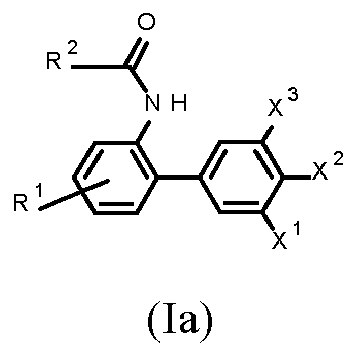 R1 für Wasserstoff, Hydroxy, Fluor, Chlor, C1-C4-Alkyl, C1-C4-Alkoxy, C1-C4-Alkylthio oder C1-C4-Halogenalkyl steht,R2 für C1-C4-Alkyl, C6-C10-Aryl oder C6-C10-Aryl-CH2- stehtX1 für Wasserstoff, C1-C3-Alkyl, C1-C4-Alkoxy, Fluor oder Chlor steht,X2 für Wasserstoff, C1-C3-Alkyl, C1-C4-Alkoxy, Fluor oder Chlor steht,X3 für Wasserstoff, C1-C3-Alkyl, C1-C4-Alkoxy, Fluor oder Chlor steht,dadurch gekennzeichnet, dass man
Anilide der Formel (II) R1 und R2 die oben angegebenen Bedeutungen haben,mit einer Organoborverbindung der Formel (III)
X1, X2 und X3 die oben angegebenen Bedeutungen haben,
und die aus einer der folgenden Gruppen gewählt ist, bestehend aus(I) Boronsäuren der Formel (III), in derQ für eine Hydroxygruppe steht,m für die Zahl 2 steht,p für die Zahl 1 steht,oder den Anhydriden, Dimeren oder Trimeren dieser Boronsäuren;(II) Boronsäurederivaten der Formel (III), in derQ für F, Cl, Br, I, C1-C4-Alkyl, C6-C10-Aryl, C1-C4-Alkoxy oder C6-C10-Aryloxy steht,m für die Zahl 2 steht,p für die Zahl 1 steht;(III) Borinsäuren der Formel (III), in derQ für OH, F, Cl, Br, I, C1-C4-Alkyl, C6-C10-Aryl, C1-C4-Alkoxy oder C6-C10-Aryloxy steht,m für die Zahl 1 steht,p für die Zahl 2 steht;(IV) cyclische Boronsäureester der Formel (III), in derQ für einen C2-C3-Alkyldioxy-Rest steht, der zusammen mit dem Boratom, an das er gebunden ist, einen 5- oder 6-gliedrigen Ring bildet, der gegebenfalls durch einen oder mehrere C1-C4-AlkylReste substituiert ist,m für die Zahl 2 steht,p für die Zahl 1 steht;(V) Boronate der Formel (III), in derQ für OH, F, Cl, Br, I, C1-C4-Alkyl, C6-C10-Aryl, C1-C4-Alkoxy oder C6-C10-Aryloxy steht,m für die Zahl 3 steht,p für die Zahl 1 stehtund die negative Ladung des Boronatanions durch ein Kation ausgeglichen wird,(VI) Triarylborane der Formel (III), in derm für die Zahl 0 steht,p für die Zahl 3 steht;(VII) Tetraarylborate der Formel (IV), in derm für die Zahl 0 steht,p für die Zahl 4 stehtund die negative Ladung des Tetraarylboratanions durch ein Kation ausgeglichen wird,in Gegenwart eines Katalysatorsystems bestehend aus einem Rutheniumkatalysator, einem Aktivierungsmittel, einem Oxidationsmittel und einem Metalloxid umsetzt.
Priority Applications (14)
| Application Number | Priority Date | Filing Date | Title |
|---|---|---|---|
| EP14189192.9A EP3009420A1 (de) | 2014-10-16 | 2014-10-16 | Verfahren zum Herstellen von Biphenylaminen aus Aniliden durch Rutheniumkatalyse |
| DK15716847.7T DK3134383T3 (da) | 2014-04-25 | 2015-04-22 | Fremgangsmåde til fremstilling af biphenylaminer af anilider ved hjælp af rutheniumkatalyse |
| ES15716847T ES2799722T3 (es) | 2014-04-25 | 2015-04-22 | Procedimiento para preparar bifenilaminas a partir de anilidas por catálisis con rutenio |
| KR1020167031926A KR20160148589A (ko) | 2014-04-25 | 2015-04-22 | 루테늄 촉매반응에 의한 아닐리드로부터 비페닐아민의 제조방법 |
| EP15716847.7A EP3134383B1 (de) | 2014-04-25 | 2015-04-22 | Verfahren zum herstellen von biphenylaminen aus aniliden durch rutheniumkatalyse |
| MX2016013879A MX2016013879A (es) | 2014-04-25 | 2015-04-22 | Procedimiento para preparar bifenilaminas a partir de anilidas por catalisis con rutenio. |
| BR112016024801-5A BR112016024801B1 (pt) | 2014-04-25 | 2015-04-22 | processo para preparar bifenilaminas a partir de anilidas por catálise de rutênio |
| US15/305,865 US10246407B2 (en) | 2014-04-25 | 2015-04-22 | Process for preparing biphenylamines from anilides by ruthenium catalysis |
| JP2016564016A JP6588924B2 (ja) | 2014-04-25 | 2015-04-22 | ルテニウムの触媒作用によってアニリド類からビフェニルアミン類を製造する方法 |
| PCT/EP2015/058636 WO2015162144A1 (de) | 2014-04-25 | 2015-04-22 | Verfahren zum herstellen von biphenylaminen aus aniliden durch rutheniumkatalyse |
| CN201580022090.7A CN106232573B (zh) | 2014-04-25 | 2015-04-22 | 通过钌催化由苯胺制备联苯胺的方法 |
| TW104112977A TWI669286B (zh) | 2014-04-25 | 2015-04-23 | 藉由釕觸媒自苯胺化物製備聯苯胺之方法 |
| IL248336A IL248336B (en) | 2014-04-25 | 2016-10-13 | A method for the production of biphenylamines from anilides using ruthenium catalysis |
| US16/113,624 US10246408B2 (en) | 2014-04-25 | 2018-08-27 | Process for preparing biphenylamines from anilides by ruthenium catalysis |
Applications Claiming Priority (1)
| Application Number | Priority Date | Filing Date | Title |
|---|---|---|---|
| EP14189192.9A EP3009420A1 (de) | 2014-10-16 | 2014-10-16 | Verfahren zum Herstellen von Biphenylaminen aus Aniliden durch Rutheniumkatalyse |
Publications (1)
| Publication Number | Publication Date |
|---|---|
| EP3009420A1 true EP3009420A1 (de) | 2016-04-20 |
Family
ID=51743324
Family Applications (1)
| Application Number | Title | Priority Date | Filing Date |
|---|---|---|---|
| EP14189192.9A Withdrawn EP3009420A1 (de) | 2014-04-25 | 2014-10-16 | Verfahren zum Herstellen von Biphenylaminen aus Aniliden durch Rutheniumkatalyse |
Country Status (1)
| Country | Link |
|---|---|
| EP (1) | EP3009420A1 (de) |
Citations (6)
| Publication number | Priority date | Publication date | Assignee | Title |
|---|---|---|---|---|
| WO2001042223A1 (en) | 1999-12-09 | 2001-06-14 | Syngenta Participations Ag | Pyrazolecarboxamide and pyrazolethioamide as fungicide |
| WO2003070705A1 (de) | 2002-02-19 | 2003-08-28 | Bayer Cropscience Aktiengesellschaft | Disubstituierte pyrazolylcarboxanilide |
| WO2007138089A1 (en) | 2006-06-01 | 2007-12-06 | Basf Se | Process for preparing substituted biphenyls |
| EP2008991A1 (de) * | 2007-06-29 | 2008-12-31 | Bayer CropScience AG | Verfahren zur Herstellung von Biarylen |
| WO2009135598A1 (en) | 2008-05-09 | 2009-11-12 | Bayer Cropscience Ag | Process for preparing substituted biphenylanilides |
| WO2014019995A1 (de) | 2012-08-02 | 2014-02-06 | Bayer Cropscience Ag | Verfahren zum herstellen von substituierten biphenylen durch c-h-aktivierung |
-
2014
- 2014-10-16 EP EP14189192.9A patent/EP3009420A1/de not_active Withdrawn
Patent Citations (8)
| Publication number | Priority date | Publication date | Assignee | Title |
|---|---|---|---|---|
| WO2001042223A1 (en) | 1999-12-09 | 2001-06-14 | Syngenta Participations Ag | Pyrazolecarboxamide and pyrazolethioamide as fungicide |
| WO2003070705A1 (de) | 2002-02-19 | 2003-08-28 | Bayer Cropscience Aktiengesellschaft | Disubstituierte pyrazolylcarboxanilide |
| WO2007138089A1 (en) | 2006-06-01 | 2007-12-06 | Basf Se | Process for preparing substituted biphenyls |
| EP2008991A1 (de) * | 2007-06-29 | 2008-12-31 | Bayer CropScience AG | Verfahren zur Herstellung von Biarylen |
| WO2009003650A1 (de) | 2007-06-29 | 2009-01-08 | Bayer Cropscience Ag | Verfahren zur herstellung von biarylen |
| WO2009135598A1 (en) | 2008-05-09 | 2009-11-12 | Bayer Cropscience Ag | Process for preparing substituted biphenylanilides |
| EP2119697A1 (de) * | 2008-05-09 | 2009-11-18 | Bayer CropScience AG | Verfahren zur Herstellung substituierter Biphenylanilin |
| WO2014019995A1 (de) | 2012-08-02 | 2014-02-06 | Bayer Cropscience Ag | Verfahren zum herstellen von substituierten biphenylen durch c-h-aktivierung |
Non-Patent Citations (9)
| Title |
|---|
| B.H.LIPSHUTZ ET AL., J.AMER.CHEM.SOC., vol. 132, 2010, pages 4978 - 9 |
| BULL. KOREAN CHEM. SOC, vol. 21, 2000, pages 165 - 166 |
| BULL. KOREAN CHEM. SOC., vol. 21, 2000, pages 165 - 166 |
| F. GLORIUS ET AL., ANGEW. CHEM. INT. ED., vol. 51, 2012, pages 2247 - 51 |
| R.K.CHINNAGOLLA; M.JEGANMOHAN, CHEMICAL COMMUNICATION, January 2014 (2014-01-01) |
| RAVI KIRAN CHINNAGOLLA ET AL: "Ruthenium-catalyzed ortho-arylation of acetanilides with aromatic boronic acids: an easy route to prepare phenanthridines and carbazoles", CHEMICAL COMMUNICATIONS, vol. 50, no. 19, 7 January 2014 (2014-01-07), pages 2442, XP055141599, ISSN: 1359-7345, DOI: 10.1039/c3cc49398a * |
| S. L. BUCHWALD ET AL., ORG. LETT., vol. 10, no. 11, 2008, pages 2207 - 10 |
| T.W. GREENE; P.G.M. WUTS: "Protective Groups in Organic Synthesis", 1999, WILEY & SONS |
| Z.SHI ET AL., ANGEW.CHEM. INT. ED., vol. 46, 2007, pages 5554 - 8 |
Similar Documents
| Publication | Publication Date | Title |
|---|---|---|
| DE60125747T2 (de) | Verfahren zur herstellung von 2-halobenzoesäuren | |
| EP2303828B1 (de) | Verfahren zur herstellung von substituierten biphenylen | |
| EP1856024B2 (de) | Verfahren zur herstellung substituierter biphenyle | |
| EP3215481B1 (de) | Verfahren zum herstellen von biphenylaminen aus azobenzolen durch rutheniumkatalyse | |
| DE112024000946T5 (de) | Phosphinliganden und deren Verwendung zur Carbonylierung von Acetylen/Ethylen zur Synthese von Acrylat-/Propionatestern | |
| EP3134383B1 (de) | Verfahren zum herstellen von biphenylaminen aus aniliden durch rutheniumkatalyse | |
| EP0606057B1 (de) | Verfahren zur Herstellung von aromatischen Olefinen | |
| DE112011103786T5 (de) | Bis(Trifluormethansulfonyl)ethyl tragende Verbindung und Säurekatalysator und Verfahren zum Herstellen derselben | |
| EP2366680A2 (de) | Verfahren zur Herstellung von 4'-Halogenalkyl-biphenyl-2-carbonsäuren | |
| DE2064301A1 (de) | Verfahren zur Gewinnung von Diarvl verbindungen | |
| DE2263527C3 (de) | 2,2-Disubstituierte Phenylacetonitril-Derivate, Verfahren zu ihrer Herstellung und deren Verwendung | |
| DE2550261A1 (de) | Benzonitrile | |
| DE10222330A1 (de) | Verfahren zur katalysatorfreien Herstellung von Alkoxybenzonitrilen | |
| EP0275436B1 (de) | Verfahren zur Herstellung von tert.-Amylbenzoylbenzosäure | |
| EP0500639B1 (de) | Verfahren zur herstellung von alkyl-[3-chlorphenyl]-sulfonen | |
| DE4225763A1 (de) | Verfahren zur Herstellung von Halogenaromaten | |
| DE19629692A1 (de) | Verfahren zur Herstellung von racemischen Phenethylaminen | |
| CH687764A5 (de) | Verfahren zur Herstellung von 7-Acylindolen. | |
| EP1268400A2 (de) | Verfahren zur herstellung von n-butyryl-4-amino-3-methyl-benzoesäuremethylester und die neue verbindung n-(4-brom-2-methylphenyl)-butanamid | |
| EP0317888B1 (de) | Neue fluorierte Nitroalkylverbindungen und ein Verfahren zur Herstellung von neuen und bekannten fluorierten Nitroalkylverbindungen | |
| AT258264B (de) | Verfahren zur Herstellung von 5-(3'-Methylaminopropyl)-5H-dibenzo[a,d] cyclohepten | |
| DE60223338T2 (de) | Verfahren zur friedel-crafts-acylierung von aniliden | |
| AT210425B (de) | Verfahren zur Herstellung von neuen Benzo-1, 3-thiazindionen-(2, 4) | |
| DE3521271A1 (de) | Verfahren zur herstellung von aminobenzylamin | |
| DD212251A1 (de) | Verfahren zur herstellung von monodeuteriertem methyliodid |
Legal Events
| Date | Code | Title | Description |
|---|---|---|---|
| PUAI | Public reference made under article 153(3) epc to a published international application that has entered the european phase |
Free format text: ORIGINAL CODE: 0009012 |
|
| AK | Designated contracting states |
Kind code of ref document: A1 Designated state(s): AL AT BE BG CH CY CZ DE DK EE ES FI FR GB GR HR HU IE IS IT LI LT LU LV MC MK MT NL NO PL PT RO RS SE SI SK SM TR |
|
| AX | Request for extension of the european patent |
Extension state: BA ME |
|
| STAA | Information on the status of an ep patent application or granted ep patent |
Free format text: STATUS: THE APPLICATION HAS BEEN PUBLISHED |
|
| STAA | Information on the status of an ep patent application or granted ep patent |
Free format text: STATUS: THE APPLICATION IS DEEMED TO BE WITHDRAWN |
|
| 18D | Application deemed to be withdrawn |
Effective date: 20161021 |