EP3006553B1 - Flacon à culture et procédé de culture - Google Patents
Flacon à culture et procédé de culture Download PDFInfo
- Publication number
- EP3006553B1 EP3006553B1 EP14808113.6A EP14808113A EP3006553B1 EP 3006553 B1 EP3006553 B1 EP 3006553B1 EP 14808113 A EP14808113 A EP 14808113A EP 3006553 B1 EP3006553 B1 EP 3006553B1
- Authority
- EP
- European Patent Office
- Prior art keywords
- culture
- recesses
- medium
- culture chamber
- cells
- Prior art date
- Legal status (The legal status is an assumption and is not a legal conclusion. Google has not performed a legal analysis and makes no representation as to the accuracy of the status listed.)
- Active
Links
Images




Classifications
-
- C—CHEMISTRY; METALLURGY
- C12—BIOCHEMISTRY; BEER; SPIRITS; WINE; VINEGAR; MICROBIOLOGY; ENZYMOLOGY; MUTATION OR GENETIC ENGINEERING
- C12M—APPARATUS FOR ENZYMOLOGY OR MICROBIOLOGY; APPARATUS FOR CULTURING MICROORGANISMS FOR PRODUCING BIOMASS, FOR GROWING CELLS OR FOR OBTAINING FERMENTATION OR METABOLIC PRODUCTS, i.e. BIOREACTORS OR FERMENTERS
- C12M23/00—Constructional details, e.g. recesses, hinges
- C12M23/02—Form or structure of the vessel
- C12M23/08—Flask, bottle or test tube
-
- C—CHEMISTRY; METALLURGY
- C12—BIOCHEMISTRY; BEER; SPIRITS; WINE; VINEGAR; MICROBIOLOGY; ENZYMOLOGY; MUTATION OR GENETIC ENGINEERING
- C12M—APPARATUS FOR ENZYMOLOGY OR MICROBIOLOGY; APPARATUS FOR CULTURING MICROORGANISMS FOR PRODUCING BIOMASS, FOR GROWING CELLS OR FOR OBTAINING FERMENTATION OR METABOLIC PRODUCTS, i.e. BIOREACTORS OR FERMENTERS
- C12M23/00—Constructional details, e.g. recesses, hinges
- C12M23/02—Form or structure of the vessel
- C12M23/12—Well or multiwell plates
Definitions
- the present invention relates to culture of cells and harvesting of the cells.
- a spheroid culture is an excellent method by which interactions of cells can be maintained, and thus the method is applied to various cells such as pancreatic islet cells, liver cells, stem cells, and cancer cells.
- studies focusing on the size of a spheroid have been made.
- the diameter or volume of a spheroid is used as an index (Non Patent Literature 1).
- cells have different functions depending on the size of a spheroid (Non Patent Literature 2 and 3).
- a technique of controlling the size of a spheroid has attracted attention.
- this technique of controlling the size of a spheroid will be applicable in various fields, for example, the artificial organ and bioreactor fields. In such applications, a technique of preparing a large number of spheroids and recovering the spheroids is important.
- Patent Literature 1 discloses a method of controlling the size of each spheroid formed by changing the number of cells to be seeded in a 96WP with a U-shaped bottom on which a hydrophilic membrane is formed.
- Patent Literature 2 to 4 disclose methods of forming a spheroid in a micro-space.
- WO2012/133514 discloses a culture vessel comprising wells having a U-shaped cross-section.
- Patent Literature 1 the culture efficiency is extremely low, which is a rate-limiting step for the large-scale culture.
- the efficiency of formation of spheroids per unit area is high, but there is a possibility that the spheroids will be removed from the inside of the culture space during replacement of the medium. Accordingly, careful attention is required during replacement of the medium.
- Patent Literature 4 a study has been made on a method of causing a part of a spheroid to adhere to the inside of a micro-space so as to prevent removal of the spheroid.
- adhesion property is different in each type of cell, it is necessary to consider a surface treatment method for each of the cells to be used, and thus the method is impractical.
- An object of the present invention is to design a micro-space structure which facilitates replacement of a medium and harvesting of cells, and to provide a culture chamber having the said micro-space structure, and a culture method using the said culture chamber, to make it possible to prepare spheroids with a uniform size with high efficiency, or to prepare a large number of spheroids with a uniform size with high efficiency.
- a culture chamber according to claim 1.
- each of the recesses have one of a hemispherical shape, a trapezoidal shape, and an inverted triangular shape. It is also preferable that an area between two adjacent recesses be flat and a 25 distances between the two recesses be in a range from 5 ⁇ m to 50 ⁇ m.
- the culture chamber be a resin molding formed of one or a combination of two or more selected from the group consisting of acrylic resin, polylactic acid, polyglycolic acid, styrene resin, acrylic styrene copolymer resin, polycarbonate resin, polyester resin, polyvinyl alcohol resin, ethylene 30 vinyl alcohol copolymer resin, thermoplastic elastomer, vinyl chloride resin, and silicon resin. It is preferable that a functional group be formed on the recesses by a surface modification treatment method of any one of plasma treatment, glass coating, corona discharge, and UV ozonation, or a combination thereof and the treatment be performed so that a water contact angle becomes 45 degrees or less.
- hydrophilic polymer chain that inhibits cell adhesion be immobilized in the recesses.
- a phospholipid or a phospholipid-polymer complex be immobilized in the recesses.
- the recesses each have a cell non-adhesive surface on which at least one polymer of a hydrophilic polymer chain that inhibits cell adhesion, and a phospholipid, or a phospholipid-polymer complex is immobilized after a functional group is formed in the recesses by a surface modification treatment method of any one of plasma treatment, glass coating, corona discharge, and UV ozonation, or a combination thereof and the treatment is performed so that a water contact angle becomes 45 degrees or less.
- hydrophilic polymer chain be poly(hydroxyethyl methacrylate), and it is more preferable that an average molecular weight of the poly(hydroxyethyl methacrylate) be 100,000 or more.
- one spheroid be formed in one space defined by each of the recesses, and it is more preferable that a spheroid be formed in the space and the spheroid is allowed to grow (proliferate).
- the spheroid is preferably induced in a state where the spheroid is formed in the space. It is preferable that 60% or more of a total number of spheroids formed in the culture 30 chamber have a diameter in a range of ⁇ 5% of an average spheroid diameter.
- cells in the recesses be recovered by agitating the medium, and it is more preferable that the agitation of the medium be done by any one of the following means.: agitation of the medium by shaking the culture chamber; agitation of the medium by sucking and discharging the medium; agitation of the medium by disposing a stirring blade in the culture chamber; and agitation of the medium by placing a stirrer in the culture chamber, or a combination thereof.
- the medium be replaced at least once and 20% or more of the medium be replaced.
- a culture method uses any one of the culture chambers described above.
- the culture method for cell seeding, cell culture, replacement of a medium, and harvesting of cells includes the steps of:
- a culture chamber capable of preparing a large number of spheroids with a uniform size with high efficiency and having a micro-space structure which is designed to enable replacement of a medium and harvesting of cells, and a culture method using the culture chamber.
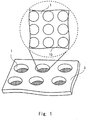
- Fig. 1 is a diagram showing an example of a culture chamber according to an embodiment.
- Fig. 1 shows a part of a culture plate 3 including a plurality of culture chambers 1.
- Fig. 1 shows a part of a culture plate 3 including a plurality of culture chambers 1.
- the upper part of Fig. 1 shows some of a plurality of recesses 10 which are formed in the bottom of each of the culture chambers 1, when viewed from the top of the culture plate 3.
- the plurality of recesses 10 are arranged in each of the culture chambers 1. In terms of the production of the culture chambers 1 and the efficiency of cell culture, it is preferable to arrange the plurality of recesses 10 in a regular manner.
- One culture chamber 1 corresponds to, for example, one well arranged in a plate including a plurality of wells. In other words, the plurality of recesses 10 are arranged in the respective wells of a well plate.
- a well plate is an experimental/testing instrument formed of a flat plate having a number of dents (holes or wells), and each well is used as a test tube or a petri dish.
- the number of wells is, for example, 6, 24, 96, 384, or more.
- Examples of the shape of the bottom of each well include a flat shape, a round shape, and a combination of a number of elongated microtubes (deep well plate).
- Each recess 10 forms a micro-space, which is a small space for culture of cells, and thus each recess can also be referred to as a microchamber.
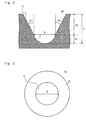
- Figs. 2 and 3 show an example of the shape of a recess according to a first embodiment.
- Fig. 2 shows a cross-sectional view of one recess 10
- Fig. 3 shows a top view of one recess 10.
- the recess 10 shown in Fig. 3 is an example of the detailed structure of each of the recesses 10 shown in the upper part of Fig. 1 .
- Each recess 10 is composed of a bottom portion 11 and an opening portion 12.
- the bottom portion 11 is a portion serving as the bottom of the culture chamber 1, and the opening portion 12 is a portion disposed above the bottom portion 11.
- a portion where the bottom portion 11 and the opening portion 12 are in contact is referred to as a boundary.
- a portion whose length is indicated by an arrow "R" corresponds to the location of the boundary.
- the boundary location is indicated by a double dashed chain line. Note that the bottom portion 11 and the opening portion 12 are formed of a continuous surface and are produced in an integrated manner.
- Figs. 2 and 3 show an equivalent diameter R and a depth (height) H of each of the plurality of recesses 10 formed in the culture chamber 1.
- equivalent diameter R refers to the diameter of a circle inscribed in the bottom portion 11 of each recess 10.
- the equivalent diameter R is the diameter of an inscribed circle that is inscribed at the boundary between the bottom portion 11 and the opening portion 12. More specifically, the equivalent diameter R is the diameter of a circle inscribed in a shape of a plane that is perpendicular to the direction of the height H of each recess 10 at the boundary.
- depth D refers to a length from the bottom on the inside of the bottom portion 11 to an upper end of each recess 10.
- the upper end of the recess 10 corresponds to an end (upper end) of the opening portion 12.
- the depth D corresponds to the depth of a space formed by the recess 10.
- the depth D is a depth from the bottom of a space, which is formed by the bottom portion 11, to an upper end of a space formed by the opening portion 12.
- Fig. 2 shows not only the depth D of the recess 10, but also a depth D1 of the bottom portion 11 and a depth D2 of the opening portion 12.
- the bottom portion 11 forms a space (first space) in which cells are cultured.
- the bottom portion 11 has, for example, a hemispherical shape.
- a shape obtained by dividing a spherical shape having the equivalent diameter R as a diameter into halves can be used.
- the shape of the bottom portion 11 is not limited to a hemispherical shape. Other specific examples of the shape will be described in a second embodiment.
- the opening portion 12 forms a space (second space) that operates to support culture and harvesting of cells.
- the opening portion 12 is formed of a wall which surrounds an area from a boundary between the opening portion 12 and the bottom portion 11 to an end (tip) of the recess 10 and which has a taper angle in a range from 1 degree to 20 degrees.
- the taper angle of the wall constituting the opening portion 12 is preferably in a range from 5 degrees to 15 degrees, and more preferably, 10 degrees. This is because if the taper angle is extremely small, it is difficult to transfer cells from the recesses into a medium during harvesting of the cells, and if the taper angle is extremely large, the cells are removed during replacement of the medium.
- Taper angles are represented by ⁇ 1 and ⁇ 2 in Fig. 2 .
- the taper angles ⁇ 1 and ⁇ 2 are substantially the same.
- the boundary between the bottom portion 11 and the opening portion 12 is formed in such a manner that the equivalent diameter R is in a range from 50 ⁇ m to 1 mm.
- the equivalent diameter is preferably in a range from 50 ⁇ m to 500 ⁇ m, and more preferably, in a range from 100 ⁇ m to 500 ⁇ m.
- the equivalent diameter R is preferably equal to or more than 400 ⁇ m and less than 2 mm. This is because, as mentioned above, nutrients can be transferred to a central portion of a spheroid with a size of 300 ⁇ m, so that necrosis does not occur. Accordingly, in order to obtain a spheroid having a diameter of 300 ⁇ m or more, it is necessary that the equivalent diameter be equal to or more than 400 ⁇ m.
- the depth D from the bottom of the bottom portion to the end of each of the recesses is set in a range from 0.6 or more times to 3 or less times the equivalent diameter R.
- the depth D is preferably in a range from 0.7 or more times to 1.2 or less times the equivalent diameter R, and more preferably, in a range from 0.8 to 1 times the equivalent diameter R.
- the area between two adjacent recesses 10 is preferably flat.
- the distance between two recesses 10 is preferably in a range from 5 ⁇ m to 50 ⁇ m. This is because it is preferable to increase the number of spheroids per unit area and culture the spheroids at a high density so that a large number of spheroids can be efficiently obtained.
- the area of the upper surface of the wall on which no spheroid is formed is preferably small as much as possible. In this case, however, when the taper angle is small and the wall is thin, cracking may easily occur due to a vibration during cell seeding or replacement of a medium.
- the distance between two recesses is preferably 5 ⁇ m or more. In view of this, the distance between two recesses is preferably in a range from 5 to 20 ⁇ m.
- the two adjacent recesses 10 may come into contact with each other.
- a part of an end of one of the two recesses 10 and a part of an end of the other one of the two recesses 10 may come into contact with each other, so that the inclined surfaces of the opening portions 12, each of which forms a taper angle, may come into contact with each other to form a chevron shape.
- the culture chamber 1 having the above-described shape is preferably produced in the following manner.
- Each culture chamber 1 is preferably a resin molding formed of one or a combination of two or more selected from the group consisting of acrylic resin, polylactic acid, polyglycolic acid, styrene resin, acrylic styrene copolymer resin, polycarbonate resin, polyester resin, polyvinyl alcohol resin, ethylene vinyl alcohol copolymer resin, thermoplastic elastomer, vinyl chloride resin, and silicon resin.
- a functional group is preferably formed on the recesses 10 of the culture chamber 1 by a surface modification treatment method of any one of plasma treatment, glass coating, corona discharge, and UV ozonation, or a combination thereof and the treatment is preferably performed so that the water contact angle becomes 45 degrees or less.
- a hydrophilic polymer chain that inhibits cell adhesion is preferably immobilized in the recesses 10. More preferably, the hydrophilic polymer chain is immobilized in the recesses 10 that are treated so that the above-mentioned water contact angle becomes 45 degrees or less.
- a phospholipid or a phospholipid-polymer complex is preferably immobilized in the recesses 10. More preferably, this immobilization treatment is performed on each recess 10 that is treated so that the above-mentioned water contact angle becomes 45 degrees or less, each recess 10 in which a hydrophilic polymer chain is immobilized, or a combination of these recesses 10.
- each of the recesses 10 preferably has a cell non-adhesive surface on which at least one polymer of a hydrophilic polymer chain that inhibits cell adhesion, and a phospholipid, or a phospholipid-polymer complex is immobilized after a functional group is formed in the recesses by a surface modification treatment method of any one of plasma treatment, glass coating, corona discharge, and UV ozonation, or a combination thereof and the treatment is performed so that the water contact angle becomes 45 degrees or less. More preferably, this treatment is carried out together with one or a combination of the above-mentioned treatments.
- the above-mentioned hydrophilic polymer chain is preferably poly(hydroxyethyl methacrylate). More preferably, the average molecular weight of poly(hydroxyethyl methacrylate) is 100,000 or more.
- the cell culture is performed by the following steps:
- the above-mentioned steps can be classified into two steps, i.e., the step of culturing cells (cell culture step) and the step of recovering cells (cell harvesting step).
- the cell culture step includes the steps a) to d), and the cell harvesting step includes the steps e) and f).
- centroid refers to a three-dimensional cell cluster including a number of aggregated cells.
- This step is a step of preparing for culture of cells.
- the total number of cells as described below are dispersed in a medium and are added to each culture chamber 1.
- a lower limit of the total number of cells is equal to or greater than the number (n) of recesses 10 present in the culture chamber 1.
- An upper limit of the total number of cells is equal to or less than a number obtained by multiplying the number (n) of recesses by a value obtained by dividing the volume (V) of each of the recesses 10 of the culture chamber 1 by the volume (v) of cells to be seeded.
- the upper limit of the total number of cells can be represented by the following formula using symbols: V/v ⁇ n. This is based on the premise that the volumes (V) of the plurality of recesses 10 are the same. If the volumes (V) of the plurality of recesses 10 are different, an average value is used.
- the medium is adjusted depending on the cells to be cultured.
- the cells are cultured for 12 hours or more in each culture chamber 1 to thereby allow the cells to form a spheroid.
- the medium is added to each culture chamber 1, the cells dispersed in the medium are loaded into the recesses 10 and the cells are cultured in the respective recesses 10. It is preferable to load one cell into each recess 10, and it is preferable to form one spheroid in the space formed by the bottom portion 11.
- a cell proliferates at the bottom portion 11 of the recess 10. If at least one cell is not present in each recess during culture and seeding, no spheroid is formed in the recess 10, because any cell does not move from the adjacent recess 10 to the said recess 10 during culture.
- each recess 10 In order to culture spheroids at a high density, it is preferable to form a spheroid in each recess 10. Accordingly, it is preferable to form at least one cell in each recess 10. In terms of the production efficiency, it is preferable to reduce the initial number of cells as much as possible and to recover as many spheroids as possible, and therefore it is preferable that the number of cells present in each recess 10 be small as much as possible. For this reason, it is preferable that one cell be present in each recess 10.
- each spheroid be allowed to grow to a size limited by the space formed by the bottom portion 11 of each recess 10 and then the medium be replaced with differentiation induction medium to thereby differentiate each spheroid.
- the cells cultured in each recess 11 are suspended in the medium by agitating the medium in each culture chamber 1.
- this step is carried out by agitating the medium.
- the agitation of the medium can be done by any one of the following means: (1) agitation of the medium by shaking each culture chamber 1; (2) agitation of the medium by sucking and discharging the medium (pipetting); (3) agitation of the medium by disposing a stirring blade in each culture chamber 1; (4) agitation of the medium by placing a stirrer in each culture chamber 1; and (5) agitation of the medium by a combination of two or more of the above-mentioned means (1) to (4).
- Step of recovering the cells is carried out by agitating the medium.
- the medium including the cells in each culture chamber 1 is sucked by a suction machine, to thereby recover the cells (spheroids) suspended in the medium.
- seeding of cells, replacement of a medium, and harvesting of cells can be performed in the same chamber, and in addition, spheroids can be recovered from each culture chamber.
- each recess 10 including the bottom portion 11 and the opening portion 12 makes it possible to easily maintain a state in which cells adhering to the bottom portion 11 or being suspended in the medium are prevented from being removed when the medium is sucked during replacement of the medium. Thus, it can be expected that the removal of cells from the bottom portion 11 is suppressed.
- the use of the hemispherical shape of the bottom portion 11 contributes to the formation of spheroids with a uniform shape and size.
- the bottom portion 11 may have the form of a part of a spherical shape, a truncated cone shape, or a linear shape.
- the linear shape of the bottom portion is a form having no substantial bottom portion and having a recess formed only by an opening portion.
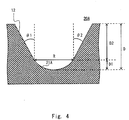
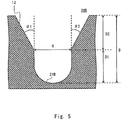
- Figs. 4 to 7 show examples of the shape of each recess according to this embodiment.
- Figs. 4 to 7 show recesses 20A to 20D having bottom portions 21A to 21D, respectively, which are different from the bottom portion 11 of the first embodiment. Since the opening portion 12 can be formed with the same shape as that of the first embodiment, Figs. 4 to 7 show examples of the shape of each recess in which the opening portions having the same shape are combined.
- a hemispherical shape which is a shape obtained by dividing a spherical shape into halves
- Figs. 4 and 5 show examples in which different hemispherical shapes are used for the bottom portion.
- Fig. 4 shows the bottom portion 21A for which a portion less than a half of a spherical shape is used.
- Fig. 4 shows a case where a part of a hemispherical shape is used for the bottom portion 21A.
- Fig. 5 shows the bottom portion 21B having a cylindrical shape with a hemispherical bottom. In the case of the shape of the bottom portion 21B shown in Fig.
- the cells are less likely to be suspended into the medium from the bottom portion 21B during harvesting of the cells. Accordingly, it is preferable to adjust the length of the cylindrical portion. For example, it is preferable to form the bottom portion 21B and the opening portion 12 so as to maintain the same ratio (1:1) between the depth (height) of the bottom portion 21B and the depth (height) of the opening portion 12.
- Fig. 6 shows the bottom portion 21C for which a truncated cone shape is used.
- the bottom portion is flat, the reflection and interference of light can be reduced, and thus it is useful for observation with a microscope.
- Fig. 7 shows an example of the shape of the recess 20D in which the bottom portion 21D has a linear shape, i.e., the bottom portion 21D does not form a space.
- the efficiency of culture and harvesting of cells in the recess 20D is lower than that of culture chambers having other shapes.
- the recess 20D has an advantage in facilitating the production process for the culture chambers.
- the method of culturing cells using the culture chambers according to this embodiment is similar to that of the first embodiment, and thus the description thereof is omitted.
- the culture chambers according to this embodiment can provide the same advantageous effects as those of the first embodiment.
- a mode in which the shape of the opening portion 12 is a circular shape or a substantially circular shape has been described in the above embodiments.
- a culture chamber including opening portions each having a shape other than a circular shape or a substantially circular shape will be described.
- An end of each opening portion may have a shape other than a circular shape or a substantially circular shape, such as a hemispherical shape, a trapezoidal shape, or an inverted triangular shape.
- FIGS. 8 and 9 show recesses 30A and 30B, respectively, each having an end with a shape different from that of the opening portion 12 of the first embodiment. While Figs. 8 and 9 show the same bottom portion 11 as that of the first embodiment, a combination of any of the bottom portions 21A to 21D of the second embodiment, or a bottom portion having another shape may be used.
- the bottom portion and the opening portion may have any shape as long as an inclined surface can be formed continuously at the boundary between the bottom portion and the opening portion.
- Fig. 8 shows an example of the shape of an end of the opening portion 32A that is formed in a curve.
- Fig. 8 is a top view of the recess 30A.
- An end of the bottom portion 11 is indicated by a circle having the equivalent diameter R, and the outer periphery of the opening portion 32A is indicated by a curve.
- the end of the opening portion 32A has a curved shape which is not symmetric in the horizontal direction and the vertical direction. However, the end of the opening portion 32A may have a shape which is symmetric in the horizontal direction or the vertical direction.
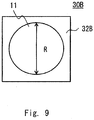
- Fig. 9 shows an example in which an end of the opening portion 32B has a rectangular shape.
- FIG. 9 shows an example in which an end of the opening portion has a square shape, the end of the opening portion may have another polygonal shape, or a combination of a curve and a straight line.
- Fig. 9 is a top view of the recess 30B.
- the end of the bottom portion 11 is indicated by a circle having the equivalent diameter R, and the outer periphery of the opening portion 32B is indicated by a solid square.
- the shape of the end of the bottom portion may be modified so as to adjust the area of the space between the end of the bottom portion and the adjacent recess. Since it is necessary for the shape of the end of the opening portion to play a role of promoting the suspension of cells, the taper angle is important.
- the taper angle has a value that varies depending on the shape of the opening portions 32A and 32B. This is because the inclination of the inclined surface that forms the wall varies depending on the shape of the opening portions 32A and 32B.
- Each of the shapes of the opening portions illustrated in this embodiment can be combined with the shape of the bottom portion 11 described in the first embodiment, or the shape of the bottom portion described in the second embodiment.
- these shapes can also be combined with a shape other than the shapes of the bottom portion illustrated in the above embodiments, as a matter of course.
- the method of culturing cells using the culture chambers according to this embodiment is similar to that of the first embodiment, and thus the description thereof is omitted.
- the culture chambers according to this embodiment can provide the same advantageous effects as those of the first embodiment.
- Fig. 1 illustrates a mode in which the culture chambers 1 according to one embodiment are arranged in the culture plate 3 (well plate).
- the culture chambers 1 according to one embodiment can also be formed in a chamber (instrument) other than the culture plate 3 shown in Fig. 1 .
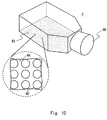
- Figs. 10 to 12 show examples of the structure of a culture chamber according to a fourth embodiment.
- Fig. 10 is a schematic view showing an example of the structure in which a flask-shaped culture flask is used.
- Fig. 11 is a schematic view showing an example of the structure in which a frame of a culture plate is used.
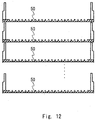
- Fig. 12 is a schematic view showing an example of the structure in which the culture plate shown in Fig. 11 is designed in a stack shape and used.
- a bottom surface of a culture flask 4 is used as a culture surface 4A (culture bottom surface).
- the culture surface 4A corresponds to each culture chamber 1 shown in Fig. 1 . Accordingly, the culture surface 4A can also be referred to as a culture chamber. Like each culture chamber 1 shown in Fig. 1 , the culture surface 4A is a unit for using the same medium.
- the culture flask 4 includes a cap 4B.
- the area of the culture surface 4A can be designed depending on the intended use. Examples of the size of a typical culture flask include 25, 75, and 225 cm 2 .
- a plurality of recesses 40 are formed in the culture surface 4A of the culture flask 4.
- each recess 40 (the shape of each of the bottom portion and the opening portion) may be any one of the shapes illustrated in the above embodiments.
- Fig. 11 shows an example in which only the frame of a culture plate is used.
- the culture chambers 1 (wells) are formed in the culture plate 3
- a bottom surface of a culture plate 5 is used as a culture surface 5A (culture bottom surface).
- the culture surface 5A corresponds to each culture chamber 1 shown in Fig. 1 . Accordingly, the culture surface 5A can also be referred to as a culture chamber.
- the culture surface 5A is a unit for using the same medium.
- the lower part of Fig. 11 shows an example (schematic cross-sectional view) of the structure of the culture surface 5A.
- each recess 50 may be any one of the shapes illustrated in the above embodiments.
- Fig. 12 shows a structural example of a cell stack form in which a plurality of culture plates 5 shown in Fig. 11 are stacked.
- Fig. 12 shows an example of a multi-stage structure. In a case where cells are cultured in a closed system with a larger area, the cell stack form is generally used. While Fig. 12 illustrates an example in which the culture plates 5 shown in Fig. 11 are stacked, the culture plates 3 shown in Fig. 1 may be stacked.
- the illustration of a chamber that accommodates the plurality of stacked culture chambers and provides a mechanism for replacement of a medium is omitted.
- a culture chamber having a typical stack shape can be used as the chamber that accommodates the plurality of culture plates. The explanation thereof is herein omitted.
- the boundary between the bottom portion and the opening portion is defined to be parallel to the bottom of each culture chamber.
- the boundary may be inclined with respect to the bottom, or may be formed in a curve. It is only necessary that a sufficient space to form a spheroid can be formed in the bottom portion 11.
- Example Comparative Example Chamber A culture place in which patterns of shapes shown in Figs. 1 to 3 are arranged in a culture bottom surface was prepared.
- EZ-Sphere® manufactured by ASAHI GLASS CO., LTD.
- Bottom shape of microchamber hemispherical shape spherical shape The number of micro-spaces/wells 600 578 Taper angle 10 degrees There is no portion at which a taper angle is formed.
- Depth 400 ⁇ m (0.8 R) 150-200 ⁇ m
- Surface p-HEMA a product with a surface on which a cell non-adhesion treatment is performed Shape of chamber 24-well plate 24-well plate
- a culture plate in which wells (culture chambers 1) each including the recesses 10 shown in Figs. 1 to 3 are formed was prepared.
- microchambers respectively correspond to the recesses 10 shown in Figs. 1 to 3 and each of micro-spaces is a space formed by each recess 10 (micro-space). It can be said that the number of micro-spaces per well is the number of recesses per well.
- endodermal cells labeled with fluorescence of GFP were used.
- the endodermal cells, vascular endothelial cells, and human mesenchymal stem cells were mixed at a ratio of 10:5-10:2, and the cells were cultured for 30 days in an endothelial cell medium kit-2: EGM-2 BulletKit (product code CC-3162: Lonza). The medium was replaced once every two days.
- a pipette manufactured by the manufacturer, model number
- the suspended spheroids were recovered.
- a pipette capable of sucking 1 mL of medium at maximum is suitably used for a 24-well plate that contains 500 ⁇ L to 1 mL of medium.
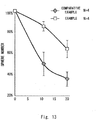
- Fig. 13 shows the survival rate of spheroids during replacement of the medium.
- the vertical axis represents the survival rate of spheroids (Sphere Number) and the horizontal axis represents the number of days of culture.
- Fig. 13 shows data obtained from the start of culture to the 20th day of culture.
- the survival rate of spheroids in the comparative example significantly decreased in comparison to that in the example.
- the survival rate of spheroids in the example was 60% or more. This indicates that the survival rate of spheroid in the example was improved 1.5 times as high as that in the comparative example.
- Fig. 14 shows the images of spheroids obtained before and after replacement of the medium in the example and the comparative example.
- Fig. 14 shows the images of spheroids in the culture chamber before and after the second replacement of the medium on the fourth day of culture.
- the left side of Fig. 14 shows a photograph of the example (Kuraray p-HEMA), and the right side of Fig. 14 shows a photograph of the comparative example (Iwaki MPC).
- the upper part of the figure shows images taken before replacement of the medium, and the lower part (below an arrow) of Fig. 14 shows images taken after replacement of the medium. More specifically, the images in the lower part of Fig. 14 show the state after replacement of the medium was performed twice, i.e., half of the medium was replaced (replacement of half of the medium), from the state before replacement of the medium.
- white dots correspond to spheroids.
- spheroids are confirmed over the entire area. After replacement of the medium, in the example, there is no large difference in the number of spheroids before and after replacement of the medium and almost all the spheroids survived, whereas in the comparative example, only about a half of the spheroids were survived.
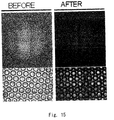
- Fig. 15 shows images taken before and after the harvesting of cells in the example.
- the left side (BEFORE) in Fig. 15 shows the image of cells taken before the harvesting of cells
- the right side (AFTER) in Fig. 15 shows the image of cells taken after the harvesting of cells.
- the upper part of Fig. 15 shows the image of the entire culture chamber
- the lower part of Fig. 15 shows the enlarged image of a part of the culture chamber.
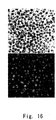
- Fig. 16 shows photographs of the spheroids recovered from the culture chamber according to the example.
- Dot-like portions in each black circular microchamber correspond to spheroids. No dot-like portions are found in the image taken after the harvesting of cells, which indicates that almost 100% of the cells can be recovered. Further, as shown in Fig. 16 , the recovered cells have an excellent spheroid shape, and each spheroid was not destroyed by the harvesting operation.
Landscapes
- Health & Medical Sciences (AREA)
- Chemical & Material Sciences (AREA)
- Organic Chemistry (AREA)
- Wood Science & Technology (AREA)
- Life Sciences & Earth Sciences (AREA)
- Engineering & Computer Science (AREA)
- Bioinformatics & Cheminformatics (AREA)
- Zoology (AREA)
- Biomedical Technology (AREA)
- Genetics & Genomics (AREA)
- Microbiology (AREA)
- Biotechnology (AREA)
- Biochemistry (AREA)
- General Engineering & Computer Science (AREA)
- General Health & Medical Sciences (AREA)
- Sustainable Development (AREA)
- Clinical Laboratory Science (AREA)
- Apparatus Associated With Microorganisms And Enzymes (AREA)
- Micro-Organisms Or Cultivation Processes Thereof (AREA)
- Chemical Kinetics & Catalysis (AREA)
- Medicinal Chemistry (AREA)
- Polymers & Plastics (AREA)
Claims (17)
- Chambre de culture comprenant une pluralité d'évidements formés chacun d'une partie inférieure et d'une partie d'ouverture,
la partie inférieure ayant une forme hémisphérique, une forme tronconique, une forme formée en utilisant une partie d'une forme sphérique, ou une forme linéaire,
la partie d'ouverture étant définie par une paroi qui entoure une zone allant d'une limite entre la partie d'ouverture et la partie inférieure à une extrémité de chacun des évidements, la paroi ayant un angle de conicité compris entre 1 et 20 degrés, un diamètre équivalent de la limite étant dans une plage comprise entre 50 µm et 1 mm et une profondeur allant d'un fond de la partie inférieure à l'extrémité de chacun des évidements étant dans une plage comprise entre 0,6 fois ou plus et 3 fois ou moins le diamètre équivalent, et
la paroi définissant la partie d'ouverture formant une surface continue jusqu'à la partie inférieure, et une inclinaison de la surface continue changeant au niveau de la limite. - Chambre de culture selon la revendication 1, l'extrémité de chacun des évidements ayant une forme hémisphérique, une forme trapézoïdale et une forme triangulaire inversée.
- Chambre de culture selon la revendication 1 ou 2, une zone entre deux évidements adjacents étant plate et une distance entre les deux évidements étant dans une plage comprise entre 5 µm et 50 µm.
- Chambre de culture selon l'une quelconque des revendications 1 à 3, la chambre de culture étant un moulage de résine formé d'un composant ou d'une combinaison de deux composants ou plus choisis dans le groupe constitué par une résine acrylique, l'acide polylactique, l'acide polyglycolique, une résine de styrène, une résine de copolymère de styrène acrylique, une résine de polycarbonate, une résine de polyester, une résine d'alcool polyvinylique, une résine de copolymère d'éthylène alcool vinylique, un élastomère thermoplastique, une résine de chlorure de vinyle et une résine de silicone.
- Chambre de culture selon l'une quelconque des revendications 1 à 4, un groupe fonctionnel étant formé sur les évidements par un procédé de traitement de modification de surface selon un traitement au plasma, un revêtement du verre, une décharge corona ou une ozonation UV, ou une combinaison de ceux-ci, et le traitement étant effectué de sorte que l'angle de contact avec l'eau devienne 45 degrés ou moins.
- Chambre de culture selon l'une quelconque des revendications 1 à 5, une chaîne polymère hydrophile qui inhibe l'adhérence des cellules étant immobilisée dans les évidements.
- Chambre de culture selon l'une quelconque des revendications 1 à 6, un phospholipide ou un complexe phospholipide-polymère étant immobilisé dans les évidements.
- Chambre de culture selon l'une quelconque des revendications 1 à 7, chacun des évidements ayant une surface non adhésive pour les cellules sur laquelle au moins un polymère d'une chaîne polymère hydrophile qui inhibe l'adhérence des cellules, et un phospholipide, ou un complexe phospholipide-polymère est immobilisé après qu'un groupe fonctionnel est formé dans les évidements par un procédé de traitement de modification de surface selon un traitement au plasma, un revêtement du verre, une décharge corona ou une ozonation UV, ou une combinaison de ceux-ci, et le traitement étant effectué de sorte que l'angle de contact avec l'eau devienne 45 degrés ou moins.
- Chambre de culture selon la revendication 8, la chaîne polymère hydrophile étant du poly(méthacrylate d'hydroxyéthyle).
- Chambre de culture selon la revendication 9, le poids moléculaire moyen du poly(méthacrylate d'hydroxyéthyle) étant de 100 000 ou plus.
- Procédé de culture qui utilise la chambre de culture selon l'une quelconque des revendications 1 à 10, le procédé de culture comprenant les étapes consistant à :disperser les cellules dans un milieu, le nombre total de cellules étant égal ou supérieur à un nombre N des évidements de la chambre de culture et égal ou inférieur à un nombre obtenu en multipliant le nombre N d'évidements par une valeur obtenue en divisant un volume V1 d'un espace défini par chacun des évidements par un volume V2 de cellules à ensemencer ; etajouter le milieu dans la chambre de culture.
- Procédé de culture selon la revendication 11, un sphéroïde étant formé dans un espace défini par chacun des évidements.
- Procédé de culture selon la revendication 12, un sphéroïde étant formé dans l'espace et le sphéroïde étant libre de se développer.
- Procédé de culture selon la revendication 12 ou 13, un sphéroïde étant formé dans l'espace et étant différencié et induit.
- Procédé de culture selon l'une quelconque des revendications 11 à 14, les cellules dans les évidements étant récupérées par agitation du milieu.
- Procédé de culture selon la revendication 15, l'agitation du milieu étant effectuée par l'un quelconque des moyens suivants : agitation du milieu par agitation de la chambre de culture ; agitation du milieu par aspiration et évacuation du milieu ; agitation du milieu par disposition d'une pale d'agitation dans la chambre de culture ; et agitation du milieu par placement d'un agitateur dans la chambre de culture, ou une combinaison de ceux-ci.
- Procédé de culture selon l'une quelconque des revendications 11 à 16, le milieu étant remplacé au moins une fois et 20 % ou plus du milieu étant remplacé.
Applications Claiming Priority (2)
| Application Number | Priority Date | Filing Date | Title |
|---|---|---|---|
| JP2013120915 | 2013-06-07 | ||
| PCT/JP2014/002993 WO2014196204A1 (fr) | 2013-06-07 | 2014-06-05 | Flacon à culture et procédé de culture |
Publications (3)
| Publication Number | Publication Date |
|---|---|
| EP3006553A1 EP3006553A1 (fr) | 2016-04-13 |
| EP3006553A4 EP3006553A4 (fr) | 2017-01-04 |
| EP3006553B1 true EP3006553B1 (fr) | 2020-09-02 |
Family
ID=52007861
Family Applications (1)
| Application Number | Title | Priority Date | Filing Date |
|---|---|---|---|
| EP14808113.6A Active EP3006553B1 (fr) | 2013-06-07 | 2014-06-05 | Flacon à culture et procédé de culture |
Country Status (11)
| Country | Link |
|---|---|
| US (4) | US10494593B2 (fr) |
| EP (1) | EP3006553B1 (fr) |
| JP (3) | JPWO2014196204A1 (fr) |
| KR (1) | KR102359408B1 (fr) |
| CN (1) | CN105308170B (fr) |
| AU (2) | AU2014276229B2 (fr) |
| BR (1) | BR112015030041B1 (fr) |
| CA (1) | CA2914463C (fr) |
| SG (1) | SG11201509870QA (fr) |
| WO (1) | WO2014196204A1 (fr) |
| ZA (1) | ZA201509018B (fr) |
Families Citing this family (45)
| Publication number | Priority date | Publication date | Assignee | Title |
|---|---|---|---|---|
| US9790465B2 (en) | 2013-04-30 | 2017-10-17 | Corning Incorporated | Spheroid cell culture well article and methods thereof |
| JP6379529B2 (ja) * | 2014-03-07 | 2018-08-29 | 大日本印刷株式会社 | 細胞培養容器 |
| SG11201609916RA (en) * | 2014-05-30 | 2016-12-29 | Kuraray Co | Culture method and cell mass |
| WO2016069895A1 (fr) | 2014-10-29 | 2016-05-06 | Corning Incorporated | Insert de culture cellulaire |
| EP3212760A1 (fr) * | 2014-10-29 | 2017-09-06 | Corning Incorporated | Plateforme de bioréacteurs de perfusion |
| JP2017532971A (ja) | 2014-10-29 | 2017-11-09 | コーニング インコーポレイテッド | 細胞培養集合体を生成するためのマイクロウェル設計および製造 |
| EP3081633A1 (fr) * | 2015-04-16 | 2016-10-19 | ARKRAY, Inc. | Dispositif et système de culture cellulaire |
| JP6822769B2 (ja) * | 2016-02-29 | 2021-01-27 | 米満 吉和 | 規則的に配置された同一サイズのスフェロイド及びその利用 |
| EP3511700B1 (fr) * | 2016-09-06 | 2023-10-04 | Keio University | Procédé de mesure de l'effet protecteur uv ou infrarouge d'une composition aqueuse et dispositif de préparation d'un échantillon de mesure |
| JP2020043764A (ja) * | 2016-12-28 | 2020-03-26 | Agcテクノグラス株式会社 | 細胞培養基材及びその製造方法 |
| JP2018174824A (ja) * | 2017-04-14 | 2018-11-15 | 株式会社クラレ | マイクロパターンの表面を濡らす方法 |
| KR101949856B1 (ko) * | 2017-06-28 | 2019-02-20 | 한국과학기술원 | 웰 플레이트, 이의 제조방법, 및 이를 이용하여 세포를 배양하는 방법 |
| WO2019014635A1 (fr) | 2017-07-14 | 2019-01-17 | Corning Incorporated | Récipients de culture cellulaire 3d pour échange de milieu manuel ou automatique |
| PL3652292T3 (pl) * | 2017-07-14 | 2025-09-01 | Corning Incorporated | Naczynie do hodowli komórkowej 3d i sposoby hodowli komórkowej 3d |
| US11857970B2 (en) | 2017-07-14 | 2024-01-02 | Corning Incorporated | Cell culture vessel |
| PL3652291T3 (pl) | 2017-07-14 | 2022-03-28 | Corning Incorporated | Naczynie do hodowli komórkowej |
| EP3971281A1 (fr) * | 2017-07-22 | 2022-03-23 | Toyo Seikan Group Holdings, Ltd. | Structure stratifiée et procédé de fabrication d'une structure stratifiée |
| KR101965900B1 (ko) * | 2017-11-03 | 2019-04-05 | 한국화학연구원 | 스페로이드 형성 및 카운팅 기기 및 이의 제조 방법, 그리고 이를 이용한 스페로이드 배양 방법 및 계수 방법 |
| CN111542592A (zh) * | 2017-11-08 | 2020-08-14 | 株式会社Ihi | 细胞培养装置用连接单元、培养箱装置以及细胞培养装置 |
| JPWO2019151114A1 (ja) | 2018-02-01 | 2021-01-28 | Agc株式会社 | 細胞培養容器 |
| US20190382701A1 (en) * | 2018-06-18 | 2019-12-19 | SageMedic Corporation | System for Obtaining 3D Micro-Tissues |
| PL3649229T3 (pl) | 2018-07-13 | 2021-12-06 | Corning Incorporated | Naczynia do hodowli komórkowych ze stabilizującymi urządzeniami |
| EP3649227A1 (fr) | 2018-07-13 | 2020-05-13 | Corning Incorporated | Dispositifs fluidiques comprenant des microplaques avec des puits interconnectés |
| EP3649226B1 (fr) | 2018-07-13 | 2022-04-06 | Corning Incorporated | Boîtes de petri pourvues d'une paroi latérale comprenant une surface de distribution de milieu liquide |
| JP7271903B2 (ja) * | 2018-10-20 | 2023-05-12 | 東洋製罐グループホールディングス株式会社 | スフェア培養部材、培養容器、穴開き部材の加工方法、及び洗浄容器 |
| KR102237425B1 (ko) * | 2018-12-26 | 2021-04-08 | 주식회사 넥스트앤바이오 | 암을 가진 대상체의 항암제 및/또는 방사선 내성 진단에 필요한 정보를 제공하는 방법 |
| JP7019618B2 (ja) * | 2019-02-13 | 2022-02-15 | 古河電気工業株式会社 | 格納容器 |
| JP7692610B2 (ja) * | 2019-02-26 | 2025-06-16 | 国立大学法人東北大学 | iPS細胞を用いた骨芽細胞塊の作製法 |
| JP7607339B2 (ja) * | 2019-08-05 | 2024-12-27 | 株式会社北里コーポレーション | 細胞凍結前処理作業用プレート |
| JP7057878B2 (ja) * | 2019-10-25 | 2022-04-21 | 東洋製罐グループホールディングス株式会社 | 接着細胞培養用器材、培養容器、細胞の剥離方法、及び接着細胞培養用器材の製造方法 |
| CN114981401A (zh) * | 2020-02-19 | 2022-08-30 | 凸版印刷株式会社 | 细胞移植前处理方法、细胞移植前处理装置以及细胞移植前处理单元 |
| EP4153718A1 (fr) * | 2020-05-19 | 2023-03-29 | Kugelmeiers AG | Appareil de culture cellulaire |
| EP4253516A3 (fr) * | 2020-06-25 | 2023-12-06 | Next & Bio Inc. | Procédé pour la prolifération en masse de cellules souches sans utiliser d'hydrogel |
| JP7706481B2 (ja) * | 2020-06-25 | 2025-07-11 | ネクストアンドバイオ インコーポレイテッド | 標準型オルガノイドの作製方法 |
| WO2021261623A1 (fr) * | 2020-06-25 | 2021-12-30 | 주식회사 넥스트앤바이오 | Procédé de fabrication d'organoïdes cérébraux |
| JP7770320B2 (ja) * | 2020-07-27 | 2025-11-14 | 株式会社コーセー | 全分泌調節剤の評価及び/又は選択方法 |
| JP7591319B2 (ja) * | 2020-11-05 | 2024-11-28 | エスアンドイー、バイオ、カンパニー、リミテッド | 三次元スフェロイド型細胞凝集体に由来の細胞外小胞の製造方法 |
| CN113189317B (zh) * | 2021-04-29 | 2024-11-15 | 广东省人民医院 | 一套人工血管三维静态培养的实验装置及其使用方法 |
| KR102746470B1 (ko) | 2021-07-09 | 2024-12-26 | 주식회사 넥스트앤바이오 | 가상 오가노이드 생성 방법 |
| KR20230108960A (ko) * | 2022-01-12 | 2023-07-19 | 전남대학교산학협력단 | 내이 오가노이드 제조 방법 |
| JP2023114829A (ja) * | 2022-02-07 | 2023-08-18 | Agc株式会社 | 細胞培養容器の基材、及び細胞培養容器 |
| JPWO2023176949A1 (fr) * | 2022-03-17 | 2023-09-21 | ||
| CN115141752A (zh) * | 2022-06-28 | 2022-10-04 | 上海划创科技发展有限公司 | 细胞培养与原位检测容器及制备方法、细胞原位检测方法 |
| GB2628007A (en) * | 2023-03-10 | 2024-09-11 | Cn Bio Innovations Ltd | Adjustable bottom platform for cell seeding into an open bottom well |
| KR102788314B1 (ko) * | 2023-11-30 | 2025-03-31 | 서울대학교산학협력단 | 세포 배양 용기 |
Family Cites Families (19)
| Publication number | Priority date | Publication date | Assignee | Title |
|---|---|---|---|---|
| EP0101749A1 (fr) | 1982-08-26 | 1984-03-07 | Westerwald AG für Silikatindustrie | Paroi composée de blocs de verre |
| JP3270286B2 (ja) | 1994-09-16 | 2002-04-02 | 住友ベークライト株式会社 | 細胞培養容器とその製造方法、及び細胞培養方法 |
| JP2001509272A (ja) * | 1997-01-17 | 2001-07-10 | コーニング インコーポレイテッド | マルチウェルプレート |
| EP1944584B1 (fr) * | 2001-05-24 | 2017-03-29 | Hitachi, Ltd. | Dispositif de mesure de flux de type résistance de chauffage |
| GB0200721D0 (en) * | 2002-01-14 | 2002-02-27 | Univ Bristol | Toxicity test |
| JP2005027598A (ja) | 2003-07-09 | 2005-02-03 | Kitakyushu Foundation For The Advancement Of Industry Science & Technology | 細胞培養チップ及び培養器、それらを用いた細胞培養方法、球状細胞組織体を担持させた細胞担持モジュール、球状細胞組織体 |
| NL2000159C2 (nl) * | 2006-07-24 | 2008-01-25 | Stork Pmt | Inrichting, werkwijze en productielijn voor het conditioneren van geslacht pluimvee. |
| US20080227664A1 (en) * | 2007-03-16 | 2008-09-18 | Canon Kabushiki Kaisha | Cell array structural body and cell array |
| JPWO2008130025A1 (ja) * | 2007-04-18 | 2010-07-22 | 公立大学法人横浜市立大学 | 肝細胞培養容器及び肝細胞培養方法 |
| WO2009003487A2 (fr) * | 2007-06-29 | 2009-01-08 | Unisense Fertilitech A/S | Dispositif, système et procédé de surveillance et/ou de culture d'objets microscopiques |
| US8533234B2 (en) * | 2008-10-07 | 2013-09-10 | Aspect Software, Inc. | Custom data display |
| JP5578779B2 (ja) | 2008-10-08 | 2014-08-27 | 国立大学法人東北大学 | スフェロイド培養方法及びスフェロイド培養容器 |
| JP4724854B2 (ja) * | 2009-02-09 | 2011-07-13 | 大日本印刷株式会社 | 細胞培養容器 |
| US8278511B2 (en) * | 2009-07-16 | 2012-10-02 | Monsanto Technology Llc | Soybean variety A1016184 |
| EP2522716B1 (fr) * | 2010-01-08 | 2019-08-28 | Sumitomo Bakelite Company Limited | Flacon à culture pour formation d'une masse cellulaire agrégée |
| SG188505A1 (en) | 2010-09-14 | 2013-05-31 | Asahi Glass Co Ltd | Culture substrate |
| JP2012157267A (ja) * | 2011-01-31 | 2012-08-23 | Hitachi Maxell Ltd | 微細パターンを有するプレート部材 |
| JP2012210166A (ja) * | 2011-03-30 | 2012-11-01 | Sumitomo Bakelite Co Ltd | 胚様体形成用培養容器 |
| US10655107B2 (en) | 2011-09-20 | 2020-05-19 | Corning Incorporated | Adherent cell culture method |
-
2014
- 2014-06-05 JP JP2015521306A patent/JPWO2014196204A1/ja active Pending
- 2014-06-05 CN CN201480032635.8A patent/CN105308170B/zh active Active
- 2014-06-05 AU AU2014276229A patent/AU2014276229B2/en active Active
- 2014-06-05 KR KR1020167000067A patent/KR102359408B1/ko active Active
- 2014-06-05 CA CA2914463A patent/CA2914463C/fr active Active
- 2014-06-05 EP EP14808113.6A patent/EP3006553B1/fr active Active
- 2014-06-05 BR BR112015030041-3A patent/BR112015030041B1/pt active IP Right Grant
- 2014-06-05 US US14/896,251 patent/US10494593B2/en active Active
- 2014-06-05 WO PCT/JP2014/002993 patent/WO2014196204A1/fr not_active Ceased
- 2014-06-05 SG SG11201509870QA patent/SG11201509870QA/en unknown
-
2015
- 2015-12-10 ZA ZA2015/09018A patent/ZA201509018B/en unknown
-
2019
- 2019-09-17 JP JP2019168253A patent/JP6892486B2/ja active Active
- 2019-10-30 US US16/668,701 patent/US11473046B2/en active Active
-
2020
- 2020-02-20 AU AU2020201221A patent/AU2020201221B2/en active Active
-
2021
- 2021-05-27 JP JP2021088960A patent/JP7219303B2/ja active Active
-
2022
- 2022-09-30 US US17/957,743 patent/US11866682B1/en active Active
-
2023
- 2023-11-28 US US18/521,821 patent/US12344824B2/en active Active
Non-Patent Citations (1)
| Title |
|---|
| None * |
Also Published As
| Publication number | Publication date |
|---|---|
| JP7219303B2 (ja) | 2023-02-07 |
| KR20160017036A (ko) | 2016-02-15 |
| US11473046B2 (en) | 2022-10-18 |
| WO2014196204A1 (fr) | 2014-12-11 |
| JP6892486B2 (ja) | 2021-06-23 |
| US20240093134A1 (en) | 2024-03-21 |
| US20200063080A1 (en) | 2020-02-27 |
| US11866682B1 (en) | 2024-01-09 |
| US10494593B2 (en) | 2019-12-03 |
| BR112015030041A2 (pt) | 2017-07-25 |
| CN105308170A (zh) | 2016-02-03 |
| US12344824B2 (en) | 2025-07-01 |
| ZA201509018B (en) | 2024-07-31 |
| CA2914463A1 (fr) | 2014-12-11 |
| US20160137962A1 (en) | 2016-05-19 |
| JP2021129590A (ja) | 2021-09-09 |
| BR112015030041B1 (pt) | 2021-01-12 |
| JP2020000255A (ja) | 2020-01-09 |
| AU2020201221A1 (en) | 2020-03-12 |
| KR102359408B1 (ko) | 2022-02-07 |
| SG11201509870QA (en) | 2016-02-26 |
| AU2014276229A1 (en) | 2016-01-21 |
| EP3006553A4 (fr) | 2017-01-04 |
| CN105308170B (zh) | 2018-04-10 |
| JPWO2014196204A1 (ja) | 2017-02-23 |
| CA2914463C (fr) | 2023-01-03 |
| EP3006553A1 (fr) | 2016-04-13 |
| AU2020201221B2 (en) | 2021-12-23 |
| AU2014276229B2 (en) | 2019-11-21 |
Similar Documents
| Publication | Publication Date | Title |
|---|---|---|
| US12344824B2 (en) | Culture chamber and culture method | |
| US8415157B2 (en) | Cell culture container and cell culture method | |
| KR102428530B1 (ko) | 세포 확장을 위한 3차원 생물 반응기 및 관련 적용 | |
| Bruzewicz et al. | Fabrication of a modular tissue construct in a microfluidic chip | |
| CN103814125B (zh) | 粘附性细胞的培养方法 | |
| KR102072156B1 (ko) | 3차원 세포배양을 위한 삽입형 배양용기, 키트 및 이를 이용한 3차원 세포 공배양방법 | |
| JPWO2008130025A1 (ja) | 肝細胞培養容器及び肝細胞培養方法 | |
| EP3652292B1 (fr) | Récipient de culture cellulaire pour une culture 3d et procédés de culture de cellules 3d | |
| CN110616185A (zh) | 一种多细胞肿瘤球及其高通量制备方法 | |
| EP4289932A1 (fr) | Culture cellulaire à l'aide de chambres amovibles à chargement par le dessus dans des plaques de culture cellulaire | |
| US20250129317A1 (en) | Bioreactor for production of organoids |
Legal Events
| Date | Code | Title | Description |
|---|---|---|---|
| PUAI | Public reference made under article 153(3) epc to a published international application that has entered the european phase |
Free format text: ORIGINAL CODE: 0009012 |
|
| 17P | Request for examination filed |
Effective date: 20151223 |
|
| AK | Designated contracting states |
Kind code of ref document: A1 Designated state(s): AL AT BE BG CH CY CZ DE DK EE ES FI FR GB GR HR HU IE IS IT LI LT LU LV MC MK MT NL NO PL PT RO RS SE SI SK SM TR |
|
| AX | Request for extension of the european patent |
Extension state: BA ME |
|
| DAX | Request for extension of the european patent (deleted) | ||
| A4 | Supplementary search report drawn up and despatched |
Effective date: 20161202 |
|
| RIC1 | Information provided on ipc code assigned before grant |
Ipc: C12M 3/00 20060101AFI20161128BHEP Ipc: C12N 5/071 20100101ALI20161128BHEP |
|
| STAA | Information on the status of an ep patent application or granted ep patent |
Free format text: STATUS: EXAMINATION IS IN PROGRESS |
|
| 17Q | First examination report despatched |
Effective date: 20190121 |
|
| GRAP | Despatch of communication of intention to grant a patent |
Free format text: ORIGINAL CODE: EPIDOSNIGR1 |
|
| STAA | Information on the status of an ep patent application or granted ep patent |
Free format text: STATUS: GRANT OF PATENT IS INTENDED |
|
| RAP1 | Party data changed (applicant data changed or rights of an application transferred) |
Owner name: CORNING INCORPORATED Owner name: PUBLIC UNIVERSITY CORPORATION YOKOHAMA CITY UNIVERSITY |
|
| INTG | Intention to grant announced |
Effective date: 20200318 |
|
| GRAS | Grant fee paid |
Free format text: ORIGINAL CODE: EPIDOSNIGR3 |
|
| GRAA | (expected) grant |
Free format text: ORIGINAL CODE: 0009210 |
|
| STAA | Information on the status of an ep patent application or granted ep patent |
Free format text: STATUS: THE PATENT HAS BEEN GRANTED |
|
| AK | Designated contracting states |
Kind code of ref document: B1 Designated state(s): AL AT BE BG CH CY CZ DE DK EE ES FI FR GB GR HR HU IE IS IT LI LT LU LV MC MK MT NL NO PL PT RO RS SE SI SK SM TR |
|
| REG | Reference to a national code |
Ref country code: GB Ref legal event code: FG4D |
|
| REG | Reference to a national code |
Ref country code: AT Ref legal event code: REF Ref document number: 1308824 Country of ref document: AT Kind code of ref document: T Effective date: 20200915 Ref country code: CH Ref legal event code: EP |
|
| REG | Reference to a national code |
Ref country code: DE Ref legal event code: R096 Ref document number: 602014069761 Country of ref document: DE |
|
| REG | Reference to a national code |
Ref country code: IE Ref legal event code: FG4D |
|
| REG | Reference to a national code |
Ref country code: LT Ref legal event code: MG4D |
|
| PG25 | Lapsed in a contracting state [announced via postgrant information from national office to epo] |
Ref country code: NO Free format text: LAPSE BECAUSE OF FAILURE TO SUBMIT A TRANSLATION OF THE DESCRIPTION OR TO PAY THE FEE WITHIN THE PRESCRIBED TIME-LIMIT Effective date: 20201202 Ref country code: GR Free format text: LAPSE BECAUSE OF FAILURE TO SUBMIT A TRANSLATION OF THE DESCRIPTION OR TO PAY THE FEE WITHIN THE PRESCRIBED TIME-LIMIT Effective date: 20201203 Ref country code: FI Free format text: LAPSE BECAUSE OF FAILURE TO SUBMIT A TRANSLATION OF THE DESCRIPTION OR TO PAY THE FEE WITHIN THE PRESCRIBED TIME-LIMIT Effective date: 20200902 Ref country code: LT Free format text: LAPSE BECAUSE OF FAILURE TO SUBMIT A TRANSLATION OF THE DESCRIPTION OR TO PAY THE FEE WITHIN THE PRESCRIBED TIME-LIMIT Effective date: 20200902 Ref country code: HR Free format text: LAPSE BECAUSE OF FAILURE TO SUBMIT A TRANSLATION OF THE DESCRIPTION OR TO PAY THE FEE WITHIN THE PRESCRIBED TIME-LIMIT Effective date: 20200902 Ref country code: SE Free format text: LAPSE BECAUSE OF FAILURE TO SUBMIT A TRANSLATION OF THE DESCRIPTION OR TO PAY THE FEE WITHIN THE PRESCRIBED TIME-LIMIT Effective date: 20200902 Ref country code: BG Free format text: LAPSE BECAUSE OF FAILURE TO SUBMIT A TRANSLATION OF THE DESCRIPTION OR TO PAY THE FEE WITHIN THE PRESCRIBED TIME-LIMIT Effective date: 20201202 |
|
| REG | Reference to a national code |
Ref country code: NL Ref legal event code: MP Effective date: 20200902 |
|
| REG | Reference to a national code |
Ref country code: AT Ref legal event code: MK05 Ref document number: 1308824 Country of ref document: AT Kind code of ref document: T Effective date: 20200902 |
|
| PG25 | Lapsed in a contracting state [announced via postgrant information from national office to epo] |
Ref country code: LV Free format text: LAPSE BECAUSE OF FAILURE TO SUBMIT A TRANSLATION OF THE DESCRIPTION OR TO PAY THE FEE WITHIN THE PRESCRIBED TIME-LIMIT Effective date: 20200902 Ref country code: RS Free format text: LAPSE BECAUSE OF FAILURE TO SUBMIT A TRANSLATION OF THE DESCRIPTION OR TO PAY THE FEE WITHIN THE PRESCRIBED TIME-LIMIT Effective date: 20200902 |
|
| PG25 | Lapsed in a contracting state [announced via postgrant information from national office to epo] |
Ref country code: SM Free format text: LAPSE BECAUSE OF FAILURE TO SUBMIT A TRANSLATION OF THE DESCRIPTION OR TO PAY THE FEE WITHIN THE PRESCRIBED TIME-LIMIT Effective date: 20200902 Ref country code: RO Free format text: LAPSE BECAUSE OF FAILURE TO SUBMIT A TRANSLATION OF THE DESCRIPTION OR TO PAY THE FEE WITHIN THE PRESCRIBED TIME-LIMIT Effective date: 20200902 Ref country code: EE Free format text: LAPSE BECAUSE OF FAILURE TO SUBMIT A TRANSLATION OF THE DESCRIPTION OR TO PAY THE FEE WITHIN THE PRESCRIBED TIME-LIMIT Effective date: 20200902 Ref country code: PT Free format text: LAPSE BECAUSE OF FAILURE TO SUBMIT A TRANSLATION OF THE DESCRIPTION OR TO PAY THE FEE WITHIN THE PRESCRIBED TIME-LIMIT Effective date: 20210104 Ref country code: NL Free format text: LAPSE BECAUSE OF FAILURE TO SUBMIT A TRANSLATION OF THE DESCRIPTION OR TO PAY THE FEE WITHIN THE PRESCRIBED TIME-LIMIT Effective date: 20200902 Ref country code: CZ Free format text: LAPSE BECAUSE OF FAILURE TO SUBMIT A TRANSLATION OF THE DESCRIPTION OR TO PAY THE FEE WITHIN THE PRESCRIBED TIME-LIMIT Effective date: 20200902 |
|
| PG25 | Lapsed in a contracting state [announced via postgrant information from national office to epo] |
Ref country code: AT Free format text: LAPSE BECAUSE OF FAILURE TO SUBMIT A TRANSLATION OF THE DESCRIPTION OR TO PAY THE FEE WITHIN THE PRESCRIBED TIME-LIMIT Effective date: 20200902 Ref country code: AL Free format text: LAPSE BECAUSE OF FAILURE TO SUBMIT A TRANSLATION OF THE DESCRIPTION OR TO PAY THE FEE WITHIN THE PRESCRIBED TIME-LIMIT Effective date: 20200902 Ref country code: ES Free format text: LAPSE BECAUSE OF FAILURE TO SUBMIT A TRANSLATION OF THE DESCRIPTION OR TO PAY THE FEE WITHIN THE PRESCRIBED TIME-LIMIT Effective date: 20200902 Ref country code: IS Free format text: LAPSE BECAUSE OF FAILURE TO SUBMIT A TRANSLATION OF THE DESCRIPTION OR TO PAY THE FEE WITHIN THE PRESCRIBED TIME-LIMIT Effective date: 20210102 |
|
| REG | Reference to a national code |
Ref country code: DE Ref legal event code: R097 Ref document number: 602014069761 Country of ref document: DE |
|
| PG25 | Lapsed in a contracting state [announced via postgrant information from national office to epo] |
Ref country code: SK Free format text: LAPSE BECAUSE OF FAILURE TO SUBMIT A TRANSLATION OF THE DESCRIPTION OR TO PAY THE FEE WITHIN THE PRESCRIBED TIME-LIMIT Effective date: 20200902 |
|
| PLBE | No opposition filed within time limit |
Free format text: ORIGINAL CODE: 0009261 |
|
| STAA | Information on the status of an ep patent application or granted ep patent |
Free format text: STATUS: NO OPPOSITION FILED WITHIN TIME LIMIT |
|
| 26N | No opposition filed |
Effective date: 20210603 |
|
| PG25 | Lapsed in a contracting state [announced via postgrant information from national office to epo] |
Ref country code: DK Free format text: LAPSE BECAUSE OF FAILURE TO SUBMIT A TRANSLATION OF THE DESCRIPTION OR TO PAY THE FEE WITHIN THE PRESCRIBED TIME-LIMIT Effective date: 20200902 Ref country code: SI Free format text: LAPSE BECAUSE OF FAILURE TO SUBMIT A TRANSLATION OF THE DESCRIPTION OR TO PAY THE FEE WITHIN THE PRESCRIBED TIME-LIMIT Effective date: 20200902 |
|
| PG25 | Lapsed in a contracting state [announced via postgrant information from national office to epo] |
Ref country code: IT Free format text: LAPSE BECAUSE OF FAILURE TO SUBMIT A TRANSLATION OF THE DESCRIPTION OR TO PAY THE FEE WITHIN THE PRESCRIBED TIME-LIMIT Effective date: 20200902 |
|
| PG25 | Lapsed in a contracting state [announced via postgrant information from national office to epo] |
Ref country code: MC Free format text: LAPSE BECAUSE OF FAILURE TO SUBMIT A TRANSLATION OF THE DESCRIPTION OR TO PAY THE FEE WITHIN THE PRESCRIBED TIME-LIMIT Effective date: 20200902 |
|
| REG | Reference to a national code |
Ref country code: CH Ref legal event code: PL |
|
| REG | Reference to a national code |
Ref country code: BE Ref legal event code: MM Effective date: 20210630 |
|
| PG25 | Lapsed in a contracting state [announced via postgrant information from national office to epo] |
Ref country code: LU Free format text: LAPSE BECAUSE OF NON-PAYMENT OF DUE FEES Effective date: 20210605 |
|
| PG25 | Lapsed in a contracting state [announced via postgrant information from national office to epo] |
Ref country code: LI Free format text: LAPSE BECAUSE OF NON-PAYMENT OF DUE FEES Effective date: 20210630 Ref country code: IE Free format text: LAPSE BECAUSE OF NON-PAYMENT OF DUE FEES Effective date: 20210605 Ref country code: CH Free format text: LAPSE BECAUSE OF NON-PAYMENT OF DUE FEES Effective date: 20210630 |
|
| PG25 | Lapsed in a contracting state [announced via postgrant information from national office to epo] |
Ref country code: BE Free format text: LAPSE BECAUSE OF NON-PAYMENT OF DUE FEES Effective date: 20210630 |
|
| PG25 | Lapsed in a contracting state [announced via postgrant information from national office to epo] |
Ref country code: HU Free format text: LAPSE BECAUSE OF FAILURE TO SUBMIT A TRANSLATION OF THE DESCRIPTION OR TO PAY THE FEE WITHIN THE PRESCRIBED TIME-LIMIT; INVALID AB INITIO Effective date: 20140605 |
|
| PG25 | Lapsed in a contracting state [announced via postgrant information from national office to epo] |
Ref country code: CY Free format text: LAPSE BECAUSE OF FAILURE TO SUBMIT A TRANSLATION OF THE DESCRIPTION OR TO PAY THE FEE WITHIN THE PRESCRIBED TIME-LIMIT Effective date: 20200902 |
|
| PG25 | Lapsed in a contracting state [announced via postgrant information from national office to epo] |
Ref country code: MK Free format text: LAPSE BECAUSE OF FAILURE TO SUBMIT A TRANSLATION OF THE DESCRIPTION OR TO PAY THE FEE WITHIN THE PRESCRIBED TIME-LIMIT Effective date: 20200902 |
|
| PG25 | Lapsed in a contracting state [announced via postgrant information from national office to epo] |
Ref country code: MT Free format text: LAPSE BECAUSE OF FAILURE TO SUBMIT A TRANSLATION OF THE DESCRIPTION OR TO PAY THE FEE WITHIN THE PRESCRIBED TIME-LIMIT Effective date: 20200902 |
|
| PGFP | Annual fee paid to national office [announced via postgrant information from national office to epo] |
Ref country code: PL Payment date: 20250326 Year of fee payment: 12 |
|
| PGFP | Annual fee paid to national office [announced via postgrant information from national office to epo] |
Ref country code: DE Payment date: 20250509 Year of fee payment: 12 |
|
| PGFP | Annual fee paid to national office [announced via postgrant information from national office to epo] |
Ref country code: GB Payment date: 20250508 Year of fee payment: 12 |
|
| PGFP | Annual fee paid to national office [announced via postgrant information from national office to epo] |
Ref country code: FR Payment date: 20250512 Year of fee payment: 12 |
|
| PG25 | Lapsed in a contracting state [announced via postgrant information from national office to epo] |
Ref country code: TR Free format text: LAPSE BECAUSE OF FAILURE TO SUBMIT A TRANSLATION OF THE DESCRIPTION OR TO PAY THE FEE WITHIN THE PRESCRIBED TIME-LIMIT Effective date: 20200902 |