EP3002289B1 - Modified nucleotides for polynucleotide sequencing - Google Patents
Modified nucleotides for polynucleotide sequencing Download PDFInfo
- Publication number
- EP3002289B1 EP3002289B1 EP15184520.3A EP15184520A EP3002289B1 EP 3002289 B1 EP3002289 B1 EP 3002289B1 EP 15184520 A EP15184520 A EP 15184520A EP 3002289 B1 EP3002289 B1 EP 3002289B1
- Authority
- EP
- European Patent Office
- Prior art keywords
- nucleotide
- nucleotides
- mmol
- group
- label
- Prior art date
- Legal status (The legal status is an assumption and is not a legal conclusion. Google has not performed a legal analysis and makes no representation as to the accuracy of the status listed.)
- Revoked
Links
- 125000003729 nucleotide group Chemical group 0.000 title claims description 193
- 239000002157 polynucleotide Substances 0.000 title claims description 56
- 108091033319 polynucleotide Proteins 0.000 title claims description 55
- 102000040430 polynucleotide Human genes 0.000 title claims description 55
- 238000012163 sequencing technique Methods 0.000 title description 25
- 239000002773 nucleotide Substances 0.000 claims description 175
- 238000000034 method Methods 0.000 claims description 50
- 230000000903 blocking effect Effects 0.000 claims description 48
- 238000010348 incorporation Methods 0.000 claims description 38
- XLYOFNOQVPJJNP-UHFFFAOYSA-N water Substances O XLYOFNOQVPJJNP-UHFFFAOYSA-N 0.000 claims description 27
- 238000001514 detection method Methods 0.000 claims description 24
- 229910001868 water Inorganic materials 0.000 claims description 24
- -1 amino, hydroxyl Chemical group 0.000 claims description 21
- 239000001226 triphosphate Substances 0.000 claims description 20
- UNXRWKVEANCORM-UHFFFAOYSA-N triphosphoric acid Chemical compound OP(O)(=O)OP(O)(=O)OP(O)(O)=O UNXRWKVEANCORM-UHFFFAOYSA-N 0.000 claims description 20
- 235000011178 triphosphate Nutrition 0.000 claims description 18
- 230000000295 complement effect Effects 0.000 claims description 17
- XYFCBTPGUUZFHI-UHFFFAOYSA-N Phosphine Chemical compound P XYFCBTPGUUZFHI-UHFFFAOYSA-N 0.000 claims description 16
- KDCGOANMDULRCW-UHFFFAOYSA-N Purine Natural products N1=CNC2=NC=NC2=C1 KDCGOANMDULRCW-UHFFFAOYSA-N 0.000 claims description 12
- 239000000126 substance Substances 0.000 claims description 10
- CZPWVGJYEJSRLH-UHFFFAOYSA-N Pyrimidine Chemical compound C1=CN=CN=C1 CZPWVGJYEJSRLH-UHFFFAOYSA-N 0.000 claims description 8
- 229910000073 phosphorus hydride Inorganic materials 0.000 claims description 8
- ASJSAQIRZKANQN-CRCLSJGQSA-N 2-deoxy-D-ribose Chemical compound OC[C@@H](O)[C@@H](O)CC=O ASJSAQIRZKANQN-CRCLSJGQSA-N 0.000 claims description 7
- 241001495444 Thermococcus sp. Species 0.000 claims description 5
- IGFXRKMLLMBKSA-UHFFFAOYSA-N purine Chemical compound N1=C[N]C2=NC=NC2=C1 IGFXRKMLLMBKSA-UHFFFAOYSA-N 0.000 claims description 5
- 108020004635 Complementary DNA Proteins 0.000 claims description 4
- 238000012544 monitoring process Methods 0.000 claims description 4
- 150000001540 azides Chemical class 0.000 claims description 3
- 125000003178 carboxy group Chemical group [H]OC(*)=O 0.000 claims 1
- 125000001273 sulfonato group Chemical group [O-]S(*)(=O)=O 0.000 claims 1
- XEKOWRVHYACXOJ-UHFFFAOYSA-N Ethyl acetate Chemical compound CCOC(C)=O XEKOWRVHYACXOJ-UHFFFAOYSA-N 0.000 description 110
- OKKJLVBELUTLKV-UHFFFAOYSA-N Methanol Chemical compound OC OKKJLVBELUTLKV-UHFFFAOYSA-N 0.000 description 73
- 125000005647 linker group Chemical group 0.000 description 71
- 239000000243 solution Substances 0.000 description 69
- IAZDPXIOMUYVGZ-UHFFFAOYSA-N Dimethylsulphoxide Chemical compound CS(C)=O IAZDPXIOMUYVGZ-UHFFFAOYSA-N 0.000 description 56
- 235000019439 ethyl acetate Nutrition 0.000 description 53
- VYPSYNLAJGMNEJ-UHFFFAOYSA-N Silicium dioxide Chemical compound O=[Si]=O VYPSYNLAJGMNEJ-UHFFFAOYSA-N 0.000 description 44
- YMWUJEATGCHHMB-UHFFFAOYSA-N Dichloromethane Chemical compound ClCCl YMWUJEATGCHHMB-UHFFFAOYSA-N 0.000 description 42
- 239000000203 mixture Substances 0.000 description 40
- AFQIYTIJXGTIEY-UHFFFAOYSA-N hydrogen carbonate;triethylazanium Chemical compound OC(O)=O.CCN(CC)CC AFQIYTIJXGTIEY-UHFFFAOYSA-N 0.000 description 39
- 150000003833 nucleoside derivatives Chemical class 0.000 description 37
- 238000005160 1H NMR spectroscopy Methods 0.000 description 35
- 239000000872 buffer Substances 0.000 description 35
- 238000006243 chemical reaction Methods 0.000 description 35
- 239000002777 nucleoside Substances 0.000 description 32
- 125000002496 methyl group Chemical group [H]C([H])([H])* 0.000 description 27
- 239000000047 product Substances 0.000 description 26
- WYURNTSHIVDZCO-UHFFFAOYSA-N Tetrahydrofuran Chemical compound C1CCOC1 WYURNTSHIVDZCO-UHFFFAOYSA-N 0.000 description 22
- 239000007787 solid Substances 0.000 description 21
- RTZKZFJDLAIYFH-UHFFFAOYSA-N Diethyl ether Chemical compound CCOCC RTZKZFJDLAIYFH-UHFFFAOYSA-N 0.000 description 20
- UIIMBOGNXHQVGW-UHFFFAOYSA-M Sodium bicarbonate Chemical compound [Na+].OC([O-])=O UIIMBOGNXHQVGW-UHFFFAOYSA-M 0.000 description 20
- 239000011541 reaction mixture Substances 0.000 description 20
- 238000003776 cleavage reaction Methods 0.000 description 19
- 230000002829 reductive effect Effects 0.000 description 19
- 230000007017 scission Effects 0.000 description 19
- 108020004414 DNA Proteins 0.000 description 18
- 150000001875 compounds Chemical class 0.000 description 18
- QTBSBXVTEAMEQO-UHFFFAOYSA-N Acetic acid Chemical compound CC(O)=O QTBSBXVTEAMEQO-UHFFFAOYSA-N 0.000 description 16
- WFDIJRYMOXRFFG-UHFFFAOYSA-N Acetic anhydride Chemical compound CC(=O)OC(C)=O WFDIJRYMOXRFFG-UHFFFAOYSA-N 0.000 description 16
- WEVYAHXRMPXWCK-UHFFFAOYSA-N Acetonitrile Chemical compound CC#N WEVYAHXRMPXWCK-UHFFFAOYSA-N 0.000 description 16
- LFQSCWFLJHTTHZ-UHFFFAOYSA-N Ethanol Chemical compound CCO LFQSCWFLJHTTHZ-UHFFFAOYSA-N 0.000 description 16
- 239000002904 solvent Substances 0.000 description 16
- 102000004190 Enzymes Human genes 0.000 description 15
- 108090000790 Enzymes Proteins 0.000 description 15
- 125000002887 hydroxy group Chemical group [H]O* 0.000 description 15
- 125000000999 tert-butyl group Chemical group [H]C([H])([H])C(*)(C([H])([H])[H])C([H])([H])[H] 0.000 description 15
- 239000011324 bead Substances 0.000 description 14
- 125000004005 formimidoyl group Chemical group [H]\N=C(/[H])* 0.000 description 14
- 238000004128 high performance liquid chromatography Methods 0.000 description 14
- 239000000377 silicon dioxide Substances 0.000 description 14
- 238000003491 array Methods 0.000 description 13
- 238000004587 chromatography analysis Methods 0.000 description 13
- 239000003039 volatile agent Substances 0.000 description 13
- JUJWROOIHBZHMG-UHFFFAOYSA-N Pyridine Chemical compound C1=CC=NC=C1 JUJWROOIHBZHMG-UHFFFAOYSA-N 0.000 description 12
- 239000007858 starting material Substances 0.000 description 12
- ZMANZCXQSJIPKH-UHFFFAOYSA-N Triethylamine Chemical compound CCN(CC)CC ZMANZCXQSJIPKH-UHFFFAOYSA-N 0.000 description 11
- 150000007523 nucleic acids Chemical class 0.000 description 11
- 239000013615 primer Substances 0.000 description 11
- YLQBMQCUIZJEEH-UHFFFAOYSA-N tetrahydrofuran Natural products C=1C=COC=1 YLQBMQCUIZJEEH-UHFFFAOYSA-N 0.000 description 11
- 125000003903 2-propenyl group Chemical group [H]C([*])([H])C([H])=C([H])[H] 0.000 description 10
- PXIPVTKHYLBLMZ-UHFFFAOYSA-N Sodium azide Chemical compound [Na+].[N-]=[N+]=[N-] PXIPVTKHYLBLMZ-UHFFFAOYSA-N 0.000 description 10
- FAPWRFPIFSIZLT-UHFFFAOYSA-M Sodium chloride Chemical compound [Na+].[Cl-] FAPWRFPIFSIZLT-UHFFFAOYSA-M 0.000 description 10
- HGCIXCUEYOPUTN-UHFFFAOYSA-N cyclohexene Chemical compound C1CCC=CC1 HGCIXCUEYOPUTN-UHFFFAOYSA-N 0.000 description 10
- 102000039446 nucleic acids Human genes 0.000 description 10
- 108020004707 nucleic acids Proteins 0.000 description 10
- 239000003208 petroleum Substances 0.000 description 10
- 125000006239 protecting group Chemical group 0.000 description 10
- 238000000746 purification Methods 0.000 description 10
- 108091034117 Oligonucleotide Proteins 0.000 description 9
- 239000002253 acid Substances 0.000 description 9
- 125000000217 alkyl group Chemical group 0.000 description 9
- 230000015572 biosynthetic process Effects 0.000 description 9
- 238000010511 deprotection reaction Methods 0.000 description 9
- 229910000030 sodium bicarbonate Inorganic materials 0.000 description 9
- 238000003786 synthesis reaction Methods 0.000 description 9
- 238000004679 31P NMR spectroscopy Methods 0.000 description 8
- 229920005654 Sephadex Polymers 0.000 description 8
- 239000012507 Sephadex™ Substances 0.000 description 8
- 239000006260 foam Substances 0.000 description 8
- 239000010410 layer Substances 0.000 description 8
- 239000012044 organic layer Substances 0.000 description 8
- 150000003003 phosphines Chemical class 0.000 description 8
- XHXFXVLFKHQFAL-UHFFFAOYSA-N phosphoryl trichloride Chemical compound ClP(Cl)(Cl)=O XHXFXVLFKHQFAL-UHFFFAOYSA-N 0.000 description 8
- QGZKDVFQNNGYKY-UHFFFAOYSA-N Ammonia Chemical compound N QGZKDVFQNNGYKY-UHFFFAOYSA-N 0.000 description 7
- 238000001712 DNA sequencing Methods 0.000 description 7
- 238000003818 flash chromatography Methods 0.000 description 7
- 239000000499 gel Substances 0.000 description 7
- 239000003446 ligand Substances 0.000 description 7
- JGFZNNIVVJXRND-UHFFFAOYSA-N N,N-Diisopropylethylamine (DIPEA) Chemical compound CCN(C(C)C)C(C)C JGFZNNIVVJXRND-UHFFFAOYSA-N 0.000 description 6
- SJRJJKPEHAURKC-UHFFFAOYSA-N N-Methylmorpholine Chemical compound CN1CCOCC1 SJRJJKPEHAURKC-UHFFFAOYSA-N 0.000 description 6
- OPTASPLRGRRNAP-UHFFFAOYSA-N cytosine Chemical compound NC=1C=CNC(=O)N=1 OPTASPLRGRRNAP-UHFFFAOYSA-N 0.000 description 6
- 239000000975 dye Substances 0.000 description 6
- RAXXELZNTBOGNW-UHFFFAOYSA-N imidazole Natural products C1=CNC=N1 RAXXELZNTBOGNW-UHFFFAOYSA-N 0.000 description 6
- 239000000543 intermediate Substances 0.000 description 6
- VLKZOEOYAKHREP-UHFFFAOYSA-N n-Hexane Chemical compound CCCCCC VLKZOEOYAKHREP-UHFFFAOYSA-N 0.000 description 6
- 239000003921 oil Substances 0.000 description 6
- 229920001467 poly(styrenesulfonates) Polymers 0.000 description 6
- 125000002924 primary amino group Chemical group [H]N([H])* 0.000 description 6
- UMJSCPRVCHMLSP-UHFFFAOYSA-N pyridine Natural products COC1=CC=CN=C1 UMJSCPRVCHMLSP-UHFFFAOYSA-N 0.000 description 6
- 239000000741 silica gel Substances 0.000 description 6
- 229910002027 silica gel Inorganic materials 0.000 description 6
- YBBRCQOCSYXUOC-UHFFFAOYSA-N sulfuryl dichloride Chemical compound ClS(Cl)(=O)=O YBBRCQOCSYXUOC-UHFFFAOYSA-N 0.000 description 6
- IMFACGCPASFAPR-UHFFFAOYSA-N tributylamine Chemical compound CCCCN(CCCC)CCCC IMFACGCPASFAPR-UHFFFAOYSA-N 0.000 description 6
- 108091032973 (ribonucleotides)n+m Proteins 0.000 description 5
- 229910019142 PO4 Inorganic materials 0.000 description 5
- 239000007984 Tris EDTA buffer Substances 0.000 description 5
- 150000007513 acids Chemical class 0.000 description 5
- 125000004432 carbon atom Chemical group C* 0.000 description 5
- IJOOHPMOJXWVHK-UHFFFAOYSA-N chlorotrimethylsilane Chemical compound C[Si](C)(C)Cl IJOOHPMOJXWVHK-UHFFFAOYSA-N 0.000 description 5
- 150000002148 esters Chemical group 0.000 description 5
- 125000000524 functional group Chemical group 0.000 description 5
- 239000000463 material Substances 0.000 description 5
- 239000002808 molecular sieve Substances 0.000 description 5
- 239000012299 nitrogen atmosphere Substances 0.000 description 5
- 239000010452 phosphate Substances 0.000 description 5
- 238000002360 preparation method Methods 0.000 description 5
- URGAHOPLAPQHLN-UHFFFAOYSA-N sodium aluminosilicate Chemical compound [Na+].[Al+3].[O-][Si]([O-])=O.[O-][Si]([O-])=O URGAHOPLAPQHLN-UHFFFAOYSA-N 0.000 description 5
- 239000011780 sodium chloride Substances 0.000 description 5
- 238000003756 stirring Methods 0.000 description 5
- 239000000725 suspension Substances 0.000 description 5
- FPGGTKZVZWFYPV-UHFFFAOYSA-M tetrabutylammonium fluoride Chemical compound [F-].CCCC[N+](CCCC)(CCCC)CCCC FPGGTKZVZWFYPV-UHFFFAOYSA-M 0.000 description 5
- QKNYBSVHEMOAJP-UHFFFAOYSA-N 2-amino-2-(hydroxymethyl)propane-1,3-diol;hydron;chloride Chemical compound Cl.OCC(N)(CO)CO QKNYBSVHEMOAJP-UHFFFAOYSA-N 0.000 description 4
- VHYFNPMBLIVWCW-UHFFFAOYSA-N 4-Dimethylaminopyridine Chemical compound CN(C)C1=CC=NC=C1 VHYFNPMBLIVWCW-UHFFFAOYSA-N 0.000 description 4
- 238000003820 Medium-pressure liquid chromatography Methods 0.000 description 4
- DBTDEFJAFBUGPP-UHFFFAOYSA-N Methanethial Chemical compound S=C DBTDEFJAFBUGPP-UHFFFAOYSA-N 0.000 description 4
- 0 OC(CC1N(C=C(C(N2)=O)C#CCNC(C(F)(F)F)=O)C2=C*11)C1C=O Chemical compound OC(CC1N(C=C(C(N2)=O)C#CCNC(C(F)(F)F)=O)C2=C*11)C1C=O 0.000 description 4
- 229910019213 POCl3 Inorganic materials 0.000 description 4
- PYMYPHUHKUWMLA-LMVFSUKVSA-N Ribose Natural products OC[C@@H](O)[C@@H](O)[C@@H](O)C=O PYMYPHUHKUWMLA-LMVFSUKVSA-N 0.000 description 4
- ISAKRJDGNUQOIC-UHFFFAOYSA-N Uracil Chemical compound O=C1C=CNC(=O)N1 ISAKRJDGNUQOIC-UHFFFAOYSA-N 0.000 description 4
- HMFHBZSHGGEWLO-UHFFFAOYSA-N alpha-D-Furanose-Ribose Natural products OCC1OC(O)C(O)C1O HMFHBZSHGGEWLO-UHFFFAOYSA-N 0.000 description 4
- 238000003556 assay Methods 0.000 description 4
- 125000000852 azido group Chemical group *N=[N+]=[N-] 0.000 description 4
- 125000000753 cycloalkyl group Chemical group 0.000 description 4
- 239000001177 diphosphate Substances 0.000 description 4
- XPPKVPWEQAFLFU-UHFFFAOYSA-J diphosphate(4-) Chemical compound [O-]P([O-])(=O)OP([O-])([O-])=O XPPKVPWEQAFLFU-UHFFFAOYSA-J 0.000 description 4
- 235000011180 diphosphates Nutrition 0.000 description 4
- 238000003379 elimination reaction Methods 0.000 description 4
- 239000003480 eluent Substances 0.000 description 4
- 238000001704 evaporation Methods 0.000 description 4
- 230000008020 evaporation Effects 0.000 description 4
- 239000000284 extract Substances 0.000 description 4
- 238000000605 extraction Methods 0.000 description 4
- 238000004651 near-field scanning optical microscopy Methods 0.000 description 4
- 125000003835 nucleoside group Chemical group 0.000 description 4
- NBIIXXVUZAFLBC-UHFFFAOYSA-K phosphate Chemical compound [O-]P([O-])([O-])=O NBIIXXVUZAFLBC-UHFFFAOYSA-K 0.000 description 4
- 125000002467 phosphate group Chemical group [H]OP(=O)(O[H])O[*] 0.000 description 4
- WRMXOVHLRUVREB-UHFFFAOYSA-N phosphono phosphate;tributylazanium Chemical compound OP(O)(=O)OP([O-])([O-])=O.CCCC[NH+](CCCC)CCCC.CCCC[NH+](CCCC)CCCC WRMXOVHLRUVREB-UHFFFAOYSA-N 0.000 description 4
- 239000000843 powder Substances 0.000 description 4
- MHYGQXWCZAYSLJ-UHFFFAOYSA-N tert-butyl-chloro-diphenylsilane Chemical compound C=1C=CC=CC=1[Si](Cl)(C(C)(C)C)C1=CC=CC=C1 MHYGQXWCZAYSLJ-UHFFFAOYSA-N 0.000 description 4
- WVLBCYQITXONBZ-UHFFFAOYSA-N trimethyl phosphate Chemical compound COP(=O)(OC)OC WVLBCYQITXONBZ-UHFFFAOYSA-N 0.000 description 4
- NWUYHJFMYQTDRP-UHFFFAOYSA-N 1,2-bis(ethenyl)benzene;1-ethenyl-2-ethylbenzene;styrene Chemical compound C=CC1=CC=CC=C1.CCC1=CC=CC=C1C=C.C=CC1=CC=CC=C1C=C NWUYHJFMYQTDRP-UHFFFAOYSA-N 0.000 description 3
- GAUSMJHDHCSZOX-UHFFFAOYSA-N 2,2,2-trifluoro-n-prop-2-ynylacetamide Chemical compound FC(F)(F)C(=O)NCC#C GAUSMJHDHCSZOX-UHFFFAOYSA-N 0.000 description 3
- BFSVOASYOCHEOV-UHFFFAOYSA-N 2-diethylaminoethanol Chemical compound CCN(CC)CCO BFSVOASYOCHEOV-UHFFFAOYSA-N 0.000 description 3
- FPQQSJJWHUJYPU-UHFFFAOYSA-N 3-(dimethylamino)propyliminomethylidene-ethylazanium;chloride Chemical compound Cl.CCN=C=NCCCN(C)C FPQQSJJWHUJYPU-UHFFFAOYSA-N 0.000 description 3
- BVKZGUZCCUSVTD-UHFFFAOYSA-M Bicarbonate Chemical compound OC([O-])=O BVKZGUZCCUSVTD-UHFFFAOYSA-M 0.000 description 3
- HMFHBZSHGGEWLO-SOOFDHNKSA-N D-ribofuranose Chemical compound OC[C@H]1OC(O)[C@H](O)[C@@H]1O HMFHBZSHGGEWLO-SOOFDHNKSA-N 0.000 description 3
- 230000006820 DNA synthesis Effects 0.000 description 3
- BWGNESOTFCXPMA-UHFFFAOYSA-N Dihydrogen disulfide Chemical compound SS BWGNESOTFCXPMA-UHFFFAOYSA-N 0.000 description 3
- KDLHZDBZIXYQEI-UHFFFAOYSA-N Palladium Chemical compound [Pd] KDLHZDBZIXYQEI-UHFFFAOYSA-N 0.000 description 3
- NFHFRUOZVGFOOS-UHFFFAOYSA-N Pd(PPh3)4 Substances [Pd].C1=CC=CC=C1P(C=1C=CC=CC=1)C1=CC=CC=C1.C1=CC=CC=C1P(C=1C=CC=CC=1)C1=CC=CC=C1.C1=CC=CC=C1P(C=1C=CC=CC=1)C1=CC=CC=C1.C1=CC=CC=C1P(C=1C=CC=CC=1)C1=CC=CC=C1 NFHFRUOZVGFOOS-UHFFFAOYSA-N 0.000 description 3
- 229910006024 SO2Cl2 Inorganic materials 0.000 description 3
- 108010090804 Streptavidin Proteins 0.000 description 3
- NINIDFKCEFEMDL-UHFFFAOYSA-N Sulfur Chemical compound [S] NINIDFKCEFEMDL-UHFFFAOYSA-N 0.000 description 3
- PZBFGYYEXUXCOF-UHFFFAOYSA-N TCEP Chemical group OC(=O)CCP(CCC(O)=O)CCC(O)=O PZBFGYYEXUXCOF-UHFFFAOYSA-N 0.000 description 3
- YXFVVABEGXRONW-UHFFFAOYSA-N Toluene Chemical compound CC1=CC=CC=C1 YXFVVABEGXRONW-UHFFFAOYSA-N 0.000 description 3
- JLCPHMBAVCMARE-UHFFFAOYSA-N [3-[[3-[[3-[[3-[[3-[[3-[[3-[[3-[[3-[[3-[[3-[[5-(2-amino-6-oxo-1H-purin-9-yl)-3-[[3-[[3-[[3-[[3-[[3-[[5-(2-amino-6-oxo-1H-purin-9-yl)-3-[[5-(2-amino-6-oxo-1H-purin-9-yl)-3-hydroxyoxolan-2-yl]methoxy-hydroxyphosphoryl]oxyoxolan-2-yl]methoxy-hydroxyphosphoryl]oxy-5-(5-methyl-2,4-dioxopyrimidin-1-yl)oxolan-2-yl]methoxy-hydroxyphosphoryl]oxy-5-(6-aminopurin-9-yl)oxolan-2-yl]methoxy-hydroxyphosphoryl]oxy-5-(6-aminopurin-9-yl)oxolan-2-yl]methoxy-hydroxyphosphoryl]oxy-5-(6-aminopurin-9-yl)oxolan-2-yl]methoxy-hydroxyphosphoryl]oxy-5-(6-aminopurin-9-yl)oxolan-2-yl]methoxy-hydroxyphosphoryl]oxyoxolan-2-yl]methoxy-hydroxyphosphoryl]oxy-5-(5-methyl-2,4-dioxopyrimidin-1-yl)oxolan-2-yl]methoxy-hydroxyphosphoryl]oxy-5-(4-amino-2-oxopyrimidin-1-yl)oxolan-2-yl]methoxy-hydroxyphosphoryl]oxy-5-(5-methyl-2,4-dioxopyrimidin-1-yl)oxolan-2-yl]methoxy-hydroxyphosphoryl]oxy-5-(5-methyl-2,4-dioxopyrimidin-1-yl)oxolan-2-yl]methoxy-hydroxyphosphoryl]oxy-5-(6-aminopurin-9-yl)oxolan-2-yl]methoxy-hydroxyphosphoryl]oxy-5-(6-aminopurin-9-yl)oxolan-2-yl]methoxy-hydroxyphosphoryl]oxy-5-(4-amino-2-oxopyrimidin-1-yl)oxolan-2-yl]methoxy-hydroxyphosphoryl]oxy-5-(4-amino-2-oxopyrimidin-1-yl)oxolan-2-yl]methoxy-hydroxyphosphoryl]oxy-5-(4-amino-2-oxopyrimidin-1-yl)oxolan-2-yl]methoxy-hydroxyphosphoryl]oxy-5-(6-aminopurin-9-yl)oxolan-2-yl]methoxy-hydroxyphosphoryl]oxy-5-(4-amino-2-oxopyrimidin-1-yl)oxolan-2-yl]methyl [5-(6-aminopurin-9-yl)-2-(hydroxymethyl)oxolan-3-yl] hydrogen phosphate Polymers Cc1cn(C2CC(OP(O)(=O)OCC3OC(CC3OP(O)(=O)OCC3OC(CC3O)n3cnc4c3nc(N)[nH]c4=O)n3cnc4c3nc(N)[nH]c4=O)C(COP(O)(=O)OC3CC(OC3COP(O)(=O)OC3CC(OC3COP(O)(=O)OC3CC(OC3COP(O)(=O)OC3CC(OC3COP(O)(=O)OC3CC(OC3COP(O)(=O)OC3CC(OC3COP(O)(=O)OC3CC(OC3COP(O)(=O)OC3CC(OC3COP(O)(=O)OC3CC(OC3COP(O)(=O)OC3CC(OC3COP(O)(=O)OC3CC(OC3COP(O)(=O)OC3CC(OC3COP(O)(=O)OC3CC(OC3COP(O)(=O)OC3CC(OC3COP(O)(=O)OC3CC(OC3COP(O)(=O)OC3CC(OC3COP(O)(=O)OC3CC(OC3CO)n3cnc4c(N)ncnc34)n3ccc(N)nc3=O)n3cnc4c(N)ncnc34)n3ccc(N)nc3=O)n3ccc(N)nc3=O)n3ccc(N)nc3=O)n3cnc4c(N)ncnc34)n3cnc4c(N)ncnc34)n3cc(C)c(=O)[nH]c3=O)n3cc(C)c(=O)[nH]c3=O)n3ccc(N)nc3=O)n3cc(C)c(=O)[nH]c3=O)n3cnc4c3nc(N)[nH]c4=O)n3cnc4c(N)ncnc34)n3cnc4c(N)ncnc34)n3cnc4c(N)ncnc34)n3cnc4c(N)ncnc34)O2)c(=O)[nH]c1=O JLCPHMBAVCMARE-UHFFFAOYSA-N 0.000 description 3
- 150000001241 acetals Chemical group 0.000 description 3
- 230000004913 activation Effects 0.000 description 3
- 150000001412 amines Chemical class 0.000 description 3
- 229910021529 ammonia Inorganic materials 0.000 description 3
- PFYXSUNOLOJMDX-UHFFFAOYSA-N bis(2,5-dioxopyrrolidin-1-yl) carbonate Chemical compound O=C1CCC(=O)N1OC(=O)ON1C(=O)CCC1=O PFYXSUNOLOJMDX-UHFFFAOYSA-N 0.000 description 3
- 125000002915 carbonyl group Chemical group [*:2]C([*:1])=O 0.000 description 3
- 229940104302 cytosine Drugs 0.000 description 3
- 238000001035 drying Methods 0.000 description 3
- 230000000694 effects Effects 0.000 description 3
- 230000008030 elimination Effects 0.000 description 3
- 238000005516 engineering process Methods 0.000 description 3
- 239000011521 glass Substances 0.000 description 3
- UYTPUPDQBNUYGX-UHFFFAOYSA-N guanine Chemical compound O=C1NC(N)=NC2=C1N=CN2 UYTPUPDQBNUYGX-UHFFFAOYSA-N 0.000 description 3
- DMEGYFMYUHOHGS-UHFFFAOYSA-N heptamethylene Natural products C1CCCCCC1 DMEGYFMYUHOHGS-UHFFFAOYSA-N 0.000 description 3
- 239000001257 hydrogen Substances 0.000 description 3
- 229910052739 hydrogen Inorganic materials 0.000 description 3
- 230000003993 interaction Effects 0.000 description 3
- 239000003456 ion exchange resin Substances 0.000 description 3
- 229920003303 ion-exchange polymer Polymers 0.000 description 3
- 239000004005 microsphere Substances 0.000 description 3
- 238000012986 modification Methods 0.000 description 3
- 230000004048 modification Effects 0.000 description 3
- 230000003647 oxidation Effects 0.000 description 3
- 238000007254 oxidation reaction Methods 0.000 description 3
- 235000021317 phosphate Nutrition 0.000 description 3
- 238000006116 polymerization reaction Methods 0.000 description 3
- 150000003212 purines Chemical class 0.000 description 3
- 238000011160 research Methods 0.000 description 3
- 230000002441 reversible effect Effects 0.000 description 3
- 150000003839 salts Chemical class 0.000 description 3
- FVAUCKIRQBBSSJ-UHFFFAOYSA-M sodium iodide Chemical compound [Na+].[I-] FVAUCKIRQBBSSJ-UHFFFAOYSA-M 0.000 description 3
- 125000001424 substituent group Chemical group 0.000 description 3
- 229910052717 sulfur Inorganic materials 0.000 description 3
- 239000011593 sulfur Substances 0.000 description 3
- 150000003573 thiols Chemical class 0.000 description 3
- CSRZQMIRAZTJOY-UHFFFAOYSA-N trimethylsilyl iodide Chemical compound C[Si](C)(C)I CSRZQMIRAZTJOY-UHFFFAOYSA-N 0.000 description 3
- YBJHBAHKTGYVGT-ZKWXMUAHSA-N (+)-Biotin Chemical compound N1C(=O)N[C@@H]2[C@H](CCCCC(=O)O)SC[C@@H]21 YBJHBAHKTGYVGT-ZKWXMUAHSA-N 0.000 description 2
- ZBMZOFSLQIPSPW-UHFFFAOYSA-N 3-bis(3-sulfophenyl)phosphanylbenzenesulfonic acid Chemical compound OS(=O)(=O)C1=CC=CC(P(C=2C=C(C=CC=2)S(O)(=O)=O)C=2C=C(C=CC=2)S(O)(=O)=O)=C1 ZBMZOFSLQIPSPW-UHFFFAOYSA-N 0.000 description 2
- ZCYVEMRRCGMTRW-UHFFFAOYSA-N 7553-56-2 Chemical compound [I] ZCYVEMRRCGMTRW-UHFFFAOYSA-N 0.000 description 2
- 229930024421 Adenine Natural products 0.000 description 2
- GFFGJBXGBJISGV-UHFFFAOYSA-N Adenine Chemical compound NC1=NC=NC2=C1N=CN2 GFFGJBXGBJISGV-UHFFFAOYSA-N 0.000 description 2
- 239000012099 Alexa Fluor family Substances 0.000 description 2
- RGSFGYAAUTVSQA-UHFFFAOYSA-N Cyclopentane Chemical compound C1CCCC1 RGSFGYAAUTVSQA-UHFFFAOYSA-N 0.000 description 2
- 108010017826 DNA Polymerase I Proteins 0.000 description 2
- 102000004594 DNA Polymerase I Human genes 0.000 description 2
- 108010008286 DNA nucleotidylexotransferase Proteins 0.000 description 2
- 108010014303 DNA-directed DNA polymerase Proteins 0.000 description 2
- 102000016928 DNA-directed DNA polymerase Human genes 0.000 description 2
- 102100029764 DNA-directed DNA/RNA polymerase mu Human genes 0.000 description 2
- KCXVZYZYPLLWCC-UHFFFAOYSA-N EDTA Chemical compound OC(=O)CN(CC(O)=O)CCN(CC(O)=O)CC(O)=O KCXVZYZYPLLWCC-UHFFFAOYSA-N 0.000 description 2
- 235000004694 Eucalyptus leucoxylon Nutrition 0.000 description 2
- 244000166102 Eucalyptus leucoxylon Species 0.000 description 2
- ZHNUHDYFZUAESO-UHFFFAOYSA-N Formamide Chemical compound NC=O ZHNUHDYFZUAESO-UHFFFAOYSA-N 0.000 description 2
- OAKJQQAXSVQMHS-UHFFFAOYSA-N Hydrazine Chemical compound NN OAKJQQAXSVQMHS-UHFFFAOYSA-N 0.000 description 2
- UFHFLCQGNIYNRP-UHFFFAOYSA-N Hydrogen Chemical compound [H][H] UFHFLCQGNIYNRP-UHFFFAOYSA-N 0.000 description 2
- 102100034343 Integrase Human genes 0.000 description 2
- PXHVJJICTQNCMI-UHFFFAOYSA-N Nickel Chemical compound [Ni] PXHVJJICTQNCMI-UHFFFAOYSA-N 0.000 description 2
- 229920001213 Polysorbate 20 Polymers 0.000 description 2
- 108010092799 RNA-directed DNA polymerase Proteins 0.000 description 2
- CDBYLPFSWZWCQE-UHFFFAOYSA-L Sodium Carbonate Chemical compound [Na+].[Na+].[O-]C([O-])=O CDBYLPFSWZWCQE-UHFFFAOYSA-L 0.000 description 2
- IQFYYKKMVGJFEH-XLPZGREQSA-N Thymidine Chemical compound O=C1NC(=O)C(C)=CN1[C@@H]1O[C@H](CO)[C@@H](O)C1 IQFYYKKMVGJFEH-XLPZGREQSA-N 0.000 description 2
- HEDRZPFGACZZDS-MICDWDOJSA-N Trichloro(2H)methane Chemical compound [2H]C(Cl)(Cl)Cl HEDRZPFGACZZDS-MICDWDOJSA-N 0.000 description 2
- DHKHKXVYLBGOIT-UHFFFAOYSA-N acetaldehyde Diethyl Acetal Natural products CCOC(C)OCC DHKHKXVYLBGOIT-UHFFFAOYSA-N 0.000 description 2
- DZBUGLKDJFMEHC-UHFFFAOYSA-N acridine Chemical compound C1=CC=CC2=CC3=CC=CC=C3N=C21 DZBUGLKDJFMEHC-UHFFFAOYSA-N 0.000 description 2
- 229960000643 adenine Drugs 0.000 description 2
- 125000003342 alkenyl group Chemical group 0.000 description 2
- 125000003545 alkoxy group Chemical group 0.000 description 2
- 239000008346 aqueous phase Substances 0.000 description 2
- 229910052786 argon Inorganic materials 0.000 description 2
- 239000012300 argon atmosphere Substances 0.000 description 2
- ISAOCJYIOMOJEB-UHFFFAOYSA-N benzoin Chemical compound C=1C=CC=CC=1C(O)C(=O)C1=CC=CC=C1 ISAOCJYIOMOJEB-UHFFFAOYSA-N 0.000 description 2
- SIKJAQJRHWYJAI-UHFFFAOYSA-N benzopyrrole Natural products C1=CC=C2NC=CC2=C1 SIKJAQJRHWYJAI-UHFFFAOYSA-N 0.000 description 2
- 125000001797 benzyl group Chemical group [H]C1=C([H])C([H])=C(C([H])=C1[H])C([H])([H])* 0.000 description 2
- 229910052799 carbon Inorganic materials 0.000 description 2
- 150000007942 carboxylates Chemical group 0.000 description 2
- 239000003054 catalyst Substances 0.000 description 2
- 239000013078 crystal Substances 0.000 description 2
- 125000004093 cyano group Chemical group *C#N 0.000 description 2
- SUYVUBYJARFZHO-UHFFFAOYSA-N dATP Natural products C1=NC=2C(N)=NC=NC=2N1C1CC(O)C(COP(O)(=O)OP(O)(=O)OP(O)(O)=O)O1 SUYVUBYJARFZHO-UHFFFAOYSA-N 0.000 description 2
- NNBZCPXTIHJBJL-UHFFFAOYSA-N decalin Chemical compound C1CCCC2CCCCC21 NNBZCPXTIHJBJL-UHFFFAOYSA-N 0.000 description 2
- 238000011161 development Methods 0.000 description 2
- VHJLVAABSRFDPM-QWWZWVQMSA-N dithiothreitol Chemical compound SC[C@@H](O)[C@H](O)CS VHJLVAABSRFDPM-QWWZWVQMSA-N 0.000 description 2
- 239000000706 filtrate Substances 0.000 description 2
- 238000001914 filtration Methods 0.000 description 2
- 125000005843 halogen group Chemical group 0.000 description 2
- 150000002367 halogens Chemical group 0.000 description 2
- 238000009396 hybridization Methods 0.000 description 2
- 125000004435 hydrogen atom Chemical group [H]* 0.000 description 2
- NPZTUJOABDZTLV-UHFFFAOYSA-N hydroxybenzotriazole Substances O=C1C=CC=C2NNN=C12 NPZTUJOABDZTLV-UHFFFAOYSA-N 0.000 description 2
- 238000003384 imaging method Methods 0.000 description 2
- 238000011065 in-situ storage Methods 0.000 description 2
- PZOUSPYUWWUPPK-UHFFFAOYSA-N indole Natural products CC1=CC=CC2=C1C=CN2 PZOUSPYUWWUPPK-UHFFFAOYSA-N 0.000 description 2
- RKJUIXBNRJVNHR-UHFFFAOYSA-N indolenine Natural products C1=CC=C2CC=NC2=C1 RKJUIXBNRJVNHR-UHFFFAOYSA-N 0.000 description 2
- 239000011630 iodine Substances 0.000 description 2
- 229910052740 iodine Inorganic materials 0.000 description 2
- 238000005259 measurement Methods 0.000 description 2
- 230000007246 mechanism Effects 0.000 description 2
- 229910052751 metal Inorganic materials 0.000 description 2
- 239000002184 metal Substances 0.000 description 2
- 150000002739 metals Chemical class 0.000 description 2
- QJGQUHMNIGDVPM-UHFFFAOYSA-N nitrogen group Chemical group [N] QJGQUHMNIGDVPM-UHFFFAOYSA-N 0.000 description 2
- 239000012038 nucleophile Substances 0.000 description 2
- 230000000269 nucleophilic effect Effects 0.000 description 2
- 230000001590 oxidative effect Effects 0.000 description 2
- 239000005022 packaging material Substances 0.000 description 2
- 150000002972 pentoses Chemical group 0.000 description 2
- 150000004713 phosphodiesters Chemical class 0.000 description 2
- 239000000256 polyoxyethylene sorbitan monolaurate Substances 0.000 description 2
- 235000010486 polyoxyethylene sorbitan monolaurate Nutrition 0.000 description 2
- 230000008569 process Effects 0.000 description 2
- 108090000765 processed proteins & peptides Proteins 0.000 description 2
- BBEAQIROQSPTKN-UHFFFAOYSA-N pyrene Chemical compound C1=CC=C2C=CC3=CC=CC4=CC=C1C2=C43 BBEAQIROQSPTKN-UHFFFAOYSA-N 0.000 description 2
- 150000003230 pyrimidines Chemical class 0.000 description 2
- 238000006894 reductive elimination reaction Methods 0.000 description 2
- 229910052711 selenium Chemical group 0.000 description 2
- 239000011669 selenium Chemical group 0.000 description 2
- 239000011734 sodium Substances 0.000 description 2
- VZWGHDYJGOMEKT-UHFFFAOYSA-J sodium pyrophosphate decahydrate Chemical compound O.O.O.O.O.O.O.O.O.O.[Na+].[Na+].[Na+].[Na+].[O-]P([O-])(=O)OP([O-])([O-])=O VZWGHDYJGOMEKT-UHFFFAOYSA-J 0.000 description 2
- 125000006850 spacer group Chemical group 0.000 description 2
- BDHFUVZGWQCTTF-UHFFFAOYSA-M sulfonate Chemical compound [O-]S(=O)=O BDHFUVZGWQCTTF-UHFFFAOYSA-M 0.000 description 2
- ILMRJRBKQSSXGY-UHFFFAOYSA-N tert-butyl(dimethyl)silicon Chemical compound C[Si](C)C(C)(C)C ILMRJRBKQSSXGY-UHFFFAOYSA-N 0.000 description 2
- BCNZYOJHNLTNEZ-UHFFFAOYSA-N tert-butyldimethylsilyl chloride Chemical compound CC(C)(C)[Si](C)(C)Cl BCNZYOJHNLTNEZ-UHFFFAOYSA-N 0.000 description 2
- 238000012360 testing method Methods 0.000 description 2
- RWQNBRDOKXIBIV-UHFFFAOYSA-N thymine Chemical compound CC1=CNC(=O)NC1=O RWQNBRDOKXIBIV-UHFFFAOYSA-N 0.000 description 2
- 229910052723 transition metal Inorganic materials 0.000 description 2
- 150000003624 transition metals Chemical class 0.000 description 2
- ZGYICYBLPGRURT-UHFFFAOYSA-N tri(propan-2-yl)silicon Chemical group CC(C)[Si](C(C)C)C(C)C ZGYICYBLPGRURT-UHFFFAOYSA-N 0.000 description 2
- RIOQSEWOXXDEQQ-UHFFFAOYSA-N triphenylphosphine Chemical compound C1=CC=CC=C1P(C=1C=CC=CC=1)C1=CC=CC=C1 RIOQSEWOXXDEQQ-UHFFFAOYSA-N 0.000 description 2
- 125000002264 triphosphate group Chemical class [H]OP(=O)(O[H])OP(=O)(O[H])OP(=O)(O[H])O* 0.000 description 2
- HRXKRNGNAMMEHJ-UHFFFAOYSA-K trisodium citrate Chemical compound [Na+].[Na+].[Na+].[O-]C(=O)CC(O)(CC([O-])=O)C([O-])=O HRXKRNGNAMMEHJ-UHFFFAOYSA-K 0.000 description 2
- 229940035893 uracil Drugs 0.000 description 2
- LIIIRHQRQZIIRT-XLPZGREQSA-N (2r,3s,5r)-5-(4-amino-5-iodopyrrolo[2,3-d]pyrimidin-7-yl)-2-(hydroxymethyl)oxolan-3-ol Chemical compound C1=C(I)C=2C(N)=NC=NC=2N1[C@H]1C[C@H](O)[C@@H](CO)O1 LIIIRHQRQZIIRT-XLPZGREQSA-N 0.000 description 1
- 125000004169 (C1-C6) alkyl group Chemical group 0.000 description 1
- 125000004890 (C1-C6) alkylamino group Chemical group 0.000 description 1
- 125000003088 (fluoren-9-ylmethoxy)carbonyl group Chemical group 0.000 description 1
- DXBHBZVCASKNBY-UHFFFAOYSA-N 1,2-Benz(a)anthracene Chemical compound C1=CC=C2C3=CC4=CC=CC=C4C=C3C=CC2=C1 DXBHBZVCASKNBY-UHFFFAOYSA-N 0.000 description 1
- ASOKPJOREAFHNY-UHFFFAOYSA-N 1-Hydroxybenzotriazole Chemical compound C1=CC=C2N(O)N=NC2=C1 ASOKPJOREAFHNY-UHFFFAOYSA-N 0.000 description 1
- PJUPKRYGDFTMTM-UHFFFAOYSA-N 1-hydroxybenzotriazole;hydrate Chemical compound O.C1=CC=C2N(O)N=NC2=C1 PJUPKRYGDFTMTM-UHFFFAOYSA-N 0.000 description 1
- HCKMZBZCHQQZRJ-IVZWLZJFSA-N 2,2,2-trifluoro-n-[3-[1-[(2r,4s,5r)-4-hydroxy-5-(hydroxymethyl)oxolan-2-yl]-2,4-dioxopyrimidin-5-yl]prop-2-ynyl]acetamide Chemical compound C1[C@H](O)[C@@H](CO)O[C@H]1N1C(=O)NC(=O)C(C#CCNC(=O)C(F)(F)F)=C1 HCKMZBZCHQQZRJ-IVZWLZJFSA-N 0.000 description 1
- UFBJCMHMOXMLKC-UHFFFAOYSA-N 2,4-dinitrophenol Chemical compound OC1=CC=C([N+]([O-])=O)C=C1[N+]([O-])=O UFBJCMHMOXMLKC-UHFFFAOYSA-N 0.000 description 1
- 125000001731 2-cyanoethyl group Chemical group [H]C([H])(*)C([H])([H])C#N 0.000 description 1
- 125000004493 2-methylbut-1-yl group Chemical group CC(C*)CC 0.000 description 1
- GOLORTLGFDVFDW-UHFFFAOYSA-N 3-(1h-benzimidazol-2-yl)-7-(diethylamino)chromen-2-one Chemical compound C1=CC=C2NC(C3=CC4=CC=C(C=C4OC3=O)N(CC)CC)=NC2=C1 GOLORTLGFDVFDW-UHFFFAOYSA-N 0.000 description 1
- QCQCHGYLTSGIGX-GHXANHINSA-N 4-[[(3ar,5ar,5br,7ar,9s,11ar,11br,13as)-5a,5b,8,8,11a-pentamethyl-3a-[(5-methylpyridine-3-carbonyl)amino]-2-oxo-1-propan-2-yl-4,5,6,7,7a,9,10,11,11b,12,13,13a-dodecahydro-3h-cyclopenta[a]chrysen-9-yl]oxy]-2,2-dimethyl-4-oxobutanoic acid Chemical compound N([C@@]12CC[C@@]3(C)[C@]4(C)CC[C@H]5C(C)(C)[C@@H](OC(=O)CC(C)(C)C(O)=O)CC[C@]5(C)[C@H]4CC[C@@H]3C1=C(C(C2)=O)C(C)C)C(=O)C1=CN=CC(C)=C1 QCQCHGYLTSGIGX-GHXANHINSA-N 0.000 description 1
- 229960000549 4-dimethylaminophenol Drugs 0.000 description 1
- WDYVUKGVKRZQNM-UHFFFAOYSA-N 6-phosphonohexylphosphonic acid Chemical compound OP(O)(=O)CCCCCCP(O)(O)=O WDYVUKGVKRZQNM-UHFFFAOYSA-N 0.000 description 1
- 239000012103 Alexa Fluor 488 Substances 0.000 description 1
- NLXLAEXVIDQMFP-UHFFFAOYSA-N Ammonium chloride Substances [NH4+].[Cl-] NLXLAEXVIDQMFP-UHFFFAOYSA-N 0.000 description 1
- VHUUQVKOLVNVRT-UHFFFAOYSA-N Ammonium hydroxide Chemical compound [NH4+].[OH-] VHUUQVKOLVNVRT-UHFFFAOYSA-N 0.000 description 1
- DWRXFEITVBNRMK-UHFFFAOYSA-N Beta-D-1-Arabinofuranosylthymine Natural products O=C1NC(=O)C(C)=CN1C1C(O)C(O)C(CO)O1 DWRXFEITVBNRMK-UHFFFAOYSA-N 0.000 description 1
- LSNNMFCWUKXFEE-UHFFFAOYSA-M Bisulfite Chemical compound OS([O-])=O LSNNMFCWUKXFEE-UHFFFAOYSA-M 0.000 description 1
- WKBOTKDWSSQWDR-UHFFFAOYSA-N Bromine atom Chemical compound [Br] WKBOTKDWSSQWDR-UHFFFAOYSA-N 0.000 description 1
- ZAMOUSCENKQFHK-UHFFFAOYSA-N Chlorine atom Chemical compound [Cl] ZAMOUSCENKQFHK-UHFFFAOYSA-N 0.000 description 1
- 101800001194 Crustacean hyperglycemic hormone 2 Proteins 0.000 description 1
- 101800001190 Crustacean hyperglycemic hormone 5 Proteins 0.000 description 1
- PMPVIKIVABFJJI-UHFFFAOYSA-N Cyclobutane Chemical compound C1CCC1 PMPVIKIVABFJJI-UHFFFAOYSA-N 0.000 description 1
- XDTMQSROBMDMFD-UHFFFAOYSA-N Cyclohexane Chemical compound C1CCCCC1 XDTMQSROBMDMFD-UHFFFAOYSA-N 0.000 description 1
- LVZWSLJZHVFIQJ-UHFFFAOYSA-N Cyclopropane Chemical compound C1CC1 LVZWSLJZHVFIQJ-UHFFFAOYSA-N 0.000 description 1
- 108010071146 DNA Polymerase III Proteins 0.000 description 1
- 102000007528 DNA Polymerase III Human genes 0.000 description 1
- 108020001019 DNA Primers Proteins 0.000 description 1
- 239000003155 DNA primer Substances 0.000 description 1
- PXGOKWXKJXAPGV-UHFFFAOYSA-N Fluorine Chemical compound FF PXGOKWXKJXAPGV-UHFFFAOYSA-N 0.000 description 1
- VEXZGXHMUGYJMC-UHFFFAOYSA-N Hydrochloric acid Chemical compound Cl VEXZGXHMUGYJMC-UHFFFAOYSA-N 0.000 description 1
- XQFRJNBWHJMXHO-RRKCRQDMSA-N IDUR Chemical compound C1[C@H](O)[C@@H](CO)O[C@H]1N1C(=O)NC(=O)C(I)=C1 XQFRJNBWHJMXHO-RRKCRQDMSA-N 0.000 description 1
- 229910021380 Manganese Chloride Inorganic materials 0.000 description 1
- GLFNIEUTAYBVOC-UHFFFAOYSA-L Manganese chloride Chemical compound Cl[Mn]Cl GLFNIEUTAYBVOC-UHFFFAOYSA-L 0.000 description 1
- 108091028043 Nucleic acid sequence Proteins 0.000 description 1
- 108010021757 Polynucleotide 5'-Hydroxyl-Kinase Proteins 0.000 description 1
- 102000008422 Polynucleotide 5'-hydroxyl-kinase Human genes 0.000 description 1
- BUGBHKTXTAQXES-UHFFFAOYSA-N Selenium Chemical compound [Se] BUGBHKTXTAQXES-UHFFFAOYSA-N 0.000 description 1
- 238000012300 Sequence Analysis Methods 0.000 description 1
- XUIMIQQOPSSXEZ-UHFFFAOYSA-N Silicon Chemical compound [Si] XUIMIQQOPSSXEZ-UHFFFAOYSA-N 0.000 description 1
- BQCADISMDOOEFD-UHFFFAOYSA-N Silver Chemical compound [Ag] BQCADISMDOOEFD-UHFFFAOYSA-N 0.000 description 1
- PMZURENOXWZQFD-UHFFFAOYSA-L Sodium Sulfate Chemical compound [Na+].[Na+].[O-]S([O-])(=O)=O PMZURENOXWZQFD-UHFFFAOYSA-L 0.000 description 1
- 244000028419 Styrax benzoin Species 0.000 description 1
- 235000000126 Styrax benzoin Nutrition 0.000 description 1
- 235000008411 Sumatra benzointree Nutrition 0.000 description 1
- 108010006785 Taq Polymerase Proteins 0.000 description 1
- 108010001244 Tli polymerase Proteins 0.000 description 1
- 229910052770 Uranium Inorganic materials 0.000 description 1
- PZDPGRYWPLCAOK-HBNTYKKESA-N [(2r,3s,5r)-5-[4-amino-2-oxo-5-[3-[(2,2,2-trifluoroacetyl)amino]prop-1-ynyl]pyrimidin-1-yl]-2-(hydroxymethyl)oxolan-3-yl]oxymethyl-diazonioazanide Chemical compound C1=C(C#CCNC(=O)C(F)(F)F)C(N)=NC(=O)N1[C@@H]1O[C@H](CO)[C@@H](OC[N-][N+]#N)C1 PZDPGRYWPLCAOK-HBNTYKKESA-N 0.000 description 1
- PNWHEULMLZSPQC-HBNTYKKESA-N [(2r,3s,5r)-5-[4-amino-5-(3-aminoprop-1-ynyl)-2-oxopyrimidin-1-yl]-2-(hydroxymethyl)oxolan-3-yl]oxymethyl-diazonioazanide Chemical compound O=C1N=C(N)C(C#CCN)=CN1[C@@H]1O[C@H](CO)[C@@H](OC[N-][N+]#N)C1 PNWHEULMLZSPQC-HBNTYKKESA-N 0.000 description 1
- PVYUEAUWEJRERY-BHDDXSALSA-N [(2r,3s,5r)-5-[4-benzamido-2-oxo-5-[3-[(2,2,2-trifluoroacetyl)amino]prop-1-ynyl]pyrimidin-1-yl]-2-[[tert-butyl(dimethyl)silyl]oxymethyl]oxolan-3-yl]oxymethyl-diazonioazanide Chemical compound C1[C@H](OCN=[N+]=[N-])[C@@H](CO[Si](C)(C)C(C)(C)C)O[C@H]1N1C(=O)N=C(NC(=O)C=2C=CC=CC=2)C(C#CCNC(=O)C(F)(F)F)=C1 PVYUEAUWEJRERY-BHDDXSALSA-N 0.000 description 1
- LKGOJVNLTLJPGL-HBNTYKKESA-N [(2r,3s,5r)-5-[5-(3-aminoprop-1-ynyl)-2,4-dioxopyrimidin-1-yl]-2-(hydroxymethyl)oxolan-3-yl]oxymethyl-diazonioazanide Chemical compound O=C1NC(=O)C(C#CCN)=CN1[C@@H]1O[C@H](CO)[C@@H](OC[N-][N+]#N)C1 LKGOJVNLTLJPGL-HBNTYKKESA-N 0.000 description 1
- KUXDQQMEFBFTGX-UHFFFAOYSA-N [N].P Chemical compound [N].P KUXDQQMEFBFTGX-UHFFFAOYSA-N 0.000 description 1
- 238000010521 absorption reaction Methods 0.000 description 1
- TUCNEACPLKLKNU-UHFFFAOYSA-N acetyl Chemical compound C[C]=O TUCNEACPLKLKNU-UHFFFAOYSA-N 0.000 description 1
- 230000002378 acidificating effect Effects 0.000 description 1
- 230000009471 action Effects 0.000 description 1
- 125000002252 acyl group Chemical group 0.000 description 1
- 150000003838 adenosines Chemical class 0.000 description 1
- 150000001298 alcohols Chemical class 0.000 description 1
- 125000005600 alkyl phosphonate group Chemical group 0.000 description 1
- 125000001118 alkylidene group Chemical group 0.000 description 1
- 125000000304 alkynyl group Chemical group 0.000 description 1
- 125000000746 allylic group Chemical group 0.000 description 1
- 239000005030 aluminium foil Substances 0.000 description 1
- 125000003368 amide group Chemical group 0.000 description 1
- 235000011114 ammonium hydroxide Nutrition 0.000 description 1
- 230000003321 amplification Effects 0.000 description 1
- 238000013459 approach Methods 0.000 description 1
- 239000012736 aqueous medium Substances 0.000 description 1
- 239000007864 aqueous solution Substances 0.000 description 1
- 125000003710 aryl alkyl group Chemical group 0.000 description 1
- 125000003118 aryl group Chemical group 0.000 description 1
- 125000004104 aryloxy group Chemical group 0.000 description 1
- 239000002585 base Substances 0.000 description 1
- QVZZPLDJERFENQ-NKTUOASPSA-N bassianolide Chemical compound CC(C)C[C@@H]1N(C)C(=O)[C@@H](C(C)C)OC(=O)[C@H](CC(C)C)N(C)C(=O)[C@@H](C(C)C)OC(=O)[C@H](CC(C)C)N(C)C(=O)[C@@H](C(C)C)OC(=O)[C@H](CC(C)C)N(C)C(=O)[C@@H](C(C)C)OC1=O QVZZPLDJERFENQ-NKTUOASPSA-N 0.000 description 1
- 229960002130 benzoin Drugs 0.000 description 1
- PASDCCFISLVPSO-UHFFFAOYSA-N benzoyl chloride Chemical compound ClC(=O)C1=CC=CC=C1 PASDCCFISLVPSO-UHFFFAOYSA-N 0.000 description 1
- 125000001743 benzylic group Chemical group 0.000 description 1
- 125000001584 benzyloxycarbonyl group Chemical group C(=O)(OCC1=CC=CC=C1)* 0.000 description 1
- IQFYYKKMVGJFEH-UHFFFAOYSA-N beta-L-thymidine Natural products O=C1NC(=O)C(C)=CN1C1OC(CO)C(O)C1 IQFYYKKMVGJFEH-UHFFFAOYSA-N 0.000 description 1
- 229960002685 biotin Drugs 0.000 description 1
- 235000020958 biotin Nutrition 0.000 description 1
- 239000011616 biotin Substances 0.000 description 1
- 125000006367 bivalent amino carbonyl group Chemical group [H]N([*:1])C([*:2])=O 0.000 description 1
- GDTBXPJZTBHREO-UHFFFAOYSA-N bromine Substances BrBr GDTBXPJZTBHREO-UHFFFAOYSA-N 0.000 description 1
- 229910052794 bromium Inorganic materials 0.000 description 1
- 150000001720 carbohydrates Chemical class 0.000 description 1
- 235000014633 carbohydrates Nutrition 0.000 description 1
- 125000006297 carbonyl amino group Chemical group [H]N([*:2])C([*:1])=O 0.000 description 1
- 150000001732 carboxylic acid derivatives Chemical class 0.000 description 1
- 238000009903 catalytic hydrogenation reaction Methods 0.000 description 1
- 239000000919 ceramic Substances 0.000 description 1
- 239000007795 chemical reaction product Substances 0.000 description 1
- 239000003638 chemical reducing agent Substances 0.000 description 1
- 239000000460 chlorine Substances 0.000 description 1
- 229910052801 chlorine Inorganic materials 0.000 description 1
- 238000004440 column chromatography Methods 0.000 description 1
- 239000012043 crude product Substances 0.000 description 1
- 125000000392 cycloalkenyl group Chemical group 0.000 description 1
- ARUKYTASOALXFG-UHFFFAOYSA-N cycloheptylcycloheptane Chemical compound C1CCCCCC1C1CCCCCC1 ARUKYTASOALXFG-UHFFFAOYSA-N 0.000 description 1
- 238000004163 cytometry Methods 0.000 description 1
- SUYVUBYJARFZHO-RRKCRQDMSA-N dATP Chemical compound C1=NC=2C(N)=NC=NC=2N1[C@H]1C[C@H](O)[C@@H](COP(O)(=O)OP(O)(=O)OP(O)(O)=O)O1 SUYVUBYJARFZHO-RRKCRQDMSA-N 0.000 description 1
- NHVNXKFIZYSCEB-XLPZGREQSA-N dTTP Chemical compound O=C1NC(=O)C(C)=CN1[C@@H]1O[C@H](COP(O)(=O)OP(O)(=O)OP(O)(O)=O)[C@@H](O)C1 NHVNXKFIZYSCEB-XLPZGREQSA-N 0.000 description 1
- 239000005549 deoxyribonucleoside Substances 0.000 description 1
- 230000001419 dependent effect Effects 0.000 description 1
- 238000013461 design Methods 0.000 description 1
- 230000001627 detrimental effect Effects 0.000 description 1
- ZWSFUUINJSQWKW-HBNTYKKESA-N diazonio-[[(2r,3s,5r)-5-[2,4-dioxo-5-[3-[(2,2,2-trifluoroacetyl)amino]prop-1-ynyl]pyrimidin-1-yl]-2-(hydroxymethyl)oxolan-3-yl]oxymethyl]azanide Chemical compound C1[C@H](OC[N-][N+]#N)[C@@H](CO)O[C@H]1N1C(=O)NC(=O)C(C#CCNC(=O)C(F)(F)F)=C1 ZWSFUUINJSQWKW-HBNTYKKESA-N 0.000 description 1
- 239000005546 dideoxynucleotide Substances 0.000 description 1
- NAGJZTKCGNOGPW-UHFFFAOYSA-K dioxido-sulfanylidene-sulfido-$l^{5}-phosphane Chemical compound [O-]P([O-])([S-])=S NAGJZTKCGNOGPW-UHFFFAOYSA-K 0.000 description 1
- 239000012153 distilled water Substances 0.000 description 1
- 150000002019 disulfides Chemical class 0.000 description 1
- 239000012039 electrophile Substances 0.000 description 1
- 230000002255 enzymatic effect Effects 0.000 description 1
- 230000032050 esterification Effects 0.000 description 1
- 238000005886 esterification reaction Methods 0.000 description 1
- 150000002170 ethers Chemical class 0.000 description 1
- 125000001495 ethyl group Chemical group [H]C([H])([H])C([H])([H])* 0.000 description 1
- 238000002474 experimental method Methods 0.000 description 1
- GVEPBJHOBDJJJI-UHFFFAOYSA-N fluoranthrene Natural products C1=CC(C2=CC=CC=C22)=C3C2=CC=CC3=C1 GVEPBJHOBDJJJI-UHFFFAOYSA-N 0.000 description 1
- GNBHRKFJIUUOQI-UHFFFAOYSA-N fluorescein Chemical compound O1C(=O)C2=CC=CC=C2C21C1=CC=C(O)C=C1OC1=CC(O)=CC=C21 GNBHRKFJIUUOQI-UHFFFAOYSA-N 0.000 description 1
- 238000002866 fluorescence resonance energy transfer Methods 0.000 description 1
- 238000001506 fluorescence spectroscopy Methods 0.000 description 1
- 239000011737 fluorine Substances 0.000 description 1
- 229910052731 fluorine Inorganic materials 0.000 description 1
- PCHJSUWPFVWCPO-UHFFFAOYSA-N gold Chemical compound [Au] PCHJSUWPFVWCPO-UHFFFAOYSA-N 0.000 description 1
- 229910052737 gold Inorganic materials 0.000 description 1
- 239000010931 gold Substances 0.000 description 1
- 229940029575 guanosine Drugs 0.000 description 1
- 235000019382 gum benzoic Nutrition 0.000 description 1
- 229910052736 halogen Inorganic materials 0.000 description 1
- 150000002373 hemiacetals Chemical class 0.000 description 1
- 150000002374 hemiaminals Chemical class 0.000 description 1
- 125000001072 heteroaryl group Chemical group 0.000 description 1
- 125000005553 heteroaryloxy group Chemical group 0.000 description 1
- 125000000623 heterocyclic group Chemical group 0.000 description 1
- 229940088597 hormone Drugs 0.000 description 1
- 239000005556 hormone Substances 0.000 description 1
- 230000007062 hydrolysis Effects 0.000 description 1
- 238000006460 hydrolysis reaction Methods 0.000 description 1
- WEVJJMPVVFNAHZ-RRKCRQDMSA-N ibacitabine Chemical compound C1=C(I)C(N)=NC(=O)N1[C@@H]1O[C@H](CO)[C@@H](O)C1 WEVJJMPVVFNAHZ-RRKCRQDMSA-N 0.000 description 1
- 230000003100 immobilizing effect Effects 0.000 description 1
- 230000006872 improvement Effects 0.000 description 1
- 230000000977 initiatory effect Effects 0.000 description 1
- 230000002452 interceptive effect Effects 0.000 description 1
- 238000003402 intramolecular cyclocondensation reaction Methods 0.000 description 1
- PGLTVOMIXTUURA-UHFFFAOYSA-N iodoacetamide Chemical compound NC(=O)CI PGLTVOMIXTUURA-UHFFFAOYSA-N 0.000 description 1
- 125000000959 isobutyl group Chemical group [H]C([H])([H])C([H])(C([H])([H])[H])C([H])([H])* 0.000 description 1
- 125000001972 isopentyl group Chemical group [H]C([H])([H])C([H])(C([H])([H])[H])C([H])([H])C([H])([H])* 0.000 description 1
- 125000001449 isopropyl group Chemical group [H]C([H])([H])C([H])(*)C([H])([H])[H] 0.000 description 1
- 239000007788 liquid Substances 0.000 description 1
- 239000012160 loading buffer Substances 0.000 description 1
- 230000007774 longterm Effects 0.000 description 1
- 239000011565 manganese chloride Substances 0.000 description 1
- 239000011159 matrix material Substances 0.000 description 1
- QSHDDOUJBYECFT-UHFFFAOYSA-N mercury Chemical compound [Hg] QSHDDOUJBYECFT-UHFFFAOYSA-N 0.000 description 1
- 229910052753 mercury Inorganic materials 0.000 description 1
- 239000011325 microbead Substances 0.000 description 1
- 239000011859 microparticle Substances 0.000 description 1
- NCGWKCHAJOUDHQ-UHFFFAOYSA-N n,n-diethylethanamine;formic acid Chemical compound OC=O.OC=O.CCN(CC)CC NCGWKCHAJOUDHQ-UHFFFAOYSA-N 0.000 description 1
- MSHMVPMXPDQYHN-YTFSRNRJSA-N n-[1-[(2r,4s,5r)-5-[[tert-butyl(dimethyl)silyl]oxymethyl]-4-(methylsulfanylmethoxy)oxolan-2-yl]-2-oxo-5-[3-[(2,2,2-trifluoroacetyl)amino]prop-1-ynyl]pyrimidin-4-yl]benzamide Chemical compound O1[C@H](CO[Si](C)(C)C(C)(C)C)[C@@H](OCSC)C[C@@H]1N1C(=O)N=C(NC(=O)C=2C=CC=CC=2)C(C#CCNC(=O)C(F)(F)F)=C1 MSHMVPMXPDQYHN-YTFSRNRJSA-N 0.000 description 1
- MHIALCHFBXGYSU-PWRODBHTSA-N n-[1-[(2r,4s,5r)-5-[[tert-butyl(dimethyl)silyl]oxymethyl]-4-hydroxyoxolan-2-yl]-2-oxo-5-[3-[(2,2,2-trifluoroacetyl)amino]prop-1-ynyl]pyrimidin-4-yl]benzamide Chemical compound C1[C@H](O)[C@@H](CO[Si](C)(C)C(C)(C)C)O[C@H]1N1C(=O)N=C(NC(=O)C=2C=CC=CC=2)C(C#CCNC(=O)C(F)(F)F)=C1 MHIALCHFBXGYSU-PWRODBHTSA-N 0.000 description 1
- SKWLCJAQSZROGQ-GVDBMIGSSA-N n-[3-[1-[(2r,4s,5r)-5-[[tert-butyl(dimethyl)silyl]oxymethyl]-4-(methylsulfanylmethoxy)oxolan-2-yl]-2,4-dioxopyrimidin-5-yl]prop-2-ynyl]-2,2,2-trifluoroacetamide Chemical compound O1[C@H](CO[Si](C)(C)C(C)(C)C)[C@@H](OCSC)C[C@@H]1N1C(=O)NC(=O)C(C#CCNC(=O)C(F)(F)F)=C1 SKWLCJAQSZROGQ-GVDBMIGSSA-N 0.000 description 1
- GQHDZQALXUNICK-RRFJBIMHSA-N n-[3-[1-[(2r,4s,5r)-5-[[tert-butyl(dimethyl)silyl]oxymethyl]-4-hydroxyoxolan-2-yl]-2,4-dioxopyrimidin-5-yl]prop-2-ynyl]-2,2,2-trifluoroacetamide Chemical compound C1[C@H](O)[C@@H](CO[Si](C)(C)C(C)(C)C)O[C@H]1N1C(=O)NC(=O)C(C#CCNC(=O)C(F)(F)F)=C1 GQHDZQALXUNICK-RRFJBIMHSA-N 0.000 description 1
- OKLUSVKQOCPUNW-IVZWLZJFSA-N n-[3-[4-amino-1-[(2r,4s,5r)-4-hydroxy-5-(hydroxymethyl)oxolan-2-yl]-2-oxopyrimidin-5-yl]prop-2-ynyl]-2,2,2-trifluoroacetamide Chemical compound C1=C(C#CCNC(=O)C(F)(F)F)C(N)=NC(=O)N1[C@@H]1O[C@H](CO)[C@@H](O)C1 OKLUSVKQOCPUNW-IVZWLZJFSA-N 0.000 description 1
- RJCPXQXQVLTECS-RRFJBIMHSA-N n-[3-[4-amino-1-[(2r,4s,5r)-5-[[tert-butyl(dimethyl)silyl]oxymethyl]-4-hydroxyoxolan-2-yl]-2-oxopyrimidin-5-yl]prop-2-ynyl]-2,2,2-trifluoroacetamide Chemical compound C1[C@H](O)[C@@H](CO[Si](C)(C)C(C)(C)C)O[C@H]1N1C(=O)N=C(N)C(C#CCNC(=O)C(F)(F)F)=C1 RJCPXQXQVLTECS-RRFJBIMHSA-N 0.000 description 1
- 125000004108 n-butyl group Chemical group [H]C([H])([H])C([H])([H])C([H])([H])C([H])([H])* 0.000 description 1
- 125000001280 n-hexyl group Chemical group C(CCCCC)* 0.000 description 1
- 125000000740 n-pentyl group Chemical group [H]C([H])([H])C([H])([H])C([H])([H])C([H])([H])C([H])([H])* 0.000 description 1
- 239000002105 nanoparticle Substances 0.000 description 1
- 230000007935 neutral effect Effects 0.000 description 1
- 229910052759 nickel Inorganic materials 0.000 description 1
- 238000003199 nucleic acid amplification method Methods 0.000 description 1
- 229940127073 nucleoside analogue Drugs 0.000 description 1
- 230000003287 optical effect Effects 0.000 description 1
- 239000012074 organic phase Substances 0.000 description 1
- 239000007800 oxidant agent Substances 0.000 description 1
- 229910052763 palladium Inorganic materials 0.000 description 1
- 239000002245 particle Substances 0.000 description 1
- 125000003538 pentan-3-yl group Chemical group [H]C([H])([H])C([H])([H])C([H])(*)C([H])([H])C([H])([H])[H] 0.000 description 1
- PTMHPRAIXMAOOB-UHFFFAOYSA-L phosphoramidate Chemical compound NP([O-])([O-])=O PTMHPRAIXMAOOB-UHFFFAOYSA-L 0.000 description 1
- 229920003023 plastic Polymers 0.000 description 1
- 239000004033 plastic Substances 0.000 description 1
- 229920002401 polyacrylamide Polymers 0.000 description 1
- 102000004196 processed proteins & peptides Human genes 0.000 description 1
- 125000001436 propyl group Chemical group [H]C([*])([H])C([H])([H])C([H])([H])[H] 0.000 description 1
- 125000000561 purinyl group Chemical group N1=C(N=C2N=CNC2=C1)* 0.000 description 1
- 239000002096 quantum dot Substances 0.000 description 1
- 238000010791 quenching Methods 0.000 description 1
- 230000000171 quenching effect Effects 0.000 description 1
- 230000005855 radiation Effects 0.000 description 1
- 150000003254 radicals Chemical class 0.000 description 1
- 230000002285 radioactive effect Effects 0.000 description 1
- 230000009467 reduction Effects 0.000 description 1
- 238000012552 review Methods 0.000 description 1
- PYWVYCXTNDRMGF-UHFFFAOYSA-N rhodamine B Chemical compound [Cl-].C=12C=CC(=[N+](CC)CC)C=C2OC2=CC(N(CC)CC)=CC=C2C=1C1=CC=CC=C1C(O)=O PYWVYCXTNDRMGF-UHFFFAOYSA-N 0.000 description 1
- 125000000548 ribosyl group Chemical group C1([C@H](O)[C@H](O)[C@H](O1)CO)* 0.000 description 1
- 125000006413 ring segment Chemical group 0.000 description 1
- 238000007480 sanger sequencing Methods 0.000 description 1
- 238000010898 silica gel chromatography Methods 0.000 description 1
- 239000010703 silicon Substances 0.000 description 1
- 229910052710 silicon Inorganic materials 0.000 description 1
- 229910052709 silver Inorganic materials 0.000 description 1
- 239000004332 silver Substances 0.000 description 1
- 229910000029 sodium carbonate Inorganic materials 0.000 description 1
- 235000009518 sodium iodide Nutrition 0.000 description 1
- 159000000000 sodium salts Chemical class 0.000 description 1
- 229910052938 sodium sulfate Inorganic materials 0.000 description 1
- 235000011152 sodium sulphate Nutrition 0.000 description 1
- AKHNMLFCWUSKQB-UHFFFAOYSA-L sodium thiosulfate Chemical compound [Na+].[Na+].[O-]S([O-])(=O)=S AKHNMLFCWUSKQB-UHFFFAOYSA-L 0.000 description 1
- 235000019345 sodium thiosulphate Nutrition 0.000 description 1
- 238000010532 solid phase synthesis reaction Methods 0.000 description 1
- 239000012536 storage buffer Substances 0.000 description 1
- 125000000547 substituted alkyl group Chemical group 0.000 description 1
- 239000000758 substrate Substances 0.000 description 1
- MPLHNVLQVRSVEE-UHFFFAOYSA-N texas red Chemical compound [O-]S(=O)(=O)C1=CC(S(Cl)(=O)=O)=CC=C1C(C1=CC=2CCCN3CCCC(C=23)=C1O1)=C2C1=C(CCC1)C3=[N+]1CCCC3=C2 MPLHNVLQVRSVEE-UHFFFAOYSA-N 0.000 description 1
- 150000003555 thioacetals Chemical class 0.000 description 1
- RYYWUUFWQRZTIU-UHFFFAOYSA-K thiophosphate Chemical compound [O-]P([O-])([O-])=S RYYWUUFWQRZTIU-UHFFFAOYSA-K 0.000 description 1
- 229940104230 thymidine Drugs 0.000 description 1
- 229940113082 thymine Drugs 0.000 description 1
- 230000001131 transforming effect Effects 0.000 description 1
- RXJKFRMDXUJTEX-UHFFFAOYSA-N triethylphosphine Chemical class CCP(CC)CC RXJKFRMDXUJTEX-UHFFFAOYSA-N 0.000 description 1
- UNXRWKVEANCORM-UHFFFAOYSA-I triphosphate(5-) Chemical compound [O-]P([O-])(=O)OP([O-])(=O)OP([O-])([O-])=O UNXRWKVEANCORM-UHFFFAOYSA-I 0.000 description 1
- SOBHUZYZLFQYFK-UHFFFAOYSA-K trisodium;hydroxy-[[phosphonatomethyl(phosphonomethyl)amino]methyl]phosphinate Chemical class [Na+].[Na+].[Na+].OP(O)(=O)CN(CP(O)([O-])=O)CP([O-])([O-])=O SOBHUZYZLFQYFK-UHFFFAOYSA-K 0.000 description 1
- 125000002221 trityl group Chemical group [H]C1=C([H])C([H])=C([H])C([H])=C1C([*])(C1=C(C(=C(C(=C1[H])[H])[H])[H])[H])C1=C([H])C([H])=C([H])C([H])=C1[H] 0.000 description 1
- 238000007738 vacuum evaporation Methods 0.000 description 1
- PXXNTAGJWPJAGM-UHFFFAOYSA-N vertaline Natural products C1C2C=3C=C(OC)C(OC)=CC=3OC(C=C3)=CC=C3CCC(=O)OC1CC1N2CCCC1 PXXNTAGJWPJAGM-UHFFFAOYSA-N 0.000 description 1
- 238000005406 washing Methods 0.000 description 1
Images


Classifications
-
- C—CHEMISTRY; METALLURGY
- C12—BIOCHEMISTRY; BEER; SPIRITS; WINE; VINEGAR; MICROBIOLOGY; ENZYMOLOGY; MUTATION OR GENETIC ENGINEERING
- C12Q—MEASURING OR TESTING PROCESSES INVOLVING ENZYMES, NUCLEIC ACIDS OR MICROORGANISMS; COMPOSITIONS OR TEST PAPERS THEREFOR; PROCESSES OF PREPARING SUCH COMPOSITIONS; CONDITION-RESPONSIVE CONTROL IN MICROBIOLOGICAL OR ENZYMOLOGICAL PROCESSES
- C12Q1/00—Measuring or testing processes involving enzymes, nucleic acids or microorganisms; Compositions therefor; Processes of preparing such compositions
- C12Q1/68—Measuring or testing processes involving enzymes, nucleic acids or microorganisms; Compositions therefor; Processes of preparing such compositions involving nucleic acids
- C12Q1/6869—Methods for sequencing
-
- C—CHEMISTRY; METALLURGY
- C07—ORGANIC CHEMISTRY
- C07H—SUGARS; DERIVATIVES THEREOF; NUCLEOSIDES; NUCLEOTIDES; NUCLEIC ACIDS
- C07H1/00—Processes for the preparation of sugar derivatives
-
- C—CHEMISTRY; METALLURGY
- C07—ORGANIC CHEMISTRY
- C07H—SUGARS; DERIVATIVES THEREOF; NUCLEOSIDES; NUCLEOTIDES; NUCLEIC ACIDS
- C07H19/00—Compounds containing a hetero ring sharing one ring hetero atom with a saccharide radical; Nucleosides; Mononucleotides; Anhydro-derivatives thereof
-
- C—CHEMISTRY; METALLURGY
- C07—ORGANIC CHEMISTRY
- C07H—SUGARS; DERIVATIVES THEREOF; NUCLEOSIDES; NUCLEOTIDES; NUCLEIC ACIDS
- C07H19/00—Compounds containing a hetero ring sharing one ring hetero atom with a saccharide radical; Nucleosides; Mononucleotides; Anhydro-derivatives thereof
- C07H19/02—Compounds containing a hetero ring sharing one ring hetero atom with a saccharide radical; Nucleosides; Mononucleotides; Anhydro-derivatives thereof sharing nitrogen
- C07H19/04—Heterocyclic radicals containing only nitrogen atoms as ring hetero atom
- C07H19/06—Pyrimidine radicals
-
- C—CHEMISTRY; METALLURGY
- C07—ORGANIC CHEMISTRY
- C07H—SUGARS; DERIVATIVES THEREOF; NUCLEOSIDES; NUCLEOTIDES; NUCLEIC ACIDS
- C07H19/00—Compounds containing a hetero ring sharing one ring hetero atom with a saccharide radical; Nucleosides; Mononucleotides; Anhydro-derivatives thereof
- C07H19/02—Compounds containing a hetero ring sharing one ring hetero atom with a saccharide radical; Nucleosides; Mononucleotides; Anhydro-derivatives thereof sharing nitrogen
- C07H19/04—Heterocyclic radicals containing only nitrogen atoms as ring hetero atom
- C07H19/06—Pyrimidine radicals
- C07H19/10—Pyrimidine radicals with the saccharide radical esterified by phosphoric or polyphosphoric acids
-
- C—CHEMISTRY; METALLURGY
- C07—ORGANIC CHEMISTRY
- C07H—SUGARS; DERIVATIVES THEREOF; NUCLEOSIDES; NUCLEOTIDES; NUCLEIC ACIDS
- C07H19/00—Compounds containing a hetero ring sharing one ring hetero atom with a saccharide radical; Nucleosides; Mononucleotides; Anhydro-derivatives thereof
- C07H19/02—Compounds containing a hetero ring sharing one ring hetero atom with a saccharide radical; Nucleosides; Mononucleotides; Anhydro-derivatives thereof sharing nitrogen
- C07H19/04—Heterocyclic radicals containing only nitrogen atoms as ring hetero atom
- C07H19/14—Pyrrolo-pyrimidine radicals
-
- C—CHEMISTRY; METALLURGY
- C07—ORGANIC CHEMISTRY
- C07H—SUGARS; DERIVATIVES THEREOF; NUCLEOSIDES; NUCLEOTIDES; NUCLEIC ACIDS
- C07H19/00—Compounds containing a hetero ring sharing one ring hetero atom with a saccharide radical; Nucleosides; Mononucleotides; Anhydro-derivatives thereof
- C07H19/02—Compounds containing a hetero ring sharing one ring hetero atom with a saccharide radical; Nucleosides; Mononucleotides; Anhydro-derivatives thereof sharing nitrogen
- C07H19/04—Heterocyclic radicals containing only nitrogen atoms as ring hetero atom
- C07H19/16—Purine radicals
-
- C—CHEMISTRY; METALLURGY
- C07—ORGANIC CHEMISTRY
- C07H—SUGARS; DERIVATIVES THEREOF; NUCLEOSIDES; NUCLEOTIDES; NUCLEIC ACIDS
- C07H19/00—Compounds containing a hetero ring sharing one ring hetero atom with a saccharide radical; Nucleosides; Mononucleotides; Anhydro-derivatives thereof
- C07H19/02—Compounds containing a hetero ring sharing one ring hetero atom with a saccharide radical; Nucleosides; Mononucleotides; Anhydro-derivatives thereof sharing nitrogen
- C07H19/04—Heterocyclic radicals containing only nitrogen atoms as ring hetero atom
- C07H19/16—Purine radicals
- C07H19/20—Purine radicals with the saccharide radical esterified by phosphoric or polyphosphoric acids
-
- C—CHEMISTRY; METALLURGY
- C07—ORGANIC CHEMISTRY
- C07H—SUGARS; DERIVATIVES THEREOF; NUCLEOSIDES; NUCLEOTIDES; NUCLEIC ACIDS
- C07H21/00—Compounds containing two or more mononucleotide units having separate phosphate or polyphosphate groups linked by saccharide radicals of nucleoside groups, e.g. nucleic acids
-
- C—CHEMISTRY; METALLURGY
- C12—BIOCHEMISTRY; BEER; SPIRITS; WINE; VINEGAR; MICROBIOLOGY; ENZYMOLOGY; MUTATION OR GENETIC ENGINEERING
- C12Q—MEASURING OR TESTING PROCESSES INVOLVING ENZYMES, NUCLEIC ACIDS OR MICROORGANISMS; COMPOSITIONS OR TEST PAPERS THEREFOR; PROCESSES OF PREPARING SUCH COMPOSITIONS; CONDITION-RESPONSIVE CONTROL IN MICROBIOLOGICAL OR ENZYMOLOGICAL PROCESSES
- C12Q2525/00—Reactions involving modified oligonucleotides, nucleic acids, or nucleotides
- C12Q2525/10—Modifications characterised by
- C12Q2525/186—Modifications characterised by incorporating a non-extendable or blocking moiety
-
- C—CHEMISTRY; METALLURGY
- C12—BIOCHEMISTRY; BEER; SPIRITS; WINE; VINEGAR; MICROBIOLOGY; ENZYMOLOGY; MUTATION OR GENETIC ENGINEERING
- C12Q—MEASURING OR TESTING PROCESSES INVOLVING ENZYMES, NUCLEIC ACIDS OR MICROORGANISMS; COMPOSITIONS OR TEST PAPERS THEREFOR; PROCESSES OF PREPARING SUCH COMPOSITIONS; CONDITION-RESPONSIVE CONTROL IN MICROBIOLOGICAL OR ENZYMOLOGICAL PROCESSES
- C12Q2535/00—Reactions characterised by the assay type for determining the identity of a nucleotide base or a sequence of oligonucleotides
- C12Q2535/113—Cycle sequencing
-
- Y—GENERAL TAGGING OF NEW TECHNOLOGICAL DEVELOPMENTS; GENERAL TAGGING OF CROSS-SECTIONAL TECHNOLOGIES SPANNING OVER SEVERAL SECTIONS OF THE IPC; TECHNICAL SUBJECTS COVERED BY FORMER USPC CROSS-REFERENCE ART COLLECTIONS [XRACs] AND DIGESTS
- Y02—TECHNOLOGIES OR APPLICATIONS FOR MITIGATION OR ADAPTATION AGAINST CLIMATE CHANGE
- Y02P—CLIMATE CHANGE MITIGATION TECHNOLOGIES IN THE PRODUCTION OR PROCESSING OF GOODS
- Y02P20/00—Technologies relating to chemical industry
- Y02P20/50—Improvements relating to the production of bulk chemicals
- Y02P20/55—Design of synthesis routes, e.g. reducing the use of auxiliary or protecting groups
Definitions
- the invention relates to modified nucleotides.
- this invention discloses nucleotides having a removable protecting group, their use in polynucleotide sequencing methods and a method for chemical deprotection of the protecting group.
- nucleic acids An example of the technologies that have improved the study of nucleic acids is the development of fabricated arrays of immobilised nucleic acids. These arrays consist typically of a high-density matrix of polynucleotides immobilised onto a solid support material. See, e.g., Fodor et al., Trends Biotech. 12:19-26, 1994 , which describes ways of assembling the nucleic acids using a chemically sensitized glass surface protected by a mask, but exposed at defined areas to allow attachment of suitably modified nucleotide phosphoramidites.
- Fabricated arrays can also be manufactured by the technique of "spotting" known polynucleotides onto a solid support at predetermined positions (e.g., Stimpson et al., Proc. Natl. Acad. Sci. USA 92:6379-6383, 1995 ).
- Sequencing by synthesis of DNA ideally requires the controlled (i.e. one at a time) incorporation of the correct complementary nucleotide opposite the oligonucleotide being sequenced. This allows for accurate sequencing by adding nucleotides in multiple cycles as each nucleotide residue is sequenced one at a time, thus preventing an uncontrolled series of incorporations occurring.
- the incorporated nucleotide is read using an appropriate label attached thereto before removal of the label moiety and the subsequent next round of sequencing.
- blocking group In order to ensure only a single incorporation occurs, a structural modification ("blocking group") of the sequencing nucleotides is required to ensure a single nucleotide incorporation but which then prevents any further nucleotide incorporation into the polynucleotide chain.
- the blocking group must then be removable, under reaction conditions which do not interfere with the integrity of the DNA being sequenced.
- the sequencing cycle can then continue with the incorporation of the next blocked, labelled nucleotide.
- the entire process should consist of high yielding, highly specific chemical and enzymatic steps to facilitate multiple cycles of sequencing.
- nucleotide and more usually nucleotide triphosphates, generally require a 3'OH-blocking group so as to prevent the polymerase used to incorporate it into a polynucleotide chain from continuing to replicate once the base on the nucleotide is added.
- a 3'OH-blocking group There are many limitations on the suitability of a molecule as a blocking group. It must be such that it prevents additional nucleotide molecules from being added to the polynucleotide chain whilst simultaneously being easily removable from the sugar moiety without causing damage to the polynucleotide chain.
- the modified nucleotide must be tolerated by the polymerase or other appropriate enzyme used to incorporate it into the polynucleotide chain.
- the ideal blocking group will therefore exhibit long term stability, be efficiently incorporated by the polymerase enzyme, cause total blocking of secondary or further incorporation and have the ability to be removed under mild conditions that do not cause damage to the polynucleotide structure, preferably under aqueous conditions. These stringent requirements are daunting obstacles to the design and synthesis of the requisite modified nucleotides.
- Reversible blocking groups for this purpose have been described previously but none of them generally meet the above criteria for polynucleotide, e.g. DNA-compatible, chemistry.
- Metzker et al. discloses the synthesis and use of eight 3'-modified 2-deoxyribonucleoside 5'-triphosphates (3'-modified dNTPs) and testing in two DNA template assays for incorporation activity.
- the 3'-modified dNTPs included 3'allyl deoxyriboadenosine 5'-triphosphate (3'-allyl dATP).
- WO02/29003 (The Trustees of Columbia University in the City of New York) describes a sequencing method which, may include the use of an allyl protecting group to cap the 3'-OH group on a growing strand of DNA in a polymerase reaction.
- the allyl group is introduced according to the procedure of Metzker ( infra ) and is said to be removed by using methodology reported by Kamal et al (Tet. Let, 40, 371-372, 1999 ).
- the Kamal deprotection methodology employs sodium iodide and chlorotrimethylsilane so as to generate in situ iodotrimethylsilane, in acetonitrile solvent, quenching with sodium thiosulfate. After extraction into ethyl acetate and drying (sodium sulfate), then concentration under reduced pressure and column chromatography (ethyl acetate:hexane; 2:3 as eluant), free alcohols were obtained in 90-98% yield.
- the present invention is based on the surprising development of a number of reversible blocking groups and methods of deprotecting them under DNA compatible conditions. Some of these blocking groups are novel per se; others have been disclosed in the prior art but, as noted above, it has not proved possible to utilised these blocking groups in DNA sequencing.
- Protecting groups which comprise the acetal functionality have been used previously as blocking groups. However, removal of such groups and ethers requires strongly acidic deprotections detrimental to DNA molecules. The hydrolysis of an acetal however, results in the formation of an unstable hemiacetal intermediate which hydrolyses under aqueous conditions to the natural hydroxyl group.
- the inventors have utilised this concept and applied it further such that this feature of the invention resides in utilising blocking groups that include protecting groups to protect intermediate molecules that would normally hydrolyse under aqueous conditions. These protecting groups comprise a second functional group that stabilises the structure of the intermediate but which can be removed at a later stage following incorporation into the polynucleotide.
- Protecting groups have been used in organic synthesis reactions to temporarily mask the characteristic chemistry of a functional group because it interferes with another reaction.
- a modified nucleotide or nucleoside molecule comprising a purine or pyrimidine base and a ribose or deoxyribose sugar moiety having a removable 3'-OH blocking group covalently attached thereto, such that the 3' carbon atom has attached a group of the structure -O-Z wherein Z is any of -C(R') 2 -O-R", -C(R') 2 -N(R") 2 ,-C(R') 2 -N(H)R", -C(R') 2 -S-R” and -C(R') 2 -F, wherein each R" is or is part of a removable protecting group; each R' is independently a hydrogen atom, an alkyl, substituted alkyl, arylalkyl, alkenyl, alkynyl, aryl, heteroaryl, heterocyclic, acyl, cyano, alkoxy, ary
- the invention provides a method of controlling the incorporation of a nucleotide molecule complementary to the nucleotide in a target single-stranded polynucleotide in a synthesis or sequencing reaction comprising incorporating into the growing complementary polynucleotide a molecule according to the invention, the incorporation of said molecule preventing or blocking introduction of subsequent nucleoside or nucleotide molecules into said growing complementary polynucleotide.
- the invention provides a method for determining the sequence of a target single-stranded polynucleotide, comprising monitoring the sequential incorporation of complementary nucleotides, wherein at least one incorporation, and preferably all of the incorporations is of a nucleotide according to the invention as hereinbefore described which preferably comprises a detectable label linked to the base of the nucleoside or nucleotide by a cleavable linker and wherein the identity of the nucleotide incorporated is determined by detecting the label, said blocking group and said label being removed prior to introduction of the next complementary nucleotide.
- the invention provides a method for determining the sequence of a target single-stranded polynucleotide, comprising:
- the invention provides a kit, comprising:
- nucleosides or nucleotides comprise a purine or pyrimidine base and a ribose or deoxyribose sugar moiety which has a blocking group covalently attached thereto, preferably at the 3'O position, which renders the molecules useful in techniques requiring blocking of the 3'-OH group to prevent incorporation of additional nucleotides, such as for example in sequencing reactions, polynucleotide synthesis, nucleic acid amplification, nucleic acid hybridisation assays, single nucleotide polymorphism studies, and other such techniques.
- blocking group is used herein in the context of the invention, this embraces “Z” blocking groups described herein.
- Z blocking groups described herein.
- each "Z” group will generally be the same group, except in those cases where the detectable label forms part of the "Z” group, i.e. is not attached to the base.
- the molecule can be linked via the base to a detectable label by a desirable linker, which label may be a fluorophore, for example.
- the detectable label may instead, if desirable, be incorporated into the blocking groups of formula "Z".
- the linker can be acid labile, photolabile or contain a disulfide linkage.
- Other linkages, in particular phosphine-cleavable azide-containing linkers, may be employed in the invention as described in greater detail.
- nucleotides are incorporated, e.g. where the incorporation of a nucleotide molecule complementary to the nucleotide in a target single stranded polynucleotide is controlled in a synthesis or sequencing reaction of the invention, the incorporation of the molecule may be accomplished via a terminal transferase, a polymerase or a reverse transcriptase.
- the molecule is incorporated by a polymerase and particularly from Thermococcus sp., such as 9°N.
- the polymerase is a mutant 9°N A485L and even more preferably is a double mutant Y409V and A485L.
- the blocking group and the label may be removed in a single chemical treatment step.
- the blocking group is cleaved simultaneously with the label. This will of course be a feature inherent to those blocking groups of formula Z which incorporate a detectable label.
- the blocked and labelled modified nucleotide constructs of the nucleotide bases A, T, C and G are recognised as substrates by the same polymerase enzyme.
- each of the nucleotides can be brought into contact with the target sequentially, with removal of non-incorporated nucleotides prior to addition of the next nucleotide, where detection and removal of the label and the blocking group is carried out either after addition of each nucleotide, or after addition of all four nucleotides.
- all of the nucleotides can be brought into contact with the target simultaneously, i.e., a composition comprising all of the different nucleotides is brought into contact with the target, and non-incorporated nucleotides are removed prior to detection and subsequent to removal of the label and the blocking group.
- the methods can comprise a first step and a second step, where in the first step, a first composition comprising two of the four types of modified nucleotides is brought into contact with the target, and non-incorporated nucleotides are removed prior to detection and subsequent to removal of the label and the blocking group, and where in the second step, a second composition comprising the two nucleotides not included in the first composition is brought into contact with the target, and non-incorporated nucleotides are removed prior to detection and subsequent to removal of the label and blocking group, and where the first steps and the second step can be optionally repeated one or more times.
- the methods described herein can also comprise a first step and a second step, where in the first step, a composition comprising one of the four nucleotides is brought into contact with the target, and non-incorporated nucleotides are removed prior to detection and subsequent to removal of the label and blocking group, and where in the second step, a second composition, comprising the three nucleotides not included in the first composition is brought into contact with the target, and non-incorporated nucleotides are removed prior to detection and subsequent to removal of the label and blocking group, and where the first steps and the second step can be optionally repeated one or more times.
- the methods described herein can also comprise a first step and a second step, where in the first step, a first composition comprising three of the four nucleotides is brought into contact with the target, and non-incorporated nucleotides are removed prior to detection and subsequent to removal of the label and blocking group and where in the second step, a composition comprising the nucleotide not included in the first composition is brought into contact with the target, and non-incorporated nucleotides are removed prior to detection and subsequent to removal of the label and blocking group, and where the first steps and the second step can be optionally repeated one or more times.
- the incorporating step in the methods of the invention can be accomplished via a terminal transferase, a polymerase or a reverse transcriptase as hereinbefore defined.
- the detectable label and/or the cleavable linker can be of a size sufficient to prevent the incorporation of a second nucleotide or nucleoside into the nucleic acid molecule.
- each of the four nucleotides in certain methods described herein for determining the sequence of a target single-stranded polynucleotide, each of the four nucleotides, one of which will be complementary to the first unpaired base in the target polynucleotide, can be brought into contact with the target sequentially, optionally with removal of non-incorporated nucleotides prior to addition of the next nucleotide. Determination of the success of the incorporation may be carried out either after provision of each nucleotide, or after the addition of all of the nucleotides added. If it is determined after addition of fewer than four nucleotides that one has been incorporated, it is not necessary to provide further nucleotides in order to detect the nucleotides complementary to the incorporated nucleotide.
- nucleotides can be brought into contact with the target simultaneously, i.e., a composition comprising all of the different nucleotide (i.e. A, T, C and G or A, U, C and G) is brought into contact with the target, and non-incorporated nucleotides removed prior to detection and removal of the label(s).
- the methods involving sequential addition of nucleotides may comprise a first substep and optionally one or more subsequent substeps. In the first substep a composition comprising one, two or three of the four possible nucleotides is provided, i.e. brought into contact with, the target.
- any unincorporated nucleotides may be removed and a detecting step may be conducted to determine whether one of the nucleotides has been incorporated. If one has been incorporated, the cleavage of the linker may be effected. In this way the identity of a nucleotide in the target polynucleotide may be determined. The nascent polynucleotide may then be extended to determine the identity of the next unpaired nucleotide in the target oligonucleotide.
- first substep above does not lead to incorporation of a nucleotide, or if this is not known, since the presence of incorporated nucleotides is not sought immediately after the first substep, one or more subsequent substeps may be conducted in which some or all, of those nucleotides not provided in the first substep are provided either, as appropriate, simultaneously or subsequently. Thereafter any unincorporated nucleotides may be removed and a detecting step conducted to determine whether one of the classes of nucleotide has been incorporated. If one has been incorporated, cleavage of the linker may be effected. In this way the identity of a nucleotide in the target polynucleotide may be determined.
- the nascent polynucleotide may then be extended to determine the identity of the next unpaired nucleotide in the target oligonucleotide. If necessary, a third and optionally a fourth substep may be effected in a similar manner to the second substep. Obviously, once four substeps have been effected, all four possible nucleotides will have been provided and one will have been incorporated.
- the method for sequencing comprises one or more substeps, to remove any unincorporated nucleotides before further nucleotide are provided. Again, this is not a required feature of the invention. Obviously, it is necessary that at least some and preferably as many as practicable of the unincorporated nucleotides are removed prior to the detection of the incorporated nucleotide.
- kits of the invention include: (a) individual nucleotides according to the hereinbefore described invention, where each nucleotide has a base that is linked to a detectable label via a cleavable linker, or a detectable label linked via an optionally cleavable liner to a blocking group of formula Z, and where the detectable label linked to each nucleotide can be distinguished upon detection from the detectable label used for other three nucleotides; and (b) packaging materials therefor.
- the kit can further include an enzyme for incorporating the nucleotide into the complementary nucleotide chain and buffers appropriate for the action of the enzyme in addition to appropriate chemicals for removal of the blocking group and the detectable label, which can preferably be removed by the same chemical treatment step.
- the nucleotides/nucleosides are suitable for use in many different DNA-based methodologies, including DNA synthesis and DNA sequencing protocols.
- the present invention relates to nucleotide or nucleoside molecules that are modified by the reversible covalent attachment of a 3'-OH blocking groups thereto, and which molecules may be used in reactions where blocked nucleotide or nucleoside molecules are required, such as in sequencing reactions, polynucleotide synthesis and the like.
- biological molecule is used to embrace any molecules or class of molecule which performs a biological role.
- molecules include for example, polynucleotides such as DNA and RNA, oligonucleotides and single nucleotides.
- peptides and peptide mimetics such as enzymes and hormones etc., are embraced by the invention.
- Particularly preferred compounds are polynucleotides, (including oligonucleotides) and nucleotides and nucleosides, preferably those which contain one base to which is attached a detectable label linked through a cleavable linker. Such compounds are useful in the determination of sequences of oligonucleotides as described herein.
- Suitable ligands are any phosphine or mixed nitrogen-phosphine ligands known to those skilled in the art, characterised in that the ligands are derivatised so as to render them water-soluble, e.g. by introducing one or more sulfonate, amine, hydroxyl (preferably a plurality of hydroxyl) or carboxylate residues. Where amine residues are present, formation of amine salts may assist the solublisation of the ligand and thus the metal-allyl complex.
- appropriate ligands are triaryl phosphines, e.g. triphenyl phosphine, derivatised so as to make them water-soluble.
- trialkyl phosphines e.g. tri-C 1-6 -alkyl phosphines such as triethyl phosphines; such trialkyl phosphines are likewise derivatised so as to make them water-soluble.
- Sulfonate-containing and carboxylate-containing phosphines are particularly preferred; an example of the former 3,3',3"-phosphinidynetris (benzenesulfonic acid) which is commercially available from Aldrich Chemical Company as the trisodium salt; and a preferred example of the latter is tris (2-carboxyethyl)phosphine which is available from Aldrich as the hydrochloride salt.
- the derivatised water-soluble phosphines and nitrogen-containing phosphines described herein may be used as their salts (e.g. as the hydrochloride or sodium salts) or, for example, in the case of the sulfonic and carboxylic acid-containing phosphines described herein, as the free acids.
- 3,3',3"-phosphinidynetris (benzenesulfonic acid) and tris (2-carboxyethyl)phosphines may be introduced either as the triacids or the trisodium salts.
- Other appropriate salts will be evident to those skilled in the art.
- the existence in salt form is not particularly important provided the phosphines are soluble in aqueous solution.
- ligands which may be used to include the following:
- the intermediates produced advantageously spontaneously dissociate under aqueous conditions back to the natural 3' hydroxy structure, which permits further incorporation of another nucleotide.
- groups of structure -O-Z wherein Z is -C(R') 2 -N(R") 2 are those in which -N(R") 2 is azido (-N 3 ).
- One such example is azidomethyl wherein each R' is H.
- "Het" Z groups are of formula C(R') 2 N 3 in which the R' groups are hydrogen.
- the azido group may be converted to amino by contacting such molecules with the phosphine or nitrogen-containing phosphines ligands described in detail in connection with the transition metal complexes which serve to cleave the allyl groups from compounds of formula PN-O-allyl, formula R-O-allyl, R 2 N(allyl), RNH(allyl), RN(allyl) 2 and R-S-allyl.
- the azido group in Z groups of formula C(R') 2 N 3 may be converted to amino by contacting such molecules with the thiols, in particular water-soluble thiols such as dithiothreitol (DTT).
- a "nucleotide” consists of a nitrogenous base, a sugar, and one or more phosphate groups. They are monomeric units of a nucleic acid sequence.
- the sugar is a ribose, and in DNA a deoxyribose, i.e. a sugar lacking a hydroxyl group that is present in ribose.
- the nitrogenous base is a derivative of purine or pyrimidine.
- the purines are adenine (A) and guanine (G), and the pyrimidines are cytosine (C) and thymine (T) (or in the context of RNA, uracil (U)).
- the C-1 atom of deoxyribose is bonded to N-1 of a pyrimidine or N-9 of a purine.
- a nucleotide is also a phosphate ester or a nucleoside, with esterification occurring on the hydroxyl group attached to C-5 of the sugar. Nucleotides are usually mono, di- or triphosphates.
- nucleoside is structurally similar to a nucleotide, but is missing the phosphate moieties.
- An example of a nucleoside analogue would be one in which the label is linked to the base and there is no phosphate group attached to the sugar molecule.
- the base is usually referred to as a purine or pyrimidine, the skilled person will appreciate that derivatives and analogues are available which do not alter the capability of the nucleotide or nucleoside to undergo Watson-Crick base pairing.
- “Derivative” or “analogue” means a compound or molecule whose core structure is the same as, or closely resembles that of, a parent compound, but which has a chemical or physical modification, such as a different or additional side group, or 2' and or 3' blocking groups, which allows the derivative nucleotide or nucleoside to be linked to another molecule.
- the base can be a deazapurine.
- the derivatives should be capable of undergoing Watson-Crick pairing.
- “Derivative” and “analogue” also mean a synthetic nucleotide or nucleoside derivative having modified base moieties and/or modified sugar moieties. Such derivatives and analogs are discussed in, e.g., Scheit, Nucleotide Analogs (John Wiley & Son, 1980 ) and Uhlman et al., Chemical Reviews 90:543-584, 1990 . Nucleotide analogs can also comprise modified phosphodiester linkages, including phosphorothioate, phosphorodithioate, alkyl-phosphonate, phosphoranilidate and phosphoramidate linkages. The analogs should be capable of undergoing Watson-Crick base pairing. "Derivative”, “analog” and “modified” as used herein, may be used interchangeably, and are encompassed by the terms “nucleotide” and “nucleoside” defined herein.
- incorporating means becoming part of a nucleic acid (eg DNA) molecule or oligonucleotide or primer.
- An oligonucleotide refers to a synthetic or natural molecule comprising a covalently linked sequence of nucleotides which are formed by a phosphodiester or modified phosphodiester bond between the 3' position of the pentose on one nucleotide and the 5' position of the pentose on an adjacent nucleotide.
- alkyl covers straight chain, branched chain and cycloalkyl groups. Unless the context indicates otherwise, the term “alkyl” refers to groups having 1 to 10 carbon atoms, for example 1 to 8 carbon atoms, and typically from 1 to 6 carbon atoms, for example from 1 to 4 carbon atoms. Examples of alkyl groups include methyl, ethyl, propyl, isopropyl, n-butyl, isobutyl, tert-butyl, n-pentyl, 2-pentyl, 3-pentyl, 2-methyl butyl, 3-methyl butyl, and n-hexyl and its isomers.
- cycloalkyl groups are those having from 3 to 10 ring atoms, particular examples including those derived from cyclopropane, cyclobutane, cyclopentane, cyclohexane and cycloheptane, bicycloheptane and decalin.
- alkyl (including cycloalkyl) groups are substituted, particularly where these form either both of the R' groups of the molecules of the invention
- substituents include halogen substituents or functional groups such as hydroxyl, amino, cyano, nitro, carboxyl and the like. Such groups may also be substituents, where appropriate, of the other R' groups in the molecules of the invention.
- amino refers to groups of type NR*R**, wherein R* and R** are independently selected from hydrogen, a C 1-6 alkyl group (also referred to as C 1-6 alkylamino or di-C 1-6 alkylamino) .
- halogen as used herein includes fluorine, chlorine, bromine and iodine.
- nucleotide molecules of the present invention are suitable for use in many different methods where the detection of nucleotides is required.
- DNA sequencing methods such as those outlined in U.S. Pat. No. 5,302,509 can be carried out using the nucleotides.
- the present invention can make use of conventional detectable labels. Detection can be carried out by any suitable method, including fluorescence spectroscopy or by other optical means.
- the preferred label is a fluorophore, which, after absorption of energy, emits radiation at a defined wavelength.
- Many suitable fluorescent labels are known. For example, Welch et al. (Chem. Eur. J. 5(3):951-960, 1999 ) discloses dansyl-functionalised fluorescent moieties that can be used in the present invention. Zhu et al. (Cytometry 28:206-211, 1997 ) describes the use of the fluorescent labels Cy3 and Cy5, which can also be used in the present invention. Labels suitable for use are also disclosed in Prober et al.
- fluorescent labels include, but are not limited to, fluorescein, rhodamine (including TMR, texas red and Rox), alexa, bodipy, acridine, coumarin, pyrene, benzanthracene and the cyanins.
- bi-fluorophore FRET cassettes Tet. Let. 46:8867-8871, 2000
- Multi-fluor dendrimeric systems J. Amer. Chem. Soc. 123:8101-8108, 2001 ) can also be used.
- microparticles including quantum dots ( Empodocles et al., Nature 399:126-130, 1999 ), gold nanoparticles ( Reichert et al., Anal. Chem. 72:6025-6029, 2000 ) and microbeads ( Lacoste et al., Proc. Natl. Acad. Sci USA 97(17):9461-9466, 2000 ) can all be used.
- Multi-component labels can also be used in the invention.
- a multi-component label is one which is dependent on the interaction with a further compound for detection.
- the most common multi-component label used in biology is the biotin-streptavidin system. Biotin is used as the label attached to the nucleotide base. Streptavidin is then added separately to enable detection to occur.
- Other multi-component systems are available. For example, dinitrophenol has a commercially available fluorescent antibody that can be used for detection.
- nucleotides The invention has been and will be further described with reference to nucleotides. However, unless indicated otherwise, the reference to nucleotides is also intended to be applicable to nucleosides. The invention will also be further described with reference to DNA, although the description will also be applicable to RNA, PNA, and other nucleic acids, unless otherwise indicated.
- the modified nucleotides of the invention may use a cleavable linker to attach the label to the nucleotide.
- a cleavable linker ensures that the label can, if required, be removed after detection, avoiding any interfering signal with any labelled nucleotide incorporated subsequently.
- Sanger sequencing methods and related protocols (Sanger-type), which rely upon randomised chain-termination at a particular type of nucleotide.
- Sanger-type sequencing protocol is the BASS method described by Metzker (infra).
- Other Sanger-type sequencing methods will be known to those skilled in the art.
- Sanger and Sanger-type methods generally operate by the conducting of an experiment in which eight types of nucleotides are provided, four of which contain a 3'OH group; and four of which omit the OH group and which are labeled differently from each other.
- the nucleotides used which omit the 3'OH group - dideoxy nucleotides - are conventially abbreviated to ddNTPs.
- ddNTPs are conventially abbreviated to ddNTPs.
- the sequence of the target oligonucleotide may be determined.
- nucleotides of the present invention may be of utility in Sanger methods and related protocols since the same effect achieved by using ddNTPs may be achieved by using the novel 3'-OH blocking groups described herein: both prevent incorporation of subsequent nucleotides.
- nucleotides according to the present invention in Sanger and Sanger-type sequencing methods, wherein the linker connecting the detectable label to the nucleotide may or may not be cleavable, forms a still further aspect of this invention.
- the invention provides the use of such nucleotides in a Sanger or a Sanger-type sequencing method.
- monitoring of the incorporation of 3'OH blocked nucleotides may be determined by use of radioactive 32 P in the phosphate groups attached. These may be present in either the ddNTPs themselves or in the primers used for extension. Where the blocking groups are of formula "Z", this represents a further aspect of the invention.
- the invention provides the use of a nucleotide having a 3'OH group blocked with a "Z" group in a Sanger or a Sanger-type sequencing method.
- a 32 P detectable label may be present in either the ddNTPs used in the primer used for extension.
- Cleavable linkers are known in the art, and conventional chemistry can be applied to attach a linker to a nucleotide base and a label.
- the linker can be cleaved by any suitable method, including exposure to acids, bases, nucleophiles, electrophiles, radicals, metals, reducing or oxidising agents, light, temperature, enzymes etc.
- the linker as discussed herein may also be cleaved with the same catalyst used to cleave the 3'O-blocking group bond.
- Suitable linkers can be adapted from standard chemical blocking groups, as disclosed in Greene & Wuts, Protective Groups in Organic Synthesis, John Wiley & Sons . Further suitable cleavable linkers used in solid-phase synthesis are disclosed in Guillier et al. (Chem. Rev. 100:2092-2157, 2000 ).
- nucleoside cleavage site can be located at a position on the linker that ensures that part of the linker remains attached to the nucleotide base after cleavage.
- the linker can be attached at any position on the nucleotide base provided that Watson-Crick base pairing can still be carried out.
- the linker is attached via the 7-position of the purine or the preferred deazapurine analogue, via an 8-modified purine, via an N-6 modified adenosine or an N-2 modified guanine.
- attachment is preferably via the 5-position on cytosine, thymidine or uracil and the N-4 position on cytosine.
- Suitable nucleotide structures are shown in Fig. 1 . For each structure in Fig.
- R 1 X can be H, phosphate, diphosphate or triphosphate.
- R 1 and R 2 can be the same or different, and are selected from H, OH, or formula Z as described herein or any other group which can be transformed into an OH, including, but not limited to, a carbonyl, provided that at least one of R 1 and R 2 formula Z as described herein.
- Some suitable functional groups for R 1 and R 2 include the structures shown in Figs. 3 and 4 .
- Suitable linkers include, but are not limited to, disulfide linkers (1), acid labile linkers (2, 3, 4 and 5; including dialkoxybenzyl linkers (e.g., 2), Sieber linkers (e.g., 3), indole linkers (e.g., 4), t-butyl Sieber linkers (e.g., 5)), electrophilically cleavable linkers, nucleophilically cleavable linkers, photocleavable linkers, cleavage under reductive conditions, oxidative conditions, cleavage via use of safety-catch linkers, and cleavage by elimination mechanisms.
- Electrophilically cleaved linkers are typically cleaved by protons and include cleavages sensitive to acids.
- Suitable linkers include the modified benzylic systems such as trityl, p-alkoxybenzyl esters and p-alkoxybenzyl amides.
- Other suitable linkers include tert-butyloxycarbonyl (Boc) groups and the acetal system.
- thiophilic metals such as nickel, silver or mercury
- thioacetal or other sulfur-containing protecting groups can also be considered for the preparation of suitable linker molecules.
- Nucleophilic cleavage is also a well recognised method in the preparation of linker molecules.
- Groups such as esters that are labile in water (i.e., can be cleaved simply at basic pH) and groups that are labile to non-aqueous nucleophiles, can be used.
- Fluoride ions can be used to cleave silicon-oxygen bonds in groups such as triisopropyl silane (TIPS) or t-butyldimethyl silane (TBDMS).
- Photocleavable linkers have been used widely in carbohydrate chemistry. It is preferable that the light required to activate cleavage does not affect the other components of the modified nucleotides. For example, if a fluorophore is used as the label, it is preferable if this absorbs light of a different wavelength to that required to cleave the linker molecule.
- Suitable linkers include those based on O-nitrobenzyl compounds and nitroveratryl compounds. Linkers based on benzoin chemistry can also be used ( Lee et al., J. Org. Chem. 64:3454-3460, 1999 ).
- linkers There are many linkers known that are susceptible to reductive cleavage. Catalytic hydrogenation using palladium-based catalysts has been used to cleave benzyl and benzyloxycarbonyl groups. Disulfide bond reduction is also known in the art.
- Oxidation-based approaches are well known in the art. These include oxidation of p-alkoxybenzyl groups and the oxidation of sulfur and selenium linkers.
- aqueous iodine to cleave disulfides and other sulfur or selenium-based linkers is also within the scope of the invention.
- Safety-catch linkers are those that cleave in two steps.
- the first step is the generation of a reactive nucleophilic center followed by a second step involving an intra-molecular cyclization that results in cleavage.
- levulinic ester linkages can be treated with hydrazine or photochemistry to release an active amine, which can then be cyclised to cleave an ester elsewhere in the molecule ( Burgess et al., J. Org. Chem. 62:5165-5168, 1997 ).
- Elimination reactions can also be used.
- the base-catalysed elimination of groups such as Fmoc and cyanoethyl, and palladium-catalysed reductive elimination of allylic systems can be used.
- the linker can comprise a spacer unit.
- the spacer distances e.g., the nucleotide base from the cleavage site or label.
- the length of the linker is unimportant provided that the label is held a sufficient distance from the nucleotide so as not to interfere with any interaction between the nucleotide and an enzyme.
- the linker may consist of the same functionality as the block. This will make the deprotection and deblocking process more efficient, as only a single treatment will be required to remove both the label and the block.
- linkers are phosphine-cleavable azide containing linkers.
- a method for determining the sequence of a target polynucleotide can be carried out by contacting the target polynucleotide separately with the different nucleotides to form the complement to that of the target polynucleotide, and detecting the incorporation of the nucleotides.
- Such a method makes use of polymerisation, whereby a polymerase enzyme extends the complementary strand by incorporating the correct nucleotide complementary to that on the target.
- the polymerisation reaction also requires a specific primer to initiate polymerisation.
- the incorporation of the modified nucleotide is carried out by the polymerase enzyme, and the incorporation event is then determined.
- polymerase enzymes include DNA polymerase I, the Klenow fragment, DNA polymerase III, T4 or T7 DNA polymerase, Taq polymerase or Vent polymerase.
- Polymerases engineered to have specific properties can also be used.
- the molecule is preferably incorporated by a polymerase and particularly from Thermococcus sp., such as 9°N.
- the polymerase is a mutant 9°N A485L and even more preferably is a double mutant Y409V and A485L.
- An example of one such preferred enzyme is Thermococcus sp. 9°N exo -Y409V A485L available from New England Biolabs. Examples of such appropriate polymerases are disclosed in Proc. Natl. Acad. Sci. USA, 1996(93), pp 5281-5285 , Nucleic Acids Research, 1999(27), pp 2454-2553 and Acids Research, 2002(30), pp 605-613 .
- the sequencing methods are preferably carried out with the target polynucleotide arrayed on a solid support.
- Multiple target polynucleotides can be immobilised on the solid support through linker molecules, or can be attached to particles, e.g., microspheres, which can also be attached to a solid support material.
- the polynucleotides can be attached attached to the solid support by a number of means, including the use of biotin-avidin interactions.
- Methods for immobilizing polynucleotides on a solid support are well known in the art, and include lithographic techniques and "spotting" individual polynucleotides in defined positions on a solid support. Suitable solid supports are known in the art, and include glass slides and beads, ceramic and silicon surfaces and plastic materials.
- the support is usually a flat surface although microscopic beads (microspheres) can also be used and can in turn be attached to another solid support by known means.
- the microspheres can be of any suitable size, typically in the range of from 10 nm to 100 nm in diameter.
- the polynucleotides are attached directly onto a planar surface, preferably a planar glass surface. Attachment will preferably be by means of a covalent linkage.
- the arrays that are used are single molecule arrays that comprise polynucleotides in distinct optically resolvable areas, e.g., as disclosed in International Application No. WO00/06770 .
- the sequencing method can be carried out on both single polynucleotide molecule and multi-polynucleotide molecule arrays, i.e., arrays of distinct individual polynucleotide molecules and arrays of distinct regions comprising multiple copies of one individual polynucleotide molecule.
- Single molecule arrays allow each individual polynucleotide to be resolved separately. The use of single molecule arrays is preferred. Sequencing single molecule arrays non-destructively allows a spatially addressable array to be formed.
- the method makes use of the polymerisation reaction to generate the complementary sequence of the target. Conditions compatible with polymerization reactions will be apparent to the skilled person.
- the primer sequence may be added as a separate component with respect to the target polynucleotide.
- the primer and the target polynucleotide may each be part of one single stranded molecule, with the primer portion forming an intramolecular duplex with a part of the target, i.e., a hairpin loop structure. This structure may be immobilised to the solid support at any point on the molecule.
- Other conditions necessary for carrying out the polymerase reaction including temperature, pH, buffer compositions etc., will be apparent to those skilled in the art.
- the modified nucleotides of the invention are then brought into contact with the target polynucleotide, to allow polymerisation to occur.
- the nucleotides may be added sequentially, i.e., separate addition of each nucleotide type (A, T, G or C), or added together. If they are added together, it is preferable for each nucleotide type to be labelled with a different label.
- This polymerisation step is allowed to proceed for a time sufficient to allow incorporation of a nucleotide.
- Nucleotides that are not incorporated are then removed, for example, by subjecting the array to a washing step, and detection of the incorporated labels may then be carried out.
- Detection may be by conventional means, for example if the label is a fluorescent moiety, detection of an incorporated base may be carried out by using a confocal scanning microscope to scan the surface of the array with a laser, to image a fluorophore bound directly to the incorporated base.
- a sensitive 2-D detector such as a charge-coupled detector (CCD)
- CCD charge-coupled detector
- SNOM scanning near-field optical microscopy
- individual polynucleotides may be distinguished when separated by a distance of less than 100 nm, e.g., 10 nm to 10 ⁇ m.
- the label may be removed using suitable conditions that cleave the linker and the 3'OH block to allow for incorporation of further modified nucleotides of the invention.
- suitable conditions may be those described herein for "Z" group deprotections. These conditions can serve to deprotect both the linker (if cleavable) and the blocking group.
- Nucleotides bearing this blocking group at the 3'position have been synthesised, shown to be successfully incorporated by DNA polymerases, block efficiently and may be subsequently removed under neutral, aqueous conditions using water soluble phosphines or thiols allowing further extension:
- Tetrasodium diphosphate decahydrate (1.5 g, 3.4 mmol) was dissolved in water (34 ml) and the solution was applied to a column of dowex in the H + form. The column was eluted with water. The eluent dropped directly into a cooled (ice bath) and stirred solution of tri-n-butylamine (1.6 ml, 6.8 mmol) in EtOH (14 ml). The column was washed until the pH of the eluent increased to 6. The aq. ethanol solution was evaporated to dryness and then co-evaporated twice with ethanol and twice with anhydrous DMF. The residue was dissolved in DMF (6.7 ml). The pale yellow solution was stored over 4A molecular sieves.
- the nucleoside (4) and proton sponge was dried over P 2 O 5 under vacuum overnight.
- a solution of (4) (92 mg, 0.21 mmol) and proton sponge (90 mg, 0.42 mmol) in trimethylphosphate (0.5 ml) was stirred with 4A molecular sieves for 1 h.
- Freshly distilled POCl 3 (24 ⁇ l, 0.26 mmol) was added and the solution was stirred at 4°C for 2h.
- the mixture was slowly warmed up to room temperature and bis (tri-n-butyl ammonium) pyrophosphate (1.7 ml, 0.85 mmol) and anhydrous tri-n-butyl amine (0.4 ml, 1.7 mmol) was added.
- the starting disulfide (4.0 mg, 13.1 ⁇ mol) was dissolved in DMF (300 ⁇ L) and diisopropylethylamine (4 ⁇ L) was slowly added. The mixture was stirred at room temperature and a solution of Cy-3 dye (5 mg, 6.53 ⁇ mol) in DMF (300 ⁇ L) was added over 10 min.
- the starting material (8) (10g, 20.43 mmol) was azeotroped in dry pyridine (2 x 100 ml) then dissolved in dry pyridine (160 ml) under N 2 atmosphere. Chlorotrimethylsilane (10 ml, 79.07 mmol) added drop wise to the solution and stirred for 2 hours at room temperature. Benzoyl chloride (2.6 ml, 22.40 mmol) was then added to solution and stirred for one further hour. The reaction mixture was cooled to 0°C, distilled water (50 ml) added slowly to the solution and stirred for 30 minutes. Pyridine and water were evaporated from mixture under high vacuum to yield a brown gel that was portioned between 100 ml of sat.
- the starting material (13) (2.85 g, 4.79 mmol) was dissolved in dry DMSO (40 ml) under N 2 atmosphere. Acetic acid (2.7 ml, 47.9 mmol) and acetic anhydride (14.4 ml, 143.7 mmol) were added sequentially and slowly to the starting material, which was then stirred for 18 h at room temperature. Saturated NaHCO 3 (150 ml) solution was carefully added to the reaction mixture. The aqueous layer was extracted with EtOAc (3 x 150 ml). The organic layers were combined, dried (MgSO 4 ), filtered and evaporated to yield an orange liquid that was subsequently azeotroped with toluene (4 x 150 ml) until material solidified.
- the starting material (14) (1.65 g, 2.99 mmol was dissolved in DCM (18 ml) and cooled to 0°C. Cyclohexene (1.5 ml, 14.95 mmol) and SO 2 Cl 2 (0.72 ml, 8.97 mmol) were added and stirred 1 h in ice bath. TLC indicated starting material still to be present whereupon a further aliquot of SO 2 Cl 2 (0.24 ml) was added and the mixture stirred for 1 h at 0°C. Volatiles were removed by evaporation to yield a light brown solid that was redissolved in 18 ml of dry DMF (18 ml) under N 2 .
- the starting material (140 mg, 0.22 mmol) was dissolved in THF (7.5 ml).
- TBAF (1M soln. in THF, 0.25 ml) was added slowly and stirred for 2 h at room temperature.
- Volatile material removed under reduced pressure to yield a brown gel that was purified by flash chromatography (EtOAc:DCM 7:3) to yield the desired product ( 16 ) as a light coloured crystalline solid (0.9 g, 76%).
- the expected triphosphate was eluted from the column at approx. 0.60 M TEAB.
- a second purification was done by HPLC in a Zorbax SB-C18 column (21.2 mm i.d. x 25 cm) eluted with 0.1M TEAB (pump A) and 30% CH 3 CN in 0.1M TEAB (pump B) using a gradient as follows: 0-5 min 5% B, ⁇ . 2 ml; 5-25 min 80% B, ⁇ . 8 ml; 25-27 min 95 %B, ⁇ . 8 ml; 27-30 min 95 %B, ⁇ . 8 ml; 30-32 min 5 %B, ⁇ .
- Alexa Fluor 488-NHS 35 mg, 54 ⁇ mol was dissolved in DMF (700 ⁇ L) and, to ensure full activation, 4-DMAP (7 mg, 59 ⁇ mol) and N,N'- disuccinimidyl carbonate (15 mg, 59 ⁇ mol) were sequentially added. After 15 min on complete activation, a solution of the starting disulfide (32.0 mg, 108 ⁇ mol) in DMF (300 ⁇ L) containing diisopropylethylamine (4 ⁇ L) was added over the solution of the activated dye.
- Alexa Fluor 488 disulfide linker (3.4 ⁇ mol, 2.37mg) in DMF (200 ⁇ L) was added 4-DMAP (0.75 mg, 5.1 ⁇ mol) and N , N -disuccinimidyl carbonate (1.70 mg, 5.1 ⁇ mol). The mixture was stirred for 15 to full activation of the acid, then it was added into the solution of the nucleotide (17) (3.45 mg, 6.0 ⁇ mol) in DMF (0.3 ml) containing n Bu 3 N (40 ⁇ L) at 0 °C. The mixture was sonicated for 3 min and then continuously stirred for 16 h in the absence of light.
- Tetrasodium diphosphate decahydrate (1.5 g, 3.4 mmol) was dissolved in water (34 ml) and the solution was applied to a column of dowex 50 in the H + form. The column was washed with water. The eluent dropped directly into a cooled (ice bath) and stirred solution of tri-n-butyl amine (1.6 ml, 6.8 mmol) in EtOH (14 ml). The column was washed until the pH of the eluent increased to 6. The aqueous ethanol solution was evaporated to dryness and then co-evaporated twice with ethanol and twice with anhydrous DMF. The residue was dissolved in DMF (6.7 ml).
- the pale yellow solution was stored over 4 ⁇ molecular sieves.
- the nucleoside (22) and proton sponge was dried over P 2 O 5 under vacuum overnight.
- a solution of (22) (104 mg, 0.22 mmol) and proton sponge (71 mg, 0.33 mmol) in trimethylphosphate (0.4 ml) was stirred with 4 ⁇ molecular sieves for 1 h.
- Freshly distilled POCl 3 (25 ⁇ l, 0.26 mmol) was added and the solution was stirred at 4°C for 2h.
- the mixture was slowly warmed up to room temperature and bis (tri- n -butyl ammonium) pyrophosphate (1.76 ml, 0.88 mmol) and anhydrous tri- n -butyl amine (0.42 ml, 1.76 mmol) were added. After 5 min, the reaction was quenched with 0.1 M TEAB (triethylammonium bicarbonate) buffer (15 ml) and stirred for 3 h. The water was removed under reduced pressure and the resulting residue dissolved in concentrated ammonia ( ⁇ 0.88, 10 ml) and stirred at room temperature for 16 h. The reaction mixture was then evaporated to dryness.
- TEAB triethylammonium bicarbonate
- the nucleoside (25) (1.13 g, 2.82 mmol) was coevaporated twice in dry pyridine (2 x 10ml) and dissolved in dry pyridine (18 ml). To this solution was added t-butyldiphenylsilylchloride (748 ⁇ l, 2.87 mmol) in small portions at 0°C. The reaction mixture was let to warm up at room temperature and left stirring overnight. The reaction was quenched with sat. aq. NaCl solution. EtOAc (25 ml) was added to reaction mixture and the aqueous layer was extracted with EtOAc three times. After drying the combined organic extracts (MgSO 4 ) the solvent was removed under vacuum.
- the nucleoside (30) and proton sponge was dried over P 2 O 5 under vacuum overnight.
- a solution of (30) (150 mg, 0.294 mmol) and proton sponge (126 mg, 0.588 mmol) in trimethylphosphate (980 ⁇ l) was stirred with 4 ⁇ molecular sieves for 1 h.
- Freshly distilled POCl 3 (36 ⁇ l, 0.388 mmol) was added and the solution was stirred at 4°C for 2h.
- the mixture was slowly warmed up to room temperature and bis (tri- n -butyl ammonium) pyrophosphate 0.5 M solution in DMF (2.35 ml, 1.17 mmol) and anhydrous tri- n -butyl amine (560 ⁇ l, 2.35 mmol) was added. After 5 min, the reaction was quenched with 0.1 M TEAB (triethylammonium bicarbonate) buffer (15 ml) and stirred for 3h. The water was removed under reduced pressure and the resulting residue dissolved in concentrated ammonia (p 0.88, 15 ml) and stirred at room temperature for 16 h. The reaction mixture was then evaporated to dryness.
- TEAB triethylammonium bicarbonate
- a hairpin DNA covalently attached self complementary primer/template
- streptavidin bead By attaching a hairpin DNA (covalently attached self complementary primer/template) to a streptavidin bead
- the reaction can be performed over multiple cycles as shown in figures 5 and 6 .
- TE buffer Tris-HCl pH 8, 10 mM and EDTA, 1 mM. Resuspend in B & W buffer (10 mM Tris-HCl pH 7.5, 1 mM EDTA and 2.0 M NaCl), add biotinylated 32 P labelled hairpin DNA with appropriate overhanging template sequence. Allow to stand at room temperature for 15 minutes. Remove buffer and wash beads 3 times TE buffer.
- Tris-(2-carboxyethyl)phosphines trisodium salt (TCEP) (0.1M) is added to the beads and mixed thoroughly. The mixture was then incubated at 65°C for 15 minutes. The deblocking solution is removed and the beads washed 3 times with TE buffer.
- Iodoacetamide (431 mM) in 0.1 mM phosphate pH 6.5 is added to the beads and mixed thoroughly, this is then left at room temperature for 5 minutes. The capping solution is removed and the beads washed 3 times with TE buffer.
- the reaction products can be analysed by placing the bead solution in the well of a standard 12% polyacrylamide DNA sequencing gel in 40% formamide loading buffer. Running the gel under denaturing conditions causes the DNA to be released from the beads and onto the gel.
- the DNA band shifts are affected by both the presence of dye and the addition of extra nucleotides and thus the cleavage of the dye (and block) with the phosphine cause a mobility shift on the gel.
Landscapes
- Chemical & Material Sciences (AREA)
- Organic Chemistry (AREA)
- Life Sciences & Earth Sciences (AREA)
- Health & Medical Sciences (AREA)
- Engineering & Computer Science (AREA)
- Molecular Biology (AREA)
- Biochemistry (AREA)
- Biotechnology (AREA)
- General Health & Medical Sciences (AREA)
- Genetics & Genomics (AREA)
- Proteomics, Peptides & Aminoacids (AREA)
- Zoology (AREA)
- Wood Science & Technology (AREA)
- Analytical Chemistry (AREA)
- Immunology (AREA)
- Microbiology (AREA)
- Biophysics (AREA)
- Physics & Mathematics (AREA)
- Bioinformatics & Cheminformatics (AREA)
- General Engineering & Computer Science (AREA)
- Measuring Or Testing Involving Enzymes Or Micro-Organisms (AREA)
- Saccharide Compounds (AREA)
- Low-Molecular Organic Synthesis Reactions Using Catalysts (AREA)
- Investigating Or Analysing Materials By The Use Of Chemical Reactions (AREA)
Description
- The invention relates to modified nucleotides. In particular, this invention discloses nucleotides having a removable protecting group, their use in polynucleotide sequencing methods and a method for chemical deprotection of the protecting group.
- Advances in the study of molecules have been led, in part, by improvement in technologies used to characterise the molecules or their biological reactions. In particular, the study of the nucleic acids DNA and RNA has benefited from developing technologies used for sequence analysis and the study of hybridisation events.
- An example of the technologies that have improved the study of nucleic acids is the development of fabricated arrays of immobilised nucleic acids. These arrays consist typically of a high-density matrix of polynucleotides immobilised onto a solid support material. See, e.g., Fodor et al., Trends Biotech. 12:19-26, 1994, which describes ways of assembling the nucleic acids using a chemically sensitized glass surface protected by a mask, but exposed at defined areas to allow attachment of suitably modified nucleotide phosphoramidites. Fabricated arrays can also be manufactured by the technique of "spotting" known polynucleotides onto a solid support at predetermined positions (e.g., Stimpson et al., Proc. Natl. Acad. Sci. USA 92:6379-6383, 1995).
- Sequencing by synthesis of DNA ideally requires the controlled (i.e. one at a time) incorporation of the correct complementary nucleotide opposite the oligonucleotide being sequenced. This allows for accurate sequencing by adding nucleotides in multiple cycles as each nucleotide residue is sequenced one at a time, thus preventing an uncontrolled series of incorporations occurring. The incorporated nucleotide is read using an appropriate label attached thereto before removal of the label moiety and the subsequent next round of sequencing. In order to ensure only a single incorporation occurs, a structural modification ("blocking group") of the sequencing nucleotides is required to ensure a single nucleotide incorporation but which then prevents any further nucleotide incorporation into the polynucleotide chain. The blocking group must then be removable, under reaction conditions which do not interfere with the integrity of the DNA being sequenced. The sequencing cycle can then continue with the incorporation of the next blocked, labelled nucleotide. In order to be of practical use, the entire process should consist of high yielding, highly specific chemical and enzymatic steps to facilitate multiple cycles of sequencing.
- To be useful in DNA sequencing, nucleotide, and more usually nucleotide triphosphates, generally require a 3'OH-blocking group so as to prevent the polymerase used to incorporate it into a polynucleotide chain from continuing to replicate once the base on the nucleotide is added. There are many limitations on the suitability of a molecule as a blocking group. It must be such that it prevents additional nucleotide molecules from being added to the polynucleotide chain whilst simultaneously being easily removable from the sugar moiety without causing damage to the polynucleotide chain. Furthermore, the modified nucleotide must be tolerated by the polymerase or other appropriate enzyme used to incorporate it into the polynucleotide chain. The ideal blocking group will therefore exhibit long term stability, be efficiently incorporated by the polymerase enzyme, cause total blocking of secondary or further incorporation and have the ability to be removed under mild conditions that do not cause damage to the polynucleotide structure, preferably under aqueous conditions. These stringent requirements are formidable obstacles to the design and synthesis of the requisite modified nucleotides.
- Reversible blocking groups for this purpose have been described previously but none of them generally meet the above criteria for polynucleotide, e.g. DNA-compatible, chemistry.
- Metzker et al., (Nucleic Acids Research, 22(20): 4259-4267, 1994) discloses the synthesis and use of eight 3'-modified 2-deoxyribonucleoside 5'-triphosphates (3'-modified dNTPs) and testing in two DNA template assays for incorporation activity. The 3'-modified dNTPs included 3'allyl deoxyriboadenosine 5'-triphosphate (3'-allyl dATP). However, the 3'allyl blocked compound was not used to demonstrate a complete cycle of termination, deprotection and reinitiation of DNA synthesis: the only test results presented were those which showed the ability of this compound to terminate DNA synthesis in a single termination assay, out of eight such assays conducted, each conducted with a different DNA polymerase.
-
WO02/29003 - The Kamal deprotection methodology employs sodium iodide and chlorotrimethylsilane so as to generate in situ iodotrimethylsilane, in acetonitrile solvent, quenching with sodium thiosulfate. After extraction into ethyl acetate and drying (sodium sulfate), then concentration under reduced pressure and column chromatography (ethyl acetate:hexane; 2:3 as eluant), free alcohols were obtained in 90-98% yield.
- In
WO02/29003 - While Metzker reports on the preparation of a 3'allyl-blocked nucleotide or nucleoside and
WO02/29003 - The Kamal methodology is inappropriate to conduct in aqueous media since the TMS chloride will hydrolyse preventing the in situ generation of TMS iodide. Attempts to carry out the Kamal deprotection (in acetonitrile) in sequencing have proven unsuccessful in our hands.
- The present invention is based on the surprising development of a number of reversible blocking groups and methods of deprotecting them under DNA compatible conditions. Some of these blocking groups are novel per se; others have been disclosed in the prior art but, as noted above, it has not proved possible to utilised these blocking groups in DNA sequencing.
- Protecting groups which comprise the acetal functionality have been used previously as blocking groups. However, removal of such groups and ethers requires strongly acidic deprotections detrimental to DNA molecules. The hydrolysis of an acetal however, results in the formation of an unstable hemiacetal intermediate which hydrolyses under aqueous conditions to the natural hydroxyl group. The inventors have utilised this concept and applied it further such that this feature of the invention resides in utilising blocking groups that include protecting groups to protect intermediate molecules that would normally hydrolyse under aqueous conditions. These protecting groups comprise a second functional group that stabilises the structure of the intermediate but which can be removed at a later stage following incorporation into the polynucleotide. Protecting groups have been used in organic synthesis reactions to temporarily mask the characteristic chemistry of a functional group because it interferes with another reaction.
- Therefore, according to a first aspect there is provided a modified nucleotide or nucleoside molecule comprising a purine or pyrimidine base and a ribose or deoxyribose sugar moiety having a removable 3'-OH blocking group covalently attached thereto, such that the 3' carbon atom has attached a group of the structure
-O-Z
wherein Z is any of -C(R')2-O-R", -C(R')2-N(R")2,-C(R')2-N(H)R", -C(R')2-S-R" and -C(R')2-F,
wherein each R" is or is part of a removable protecting group;
each R' is independently a hydrogen atom, an alkyl, substituted alkyl, arylalkyl, alkenyl, alkynyl, aryl, heteroaryl, heterocyclic, acyl, cyano, alkoxy, aryloxy, heteroaryloxy or amido group, or a detectable label attached through a linking group; or (R')2 represents an alkylidene group of formula =C(R''')2 wherein each R''' may be the same or different and is selected from the group comprising hydrogen and halogen atoms and alkyl groups; and
wherein said molecule may be reacted to yield an intermediate in which each R" is exchanged for H or, where Z is -C(R')2-F, the F is exchanged for OH, SH or NH2, preferably OH, which intermediate dissociates under aqueous conditions to afford a molecule with a free 3'OH;
with the proviso that where Z is -C(R')2-S-R", both R' groups are not H. - In a further aspect the invention provides a method of controlling the incorporation of a nucleotide molecule complementary to the nucleotide in a target single-stranded polynucleotide in a synthesis or sequencing reaction comprising incorporating into the growing complementary polynucleotide a molecule according to the invention, the incorporation of said molecule preventing or blocking introduction of subsequent nucleoside or nucleotide molecules into said growing complementary polynucleotide.
- In a further aspect, the invention provides a method for determining the sequence of a target single-stranded polynucleotide, comprising monitoring the sequential incorporation of complementary nucleotides, wherein at least one incorporation, and preferably all of the incorporations is of a nucleotide according to the invention as hereinbefore described which preferably comprises a detectable label linked to the base of the nucleoside or nucleotide by a cleavable linker and wherein the identity of the nucleotide incorporated is determined by detecting the label, said blocking group and said label being removed prior to introduction of the next complementary nucleotide.
- From a further aspect, the invention provides a method for determining the sequence of a target single-stranded polynucleotide, comprising:
- (a) providing a plurality of different nucleotides according to the hereinbefore described invention which nucleotides are preferably linked from the base to a detectable label by a cleavable linker and wherein the detectable label linked to each type of nucleotide can be distinguished upon detection from the detectable label used for other types of nucleotides;
- (b) incorporating the nucleotide into the complement of the target single-stranded polynucleotide;
- (c) detecting the label of the nucleotide of (b), thereby determining the type of nucleotide incorporated;
- (d) removing the label of the nucleotide of (b) and the blocking group; and
- (e) optionally repeating steps (b)-(d) one or more times;
- Additionally, in another aspect, the invention provides a kit, comprising:
- (a) a plurality of different individual nucleotides of the invention; and
- (b) packaging materials therefor.
- The nucleosides or nucleotides according to or used in the methods of the present invention comprise a purine or pyrimidine base and a ribose or deoxyribose sugar moiety which has a blocking group covalently attached thereto, preferably at the 3'O position, which renders the molecules useful in techniques requiring blocking of the 3'-OH group to prevent incorporation of additional nucleotides, such as for example in sequencing reactions, polynucleotide synthesis, nucleic acid amplification, nucleic acid hybridisation assays, single nucleotide polymorphism studies, and other such techniques.
- Where the term "blocking group" is used herein in the context of the invention, this embraces "Z" blocking groups described herein. However, it will be appreciated that, in the methods of the invention as described and claimed herein, where mixtures of nucleotides are used, these very preferably each comprise the same type of blocking, i.e. "Z"-blocked. Where "Z"-blocked nucleotides are used, each "Z" group will generally be the same group, except in those cases where the detectable label forms part of the "Z" group, i.e. is not attached to the base.
- Once the blocking group has been removed, it is possible to incorporate another nucleotide to the free 3'-OH group.
- The molecule can be linked via the base to a detectable label by a desirable linker, which label may be a fluorophore, for example. The detectable label may instead, if desirable, be incorporated into the blocking groups of formula "Z". The linker can be acid labile, photolabile or contain a disulfide linkage. Other linkages, in particular phosphine-cleavable azide-containing linkers, may be employed in the invention as described in greater detail.
- Preferred labels and linkages included those disclosed in
WO 03/048387 - In the methods where nucleotides are incorporated, e.g. where the incorporation of a nucleotide molecule complementary to the nucleotide in a target single stranded polynucleotide is controlled in a synthesis or sequencing reaction of the invention, the incorporation of the molecule may be accomplished via a terminal transferase, a polymerase or a reverse transcriptase.
- Preferably, the molecule is incorporated by a polymerase and particularly from Thermococcus sp., such as 9°N. Even more preferably, the polymerase is a mutant 9°N A485L and even more preferably is a double mutant Y409V and A485L.
- In the methods for determining the sequence of a target single-stranded polynucleotide comprising monitoring the sequential incorporation of complementary nucleotides of the invention, it is preferred that the blocking group and the label may be removed in a single chemical treatment step. Thus, in a preferred embodiment of the invention, the blocking group is cleaved simultaneously with the label. This will of course be a feature inherent to those blocking groups of formula Z which incorporate a detectable label.
- Furthermore, preferably the blocked and labelled modified nucleotide constructs of the nucleotide bases A, T, C and G are recognised as substrates by the same polymerase enzyme.
- In the methods described herein, each of the nucleotides can be brought into contact with the target sequentially, with removal of non-incorporated nucleotides prior to addition of the next nucleotide, where detection and removal of the label and the blocking group is carried out either after addition of each nucleotide, or after addition of all four nucleotides.
- In the methods, all of the nucleotides can be brought into contact with the target simultaneously, i.e., a composition comprising all of the different nucleotides is brought into contact with the target, and non-incorporated nucleotides are removed prior to detection and subsequent to removal of the label and the blocking group.
- The methods can comprise a first step and a second step, where in the first step, a first composition comprising two of the four types of modified nucleotides is brought into contact with the target, and non-incorporated nucleotides are removed prior to detection and subsequent to removal of the label and the blocking group, and where in the second step, a second composition comprising the two nucleotides not included in the first composition is brought into contact with the target, and non-incorporated nucleotides are removed prior to detection and subsequent to removal of the label and blocking group, and where the first steps and the second step can be optionally repeated one or more times.
- The methods described herein can also comprise a first step and a second step, where in the first step, a composition comprising one of the four nucleotides is brought into contact with the target, and non-incorporated nucleotides are removed prior to detection and subsequent to removal of the label and blocking group, and where in the second step, a second composition, comprising the three nucleotides not included in the first composition is brought into contact with the target, and non-incorporated nucleotides are removed prior to detection and subsequent to removal of the label and blocking group, and where the first steps and the second step can be optionally repeated one or more times.
- The methods described herein can also comprise a first step and a second step, where in the first step, a first composition comprising three of the four nucleotides is brought into contact with the target, and non-incorporated nucleotides are removed prior to detection and subsequent to removal of the label and blocking group and where in the second step, a composition comprising the nucleotide not included in the first composition is brought into contact with the target, and non-incorporated nucleotides are removed prior to detection and subsequent to removal of the label and blocking group, and where the first steps and the second step can be optionally repeated one or more times.
- The incorporating step in the methods of the invention can be accomplished via a terminal transferase, a polymerase or a reverse transcriptase as hereinbefore defined. The detectable label and/or the cleavable linker can be of a size sufficient to prevent the incorporation of a second nucleotide or nucleoside into the nucleic acid molecule.
- In certain methods described herein for determining the sequence of a target single-stranded polynucleotide, each of the four nucleotides, one of which will be complementary to the first unpaired base in the target polynucleotide, can be brought into contact with the target sequentially, optionally with removal of non-incorporated nucleotides prior to addition of the next nucleotide. Determination of the success of the incorporation may be carried out either after provision of each nucleotide, or after the addition of all of the nucleotides added. If it is determined after addition of fewer than four nucleotides that one has been incorporated, it is not necessary to provide further nucleotides in order to detect the nucleotides complementary to the incorporated nucleotide.
- Alternatively, all of the nucleotides can be brought into contact with the target simultaneously, i.e., a composition comprising all of the different nucleotide (i.e. A, T, C and G or A, U, C and G) is brought into contact with the target, and non-incorporated nucleotides removed prior to detection and removal of the label(s). The methods involving sequential addition of nucleotides may comprise a first substep and optionally one or more subsequent substeps. In the first substep a composition comprising one, two or three of the four possible nucleotides is provided, i.e. brought into contact with, the target. Thereafter any unincorporated nucleotides may be removed and a detecting step may be conducted to determine whether one of the nucleotides has been incorporated. If one has been incorporated, the cleavage of the linker may be effected. In this way the identity of a nucleotide in the target polynucleotide may be determined. The nascent polynucleotide may then be extended to determine the identity of the next unpaired nucleotide in the target oligonucleotide.
- If the first substep above does not lead to incorporation of a nucleotide, or if this is not known, since the presence of incorporated nucleotides is not sought immediately after the first substep, one or more subsequent substeps may be conducted in which some or all, of those nucleotides not provided in the first substep are provided either, as appropriate, simultaneously or subsequently. Thereafter any unincorporated nucleotides may be removed and a detecting step conducted to determine whether one of the classes of nucleotide has been incorporated. If one has been incorporated, cleavage of the linker may be effected. In this way the identity of a nucleotide in the target polynucleotide may be determined. The nascent polynucleotide may then be extended to determine the identity of the next unpaired nucleotide in the target oligonucleotide. If necessary, a third and optionally a fourth substep may be effected in a similar manner to the second substep. Obviously, once four substeps have been effected, all four possible nucleotides will have been provided and one will have been incorporated.
- It is desirable to determine whether a type or class of nucleotide has been incorporated after any particular combination comprising one, two or three nucleotides has been provided. In this way the unnecessary cost and time expended in providing the other nucleotide(s) is obviated. This is not a required feature of the invention, however.
- It is also desirable, where the method for sequencing comprises one or more substeps, to remove any unincorporated nucleotides before further nucleotide are provided. Again, this is not a required feature of the invention. Obviously, it is necessary that at least some and preferably as many as practicable of the unincorporated nucleotides are removed prior to the detection of the incorporated nucleotide.
- The kits of the invention include: (a) individual nucleotides according to the hereinbefore described invention, where each nucleotide has a base that is linked to a detectable label via a cleavable linker, or a detectable label linked via an optionally cleavable liner to a blocking group of formula Z, and where the detectable label linked to each nucleotide can be distinguished upon detection from the detectable label used for other three nucleotides; and (b) packaging materials therefor. The kit can further include an enzyme for incorporating the nucleotide into the complementary nucleotide chain and buffers appropriate for the action of the enzyme in addition to appropriate chemicals for removal of the blocking group and the detectable label, which can preferably be removed by the same chemical treatment step.
- The nucleotides/nucleosides are suitable for use in many different DNA-based methodologies, including DNA synthesis and DNA sequencing protocols.
- The invention may be understood with reference to the attached drawings in which:
-
Fig. 1 shows exemplary nucleotide structures. For each structure, X can be H, phosphate, diphosphate or triphosphate. R1 and R2 can be the same or different, and can be selected from H, OH, or any group which can be transformed into an OH, including, but not limited to, a carbonyl. Some suitable functional groups for R1 and R2 include the structures shown inFig. 3 andFig. 4 . -
Fig. 2 shows structures of linkers, including (1) disulfide linkers and acid labile linkers, (2) dialkoxybenzyl linkers, (3) Sieber linkers, (4) indole linkers and (5) t-butyl Sieber linkers. -
Fig. 3 shows some functional molecules, including some cleavable linkers and some suitable hydroxyl protecting groups. In these structures, R1 and R2 may be the same of different, and can be H, OH, or any group which can be transformed into an OH group, including a carbonyl. R3 represents one or more substituents independently selected from alkyl, alkoxyl, amino or halogen groups. R4 and R5 can be H or alkyl, and R6 can be alkyl, cycloalkyl, alkenyl, cycloalkenyl or benzyl. X can be H, phosphate, diphosphate or triphosphate. -
Fig. 4 is a schematic illustration of some of the Z blocking groups that can be used. -
Fig. 5 shows two cycles of incorporation of labelled and blocked DGTP, DCTP and dATP respectively (compounds 18, 24 and 32). -
Fig. 6 shows six cycles of incorporation of labelled and blocked DTTP (compound 6). - The present invention relates to nucleotide or nucleoside molecules that are modified by the reversible covalent attachment of a 3'-OH blocking groups thereto, and which molecules may be used in reactions where blocked nucleotide or nucleoside molecules are required, such as in sequencing reactions, polynucleotide synthesis and the like.
- As used herein the term biological molecule is used to embrace any molecules or class of molecule which performs a biological role. Such molecules include for example, polynucleotides such as DNA and RNA, oligonucleotides and single nucleotides. In addition, peptides and peptide mimetics, such as enzymes and hormones etc., are embraced by the invention.
- Particularly preferred compounds however are polynucleotides, (including oligonucleotides) and nucleotides and nucleosides, preferably those which contain one base to which is attached a detectable label linked through a cleavable linker. Such compounds are useful in the determination of sequences of oligonucleotides as described herein.
- Suitable ligands are any phosphine or mixed nitrogen-phosphine ligands known to those skilled in the art, characterised in that the ligands are derivatised so as to render them water-soluble, e.g. by introducing one or more sulfonate, amine, hydroxyl (preferably a plurality of hydroxyl) or carboxylate residues. Where amine residues are present, formation of amine salts may assist the solublisation of the ligand and thus the metal-allyl complex. Examples of appropriate ligands are triaryl phosphines, e.g. triphenyl phosphine, derivatised so as to make them water-soluble. Also preferred are trialkyl phosphines, e.g. tri-C1-6-alkyl phosphines such as triethyl phosphines; such trialkyl phosphines are likewise derivatised so as to make them water-soluble. Sulfonate-containing and carboxylate-containing phosphines are particularly preferred; an example of the former 3,3',3"-phosphinidynetris (benzenesulfonic acid) which is commercially available from Aldrich Chemical Company as the trisodium salt; and a preferred example of the latter is tris(2-carboxyethyl)phosphine which is available from Aldrich as the hydrochloride salt.
- The derivatised water-soluble phosphines and nitrogen-containing phosphines described herein may be used as their salts (e.g. as the hydrochloride or sodium salts) or, for example, in the case of the sulfonic and carboxylic acid-containing phosphines described herein, as the free acids. Thus 3,3',3"-phosphinidynetris (benzenesulfonic acid) and tris(2-carboxyethyl)phosphines may be introduced either as the triacids or the trisodium salts. Other appropriate salts will be evident to those skilled in the art. The existence in salt form is not particularly important provided the phosphines are soluble in aqueous solution.
- Other ligands which may be used to include the following:


- The intermediates produced advantageously spontaneously dissociate under aqueous conditions back to the natural 3' hydroxy structure, which permits further incorporation of another nucleotide.
- One example of groups of structure -O-Z wherein Z is -C(R')2-N(R")2 are those in which -N(R")2 is azido (-N3). One such example is azidomethyl wherein each R' is H. "Het" Z groups are of formula C(R')2N3 in which the R' groups are hydrogen.
- Where molecules contain Z groups of formula C(R')2N3, the azido group may be converted to amino by contacting such molecules with the phosphine or nitrogen-containing phosphines ligands described in detail in connection with the transition metal complexes which serve to cleave the allyl groups from compounds of formula PN-O-allyl, formula R-O-allyl, R2N(allyl), RNH(allyl), RN(allyl)2 and R-S-allyl. When transforming azido to amino, however, no transition metal is necessary. Alternatively, the azido group in Z groups of formula C(R')2N3 may be converted to amino by contacting such molecules with the thiols, in particular water-soluble thiols such as dithiothreitol (DTT).
- As is known in the art, a "nucleotide" consists of a nitrogenous base, a sugar, and one or more phosphate groups. They are monomeric units of a nucleic acid sequence. In RNA, the sugar is a ribose, and in DNA a deoxyribose, i.e. a sugar lacking a hydroxyl group that is present in ribose. The nitrogenous base is a derivative of purine or pyrimidine. The purines are adenine (A) and guanine (G), and the pyrimidines are cytosine (C) and thymine (T) (or in the context of RNA, uracil (U)). The C-1 atom of deoxyribose is bonded to N-1 of a pyrimidine or N-9 of a purine. A nucleotide is also a phosphate ester or a nucleoside, with esterification occurring on the hydroxyl group attached to C-5 of the sugar. Nucleotides are usually mono, di- or triphosphates.
- A "nucleoside" is structurally similar to a nucleotide, but is missing the phosphate moieties. An example of a nucleoside analogue would be one in which the label is linked to the base and there is no phosphate group attached to the sugar molecule.
- Although the base is usually referred to as a purine or pyrimidine, the skilled person will appreciate that derivatives and analogues are available which do not alter the capability of the nucleotide or nucleoside to undergo Watson-Crick base pairing. "Derivative" or "analogue" means a compound or molecule whose core structure is the same as, or closely resembles that of, a parent compound, but which has a chemical or physical modification, such as a different or additional side group, or 2' and or 3' blocking groups, which allows the derivative nucleotide or nucleoside to be linked to another molecule. For example, the base can be a deazapurine. The derivatives should be capable of undergoing Watson-Crick pairing. "Derivative" and "analogue" also mean a synthetic nucleotide or nucleoside derivative having modified base moieties and/or modified sugar moieties. Such derivatives and analogs are discussed in, e.g., Scheit, Nucleotide Analogs (John Wiley & Son, 1980) and Uhlman et al., Chemical Reviews 90:543-584, 1990. Nucleotide analogs can also comprise modified phosphodiester linkages, including phosphorothioate, phosphorodithioate, alkyl-phosphonate, phosphoranilidate and phosphoramidate linkages. The analogs should be capable of undergoing Watson-Crick base pairing. "Derivative", "analog" and "modified" as used herein, may be used interchangeably, and are encompassed by the terms "nucleotide" and "nucleoside" defined herein.
- In the context of the present invention, the term "incorporating" means becoming part of a nucleic acid (eg DNA) molecule or oligonucleotide or primer. An oligonucleotide refers to a synthetic or natural molecule comprising a covalently linked sequence of nucleotides which are formed by a phosphodiester or modified phosphodiester bond between the 3' position of the pentose on one nucleotide and the 5' position of the pentose on an adjacent nucleotide.
- The term "alkyl" covers straight chain, branched chain and cycloalkyl groups. Unless the context indicates otherwise, the term "alkyl" refers to groups having 1 to 10 carbon atoms, for example 1 to 8 carbon atoms, and typically from 1 to 6 carbon atoms, for example from 1 to 4 carbon atoms. Examples of alkyl groups include methyl, ethyl, propyl, isopropyl, n-butyl, isobutyl, tert-butyl, n-pentyl, 2-pentyl, 3-pentyl, 2-methyl butyl, 3-methyl butyl, and n-hexyl and its isomers.
- Examples of cycloalkyl groups are those having from 3 to 10 ring atoms, particular examples including those derived from cyclopropane, cyclobutane, cyclopentane, cyclohexane and cycloheptane, bicycloheptane and decalin.
- Where alkyl (including cycloalkyl) groups are substituted, particularly where these form either both of the R' groups of the molecules of the invention, examples of appropriate substituents include halogen substituents or functional groups such as hydroxyl, amino, cyano, nitro, carboxyl and the like. Such groups may also be substituents, where appropriate, of the other R' groups in the molecules of the invention.
- The term amino refers to groups of type NR*R**, wherein R* and R** are independently selected from hydrogen, a C1-6 alkyl group (also referred to as C1-6 alkylamino or di-C1-6 alkylamino) .
- The term "halogen" as used herein includes fluorine, chlorine, bromine and iodine.
- The nucleotide molecules of the present invention are suitable for use in many different methods where the detection of nucleotides is required.
- DNA sequencing methods, such as those outlined in
U.S. Pat. No. 5,302,509 can be carried out using the nucleotides. - The present invention can make use of conventional detectable labels. Detection can be carried out by any suitable method, including fluorescence spectroscopy or by other optical means. The preferred label is a fluorophore, which, after absorption of energy, emits radiation at a defined wavelength. Many suitable fluorescent labels are known. For example, Welch et al. (Chem. Eur. J. 5(3):951-960, 1999) discloses dansyl-functionalised fluorescent moieties that can be used in the present invention. Zhu et al. (Cytometry 28:206-211, 1997) describes the use of the fluorescent labels Cy3 and Cy5, which can also be used in the present invention. Labels suitable for use are also disclosed in Prober et al. (Science 238:336-341, 1987); Connell et al. (BioTechniques 5(4):342-384, 1987), Ansorge et al. (Nucl. Acids Res. 15(11):4593-4602, 1987) and Smith et al. (Nature 321:674, 1986). Other commercially available fluorescent labels include, but are not limited to, fluorescein, rhodamine (including TMR, texas red and Rox), alexa, bodipy, acridine, coumarin, pyrene, benzanthracene and the cyanins.
- Multiple labels can also be used in the invention. For example, bi-fluorophore FRET cassettes (Tet. Let. 46:8867-8871, 2000) are well known in the art and can be utilised in the present invention. Multi-fluor dendrimeric systems (J. Amer. Chem. Soc. 123:8101-8108, 2001) can also be used.
- Although fluorescent labels are preferred, other forms of detectable labels will be apparent as useful to those of ordinary skill. For example, microparticles, including quantum dots (Empodocles et al., Nature 399:126-130, 1999), gold nanoparticles (Reichert et al., Anal. Chem. 72:6025-6029, 2000) and microbeads (Lacoste et al., Proc. Natl. Acad. Sci USA 97(17):9461-9466, 2000) can all be used.
- Multi-component labels can also be used in the invention. A multi-component label is one which is dependent on the interaction with a further compound for detection. The most common multi-component label used in biology is the biotin-streptavidin system. Biotin is used as the label attached to the nucleotide base. Streptavidin is then added separately to enable detection to occur. Other multi-component systems are available. For example, dinitrophenol has a commercially available fluorescent antibody that can be used for detection.
- The invention has been and will be further described with reference to nucleotides. However, unless indicated otherwise, the reference to nucleotides is also intended to be applicable to nucleosides. The invention will also be further described with reference to DNA, although the description will also be applicable to RNA, PNA, and other nucleic acids, unless otherwise indicated.
- The modified nucleotides of the invention may use a cleavable linker to attach the label to the nucleotide. The use of a cleavable linker ensures that the label can, if required, be removed after detection, avoiding any interfering signal with any labelled nucleotide incorporated subsequently.
- Those skilled in the art will be aware of the utility of dideoxynucleoside triphosphates in so-called Sanger sequencing methods, and related protocols (Sanger-type), which rely upon randomised chain-termination at a particular type of nucleotide. An example of a Sanger-type sequencing protocol is the BASS method described by Metzker (infra). Other Sanger-type sequencing methods will be known to those skilled in the art.
- Sanger and Sanger-type methods generally operate by the conducting of an experiment in which eight types of nucleotides are provided, four of which contain a 3'OH group; and four of which omit the OH group and which are labeled differently from each other. The nucleotides used which omit the 3'OH group - dideoxy nucleotides - are conventially abbreviated to ddNTPs. As is known by the skilled person, since the ddNTPs are labeled differently, by determining the positions of the terminal nucleotides incorporated, and combining this information, the sequence of the target oligonucleotide may be determined.
- The nucleotides of the present invention, it will be recognized, may be of utility in Sanger methods and related protocols since the same effect achieved by using ddNTPs may be achieved by using the novel 3'-OH blocking groups described herein: both prevent incorporation of subsequent nucleotides.
- The use of the nucleotides according to the present invention in Sanger and Sanger-type sequencing methods, wherein the linker connecting the detectable label to the nucleotide may or may not be cleavable, forms a still further aspect of this invention. Viewed from this aspect, the invention provides the use of such nucleotides in a Sanger or a Sanger-type sequencing method.
- Where 3'-OH Z-blocked nucleotides according to the present invention are used, it will be appreciated that the detectable labels attached to the nucleotides need not be connected via cleavable linkers, since in each instance where a labelled nucleotide of the invention is incorporated, no nucleotides need to be subsequently incorporated and thus the label need not be removed from the nucleotide.
- Moreover, it will be appreciated that monitoring of the incorporation of 3'OH blocked nucleotides may be determined by use of radioactive 32P in the phosphate groups attached. These may be present in either the ddNTPs themselves or in the primers used for extension. Where the blocking groups are of formula "Z", this represents a further aspect of the invention.
- Viewed from this aspect, the invention provides the use of a nucleotide having a 3'OH group blocked with a "Z" group in a Sanger or a Sanger-type sequencing method. In this embodiment, a 32P detectable label may be present in either the ddNTPs used in the primer used for extension.
- Cleavable linkers are known in the art, and conventional chemistry can be applied to attach a linker to a nucleotide base and a label. The linker can be cleaved by any suitable method, including exposure to acids, bases, nucleophiles, electrophiles, radicals, metals, reducing or oxidising agents, light, temperature, enzymes etc. The linker as discussed herein may also be cleaved with the same catalyst used to cleave the 3'O-blocking group bond. Suitable linkers can be adapted from standard chemical blocking groups, as disclosed in Greene & Wuts, Protective Groups in Organic Synthesis, John Wiley & Sons. Further suitable cleavable linkers used in solid-phase synthesis are disclosed in Guillier et al. (Chem. Rev. 100:2092-2157, 2000).
- The use of the term "cleavable linker" is not meant to imply that the whole linker is required to be removed from e.g., the nucleotide base. Where the detectable label is attached to the base, the nucleoside cleavage site can be located at a position on the linker that ensures that part of the linker remains attached to the nucleotide base after cleavage.
- Where the detectable label is attached to the base, the linker can be attached at any position on the nucleotide base provided that Watson-Crick base pairing can still be carried out. In the context of purine bases, it is preferred if the linker is attached via the 7-position of the purine or the preferred deazapurine analogue, via an 8-modified purine, via an N-6 modified adenosine or an N-2 modified guanine. For pyrimidines, attachment is preferably via the 5-position on cytosine, thymidine or uracil and the N-4 position on cytosine. Suitable nucleotide structures are shown in
Fig. 1 . For each structure inFig. 1 X can be H, phosphate, diphosphate or triphosphate. R1 and R2 can be the same or different, and are selected from H, OH, or formula Z as described herein or any other group which can be transformed into an OH, including, but not limited to, a carbonyl, provided that at least one of R1 and R2 formula Z as described herein. Some suitable functional groups for R1 and R2 include the structures shown inFigs. 3 and4 . - Suitable linkers are shown in
Fig. 3 and include, but are not limited to, disulfide linkers (1), acid labile linkers (2, 3, 4 and 5; including dialkoxybenzyl linkers (e.g., 2), Sieber linkers (e.g., 3), indole linkers (e.g., 4), t-butyl Sieber linkers (e.g., 5)), electrophilically cleavable linkers, nucleophilically cleavable linkers, photocleavable linkers, cleavage under reductive conditions, oxidative conditions, cleavage via use of safety-catch linkers, and cleavage by elimination mechanisms. - Electrophilically cleaved linkers are typically cleaved by protons and include cleavages sensitive to acids. Suitable linkers include the modified benzylic systems such as trityl, p-alkoxybenzyl esters and p-alkoxybenzyl amides. Other suitable linkers include tert-butyloxycarbonyl (Boc) groups and the acetal system.
- The use of thiophilic metals, such as nickel, silver or mercury, in the cleavage of thioacetal or other sulfur-containing protecting groups can also be considered for the preparation of suitable linker molecules.
- Nucleophilic cleavage is also a well recognised method in the preparation of linker molecules. Groups such as esters that are labile in water (i.e., can be cleaved simply at basic pH) and groups that are labile to non-aqueous nucleophiles, can be used. Fluoride ions can be used to cleave silicon-oxygen bonds in groups such as triisopropyl silane (TIPS) or t-butyldimethyl silane (TBDMS).
- Photocleavable linkers have been used widely in carbohydrate chemistry. It is preferable that the light required to activate cleavage does not affect the other components of the modified nucleotides. For example, if a fluorophore is used as the label, it is preferable if this absorbs light of a different wavelength to that required to cleave the linker molecule. Suitable linkers include those based on O-nitrobenzyl compounds and nitroveratryl compounds. Linkers based on benzoin chemistry can also be used (Lee et al., J. Org. Chem. 64:3454-3460, 1999).
- There are many linkers known that are susceptible to reductive cleavage. Catalytic hydrogenation using palladium-based catalysts has been used to cleave benzyl and benzyloxycarbonyl groups. Disulfide bond reduction is also known in the art.
- Oxidation-based approaches are well known in the art. These include oxidation of p-alkoxybenzyl groups and the oxidation of sulfur and selenium linkers. The use of aqueous iodine to cleave disulfides and other sulfur or selenium-based linkers is also within the scope of the invention.
- Safety-catch linkers are those that cleave in two steps. In a preferred system the first step is the generation of a reactive nucleophilic center followed by a second step involving an intra-molecular cyclization that results in cleavage. For example, levulinic ester linkages can be treated with hydrazine or photochemistry to release an active amine, which can then be cyclised to cleave an ester elsewhere in the molecule (Burgess et al., J. Org. Chem. 62:5165-5168, 1997).
- Elimination reactions can also be used. For example, the base-catalysed elimination of groups such as Fmoc and cyanoethyl, and palladium-catalysed reductive elimination of allylic systems, can be used.
- As well as the cleavage site, the linker can comprise a spacer unit. The spacer distances e.g., the nucleotide base from the cleavage site or label. The length of the linker is unimportant provided that the label is held a sufficient distance from the nucleotide so as not to interfere with any interaction between the nucleotide and an enzyme.
- In a preferred embodiment the linker may consist of the same functionality as the block. This will make the deprotection and deblocking process more efficient, as only a single treatment will be required to remove both the label and the block.
- Particularly preferred linkers are phosphine-cleavable azide containing linkers.
- A method for determining the sequence of a target polynucleotide can be carried out by contacting the target polynucleotide separately with the different nucleotides to form the complement to that of the target polynucleotide, and detecting the incorporation of the nucleotides. Such a method makes use of polymerisation, whereby a polymerase enzyme extends the complementary strand by incorporating the correct nucleotide complementary to that on the target. The polymerisation reaction also requires a specific primer to initiate polymerisation.
- For each cycle, the incorporation of the modified nucleotide is carried out by the polymerase enzyme, and the incorporation event is then determined. Many different polymerase enzymes exist, and it will be evident to the person of ordinary skill which is most appropriate to use. Preferred enzymes include DNA polymerase I, the Klenow fragment, DNA polymerase III, T4 or T7 DNA polymerase, Taq polymerase or Vent polymerase. Polymerases engineered to have specific properties can also be used. As noted earlier, the molecule is preferably incorporated by a polymerase and particularly from Thermococcus sp., such as 9°N. Even more preferably, the polymerase is a mutant 9°N A485L and even more preferably is a double mutant Y409V and A485L. An example of one such preferred enzyme is Thermococcus sp. 9°N exo -Y409V A485L available from New England Biolabs. Examples of such appropriate polymerases are disclosed in Proc. Natl. Acad. Sci. USA, 1996(93), pp 5281-5285, Nucleic Acids Research, 1999(27), pp 2454-2553 and Acids Research, 2002(30), pp 605-613.
- The sequencing methods are preferably carried out with the target polynucleotide arrayed on a solid support. Multiple target polynucleotides can be immobilised on the solid support through linker molecules, or can be attached to particles, e.g., microspheres, which can also be attached to a solid support material. The polynucleotides can be attached attached to the solid support by a number of means, including the use of biotin-avidin interactions. Methods for immobilizing polynucleotides on a solid support are well known in the art, and include lithographic techniques and "spotting" individual polynucleotides in defined positions on a solid support. Suitable solid supports are known in the art, and include glass slides and beads, ceramic and silicon surfaces and plastic materials. The support is usually a flat surface although microscopic beads (microspheres) can also be used and can in turn be attached to another solid support by known means. The microspheres can be of any suitable size, typically in the range of from 10 nm to 100 nm in diameter. In a preferred embodiment, the polynucleotides are attached directly onto a planar surface, preferably a planar glass surface. Attachment will preferably be by means of a covalent linkage. Preferably, the arrays that are used are single molecule arrays that comprise polynucleotides in distinct optically resolvable areas, e.g., as disclosed in International Application No.
WO00/06770 - The sequencing method can be carried out on both single polynucleotide molecule and multi-polynucleotide molecule arrays, i.e., arrays of distinct individual polynucleotide molecules and arrays of distinct regions comprising multiple copies of one individual polynucleotide molecule. Single molecule arrays allow each individual polynucleotide to be resolved separately. The use of single molecule arrays is preferred. Sequencing single molecule arrays non-destructively allows a spatially addressable array to be formed.
- The method makes use of the polymerisation reaction to generate the complementary sequence of the target. Conditions compatible with polymerization reactions will be apparent to the skilled person.
- To carry out the polymerase reaction it will usually be necessary to first anneal a primer sequence to the target polynucleotide, the primer sequence being recognised by the polymerase enzyme and acting as an initiation site for the subsequent extension of the complementary strand. The primer sequence may be added as a separate component with respect to the target polynucleotide. Alternatively, the primer and the target polynucleotide may each be part of one single stranded molecule, with the primer portion forming an intramolecular duplex with a part of the target, i.e., a hairpin loop structure. This structure may be immobilised to the solid support at any point on the molecule. Other conditions necessary for carrying out the polymerase reaction, including temperature, pH, buffer compositions etc., will be apparent to those skilled in the art.
- The modified nucleotides of the invention are then brought into contact with the target polynucleotide, to allow polymerisation to occur. The nucleotides may be added sequentially, i.e., separate addition of each nucleotide type (A, T, G or C), or added together. If they are added together, it is preferable for each nucleotide type to be labelled with a different label.
- This polymerisation step is allowed to proceed for a time sufficient to allow incorporation of a nucleotide.
- Nucleotides that are not incorporated are then removed, for example, by subjecting the array to a washing step, and detection of the incorporated labels may then be carried out.
- Detection may be by conventional means, for example if the label is a fluorescent moiety, detection of an incorporated base may be carried out by using a confocal scanning microscope to scan the surface of the array with a laser, to image a fluorophore bound directly to the incorporated base. Alternatively, a sensitive 2-D detector, such as a charge-coupled detector (CCD), can be used to visualise the individual signals generated. However, other techniques such as scanning near-field optical microscopy (SNOM) are available and may be used when imaging dense arrays. For example, using SNOM, individual polynucleotides may be distinguished when separated by a distance of less than 100 nm, e.g., 10 nm to 10 µm. For a description of scanning near-field optical microscopy, see Moyer et al., Laser Focus World 29:10, 1993. Suitable apparatus used for imaging polynucleotide arrays are known and the technical set-up will be apparent to the skilled person.
- After detection, the label may be removed using suitable conditions that cleave the linker and the 3'OH block to allow for incorporation of further modified nucleotides of the invention. Appropriate conditions may be those described herein for "Z" group deprotections. These conditions can serve to deprotect both the linker (if cleavable) and the blocking group.
- This invention may be further understood with reference to the following examples which serve to illustrate the invention. 3'-OH protected with an azidomethyl group as a protected form of a hemiaminal:

- Nucleotides bearing this blocking group at the 3'position have been synthesised, shown to be successfully incorporated by DNA polymerases, block efficiently and may be subsequently removed under neutral, aqueous conditions using water soluble phosphines or thiols allowing further extension:

- To a solution of 5-iodo-2'-deoxyuridine (1.05 g, 2.96 mmol) and CuI (114 mg, 0.60 mmol) in dry DMF (21 ml) was added triethylamine (0.9 ml). After stirring for 5 min trifluoro-N-prop-2-ynyl-acetamide (1.35 g, 9.0 mmol) and Pd(PPh3)4 (330 mg, 0.29 mmol) were added to the mixture and the reaction was stirred at room temperature in the dark for 16 h. Metanol (MeOH) (40 ml) and bicarbonate dowex added to the reaction mixture and stirred for 45 min. The mixture was filtered and the filtrate washed with MeOH and the solvent was removed under vacuum. The crude mixture was purified by chromatography on silica (ethyl acetate (EtOAc) to EtOAc:MeOH 95:5) to give slightly yellow crystals (794 mg, 71 %). 1H NMR (d6 dimethylsulfoxide (DMSO)) δ 2.13-2.17 (m, 2H, H-2'), 3.57-3.65 (m, 2H, H-5'), 3.81-3.84 (m, 1H, H-4'), 4.23-4.27 (m, 3H, H-3', CH2N), 5.13 (t, J = 5.0 Hz, 1H, OH), 5.20 (d, J = 4.3 Hz, 1H, OH), 6.13 (t, J = 6.7 Hz, 1H, H-1'), 8.23 (s, 1H, H-6), 10.11 (t, J = 5.6 Hz, 1H, NH), 11.70 (br s, 1H, NH). Mass (-ve electrospray) calcd for C14H14F3N3O6 377.08, found 376.

- To a solution of (1) (656 mg, 1.74 mmol) in dry DMF (15 ml) was added t-butyldimethylsilylchloride (288 mg, 1.91 mmol) in small portions, followed by imidazole (130 mg, 1.91 mmol). The reaction was followed by TLC and was completed after stirring for 8 h at room temperature. The reaction was quenched with sat. aq. NaCl solution. EtOAc (25 ml) was added to the reaction mixture and the aqueous layer was extracted with EtOAc three times. After drying the combined organics (MgSO4), the solvent was removed under vacuum. Purification by chromatography on silica (EtOAc:petroleum ether 8:2) gave (2) as slightly yellow crystals (676 mg, 83 %). 1H NMR (d6 DMSO) δ 0.00 (s, 6H, CH3), 0.79 (s, 9H, tBu), 1.93 -2.00 (m, 1H, H-2'), 2.06- 2.11 (m, 1H, H-2'), 3.63-3.75 (m, 2H, H-5'), 3.79-3.80 (m, 1H, H-4'), 4.12-4.14 (m, 3H, H-3', CH2N), 5.22 (d, J = 4.1 Hz, 1H, OH), 6.03 (t,
J = 6.9 Hz, 1H, H-1'), 7.86 (s, 1H, H-6), 9.95 (t, J = 5.4 Hz, 1H, NH), 11.61 (br s, 1H, NH). Mass (-ve electrospray) calcd for C20H28F3N3O6Si 491.17, found 490.
- To a solution of (2) (1.84 g, 3.7 mmol) in dry DMSO (7 ml) was added acetic acid (3.2 ml) and acetic anhydride (10.2 ml). The mixture was stirred for 2 days at room temperature, before it was quenched with sat. aq. NaHCO3. EtOAc (50 ml) was added and the aqueous layer was extracted three times with ethyl acetate. The combined organic layers were washed with sat. aq. NaHCO3 solution and dried (MgSO4). After removing the solvent under reduced pressure, the product (3) was purified by chromatography on silica (EtOAc: petroleum ether 8:2) yielding a clear sticky oil (1.83 g, 89 %). 1H NMR (d6 DMSO) : δ 0.00 (s, 6H, CH3), 0.79 (s, 9H, tBu), 1.96-2.06 (m, 1H, H-2'), 1.99 (s, 3H, SCH3), 2.20-2.26 (m, 1H, H-2'), 3.63-3.74 (m, 2H, H-5'), 3.92-3.95 (m, 1H, H-4'), 4.11-4.13 (m, 2H, CH2), 4.28-4.30 (m, 1H, H-3'), 4.59 (br s, 2H, CH2), 5.97 (t, J = 6.9 Hz, 1H, H-1'), 7.85 (s, 1H, H-6), 9.95 (t, J = 5.3 Hz, 1H, NH), 11.64 (s, 1H, NH). Mass (-ve electrospray) calcd for C22H32F3N3O6SSi 551.17, found 550.

- To a solution of (3) (348 mg, 0.63 mmol) and cyclohexene (0.32 ml, 3.2 mmol) in dry CH2Cl2 (5 ml) at 4°C, sulfurylchoride (1M in CH2Cl2, 0.76 ml, 0.76 mmol) was added drop wise under N2. After 10 min TLC indicated the full consumption of the nucleoside (3). The solvent was evaporated and the residue was subjected to high vacuum for 20 min. It was then redissolved in dry DMF (3 ml) and treated with NaN3 (205 mg, 3.15 mmol). The resulting suspension was stirred under room temperature for 2h. The reaction was quenched with CH2Cl2 and the organic layers were washed with sat aq. NaCl solution. After removing the solvent, the resulting yellow gum was redissolved in THF (2 ml) and treated with TBAF (1 M in THF, 0.5 ml) at room temperature for 30 min. The solvent was removed and the reaction worked up with CH2Cl2 and sat. aq. NaHCO3 solution. The aqueous layer was extracted three times with CH2Cl2. Purification by chromatography on silica (EtOAc: petroleum ether 1:1 to EtOAc) gave (4) (100 mg, 37 %) as a pale yellow foam. 1H NMR (d6 DMSO) δ 2.15-2.26 (m, 2H, H-2'), 3.47-3.57 (m, 2H, H-5'), 3.88-3.90 (m, 1H, H-4'), 4.14 (d, J = 4.7 Hz, 2H, CH2NH), 4.24-4.27 (m, 1H, H-3'), 4.75 (s, 2H, CH2N3), 5.14 (t, J = 5.2 Hz, 1H, OH), 5.96-6.00 (m, 1H, H-1'), 8.10 (s, 1H, H-6), 10.00 (s, 1H, NHCOCF3)), 11.26 (s, 1H, NH) .

- Tetrasodium diphosphate decahydrate (1.5 g, 3.4 mmol) was dissolved in water (34 ml) and the solution was applied to a column of dowex in the H+ form. The column was eluted with water. The eluent dropped directly into a cooled (ice bath) and stirred solution of tri-n-butylamine (1.6 ml, 6.8 mmol) in EtOH (14 ml). The column was washed until the pH of the eluent increased to 6. The aq. ethanol solution was evaporated to dryness and then co-evaporated twice with ethanol and twice with anhydrous DMF. The residue was dissolved in DMF (6.7 ml). The pale yellow solution was stored over 4A molecular sieves.
- The nucleoside (4) and proton sponge was dried over P2O5 under vacuum overnight. A solution of (4) (92 mg, 0.21 mmol) and proton sponge (90 mg, 0.42 mmol) in trimethylphosphate (0.5 ml) was stirred with 4A molecular sieves for 1 h. Freshly distilled POCl3 (24 µl, 0.26 mmol) was added and the solution was stirred at 4°C for 2h. The mixture was slowly warmed up to room temperature and bis (tri-n-butyl ammonium) pyrophosphate (1.7 ml, 0.85 mmol) and anhydrous tri-n-butyl amine (0.4 ml, 1.7 mmol) was added. After 3 min, the reaction was quenched with 0.1 M TEAB (triethylammonium bicarbonate) buffer (15 ml) and stirred for 3h. The water was removed under reduced pressure and the resulting residue dissolved in concentrated ammonia (p 0.88, 15 ml) and stirred at room temperature for 16 h. The reaction mixture was then evaporated to dryness. The residue was dissolved in water and the solution applied to a DEAE-Sephadex A-25 column. MPLC was performed with a linear gradient of TEAB. The triphosphate was eluted between 0.7 M and 0.8 M buffer. Fractions containing the product were combined and evaporated to dryness. The residue was dissolved in water and further purified by HPLC. HPLC: t r (5): 18.8 min (Zorbax C18 preparative column, gradient: 5% to 35% B in 30 min, buffer A 0.1M TEAB, buffer B MeCN) The product was isolated as a white foam (76 O.D., 7.6 µmol, 3.8%, ε280 = 10000). 1H NMR (D2O) δ 1.79 (s, CH2), 2.23-2.30; 2.44-2.50 (2 x m, 2H, H-2'), 3.85 (m, CH2NH), 4.10-4.18 (m, 2H, H-5'), 4.27 (br s, H-4'), 4.48-4.50 (m, H-3'), 4.70-4.77 (m, CH2N3), 6.21 (t, J = 6.6 Hz, H-1'), 8.32 (s, 1H, H-6). 31P NMR (D2O) δ -6.6 (m, 1P, Pγ), -10.3 (d, J =18.4 Hz, 1P, Pα), -21.1 (m, 1P, Pβ). Mass (-ve electrospray) calcd for C13H19N6O14P3 576.02, found 575.

- The starting disulfide (4.0 mg, 13.1 µmol) was dissolved in DMF (300 µL) and diisopropylethylamine (4 µL) was slowly added. The mixture was stirred at room temperature and a solution of Cy-3 dye (5 mg, 6.53 µmol) in DMF (300 µL) was added over 10 min. After 3.5 h, on complete reaction, the volatiles were evaporated under reduced pressure and the crude residue was HPLC purified on a Zorbax analytical column SB-C18 with a flow rate of 1ml/min in 0.1M triethylammonium bicarbonate buffer (buffer A) and CH3CN (buffer B) using the following gradient: 5
min 2% B; 31min 55% B; 33 min 95% B; 37 min 95%; 39min 2% B; 44 min. 2% B. The expected Cy3-disulfide linker was eluted with a tr: 21.8 min. in 70% yield (based on a UV measurement; ε550 150,000 cm-1 M-1 in H2O) as a hygroscopic solid. 1H NMR (D2O) δ 1.31-1.20 (m + t, J = 7.2 Hz, 5H, CH2 + CH3), 1.56-1.47 (m, 2H, CH2), 1.67 (s, 12H, 4 CH3), 1.79-1.74 (m, 2H, CH2), 2.11 (t, J = 6.9 Hz, 2H, CH2), 2.37 (t, J = 6.9 Hz, 2H, CH2), 2.60 (t, J = 6.3 Hz, 2H, CH2), 2.67 (t, J = 6.9 Hz, 2H, CH2), 3.27 (t, J = 6.1 Hz, 2H, CH2), 4.10-4.00 (m, 4H, 2CH2), 6.29 (dd, J =13.1, 8.1 Hz, 2H, 2 =CH), 7.29 (dd, 2H, J = 8.4, 6.1 Hz, 2 =CH), 7.75-7.71 (m, 2H, 2 =CH), 7.78 (s, 2H, =CH), 8.42 (t, J =12.8 Hz, 1H, =CH). Mass (-ve electrospray) calcd for C36H47N3O9S4 793.22, found 792 (M-H), 396 [M/2].
- A mixture of Cy3 disulphide linker (2.5 µmοl), disuccinimidyl carbonate (0.96 mg, 3.75 µmol) and DMAP (0.46 mg, 3.75 µmol) were dissolved in dry DMF (0.5 ml) and stirred at room temperature for 10 min. The reaction was monitored by TLC (MeOH:CH2Cl2 3:7) until all the dye linker was consumed. Then a solution of (5) (7.5 µmol) and n-Bu3N (30 µl, 125 µmol) in DMF (0.2 ml) was added to the reaction mixture and stirred at room temperature for 1 h. TLC (MeOH:CH2Cl2 4:6) showed complete consumption of the activated ester and a dark red spot appeared on the baseline. The reaction was quenched with TEAB buffer (0.1M, 10 ml) and loaded on a DEAE Sephadex column (2 x 5 cm). The column was first eluted with 0.1 M TEAB buffer (100 ml) to wash off organic residues and then 1 M TEAB buffer (100 ml). The desired triphosphate analogue (6) was eluted out with 1 M TEAB buffer. The fraction containing the product were combined, evaporated and purified by HPLC. HPLC conditions: t r (6): 16.1 min (Zorbax C18 preparative column, gradient: 2% to 55% B in 30 min, buffer A 0.1M TEAB, buffer B MeCN). The product was isolated as dark red solid (1.35 µmol, 54%, ε550 = 150000). 1H NMR (D2O) δ 1.17-1.28 (m, 6H 3 x CH2), 1.41-1.48 (m, 3 H, CH3), 1.64 (s, 12H, 4 x CH3), 1.68-1.71 (m, 2H, CH2), 2.07-2.10 (m, 3H, H-2', CH2), 2.31-2.35 (m, 1H, H-2'), 2.50-2.54 (m, 2H, CH2), 2.65 (t, J = 5.9 Hz, 2H, CH2), 2.76 (t, J = 7.0 Hz, 2H, CH2), 3.26-3.31 (m, 2H, CH2), 3.88-3.91 (m, 2H CH2), 3.94-4.06 (m, 3H, CH2N, H-5'), 4.16 (br s, 1H, H-4'), 4.42-4.43 (m, 1H, H-3'), 4.72-4.78 (m, 2H, CH2N3), 6.24 (dd, J = 5.8, 8.2 Hz, H-1'), 6.25 (dd, J = 3.5, 8.5 Hz, 2H, HAr), 7.24, 7.25 (2d, J = 14.8 Hz, 2 x =CH), 7.69-7.86 (m, 4H, HAr, H-6), 8.42 (t, J = 13.4 Hz, =CH). 31P NMR (D2O) δ -4.85 (m, 1P, Pγ), -9.86 (m, 1P, Pα), -20.40 (m, 1P, Pβ). Mass (-ve electrospray) calcd for C49H64N9O22P3S4 1351.23, found 1372 (M-2H+Na), 1270 [M-80], 1190 [M-160].

- To a solution of 5-iodo-2'-deoxycytidine (10 g, 28.32 mmol) in DMF (200 ml) in a light protected round bottom flask under Argon atmosphere, was added CuI (1.08 g, 5.67 mmol), triethylamine (7.80 ml, 55.60 mmol), 2,2,2-trifluoro-N-prop-2-ynyl-acetamide (12.8 g, 84.76 mmol) and at last Pd(PPh)3)4 (3.27 g, 2.83 mmol). After 18 hours at room temperature, dowex bicarbonate (20 mg) was added and the mixture was stirred for a further 1 h. Filtration and evaporation of the volatiles under reduced pressure gave a residue that was purified by flash chromatography on silica gel (CH2Cl2, CH2Cl2:EtOAc 1:1, EtOAc:MeOH 9:1).The expected product (7) was obtained as a beige solid in quantitative yield. 1H NMR (D2O) δ 2.24-2.17 (m, 1H, H-2'), 2.41-2.37 (m, 1H, H-2'), 3.68 (dd, J = 12.5, 5.0 Hz, 1H, H-5'), 3.77 (dd, J = 12.5, 3.2 Hz, 1H, H-5'), 3.99 (m, 1H, H-4'), 4.27 (s, 2H, CH2N), 4.34 (m, 1H, H-3'), 6.11 (t, J = 6.3 Hz, 1H, H-1'), 8.1 (br s, 1H, NH) ; MS (ES) : m/z (%) (M-H) 375 (100).
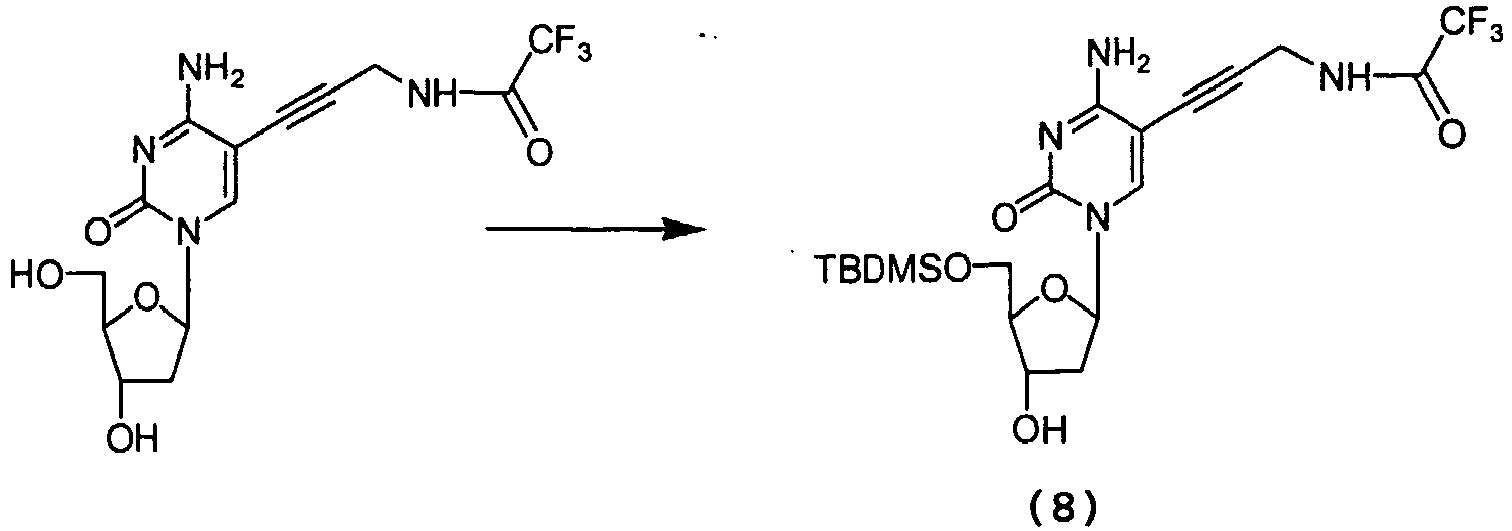
- To a solution of the starting material (7) (1.0 g, 2.66 mmol) and imidazole (200 mg, 2.93 mmol) in DMF (3.0 ml) at 0 °C, was slowly added TBDMSCl (442 mg, 2.93 mmol) in four portions over 1 h. After 2 h, the volatiles were evaporated under reduced pressure and the residue was adsorbed on silica gel and purified by flash chromatography (EtOAc, EtOAc:MeOH 9.5:0.5). The expected product (8) was isolated as a crystalline solid (826 mg, 64%). 1H NMR (d6 DMSO) δ 0.00 (s, 1H, CH3); 0.01 (s, 1H, CH3), 0.79 (s, 9 H, tBu), 1.87-1.80 (m, 1H, H-2'), 2.12 (ddd, J = 13.0, 5.8 and 3.0 Hz, 1H, H-2'), 3.65 (dd, J = 11.5, 2.9 Hz, 1H, H-5'), 3.74 (dd, J = 11.5, 2.5 Hz, 1H, H-5'), 3.81-3.80 (m, 1H, H-4'), 4.10-4.09 (m, 1H, H-3'), 4.17 (d, 2H, J = 5.1 Hz, NCH 2), 5.19 (d, 1H, J = 4.0 Hz, 3'-OH), 6.04 (t, J = 6.6 Hz, 1H, H-1'), 6.83 (br s, 1H, NHH), 7.78 (br s, 1H, NHH), 7.90 (s, 1H, H-6), 9.86 (t, J = 5.1 Hz, 1H, -H2CNH); MS (ES): m/z (%) (MH)+ 491 (40%).

- To a solution of the starting material (8) (825 mg, 1.68 mmol) in DMSO (6.3 ml) and N2 atmosphere, was slowly added acetic acid (AcOH) (1.3 ml, 23.60 mmol) followed by acetic anhydride (Ac2O) (4.8 ml, 50.50 mmol). The solution was stirred at room temperature for 18 h and quenched at 0 °C by addition of saturated NaHCO3 (20 ml). The product was extracted into EtOAc (3 x 30 ml), organic extracts combined, dried (MgSO4), filtered and the volatiles evaporated. The crude residue was purified by flash chromatography on silica gel (EtOAc: petroleum ether 1:1) to give the expected product as a colourless oil (9) (573 mg, 62%). 1H NMR (d6 DMSO) δ 0.00 (s, 6H, 2 x CH3), 0.78 (s, 9H, tBu), 2.01 (s, 3H, SCH3), 2.19-1.97 (m, 2H, 2 x H2'), 2.25 (s, 3H, COCH3), 3.67 (dd, 1H, J = 11.5 Hz, H-5'), 3.78 (dd, 1H, J = 11.5, 3.3 Hz, H-5'), 4.06-4.05 (m, 1H, H-4'), 4.17 (d, 2H, J = 5.1 Hz, N-CH 2), 4.30-4.28 (m, 1H, H-3'), 4.63 (s, 2H; CH 2-S), 5.94 (t, 1H, J = 6.5 Hz, H-1'), 8.17 (s, 1H, H-6), 9.32 (s, 1H, NHCO), 9.91 (t, 1H, J = 5.4 Hz, NHCH2); MS (ES): m/z (%) (MH)+ 593.

- To a solution of the starting material (9) (470 mg, 0.85 mmol) in dicloromethane (DCM) (8 ml) under N2 atmosphere and cooled to 0 °C, was added cyclohexene (430 µl, 4.27 mmol) followed by SO2Cl2 (1 M in DCM, 1.0 ml, 1.02 mmol). The solution was stirred for 30 minutes at 0 °C, and the volatiles were evaporated. Residue immediately dissolved in DMF (8 ml) stirred under N2 and sodium azide (275 mg, 4.27 mmol) slowly added. After 18 h, the crude product was evaporated to dryness, dissolved in EtOAc (30 ml) and washed with Na2CO3 (3 x 5 ml). The combined organic layer was kept separately. A second extraction of the product from the aqueous layer was performed with DCM (3 x 10 ml). All the combined organic layers were dried (MgSO4), filtered and the volatiles evaporated under reduced pressure to give an oil identified as the expected product (10) (471 mg, 94 % yield). This was used without any further purification. 1H NMR (d6 DMSO) δ 0.11 (s, 3H, CH3), 0.11 (s, 3H, CH3), 0.88 (s, 9H, tBu), 2.16-2.25 (m, 1H, H-2'), 2.35 (s, 3H, COCH3), 2.47-2.58 (m, 1H, H-2'), 3.79 (dd, J = 11.6, 3.2 Hz, 1H, H-5'), 3.90 (dd, J = 11.6, 3.0 Hz, 1H, H-5'), 4.17-4.19 (m, 1H, H-4'), 4.28 (s, 2H, NCH2), 4.32-4.35 (m, 1H, H-3'), 4.89 (dd, J = 14.4, 6.0 Hz, 2H, CH2-N3), 6.05 (t, J = 6.4 Hz, 1H, H-1'), 8.25 (s, 1H, H-6), 9.46 (br s, 1H, NHH), 10.01 (br s, 1H, NHH).

- To a solution of the starting material (11) (440 mg, 0.75 mmol) in THF (20 ml) at 0 °C and N2 atmosphere, was added TBAF in THF 1.0 M (0.82 ml, 0.82 mmol). After 1.5 h, the volatiles were evaporated under reduced pressure and the residue purified by flash chromatography on silica gel (EtOAc:petroleum ether 8:2 to EtOAc 100 % to EtOAc:MeOH 8:2). Two compounds were isolated and identified as above described. The first eluted 4-N-Acetyl (11), (53 mg, 15 %) and, the second one 4-NH2 (12) (271 mg, 84 %).
- Compound 4-N-Acetyl (11) : 1H NMR (d6 DMSO) δ 1.98 (s, 3H, CH3CO), 2.14-2.20 (m, 2H, HH-2'), 3.48-3.55 (m, 1H, H-5'), 3.57-3.63 (m, 1H, H-5'), 3.96-4.00 (m, 1H, H-4'), 4.19 (d, J = 5.3 Hz, 2H, CH 2-NH), 4.23-4.28 (m, 1H, H-3'), 4.77 (s, 2H, CH2-N3) , 5.2 (t, 1H, J = 5.1 Hz, 5'-OH), 5.95 (t, J = 6.2 Hz, 1H, H-1'), 8.43 (s, 1H, H-6), 9.34 (s, 1H, CONH), 9.95 (t, J = 5.3 Hz, 1H, NHCH2).
- Compound 4-NH2 (12): 1H NMR (d6 DMSO) δ 1.98-2.07(2H, CHH-2'), 3.50-3.63 (m, 2H, CHH-5'), 3.96-4.00 (m, 1H, H-4'), 4.09 (d, J = 5.3 Hz, 2H, CH 2-NH), 4.24-4.28 (m, 1H, H-3'), 4.76 (s, 2H, CH2-N3), 5.13 (t, J = 5.3 Hz, 1H, 5'-OH), 5.91 (br s, 1H, NHH), 6.11 (t, J = 6.4 Hz, 1H, H-1'), 8.20 (t, J = 5.3 Hz, 1H, NCH2), 8.45 (s, 1H, H-6), 11.04 (br s, 1H, NHH).

- The starting material (8) (10g, 20.43 mmol) was azeotroped in dry pyridine (2 x 100 ml) then dissolved in dry pyridine (160 ml) under N2 atmosphere. Chlorotrimethylsilane (10 ml, 79.07 mmol) added drop wise to the solution and stirred for 2 hours at room temperature. Benzoyl chloride (2.6 ml, 22.40 mmol) was then added to solution and stirred for one further hour. The reaction mixture was cooled to 0°C, distilled water (50 ml) added slowly to the solution and stirred for 30 minutes. Pyridine and water were evaporated from mixture under high vacuum to yield a brown gel that was portioned between 100 ml of sat. aq. NaHCO3 (100 ml) solution DCM. The organic phase was separated and the aqueous phase extracted with a further (2 x 100 ml) of DCM. The organic layers were combined, dried (MgSO4), filtered and the volatiles evaporated under reduced pressure. The resulting brown oil was purified by flash chromatography on silica gel (DCM:MeOH 99:1 to 95:5) to yield a light yellow crystalline solid (13) (8.92 g, 74%). 1H NMR (d6 DMSO) : δ 0.00 (s, 6H, CH3), 0.78 (s, 9H, tBu), 1.94 (m, 1H, H-2'), 2.27 (m, 1H, H-2'), 3.64 (d, 1H, J = 11.6 Hz, H-5'), 3.75 (d, 1H, J = 11.6 Hz, H-5'), 3.91 (m, 1H, H-4'), 4.09 (br m, 3H, CH2NH, H-3'), 5.24 (s, 1H, 3'-OH), 6.00 (m, 1H, H-1'), 7.39 (m, 2H, Ph), 7.52 (m, 2H, Ph), 7.86 (m, 1H, Ph), 8.0 (s, 1H, H-6), 9.79 (t, 1H, J = 5.4 Hz, NHCH2), 12.67 (br s, 1H, NH) . Mass (+ve electrospray) calcd for C27H33F3N4O6Si 594.67, found 595.

- The starting material (13) (2.85 g, 4.79 mmol) was dissolved in dry DMSO (40 ml) under N2 atmosphere. Acetic acid (2.7 ml, 47.9 mmol) and acetic anhydride (14.4 ml, 143.7 mmol) were added sequentially and slowly to the starting material, which was then stirred for 18 h at room temperature. Saturated NaHCO3 (150 ml) solution was carefully added to the reaction mixture. The aqueous layer was extracted with EtOAc (3 x 150 ml). The organic layers were combined, dried (MgSO4), filtered and evaporated to yield an orange liquid that was subsequently azeotroped with toluene (4 x 150 ml) until material solidified. Crude residue purified on silica gel (petroleum ether:EtOAc 3:1 to 2:1) to yield a yellow crystalline solid (14) (1.58 g, 50%). 1H NMR (d6 DMSO) : δ 0.00 (s, 6H, CH3), 0.78 (s, 9H, tBu), 1.99 (s, 3H, CH3), 2.09 (m, 1H, H-2'), 2.28 (m, 1H, H-2'), 3.66 (d, 1H, J = 11.5, 2.9 Hz, H-5'), 3.74 (dd, 1H, J = 11.3, 2.9 Hz, H-5'), 3.99 (m, 1H, H-4'), 4.09 (m, 1H, CH2NH), 4.29 (m, 1H, H-3'), 4.61 (s, 2H, CH2S), 6.00 (m, 1H, H-1'), 7.37 (m, 2H, Ph), 7.50 (m, 2H, Ph), 7.80 (d, 1H, J = 7.55 Hz, HAr), 7.97 (s, 1H, H-6), 9.79 (br t, 1H, NHCH2), 12.64 (br s, 1H, NH). Mass (-ve electrospray) calcd for C29H37F3N4O6SSi 654.79, found 653.2.

- The starting material (14) (1.65 g, 2.99 mmol) was dissolved in DCM (18 ml) and cooled to 0°C. Cyclohexene (1.5 ml, 14.95 mmol) and SO2Cl2 (0.72 ml, 8.97 mmol) were added and stirred 1 h in ice bath. TLC indicated starting material still to be present whereupon a further aliquot of SO2Cl2 (0.24 ml) was added and the mixture stirred for 1 h at 0°C. Volatiles were removed by evaporation to yield a light brown solid that was redissolved in 18 ml of dry DMF (18 ml) under N2. Sodium azide (0.97 g, 14.95 mmol) was then added to the solution and stirred for 2.5 h at room temperature. The reaction mixture was passed through a pad of silica and eluted with EtOAc and the volatiles removed by high vacuum evaporation. The resulting brown gel was purified by flash chromatography (petroleum ether:EtOAc 4:1 to 2:1) to yield the desired product as a white crystalline solid (15) (0.9 g, 55%). 1H NMR (d6 DMSO) : δ 0.00 (s, 6H, CH3), 0.78 (s, 9H, tBu), 2.16 (m, 1H, H-2'), 2.22 (m, 1H, H-2'), 3.70 (d, 1H, J = 11.5 Hz, H-5'), 3.75 (d, 1H, J = 11.3 Hz, H-5'), 4.01 (m, 1H, H-4'), 4.10 (m, 1H, CH2NH), 4.23 (m, 1H, H-3'), 4.76 (s, 2H, CH2S), 5.99 (m, 1H, H-1'), 7.37 (m, 2H, Ph), 7.50 (m, 2H, Ph), 7.81 (d, 1H, J = 7.4 Hz, Ph), 7.95 (s, 1H, H-6), 9.78 (br s, 1H, NHCH2), 12.64 (br s, 1H, NH). Mass (-ve electrospray) calcd for C28H34F3N7O6Si 649.71, found 648.2

- The starting material (15) (140 mg, 0.22 mmol) was dissolved in THF (7.5 ml). TBAF (1M soln. in THF, 0.25 ml) was added slowly and stirred for 2 h at room temperature. Volatile material removed under reduced pressure to yield a brown gel that was purified by flash chromatography (EtOAc:DCM 7:3) to yield the desired product (16) as a light coloured crystalline solid (0.9 g, 76%). 1H NMR (d6 DMSO) : δ 2.16 (m, 1H, H-2'), 2.22 (m, 1H, H-2'), 3.70 (d, 1H, J = 11.5 Hz, H-5'), 3.75 (d, 1H, J = 11.3 Hz, H-5'), 4.01 (m, 1H, H-4'), 4.10 (m, 1H, CH2NH), 4.23 (m, 1H, H-3'), 4.76 (s, 2H, CH2S), 5.32 (s, 1H, 5' OH), 5.99 (m, 1H, H-1'), 7.37 (m, 2H, Ph), 7.50 (m, 2H, Ph), 7.81 (d, 1H, J = 7.35 Hz, Ph), 7.95 (s, 1H, H-6), 9.78 (br s, 1H, NHCH2), 12.64 (br s, 1H, NH). Mass (-ve electrospray) calcd for C22H20F3N7O6 535.44, found 534.

- To a solution of (11) and (12) (290 mg, 0.67 mmol) and proton sponge (175 mg, 0.82 mmol) (both previously dried under P2O5 for at least 24 h) in PO(OMe)3 (600 µl), at 0 °C under Argon atmosphere, was slowly added POCl3 (freshly distilled) (82 µl, 0.88 mmol). The solution was vigorously stirred for 3 h at 0 °C and then quenched by addition of tetra-tributylammonium diphosphate (0.5 M) in DMF (5.2 ml, 2.60 mmol), followed by nBu3N (1.23 ml, 5.20 mmol) and triethylammonium bicarbonate (TEAB) 0.1 M (20 ml). After 1 h at room temperature aqueous ammonia solution (ρ 0.88, 20 ml) was added to the mixture. Solution stirred at room temperature for 15 h, volatiles evaporated under reduced pressure and the residue was purified by MPLC with a gradient of TEAB from 0.05M to 0.7M. The expected triphosphate was eluted from the column at approx. 0.60 M TEAB. A second purification was done by HPLC in a Zorbax SB-C18 column (21.2 mm i.d. x 25 cm) eluted with 0.1M TEAB (pump A) and 30% CH3CN in 0.1M TEAB (pump B) using a gradient as follows: 0-5 min 5% B, Φ.2 ml; 5-25 min 80% B, Φ.8 ml; 25-27 min 95 %B, Φ.8 ml; 27-30 min 95 %B, Φ.8 ml; 30-32 min 5 %B, Φ.8 ml; 32-35 min 95 %B, Φ.2 ml, affording the product described above with a rt (17): 20.8 (14.5 µmols, 2.5% yield); 31P NMR (D2O, 162 MHz) δ -5.59 (d, J = 20.1 Hz, Pχ), -10.25 (d, J = 19.3 Hz, 1P, Pα), -20.96 (t, J = 19.5 Hz, 1P, Pβ); 1H NMR (D2O) δ 2.47-2.54 (m, 1H, H-2'), 2.20-2.27 (m, 1H, H-2'), 3.88 (s, 2H, CH2N), 4.04-4.12 (m, 1H, HH-5'), 4.16-4.22 (m, 1H, HH-5'), 4.24-4.30 (m, 1H, H-4'), 4.44-4.48 (m, 1H, H-3'), 6.13 (t, J = 6.3 Hz, 1H, H-1'), 8.35 (s, 1H, H-6); MS (ES): m/z (%) (M-H) 574 (73%), 494 (100 %).

- Commercial available Alexa Fluor 488-NHS (35 mg, 54 µmol) was dissolved in DMF (700 µL) and, to ensure full activation, 4-DMAP (7 mg, 59 µmol) and N,N'-disuccinimidyl carbonate (15 mg, 59 µmol) were sequentially added. After 15 min on complete activation, a solution of the starting disulfide (32.0 mg, 108 µmol) in DMF (300 µL) containing diisopropylethylamine (4 µL) was added over the solution of the activated dye. Further addition of diisopropylethylamine (20 µL) to the final mixture was done, ultrasonicated for 5 min and reacted for 18 h at room temperature in the darkness. The volatiles were evaporated under reduced pressure and the crude residue was first purified passing it through a short ion exchange resin Sephadex -DEAE A-25 (40-120 µ) column, first eluted with TEAB 0.1 M (25 ml) then 1.0 M TEAB (75 ml). The latest containing the two final compounds was concentrated and the residue was HPLC purified in a Zorbax SB-C18 column (21.2 mm i.d. x 25 cm) eluted with 0.1M TEAB (pump A) and CH3CN (pump B) using a gradient as follows: 0-2
min 2% B,Φ .2 ml; 2-4min 2% B, Φ.8 ml; 4-15 min 23 %B, Φ.8 ml; 15-24 min 23 %B, Φ.8 ml; 24-26 min 95 %B, Φ.8 ml; 26-28 min 95 %B, Φ.8 ml, 28-30min 2 %B, Φ.8 ml, 30-33min 2 %B,Φ .2 ml affording both compounds detailed above with tr: 19.0 (left regioisomer) and tr: 19.5 (right regioisomer). Both regioisomers were respectively passed through a dowex ion exchange resin column, affording respectively 16.2 µmol and 10.0 µmol, 62% total yield (based in commercial available Alexa Fluor 488-NHS of 76% purity) ; ε493 = 71,000 cm-1 M-1 in H2O. 1H NMR (D2O) (left regioisomer) δ 2.51 (t, J = 6.8 Hz, 2H, CH2), 2.66 (t, J = 6.8 Hz, 2H, CH2), 2.71 (t, J = 5.8 Hz, 2H, CH2), 3.43 (t, J = 5.8 Hz, 2H, CH2), 6.64 (d, J = 9.2 Hz, 2H, HAr), 6.77 (d, J = 9.2 Hz, 2H, HAr), 7.46 (s, 1H, HAr), 7.90 (dd, J = 8.1 and 1.5 Hz, 1H, HAr), 8.20 (d, J = 8.1 Hz, 1H, HAr). 1H NMR (D2O) (right regioisomer) δ 2.67 (t, J = 6.8 Hz, 2H, CH2), 2.82 (t, J = 6.8 Hz, 2H, CH2), 2.93 (t, J = 6.1 Hz, 2H, CH2), 3.68 (t, J = 6.1 Hz, 2H, CH2), 6.72 (d, J = 9.3 Hz, 2H, HAr), 6.90 (d, J = 9.3 Hz, 2H, HAr), 7.32 (d, J = 7.9 Hz, 1H, HAr), 8.03 (dd, J = 7.9, 1.7 Hz, 1H, HAr), 8.50 (d, J = 1.8 Hz, 1H, HAr) Mass (-ve electrospray) calcd for C26H23N3O12S4 697.02, found 692 (M-H), 347 [M/2].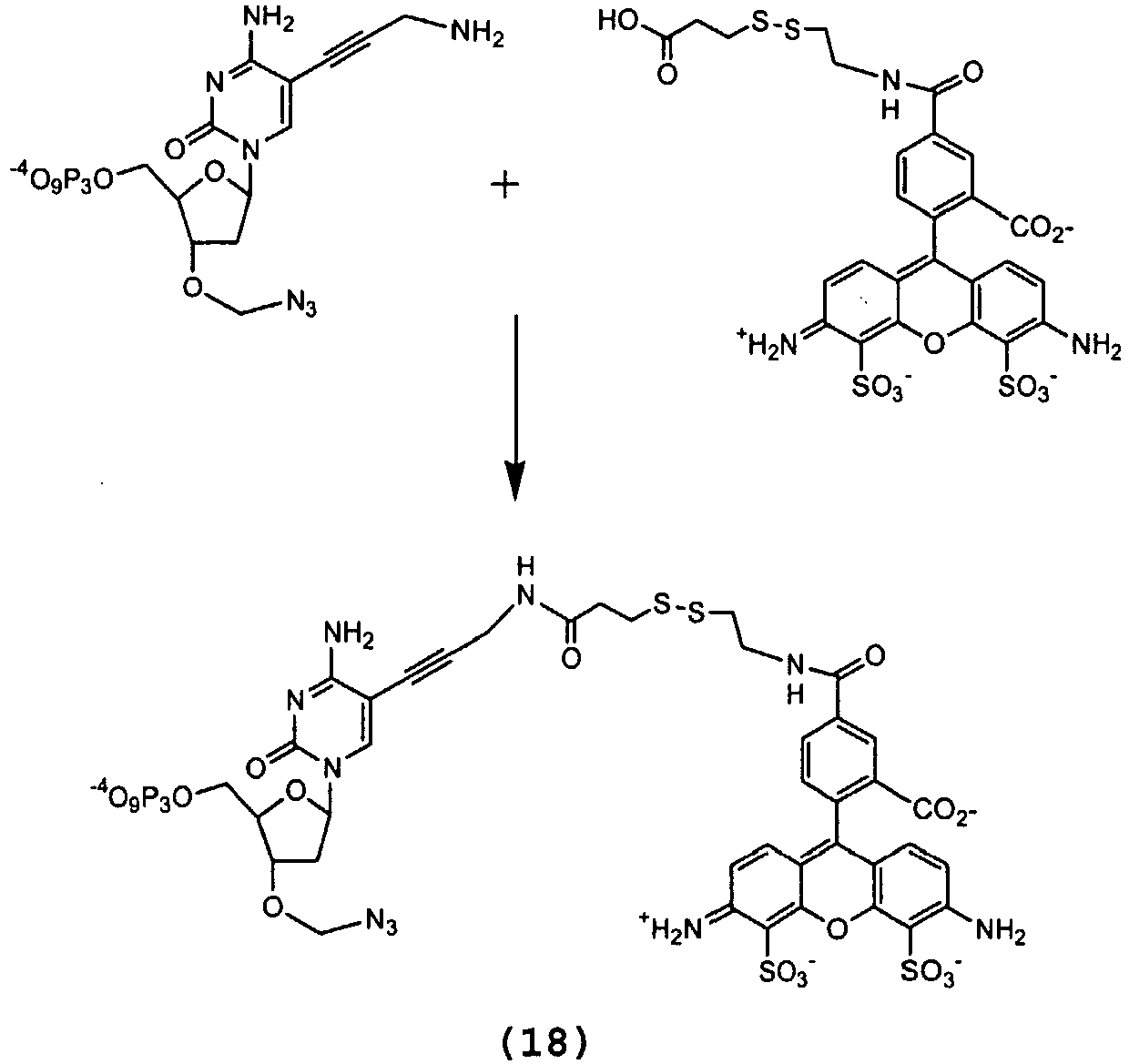
- To a solution of Alexa Fluor 488 disulfide linker (3.4 µmol, 2.37mg) in DMF (200 µL) was added 4-DMAP (0.75 mg, 5.1 µmol) and N,N-disuccinimidyl carbonate (1.70 mg, 5.1 µmol). The mixture was stirred for 15 to full activation of the acid, then it was added into the solution of the nucleotide (17) (3.45 mg, 6.0 µmol) in DMF (0.3 ml) containing nBu3N (40 µL) at 0 °C. The mixture was sonicated for 3 min and then continuously stirred for 16 h in the absence of light. The volatiles were evaporated under reduced pressure and the residue was firstly purified by filtration through a short ion exchange resin Sephadex -DEAE A-25 column, first eluted with TEAB 0.1 M (50 ml) removing the unreacted dye-linker, then 1.0 M TEAB (100 ml) to collect the expected product (18). After concentration and the residue was HPLC purified in a Zorbax SB-C18 column (21.2 mm i.d. x 25 cm) eluted with 0.1M TEAB (pump A) and CH3CN (pump B) using a gradient as follows: 0-2 min 2% B, Φ.2 ml; 2-4 min 2% B, Φ.8 ml; 4-15 min 23 %B, Φ.8 ml; 15-24 min 23 %B, Φ.8 ml; 24-26 min 95 %B, Φ.8 ml; 26-28 min 95 %B, Φ.8 ml, 28-30 min 2 %B, Φ.8 ml, 30-33 min 2 %B, Φ.2 ml affording the product detailed above with a rt (18): 19.8 (0.26 µmols, 12% yield based on UV measurement); λmax = 493 nm, ∈ 71,000 cm-1 M-1 in H2O); 31P NMR (D2O, 162 MHz) δ -5.06 (d, J = 20.6 Hz, 1P, Pχ), -10.25 (d, J = 19.3 Hz, 1P, Pα), -21.21 (t, J = 19.5 Hz, 1P, Pβ); 1H NMR (D2O) δ 2.09-2.17 (m, 1H, HH-2'), 2.43-2.50 (m, 1H, HH-2'), 2.61 (t, J = 6.8 Hz, 2H, H2C-S), 2.83 (2H, S-CH2), 3.68 (t, J = 6.0 Hz, 2H, ArCONCH2), 4.06 (s, 2H, CH2N), 4.08-4.17 (m, 4H, HH-5'), 4.25-4.29 (m, 1H, H-4'), 4.46-4.50 (m, 1H, H-3'), 6.09 (t, J = 6.4 Hz, 1H, H-1'), 6.88 (d, J = 9.1 Hz, 1H, HAr), 6.89 (d, J = 9.3 Hz, 1H, HAr), 7.15 (d, J = 9.3 Hz, 1H, HAr), 7.17 (d, J = 9.1 Hz, 1H, HAr), 7.64 (br s, 1H, HAr), 8.00-7.94 (m, 2H, HAr), 8.04 (s, 1H, H-6); MS (ES): m/z (%) (M-H) 1253 (46%), (M-H+ Na)- 1275 (100 %).

- Under N2, a suspension of 7-deaza-7-iodo-guanosine (2 g, 2.75 mmol), Pd(PPh3)4 (582 mg, 0.55 mmol), CuI (210 mg, 1.1 mmol), Et3N (1.52 ml, 11 mmol) and the propagylamine (2.5 g, 16.5 mmol) in DMF (40 ml) was stirred at room temperature for 15 h under N2. The reaction was protected from light with aluminium foil. After TLC indicating the full consumption of starting material, the reaction mixture was concentrated. The residue was diluted with MeOH (20 ml) and treated with dowex-HCO3 -. The mixture was stirring for 30 min and filtered. The solution was concentrated and purified by silica gel chromatography (petroleum ether:EtOAc 50:50 to petroleum ether: EtOAc:MeOH 40: 40: 20), giving (19) as a yellow powder (2.1 g, 92%). 1H NMR (d6 DMSO) δ 2.07-2.11 (m, 1H, H-2'), 2.31-2.33 (m, 1H, H-2'), 3.49-3.53 (m, 2H, H-5'), 3.77 (br s, 1H, H-4'), 4.25 (d, J = 4.3 Hz, 2H, ≡CCH2), 4.30 (br s, 1H, H-3'), 4.95 (t, J = 5.2 Hz, 1H, 5'-OH), 5.25 (d, J = 3.4 Hz, 1H, 3'-OH), 6.27-6.31 (m, 1H, H-1'), 6.37 (s, 2H, NH2), 7.31 (s, 1H, H-8), 10.10 (br s, 1H, NHCOCF3), 10.55 (s, 1H, NH). Mass (-ve electrospray) calcd for C16H16F3N5O5 415, found 414.
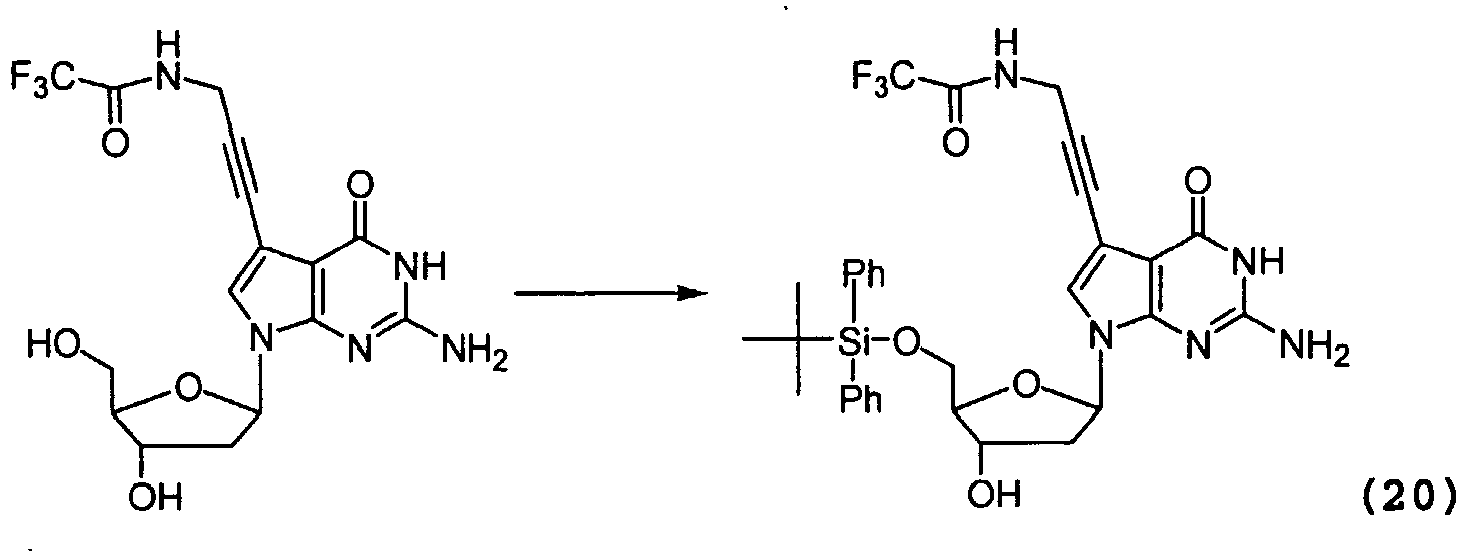
- A solution of (19) (2.4 g, 5.8 mmol) in pyridine (50 ml) was treated with tert-butyldiphenylsilyl chloride (TBDPSCl) (1.65 ml, 6.3 mmol) drop wise at 0 °C. The reaction mixture was then warmed to room temperature. After 4h, another portion of TBDPSCl (260 µL, 1 mmol) was added. The reaction was monitored by TLC, until full consumption of the starting material. The reaction was quenched with MeOH (∼5 ml) and evaporated to dryness. The residue was dissolved in DCM and aq. sat. NaHCO3 was added. The aqueous layer was extracted with DCM three times. The combined organic extracts were dried (MgSO4) and concentrated under vacuum. Purification by chromatography on silica (EtOAc to EtOAc:MeOH 85:15) gave (20) a yellow foam (3.1 g, 82%). 1H NMR (d6 DMSO) δ 1.07 (s, 9H, CH3), 2.19-2.23 (m, 1H, H-2'), 2.38-2.43 (m, 1H, H-2'), 3.73-3.93 (m, 2H, H-5'), 4.29 (d, J = 5.0 Hz, 2H, CH2N), 4.42-4.43 (m, 1H, H-3'), 5.41 (br s, 1H, OH), 6.37 (t, J = 6.5 Hz, H-1'), 6.45 (br s, 2H, NH2), 7.24-7.71 (m, 11H, H-8, HAr), 10.12 (t, J = 3.6 Hz, 1H, NH), 10.62 (s, 1H, H-3). Mass (+ve electrospray) calcd for C32H34F3N5O5Si 653, found 654.

- A solution of (20) (1.97 g, 3.0 mmol) in DMSO (15 ml) was treated with Ac2O (8.5 ml, 90 mmol), and AcOH (2.4 ml, 42 mmol) and stirred at room temperature for 15 h, then 2 h at 40°C. The reaction mixture was diluted with EtOAc (200 ml) and stirred with sat, aq. NaHCO3 (200 ml) for 1 h. The aqueous layer was washed with EtOAc twice. The organic layer was combined, dried (MgSO4) and concentrated under vacuum. Purification by chromatography on silica (EtOAc:Hexane 1:1 to EtOAc:Hexane:MeOH 10:10:1) gave (21) as a yellow foam (1.3 g, 60%). 1H NMR (CDCl3) δ 1.04 (s, 9H, CH3), 2.08 (s, 3H, SCH3), 2.19-2.35 (m, 2H, H-2), 3.67-3.71 (m, 2H, H-5'), 3.97-3.99 (m, 2H, H-4', H-3'), 4.23 (br s, 2H, CH2N), 4.58 (s, 2H, CH2S), 6.31 (dd, J = 5.7, 7.9 Hz, H-1'), 7.19-7.62 (m, 11H, H8, HAr). Mass (+ve electrospray) calcd for C34H38F3N5O5SSi 713, found: 714.

- To a solution of (21) (1.3 mg, 1.8 mmol), cyclohexene (0.91 ml, 9 mmol) in CH2Cl2 (10 ml) in 4 °C, sulfurylchloride (1M in CH2Cl2) (1.1 ml, 1.1 mmol) was added drop wise under N2. After 30 min., TLC indicated the full consumption of the nucleoside (22). After evaporation to remove the solvent, the residue was then subjected to high vacuum for 20 min, and then treated with NaN3 (585 mmol, 9 mmol) and DMF (10 ml). The resulted suspension was stirred under room temperature for 2h. Extraction with CH2Cl2/NaCl (10%) gave a yellow gum, which was treated with TBAF in THF (1 M, 3 ml) and THF (3 ml) at room temperature for 20 min. Evaporation to remove solvents, extraction with EtOAc/sat. aq. NaHCO3, followed by purification by chromatography on silica (EtOAc to EtOAc:MeOH 9:1) gave (22) as a yellow foam (420 mg, 50%). 1H NMR (d6 DMSO): δ 2.36-2.42 (m, 1H, H-2'), 2.49-2.55 (m, 1H, H-2'), 3.57-3.59 (m, 2H, H-5'), 3.97-4.00 (m, 1H, H-4'), 4.29 (m, 2H, CH2N), 4.46-4.48 (m, 1H, H-3'), 4.92-4.96 (m, 2H, CH2N3), 5.14 (t, J = 5.4 Hz, 1H, 5'-OH), 5.96-6.00 (dd, J = 5.7, 8.7 Hz, 1H, H-1'), 6.46 (br s, 2H, NH2), 7.39 (s, 1H, H-6), 10.14 (s, 1H, NH), 10.63 (s, 1H, H-3).

- Tetrasodium diphosphate decahydrate (1.5 g, 3.4 mmol) was dissolved in water (34 ml) and the solution was applied to a column of dowex 50 in the H+ form. The column was washed with water. The eluent dropped directly into a cooled (ice bath) and stirred solution of tri-n-butyl amine (1.6 ml, 6.8 mmol) in EtOH (14 ml). The column was washed until the pH of the eluent increased to 6. The aqueous ethanol solution was evaporated to dryness and then co-evaporated twice with ethanol and twice with anhydrous DMF. The residue was dissolved in DMF (6.7 ml). The pale yellow solution was stored over 4Å molecular sieves. The nucleoside (22) and proton sponge was dried over P2O5 under vacuum overnight. A solution of (22) (104 mg, 0.22 mmol) and proton sponge (71 mg, 0.33 mmol) in trimethylphosphate (0.4 ml) was stirred with 4Å molecular sieves for 1 h. Freshly distilled POCl3 (25 µl, 0.26 mmol) was added and the solution was stirred at 4°C for 2h. The mixture was slowly warmed up to room temperature and bis (tri-n-butyl ammonium) pyrophosphate (1.76 ml, 0.88 mmol) and anhydrous tri-n-butyl amine (0.42 ml, 1.76 mmol) were added. After 5 min, the reaction was quenched with 0.1 M TEAB (triethylammonium bicarbonate) buffer (15 ml) and stirred for 3 h. The water was removed under reduced pressure and the resulting residue dissolved in concentrated ammonia (ρ 0.88, 10 ml) and stirred at room temperature for 16 h. The reaction mixture was then evaporated to dryness. The residue was dissolved in water and the solution applied to a DEAE-Sephadex A-25 column. MPLC was performed with a linear gradient of 2 L each of 0.05 M and 1 M TEAB. The triphosphate was eluted between 0.7 M and 0.8 M buffer. Fractions containing the product were combined and evaporated to dryness. The residue was dissolved in water and further purified by HPLC. t r (23) = 20.5 min (Zorbax C18 preparative column, gradient: 5% to 35% B in 30 min, buffer A 0.1M TEAB, buffer B MeCN). The product was isolated as a white foam (225 O.D., 29.6 µmol, 13.4%, ε260 = 7,600). 1H NMR (D2O) δ 2.43-2.5 (m, 2H, H-2'), 3.85 (m, 2H, CH2N), 3.97-4.07 (m, 2H, H-5'), 4.25 (br s, 1H, H-4'), 4.57 (br s, 1H, H-3'), 4.74-4.78 (m, 2H, CH2N3), 6.26-6.29 (m, 1H, H-1'), 7.41 (s, 1H, H-8). 31P-NMR (D2O) δ -8.6 (m, 1P, Pγ), -10.1 (d, J =19.4 Hz, 1P, Pα), -21.8 (t, J = 19.4 Hz, 1P, Pβ). Mass (-ve electrospray) calcd for C15H21N8O13P3 614, found 613.

- A mixture of disulphide linkered-Cy3 (2.5 µmol), 1-(3-dimethylaminopropyl)-3-ethylcarbodiimide hydrochloride (EDC) (0.95 mg, 5 µmοl), 1-hydroxybenzotriazole (HOBt) (0.68 mg, 5 µmol) and N-methyl-morpholine (0.55 µL, 5 µmol) in DMF (0.9 ml) was stirred at room temperature for 1 h. A solution of (23) (44 O.D., 3.75 µmol) in 0.1 ml water was added to the reaction mixture at 4°C, and left at room temperature for 3 h. The reaction was quenched with TEAB buffer (0.1M, 10 ml) and loaded on a DEAE Sephadex column (2 x 5 cm). The column was first eluted with 0.1 M TEAB buffer (100 ml) and then 1 M TEAB buffer (100 ml). The desired triphosphate product was eluted out with 1 M TEAB buffer. Concentrating the fraction containing the product and applied to HPLC. t r (24) = 23.8 min (Zorbax C18 preparative column, gradient: 5% to 55% B in 30 min, buffer A 0.1M TEAB, buffer B MeCN). The product was isolated as a red foam (0.5 µmol, 20%, εmax = 150,000). 1H NMR (D2O) δ 1.17-1.71 (m, 20H, 4 x CH2, 4 x CH3), 2.07-2.15 (m, 1H, H-2'), 2.21-2.30 (m, 1H, H-2'), 2.52-2.58 (m, 2H, CH2), 2.66-2.68 (m, 2H, CH2), 2.72-2.76 (m, 2H, CH2), 3.08-3.19 (m, 2H, CH2), 3.81-3.93 (m, 6H, CH2, H-5'), 4.08-4.16 (m, 1H, H-4'), 4.45-4.47 (m, 1H, H-3'), 4.70-4.79 (m, 2H, CH2N3), 6.05-6.08 (m, 2H, HAr), 6.15-6.18 (m, 1H, H-1'), 7.11 (s, 1H, H-8), 7.09-7.18 (m, 2H, CH), 7.63-7.72 (m, 4H, HAr), 8.27-8.29 (m, 1H, CH). 31P NMR (D2O) δ -4.7 (m, 1P, Pγ), - 9.8 (m, 1P, Pα), -19.7 (m, 1P, Pβ). Mass (-ve electrospray) calcd for C51H66N11O21P3S41389.25, found 1388 (M-H), 694 [M-2H], 462 [M-3H].

- To a suspension of 7-deaza-7-iodo-2'-deoxyadenosine (1 g, 2.65 mmol) and CuI (100 mg, 0.53 mmol) in dry DMF (20 ml) was added triethylamine (740 µl, 5.3 mmol). After stirring for 5 min trifluoro-N-prop-2-ynyl-acetamide (1.2 g, 7.95 mmol) and Pd(PPh3)4 (308 mg, 0.26 mmol) were added to the mixture and the reaction was stirred at room temperature in the dark for 16 h. MeOH (40 ml) and bicarbonate dowex was added to the reaction mixture and stirred for 45 min. The mixture was filtered. The filtrate washed with MeOH and the solvent was removed under vacuum. The crude mixture was purified by chromatography on silica (EtOAc to EtOAc: MeOH 95:20) to give slightly yellow powder (25) (1.0 g, 95 %) . 1H NMR (d6 DMSO) δ 2.11-2.19 (m, 1H, H-2'), 2.40-2.46 (m, 1H, H-2'), 3.44-3.58 (m, 2H, H-5'), 3.80 (m, 1H, H-4'), 4.29 (m, 3H, H-3', CH2N), 5.07 (t, J = 5.5 Hz, 1H, OH), 5.26 (d, J = 4.0 Hz, 1H, OH), 6.45 (dd, J = 6.1, 8.1 Hz, 1H, H-1'), 7.74 (s, 1H, H-8), 8.09 (s, 1H, H-2), 10.09 (t, J = 5.3 Hz, 1H, NH).

- The nucleoside (25) (1.13 g, 2.82 mmol) was coevaporated twice in dry pyridine (2 x 10ml) and dissolved in dry pyridine (18 ml). To this solution was added t-butyldiphenylsilylchloride (748 µl, 2.87 mmol) in small portions at 0°C. The reaction mixture was let to warm up at room temperature and left stirring overnight. The reaction was quenched with sat. aq. NaCl solution. EtOAc (25 ml) was added to reaction mixture and the aqueous layer was extracted with EtOAc three times. After drying the combined organic extracts (MgSO4) the solvent was removed under vacuum. Purification by chromatography on silica (DCM then EtOAc to EtOAc: MeOH 85:15) gave (26) as a slightly yellow powder (1.76 g, 97 %). 1H NMR (d6 DMSO) δ 1.03 (s, 9H, tBu), 2.25-2.32 (m, 1H, H-2'), 2.06-2.47 (m, 1H, H-2'), 3.71-3.90 (m, 2H, H-5'), 3.90-3.96 (m, 1H, H-4'), 4.32 (m, 2H, CH2N), 4.46 (m, 1H, H-3'), 5.42 (br s, 1H, OH), 6.53 (t, J = 6.7 Hz, 1H, H-1'), 7.38-7.64 (m, 11H, H-8 and HAr), 8.16 (s, 1H, H-2), 10.12 (t, J = 5.3 Hz, 1H, NH) .

- 5'-O-(tert-Butyldiphenylsilyl)-7-deaza-4-N,N-dimethylformadin-7-[3-(2,2,2-trifluoroacetamido)-prop-1-ynyl]-2'-deoxyadenosine (27). A solution of the nucleoside (26) (831 mg, 1.30 mmol) was dissolved in a mixture of MeOH:N,N-dimethylacetal (30 ml: 3ml) and stirred at 40°C. The reaction monitored by TLC, was complete after 1 h. The solvent was removed under vacuum. Purification by chromatography on silica (EtOAc: MeOH 95:5) gave (27) as a slightly brown powder (777 mg, 86 %). 1H NMR (d6 DMSO) δ 0.99 (s, 9H, tBu), 2.22-2.29 (m, 1H, H-2'), 2.50-2.59 (m, 1H, H-2'), 3.13 (s. 3H, CH3), 3.18 (s. 3H, CH3), 3.68-3.87 (m, 2H, H-5'), 3.88-3.92 (m, 1H, H-4'), 4.25 (m, 2H, CH2N), 4.43 (m, 1H, H-3'), 6.56 (t, J = 6.6 Hz, 1H, H-1'), 7.36-7.65 (m, 10H, HAr), 7.71 (s, 1H, H-8), 8.33 (s, 1H, CH), 8.8 (s, 1H, H-2), 10.12 (t, J = 5.3 Hz, 1H, NH).

- To a solution of (27) (623 mg, 0.89 mmol) in dry DMSO (8 ml) was added acetic acid (775 µl, 13.35 mmol) and acetic anhydride (2.54ml, 26.7 mmol). The mixture was stirred overnight at room temperature. The reaction was then poured into EtOAc and sat. aq. NaHCO3 (1:1) solution and stirred vigorously. The organic layer was washed one more time with sat. aq. NaHCO3 and dried over MgSO4. After removing the solvent under reduced pressure, the product (28) was purified by chromatography on silica (EtOAc: petroleum ether 1:2, then EtOAc) yielding (28) (350 mg, 52 %). 1H NMR (d6 DMSO) : δ, 1.0 (s, 9H, tBu), 2.09 (s, 3H, SCH3), 2.41-2.48 (m, 1H, H-2'), 2.64-2.72 (m, 1H, H-2'), 3.12 (s, 3H, CH3), 3.17 (s, 3H, CH3), 3.66-3.89 (m, 2H, H-5'), 4.04 (m, 1H, H-4'), 4.26 (m, J = 5.6 Hz, 2H, CH2), 4.67 (m, 1H, H-3'), 4.74 (br s, 2H, CH2), 6.49 (t, J = 6.1, 8.1 Hz, 1H, H-1'), 7.37-7.48 (m, 5H, HAr), 7.58-7.67 (m, 5H, HAr), 7.76 (s, 1H, H-8), 8.30 (s, 1H, CH), 8.79 (s, 1H, H-2), 10.05 (t, J = 5.6 Hz, 1H, NH).

- To a solution of (28) (200 mg, 0.26 mmol) and cyclohexene (0.135 ml, 1.3 mmol) in dry CH2Cl2 (5 ml) at 0 °C, sulfurylchoride (32 µl, 0.39 mmol) was added under N2. After 10 min, TLC indicated the full consumption of the nucleoside (28). The solvent was evaporated and the residue was subjected to high vacuum for 20 min. It was then redissolved in dry DMF (3 ml), cooled to 0°C and treated with NaN3 (86 mg, 1.3 mmol). The resulting suspension was stirred under room temperature for 3h. The reaction was partitioned between EtOAc and water. The aqueous phases were extracted with EtOAc. The combined organic extracts were combined and dried over MgSO4. After removing the solvent under reduced pressure, the mixture was purified by chromatography on silica (EtOAc) yielding an oil (29) (155 mg, 80 %). 1H NMR (d6 DMSO) : δ 0.99 (s, 9H, tBu), 2.45-2.50 (m, 1H, H-2'), 2.69-2.78 (m, 1H, H-2'), 3.12 (s, 3H, CH3), 3.17 (s, 3H, CH3), 3.67-3.88 (m, 2H, H-5'), 4.06 (m, 1H, H-4'), 4.25 (m, 2H, CH2), 4.61 (m, 1H, H-3'), 4.84-4.97 (m, 2H, CH2), 6.58 (t, J = 6.6 Hz, 1H, H-1'), 7.35-7.47 (m, 5H, HAr), 7.58-7.65 (m, 5H, HAr), 7.77 (s, 1H, H-8), 8.30 (s, 1H, CH), 8.79 (s, 1H, H-2), 10.05 (br s, 1H, NH).

- A solution of (29) (155 mg, 0.207 mmol) in solution in tetrahydrofuran (THF) (3 ml) was treated with TBAF (1 M in THF, 228 µl) at 0°C. The ice-bath was then removed and the reaction mixture stirred at room temperature. After 2 h TLC indicated the full consumption of the nucleoside. The solvent was removed.. Purification by chromatography on silica (EtOAc:MeOH 95:5) gave (30) (86 mg, 82 %) as a pale brown oil. 1H NMR (d6 DMSO) δ 2.40-2.48 (dd, J = 8.1 , 13.6 Hz, 1H, H-2'), 2.59-2.68 (dd, J = 8.3, 14 Hz, 1H, H-2'), 3.12 (s, 3H, CH3), 3.17 (s, 3H, CH3), 3.52-3.62 (m, 2H, H-5'), 4.02 (m, 1H, H-4'), 4.28 (d, J = 5.6 Hz, 2H, CH2NH), 4.47 (m, 1H, H-3'), 4.89 (s, 2H, CH2N3), 5.19 (t, J = 5.6 Hz, 1H, OH), 6.49 (dd, J = 8.1, 8.7 Hz, 1H, H-1'), 7.88 (s, 1H, H-8), 8.34 (s, 1H, CH), 8.80 (s, 1H, H-2), 10.08 (s, 1H, NH).

- The nucleoside (30) and proton sponge was dried over P2O5 under vacuum overnight. A solution of (30) (150 mg, 0.294 mmol) and proton sponge (126 mg, 0.588 mmol) in trimethylphosphate (980 µl) was stirred with 4Å molecular sieves for 1 h. Freshly distilled POCl3 (36 µl, 0.388 mmol) was added and the solution was stirred at 4°C for 2h. The mixture was slowly warmed up to room temperature and bis (tri-n-butyl ammonium) pyrophosphate 0.5 M solution in DMF (2.35 ml, 1.17 mmol) and anhydrous tri-n-butyl amine (560 µl, 2.35 mmol) was added. After 5 min, the reaction was quenched with 0.1 M TEAB (triethylammonium bicarbonate) buffer (15 ml) and stirred for 3h. The water was removed under reduced pressure and the resulting residue dissolved in concentrated ammonia (p 0.88, 15 ml) and stirred at room temperature for 16 h. The reaction mixture was then evaporated to dryness. The residue was dissolved in water and the solution applied to a DEAE-Sephadex A-25 column. MPLC was performed with a linear gradient of 0.05 M to 1 M TEAB. Fractions containing the product were combined and evaporated to dryness. The residue was dissolved in water and further purified by HPLC. HPLC: t r (31): 19.94 min (Zorbax C18 preparative column, gradient: 5% to 35% B in 20 min, buffer A 0.1M TEAB, buffer B MeCN). The product (31) was isolated as a white foam (17.5 µmol, 5.9%, ε280 = 15000). 1H NMR (D2O) δ 2.67-2.84 (2m, 2H, H-2'), 4.14 (m, 2H, CH2NH), 4.17-4.36 (m, 2H, H-5'), 4.52 (br s, H-4'), 6.73 (t, J = 6.6 Hz, H-1'), 8.06 (s, 1H, H-8), 8.19 (s, 1H, H-2). 31P NMR (D2O) δ -5.07 (d, J = 21.8 Hz, 1P, Pγ), -10.19 (d, J =19.8 Hz, 1P, Pα), -21.32 (t, J = 19.8 Hz, 1P, Pβ). Mass (-ve electrospray) calcd for C15H21N8O12P3 598.05, found 596.

- To the Cy3 disulphide linker (1.3 µmol) in solution in DMF (450 µl) is added at 0°C 50 µl of a mixture of 1-(3-dimethylaminopropyl)-3-ethylcarbodiimide hydrochloride, 1-hydroxybenzotriazole hydrate and N-methylmorpholine (26 µM each) in DMF. The reaction mixture wais stirred at room temperature for 1 h. The reaction was monitored by TLC (MeOH:CH2Cl2 3:7) until all the dye linker was consumed. Then DMF (400 µl) was added at 0°C, followed by the nucleotide (31) (1.2 µmol) in solution in water (100 µl) and the reaction mixture and stirred at room temperature overnight. TLC (MeOH:CH2Cl2 4:6) showed complete consumption of the activated ester and a dark red spot appeared on the baseline. The reaction was quenched with TEAB buffer (0.1M, 10 ml) and loaded on a DEAE Sephadex column (2 x 5 cm). The column was first eluted with 0.1 M TEAB buffer (100 ml) to wash off organic residues and then 1 M TEAB buffer (100 ml). The desired triphosphate (32) was eluted out with 1 M TEAB buffer. The fraction containing the product were combined, evaporated and purified by HPLC. HPLC conditions: t r (32): 22.44 min (Zorbax C18 preparative column, gradient: 5% to 35% B in 20 min, buffer A 0.1M TEAB, buffer B MeCN). The product was isolated as dark pink solid (0.15 µmol, 12.5%, ε550 = 150000). 1H NMR (D2O) δ 2.03 (t, 2H, CH2), 2.25 (m, 1H, H-2'), 2.43 (m, 1H, H-2'), 2.50 (m, 2H, CH2), 2.66 (m, 2H, CH2), 3.79 (m, 2H CH2), 3.99 (m, 4H, CH2N, H-5'), 4.18 (br s, 1H, H-4'), 6.02, 6.17 (2d, J = 13.64 Hz, 2H, HAr), 6.30 (dd, J = 6.06, 8.58 Hz, H-1'), 7.08, 7.22 (2d, 2H, 2 x =CH), 7.58-7.82 (m, 5H, HAr, H-2, H-8), 8.29 (m, =CH). 31P NMR (D2O) δ -4.83 (m, 1P, Pγ), -10.06 (m, 1P, Pα), -20.72 (m, 1P, Pβ).
- To a 100 nM DNA primer/template (primer previously labelled with P32 and T4 polynucleotide kinase) in Tris-HCl pH 8.8 50 mM, Tween-20 0.01%, and
MgSO 4 4 mM, add 2µM compound 6 and 100 nM polymerase (Thermococcus sp. 9°N exo -Y409V A485L supplied by New England Biolabs). The template consists of a run of 10 adenine bases to show the effect of the block. The reaction is heated to 65 C for 10 mins. To show complete blocking, a chase is performed with the four native, unblocked nucleoside triphosphates. Quantitative incorporation of a single azidomethyl blocked dTTP can be observed and thus the azidomethyl group can be seen to act as an effective block to further incorporation. - By attaching a hairpin DNA (covalently attached self complementary primer/template) to a streptavidin bead The reaction can be performed over multiple cycles as shown in
figures 5 and6 . - Remove the storage buffer and wash the
beads 3 times with TE buffer (Tris-HCl pH 8, 10 mM and EDTA, 1 mM). Resuspend in B & W buffer (10 mM Tris-HCl pH 7.5, 1 mM EDTA and 2.0 M NaCl), add biotinylated 32P labelled hairpin DNA with appropriate overhanging template sequence. Allow to stand at room temperature for 15 minutes. Remove buffer and washbeads 3 times TE buffer. - To a solution of Tris-HCl pH 8.8 50 mM, Tween-20 0.01%,
MgSO 4 4 mM, MnCl2 0.4 mM (exceptcycle 1, 0.2 mM), add 2 µM FFN and 100 nM polymerase. This solution is then added to the beads and mixed thoroughly and incubated at 65°C for 10-15 minutes. The reaction mixture is removed and the beads washed 3 times with TE buffer. - Tris-(2-carboxyethyl)phosphines trisodium salt (TCEP) (0.1M) is added to the beads and mixed thoroughly. The mixture was then incubated at 65°C for 15 minutes. The deblocking solution is removed and the beads washed 3 times with TE buffer.
- Iodoacetamide (431 mM) in 0.1 mM phosphate pH 6.5 is added to the beads and mixed thoroughly, this is then left at room temperature for 5 minutes. The capping solution is removed and the beads washed 3 times with TE buffer.
- The reaction products can be analysed by placing the bead solution in the well of a standard 12% polyacrylamide DNA sequencing gel in 40% formamide loading buffer. Running the gel under denaturing conditions causes the DNA to be released from the beads and onto the gel. The DNA band shifts are affected by both the presence of dye and the addition of extra nucleotides and thus the cleavage of the dye (and block) with the phosphine cause a mobility shift on the gel.
- Two cycles of incorporation with compounds 18 (C), 24 (G) and 32 (A) and six cycles with
compound 6 can be seen in figuresFig. 5 andFig. 6 .
Claims (15)
- A modified nucleotide triphosphate molecule comprising a purine or pyrimidine base and a deoxyribose sugar moiety having a 3'-azidomethyl group.
- A molecule according to claim 1 wherein said base is linked to a detectable label via a cleavable linker or a non-cleavable linker.
- A molecule according to claim 2 wherein said linker is cleavable.
- A molecule according to claims 2 or 3 wherein said detectable label is a fluorophore.
- A molecule according to claims 3 or 4 wherein said linker contains a phosphine cleavable azide.
- A kit comprising four modified nucleotide triphosphate molecules, each comprising a purine or pyrimidine base and a deoxyribose sugar moiety having a 3'-azidomethyl group where each nucleotide has a base that is linked to a detectable label via a cleavable linker and where the detectable label linked to each nucleotide can be distinguished upon detection from the detectable label used for the other three nucleotides.
- A kit according to claim 6 further containing a polymerase.
- The kit according to claim 7 wherein the polymerase is a Thermococcus sp.
- A polynucleotide molecule having a 3'-azidomethyl group.
- A method for determining the sequence of a target single-stranded polynucleotide, comprising monitoring the sequential incorporation of complementary nucleotides, wherein at least one incorporation is of a nucleotide comprising a purine or pyrimidine base and a deoxyribose sugar moiety having a 3'-azidomethyl group where the nucleotide has a base that is linked to a detectable label via a cleavable linker and wherein the identity of the nucleotide is determined by detecting the label linked to the base and the blocking group and label are removed prior to introduction of the next complementary nucleotide.
- The method of claim 10 wherein the label of the nucleotide and the blocking group are removed in a single chemical treatment step.
- The method of claims 10 or 11, the method comprising:(a) providing a plurality of different nucleotides wherein each nucleotide of said plurality of different nucleotides has a 3'-azidomethyl group and a base that is linked to a detectable label via a cleavable linker, wherein the detectable label linked to each type of nucleotide can be distinguished upon detection from the detectable label used for other types of nucleotides;(b) incorporating the nucleotide into the complement of the target single-stranded polynucleotide;(c) detecting the label of the nucleotide of (b), thereby determining the type of nucleotide incorporated;(d) removing the label of the nucleotide of (b) and the blocking group; and(e) optionally repeating steps (b)-(d) one or more times;thereby determining the sequence of a target single-stranded polynucleotide.
- The method of any one of claims 10 to 12 wherein the blocking group is removed using a water soluble phosphine.
- The method of claim 13 wherein the phosphine is a derivatised trialkyl phosphine.
- The method of claim 14 wherein the phosphine is derivatised with one or more functionalities selected from the group comprising amino, hydroxyl, carboxyl and sulfonate groups.
Priority Applications (7)
| Application Number | Priority Date | Filing Date | Title |
|---|---|---|---|
| EP18157128.2A EP3363809B1 (en) | 2002-08-23 | 2003-08-22 | Modified nucleotides for polynucleotide sequencing |
| EP20168283.8A EP3795577A1 (en) | 2002-08-23 | 2003-08-22 | Modified nucleotides |
| DK18157128.2T DK3363809T3 (en) | 2002-08-23 | 2003-08-22 | MODIFIED NUCLEOTIDES FOR POLYNUCLEOTIDE SEQUENCE |
| SI200332563T SI3002289T1 (en) | 2002-08-23 | 2003-08-22 | Modified nucleotides for polynucleotide sequencing |
| EP19164666.0A EP3587433B1 (en) | 2002-08-23 | 2003-08-22 | Modified nucleotides |
| CY20201100377T CY1123506T1 (en) | 2002-08-23 | 2020-04-27 | MODIFIED NUCLEOTIDES FOR POLYNUCLEOTIDE SEQUENCES |
| CY20201100431T CY1122950T1 (en) | 2002-08-23 | 2020-05-11 | MODIFIED NUCLEOTIDES |
Applications Claiming Priority (5)
| Application Number | Priority Date | Filing Date | Title |
|---|---|---|---|
| US10/227,131 US7057026B2 (en) | 2001-12-04 | 2002-08-23 | Labelled nucleotides |
| GB0230037A GB0230037D0 (en) | 2002-12-23 | 2002-12-23 | Modified nucleotides |
| GB0303924A GB0303924D0 (en) | 2003-02-20 | 2003-02-20 | Modified nucleotides |
| EP03792519A EP1530578B1 (en) | 2002-08-23 | 2003-08-22 | Modified nucleotides for polynucleotide sequencing |
| EP12180077.5A EP2607369B1 (en) | 2002-08-23 | 2003-08-22 | Modified nucleotides for polynucleotide sequencing |
Related Parent Applications (3)
| Application Number | Title | Priority Date | Filing Date |
|---|---|---|---|
| IB3003686 Previously-Filed-Application | 2003-08-22 | ||
| EP12180077.5A Division EP2607369B1 (en) | 2002-08-23 | 2003-08-22 | Modified nucleotides for polynucleotide sequencing |
| EP03792519A Division EP1530578B1 (en) | 2002-08-23 | 2003-08-22 | Modified nucleotides for polynucleotide sequencing |
Related Child Applications (3)
| Application Number | Title | Priority Date | Filing Date |
|---|---|---|---|
| EP20168283.8A Division EP3795577A1 (en) | 2002-08-23 | 2003-08-22 | Modified nucleotides |
| EP18157128.2A Division EP3363809B1 (en) | 2002-08-23 | 2003-08-22 | Modified nucleotides for polynucleotide sequencing |
| EP19164666.0A Division EP3587433B1 (en) | 2002-08-23 | 2003-08-22 | Modified nucleotides |
Publications (2)
| Publication Number | Publication Date |
|---|---|
| EP3002289A1 EP3002289A1 (en) | 2016-04-06 |
| EP3002289B1 true EP3002289B1 (en) | 2018-02-28 |
Family
ID=46324959
Family Applications (6)
| Application Number | Title | Priority Date | Filing Date |
|---|---|---|---|
| EP12180077.5A Expired - Lifetime EP2607369B1 (en) | 2002-08-23 | 2003-08-22 | Modified nucleotides for polynucleotide sequencing |
| EP19164666.0A Revoked EP3587433B1 (en) | 2002-08-23 | 2003-08-22 | Modified nucleotides |
| EP15184520.3A Revoked EP3002289B1 (en) | 2002-08-23 | 2003-08-22 | Modified nucleotides for polynucleotide sequencing |
| EP18157128.2A Revoked EP3363809B1 (en) | 2002-08-23 | 2003-08-22 | Modified nucleotides for polynucleotide sequencing |
| EP03792519A Expired - Lifetime EP1530578B1 (en) | 2002-08-23 | 2003-08-22 | Modified nucleotides for polynucleotide sequencing |
| EP20168283.8A Withdrawn EP3795577A1 (en) | 2002-08-23 | 2003-08-22 | Modified nucleotides |
Family Applications Before (2)
| Application Number | Title | Priority Date | Filing Date |
|---|---|---|---|
| EP12180077.5A Expired - Lifetime EP2607369B1 (en) | 2002-08-23 | 2003-08-22 | Modified nucleotides for polynucleotide sequencing |
| EP19164666.0A Revoked EP3587433B1 (en) | 2002-08-23 | 2003-08-22 | Modified nucleotides |
Family Applications After (3)
| Application Number | Title | Priority Date | Filing Date |
|---|---|---|---|
| EP18157128.2A Revoked EP3363809B1 (en) | 2002-08-23 | 2003-08-22 | Modified nucleotides for polynucleotide sequencing |
| EP03792519A Expired - Lifetime EP1530578B1 (en) | 2002-08-23 | 2003-08-22 | Modified nucleotides for polynucleotide sequencing |
| EP20168283.8A Withdrawn EP3795577A1 (en) | 2002-08-23 | 2003-08-22 | Modified nucleotides |
Country Status (10)
| Country | Link |
|---|---|
| US (9) | US7541444B2 (en) |
| EP (6) | EP2607369B1 (en) |
| JP (3) | JP2006509040A (en) |
| AU (1) | AU2003259350A1 (en) |
| CY (1) | CY1120186T1 (en) |
| DK (3) | DK3002289T3 (en) |
| ES (2) | ES2407681T3 (en) |
| GB (1) | GB2395954A (en) |
| SI (3) | SI3002289T1 (en) |
| WO (1) | WO2004018497A2 (en) |
Families Citing this family (876)
| Publication number | Priority date | Publication date | Assignee | Title |
|---|---|---|---|---|
| ATE356222T1 (en) | 2000-10-06 | 2007-03-15 | Univ Columbia | MASSIVE PARALLEL METHOD FOR DECODING DNA AND RNA |
| US9708358B2 (en) | 2000-10-06 | 2017-07-18 | The Trustees Of Columbia University In The City Of New York | Massive parallel method for decoding DNA and RNA |
| US7057026B2 (en) | 2001-12-04 | 2006-06-06 | Solexa Limited | Labelled nucleotides |
| GB0129012D0 (en) | 2001-12-04 | 2002-01-23 | Solexa Ltd | Labelled nucleotides |
| US7414116B2 (en) | 2002-08-23 | 2008-08-19 | Illumina Cambridge Limited | Labelled nucleotides |
| AU2003259352A1 (en) | 2002-08-23 | 2004-03-11 | Solexa Limited | Labelled nucleotides |
| US11008359B2 (en) | 2002-08-23 | 2021-05-18 | Illumina Cambridge Limited | Labelled nucleotides |
| EP2607369B1 (en) | 2002-08-23 | 2015-09-23 | Illumina Cambridge Limited | Modified nucleotides for polynucleotide sequencing |
| GB0307428D0 (en) | 2003-03-31 | 2003-05-07 | Medical Res Council | Compartmentalised combinatorial chemistry |
| US20060078893A1 (en) | 2004-10-12 | 2006-04-13 | Medical Research Council | Compartmentalised combinatorial chemistry by microfluidic control |
| GB0307403D0 (en) | 2003-03-31 | 2003-05-07 | Medical Res Council | Selection by compartmentalised screening |
| GB0321306D0 (en) | 2003-09-11 | 2003-10-15 | Solexa Ltd | Modified polymerases for improved incorporation of nucleotide analogues |
| WO2005044836A2 (en) | 2003-11-05 | 2005-05-19 | Genovoxx Gmbh | Macromolecular nucleotide compounds and methods for using the same |
| CA2557818A1 (en) * | 2004-03-03 | 2005-09-15 | The Trustees Of Columbia University In The City Of New York | Photocleavable fluorescent nucleotides for dna sequencing on chip constructed by site-specific coupling chemistry |
| JP4627625B2 (en) * | 2004-03-11 | 2011-02-09 | 三井化学株式会社 | Method for producing N-acetylcytidines |
| US20050221339A1 (en) | 2004-03-31 | 2005-10-06 | Medical Research Council Harvard University | Compartmentalised screening by microfluidic control |
| US7968287B2 (en) | 2004-10-08 | 2011-06-28 | Medical Research Council Harvard University | In vitro evolution in microfluidic systems |
| EP2272983A1 (en) | 2005-02-01 | 2011-01-12 | AB Advanced Genetic Analysis Corporation | Reagents, methods and libraries for bead-based sequencing |
| EP2236628A3 (en) | 2005-02-01 | 2010-10-13 | AB Advanced Genetic Analysis Corporation | Reagents, methods and libraries for bead-based sequencing |
| GB0507835D0 (en) * | 2005-04-18 | 2005-05-25 | Solexa Ltd | Method and device for nucleic acid sequencing using a planar wave guide |
| US8623628B2 (en) | 2005-05-10 | 2014-01-07 | Illumina, Inc. | Polymerases |
| AU2006259565B2 (en) | 2005-06-15 | 2011-01-06 | Complete Genomics, Inc. | Single molecule arrays for genetic and chemical analysis |
| WO2007002204A2 (en) * | 2005-06-21 | 2007-01-04 | The Trustees Of Columbia University In The City Of New York | Pyrosequencing methods and related compostions |
| GB0514935D0 (en) | 2005-07-20 | 2005-08-24 | Solexa Ltd | Methods for sequencing a polynucleotide template |
| JP4621921B2 (en) * | 2005-07-27 | 2011-02-02 | 国立大学法人群馬大学 | Novel nucleic acid derivative and method for producing polynucleotide using the same |
| GB0517097D0 (en) | 2005-08-19 | 2005-09-28 | Solexa Ltd | Modified nucleosides and nucleotides and uses thereof |
| EP3591069A3 (en) | 2005-10-27 | 2020-03-04 | The President and Fellows of Harvard College | Methods and compositions for labeling nucleic acids |
| US7982029B2 (en) | 2005-10-31 | 2011-07-19 | The Trustees Of Columbia University In The City Of New York | Synthesis of four color 3′O-allyl, modified photocleavable fluorescent nucleotides and related methods |
| WO2007053719A2 (en) | 2005-10-31 | 2007-05-10 | The Trustees Of Columbia University In The City Of New York | Chemically cleavable 3'-o-allyl-dntp-allyl-fluorophore fluorescent nucleotide analogues and related methods |
| GB0524069D0 (en) | 2005-11-25 | 2006-01-04 | Solexa Ltd | Preparation of templates for solid phase amplification |
| EP2363205A3 (en) | 2006-01-11 | 2014-06-04 | Raindance Technologies, Inc. | Microfluidic Devices And Methods Of Use In The Formation And Control Of Nanoreactors |
| WO2008029281A2 (en) | 2006-02-10 | 2008-03-13 | Invitrogen Corporation | Labeling and detection of post translationally modified proteins |
| US8114636B2 (en) | 2006-02-10 | 2012-02-14 | Life Technologies Corporation | Labeling and detection of nucleic acids |
| WO2007123744A2 (en) | 2006-03-31 | 2007-11-01 | Solexa, Inc. | Systems and devices for sequence by synthesis analysis |
| US20090253581A1 (en) | 2006-04-04 | 2009-10-08 | Keygene N.V. | High Throughput Detection of Molecular Markers Based on AFLP and High Throughput Sequencing |
| EP2530168B1 (en) | 2006-05-11 | 2015-09-16 | Raindance Technologies, Inc. | Microfluidic Devices |
| US9562837B2 (en) | 2006-05-11 | 2017-02-07 | Raindance Technologies, Inc. | Systems for handling microfludic droplets |
| WO2007135368A2 (en) * | 2006-05-18 | 2007-11-29 | Solexa Limited | Dye compounds and the use of their labelled conjugates |
| EP2032686B1 (en) | 2006-06-23 | 2022-01-12 | Illumina, Inc. | System and method for creation of dna cluster arrays |
| DE602007009233D1 (en) | 2006-07-12 | 2010-10-28 | Keygene Nv | HIGH-SPEED GENOMIC MAPPING USING AFLP |
| EP2077912B1 (en) | 2006-08-07 | 2019-03-27 | The President and Fellows of Harvard College | Fluorocarbon emulsion stabilizing surfactants |
| WO2008037568A2 (en) * | 2006-09-04 | 2008-04-03 | Quiatech Ab | Reversible terminators for efficient sequencing by synthesis |
| US8399188B2 (en) | 2006-09-28 | 2013-03-19 | Illumina, Inc. | Compositions and methods for nucleotide sequencing |
| US7754429B2 (en) | 2006-10-06 | 2010-07-13 | Illumina Cambridge Limited | Method for pair-wise sequencing a plurity of target polynucleotides |
| WO2008045158A1 (en) | 2006-10-10 | 2008-04-17 | Illumina, Inc. | Compositions and methods for representational selection of nucleic acids fro complex mixtures using hybridization |
| DE112007002932B4 (en) | 2006-12-01 | 2015-08-06 | The Trustees Of Columbia University In The City Of New York | Four-color DNA sequencing by synthesis using cleavable, reversible, fluorescent nucleotide terminators |
| US7897737B2 (en) | 2006-12-05 | 2011-03-01 | Lasergen, Inc. | 3′-OH unblocked, nucleotides and nucleosides, base modified with photocleavable, terminating groups and methods for their use in DNA sequencing |
| US7893227B2 (en) * | 2006-12-05 | 2011-02-22 | Lasergen, Inc. | 3′-OH unblocked nucleotides and nucleosides base modified with non-cleavable, terminating groups and methods for their use in DNA sequencing |
| US11940413B2 (en) | 2007-02-05 | 2024-03-26 | IsoPlexis Corporation | Methods and devices for sequencing nucleic acids in smaller batches |
| US8772046B2 (en) | 2007-02-06 | 2014-07-08 | Brandeis University | Manipulation of fluids and reactions in microfluidic systems |
| WO2008130623A1 (en) | 2007-04-19 | 2008-10-30 | Brandeis University | Manipulation of fluids, fluid components and reactions in microfluidic systems |
| EP4310194A3 (en) | 2007-10-19 | 2024-10-16 | The Trustees of Columbia University in the City of New York | Design and synthesis of cleavable fluorescent nucleotides as reversible terminators for dna sequencing by synthesis |
| US9115163B2 (en) | 2007-10-19 | 2015-08-25 | The Trustees Of Columbia University In The City Of New York | DNA sequence with non-fluorescent nucleotide reversible terminators and cleavable label modified nucleotide terminators |
| US8617811B2 (en) | 2008-01-28 | 2013-12-31 | Complete Genomics, Inc. | Methods and compositions for efficient base calling in sequencing reactions |
| WO2009067663A1 (en) | 2007-11-21 | 2009-05-28 | University Of Georgia Research Foundation, Inc. | Alkynes and methods of reacting alkynes with 1,3-dipole-functional compounds |
| CA2718905A1 (en) | 2008-03-17 | 2009-09-24 | Expressive Research B.V. | Expression-linked gene discovery |
| US9017973B2 (en) | 2008-03-19 | 2015-04-28 | Intelligent Biosystems, Inc. | Methods and compositions for incorporating nucleotides |
| US20100035253A1 (en) * | 2008-03-19 | 2010-02-11 | Intelligent Bio-Systems, Inc. | Methods And Compositions For Incorporating Nucleotides |
| US8911948B2 (en) | 2008-04-30 | 2014-12-16 | Integrated Dna Technologies, Inc. | RNase H-based assays utilizing modified RNA monomers |
| EP2644710B1 (en) | 2008-04-30 | 2016-12-21 | Integrated Dna Technologies, Inc. | Rnase-h-based assays utilizing modified rna monomers |
| US8039817B2 (en) | 2008-05-05 | 2011-10-18 | Illumina, Inc. | Compensator for multiple surface imaging |
| EP2294214A2 (en) * | 2008-05-07 | 2011-03-16 | Illumina, Inc. | Compositions and methods for providing substances to and from an array |
| CN104263816B (en) | 2008-05-16 | 2018-10-19 | 生命技术公司 | Double label method for measuring cell Proliferation |
| EP2294076B1 (en) * | 2008-05-27 | 2017-03-08 | TriLink BioTechnologies | Chemically modified nucleoside 5'-triphosphates for thermally initiated replication of nucleic acid |
| US8148503B2 (en) | 2008-06-11 | 2012-04-03 | Lasergen, Inc. | Nucleotides and nucleosides and methods for their use in DNA sequencing |
| WO2010003132A1 (en) | 2008-07-02 | 2010-01-07 | Illumina Cambridge Ltd. | Using populations of beads for the fabrication of arrays on surfaces |
| US12038438B2 (en) | 2008-07-18 | 2024-07-16 | Bio-Rad Laboratories, Inc. | Enzyme quantification |
| WO2010009365A1 (en) | 2008-07-18 | 2010-01-21 | Raindance Technologies, Inc. | Droplet libraries |
| US8383345B2 (en) | 2008-09-12 | 2013-02-26 | University Of Washington | Sequence tag directed subassembly of short sequencing reads into long sequencing reads |
| WO2010038042A1 (en) | 2008-10-02 | 2010-04-08 | Illumina Cambridge Ltd. | Nucleic acid sample enrichment for sequencing applications |
| US8541207B2 (en) | 2008-10-22 | 2013-09-24 | Illumina, Inc. | Preservation of information related to genomic DNA methylation |
| WO2010062775A2 (en) | 2008-11-03 | 2010-06-03 | The Regents Of The University Of California | Methods for detecting modification resistant nucleic acids |
| WO2010068702A2 (en) * | 2008-12-10 | 2010-06-17 | Illumina, Inc. | Methods and compositions for hybridizing nucleic acids |
| EP2607496B1 (en) | 2008-12-23 | 2014-07-16 | Illumina, Inc. | Methods useful in nucleic acid sequencing protocols |
| ES2403312T3 (en) | 2009-01-13 | 2013-05-17 | Keygene N.V. | New strategies for genome sequencing |
| US8528589B2 (en) | 2009-03-23 | 2013-09-10 | Raindance Technologies, Inc. | Manipulation of microfluidic droplets |
| WO2010111691A2 (en) | 2009-03-27 | 2010-09-30 | Life Technologies Corp | Conjugates of biomolecules to nanoparticles |
| US20100330569A1 (en) | 2009-04-23 | 2010-12-30 | Intelligent Bio-Systems, Inc. | Hydroxymethyl Linkers For Labeling Nucleotides |
| US12129514B2 (en) | 2009-04-30 | 2024-10-29 | Molecular Loop Biosolutions, Llc | Methods and compositions for evaluating genetic markers |
| EP2425240A4 (en) | 2009-04-30 | 2012-12-12 | Good Start Genetics Inc | Methods and compositions for evaluating genetic markers |
| US20100279882A1 (en) * | 2009-05-01 | 2010-11-04 | Mostafa Ronaghi | Sequencing methods |
| US20100311144A1 (en) | 2009-06-05 | 2010-12-09 | Life Technologies Corporation | Mutant dna polymerases |
| US10036063B2 (en) | 2009-07-24 | 2018-07-31 | Illumina, Inc. | Method for sequencing a polynucleotide template |
| ES2595055T3 (en) | 2009-08-25 | 2016-12-27 | Illumina, Inc. | Methods to select and amplify polynucleotides |
| US10520500B2 (en) | 2009-10-09 | 2019-12-31 | Abdeslam El Harrak | Labelled silica-based nanomaterial with enhanced properties and uses thereof |
| EP2494073B1 (en) | 2009-10-26 | 2017-11-29 | AGCT GmbH | Nucleotide conjugates and methods of uses thereof |
| EP2517025B1 (en) | 2009-12-23 | 2019-11-27 | Bio-Rad Laboratories, Inc. | Methods for reducing the exchange of molecules between droplets |
| WO2011093939A1 (en) | 2010-02-01 | 2011-08-04 | Illumina, Inc. | Focusing methods and optical systems and assemblies using the same |
| US9366632B2 (en) | 2010-02-12 | 2016-06-14 | Raindance Technologies, Inc. | Digital analyte analysis |
| JP5934657B2 (en) | 2010-02-12 | 2016-06-15 | レインダンス テクノロジーズ, インコーポレイテッド | Digital specimen analysis |
| US10351905B2 (en) | 2010-02-12 | 2019-07-16 | Bio-Rad Laboratories, Inc. | Digital analyte analysis |
| US9399797B2 (en) | 2010-02-12 | 2016-07-26 | Raindance Technologies, Inc. | Digital analyte analysis |
| US8603741B2 (en) | 2010-02-18 | 2013-12-10 | Pacific Biosciences Of California, Inc. | Single molecule sequencing with two distinct chemistry steps |
| EP2539464B1 (en) | 2010-02-23 | 2016-11-16 | Illumina, Inc. | Amplification methods to minimise sequence specific bias |
| DE202011003570U1 (en) | 2010-03-06 | 2012-01-30 | Illumina, Inc. | Systems and apparatus for detecting optical signals from a sample |
| US8951940B2 (en) | 2010-04-01 | 2015-02-10 | Illumina, Inc. | Solid-phase clonal amplification and related methods |
| US10787701B2 (en) | 2010-04-05 | 2020-09-29 | Prognosys Biosciences, Inc. | Spatially encoded biological assays |
| US20190300945A1 (en) | 2010-04-05 | 2019-10-03 | Prognosys Biosciences, Inc. | Spatially Encoded Biological Assays |
| AU2011237729B2 (en) | 2010-04-05 | 2014-04-03 | Prognosys Biosciences, Inc. | Spatially encoded biological assays |
| US9029103B2 (en) | 2010-08-27 | 2015-05-12 | Illumina Cambridge Limited | Methods for sequencing polynucleotides |
| JP5917519B2 (en) | 2010-09-10 | 2016-05-18 | バイオ−ラッド ラボラトリーズ インコーポレーティッド | DNA size selection for chromatin analysis |
| US8483969B2 (en) | 2010-09-17 | 2013-07-09 | Illuminia, Inc. | Variation analysis for multiple templates on a solid support |
| US8759038B2 (en) | 2010-09-29 | 2014-06-24 | Illumina Cambridge Limited | Compositions and methods for sequencing nucleic acids |
| WO2012045012A2 (en) | 2010-09-30 | 2012-04-05 | Raindance Technologies, Inc. | Sandwich assays in droplets |
| WO2012055929A1 (en) | 2010-10-26 | 2012-05-03 | Illumina, Inc. | Sequencing methods |
| EP2632593B1 (en) | 2010-10-27 | 2021-09-29 | Illumina, Inc. | Flow cells for biological or chemical analysis |
| US8575071B2 (en) | 2010-11-03 | 2013-11-05 | Illumina, Inc. | Reducing adapter dimer formation |
| EP2635679B1 (en) | 2010-11-05 | 2017-04-19 | Illumina, Inc. | Linking sequence reads using paired code tags |
| US9074251B2 (en) | 2011-02-10 | 2015-07-07 | Illumina, Inc. | Linking sequence reads using paired code tags |
| EP2643484A4 (en) | 2010-11-22 | 2014-04-16 | Univ California | METHODS OF IDENTIFYING A CELLULAR TRANSCRIPT FROM RNA |
| WO2013082164A1 (en) | 2011-11-28 | 2013-06-06 | Life Technologies Corporation | Enhanced ligation reactions |
| US9163281B2 (en) | 2010-12-23 | 2015-10-20 | Good Start Genetics, Inc. | Methods for maintaining the integrity and identification of a nucleic acid template in a multiplex sequencing reaction |
| US8951781B2 (en) | 2011-01-10 | 2015-02-10 | Illumina, Inc. | Systems, methods, and apparatuses to image a sample for biological or chemical analysis |
| WO2012106081A2 (en) | 2011-01-31 | 2012-08-09 | Illumina, Inc. | Methods for reducing nucleic acid damage |
| WO2012106546A2 (en) | 2011-02-02 | 2012-08-09 | University Of Washington Through Its Center For Commercialization | Massively parallel continguity mapping |
| EP3859011A1 (en) | 2011-02-11 | 2021-08-04 | Bio-Rad Laboratories, Inc. | Methods for forming mixed droplets |
| EP2675819B1 (en) | 2011-02-18 | 2020-04-08 | Bio-Rad Laboratories, Inc. | Compositions and methods for molecular labeling |
| AU2012236896A1 (en) | 2011-03-25 | 2013-05-16 | Integrated Dna Technologies, Inc. | RNase H-based assays utilizing modified RNA monomers |
| GB201106254D0 (en) | 2011-04-13 | 2011-05-25 | Frisen Jonas | Method and product |
| DE102012008375A1 (en) | 2011-04-27 | 2012-10-31 | Genovoxx Gmbh | Methods and components for the detection of nucleic acid chains |
| US20150086981A1 (en) | 2011-05-04 | 2015-03-26 | Genovoxx Gmbh | Nucleoside-triphosphate conjugate and methods for the use thereof |
| US9624539B2 (en) | 2011-05-23 | 2017-04-18 | The Trustees Of Columbia University In The City Of New York | DNA sequencing by synthesis using Raman and infrared spectroscopy detection |
| DE202012013668U1 (en) | 2011-06-02 | 2019-04-18 | Raindance Technologies, Inc. | enzyme quantification |
| US8841071B2 (en) | 2011-06-02 | 2014-09-23 | Raindance Technologies, Inc. | Sample multiplexing |
| US8778848B2 (en) | 2011-06-09 | 2014-07-15 | Illumina, Inc. | Patterned flow-cells useful for nucleic acid analysis |
| AU2012281242B2 (en) | 2011-07-08 | 2016-12-22 | Keygene N.V. | Sequence based genotyping based on oligonucleotide ligation assays |
| US8658430B2 (en) | 2011-07-20 | 2014-02-25 | Raindance Technologies, Inc. | Manipulating droplet size |
| CN104024269B (en) | 2011-09-13 | 2017-05-24 | 激光基因公司 | 5-methoxy, 3'-OH unblocked, fast photocleavable terminating nucleotides and methods for nucleic acid sequencing |
| EP3623481B1 (en) | 2011-09-23 | 2021-08-25 | Illumina, Inc. | Compositions for nucleic acid sequencing |
| US10152569B2 (en) | 2011-09-26 | 2018-12-11 | Gen-Probe Incorporated | Algorithms for sequence determinations |
| US10378051B2 (en) * | 2011-09-29 | 2019-08-13 | Illumina Cambridge Limited | Continuous extension and deblocking in reactions for nucleic acids synthesis and sequencing |
| EP2768983A4 (en) | 2011-10-17 | 2015-06-03 | Good Start Genetics Inc | Analysis methods |
| CA3003082C (en) | 2011-10-28 | 2020-12-15 | Illumina, Inc. | Microarray fabrication system and method |
| CA2854023A1 (en) | 2011-11-07 | 2013-05-16 | Illumina, Inc. | Integrated sequencing apparatuses and methods of use |
| DK2788499T3 (en) | 2011-12-09 | 2016-03-21 | Illumina Inc | Enhanced root for polymer tags |
| WO2013117595A2 (en) | 2012-02-07 | 2013-08-15 | Illumina Cambridge Limited | Targeted enrichment and amplification of nucleic acids on a support |
| EP2817418B1 (en) | 2012-02-24 | 2017-10-11 | Raindance Technologies, Inc. | Labeling and sample preparation for sequencing |
| NO2694769T3 (en) | 2012-03-06 | 2018-03-03 | ||
| US20130261984A1 (en) | 2012-03-30 | 2013-10-03 | Illumina, Inc. | Methods and systems for determining fetal chromosomal abnormalities |
| CA3138752C (en) | 2012-04-03 | 2024-02-06 | Illumina, Inc. | Integrated optoelectronic read head and fluidic cartridge useful for nucleic acid sequencing |
| US8209130B1 (en) | 2012-04-04 | 2012-06-26 | Good Start Genetics, Inc. | Sequence assembly |
| US8812422B2 (en) | 2012-04-09 | 2014-08-19 | Good Start Genetics, Inc. | Variant database |
| US20130274148A1 (en) | 2012-04-11 | 2013-10-17 | Illumina, Inc. | Portable genetic detection and analysis system and method |
| US9444880B2 (en) | 2012-04-11 | 2016-09-13 | Illumina, Inc. | Cloud computing environment for biological data |
| US10227635B2 (en) | 2012-04-16 | 2019-03-12 | Molecular Loop Biosolutions, Llc | Capture reactions |
| ES2683707T3 (en) | 2012-05-02 | 2018-09-27 | Ibis Biosciences, Inc. | DNA sequencing |
| EP3438286B1 (en) | 2012-05-02 | 2020-10-28 | Ibis Biosciences, Inc. | Dna sequencing |
| ES2833524T3 (en) | 2012-05-02 | 2021-06-15 | Ibis Biosciences Inc | DNA sequencing |
| US9012022B2 (en) | 2012-06-08 | 2015-04-21 | Illumina, Inc. | Polymer coatings |
| US8895249B2 (en) | 2012-06-15 | 2014-11-25 | Illumina, Inc. | Kinetic exclusion amplification of nucleic acid libraries |
| WO2014008448A1 (en) | 2012-07-03 | 2014-01-09 | Sloan Kettering Institute For Cancer Research | Quantitative assessment of human t-cell repertoire recovery after allogeneic hematopoietic stem cell transplantation |
| US9092401B2 (en) | 2012-10-31 | 2015-07-28 | Counsyl, Inc. | System and methods for detecting genetic variation |
| EP2875173B1 (en) | 2012-07-17 | 2017-06-28 | Counsyl, Inc. | System and methods for detecting genetic variation |
| NL2017959B1 (en) | 2016-12-08 | 2018-06-19 | Illumina Inc | Cartridge assembly |
| CA3040684C (en) | 2012-08-20 | 2023-02-07 | Hod Finkelstein | Method and system for fluorescence lifetime based sequencing |
| US9150896B2 (en) * | 2012-09-06 | 2015-10-06 | Illumina, Inc. | Nucleotides and primers with removable blocking groups |
| US9593365B2 (en) | 2012-10-17 | 2017-03-14 | Spatial Transcriptions Ab | Methods and product for optimising localised or spatial detection of gene expression in a tissue sample |
| US9181583B2 (en) | 2012-10-23 | 2015-11-10 | Illumina, Inc. | HLA typing using selective amplification and sequencing |
| US9116139B2 (en) | 2012-11-05 | 2015-08-25 | Illumina, Inc. | Sequence scheduling and sample distribution techniques |
| US9683230B2 (en) | 2013-01-09 | 2017-06-20 | Illumina Cambridge Limited | Sample preparation on a solid support |
| US9805407B2 (en) | 2013-01-25 | 2017-10-31 | Illumina, Inc. | Methods and systems for using a cloud computing environment to configure and sell a biological sample preparation cartridge and share related data |
| US9512422B2 (en) | 2013-02-26 | 2016-12-06 | Illumina, Inc. | Gel patterned surfaces |
| US9873913B2 (en) | 2013-03-08 | 2018-01-23 | Roche Molecular Systems, Inc. | Mutation testing |
| WO2014135223A1 (en) | 2013-03-08 | 2014-09-12 | Illumina Cambridge Ltd | Rhodamine compounds and their use as fluorescent labels |
| EP2964612B1 (en) | 2013-03-08 | 2017-02-01 | Illumina Cambridge Limited | Polymethine compounds and their use as fluorescent labels |
| US20160023208A1 (en) | 2013-03-13 | 2016-01-28 | Illumina, Inc. | Multilayer fluidic devices and methods for their fabrication |
| EP3553175B1 (en) | 2013-03-13 | 2021-07-14 | Illumina, Inc. | Method of preparing a nucleic acid sequencing library |
| US8778609B1 (en) | 2013-03-14 | 2014-07-15 | Good Start Genetics, Inc. | Methods for analyzing nucleic acids |
| ES2674043T5 (en) | 2013-03-14 | 2021-11-03 | Illumina Inc | Modified polymerases for improved incorporation of nucleotide analogs |
| US9146248B2 (en) | 2013-03-14 | 2015-09-29 | Intelligent Bio-Systems, Inc. | Apparatus and methods for purging flow cells in nucleic acid sequencing instruments |
| US20140274747A1 (en) | 2013-03-15 | 2014-09-18 | Illumina, Inc. | Super resolution imaging |
| KR102230831B1 (en) * | 2013-03-15 | 2021-03-22 | 일루미나 케임브리지 리미티드 | Modified nucleosides or nucleotides |
| US10648026B2 (en) | 2013-03-15 | 2020-05-12 | The Trustees Of Columbia University In The City Of New York | Raman cluster tagged molecules for biological imaging |
| US9591268B2 (en) | 2013-03-15 | 2017-03-07 | Qiagen Waltham, Inc. | Flow cell alignment methods and systems |
| US9193998B2 (en) | 2013-03-15 | 2015-11-24 | Illumina, Inc. | Super resolution imaging |
| WO2014171899A1 (en) | 2013-04-19 | 2014-10-23 | Agency For Science, Technology And Research | Tunable fluorescence using cleavable linkers |
| EP3005200A2 (en) | 2013-06-03 | 2016-04-13 | Good Start Genetics, Inc. | Methods and systems for storing sequence read data |
| DK3013983T3 (en) | 2013-06-25 | 2023-03-06 | Prognosys Biosciences Inc | SPATIALLY ENCODED BIOLOGICAL ASSAYS USING A MICROFLUIDIC DEVICE |
| MX363806B (en) | 2013-07-01 | 2019-04-03 | Illumina Inc | Catalyst-free surface functionalization and polymer grafting. |
| EP3241913B1 (en) | 2013-07-03 | 2019-02-20 | Illumina, Inc. | System for sequencing by orthogonal synthesis |
| FI3030645T3 (en) | 2013-08-08 | 2023-02-10 | Fluidic system for reagent delivery to a flow cell | |
| US9352315B2 (en) | 2013-09-27 | 2016-05-31 | Taiwan Semiconductor Manufacturing Company, Ltd. | Method to produce chemical pattern in micro-fluidic structure |
| US11901041B2 (en) | 2013-10-04 | 2024-02-13 | Bio-Rad Laboratories, Inc. | Digital analysis of nucleic acid modification |
| CN103601778A (en) * | 2013-10-17 | 2014-02-26 | 上海交通大学 | Synthetic method of 7-denitrified-7-substituted guanosine |
| WO2015057565A1 (en) | 2013-10-18 | 2015-04-23 | Good Start Genetics, Inc. | Methods for assessing a genomic region of a subject |
| US10851414B2 (en) | 2013-10-18 | 2020-12-01 | Good Start Genetics, Inc. | Methods for determining carrier status |
| US10540783B2 (en) | 2013-11-01 | 2020-01-21 | Illumina, Inc. | Image analysis useful for patterned objects |
| EP2876166B1 (en) | 2013-11-20 | 2016-12-14 | Roche Diagnostics GmbH | New compound for sequencing by synthesis |
| PL3077943T3 (en) | 2013-12-03 | 2020-11-30 | Illumina, Inc. | Methods and systems for analyzing image data |
| CN110411998B (en) | 2013-12-10 | 2022-06-07 | 伊鲁米那股份有限公司 | Biosensors for biological or chemical analysis and methods for their manufacture |
| US9944977B2 (en) | 2013-12-12 | 2018-04-17 | Raindance Technologies, Inc. | Distinguishing rare variations in a nucleic acid sequence from a sample |
| US10246746B2 (en) | 2013-12-20 | 2019-04-02 | Illumina, Inc. | Preserving genomic connectivity information in fragmented genomic DNA samples |
| KR102333635B1 (en) | 2013-12-23 | 2021-11-30 | 일루미나, 인코포레이티드 | Structured substrates for improving detection of light emissions and methods relating to the same |
| US11193176B2 (en) | 2013-12-31 | 2021-12-07 | Bio-Rad Laboratories, Inc. | Method for detecting and quantifying latent retroviral RNA species |
| US10537889B2 (en) | 2013-12-31 | 2020-01-21 | Illumina, Inc. | Addressable flow cell using patterned electrodes |
| US9677132B2 (en) | 2014-01-16 | 2017-06-13 | Illumina, Inc. | Polynucleotide modification on solid support |
| WO2015108663A1 (en) | 2014-01-16 | 2015-07-23 | Illumina, Inc. | Amplicon preparation and sequencing on solid supports |
| BR112016018547B1 (en) | 2014-02-13 | 2023-12-12 | Illumina, Inc | METHOD FOR PROCESSING GENOMIC INFORMATION |
| JP7011392B2 (en) | 2014-02-18 | 2022-01-26 | イラミーナ インコーポレーテッド | Methods and compositions for DNA profiling |
| CN110982689A (en) | 2014-03-11 | 2020-04-10 | 伊鲁米那股份有限公司 | Disposable integrated microfluidic cartridge and methods of making and using same |
| FR3020071B1 (en) | 2014-04-17 | 2017-12-22 | Dna Script | PROCESS FOR THE SYNTHESIS OF NUCLEIC ACIDS, IN PARTICULAR LARGE NUCLEIC ACIDS, USE OF THE METHOD AND KIT FOR IMPLEMENTING THE METHOD |
| CA3060708A1 (en) | 2014-04-29 | 2015-11-05 | Illumina, Inc | Multiplexed single cell gene expression analysis using template switch and tagmentation |
| GB201408077D0 (en) | 2014-05-07 | 2014-06-18 | Illumina Cambridge Ltd | Polymethine compounds and their use as fluorescent labels |
| WO2015175530A1 (en) | 2014-05-12 | 2015-11-19 | Gore Athurva | Methods for detecting aneuploidy |
| ES2876432T3 (en) | 2014-05-16 | 2021-11-12 | Illumina Inc | Nucleic acid synthesis techniques |
| CA2949984C (en) | 2014-05-27 | 2021-10-19 | Illumina, Inc. | Systems and methods for biochemical analysis including a base instrument and a removable cartridge |
| CN106687574B (en) | 2014-06-03 | 2021-06-29 | 亿明达股份有限公司 | Compositions, systems and methods for detecting events using tethers anchored to or near nanoparticles |
| US20150353989A1 (en) | 2014-06-09 | 2015-12-10 | Illumina Cambridge Limited | Sample preparation for nucleic acid amplification |
| WO2015189636A1 (en) | 2014-06-13 | 2015-12-17 | Illumina Cambridge Limited | Methods and compositions for preparing sequencing libraries |
| US10829814B2 (en) | 2014-06-19 | 2020-11-10 | Illumina, Inc. | Methods and compositions for single cell genomics |
| US10017759B2 (en) | 2014-06-26 | 2018-07-10 | Illumina, Inc. | Library preparation of tagged nucleic acid |
| EP3161154B1 (en) | 2014-06-27 | 2020-04-15 | Illumina, Inc. | Modified polymerases for improved incorporation of nucleotide analogues |
| WO2016003814A1 (en) | 2014-06-30 | 2016-01-07 | Illumina, Inc. | Methods and compositions using one-sided transposition |
| ES2697428T3 (en) | 2014-07-15 | 2019-01-23 | Illumina Inc | Electronic device activated biochemically |
| CN112941065A (en) | 2014-07-21 | 2021-06-11 | 亿明达股份有限公司 | Polynucleotide enrichment Using CRISPR-CAS System |
| GB201414098D0 (en) * | 2014-08-08 | 2014-09-24 | Illumina Cambridge Ltd | Modified nucleotide linkers |
| WO2016025818A1 (en) | 2014-08-15 | 2016-02-18 | Good Start Genetics, Inc. | Systems and methods for genetic analysis |
| EP3183577B1 (en) | 2014-08-21 | 2020-08-19 | Illumina Cambridge Limited | Reversible surface functionalization |
| FR3025201B1 (en) | 2014-09-02 | 2018-10-12 | Dna Script | MODIFIED NUCLEOTIDES FOR THE SYNTHESIS OF NUCLEIC ACIDS, A KIT COMPRISING SUCH NUCLEOTIDES AND THEIR USE FOR GENERATING SYNTHETIC NUCLEIC ACID GENES OR SEQUENCES |
| US11408024B2 (en) | 2014-09-10 | 2022-08-09 | Molecular Loop Biosciences, Inc. | Methods for selectively suppressing non-target sequences |
| WO2016040602A1 (en) | 2014-09-11 | 2016-03-17 | Epicentre Technologies Corporation | Reduced representation bisulfite sequencing using uracil n-glycosylase (ung) and endonuclease iv |
| WO2016040607A1 (en) | 2014-09-12 | 2016-03-17 | Illumina, Inc. | Compositions, systems, and methods for detecting the presence of polymer subunits using chemiluminescence |
| JP6802154B2 (en) | 2014-09-18 | 2020-12-16 | イラミーナ インコーポレーテッド | Methods and systems for analyzing nucleic acid sequencing data |
| JP2017536087A (en) | 2014-09-24 | 2017-12-07 | グッド スタート ジェネティクス, インコーポレイテッド | Process control to increase the robustness of genetic assays |
| US9677057B2 (en) | 2014-09-30 | 2017-06-13 | Illumina, Inc. | Modified polymerases for improved incorporation of nucleotide analogues |
| US9897791B2 (en) | 2014-10-16 | 2018-02-20 | Illumina, Inc. | Optical scanning systems for in situ genetic analysis |
| JP6808617B2 (en) | 2014-10-17 | 2021-01-06 | イルミナ ケンブリッジ リミテッド | Dislocations that maintain continuity |
| EP3209781B8 (en) | 2014-10-20 | 2020-01-15 | Molecular Assemblies Inc. | Modified template-independent enzymes for polydeoxynucleotide synthesis |
| WO2016065248A1 (en) | 2014-10-23 | 2016-04-28 | Complete Genomics, Inc. | Signal confinement sequencing (scs) and nucleotide analogues for signal confinement sequencing |
| CN114805710B (en) | 2014-10-31 | 2023-11-17 | 伊鲁米纳剑桥有限公司 | Polymer and DNA copolymer coating |
| US10000799B2 (en) | 2014-11-04 | 2018-06-19 | Boreal Genomics, Inc. | Methods of sequencing with linked fragments |
| GB201419731D0 (en) | 2014-11-05 | 2014-12-17 | Illumina Cambridge Ltd | Sequencing from multiple primers to increase data rate and density |
| ES2768762T3 (en) | 2014-11-05 | 2020-06-23 | Illumina Cambridge Ltd | Reduction of DNA damage during sample preparation and sequencing using siderophore chelating agents |
| CN107109495B (en) | 2014-11-11 | 2021-12-24 | 伊鲁米那股份有限公司 | Polynucleotide amplification using CRISPR-CAS system |
| WO2016075204A1 (en) | 2014-11-11 | 2016-05-19 | Illumina, Inc. | Methods and arrays for producing and sequencing monoclonal clusters of nucleic acid |
| CN112782140A (en) | 2014-12-03 | 2021-05-11 | 伊索普莱西斯公司 | Analysis and screening of cellular secretion characteristics |
| EP3234187B1 (en) | 2014-12-15 | 2021-02-17 | Illumina, Inc. | Method for single molecular placement on a substrate |
| US10066259B2 (en) | 2015-01-06 | 2018-09-04 | Good Start Genetics, Inc. | Screening for structural variants |
| BR112017017025B1 (en) | 2015-02-10 | 2024-01-02 | Illumina, Inc | METHODS AND COMPOSITIONS FOR ANALYZING CELLULAR COMPONENTS |
| GB201503534D0 (en) * | 2015-03-03 | 2015-04-15 | Nuclera Nucleics Ltd | Novel method |
| US10576471B2 (en) | 2015-03-20 | 2020-03-03 | Illumina, Inc. | Fluidics cartridge for use in the vertical or substantially vertical position |
| US9976174B2 (en) | 2015-03-24 | 2018-05-22 | Illumina Cambridge Limited | Methods, carrier assemblies, and systems for imaging samples for biological or chemical analysis |
| US20180100192A1 (en) | 2015-03-31 | 2018-04-12 | lllumina Cambridge Limited | Surface concatemerization of templates |
| CN120425026A (en) | 2015-04-10 | 2025-08-05 | 十程基因技术瑞典公司 | Spatial differentiation of biological samples and multiplex nucleic acid analysis |
| CN108449971B (en) | 2015-04-14 | 2020-10-16 | 亿明达股份有限公司 | Structured substrate for improved detection of light emission and method relating thereto |
| US10844428B2 (en) | 2015-04-28 | 2020-11-24 | Illumina, Inc. | Error suppression in sequenced DNA fragments using redundant reads with unique molecular indices (UMIS) |
| US9868947B2 (en) | 2015-05-04 | 2018-01-16 | Washington University | Compositions and methods for the construction of a random allelic series |
| CN106117288B (en) * | 2015-05-08 | 2019-10-15 | 生捷科技控股公司 | The reversible terminator of disulfide bond connection |
| JP2018518157A (en) | 2015-05-11 | 2018-07-12 | イラミーナ インコーポレーテッド | Platform for therapeutic drug discovery and analysis |
| GB201508858D0 (en) | 2015-05-22 | 2015-07-01 | Illumina Cambridge Ltd | Polymethine compounds with long stokes shifts and their use as fluorescent labels |
| KR102134953B1 (en) | 2015-05-29 | 2020-07-16 | 일루미나, 인코포레이티드 | Sample carrier and assay system for carrying out the specified reaction |
| WO2016196358A1 (en) | 2015-05-29 | 2016-12-08 | Epicentre Technologies Corporation | Methods of analyzing nucleic acids |
| JP6609641B2 (en) | 2015-05-29 | 2019-11-20 | イルミナ ケンブリッジ リミテッド | Advanced use of surface primers in clusters |
| IL293410B2 (en) | 2015-06-03 | 2024-01-01 | Illumina Inc | Compositions, systems and methods for sequencing polynucleotides using tethers anchored to polymerases attached to nanopores |
| JP6698708B2 (en) | 2015-06-09 | 2020-05-27 | ライフ テクノロジーズ コーポレーション | Methods, systems, compositions, kits, devices, and computer-readable media for molecular tagging |
| CN107922966B (en) | 2015-07-06 | 2022-06-28 | 伊卢米纳剑桥有限公司 | Sample preparation for nucleic acid amplification |
| CN107924121B (en) | 2015-07-07 | 2021-06-08 | 亿明达股份有限公司 | Selective Surface Patterning via Nanoimprinting |
| GB201512372D0 (en) * | 2015-07-15 | 2015-08-19 | Nuclera Nucleics Ltd | Novel method |
| WO2017015018A1 (en) | 2015-07-17 | 2017-01-26 | Illumina, Inc. | Polymer sheets for sequencing applications |
| WO2017019456A2 (en) | 2015-07-27 | 2017-02-02 | Illumina, Inc. | Spatial mapping of nucleic acid sequence information |
| AU2016298541B2 (en) | 2015-07-30 | 2019-10-31 | Illumina, Inc. | Orthogonal deblocking of nucleotides |
| ES2868195T3 (en) | 2015-08-14 | 2021-10-21 | Illumina Inc | Systems and methods that use magnetically sensitive sensors to determine a genetic trait |
| CN108474805A (en) | 2015-08-24 | 2018-08-31 | 亿明达股份有限公司 | In-line accumulators and flow control systems for biological and chemical assays |
| AU2016316773B2 (en) | 2015-08-28 | 2020-01-30 | Illumina, Inc. | Nucleic acid sequence analysis from single cells |
| CN107921432A (en) | 2015-09-02 | 2018-04-17 | 伊卢米纳剑桥有限公司 | Improve the system and method for the droplet manipulation in flow control system |
| US10647981B1 (en) | 2015-09-08 | 2020-05-12 | Bio-Rad Laboratories, Inc. | Nucleic acid library generation methods and compositions |
| WO2017042040A1 (en) | 2015-09-09 | 2017-03-16 | Qiagen Gmbh | Polymerase enzyme |
| US10450598B2 (en) | 2015-09-11 | 2019-10-22 | Illumina, Inc. | Systems and methods for obtaining a droplet having a designated concentration of a substance-of-interest |
| GB201516987D0 (en) | 2015-09-25 | 2015-11-11 | Illumina Cambridge Ltd | Polymethine compounds and their use as fluorescent labels |
| US11085076B2 (en) | 2015-09-28 | 2021-08-10 | The Trustees Of Columbia University In The City Of New York | Synthesis of novel disulfide linker based nucleotides as reversible terminators for DNA sequencing by synthesis |
| US10577643B2 (en) | 2015-10-07 | 2020-03-03 | Illumina, Inc. | Off-target capture reduction in sequencing techniques |
| US10465232B1 (en) | 2015-10-08 | 2019-11-05 | Trace Genomics, Inc. | Methods for quantifying efficiency of nucleic acid extraction and detection |
| US10894981B2 (en) | 2015-10-13 | 2021-01-19 | Japan Agency For Marine-Earth Science And Technology | Method for fragmenting double-stranded RNA and use of the same |
| KR102663563B1 (en) | 2015-11-09 | 2024-05-03 | 레디액션 엘티디. | Radiation shielding device and its application |
| US10253352B2 (en) | 2015-11-17 | 2019-04-09 | Omniome, Inc. | Methods for determining sequence profiles |
| CN109072300B (en) | 2015-12-17 | 2023-01-31 | 伊路敏纳公司 | Differentiating methylation levels in complex biological samples |
| WO2017123533A1 (en) | 2016-01-11 | 2017-07-20 | Illumina, Inc. | Detection apparatus having a microfluorometer, a fluidic system, and a flow cell latch clamp module |
| SG11201805787YA (en) | 2016-03-24 | 2018-10-30 | Illumina Inc | Photonic superlattice-based devices and compositions for use in luminescent imaging, and methods of using the same |
| WO2017168329A1 (en) | 2016-03-28 | 2017-10-05 | Boreal Genomics, Inc. | Droplet-based linked-fragment sequencing |
| US10961573B2 (en) | 2016-03-28 | 2021-03-30 | Boreal Genomics, Inc. | Linked duplex target capture |
| PL3377226T3 (en) | 2016-03-28 | 2021-07-26 | Illumina, Inc. | Multi-plane microarrays |
| WO2017177017A1 (en) | 2016-04-07 | 2017-10-12 | Omniome, Inc. | Methods of quantifying target nucleic acids and identifying sequence variants |
| WO2017185026A1 (en) | 2016-04-22 | 2017-10-26 | Complete Genomics, Inc. | Reversibly blocked nucleoside analogues and their use |
| WO2017184997A1 (en) | 2016-04-22 | 2017-10-26 | Illumina, Inc. | Photonic stucture-based devices and compositions for use in luminescent imaging of multiple sites within a pixel, and methods of using the same |
| EP3455372B1 (en) | 2016-05-11 | 2019-10-30 | Illumina, Inc. | Polynucleotide enrichment and amplification using argonaute systems |
| SG11201809376WA (en) | 2016-05-18 | 2018-12-28 | Illumina Inc | Self assembled patterning using patterned hydrophobic surfaces |
| EP3463381A4 (en) | 2016-05-23 | 2020-01-01 | The Trustees of Columbia University in the City of New York | NUCLEOTIDE DERIVATIVES AND THEIR METHODS OF USE |
| AU2017278350B2 (en) | 2016-06-06 | 2023-10-19 | Redvault Biosciences, Lp | Target reporter constructs and uses thereof |
| US11186836B2 (en) | 2016-06-16 | 2021-11-30 | Haystack Sciences Corporation | Oligonucleotide directed and recorded combinatorial synthesis of encoded probe molecules |
| KR102475710B1 (en) | 2016-07-22 | 2022-12-08 | 오레곤 헬스 앤드 사이언스 유니버시티 | Single-cell whole-genome libraries and combinatorial indexing methods for their preparation |
| US20200166518A1 (en) | 2016-09-12 | 2020-05-28 | IsoPlexis Corporation | System and methods for multiplexed analysis of cellular and other immunotherapeutics |
| KR102711907B1 (en) | 2016-09-22 | 2024-09-27 | 일루미나, 인코포레이티드 | Somatic copy number variation detection |
| WO2018064116A1 (en) | 2016-09-28 | 2018-04-05 | Illumina, Inc. | Methods and systems for data compression |
| US10385214B2 (en) | 2016-09-30 | 2019-08-20 | Illumina Cambridge Limited | Fluorescent dyes and their uses as biomarkers |
| EP4439045A3 (en) | 2016-10-14 | 2024-11-27 | Illumina, Inc. | Cartridge assembly |
| ES2927350T3 (en) | 2016-10-19 | 2022-11-04 | Illumina Inc | Methods for chemical ligation of nucleic acids |
| EP4036578A1 (en) | 2016-11-11 | 2022-08-03 | Isoplexis Corporation | Compositions and methods for the simultaneous genomic, transcriptomic and proteomic analysis of single cells |
| WO2018093780A1 (en) | 2016-11-16 | 2018-05-24 | Illumina, Inc. | Validation methods and systems for sequence variant calls |
| GB201619458D0 (en) | 2016-11-17 | 2017-01-04 | Spatial Transcriptomics Ab | Method for spatial tagging and analysing nucleic acids in a biological specimen |
| EP3545284A4 (en) | 2016-11-22 | 2020-07-01 | Isoplexis Corporation | SYSTEMS, DEVICES AND METHODS FOR CELL DETECTION AND METHODS FOR THE PRODUCTION THEREOF |
| CA3048420C (en) | 2016-12-09 | 2025-05-20 | Ncan Genomics, Inc. | Linked ligation |
| BR112018015871B1 (en) | 2016-12-09 | 2021-12-07 | The Broad Institute, Inc. | SYSTEM, METHOD AND DEVICE TO DETECT THE PRESENCE OF A TARGET NUCLEIC ACID SEQUENCE IN A SAMPLE |
| CA3046532A1 (en) | 2016-12-22 | 2018-06-28 | Illumina, Inc. | Arrays including a resin film and a patterned polymer layer |
| CN110325651B (en) | 2016-12-22 | 2024-03-15 | 伊鲁米那股份有限公司 | Arrays with quality control tracers |
| RU2765075C2 (en) | 2016-12-22 | 2022-01-25 | Иллюмина, Инк. | Biochip including sequencing primer and non-sequencing unit |
| CN109476674B (en) | 2016-12-22 | 2021-12-10 | 伊鲁米纳剑桥有限公司 | Coumarin compound and application thereof as fluorescent marker |
| CA3048415C (en) | 2016-12-30 | 2023-02-28 | Omniome, Inc. | Method and system employing distinguishable polymerases for detecting ternary complexes and identifying cognate nucleotides |
| GB201704754D0 (en) | 2017-01-05 | 2017-05-10 | Illumina Inc | Kinetic exclusion amplification of nucleic acid libraries |
| MX2019008055A (en) | 2017-01-06 | 2019-11-05 | Illumina Inc | Phasing correction. |
| WO2018128544A1 (en) | 2017-01-06 | 2018-07-12 | Agendia N.V. | Biomarkers for selecting patient groups, and uses thereof. |
| CA3049722C (en) | 2017-01-10 | 2023-01-24 | Omniome, Inc. | Polymerases engineered to reduce nucleotide-independent dna binding |
| CN110178184B (en) | 2017-01-17 | 2024-04-19 | Illumina公司 | Oncogenic splice variant determination |
| US10844429B2 (en) | 2017-01-18 | 2020-11-24 | Illumina, Inc. | Methods and systems for generation and error-correction of unique molecular index sets with heterogeneous molecular lengths |
| CA3050241C (en) | 2017-01-20 | 2022-11-29 | Omniome, Inc. | Allele-specific capture of nucleic acids |
| EP3565900B1 (en) | 2017-01-20 | 2021-04-07 | Omniome, Inc. | Genotyping by polymerase binding |
| US10975427B2 (en) | 2017-01-20 | 2021-04-13 | Omniome, Inc. | Process for cognate nucleotide detection in a nucleic acid sequencing workflow |
| GB201701689D0 (en) | 2017-02-01 | 2017-03-15 | Illumia Inc | System and method with fiducials of non-closed shapes |
| GB201701688D0 (en) | 2017-02-01 | 2017-03-15 | Illumia Inc | System and method with fiducials in non-recliner layouts |
| GB201701686D0 (en) | 2017-02-01 | 2017-03-15 | Illunina Inc | System & method with fiducials having offset layouts |
| US11896944B2 (en) | 2017-02-01 | 2024-02-13 | Illumina, Inc. | System and method with fiducials responding to multiple excitation frequencies |
| WO2018148727A1 (en) | 2017-02-13 | 2018-08-16 | Qiagen Waltham Inc. | Polymerase enzyme from 9°n |
| WO2018148726A1 (en) | 2017-02-13 | 2018-08-16 | Qiagen Waltham Inc. | Polymerase enzyme from phage t4 |
| EP3580351A1 (en) | 2017-02-13 | 2019-12-18 | Qiagen Sciences, LLC | Polymerase enzyme from 9°n |
| WO2018148723A1 (en) | 2017-02-13 | 2018-08-16 | Qiagen Waltham Inc. | Polymerase enzyme from pyrococcus abyssi |
| WO2018148724A1 (en) | 2017-02-13 | 2018-08-16 | Qiagen Waltham Inc. | Polymerase enzyme from pyrococcus furiosus |
| US11492666B2 (en) | 2017-02-15 | 2022-11-08 | Pacific Biosciences Of California, Inc. | Distinguishing sequences by detecting polymerase dissociation |
| US20190360051A1 (en) | 2017-02-17 | 2019-11-28 | Stichting Vumc | Swarm intelligence-enhanced diagnosis and therapy selection for cancer using tumor- educated platelets |
| FI3452621T3 (en) | 2017-02-21 | 2022-12-15 | TAGMENTATION WITH IMMOBILIZED TRANSPOSOME WITH LINKS | |
| US11591647B2 (en) | 2017-03-06 | 2023-02-28 | Singular Genomics Systems, Inc. | Nucleic acid sequencing-by-synthesis (SBS) methods that combine SBS cycle steps |
| US11104937B2 (en) | 2017-03-15 | 2021-08-31 | The Broad Institute, Inc. | CRISPR effector system based diagnostics |
| US11174515B2 (en) | 2017-03-15 | 2021-11-16 | The Broad Institute, Inc. | CRISPR effector system based diagnostics |
| JP2020513815A (en) | 2017-03-15 | 2020-05-21 | ザ・ブロード・インスティテュート・インコーポレイテッド | Diagnostic method for virus detection based on clustered short repeat palindrome effector system |
| US11021740B2 (en) | 2017-03-15 | 2021-06-01 | The Broad Institute, Inc. | Devices for CRISPR effector system based diagnostics |
| CN116926061A (en) | 2017-03-20 | 2023-10-24 | Illumina公司 | Methods and compositions for preparing nucleic acid libraries |
| EP4053294A1 (en) | 2017-03-24 | 2022-09-07 | Life Technologies Corporation | Polynucleotide adapters and methods of use thereof |
| CN110709089B (en) | 2017-03-28 | 2024-12-06 | 哥伦比亚大学董事会 | 3'-O-modified nucleotide analogs with different cleavable linkers for linking fluorescent labels to bases for DNA synthesis sequencing |
| US10737267B2 (en) | 2017-04-04 | 2020-08-11 | Omniome, Inc. | Fluidic apparatus and methods useful for chemical and biological reactions |
| ES2893528T3 (en) | 2017-04-23 | 2022-02-09 | Illumina Cambridge Ltd | Compositions and methods to improve sample identification in indexed nucleic acid collections |
| ES2937929T3 (en) | 2017-04-23 | 2023-04-03 | Illumina Inc | Compositions and methods to improve sample identification in indexed nucleic acid libraries |
| AU2018259202B2 (en) | 2017-04-23 | 2022-03-24 | Illumina Cambridge Limited | Compositions and methods for improving sample identification in indexed nucleic acid libraries |
| US10975430B2 (en) | 2017-04-23 | 2021-04-13 | Illumina Cambridge Limited | Compositions and methods for improving sample identification in indexed nucleic acid libraries |
| US10161003B2 (en) | 2017-04-25 | 2018-12-25 | Omniome, Inc. | Methods and apparatus that increase sequencing-by-binding efficiency |
| US11028435B2 (en) | 2017-05-01 | 2021-06-08 | Illumina, Inc. | Optimal index sequences for multiplex massively parallel sequencing |
| US11795580B2 (en) | 2017-05-02 | 2023-10-24 | Haystack Sciences Corporation | Molecules for verifying oligonucleotide directed combinatorial synthesis and methods of making and using the same |
| CN110832087B (en) | 2017-05-08 | 2025-03-18 | 伊鲁米那股份有限公司 | Universal short adapter for indexing of polynucleotide samples |
| KR102628035B1 (en) | 2017-06-07 | 2024-01-22 | 오레곤 헬스 앤드 사이언스 유니버시티 | Single cell whole genome library for methylation sequencing |
| US11542540B2 (en) | 2017-06-16 | 2023-01-03 | Life Technologies Corporation | Control nucleic acids, and compositions, kits, and uses thereof |
| US11702654B2 (en) | 2017-06-20 | 2023-07-18 | Illumina, Inc. | Methods and compositions for addressing inefficiencies in amplification reactions |
| GB201711219D0 (en) | 2017-07-12 | 2017-08-23 | Illumina Cambridge Ltd | Short pendant arm linkers for nucleotides in sequencing applications |
| US11578180B2 (en) | 2017-07-18 | 2023-02-14 | Pacific Biosciences Of California, Inc. | Method of chemically modifying plastic surfaces |
| EP3662482A1 (en) | 2017-07-31 | 2020-06-10 | Illumina Inc. | Sequencing system with multiplexed biological sample aggregation |
| KR102480894B1 (en) | 2017-08-01 | 2022-12-23 | 일루미나, 인코포레이티드 | Hydrogel beads for nucleotide sequencing |
| CN118086478A (en) | 2017-08-01 | 2024-05-28 | 深圳华大智造科技有限公司 | Nucleic acid sequencing method |
| JP6998404B2 (en) | 2017-08-01 | 2022-02-04 | 深▲セン▼恒特基因有限公司 | Method for enriching and determining the target nucleotide sequence |
| FI3662083T3 (en) | 2017-08-01 | 2024-11-20 | Illumina Inc | Spatial indexing of genetic material and library preparation using hydrogel beads and flow cells |
| SG11202000964UA (en) | 2017-08-15 | 2020-02-27 | Omniome Inc | Scanning apparatus and methods useful for detection of chemical and biological analytes |
| US20190077726A1 (en) * | 2017-09-13 | 2019-03-14 | Singular Genomics Systems, Inc. | Methods of synthesizing labeled nucleosides |
| US11447818B2 (en) | 2017-09-15 | 2022-09-20 | Illumina, Inc. | Universal short adapters with variable length non-random unique molecular identifiers |
| KR20200059243A (en) | 2017-09-20 | 2020-05-28 | 리제너론 파마슈티칼스 인코포레이티드 | Immunotherapy for patients with tumors with high burden of passenger gene mutation |
| KR20220031940A (en) | 2017-10-16 | 2022-03-14 | 일루미나, 인코포레이티드 | Aberrant splicing detection using convolutional neural networks (cnns) |
| NZ759818A (en) | 2017-10-16 | 2022-04-29 | Illumina Inc | Semi-supervised learning for training an ensemble of deep convolutional neural networks |
| GB201716931D0 (en) | 2017-10-16 | 2017-11-29 | Illumina Cambridge Ltd | New fluorescent compounds and their use as biomarkers |
| EP4289996B1 (en) | 2017-11-06 | 2026-02-11 | Illumina Inc. | Nucleic acid indexing techniques |
| AU2018367488B2 (en) | 2017-11-16 | 2021-09-16 | Illumina, Inc. | Systems and methods for determining microsatellite instability |
| IL271235B2 (en) | 2017-11-30 | 2024-12-01 | Illumina Inc | Validation methods and systems for sequence variant calls |
| JP6868541B2 (en) * | 2017-12-05 | 2021-05-12 | イルミナ ケンブリッジ リミテッド | Modified nucleosides or modified nucleotides |
| CA3279137A1 (en) | 2018-01-08 | 2025-10-30 | Illumina, Inc. | Systems and devices for high-throughput sequencing with semiconductor-based detection |
| WO2019136376A1 (en) | 2018-01-08 | 2019-07-11 | Illumina, Inc. | High-throughput sequencing with semiconductor-based detection |
| EP3619653B1 (en) | 2018-01-15 | 2021-05-19 | Illumina Inc. | Deep learning-based variant classifier |
| US20210371926A1 (en) | 2018-01-29 | 2021-12-02 | The Broad Institute, Inc. | Crispr effector system based diagnostics |
| KR20200139671A (en) | 2018-02-06 | 2020-12-14 | 옴니옴 인코포레이티드 | Composition and technology for nucleic acid primer extension |
| EP4253562A3 (en) | 2018-02-13 | 2023-10-25 | Illumina, Inc. | Dna sequencing using hydrogel beads |
| US12215124B2 (en) | 2018-02-21 | 2025-02-04 | Singular Genomics Systems, Inc. | Fluorinated nucleotides and uses thereof |
| WO2019178393A1 (en) | 2018-03-15 | 2019-09-19 | The Trustees Of Columbia University In The City Of New York | Nucleotide analogues and use thereof for nucleic acid sequencing and analysis |
| CN110832086A (en) | 2018-04-02 | 2020-02-21 | 伊鲁米那股份有限公司 | Compositions and methods for making controls for sequence-based genetic testing |
| US20190318806A1 (en) | 2018-04-12 | 2019-10-17 | Illumina, Inc. | Variant Classifier Based on Deep Neural Networks |
| NL2020861B1 (en) | 2018-04-12 | 2019-10-22 | Illumina Inc | Variant classifier based on deep neural networks |
| CA3097583A1 (en) | 2018-04-19 | 2019-10-24 | Omniome, Inc. | Improving accuracy of base calls in nucleic acid sequencing methods |
| AU2019257320B2 (en) | 2018-04-20 | 2022-04-07 | Illumina, Inc. | Methods of encapsulating single cells, the encapsulated cells and uses thereof |
| WO2019209426A1 (en) | 2018-04-26 | 2019-10-31 | Omniome, Inc. | Methods and compositions for stabilizing nucleic acid-nucleotide-polymerase complexes |
| US12084474B2 (en) | 2018-05-15 | 2024-09-10 | Illumina, Inc. | Compositions and methods for chemical cleavage and deprotection of surface-bound oligonucleotides |
| KR102640255B1 (en) | 2018-05-17 | 2024-02-27 | 일루미나, 인코포레이티드 | High-throughput single-cell sequencing with reduced amplification bias |
| US12352745B2 (en) | 2018-05-25 | 2025-07-08 | Illumina, Inc. | Circulating RNA signatures specific to preeclampsia |
| US11180794B2 (en) | 2018-05-31 | 2021-11-23 | Omniome, Inc. | Methods and compositions for capping nucleic acids |
| AU2019276719B2 (en) | 2018-05-31 | 2025-11-13 | Pacific Biosciences Of California, Inc. | Increased signal to noise in nucleic acid sequencing |
| KR102507415B1 (en) | 2018-06-04 | 2023-03-07 | 일루미나, 인코포레이티드 | High-throughput single-cell transcriptome libraries and methods of making and of using |
| NL2021377B1 (en) | 2018-07-03 | 2020-01-08 | Illumina Inc | Interposer with first and second adhesive layers |
| US12073922B2 (en) | 2018-07-11 | 2024-08-27 | Illumina, Inc. | Deep learning-based framework for identifying sequence patterns that cause sequence-specific errors (SSEs) |
| CA3106410A1 (en) | 2018-07-23 | 2020-01-30 | Dna Script | Massively parallel enzymatic synthesis of nucleic acid strands |
| WO2020023362A1 (en) | 2018-07-24 | 2020-01-30 | Omniome, Inc. | Serial formation of ternary complex species |
| WO2020022891A2 (en) | 2018-07-26 | 2020-01-30 | Stichting Vumc | Biomarkers for atrial fibrillation |
| EP3836967A4 (en) | 2018-07-30 | 2022-06-15 | ReadCoor, LLC | METHODS AND SYSTEMS FOR SAMPLE PROCESSING OR ANALYSIS |
| SG11202101164TA (en) | 2018-08-03 | 2021-03-30 | 10X Genomics Inc | Methods and systems to minimize barcode exchange |
| CA3109238A1 (en) | 2018-08-15 | 2020-02-20 | Illumina, Inc. | Compositions and methods for improving library enrichment |
| WO2020039261A1 (en) | 2018-08-23 | 2020-02-27 | Boreal Genomics, Inc. | Linked target capture and ligation |
| US11519033B2 (en) | 2018-08-28 | 2022-12-06 | 10X Genomics, Inc. | Method for transposase-mediated spatial tagging and analyzing genomic DNA in a biological sample |
| EP4603594A3 (en) | 2018-08-28 | 2025-11-12 | 10X Genomics, Inc. | Increasing spatial array resolution |
| EP3844308A1 (en) | 2018-08-28 | 2021-07-07 | 10X Genomics, Inc. | Resolving spatial arrays |
| EP3850110A4 (en) | 2018-09-11 | 2022-06-08 | Singular Genomics Systems, Inc. | MODIFIED ARCHAEA FAMILY B POLYMERASES |
| WO2020060811A1 (en) | 2018-09-17 | 2020-03-26 | Omniome, Inc. | Engineered polymerases for improved sequencing |
| US12258368B2 (en) | 2018-09-28 | 2025-03-25 | Centrillion Technology Holdings Corporation | Disulfide-linked reversible terminators |
| WO2020073734A1 (en) | 2018-10-12 | 2020-04-16 | 深圳市真迈生物科技有限公司 | Biochip and manufacturing method therefor |
| JP6888123B2 (en) | 2018-10-15 | 2021-06-16 | イルミナ インコーポレイテッド | Deep learning-based technology for pre-training deep convolutional neural networks |
| WO2020086834A1 (en) | 2018-10-25 | 2020-04-30 | Singular Genomics Systems, Inc. | Nucleotide analogues |
| CA3113271A1 (en) | 2018-10-26 | 2020-04-30 | Illumina, Inc. | Modulating polymer beads for dna processing |
| CA3103719A1 (en) | 2018-10-31 | 2020-05-07 | Illumina, Inc. | Polymerases, compositions, and methods of use |
| CN112840035B (en) | 2018-11-07 | 2024-01-30 | 青岛华大智造科技有限责任公司 | Method for sequencing polynucleotides |
| NL2022043B1 (en) | 2018-11-21 | 2020-06-03 | Akershus Univ Hf | Tagmentation-Associated Multiplex PCR Enrichment Sequencing |
| MX2021003771A (en) | 2018-11-30 | 2021-05-27 | Illumina Inc | Analysis of multiple analytes using a single assay. |
| CN211311438U (en) | 2018-12-04 | 2020-08-21 | 欧姆尼欧美公司 | Flow cell |
| CA3103739A1 (en) | 2018-12-05 | 2020-06-11 | Illumina, Inc. | Polymerases, compositions, and methods of use |
| AU2019391274B2 (en) | 2018-12-05 | 2025-10-30 | Illumina Cambridge Limited | Methods and compositions for cluster generation by bridge amplification |
| WO2020118255A1 (en) | 2018-12-07 | 2020-06-11 | Element Biosciences, Inc. | Flow cell device and use thereof |
| US12529094B2 (en) | 2018-12-10 | 2026-01-20 | 10X Genomics, Inc. | Imaging system hardware |
| US20220290217A1 (en) | 2018-12-10 | 2022-09-15 | 10X Genomics, Inc. | Resolving spatial arrays using deconvolution |
| GB201820300D0 (en) | 2018-12-13 | 2019-01-30 | 10X Genomics Inc | Method for spatial tagging and analysing genomic DNA in a biological specimen |
| GB201820341D0 (en) | 2018-12-13 | 2019-01-30 | 10X Genomics Inc | Method for transposase-mediated spatial tagging and analysing genomic DNA in a biological specimen |
| US11268091B2 (en) | 2018-12-13 | 2022-03-08 | Dna Script Sas | Direct oligonucleotide synthesis on cells and biomolecules |
| WO2020120179A1 (en) | 2018-12-14 | 2020-06-18 | Illumina Cambridge Limited | Decreasing phasing with unlabeled nucleotides during sequencing |
| JP7562424B2 (en) | 2018-12-17 | 2024-10-07 | イルミナ ケンブリッジ リミテッド | Sequencing primer oligonucleotides |
| WO2020126593A1 (en) | 2018-12-17 | 2020-06-25 | Illumina Cambridge Limited | Compositions for use in polyunucleotide sequencing |
| JP7587425B2 (en) | 2018-12-18 | 2024-11-20 | イルミナ ケンブリッジ リミテッド | Methods and compositions for paired-end sequencing using a single surface primer |
| ES2988083T3 (en) | 2018-12-19 | 2024-11-19 | Hoffmann La Roche | 3' reversibly protected nucleotides for sequencing by synthesis using nanopores |
| BR112020026667A2 (en) | 2018-12-19 | 2021-07-27 | Illumina, Inc. | methods to improve the clonality priority of the polynucleotide cluster |
| WO2020132350A2 (en) | 2018-12-20 | 2020-06-25 | Omniome, Inc. | Temperature control for analysis of nucleic acids and other analytes |
| US11293061B2 (en) | 2018-12-26 | 2022-04-05 | Illumina Cambridge Limited | Sequencing methods using nucleotides with 3′ AOM blocking group |
| ES3058856T3 (en) | 2019-01-02 | 2026-03-13 | Radiaction Ltd | Radiation protection apparatus and materials therefor |
| ES3031116T3 (en) | 2019-01-02 | 2025-07-04 | Radiaction Ltd | Patient head protection device |
| US11473136B2 (en) | 2019-01-03 | 2022-10-18 | Ncan Genomics, Inc. | Linked target capture |
| US11926867B2 (en) | 2019-01-06 | 2024-03-12 | 10X Genomics, Inc. | Generating capture probes for spatial analysis |
| US11649485B2 (en) | 2019-01-06 | 2023-05-16 | 10X Genomics, Inc. | Generating capture probes for spatial analysis |
| CN113453692A (en) | 2019-01-08 | 2021-09-28 | 奇异基因组学系统公司 | Nucleotide cleavable linkers and uses thereof |
| BR112021006038A2 (en) | 2019-01-11 | 2021-10-26 | Illumina Cambridge Limited | STRAPOSOME COMPLEXES CONNECTED TO THE SURFACE OF THE COMPLEX |
| EP3921418A4 (en) | 2019-02-06 | 2023-02-08 | Singular Genomics Systems, Inc. | NUCLEIC ACID SEQUENCING COMPOSITIONS AND METHODS |
| CN113423840B (en) | 2019-02-12 | 2024-03-08 | Dna斯克瑞普特公司 | Efficient product cleavage in template-free enzymatic synthesis of polynucleotides |
| WO2020167574A1 (en) | 2019-02-14 | 2020-08-20 | Omniome, Inc. | Mitigating adverse impacts of detection systems on nucleic acids and other biological analytes |
| CN113613787B (en) | 2019-02-20 | 2023-06-13 | 加利福尼亚太平洋生物科学股份有限公司 | Scanning device and method for detecting chemical and biological analytes |
| CN114174531A (en) | 2019-02-28 | 2022-03-11 | 10X基因组学有限公司 | Profiling of biological analytes with spatially barcoded oligonucleotide arrays |
| US12624350B2 (en) | 2019-03-01 | 2026-05-12 | Illumina, Inc. | High-throughput single-nuclei and single-cell libraries and methods of making and of using |
| KR102865446B1 (en) | 2019-03-01 | 2025-09-29 | 일루미나 케임브리지 리미티드 | Tertiary amine-substituted coumarin compounds and their use as fluorescent labels |
| NL2023327B1 (en) | 2019-03-01 | 2020-09-17 | Illumina Inc | Multiplexed fluorescent detection of analytes |
| MY209343A (en) | 2019-03-01 | 2025-07-03 | Illumina Cambridge Ltd | Exocyclic amine substituted coumarin compounds and uses as fluorescent labels |
| WO2020178231A1 (en) | 2019-03-01 | 2020-09-10 | Illumina, Inc. | Multiplexed fluorescent detection of analytes |
| CN114127309A (en) | 2019-03-15 | 2022-03-01 | 10X基因组学有限公司 | Method for single cell sequencing using spatial arrays |
| WO2020191389A1 (en) | 2019-03-21 | 2020-09-24 | Illumina, Inc. | Training data generation for artificial intelligence-based sequencing |
| NL2023316B1 (en) | 2019-03-21 | 2020-09-28 | Illumina Inc | Artificial intelligence-based sequencing |
| NL2023312B1 (en) | 2019-03-21 | 2020-09-28 | Illumina Inc | Artificial intelligence-based base calling |
| NL2023311B9 (en) | 2019-03-21 | 2021-03-12 | Illumina Inc | Artificial intelligence-based generation of sequencing metadata |
| NL2023314B1 (en) | 2019-03-21 | 2020-09-28 | Illumina Inc | Artificial intelligence-based quality scoring |
| NL2023310B1 (en) | 2019-03-21 | 2020-09-28 | Illumina Inc | Training data generation for artificial intelligence-based sequencing |
| US11210554B2 (en) | 2019-03-21 | 2021-12-28 | Illumina, Inc. | Artificial intelligence-based generation of sequencing metadata |
| US11783917B2 (en) | 2019-03-21 | 2023-10-10 | Illumina, Inc. | Artificial intelligence-based base calling |
| WO2020198071A1 (en) | 2019-03-22 | 2020-10-01 | 10X Genomics, Inc. | Three-dimensional spatial analysis |
| US11421271B2 (en) | 2019-03-28 | 2022-08-23 | Illumina Cambridge Limited | Methods and compositions for nucleic acid sequencing using photoswitchable labels |
| US11327073B2 (en) | 2019-04-12 | 2022-05-10 | Western Digital Technologies, Inc. | Thermal sensor array for molecule detection and related detection schemes |
| US11738336B2 (en) | 2019-04-12 | 2023-08-29 | Western Digital Technologies, Inc. | Spin torque oscillator (STO) sensors used in nucleic acid sequencing arrays and detection schemes for nucleic acid sequencing |
| US11609208B2 (en) | 2019-04-12 | 2023-03-21 | Western Digital Technologies, Inc. | Devices and methods for molecule detection based on thermal stabilities of magnetic nanoparticles |
| US11112468B2 (en) | 2019-04-12 | 2021-09-07 | Western Digital Technologies, Inc. | Magnetoresistive sensor array for molecule detection and related detection schemes |
| US11579217B2 (en) | 2019-04-12 | 2023-02-14 | Western Digital Technologies, Inc. | Devices and methods for frequency- and phase-based detection of magnetically-labeled molecules using spin torque oscillator (STO) sensors |
| CN113905822B (en) | 2019-04-12 | 2023-09-22 | 西部数据技术公司 | Nucleic acid sequencing by synthesis using magnetic sensor arrays |
| CN118931711A (en) | 2019-05-15 | 2024-11-12 | 青岛华大智造科技有限责任公司 | Single-channel sequencing device and sequencing method |
| US11423306B2 (en) | 2019-05-16 | 2022-08-23 | Illumina, Inc. | Systems and devices for characterization and performance analysis of pixel-based sequencing |
| US11593649B2 (en) | 2019-05-16 | 2023-02-28 | Illumina, Inc. | Base calling using convolutions |
| EP3976820A1 (en) | 2019-05-30 | 2022-04-06 | 10X Genomics, Inc. | Methods of detecting spatial heterogeneity of a biological sample |
| WO2020252186A1 (en) | 2019-06-11 | 2020-12-17 | Omniome, Inc. | Calibrated focus sensing |
| WO2021003191A1 (en) | 2019-07-02 | 2021-01-07 | Yifat Jonathan | Deployable radiation shield cover |
| AU2020312787A1 (en) | 2019-07-12 | 2021-06-17 | Illumina Cambridge Limited | Nucleic acid library preparation using electrophoresis |
| SG11202105836XA (en) | 2019-07-12 | 2021-07-29 | Illumina Cambridge Ltd | Compositions and methods for preparing nucleic acid sequencing libraries using crispr/cas9 immobilized on a solid support |
| US11377655B2 (en) | 2019-07-16 | 2022-07-05 | Pacific Biosciences Of California, Inc. | Synthetic nucleic acids having non-natural structures |
| US10656368B1 (en) | 2019-07-24 | 2020-05-19 | Omniome, Inc. | Method and system for biological imaging using a wide field objective lens |
| AU2019462785A1 (en) | 2019-08-20 | 2022-04-07 | Qingdao MGI Tech Co. Ltd | Method for sequencing polynucleotides on basis of optical signal dynamics of luminescent label and secondary luminescent signal |
| TW202124406A (en) | 2019-09-10 | 2021-07-01 | 美商歐姆尼歐美公司 | Reversible modification of nucleotides |
| US20220290245A1 (en) | 2019-09-11 | 2022-09-15 | The United States Of America, As Represented By The Secretary, Department Of Health And Human Servic | Cancer detection and classification |
| US11512295B2 (en) | 2019-09-12 | 2022-11-29 | Singular Genomics Systems, Inc. | Modified thermoccocus polymerases |
| US11208682B2 (en) | 2019-09-13 | 2021-12-28 | Western Digital Technologies, Inc. | Enhanced optical detection for nucleic acid sequencing using thermally-dependent fluorophore tags |
| CN117036248A (en) | 2019-10-01 | 2023-11-10 | 10X基因组学有限公司 | Systems and methods for identifying morphological patterns in tissue samples |
| WO2021076152A1 (en) | 2019-10-18 | 2021-04-22 | Omniome, Inc. | Methods and compositions for capping nucleic acids |
| WO2021092433A2 (en) | 2019-11-08 | 2021-05-14 | 10X Genomics, Inc. | Enhancing specificity of analyte binding |
| EP4055185A1 (en) | 2019-11-08 | 2022-09-14 | 10X Genomics, Inc. | Spatially-tagged analyte capture agents for analyte multiplexing |
| EP4055155A1 (en) | 2019-11-08 | 2022-09-14 | Pacific Biosciences of California, Inc. | Engineered polymerases for improved sequencing by binding |
| CA3158603A1 (en) | 2019-11-18 | 2021-05-27 | Neil Ira WEISENFELD | Systems and methods for tissue classification |
| US20210155982A1 (en) | 2019-11-21 | 2021-05-27 | 10X Genomics, Inc. | Pipeline for spatial analysis of analytes |
| US11747329B2 (en) | 2019-11-22 | 2023-09-05 | Western Digital Technologies, Inc. | Magnetic gradient concentrator/reluctance detector for molecule detection |
| CN113677807A (en) | 2019-11-22 | 2021-11-19 | 因美纳有限公司 | Preeclampsia-specific circulating RNA markers |
| JP2023510454A (en) | 2019-11-27 | 2023-03-14 | イルミナ ケンブリッジ リミテッド | Pigments and compositions containing cyclooctatetraene |
| DE202019106695U1 (en) | 2019-12-02 | 2020-03-19 | Omniome, Inc. | System for sequencing nucleic acids in fluid foam |
| DE202019106694U1 (en) | 2019-12-02 | 2020-03-19 | Omniome, Inc. | System for sequencing nucleic acids in fluid foam |
| CA3131632A1 (en) | 2019-12-04 | 2021-06-10 | Tong Liu | Preparation of dna sequencing libraries for detection of dna pathogens in plasma |
| WO2021118349A1 (en) | 2019-12-10 | 2021-06-17 | Prinses Máxima Centrum Voor Kinderoncologie B.V. | Methods of typing germ cell tumors |
| CA3164781A1 (en) * | 2019-12-18 | 2021-06-24 | F. Hoffmann-La Roche Ag | Methods of sequencing by synthesis using a consecutive labeling scheme |
| MX2021011847A (en) | 2019-12-19 | 2021-11-17 | Illumina Inc | High-throughput single-cell libraries and methods of making and of using. |
| US11498078B2 (en) | 2019-12-23 | 2022-11-15 | Singular Genomics Systems, Inc. | Flow cell receiver and methods of use |
| US11747262B2 (en) | 2019-12-23 | 2023-09-05 | Singular Genomics Systems, Inc. | Flow cell carrier and methods of use |
| CN121022991A (en) | 2019-12-23 | 2025-11-28 | 10X基因组学有限公司 | Spatial analysis using RNA templated ligation |
| AU2020412459B2 (en) | 2019-12-23 | 2022-12-08 | Singular Genomics Systems, Inc. | Methods for long read sequencing |
| EP4081656A1 (en) | 2019-12-23 | 2022-11-02 | 10X Genomics, Inc. | Compositions and methods for using fixed biological samples in partition-based assays |
| EP4081777B1 (en) | 2019-12-23 | 2026-02-18 | 10X Genomics, Inc. | Reversible fixing reagents and methods of use thereof |
| CA3166578A1 (en) | 2019-12-31 | 2021-07-08 | Singular Genomics Systems, Inc. | Polynucleotide barcodes for long read sequencing |
| US12365942B2 (en) | 2020-01-13 | 2025-07-22 | 10X Genomics, Inc. | Methods of decreasing background on a spatial array |
| US12405264B2 (en) | 2020-01-17 | 2025-09-02 | 10X Genomics, Inc. | Electrophoretic system and method for analyte capture |
| US11702693B2 (en) | 2020-01-21 | 2023-07-18 | 10X Genomics, Inc. | Methods for printing cells and generating arrays of barcoded cells |
| US11732299B2 (en) | 2020-01-21 | 2023-08-22 | 10X Genomics, Inc. | Spatial assays with perturbed cells |
| US20210230681A1 (en) | 2020-01-24 | 2021-07-29 | 10X Genomics, Inc. | Methods for spatial analysis using proximity ligation |
| CN115362264A (en) | 2020-01-29 | 2022-11-18 | 10X基因组学有限公司 | Compositions and methods for analyte detection |
| US12076701B2 (en) | 2020-01-31 | 2024-09-03 | 10X Genomics, Inc. | Capturing oligonucleotides in spatial transcriptomics |
| US12110541B2 (en) | 2020-02-03 | 2024-10-08 | 10X Genomics, Inc. | Methods for preparing high-resolution spatial arrays |
| US12110548B2 (en) | 2020-02-03 | 2024-10-08 | 10X Genomics, Inc. | Bi-directional in situ analysis |
| US11898205B2 (en) | 2020-02-03 | 2024-02-13 | 10X Genomics, Inc. | Increasing capture efficiency of spatial assays |
| US12112833B2 (en) | 2020-02-04 | 2024-10-08 | 10X Genomics, Inc. | Systems and methods for index hopping filtering |
| WO2021158511A1 (en) | 2020-02-04 | 2021-08-12 | Omniome, Inc. | Flow cells and methods for their manufacture and use |
| US11732300B2 (en) | 2020-02-05 | 2023-08-22 | 10X Genomics, Inc. | Increasing efficiency of spatial analysis in a biological sample |
| WO2021158925A1 (en) | 2020-02-07 | 2021-08-12 | 10X Genomics, Inc. | Quantitative and automated permeabilization performance evaluation for spatial transcriptomics |
| US12421558B2 (en) | 2020-02-13 | 2025-09-23 | 10X Genomics, Inc. | Systems and methods for joint interactive visualization of gene expression and DNA chromatin accessibility |
| US12281357B1 (en) | 2020-02-14 | 2025-04-22 | 10X Genomics, Inc. | In situ spatial barcoding |
| CN115485391A (en) | 2020-02-17 | 2022-12-16 | 10X基因组学有限公司 | In situ analysis of chromatin interactions |
| US12591780B2 (en) | 2020-02-20 | 2026-03-31 | Illumina, Inc. | Data compression for artificial intelligence-based base calling |
| US12592298B2 (en) | 2020-02-20 | 2026-03-31 | Illumina, Inc. | Hardware execution and acceleration of artificial intelligence-based base caller |
| KR20220143854A (en) | 2020-02-20 | 2022-10-25 | 일루미나, 인코포레이티드 | AI-based many-to-many base calling |
| US12354008B2 (en) | 2020-02-20 | 2025-07-08 | Illumina, Inc. | Knowledge distillation and gradient pruning-based compression of artificial intelligence-based base caller |
| EP4484571A3 (en) | 2020-02-21 | 2025-03-19 | 10X Genomics, Inc. | Methods and compositions for integrated in situ spatial assay |
| WO2021168326A1 (en) | 2020-02-21 | 2021-08-26 | Readcoor, Llc | Compositions, methods and systems for sample processing |
| US11891654B2 (en) | 2020-02-24 | 2024-02-06 | 10X Genomics, Inc. | Methods of making gene expression libraries |
| US11034942B1 (en) | 2020-02-27 | 2021-06-15 | Singular Genomics Systems, Inc. | Modified pyrococcus polymerases and uses thereof |
| CA3173798A1 (en) | 2020-03-03 | 2021-09-10 | Pacific Biosciences Of California, Inc. | Methods and compositions for sequencing double stranded nucleic acids |
| US12188085B2 (en) | 2020-03-05 | 2025-01-07 | 10X Genomics, Inc. | Three-dimensional spatial transcriptomics with sequencing readout |
| US11359238B2 (en) | 2020-03-06 | 2022-06-14 | Singular Genomics Systems, Inc. | Linked paired strand sequencing |
| PL3969618T3 (en) | 2020-03-09 | 2024-01-03 | Illumina, Inc. | Methods for sequencing polynucleotides |
| WO2021183403A2 (en) | 2020-03-10 | 2021-09-16 | Western Digital Technologies, Inc. | Magnetic sensor arrays for nucleic acid sequencing and methods of making and using them |
| EP4127220B1 (en) | 2020-03-30 | 2024-06-05 | Illumina, Inc. | Methods and compositions for preparing nucleic acid libraries |
| CN113512083B (en) * | 2020-04-10 | 2023-05-23 | 深圳华大生命科学研究院 | Method for synthesizing nucleotide or nucleotide analogue |
| WO2021216708A1 (en) | 2020-04-22 | 2021-10-28 | 10X Genomics, Inc. | Methods for spatial analysis using targeted rna depletion |
| WO2021221500A1 (en) | 2020-04-27 | 2021-11-04 | Agendia N.V. | Treatment of her2 negative, mammaprint high risk 2 breast cancer. |
| US11739359B2 (en) | 2020-05-01 | 2023-08-29 | Microsoft Technology Licensing, Llc | Universal template strands for enzymatic polynucleotide synthesis |
| CN115836135A (en) | 2020-05-05 | 2023-03-21 | 加利福尼亚太平洋生物科学股份有限公司 | Compositions and methods for modifying polymerase-nucleic acid complexes |
| US20230203592A1 (en) | 2020-05-05 | 2023-06-29 | Akershus Universitetssykehus Hf | Compositions and methods for characterizing bowel cancer |
| US11188778B1 (en) | 2020-05-05 | 2021-11-30 | Illumina, Inc. | Equalization-based image processing and spatial crosstalk attenuator |
| IL297920A (en) | 2020-05-08 | 2023-01-01 | Illumina Inc | Genome sequencing and detection techniques |
| EP4150065A2 (en) | 2020-05-12 | 2023-03-22 | Illumina Inc | Generating nucleic acids with modified bases using recombinant terminal deoxynucleotidyl transferase |
| EP4150066A1 (en) | 2020-05-12 | 2023-03-22 | Illumina, Inc. | Thermostable terminal deoxynucleotidyl transferase |
| WO2021237087A1 (en) | 2020-05-22 | 2021-11-25 | 10X Genomics, Inc. | Spatial analysis to detect sequence variants |
| EP4414459B1 (en) | 2020-05-22 | 2025-09-03 | 10X Genomics, Inc. | Simultaneous spatio-temporal measurement of gene expression and cellular activity |
| WO2021242834A1 (en) | 2020-05-26 | 2021-12-02 | 10X Genomics, Inc. | Method for resetting an array |
| US11702683B2 (en) | 2020-05-28 | 2023-07-18 | Microsoft Technology Licensing, Llc | De novo polynucleotide synthesis with substrate-bound polymerase |
| US12031177B1 (en) | 2020-06-04 | 2024-07-09 | 10X Genomics, Inc. | Methods of enhancing spatial resolution of transcripts |
| US20230193356A1 (en) | 2020-06-08 | 2023-06-22 | The Broad Institute, Inc. | Single cell combinatorial indexing from amplified nucleic acids |
| WO2021252499A1 (en) | 2020-06-08 | 2021-12-16 | 10X Genomics, Inc. | Methods of determining a surgical margin and methods of use thereof |
| WO2021252617A1 (en) | 2020-06-09 | 2021-12-16 | Illumina, Inc. | Methods for increasing yield of sequencing libraries |
| EP4446430A3 (en) | 2020-06-10 | 2024-12-18 | 10X Genomics, Inc. | Methods for determining a location of an analyte in a biological sample |
| AU2021288692A1 (en) | 2020-06-11 | 2023-02-02 | Nautilus Subsidiary, Inc. | Methods and systems for computational decoding of biological, chemical, and physical entities |
| WO2021259881A1 (en) * | 2020-06-22 | 2021-12-30 | Illumina Cambridge Limited | Nucleosides and nucleotides with 3' acetal blocking group |
| WO2021263111A1 (en) | 2020-06-25 | 2021-12-30 | 10X Genomics, Inc. | Spatial analysis of dna methylation |
| CN111732623B (en) * | 2020-06-30 | 2022-01-18 | 中国科学院化学研究所 | Tri-isopropyl silaacetylene modified deoxycytidine phosphoramidite monomer and preparation method and application thereof |
| EP4172364A1 (en) * | 2020-06-30 | 2023-05-03 | Illumina, Inc. | Catalytically controlled sequencing by synthesis to produce scarless dna |
| US12168801B1 (en) | 2020-07-02 | 2024-12-17 | 10X Genomics, Inc. | Hybrid/capture probe designs for full-length cDNA |
| US20230242967A1 (en) | 2020-07-02 | 2023-08-03 | Illumina, Inc. | A method to calibrate nucleic acid library seeding efficiency in flowcells |
| US11761038B1 (en) | 2020-07-06 | 2023-09-19 | 10X Genomics, Inc. | Methods for identifying a location of an RNA in a biological sample |
| US12209280B1 (en) | 2020-07-06 | 2025-01-28 | 10X Genomics, Inc. | Methods of identifying abundance and location of an analyte in a biological sample using second strand synthesis |
| US11981960B1 (en) | 2020-07-06 | 2024-05-14 | 10X Genomics, Inc. | Spatial analysis utilizing degradable hydrogels |
| BR112023000073A2 (en) | 2020-07-08 | 2023-04-11 | Illumina Inc | MICROSPHERES AS TRANSPOSOME TRANSPORTERS |
| EP4153606A4 (en) | 2020-07-13 | 2024-10-02 | Singular Genomics Systems, Inc. | Methods of sequencing complementary polynucleotides |
| CA3182305A1 (en) | 2020-07-21 | 2022-01-27 | Pin Koon EE | Base-modified nucleotides as substrates for tdt-based enzymatic nucleic acid |
| US11981964B2 (en) | 2020-07-28 | 2024-05-14 | Illumina Cambridge Limited | Substituted coumarin dyes and uses as fluorescent labels |
| EP4121561A4 (en) | 2020-08-06 | 2024-04-17 | Singular Genomics Systems, Inc. | METHODS FOR IN SITU TRANSCRIPTOMICS AND PROTEOMICS |
| CA3190588A1 (en) | 2020-08-06 | 2022-02-10 | Illumina, Inc. | Preparation of rna and dna sequencing libraries using bead-linked transposomes |
| US12297499B2 (en) | 2020-08-17 | 2025-05-13 | 10X Genomics, Inc. | Multicomponent nucleic acid probes for sample analysis |
| US20220049303A1 (en) | 2020-08-17 | 2022-02-17 | Readcoor, Llc | Methods and systems for spatial mapping of genetic variants |
| IL299783A (en) | 2020-08-18 | 2023-03-01 | Illumina Inc | Sequence-specific targeted transposition and selection and sorting of nucleic acids |
| US11981958B1 (en) | 2020-08-20 | 2024-05-14 | 10X Genomics, Inc. | Methods for spatial analysis using DNA capture |
| US20220067489A1 (en) | 2020-08-28 | 2022-03-03 | Illumina, Inc. | Detecting and Filtering Clusters Based on Artificial Intelligence-Predicted Base Calls |
| US12580044B1 (en) | 2020-09-02 | 2026-03-17 | 10X Genomics, Inc. | Systems and methods for identifying cells that are antigen-specific for an immunogenic feature |
| IL300983A (en) | 2020-09-11 | 2023-04-01 | Illumina Cambridge Ltd | Methods of enriching a target sequence from a sequencing library using hairpin adaptors |
| EP4211508B1 (en) | 2020-09-14 | 2025-11-26 | Singular Genomics Systems, Inc. | Methods and systems for multidimensional imaging |
| US11926822B1 (en) | 2020-09-23 | 2024-03-12 | 10X Genomics, Inc. | Three-dimensional spatial analysis |
| AU2021366658A1 (en) | 2020-10-21 | 2023-06-22 | Illumina Cambridge Limited | Sequencing templates comprising multiple inserts and compositions and methods for improving sequencing throughput |
| WO2022087485A1 (en) | 2020-10-22 | 2022-04-28 | Singular Genomics Systems, Inc. | Nucleic acid circularization and amplification on a surface |
| EP4200444A4 (en) | 2020-10-30 | 2024-09-25 | Singular Genomics Systems, Inc. | METHODS AND COMPOSITIONS FOR REDUCING NUCLEOTIDE IMPURITIES |
| AU2021368759A1 (en) | 2020-10-30 | 2023-06-22 | Element Biosciences, Inc. | Reagents for massively parallel nucleic acid sequencing |
| US12071667B2 (en) | 2020-11-04 | 2024-08-27 | 10X Genomics, Inc. | Sequence analysis using meta-stable nucleic acid molecules |
| US12391970B2 (en) | 2020-11-11 | 2025-08-19 | Microsoft Technology Licensing, Llc | Spatial control of polynucleotide synthesis by strand capping |
| US11827935B1 (en) | 2020-11-19 | 2023-11-28 | 10X Genomics, Inc. | Methods for spatial analysis using rolling circle amplification and detection probes |
| EP4247966A4 (en) * | 2020-11-20 | 2024-10-16 | The General Hospital Corporation | DNA METHYLATION ANALYSIS METHODS |
| JP2023552015A (en) | 2020-12-02 | 2023-12-14 | イルミナ ソフトウェア, インコーポレイテッド | Systems and methods for detecting genetic mutations |
| US12509717B2 (en) | 2020-12-11 | 2025-12-30 | 10X Genomics, Inc. | Methods and compositions for multimodal in situ analysis |
| US12099178B2 (en) | 2020-12-16 | 2024-09-24 | Singular Genomics Systems, Inc. | Kinematic imaging system |
| US20220195516A1 (en) | 2020-12-17 | 2022-06-23 | Illumina Cambridge Limited | Methods, systems and compositions for nucleic acid sequencing |
| US20220195517A1 (en) | 2020-12-17 | 2022-06-23 | Illumina Cambridge Limited | Long stokes shift chromenoquinoline dyes and uses in sequencing applications |
| US20220195196A1 (en) | 2020-12-17 | 2022-06-23 | Illumina Cambridge Limited | Alkylpyridinium coumarin dyes and uses in sequencing applications |
| EP4121555B1 (en) | 2020-12-21 | 2026-02-25 | 10X Genomics, Inc. | Methods for capturing probes and/or barcodes |
| CA3205944C (en) | 2020-12-21 | 2025-02-11 | Singular Genomics Systems, Inc. | Systems and methods for multicolor imaging |
| US20220195518A1 (en) | 2020-12-22 | 2022-06-23 | Illumina Cambridge Limited | Methods and compositions for nucleic acid sequencing |
| WO2022155331A1 (en) | 2021-01-13 | 2022-07-21 | Pacific Biosciences Of California, Inc. | Surface structuring with colloidal assembly |
| US12060603B2 (en) | 2021-01-19 | 2024-08-13 | 10X Genomics, Inc. | Methods for internally controlled in situ assays using padlock probes |
| EP4284945B1 (en) | 2021-01-26 | 2024-10-23 | 10X Genomics, Inc. | Nucleic acid analog probes for in situ analysis |
| KR20230154303A (en) | 2021-01-29 | 2023-11-07 | 일루미나, 인코포레이티드 | Methods, compositions and kits for improving seeding efficiency of flow cells with polynucleotides |
| ES3015114T3 (en) | 2021-02-04 | 2025-04-29 | Illumina Inc | Long indexed-linked read generation on transposome bound beads |
| US11486001B2 (en) | 2021-02-08 | 2022-11-01 | Singular Genomics Systems, Inc. | Methods and compositions for sequencing complementary polynucleotides |
| WO2022174054A1 (en) | 2021-02-13 | 2022-08-18 | The General Hospital Corporation | Methods and compositions for in situ macromolecule detection and uses thereof |
| EP4301873A1 (en) | 2021-03-03 | 2024-01-10 | 10X Genomics, Inc. | Analyte detection in situ using nucleic acid origami |
| EP4263868A4 (en) | 2021-03-12 | 2024-11-27 | Singular Genomics Systems, Inc. | NANOARRAYS AND METHODS OF USE THEREOF |
| US11884977B2 (en) | 2021-03-12 | 2024-01-30 | Singular Genomics Systems, Inc. | Nanoarrays and methods of use thereof |
| US12525320B2 (en) | 2021-03-16 | 2026-01-13 | Illumina, Inc. | Neural network parameter quantization for base calling |
| WO2022197754A1 (en) | 2021-03-16 | 2022-09-22 | Illumina Software, Inc. | Neural network parameter quantization for base calling |
| CA3210451A1 (en) | 2021-03-22 | 2022-09-29 | Illumina Cambridge Limited | Methods for improving nucleic acid cluster clonality |
| JP2024511766A (en) | 2021-03-29 | 2024-03-15 | イルミナ インコーポレイテッド | Improved library preparation method |
| CA3214282A1 (en) | 2021-03-29 | 2022-10-06 | Illumina, Inc. | Compositions and methods for assessing dna damage in a library and normalizing amplicon size bias |
| MX2023010495A (en) | 2021-03-30 | 2023-09-18 | Illumina Inc | Improved methods of isothermal complementary dna and library preparation. |
| KR20230164668A (en) | 2021-03-31 | 2023-12-04 | 일루미나, 인코포레이티드 | Method for manufacturing directed tagged sequencing libraries using transposon-based technology using unique molecular identifiers for error correction |
| WO2022212180A1 (en) | 2021-03-31 | 2022-10-06 | Illumina, Inc. | Artificial intelligence-based base caller with contextual awareness |
| KR20230165273A (en) | 2021-03-31 | 2023-12-05 | 일루미나 케임브리지 리미티드 | Nucleic acid library sequencing technology with adapter dimer detection |
| JP7719206B2 (en) | 2021-04-02 | 2025-08-05 | イルミナ インコーポレイテッド | Nucleotide for sequencing - Machine learning model for detecting bubbles in specimen slides |
| EP4428246B1 (en) | 2021-04-14 | 2025-12-24 | 10X Genomics, Inc. | Methods of measuring mislocalization of an analyte |
| US12217829B2 (en) | 2021-04-15 | 2025-02-04 | Illumina, Inc. | Artificial intelligence-based analysis of protein three-dimensional (3D) structures |
| US12444482B2 (en) | 2021-04-15 | 2025-10-14 | Illumina, Inc. | Multi-channel protein voxelization to predict variant pathogenicity using deep convolutional neural networks |
| US12070744B2 (en) | 2021-04-22 | 2024-08-27 | Illumina, Inc. | Valve assemblies and related systems |
| US11578320B2 (en) | 2021-04-27 | 2023-02-14 | Singular Genomics Systems, Inc. | High density sequencing and multiplexed priming |
| KR20240004473A (en) | 2021-04-29 | 2024-01-11 | 일루미나, 인코포레이티드 | Amplification techniques for nucleic acid characterization |
| WO2022235764A1 (en) | 2021-05-05 | 2022-11-10 | Singular Genomics Systems, Inc. | Multiomic analysis device and methods of use thereof |
| JP2024516191A (en) | 2021-05-05 | 2024-04-12 | イルミナ ケンブリッジ リミテッド | Fluorescent dyes containing bis-boron fused heterocycles and their use in sequencing - Patents.com |
| EP4320271B1 (en) | 2021-05-06 | 2025-03-19 | 10X Genomics, Inc. | Methods for increasing resolution of spatial analysis |
| EP4334475A1 (en) | 2021-05-07 | 2024-03-13 | Agendia N.V. | Endocrine treatment of hormone receptor positive breast cancer typed as having a low risk of recurrence |
| EP4337786A1 (en) | 2021-05-10 | 2024-03-20 | Pacific Biosciences of California, Inc. | Single-molecule seeding and amplification on a surface |
| EP4337789A1 (en) | 2021-05-10 | 2024-03-20 | Pacific Biosciences of California, Inc. | Dna amplification buffer replenishment during rolling circle amplification |
| US12624351B2 (en) | 2021-05-19 | 2026-05-12 | Microsoft Technology Licensing, Llc | Real-time detection of errors in oligonucleotide synthesis |
| CN117916390A (en) * | 2021-05-20 | 2024-04-19 | 伊鲁米纳公司 | Compositions and methods for sequencing-by-synthesis |
| CA3220708A1 (en) | 2021-05-28 | 2022-12-01 | Niall Anthony Gormley | Oligo-modified nucleotide analogues for nucleic acid preparation |
| EP4347877A1 (en) | 2021-06-01 | 2024-04-10 | 10X Genomics, Inc. | Methods and compositions for analyte detection and probe resolution |
| EP4347880B1 (en) | 2021-06-02 | 2026-02-04 | 10X Genomics, Inc. | Sample analysis using asymmetric circularizable probes |
| US20220403450A1 (en) | 2021-06-03 | 2022-12-22 | Illumina Software, Inc. | Systems and methods for sequencing nucleotides using two optical channels |
| WO2022256503A1 (en) | 2021-06-03 | 2022-12-08 | 10X Genomics, Inc. | Methods, compositions, kits, and systems for enhancing analyte capture for spatial analysis |
| US12570831B2 (en) | 2021-06-15 | 2026-03-10 | Illumina, Inc. | Hydrogel-free surface functionalization for sequencing |
| CN117597453A (en) | 2021-06-23 | 2024-02-23 | 伊鲁米纳公司 | Compositions, methods, kits, cartridges and systems for sequencing reagents |
| EP4359557B1 (en) | 2021-06-24 | 2026-05-20 | Illumina Inc | METHOD AND COMPOSITIONS FOR THE COMBINATORY INDEXATION OF NUCLEAN ACIDS ON A SPOON BASE |
| WO2023278184A1 (en) | 2021-06-29 | 2023-01-05 | Illumina, Inc. | Methods and systems to correct crosstalk in illumination emitted from reaction sites |
| EP4364149A1 (en) | 2021-06-29 | 2024-05-08 | Illumina, Inc. | Machine-learning model for generating confidence classifications for genomic coordinates |
| AU2022300970A1 (en) | 2021-06-29 | 2024-01-18 | Illumina, Inc. | Self-learned base caller, trained using oligo sequences |
| KR20240022490A (en) | 2021-06-29 | 2024-02-20 | 일루미나, 인코포레이티드 | Signal-to-noise ratio metrics for determining nucleotide base calling and base calling quality |
| US12530882B2 (en) | 2021-07-01 | 2026-01-20 | Illumina, Inc. | Efficient artificial intelligence-based base calling of index sequences |
| US12423815B2 (en) | 2021-07-13 | 2025-09-23 | Illumina, Inc. | Methods and systems for real time extraction of crosstalk in illumination emitted from reaction sites |
| US20230026886A1 (en) | 2021-07-13 | 2023-01-26 | 10X Genomics, Inc. | Methods for preparing polymerized matrix with controllable thickness |
| US11455487B1 (en) | 2021-10-26 | 2022-09-27 | Illumina Software, Inc. | Intensity extraction and crosstalk attenuation using interpolation and adaptation for base calling |
| WO2023003757A1 (en) | 2021-07-19 | 2023-01-26 | Illumina Software, Inc. | Intensity extraction with interpolation and adaptation for base calling |
| GB2629259B (en) | 2021-07-21 | 2025-05-28 | Element Biosciences Inc | Optical systems for nucleic acid sequencing and methods thereof |
| WO2023004357A1 (en) | 2021-07-23 | 2023-01-26 | Illumina, Inc. | Methods for preparing substrate surface for dna sequencing |
| US20230021577A1 (en) | 2021-07-23 | 2023-01-26 | Illumina Software, Inc. | Machine-learning model for recalibrating nucleotide-base calls |
| CA3223746A1 (en) | 2021-07-28 | 2023-02-02 | Rohan PAUL | Quality score calibration of basecalling systems |
| CA3224093A1 (en) | 2021-07-30 | 2023-02-02 | Jorge Ivan Hernandez Neuta | Methods and compositions for synchronizing reactions in situ |
| US12139751B2 (en) | 2021-07-30 | 2024-11-12 | 10X Genomics, Inc. | Circularizable probes for in situ analysis |
| WO2023015192A1 (en) | 2021-08-03 | 2023-02-09 | 10X Genomics, Inc. | Nucleic acid concatemers and methods for stabilizing and/or compacting the same |
| US12391984B2 (en) | 2021-08-03 | 2025-08-19 | 10X Genomics, Inc. | Compositions and methods for rolling circle amplification |
| US12460251B2 (en) | 2021-08-03 | 2025-11-04 | 10X Genomics, Inc. | Stabilization and/or compaction of nucleic acid molecules |
| KR20240035413A (en) | 2021-08-03 | 2024-03-15 | 일루미나, 인코포레이티드 | Base calling using the multi-base caller model |
| US12529096B2 (en) | 2021-08-03 | 2026-01-20 | 10X Genomics, Inc. | Stabilization and/or compaction of nucleic acid structures |
| US12077789B2 (en) | 2021-08-14 | 2024-09-03 | Illumina, Inc. | Polymerases, compositions, and methods of use |
| WO2023023484A1 (en) | 2021-08-16 | 2023-02-23 | 10X Genomics, Inc. | Probes comprising a split barcode region and methods of use |
| CA3223390A1 (en) | 2021-08-17 | 2023-02-23 | Colin Brown | Methods and compositions for identifying methylated cytosines |
| WO2023023638A1 (en) | 2021-08-20 | 2023-02-23 | Singular Genomics Systems, Inc. | Chemical and thermal assisted nucleic acid amplification methods |
| CN118103750A (en) | 2021-08-31 | 2024-05-28 | 伊鲁米纳公司 | Flow cell with enhanced pore imaging resolution |
| WO2023034079A1 (en) | 2021-09-01 | 2023-03-09 | Illumina Software, Inc. | Amplitude modulation for accelerated base calling |
| EP4196605B1 (en) | 2021-09-01 | 2024-12-04 | 10X Genomics, Inc. | Methods for blocking a capture probe on a spatial array |
| EP4396372A2 (en) | 2021-09-03 | 2024-07-10 | Singular Genomics Systems, Inc. | Amplification oligonucleotides |
| WO2023035110A1 (en) | 2021-09-07 | 2023-03-16 | 深圳华大智造科技股份有限公司 | Method for analyzing sequence of target polynucleotide |
| AU2021463802A1 (en) | 2021-09-07 | 2024-03-28 | Mgi Tech Co., Ltd. | Method for analyzing sequence of target polynucleotide |
| JP2024535663A (en) | 2021-09-17 | 2024-10-02 | イルミナ インコーポレイテッド | Automatic Identification of Sources of Faults from Base Call Error Patterns in Nucleotide Sequencing |
| US20230095961A1 (en) | 2021-09-21 | 2023-03-30 | Illumina, Inc. | Graph reference genome and base-calling approach using imputed haplotypes |
| WO2023049215A1 (en) | 2021-09-22 | 2023-03-30 | Illumina, Inc. | Compressed state-based base calling |
| WO2023056328A2 (en) | 2021-09-30 | 2023-04-06 | Illumina, Inc. | Solid supports and methods for depleting and/or enriching library fragments prepared from biosamples |
| US12480157B2 (en) | 2021-09-30 | 2025-11-25 | Illumina, Inc. | Polynucleotide sequencing |
| WO2023069865A1 (en) | 2021-10-15 | 2023-04-27 | Codexis, Inc. | Engineered terminal deoxynucleotidyl transferase variants |
| CA3234961A1 (en) | 2021-10-20 | 2023-04-27 | Illumina, Inc. | Methods for capturing library dna for sequencing |
| EP4423664A4 (en) | 2021-10-25 | 2025-08-27 | Singular Genomics Systems Inc | MANIPULATION AND DETECTION OF BIOLOGICAL SAMPLES |
| EP4422792A4 (en) | 2021-10-26 | 2025-12-17 | Singular Genomics Systems Inc | TARGETED MULTIPLEXED POLYNUCLEOTIDE AMPLIFICATION |
| KR20240101616A (en) * | 2021-11-01 | 2024-07-02 | 트위스트 바이오사이언스 코포레이션 | Synthesis apparatus and method |
| WO2023081485A1 (en) | 2021-11-08 | 2023-05-11 | Pacific Biosciences Of California, Inc. | Stepwise sequencing of a polynucleotide with a homogenous reaction mixture |
| WO2023086880A1 (en) | 2021-11-10 | 2023-05-19 | 10X Genomics, Inc. | Methods, compositions, and kits for determining the location of an analyte in a biological sample |
| WO2023085932A1 (en) | 2021-11-10 | 2023-05-19 | Omnigen B.V. | Prediction of response following folfirinox treatment in cancer patients |
| WO2023102118A2 (en) | 2021-12-01 | 2023-06-08 | 10X Genomics, Inc. | Methods, compositions, and systems for improved in situ detection of analytes and spatial analysis |
| EP4441743A1 (en) | 2021-12-02 | 2024-10-09 | Illumina, Inc. | Generating cluster-specific-signal corrections for determining nucleotide-base calls |
| US20230183799A1 (en) | 2021-12-10 | 2023-06-15 | Illumina, Inc. | Parallel sample and index sequencing |
| WO2023119164A1 (en) | 2021-12-21 | 2023-06-29 | Illumina Cambridge Limited | Wax-microsphere matrix compositions and methods of making and using the same |
| WO2023122363A1 (en) | 2021-12-23 | 2023-06-29 | Illumina Software, Inc. | Dynamic graphical status summaries for nucelotide sequencing |
| US20230215515A1 (en) | 2021-12-23 | 2023-07-06 | Illumina Software, Inc. | Facilitating secure execution of external workflows for genomic sequencing diagnostics |
| US12403467B2 (en) | 2021-12-23 | 2025-09-02 | Illumina, Inc. | Systems and related temperature calibration methods |
| US20230242974A1 (en) | 2021-12-27 | 2023-08-03 | 10X Genomics, Inc. | Methods and compositions for rolling circle amplification |
| US20230207050A1 (en) | 2021-12-28 | 2023-06-29 | Illumina Software, Inc. | Machine learning model for recalibrating nucleotide base calls corresponding to target variants |
| EP4457814A1 (en) | 2021-12-29 | 2024-11-06 | Illumina, Inc. | Automatically switching variant analysis model versions for genomic analysis applications |
| US20230212667A1 (en) | 2021-12-29 | 2023-07-06 | Illumina Cambridge Limited | Methods of nucleic acid sequencing using surface-bound primers |
| AU2023208743A1 (en) | 2022-01-20 | 2024-01-04 | Illumina, Inc. | Methods of detecting methylcytosine and hydroxymethylcytosine by sequencing |
| WO2023141588A1 (en) | 2022-01-21 | 2023-07-27 | 10X Genomics, Inc. | Multiple readout signals for analyzing a sample |
| AU2023223467A1 (en) | 2022-02-23 | 2024-08-08 | Insitro, Inc. | Pooled optical screening and transcriptional measurements of cells comprising barcoded genetic perturbations |
| US20230410944A1 (en) | 2022-02-25 | 2023-12-21 | Illumina, Inc. | Calibration sequences for nucelotide sequencing |
| EP4483371A1 (en) | 2022-02-25 | 2025-01-01 | Illumina, Inc. | Machine-learning models for detecting and adjusting values for nucleotide methylation levels |
| US11795505B2 (en) | 2022-03-10 | 2023-10-24 | Singular Genomics Systems, Inc. | Nucleic acid delivery scaffolds |
| WO2023175026A1 (en) | 2022-03-15 | 2023-09-21 | Illumina, Inc. | Methods of determining sequence information |
| US20230343414A1 (en) | 2022-03-25 | 2023-10-26 | Illumina, Inc. | Sequence-to-sequence base calling |
| EP4499862A1 (en) | 2022-03-28 | 2025-02-05 | Illumina, Inc. | Labeled avidin and methods for sequencing |
| AU2023246772A1 (en) | 2022-03-29 | 2024-01-18 | Illumina Inc. | Chromenoquinoline dyes and uses in sequencing |
| US12092578B2 (en) | 2022-03-29 | 2024-09-17 | Nautilus Subsidiary, Inc. | Integrated arrays for single-analyte processes |
| EP4499870A1 (en) | 2022-03-31 | 2025-02-05 | Illumina, Inc. | Compositions and methods for improving sequencing signals |
| AU2023244351A1 (en) | 2022-03-31 | 2024-01-18 | Illumina, Inc. | Nucleosides and nucleotides with 3' vinyl blocking group useful in sequencing by synthesis |
| AU2023243205A1 (en) | 2022-04-01 | 2024-09-19 | 10X Genomics, Inc. | Compositions and methods for targeted masking of autofluorescence |
| EP4504969A1 (en) | 2022-04-06 | 2025-02-12 | 10X Genomics, Inc. | Methods for multiplex cell analysis |
| EP4504930A1 (en) | 2022-04-07 | 2025-02-12 | Illumina, Inc. | Altered cytidine deaminases and methods of use |
| EP4504966A1 (en) | 2022-04-08 | 2025-02-12 | Illumina, Inc. | Aptamer dynamic range compression and detection techniques |
| EP4515547A1 (en) | 2022-04-26 | 2025-03-05 | Illumina, Inc. | Machine-learning models for selecting oligonucleotide probes for array technologies |
| WO2023209606A1 (en) | 2022-04-29 | 2023-11-02 | Illumina Cambridge Limited | Methods and systems for encapsulating lyophilised microspheres |
| EP4519674A1 (en) | 2022-05-06 | 2025-03-12 | 10X Genomics, Inc. | Analysis of antigen and antigen receptor interactions |
| EP4523215A1 (en) | 2022-05-10 | 2025-03-19 | Illumina Inc. | Adaptive neural network for nucelotide sequencing |
| US20250320487A1 (en) | 2022-05-18 | 2025-10-16 | Illumina, Inc. | Preparation Of Size-Controlled Nucleic Acid Fragments |
| US20260110035A1 (en) | 2022-05-19 | 2026-04-23 | Agendia N.V. | Dna repair signature and prediction of response following cancer therapy |
| EP4526470A1 (en) | 2022-05-19 | 2025-03-26 | Agendia N.V. | Prediction of response to immune therapy in breast cancer patients |
| AU2023281871A1 (en) | 2022-05-31 | 2024-11-14 | Illumina, Inc | Compositions and methods for nucleic acid sequencing |
| WO2023235353A2 (en) | 2022-06-03 | 2023-12-07 | Illumina, Inc. | Circulating rna biomarkers for preeclampsia |
| JP2025526537A (en) | 2022-06-09 | 2025-08-15 | イルミナ インコーポレイテッド | Dependence of base calling on flow cell tilt |
| EP4540607A1 (en) | 2022-06-17 | 2025-04-23 | 10X Genomics, Inc. | Catalytic de-crosslinking of samples for in situ analysis |
| KR20250034034A (en) | 2022-06-24 | 2025-03-10 | 일루미나, 인코포레이티드 | How to improve split-read alignment by intelligently identifying and scoring candidate split groups |
| IL317959A (en) | 2022-06-27 | 2025-02-01 | Illumina Inc | Generating and implementing a structural variation graph genome |
| CA3260497A1 (en) | 2022-06-27 | 2024-01-04 | Illumina, Inc. | Accelerators for a genotype imputation model |
| EP4544554A1 (en) | 2022-06-27 | 2025-04-30 | Illumina, Inc. | Improved human leukocyte antigen (hla) genotyping |
| CA3259955A1 (en) | 2022-06-28 | 2024-01-04 | Illumina, Inc. | Fluorescent dyes containing fused tetracyclic bis-boron heterocycle and uses in sequencing |
| WO2024015962A1 (en) | 2022-07-15 | 2024-01-18 | Pacific Biosciences Of California, Inc. | Blocked asymmetric hairpin adaptors |
| US20240038327A1 (en) | 2022-07-26 | 2024-02-01 | Illumina Software, Inc. | Rapid single-cell multiomics processing using an executable file |
| CN115260262B (en) * | 2022-08-09 | 2024-09-27 | 深圳赛陆医疗科技有限公司 | A method for preparing cytosine azide compound |
| WO2024036304A1 (en) | 2022-08-12 | 2024-02-15 | 10X Genomics, Inc. | Puma1 polymerases and uses thereof |
| US12116626B2 (en) | 2022-08-16 | 2024-10-15 | 10X Genomics, Inc. | AP50 polymerases and uses thereof |
| US20250361558A1 (en) | 2022-08-19 | 2025-11-27 | Illumina, Inc. | Third dna base pair site-specific dna detection |
| US20240177807A1 (en) | 2022-09-16 | 2024-05-30 | Illumina, Inc. | Cluster segmentation and conditional base calling |
| EP4595060A1 (en) | 2022-09-29 | 2025-08-06 | Illumina, Inc. | A target-variant-reference panel for imputing target variants |
| WO2024073519A1 (en) | 2022-09-30 | 2024-04-04 | Illumina, Inc. | Machine-learning model for refining structural variant calls |
| EP4594482A1 (en) | 2022-09-30 | 2025-08-06 | Illumina, Inc. | Cytidine deaminases and methods of use in mapping modified cytosine nucleotides |
| US20240141427A1 (en) | 2022-09-30 | 2024-05-02 | Illumina, Inc. | Polymerases, compositions, and methods of use |
| CN120153070A (en) | 2022-09-30 | 2025-06-13 | 因美纳有限公司 | Helicase-cytidine deaminase complexes and methods of use thereof |
| US20250388894A1 (en) | 2022-09-30 | 2025-12-25 | Illumina, Inc. | Methods of using cpg binding proteins in mapping modified cytosine nucleotides |
| CN119213083A (en) | 2022-09-30 | 2024-12-27 | 伊路米纳有限公司 | Compositions and methods for reducing photodamage during sequencing |
| WO2024077096A1 (en) | 2022-10-05 | 2024-04-11 | Illumina, Inc. | Integrating variant calls from multiple sequencing pipelines utilizing a machine learning architecture |
| WO2024077152A1 (en) | 2022-10-06 | 2024-04-11 | Illumina, Inc. | Probes for depleting abundant small noncoding rna |
| EP4599080A2 (en) | 2022-10-06 | 2025-08-13 | Illumina, Inc. | Probes for improving environmental sample surveillance |
| WO2024077162A2 (en) | 2022-10-06 | 2024-04-11 | Illumina, Inc. | Probes for improving coronavirus sample surveillance |
| US20240127906A1 (en) | 2022-10-11 | 2024-04-18 | Illumina, Inc. | Detecting and correcting methylation values from methylation sequencing assays |
| CN120129825A (en) | 2022-10-14 | 2025-06-10 | 10X基因组学有限公司 | Methods, compositions and systems for assessing the quality of biological samples |
| WO2024098185A1 (en) | 2022-11-07 | 2024-05-16 | GeneSense Technology Inc., Shanghai (CN) | Nucleic acid sequencing using self-luminescence |
| WO2024102736A1 (en) | 2022-11-08 | 2024-05-16 | 10X Genomics, Inc. | Immobilization methods and compositions for in situ detection |
| WO2024102809A1 (en) | 2022-11-09 | 2024-05-16 | 10X Genomics, Inc. | Methods, compositions, and kits for determining the location of multiple analytes in a biological sample |
| EP4573210B1 (en) | 2022-11-16 | 2026-05-06 | 10X Genomics, Inc. | Method for analysing gene expression in cells in a pellet |
| WO2024107727A1 (en) | 2022-11-18 | 2024-05-23 | 10X Genomics, Inc. | Systems and methods for actively mitigating vibrations |
| EP4622746A1 (en) | 2022-11-22 | 2025-10-01 | 10X Genomics, Inc. | Systems and methods for interfacing with a bottle |
| US12581050B2 (en) | 2022-11-23 | 2026-03-17 | 10X Genomics, Inc. | Optical assemblies for machine vision calibration |
| KR20250130601A (en) | 2022-11-29 | 2025-09-02 | 엘리먼트 바이오사이언스, 인크. | Flow cell device and optical system for nucleic acid sequencing |
| EP4627113A1 (en) | 2022-11-30 | 2025-10-08 | Illumina, Inc. | Chemoenzymatic correction of false positive uracil transformations |
| EP4627583A1 (en) | 2022-11-30 | 2025-10-08 | Illumina, Inc. | Accurately predicting variants from methylation sequencing data |
| EP4630435A1 (en) | 2022-12-09 | 2025-10-15 | Illumina, Inc. | Nucleosides and nucleotides with 3´ blocking groups and cleavable linkers |
| WO2024129672A1 (en) | 2022-12-12 | 2024-06-20 | The Broad Institute, Inc. | Trafficked rnas for assessment of cell-cell connectivity and neuroanatomy |
| WO2024129969A1 (en) | 2022-12-14 | 2024-06-20 | Illumina, Inc. | Systems and methods for capture and enrichment of clustered beads on flow cell substrates |
| US20250354196A1 (en) | 2022-12-16 | 2025-11-20 | Illumina, Inc. | Boranes on solid supports |
| US20240218437A1 (en) | 2022-12-16 | 2024-07-04 | 10X Genomics, Inc. | Methods and compositions for assessing performance |
| EP4639552A1 (en) | 2022-12-21 | 2025-10-29 | Illumina, Inc. | Context-dependent base calling |
| EP4638789A1 (en) | 2022-12-21 | 2025-10-29 | 10X Genomics, Inc. | Methods for tethering ribonucleic acids in biological samples |
| CA3246536A1 (en) | 2022-12-22 | 2024-06-27 | Illumina, Inc. | Transition-metal catalyst compositions and methods for sequencing by synthesis |
| AU2023409219A1 (en) | 2022-12-22 | 2024-10-03 | Illumina, Inc. | Palladium catalyst compositions and methods for sequencing by synthesis |
| CN119095984A (en) | 2022-12-27 | 2024-12-06 | 伊路米纳有限公司 | Sequencing method using 3' allyl-terminated nucleotides |
| CA3246669A1 (en) | 2023-01-06 | 2024-07-11 | Illumina, Inc. | Reducing uracils by polymerase |
| EP4646492A1 (en) | 2023-01-06 | 2025-11-12 | 10X Genomics, Inc. | Methods and compositions for in situ analysis of variant sequences |
| JP2026506415A (en) | 2023-02-06 | 2026-02-25 | イルミナ インコーポレイテッド | Determination and removal of intercluster optical interference |
| CA3259901A1 (en) | 2023-02-17 | 2024-08-22 | Illumina, Inc. | Cell-free dna signals as biomarkers of preeclampsia |
| US20250369046A1 (en) | 2023-03-10 | 2025-12-04 | Illumina, Inc. | Aptamer detection techniques |
| AU2024247164A1 (en) | 2023-03-29 | 2024-12-12 | Illumina, Inc. | Naphthalimide dyes and uses in nucleic acid sequencing |
| EP4706045A1 (en) | 2023-03-30 | 2026-03-11 | Illumina, Inc. | Tandem repeat genotyping |
| EP4689181A1 (en) | 2023-03-30 | 2026-02-11 | Illumina, Inc. | Compositions and methods for nucleic acid sequencing |
| CA3260664A1 (en) | 2023-05-03 | 2024-11-07 | Illumina, Inc. | Machine learning model for recalibrating genotype calls from existing sequencing data files |
| WO2024229260A1 (en) | 2023-05-03 | 2024-11-07 | 10X Genomics, Inc. | Methods and compositions for spatial assay |
| EP4720334A1 (en) | 2023-05-26 | 2026-04-08 | Illumina, Inc. | Methods for preserving methylation status during clustering |
| US20240404624A1 (en) | 2023-05-31 | 2024-12-05 | Illumina, Inc. | Structural variant alignment and variant calling by utilizing a structural-variant reference genome |
| EP4720339A1 (en) | 2023-05-31 | 2026-04-08 | Illumina, Inc. | Methods for double-stranded sequencing by synthesis |
| EP4720331A1 (en) | 2023-05-31 | 2026-04-08 | Illumina, Inc. | False positive reduction by translesion polymerase repair |
| WO2024249973A2 (en) | 2023-06-02 | 2024-12-05 | Illumina, Inc. | Linking human genes to clinical phenotypes using graph neural networks |
| WO2024254003A1 (en) | 2023-06-05 | 2024-12-12 | Illumina, Inc. | Identification and mapping of methylation sites |
| EP4731786A1 (en) | 2023-06-26 | 2026-04-29 | Pacific Biosciences of California, Inc. | Compositions and methods for nucleic acid extension |
| CN121359206A (en) | 2023-06-27 | 2026-01-16 | 因美纳有限公司 | Variant detection using methylation level estimation |
| AU2024311047A1 (en) | 2023-06-30 | 2025-12-11 | Illumina, Inc. | Using flowcell spatial coordinates to link reads for improved genome analysis |
| EP4735635A1 (en) | 2023-06-30 | 2026-05-06 | Illumina, Inc. | Systems and methods of sequencing polynucleotides with alternative scatterplots |
| WO2025006874A1 (en) | 2023-06-30 | 2025-01-02 | Illumina, Inc. | Machine-learning model for recalibrating genotype calls corresponding to germline variants and somatic mosaic variants |
| EP4735636A1 (en) | 2023-06-30 | 2026-05-06 | Illumina, Inc. | Systems and methods of sequencing polynucleotides with four labeled nucleotides |
| EP4735634A1 (en) | 2023-06-30 | 2026-05-06 | Illumina, Inc. | Systems and methods of sequencing polynucleotides with modified bases |
| WO2025010160A1 (en) | 2023-07-06 | 2025-01-09 | Pacific Biosciences Of California, Inc. | Methods and compositions for stabilizing concatemers |
| WO2025029831A1 (en) | 2023-07-31 | 2025-02-06 | 10X Genomics, Inc. | Methods and systems for targeted rna cleavage and target rna-primed rolling circle amplification |
| GB202312147D0 (en) | 2023-08-08 | 2023-09-20 | Syndex Bio Ltd | Methylation method |
| CN121752734A (en) | 2023-08-31 | 2026-03-27 | 因美纳有限公司 | Aptamer dynamic range compression and detection techniques |
| US20250075269A1 (en) | 2023-08-31 | 2025-03-06 | Illumina, Inc. | Compositions and methods for nucleic acid sequencing |
| CN121969766A (en) | 2023-08-31 | 2026-05-01 | 因美纳有限公司 | Fittest technology |
| WO2025054389A1 (en) | 2023-09-07 | 2025-03-13 | Illumina, Inc. | Identification of methylated cytosine using landmarks |
| EP4520821A1 (en) | 2023-09-08 | 2025-03-12 | The Regents Of The University Of Michigan | Microrna-derived rnas and polypeptides and uses thereof |
| CN121368802A (en) | 2023-09-12 | 2026-01-20 | 因美纳有限公司 | System and method for determining linkage of sequential reads on a flow cell |
| WO2025058517A1 (en) | 2023-09-12 | 2025-03-20 | Levels Diagnostics Holding B.V. | Biomarkers for typing a sample of an individual for hepatocellular carcinoma. |
| WO2025061942A1 (en) | 2023-09-20 | 2025-03-27 | Illumina, Inc. | Sequencing error identification and correction |
| WO2025061922A1 (en) | 2023-09-20 | 2025-03-27 | Illumina, Inc. | Methods for sequencing |
| WO2025072368A1 (en) | 2023-09-28 | 2025-04-03 | Illumina, Inc. | Capture and selective release of biological material |
| WO2025072783A1 (en) | 2023-09-28 | 2025-04-03 | Illumina, Inc. | Altered cytidine deaminases and methods of use |
| US20250111899A1 (en) | 2023-09-29 | 2025-04-03 | Illumina, Inc. | Predicting insert lengths using primary analysis metrics |
| US20250111898A1 (en) | 2023-09-29 | 2025-04-03 | Illumina, Inc. | Tracking and modifying cluster location on nucleotide-sample slides in real time |
| WO2025081064A2 (en) | 2023-10-11 | 2025-04-17 | Illumina, Inc. | Thermophilic deaminase and methods for identifying modified cytosine |
| WO2025090596A1 (en) | 2023-10-26 | 2025-05-01 | Illumina, Inc. | 4,5-substituted naphthalimide dyes and uses in nucleic acid sequencing |
| WO2025090883A1 (en) | 2023-10-27 | 2025-05-01 | Illumina, Inc. | Detecting variants in nucleotide sequences based on haplotype diversity |
| WO2025106431A1 (en) | 2023-11-17 | 2025-05-22 | Illumina, Inc. | Determining structural variants |
| WO2025106629A1 (en) | 2023-11-17 | 2025-05-22 | Illumina, Inc. | Structural variant detection using spatially linked reads |
| US20250163505A1 (en) | 2023-11-17 | 2025-05-22 | Illumina, Inc. | Conjugated polymers or polymer dots as fluorescent labels |
| US20250163502A1 (en) | 2023-11-22 | 2025-05-22 | 10X Genomics, Inc. | Methods for processing ribonucleic acids in biological samples |
| WO2025117738A1 (en) | 2023-11-28 | 2025-06-05 | Illumina, Inc. | Methods of improving unique molecular index ligation efficiency |
| EP4567128A1 (en) | 2023-12-07 | 2025-06-11 | Max-Delbrück-Centrum für Molekulare Medizin in der Helmholtz-Gemeinschaft | Improved method and means for spatial nucleic acid detection in-situ |
| WO2025123005A2 (en) | 2023-12-07 | 2025-06-12 | Illumina, Inc. | Preparation and compositions of cot-1 nucleic acid |
| WO2025129074A2 (en) | 2023-12-14 | 2025-06-19 | Illumina, Inc. | Indexing techniques for tagmented dna libraries |
| WO2025129133A1 (en) | 2023-12-15 | 2025-06-19 | Illumina, Inc. | Minimal residual disease (mrd) models for determining likelihoods or probabilities of a subject comprising cancer |
| US20250201346A1 (en) | 2023-12-18 | 2025-06-19 | Illumina, Inc. | Using machine learning models for detecting minimum residual disease (mrd) in a subject |
| WO2025136890A1 (en) | 2023-12-18 | 2025-06-26 | Illumina, Inc. | Hydrogel nanoparticles as labeling scaffold in sequencing |
| WO2025137222A1 (en) | 2023-12-19 | 2025-06-26 | Illumina, Inc. | Methylation detection assay |
| US20250210137A1 (en) | 2023-12-20 | 2025-06-26 | Illumina, Inc. | Directly determining signal-to-noise-ratio metrics for accelerated convergence in determining nucleotide-base calls and base-call quality |
| WO2025136105A1 (en) | 2023-12-20 | 2025-06-26 | Stichting Amsterdam UMC | Intestinal tissue-adherent microbial signatures predictive of response to anti-tnf-alpha in crohn's disease |
| US20250207203A1 (en) | 2023-12-20 | 2025-06-26 | 10X Genomics, Inc. | In situ detection of copy number variations in biological samples |
| WO2025137268A1 (en) | 2023-12-20 | 2025-06-26 | Pacific Biosciences Of California, Inc. | Methods and compositions for reducing gc bias |
| CN121359207A (en) | 2023-12-21 | 2026-01-16 | 因美纳有限公司 | Enhanced nucleotide read mapping and alignment using improved haplotype data structures with allele-variant differences. |
| WO2025136717A1 (en) | 2023-12-22 | 2025-06-26 | Illumina, Inc. | Improving mapping resolution using spatial information of sequenced reads |
| US20250215493A1 (en) | 2023-12-28 | 2025-07-03 | Illumina, Inc. | Nucleotides with enzymatically cleavable 3'-o-glycoside blocking groups for sequencing |
| WO2025144626A1 (en) | 2023-12-28 | 2025-07-03 | Illumina, Inc. | Sequencing with single-stranded binding proteins |
| WO2025144711A1 (en) | 2023-12-29 | 2025-07-03 | Illumina, Inc. | Tricyclic polymethine dyes for nucleic acid sequencing |
| WO2025160089A1 (en) | 2024-01-26 | 2025-07-31 | Illumina, Inc. | Custom multigenome reference construction for improved sequencing analysis of genomic samples |
| WO2025174774A1 (en) | 2024-02-12 | 2025-08-21 | Illumina, Inc. | Determining offline corrections for sequence specific errors caused by low complexity nucleotide sequences |
| WO2025174708A1 (en) | 2024-02-13 | 2025-08-21 | Illumina, Inc. | Design and method for cross-sequencing platform compatibility of flow cells |
| WO2025178951A1 (en) | 2024-02-22 | 2025-08-28 | Illumina, Inc. | Techniques for dynamic range compression grouping in analyte assays |
| WO2025184226A1 (en) | 2024-02-28 | 2025-09-04 | Illumina, Inc. | Nucleotides with terminal phosphate capping |
| CN121359209A (en) | 2024-02-28 | 2026-01-16 | 因美纳有限公司 | Personalized haplotype database for improving nucleotide read mapping and alignment, and for improving genotype detection. |
| WO2025188906A1 (en) | 2024-03-08 | 2025-09-12 | Illumina, Inc. | Modified adenosine nucleotides |
| WO2025189105A1 (en) | 2024-03-08 | 2025-09-12 | Illumina, Inc. | Size thresholding of dna fragments |
| WO2025193747A1 (en) | 2024-03-12 | 2025-09-18 | Illumina, Inc. | Machine-learning models for ordering and expediting sequencing tasks or corresponding nucleotide-sample slides |
| CN117886850B (en) * | 2024-03-14 | 2024-07-05 | 深圳赛陆医疗科技有限公司 | Preparation method of azide compound |
| WO2025194033A1 (en) | 2024-03-15 | 2025-09-18 | 10X Genomics, Inc. | Systems and methods for covering and sealing an open well |
| WO2025198469A1 (en) | 2024-03-18 | 2025-09-25 | Agendia N.V. | Prediction of response to immune therapy in triple negative breast cancer patients. |
| WO2025207535A1 (en) | 2024-03-26 | 2025-10-02 | Illumina, Inc. | Photo-switchable surfaces |
| WO2025207886A1 (en) | 2024-03-28 | 2025-10-02 | Illumina, Inc. | Kits and methods for on-flow cell library preparation and methylation detection |
| WO2025217057A1 (en) | 2024-04-08 | 2025-10-16 | Illumina, Inc. | Variant detection using improved sequence data alignments |
| US20250320550A1 (en) | 2024-04-12 | 2025-10-16 | Robert Bosch Gmbh | Sequencing by synthesis using electroactively labeled 3-oh-modified nucleotides |
| WO2025221895A1 (en) | 2024-04-19 | 2025-10-23 | Illumina, Inc. | Water soluble polymer scaffolds for dye labeling |
| WO2025230914A1 (en) | 2024-04-29 | 2025-11-06 | Illumina, Inc. | Nucleotides with enzyme-triggered self-immolative linkers for sequencing by synthesis |
| CN121359208A (en) | 2024-05-13 | 2026-01-16 | 因美纳有限公司 | The sequencing cycle was modified during sequencing run to meet customized coverage estimation for the target genome region. |
| WO2025240924A1 (en) | 2024-05-17 | 2025-11-20 | Illumina, Inc. | Blind equalization systems for base calling applications |
| WO2025240918A1 (en) | 2024-05-17 | 2025-11-20 | 10X Genomics, Inc. | Systems and methods for generating codebooks |
| WO2025250996A2 (en) | 2024-05-31 | 2025-12-04 | Illumina, Inc. | Call generation and recalibration models for implementing personalized diploid reference haplotypes in genotype calling |
| WO2025250794A1 (en) | 2024-05-31 | 2025-12-04 | Illumina, Inc. | Two-copy allele detection |
| WO2025255457A1 (en) | 2024-06-07 | 2025-12-11 | 10X Genomics, Inc. | Compositions and methods for improved on-target spatial profiling |
| WO2025264836A1 (en) | 2024-06-18 | 2025-12-26 | Illumina, Inc. | Methods for increasing sequencing quality of gc-rich regions |
| WO2025264831A1 (en) | 2024-06-18 | 2025-12-26 | Illumina, Inc. | Methods for increasing sequencing quality of gc-rich regions |
| WO2025264702A1 (en) | 2024-06-18 | 2025-12-26 | 10X Genomics, Inc. | 3d hydrogels for nucleic acid sequencing |
| WO2026000160A1 (en) * | 2024-06-25 | 2026-01-02 | 深圳华大智造科技股份有限公司 | Modified dye and use thereof |
| WO2026006314A1 (en) | 2024-06-28 | 2026-01-02 | Illumina, Inc. | Tagging target regions prior to nucleotide sequencing |
| WO2026006774A1 (en) | 2024-06-28 | 2026-01-02 | Illumina, Inc. | Altered cytidine deaminases and methods of use |
| WO2026006771A1 (en) | 2024-06-28 | 2026-01-02 | Illumina, Inc. | Cluster-filtering scores |
| WO2026006746A2 (en) | 2024-06-28 | 2026-01-02 | Illumina, Inc. | Nucleic acid preparation and analysis techniques |
| WO2026017767A1 (en) | 2024-07-16 | 2026-01-22 | Institut Pasteur | A new class of miniature viral polymerases for untemplated synthesis of natural or modified nucleic acids |
| WO2026030370A1 (en) | 2024-07-30 | 2026-02-05 | Illumina, Inc. | Generating adaptive intensity value decision boundaries for nucleotide sequencing |
| WO2026030369A1 (en) | 2024-07-31 | 2026-02-05 | 10X Genomics, Inc. | Methods and compositions for in situ analyte detection |
| WO2026035914A1 (en) | 2024-08-09 | 2026-02-12 | Illumina, Inc. | Nucleotides having 3'-hydroxy blocking groups |
| WO2026043885A1 (en) | 2024-08-20 | 2026-02-26 | 10X Genomics, Inc. | Methods and systems for preparing a nucleic acid library |
| WO2026072725A1 (en) | 2024-09-25 | 2026-04-02 | Illumina, Inc. | Adjusting oligonucleotide-cluster location in images in real time using band-edge spectral regions |
| WO2026072262A1 (en) | 2024-09-27 | 2026-04-02 | Illumina, Inc. | Methods and systems for phasing, mapping, and assembling sequence reads and detecting structural variants |
| WO2026072986A1 (en) | 2024-09-27 | 2026-04-02 | Illumina, Inc. | Determining offline corrections for sequence specific errors caused by low complexity sequences using a machine learning model |
| WO2026072464A1 (en) | 2024-09-27 | 2026-04-02 | Illumina, Inc. | Read mapping enhanced by spatial information |
| WO2026072263A1 (en) | 2024-09-27 | 2026-04-02 | Illumina, Inc. | Methods and systems for detecting copy number variants |
| WO2026072436A1 (en) | 2024-09-27 | 2026-04-02 | Illumina, Inc. | Systems and methods for quantifying sequence read connectivity |
| WO2026073213A1 (en) | 2024-09-30 | 2026-04-02 | Illumina, Inc. | Protein capture techniques with surface linked aptamers |
| WO2026073084A2 (en) | 2024-09-30 | 2026-04-02 | Illumina, Inc. | Dna enrichment methods and kits |
| WO2026073207A1 (en) | 2024-09-30 | 2026-04-02 | Illumina, Inc. | Affinity-binder-based assay compositions and methods |
| WO2026080196A1 (en) | 2024-10-09 | 2026-04-16 | Illumina, Inc. | Machine learning methods and systems for detecting structural variants |
| WO2026080827A1 (en) | 2024-10-11 | 2026-04-16 | Illumina, Inc. | Tagmentation kits and methods |
| WO2026090042A1 (en) | 2024-10-21 | 2026-04-30 | The Broad Institute, Inc. | Single-cell and spatial dna methylation measurements |
| WO2026096395A1 (en) | 2024-10-28 | 2026-05-07 | Illumina, Inc. | Methods and compositions for preparing samples for sequencing |
| WO2026096262A1 (en) | 2024-10-30 | 2026-05-07 | Illumina, Inc. | Methods and systems for phasing sequence reads |
| WO2026096180A1 (en) | 2024-10-30 | 2026-05-07 | Illumina, Inc. | Transposome complex attachment to flow cell surfaces |
| WO2026096634A1 (en) | 2024-10-30 | 2026-05-07 | Illumina, Inc. | On-flow cell processing of a complementary dna sample |
| WO2026096758A1 (en) | 2024-11-01 | 2026-05-07 | 10X Genomics, Inc. | Methods and compositions for amplification reactions in situ |
Citations (12)
| Publication number | Priority date | Publication date | Assignee | Title |
|---|---|---|---|---|
| GB230037A (en) | 1924-02-27 | 1925-10-01 | Panhard & Levassor | Improvements in internal combustion engines provided with valve sleeves |
| GB303924A (en) | 1927-10-13 | 1929-01-14 | Gregorio John Boonzaier | Improvements in or relating to carburettors for internal combustion engines |
| WO1991006678A1 (en) | 1989-10-26 | 1991-05-16 | Sri International | Dna sequencing |
| US5547839A (en) | 1989-06-07 | 1996-08-20 | Affymax Technologies N.V. | Sequencing of surface immobilized polymers utilizing microflourescence detection |
| WO1996027025A1 (en) | 1995-02-27 | 1996-09-06 | Ely Michael Rabani | Device, compounds, algorithms, and methods of molecular characterization and manipulation with molecular parallelism |
| WO2000053805A1 (en) | 1999-03-10 | 2000-09-14 | Asm Scientific, Inc. | A method for direct nucleic acid sequencing |
| EP1046648A1 (en) | 1997-07-07 | 2000-10-25 | The Institute Of Physical & Chemical Research | 3'-deoxyribonucleotide derivatives |
| WO2001092284A1 (en) | 2000-06-01 | 2001-12-06 | Amersham Biosciences Uk Limited | Nucleotide analogues comprising a reporter moiety and a polymerase enzyme blocking moiety |
| US20020019363A1 (en) | 2000-02-18 | 2002-02-14 | Ismaili Hicham Moulay Alaoui | Method for the treatment or prevention of flavivirus infections using nucleoside analogues |
| WO2002029003A2 (en) | 2000-10-06 | 2002-04-11 | The Trustees Of Columbia University In The City Of New York | Massive parallel method for decoding dna and rna |
| US20030104437A1 (en) | 2001-12-04 | 2003-06-05 | Colin Barnes | Labelled Nucleotides |
| EP2325304A1 (en) | 2003-09-11 | 2011-05-25 | Illumina Cambridge Limited | Modified DNA polymerases for improved incorporation of nucleotide analogues |
Family Cites Families (116)
| Publication number | Priority date | Publication date | Assignee | Title |
|---|---|---|---|---|
| US227131A (en) | 1880-05-04 | Heney o | ||
| US4711955A (en) * | 1981-04-17 | 1987-12-08 | Yale University | Modified nucleotides and methods of preparing and using same |
| US5175269A (en) * | 1984-01-30 | 1992-12-29 | Enzo Diagnostics, Inc. | Compound and detectable molecules having an oligo- or polynucleotide with modifiable reactive group |
| US5118605A (en) * | 1984-10-16 | 1992-06-02 | Chiron Corporation | Polynucleotide determination with selectable cleavage sites |
| US4824775A (en) * | 1985-01-03 | 1989-04-25 | Molecular Diagnostics, Inc. | Cells labeled with multiple Fluorophores bound to a nucleic acid carrier |
| US4772691A (en) * | 1985-06-05 | 1988-09-20 | The Medical College Of Wisconsin, Inc. | Chemically cleavable nucleotides |
| US4863849A (en) * | 1985-07-18 | 1989-09-05 | New York Medical College | Automatable process for sequencing nucleotide |
| US4888274A (en) | 1985-09-18 | 1989-12-19 | Yale University | RecA nucleoprotein filament and methods |
| US5242796A (en) | 1986-07-02 | 1993-09-07 | E. I. Du Pont De Nemours And Company | Method, system and reagents for DNA sequencing |
| US5047519A (en) | 1986-07-02 | 1991-09-10 | E. I. Du Pont De Nemours And Company | Alkynylamino-nucleotides |
| GB8810400D0 (en) | 1988-05-03 | 1988-06-08 | Southern E | Analysing polynucleotide sequences |
| SE8801070D0 (en) | 1988-03-23 | 1988-03-23 | Pharmacia Ab | METHOD FOR IMMOBILIZING A DNA SEQUENCE ON A SOLID SUPPORT |
| US4971903A (en) | 1988-03-25 | 1990-11-20 | Edward Hyman | Pyrophosphate-based method and apparatus for sequencing nucleic acids |
| US5174962A (en) * | 1988-06-20 | 1992-12-29 | Genomyx, Inc. | Apparatus for determining DNA sequences by mass spectrometry |
| GB8910880D0 (en) | 1989-05-11 | 1989-06-28 | Amersham Int Plc | Sequencing method |
| US6346413B1 (en) | 1989-06-07 | 2002-02-12 | Affymetrix, Inc. | Polymer arrays |
| US5302509A (en) | 1989-08-14 | 1994-04-12 | Beckman Instruments, Inc. | Method for sequencing polynucleotides |
| WO1993005183A1 (en) | 1991-09-09 | 1993-03-18 | Baylor College Of Medicine | Method and device for rapid dna or rna sequencing determination by a base addition sequencing scheme |
| DE4141178A1 (en) | 1991-12-13 | 1993-06-17 | Europ Lab Molekularbiolog | New nucleic acid sequencing method - using one labelled nucleotide at one time in cycles comprising elongation, wash, label detection and removal of the label, then repeating |
| GB9208733D0 (en) * | 1992-04-22 | 1992-06-10 | Medical Res Council | Dna sequencing method |
| GB9210176D0 (en) * | 1992-05-12 | 1992-06-24 | Cemu Bioteknik Ab | Chemical method |
| US5516664A (en) | 1992-12-23 | 1996-05-14 | Hyman; Edward D. | Enzymatic synthesis of repeat regions of oligonucleotides |
| US5436143A (en) * | 1992-12-23 | 1995-07-25 | Hyman; Edward D. | Method for enzymatic synthesis of oligonucleotides |
| US6074823A (en) * | 1993-03-19 | 2000-06-13 | Sequenom, Inc. | DNA sequencing by mass spectrometry via exonuclease degradation |
| FR2703052B1 (en) * | 1993-03-26 | 1995-06-02 | Pasteur Institut | New method of nucleic acid sequencing. |
| US5959089A (en) | 1993-07-19 | 1999-09-28 | Hannessian; Stephen | Amino-cyclodextrin syntheses |
| GB9315847D0 (en) * | 1993-07-30 | 1993-09-15 | Isis Innovation | Tag reagent and assay method |
| US5547859A (en) * | 1993-08-02 | 1996-08-20 | Goodman; Myron F. | Chain-terminating nucleotides for DNA sequencing methods |
| EP0765401B1 (en) * | 1993-11-17 | 2001-02-21 | Amersham Pharmacia Biotech UK Limited | Primer extension mass spectroscopy nucleic acid sequencing method |
| US5872244A (en) | 1994-09-02 | 1999-02-16 | Andrew C. Hiatt | 3' protected nucleotides for enzyme catalyzed template-independent creation of phosphodiester bonds |
| US6214987B1 (en) * | 1994-09-02 | 2001-04-10 | Andrew C. Hiatt | Compositions for enzyme catalyzed template-independent formation of phosphodiester bonds using protected nucleotides |
| US5763594A (en) | 1994-09-02 | 1998-06-09 | Andrew C. Hiatt | 3' protected nucleotides for enzyme catalyzed template-independent creation of phosphodiester bonds |
| US6232465B1 (en) * | 1994-09-02 | 2001-05-15 | Andrew C. Hiatt | Compositions for enzyme catalyzed template-independent creation of phosphodiester bonds using protected nucleotides |
| US5808045A (en) * | 1994-09-02 | 1998-09-15 | Andrew C. Hiatt | Compositions for enzyme catalyzed template-independent creation of phosphodiester bonds using protected nucleotides |
| US6013445A (en) | 1996-06-06 | 2000-01-11 | Lynx Therapeutics, Inc. | Massively parallel signature sequencing by ligation of encoded adaptors |
| US5604097A (en) | 1994-10-13 | 1997-02-18 | Spectragen, Inc. | Methods for sorting polynucleotides using oligonucleotide tags |
| JPH10509429A (en) | 1994-10-14 | 1998-09-14 | ストラティジーン | Porphyrin labeling of polynucleotides |
| US5681940A (en) | 1994-11-02 | 1997-10-28 | Icn Pharmaceuticals | Sugar modified nucleosides and oligonucleotides |
| DE4438918A1 (en) | 1994-11-04 | 1996-05-09 | Hoechst Ag | Modified oligonucleotides, their preparation and their use |
| SE9500342D0 (en) | 1995-01-31 | 1995-01-31 | Marek Kwiatkowski | Novel chain terminators, the use thereof for nucleic acid sequencing and synthesis and a method of their preparation |
| EP0745686A1 (en) * | 1995-06-01 | 1996-12-04 | Roche Diagnostics GmbH | The use of DNA polymerase 3'-intrinsic editing activity |
| US5728528A (en) | 1995-09-20 | 1998-03-17 | The Regents Of The University Of California | Universal spacer/energy transfer dyes |
| US6312893B1 (en) * | 1996-01-23 | 2001-11-06 | Qiagen Genomics, Inc. | Methods and compositions for determining the sequence of nucleic acid molecules |
| EP0992511B1 (en) | 1996-01-23 | 2009-03-11 | Operon Biotechnologies, Inc. | Methods and compositions for determining the sequence of nucleic acid molecules |
| US6613508B1 (en) * | 1996-01-23 | 2003-09-02 | Qiagen Genomics, Inc. | Methods and compositions for analyzing nucleic acid molecules utilizing sizing techniques |
| US5821356A (en) * | 1996-08-12 | 1998-10-13 | The Perkin Elmer Corporation | Propargylethoxyamino nucleotides |
| US5885775A (en) * | 1996-10-04 | 1999-03-23 | Perseptive Biosystems, Inc. | Methods for determining sequences information in polynucleotides using mass spectrometry |
| EP1015629A1 (en) | 1997-01-08 | 2000-07-05 | Proligo L.L.C. | Bioconjugation of oligonucleotides |
| US6046005A (en) * | 1997-01-15 | 2000-04-04 | Incyte Pharmaceuticals, Inc. | Nucleic acid sequencing with solid phase capturable terminators comprising a cleavable linking group |
| US6136543A (en) * | 1997-01-31 | 2000-10-24 | Hitachi, Ltd. | Method for determining nucleic acids base sequence and apparatus therefor |
| DK1017848T3 (en) * | 1997-07-28 | 2003-02-10 | Medical Biosystems Ltd | Nucleic acid sequence analysis |
| US6008379A (en) * | 1997-10-01 | 1999-12-28 | The Perkin-Elmer Corporation | Aromatic-substituted xanthene dyes |
| US6485944B1 (en) | 1997-10-10 | 2002-11-26 | President And Fellows Of Harvard College | Replica amplification of nucleic acid arrays |
| US6511803B1 (en) | 1997-10-10 | 2003-01-28 | President And Fellows Of Harvard College | Replica amplification of nucleic acid arrays |
| CA2305449A1 (en) | 1997-10-10 | 1999-04-22 | President & Fellows Of Harvard College | Replica amplification of nucleic acid arrays |
| GB9815163D0 (en) | 1998-07-13 | 1998-09-09 | Brax Genomics Ltd | Compounds |
| CA2325399A1 (en) | 1998-03-23 | 1999-09-30 | Invitrogen Corporation | Modified nucleotides and methods useful for nucleic acid sequencing |
| US6780591B2 (en) * | 1998-05-01 | 2004-08-24 | Arizona Board Of Regents | Method of determining the nucleotide sequence of oligonucleotides and DNA molecules |
| CA2330673C (en) * | 1998-05-01 | 2009-05-26 | Arizona Board Of Regents | Method of determining the nucleotide sequence of oligonucleotides and dna molecules |
| US6096875A (en) | 1998-05-29 | 2000-08-01 | The Perlein-Elmer Corporation | Nucleotide compounds including a rigid linker |
| US6218530B1 (en) * | 1998-06-02 | 2001-04-17 | Ambergen Inc. | Compounds and methods for detecting biomolecules |
| US6287821B1 (en) * | 1998-06-11 | 2001-09-11 | Orchid Biosciences, Inc. | Nucleotide analogues with 3'-pro-fluorescent fluorophores in nucleic acid sequence analysis |
| US6335155B1 (en) | 1998-06-26 | 2002-01-01 | Sunesis Pharmaceuticals, Inc. | Methods for rapidly identifying small organic molecule ligands for binding to biological target molecules |
| US6218118B1 (en) * | 1998-07-09 | 2001-04-17 | Agilent Technologies, Inc. | Method and mixture reagents for analyzing the nucleotide sequence of nucleic acids by mass spectrometry |
| US6787308B2 (en) * | 1998-07-30 | 2004-09-07 | Solexa Ltd. | Arrayed biomolecules and their use in sequencing |
| WO2000006770A1 (en) | 1998-07-30 | 2000-02-10 | Solexa Ltd. | Arrayed biomolecules and their use in sequencing |
| GB0002310D0 (en) | 2000-02-01 | 2000-03-22 | Solexa Ltd | Polynucleotide sequencing |
| DE19844931C1 (en) * | 1998-09-30 | 2000-06-15 | Stefan Seeger | Procedures for DNA or RNA sequencing |
| US6221592B1 (en) | 1998-10-20 | 2001-04-24 | Wisconsin Alumi Research Foundation | Computer-based methods and systems for sequencing of individual nucleic acid molecules |
| US6451525B1 (en) | 1998-12-03 | 2002-09-17 | Pe Corporation (Ny) | Parallel sequencing method |
| JP4638043B2 (en) | 1998-12-14 | 2011-02-23 | パシフィック バイオサイエンシーズ オブ カリフォルニア, インコーポレイテッド | Systems and methods for sequencing single molecule nucleic acids by polymerase synthesis |
| US6380378B1 (en) * | 1998-12-24 | 2002-04-30 | Toagosei Company, Ltd. | Nucleotide compound, nucleotide block oligonucleotide, and method for producing them |
| US6087112A (en) | 1998-12-30 | 2000-07-11 | Oligos Etc. Inc. | Arrays with modified oligonucleotide and polynucleotide compositions |
| ATE556149T1 (en) | 1999-02-23 | 2012-05-15 | Caliper Life Sciences Inc | MANIPULATION OF MICROPARTICLES IN MICROFLUIDIC SYSTEMS |
| US7037654B2 (en) * | 1999-04-30 | 2006-05-02 | Aclara Biosciences, Inc. | Methods and compositions for enhancing detection in determinations employing cleavable electrophoretic tag reagents |
| US7056661B2 (en) | 1999-05-19 | 2006-06-06 | Cornell Research Foundation, Inc. | Method for sequencing nucleic acid molecules |
| US6818395B1 (en) | 1999-06-28 | 2004-11-16 | California Institute Of Technology | Methods and apparatus for analyzing polynucleotide sequences |
| US6242193B1 (en) * | 1999-07-30 | 2001-06-05 | Hitachi, Ltd. | Apparatus for determining base sequence of nucleic acid |
| US6982146B1 (en) * | 1999-08-30 | 2006-01-03 | The United States Of America As Represented By The Department Of Health And Human Services | High speed parallel molecular nucleic acid sequencing |
| AU7086800A (en) | 1999-08-30 | 2001-03-26 | Government Of The United States Of America, As Represented By The Secretary Of The Department Of Health And Human Services, The | High speed parallel molecular nucleic acid sequencing |
| WO2001023610A2 (en) | 1999-09-29 | 2001-04-05 | Solexa Ltd. | Polynucleotide sequencing |
| US6309836B1 (en) | 1999-10-05 | 2001-10-30 | Marek Kwiatkowski | Compounds for protecting hydroxyls and methods for their use |
| JP2003516129A (en) | 1999-11-04 | 2003-05-13 | カリフォルニア・インスティテュート・オブ・テクノロジー | Method and apparatus for analyzing a polynucleotide sequence |
| AU3015801A (en) * | 1999-12-23 | 2001-07-09 | Axaron Bioscience Ag | Method for carrying out the parallel sequencing of a nucleic acid mixture on a surface |
| GB0002389D0 (en) * | 2000-02-02 | 2000-03-22 | Solexa Ltd | Molecular arrays |
| WO2001073121A1 (en) | 2000-03-30 | 2001-10-04 | Toyota Jidosha Kabushiki Kaisha | Method of determining base sequence of single nucleic acid molecule |
| GB0016473D0 (en) | 2000-07-05 | 2000-08-23 | Amersham Pharm Biotech Uk Ltd | Sequencing method |
| DE10041539A1 (en) * | 2000-08-24 | 2002-03-07 | Febit Ferrarius Biotech Gmbh | New amidite derivatives for the synthesis of polymers on surfaces |
| CA2421582A1 (en) | 2000-09-11 | 2002-03-21 | The Trustees Of Columbia University In The City Of New York | Combinatorial fluorescence energy transfer tags and uses thereof |
| CN1481441A (en) | 2000-10-20 | 2004-03-10 | 斯坦福大学受托管理委员会 | Method and apparatus for characterizing intermolecular interactions and motion in a sample from transient electrical signals |
| WO2002072892A1 (en) | 2001-03-12 | 2002-09-19 | California Institute Of Technology | Methods and apparatus for analyzing polynucleotide sequences by asynchronous base extension |
| US20030027140A1 (en) | 2001-03-30 | 2003-02-06 | Jingyue Ju | High-fidelity DNA sequencing using solid phase capturable dideoxynucleotides and mass spectrometry |
| DE10120797B4 (en) | 2001-04-27 | 2005-12-22 | Genovoxx Gmbh | Method for analyzing nucleic acid chains |
| DE10120798B4 (en) | 2001-04-27 | 2005-12-29 | Genovoxx Gmbh | Method for determining gene expression |
| US6613523B2 (en) * | 2001-06-29 | 2003-09-02 | Agilent Technologies, Inc. | Method of DNA sequencing using cleavable tags |
| CA2452474C (en) * | 2001-07-13 | 2012-03-06 | Ambergen, Inc. | Nucleotide compositions comprising photocleavable markers and methods of preparation thereof |
| WO2003020968A2 (en) | 2001-08-29 | 2003-03-13 | Genovoxx Gmbh | Method for analyzing nucleic acid sequences and gene expression |
| GB0128526D0 (en) | 2001-11-29 | 2002-01-23 | Amersham Pharm Biotech Uk Ltd | Nucleotide analogues |
| GB0129012D0 (en) | 2001-12-04 | 2002-01-23 | Solexa Ltd | Labelled nucleotides |
| WO2003066812A2 (en) | 2002-02-05 | 2003-08-14 | Baylor College Of Medecine | Substituted 4,4-difluoro-4-bora-3a, 4a-diaza-s-indacene compounds for 8-color dna sequencing |
| AU2003214765B2 (en) | 2002-04-04 | 2007-07-26 | Qiagen Gmbh | New method |
| US20040014096A1 (en) * | 2002-04-12 | 2004-01-22 | Stratagene | Dual-labeled nucleotides |
| US7074597B2 (en) | 2002-07-12 | 2006-07-11 | The Trustees Of Columbia University In The City Of New York | Multiplex genotyping using solid phase capturable dideoxynucleotides and mass spectrometry |
| EP2607369B1 (en) | 2002-08-23 | 2015-09-23 | Illumina Cambridge Limited | Modified nucleotides for polynucleotide sequencing |
| US7414116B2 (en) | 2002-08-23 | 2008-08-19 | Illumina Cambridge Limited | Labelled nucleotides |
| AU2003259352A1 (en) | 2002-08-23 | 2004-03-11 | Solexa Limited | Labelled nucleotides |
| CA2557818A1 (en) | 2004-03-03 | 2005-09-15 | The Trustees Of Columbia University In The City Of New York | Photocleavable fluorescent nucleotides for dna sequencing on chip constructed by site-specific coupling chemistry |
| US7393533B1 (en) | 2004-11-08 | 2008-07-01 | La Jolla Institute For Allergy And Immunology | H3L envelope protein immunization methods and H3L envelope passive protection methods |
| GB0517097D0 (en) | 2005-08-19 | 2005-09-28 | Solexa Ltd | Modified nucleosides and nucleotides and uses thereof |
| US8481259B2 (en) | 2007-02-05 | 2013-07-09 | Intelligent Bio-Systems, Inc. | Methods and devices for sequencing nucleic acids in smaller batches |
| US9115163B2 (en) | 2007-10-19 | 2015-08-25 | The Trustees Of Columbia University In The City Of New York | DNA sequence with non-fluorescent nucleotide reversible terminators and cleavable label modified nucleotide terminators |
| US20100035253A1 (en) | 2008-03-19 | 2010-02-11 | Intelligent Bio-Systems, Inc. | Methods And Compositions For Incorporating Nucleotides |
| US9309569B2 (en) | 2010-08-26 | 2016-04-12 | Intelligent Bio-Systems, Inc. | Methods and compositions for sequencing nucleic acid using charge |
| EP2652153B1 (en) | 2010-12-17 | 2017-07-05 | The Trustees of Columbia University in the City of New York | Dna sequencing by synthesis using modified nucleotides and nanopore detection |
| US9624539B2 (en) | 2011-05-23 | 2017-04-18 | The Trustees Of Columbia University In The City Of New York | DNA sequencing by synthesis using Raman and infrared spectroscopy detection |
| KR102230831B1 (en) | 2013-03-15 | 2021-03-22 | 일루미나 케임브리지 리미티드 | Modified nucleosides or nucleotides |
-
2003
- 2003-08-22 EP EP12180077.5A patent/EP2607369B1/en not_active Expired - Lifetime
- 2003-08-22 DK DK15184520.3T patent/DK3002289T3/en active
- 2003-08-22 WO PCT/GB2003/003686 patent/WO2004018497A2/en not_active Ceased
- 2003-08-22 GB GB0405884A patent/GB2395954A/en not_active Withdrawn
- 2003-08-22 EP EP19164666.0A patent/EP3587433B1/en not_active Revoked
- 2003-08-22 AU AU2003259350A patent/AU2003259350A1/en not_active Abandoned
- 2003-08-22 JP JP2005501219A patent/JP2006509040A/en active Pending
- 2003-08-22 US US10/525,401 patent/US7541444B2/en not_active Expired - Lifetime
- 2003-08-22 EP EP15184520.3A patent/EP3002289B1/en not_active Revoked
- 2003-08-22 DK DK19164666.0T patent/DK3587433T3/en active
- 2003-08-22 EP EP18157128.2A patent/EP3363809B1/en not_active Revoked
- 2003-08-22 ES ES03792519T patent/ES2407681T3/en not_active Expired - Lifetime
- 2003-08-22 ES ES12180077.5T patent/ES2550513T3/en not_active Expired - Lifetime
- 2003-08-22 EP EP03792519A patent/EP1530578B1/en not_active Expired - Lifetime
- 2003-08-22 DK DK18157128.2T patent/DK3363809T3/en active
- 2003-08-22 SI SI200332563T patent/SI3002289T1/en unknown
- 2003-08-22 SI SI200332612T patent/SI3363809T1/en unknown
- 2003-08-22 SI SI200332613T patent/SI3587433T1/en unknown
- 2003-08-22 EP EP20168283.8A patent/EP3795577A1/en not_active Withdrawn
-
2009
- 2009-06-01 US US12/455,397 patent/US7771973B2/en not_active Expired - Lifetime
-
2010
- 2010-07-20 US US12/804,352 patent/US8071739B2/en not_active Expired - Fee Related
- 2010-11-12 JP JP2010254204A patent/JP2011088898A/en active Pending
-
2011
- 2011-10-25 US US13/281,275 patent/US8597881B2/en not_active Expired - Fee Related
-
2013
- 2013-03-08 US US13/791,575 patent/US9121060B2/en not_active Expired - Fee Related
- 2013-07-19 JP JP2013150717A patent/JP5748805B2/en not_active Expired - Lifetime
-
2015
- 2015-08-07 US US14/821,548 patent/US9388464B2/en not_active Expired - Fee Related
-
2016
- 2016-06-10 US US15/179,813 patent/US10513731B2/en not_active Expired - Lifetime
-
2018
- 2018-04-04 CY CY20181100380T patent/CY1120186T1/en unknown
-
2019
- 2019-07-26 US US16/523,810 patent/US20200017908A1/en not_active Abandoned
-
2020
- 2020-05-18 US US16/877,442 patent/US20200399692A1/en not_active Abandoned
Patent Citations (12)
| Publication number | Priority date | Publication date | Assignee | Title |
|---|---|---|---|---|
| GB230037A (en) | 1924-02-27 | 1925-10-01 | Panhard & Levassor | Improvements in internal combustion engines provided with valve sleeves |
| GB303924A (en) | 1927-10-13 | 1929-01-14 | Gregorio John Boonzaier | Improvements in or relating to carburettors for internal combustion engines |
| US5547839A (en) | 1989-06-07 | 1996-08-20 | Affymax Technologies N.V. | Sequencing of surface immobilized polymers utilizing microflourescence detection |
| WO1991006678A1 (en) | 1989-10-26 | 1991-05-16 | Sri International | Dna sequencing |
| WO1996027025A1 (en) | 1995-02-27 | 1996-09-06 | Ely Michael Rabani | Device, compounds, algorithms, and methods of molecular characterization and manipulation with molecular parallelism |
| EP1046648A1 (en) | 1997-07-07 | 2000-10-25 | The Institute Of Physical & Chemical Research | 3'-deoxyribonucleotide derivatives |
| WO2000053805A1 (en) | 1999-03-10 | 2000-09-14 | Asm Scientific, Inc. | A method for direct nucleic acid sequencing |
| US20020019363A1 (en) | 2000-02-18 | 2002-02-14 | Ismaili Hicham Moulay Alaoui | Method for the treatment or prevention of flavivirus infections using nucleoside analogues |
| WO2001092284A1 (en) | 2000-06-01 | 2001-12-06 | Amersham Biosciences Uk Limited | Nucleotide analogues comprising a reporter moiety and a polymerase enzyme blocking moiety |
| WO2002029003A2 (en) | 2000-10-06 | 2002-04-11 | The Trustees Of Columbia University In The City Of New York | Massive parallel method for decoding dna and rna |
| US20030104437A1 (en) | 2001-12-04 | 2003-06-05 | Colin Barnes | Labelled Nucleotides |
| EP2325304A1 (en) | 2003-09-11 | 2011-05-25 | Illumina Cambridge Limited | Modified DNA polymerases for improved incorporation of nucleotide analogues |
Non-Patent Citations (35)
| Title |
|---|
| "Bond-BreakerTM TCEP Solution, Neutral pH", PIERCE, July 2005 (2005-07-01), XP055406300 |
| "Instructions from Pierce for Immobilized TCEP Disulfide Reducing Gel", PIERCE BIOTECHNOLOGY, May 2003 (2003-05-01), XP055487948 |
| "PAGEPrepTM Protein Clean-up Enrichment Kit", PIERCE BIOTECHNOLOGY, July 2001 (2001-07-01), XP055487949 |
| "Protective Groups in Organic Synthesis", JOHN WILEY & SONS, article GREENE ET AL. |
| "The Weizmann Institute of Science", vol. 2, Rehovoth, Israel, article ZABICKY: "The chemistry of the carbonyl group" |
| "Tris(2-carboxyethyl)phosphine hydrochloride (Product Information)", SIGMA-ALDRICH, - December 2002 (2002-12-01), XP055536332 |
| ANONYMOUS: "Staudinger reaction", WIKIPEDIA, 27 August 2018 (2018-08-27), XP055536305, Retrieved from the Internet <URL:https://en.wikipedia.org/wiki/Staudinger_reaction> |
| BALAKIREV M ET AL.: "Lipoic acid-derived amphiphiles for redox-controlled DNA delivery", CHEM BIOL., vol. 7, no. 10, October 2000 (2000-10-01), pages 813 - 819, XP002407695 |
| BALASUBRAMANIAN S: "Chemical biology on the genome", BIOORG MED CHEM., vol. 22, no. 16, 15 August 2014 (2014-08-15), pages 4356 - 4370, XP029045010 |
| BURNS ET AL.: "Selective reduction of disulfides by tris(2-carboxyethyl)phosphine", J. ORG. CHEM., vol. 56, no. 8, 1991, pages 2648 - 2650, XP055536320 |
| CHEN ET AL.: "The history and advances of reversible terminators used in new generations of sequencing technology", GENOMICS PROTEOMICS BIOINFORMATICS, vol. 11, 2013, pages 34 - 40, XP055282040 |
| DE CLERCQ: "Strategies in the design of antiviral drugs", NATURE REVIEW, vol. 1, January 2002 (2002-01-01), pages 13 - 25, XP055536314 |
| EVANS ET AL.: "5-Azido-2'-deoxyuridine 5'-triphosphate: A photoaffinity-labeling reagent and tool for the enzymatic synthesis of photoactive DNA", PROC. NATL. ACAD. SCI. USA, vol. 83, 1986, pages 5382 - 5386, XP055536315 |
| G. MICHAEL BLACKBURN, MICHAEL J. GAIT: "NUCLEIC ACIDS IN CHEMISTRY AND BIOLOGY, 2. Edition", 1996, OXFORD UNIVERSITY PRESS, pages: 2pp |
| GOLOLOBOV VG ET AL.: "Recent Advances in the Staudinger Reaction", TETRAHEDRON, vol. 48, no. 8, 1992, pages 1353 - 1406, XP001026197, DOI: 10.1016/S0040-4020(01)92229-X |
| GOLOLOBOV YG ET AL.: "Recent Advances in the Staudinger Reaction", TETRAHEDRON, vol. 48, no. 8, 1992, pages 1353 - 1406, XP001026197 |
| HAN JC ET AL.: "A procedure for quantitative determination of tris(2- carboxyethyl)phosphine, an odorless reducing agent more stable and effective than dithiothreitol", ANAL BIOCHEM., vol. 220, no. 1, July 1994 (1994-07-01), pages 5 - 10, XP055536326 |
| HOOLEY ET AL.: "Detection of Reactive Tetrahedral Intermediates in a Deep Cavitand with an Introverted Functionality", JOURNAL OF THE AMERICAN CHEMICAL SOCIETY, vol. 129, 2007, pages 15330 - 15339, XP055536317 |
| LIN ET AL.: "Syntheses and Biological Evaluations of 3'- Deoxy-3'-C-Branched-Chain-Substituted Nucleosides", JOURNAL OF MEDICINAL CHEMISTRY, vol. 36, no. 3, 5 February 1993 (1993-02-05), pages 353 - 362, XP002310825, DOI: 10.1021/jm00055a006 |
| LOUBINOUX B ET AL.: "Protection des phenols par le groupement azidomethylene application a la synthese de phenols instables", TETRAHEDRON, vol. 44, no. 19, 1988, pages 6055 - 6064, XP026910335 |
| MARRIN EGLI: "CURRENT PROTOCOLS IN NUCLEIC ACID CHEMISTRY", vol. 1, 2011, JOHN WILEY & SONS, INC., pages: 2pp, 1-8, A.4A.1 - A.4A.2, XP055705747 |
| MCNAUGHT A D: "Nomenclature of Carbohydrates", PURE AND APPLIED CHEMISTRY, vol. 68, no. 10, 1996, pages 1909 - 2008, XP000650587 |
| MERY J ET AL.: "Disulfide linkage to polyacrylic resin for automated Fmoc peptide synthesis. Immunochemical applications of peptide resins and mercaptoamide peptides", INT J PEPT PROTEIN RES., vol. 42, no. 1, July 1993 (1993-07-01), pages 44 - 52, XP055536323 |
| METZKER ET AL.: "TERMINATION OF DNA SYNTHESIS BY NOVEL 3'-MODIFIED-DEOXYRIBONUCLEOSIDE 5'-TRIPHOSPHATES", NUCLEIC ACIDS RESEARCH, vol. 22, no. 20, 1994, pages 4259 - 4267, XP001068669 |
| OKSMAN ET AL.: "Solution confirmations and hydrolytic stability of 2', 3'- dideoxyribonucleosides, including some potential inhibitors of human immunodeficiency virus", JOURNAL OF PHYSICAL ORGANIC CHEMISTRY, vol. 5, 1992, pages 741 - 747, XP055536313 |
| OKSMAN ET AL.: "Solution Conformations and Hydrolytic Stability of 2'- and 3'-Substituted 2',3'Dideoxyribonucleosides, Including Some Potential Inhibitors of Human Immunodeficiency Virus", JOURNAL OF PHYSICAL ORGANIC CHEMISTRY, vol. 5, 1992, pages 741 - 747, XP055084735, DOI: 10.1002/poc.610051106 |
| PATHAK T: "Azidonucleosides: Synthesis, Reactions, and Biological Properties", CHEM. REV., vol. 102, 8 May 2002 (2002-05-08), pages 1623 - 1667, XP055536308 |
| POLUSHIN ET AL.: "Synthesis of Oligonucleotides Containing 2'-Azido and 2'-Amino-2'-deoxyuridine Using Phosphotriester Chemistry", TETRAHEDRON LETTERS, vol. 37, no. 19, 1996, pages 3227 - 3230, XP004029365, DOI: 10.1016/0040-4039(96)00536-9 |
| Retrieved from the Internet <URL:www.chemspider.com/Chemical-Structure.418727.html> |
| SAXON E ET AL.: "Cell surface engineering by a modified Staudinger reaction", SCIENCE, vol. 287, no. 5460, 17 March 2000 (2000-03-17), pages 2007 - 2010, XP002188901 |
| SCRIVEN ET AL.: "Azides: their preparation and synthetic uses", CHEMICAL REVIEWS, vol. 88, no. 2, 1988, pages 297 - 368, XP002525610 |
| VANHEUSDEN ET AL.: "3'-C-Branched-Chain-Substituted Nucleosides and Nucleotides as Potent Inhibitors of Mycobacterium tuberculosis Thymidine Monophosphate Kinase", JOURNAL OF MEDICINAL CHEMISTRY, vol. 46, 2003, pages 3811 - 3821, XP055536302 |
| ZAVGORODNY ET AL.: "1-Alkylthioalkylation of Nucleoside Hydroxyl Functions and Its Synthetic Applications: A new Versatile Method in Nucleoside Chemistry", TETRAHEDRON LETTERS, vol. 32, no. 51, 1991, pages 7593 - 7596, XP002200270, DOI: 10.1016/0040-4039(91)80543-F |
| ZAVGORODNY S ET AL.: "1-Alkylthioalkylation of Nucleoside Hydroxyl Functions and Its Synthetic Applications: A New Versatile Method in Nucleoside Chemistry", TETRAHEDRON LETTERS, vol. 32, no. 51, 1991, pages 7593 - 7596, XP002200270 |
| ZAVGORODNY S ET AL.: "S,X-Acetals in Nucleoside Chemistry. 1111. Synthesis of 2'-and 3'- O-Azidomethyl Derivatives of Ribonucleosides", NUCLEOSIDES , NUCLEOTIDES AND NUCLEIC ACIDS, vol. 19, 1977, pages 1977 - 1991, XP055536310 |
Also Published As
Similar Documents
| Publication | Publication Date | Title |
|---|---|---|
| EP3587433B1 (en) | Modified nucleotides | |
| US9410200B2 (en) | Labelled nucleotides | |
| EP3266791B1 (en) | Labelled nucleotides | |
| EP3091026B1 (en) | Disulfide-linked reversible terminators | |
| HK40012671A (en) | Modified nucleotides | |
| HK40012671B (en) | Modified nucleotides | |
| HK1253509B (en) | Modified nucleotides for polynucleotide sequencing | |
| HK40048340A (en) | Modified nucleotides | |
| HK1253509A1 (en) | Modified nucleotides for polynucleotide sequencing | |
| HK1248710B (en) | Labelled nucleotides |
Legal Events
| Date | Code | Title | Description |
|---|---|---|---|
| PUAI | Public reference made under article 153(3) epc to a published international application that has entered the european phase |
Free format text: ORIGINAL CODE: 0009012 |
|
| 17P | Request for examination filed |
Effective date: 20160219 |
|
| AC | Divisional application: reference to earlier application |
Ref document number: 1530578 Country of ref document: EP Kind code of ref document: P Ref document number: 2607369 Country of ref document: EP Kind code of ref document: P |
|
| AK | Designated contracting states |
Kind code of ref document: A1 Designated state(s): AT BE BG CH CY CZ DE DK EE ES FI FR GB GR HU IE IT LI LU MC NL PT RO SE SI SK TR |
|
| 17Q | First examination report despatched |
Effective date: 20160822 |
|
| STAA | Information on the status of an ep patent application or granted ep patent |
Free format text: STATUS: EXAMINATION IS IN PROGRESS |
|
| GRAP | Despatch of communication of intention to grant a patent |
Free format text: ORIGINAL CODE: EPIDOSNIGR1 |
|
| STAA | Information on the status of an ep patent application or granted ep patent |
Free format text: STATUS: GRANT OF PATENT IS INTENDED |
|
| INTG | Intention to grant announced |
Effective date: 20170915 |
|
| GRAS | Grant fee paid |
Free format text: ORIGINAL CODE: EPIDOSNIGR3 |
|
| GRAA | (expected) grant |
Free format text: ORIGINAL CODE: 0009210 |
|
| STAA | Information on the status of an ep patent application or granted ep patent |
Free format text: STATUS: THE PATENT HAS BEEN GRANTED |
|
| AC | Divisional application: reference to earlier application |
Ref document number: 1530578 Country of ref document: EP Kind code of ref document: P Ref document number: 2607369 Country of ref document: EP Kind code of ref document: P |
|
| AK | Designated contracting states |
Kind code of ref document: B1 Designated state(s): AT BE BG CH CY CZ DE DK EE ES FI FR GB GR HU IE IT LI LU MC NL PT RO SE SI SK TR |
|
| REG | Reference to a national code |
Ref country code: GB Ref legal event code: FG4D Ref country code: CH Ref legal event code: EP |
|
| REG | Reference to a national code |
Ref country code: AT Ref legal event code: REF Ref document number: 974007 Country of ref document: AT Kind code of ref document: T Effective date: 20180315 |
|
| REG | Reference to a national code |
Ref country code: IE Ref legal event code: FG4D |
|
| REG | Reference to a national code |
Ref country code: DE Ref legal event code: R096 Ref document number: 60351016 Country of ref document: DE |
|
| REG | Reference to a national code |
Ref country code: RO Ref legal event code: EPE |
|
| REG | Reference to a national code |
Ref country code: PT Ref legal event code: SC4A Ref document number: 3002289 Country of ref document: PT Date of ref document: 20180409 Kind code of ref document: T Free format text: AVAILABILITY OF NATIONAL TRANSLATION Effective date: 20180403 |
|
| REG | Reference to a national code |
Ref country code: SE Ref legal event code: TRGR |
|
| REG | Reference to a national code |
Ref country code: NL Ref legal event code: FP |
|
| REG | Reference to a national code |
Ref country code: DK Ref legal event code: T3 Effective date: 20180416 Ref country code: ES Ref legal event code: FG2A Ref document number: 2664803 Country of ref document: ES Kind code of ref document: T3 Effective date: 20180423 |
|
| REG | Reference to a national code |
Ref country code: CH Ref legal event code: NV Representative=s name: MICHELI AND CIE SA, CH |
|
| REG | Reference to a national code |
Ref country code: EE Ref legal event code: FG4A Ref document number: E015489 Country of ref document: EE Effective date: 20180404 |
|
| REG | Reference to a national code |
Ref country code: SK Ref legal event code: T3 Ref document number: E 27024 Country of ref document: SK |
|
| REG | Reference to a national code |
Ref country code: FR Ref legal event code: PLFP Year of fee payment: 16 |
|
| REG | Reference to a national code |
Ref country code: GR Ref legal event code: EP Ref document number: 20180401429 Country of ref document: GR Effective date: 20181031 |
|
| REG | Reference to a national code |
Ref country code: DE Ref legal event code: R026 Ref document number: 60351016 Country of ref document: DE |
|
| PLBI | Opposition filed |
Free format text: ORIGINAL CODE: 0009260 |
|
| PLAX | Notice of opposition and request to file observation + time limit sent |
Free format text: ORIGINAL CODE: EPIDOSNOBS2 |
|
| REG | Reference to a national code |
Ref country code: HU Ref legal event code: AG4A Ref document number: E038902 Country of ref document: HU |
|
| 26 | Opposition filed |
Opponent name: HOFFMANN EITLE Effective date: 20181128 |
|
| PLBB | Reply of patent proprietor to notice(s) of opposition received |
Free format text: ORIGINAL CODE: EPIDOSNOBS3 |
|
| PLBI | Opposition filed |
Free format text: ORIGINAL CODE: 0009260 |
|
| REG | Reference to a national code |
Ref country code: GB Ref legal event code: S75Z Free format text: APPLICATION OPEN FOR OPPOSITION; PATENT NUMBER: EP3002289 PATENT COURT ACTION NUMBER: HP-2019-000052 TITLE OF PATENT: MODIFIED NUCLEOTIDES FOR POLYNUCLEOTIDE SEQUENCING INTERNATIONAL CLASSIFICATION: C07H NAME OF PROPRIETOR: ILLUMINA CAMBRIDGE LIMITED PROPRIETOR'S ADDRESS FOR SERVICE: POWELL GILBERT LLP 85 FLEET STREET LONDON EC4Y 1AE THESE AMENDMENTS MAY BE VIEWED ON OUR WEBSITE AND HAVE BEEN OFFERED ON AN UNCONDITIONAL BASIS. IF YOU WISH TO FILE OPPOSITION AGAINST THESE AMENDMENTS THEN THIS SHOULD BE FILED BY EMAIL AND SENT TO LITIGATIONAMEND@IPO.GOV.UK. Ref country code: GB Ref legal event code: S72Z Free format text: COUNTERCLAIM LODGED; COUNTERCLAIM FOR REVOCATION LODGED AT THE PATENTS COURT ON 29 JANUARY 2020 (HP-2019-000052) |
|
| REG | Reference to a national code |
Ref country code: FI Ref legal event code: MDE Opponent name: BGI COMPLETE GENOMICS HONG KONG CO., LIMITED Ref country code: FI Ref legal event code: MDE Opponent name: HOFFMANN EITLE |
|
| 26 | Opposition filed |
Opponent name: BGI COMPLETE GENOMICS HONG KONG CO., LIMITED Effective date: 20200429 |
|
| REG | Reference to a national code |
Ref country code: FI Ref legal event code: MDE Opponent name: BGI COMPLETE GENOMICS HONG KONG CO., LIMITED Ref country code: FI Ref legal event code: MDE Opponent name: HOFFMANN EITLE |
|
| REG | Reference to a national code |
Ref country code: AT Ref legal event code: UEP Ref document number: 974007 Country of ref document: AT Kind code of ref document: T Effective date: 20180228 |
|
| REG | Reference to a national code |
Ref country code: ES Ref legal event code: GD2A Effective date: 20200827 |
|
| PLAB | Opposition data, opponent's data or that of the opponent's representative modified |
Free format text: ORIGINAL CODE: 0009299OPPO |
|
| PLAB | Opposition data, opponent's data or that of the opponent's representative modified |
Free format text: ORIGINAL CODE: 0009299OPPO |
|
| R26 | Opposition filed (corrected) |
Opponent name: HOFFMANN EITLE Effective date: 20181128 |
|
| APBM | Appeal reference recorded |
Free format text: ORIGINAL CODE: EPIDOSNREFNO |
|
| APBP | Date of receipt of notice of appeal recorded |
Free format text: ORIGINAL CODE: EPIDOSNNOA2O |
|
| APAH | Appeal reference modified |
Free format text: ORIGINAL CODE: EPIDOSCREFNO |
|
| APAW | Appeal reference deleted |
Free format text: ORIGINAL CODE: EPIDOSDREFNO |
|
| REG | Reference to a national code |
Ref country code: HU Ref legal event code: AG4B Ref document number: E038902 Country of ref document: HU |
|
| APBQ | Date of receipt of statement of grounds of appeal recorded |
Free format text: ORIGINAL CODE: EPIDOSNNOA3O |
|
| APBQ | Date of receipt of statement of grounds of appeal recorded |
Free format text: ORIGINAL CODE: EPIDOSNNOA3O |
|
| APAH | Appeal reference modified |
Free format text: ORIGINAL CODE: EPIDOSCREFNO |
|
| PGFP | Annual fee paid to national office [announced via postgrant information from national office to epo] |
Ref country code: SE Payment date: 20220615 Year of fee payment: 20 Ref country code: PT Payment date: 20220624 Year of fee payment: 20 Ref country code: IE Payment date: 20220609 Year of fee payment: 20 Ref country code: GB Payment date: 20220630 Year of fee payment: 20 Ref country code: BG Payment date: 20220615 Year of fee payment: 20 |
|
| PGFP | Annual fee paid to national office [announced via postgrant information from national office to epo] |
Ref country code: NL Payment date: 20220715 Year of fee payment: 20 |
|
| PGFP | Annual fee paid to national office [announced via postgrant information from national office to epo] |
Ref country code: TR Payment date: 20220819 Year of fee payment: 20 Ref country code: SK Payment date: 20220713 Year of fee payment: 20 Ref country code: RO Payment date: 20220727 Year of fee payment: 20 Ref country code: LU Payment date: 20220816 Year of fee payment: 20 Ref country code: IT Payment date: 20220712 Year of fee payment: 20 Ref country code: FI Payment date: 20220809 Year of fee payment: 20 Ref country code: ES Payment date: 20220901 Year of fee payment: 20 Ref country code: EE Payment date: 20220705 Year of fee payment: 20 Ref country code: DK Payment date: 20220809 Year of fee payment: 20 Ref country code: DE Payment date: 20220608 Year of fee payment: 20 Ref country code: CZ Payment date: 20220727 Year of fee payment: 20 Ref country code: CY Payment date: 20220712 Year of fee payment: 20 Ref country code: AT Payment date: 20220531 Year of fee payment: 20 |
|
| PGFP | Annual fee paid to national office [announced via postgrant information from national office to epo] |
Ref country code: SI Payment date: 20220629 Year of fee payment: 20 Ref country code: MC Payment date: 20220726 Year of fee payment: 20 Ref country code: HU Payment date: 20220717 Year of fee payment: 20 Ref country code: GR Payment date: 20220720 Year of fee payment: 20 Ref country code: FR Payment date: 20220709 Year of fee payment: 20 Ref country code: BE Payment date: 20220718 Year of fee payment: 20 |
|
| PGFP | Annual fee paid to national office [announced via postgrant information from national office to epo] |
Ref country code: CH Payment date: 20220901 Year of fee payment: 20 |
|
| REG | Reference to a national code |
Ref country code: DE Ref legal event code: R103 Ref document number: 60351016 Country of ref document: DE Ref country code: DE Ref legal event code: R064 Ref document number: 60351016 Country of ref document: DE |
|
| APBU | Appeal procedure closed |
Free format text: ORIGINAL CODE: EPIDOSNNOA9O |
|
| P01 | Opt-out of the competence of the unified patent court (upc) registered |
Effective date: 20230505 |
|
| RDAF | Communication despatched that patent is revoked |
Free format text: ORIGINAL CODE: EPIDOSNREV1 |
|
| STAA | Information on the status of an ep patent application or granted ep patent |
Free format text: STATUS: PATENT REVOKED |
|
| RDAG | Patent revoked |
Free format text: ORIGINAL CODE: 0009271 |
|
| REG | Reference to a national code |
Ref country code: CH Ref legal event code: PL |
|
| REG | Reference to a national code |
Ref country code: SK Ref legal event code: MC4A Ref document number: E 27024 Country of ref document: SK Effective date: 20230317 |
|
| REG | Reference to a national code |
Ref country code: GR Ref legal event code: NF Ref document number: 20180401429 Country of ref document: GR Effective date: 20230710 |
|
| 27W | Patent revoked |
Effective date: 20230317 |
|
| GBPR | Gb: patent revoked under art. 102 of the ep convention designating the uk as contracting state |
Effective date: 20230317 |
|
| REG | Reference to a national code |
Ref country code: EE Ref legal event code: MF4A Ref document number: E015489 Country of ref document: EE Effective date: 20230725 |
|
| REG | Reference to a national code |
Ref country code: SE Ref legal event code: ECNC |
|
| REG | Reference to a national code |
Ref country code: AT Ref legal event code: MA03 Ref document number: 974007 Country of ref document: AT Kind code of ref document: T Effective date: 20230317 |