EP2990467B1 - Method for producing molded solid fuel - Google Patents
Method for producing molded solid fuel Download PDFInfo
- Publication number
- EP2990467B1 EP2990467B1 EP14789025.5A EP14789025A EP2990467B1 EP 2990467 B1 EP2990467 B1 EP 2990467B1 EP 14789025 A EP14789025 A EP 14789025A EP 2990467 B1 EP2990467 B1 EP 2990467B1
- Authority
- EP
- European Patent Office
- Prior art keywords
- molding
- solid fuel
- coal
- molding machine
- powdery
- Prior art date
- Legal status (The legal status is an assumption and is not a legal conclusion. Google has not performed a legal analysis and makes no representation as to the accuracy of the status listed.)
- Not-in-force
Links
Images

Classifications
-
- C—CHEMISTRY; METALLURGY
- C10—PETROLEUM, GAS OR COKE INDUSTRIES; TECHNICAL GASES CONTAINING CARBON MONOXIDE; FUELS; LUBRICANTS; PEAT
- C10L—FUELS NOT OTHERWISE PROVIDED FOR; NATURAL GAS; SYNTHETIC NATURAL GAS OBTAINED BY PROCESSES NOT COVERED BY SUBCLASSES C10G OR C10K; LIQUIFIED PETROLEUM GAS; USE OF ADDITIVES TO FUELS OR FIRES; FIRE-LIGHTERS
- C10L5/00—Solid fuels
- C10L5/02—Solid fuels such as briquettes consisting mainly of carbonaceous materials of mineral or non-mineral origin
- C10L5/04—Raw material of mineral origin to be used; Pretreatment thereof
-
- C—CHEMISTRY; METALLURGY
- C10—PETROLEUM, GAS OR COKE INDUSTRIES; TECHNICAL GASES CONTAINING CARBON MONOXIDE; FUELS; LUBRICANTS; PEAT
- C10L—FUELS NOT OTHERWISE PROVIDED FOR; NATURAL GAS; SYNTHETIC NATURAL GAS OBTAINED BY PROCESSES NOT COVERED BY SUBCLASSES C10G OR C10K; LIQUIFIED PETROLEUM GAS; USE OF ADDITIVES TO FUELS OR FIRES; FIRE-LIGHTERS
- C10L5/00—Solid fuels
- C10L5/02—Solid fuels such as briquettes consisting mainly of carbonaceous materials of mineral or non-mineral origin
- C10L5/34—Other details of the shaped fuels, e.g. briquettes
- C10L5/36—Shape
- C10L5/361—Briquettes
-
- C—CHEMISTRY; METALLURGY
- C10—PETROLEUM, GAS OR COKE INDUSTRIES; TECHNICAL GASES CONTAINING CARBON MONOXIDE; FUELS; LUBRICANTS; PEAT
- C10L—FUELS NOT OTHERWISE PROVIDED FOR; NATURAL GAS; SYNTHETIC NATURAL GAS OBTAINED BY PROCESSES NOT COVERED BY SUBCLASSES C10G OR C10K; LIQUIFIED PETROLEUM GAS; USE OF ADDITIVES TO FUELS OR FIRES; FIRE-LIGHTERS
- C10L9/00—Treating solid fuels to improve their combustion
- C10L9/10—Treating solid fuels to improve their combustion by using additives
-
- C—CHEMISTRY; METALLURGY
- C10—PETROLEUM, GAS OR COKE INDUSTRIES; TECHNICAL GASES CONTAINING CARBON MONOXIDE; FUELS; LUBRICANTS; PEAT
- C10L—FUELS NOT OTHERWISE PROVIDED FOR; NATURAL GAS; SYNTHETIC NATURAL GAS OBTAINED BY PROCESSES NOT COVERED BY SUBCLASSES C10G OR C10K; LIQUIFIED PETROLEUM GAS; USE OF ADDITIVES TO FUELS OR FIRES; FIRE-LIGHTERS
- C10L2200/00—Components of fuel compositions
- C10L2200/04—Organic compounds
- C10L2200/0407—Specifically defined hydrocarbon fractions as obtained from, e.g. a distillation column
- C10L2200/043—Kerosene, jet fuel
-
- C—CHEMISTRY; METALLURGY
- C10—PETROLEUM, GAS OR COKE INDUSTRIES; TECHNICAL GASES CONTAINING CARBON MONOXIDE; FUELS; LUBRICANTS; PEAT
- C10L—FUELS NOT OTHERWISE PROVIDED FOR; NATURAL GAS; SYNTHETIC NATURAL GAS OBTAINED BY PROCESSES NOT COVERED BY SUBCLASSES C10G OR C10K; LIQUIFIED PETROLEUM GAS; USE OF ADDITIVES TO FUELS OR FIRES; FIRE-LIGHTERS
- C10L2290/00—Fuel preparation or upgrading, processes or apparatus therefore, comprising specific process steps or apparatus units
- C10L2290/06—Heat exchange, direct or indirect
-
- C—CHEMISTRY; METALLURGY
- C10—PETROLEUM, GAS OR COKE INDUSTRIES; TECHNICAL GASES CONTAINING CARBON MONOXIDE; FUELS; LUBRICANTS; PEAT
- C10L—FUELS NOT OTHERWISE PROVIDED FOR; NATURAL GAS; SYNTHETIC NATURAL GAS OBTAINED BY PROCESSES NOT COVERED BY SUBCLASSES C10G OR C10K; LIQUIFIED PETROLEUM GAS; USE OF ADDITIVES TO FUELS OR FIRES; FIRE-LIGHTERS
- C10L2290/00—Fuel preparation or upgrading, processes or apparatus therefore, comprising specific process steps or apparatus units
- C10L2290/08—Drying or removing water
-
- C—CHEMISTRY; METALLURGY
- C10—PETROLEUM, GAS OR COKE INDUSTRIES; TECHNICAL GASES CONTAINING CARBON MONOXIDE; FUELS; LUBRICANTS; PEAT
- C10L—FUELS NOT OTHERWISE PROVIDED FOR; NATURAL GAS; SYNTHETIC NATURAL GAS OBTAINED BY PROCESSES NOT COVERED BY SUBCLASSES C10G OR C10K; LIQUIFIED PETROLEUM GAS; USE OF ADDITIVES TO FUELS OR FIRES; FIRE-LIGHTERS
- C10L2290/00—Fuel preparation or upgrading, processes or apparatus therefore, comprising specific process steps or apparatus units
- C10L2290/18—Spraying or sprinkling
-
- C—CHEMISTRY; METALLURGY
- C10—PETROLEUM, GAS OR COKE INDUSTRIES; TECHNICAL GASES CONTAINING CARBON MONOXIDE; FUELS; LUBRICANTS; PEAT
- C10L—FUELS NOT OTHERWISE PROVIDED FOR; NATURAL GAS; SYNTHETIC NATURAL GAS OBTAINED BY PROCESSES NOT COVERED BY SUBCLASSES C10G OR C10K; LIQUIFIED PETROLEUM GAS; USE OF ADDITIVES TO FUELS OR FIRES; FIRE-LIGHTERS
- C10L2290/00—Fuel preparation or upgrading, processes or apparatus therefore, comprising specific process steps or apparatus units
- C10L2290/24—Mixing, stirring of fuel components
-
- C—CHEMISTRY; METALLURGY
- C10—PETROLEUM, GAS OR COKE INDUSTRIES; TECHNICAL GASES CONTAINING CARBON MONOXIDE; FUELS; LUBRICANTS; PEAT
- C10L—FUELS NOT OTHERWISE PROVIDED FOR; NATURAL GAS; SYNTHETIC NATURAL GAS OBTAINED BY PROCESSES NOT COVERED BY SUBCLASSES C10G OR C10K; LIQUIFIED PETROLEUM GAS; USE OF ADDITIVES TO FUELS OR FIRES; FIRE-LIGHTERS
- C10L2290/00—Fuel preparation or upgrading, processes or apparatus therefore, comprising specific process steps or apparatus units
- C10L2290/28—Cutting, disintegrating, shredding or grinding
-
- C—CHEMISTRY; METALLURGY
- C10—PETROLEUM, GAS OR COKE INDUSTRIES; TECHNICAL GASES CONTAINING CARBON MONOXIDE; FUELS; LUBRICANTS; PEAT
- C10L—FUELS NOT OTHERWISE PROVIDED FOR; NATURAL GAS; SYNTHETIC NATURAL GAS OBTAINED BY PROCESSES NOT COVERED BY SUBCLASSES C10G OR C10K; LIQUIFIED PETROLEUM GAS; USE OF ADDITIVES TO FUELS OR FIRES; FIRE-LIGHTERS
- C10L2290/00—Fuel preparation or upgrading, processes or apparatus therefore, comprising specific process steps or apparatus units
- C10L2290/30—Pressing, compressing or compacting
-
- C—CHEMISTRY; METALLURGY
- C10—PETROLEUM, GAS OR COKE INDUSTRIES; TECHNICAL GASES CONTAINING CARBON MONOXIDE; FUELS; LUBRICANTS; PEAT
- C10L—FUELS NOT OTHERWISE PROVIDED FOR; NATURAL GAS; SYNTHETIC NATURAL GAS OBTAINED BY PROCESSES NOT COVERED BY SUBCLASSES C10G OR C10K; LIQUIFIED PETROLEUM GAS; USE OF ADDITIVES TO FUELS OR FIRES; FIRE-LIGHTERS
- C10L2290/00—Fuel preparation or upgrading, processes or apparatus therefore, comprising specific process steps or apparatus units
- C10L2290/32—Molding or moulds
-
- C—CHEMISTRY; METALLURGY
- C10—PETROLEUM, GAS OR COKE INDUSTRIES; TECHNICAL GASES CONTAINING CARBON MONOXIDE; FUELS; LUBRICANTS; PEAT
- C10L—FUELS NOT OTHERWISE PROVIDED FOR; NATURAL GAS; SYNTHETIC NATURAL GAS OBTAINED BY PROCESSES NOT COVERED BY SUBCLASSES C10G OR C10K; LIQUIFIED PETROLEUM GAS; USE OF ADDITIVES TO FUELS OR FIRES; FIRE-LIGHTERS
- C10L2290/00—Fuel preparation or upgrading, processes or apparatus therefore, comprising specific process steps or apparatus units
- C10L2290/54—Specific separation steps for separating fractions, components or impurities during preparation or upgrading of a fuel
- C10L2290/546—Sieving for separating fractions, components or impurities during preparation or upgrading of a fuel
-
- C—CHEMISTRY; METALLURGY
- C10—PETROLEUM, GAS OR COKE INDUSTRIES; TECHNICAL GASES CONTAINING CARBON MONOXIDE; FUELS; LUBRICANTS; PEAT
- C10L—FUELS NOT OTHERWISE PROVIDED FOR; NATURAL GAS; SYNTHETIC NATURAL GAS OBTAINED BY PROCESSES NOT COVERED BY SUBCLASSES C10G OR C10K; LIQUIFIED PETROLEUM GAS; USE OF ADDITIVES TO FUELS OR FIRES; FIRE-LIGHTERS
- C10L2290/00—Fuel preparation or upgrading, processes or apparatus therefore, comprising specific process steps or apparatus units
- C10L2290/54—Specific separation steps for separating fractions, components or impurities during preparation or upgrading of a fuel
- C10L2290/547—Filtration for separating fractions, components or impurities during preparation or upgrading of a fuel
-
- C—CHEMISTRY; METALLURGY
- C10—PETROLEUM, GAS OR COKE INDUSTRIES; TECHNICAL GASES CONTAINING CARBON MONOXIDE; FUELS; LUBRICANTS; PEAT
- C10L—FUELS NOT OTHERWISE PROVIDED FOR; NATURAL GAS; SYNTHETIC NATURAL GAS OBTAINED BY PROCESSES NOT COVERED BY SUBCLASSES C10G OR C10K; LIQUIFIED PETROLEUM GAS; USE OF ADDITIVES TO FUELS OR FIRES; FIRE-LIGHTERS
- C10L5/00—Solid fuels
- C10L5/02—Solid fuels such as briquettes consisting mainly of carbonaceous materials of mineral or non-mineral origin
- C10L5/06—Methods of shaping, e.g. pelletizing or briquetting
- C10L5/08—Methods of shaping, e.g. pelletizing or briquetting without the aid of extraneous binders
-
- C—CHEMISTRY; METALLURGY
- C10—PETROLEUM, GAS OR COKE INDUSTRIES; TECHNICAL GASES CONTAINING CARBON MONOXIDE; FUELS; LUBRICANTS; PEAT
- C10L—FUELS NOT OTHERWISE PROVIDED FOR; NATURAL GAS; SYNTHETIC NATURAL GAS OBTAINED BY PROCESSES NOT COVERED BY SUBCLASSES C10G OR C10K; LIQUIFIED PETROLEUM GAS; USE OF ADDITIVES TO FUELS OR FIRES; FIRE-LIGHTERS
- C10L9/00—Treating solid fuels to improve their combustion
-
- Y—GENERAL TAGGING OF NEW TECHNOLOGICAL DEVELOPMENTS; GENERAL TAGGING OF CROSS-SECTIONAL TECHNOLOGIES SPANNING OVER SEVERAL SECTIONS OF THE IPC; TECHNICAL SUBJECTS COVERED BY FORMER USPC CROSS-REFERENCE ART COLLECTIONS [XRACs] AND DIGESTS
- Y02—TECHNOLOGIES OR APPLICATIONS FOR MITIGATION OR ADAPTATION AGAINST CLIMATE CHANGE
- Y02E—REDUCTION OF GREENHOUSE GAS [GHG] EMISSIONS, RELATED TO ENERGY GENERATION, TRANSMISSION OR DISTRIBUTION
- Y02E50/00—Technologies for the production of fuel of non-fossil origin
- Y02E50/30—Fuel from waste, e.g. synthetic alcohol or diesel
Definitions
- the present invention relates to a method of manufacturing a molded solid fuel from low-grade coal such as brown coal and subbituminous coal.
- a manufacturing method descried in PTL 1 Japanese Unexamined Patent Application Publication No. Sho57(1982)-151696 ) has been known as a method of manufacturing molded coal through pressure-molding of powdery material coal.
- this manufacturing method dried powdery molding material coal and a binder such as coal-tar pitch are blended, and such a blend is pressure-molded to produce molded coal.
- a water coating is formed on a mold surface of a molding machine by water spray or steam blowing, and then the blend is pressure-molded.
- This manufacturing method described in PTL 1 is intended to prevent insufficient removal of molded coal from the mold.
- a water coating is formed on the mold surface, thereby wettability of the binder to the mold surface is extremely lowered. Accordingly, adhesive strength of the binder is also lowered. As a result, insufficient removal of molded coal from the mold can be prevented.
- a manufacturing method descried in PTL 2 Japanese Unexamined Patent Application Publication No. 2010-116544 ) has been known as a method of manufacturing molded coal by pressure-molding powdery material coal with no binder.
- the method of manufacturing the molded solid fuel described in PTL 2 includes a mixing step of mixing a mixed oil containing a heavy oil and a solvent oil with pulverized low-grade coal to produce a slurry, an evaporation step of heating and dehydrating the slurry to produce a dehydrated slurry, a solid-liquid separation step of separating the solvent oil from the dehydrated slurry to produce a cake, a drying step of heating the cake to further separate the solvent oil from that cake to produce powdery upgraded coal, a humidification step of humidifying the powdery upgraded coal to produce humidified upgraded coal having a water content of 3 to 10 wt%, and a molding step of pressure-molding the powdery, humidified upgraded coal by a double-roll molding machine to produce a molded solid fuel in a form of briquettes.
- the powdery upgraded coal to be pressure-molded has a high temperature of 100°C or higher after the drying step.
- friction occurs between each roll surface of the double-roll molding machine and the powdery upgraded coal during the pressure molding by the double-roll molding machine.
- a surficial portion of the molded solid fuel has even higher temperature, leading to a large temperature difference between the surficial portion and the inside thereof.
- the molded solid fuel has internal strain due to the temperature difference, and is reduced in strength.
- the manufacturing method described in PTL 2 leaves room for improvement.
- An object of the invention is therefore to provide a method of manufacturing a molded solid fuel having high strength from low-grade coal in production of the fuel from low-grade coal.
- the invention of the application adopts the following measures.
- a method of manufacturing a molded solid fuel including: a pulverization step of pulverizing low-grade coal; a mixing step of mixing the pulverized low-grade coal and a solvent oil to produce a slurry; a dehydration step of heating and dehydrating the slurry to produce a dehydrated slurry; a solid-liquid separation step of separating the solvent oil from the dehydrated slurry to produce a cake; a drying step of heating the cake to further separate the solvent oil from the cake to produce powdery upgraded coal; and a molding step of pressure-molding the powdery upgraded coal by a molding machine without adding and/or mixing a binder, in which in the molding step, a coolant is sprayed onto a surface of the molding machine to cool the surface, thereby surface temperature of the molding machine is maintained to 100°C or lower, wherein water is used as the coolant.
- the molding machine in the method of manufacturing the molded solid fuel of claim 1, is accommodated in a semi-sealed molding chamber having an opened carry-in part for the powdery upgraded coal produced in the drying step and an opened carry-out part for the molded solid fuel provided from the molding machine, and humidity in the molding chamber is maintained to 85% or more.
- the molding step is performed with a coolant spray device that sprays the coolant onto the surface of the molding machine, and with a material supply line along which the powdery upgraded coal produced in the drying step is carried as a molding material to the molding machine.
- the coolant spray device is accommodated in the molding chamber in the method of manufacturing the molded solid fuel of claim 3.
- a sieving device sieves the molded solid fuel provided from the molding machine and the powdery upgraded coal as a non-molded material and separates them from each other, and the powdery upgraded coal as undersize powder provided from the sieving device is returned to the material supply line along a recycle line.
- the coolant is sprayed onto the surface of the molding machine to cool the surface so that the surface temperature of the molding machine is maintained to 100°C or lower. Consequently, the molded solid fuel has a small temperature difference between the surficial portion and the inside thereof compared with the case where no coolant is sprayed, leading to suppression of occurrence of strain. As a result, a molded solid fuel having high strength can be provided.
- the surface temperature of the molding machine is maintained to 100°C or lower, and the molding step is performed in the semi-sealed molding chamber while the inside of the molding chamber is humidified to maintain the humidity in the molding chamber to 85% or more. Consequently, in the molded solid fuel, occurrence of strain is suppressed as described above, and evaporation of water is suppressed due to the humidification.
- the molded solid fuel therefore has a small difference in moisture percentage between the surficial portion and the inside thereof, and is thus homogenized. As a result, a molded solid fuel having high strength can be provided.
- water is sprayed as the coolant onto the surface of the molding machine.
- Water has high specific heat and high evaporative latent heat and thus has a high cooling effect, and furthermore is inexpensive; hence, water is used as the coolant.
- the powdery upgraded coal is produced through dehydrating low-grade coal in oil as described above, and has a hydrophobic (lipophilic) surface.
- an organic coolant such as lubricating oil is compatible with the powdery upgraded coal, which impairs nipping of the powdery upgraded coal between the rolls of the molding machine. Consequently, a molded material having high strength may not be provided.
- Using water as the coolant decreases a nip angle (biting angle into the molding machine) and improves nipping of the coal between the rollers. Consequently, a molded material having further high strength can be provided.
- FIG. 1 is a block diagram illustrating an overall configuration of a manufacturing apparatus of a molded-solid fuel used in an embodiment of the manufacturing method of the invention.
- a manufacturing apparatus 100 of a molded solid fuel includes a pulverization section 1 that pulverizes low-grade coal (material coal), a mixing section 2 that mixes the pulverized low-grade coal and a solvent oil to produce a slurry, a dehydration section 3 that heats and dehydrates the slurry to produce a dehydrated slurry, a solid-liquid separation section 4 that separates the solvent oil from the dehydrated slurry to produce a cake, a drying section 5 that heats the cake to further separate the solvent oil from the cake to produce powdery upgraded coal, and a molding section 6 that pressure-molds the powdery upgraded coal without adding and/or mixing a binder to produce a molded solid fuel in a form of briquettes.
- a manufacturing method of the molded solid fuel according to this embodiment, the method being performed by the manufacturing apparatus 100, is now described in detail.
- low-grade coal material coal
- the pulverization section 1 is configured of a pulverizer.
- the pulverized low-grade coal has a particle diameter of, for example, about 0.05 to 3 mm, and an average particle diameter of about several hundred micrometers.
- the low-grade coal as the material coal contains water in a moisture percentage of 25 to 65 mass%, for example, and is desirably dehydrated to promote its use.
- Such low-grade coal includes brown coal and subbituminous coal.
- Brown coal includes Egyptian coal, Mulia coal, North Dakota coal, and Bulga coal.
- Subbituminous coal includes west Banco charcoal, Binungan charcoal, Saramangau charcoal, and Ekokoru charcoal.
- the mixing section 2 mixes a solvent oil and the pulverized low-grade coal to produce a slurry (a fluid mixture of the pulverized low-grade coal and the solvent oil).
- Amass ratio of the pulverized low-grade coal to the solvent oil is preferably 0.5 or more, more preferably 1.0 or more, and further preferably 1.5 or more, and is preferably 4 or less with reference to dried or moisture-free coal.
- the mixing section 2 is configured of a mixing bath for mixing the pulverized low-grade coal and the solvent oil, and a stirrer provided in the mixing bath.
- a low-boiling oil is used as the solvent oil to be a heating medium for dehydration in light of handling ability of a slurry, ease of penetration into the pores of the low-grade coal, and the like.
- Petroleum-derived oil having a boiling point of 100 to 300°C is recommended to be used in consideration of stability at the water evaporation temperature.
- Examples of the petroleum-derived oil include kerosene, light oil, and heavy oil.
- the petroleum-derived oil may be a mixed oil containing the solvent oil and a heavy oil that is added as necessary.
- the heavy oil includes an oil having a boiling point of 300°C or higher. Specific examples of the heavy oil include asphalt and tar.
- the dehydration section 3 heats and dehydrates the slurry produced in the mixing section 2 to produce a dehydrated slurry.
- the dehydration section 3 is configured of a preheater for preheating the slurry produced in the mixing section 2, and an evaporator for further heating the preheated slurry.
- the slurry is dehydrated in oil at a pressurizing condition of 0.2 to 0.5 MPa and a heating condition of 120 to 160°C. Water contained in the low-grade coal in the slurry is drained as waste water from the evaporator.
- the solid-liquid separation section 4 separates the solvent oil from the dehydrated slurry to produce a muddy cake.
- the solid-liquid separation section 4 is configured of a solid-liquid separator.
- a centrifuge which separates the dehydrated slurry into the cake and the solvent oil by centrifugal separation, is used as the solid-liquid separator.
- Another type of solid-liquid separator such as a precipitation type, a filtration type, and a compression type, may be used.
- the solvent oil recovered from the dehydrated slurry is returned as a recycle oil to the mixing section 2.
- the solvent oil returned to the mixing section 2 is reused for adjustment of the slurry in the mixing section 2.
- the drying section 5 heats the cake separated in the solid-liquid separation section 4 to separate the solvent oil from the cake. Consequently, the cake is formed into powdery upgraded coal.
- the solvent oil recovered from the cake is returned as a recycle oil to the mixing section 2.
- the drying section 5 is configured of a dryer and a gas cooler.
- the dryer heats an object while continuously conveying the object within the dryer.
- usable dryers include a steam tube dryer including a plurality of heating steam tubes that are arranged in an axial direction on an inner surface of a drum.
- the cake is heated in the dryer to evaporate the solvent oil in the cake.
- the evaporated solvent oil is transferred from the dryer to the gas cooler by a carrier gas.
- the solvent oil transferred to the gas cooler is condensed and collected in the gas cooler, and returned as a recycle oil to the mixing section 2.
- the molding section 6 pressure-molds the powdery upgraded coal produced in the drying section 5 without adding and/or mixing a binder by a molding machine having many pockets on its surface, and thus produces a molded solid fuel in a form of briquettes.
- a coolant is sprayed onto the surface of the molding machine to cool-the surface, so that the surface temperature of the molding machine is maintained to 100°C or lower.
- the surface temperature of the molding machine is thus intentionally maintained to 100°C or lower, and thereby a temperature difference between the surficial portion and the inside of the molded solid fuel is decreased. Consequently, occurrence of strain is suppressed in the molded solid fuel, so that a molded solid fuel having high strength is provided.
- the lower limit of the surface temperature of the molding machine being cooled is, but not limited to, normal temperature, i.e., about 20 to 25°C. Actually, if the surface temperature is too different from the temperature of the molding material, strain is rather caused; hence, a preferred lower limit of the surface temperature is about 60°C. When the temperature of the molding material is 100°C or higher, the surface temperature of the molding machine is preferably about 80 to 100°C.
- Water is sprayed as the coolant onto the surface of the molding machine.
- the reason for this is as follows: Water as the coolant has high specific heat and high evaporative latent heat and thus has a high cooling effect, and furthermore is inexpensive. In addition, water improves nipping of the upgraded-coal powder in the molding section.
- weight percentage of the amount of sprayed water to the amount of production of the molded solid fuel is 0.1% or more. This is because if the weight percentage is less than 0.1%, the cooling effect on the surface of the molding machine is not sufficiently provided.
- the upper limit of the water spray amount is about 5.0%.
- the weight percentage of the amount of sprayed water to the amount of production of the molded solid fuel is preferably 0.2 to 2.0%.
- the molding machine includes a double-roll molding machine.
- the double-roll molding machine has a structure where two cylindrical rolls are provided in a horizontally adjacent manner, and each roll rotates in a direction from the upside to its adjacent point.
- Many almond-shaped pockets (molds) as formworks for ellipsoidal briquettes are provided on a peripheral surface of each roll. Such pockets are arranged in a manner of being synchronized between the two rotating rolls.
- the peripheries of the two rolls of the double-roll molding machine are not in contact with each other, and a gap of, for example, about 2 mm still exists between the adjacent points as the nearest points.
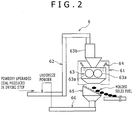
- Fig. 2 is a schematic illustration of an exemplary configuration of the molding section in Fig. 1 .
- the molding section 6 is configured of a double-roll molding machine 63 having a material supply unit (material clipping unit) 63b; a water spray unit 64 that sprays water as a coolant onto the surface of each roll 63a (the surface having many pockets) of the double-roll molding machine 63; a material supply line 62 along which the powdery upgraded coal as a molding material is carried from the drying section 5 to the double-roll molding machine 63; a sieving unit 65 that sieves the molded solid fuel provided from the double-roll molding machine 63 and the powdery upgraded coal as a non-molded material, and separates them from each other; a recycle line 66 along which the powdery upgraded coal as undersize powder provided from the sieving unit 65 is returned to the material supply line 62; and a semi-sealed molding chamber 61 that accommodates the double-roll molding machine 63 and the water spray unit 64, and has an opened carry-in part for the powdery upgraded coal provided from the drying section 5 and an opened carry-
- the molding section 6 configured in this way is designed such that the surface of each roll 63a of the double-roll molding machine 63 is cooled by the water spray unit 64 to maintain the surface temperature of the roll 63a to 100°C or lower.
- the inside of the molding chamber 61 is preferably humidified to maintain the humidity in the molding chamber 61 to 85% or more.
- an appropriate humidifying tool such as a humidifier may be provided in the molding chamber 61 in place of the water spray unit 64. Higher humidity in the molding chamber 61 is preferred, and the upper limit of the humidity may be 100%.
- the surface temperature of the roll 63a is maintained to 100°C or lower, thereby the molded solid fuel has a small temperature difference between the surficial portion and the inside thereof compared with the case where no coolant is sprayed, leading to suppression of occurrence of strain.
- the humidity in the molding chamber 61 is maintained to 85% or more, thereby the molded solid fuel is suppressed in water evaporation, and thus has a small difference in moisture percentage between the surficial portion and the inside thereof, leading to homogenization of the molded solid fuel.
- a molded solid fuel having high strength can be provided.
- the humidified powdery upgraded coal provided from the sieving unit 65 is returned to the material supply line 62 along the recycle line 66, and is mixed as a molding material to the powdery upgraded coal provided from the drying section 5; hence, the molding material can be more easily humidified before being supplied to the double-roll molding machine 63. Furthermore, water is sprayed onto the surface of the roll 63a by the water spray unit 64. It is thereby possible to improve nipping of the upgraded-coal powder between the rolls 63a, and suppress noise and/or vibration in the double-roll molding machine 63 (explosion occurring when air is exhausted from the pocket of the roll 63a and/or roll vibration).
- a molded solid fuel is experimentally manufactured through pressure molding in order to check the effect of water spray in the molding step.
- Mulia coal which is Indonesian brown coal, was used as low-grade coal as a material.
- the Mulia coal was pulverized by a hummer crusher in the pulverization section 1 and was formed into particles having a maximum particle size of 3 mm or less and an average particle size of about 0.5 mm.
- Such pulverized low-grade coal was subjected to separation treatment of dust coal, so that dust coal particles having an average particle diameter of about 0.1 mm or less were removed.
- the mixing section 2 then mixed the low-grade coal, from which the dust coal had been removed, and kerosene as the solvent oil, and thus produced a slurry.
- a weight ratio of the pulverized low-grade coal to the solvent oil was adjusted to 1.7 with reference to dried or moisture-free coal.
- the slurry produced in this way was sequentially subjected to the steps performed by the dehydration section 3, the solid-liquid separation section 4, and the drying section 5 to produce powdery upgraded coal.
- the produced powdery upgraded coal was carried into the molding section 6 having the configuration illustrated in Fig. 2 .
- Water was sprayed onto the surface of each roll 63a of the double-roll molding machine 63 by the water spray unit 64 to maintain the surface temperature of the roll 63a to 90°C, and maintain to 99% humidity in the molding chamber 61, specifically humidity in the periphery of each roll 63a of the double-roll molding machine 63.
- the molding step was performed to produce the molded solid fuel.
- Table 1 shows the results.
- roll surface temperature was measured using a non-contact thermometer.
- humidity under molding machine refers to a measurement of humidity in a space between the rolls 63a of the double-roll molding machine 63 and the sieving unit 65 below the rolls 63a.
- water spray amount refers to the weight percentage of the amount of sprayed water to the amount of production of the molded solid fuel.
- Humidity and moisture percentage of "molding material” were measured on the molding material at a place just before the material supply unit 63b on the material supply line 62.
- Temperature and moisture percentage of "recycle powder” were measured on the powdery upgraded coal as undersize powder provided from the sieving unit 65.
- the roll 63a has a diameter of 1000 mm, and each pocket provided on the surface of the roll 63a has a volumetric capacity of 15 cm 3 .
- Example 1 As shewn in Table 1 in Example 1 a molded solid fuel having a high crushing strength of 105 kgf ( ⁇ 1030 N), which is about two times higher than that in the case where no water spray is performed (comparative example 2 described later).
- Powdery upgraded coal produced in the same way as in Example 1 was carried into the molding section 6 having the configuration illustrated in Fig. 2 , and was subjected to the molding step.
- the molding condition of the comparative example 1 was different from that of Example 1 in that the water spray amount was 0.05% (Example 1: 1.0%), roll surface temperature after water spray was 110°C (Example 1: 90°C), and humidity under molding machine after water spray was 70% (Example 1: 99%).
- the produced molded solid fuel has a considerably low crushing strength-compared with the crushing strength in Example 1, i.e., 72 kgf ( ⁇ 706 N), about 70% of that in Example 1.
- Powdery upgraded coal produced in the same way as in Example 1 was carried into the molding section 6 having the configuration illustrated in Fig. 2 , and was subjected to the molding step without water spray and recycle of undersize powder.
- the roll surface temperature greatly exceeds 100°C or lower defined in the invention, and the humidity in the molding chamber 61 falls much below 85% or more defined in the invention.
- the produced molded solid fuel has a crushing strength of 54 kgf ( ⁇ 530 N), about 50% of the crushing strength in Example 1.
- the comparative example 2 since no water is sprayed onto the roll surface, noise and/or vibration occur in the double-roll molding machine 63.
- Powdery upgraded coal produced in the same way as in Example 1 was carried into the molding section 6 having the configuration illustrated in Fig. 2 , and was subjected to the molding step while oil spray was performed in place of water spray (but recycle of undersize powder was not performed).
- the sprayed oil was a typical low-viscosity machine oil.
- the oil has low specific heat and evaporative latent heat lower than water.
- the roll surface temperature and the humidity in the molding chamber do not satisfy the requirements defined in the invention, and the produced molded solid fuel has a crushing strength that is about 75% of that in
- a molded solid fuel having high strength can be produced from low-grade coal.
- the invention is suitable for producing a molded solid fuel from low-grade coal such as brown coal and subbituminous coal.
Landscapes
- Chemical & Material Sciences (AREA)
- Oil, Petroleum & Natural Gas (AREA)
- Organic Chemistry (AREA)
- Life Sciences & Earth Sciences (AREA)
- Environmental & Geological Engineering (AREA)
- General Life Sciences & Earth Sciences (AREA)
- Geochemistry & Mineralogy (AREA)
- Geology (AREA)
- Engineering & Computer Science (AREA)
- Combustion & Propulsion (AREA)
- Solid Fuels And Fuel-Associated Substances (AREA)
Priority Applications (1)
| Application Number | Priority Date | Filing Date | Title |
|---|---|---|---|
| PL14789025T PL2990467T3 (pl) | 2013-04-24 | 2014-03-27 | Sposób wytwarzania formowanego paliwa stałego |
Applications Claiming Priority (2)
| Application Number | Priority Date | Filing Date | Title |
|---|---|---|---|
| JP2013091396A JP5985433B2 (ja) | 2013-04-24 | 2013-04-24 | 成型固形燃料の製造方法 |
| PCT/JP2014/059035 WO2014174985A1 (ja) | 2013-04-24 | 2014-03-27 | 成型固形燃料の製造方法 |
Publications (3)
| Publication Number | Publication Date |
|---|---|
| EP2990467A1 EP2990467A1 (en) | 2016-03-02 |
| EP2990467A4 EP2990467A4 (en) | 2017-01-18 |
| EP2990467B1 true EP2990467B1 (en) | 2017-09-13 |
Family
ID=51791567
Family Applications (1)
| Application Number | Title | Priority Date | Filing Date |
|---|---|---|---|
| EP14789025.5A Not-in-force EP2990467B1 (en) | 2013-04-24 | 2014-03-27 | Method for producing molded solid fuel |
Country Status (8)
| Country | Link |
|---|---|
| US (1) | US9738844B2 (pl) |
| EP (1) | EP2990467B1 (pl) |
| JP (1) | JP5985433B2 (pl) |
| CN (1) | CN105121608B (pl) |
| AU (1) | AU2014258729B2 (pl) |
| PL (1) | PL2990467T3 (pl) |
| RU (1) | RU2628523C2 (pl) |
| WO (1) | WO2014174985A1 (pl) |
Families Citing this family (7)
| Publication number | Priority date | Publication date | Assignee | Title |
|---|---|---|---|---|
| JP6632496B2 (ja) * | 2016-08-24 | 2020-01-22 | 株式会社神戸製鋼所 | 固形燃料の製造方法 |
| KR101839959B1 (ko) * | 2016-08-29 | 2018-03-19 | 주식회사 포스코 | 성형탄 제조 설비의 원료 공급장치 및 원료 공급 방법 |
| WO2018079713A1 (ja) * | 2016-10-27 | 2018-05-03 | 宇部興産株式会社 | 石炭成型燃料の製造方法および石炭成型燃料 |
| JP2019038942A (ja) * | 2017-08-25 | 2019-03-14 | 宇部興産株式会社 | 石炭成型燃料の製造方法 |
| RU2661881C1 (ru) * | 2018-04-20 | 2018-07-20 | Сергей Иванович Цыбульский | Способ брикетирования угля |
| CN112111312A (zh) * | 2020-09-03 | 2020-12-22 | 陈生海 | 一种速燃引火种及其制备方法、制备装置 |
| JP7761014B2 (ja) * | 2023-02-20 | 2025-10-28 | Jfeスチール株式会社 | フェロコークス用成型物の製造方法 |
Family Cites Families (10)
| Publication number | Priority date | Publication date | Assignee | Title |
|---|---|---|---|---|
| US3907486A (en) * | 1973-12-07 | 1975-09-23 | United States Steel Corp | Means for internally cooling briquetting machine rolls and segments |
| JPS5566987A (en) * | 1978-11-16 | 1980-05-20 | Nippon Kokan Kk <Nkk> | Method of briquetting powdery coke |
| JPS57151695A (en) | 1981-03-13 | 1982-09-18 | Sumikin Coke Co Ltd | Production of dry molded coal |
| JPS57151696A (en) | 1981-03-14 | 1982-09-18 | Sumikin Coke Co Ltd | Production of dry molded coal |
| JP3415368B2 (ja) * | 1996-08-02 | 2003-06-09 | 新東工業株式会社 | 焼却灰の粒状化処理装置 |
| JP4045232B2 (ja) | 2003-11-07 | 2008-02-13 | 株式会社神戸製鋼所 | 低品位炭を原料とする固形燃料の製造方法および製造装置 |
| CN101220308B (zh) * | 2008-01-28 | 2011-02-02 | 沈阳航空工业学院 | 低阶煤干燥与型煤生产工艺及成套设备 |
| JP4580011B2 (ja) * | 2008-10-09 | 2010-11-10 | 株式会社神戸製鋼所 | 固形燃料の製造方法及び該製造方法により作製された固形燃料 |
| JP4603620B2 (ja) * | 2008-10-14 | 2010-12-22 | 株式会社神戸製鋼所 | 多孔質炭を原料とする成型固形燃料の製造方法 |
| JP2010172840A (ja) * | 2009-01-30 | 2010-08-12 | Eco-Material Inc | 温度調節機構を付与したペレット造粒機 |
-
2013
- 2013-04-24 JP JP2013091396A patent/JP5985433B2/ja active Active
-
2014
- 2014-03-27 EP EP14789025.5A patent/EP2990467B1/en not_active Not-in-force
- 2014-03-27 US US14/767,753 patent/US9738844B2/en not_active Expired - Fee Related
- 2014-03-27 RU RU2015150204A patent/RU2628523C2/ru active
- 2014-03-27 PL PL14789025T patent/PL2990467T3/pl unknown
- 2014-03-27 WO PCT/JP2014/059035 patent/WO2014174985A1/ja not_active Ceased
- 2014-03-27 CN CN201480022714.0A patent/CN105121608B/zh not_active Expired - Fee Related
- 2014-03-27 AU AU2014258729A patent/AU2014258729B2/en active Active
Non-Patent Citations (1)
| Title |
|---|
| None * |
Also Published As
| Publication number | Publication date |
|---|---|
| PL2990467T3 (pl) | 2018-01-31 |
| WO2014174985A1 (ja) | 2014-10-30 |
| EP2990467A4 (en) | 2017-01-18 |
| JP5985433B2 (ja) | 2016-09-06 |
| AU2014258729A1 (en) | 2015-10-01 |
| RU2628523C2 (ru) | 2017-08-17 |
| CN105121608B (zh) | 2018-09-18 |
| EP2990467A1 (en) | 2016-03-02 |
| US9738844B2 (en) | 2017-08-22 |
| US20150376529A1 (en) | 2015-12-31 |
| CN105121608A (zh) | 2015-12-02 |
| AU2014258729B2 (en) | 2016-03-24 |
| RU2015150204A (ru) | 2017-05-29 |
| JP2014214201A (ja) | 2014-11-17 |
Similar Documents
| Publication | Publication Date | Title |
|---|---|---|
| EP2990467B1 (en) | Method for producing molded solid fuel | |
| US8580000B2 (en) | Indirect heat-drying apparatus, indirect heat-drying method of drying substance to be dried, and method and apparatus for producing solid fuel | |
| US8070839B2 (en) | Briquetting process | |
| JP4603620B2 (ja) | 多孔質炭を原料とする成型固形燃料の製造方法 | |
| RU2483097C2 (ru) | Способ получения твердого топлива и твердое топливо, полученное данным способом | |
| WO2012137956A1 (ja) | 固形燃料成型方法 | |
| CN104781625B (zh) | 粒状物的间接加热干燥方法、改性煤的制造方法、间接加热型干燥装置以及改性煤制造装置 | |
| RU2628522C2 (ru) | Способ изготовления формованного твердого топлива | |
| US20150218054A1 (en) | Carbon electrode manufacturing | |
| WO2013189889A1 (de) | Verfahren und anlage zur aufbereitung von biomasse | |
| JP2014019746A (ja) | 副生炭成形物の製造方法 | |
| US3433859A (en) | Process for the preparation of hardened,dense heat transfer medium | |
| JP5739785B2 (ja) | 残渣炭成形物の製造方法 | |
| JP5635962B2 (ja) | 残渣炭成形物の製造方法 | |
| JP2008144113A (ja) | 固形燃料の製造方法および製造装置 | |
| JP6026367B2 (ja) | 改質石炭の製造方法 | |
| KR101402884B1 (ko) | 분말 석유코크스 제조방법 | |
| CN106458448A (zh) | 改质煤的贮存方法 | |
| CN119750620A (zh) | 一种超细氢氧化铝阻燃剂制备工艺 | |
| WO2015115199A1 (ja) | 改質石炭の製造方法及び改質石炭 | |
| JPS6212954B2 (pl) |
Legal Events
| Date | Code | Title | Description |
|---|---|---|---|
| PUAI | Public reference made under article 153(3) epc to a published international application that has entered the european phase |
Free format text: ORIGINAL CODE: 0009012 |
|
| 17P | Request for examination filed |
Effective date: 20150903 |
|
| AK | Designated contracting states |
Kind code of ref document: A1 Designated state(s): AL AT BE BG CH CY CZ DE DK EE ES FI FR GB GR HR HU IE IS IT LI LT LU LV MC MK MT NL NO PL PT RO RS SE SI SK SM TR |
|
| AX | Request for extension of the european patent |
Extension state: BA ME |
|
| DAX | Request for extension of the european patent (deleted) | ||
| A4 | Supplementary search report drawn up and despatched |
Effective date: 20161215 |
|
| RIC1 | Information provided on ipc code assigned before grant |
Ipc: C10L 5/36 20060101ALI20161209BHEP Ipc: C10L 9/00 20060101ALI20161209BHEP Ipc: C10L 5/08 20060101ALI20161209BHEP Ipc: C10L 5/04 20060101AFI20161209BHEP |
|
| GRAP | Despatch of communication of intention to grant a patent |
Free format text: ORIGINAL CODE: EPIDOSNIGR1 |
|
| INTG | Intention to grant announced |
Effective date: 20170502 |
|
| GRAS | Grant fee paid |
Free format text: ORIGINAL CODE: EPIDOSNIGR3 |
|
| GRAA | (expected) grant |
Free format text: ORIGINAL CODE: 0009210 |
|
| AK | Designated contracting states |
Kind code of ref document: B1 Designated state(s): AL AT BE BG CH CY CZ DE DK EE ES FI FR GB GR HR HU IE IS IT LI LT LU LV MC MK MT NL NO PL PT RO RS SE SI SK SM TR |
|
| REG | Reference to a national code |
Ref country code: GB Ref legal event code: FG4D |
|
| REG | Reference to a national code |
Ref country code: CH Ref legal event code: EP |
|
| REG | Reference to a national code |
Ref country code: IE Ref legal event code: FG4D |
|
| REG | Reference to a national code |
Ref country code: AT Ref legal event code: REF Ref document number: 928133 Country of ref document: AT Kind code of ref document: T Effective date: 20171015 |
|
| REG | Reference to a national code |
Ref country code: DE Ref legal event code: R096 Ref document number: 602014014642 Country of ref document: DE |
|
| REG | Reference to a national code |
Ref country code: NL Ref legal event code: MP Effective date: 20170913 |
|
| REG | Reference to a national code |
Ref country code: LT Ref legal event code: MG4D |
|
| PG25 | Lapsed in a contracting state [announced via postgrant information from national office to epo] |
Ref country code: HR Free format text: LAPSE BECAUSE OF FAILURE TO SUBMIT A TRANSLATION OF THE DESCRIPTION OR TO PAY THE FEE WITHIN THE PRESCRIBED TIME-LIMIT Effective date: 20170913 Ref country code: FI Free format text: LAPSE BECAUSE OF FAILURE TO SUBMIT A TRANSLATION OF THE DESCRIPTION OR TO PAY THE FEE WITHIN THE PRESCRIBED TIME-LIMIT Effective date: 20170913 Ref country code: LT Free format text: LAPSE BECAUSE OF FAILURE TO SUBMIT A TRANSLATION OF THE DESCRIPTION OR TO PAY THE FEE WITHIN THE PRESCRIBED TIME-LIMIT Effective date: 20170913 Ref country code: SE Free format text: LAPSE BECAUSE OF FAILURE TO SUBMIT A TRANSLATION OF THE DESCRIPTION OR TO PAY THE FEE WITHIN THE PRESCRIBED TIME-LIMIT Effective date: 20170913 Ref country code: NO Free format text: LAPSE BECAUSE OF FAILURE TO SUBMIT A TRANSLATION OF THE DESCRIPTION OR TO PAY THE FEE WITHIN THE PRESCRIBED TIME-LIMIT Effective date: 20171213 |
|
| REG | Reference to a national code |
Ref country code: AT Ref legal event code: MK05 Ref document number: 928133 Country of ref document: AT Kind code of ref document: T Effective date: 20170913 |
|
| PG25 | Lapsed in a contracting state [announced via postgrant information from national office to epo] |
Ref country code: GR Free format text: LAPSE BECAUSE OF FAILURE TO SUBMIT A TRANSLATION OF THE DESCRIPTION OR TO PAY THE FEE WITHIN THE PRESCRIBED TIME-LIMIT Effective date: 20171214 Ref country code: RS Free format text: LAPSE BECAUSE OF FAILURE TO SUBMIT A TRANSLATION OF THE DESCRIPTION OR TO PAY THE FEE WITHIN THE PRESCRIBED TIME-LIMIT Effective date: 20170913 Ref country code: BG Free format text: LAPSE BECAUSE OF FAILURE TO SUBMIT A TRANSLATION OF THE DESCRIPTION OR TO PAY THE FEE WITHIN THE PRESCRIBED TIME-LIMIT Effective date: 20171213 Ref country code: ES Free format text: LAPSE BECAUSE OF FAILURE TO SUBMIT A TRANSLATION OF THE DESCRIPTION OR TO PAY THE FEE WITHIN THE PRESCRIBED TIME-LIMIT Effective date: 20170913 Ref country code: LV Free format text: LAPSE BECAUSE OF FAILURE TO SUBMIT A TRANSLATION OF THE DESCRIPTION OR TO PAY THE FEE WITHIN THE PRESCRIBED TIME-LIMIT Effective date: 20170913 |
|
| PG25 | Lapsed in a contracting state [announced via postgrant information from national office to epo] |
Ref country code: NL Free format text: LAPSE BECAUSE OF FAILURE TO SUBMIT A TRANSLATION OF THE DESCRIPTION OR TO PAY THE FEE WITHIN THE PRESCRIBED TIME-LIMIT Effective date: 20170913 |
|
| PG25 | Lapsed in a contracting state [announced via postgrant information from national office to epo] |
Ref country code: RO Free format text: LAPSE BECAUSE OF FAILURE TO SUBMIT A TRANSLATION OF THE DESCRIPTION OR TO PAY THE FEE WITHIN THE PRESCRIBED TIME-LIMIT Effective date: 20170913 Ref country code: CZ Free format text: LAPSE BECAUSE OF FAILURE TO SUBMIT A TRANSLATION OF THE DESCRIPTION OR TO PAY THE FEE WITHIN THE PRESCRIBED TIME-LIMIT Effective date: 20170913 |
|
| PG25 | Lapsed in a contracting state [announced via postgrant information from national office to epo] |
Ref country code: EE Free format text: LAPSE BECAUSE OF FAILURE TO SUBMIT A TRANSLATION OF THE DESCRIPTION OR TO PAY THE FEE WITHIN THE PRESCRIBED TIME-LIMIT Effective date: 20170913 Ref country code: SK Free format text: LAPSE BECAUSE OF FAILURE TO SUBMIT A TRANSLATION OF THE DESCRIPTION OR TO PAY THE FEE WITHIN THE PRESCRIBED TIME-LIMIT Effective date: 20170913 Ref country code: AT Free format text: LAPSE BECAUSE OF FAILURE TO SUBMIT A TRANSLATION OF THE DESCRIPTION OR TO PAY THE FEE WITHIN THE PRESCRIBED TIME-LIMIT Effective date: 20170913 Ref country code: IT Free format text: LAPSE BECAUSE OF FAILURE TO SUBMIT A TRANSLATION OF THE DESCRIPTION OR TO PAY THE FEE WITHIN THE PRESCRIBED TIME-LIMIT Effective date: 20170913 Ref country code: IS Free format text: LAPSE BECAUSE OF FAILURE TO SUBMIT A TRANSLATION OF THE DESCRIPTION OR TO PAY THE FEE WITHIN THE PRESCRIBED TIME-LIMIT Effective date: 20180113 Ref country code: SM Free format text: LAPSE BECAUSE OF FAILURE TO SUBMIT A TRANSLATION OF THE DESCRIPTION OR TO PAY THE FEE WITHIN THE PRESCRIBED TIME-LIMIT Effective date: 20170913 |
|
| REG | Reference to a national code |
Ref country code: DE Ref legal event code: R097 Ref document number: 602014014642 Country of ref document: DE |
|
| PLBE | No opposition filed within time limit |
Free format text: ORIGINAL CODE: 0009261 |
|
| STAA | Information on the status of an ep patent application or granted ep patent |
Free format text: STATUS: NO OPPOSITION FILED WITHIN TIME LIMIT |
|
| PG25 | Lapsed in a contracting state [announced via postgrant information from national office to epo] |
Ref country code: DK Free format text: LAPSE BECAUSE OF FAILURE TO SUBMIT A TRANSLATION OF THE DESCRIPTION OR TO PAY THE FEE WITHIN THE PRESCRIBED TIME-LIMIT Effective date: 20170913 |
|
| 26N | No opposition filed |
Effective date: 20180614 |
|
| REG | Reference to a national code |
Ref country code: CH Ref legal event code: PL |
|
| GBPC | Gb: european patent ceased through non-payment of renewal fee |
Effective date: 20180327 |
|
| PG25 | Lapsed in a contracting state [announced via postgrant information from national office to epo] |
Ref country code: MC Free format text: LAPSE BECAUSE OF FAILURE TO SUBMIT A TRANSLATION OF THE DESCRIPTION OR TO PAY THE FEE WITHIN THE PRESCRIBED TIME-LIMIT Effective date: 20170913 Ref country code: SI Free format text: LAPSE BECAUSE OF FAILURE TO SUBMIT A TRANSLATION OF THE DESCRIPTION OR TO PAY THE FEE WITHIN THE PRESCRIBED TIME-LIMIT Effective date: 20170913 |
|
| REG | Reference to a national code |
Ref country code: BE Ref legal event code: MM Effective date: 20180331 |
|
| REG | Reference to a national code |
Ref country code: IE Ref legal event code: MM4A |
|
| PG25 | Lapsed in a contracting state [announced via postgrant information from national office to epo] |
Ref country code: LU Free format text: LAPSE BECAUSE OF NON-PAYMENT OF DUE FEES Effective date: 20180327 |
|
| PG25 | Lapsed in a contracting state [announced via postgrant information from national office to epo] |
Ref country code: IE Free format text: LAPSE BECAUSE OF NON-PAYMENT OF DUE FEES Effective date: 20180327 |
|
| PG25 | Lapsed in a contracting state [announced via postgrant information from national office to epo] |
Ref country code: GB Free format text: LAPSE BECAUSE OF NON-PAYMENT OF DUE FEES Effective date: 20180327 Ref country code: CH Free format text: LAPSE BECAUSE OF NON-PAYMENT OF DUE FEES Effective date: 20180331 Ref country code: LI Free format text: LAPSE BECAUSE OF NON-PAYMENT OF DUE FEES Effective date: 20180331 Ref country code: BE Free format text: LAPSE BECAUSE OF NON-PAYMENT OF DUE FEES Effective date: 20180331 |
|
| PG25 | Lapsed in a contracting state [announced via postgrant information from national office to epo] |
Ref country code: FR Free format text: LAPSE BECAUSE OF NON-PAYMENT OF DUE FEES Effective date: 20180331 |
|
| PG25 | Lapsed in a contracting state [announced via postgrant information from national office to epo] |
Ref country code: MT Free format text: LAPSE BECAUSE OF NON-PAYMENT OF DUE FEES Effective date: 20180327 |
|
| PG25 | Lapsed in a contracting state [announced via postgrant information from national office to epo] |
Ref country code: TR Free format text: LAPSE BECAUSE OF FAILURE TO SUBMIT A TRANSLATION OF THE DESCRIPTION OR TO PAY THE FEE WITHIN THE PRESCRIBED TIME-LIMIT Effective date: 20170913 |
|
| PG25 | Lapsed in a contracting state [announced via postgrant information from national office to epo] |
Ref country code: PT Free format text: LAPSE BECAUSE OF FAILURE TO SUBMIT A TRANSLATION OF THE DESCRIPTION OR TO PAY THE FEE WITHIN THE PRESCRIBED TIME-LIMIT Effective date: 20170913 |
|
| PG25 | Lapsed in a contracting state [announced via postgrant information from national office to epo] |
Ref country code: HU Free format text: LAPSE BECAUSE OF FAILURE TO SUBMIT A TRANSLATION OF THE DESCRIPTION OR TO PAY THE FEE WITHIN THE PRESCRIBED TIME-LIMIT; INVALID AB INITIO Effective date: 20140327 Ref country code: CY Free format text: LAPSE BECAUSE OF FAILURE TO SUBMIT A TRANSLATION OF THE DESCRIPTION OR TO PAY THE FEE WITHIN THE PRESCRIBED TIME-LIMIT Effective date: 20170913 Ref country code: MK Free format text: LAPSE BECAUSE OF NON-PAYMENT OF DUE FEES Effective date: 20170913 |
|
| PG25 | Lapsed in a contracting state [announced via postgrant information from national office to epo] |
Ref country code: AL Free format text: LAPSE BECAUSE OF FAILURE TO SUBMIT A TRANSLATION OF THE DESCRIPTION OR TO PAY THE FEE WITHIN THE PRESCRIBED TIME-LIMIT Effective date: 20170913 |
|
| PGFP | Annual fee paid to national office [announced via postgrant information from national office to epo] |
Ref country code: DE Payment date: 20210316 Year of fee payment: 8 Ref country code: PL Payment date: 20210212 Year of fee payment: 8 |
|
| REG | Reference to a national code |
Ref country code: DE Ref legal event code: R119 Ref document number: 602014014642 Country of ref document: DE |
|
| PG25 | Lapsed in a contracting state [announced via postgrant information from national office to epo] |
Ref country code: DE Free format text: LAPSE BECAUSE OF NON-PAYMENT OF DUE FEES Effective date: 20221001 |
|
| PG25 | Lapsed in a contracting state [announced via postgrant information from national office to epo] |
Ref country code: PL Free format text: LAPSE BECAUSE OF NON-PAYMENT OF DUE FEES Effective date: 20220327 |