EP2990448B1 - White ink for ink-jet printing - Google Patents
White ink for ink-jet printing Download PDFInfo
- Publication number
- EP2990448B1 EP2990448B1 EP14788180.9A EP14788180A EP2990448B1 EP 2990448 B1 EP2990448 B1 EP 2990448B1 EP 14788180 A EP14788180 A EP 14788180A EP 2990448 B1 EP2990448 B1 EP 2990448B1
- Authority
- EP
- European Patent Office
- Prior art keywords
- ink
- titanium oxide
- white ink
- weight
- pigment
- Prior art date
- Legal status (The legal status is an assumption and is not a legal conclusion. Google has not performed a legal analysis and makes no representation as to the accuracy of the status listed.)
- Revoked
Links
Classifications
-
- C—CHEMISTRY; METALLURGY
- C09—DYES; PAINTS; POLISHES; NATURAL RESINS; ADHESIVES; COMPOSITIONS NOT OTHERWISE PROVIDED FOR; APPLICATIONS OF MATERIALS NOT OTHERWISE PROVIDED FOR
- C09D—COATING COMPOSITIONS, e.g. PAINTS, VARNISHES OR LACQUERS; FILLING PASTES; CHEMICAL PAINT OR INK REMOVERS; INKS; CORRECTING FLUIDS; WOODSTAINS; PASTES OR SOLIDS FOR COLOURING OR PRINTING; USE OF MATERIALS THEREFOR
- C09D11/00—Inks
- C09D11/30—Inkjet printing inks
- C09D11/32—Inkjet printing inks characterised by colouring agents
- C09D11/322—Pigment inks
-
- C—CHEMISTRY; METALLURGY
- C08—ORGANIC MACROMOLECULAR COMPOUNDS; THEIR PREPARATION OR CHEMICAL WORKING-UP; COMPOSITIONS BASED THEREON
- C08K—Use of inorganic or non-macromolecular organic substances as compounding ingredients
- C08K9/00—Use of pretreated ingredients
- C08K9/02—Ingredients treated with inorganic substances
-
- C—CHEMISTRY; METALLURGY
- C09—DYES; PAINTS; POLISHES; NATURAL RESINS; ADHESIVES; COMPOSITIONS NOT OTHERWISE PROVIDED FOR; APPLICATIONS OF MATERIALS NOT OTHERWISE PROVIDED FOR
- C09D—COATING COMPOSITIONS, e.g. PAINTS, VARNISHES OR LACQUERS; FILLING PASTES; CHEMICAL PAINT OR INK REMOVERS; INKS; CORRECTING FLUIDS; WOODSTAINS; PASTES OR SOLIDS FOR COLOURING OR PRINTING; USE OF MATERIALS THEREFOR
- C09D11/00—Inks
- C09D11/02—Printing inks
- C09D11/10—Printing inks based on artificial resins
- C09D11/101—Inks specially adapted for printing processes involving curing by wave energy or particle radiation, e.g. with UV-curing following the printing
-
- C—CHEMISTRY; METALLURGY
- C09—DYES; PAINTS; POLISHES; NATURAL RESINS; ADHESIVES; COMPOSITIONS NOT OTHERWISE PROVIDED FOR; APPLICATIONS OF MATERIALS NOT OTHERWISE PROVIDED FOR
- C09D—COATING COMPOSITIONS, e.g. PAINTS, VARNISHES OR LACQUERS; FILLING PASTES; CHEMICAL PAINT OR INK REMOVERS; INKS; CORRECTING FLUIDS; WOODSTAINS; PASTES OR SOLIDS FOR COLOURING OR PRINTING; USE OF MATERIALS THEREFOR
- C09D11/00—Inks
- C09D11/02—Printing inks
- C09D11/10—Printing inks based on artificial resins
- C09D11/102—Printing inks based on artificial resins containing macromolecular compounds obtained by reactions other than those only involving unsaturated carbon-to-carbon bonds
- C09D11/104—Polyesters
-
- C—CHEMISTRY; METALLURGY
- C09—DYES; PAINTS; POLISHES; NATURAL RESINS; ADHESIVES; COMPOSITIONS NOT OTHERWISE PROVIDED FOR; APPLICATIONS OF MATERIALS NOT OTHERWISE PROVIDED FOR
- C09D—COATING COMPOSITIONS, e.g. PAINTS, VARNISHES OR LACQUERS; FILLING PASTES; CHEMICAL PAINT OR INK REMOVERS; INKS; CORRECTING FLUIDS; WOODSTAINS; PASTES OR SOLIDS FOR COLOURING OR PRINTING; USE OF MATERIALS THEREFOR
- C09D11/00—Inks
- C09D11/30—Inkjet printing inks
- C09D11/36—Inkjet printing inks based on non-aqueous solvents
-
- C—CHEMISTRY; METALLURGY
- C09—DYES; PAINTS; POLISHES; NATURAL RESINS; ADHESIVES; COMPOSITIONS NOT OTHERWISE PROVIDED FOR; APPLICATIONS OF MATERIALS NOT OTHERWISE PROVIDED FOR
- C09D—COATING COMPOSITIONS, e.g. PAINTS, VARNISHES OR LACQUERS; FILLING PASTES; CHEMICAL PAINT OR INK REMOVERS; INKS; CORRECTING FLUIDS; WOODSTAINS; PASTES OR SOLIDS FOR COLOURING OR PRINTING; USE OF MATERIALS THEREFOR
- C09D133/00—Coating compositions based on homopolymers or copolymers of compounds having one or more unsaturated aliphatic radicals, each having only one carbon-to-carbon double bond, and at least one being terminated by only one carboxyl radical, or of salts, anhydrides, esters, amides, imides, or nitriles thereof; Coating compositions based on derivatives of such polymers
- C09D133/04—Homopolymers or copolymers of esters
- C09D133/06—Homopolymers or copolymers of esters of esters containing only carbon, hydrogen and oxygen, the oxygen atom being present only as part of the carboxyl radical
- C09D133/08—Homopolymers or copolymers of acrylic acid esters
-
- C—CHEMISTRY; METALLURGY
- C09—DYES; PAINTS; POLISHES; NATURAL RESINS; ADHESIVES; COMPOSITIONS NOT OTHERWISE PROVIDED FOR; APPLICATIONS OF MATERIALS NOT OTHERWISE PROVIDED FOR
- C09D—COATING COMPOSITIONS, e.g. PAINTS, VARNISHES OR LACQUERS; FILLING PASTES; CHEMICAL PAINT OR INK REMOVERS; INKS; CORRECTING FLUIDS; WOODSTAINS; PASTES OR SOLIDS FOR COLOURING OR PRINTING; USE OF MATERIALS THEREFOR
- C09D135/00—Coating compositions based on homopolymers or copolymers of compounds having one or more unsaturated aliphatic radicals, each having only one carbon-to-carbon double bond, and at least one being terminated by a carboxyl radical, and containing at least another carboxyl radical in the molecule, or of salts, anhydrides, esters, amides, imides or nitriles thereof; Coating compositions based on derivatives of such polymers
- C09D135/02—Homopolymers or copolymers of esters
-
- C—CHEMISTRY; METALLURGY
- C08—ORGANIC MACROMOLECULAR COMPOUNDS; THEIR PREPARATION OR CHEMICAL WORKING-UP; COMPOSITIONS BASED THEREON
- C08K—Use of inorganic or non-macromolecular organic substances as compounding ingredients
- C08K3/00—Use of inorganic substances as compounding ingredients
- C08K3/18—Oxygen-containing compounds, e.g. metal carbonyls
- C08K3/20—Oxides; Hydroxides
- C08K3/22—Oxides; Hydroxides of metals
- C08K2003/2237—Oxides; Hydroxides of metals of titanium
- C08K2003/2241—Titanium dioxide
-
- C—CHEMISTRY; METALLURGY
- C08—ORGANIC MACROMOLECULAR COMPOUNDS; THEIR PREPARATION OR CHEMICAL WORKING-UP; COMPOSITIONS BASED THEREON
- C08K—Use of inorganic or non-macromolecular organic substances as compounding ingredients
- C08K2201/00—Specific properties of additives
- C08K2201/002—Physical properties
- C08K2201/003—Additives being defined by their diameter
Definitions
- Ink-jet printing system jets and lands minute droplets of ink from ink-jet heads on a base material to be printed, thereby printing by forming an image or characters on the base material.
- This ink-jet printing system does not require a printing plate for printing.
- Electrographic system is a widely known as a typical printing system requiring no printing plate.
- the ink-jet printing system is superior to the electrographic system in the initial cost of the apparatus, the running cost of printing, the apparatus size, and high-speed printability.
- the ink-jet printing system typically uses ink-jet ink of active energy ray-curable type.
- This ink mainly contains polymerizable compounds such as a reactive monomer and oligomer, and a polymerization initiator such as a photo-radical generator and a photoacid generator.
- the ink is landed on a base material to be printed, and then active energy rays are applied to the ink to cause polymerization reaction of the ink components, thereby forming an image and characters.
- the single-passing system often uses fixed ink-jet heads, and thus requires head cleaning. Typically, head cleaning is carried out once per every several hours, and the frequency is low. Therefore, the single-passing system requires the designing of ink which will not cause deflection or ejection failure of ink.
- ink which will not cause deflection or ejection failure of ink.
- specific gravity of the pigment in the ink is high. Therefore, when the apparatus is ceased for a while, the pigment tends to sediment in the nozzles. Furthermore, pigment sedimentation tends to cause problems such as ink ejection failure (nozzle void), so that improvement is desired.
- Patent Literatures 1 to 3 disclose the methods for preventing sedimentation of titanium oxide through the surface treatment of titanium oxide used as the pigment, and/or the use of a specific pigment dispersant. Prevention of sedimentation of titanium oxide likely improves ejection stability. However, by any of these disclosed methods, it is difficult to achieve sufficient ejection stability over a long time which allows favorable use of inks on the single-passing system.
- Patent Literature 4 discloses a method of improving pigment sedimentation by using hollow particles in place of titanium oxide as the white pigment.
- the hollow particles have a lower specific gravity than titanium oxide, so that the hollow particles resist sedimentation even in a low viscosity ink.
- the hollow particles tend to have lower hiding property in comparison with titanium oxide. Therefore, in order to achieve a sufficient printing concentration by printing on the single-passing system, for example, the printing concentration must be improved by using multiple heads, which may cause a problem of upsizing of the apparatus.
- the present invention provides an ink-jet white ink of active energy ray-curable type, the white ink having high printing stability and good hiding property.
- the white ink is suitable for printing on the single-pass ink-jet printing system.
- One embodiment of the present invention relates to an ink-jet white ink of active energy ray-curable type (hereinafter referred to as "white ink”).
- the white ink is intended to be used under the printing system wherein ink is jetted and landed on a base material to be printed by the ink-jet printing system, and then the ink coating film is cured by irradiation with active energy ray, thereby an image and characters are formed.
- active energy rays herein means the energy beams in a broad sense which can provide energy necessary for the activation of chemical reaction. Not particularly limited, but in one embodiment of the present invention, the active energy rays are preferably light energy containing ultraviolet rays.
- the white ink contains titanium oxide, a pigment dispersing resin, and a polymerizable compound, the content of titanium oxide is from 15 to 30% by weight with reference to the total weight of the white ink, and the titanium oxide has a weight average particle diameter of 180 to 250 nm.
- the components of the white ink are more specifically described below.
- the white ink of the present invention includes titanium oxide having a weight average particle diameter of 180 to 250 nm as the white pigment.
- the titanium oxide is surface-treated. In the white ink, if the weight average particle diameter of the titanium oxide is too small, sufficient hiding property cannot be achieved. On the other hand, if the weight average particle diameter of the titanium oxide is too large, sedimentation of the titanium oxide is hastened. Therefore, titanium oxide included in the ink in the ink-jet head sediments in a short time, and decap property tends to deteriorate. Regarding this, in the present invention, the titanium oxide has a weight average particle diameter of 180 to 250 nm, so that decap property during printing is improved, and printing is successfully carried out over a long time. In one embodiment, the weight average particle diameter of the titanium oxide is preferably from 200 to 250 nm, and more preferably from 220 to 250 nm.
- the content of titanium oxide in the white ink is from 15 to 30% by weight with reference to the total weight of the white ink. If the content of titanium oxide is too low, obtaining sufficient hiding property is hard. On the other hand, if the content is too high, storage stability tends to deteriorate. Regarding this, the content of titanium oxide in the white ink of the present invention is adjusted within the above-described range, so that high hiding property is achieved even if the thickness of the printed material is small, and high storage stability of the ink is maintained.
- the content of titanium oxide is preferably from 17 to 25% by weight, and more preferably from 19 to 23% by weight with reference to the total weight of the white ink.
- a surface-treated titanium oxide is used.
- the surface treatment is carried out using a surface-treating agent which comprises at least one inorganic surface-treating agent and an organic surface-treating agent.
- the treatment with the surface-treating agent makes it easy to reduce catalytic activity and control hydrophilicity on the surface of titanium oxide.
- weather resistance and dispersion stability of the ink are readily improved.
- the at least one inorganic surface-treating agent is selected from aluminum compounds including aluminum hydroxide and alumina, silica, and zirconia.
- the organic surface-treating agent include polyalcohols, alkanolamines, organosilicon compounds, organic phosphate compounds, and higher fatty acids.
- titanium oxide whose surface is treated with silica is known to have acidic hydroxyl groups on particle surface thereof. Therefore, the combination of the titanium oxide and a basic dispersant forms intermolecular interaction such as a hydrogen bond between them. Although not bound by any theory, such intermolecular interaction likely improves adsorption between the titanium oxide and basic dispersant, and makes it easy to control the sedimentation of titanium oxide. In addition, for the same reason, among the titanium oxide treated with the above-described organic surface-treating agent, the titanium oxide treated with a polyalcohol, alkanolamine, or organosilicon compound is particularly preferred, because it has neutral hydroxyl groups on particle surface thereof.
- the titanium oxide is more preferably treated with a surface-treating agent, and the treated surface has hydroxyl groups.
- the hydroxyl groups are classified into acidic, neutral, and basic according to the surface-treating agent used.
- the hydroxyl groups are preferably acidic and neutral, and more preferably acidic.
- the white ink of the present invention contains a pigment dispersant.
- a pigment dispersant improves pigment dispersibility and ink storage stability, and makes it easy to prevent sedimentation of the pigment.
- a basic dispersant is preferably used from the viewpoints of affinity with the ink constituents, and storage stability.
- a pigment dispersant of resin type be used from the viewpoint of affinity with the ink constituents.
- Specific examples of the pigment dispersant of resin type include polymeric dispersants having a main skeleton such as polyurethane skeleton, polyacryl skeleton, polyester skeleton, polyamide skeleton, polyimide skeleton, and polyurea skeleton.
- DISPER-BYK 162, 167, 168, and LP-N-22252; Solsperse 24000SC, 24000GR, 32000, 33000, 35000, 39000, 76400, 76500, J100, and J200; and AJISPER PB-821, 822, 824, and 827 are preferred. All of them are dispersants of basic resin type.
- the content of the pigment dispersant is not particularly limited, and may be freely adjusted as long as desired stability is achieved.
- the proportion of the active ingredients of the pigment dispersant is preferably from 2 to 10 parts by weight with reference to 100 parts by weight of titanium oxide.
- the content of the pigment dispersant is preferably from 3 to 8 parts by weight, and more preferably from 4 to 7 parts by weight with reference to 100 parts by weight of titanium oxide.
- the white ink of the present invention may include at least one of the compounds represented by the general formulae (1) and (2). These specific compounds have a low viscosity, and thus can decrease the ink viscosity. Therefore, the use of the compound makes readily improves the ink ejection performance. In addition, reduction of the ink viscosity allows the increase of the content of the pigment and polymerization initiator. Accordingly, the use of the compound allowed the improvement of the hiding property and curability of the printed material.
- R1 and R2 are each independently a hydrogen atom or a methyl group
- R3 is a hydrogen atom or an alkyl group with 1 to 10 carbon atoms
- n represents an integer of 1 to 10.
- R3 is preferably a hydrogen atom, and n is preferably 1 or 2. If n is greater than 10, the polymerizable compound has a high viscosity, which may makes it difficult to obtain an ink with a low viscosity.
- the content of the specific compounds represented by the general formulae (1) and (2) is preferably from 10 to 50% by weight, more preferably from 15 to 45% by weight, and most preferably from 20 to 40% by weight with reference to the total weight of the ink.
- the content of the specific compounds is adjusted within this range, the ink viscosity ink is readily decreased while a storage stability of the ink is maintained. Furthermore, as a result of this, ejection performance of the ink is readily improved.
- the content of the specific compound in the ink is 10% by weight or more, ink viscosity is readily decreased, and as a result of this, ejection performance of the ink is improved.
- the content is 50% by weight or less
- the pigment dispersant in the ink dissolves, and as a result of this, the problem of deficiency of the amount of the pigment dispersant to titanium oxide is avoided. Accordingly, marked storage stability of the ink is readily achieved.
- the polymerizable compound may be a combination of a monofunctional monomer and a polyfunctional monomer.
- the monofunctional monomer means a compound having only one polymerizable functional group in a molecule.
- the polyfunctional monomer means a compound having two or more polymerizable functional groups in a molecule.
- the specific compounds represented by the general formulae (1) and (2) are not included.
- the polymerizable compound may be a combination of a monofunctional monomer, a polyfunctional monomer, and specific compounds represented by the general formulae (1) and (2).
- the polyfunctional monomer includes at least one of dipropylene glycol diacrylate, 1,9-nonanediol diacrylate, and 1,10-decanediol diacrylate.
- the whole composition of the polymerizable compound is not particularly limited. However, in the whole composition, if the proportion of the monofunctional monomer is too high, ink curability may decrease. Therefore, in one embodiment, with reference to the total weight of the polymerizable compound, the total content of the polyfunctional monomer and/or the specific compounds represented by the general formulae (1) and (2) is preferably 70% by weight or more. The total content is more preferably 80% by weight or more, and even more preferably 90% by weight or more. In one embodiment, with reference to the total weight of the polymerizable compound, the specific compounds represented by the general formulae (1) and (2) is more preferably 70% by weight or more.
- the white ink of the present invention may further include, in addition to the above-described constituent, other components known to the well-known in the art.
- an oligomer and/or a prepolymer may be used. Specific examples include, but not limited to, the followings.
- the content of the component is preferably less than 10% by weight, and more preferably less than 5% by weight, with reference to the total weight of the ink.
- the active energy rays applied to the white ink are preferably light energy containing ultraviolet ray.
- the above-described constituents of the white ink further include a polymerization initiator.
- the polymerization initiator is not particularly limited, and may be appropriately selected from the compounds known in the technical field, in consideration of the curing rate and physical properties of the cured coating film. In one embodiment, a molecule-cleaving or hydrogen-withdrawing polymerization initiator is preferred.
- polymerization initiator examples include benzoin isobutyl ether, 2,4-diethylthioxanthone, 2-isopropylthioxanthone, 2,4,6-trimethylbenzoyl diphenyl phosphine oxide, 2-benzyl-2-dimethylamino-1-(4-morpholinophenyl)-butane-1-one, bis(2,4,6-dimethoxybenzoyl)-2,4,4-trimethylpentylphosphine oxide, bis(2,4,6-trimethylbenzoyl) phenylphosphine oxide, 2-methyl-1-(4-methylthio phenyl)-2-morpholinopropane-1-one, oligo(2-hydroxy-2-methyl-1-(4-(1-methylvinyl)phenyl)propanone), 4-benzoyl-4'-methyl-diphenyl sulfide, 1,2-octanedione, and 1-(4-(phenylthio
- polymerization initiators are preferred because their radical formation reaction will not be inhibited by light absorption of a pigment and a polymerizable compound, and their high radical generation efficiency improves ink curability.
- the content of the polymerization initiator is preferably from 3 to 20% by weight, and more preferably from 5 to 15% by weight with reference to the total weight of the ink.
- polymerization initiator examples include molecule-cleaving polymerization initiators such as 1-hydroxycyclohexylphenyl ketone, benzoin ethyl ether, benzyl dimethylketal, 2-hydroxy-2-methyl-1-phenylpropane-1-one, and 1-(4-isopropyl phenyl)-2-hydroxy-2-methylpropane-1-one.
- molecule-cleaving polymerization initiators such as 1-hydroxycyclohexylphenyl ketone, benzoin ethyl ether, benzyl dimethylketal, 2-hydroxy-2-methyl-1-phenylpropane-1-one, and 1-(4-isopropyl phenyl)-2-hydroxy-2-methylpropane-1-one.
- hydrogen-withdrawing polymerization initiators such as benzophenone, 4-phenylbenzophenone, and isophthalphenone.
- the above-listed polymerization initiators at least one selected from the group consisting of 2,4,6-trimethylbenzoyldiphenylphosphine oxide, bis(2,4,6-trimethylbenzoyl)phenylphosphine oxide, and 4-benzoyl-4'-methyldiphenyl sulfide is preferred.
- These polymerization initiators are preferred because they have high curability, and will not yellow the cured ink film.
- the ink of the present invention includes one, preferably two of the above-listed polymerization initiators.
- the use of the combination of 2,4,6-trimethylbenzoyldiphenylphosphine oxide and 4-benzoyl-4'-methyldiphenyl sulfide is preferred.
- the mixing ratio of 2,4,6-trimethylbenzoyldiphenylphosphine oxide and 4-benzoyl-4'-methyldiphenyl sulfide is from 2 : 1 to 5 : 1.
- the total content of the polymerization initiator is preferably from 10 to 20% by weight with reference to the total weight of the ink.
- the polymerization initiator may be combined with a sensitizer.
- the sensitizer is preferably an amine which will not cause addition reaction with the polymerizable compound.
- the sensitizer useful in the present invention include trimethylamine, methyldimethanol amine, triethanolamine, p-diethylaminoacetophenone, ethyl-4-(dimethylamino)-benzoate, Isoamyl p-(dimethylamino)-benzoate, N,N-dimethylbenzylamine, and 4,4'-bis(diethylamino)benzophenone.
- These sensitizers may yellow the cured ink film, and thus are preferably used in an amount which will not cause yellowing.
- the use of an organic solvent is preferred.
- the use of an organic solvent makes it easy to decrease the ink viscosity, and allows the improvement of ejection property.
- the organic solvent include glycol monoacetate compounds such as ethylene glycol monobutyl ether acetate, diethylene glycol monoethyl ether acetate, diethylene glycol monobutyl ether acetate; glycol ether compounds such as diethyleneglycol dimethyl ether, diethylene glycol methyl ethyl ether, diethylene glycol diethyl ether, and tetraethylene glycol dimethyl ether; and lactate compounds such as ethyl lactate, and butyl lactate.
- the content of the organic solvent is preferably from 0.01 to 5% by weight with reference to the total weight of the ink.
- the content is more preferably from 0.1 to 3% by weight, and even more preferably from 0.5 to 2% by weight.
- the use of a surface conditioner is preferred, thereby improving spreadability on the base material.
- the surface conditioner may be any compound known in the technical field, and may be appropriately selected from acrylic, silicon, and fluorine compounds. Specific examples of the surface conditioner include, but not limited to, BYK-350, 352, 354, 355, 358N, 361N, 381N, 381, 392, BYK-300, 302, 306, 307, 310, 315, 320, 322, 323, 325, 330, 331, 333, 337, 340, 344, 370, 375, 377, 355, 356, 357, 390, UV3500, UV3510, and UV3570 manufactured by BYK-Chemie.
- Hindered phenol compounds "IRGANOX 1010, 1010FF, 1035, 1035FF, 1076, 1076FD, 1076DWJ, 1098, 1135, 1330, 245, 245FF, 245DWJ, 259, 3114, 565, 565DD, and 295" manufactured by BASF; "BHT SWANOX”, “NONFLEX Alba, MBP, EBP, CBP, BB", “TBH” manufactured by Seiko Chemical Co., Ltd., "AO-20, 30, 50, 50F, 70, 80, and 330” manufactured by ADEKA Corporation; "H-BHT” manufactured by Honshu Chemical Industry Co., Ltd., and “Yoshinox BB, 425, and 930" manufactured by API Corporation.
- Phenothiazine compounds “Phenothiazine” manufactured by Seiko Chemical Co., Ltd.; “Phenothiazine”, “2-methoxyphenothiazine”, and “2-cyanophenothiazine” manufactured by Sakai Chemical Industry Co., Ltd.
- Hindered amine compounds "IRGANOX 5067” "TINUVIN 144, 765, 770DF, and 622LD” manufactured by BASF; "NONFLEX H, F, OD-3, DCD, and LAS-P", “STEARER STAR", "diphenylamine”, “4-aminodiphenylamine”, and “4-oxydiphenylamine” manufactured by Seiko Chemical Co., Ltd.; "HOTEMPO” manufactured by Evonik Degussa GmbH; "Fancryl 711MM and 712HM” manufactured by Hitachi Chemical Co., Ltd.
- Phosphorus compounds "triphenylphosphine”, “IRGAFOS 168 and 168FF” manufactured by BASF; and “NONFLEX TNP” manufactured by Seiko Chemical Co., Ltd.
- the following compounds are preferred from the viewpoints of solubility in the ink and color of the stabilizer.
- Hindered phenol compounds "BHT Swanox”, “NONFLEX Alba” manufactured by Seiko Chemical Co., Ltd.; “H-BHT” manufactured by Honshu Chemical Industry Co., Ltd.
- Phenothiazine compounds “Phenothiazine” manufactured by Seiko Chemical Co., Ltd.; “Phenothiazine” manufactured by Sakai Chemical Industry Co., Ltd.
- Hindered amine compounds "HO-TEMPO” manufactured by Evonik Degussa GmbH.
- Phosphorus compounds "Triphenyl phosphine" manufactured by BASF.
- the content of the stabilizer is preferably from 0.01 to 5% by weight with reference to the total weight of the ink. If the content is below this range, ink stability may be poor. On the other hand, if the content is above this range, ink curing may be hindered.
- the white ink of the present invention may be prepared by a method well known in the technical field.
- the white ink may be prepared as follows: titanium oxide, a pigment dispersing resin, and a polymerizable monomer are uniformly mixed and dispersed to make a pigment dispersion, and then other constituents such as a polymerizable monomer and a polymerization initiator are added to the dispersion, and uniformly mixed.
- This dispersion treatment may be carried out by, for example, a wet bead mill using a pulverization medium.
- the pulverization medium is preferably zirconia beads.
- the diameter of the beads used as the pulverization medium is preferably from 0.1 to 1 mm, and more preferably from 0.3 to 0.5 mm.
- the polymerizable monomer used for dispersion treatment is preferably vinyloxydiethylene glycol acrylate or dipropylene glycol diacrylate.
- the ink thus obtained is preferably filtrated through a filter.
- the white ink of the present invention is intended to be used for printing on the ink-jet printing system. Therefore, the ink preferably has a viscosity suitable for achieving stable ejection property at the temperature during ink ejection.
- the ink viscosity at 25°C is preferably adjusted to 5 to 50 mPa ⁇ s.
- stable ejection property is achieved when an ordinary head having a frequency of 5 to 30 KHz. Ejection followability is readily improved by adjusting the viscosity to 5 mPa ⁇ s or more.
- the viscosity is adjusted to 50 mPa ⁇ s or less, good ejection stability is readily obtained.
- the ink viscosity can be adjusted by appropriately changing the mixing ratio of the constituents of the ink.
- the ink viscosity at 25°C is more preferably adjusted to 7 to 14.5 mPa ⁇ s, and particularly preferably adjusted to 8.5 to 13 mPa ⁇ s.
- Stable ejection property is readily achieved by adjusting the ink viscosity within this range when using an ordinary head having a frequency of 5 to 30 KHz, and also when using a head with a high frequency of 10 to 50 KHz.
- the white ink of the present invention is suitable to the ink-jet printing system, particularly to the single-pass system (hereinafter referred to as "single-pass ink-jet printing system").
- the single-pass ink-jet printing system accomplishes printing on the base material to be printed in one time, and is suitable for business printing required to achieve a high printing speed. Under this system, only one time of printing is carried out for one color, so that an ink with a high pigment concentration which can achieve a sufficient concentration in one time of printing is required.
- a fixed ink-jet head is frequently used under the single-pass ink-jet printing system.
- An alternative embodiment of the present invention relates to a printing method on the ink-jet printing system using the above-described white ink.
- One embodiment of the printing method includes a step of ejecting the droplets of a white ink from an ink-jet head on a printing base material, and forming a coating film of the white ink on the printing base material, a step of irradiating the coating film with active energy rays to cure the coating film, thereby forming a printed surface.
- the ink-jet head may be a fixed head typically used under the single-pass ink-jet printing system.
- the amount of the ink solution droplets ejected from the ink-jet head may be 20 picoliter or less. According to the present invention, the printed material has high hiding property even if the ejection volume is 20 picoliter or less.
- the printing base material used in the present invention is not particularly limited.
- the printing base material include plastic base materials such as polycarbonate, hard vinyl chloride, soft vinyl chloride, polystyrene, styrofoam, PMMA, polypropylene, polyethylene, and PET.
- the printing base material may be a combination or modified product of various plastic base materials.
- Other examples include paper base materials such as fine paper, art paper, coated paper, and cast-coated paper, and metal base materials such as glass and stainless steel.
- the white ink of the present invention has high hiding property, so that is suitable to transparent base materials and color base materials other than white base materials.
- part and % means “part by weight” and “% by weight”, respectively.
- TIPAQUE CR-60 titanium oxide treated with aluminum, primary particle diameter 210 nm, manufactured by Ishihara Sangyo Kaisha, Ltd.
- DISPER BYK-111 acidic dispersant, acid value 129 mmg KOH/g, manufactured by BYK-Chemie
- 47.5 parts of dipropylene glycol diacrylate were placed in a disperser, and these components were mixed for preliminary dispersion. Subsequently, these components were subjected to main dispersion for 2 hours using a 0.6-L DYNO mill filled with 1800 g of zirconia beads having a diameter of 1 mm, thereby obtaining a pigment dispersion A.
- a pigment dispersion B1 was obtained in the same manner as in the pigment dispersion operation for the pigment dispersion A, except that SOLSPERSE 32000 (basic dispersant, acid value 24, 8 mmg KOH/g, amine value 27, 1 mmg KOH/g, manufactured by The Lubrizol Corporation) was used as a pigment dispersing resin.
- SOLSPERSE 32000 basic dispersant, acid value 24, 8 mmg KOH/g, amine value 27, 1 mmg KOH/g, manufactured by The Lubrizol Corporation
- a pigment dispersion B2 was obtained in the same manner as the pigment dispersion B1, except that dipropylene glycol diacrylate in the pigment dispersion B1, was replaced with vinyloxydiethylene glycol acrylate.
- a pigment dispersion C1 was obtained in the same manner as in the pigment dispersion operation for the pigment dispersion A, except that TIPAQUE PF-726 (titanium oxide treated with aluminum/silica, primary particle diameter 210 nm, manufactured by Ishihara Sangyo Kaisha, Ltd.) as the pigment, and SOLSPERSE 32000 (basic dispersant, manufactured by The Lubrizol Corporation) was used as the pigment dispersing resin.
- TIPAQUE PF-726 titanium oxide treated with aluminum/silica, primary particle diameter 210 nm, manufactured by Ishihara Sangyo Kaisha, Ltd.
- SOLSPERSE 32000 basic dispersant, manufactured by The Lubrizol Corporation
- a pigment dispersion C2 was obtained in the same manner as in the pigment dispersion operation for the pigment dispersion C1, except that dipropylene glycol diacrylate in the pigment dispersion C1, was replaced with vinyloxydiethylene glycol acrylate.
- a pigment dispersion D was obtained in the same manner as in the pigment dispersion operation for the pigment dispersion A, except that TIPAQUE A-220 (titanium oxide treated with aluminum, primary particle diameter 160 nm, manufactured by Ishihara Sangyo Kaisha, Ltd.) as the pigment, and SOLSPERSE 32000 (basic dispersant, manufactured by The Lubrizol Corporation) was used as the pigment dispersing resin.
- TIPAQUE A-220 titanium oxide treated with aluminum, primary particle diameter 160 nm, manufactured by Ishihara Sangyo Kaisha, Ltd.
- SOLSPERSE 32000 basic dispersant, manufactured by The Lubrizol Corporation
- a pigment dispersion E was obtained in the same manner as in the pigment dispersion operation for the pigment dispersion A, except that TIPAQUE CR-58 (titanium oxide treated with aluminum, primary particle diameter 280 nm, manufactured by Ishihara Sangyo Kaisha, Ltd.) as the pigment, and SOLSPERSE 32000 (basic dispersant, manufactured by The Lubrizol Corporation) was used as the pigment dispersing resin.
- TIPAQUE CR-58 titanium oxide treated with aluminum, primary particle diameter 280 nm, manufactured by Ishihara Sangyo Kaisha, Ltd.
- SOLSPERSE 32000 basic dispersant, manufactured by The Lubrizol Corporation
- a pigment dispersion F was obtained in the same manner as in the pigment dispersion operation for the pigment dispersion A, except that TIPAQUE CR-80 (titanium oxide treated with aluminum/silica, primary particle diameter 250 nm, manufactured by Ishihara Sangyo Kaisha, Ltd.) as the pigment, and SOLSPERSE 32000 (basic dispersant, manufactured by The Lubrizol Corporation) was used as the pigment dispersing resin.
- TIPAQUE CR-80 titanium oxide treated with aluminum/silica, primary particle diameter 250 nm, manufactured by Ishihara Sangyo Kaisha, Ltd.
- SOLSPERSE 32000 basic dispersant, manufactured by The Lubrizol Corporation
- a pigment dispersion G was obtained in the same manner as in the pigment dispersion operation for the pigment dispersion A, except that TIPAQUE CR-60-2 (titanium oxide treated with aluminum/polyalcohol, primary particle diameter 210 nm, manufactured by Ishihara Sangyo Kaisha, Ltd.) as the pigment, and SOLSPERSE 32000 (basic dispersant, manufactured by The Lubrizol Corporation) was used as the pigment dispersing resin.
- TIPAQUE CR-60-2 titanium oxide treated with aluminum/polyalcohol, primary particle diameter 210 nm, manufactured by Ishihara Sangyo Kaisha, Ltd.
- SOLSPERSE 32000 basic dispersant, manufactured by The Lubrizol Corporation
- a pigment dispersion H was obtained in the same manner as in the pigment dispersion operation for the pigment dispersion A, except that TIPAQUE PF-690 (titanium oxide treated with aluminum/silica/polyalcohol, primary particle diameter 210 nm, manufactured by Ishihara Sangyo Kaisha, Ltd.) as the pigment, and SOLSPERSE 32000 (basic dispersant, manufactured by The Lubrizol Corporation) was used as the pigment dispersing resin.
- TIPAQUE PF-690 titanium oxide treated with aluminum/silica/polyalcohol, primary particle diameter 210 nm, manufactured by Ishihara Sangyo Kaisha, Ltd.
- SOLSPERSE 32000 basic dispersant, manufactured by The Lubrizol Corporation
- a pigment dispersion J was obtained in the same manner as in the pigment dispersion operation for the pigment dispersion A, except that KRONOS2190 (titanium oxide treated with aluminum/zirconium/organic substance, primary particle diameter 200 nm, manufactured by KRONOS INTERNATIONAL Inc.) as the pigment, and SOLSPERSE 32000 (basic dispersant, manufactured by The Lubrizol Corporation) was used as the pigment dispersing resin.
- KRONOS2190 titanium oxide treated with aluminum/zirconium/organic substance, primary particle diameter 200 nm, manufactured by KRONOS INTERNATIONAL Inc.
- SOLSPERSE 32000 basic dispersant, manufactured by The Lubrizol Corporation
- a pigment dispersion K was obtained in the same manner as in the pigment dispersion operation for the pigment dispersion A, except that KRONOS2310 (titanium oxide treated with aluminum/silica/zirconium/organic substance, primary particle diameter 200 nm, manufactured by KRONOS INTERNATIONAL Inc.) as the pigment, and SOLSPERSE 32000 (basic dispersant, manufactured by The Lubrizol Corporation) was used as the pigment dispersing resin.
- KRONOS2310 titanium oxide treated with aluminum/silica/zirconium/organic substance, primary particle diameter 200 nm, manufactured by KRONOS INTERNATIONAL Inc.
- SOLSPERSE 32000 basic dispersant, manufactured by The Lubrizol Corporation
- compositions of the pigment dispersions A to K prepared as described above are summarized in Table 1.
- DPGDA dipropylene glycol diacrylate
- the solid content (pigment content) in each of the pigment dispersions A to K is 50% by weight with reference to the total weight of the pigment dispersion.
- the white inks thus obtained were measured for the pigment particle diameter using a dynamic light scattering particle diameter distribution analyzer Nanotrac UPA (manufactured by Nikkiso Co., Ltd., model number: UPA-EX150).
- Nanotrac UPA manufactured by Nikkiso Co., Ltd., model number: UPA-EX150
- ethyl acetate was used as the measurement solvent, and the absorption mode was particle permeability. Measurement was carried out on the precondition that the particle shape is nonspherical, and the value when the weight cumulative distribution is 50% was used as the weight average particle diameter.
- the measurement of the ink viscosity was carried out using an E type viscometer (manufactured by Toki Sangyo Co., Ltd.). The measurement conditions are as follows: the viscosity was measured at 25°C three minutes after adjusting the rotation speed to the value appropriated to the measurement. Storage stability was evaluated from the rate of viscosity change between the ink viscosity stored at 60°C for one week and the ink viscosity before storage. The evaluation criteria are as follows. The rating "C" or higher was judged as practical level.
- Hue evaluation was carried out using the measurement samples prepared in the evaluation of hiding property. These measurement samples were measured on a black plate. From the L*a*b* values thus obtained, the hue was evaluated according to the following evaluation criteria.
Landscapes
- Chemical & Material Sciences (AREA)
- Organic Chemistry (AREA)
- Life Sciences & Earth Sciences (AREA)
- Engineering & Computer Science (AREA)
- Materials Engineering (AREA)
- Wood Science & Technology (AREA)
- Chemical Kinetics & Catalysis (AREA)
- Health & Medical Sciences (AREA)
- Medicinal Chemistry (AREA)
- Polymers & Plastics (AREA)
- Inks, Pencil-Leads, Or Crayons (AREA)
- Ink Jet Recording Methods And Recording Media Thereof (AREA)
- Pigments, Carbon Blacks, Or Wood Stains (AREA)
- Ink Jet (AREA)
Description
- The present invention relates to an ink-jet white ink of active energy ray-curable type, wherein the white ink has high printing stability and good hiding property, and is particularly suitable for printing on the single-pass ink-jet printing system.
- Ink-jet printing system jets and lands minute droplets of ink from ink-jet heads on a base material to be printed, thereby printing by forming an image or characters on the base material. This ink-jet printing system does not require a printing plate for printing. Electrographic system is a widely known as a typical printing system requiring no printing plate. However, the ink-jet printing system is superior to the electrographic system in the initial cost of the apparatus, the running cost of printing, the apparatus size, and high-speed printability.
- The ink-jet printing system typically uses ink-jet ink of active energy ray-curable type. This ink mainly contains polymerizable compounds such as a reactive monomer and oligomer, and a polymerization initiator such as a photo-radical generator and a photoacid generator. In the printing on this printing system, the ink is landed on a base material to be printed, and then active energy rays are applied to the ink to cause polymerization reaction of the ink components, thereby forming an image and characters.
- In recent years, with the improvement of performance of ink-jet heads, the application of the ink-jet printing system to the existing printing market using offset printing and other systems is expected. In the existing printing market, productivity is very important. However, the multi-pass printing system is used in the sign market, and this printing system is insufficient to achieve the desired productivity. Therefore, in the printing market, in order to achieve productivity using the ink-jet printing system which cannot be obtained by the multi-pass printing system, the use of the single-passing system which allows high-speed printing is desired.
- The single-passing system often uses fixed ink-jet heads, and thus requires head cleaning. Typically, head cleaning is carried out once per every several hours, and the frequency is low. Therefore, the single-passing system requires the designing of ink which will not cause deflection or ejection failure of ink. In particular, when titanium oxide is used as the white pigment of a white ink, specific gravity of the pigment in the ink is high. Therefore, when the apparatus is ceased for a while, the pigment tends to sediment in the nozzles. Furthermore, pigment sedimentation tends to cause problems such as ink ejection failure (nozzle void), so that improvement is desired.
- Patent Literatures 1 to 3 disclose the methods for preventing sedimentation of titanium oxide through the surface treatment of titanium oxide used as the pigment, and/or the use of a specific pigment dispersant. Prevention of sedimentation of titanium oxide likely improves ejection stability. However, by any of these disclosed methods, it is difficult to achieve sufficient ejection stability over a long time which allows favorable use of inks on the single-passing system.
- Patent Literature 4 discloses a method of improving pigment sedimentation by using hollow particles in place of titanium oxide as the white pigment. The hollow particles have a lower specific gravity than titanium oxide, so that the hollow particles resist sedimentation even in a low viscosity ink. However, the hollow particles tend to have lower hiding property in comparison with titanium oxide. Therefore, in order to achieve a sufficient printing concentration by printing on the single-passing system, for example, the printing concentration must be improved by using multiple heads, which may cause a problem of upsizing of the apparatus.
-
- Patent Literature 1: Japanese Patent No.
4799987 - Patent Literature 2: Japanese Patent No.
4807816 - Patent Literature 3: Japanese Patent No.
4979177 - Patent Literature 4: Japanese Patent No.
4902216 - In view of the above-described circumstances, the problem of the present invention is to provide an ink-jet white ink of active energy ray-curable type, wherein the white ink has high printing stability and good hiding property, and is particularly suitable for printing on the single-pass ink-jet printing system.
- The problem of the present invention is solved by
an ink-jet white ink of active energy ray-curable type, comprising titanium oxide, a pigment dispersant, and a polymerizable compound,
wherein the content of the titanium oxide is from 15 to 30% by weight with reference to the total weight of the ink,
wherein the weight-average particle diameter of the titanium oxide is 180 to 250 nm,
wherein the polymerizable compound comprises at least one selected from the group consisting of: - compounds represented by the following general formulae (1) and (2):

- wherein R1 and R2 are each independently a hydrogen atom or a methyl group, R3 is a hydrogen atom or an alkyl group with 1 to 10 carbon atoms, and n represents an integer of 1 to 10;

- wherein R1 is a hydrogen atom or a methyl group, R3 is a hydrogen atom or an alkyl group with 1 to 10 carbon atoms, and m represents an integer of 1 to 10;
- a monofunctional monomer including at least one of lauryl acrylate and N-vinyl caprolactam; and
- a polyfunctional monomer including at least one of dipropylene glycol diacrylate, 1,9-nonanediol diacrylate, and 1,10-decanediol diacrylate, and
- wherein the titanium oxide is treated with a surface-treating agent comprising at least one inorganic surface-treating agent selected from the group consisting of aluminum compound including aluminum hydroxide and alumina, silica, and zirconia; and an organic surface-treating agent.
- Preferred embodiments of the present invention are set forth in the dependent claims.
- The present invention provides an ink-jet white ink of active energy ray-curable type, the white ink having high printing stability and good hiding property. The white ink is suitable for printing on the single-pass ink-jet printing system.
- Details about the present invention are described below based on preferred embodiments.
- One embodiment of the present invention relates to an ink-jet white ink of active energy ray-curable type (hereinafter referred to as "white ink"). The white ink is intended to be used under the printing system wherein ink is jetted and landed on a base material to be printed by the ink-jet printing system, and then the ink coating film is cured by irradiation with active energy ray, thereby an image and characters are formed. The term "active energy rays" herein means the energy beams in a broad sense which can provide energy necessary for the activation of chemical reaction. Not particularly limited, but in one embodiment of the present invention, the active energy rays are preferably light energy containing ultraviolet rays. The white ink contains titanium oxide, a pigment dispersing resin, and a polymerizable compound, the content of titanium oxide is from 15 to 30% by weight with reference to the total weight of the white ink, and the titanium oxide has a weight average particle diameter of 180 to 250 nm. The components of the white ink are more specifically described below.
- The white ink of the present invention includes titanium oxide having a weight average particle diameter of 180 to 250 nm as the white pigment. The titanium oxide is surface-treated. In the white ink, if the weight average particle diameter of the titanium oxide is too small, sufficient hiding property cannot be achieved.
On the other hand, if the weight average particle diameter of the titanium oxide is too large, sedimentation of the titanium oxide is hastened. Therefore, titanium oxide included in the ink in the ink-jet head sediments in a short time, and decap property tends to deteriorate. Regarding this, in the present invention, the titanium oxide has a weight average particle diameter of 180 to 250 nm, so that decap property during printing is improved, and printing is successfully carried out over a long time. In one embodiment, the weight average particle diameter of the titanium oxide is preferably from 200 to 250 nm, and more preferably from 220 to 250 nm. - The term "weight average particle diameter" used herein means not the primary particle diameter of titanium oxide, but the particle diameter of titanium oxide dispersed in the ink, more specifically the secondary particle diameter. The secondary particle diameter can be confirmed by, for example, a particle diameter distribution analyzer of dynamic light scattering type.
- In the present invention, the primary particle diameter of the titanium oxide used as the ink material is not particularly limited. However, when titanium oxide having a primary particle diameter larger than the range of the secondary particle diameter defined in the white ink of the present invention is used, the primary particles must be micronized. Such micronization causes destruction of titanium oxide, or peeling of the treating agent from the surface of titanium oxide, and tends to cause deterioration of dispersion stability or inclusion of coarse particles. Accordingly, in one embodiment, it is preferred that titanium oxide having a primary particle diameter of 150 to 250 nm is used, and the titanium oxide is subjected to dispersion treatment, thereby adjusting them to the range of the secondary particle diameter defined in present invention. More preferably, titanium oxide having a primary particle diameter of 180 to 240 nm is used, and even most preferably, titanium oxide having a primary particle diameter of 200 to 230 nm is used.
- The content of titanium oxide in the white ink is from 15 to 30% by weight with reference to the total weight of the white ink. If the content of titanium oxide is too low, obtaining sufficient hiding property is hard. On the other hand, if the content is too high, storage stability tends to deteriorate. Regarding this, the content of titanium oxide in the white ink of the present invention is adjusted within the above-described range, so that high hiding property is achieved even if the thickness of the printed material is small, and high storage stability of the ink is maintained. The content of titanium oxide is preferably from 17 to 25% by weight, and more preferably from 19 to 23% by weight with reference to the total weight of the white ink.
- The titanium oxide used in the present invention may be of anatase or rutile type. Titanium oxide of rutile type is preferred, because it makes it easy to improve the hiding property of the printed material. In addition, the titanium oxide to be used may be prepared by any method such as chlorine method or sulfuric acid method. The titanium oxide prepared by chlorine method is preferred for improving whiteness of the printed material.
- In the present invention, a surface-treated titanium oxide is used. The surface treatment is carried out using a surface-treating agent which comprises at least one inorganic surface-treating agent and an organic surface-treating agent. The treatment with the surface-treating agent makes it easy to reduce catalytic activity and control hydrophilicity on the surface of titanium oxide. In addition, weather resistance and dispersion stability of the ink are readily improved. The at least one inorganic surface-treating agent is selected from aluminum compounds including aluminum hydroxide and alumina, silica, and zirconia. Examples of the organic surface-treating agent include polyalcohols, alkanolamines, organosilicon compounds, organic phosphate compounds, and higher fatty acids.
- As is evident from the below-described example, in particular, the combination of a basic dispersant and titanium oxide whose surface is treated with silica tends to more highly improve dispersion stability and pigment sedimentation properties.
- Commonly, titanium oxide whose surface is treated with silica is known to have acidic hydroxyl groups on particle surface thereof. Therefore, the combination of the titanium oxide and a basic dispersant forms intermolecular interaction such as a hydrogen bond between them. Although not bound by any theory, such intermolecular interaction likely improves adsorption between the titanium oxide and basic dispersant, and makes it easy to control the sedimentation of titanium oxide. In addition, for the same reason, among the titanium oxide treated with the above-described organic surface-treating agent, the titanium oxide treated with a polyalcohol, alkanolamine, or organosilicon compound is particularly preferred, because it has neutral hydroxyl groups on particle surface thereof.
- From these viewpoints, in one embodiment of the present invention, the titanium oxide is more preferably treated with a surface-treating agent, and the treated surface has hydroxyl groups. The hydroxyl groups are classified into acidic, neutral, and basic according to the surface-treating agent used. In the present invention, from the viewpoint of interaction with the basic dispersant, the hydroxyl groups are preferably acidic and neutral, and more preferably acidic.
- In one embodiment of the present invention, the titanium oxide having a weight average particle diameter of 180 to 250 nm, or a primary particle diameter of 150 to 250 nm is used. Such titanium oxide is commercially available. Examples include TIPAQUE CR-60, CR-60-2, CR-63, CR-67, PF-690, PF-691, PF-726, and PF-728 manufactured by Ishihara Sangyo Kaisha, Ltd; KRONOS 2064, 2160, 2190, 2220, 2300, and 2310 manufactured by KRONOS Worldwide Inc. Among them, TIPAQUE CR-63, CR-80, PF-690, PF-691, PF-726, PF-728, KRONOS 2220, and 2310 are preferred, all of which are titanium oxide having hydroxyl groups on the treated surface.
- The white ink of the present invention contains a pigment dispersant. The use of an appropriate pigment dispersant improves pigment dispersibility and ink storage stability, and makes it easy to prevent sedimentation of the pigment. In one embodiment of the present invention, a basic dispersant is preferably used from the viewpoints of affinity with the ink constituents, and storage stability. In addition, from the viewpoint of affinity with the ink constituents, it is particularly preferred that a pigment dispersant of resin type be used. Specific examples of the pigment dispersant of resin type include polymeric dispersants having a main skeleton such as polyurethane skeleton, polyacryl skeleton, polyester skeleton, polyamide skeleton, polyimide skeleton, and polyurea skeleton. From the viewpoint of storage stability of the ink, a polymeric dispersant having at least one selected from a polyurethane skeleton, a polyacryl skeleton, and a polyester skeleton is preferred. The structure of the polymeric dispersant is not particularly limited. For example, the structure may be a random structure, a block structure, a comb structure, or a star structure. From the viewpoint of storage stability of the ink, a polymeric dispersant having a block structure or a comb structure is preferred.
- The weight average molecular weight of the pigment dispersant used in the present invention is preferably 1000 or more and 70000 or less. The molecular weight is more preferably 2000 or more and 60000 or less, and particularly preferably 3000 or more and 50000 or less. When the molecular weight is adjusted within this range, pigment dispersibility is improved while keeping the ink viscosity low, and further pigment sedimentation is readily prevented.
- Specific examples of the pigment dispersant used in the present invention are listed below:
- wetting dispersants manufactured by BYK-Chemie, including DISPER BYK 101, 102, 103, 106, 108, 109, 110, 111, 112, 116, 130, 140, 142, 145, 161, 162, 163, 164, 166, 167, 168, 170, 171, 174, 180, 182, 183, 184, 185, 2000, 2001, 2020, 2050, 2070, 2096, and 2150; BYK JET 9130, 9131, 9132, 9133, and 9150; and LP-N-22252;
- EFKA series manufactured by Ciba Specialty Chemicals, including 4008, 4009, 4010, 4015, 4020, 4046, 4047, 4050, 4055, 4060, 4080, 4300, 4330, 4340, 4400, 4401, 4402, 4403, 4406, 4800, 5010, 5044, 5054, 5055, 5063, 5064, 5065, 5066, 5070, and 5244;
- Solsperse series manufactured by The Lubrizol Corporation, including 3000, 11200, 13240, 13650, 13940, 16000, 17000, 18000, 20000, 21000, 24000SC, 24000GR, 26000, 28000, 31845, 32000, 32500, 32550, 32600, 33000, 34750, 35100, 35200, 36000, 36600, 37500, 38500, 39000, 41000, 53000, 53095, 54000, 55000, 56000, 71000, 76400, 76500, J100, and J200;
- DISPARLON series manufactured by Kusumoto Chemicals, Ltd., including 1210, 1220, 1831, 1850, 1860, 2100, 2150, 2200, 7004, KS-260, KS-273N, KS-860, KS-873N, PW-36, DN-900, DA-234, DA-325, DA-375, DA-550, DA-1200, DA-1401, and DA-7301;
- AJISPER series manufactured by Ajinomoto Fine-Techno Co., Inc., including PB-711, PB-821, PB-822, PB-824, PB-827, PB-711, PN-411, and PA-111.
- In one embodiment of the present invention, DISPER-BYK 162, 167, 168, and LP-N-22252; Solsperse 24000SC, 24000GR, 32000, 33000, 35000, 39000, 76400, 76500, J100, and J200; and AJISPER PB-821, 822, 824, and 827 are preferred. All of them are dispersants of basic resin type.
- The content of the pigment dispersant is not particularly limited, and may be freely adjusted as long as desired stability is achieved. In one embodiment of the present invention, it is preferred that titanium oxide treated with a surface-treating agent, and having hydroxyl groups on the treated surface be used as a white pigment.
In this embodiment, in order to sufficiently achieve the above-described effect of intermolecular interaction using a basic resin dispersant as the pigment dispersant, it is important to appropriately adjust the mixing ratio between the titanium oxide and pigment dispersant. Accordingly, in one embodiment of the present invention, from the viewpoints of pigment dispersibility, storage stability of the ink, and decap property, the proportion of the active ingredients of the pigment dispersant is preferably from 2 to 10 parts by weight with reference to 100 parts by weight of titanium oxide. When the mixing ratio is adjusted within this range, pigment dispersibility is good, pigment sedimentation is inhibited even if the standing time after printing is prolonged, and nozzle void hardly occurs. On the other hand, if the content of the pigment dispersant in the ink is too small, it is difficult to maintain dispersion stability of the pigment, and pigment flocculation tends to occur. In addition, if the content of the pigment dispersant is too high, ink flowability deteriorates, and ejection property may be influenced. For this reason, in one embodiment of the present invention, the content of the pigment dispersant is preferably from 3 to 8 parts by weight, and more preferably from 4 to 7 parts by weight with reference to 100 parts by weight of titanium oxide. - The white ink of the present invention may include at least one of the compounds represented by the general formulae (1) and (2). These specific compounds have a low viscosity, and thus can decrease the ink viscosity. Therefore, the use of the compound makes readily improves the ink ejection performance. In addition, reduction of the ink viscosity allows the increase of the content of the pigment and polymerization initiator. Accordingly, the use of the compound allowed the improvement of the hiding property and curability of the printed material.

- In the formula, R1 and R2 are each independently a hydrogen atom or a methyl group, R3 is a hydrogen atom or an alkyl group with 1 to 10 carbon atoms, and n represents an integer of 1 to 10. R3 is preferably a hydrogen atom, and n is preferably 1 or 2. If n is greater than 10, the polymerizable compound has a high viscosity, which may makes it difficult to obtain an ink with a low viscosity.
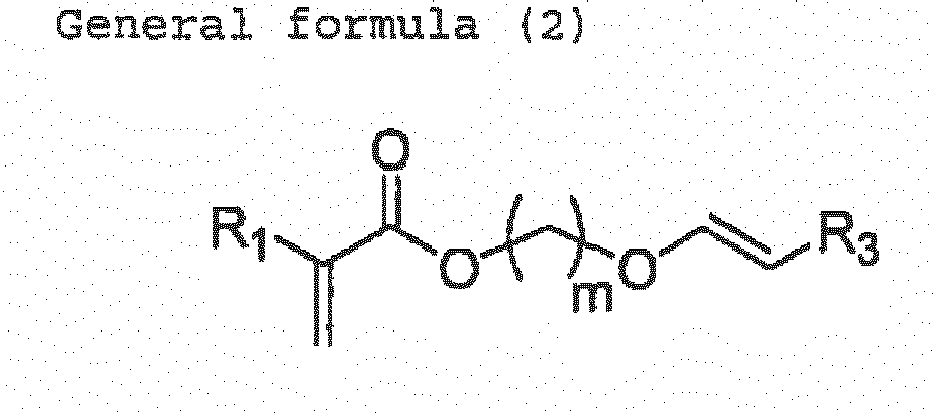
- In the formula, R1 is a hydrogen atom or a methyl group, R3 is a hydrogen atom or an alkyl group with 1 to 10 carbon atoms, and m represent an integer of 1 to 10. R3 is preferably a hydrogen atom. If m is greater than 10, the polymerizable compound has a high viscosity, which may makes it difficult to obtain an ink with a low viscosity.
- Specific examples of the polymerizable compounds represented by the general formulae (1) and (2) include vinyloxyethyl (meth)acrylate, vinyloxydiethylene glycol (meth)acrylate, vinyloxytriethylene glycol (meth)acrylate, vinyloxypropylene glycol (meth) acrylate, vinyloxydipropylene glycol (meth)acrylate, vinyloxytripropylene glycol (meth)acrylate, vinyloxymethyl(meth)acrylate, vinyloxybutyl (meth)acrylate, vinyloxyhexyl (meth)acrylate, vinyloxyoctyl (meth)acrylate, and vinyloxydecyl (meth)acrylate. Among them, vinyloxyethyl (meth)acrylate, vinyloxydiethylene glycol (meth) acrylate, vinyloxypropylene glycol (meth)acrylate, and vinyloxybutyl (meth)acrylate are preferred. In one embodiment, vinyloxyethyl (meth)acrylate and vinyloxypropylene glycol (meth)acrylate are more preferred, and vinyloxyethyl (meth)acrylate is most preferred. According to another embodiment, vinyloxydiethylene glycol (meth)acrylate is preferred, and vinyloxydiethylene glycol acrylate (VEEA) is most preferred. VEEA is a compound represented by the formula (1), wherein R1 to R3 are hydrogen atoms, and n = 2.
- The content of the specific compounds represented by the general formulae (1) and (2) is preferably from 10 to 50% by weight, more preferably from 15 to 45% by weight, and most preferably from 20 to 40% by weight with reference to the total weight of the ink. When the content of the specific compounds is adjusted within this range, the ink viscosity ink is readily decreased while a storage stability of the ink is maintained. Furthermore, as a result of this, ejection performance of the ink is readily improved. When the content of the specific compound in the ink is 10% by weight or more, ink viscosity is readily decreased, and as a result of this, ejection performance of the ink is improved. On the other hand, when the content is 50% by weight or less, the pigment dispersant in the ink dissolves, and as a result of this, the problem of deficiency of the amount of the pigment dispersant to titanium oxide is avoided. Accordingly, marked storage stability of the ink is readily achieved.
- According to another embodiment, the polymerizable compound may be a combination of a monofunctional monomer and a polyfunctional monomer. The monofunctional monomer means a compound having only one polymerizable functional group in a molecule. The polyfunctional monomer means a compound having two or more polymerizable functional groups in a molecule. However, in the present description, the specific compounds represented by the general formulae (1) and (2) are not included. According to yet another embodiment, the polymerizable compound may be a combination of a monofunctional monomer, a polyfunctional monomer, and specific compounds represented by the general formulae (1) and (2).
- The monofunctional monomer includes at least one of lauryl acrylate and N-vinyl caprolactam.
- The polyfunctional monomer includes at least one of dipropylene glycol diacrylate, 1,9-nonanediol diacrylate, and 1,10-decanediol diacrylate.
- In the present invention, the whole composition of the polymerizable compound is not particularly limited. However, in the whole composition, if the proportion of the monofunctional monomer is too high, ink curability may decrease. Therefore, in one embodiment, with reference to the total weight of the polymerizable compound, the total content of the polyfunctional monomer and/or the specific compounds represented by the general formulae (1) and (2) is preferably 70% by weight or more. The total content is more preferably 80% by weight or more, and even more preferably 90% by weight or more. In one embodiment, with reference to the total weight of the polymerizable compound, the specific compounds represented by the general formulae (1) and (2) is more preferably 70% by weight or more. When the content of the specific compound is 70% by weight or more, reduction of the ink viscosity, and improvement of ejection stability are readily achieved. In either embodiment, the content of the polymerizable compound in the ink is preferably from 50 to 80% by weight, more preferably from 55 to 75% by weight, and most preferably from 60 to 70% by weight. When the content of the polymerizable compound is adjusted within this range, the ink viscosity is maintained at an appropriate value, and ejection stability is readily improved.
- The white ink of the present invention may further include, in addition to the above-described constituent, other components known to the well-known in the art. For example, in one embodiment, an oligomer and/or a prepolymer may be used. Specific examples include, but not limited to, the followings.
- "Ebecryl 230, 244, 245, 270, 280/15IB, 284, 285, 4830, 4835, 4858, 4883, 8402, 8803, 8800, 254, 264, 265, 294/35HD, 1259, 1264, 4866, 9260, 8210, 1290, 1290K, 5129, 2000, 2001, 2002, 2100, KRM7222, KRM7735, 4842, 210, 215, 4827, 4849, 6700, 6700-20T, 204, 205, 6602, 220, 4450, 770, IRR567, 81, 84, 83, 80, 657, 800, 805, 808, 810, 812, 1657, 1810, IRR302, 450, 670, 830, 835, 870, 1830, 1870, 2870, IRR267, 813, IRR483, 811, 436, 438, 446, 505, 524, 525, 554W, 584, 586, 745, 767, 1701, 1755, 740/40TP, 600, 601, 604, 605, 607, 608, 609, 600/25TO, 616, 645, 648, 860, 1606, 1608, 1629, 1940, 2958, 2959, 3200, 3201, 3404, 3411, 3412, 3415, 3500, 3502, 3600, 3603, 3604, 3605, 3608, 3700, 3700-20H, 3700-20T, 3700-25R, 3701, 3701-20T, 3703, 3702, RDX63182, 6040, IRR419" manufactured by Daicel-UCB Company, Ltd.;
"CN104, CN120, CN124, CN136, CN151, CN2270, CN2271E, CN435, CN454, CN970, CN971, CN972, CN9782, CN981, CN9893, and CN991" manufactured by Sartomer Company, Inc.;
"Laromer EA81, LR8713, LR8765, LR8986, PE56F, PE44F, LR8800, PE46T, LR8907, P043F, PO77F, PE55F, LR8967, LR8981, LR8982, LR8992, LR9004, LR8956, LR8985, LR8987, UP35D, UA19T, LR9005, PO83F, PO33F, PO84F, PO94F, LR8863, LR8869, LR8889, LR8997, LR8996, LR9013, LR9019, PO9026V, and PE9027V" manufactured by BASF;
"Photomer 3005, 3015, 3016, 3072, 3982, 3215, 5010, 5429, 5430, 5432, 5662, 5806, 5930, 6008, 6010, 6019, 6184, 6210, 6217, 6230, 6891, 6892, 6893-20R, 6363, 6572, and 3660" manufactured by Cognis Corporation;
"Art-Resin UN-9000HP, 9000PEP, 9200A, 7600, 5200, 1003, 1255, 3320HA, 3320HB, 3320HC, 3320HS, 901T, 1200TPK, 6060PTM, and 6060P" manufactured by Negami Chemical Industrial Co., Ltd.;
"Shiko UV-6630B, 7000B, 7510B, 7461TE, 3000B, 3200B, 3210EA, 3310B, 3500BA, 3520TL, 3700B, 6100B, 6640B, 1400B, 1700B, 6300B, 7550B, 7605B, 7610B, 7620EA, 7630B, 7640B, 2000B, 2010B, 2250EA, and 2750B" manufactured by Nippon Synthetic Chemical Industry Co., Ltd.;
"KAYARAD R-280, R-146, R131, R-205, EX2320, R190, R130, R-300, C-0011, TCR-1234, ZFR-1122, UX-2201, UX-2301, UX3204, UX-3301, UX-4101, UX-6101, UX-7101, MAX-5101, MAX-5100, MAX-3510, and UX-4101" manufactured by Nippon Kayaku Co., Ltd. - When any of these oligomer and/or prepolymer component is used, the content of the component is preferably less than 10% by weight, and more preferably less than 5% by weight, with reference to the total weight of the ink.
- In one embodiment of the present invention, the active energy rays applied to the white ink are preferably light energy containing ultraviolet ray. In this embodiment, it is preferable that the above-described constituents of the white ink further include a polymerization initiator. The polymerization initiator is not particularly limited, and may be appropriately selected from the compounds known in the technical field, in consideration of the curing rate and physical properties of the cured coating film. In one embodiment, a molecule-cleaving or hydrogen-withdrawing polymerization initiator is preferred. Specific examples of the polymerization initiator include benzoin isobutyl ether, 2,4-diethylthioxanthone, 2-isopropylthioxanthone, 2,4,6-trimethylbenzoyl diphenyl phosphine oxide, 2-benzyl-2-dimethylamino-1-(4-morpholinophenyl)-butane-1-one, bis(2,4,6-dimethoxybenzoyl)-2,4,4-trimethylpentylphosphine oxide, bis(2,4,6-trimethylbenzoyl) phenylphosphine oxide, 2-methyl-1-(4-methylthio phenyl)-2-morpholinopropane-1-one, oligo(2-hydroxy-2-methyl-1-(4-(1-methylvinyl)phenyl)propanone), 4-benzoyl-4'-methyl-diphenyl sulfide, 1,2-octanedione, and 1-(4-(phenylthio)-2,2-(O-benzoyloxime)). These polymerization initiators are preferred because their radical formation reaction will not be inhibited by light absorption of a pigment and a polymerizable compound, and their high radical generation efficiency improves ink curability. The content of the polymerization initiator is preferably from 3 to 20% by weight, and more preferably from 5 to 15% by weight with reference to the total weight of the ink.
- Other specific examples of the polymerization initiator include molecule-cleaving polymerization initiators such as 1-hydroxycyclohexylphenyl ketone, benzoin ethyl ether, benzyl dimethylketal, 2-hydroxy-2-methyl-1-phenylpropane-1-one, and 1-(4-isopropyl phenyl)-2-hydroxy-2-methylpropane-1-one. In addition, they include hydrogen-withdrawing polymerization initiators such as benzophenone, 4-phenylbenzophenone, and isophthalphenone.
- Among the above-listed polymerization initiators, at least one selected from the group consisting of 2,4,6-trimethylbenzoyldiphenylphosphine oxide, bis(2,4,6-trimethylbenzoyl)phenylphosphine oxide, and 4-benzoyl-4'-methyldiphenyl sulfide is preferred. These polymerization initiators are preferred because they have high curability, and will not yellow the cured ink film. The ink of the present invention includes one, preferably two of the above-listed polymerization initiators. In particular, the use of the combination of 2,4,6-trimethylbenzoyldiphenylphosphine oxide and 4-benzoyl-4'-methyldiphenyl sulfide is preferred. In a more preferred embodiment, the mixing ratio of 2,4,6-trimethylbenzoyldiphenylphosphine oxide and 4-benzoyl-4'-methyldiphenyl sulfide is from 2 : 1 to 5 : 1. In this embodiment, the total content of the polymerization initiator is preferably from 10 to 20% by weight with reference to the total weight of the ink.
- In one embodiment of the white ink of the present invention, the polymerization initiator may be combined with a sensitizer. When the polymerization initiator and a sensitizer are used in combination, the sensitizer is preferably an amine which will not cause addition reaction with the polymerizable compound. Examples of the sensitizer useful in the present invention include trimethylamine, methyldimethanol amine, triethanolamine, p-diethylaminoacetophenone, ethyl-4-(dimethylamino)-benzoate, Isoamyl p-(dimethylamino)-benzoate, N,N-dimethylbenzylamine, and 4,4'-bis(diethylamino)benzophenone. These sensitizers may yellow the cured ink film, and thus are preferably used in an amount which will not cause yellowing.
- In one embodiment of the white ink of the present invention, the use of an organic solvent is preferred. The use of an organic solvent makes it easy to decrease the ink viscosity, and allows the improvement of ejection property. Examples of the organic solvent include glycol monoacetate compounds such as ethylene glycol monobutyl ether acetate, diethylene glycol monoethyl ether acetate, diethylene glycol monobutyl ether acetate; glycol ether compounds such as diethyleneglycol dimethyl ether, diethylene glycol methyl ethyl ether, diethylene glycol diethyl ether, and tetraethylene glycol dimethyl ether; and lactate compounds such as ethyl lactate, and butyl lactate. Among them, ethylene glycol monobutyl ether acetate, diethylene glycol monobutyl ether acetate, diethylene glycol methyl ethyl ether, diethylene glycol diethyl ether are preferred, and diethylene glycol methyl ethyl ether, diethylene glycol diethyl ether are more preferred.
- The content of the organic solvent is preferably from 0.01 to 5% by weight with reference to the total weight of the ink. When the content is 0.01% by weight or more, ejection property tends to be good. In addition, when the content is 5% by weight or less, ejection is stably carried out without deterioration of the decap property caused by drying of the organic solvent. The content is more preferably from 0.1 to 3% by weight, and even more preferably from 0.5 to 2% by weight.
- In one embodiment of the white ink of the present invention, the use of a surface conditioner is preferred, thereby improving spreadability on the base material. The surface conditioner may be any compound known in the technical field, and may be appropriately selected from acrylic, silicon, and fluorine compounds. Specific examples of the surface conditioner include, but not limited to, BYK-350, 352, 354, 355, 358N, 361N, 381N, 381, 392, BYK-300, 302, 306, 307, 310, 315, 320, 322, 323, 325, 330, 331, 333, 337, 340, 344, 370, 375, 377, 355, 356, 357, 390, UV3500, UV3510, and UV3570 manufactured by BYK-Chemie. Other examples include Tegoglide-100, 110, 130, 420, 432, 435, 440, 450GZ400, Tegorad-2100, 2200, 2250, 2500, and 2700 manufactured by Evonik Degussa GmbH. These surface conditioners may be used singly or in combination of two or more thereof according to the intended use.
- The content of the surface conditioner is preferably from 0.01 to 5% by weight with reference to the total weight of the ink. When the content is 0.01% by weight or more, spreadability tends to be good. On the other hand, when the content is 5% by weight or less, storage stability of the ink tend to be better. The content is more preferably from 0.05 to 3% by weight.
- In one embodiment of the white ink of the present invention, the use of a stabilizer is preferred. The use of a stabilizer improves viscosity stability of the ink over time, and on-machine viscosity stability in the recording apparatus. The stabilizer useful in the present invention is not particularly limited. In one preferred embodiment, at least one selected from the group consisting of hindered phenol compounds, phenothiazine compounds, hindered amine compounds, and phosphorus compounds may be used. Specific examples of the stabilizer are listed below.
- Hindered phenol compounds: "IRGANOX 1010, 1010FF, 1035, 1035FF, 1076, 1076FD, 1076DWJ, 1098, 1135, 1330, 245, 245FF, 245DWJ, 259, 3114, 565, 565DD, and 295" manufactured by BASF; "BHT SWANOX", "NONFLEX Alba, MBP, EBP, CBP, BB", "TBH" manufactured by Seiko Chemical Co., Ltd., "AO-20, 30, 50, 50F, 70, 80, and 330" manufactured by ADEKA Corporation; "H-BHT" manufactured by Honshu Chemical Industry Co., Ltd., and "Yoshinox BB, 425, and 930" manufactured by API Corporation.
- Phenothiazine compounds: "Phenothiazine" manufactured by Seiko Chemical Co., Ltd.; "Phenothiazine", "2-methoxyphenothiazine", and "2-cyanophenothiazine" manufactured by Sakai Chemical Industry Co., Ltd.
- Hindered amine compounds: "IRGANOX 5067" "TINUVIN 144, 765, 770DF, and 622LD" manufactured by BASF; "NONFLEX H, F, OD-3, DCD, and LAS-P", "STEARER STAR", "diphenylamine", "4-aminodiphenylamine", and "4-oxydiphenylamine" manufactured by Seiko Chemical Co., Ltd.; "HOTEMPO" manufactured by Evonik Degussa GmbH; "Fancryl 711MM and 712HM" manufactured by Hitachi Chemical Co., Ltd.
- Phosphorus compounds: "triphenylphosphine", "IRGAFOS 168 and 168FF" manufactured by BASF; and "NONFLEX TNP" manufactured by Seiko Chemical Co., Ltd.
- Other compounds: "IRGASTAB UV-10 and 22" manufactured by BASF; "Hydroquinone", "Metokinon", "Torukinon", "MH", "PBQ", "TBQ", and "2,5-diphenyl-p-benzoquinone" manufactured by Seiko Chemical Co., Ltd.; "Q-1300 and 1301" manufactured by Wako Pure Chemical Industries, Ltd.; and "GENORAD 16, 18, and 20" manufactured by RAHN AG.
- Among the above-listed compounds, the following compounds are preferred from the viewpoints of solubility in the ink and color of the stabilizer.
- Hindered phenol compounds: "BHT Swanox", "NONFLEX Alba" manufactured by Seiko Chemical Co., Ltd.; "H-BHT" manufactured by Honshu Chemical Industry Co., Ltd.
- Phenothiazine compounds: "Phenothiazine" manufactured by Seiko Chemical Co., Ltd.; "Phenothiazine" manufactured by Sakai Chemical Industry Co., Ltd.
- Hindered amine compounds: "HO-TEMPO" manufactured by Evonik Degussa GmbH.
- Phosphorus compounds: "Triphenyl phosphine" manufactured by BASF.
- The content of the stabilizer is preferably from 0.01 to 5% by weight with reference to the total weight of the ink. If the content is below this range, ink stability may be poor. On the other hand, if the content is above this range, ink curing may be hindered.
- The white ink of the present invention may be prepared by a method well known in the technical field. In one embodiment, the white ink may be prepared as follows: titanium oxide, a pigment dispersing resin, and a polymerizable monomer are uniformly mixed and dispersed to make a pigment dispersion, and then other constituents such as a polymerizable monomer and a polymerization initiator are added to the dispersion, and uniformly mixed. This dispersion treatment may be carried out by, for example, a wet bead mill using a pulverization medium. The pulverization medium is preferably zirconia beads. The diameter of the beads used as the pulverization medium is preferably from 0.1 to 1 mm, and more preferably from 0.3 to 0.5 mm. In addition, the polymerizable monomer used for dispersion treatment is preferably vinyloxydiethylene glycol acrylate or dipropylene glycol diacrylate. In one embodiment, the ink thus obtained is preferably filtrated through a filter.
- The white ink of the present invention is intended to be used for printing on the ink-jet printing system. Therefore, the ink preferably has a viscosity suitable for achieving stable ejection property at the temperature during ink ejection. In one embodiment, the ink viscosity at 25°C is preferably adjusted to 5 to 50 mPa·s. When the ink viscosity is adjusted within this range, in particular, stable ejection property is achieved when an ordinary head having a frequency of 5 to 30 KHz. Ejection followability is readily improved by adjusting the viscosity to 5 mPa·s or more. On the other hand, when the viscosity is adjusted to 50 mPa·s or less, good ejection stability is readily obtained. If the ink viscosity is beyond the above-described range, ejection property tends to deteriorate even if a viscosity-decreasing mechanism by heating is incorporated into the head, and ejection stability decreases, which may result in total failure of ejection. The ink viscosity can be adjusted by appropriately changing the mixing ratio of the constituents of the ink. In one embodiment, the ink viscosity at 25°C is more preferably adjusted to 7 to 14.5 mPa·s, and particularly preferably adjusted to 8.5 to 13 mPa·s. Stable ejection property is readily achieved by adjusting the ink viscosity within this range when using an ordinary head having a frequency of 5 to 30 KHz, and also when using a head with a high frequency of 10 to 50 KHz.
- The white ink of the present invention is suitable to the ink-jet printing system, particularly to the single-pass system (hereinafter referred to as "single-pass ink-jet printing system"). The single-pass ink-jet printing system accomplishes printing on the base material to be printed in one time, and is suitable for business printing required to achieve a high printing speed. Under this system, only one time of printing is carried out for one color, so that an ink with a high pigment concentration which can achieve a sufficient concentration in one time of printing is required. In addition, different from the shuttle-type multi-pass ink-jet printing system, a fixed ink-jet head is frequently used under the single-pass ink-jet printing system. Under the multi-pass system, cleaning is periodically carried out in a short period, but under the single system, the frequency of cleaning is about once in every several hours, and the frequency is low. Therefore, in particular, the single-pass ink-jet printing system requires an ink having high printing stability and superior decap property. Under such circumstances, prior art ink tends to cause the decrease of printing stability and decap property with the increase of the pigment concentration, so that it is difficult to satisfy the demand. On the other hand, the white ink of the present invention achieves high decap property, and prevents the occurrence of nozzle void even if cleaning is not carried out for a long time. Therefore, the use of the white ink of the present invention allows satisfactory printing on the single-pass ink-jet printing system over a long time.
- An alternative embodiment of the present invention relates to a printing method on the ink-jet printing system using the above-described white ink. One embodiment of the printing method includes a step of ejecting the droplets of a white ink from an ink-jet head on a printing base material, and forming a coating film of the white ink on the printing base material, a step of irradiating the coating film with active energy rays to cure the coating film, thereby forming a printed surface. The ink-jet head may be a fixed head typically used under the single-pass ink-jet printing system. In addition, the amount of the ink solution droplets ejected from the ink-jet head may be 20 picoliter or less. According to the present invention, the printed material has high hiding property even if the ejection volume is 20 picoliter or less.
- The printing base material used in the present invention is not particularly limited. Examples of the printing base material include plastic base materials such as polycarbonate, hard vinyl chloride, soft vinyl chloride, polystyrene, styrofoam, PMMA, polypropylene, polyethylene, and PET. The printing base material may be a combination or modified product of various plastic base materials. Other examples include paper base materials such as fine paper, art paper, coated paper, and cast-coated paper, and metal base materials such as glass and stainless steel. In particular, the white ink of the present invention has high hiding property, so that is suitable to transparent base materials and color base materials other than white base materials.
- The present invention is more specifically described below based on examples and comparative examples. Unless otherwise noted, "part" and "%" means "part by weight" and "% by weight", respectively.
- 50 parts of TIPAQUE CR-60 (titanium oxide treated with aluminum, primary particle diameter 210 nm, manufactured by Ishihara Sangyo Kaisha, Ltd.) as a pigment, 2.5 parts of DISPER BYK-111 (acidic dispersant, acid value 129 mmg KOH/g, manufactured by BYK-Chemie) as a pigment dispersant, and 47.5 parts of dipropylene glycol diacrylate were placed in a disperser, and these components were mixed for preliminary dispersion. Subsequently, these components were subjected to main dispersion for 2 hours using a 0.6-L DYNO mill filled with 1800 g of zirconia beads having a diameter of 1 mm, thereby obtaining a pigment dispersion A.
- A pigment dispersion B1 was obtained in the same manner as in the pigment dispersion operation for the pigment dispersion A, except that SOLSPERSE 32000 (basic dispersant, acid value 24, 8 mmg KOH/g, amine value 27, 1 mmg KOH/g, manufactured by The Lubrizol Corporation) was used as a pigment dispersing resin.
- A pigment dispersion B2 was obtained in the same manner as the pigment dispersion B1, except that dipropylene glycol diacrylate in the pigment dispersion B1, was replaced with vinyloxydiethylene glycol acrylate.
- A pigment dispersion C1 was obtained in the same manner as in the pigment dispersion operation for the pigment dispersion A, except that TIPAQUE PF-726 (titanium oxide treated with aluminum/silica, primary particle diameter 210 nm, manufactured by Ishihara Sangyo Kaisha, Ltd.) as the pigment, and SOLSPERSE 32000 (basic dispersant, manufactured by The Lubrizol Corporation) was used as the pigment dispersing resin.
- A pigment dispersion C2 was obtained in the same manner as in the pigment dispersion operation for the pigment dispersion C1, except that dipropylene glycol diacrylate in the pigment dispersion C1, was replaced with vinyloxydiethylene glycol acrylate.
- A pigment dispersion D was obtained in the same manner as in the pigment dispersion operation for the pigment dispersion A, except that TIPAQUE A-220 (titanium oxide treated with aluminum, primary particle diameter 160 nm, manufactured by Ishihara Sangyo Kaisha, Ltd.) as the pigment, and SOLSPERSE 32000 (basic dispersant, manufactured by The Lubrizol Corporation) was used as the pigment dispersing resin.
- A pigment dispersion E was obtained in the same manner as in the pigment dispersion operation for the pigment dispersion A, except that TIPAQUE CR-58 (titanium oxide treated with aluminum, primary particle diameter 280 nm, manufactured by Ishihara Sangyo Kaisha, Ltd.) as the pigment, and SOLSPERSE 32000 (basic dispersant, manufactured by The Lubrizol Corporation) was used as the pigment dispersing resin.
- A pigment dispersion F was obtained in the same manner as in the pigment dispersion operation for the pigment dispersion A, except that TIPAQUE CR-80 (titanium oxide treated with aluminum/silica, primary particle diameter 250 nm, manufactured by Ishihara Sangyo Kaisha, Ltd.) as the pigment, and SOLSPERSE 32000 (basic dispersant, manufactured by The Lubrizol Corporation) was used as the pigment dispersing resin.
- A pigment dispersion G was obtained in the same manner as in the pigment dispersion operation for the pigment dispersion A, except that TIPAQUE CR-60-2 (titanium oxide treated with aluminum/polyalcohol, primary particle diameter 210 nm, manufactured by Ishihara Sangyo Kaisha, Ltd.) as the pigment, and SOLSPERSE 32000 (basic dispersant, manufactured by The Lubrizol Corporation) was used as the pigment dispersing resin.
- A pigment dispersion H was obtained in the same manner as in the pigment dispersion operation for the pigment dispersion A, except that TIPAQUE PF-690 (titanium oxide treated with aluminum/silica/polyalcohol, primary particle diameter 210 nm, manufactured by Ishihara Sangyo Kaisha, Ltd.) as the pigment, and SOLSPERSE 32000 (basic dispersant, manufactured by The Lubrizol Corporation) was used as the pigment dispersing resin.
- A pigment dispersion I was obtained in the same manner as in the pigment dispersion operation for the pigment dispersion A, except that KRONOS2064 (titanium oxide treated with aluminum/organic substance, primary particle diameter 200 nm, manufactured by KRONOS International Inc.) as the pigment, and SOLSPERSE 32000 (basic dispersant, manufactured by The Lubrizol Corporation) was used as the pigment dispersing resin.
- A pigment dispersion J was obtained in the same manner as in the pigment dispersion operation for the pigment dispersion A, except that KRONOS2190 (titanium oxide treated with aluminum/zirconium/organic substance, primary particle diameter 200 nm, manufactured by KRONOS INTERNATIONAL Inc.) as the pigment, and SOLSPERSE 32000 (basic dispersant, manufactured by The Lubrizol Corporation) was used as the pigment dispersing resin.
- A pigment dispersion K was obtained in the same manner as in the pigment dispersion operation for the pigment dispersion A, except that KRONOS2310 (titanium oxide treated with aluminum/silica/zirconium/organic substance, primary particle diameter 200 nm, manufactured by KRONOS INTERNATIONAL Inc.) as the pigment, and SOLSPERSE 32000 (basic dispersant, manufactured by The Lubrizol Corporation) was used as the pigment dispersing resin.
- The compositions of the pigment dispersions A to K prepared as described above are summarized in Table 1. "DPGDA" listed in Table 1 represents dipropylene glycol diacrylate; "VEEA" represents vinyloxydiethylene glycol acrylate (= vinyloxyethoxyethyl acrylate). The solid content (pigment content) in each of the pigment dispersions A to K is 50% by weight with reference to the total weight of the pigment dispersion.
Table 1 Pigment dispersion Pigment Pigment dispersant Monomer Product name Primary particle diameter (nm) Surface treatment A TIPAQUE CR-60 210 Aluminum DISPERBYK-111 DPGDA B1 TIPAQUE CR-60 210 Aluminum SOLSPERSE 32000 DPGDA B2 TIPAQUE CR-60 210 Aluminum SOLSPERSE 32000 VEEA C1 TIPAQUE PF-726 210 Aluminum/silica SOLSPERSE 32000 DPGDA C2 TIPAQUE PF-726 210 Aluminum/silica SOLSPERSE 32000 VEEA D TIPAQUE A-220 160 Aluminum SOLSPERSE 32000 DPGDA E TIPAQUE CR-58 280 Aluminum/silica SOLSPERSE 32000 DPGDA F TIPAQUE CR-80 250 Aluminum/silica SOLSPERSE 32000 DPGDA G TIPAQUE CR-60-2 210 Aluminum/polyalcohol SOLSPERSE 32000 DPGDA H TIPAQUE PF-690 210 Aluminum/silica/polyalcohol SOLSPERSE 32000 DPGDA I KRONOS2064 200 Aluminum/organic substance SOLSPERSE 32000 DPGDA J KRONOS2190 200 Aluminum/zirconium/organic substance SOLSPERSE 32000 DPGDA K KRONOS2310 200 Aluminum/silica/zirconium/organic substance SOLSPERSE 32000 DPGDA - According to the recipe of the constituents listed in Tables 2 to 4, other components listed in the table were added to each of the pigment dispersions sequentially from the top under stirring, and mixed until the polymerization initiator dissolved. Thereafter, the mixture obtained was filtered through a 1-µm membrane filter, and coarse particles were removed to obtain white inks.
- The white inks thus obtained were evaluated for various properties according to the following procedure. The results are shown in Tables 2 to 4.
- The white inks thus obtained were measured for the pigment particle diameter using a dynamic light scattering particle diameter distribution analyzer Nanotrac UPA (manufactured by Nikkiso Co., Ltd., model number: UPA-EX150). For the measurement, ethyl acetate was used as the measurement solvent, and the absorption mode was particle permeability. Measurement was carried out on the precondition that the particle shape is nonspherical, and the value when the weight cumulative distribution is 50% was used as the weight average particle diameter.
- Using OnePass JET (manufactured by Tritek Co., Ltd.) as the printing apparatus and KJ4A (manufactured by Kyocera Corporation) as the ink-jet head, the evaluation was carried out according to the following procedure. Firstly, the ink was charged into the ink-jet head, a nozzle check pattern was printed, and the ejection of ink from all the nozzles was confirmed. Thereafter, the apparatus was allowed to stand for predetermined time (2 hours) without nozzle protection such as capping. After the lapse of the defined time, a nozzle check pattern was printed, and the number of nozzle void was confirmed. The evaluation criteria are as follows.
- A: No occurrence of nozzle void.
- B: Nozzle void is less than five.
- C: Nozzle void is five or more.
- Using the above-described apparatus used for the evaluation of decap property, solid printing was carried out on a transparent PET film (base material thickness 100 µm) to form an ink coating film having a film thickness of 6 µm. Subsequently, ultraviolet rays were applied using a UV lamp to cure the ink coating film, and thus a measurement sample of a printed material was prepared. The measurement sample was measured for the L* values of the L*a*b* colorimetric system on a black plate (L* value 14) and a white plate (L* value 95). From the L* value thus obtained, the "hiding rate" defined by formula described below was calculated, and the hiding property was evaluated.

- The evaluation criteria are as follows.
- A: Hiding rate is 75% or more.
- B: Hiding rate is 70% or more and less than 75%.
- C: Hiding rate is less than 70%.
- The measurement of the ink viscosity was carried out using an E type viscometer (manufactured by Toki Sangyo Co., Ltd.). The measurement conditions are as follows: the viscosity was measured at 25°C three minutes after adjusting the rotation speed to the value appropriated to the measurement. Storage stability was evaluated from the rate of viscosity change between the ink viscosity stored at 60°C for one week and the ink viscosity before storage. The evaluation criteria are as follows. The rating "C" or higher was judged as practical level.
- A: The rate of viscosity change is less than 5%.
- B: The rate of viscosity change is 5% or more and less than 10%.
- C: The rate of viscosity change is 10% or more and less than 15%.
- D: The rate of viscosity change is 15% or more.
- Printing was carried out using the head (KJ4A) manufactured by Kyocera Corporation, the condition of ink ejection was observed by stroboscopic photographing, thereby evaluating the frequency properties. The waveform was the Fire 1 mode. For the evaluation, the manner of splitting of droplets was observed at the starting of ejection when the frequency was changed to 5 and 20 kHz, and after continuous ejection for 10 minutes. The manner of splitting of droplets at the points of 1 mm and 2 mm after ejection was observed. The ink is preferably stable without splitting of droplets. The evaluation criteria are as follows. The rating "B" or higher was judged as practical level.
- A: Droplets are continuous until 2 mm without splitting, and stable.
- B: Droplets are split at 1 mm, and coalesce at 2 mm, or the manner of splitting markedly changes from the early stage.
- C: Droplets are split at 1 mm, and do not coalesce even at 2 mm; ejection failure occurs in the early stage or 10 minutes after.
- Hue evaluation was carried out using the measurement samples prepared in the evaluation of hiding property. These measurement samples were measured on a black plate. From the L*a*b* values thus obtained, the hue was evaluated according to the following evaluation criteria.
- A: The b* value is less than -5.
- B: The b* value is -5 or more and less than -3.
- C: The b* value is -3 or more.
- Examples 1 to 20, 25, and 26 are not in accorance with the present invention.
Table 2 Example 1 2 3 4 5 6 7 8 10 11 12 13 14 15 16 17 Dispersion Dispersion type A B1 B1 B1 C1 C1 C1 C1 C1 C1 C1 C1 C1 B1 B1 B2 B2 Content 36 36 44 52 36 44 52 44 44 44 44 44 44 44 44 44 44 Monomer DPGDA 47 47 39 31 47 39 31 9 9 9 9 9 9 24 9 14.9 4.9 VCAP 5 5 5 5 5 5 5 5 5 5 5 5 5 5 5 5 5 PEA 30 LA 30 VEEA 30 30 30 30 15 30 24.1 34.1 Initiator TPO 9 9 9 9 9 9 9 9 9 9 9 9 9 9 9 Irg819 9 9 BMS 2 2 Irg907 2 2 2 2 2 2 2 2 2 2 2 2 2 2 2 Solvent DEDG Surface conditioner UV3510 1 1 1 1 1 1 1 1 1 1 1 1 1 1 1 1 1 Evaluation Particle diameter (nm) 210 220 235 240 210 220 230 215 225 220 220 220 220 235 235 240 245 Decap property B A B B A A A A A A A A A B A A B Hiding property B B A A B A A A A A A A A A A A A Stability C B B C A A A A A A A A A B B C C Ejection property B B B B B B B B B A A A A B A A A Hue B B B B B B B B B B B A A B B B B Table 3 Example 18 19 20 21 22 23 24 25 26 27 28 29 30 31 32 Dispersion Dispersion type C1 C2 C2 G G H H C1 C1 I I J J K K Content 44 44 44 36 44 36 44 44 44 36 44 36 44 36 44 Monomer DPGDA 24 14.9 4.9 47 39 47 39 38 33 47 39 47 39 47 39 VCAP 5 5 5 5 5 5 5 5 5 5 5 5 5 5 5 PEA LA VEEA 15 24.1 34.1 Initiator TPO 9 9 9 9 9 9 9 9 9 9 9 9 9 9 9 Irg819 BMS Irg907 2 2 2 2 2 2 2 2 2 2 2 2 2 2 2 Solvent DEDG 1 6 Surface conditioner UV3510 1 1 1 1 1 1 1 1 1 1 1 1 1 1 1 Evaluation Particle diameter (nm) 220 230 230 215 235 215 230 230 240 210 230 200 225 205 215 Decap property A A A A B A A A B A B A B A A Hiding property A A A B A B A A A B A B A B A Stability A A B A A A A A A A A A A A A Ejection property A A A B B A B A A B B B B A B Hue B B B B B B B B B B B B B B B Table 4 Comparative Example 1 2 3 4 5 Dispersion Dispersion type C1 C1 D E F Content 24 66 44 44 44 Monomer DPGDA 59 17 39 39 39 VCAP 5 5 5 5 5 PEA LA VEEA Initiator TPO 9 9 9 9 9 Irg819 BMS Irg907 2 2 2 2 2 Solvent DEDG Surface conditioner UV3510 1 1 1 1 1 Evaluation Particle diameter (nm) 240 210 160 310 280 Decap property A C B C C Hiding property C A C A A Stability A D C C B Ejection property B B B C B Hue C B C C C - Details about the abbreviations listed in Tables 2 to 4 are as follows.
- DPGDA: dipropylene glycol diacrylate
- VCAP: N-vinyl caprolactam
- PEA: phenoxyethyl acrylate
- LA: lauryl acrylate
- VEEA: vinyloxydiethylene glycol acrylate
- TPO: Lucirin TPO (manufactured by BASF, 2,4,6-trimethylbenzoyl diphenylphosphine oxide)
- Irg819: Irgacure819 (manufactured by BASF, bis (2,4,6-trimethylbenzoyl)phenylphosphine oxide)
- BMS: Speedcure BMS (manufactured by Lambson, 4-benzoyl-4'-methyldiphenyl sulfide)
- Irg907: Irgacure907 (manufactured by BASF, 2-methyl-1-(4-methylthiophenyl)-2-morpholinopropan-1-one)
- UV3510: BYK UV3510 (manufactured by BYK-Chemie, silicone surface conditioner)
- As seen by Tables 2 and 3, when the content of titanium oxide used as the white pigment and the weight average particle diameter of titanium oxide are within the predetermined range defined in the present invention, good results are obtained in all the desired properties such as printing stability and hiding property. In contrast, as seen by Table 4, it was difficult to satisfy all the desired properties in Comparative Example 1 to 5, which do not satisfy the content of titanium oxide and the weight average particle diameter of titanium oxide defined in the present invention.
Claims (11)
- An ink-jet white ink of active energy ray-curable type, comprising titanium oxide, a pigment dispersant, and a polymerizable compound,
wherein the content of the titanium oxide is from 15 to 30% by weight with reference to the total weight of the ink,
wherein the weight-average particle diameter of the titanium oxide is 180 to 250 nm,
wherein the polymerizable compound comprises at least one selected from the group consisting of:compounds represented by the following general formulae (1) and (2): wherein R1 and R2 are each independently a hydrogen atom or a methyl group, R3 is a hydrogen atom or an alkyl group with 1 to 10 carbon atoms, and n represents an integer of 1 to 10;
 wherein R1 is a hydrogen atom or a methyl group, R3 is a hydrogen atom or an alkyl group with 1 to 10 carbon atoms, and m represents an integer of 1 to 10;a monofunctional monomer including at least one of lauryl acrylate and N-vinyl caprolactam; anda polyfunctional monomer including at least one of dipropylene glycol diacrylate, 1,9-nonanediol diacrylate, and 1,10-decanediol diacrylate, andwherein the titanium oxide is treated with a surface-treating agent comprising at least one inorganic surface-treating agent selected from the group consisting of aluminum compound including aluminum hydroxide and alumina, silica, and zirconia; and an organic surface-treating agent.
 - The white ink of claim 1, wherein the titanium oxide has hydroxyl groups on treated surface thereof.
- The white ink of claim 1, wherein the organic surface-treating agent is selected from the group consisting of polyalcohol, alkanolamines, and organosilicon compounds.
- The white ink of claim 1, wherein the inorganic surface-treating agent comprises an aluminum compound selected from aluminum hydroxide and alumina, and silica.
- The white ink of any one of claims 1 to 4, wherein the pigment dispersant comprises a basic dispersant.
- The white ink of any one of claims 1 to 5, which further comprises a polymerization initiator, the polymerization initiator comprising at least one selected from the group consisting of 2,4,6-trimethylbenzoyl diphenyl phosphine oxide, bis(2,4,6-trimethylbenzoyl)phenylphosphine oxide, and 4-benzoyl-4'-methyldiphenyl sulfide.
- The white ink of any one of claims 1 to 6, which further comprises an organic solvent, wherein the content of the organic solvent is from 0.01 to 5% by weight with reference to the total weight of the ink.
- The white ink of any one of claims 1 to 7, which is used for printing on the single-pass ink-jet printing system.
- The white ink of any one of claims 1 to 8, wherein the total content of the polyfunctional monomer and/or the compounds represented by the general formulae (1) and (2) is 70% by weight or more, with reference to the total weight of the polymerizable compound.
- The white ink of any one of claims 1 to 9, wherein the content of the compounds represented by the general formulae (1) and (2) is from 10 to 50% by weight with reference to the total weight of the ink.
- The white ink of any one of claims 1 to 10, wherein the polymerizable compound comprises: vinyloxydiethylene glycol acrylate; and at least one selected from the group consisting of dipropylene glycol diacrylate, 1,9-nonanediol diacrylate, and 1,10-decanediol diacrylate.
Priority Applications (1)
| Application Number | Priority Date | Filing Date | Title |
|---|---|---|---|
| EP17202042.2A EP3299425B1 (en) | 2013-04-25 | 2014-04-25 | White ink for ink-jet printing |
Applications Claiming Priority (2)
| Application Number | Priority Date | Filing Date | Title |
|---|---|---|---|
| JP2013092483A JP6065733B2 (en) | 2013-04-25 | 2013-04-25 | Ink for inkjet |
| PCT/JP2014/061743 WO2014175440A1 (en) | 2013-04-25 | 2014-04-25 | White ink for ink-jet printing |
Related Child Applications (2)
| Application Number | Title | Priority Date | Filing Date |
|---|---|---|---|
| EP17202042.2A Division-Into EP3299425B1 (en) | 2013-04-25 | 2014-04-25 | White ink for ink-jet printing |
| EP17202042.2A Division EP3299425B1 (en) | 2013-04-25 | 2014-04-25 | White ink for ink-jet printing |
Publications (3)
| Publication Number | Publication Date |
|---|---|
| EP2990448A1 EP2990448A1 (en) | 2016-03-02 |
| EP2990448A4 EP2990448A4 (en) | 2016-04-13 |
| EP2990448B1 true EP2990448B1 (en) | 2018-01-17 |
Family
ID=51792001
Family Applications (2)
| Application Number | Title | Priority Date | Filing Date |
|---|---|---|---|
| EP14788180.9A Revoked EP2990448B1 (en) | 2013-04-25 | 2014-04-25 | White ink for ink-jet printing |
| EP17202042.2A Active EP3299425B1 (en) | 2013-04-25 | 2014-04-25 | White ink for ink-jet printing |
Family Applications After (1)
| Application Number | Title | Priority Date | Filing Date |
|---|---|---|---|
| EP17202042.2A Active EP3299425B1 (en) | 2013-04-25 | 2014-04-25 | White ink for ink-jet printing |
Country Status (5)
| Country | Link |
|---|---|
| US (2) | US9534126B2 (en) |
| EP (2) | EP2990448B1 (en) |
| JP (1) | JP6065733B2 (en) |
| CN (1) | CN105143365B (en) |
| WO (1) | WO2014175440A1 (en) |
Families Citing this family (31)
| Publication number | Priority date | Publication date | Assignee | Title |
|---|---|---|---|---|
| JP6065733B2 (en) * | 2013-04-25 | 2017-01-25 | 東洋インキScホールディングス株式会社 | Ink for inkjet |
| JP5748014B1 (en) * | 2014-03-26 | 2015-07-15 | 東洋インキScホールディングス株式会社 | Active energy ray curable inkjet ink |
| WO2016076662A1 (en) * | 2014-11-13 | 2016-05-19 | 주식회사 엘지화학 | Ultraviolet curable white ink composition for inkjet printing, method for preparing white bezel pattern using same, and electronic device comprising white bezel pattern prepared by same |
| KR101796359B1 (en) | 2014-11-13 | 2017-11-10 | 주식회사 엘지화학 | UV curable white ink composition for inkjet, method for manufacturing a white bezel pattern using the same and electric device comprising the white bezel pattern |
| JP6569231B2 (en) * | 2015-02-10 | 2019-09-04 | 株式会社リコー | Active energy ray curable ink, ink container, and inkjet discharge apparatus |
| JP6058058B2 (en) * | 2015-03-31 | 2017-01-11 | 大日本塗料株式会社 | Ink set, printed matter and method for producing the same |
| US10414933B2 (en) | 2015-04-27 | 2019-09-17 | Hewlett-Packard Development Company, L.P. | White inks |
| US10464341B2 (en) | 2015-04-27 | 2019-11-05 | Hewlett-Packard Development Company, L.P. | Fluid sets for inkjet imaging |
| CN107406705B (en) | 2015-04-27 | 2020-10-09 | 惠普发展公司,有限责任合伙企业 | Fluid Kits for Inkjet Imaging |
| WO2016175871A1 (en) | 2015-04-27 | 2016-11-03 | Hewlett-Packard Development Company, L.P. | White inks |
| US10167400B2 (en) | 2015-04-27 | 2019-01-01 | Hewlett Packard Development Company, L.P. | White inks |
| BR112017018512B1 (en) | 2015-04-27 | 2022-05-17 | Hewlett-Packard Development Company, L.P. | White pigment dispersions, method for producing a white pigment dispersion and fluid assembly to form inkjet images |
| JP6915230B2 (en) * | 2015-06-16 | 2021-08-04 | 株式会社リコー | An active energy ray-curable composition, an active energy ray-curable ink, a composition container, a method and an apparatus for forming a two-dimensional or three-dimensional image, a molded product, and a dispersibility evaluation apparatus. |
| WO2017033970A1 (en) | 2015-08-24 | 2017-03-02 | 東洋合成工業株式会社 | Device manufacturing method and composition |
| JP6881836B2 (en) * | 2015-10-07 | 2021-06-02 | 花王株式会社 | Inkjet recording method |
| JP6900630B2 (en) * | 2015-10-26 | 2021-07-07 | 株式会社リコー | Active energy ray-curable composition, active energy ray-curable ink, composition storage container, two-dimensional or three-dimensional image forming method and forming apparatus, and molded product |
| JP2017165925A (en) * | 2016-03-18 | 2017-09-21 | 株式会社リコー | Active energy ray curable composition, active energy ray curable ink, composition container, two-dimensional or three-dimensional image forming method and image forming apparatus, image, structure, molded product |
| JP2017214523A (en) * | 2016-06-02 | 2017-12-07 | 株式会社リコー | Active energy ray curable composition, active energy ray curable ink, composition container, two-dimensional or three-dimensional image, forming apparatus and forming method thereof, structure, and molded article |
| JP6890468B2 (en) * | 2017-05-24 | 2021-06-18 | 理想科学工業株式会社 | Oil-based inkjet ink |
| US11345820B2 (en) * | 2017-12-11 | 2022-05-31 | Nippon Kayaku Kabushiki Kaisha | Hollow particles and production method therefor, and white ink |
| CN111684025B (en) * | 2018-02-01 | 2024-01-16 | 麦克赛尔株式会社 | Photocurable inkjet recording ink composition and ink set |
| JP2020062757A (en) * | 2018-10-15 | 2020-04-23 | 株式会社ミマキエンジニアリング | Inkjet printing device and inkjet printing method |
| JP7630423B2 (en) * | 2019-02-28 | 2025-02-17 | 株式会社 資生堂 | Highly opaque white pigment for low viscosity dispersion medium and method for producing same |
| JP7274908B2 (en) * | 2019-03-28 | 2023-05-17 | 大日本塗料株式会社 | Water-based white ink, ink set and printing method |
| JP7415109B2 (en) | 2020-05-12 | 2024-01-17 | サカタインクス株式会社 | Water-based inkjet white ink composition storage method |
| CN121295532A (en) * | 2020-07-15 | 2026-01-09 | 山阳色素株式会社 | Water-based inkjet inks and methods for printing fibrous structures using inkjet printing. |
| JP2022080617A (en) * | 2020-11-18 | 2022-05-30 | Dic株式会社 | Dispersion, light conversion layer, color filter, and light-emitting element |
| JP2022130048A (en) * | 2021-02-25 | 2022-09-06 | サカタインクス株式会社 | white ink composition |
| US12421407B2 (en) | 2021-10-06 | 2025-09-23 | Canon Kabushiki Kaisha | Aqueous ink, ink cartridge and ink jet recording method |
| EP4163341B1 (en) * | 2021-10-06 | 2025-11-19 | Canon Kabushiki Kaisha | Aqueous ink, ink cartridge and ink jet recording method |
| WO2026088844A1 (en) * | 2024-10-24 | 2026-04-30 | Dic株式会社 | Two-part curable adhesive, laminate, and packaging material |
Citations (20)
| Publication number | Priority date | Publication date | Assignee | Title |
|---|---|---|---|---|
| EP1388578A1 (en) | 2002-07-31 | 2004-02-11 | Dainippon Ink And Chemicals, Inc. | Ultraviolet-curable ink composition for ink jet recording |
| US20070259986A1 (en) | 2006-05-05 | 2007-11-08 | Elwakil Hamdy A | Curable white inkjet ink |
| US20080075882A1 (en) | 2006-09-25 | 2008-03-27 | Fujifilm Corporation | Process for producing molded printed material, and molded printed material |
| EP1958788A1 (en) | 2007-02-19 | 2008-08-20 | FUJIFILM Corporation | Ink composition, inkjet recording method, and printed material |
| EP1967557A1 (en) | 2005-11-11 | 2008-09-10 | Toyo Ink Mfg. Co., Ltd. | Active energy ray-curable ink-jet ink |
| EP2042574A1 (en) | 2007-09-28 | 2009-04-01 | FUJIFILM Corporation | White ink composition, inkjet recording method, and printed material |
| EP2042572A1 (en) | 2007-09-28 | 2009-04-01 | FUJIFILM Corporation | Ink composition, inkjet recording method, printed material, and process for producing molded printed material |
| EP2105478A1 (en) | 2008-03-26 | 2009-09-30 | FUJIFILM Corporation | Inkjet recording method and inkjet recording system |
| EP2206753A1 (en) | 2007-10-24 | 2010-07-14 | Agfa Graphics N.V. | White inkjet ink improved for dispersion stability |
| EP2230284A1 (en) | 2009-03-17 | 2010-09-22 | Fujifilm Corporation | Ink composition and inkjet recording method |
| EP2262391A1 (en) | 2008-03-07 | 2010-12-22 | Grip Force Technologies AB | Spike device for an anti-slid shoe |
| US20110169903A1 (en) | 2010-01-14 | 2011-07-14 | Fujifilm Corporation | Inkjet ink composition and inkjet recording method |
| US20120133059A1 (en) | 2010-11-30 | 2012-05-31 | Seiko Epson Corporation | Radiation curable ink jet composition, recorded matter, and ink jet recording method |
| US20120142809A1 (en) | 2010-12-01 | 2012-06-07 | Oberski Michael V | Ink jettable, radiation curable, fluid compositions, production methods, and related substrates |
| EP2599841A1 (en) | 2011-12-02 | 2013-06-05 | Agfa Graphics N.V. | White inkjet inks |
| EP2623567A1 (en) | 2012-02-03 | 2013-08-07 | Agfa Graphics N.V. | Inkjet Printing of Wood Colours |
| US20130321250A1 (en) | 2003-05-23 | 2013-12-05 | Sony Corporation | Pixel circuit, display device, and method of driving pixel circuit |
| WO2014032936A1 (en) | 2012-08-27 | 2014-03-06 | Agfa Graphics Nv | Recycling of radiation cured printed matter |
| EP2752469A1 (en) | 2011-08-29 | 2014-07-09 | Toyo Ink Sc Holdings Co., Ltd. | Active energy ray-curable inkjet ink composition, and printed material using same |
| EP2818327A1 (en) | 2013-06-24 | 2014-12-31 | Agfa Graphics Nv | White inkjet ink printing |
Family Cites Families (27)
| Publication number | Priority date | Publication date | Assignee | Title |
|---|---|---|---|---|
| JP2003191507A (en) | 2001-12-26 | 2003-07-09 | Konica Corp | Ink jet recording method and recorder |
| JP4979177B2 (en) * | 2002-07-31 | 2012-07-18 | Dic株式会社 | UV curable white ink composition for inkjet recording |
| JP4807816B2 (en) | 2002-07-31 | 2011-11-02 | Dic株式会社 | UV curable white ink composition for inkjet recording |
| JP4204333B2 (en) * | 2003-01-20 | 2009-01-07 | 株式会社日本触媒 | Active energy ray-curable composition and inkjet ink |
| JP2007332166A (en) | 2004-09-29 | 2007-12-27 | Taiyo Ink Mfg Ltd | Photo-curable white ink composition |
| WO2006075458A1 (en) * | 2005-01-11 | 2006-07-20 | Konica Minolta Medical & Graphic, Inc. | Inkjet white ink composition, method of forming inkjet image therewith and inkjet recording apparatus |
| JP4799987B2 (en) | 2005-09-30 | 2011-10-26 | 富士フイルム株式会社 | Ink jet ink composition |
| JP4902216B2 (en) | 2006-02-10 | 2012-03-21 | 富士フイルム株式会社 | Ink jet ink composition |
| JP5241349B2 (en) * | 2007-09-26 | 2013-07-17 | 富士フイルム株式会社 | Ink composition, ink jet recording method and printed matter |
| US8076393B2 (en) | 2007-09-26 | 2011-12-13 | Fujifilm Corporation | Ink composition, inkjet recording method, and printed material |
| JP5244424B2 (en) * | 2008-03-05 | 2013-07-24 | 富士フイルム株式会社 | Ink composition, ink jet recording method and printed matter |
| JP5637444B2 (en) * | 2010-11-30 | 2014-12-10 | セイコーエプソン株式会社 | Radiation-curable inkjet ink composition, recorded matter, and inkjet recording method |
| US8575768B2 (en) | 2010-11-30 | 2013-11-05 | Seiko Epson Corporation | Radiation-curable ink jet composition and ink jet recording method |
| JP2012116928A (en) * | 2010-11-30 | 2012-06-21 | Seiko Epson Corp | Ultraviolet curable ink composition for inkjet, recorded matter, and inkjet recording method |
| JP5725401B2 (en) * | 2010-11-30 | 2015-05-27 | セイコーエプソン株式会社 | Radiation-curable inkjet ink composition, recorded matter, and inkjet recording method |
| JP2012116933A (en) * | 2010-11-30 | 2012-06-21 | Seiko Epson Corp | Ultraviolet curable ink composition for inkjet, recorded matter, and inkjet recording method |
| JP5790234B2 (en) | 2010-12-13 | 2015-10-07 | セイコーエプソン株式会社 | UV-curable ink composition for inkjet, inkjet recording apparatus using the same, inkjet recording method using the same, and ink set |
| JP2012158745A (en) | 2011-01-12 | 2012-08-23 | Sanyo Chem Ind Ltd | Polymerizable compound for inkjet printing ink, and ink composition |
| JP2012193229A (en) * | 2011-03-15 | 2012-10-11 | Seiko Epson Corp | Radiation-curable ink composition for inkjet ink, recorded matter, and inkjet recording method |
| JP5748170B2 (en) * | 2011-01-21 | 2015-07-15 | セイコーエプソン株式会社 | Radiation curable inkjet ink, recorded matter, and inkjet recording method |
| CN102604475B (en) * | 2011-01-21 | 2016-02-17 | 精工爱普生株式会社 | Radiation-curable inkjet ink, recorded matter, and inkjet recording method |
| JP5351293B2 (en) | 2011-02-16 | 2013-11-27 | 富士フイルム株式会社 | Ink jet ink composition, method for producing the same, and ink jet recording method |
| JP6134090B2 (en) * | 2011-03-16 | 2017-05-24 | セイコーエプソン株式会社 | UV curable ink composition for inkjet |
| JP2012241057A (en) * | 2011-05-17 | 2012-12-10 | Konica Minolta Ij Technologies Inc | White ink for active ray-curable inkjet and method for producing the same |
| JP5825089B2 (en) * | 2011-12-21 | 2015-12-02 | コニカミノルタ株式会社 | UV curable non-aqueous inkjet ink |
| JP6142506B2 (en) * | 2012-05-29 | 2017-06-07 | セイコーエプソン株式会社 | Inkjet ink composition, ink container, and inkjet recording method |
| JP6065733B2 (en) * | 2013-04-25 | 2017-01-25 | 東洋インキScホールディングス株式会社 | Ink for inkjet |
-
2013
- 2013-04-25 JP JP2013092483A patent/JP6065733B2/en active Active
-
2014
- 2014-04-25 EP EP14788180.9A patent/EP2990448B1/en not_active Revoked
- 2014-04-25 CN CN201480023342.3A patent/CN105143365B/en active Active
- 2014-04-25 WO PCT/JP2014/061743 patent/WO2014175440A1/en not_active Ceased
- 2014-04-25 EP EP17202042.2A patent/EP3299425B1/en active Active
- 2014-04-25 US US14/786,686 patent/US9534126B2/en active Active
-
2016
- 2016-11-21 US US15/357,798 patent/US9873810B2/en active Active
Patent Citations (20)
| Publication number | Priority date | Publication date | Assignee | Title |
|---|---|---|---|---|
| EP1388578A1 (en) | 2002-07-31 | 2004-02-11 | Dainippon Ink And Chemicals, Inc. | Ultraviolet-curable ink composition for ink jet recording |
| US20130321250A1 (en) | 2003-05-23 | 2013-12-05 | Sony Corporation | Pixel circuit, display device, and method of driving pixel circuit |
| EP1967557A1 (en) | 2005-11-11 | 2008-09-10 | Toyo Ink Mfg. Co., Ltd. | Active energy ray-curable ink-jet ink |
| US20070259986A1 (en) | 2006-05-05 | 2007-11-08 | Elwakil Hamdy A | Curable white inkjet ink |
| US20080075882A1 (en) | 2006-09-25 | 2008-03-27 | Fujifilm Corporation | Process for producing molded printed material, and molded printed material |
| EP1958788A1 (en) | 2007-02-19 | 2008-08-20 | FUJIFILM Corporation | Ink composition, inkjet recording method, and printed material |
| EP2042574A1 (en) | 2007-09-28 | 2009-04-01 | FUJIFILM Corporation | White ink composition, inkjet recording method, and printed material |
| EP2042572A1 (en) | 2007-09-28 | 2009-04-01 | FUJIFILM Corporation | Ink composition, inkjet recording method, printed material, and process for producing molded printed material |
| EP2206753A1 (en) | 2007-10-24 | 2010-07-14 | Agfa Graphics N.V. | White inkjet ink improved for dispersion stability |
| EP2262391A1 (en) | 2008-03-07 | 2010-12-22 | Grip Force Technologies AB | Spike device for an anti-slid shoe |
| EP2105478A1 (en) | 2008-03-26 | 2009-09-30 | FUJIFILM Corporation | Inkjet recording method and inkjet recording system |
| EP2230284A1 (en) | 2009-03-17 | 2010-09-22 | Fujifilm Corporation | Ink composition and inkjet recording method |
| US20110169903A1 (en) | 2010-01-14 | 2011-07-14 | Fujifilm Corporation | Inkjet ink composition and inkjet recording method |
| US20120133059A1 (en) | 2010-11-30 | 2012-05-31 | Seiko Epson Corporation | Radiation curable ink jet composition, recorded matter, and ink jet recording method |
| US20120142809A1 (en) | 2010-12-01 | 2012-06-07 | Oberski Michael V | Ink jettable, radiation curable, fluid compositions, production methods, and related substrates |
| EP2752469A1 (en) | 2011-08-29 | 2014-07-09 | Toyo Ink Sc Holdings Co., Ltd. | Active energy ray-curable inkjet ink composition, and printed material using same |
| EP2599841A1 (en) | 2011-12-02 | 2013-06-05 | Agfa Graphics N.V. | White inkjet inks |
| EP2623567A1 (en) | 2012-02-03 | 2013-08-07 | Agfa Graphics N.V. | Inkjet Printing of Wood Colours |
| WO2014032936A1 (en) | 2012-08-27 | 2014-03-06 | Agfa Graphics Nv | Recycling of radiation cured printed matter |
| EP2818327A1 (en) | 2013-06-24 | 2014-12-31 | Agfa Graphics Nv | White inkjet ink printing |
Non-Patent Citations (14)
| Title |
|---|
| "DuPont Ti-Pure R-706 Titanium Dioxide", DUPONT (THE MIRACLE OF SCIENCE), 2012, pages 1 - 2, XP055522958 |
| "Kronos 2064 titanium dioxide", KRONOS, 2018, pages 1, XP055522932 |
| "Kronos 2073 titanium dioxide", KRONOS, 2014, pages 1, XP055522905 |
| "Kronos 2075 titanium dioxide", KRONOS, pages 1, XP055522912 |
| "Kronos 2076 titanium dioxide", KRONOS, 2017, pages 1, XP055522922 |
| "Kronos 2190 tatanium dioxide", KRONOS, 2014, pages 1, XP055522884 |
| "Kronos 2225 titanium dioxide", KRONOS, 2014, pages 1, XP055522924 |
| "Kronos 2310 tinanium dioxide", KRONOS, 2014, XP055522898 |
| "Kronos 2450 titanium dioxide", KRONOS, 2015, pages 1, XP055522903 |
| "Kronos 2500 titanium dioxide", KRONOS, 2014, XP055522929 |
| "Product data sheet Kemira RDI-S", KEMIRA, May 2007 (2007-05-01), pages 1, XP055522956 |
| "Tioxide tr52 for quality white inks- excellent opacity high gloss low abrasivity", HUNTSMAN, 2007, pages 1 - 4, XP055522948 |
| "Tioxide TR92- MULTI PURPOSE EXCELLENT COLOUR HIGH OPACITY", HUNTSMAN, June 2008 (2008-06-01), pages 1 - 4, XP055515228 |
| "Titanium Dioxide Pigments : Basic Physical Properties- TIPAQUE PIGMENTS FOR SUPERIOR PERFORMANCE & WHITENESS", NEW TIPAQUE NEWS, vol. 1, 2015, pages 1 - 45, XP055522943 |
Also Published As
| Publication number | Publication date |
|---|---|
| JP2014214221A (en) | 2014-11-17 |
| EP2990448A4 (en) | 2016-04-13 |
| US20160060472A1 (en) | 2016-03-03 |
| US20170137649A1 (en) | 2017-05-18 |
| CN105143365A (en) | 2015-12-09 |
| EP3299425A1 (en) | 2018-03-28 |
| CN105143365B (en) | 2018-07-13 |
| WO2014175440A1 (en) | 2014-10-30 |
| EP3299425B1 (en) | 2022-12-07 |
| EP2990448A1 (en) | 2016-03-02 |
| US9534126B2 (en) | 2017-01-03 |
| US9873810B2 (en) | 2018-01-23 |
| JP6065733B2 (en) | 2017-01-25 |
Similar Documents
| Publication | Publication Date | Title |
|---|---|---|
| EP3299425B1 (en) | White ink for ink-jet printing | |
| EP2752469B1 (en) | Active energy ray-curable inkjet ink composition and printed material using same | |
| EP3381687B1 (en) | Active energy beam-curable inkjet ink composition | |
| EP2505624B1 (en) | Active energy ray-curable inkjet ink composition | |
| JP5621209B2 (en) | Active energy ray curable inkjet ink | |
| EP2412768B1 (en) | Inkjet ink composition, inkjet recording method, and printed material | |
| JP5990879B2 (en) | Active energy ray-curable inkjet ink composition | |
| EP3124560B1 (en) | Active energy ray-curable inkjet ink composition | |
| EP2832803B1 (en) | Active light-curable inkjet ink composition, method for producing same, inkjet recording method, and printed material | |
| EP1967557B1 (en) | Active energy beam-curable inkjet ink | |
| EP3143091B1 (en) | Inks | |
| EP3118271A1 (en) | Active energy ray-curable inkjet ink composition | |
| JP5942592B2 (en) | Active energy ray-curable inkjet ink composition | |
| JP5589223B2 (en) | Active energy ray curable inkjet ink set | |
| JPWO2018105355A1 (en) | Active ray curable blue ink, ink set and image forming method | |
| JP2007016180A (en) | Ink composition |
Legal Events
| Date | Code | Title | Description |
|---|---|---|---|
| TPAC | Observations filed by third parties |
Free format text: ORIGINAL CODE: EPIDOSNTIPA |
|
| PUAI | Public reference made under article 153(3) epc to a published international application that has entered the european phase |
Free format text: ORIGINAL CODE: 0009012 |
|
| 17P | Request for examination filed |
Effective date: 20151124 |
|
| AK | Designated contracting states |
Kind code of ref document: A1 Designated state(s): AL AT BE BG CH CY CZ DE DK EE ES FI FR GB GR HR HU IE IS IT LI LT LU LV MC MK MT NL NO PL PT RO RS SE SI SK SM TR |
|
| AX | Request for extension of the european patent |
Extension state: BA ME |
|
| A4 | Supplementary search report drawn up and despatched |
Effective date: 20160310 |
|
| RIC1 | Information provided on ipc code assigned before grant |
Ipc: B41M 5/00 20060101ALI20160304BHEP Ipc: C09D 11/101 20140101ALI20160304BHEP Ipc: C09D 11/322 20140101AFI20160304BHEP |
|
| DAX | Request for extension of the european patent (deleted) | ||
| STAA | Information on the status of an ep patent application or granted ep patent |
Free format text: STATUS: EXAMINATION IS IN PROGRESS |
|
| 17Q | First examination report despatched |
Effective date: 20170202 |
|
| REG | Reference to a national code |
Ref country code: DE Ref legal event code: R079 Ref document number: 602014020135 Country of ref document: DE Free format text: PREVIOUS MAIN CLASS: C09D0011322000 Ipc: C09D0011101000 |
|
| GRAP | Despatch of communication of intention to grant a patent |
Free format text: ORIGINAL CODE: EPIDOSNIGR1 |
|
| STAA | Information on the status of an ep patent application or granted ep patent |
Free format text: STATUS: GRANT OF PATENT IS INTENDED |
|
| RIC1 | Information provided on ipc code assigned before grant |
Ipc: C09D 11/101 20140101AFI20170705BHEP Ipc: C09D 11/322 20140101ALI20170705BHEP |
|
| INTG | Intention to grant announced |
Effective date: 20170803 |
|
| GRAS | Grant fee paid |
Free format text: ORIGINAL CODE: EPIDOSNIGR3 |
|
| GRAA | (expected) grant |
Free format text: ORIGINAL CODE: 0009210 |
|
| STAA | Information on the status of an ep patent application or granted ep patent |
Free format text: STATUS: THE PATENT HAS BEEN GRANTED |
|
| AK | Designated contracting states |
Kind code of ref document: B1 Designated state(s): AL AT BE BG CH CY CZ DE DK EE ES FI FR GB GR HR HU IE IS IT LI LT LU LV MC MK MT NL NO PL PT RO RS SE SI SK SM TR |
|
| REG | Reference to a national code |
Ref country code: GB Ref legal event code: FG4D |
|
| REG | Reference to a national code |
Ref country code: CH Ref legal event code: EP |
|
| REG | Reference to a national code |
Ref country code: IE Ref legal event code: FG4D |
|
| REG | Reference to a national code |
Ref country code: AT Ref legal event code: REF Ref document number: 964392 Country of ref document: AT Kind code of ref document: T Effective date: 20180215 |
|
| REG | Reference to a national code |
Ref country code: DE Ref legal event code: R096 Ref document number: 602014020135 Country of ref document: DE |
|
| REG | Reference to a national code |
Ref country code: FR Ref legal event code: PLFP Year of fee payment: 5 |
|
| REG | Reference to a national code |
Ref country code: NL Ref legal event code: MP Effective date: 20180117 |
|
| REG | Reference to a national code |
Ref country code: LT Ref legal event code: MG4D |
|
| REG | Reference to a national code |
Ref country code: AT Ref legal event code: MK05 Ref document number: 964392 Country of ref document: AT Kind code of ref document: T Effective date: 20180117 |
|
| PG25 | Lapsed in a contracting state [announced via postgrant information from national office to epo] |
Ref country code: NL Free format text: LAPSE BECAUSE OF FAILURE TO SUBMIT A TRANSLATION OF THE DESCRIPTION OR TO PAY THE FEE WITHIN THE PRESCRIBED TIME-LIMIT Effective date: 20180117 |
|
| PG25 | Lapsed in a contracting state [announced via postgrant information from national office to epo] |
Ref country code: ES Free format text: LAPSE BECAUSE OF FAILURE TO SUBMIT A TRANSLATION OF THE DESCRIPTION OR TO PAY THE FEE WITHIN THE PRESCRIBED TIME-LIMIT Effective date: 20180117 Ref country code: LT Free format text: LAPSE BECAUSE OF FAILURE TO SUBMIT A TRANSLATION OF THE DESCRIPTION OR TO PAY THE FEE WITHIN THE PRESCRIBED TIME-LIMIT Effective date: 20180117 Ref country code: HR Free format text: LAPSE BECAUSE OF FAILURE TO SUBMIT A TRANSLATION OF THE DESCRIPTION OR TO PAY THE FEE WITHIN THE PRESCRIBED TIME-LIMIT Effective date: 20180117 Ref country code: FI Free format text: LAPSE BECAUSE OF FAILURE TO SUBMIT A TRANSLATION OF THE DESCRIPTION OR TO PAY THE FEE WITHIN THE PRESCRIBED TIME-LIMIT Effective date: 20180117 Ref country code: NO Free format text: LAPSE BECAUSE OF FAILURE TO SUBMIT A TRANSLATION OF THE DESCRIPTION OR TO PAY THE FEE WITHIN THE PRESCRIBED TIME-LIMIT Effective date: 20180417 Ref country code: CY Free format text: LAPSE BECAUSE OF FAILURE TO SUBMIT A TRANSLATION OF THE DESCRIPTION OR TO PAY THE FEE WITHIN THE PRESCRIBED TIME-LIMIT Effective date: 20180117 |
|
| PG25 | Lapsed in a contracting state [announced via postgrant information from national office to epo] |
Ref country code: LV Free format text: LAPSE BECAUSE OF FAILURE TO SUBMIT A TRANSLATION OF THE DESCRIPTION OR TO PAY THE FEE WITHIN THE PRESCRIBED TIME-LIMIT Effective date: 20180117 Ref country code: SE Free format text: LAPSE BECAUSE OF FAILURE TO SUBMIT A TRANSLATION OF THE DESCRIPTION OR TO PAY THE FEE WITHIN THE PRESCRIBED TIME-LIMIT Effective date: 20180117 Ref country code: IS Free format text: LAPSE BECAUSE OF FAILURE TO SUBMIT A TRANSLATION OF THE DESCRIPTION OR TO PAY THE FEE WITHIN THE PRESCRIBED TIME-LIMIT Effective date: 20180517 Ref country code: PL Free format text: LAPSE BECAUSE OF FAILURE TO SUBMIT A TRANSLATION OF THE DESCRIPTION OR TO PAY THE FEE WITHIN THE PRESCRIBED TIME-LIMIT Effective date: 20180117 Ref country code: GR Free format text: LAPSE BECAUSE OF FAILURE TO SUBMIT A TRANSLATION OF THE DESCRIPTION OR TO PAY THE FEE WITHIN THE PRESCRIBED TIME-LIMIT Effective date: 20180418 Ref country code: BG Free format text: LAPSE BECAUSE OF FAILURE TO SUBMIT A TRANSLATION OF THE DESCRIPTION OR TO PAY THE FEE WITHIN THE PRESCRIBED TIME-LIMIT Effective date: 20180417 Ref country code: RS Free format text: LAPSE BECAUSE OF FAILURE TO SUBMIT A TRANSLATION OF THE DESCRIPTION OR TO PAY THE FEE WITHIN THE PRESCRIBED TIME-LIMIT Effective date: 20180117 Ref country code: AT Free format text: LAPSE BECAUSE OF FAILURE TO SUBMIT A TRANSLATION OF THE DESCRIPTION OR TO PAY THE FEE WITHIN THE PRESCRIBED TIME-LIMIT Effective date: 20180117 |
|
| REG | Reference to a national code |
Ref country code: DE Ref legal event code: R026 Ref document number: 602014020135 Country of ref document: DE |
|
| PLBI | Opposition filed |
Free format text: ORIGINAL CODE: 0009260 |
|
| PLAX | Notice of opposition and request to file observation + time limit sent |
Free format text: ORIGINAL CODE: EPIDOSNOBS2 |
|
| PG25 | Lapsed in a contracting state [announced via postgrant information from national office to epo] |
Ref country code: IT Free format text: LAPSE BECAUSE OF FAILURE TO SUBMIT A TRANSLATION OF THE DESCRIPTION OR TO PAY THE FEE WITHIN THE PRESCRIBED TIME-LIMIT Effective date: 20180117 Ref country code: AL Free format text: LAPSE BECAUSE OF FAILURE TO SUBMIT A TRANSLATION OF THE DESCRIPTION OR TO PAY THE FEE WITHIN THE PRESCRIBED TIME-LIMIT Effective date: 20180117 Ref country code: EE Free format text: LAPSE BECAUSE OF FAILURE TO SUBMIT A TRANSLATION OF THE DESCRIPTION OR TO PAY THE FEE WITHIN THE PRESCRIBED TIME-LIMIT Effective date: 20180117 Ref country code: RO Free format text: LAPSE BECAUSE OF FAILURE TO SUBMIT A TRANSLATION OF THE DESCRIPTION OR TO PAY THE FEE WITHIN THE PRESCRIBED TIME-LIMIT Effective date: 20180117 |
|
| 26 | Opposition filed |
Opponent name: AGFA NV Effective date: 20181001 |
|
| PG25 | Lapsed in a contracting state [announced via postgrant information from national office to epo] |
Ref country code: SM Free format text: LAPSE BECAUSE OF FAILURE TO SUBMIT A TRANSLATION OF THE DESCRIPTION OR TO PAY THE FEE WITHIN THE PRESCRIBED TIME-LIMIT Effective date: 20180117 Ref country code: CZ Free format text: LAPSE BECAUSE OF FAILURE TO SUBMIT A TRANSLATION OF THE DESCRIPTION OR TO PAY THE FEE WITHIN THE PRESCRIBED TIME-LIMIT Effective date: 20180117 Ref country code: SK Free format text: LAPSE BECAUSE OF FAILURE TO SUBMIT A TRANSLATION OF THE DESCRIPTION OR TO PAY THE FEE WITHIN THE PRESCRIBED TIME-LIMIT Effective date: 20180117 Ref country code: MC Free format text: LAPSE BECAUSE OF FAILURE TO SUBMIT A TRANSLATION OF THE DESCRIPTION OR TO PAY THE FEE WITHIN THE PRESCRIBED TIME-LIMIT Effective date: 20180117 Ref country code: DK Free format text: LAPSE BECAUSE OF FAILURE TO SUBMIT A TRANSLATION OF THE DESCRIPTION OR TO PAY THE FEE WITHIN THE PRESCRIBED TIME-LIMIT Effective date: 20180117 |
|
| REG | Reference to a national code |
Ref country code: CH Ref legal event code: PL |
|
| REG | Reference to a national code |
Ref country code: BE Ref legal event code: MM Effective date: 20180430 |
|
| REG | Reference to a national code |
Ref country code: IE Ref legal event code: MM4A |
|
| PG25 | Lapsed in a contracting state [announced via postgrant information from national office to epo] |
Ref country code: LU Free format text: LAPSE BECAUSE OF NON-PAYMENT OF DUE FEES Effective date: 20180425 |
|
| PG25 | Lapsed in a contracting state [announced via postgrant information from national office to epo] |
Ref country code: LI Free format text: LAPSE BECAUSE OF NON-PAYMENT OF DUE FEES Effective date: 20180430 Ref country code: BE Free format text: LAPSE BECAUSE OF NON-PAYMENT OF DUE FEES Effective date: 20180430 Ref country code: SI Free format text: LAPSE BECAUSE OF FAILURE TO SUBMIT A TRANSLATION OF THE DESCRIPTION OR TO PAY THE FEE WITHIN THE PRESCRIBED TIME-LIMIT Effective date: 20180117 Ref country code: CH Free format text: LAPSE BECAUSE OF NON-PAYMENT OF DUE FEES Effective date: 20180430 |
|
| PLBB | Reply of patent proprietor to notice(s) of opposition received |
Free format text: ORIGINAL CODE: EPIDOSNOBS3 |
|
| PG25 | Lapsed in a contracting state [announced via postgrant information from national office to epo] |
Ref country code: IE Free format text: LAPSE BECAUSE OF NON-PAYMENT OF DUE FEES Effective date: 20180425 |
|
| PLAY | Examination report in opposition despatched + time limit |
Free format text: ORIGINAL CODE: EPIDOSNORE2 |
|
| PLBC | Reply to examination report in opposition received |
Free format text: ORIGINAL CODE: EPIDOSNORE3 |
|
| PG25 | Lapsed in a contracting state [announced via postgrant information from national office to epo] |
Ref country code: MT Free format text: LAPSE BECAUSE OF NON-PAYMENT OF DUE FEES Effective date: 20180425 |
|
| PG25 | Lapsed in a contracting state [announced via postgrant information from national office to epo] |
Ref country code: TR Free format text: LAPSE BECAUSE OF FAILURE TO SUBMIT A TRANSLATION OF THE DESCRIPTION OR TO PAY THE FEE WITHIN THE PRESCRIBED TIME-LIMIT Effective date: 20180117 |
|
| PLAB | Opposition data, opponent's data or that of the opponent's representative modified |
Free format text: ORIGINAL CODE: 0009299OPPO |
|
| R26 | Opposition filed (corrected) |
Opponent name: AGFA NV Effective date: 20181001 |
|
| PG25 | Lapsed in a contracting state [announced via postgrant information from national office to epo] |
Ref country code: PT Free format text: LAPSE BECAUSE OF FAILURE TO SUBMIT A TRANSLATION OF THE DESCRIPTION OR TO PAY THE FEE WITHIN THE PRESCRIBED TIME-LIMIT Effective date: 20180117 |
|
| PG25 | Lapsed in a contracting state [announced via postgrant information from national office to epo] |
Ref country code: MK Free format text: LAPSE BECAUSE OF NON-PAYMENT OF DUE FEES Effective date: 20180117 Ref country code: HU Free format text: LAPSE BECAUSE OF FAILURE TO SUBMIT A TRANSLATION OF THE DESCRIPTION OR TO PAY THE FEE WITHIN THE PRESCRIBED TIME-LIMIT; INVALID AB INITIO Effective date: 20140425 |
|
| PLAB | Opposition data, opponent's data or that of the opponent's representative modified |
Free format text: ORIGINAL CODE: 0009299OPPO |
|
| R26 | Opposition filed (corrected) |
Opponent name: AGFA NV Effective date: 20181001 |
|
| REG | Reference to a national code |
Ref country code: DE Ref legal event code: R082 Ref document number: 602014020135 Country of ref document: DE Representative=s name: GRUENECKER PATENT- UND RECHTSANWAELTE PARTG MB, DE Ref country code: DE Ref legal event code: R081 Ref document number: 602014020135 Country of ref document: DE Owner name: TOYOCOLOR CO., LTD., JP Free format text: FORMER OWNERS: TOYO INK CO., LTD., TOKYO, JP; TOYO INK SC HOLDINGS CO., LTD., TOKYO, JP Ref country code: DE Ref legal event code: R081 Ref document number: 602014020135 Country of ref document: DE Owner name: TOYO INK SC HOLDINGS CO., LTD., JP Free format text: FORMER OWNERS: TOYO INK CO., LTD., TOKYO, JP; TOYO INK SC HOLDINGS CO., LTD., TOKYO, JP |
|
| PGFP | Annual fee paid to national office [announced via postgrant information from national office to epo] |
Ref country code: FR Payment date: 20210309 Year of fee payment: 8 |
|
| REG | Reference to a national code |
Ref country code: GB Ref legal event code: 732E Free format text: REGISTERED BETWEEN 20210408 AND 20210414 |
|
| PGFP | Annual fee paid to national office [announced via postgrant information from national office to epo] |
Ref country code: GB Payment date: 20210331 Year of fee payment: 8 |
|
| REG | Reference to a national code |
Ref country code: DE Ref legal event code: R103 Ref document number: 602014020135 Country of ref document: DE Ref country code: DE Ref legal event code: R064 Ref document number: 602014020135 Country of ref document: DE |
|
| RDAF | Communication despatched that patent is revoked |
Free format text: ORIGINAL CODE: EPIDOSNREV1 |
|
| PGFP | Annual fee paid to national office [announced via postgrant information from national office to epo] |
Ref country code: DE Payment date: 20210330 Year of fee payment: 8 |
|
| RDAG | Patent revoked |
Free format text: ORIGINAL CODE: 0009271 |
|
| STAA | Information on the status of an ep patent application or granted ep patent |
Free format text: STATUS: PATENT REVOKED |
|
| REG | Reference to a national code |
Ref country code: CH Ref legal event code: PL |
|
| REG | Reference to a national code |
Ref country code: FI Ref legal event code: MGE |
|
| 27W | Patent revoked |
Effective date: 20210615 |
|
| GBPR | Gb: patent revoked under art. 102 of the ep convention designating the uk as contracting state |
Effective date: 20210615 |