EP2965562B1 - Benutzervorrichtung für mobiltelekommunikation und verfahren zum zugang zu einem telekommunikationsnetz - Google Patents
Benutzervorrichtung für mobiltelekommunikation und verfahren zum zugang zu einem telekommunikationsnetz Download PDFInfo
- Publication number
- EP2965562B1 EP2965562B1 EP14714373.9A EP14714373A EP2965562B1 EP 2965562 B1 EP2965562 B1 EP 2965562B1 EP 14714373 A EP14714373 A EP 14714373A EP 2965562 B1 EP2965562 B1 EP 2965562B1
- Authority
- EP
- European Patent Office
- Prior art keywords
- access
- network
- tbarring
- user equipment
- wait time
- Prior art date
- Legal status (The legal status is an assumption and is not a legal conclusion. Google has not performed a legal analysis and makes no representation as to the accuracy of the status listed.)
- Active
Links
Images


Classifications
-
- H—ELECTRICITY
- H04—ELECTRIC COMMUNICATION TECHNIQUE
- H04W—WIRELESS COMMUNICATION NETWORKS
- H04W48/00—Access restriction; Network selection; Access point selection
- H04W48/16—Discovering, processing access restriction or access information
-
- H—ELECTRICITY
- H04—ELECTRIC COMMUNICATION TECHNIQUE
- H04W—WIRELESS COMMUNICATION NETWORKS
- H04W48/00—Access restriction; Network selection; Access point selection
- H04W48/02—Access restriction performed under specific conditions
Definitions
- the present invention relates to a user equipment for mobile telecommunications and to a method for accessing a mobile telecommunications network.
- the term "user equipment” (or its acronym “UE") is used to indicate any device which can be directly used by a final user to communicate by connecting to the UMTS access network. It may be a mobile phone, a smartphone, a laptop with a broadband data adapter, or any other device connecting to the Radio Base Station, as set out in the ETSI 125/136-series and 3GPP 25/36-series specifications.
- the user equipment corresponds to the mobile station (MS) of the GSM system.
- the term "user equipment” will refer to any device which can be directly used by a final user to communicate by connecting to the radio mobile access network, regardless of the standard adopted by the mobile telecommunications network itself (GSM, UMTS, CDMA2000, W-CDMA, etc.), in that the present invention is applicable without distinction to any of such devices.
- the most effective way of preventing the signalling network from entering such a condition, or of bringing it out if it has unfortunately entered it consists of applying access restrictions at the very origin, i.e. in the user equipments, so that the total requests collected in the signalling network will be smaller than the quantity that would otherwise cause it to become congested.
- every user equipment has relevant system information (which is broadcast in every cell of the network)
- said user equipment when the user equipment is requested to establish a connection to the network, said user equipment first verifies if in the cell it belongs to there is a barring that concerns it. If there is no barring, the equipment attempts to gain access by sending a first message to the network. If there is a barring, the user equipment performs the following phases:
- This procedure allows to prevent the network from entering a congested state, or to bring it out if it has fallen into it, thus minimizing the resource utilization in the "uplink" transmission direction (i.e. from the user equipment to the radio base station), which in such circumstances is the critical one.
- Restrictions can be set distinctly for the various services offered by the network (emergency calls, data services, signalling, GSM or UMTS circuit voice services, voice and video multimedia services specifically dealt with by document 3GPP TS 24.173, etc.), with the possibility of favouring those which are considered to be more useful as the case may be.
- the procedure of the 3GPP TS 25.331 specification has a few drawbacks.
- the barring probability imposed by the network is 85%.
- the probability that a user equipment will have the possibility of attempting an access at the first draw will be 15%. This is not very different from the probability of 17% that another user equipment will make eleven consecutive unsuccessful draws (0.85 11 ⁇ 0.17).
- the user equipment that was granted access to the network can immediately draw for the possibility of requesting another access, just like any other user equipment to which the draw did not grant access for one or more consecutive times, and which therefore had to wait for one or more wait times to elapse (calculated with formula 1) prior to reattempting the draw.
- some users may also be disfavoured by propagation conditions because, when sending access requests on common channels with possible collisions between concurrent instances, the signals in better propagation conditions will most likely prevail.
- the present invention aims at solving this and other problems by providing a user equipment, as well as a method implemented by said user equipment, for reducing or avoiding the congestion of a mobile telecommunications network.
- the basic idea of the present invention is to increase the equity with which the user equipments for mobile communications can make an attempt to access the mobile telecommunications network, by dynamically differentiating the wait times that must elapse before the user equipments can attempt to access the network on the basis of the result of at least one previous access attempt, without affecting the efficacy ensured by the techniques known in the art in terms of network congestion reduction or prevention.
- This idea also increases the probability that all user equipments can immediately establish at least one communication, while also promoting a reduction of the reiterations of access attempts and advantageously allowing the network to resume its normal conditions more quickly, resulting in shorter wait times for requests not yet met and better utilization of the system resources.
- the invention will be described with reference to the LTE system, but those skilled in the art will understand that the invention is also applicable to other mobile communications systems, such as, for example, GSM and UMTS.
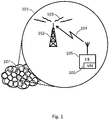
- a mobile telecommunications network 107 preferably a cellular one, comprising at least one radio cell 101, which in turn comprises a radio base station 102.
- the radio base station 102 can be logically connected to user equipments 105 located within said radio cell 101 in order to provide connectivity of various kinds (e.g. voice, data, SMS, MMS or the like).
- the radio cell 101 may enter an overload condition for several reasons.
- a first cause for overload is an anomalous distribution of user equipments 105 within the network 107 (e.g. when a crowd of people concentrates in a stadium for a sports event or the like), i.e. when one or more cells 101 contain a greater number of user equipments 105 than that for which they have been sized.
- the resources of the cell 101 such as signalling or traffic channels, may become saturated, i.e. have no available band, and thus make it impossible for one or more user equipments 105 to establish communications and exchange data with the radio base station 102.
- a second cause for overload is high traffic generated by the user equipments 105 distributed within the network 107 towards particular nodes (not shown in the annexed drawings) of the same network 107 (e.g. when many user equipments 105 are used simultaneously for sending messages on holidays or for exceptional events, such as earthquakes, floods or the like); such nodes may, in fact, include elements providing a particular service to the user equipments 105, e.g. DNS (Domain Name Service), call routing, SMS (Short Message Service), data packet routing or other services.
- DNS Domain Name Service
- call routing e.g., call routing, SMS (Short Message Service), data packet routing or other services.
- access attempt refers to any connection service request sent to the telecommunications network by the user equipment UE 105.
- the expression “access attempt” is used herein in order to highlight the fact that requests will not always be successful, and that service access restrictions may be applied to such services, so that it cannot be certain a priori that the service will actually be available at any specific moment, even though it is included in the connection services that the telecommunications network can normally provide to the user equipment, which is assumed to be able to use such services.
- the cell's signalling resources are likely to become congested, and it is therefore expedient to introduce access restrictions either in the cells 101 involved in the congestion or in the whole network 107; said restrictions must be notified to the user equipments 105, so that said user equipments 105 can limit their access requests to avoid transmitting signals potentially causing congestion themselves.
- the notification of said restrictions can be broadcast in the cell 101 by the radio base station 102 via radio signals 103 carrying the so-called "system information".
- system information can be broadcast in the cell 101 by the radio base station 102 via radio signals 103 carrying the so-called "system information".
- system information can be broadcast in the cell 101 by the radio base station 102 via radio signals 103 carrying the so-called "system information".
- system information can be set and keep up-to-date in a memory of their own the system information that concerns them.
- This procedure will not be described herein, but it is assumed that the system information which is set and updated by the user equipments includes any access restrictions set in the network 107.
- the access restriction information that is broadcast by the radio network is of the type required for the LTE system, in accordance with the 3GPP TS 36.331 V11.0.0 specification.
- the network indicates:
- the access restriction mechanism of the present invention is based upon the determination of a wait time that a user equipment must allow to elapse, at the least, before verifying the possibility of making an attempt to access the network, whether after an unsuccessful access attempt or after the end of a successful connection.
- the expression "verifying the possibility of making an attempt to access the network” refers to the execution of all actions and verifications required by the network prior to the transmission of an access request. All of said verification actions may then be followed, depending on their result, by an attempt to access the network, through the emission of an appropriate signal by the user equipment. If the access attempt is successful and the network accepts the service request in question, a connection can be established between the user equipment and the network for the provision of the service.
- the user equipment 105 comprises an access management module 106 that determines the wait time, and transceiver means adapted to try to access the mobile telecommunications network 107.
- the following will illustrate how the present invention can improve the fairness with which the user equipments 105 can try to gain access to the network 107.
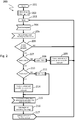
- the method comprises a start phase 201 followed by an initialization phase 202, during which a logic variable ADA (Access Delay Applied) is set to a "false" value and the value of the wait time Tbarring is set to zero.
- ADA Access Delay Applied
- the initialization phase 202 is followed by a wait phase 203, during which the equipment 105 waits for a service request from the user, e.g. issued by pressing a key of the user equipment 105, or from an application, issued through an appropriate message.
- a service request from the user, e.g. issued by pressing a key of the user equipment 105, or from an application, issued through an appropriate message.
- the user equipment 105 As it receives a service request, the user equipment 105 enters a service request management phase 204, during which the user equipment 105 starts suitable procedures for fulfilling said request. Following said management phase 204, the user equipment 105 enters an access data reading phase 205, during which it acquires or updates the data about the status of any network access restrictions and the status of a "Tbarring" wait time counter, the functions of which will be described later on.
- the user equipment 105 By processing said data, it is determined whether the user equipment 105 is allowed or not to make an attempt to access the network (choice phase 206). This decision depends on the data being broadcast by the network in the cell where the user equipment 105 is located and on the status of the Tbarring counter. The data broadcast by the network will not be described any further because they do not concern any aspects that characterize the present invention. In particular, it is assumed that the procedures described in the present invention lie within the general context of wireless network access control, wherein access classes can be defined and access attempts are inhibited in particular conditions that will not be described herein.
- the wait time Tbarring which may have elapsed or not, will however be dwelt upon below. If the wait time Tbarring has not elapsed (i.e. the counter is still counting), no attempt to access the network is allowed and the process returns to the wait phase 203, awaiting the next service request.
- a second choice phase 207 is carried out, wherein it is verified if the network is imposing any access restrictions.
- the procedure goes on to a setting phase 208, wherein the value of a logic variable ADA is set to "false”, and then to an access phase 209, wherein an attempt to access the network is made, which may or may not originate a connection for the provision of services. Finally, the process goes back to the wait phase 203.
- a third choice phase 210 is carried out, wherein the value of the logic variable ADA is checked. If ADA is equal to the "true" value, the process goes on to a restricted access phase 214, wherein an attempt to access the network is made, which may or may not originate a connection for the provision of services, and then to a data collection phase 215, wherein the data about previous access attempt(s) and/or network connection(s) 107 are collected.
- ADA is set to a "true” value (phase 211) and the collection phase 215 is carried out without attempting to access the network.
- the user equipment 105 calculates, during a calculation phase 216, the wait time Tbarring (see formula 2 below) and, during a counter start phase 217, starts the "Tbarring" wait time counter, the status of which indicates whether said wait time Tbarring has elapsed or not.
- the status of this counter can be verified in a further phase 206, if, after the procedure has returned to the wait phase 203, a new service request is issued (phase 204), with all that ensues therefrom.
- a wait time in restricted access conditions all access attempts are preceded by a wait time.
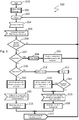
- a first variant 300 of the first embodiment of the invention includes a draw downstream of phase 211 of Figure 2 , represented in Figure 3 by a drawing phase 312.
- the draw can be implemented, for example, by comparing a random or pseudorandom number, instantly generated by the user equipment, with a reference probability received from the network or preset or otherwise made available.
- Other types of decisions are also applicable, which allow a sub-set of user equipments, defined statistically or otherwise, to make an attempt to access the network.
- the user equipment 105 After the drawing phase 312, the user equipment 105 enters a choice phase 313, wherein the result of the draw is evaluated. If the draw has been unsuccessful, then the user equipment 105 enters the data collection phase 215 without making any access attempt. If, on the contrary, the draw has been successful, an attempt to access to network is made (phase 214), followed by the data collection phase 215. In this manner, a certain percentage of user equipments 105, statistically dependent on the characteristics of the draw, can make an attempt to access the network without waiting for a wait time to elapse.
- This first variant can be considered to be a generalization of the first embodiment of the invention; it should be noted that, if the variables that determine the decision 313 are set in such a way that the decision will systematically turn out to be negative (phase 211 is always followed by phase 215), the results of the application of this variant will always coincide with those which would be obtained by applying the first embodiment shown in Figure 2 .
- a second variant 400 of the first embodiment consists of keeping the variable ADA constantly at the "false" logic value and switching, when the result of the draw in phase 313 is favourable, from phase 313 to phase 209 of Figure 2 , instead of phase 214.
- the variable ADA and the phases 202, 208, 210, 211 and 214 can be removed, and the positive result of the decision 207 can be followed by the draw 212, as shown in Figure 4 , where the drawing phase is labelled 412 and the resulting decision is labelled 413.
- this provides the same algorithm operation as specified in the 3GPP TS 36.331 V11.0.0 document.
- This variant is simpler than the above-described first embodiment, but after an access attempt it no longer requires setting a wait time that must elapse before another attempt to access the network can be made. The wait time is only interposed after a failed access attempt.
- Tbarring Brt ⁇ 1 ⁇ w 1 ⁇ 1 ⁇ 2 x rand ⁇ ⁇ 1 / 1 + w 2 fails g ⁇ ⁇ 1 + w 3 ⁇ ⁇ i Brt / Brt + w 4 ⁇ t c ⁇ t vi ⁇ ⁇ 1 + w 5 x ⁇ i d vi / Brt + w 4 ⁇ t c ⁇ t vi ⁇ ⁇ 1 + w 6 ⁇ ⁇ j Brt / Brt + w 4 ⁇ t c ⁇ t sj ⁇ ⁇ 1 + w 7 ⁇ ⁇ k v dk / Brt + w 4 ⁇
- Tbarring may also be defined otherwise, without essentially changing the operation of the user equipment 105 and without departing from the method of the invention.
- the Tbarring wait time start instant may be set at the start of the attempt to access the network after which Tbarring is calculated, or at the end of said attempt, or at the end of the connection possibly established after said attempt, or at other instants.
- the formula (2) determines the wait time by taking into account, in the first line, the reference time interval Brt transmitted by the network, multiplied by a random or pseudorandom factor (the contents between square brackets in the first line) evenly distributed between the extremes (1 - w1 ) and (1 + w1 ).
- This random factor which depends on the random number "rand", generated by the user equipment 105, and on the parameter w1 , advantageously serves to avoid coincidences of events determined by different user equipments, which, especially immediately after the establishment of the restrictions, may cause problematical signal overlaps.
- the parameter w1 determines the distribution over time of the access attempts around an average wait time value that depends on Brt.
- the parameter w1 just like the parameters g, w2, w3, ..., w7 and other parameters that may be added, as will be explained later on, are stored in the access management module 106 of the user equipment 105.
- the access management module 106 of the user equipment 105 By default, it is assumed that such parameters are preset into the user equipment 105 at the factory by its manufacturer. They may also, however, be totally or partly transmitted in real time through the network 107 or set offline by the network operator by means of a suitable equipment physically connected to the user equipment 105 or connected thereto via a wireless connection, e.g. by using an OTA (Over-The-Air) or NFC (Near Field Communication) technique or otherwise.
- OTA Over-The-Air
- NFC Near Field Communication
- one or more weights w4 may be differentiated by service type and may also be dependent on the values of the indices i, j and k of the summations present in the formula 2, in which case they will have different values as a function of the time instants at which the previous attempts took place.
- the variation ranges of the indices " i “, " j “, “ k “, as well as of other similar indices which may possibly be added, are preset, transmitted or set by the network in a similar manner, so as to reasonably limit the processing load.
- Such indices may, for example, vary between 1 and I, 1 and J, 1 and K, respectively, where I, J and K (and so on) are integer numbers greater than zero that determine the quantity of attempts to access the network 107 made by the user equipment 105 for voice traffic, SMS traffic and data traffic, respectively, which are to be taken into account when calculating the wait time, in the presence or absence of access restrictions.
- Tbarring generally takes different values, at a given instant, depending on the result of previous attempts to access the network made by the user equipment 105.
- the "result" of an access attempt may be either a successful access request or an unsuccessful access request, resulting in the requested communication service being provided or not (e.g. voice service connection, SMS transmission). If the access attempt is successful, the "result” generally also includes the characteristics of the service provided to the user equipment 105, such as the incoming or outgoing traffic volume, the duration of the voice communication, the size of an MMS sent or received, etc.
- the formula (2) provides a value of the wait time Tbarring which is shorter than that which would be obtained if the same access attempt had been successful, and vice versa. It can be easily demonstrated that this can be applied to any kind of service involved in the access attempt and to any valid combination of the values of the elements used in the formula (2), including, for example, the number of attempts taken into consideration, whether or not the access is restricted during the attempts made, the time elapsed since the attempts taken into account, the parameters w1-w7, the value of rand, and so on.
- Said parameters may be set at the factory, by the network operator, or via real-time transmissions of values, so that the behaviour of the user equipments 105 can be differentiated according to their characteristics (e.g. techniques in use), to the services they are specialized in, to the services they are mostly used for (also depending on the SIM in use), and to the network's characteristics. In this manner, bandwidth utilization can advantageously be avoided when the network 107 or the cell 101 is about to enter a congested state.
- the Tbarring calculation formula (2) will only include the components relating to the SMS and data traffic, and hence the weights for voice traffic w3 and w5 will be both null.
- the wait time Tbarring is differentiated also on the basis of the type of service to which the user equipment 105 intends to access.
- Tbarring may be differentiated according to priorities assigned to the users' SIM's and/or to the user equipment 105 and/or to the counterpart of the connection to be established (e.g. calls to emergency numbers have priority over calls to other numbers).
- the second line of the formula (2) contains a factor that reduces the wait time as the number of failed access attempts grows, which are assumed to be counted by the user equipment. This factor decreases as the parameter w2 and the number of fails (fails) taken into account increase. In addition, the number of failed attempts is raised to a power with exponent " g " so as to be able to differentiate, in combination with the parameter w2, the weight of the first fails from the weight of repeated fails.
- the failed attempts to be considered may be, for example, all those made starting from a given instant, or all those that were made prior to the instant at which Tbarring is calculated, and their maximum number may either be limited or not.
- the man skilled in the art may also define other rules for appropriately taking into account the connection attempts.
- the parameter g may theoretically have any value, but in practice it is thought that it will have values in the range [0 , +1], because for negative values of g Tbarring will decrease as the number of failed access attempts increases, whereas for values greater than 1 Tbarring will grow more than proportionally thereto.
- the third line contains the factor that determines the wait time increase dependent on the voice service connections originated by the user equipment 105.
- the weight of each one of these connections depends on the common parameter w3 and on the time elapsed since the end thereof (t c - t vi ), referred to the reference interval Brt, according to the parameter w4.
- a connection just ended will increase the wait time by a factor (1+ w3 ), whereas a connection ended since a time equal to Brt/w4 will increase it by a factor (1+ w3 /2).
- the number of connections taken into account is determined by the range of the index " i ".
- the index i can be set to take into account only the events occurred after the establishment of the access restrictions, or also previous events, or the events occurred after a given reference instant, which may be, for example, the instant at which an exceptional event has occurred, regardless of the instant at which the necessary access restrictions have then been established.
- all indices related to a type of service to which a network access restriction is applied are set to zero as soon as the user equipment 105 is informed by the network 107 about a partial restriction applied to a given type of service (voice, SMS or data traffic) or about a total restriction (applied to all services).
- the user equipment sets the Tbarring calculation by taking into account only the (failed or successful) attempts made starting from the instant when it came to know about the access restriction. In other words, the "memory" of the equipment extends up to the start of the access restrictions.
- the user equipment 105 may take into account and store the parameters relating to the access attempts (e.g. fails, d vi , v dk and the associated characteristic instants t dk , t vi and t sj ) for a predetermined number of consecutive access attempts, for one or more service types, regardless of the presence of access restrictions to the network 107, and may continue to do so even after the restrictions have been established.
- the parameters relating to the access attempts e.g. fails, d vi , v dk and the associated characteristic instants t dk , t vi and t sj
- the user equipment 105 also takes into account the traffic generated by the equipment in the period immediately preceding the network's restricted status; in fact, in this case Tbarring is set by also considering what happened before the start of the restriction, so that particularly active users, who most contributed to overloading the network, will be more penalized than others, at least at the beginning of the restriction stage. In this second case, it can be said that the equipment's memory extends beyond the start of the access restriction.
- the user equipments 105 normally keep track of the outgoing and incoming calls, and are therefore provided with all the elements which are necessary for calculating the value of the third line of the formula (2).
- the fourth line contains the factor that determines the wait time increase based on the duration of the voice service connections originated by the user equipment 105.
- the weight of each duration is given by the product of the common factor w5 by the duration d vi of the connection being considered, referred to the same divisor as the preceding line, which takes into account the time elapsed since the end of the connection.
- a connection just ended, which has lasted a time equal to Brt, will increase the wait time by a factor (1+ w5 ).
- the fifth line of the formula (2) contains the factor that determines the wait time increase dependent on the SMS's sent by the user equipment 105.
- the expression is similar to that of the third line, except that the weight w3 is replaced by the weight w6; for brevity's sake, it will not therefore be commented upon any further.
- dots indicate that, for brevity, other expressions of factors similar to those already described are not shown.
- factors may be added which take into account the connections established upon command from the network and "terminated" at the user equipment (incoming calls, video calls or the like), the expressions of which are similar to those of lines three, four and six, which concern connections established upon command from the user equipment.
- Expressions may also be added in regard to incoming SMS's and downloaded data volumes, outgoing and incoming MMS's, multimedia services, services requiring communications with/among machines (e.g.
- Machine-to-Machine communications which may involve washing machines, refrigerators, video surveillance systems, gas/water/energy meters or the like.
- communications with/between machines may have very different characteristics and requirements from those of other types of communications; therefore, user equipments 105 designed for this purpose can be characterized by specific formulae and parameters in order to beneficially differentiate the Tbarring calculation.
- the method of the present invention as described above, comprising at least one phase in which the wait time is calculated with the formula (2), comprises at least one of the procedures generally represented in Figure 2 and in the variants of Figures 3 and 4 . It is preferably applied by means of a computer-based procedure written in any programming language and preferably executed by the access management module 106, or it may be applied directly by the module 106 by means of an electronic circuitry possibly comprising CPLD (Complex Programmable Logic Device), FPGA (Field Programmable Gate Array) or other programmable hardware.
- CPLD Computer-based procedure written in any programming language and preferably executed by the access management module 106
- FPGA Field Programmable Gate Array
- a second embodiment of the invention 500 is shown in Fig. 5 .
- the first wait time calculated after the establishment of the network access restrictions is determined by means of a different formula than the one that will be used afterwards.
- Most of the procedure shown in Figure 5 coincides with that of Figure 3 , as can be evicted from the similarity of the labels assigned to many phases and of the links that connect them.
- the most important difference between the two procedures lies in the calculation of the wait time Tbarring: in the case of the procedure of Figure 2 , Tbarring is still calculated with the formula (2) (calculation phase 216), whereas in the case of the procedure of Figure 5 it is only calculated with the formula 2 if the variable ADA has the "true" logic value, i.e.
- Said second embodiment represents the particular case wherein the wait time calculation is differentiated in dependence on the instant at which the conditions of restricted network access are established.
- One skilled in the art will also be able to determine one or more wait time differentiations in dependence on the difference between the time at which said wait time is applied and a given reference instant.
- the formula (3) discerns whether or not a time longer than ⁇ t vm has elapsed since the instant at which the last voice service connection originated by the user equipment 105 was ended.
- ⁇ t vm is a system parameter set by the network 107 or by the manufacturer of the user equipment 105, the value of which increases with the penalty to be imposed on the user equipments 105 that were able to obtain a voice service connection.
- the formula (3) will take the same expression as the first line of formula (2), but the value of the parameter w1 may be different, and in particular may be greater in order to widely scatter over time the expirations of the first wait times being set.
- the addend w8 x Brt is added to the wait time of the previous case, on the assumption that the user has already been able to communicate something about the event that determined the establishment of the access restrictions.
- this particular example of embodiment of the invention only takes into account previous attempts to access the network made in order to obtain a voice communication service, i.e. to make a voice conversation.
- the wait time Tbarring may conceivably also depend on the result of access attempts made by the same equipment for services other than voice, e.g. video calls, SMS, data transmission, etc. This applies to both the first and the second embodiments of the invention.
- the formula (3) only refers to the voice service
- the man skilled in the art will understand that it is likewise possible to make a wait time calculation applicable to access requests for other services (e.g. SMS, data traffic) or even for a combination of multiple services, as is the case, for example, in the formula (2).
- wait times can be determined with two or more different formulae, for one or more types of traffic available to the user equipment, by circumscribing the use of each formula within a given time interval (e.g. an initial 20 second interval after the establishment of the restrictions, or a final 20 second interval before the removal of the restrictions), or for a predetermined number of wait time determinations identified, for example, by an order number attributed starting from the establishment of the restrictions (e.g. the first three wait time computations after the establishment of the restrictions).
- Each one of the service-specific wait times may or may not in turn take into account only access attempts made by the user equipment 105 for a service of the same type as the one being the object of the current attempt.
- the invention may be implemented by using a single formula for the calculation of the wait time to be applied to all attempts to access any type of service, depending on design choices, or to attempts to access only one specific type of service or some services or all services that can be requested to the network by the user equipment 105; this latter case is the one assumed in the formula (2).
- the formula (3) presented herein as one possible formula for determining the initial wait time, should only be considered as an example used herein for the purpose of illustrating the principle. Those skilled in the art will be able, in fact, to conceive many other calculation formulae suitable for different operating conditions. In particular, the differentiation options described with reference to the formula (2) also apply to the formula (3).
- the method of Figure 5 is preferably implemented through a computer-based procedure written in any programming language and preferably executed by the access management module 106 or directly implemented by the module 106 by means of an electronic circuitry and/or CPLD or FPGA or other programmable hardware.
- This method comprises at least one phase wherein the wait time is calculated according to the formula (2) or the formula (3) or another formula.
- the formula (3) is used for calculating the first wait time to be applied after the establishment of the access restrictions, whereas the formula (2) is subsequently used for calculating said wait time until the restrictions are removed.
- the application of either formula depends on the same logic variable called ADA (Access Delay Applied), already employed for distinguishing the first Tbarring calculation, carried out after the restricted conditions have been established, from the following ones.
- ADA Access Delay Applied
- the present invention is particularly advantageous over the prior art when a calamity makes communications critical, and those in the area involved have urgent necessity to signal that help is needed or to reassure someone about their own health. In such circumstances, the impossibility to communicate at once is detrimental for rescue organization and generates anxiety, thus further worsening the effects of the distressing event.
- the present invention offers the advantages mentioned herein with equal or increased effectiveness in terms of network decongestion, especially in the case of the above-described second embodiment.
- the latter advantageously allows to differentiate the wait time determinations at the initial stages of restriction establishment, without the necessity of modifying the values of the parameters broadcast by the network, the updating of which would require costly operations.
- the values of many parameters which are useful for calculating the wait time Tbarring can be set, whether at the factory or offline by the network operator.
- the behaviours of different user equipments can be differentiated depending, for example, on their reception/transmission technologies (GSM, GPRS, EDGE, UMTS, HSPA, LTE or the like), on the services for which the user equipments have been prevalently designed (voice, data, multimedia services, messaging services, video surveillance, machine-to-machine communications, etc.), on the services for which they are prevalently used, and on the users of the equipments, i.e. the SIM installed in the user equipment 105.
- a first line of variants concerns the formulae for determining the wait times, which, in order to take into account the failed access attempts, the successful access attempts, the different types of user equipments 105, etc., may comprise factors, addends, exponential functions, logarithmic functions, variable elements subject to upper or lower limits, or the like.
- a second line of variants concerns the combination of different determination formulae at different stages of application of the access restrictions. Typically, one can differentiate the start phase from the steady-state phase, as in the above-described example, possibly extending the start phase beyond the first wait time determination and articulating it into sub-phases.
- a third line of variants concerns the adaptation of the user equipment to particular characteristics of the user, possibly also considering confidential personal data which, although not taken into account in normal conditions, should however be considered, in the user's opinion, in critical conditions.
- the present invention allows, for example, to shorten the wait times for accessing specific services or to automatically send short messages to predefined addressees, by correlating the formulae and the parameters with the type of equipment and with the SIM in use, without having to resort to emergency calls.
- Another possible variant also takes into account, in the Tbarring calculation, the traffic originated by another user equipment of the network 107 towards the user equipment 105, i.e. the incoming traffic of the user equipment in question.
- Multiplicative factors can be added to the formulae (2) and (3) to increase the wait time for those user equipments 105 which have been successfully reached by voice calls, SMS messages or data traffic (e.g. instant messaging); the mathematical structure of these factors can be similar to that already described for the traffic of the same type originated by the user equipment 105, and may take into account both the number of communications and the traffic volume in terms of time and/or termination traffic volume.
Landscapes
- Engineering & Computer Science (AREA)
- Computer Security & Cryptography (AREA)
- Computer Networks & Wireless Communication (AREA)
- Signal Processing (AREA)
- Mobile Radio Communication Systems (AREA)
Claims (15)
- Anwenderausrüstung (105) umfassend- Kommunikationsmittel, die angepasst sind, zu versuchen, auf ein Mobilfunknetzwert (107) zuzugreifen und von dem Netzwerk (107) Informationen über das Vorhandensein von Zugriffsbeschränkungen auf das Netzwerk (107) zu empfangen,- ein Zugriffsverwaltungsmodul (106), das konfiguriert ist, um bei Vorhandensein von Zugriffsbeschränkungen auf das Netzwerk (107) eine Wartezeit Tbarring zu bestimmen, die zumindest zwischen aufeinanderfolgenden Verifikationen der Möglichkeit des Zugriffs auf das Netzwerk (107) ablaufen muss,dadurch gekennzeichnet, dass
der Wert der Wartezeit Tbarring basierend auf der Tatsache, dass mindestens ein vorheriger Versuch, auf das Netzwerk (107) zuzugreifen, durch die Anwenderausrüstung (105) erfolgreich oder erfolglos war, variiert wird. - Anwenderausrüstung (105) nach Anspruch 1, wobei, wenn zumindest ein vorheriger Versuch, auf das Netzwerk (107) zuzugreifen, erfolglos war, der Wert der Wartezeit Tbarring, der durch das Modul (106) erzeugt wird, kleiner ist als der, welcher erzeugt werden würde, wenn der gleiche zumindest eine vorherige Versuch, auf das Netzwerk (107) zuzugreifen, erfolgreich gewesen wäre.
- Anwenderausrüstung (105) nach Anspruch 1, wobei, wenn zumindest ein vorheriger Versuch, auf das Netzwerk (107) zuzugreifen, erfolgreich war, der Wert der Wartezeit Tbarring, der durch das Modul (106) erzeugt wird, größer ist als der, welcher erzeugt werden würde, wenn der gleiche zumindest eine vorherige Versuch, auf das Netzwerk (107) zuzugreifen, erfolglos gewesen wäre.
- Anwenderausrüstung (105) nach einem der Ansprüche 1 bis 3, wobei der Wert der Wartezeit (Tbarring) durch das Zugriffsverwaltungsmodul (106) außerdem basierend auf der Typologie eines Services, der durch das Netzwerk (107) bereitgestellt wird, für den ein Zugriff angefragt wird, generiert wird.
- Anwenderausrüstung (105) nach einem der Ansprüche 1 bis 4, wobei der Wert der Wartezeit Tbarring durch das Zugriffsverwaltungsmodul (106) außerdem basierend auf einem Verkehrsvolumen, das durch die Anwenderausrüstung (105) durch das Netzwerk (107) während zumindest eines der vorherigen Versuche, auf das Netzwerk (107) zuzugreifen, generiert wird.
- Anwenderausrüstung (105) nach einem der Ansprüche 1 bis 5, wobei der Wert der Wartezeit Tbarring durch das Zugriffsverwaltungsmodul (106) außerdem basierend auf dem Ergebnis zumindest eines der Versuche, auf das Netzwerk (107) zuzugreifen, der vor Etablierung der Zugriffsbeschränkungen auf das Netzwerk (107) ausgeführt wurde, generiert wird.
- Anwenderausrüstung (105) nach einem der Ansprüche 1 bis 6, wobei der Wert der Wartezeit Tbarring durch das Zugriffsverwaltungsmodul (106) außerdem basierend auf einer Zufalls- oder Pseudozufallszahl generiert wird.
- Anwenderausrüstung (105) nach Anspruch 7, wobei das Zugriffsverwaltungsmodul (106) den Wert der Wartezeit Tbarring basierend auf einer Formel, die zumindest einen Faktor umfasst, generiert, der gleich Brt x [1 - w1 x (1-2 x rand)] x x [1/(1 + w2 x failsg )] ist, wobei Brt ein vorbestimmtes Zeitintervall repräsentiert, w1 ein Parameter größer als oder gleich 0 und kleiner als 1 ist, w2 und g Parameter sind, die größer als oder gleich 0 sind, rand ein numerischer Zufalls- oder Pseudozufallswert größer als oder gleich 0 und kleiner als 1 ist, x eine Multiplikationsoperation anzeigt und fails ein nichtnegativer Integerwert ist, der die Anzahl der erfolglosen Versuche, auf das Netzwerk (107) zuzugreifen, repräsentiert.
- Verfahren zum Zugreifen auf ein Mobilfunknetz (107), wobei mehrere Anwenderausrüstungen (105) versuchen, auf das Mobilfunknetz (107) zuzugreifen, wenn das letztere Zugriffsbeschränkungen unterliegt, wobei das Verfahren durch zumindest eines der Anwenderausrüstungen (105) ausgeführt wird, wenn dieses einen Zugriff auf das Netzwerk (107) zur Realisierung eines Services anfragt, und das Verfahren die Phasen umfasst:a) Erzeugen eines Wertes einer Wartezeit Tbarring, die ablaufen muss, bevor ein Versuch, auf ein Netzwerk (107) zuzugreifen, ausgeführt werden kann, die vom Beginn der Übertragung der Zugriffsanfrage beim Vorhandensein von Zugriffsbeschränkungen beginnt,b) Warten für ein Zeitintervall, das eine Dauer aufweist, die zumindest gleich dem Wert Tbarring, der in Phase a) generiert wurde, ist,c) Versuchen, auf ein Netzwerk (107) zuzugreifen, zur Realisierung des Services,dadurch gekennzeichnet, dass
die Generation des Wertes der Wartezeit Tbarring, die in Phase a) erfolgt, in Abhängigkeit von dem Fakt variiert, dass zumindest ein Versuch, auf das Netzwerk (107) zuzugreifen, der durch eine Anwenderausrüstung (105) zu einem Zeitpunkt vor der Generation ausgeführt wurde, erfolgreich oder erfolglos war. - Verfahren nach Anspruch 9, wobei, wenn der zumindest eine vorherige Versuch, auf das Netzwerk (107) zuzugreifen, erfolglos war, der Wert der erzeugten Wartezeit (Tbarring), geringer ist als der, welcher erzeugt worden wäre, wenn der gleiche zumindest eine vorherige Versuch, auf das Netzwerk (107) zuzugreifen, erfolgreich gewesen wäre.
- Verfahren nach Anspruch 9, wobei, wenn der zumindest eine vorherige Versuch, auf das Netzwerk (107) zuzugreifen, erfolgreich war, der Wert der erzeugten Wartezeit Tbarring, größer ist als der, welcher erzeugt worden wäre, wenn der gleiche zumindest eine vorherige Versuch, auf das Netzwerk (107) zuzugreifen, erfolglos gewesen wäre.
- Verfahren nach einem der Ansprüche 9 bis 11, wobei der Wert der Wartezeit außerdem durch die Typologie des Services, der durch das Netzwerk (107), auf das die Anwenderausrüstung (105) dabei ist, zu versuchen, zuzugreifen, beeinflusst wird.
- Verfahren nach einem der Ansprüche 9 bis 12, wobei der Wert der Wartezeit Tbarring durch ein Verkehrsvolumen, das durch die Anwenderausrüstung (105) in Richtung auf das Netzwerk (107) während zumindest einem der vorherigen Versuche, auf das Netzwerk (107) zuzugreifen, beeinflusst wird.
- Verfahren nach einem der Ansprüche 9 bis 13, wobei der Wert der Wartezeit Tbarring außerdem basierend auf einer Zufalls- oder Pseudozufallszahl generiert wird.
- Verfahren nach Anspruch 14, wobei der Wert der Wartezeit Tbarring basierend auf einer Formel generiert wird, die mindestens einen Faktor aufweist, der gleich Brt x [1 - w1 x (1 - 2 x rand)] x [1/(1 + w2 x failsg )] ist, wobei Brt ein vorbestimmtes Zeitintervall repräsentiert, w1 ein Parameter größer als oder gleich 0 und kleiner als 1 ist, w2 und g Parameter sind, die größer als oder gleich 0 sind, rand ein numerischer Zufalls- oder Pseudozufallswert größer als oder gleich 0 und kleiner als 1 ist, x eine Multiplikationsoperation anzeigt und fails ein nichtnegativer Integerwert ist, der die Anzahl der erfolglosen Versuche, auf das Netzwerk (107) zuzugreifen repräsentiert.
Applications Claiming Priority (2)
| Application Number | Priority Date | Filing Date | Title |
|---|---|---|---|
| IT000189A ITTO20130189A1 (it) | 2013-03-08 | 2013-03-08 | Apparato d'utente per telecomunicazioni mobili e metodo per accedere ad una rete di telecomunicazioni |
| PCT/IB2014/059331 WO2014136025A1 (en) | 2013-03-08 | 2014-02-28 | User equipment for mobile telecommunications and method for accessing a telecommunications network |
Publications (2)
| Publication Number | Publication Date |
|---|---|
| EP2965562A1 EP2965562A1 (de) | 2016-01-13 |
| EP2965562B1 true EP2965562B1 (de) | 2018-07-04 |
Family
ID=48227481
Family Applications (1)
| Application Number | Title | Priority Date | Filing Date |
|---|---|---|---|
| EP14714373.9A Active EP2965562B1 (de) | 2013-03-08 | 2014-02-28 | Benutzervorrichtung für mobiltelekommunikation und verfahren zum zugang zu einem telekommunikationsnetz |
Country Status (5)
| Country | Link |
|---|---|
| US (1) | US9462540B2 (de) |
| EP (1) | EP2965562B1 (de) |
| CN (1) | CN105075337B (de) |
| IT (1) | ITTO20130189A1 (de) |
| WO (1) | WO2014136025A1 (de) |
Families Citing this family (3)
| Publication number | Priority date | Publication date | Assignee | Title |
|---|---|---|---|---|
| US20160143057A1 (en) * | 2013-07-02 | 2016-05-19 | Telefonaktiebolaget L M Ericsson (Publ) | Method and network node for managing collisions |
| US20190150033A1 (en) * | 2016-05-03 | 2019-05-16 | Telefonaktiebolaget Lm Ericsson (Publ) | Network nodes and terminal devices, and methods of operating the same |
| US10568018B1 (en) * | 2018-04-19 | 2020-02-18 | Sprint Spectrum L.P. | Methods and systems for preventing message overloading in wireless networks |
Family Cites Families (8)
| Publication number | Priority date | Publication date | Assignee | Title |
|---|---|---|---|---|
| JP4667194B2 (ja) | 2005-10-07 | 2011-04-06 | 株式会社エヌ・ティ・ティ・ドコモ | 規制制御システム、無線通信端末装置、規制制御方法、無線通信端末制御方法 |
| GB2447434A (en) | 2007-02-09 | 2008-09-17 | Vodafone Plc | Restricting access to telecommunications networks based upon network conditions |
| JP5314265B2 (ja) * | 2007-10-24 | 2013-10-16 | 株式会社エヌ・ティ・ティ・ドコモ | 送信処理規制方法、移動通信システム及び移動局 |
| JP2013520100A (ja) * | 2010-02-12 | 2013-05-30 | インターデイジタル パテント ホールディングス インコーポレイテッド | マシン間通信におけるアクセス制御および輻輳制御 |
| CN102223729B (zh) * | 2010-04-16 | 2016-06-29 | 中兴通讯股份有限公司 | 控制机器类型通信设备接入网络的方法及系统 |
| WO2012013355A1 (en) | 2010-07-30 | 2012-02-02 | Deutsche Telekom Ag | Method and program for cell barring in a cellular network |
| CN102438280B (zh) * | 2010-09-29 | 2015-05-13 | 中兴通讯股份有限公司 | 一种终端接入时间控制方法及系统 |
| CN102111847B (zh) * | 2011-01-10 | 2013-07-24 | 大唐移动通信设备有限公司 | 一种接入控制的方法及装置 |
-
2013
- 2013-03-08 IT IT000189A patent/ITTO20130189A1/it unknown
-
2014
- 2014-02-28 WO PCT/IB2014/059331 patent/WO2014136025A1/en not_active Ceased
- 2014-02-28 CN CN201480010527.0A patent/CN105075337B/zh active Active
- 2014-02-28 EP EP14714373.9A patent/EP2965562B1/de active Active
- 2014-02-28 US US14/766,669 patent/US9462540B2/en active Active
Non-Patent Citations (1)
| Title |
|---|
| None * |
Also Published As
| Publication number | Publication date |
|---|---|
| ITTO20130189A1 (it) | 2014-09-09 |
| US20150373630A1 (en) | 2015-12-24 |
| EP2965562A1 (de) | 2016-01-13 |
| CN105075337A (zh) | 2015-11-18 |
| CN105075337B (zh) | 2019-03-01 |
| US9462540B2 (en) | 2016-10-04 |
| WO2014136025A1 (en) | 2014-09-12 |
Similar Documents
| Publication | Publication Date | Title |
|---|---|---|
| US10681614B2 (en) | Network-controlled adaptive terminal behavior managing high-network-load scenarios | |
| KR101256293B1 (ko) | 하트비트 신호 발생 방법 및 시스템 | |
| JP5767326B2 (ja) | セルラネットワークにおけるセル・バーリングのための方法及びプログラム | |
| RU2486699C2 (ru) | Мобильная станция, базовая станция радиосвязи, способ управления связью и система мобильной связи | |
| US10506467B2 (en) | Method and system for signaling saving on radio access networks using early throttling mechanism for communication devices | |
| WO2002080602A1 (en) | Method for assessing the characteristics of a network for mobile telecommunications apparatuses | |
| RU2007131687A (ru) | Способ распределения радиоресурсов область техники, к которой относится изобретение | |
| CN102892177A (zh) | 一种终端接入控制处理方法及装置 | |
| US8423067B2 (en) | Method of connecting prioritized incoming calls in overload situations in a mobile radio network | |
| CN108347746A (zh) | 接入控制方法、接入网网元及用户设备 | |
| WO1998035522A2 (en) | Method of dynamically controlling the length of r_data messages on a random access channel | |
| US9462540B2 (en) | User equipment for mobile telecommunications and method for accessing a telecommunications network | |
| ES2316845T3 (es) | Metodo para controlar la carga de llamadas de usuario en un sistema de conmutacion por software. | |
| CN102438280B (zh) | 一种终端接入时间控制方法及系统 | |
| WO2011106979A1 (zh) | 短消息业务接入量的控制方法及基站子系统 | |
| JP5290450B1 (ja) | 移動通信システムにおける無線ネットワーク制御局及び規制方法 | |
| US10206241B2 (en) | Session management | |
| CN112188545B (zh) | 一种接入控制方法、装置、存储介质和基站 | |
| JP3028953B1 (ja) | 移動通信システムにおける無線交換機の呼振り分け方式 | |
| US20240214289A1 (en) | Accounting adjustment for packet drops occurring in mobile networks | |
| JP2004023648A (ja) | 携帯電話網における発信規制優先方式 | |
| KR20040068707A (ko) | 기지국시스템에서 패킷데이터를 전송할 기지국제어기를선택하는 방법 | |
| CN102932845A (zh) | 系统消息的传输方法、网元及系统 | |
| KR20130140273A (ko) | 과부하 지역의 네트워크 부하 저감 정책 운영 방법 및 시스템과 기록매체 | |
| KR20170010636A (ko) | 기지국장치 및 기지국장치의 동작 방법 |
Legal Events
| Date | Code | Title | Description |
|---|---|---|---|
| PUAI | Public reference made under article 153(3) epc to a published international application that has entered the european phase |
Free format text: ORIGINAL CODE: 0009012 |
|
| 17P | Request for examination filed |
Effective date: 20150723 |
|
| AK | Designated contracting states |
Kind code of ref document: A1 Designated state(s): AL AT BE BG CH CY CZ DE DK EE ES FI FR GB GR HR HU IE IS IT LI LT LU LV MC MK MT NL NO PL PT RO RS SE SI SK SM TR |
|
| AX | Request for extension of the european patent |
Extension state: BA ME |
|
| DAX | Request for extension of the european patent (deleted) | ||
| GRAP | Despatch of communication of intention to grant a patent |
Free format text: ORIGINAL CODE: EPIDOSNIGR1 |
|
| STAA | Information on the status of an ep patent application or granted ep patent |
Free format text: STATUS: GRANT OF PATENT IS INTENDED |
|
| INTG | Intention to grant announced |
Effective date: 20180321 |
|
| GRAS | Grant fee paid |
Free format text: ORIGINAL CODE: EPIDOSNIGR3 |
|
| GRAA | (expected) grant |
Free format text: ORIGINAL CODE: 0009210 |
|
| STAA | Information on the status of an ep patent application or granted ep patent |
Free format text: STATUS: THE PATENT HAS BEEN GRANTED |
|
| AK | Designated contracting states |
Kind code of ref document: B1 Designated state(s): AL AT BE BG CH CY CZ DE DK EE ES FI FR GB GR HR HU IE IS IT LI LT LU LV MC MK MT NL NO PL PT RO RS SE SI SK SM TR |
|
| REG | Reference to a national code |
Ref country code: GB Ref legal event code: FG4D |
|
| REG | Reference to a national code |
Ref country code: CH Ref legal event code: EP |
|
| REG | Reference to a national code |
Ref country code: AT Ref legal event code: REF Ref document number: 1015844 Country of ref document: AT Kind code of ref document: T Effective date: 20180715 |
|
| REG | Reference to a national code |
Ref country code: IE Ref legal event code: FG4D |
|
| REG | Reference to a national code |
Ref country code: DE Ref legal event code: R096 Ref document number: 602014027841 Country of ref document: DE |
|
| REG | Reference to a national code |
Ref country code: NL Ref legal event code: MP Effective date: 20180704 |
|
| REG | Reference to a national code |
Ref country code: LT Ref legal event code: MG4D |
|
| REG | Reference to a national code |
Ref country code: AT Ref legal event code: MK05 Ref document number: 1015844 Country of ref document: AT Kind code of ref document: T Effective date: 20180704 |
|
| PG25 | Lapsed in a contracting state [announced via postgrant information from national office to epo] |
Ref country code: NL Free format text: LAPSE BECAUSE OF FAILURE TO SUBMIT A TRANSLATION OF THE DESCRIPTION OR TO PAY THE FEE WITHIN THE PRESCRIBED TIME-LIMIT Effective date: 20180704 |
|
| PG25 | Lapsed in a contracting state [announced via postgrant information from national office to epo] |
Ref country code: LT Free format text: LAPSE BECAUSE OF FAILURE TO SUBMIT A TRANSLATION OF THE DESCRIPTION OR TO PAY THE FEE WITHIN THE PRESCRIBED TIME-LIMIT Effective date: 20180704 Ref country code: BG Free format text: LAPSE BECAUSE OF FAILURE TO SUBMIT A TRANSLATION OF THE DESCRIPTION OR TO PAY THE FEE WITHIN THE PRESCRIBED TIME-LIMIT Effective date: 20181004 Ref country code: CZ Free format text: LAPSE BECAUSE OF FAILURE TO SUBMIT A TRANSLATION OF THE DESCRIPTION OR TO PAY THE FEE WITHIN THE PRESCRIBED TIME-LIMIT Effective date: 20180704 Ref country code: AT Free format text: LAPSE BECAUSE OF FAILURE TO SUBMIT A TRANSLATION OF THE DESCRIPTION OR TO PAY THE FEE WITHIN THE PRESCRIBED TIME-LIMIT Effective date: 20180704 Ref country code: SE Free format text: LAPSE BECAUSE OF FAILURE TO SUBMIT A TRANSLATION OF THE DESCRIPTION OR TO PAY THE FEE WITHIN THE PRESCRIBED TIME-LIMIT Effective date: 20180704 Ref country code: RS Free format text: LAPSE BECAUSE OF FAILURE TO SUBMIT A TRANSLATION OF THE DESCRIPTION OR TO PAY THE FEE WITHIN THE PRESCRIBED TIME-LIMIT Effective date: 20180704 Ref country code: NO Free format text: LAPSE BECAUSE OF FAILURE TO SUBMIT A TRANSLATION OF THE DESCRIPTION OR TO PAY THE FEE WITHIN THE PRESCRIBED TIME-LIMIT Effective date: 20181004 Ref country code: PL Free format text: LAPSE BECAUSE OF FAILURE TO SUBMIT A TRANSLATION OF THE DESCRIPTION OR TO PAY THE FEE WITHIN THE PRESCRIBED TIME-LIMIT Effective date: 20180704 Ref country code: IS Free format text: LAPSE BECAUSE OF FAILURE TO SUBMIT A TRANSLATION OF THE DESCRIPTION OR TO PAY THE FEE WITHIN THE PRESCRIBED TIME-LIMIT Effective date: 20181104 Ref country code: GR Free format text: LAPSE BECAUSE OF FAILURE TO SUBMIT A TRANSLATION OF THE DESCRIPTION OR TO PAY THE FEE WITHIN THE PRESCRIBED TIME-LIMIT Effective date: 20181005 Ref country code: FI Free format text: LAPSE BECAUSE OF FAILURE TO SUBMIT A TRANSLATION OF THE DESCRIPTION OR TO PAY THE FEE WITHIN THE PRESCRIBED TIME-LIMIT Effective date: 20180704 |
|
| PG25 | Lapsed in a contracting state [announced via postgrant information from national office to epo] |
Ref country code: LV Free format text: LAPSE BECAUSE OF FAILURE TO SUBMIT A TRANSLATION OF THE DESCRIPTION OR TO PAY THE FEE WITHIN THE PRESCRIBED TIME-LIMIT Effective date: 20180704 Ref country code: ES Free format text: LAPSE BECAUSE OF FAILURE TO SUBMIT A TRANSLATION OF THE DESCRIPTION OR TO PAY THE FEE WITHIN THE PRESCRIBED TIME-LIMIT Effective date: 20180704 Ref country code: AL Free format text: LAPSE BECAUSE OF FAILURE TO SUBMIT A TRANSLATION OF THE DESCRIPTION OR TO PAY THE FEE WITHIN THE PRESCRIBED TIME-LIMIT Effective date: 20180704 Ref country code: HR Free format text: LAPSE BECAUSE OF FAILURE TO SUBMIT A TRANSLATION OF THE DESCRIPTION OR TO PAY THE FEE WITHIN THE PRESCRIBED TIME-LIMIT Effective date: 20180704 |
|
| REG | Reference to a national code |
Ref country code: DE Ref legal event code: R097 Ref document number: 602014027841 Country of ref document: DE |
|
| PG25 | Lapsed in a contracting state [announced via postgrant information from national office to epo] |
Ref country code: EE Free format text: LAPSE BECAUSE OF FAILURE TO SUBMIT A TRANSLATION OF THE DESCRIPTION OR TO PAY THE FEE WITHIN THE PRESCRIBED TIME-LIMIT Effective date: 20180704 Ref country code: RO Free format text: LAPSE BECAUSE OF FAILURE TO SUBMIT A TRANSLATION OF THE DESCRIPTION OR TO PAY THE FEE WITHIN THE PRESCRIBED TIME-LIMIT Effective date: 20180704 |
|
| PLBE | No opposition filed within time limit |
Free format text: ORIGINAL CODE: 0009261 |
|
| STAA | Information on the status of an ep patent application or granted ep patent |
Free format text: STATUS: NO OPPOSITION FILED WITHIN TIME LIMIT |
|
| PG25 | Lapsed in a contracting state [announced via postgrant information from national office to epo] |
Ref country code: DK Free format text: LAPSE BECAUSE OF FAILURE TO SUBMIT A TRANSLATION OF THE DESCRIPTION OR TO PAY THE FEE WITHIN THE PRESCRIBED TIME-LIMIT Effective date: 20180704 Ref country code: SM Free format text: LAPSE BECAUSE OF FAILURE TO SUBMIT A TRANSLATION OF THE DESCRIPTION OR TO PAY THE FEE WITHIN THE PRESCRIBED TIME-LIMIT Effective date: 20180704 Ref country code: SK Free format text: LAPSE BECAUSE OF FAILURE TO SUBMIT A TRANSLATION OF THE DESCRIPTION OR TO PAY THE FEE WITHIN THE PRESCRIBED TIME-LIMIT Effective date: 20180704 |
|
| 26N | No opposition filed |
Effective date: 20190405 |
|
| PG25 | Lapsed in a contracting state [announced via postgrant information from national office to epo] |
Ref country code: SI Free format text: LAPSE BECAUSE OF FAILURE TO SUBMIT A TRANSLATION OF THE DESCRIPTION OR TO PAY THE FEE WITHIN THE PRESCRIBED TIME-LIMIT Effective date: 20180704 |
|
| REG | Reference to a national code |
Ref country code: CH Ref legal event code: PL |
|
| PG25 | Lapsed in a contracting state [announced via postgrant information from national office to epo] |
Ref country code: LU Free format text: LAPSE BECAUSE OF NON-PAYMENT OF DUE FEES Effective date: 20190228 Ref country code: MC Free format text: LAPSE BECAUSE OF FAILURE TO SUBMIT A TRANSLATION OF THE DESCRIPTION OR TO PAY THE FEE WITHIN THE PRESCRIBED TIME-LIMIT Effective date: 20180704 |
|
| REG | Reference to a national code |
Ref country code: BE Ref legal event code: MM Effective date: 20190228 |
|
| REG | Reference to a national code |
Ref country code: IE Ref legal event code: MM4A |
|
| PG25 | Lapsed in a contracting state [announced via postgrant information from national office to epo] |
Ref country code: LI Free format text: LAPSE BECAUSE OF NON-PAYMENT OF DUE FEES Effective date: 20190228 Ref country code: CH Free format text: LAPSE BECAUSE OF NON-PAYMENT OF DUE FEES Effective date: 20190228 |
|
| PG25 | Lapsed in a contracting state [announced via postgrant information from national office to epo] |
Ref country code: IE Free format text: LAPSE BECAUSE OF NON-PAYMENT OF DUE FEES Effective date: 20190228 |
|
| PG25 | Lapsed in a contracting state [announced via postgrant information from national office to epo] |
Ref country code: BE Free format text: LAPSE BECAUSE OF NON-PAYMENT OF DUE FEES Effective date: 20190228 |
|
| PG25 | Lapsed in a contracting state [announced via postgrant information from national office to epo] |
Ref country code: TR Free format text: LAPSE BECAUSE OF FAILURE TO SUBMIT A TRANSLATION OF THE DESCRIPTION OR TO PAY THE FEE WITHIN THE PRESCRIBED TIME-LIMIT Effective date: 20180704 |
|
| PG25 | Lapsed in a contracting state [announced via postgrant information from national office to epo] |
Ref country code: PT Free format text: LAPSE BECAUSE OF FAILURE TO SUBMIT A TRANSLATION OF THE DESCRIPTION OR TO PAY THE FEE WITHIN THE PRESCRIBED TIME-LIMIT Effective date: 20181104 Ref country code: MT Free format text: LAPSE BECAUSE OF NON-PAYMENT OF DUE FEES Effective date: 20190228 |
|
| PG25 | Lapsed in a contracting state [announced via postgrant information from national office to epo] |
Ref country code: CY Free format text: LAPSE BECAUSE OF FAILURE TO SUBMIT A TRANSLATION OF THE DESCRIPTION OR TO PAY THE FEE WITHIN THE PRESCRIBED TIME-LIMIT Effective date: 20180704 |
|
| PG25 | Lapsed in a contracting state [announced via postgrant information from national office to epo] |
Ref country code: HU Free format text: LAPSE BECAUSE OF FAILURE TO SUBMIT A TRANSLATION OF THE DESCRIPTION OR TO PAY THE FEE WITHIN THE PRESCRIBED TIME-LIMIT; INVALID AB INITIO Effective date: 20140228 |
|
| PG25 | Lapsed in a contracting state [announced via postgrant information from national office to epo] |
Ref country code: MK Free format text: LAPSE BECAUSE OF FAILURE TO SUBMIT A TRANSLATION OF THE DESCRIPTION OR TO PAY THE FEE WITHIN THE PRESCRIBED TIME-LIMIT Effective date: 20180704 |
|
| P01 | Opt-out of the competence of the unified patent court (upc) registered |
Effective date: 20230516 |
|
| PGFP | Annual fee paid to national office [announced via postgrant information from national office to epo] |
Ref country code: GB Payment date: 20260226 Year of fee payment: 13 |
|
| PGFP | Annual fee paid to national office [announced via postgrant information from national office to epo] |
Ref country code: DE Payment date: 20260303 Year of fee payment: 13 |
|
| PGFP | Annual fee paid to national office [announced via postgrant information from national office to epo] |
Ref country code: IT Payment date: 20260227 Year of fee payment: 13 |
|
| PGFP | Annual fee paid to national office [announced via postgrant information from national office to epo] |
Ref country code: FR Payment date: 20260225 Year of fee payment: 13 |