EP2965379B1 - Alkali metal intercalation material as an electrode in an electrolytic cell - Google Patents
Alkali metal intercalation material as an electrode in an electrolytic cell Download PDFInfo
- Publication number
- EP2965379B1 EP2965379B1 EP14760372.4A EP14760372A EP2965379B1 EP 2965379 B1 EP2965379 B1 EP 2965379B1 EP 14760372 A EP14760372 A EP 14760372A EP 2965379 B1 EP2965379 B1 EP 2965379B1
- Authority
- EP
- European Patent Office
- Prior art keywords
- cell
- intercalation material
- electrolyte membrane
- alkali metal
- negative electrode
- Prior art date
- Legal status (The legal status is an assumption and is not a legal conclusion. Google has not performed a legal analysis and makes no representation as to the accuracy of the status listed.)
- Active
Links
Images





Classifications
-
- H—ELECTRICITY
- H01—ELECTRIC ELEMENTS
- H01M—PROCESSES OR MEANS, e.g. BATTERIES, FOR THE DIRECT CONVERSION OF CHEMICAL ENERGY INTO ELECTRICAL ENERGY
- H01M4/00—Electrodes
- H01M4/02—Electrodes composed of, or comprising, active material
- H01M4/13—Electrodes for accumulators with non-aqueous electrolyte, e.g. for lithium-accumulators; Processes of manufacture thereof
- H01M4/131—Electrodes based on mixed oxides or hydroxides, or on mixtures of oxides or hydroxides, e.g. LiCoOx
-
- H—ELECTRICITY
- H01—ELECTRIC ELEMENTS
- H01B—CABLES; CONDUCTORS; INSULATORS; SELECTION OF MATERIALS FOR THEIR CONDUCTIVE, INSULATING OR DIELECTRIC PROPERTIES
- H01B1/00—Conductors or conductive bodies characterised by the conductive materials; Selection of materials as conductors
- H01B1/02—Conductors or conductive bodies characterised by the conductive materials; Selection of materials as conductors mainly consisting of metals or alloys
-
- H—ELECTRICITY
- H01—ELECTRIC ELEMENTS
- H01M—PROCESSES OR MEANS, e.g. BATTERIES, FOR THE DIRECT CONVERSION OF CHEMICAL ENERGY INTO ELECTRICAL ENERGY
- H01M10/00—Secondary cells; Manufacture thereof
- H01M10/05—Accumulators with non-aqueous electrolyte
-
- H—ELECTRICITY
- H01—ELECTRIC ELEMENTS
- H01M—PROCESSES OR MEANS, e.g. BATTERIES, FOR THE DIRECT CONVERSION OF CHEMICAL ENERGY INTO ELECTRICAL ENERGY
- H01M10/00—Secondary cells; Manufacture thereof
- H01M10/05—Accumulators with non-aqueous electrolyte
- H01M10/056—Accumulators with non-aqueous electrolyte characterised by the materials used as electrolytes, e.g. mixed inorganic/organic electrolytes
- H01M10/0561—Accumulators with non-aqueous electrolyte characterised by the materials used as electrolytes, e.g. mixed inorganic/organic electrolytes the electrolyte being constituted of inorganic materials only
- H01M10/0562—Solid materials
-
- H—ELECTRICITY
- H01—ELECTRIC ELEMENTS
- H01M—PROCESSES OR MEANS, e.g. BATTERIES, FOR THE DIRECT CONVERSION OF CHEMICAL ENERGY INTO ELECTRICAL ENERGY
- H01M2300/00—Electrolytes
- H01M2300/0017—Non-aqueous electrolytes
- H01M2300/002—Inorganic electrolyte
-
- H—ELECTRICITY
- H01—ELECTRIC ELEMENTS
- H01M—PROCESSES OR MEANS, e.g. BATTERIES, FOR THE DIRECT CONVERSION OF CHEMICAL ENERGY INTO ELECTRICAL ENERGY
- H01M2300/00—Electrolytes
- H01M2300/0017—Non-aqueous electrolytes
- H01M2300/0065—Solid electrolytes
- H01M2300/0068—Solid electrolytes inorganic
-
- Y—GENERAL TAGGING OF NEW TECHNOLOGICAL DEVELOPMENTS; GENERAL TAGGING OF CROSS-SECTIONAL TECHNOLOGIES SPANNING OVER SEVERAL SECTIONS OF THE IPC; TECHNICAL SUBJECTS COVERED BY FORMER USPC CROSS-REFERENCE ART COLLECTIONS [XRACs] AND DIGESTS
- Y02—TECHNOLOGIES OR APPLICATIONS FOR MITIGATION OR ADAPTATION AGAINST CLIMATE CHANGE
- Y02E—REDUCTION OF GREENHOUSE GAS [GHG] EMISSIONS, RELATED TO ENERGY GENERATION, TRANSMISSION OR DISTRIBUTION
- Y02E60/00—Enabling technologies; Technologies with a potential or indirect contribution to GHG emissions mitigation
- Y02E60/10—Energy storage using batteries
Definitions
- the present invention relates in general to electrolytic cells. More particularly, the present invention provides an electrolytic cell that includes a solid alkali ion conductive electrolyte membrane and at least one electrode that includes an alkali metal intercalation material. In some instances, the intercalation material includes an alkali metal selected from sodium and lithium.
- Electrolytic cells comprising solid alkali ion conductive electrolyte membranes that selectively transport alkali ions are known in the art.
- alkali ion selective membrane in an electrolytic cell, alkali ions are allowed to pass between the cell's anolyte compartment and catholyte compartment while other chemicals are maintained in their original compartments.
- an electrolytic cell can be engineered to be more efficient and to produce different chemical reactions than would otherwise occur without the membrane.
- Solid alkali ion conductive electrolyte membranes are used in electrochemical cells for various reasons, including, but not limited to, for being ion conductive, ion selective, water impermeable, chemically stable, electronically insulating, and for similar reasons.
- NaSICON Na Super Ion CONducting
- LiSICON Li Super Ion CONducting
- Other examples of solid alkali ion conductive electrolyte membranes include beta alumina, sodium-conductive glasses, etc.
- Electrolytic cells comprising solid alkali ion conductive membranes are used to produce a wide variety of different chemicals and to perform various chemical processes. In some cases, such electrolytic cells convert alkali salts into their corresponding acids. In other cases, such electrolytic cells may also be used to separate alkali metals from mixed alkali salts. Accordingly, some such electrolytic cells can be used to purify metals, such as sodium, lithium, potassium. Electrolytic cells are known from WO2013/109542 or US2013/0004852 .
- electrolytic cells comprising solid alkali ion conductive membranes are not necessarily without their shortcomings or challenges.
- some such electrolytic cells are relatively inefficient. More particularly, some such cells are subject to a relatively high amount of voltage drop between and anode electrode and cathode electrode.
- the contents of such cells can degrade or damage the solid alkali ion conductive membrane, thereby, causing the cell to become less efficient or even inoperable.
- the present invention relates to a solid state alkali metal based secondary battery as disclosed in claim 1.
- rechargeable batteries are often referred to as having positive and negative electrodes.
- negative electrode may be used interchangeable with “anode”
- positive electrode may be used interchangeably with “cathode”
- negative electrode compartment may be used interchangeably with “anolyte”
- positive electrode compartment may be used interchangeably with “catholyte”.
- the described cell includes an anolyte compartment housing a negative electrode, wherein the negative electrode includes a first alkali metal intercalation material.
- the cell also includes a catholyte compartment comprising a positive electrode, wherein the positive electrode includes a second alkali metal intercalation material that is different from the first alkali metal intercalation material.
- the cell includes a solid alkali metal ion conductive electrolyte membrane that separates the negative electrode from the positive electrode, wherein the first and the second alkali metal intercalation materials are in direct contact with the electrolyte membrane, and wherein electrolyte membrane is selected from a sodium ion conductive electrolyte membrane and a lithium ion conductive membrane.
- the described invention relates to a solid alkali metal ion conductive electrolyte membrane that includes a first surface and a second surface (which is substantially opposite to the first surface), wherein the electrolyte membrane is selected from a sodium ion conductive electrolyte membrane and a lithium ion conductive membrane.
- a negative electrode which includes a first alkali metal intercalation material, is attached to the first surface.
- the present invention provides an electrolytic cell that includes a solid alkali ion conductive electrolyte membrane and at least one electrode that includes an alkali metal intercalation material.
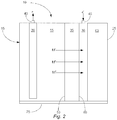
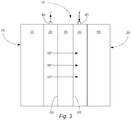
- the electrolytic cell 10 comprises an anolyte compartment 15, which includes an anode electrode 20; a catholyte compartment 25, which comprises a cathode electrode 30; an alkali ion conductive electrolyte membrane 35 that separates the anolyte compartment 15 from the catholyte compartment 25; a first terminal 40; and a second terminal 45.
- such compartments can be any suitable shape and have any other suitable characteristic that allows the cell 10 to function as intended.
- the anolyte compartment and the catholyte compartment can each be tubular, rectangular, irregular, or can be any other suitable shape.
- the two compartments can have any suitable spatial relationship with respect to each other.
- Figure 1 shows an embodiment in which the anolyte compartment 15 and the catholyte compartment 25 are adjacent to each other, in other embodiments (not shown), one compartment (e.g., the anolyte compartment) is disposed (at least partially) within the other compartment (e.g., the catholyte compartment), while the contents of the two compartments remain separated by the alkali ion conductive electrolyte membrane 35 and any other compartmental walls.
- the intercalation material of anode 20 comprises a material that causes little to no increase in the resistance of the electrolyte membrane 35 (discussed below).
- the intercalation material readily transports alkali ions there through and has little to no adverse effect on the rate at which alkali ions pass from the anolyte compartment 15 to the catholyte compartment 25.
- the intercalation material comprises sodium metal intercalated with a base material, such as carbon (e.g ., graphite, mesoporous carbon, boron-doped diamond, carbon, and/or graphene).
- a base material such as carbon (e.g ., graphite, mesoporous carbon, boron-doped diamond, carbon, and/or graphene).
- the anode 20 comprises Na x C 6 (wherein x is between about 0 and about 3).
- the intercalation material in the anode 20 comprises a lithium metal intercalated into and/or onto a base material, such as carbon (e.g ., graphite, mesoporous carbon, boron-doped diamond, carbon, and/or graphene).
- a base material such as carbon (e.g ., graphite, mesoporous carbon, boron-doped diamond, carbon, and/or graphene).
- the anode 20 comprises Li x C 6 (wherein x is between about 0 and about 3).
- the anode can have any suitable configuration, in some embodiments, the anode comprises a coating, wire, felt, plate, tube, mesh, foam, and/or other suitable anode configuration.
- the anode 20 is coupled to or disposed on a first side 50 of the membrane 35 that faces the anolyte compartment 15. While having the intercalation material of the anode be disposed on the electrolyte membrane ( e.g ., as a coating) may provide the cell 10 with several features, in some embodiments, by having the intercalation material be disposed on the electrolyte membrane, alkali ions (e.g ., Na + or Li + ) can pass directly from the anode and through the electrolyte membrane ( e.g ., as the current is passed between the anode and cathode 30) and into the catholyte compartment 25.
- alkali ions e.g ., Na + or Li +
- the intercalation material can be coupled to the electrolyte membrane 35 (as shown in Figure 1 ) or be disposed on, coupled to, or otherwise be formed as part of the anode (as shown in Figure 2 ) in any suitable manner.
- the intercalation material of the anode 20 is disposed on the electrolyte membrane and/or anode (e.g ., an anode substrate) through a method such as chemical vapor deposition ("CVD"), physical vapor deposition (“PVD”), sputtering, casting, pulsed laser deposition, DC magnetron sputtering, molding, extrusion, and/or any other suitable technique that is either capable of disposing the intercalation material of the anode on the electrolyte membrane or that is otherwise capable of forming the anode.
- CVD chemical vapor deposition
- PVD physical vapor deposition
- intercalation material can be added to a substrate (e.g ., the first side 50 of the electrolyte membrane 35, the anode 20, and/or an anode substrate) as a single layer, in some embodiments, 1, 2, 3, 4, 5, 6, 7, 8, 9, 10, or more layers of the intercalation material are added to the substrate to form the anode.
- a substrate e.g ., the first side 50 of the electrolyte membrane 35, the anode 20, and/or an anode substrate
- 1, 2, 3, 4, 5, 6, 7, 8, 9, 10, or more layers of the intercalation material are added to the substrate to form the anode.
- the intercalation material of the anode 20 comprises an alkali metal (e.g ., Na or Li) when the anode is formed ( e.g ., when the intercalation material is disposed on the electrolyte membrane 35, an anode substrate, etc.)
- the base material e.g ., carbon, nickel oxide, manganese oxide, iron phosphate, etc.
- the alkali metal is then loaded into the base material. While this loading can be accomplished in any suitable manner, in some embodiments, the loading is accomplished before the intercalation material is added to the cell 10 and/or as the cell functions.
- the intercalation material of the anode is as thin as a measurement selected from about 50 ⁇ m, about 25 ⁇ m, about 10 ⁇ m, about 5 ⁇ m, and about 1 ⁇ m. In some embodiments, however, the intercalation material of the anode is as thick as a measurement selected from about 55 ⁇ m, about 100 ⁇ m, about 500 ⁇ m, about 1mm, about 5mm, and about 1cm. In still other embodiments, the thickness of the intercalation material of the anode is between any suitable combination or sub-range of the aforementioned measurements ( e.g ., between about 250 ⁇ m and about 520 ⁇ m).
- the anolyte compartment 15 comprises an anolyte solution 55 (as shown in Figures 1 and 2 ).
- the anolyte solution can comprise any suitable chemical or chemicals that allow the cell 10 to function and to carry out a desired chemical reaction.
- suitable anolyte solutions include, but are not limited to, aqueous and/or non-aqueous solutions comprising water, formamide, methyl formamide, dimethyl formamide, acetamide, fluoroacetamide, methyl acetamide, 1,2-propanediol, ethylene glycol, 1,3-propylene glycol, Na 2 SO 4 , NaNO 3 , Li 2 SO 4 , LiNO 3 , Nal, Na 2 S, NaCl, Lil, Li 2 S, and/or LiCl.
- the anolyte solution comprises an aqueous solution of Nal, Na 2 S, NaCl, Na 2 SO 4 , and NaNO 3 .
- the anolyte solution comprises an aqueous solution of Lil, Li 2 S, or LiCl.
- the cell 10 can comprise any solid alkali ion selective electrolyte membrane that allows the cell to effectuate a desired electrochemical reaction.
- the alkali ion conductive electrolyte membrane 35 material may include, but is not limited to, a ⁇ "-alumina ceramic electrolyte separator, and an alkali Metal Super Ion Conductive (MeSICON) material, where "Me” represents an alkali metal.
- MeSICON materials include, but are not limited to, ceramic NaSICON type materials (including, without limitation, any suitable known or novel NaSICON material) and LiSICON type materials (including, without limitation, any suitable known or novel LiSICON material).
- the electrolyte membrane comprises a NaSICON type material.
- the electrolyte membrane comprises a LiSICON type material.
- the cell 10 can comprise any suitable cathode 30 material that allows the cell to carry out any desired chemical reaction.
- suitable cathode materials include, but are not limited to, a second alkali metal intercalation material that is disposed on a second side 60 (as shown in Figure 2 ) of the electrolyte membrane 35, nickel, stainless steel alloys, graphite, carbon, titanium, a nickel cobalt ferrous alloy ( e.g ., a KOVAR® alloy), an electro-catalyst ( e.g ., platinum), a molten metal (e.g ., molten sodium), other known or novel cathode materials, and combinations thereof.
- the cathode comprises an alkali metal intercalation material.
- the cathode 30 comprises an alkali metal intercalation material
- the cathode can comprise any suitable intercalation material that allows the cell 10 to function.
- the electrolyte membrane 35 is selective to sodium ions (e.g ., comprises a NaSICON type material)
- the intercalation material used in the cathode 30 comprises sodium intercalated with a base material, such as carbon ( e.g ., graphite, mesoporous carbon, boron-doped diamond, carbon, and/or graphene), nickel oxide, manganese oxide, iron phosphate, etc.
- suitable sodium intercalation materials that can be used in the cathode include, but are not limited to, Na x NiO, Na x MnO 2 , Na x NiO 2 , Na x AlO 2 , Na x CoO 2 (wherein x is between about 0.2 and about 1) and/or Na x Fe y (PO 4 ) z , (wherein x is between about 0 and about 3, y is about 1, and z is between about 1 and about 3.
- the cathode 30 comprises a lithium intercalation material.
- the cathode comprises Li x NiO, Li x MnO 2 , Li x CoO 2 , Li x Mn 2 O 4 (wherein x is between about 0.2 and about 1), and/or Li x Fe y (PO 4 ) z (wherein x is between about 0 and about 3, y is about 1, and z is between about 1 and about 3).
- the cathode 30 is coupled to a second side 60 of the membrane 35 that faces the catholyte compartment 15.
- the position of the cathode may provide the cell 10 with several benefits, which may include, without limitation, an efficient way to operate the cell with a relatively small amount of voltage drop between the anode 20 and the cathode.
- the cathode comprises a substrate (e.g ., a carbon substrate, a wire, mesh, a plate, foam, etc.) that is at least partially coated with the intercalation material.
- the intercalation material is disposed on the electrolyte membrane 35 (as shown in Figure 3 ).
- the intercalation material of the cathode 20 is disposed on a substrate (e.g ., the second side 60 of the electrolyte membrane, a cathode substrate (e.g ., a carbon substrate, a wire, mesh, a plate, foam, etc.), through one or more of the methods that are discussed above for forming and/or disposing the intercalation material for the anode 20 (e.g ., CVD, PVD, sputtering, casting, etc.).
- the intercalation material can be deposited on a substrate (e.g ., the electrolyte membrane, a cathode substrate, etc.) in any suitable number of layers, including, without limitation, 1, 2, 3, 4, 5, 6, 7, 8, 9, 10, or more.
- the intercalation material includes an alkali metal (e.g ., Na or Li) when the material is deposited on a substrate of the catholyte compartment 25 ( e.g ., the second side 60 of the electrolyte membrane 35, a cathode substrate, etc.), in other embodiments, the base material (e.g ., nickel oxide, manganese oxide, iron phosphate, etc.) of the intercalation material is first coated on the substrate and the alkali metal is then loaded into and/or onto the base material. While this loading can be accomplished in any suitable manner, in some non-limiting embodiments, the loading occurs before the cathode is added to the cell 10, prior to operation of the cell, and/or as the cell operates.
- an alkali metal e.g ., Na or Li
- the base material e.g ., nickel oxide, manganese oxide, iron phosphate, etc.
- the coating of the intercalation material can be any suitable thickness that allows the cell 10 to function.
- the intercalation material of the cathode is as thin as a measurement selected from about 50 ⁇ m, about 25 ⁇ m, about 10 ⁇ m, about 5 ⁇ m, and about 1 ⁇ m. In some embodiments, however, the intercalation material of the cathode is as thick as a measurement selected from about 55 ⁇ m, about 100 ⁇ m, about 500 ⁇ m, about 1mm, about 5mm, and about 1cm.
- the intercalation material of the cathode has a thickness between any suitable combination or sub-range of the aforementioned measurements (e.g ., between about 250 ⁇ m and about 520 ⁇ m or between about 10 ⁇ m and about 5mm).
- the catholyte compartment 25 comprises a catholyte solution 65 (or catholyte material).
- the catholyte solution can comprise any suitable chemical or chemicals that allow the cell 10 to carry out a desired chemical reaction.
- suitable materials in the catholyte solution 65 include, but are not limited to, molten sodium, sodium hydroxide, glycerol, water, methanol, borax, sodium tetraborate decahydrate, sodium metaborate tetrahydrate, sodium silicate, boric acid, sodium borohydride, sodium phosphate, sodium hydrogen phosphate, sodium glycerol, sodium carbonate, ethylene, propylene, an ionic liquid (e.g ., N-methoxyethyl-N-methyl-pyrrolidinium, butylmethyl-pyrrolidinium, propylmethyl-pyrrolidinium, triethyl-sulfonium, diethylmethylsulfonium, ethyl-dimethyl-ammonio-(trimethylammonio)-dihydroborate, pyridinium, pyrrolidinium, quaternary ammonium, quaternary phosphonium, trisulfonium,
- the cell 10 can comprise any suitable terminals that are capable of electrically connecting the cell with a power source (e.g ., power source 70, shown in Figure 4 ).
- a power source e.g ., power source 70, shown in Figure 4
- the terminals can comprise any suitable material and be any suitable shape and any suitable size.
- the power supply can be any known or novel power supply that is capable of providing a suitable amount of voltage and current between the anode 20 and cathode 30 and that is otherwise suitable for use with an electrolytic cell.
- the cell 10 can optionally comprise any other suitable component.
- the cell comprises one or more outlet and/or inlet channels to one or more of the compartments to allow materials to be added to and/or removed from the cell as it functions.
- Figure 4 shows an embodiment in which the cell 10 optionally comprises a temperature management system 75.
- the cell can comprise any suitable type of temperature management system that is capable of maintaining the cell within a suitable operating temperature range. Some examples of such temperature management systems include, but are not limited to, a heater, a cooler, one or more temperature sensors, and appropriate temperature control circuitry.
- Figure 4 illustrates that as the cell 10 functions and electrons (e - ) flow from the anode 20 ( e.g ., via the first terminal 40), an alkali metal M, such as Na or Li ( e.g ., from an alkali metal intercalation material present in the anode) is oxidized to form alkali ions ( e.g ., Na + or Li + ).
- alkali ions e.g ., Na + or Li +
- Figure 4 shows that these alkali ions (M + ) are then transported through the alkali ion conductive electrolyte membrane 35 and then to the catholyte compartment 25.
- Figure 5 shows an embodiment in which a cell 100 is used in to synthesize molten sodium. While such a cell can comprise any suitable component, Figure 5 shows an embodiment in which the cell 100 comprises: an anode 20 that includes an sodium intercalation compound that that is disposed on the first surface 50 of the electrolyte membrane 35 ( e.g ., a NaSICON type membrane); an anolyte solution 55 that includes a sodium containing compound (e.g ., NaX, wherein X comprises an anion capable of combining with a sodium cation to form an ionic compound, wherein some examples of NaX may include NaS, Na 2 S, Nal, NaCl, Na 2 SO 4 , NaNO 3 , etc.); and a molten sodium cathode 30.
- an anode 20 that includes an sodium intercalation compound that that is disposed on the first surface 50 of the electrolyte membrane 35 (e.g ., a NaSICON type membrane); an anolyte solution 55 that includes
- Figure 5 shows that as the cell 100 operates and the sodium containing solution (e.g ., NaX) is ionized by the anode 20, sodium cations (e.g ., Na + ) are selectively transported to the catholyte compartment 25 where they combine with the molten sodium cathode 30 while the anion (e.g ., S - , I - , Cl - , etc.) forms a substance that precipitates (e.g ., in the case of sulfur) or bubbles off ( e.g ., in the case iodine and chorine).
- sodium containing solution e.g ., NaX
- NaX sodium containing solution
- anode 20 shows that as the cell 100 operates and the sodium containing solution (e.g ., NaX) is ionized by the anode 20
- sodium cations e.g ., Na +
- the anion e.g ., S - , I - , Cl
- the described cell 10 may function at any suitable operating temperature.
- the anode may have any suitable temperature that allows the cell to function.
- an electrode comprises sodium
- the cell functions at an operating temperature below about 100° C, and more particularly below 97° C, or below the melting point of sodium.
- an electrode comprises lithium
- the cell functions at an operating temperature below about 200° C, and more particularly below 181° C, or below the melting point of lithium.
- the cell may have several other beneficial characteristics. Indeed, some embodiments of the cell 10 that comprise an electrode (e.g ., the anode 20) that includes an intercalation material and that is coupled to the electrolyte membrane 35, can operate more efficiently (e.g ., experience less voltage drop between the anode and the cathode 30) then occurs in some competing electrolytic cells. Additionally, some embodiments of the cell that comprise an electrode (e.g ., an anode) that includes an intercalation material may be useful (as described above) for the synthesis of molten sodium and/or wide variety of other compounds.
- the cell is a secondary cell or rechargeable battery.
- secondary cells can be discharged and recharged and this specification describes cell arrangements and methods for both states.
- recharging in its various forms implies a second charging, one of skill in the art will understand that discussions regarding recharging would be valid for, and applicable to, the first or initial charge, and vice versa.
- the terms “recharge,” “recharged,” and “rechargeable” shall be interchangeable with the terms “charge,” “charged,” and “chargeable,” respectively.
- FIG. 6 shows a representative embodiment in which the alkali metal based secondary cell 110 comprises an anolyte compartment 115, which includes a negative electrode 120 comprising a first alkali metal intercalation material; a catholyte compartment 125, which comprises a positive electrode 130 an alkali ion conductive electrolyte membrane 135 that separates the negative electrode 120 from the positive electrode 130; a first terminal 140; and a second terminal 145.
- the alkali metal based secondary cell 110 comprises an anolyte compartment 115, which includes a negative electrode 120 comprising a first alkali metal intercalation material; a catholyte compartment 125, which comprises a positive electrode 130 an alkali ion conductive electrolyte membrane 135 that separates the negative electrode 120 from the positive electrode 130; a first terminal 140; and a second terminal 145.
- the cell can comprise an anolyte compartment 115 and a catholyte compartment 125.
- the two compartments can be any suitable shape and have any other suitable characteristic that allows the cell 110 to function as intended.
- the negative electrode compartment and the positive electrode compartment can each be tubular, rectangular, irregular, or can be any other suitable shape.
- the two compartments can have any suitable spatial relationship with respect to each other.
- Figure 6 shows an embodiment in which the negative electrode compartment 115 and the positive electrode compartment 125 are adjacent to each other
- one compartment e.g., the negative electrode compartment
- the other compartment e.g., the positive electrode compartment
- the contents of the two compartments remain separated by the alkali ion conductive electrolyte membrane 135 and any other compartmental walls.
- the intercalation material can comprise any alkali metal containing material that allows the negative electrode to function as an electrode, that also allows alkali metal (e.g ., Na or Li) in the negative electrode to be oxidized to form alkali ions (Na + or Li + ) as the cell is discharged, and that also allows alkali ions to be reduced and to intercalate with the intercalation material as the cell is recharged.
- the intercalation material comprises a material that causes little to no increase in the resistance of the electrolyte membrane (discussed below). In other words, in some embodiments, the intercalation material readily transports alkali ions there through and has little to no adverse effect on the rate at which alkali ions pass from the negative electrode compartment 115 to the positive electrode compartment 125.
- the intercalation material in the negative electrode 120 comprises sodium metal intercalated with carbon (e.g ., graphite, mesoporous carbon, boron-doped diamond, carbon, and/or graphene). Indeed, in some embodiments, the negative electrode 120 comprises Na x C 6 , Na x Co 2 O 4 , and/or sodium intercalated into hard carbon, wherein x is between about 0 and about 3.
- carbon e.g ., graphite, mesoporous carbon, boron-doped diamond, carbon, and/or graphene.
- the negative electrode 120 comprises Na x C 6 , Na x Co 2 O 4 , and/or sodium intercalated into hard carbon, wherein x is between about 0 and about 3.
- the intercalation material in the negative electrode 120 comprises a lithium metal intercalated into and/or onto carbon (e.g ., graphite, mesoporous carbon, boron-doped diamond, carbon, and/or graphene).
- the negative electrode comprises Li x C 6 , wherein x is between about 0 and about 3.
- the negative electrode is disposed on or coupled to a first side 150 (as shown in Figure 6 ) of the membrane that faces the negative electrode compartment 115. While having the intercalation material of the negative electrode be coupled to the electrolyte membrane may provide the cell 110 with several features, in some embodiments, by having the intercalation material be coupled to the electrolyte membrane, alkali ions (e.g ., Na + or Li + ) can pass directly from the negative electrode and through the electrolyte membrane ( e.g ., as the cell is discharged) and directly from the electrolyte membrane, back to the negative electrode ( e.g ., as the cell is recharged).
- alkali ions e.g ., Na + or Li +
- the negative electrode 120 is coupled to the electrolyte membrane 135, the negative electrode can be coupled to the electrolyte membrane in any suitable manner.
- the intercalation material of the negative electrode 120 is disposed on the electrolyte membrane through a method such as chemical vapor deposition ("CVD"), physical vapor deposition (“PVD”), sputtering, casting, pulsed laser deposition, DC magnetron sputtering, and/or any other suitable technique that is capable of coupling the intercalation material of the negative electrode to the electrolyte membrane.
- CVD chemical vapor deposition
- PVD physical vapor deposition
- sputtering casting
- pulsed laser deposition DC magnetron sputtering
- any other suitable technique that is capable of coupling the intercalation material of the negative electrode to the electrolyte membrane.
- the intercalation material can be added to the electrolyte membrane as a single layer, in some embodiments, 1, 2, 3, 4, 5, 6, 7, 8, 9, 10, or more layers of the intercalation material
- the intercalation material of the negative electrode 120 comprises an alkali metal (e.g ., Na or Li) when the material is coupled to the electrolyte membrane 135, in other embodiments, the base material (e.g ., carbon) of the intercalation material is first coated on the electrolyte membrane and the alkali metal is then loaded into the base material. While this loading can be accomplished in any suitable manner, in some non-limiting embodiments, the loading occurs during fabrication of the negative electrode, prior to operation of the cell and/or as the cell operates.
- alkali metal e.g ., Na or Li
- the base material e.g ., carbon
- the intercalation material of the negative electrode 120 can be any suitable thickness that allows the cell 110 to function.
- the intercalation material of the negative electrode is as thin as a measurement selected from about 50 ⁇ m, about 25 ⁇ m, about 10 ⁇ m, and about 5 ⁇ m, and about 1 ⁇ m.
- the intercalation material of the negative electrode is as thick as a measurement selected from about 55 ⁇ m, about 100 ⁇ m, about 500 ⁇ m, about 1mm, about 5mm, and about 1cm.
- the thickness of the intercalation material of the negative electrode is between any suitable combination or sub-range of the aforementioned measurements ( e.g ., between about 250 ⁇ m and about 500 ⁇ m).
- the negative electrode compartment 115 further comprises a negative electrolyte solution.
- the negative electrolyte solution can comprise any suitable chemical or chemicals that allow the cell 110 to function.
- the cell 110 also comprises a solid alkali ion selective electrolyte membrane 135.
- the alkali ion conductive electrolyte membrane 135 material may include, but is not limited to, a ⁇ "-alumina ceramic electrolyte separator, and an alkali Metal Super Ion Conductive (MeSICON) material, where "Me” represents an alkali metal.
- MeSICON materials include, but are not limited to, ceramic NaSICON-type materials (including, without limitation, any suitable known or novel NaSICON material) and LiSICON-type materials (including, without limitation, any suitable known or novel LiSICON material).
- the electrolyte membrane comprises a NaSICON-type material.
- the electrolyte membrane comprises a LiSICON-type material.
- the cell 110 can comprise any suitable positive electrode 130 that allows the cell to be charged and discharged as intended.
- suitable positive electrodes include, but are not limited to, a second alkali metal intercalation material that is coupled to a second side 155 (as shown in Figure 6 ) of the electrolyte membrane 135 and an electrode material that is separated from the electrolyte membrane.
- the positive electrode 130 comprises a second alkali metal intercalation material that is coupled to the second side 155 of the electrolyte membrane 135, the positive electrode can comprise any suitable intercalation material that allows the cell to function and that is different ( e.g ., has a different potential) than the first intercalation material that is used in the negative electrode 120.
- the described cell 110 comprises a solid state rechargeable battery.
- the second intercalation material used in the positive electrode 130 also comprises sodium.
- suitable sodium intercalation materials that can be used in the positive electrode include, but are not limited to, Na x NiO, Na x MnO 2 , Na x NiO 2 , Na x AlO 2 , Na x CoO 2 (wherein x is between about 0.2 and about 1) and/or Na x Fe y (PO 4 ) z (wherein x is between about 0 and about 3, y is about 1 and z is between about 1 and about 3).
- the negative electrode comprises Na x C 6
- the positive electrode comprises Na x MnO 2 .
- the positive electrode 130 comprises a second lithium intercalation material, which is different than the first.
- the negative electrode comprises a lithium intercalation material (e.g ., Li x C 6 )
- the positive electrode comprises Li x NiO, Li x MnO 2 , Li x CoO 2 , Li x Mn 2 O 4 (wherein x is between about 0.2 and about 1) and/or Li x Fe y (PO 4 ) z (wherein x is between about 0 and about 3, y is about 1 and z is between about 1 and about 3).
- the negative electrode comprises Li x C 6
- the positive electrode comprises Li x MnO 2 .
- the positive electrode 130 comprises the second alkali metal intercalation material, and where such material is coupled to the second side 155 of the electrolyte membrane 135, the positive electrode can be coupled to the electrolyte membrane in any suitable manner.
- the intercalation material of the positive electrode 130 is disposed on the electrolyte membrane through one or more of the methods that are used to couple the first intercalation material of the negative electrode 120 to the first side 150 of the electrolyte membrane ( e.g ., via CVD, PVD, sputtering, casting, etc.).
- the second intercalation material can be deposited on the second side of the electrolyte membrane in any suitable number of layers, including, without limitation, 1, 2, 3, 4, 5, 6, 7, 8, 9, 10, or more.
- the intercalation material of the positive electrode 130 comprises an alkali metal (e.g ., Na or Li) when the material is coupled to the second side 155 of the electrolyte membrane 135, in other embodiments, the base material (e.g ., nickel oxide, manganese oxide, iron phosphate, etc.) of the second intercalation material is first coated on the electrolyte membrane and the alkali metal is then loaded into and/or onto the base material. While this loading can be accomplished in any suitable manner, in some non-limiting embodiments, the loading occurs during fabrication of the positive electrode, prior to operation of the cell and/or as the cell operates.
- alkali metal e.g ., Na or Li
- the base material e.g ., nickel oxide, manganese oxide, iron phosphate, etc.
- the second intercalation material of the positive electrode 130 can be any suitable thickness that allows the cell 110 to function.
- the intercalation material of the positive electrode is as thin as a measurement selected from about 50 ⁇ m, about 25 ⁇ m, about 10 ⁇ m, and about 5 ⁇ m, and about 1 ⁇ m.
- the intercalation material of the positive electrode is as thick as a measurement selected from about 55 ⁇ m, about 100 ⁇ m, about 500 ⁇ m, about 1mm, and about 5mm, and about 1cm.
- the second intercalation material of the positive electrode has a thickness between any suitable combination or sub-range of the aforementioned measurements ( e.g ., between about 250 ⁇ m and about 500 ⁇ m or between about 10 ⁇ m and about 5mm).
- the described cell can comprise virtually any other known or novel positive electrode material that allows the battery to be discharged and charged.
- the positive electrode comprises a wire, felt, plate, tube, mesh, foam, and/or other suitable positive electrode configuration in which the positive electrode is separated from the electrolyte membrane 135.
- the positive electrode comprises a material selected from, but not limited to, a nickel foam, a sodium composite that is not molten at the cell's operating temperature (including, without limitation, a sodium/sulfur material), nickel hydroxide (Ni(OH) 2 ) ( e.g ., when the cell is at least partially discharged), nickel oxyhydroxide (NiOOH) ( e.g ., when the cell is at least partially charged), and/or another suitable material.
- a material selected from, but not limited to, a nickel foam, a sodium composite that is not molten at the cell's operating temperature including, without limitation, a sodium/sulfur material
- nickel hydroxide (Ni(OH) 2 ) e.g ., when the cell is at least partially discharged
- NiOOH nickel oxyhydroxide
- the positive electrolyte can comprise any suitable alkali ion conductive material that allows the cell 110 to function as intended.
- suitable materials in the positive electrolyte solution 152 include, but are not limited to, sodium hydroxide, glycerol, water, borax, sodium tetraborate decahydrate, sodium metaborate tetrahydrate, sodium silicate, boric acid, sodium borohydride, sodium phosphate, sodium hydrogen phosphate, sodium glycerol, sodium carbonate, ethylene, propylene, an ionic liquid ( e.g ., N-methoxyethyl-N-methyl-pyrrolidinium, butylmethyl-pyrrolidinium, propylmethyl-pyrrolidinium, triethyl-sulfonium, diethylmethylsulfonium, ethyl-dimethyl-ammonio-(trimethylammonio)-dihydroborate, pyridinium, pyrrolidinium, quatern
- the cell 10 can comprise any suitable terminals that are capable of electrically connecting the cell with an external circuit, including, without limitation, to one or more other cells.
- the terminals can comprise any suitable material and any suitable shape of any suitable size.
- the cell 110 can optionally comprise any other suitable component.
- Figure 8 shows an embodiment in which the cell 110 optionally comprises a temperature management system 160.
- the cell can comprise any suitable type of temperature management system that is capable of maintaining the cell within a suitable operating temperature range.
- Some examples of such temperature management systems include, but are not limited to, a heater, a cooler, one or more temperature sensors, and appropriate temperature control circuitry.
- Figure 6 illustrates that as the cell 110 is discharged and electrons (e - ) flow from the negative electrode 120 ( e.g ., via the first terminal 140), an alkali metal M, such as Na or Li, in the negative electrode is oxidized to form alkali ions ( e.g ., Na + or Li + ).
- alkali ions e.g ., Na + or Li +
- Figure 6 shows that these alkali ions (M + ) are transported from the negative electrode 120, through the alkali ion conductive electrolyte membrane 135, and then to the positive electrode compartment 125 ( e.g ., into the positive electrode 130 and/or the positive electrolyte solution 152).
- the negative electrode gives sodium ions to the positive electrode as the cell discharges.
- Figure 7 shows that as the described secondary cell 110 is recharged and electrons (e - ) flow into the negative electrode 120 ( e.g ., via the first terminal 140) from an external power source (not shown), such as a recharger, the chemical reactions that occurred when the cell was discharged (as shown in Figure 6 ) are reversed.
- Figure 7 shows that as the cell 110 is recharged, alkali ions (Na + or Li + ) are transported from the positive electrode compartment 125 ( e.g ., from the positive electrode 130), through the alkali ion conductive electrolyte membrane 135, and to the negative electrode 120, where the alkali ions are reduced and intercalated back into or onto the negative electrode 120.
- the positive electrode gives sodium ions to the negative electrode as the cell recharges.
- the positive electrode 30 half-reaction for the cell 110 (with charging being forward) is: LiCoO 2 ⁇ Li 1-n CoO 2 + n Li + + n e - , wherein the negative electrode 120 half-reaction is n Li + + n e - + C ⁇ Li n C.
- the described cell 110 may function at any suitable operating temperature.
- the negative electrode 120 may have any suitable temperature that allows it to remain solid. Indeed, in some embodiments where an electrode comprises sodium, the cell functions at an operating temperature below about 100° C, and more particularly below 97° C, or below the melting point of sodium. In other embodiments where an electrode comprises lithium, the cell functions at an operating temperature below about 200° C, and more particularly below 181° C, or below the melting point of lithium.
- the cell may have several other beneficial characteristics.
- the negative electrode 120 comprises an alkali metal intercalation material (e.g ., Na x C 6 or Li x C 6 ) that is solid as the cell functions
- some embodiments of cell function at relatively low temperatures.
- such embodiments of the cell may require little to no energy to heat and/or dissipate heat from the cell as the cell functions.
- the cell can operate at a lower temperature than certain conventional rechargeable batteries that comprise a molten negative electrode, the cell may be less dangerous to use or handle.
- some embodiments of the cell may be recharged multiple times, do not release hazardous chemicals as it functions, and require less thermal energy than some conventional batteries, such embodiments of the cell may be relatively environmentally friendly.
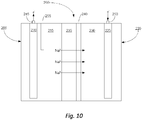
- an electrolytic cell e.g ., a rechargeable battery 200 was constructed to include components similar to those in Figure 10 .
- the cell 10 was constructed to include an anolyte compartment 205 housing a nickel wire anode 210 that is in contact with negative electrolyte solution 215 containing ethylene glycol and NaI at a 38% concentration, by weight.
- the cell was constructed to include a cathode compartment 220 housing a nickel oxyhydroxide cathode 225 disposed in a positive electrolyte solution 230 comprising an aqueous solution that includes borax at a 30% concentration, by weight.
- cell 200 further comprises a NaSICON membrane 235 comprising a layer of carbon 240 facing the cathode 225. Also, Figure 10 shows that the cell 200 includes a first terminal 245, a second terminal 250, and a platinum reference 255.
- the graph in Figure 11 shows that when the cell 200 was charged and discharged at 90° C over a period of three weeks, the carbon layer 240 substantially maintained its stability in the borax solution 230.
- Figure 12 further shows that when the operation of the cell 200 of Figure 10 was compared (via electrochemical impedance spectroscopy, "EIS") to the cell 300 of Figure 13 (which has the same setup of the cell 200 in Figure 10 , but lacks the carbon layer 240), the cell 200 of Figure 10 with the carbon layer 240 did not have a higher resistance than the cell 300 of Figure 13 , which lacked the carbon layer.
- EIS electrochemical impedance spectroscopy
- line 305 represents the EIS measurements of the electrode in the cell 300 with the uncoated NaSICON 235
- line 310 represents the EIS measurements of the electrode and membrane 235 in the cell 300 with the uncoated NaSICON 235
- line 315 represents the EIS measurements of the electrode in the cell 200 with the coated NaSICON 235
- line 320 represents the EIS measurements of the electrode and membrane 235 in the cell 200 with the uncoated NaSICON 235.
- an electrode e.g ., an anode 20 and/or cathode 30
- an alkali metal intercalation material having a base material e.g., carbon
Landscapes
- Chemical & Material Sciences (AREA)
- Engineering & Computer Science (AREA)
- General Chemical & Material Sciences (AREA)
- Chemical Kinetics & Catalysis (AREA)
- Electrochemistry (AREA)
- Manufacturing & Machinery (AREA)
- Materials Engineering (AREA)
- Inorganic Chemistry (AREA)
- Physics & Mathematics (AREA)
- Condensed Matter Physics & Semiconductors (AREA)
- General Physics & Mathematics (AREA)
- Secondary Cells (AREA)
- Battery Electrode And Active Subsutance (AREA)
Applications Claiming Priority (3)
| Application Number | Priority Date | Filing Date | Title |
|---|---|---|---|
| US201361772306P | 2013-03-04 | 2013-03-04 | |
| US201361772356P | 2013-03-04 | 2013-03-04 | |
| PCT/US2014/020392 WO2014138110A1 (en) | 2013-03-04 | 2014-03-04 | Alkali metal intercalation material as an electrode in an electrolytic cell |
Publications (3)
| Publication Number | Publication Date |
|---|---|
| EP2965379A1 EP2965379A1 (en) | 2016-01-13 |
| EP2965379A4 EP2965379A4 (en) | 2016-11-09 |
| EP2965379B1 true EP2965379B1 (en) | 2020-07-08 |
Family
ID=51491883
Family Applications (1)
| Application Number | Title | Priority Date | Filing Date |
|---|---|---|---|
| EP14760372.4A Active EP2965379B1 (en) | 2013-03-04 | 2014-03-04 | Alkali metal intercalation material as an electrode in an electrolytic cell |
Country Status (5)
| Country | Link |
|---|---|
| EP (1) | EP2965379B1 (https=) |
| JP (1) | JP6546099B2 (https=) |
| KR (1) | KR102202085B1 (https=) |
| ES (1) | ES2817901T3 (https=) |
| WO (1) | WO2014138110A1 (https=) |
Families Citing this family (6)
| Publication number | Priority date | Publication date | Assignee | Title |
|---|---|---|---|---|
| US9722279B2 (en) * | 2014-12-24 | 2017-08-01 | Toyota Motor Engineering & Manufacturing North America, Inc. | All-solid-state metal-metal battery comprising ion conducting ceramic as electrolyte |
| JP6549944B2 (ja) * | 2015-09-10 | 2019-07-24 | 三洋化成工業株式会社 | リチウムイオン電池 |
| US9779882B2 (en) * | 2015-11-23 | 2017-10-03 | Nanotek Instruments, Inc. | Method of producing supercapacitor electrodes and cells having high active mass loading |
| KR102839204B1 (ko) * | 2018-12-28 | 2025-07-28 | 메타제네시스 엘티디 | 저 순도 소스로부터 고 순도 리튬의 전해 생산 |
| KR102766561B1 (ko) * | 2019-11-04 | 2025-02-10 | 주식회사 엘지에너지솔루션 | 탄소계 기반 하이브리드 음극을 구비한 이차전지의 수명 특성 예측 방법 |
| ES3010694T3 (en) | 2021-02-09 | 2025-04-04 | Unisense As | A solid-contact ion-selective electrode |
Citations (1)
| Publication number | Priority date | Publication date | Assignee | Title |
|---|---|---|---|---|
| JP2005063958A (ja) * | 2003-07-29 | 2005-03-10 | Mamoru Baba | 薄膜固体リチウムイオン二次電池およびその製造方法 |
Family Cites Families (20)
| Publication number | Priority date | Publication date | Assignee | Title |
|---|---|---|---|---|
| GB9516850D0 (en) * | 1995-08-17 | 1995-10-18 | Programme 3 Patent Holdings | High temperature storage battery |
| US7390591B2 (en) * | 2002-10-15 | 2008-06-24 | Polyplus Battery Company | Ionically conductive membranes for protection of active metal anodes and battery cells |
| JP2005038720A (ja) * | 2003-07-15 | 2005-02-10 | Sony Corp | 負極の製造方法および電池の製造方法 |
| JP4048243B2 (ja) * | 2003-12-01 | 2008-02-20 | 独立行政法人産業技術総合研究所 | 二次電池及びその製造方法 |
| US7282295B2 (en) * | 2004-02-06 | 2007-10-16 | Polyplus Battery Company | Protected active metal electrode and battery cell structures with non-aqueous interlayer architecture |
| WO2007075867A2 (en) * | 2005-12-19 | 2007-07-05 | Polyplus Battery Company | Composite solid electrolyte for protection of active metal anodes |
| JP5144845B2 (ja) * | 2008-01-31 | 2013-02-13 | 株式会社オハラ | 固体電池 |
| JP5678297B2 (ja) * | 2008-06-10 | 2015-02-25 | 友寄 壹 | リチウムイオン電池の製法及びリチウム電池の製法 |
| JP2009301727A (ja) * | 2008-06-10 | 2009-12-24 | Kazu Tomoyose | リチウム電池の製法 |
| JP5414075B2 (ja) * | 2008-12-26 | 2014-02-12 | 独立行政法人産業技術総合研究所 | リチウム二次電池 |
| JP5354580B2 (ja) * | 2009-01-28 | 2013-11-27 | 独立行政法人産業技術総合研究所 | リチウム−空気電池 |
| JP5333184B2 (ja) * | 2009-03-16 | 2013-11-06 | トヨタ自動車株式会社 | 全固体二次電池 |
| JP5310284B2 (ja) * | 2009-06-11 | 2013-10-09 | トヨタ自動車株式会社 | 金属二次電池 |
| US20110039162A1 (en) * | 2009-08-11 | 2011-02-17 | Samsung Electronics Co., Ltd. | All-solid secondary battery and positive electrode used therefor |
| EP2497133B1 (en) * | 2009-11-05 | 2018-12-26 | Field Upgrading USA, Inc. | Solid-state sodium-based secondary cell having a sodium ion conductive ceramic separator |
| JP2011228162A (ja) * | 2010-04-21 | 2011-11-10 | National Institute Of Advanced Industrial & Technology | リチウム−水電池による水素製造と燃料電池の組み合わせ |
| JP2012094410A (ja) * | 2010-10-27 | 2012-05-17 | Dainippon Printing Co Ltd | 全固体二次電池、および全固体二次電池の製造方法 |
| WO2012096993A2 (en) * | 2011-01-10 | 2012-07-19 | Ceramatec, Inc. | Control of ph kinetics in an electrolytic cell having acid-intolerant alkali-conductive membrane |
| JP2012212648A (ja) * | 2011-03-24 | 2012-11-01 | Tokyo Univ Of Science | ナトリウム二次電池用電極およびナトリウム二次電池 |
| EP2804967B1 (en) * | 2012-01-16 | 2019-06-19 | Enlighten Innovations Inc. | Composite alkali ion conductive solid electrolyte |
-
2014
- 2014-03-04 EP EP14760372.4A patent/EP2965379B1/en active Active
- 2014-03-04 JP JP2015561558A patent/JP6546099B2/ja active Active
- 2014-03-04 KR KR1020157026934A patent/KR102202085B1/ko active Active
- 2014-03-04 WO PCT/US2014/020392 patent/WO2014138110A1/en not_active Ceased
- 2014-03-04 ES ES14760372T patent/ES2817901T3/es active Active
Patent Citations (1)
| Publication number | Priority date | Publication date | Assignee | Title |
|---|---|---|---|---|
| JP2005063958A (ja) * | 2003-07-29 | 2005-03-10 | Mamoru Baba | 薄膜固体リチウムイオン二次電池およびその製造方法 |
Also Published As
| Publication number | Publication date |
|---|---|
| JP2016515287A (ja) | 2016-05-26 |
| KR20150123905A (ko) | 2015-11-04 |
| WO2014138110A1 (en) | 2014-09-12 |
| ES2817901T3 (es) | 2021-04-08 |
| EP2965379A1 (en) | 2016-01-13 |
| JP6546099B2 (ja) | 2019-07-17 |
| KR102202085B1 (ko) | 2021-01-13 |
| EP2965379A4 (en) | 2016-11-09 |
Similar Documents
| Publication | Publication Date | Title |
|---|---|---|
| US10355305B2 (en) | Alkali metal intercalation material as an electrode in an electrolytic cell | |
| US8968902B2 (en) | Low temperature molten sodium secondary cell with sodium ion conductive electrolyte membrane | |
| CA2770733C (en) | Solid-state sodium-based secondary cell having a sodium ion conductive ceramic separator | |
| EP2965379B1 (en) | Alkali metal intercalation material as an electrode in an electrolytic cell | |
| US10056651B2 (en) | Low temperature secondary cell with sodium intercalation electrode | |
| CA2902908C (en) | Low temperature battery with molten sodium-fsa electrolyte | |
| US10020543B2 (en) | Low temperature battery with molten sodium-FSA electrolyte | |
| KR20150053776A (ko) | 나트륨-할로겐 2차 전지 | |
| WO2011038233A1 (en) | High-performance rechargeable batteries with fast solid-state ion conductors | |
| US10483586B2 (en) | All-solid-state battery using sodium ion intercalation cathode with Li/Na exchanging layer | |
| EP2935655B1 (en) | Degradation protection of solid alkali ion conductive electrolyte membrane | |
| EP2973838B1 (en) | Low temperature secondary cell with sodium intercalation electrode | |
| JP2015530722A (ja) | 電池の電荷移動機構 |
Legal Events
| Date | Code | Title | Description |
|---|---|---|---|
| PUAI | Public reference made under article 153(3) epc to a published international application that has entered the european phase |
Free format text: ORIGINAL CODE: 0009012 |
|
| 17P | Request for examination filed |
Effective date: 20150909 |
|
| AK | Designated contracting states |
Kind code of ref document: A1 Designated state(s): AL AT BE BG CH CY CZ DE DK EE ES FI FR GB GR HR HU IE IS IT LI LT LU LV MC MK MT NL NO PL PT RO RS SE SI SK SM TR |
|
| AX | Request for extension of the european patent |
Extension state: BA ME |
|
| DAX | Request for extension of the european patent (deleted) | ||
| A4 | Supplementary search report drawn up and despatched |
Effective date: 20161007 |
|
| RIC1 | Information provided on ipc code assigned before grant |
Ipc: H01M 4/131 20100101ALI20160930BHEP Ipc: H01M 10/05 20100101AFI20160930BHEP Ipc: H01M 10/0562 20100101ALI20160930BHEP Ipc: H01B 1/02 20060101ALI20160930BHEP |
|
| RAP1 | Party data changed (applicant data changed or rights of an application transferred) |
Owner name: FIELD UPGRADING LIMITED |
|
| STAA | Information on the status of an ep patent application or granted ep patent |
Free format text: STATUS: EXAMINATION IS IN PROGRESS |
|
| 17Q | First examination report despatched |
Effective date: 20181008 |
|
| RAP1 | Party data changed (applicant data changed or rights of an application transferred) |
Owner name: ENLIGHTEN INNOVATIONS INC. |
|
| GRAP | Despatch of communication of intention to grant a patent |
Free format text: ORIGINAL CODE: EPIDOSNIGR1 |
|
| STAA | Information on the status of an ep patent application or granted ep patent |
Free format text: STATUS: GRANT OF PATENT IS INTENDED |
|
| INTG | Intention to grant announced |
Effective date: 20200103 |
|
| GRAS | Grant fee paid |
Free format text: ORIGINAL CODE: EPIDOSNIGR3 |
|
| GRAJ | Information related to disapproval of communication of intention to grant by the applicant or resumption of examination proceedings by the epo deleted |
Free format text: ORIGINAL CODE: EPIDOSDIGR1 |
|
| GRAL | Information related to payment of fee for publishing/printing deleted |
Free format text: ORIGINAL CODE: EPIDOSDIGR3 |
|
| STAA | Information on the status of an ep patent application or granted ep patent |
Free format text: STATUS: EXAMINATION IS IN PROGRESS |
|
| GRAR | Information related to intention to grant a patent recorded |
Free format text: ORIGINAL CODE: EPIDOSNIGR71 |
|
| STAA | Information on the status of an ep patent application or granted ep patent |
Free format text: STATUS: GRANT OF PATENT IS INTENDED |
|
| GRAA | (expected) grant |
Free format text: ORIGINAL CODE: 0009210 |
|
| STAA | Information on the status of an ep patent application or granted ep patent |
Free format text: STATUS: THE PATENT HAS BEEN GRANTED |
|
| INTC | Intention to grant announced (deleted) | ||
| INTG | Intention to grant announced |
Effective date: 20200528 |
|
| AK | Designated contracting states |
Kind code of ref document: B1 Designated state(s): AL AT BE BG CH CY CZ DE DK EE ES FI FR GB GR HR HU IE IS IT LI LT LU LV MC MK MT NL NO PL PT RO RS SE SI SK SM TR |
|
| REG | Reference to a national code |
Ref country code: CH Ref legal event code: EP Ref country code: AT Ref legal event code: REF Ref document number: 1289439 Country of ref document: AT Kind code of ref document: T Effective date: 20200715 |
|
| REG | Reference to a national code |
Ref country code: DE Ref legal event code: R096 Ref document number: 602014067503 Country of ref document: DE |
|
| REG | Reference to a national code |
Ref country code: IE Ref legal event code: FG4D |
|
| REG | Reference to a national code |
Ref country code: SE Ref legal event code: TRGR |
|
| REG | Reference to a national code |
Ref country code: LT Ref legal event code: MG4D |
|
| REG | Reference to a national code |
Ref country code: AT Ref legal event code: MK05 Ref document number: 1289439 Country of ref document: AT Kind code of ref document: T Effective date: 20200708 |
|
| REG | Reference to a national code |
Ref country code: NL Ref legal event code: MP Effective date: 20200708 |
|
| PG25 | Lapsed in a contracting state [announced via postgrant information from national office to epo] |
Ref country code: BG Free format text: LAPSE BECAUSE OF FAILURE TO SUBMIT A TRANSLATION OF THE DESCRIPTION OR TO PAY THE FEE WITHIN THE PRESCRIBED TIME-LIMIT Effective date: 20201008 Ref country code: HR Free format text: LAPSE BECAUSE OF FAILURE TO SUBMIT A TRANSLATION OF THE DESCRIPTION OR TO PAY THE FEE WITHIN THE PRESCRIBED TIME-LIMIT Effective date: 20200708 Ref country code: LT Free format text: LAPSE BECAUSE OF FAILURE TO SUBMIT A TRANSLATION OF THE DESCRIPTION OR TO PAY THE FEE WITHIN THE PRESCRIBED TIME-LIMIT Effective date: 20200708 Ref country code: FI Free format text: LAPSE BECAUSE OF FAILURE TO SUBMIT A TRANSLATION OF THE DESCRIPTION OR TO PAY THE FEE WITHIN THE PRESCRIBED TIME-LIMIT Effective date: 20200708 Ref country code: PT Free format text: LAPSE BECAUSE OF FAILURE TO SUBMIT A TRANSLATION OF THE DESCRIPTION OR TO PAY THE FEE WITHIN THE PRESCRIBED TIME-LIMIT Effective date: 20201109 Ref country code: AT Free format text: LAPSE BECAUSE OF FAILURE TO SUBMIT A TRANSLATION OF THE DESCRIPTION OR TO PAY THE FEE WITHIN THE PRESCRIBED TIME-LIMIT Effective date: 20200708 Ref country code: GR Free format text: LAPSE BECAUSE OF FAILURE TO SUBMIT A TRANSLATION OF THE DESCRIPTION OR TO PAY THE FEE WITHIN THE PRESCRIBED TIME-LIMIT Effective date: 20201009 Ref country code: NO Free format text: LAPSE BECAUSE OF FAILURE TO SUBMIT A TRANSLATION OF THE DESCRIPTION OR TO PAY THE FEE WITHIN THE PRESCRIBED TIME-LIMIT Effective date: 20201008 |
|
| PG25 | Lapsed in a contracting state [announced via postgrant information from national office to epo] |
Ref country code: PL Free format text: LAPSE BECAUSE OF FAILURE TO SUBMIT A TRANSLATION OF THE DESCRIPTION OR TO PAY THE FEE WITHIN THE PRESCRIBED TIME-LIMIT Effective date: 20200708 Ref country code: RS Free format text: LAPSE BECAUSE OF FAILURE TO SUBMIT A TRANSLATION OF THE DESCRIPTION OR TO PAY THE FEE WITHIN THE PRESCRIBED TIME-LIMIT Effective date: 20200708 Ref country code: LV Free format text: LAPSE BECAUSE OF FAILURE TO SUBMIT A TRANSLATION OF THE DESCRIPTION OR TO PAY THE FEE WITHIN THE PRESCRIBED TIME-LIMIT Effective date: 20200708 Ref country code: IS Free format text: LAPSE BECAUSE OF FAILURE TO SUBMIT A TRANSLATION OF THE DESCRIPTION OR TO PAY THE FEE WITHIN THE PRESCRIBED TIME-LIMIT Effective date: 20201108 |
|
| PG25 | Lapsed in a contracting state [announced via postgrant information from national office to epo] |
Ref country code: NL Free format text: LAPSE BECAUSE OF FAILURE TO SUBMIT A TRANSLATION OF THE DESCRIPTION OR TO PAY THE FEE WITHIN THE PRESCRIBED TIME-LIMIT Effective date: 20200708 |
|
| REG | Reference to a national code |
Ref country code: ES Ref legal event code: FG2A Ref document number: 2817901 Country of ref document: ES Kind code of ref document: T3 Effective date: 20210408 |
|
| REG | Reference to a national code |
Ref country code: DE Ref legal event code: R097 Ref document number: 602014067503 Country of ref document: DE |
|
| PG25 | Lapsed in a contracting state [announced via postgrant information from national office to epo] |
Ref country code: EE Free format text: LAPSE BECAUSE OF FAILURE TO SUBMIT A TRANSLATION OF THE DESCRIPTION OR TO PAY THE FEE WITHIN THE PRESCRIBED TIME-LIMIT Effective date: 20200708 Ref country code: CZ Free format text: LAPSE BECAUSE OF FAILURE TO SUBMIT A TRANSLATION OF THE DESCRIPTION OR TO PAY THE FEE WITHIN THE PRESCRIBED TIME-LIMIT Effective date: 20200708 Ref country code: DK Free format text: LAPSE BECAUSE OF FAILURE TO SUBMIT A TRANSLATION OF THE DESCRIPTION OR TO PAY THE FEE WITHIN THE PRESCRIBED TIME-LIMIT Effective date: 20200708 Ref country code: RO Free format text: LAPSE BECAUSE OF FAILURE TO SUBMIT A TRANSLATION OF THE DESCRIPTION OR TO PAY THE FEE WITHIN THE PRESCRIBED TIME-LIMIT Effective date: 20200708 Ref country code: SM Free format text: LAPSE BECAUSE OF FAILURE TO SUBMIT A TRANSLATION OF THE DESCRIPTION OR TO PAY THE FEE WITHIN THE PRESCRIBED TIME-LIMIT Effective date: 20200708 |
|
| PLBE | No opposition filed within time limit |
Free format text: ORIGINAL CODE: 0009261 |
|
| STAA | Information on the status of an ep patent application or granted ep patent |
Free format text: STATUS: NO OPPOSITION FILED WITHIN TIME LIMIT |
|
| PG25 | Lapsed in a contracting state [announced via postgrant information from national office to epo] |
Ref country code: AL Free format text: LAPSE BECAUSE OF FAILURE TO SUBMIT A TRANSLATION OF THE DESCRIPTION OR TO PAY THE FEE WITHIN THE PRESCRIBED TIME-LIMIT Effective date: 20200708 |
|
| 26N | No opposition filed |
Effective date: 20210409 |
|
| PG25 | Lapsed in a contracting state [announced via postgrant information from national office to epo] |
Ref country code: SK Free format text: LAPSE BECAUSE OF FAILURE TO SUBMIT A TRANSLATION OF THE DESCRIPTION OR TO PAY THE FEE WITHIN THE PRESCRIBED TIME-LIMIT Effective date: 20200708 |
|
| PG25 | Lapsed in a contracting state [announced via postgrant information from national office to epo] |
Ref country code: SI Free format text: LAPSE BECAUSE OF FAILURE TO SUBMIT A TRANSLATION OF THE DESCRIPTION OR TO PAY THE FEE WITHIN THE PRESCRIBED TIME-LIMIT Effective date: 20200708 |
|
| PG25 | Lapsed in a contracting state [announced via postgrant information from national office to epo] |
Ref country code: MC Free format text: LAPSE BECAUSE OF FAILURE TO SUBMIT A TRANSLATION OF THE DESCRIPTION OR TO PAY THE FEE WITHIN THE PRESCRIBED TIME-LIMIT Effective date: 20200708 |
|
| REG | Reference to a national code |
Ref country code: CH Ref legal event code: PL |
|
| REG | Reference to a national code |
Ref country code: BE Ref legal event code: MM Effective date: 20210331 |
|
| PG25 | Lapsed in a contracting state [announced via postgrant information from national office to epo] |
Ref country code: LU Free format text: LAPSE BECAUSE OF NON-PAYMENT OF DUE FEES Effective date: 20210304 Ref country code: LI Free format text: LAPSE BECAUSE OF NON-PAYMENT OF DUE FEES Effective date: 20210331 Ref country code: CH Free format text: LAPSE BECAUSE OF NON-PAYMENT OF DUE FEES Effective date: 20210331 Ref country code: IE Free format text: LAPSE BECAUSE OF NON-PAYMENT OF DUE FEES Effective date: 20210304 |
|
| PG25 | Lapsed in a contracting state [announced via postgrant information from national office to epo] |
Ref country code: BE Free format text: LAPSE BECAUSE OF NON-PAYMENT OF DUE FEES Effective date: 20210331 |
|
| PG25 | Lapsed in a contracting state [announced via postgrant information from national office to epo] |
Ref country code: HU Free format text: LAPSE BECAUSE OF FAILURE TO SUBMIT A TRANSLATION OF THE DESCRIPTION OR TO PAY THE FEE WITHIN THE PRESCRIBED TIME-LIMIT; INVALID AB INITIO Effective date: 20140304 |
|
| P01 | Opt-out of the competence of the unified patent court (upc) registered |
Effective date: 20230517 |
|
| PG25 | Lapsed in a contracting state [announced via postgrant information from national office to epo] |
Ref country code: CY Free format text: LAPSE BECAUSE OF FAILURE TO SUBMIT A TRANSLATION OF THE DESCRIPTION OR TO PAY THE FEE WITHIN THE PRESCRIBED TIME-LIMIT Effective date: 20200708 |
|
| PG25 | Lapsed in a contracting state [announced via postgrant information from national office to epo] |
Ref country code: MK Free format text: LAPSE BECAUSE OF FAILURE TO SUBMIT A TRANSLATION OF THE DESCRIPTION OR TO PAY THE FEE WITHIN THE PRESCRIBED TIME-LIMIT Effective date: 20200708 |
|
| PG25 | Lapsed in a contracting state [announced via postgrant information from national office to epo] |
Ref country code: TR Free format text: LAPSE BECAUSE OF FAILURE TO SUBMIT A TRANSLATION OF THE DESCRIPTION OR TO PAY THE FEE WITHIN THE PRESCRIBED TIME-LIMIT Effective date: 20200708 |
|
| PG25 | Lapsed in a contracting state [announced via postgrant information from national office to epo] |
Ref country code: MT Free format text: LAPSE BECAUSE OF FAILURE TO SUBMIT A TRANSLATION OF THE DESCRIPTION OR TO PAY THE FEE WITHIN THE PRESCRIBED TIME-LIMIT Effective date: 20200708 |
|
| PGFP | Annual fee paid to national office [announced via postgrant information from national office to epo] |
Ref country code: ES Payment date: 20250429 Year of fee payment: 12 |
|
| PGFP | Annual fee paid to national office [announced via postgrant information from national office to epo] |
Ref country code: SE Payment date: 20260319 Year of fee payment: 13 |
|
| PGFP | Annual fee paid to national office [announced via postgrant information from national office to epo] |
Ref country code: GB Payment date: 20260324 Year of fee payment: 13 |
|
| PGFP | Annual fee paid to national office [announced via postgrant information from national office to epo] |
Ref country code: DE Payment date: 20260319 Year of fee payment: 13 |
|
| PGFP | Annual fee paid to national office [announced via postgrant information from national office to epo] |
Ref country code: IT Payment date: 20260324 Year of fee payment: 13 |
|
| PGFP | Annual fee paid to national office [announced via postgrant information from national office to epo] |
Ref country code: FR Payment date: 20260320 Year of fee payment: 13 |