EP2962003B1 - Vorrichtung zum lösbaren anbinden eines betätigungsgliedes an einen geber oder nehmer - Google Patents
Vorrichtung zum lösbaren anbinden eines betätigungsgliedes an einen geber oder nehmer Download PDFInfo
- Publication number
- EP2962003B1 EP2962003B1 EP14786660.2A EP14786660A EP2962003B1 EP 2962003 B1 EP2962003 B1 EP 2962003B1 EP 14786660 A EP14786660 A EP 14786660A EP 2962003 B1 EP2962003 B1 EP 2962003B1
- Authority
- EP
- European Patent Office
- Prior art keywords
- sleeve
- embodied
- actuating member
- reception element
- bushing
- Prior art date
- Legal status (The legal status is an assumption and is not a legal conclusion. Google has not performed a legal analysis and makes no representation as to the accuracy of the status listed.)
- Active
Links
Images


Classifications
-
- F—MECHANICAL ENGINEERING; LIGHTING; HEATING; WEAPONS; BLASTING
- F16—ENGINEERING ELEMENTS AND UNITS; GENERAL MEASURES FOR PRODUCING AND MAINTAINING EFFECTIVE FUNCTIONING OF MACHINES OR INSTALLATIONS; THERMAL INSULATION IN GENERAL
- F16C—SHAFTS; FLEXIBLE SHAFTS; ELEMENTS OR CRANKSHAFT MECHANISMS; ROTARY BODIES OTHER THAN GEARING ELEMENTS; BEARINGS
- F16C11/00—Pivots; Pivotal connections
- F16C11/04—Pivotal connections
- F16C11/06—Ball-joints; Other joints having more than one degree of angular freedom, i.e. universal joints
- F16C11/08—Ball-joints; Other joints having more than one degree of angular freedom, i.e. universal joints with resilient bearings
- F16C11/083—Ball-joints; Other joints having more than one degree of angular freedom, i.e. universal joints with resilient bearings by means of parts of rubber or like materials
-
- F—MECHANICAL ENGINEERING; LIGHTING; HEATING; WEAPONS; BLASTING
- F16—ENGINEERING ELEMENTS AND UNITS; GENERAL MEASURES FOR PRODUCING AND MAINTAINING EFFECTIVE FUNCTIONING OF MACHINES OR INSTALLATIONS; THERMAL INSULATION IN GENERAL
- F16C—SHAFTS; FLEXIBLE SHAFTS; ELEMENTS OR CRANKSHAFT MECHANISMS; ROTARY BODIES OTHER THAN GEARING ELEMENTS; BEARINGS
- F16C11/00—Pivots; Pivotal connections
- F16C11/04—Pivotal connections
- F16C11/06—Ball-joints; Other joints having more than one degree of angular freedom, i.e. universal joints
- F16C11/0695—Mounting of ball-joints, e.g. fixing them to a connecting rod
-
- F—MECHANICAL ENGINEERING; LIGHTING; HEATING; WEAPONS; BLASTING
- F16—ENGINEERING ELEMENTS AND UNITS; GENERAL MEASURES FOR PRODUCING AND MAINTAINING EFFECTIVE FUNCTIONING OF MACHINES OR INSTALLATIONS; THERMAL INSULATION IN GENERAL
- F16C—SHAFTS; FLEXIBLE SHAFTS; ELEMENTS OR CRANKSHAFT MECHANISMS; ROTARY BODIES OTHER THAN GEARING ELEMENTS; BEARINGS
- F16C7/00—Connecting-rods or like links pivoted at both ends; Construction of connecting-rod heads
- F16C7/02—Constructions of connecting-rods with constant length
-
- F—MECHANICAL ENGINEERING; LIGHTING; HEATING; WEAPONS; BLASTING
- F16—ENGINEERING ELEMENTS AND UNITS; GENERAL MEASURES FOR PRODUCING AND MAINTAINING EFFECTIVE FUNCTIONING OF MACHINES OR INSTALLATIONS; THERMAL INSULATION IN GENERAL
- F16F—SPRINGS; SHOCK-ABSORBERS; MEANS FOR DAMPING VIBRATION
- F16F1/00—Springs
- F16F1/36—Springs made of rubber or other material having high internal friction, e.g. thermoplastic elastomers
- F16F1/373—Springs made of rubber or other material having high internal friction, e.g. thermoplastic elastomers characterised by having a particular shape
- F16F1/376—Springs made of rubber or other material having high internal friction, e.g. thermoplastic elastomers characterised by having a particular shape having projections, studs, serrations or the like on at least one surface
-
- F—MECHANICAL ENGINEERING; LIGHTING; HEATING; WEAPONS; BLASTING
- F16—ENGINEERING ELEMENTS AND UNITS; GENERAL MEASURES FOR PRODUCING AND MAINTAINING EFFECTIVE FUNCTIONING OF MACHINES OR INSTALLATIONS; THERMAL INSULATION IN GENERAL
- F16F—SPRINGS; SHOCK-ABSORBERS; MEANS FOR DAMPING VIBRATION
- F16F1/00—Springs
- F16F1/36—Springs made of rubber or other material having high internal friction, e.g. thermoplastic elastomers
- F16F1/38—Springs made of rubber or other material having high internal friction, e.g. thermoplastic elastomers with a sleeve of elastic material between a rigid outer sleeve and a rigid inner sleeve or pin, i.e. bushing-type
- F16F1/3835—Springs made of rubber or other material having high internal friction, e.g. thermoplastic elastomers with a sleeve of elastic material between a rigid outer sleeve and a rigid inner sleeve or pin, i.e. bushing-type characterised by the sleeve of elastic material, e.g. having indentations or made of materials of different hardness
-
- F—MECHANICAL ENGINEERING; LIGHTING; HEATING; WEAPONS; BLASTING
- F16—ENGINEERING ELEMENTS AND UNITS; GENERAL MEASURES FOR PRODUCING AND MAINTAINING EFFECTIVE FUNCTIONING OF MACHINES OR INSTALLATIONS; THERMAL INSULATION IN GENERAL
- F16H—GEARING
- F16H61/00—Control functions within control units of change-speed- or reversing-gearings for conveying rotary motion ; Control of exclusively fluid gearing, friction gearing, gearings with endless flexible members or other particular types of gearing
- F16H61/26—Generation or transmission of movements for final actuating mechanisms
Definitions
- the present invention relates to a device for releasably connecting an actuator to a donor or taker, for example to a shift lever or a transmission of a motor vehicle, with a connection point for fixing the actuator and a receptacle for fixing a connection element of the transmitter or receiver, wherein the receptacle a essentially having an eyelet-like outer receiving element and an inner receiving element arranged therein, between which an elastic damping element is arranged.
- the invention further relates to an actuator with such a tether.
- Tying devices of the type mentioned are, for example US 5,265,495 A1 and EP 2 278 178 B1 known and are used, inter alia, in the automotive sector, an actuator, such as a control cable or an actuating rod, with its help as in a manual transmission, the predetermined by the driver by actuating the shift lever switching movement is transmitted to the selector lever on the gear housing, each end to the shift lever and the Connect gear selector lever.
- an actuator such as a control cable or an actuating rod
- the actuating member is connected to a connection point of the connection device, which in turn has a receptacle which is fixed to a connection element of the take or donor, for example an actuation pin of the gear selector lever or a connection element of the shift lever.
- the elastic damping element in the receptacle which is arranged between the eyelet-like outer receiving element and the inner receiving element received therein, serves to prevent the Transmission of vibrations of the transmission from the gear selector lever on the actuator and subsequently dampen the actuator to the shift lever, so that as a result undesirable vibrations on the shift lever or in the interior of the vehicle as possible avoided.
- connection devices of the type mentioned are also from the DE 197 55 284 A1 such as EP 1 798 431 A1 known.
- the DE 197 55 284 A1 discloses a ball joint with a pin arranged on a ball joint, which is partially surrounded by a bearing shell, wherein the dome-shaped inner surface having bearing shell is inserted by means of a substantially cylindrical outer circumferential surface in a receiving bore of a housing.
- the bearing shell is embedded on its outer circumferential surface in a sleeve made of a rubber-elastic elastomer, which rests in the receiving bore.
- the connection of the actuator is such that a lever extends from the housing, which is provided on the lateral surface with an external thread, wherein a non-illustrated shift lever of the motor vehicle can be fixed to this external thread.
- An attachment device with a receptacle with an outer receiving element and an inner receiving element disposed therein, between which an elastic damping element is arranged also discloses the EP 1 798 431 A1 ,
- the damping element is cylindrical.
- the connection for fixing a moving member takes place by encapsulation.
- From the DE 197 31 039 A1 is a device for connecting a Bowden cable to the change gear of a motor vehicle, the device consists of a Bowden cable, the tail is connected to a fixed in the device receiving sleeve and the device further comprises a damping element, with a arranged therein Plastic core, the opening of which receives a transmission connection element. Also in this connection device known from the prior art, the connection of a connection member to the encoder or slave takes place by encapsulation.
- Object of the present invention is therefore to improve a tether and an actuator with a connection device of the type mentioned in that the transmission of unwanted vibrations from the transmission via the actuator in the interior of the vehicle is reduced to a minimum.
- connection of the actuator to the tethering device should be technically simplified.
- the device for releasably connecting an actuator to a donor or taker according to the preamble of claim 1 is characterized in that the damping element is designed as a separate component and on its outer or inner receiving element facing wall a periodically and / or alternately formed wave profile and the Connection point has a threaded insert for fixing the actuator.
- a damping element which is arranged between the inner and the outer receiving element of the tether and a wave profile-like outer wall, that is a Wavy profile, the outer receiving element out, has significantly improved damping properties, which relates to the unwanted transmission of vibrations to the transmission member.
- the reason for this is, inter alia, that the contact surface of the damping element to the outer receiving element is minimized by the profile, in particular wave profile out so that the transmission of disturbing vibrations is suppressed in an advantageous manner.
- the tether has a threaded insert on which advantageously the actuator can be fixed by means of a screw.
- a threaded insert allows a cost-effective, flexible and in particular again releasable connection of the actuator to the tether.
- the profile is periodically formed on the outer wall of the damping element and / or formed of alternating part-circular, in particular semicircular extensions and depressions.
- At least one of the edges or edges of the damping element is in a further advantageous embodiment of the invention, in particular bevelled or rounded.
- the damping element is designed as a cylindrical, annular component.
- a particularly cost-effective and stable tying device is achieved in that the outer receiving element and the connection point are integrally formed, in particular as a common base body.
- the outer receiving element, the inner receiving element and / or the damping element is substantially annular and / or hollow cylindrical are. In this way, in particular a rotational movement of the tethering device or of the actuating element relative to the connecting element of the transmitter or receiver is made possible around the longitudinal or rotational axis of the eye-like outer receiving element.
- connection device has a socket in which the connection element of the encoder or receiver, in particular by means of a latching and / or Knipstagen, is determinable.
- the socket is formed as a socket of a ball joint in which a ball head exhibiting a connecting element of Encoder or receiver can be fixed, in particular latched or clipped.
- the inner receiving element has a preferably cylindrical sleeve in which the socket is arranged.
- a two-part construction of sleeve and socket accommodated therein allows the inner receiving element to be adapted, on the one hand, to the shape of the connecting element by means of the bush and, on the other hand, via the sleeve to the shape of the outer receiving element.
- the connection device as a whole can be flexibly adapted to different encoders or receivers.
- the sleeve has a passage taper, by means of which the preferably correspondingly tapered bushing is engaged by molding flow.
- the inner receiving element in the axial direction relative to the eyelet-shaped outer receiving element each end has a closing element, by means of which the inner receiving element, in particular the sleeve and / or the sleeve, in the axial direction on the outer receiving element is fixed.
- the socket and at least one of the two end elements in one piece, in particular as a hollow cylinder with a one-round circumferential collar or flange formed.
- the respective end-side termination elements are formed such that they have greater radial extent than the sleeve or the socket, so that by means of shape flow axial fixing of the inner receiving element via the front side or on a flat side on the outer receiving element fitting end element is achieved. It is conceivable, for example, that at least one of the two end elements is formed lid or plate or disc-like.
- the hole-disc-like design is particularly suitable for that side of the inner or outer Receiving element, via which the connection element, in particular the ball joint head, is inserted into the socket.
- At least one of the two end elements has a frontally circumferential groove into which the sleeve engages in the assembled position. It is conceivable, for example, that the sleeve is pressed into the circumferential groove, glued or clipped.
- the threaded insert is designed as a nut, in particular as a polygonal nut.
- a polygonal nut in particular standard components can be used, which has an advantageous effect on the manufacturing cost of the connection device.
- the application point a support and / or a guide for the actuator to be connected, in particular for a Connecting lug to be connected to an actuator.
- An independent idea of the invention relates to an actuating member having at least one connecting device, of the kind previously described, arranged at one end, preferably in the region of a connecting lug.
- the axis of the threaded insert or the nut is orthogonal to the axis of the receptacle.
- the actuator it is provided that at least one end, preferably in the region of a terminal lug, a hole, in particular a slot, is provided, through which a screw in the threaded insert can be screwed for fixing the actuator to the device.
- a further advantageous embodiment of the invention provides that the damping element is designed as a separately manageable component.
- the Fig. 1 and 2 show a possible embodiment of a device 1 according to the invention for releasably connecting an actuating member to a donor or taker, for example to a shift lever or a transmission of a motor vehicle.
- the device 1 a connection point 10 for fixing the actuator and a receptacle 20 for fixing a connection element of the encoder or receiver, wherein the receptacle 20 consists of a substantially eyelet-like outer receiving element 30 and an inner receiving element 40 disposed therein.
- the outer receiving element 30 and the connection point 10 integrally formed to form a common base body, wherein the main body has a substantially elongated shape, at one end of the eye-like, approximately annular outer receiving element 30 and at the other end the connection point 10 for Setting the actuator are arranged.
- an elastic damping element 50 is arranged according to the invention, which has a circumferential wave profile 52 on its outer wall facing the outer receiving element 30 51.
- Fig. 1 and 2 consists of the inner receiving element 40 a total of four components, namely a cover-like closure member 43, a disc-like end member 44, a sleeve 41 and a receptacle 42 received therein.
- the sleeve 42 is formed as a socket of a ball joint, in which a ball head exhibiting a connection element of the encoder or receiver can be fixed.
- the joint socket in particular latching or Klipsharmsstoff, by means of which the connection element in a particularly simple manner and in particular again releasably in the inner receiving element 40, ie in the socket 42, can be fixed.
- the sleeve 42 is received in the present embodiment in a cylindrical sleeve 41 which has a passage taper 46, by means of which the corresponding tapered bushing 42 is fixed in the mounting position in an axial direction within the sleeve 41.
- the bushing 42 is fixed in the sleeve 41 by the plate-like closing element 43, the front side has a circumferential groove 45, in which the sleeve 41 engages in the assembled position.
- the closing element 43 has a greater extent in the radial direction than the sleeve 41 and comes with the overlapping area in contact position with the outer receiving element 30, whereby the inner receiving member 40 relative to the outer receiving member 30 is fixed in an axial direction by means of positive locking.
- a further closing element 44 is provided, which is formed in one piece with the sleeve 41 in the present embodiment.
- Sleeve 41 and end member 44 together form a hollow cylinder having a circumferential collar or flange which is formed by the disc-like end member 44.
- the attachment point 10 a support 13 and thereof laterally lifting guides 14, in which the to be connected and not shown actuator, in particular a connecting lug of an actuator to be connected, is added.
- the connection point 10 has a threaded insert 11.
- the threaded insert 11 is a polygonal punch nut 12, which is shown in cross-section substantially trapezoidal.
- the nut 12 is integrated by overmolding in the present case of plastic base body 60. It is also conceivable that the threaded member 11 is inserted into a corresponding opening in the base body 60, clipped, snapped or glued.
- the polygonal outer contour of the threaded element causes in an advantageous manner a rotation.
- the actuator in particular in the region of the terminal lug, has a slot, whereby a continuous adjustment and pre-fixing the tether 1 on the actuator is possible.
- Fig. 3 shows the elastic damping element 50 according to the invention, which has a peripheral wave profile 52 at its outer walls 51 facing the outer receiving element 30.
- the wave profile is formed periodically, in particular from alternating semicircular extensions 53 and depressions 54.
- the frontal boundaries 55, 56 of the damping element 50 are drawn, bent in the present embodiment. This will be an introduction of the Damping element 50 between the outer eyelet-like receiving element 30 and the inner receiving element 40 arranged therein facilitates.
- extensions or profiled end sections can be provided according to an independent aspect of the invention on the end faces of the damping element.
- a circumferential, annular extension is arranged on at least one end face of the damping element. It has been found to be advantageous if the diameter of the annular extension is greater than the wall thickness of the cylindrical portion of the damping element (50).
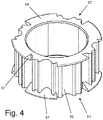
- Fig. 4 shows a further embodiment of the damping element, which is provided with the reference numeral 50.
- projections 57 are arranged, which protrude beyond the outer wall of the damping element 50 and tapering from the outer wall 51 to the end face 58 towards.
- the extensions 57 is a damping in the direction of - in FIG. 4 not shown - vehicle Z-axis reached.
- the extensions 57 are arranged offset at the opposite end faces 58, thereby the damping element can be produced inexpensively, since a simple demolding during production by means of a tool is possible.
- Another embodiment for damping in the direction of - in FIG. 4 not shown - vehicle Z-axis is to be attached to the encircling collar of in FIG. 4 not shown sleeve 41 or on the damping element facing side of in FIG. 4 Not shown end member 43 to arrange a soft component.
- the soft component is injection-molded in an injection mold onto the intended surfaces of the sleeve 41 or the closing element 43.
- the soft component may be formed as a knob or wedge or web, which are arranged circumferentially on the collar of the sleeve 41 or on the damping element 50 facing side of the closing element 43.
- the number of nubs or wedges or webs can vary.
- the base body 60 and the sleeve 42, the sleeve 41 and the end elements 43, 44 are preferably made of plastic, for example made of polyamide, which are optionally glass-reinforced and / or polytetrafluoroethylene (PTFE) component.
- plastics for example made of polyamide, which are optionally glass-reinforced and / or polytetrafluoroethylene (PTFE) component.
- PTFE polytetrafluoroethylene
Landscapes
- Engineering & Computer Science (AREA)
- General Engineering & Computer Science (AREA)
- Mechanical Engineering (AREA)
- Vibration Prevention Devices (AREA)
- Arrangement Or Mounting Of Control Devices For Change-Speed Gearing (AREA)
- Mechanical Control Devices (AREA)
Description
- Die vorliegende Erfindung betrifft eine Vorrichtung zum lösbaren Anbinden eines Betätigungsgliedes an einen Geber oder Nehmer, beispielsweise an einen Schalthebel oder ein Getriebe eines Kraftfahrzeuges, mit einer Anbindungsstelle zum Festlegen des Betätigungsgliedes und einer Aufnahme zum Festlegen eines Anbindungselementes des Gebers oder Nehmers, wobei die Aufnahme ein im Wesentlichen ösenartiges äußeres Aufnahmeelement sowie ein darin angeordnetes inneres Aufnahmeelement aufweist, zwischen denen ein elastisches Dämpfungselement angeordnet ist.
Die Erfindung betrifft ferner ein Betätigungsglied mit einer derartigen Anbindevorrichtung.
Anbindevorrichtungen der eingangs genannten Art sind beispielsweise ausUS 5 265 495 A1 undEP 2 278 178 B1 bekannt und werden u.a. im Automobilbereich eingesetzt, um ein Betätigungsglied, beispielsweise einen Betätigungszug oder eine Betätigungsstange, mit dessen Hilfe etwa bei einem Handschaltgetriebe die vom Fahrer durch Betätigung des Schalthebels vorgegebene Schaltbewegung auf den Wählhebel am Getriebegehäuse übertragen wird, jeweils endseitig an den Schalthebel und den Getriebewählhebel anzubinden. Dabei ist jeweils ein Ende des Betätigungsgliedes mit einer Anbindungsstelle der Anbindungsvorrichtung verbunden, welche wiederum eine Aufnahme aufweist, die an einem Anbindungselement des Nehmens oder Gebers, beispielsweise einem Betätigungszapfen des Getriebewählhebels oder einem Anbindungselement des Schalthebels, festgelegt ist. Das elastische Dämpfungselement in der Aufnahme, welches zwischen dem ösenartigen äußeren Aufnahmeelement und dem darin aufgenommenen inneren Aufnahmeelement angeordnet ist, dient dazu, die Übertragung von Vibrationen des Getriebes vom Getriebewählhebel auf das Betätigungsglied und im Weiteren vom Betätigungsglied auf den Schalthebel auszudämpfen, so dass im Ergebnis unerwünschte Vibrationen am Schalthebel bzw. im Innenraum des Fahrzeuges möglichst vermieden werden. - Weitere Anbindungsvorrichtungen der eingangs genannten Art sind auch aus der
DE 197 55 284 A1 sowieEP 1 798 431 A1 bekannt. - Die
DE 197 55 284 A1 offenbart ein Kugelgelenk mit einer auf einem Zapfen angeordneten Gelenkkugel, die abschnittsweise von einer Lagerschale umgeben ist, wobei die eine kalottenförmige Innenmantelfläche aufweisende Lagerschale mittels einer im wesentlichen zylindrische Außenmantelfläche in eine Aufnahmebohrung eines Gehäuses eingesetzt ist. Hierbei ist die Lagerschale an ihrer Außenmantelfläche in einer aus einem gummielastischen Elastomer hergestellten Hülse eingebettet, die in der Aufnahmebohrung anliegt. Die Anbindung des Betätigungsgliedes ist derart, dass von dem Gehäuse ein Hebel ausgeht, der an der Mantelfläche mit einem Außengewinde versehen ist, wobei an diesem Außengewinde ein nicht näher dargestellter Schalthebel des Kraftfahrzeuges fixiert werden kann. - Eine Anbindungsvorrichtung mit einer Aufnahme mit einem äußeren Aufnahmeelement und ein darin angeordnetes inneres Aufnahmeelement, zwischen denen ein elastisches Dämpfungselement angeordnet ist, offenbart auch die
EP 1 798 431 A1 . Bei dieser bekannten Anbindungsvorrichtung ist das Dämpfungselement zylindrisch ausgebildet. Die Anbindung zum Festlegen eines Bewegungsglieds erfolgt dabei durch Umspritzen. - Aus der
DE 197 31 039 A1 geht eine Vorrichtung zur Anbindung eines Bowdenzuges an das Wechselgetriebe eines Kraftfahrzeuges hervor, wobei die Vorrichtung aus einem Bowdenzug besteht, dessen Endstück mit einer in der Vorrichtung festgelegten Aufnahmehülse verbunden ist und die Vorrichtung weiterhin ein Dämpfungselement aufweist, mit einem darin angeordneten Kunststoffkern, dessen Öffnung ein Getriebeanbindungselement aufnimmt. Auch bei dieser aus dem Stand der Technik bekannten Anbindungsvorrichtung erfolgt die Anbindung eines Anbindungsglieds an den Geber oder Nehmer durch Umspritzen. - Trotz eines derartigen Dämpfungselementes zeigen die aus dem Stand der Technik bekannten Anbindevorrichtungen - gemessen am heutigen Fahrkomfort von Kraftfahrzeugen - häufig noch unzureichende Vibrationsunterdrückungseigenschaften. Dies gilt auch gemessen am heutigen Geräuschkomfort.
- Aufgabe der vorliegenden Erfindung ist es daher, eine Anbindevorrichtung sowie ein Betätigungsglied mit einer Anbindungsvorrichtung der eingangs genannten Art dahingehend zu verbessern, dass die Übertragung von unerwünschten Vibrationen vom Getriebe über das Betätigungsglied in den Innenraum des Fahrzeuges auf ein Minimum reduziert wird. Gleichzeitig soll die Anbindung des Betätigungsgliedes an die Anbindevorrichtung technisch vereinfacht werden.
- Diese Aufgabe wird mit einer Vorrichtung gemäß Anspruch 1 sowie mit einem Betätigungsglied gemäß Anspruch 18 gelöst. Vorteilhafte Ausgestaltungen der Erfindung sind Gegenstand der Unteransprüche.
- Die Vorrichtung zum lösbaren Anbinden eines Betätigungsgliedes an einen Geber oder Nehmer gemäß Obergriffs des Anspruchs 1 zeichnet sich dadurch aus, dass das Dämpfungselement als separates Bauteil ausgebildet ist und an seiner dem äußeren oder inneren Aufnahmeelement zugewandten Wandung ein periodisch und/oder alternierend ausgebildetes Wellenprofil und die Anbindungsstelle einen Gewindeeinsatz zum Festlegen des Betätigungsgliedes aufweist.
- Erfindungsgemäß wurde erkannt, dass ein Dämpfungselement, welches zwischen dem inneren und dem äußeren Aufnahmeelement der Anbindevorrichtung angeordnet ist und eine wellenprofilartige Außenwandung, das heißt ein Wellenprofil, zum äußeren Aufnahmeelement hin aufweist, deutlich verbesserte Dämpfungseigenschaften besitzt, was die unerwünschte Übertragung von Vibrationen auf das Übertragungsglied betrifft. Grund hierfür ist u.a., dass durch das Profil, insbesondere Wellenprofil die Kontaktfläche des Dämpfungselementes zum äußeren Aufnahmeelement hin derart minimiert ist, dass die Übertragung von störenden Vibrationen in vorteilhafter Weise unterdrückt wird.
- Auf Grund der Unterdrückung von störenden Vibrationen ist es möglich, die Anbindung des Betätigungsgliedes an die Anbindevorrichtung in erfindungsgemäßer Weise zu erleichtern, indem die Anbindestelle der Anbindevorrichtung einen Gewindeeinsatz aufweist, an dem in vorteilhafter Weise das Betätigungsglied mittels einer Schraube festgelegt werden kann. Im Vergleich zum Stand der Technik, bei dem das Betätigungsglied entweder direkt in die Anbindungsstelle eingespritzt wird, erlaubt ein Gewindeeinsatz eine kostengünstige, flexible und insbesondere wieder lösbare Anbindung des Betätigungsgliedes an die Anbindevorrichtung.
- Gemäß einer ersten vorteilhaften Ausgestaltung der Erfindung ist das Profil auf der Außenwandung des Dämpfungselementes periodisch ausgebildet und/oder aus alternierend teilkreisförmigen, insbesondere halbkreisförmigen Fortsätzen und Vertiefungen gebildet. In Versuchen hat sich nämlich herausgestellt, dass durch ein derart ausgebildetes Wellenprofil die Dämpfungseigenschaften besonders effektiv verbessert werden.
- Um das Zusammenfügen der Anbindeeinrichtung bzw. des Einfügung des Dämpfungselementes zwischen das äußere ösenartige Ausnahmeelement und das darin aufgenommene innere Aufnahmeelement zu erleichtern, ist wenigstens eine der Umrandungen bzw. Kanten des Dämpfungselementes bei einer weiteren vorteilhaften Ausgestaltung der Erfindung abgefasst, insbesondere abgekantet oder abgerundet.
- Für eine automatisierte Montage der Anbindeeinrichtung ist es vorteilhaft, wenn das Dämpfungselement als zylindrisches, ringförmiges Bauteil ausgebildet ist.
- Eine besonders kostengünstige und stabile Anbindevorrichtung wird dadurch erreicht, dass das äußere Aufnahmeelement und die Anbindungsstelle einstückig, insbesondere als ein gemeinsamer Grundkörper, ausgebildet sind.
- Um einen Ausgleich von Winkelbewegungen zwischen dem Betätigungsglied und dem Anbindungselement des Gebers oder Nehmers zu gewährleisten, ist es nach einer weiteren vorteilhaften Ausgestaltung der Erfindung vorgesehen, dass das äußere Aufnahmeelement, das innere Aufnahmeelement und/oder das Dämpfungselement im Wesentlichen ringförmig und/oder hohlzylinderförmig ausgebildet sind. Hierdurch wird insbesondere eine Rotationsbewegung der Anbindevorrichtung bzw. des Betätigungsgliedes relativ zum Anbindungselement des Gebers oder Nehmers um die Längs- bzw. Rotationsachse des ösenartigen äußeren Aufnahmeelementes ermöglicht.
- Eine besonders leichte und insbesondere wieder lösbare Verbindung zwischen Anbindungseinrichtung und Anbindungselement wird dadurch erreicht, dass gemäß einer weiteren vorteilhaften Ausgestaltung der Erfindung das innere Aufnahmeelement eine Buchse aufweist, in der das Anbindungselement des Gebers oder Nehmers, insbesondere mittels einer Rast- und/oder Knipsverbindung, festlegbar ist.
- Um die Rotationsbewegungsfreiheitsgrade der Anbindevorrichtung bzw. des Betätigungsgliedes relativ zum Anbindungselement des Gebers und/oder Nehmers auf drei Achsen zu erweitern, kann es in vorteilhafter Weise vorgesehen sein, dass die Buchse als Gelenkpfanne eines Kugelgelenks ausgebildet ist, in der ein einen Kugelkopf aufweisendes Anbindungselementes des Gebers oder Nehmers festlegbar, insbesondere einrastbar oder einklipsbar ist.
- Darüber hinaus kann es vorgesehen sein, dass das innere Aufnahmeelement eine vorzugsweise zylinderförmige Hülse aufweist, in der die Buchse angeordnet ist. Ein derartiger zweiteiliger Aufbau aus Hülse und darin aufgenommener Buchse erlaubt es, das innere Aufnahmeelement einerseits mittels der Buchse an die Form des Anbindungselementes und andererseits über die Hülse an die Form des äußeren Aufnahmeelementes anzupassen. Hierdurch wird die Anbindungsvorrichtung insgesamt flexibel an verschiedene Geber bzw. Nehmer adaptierbar.
- Zur Festlegung der Buchse in Montagestellung in wenigstens einer axialen Richtung innerhalb der Hülse ist es nach einer weiteren vorteilhaften Ausgestaltung der Erfindung vorgesehen, dass die Hülse eine Durchgangsverjüngung aufweist, mittels derer die vorzugsweise sich korrespondierend verjüngende Buchse durch Formfluss in Eingriff steht.
- Nach einer weiteren vorteilhaften Ausgestaltung der Erfindung ist es vorgesehen, dass das innere Aufnahmeelement in axialer Richtung bezüglich des ösenartigen äußeren Aufnahmeelementes jeweils endseitig ein Abschlusselement aufweist, mittels dessen das innere Aufnahmeelement, insbesondere die Hülse und/oder die Buchse, in axialer Richtung am äußeren Aufnahmeelement festgelegt ist.
- Besonders bevorzug ist die Buchse und wenigstens eines der beiden Abschlusselemente einstückig, insbesondere als Hohlzylinder mit einem einenends umlaufendem Bund oder Flansch, ausgebildet.
- Vorzugsweise sind die jeweiligen endseitigen Abschlusselemente derart ausgebildet, dass sie größere radiale Ausdehnung aufweisen als die Hülse oder die Buchse, so dass mittels Formfluss eine axiale Festlegung des inneren Aufnahmeelementes über das stirnseitig bzw. auf einer Flachseite am äußeren Aufnahmeelement anliegende Abschlusselement erreicht wird. Denkbar ist beispielsweise, dass wenigstens eines der beiden Abschlusselemente deckel- oder teller- oder lochscheibenartig ausgebildet ist. Die lochscheibenartige Ausbildung bietet sich insbesondere für jene Seite des inneren bzw. äußeren Aufnahmeelementes an, über die das Anbindungselement, insbesondere der Kugelgelenkkopf, in die Buchse eingeführt wird.
- Zur Fixierung der Abschlusselemente an der Hülse ist nach einer weiteren vorteilhaften Ausgestaltung der Erfindung vorgesehen, dass wenigstens eines der beiden Abschlusselemente eine stirnseitig umlaufende Nut aufweist, in welche die Hülse in Montagestellung eingreift. Denkbar ist beispielsweise, dass die Hülse in die umlaufende Nut eingepresst, eingeklebt oder eingeklipst wird.
- Gemäß einer weiteren vorteilhaften Ausgestaltung der Erfindung ist der Gewindeeinsatz als Mutter, insbesondere als Mehrkantmutter, ausgebildet. Hierbei kann insbesondere auf Standartbauelemente zurückgegriffen werden, was sich in vorteilhafter Weise auf die Herstellungskosten der Anbindungsvorrichtung auswirkt.
- Um die Anbindung des Betätigungsgliedes an die Anbindungsstelle technisch weiter zu vereinfachen, insbesondere eine wohl definierte Anbindung zu gewährleisten, ist es nach einer weiteren vorteilhaften Ausgestaltung der Erfindung vorgesehen, dass die Anwendungsstelle eine Auflage und/oder eine Führung für das anzubindende Betätigungsglied, insbesondere für eine Anschlusslasche eines anzubindenden Betätigungsgliedes aufweist.
- Ein unabhängiger Gedanke der Erfindung betrifft ein Betätigungsglied mit wenigstens einer einenends, vorzugsweise im Bereich einer Anschlusslasche, angeordneten Anbindungsvorrichtung der zuvor beschriebenen Art.
- Nach einer weiteren vorteilhaften Ausgestaltung ist es vorgesehen, dass die Achse des Gewindeeinsatzes bzw. der Mutter orthogonal zur Achse der Aufnahme verläuft. Dadurch ergeben sich Vorteile bei der Montage und Einstellung der Vorrichtung in einem Kraftfahrzeug, da der Werkzeugangriff in einer im Wesentlichen horizontalen Ebene liegt.
- Nach einer besonders vorteilhaften Ausgestaltung des Betätigungsgliedes ist es vorgesehen, dass wenigstens einenends, vorzugsweise im Bereich einer Anschlusslasche, ein Loch, insbesondere ein Langloch, vorgesehen ist, durch das zum Festlegen des Betätigungsgliedes an der Vorrichtung eine Schraube in den Gewindeeinsatz eindrehbar ist. Eine weitere vorteilhafte Ausgestaltung der Erfindung sieht vor, dass das Dämpfungselement als separat handhabbares Bauteil ausgebildet ist.
- Weitere Ziele, Vorteile, Merkmale und Anwendungsmöglichkeiten der vorliegenden Erfindung ergeben sich aus der nachfolgenden Beschreibung eines Ausführungsbeispieles anhand der Zeichnung. Dabei bilden alle beschriebenen und/oder bildlich dargestellten Merkmale für sich oder in beliebiger sinnvoller Kombination den Gegenstand der vorliegenden Erfindung, auch unabhängig von ihrer Zusammenfassung in den Ansprüchen oder deren Rückbeziehung.
- Es zeigen:
- Fig. 1
- eine Explosionsdarstellung eines möglichen Ausführungsbeispiels einer erfindungsgemäßen Vorrichtung zum lösbaren Anbinden eines Betätigungsgliedes an einem Geber oder Nehmer,
- Fig. 2
- einen Längsschnitt durch die zusammengefügte Vorrichtung gemäß
Fig. 1 und - Fig. 3
- eine Draufsicht auf das Dämpfungselement der Vorrichtung gemäß
Fig. 1 . - Fig. 4
- eine perspektivische Ansicht einer weiteren Ausführungsform des Dämpfungselements.
- Die
Fig. 1 und2 zeigen ein mögliches Ausführungsbeispiel einer erfindungsgemäßen Vorrichtung 1 zum lösbaren Anbinden eines Betätigungsliedes an einen Geber oder Nehmer, beispielsweise an einen Schalthebel oder ein Getriebe eines Kraftfahrzeuges. Hierzu weist die Vorrichtung 1 eine Anbindungsstelle 10 zum Festlegen des Betätigungsgliedes und eine Aufnahme 20 zum Festlegen eines Anbindungselementes des Gebers oder Nehmers auf, wobei die Aufnahme 20 aus einem im Wesentlichen ösenartigen äußeren Aufnahmeelement 30 sowie einem darin angeordneten inneren Aufnahmeelement 40 besteht. - In vorteilhafter Weise sind bei dem in den
Fig. 1 und2 gezeigten Ausführungsbeispiel das äußere Aufnahmeelement 30 und die Anbindungsstelle 10 unter Bildung eines gemeinsamen Grundkörpers einstückig ausgebildet, wobei der Grundkörper eine im wesentliche längliche Form aufweist, an dessen einem Ende das ösenartige, in etwa ringförmige äußere Aufnahmeelement 30 und an dessen anderem Ende die Anbindungsstelle 10 zum Festlegen des Betätigungsgliedes angeordnet sind. Zwischen dem äußerem Aufnahmeelement 30 und dem inneren Aufnahmeelement 40 ist gemäß der Erfindung ein elastischen Dämpfungselement 50 angeordnet, das an seiner dem äußeren Aufnahmeelement 30 zugewandten Außenwandung 51 ein umlaufendes Wellenprofil 52 aufweist. - Wie den
Fig. 1 und2 außerdem zu entnehmen ist, besteht das innere Aufnahmeelement 40 insgesamt aus vier Bauteilen, nämlich einem deckelartigen Abschlusselement 43, einem lochscheibenartigen Abschlusselement 44, einer Hülse 41 sowie einer darin aufgenommenen Buchse 42. - Bei dem in den
Fig. 1 und2 gezeigten Ausführungsbeispiel ist die Buchse 42 als Gelenkpfanne eines Kugelgelenkes ausgebildet, in welche ein einen Kugelkopf aufweisendes Anbindungselement des Gebers oder Nehmers festlegbar ist. Im vorliegenden Ausführungsbeispiel weist die Gelenkpfanne insbesondere Rast- bzw. Klipsverbindungsmittel auf, mit deren Hilfe das Anbindungselement in besonders einfacher Weise und insbesondere wieder lösbar in dem innerem Aufnahmeelement 40, d.h. in der Buchse 42, festlegbar ist. - Desweiteren ist die Buchse 42 bei dem vorliegenden Ausführungsbeispiel in einer zylinderförmig ausgebildeten Hülse 41 aufgenommen, welche eine Durchgangsverjüngung 46 aufweist, mittels derer die sich korrespondierende verjüngende Buchse 42 in Montagestellung in einer axialen Richtung innerhalb der Hülse 41 festgelegt ist.
- In entgegengesetzter axialer Richtung ist die Buchse 42 in Hülse 41 durch das tellerartige Abschlusselement 43 festgelegt, das stirnseitig eine umlaufende Nut 45 aufweist, in welche die Hülse 41 in Montagestellung eingreift. Das Abschlusselement 43 besitzt in radialer Richtung eine größere Ausdehnung als die Hülse 41 und gelangt mit dem überlappenden Bereich in Anlagestellung mit dem äußeren Aufnahmeelement 30, wodurch das innere Aufnahmeelement 40 gegenüber dem äußeren Aufnahmeelement 30 in einer axialen Richtung mittels Formschluss festgelegt ist.
- Auf der gegenüberliegenden Seite des tellerartigen Abschlusselementes 43 ist ein weiteres Abschlusselement 44 vorgesehen, welches im vorliegenden Ausführungsbeispiel einstückig mit der Hülse 41 ausgebildet ist. Hülse 41 und Abschlusselement 44 bilden zusammen einen Hohlzylinder, der einen umlaufenden Bund oder Flansch aufweist, welcher durch das lochscheibenartige Abschlusselement 44 gebildet ist. Durch die Öffnung des lochscheibenartigen Aufnahmeelements 44 wird ein Zugang geschaffen, über den das Anbindungselement des Gebers oder Nehmers in die Buchse 42 einführbar ist.
- Wie den
Fig. 1 und2 ferner zu entnehmen ist, weist die Anbindungsstelle 10 eine Auflage 13 sowie sich davon seitlich abhebende Führungen 14 auf, in der das anzubindende und hier nicht dargestellte Betätigungsglied, insbesondere eine Anschlusslasche eines anzubindenden Betätigungsgliedes, aufgenommen wird. - Zum Festlegen des Betätigungsgliedes an der Anbindungsstelle 10 ist es gemäß der Erfindung vorgesehen, dass die Anbindungsstelle 10 einen Gewindeeinsatz 11 aufweist. Im hier gezeigten Ausführungsbeispiel ist der Gewindeeinsatz 11 eine mehrkantige Stanzmutter 12, die im Querschnitt im Wesentlichen trapezförmig abgebildet ist. Ferner ist den
Fig. 1 und2 zu entnehmen, dass die Mutter 12 durch umspritzen in den vorliegend aus Kunststoff bestehenden Grundkörper 60 integriert ist. Denkbar ist auch, dass das Gewindeelement 11 in eine entsprechende Öffnung im Grundkörper 60 eingesetzt, eingeklipst, eingerastet oder eingeklebt ist. Die Mehrkantaußenkontur des Gewindeelementes bewirkt in vorteilhafter Weise eine Verdrehsicherung. - Um eine Längeneinstellung des anzubindenden, hier nicht dargestellten Betätigungsgliedes zu gewährleisten, kann es weiterhin vorgesehen sein, dass das Betätigungsglied, insbesondere im Bereich der Anschlusslasche, ein Langloch aufweist, wodurch eine stufenlose Einstellung und Vorfixierung der Anbindevorrichtung 1 am Betätigungsglied möglich ist.
-
Fig. 3 zeigt das erfindungsgemäße elastische Dämpfungselement 50, welches an seine dem äußeren Aufnahmeelement 30 zugewandten Außenwandungen 51 ein umlaufendes Wellenprofil 52 aufweist. Im hier gezeigten Ausführungsbeispiel ist das Wellenprofil periodisch, insbesondere aus alternierend halbkreisförmigen Fortsätzen 53 und Vertiefungen 54 gebildet. Durch Versuche hat sich herausgestellt, dass ein derartig ausgebildetes Dämpfungselement 50 deutlich verbesserte Dämpfungseigenschaften aufweist, was die Übertragung von Vibrationen vom Getriebe über das Betätigungsglied zum Wahlhebel eines Kraftfahrzeuges angeht. Die Dämpfungseigenschaften werden außerdem dadurch verbessert, dass das Dämpfungselement 50 - wie beim vorliegenden Ausführungsbeispiel - als separates Bauteil mit einem im Wesentlichen ringförmigen Querschnittsprofil ohne Materialunterbrechungen ausgeführt ist. Vorzugsweise besteht das Dämpfungselement 50 aus Gummi oder einem gummiartigen synthetischen Elastomer. - Wie insbesondere den
Fig. 1 und3 zu entnehmen ist, sind die stirnseitigen Berandungen 55, 56 des Dämpfungselementes 50 abgefasst, im vorliegenden Ausführungsbeispiel abgekantet. Hierdurch wird eine Einführung des Dämpfungselementes 50 zwischen das äußere ösenartige Aufnahmeelement 30 und das darin angeordnete innere Aufnahmeelement 40 erleichtert. - Um auch eine Dämpfung in Richtung aller drei Fahrzeugachsen, insbesondere auch der bzgl. des Fahrzeuges nach oben gerichteten Z-Achse bzw. der Fahrzeughochachse zu erhalten, können nach einem eigenständigen Aspekt der Erfindung an den Stirnseiten des Dämpfungselements Fortsätze oder profilierte Endabschnitte vorgesehen sein. Bspw. ist dazu an wenigstens einer Stirnfläche des Dämpfungselements ein umlaufender, ringförmiger Fortsatz angeordnet. Dabei hat es sich als vorteilhaft herausgestellt, wenn der Durchmesser des ringförmigen Fortsatzes größer als die Wandstärke des zylindrischen Teils des Dämpfungselementes (50) ist.
-
Fig. 4 zeigt eine weitere Ausführungsform des Dämpfungselements, das mit dem Bezugszeichen 50 versehen ist. An den Stirnseiten 58 sind Fortsätze 57 angeordnet, die über die Außenwand des Dämpfungselements 50 hinausragen und von der Außenwand 51 zur Stirnseite 58 hin sich verjüngend zulaufen. Mit den Fortsätzen 57 wird eine Dämpfung in Richtung der - inFigur 4 nicht gezeigten - Fahrzeug Z-Achse erreicht. Die Fortsätze 57 sind an den gegenüberliegenden Stirnseiten 58 versetzt angeordnet, hierdurch lässt sich das Dämpfungselement kostengünstig herstellen, da eine einfache Entformung bei der Herstellung mittels eines Werkzeuges möglich ist. - Eine weitere Ausgestaltung für eine Dämpfung in Richtung der - in
Figur 4 nicht gezeigten - Fahrzeug Z-Achse besteht darin, an dem umlaufenden Bund der inFigur 4 nicht gezeigten Hülse 41 oder an der dem Dämpfungselement zugewandten Seite des inFigur 4 nicht gezeigten Abschlusselements 43 eine Weichkomponente anzuordnen. - Die Herstellung einer derart gestalteten Hülse oder eines Abschlusselements ist aus dem Stand der Technik bekannt und erfolgt z.B. als 2K-Bauteil. Dies bedeutet, dass die Weichkomponente in einer Spritzgussform an die vorgesehenen Flächen der Hülse 41 oder des Abschlusselements 43 angespritzt wird.
Die Weichkomponente kann dabei als Noppe oder Keil oder Steg ausgebildet sein, die umlaufend an dem Bund der Hülse 41 oder an der dem Dämpfungselement 50 zugewandten Seite des Abschlusselements 43 angeordnet sind. Dabei kann die Anzahl der Noppen oder Keile oder Stege variieren. - Demgegenüber sind der Grundkörper 60 sowie die Buchse 42, die Hülse 41 und die Abschlusselemente 43, 44 vorzugsweise aus Kunststoff, beispielsweise aus Polyamid gefertigt, die gegebenenfalls glaserverstärkt sind und/oder Polytetrafluorethylen (PTFE)-Bestandteil aufweisen. Die Verwendung solcher Kunststoffe ist hinsichtlich einer Gewichtseinsparung als auch unter fertigungstechnischen Gesichtspunkten von besonderem Vorteil.
-
- 1
- Anbindevorrichtung
- 10
- Anbindungsstelle
- 11
- Gewindeeinsatz
- 12
- Mutter
- 13
- Auflage
- 14
- Führung
- 20
- Aufnahme
- 30
- äußeres Aufnahmeelement
- 40
- inneres Aufnahmeelement
- 41
- Hülse
- 42
- Buchse
- 43
- Abschlusselement
- 44
- Abschlusselement
- 45
- Nut
- 50
- Dämpfungselement
- 51
- Außenwandung des Dämpfungselementes
- 52
- Wellenprofil
- 53
- Fortsatz
- 54
- Vertiefung
- 55
- Berandung
- 56
- Berandung
- 57
- Fortsatz
- 58
- Stirnseite
- 60
- Grundkörper
Claims (20)
- Vorrichtung (1) zum lösbaren Anbinden eines Betätigungsgliedes an einen Geber oder Nehmer, beispielsweise an einen Schalthebel oder ein Getriebe eines Kraftfahrzeuges, mit einer Anbindungsstelle (10) zum Festlegen des Betätigungsgliedes und einer Aufnahme (20) zum Festlegen eines Anbindungselements des Gebers oder Nehmers, wobei die Aufnahme (20) ein im Wesentlichen ösenartiges äußeres Aufnahmeelement (30) sowie ein darin angeordnetes inneres Aufnahmeelement (40) aufweist, zwischen denen ein elastisches Dämpfungselement (50) angeordnet ist, dadurch gekennzeichnet, dass das Dämpfungselement (50) als separates Bauteil ausgebildet ist und an seiner dem äußeren oder inneren Aufnahmeelement (30) zugewandten Wandung (51) ein periodisch und/oder alternierend ausgebildetes Profil in Form eines Wellenprofils (52) und die Anbindungsstelle (10) ein Gewindeeinsatz (11) zum Festlegen des Betätigungsgliedes aufweisen.
- Vorrichtung (1) nach Anspruch 1, dadurch gekennzeichnet, dass das Profil, insbesondere Wellenprofil (52) periodisch ausgebildet und/oder aus alternierend teilkreisförmigen, insbesondere halbkreisförmigen, Fortsätzen (53) und Vertiefungen (54) gebildet ist.
- Vorrichtung (1) nach Anspruch 1 oder 2, dadurch gekennzeichnet, dass wenigstens eine Berandung (55, 56) des Dämpfungselements (50) abgefast, insbesondere abgekantet oder abgerundet, ist.
- Vorrichtung (1) nach einem der vorhergehenden Ansprüche, dadurch gekennzeichnet, dass das äußere Aufnahmeelement (30) und die Anbindungsstelle (10) einstückig, insbesondere als ein gemeinsamer Grundkörper (60), ausgebildet sind.
- Vorrichtung (1) nach einem der vorhergehenden Ansprüche, dadurch gekennzeichnet, dass das äußere Aufnahmeelement (30), das innere Aufnahmeelement (40) und/oder das Dämpfungselement (50) im Wesentlichen ringförmig und/oder hohlzylinderförmig ausgebildet sind.
- Vorrichtung (1) nach einem der vorhergehenden Ansprüche, dadurch gekennzeichnet, dass das innere Aufnahmeelement (40) eine Buchse (42) aufweist, in der das Anbindungselement des Gebers oder Nehmers, insbesondere mittels einer Rast- und/oder Klipsverbindung, festlegbar ist.
- Vorrichtung (1) nach Anspruch 6, dadurch gekennzeichnet, dass die Buchse (42) als Gelenkpfanne eines Kugelgelenks ausgebildet ist, in der ein einen Kugelkopf aufweisendes Anbindungselement des Gebers oder Nehmers festlegbar, insbesondere einrastbar oder einklipsbar, ist.
- Vorrichtung (1) nach Anspruch 6 oder 7, dadurch gekennzeichnet, dass das innere Aufnahmeelement (40) eine vorzugsweise zylinderförmige Hülse (41) aufweist, in der die Buchse (42) angeordnet ist.
- Vorrichtung (1) nach Anspruch 8, dadurch gekennzeichnet, dass die Hülse (41) eine Durchgangsverjüngung aufweist, mittels derer die vorzugsweise sich korrespondierend verjüngende Buchse (42) in Montagestellung in wenigstens einer axialen Richtung innerhalb der Hülse (41) festgelegt ist.
- Vorrichtung (1) nach einem der vorhergehenden Ansprüche, dadurch gekennzeichnet, dass das innere Aufnahmeelement (40) in axialer Richtung bezüglich des ösenartigen äußeren Aufnahmeelementes (40) jeweils endseitig ein Abschlusselement (43, 44) aufweist, mittels derer das innere Aufnahmeelement (40), insbesondere die Hülse (41) und/oder die Buchse (42), in axialer Richtung am äußeren Aufnahmeelement (30) festgelegt ist.
- Vorrichtung (1) nach Anspruch 10, dadurch gekennzeichnet, dass die Buchse (42) und wenigstens eines der beiden Abschlusselemente (43, 44) einstückig, insbesondere als Hohlzylinder mit einem einenends umlaufendem Bund oder Flansch, ausgebildet ist.
- Vorrichtung (1) nach Anspruch 10 oder 11, dadurch gekennzeichnet, dass wenigstens eines der beiden Abschlusselemente (43, 44) deckel- oder teller-oder lochscheibenartig ausgebildet ist.
- Vorrichtung (1) nach einem der Ansprüche 10 bis 12, dadurch gekennzeichnet, dass wenigstens eines der beiden Abschlusselemente (43, 44) eine umlaufende Nut (45) aufweist, in welche die Hülse (41) in Montagestellung eingreift.
- Vorrichtung (1) nach einem der vorhergehenden Ansprüche, dadurch gekennzeichnet, dass der Gewindeeinsatz (11) eine Mutter (12), insbesondere eine Mehrkantmutter, ist.
- Vorrichtung nach einem der vorhergehenden Ansprüche 1 bis 14, dadurch gekennzeichnet, dass die Achse des Gewindeeinsatzes (11) orthogonal zur Achse der Aufnahme (20) angeordnet ist.
- Vorrichtung (1) nach einem der vorhergehenden Ansprüche, dadurch gekennzeichnet, dass der Gewindeeinsatz (11) in die Anbindestelle (10), insbesondere in den Grundkörper (60), durch Umspritzen integriert ist.
- Vorrichtung (1) nach einem der vorhergehenden Ansprüche, dadurch gekennzeichnet, dass die Anbindungsstelle (10) eine Auflage (13) und/oder eine Führung (14) für das anzubindende Betätigungsglied, insbesondere für eine Anschlusslasche eines anzubindenden Betätigungsgliedes, aufweist.
- Betätigungsglied mit wenigstens einer einenends, vorzugsweise im Bereich einer Anschlusslasche, angeordneten Vorrichtung (1) nach einem der vorhergehenden Ansprüche.
- Betätigungsglied nach Anspruch 18, dadurch gekennzeichnet, dass wenigstens einenends, vorzugsweise im Bereich einer Anschlusslasche, ein Loch, insbesondere ein Langloch, vorgesehen ist, durch das zum Festlegen des Betätigungsgliedes an der Vorrichtung (1) eine Schraube in das Gewindeelement (11) eindrehbar ist.
- Vorrichtung nach einem der vorhergehenden Ansprüche 1 bis 19, dadurch gekennzeichnet, dass an wenigstens einer Stirnfläche des Dämpfungselements (50) ein umlaufender, ringförmiger Fortsatz angeordnet ist.
Applications Claiming Priority (2)
| Application Number | Priority Date | Filing Date | Title |
|---|---|---|---|
| DE202013104768U DE202013104768U1 (de) | 2013-10-23 | 2013-10-23 | Vorrichtung zum lösbaren Anbinden eines Betätigungsgliedes an einen Geber oder Nehmer |
| PCT/EP2014/072345 WO2015059056A1 (de) | 2013-10-23 | 2014-10-17 | Vorrichtung zum lösbaren anbinden eines betätigungsgliedes an einen geber oder nehmer |
Publications (2)
| Publication Number | Publication Date |
|---|---|
| EP2962003A1 EP2962003A1 (de) | 2016-01-06 |
| EP2962003B1 true EP2962003B1 (de) | 2018-03-14 |
Family
ID=49781044
Family Applications (1)
| Application Number | Title | Priority Date | Filing Date |
|---|---|---|---|
| EP14786660.2A Active EP2962003B1 (de) | 2013-10-23 | 2014-10-17 | Vorrichtung zum lösbaren anbinden eines betätigungsgliedes an einen geber oder nehmer |
Country Status (8)
| Country | Link |
|---|---|
| US (2) | US20160245332A1 (de) |
| EP (1) | EP2962003B1 (de) |
| JP (1) | JP6397905B2 (de) |
| KR (1) | KR102102503B1 (de) |
| CN (1) | CN105683595B (de) |
| DE (1) | DE202013104768U1 (de) |
| ES (1) | ES2672742T3 (de) |
| WO (1) | WO2015059056A1 (de) |
Families Citing this family (3)
| Publication number | Priority date | Publication date | Assignee | Title |
|---|---|---|---|---|
| US10988015B2 (en) * | 2018-12-06 | 2021-04-27 | GM Global Technology Operations LLC | Multi-position mount system |
| DE202020100426U1 (de) * | 2020-01-27 | 2020-02-13 | S-Fasteners Gmbh | Zug-Druck-Stange |
| CN112682419B (zh) * | 2021-03-16 | 2021-05-18 | 长岛高能聚氨酯有限公司 | 一种铝质关节球销总成及其生产工艺 |
Citations (1)
| Publication number | Priority date | Publication date | Assignee | Title |
|---|---|---|---|---|
| DE19755284A1 (de) * | 1997-12-22 | 1999-06-24 | Schaeffler Waelzlager Ohg | Kugelgelenk |
Family Cites Families (12)
| Publication number | Priority date | Publication date | Assignee | Title |
|---|---|---|---|---|
| US2710208A (en) * | 1952-11-18 | 1955-06-07 | Columbus Auto Parts | Universal joint |
| US3350042A (en) * | 1965-10-11 | 1967-10-31 | Clevite Corp | Corrugated resilient mount |
| JPS5125902B2 (de) * | 1972-01-28 | 1976-08-03 | ||
| JPS5137365A (de) * | 1974-09-27 | 1976-03-29 | Toshio Hata | |
| JPH01150242U (de) * | 1988-04-11 | 1989-10-17 | ||
| JPH0720739Y2 (ja) * | 1989-06-20 | 1995-05-15 | オイレス工業株式会社 | ペダルアームの軸受部構造 |
| US5265495A (en) * | 1992-09-21 | 1993-11-30 | Teleflex Incorporated | Isolated shifter terminal assembly |
| DE10127630C2 (de) * | 2000-06-13 | 2003-04-30 | Kuester Automotive Control Sys | Vorrichtung zur Längeneinstellung, insbesondere einer Fernbetätigung in Kraftfahrzeugen |
| DE10206085B4 (de) * | 2002-02-13 | 2004-02-05 | Dura Automotive Systems Gmbh | Anschlußeinrichtung für ein Winkelgelenk |
| JP4145739B2 (ja) * | 2003-07-01 | 2008-09-03 | 本田技研工業株式会社 | 防振型ボールジョイント |
| FR2895042B1 (fr) * | 2005-12-15 | 2008-02-29 | Dura Automotive Systems Soc Pa | Dispositif de liaison a rotule entre deux elements d'une tranmission mecanique |
| EP2278178B1 (de) | 2009-07-14 | 2013-02-27 | Fulvio Orsolini | Kugelgelenk zum verbinden mechanischer Teile |
-
2013
- 2013-10-23 DE DE202013104768U patent/DE202013104768U1/de not_active Expired - Lifetime
-
2014
- 2014-10-17 ES ES14786660.2T patent/ES2672742T3/es active Active
- 2014-10-17 JP JP2016520155A patent/JP6397905B2/ja active Active
- 2014-10-17 EP EP14786660.2A patent/EP2962003B1/de active Active
- 2014-10-17 US US15/027,542 patent/US20160245332A1/en not_active Abandoned
- 2014-10-17 KR KR1020167011327A patent/KR102102503B1/ko active Active
- 2014-10-17 CN CN201480058704.2A patent/CN105683595B/zh active Active
- 2014-10-17 WO PCT/EP2014/072345 patent/WO2015059056A1/de not_active Ceased
-
2019
- 2019-08-14 US US16/540,120 patent/US11187263B2/en active Active
Patent Citations (1)
| Publication number | Priority date | Publication date | Assignee | Title |
|---|---|---|---|---|
| DE19755284A1 (de) * | 1997-12-22 | 1999-06-24 | Schaeffler Waelzlager Ohg | Kugelgelenk |
Also Published As
| Publication number | Publication date |
|---|---|
| WO2015059056A1 (de) | 2015-04-30 |
| CN105683595A (zh) | 2016-06-15 |
| US20160245332A1 (en) | 2016-08-25 |
| US20190368537A1 (en) | 2019-12-05 |
| KR102102503B1 (ko) | 2020-04-21 |
| JP6397905B2 (ja) | 2018-09-26 |
| DE202013104768U1 (de) | 2013-11-19 |
| EP2962003A1 (de) | 2016-01-06 |
| KR20160073973A (ko) | 2016-06-27 |
| ES2672742T3 (es) | 2018-06-15 |
| JP2016533938A (ja) | 2016-11-04 |
| US11187263B2 (en) | 2021-11-30 |
| CN105683595B (zh) | 2019-05-28 |
Similar Documents
| Publication | Publication Date | Title |
|---|---|---|
| DE69409912T2 (de) | Feinbedienungseinrichtung mit Schwingungsdämpfer | |
| EP3692269B1 (de) | Winkelkupplung | |
| EP3077684B1 (de) | Ringförmige steckkupplung sowie ein herstellungs- und ein verbindungsverfahren dafür | |
| EP2646295A1 (de) | Wischerantrieb | |
| EP1925831A2 (de) | Schwingungsentkoppelndes Kupplungselement | |
| EP2037292A2 (de) | Einbauanordnung für ein schwingungsempfindliches Bauteil, insbesondere eines Ultraschallwandlers, und Verfahren zum Einbau des Bauteils | |
| WO1996020101A1 (de) | Scheibenwischeranlage mit einem geräusch- bzw. schwingungsdämpfenden befestigungsmittel | |
| DE102021118920A1 (de) | Toleranzausgleichsvorrichtung | |
| EP1744063A2 (de) | Toleranzausgleichsanordnung aus Kunststoff | |
| WO2009030480A2 (de) | Befestiger | |
| EP3585671B1 (de) | Lager für eine lenkspindel und lenksäule für ein kraftfahrzeug | |
| DE102004021537A1 (de) | Elektromotor und Getriebe-Antriebseinheit für Stellantriebe im Kraftfahrzeug | |
| DE19901674B4 (de) | Schaltgabel mit Gleitschuhen aus Kunststoff | |
| EP3803148B1 (de) | Gummielastische lagerung für eine antriebseinheit in einem kraftfahrzeug | |
| WO2015059056A1 (de) | Vorrichtung zum lösbaren anbinden eines betätigungsgliedes an einen geber oder nehmer | |
| EP3927594B1 (de) | Hilfskraftlenkung für ein kraftfahrzeug | |
| DE10081629B4 (de) | Seilzugbefestigung | |
| WO2007124838A1 (de) | Lenkvorrichtung für fahrzeuge und verfahren zur montage einer lageranordnung | |
| EP1291536B1 (de) | Vorrichtung zur Befestigung eines langgestreckten Elementes | |
| DE10216903B4 (de) | Anbindungsvorrichtung für einen Betätigungszug an einen Nehmer, insbesondere Zugöse | |
| EP2006171A2 (de) | Scheibenwischerantriebsanordnung | |
| EP4030024B1 (de) | Kraftfahrzeugschloss | |
| DE102012209058A1 (de) | Scheibenwischvorrichtung | |
| DE19521084B4 (de) | Wischerwelle für eine Scheibenwischeranlage, insbesondere eines Kraftfahrzeuges | |
| DE4103931A1 (de) | Stabilisierungs- und abstuetzeinrichtung fuer die schwenklagerung eines kupplungshebels |
Legal Events
| Date | Code | Title | Description |
|---|---|---|---|
| PUAI | Public reference made under article 153(3) epc to a published international application that has entered the european phase |
Free format text: ORIGINAL CODE: 0009012 |
|
| 17P | Request for examination filed |
Effective date: 20151002 |
|
| AK | Designated contracting states |
Kind code of ref document: A1 Designated state(s): AL AT BE BG CH CY CZ DE DK EE ES FI FR GB GR HR HU IE IS IT LI LT LU LV MC MK MT NL NO PL PT RO RS SE SI SK SM TR |
|
| AX | Request for extension of the european patent |
Extension state: BA ME |
|
| 17Q | First examination report despatched |
Effective date: 20160224 |
|
| DAX | Request for extension of the european patent (deleted) | ||
| GRAP | Despatch of communication of intention to grant a patent |
Free format text: ORIGINAL CODE: EPIDOSNIGR1 |
|
| INTG | Intention to grant announced |
Effective date: 20170925 |
|
| GRAS | Grant fee paid |
Free format text: ORIGINAL CODE: EPIDOSNIGR3 |
|
| GRAA | (expected) grant |
Free format text: ORIGINAL CODE: 0009210 |
|
| RIN1 | Information on inventor provided before grant (corrected) |
Inventor name: HENRICH, WILLI Inventor name: KREMER, VIKTOR |
|
| AK | Designated contracting states |
Kind code of ref document: B1 Designated state(s): AL AT BE BG CH CY CZ DE DK EE ES FI FR GB GR HR HU IE IS IT LI LT LU LV MC MK MT NL NO PL PT RO RS SE SI SK SM TR |
|
| REG | Reference to a national code |
Ref country code: GB Ref legal event code: FG4D Free format text: NOT ENGLISH |
|
| REG | Reference to a national code |
Ref country code: CH Ref legal event code: EP Ref country code: AT Ref legal event code: REF Ref document number: 979188 Country of ref document: AT Kind code of ref document: T Effective date: 20180315 |
|
| REG | Reference to a national code |
Ref country code: IE Ref legal event code: FG4D Free format text: LANGUAGE OF EP DOCUMENT: GERMAN |
|
| REG | Reference to a national code |
Ref country code: DE Ref legal event code: R096 Ref document number: 502014007645 Country of ref document: DE |
|
| REG | Reference to a national code |
Ref country code: ES Ref legal event code: FG2A Ref document number: 2672742 Country of ref document: ES Kind code of ref document: T3 Effective date: 20180615 |
|
| REG | Reference to a national code |
Ref country code: NL Ref legal event code: MP Effective date: 20180314 |
|
| REG | Reference to a national code |
Ref country code: LT Ref legal event code: MG4D |
|
| PG25 | Lapsed in a contracting state [announced via postgrant information from national office to epo] |
Ref country code: FI Free format text: LAPSE BECAUSE OF FAILURE TO SUBMIT A TRANSLATION OF THE DESCRIPTION OR TO PAY THE FEE WITHIN THE PRESCRIBED TIME-LIMIT Effective date: 20180314 Ref country code: LT Free format text: LAPSE BECAUSE OF FAILURE TO SUBMIT A TRANSLATION OF THE DESCRIPTION OR TO PAY THE FEE WITHIN THE PRESCRIBED TIME-LIMIT Effective date: 20180314 Ref country code: NO Free format text: LAPSE BECAUSE OF FAILURE TO SUBMIT A TRANSLATION OF THE DESCRIPTION OR TO PAY THE FEE WITHIN THE PRESCRIBED TIME-LIMIT Effective date: 20180614 Ref country code: HR Free format text: LAPSE BECAUSE OF FAILURE TO SUBMIT A TRANSLATION OF THE DESCRIPTION OR TO PAY THE FEE WITHIN THE PRESCRIBED TIME-LIMIT Effective date: 20180314 Ref country code: CY Free format text: LAPSE BECAUSE OF FAILURE TO SUBMIT A TRANSLATION OF THE DESCRIPTION OR TO PAY THE FEE WITHIN THE PRESCRIBED TIME-LIMIT Effective date: 20180314 |
|
| PG25 | Lapsed in a contracting state [announced via postgrant information from national office to epo] |
Ref country code: RS Free format text: LAPSE BECAUSE OF FAILURE TO SUBMIT A TRANSLATION OF THE DESCRIPTION OR TO PAY THE FEE WITHIN THE PRESCRIBED TIME-LIMIT Effective date: 20180314 Ref country code: LV Free format text: LAPSE BECAUSE OF FAILURE TO SUBMIT A TRANSLATION OF THE DESCRIPTION OR TO PAY THE FEE WITHIN THE PRESCRIBED TIME-LIMIT Effective date: 20180314 Ref country code: SE Free format text: LAPSE BECAUSE OF FAILURE TO SUBMIT A TRANSLATION OF THE DESCRIPTION OR TO PAY THE FEE WITHIN THE PRESCRIBED TIME-LIMIT Effective date: 20180314 Ref country code: GR Free format text: LAPSE BECAUSE OF FAILURE TO SUBMIT A TRANSLATION OF THE DESCRIPTION OR TO PAY THE FEE WITHIN THE PRESCRIBED TIME-LIMIT Effective date: 20180615 Ref country code: BG Free format text: LAPSE BECAUSE OF FAILURE TO SUBMIT A TRANSLATION OF THE DESCRIPTION OR TO PAY THE FEE WITHIN THE PRESCRIBED TIME-LIMIT Effective date: 20180614 |
|
| PG25 | Lapsed in a contracting state [announced via postgrant information from national office to epo] |
Ref country code: MT Free format text: LAPSE BECAUSE OF FAILURE TO SUBMIT A TRANSLATION OF THE DESCRIPTION OR TO PAY THE FEE WITHIN THE PRESCRIBED TIME-LIMIT Effective date: 20180314 |
|
| REG | Reference to a national code |
Ref country code: FR Ref legal event code: PLFP Year of fee payment: 5 |
|
| PG25 | Lapsed in a contracting state [announced via postgrant information from national office to epo] |
Ref country code: EE Free format text: LAPSE BECAUSE OF FAILURE TO SUBMIT A TRANSLATION OF THE DESCRIPTION OR TO PAY THE FEE WITHIN THE PRESCRIBED TIME-LIMIT Effective date: 20180314 Ref country code: AL Free format text: LAPSE BECAUSE OF FAILURE TO SUBMIT A TRANSLATION OF THE DESCRIPTION OR TO PAY THE FEE WITHIN THE PRESCRIBED TIME-LIMIT Effective date: 20180314 Ref country code: RO Free format text: LAPSE BECAUSE OF FAILURE TO SUBMIT A TRANSLATION OF THE DESCRIPTION OR TO PAY THE FEE WITHIN THE PRESCRIBED TIME-LIMIT Effective date: 20180314 Ref country code: PL Free format text: LAPSE BECAUSE OF FAILURE TO SUBMIT A TRANSLATION OF THE DESCRIPTION OR TO PAY THE FEE WITHIN THE PRESCRIBED TIME-LIMIT Effective date: 20180314 Ref country code: NL Free format text: LAPSE BECAUSE OF FAILURE TO SUBMIT A TRANSLATION OF THE DESCRIPTION OR TO PAY THE FEE WITHIN THE PRESCRIBED TIME-LIMIT Effective date: 20180314 |
|
| PG25 | Lapsed in a contracting state [announced via postgrant information from national office to epo] |
Ref country code: SK Free format text: LAPSE BECAUSE OF FAILURE TO SUBMIT A TRANSLATION OF THE DESCRIPTION OR TO PAY THE FEE WITHIN THE PRESCRIBED TIME-LIMIT Effective date: 20180314 Ref country code: CZ Free format text: LAPSE BECAUSE OF FAILURE TO SUBMIT A TRANSLATION OF THE DESCRIPTION OR TO PAY THE FEE WITHIN THE PRESCRIBED TIME-LIMIT Effective date: 20180314 Ref country code: SM Free format text: LAPSE BECAUSE OF FAILURE TO SUBMIT A TRANSLATION OF THE DESCRIPTION OR TO PAY THE FEE WITHIN THE PRESCRIBED TIME-LIMIT Effective date: 20180314 |
|
| REG | Reference to a national code |
Ref country code: DE Ref legal event code: R097 Ref document number: 502014007645 Country of ref document: DE |
|
| PG25 | Lapsed in a contracting state [announced via postgrant information from national office to epo] |
Ref country code: PT Free format text: LAPSE BECAUSE OF FAILURE TO SUBMIT A TRANSLATION OF THE DESCRIPTION OR TO PAY THE FEE WITHIN THE PRESCRIBED TIME-LIMIT Effective date: 20180716 |
|
| PLBE | No opposition filed within time limit |
Free format text: ORIGINAL CODE: 0009261 |
|
| STAA | Information on the status of an ep patent application or granted ep patent |
Free format text: STATUS: NO OPPOSITION FILED WITHIN TIME LIMIT |
|
| PG25 | Lapsed in a contracting state [announced via postgrant information from national office to epo] |
Ref country code: DK Free format text: LAPSE BECAUSE OF FAILURE TO SUBMIT A TRANSLATION OF THE DESCRIPTION OR TO PAY THE FEE WITHIN THE PRESCRIBED TIME-LIMIT Effective date: 20180314 |
|
| 26N | No opposition filed |
Effective date: 20181217 |
|
| PG25 | Lapsed in a contracting state [announced via postgrant information from national office to epo] |
Ref country code: SI Free format text: LAPSE BECAUSE OF FAILURE TO SUBMIT A TRANSLATION OF THE DESCRIPTION OR TO PAY THE FEE WITHIN THE PRESCRIBED TIME-LIMIT Effective date: 20180314 |
|
| REG | Reference to a national code |
Ref country code: CH Ref legal event code: PL |
|
| REG | Reference to a national code |
Ref country code: BE Ref legal event code: MM Effective date: 20181031 |
|
| PG25 | Lapsed in a contracting state [announced via postgrant information from national office to epo] |
Ref country code: MC Free format text: LAPSE BECAUSE OF FAILURE TO SUBMIT A TRANSLATION OF THE DESCRIPTION OR TO PAY THE FEE WITHIN THE PRESCRIBED TIME-LIMIT Effective date: 20180314 Ref country code: LU Free format text: LAPSE BECAUSE OF NON-PAYMENT OF DUE FEES Effective date: 20181017 |
|
| REG | Reference to a national code |
Ref country code: IE Ref legal event code: MM4A |
|
| PG25 | Lapsed in a contracting state [announced via postgrant information from national office to epo] |
Ref country code: CH Free format text: LAPSE BECAUSE OF NON-PAYMENT OF DUE FEES Effective date: 20181031 Ref country code: LI Free format text: LAPSE BECAUSE OF NON-PAYMENT OF DUE FEES Effective date: 20181031 Ref country code: BE Free format text: LAPSE BECAUSE OF NON-PAYMENT OF DUE FEES Effective date: 20181031 |
|
| PG25 | Lapsed in a contracting state [announced via postgrant information from national office to epo] |
Ref country code: IE Free format text: LAPSE BECAUSE OF NON-PAYMENT OF DUE FEES Effective date: 20181017 |
|
| PG25 | Lapsed in a contracting state [announced via postgrant information from national office to epo] |
Ref country code: TR Free format text: LAPSE BECAUSE OF FAILURE TO SUBMIT A TRANSLATION OF THE DESCRIPTION OR TO PAY THE FEE WITHIN THE PRESCRIBED TIME-LIMIT Effective date: 20180314 |
|
| PG25 | Lapsed in a contracting state [announced via postgrant information from national office to epo] |
Ref country code: MK Free format text: LAPSE BECAUSE OF NON-PAYMENT OF DUE FEES Effective date: 20180314 Ref country code: HU Free format text: LAPSE BECAUSE OF FAILURE TO SUBMIT A TRANSLATION OF THE DESCRIPTION OR TO PAY THE FEE WITHIN THE PRESCRIBED TIME-LIMIT; INVALID AB INITIO Effective date: 20141017 |
|
| PG25 | Lapsed in a contracting state [announced via postgrant information from national office to epo] |
Ref country code: IS Free format text: LAPSE BECAUSE OF FAILURE TO SUBMIT A TRANSLATION OF THE DESCRIPTION OR TO PAY THE FEE WITHIN THE PRESCRIBED TIME-LIMIT Effective date: 20180714 |
|
| REG | Reference to a national code |
Ref country code: AT Ref legal event code: MM01 Ref document number: 979188 Country of ref document: AT Kind code of ref document: T Effective date: 20191017 |
|
| PG25 | Lapsed in a contracting state [announced via postgrant information from national office to epo] |
Ref country code: AT Free format text: LAPSE BECAUSE OF NON-PAYMENT OF DUE FEES Effective date: 20191017 |
|
| P01 | Opt-out of the competence of the unified patent court (upc) registered |
Effective date: 20230530 |
|
| PGFP | Annual fee paid to national office [announced via postgrant information from national office to epo] |
Ref country code: DE Payment date: 20251031 Year of fee payment: 12 |
|
| PGFP | Annual fee paid to national office [announced via postgrant information from national office to epo] |
Ref country code: GB Payment date: 20251022 Year of fee payment: 12 |
|
| PGFP | Annual fee paid to national office [announced via postgrant information from national office to epo] |
Ref country code: IT Payment date: 20251024 Year of fee payment: 12 |
|
| PGFP | Annual fee paid to national office [announced via postgrant information from national office to epo] |
Ref country code: FR Payment date: 20251030 Year of fee payment: 12 |
|
| PGFP | Annual fee paid to national office [announced via postgrant information from national office to epo] |
Ref country code: ES Payment date: 20251210 Year of fee payment: 12 |