EP2949638A1 - Verfahren zur herstellung von 2,2 -biphenolen unter verwendung von selendioxid - Google Patents
Verfahren zur herstellung von 2,2 -biphenolen unter verwendung von selendioxid Download PDFInfo
- Publication number
- EP2949638A1 EP2949638A1 EP15168685.4A EP15168685A EP2949638A1 EP 2949638 A1 EP2949638 A1 EP 2949638A1 EP 15168685 A EP15168685 A EP 15168685A EP 2949638 A1 EP2949638 A1 EP 2949638A1
- Authority
- EP
- European Patent Office
- Prior art keywords
- alkyl
- aryl
- phenol
- acid
- substituted
- Prior art date
- Legal status (The legal status is an assumption and is not a legal conclusion. Google has not performed a legal analysis and makes no representation as to the accuracy of the status listed.)
- Granted
Links
- 238000000034 method Methods 0.000 title claims abstract description 70
- JPJALAQPGMAKDF-UHFFFAOYSA-N selenium dioxide Chemical compound O=[Se]=O JPJALAQPGMAKDF-UHFFFAOYSA-N 0.000 title claims abstract description 48
- IMHDGJOMLMDPJN-UHFFFAOYSA-N biphenyl-2,2'-diol Chemical class OC1=CC=CC=C1C1=CC=CC=C1O IMHDGJOMLMDPJN-UHFFFAOYSA-N 0.000 title claims abstract description 17
- 238000002360 preparation method Methods 0.000 title claims abstract description 7
- 230000008569 process Effects 0.000 claims abstract description 19
- QTBSBXVTEAMEQO-UHFFFAOYSA-N Acetic acid Chemical compound CC(O)=O QTBSBXVTEAMEQO-UHFFFAOYSA-N 0.000 claims description 45
- 239000002904 solvent Substances 0.000 claims description 24
- ISWSIDIOOBJBQZ-UHFFFAOYSA-N Phenol Chemical compound OC1=CC=CC=C1 ISWSIDIOOBJBQZ-UHFFFAOYSA-N 0.000 claims description 22
- 125000000217 alkyl group Chemical group 0.000 claims description 16
- 239000011541 reaction mixture Substances 0.000 claims description 14
- 239000002253 acid Substances 0.000 claims description 10
- 125000003118 aryl group Chemical group 0.000 claims description 10
- 229910052736 halogen Inorganic materials 0.000 claims description 7
- DTQVDTLACAAQTR-UHFFFAOYSA-N Trifluoroacetic acid Chemical compound OC(=O)C(F)(F)F DTQVDTLACAAQTR-UHFFFAOYSA-N 0.000 claims description 6
- NBIIXXVUZAFLBC-UHFFFAOYSA-N Phosphoric acid Chemical compound OP(O)(O)=O NBIIXXVUZAFLBC-UHFFFAOYSA-N 0.000 claims description 4
- 150000001875 compounds Chemical class 0.000 claims description 4
- XBDQKXXYIPTUBI-UHFFFAOYSA-N dimethylselenoniopropionate Natural products CCC(O)=O XBDQKXXYIPTUBI-UHFFFAOYSA-N 0.000 claims description 4
- 238000010438 heat treatment Methods 0.000 claims description 4
- BDAGIHXWWSANSR-UHFFFAOYSA-N methanoic acid Natural products OC=O BDAGIHXWWSANSR-UHFFFAOYSA-N 0.000 claims description 4
- OSWFIVFLDKOXQC-UHFFFAOYSA-N 4-(3-methoxyphenyl)aniline Chemical compound COC1=CC=CC(C=2C=CC(N)=CC=2)=C1 OSWFIVFLDKOXQC-UHFFFAOYSA-N 0.000 claims description 2
- 229910000147 aluminium phosphate Inorganic materials 0.000 claims description 2
- 235000019253 formic acid Nutrition 0.000 claims description 2
- 235000019260 propionic acid Nutrition 0.000 claims description 2
- IUVKMZGDUIUOCP-BTNSXGMBSA-N quinbolone Chemical compound O([C@H]1CC[C@H]2[C@H]3[C@@H]([C@]4(C=CC(=O)C=C4CC3)C)CC[C@@]21C)C1=CCCC1 IUVKMZGDUIUOCP-BTNSXGMBSA-N 0.000 claims description 2
- 238000006243 chemical reaction Methods 0.000 description 26
- -1 graphite Chemical compound 0.000 description 25
- XEKOWRVHYACXOJ-UHFFFAOYSA-N Ethyl acetate Chemical compound CCOC(C)=O XEKOWRVHYACXOJ-UHFFFAOYSA-N 0.000 description 24
- HEDRZPFGACZZDS-MICDWDOJSA-N Trichloro(2H)methane Chemical compound [2H]C(Cl)(Cl)Cl HEDRZPFGACZZDS-MICDWDOJSA-N 0.000 description 24
- JUJWROOIHBZHMG-UHFFFAOYSA-N Pyridine Chemical compound C1=CC=NC=C1 JUJWROOIHBZHMG-UHFFFAOYSA-N 0.000 description 23
- 239000000047 product Substances 0.000 description 22
- ZMXDDKWLCZADIW-UHFFFAOYSA-N N,N-Dimethylformamide Chemical compound CN(C)C=O ZMXDDKWLCZADIW-UHFFFAOYSA-N 0.000 description 12
- IMNFDUFMRHMDMM-UHFFFAOYSA-N N-Heptane Chemical compound CCCCCCC IMNFDUFMRHMDMM-UHFFFAOYSA-N 0.000 description 12
- 238000001644 13C nuclear magnetic resonance spectroscopy Methods 0.000 description 11
- BUGBHKTXTAQXES-UHFFFAOYSA-N Selenium Chemical compound [Se] BUGBHKTXTAQXES-UHFFFAOYSA-N 0.000 description 11
- UMJSCPRVCHMLSP-UHFFFAOYSA-N pyridine Natural products COC1=CC=CN=C1 UMJSCPRVCHMLSP-UHFFFAOYSA-N 0.000 description 11
- 229910052711 selenium Inorganic materials 0.000 description 11
- 239000011669 selenium Substances 0.000 description 11
- 241000894007 species Species 0.000 description 11
- 125000004400 (C1-C12) alkyl group Chemical group 0.000 description 9
- 238000005160 1H NMR spectroscopy Methods 0.000 description 9
- KUFFULVDNCHOFZ-UHFFFAOYSA-N 2,4-xylenol Chemical compound CC1=CC=C(O)C(C)=C1 KUFFULVDNCHOFZ-UHFFFAOYSA-N 0.000 description 9
- 125000002496 methyl group Chemical group [H]C([H])([H])* 0.000 description 9
- MNVMYTVDDOXZLS-UHFFFAOYSA-N 4-methoxyguaiacol Natural products COC1=CC=C(O)C(OC)=C1 MNVMYTVDDOXZLS-UHFFFAOYSA-N 0.000 description 8
- CSNNHWWHGAXBCP-UHFFFAOYSA-L Magnesium sulfate Chemical compound [Mg+2].[O-][S+2]([O-])([O-])[O-] CSNNHWWHGAXBCP-UHFFFAOYSA-L 0.000 description 8
- 229910052801 chlorine Inorganic materials 0.000 description 8
- 239000000460 chlorine Substances 0.000 description 8
- 229910052731 fluorine Inorganic materials 0.000 description 8
- 229910052794 bromium Inorganic materials 0.000 description 7
- 239000000706 filtrate Substances 0.000 description 7
- 150000002989 phenols Chemical class 0.000 description 7
- XDTMQSROBMDMFD-UHFFFAOYSA-N Cyclohexane Chemical compound C1CCCCC1 XDTMQSROBMDMFD-UHFFFAOYSA-N 0.000 description 6
- WYURNTSHIVDZCO-UHFFFAOYSA-N Tetrahydrofuran Chemical compound C1CCOC1 WYURNTSHIVDZCO-UHFFFAOYSA-N 0.000 description 6
- 230000002378 acidificating effect Effects 0.000 description 6
- 239000006227 byproduct Substances 0.000 description 6
- 238000010168 coupling process Methods 0.000 description 6
- 238000005859 coupling reaction Methods 0.000 description 6
- 229910052740 iodine Inorganic materials 0.000 description 6
- 238000005691 oxidative coupling reaction Methods 0.000 description 6
- 238000005481 NMR spectroscopy Methods 0.000 description 5
- VYPSYNLAJGMNEJ-UHFFFAOYSA-N Silicium dioxide Chemical compound O=[Si]=O VYPSYNLAJGMNEJ-UHFFFAOYSA-N 0.000 description 5
- 230000008878 coupling Effects 0.000 description 5
- 238000004821 distillation Methods 0.000 description 5
- 239000003480 eluent Substances 0.000 description 5
- 125000006736 (C6-C20) aryl group Chemical group 0.000 description 4
- IKEHOXWJQXIQAG-UHFFFAOYSA-N 2-tert-butyl-4-methylphenol Chemical compound CC1=CC=C(O)C(C(C)(C)C)=C1 IKEHOXWJQXIQAG-UHFFFAOYSA-N 0.000 description 4
- ZAMOUSCENKQFHK-UHFFFAOYSA-N Chlorine atom Chemical compound [Cl] ZAMOUSCENKQFHK-UHFFFAOYSA-N 0.000 description 4
- RTZKZFJDLAIYFH-UHFFFAOYSA-N Diethyl ether Chemical compound CCOCC RTZKZFJDLAIYFH-UHFFFAOYSA-N 0.000 description 4
- PXGOKWXKJXAPGV-UHFFFAOYSA-N Fluorine Chemical compound FF PXGOKWXKJXAPGV-UHFFFAOYSA-N 0.000 description 4
- 125000002252 acyl group Chemical group 0.000 description 4
- 125000004453 alkoxycarbonyl group Chemical group 0.000 description 4
- 229910052799 carbon Inorganic materials 0.000 description 4
- 239000012043 crude product Substances 0.000 description 4
- 229910052739 hydrogen Inorganic materials 0.000 description 4
- 150000002576 ketones Chemical class 0.000 description 4
- 229910052943 magnesium sulfate Inorganic materials 0.000 description 4
- 235000019341 magnesium sulphate Nutrition 0.000 description 4
- 239000012074 organic phase Substances 0.000 description 4
- 239000000741 silica gel Substances 0.000 description 4
- 229910002027 silica gel Inorganic materials 0.000 description 4
- JOXIMZWYDAKGHI-UHFFFAOYSA-N toluene-4-sulfonic acid Chemical compound CC1=CC=C(S(O)(=O)=O)C=C1 JOXIMZWYDAKGHI-UHFFFAOYSA-N 0.000 description 4
- XLYOFNOQVPJJNP-UHFFFAOYSA-N water Substances O XLYOFNOQVPJJNP-UHFFFAOYSA-N 0.000 description 4
- YMWUJEATGCHHMB-UHFFFAOYSA-N Dichloromethane Chemical compound ClCCl YMWUJEATGCHHMB-UHFFFAOYSA-N 0.000 description 3
- XTHFKEDIFFGKHM-UHFFFAOYSA-N Dimethoxyethane Chemical compound COCCOC XTHFKEDIFFGKHM-UHFFFAOYSA-N 0.000 description 3
- ZMANZCXQSJIPKH-UHFFFAOYSA-N Triethylamine Chemical compound CCN(CC)CC ZMANZCXQSJIPKH-UHFFFAOYSA-N 0.000 description 3
- 230000008901 benefit Effects 0.000 description 3
- 239000013078 crystal Substances 0.000 description 3
- 238000002844 melting Methods 0.000 description 3
- 230000008018 melting Effects 0.000 description 3
- 239000007800 oxidant agent Substances 0.000 description 3
- 239000007787 solid Substances 0.000 description 3
- YLQBMQCUIZJEEH-UHFFFAOYSA-N tetrahydrofuran Natural products C=1C=COC=1 YLQBMQCUIZJEEH-UHFFFAOYSA-N 0.000 description 3
- 125000006652 (C3-C12) cycloalkyl group Chemical group 0.000 description 2
- 125000006707 (C3-C12) heterocycloalkyl group Chemical group 0.000 description 2
- VXSCPERJHPWROZ-UHFFFAOYSA-N 2,4,5-trimethylphenol Chemical compound CC1=CC(C)=C(O)C=C1C VXSCPERJHPWROZ-UHFFFAOYSA-N 0.000 description 2
- ICKWICRCANNIBI-UHFFFAOYSA-N 2,4-di-tert-butylphenol Chemical compound CC(C)(C)C1=CC=C(O)C(C(C)(C)C)=C1 ICKWICRCANNIBI-UHFFFAOYSA-N 0.000 description 2
- AFVFQIVMOAPDHO-UHFFFAOYSA-N Methanesulfonic acid Chemical compound CS(O)(=O)=O AFVFQIVMOAPDHO-UHFFFAOYSA-N 0.000 description 2
- KDLHZDBZIXYQEI-UHFFFAOYSA-N Palladium Chemical compound [Pd] KDLHZDBZIXYQEI-UHFFFAOYSA-N 0.000 description 2
- 230000015572 biosynthetic process Effects 0.000 description 2
- 125000003178 carboxy group Chemical group [H]OC(*)=O 0.000 description 2
- 238000004440 column chromatography Methods 0.000 description 2
- 230000007717 exclusion Effects 0.000 description 2
- 239000011737 fluorine Substances 0.000 description 2
- VNWKTOKETHGBQD-UHFFFAOYSA-N methane Chemical compound C VNWKTOKETHGBQD-UHFFFAOYSA-N 0.000 description 2
- 230000007935 neutral effect Effects 0.000 description 2
- BASFCYQUMIYNBI-UHFFFAOYSA-N platinum Chemical compound [Pt] BASFCYQUMIYNBI-UHFFFAOYSA-N 0.000 description 2
- 238000010992 reflux Methods 0.000 description 2
- 239000000126 substance Substances 0.000 description 2
- 125000001424 substituent group Chemical group 0.000 description 2
- 231100000331 toxic Toxicity 0.000 description 2
- 230000002588 toxic effect Effects 0.000 description 2
- 239000002699 waste material Substances 0.000 description 2
- 238000010626 work up procedure Methods 0.000 description 2
- 125000004642 (C1-C12) alkoxy group Chemical group 0.000 description 1
- 125000004169 (C1-C6) alkyl group Chemical group 0.000 description 1
- 125000004209 (C1-C8) alkyl group Chemical group 0.000 description 1
- 0 *c(c(*)c1*)c(*)c(*)c1O Chemical compound *c(c(*)c1*)c(*)c(*)c1O 0.000 description 1
- 125000005919 1,2,2-trimethylpropyl group Chemical group 0.000 description 1
- 125000005918 1,2-dimethylbutyl group Chemical group 0.000 description 1
- 125000006218 1-ethylbutyl group Chemical group [H]C([H])([H])C([H])([H])C([H])([H])C([H])(*)C([H])([H])C([H])([H])[H] 0.000 description 1
- GDGDLBOVIAWEAD-UHFFFAOYSA-N 2,4-ditert-butyl-6-(3,5-ditert-butyl-2-hydroxyphenyl)phenol Chemical compound CC(C)(C)C1=CC(C(C)(C)C)=CC(C=2C(=C(C=C(C=2)C(C)(C)C)C(C)(C)C)O)=C1O GDGDLBOVIAWEAD-UHFFFAOYSA-N 0.000 description 1
- RFZQQXVTMUBVNR-UHFFFAOYSA-N 2,4-ditert-butyl-6-(3,5-ditert-butyl-2-hydroxyphenyl)selanylphenol Chemical compound CC(C)(C)C1=CC(C(C)(C)C)=CC([Se]C=2C(=C(C=C(C=2)C(C)(C)C)C(C)(C)C)O)=C1O RFZQQXVTMUBVNR-UHFFFAOYSA-N 0.000 description 1
- ACLYDPXIOTUBKH-UHFFFAOYSA-N 2-(2-hydroxy-3,4,6-trimethylphenyl)-3,5,6-trimethylphenol Chemical compound OC1=C(C)C(C)=CC(C)=C1C1=C(C)C=C(C)C(C)=C1O ACLYDPXIOTUBKH-UHFFFAOYSA-N 0.000 description 1
- UWPCLDHZOQJKEQ-UHFFFAOYSA-N 2-(2-hydroxy-3,4-dimethyl-6-propan-2-ylphenyl)-5,6-dimethyl-3-propan-2-ylphenol Chemical compound CC(C)C1=CC(C)=C(C)C(O)=C1C1=C(C(C)C)C=C(C)C(C)=C1O UWPCLDHZOQJKEQ-UHFFFAOYSA-N 0.000 description 1
- XBDTZNMRTRPDKH-UHFFFAOYSA-N 2-(2-hydroxy-3,5-dimethylphenyl)-4,6-dimethylphenol Chemical compound CC1=CC(C)=C(O)C(C=2C(=C(C)C=C(C)C=2)O)=C1 XBDTZNMRTRPDKH-UHFFFAOYSA-N 0.000 description 1
- NROCGZAZNBWWMM-UHFFFAOYSA-N 2-(2-hydroxy-3,5-dimethylphenyl)selanyl-4,6-dimethylphenol Chemical compound CC=1C(=C(C=C(C1)C)[Se]C1=C(C(=CC(=C1)C)C)O)O NROCGZAZNBWWMM-UHFFFAOYSA-N 0.000 description 1
- 125000005916 2-methylpentyl group Chemical group 0.000 description 1
- GDGFDAKCWRGGHW-UHFFFAOYSA-N 2-tert-butyl-4,5-dimethylphenol Chemical compound CC1=CC(O)=C(C(C)(C)C)C=C1C GDGFDAKCWRGGHW-UHFFFAOYSA-N 0.000 description 1
- AEDJUGFTXGHBTM-UHFFFAOYSA-N 2-tert-butyl-6-(3-tert-butyl-2-hydroxy-5-methylphenyl)-4-methylphenol Chemical compound CC(C)(C)C1=CC(C)=CC(C=2C(=C(C=C(C)C=2)C(C)(C)C)O)=C1O AEDJUGFTXGHBTM-UHFFFAOYSA-N 0.000 description 1
- MSTZSYPCBRMZJP-UHFFFAOYSA-N 2-tert-butyl-6-(3-tert-butyl-2-hydroxy-5-methylphenyl)selanyl-4-methylphenol Chemical compound CC(C)(C)C1=CC(C)=CC([Se]C=2C(=C(C=C(C)C=2)C(C)(C)C)O)=C1O MSTZSYPCBRMZJP-UHFFFAOYSA-N 0.000 description 1
- 125000003542 3-methylbutan-2-yl group Chemical group [H]C([H])([H])C([H])(*)C([H])(C([H])([H])[H])C([H])([H])[H] 0.000 description 1
- RXVGLMIJVKJIQI-UHFFFAOYSA-N 3-tert-butyl-2-(6-tert-butyl-2-hydroxy-3,4-dimethylphenyl)-5,6-dimethylphenol Chemical compound OC1=C(C)C(C)=CC(C(C)(C)C)=C1C1=C(O)C(C)=C(C)C=C1C(C)(C)C RXVGLMIJVKJIQI-UHFFFAOYSA-N 0.000 description 1
- RFRYAUSWHSKOIY-UHFFFAOYSA-N 4,5-dimethyl-2-propan-2-ylphenol Chemical compound CC(C)C1=CC(C)=C(C)C=C1O RFRYAUSWHSKOIY-UHFFFAOYSA-N 0.000 description 1
- 238000004495 77Se NMR spectroscopy Methods 0.000 description 1
- ZOXJGFHDIHLPTG-UHFFFAOYSA-N Boron Chemical compound [B] ZOXJGFHDIHLPTG-UHFFFAOYSA-N 0.000 description 1
- WKBOTKDWSSQWDR-UHFFFAOYSA-N Bromine atom Chemical compound [Br] WKBOTKDWSSQWDR-UHFFFAOYSA-N 0.000 description 1
- OKTJSMMVPCPJKN-UHFFFAOYSA-N Carbon Chemical compound [C] OKTJSMMVPCPJKN-UHFFFAOYSA-N 0.000 description 1
- FRQSVNHXKTZEJA-UHFFFAOYSA-N Cc(c(C)c1-c(c(C)c(C)cc2C)c2O)cc(C)c1O Chemical compound Cc(c(C)c1-c(c(C)c(C)cc2C)c2O)cc(C)c1O FRQSVNHXKTZEJA-UHFFFAOYSA-N 0.000 description 1
- 238000000023 Kugelrohr distillation Methods 0.000 description 1
- 101150020891 PRKCA gene Proteins 0.000 description 1
- 229910006069 SO3H Inorganic materials 0.000 description 1
- 229910021536 Zeolite Inorganic materials 0.000 description 1
- QVGXLLKOCUKJST-UHFFFAOYSA-N atomic oxygen Chemical compound [O] QVGXLLKOCUKJST-UHFFFAOYSA-N 0.000 description 1
- 229910052796 boron Inorganic materials 0.000 description 1
- GDTBXPJZTBHREO-UHFFFAOYSA-N bromine Substances BrBr GDTBXPJZTBHREO-UHFFFAOYSA-N 0.000 description 1
- 239000003054 catalyst Substances 0.000 description 1
- 230000008859 change Effects 0.000 description 1
- 239000007795 chemical reaction product Substances 0.000 description 1
- 230000000052 comparative effect Effects 0.000 description 1
- 238000006880 cross-coupling reaction Methods 0.000 description 1
- 238000002425 crystallisation Methods 0.000 description 1
- 230000008025 crystallization Effects 0.000 description 1
- 125000002704 decyl group Chemical group [H]C([H])([H])C([H])([H])C([H])([H])C([H])([H])C([H])([H])C([H])([H])C([H])([H])C([H])([H])C([H])([H])C([H])([H])* 0.000 description 1
- 239000011903 deuterated solvents Substances 0.000 description 1
- 238000010586 diagram Methods 0.000 description 1
- SBZXBUIDTXKZTM-UHFFFAOYSA-N diglyme Chemical compound COCCOCCOC SBZXBUIDTXKZTM-UHFFFAOYSA-N 0.000 description 1
- HNPSIPDUKPIQMN-UHFFFAOYSA-N dioxosilane;oxo(oxoalumanyloxy)alumane Chemical compound O=[Si]=O.O=[Al]O[Al]=O HNPSIPDUKPIQMN-UHFFFAOYSA-N 0.000 description 1
- 238000002848 electrochemical method Methods 0.000 description 1
- 230000007613 environmental effect Effects 0.000 description 1
- 125000001495 ethyl group Chemical group [H]C([H])([H])C([H])([H])* 0.000 description 1
- 238000002474 experimental method Methods 0.000 description 1
- 238000001914 filtration Methods 0.000 description 1
- 239000007789 gas Substances 0.000 description 1
- 239000011521 glass Substances 0.000 description 1
- 229910021397 glassy carbon Inorganic materials 0.000 description 1
- 239000010439 graphite Substances 0.000 description 1
- 229910002804 graphite Inorganic materials 0.000 description 1
- 125000001475 halogen functional group Chemical group 0.000 description 1
- 150000002367 halogens Chemical class 0.000 description 1
- 238000001052 heteronuclear multiple bond coherence spectrum Methods 0.000 description 1
- 238000005570 heteronuclear single quantum coherence Methods 0.000 description 1
- 238000009815 homocoupling reaction Methods 0.000 description 1
- 239000004615 ingredient Substances 0.000 description 1
- 125000000959 isobutyl group Chemical group [H]C([H])([H])C([H])(C([H])([H])[H])C([H])([H])* 0.000 description 1
- 125000004491 isohexyl group Chemical group C(CCC(C)C)* 0.000 description 1
- 125000001972 isopentyl group Chemical group [H]C([H])([H])C([H])(C([H])([H])[H])C([H])([H])C([H])([H])* 0.000 description 1
- 125000001449 isopropyl group Chemical group [H]C([H])([H])C([H])(*)C([H])([H])[H] 0.000 description 1
- ZDGGJQMSELMHLK-UHFFFAOYSA-N m-Trifluoromethylhippuric acid Chemical compound OC(=O)CNC(=O)C1=CC=CC(C(F)(F)F)=C1 ZDGGJQMSELMHLK-UHFFFAOYSA-N 0.000 description 1
- 238000004519 manufacturing process Methods 0.000 description 1
- 229910052751 metal Inorganic materials 0.000 description 1
- 239000002184 metal Substances 0.000 description 1
- 229940098779 methanesulfonic acid Drugs 0.000 description 1
- 239000000203 mixture Substances 0.000 description 1
- 125000004108 n-butyl group Chemical group [H]C([H])([H])C([H])([H])C([H])([H])C([H])([H])* 0.000 description 1
- 125000003136 n-heptyl group Chemical group [H]C([H])([H])C([H])([H])C([H])([H])C([H])([H])C([H])([H])C([H])([H])C([H])([H])* 0.000 description 1
- 125000001280 n-hexyl group Chemical group C(CCCCC)* 0.000 description 1
- 125000000740 n-pentyl group Chemical group [H]C([H])([H])C([H])([H])C([H])([H])C([H])([H])C([H])([H])* 0.000 description 1
- 125000001971 neopentyl group Chemical group [H]C([*])([H])C(C([H])([H])[H])(C([H])([H])[H])C([H])([H])[H] 0.000 description 1
- 125000001400 nonyl group Chemical group [H]C([*])([H])C([H])([H])C([H])([H])C([H])([H])C([H])([H])C([H])([H])C([H])([H])C([H])([H])C([H])([H])[H] 0.000 description 1
- 230000003647 oxidation Effects 0.000 description 1
- 238000007254 oxidation reaction Methods 0.000 description 1
- 229910052760 oxygen Inorganic materials 0.000 description 1
- 239000001301 oxygen Substances 0.000 description 1
- 229910052763 palladium Inorganic materials 0.000 description 1
- 125000003538 pentan-3-yl group Chemical group [H]C([H])([H])C([H])([H])C([H])(*)C([H])([H])C([H])([H])[H] 0.000 description 1
- 229910052697 platinum Inorganic materials 0.000 description 1
- 239000010970 precious metal Substances 0.000 description 1
- 125000001436 propyl group Chemical group [H]C([*])([H])C([H])([H])C([H])([H])[H] 0.000 description 1
- 238000000746 purification Methods 0.000 description 1
- 239000012264 purified product Substances 0.000 description 1
- 239000002994 raw material Substances 0.000 description 1
- 230000035484 reaction time Effects 0.000 description 1
- 238000007670 refining Methods 0.000 description 1
- 239000012047 saturated solution Substances 0.000 description 1
- 125000002914 sec-butyl group Chemical group [H]C([H])([H])C([H])([H])C([H])(*)C([H])([H])[H] 0.000 description 1
- 238000010583 slow cooling Methods 0.000 description 1
- 239000000243 solution Substances 0.000 description 1
- 238000001228 spectrum Methods 0.000 description 1
- 239000007858 starting material Substances 0.000 description 1
- 238000003756 stirring Methods 0.000 description 1
- 238000003786 synthesis reaction Methods 0.000 description 1
- 125000000999 tert-butyl group Chemical group [H]C([H])([H])C(*)(C([H])([H])[H])C([H])([H])[H] 0.000 description 1
- 125000001973 tert-pentyl group Chemical group [H]C([H])([H])C([H])([H])C(*)(C([H])([H])[H])C([H])([H])[H] 0.000 description 1
- 230000009466 transformation Effects 0.000 description 1
- 238000000844 transformation Methods 0.000 description 1
- 229910052723 transition metal Inorganic materials 0.000 description 1
- 150000003624 transition metals Chemical class 0.000 description 1
- 239000010457 zeolite Substances 0.000 description 1
Classifications
-
- C—CHEMISTRY; METALLURGY
- C07—ORGANIC CHEMISTRY
- C07C—ACYCLIC OR CARBOCYCLIC COMPOUNDS
- C07C37/00—Preparation of compounds having hydroxy or O-metal groups bound to a carbon atom of a six-membered aromatic ring
- C07C37/11—Preparation of compounds having hydroxy or O-metal groups bound to a carbon atom of a six-membered aromatic ring by reactions increasing the number of carbon atoms
-
- C—CHEMISTRY; METALLURGY
- C07—ORGANIC CHEMISTRY
- C07C—ACYCLIC OR CARBOCYCLIC COMPOUNDS
- C07C391/00—Compounds containing selenium
- C07C391/02—Compounds containing selenium having selenium atoms bound to carbon atoms of six-membered aromatic rings
Definitions
- the invention relates to a process for the preparation of 2,2'-biphenols using selenium dioxide.
- phenols is used in this application as a generic term and thus also includes substituted phenols.
- the object of the invention was to provide a method which does not have the disadvantages described in connection with the prior art.
- a process is to be provided with which 2,2'-biphenols can be prepared selectively, ie, produce as few by-products as possible in the preparation.
- the method should also be used industrially.
- the steps a) to d) can be carried out in any order.
- the method is not limited to the components presented above. Other ingredients such as solvents may also be included in the reaction mixture.
- the pKs 1 value should be used. This must be in the case of the invention in the range of 0.0 to 5.0.
- the pKs value is the value of the molecule as it is under neutral (ie, neither acidic nor basic) conditions, and not the value of the corresponding acid (pKca). For example, in a neutral environment, pyridine is not considered to be protonated.
- the definition the pKs value or pKb value is well known to the person skilled in the art and can be taken from the corresponding specialist literature.
- a problem with the use of selenium dioxide is that the corresponding 2,2'-Selenobiarylether and the corresponding Pummerer ketone can be obtained in large quantities as a by-product. If the reaction is unfavorable, it may even happen that the 2,2'-selenobiaryl ether is the main product of the reaction. According to the object of the invention, however, the reaction is just to lead so that those by-products are reduced as possible.
- reaction can be selectively shifted in the direction of the 2,2'-biphenol by addition of an acid having a pKa value in the range from 0.0 to 5.0.
- the reaction can be directed towards C, C coupling via the pKs values.
- the fact that predominantly the desired main product is formed and the formation of is reduced higher molecular weight over oxidation products, the workup is significantly simplified.
- selenium dioxide is used in the process according to the invention.
- Selenium dioxide is a waste product from metal purification and ore refining.
- a waste product from other processes is added again to add value. This is an important topic, especially against the background of the sustainability of processes.
- (C 1 -C 12 ) -alkyl comprises straight-chain and branched alkyl groups. These are preferably unsubstituted straight-chain or branched (C 1 -C 8 ) -alkyl groups and very preferably (C 1 -C 6 ) -alkyl groups.
- Examples of (C 1 -C 12 ) -alkyl groups are, in particular, methyl, ethyl, propyl, isopropyl, n-butyl, isobutyl, sec-butyl, tert-butyl, n-pentyl, 2-pentyl, 2-methylbutyl -, 3-methylbutyl, 1,2-dimethylpropyl, 1,1-dimethylpropyl, 2,2-dimethylpropyl, 1-ethylpropyl, n-hexyl, 2-hexyl, 2-methylpentyl, 3-methylpentyl -, 4-methylpentyl, 1,1-dimethylbutyl, 1,2-dimethylbutyl, 2,2-dimethylbutyl, 1,3-dimethylbutyl, 2,3-dimethylbutyl, 3,3-dimethylbutyl, 1 , 1,2-trimethylpropyl, 1,2,2-trimethylpropyl, 1-ethylbut
- R 2 and R 4 are -H.
- R 7 and R 9 are -H.
- the first phenol corresponds to the second phenol.
- This variant is thus a homocoupling of two identical phenols.
- the ortho-ortho coupling gives rise to the desired 2,2'-biphenols.
- the selenium dioxide in process step c) is added in a molar ratio based on the sum of the first and the second phenol, which is in a range from 0.25 to 1.2.
- the range of 0.25 to 0.9 is preferable, and the range of 0.4 to 0.7 is particularly preferable.
- selenium dioxide can be used in a substoichiometric amount represents a further advantage over the reaction described in the prior art with other inorganic oxidizing agents such as AlCl 3 , FeCl 3 or MnO 2 .
- the acid in process step d) is selected from: acetic acid (pKs 4.8), formic acid (pKs 3.8), trifluoroacetic acid (pKs 0.23), propionic acid (pKs 4.9), phosphoric acid (pKs 1 2,1).
- the acid is used in process step d) as the solvent.
- reaction mixture in process step e) is heated to a temperature in the range from 50 ° C to 110 ° C.
- the range of 60 ° C to 100 ° C is preferable, and the range of 70 ° C to 90 ° C is particularly preferable.
- the temperatures given here are the temperatures measured in the oil bath.
- the heating in step e) takes place over a period in the range of 5 minutes to 24 hours.
- the range of 15 minutes to 2.5 hours is preferable, and the range of 15 minutes to 2.0 hours is particularly preferable.
- the NMR spectroscopic investigations were carried out on multicore resonance spectrometers of the type AC 300 or AV II 400 from Bruker, Analytical Messtechnik, Düsseldorf.
- the solvent used was CDCl 3 .
- the 1 H and 13 C spectra were calibrated according to the residual content of non-deuterated solvent according to the NMR Solvent Data Chart from Cambridge Isotopes Laboratories, USA.
- the assignment of the 1 H and 13 C signals were partially elicited by H, H-COZY, H, H-NOESY, H, C-HSQC and H, C-HMBC spectra.
- the chemical shifts are given as ⁇ values in ppm.
- the resulting fractions are recrystallized from cyclohexane: ethyl acetate 95: 5.
- the solid residue is dissolved at 50 ° C and filtered off insoluble residues on a glass frit. From the saturated solution, the reaction product crystallizes at room temperature overnight. The resulting crystals are washed again with cold cyclohexane.
- the reaction is carried out according to the general procedure in a screw-test tube. To this end, 1.00 g (8.2 mmol, 1.0 equiv.) Of 2,4-dimethylphenol and 0.54 g (4.9 mmol, 0.6 equiv.) Of selenium dioxide are dissolved in 1 mL of acid and heated. The product is obtained as a beige crystalline solid.
- the reaction is carried out according to the general procedure in a screw-test tube. To this is dissolved 1.00 g (8.2 mmol, 1.0 equiv.) Of 2,4-dimethylphenol and 0.54 g (4.9 mmol, 0.6 equiv.) Of selenium dioxide in 1 ml of pyridine and heated. The product is obtained as a colorless crystalline solid.
- reaction is carried out according to the general procedure in a screw-test tube. To this was dissolved 1.32 g (8.0 mmol, 1.0 equiv.) Of 2- tert -butyl-4-methylphenol and 0.54 g (4.9 mmol, 0.6 equiv.) Of selenium dioxide in 1 mL of pyridine and heated.
- ⁇ (ppm) 7.15 (s, 2H, 6H), 7:05 (s, 2H, 4-H), 5:07 (s, 2H, OH), 2.21 (s, 6H, 5-CH 3), 21.2 ( s, 18H, 3-C (CH 3 ) 3 .
- the reaction is carried out according to the general procedure in a screw-test tube. To this was dissolved 5.00 g (30.5 mmol, 1.0 equiv.) Of 2- tert- Butyl-4-methylphenol and 2.03 g (18.3 mmol, 0.6 equiv.) Of selenium dioxide in 5 mL of acetic acid and heated.
- the eluent used was 99/1 cyclohexane / ethyl acetate.
- the resulting product was heated at reflux in 90 mL heptane until it dissolved completely.
- the solution was cooled in an oil bath overnight to room temperature.
- the product thus obtained was filtered off and washed with cold heptane.
- the filtrate was concentrated under reduced pressure and crystallized for 3 days at 4 ° C in a refrigerator. Colorless needles were obtained. Yield: 5.459 g (13.3 mmol), 56%
- connection classes are specified in more detail in the tables: ⁇ u> Table 1a: ⁇ / u> Oxidative coupling of 2,4-dimethylphenol basic conditions solvent T [° C] t [h] pKb Pummerer ketone [%] Biphenol [%] Selenium species [%] pyridine 60 5 8.9 - - 79.1 pyridine 85 5 8.9 2.6 13.1 59.6 pyridine 100 0.5 8.9 1.9 11.0 39.9 Triethylamine (dry) 80 4 3.3 - - 1.8 DMF 85 5 -1.1 4.2 19.1 18.8
- the desired biphenol is the major product of the reaction.
- Table 3a ⁇ / u> Oxidative coupling of 2-tert-butyl-4-methylphenol basic conditions solvent T [° C] t [h] pKb Biphenol [%] Selenium species [%] pyridine 40 24 8.9 7.2 61.5 pyridine 60 7 8.9 1.6 32.2 pyridine 85 1.5 8.9 6.1 32.5 pyridine 100 0.5 8.9 4.5 28.9
- the desired biphenol can be prepared in very good yields.
Landscapes
- Chemical & Material Sciences (AREA)
- Organic Chemistry (AREA)
- Chemical Kinetics & Catalysis (AREA)
- Organic Low-Molecular-Weight Compounds And Preparation Thereof (AREA)
Abstract
Description
- Die Erfindung betrifft ein Verfahren zur Herstellung von 2,2'-Biphenolen unter Verwendung von Selendioxid.
- Die direkte Kupplung von Phenolen zu den entsprechenden Biphenolderivaten, die von großem industriellen Interesse sind, stellt nach wie vor eine Herausforderung dar, da diese Reaktionen oftmals weder regio- noch chemoselektiv sind.
- Der Begriff Phenole wird in dieser Anmeldung als Gattungsbegriff verwendet und umfasst somit auch substituierte Phenole.
- Die Synthese dieser Biphenole ist u.a. mittels elektrochemischer Verfahren möglich. Hierbei wurden Kohlenstoffelektroden wie Graphit, Glaskohlenstoff, BDD oder Edelmetalle wie Platin verwendet (vgl.
F. Stecker, A. Fischer, I. M. Malkowsky, S. R. Waldvogel, A. Kirste, WO 2010139687 A1 undA. Fischer, I. M. Malkowsky, F. Stecker, S. R. Waldvogel, A. Kirste WO 2010023258 A1 ). Nachteiteilig bei diesen elektrochemischen Verfahren sind die zum Teil teuren Apparaturen, die extra angefertigt werden müssen. Weiterhin ist eine Hochskalierung auf den Tonnenmaßstab, wie er in der Industrie üblicherweise benötigt wird, zum Teil sehr aufwändig und in einigen Fällen sogar unmöglich. - Die direkte Kreuzkupplung ungeschützter Phenolderivate unter klassischen organischen Bedingungen ist bisher nur bei wenigen Beispielen gelungen. Hierfür wurden meist überstöchiometrische Mengen an anorganischen Oxidationsmitteln wie AlCl3, FeCl3, MnO2 oder das organische DDQ verwendet (vgl. G. Sartori, R. Maggi, F. Bigi, M. Grandi, J. Org. Chem. 1993, 58, 7271).
- Alternativ werden solche Kupplungsreaktionen in einer mehrstufigen Sequenz durchgeführt. Hierbei werden Abgangsfunktionalitäten und oft giftige, komplizierte Übergangsmetallkatalysatoren, welche beispielsweise auf Palladium basieren, verwendet.
- Ein großer Nachteil der oben genannten Methoden zur Phenol-Kupplung ist die Notwendigkeit trockener Lösungsmittel und des Luftausschlusses. Beides bedeutet einen großen Aufwand, gerade, wenn das Verfahren großtechnisch eingesetzt werden soll.
- Des Weiteren treten bei den im Stand der Technik beschriebenen Reaktionen oft toxische Nebenprodukte auf, die vom gewünschten Produkt aufwendig abgetrennt und teuer entsorgt werden müssen. Durch knapper werdende Rohstoffe (z.B. Bor und Brom) und die steigende Relevanz des Umweltschutzes steigt der Preis für solche Transformationen. Vor allem bei der Nutzung von mehrstufigen Sequenzen ist ein Wechsel von verschiedenen Lösungsmitteln notwendig, was einen hohen Aufwand darstellt und einen zusätzlichen Kostenfaktor bedeutet.
- Der Erfindung lag die Aufgabe zugrunde, ein Verfahren bereitzustellen, welches die in Zusammenhang mit dem Stand der Technik beschriebenen Nachteile nicht aufweist. Insbesondere soll ein Verfahren bereitgestellt werden, mit welchem 2,2'-Biphenolen selektiv hergestellt werden können, also bei der Herstellung möglichst wenig Nebenprodukte anfallen. Das Verfahren sollte auch großtechnisch einsetzbar sein.
- Gelöst wird die Aufgabe durch ein Verfahren nach Anspruch 1.
- Verfahren zur Herstellung von 2,2'-Biphenolen umfassend die Verfahrensschritte:
- a) Zugabe eines ersten Phenols zum Reaktionsgemisch,
- b) Zugabe eines zweiten Phenols zum Reaktionsgemisch,
- c) Zugabe von Selendioxid zum Reaktionsgemisch,
- d) Zugabe einer Säure mit einem pKs-Wert im Bereich von 0,0 bis 5,0 zum Reaktionsgemisch,
- e) Erwärmen des Reaktionsgemisches, so dass das erste Phenol und das zweite Phenol zu einem 2,2'-Biphenol umgesetzt werden.
- Die Schritte a) bis d) können hierbei in beliebiger Reihenfolge durchgeführt werden.
- Das Verfahren ist nicht auf die oben dargestellten Komponenten beschränkt. Weitere Bestandteile wie beispielsweise Lösungsmittel können ebenfalls in dem Reaktionsgemisch enthalten sein.
- Verfügt die Säure über mehr als einen pKs-Wert, so ist der pKs1-Wert heranzuziehen. Dieser muss im erfindungsgemäßen Fall im Bereich von 0,0 bis 5,0 liegen. Bei dem pKs-Wert handelt es sich um den Wert des Moleküls, wie es unter neutralen (also weder sauren noch basischen) Bedingungen vorliegt, und nicht um den Wert der korrespondierenden Säure (pKca). In einem neutralen Umfeld ist also beispielsweise Pyridin als nicht protoniert anzusehen. Die Definition des pKs-Wertes bzw. pKb-Wertes ist dem Fachmann hinlänglich bekannt und kann der entsprechenden Fachliteratur entnommen werden.
- Ein Problem beim Einsatz von Selendioxid ist, dass der entsprechende 2,2'-Selenobiarylether und das entsprechende Pummerer-Keton in großen Mengen als Nebenprodukt anfallen können. Bei ungünstiger Reaktionsführung kann es sogar vorkommen, dass der 2,2'-Selenobiarylether das Hauptprodukt der Reaktion darstellt. Gemäß der Aufgabenstellung der Erfindung gilt es jedoch die Reaktion gerade so zu führen, dass jene Nebenprodukte möglichst reduziert werden.
- Durch Zugabe von Selendioxid als Oxidationsmittel können abhängig von den Reaktionsbedingungen 2,2'-Biphenole oder 2,2'-Selenobiarylether als Hauptprodukte der Reaktion anfallen (vgl. Schema 1).

- Es wurde gefunden, dass sich die Reaktion durch Zugabe einer Säure mit einem pKs-Wert im Bereich von 0,0 bis 5,0 gezielt in die Richtung des 2,2'-Biphenole verschieben lässt.
- Weitere Vorteile gegenüber der im Stand der Technik beschriebenen Verfahren sind, dass dabei nicht unter Feuchtigkeits- oder Sauerstoffausschluss gearbeitet werden muss. Dies stellt einen deutlichen Vorteil gegenüber anderen Syntheserouten dar. Diese direkte Methode der C,C-Kupplung ist ein effizientes und selektives Verfahren, welches sich in vorteilhafter Weise von den bestehenden mehrstufigen Syntheserouten abhebt.
- Über den pKs-Werte kann die Reaktion in Richtung C,C-Kupplung gelenkt werden. Dadurch, dass überwiegend das gewünschte Hauptprodukt gebildet wird und die Bildung von höhermolekularen Überoxidationsprodukten verringert wird, wird die Aufarbeitung deutlich vereinfacht.
- Nicht umgesetzte Edukte sowie eingesetzte Lösungsmittel können destillativ zurückgewonnen und für weitere Reaktionen verwendet werden. Somit erfüllt das erfindungsgemäße Verfahren die Erfordernisse eines ökonomischen, großtechnischen Verfahrens.
- Ferner wird im erfindungsgemäßen Verfahren Selendioxid verwendet. Selendioxid ist ein Abfallprodukt aus der Metallaufreinigung und Erzraffination. Somit wird in dem hier beanspruchten Verfahren ein Abfallprodukt aus anderen Prozessen erneut wertschöpfend eingesetzt. Dies ist insbesondere vor dem Hintergrund der Nachhaltigkeit von Prozessen ein wichtiges Thema.
- In einer Variante des Verfahrens handelt es sich bei dem ersten Phenol in Verfahrensschritt a) um eine Verbindung gemäß der allgemeinen Formel I:

- -H, -(C1-C12)-Alkyl, -O-(C1-C12)-Alkyl, -(C6-C20)-Aryl, -O-(C6-C20)-Aryl, -Halogen (wie Cl, F, Br, I), -OC=O-(C1-C12)-Alkyl,
- zwei benachbarte Reste können des Weiteren zu einem kondensierten System miteinander verbunden sein,
- wobei die genannten Alkyl- und Arylgruppen substituiert sein können,
- und mindestens R1 oder R5 gleich -H ist.
- (C1-C12)-Alkyl und O-(C1-C12)-Alkyl können jeweils unsubstituiert oder durch einen oder mehrere gleiche oder verschiedene Reste substituiert sein, die ausgewählt sind aus:
- (C3-C12)-Cycloalkyl, (C3-C12)-Heterocycloalkyl, (C6-C20)-Aryl, Fluor, Chlor, Cyano, Formyl, Acyl oder Alkoxycarbonyl.
- (C6-C20)-Aryl und O-(C6-C20)-Aryl können jeweils unsubstituiert oder durch einen oder mehrere gleiche oder verschiedene Reste substituiert sein, die ausgewählt sind aus:
- -H, -(C1-C12)-Alkyl, -O-(C1-C12)-Alkyl, -O-(C6-C20)-Aryl, -(C6-C20)-Aryl, -Halogen (wie Cl, F, Br, I), -COO-(C1-C12)-Alkyl, -CONH-(C1-C12)-Alkyl, -(C6-C20)-Aryl-CON[(C1-C12)-Alkyl]2, -CO-(C1-C12)-Alkyl, -CO-(C6-C20)-Aryl, -COOH, -OH, -SO3H; -SO3Na, -NO2, -CN, -NH2, -N[(C1-C12)-Alkyl]2.
- Im Rahmen der Erfindung umfasst der Ausdruck (C1-C12)-Alkyl geradkettige und verzweigte Alkylgruppen. Vorzugsweise handelt es sich dabei um unsubstituierte geradkettige oder verzweigte (C1-C8)-Alkylgruppen und ganz bevorzugt (C1-C6)-Alkylgruppen. Beispiele für (C1-C12)-Alkylgruppen sind insbesondere Methyl, Ethyl, Propyl, Isopropyl, n-Butyl, iso-Butyl, sec.-Butyl, tert.-Butyl, n-Pentyl, 2-Pentyl, 2-Methylbutyl-, 3-Methylbutyl-, 1,2-Dimethylpropyl-, 1,1-Dimethylpropyl, 2,2-Dimethylpropyl-, 1-Ethylpropyl-, n-Hexyl-, 2-Hexyl-, 2-Methylpentyl-, 3-Methylpentyl-, 4-Methylpentyl-, 1,1-Dimethylbutyl-, 1,2-Dimethylbutyl-, 2,2-Dimethylbutyl-, 1,3-Dimethylbutyl-, 2,3-Dimethylbutyl-, 3,3-Dimethylbutyl-, 1,1,2-Trimethylpropyl-, 1,2,2-Trimethylpropyl-, 1-Ethylbutyl-, 1-Ethyl-2-methylpropyl-, n-Heptyl-, 2-Heptyl-, 3-Heptyl-, 2-Ethylpentyl-, 1-Propylbutyl-, n-Octyl-, 2-Ethylhexyl-, 2-Propylheptyl-, Nonyl-, Decyl.
- Die Erläuterungen zum Ausdruck -(C1-C12)-Alkyl gelten auch für die Alkylgruppen in -O-(C1-C12)-Alkyl, also in -(C1-C12)-Alkoxy. Vorzugsweise handelt es sich dabei um unsubstituierte geradkettige oder verzweigte -(C1-C6)-Alkoxygruppen.
- Substituierte (C1-C12)-Alkylgruppen und substituierte (C1-C12)-Alkoxygruppen können in Abhängigkeit von ihrer Kettenlänge, einen oder mehrere Substituenten aufweisen. Die Substituenten sind vorzugsweise unabhängig voneinander ausgewählt sind aus:
- -(C3-C12)-Cycloalkyl, -(C3-C12)-Heterocycloalkyl, -(C6-C20)-Aryl, Fluor, Chlor, Cyano, Formyl, Acyl oder Alkoxycarbonyl,
- In einer Variante des Verfahrens sind R1, R2, R3, R4, R5 jeweils unabhängig voneinander ausgewählt aus:
- -H, -(C1-C12)-Alkyl, -O-(C1-C12)-Alkyl, -(C6-C20)-Aryl, -O-(C6-C20)-Aryl,
- wobei die genannten Alkyl- und Arylgruppen substituiert sein können,
- und mindestens R1 oder R5 gleich -H ist.
- In einer Variante des Verfahrens sind R1, R2, R3, R4, R5 jeweils unabhängig voneinander ausgewählt aus:
- -H, -(C1-C12)-Alkyl,
- wobei die genannten Alkyl- und Arylgruppen substituiert sein können,
- und mindestens R1 oder R5 gleich -H ist.
- In einer Variante des Verfahrens sind R1, R3, R5 jeweils unabhängig voneinander ausgewählt aus:
- -H, -(C1-C12)-Alkyl,
- wobei die genannten Alkylgruppen substituiert sein können,
- und mindestens R1 oder R5 gleich -H ist.
- In einer Variante des Verfahrens stehen R2 und R4 für -H.
- In einer Variante des Verfahrens handelt es sich bei dem zweiten Phenol in Verfahrensschritt b) um eine Verbindung gemäß der allgemeinen Formel II:

- -H, -(C1-C12)-Alkyl, -O-(C1-C12)-Alkyl, -(C6-C20)-Aryl, -O-(C6-C20)-Aryl, -Halogen (wie Cl, F, Br, I),
- -OC=O-(C1-C12)-Alkyl,
- zwei benachbarte Reste können des Weiteren zu einem kondensierten System miteinander verbunden sein,
- wobei die genannten Alkyl- und Arylgruppen substituiert sein können,
- und mindestens R6 oder R10 gleich -H ist.
- In einer Variante des Verfahrens sind R6, R7, R8, R9, R10 jeweils unabhängig voneinander ausgewählt aus:
- -H, -(C1-C12)-Alkyl, -O-(C1-C12)-Alkyl, -(C6-C20)-Aryl, -O-(C6-C20)-Aryl,
- wobei die genannten Alkyl- und Arylgruppen substituiert sein können,
- und mindestens R6 oder R10 gleich -H ist.
- In einer Variante des Verfahrens sind R6, R7, R8, R9, R10 jeweils unabhängig voneinander ausgewählt aus:
- -H, -(C1-C12)-Alkyl,
- wobei die genannten Alkyl- und Arylgruppen substituiert sein können,
- und mindestens R6 oder R10 gleich -H ist.
- In einer Variante des Verfahrens sind R6, R8, R10 jeweils unabhängig voneinander ausgewählt aus:
- -H, -(C1-C12)-Alkyl,
- wobei die genannten Alkylgruppen substituiert sein können,
- und mindestens R6 oder R10 gleich -H ist.
- In einer Variante des Verfahrens stehen R7 und R9 für -H.
- In einer Variante des Verfahrens entspricht das erste Phenol dem zweiten Phenol.
- Bei dieser Variante handelt es sich also um eine Homokupplung zweier gleicher Phenole. Durch die ortho-ortho-Kupplung entstehen so die gewünschten 2,2'-Biphenole.
- In einer Variante des Verfahrens wird das Selendioxid in Verfahrensschritt c) in einem molaren Verhältnis bezogen auf die Summe des ersten und des zweiten Phenols zugegeben, welches in einem Bereich von 0,25 bis 1,2 liegt.
- Hierbei ist der Bereich von 0,25 bis 0,9 bevorzugt, und der Bereich von 0,4 bis 0,7 besonders bevorzugt.
- Dass das Selendioxid in einer unterstöchiometrischen Menge eingesetzt werden kann, stellt einen weiteren Vorteil gegenüber der im Stand der Technik beschriebenen Reaktion mit anderen anorganischen Oxidationsmitteln wie beispielsweise AlCl3, FeCl3 oder MnO2 dar.
- In einer Variante des Verfahrens ist die Säure im Verfahrensschritt d) ausgewählt aus: Essigsäure (pKs 4,8), Ameisensäure (pKs 3,8), Trifluoressigsäure (pKs 0,23), Propionsäure (pKs 4,9), Phosphorsäure (pKs1 2,1).
- In einer Variante des Verfahrens wird die Säure im Verfahrensschritt d) als Lösungsmittel eingesetzt.
- In einer Variante des Verfahrens wird das Reaktionsgemisch im Verfahrensschritt e) auf eine Temperatur in dem Bereich von 50 °C bis 110 °C erwärmt.
- Hierbei ist der Bereich von 60 °C bis 100 °C bevorzugt, und der Bereich von 70 °C bis 90 °C besonders bevorzugt.
- Bei den hierbei angegebenen Temperaturen handelt es sich um die im Ölbad gemessenen Temperaturen.
- In einer Variante des Verfahrens erfolgt das Erwärmen im Verfahrensschritt e) über einen Zeitraum im Bereich von 5 Minuten bis 24 Stunden.
- Hierbei ist der Bereich von 15 Minuten bis 2,5 Stunden bevorzugt, und der Bereich von 15 Minuten bis 2,0 Stunden besonders bevorzugt.
- Im Folgenden wird die Erfindung anhand von Ausführungsbeispielen näher erläutert.
- Die NMR-spektroskopischen Untersuchungen wurden an Multikernresonanzspektrometern des Typs AC 300 oder AV II 400 der Firma Bruker, Analytische Messtechnik, Karlsruhe, durchgeführt. Als Lösungsmittel wurde CDCl3 verwendet. Die 1H- und 13C-Spektren wurden gemäß dem Restgehalt an nicht deuteriertem Lösungsmittel nach der NMR Solvent Data Chart der Fa. Cambridge Isotopes Laboratories, USA, kalibriert. Die Zuordnung der 1H- und 13C-Signale erfolgte teilweise mit Hilfe von H,H-COSY, H,H-NOESY, H,C-HSQC und H,C-HMBC-Spektren. Die chemischen Verschiebungen sind als δ-Werte in ppm angegeben. Für die Multiplizitäten der NMR-Signale wurden folgende Abkürzungen verwendet: s (Singulett), bs (breites Singulett), d (Dublett), t (Triplett), q (Quartett), m (Multiplett), dd (Dublett von Dublett), dt (Dublett von Triplett), tq (Triplett von Quartett). Alle Kopplungskonstanten J wurden mit der Anzahl der eingeschlossenen Bindungen in Hertz (Hz) angegeben. Die bei der Signalzuordnung angegebene Nummerierung entspricht der in den Formelschemata angegebenen Bezifferung, die nicht mit der IUPAC-Nomenklatur übereinstimmen muss.
- 8.2 mmol des jeweiligen Phenols werden im entsprechenden Lösungsmittel gelöst (8.2 m). Das Reaktionsgemisch wird erhitzt und 4.9 mmol Selendioxid werden unter rühren zugegeben. Das Lösungsmittel wird im Vakuum destilliert (Temperatur <70° C). Eine Fritte wird mit 2,5 cm Kieselgel (unten) und 2,5 cm Zeolith (oben) vorbereitet. Der Destillationsrückstand wird im Laufmittel aufgenommen und auf die Filtrationssäule geben. Mit Cyclohexan:Essigester (95:5) wird das Produkt von der Fritte waschen und in Fraktionen gesammelt. Die Fraktionen die Produkt enthalten werden zusammengefasst und destillativ vom Laufmittel befreit.
- Die erhaltenen Fraktionen werden aus Cyclohexan:Essigester 95:5 umkristallisiert. Dazu wird der feste Rückstand bei 50 °C gelöst und unlösliche Rückstände über eine Glasfritte abfiltriert. Aus der gesättigten Lösung kristallisiert das Reaktionsprodukt bei Raumtemperatur über Nacht. Die erhaltenen Kristalle werden nochmal mit kaltem Cyclohexan gewaschen.
- Die Strukturformel zeigt jeweils das bei der Reaktion angefallene Hauptprodukt.
-
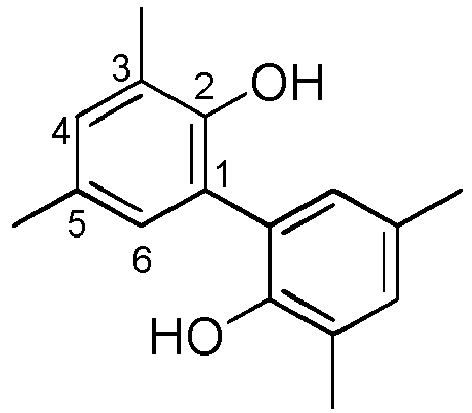
- Die Durchführung der Reaktion erfolgt gemäß der allgemeinen Arbeitsvorschrift in einem verschraubbaren Reagenzglas. Hierzu werden 1.00 g (8.2 mmol, 1.0 Äquiv.) 2,4-Dimethylphenol und 0.54 g (4.9 mmol, 0.6 Äquiv.) Selendioxid in 1 mL Säure gelöst und erhitzt. Das Produkt wird als beiger kristalliner Feststoff erhalten.
- 1H-NMR (300 MHz, CDCl3):
- δ (ppm) = 7.00 (s,2H, 6-H), 6.87 (s, 2H, 4-H), 5.07 (s,2H, OH), 2.27 (s, 12H, 3-CH3, 5-CH3). 13C-NMR (75 MHz, CDCl3):
- δ (ppm) = 149.2 (C-2),132.1 (C-4), 130.0 (C-5), 128.5 (C-6), 125.1 (C-3), 122.1 (C-1), 20.4 (5-CH3), 16.2 (3-CH3).
-

- Die Durchführung der Reaktion erfolgt gemäß der allgemeinen Arbeitsvorschrift in einem verschraubbaren Reagenzglas. Hierzu werden 1.00 g (8.2 mmol, 1.0 Äquiv.) 2,4-Dimethylphenol und 0.54 g (4.9 mmol, 0.6 Äquiv.) Selendioxid in 1 mL Pyridin gelöst und erhitzt. Das Produkt wird als farbloser kristalliner Feststoff erhalten.
- 1H-NMR (400 MHz, CDCl3):
- δ (ppm) = 7.12 (s,2H, 6-H), 6.91 (s, 2H, 4-H), 5.97 (s,2H, OH), 2.23 (s, 6H, 3-CH3) 2.23 (s, 6H, 5-CH3).
- 13C-NMR (100 MHz, CDCl3):
- δ (ppm) = 151.7 (C-2),133.2 (C-3), 133.1 (C-5), 130.4 (C-4), 124.2 (C-6), 114.9 (C-1), 20.3 (5-CH3), 16.5 (3-CH3).
- 77Se-NMR (76 MHz, CDCl3):
- δ (ppm) = 163.36 ppm.
-

- Die Durchführung der Reaktion erfolgt gemäß der allgemeinen Arbeitsvorschrift in einem verschraubbaren Reagenzglas. Dazu wurden 1.32 g (8.0 mmol, 1.0 Äquiv.) 2-tert-Butyl-4-methylphenol und 0.54 g (4.9 mmol, 0.6 Äquiv.) Selendioxid in 1 mL Pyridin gelöst und erhitzt.
- 1H-NMR (300 MHz, CDCl3):
- δ (ppm) = 7.15 (s, 2H, 6-H), 7.05 (s, 2H, 4-H), 5.07 (s,2H, OH), 2.21 (s, 6H, 5-CH3), 2.21 (s, 18H, 3-C(CH3)3.
- 13C-NMR (75 MHz, CDCl3):
- δ (ppm)= 152.1, 136.4, 133.4, 120.1, 129.5, 117.2, 35.1, 29.6, 20.8.
-

- Die Durchführung der Reaktion erfolgt gemäß der allgemeinen Arbeitsvorschrift in einem verschraubbaren Reagenzglas. Dazu wurden 5.00 g (30.5 mmol, 1.0 Äquiv.) 2-tert-Butyl-4-methylphenol und 2.03 g (18.3 mmol, 0.6 Äquiv.) Selendioxid in 5 mL Essigsäure gelöst und erhitzt.
- 1H-NMR (400 MHz, CDCl3):
- δ (ppm) = 7.17 (d, J=2.2 Hz, 2H), 6.91 (d, J=2.2 Hz, 2H), 5.19 (s, 2H), 2.33 (s, 6H), 1.45 (s, 18H).
- 13C-NMR (75 MHz, CDCl3):
- δ (ppm) = 149.9, 137.0, 129.7, 128.9, 128.6, 122.7, 35.0, 29.8, 27.0.
-
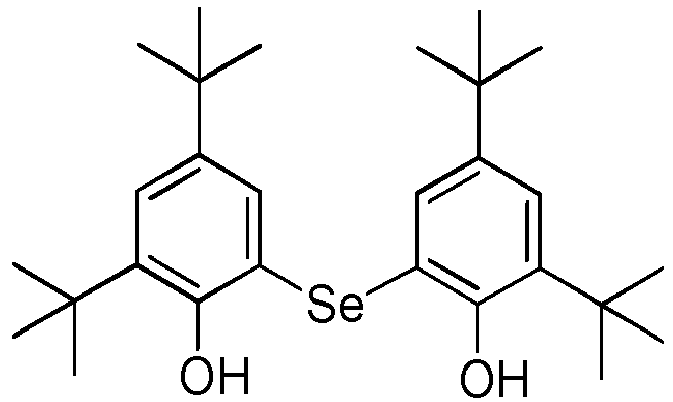
- 1H-NMR (400 MHz, CDCl3):
- δ (ppm) = 7.31 (d, J=2.4 Hz, 2H), 7.29 (d, J=2.4), 6.29 (s, 2H), 1.42 (s, 18H), 1.24 (s, 18H). 13C-NMR (75 MHz, CDCl3):
- δ (ppm) = 151.7, 143.5, 135.8, 129.8, 125.6, 117.2, 35.4, 34.4, 31.6, 29.7.
-

- In einem 100 mL Rundkolben wurden 9.700 g 2,4-Di-tert-butylphenol (47 mmol) in 65 mL Essigsäure gelöst, mit 3.130 g Selendioxid (28 mmol) versetzt und im 100 °C heißen Ölbad erhitzt. Nach 30 Minuten wurde die Reaktion beendet, mit 250 mL Essigsäureethylester verdünnt und filtriert. Das Filtrat wurde dreimal mit je 150 mL Wasser gewaschen, die organische Phase abgetrennt, über Magnesiumsulfat getrocknet und vom Lösungsmittel befreit. Das Rohprodukt wurde mittels Säulenchromatographie gereinigt: Die Länge der Säule betrug 8 cm mit einem Durchmesser von 12 cm. Als Eluent wurde Cyclohexan/Essigsäureethylester im Verhältnis 99/1 verwendet. Das so erhaltene Produkt wurde unter Rückfluss in 90 mL Heptan erhitzt, bis es sich vollständige löste. Die Lösung wurde im Ölbad über Nacht bis auf Raumtemperatur abgekühlt. Das so erhaltene Produkt wurde abfiltriert und mit kaltem Heptan gewaschen. Das Filtrat wurde unter vermindertem Druck eingeengt und drei Tage bei 4 °C im Kühlschrank zur Kristallisation gebracht. Es wurden farblose Nadeln erhalten.
Ausbeute: 5.459 g (13.3 mmol), 56% - 1H-NMR (400 MHz, CDCl3): δ (ppm) =7.39 (d, J=2.4 Hz, 2H), 7.11 (d, J=2.4, 2H), 5.21 (s, 2H), 1.45 (s, 18H), 1.32 (s, 18H).
- 13C-NMR (75 MHz, CDCl3): δ (ppm) =149.9, 143.0, 125.4, 124.9, 122.4, 35.4, 34.6, 31.7, 29.8.
-
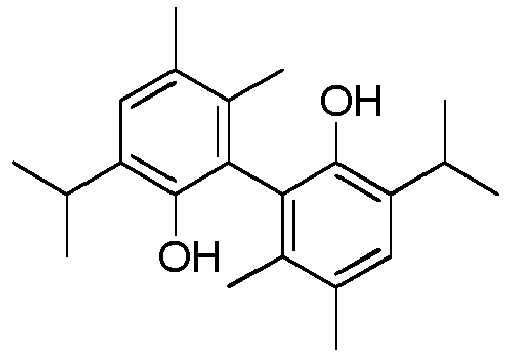
- In einem 50 mL Rundkolben wurden 860 mg 4,5-Dimethyl-2-isopropylphenol (5 mmol) in 20 mL Essigsäure gelöst, mit 581 mg Selendioxid (5 mmol) versetzt und im 105 °C heißen Ölbad erhitzt. Nach 40 Minuten wurde die Reaktion beendet, mit 100 mL Essigsäureethylester verdünnt und filtriert. Das Filtrat wurde dreimal mit je 50 mL Wasser gewaschen, die organische Phase abgetrennt und über Magnesiumsulfat getrocknet. Es wurden 872 mg Rohprodukt erhalten, welches mittels Kugelrohrdestillation gereinigt wurde, wobei das Produkt bei 0.001 mbar und 74 °C sublimierte. Es wurden 351 mg farbloser, klarer Kristalle erhalten. Trotz Temperaturerhöhung konnte das Produkt nicht vollständig sublimiert werden, sodass das Gaschromatogramme des Destillationssumpfes geringe Spuren des Produktes zeigte. Zur Probenvorbereitung werden die jeweiligen Proben über eine Kieselgel (ca. 4 cm) gefüllte Pasteurpipette mit filtriert. Der größte Teils des Destillationssumpfes blieb auf dem Kieselgel zurück.
Ausbeute: 351mg (1.0 mmol), 41% - 1H-NMR: (400 MHz, CDCl3) δ [ppm] = 1.25 (dd, 12H), 1.85(s, 6H), 2.26 (s, 6H), 3.26(hept, J=6.9 Hz, 2H), 4.60(s, 2H), 7.06(s, 2H);
- 13C-NMR: (100 MHz, CDCl3) δ [ppm] =16.21, 20.11, 22.72, 22.87, 27.19, 120.34, 128.24, 128.74, 132.12, 133.81, 149.04;
- Schmelzbereich: 108.8-109.7 °C
-

- In einem 100 mL Rundkolben wurden 10.719 g 2-tert-Butyl-4,5-dimethylphenol (60 mmol) in 35 mL Essigsäure gelöst, mit 4.003 g Selendioxid (36 mmol) versetzt und im 80 °C heißen Ölbad erhitzt. Nach 75 Minuten wurde die Reaktion beendet, mit 250 mL Essigsäureethylester verdünnt und filtriert. Das Filtrat wurde dreimal mit je 150 mL Wasser gewaschen, die organische Phase abgetrennt und über Magnesiumsulfat getrocknet. Das Rohprodukt wurde über eine Schicht aus 3cm Kieselgel und 2 cm Celite filtriert, wobei ein Gemisch aus Cyclohexan/Essigsäureethylester 95/5 als Eluent diente. Das Filtrat wurde vom Lösungsmittel befreit und unter Rückfluss in Heptan erhitzt. Langsames Abkühlen auf Raumtemperatur über Nacht führte zu klaren, leicht gelblichen Nadeln. Das Produkt wurde abfiltriert und mit kaltem Heptan gewaschen. Das Filtrat wurde auf die Hälfte eingeengt und bei 4 °C über zwei Tage zur Kristallisation gebracht.
Ausbeute: 5.004 g (14.1 mmol), 47% - 1H-NMR: (400 MHz, CDCl3) δ [ppm] = 1.40 (s, 18H), 1.83(s, 6H), 2.26 (s, 6H), 4.81(s, 2H), 7.14(s 2H);
Schmelzbereich: 165.2-165.5 °C. -

- In einem 10 mL Rundkolben wurden 512 mg 2,4,5-Trimethylphenol (4 mmol) in 5 mL Essigsäure gelöst, mit 229 mg Selendioxid (2 mmol) versetzt und im 80 °C heißen Ölbad erhitzt. Nach 120 Minuten wurde die Reaktion beendet, mit 50 mL Dichlormethan verdünnt und filtriert. Das Filtrat wurde dreimal mit je 50 mL Wasser gewaschen, die organische Phase abgetrennt, über Magnesiumsulfat getrocknet und vom Lösungsmittel befreit. Das Rohprodukt wurde Säulenchromatographisch gereinigt: Die Säulenlänge betrug 10 cm und der Säulendurchmesser 3 cm. Es wurde ein Eluent aus Cyclohexan/ Essigsäureethylester 95/5 verwendet. Das gereinigte Produkt wurde bei 60 °C in 5 mL Heptan gelöst. Kristallisation bei 4 °C ergab nach zwei Tagen farblose, nadelförmige Kristalle. Das Produkt wurde abfiltriert, mit kaltem Heptan gewaschen du unter Vakuum von Lösungsmittelresten befreit.
Ausbeute: 226 mg (0.8 mmol), 47% - 1H-NMR: (400 MHz, CDCl3) δ [ppm] = 1.40 (s, 18H), 1.83(s, 6H), 2.26 (s, 6H), 4.81(s, 2H), 7.14(s 2H);
- 13C-NMR:(75 MHz, CDCl3) δ [ppm] = 15.73, 16.07 19.51, 119.96, 121.38, 128.48, 132.67, 133.87, 149.79
Schmelzbereich: 68.8-169.5 °C - Die Ergebnisse der oben beschrieben Reaktion, und Variationen derselben, sind in den folgenden Tabellen dargestellt. Die erfindungsgemäßen Verfahren sind hierbei mit * gekennzeichnet.
- Folgende Verbindungsklassen werden in den Tabellen näher spezifiziert:

Tabelle 1a: Oxidative Kupplung von 2,4-Dimethylphenol basische Bedingungen 
Lösungsmittel T [°C] t [h] pKb-Wert Pummerer Keton [%] Biphenol [%] Selenspezies [%] Pyridin 60 5 8,9 - - 79,1 Pyridin 85 5 8,9 2,6 13,1 59,6 Pyridin 100 0,5 8,9 1,9 11,0 39,9 Triethylamin (trocken) 80 4 3,3 - - 1,8 DMF 85 5 -1,1 4,2 19,1 18,8 - Der Tabelle 1a kann man entnehmen, dass (mit Ausnahme von Dimethylformamid (DMF)) das gewünschte Biphenol lediglich als Nebenprodukt anfällt. Bei DMF fallen das Biphenol und die unerwünschte Selenspezies etwa zu gleichen Teilen an.
Tabelle 1 b: Oxidative Kupplung von 2,4-Dimethylphenol saure Bedingungen 
Lösungsmittel T t pKs-Wert Pummer er Keton Biphenol Selenspezies [°C] [h] [%] [%] [%] Essigsäure* 85 5 4,8 4,5 74,8 1,98 Essigsäure* 60 1,5 4,8 1,8 39,8 8,0 Trifluoressigsäure / Essigsäure* (3:1) 85 5 0,23 / 4,8 2,5 77,8 1,4 Ameisensäure* 60 2 3,8 1,8 85,4 - Methansulfonsäure 85 5 -2,6 - 3,9 6,1 p-Toluolsulfonsäure 85 5 -2,8 - 15,0 - - Der Tabelle 1b kann man entnehmen, dass unter den erfindungsgemäßen sauren Bedingungen jeweils das Biphenol in sehr guter Ausbeute hergestellt werden konnte. Unter Verwendung von Methansulfonsäure (pKs -2,6) und p-Toluolsulfonsäure (pKs -2,8), deren pKs-Werte jeweils unter dem Wert von 0,0 liegen, konnte das gewünschte Biphenol nur in sehr geringen Ausbeuten erhalten werden.
Tabelle 2a: Oxidative Kupplung von 2,4-Di-tert-butylphenol basische Bedingungen 
Lösungsmittel T [°C] t [h] pKb-Wert Biphenol [%] Selenspezies [%] Pyridin 40 24 8,9 20,6 46,8 Pyridin 60 7 8,9 10,1 30,4 - Unter basischen Bedingungen entsteht wieder die Selenspezies als Hauptprodukt der Reaktion.
Tabelle 2b: Oxidative Kupplung von 2,4-Di-tert-butylphenol saure Bedingungen 
Lösungsmittel T [°C] t [h] pKs-Wert Biphenol [%] Selenspezies [%] Essigsäure* 50 18 4,8 29,5 25,2 Essigsäure* 85 1 4,8 25,9 23,1 Essigsäure* 105 0,2 4,8 75,1 2,6 Ameisensäure* 70 1 3,8 46,9 7,6 - Unter den erfindungsgemäßen sauren Bedingungen ist das angestrebte Biphenol das Hauptprodukt der Reaktion.
Tabelle 3a: Oxidative Kupplung von 2-tert-Butyl-4-methylphenol basische Bedingungen 
Lösungsmittel T [°C] t [h] pKb-Wert Biphenol [%] Selenspezies [%] Pyridin 40 24 8,9 7,2 61,5 Pyridin 60 7 8,9 1,6 32,2 Pyridin 85 1,5 8,9 6,1 32,5 Pyridin 100 0,5 8,9 4,5 28,9 - Auch aus der Tabelle 3a ist wiederum ersichtlich, dass basische Bedingungen zur Selenspezies führen, und das angestrebte Biphenol nur zu sehr geringen Anteilen erhalten wird.
Tabelle 3b: Oxidative Kupplung von 2-tert-Butyl-4-methylphenol saure Bedingungen 
Lösungsmittel T [°C] t [h] pKs-Wert Biphenol [%] Selenspezies [%] Essigsäure* 50 18 4,8 34,2 19,8 Essigsäure* 85 1,5 4,8 63,7 4,0 Essigsäure* 100 0,4 4,8 53,2 2,1 - Unter erfindungsgemäßen Bedingungen hingegen kann das angestrebte Biphenol in sehr guten Ausbeuten hergestellt werden.
- Die in den Tabellen 1a bis 3b zusammengefassten Ergebnisse zeigen eindeutig, dass das erfindungsgemäße Verfahren die zuvor definierte Aufgabenstellung erfüllt. Das erfindungsgemäße Verfahren stellt eine Syntheseroute dar, mit welcher 2,2'-Biphenole selektiv, in guter Ausbeute hergestellt werden können. Des Weiteren lässt sich das erfindungsgemäße Verfahren auch großtechnisch verwirklichen.
- Im Folgenden werden weitere Vergleichsversuche beschrieben.
- Es wurde 2,4-Dimethylphenol mit SeO2 umgesetzt.
Tabelle 4: Übersicht der Umsetzung von 2,4-Dimethylphenol mit Selendioxid bei verschiedenen Temperaturen und Lösungsmitteln nach 18 Stunden. Es wurden jeweils 1,3 Äquivalente Selendioxid (bezogen auf 2,4-Dimethylphenol) eingesetzt. Lösungsmittel T [°C] t [h] 2,4-Dimethyl phenol Pummerer -Keton Biphenol Selenspezies THF 90 18 98 1 1 - Glyme 96 18 - 17 74 - Glyme 75 18 13 9 52 10 Diglyme 96 18 95 1 4 - - Verwendet man Glyme (Ethylenglycoldimethylether) als Lösungsmittel, so erhält man auch hier das Biphenol als Hauptprodukt. Es bedarf allerdings hoher Temperaturen und langer Reaktionszeiten, was die Reaktion für einen großtechnischen Einsatz unattraktiv macht. Ein weiterer Nachteil ist, dass das Selendioxid überstöchiometrisch, also mit mehr als 1,0 Äquivalenten, eingesetzt werden muss. Des Weiteren liegt sie Summe der Nebenprodukte (Pummerer-Keton + Selenspezies) jeweils über 15%. Durch den hohen Anteil an Nebenkomponenten wird die entsprechende Aufarbeitung zur Gewinnung der Reinsubstanz deutlich schwieriger und damit verbunden auch teurer, was für einen großtechnischen Prozess unvorteilhaft ist.
- Mit Tetrahydrofuran (THF) (pKb 11,5) als Lösungsmittel bildet sich so gut wie kein Biphenol.
- Unter Einsatz des erfindungsgemäßen Verfahrens können in viel kürzerer Zeit deutlich bessere Reaktionsergebnisse erzielt werden.
Claims (13)
- Verfahren zur Herstellung von 2,2'-Biphenolen umfassend die Verfahrensschritte:a) Zugabe eines ersten Phenols zum Reaktionsgemisch,b) Zugabe eines zweiten Phenols zum Reaktionsgemisch,c) Zugabe von Selendioxid zum Reaktionsgemisch,d) Zugabe einer Säure mit einem pKs-Wert im Bereich von 0,0 bis 5,0 zum Reaktionsgemisch,e) Erwärmen des Reaktionsgemisches, so dass das erste Phenol und das zweite Phenol zu einem 2,2'-Biphenol umgesetzt werden.
- Verfahren nach Anspruch 1,
wobei es sich bei dem ersten Phenol in Verfahrensschritt a) um eine Verbindung gemäß der allgemeinen Formel I handelt: -H, -(C1-C12)-Alkyl, -O-(C1-C12)-Alkyl, -(C6-C20)-Aryl, -O-(C6-C20)-Aryl, -Halogen, -OC=O-(C1-C12)-Alkyl,zwei benachbarte Reste können des Weiteren zu einem kondensierten System miteinander verbunden sein,wobei die genannten Alkyl- und Arylgruppen substituiert sein können,und mindestens R1 oder R5 gleich -H ist.
 - Verfahren nach Anspruch 2,
wobei R1, R2, R3, R4, R5 jeweils unabhängig voneinander ausgewählt sind aus:-H, -(C1-C12)-Alkyl, -O-(C1-C12)-Alkyl, -(C6-C20)-Aryl, -O-(C6-C20)-Aryl,wobei die genannten Alkyl- und Arylgruppen substituiert sein können,und mindestens R1 oder R5 gleich -H ist. - Verfahren nach einem der Ansprüche 2 oder 3,
wobei R1, R3, R5 jeweils unabhängig voneinander ausgewählt sind aus:-H, -(C1-C12)-Alkyl,wobei die genannten Alkylgruppen substituiert sein können,und mindestens R1 oder R5 gleich -H ist. - Verfahren nach einem der Ansprüche 1 bis 4,
wobei es sich bei dem zweiten Phenol in Verfahrensschritt b) um eine Verbindung gemäß der allgemeinen Formel II handelt: -H, -(C1-C12)-Alkyl, -O-(C1-C12)-Alkyl, -(C6-C20)-Aryl, -O-(C6-C20)-Aryl, -Halogen, -OC=O-(C1-C12)-Alkyl,zwei benachbarte Reste können des Weiteren zu einem kondensierten System miteinander verbunden sein,wobei die genannten Alkyl- und Arylgruppen substituiert sein können,und mindestens R6 oder R10 gleich -H ist.
 - Verfahren nach Anspruch 5,
wobei R6, R7, R8, R9, R10 jeweils unabhängig voneinander ausgewählt sind aus:-H, -(C1-C12)-Alkyl, -O-(C1-C12)-Alkyl, -(C6-C20)-Aryl, -O-(C6-C20)-Aryl,wobei die genannten Alkyl- und Arylgruppen substituiert sein können,und mindestens R6 oder R10 gleich -H ist. - Verfahren nach einem der Ansprüche 5 oder 6,wobei R6, R8, R10 jeweils unabhängig voneinander ausgewählt sind aus:-H, -(C1-C12)-Alkyl,wobei die genannten Alkylgruppen substituiert sein können,und mindestens R6 oder R10 gleich -H ist.
- Verfahren nach einem der Ansprüche 1 bis 7,
wobei das erste Phenol dem zweiten Phenol entspricht. - Verfahren nach einem der Ansprüche 1 bis 8,
wobei das Selendioxid in Verfahrensschritt c) in einem molaren Verhältnis bezogen auf die Summe des ersten und des zweiten Phenols zugegeben wird, welches in einem Bereich von 0,25 bis 1,2 liegt. - Verfahren nach einem der Ansprüche 1 bis 9,
wobei die Säure im Verfahrensschritt d) ausgewählt ist aus:Essigsäure, Ameisensäure, Trifluoressigsäure, Propionsäure, Phosphorsäure. - Verfahren nach einem der Ansprüche 1 bis 10,
wobei die Säure im Verfahrensschritt d) als Lösungsmittel eingesetzt wird. - Verfahren nach einem der Ansprüche 1 bis 11,
wobei das Reaktionsgemisch im Verfahrensschritt e) auf eine Temperatur in dem Bereich von 50 °C bis 110 °C erwärmt wird. - Verfahren nach einem der Ansprüche 1 bis 12,
wobei das Erwärmen im Verfahrensschritt e) über einen Zeitraum im Bereich von 5 Minuten bis 24 Stunden erfolgt.
Applications Claiming Priority (1)
| Application Number | Priority Date | Filing Date | Title |
|---|---|---|---|
| DE102014209967.6A DE102014209967A1 (de) | 2014-05-26 | 2014-05-26 | Verfahren zur Herstellung von 2,2'-Biphenolen unter Verwendung von Selendioxid |
Publications (2)
| Publication Number | Publication Date |
|---|---|
| EP2949638A1 true EP2949638A1 (de) | 2015-12-02 |
| EP2949638B1 EP2949638B1 (de) | 2017-11-08 |
Family
ID=53191517
Family Applications (1)
| Application Number | Title | Priority Date | Filing Date |
|---|---|---|---|
| EP15168685.4A Not-in-force EP2949638B1 (de) | 2014-05-26 | 2015-05-21 | Verfahren zur herstellung von 2,2 -biphenolen unter verwendung von selendioxid |
Country Status (4)
| Country | Link |
|---|---|
| US (1) | US9517986B2 (de) |
| EP (1) | EP2949638B1 (de) |
| CN (1) | CN105111048B (de) |
| DE (1) | DE102014209967A1 (de) |
Families Citing this family (6)
| Publication number | Priority date | Publication date | Assignee | Title |
|---|---|---|---|---|
| DE102014201756A1 (de) | 2014-01-31 | 2015-08-06 | Evonik Degussa Gmbh | Reinigung chlorverschmutzter Organophosphorverbindungen |
| EP3095779B1 (de) | 2015-05-20 | 2018-04-04 | Evonik Degussa GmbH | Kupplung von zwei arenen mit selendioxid zu einem selenobiarylether |
| EP3095776A1 (de) | 2015-05-20 | 2016-11-23 | Evonik Degussa GmbH | Kupplung von einem Phenol und einem Aren unter Verwendung von Selendioxid |
| EP3178825A1 (de) | 2015-12-07 | 2017-06-14 | Evonik Degussa GmbH | Heterozyklische selena-phosphite sowie verfahren zu deren herstellung |
| DE102016205888A1 (de) | 2015-12-07 | 2017-06-08 | Evonik Degussa Gmbh | Komplexe von Diphenylselenoxiden, deren Verwendung und Katalyseverfahren |
| EP3178826A1 (de) | 2015-12-07 | 2017-06-14 | Evonik Degussa GmbH | Heterozyklische an einer hydroxyl-gruppe geschützte selena-monophosphite sowie verfahren zu deren herstellung |
Citations (2)
| Publication number | Priority date | Publication date | Assignee | Title |
|---|---|---|---|---|
| WO2010023258A1 (de) | 2008-09-01 | 2010-03-04 | Basf Se | Verfahren zur anodischen dehydrodimerisierung von substituierten arylalkoholen |
| WO2010139687A1 (de) | 2009-06-05 | 2010-12-09 | Basf Se | Verfahren zur herstellung von unsymmetrischen biarylalkoholen |
Family Cites Families (1)
| Publication number | Priority date | Publication date | Assignee | Title |
|---|---|---|---|---|
| DE102005015893A1 (de) * | 2005-04-06 | 2006-10-12 | Basf Ag | Verbessertes Verfahren zur Herstellung von Biphenolen aus Monophenolen |
-
2014
- 2014-05-26 DE DE102014209967.6A patent/DE102014209967A1/de not_active Withdrawn
-
2015
- 2015-05-21 EP EP15168685.4A patent/EP2949638B1/de not_active Not-in-force
- 2015-05-22 US US14/719,900 patent/US9517986B2/en not_active Expired - Fee Related
- 2015-05-25 CN CN201510386228.3A patent/CN105111048B/zh not_active Expired - Fee Related
Patent Citations (2)
| Publication number | Priority date | Publication date | Assignee | Title |
|---|---|---|---|---|
| WO2010023258A1 (de) | 2008-09-01 | 2010-03-04 | Basf Se | Verfahren zur anodischen dehydrodimerisierung von substituierten arylalkoholen |
| WO2010139687A1 (de) | 2009-06-05 | 2010-12-09 | Basf Se | Verfahren zur herstellung von unsymmetrischen biarylalkoholen |
Non-Patent Citations (3)
| Title |
|---|
| BEI-SIH LIAO ET AL: "Efficient oxidative coupling of 2,6-disubstituted phenol catalyzed by a dicopper(ii) complex", DALTON TRANSACTIONS, vol. 41, no. 4, 1 January 2012 (2012-01-01), pages 1158 - 1164, XP055143000, ISSN: 1477-9226, DOI: 10.1039/c1dt11065a * |
| BERND ELSLER ET AL: "Metal- and Reagent-Free Highly Selective Anodic Cross-Coupling Reaction of Phenols", ANGEWANDTE CHEMIE INTERNATIONAL EDITION, 18 March 2014 (2014-03-18), pages n/a - n/a, XP055203477, ISSN: 1433-7851, DOI: 10.1002/anie.201400627 * |
| G. SARTORI; R. MAGGI; F. BIGI; M. GRANDI, J. ORG. CHEM., vol. 58, 1993, pages 7271 |
Also Published As
| Publication number | Publication date |
|---|---|
| CN105111048B (zh) | 2017-04-12 |
| CN105111048A (zh) | 2015-12-02 |
| EP2949638B1 (de) | 2017-11-08 |
| US20150336865A1 (en) | 2015-11-26 |
| US9517986B2 (en) | 2016-12-13 |
| DE102014209967A1 (de) | 2015-12-17 |
Similar Documents
| Publication | Publication Date | Title |
|---|---|---|
| EP2949637B1 (de) | Verfahren zur herstellung von 2,2 -biphenolen unter verwendung von selendioxid und halogeniertem lösungsmittel | |
| EP2949646A1 (de) | Verfahren zur herstellung von 2,2'-selenobiarylethern oder 4,4'-selenobiarylethern unter verwendung von selendioxid | |
| EP3064484B1 (de) | Herstellung von 2,2'-biarylen in gegenwart von molybdän(v)-chlorid | |
| EP2949638B1 (de) | Verfahren zur herstellung von 2,2 -biphenolen unter verwendung von selendioxid | |
| DE69114106T2 (de) | Verfahren zur Herstellung von Nitroxylradikalen von gehinderten Aminen. | |
| WO2015176927A1 (de) | Verfahren zur reduzierung des chlorgehalts von organomonophosphiten unter verwendung von zwei lösungen | |
| WO2015181018A1 (de) | Verfahren zur herstellung von unsymmetrischen biphenolen mittels einsatz von selendioxid | |
| DE2355690C2 (de) | Verfahren zur Herstellung von Phenol oder substituierten Phenolen | |
| DE2416035C3 (de) | Synthese von Chinonderivaten mit biologischer Aktivität | |
| DE69305599T2 (de) | Verfahren und Herstellung von Salicylaldoxim-Derivaten | |
| EP2859032B1 (de) | Verfahren zur herstellung eines polyetheretherketons | |
| EP3095779B1 (de) | Kupplung von zwei arenen mit selendioxid zu einem selenobiarylether | |
| DE1593023B2 (de) | Verfahren zur herstellung fluorierter organischer verbindungen | |
| DE112011103786T5 (de) | Bis(Trifluormethansulfonyl)ethyl tragende Verbindung und Säurekatalysator und Verfahren zum Herstellen derselben | |
| DE102004040923A1 (de) | Spezielle Calixarene, Verfahren zu ihrer Herstellung und ihre Verwendung | |
| DE69219582T2 (de) | Neue verbindung und trennungsreagenz | |
| DE60114521T2 (de) | Verfahren zur Herstellung von Carbonsäurearylestern | |
| DE69128176T2 (de) | Herstellung von Fluorphenolen, Fluorhalophenolen, N-Azylfluoranilinen und N-Azylfluorhaloanilinen | |
| DE2109880A1 (de) | Verfahren zur Herstellung von Pyrimidinen | |
| DE2552365C2 (de) | Verfahren zur Herstellung von in 6-Stellung substituierten 2,3-Dimethoxy-5-methyl-1,4-benzochinonen | |
| DE69031404T2 (de) | Verfahren zur Herstellung von bromierten Derivaten aus Alkoholen | |
| DE1936743C3 (de) | Verfahren zur Herstellung von Bis-{4-liydroxymethyl-5-hydroxy-6-methyIpyridyl-3-methyl)-disulfiddichlorhydrat-dihydrat | |
| DE2558186C3 (de) | Verfahren zur Herstellung von Phosphorsäure-tris-(dimethylamid) | |
| EP3145907B1 (de) | Verfahren zur herstellung von alkoxybenzonitrilen | |
| DE1178052B (de) | Verfahren zur Herstellung von heterocyclischen Verbindungne, die mindestens ein einem Ringstickstoffatom benachbartes Chloratom enthalten. |
Legal Events
| Date | Code | Title | Description |
|---|---|---|---|
| 17P | Request for examination filed |
Effective date: 20150521 |
|
| AK | Designated contracting states |
Kind code of ref document: A1 Designated state(s): AL AT BE BG CH CY CZ DE DK EE ES FI FR GB GR HR HU IE IS IT LI LT LU LV MC MK MT NL NO PL PT RO RS SE SI SK SM TR |
|
| AX | Request for extension of the european patent |
Extension state: BA ME |
|
| PUAI | Public reference made under article 153(3) epc to a published international application that has entered the european phase |
Free format text: ORIGINAL CODE: 0009012 |
|
| GRAP | Despatch of communication of intention to grant a patent |
Free format text: ORIGINAL CODE: EPIDOSNIGR1 |
|
| RIC1 | Information provided on ipc code assigned before grant |
Ipc: C07C 39/15 20060101ALI20170426BHEP Ipc: C07C 37/11 20060101AFI20170426BHEP |
|
| INTG | Intention to grant announced |
Effective date: 20170529 |
|
| GRAS | Grant fee paid |
Free format text: ORIGINAL CODE: EPIDOSNIGR3 |
|
| GRAA | (expected) grant |
Free format text: ORIGINAL CODE: 0009210 |
|
| AK | Designated contracting states |
Kind code of ref document: B1 Designated state(s): AL AT BE BG CH CY CZ DE DK EE ES FI FR GB GR HR HU IE IS IT LI LT LU LV MC MK MT NL NO PL PT RO RS SE SI SK SM TR |
|
| REG | Reference to a national code |
Ref country code: GB Ref legal event code: FG4D Free format text: NOT ENGLISH |
|
| REG | Reference to a national code |
Ref country code: CH Ref legal event code: EP Ref country code: AT Ref legal event code: REF Ref document number: 943994 Country of ref document: AT Kind code of ref document: T Effective date: 20171115 |
|
| REG | Reference to a national code |
Ref country code: IE Ref legal event code: FG4D Free format text: LANGUAGE OF EP DOCUMENT: GERMAN |
|
| REG | Reference to a national code |
Ref country code: DE Ref legal event code: R096 Ref document number: 502015002282 Country of ref document: DE |
|
| REG | Reference to a national code |
Ref country code: NL Ref legal event code: MP Effective date: 20171108 |
|
| REG | Reference to a national code |
Ref country code: LT Ref legal event code: MG4D |
|
| PG25 | Lapsed in a contracting state [announced via postgrant information from national office to epo] |
Ref country code: NL Free format text: LAPSE BECAUSE OF FAILURE TO SUBMIT A TRANSLATION OF THE DESCRIPTION OR TO PAY THE FEE WITHIN THE PRESCRIBED TIME-LIMIT Effective date: 20171108 Ref country code: ES Free format text: LAPSE BECAUSE OF FAILURE TO SUBMIT A TRANSLATION OF THE DESCRIPTION OR TO PAY THE FEE WITHIN THE PRESCRIBED TIME-LIMIT Effective date: 20171108 Ref country code: FI Free format text: LAPSE BECAUSE OF FAILURE TO SUBMIT A TRANSLATION OF THE DESCRIPTION OR TO PAY THE FEE WITHIN THE PRESCRIBED TIME-LIMIT Effective date: 20171108 Ref country code: NO Free format text: LAPSE BECAUSE OF FAILURE TO SUBMIT A TRANSLATION OF THE DESCRIPTION OR TO PAY THE FEE WITHIN THE PRESCRIBED TIME-LIMIT Effective date: 20180208 Ref country code: SE Free format text: LAPSE BECAUSE OF FAILURE TO SUBMIT A TRANSLATION OF THE DESCRIPTION OR TO PAY THE FEE WITHIN THE PRESCRIBED TIME-LIMIT Effective date: 20171108 Ref country code: LT Free format text: LAPSE BECAUSE OF FAILURE TO SUBMIT A TRANSLATION OF THE DESCRIPTION OR TO PAY THE FEE WITHIN THE PRESCRIBED TIME-LIMIT Effective date: 20171108 |
|
| PG25 | Lapsed in a contracting state [announced via postgrant information from national office to epo] |
Ref country code: HR Free format text: LAPSE BECAUSE OF FAILURE TO SUBMIT A TRANSLATION OF THE DESCRIPTION OR TO PAY THE FEE WITHIN THE PRESCRIBED TIME-LIMIT Effective date: 20171108 Ref country code: GR Free format text: LAPSE BECAUSE OF FAILURE TO SUBMIT A TRANSLATION OF THE DESCRIPTION OR TO PAY THE FEE WITHIN THE PRESCRIBED TIME-LIMIT Effective date: 20180209 Ref country code: LV Free format text: LAPSE BECAUSE OF FAILURE TO SUBMIT A TRANSLATION OF THE DESCRIPTION OR TO PAY THE FEE WITHIN THE PRESCRIBED TIME-LIMIT Effective date: 20171108 Ref country code: BG Free format text: LAPSE BECAUSE OF FAILURE TO SUBMIT A TRANSLATION OF THE DESCRIPTION OR TO PAY THE FEE WITHIN THE PRESCRIBED TIME-LIMIT Effective date: 20180208 Ref country code: IS Free format text: LAPSE BECAUSE OF FAILURE TO SUBMIT A TRANSLATION OF THE DESCRIPTION OR TO PAY THE FEE WITHIN THE PRESCRIBED TIME-LIMIT Effective date: 20180308 Ref country code: RS Free format text: LAPSE BECAUSE OF FAILURE TO SUBMIT A TRANSLATION OF THE DESCRIPTION OR TO PAY THE FEE WITHIN THE PRESCRIBED TIME-LIMIT Effective date: 20171108 |
|
| PG25 | Lapsed in a contracting state [announced via postgrant information from national office to epo] |
Ref country code: DK Free format text: LAPSE BECAUSE OF FAILURE TO SUBMIT A TRANSLATION OF THE DESCRIPTION OR TO PAY THE FEE WITHIN THE PRESCRIBED TIME-LIMIT Effective date: 20171108 Ref country code: CY Free format text: LAPSE BECAUSE OF FAILURE TO SUBMIT A TRANSLATION OF THE DESCRIPTION OR TO PAY THE FEE WITHIN THE PRESCRIBED TIME-LIMIT Effective date: 20171108 Ref country code: EE Free format text: LAPSE BECAUSE OF FAILURE TO SUBMIT A TRANSLATION OF THE DESCRIPTION OR TO PAY THE FEE WITHIN THE PRESCRIBED TIME-LIMIT Effective date: 20171108 Ref country code: CZ Free format text: LAPSE BECAUSE OF FAILURE TO SUBMIT A TRANSLATION OF THE DESCRIPTION OR TO PAY THE FEE WITHIN THE PRESCRIBED TIME-LIMIT Effective date: 20171108 Ref country code: SK Free format text: LAPSE BECAUSE OF FAILURE TO SUBMIT A TRANSLATION OF THE DESCRIPTION OR TO PAY THE FEE WITHIN THE PRESCRIBED TIME-LIMIT Effective date: 20171108 |
|
| REG | Reference to a national code |
Ref country code: DE Ref legal event code: R097 Ref document number: 502015002282 Country of ref document: DE |
|
| PG25 | Lapsed in a contracting state [announced via postgrant information from national office to epo] |
Ref country code: PL Free format text: LAPSE BECAUSE OF FAILURE TO SUBMIT A TRANSLATION OF THE DESCRIPTION OR TO PAY THE FEE WITHIN THE PRESCRIBED TIME-LIMIT Effective date: 20171108 Ref country code: SM Free format text: LAPSE BECAUSE OF FAILURE TO SUBMIT A TRANSLATION OF THE DESCRIPTION OR TO PAY THE FEE WITHIN THE PRESCRIBED TIME-LIMIT Effective date: 20171108 Ref country code: RO Free format text: LAPSE BECAUSE OF FAILURE TO SUBMIT A TRANSLATION OF THE DESCRIPTION OR TO PAY THE FEE WITHIN THE PRESCRIBED TIME-LIMIT Effective date: 20171108 Ref country code: IT Free format text: LAPSE BECAUSE OF FAILURE TO SUBMIT A TRANSLATION OF THE DESCRIPTION OR TO PAY THE FEE WITHIN THE PRESCRIBED TIME-LIMIT Effective date: 20171108 |
|
| PLBE | No opposition filed within time limit |
Free format text: ORIGINAL CODE: 0009261 |
|
| STAA | Information on the status of an ep patent application or granted ep patent |
Free format text: STATUS: NO OPPOSITION FILED WITHIN TIME LIMIT |
|
| PG25 | Lapsed in a contracting state [announced via postgrant information from national office to epo] |
Ref country code: MT Free format text: LAPSE BECAUSE OF FAILURE TO SUBMIT A TRANSLATION OF THE DESCRIPTION OR TO PAY THE FEE WITHIN THE PRESCRIBED TIME-LIMIT Effective date: 20171108 |
|
| 26N | No opposition filed |
Effective date: 20180809 |
|
| PG25 | Lapsed in a contracting state [announced via postgrant information from national office to epo] |
Ref country code: SI Free format text: LAPSE BECAUSE OF FAILURE TO SUBMIT A TRANSLATION OF THE DESCRIPTION OR TO PAY THE FEE WITHIN THE PRESCRIBED TIME-LIMIT Effective date: 20171108 |
|
| REG | Reference to a national code |
Ref country code: DE Ref legal event code: R119 Ref document number: 502015002282 Country of ref document: DE |
|
| REG | Reference to a national code |
Ref country code: CH Ref legal event code: PL |
|
| REG | Reference to a national code |
Ref country code: BE Ref legal event code: MM Effective date: 20180531 |
|
| PG25 | Lapsed in a contracting state [announced via postgrant information from national office to epo] |
Ref country code: MC Free format text: LAPSE BECAUSE OF FAILURE TO SUBMIT A TRANSLATION OF THE DESCRIPTION OR TO PAY THE FEE WITHIN THE PRESCRIBED TIME-LIMIT Effective date: 20171108 |
|
| REG | Reference to a national code |
Ref country code: IE Ref legal event code: MM4A |
|
| PG25 | Lapsed in a contracting state [announced via postgrant information from national office to epo] |
Ref country code: CH Free format text: LAPSE BECAUSE OF NON-PAYMENT OF DUE FEES Effective date: 20180531 Ref country code: LI Free format text: LAPSE BECAUSE OF NON-PAYMENT OF DUE FEES Effective date: 20180531 |
|
| PG25 | Lapsed in a contracting state [announced via postgrant information from national office to epo] |
Ref country code: LU Free format text: LAPSE BECAUSE OF NON-PAYMENT OF DUE FEES Effective date: 20180521 |
|
| PG25 | Lapsed in a contracting state [announced via postgrant information from national office to epo] |
Ref country code: DE Free format text: LAPSE BECAUSE OF NON-PAYMENT OF DUE FEES Effective date: 20181201 Ref country code: IE Free format text: LAPSE BECAUSE OF NON-PAYMENT OF DUE FEES Effective date: 20180521 Ref country code: FR Free format text: LAPSE BECAUSE OF NON-PAYMENT OF DUE FEES Effective date: 20180531 |
|
| PG25 | Lapsed in a contracting state [announced via postgrant information from national office to epo] |
Ref country code: BE Free format text: LAPSE BECAUSE OF NON-PAYMENT OF DUE FEES Effective date: 20180531 |
|
| GBPC | Gb: european patent ceased through non-payment of renewal fee |
Effective date: 20190521 |
|
| PG25 | Lapsed in a contracting state [announced via postgrant information from national office to epo] |
Ref country code: TR Free format text: LAPSE BECAUSE OF FAILURE TO SUBMIT A TRANSLATION OF THE DESCRIPTION OR TO PAY THE FEE WITHIN THE PRESCRIBED TIME-LIMIT Effective date: 20171108 |
|
| PG25 | Lapsed in a contracting state [announced via postgrant information from national office to epo] |
Ref country code: GB Free format text: LAPSE BECAUSE OF NON-PAYMENT OF DUE FEES Effective date: 20190521 |
|
| PG25 | Lapsed in a contracting state [announced via postgrant information from national office to epo] |
Ref country code: PT Free format text: LAPSE BECAUSE OF FAILURE TO SUBMIT A TRANSLATION OF THE DESCRIPTION OR TO PAY THE FEE WITHIN THE PRESCRIBED TIME-LIMIT Effective date: 20171108 |
|
| PG25 | Lapsed in a contracting state [announced via postgrant information from national office to epo] |
Ref country code: MK Free format text: LAPSE BECAUSE OF NON-PAYMENT OF DUE FEES Effective date: 20171108 Ref country code: HU Free format text: LAPSE BECAUSE OF FAILURE TO SUBMIT A TRANSLATION OF THE DESCRIPTION OR TO PAY THE FEE WITHIN THE PRESCRIBED TIME-LIMIT; INVALID AB INITIO Effective date: 20150521 |
|
| PG25 | Lapsed in a contracting state [announced via postgrant information from national office to epo] |
Ref country code: AL Free format text: LAPSE BECAUSE OF FAILURE TO SUBMIT A TRANSLATION OF THE DESCRIPTION OR TO PAY THE FEE WITHIN THE PRESCRIBED TIME-LIMIT Effective date: 20171108 |
|
| REG | Reference to a national code |
Ref country code: AT Ref legal event code: MM01 Ref document number: 943994 Country of ref document: AT Kind code of ref document: T Effective date: 20200521 |
|
| PG25 | Lapsed in a contracting state [announced via postgrant information from national office to epo] |
Ref country code: AT Free format text: LAPSE BECAUSE OF NON-PAYMENT OF DUE FEES Effective date: 20200521 |