EP2943150B1 - Daily periodic target-zone modulation in the model predictive control problem for artificial pancreas for type i diabetes applications - Google Patents
Daily periodic target-zone modulation in the model predictive control problem for artificial pancreas for type i diabetes applications Download PDFInfo
- Publication number
- EP2943150B1 EP2943150B1 EP14738072.9A EP14738072A EP2943150B1 EP 2943150 B1 EP2943150 B1 EP 2943150B1 EP 14738072 A EP14738072 A EP 14738072A EP 2943150 B1 EP2943150 B1 EP 2943150B1
- Authority
- EP
- European Patent Office
- Prior art keywords
- insulin
- zone
- controller
- day
- during
- Prior art date
- Legal status (The legal status is an assumption and is not a legal conclusion. Google has not performed a legal analysis and makes no representation as to the accuracy of the status listed.)
- Active
Links
Images


Classifications
-
- A—HUMAN NECESSITIES
- A61—MEDICAL OR VETERINARY SCIENCE; HYGIENE
- A61M—DEVICES FOR INTRODUCING MEDIA INTO, OR ONTO, THE BODY; DEVICES FOR TRANSDUCING BODY MEDIA OR FOR TAKING MEDIA FROM THE BODY; DEVICES FOR PRODUCING OR ENDING SLEEP OR STUPOR
- A61M5/00—Devices for bringing media into the body in a subcutaneous, intra-vascular or intramuscular way; Accessories therefor, e.g. filling or cleaning devices, arm rests
- A61M5/14—Infusion devices, e.g. infusing by gravity; Blood infusion; Accessories therefor
- A61M5/168—Means for controlling media flow to the body or for metering media to the body, e.g. drip meters, counters
- A61M5/172—Means for controlling media flow to the body or for metering media to the body, e.g. drip meters, counters electrical or electronic
- A61M5/1723—Means for controlling media flow to the body or for metering media to the body, e.g. drip meters, counters electrical or electronic using feedback of body parameters, e.g. blood sugar or pressure
-
- A—HUMAN NECESSITIES
- A61—MEDICAL OR VETERINARY SCIENCE; HYGIENE
- A61M—DEVICES FOR INTRODUCING MEDIA INTO, OR ONTO, THE BODY; DEVICES FOR TRANSDUCING BODY MEDIA OR FOR TAKING MEDIA FROM THE BODY; DEVICES FOR PRODUCING OR ENDING SLEEP OR STUPOR
- A61M5/00—Devices for bringing media into the body in a subcutaneous, intra-vascular or intramuscular way; Accessories therefor, e.g. filling or cleaning devices, arm rests
- A61M5/14—Infusion devices, e.g. infusing by gravity; Blood infusion; Accessories therefor
- A61M5/142—Pressure infusion, e.g. using pumps
- A61M5/14244—Pressure infusion, e.g. using pumps adapted to be carried by the patient, e.g. portable on the body
- A61M5/14276—Pressure infusion, e.g. using pumps adapted to be carried by the patient, e.g. portable on the body specially adapted for implantation
-
- A—HUMAN NECESSITIES
- A61—MEDICAL OR VETERINARY SCIENCE; HYGIENE
- A61P—SPECIFIC THERAPEUTIC ACTIVITY OF CHEMICAL COMPOUNDS OR MEDICINAL PREPARATIONS
- A61P3/00—Drugs for disorders of the metabolism
- A61P3/08—Drugs for disorders of the metabolism for glucose homeostasis
- A61P3/10—Drugs for disorders of the metabolism for glucose homeostasis for hyperglycaemia, e.g. antidiabetics
-
- G—PHYSICS
- G16—INFORMATION AND COMMUNICATION TECHNOLOGY [ICT] SPECIALLY ADAPTED FOR SPECIFIC APPLICATION FIELDS
- G16H—HEALTHCARE INFORMATICS, i.e. INFORMATION AND COMMUNICATION TECHNOLOGY [ICT] SPECIALLY ADAPTED FOR THE HANDLING OR PROCESSING OF MEDICAL OR HEALTHCARE DATA
- G16H20/00—ICT specially adapted for therapies or health-improving plans, e.g. for handling prescriptions, for steering therapy or for monitoring patient compliance
- G16H20/10—ICT specially adapted for therapies or health-improving plans, e.g. for handling prescriptions, for steering therapy or for monitoring patient compliance relating to drugs or medications, e.g. for ensuring correct administration to patients
-
- G—PHYSICS
- G16—INFORMATION AND COMMUNICATION TECHNOLOGY [ICT] SPECIALLY ADAPTED FOR SPECIFIC APPLICATION FIELDS
- G16H—HEALTHCARE INFORMATICS, i.e. INFORMATION AND COMMUNICATION TECHNOLOGY [ICT] SPECIALLY ADAPTED FOR THE HANDLING OR PROCESSING OF MEDICAL OR HEALTHCARE DATA
- G16H20/00—ICT specially adapted for therapies or health-improving plans, e.g. for handling prescriptions, for steering therapy or for monitoring patient compliance
- G16H20/10—ICT specially adapted for therapies or health-improving plans, e.g. for handling prescriptions, for steering therapy or for monitoring patient compliance relating to drugs or medications, e.g. for ensuring correct administration to patients
- G16H20/17—ICT specially adapted for therapies or health-improving plans, e.g. for handling prescriptions, for steering therapy or for monitoring patient compliance relating to drugs or medications, e.g. for ensuring correct administration to patients delivered via infusion or injection
-
- G—PHYSICS
- G16—INFORMATION AND COMMUNICATION TECHNOLOGY [ICT] SPECIALLY ADAPTED FOR SPECIFIC APPLICATION FIELDS
- G16H—HEALTHCARE INFORMATICS, i.e. INFORMATION AND COMMUNICATION TECHNOLOGY [ICT] SPECIALLY ADAPTED FOR THE HANDLING OR PROCESSING OF MEDICAL OR HEALTHCARE DATA
- G16H50/00—ICT specially adapted for medical diagnosis, medical simulation or medical data mining; ICT specially adapted for detecting, monitoring or modelling epidemics or pandemics
- G16H50/50—ICT specially adapted for medical diagnosis, medical simulation or medical data mining; ICT specially adapted for detecting, monitoring or modelling epidemics or pandemics for simulation or modelling of medical disorders
Definitions
- Type 1 Diabetes Mellitus is a metabolic autoimmune disease characterized by the destruction of the pancreas' beta cells, and results in the body being incapable of producing insulin, a hormone that serves at least two important functions. The first is to facilitate the absorption of glucose from the blood-stream into many types of cell. The second function is to participate, in conjunction with glucagon (insulin's antagonist), in the endocrine feedback loop that regulates the liver's release/removal of glucose into/from the blood-stream.
- glucagon insulin's antagonist
- hypoglycemia has very near-term consequences and may result in, e.g., dizziness or disorientation if mild, fits or unconsciousness if serious, and irreversible coma or death in severe cases.
- a hyperglycemic state has few consequences if it is brief.
- a blood-glucose level that is high on average over long periods of time may result in a plethora of health problems, e.g., cardiovascular disease, kidney failure and retinal damage, possibly many years down the line.
- the overall goal of this work is an artificial pancreas for the automated delivery of insulin to people with T1DM [1,2,3].
- a crucial element of any fully automated artificial pancreas is a feedback control law that performs algorithmic insulin dosing that is effective and safe.
- a variety of such glycemia controllers have been proposed, e.g., based on Model Predictive Control (MPC) [4,5,6,7], proportional-integral-derivative control [8,9], and adaptive neural networks [10].
- MPC multi-proliferative glycemia controllers based on zone-MPC [5,6,11], whereby the blood-glucose levels are controlled with respect to the inclusion within a safety-set, rather than to track a singular setpoint.
- zone-MPC zone-MPC
- the reason this has proven effective in real-life operation of the controller is twofold.
- Second is that the feedback signals, an estimate of the blood-glucose level provided every 5 minutes by a continuous glucose monitor [12], suffers large errors and delays, both of which have time-varying properties and have proven difficult to model and correct for.
- zone-MPC provides robustness against excessively responding to noise in the state estimate when the blood-glucose level is estimated to be within the safe zone.
- the work presented here is an innovative extension of the zone-MPC strategy presented in WO2012/051344 [5,6,11].
- the invention provides a zone-MPC law that strategically reduces the risk of hypoglycemia during the night - assumed to be the time of sleep.
- One innovation over the time-invariant zone-MPC strategy of [5,6,11] is that the invention is periodically time dependent w.r.t. the time of day. Specifically, during the night the blood-glucose target zone is raised, and the bound on the maximum insulin infusion rate is reduced, from the values employed during the day. The motivation for the former is to induce a rise of blood-glucose levels at night. The latter is enforced as a further safety mechanism and reduces the chance of controller induced hypoglycemia.
- the key component in a successful artificial pancreas system designed to maintain the blood glucose concentrations of people with type 1 diabetes mellitus within the euglycemic zone (80-140mg/dL) is the control algorithm, which automatically directs the delivery of insulin to be administered to a subject with type 1 diabetes.
- the controller must meet a variety of challenges, such as the inherent long time delays between subcutaneous sensing, subcutaneous pump action, and the body's insulin-blood glucose dynamics, among others.
- Our artificial pancreas research group has designed and tested controllers that meet these challenges. However, clinical tests are limited in scope and length due to the risks of hypoglycemia during times of patient sleep.
- the present invention facilitates the testing and verification of glycemia controllers over prolonged, multi-day periods of time.
- the disclosed controllers achieve this safely by continuously modulating their control objective depending on the time of day. Specifically, the target blood glucose zone values during the night are higher than during the day, and there is a period of smooth transition between the daytime and nighttime. Furthermore, the insulin input constraints enforced by the controller are lower during the night than during the day. These characteristics permit elevated blood glucose levels during the night, and reduce the maximum amount of insulin deliverable by the artificial pancreas device while the patient is asleep. The risk of (controller induced) hypoglycemia during periods of sleep is thus reduced.
- the invention provides a controller for an artificial pancreas for automated insulin delivery to patients with type 1 diabetes mellitus (T1DM) that enforces safe insulin delivery throughout both day and night, wherein the controller employs zone model predictive control, whereby real-time optimization, based on a model of a human's insulin response, is utilized to regulate blood glucose levels to a safe zone, and time-dependent zones that smoothly modulate the controller correction based on the time of day, wherein the controller strategically strives to maintain an 80-140 mg/dL glucose zone during the day, a 110-220 mg/dL zone at night, and a smooth transition of 2 hour duration in between.
- T1DM type 1 diabetes mellitus
- the invention provides a controller for an artificial pancreas that automatically directs the delivery of insulin to maintain blood glucose concentrations of people with type 1 diabetes mellitus (T1DM) within the euglycemic zone (80-140mg/dL) using a control algorithm that continuously modulates the control objective depending on the time of day, wherein target blood glucose zone values during the night are higher than during the day, there is a period of smooth transition between the daytime and nighttime, and insulin input constraints enforced by the controller are lower during the night than during the day, wherein elevated blood glucose levels are permitted during the night, and the maximum amount of insulin deliverable by the artificial pancreas device while the patient is asleep is reduced, and risk of controller induced hypoglycemia during periods of sleep is thus reduced.
- T1DM type 1 diabetes mellitus
- the invention provides a periodic zone model predictive control (PZMPC) controller adapted for directing insulin, particularly from an artificial pancreas.
- PZMPC periodic zone model predictive control
- the invention also provides corresponding algorithms for programming the subject controllers to effectively implement the disclosed control steps.
- the invention also provides an artificial pancreas system or subsystem comprising a subject controller, which may comprise for example, the controller and a pump (e.g. subcutaneous).
- a subject controller which may comprise for example, the controller and a pump (e.g. subcutaneous).
- the invention also provides a periodic zone model predictive control (PZMPC) scheme of an artificial pancreas (AP) for Type 1 diabetes applications comprising a control algorithm which directs a subject controller.
- PZMPC periodic zone model predictive control
- the invention also provides a method comprising directing and optionally, delivering, insulin delivery using a subject controller.
- the invention provides an artificial pancreas for automated insulin delivery to patients with type 1 diabetes mellitus (T1DM).
- T1DM type 1 diabetes mellitus
- a crucial element of any fully automated artificial pancreas is a strategy to perform safe and effective insulin dosing, and we have successfully developed control algorithms that achieve this task. Rigorous testing requires first to operate controllers for multi-day periods, and second to move trials from clinics to an outpatient environment.
- the invention provides a fully automatic control strategy that enforces safe insulin delivery throughout both day and night.
- the control strategy employs zone model predictive control, whereby real-time optimization, based on a model of a human's insulin response, is utilized to regulate blood glucose levels to a safe zone.
- zone model predictive control whereby real-time optimization, based on a model of a human's insulin response, is utilized to regulate blood glucose levels to a safe zone.
- One inventive aspect of our solution is the use of time-dependent zones that smoothly modulate the controller correction based on the time of day. Specifically, the controller strategically strives to maintain an 80-140 mg/dL glucose zone during the day, a 110-220 mg/dL zone at night, and a smooth transition of 2 hour duration in between.
- the subject controller Based on a test of 10 in silico adult subjects on a typical meal schedule, the subject controller administers on average 7.0% and 2.2% less insulin during the night than current fixed-zone controllers and basal-bolus therapy, respectively, and thereby alleviates the risk of nocturnal hypoglycemia. Furthermore, the controller produces excellent responses to unannounced meals, severe hyperglycemia and unannounced, self-administered insulin boluses.
- the subject control strategy is a significant step towards safe and continuous evaluation of artificial pancreases on people with T1DM in an outpatient environment for prolonged periods of time.
- PZMPC Periodic-Zone Model Predictive Control
- the control input u is required to satisfy u ⁇ i ⁇ u i ⁇ u ⁇ i
- u , û ⁇ R denote time-dependent lower- and upper-bounds, respectively.
- the bounds u i , û i are assumed known for all i ⁇ N . Eq. (2) is considered a hard constraint here.
- the output y satisfy y ⁇ i ⁇ y i ⁇ y ⁇ i
- y , ⁇ ⁇ R denote time-dependent lower- and upper-bounds of the output target-zone, respectively.
- the bounds y i , ⁇ i are assumed known for all i ⁇ N.
- the output objective (3) is not employed as a hard constraint here; instead, it is treated as a soft constraint by appropriate cost penalization.
- p ⁇ N + denote a finite period length (i.e., corresponding to 24h for diurnal periodicity).
- the prediction horizon by P ⁇ N +
- the control horizon by N ⁇ N 1 P
- two weighting factors for the input u and zone-excursion z by R, Q ⁇ R + , respectively.
- the parameters N, P, R and Q are design parameters and assumed to be given (see Section III-D).
- the PZMPC strategy performs closed-loop control action of the plant by applying at each time step i the first control input of the predicted optimal control input trajectory given by the solution of Problem 2.
- Problem 2 can be formulated as a quadratic program that is convex, although generally not strictly convex.
- a state-estimate is required to initialization the predicted state trajectory in (4).
- a Luenberger-observer is employed (see, e.g., [14]).
- the SISO LTI model of [5] is employed, summarized as follows.
- the scalar plant input is the administered insulin rate u IN [U/h]
- the scalar plant output is the subject's blood-glucose value y BG [mg/dL].
- Z -1 denote the backwards shift operator.
- the main novelty and contribution of the disclosed MPC strategy over [5,6,11], w.r.t. glycemia control, is the use of periodically time-dependent output target zones via (3).
- This choice provides a good combination of the controller striving to maintain a blood-glucose level that is healthy semi-permanently, while not excessively responding to disturbances and sensor errors with a non-basal insulin delivery.
- the target zone is both elevated and wider during the night than during the day.
- the elevated lower bound implies that the controller reduces the insulin input rate to below the basal rate at higher blood-glucose values during the night than during the day.
- the highly elevated upper bound implies that the controller administers an insulin input rate exceeding the basal rate only at blood-glucose levels that are high enough to pose a serious and near-term health risk.
- the daytime zone is employed from 7am to 10pm, the nighttime zone from 12pm to 5am, and there are two two-hour periods in between where the controller smoothly transitions the target zone bounds based on a cosine function.
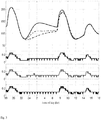
- the target zone bounds are plotted over the course of one day in Fig. 1 .
- the transition function is omitted as straightforward.
- the disclosed MPC strategy enforces daily periodically time-dependent, hard, insulin input rate constraints via (2).
- the input rate is bounded from above only by the pump's maximum achievable flow-rate, and is thus hardware dependent. Note that this maximum rate is unlikely to ever be commanded by the controller.
- the input rate is limited from above to 1.5x the subject's basal rate (see Section III-D), and is subject-specific.
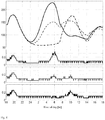
- the insulin input rate's lower bound is zero at all times. Daytime is from 5am to 10pm. All other times are nighttime - there is no transition period. Note that the start of day- and nighttimes coincides with the start of the output zones' transition periods. The insulin bounds are plotted over the course of one day in Fig. 2 .
- the disclosed PZMPC strategy is tested using the Uni. Padova/UVa FDA accepted metabolic simulator [15] with 100 in silico adult subjects.
- the PZMPC strategy is compared to two alternative control strategies.
- the first alternative is the zone-MPC strategy described in [5,6] employing the same blood-glucose target zone (equal to the PZMPC daytime zone) at all times of day. This strategy is referred to here as invariant-zone MPC.
- the second alternative employs the invariant-zone MPC strategy only during the day (5am-10pm), and delivers the subject-specific basal insulin input rate during the night (10pm-5am). This strategy is referred to as the nighttime-basal strategy.
- the purpose of the experiment is to demonstrate increased safety margins during the night when using the disclosed PZMPC algorithm.
- the simulations start at 1pm and end at 6pm the following day (simulated time).
- the controllers operate in closed-loop from 4pm on the first day until the end of the simulation.
- a 50g dinner, 40g breakfast and 15g snack is provided at 6pm, 7am (next day) and 2pm (next day), respectively.
- Meal weights refer to carbohydrates. Results prior to 6pm on the first day are ignored to reduce the effects of initial conditions.
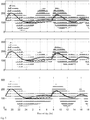
- the simulation result for an in silico subject that displays very typical behavior is depicted in Fig. 3 .
- the main response difference, as desired and expected, is an elevated blood-glucose level during the night when using PZMPC. This is achieved by imposing a prolonged reduction in insulin input rate during the transition from daytime zone to nighttime zone starting at about 10pm.
- the three control strategies produce the same output response until shortly before 11pm, and a very similar output response after about 9am (next day). All three control strategies produce the same input response until shortly prior to 10pm, and a very similar input response after 8am (next day).
- the PZMPC strategy delivers more insulin in response to the 7am breakfast than the other two strategies.
- Fig. 5 Plotted in Fig. 5 are the trajectories of mean blood-glucose values over all 100 in silico subjects.
- the three control strategies produce very similar mean responses until midnight and after 9am, with the PZMPC, invariant-zone MPC and nighttime-basal strategies producing successively lower mean glucose responses during the night and early morning.
- Fig. 5 Also plotted in Fig. 5 are the min-max envelopes of the blood-glucose responses for the three contrasted control strategies. Again, before midnight and after about 9am the envelopes are very similar. However, the PZMPC, invariant-zone MPC and nighttime-basal strategies result in significantly different nighttime envelope boundaries. Of particular interest for the purpose of increased safety margins is that with the PZMPC approach the nighttime lower-bound of the envelope spends much time near (partly above) 100 mg/dL.
- the ratio of mean blood-glucose level achieved with invariant-zone MPC vs. the mean blood-glucose level achieved with PZMPC is less than unity for each in silico subject, both for the whole day and only nighttime.
- the ratio of total insulin delivery with invariant-zone MPC vs. the total insulin delivery with PZMPC is greater than unity for each in silico subject during the night, and greater than unity for all except one in silico subject for the whole day. The one exception is described in more detail in Section IV-D.
- the behavior is a statistical exception, but not surprising, and conforms to the response that can be expected from the PZMPC controller.
- One of the purposes of the Uni. Padova/UVa simulator is to facilitate the testing of glycemia controllers on virtual patients that have physiological parameters over a wide spectrum.
- the disclosed PZMPC strategy was tested via simulations in other scenarios, and it demonstrated excellent responses to unannounced meals, severe hypoglycemia, and unannounced, self-administered insulin boluses.
- An MPC strategy employing daily periodic blood-glucose target zones and daily periodic insulin input constraints is provided to safely operate glycemia controllers for prolonged, multi-day periods, including times that the subject is asleep.
- This control strategy is useful for the testing, verification and operation of an artificial pancreas for the treatment of T1DM.
- silico testing confirmed that the strategy achieves the goal of reducing the threat of hypoglycemia during nighttime.
- More advanced periodic MPC schemes are also provided; for example, the inclusion of diurnal physiological time-dependence in the insulin-glucose dynamics, and the incorporation of time-dependent changes in subject behavior over a typical week.
- Fig. 1 Daily periodic blood-glucose ( y BG ) target zone boundaries [mg/dL]. Daytime: 7am-10pm. Nighttime: 12pm-5am. Daytime zone: [80; 140] mg/dL. Nighttime zone: [110; 220] mg/dL. Smooth transition of two hour duration (5-7am, 10-12pm) based on cosine function.
- Fig. 2 Daily periodic constraints on the insulin input rate u IN [U/h]. Daytime: 5am-10pm. Nighttime: 10pm-5am. Daytime upper-bound is pump-maximum: Hardware dependent. Nighttime upper-bound is 1:5 u basal : Subject-specific. Lower-bound is 0 [U/h] at all times.
- FIG. 3 Simulation result.
- Top plot is blood-glucose [mg/dL]: PZMPC (blue, solid), invariant-zone MPC (red, dashed), nighttime-basal (black, dash-dotted).
- Lower three plots are insulin input rate [U/h]: PZMPC (blue, top), invariant-zone MPC (red, middle), nighttime-basal (black, bottom). This in silico subject results in trajectories with typical characteristics.
- Fig. 4 Simulation result.
- Top plot is blood-glucose [mg/dL]: PZMPC (blue, solid), invariant-zone MPC (red, dashed), nighttime-basal (black, dash-dotted).
- Lower three plots are insulin input rate [U/h]: PZMPC (blue, top), invariant-zone MPC (red, middle), nighttime-basal (black, bottom).
- PZMPC resulted in more total insulin delivery than invariant-zone MPC and nighttime-basal strategies.
- Fig. 5 Blood-glucose ( y BG [mg/dL]) mean trajectories and min-max envelopes over 100 in silico subjects. Mean trajectories identical on each subplot: PZMPC (blue, solid), invariant-zone MPC (red, dashed), nighttime-basal (black, dash-dotted). Envelopes: PZMPC (top), invariant-zone MPC (middle), nighttime-basal (bottom).
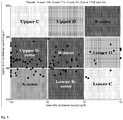
- Fig. 6 CVGA plot for 100 in silico subjects and PZMPC (see also Table II).
- Zone MPC glycemia controllers This example describes a modification to our Zone MPC algorithm, and facilitates operating Zone MPC glycemia controllers in fully closed-loop mode for extended, multi-day periods of time.
- Operating glycemia controllers for extended periods of time is indispensable for the development, testing and verification of an artificial pancreas that is fully automated and requires no specialist supervision.
- the control strategy employed is a feedback-control strategy, where measurements of blood glucose values are used by the controller in order to determine a value of the insulin input that is applied to the subject.
- An outline of the real-time control protocol is shown in Fig. S1. This example refers in its entirety to the operation "Control Action Calculated”.
- the control algorithm is a so-called Model Predictive Control (MPC) algorithm.
- MPC employs an explicit model of the process to be controlled when optimizing the input.
- MPC controllers for glycemia control use a model of a human's T1DM glucose-insulin dynamics to predict the evolution of the blood glucose values over a so-called prediction horizon of P controller steps, and optimize a predicted insulin input trajectory in order to optimize a specified cost objective that penalizes unsafe glycemic values and also insulin usage.
- the MPC controller determines an optimal predicted insulin input trajectory into the future. However, only the first insulin input of the optimal trajectory is applied to the subject, and at the next step k + 1 the optimization process is repeated.
- MPC is based on real-time numerical optimization, and this allows for a large degree of flexibility when defining the control objective.
- constraints can be incorporated explicitly into the optimization routine.
- constraints on the input ensure that insulin delivery rates are constrained between prescribed minimum and maximum values.
- Zone MPC Another mechanism of exploiting the flexibility of MPC is to consider Zone MPC.
- Zone MPC for glycemia control the controller strives to maintain a blood glucose level that is within a safe zone, rather than controlling the blood glucose level to a specific set point.
- Zone MPC is applied when a specific set point value of a controlled variable (CV) is of low relevance compared to a zone that is defined by upper and lower boundaries.
- CV controlled variable
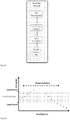
- the Zone MPC strategy of this work is implemented by defining upper and lower bounds (see Fig. S2) as soft constraints and optimizing the insulin input computation by penalizing, by means of an appropriate cost function, the deviations of predicted blood glucose levels beyond the zone.
- Fig. S2 illustrates the three zones defined in the Zone MPC, from top to bottom: Undesirably high glycemia value zone, controller target zone, and undesirably low glycemia value zone.
- the green dots in Fig. S2 indicate predicted glycemic values that are in the desired range.
- the upper zone represents undesirably high predicted glycemic values that are represented by orange dots.
- the lower zone represents undesirably low predicted glycemic values, symbolized by red dots.
- the zone below the lower bound represents either a hypoglycemic zone, or a pre-hypoglycemic protective area that is a low alarm zone.
- Zone MPC is performed employing periodically time-dependent zones, where the periodic time-dependence is with respect to the time of day.
- the purpose of this is to let the controller maintain safe glucose zones during the night that are different from the safe glucose zones maintained during the day, and to facilitate a smooth transition between the night and day zones.
- a higher safe zone be maintained than during the day, in order to reduce the likelihood of (controller induced) hypoglycemic events during sleep.
- a smooth transition between night and day zones is achieved by smoothly shifting the zone boundaries according to a cosine function.
- the second of three significant changes from IDE G110093 is that the online optimization of the insulin input, performed as part of the Zone MPC routine, is performed with respect to hard constraints that are periodically time-dependent.
- the periodic time-dependence is again based on the time of day.
- the upper limit of insulin input during the day is higher than the upper limit imposed during the night.
- the maximum insulin input is the maximum insulin amount deliverable by the pump, and is hardware dependent. This is the same as in the Zone MPC algorithm described in the aforementioned references.
- the maximum insulin input is a small amount higher than the basal infusion rate, and is patient dependent.
- the amount by which the upper limit is higher than a patient's basal rate is a design parameter ( ⁇ , see Table S2).
- the purpose of having such time-dependent insulin input constraints is again to reduce the possibility of over-delivery of insulin while a patient is asleep. While appropriate choices of the safe zone definitions during the night and day should result in a controller giving near-basal insulin inputs, the night-time input constraint, enforced explicitly within the input optimization, acts as a further safety mechanism, preventing the administration of excessive insulin.
- MPC is a State-Feedback Strategy
- MPC is a state-feedback control strategy. This means that at each time step k that the controller is invoked, the controller's internal model must be initialized to the most appropriate state, such that glucose predictions correspond as closely as possible to reality. In the case of glycemia control an appropriate state is not directly measurable. Therefore a state-estimator is employed to estimate the most appropriate state from the available blood glucose measurements.
- the state-estimator employed is a linear-estimator (sometimes referred to as a Luenberger-observer) and has a gain as a tuning parameter.
- a suitable gain can be computed, and in this supplement a change to the method of gain computation is described. This method brings the gain-computation in-line with modern system-theoretic methodologies.
- PZMPC Periodic-Zone Model Predictive Control
- the adjustable parameters used in the PZMPC algorithm are listed in Table S2. These parameters are adjustable in the sense that they may be adjusted, within the ranges listed in Table S2, between clinical trials. However, they remain constant throughout any one trial. Changes from IDE G110093 are summarized in the right-most column. Table S2. Notation guide for the adjustable parameters in the Zone MPC. Symbol Min Value Nominal Value Max Value Unit Interpretation Change status R 12 15 50 h u 2 Weighting factor for the insulin term in the cost function Formerly fixed at 50. T Z 1 240 300 360 min End of nighttime, start of transition to daytime. New. See Eqs. (3), (4), (5). T Z 2 360 420 480 min Start of daytime, end of transition from nighttime. New. See Eqs.
- G ZH t : ⁇ V UN ⁇ V UD 2 cos ⁇ t ⁇ T Z 1 T Z 2 ⁇ T Z 1 + V UD + V UN 2 if T Z 1 ⁇ t ⁇ T Z 2 V UD if T Z 2 ⁇ t ⁇ T Z 3 V UD ⁇ V UN 2 cos ⁇ t ⁇ T Z 3 T Z 4 ⁇ T Z 3 + V UD + V UN 2 if T Z 3 ⁇ t ⁇ T Z 4 V UN otherwise
- G ZL t : ⁇ V LN ⁇ V LD 2 cos ⁇ t ⁇ T Z 1 T Z 2 ⁇ T Z 1 + V LD + V LN 2 if T Z 1 ⁇ t ⁇ T Z 2 V LD if T Z 2 ⁇ t ⁇ T Z 3 V LD ⁇ V LN 2 cos ⁇ t ⁇ T Z 3 T Z 4 ⁇ T Z 3 + V LD + V LN 2
- I H t : ⁇ I pump if T Z 1 ⁇ t ⁇ T Z 3 ⁇ ⁇ basal otherwise
- variable I' D denotes the offset of the actual infusion rate to the basal infusion rate.
- the gain L must be chosen such that ⁇ ( A - LC) ⁇ 1, where ⁇ () denotes the spectral radius.
- L ⁇ 4233.7 ⁇ 3768.3 ⁇ 3317.6
- MATLAB's function 'fmincon.m' (“trust-region-reflective” algorithm) is used to solve the optimization problem (i.e., the minimization of the cost function J ( I ' D )).
- the following parameters are used for each optimization:
- Initialization corresponds to gathering enough information about glucose measurements and insulin delivery rates in order to determine a reliable state estimate to initialize the prediction.
- the ratio of the output error weighting matrix ( Q ) and the input change weighting matrix ( R ) may be varied between: 12 ⁇ R Q ⁇ 50.
- the larger Q ⁇ matrix resulted in faster convergence of the state estimate.
- Q ⁇ 10000 ⁇ I
- a useful value of Q ⁇ matrix is determined to be between 1000 ⁇ I and 5000 ⁇ I .
Landscapes
- Health & Medical Sciences (AREA)
- Engineering & Computer Science (AREA)
- Public Health (AREA)
- General Health & Medical Sciences (AREA)
- Medical Informatics (AREA)
- Biomedical Technology (AREA)
- Life Sciences & Earth Sciences (AREA)
- Animal Behavior & Ethology (AREA)
- Hematology (AREA)
- Veterinary Medicine (AREA)
- Diabetes (AREA)
- Epidemiology (AREA)
- Primary Health Care (AREA)
- Heart & Thoracic Surgery (AREA)
- Vascular Medicine (AREA)
- Anesthesiology (AREA)
- Chemical & Material Sciences (AREA)
- Bioinformatics & Cheminformatics (AREA)
- Medicinal Chemistry (AREA)
- Data Mining & Analysis (AREA)
- Pathology (AREA)
- Databases & Information Systems (AREA)
- General Chemical & Material Sciences (AREA)
- Obesity (AREA)
- Chemical Kinetics & Catalysis (AREA)
- Pharmacology & Pharmacy (AREA)
- Nuclear Medicine, Radiotherapy & Molecular Imaging (AREA)
- Organic Chemistry (AREA)
- Endocrinology (AREA)
- Emergency Medicine (AREA)
- External Artificial Organs (AREA)
- Measurement Of The Respiration, Hearing Ability, Form, And Blood Characteristics Of Living Organisms (AREA)
- Infusion, Injection, And Reservoir Apparatuses (AREA)
- Investigating Or Analysing Biological Materials (AREA)
Applications Claiming Priority (2)
| Application Number | Priority Date | Filing Date | Title |
|---|---|---|---|
| US201361751942P | 2013-01-14 | 2013-01-14 | |
| PCT/US2014/011378 WO2014110541A1 (en) | 2013-01-14 | 2014-01-14 | Daily periodic target-zone modulation in the model predictive control problem for artificial pancreas for type i diabetes applications |
Publications (3)
| Publication Number | Publication Date |
|---|---|
| EP2943150A1 EP2943150A1 (en) | 2015-11-18 |
| EP2943150A4 EP2943150A4 (en) | 2016-10-26 |
| EP2943150B1 true EP2943150B1 (en) | 2018-12-05 |
Family
ID=51165703
Family Applications (1)
| Application Number | Title | Priority Date | Filing Date |
|---|---|---|---|
| EP14738072.9A Active EP2943150B1 (en) | 2013-01-14 | 2014-01-14 | Daily periodic target-zone modulation in the model predictive control problem for artificial pancreas for type i diabetes applications |
Country Status (8)
| Country | Link |
|---|---|
| US (1) | US10507284B2 (enExample) |
| EP (1) | EP2943150B1 (enExample) |
| JP (1) | JP6810989B2 (enExample) |
| KR (1) | KR102212020B1 (enExample) |
| CN (1) | CN105050539B (enExample) |
| AU (1) | AU2014205123B2 (enExample) |
| CA (1) | CA2897925C (enExample) |
| WO (1) | WO2014110541A1 (enExample) |
Families Citing this family (92)
| Publication number | Priority date | Publication date | Assignee | Title |
|---|---|---|---|---|
| US8417311B2 (en) | 2008-09-12 | 2013-04-09 | Optiscan Biomedical Corporation | Fluid component analysis system and method for glucose monitoring and control |
| US7972296B2 (en) | 2007-10-10 | 2011-07-05 | Optiscan Biomedical Corporation | Fluid component analysis system and method for glucose monitoring and control |
| US7959598B2 (en) | 2008-08-20 | 2011-06-14 | Asante Solutions, Inc. | Infusion pump systems and methods |
| EP3594961A1 (en) | 2010-10-31 | 2020-01-15 | Trustees of Boston University | Blood glucose control system |
| WO2014172467A1 (en) | 2013-04-16 | 2014-10-23 | Smartloop Llc | Discretionary insulin delivery systems and methods |
| US9561324B2 (en) | 2013-07-19 | 2017-02-07 | Bigfoot Biomedical, Inc. | Infusion pump system and method |
| GB2523989B (en) | 2014-01-30 | 2020-07-29 | Insulet Netherlands B V | Therapeutic product delivery system and method of pairing |
| WO2015116524A1 (en) | 2014-01-31 | 2015-08-06 | Trustees Of Boston University | Offline glucose control based on preceding periods |
| AU2015301146B2 (en) * | 2014-08-06 | 2020-06-25 | Regents Of The University Of California | Moving-horizon state-initializer for control applications |
| DE102015000845A1 (de) * | 2015-01-27 | 2016-07-28 | W.O.M. World Of Medicine Gmbh | Verfahren und Vorrichtung zur Regelung der Temperatur des Gasstroms bei medizintechnischen Vorrichtungen |
| CA2977053C (en) | 2015-02-18 | 2023-08-01 | Insulet Corporation | Fluid delivery and infusion devices, and methods of use thereof |
| EP3319511B1 (en) | 2015-08-07 | 2021-10-06 | Trustees of Boston University | Glucose control system with automatic adaptation of glucose target |
| WO2017070553A1 (en) * | 2015-10-21 | 2017-04-27 | University Of Virginia Patent Foundation | System, method and computer readable medium for dynamical tracking of the risk for hypoglycemia in type 1 and type 2 diabetes |
| JP6957509B2 (ja) * | 2016-01-12 | 2021-11-02 | プレジデント・アンド・フェロウズ・オブ・ハーバード・カレッジ | 過去の予測を使用する人工膵臓のための予測制御モデル |
| EP3374905A1 (en) | 2016-01-13 | 2018-09-19 | Bigfoot Biomedical, Inc. | User interface for diabetes management system |
| EP4545005A3 (en) | 2016-01-14 | 2025-07-02 | Insulet Corporation | Adjusting insulin delivery rates |
| HK1256995A1 (zh) | 2016-01-14 | 2019-10-11 | Bigfoot Biomedical, Inc. | 药物输送设备、系统和方法中的阻塞解决方案 |
| AU2017216336B2 (en) | 2016-02-05 | 2020-12-10 | Animas Corporation | Visualization and analysis tool for a drug delivery system |
| EP3451926B1 (en) | 2016-05-02 | 2024-12-11 | DexCom, Inc. | System for providing alerts optimized for a user |
| US12383166B2 (en) | 2016-05-23 | 2025-08-12 | Insulet Corporation | Insulin delivery system and methods with risk-based set points |
| WO2018009614A1 (en) | 2016-07-06 | 2018-01-11 | President And Fellows Of Harvard College | Event-triggered model predictive control for embedded artificial pancreas systems |
| WO2018058041A1 (en) | 2016-09-23 | 2018-03-29 | Insulet Corporation | Fluid delivery device with sensor |
| AU2017376111B2 (en) | 2016-12-12 | 2023-02-02 | Bigfoot Biomedical, Inc. | Alarms and alerts for medication delivery devices and related systems and methods |
| US10500334B2 (en) | 2017-01-13 | 2019-12-10 | Bigfoot Biomedical, Inc. | System and method for adjusting insulin delivery |
| US10881793B2 (en) | 2017-01-13 | 2021-01-05 | Bigfoot Biomedical, Inc. | System and method for adjusting insulin delivery |
| EP4708310A3 (en) | 2017-01-13 | 2026-05-06 | Insulet Corporation | Insulin delivery methods, systems and devices |
| EP4708311A3 (en) | 2017-01-13 | 2026-05-20 | Insulet Corporation | METHODS, SYSTEMS AND DEVICES FOR INSULIN ADMINISTRATION |
| US10583250B2 (en) | 2017-01-13 | 2020-03-10 | Bigfoot Biomedical, Inc. | System and method for adjusting insulin delivery |
| US10758675B2 (en) | 2017-01-13 | 2020-09-01 | Bigfoot Biomedical, Inc. | System and method for adjusting insulin delivery |
| US11497851B2 (en) * | 2017-03-31 | 2022-11-15 | Lifescan Ip Holdings, Llc | Maintaining maximum dosing limits for closed loop insulin management systems |
| US11147920B2 (en) | 2017-04-18 | 2021-10-19 | Lifescan Ip Holdings, Llc | Diabetes management system with automatic basal and manual bolus insulin control |
| CA3059985C (en) | 2017-05-05 | 2023-08-08 | Eli Lilly And Company | Closed loop control of physiological glucose |
| US12161463B2 (en) | 2017-06-09 | 2024-12-10 | President And Fellows Of Harvard College | Prevention of post-bariatric hypoglycemia using a novel glucose prediction algorithm and mini-dose stable glucagon |
| US12653426B2 (en) | 2017-07-13 | 2026-06-16 | Bigfoot Biomedical, Inc. | Multi-scale display of blood glucose information |
| EP4765154A2 (en) | 2017-08-02 | 2026-06-24 | Diabeloop | Closed-loop blood glucose control systems and methods |
| JP7133625B2 (ja) | 2017-12-21 | 2022-09-08 | イーライ リリー アンド カンパニー | 生理的グルコースの閉ループ制御 |
| JP7443235B2 (ja) | 2018-02-09 | 2024-03-05 | デックスコム・インコーポレーテッド | 意思決定支援のシステムおよび方法 |
| USD928199S1 (en) | 2018-04-02 | 2021-08-17 | Bigfoot Biomedical, Inc. | Medication delivery device with icons |
| US11147919B2 (en) | 2018-04-23 | 2021-10-19 | Medtronic Minimed, Inc. | Methodology to recommend and implement adjustments to a fluid infusion device of a medication delivery system |
| US11158413B2 (en) | 2018-04-23 | 2021-10-26 | Medtronic Minimed, Inc. | Personalized closed loop medication delivery system that utilizes a digital twin of the patient |
| US11565043B2 (en) | 2018-05-04 | 2023-01-31 | Insulet Corporation | Safety constraints for a control algorithm based drug delivery system |
| US12562251B1 (en) | 2018-05-09 | 2026-02-24 | Bigfoot Biomedical, Inc. | Computing architecture for assuring the provenance of medication therapy related parameters, and related systems, methods and devices |
| US12128212B2 (en) | 2018-06-19 | 2024-10-29 | President And Fellows Of Harvard College | Adaptive zone model predictive control with a glucose and velocity dependent dynamic cost function for an artificial pancreas |
| CN112313754A (zh) | 2018-06-22 | 2021-02-02 | 伊莱利利公司 | 胰岛素和普兰林肽输送系统、方法和设备 |
| US11547799B2 (en) | 2018-09-20 | 2023-01-10 | Medtronic Minimed, Inc. | Patient day planning systems and methods |
| AU2019347755B2 (en) | 2018-09-28 | 2023-02-02 | Insulet Corporation | Activity mode for artificial pancreas system |
| WO2020077223A1 (en) | 2018-10-11 | 2020-04-16 | Insulet Corporation | Event detection for drug delivery system |
| USD920343S1 (en) | 2019-01-09 | 2021-05-25 | Bigfoot Biomedical, Inc. | Display screen or portion thereof with graphical user interface associated with insulin delivery |
| US11986629B2 (en) | 2019-06-11 | 2024-05-21 | Medtronic Minimed, Inc. | Personalized closed loop optimization systems and methods |
| US11957876B2 (en) | 2019-07-16 | 2024-04-16 | Beta Bionics, Inc. | Glucose control system with automated backup therapy protocol generation |
| JP7657428B2 (ja) | 2019-07-16 | 2025-04-07 | ベータ バイオニクス,インコーポレイテッド | 血糖制御システム |
| MX2022000670A (es) | 2019-07-16 | 2022-05-20 | Beta Bionics Inc | Sistema de control de glucosa en sangre. |
| US11801344B2 (en) | 2019-09-13 | 2023-10-31 | Insulet Corporation | Blood glucose rate of change modulation of meal and correction insulin bolus quantity |
| US11935637B2 (en) | 2019-09-27 | 2024-03-19 | Insulet Corporation | Onboarding and total daily insulin adaptivity |
| EP4354455B1 (en) | 2019-12-06 | 2025-10-29 | Insulet Corporation | Techniques and devices providing adaptivity and personalization in diabetes treatment |
| US11833329B2 (en) | 2019-12-20 | 2023-12-05 | Insulet Corporation | Techniques for improved automatic drug delivery performance using delivery tendencies from past delivery history and use patterns |
| WO2021141941A1 (en) | 2020-01-06 | 2021-07-15 | Insulet Corporation | Prediction of meal and/or exercise events based on persistent residuals |
| WO2021158580A1 (en) | 2020-02-03 | 2021-08-12 | Insulet Corporation | Use of fuzzy logic in predicting user behavior affecting blood glucose concentration |
| US11551802B2 (en) | 2020-02-11 | 2023-01-10 | Insulet Corporation | Early meal detection and calorie intake detection |
| US11547800B2 (en) | 2020-02-12 | 2023-01-10 | Insulet Corporation | User parameter dependent cost function for personalized reduction of hypoglycemia and/or hyperglycemia in a closed loop artificial pancreas system |
| US11986630B2 (en) | 2020-02-12 | 2024-05-21 | Insulet Corporation | Dual hormone delivery system for reducing impending hypoglycemia and/or hyperglycemia risk |
| US11324889B2 (en) | 2020-02-14 | 2022-05-10 | Insulet Corporation | Compensation for missing readings from a glucose monitor in an automated insulin delivery system |
| US12495994B2 (en) | 2020-02-20 | 2025-12-16 | Insulet Corporation | Meal bolus subcategories in model based insulin therapy |
| US11607493B2 (en) | 2020-04-06 | 2023-03-21 | Insulet Corporation | Initial total daily insulin setting for user onboarding |
| CN111710009B (zh) * | 2020-05-29 | 2023-06-23 | 北京百度网讯科技有限公司 | 人流密度的生成方法、装置、电子设备以及存储介质 |
| US12121700B2 (en) | 2020-07-22 | 2024-10-22 | Insulet Corporation | Open-loop insulin delivery basal parameters based on insulin delivery records |
| US11684716B2 (en) | 2020-07-31 | 2023-06-27 | Insulet Corporation | Techniques to reduce risk of occlusions in drug delivery systems |
| US12569619B2 (en) | 2020-09-21 | 2026-03-10 | Insulet Corporation | Techniques for determining automated insulin delivery dosages |
| US12115351B2 (en) | 2020-09-30 | 2024-10-15 | Insulet Corporation | Secure wireless communications between a glucose monitor and other devices |
| EP4696344A3 (en) | 2020-09-30 | 2026-04-15 | Insulet Corporation | Drug delivery device with integrated optical-based glucose monitor |
| KR102521085B1 (ko) * | 2020-10-30 | 2023-04-12 | 이오플로우(주) | 인슐린 패치를 포함하는 인공췌장 제어 방법 및 그 장치 |
| US11160925B1 (en) | 2021-01-29 | 2021-11-02 | Insulet Corporation | Automatic drug delivery system for delivery of a GLP-1 therapeutic |
| EP4285376A1 (en) | 2021-01-29 | 2023-12-06 | Insulet Corporation | Techniques and devices that adapt basal profiles for drug delivery applications |
| US20220273874A1 (en) * | 2021-02-24 | 2022-09-01 | University Of Virginia Patent Foundation | Method and system of fully-automated artificial pancreas control for counteracting postprandial hyperglycemia |
| US12636435B2 (en) | 2021-02-26 | 2026-05-26 | Insulet Corporation | Techniques for optimizing usage of an automatic drug delivery system |
| WO2022192482A1 (en) | 2021-03-10 | 2022-09-15 | Insulet Corporation | A medicament delivery device with an adjustable and piecewise analyte level cost component to address persistent positive analyte level excursions |
| US11904140B2 (en) | 2021-03-10 | 2024-02-20 | Insulet Corporation | Adaptable asymmetric medicament cost component in a control system for medicament delivery |
| USD1127405S1 (en) | 2021-03-25 | 2026-05-26 | Beta Bionics, Inc. | Clip for bionic pancreas infusion pump cases |
| US12465686B2 (en) | 2021-03-25 | 2025-11-11 | Beta Bionics, Inc. | Emergency medicament dose control |
| US12592306B2 (en) | 2021-04-28 | 2026-03-31 | Insulet Corporation | Devices and methods for initialization of drug delivery devices using measured analyte sensor information |
| US12496398B2 (en) | 2021-05-28 | 2025-12-16 | Insulet Corporation | Threshold based automatic glucose control response |
| EP4101482A1 (en) | 2021-06-07 | 2022-12-14 | Insulet Corporation | Exercise safety prediction based on physiological conditions |
| US12514980B2 (en) | 2021-06-30 | 2026-01-06 | Insulet Corporation | Adjustment of medicament delivery by a medicament delivery device based on menstrual cycle phase |
| US12521486B2 (en) | 2021-07-16 | 2026-01-13 | Insulet Corporation | Method for modification of insulin delivery during pregnancy in automatic insulin delivery systems |
| US12653949B2 (en) | 2021-07-29 | 2026-06-16 | Insulet Corporation | Adaptation of medicament delivery in response to user stress load |
| EP4409581A1 (en) | 2021-09-27 | 2024-08-07 | Insulet Corporation | Techniques enabling adaptation of parameters in aid systems by user input |
| US11439754B1 (en) | 2021-12-01 | 2022-09-13 | Insulet Corporation | Optimizing embedded formulations for drug delivery |
| WO2023150737A1 (en) | 2022-02-07 | 2023-08-10 | Insulet Corporation | Techniques for determining medication correction factors in automatic medication delivery systems |
| EP4243030A1 (en) | 2022-03-09 | 2023-09-13 | Insulet Corporation | Adjusting medicament delivery parameters in an open loop medicament delivery mode |
| EP4511843A1 (en) | 2022-04-21 | 2025-02-26 | Insulet Corporation | Insulin adaptation and safety monitoring for sick day management |
| KR20250129777A (ko) | 2023-01-06 | 2025-08-29 | 인슐렛 코포레이션 | 후속 자동 안전 제약 완화를 갖는 자동으로 또는 수동으로 개시되는 음식 볼러스 전달 |
| CN119480135B (zh) * | 2024-11-08 | 2025-10-10 | 北京理工大学 | 基于未知外源输入估计的餐后长时间窗血糖态势预测方法 |
Family Cites Families (13)
| Publication number | Priority date | Publication date | Assignee | Title |
|---|---|---|---|---|
| US6740072B2 (en) * | 2001-09-07 | 2004-05-25 | Medtronic Minimed, Inc. | System and method for providing closed loop infusion formulation delivery |
| US8152789B2 (en) * | 2001-10-23 | 2012-04-10 | Medtronic Minimed, Inc. | System and method for providing closed loop infusion formulation delivery |
| US7591801B2 (en) * | 2004-02-26 | 2009-09-22 | Dexcom, Inc. | Integrated delivery device for continuous glucose sensor |
| WO2006124716A2 (en) * | 2005-05-13 | 2006-11-23 | Trustees Of Boston University | Fully automated control system for type 1 diabetes |
| US9056165B2 (en) * | 2006-09-06 | 2015-06-16 | Medtronic Minimed, Inc. | Intelligent therapy recommendation algorithm and method of using the same |
| US20080234943A1 (en) * | 2007-03-20 | 2008-09-25 | Pinaki Ray | Computer program for diabetes management |
| US20100145262A1 (en) * | 2007-05-03 | 2010-06-10 | Novo Nordisk A/S | Safety system for insulin delivery advisory algorithms |
| SI2518655T1 (sl) * | 2007-06-21 | 2020-02-28 | F. Hoffmann-La Roche Ag | Pripomoček in metoda za preprečevanje hipoglikemije |
| JP2010531707A (ja) * | 2007-06-25 | 2010-09-30 | メディンゴ・リミテッド | 適合された基礎インスリン送達システム |
| EP3881874A1 (en) * | 2008-09-15 | 2021-09-22 | DEKA Products Limited Partnership | Systems and methods for fluid delivery |
| EP2413781B1 (en) * | 2009-03-31 | 2019-07-24 | Abbott Diabetes Care Inc. | Overnight closed-loop insulin delivery with model predictive control and glucose measurement error model |
| EP2628115B1 (en) * | 2010-10-12 | 2015-06-03 | The Regents of The University of California | Insulin delivery device |
| US9486578B2 (en) * | 2012-12-07 | 2016-11-08 | Animas Corporation | Method and system for tuning a closed-loop controller for an artificial pancreas |
-
2014
- 2014-01-14 EP EP14738072.9A patent/EP2943150B1/en active Active
- 2014-01-14 AU AU2014205123A patent/AU2014205123B2/en active Active
- 2014-01-14 JP JP2015552873A patent/JP6810989B2/ja active Active
- 2014-01-14 CA CA2897925A patent/CA2897925C/en active Active
- 2014-01-14 WO PCT/US2014/011378 patent/WO2014110541A1/en not_active Ceased
- 2014-01-14 CN CN201480015278.4A patent/CN105050539B/zh active Active
- 2014-01-14 US US14/154,241 patent/US10507284B2/en active Active
- 2014-01-14 KR KR1020157021677A patent/KR102212020B1/ko active Active
Non-Patent Citations (1)
| Title |
|---|
| None * |
Also Published As
| Publication number | Publication date |
|---|---|
| US10507284B2 (en) | 2019-12-17 |
| KR20150108860A (ko) | 2015-09-30 |
| AU2014205123B2 (en) | 2018-08-16 |
| AU2014205123A1 (en) | 2015-07-30 |
| JP6810989B2 (ja) | 2021-01-13 |
| WO2014110541A1 (en) | 2014-07-17 |
| CA2897925A1 (en) | 2014-07-17 |
| KR102212020B1 (ko) | 2021-02-05 |
| EP2943150A1 (en) | 2015-11-18 |
| CN105050539A (zh) | 2015-11-11 |
| EP2943150A4 (en) | 2016-10-26 |
| US20140200559A1 (en) | 2014-07-17 |
| CA2897925C (en) | 2017-05-30 |
| CN105050539B (zh) | 2018-05-18 |
| JP2016504119A (ja) | 2016-02-12 |
Similar Documents
| Publication | Publication Date | Title |
|---|---|---|
| US10507284B2 (en) | Daily periodic target-zone modulation in the model predictive control problem for artificial pancreas for type I diabetes applications | |
| Grosman et al. | Zone model predictive control: a strategy to minimize hyper-and hypoglycemic events | |
| Palerm et al. | A run-to-run control strategy to adjust basal insulin infusion rates in type 1 diabetes | |
| EP2521483B1 (en) | System to deliver insulin to a subject | |
| Marchetti et al. | A feedforward–feedback glucose control strategy for type 1 diabetes mellitus | |
| León-Vargas et al. | Postprandial blood glucose control using a hybrid adaptive PD controller with insulin-on-board limitation | |
| Kovatchev et al. | Control to range for diabetes: functionality and modular architecture | |
| EP2628115B1 (en) | Insulin delivery device | |
| Daskalaki et al. | An Actor–Critic based controller for glucose regulation in type 1 diabetes | |
| León-Vargas et al. | Postprandial response improvement via safety layer in closed-loop blood glucose controllers | |
| JP2016047388A (ja) | 血糖制御システム | |
| Toffanin et al. | Automatic adaptation of basal therapy for type 1 diabetic patients: a run-to-run approach | |
| Allam et al. | Evaluation of using a recurrent neural network (RNN) and a fuzzy logic controller (FLC) in closed loop system to regulate blood glucose for type-1 diabetic patients | |
| Batora et al. | Bihormonal control of blood glucose in people with type 1 diabetes | |
| Mirzaee et al. | A nonlinear MPC approach for blood glucose regulation in diabetic patients | |
| Boiroux et al. | Overnight control of blood glucose in people with type 1 diabetes | |
| Boiroux et al. | A nonlinear model predictive control strategy for glucose control in people with type 1 diabetes | |
| CN110352460A (zh) | 人工胰腺 | |
| Das et al. | Glucose regulation in diabetes patients via insulin pump: A feedback linearisation approach | |
| Boiroux et al. | Assessment of model predictive and adaptive glucose control strategies for people with type 1 diabetes | |
| Baldisseri et al. | A quantitative comparison of deep reinforcement learning algorithms for type 1 diabetes control | |
| Van Herpe et al. | The application of model predictive control to normalize glycemia of critically ill patients | |
| Ata et al. | Model based control of artificial pancreas under meal disturbances | |
| Rashid et al. | Plasma insulin cognizant predictive control for artificial pancreas | |
| Boiroux | Model predictive control algorithms for pen and pump insulin administration |
Legal Events
| Date | Code | Title | Description |
|---|---|---|---|
| PUAI | Public reference made under article 153(3) epc to a published international application that has entered the european phase |
Free format text: ORIGINAL CODE: 0009012 |
|
| 17P | Request for examination filed |
Effective date: 20150710 |
|
| AK | Designated contracting states |
Kind code of ref document: A1 Designated state(s): AL AT BE BG CH CY CZ DE DK EE ES FI FR GB GR HR HU IE IS IT LI LT LU LV MC MK MT NL NO PL PT RO RS SE SI SK SM TR |
|
| AX | Request for extension of the european patent |
Extension state: BA ME |
|
| DAX | Request for extension of the european patent (deleted) | ||
| RIC1 | Information provided on ipc code assigned before grant |
Ipc: A61F 2/76 20060101ALI20160602BHEP Ipc: G06F 19/00 20110101ALI20160602BHEP Ipc: A61M 5/142 20060101ALI20160602BHEP Ipc: A61F 2/02 20060101AFI20160602BHEP Ipc: A61M 5/172 20060101ALI20160602BHEP |
|
| A4 | Supplementary search report drawn up and despatched |
Effective date: 20160928 |
|
| RIC1 | Information provided on ipc code assigned before grant |
Ipc: A61M 5/172 20060101ALI20160922BHEP Ipc: A61M 5/142 20060101ALI20160922BHEP Ipc: G06F 19/00 20110101ALI20160922BHEP Ipc: A61F 2/02 20060101AFI20160922BHEP Ipc: A61F 2/76 20060101ALI20160922BHEP |
|
| STAA | Information on the status of an ep patent application or granted ep patent |
Free format text: STATUS: EXAMINATION IS IN PROGRESS |
|
| 17Q | First examination report despatched |
Effective date: 20170522 |
|
| GRAP | Despatch of communication of intention to grant a patent |
Free format text: ORIGINAL CODE: EPIDOSNIGR1 |
|
| STAA | Information on the status of an ep patent application or granted ep patent |
Free format text: STATUS: GRANT OF PATENT IS INTENDED |
|
| INTG | Intention to grant announced |
Effective date: 20180705 |
|
| RIN1 | Information on inventor provided before grant (corrected) |
Inventor name: GONDHALEKAR, RAVI, L. Inventor name: DASSAU, EYAL Inventor name: DOYLE III, FRANCIS J. |
|
| GRAS | Grant fee paid |
Free format text: ORIGINAL CODE: EPIDOSNIGR3 |
|
| GRAA | (expected) grant |
Free format text: ORIGINAL CODE: 0009210 |
|
| STAA | Information on the status of an ep patent application or granted ep patent |
Free format text: STATUS: THE PATENT HAS BEEN GRANTED |
|
| AK | Designated contracting states |
Kind code of ref document: B1 Designated state(s): AL AT BE BG CH CY CZ DE DK EE ES FI FR GB GR HR HU IE IS IT LI LT LU LV MC MK MT NL NO PL PT RO RS SE SI SK SM TR |
|
| REG | Reference to a national code |
Ref country code: GB Ref legal event code: FG4D |
|
| REG | Reference to a national code |
Ref country code: CH Ref legal event code: EP |
|
| REG | Reference to a national code |
Ref country code: AT Ref legal event code: REF Ref document number: 1072115 Country of ref document: AT Kind code of ref document: T Effective date: 20181215 |
|
| REG | Reference to a national code |
Ref country code: IE Ref legal event code: FG4D |
|
| REG | Reference to a national code |
Ref country code: DE Ref legal event code: R096 Ref document number: 602014037416 Country of ref document: DE |
|
| REG | Reference to a national code |
Ref country code: NL Ref legal event code: MP Effective date: 20181205 |
|
| REG | Reference to a national code |
Ref country code: AT Ref legal event code: MK05 Ref document number: 1072115 Country of ref document: AT Kind code of ref document: T Effective date: 20181205 |
|
| REG | Reference to a national code |
Ref country code: LT Ref legal event code: MG4D |
|
| PG25 | Lapsed in a contracting state [announced via postgrant information from national office to epo] |
Ref country code: LV Free format text: LAPSE BECAUSE OF FAILURE TO SUBMIT A TRANSLATION OF THE DESCRIPTION OR TO PAY THE FEE WITHIN THE PRESCRIBED TIME-LIMIT Effective date: 20181205 Ref country code: ES Free format text: LAPSE BECAUSE OF FAILURE TO SUBMIT A TRANSLATION OF THE DESCRIPTION OR TO PAY THE FEE WITHIN THE PRESCRIBED TIME-LIMIT Effective date: 20181205 Ref country code: AT Free format text: LAPSE BECAUSE OF FAILURE TO SUBMIT A TRANSLATION OF THE DESCRIPTION OR TO PAY THE FEE WITHIN THE PRESCRIBED TIME-LIMIT Effective date: 20181205 Ref country code: HR Free format text: LAPSE BECAUSE OF FAILURE TO SUBMIT A TRANSLATION OF THE DESCRIPTION OR TO PAY THE FEE WITHIN THE PRESCRIBED TIME-LIMIT Effective date: 20181205 Ref country code: FI Free format text: LAPSE BECAUSE OF FAILURE TO SUBMIT A TRANSLATION OF THE DESCRIPTION OR TO PAY THE FEE WITHIN THE PRESCRIBED TIME-LIMIT Effective date: 20181205 Ref country code: BG Free format text: LAPSE BECAUSE OF FAILURE TO SUBMIT A TRANSLATION OF THE DESCRIPTION OR TO PAY THE FEE WITHIN THE PRESCRIBED TIME-LIMIT Effective date: 20190305 Ref country code: NO Free format text: LAPSE BECAUSE OF FAILURE TO SUBMIT A TRANSLATION OF THE DESCRIPTION OR TO PAY THE FEE WITHIN THE PRESCRIBED TIME-LIMIT Effective date: 20190305 Ref country code: LT Free format text: LAPSE BECAUSE OF FAILURE TO SUBMIT A TRANSLATION OF THE DESCRIPTION OR TO PAY THE FEE WITHIN THE PRESCRIBED TIME-LIMIT Effective date: 20181205 |
|
| PG25 | Lapsed in a contracting state [announced via postgrant information from national office to epo] |
Ref country code: GR Free format text: LAPSE BECAUSE OF FAILURE TO SUBMIT A TRANSLATION OF THE DESCRIPTION OR TO PAY THE FEE WITHIN THE PRESCRIBED TIME-LIMIT Effective date: 20190306 Ref country code: RS Free format text: LAPSE BECAUSE OF FAILURE TO SUBMIT A TRANSLATION OF THE DESCRIPTION OR TO PAY THE FEE WITHIN THE PRESCRIBED TIME-LIMIT Effective date: 20181205 Ref country code: SE Free format text: LAPSE BECAUSE OF FAILURE TO SUBMIT A TRANSLATION OF THE DESCRIPTION OR TO PAY THE FEE WITHIN THE PRESCRIBED TIME-LIMIT Effective date: 20181205 Ref country code: AL Free format text: LAPSE BECAUSE OF FAILURE TO SUBMIT A TRANSLATION OF THE DESCRIPTION OR TO PAY THE FEE WITHIN THE PRESCRIBED TIME-LIMIT Effective date: 20181205 |
|
| PG25 | Lapsed in a contracting state [announced via postgrant information from national office to epo] |
Ref country code: NL Free format text: LAPSE BECAUSE OF FAILURE TO SUBMIT A TRANSLATION OF THE DESCRIPTION OR TO PAY THE FEE WITHIN THE PRESCRIBED TIME-LIMIT Effective date: 20181205 |
|
| PG25 | Lapsed in a contracting state [announced via postgrant information from national office to epo] |
Ref country code: PL Free format text: LAPSE BECAUSE OF FAILURE TO SUBMIT A TRANSLATION OF THE DESCRIPTION OR TO PAY THE FEE WITHIN THE PRESCRIBED TIME-LIMIT Effective date: 20181205 Ref country code: CZ Free format text: LAPSE BECAUSE OF FAILURE TO SUBMIT A TRANSLATION OF THE DESCRIPTION OR TO PAY THE FEE WITHIN THE PRESCRIBED TIME-LIMIT Effective date: 20181205 Ref country code: PT Free format text: LAPSE BECAUSE OF FAILURE TO SUBMIT A TRANSLATION OF THE DESCRIPTION OR TO PAY THE FEE WITHIN THE PRESCRIBED TIME-LIMIT Effective date: 20190405 Ref country code: IT Free format text: LAPSE BECAUSE OF FAILURE TO SUBMIT A TRANSLATION OF THE DESCRIPTION OR TO PAY THE FEE WITHIN THE PRESCRIBED TIME-LIMIT Effective date: 20181205 |
|
| PG25 | Lapsed in a contracting state [announced via postgrant information from national office to epo] |
Ref country code: SK Free format text: LAPSE BECAUSE OF FAILURE TO SUBMIT A TRANSLATION OF THE DESCRIPTION OR TO PAY THE FEE WITHIN THE PRESCRIBED TIME-LIMIT Effective date: 20181205 Ref country code: SM Free format text: LAPSE BECAUSE OF FAILURE TO SUBMIT A TRANSLATION OF THE DESCRIPTION OR TO PAY THE FEE WITHIN THE PRESCRIBED TIME-LIMIT Effective date: 20181205 Ref country code: EE Free format text: LAPSE BECAUSE OF FAILURE TO SUBMIT A TRANSLATION OF THE DESCRIPTION OR TO PAY THE FEE WITHIN THE PRESCRIBED TIME-LIMIT Effective date: 20181205 Ref country code: IS Free format text: LAPSE BECAUSE OF FAILURE TO SUBMIT A TRANSLATION OF THE DESCRIPTION OR TO PAY THE FEE WITHIN THE PRESCRIBED TIME-LIMIT Effective date: 20190405 Ref country code: RO Free format text: LAPSE BECAUSE OF FAILURE TO SUBMIT A TRANSLATION OF THE DESCRIPTION OR TO PAY THE FEE WITHIN THE PRESCRIBED TIME-LIMIT Effective date: 20181205 |
|
| REG | Reference to a national code |
Ref country code: CH Ref legal event code: PL |
|
| REG | Reference to a national code |
Ref country code: DE Ref legal event code: R097 Ref document number: 602014037416 Country of ref document: DE |
|
| PG25 | Lapsed in a contracting state [announced via postgrant information from national office to epo] |
Ref country code: LU Free format text: LAPSE BECAUSE OF NON-PAYMENT OF DUE FEES Effective date: 20190114 |
|
| PLBE | No opposition filed within time limit |
Free format text: ORIGINAL CODE: 0009261 |
|
| STAA | Information on the status of an ep patent application or granted ep patent |
Free format text: STATUS: NO OPPOSITION FILED WITHIN TIME LIMIT |
|
| REG | Reference to a national code |
Ref country code: BE Ref legal event code: MM Effective date: 20190131 |
|
| REG | Reference to a national code |
Ref country code: IE Ref legal event code: MM4A |
|
| PG25 | Lapsed in a contracting state [announced via postgrant information from national office to epo] |
Ref country code: SI Free format text: LAPSE BECAUSE OF FAILURE TO SUBMIT A TRANSLATION OF THE DESCRIPTION OR TO PAY THE FEE WITHIN THE PRESCRIBED TIME-LIMIT Effective date: 20181205 Ref country code: MC Free format text: LAPSE BECAUSE OF FAILURE TO SUBMIT A TRANSLATION OF THE DESCRIPTION OR TO PAY THE FEE WITHIN THE PRESCRIBED TIME-LIMIT Effective date: 20181205 Ref country code: DK Free format text: LAPSE BECAUSE OF FAILURE TO SUBMIT A TRANSLATION OF THE DESCRIPTION OR TO PAY THE FEE WITHIN THE PRESCRIBED TIME-LIMIT Effective date: 20181205 |
|
| 26N | No opposition filed |
Effective date: 20190906 |
|
| PG25 | Lapsed in a contracting state [announced via postgrant information from national office to epo] |
Ref country code: BE Free format text: LAPSE BECAUSE OF NON-PAYMENT OF DUE FEES Effective date: 20190131 |
|
| PG25 | Lapsed in a contracting state [announced via postgrant information from national office to epo] |
Ref country code: CH Free format text: LAPSE BECAUSE OF NON-PAYMENT OF DUE FEES Effective date: 20190131 Ref country code: LI Free format text: LAPSE BECAUSE OF NON-PAYMENT OF DUE FEES Effective date: 20190131 |
|
| PG25 | Lapsed in a contracting state [announced via postgrant information from national office to epo] |
Ref country code: IE Free format text: LAPSE BECAUSE OF NON-PAYMENT OF DUE FEES Effective date: 20190114 |
|
| PG25 | Lapsed in a contracting state [announced via postgrant information from national office to epo] |
Ref country code: TR Free format text: LAPSE BECAUSE OF FAILURE TO SUBMIT A TRANSLATION OF THE DESCRIPTION OR TO PAY THE FEE WITHIN THE PRESCRIBED TIME-LIMIT Effective date: 20181205 |
|
| PG25 | Lapsed in a contracting state [announced via postgrant information from national office to epo] |
Ref country code: MT Free format text: LAPSE BECAUSE OF NON-PAYMENT OF DUE FEES Effective date: 20190114 |
|
| PG25 | Lapsed in a contracting state [announced via postgrant information from national office to epo] |
Ref country code: CY Free format text: LAPSE BECAUSE OF FAILURE TO SUBMIT A TRANSLATION OF THE DESCRIPTION OR TO PAY THE FEE WITHIN THE PRESCRIBED TIME-LIMIT Effective date: 20181205 |
|
| PG25 | Lapsed in a contracting state [announced via postgrant information from national office to epo] |
Ref country code: HU Free format text: LAPSE BECAUSE OF FAILURE TO SUBMIT A TRANSLATION OF THE DESCRIPTION OR TO PAY THE FEE WITHIN THE PRESCRIBED TIME-LIMIT; INVALID AB INITIO Effective date: 20140114 |
|
| PG25 | Lapsed in a contracting state [announced via postgrant information from national office to epo] |
Ref country code: MK Free format text: LAPSE BECAUSE OF FAILURE TO SUBMIT A TRANSLATION OF THE DESCRIPTION OR TO PAY THE FEE WITHIN THE PRESCRIBED TIME-LIMIT Effective date: 20181205 |
|
| P01 | Opt-out of the competence of the unified patent court (upc) registered |
Effective date: 20230505 |
|
| PGFP | Annual fee paid to national office [announced via postgrant information from national office to epo] |
Ref country code: GB Payment date: 20260127 Year of fee payment: 13 |
|
| PGFP | Annual fee paid to national office [announced via postgrant information from national office to epo] |
Ref country code: DE Payment date: 20260128 Year of fee payment: 13 |
|
| PGFP | Annual fee paid to national office [announced via postgrant information from national office to epo] |
Ref country code: FR Payment date: 20260126 Year of fee payment: 13 |