EP2922133A1 - Vorrichtung und Verfahren zum Transport von galvanischen Zellen - Google Patents
Vorrichtung und Verfahren zum Transport von galvanischen Zellen Download PDFInfo
- Publication number
- EP2922133A1 EP2922133A1 EP14197183.8A EP14197183A EP2922133A1 EP 2922133 A1 EP2922133 A1 EP 2922133A1 EP 14197183 A EP14197183 A EP 14197183A EP 2922133 A1 EP2922133 A1 EP 2922133A1
- Authority
- EP
- European Patent Office
- Prior art keywords
- basket
- cells
- fire
- hollow glass
- galvanic cells
- Prior art date
- Legal status (The legal status is an assumption and is not a legal conclusion. Google has not performed a legal analysis and makes no representation as to the accuracy of the status listed.)
- Granted
Links
Images

Classifications
-
- H—ELECTRICITY
- H01—ELECTRIC ELEMENTS
- H01M—PROCESSES OR MEANS, e.g. BATTERIES, FOR THE DIRECT CONVERSION OF CHEMICAL ENERGY INTO ELECTRICAL ENERGY
- H01M10/00—Secondary cells; Manufacture thereof
- H01M10/05—Accumulators with non-aqueous electrolyte
- H01M10/052—Li-accumulators
- H01M10/0525—Rocking-chair batteries, i.e. batteries with lithium insertion or intercalation in both electrodes; Lithium-ion batteries
-
- H—ELECTRICITY
- H01—ELECTRIC ELEMENTS
- H01M—PROCESSES OR MEANS, e.g. BATTERIES, FOR THE DIRECT CONVERSION OF CHEMICAL ENERGY INTO ELECTRICAL ENERGY
- H01M50/00—Constructional details or processes of manufacture of the non-active parts of electrochemical cells other than fuel cells, e.g. hybrid cells
- H01M50/20—Mountings; Secondary casings or frames; Racks, modules or packs; Suspension devices; Shock absorbers; Transport or carrying devices; Holders
- H01M50/256—Carrying devices, e.g. belts
-
- B—PERFORMING OPERATIONS; TRANSPORTING
- B65—CONVEYING; PACKING; STORING; HANDLING THIN OR FILAMENTARY MATERIAL
- B65B—MACHINES, APPARATUS OR DEVICES FOR, OR METHODS OF, PACKAGING ARTICLES OR MATERIALS; UNPACKING
- B65B29/00—Packaging of materials presenting special problems
-
- C—CHEMISTRY; METALLURGY
- C03—GLASS; MINERAL OR SLAG WOOL
- C03C—CHEMICAL COMPOSITION OF GLASSES, GLAZES OR VITREOUS ENAMELS; SURFACE TREATMENT OF GLASS; SURFACE TREATMENT OF FIBRES OR FILAMENTS MADE FROM GLASS, MINERALS OR SLAGS; JOINING GLASS TO GLASS OR OTHER MATERIALS
- C03C11/00—Multi-cellular glass ; Porous or hollow glass or glass particles
- C03C11/002—Hollow glass particles
-
- F—MECHANICAL ENGINEERING; LIGHTING; HEATING; WEAPONS; BLASTING
- F42—AMMUNITION; BLASTING
- F42B—EXPLOSIVE CHARGES, e.g. FOR BLASTING, FIREWORKS, AMMUNITION
- F42B39/00—Packaging or storage of ammunition or explosive charges; Safety features thereof; Cartridge belts or bags
- F42B39/14—Explosion or fire protection arrangements on packages or ammunition
- F42B39/16—Fire-extinguishing
-
- H—ELECTRICITY
- H01—ELECTRIC ELEMENTS
- H01M—PROCESSES OR MEANS, e.g. BATTERIES, FOR THE DIRECT CONVERSION OF CHEMICAL ENERGY INTO ELECTRICAL ENERGY
- H01M10/00—Secondary cells; Manufacture thereof
-
- H—ELECTRICITY
- H01—ELECTRIC ELEMENTS
- H01M—PROCESSES OR MEANS, e.g. BATTERIES, FOR THE DIRECT CONVERSION OF CHEMICAL ENERGY INTO ELECTRICAL ENERGY
- H01M10/00—Secondary cells; Manufacture thereof
- H01M10/42—Methods or arrangements for servicing or maintenance of secondary cells or secondary half-cells
- H01M10/52—Removing gases inside the secondary cell, e.g. by absorption
-
- H—ELECTRICITY
- H01—ELECTRIC ELEMENTS
- H01M—PROCESSES OR MEANS, e.g. BATTERIES, FOR THE DIRECT CONVERSION OF CHEMICAL ENERGY INTO ELECTRICAL ENERGY
- H01M50/00—Constructional details or processes of manufacture of the non-active parts of electrochemical cells other than fuel cells, e.g. hybrid cells
- H01M50/20—Mountings; Secondary casings or frames; Racks, modules or packs; Suspension devices; Shock absorbers; Transport or carrying devices; Holders
- H01M50/233—Mountings; Secondary casings or frames; Racks, modules or packs; Suspension devices; Shock absorbers; Transport or carrying devices; Holders characterised by physical properties of casings or racks, e.g. dimensions
- H01M50/24—Mountings; Secondary casings or frames; Racks, modules or packs; Suspension devices; Shock absorbers; Transport or carrying devices; Holders characterised by physical properties of casings or racks, e.g. dimensions adapted for protecting batteries from their environment, e.g. from corrosion
-
- H—ELECTRICITY
- H01—ELECTRIC ELEMENTS
- H01M—PROCESSES OR MEANS, e.g. BATTERIES, FOR THE DIRECT CONVERSION OF CHEMICAL ENERGY INTO ELECTRICAL ENERGY
- H01M6/00—Primary cells; Manufacture thereof
-
- H—ELECTRICITY
- H01—ELECTRIC ELEMENTS
- H01M—PROCESSES OR MEANS, e.g. BATTERIES, FOR THE DIRECT CONVERSION OF CHEMICAL ENERGY INTO ELECTRICAL ENERGY
- H01M2200/00—Safety devices for primary or secondary batteries
-
- Y—GENERAL TAGGING OF NEW TECHNOLOGICAL DEVELOPMENTS; GENERAL TAGGING OF CROSS-SECTIONAL TECHNOLOGIES SPANNING OVER SEVERAL SECTIONS OF THE IPC; TECHNICAL SUBJECTS COVERED BY FORMER USPC CROSS-REFERENCE ART COLLECTIONS [XRACs] AND DIGESTS
- Y02—TECHNOLOGIES OR APPLICATIONS FOR MITIGATION OR ADAPTATION AGAINST CLIMATE CHANGE
- Y02E—REDUCTION OF GREENHOUSE GAS [GHG] EMISSIONS, RELATED TO ENERGY GENERATION, TRANSMISSION OR DISTRIBUTION
- Y02E60/00—Enabling technologies; Technologies with a potential or indirect contribution to GHG emissions mitigation
- Y02E60/10—Energy storage using batteries
Definitions
- the invention relates to a device for transporting spent, damaged or defective galvanic cells while preventing and combating safety-critical states of the galvanic cells, in particular lithium-ion-based cells and / or lithium-ion polymer cells, with a container defining a space between them, wherein the room is filled with a fire-retardant consisting of only inert, non-conductive and non-combustible and absorbent hollow glass granules as a loose bed. Furthermore, the invention relates to a storage and transport method for used, damaged or defective galvanic cells.
- the invention is applicable in principle to all three types of galvanic cells, but in particular directed to the metal ion-based cells and more particularly to the lithium ion-based cells and / or lithium ion polymer cells.
- Lithium ion-based cells are increasingly being used today in a variety of fields, since their capacity is advantageous in comparison to the weight.
- their use in electric vehicles and hybrid vehicles, such as battery-operated cars or two-wheelers, is expected to increase greatly in the future.
- This material is sometimes very reactive and harmful to health. It is also possible that the released material ignites and there are fire and / or explosion events.
- lithium hexafluorophosphate is used as the electrolyte in almost all lithium-ion batteries, which leak when the battery is damaged and can decompose to highly reactive and toxic compounds (hydrofluoric acid, etc.).
- From the EP 2 167 439 B1 is a use of a fire retardant consisting of up to at least 1000 ° C temperature-resistant hollow round granules of hollow glass spheres, the diameter of the round granules is between 0.1 mm and 5 mm, for preventive fire protection by permanent application to the danger object and / or permanent filling of the danger object known with the fire retardant.
- This idea has also proven itself, but is particularly suitable for floating application in tank farms or backfilling of cable ducts etc.
- WO 2011/015411 A1 there is known a method of controlling and / or preventing a fire of one or more battery cells, preferably of lithium ion cells, using an aqueous solution of a calcium salt and a gel extinguishing agent.
- a method for the safe shredding of batteries comprising the steps of: a) providing one or more batteries to be shredded; and b) mechanical comminution of the provided Batteries, wherein the crushing process takes place in the presence of: i) at least one metal fire retardant, which is suitable to suppress or reduce a fire of the batteries; and of ii) at least one binder which is suitable for binding acids and / or bases.
- a transport device for dangerous goods in particular electrochemical energy storage devices is known, which may have a safety device and a container for the dangerous goods, which is filled with a filling material.
- the object of the invention is in contrast to provide an alternative to the transport and storage of spent, damaged or defective galvanic cells while preventing and combating safety-critical conditions of the galvanic cells, which facilitates handling.
- the basket is a wire basket, which optionally consists of powder-coated wire.
- the basket is made of a non-conductive material.
- the basket can be provided with spacers.
- the basket must be introduced only in the container filled with fire protection material. The distances are thus “automatically” observed and in the transport despite jolts and jerking.
- the basket may be provided with partitions in the interior to form compartments for individual batteries, so that they always comply with the required distance from each other.
- the spacers can be formed in the simplest case of a bracket construction, the e.g. is formed as part of the basket and protrudes outward.
- the spacers can be arranged on the bottom and / or on the side walls of the basket, so that the distances to the bottom and / or the side walls are met and they are filled with fire protection material.
- the mesh size or size of the openings can be adapted to the size of the fire retardant.
- the basket may be provided with brackets to facilitate manual or mechanical handling, e.g. Extract, simplify, be provided. This can e.g. Bow handles, eyelets, etc. be.
- the preferred fire retardant consists only of hollow glass granules, i. it contains only hollow glass granules and no other ingredients.
- the hollow glass granules are up to at least 1000 ° C temperature-resistant hollow or hollow bodies provided with round granules, which preferably has an average diameter between 0.1 mm and 10 mm. More preferably, a mean diameter is between 0.1 mm and 5 mm.
- the hollow glass granules used have calculated according to the safety risk grain size and void fraction for ignition prevention by cooling and extinguish a fire by suffocation and / or oxygen occlusion and to prevent the formation of an inflammable Gas mixture and calculated according to the safety risk grain size to prevent an explosion, ie an explosive atmosphere, displacing oxygen and prevent ignition sources. Furthermore, it has no electrical conductivity. In addition, it is absorbent and can therefore absorb leaking electrolytes from the cells.
- the system allows the reuse of the without problems and it is practically wear-free.
- the fire protection material only needs to be replaced if used or contaminated.
- the invention also relates to a storage and transport method according to claim 9.
- the galvanic cells in question are embedded directly and solely in a hollow glass granulate serving as a fire retardant for storage / transport to prevent safety-critical conditions in the apparatus described above.
- the storage and / or transport can be carried out in a dangerous goods container of appropriate classification, in which the galvanic cells are embedded to each other in height and width and depth at a distance.
- the special fire-retardant of the hollow glass granules is suitable for storing and transporting used, damaged or defective batteries or galvanic cells, in particular lithium-ion-based cells.
- the properties of the hollow glass granules used are given above and are also used in the embedding.
- the fire-retardant acts by "suffocation" of the potential fire, since the round granulate settles after the densest ball packing from a certain layer thickness air displacing and sealing on the galvanic cells.
- the round granulate consists of an inert glass material. This allows one particularly good pourability and pourability as well as creep and thus good transport properties and coverage of the fire area, even in narrow and otherwise difficult to access areas, such as columns. Thus, an oxygen supply of the potential fire is prevented there.
- a container made of fire-resistant material, e.g. a dangerous goods or security container instead, in which the batteries embedded in the hollow glass granules and, if necessary, are embedded to each other in the height and width and depth at a distance. It has proven to be particularly preferable to maintain a distance of at least approximately 30 mm in each case (height, width, depth) relative to a cell height of approximately 10 mm relative to one another, if a plurality of lithium-ion-based cells are inserted.
- the outer packaging may e.g. consist of metal of suitable size, the bottom of which is covered with a layer of a special hollow glass granules having a layer thickness of at least 30 mm, preferably 5 to 20 cm, in particular 10 cm. But there are also plastic containers.
- the galvanic cells should be placed on this floor so that a free space of at least 100 mm remains between the galvanic cells.
- the free spaces must be filled with the same special hollow glass granules. Additional layers of cells can be laid in the same way on this first layer of galvanic cells.
- the cells are to be covered at the top with a layer of special hollow glass granules with a layer thickness of at least 100 mm.
- all galvanic cells are surrounded on all sides by a layer of special hollow glass granules with a layer thickness of at least 100 mm.
- the closed (safety) container prevents the spread of fire and contamination in case of inflammation of the cells.
- the hollow glass granules smothered a fire occurring within a short time or can not even arise this.
- the cells are thereby embedded directly into an amount of hollow glass granulate calculated according to the safety risk.
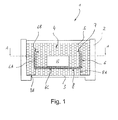
- FIGS. 1 and 2 is shown as a whole with 1 designated closable container made of fire-resistant material. In the FIGS. 1 and 2 the existing lid is omitted for clarity.
- the container 1 defines with an outer wall 2 and a bottom 3 (and the lid, not shown) in the interior of a space 4 which is filled with a bed of hollow glass granules 5.
- the hollow glass granules 5 is inert, non-conductive and non-combustible and absorbent and melts only above at least 1000 ° C. It has a mean diameter between 0.1 and 5 mm (after sieve analysis).
- a basket 6 of powder-coated wire mesh is used, the mesh size is designed such that the hollow glass granules 5 can penetrate unhindered through the mesh or flow.
- the battery B Since the hollow glass granules 5 can flow freely through the mesh of the basket, the battery B is surrounded on all sides by hollow glass granules 5 or embedded therein and the risk of an uncontrolled occurrence of a critical state is minimized or prevented.
- the basket 6 can be introduced into the container 1 and removed, it has two bow handles 7, projecting from the upper edge 6B of the basket 6 to the inside.
- the basket is provided at the bottom with two spacers 8, each consisting of a wire hanger and are spaced in the longitudinal direction of the basket.
- the bracket 8 extend first with a leg 8A from the bottom of the basket 6C down to the bottom 3 of the container and thus determine the distance of the basket 6 and the battery B arranged therein to the ground.
- bracket 8 extend laterally outwardly to the side wall 6A of the container 1, to which a further leg 8B kinks.
- the basket 6 is also positioned laterally in the container 1 and can not slip, so that the distance to the side wall 6A is also fixed.
- the distance of the basket 6 in the remaining container dimension is either by the basket 6 itself or more bracket 9 (see FIG. 2 , shown in dashed lines) fixed analogously.
- the battery B can thus be placed in the basket 6 and this are then introduced into the container 1, wherein already partially filled hollow glass granules 5 flows through the mesh of the basket and thus surrounds the battery B. Thereafter, further hollow glass granules 5 can be filled to fill the space 4 in the container 1 completely or to the desired level and to cover the battery B.
Landscapes
- Chemical & Material Sciences (AREA)
- Engineering & Computer Science (AREA)
- Chemical Kinetics & Catalysis (AREA)
- General Chemical & Material Sciences (AREA)
- Electrochemistry (AREA)
- Manufacturing & Machinery (AREA)
- Materials Engineering (AREA)
- Geochemistry & Mineralogy (AREA)
- Life Sciences & Earth Sciences (AREA)
- Organic Chemistry (AREA)
- General Engineering & Computer Science (AREA)
- Mechanical Engineering (AREA)
- Secondary Cells (AREA)
- Battery Mounting, Suspending (AREA)
- Processing Of Solid Wastes (AREA)
- Packaging Of Annular Or Rod-Shaped Articles, Wearing Apparel, Cassettes, Or The Like (AREA)
- Fuel Cell (AREA)
- Primary Cells (AREA)
Description
- Die Erfindung betrifft eine Vorrichtung zum Transport von verbrauchten, beschädigten oder defekten galvanischen Zellen unter Verhinderung und Bekämpfung von sicherheitskritischen Zuständen der galvanischen Zellen, insbesondere Lithiumionen-basierten Zellen und/oder Lithiumionen-Polymerzellen, mit einem Behälter, der einen Raum zwischen sich definieren, wobei der Raum mit einem Brandschutzmittel aus lediglich inertem, nicht-leitfähigem und nicht brennbarem sowie saugfähigem Hohlglasgranulat als lose Schüttung verfüllt ist. Des Weiteren betrifft die Erfindung ein Lager- und Transport-Verfahren für verbrauchte, beschädigte oder defekte galvanischen Zellen.
- Vorliegend werden im Rahmen der Erfindung als galvanische Zelle Vorrichtungen zur spontanen Umwandlung von chemischer in elektrische Energie verstanden, die in drei Gruppen unterteilt werden,
- a) Primärzellen, umgangssprachlich auch als Batterie bezeichnet. Kennzeichnend ist, dass die Zelle aufgeladen ist und nur einmalig entladen werden kann. Die Entladung ist irreversibel und die Primärzelle kann elektrisch nicht mehr aufgeladen werden.
- b) Sekundärzellen, umgangssprachlich auch als Akkumulator bezeichnet. Nach einer Entladung können Sekundärzellen durch eine gegenüber der Entladung gegenläufigen Stromrichtung wieder neu aufgeladen werden. Es kommen im Rahmen der Erfindung insbesondere Lithiumionen-basierte Zellen in Frage.
- c) Brennstoffzellen, auch als Tertiärzellen bezeichnet. Bei diesen galvanischen Zellen wird der chemische Energieträger von außerhalb kontinuierlich zur Verfügung gestellt. Dies ermöglicht einen kontinuierlichen und im Prinzip zeitlich unbeschränkten Betrieb.
- Die Erfindung ist prinzipiell auf alle drei Arten von galvanischen Zellen anwendbar, jedoch insbesondere auf die Metall-Ionen-basierten Zellen und ganz besonders auf die Lithiumionen-basierten Zellen und/oder Lithiumionen-Polymerzellen gerichtet.
- Im Folgenden wird vereinfachend nur der Begriff "Batterie" verwendet, auch wenn alle Arten von galvanischen Zellen gemeint sind.
- Lithiumionen-basierte Zellen werden heutzutage vermehrt in vielfältigen Bereichen eingesetzt, da ihre Kapazität im Vergleich zum Gewicht vorteilhaft ist. Insbesondere wird erwartet, dass ihre Verwendung in Elektrofahrzeugen und Hybridfahrzeugen, wie Akkumulator betriebene PKW oder Zweiräder in Zukunft stark zunimmt.
- Beim Versagen von Batterien, insbesondere von Lithiumionen Batterien, können aus dem Batterieinneren chemische Stoffe (Elektrolyt) und Partikel austreten. Dieses freigesetzte Material liegt dann in fester, flüssiger oder gasförmiger Form sowie in Kombinationen vor, z.B. als Partikel, Staub, Folie, Aerosol, Flüssigkeit, Tröpfchennebel. Zudem kann durch chemische und/oder elektrische Reaktion starke Hitze auftreten.
- Dieses Material ist teilweise sehr reaktiv und gesundheitsschädlich. Es ist auch möglich, dass sich das freigesetzte Material entzündet und es zu Brand- und/oder Explosionsereignissen kommt.
- So wird beispielsweise in fast allen Lithiumionen-Batterien Lithiumhexafluorophosphat als Elektrolyt verwendet, welches bei einer Beschädigung der Batterie austreten und sich zu hochreaktiven und toxischen Verbindungen (Flusssäure etc.) zersetzen kann.
- Kommt es trotz aller Vorsichtsmaßnahmen zu einem sicherheitskritischen Zustand, so müssen Gegenmaßnahmen eingeleitet werden. Kommt es z.B. zu einem Brand, so sind Maßnahmen zur Brandbekämpfung und zur Vermeidung einer Kontamination der Umgebung erforderlich.
- Sicherheitskritische Zustände umfassen vorliegend:
- das Austreten des Elektrolyt mit ggf. zeitlich verzögerter Bildung von aggressiven und giftigen Verbindungen (bei Lithium-Zellen ist das z.B. Flusssäure);
- die Erwärmung der Zelle über den Siedepunkt des Elektrolyt hinaus;
- die Gasbildung;
- das Öffnen eines Sicherheitsventils und/ oder das Platzen des Gehäuses
- das Austreten des Gases;
- die Bildung eines zündfähigen Gasgemisches unter Zustrom von Sauerstoff;
- die Explosion des Gasgemisches nach Entzündung an einer zelleninternen oder
- externen Zündquelle;
- das Verbrennen der Bestandteile der galvanischen Zelle unter Bildung von Rauchgasen;
- das Übergreifen des Brandes auf umliegende Materialien und Einrichtungen.
- Diese sicherheitskritischen Zustände bei galvanischen Zellen, insbesondere Metalllonen-basierten Zellen und ganz besonders bevorzugt Lithiumionen-basierten Zellen sollten verhindert oder zumindest weitgehend unterbunden werden.
- Aus der
DE 10 2006 019 739 B4 ist ein System zum Löschen von Bränden in einem Gefahrenobjekt unter Verwendung eines Löschmittels mit mindestens einem Vorratsbehälter für das Löschmittel, mit einem Rohrleitungssystem zum Transport des Löschmittels vom Vorratsbehälter zum Brand und mit einem Fördermittel zum Fördern des Löschmittels vom Vorratsbehälter durch das Rohrleitungssystem zum Brand bekannt. Als Löschmittel kommt ein bis wenigstens 1000 Grad temperaturfestes, hohles Rundgranulat zum Einsatz, dessen Durchmesser zwischen 0,1 mm und 5 mm liegt. Dieses System hat sich bereits bewährt, benötigt aber aktive Fördermittel, Sensoren etc. und kommt somit eher für Industrieanlagen in Frage. - Aus der
EP 2 167 439 B1 ist eine Verwendung eines Brandschutzmittels bestehend aus einem bis wenigstens 1000°C temperaturfesten hohlen Rundgranulat aus Hohlglaskugeln, wobei der Durchmesser des Rundgranulats zwischen 0,1 mm und 5 mm liegt, zum vorbeugenden Brandschutz durch dauerhaftes Aufbringen auf das Gefahrenobjekt und/oder dauerhaftes Verfüllen des Gefahrenobjekts mit dem Brandschutzmittel bekannt. Auch diese Idee hat sich bewährt, eignet sich aber insbesondere für die schwimmende Aufbringung in Tanklagern oder Verfüllen von Kabelkanälen etc. - Aus der
WO 2011/015411 A1 ist ein Verfahren zur Bekämpfung und/oder Vorbeugung eines Brandes einer oder mehrerer Batteriezellen, bevorzugt von Lithiumionen-Zellen bekannt, bei dem eine wässrige Lösung eines Kalzium-Salzes und ein Gel-Löschmittel angewendet werden. - Aus der
WO 2010/149611 A1 ist ein Verfahren zur sicheren Zerkleinerung von Batterien bekannt, umfassend die Schritte: a) Bereitstellen einer oder mehrerer zu zerkleinernder Batterien; und b) mechanische Zerkleinerung der bereitgestellten Batterien, wobei der Zerkleinerungsprozess stattfindet in Anwesenheit von: i) mindestens einem Metallbrandschutzmittel, welches geeignet ist einen Brand der Batterien zu unterdrücken oder zu vermindern; und von ii) mindestens einem Bindemittel, welches geeignet ist Säuren und/oder Basen zu binden. - Aus der
DE 10 2010 035 959 A1 ist eine Transportvorrichtung für Gefahrgut, insbesondere elektrochemische Energiespeichereinrichtungen bekannt, die eine Sicherheitseinrichtung und ein Behältnis für das Gefahrgut aufweisen kann, das mit einem Füllmaterial gefüllt ist. - Aufgabe der Erfindung ist es demgegenüber eine Alternative zum Transport und Lagerung von verbrauchten, beschädigten oder defekten galvanischen Zellen unter Verhinderung und Bekämpfung von sicherheitskritischen Zuständen der galvanischen Zellen bereitzustellen, die die Handhabung erleichtert.
- Diese Aufgabe wird durch die in Anspruch 1 wiedergegebene Vorrichtung sowie das in Anspruch 9 wiedergegebene Verfahren gelöst.
- Erfindungsgemäß ist erkannt worden, dass wenn in dem Raum ein für das Brandschutzmaterial durchlässiger Korb zur Aufnahme für mindestens eine galvanische Zelle angeordnet ist, das Einbringen und insbesondere das Herausheben der Batterien in bzw. aus dem Brandschutzmaterial vereinfacht wird.
- Es wird nämlich so möglich, den Korb außerhalb des Behälters aus mit den fraglichen Batterien zu bestücken und den Korb dass als Ganzes im mit Brandschutzmaterial gefüllten Behälter zu versenken. Analog ist es einfach den Behälter zu entleeren, wozu nur der Korb herausgehoben werden muss. Das Brandschutzmaterial dringt in beiden Fällen aufgrund der Durchlässigkeit in den Korb ein (bzw. fließt heraus) und umgibt die Batterien, so dass diese eingebettet sind (bzw. frei liegen).
- Vorzugsweise ist der Korb ein Drahtkorb, der ggf. aus pulverbeschichtetem Draht besteht.
- Vorzugsweise besteht der Korb aus einem nicht leitfähigen Material.
- Damit die Abstände zu den Behälterwandungen eingehalten werden, kann der Korb mit Abstandhaltern versehen sein. Somit muss der Korb nur in den mit Brandschutzmaterial gefüllten Behälter eingebracht werden. Die Abstände werden somit "automatisch" eingehalten und auch im Transport trotz Erschütterungen und Ruckeln.
- Ferner kann der Korb mit Unterteilungen im Inneren versehen sein, um Fächer für einzelne Batterien auszubilden, so dass diese den geforderten Abstand zueinander immer einhalten.
- Die Abstandhalter können dabei im einfachsten Fall von einer Bügelkonstruktion gebildet sein, die z.B. als Teil des Korbs ausgebildet ist und nach Außen absteht.
- Die Abstandhalter können am Boden und/oder an den Seitenwänden des Korbs angeordnet sein, so dass die Abstände zum Boden und/oder den Seitenwänden eingehalten werden und diese mit Brandschutzmaterial ausgefüllt sind.
- Die Maschenweite bzw. Größe der Öffnungen kann an die Größe des Brandschutzmittels angepasst werden.
- Der Korb kann mit Halterungen versehen sein, um die manuelle oder maschinelle Handhabung, z.B. Herausziehen, zu vereinfachen, versehen sein. Dies können z.B. Bügelgriffe, Ösen etc. sein.
- Das bevorzugte Brandschutzmittel besteht lediglich aus Hohlglasgranulat, d.h. es enthält nur Hohlglasgranulat und sonst keine weiteren Bestandteile. Vorzugsweise ist das Hohlglasgranulat ein bis wenigstens 1000°C temperaturfestes hohles oder mit Hohlstellen versehenes Rundgranulat, das vorzugsweise einen mittleren Durchmesser zwischen 0,1 mm und 10 mm aufweist. Noch bevorzugter ist ein mittlerer Durchmesser zwischen 0,1 mm und 5 mm.
- Das verwendete Hohlglasgranulat hat eine entsprechend des Sicherheitsrisikos berechnete Korngröße und Hohlraumanteil zur Entzündungsvermeidung durch Abkühlung und zum Löschen eines Brandes durch Erstickung und /oder Sauerstoffabschluss und zur Verhinderung der Bildung eines entzündlichen Gasgemisches sowie einer entsprechend des Sicherheitsrisikos berechneten Korngröße zur Verhinderung einer Explosion, also einer explosionsfähigen Atmosphäre, Verdrängen von Sauerstoff und verhindern von Zündquellen. Ferner weist es keinerlei elektrische Leitfähigkeit auf. Zudem ist es saugfähig und kann daher aus den Zellen ausgetretenen Elektrolyten aufnehmen.
- Das System erlaubt die Wiederverwendung des ohne Probleme und es ist praktisch verschleißfrei. Das Brandschutzmaterial muss nur bei Verbrauch oder Kontamination ausgetauscht werden.
- Die Erfindung betrifft auch ein Lager- und Transportverfahren nach Anspruch 9.
- Danach werden die fraglichen galvanischen Zellen direkt und einzig in ein als Brandschutzmittel dienendes Hohlglasgranulat zur Lagerung /Transport zur Verhinderung von sicherheitskritischen Zuständen in der zuvor beschriebenen Vorrichtung eingebettet.
- Es bedarf keiner aktiven Überwachung zur Auslösung des Ausbringens und/oder Aufbringen eines Löschmittels.
- Die Lagerung und/oder der Transport können in einem Gefahrgutbehälter entsprechender Klassifikation durchgeführt, in dem die galvanischen Zellen zueinander in der Höhe und Breite sowie Tiefe mit Abstand eingebettet sind.
- Es hat sich gezeigt, dass sich das besondere Brandschutzmittel der Hohlglasgranulate für das Lagern und Transportieren von verbrauchten, beschädigten oder defekten Batterien bzw. galvanischen Zellen, insbesondere Lithiumionen-basierten Zellen, eignet.
- Die Eigenschaften der eingesetzten Hohlglasgranulate sind oben angegeben und werden auch bei der Einbettung verwendet. Das Brandschutzmittel wirkt durch "Ersticken" des potentiellen Brandes, da das Rundgranulat sich nach der dichtesten Kugelpackung ab einer gewissen Schichtdicke Luft verdrängend und abdichtend auf die galvanischen Zellen ablegt.
- Das Rundgranulat besteht aus einem inerten Glas-Material. Dies erlaubt eine besonders gute Schütt- und Riesel- sowie Kriechfähigkeit und somit gute Transporteigenschaften und Abdeckung des Brandbereichs, auch in engen und ansonsten schlecht zugänglichen Bereichen, wie Spalten. Somit wird auch dort eine Sauerstoffversorgung des potentiellen Brandes verhindert.
- Vorzugsweise finden die Lagerung und/oder der Transport in einem Behälter (äußere Umwandung) aus brandfestem Material, z.B. einem Gefahrgut- oder Sicherheitsbehälter statt, in dem die Batterien im Hohlglasgranulat eingebettet und ggf. zueinander in der Höhe und Breite sowie Tiefe mit Abstand eingebettet sind. Als besonders bevorzugt hat sich herausgestellt, einen Abstand von mindestens jeweils ca. 30 mm (Höhe, Breite, Tiefe) bezogen auf eine Zellenhöhe von ca. 10 mm zueinander einzuhalten, falls mehrere Lithiumionen-basierte Zellen eingelegt werden.
- Dabei sollte zwischen Seitenwänden der Außenverpackung (=Umwandung) und den Lithiumionen-Zellen ein Abstand eingehalten werden von mindestens 2 cm, vorzugsweise 5 bis 20 cm, insbesondere 10 cm.
- Die Außenverpackung kann z.B. aus Metall geeigneter Größe bestehen, deren Boden mit einer Schicht eines speziellen Hohlglasgranulates mit einer Schichtdicke von mindestens 30 mm, vorzugsweise 5 bis 20 cm, insbesondere 10 cm bedeckt ist. Es eignen sich aber auch Behälter aus Kunststoff.
- Sollen mehrere galvanische Zellen transportiert werden, so sollten die galvanischen Zellen so auf diesen Boden gelegt werden, dass zwischen den galvanischen Zellen ein freier Raum von mindestens 100 mm verbleibt. Die freien Räume sind mit demselben speziellen Hohlglasgranulat aufzufüllen. Auf diese erste Lage von galvanischen Zellen können weitere Lagen von Zellen in gleicher Weise gelegt werden. Die Zellen sind nach oben mit einer Schicht des speziellen Hohlglasgranulates mit einer Schichtdicke von mindestens 100 mm abzudecken. Somit sind alle galvanischen Zellen allseitig von einer Schicht des speziellen Hohlglasgranulates mit einer Schichtdicke von mindestens 100 mm umgeben.
- Der geschlossene (Sicherheits)behälter verhindert im Fall der Entzündung der Zellen die Brandausbreitung und Kontamination. Das Hohlglasgranulat erstickt einen aufgetretenen Brand innerhalb kurzer Zeit bzw. lässt diesen gar nicht erst entstehen. Die Zellen werden dabei direkt in eine entsprechend des Sicherheitsrisikos berechnete Menge des Hohlglasgranulats eingebettet.
- Weitere Merkmale und Einzelheiten der Erfindung ergeben sich aus der nachfolgenden Beschreibung der Zeichnung. Es zeigen:
-
Fig. 1 eine schematische seitliche Schnittansicht eines erfindungsgemäßen Behälters zum Sammeln, Lagern und Transport von Lithiumionen-Batterien und -
Fig. 2 den Behälter ausFigur 1 in einer Draufsicht im Schnitt entlang der Linie A-A. - In den
Figuren 1 und2 ist ein als Ganzes mit 1 bezeichneter verschließbarer Behälter aus brandfestem Material dargestellt. In denFiguren 1 und2 ist der vorhandene Deckel zur besseren Übersicht weggelassen. - Der Behälter 1 definiert mit einer äußeren Wandung 2 und einem Boden 3 (sowie dem nicht dargestellten Deckel) im Inneren einen Raum 4, der mit einer Schüttung Hohlglasgranulat 5 gefüllt ist.
- Das Hohlglasgranulat 5 ist inert, nicht-leitfähig und nicht brennbar sowie saugfähig und schmilzt erst oberhalb von mindestens 1000 °C. Es weist einen mittleren Durchmesser zwischen 0,1 und 5 mm (nach Siebanalyse) auf.
- In den Raum 4 ist ein Korb 6 aus pulverbeschichtetem Drahtgeflecht eingesetzt, dessen Maschenweite derart ausgestaltet ist, dass das Hohlglasgranulat 5 ungehindert durch die Maschen dringen bzw. fließen kann.
- In dem Korb 6 ist eine defekte Batterie B eingelegt.
- Da das Hohlglasgranulat 5 frei durch die Maschen des Korbs fließen kann, wird die Batterie B allseitig von Hohlglasgranulat 5 umgeben bzw. darin eingebettet und die Gefahr eines unkontrollierten Auftretens eines kritischen Zustands ist minimiert bzw. verhindert.
- Damit der Korb 6 in den Behälter 1 eingebracht und entfernt werden kann, weist er jeweils zwei Bügelgriffe 7 auf, vom oberen Rand 6B des Korbs 6 nach Innen vorstehen.
- Ferner ist der Korb an der Unterseite mit zwei Abstandshaltern 8 versehen, die jeweils aus einem Drahtbügel bestehen und in Längsrichtung des Korbs beabstandet sind.
- Die Bügel 8 erstrecken sich zunächst mit einem Schenkel 8A vom Korbboden 6C nach unten zum Boden 3 des Behälters und bestimmen somit den Abstand des Korbs 6 bzw. der darin angeordneten Batterie B zum Boden.
- Dann erstrecken sich die Bügel 8 seitlich nach Außen zur seitlichen Wandung 6A des Behälters 1, wozu ein weiterer Schenkel 8B abknickt. Somit wird der Korb 6 auch seitlich in dem Behälter 1 positioniert und kann nicht verrutschen, so dass der Abstand zur seitlichen Wandung 6A ebenfalls festgelegt ist.
- Der Abstand des Korbs 6 in der verbleibenden Behälterdimension (Blickrichtung auf die
Figur 1 ) wird entweder durch den Korb 6 selber oder weitere Bügel 9 (sieheFigur 2 , gestrichelt dargestellt) analog fixiert. - Die Batterie B kann also in den Korb 6 gelegt werden und dieser anschließend in den Behälter 1 eingebracht werden, wobei bereits teilweise eingefülltes Hohlglasgranulat 5 durch die Maschen des Korbs fließt und somit die Batterie B umgibt. Danach kann weiteres Hohlglasgranulat 5 aufgefüllt werden um den Raum 4 im Behälter 1 vollständig bzw. bis zur gewünschten Füllhöhe auszufüllen und die Batterie B zu bedecken.
-
- 1
- Gefahrgutbehälter
- 2
- Wandung
- 3
- Boden
- 4
- Raum
- 5
- Hohlglasgranulat
- 6
- Korb
- 6A
- seitliche Wandung des Korbs
- 6B
- Rand des Korbs
- 6C
- Korbboden
- 7
- Bügelgriff
- 8
- Bügel
- 8A
- Schenkel
- 8B
- Schenkel
- 9
- Bügel
- B
- Lithiumionenpolymer-Batteriemodul
Claims (10)
- Vorrichtung zum Transport von verbrauchten, beschädigten oder defekten galvanischen Zellen unter Verhinderung und Bekämpfung von sicherheitskritischen Zuständen der galvanischen Zellen, insbesondere Lithiumionen-basierten Zellen und/oder Lithiumionen-Polymerzellen, mit einem Behälter, der einen Raum definiert, wobei der Raum mit einem Brandschutzmittel aus lediglich inertem, nicht-leitfähigem und nicht brennbarem sowie saugfähigem Hohlglasgranulat als lose Schüttung verfüllt ist, dadurch gekennzeichnet dass in dem Raum ein für das Brandschutzmaterial durchlässiger Korb zur Aufnahme für mindestens eine galvanische Zelle angeordnet ist.
- Vorrichtung nach Anspruch 1, dadurch gekennzeichnet, dass der Korb ein Drahtkorb ist.
- Vorrichtung nach Anspruch 2, dadurch gekennzeichnet, dass der Korb aus pulverbeschichtetem Draht besteht.
- Vorrichtung nach einem der vorhergehenden Ansprüche, dadurch gekennzeichnet, dass der Korb mit Abstandhaltern versehen ist.
- Vorrichtung nach Anspruch 4, dadurch gekennzeichnet, dass die Abstandhalter von einer Bügelkonstruktion gebildet sind.
- Vorrichtung nach Anspruch 5, dadurch gekennzeichnet, dass die Abstandhalter am Boden und/oder an den Seitenwänden des Korbs angeordnet sind.
- Vorrichtung nach einem der vorhergehenden Ansprüche, dadurch gekennzeichnet, dass das Hohlglasgranulat ein bis wenigstens 1000°C temperaturfestes hohles oder mit Hohlstellen versehenes Rundgranulat ist, das vorzugsweise einen mittleren Durchmesser zwischen 0,1 mm und 10 mm, insbesondere zwischen 0,1 mm und 5 mm aufweist.
- Vorrichtung nach einem der vorhergehenden Ansprüche, dadurch gekennzeichnet, dass die äußere Umwandung ein üblicher Gefahrgutbehälter ist.
- Lager- und Transport-Verfahren für verbrauchte, beschädigte oder defekte galvanischen Zellen, insbesondere Lithiumionen-basierten Zellen, dadurch gekennzeichnet, dass die galvanischen Zellen direkt und einzig in ein als Brandschutzmittel dienendes Hohlglasgranulat zur Lagerung /Transport zur Verhinderung von sicherheitskritischen Zuständen in einer Vorrichtung nach einem der vorhergehenden Ansprüche eingebettet werden.
- Verfahren nach Anspruch 9, dadurch gekennzeichnet, dass die Lagerung und/oder der Transport in einem Gefahrgutbehälter entsprechender Klassifikation durchgeführt werden, in dem die galvanischen Zellen zueinander in der Höhe und Breite sowie Tiefe mit Abstand eingebettet sind.
Priority Applications (1)
| Application Number | Priority Date | Filing Date | Title |
|---|---|---|---|
| PL14197183T PL2922133T3 (pl) | 2014-03-21 | 2014-12-10 | Urządzenie i sposób do transportu ogniw galwanicznych |
Applications Claiming Priority (1)
| Application Number | Priority Date | Filing Date | Title |
|---|---|---|---|
| DE102014103928.9A DE102014103928A1 (de) | 2014-03-21 | 2014-03-21 | Vorrichtung und Verfahren zum Transport von galvanischen Zellen |
Publications (2)
| Publication Number | Publication Date |
|---|---|
| EP2922133A1 true EP2922133A1 (de) | 2015-09-23 |
| EP2922133B1 EP2922133B1 (de) | 2016-11-09 |
Family
ID=52292608
Family Applications (1)
| Application Number | Title | Priority Date | Filing Date |
|---|---|---|---|
| EP14197183.8A Active EP2922133B1 (de) | 2014-03-21 | 2014-12-10 | Vorrichtung und Verfahren zum Transport von galvanischen Zellen |
Country Status (10)
| Country | Link |
|---|---|
| US (1) | US20170110757A1 (de) |
| EP (1) | EP2922133B1 (de) |
| JP (1) | JP2017515764A (de) |
| KR (1) | KR20160135229A (de) |
| DE (1) | DE102014103928A1 (de) |
| DK (1) | DK2922133T3 (de) |
| ES (1) | ES2612102T3 (de) |
| PL (1) | PL2922133T3 (de) |
| PT (1) | PT2922133T (de) |
| WO (1) | WO2015140256A1 (de) |
Families Citing this family (8)
| Publication number | Priority date | Publication date | Assignee | Title |
|---|---|---|---|---|
| DE102014110654A1 (de) * | 2014-07-29 | 2016-02-04 | Genius Patentverwertung Gmbh & Co. Kg | Vorrichtung und Verfahren zum Transport von galvanischen Zellen |
| US11311758B2 (en) | 2018-04-17 | 2022-04-26 | Cellblock Fcs, Llc | Device for extinguishing a fire |
| US11247083B2 (en) * | 2018-06-28 | 2022-02-15 | Cellblock Fcs, Llc | Fire containment device and kit |
| US11542091B2 (en) * | 2020-07-23 | 2023-01-03 | Cellblock Fcs, Llc | Shipping package for lithium battery |
| JP7683449B2 (ja) * | 2021-10-13 | 2025-05-27 | 栗田工業株式会社 | 蓄電デバイス輸送容器、及びこれを用いた蓄電デバイスの輸送方法 |
| JP7683455B2 (ja) * | 2021-10-27 | 2025-05-27 | 栗田工業株式会社 | 蓄電デバイスの輸送容器、及びこれを用いた蓄電デバイスの輸送方法 |
| JP7783096B2 (ja) * | 2022-03-14 | 2025-12-09 | アズビル株式会社 | 防爆型機器 |
| DE102022203617A1 (de) | 2022-04-11 | 2023-10-12 | Volkswagen Aktiengesellschaft | Batteriezellträger für Ausschuss-Batteriezellen |
Citations (10)
| Publication number | Priority date | Publication date | Assignee | Title |
|---|---|---|---|---|
| EP0395322A1 (de) * | 1989-04-27 | 1990-10-31 | Shin-Etsu Handotai Company Limited | Verfahren zum Löschen eines Metallfeuers und Feuerlöschmittel dafür |
| DE4438486A1 (de) * | 1994-10-28 | 1996-05-02 | Sander Polyplast Gmbh | Behälter zur Aufbewahrung und zum Transport von Gefahrengut |
| DE102006019739A1 (de) * | 2006-04-28 | 2007-10-31 | Patentverwertung GbR (vertretungsberchtigte Gesellschafter: Bärbel Knopf, Fischersteeg 11 | Löschmittel, Verfahren und System zu dessen Einsatz |
| DE102008006778A1 (de) * | 2008-01-30 | 2009-08-06 | Patentverwertung GbR (vertretungsberechtigter Gesellschafter: Bärbel Knopf, 15754 Heidesee) | Brandschutzmittel und Verfahren zu dessen Einsatz |
| WO2010149611A1 (de) | 2009-06-25 | 2010-12-29 | Sb Limotive Company Ltd. | Verfahren zur sicheren zerkleinerung von lithium-ionen-batterien |
| WO2011015411A1 (de) | 2009-08-03 | 2011-02-10 | Robert Bosch Gmbh | Verfahren zur bekämpfung und/oder vorbeugung eines brandes von lithium-ionen-zellen und lithium-ionen-polymer-zellen |
| DE102010035959A1 (de) | 2010-08-31 | 2012-03-01 | Li-Tec Battery Gmbh | Transportvorrichtung für elektrochemische Energiespeichervorrichtungen |
| DE102010048051A1 (de) * | 2010-10-12 | 2012-04-12 | Rench Chemie Gmbh | Verpackungselement und seine Verwendung |
| DE202012002104U1 (de) * | 2012-03-02 | 2013-06-04 | Nefab Ab | Transportbehälter zum Transport von Batterien |
| DE202013004963U1 (de) * | 2013-06-02 | 2013-07-16 | Markus Kohten | Sicherheitsbox zum Transport und Lagerung von Batterien |
Family Cites Families (26)
| Publication number | Priority date | Publication date | Assignee | Title |
|---|---|---|---|---|
| US1670158A (en) * | 1922-01-16 | 1928-05-15 | Rub Tex Products Inc | Reenforced-rubber jar |
| US1658205A (en) * | 1924-11-10 | 1928-02-07 | Goodrich Co B F | Container |
| US1840492A (en) * | 1928-04-02 | 1932-01-12 | Benjamin Clarke | Container and handle means |
| US1922082A (en) * | 1929-08-05 | 1933-08-15 | Willard Storage Battery Co | Storage battery container |
| US4508027A (en) * | 1983-12-19 | 1985-04-02 | Mccord Frederick B | Portion dividing frying basket |
| DE59810794D1 (de) * | 1998-03-02 | 2004-03-25 | Wilhelmi Werke Ag | Plattenförmiges Brandschutzelement in Sandwich-Bauweise |
| US6187474B1 (en) * | 1999-02-03 | 2001-02-13 | Lucent Technologies Inc. | Battery container |
| US6367646B1 (en) * | 2000-03-03 | 2002-04-09 | Erie Plastics Corporation | Battery box |
| US20030175584A1 (en) * | 2002-03-14 | 2003-09-18 | Electric Fuel Ltd. | Battery pack holder for metal-air battery cells |
| DE20210935U1 (de) * | 2002-07-19 | 2002-11-28 | Rösler, Peter, 88239 Wangen | Entfeuchter-Vorrichtung |
| US6918498B2 (en) * | 2003-05-06 | 2005-07-19 | Chicago Display Marketing Corporation | Method and apparatus for a wire shelf hooking onto slotted brackets |
| US6828027B1 (en) * | 2003-06-02 | 2004-12-07 | Baswaacoustic Ag | Fire-resistant coated building panels |
| US20060078409A1 (en) * | 2004-09-24 | 2006-04-13 | Mitsumasa Takeda | Safety enhanced load carrying device and method |
| US20070254075A1 (en) * | 2006-05-01 | 2007-11-01 | Nikki Haars | Special stackable container for storage of baked goods |
| NL1032221C2 (nl) * | 2006-07-21 | 2008-01-22 | Modina B V | Bouwmateriaal evenals een werkwijze voor de vervaardiging hiervan en toepassing van het bouwmateriaal. |
| WO2008060443A2 (en) * | 2006-11-10 | 2008-05-22 | Best Willie H | Radiant tube broiler |
| DE102009047695A1 (de) * | 2009-12-09 | 2011-06-16 | Robert Bosch Gmbh | Steuerbar wärmeisolierendes Gehäuse und Verfahren zur Steuerung hierfür |
| US8544670B2 (en) * | 2010-04-15 | 2013-10-01 | George Howard Brilmyer | Fire containment case for portable battery operated electronic devices |
| DE102011009696A1 (de) * | 2011-01-28 | 2012-08-02 | Li-Tec Battery Gmbh | Transportvorrichtung für elektrochemische Energiespeichervorrichtungen |
| US20120225331A1 (en) * | 2011-03-02 | 2012-09-06 | Lithionics, Llc | Battery pack protection system |
| DE102011075318A1 (de) * | 2011-05-05 | 2012-11-08 | Sb Limotive Company Ltd. | Batteriegehäuse für Lithium-Ionen-Zellen |
| US9861235B2 (en) * | 2012-06-13 | 2018-01-09 | Monte S. Beasley | Basket apparatuses for use in preparation of food products |
| EP2719312B1 (de) * | 2012-10-12 | 2015-06-10 | ELECTROLUX PROFESSIONAL S.p.A. | Verbesserte Filtergruppe für eine Fritteuse |
| DE202014006615U1 (de) * | 2013-11-29 | 2015-10-15 | Pilkington Group Limited | Feuerbeständiges Material |
| DE102014111645A1 (de) * | 2014-08-14 | 2016-02-18 | Jobst H. KERSPE | Batteriegehäuse |
| US20180235400A1 (en) * | 2016-01-20 | 2018-08-23 | Darryl Thomas Jones | Chafer rack wire bar and panel assembly |
-
2014
- 2014-03-21 DE DE102014103928.9A patent/DE102014103928A1/de not_active Withdrawn
- 2014-12-10 PT PT141971838T patent/PT2922133T/pt unknown
- 2014-12-10 ES ES14197183.8T patent/ES2612102T3/es active Active
- 2014-12-10 DK DK14197183.8T patent/DK2922133T3/en active
- 2014-12-10 EP EP14197183.8A patent/EP2922133B1/de active Active
- 2014-12-10 PL PL14197183T patent/PL2922133T3/pl unknown
-
2015
- 2015-03-19 US US15/127,212 patent/US20170110757A1/en not_active Abandoned
- 2015-03-19 WO PCT/EP2015/055806 patent/WO2015140256A1/de not_active Ceased
- 2015-03-19 JP JP2017500418A patent/JP2017515764A/ja active Pending
- 2015-03-19 KR KR1020167027318A patent/KR20160135229A/ko not_active Ceased
Patent Citations (12)
| Publication number | Priority date | Publication date | Assignee | Title |
|---|---|---|---|---|
| EP0395322A1 (de) * | 1989-04-27 | 1990-10-31 | Shin-Etsu Handotai Company Limited | Verfahren zum Löschen eines Metallfeuers und Feuerlöschmittel dafür |
| DE4438486A1 (de) * | 1994-10-28 | 1996-05-02 | Sander Polyplast Gmbh | Behälter zur Aufbewahrung und zum Transport von Gefahrengut |
| DE102006019739A1 (de) * | 2006-04-28 | 2007-10-31 | Patentverwertung GbR (vertretungsberchtigte Gesellschafter: Bärbel Knopf, Fischersteeg 11 | Löschmittel, Verfahren und System zu dessen Einsatz |
| DE102006019739B4 (de) | 2006-04-28 | 2008-07-10 | Patentverwertung GbR (vertretungsberchtigte Gesellschafter: Bärbel Knopf, Fischersteeg 11 | System zum Löschen von Bränden und Verfahren zu dessen Einsatz |
| DE102008006778A1 (de) * | 2008-01-30 | 2009-08-06 | Patentverwertung GbR (vertretungsberechtigter Gesellschafter: Bärbel Knopf, 15754 Heidesee) | Brandschutzmittel und Verfahren zu dessen Einsatz |
| EP2167439B1 (de) | 2008-01-30 | 2011-11-16 | Schmidt, Andreas | Brandschutzmittel und verfahren zu dessen einsatz |
| WO2010149611A1 (de) | 2009-06-25 | 2010-12-29 | Sb Limotive Company Ltd. | Verfahren zur sicheren zerkleinerung von lithium-ionen-batterien |
| WO2011015411A1 (de) | 2009-08-03 | 2011-02-10 | Robert Bosch Gmbh | Verfahren zur bekämpfung und/oder vorbeugung eines brandes von lithium-ionen-zellen und lithium-ionen-polymer-zellen |
| DE102010035959A1 (de) | 2010-08-31 | 2012-03-01 | Li-Tec Battery Gmbh | Transportvorrichtung für elektrochemische Energiespeichervorrichtungen |
| DE102010048051A1 (de) * | 2010-10-12 | 2012-04-12 | Rench Chemie Gmbh | Verpackungselement und seine Verwendung |
| DE202012002104U1 (de) * | 2012-03-02 | 2013-06-04 | Nefab Ab | Transportbehälter zum Transport von Batterien |
| DE202013004963U1 (de) * | 2013-06-02 | 2013-07-16 | Markus Kohten | Sicherheitsbox zum Transport und Lagerung von Batterien |
Also Published As
| Publication number | Publication date |
|---|---|
| DE102014103928A1 (de) | 2015-09-24 |
| DK2922133T3 (en) | 2017-01-23 |
| JP2017515764A (ja) | 2017-06-15 |
| WO2015140256A1 (de) | 2015-09-24 |
| PL2922133T3 (pl) | 2017-06-30 |
| ES2612102T3 (es) | 2017-05-12 |
| US20170110757A1 (en) | 2017-04-20 |
| PT2922133T (pt) | 2016-12-20 |
| EP2922133B1 (de) | 2016-11-09 |
| KR20160135229A (ko) | 2016-11-25 |
Similar Documents
| Publication | Publication Date | Title |
|---|---|---|
| EP2922133B1 (de) | Vorrichtung und Verfahren zum Transport von galvanischen Zellen | |
| DE102014110654A1 (de) | Vorrichtung und Verfahren zum Transport von galvanischen Zellen | |
| EP2611714A1 (de) | Transportvorrichtung für elektrochemische energiespeichervorrichtungen | |
| EP3005465B1 (de) | Sicherheitsbehältnis für gefährliches ladegut, insbesondere für batterien | |
| DE102016102969B4 (de) | Anordnung mit einer galvanischen Zelle und gemeinsamer Transportbehälter | |
| WO2013020704A2 (de) | Sicherheitsbehälter zur handhabung einer elektrochemischen vorrichtung und verfahren zur handhabung einer in einem sicherheitsbehälter angeordneten elektrochemischen vorrichtung | |
| DE202021001906U1 (de) | Lagercontainer für Akkus | |
| DE202023101699U1 (de) | Behältnis zur Lagerung von Batterien sowie dessen Verwendung | |
| DE102021132499A1 (de) | Batterieanordnung und Verfahren zum Bekämpfen eines Batteriebrands sowie Kraftfahrzeug | |
| DE202013010308U1 (de) | Anordnung für sicherere Batterien in Beförderung und Anwendung | |
| WO2014082954A1 (de) | Aufnahmeeinrichtung für eine elektrochemische energiespeichereinheit | |
| EP3653523A1 (de) | Gefahrgut-transportbehälter | |
| WO2020114536A2 (de) | Sicherungssystem für gefährliches ladegut, insbesondere für defekte oder verunfallte elektrofahrzeuge, behältnis für solches und verfahren zu dessen sicherung | |
| DE102013113880B4 (de) | Vorrichtung und Verfahren zum Transport von galvanischen Zellen | |
| WO2016038207A1 (de) | Verfahren zum betrieb einer vorrichtung zur beherrschung eines brandes oder stoffaustrittes, insbesondere für lithiumbatterien | |
| DE202016001797U1 (de) | Transportvorrichtung für Lithiumbatterien in einem Flugzeug | |
| DE102013222269A1 (de) | Aufnahmeeinrichtung für eine elektrochemische Energiespeichereinheit | |
| DE202025102856U1 (de) | Aufbewahrungsvorrichtung | |
| DE102015010955A1 (de) | Formkörper, Gemische und Vorrichtungen zum Schutz von Hochenergiebatterien und -akkus, insbesondere solcher auf der Basis von Lithium, beim Betrieb, Lagern und Transport | |
| DE102014226241A1 (de) | Transportbehälter für eine beschädigte Lithium-Ionen-Batterie | |
| EP4396107A1 (de) | Quarantänebehälter für gefahrengegenstände | |
| DE102018008491A1 (de) | Schutzmittel für elektrochemische Energiespeicher,insbesondere für Energiespeicher, die Lithium enthalten | |
| DE102023129350A1 (de) | Ladevorrichtung für ein elektrisches Kraftfahrzeug | |
| DE102023129349A1 (de) | Ladevorrichtung für ein elektrisches Kraftfahrzeug | |
| EP4144664A1 (de) | Quarantänebehälter für gefahrengegenstände |
Legal Events
| Date | Code | Title | Description |
|---|---|---|---|
| PUAI | Public reference made under article 153(3) epc to a published international application that has entered the european phase |
Free format text: ORIGINAL CODE: 0009012 |
|
| AK | Designated contracting states |
Kind code of ref document: A1 Designated state(s): AL AT BE BG CH CY CZ DE DK EE ES FI FR GB GR HR HU IE IS IT LI LT LU LV MC MK MT NL NO PL PT RO RS SE SI SK SM TR |
|
| AX | Request for extension of the european patent |
Extension state: BA ME |
|
| 17P | Request for examination filed |
Effective date: 20150916 |
|
| RBV | Designated contracting states (corrected) |
Designated state(s): AL AT BE BG CH CY CZ DE DK EE ES FI FR GB GR HR HU IE IS IT LI LT LU LV MC MK MT NL NO PL PT RO RS SE SI SK SM TR |
|
| 17Q | First examination report despatched |
Effective date: 20151211 |
|
| REG | Reference to a national code |
Ref country code: DE Ref legal event code: R079 Ref document number: 502014001917 Country of ref document: DE Free format text: PREVIOUS MAIN CLASS: H01M0010000000 Ipc: F42B0039160000 |
|
| RIC1 | Information provided on ipc code assigned before grant |
Ipc: H01M 10/00 20060101ALI20160509BHEP Ipc: C03C 11/00 20060101ALI20160509BHEP Ipc: F42B 39/16 20060101AFI20160509BHEP Ipc: H01M 6/00 20060101ALI20160509BHEP |
|
| GRAP | Despatch of communication of intention to grant a patent |
Free format text: ORIGINAL CODE: EPIDOSNIGR1 |
|
| INTG | Intention to grant announced |
Effective date: 20160617 |
|
| GRAS | Grant fee paid |
Free format text: ORIGINAL CODE: EPIDOSNIGR3 |
|
| GRAA | (expected) grant |
Free format text: ORIGINAL CODE: 0009210 |
|
| AK | Designated contracting states |
Kind code of ref document: B1 Designated state(s): AL AT BE BG CH CY CZ DE DK EE ES FI FR GB GR HR HU IE IS IT LI LT LU LV MC MK MT NL NO PL PT RO RS SE SI SK SM TR |
|
| REG | Reference to a national code |
Ref country code: GB Ref legal event code: FG4D Free format text: NOT ENGLISH |
|
| REG | Reference to a national code |
Ref country code: AT Ref legal event code: REF Ref document number: 844346 Country of ref document: AT Kind code of ref document: T Effective date: 20161115 Ref country code: CH Ref legal event code: EP |
|
| REG | Reference to a national code |
Ref country code: IE Ref legal event code: FG4D Free format text: LANGUAGE OF EP DOCUMENT: GERMAN |
|
| REG | Reference to a national code |
Ref country code: CH Ref legal event code: NV Representative=s name: ALDO ROEMPLER PATENTANWALT, CH |
|
| REG | Reference to a national code |
Ref country code: PT Ref legal event code: SC4A Ref document number: 2922133 Country of ref document: PT Date of ref document: 20161220 Kind code of ref document: T Free format text: AVAILABILITY OF NATIONAL TRANSLATION Effective date: 20161205 |
|
| REG | Reference to a national code |
Ref country code: FR Ref legal event code: PLFP Year of fee payment: 3 Ref country code: DE Ref legal event code: R096 Ref document number: 502014001917 Country of ref document: DE |
|
| REG | Reference to a national code |
Ref country code: DK Ref legal event code: T3 Effective date: 20170116 |
|
| REG | Reference to a national code |
Ref country code: NL Ref legal event code: FP |
|
| REG | Reference to a national code |
Ref country code: SE Ref legal event code: TRGR |
|
| PG25 | Lapsed in a contracting state [announced via postgrant information from national office to epo] |
Ref country code: LV Free format text: LAPSE BECAUSE OF FAILURE TO SUBMIT A TRANSLATION OF THE DESCRIPTION OR TO PAY THE FEE WITHIN THE PRESCRIBED TIME-LIMIT Effective date: 20161109 |
|
| REG | Reference to a national code |
Ref country code: LT Ref legal event code: MG4D |
|
| REG | Reference to a national code |
Ref country code: NO Ref legal event code: T2 Effective date: 20161109 |
|
| PG25 | Lapsed in a contracting state [announced via postgrant information from national office to epo] |
Ref country code: LT Free format text: LAPSE BECAUSE OF FAILURE TO SUBMIT A TRANSLATION OF THE DESCRIPTION OR TO PAY THE FEE WITHIN THE PRESCRIBED TIME-LIMIT Effective date: 20161109 Ref country code: GR Free format text: LAPSE BECAUSE OF FAILURE TO SUBMIT A TRANSLATION OF THE DESCRIPTION OR TO PAY THE FEE WITHIN THE PRESCRIBED TIME-LIMIT Effective date: 20170210 |
|
| REG | Reference to a national code |
Ref country code: ES Ref legal event code: FG2A Ref document number: 2612102 Country of ref document: ES Kind code of ref document: T3 Effective date: 20170512 |
|
| PG25 | Lapsed in a contracting state [announced via postgrant information from national office to epo] |
Ref country code: HR Free format text: LAPSE BECAUSE OF FAILURE TO SUBMIT A TRANSLATION OF THE DESCRIPTION OR TO PAY THE FEE WITHIN THE PRESCRIBED TIME-LIMIT Effective date: 20161109 Ref country code: IS Free format text: LAPSE BECAUSE OF FAILURE TO SUBMIT A TRANSLATION OF THE DESCRIPTION OR TO PAY THE FEE WITHIN THE PRESCRIBED TIME-LIMIT Effective date: 20170309 Ref country code: RS Free format text: LAPSE BECAUSE OF FAILURE TO SUBMIT A TRANSLATION OF THE DESCRIPTION OR TO PAY THE FEE WITHIN THE PRESCRIBED TIME-LIMIT Effective date: 20161109 |
|
| PG25 | Lapsed in a contracting state [announced via postgrant information from national office to epo] |
Ref country code: RO Free format text: LAPSE BECAUSE OF FAILURE TO SUBMIT A TRANSLATION OF THE DESCRIPTION OR TO PAY THE FEE WITHIN THE PRESCRIBED TIME-LIMIT Effective date: 20161109 Ref country code: EE Free format text: LAPSE BECAUSE OF FAILURE TO SUBMIT A TRANSLATION OF THE DESCRIPTION OR TO PAY THE FEE WITHIN THE PRESCRIBED TIME-LIMIT Effective date: 20161109 Ref country code: SK Free format text: LAPSE BECAUSE OF FAILURE TO SUBMIT A TRANSLATION OF THE DESCRIPTION OR TO PAY THE FEE WITHIN THE PRESCRIBED TIME-LIMIT Effective date: 20161109 |
|
| REG | Reference to a national code |
Ref country code: DE Ref legal event code: R097 Ref document number: 502014001917 Country of ref document: DE |
|
| PG25 | Lapsed in a contracting state [announced via postgrant information from national office to epo] |
Ref country code: SM Free format text: LAPSE BECAUSE OF FAILURE TO SUBMIT A TRANSLATION OF THE DESCRIPTION OR TO PAY THE FEE WITHIN THE PRESCRIBED TIME-LIMIT Effective date: 20161109 Ref country code: BG Free format text: LAPSE BECAUSE OF FAILURE TO SUBMIT A TRANSLATION OF THE DESCRIPTION OR TO PAY THE FEE WITHIN THE PRESCRIBED TIME-LIMIT Effective date: 20170209 |
|
| PLBE | No opposition filed within time limit |
Free format text: ORIGINAL CODE: 0009261 |
|
| STAA | Information on the status of an ep patent application or granted ep patent |
Free format text: STATUS: NO OPPOSITION FILED WITHIN TIME LIMIT |
|
| PG25 | Lapsed in a contracting state [announced via postgrant information from national office to epo] |
Ref country code: MC Free format text: LAPSE BECAUSE OF FAILURE TO SUBMIT A TRANSLATION OF THE DESCRIPTION OR TO PAY THE FEE WITHIN THE PRESCRIBED TIME-LIMIT Effective date: 20161109 |
|
| REG | Reference to a national code |
Ref country code: IE Ref legal event code: MM4A |
|
| 26N | No opposition filed |
Effective date: 20170810 |
|
| PG25 | Lapsed in a contracting state [announced via postgrant information from national office to epo] |
Ref country code: LU Free format text: LAPSE BECAUSE OF NON-PAYMENT OF DUE FEES Effective date: 20161210 |
|
| PG25 | Lapsed in a contracting state [announced via postgrant information from national office to epo] |
Ref country code: IE Free format text: LAPSE BECAUSE OF NON-PAYMENT OF DUE FEES Effective date: 20161210 Ref country code: SI Free format text: LAPSE BECAUSE OF FAILURE TO SUBMIT A TRANSLATION OF THE DESCRIPTION OR TO PAY THE FEE WITHIN THE PRESCRIBED TIME-LIMIT Effective date: 20161109 |
|
| REG | Reference to a national code |
Ref country code: FR Ref legal event code: PLFP Year of fee payment: 4 |
|
| PG25 | Lapsed in a contracting state [announced via postgrant information from national office to epo] |
Ref country code: HU Free format text: LAPSE BECAUSE OF FAILURE TO SUBMIT A TRANSLATION OF THE DESCRIPTION OR TO PAY THE FEE WITHIN THE PRESCRIBED TIME-LIMIT; INVALID AB INITIO Effective date: 20141210 |
|
| PG25 | Lapsed in a contracting state [announced via postgrant information from national office to epo] |
Ref country code: CY Free format text: LAPSE BECAUSE OF FAILURE TO SUBMIT A TRANSLATION OF THE DESCRIPTION OR TO PAY THE FEE WITHIN THE PRESCRIBED TIME-LIMIT Effective date: 20161109 Ref country code: MK Free format text: LAPSE BECAUSE OF FAILURE TO SUBMIT A TRANSLATION OF THE DESCRIPTION OR TO PAY THE FEE WITHIN THE PRESCRIBED TIME-LIMIT Effective date: 20161109 |
|
| PG25 | Lapsed in a contracting state [announced via postgrant information from national office to epo] |
Ref country code: MT Free format text: LAPSE BECAUSE OF FAILURE TO SUBMIT A TRANSLATION OF THE DESCRIPTION OR TO PAY THE FEE WITHIN THE PRESCRIBED TIME-LIMIT Effective date: 20161109 |
|
| PG25 | Lapsed in a contracting state [announced via postgrant information from national office to epo] |
Ref country code: AL Free format text: LAPSE BECAUSE OF FAILURE TO SUBMIT A TRANSLATION OF THE DESCRIPTION OR TO PAY THE FEE WITHIN THE PRESCRIBED TIME-LIMIT Effective date: 20161109 |
|
| PGFP | Annual fee paid to national office [announced via postgrant information from national office to epo] |
Ref country code: SE Payment date: 20221221 Year of fee payment: 9 Ref country code: PT Payment date: 20221130 Year of fee payment: 9 Ref country code: NO Payment date: 20221220 Year of fee payment: 9 Ref country code: NL Payment date: 20221220 Year of fee payment: 9 Ref country code: GB Payment date: 20221222 Year of fee payment: 9 Ref country code: FR Payment date: 20221220 Year of fee payment: 9 Ref country code: FI Payment date: 20221216 Year of fee payment: 9 Ref country code: DK Payment date: 20221221 Year of fee payment: 9 Ref country code: DE Payment date: 20221130 Year of fee payment: 9 Ref country code: CZ Payment date: 20221202 Year of fee payment: 9 Ref country code: AT Payment date: 20221216 Year of fee payment: 9 |
|
| PGFP | Annual fee paid to national office [announced via postgrant information from national office to epo] |
Ref country code: PL Payment date: 20221201 Year of fee payment: 9 Ref country code: BE Payment date: 20221220 Year of fee payment: 9 |
|
| PGFP | Annual fee paid to national office [announced via postgrant information from national office to epo] |
Ref country code: TR Payment date: 20221209 Year of fee payment: 9 Ref country code: ES Payment date: 20230119 Year of fee payment: 9 Ref country code: CH Payment date: 20230103 Year of fee payment: 9 |
|
| PGFP | Annual fee paid to national office [announced via postgrant information from national office to epo] |
Ref country code: IT Payment date: 20221230 Year of fee payment: 9 |
|
| REG | Reference to a national code |
Ref country code: DE Ref legal event code: R119 Ref document number: 502014001917 Country of ref document: DE |
|
| REG | Reference to a national code |
Ref country code: DK Ref legal event code: EBP Effective date: 20231231 |
|
| PG25 | Lapsed in a contracting state [announced via postgrant information from national office to epo] |
Ref country code: CZ Free format text: LAPSE BECAUSE OF NON-PAYMENT OF DUE FEES Effective date: 20231210 |
|
| REG | Reference to a national code |
Ref country code: SE Ref legal event code: EUG |
|
| PG25 | Lapsed in a contracting state [announced via postgrant information from national office to epo] |
Ref country code: FI Free format text: LAPSE BECAUSE OF NON-PAYMENT OF DUE FEES Effective date: 20231210 Ref country code: CZ Free format text: LAPSE BECAUSE OF NON-PAYMENT OF DUE FEES Effective date: 20231210 |
|
| REG | Reference to a national code |
Ref country code: CH Ref legal event code: PL |
|
| PG25 | Lapsed in a contracting state [announced via postgrant information from national office to epo] |
Ref country code: PT Free format text: LAPSE BECAUSE OF NON-PAYMENT OF DUE FEES Effective date: 20240611 |
|
| REG | Reference to a national code |
Ref country code: NL Ref legal event code: MM Effective date: 20240101 |
|
| REG | Reference to a national code |
Ref country code: AT Ref legal event code: MM01 Ref document number: 844346 Country of ref document: AT Kind code of ref document: T Effective date: 20231210 |
|
| GBPC | Gb: european patent ceased through non-payment of renewal fee |
Effective date: 20231210 |
|
| REG | Reference to a national code |
Ref country code: BE Ref legal event code: MM Effective date: 20231231 |
|
| PG25 | Lapsed in a contracting state [announced via postgrant information from national office to epo] |
Ref country code: PT Free format text: LAPSE BECAUSE OF NON-PAYMENT OF DUE FEES Effective date: 20240611 |
|
| PG25 | Lapsed in a contracting state [announced via postgrant information from national office to epo] |
Ref country code: NL Free format text: LAPSE BECAUSE OF NON-PAYMENT OF DUE FEES Effective date: 20240101 |
|
| PG25 | Lapsed in a contracting state [announced via postgrant information from national office to epo] |
Ref country code: NL Free format text: LAPSE BECAUSE OF NON-PAYMENT OF DUE FEES Effective date: 20240101 |
|
| PG25 | Lapsed in a contracting state [announced via postgrant information from national office to epo] |
Ref country code: DE Free format text: LAPSE BECAUSE OF NON-PAYMENT OF DUE FEES Effective date: 20240702 |
|
| PG25 | Lapsed in a contracting state [announced via postgrant information from national office to epo] |
Ref country code: GB Free format text: LAPSE BECAUSE OF NON-PAYMENT OF DUE FEES Effective date: 20231210 |
|
| PG25 | Lapsed in a contracting state [announced via postgrant information from national office to epo] |
Ref country code: BE Free format text: LAPSE BECAUSE OF NON-PAYMENT OF DUE FEES Effective date: 20231231 |
|
| PG25 | Lapsed in a contracting state [announced via postgrant information from national office to epo] |
Ref country code: FR Free format text: LAPSE BECAUSE OF NON-PAYMENT OF DUE FEES Effective date: 20231231 |
|
| PG25 | Lapsed in a contracting state [announced via postgrant information from national office to epo] |
Ref country code: CH Free format text: LAPSE BECAUSE OF NON-PAYMENT OF DUE FEES Effective date: 20231231 |
|
| PG25 | Lapsed in a contracting state [announced via postgrant information from national office to epo] |
Ref country code: AT Free format text: LAPSE BECAUSE OF NON-PAYMENT OF DUE FEES Effective date: 20231210 |
|
| PG25 | Lapsed in a contracting state [announced via postgrant information from national office to epo] |
Ref country code: NO Free format text: LAPSE BECAUSE OF NON-PAYMENT OF DUE FEES Effective date: 20231231 Ref country code: GB Free format text: LAPSE BECAUSE OF NON-PAYMENT OF DUE FEES Effective date: 20231210 Ref country code: FR Free format text: LAPSE BECAUSE OF NON-PAYMENT OF DUE FEES Effective date: 20231231 Ref country code: DE Free format text: LAPSE BECAUSE OF NON-PAYMENT OF DUE FEES Effective date: 20240702 Ref country code: CH Free format text: LAPSE BECAUSE OF NON-PAYMENT OF DUE FEES Effective date: 20231231 Ref country code: BE Free format text: LAPSE BECAUSE OF NON-PAYMENT OF DUE FEES Effective date: 20231231 Ref country code: AT Free format text: LAPSE BECAUSE OF NON-PAYMENT OF DUE FEES Effective date: 20231210 |
|
| PG25 | Lapsed in a contracting state [announced via postgrant information from national office to epo] |
Ref country code: DK Free format text: LAPSE BECAUSE OF NON-PAYMENT OF DUE FEES Effective date: 20231231 |
|
| REG | Reference to a national code |
Ref country code: ES Ref legal event code: FD2A Effective date: 20250130 |
|
| PG25 | Lapsed in a contracting state [announced via postgrant information from national office to epo] |
Ref country code: DK Free format text: LAPSE BECAUSE OF NON-PAYMENT OF DUE FEES Effective date: 20231231 |
|
| PG25 | Lapsed in a contracting state [announced via postgrant information from national office to epo] |
Ref country code: ES Free format text: LAPSE BECAUSE OF NON-PAYMENT OF DUE FEES Effective date: 20231211 |
|
| PG25 | Lapsed in a contracting state [announced via postgrant information from national office to epo] |
Ref country code: PL Free format text: LAPSE BECAUSE OF NON-PAYMENT OF DUE FEES Effective date: 20231210 |
|
| PG25 | Lapsed in a contracting state [announced via postgrant information from national office to epo] |
Ref country code: IT Free format text: LAPSE BECAUSE OF NON-PAYMENT OF DUE FEES Effective date: 20231210 |
|
| PG25 | Lapsed in a contracting state [announced via postgrant information from national office to epo] |
Ref country code: SE Free format text: LAPSE BECAUSE OF NON-PAYMENT OF DUE FEES Effective date: 20231211 |