EP2889353B1 - Künstlicher schnee bei normaler temperatur - Google Patents
Künstlicher schnee bei normaler temperatur Download PDFInfo
- Publication number
- EP2889353B1 EP2889353B1 EP12883713.5A EP12883713A EP2889353B1 EP 2889353 B1 EP2889353 B1 EP 2889353B1 EP 12883713 A EP12883713 A EP 12883713A EP 2889353 B1 EP2889353 B1 EP 2889353B1
- Authority
- EP
- European Patent Office
- Prior art keywords
- grains
- snow
- normal temperature
- solid grains
- magnetic material
- Prior art date
- Legal status (The legal status is an assumption and is not a legal conclusion. Google has not performed a legal analysis and makes no representation as to the accuracy of the status listed.)
- Active
Links
Images


Classifications
-
- A—HUMAN NECESSITIES
- A63—SPORTS; GAMES; AMUSEMENTS
- A63C—SKATES; SKIS; ROLLER SKATES; DESIGN OR LAYOUT OF COURTS, RINKS OR THE LIKE
- A63C19/00—Design or layout of playing courts, rinks, bowling greens or areas for water-skiing; Covers therefor
- A63C19/02—Shaping of the surface of courts according to the necessities of the different games
-
- B—PERFORMING OPERATIONS; TRANSPORTING
- B01—PHYSICAL OR CHEMICAL PROCESSES OR APPARATUS IN GENERAL
- B01J—CHEMICAL OR PHYSICAL PROCESSES, e.g. CATALYSIS OR COLLOID CHEMISTRY; THEIR RELEVANT APPARATUS
- B01J2/00—Processes or devices for granulating materials, e.g. fertilisers in general; Rendering particulate materials free flowing in general, e.g. making them hydrophobic
- B01J2/006—Coating of the granules without description of the process or the device by which the granules are obtained
-
- B—PERFORMING OPERATIONS; TRANSPORTING
- B22—CASTING; POWDER METALLURGY
- B22F—WORKING METALLIC POWDER; MANUFACTURE OF ARTICLES FROM METALLIC POWDER; MAKING METALLIC POWDER; APPARATUS OR DEVICES SPECIALLY ADAPTED FOR METALLIC POWDER
- B22F1/00—Metallic powder; Treatment of metallic powder, e.g. to facilitate working or to improve properties
- B22F1/10—Metallic powder containing lubricating or binding agents; Metallic powder containing organic material
- B22F1/102—Metallic powder coated with organic material
-
- B—PERFORMING OPERATIONS; TRANSPORTING
- B22—CASTING; POWDER METALLURGY
- B22F—WORKING METALLIC POWDER; MANUFACTURE OF ARTICLES FROM METALLIC POWDER; MAKING METALLIC POWDER; APPARATUS OR DEVICES SPECIALLY ADAPTED FOR METALLIC POWDER
- B22F1/00—Metallic powder; Treatment of metallic powder, e.g. to facilitate working or to improve properties
- B22F1/16—Metallic particles coated with a non-metal
-
- B—PERFORMING OPERATIONS; TRANSPORTING
- B22—CASTING; POWDER METALLURGY
- B22F—WORKING METALLIC POWDER; MANUFACTURE OF ARTICLES FROM METALLIC POWDER; MAKING METALLIC POWDER; APPARATUS OR DEVICES SPECIALLY ADAPTED FOR METALLIC POWDER
- B22F1/00—Metallic powder; Treatment of metallic powder, e.g. to facilitate working or to improve properties
- B22F1/18—Non-metallic particles coated with metal
-
- B—PERFORMING OPERATIONS; TRANSPORTING
- B22—CASTING; POWDER METALLURGY
- B22F—WORKING METALLIC POWDER; MANUFACTURE OF ARTICLES FROM METALLIC POWDER; MAKING METALLIC POWDER; APPARATUS OR DEVICES SPECIALLY ADAPTED FOR METALLIC POWDER
- B22F9/00—Making metallic powder or suspensions thereof
- B22F9/02—Making metallic powder or suspensions thereof using physical processes
- B22F9/04—Making metallic powder or suspensions thereof using physical processes starting from solid material, e.g. by crushing, grinding or milling
-
- C—CHEMISTRY; METALLURGY
- C09—DYES; PAINTS; POLISHES; NATURAL RESINS; ADHESIVES; COMPOSITIONS NOT OTHERWISE PROVIDED FOR; APPLICATIONS OF MATERIALS NOT OTHERWISE PROVIDED FOR
- C09K—MATERIALS FOR MISCELLANEOUS APPLICATIONS, NOT PROVIDED FOR ELSEWHERE
- C09K3/00—Materials not provided for elsewhere
- C09K3/24—Materials not provided for elsewhere for simulating ice or snow
-
- E—FIXED CONSTRUCTIONS
- E01—CONSTRUCTION OF ROADS, RAILWAYS, OR BRIDGES
- E01C—CONSTRUCTION OF, OR SURFACES FOR, ROADS, SPORTS GROUNDS, OR THE LIKE; MACHINES OR AUXILIARY TOOLS FOR CONSTRUCTION OR REPAIR
- E01C13/00—Pavings or foundations specially adapted for playgrounds or sports grounds; Drainage, irrigation or heating of sports grounds
- E01C13/10—Pavings or foundations specially adapted for playgrounds or sports grounds; Drainage, irrigation or heating of sports grounds for artificial surfaces for outdoor or indoor practice of snow or ice sports
- E01C13/12—Pavings or foundations specially adapted for playgrounds or sports grounds; Drainage, irrigation or heating of sports grounds for artificial surfaces for outdoor or indoor practice of snow or ice sports for snow sports, e.g. skiing or ski tow track
-
- F—MECHANICAL ENGINEERING; LIGHTING; HEATING; WEAPONS; BLASTING
- F25—REFRIGERATION OR COOLING; COMBINED HEATING AND REFRIGERATION SYSTEMS; HEAT PUMP SYSTEMS; MANUFACTURE OR STORAGE OF ICE; LIQUEFACTION SOLIDIFICATION OF GASES
- F25C—PRODUCING, WORKING OR HANDLING ICE
- F25C3/00—Processes or apparatus specially adapted for producing ice or snow for winter sports or similar recreational purposes, e.g. for sporting installations; Producing artificial snow
- F25C3/04—Processes or apparatus specially adapted for producing ice or snow for winter sports or similar recreational purposes, e.g. for sporting installations; Producing artificial snow for sledging or ski trails; Producing artificial snow
-
- H—ELECTRICITY
- H01—ELECTRIC ELEMENTS
- H01F—MAGNETS; INDUCTANCES; TRANSFORMERS; SELECTION OF MATERIALS FOR THEIR MAGNETIC PROPERTIES
- H01F1/00—Magnets or magnetic bodies characterised by the magnetic materials therefor; Selection of materials for their magnetic properties
- H01F1/01—Magnets or magnetic bodies characterised by the magnetic materials therefor; Selection of materials for their magnetic properties of inorganic materials
- H01F1/03—Magnets or magnetic bodies characterised by the magnetic materials therefor; Selection of materials for their magnetic properties of inorganic materials characterised by their coercivity
- H01F1/12—Magnets or magnetic bodies characterised by the magnetic materials therefor; Selection of materials for their magnetic properties of inorganic materials characterised by their coercivity of soft-magnetic materials
- H01F1/14—Magnets or magnetic bodies characterised by the magnetic materials therefor; Selection of materials for their magnetic properties of inorganic materials characterised by their coercivity of soft-magnetic materials metals or alloys
- H01F1/20—Magnets or magnetic bodies characterised by the magnetic materials therefor; Selection of materials for their magnetic properties of inorganic materials characterised by their coercivity of soft-magnetic materials metals or alloys in the form of particles, e.g. powder
- H01F1/28—Magnets or magnetic bodies characterised by the magnetic materials therefor; Selection of materials for their magnetic properties of inorganic materials characterised by their coercivity of soft-magnetic materials metals or alloys in the form of particles, e.g. powder dispersed or suspended in a bonding agent
-
- C—CHEMISTRY; METALLURGY
- C22—METALLURGY; FERROUS OR NON-FERROUS ALLOYS; TREATMENT OF ALLOYS OR NON-FERROUS METALS
- C22C—ALLOYS
- C22C2202/00—Physical properties
- C22C2202/02—Magnetic
-
- C—CHEMISTRY; METALLURGY
- C22—METALLURGY; FERROUS OR NON-FERROUS ALLOYS; TREATMENT OF ALLOYS OR NON-FERROUS METALS
- C22C—ALLOYS
- C22C33/00—Making ferrous alloys
- C22C33/02—Making ferrous alloys by powder metallurgy
- C22C33/0257—Making ferrous alloys by powder metallurgy characterised by the range of the alloying elements
- C22C33/0278—Making ferrous alloys by powder metallurgy characterised by the range of the alloying elements with at least one alloying element having a minimum content above 5%
Definitions
- the present invention relates to artificial snow, a method for producing the artificial snow, and a trail made from the artificial snow.
- the present invention relates to artificial snow for skiing that is not subject to the restrictions of seasons and environmental temperature and a trail made from the artificial snow.
- the artificial snow can be paved on trails at different gradients.
- Skiing is a popular sport.
- skiing requires natural snow, which can be formed only under certain climatic conditions, e.g., the environmental temperature is very low. Consequently, skiing on natural snow is subjected to the restrictions of environmental temperature and seasons.
- the operation time of a ski resort is restricted by environmental temperature, seasons, and snow fall; in addition, the cost and workload required for creating trails are huge. Therefore, the income of a ski resort is severely affected by those factors.
- a snow making apparatus In a ski resort, usually a snow making apparatus is used to make snow from water, and then the man-made snow is used to pave trails, in order to mitigate the effect of environmental temperature and seasons and increase the amount of snow. That approach consumes water and energy heavily, requires a long snow making time, and is costly; in addition, it is still severely subjected to the restrictions of environmental temperature and seasons.
- One approach is to utilize the grains of an organic material that can absorb water and thereby inflate to produce artificial snow.
- an organic cross-linking agent is added in the producing process to improve the aggregation among the grains, and inorganic substances (e.g., talcum) are added to improve the fluidity of the grains.
- inorganic substances e.g., talcum
- the other approach is to utilize a solid material rather than water to simulate the features of trails formed by natural snow.
- the grains of an organic material are mixed with a solid lubricating agent to produce artificial snow, the solid lubricating agent rendering certain adhesiveness and fluidity among the grains.
- an artificial apparatus is used to simulate the feeling of skiing. For example, a solution skiing on plastic brushes, the so called “skiing-on-brush", is to lay brushes made of a macromolecular material (e.g., nylon) piece by piece at an appropriate location (e.g., on a slope), and slide on the brushes by means of a ski-board.
- a macromolecular material e.g., nylon
- skiing-on-mushroom the head of each of the elongated elements of its brushs similar to the above-mentuioend brushes is fabricated to have an arc shape. All of these technical solutions can be generally referred to as dry skiing. However, the feeling and effect of skiing that can be provided in the existing approaches in the prior art are quite different from those provided by skiing on natural snow; in addition, both the production and use are complex, and trails produced in such approaches can't be used as natural snow trails.
- JP 2000 137353 A discloses magnetic powder particles covered by a polyethylene coating layer.
- JP 2011 185920 A and JP S63 134555 A disclose technologies relating to magnetic balls and ferrite particles.
- An object of the present invention is to provide artificial snow at normal temperature, which can simulate the features of natural snow well, is simple to produce and convenient to use, thereby enabling a substantial reduction of the restrictions of environmental temperature and seasons on skiing and significantly increasing the returns of ski resorts.
- the present invention provides artificial snow at normal temperature for skiing, composed of grains of artificial snow at normal temperature that include magnetic solid grains.
- the artificial snow at normal temperature is applicable to skiing in a ski resort, and can be paved massively on trails at different gradients.
- the residual magnetism in the grains is selected freely within a range of 1,000-9,000Gs. More preferably, the residual magnetism can be selected within a range of 2,000-9,000Gs. More specifically, the residual magnetism is 2,000-2,300Gs. If the solid grains are ferrite grains, the residual magnetism is preferably 2,000-2,300Gs.
- the present invention further provides a trail, comprising the artificial snow at normal temperature disclosed in the present invention.
- the trail further comprises a strong magnetic layer composed of several permanent magnet blocks, and these permanent magnet blocks are arranged in a uniform polarity orientation on the foundation of the trail and thereby forms the strong magnetic layer under the artificial snow at normal temperature.
- the magnetism of a magnetic material is utilized to simulate the features of natural snow.
- the simulated snow can solve two problems: aggregation, i.e., the snow grains can aggregate and form stable distribution in specific shapes, and thereby adhere to trails at different gradients, similar to natural snow; 2) damped dispersion, i.e., it is easy to change the shapes of the simulated snow that aggregate in specific shapes under the action of external force, similar to the case of natural snow; in addition, the simulated snow can accept reshaping and dispersion with damping, and can even disperse into smaller aggregates or individual grains; such a feature is a required feature for skiing, for it can provide required resistance for the skier to slow down, control the direction, and even brake.
- the surfaces of the magnetic solid grains can be modified, so that the surfaces of the grains obtain a lubricating property, which is helpful for reducing the friction force between the grains and a ski-board; in addition, the interaction between natural snow grains and between natural snow and ski-board can be further simulated.
- the method further comprises the following step between the sieving step and the magnetization step: bonding a layer of material that can modify the surface performance of the solid grains to the surfaces of the solid grains obtained from the sieving.
- the material layer is a macromolecular material layer or a metal coating.
- the method further comprises: coloring the material layer which has been bonded to the solid grains.
- the method further comprises the following step between the sieving step and the magnetization step: bonding a layer of material that can modify the surface performance of the solid grains to the surfaces of the solid grains obtained from the sieving.
- the method further comprises: coloring the material layer which has been bonded to the solid grains.
- the step of producing solid grains that contain a magnetic material comprises: mixing a crushed or molten magnetic material with a molten material for the main bodies of the solid grains, and then pelleting, to obtain solid grains that contain a magnetic material.
- the step of producing solid grains consisting of a main body made of a non-magnetic material and containing a magnetic material further comprises: magnetizing the main body material by charging magnetism when the main body material is still in a molten state, and utilizing the strong magnetic force of a magnetic field to enable the magnetic material contained in the main body to align automatically orderly or enable the magnetic material contained in the main body to have the same polarity orientation.
- the present invention is a pioneer invention for simulating natural snow, and has the following advantages.
- Fig.1 shows schematically a single snow grain 1 of the artificial snow at normal temperature disclosed in the present invention.
- the artificial snow at normal temperature is used for skiing, and consists of several snow grains 1.
- Each snow grain 1 includes a magnetic solid grain 2, with a material 3 that can modify the surface performance bonded to the surface of the solid grain 2; the material exhibits white color on the surface of the solid grain 2.
- the bonded material layer 3 that can modify the surface performance is a macromolecular material layer or a metal coating.
- the grain size of the magnetic solid grain 2 can be selected according to the actual demand. For example, solid grain 2 at different grain sizes can be used at different parts of a trail.
- the grain size of the solid grain 2 is within a range of 1-3m, even more preferably equal to 2mm. Utilizing the different ranges and dimensions of grain size described above, the obtained artificial snow at normal temperature can have different features.
- the 1-3mm grain size range has the highest applicability, and provides much better performance.
- the solid grains 2 can be made into any shape as required, such as spherical, ellipsoidal, triangular, square, or irregular polygonal shape, etc.
- the solid grains 2 for producing the artificial snow at normal temperature have magnetism, apparent attractive force exists among the solid grains owing to the magnetism.
- these solid grains have an aggregation feature and a damped dispersion feature.
- the aggregation feature refers to that the snow grains 1 can aggregate together and form stable distribution in specific shapes, and thereby adhere to trails at different gradients.
- the damped dispersion feature refers to that the aggregated simulated snow in specific shapes can change the shape easily under external force, similar to the case of natural snow, and can accept reshaping and dispersion with damping, and even disperse into smaller aggregates or individual grains. That feature is a required feature for skiing, for it can provide required resistance for the skier to slow down, control the direction, and even brake.
- the magnetic solid grains 2 described above can be the grains made of a magnetic material as shown in Fig.1 (the solid grains 2 shown in Fig.1 are solely made of a magnetic material) or grains that have a main body made of a non-magnetic material and contain a magnetic material.
- Fig.2 is a schematic diagram of another embodiment of the solid grain 2.
- the solid grain 2 has a main body made of a non-magnetic material 4 and contains a magnetic material 5.
- the magnetic solid grains 2 are grains that have a main body made of a non-magnetic material and contain a magnetic material
- the non-magnetic main body 4 of the solid grain can be selected freely from metal materials, organic materials, and inorganic non-metal materials
- the magnetic material 5 can be dispersed in the main body 4 of the solid grain, or inlaid in the main body 4 of the solid grain, or encapsulated by the main body 4 of the solid grain.
- bonding a material layer that can modify the surface performance to the surfaces of the solid grains is not a necessity for the present invention.
- the main body of the solid grain is made of an organic macromolecular material, apparently it is only optional to bond a layer of organic macromolecular material to the surfaces of the solid grain; in addition, bonding a metal coating is also optional.
- whether to bonding a material layer that can modify the surface performance to the surfaces of the solid grains can be determined according to the specific technical solution.
- the magnetic material in the solid grains 2 shown in Fig.1 and Fig.2 is ferrite; or a rare earth permanent magnetic material. In view that a large quantity of magnetic material is required in the present invention, cheaper material ferrite magnetic material or Nd-Fe-B rare earth permanent magnetic material is used.
- the residual magnetism in the solid grains 2 can be selected according to the actual demand, to meet the requirement for aggregation and damped dispersion features of snow grains 1, which are required for creating a trail.
- the residual magnetism in the solid grains 2 is selected within a range of 1,000-9,000Gs, more preferably within a range of 2,000-9,000Gs, such as 3,000Gs or 4,000Gs.
- the magnetic material is ferrite, preferably the residual magnetism is 2,000-2,300Gs, so that better aggregation and damped dispersion of the snow grains 1 can be realized.
- the magnetic material in the snow grains can be a mixture composed of a ferrite material and a rare earth permanent magnetic material.
- the magnetic materials 5 contained in the main body 4 made of a non-magnetic material can be grains of the same magnetic material or a mixture of grains of different magnetic materials, such as a mixture composed of a ferrite material and an Nd-Fe-B rare earth permanent magnetic material.
- the residual magnetism in rare earth permanent magnetic materials can reach a level higher than the residual magnetism in ferrites.
- the residual magnetism in the solid grains can be increased, which means that the attractive force among the solid grains 2 can be increased; thus, the artificial snow at normal temperature will exhibit a higher damping feature when the snow grains are dispersed.
- the solid grains 2 shown in Fig.2 can be produced in a way that the magnetic material 5 attains a uniform polarity orientation.
- the material layer 3 bonded to the surfaces of the solid grains for modifying the surface performance is a macromolecular material layer or a metal coating.
- the macromolecular material is polyethylene (PE), polypropylene (PP), polyvinyl chloride (PVC), or polyurethane, for example.
- the artificial snow at normal temperature disclosed in the present invention can be produced in other colors.
- the macromolecular material layer is applied in a way that it can be colored firmly, so that the grains can have different colors, such as red, blue, or green, etc. Accordingly, the simulated snow can have higher applicability and enrich the skier's visual experience and entertainment.
- the artificial snow at normal temperature disclosed in the present invention can be stored and used very conveniently. It can be used separately to create trails or used with natural snow together to create trails.
- the artificial snow at normal temperature disclosed in the present invention neither uses water nor involves any substance with unstable properties, and is very environment-friendly.
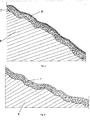
- Fig.3 is an illustrative partial sectional view of a first embodiment of a trail created with the artificial snow at normal temperature in the present invention and natural snow in mixture.
- natural snow 6 covers the artificial snow at normal temperature 7 disclosed in the present invention
- the artificial snow at normal temperature disclosed in the present invention is paved on the foundation 8.
- the foundation 8 can be a natural foundation or an artificial foundation. As shown in the figure, the foundation is an undulating slope.
- natural snow 6 and the artificial snow at normal temperature 7 form a sloping trail together.
- Natural snow 6 and the artificial snow at normal temperature 7 can form trails at different gradients, including 0° gradient.
- Fig.4 is an illustrative partial sectional view of a second embodiment of a trail created with the artificial snow at normal temperature according to the present invention. Compared with the embodiment shown in Fig.3 , the difference in the second embodiment is: no natural snow is used; instead, the trail is created solely by paving the artificial snow at normal temperature 7 on the foundation 8. Such a trail is not subject to the restrictions of time and temperature completely.
- the trail is created by covering natural snow 6 on the artificial snow at normal temperature 7 in the embodiment shown in Fig.3 , it should be noted that natural snow 6 can be mixed with the artificial snow at normal temperature 7 homogeneously or non-homogeneously to create a trail, which is to say, an embodiment in which natural snow is used in mixture with the artificial snow at normal temperature disclosed in the present invention is very flexible; in that case, the proportions between natural snow and the artificial snow at normal temperature and the paving method can be selected as required according to the actual situation.
- Fig.5 is an illustrative partial sectional view of a third embodiment of a trail paved with the artificial snow at normal temperature according to the present invention.
- the trail further comprises a strong magnetic layer composed of several permanent magnet blocks 9 which are arranged in a uniform polarity orientation on the foundation 8 of the trail and thereby forms the strong magnetic layer under the artificial snow at normal temperature 7.
- the snow grains 1 that form the artificial snow at normal temperature 7 can align to a polarity orientation automatically, so that the polarity orientation of the snow grains 1 is uniform as far as possible, and thereby higher attractive force can be created among the snow grains 1, and the snow grains 1 can exhibit higher dispersion resistance.
- damped dispersion is one of the most important features simulated by the artificial snow at normal temperature disclosed in the present invention, and the higher dispersion resistance among the snow grains 1 can meet a higher requirement for damped dispersion.
- the dimensions of the strong magnetic layer composed by the permanent magnet blocks 9 can be equal to the dimensions of the trail plane essentially, or can be smaller than the dimensions of the trail plane as required.
- the permanent magnet blocks 9 can be 10cm ⁇ 10cm squares, for example.
- the artificial snow at normal temperature disclosed in the present invention in which the solid grains 2 are made of a magnetic material solely, can be produced with a method that comprises the following steps:
- the material layer is a macromolecular material layer, or a metal coating.
- the above method can further comprise: coloring the material layer which has been bonded to the solid grains.
- the producing method can comprise the following steps:
- the above method comprises the following step between the sieving step and the magnetization step: bonding a layer of material that modify the surface performance to the surfaces of the solid grains obtained from the sieving.
- the above method can further comprise: coloring the material layer which has been bonded to the solid grains.
- the main body of the solid grain can be a material selected from metal materials, organic materials, and inorganic non-metal materials; preferably, the solid grains that have a main body made of a non-magnetic material and contain a magnetic material are obtained by mixing a crushed or molten magnetic material with a molten material for the main body and then pelleting. If the main body of the solid grain is made of an organic macromolecular material, as described above, the step of bonding a layer of material that can modify the surface performance to the surfaces of the solid grains obtained from the sieving is not a necessity.
- the magnetization is carried out when the material for the main body is still in a molten state, and the strong magnetic force of a magnetic field is utilized to enable the magnetic material contained in the main body to align automatically orderly or enable the magnetic material contained in the main body to have the same polarity orientation.
- the mesh size of the mesh sieve can be selected according to the expected grain size of the solid grains, for example, the mesh size can be 4-10mpi, more specifically 5mpi, 8mpi, or 9mpi, etc.
- the artificial snow at normal temperature disclosed in the present invention can simulate the features of natural snow well, is simple to produce and convenient to use, simplifies the operation of creating a trail, and can substitute natural snow on a large scale in order to create a trail, thereby enabling a substantial reduction of the restrictions of environmental temperature and seasons on skiing, lengthening the operating time of a ski resort, and significantly increasing the returns of the ski resort.
Landscapes
- Chemical & Material Sciences (AREA)
- Engineering & Computer Science (AREA)
- Organic Chemistry (AREA)
- Dispersion Chemistry (AREA)
- Power Engineering (AREA)
- Structural Engineering (AREA)
- Materials Engineering (AREA)
- Architecture (AREA)
- Civil Engineering (AREA)
- Thermal Sciences (AREA)
- General Engineering & Computer Science (AREA)
- Mechanical Engineering (AREA)
- Physics & Mathematics (AREA)
- Chemical Kinetics & Catalysis (AREA)
- Road Paving Structures (AREA)
- Compositions Of Macromolecular Compounds (AREA)
- Hard Magnetic Materials (AREA)
Claims (4)
- Künstlicher Schnee bei Normaltemperatur (7) für Skilauf, zusammengesetzt aus Körnern (1) von künstlichem Schnee bei Normaltemperatur (7), die magnetische feste Körner (2) enthalten, wobei ein Restmagnetismus in den festen Körnern (2) innerhalb eines Bereichs von 1000 - 9000 Gs liegt, und eine Korngröße der festen Körner (2) innerhalb eines Bereichs von 1-3 mm liegt,wobei das magnetische Material in den festen Körnern ein Ferrit-Magnetmaterial oder ein Nd-Fe-B-Seltenerd-Permanentmagnetmaterial ist,wobei eine Schicht makromolekularen Materials oder ein Metallüberzug an die Oberflächen der festen Körner (2) gebunden ist,wobei das makromolekulare Material ein Kunststoffmaterial, ein Lackmaterial oder ein polymerbasiertes Verbundmaterial ist,wobei das makromolekulare Material Polyethylen, Polypropylen, Polyvinylchlorid oder Polyurethan ist.
- Verfahren zur Herstellung von künstlichem Schnee bei Normaltemperatur (7), welches die folgenden Schritte umfasst:A) Verwenden einer Zerkleinerungsvorrichtung, um ein magnetisches Material zu festen Körnern zu zerkleinern, oder Erzeugen von festen Körnern, die aus einem Hauptkörper (4) bestehen, der aus einem nichtmagnetischen Material hergestellt ist, und ein magnetisches Material (5) enthalten, wobei das magnetische Material in den festen Körnern ein Ferrit-Magnetmaterial oder ein Nd-Fe-B-Seltenerd-Permanentmagnetmaterial ist;B) Verwenden eines Maschensiebs, um die festen Körner bei einer bestimmten Korngröße zu sieben; undC) Magnetisieren der aus dem Sieben erhaltenen festen Körner durch Aufladen von Magnetismus,wobei ein Restmagnetismus in den festen Körnern (2) innerhalb eines Bereichs von 1000 - 9000 Gs liegt, und eine Korngröße der festen Körner (2) innerhalb eines Bereichs von 1-3 mm liegt,
wobei das Verfahren zwischen dem Siebschritt und dem Magnetisierungsschritt zudem den folgenden Schritt umfasst: Binden einer Schicht makromolekularen Materials oder eines Metallüberzugs an die Oberflächen der aus dem Sieben erhaltenen festen Körner,
wobei das makromolekulare Material ein Kunststoffmaterial, ein Lackmaterial oder ein polymerbasiertes Verbundmaterial ist,
wobei das makromolekulare Material Polyethylen, Polypropylen, Polyvinylchlorid oder Polyurethan ist. - Piste, umfassend den künstlichen Schnee bei Normaltemperatur (7) nach Anspruch 1 und eine stark magnetische Schicht, die aus mehreren Permanentmagnet-Blöcken (9) zusammengesetzt ist, die in einer Orientierung mit einheitlicher Polarität auf dem Fundament (8) der Piste angeordnet sind, und dadurch die stark magnetische Schicht unter dem künstlichen Schnee bei Normaltemperatur (7) bildet.
- Verwendung des künstlichen Schnees bei Normaltemperatur (7) nach Anspruch 1 zum massiven Aufbringen auf Pisten mit verschiedenen Steigungen in einem Skigebiet.
Applications Claiming Priority (1)
| Application Number | Priority Date | Filing Date | Title |
|---|---|---|---|
| PCT/CN2012/080640 WO2014032226A1 (zh) | 2012-08-27 | 2012-08-27 | 人造常温雪 |
Publications (3)
| Publication Number | Publication Date |
|---|---|
| EP2889353A1 EP2889353A1 (de) | 2015-07-01 |
| EP2889353A4 EP2889353A4 (de) | 2016-06-22 |
| EP2889353B1 true EP2889353B1 (de) | 2021-05-19 |
Family
ID=50182349
Family Applications (1)
| Application Number | Title | Priority Date | Filing Date |
|---|---|---|---|
| EP12883713.5A Active EP2889353B1 (de) | 2012-08-27 | 2012-08-27 | Künstlicher schnee bei normaler temperatur |
Country Status (12)
| Country | Link |
|---|---|
| US (1) | US10414959B2 (de) |
| EP (1) | EP2889353B1 (de) |
| JP (1) | JP6177329B2 (de) |
| KR (2) | KR20150043430A (de) |
| CN (1) | CN104640955B (de) |
| AU (1) | AU2012388637B2 (de) |
| BR (1) | BR112015004109A2 (de) |
| CA (1) | CA2882504C (de) |
| RU (1) | RU2605120C2 (de) |
| SG (1) | SG11201501247XA (de) |
| UA (1) | UA110011C2 (de) |
| WO (1) | WO2014032226A1 (de) |
Families Citing this family (5)
| Publication number | Priority date | Publication date | Assignee | Title |
|---|---|---|---|---|
| KR102190889B1 (ko) * | 2017-11-21 | 2020-12-14 | 주식회사 엘지화학 | 고단열 및 고강도 실리카 에어로겔 블랭킷 제조방법 |
| CN111704893B (zh) * | 2020-05-26 | 2021-11-05 | 北京理工大学 | 一种磁性凝胶冰雪材料及其制备方法 |
| CN113528089B (zh) * | 2021-06-23 | 2022-09-02 | 清华大学 | 基于磁性微颗粒的磁性吸能材料及其制备方法 |
| CN113638286B (zh) * | 2021-08-13 | 2022-06-14 | 清华大学 | 基于聚合物仿雪磁性颗粒的雪道及其铺设方法 |
| CN116622339B (zh) * | 2023-04-19 | 2025-09-12 | 北京华圻生态科技有限公司 | 一种人造雪及其制备方法 |
Citations (1)
| Publication number | Priority date | Publication date | Assignee | Title |
|---|---|---|---|---|
| JPS63134555A (ja) * | 1986-11-25 | 1988-06-07 | 高田 利夫 | フエライト複合体の製造法 |
Family Cites Families (30)
| Publication number | Priority date | Publication date | Assignee | Title |
|---|---|---|---|---|
| US3020811A (en) * | 1958-02-21 | 1962-02-13 | Cataphote Corp | Artificial snow |
| US3066580A (en) * | 1958-09-19 | 1962-12-04 | Alberti Rudolf | Ski surface and process of forming same |
| US3189667A (en) | 1960-11-23 | 1965-06-15 | Deutsche Edelstahlwerke Ag | Method of producing pressings to form permanent magnets |
| US3291486A (en) * | 1962-06-26 | 1966-12-13 | Dow Chemical Co | Ski slopes having a surface coating comprising a particulate resinous composition |
| US3400643A (en) * | 1966-02-14 | 1968-09-10 | Holley Plastics Company | Plastic ski surface structure |
| US3443492A (en) * | 1966-10-13 | 1969-05-13 | Charles M Pleass | Artificial snow |
| US3736847A (en) * | 1971-09-07 | 1973-06-05 | Mosher R | Synthetic terrain covering |
| SU429672A1 (ru) | 1971-09-27 | 1974-06-05 | Н. А. Лебедев Государственный проектный институт Печорпроект | Состав искусственного льда |
| SU452566A1 (ru) | 1973-03-22 | 1974-12-05 | Сибирский филиал Всесоюзного научно-исследовательского института гидротехники им.Б.Е.Веденеева | Заменитель льда |
| JPS609606B2 (ja) | 1977-05-30 | 1985-03-12 | 三菱化成ポリテック株式会社 | 人工スキー場滑走路面に散布する滑走用ビーズ |
| JPS5723144Y2 (de) * | 1978-12-18 | 1982-05-19 | ||
| JPS5590432A (en) | 1978-12-26 | 1980-07-09 | Fujitsu Ltd | Preparation of optical fiber |
| JPS5723144U (de) | 1980-07-15 | 1982-02-05 | ||
| JPH0388888A (ja) | 1989-05-18 | 1991-04-15 | Teiko Miyata | 人工雪及びその製造方法 |
| JP2794119B2 (ja) * | 1989-06-05 | 1998-09-03 | えい子 伊東 | スキー用人工滑材 |
| JPH08134438A (ja) | 1994-11-10 | 1996-05-28 | Takeda Chem Ind Ltd | 人工雪及びその製造方法 |
| JP3926937B2 (ja) | 1998-10-30 | 2007-06-06 | 京セラ株式会社 | 電子写真用キャリア、電子写真用キャリアの製造方法および電子写真用キャリアを用いた電子写真用現像剤 |
| JP3535127B2 (ja) | 2001-10-19 | 2004-06-07 | 金光 賢之 | 人工雪材の製造方法 |
| CN1997697A (zh) * | 2004-03-23 | 2007-07-11 | 联邦科学与工业研究组织 | 掺杂有氧化铁颗粒的聚合物珠 |
| ES2394853T3 (es) | 2005-06-30 | 2013-02-06 | Jingming Lang | Nieve artificial, y pista o suelo de esquí artificial |
| CN100551987C (zh) * | 2005-07-01 | 2009-10-21 | 郎静明 | 人造雪及人造滑雪场 |
| JP5590432B2 (ja) | 2006-06-15 | 2014-09-17 | 大日本印刷株式会社 | 燃料電池用シート状部材の製造方法、及び、メンブレンフィルタ用シート状部材の製造方法 |
| EP2071258A1 (de) | 2007-12-14 | 2009-06-17 | Bächler Top Track AG | Nukleatordüse, Verwendung einer Nukleatordüse, Schneekanone, Schneilanze und Verfahren zum Erzeugen von Eiskeimen und von künstlichem Schnee |
| RU2368639C1 (ru) | 2007-12-25 | 2009-09-27 | Андрей Викторович Гетманский | Имитатор льда или снега |
| RU84239U1 (ru) | 2009-02-24 | 2009-07-10 | Андрей Викторович Гетманский | Синтетическая снежная трасса |
| CN101781437B (zh) * | 2010-01-12 | 2012-07-04 | 南京大学 | 一种磁性丙烯酸系强碱阴离子交换微球树脂及其制备方法 |
| CN102194562A (zh) | 2010-02-09 | 2011-09-21 | 日立麦克赛尔株式会社 | 生物用磁性球的制造方法以及磁性球和磁性物 |
| JP5120467B2 (ja) * | 2010-03-17 | 2013-01-16 | Tdk株式会社 | フェライト磁性材料、フェライト磁石、フェライト焼結磁石 |
| GB2481637B (en) * | 2010-07-01 | 2013-11-20 | Custompac Ltd | A method of manufacturing artificial snow |
| WO2012159096A2 (en) * | 2011-05-18 | 2012-11-22 | The Regents Of The University Of California | Nanostructured high-strength permanent magnets |
-
2012
- 2012-08-27 EP EP12883713.5A patent/EP2889353B1/de active Active
- 2012-08-27 RU RU2015110988/05A patent/RU2605120C2/ru active
- 2012-08-27 WO PCT/CN2012/080640 patent/WO2014032226A1/zh not_active Ceased
- 2012-08-27 UA UAA201502135A patent/UA110011C2/uk unknown
- 2012-08-27 BR BR112015004109A patent/BR112015004109A2/pt not_active Application Discontinuation
- 2012-08-27 SG SG11201501247XA patent/SG11201501247XA/en unknown
- 2012-08-27 US US14/424,153 patent/US10414959B2/en not_active Expired - Fee Related
- 2012-08-27 KR KR1020157006375A patent/KR20150043430A/ko not_active Ceased
- 2012-08-27 CA CA2882504A patent/CA2882504C/en not_active Expired - Fee Related
- 2012-08-27 KR KR1020177001900A patent/KR101836202B1/ko not_active Expired - Fee Related
- 2012-08-27 JP JP2015528826A patent/JP6177329B2/ja not_active Expired - Fee Related
- 2012-08-27 CN CN201280075432.8A patent/CN104640955B/zh not_active Expired - Fee Related
- 2012-08-27 AU AU2012388637A patent/AU2012388637B2/en not_active Ceased
Patent Citations (1)
| Publication number | Priority date | Publication date | Assignee | Title |
|---|---|---|---|---|
| JPS63134555A (ja) * | 1986-11-25 | 1988-06-07 | 高田 利夫 | フエライト複合体の製造法 |
Also Published As
| Publication number | Publication date |
|---|---|
| US20150307760A1 (en) | 2015-10-29 |
| KR20170010914A (ko) | 2017-02-01 |
| KR20150043430A (ko) | 2015-04-22 |
| JP2015528559A (ja) | 2015-09-28 |
| CA2882504C (en) | 2020-11-10 |
| SG11201501247XA (en) | 2015-04-29 |
| AU2012388637B2 (en) | 2016-04-21 |
| NZ705168A (en) | 2016-05-27 |
| EP2889353A4 (de) | 2016-06-22 |
| AU2012388637A1 (en) | 2015-03-05 |
| CN104640955A (zh) | 2015-05-20 |
| BR112015004109A2 (pt) | 2017-07-04 |
| RU2605120C2 (ru) | 2016-12-20 |
| US10414959B2 (en) | 2019-09-17 |
| UA110011C2 (uk) | 2015-10-26 |
| WO2014032226A1 (zh) | 2014-03-06 |
| EP2889353A1 (de) | 2015-07-01 |
| RU2015110988A (ru) | 2016-10-20 |
| CN104640955B (zh) | 2017-08-01 |
| JP6177329B2 (ja) | 2017-08-09 |
| KR101836202B1 (ko) | 2018-03-08 |
| CA2882504A1 (en) | 2014-03-06 |
Similar Documents
| Publication | Publication Date | Title |
|---|---|---|
| AU2012388637B2 (en) | Artificial snow at normal temperature | |
| CN104861931B (zh) | 一种人造雪的制备方法 | |
| JP6549630B2 (ja) | 人工常温雪 | |
| CN203503234U (zh) | 一种投影沙盘展示系统 | |
| NZ705168B2 (en) | Artificial snow at normal temperature | |
| KR101890914B1 (ko) | 인조잔디용 목재칩 충진재 및 이의 제조방법 | |
| KR101612717B1 (ko) | 컬링스톤의 제작방법 | |
| CN104658734B (zh) | 一种球形磁性复合材料及其制备方法 | |
| KR101735293B1 (ko) | 컬링스톤의 제작방법 | |
| CN206090230U (zh) | 一种彩色人行道耐磨涂层结构 | |
| US20120034429A1 (en) | Adaptive disruptive environmental graphic design class pattern and methods related thereto | |
| CN208933780U (zh) | 一种儿童运动防护地坪 | |
| CN204059868U (zh) | 一种耐污epdm橡胶颗粒弹性地面 | |
| KR20210044953A (ko) | 색상 발현이 우수한 내균열성 경관포장용 칼라아스콘 | |
| CN208762824U (zh) | 一种压实型epdm运动场地坪 | |
| CN208762825U (zh) | 一种不易褪色的彩色epdm运动场地坪 | |
| CN205474694U (zh) | 一种环保混合型塑胶跑道 | |
| CN203891415U (zh) | 一种立体视觉地面 | |
| CN202202232U (zh) | 永不褪色护树砖 | |
| KR101735426B1 (ko) | 컬링스톤의 제작방법 | |
| CN203323619U (zh) | 新型玩具枪子弹 | |
| CN103589175A (zh) | 一种新型园林路面材料及其制备方法 | |
| CN202440737U (zh) | 一种亲水塑胶场地 | |
| CN202202233U (zh) | 双层护树砖 | |
| JPS58143001A (ja) | 舗装方法 |
Legal Events
| Date | Code | Title | Description |
|---|---|---|---|
| PUAI | Public reference made under article 153(3) epc to a published international application that has entered the european phase |
Free format text: ORIGINAL CODE: 0009012 |
|
| 17P | Request for examination filed |
Effective date: 20150327 |
|
| AK | Designated contracting states |
Kind code of ref document: A1 Designated state(s): AL AT BE BG CH CY CZ DE DK EE ES FI FR GB GR HR HU IE IS IT LI LT LU LV MC MK MT NL NO PL PT RO RS SE SI SK SM TR |
|
| AX | Request for extension of the european patent |
Extension state: BA ME |
|
| DAX | Request for extension of the european patent (deleted) | ||
| RA4 | Supplementary search report drawn up and despatched (corrected) |
Effective date: 20160520 |
|
| RIC1 | Information provided on ipc code assigned before grant |
Ipc: B22F 9/00 20060101ALI20160513BHEP Ipc: C09K 3/24 20060101AFI20160513BHEP Ipc: B01J 2/00 20060101ALI20160513BHEP Ipc: F25C 3/04 20060101ALI20160513BHEP |
|
| STAA | Information on the status of an ep patent application or granted ep patent |
Free format text: STATUS: EXAMINATION IS IN PROGRESS |
|
| 17Q | First examination report despatched |
Effective date: 20181022 |
|
| REG | Reference to a national code |
Ref country code: DE Ref legal event code: R079 Ref document number: 602012075638 Country of ref document: DE Free format text: PREVIOUS MAIN CLASS: C09K0003240000 Ipc: B01J0002000000 |
|
| GRAP | Despatch of communication of intention to grant a patent |
Free format text: ORIGINAL CODE: EPIDOSNIGR1 |
|
| STAA | Information on the status of an ep patent application or granted ep patent |
Free format text: STATUS: GRANT OF PATENT IS INTENDED |
|
| RIC1 | Information provided on ipc code assigned before grant |
Ipc: H01F 1/28 20060101ALI20201110BHEP Ipc: E01C 13/12 20060101ALI20201110BHEP Ipc: B22F 9/04 20060101ALI20201110BHEP Ipc: B01J 2/00 20060101AFI20201110BHEP Ipc: C22C 33/02 20060101ALI20201110BHEP Ipc: F25C 3/04 20060101ALI20201110BHEP Ipc: B22F 1/02 20060101ALI20201110BHEP Ipc: C09K 3/24 20060101ALI20201110BHEP |
|
| INTG | Intention to grant announced |
Effective date: 20201130 |
|
| GRAS | Grant fee paid |
Free format text: ORIGINAL CODE: EPIDOSNIGR3 |
|
| GRAA | (expected) grant |
Free format text: ORIGINAL CODE: 0009210 |
|
| STAA | Information on the status of an ep patent application or granted ep patent |
Free format text: STATUS: THE PATENT HAS BEEN GRANTED |
|
| AK | Designated contracting states |
Kind code of ref document: B1 Designated state(s): AL AT BE BG CH CY CZ DE DK EE ES FI FR GB GR HR HU IE IS IT LI LT LU LV MC MK MT NL NO PL PT RO RS SE SI SK SM TR |
|
| REG | Reference to a national code |
Ref country code: GB Ref legal event code: FG4D |
|
| REG | Reference to a national code |
Ref country code: CH Ref legal event code: EP |
|
| REG | Reference to a national code |
Ref country code: DE Ref legal event code: R096 Ref document number: 602012075638 Country of ref document: DE |
|
| REG | Reference to a national code |
Ref country code: AT Ref legal event code: REF Ref document number: 1393455 Country of ref document: AT Kind code of ref document: T Effective date: 20210615 |
|
| REG | Reference to a national code |
Ref country code: IE Ref legal event code: FG4D |
|
| REG | Reference to a national code |
Ref country code: LT Ref legal event code: MG9D |
|
| REG | Reference to a national code |
Ref country code: NL Ref legal event code: MP Effective date: 20210519 |
|
| PG25 | Lapsed in a contracting state [announced via postgrant information from national office to epo] |
Ref country code: HR Free format text: LAPSE BECAUSE OF FAILURE TO SUBMIT A TRANSLATION OF THE DESCRIPTION OR TO PAY THE FEE WITHIN THE PRESCRIBED TIME-LIMIT Effective date: 20210519 Ref country code: BG Free format text: LAPSE BECAUSE OF FAILURE TO SUBMIT A TRANSLATION OF THE DESCRIPTION OR TO PAY THE FEE WITHIN THE PRESCRIBED TIME-LIMIT Effective date: 20210819 Ref country code: LT Free format text: LAPSE BECAUSE OF FAILURE TO SUBMIT A TRANSLATION OF THE DESCRIPTION OR TO PAY THE FEE WITHIN THE PRESCRIBED TIME-LIMIT Effective date: 20210519 Ref country code: FI Free format text: LAPSE BECAUSE OF FAILURE TO SUBMIT A TRANSLATION OF THE DESCRIPTION OR TO PAY THE FEE WITHIN THE PRESCRIBED TIME-LIMIT Effective date: 20210519 |
|
| PG25 | Lapsed in a contracting state [announced via postgrant information from national office to epo] |
Ref country code: PL Free format text: LAPSE BECAUSE OF FAILURE TO SUBMIT A TRANSLATION OF THE DESCRIPTION OR TO PAY THE FEE WITHIN THE PRESCRIBED TIME-LIMIT Effective date: 20210519 Ref country code: NO Free format text: LAPSE BECAUSE OF FAILURE TO SUBMIT A TRANSLATION OF THE DESCRIPTION OR TO PAY THE FEE WITHIN THE PRESCRIBED TIME-LIMIT Effective date: 20210819 Ref country code: PT Free format text: LAPSE BECAUSE OF FAILURE TO SUBMIT A TRANSLATION OF THE DESCRIPTION OR TO PAY THE FEE WITHIN THE PRESCRIBED TIME-LIMIT Effective date: 20210920 Ref country code: ES Free format text: LAPSE BECAUSE OF FAILURE TO SUBMIT A TRANSLATION OF THE DESCRIPTION OR TO PAY THE FEE WITHIN THE PRESCRIBED TIME-LIMIT Effective date: 20210519 Ref country code: GR Free format text: LAPSE BECAUSE OF FAILURE TO SUBMIT A TRANSLATION OF THE DESCRIPTION OR TO PAY THE FEE WITHIN THE PRESCRIBED TIME-LIMIT Effective date: 20210820 Ref country code: IS Free format text: LAPSE BECAUSE OF FAILURE TO SUBMIT A TRANSLATION OF THE DESCRIPTION OR TO PAY THE FEE WITHIN THE PRESCRIBED TIME-LIMIT Effective date: 20210919 Ref country code: LV Free format text: LAPSE BECAUSE OF FAILURE TO SUBMIT A TRANSLATION OF THE DESCRIPTION OR TO PAY THE FEE WITHIN THE PRESCRIBED TIME-LIMIT Effective date: 20210519 Ref country code: RS Free format text: LAPSE BECAUSE OF FAILURE TO SUBMIT A TRANSLATION OF THE DESCRIPTION OR TO PAY THE FEE WITHIN THE PRESCRIBED TIME-LIMIT Effective date: 20210519 Ref country code: SE Free format text: LAPSE BECAUSE OF FAILURE TO SUBMIT A TRANSLATION OF THE DESCRIPTION OR TO PAY THE FEE WITHIN THE PRESCRIBED TIME-LIMIT Effective date: 20210519 |
|
| PG25 | Lapsed in a contracting state [announced via postgrant information from national office to epo] |
Ref country code: NL Free format text: LAPSE BECAUSE OF FAILURE TO SUBMIT A TRANSLATION OF THE DESCRIPTION OR TO PAY THE FEE WITHIN THE PRESCRIBED TIME-LIMIT Effective date: 20210519 |
|
| PG25 | Lapsed in a contracting state [announced via postgrant information from national office to epo] |
Ref country code: SK Free format text: LAPSE BECAUSE OF FAILURE TO SUBMIT A TRANSLATION OF THE DESCRIPTION OR TO PAY THE FEE WITHIN THE PRESCRIBED TIME-LIMIT Effective date: 20210519 Ref country code: SM Free format text: LAPSE BECAUSE OF FAILURE TO SUBMIT A TRANSLATION OF THE DESCRIPTION OR TO PAY THE FEE WITHIN THE PRESCRIBED TIME-LIMIT Effective date: 20210519 Ref country code: EE Free format text: LAPSE BECAUSE OF FAILURE TO SUBMIT A TRANSLATION OF THE DESCRIPTION OR TO PAY THE FEE WITHIN THE PRESCRIBED TIME-LIMIT Effective date: 20210519 Ref country code: CZ Free format text: LAPSE BECAUSE OF FAILURE TO SUBMIT A TRANSLATION OF THE DESCRIPTION OR TO PAY THE FEE WITHIN THE PRESCRIBED TIME-LIMIT Effective date: 20210519 Ref country code: DK Free format text: LAPSE BECAUSE OF FAILURE TO SUBMIT A TRANSLATION OF THE DESCRIPTION OR TO PAY THE FEE WITHIN THE PRESCRIBED TIME-LIMIT Effective date: 20210519 Ref country code: RO Free format text: LAPSE BECAUSE OF FAILURE TO SUBMIT A TRANSLATION OF THE DESCRIPTION OR TO PAY THE FEE WITHIN THE PRESCRIBED TIME-LIMIT Effective date: 20210519 |
|
| REG | Reference to a national code |
Ref country code: DE Ref legal event code: R097 Ref document number: 602012075638 Country of ref document: DE |
|
| REG | Reference to a national code |
Ref country code: DE Ref legal event code: R119 Ref document number: 602012075638 Country of ref document: DE |
|
| PLBE | No opposition filed within time limit |
Free format text: ORIGINAL CODE: 0009261 |
|
| STAA | Information on the status of an ep patent application or granted ep patent |
Free format text: STATUS: NO OPPOSITION FILED WITHIN TIME LIMIT |
|
| REG | Reference to a national code |
Ref country code: CH Ref legal event code: PL |
|
| PG25 | Lapsed in a contracting state [announced via postgrant information from national office to epo] |
Ref country code: MC Free format text: LAPSE BECAUSE OF FAILURE TO SUBMIT A TRANSLATION OF THE DESCRIPTION OR TO PAY THE FEE WITHIN THE PRESCRIBED TIME-LIMIT Effective date: 20210519 |
|
| REG | Reference to a national code |
Ref country code: BE Ref legal event code: MM Effective date: 20210831 |
|
| 26N | No opposition filed |
Effective date: 20220222 |
|
| GBPC | Gb: european patent ceased through non-payment of renewal fee |
Effective date: 20210827 |
|
| PG25 | Lapsed in a contracting state [announced via postgrant information from national office to epo] |
Ref country code: LI Free format text: LAPSE BECAUSE OF NON-PAYMENT OF DUE FEES Effective date: 20210831 Ref country code: CH Free format text: LAPSE BECAUSE OF NON-PAYMENT OF DUE FEES Effective date: 20210831 |
|
| PG25 | Lapsed in a contracting state [announced via postgrant information from national office to epo] |
Ref country code: IS Free format text: LAPSE BECAUSE OF FAILURE TO SUBMIT A TRANSLATION OF THE DESCRIPTION OR TO PAY THE FEE WITHIN THE PRESCRIBED TIME-LIMIT Effective date: 20210919 Ref country code: LU Free format text: LAPSE BECAUSE OF NON-PAYMENT OF DUE FEES Effective date: 20210827 Ref country code: AL Free format text: LAPSE BECAUSE OF FAILURE TO SUBMIT A TRANSLATION OF THE DESCRIPTION OR TO PAY THE FEE WITHIN THE PRESCRIBED TIME-LIMIT Effective date: 20210519 |
|
| PG25 | Lapsed in a contracting state [announced via postgrant information from national office to epo] |
Ref country code: IT Free format text: LAPSE BECAUSE OF NON-PAYMENT OF DUE FEES Effective date: 20210827 Ref country code: IE Free format text: LAPSE BECAUSE OF NON-PAYMENT OF DUE FEES Effective date: 20210827 Ref country code: GB Free format text: LAPSE BECAUSE OF NON-PAYMENT OF DUE FEES Effective date: 20210827 Ref country code: FR Free format text: LAPSE BECAUSE OF NON-PAYMENT OF DUE FEES Effective date: 20210831 Ref country code: DE Free format text: LAPSE BECAUSE OF NON-PAYMENT OF DUE FEES Effective date: 20220301 Ref country code: BE Free format text: LAPSE BECAUSE OF NON-PAYMENT OF DUE FEES Effective date: 20210831 |
|
| REG | Reference to a national code |
Ref country code: AT Ref legal event code: MM01 Ref document number: 1393455 Country of ref document: AT Kind code of ref document: T Effective date: 20210827 |
|
| PG25 | Lapsed in a contracting state [announced via postgrant information from national office to epo] |
Ref country code: AT Free format text: LAPSE BECAUSE OF NON-PAYMENT OF DUE FEES Effective date: 20210827 |
|
| PG25 | Lapsed in a contracting state [announced via postgrant information from national office to epo] |
Ref country code: HU Free format text: LAPSE BECAUSE OF FAILURE TO SUBMIT A TRANSLATION OF THE DESCRIPTION OR TO PAY THE FEE WITHIN THE PRESCRIBED TIME-LIMIT; INVALID AB INITIO Effective date: 20120827 Ref country code: CY Free format text: LAPSE BECAUSE OF FAILURE TO SUBMIT A TRANSLATION OF THE DESCRIPTION OR TO PAY THE FEE WITHIN THE PRESCRIBED TIME-LIMIT Effective date: 20210519 |
|
| PG25 | Lapsed in a contracting state [announced via postgrant information from national office to epo] |
Ref country code: MK Free format text: LAPSE BECAUSE OF FAILURE TO SUBMIT A TRANSLATION OF THE DESCRIPTION OR TO PAY THE FEE WITHIN THE PRESCRIBED TIME-LIMIT Effective date: 20210519 |
|
| PG25 | Lapsed in a contracting state [announced via postgrant information from national office to epo] |
Ref country code: MT Free format text: LAPSE BECAUSE OF FAILURE TO SUBMIT A TRANSLATION OF THE DESCRIPTION OR TO PAY THE FEE WITHIN THE PRESCRIBED TIME-LIMIT Effective date: 20210519 |
|
| REG | Reference to a national code |
Ref country code: AT Ref legal event code: UEP Ref document number: 1393455 Country of ref document: AT Kind code of ref document: T Effective date: 20210519 |
|
| PG25 | Lapsed in a contracting state [announced via postgrant information from national office to epo] |
Ref country code: TR Free format text: LAPSE BECAUSE OF FAILURE TO SUBMIT A TRANSLATION OF THE DESCRIPTION OR TO PAY THE FEE WITHIN THE PRESCRIBED TIME-LIMIT Effective date: 20210519 |