EP2864374B2 - Filmzusammensetzung - Google Patents
Filmzusammensetzung Download PDFInfo
- Publication number
- EP2864374B2 EP2864374B2 EP13731746.7A EP13731746A EP2864374B2 EP 2864374 B2 EP2864374 B2 EP 2864374B2 EP 13731746 A EP13731746 A EP 13731746A EP 2864374 B2 EP2864374 B2 EP 2864374B2
- Authority
- EP
- European Patent Office
- Prior art keywords
- polymer
- composition
- density
- film
- catalyst
- Prior art date
- Legal status (The legal status is an assumption and is not a legal conclusion. Google has not performed a legal analysis and makes no representation as to the accuracy of the status listed.)
- Active
Links
Images

Classifications
-
- C—CHEMISTRY; METALLURGY
- C08—ORGANIC MACROMOLECULAR COMPOUNDS; THEIR PREPARATION OR CHEMICAL WORKING-UP; COMPOSITIONS BASED THEREON
- C08J—WORKING-UP; GENERAL PROCESSES OF COMPOUNDING; AFTER-TREATMENT NOT COVERED BY SUBCLASSES C08B, C08C, C08F, C08G or C08H
- C08J5/00—Manufacture of articles or shaped materials containing macromolecular substances
- C08J5/18—Manufacture of films or sheets
-
- C—CHEMISTRY; METALLURGY
- C08—ORGANIC MACROMOLECULAR COMPOUNDS; THEIR PREPARATION OR CHEMICAL WORKING-UP; COMPOSITIONS BASED THEREON
- C08L—COMPOSITIONS OF MACROMOLECULAR COMPOUNDS
- C08L23/00—Compositions of homopolymers or copolymers of unsaturated aliphatic hydrocarbons having only one carbon-to-carbon double bond; Compositions of derivatives of such polymers
- C08L23/02—Compositions of homopolymers or copolymers of unsaturated aliphatic hydrocarbons having only one carbon-to-carbon double bond; Compositions of derivatives of such polymers not modified by chemical after-treatment
- C08L23/04—Homopolymers or copolymers of ethene
- C08L23/06—Polyethene
-
- C—CHEMISTRY; METALLURGY
- C08—ORGANIC MACROMOLECULAR COMPOUNDS; THEIR PREPARATION OR CHEMICAL WORKING-UP; COMPOSITIONS BASED THEREON
- C08J—WORKING-UP; GENERAL PROCESSES OF COMPOUNDING; AFTER-TREATMENT NOT COVERED BY SUBCLASSES C08B, C08C, C08F, C08G or C08H
- C08J2323/00—Characterised by the use of homopolymers or copolymers of unsaturated aliphatic hydrocarbons having only one carbon-to-carbon double bond; Derivatives of such polymers
- C08J2323/02—Characterised by the use of homopolymers or copolymers of unsaturated aliphatic hydrocarbons having only one carbon-to-carbon double bond; Derivatives of such polymers not modified by chemical after treatment
- C08J2323/04—Homopolymers or copolymers of ethene
- C08J2323/06—Polyethene
-
- C—CHEMISTRY; METALLURGY
- C08—ORGANIC MACROMOLECULAR COMPOUNDS; THEIR PREPARATION OR CHEMICAL WORKING-UP; COMPOSITIONS BASED THEREON
- C08J—WORKING-UP; GENERAL PROCESSES OF COMPOUNDING; AFTER-TREATMENT NOT COVERED BY SUBCLASSES C08B, C08C, C08F, C08G or C08H
- C08J2323/00—Characterised by the use of homopolymers or copolymers of unsaturated aliphatic hydrocarbons having only one carbon-to-carbon double bond; Derivatives of such polymers
- C08J2323/02—Characterised by the use of homopolymers or copolymers of unsaturated aliphatic hydrocarbons having only one carbon-to-carbon double bond; Derivatives of such polymers not modified by chemical after treatment
- C08J2323/04—Homopolymers or copolymers of ethene
- C08J2323/08—Copolymers of ethene
-
- C—CHEMISTRY; METALLURGY
- C08—ORGANIC MACROMOLECULAR COMPOUNDS; THEIR PREPARATION OR CHEMICAL WORKING-UP; COMPOSITIONS BASED THEREON
- C08J—WORKING-UP; GENERAL PROCESSES OF COMPOUNDING; AFTER-TREATMENT NOT COVERED BY SUBCLASSES C08B, C08C, C08F, C08G or C08H
- C08J2323/00—Characterised by the use of homopolymers or copolymers of unsaturated aliphatic hydrocarbons having only one carbon-to-carbon double bond; Derivatives of such polymers
- C08J2323/02—Characterised by the use of homopolymers or copolymers of unsaturated aliphatic hydrocarbons having only one carbon-to-carbon double bond; Derivatives of such polymers not modified by chemical after treatment
- C08J2323/18—Homopolymers or copolymers of hydrocarbons having four or more carbon atoms
- C08J2323/20—Homopolymers or copolymers of hydrocarbons having four or more carbon atoms having four to nine carbon atoms
Definitions
- the present invention relates to novel ethylene polymer compositions and to films made therefrom.
- bimodal polyethylene compositions that is to say compositions comprising a low molecular weight (LMW) component and a high molecular weight (HMW) component.
- LMW low molecular weight
- HMW high molecular weight
- films made from bimodal resins may have an inferior appearance due to the presence of gels, which is indicative for a lower degree of homogeneity of the final resin.
- EP 1712574A discloses a polyethylene resin for films said to have improved processability and mechanical properties, particularly impact strength. Although the resin is simply stated to have a density of 940 kg/m 3 or more, the Examples all have densities in the range 945-947 kg/m 3 , as it is well known that dart drop impact resistance declines sharply with increasing density (see for example Ster van der Ven, "Polypropylene and other Polyolefins", Elsevier Science Publishers, 1990, p. 489 ).
- Impact strength characterises the behaviour of a material under a specific load (impact).
- the dart drop test applies specifically to films: a free-falling dart of specific weight and geometry is dropped onto a film from a specified height. All dart drop values are measured according to ASTM D1709 Method A, and all values quoted herein are on a 15mm film.
- Elmendorf Tear strength characterises the resistance to tearing of a film in a particular direction, either machine direction (MD - the direction of stretching) or transverse direction TD.
- MD machine direction
- TD transverse direction
- Elmendorf Tear Resistance is the resistance to tearing measured according to ASTM Standard D 1922 on 15 mm film and is expressed in g/25mm.
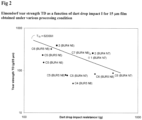
- the compositions of the present invention have been found to have particularly good TD tear strength for a given impact strength as measured by the dart drop test.
- the HLMI of the polyethylene composition from which the film is made is preferably from 8 to 14, and most preferably from 8 to 13.
- the melt flow index MI 5 of the polyethylene composition from which the film is made is preferably between 0.2 g/10 min and 0.5 g/10 min, more preferably between 0.25 and 0.45 g/10 min and most preferably between 0.25 and 0.4 g/10 min.
- the ratio of HLMI to melt flow index MI 5 (HLMI/MI 5 ) of the polyethylene copmposition from which the film is made is preferably between 27 and 37, more preferably between 28 and 34.
- melt flow indices HLMI and MI 5 are measured according to ISO1133 at a temperature of 190°C under loads of 21.6kg and 5kg respectively.
- the molecular weight distribution Mw/Mn of the polyethylene composition from which the film is made, as measured by gel permeation chromatography, is preferably between 28 and 38, more preferably between 30 and 36.
- the magnitude of the dynamic complex viscosity at an applied oscillating frequency w of 100 rad/s, n ⁇ 100 , which is linked to the molecular weight of the polymer, is the viscosity at shear rates of the order typically experienced during extrusion processes. It affects extruder motor power consumption, melt pressure generation at the die etc; a low ⁇ ⁇ 100 is desirable.
- the composition used in the invention preferably has a dynamic complex viscosity ⁇ ⁇ 100 below 2400 Pa.s, more preferably below 2300 Pa.s.
- the polyethylene composition preferably has a density of from 949 to 955 kg/m 3 and most particularly from 950 to 953 kg/m 3 .
- the polyethylene composition has a density between 950 to 953 kg/m3 and an HLMI between 8 and 13 g/10min.
- the polyethylene composition from which the film is made is a multimodal polyethylene composition comprising from 40 to 60 wt% of an ethylene polymer (A) having a density of at least 965 kg/m 3 , and from 60 to 40 wt% of an ethylene polymer (B) having a density of 910 to 945 kg/m 3 .
- the polyethylene composition may optionally further comprise a small prepolymerisation fraction in an amount of 10 wt% or less based on total polyethylene.
- it may further comprise a fraction of very high molecular weight polymer, having a higher molecular weight than the aforementioned high molecular weight polymer, in an amount of 10 wt% or less based on total polyethylene.
- the weight ratio of polymer (A) to polymer (B) in the polyethylene composition is between 47:53 and 55:45, more preferably between 48:52 and 53:47, regardless of the presence or otherwise of any additional polyethylene fractions.
- the polyethylene composition of the invention is multimodal, in that it comprises at least two polyethylene components.
- it is bimodal, which means that it contains significant amounts of only two polyethylene components.
- the form of the molecular weight distribution curve, i.e. the appearance of the graph of the polymer weight fraction as function of its molecular weight, of a multimodal polyethylene will show two or more maxima or at least be distinctly broadened in comparison with the curves for the individual fractions. For example, if a polymer is produced in a sequential multistage process utilising reactors coupled in series with different conditions in each reactor, each of the polymer fractions produced in the different reactors will have its own molecular weight distribution and weight average molecular weight.
- the molecular weight distribution curve of such a polymer comprises the sum of the individual curves of the fractions, typically yielding a curve for the multimodal polymer having a substantially single peak or two or more distinct maxima.
- a "substantially single peak” may not follow a Gaussian distribution, may be broader than a Gaussian distribution would indicate, or have a flatter peak than a Gaussian distribution. Some substantially singular peaks may have a tail on either side of the peak. In some embodiments it may be possible to mathematically resolve a "substantially single peak" in a molecular weight distribution curve into two or more components by various methods.
- ethylene polymer (A) is a homopolymer
- ethylene polymer (B) is a copolymer of ethylene and a C 4 -C 8 alpha-olefin.
- the amount of polymer (A) present in the composition is preferably between 47wt% and 55wt% based on total polyethylene, more preferably between 48wt% and 53wt%.
- the amount of polymer (B) present in the composition is preferably between 45wt% and 53wt%, more preferably between 47wt% and 52wt%. These amounts correspond to the weight ratio of (A) to (B) in the case where these are the only two polyethylene fractions present in the composition.
- polyethylene fractions may optionally be present in the composition: when the amounts of polymer (A) and polymer (B) are 47-55wt% and 45-53wt% respectively, it is preferred that the maximum amount of any prepolymer as previously described is 5wt%, and the maximum amount of any very high molecular weight fraction as previously described is 5wt%.
- the term "homopolymer” is understood to denote an ethylene polymer composed essentially of monomer units derived from ethylene and substantially devoid of monomer units derived from other olefins.. It may contain trace amount of units derived from other olefins which are present as impurities in the feed or recycle streams of the polymerisation process or which are carried over between stages in a multistage process, but it should contain less than 0.3 mol% , preferably less than 0.2 mol% of units derived from other olefins.
- copolymer of ethylene and a C 4 -C 8 alpha-olefin is understood to denote a copolymer comprising monomer units derived from ethylene and monomer units derived from a C 4 -C 8 alpha-olefin and, optionally, from at least one other .alpha.-olefin.
- the C 4 -C 8 alpha-olefin can be selected from olefinically unsaturated monomers comprising from 4 to 8 carbon atoms, such as, for example, 1-butene, 1-pentene, 1-hexene, 3-methyl-1-butene, 3- and 4-methyl-1-pentenes and 1-octene.
- Preferred alpha-olefins are 1-butene, 1-hexene and 1-octene and more particularly 1-hexene.
- the other alpha-olefin which may also be present additional to the C 4 -C 8 alpha-olefin is preferably selected from olefinically unsaturated monomers comprising from 3 to 8 carbon atoms, such as, for example, propylene, 1-butene, 1-pentene, 3-methyl-1-butene, 3- and 4-methyl-1-pentenes, 1-hexene and 1-octene.
- the content in copolymer (B) of monomer units derived from C 4 -C 8 alpha-olefin, hereinafter called comonomer content, is generally at least 1 wt%, in particular at least 1.5wt%.
- the comonomer content of copolymer (B) is usually at most 6wt%, preferably at most 5wt%.
- Comonomer content in the overall composition is preferably in the range 0.5-3wt%.
- the C 4 -C 8 alpha-olefin content is measured by 13 C NMR according to the method described in J. C. Randall, JMS-Rev. Macromol. Chem. Phys., C29(2&3), p. 201-317 (1989 ), that is to say that the content of units derived from C 4 -C 8 alpha-olefin is calculated from the measurements of the integrals of the lines characteristic of that particular C 4 -C 8 alpha-olefin in comparison with the integral of the line characteristic of the units derived from ethylene (30 ppm).
- a composition composed essentially of monomer units derived from ethylene and a single C 4 -C 8 alpha-olefin is particularly preferred.
- polymer (A) has an MI 2 of from 100 to 800, preferably from 200 to 700, The most preferred range of MI 2 for polymer (A) is from 250 to 450 g/10min.
- melt flow index MI 2 is defined as that measured according to ISO1133 at a temperature of 190°C under a load of 2.16kg, although in the Examples below it has been calculated from the value measured using a smaller 8mm length/1.0mm internal diameter die.
- the density of polymer (A) is preferably between 968 and 975 kg/m 3 , more preferably between 970 and 974 kg/m 3 .
- the density of copolymer (B) is preferably between 920 and 940 kg/m 3 , more preferably between 925 and 935 kg/m 3 .
- the ratio of HLMI to melt index MI 2 for polymer (A) is preferably 20 to 40, more preferably 25 to 35.
- the ratio of HLMI to melt index MI 5 for polymer (A) is preferably 5 to 15, more preferably 8 to 13.
- the ratio of HLMI to melt index MI 2 for polymer (B) is preferably 20 to 40, more preferably 25 to 35.
- the ratio of HLMI to melt index MI 5 for polymer (B) is preferably 5 to 15, more preferably 8 to 13.
- melt index, density and comonomer content of both polymers are measured directly.
- melt index, density and comonomer content of the second polymer cannot be measured, and instead for the purposes of this invention they are defined as shown below. The definitions below would also apply to a third or subsequent polymer (if one is present) which is made in the presence of the first two polymers.
- melt indices such as HLMI and MI 2 of the second (or third or subsequent) polymer are defined as being the value directly measured for the second (or third or subsequent) polymer when made separately under the same polymerisation conditions as used to make the multimodal composition.
- the second (or third or subsequent) polymer is made separately using the same catalyst and under the same polymerisation conditions as those employed in the second (or third or subsequent) reactor of the multimodal polymerisation,and its melt index is then measured.
- the polymer is made with a "multiple catalyst system” such as a bimetallic catalyst, it is possible to make both polymers (A) and (B) in the same reactor. In such a case it is not possible to measure directly the properties of either polymer (A) or polymer (B). Therefore in this case the properties of both polymers (A) and (B) are defined as being those obtained when the respective polymers are prepared separately using the individual catalysts of the "multiple catalyst system", and under the same polymerisation conditions as those employed for making the multimodal polymer composition.
- a "multiple catalyst system” such as a bimetallic catalyst
- a particularly preferred composition for forming the films of the present invention has a density between 949 to 955 kg/m 3 and an HLMI between 8 and 14 g/10min, and comprises from 47 to 55 wt% of an ethylene polymer (A) having a density of between 968 and 975 kg/m 3 , and from 45 to 53 wt% of an ethylene polymer (B) having a density of between 920 and 940 kg/m 3 , the ratio of (A):(B) also being from 47:53 to 55:45.
- Polymer (A) preferably has an MI 2 between 200 and 700 g/10min.
- the most preferred multimodal composition for forming the films of the present invention has a density between 950 to 953 kg/m 3 and an HLMI between 8 and 13 g/10min, and comprises from 48 to 53 wt% of an ethylene polymer (A) having a density of between 970 and 974 kg/m 3 , and from 47 to 52 wt% of an ethylene polymer (B) having a density of between 925 and 935 kg/m 3 , the ratio of (A):(B) also being from 48:52 to 53:47.
- Polymer (A) preferably has an MI 2 between 250 and 450 g/10min.
- the films of the invention may consist entirely of the polyethylene composition described above, the invention includes within its scope films comprising other components in addition to the polyethylene composition.
- the film may contain conventional additives in an amount of up to 8wt%, preferably up to 5wt% and more preferably up to 3wt% based on the total weight of the film.
- additives include stabilizers (antioxidizing agents and/or anti-UV agents), antistatic agents and processing aids, as well as pigments.
- the film may also contain up to 10wt% of another polyolefin.
- compositions of the invention comprise a minimum of 47wt% of polymer (A) and 45wt% of polymer (B), and therefore the maximum combined amount of all other components including any prepolymer, very high molecular weight polymer, additives or other polyolefin (if present), is 8wt%. Similary, when the minimum amount of polymer (A) is 48wt% and the minimum amount of polymer (B) is 47wt%, the maximum content of all other components is 5wt%,
- the films of the invention have a dart drop value of more than 270g, more preferably more than 310g, and still more preferably more than 350g, when the film has a thickness of 15 ⁇ m and is extruded with a die diameter of 100mm, a die gap of 1.2mm, a blow-up ratio BUR of 4, a neck height of 7 x die diameter and a take-up speed of 30m/min.
- compositions used in the films of the invention are preferably unreticulated.
- the preferred polyethylene composition used in the films of the invention may be produced by any of the methods known in the art, such as mechanically blending polymers (A) and (B) and optionally other polyethylenes, in situ formation of of polymers (A) and (B) in the presence of a "multiple catalyst system", and formation of polymers (A) and (B) in a multistage process.
- Blending may be carried out in any conventional blending apparatus.
- a “multiple catalyst system” is meant a composition, mixture or system including at least two different catalyst compounds, each having the same or a different metal group, including a “dual catalyst,” e.g., a bimetallic catalyst.
- each different catalyst compound of the multiple catalyst system may reside on a single support particle, in which case a dual (bimetallic) catalyst is considered to be a supported catalyst.
- bimetallic catalyst also broadly includes a system or mixture in which one of the catalysts resides on one collection of support particles, and another catalyst resides on another collection of support particles.
- the two supported catalysts are introduced to a single reactor, either simultaneously or sequentially, and polymerisation is conducted in the presence of the bimetallic catalyst system, i.e., the two collections of supported catalysts.
- the multiple catalyst system includes a mixture of unsupported catalysts in slurry form.
- One catalyst may be used to produce the HMW component, and the other may be used to produce the LMW component.
- the catalyst producing the LMW component is usually more responsive to chain termination reagents, such as hydrogen, than the HMW catalyst.
- the polyethylene composition of the invention is preferably obtained by a multistage ethylene polymerisation, typically using a series of reactors.
- a multistage process is a polymerisation process in which a polymer comprising two or more fractions is produced by producing at least two polymer fraction(s) in separate reaction stages, usually with different reaction conditions in each stage, in the presence of the reaction product of the previous stage.
- the polymerisation reactions used in each stage may involve conventional ethylene homopolymerisation or copolymerisation reactions, e.g. gas-phase, slurry phase, liquid phase polymerisations, using conventional reactors, e.g. loop reactors, gas phase reactors, batch reactors etc.
- the polymer (A) is produced in the first reactor, and that polymer (B) is produced in a subsequent reactor. However this order may be reversed. If the multimodal composition includes a prepolymer, this is made in a reactor preceding the first reactor. It is preferred that all reactors are slurry reactors, in particular slurry loop reactors.
- the invention also provides a process for obtaining a polyethylene film, comprising the steps of polymerising ethylene and optionally comonomer, compounding the polyethylene composition to form it into pellets, and then forming the pellets into a film.
- the step of polymerising ethylene preferably forms a multimodal polyethylene.
- the catalyst employed in the polymerisation process to produce the polyethylene compositions of the invention may be any catalyst(s) suitable for preparing such polyethylenes. If the polyethylene is multimodal, it is preferred that the same catalyst produces both the high and low molecular weight fractions.
- the catalyst may be a chromium catalyst, a Ziegler-Natta catalyst, or a metallocene catalyst.
- the catalyst is a Ziegler-Natta catalyst.
- the catalyst used comprises at least one transition metal.
- Transition metal means a metal of groups 4, 5 or 6 of the Periodic Table of elements (CRC Handbook of Chemistry and Physics, 75th edition, 1994-95).
- the transition metal is preferably titanium and/or zirconium.
- a catalyst comprising not only the transition metal but also magnesium is preferably utilised. Good results have been obtained with catalysts comprising:
- catalysts contain 5 to 30% by weight of transition metal, 0.5 to 20% by weight of magnesium, 20 to 70% by weight of chlorine and 0.1 to 10% by weight of aluminium, and have a residual organic radical content in the precipitated catalyst of less than 35wt%.
- These catalysts are also obtained by coprecipitation of at least one transition metal compound and a magnesium compound by means of a halogenated organoaluminium compound, but with a ratio of transition metal to magnesium of no more than about 1:1. They may optionally further omprise an electron donor. They are described in more detail in our own EP 703247B .
- Most preferred catalysts have the following composition:
- the cocatalyst utilised in the process is preferably an organoaluminium compound.
- organoaluminium compounds of formula AlR 3 in which R represents an alkyl grouping having from 1 to 8 carbon atoms are preferred. Particularly preferred are triethylaluminium and triisobutylaluminium.
- the polymerisation temperature is generally from 20 to 130°C, preferably from 60°C to 115°C, and more preferably from 75°C to 110°C.
- the total pressure at which the process is effected is in general from 0.1 MPa to 10 MPa.
- the total pressure is preferably at least 2.5 MPa.
- the total pressure is preferably at least 1.3 MPa.
- the period of polymerisation in the first reactor and in the further reactor is in general at least 20 minutes, preferably at least 30 minutes. It does not usually exceed 5 hours, preferably not 3 hours.
- a slurry comprising the resin of the invention is collected at the outlet of the further polymerisation reactor.
- the composition may be separated from the suspension by any known means.
- the suspension is subjected to a pressure expansion (final expansion) so as to eliminate the diluent, the ethylene, the alpha-olefin and any hydrogen from the composition.
- compositions of the invention are compounded into pellets, which may optionally then be used in the manufacture of films.
- Compounding conditions and equipment are well known to those skilled in the art.
- Films may optionally be made from compositions which have been reticulated during compounding: however it is preferred that the compositions of the invention and films made therefrom, as well as the films of the invention, are unreticulated.
- compositions made according to the invention can be mixed with the usual processing additives for polyolefins, such as stabilizers (antioxidizing agents and/or anti-UV agents), antistatic agents and processing aids, as well as pigments.
- processing additives for polyolefins such as stabilizers (antioxidizing agents and/or anti-UV agents), antistatic agents and processing aids, as well as pigments.
- Melt indexes are determined according to ISO1133 and are indicated in g/10min. For polyethylenes a temperature of 190°C is applied. MI 2 is determined under a load of 2.16 kg, MI 5 is determined under a load of 5 kg and HLMI is determined under a load of 21.6 kg.
- Density of the polyethylene was measured according to ISO 1183-1 (Method A) and the sample plaque was prepared according to ASTM D4703 (Condition C) where it was cooled under pressure at a cooling rate of 15°C/min from 190°C to 40°C.
- Dynamic rheological measurements are carried out, according to ASTM D 4440, on a dynamic rheometer (e.g., ARES) with 25 mm diameter parallel plates in a dynamic mode under an inert atmosphere.
- the rheometer has been thermally stable at 190°C for at least 30 minutes before inserting the appropriately stabilised (with anti-oxidant additives), compression-moulded sample onto the parallel plates.
- the plates are then closed with a positive normal force registered on the meter to ensure good contact.
- After about 5 minutes at 190°C the plates are lightly compressed and the surplus polymer at the circumference of the plates is trimmed. A further 10 minutes is allowed for thermal stability and for the normal force to decrease back to zero. That is, all measurements are carried out after the samples have been equilibrated at 190°C for about 15 minutes and are run under full nitrogen blanketing.
- Two strain sweep (SS) experiments are initially carried out at 190°C to determine the linear viscoelastic strain that would generate a torque signal which is greater than 10% of the lower scale of the transducer, over the full frequency (e.g. 0.01 to 100 rad/s) range.
- the first SS experiment is carried out with a low applied frequency of 0.1 rad/s. This test is used to determine the sensitivity of the torque at low frequency.
- the second SS experiment is carried out with a high applied frequency of 100 rad/s. This is to ensure that the selected applied strain is well within the linear viscoelastic region of the polymer so that the oscillatory rheological measurements do not induce structural changes to the polymer during testing.
- a time sweep (TS) experiment is carried out with a low applied frequency of 0.1 rad/s at the selected strain (as determined by the SS experiments) to check the stability of the sample during testing.
- the frequency sweep (FS) experiment was then carried out at 190°C using the above appropriately selected strain level between dynamic frequencies range of 10 -2 to 100 rad/s, under nitrogen.
- Storage modulus G'( ⁇ ), also known as “elastic modulus”, which is a function of the applied oscillating frequency, ⁇ , is defined as the stress in phase with the strain in a sinusoidal deformation divided by the strain; while the term “Viscous modulus”, G"( ⁇ ), also known as “loss modulus”, which is also a function of the applied oscillating frequency, ⁇ , is defined as the stress 90 degrees out of phase with the strain divided by the strain. Both these moduli, and the others linear viscoelastic, dynamic rheological parameters, are well known within the skill in the art, for example, as discussed by G. Marin in "Oscillatory Rheometry", Chapter 10 of the book on Rheological Measurement, edited by A.A. Collyer and D.W. Clegg, Elsevier, 1988 .
- Elmendorf Tear Resistance is the resistance to tearing measured according to ASTM Standard D 1922; MD denotes the measurement in the longitudinal (machine) direction of the film, TD denotes the measurement in the transverse direction of the film. The values have been expressed in g/25 ⁇ m.
- the solvent used was 1,2,4 Trichlorobenzene at 150°C, stabilised with BHT, of 0.2 g/litre concentration.
- Polymer solutions of 0.8 g/litre concentration were prepared at 160°C for one hour with stirring only at the last 30 minutes.
- the nominal injection volume was set at 400 ⁇ l and the nominal flow rate was 1 ml/min.
- a relative calibration was constructed using 13 narrow molecular weight linear polystyrene standards: PS Standard Molecular Weight 1 7 520 000 2 4 290 000 3 2 630 000 4 1 270 000 5 706 000 6 355 000 7 190 000 8 114 000 9 43 700 10 18 600 11 10 900 12 6 520 13 2 950
- Magnesium diethoxide was reacted with titanium tetrabutoxide for 7 hours at 140 ⁇ 5 °C in an amount such that the molar ratio of titanium to magnesium was equal to 1.
- the reaction product thus obtained (mixed alcoholate) was subsequently contacted with ethylbenzoate (EB) at ambient temperature for at least 6 hours and diluted in hexane to reach a concentration of 0.4 mol magnesium per litre, the addition being in an amount such that the molar ratio of ethyl benzoate to magnesium diethoxide was equal to 2.
- EB ethylbenzoate
- the mixture of mixed alcoholate and ethyl benzoate was then reacted with aluminium isobutyl dichloride (IBADIC), in two steps. Both steps were performed at 45°C.
- the amount of IBADIC introduced at the end of the first step corresponded to a IBADIC /Mg ratio of 4.5 mole/mole.
- a partial elimination of the chlorination by-products was effected by decantation of the solid and removal of the supernatant liquid.
- the amount of IBADIC introduced at the end of the second chlorination step corresponded to a IBADIC /Mg ratio of 2.5 mole/mole.
- the slurry was aged at 60°C for 45 minutes, and subsequently cooled at ambient temperature (less than 35°C).
- the reaction by-products were then removed from the slurry by washing the solid with polymerisation grade hexane.
- the catalyst thus obtained, collected from the suspension comprised (% by weight): Ti: 13; Cl: 51; Al: 2; Mg: 7.
- the concentration of total benzoates in the catalyst was about 10wt%.
- the resulting mixture, at least partially degassed of hydrogen, was then continuously introduced into a second polymerization reactor, at the same time as ethylene, hexene, isobutane and hydrogen, and the polymerization of the ethylene and of the hexene was carried out therein in order to form the ethylene/1-hexene copolymer (B).
- the suspension comprising the composition comprising ethylene polymers was continuously withdrawn from the second reactor and this suspension was subjected to a final reduction in pressure, so as to evaporate the isobutane and the reactants present (ethylene, hexene and hydrogen) and to recover the composition in the form of a powder, which was subjected to drying in order to complete the degassing of the isobutane.
- the polymer powder was then transferred to a Werner and Pfleiderer ZSK40 twinscrew extruder and compounded with the following additive package: 1000 ppm calcium stearate, 1000 ppm zinc stearate, 800 ppm Irgafos 168, 800 ppm Irganox 1076.
- Comparative examples C3 and C4 are taken from WO 2006/018245 (comparative example A and example 7, respectively) and C7 is taken from EP 1712574A (example 5).
- Comparative examples C5 and C6 are commercially available resins (Hostalen GM9450F from LyondellBasell Industries and Thaizex 7000F from Bangkok Polyethylene PLC, respectively).
- Mz/G' 3000 Pa
- HLMI HLMI
- the Examples of the invention have lower values for the complex viscosity at high shear rate of 100 rad/s as measured in a dynamic rheometer ( ⁇ * 100 ) than any of the comparative Examples.
- compositions of the above Examples were blown into films on a Kiefel Rotex 40SA line of the following description:
- Samples of the films made from above examples were conditioned for 48 hours at 20 - 25°C before measuring their dart drop impacting and Elemendorf tear resistance.
Landscapes
- Chemical & Material Sciences (AREA)
- Health & Medical Sciences (AREA)
- Chemical Kinetics & Catalysis (AREA)
- Medicinal Chemistry (AREA)
- Polymers & Plastics (AREA)
- Organic Chemistry (AREA)
- Engineering & Computer Science (AREA)
- Manufacturing & Machinery (AREA)
- Materials Engineering (AREA)
- Manufacture Of Macromolecular Shaped Articles (AREA)
- Compositions Of Macromolecular Compounds (AREA)
- Addition Polymer Or Copolymer, Post-Treatments, Or Chemical Modifications (AREA)
- Laminated Bodies (AREA)
Claims (7)
- Folie aus einer Polyethylenzusammensetzung mit einer Dichte von 948-956 kg/m3, einem Hochlast-Schmelzindex HLMI von 7-15, einem Schmelze-Speichermodul G' bei einer dynamischen Frequenz, bei der der Verlustmodul G" = 3000 Pa ist, G'(G" = 3000) von 1400-1800 Pa und einem Wert von Mz/G' (G" = 3000) von mindestens 930 Da/Pa, wobei Mz das z-mittlere Molekulargewicht ist.
- Folie nach Anspruch 1, wobei die Polyethylenzusammensetzung einen Schmelze-Speichermodul G'(G" = 3000) von 1450 bis 1750 Pa, vorzugsweise von 1500 bis 1700 Pa, aufweist.
- Folie nach Anspruch oder 2, wobei die Polyethylenzusammensetzung eine dynamische komplexe Viskosität η*100 unter 2400 Pa.s, vorzugsweise unter 2300 Pa.s, aufweist.
- Folie nach einem der vorhergehenden Ansprüche, wobei die Polyethylenzusammensetzung einen Schmelzflussindex Mls von zwischen 0,2 g/10 min und 0,5 g/10 min aufweist.
- Folie nach einem der vorhergehenden Ansprüche, wobei die Polyethylenzusammensetzung eine Dichte von 949 bis 955 kg/m3 aufweist.
- Folie nach einem der vorhergehenden Ansprüche, wobei es sich bei der Polyethylenzusammensetzung um eine multimodale Zusammensetzung handelt, die 47 bis 55 Gew.-% eines Ethylenpolymers (A) mit einer Dichte von mindestens 965 kg/m3 und 45 bis 53 Gew.-% eines Ethylenpolymers (B) mit einer Dichte von 910 bis 945 kg/m3 umfasst.
- Folie nach einem der vorhergehenden Ansprüche, die einen Dart-Drop-Wert von mehr als 270, vorzugsweise mehr als 310, aufweist, wenn die Folie eine Dicke von 15 µm aufweist und mit einem Düsendurchmesser von 100 mm, einem Düsenspalt von 1,2 mm, einem Aufblasverhältnis BUR von 4, einer Halshöhe von 7 x Düsendurchmesser und einer Aufnahmegeschwindigkeit von 30 m/min extrudiert wird.
Priority Applications (1)
| Application Number | Priority Date | Filing Date | Title |
|---|---|---|---|
| EP13731746.7A EP2864374B2 (de) | 2012-06-26 | 2013-06-25 | Filmzusammensetzung |
Applications Claiming Priority (3)
| Application Number | Priority Date | Filing Date | Title |
|---|---|---|---|
| EP12173654 | 2012-06-26 | ||
| PCT/EP2013/063202 WO2014001288A1 (en) | 2012-06-26 | 2013-06-25 | Film composition |
| EP13731746.7A EP2864374B2 (de) | 2012-06-26 | 2013-06-25 | Filmzusammensetzung |
Publications (3)
| Publication Number | Publication Date |
|---|---|
| EP2864374A1 EP2864374A1 (de) | 2015-04-29 |
| EP2864374B1 EP2864374B1 (de) | 2016-05-25 |
| EP2864374B2 true EP2864374B2 (de) | 2023-08-16 |
Family
ID=48699771
Family Applications (1)
| Application Number | Title | Priority Date | Filing Date |
|---|---|---|---|
| EP13731746.7A Active EP2864374B2 (de) | 2012-06-26 | 2013-06-25 | Filmzusammensetzung |
Country Status (10)
| Country | Link |
|---|---|
| US (1) | US9481772B2 (de) |
| EP (1) | EP2864374B2 (de) |
| JP (1) | JP6177323B2 (de) |
| CN (1) | CN104540857B (de) |
| BR (1) | BR112014032628B1 (de) |
| CA (1) | CA2876948C (de) |
| ES (1) | ES2588513T5 (de) |
| MX (1) | MX377242B (de) |
| RU (1) | RU2631651C2 (de) |
| WO (1) | WO2014001288A1 (de) |
Families Citing this family (8)
| Publication number | Priority date | Publication date | Assignee | Title |
|---|---|---|---|---|
| JP4871280B2 (ja) | 2005-08-30 | 2012-02-08 | スパンション エルエルシー | 半導体装置およびその製造方法 |
| EP3303424B1 (de) * | 2015-05-28 | 2020-03-11 | SABIC Global Technologies B.V. | Multimodales hochdichtes polyethylen |
| US11718719B2 (en) * | 2016-10-14 | 2023-08-08 | Exxonmobil Chemical Patents Inc. | Oriented films comprising ethlyene-based polymers and methods of making same |
| US10623846B2 (en) * | 2016-12-06 | 2020-04-14 | Bose Corporation | Earpieces employing viscoelastic materials |
| TWI790693B (zh) * | 2020-08-03 | 2023-01-21 | 美商美力肯及公司 | 熱塑性聚合物組成物及由其製造薄膜之方法 |
| EP4251663A1 (de) | 2020-11-27 | 2023-10-04 | Borealis AG | Verfahren |
| US20240342976A1 (en) * | 2021-08-03 | 2024-10-17 | Ineos Europe Ag | Polyethylene film |
| CN120379805A (zh) | 2022-12-20 | 2025-07-25 | 英尼奥斯欧洲股份公司 | 生产聚烯烃粒料的方法 |
Family Cites Families (23)
| Publication number | Priority date | Publication date | Assignee | Title |
|---|---|---|---|---|
| LU64420A1 (de) | 1971-12-08 | 1973-07-16 | ||
| BE791676A (fr) | 1971-12-08 | 1973-05-21 | Solvay | Procédé pour la polymérisation des oléfines |
| LU77489A1 (de) | 1977-06-06 | 1979-01-19 | ||
| DE69232109T2 (de) * | 1991-07-24 | 2002-03-14 | Mobil Oil Corp., Fairfax | Verbesserte Polyethylenharze für Filme |
| BE1008702A3 (fr) | 1994-09-22 | 1996-07-02 | Solvay | Procede de polymerisation d'olefines. |
| JP3487728B2 (ja) * | 1997-02-21 | 2004-01-19 | 三井化学株式会社 | 包装用ポリエチレンフィルム |
| GB9928679D0 (en) | 1999-12-03 | 2000-02-02 | Bp Chem Int Ltd | Polymerisation process |
| JP2002206008A (ja) * | 2001-01-11 | 2002-07-26 | Idemitsu Petrochem Co Ltd | インフレーションフィルム成形用ポリエチレン系樹脂及びそれを基材としたインフレーションフィルム |
| AU2002342028A1 (en) * | 2001-11-30 | 2003-06-17 | Exxonmobil Chemical Patents Inc. | Oxygen tailoring of polyethylene resins |
| JP2003192802A (ja) * | 2001-12-27 | 2003-07-09 | Asahi Kasei Corp | フィルム成型用ポリエチレン樹脂組成物およびその製造法 |
| JP2003212924A (ja) * | 2002-01-29 | 2003-07-30 | Japan Polyolefins Co Ltd | ポリエチレン系樹脂材料およびそれを用いた成形体 |
| US6875828B2 (en) * | 2002-09-04 | 2005-04-05 | Univation Technologies, Llc | Bimodal polyolefin production process and films therefrom |
| TW200504093A (en) * | 2003-05-12 | 2005-02-01 | Dow Global Technologies Inc | Polymer composition and process to manufacture high molecular weight-high density polyethylene and film therefrom |
| US6878454B1 (en) * | 2003-12-05 | 2005-04-12 | Univation Technologies, Llc | Polyethylene films |
| GB0418581D0 (en) | 2004-08-20 | 2004-09-22 | Solvay | Polymer composition |
| DE602006012623D1 (de) * | 2005-02-09 | 2010-04-15 | Ineos Europe Ltd | Copolymere und folien daraus |
| DE602005005164T2 (de) | 2005-04-12 | 2008-09-11 | Borealis Technology Oy | Polyethylenfilm mit verbesserter Verarbeitbarkeit und verbesserten mechanischen Eigenschaften |
| US7858702B2 (en) * | 2005-06-14 | 2010-12-28 | Univation Technologies, Llc | Enhanced ESCR bimodal HDPE for blow molding applications |
| EP1935909A1 (de) * | 2006-12-21 | 2008-06-25 | Ineos Europe Limited | Copolymere und Folien daraus |
| KR101555726B1 (ko) * | 2007-12-31 | 2015-09-25 | 다우 글로벌 테크놀로지스 엘엘씨 | 에틸렌-기재 중합체 조성물, 그의 제조 방법 및 그로부터 제조된 물품 |
| WO2010034520A1 (en) | 2008-09-25 | 2010-04-01 | Basell Polyolefine Gmbh | Impact resistant lldpe composition and films made thereof |
| KR101769641B1 (ko) * | 2010-01-19 | 2017-08-18 | 다우 글로벌 테크놀로지스 엘엘씨 | 취입 필름 압출 방법에 적당한 폴리에틸렌 조성물의 버블 안정성 개선 방법 |
| MX357624B (es) * | 2012-06-26 | 2018-07-17 | Dow Global Technologies Llc | Una composicion de mezcla de polietileno adecuada para peliculas sopladas y peliculas fabricadas a partir de la misma. |
-
2013
- 2013-06-25 EP EP13731746.7A patent/EP2864374B2/de active Active
- 2013-06-25 MX MX2015000068A patent/MX377242B/es active IP Right Grant
- 2013-06-25 CN CN201380044718.4A patent/CN104540857B/zh active Active
- 2013-06-25 RU RU2015102029A patent/RU2631651C2/ru active
- 2013-06-25 CA CA2876948A patent/CA2876948C/en active Active
- 2013-06-25 US US14/409,003 patent/US9481772B2/en active Active
- 2013-06-25 BR BR112014032628-2A patent/BR112014032628B1/pt active IP Right Grant
- 2013-06-25 WO PCT/EP2013/063202 patent/WO2014001288A1/en not_active Ceased
- 2013-06-25 JP JP2015519039A patent/JP6177323B2/ja active Active
- 2013-06-25 ES ES13731746T patent/ES2588513T5/es active Active
Also Published As
| Publication number | Publication date |
|---|---|
| EP2864374A1 (de) | 2015-04-29 |
| BR112014032628A2 (pt) | 2017-06-27 |
| EP2864374B1 (de) | 2016-05-25 |
| JP2015525806A (ja) | 2015-09-07 |
| ES2588513T3 (es) | 2016-11-03 |
| CN104540857B (zh) | 2016-05-25 |
| BR112014032628B1 (pt) | 2021-06-22 |
| RU2631651C2 (ru) | 2017-09-26 |
| US20150368412A1 (en) | 2015-12-24 |
| MX2015000068A (es) | 2015-04-08 |
| WO2014001288A1 (en) | 2014-01-03 |
| US9481772B2 (en) | 2016-11-01 |
| CN104540857A (zh) | 2015-04-22 |
| ES2588513T5 (es) | 2024-03-05 |
| CA2876948C (en) | 2020-04-14 |
| MX377242B (es) | 2025-03-07 |
| JP6177323B2 (ja) | 2017-08-09 |
| CA2876948A1 (en) | 2014-01-03 |
| RU2015102029A (ru) | 2016-08-10 |
Similar Documents
| Publication | Publication Date | Title |
|---|---|---|
| EP2864374B2 (de) | Filmzusammensetzung | |
| EP1778769B2 (de) | Polymerzusammensetzung | |
| EP2668231B1 (de) | Polyethylenzusammensetzung | |
| EP1922342B1 (de) | Polymerzusammensetzung | |
| EP1812629B2 (de) | Verstreckte bänder, fasern und filamente aus einem multimodalen polyethylenharz | |
| EP2855577B1 (de) | Polymerzusammensetzung zum blasformen | |
| CN101160332B (zh) | 具有改良的加工性能与机械性能的聚乙烯膜 | |
| EP4344869A1 (de) | Multimodale ethylencopolymerzusammensetzung und folien damit | |
| CN117794963A (zh) | 用于膜层的聚乙烯共聚物 | |
| EP4267480B1 (de) | Polymerzusammensetzung für kappen und verschlüsse | |
| EP4380798B1 (de) | Polyethylenfilm | |
| CN120641474A (zh) | 用于包装应用的包括再生低密度聚乙烯的聚合物组合物 |
Legal Events
| Date | Code | Title | Description |
|---|---|---|---|
| PUAI | Public reference made under article 153(3) epc to a published international application that has entered the european phase |
Free format text: ORIGINAL CODE: 0009012 |
|
| 17P | Request for examination filed |
Effective date: 20141216 |
|
| AK | Designated contracting states |
Kind code of ref document: A1 Designated state(s): AL AT BE BG CH CY CZ DE DK EE ES FI FR GB GR HR HU IE IS IT LI LT LU LV MC MK MT NL NO PL PT RO RS SE SI SK SM TR |
|
| AX | Request for extension of the european patent |
Extension state: BA ME |
|
| DAX | Request for extension of the european patent (deleted) | ||
| GRAP | Despatch of communication of intention to grant a patent |
Free format text: ORIGINAL CODE: EPIDOSNIGR1 |
|
| INTG | Intention to grant announced |
Effective date: 20160215 |
|
| GRAS | Grant fee paid |
Free format text: ORIGINAL CODE: EPIDOSNIGR3 |
|
| GRAA | (expected) grant |
Free format text: ORIGINAL CODE: 0009210 |
|
| AK | Designated contracting states |
Kind code of ref document: B1 Designated state(s): AL AT BE BG CH CY CZ DE DK EE ES FI FR GB GR HR HU IE IS IT LI LT LU LV MC MK MT NL NO PL PT RO RS SE SI SK SM TR |
|
| REG | Reference to a national code |
Ref country code: GB Ref legal event code: FG4D |
|
| REG | Reference to a national code |
Ref country code: CH Ref legal event code: EP |
|
| REG | Reference to a national code |
Ref country code: IE Ref legal event code: FG4D Ref country code: AT Ref legal event code: REF Ref document number: 802275 Country of ref document: AT Kind code of ref document: T Effective date: 20160615 |
|
| REG | Reference to a national code |
Ref country code: FR Ref legal event code: PLFP Year of fee payment: 4 |
|
| REG | Reference to a national code |
Ref country code: DE Ref legal event code: R096 Ref document number: 602013008011 Country of ref document: DE |
|
| REG | Reference to a national code |
Ref country code: LT Ref legal event code: MG4D |
|
| REG | Reference to a national code |
Ref country code: NL Ref legal event code: MP Effective date: 20160525 |
|
| PG25 | Lapsed in a contracting state [announced via postgrant information from national office to epo] |
Ref country code: NO Free format text: LAPSE BECAUSE OF FAILURE TO SUBMIT A TRANSLATION OF THE DESCRIPTION OR TO PAY THE FEE WITHIN THE PRESCRIBED TIME-LIMIT Effective date: 20160825 Ref country code: NL Free format text: LAPSE BECAUSE OF FAILURE TO SUBMIT A TRANSLATION OF THE DESCRIPTION OR TO PAY THE FEE WITHIN THE PRESCRIBED TIME-LIMIT Effective date: 20160525 Ref country code: LT Free format text: LAPSE BECAUSE OF FAILURE TO SUBMIT A TRANSLATION OF THE DESCRIPTION OR TO PAY THE FEE WITHIN THE PRESCRIBED TIME-LIMIT Effective date: 20160525 Ref country code: FI Free format text: LAPSE BECAUSE OF FAILURE TO SUBMIT A TRANSLATION OF THE DESCRIPTION OR TO PAY THE FEE WITHIN THE PRESCRIBED TIME-LIMIT Effective date: 20160525 |
|
| REG | Reference to a national code |
Ref country code: ES Ref legal event code: FG2A Ref document number: 2588513 Country of ref document: ES Kind code of ref document: T3 Effective date: 20161103 |
|
| REG | Reference to a national code |
Ref country code: AT Ref legal event code: MK05 Ref document number: 802275 Country of ref document: AT Kind code of ref document: T Effective date: 20160525 |
|
| PG25 | Lapsed in a contracting state [announced via postgrant information from national office to epo] |
Ref country code: LV Free format text: LAPSE BECAUSE OF FAILURE TO SUBMIT A TRANSLATION OF THE DESCRIPTION OR TO PAY THE FEE WITHIN THE PRESCRIBED TIME-LIMIT Effective date: 20160525 Ref country code: GR Free format text: LAPSE BECAUSE OF FAILURE TO SUBMIT A TRANSLATION OF THE DESCRIPTION OR TO PAY THE FEE WITHIN THE PRESCRIBED TIME-LIMIT Effective date: 20160826 Ref country code: SE Free format text: LAPSE BECAUSE OF FAILURE TO SUBMIT A TRANSLATION OF THE DESCRIPTION OR TO PAY THE FEE WITHIN THE PRESCRIBED TIME-LIMIT Effective date: 20160525 Ref country code: RS Free format text: LAPSE BECAUSE OF FAILURE TO SUBMIT A TRANSLATION OF THE DESCRIPTION OR TO PAY THE FEE WITHIN THE PRESCRIBED TIME-LIMIT Effective date: 20160525 Ref country code: PT Free format text: LAPSE BECAUSE OF FAILURE TO SUBMIT A TRANSLATION OF THE DESCRIPTION OR TO PAY THE FEE WITHIN THE PRESCRIBED TIME-LIMIT Effective date: 20160926 |
|
| PG25 | Lapsed in a contracting state [announced via postgrant information from national office to epo] |
Ref country code: RO Free format text: LAPSE BECAUSE OF FAILURE TO SUBMIT A TRANSLATION OF THE DESCRIPTION OR TO PAY THE FEE WITHIN THE PRESCRIBED TIME-LIMIT Effective date: 20160525 Ref country code: SK Free format text: LAPSE BECAUSE OF FAILURE TO SUBMIT A TRANSLATION OF THE DESCRIPTION OR TO PAY THE FEE WITHIN THE PRESCRIBED TIME-LIMIT Effective date: 20160525 Ref country code: DK Free format text: LAPSE BECAUSE OF FAILURE TO SUBMIT A TRANSLATION OF THE DESCRIPTION OR TO PAY THE FEE WITHIN THE PRESCRIBED TIME-LIMIT Effective date: 20160525 Ref country code: EE Free format text: LAPSE BECAUSE OF FAILURE TO SUBMIT A TRANSLATION OF THE DESCRIPTION OR TO PAY THE FEE WITHIN THE PRESCRIBED TIME-LIMIT Effective date: 20160525 Ref country code: CZ Free format text: LAPSE BECAUSE OF FAILURE TO SUBMIT A TRANSLATION OF THE DESCRIPTION OR TO PAY THE FEE WITHIN THE PRESCRIBED TIME-LIMIT Effective date: 20160525 |
|
| REG | Reference to a national code |
Ref country code: CH Ref legal event code: PL |
|
| REG | Reference to a national code |
Ref country code: DE Ref legal event code: R026 Ref document number: 602013008011 Country of ref document: DE |
|
| PG25 | Lapsed in a contracting state [announced via postgrant information from national office to epo] |
Ref country code: AT Free format text: LAPSE BECAUSE OF FAILURE TO SUBMIT A TRANSLATION OF THE DESCRIPTION OR TO PAY THE FEE WITHIN THE PRESCRIBED TIME-LIMIT Effective date: 20160525 Ref country code: PL Free format text: LAPSE BECAUSE OF FAILURE TO SUBMIT A TRANSLATION OF THE DESCRIPTION OR TO PAY THE FEE WITHIN THE PRESCRIBED TIME-LIMIT Effective date: 20160525 Ref country code: SM Free format text: LAPSE BECAUSE OF FAILURE TO SUBMIT A TRANSLATION OF THE DESCRIPTION OR TO PAY THE FEE WITHIN THE PRESCRIBED TIME-LIMIT Effective date: 20160525 |
|
| PLBI | Opposition filed |
Free format text: ORIGINAL CODE: 0009260 |
|
| REG | Reference to a national code |
Ref country code: IE Ref legal event code: MM4A |
|
| PG25 | Lapsed in a contracting state [announced via postgrant information from national office to epo] |
Ref country code: MC Free format text: LAPSE BECAUSE OF FAILURE TO SUBMIT A TRANSLATION OF THE DESCRIPTION OR TO PAY THE FEE WITHIN THE PRESCRIBED TIME-LIMIT Effective date: 20160525 |
|
| PLAX | Notice of opposition and request to file observation + time limit sent |
Free format text: ORIGINAL CODE: EPIDOSNOBS2 |
|
| 26 | Opposition filed |
Opponent name: BOREALIS AG Effective date: 20170224 |
|
| PG25 | Lapsed in a contracting state [announced via postgrant information from national office to epo] |
Ref country code: CH Free format text: LAPSE BECAUSE OF NON-PAYMENT OF DUE FEES Effective date: 20160630 Ref country code: LI Free format text: LAPSE BECAUSE OF NON-PAYMENT OF DUE FEES Effective date: 20160630 |
|
| PG25 | Lapsed in a contracting state [announced via postgrant information from national office to epo] |
Ref country code: IE Free format text: LAPSE BECAUSE OF NON-PAYMENT OF DUE FEES Effective date: 20160625 Ref country code: SI Free format text: LAPSE BECAUSE OF FAILURE TO SUBMIT A TRANSLATION OF THE DESCRIPTION OR TO PAY THE FEE WITHIN THE PRESCRIBED TIME-LIMIT Effective date: 20160525 |
|
| REG | Reference to a national code |
Ref country code: FR Ref legal event code: PLFP Year of fee payment: 5 |
|
| REG | Reference to a national code |
Ref country code: GB Ref legal event code: 732E Free format text: REGISTERED BETWEEN 20170622 AND 20170628 |
|
| PLBB | Reply of patent proprietor to notice(s) of opposition received |
Free format text: ORIGINAL CODE: EPIDOSNOBS3 |
|
| PG25 | Lapsed in a contracting state [announced via postgrant information from national office to epo] |
Ref country code: HU Free format text: LAPSE BECAUSE OF FAILURE TO SUBMIT A TRANSLATION OF THE DESCRIPTION OR TO PAY THE FEE WITHIN THE PRESCRIBED TIME-LIMIT; INVALID AB INITIO Effective date: 20130625 |
|
| REG | Reference to a national code |
Ref country code: FR Ref legal event code: PLFP Year of fee payment: 6 |
|
| PG25 | Lapsed in a contracting state [announced via postgrant information from national office to epo] |
Ref country code: MT Free format text: LAPSE BECAUSE OF NON-PAYMENT OF DUE FEES Effective date: 20160630 Ref country code: LU Free format text: LAPSE BECAUSE OF NON-PAYMENT OF DUE FEES Effective date: 20160625 Ref country code: IS Free format text: LAPSE BECAUSE OF FAILURE TO SUBMIT A TRANSLATION OF THE DESCRIPTION OR TO PAY THE FEE WITHIN THE PRESCRIBED TIME-LIMIT Effective date: 20160525 Ref country code: HR Free format text: LAPSE BECAUSE OF FAILURE TO SUBMIT A TRANSLATION OF THE DESCRIPTION OR TO PAY THE FEE WITHIN THE PRESCRIBED TIME-LIMIT Effective date: 20160525 Ref country code: MK Free format text: LAPSE BECAUSE OF FAILURE TO SUBMIT A TRANSLATION OF THE DESCRIPTION OR TO PAY THE FEE WITHIN THE PRESCRIBED TIME-LIMIT Effective date: 20160525 Ref country code: CY Free format text: LAPSE BECAUSE OF FAILURE TO SUBMIT A TRANSLATION OF THE DESCRIPTION OR TO PAY THE FEE WITHIN THE PRESCRIBED TIME-LIMIT Effective date: 20160525 |
|
| PG25 | Lapsed in a contracting state [announced via postgrant information from national office to epo] |
Ref country code: BG Free format text: LAPSE BECAUSE OF FAILURE TO SUBMIT A TRANSLATION OF THE DESCRIPTION OR TO PAY THE FEE WITHIN THE PRESCRIBED TIME-LIMIT Effective date: 20160525 |
|
| PG25 | Lapsed in a contracting state [announced via postgrant information from national office to epo] |
Ref country code: AL Free format text: LAPSE BECAUSE OF FAILURE TO SUBMIT A TRANSLATION OF THE DESCRIPTION OR TO PAY THE FEE WITHIN THE PRESCRIBED TIME-LIMIT Effective date: 20160525 Ref country code: TR Free format text: LAPSE BECAUSE OF FAILURE TO SUBMIT A TRANSLATION OF THE DESCRIPTION OR TO PAY THE FEE WITHIN THE PRESCRIBED TIME-LIMIT Effective date: 20160525 |
|
| APBM | Appeal reference recorded |
Free format text: ORIGINAL CODE: EPIDOSNREFNO |
|
| APBP | Date of receipt of notice of appeal recorded |
Free format text: ORIGINAL CODE: EPIDOSNNOA2O |
|
| APAH | Appeal reference modified |
Free format text: ORIGINAL CODE: EPIDOSCREFNO |
|
| APBQ | Date of receipt of statement of grounds of appeal recorded |
Free format text: ORIGINAL CODE: EPIDOSNNOA3O |
|
| PLAB | Opposition data, opponent's data or that of the opponent's representative modified |
Free format text: ORIGINAL CODE: 0009299OPPO |
|
| R26 | Opposition filed (corrected) |
Opponent name: BOREALIS AG Effective date: 20170224 |
|
| APBU | Appeal procedure closed |
Free format text: ORIGINAL CODE: EPIDOSNNOA9O |
|
| PLAH | Information related to despatch of examination report in opposition + time limit modified |
Free format text: ORIGINAL CODE: EPIDOSCORE2 |
|
| PLAY | Examination report in opposition despatched + time limit |
Free format text: ORIGINAL CODE: EPIDOSNORE2 |
|
| PLBC | Reply to examination report in opposition received |
Free format text: ORIGINAL CODE: EPIDOSNORE3 |
|
| P01 | Opt-out of the competence of the unified patent court (upc) registered |
Effective date: 20230518 |
|
| PUAH | Patent maintained in amended form |
Free format text: ORIGINAL CODE: 0009272 |
|
| STAA | Information on the status of an ep patent application or granted ep patent |
Free format text: STATUS: PATENT MAINTAINED AS AMENDED |
|
| 27A | Patent maintained in amended form |
Effective date: 20230816 |
|
| AK | Designated contracting states |
Kind code of ref document: B2 Designated state(s): AL AT BE BG CH CY CZ DE DK EE ES FI FR GB GR HR HU IE IS IT LI LT LU LV MC MK MT NL NO PL PT RO RS SE SI SK SM TR |
|
| REG | Reference to a national code |
Ref country code: DE Ref legal event code: R102 Ref document number: 602013008011 Country of ref document: DE |
|
| REG | Reference to a national code |
Ref country code: ES Ref legal event code: DC2A Ref document number: 2588513 Country of ref document: ES Kind code of ref document: T5 Effective date: 20240305 |
|
| PGFP | Annual fee paid to national office [announced via postgrant information from national office to epo] |
Ref country code: DE Payment date: 20250627 Year of fee payment: 13 |
|
| PGFP | Annual fee paid to national office [announced via postgrant information from national office to epo] |
Ref country code: GB Payment date: 20250627 Year of fee payment: 13 |
|
| PGFP | Annual fee paid to national office [announced via postgrant information from national office to epo] |
Ref country code: BE Payment date: 20250627 Year of fee payment: 13 |
|
| PGFP | Annual fee paid to national office [announced via postgrant information from national office to epo] |
Ref country code: FR Payment date: 20250625 Year of fee payment: 13 |
|
| PGFP | Annual fee paid to national office [announced via postgrant information from national office to epo] |
Ref country code: ES Payment date: 20250701 Year of fee payment: 13 |
|
| PGFP | Annual fee paid to national office [announced via postgrant information from national office to epo] |
Ref country code: IT Payment date: 20250619 Year of fee payment: 13 |