EP2860025B1 - Fensterelement in einer gekrümmten Anzeigevorrichtung, Verfahren zur Herstellung eines Fensterelements mit einer gekrümmten Anzeigevorrichtung und gekrümmte Anzeigevorrichtung damit - Google Patents
Fensterelement in einer gekrümmten Anzeigevorrichtung, Verfahren zur Herstellung eines Fensterelements mit einer gekrümmten Anzeigevorrichtung und gekrümmte Anzeigevorrichtung damit Download PDFInfo
- Publication number
- EP2860025B1 EP2860025B1 EP14183961.3A EP14183961A EP2860025B1 EP 2860025 B1 EP2860025 B1 EP 2860025B1 EP 14183961 A EP14183961 A EP 14183961A EP 2860025 B1 EP2860025 B1 EP 2860025B1
- Authority
- EP
- European Patent Office
- Prior art keywords
- curvature
- radius
- window body
- polymer resin
- curved
- Prior art date
- Legal status (The legal status is an assumption and is not a legal conclusion. Google has not performed a legal analysis and makes no representation as to the accuracy of the status listed.)
- Active
Links
Images


Classifications
-
- B—PERFORMING OPERATIONS; TRANSPORTING
- B29—WORKING OF PLASTICS; WORKING OF SUBSTANCES IN A PLASTIC STATE IN GENERAL
- B29C—SHAPING OR JOINING OF PLASTICS; SHAPING OF MATERIAL IN A PLASTIC STATE, NOT OTHERWISE PROVIDED FOR; AFTER-TREATMENT OF THE SHAPED PRODUCTS, e.g. REPAIRING
- B29C39/00—Shaping by casting, i.e. introducing the moulding material into a mould or between confining surfaces without significant moulding pressure; Apparatus therefor
- B29C39/02—Shaping by casting, i.e. introducing the moulding material into a mould or between confining surfaces without significant moulding pressure; Apparatus therefor for making articles of definite length, i.e. discrete articles
- B29C39/12—Making multilayered or multicoloured articles
-
- B—PERFORMING OPERATIONS; TRANSPORTING
- B29—WORKING OF PLASTICS; WORKING OF SUBSTANCES IN A PLASTIC STATE IN GENERAL
- B29C—SHAPING OR JOINING OF PLASTICS; SHAPING OF MATERIAL IN A PLASTIC STATE, NOT OTHERWISE PROVIDED FOR; AFTER-TREATMENT OF THE SHAPED PRODUCTS, e.g. REPAIRING
- B29C45/00—Injection moulding, i.e. forcing the required volume of moulding material through a nozzle into a closed mould; Apparatus therefor
- B29C45/0001—Injection moulding, i.e. forcing the required volume of moulding material through a nozzle into a closed mould; Apparatus therefor characterised by the choice of material
-
- B—PERFORMING OPERATIONS; TRANSPORTING
- B29—WORKING OF PLASTICS; WORKING OF SUBSTANCES IN A PLASTIC STATE IN GENERAL
- B29C—SHAPING OR JOINING OF PLASTICS; SHAPING OF MATERIAL IN A PLASTIC STATE, NOT OTHERWISE PROVIDED FOR; AFTER-TREATMENT OF THE SHAPED PRODUCTS, e.g. REPAIRING
- B29C65/00—Joining or sealing of preformed parts, e.g. welding of plastics materials; Apparatus therefor
- B29C65/48—Joining or sealing of preformed parts, e.g. welding of plastics materials; Apparatus therefor using adhesives, i.e. using supplementary joining material; solvent bonding
- B29C65/4855—Joining or sealing of preformed parts, e.g. welding of plastics materials; Apparatus therefor using adhesives, i.e. using supplementary joining material; solvent bonding characterised by their physical properties, e.g. being electrically-conductive
-
- B—PERFORMING OPERATIONS; TRANSPORTING
- B32—LAYERED PRODUCTS
- B32B—LAYERED PRODUCTS, i.e. PRODUCTS BUILT-UP OF STRATA OF FLAT OR NON-FLAT, e.g. CELLULAR OR HONEYCOMB, FORM
- B32B1/00—Layered products having a non-planar shape
-
- B—PERFORMING OPERATIONS; TRANSPORTING
- B32—LAYERED PRODUCTS
- B32B—LAYERED PRODUCTS, i.e. PRODUCTS BUILT-UP OF STRATA OF FLAT OR NON-FLAT, e.g. CELLULAR OR HONEYCOMB, FORM
- B32B27/00—Layered products comprising a layer of synthetic resin
- B32B27/06—Layered products comprising a layer of synthetic resin as the main or only constituent of a layer, which is next to another layer of the same or of a different material
- B32B27/08—Layered products comprising a layer of synthetic resin as the main or only constituent of a layer, which is next to another layer of the same or of a different material of synthetic resin
-
- B—PERFORMING OPERATIONS; TRANSPORTING
- B32—LAYERED PRODUCTS
- B32B—LAYERED PRODUCTS, i.e. PRODUCTS BUILT-UP OF STRATA OF FLAT OR NON-FLAT, e.g. CELLULAR OR HONEYCOMB, FORM
- B32B27/00—Layered products comprising a layer of synthetic resin
- B32B27/28—Layered products comprising a layer of synthetic resin comprising synthetic resins not wholly covered by any one of the sub-groups B32B27/30 - B32B27/42
- B32B27/281—Layered products comprising a layer of synthetic resin comprising synthetic resins not wholly covered by any one of the sub-groups B32B27/30 - B32B27/42 comprising polyimides
-
- B—PERFORMING OPERATIONS; TRANSPORTING
- B32—LAYERED PRODUCTS
- B32B—LAYERED PRODUCTS, i.e. PRODUCTS BUILT-UP OF STRATA OF FLAT OR NON-FLAT, e.g. CELLULAR OR HONEYCOMB, FORM
- B32B27/00—Layered products comprising a layer of synthetic resin
- B32B27/30—Layered products comprising a layer of synthetic resin comprising vinyl (co)polymers; comprising acrylic (co)polymers
- B32B27/308—Layered products comprising a layer of synthetic resin comprising vinyl (co)polymers; comprising acrylic (co)polymers comprising acrylic (co)polymers
-
- B—PERFORMING OPERATIONS; TRANSPORTING
- B32—LAYERED PRODUCTS
- B32B—LAYERED PRODUCTS, i.e. PRODUCTS BUILT-UP OF STRATA OF FLAT OR NON-FLAT, e.g. CELLULAR OR HONEYCOMB, FORM
- B32B27/00—Layered products comprising a layer of synthetic resin
- B32B27/36—Layered products comprising a layer of synthetic resin comprising polyesters
-
- B—PERFORMING OPERATIONS; TRANSPORTING
- B32—LAYERED PRODUCTS
- B32B—LAYERED PRODUCTS, i.e. PRODUCTS BUILT-UP OF STRATA OF FLAT OR NON-FLAT, e.g. CELLULAR OR HONEYCOMB, FORM
- B32B27/00—Layered products comprising a layer of synthetic resin
- B32B27/36—Layered products comprising a layer of synthetic resin comprising polyesters
- B32B27/365—Layered products comprising a layer of synthetic resin comprising polyesters comprising polycarbonates
-
- B—PERFORMING OPERATIONS; TRANSPORTING
- B32—LAYERED PRODUCTS
- B32B—LAYERED PRODUCTS, i.e. PRODUCTS BUILT-UP OF STRATA OF FLAT OR NON-FLAT, e.g. CELLULAR OR HONEYCOMB, FORM
- B32B7/00—Layered products characterised by the relation between layers; Layered products characterised by the relative orientation of features between layers, or by the relative values of a measurable parameter between layers, i.e. products comprising layers having different physical, chemical or physicochemical properties; Layered products characterised by the interconnection of layers
- B32B7/04—Interconnection of layers
- B32B7/12—Interconnection of layers using interposed adhesives or interposed materials with bonding properties
-
- E—FIXED CONSTRUCTIONS
- E04—BUILDING
- E04C—STRUCTURAL ELEMENTS; BUILDING MATERIALS
- E04C2/00—Building elements of relatively thin form for the construction of parts of buildings, e.g. sheet materials, slabs, or panels
- E04C2/02—Building elements of relatively thin form for the construction of parts of buildings, e.g. sheet materials, slabs, or panels characterised by specified materials
- E04C2/10—Building elements of relatively thin form for the construction of parts of buildings, e.g. sheet materials, slabs, or panels characterised by specified materials of wood, fibres, chips, vegetable stems, or the like; of plastics; of foamed products
- E04C2/20—Building elements of relatively thin form for the construction of parts of buildings, e.g. sheet materials, slabs, or panels characterised by specified materials of wood, fibres, chips, vegetable stems, or the like; of plastics; of foamed products of plastics
-
- E—FIXED CONSTRUCTIONS
- E04—BUILDING
- E04C—STRUCTURAL ELEMENTS; BUILDING MATERIALS
- E04C2/00—Building elements of relatively thin form for the construction of parts of buildings, e.g. sheet materials, slabs, or panels
- E04C2/02—Building elements of relatively thin form for the construction of parts of buildings, e.g. sheet materials, slabs, or panels characterised by specified materials
- E04C2/10—Building elements of relatively thin form for the construction of parts of buildings, e.g. sheet materials, slabs, or panels characterised by specified materials of wood, fibres, chips, vegetable stems, or the like; of plastics; of foamed products
- E04C2/24—Building elements of relatively thin form for the construction of parts of buildings, e.g. sheet materials, slabs, or panels characterised by specified materials of wood, fibres, chips, vegetable stems, or the like; of plastics; of foamed products laminated and composed of materials covered by two or more of groups E04C2/12, E04C2/16, E04C2/20
-
- E—FIXED CONSTRUCTIONS
- E04—BUILDING
- E04C—STRUCTURAL ELEMENTS; BUILDING MATERIALS
- E04C2/00—Building elements of relatively thin form for the construction of parts of buildings, e.g. sheet materials, slabs, or panels
- E04C2/54—Slab-like translucent elements
-
- H—ELECTRICITY
- H05—ELECTRIC TECHNIQUES NOT OTHERWISE PROVIDED FOR
- H05K—PRINTED CIRCUITS; CASINGS OR CONSTRUCTIONAL DETAILS OF ELECTRIC APPARATUS; MANUFACTURE OF ASSEMBLAGES OF ELECTRICAL COMPONENTS
- H05K5/00—Casings, cabinets or drawers for electric apparatus
- H05K5/02—Details
- H05K5/03—Covers
-
- B—PERFORMING OPERATIONS; TRANSPORTING
- B29—WORKING OF PLASTICS; WORKING OF SUBSTANCES IN A PLASTIC STATE IN GENERAL
- B29K—INDEXING SCHEME ASSOCIATED WITH SUBCLASSES B29B, B29C OR B29D, RELATING TO MOULDING MATERIALS OR TO MATERIALS FOR MOULDS, REINFORCEMENTS, FILLERS OR PREFORMED PARTS, e.g. INSERTS
- B29K2033/00—Use of polymers of unsaturated acids or derivatives thereof as moulding material
- B29K2033/04—Polymers of esters
- B29K2033/08—Polymers of acrylic acid esters, e.g. PMA, i.e. polymethylacrylate
-
- B—PERFORMING OPERATIONS; TRANSPORTING
- B29—WORKING OF PLASTICS; WORKING OF SUBSTANCES IN A PLASTIC STATE IN GENERAL
- B29K—INDEXING SCHEME ASSOCIATED WITH SUBCLASSES B29B, B29C OR B29D, RELATING TO MOULDING MATERIALS OR TO MATERIALS FOR MOULDS, REINFORCEMENTS, FILLERS OR PREFORMED PARTS, e.g. INSERTS
- B29K2067/00—Use of polyesters or derivatives thereof, as moulding material
- B29K2067/003—PET, i.e. poylethylene terephthalate
-
- B—PERFORMING OPERATIONS; TRANSPORTING
- B29—WORKING OF PLASTICS; WORKING OF SUBSTANCES IN A PLASTIC STATE IN GENERAL
- B29K—INDEXING SCHEME ASSOCIATED WITH SUBCLASSES B29B, B29C OR B29D, RELATING TO MOULDING MATERIALS OR TO MATERIALS FOR MOULDS, REINFORCEMENTS, FILLERS OR PREFORMED PARTS, e.g. INSERTS
- B29K2069/00—Use of PC, i.e. polycarbonates or derivatives thereof, as moulding material
-
- B—PERFORMING OPERATIONS; TRANSPORTING
- B29—WORKING OF PLASTICS; WORKING OF SUBSTANCES IN A PLASTIC STATE IN GENERAL
- B29K—INDEXING SCHEME ASSOCIATED WITH SUBCLASSES B29B, B29C OR B29D, RELATING TO MOULDING MATERIALS OR TO MATERIALS FOR MOULDS, REINFORCEMENTS, FILLERS OR PREFORMED PARTS, e.g. INSERTS
- B29K2077/00—Use of PA, i.e. polyamides, e.g. polyesteramides or derivatives thereof, as moulding material
-
- B—PERFORMING OPERATIONS; TRANSPORTING
- B29—WORKING OF PLASTICS; WORKING OF SUBSTANCES IN A PLASTIC STATE IN GENERAL
- B29L—INDEXING SCHEME ASSOCIATED WITH SUBCLASS B29C, RELATING TO PARTICULAR ARTICLES
- B29L2031/00—Other particular articles
- B29L2031/778—Windows
-
- B—PERFORMING OPERATIONS; TRANSPORTING
- B32—LAYERED PRODUCTS
- B32B—LAYERED PRODUCTS, i.e. PRODUCTS BUILT-UP OF STRATA OF FLAT OR NON-FLAT, e.g. CELLULAR OR HONEYCOMB, FORM
- B32B2307/00—Properties of the layers or laminate
- B32B2307/40—Properties of the layers or laminate having particular optical properties
- B32B2307/412—Transparent
-
- B—PERFORMING OPERATIONS; TRANSPORTING
- B32—LAYERED PRODUCTS
- B32B—LAYERED PRODUCTS, i.e. PRODUCTS BUILT-UP OF STRATA OF FLAT OR NON-FLAT, e.g. CELLULAR OR HONEYCOMB, FORM
- B32B2307/00—Properties of the layers or laminate
- B32B2307/50—Properties of the layers or laminate having particular mechanical properties
- B32B2307/536—Hardness
-
- B—PERFORMING OPERATIONS; TRANSPORTING
- B32—LAYERED PRODUCTS
- B32B—LAYERED PRODUCTS, i.e. PRODUCTS BUILT-UP OF STRATA OF FLAT OR NON-FLAT, e.g. CELLULAR OR HONEYCOMB, FORM
- B32B2457/00—Electrical equipment
- B32B2457/20—Displays, e.g. liquid crystal displays, plasma displays
-
- E—FIXED CONSTRUCTIONS
- E04—BUILDING
- E04C—STRUCTURAL ELEMENTS; BUILDING MATERIALS
- E04C2/00—Building elements of relatively thin form for the construction of parts of buildings, e.g. sheet materials, slabs, or panels
- E04C2002/005—Appearance of panels
-
- E—FIXED CONSTRUCTIONS
- E06—DOORS, WINDOWS, SHUTTERS, OR ROLLER BLINDS IN GENERAL; LADDERS
- E06B—FIXED OR MOVABLE CLOSURES FOR OPENINGS IN BUILDINGS, VEHICLES, FENCES OR LIKE ENCLOSURES IN GENERAL, e.g. DOORS, WINDOWS, BLINDS, GATES
- E06B3/00—Window sashes, door leaves, or like elements for closing wall or like openings; Layout of fixed or moving closures, e.g. windows in wall or like openings; Features of rigidly-mounted outer frames relating to the mounting of wing frames
- E06B3/66—Units comprising two or more parallel glass or like panes permanently secured together
- E06B3/673—Assembling the units
- E06B2003/67395—Non-planar units or of curvilinear outline, e.g. for vehicles
-
- Y—GENERAL TAGGING OF NEW TECHNOLOGICAL DEVELOPMENTS; GENERAL TAGGING OF CROSS-SECTIONAL TECHNOLOGIES SPANNING OVER SEVERAL SECTIONS OF THE IPC; TECHNICAL SUBJECTS COVERED BY FORMER USPC CROSS-REFERENCE ART COLLECTIONS [XRACs] AND DIGESTS
- Y10—TECHNICAL SUBJECTS COVERED BY FORMER USPC
- Y10T—TECHNICAL SUBJECTS COVERED BY FORMER US CLASSIFICATION
- Y10T428/00—Stock material or miscellaneous articles
- Y10T428/24—Structurally defined web or sheet [e.g., overall dimension, etc.]
- Y10T428/24479—Structurally defined web or sheet [e.g., overall dimension, etc.] including variation in thickness
-
- Y—GENERAL TAGGING OF NEW TECHNOLOGICAL DEVELOPMENTS; GENERAL TAGGING OF CROSS-SECTIONAL TECHNOLOGIES SPANNING OVER SEVERAL SECTIONS OF THE IPC; TECHNICAL SUBJECTS COVERED BY FORMER USPC CROSS-REFERENCE ART COLLECTIONS [XRACs] AND DIGESTS
- Y10—TECHNICAL SUBJECTS COVERED BY FORMER USPC
- Y10T—TECHNICAL SUBJECTS COVERED BY FORMER US CLASSIFICATION
- Y10T428/00—Stock material or miscellaneous articles
- Y10T428/24—Structurally defined web or sheet [e.g., overall dimension, etc.]
- Y10T428/24628—Nonplanar uniform thickness material
Definitions
- the present invention relates to display devices. More particularly, example embodiments relate to curved display devices including window members.
- US 2013/000822 A1 discloses a method for fabricating a window member for a display device of a portable terminal.
- a window member according to claim 1 and a method of manufacturing a window member according to claim 11.
- Example embodiments provide a window member, a method of manufacturing the window member, and a curved display device including the window member.
- a window member in a curved display device includes a window body having a flat portion.
- a first radius of curvature of an inner surface of the curved portion is different from a second radius of curvature of an outer surface of the curved portion.
- the first radius of curvature may be greater than the second radius of curvature. In example embodiments, the first radius of curvature may be smaller than the second radius of curvature.
- a thickness of the curved portion of the window body is thicker than the thickness of the flat portion of the window body.
- the window body is formed by an injection molding process that injects a melted transparent resin into a mold.
- the transparent resin may include at least one of polycarbonate (PC) or polymethylmethacrylate (PMMA).
- the window member may further include a transparent polymer resin layer disposed on the window body, and a protection layer disposed on the transparent polymer resin layer.
- the transparent poly resin layer may include at least one of polyethylene-terephthalate (PET) or polyimide (PI).
- PET polyethylene-terephthalate
- PI polyimide
- the window body may be attached to the transparent polymer resin layer by at least one of optically clear adhesive (OCA) or binder.
- OCA optically clear adhesive
- the protection layer may include an anti-reflection layer or an anti-fingerprint layer.
- a method of manufacturing a window member of a curved display device includes forming a window body having a flat portion and a curved portion by injecting a melted transparent resin into a mold, disposing a protection layer on a transparent polymer resin layer, and attaching the transparent polymer resin layer onto the window body.
- a first radius of curvature of an inner surface of the curved portion is different from a second radius of curvature of an outer surface of the curved portion.
- the first radius of curvature may be greater than the second radius of curvature.
- a thickness of the curved portion of the window body may be thicker than a thickness of the flat portion of the window body.
- Attaching the transparent polymer resin layer onto the window body may include attaching at least one of optically clear adhesive (OCA) or binder to the transparent polymer resin layer, and attaching the transparent polymer resin layer to the window body using the at least one of the optically clear adhesive (OCA) or the binder.
- OCA optically clear adhesive
- the transparent resin may include at least one of polycarbonate (PC) or polymethylmethacrylate (PMMA).
- the transparent polymer resin layer may include at least one of polyethylene-terephthalate (PET) or polyimide (PI).
- the protection layer may include an anti-reflection layer or an anti-fingerprint layer.
- a curved display device may include a display panel including a curved display region, a functional panel disposed on the display panel, and a window member disposed on the functional panel, the window member including a window body that has a curved portion corresponding to the curved display region of the display panel and a flat portion.
- a first radius of curvature of an inner surface of the curved portion is different from a second radius of curvature of an outer surface of the curved portion.
- the first radius of curvature may be greater than the second radius of curvature.
- a thickness of the curved portion of the window body is may be thicker than the thickness of the flat portion of the window body.
- the window member 100 in the curved display device may include a window body 120.
- the window member 100 may further include a transparent polymer resin layer 140 on the window body 120, and a protection layer 160 disposed on the transparent polymer resin layer 140.
- the window body 120 may protect inner portions of the display device, while passively transferring images generated by the display device (e.g., a display panel).
- the window body 120 may include at least one flat portion A and at least one curved portion B.
- images generated by the display device may be displayed not only at the flat portion A but also at the curved portion B.
- a first radius of curvature of an inner surface 122 of the curved portion B of the window body 120 is different from a second radius of curvature of an outer surface 124 of the curved portion B of the window body 120.
- the first radius of curvature of the inner surface 122 of the curved portion B of the window body 120 may be greater than the second radius of curvature of an outer surface 124 of the curved portion B of the window body 120.
- the first radius of curvature of the inner surface 122 may be set to about 5.8R
- the second radius of curvature of the outer surface 124 may be set to about 5R, where R represents a predetermined value or constant of a radius.
- the window body 120 may be formed such that the first radius of curvature of the inner surface 122 of the curved portion B of the window body 120 may be greater about 5.8/5 times than the second radius of curvature of the outer surface 124 of the curved portion B.
- the first radius of curvature of the inner surface 122 of the curved portion B of the window body 120 may be smaller than the second radius of curvature of an outer surface 124 of the curved portion B of the window body 120.
- the first radius of curvature may be set to about 5R, and the second radius of curvature may be set to about 6R.
- a thickness of the curved portion B of the window body 120 is thicker than the thickness of the flat portion A of the window body 120.
- the flat portion A has substantially uniform thickness.
- the window body 120 is formed by an injection molding process that injects a melted transparent resin into a mold.
- the mold may be designed such that a first molding side of the mold corresponding to the inner surface 122 of the curved portion B of the window body 120 has a radius of curvature greater than that of a second molding side of the mold corresponding to the outer surface 124 of the curved portion B of the window body 120.
- the window body 120 formed by the mold such that the first radius of curvature of the inner surface 122 of the curved portion B may be greater than the second radius of curvature of the outer surface 124 of the curved portion B.
- the window body 120 may include a plurality of curved portions and may have various radiuses of curvature through various shapes of the mold.
- the second radius of curvature may be greater than the first radius of curvature (i.e., the radius of curvature of the inner surface 122 of the curved portion B may be smaller than the radius of curvature of the outer surface 124 of the curved portion B).
- the transparent resin included in the window body 120 may include at least one polycarbonate (PC) or polymethylmethacrylate (PMMA).
- the PC and the PMMA may be stronger and more flexible than conventional glasses.
- the window body 120 may be formed easily by an injection molding process using the PC or the PMMA.
- the PC and the PMMA may form the window body 120 in the curved display device.
- the transparent resin in the window body 120 is not limited thereto.
- the transparent resin may include a mixed plastic material including mixed PC and PMMA.
- the transparent polymer resin layer 140 is disposed on the window body 120.
- the transparent polymer resin layer 140 may prevent a surface of the window body 120 from being damaged.
- the transparent polymer resin layer 140 may include at least one polyethylene-terephthalate (PET) or polyimide (PI).
- PET polyethylene-terephthalate
- PI polyimide
- the transparent polymer resin layer 140 may be attached onto the window body 120 as a film or a coating layer.
- the PET and the PI may have good strength, good electrical insulation characteristics, good durability from chemicals, low thermal contraction, and low gas permeability. Thus, physical and chemical reliability of the window member 100 may be improved.
- the material in the transparent polymer resin layer 140 is not limited thereto.
- the transparent polymer resin layer 140 may include acrylic urethane, epoxy, polyester, etc.
- the window body 120 may be attached to the transparent polymer resin layer 140 by at least one of optically clear adhesive (OCA) or a binder.
- OCA optically clear adhesive
- the OCA and the binder may be sprayed onto an inner surface of the transparent polymer resin layer 140, or may be attached onto the inner surface of the transparent polymer resin layer 140. Then, the inner surface of the transparent polymer resin layer 140 may be attached onto an outer surface of the window body 120.
- a shape of the transparent polymer resin layer 140 may correspond to a shape of the outer surface of the window body 120.
- a method of attaching the transparent polymer resin layer 140 onto the window body 120 may be performed by a laminating process. However, the method of attaching the transparent polymer resin layer 140 onto the window body 120 is not limited thereto.
- the binder is a material that attaches the transparent polymer resin layer 140 onto the window body 120.
- the binder may include an inorganic binder (e.g., epoxy, phenol, etc), an organic binder (e.g., sodium silicate, sodium calcium, etc), or a hybrid binder of the organic binder and the inorganic binder.
- the protection layer 160 is disposed on the transparent polymer resin layer 140 and may improve surface hardness of the window member 100.
- the protection layer 360 may include a high hardness material having hardness substantially equal to and higher than 5H.
- the protection layer 160 may include a transparent material that is a mixture of an organic material and an inorganic material.
- the protection layer 160 may be formed as a film or a coating layer on the transparent polymer resin layer 140.
- the protection layer 160 may include a mixture of a glass material and a transparent polymer resin.
- the protection layer 160 may include an anti-reflection (coating) layer to prevent external light reflections and/or anti-fingerprint (coating) layer.
- functions of the protection layer 160 and materials in the protection layer 160 are not limited thereto.
- the protection layer 160 may be act as an antifouling layer.
- the window member 100 may include the window body 120 formed with the first radius of curvature different from the second radius of curvature so that shadows of a curved display region may not appear (or, may be reduced). Thus, image distortions at a curved display region may be prevented. Further, White Angular Dependency (WAD) at the side view of the display device may be improved.
- WAD White Angular Dependency
- a display panel under the inner surface of the window body may be gently bent and thus tension (or stress) applied to the display panel may be reduced.
- FIG. 2 illustrates a cross-sectional view illustrating an example of a portion of the window member of FIG. 1 .
- a first radius of curvature R1 of an inner surface 122 of a curved portion of a window body 120 may be greater than a second radius of curvature R2 of an outer surface 124 of the curved portion of the window body 120.
- the flat portion has a substantially uniform thickness.
- a thickness of an end of the curved portion T2 of the window body 120 may be substantially the same as a thickness of the flat portion T3 and T4.
- a thickness of the curved portion T1 of the window body 120 may be thicker than a thickness of the flat portion T3 and T4 of the window body 120.
- the first radius of curvature R1 may be from about 5.2R to about 6.5R, where R represents a predetermined value or constant of a radius.
- the thickness of the curved portion T1 of the window body 120 may be about 20% to about 30% thicker than the thickness of the flat portion T3 and T4 of the window body 120.
- shadows of the curved display region and distortions of the curved display region caused by light refracting and light scattering may not appear (or may be reduced).
- the thickness of the curved portion i.e., the first radius of curvature R1 and the second radius of curvature R2
- the ratio of the first radius of curvature R1 to the second radius of curvature R2 may be any ratio (or any value) that prevents shadows at the curved display region or distortions at the curved display region.
- the second radius of curvature R2 may be greater than the first radius of curvature R1, also.
- the window body 120 is formed by an injection molding process that injects a melted transparent resin into a mold.
- the window member 100 may further include a transparent polymer resin layer 140 on the window body 120 and a protection layer 160 on the transparent polymer resin layer 140. As these are described above, duplicative descriptions will not be repeated.
- FIG. 3 illustrates a perspective view illustrating a window member in a curved display device according to example embodiments
- FIG. 4 illustrates a cross-sectional view illustrating an example of a portion of the window member of FIG. 3 .
- Detailed descriptions on elements and/or constructions substantially the same as or similar to those illustrated with reference to FIG. 1 are omitted.
- the window member 300 in the curved display device may include a window body 320.
- the window member 300 may further include a transparent polymer resin layer 340 on the window body 320, and a protection layer 360 on the transparent polymer resin layer 340.
- the window body 320 may include at least one flat portion C and at least one curved portion D.
- images generated by the display device may be displayed not only at the flat portion C but also at the curved portion D.
- a first radius of curvature of an inner surface 322 of the curved portion D of the window body 320 may be greater than a second radius of curvature of an outer surface 324 of the curved portion D of the window body 320.
- the window body 320 is formed by an injection molding process that injects a melted transparent resin into a mold.
- the window body 320 may include a plurality of curved portions and may have various radiuses of curvature through various shapes of the mold.
- the transparent resin included in the window body 320 may include at least one polycarbonate (PC) or polymethylmethacrylate (PMMA).
- the transparent polymer resin layer 340 may be disposed on the window body 320.
- the transparent polymer resin layer 340 may prevent a surface of the window body 320 from being damaged.
- the transparent polymer resin layer 340 may include at least one polyethylene-terephthalate (PET) or polyimide (PI).
- the window body 320 may be attached to the transparent polymer resin layer 340 by at least one of optically clear adhesive (OCA) or a binder.
- OCA optically clear adhesive
- the protection layer 360 may be disposed on the transparent polymer resin layer 340 and may improve surface hardness of the window member 300.
- the protection layer 360 may include a high hardness material having hardness substantially equal to and higher than 5H.
- the protection layer 360 may include an anti-reflection (coating) layer to prevent external light reflections and/or anti-fingerprint (coating) layer.
- functions of the protection layer 360 and materials in the protection layer 360 are not limited thereto.
- the protection layer 360 may be act as an antifouling layer.
- the first radius of curvature R3 of the inner surface 322 of the curved portion of the window body 320 may be smaller than the second radius of curvature R4 of the outer surface 324 of the curved portion of the window body 320.
- a flat portion of the window body 320 may have a substantially uniform thickness.
- the window body 120 having the first radius of curvature R 3 and the second radius of curvature R 4 is formed by an injection molding process that injects a melted transparent resin into a mold.
- the transparent resin layer 340 and the protection layer 360 may have substantially uniform thicknesses, respectively.
- FIG. 5 illustrates a flow chart illustrating a method of manufacturing a window member in a curved display device according to example embodiments
- FIGS. 6A through 6C illustrate cross-sectional views describing an example of a method of manufacturing the window member of FIG. 5 .
- the method of manufacturing the window member in the curved display device may form a window body 120 using an injection molding process (S110), may dispose a protection layer 160 on a transparent polymer resin layer 140 (S130), and may attach the transparent polymer resin layer 140 onto the window body 120 (S150).
- S110 injection molding process
- S130 transparent polymer resin layer 140
- S150 transparent polymer resin layer 140
- the window body 120 is formed by an injection molding process that injects a melted transparent resin into a mold, so that the window body 120 may include at least one flat portion and at least one curved portion (S110).
- the curved portion may be disposed on a curved display region of the curved display device.
- a first radius of curvature R1 of an inner surface 122 of the curved portion may be greater than a second radius of curvature R2 of an outer surface 124 of the curved portion.
- the mold may be designed such that a first molding side of the mold corresponding to the inner surface 122 of the curved portion of the window body 120 has a radius of curvature greater than that of a second molding side of the mold corresponding to the outer surface 124 of the curved portion of the window body 120.
- the window body 120 formed by the mold such that the first radius of curvature of the inner surface 122 of the curved portion may be greater than the second radius of curvature of the outer surface 124 of the curved portion.
- the window body 120 may include a plurality of curved portions and may have various radiuses of curvature through various shapes of the mold.
- a thickness of the curved portion of the window body 120 is thicker than the thickness of the flat portion of the window body 120.
- the flat portion has uniform thickness. As these are described above, duplicative descriptions will not be repeated.
- a transparent resin included in the window body 120 may include at least one polycarbonate or polymethymethacrylate.
- the transparent resins applied to the window body 120 are not limited thereto.
- the transparent resin may include a mixed plastic material including mixed PC and PMMA.
- the protection layer 160 may be disposed on (e.g. sprayed onto) the transparent polymer resin layer 140 (or, a transparent polymer resin sheet) (S130).
- the transparent polymer resin layer 140 may prevent a surface of the window body 120 from being damaged.
- the transparent polymer resin layer 140 may include at least one polyethylene-terephthalate or polyimide.
- materials applied to the transparent polymer resin layer 140 are not limited thereto.
- the transparent polymer resin layer 140 may include acrylic urethane, epoxy, polyester, etc.
- the protection layer 160 may be disposed on the transparent polymer resin layer 140 to improve surface hardness of the window member 100.
- the protection layer 160 may include a high hardness material having hardness substantially equal to and higher than 5H.
- the protection layer 160 may include a transparent material that is mixture of an organic material and an inorganic material.
- the protection layer 160 may be formed as a film or a coating layer on the transparent polymer resin layer 140.
- the protection layer 160 may include an anti-reflection (coating) layer to prevent external light reflections and/or anti-fingerprint (coating) layer.
- functions of the protection layer 160 and materials in the protection layer 160 are not limited thereto.
- the protection layer 160 may be act as an antifouling layer.
- an attaching material 180 may be attached to the inner surface of the transparent polymer resin layer 140.
- the attaching material 180 may act as attaching the transparent polymer resin layer 140 to the window body 120.
- the attaching material may include at least one of optically clear adhesive (OCA) or a binder.
- the transparent polymer resin layer 140 may be attached onto the window body 120 (S150).
- An OCA and/or a binder may be sprayed onto an inner surface of the transparent polymer resin layer 140, or may be attached onto the inner surface of the transparent polymer resin layer 140. Then, the inner surface of the transparent polymer resin layer 140 may be attached onto an outer surface of the window body 120. Because the transparent polymer resin layer 140 may be flexible, the shape of the transparent polymer resin layer 140 may correspond to the shape of the outer surface of the window body 120.
- the transparent polymer resin layer 140 may be attached onto the window body 120 by a laminating process. However, the method of attaching the transparent polymer resin layer 140 onto the window body 120 is not limited thereto.
- the method of manufacturing the window member of the curved display device may form the window body 120 where the first radius of curvature of the inner surface of the curved portion is greater than the second radius of curvature of the outer surface of the curved portion so that distortions of a curved display region may not appear. Further, the method of manufacturing the window member of the curved display device may form the curved portion without any additional process.
- FIGS. 7A and 7B illustrate cross-sectional views describing another example of a method of manufacturing the window member of FIG. 5 .
- the method of manufacturing the window member in the curved display device may form a window body 320 using an injection molding process, may dispose a protection layer 360 on a transparent polymer resin layer 340, and may attach the transparent polymer resin layer 340 onto the window body 120.
- the window body 320 is formed by an injection molding process that injects a melted transparent resin into a mold, so that the window body 320 may include at least one flat portion and at least one curved portion.
- a first radius of curvature R3 of an inner surface 322 of the curved portion of the window body 320 may be smaller than a second radius of curvature R4 of an outer surface 324 of the curved portion of the window body 320.
- the mold may be designed such that a first molding side of the mold corresponding to the inner surface 322 of the curved portion of the window body 320 has a radius of curvature greater than that of a second molding side of the mold corresponding to the outer surface 324 of the curved portion of the window body 320.
- the window body 320 formed by the mold such that the first radius of curvature of the inner surface 322 of the curved portion may be smaller than the second radius of curvature of the outer surface 324 of the curved portion.
- a thickness of the curved portion of the window body 320 is thicker than the thickness of the flat portion of the window body 320. Further, the flat portion has uniform thickness. As these are described above, duplicative descriptions will not be repeated.
- the transparent resin included in the window body 320 may include at least one polycarbonate (PC) or polymethylmethacrylate (PMMA).
- PC polycarbonate
- PMMA polymethylmethacrylate
- the transparent resin in the window body 120 is not limited thereto.
- the transparent polymer resin layer 340 may be attached onto the window body 320.
- the protection layer 360 may be formed on the transparent polymer resin layer 340.
- An OCA and/or a binder may be sprayed onto an inner surface of the transparent polymer resin layer 340, or may be attached onto the inner surface of the transparent polymer resin layer 340. Then, the inner surface of the transparent polymer resin layer 340 may be attached onto an outer surface of the window body 320. Because the transparent polymer resin layer 340 may be flexible, the shape of the transparent polymer resin layer 340 may correspond to the shape of the outer surface of the window body 320. Radiuses of curvature of inner surfaces of curved portions of the transparent polymer resin layer 340 and the protection layer 360 may be smaller than radiuses of curvature of outer surfaces of curved portions of the transparent polymer resin layer 340 and the protection layer 360, respectively.
- FIG. 8 illustrates a cross-sectional view illustrating a portion of a curved display device according to example embodiments.
- the curved display device 500 may include a display panel 580 including at least one curved display region, a functional panel 570, and a window member 520.
- the display panel 580 may include a plurality of pixels including a plurality of pixel circuits.
- the display panel 580 may include a scan driving unit, a data driving unit, a power unit, and a timing control unit to display images. Further, the display panel 580 may include a flexible substrate for designing the curved display device 500.
- the functional panel 570 may be disposed on the display panel 580.
- the functional panel 570 may include at least one of a protection film, a polarizing plate, and a touch screen panel. Because these are examples, the functional panels and locations of the functional panels are not limited thereto. Any panel (or, plate) may be included in the functional panel 570 to provide various functions to the curved display device 500.
- the functional panel 570 may include a flexible substrate to design the curved display device 500.
- the functional panel 570 may be attached onto the display panel 570 by OCA, binder, etc.
- the window member 520 may be disposed on the functional panel 570.
- the window member 520 may include a window body 510 that includes a curved portion corresponding to the curved display region of the curved display device 500 and a flat portion.
- the window member 520 may protect inner panels (i.e., the display panel and the functional panel) of the curved display device 500 from external factors.
- the window member 520 may further include a transparent polymer resin layer 505 disposed on the window body 510, and a protection layer (not illustrated) disposed on the transparent polymer resin layer 505.
- a first radius of curvature of inner surface 522 of the curved portion of the window body 510 is different from a second radius of curvature of outer surface 524 of the curved portion of the window body 510.
- the first radius of curvature may be greater than the second radius of curvature.
- a thickness of the curved portion of the window body 501 is thicker than the thickness of the flat portion of the window body because of difference between the first radius of curvature and the second radius of curvature.
- the flat portion has uniform thickness.
- the window body may be formed by an injection molding process that injects a melted transparent resin into a mold. As these are described above, duplicated descriptions will not be repeated.
- the transparent resin included in the window body 510 may include at least one polycarbonate or polymethylmethacrylate.
- the transparent polymer resin layer 505 may include at least one polyethylene-terephthalate or polyimide.
- the protection layer may be disposed on (e.g. sprayed onto) the transparent polymer resin layer 505.
- the protection layer may include a mixture of a glass material and a transparent polymer resin.
- the protection layer may be formed as a film or a coating layer on the transparent polymer resin layer 505. As these are described above, duplicative descriptions will not be repeated.
- the window body 510 of the window member 520 in the curved display device 500 may include the curved portion that the first radius of curvature of the inner surface 522 of the curved portion is greater than a second radius of curvature of an outer surface 524 of the curved portion.
- distortions and shadows of the curved display region may be reduced (or, may not appear), so that visibility of the curved display device 500 may be improved.
- the display panel under the inner surface of the window body may be gently bent, and thus tension (or stress) applied to the display panel may be reduced.
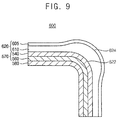
- FIG. 9 illustrates a cross-sectional view illustrating a portion of a curved display device according to example embodiments.
- the curved display device 600 may include a display panel 580 including at least one curved display region, a functional panel 570, and a window member 620.
- a display panel 580 including at least one curved display region, a functional panel 570, and a window member 620.
- like reference numerals are used to designate elements the same as those in FIG. 8 , and detailed description of these elements may be omitted.
- the curved display device 600 of FIG. 9 may be substantially the same as or similar to the curved display device 500 of FIG. 8 except for the shape a curved portion of the window member 620.
- the window member 620 may be disposed on the functional panel 570.
- the window member 620 may include a window body 610 that includes a curved portion corresponding to the curved display region of the curved display device 600 and a flat portion.
- the window member 620 may protect inner panels (i.e., the display panel and the functional panel) of the curved display device 600 from external factors.
- the window member 620 may further include a transparent polymer resin layer 605 disposed on the window body 610, and a protection layer (not illustrated) disposed on the transparent polymer resin layer 605.
- a first radius of curvature of inner surface 622 of the curved portion of the window body 610 is different from a second radius of curvature of outer surface 624 of the curved portion of the window body 610.
- a transparent resin included in the window body 610 may include at least one PC or PMMA.
- the transparent polymer resin layer 605 may include at least one PET or PI.
- the protection layer may be formed on (or, sprayed onto) the transparent polymer resin layer 605.
- the protection layer may include a mixture of a glass material and a transparent polymer resin.
- the protection layer may be formed as a film or a coating layer on the transparent polymer resin layer 605. As these are described above, duplicative descriptions will not be repeated.
- the window body 610 of the window member 620 in the curved display device 600 may include the curved portion that the first radius of curvature of the inner surface 622 of the curved portion is smaller than a second radius of curvature of an outer surface 624 of the curved portion.
- distortions and shadows of the curved display region may be reduced (or, may not appear), so that visibility of the curved display device 600 may be improved.
- the present embodiments may be applied to any curved display device, and to any electronic device including the curved display device.
- the present embodiments may be applied to a television, a digital television, a three-dimensional television, a mobile phone, a smart phone, a laptop computer, a tablet computer, a personal digital assistants (PDA), a portable multimedia player (PMP), a digital camera, a music player, a portable game console, a navigation device, etc.
- curved or flexible display devices may be thin, light, bendable, and more shock-resistant than flat panel display devices. Further, curved (or flexible) display devices can be designed in various shapes.
- a window member may have the same thickness at a curved portion as at a flat portion. In this case, a shadow may be caused by the refraction of light at the curved display region according to an angle at which a user views the curved display device, and may result in image distortion.
- example embodiments provide a window member capable of preventing or reducing an image distortion at a curved portion.
- a window member in a curved display device has a window body that is formed such that a radius of curvature of an inner surface of a curved portion of the window body is different from a radius of curvature of an outer surface of the curved portion of the window body, so that shadows of a curved display region may not appear or may be reduced.
- a curved display device includes the window member that has the first radius of curvature being greater than the second radius of curvature, so that image distortions at a curved display region may be prevented.
- a display panel under the inner surface of the window body may be more gently bent than other display panels, and thus tension or stress applied to the display panel may be reduced.
Landscapes
- Engineering & Computer Science (AREA)
- Architecture (AREA)
- Mechanical Engineering (AREA)
- Civil Engineering (AREA)
- Structural Engineering (AREA)
- Life Sciences & Earth Sciences (AREA)
- Wood Science & Technology (AREA)
- Manufacturing & Machinery (AREA)
- Microelectronics & Electronic Packaging (AREA)
- Devices For Indicating Variable Information By Combining Individual Elements (AREA)
- Liquid Crystal (AREA)
- Injection Moulding Of Plastics Or The Like (AREA)
Claims (12)
- Fensterelement (100) für eine gekrümmte Anzeigevorrichtung, umfassend:einen transparenten Fensterkörper (120) mit einem flachen Abschnitt A undeinem gekrümmten Abschnitt B, wobei der flache Abschnitt eine im Wesentlichen gleichmäßige Dicke aufweist und der gekrümmte Abschnitt dicker als der flache Abschnitt ist;wobei ein erster Krümmungsradius einer Innenfläche (122) des gekrümmten Abschnitts sich von einem zweiten Krümmungsradius einer Außenfläche (124) des gekrümmten Abschnitts unterscheidet.
- Fensterelement nach Anspruch 1, wobei der erste Krümmungsradius größer als der zweite Krümmungsradius ist.
- Fensterelement nach Anspruch 1, wobei der erste Krümmungsradius kleiner als der zweite Krümmungsradius ist.
- Fensterelement nach einem der vorangehenden Ansprüche, wobei der Fensterkörper durch einen Spritzgießprozess gebildet ist, der ein geschmolzenes transparentes Harz in eine Form einspritzt.
- Fensterelement nach Anspruch 4, wobei das transparente Harz Polycarbonat (PC) oder/und Polymethylmethacrylat (PMMA) einschließt.
- Fensterelement nach einem der vorangehenden Ansprüche, ferner umfassend:eine auf dem Fensterkörper angeordnete transparente Polymerharzschicht (140); undeine auf der transparenten Polymerharzschicht angeordnete Schutzschicht (160).
- Fensterelement nach Anspruch 6, wobei die transparente Polymerharzschicht Polyethylenterephthalat (PET) oder/und Polyimid (PI) einschließt.
- Fensterelement nach Anspruch 7, wobei der Fensterkörper durch einen optisch klaren Kleber (OCA) oder/und ein Bindemittel an der transparenten Polymerharzschicht befestigt ist.
- Fensterelement nach Anspruch 6, 7 oder 8, wobei die Schutzschicht eine Antireflexionsschicht oder eine Fingerabdrücke vermeidende Schicht einschließt.
- Gekrümmte Anzeigevorrichtung (500), umfassend:ein Anzeigefeld (580) mit einem gekrümmten Anzeigebereich;ein Funktionsfeld (570) auf dem Anzeigefeld; undein Fensterelement (520) nach einem der vorangehenden Ansprüche auf dem Funktionsfeld, wobei der gekrümmte Abschnitt des Fensterkörpers dem gekrümmten Anzeigebereich des Anzeigefelds entspricht.
- Verfahren zur Herstellung eines Fensterelements für eine gekrümmte Anzeigevorrichtung, wobei das Verfahren umfasst:Bilden eines Fensterkörpers, der einen flachen Abschnitt und einen gekrümmten Abschnitt aufweist, durch Einspritzen eines geschmolzenen transparenten Harzes in eine Form;Anordnen einer Schutzschicht auf einer transparenten Polymerharzschicht;undBefestigen der transparenten Polymerharzschicht auf dem Fensterkörper,wobei ein erster Krümmungsradius einer Innenfläche des gekrümmten Abschnitts sich von einem zweiten Krümmungsradius einer Außenfläche des gekrümmten Abschnitts unterscheidet und wobei die Schutzschicht und die transparente Polymerharzschicht jeweils eine im Wesentlichen gleichmäßige Dicke aufweisen.
- Verfahren nach Anspruch 11, wobei der erste Krümmungsradius größer als der zweite Krümmungsradius ist und
wobei eine Dicke des gekrümmten Abschnitts des Fensterkörpers größer als eine Dicke des flachen Abschnitts des Fensterkörpers ist.
Applications Claiming Priority (2)
| Application Number | Priority Date | Filing Date | Title |
|---|---|---|---|
| KR20130120244 | 2013-10-10 | ||
| KR1020140052247A KR101669026B1 (ko) | 2013-10-10 | 2014-04-30 | 곡면형 표시 장치의 윈도우 부재, 곡면형 표시 장치의 윈도우 부재 제조 방법 및 이를 구비한 곡면형 표시 장치 |
Publications (2)
| Publication Number | Publication Date |
|---|---|
| EP2860025A1 EP2860025A1 (de) | 2015-04-15 |
| EP2860025B1 true EP2860025B1 (de) | 2016-11-02 |
Family
ID=51618968
Family Applications (1)
| Application Number | Title | Priority Date | Filing Date |
|---|---|---|---|
| EP14183961.3A Active EP2860025B1 (de) | 2013-10-10 | 2014-09-08 | Fensterelement in einer gekrümmten Anzeigevorrichtung, Verfahren zur Herstellung eines Fensterelements mit einer gekrümmten Anzeigevorrichtung und gekrümmte Anzeigevorrichtung damit |
Country Status (3)
| Country | Link |
|---|---|
| US (1) | US9572267B2 (de) |
| EP (1) | EP2860025B1 (de) |
| JP (1) | JP6607666B2 (de) |
Families Citing this family (26)
| Publication number | Priority date | Publication date | Assignee | Title |
|---|---|---|---|---|
| KR102392671B1 (ko) * | 2015-05-11 | 2022-04-29 | 삼성디스플레이 주식회사 | 가요성 표시 장치 |
| KR102192181B1 (ko) | 2015-08-11 | 2020-12-17 | 삼성전자주식회사 | 외관 하우징, 이의 제작 방법 및 이를 구비한 전자 장치 |
| KR102534599B1 (ko) | 2016-05-10 | 2023-05-22 | 삼성디스플레이 주식회사 | 롤러블 표시 장치 및 이를 포함하는 전자 기기 |
| KR102603654B1 (ko) * | 2016-08-24 | 2023-11-17 | 삼성디스플레이 주식회사 | 표시 장치 |
| KR20190102983A (ko) * | 2017-01-17 | 2019-09-04 | 세키스이가가쿠 고교가부시키가이샤 | 충전 접합재, 보호 시트 부착 충전 접합재, 적층체, 광학 디바이스 및 광학 디바이스용 보호 패널 |
| KR102367971B1 (ko) * | 2017-06-16 | 2022-02-25 | 삼성디스플레이 주식회사 | 커버 윈도우 및 커버 윈도우를 포함하는 표시 장치 |
| JP7029894B2 (ja) * | 2017-07-11 | 2022-03-04 | 株式会社ジャパンディスプレイ | 表示装置 |
| KR102393175B1 (ko) * | 2017-09-25 | 2022-05-02 | 엘지전자 주식회사 | 디스플레이 디바이스 |
| KR102450111B1 (ko) | 2017-12-28 | 2022-10-05 | 삼성디스플레이 주식회사 | 표시 장치 |
| KR20190090522A (ko) * | 2018-01-25 | 2019-08-02 | 엘지전자 주식회사 | 이동 단말기 |
| US11737307B1 (en) * | 2018-06-05 | 2023-08-22 | Apple Inc. | Electronic devices having curved displays with supporting frames |
| KR102494409B1 (ko) * | 2018-07-10 | 2023-02-01 | 삼성디스플레이 주식회사 | 표시 장치 |
| US11846788B2 (en) | 2019-02-01 | 2023-12-19 | Racing Optics, Inc. | Thermoform windshield stack with integrated formable mold |
| US11364715B2 (en) * | 2019-05-21 | 2022-06-21 | Racing Optics, Inc. | Polymer safety glazing for vehicles |
| KR102663520B1 (ko) * | 2019-08-23 | 2024-05-08 | 삼성디스플레이 주식회사 | 커버 윈도우 및 이를 포함하는 표시 장치 |
| US11912001B2 (en) | 2019-12-03 | 2024-02-27 | Ro Technologies, Llc | Method and apparatus for reducing non-normal incidence distortion in glazing films |
| US11648723B2 (en) | 2019-12-03 | 2023-05-16 | Racing Optics, Inc. | Method and apparatus for reducing non-normal incidence distortion in glazing films |
| US20210285661A1 (en) | 2020-03-10 | 2021-09-16 | Wolf Steel Ltd. | Heating and cooling appliance |
| US11548356B2 (en) | 2020-03-10 | 2023-01-10 | Racing Optics, Inc. | Protective barrier for safety glazing |
| KR102774689B1 (ko) | 2020-05-26 | 2025-03-06 | 삼성디스플레이 주식회사 | 폴더블 표시장치 |
| KR102905385B1 (ko) | 2020-11-18 | 2025-12-30 | 삼성전자주식회사 | 플렉서블 디스플레이를 포함하는 폴더블 전자 장치 |
| US11490667B1 (en) | 2021-06-08 | 2022-11-08 | Racing Optics, Inc. | Low haze UV blocking removable lens stack |
| US12140781B2 (en) | 2021-07-27 | 2024-11-12 | Laminated Film Llc | Low reflectance removable lens stack |
| US11709296B2 (en) | 2021-07-27 | 2023-07-25 | Racing Optics, Inc. | Low reflectance removable lens stack |
| US11933943B2 (en) | 2022-06-06 | 2024-03-19 | Laminated Film Llc | Stack of sterile peelable lenses with low creep |
| CN117711269B (zh) * | 2023-12-27 | 2025-02-11 | 武汉华星光电半导体显示技术有限公司 | 显示模组及显示装置 |
Family Cites Families (36)
| Publication number | Priority date | Publication date | Assignee | Title |
|---|---|---|---|---|
| TWI230002B (en) * | 2000-10-17 | 2005-03-21 | Nissha Printing | Antireflective molded product and its manufacture method, mold for antireflective molded product |
| KR200328691Y1 (ko) | 2003-05-26 | 2003-10-01 | (주)씨엠케이 | 액정디스플레이 보호판의 시인성 개선을 위한 구조 |
| WO2006057276A1 (ja) * | 2004-11-26 | 2006-06-01 | Mitsui Chemicals, Inc. | ディスプレイ用窓材 |
| TW200627124A (en) | 2005-01-25 | 2006-08-01 | Wistron Corp | Electronic Device with Continuously Adjustable Size of Display Area |
| TWI259715B (en) | 2005-01-25 | 2006-08-01 | Wistron Corp | Electronic device able to adjust the size of the display area |
| JP4986503B2 (ja) * | 2005-11-08 | 2012-07-25 | 富士通コンポーネント株式会社 | 熱可塑性樹脂筐体及びその製造方法 |
| JP2007190794A (ja) | 2006-01-19 | 2007-08-02 | Sumitomo Chemical Co Ltd | 携帯型情報端末の表示窓保護板 |
| JP2007326259A (ja) * | 2006-06-07 | 2007-12-20 | Yoshida Industry Co Ltd | ディスプレイの製造方法及びディスプレイ |
| JP5305631B2 (ja) | 2007-10-25 | 2013-10-02 | 出光興産株式会社 | ポリカーボネート樹脂組成物、ポリカーボネート樹脂成形品及びその製造方法 |
| KR100994102B1 (ko) | 2008-11-28 | 2010-11-15 | (주) 태양기전 | 노트북용 디스플레이 보호 윈도우 |
| KR20090010012A (ko) | 2008-12-18 | 2009-01-28 | 주식회사 삼광 | 모바일폰 윈도우의 제조방법 |
| US8911653B2 (en) * | 2009-05-21 | 2014-12-16 | Semiconductor Energy Laboratory Co., Ltd. | Method for manufacturing light-emitting device |
| KR101084152B1 (ko) * | 2009-07-23 | 2011-11-17 | 엘지전자 주식회사 | 디스플레이장치 |
| KR101113289B1 (ko) | 2010-03-04 | 2012-02-24 | 주식회사 토비스 | 곡면 디스플레이 패널 제조 방법, 이를 이용한 곡면 디스플레이 패널, 및 이를 이용한 다중 영상 표시 장치 |
| KR101113457B1 (ko) | 2010-05-10 | 2012-03-05 | 삼성모바일디스플레이주식회사 | 곡면 터치 스크린 패널 및 그 제조방법 |
| KR101211371B1 (ko) * | 2010-09-16 | 2012-12-13 | 주식회사 토비스 | 곡면 디스플레이 패널 제조 방법 |
| KR20120116813A (ko) | 2011-04-13 | 2012-10-23 | 엘지이노텍 주식회사 | 가요성 디스플레이 및 그 제조방법 |
| US20120288661A1 (en) * | 2011-05-10 | 2012-11-15 | Weis Limited | Solid structure glass and method for making the same |
| JP2013003306A (ja) | 2011-06-15 | 2013-01-07 | Sony Corp | 表示装置および電子機器 |
| KR101861365B1 (ko) * | 2011-06-28 | 2018-05-28 | 삼성전자주식회사 | 휴대용 단말기의 디스플레이용 윈도우 부재 제작 방법 |
| US10061356B2 (en) | 2011-06-30 | 2018-08-28 | Samsung Display Co., Ltd. | Flexible display panel and display apparatus including the flexible display panel |
| KR101320384B1 (ko) * | 2011-06-30 | 2013-10-23 | 삼성디스플레이 주식회사 | 가요성 표시 패널 및 상기 가요성 표시 패널을 포함하는 표시 장치 |
| KR101320385B1 (ko) | 2011-06-30 | 2013-10-23 | 삼성디스플레이 주식회사 | 가요성 표시 패널 및 상기 가요성 표시 패널을 포함하는 표시 장치 |
| KR20130015230A (ko) * | 2011-08-02 | 2013-02-13 | 삼성디스플레이 주식회사 | 표시 장치 및 그 제조 방법 |
| KR101837714B1 (ko) | 2011-08-10 | 2018-03-13 | 삼성디스플레이 주식회사 | 표시 장치 |
| US8842057B2 (en) | 2011-09-27 | 2014-09-23 | Z124 | Detail on triggers: transitional states |
| JP5630428B2 (ja) * | 2011-12-12 | 2014-11-26 | コニカミノルタ株式会社 | ディスプレイ用カバーガラス |
| JP5712912B2 (ja) * | 2011-12-14 | 2015-05-07 | コニカミノルタ株式会社 | ディスプレイ用カバーガラス |
| KR101268471B1 (ko) | 2011-12-20 | 2013-06-04 | 주식회사 토비스 | 곡면 디스플레이 패널 제조 방법, 이를 이용한 곡면 디스플레이 패널, 및 이를 이용한 다중 영상 표시 장치 |
| KR20130091225A (ko) * | 2012-02-07 | 2013-08-16 | 주식회사 에스앤에스텍 | 기능성 모듈 및 그의 제조 방법 |
| JP2013200495A (ja) * | 2012-03-26 | 2013-10-03 | Dainippon Printing Co Ltd | 配列型表示装置 |
| KR101386219B1 (ko) * | 2012-06-26 | 2014-04-17 | 삼성디스플레이 주식회사 | 플렉서블 표시 패널, 이를 포함하는 표시 장치 및 그 제조 방법 |
| KR20140002470A (ko) * | 2012-06-29 | 2014-01-08 | 삼성디스플레이 주식회사 | 디스플레이 장치, 디스플레이 장치의 제조방법, 디스플레이 장치의 제조장치 |
| KR102114312B1 (ko) * | 2012-10-29 | 2020-06-18 | 삼성디스플레이 주식회사 | 표시 장치 및 이의 화면 제어 방법 |
| KR101991839B1 (ko) * | 2013-01-15 | 2019-06-24 | 삼성디스플레이 주식회사 | 커버 윈도우를 구비하는 표시 장치 |
| KR101975490B1 (ko) * | 2013-02-18 | 2019-05-08 | 삼성디스플레이 주식회사 | 커버 윈도우 및 이를 구비한 표시 장치 |
-
2014
- 2014-08-27 JP JP2014172452A patent/JP6607666B2/ja active Active
- 2014-09-08 EP EP14183961.3A patent/EP2860025B1/de active Active
- 2014-09-23 US US14/493,854 patent/US9572267B2/en active Active
Also Published As
| Publication number | Publication date |
|---|---|
| US9572267B2 (en) | 2017-02-14 |
| JP2015075760A (ja) | 2015-04-20 |
| JP6607666B2 (ja) | 2019-11-20 |
| EP2860025A1 (de) | 2015-04-15 |
| US20150103474A1 (en) | 2015-04-16 |
Similar Documents
| Publication | Publication Date | Title |
|---|---|---|
| EP2860025B1 (de) | Fensterelement in einer gekrümmten Anzeigevorrichtung, Verfahren zur Herstellung eines Fensterelements mit einer gekrümmten Anzeigevorrichtung und gekrümmte Anzeigevorrichtung damit | |
| CN104553184B (zh) | 弯曲显示装置中的窗构件、其制造方法和弯曲显示装置 | |
| US10586944B2 (en) | Display device having window member and method of manufacturing window member | |
| US10852768B2 (en) | Display device | |
| US10003044B2 (en) | Cover window for a display device, and a display device including the same | |
| US9958900B2 (en) | Cover window and manufacturing method of the same | |
| US11820043B2 (en) | Display device and method of manufacturing cover member | |
| US10470319B2 (en) | Window and a display apparatus including the same | |
| US20140030496A1 (en) | Window structure for protecting a display panel | |
| US20150004334A1 (en) | Foldable transparent composite cover window, manufacturing method of the same, and foldable display device containing the same | |
| US20100201603A1 (en) | Multi-display apparatus | |
| KR20150144913A (ko) | 플렉서블 표시 장치 | |
| CN102916033A (zh) | 显示装置和用于制造显示装置的方法 | |
| EP2631748B1 (de) | Berührungstafel mit verbesserter Sichtbarkeit und Verfahren zur Herstellung davon | |
| US20210356995A1 (en) | Display panel and display device | |
| KR20130097048A (ko) | 시인성이 개선된 터치 패널 및 그의 제조방법 | |
| US10877184B2 (en) | Glass member for display device, method of fabricating the glass member, and display device including the glass member | |
| US20140354907A1 (en) | Composite touch cover plate | |
| KR20210130474A (ko) | 글라스를 포함하는 투명 커버 및 이와 결합된 폴더블 디스플레이를 포함하는 전자 장치 | |
| CN106843388A (zh) | 显示屏组件及其组装方法与电子装置 | |
| CN112820200A (zh) | 盖板及显示装置 | |
| CN113112923A (zh) | 曲面盖板和可弯折显示装置 | |
| CN111816808B (zh) | 电池盖、壳体组件及电子设备 | |
| US9477264B2 (en) | Window member for display screen of portable terminal and method for fabricating the window member | |
| CN222232826U (zh) | 屏幕模组及电子设备 |
Legal Events
| Date | Code | Title | Description |
|---|---|---|---|
| PUAI | Public reference made under article 153(3) epc to a published international application that has entered the european phase |
Free format text: ORIGINAL CODE: 0009012 |
|
| 17P | Request for examination filed |
Effective date: 20140908 |
|
| AK | Designated contracting states |
Kind code of ref document: A1 Designated state(s): AL AT BE BG CH CY CZ DE DK EE ES FI FR GB GR HR HU IE IS IT LI LT LU LV MC MK MT NL NO PL PT RO RS SE SI SK SM TR |
|
| AX | Request for extension of the european patent |
Extension state: BA ME |
|
| R17P | Request for examination filed (corrected) |
Effective date: 20150624 |
|
| RBV | Designated contracting states (corrected) |
Designated state(s): AL AT BE BG CH CY CZ DE DK EE ES FI FR GB GR HR HU IE IS IT LI LT LU LV MC MK MT NL NO PL PT RO RS SE SI SK SM TR |
|
| RAP1 | Party data changed (applicant data changed or rights of an application transferred) |
Owner name: SAMSUNG DISPLAY CO., LTD. |
|
| GRAP | Despatch of communication of intention to grant a patent |
Free format text: ORIGINAL CODE: EPIDOSNIGR1 |
|
| INTG | Intention to grant announced |
Effective date: 20160524 |
|
| GRAS | Grant fee paid |
Free format text: ORIGINAL CODE: EPIDOSNIGR3 |
|
| GRAA | (expected) grant |
Free format text: ORIGINAL CODE: 0009210 |
|
| AK | Designated contracting states |
Kind code of ref document: B1 Designated state(s): AL AT BE BG CH CY CZ DE DK EE ES FI FR GB GR HR HU IE IS IT LI LT LU LV MC MK MT NL NO PL PT RO RS SE SI SK SM TR |
|
| REG | Reference to a national code |
Ref country code: GB Ref legal event code: FG4D |
|
| REG | Reference to a national code |
Ref country code: AT Ref legal event code: REF Ref document number: 841404 Country of ref document: AT Kind code of ref document: T Effective date: 20161115 Ref country code: CH Ref legal event code: EP |
|
| REG | Reference to a national code |
Ref country code: IE Ref legal event code: FG4D |
|
| REG | Reference to a national code |
Ref country code: DE Ref legal event code: R096 Ref document number: 602014004590 Country of ref document: DE |
|
| PG25 | Lapsed in a contracting state [announced via postgrant information from national office to epo] |
Ref country code: LV Free format text: LAPSE BECAUSE OF FAILURE TO SUBMIT A TRANSLATION OF THE DESCRIPTION OR TO PAY THE FEE WITHIN THE PRESCRIBED TIME-LIMIT Effective date: 20161102 |
|
| REG | Reference to a national code |
Ref country code: NL Ref legal event code: MP Effective date: 20161102 |
|
| REG | Reference to a national code |
Ref country code: LT Ref legal event code: MG4D |
|
| REG | Reference to a national code |
Ref country code: AT Ref legal event code: MK05 Ref document number: 841404 Country of ref document: AT Kind code of ref document: T Effective date: 20161102 |
|
| PG25 | Lapsed in a contracting state [announced via postgrant information from national office to epo] |
Ref country code: SE Free format text: LAPSE BECAUSE OF FAILURE TO SUBMIT A TRANSLATION OF THE DESCRIPTION OR TO PAY THE FEE WITHIN THE PRESCRIBED TIME-LIMIT Effective date: 20161102 Ref country code: LT Free format text: LAPSE BECAUSE OF FAILURE TO SUBMIT A TRANSLATION OF THE DESCRIPTION OR TO PAY THE FEE WITHIN THE PRESCRIBED TIME-LIMIT Effective date: 20161102 Ref country code: NL Free format text: LAPSE BECAUSE OF FAILURE TO SUBMIT A TRANSLATION OF THE DESCRIPTION OR TO PAY THE FEE WITHIN THE PRESCRIBED TIME-LIMIT Effective date: 20161102 Ref country code: NO Free format text: LAPSE BECAUSE OF FAILURE TO SUBMIT A TRANSLATION OF THE DESCRIPTION OR TO PAY THE FEE WITHIN THE PRESCRIBED TIME-LIMIT Effective date: 20170202 Ref country code: GR Free format text: LAPSE BECAUSE OF FAILURE TO SUBMIT A TRANSLATION OF THE DESCRIPTION OR TO PAY THE FEE WITHIN THE PRESCRIBED TIME-LIMIT Effective date: 20170203 |
|
| PG25 | Lapsed in a contracting state [announced via postgrant information from national office to epo] |
Ref country code: FI Free format text: LAPSE BECAUSE OF FAILURE TO SUBMIT A TRANSLATION OF THE DESCRIPTION OR TO PAY THE FEE WITHIN THE PRESCRIBED TIME-LIMIT Effective date: 20161102 Ref country code: PL Free format text: LAPSE BECAUSE OF FAILURE TO SUBMIT A TRANSLATION OF THE DESCRIPTION OR TO PAY THE FEE WITHIN THE PRESCRIBED TIME-LIMIT Effective date: 20161102 Ref country code: IS Free format text: LAPSE BECAUSE OF FAILURE TO SUBMIT A TRANSLATION OF THE DESCRIPTION OR TO PAY THE FEE WITHIN THE PRESCRIBED TIME-LIMIT Effective date: 20170302 Ref country code: PT Free format text: LAPSE BECAUSE OF FAILURE TO SUBMIT A TRANSLATION OF THE DESCRIPTION OR TO PAY THE FEE WITHIN THE PRESCRIBED TIME-LIMIT Effective date: 20170302 Ref country code: RS Free format text: LAPSE BECAUSE OF FAILURE TO SUBMIT A TRANSLATION OF THE DESCRIPTION OR TO PAY THE FEE WITHIN THE PRESCRIBED TIME-LIMIT Effective date: 20161102 Ref country code: AT Free format text: LAPSE BECAUSE OF FAILURE TO SUBMIT A TRANSLATION OF THE DESCRIPTION OR TO PAY THE FEE WITHIN THE PRESCRIBED TIME-LIMIT Effective date: 20161102 Ref country code: ES Free format text: LAPSE BECAUSE OF FAILURE TO SUBMIT A TRANSLATION OF THE DESCRIPTION OR TO PAY THE FEE WITHIN THE PRESCRIBED TIME-LIMIT Effective date: 20161102 Ref country code: HR Free format text: LAPSE BECAUSE OF FAILURE TO SUBMIT A TRANSLATION OF THE DESCRIPTION OR TO PAY THE FEE WITHIN THE PRESCRIBED TIME-LIMIT Effective date: 20161102 |
|
| PG25 | Lapsed in a contracting state [announced via postgrant information from national office to epo] |
Ref country code: SK Free format text: LAPSE BECAUSE OF FAILURE TO SUBMIT A TRANSLATION OF THE DESCRIPTION OR TO PAY THE FEE WITHIN THE PRESCRIBED TIME-LIMIT Effective date: 20161102 Ref country code: RO Free format text: LAPSE BECAUSE OF FAILURE TO SUBMIT A TRANSLATION OF THE DESCRIPTION OR TO PAY THE FEE WITHIN THE PRESCRIBED TIME-LIMIT Effective date: 20161102 Ref country code: CZ Free format text: LAPSE BECAUSE OF FAILURE TO SUBMIT A TRANSLATION OF THE DESCRIPTION OR TO PAY THE FEE WITHIN THE PRESCRIBED TIME-LIMIT Effective date: 20161102 Ref country code: EE Free format text: LAPSE BECAUSE OF FAILURE TO SUBMIT A TRANSLATION OF THE DESCRIPTION OR TO PAY THE FEE WITHIN THE PRESCRIBED TIME-LIMIT Effective date: 20161102 Ref country code: DK Free format text: LAPSE BECAUSE OF FAILURE TO SUBMIT A TRANSLATION OF THE DESCRIPTION OR TO PAY THE FEE WITHIN THE PRESCRIBED TIME-LIMIT Effective date: 20161102 |
|
| REG | Reference to a national code |
Ref country code: DE Ref legal event code: R097 Ref document number: 602014004590 Country of ref document: DE |
|
| REG | Reference to a national code |
Ref country code: FR Ref legal event code: PLFP Year of fee payment: 4 |
|
| PG25 | Lapsed in a contracting state [announced via postgrant information from national office to epo] |
Ref country code: BG Free format text: LAPSE BECAUSE OF FAILURE TO SUBMIT A TRANSLATION OF THE DESCRIPTION OR TO PAY THE FEE WITHIN THE PRESCRIBED TIME-LIMIT Effective date: 20170202 Ref country code: SM Free format text: LAPSE BECAUSE OF FAILURE TO SUBMIT A TRANSLATION OF THE DESCRIPTION OR TO PAY THE FEE WITHIN THE PRESCRIBED TIME-LIMIT Effective date: 20161102 Ref country code: IT Free format text: LAPSE BECAUSE OF FAILURE TO SUBMIT A TRANSLATION OF THE DESCRIPTION OR TO PAY THE FEE WITHIN THE PRESCRIBED TIME-LIMIT Effective date: 20161102 Ref country code: BE Free format text: LAPSE BECAUSE OF FAILURE TO SUBMIT A TRANSLATION OF THE DESCRIPTION OR TO PAY THE FEE WITHIN THE PRESCRIBED TIME-LIMIT Effective date: 20161102 |
|
| PLBE | No opposition filed within time limit |
Free format text: ORIGINAL CODE: 0009261 |
|
| STAA | Information on the status of an ep patent application or granted ep patent |
Free format text: STATUS: NO OPPOSITION FILED WITHIN TIME LIMIT |
|
| 26N | No opposition filed |
Effective date: 20170803 |
|
| PG25 | Lapsed in a contracting state [announced via postgrant information from national office to epo] |
Ref country code: SI Free format text: LAPSE BECAUSE OF FAILURE TO SUBMIT A TRANSLATION OF THE DESCRIPTION OR TO PAY THE FEE WITHIN THE PRESCRIBED TIME-LIMIT Effective date: 20161102 |
|
| REG | Reference to a national code |
Ref country code: CH Ref legal event code: PL |
|
| PG25 | Lapsed in a contracting state [announced via postgrant information from national office to epo] |
Ref country code: MC Free format text: LAPSE BECAUSE OF FAILURE TO SUBMIT A TRANSLATION OF THE DESCRIPTION OR TO PAY THE FEE WITHIN THE PRESCRIBED TIME-LIMIT Effective date: 20161102 |
|
| REG | Reference to a national code |
Ref country code: IE Ref legal event code: MM4A |
|
| PG25 | Lapsed in a contracting state [announced via postgrant information from national office to epo] |
Ref country code: LU Free format text: LAPSE BECAUSE OF NON-PAYMENT OF DUE FEES Effective date: 20170908 |
|
| PG25 | Lapsed in a contracting state [announced via postgrant information from national office to epo] |
Ref country code: IE Free format text: LAPSE BECAUSE OF NON-PAYMENT OF DUE FEES Effective date: 20170908 Ref country code: LI Free format text: LAPSE BECAUSE OF NON-PAYMENT OF DUE FEES Effective date: 20170930 Ref country code: CH Free format text: LAPSE BECAUSE OF NON-PAYMENT OF DUE FEES Effective date: 20170930 |
|
| REG | Reference to a national code |
Ref country code: FR Ref legal event code: PLFP Year of fee payment: 5 |
|
| PG25 | Lapsed in a contracting state [announced via postgrant information from national office to epo] |
Ref country code: MT Free format text: LAPSE BECAUSE OF NON-PAYMENT OF DUE FEES Effective date: 20170908 |
|
| PG25 | Lapsed in a contracting state [announced via postgrant information from national office to epo] |
Ref country code: HU Free format text: LAPSE BECAUSE OF FAILURE TO SUBMIT A TRANSLATION OF THE DESCRIPTION OR TO PAY THE FEE WITHIN THE PRESCRIBED TIME-LIMIT; INVALID AB INITIO Effective date: 20140908 |
|
| PG25 | Lapsed in a contracting state [announced via postgrant information from national office to epo] |
Ref country code: CY Free format text: LAPSE BECAUSE OF FAILURE TO SUBMIT A TRANSLATION OF THE DESCRIPTION OR TO PAY THE FEE WITHIN THE PRESCRIBED TIME-LIMIT Effective date: 20161102 |
|
| PG25 | Lapsed in a contracting state [announced via postgrant information from national office to epo] |
Ref country code: MK Free format text: LAPSE BECAUSE OF FAILURE TO SUBMIT A TRANSLATION OF THE DESCRIPTION OR TO PAY THE FEE WITHIN THE PRESCRIBED TIME-LIMIT Effective date: 20161102 |
|
| PG25 | Lapsed in a contracting state [announced via postgrant information from national office to epo] |
Ref country code: TR Free format text: LAPSE BECAUSE OF FAILURE TO SUBMIT A TRANSLATION OF THE DESCRIPTION OR TO PAY THE FEE WITHIN THE PRESCRIBED TIME-LIMIT Effective date: 20161102 |
|
| PG25 | Lapsed in a contracting state [announced via postgrant information from national office to epo] |
Ref country code: AL Free format text: LAPSE BECAUSE OF FAILURE TO SUBMIT A TRANSLATION OF THE DESCRIPTION OR TO PAY THE FEE WITHIN THE PRESCRIBED TIME-LIMIT Effective date: 20161102 |
|
| P01 | Opt-out of the competence of the unified patent court (upc) registered |
Effective date: 20230515 |
|
| PGFP | Annual fee paid to national office [announced via postgrant information from national office to epo] |
Ref country code: DE Payment date: 20250820 Year of fee payment: 12 |
|
| PGFP | Annual fee paid to national office [announced via postgrant information from national office to epo] |
Ref country code: GB Payment date: 20250820 Year of fee payment: 12 |
|
| PGFP | Annual fee paid to national office [announced via postgrant information from national office to epo] |
Ref country code: FR Payment date: 20250821 Year of fee payment: 12 |