EP2857560B2 - Plasmachemisches verfahren zur herstellung schwarzer oxidkeramikschichten und entsprechend beschichteter gegenstand - Google Patents
Plasmachemisches verfahren zur herstellung schwarzer oxidkeramikschichten und entsprechend beschichteter gegenstand Download PDFInfo
- Publication number
- EP2857560B2 EP2857560B2 EP14184217.9A EP14184217A EP2857560B2 EP 2857560 B2 EP2857560 B2 EP 2857560B2 EP 14184217 A EP14184217 A EP 14184217A EP 2857560 B2 EP2857560 B2 EP 2857560B2
- Authority
- EP
- European Patent Office
- Prior art keywords
- mol
- electrolyte
- oxide ceramic
- iron
- ammonium
- Prior art date
- Legal status (The legal status is an assumption and is not a legal conclusion. Google has not performed a legal analysis and makes no representation as to the accuracy of the status listed.)
- Active
Links
Images


Classifications
-
- C—CHEMISTRY; METALLURGY
- C25—ELECTROLYTIC OR ELECTROPHORETIC PROCESSES; APPARATUS THEREFOR
- C25D—PROCESSES FOR THE ELECTROLYTIC OR ELECTROPHORETIC PRODUCTION OF COATINGS; ELECTROFORMING; APPARATUS THEREFOR
- C25D11/00—Electrolytic coating by surface reaction, i.e. forming conversion layers
- C25D11/02—Anodisation
- C25D11/026—Anodisation with spark discharge
-
- C—CHEMISTRY; METALLURGY
- C25—ELECTROLYTIC OR ELECTROPHORETIC PROCESSES; APPARATUS THEREFOR
- C25D—PROCESSES FOR THE ELECTROLYTIC OR ELECTROPHORETIC PRODUCTION OF COATINGS; ELECTROFORMING; APPARATUS THEREFOR
- C25D11/00—Electrolytic coating by surface reaction, i.e. forming conversion layers
- C25D11/02—Anodisation
- C25D11/04—Anodisation of aluminium or alloys based thereon
- C25D11/06—Anodisation of aluminium or alloys based thereon characterised by the electrolytes used
-
- C—CHEMISTRY; METALLURGY
- C25—ELECTROLYTIC OR ELECTROPHORETIC PROCESSES; APPARATUS THEREFOR
- C25D—PROCESSES FOR THE ELECTROLYTIC OR ELECTROPHORETIC PRODUCTION OF COATINGS; ELECTROFORMING; APPARATUS THEREFOR
- C25D11/00—Electrolytic coating by surface reaction, i.e. forming conversion layers
- C25D11/02—Anodisation
- C25D11/04—Anodisation of aluminium or alloys based thereon
- C25D11/06—Anodisation of aluminium or alloys based thereon characterised by the electrolytes used
- C25D11/10—Anodisation of aluminium or alloys based thereon characterised by the electrolytes used containing organic acids
-
- C—CHEMISTRY; METALLURGY
- C25—ELECTROLYTIC OR ELECTROPHORETIC PROCESSES; APPARATUS THEREFOR
- C25D—PROCESSES FOR THE ELECTROLYTIC OR ELECTROPHORETIC PRODUCTION OF COATINGS; ELECTROFORMING; APPARATUS THEREFOR
- C25D11/00—Electrolytic coating by surface reaction, i.e. forming conversion layers
- C25D11/02—Anodisation
- C25D11/04—Anodisation of aluminium or alloys based thereon
- C25D11/14—Producing integrally coloured layers
-
- C—CHEMISTRY; METALLURGY
- C25—ELECTROLYTIC OR ELECTROPHORETIC PROCESSES; APPARATUS THEREFOR
- C25D—PROCESSES FOR THE ELECTROLYTIC OR ELECTROPHORETIC PRODUCTION OF COATINGS; ELECTROFORMING; APPARATUS THEREFOR
- C25D11/00—Electrolytic coating by surface reaction, i.e. forming conversion layers
- C25D11/02—Anodisation
- C25D11/26—Anodisation of refractory metals or alloys based thereon
-
- C—CHEMISTRY; METALLURGY
- C25—ELECTROLYTIC OR ELECTROPHORETIC PROCESSES; APPARATUS THEREFOR
- C25D—PROCESSES FOR THE ELECTROLYTIC OR ELECTROPHORETIC PRODUCTION OF COATINGS; ELECTROFORMING; APPARATUS THEREFOR
- C25D11/00—Electrolytic coating by surface reaction, i.e. forming conversion layers
- C25D11/02—Anodisation
- C25D11/30—Anodisation of magnesium or alloys based thereon
-
- C—CHEMISTRY; METALLURGY
- C25—ELECTROLYTIC OR ELECTROPHORETIC PROCESSES; APPARATUS THEREFOR
- C25D—PROCESSES FOR THE ELECTROLYTIC OR ELECTROPHORETIC PRODUCTION OF COATINGS; ELECTROFORMING; APPARATUS THEREFOR
- C25D11/00—Electrolytic coating by surface reaction, i.e. forming conversion layers
- C25D11/02—Anodisation
- C25D11/04—Anodisation of aluminium or alloys based thereon
- C25D11/16—Pretreatment, e.g. desmutting
Definitions
- Plasma chemical method for producing black oxide ceramic layers The invention relates to a plasma chemical method for producing black oxide ceramic layers on light metals, in particular aluminum, titanium, or their alloys after the process of anodic oxidation with spark discharge in aqueous electrolytes.
- ANOF anodic oxidation under spark discharge
- PCO plasma chemical oxidation
- PEO plasma electrolytic oxidation
- ASD anodic sparc deposition
- MAO micro arc oxidation
- this anodic oxidation in aqueous electrolytes is a gas-solid reaction under plasma conditions, in which the high energy input at the base of the discharge column generates liquid metal on the anode, which forms a briefly melted oxide with the activated oxygen.
- the layer formation takes place via partial anodes.
- There is a formation area in front of the spark discharge P. short; Dechema-Monographien Volume 121 - VCH Verlagsgesellschaft 1990, page 167-180 with further references).
- the electrolytes were combined in such a way that their positive properties are combined and high-quality anodic oxide ceramic layers are created on aluminum.
- the metal ion in the oxide ceramic layer comes from the metal, the oxygen from the anodic reaction in the aqueous electrolyte used.
- the oxide ceramic is liquid at the determined plasma temperatures of around 7,000 Kelvin. There is enough time on the side of the metal so that the melt of the oxide ceramic can contract well and thus form a sintered, low-pore oxide ceramic layer. To the side of the electrolyte, the melt of the oxide ceramic is quickly cooled by the electrolyte and the gases that migrate, in particular oxygen and water vapor, leave an oxide ceramic layer with a wide-meshed capillary system.
- Pore diameters from 0.1 ⁇ m to 30 ⁇ m were determined from scanning electron microscopic examinations ( CERAMIC COATINGS BY ANODIC SPARK DEPOSITION GP Wirtz et al, MATERIALS & MANUFACTURING PROCESSES 6 (1), 87-115 (1991 ), especially Figure 12).
- Components provided with such resistant coatings are u. A. used in the automotive, aerospace and optical industries as well as medical technology.
- the DD 299 595 and DD 299 596 describe the production of black conversion layers on light metals using electrolytes that contain chromate.
- DD 221 762 A1 and DD 257 275 A1 For example, it is known to add metal salts, such as iron hexacyanoferrate, nickel, cobalt, or chromium salts, to the electrolyte to produce dark-colored oxide layers.
- metal salts such as iron hexacyanoferrate, nickel, cobalt, or chromium salts
- a method is also known with which black ceramic films can be produced by microarc oxidation (MAO) with an electrolyte which contains sodium fluoride (DATABASE WPI, Week 201163, Thomson Scientific, London, GB; AN 2011-L6540 & CN 102 154 673 A ).
- MAO microarc oxidation
- electrolytes containing molybdenum, cobalt, chromium or nickel or cyanide ions or other substances of concern should no longer be used in the future, as these can lead to problems related to occupational safety or the environment.
- the object of the invention is therefore a method for producing black oxide ceramic layers on aluminum titanium or their alloys and to provide special materials containing these materials after the process of anodic oxidation under spark discharge (ANOF), in which electrolytes are used which are low in pollutants and easy to handle.
- ANOF anodic oxidation under spark discharge
- the electrolytes should not contain any molybdenum, cobalt, chromium and nickel ions as well as cyanide ions and borates.
- an iron and vanadium-containing electrolyte, black oxide ceramic layers on aluminum, titanium or their alloys and special materials containing these materials can be produced by the process of anodic oxidation.
- the electrolyte is therefore free of molybdenum, cobalt, chromium and nickel.
- black and stable oxide ceramic layers can be produced, the layer thickness of which can be varied over a wide range.
- deep black is understood to mean all layers which, according to the CIE L * a * b * system, have values of L * less than or equal to 30.
- the aluminum and its alloys include pure aluminum and alloys with the main component aluminum, such as the wrought aluminum alloys of the EN-AW 1000, 2000, 3000, 4000, 5000, 6000, 7000 series, or the cast aluminum alloys of the EN-AC 21000, 21100 series , 42000, 43000, 43200, 43400, 44300, 46000, 46200, 47000, 47100, 48000, 51000, 51100 in question.
- Pure titanium or titanium alloys such as TiAl6V4; Use TiAl5Fe2.5 and others.
- Special materials with aluminum, titanium or their alloys are, for example, intermetallic compounds or phases such as titanium aluminides.
- the electrolyte has a pH of 5.4 to 10.0 during the anodic oxidation.
- the electrolyte can also contain inorganic or organic anions. It preferably contains 0.2 to 0.9 mol / L of a phosphate of an alkali metal, preferably a dihydrogen phosphate or pyrophosphate, in particular potassium dihydrogen phosphate or potassium pyrophosphate, and / or 0.15 to 0.5 mol / L of citric acid or its salts. Citrates are particularly preferred because they support a controlled sparking process. Phosphates allow better layer growth.
- the electrolyte contains 0.8 to 2.9 mol / L, preferably 0.8 to 2.1 mol / L of a stabilizer, in particular hexamethylenetetramine.
- iron and vanadium salts are added to the electrolyte in order to obtain the desired black color of the oxide ceramic layer.
- the combination of iron and vanadium according to the invention gives deep black and thick layers (up to 100 ⁇ m).
- the presence of both metal salts is absolutely necessary for their production.
- no deep black layers in the sense of the invention are obtained with only one of the two metal salts.
- ammonium iron (III) citrate and ammonium (mono) vanadate are used for this purpose, in a concentration of 0.04 to 0.09 mol / L and 0.035 to 0.090 mol / L.
- An electrolyte temperature of 15 to 60, preferably up to 40 degrees Celsius has been found to be particularly suitable.
- the current density used is preferably between 0.02 and 0.10 Acm -2 , preferably 0.04 to 0.08 Acm -2 , without having to compromise on the quality and layer thickness of the oxide ceramic layers.
- the current density is advantageously kept constant until a final voltage below 1000 V, preferably 300 to 650 V, is reached.
- the oxide ceramic layers obtainable by means of the invention can have a layer thickness of 5 ⁇ m to 100 ⁇ m and consist of oxides, in particular spinels, of aluminum, iron and vanadium.
- the electrolyte combinations according to the invention With the electrolyte combinations according to the invention, deep black (of L * less than or equal to 30, see above) and also adherent layer thicknesses greater than 50 ⁇ m can be produced for the first time.
- the electrolyte combination according to the invention allows the production of thin or thick jet black and also adhesive layers of up to 100 ⁇ m.
- the electrolyte is low in pollutants and easy to handle, that is to say does not contain any molybdenum, cobalt, chromium and nickel ions, as well as cyanide ions and borate ions.
- the electrolyte solutions were freshly prepared and placed in conventional devices for anodic oxidation. Before the oxidation, all sample plates were degreased with a commercially available cleaner and then immersed and contacted in the electrolyte baths. The voltage was applied with a rectifier from RGB (30A / 380V). After about 10 min. the voltages were in the range of 230 to 290 volts.
- the characterization of the layer was carried out on the samples according to the CIE L * a * b * system according to DIN EN ISO 11664-4, layer thickness measurements and cross-cut tests according to DIN 2499.
- the layer thickness measurements were carried out using the specified measuring device from Helmut Fischer GmbH & Co.KG (see above). 10 measurements of the layer thickness were carried out for each sample plate and the mean value was given.
Landscapes
- Chemical & Material Sciences (AREA)
- Engineering & Computer Science (AREA)
- Chemical Kinetics & Catalysis (AREA)
- Electrochemistry (AREA)
- Materials Engineering (AREA)
- Metallurgy (AREA)
- Organic Chemistry (AREA)
- Other Surface Treatments For Metallic Materials (AREA)
- Electroplating And Plating Baths Therefor (AREA)
Description
- Plasmachemisches Verfahren zur Herstellung schwarzer Oxidkeramikschichten Die Erfindung betrifft ein plasmachemisches Verfahren zur Herstellung schwarzer Oxidkeramikschichten auf Leichtmetallen, insbesondere Aluminium, Titan, oder deren Legierungen nach dem Prozess der anodischen Oxidation unter Funkenentladung in wässrigen Elektrolyten.
- Es ist bekannt, Oxidkeramikschichten auf Leichtmetallen durch plasmachemische Prozesse in wässrigen Elektrolyten herzustellen. Diese Prozesse sind in der Literatur unter anderem unter den Namen anodische Oxidation unter Funkenentladung (ANOF), plasmachemische Oxidation (PCO), plasma electrolytic oxidation (PEO), anodic sparc deposition (ASD) sowie micro arc oxidation (MAO) bekannt.
- Wie aus
EP 0 545 230 A1 bekannt, ist diese anodische Oxidation in wässrigen Elektrolyten eine Gas-Festkörper-Reaktion unter Plasmabedingungen, bei der der hohe Energieeintrag am Fußpunkt der Entladungssäule auf der Anode flüssiges Metall erzeugt, das mit dem aktivierten Sauerstoff ein kurzzeiterschmolzenes Oxid bildet. Die Schichtbildung erfolgt über Partialanoden. Der Funkenentladung ist ein Formierbereich vorgelagert (P. Kurze; Dechema-Monographien Band 121 - VCH Verlagsgesellschaft 1990, Seite 167-180 mit weiteren Literaturhinweisen). Die Elektrolyte wurden so kombiniert, dass ihre positiven Eigenschaften vereint werden und qualitativ hochwertige anodisch erzeugte Oxidkeramikschichten auf Aluminium entstehen. Durch Kombination verschiedener Salze können höhere Salzkonzentrationen im Elektrolytbad und damit höhere Viskositäten erreicht werden. Solche hochviskosen Elektrolyte haben eine hohe Wärmekapazität, stabilisieren den ausgebildeten Sauerstoffilm auf der Anode und garantieren damit eine gleichmäßige Oxidschichtausbildung (DD-WP 142 360).
Aufgrund des Verlaufs der Stromdichte-Pötential-Kurven (SPK) für die anodische Funkenentladung lassen sich drei markante Bereiche unterscheiden, der Faraday-, Funkenentladungs-, und Bogenentladungsbereich (s. P. Kurze loc.cit). Auf dem Metall oder der Metalllegierung befindet sich natürlicherweise eine Sperrschicht. Durch Erhöhung der Spannung des anodisch gepolten Metalls wächst die Sperrschicht. Dann entsteht an der Phasengrenze Metall/Gas/Elektrolyt partiell ein Sauerstoffplasma, durch das sich die Oxidkeramikschicht bildet. Das Metallion in der Oxidkeramikschicht stammt aus dem Metall, der Sauerstoff aus der anodischen Reaktion in dem verwendeten wässrigen Elektrolyten. Die Oxidkeramik ist bei den ermittelten Plasmatemperaturen von etwa 7.000 Kelvin flüssig. Zur Seite des Metalls hin ist die Zeit ausreichend, damit sich die Schmelze der Oxidkeramik gut zusammenziehen kann und so eine aufgesinterte porenarme Oxidkeramikschicht bildet. Zur Seite des Elektrolyten hin wird die Schmelze der Oxidkeramik schnell durch den Elektrolyten abgekühlt und die noch abwandernden Gase, insbesondere Sauerstoff und Wasserdampf hinterlassen eine Oxidkeramikschicht mit einem weitmaschig verknüpften Kapillarsystem. Aus rasterelektronenmikroskopischen Untersuchungen wurden Porendurchmesser von 0,1 µm bis 30 µm bestimmt (CERAMIC COATINGS BY ANODIC SPARK DEPOSITION G.P. Wirtz et al, MATERIALS & MANUFACTURING PROCESSES 6 (1), 87-115 (1991), insbesondere Figur 12). - Mit solchen widerstandsfähigen Beschichtungen versehene Bauteile werden u. A. in der Automobil-, Luft- und Raumfahrt- sowie optischen Industrie und auch Medizintechnik eingesetzt.
- Die
DD 299 595 DD 299 596 - Aus
DD 221 762 A1 DD 257 275 A1 - Aus
US 4,659,440 ist der Einsatz von Elektrolyten bekannt, die neben Flusssäure und Peroxiden auch Vanadium-Verbindungen für eine Farbgebung enthalten können. - Einerseits werden in den bekannten Verfahren nach heutigem Kenntnisstand bedenkliche Stoffe in den Elektrolyten eingesetzt, insbesondere krebserregende Chromsalze, oder solche Metallsalze, die sich auf der ECHA Liste (http://echa.europa.eu) befinden, da sie als umwelt- und/oder arbeitssicherheitsgefährdend eingestuft sind.
- So ist aus der
DE 10 2011 055 644 B4 bekannt, Elektrolyten einzusetzen, die Kobalt- und Nickel-Salze enthalten. - Andererseits besteht nach wie vor der Wunsch nach schwarzen Oxidkeramikschichten mit chemischer Beständigkeit und Verschleißfestigkeit.
- Des Weiteren ist die Herstellung einer schwarzen Keramikschicht auf einer Aluminium-Legierung durch plasma-elektrolytische Oxidation (PEO) bekannt, bei der ein Elektrolyt auf Basis von Natriumwolframat verwendet wird (Hwang et al., Materials Transactions 53(3), 559-564, 2012).
- Auch ist eine Methode bekannt, mit welcher schwarze keramische Filme durch microarc oxidation (MAO) mit einem Elektrolyten, welcher Natriumfluorid enthält, hergestellt werden können (DATABASE WPI, Week 201163, Thomson Scientific, London, GB; AN 2011-L6540 &
CN 102 154 673 A ). - Daher sollten in Zukunft keine Elektrolyte mehr eingesetzt werden, die Molybdän-, Kobalt-, Chrom- oder Nickel- oder Cyanid-Ionen oder weitere besorgniserregende Stoffe enthalten, da diese zu arbeitssicherheits- oder umweltrelevanten Problemen führen können.
- Aufgabe der Erfindung ist es daher, ein Verfahren zur Erzeugung schwarzer Oxidkeramikschichten auf Aluminium Titan oder deren Legierungen sowie diese Materialien enthaltende Sonderwerkstoffe nach dem Prozess der anodischen Oxidation unter Funkenentladung (ANOF) bereitzustellen, bei dem Elektrolyte eingesetzt werden, die schadstoffarm und einfach zu handhaben sind. Insbesondere sollen die Elektrolyte keine Molybdän-, Kobalt-, Chrom- und Nickel-Ionen sowie Cyanid-Ionen und Borate enthalten.
- Diese Aufgabe wird durch das in Anspruch 1 wiedergegebene Verfahren gelöst.
- Erfindungsgemäß ist erkannt worden, dass durch Einsatz eines Eisen- und Vanadium-haltigen Elektrolyten, schwarze Oxidkeramikschichten auf Aluminium, Titan oder deren Legierungen sowie diese Materialien enthaltende Sonderwerkstoffe nach dem Prozess der anodischen Oxidation herstellbar sind. Der Elektrolyt ist also Molybdän-, Kobalt-, Chrom- und Nickel-frei.
- Mit der Erfindung können schwarze und beständige Oxidkeramikschichten erzeugt werden, deren Schichtdicke über einen breiten Bereich variiert werden kann.
- Als tiefschwarz im Sinne der Erfindung werden alle Schichten verstanden, die nach dem CIE L*a*b* System Werte von L* kleiner oder gleich 30 aufweisen.
- Als Aluminium und dessen Legierungen kommen Reinaluminium sowie Legierungen mit Hauptbestandteil Aluminium, wie die Aluminium-Knetlegierungen der Serien EN-AW 1000, 2000, 3000, 4000, 5000, 6000, 7000, oder die Aluminium-Gusslegierungen der Serien EN-AC 21000, 21100, 42000, 43000, 43200, 43400, 44300, 46000, 46200, 47000, 47100, 48000, 51000, 51100 in Frage.
Des Weiteren lassen sich Reintitan oder auch Titanlegierungen wie TiAl6V4; TiAl5Fe2,5 u.a. einsetzen.
Als Sonderwerkstoffe mit Aluminium, Titan oder deren Legierungen kommen z.B. intermetallische Verbindungen bzw. Phasen, wie Titanaluminide, in Frage. - Ganz besonders bevorzugt ist der Einsatz von Aluminium und dessen Legierungen.
- Als besonders vorteilhaft hat es sich im Rahmen der Erfindung erwiesen, wenn der Elektrolyt bei der anodischen Oxidation einen pH-Wert von 5,4 bis 10,0 aufweist.
- Der Elektrolyt kann ebenfalls anorganische oder organische Anionen enthalten. Bevorzugt enthalten sind 0,2 bis 0,9 Mol/L eines Phosphats eines Alkalimetalls, vorzugsweise ein Dihydrogenphosphat oder Pyrophosphat, insbesondere Kaliumdihydrogenphosphat oder Kaliumpyrophosphat, und/oder 0,15 bis 0,5 Mol/L Zitronensäure oder deren Salze. Zitrate sind besonders bevorzugt, da sie einen kontrollierten Funkenprozess unterstützten. Phosphate erlauben ein besseres Schichtenwachstum.
- Ebenfalls sinnvoll ist es, wenn der Elektrolyt 0,8 bis 2,9 Mol/L, vorzugsweise 0,8 bis 2,1 Mol/L eines Stabilisators, insbesondere Hexamethylentetramin, enthält.
- Im Rahmen der Erfindung werden Eisen- und Vanadium-Salze dem Elektrolyten zugesetzt, um die gewünschte schwarze Farbe der Oxidkeramikschicht zu erhalten. Insbesondere werden durch die erfindungsgemäße Kombination von Eisen und Vanadium tiefschwarze und dicke Schichten (bis 100µm) erhalten. Für deren Erzeugung ist das Vorhandensein beider Metallsalze zwingend erforderlich. Wie aus den Vergleichsversuchen (siehe unten) hervor geht, werden mit lediglich einem der beiden Metallsalze keine tiefschwarzen Schichten im Sinne der Erfindung erhalten.
- Erfindungsgemäß werden dazu Ammoniumeisen(III)citrat und Ammonium(mono)vanadat eingesetzt und zwar in einer Konzentration von 0,04 bis 0,09 Mol/L und 0,035 bis 0,090 Mol/L.
- Als besonders geeignet haben sich eine Elektrolyt-Temperatur von 15 bis 60, vorzugsweise bis 40 Grad Celsius herausgestellt.
- Vorzugsweise liegt die eingesetzte Stromdichte zwischen 0,02 und 0,10 Acm-2, vorzugsweise 0,04 bis 0,08 Acm-2, ohne das Abstriche bei der Qualität und Schichtdicke der Oxidkeramikschichten gemacht werden müssen.
- Vorteilhafterweise wird die Stromdichte konstant gehalten, bis dass eine Endspannung unterhalb von 1000 V, vorzugsweise 300 bis 650 V erreicht wird.
- Die mittels der Erfindung erhältlichen Oxidkeramikschichten können eine Schichtdicke von 5 µm bis 100 µm aufweisen und bestehen aus Oxiden, insbesondere Spinellen, von Aluminium, Eisen und Vanadium.
- Mit den erfindungsgemäßen Elektrolytkombinationen sind erstmals tiefschwarze (von L* kleiner oder gleich 30, vgl. oben) und auch haftfeste Schichtdicken größer 50 µm erzeugbar. Insbesondere erlaubt die erfindungsgemäße Elektrolytkombination die Erzeugung dünner oder dicker tiefschwarzer und auch haftfester Schichten von bis zu 100 µm.
- Besonders bevorzugt ist es ebenfalls, wenn der Elektrolyt schadstoffarm und einfach zu handhaben ist, also keine Molybdän-, Kobalt-, Chrom- und Nickel-Ionen sowie Cyanid-Ionen und Borat-Ionen enthält.
- Weitere Merkmale und Einzelheiten der Erfindung ergeben sich aus der nachfolgenden Beschreibung von Beispielen.
-
- Probenmaterial: a) EN-AW 6082 (EN-AW AlSi1MgMn, Wärmebehandlungszustand T6 und T4); b) EN-AC 46000 (GD-AlSi9Cu3(Fe)),
- Gleichrichter: Fa. RGB Typ WER 21.877 (30A/380V),
- Gestellmaterial: Aluminium (isoliert),
- Farbmessgerät: Fa. BYK-Gardner spectro-guide (Ser.Nr. 1020746), Lichtart/Beobachter D65/10°, Meßgeometrie 45°/0°,
- Schichtdickenmessgerät: Fa. Helmut Fischer GmbH & Co.KG, DUALSCOPE® MP40E, Sonde ETA 3.3H
- Die Elektrolyt-Lösungen wurden frisch zubereitet und in übliche Vorrichtungen für die anodische Oxidation eingebracht. Vor der Oxidation wurden alle Probenplatten mit einem handelsüblichen Reiniger entfettet und anschließend in die Elektrolytbäder eingetaucht und kontaktiert. Die Spannung wurde mit einem Gleichrichter der Fa. RGB (30A/380V) angelegt. Nach etwa 10 min. lagen die Spannungen im Bereich 230 bis 290 Volt.
- Nach Erreichen der angegebenen Dauer wurden die Probeplatten entnommen, nach üblichen Verfahren gesäubert und untersucht.
- An den Proben erfolgten zur Charakterisierung der Schicht nach dem CIE L*a*b*-System gemäß DIN EN ISO 11664-4, Schichtdickenmessungen sowie Gitterschnitt-Tests gemäß DIN 2499.
- Zur Charakterisierung einzelner Schichten wurden Querschliffe hergestellt und diese mittels REM (Rasterelektronenmikroskopie) bzw. EDX (Energiedispersive Röntgenspektroskopie) festkörperanalytisch untersucht und dokumentiert.
- Die Erfindung soll exemplarisch an nachfolgenden Beispielen erläutert werden:
- Ausführungsbeispiel 1
Eine alkalisch entfettete Aluminium Platte aus der Knetlegierung EN-AW 6082/ AlSi1 MgMn wird in einem wässrigen Elektrolyt mit 0,4 Mol/L Zitronensäure; 1,5 Mol/L Hexamethylentetramin; 0,7 Mol/L Kaliumdihydrogenphosphat; 0,05 Mol/L Ammoniumeisen(III)citrat; 0,075 Mol/L Ammonium(mono)vanadat mit einem pH-Wert von 6,1 eingetaucht und als Anode kontaktiert und bei einer Stromdichte von 0,035 Acm-2, bei 25°C für 15 min Laufzeit mittels Funkenentladung beschichtet.
Es wurde eine tiefschwarze festhaftende Beschichtung erhalten mit einer Schichtdicke von 20 µm und einer Farbcharakteristik L* 28,68; a* -0,01; b* -0,33. - Ausführungsbeispiel 2
Eine alkalisch entfettete Aluminium Platte aus der Knetlegierung EN-AW 6082/ AlSi1MgMn wird in einem wässrigen Elektrolyt umfassend 0,4 Mol/L Zitronensäure; 1,5 Mol/L Hexamethylentetramin; 0,7 Mol/L Kaliumdihydrogenphosphat; 0,05 Mol/L Ammoniumeisen(III)citrat; 0,075 Mol/L Ammonium(mono)vanadat mit einem pH-Wert von 6,1 als Anode kontaktiert und bei einer Stromdichte von 0,035 Acm-2, bei 25°C für 60 min Laufzeit mittels Funkenentladung beschichtet.
Es wurde eine tiefschwarze festhaftende Beschichtung erhalten mit einer Schichtdicke von 80 µm und einer Farbcharakteristik L* 26,38; a* -0,15; b* -0,76. - Ausführungsbeispiel 3
Eine alkalisch entfettete Aluminium Platte aus der Gußlegierung EN-AC 46000 / GD-AlSi9Cu3(Fe) wird in einem wässrigen Elektrolyt umfassend 0,4 Mol/L Zitronensäure; 1,5 Mol/L Hexamethylentetramin; 0,7 Mol/L Kaliumdihydrogenphosphat; 0,05 mol/L Ammoniumeisen(III)citrat, 0,075 Mol/L Ammonium(mono)vanadat mit einem pH-Wert von 6,1 als Anode kontaktiert und bei einer Stromdichte von 0,05 Acm-2, bei 30°C für 40 min Laufzeit mittels Funkenentladung beschichtet.
Es wurde eine tiefschwarze festhaftende Beschichtung erhalten mit einer Schichtdicke von 22 µm und einer Farbcharakteristik L* 25,97; a* 0,40; b* 0,20. - Ausführungsbeispiel 4
Eine alkalisch entfettete Aluminium Platte aus der Knetlegierung EN-AW 6082/ AlSi1MgMn wird in einem wässrigen Elektrolyt umfassend 1,3 Mol/L Hexamethylenteträmin; 0,35 Mol/L Kaliumpyrophosphat; 0,05 mol/L Ammoniumeisen(III)citrat; 0,075 Mol/L Ammonium(mono)vanadat mit einem pH-Wert von 9,6 als Anode kontaktiert und bei einer Stromdichte von 0,032 Acm-2, bei 40°C für 30 min Laufzeit mittels Funkenentladung beschichtet.
Es wurde eine tiefschwarze festhaftende Beschichtung erhalten mit einer Schichtdicke von 22 µm und einer Farbcharakteristik L* 26,60; a* 0,00; b* -0,60. - Ausführungsbeispiel 5
Eine alkalisch entfettete und sauer gebeizte rein Titan Platte (Grad 2) wird in einem wässrigen Elektrolyt mit der Zusammensetzung 0,4 mol/l Zitronensäure; 1,5 mol/l Hexamethylentetramin; 0,7 mol/l Kaliumdihydrogenphosphat; 0,05 Ammoniumeisen(III)citrat; 0,075 mol/l Ammonium(mono)vanadat mit einem pH-Wert von 6,1 eingetaucht und als Anode kontaktiert und bei einer Stromdicht von 0,03 Acm-1, bei 20°C für 15 min Laufzeit mittels Funkenentladung beschichtet.
Es wurde eine tiefschwarze festhaftende Beschichtung erhalten mit einer Schichtdicke von 26,5 µm und einer Farbcharakteristik L* 29,67; a* 3,91; b*4,01. - Ausführungsbeispiel 6
Eine alkalisch entfettete Aluminium Platte aus der Knetlegierung EN-AW 6082/ AlSi1MgMn wird in einem wässrigen Elektrolyt umfassend 0,35 Mol/L Zitronensäure, 2,85 Mol/L Hexamethylentetramin, 0,5 Mol/L Kaliumdihydrogenphosphat, 0,05 Mol/L Ammoniumeisen(III)citrat und 0,07 Mol/L Ammonium(mono)vanadat mit einem pH-Wert von 6,6 eingetaucht und als Anode kontaktiert und bei einer Stromdichte von 0,035 Acm-2, bei 25°C für 15 min Laufzeit mittels Funkenentladung beschichtet.
Es wurde eine tiefschwarze festhaftende Beschichtung erhalten mit einer Schichtdicke von 12,3 µm und einer Farbcharakteristik L* 27,91; a* 0,34; b* -0,16. - Die Farb-Messungen erfolgten mit dem angegebenen Farbmessgerät der Firma BYK-Gardner GmbH (siehe oben). Für jede Probenplatte wurde eine Farbmessung nach CIE L*a*b*-System durchgeführt.
- Die Schichtdickenmessungen erfolgten mit dem angegebenen Messgerät der Firma Helmut Fischer GmbH & Co.KG (siehe oben). Für jede Probenplatte wurden 10 Messungen der Schichtdicke durchgeführt und der Mittelwert angegeben.
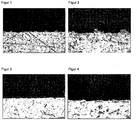
- Querschliffuntersuchungen zeigen, dass bei der Vergleichs-Variante gemäß
DD 221 762 A1 Fig.1 und 2 ). Die Schichtdicke gemäß Ausführungsbeispiel 1 (Fig. 3 und 4 ) ist deutlich höher und wirkt homogener als die der Vergleichs-Variante. - Beim Vergleich der EDX Spektren (
Fig.5 und6 ) ist zusehen, dass bei der Vergleichs-Variante (Fig. 5 ) Kobalt, Nickel und Molybdän in der Schicht enthalten sind. Bei der Schicht gemäß der Erfindung (Ausführungsbeispiel 1,Fig. 6 ) sind dagegen lediglich die Atome Eisen und Vanadat nachweisbar (Fig. 6 ). Die Spuren von Nickel und Chrom sind materialbedingt. -
- a) Als Vergleich zwischen der Erfindung und dem Stand der Technik dienen Werte von Beschichtungen gemäß
DD 221 762 A1
Schwarze Beschichtungen nachDD 221 762 A1 - b) Verändert man beim Elektrolyten nach Ausführungsbeispiel 1 die Vanadiumkonzentration, d.h. enthält der Elektrolyt neben Eisen KEIN Vanadium (d.h. 0 g/L) so werden L* Werte mit 51,44 erreicht. Bei Erhöhung des Vanadium Anteils im selben Elektrolyten auf 3g/L erhält man mit L*=32,8; a*=1,87; b*=3,87 ebenfalls braune Schichten.
- c) Verändert man beim Elektrolyten nach Ausführungsbeispiel 1 die Eisenkonzentration, d.h. liegt als Metallsalz im Elektrolyten nur eine Vanadiumverbindung und KEIN Eisen vor (d.h. 0g/L Fe), so erhält man ebenso nur braune Schichten mit L*=37,23; a*=1,99; b*=7,24. Bei Erhöhung der Eisenkonzentration bei konstant Haltung der Vanadiumkonzentration auf 4g/L Fe erhält man ebenfalls braune Schichten mit L*=33,45; a*=1,48; b*=4,0
Claims (10)
- Plasmachemisches Verfahren zur Herstellung schwarzer Oxidkeramikschichten auf Aluminium, Titan oder deren Legierungen sowie diese Materialien enthaltende Sonderwerkstoffe, welche intermetallischen Verbindungen von Aluminium, Titan oder deren Legierungen umfassen, nach dem Prozess der anodischen Oxidation in einem wässrigen Elektrolyten, welcher Eisen- und Vanadiumhaltig ist, dadurch gekennzeichnet, dass der Elektrolyt 0,04 bis 0,09 Mol/L Ammoniumeisen(III)citrat und 0,035 bis 0,090 Mol/L Ammonium(mono)vanadat enthält.
- Verfahren nach Anspruch 1, dadurch gekennzeichnet, dass der Elektrolyt einen pH-Wert von 5,4 bis 10,0 aufweist.
- Verfahren nach Anspruch 1 oder 2, dadurch gekennzeichnet, dass der Elektrolyt 0,15 bis 0,5 Mol/L Zitronensäure oder deren Salze enthält.
- Verfahren nach einem der vorhergehenden Ansprüche, dadurch gekennzeichnet, dass der Elektrolyt 0,8 bis 2,9 Mol/L eines Stabilisators, insbesondere Hexamethylentetramin, enthält.
- Verfahren nach einem der vorhergehenden Ansprüche, dadurch gekennzeichnet, dass der Elektrolyt 0,2 bis 0,9 Mol/L eines Phosphats eines Alkalimetalls, vorzugsweise ein Dihydrogenphosphat oder Pyrophosphat, insbesondere Kaliumdihydrogenphosphat oder Kaliumpyrophosphat, enthält.
- Verfahren nach einem der vorhergehenden Ansprüche, dadurch gekennzeichnet, dass das Elektrolytbad eine Temperatur von 15 bis 60 Grad Celsius aufweist.
- Verfahren nach einem der vorhergehenden Ansprüche, dadurch gekennzeichnet, dass die eingesetzte Stromdichte von 0,02 bis 0,10 Acm-2, vorzugsweise 0,04 bis 0,08 Acm-2, beträgt.
- Verfahren nach Anspruch 7, dadurch gekennzeichnet, dass eine Endspannung unterhalb von 1000 V, vorzugsweise 300 bis 650 V, erreicht wird.
- Verfahren nach einem der vorhergehenden Ansprüche, dadurch gekennzeichnet, dass die Oxidkeramikschichten eine Schichtdicke im Bereich von 5 µm bis 100 µm aufweisen.
- Verfahren nach einem der vorhergehenden Ansprüche, dadurch gekennzeichnet, dass die erzeugten Oxidkeramikschichten aus Oxiden, insbesondere Spinellen, von Aluminium, Eisen und Vanadium bestehen.
Applications Claiming Priority (1)
| Application Number | Priority Date | Filing Date | Title |
|---|---|---|---|
| DE102013110660.9A DE102013110660A1 (de) | 2013-09-26 | 2013-09-26 | Plasmachemisches Verfahren zur Herstellung schwarzer Oxidkeramikschichten und entsprechend beschichteter Gegenstand |
Publications (3)
| Publication Number | Publication Date |
|---|---|
| EP2857560A1 EP2857560A1 (de) | 2015-04-08 |
| EP2857560B1 EP2857560B1 (de) | 2017-03-22 |
| EP2857560B2 true EP2857560B2 (de) | 2020-04-22 |
Family
ID=51492882
Family Applications (1)
| Application Number | Title | Priority Date | Filing Date |
|---|---|---|---|
| EP14184217.9A Active EP2857560B2 (de) | 2013-09-26 | 2014-09-10 | Plasmachemisches verfahren zur herstellung schwarzer oxidkeramikschichten und entsprechend beschichteter gegenstand |
Country Status (3)
| Country | Link |
|---|---|
| US (1) | US20150083598A1 (de) |
| EP (1) | EP2857560B2 (de) |
| DE (1) | DE102013110660A1 (de) |
Families Citing this family (9)
| Publication number | Priority date | Publication date | Assignee | Title |
|---|---|---|---|---|
| DE102013110660A1 (de) | 2013-09-26 | 2015-03-26 | AHC Oberflächentechnik GmbH | Plasmachemisches Verfahren zur Herstellung schwarzer Oxidkeramikschichten und entsprechend beschichteter Gegenstand |
| WO2019098378A1 (ja) * | 2017-11-17 | 2019-05-23 | 株式会社東亜電化 | 黒色酸化被膜を備えるマグネシウム又はアルミニウム金属部材及びその製造方法 |
| DE102018110905A1 (de) * | 2018-05-07 | 2019-11-07 | Lucas Automotive Gmbh | Elektrode für ein Eloxal-Verfahren |
| US11032930B2 (en) * | 2019-05-28 | 2021-06-08 | Apple Inc. | Titanium surfaces with improved color consistency and resistance to color change |
| CN114144545A (zh) * | 2019-07-09 | 2022-03-04 | Bsh家用电器有限公司 | 制造组件的方法、组件和燃气灶 |
| CN111058077B (zh) * | 2020-01-19 | 2022-03-22 | 常州大学 | 一种用于微弧氧化黑色陶瓷膜的电解液及其制备方法和微弧氧化方法 |
| CN112663112B (zh) * | 2020-12-02 | 2022-10-04 | 斯特凯新材料(上海)有限公司 | 一种电解液及镁合金复合氧化黑色陶瓷膜的制备方法 |
| CN114016108B (zh) * | 2021-12-20 | 2022-11-25 | 哈尔滨三泳金属表面技术有限公司 | 一种高硅高铜压铸铝合金的表面氧化膜及其制备工艺 |
| DE102022206126A1 (de) | 2022-06-20 | 2023-03-09 | Carl Zeiss Smt Gmbh | Bauteil zum Einsatz in einer Projektionsbelichtungsanlage |
Citations (4)
| Publication number | Priority date | Publication date | Assignee | Title |
|---|---|---|---|---|
| WO2003021009A2 (en) † | 2001-08-03 | 2003-03-13 | Elisha Holding Llc | Process for treating a conductive surface and products formed thereby |
| US20070221508A1 (en) † | 2006-03-25 | 2007-09-27 | Hon Hai Precision Industry Co., Ltd. | Method for anodizing magnesium products |
| US20070246691A1 (en) † | 2006-04-19 | 2007-10-25 | Hon Hai Precision Industry Co., Ltd. | Electrolyte for anodizing magnesium products |
| EP2103718A1 (de) † | 2006-09-28 | 2009-09-23 | Nihon Parkerizing Co., Ltd. | Verfahren zum aufbringen eines keramikfilms auf metall, elektrolyselösung zur verwendung bei dem verfahren und keramikfilm und metallmaterial |
Family Cites Families (12)
| Publication number | Priority date | Publication date | Assignee | Title |
|---|---|---|---|---|
| DD221762A1 (de) | 1983-12-28 | 1985-05-02 | Karl Marx Stadt Tech Hochschul | Verfahren zur erzeugung einer strahlungsabsorbierenden oberflaeche |
| US4659440A (en) | 1985-10-24 | 1987-04-21 | Rudolf Hradcovsky | Method of coating articles of aluminum and an electrolytic bath therefor |
| US4668347A (en) * | 1985-12-05 | 1987-05-26 | The Dow Chemical Company | Anticorrosive coated rectifier metals and their alloys |
| DD257275A1 (de) * | 1987-02-02 | 1988-06-08 | Karl Marx Stadt Tech Hochschul | Dekorativer ueberzug auf metallen |
| DD299596A7 (de) | 1989-07-19 | 1992-04-30 | Jenoptik Carl Zeiss Jena Gmbh Werk Entw. Wiss.-Techn. Ausruestungen,De | Elektrolyt zur erzeugung schwarzer konversionsschichten auf leichtmetallen |
| DD299595A7 (de) | 1989-07-19 | 1992-04-30 | Jenoptik Carl Zeiss Jena Gmbh Werk Entw. Wiss.-Techn. Ausruestungen,De | Schwarze konversionsschichten auf titanwerkstoffen |
| DE4139006C3 (de) | 1991-11-27 | 2003-07-10 | Electro Chem Eng Gmbh | Verfahren zur Erzeugung von Oxidkeramikschichten auf sperrschichtbildenden Metallen und auf diese Weise erzeugte Gegenstände aus Aluminium, Magnesium, Titan oder deren Legierungen mit einer Oxidkeramikschicht |
| DE10127770A1 (de) * | 2001-06-07 | 2002-12-12 | Volkswagen Ag | Verfahren zur Erzeugung von Korrosionsschutzschichten auf Oberflächen aus Magnesium oder Magnesiumlegierungen |
| DE102008043970A1 (de) * | 2008-11-21 | 2010-05-27 | Biotronik Vi Patent Ag | Verfahren zur Herstellung einer korrosionshemmenden Beschichtung auf einem Implantat aus einer biokorrodierbaren Magnesiumlegierung sowie nach dem Verfahren hergestelltes Implantat |
| CN102154673B (zh) * | 2011-04-12 | 2012-10-03 | 中国船舶重工集团公司第十二研究所 | 在铝合金表面制备环保型微弧氧化黑色陶瓷膜的方法 |
| DE102011055644B4 (de) * | 2011-11-23 | 2013-05-29 | Verein zur Förderung von Innovationen durch Forschung, Entwicklung und Technologietransfer e.V. (Verein INNOVENT e.V.) | Verfahren zur Erzeugung einer schwarzen oxidkeramischen Oberflächenschicht auf einem Bauteil aus einer Leichtmetalllegierung |
| DE102013110660A1 (de) | 2013-09-26 | 2015-03-26 | AHC Oberflächentechnik GmbH | Plasmachemisches Verfahren zur Herstellung schwarzer Oxidkeramikschichten und entsprechend beschichteter Gegenstand |
-
2013
- 2013-09-26 DE DE102013110660.9A patent/DE102013110660A1/de not_active Ceased
-
2014
- 2014-09-10 EP EP14184217.9A patent/EP2857560B2/de active Active
- 2014-09-22 US US14/492,739 patent/US20150083598A1/en not_active Abandoned
Patent Citations (4)
| Publication number | Priority date | Publication date | Assignee | Title |
|---|---|---|---|---|
| WO2003021009A2 (en) † | 2001-08-03 | 2003-03-13 | Elisha Holding Llc | Process for treating a conductive surface and products formed thereby |
| US20070221508A1 (en) † | 2006-03-25 | 2007-09-27 | Hon Hai Precision Industry Co., Ltd. | Method for anodizing magnesium products |
| US20070246691A1 (en) † | 2006-04-19 | 2007-10-25 | Hon Hai Precision Industry Co., Ltd. | Electrolyte for anodizing magnesium products |
| EP2103718A1 (de) † | 2006-09-28 | 2009-09-23 | Nihon Parkerizing Co., Ltd. | Verfahren zum aufbringen eines keramikfilms auf metall, elektrolyselösung zur verwendung bei dem verfahren und keramikfilm und metallmaterial |
Also Published As
| Publication number | Publication date |
|---|---|
| EP2857560B1 (de) | 2017-03-22 |
| DE102013110660A1 (de) | 2015-03-26 |
| EP2857560A1 (de) | 2015-04-08 |
| US20150083598A1 (en) | 2015-03-26 |
Similar Documents
| Publication | Publication Date | Title |
|---|---|---|
| EP2857560B1 (de) | Plasmachemisches verfahren zur herstellung schwarzer oxidkeramikschichten und entsprechend beschichteter gegenstand | |
| EP0545230B1 (de) | Verfahren zur Erzeugung von ggf. modifizierten Oxidkeramikschichten auf sperrschichtbildenden Metallen und damit erhaltene Gegenstände | |
| DE69013993T2 (de) | Verfahren zur Anodisierung von Aluminium. | |
| EP3440235B1 (de) | Verbessertes verfahren zur nickelfreien phosphatierung von metallischen oberflächen | |
| DE2349113B2 (de) | Wäßriges Bad zur elektrolytischen Vorbehandlung von Aluminium oder Aluminiumlegierungen für das Aufbringen einer wasserlöslichen oder wasserdispergierbaren Beschichtungssubstanz | |
| EP0333048A1 (de) | Verfahren zur Erzeugung von korrosions- und verschleissbeständigen Schutzschichten auf Magnesium und Magnesiumlegierungen | |
| Fachikov et al. | Surface treatment of zinc coatings by molybdate solutions | |
| EP0333049A1 (de) | Verfahren zur Oberflächenveredelung von Magnesium und Magnesiumlegierungen | |
| WO2021116318A1 (de) | Verfahren zum herstellen eines stahlflachprodukts mit einer metallischen schutzschicht auf basis von zink und einer auf einer oberfläche der metallischen schutzschicht erzeugten phosphatierschicht und derartiges stahlflachprodukt | |
| DE69602226T2 (de) | Eisenlegierung mit Fe-Al Diffusionsschicht und Verfahren zu ihrer Herstellung | |
| EP4253592A2 (de) | Schmelztauchbeschichtetes stahlband mit verbessertem oberflächenerscheinungsbild und verfahren zu seiner herstellung | |
| DE202008010896U1 (de) | Werkstoff, insbesondere Bauteile, mit verbesserten Verschleißschutzschichten | |
| EP3392375B1 (de) | Verfahren zur schlammfreien schichtbildenden zinkphosphatierung von metallischen bauteilen in serie | |
| EP4121580A1 (de) | Verfahren zum erzeugen einer phosphatierschicht und nickelfreie phosphatierlösung | |
| DE4209733A1 (de) | Verfahren zur elektrolytischen Beschichtung von Substraten und dergleichen | |
| KR20200089698A (ko) | 흑색 산화 피막을 구비하는 마그네슘 또는 알루미늄 금속 부재 및 그의 제조 방법 | |
| DE102011055644B4 (de) | Verfahren zur Erzeugung einer schwarzen oxidkeramischen Oberflächenschicht auf einem Bauteil aus einer Leichtmetalllegierung | |
| DE693832C (de) | Bad und Verfahren zur elektrolytischen Herstellung von Zinkueberzuegen | |
| EP1273679A1 (de) | Metallisches Bauteil mit äusserer Funktionsschicht und Verfahren zu seiner Herstellung | |
| EP3872201A1 (de) | Schmelztauchbeschichtetes stahlerzeugnis mit zink-aluminium-magnesium-beschichtung sowie herstellverfahren und verwendung einer vorrichtung zum schmelztauchbeschichten von stahlband | |
| DE19858795C2 (de) | Verfahren zum Abdunkeln einer Oberflächenschicht eines Materialstücks, die Zink enthält | |
| DE3442591C2 (de) | ||
| DE102023103033A1 (de) | Kalt geformtes Bauteil | |
| DE102017104654A1 (de) | Lichtbeständige Kombinationsfärbung anodisierter Aluminiumoberflächen | |
| DE102018219198A1 (de) | Kathodisches Beizverfahren zur beschleunigten Entzunderung ohne Ausbeizen der Korngrenze |
Legal Events
| Date | Code | Title | Description |
|---|---|---|---|
| PUAI | Public reference made under article 153(3) epc to a published international application that has entered the european phase |
Free format text: ORIGINAL CODE: 0009012 |
|
| 17P | Request for examination filed |
Effective date: 20140910 |
|
| AK | Designated contracting states |
Kind code of ref document: A1 Designated state(s): AL AT BE BG CH CY CZ DE DK EE ES FI FR GB GR HR HU IE IS IT LI LT LU LV MC MK MT NL NO PL PT RO RS SE SI SK SM TR |
|
| AX | Request for extension of the european patent |
Extension state: BA ME |
|
| R17P | Request for examination filed (corrected) |
Effective date: 20150810 |
|
| RBV | Designated contracting states (corrected) |
Designated state(s): AL AT BE BG CH CY CZ DE DK EE ES FI FR GB GR HR HU IE IS IT LI LT LU LV MC MK MT NL NO PL PT RO RS SE SI SK SM TR |
|
| 17Q | First examination report despatched |
Effective date: 20151127 |
|
| GRAP | Despatch of communication of intention to grant a patent |
Free format text: ORIGINAL CODE: EPIDOSNIGR1 |
|
| RIC1 | Information provided on ipc code assigned before grant |
Ipc: C25D 11/06 20060101ALI20160930BHEP Ipc: C25D 11/14 20060101ALI20160930BHEP Ipc: C25D 11/16 20060101ALN20160930BHEP Ipc: C25D 11/02 20060101ALI20160930BHEP Ipc: C25D 11/10 20060101AFI20160930BHEP Ipc: C25D 11/26 20060101ALI20160930BHEP Ipc: C25D 11/30 20060101ALI20160930BHEP |
|
| INTG | Intention to grant announced |
Effective date: 20161028 |
|
| RIC1 | Information provided on ipc code assigned before grant |
Ipc: C25D 11/14 20060101ALI20161017BHEP Ipc: C25D 11/10 20060101AFI20161017BHEP Ipc: C25D 11/02 20060101ALI20161017BHEP Ipc: C25D 11/16 20060101ALN20161017BHEP Ipc: C25D 11/26 20060101ALI20161017BHEP Ipc: C25D 11/06 20060101ALI20161017BHEP Ipc: C25D 11/30 20060101ALI20161017BHEP |
|
| GRAS | Grant fee paid |
Free format text: ORIGINAL CODE: EPIDOSNIGR3 |
|
| GRAA | (expected) grant |
Free format text: ORIGINAL CODE: 0009210 |
|
| AK | Designated contracting states |
Kind code of ref document: B1 Designated state(s): AL AT BE BG CH CY CZ DE DK EE ES FI FR GB GR HR HU IE IS IT LI LT LU LV MC MK MT NL NO PL PT RO RS SE SI SK SM TR |
|
| REG | Reference to a national code |
Ref country code: GB Ref legal event code: FG4D Free format text: NOT ENGLISH |
|
| REG | Reference to a national code |
Ref country code: CH Ref legal event code: EP |
|
| REG | Reference to a national code |
Ref country code: AT Ref legal event code: REF Ref document number: 877873 Country of ref document: AT Kind code of ref document: T Effective date: 20170415 |
|
| REG | Reference to a national code |
Ref country code: IE Ref legal event code: FG4D Free format text: LANGUAGE OF EP DOCUMENT: GERMAN |
|
| REG | Reference to a national code |
Ref country code: CH Ref legal event code: NV Representative=s name: ALDO ROEMPLER PATENTANWALT, CH |
|
| REG | Reference to a national code |
Ref country code: DE Ref legal event code: R096 Ref document number: 502014003086 Country of ref document: DE |
|
| REG | Reference to a national code |
Ref country code: NL Ref legal event code: FP |
|
| PG25 | Lapsed in a contracting state [announced via postgrant information from national office to epo] |
Ref country code: FI Free format text: LAPSE BECAUSE OF FAILURE TO SUBMIT A TRANSLATION OF THE DESCRIPTION OR TO PAY THE FEE WITHIN THE PRESCRIBED TIME-LIMIT Effective date: 20170322 Ref country code: LT Free format text: LAPSE BECAUSE OF FAILURE TO SUBMIT A TRANSLATION OF THE DESCRIPTION OR TO PAY THE FEE WITHIN THE PRESCRIBED TIME-LIMIT Effective date: 20170322 Ref country code: NO Free format text: LAPSE BECAUSE OF FAILURE TO SUBMIT A TRANSLATION OF THE DESCRIPTION OR TO PAY THE FEE WITHIN THE PRESCRIBED TIME-LIMIT Effective date: 20170622 Ref country code: GR Free format text: LAPSE BECAUSE OF FAILURE TO SUBMIT A TRANSLATION OF THE DESCRIPTION OR TO PAY THE FEE WITHIN THE PRESCRIBED TIME-LIMIT Effective date: 20170623 Ref country code: HR Free format text: LAPSE BECAUSE OF FAILURE TO SUBMIT A TRANSLATION OF THE DESCRIPTION OR TO PAY THE FEE WITHIN THE PRESCRIBED TIME-LIMIT Effective date: 20170322 |
|
| REG | Reference to a national code |
Ref country code: LT Ref legal event code: MG4D |
|
| PG25 | Lapsed in a contracting state [announced via postgrant information from national office to epo] |
Ref country code: LV Free format text: LAPSE BECAUSE OF FAILURE TO SUBMIT A TRANSLATION OF THE DESCRIPTION OR TO PAY THE FEE WITHIN THE PRESCRIBED TIME-LIMIT Effective date: 20170322 Ref country code: SE Free format text: LAPSE BECAUSE OF FAILURE TO SUBMIT A TRANSLATION OF THE DESCRIPTION OR TO PAY THE FEE WITHIN THE PRESCRIBED TIME-LIMIT Effective date: 20170322 Ref country code: BG Free format text: LAPSE BECAUSE OF FAILURE TO SUBMIT A TRANSLATION OF THE DESCRIPTION OR TO PAY THE FEE WITHIN THE PRESCRIBED TIME-LIMIT Effective date: 20170622 Ref country code: RS Free format text: LAPSE BECAUSE OF FAILURE TO SUBMIT A TRANSLATION OF THE DESCRIPTION OR TO PAY THE FEE WITHIN THE PRESCRIBED TIME-LIMIT Effective date: 20170322 |
|
| REG | Reference to a national code |
Ref country code: FR Ref legal event code: PLFP Year of fee payment: 4 |
|
| PG25 | Lapsed in a contracting state [announced via postgrant information from national office to epo] |
Ref country code: SK Free format text: LAPSE BECAUSE OF FAILURE TO SUBMIT A TRANSLATION OF THE DESCRIPTION OR TO PAY THE FEE WITHIN THE PRESCRIBED TIME-LIMIT Effective date: 20170322 Ref country code: ES Free format text: LAPSE BECAUSE OF FAILURE TO SUBMIT A TRANSLATION OF THE DESCRIPTION OR TO PAY THE FEE WITHIN THE PRESCRIBED TIME-LIMIT Effective date: 20170322 Ref country code: IT Free format text: LAPSE BECAUSE OF FAILURE TO SUBMIT A TRANSLATION OF THE DESCRIPTION OR TO PAY THE FEE WITHIN THE PRESCRIBED TIME-LIMIT Effective date: 20170322 Ref country code: EE Free format text: LAPSE BECAUSE OF FAILURE TO SUBMIT A TRANSLATION OF THE DESCRIPTION OR TO PAY THE FEE WITHIN THE PRESCRIBED TIME-LIMIT Effective date: 20170322 Ref country code: RO Free format text: LAPSE BECAUSE OF FAILURE TO SUBMIT A TRANSLATION OF THE DESCRIPTION OR TO PAY THE FEE WITHIN THE PRESCRIBED TIME-LIMIT Effective date: 20170322 Ref country code: CZ Free format text: LAPSE BECAUSE OF FAILURE TO SUBMIT A TRANSLATION OF THE DESCRIPTION OR TO PAY THE FEE WITHIN THE PRESCRIBED TIME-LIMIT Effective date: 20170322 |
|
| PG25 | Lapsed in a contracting state [announced via postgrant information from national office to epo] |
Ref country code: IS Free format text: LAPSE BECAUSE OF FAILURE TO SUBMIT A TRANSLATION OF THE DESCRIPTION OR TO PAY THE FEE WITHIN THE PRESCRIBED TIME-LIMIT Effective date: 20170722 Ref country code: PL Free format text: LAPSE BECAUSE OF FAILURE TO SUBMIT A TRANSLATION OF THE DESCRIPTION OR TO PAY THE FEE WITHIN THE PRESCRIBED TIME-LIMIT Effective date: 20170322 Ref country code: SM Free format text: LAPSE BECAUSE OF FAILURE TO SUBMIT A TRANSLATION OF THE DESCRIPTION OR TO PAY THE FEE WITHIN THE PRESCRIBED TIME-LIMIT Effective date: 20170322 Ref country code: PT Free format text: LAPSE BECAUSE OF FAILURE TO SUBMIT A TRANSLATION OF THE DESCRIPTION OR TO PAY THE FEE WITHIN THE PRESCRIBED TIME-LIMIT Effective date: 20170724 |
|
| REG | Reference to a national code |
Ref country code: DE Ref legal event code: R026 Ref document number: 502014003086 Country of ref document: DE |
|
| PLBI | Opposition filed |
Free format text: ORIGINAL CODE: 0009260 |
|
| PLAX | Notice of opposition and request to file observation + time limit sent |
Free format text: ORIGINAL CODE: EPIDOSNOBS2 |
|
| 26 | Opposition filed |
Opponent name: HENKEL AG & CO. KGAA Effective date: 20171221 |
|
| PG25 | Lapsed in a contracting state [announced via postgrant information from national office to epo] |
Ref country code: DK Free format text: LAPSE BECAUSE OF FAILURE TO SUBMIT A TRANSLATION OF THE DESCRIPTION OR TO PAY THE FEE WITHIN THE PRESCRIBED TIME-LIMIT Effective date: 20170322 |
|
| PG25 | Lapsed in a contracting state [announced via postgrant information from national office to epo] |
Ref country code: SI Free format text: LAPSE BECAUSE OF FAILURE TO SUBMIT A TRANSLATION OF THE DESCRIPTION OR TO PAY THE FEE WITHIN THE PRESCRIBED TIME-LIMIT Effective date: 20170322 |
|
| PLAF | Information modified related to communication of a notice of opposition and request to file observations + time limit |
Free format text: ORIGINAL CODE: EPIDOSCOBS2 |
|
| PG25 | Lapsed in a contracting state [announced via postgrant information from national office to epo] |
Ref country code: MC Free format text: LAPSE BECAUSE OF FAILURE TO SUBMIT A TRANSLATION OF THE DESCRIPTION OR TO PAY THE FEE WITHIN THE PRESCRIBED TIME-LIMIT Effective date: 20170322 |
|
| REG | Reference to a national code |
Ref country code: IE Ref legal event code: MM4A |
|
| PLBB | Reply of patent proprietor to notice(s) of opposition received |
Free format text: ORIGINAL CODE: EPIDOSNOBS3 |
|
| PG25 | Lapsed in a contracting state [announced via postgrant information from national office to epo] |
Ref country code: IE Free format text: LAPSE BECAUSE OF NON-PAYMENT OF DUE FEES Effective date: 20170910 |
|
| REG | Reference to a national code |
Ref country code: FR Ref legal event code: PLFP Year of fee payment: 5 |
|
| PG25 | Lapsed in a contracting state [announced via postgrant information from national office to epo] |
Ref country code: MT Free format text: LAPSE BECAUSE OF FAILURE TO SUBMIT A TRANSLATION OF THE DESCRIPTION OR TO PAY THE FEE WITHIN THE PRESCRIBED TIME-LIMIT Effective date: 20170322 |
|
| GBPC | Gb: european patent ceased through non-payment of renewal fee |
Effective date: 20180910 |
|
| PG25 | Lapsed in a contracting state [announced via postgrant information from national office to epo] |
Ref country code: HU Free format text: LAPSE BECAUSE OF FAILURE TO SUBMIT A TRANSLATION OF THE DESCRIPTION OR TO PAY THE FEE WITHIN THE PRESCRIBED TIME-LIMIT; INVALID AB INITIO Effective date: 20140910 |
|
| PG25 | Lapsed in a contracting state [announced via postgrant information from national office to epo] |
Ref country code: CY Free format text: LAPSE BECAUSE OF FAILURE TO SUBMIT A TRANSLATION OF THE DESCRIPTION OR TO PAY THE FEE WITHIN THE PRESCRIBED TIME-LIMIT Effective date: 20170322 Ref country code: GB Free format text: LAPSE BECAUSE OF NON-PAYMENT OF DUE FEES Effective date: 20180910 |
|
| PG25 | Lapsed in a contracting state [announced via postgrant information from national office to epo] |
Ref country code: MK Free format text: LAPSE BECAUSE OF FAILURE TO SUBMIT A TRANSLATION OF THE DESCRIPTION OR TO PAY THE FEE WITHIN THE PRESCRIBED TIME-LIMIT Effective date: 20170322 |
|
| PUAH | Patent maintained in amended form |
Free format text: ORIGINAL CODE: 0009272 |
|
| STAA | Information on the status of an ep patent application or granted ep patent |
Free format text: STATUS: PATENT MAINTAINED AS AMENDED |
|
| PG25 | Lapsed in a contracting state [announced via postgrant information from national office to epo] |
Ref country code: TR Free format text: LAPSE BECAUSE OF FAILURE TO SUBMIT A TRANSLATION OF THE DESCRIPTION OR TO PAY THE FEE WITHIN THE PRESCRIBED TIME-LIMIT Effective date: 20170322 |
|
| RAP2 | Party data changed (patent owner data changed or rights of a patent transferred) |
Owner name: AALBERTS SURFACE TREATMENT GMBH |
|
| 27A | Patent maintained in amended form |
Effective date: 20200422 |
|
| AK | Designated contracting states |
Kind code of ref document: B2 Designated state(s): AL AT BE BG CH CY CZ DE DK EE ES FI FR GB GR HR HU IE IS IT LI LT LU LV MC MK MT NL NO PL PT RO RS SE SI SK SM TR |
|
| REG | Reference to a national code |
Ref country code: DE Ref legal event code: R102 Ref document number: 502014003086 Country of ref document: DE |
|
| PG25 | Lapsed in a contracting state [announced via postgrant information from national office to epo] |
Ref country code: AL Free format text: LAPSE BECAUSE OF FAILURE TO SUBMIT A TRANSLATION OF THE DESCRIPTION OR TO PAY THE FEE WITHIN THE PRESCRIBED TIME-LIMIT Effective date: 20170322 |
|
| REG | Reference to a national code |
Ref country code: NL Ref legal event code: FP |
|
| PGFP | Annual fee paid to national office [announced via postgrant information from national office to epo] |
Ref country code: BE Payment date: 20240920 Year of fee payment: 11 Ref country code: LU Payment date: 20240919 Year of fee payment: 11 |
|
| PGFP | Annual fee paid to national office [announced via postgrant information from national office to epo] |
Ref country code: FR Payment date: 20240930 Year of fee payment: 11 |
|
| PGFP | Annual fee paid to national office [announced via postgrant information from national office to epo] |
Ref country code: NL Payment date: 20240920 Year of fee payment: 11 |
|
| PGFP | Annual fee paid to national office [announced via postgrant information from national office to epo] |
Ref country code: AT Payment date: 20240918 Year of fee payment: 11 |
|
| PGFP | Annual fee paid to national office [announced via postgrant information from national office to epo] |
Ref country code: CH Payment date: 20241001 Year of fee payment: 11 |
|
| PGFP | Annual fee paid to national office [announced via postgrant information from national office to epo] |
Ref country code: DE Payment date: 20250716 Year of fee payment: 12 |
|
| REG | Reference to a national code |
Ref country code: CH Ref legal event code: H13 Free format text: ST27 STATUS EVENT CODE: U-0-0-H10-H13 (AS PROVIDED BY THE NATIONAL OFFICE) Effective date: 20260504 |
|
| REG | Reference to a national code |
Ref country code: NL Ref legal event code: MM Effective date: 20251001 |
|
| REG | Reference to a national code |
Ref country code: AT Ref legal event code: MM01 Ref document number: 877873 Country of ref document: AT Kind code of ref document: T Effective date: 20250910 |
|
| PG25 | Lapsed in a contracting state [announced via postgrant information from national office to epo] |
Ref country code: LU Free format text: LAPSE BECAUSE OF NON-PAYMENT OF DUE FEES Effective date: 20250910 |
|
| REG | Reference to a national code |
Ref country code: BE Ref legal event code: MM Effective date: 20250930 |
|
| PG25 | Lapsed in a contracting state [announced via postgrant information from national office to epo] |
Ref country code: NL Free format text: LAPSE BECAUSE OF NON-PAYMENT OF DUE FEES Effective date: 20251001 |
|
| PG25 | Lapsed in a contracting state [announced via postgrant information from national office to epo] |
Ref country code: AT Free format text: LAPSE BECAUSE OF NON-PAYMENT OF DUE FEES Effective date: 20250910 |
|
| PG25 | Lapsed in a contracting state [announced via postgrant information from national office to epo] |
Ref country code: BE Free format text: LAPSE BECAUSE OF NON-PAYMENT OF DUE FEES Effective date: 20250930 Ref country code: CH Free format text: LAPSE BECAUSE OF NON-PAYMENT OF DUE FEES Effective date: 20250930 |
|
| PG25 | Lapsed in a contracting state [announced via postgrant information from national office to epo] |
Ref country code: FR Free format text: LAPSE BECAUSE OF NON-PAYMENT OF DUE FEES Effective date: 20250930 |