EP2855536B1 - Novel composition for preparing polysaccharide fibers - Google Patents
Novel composition for preparing polysaccharide fibers Download PDFInfo
- Publication number
- EP2855536B1 EP2855536B1 EP13726657.3A EP13726657A EP2855536B1 EP 2855536 B1 EP2855536 B1 EP 2855536B1 EP 13726657 A EP13726657 A EP 13726657A EP 2855536 B1 EP2855536 B1 EP 2855536B1
- Authority
- EP
- European Patent Office
- Prior art keywords
- solution
- glucan
- poly
- repeat units
- fiber
- Prior art date
- Legal status (The legal status is an assumption and is not a legal conclusion. Google has not performed a legal analysis and makes no representation as to the accuracy of the status listed.)
- Active
Links
Images
Classifications
-
- C—CHEMISTRY; METALLURGY
- C08—ORGANIC MACROMOLECULAR COMPOUNDS; THEIR PREPARATION OR CHEMICAL WORKING-UP; COMPOSITIONS BASED THEREON
- C08B—POLYSACCHARIDES; DERIVATIVES THEREOF
- C08B37/00—Preparation of polysaccharides not provided for in groups C08B1/00 - C08B35/00; Derivatives thereof
-
- D—TEXTILES; PAPER
- D01—NATURAL OR MAN-MADE THREADS OR FIBRES; SPINNING
- D01D—MECHANICAL METHODS OR APPARATUS IN THE MANUFACTURE OF ARTIFICIAL FILAMENTS, THREADS, FIBRES, BRISTLES OR RIBBONS
- D01D5/00—Formation of filaments, threads, or the like
- D01D5/06—Wet spinning methods
-
- C—CHEMISTRY; METALLURGY
- C08—ORGANIC MACROMOLECULAR COMPOUNDS; THEIR PREPARATION OR CHEMICAL WORKING-UP; COMPOSITIONS BASED THEREON
- C08B—POLYSACCHARIDES; DERIVATIVES THEREOF
- C08B37/00—Preparation of polysaccharides not provided for in groups C08B1/00 - C08B35/00; Derivatives thereof
- C08B37/0006—Homoglycans, i.e. polysaccharides having a main chain consisting of one single sugar, e.g. colominic acid
- C08B37/0009—Homoglycans, i.e. polysaccharides having a main chain consisting of one single sugar, e.g. colominic acid alpha-D-Glucans, e.g. polydextrose, alternan, glycogen; (alpha-1,4)(alpha-1,6)-D-Glucans; (alpha-1,3)(alpha-1,4)-D-Glucans, e.g. isolichenan or nigeran; (alpha-1,4)-D-Glucans; (alpha-1,3)-D-Glucans, e.g. pseudonigeran; Derivatives thereof
-
- C—CHEMISTRY; METALLURGY
- C08—ORGANIC MACROMOLECULAR COMPOUNDS; THEIR PREPARATION OR CHEMICAL WORKING-UP; COMPOSITIONS BASED THEREON
- C08B—POLYSACCHARIDES; DERIVATIVES THEREOF
- C08B37/00—Preparation of polysaccharides not provided for in groups C08B1/00 - C08B35/00; Derivatives thereof
- C08B37/0006—Homoglycans, i.e. polysaccharides having a main chain consisting of one single sugar, e.g. colominic acid
- C08B37/0009—Homoglycans, i.e. polysaccharides having a main chain consisting of one single sugar, e.g. colominic acid alpha-D-Glucans, e.g. polydextrose, alternan, glycogen; (alpha-1,4)(alpha-1,6)-D-Glucans; (alpha-1,3)(alpha-1,4)-D-Glucans, e.g. isolichenan or nigeran; (alpha-1,4)-D-Glucans; (alpha-1,3)-D-Glucans, e.g. pseudonigeran; Derivatives thereof
- C08B37/0021—Dextran, i.e. (alpha-1,4)-D-glucan; Derivatives thereof, e.g. Sephadex, i.e. crosslinked dextran
-
- C—CHEMISTRY; METALLURGY
- C08—ORGANIC MACROMOLECULAR COMPOUNDS; THEIR PREPARATION OR CHEMICAL WORKING-UP; COMPOSITIONS BASED THEREON
- C08L—COMPOSITIONS OF MACROMOLECULAR COMPOUNDS
- C08L5/00—Compositions of polysaccharides or of their derivatives not provided for in groups C08L1/00 or C08L3/00
-
- C—CHEMISTRY; METALLURGY
- C08—ORGANIC MACROMOLECULAR COMPOUNDS; THEIR PREPARATION OR CHEMICAL WORKING-UP; COMPOSITIONS BASED THEREON
- C08L—COMPOSITIONS OF MACROMOLECULAR COMPOUNDS
- C08L5/00—Compositions of polysaccharides or of their derivatives not provided for in groups C08L1/00 or C08L3/00
- C08L5/02—Dextran; Derivatives thereof
-
- D—TEXTILES; PAPER
- D01—NATURAL OR MAN-MADE THREADS OR FIBRES; SPINNING
- D01F—CHEMICAL FEATURES IN THE MANUFACTURE OF ARTIFICIAL FILAMENTS, THREADS, FIBRES, BRISTLES OR RIBBONS; APPARATUS SPECIALLY ADAPTED FOR THE MANUFACTURE OF CARBON FILAMENTS
- D01F11/00—Chemical after-treatment of artificial filaments or the like during manufacture
-
- D—TEXTILES; PAPER
- D01—NATURAL OR MAN-MADE THREADS OR FIBRES; SPINNING
- D01F—CHEMICAL FEATURES IN THE MANUFACTURE OF ARTIFICIAL FILAMENTS, THREADS, FIBRES, BRISTLES OR RIBBONS; APPARATUS SPECIALLY ADAPTED FOR THE MANUFACTURE OF CARBON FILAMENTS
- D01F9/00—Artificial filaments or the like of other substances; Manufacture thereof; Apparatus specially adapted for the manufacture of carbon filaments
-
- Y—GENERAL TAGGING OF NEW TECHNOLOGICAL DEVELOPMENTS; GENERAL TAGGING OF CROSS-SECTIONAL TECHNOLOGIES SPANNING OVER SEVERAL SECTIONS OF THE IPC; TECHNICAL SUBJECTS COVERED BY FORMER USPC CROSS-REFERENCE ART COLLECTIONS [XRACs] AND DIGESTS
- Y10—TECHNICAL SUBJECTS COVERED BY FORMER USPC
- Y10S—TECHNICAL SUBJECTS COVERED BY FORMER USPC CROSS-REFERENCE ART COLLECTIONS [XRACs] AND DIGESTS
- Y10S424/00—Drug, bio-affecting and body treating compositions
- Y10S424/13—Burn treatment
Definitions
- the present invention is directed to a process for forming fibers of poly( ⁇ (1 ⁇ 3) glucan) by solution spinning a solution of xanthated poly( ⁇ (1 ⁇ 3) glucan) in an aqueous alkali metal hydroxide and to the solution itself.
- the poly( ⁇ (1 ⁇ 3) glucan) employed was synthesized by fermentation.
- Polysaccharides have been known since the dawn of civilization, primarily in the form of cellulose, a polymer formed from glucose by natural processes via ⁇ (1 ⁇ 4) glycoside linkages; see, for example, Applied Fibre Science, F. Happey, Ed., Chapter 8, E. Atkins, Academic Press, New York, 1979 . Numerous other polysaccharide polymers are also disclosed therein.
- glucan polymer characterized by ⁇ (1 ⁇ 3) glycoside linkages
- GtfJ glucosyltransferase isolated from Streptococcus salivarius
- Scheme et al. Microbiology, vol 141, pp. 1451-1460 (1995 ).
- Highly crystalline, highly oriented, low molecular weight films of ⁇ (1 ⁇ 3)-D-glucan have been fabricated for the purposes of x-ray diffraction analysis, Ogawa et al., Fiber Diffraction Methods, 47, pp. 353-362 (1980 ).
- the insoluble glucan polymer is acetylated, the acetylated glucan dissolved to form a 5% solution in chloroform and the solution cast into a film.
- the film is then subjected to stretching in glycerine at 150° C. which orients the film and stretches it to a length 6.5 times the original length of the solution cast film.
- the film is deacetylated and crystallized by annealing in superheated water at 140° C. in a pressure vessel. It is well-known in the art that exposure of polysaccharides to such a hot aqueous environment results in chain cleavage and loss of molecular weight, with concomitant degradation of mechanical properties.
- Polysaccharides based on glucose and glucose itself are particularly important because of their prominent role in photosynthesis and metabolic processes.
- Cellulose and starch, both based on molecular chains of polyanhydroglucose are the most abundant polymers on earth and are of great commercial importance.
- Such polymers offer materials that are environmentally benign throughout their entire life cycle and are constructed from renewable energy and raw materials sources.
- glucan is a term of art that refers to a polysaccharide comprising beta-D-glucose monomer units that are linked in eight possible ways.
- Cellulose is a glucan.
- the repeating monomeric units can be linked in a variety of configurations following an enchainment pattern.
- the nature of the enchainment pattern depends, in part, on how the ring closes when an aldohexose ring closes to form a hemiacetal.
- the open chain form of glucose an aldohexose
- has four asymmetric centers see below.
- D and L glucose are two.
- a new asymmetric center is created at C1 thus making 5 asymmetric carbons.
- ⁇ (1 ⁇ 4)-linked polymer e.g.
- starch or ⁇ (1 ⁇ 4)-linked polymer, e.g. cellulose, can be formed upon further condensation to polymer.
- the configuration at C1 in the polymer determines whether it is an alpha or beta linked polymer, and the numbers in parenthesis following alpha or beta refer to the carbon atoms through which enchainment takes place.
- the properties exhibited by a glucan polymer are determined by the enchainment pattern.
- the very different properties of cellulose and starch are determined by the respective nature of their enchainment patterns.
- Starch or amylose consists of ⁇ (1 ⁇ 4) linked glucose and does not form fibers among other things because it is swollen or dissolved by water.
- cellulose consists of ⁇ (1 ⁇ 4) linked glucose, and makes an excellent structural material being both crystalline and hydrophobic, and is commonly used for textile applications as cotton fiber, as well as for structures in the form of wood.
- cotton has evolved under constraints wherein the polysaccharide structure and physical properties have not been optimized for textile uses.
- cotton fiber is of short fiber length, limited variation in cross section and fiber fineness and is produced in a highly labor and land intensive process.
- U.S. Patent No. 7,000,000 discloses a process for preparing fiber from liquid crystalline solutions of acetylated poly( ⁇ (1 ⁇ 3) glucan). The thus prepared fiber was then de-acetylated resulting in a fiber of poly( ⁇ (1 ⁇ 3) glucan).
- the present invention is directed to a solution comprising 0.75 to 2 molar aqueous alkali metal hydroxide and a solids content of 5 to 20 % by weight of xanthated poly( ⁇ (1 ⁇ 3) glucan); wherein the number average molecular weight of the xanthated poly( ⁇ (1 ⁇ 3) glucan) is at least 10,000 Daltons; wherein at least 90 mol-% of the repeat units in the xanthated poly( ⁇ (1 ⁇ 3) glucan) are glucose repeat units and at least 50% of the linkages between glucose repeat units are ⁇ (1 ⁇ 3) glycoside linkages; and, wherein the degree of xanthation of the xanthated poly( ⁇ (1 ⁇ 3) glucan) lies in the range of 0.1 to 1.
- the present invention is also directed to a process comprising: forming a solution by dissolving, in a 0.75 to 2 molar aqueous alkali metal hydroxide, CS 2 , and 5 to 20 percent by weight of the total weight of the resulting solution of poly( ⁇ (1 ⁇ 3) glucan) characterized by a number average molecular weight of at least 10,000 Da, wherein at least 90 mol-% of the repeat units in the poly( ⁇ (1 ⁇ 3) glucan) are glucose repeat units and at least 50% of the linkages between glucose repeat units are ⁇ (1 ⁇ 3) glycoside linkages; causing said solution to flow through a spinneret, forming a fiber thereby; and contacting said fiber with an acidic liquid coagulant; wherein in said process the weight ratio of CS 2 to poly( ⁇ (1 ⁇ 3) glucan) lies in the range of 0.1 to 1.0.
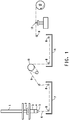
- FIG. 1 is a schematic diagram of an apparatus suitable for air gap or wet spinning of the aqueous alkali metal hydroxide solutions of PAGX hereof.
- solids content is synonymous with the concentration by weight of xanthated poly( ⁇ (1 ⁇ 3) glucan) with respect to the total weight of solution.
- Percent by weight is represented by the term "wt-%.”
- MOH alkali metal hydroxide suitable for the practice of the invention.
- MOH(aq) aqueous alkali metal hydroxide solution suitable for the practice of the invention. It shall be understood that the expression “concentration of the MOH(aq)” shall refer to the molarity of the aqueous alkali metal hydroxide solution hereof.
- a polymer including glucan, and poly( ⁇ (1 ⁇ 3) glucan) (PAG) in particular, is made up of a plurality of so-called repeat units covalently linked to one another.
- the repeat units in a polymer chain are diradicals, the radical form providing the chemical bonding between repeat units.
- glucose repeat units shall refer to the diradical form of glucose that is linked to other diradicals in the polymer chain, thereby forming said polymer chain.
- glucan refers to polymers, including oligomers and low molecular weight polymers that are unsuitable for fiber formation.
- the glucan polymer suitable for the practice of the invention is a poly( ⁇ (1 ⁇ 3) glucan) or xanthated poly( ⁇ (1 ⁇ 3) glucan), characterized by a number average molecular weight of at least 10,000 Daltons, preferably of at least 40,000 - 100,000 Daltons.
- Suitable PAGX is characterized by a degree of xanthation in the range of 0.1 to 1 .
- xanthation is a term of art referring to the reaction of a hydroxyl group with CS 2 in alkali metal hydroxide, according to the following reaction:
- each cyclic hexose repeat unit offers three hydroxyls for potential reaction to form the xanthate according to the above reaction scheme.
- degree of xanthation refers to the average percentage of available hydroxyl sites in each repeat unit that have actually undergone reaction to the xanthate.
- the theoretical maximum degree of xanthation a suitable PAG polymer molecule can undergo is 3 - that is, every single hydroxyl site in the polymer would have undergone reaction.
- suitable PAGX polymers have undergone xanthation to the degree of 0.1 to 1. This means that on the average between one hydroxyl site per ten repeat units, and 10 hydroxyl sites per ten repeat units have undergone the xanthation reaction, while the theoretical maximum would be 30 hydroxyl sites per ten repeat units.
- the present invention is directed to a solution comprising 0.75 to 2 molar aqueous alkali metal hydroxide and a solids content of 5 to 20 % by weight of PAGX; wherein the number average molecular weight of the PAGX is at least 10,000 Daltons; and, wherein the degress of xanthation of the PAGX lies in the range of 0.1 to 1.
- the alkali metal hydroxide (MOH) is sodium hydroxide.
- concentration of the NaOH is in the range of 1.0 to 1.7 M.
- the solids concentration is in the range of 7.5 to 15 %.
- the PAG suitable for use in the process of the present invention is a glucan characterized by a number average molecular weight (M n ) of at least 10,000 Da wherein at least 90 mol-% of the repeat units in the polymer are glucose repeat units and at least 50% of the linkages between glucose repeat units are ⁇ (1 ⁇ 3) glycoside linkages.
- M n number average molecular weight
- at least 95 mol-%, most preferably 100 mol-%, of the repeat units are glucose repeat units.
- at least 90 %, most preferably 100 %, of the linkages between glucose units are ⁇ (1 ⁇ 3) glycoside linkages.
- polysaccharides for example, The Polysaccharides, G. O. Aspinall, Vol. 1, Chap. 2, Academic Press, New York, 1983 . Any means for producing the ⁇ (1 ⁇ 3) polysaccharide suitable for the invention in satisfactory yield and 90 % purity is suitable.
- poly( ⁇ (1 ⁇ 3)-D-glucose) is formed by contacting an aqueous solution of sucrose with gtfJ glucosyltransferase isolated from Streptococcus salivarius according to the methods taught in the art.
- the gtfJ is generated by genetically modified E. Coli, as described in detail, infra.
- the PAG suitable for use in the present invention can further comprise repeat units linked by a glycoside linkage other than ⁇ (1 ⁇ 3), including ⁇ (1 ⁇ 4), ⁇ (1 ⁇ 6), ⁇ (1 ⁇ 2), ⁇ (1 ⁇ 3), ⁇ (1 ⁇ 4) or ⁇ (1 ⁇ 6) or any combination thereof.
- at least 50% of the glycoside linkages in the polymer are ⁇ (1 ⁇ 3) glycoside linkages.
- Preferably at least 90 %, most preferably 100 %, of the linkages between glucose units are ⁇ (1 ⁇ 73) glycoside linkages.
- the solution hereof is prepared by adding a suitable PAG to MOH(aq), containing carbon disulfide and agitating to obtain thorough mixing. PAGX is formed in situ under these conditions.
- the solids content of PAGX in the solution ranges from 5 to 20 % by weight with respect to the total weight of the solution. When solids content of PAGX is below 5 %, the fiber-forming capability of the solution is greatly degraded. Solutions with solids content above 15 % are increasingly problematical to form, requiring increasingly refined solution forming techniques.
- the solubility limit of PAGX is a function of the molecular weight of the PAGX, the concentration of the MOH(aq), the degree of xanthation, the duration of mixing, the viscosity of the solution as it is being formed, the shear forces to which the solution is subject, and the temperature at which mixing takes place. Generally, higher shear mixing and higher temperature will be associated with higher solubility.
- the maximum temperature for mixing is limited 46 °C, the boiling point of the CS 2 . From the standpoint of solubility and spinnability, the optimum concentrations of the MOH(aq) and CS 2 may change depending upon the other parameters in the mixing process.
- the ingredients are combined, allowed to stand for 1 to 3 hours, and then spun into fiber as described in detail, infra.
- a solution time on the order of 1-5 hours is also suitable.
- the present invention is further directed to a process comprising forming a solution by dissolving in a 0.75 to 2 molar aqueous alkali metal hydroxide, CS 2 , and 5 to 15 percent by weight of the total weight of the resulting solution of PAG characterized by a number average molecular weight of at least 10,000 Da; causing said solution to flow through a spinneret, forming a fiber thereby; and, contacting said fiber with an acidic liquid coagulant; wherein said process the weight ratio of CS 2 to PAG lies in the range of 0.1 to 1.0.
- the alkali metal (M) is sodium.
- a suitable PAG is one wherein 100 % of the repeat units are glucose, and 100 % of the linkages between glucose repeat units are ⁇ (1 ⁇ 3) glycoside linkages.
- the minimum solids content of PAGX required in the solution in order to achieve stable fiber formation varies according to the molecular weight of the PAGX, as well as the degree of xanthation. It is found in the practice of the invention that a 5% solids content is an approximate lower limit to the concentration needed for stable fiber formation. At > 15 %, especially greater than 20 % solids, excessive amounts of undissolved PAGX are present, causing a degradation in fiber spinning performance. A solution having a solids content of at least 7.5 % is preferred. A solids content ranging from about 7.5 % to about 15 % in a 1.0 to 1.7 M NaOH solution is more preferred.. Preferred is a PAGX characterized by a number average molecular weight in the range of 40,000 - 100,000 Daltons and degree of xanthation in the range of 0.1 - 1.
- Spinning from the solution hereof can be accomplished by means known in the art, and as described in O'Brien, op. cit.
- the viscous spinning solution can be forced by means such as the push of a piston or the action of a pump through a single or multi-holed spinneret or other form of die.
- the spinneret holes can be of any cross-sectional shape, including round, flat, multi-lobal, and the like, as are known in the art.
- the extruded strand can then be passed by ordinary means into a coagulation bath wherein is contained a liquid coagulant which converts the PAGX back to PAG, causing the polymer to coagulate into a fiber according to the present invention.
- Suitable liquid coagulants include but are not limited to glacial acetic acid, aqueous acetic acid, sulfuric acid, combinations of sulfuric acid, sodium sulfate, and zinc sulfate.
- the liquid coagulant is maintained at a temperature in the range of 0 - 100°C, and preferably in the range of 15 - 70°C.
- the coagulation bath comprises glacial acetic acid. It is found in the practice of the invention that satisfactory results are achieved by employing as the coagulant liquid an excess of glacial acetic acid. During the course of spinning, the glacial acetic acid neutralizes aqueous NaOH and regenerates PAG from PAGX as the spun fiber passes through the coagulant bath.
- extrusion is effected directly into the coagulation bath.
- the spinneret is partially or fully immersed in the coagulation bath.
- the spinnerets and associated fittings should be constructed of corrosion resistant alloys such as stainless steel or platinum/gold.
- the thus coagulated fiber is then passed into a second bath provided to neutralize and dilute residual acid from the coagulation bath.
- the secondary bath preferably contains H 2 O, methanol, or 5 % aqueous NaHCO 3 , or a mixture thereof.
- Aqueous NaHCO 3 is preferred.
- the wound fiber package is soaked in one or more neutralizing wash baths for a period of time up to four hours in each bath. A sequence of baths comprising respectively 5 % aqueous NaHCO 3 , methanol, and H 2 O, has been found satisfactory.
- the seed medium used to grow the starter cultures for the fermenters, contained: yeast extract (Amberx 695, 5.0 grams per liter (g/L)), K 2 HPO 4 (10.0 g/L), KH 2 PO 4 (7.0 g/L), sodium citrate dihydrate (1.0 g/L), (NH 4 ) 2 SO 4 (4.0 g/L), MgSO 4 heptahydrate (1.0 g/L) and ferric ammonium citrate (0.10 g/L).
- the pH of the medium was adjusted to 6.8 using either 5N NaOH or H 2 SO 4 and the medium was sterilized in the flask. Post sterilization additions included glucose (20 mL/L of a 50% w/w solution) and ampicillin (4 mL/L of a 25 mg/mL stock solution).
- the growth medium used in the fermenter contained: KH 2 PO 4 (3.50 g/L), FeSO 4 heptahydrate (0.05 g/L), MgSO 4 heptahydrate (2.0 g/L), sodium citrate dihydrate (1.90 g/L), yeast extract (Ambrex 695, 5.0 g/L), Suppressor 7153 antifoam (0.25 milliliters per liter, mL/L), NaCl (1.0 g/L), CaCl 2 dihydrate (10 g/L), and NIT trace elements solution (10 mL/L).
- the NIT trace elements solution contained citric acid monohydrate (10 g/L), MnSO 4 hydrate (2 g/L), NaCl (2 g/L), FeSO 4 heptahydrate (0.5 g/L), ZnSO 4 heptahydrate (0.2 g/L), CuSO 4 pentahydrate (0.02 g/L) and NaMoO 4 dihydrate (0.02 g/L).
- Post sterilization additions included glucose (12.5 g/L of a 50% w/w solution) and ampicillin (4 mL/L of a 25 mg/mL stock solution).
- a gene encoding the mature glucosyltransferase enzyme (GtfJ; EC 2.4.1.5; GENBANK® AAA26896.1, SEQ ID NO: 3) from Streptococcus salivarius (ATCC 25975) was synthesized using codons optimized for expression in E. coli (DNA 2.0, Menlo Park CA).
- the nucleic acid product (SEQ ID NO: 1) was subcloned into pJexpress404® (DNA 2.0, Menlo Park CA) to generate the plasmid identified as pMP52 (SEQ ID NO: 2).
- the plasmid pMP52 was used to transform E. coli MG1655 (ATCC 47076) to generate the strain identified as MG1655/pMP52.
- Production of the recombinant gtfJ enzyme in a fermenter was initiated by expressing the gtfJ enzyme, constructed as described supra. A 10 mL aliquot of the seed medium was added into a 125 mL disposable baffled flask and was inoculated with a 1.0 mL culture of the E. coli MG1655/pMP52 prepared supra, in 20% glycerol. This culture was allowed to grow at 37°C while shaking at 300 revolutions per minute (rpm) for 3 hours.
- glucosyltransferase enzyme activity was initiated, when cells reached an OD 550 of 70, with the addition of 9 mL of 0.5 M IPTG (isopropyl ⁇ -D-1-thiogalacto- pyranoside).
- the dissolved oxygen (DO) concentration was controlled at 25% of air saturation.
- the DO was controlled first by impeller agitation rate (400 to 1200 rpm) and later by aeration rate (2 to 10 standard liters per minute, slpm).
- the pH was controlled at 6.8. NH 4 OH (14.5% weight/volume, w/v) and H 2 SO 4 (20% w/v) were used for pH control.
- the back pressure was maintained at 0.5 bars.
- the cell paste obtained above was suspended at 150 g/L in 50 mM potassium phosphate buffer pH 7.2 to prepare a slurry.
- the slurry was homogenized at 12,000 psi (Rannie-type machine, APV-1000 or APV 16.56) and the homogenate chilled to 4 °C.
- 50 g of a floc solution Aldrich no. 409138, 5% in 50 mM sodium phosphate buffer pH 7.0
- Agitation was reduced to light stirring for 15 minutes.
- the cell homogenate was then clarified by centrifugation at 4500 rpm for 3 hours at 5-10°C.
- FIG. 1 is a schematic diagram of an apparatus suitable for use in the fiber spinning process hereof.
- the worm gear drive, 1, drives a ram, 2, at a controlled rate onto a piston fitted into a spinning cell, 3.
- the spinning cell may contain filter assemblies.
- a suitable filter assembly includes 100 and 325 mesh stainless steel screens.
- a spin pack, 4, contains the spinneret, 5, and optionally stainless steel screens as prefilters for the spinneret.
- the extruded filament, 6, produced therefrom is directed into a liquid coagulation bath, 7. In all the examples listed in Table 1, the filament was extruded from the spinneret directly into the liquid coagulation bath - the bottom of the spinneret was immersed in the bath.
- the extrudate can be, but need not be, directed back and forth through the bath between guides, 8, which are normally fabricated of Teflon® PTFE. Only one pass through the bath is shown in Figure 1 .
- the thus quenched filament, 9, can optionally be directed through a drawing zone using an independently driven roll, 10, around which the thus quenched filament is wrapped.
- the quenched filament may optionally be directed through a draw bath, 11, that allows further treatment such as additional solvent extraction, washing or drawing of the extruded filaments.
- the thus prepared filament is then directed through a traversing mechanism, 12, to evenly distribute the fiber on the bobbin, and collected on plastic bobbins using a wind up, 13.
- the process comprises a plurality of independently driven rolls.
- the driven roll, 10, is removed from the fiber pathway, but the fiber is nevertheless immersed in the draw bath.
- the two are independent of each other. In all of the examples, infra , the driven roll, 10, was removed from the fiber pathway.
- a plurality of filaments is extruded through a multi-hole spinneret, and the filaments so produced are converged to form a yarn.
- the process further comprises a plurality of multi-hole spinnerets so that a plurality of yarns can be prepared simultaneously.
- the wound bobbin of fiber produced was soaked overnight in a bucket of the liquid indicated in Table 1. The thus soaked bobbin of fiber was then air dried for at least 24 hours. The fiber tensile properties were then determined according to ASTM D2101-82.
- the spin cell, the piston, the connecting tubing and the spinneret were all constructed of stainless steel.
- the physical properties were determined for every fiber prepared. The results are shown in Table 1. Included are the denier of the fiber produced, and the physical properties such as tenacity (T) in grams per denier (gpd), elongation to break (E, %), and initial modulus (M) in gpd. Glossary of Terms Column Label Actual Term Explanation Jet Vel. (fpm) Jet Velocity The linear speed of the fiber at the exit from the spinneret. fpm Feet per minute Coag. Coagulation Temp. Temperature NA Not Applicable The parameter does not apply to this example. NT Not Tested S.S.F. Spin Stretch Factor S.S.F.
- aqueous solution Twenty liters of an aqueous solution was prepared by combining 1000g of sucrose (VWR #BDH8029), 20 g Dextran T-10 (Sigma #D9260), and 370.98 g Boric Acid (Sigma #B6768) were combined in about 18 l of water. 4N NaOH (EMD #SX0590-1) solution was employed to adjust the pH to 7.5. Additional water was then added to bring the total volume up to 20 l. The thus prepared solution was then charged with 180 ml of the enzyme extract prepared supra and allowed to stand at ambient temperature for 48 hours. The resulting poly( ⁇ (1 ⁇ 3) glucan) solids were collected on a Büchner funnel using a 325 mesh screen over 40 micrometer filter paper.
- Molecular weights were determined by size exclusion chromatography (SEC) with a GPCV/LS 2000 TM (Waters Corporation, Milford, MA) chromatograph equipped with two Zorbax PSM Bimodal-s silica columns (Agilent, Wilmington, DE), using DMAc from J.T Baker, Phillipsburg, NJ with 3.0% LiCl (Aldrich, Milwaukee, WI) as the mobile phase. Samples were dissolved in DMAc with 5.0% LiCl. Number and weight average molecular weights (Mn and Mw) were found to be 139,000 and 279,000 Daltons respectively.
- a 250 mL wide mouth glass bottle was charged with 25 g of polymer P1 and 225 g of 5 wt % sodium hydroxide.
- CS 2 (7.5 g)
- the container was fitted with a cap and a septum through which a polypropylene stirring rod had been fitted.
- the contents were manually mixed with the stirring rod and then allowed to stand at room temperature overnight.
- the partially dissolved solution (clear but containing a small amount of visible particulate) was transferred into a spin cell and piston containing screen packs including 100 and 325 mesh stainless steel screens.
- a piston was fitted over the viscous mixture.
- the mixture was then pumped back and forth through 13 cycles using a motorized worm gear driven ram into an identically equipped spinning cell coupled head to head with the first cell via a coupler fabricated from % inch (6.5 mm) stainless steel tubing.
- Example 1 Approximately 20 hours after the preparation of the solution of Example 1, the solution thus prepared was fed to the spinning apparatus, as described, supra, referring to Figure 1 .
- the solution was fed to a 20 hole spinneret wherein each hole was characterized by a circular cross-section, a diameter of 0.003 in (0.076 mm) and a length of 0.006 in (0.152 mm).
- Table 1 provides the spinning conditions that were used for the fibers prepared in Examples 2 - 4.
- the apparatus depicted in Figure 1 was modified by removal of the driven roll, 10, from the filament pathway in Examples 1-3.
- the indicated spin stretch was attained by running the windup faster than the jet velocity.
- Example 1 The solution of Example 1 was metered at the rates shown in Table 1 through a spin pack having a filter assembly consisting of 100 and 325 mesh screens to the spinneret.
- the spinneret was immersed into a water coagulation bath containing, by weight, 8% H 2 SO 4 , 23% Na 2 SO 4 , and 0.5% ZnSO 4 .
- the filament was extruded directly into the quench bath vertically at the temperature indicated in Table 1. Additional residence time in the 6 foot long (1.8 meter) coagulation bath was increased by directing the fiber over additional guide pins (8) for a total immersion distance of 4.1 or 11 ft (1.25 or 3.3 metres) as indicated.
- Example 2 upon removal from the coagulation bath the thus coagulated filaments was directed to a speed controlled wind-up with a traversing guide, at wind-up speeds shown in Table 1.
- Example 4 the coagulated filaments were directed to a second bath of methanol for the length and at the temperature indicated in Table 1.
- several hundred feel of fiber were wound onto a bobbin.
- Poly( ⁇ (1 ⁇ 73) glucan) polymer was synthesized, washed, and isolated using the materials and procedures employed for the preparation of Polymer P1 in Example 1 except that 200 ml of the enzyme extract was added to the pH-adjusted sucrose/dextran/boric acid solution instead of 180 ml. Yield: 246.08 grams of white flaky solids.
- Mn and Mw were determined as for polymer P1 to be 129,000 and 270,000 respectively.
- a 250 mL wide mouth glass bottle was charged with 18 g of polymer P2 and 225 g of 4.5 wt % sodium hydroxide.
- CS 2 (2.7 g)
- the container was fitted with a cap and a septum through which a polypropylene stirring rod had been fitted.
- the contents were manually mixed with the stirring rod and then allowed to stand at room temperature overnight.
- the partially dissolved solution was transferred into a spin cell and piston containing screen packs including 325 mesh stainless steel screens.
- a piston was fitted over the viscous mixture.
- the mixture was then pumped back and forth through 13 cycles using a motorized worm gear driven ram into an identically equipped spinning cell coupled head to head with the first cell via a coupler fabricated from % inch (6.5 mm) stainless steel tubing.
- Example 6 The fibers of Examples 6 - 11 were spun from the spinning solution of Example 5, in the manner of the fibers of Examples 2 - 4, supra, under the conditions shown in Table 1.
- the filament was extruded directly into a coagulation bath containing 5 % H 2 SO 4 (aq.).
- Example 10 the fiber was extruded directly into a coagulation bath containing glacial acetic acid.
- Example 11 into 50/50 acetic acid/ water (v/v) Additional length in the coagulation bath was provided by directing the fiber over additional guide pins (8) for a total immersion distance of 3, 4.3, or 4.5 ft (0.9, 1.3 or 1.4 metres).
- Example 7 In Examples 7 - 11, but not Example 6, upon removal from the coagulation bath the thus coagulated filament was directed through a second bath (11) of methanol at lengths and temperatures indicated in Table 1. The fiber of Example 6 was guided directly to the wind-up. From the second bath, the coagulated fibers of Examples 7 - 11 were directed to the wind-up, at the wind-up speeds shown in Table 1. The fiber bobbins were soaked as in Examples 2 - 4.
- a 250 mL wide mouth glass bottle was charged with 20 g of Polymer P2 and 180 g of 4.5 wt% sodium hydroxide.
- CS 2 (3.0 g)
- the container was fitted with a cap and septum through which a polypropylene stirring rod had been fitted.
- the contents were manually mixed with the plastic stirrer and then allowed to stand 2 days.
- the partially dissolved solution was transferred into a 300 mL stainless steel cylinder fitted with 2x 100 mesh, 1x 325 mesh and 2x 20 mesh stainless steel screens.
- a piston was fitted over the viscous mixture.
- the mixture was then pumped back and forth through 13 cycles using a motorized worm gear driven ram into an identically equipped spinning cell coupled head to head with the first cell via a coupler fabricated from 1 ⁇ 4 inch (6.5 mm) stainless steel tubing.
- the fibers of Examples 13 - 15 were spun from the spinning solution of Example 12 in the manner of the fibers of Examples 2 - 4, supra, under the conditions shown in Table 1.
- the fibers were extruded directly into 5% H 2 SO 4 (aq.) at the temperature indicated in Table 1.
- the thus coagulated fibers upon removal from the coagulation bath were directed to the wind-up at wind-up speeds shown in Table 1.
- the coagulated fibers of Examples 14 and 15 were first passed through the second bath, as indicated in Table 1.
- the fiber bobbins were soaked and dried as in Examples 2 - 4.
- Poly( ⁇ (1 ⁇ 3) glucan) polymer was synthesized, washed, and isolated using the materials and procedures employed for the preparation of Polymer P1 in Example 1 except that 200 ml of the enzyme extract was added to the pH-adjusted sucrose/dextran/boric acid solution instead of 180 ml. Yield: 228.52 grams of white flaky solids. M n was 132,000 Daltons; M w was 301,000 Daltons.
- a 250 mL wide mouth glass bottle was charged with 18 g of polymer P3 and 225 g of 4.5 wt % sodium hydroxide.
- the container was fitted with a cap and a septum through which a polypropylene stirring rod had been fitted.
- the contents were manually mixed with the stirring rod and then allowed to stand at room temperature overnight.
- CS 2 (5.4 g), was then added via syringe the following morning.
- the partially dissolved solution was immediately transferred into a spin cell and piston containing screen packs including 325 mesh stainless steel screens.
- a piston was fitted over the viscous mixture.
- the mixture was then pumped back and forth through 13 cycles using a motorized worm gear driven ram into an identically equipped spinning cell coupled head to head with the first cell via a coupler fabricated from % inch (6.5 mm) stainless steel tubing.
- Table 1 gives the spinning conditions that were used for the fibers prepared in Examples 17-23.
- the apparatus depicted in Figure 1 was modified by removal of the driven roll, 10, from the filament pathway. Spin stretch was attained by running the windup faster than the jet velocity.
- the spinning solution thus prepared was metered at the rates shown in Table 1 through a spin pack having a filter assembly consisting of 100 and 325 mesh stainless steel screens to a 20-hole spinneret having .003 inch diameter (0.076 mm) and .006 inch length (0.152 mm) holes.
- the filament was extruded directly into 5 % H 2 SO 4 for Examples 17-19 and 10% H 2 SO 4 for Examples 20-23 at the coagulation bath temperature shown in Table 1.
- the thus coagulated filament was directed through a second bath (11) of methanol at lengths and temperatures shown in Table 1, and thence to the wind-up.
- the filaments of Examples 17, 20, and 21 were guided directly to the wind-up.
- the second bath in the case of Example 23 was filled with water. Fiber spinning was completed within 8 hours from the addition of carbon disulfide.
- the fiber bobbins were soaked in 5% NaHCO 3 for 15 minutes, then soaked in water overnight. The bobbins were then removed and allowed to air dry before being subjected to physical measurements.
- a 250 mL wide mouth glass bottle was charged with 32.9 g of polymer P3 and 220 g of 5 wt % sodium hydroxide.
- the container was fitted with a cap and a septum through which a polypropylene stirring rod had been fitted.
- the contents were manually mixed with the stirring rod and then allowed to stand at room temperature overnight.
- CS 2 (9.9 g), was then added via syringe the following morning.
- the partially dissolved solution was immediately transferred into a spin cell and piston containing screen packs including 325 mesh stainless steel screens.
- a piston was fitted over the viscous mixture.
- the mixture was then pumped back and forth through 11 cycles using a motorized worm gear driven ram into an identically equipped spinning cell coupled head to head with the first cell via a coupler fabricated from % inch (6.5 mm) stainless steel tubing.
- Table 1 gives the spinning conditions that were used for the fibers prepared in Examples 25-31.
- the apparatus depicted in Figure 1 was modified by removal of the driven roll, 10, from the filament pathway for Examples 25-27. Spin stretch was attained by running the windup faster than the jet velocity.
- the spinning solution thus prepared was metered at the rates shown in Table 1 through a spin pack having a filter assembly consisting of 100 and 325 mesh stainless steel screens to a 20-hole spinneret having .003 inch (0.076 mm) diameter and .006 inch (0.152 mm) length holes.
- the filament was extruded directly into 10% H 2 SO 4 for Examples 25-30 and glacial acetic acid for Example 31 at the coagulation bath temperature shown in Table 1.
- the fiber bobbins were soaked in 5% NaHCO 3 overnight, and then soaked in water for an additional day. The bobbins were then removed and allowed to air dry before being subjected to physical measurements.
- solubility designations in Table 2 were determined by visual inspection. A clear solution was considered completely dissolved; a clear solution with some small particles floating around was also considered to be dissolved; since it was considered, that the partially dissolved solutions could be driven to complete dissolution with more intensive mixing. A turbid solution with large undissolved particles was considered to be undissolved.
- Example 45 Determination of glucan xanthate formation and decomposition using NMR Spectroscopy
- the NMR tubes were removed from the centrifuge and placed in the magnet of a Bruker 500 MHz Avance II Spectrometer equipped with a 5mm CPDUL cryoprobe having z gradients. The probe was tuned and the magnet was shimmed before starting a series of consecutive experiments to investigate the formation and degradation of poly( ⁇ (1 ⁇ 3) glucan).
- Each experiment was acquired using the Bruker zgig pulse sequence with a spectral width of 33333.3 Hz (265.0 ppm), a transmitter offset of 160 ppm, and 32768 time domain points for an acquisition time of 0.4916 sec. A 3 sec. delay was used between pulses and 3000 scans were acquired for each experiment, giving a total time of 2 hours and 56 minutes for each experiment.
- the digital data from each experiment was converted to analog data so that backward linear prediction could be performed.
- the first 12 points of each data set were replaced using Bruker's linear prediction data processing based on the first 1024 data points.
- the Free Induction Decay was also multiplied by a 2.0 Hz exponential function before being transformed.
- the integral area for the xanthate carbon centered at 232.5 ppm, was compared to the integral area (set to 1.00) for the glucan C1 anomeric carbons at 95.6 - 100.9 ppm, used as an internal calibration.
Landscapes
- Chemical & Material Sciences (AREA)
- Engineering & Computer Science (AREA)
- Chemical Kinetics & Catalysis (AREA)
- Health & Medical Sciences (AREA)
- Organic Chemistry (AREA)
- Medicinal Chemistry (AREA)
- Polymers & Plastics (AREA)
- Life Sciences & Earth Sciences (AREA)
- Textile Engineering (AREA)
- General Chemical & Material Sciences (AREA)
- Molecular Biology (AREA)
- General Health & Medical Sciences (AREA)
- Biochemistry (AREA)
- Materials Engineering (AREA)
- Mechanical Engineering (AREA)
- Artificial Filaments (AREA)
- Polysaccharides And Polysaccharide Derivatives (AREA)
- Preparation Of Compounds By Using Micro-Organisms (AREA)
Applications Claiming Priority (2)
| Application Number | Priority Date | Filing Date | Title |
|---|---|---|---|
| US13/479,990 US9034092B2 (en) | 2012-05-24 | 2012-05-24 | Composition for preparing polysaccharide fibers |
| PCT/US2013/042329 WO2013177348A1 (en) | 2012-05-24 | 2013-05-23 | Novel composition for preparing polysaccharide fibers |
Publications (2)
| Publication Number | Publication Date |
|---|---|
| EP2855536A1 EP2855536A1 (en) | 2015-04-08 |
| EP2855536B1 true EP2855536B1 (en) | 2016-12-21 |
Family
ID=48570474
Family Applications (1)
| Application Number | Title | Priority Date | Filing Date |
|---|---|---|---|
| EP13726657.3A Active EP2855536B1 (en) | 2012-05-24 | 2013-05-23 | Novel composition for preparing polysaccharide fibers |
Country Status (14)
| Country | Link |
|---|---|
| US (2) | US9034092B2 (enExample) |
| EP (1) | EP2855536B1 (enExample) |
| JP (1) | JP6167172B2 (enExample) |
| KR (1) | KR102049792B1 (enExample) |
| CN (1) | CN104379607B (enExample) |
| AU (1) | AU2013266331B2 (enExample) |
| BR (1) | BR112014028870B1 (enExample) |
| CA (1) | CA2873322A1 (enExample) |
| IN (1) | IN2014DN08909A (enExample) |
| MY (1) | MY166348A (enExample) |
| NZ (1) | NZ701241A (enExample) |
| PH (1) | PH12014502607B1 (enExample) |
| SG (1) | SG11201407488SA (enExample) |
| WO (1) | WO2013177348A1 (enExample) |
Families Citing this family (29)
| Publication number | Priority date | Publication date | Assignee | Title |
|---|---|---|---|---|
| US9034092B2 (en) * | 2012-05-24 | 2015-05-19 | E I Du Pont De Nemours And Company | Composition for preparing polysaccharide fibers |
| JP6305509B2 (ja) * | 2013-03-15 | 2018-04-04 | シマノ アメリカン コーポレイションShimano American Corporation | 加熱液体テーパ付ライン生産装置および方法 |
| AT514137A1 (de) * | 2013-04-05 | 2014-10-15 | Lenzing Akiengesellschaft | Polysaccharidfaser und Verfahren zu ihrer Herstellung |
| AT514136A1 (de) | 2013-04-05 | 2014-10-15 | Lenzing Akiengesellschaft | Polysaccharidfaser mit erhöhtem Fibrillationsvermögen und Verfahren zu ihrer Herstellung |
| AT514476A1 (de) * | 2013-06-17 | 2015-01-15 | Lenzing Akiengesellschaft | Polysaccharidfaser und Verfahren zu ihrer Herstellung |
| AT514475B1 (de) * | 2013-06-17 | 2016-11-15 | Chemiefaser Lenzing Ag | Polysaccharidfaser und Verfahren zu ihrer Herstellung |
| AT514468A1 (de) | 2013-06-17 | 2015-01-15 | Lenzing Akiengesellschaft | Hochsaugfähige Polysaccharidfaser und ihre Verwendung |
| AT514474B1 (de) * | 2013-06-18 | 2016-02-15 | Chemiefaser Lenzing Ag | Polysaccharidfaser und Verfahren zu ihrer Herstellung |
| US20150126730A1 (en) * | 2013-11-07 | 2015-05-07 | E I Du Pont De Nemours And Company | Novel composition for preparing polysaccharide fibers |
| CN106103551A (zh) | 2014-01-06 | 2016-11-09 | 纳幕尔杜邦公司 | 聚α‑1,3‑葡聚糖膜的制备 |
| WO2015109066A1 (en) | 2014-01-17 | 2015-07-23 | E. I. Du Pont De Nemours And Company | Production of poly alpha-1,3-glucan formate films |
| WO2015200593A1 (en) * | 2014-06-26 | 2015-12-30 | E.I. Du Pont De Nemours And Company | Production of poly alpha-1,3-glucan formate films |
| WO2015200612A1 (en) * | 2014-06-26 | 2015-12-30 | E. I. Du Pont De Nemours And Company | Production of poly alpha-1,3-glucan food casings |
| WO2015200589A1 (en) * | 2014-06-26 | 2015-12-30 | E. I. Du Pont De Nemours And Company | Production of poly alpha-1,3-glucan films |
| JP2017525791A (ja) * | 2014-06-26 | 2017-09-07 | イー・アイ・デュポン・ドウ・ヌムール・アンド・カンパニーE.I.Du Pont De Nemours And Company | ポリα−1,3−グルカンエステルフィルムの作製 |
| BR112017013368B1 (pt) * | 2014-12-22 | 2021-11-23 | Nutrition & Biosciences USA 4, Inc. | Composição de mistura polimérica |
| EP3253454B1 (en) | 2015-02-06 | 2020-04-22 | DuPont Industrial Biosciences USA, LLC | Colloidal dispersions of poly alpha-1,3-glucan based polymers |
| JP6956013B2 (ja) * | 2015-06-01 | 2021-10-27 | ニュートリション・アンド・バイオサイエンシーズ・ユーエスエー・フォー,インコーポレイテッド | ポリα−1,3−グルカンフィブリッド及びその使用、並びにポリα−1,3−グルカンフィブリッドを製造する方法 |
| WO2016196021A1 (en) | 2015-06-01 | 2016-12-08 | E I Du Pont De Nemours And Company | Structured liquid compositions comprising colloidal dispersions of poly alpha-1,3-glucan |
| EP3368717B1 (en) | 2015-10-26 | 2022-12-14 | Nutrition & Biosciences USA 4, Inc. | Polysaccharide coatings for paper |
| CN108350660B (zh) | 2015-10-26 | 2022-04-29 | 营养与生物科学美国4公司 | 水不溶性α-(1,3→葡聚糖)组合物 |
| JP6970678B2 (ja) * | 2015-11-10 | 2021-11-24 | ニュートリション・アンド・バイオサイエンシーズ・ユーエスエー・フォー,インコーポレイテッド | グルカン不織ウェブ |
| WO2017083228A1 (en) | 2015-11-13 | 2017-05-18 | E. I. Du Pont De Nemours And Company | Glucan fiber compositions for use in laundry care and fabric care |
| WO2017083229A1 (en) | 2015-11-13 | 2017-05-18 | E. I. Du Pont De Nemours And Company | Glucan fiber compositions for use in laundry care and fabric care |
| WO2017083226A1 (en) | 2015-11-13 | 2017-05-18 | E. I. Du Pont De Nemours And Company | Glucan fiber compositions for use in laundry care and fabric care |
| US10895028B2 (en) | 2015-12-14 | 2021-01-19 | Dupont Industrial Biosciences Usa, Llc | Nonwoven glucan webs |
| CN107366031A (zh) * | 2017-07-19 | 2017-11-21 | 宜宾运通塑料助剂有限公司 | 一种湿法纺丝机、氯化聚氯乙烯纤维及其制备方法 |
| CN114828992B (zh) * | 2019-12-23 | 2024-05-17 | 东丽株式会社 | 分离膜和其制造方法 |
| CN113136628B (zh) * | 2021-05-25 | 2023-04-28 | 清华大学 | 一种生物纤维及其制备方法和湿法纺丝装置 |
Family Cites Families (16)
| Publication number | Priority date | Publication date | Assignee | Title |
|---|---|---|---|---|
| JPS6054322B2 (ja) | 1977-09-30 | 1985-11-29 | 株式会社林原生物化学研究所 | 成形物の製法 |
| US4501886A (en) | 1982-08-09 | 1985-02-26 | E. I. Du Pont De Nemours And Company | Cellulosic fibers from anisotropic solutions |
| JPS6040102A (ja) * | 1983-08-15 | 1985-03-02 | Asahi Chem Ind Co Ltd | ビスコ−スの製造法 |
| JPH0621184B2 (ja) * | 1985-05-01 | 1994-03-23 | 旭化成工業株式会社 | セルロ−ス系のド−プ |
| JPS61239018A (ja) * | 1986-04-14 | 1986-10-24 | Shogo Sataku | 繊維の連続製造法 |
| KR20010101647A (ko) * | 1999-01-25 | 2001-11-14 | 메리 이. 보울러 | 폴리사카라이드 섬유 |
| US8013148B2 (en) * | 2003-07-09 | 2011-09-06 | Ezaki Glico Co., Ltd. | Molded object comprising α-1,4-glucans and/or modifications thereof and process for producing the same |
| DE10357260A1 (de) | 2003-12-08 | 2005-06-30 | Degussa Food Ingredients Gmbh | Polysaccharid-Derivate, deren Herstellung und Verwendung |
| US8642757B2 (en) * | 2011-09-09 | 2014-02-04 | E I Du Pont De Nemours And Company | High titer production of highly linear poly (α 1,3 glucan) |
| TWI565801B (zh) * | 2011-10-05 | 2017-01-11 | 杜邦股份有限公司 | 用於製備多醣纖維之新穎組成物 |
| WO2013052730A1 (en) * | 2011-10-05 | 2013-04-11 | E. I. Du Pont De Nemours And Company | Novel composition for preparing polysaccharide fibers |
| WO2013096502A1 (en) * | 2011-12-19 | 2013-06-27 | E. I. Du Pont De Nemours And Company | INCREASED POLY (α 1, 3 GLUCAN) YIELD USING BORIC ACID |
| US9334584B2 (en) * | 2011-12-21 | 2016-05-10 | E I Du Pont De Nemours And Company | Process for preparing polysaccharide fibers from aqueous alkali metal hydroxide solution |
| SG11201403710RA (en) * | 2011-12-30 | 2014-07-30 | Du Pont | Fiber composition comprising 1,3-glucan and a method of preparing same |
| US9034092B2 (en) * | 2012-05-24 | 2015-05-19 | E I Du Pont De Nemours And Company | Composition for preparing polysaccharide fibers |
| EP2900828B1 (en) * | 2012-09-25 | 2023-04-19 | Nutrition & Biosciences USA 4, Inc. | Glucosyltransferase enzymes for production of glucan polymers |
-
2012
- 2012-05-24 US US13/479,990 patent/US9034092B2/en active Active
-
2013
- 2013-05-23 WO PCT/US2013/042329 patent/WO2013177348A1/en not_active Ceased
- 2013-05-23 MY MYPI2014002990A patent/MY166348A/en unknown
- 2013-05-23 JP JP2015514170A patent/JP6167172B2/ja active Active
- 2013-05-23 SG SG11201407488SA patent/SG11201407488SA/en unknown
- 2013-05-23 BR BR112014028870-4A patent/BR112014028870B1/pt active IP Right Grant
- 2013-05-23 CN CN201380027081.8A patent/CN104379607B/zh active Active
- 2013-05-23 AU AU2013266331A patent/AU2013266331B2/en active Active
- 2013-05-23 KR KR1020147035559A patent/KR102049792B1/ko not_active Expired - Fee Related
- 2013-05-23 NZ NZ701241A patent/NZ701241A/en not_active IP Right Cessation
- 2013-05-23 CA CA2873322A patent/CA2873322A1/en not_active Abandoned
- 2013-05-23 EP EP13726657.3A patent/EP2855536B1/en active Active
-
2014
- 2014-10-24 IN IN8909DEN2014 patent/IN2014DN08909A/en unknown
- 2014-11-21 PH PH12014502607A patent/PH12014502607B1/en unknown
-
2015
- 2015-04-16 US US14/688,801 patent/US9540747B2/en active Active
Non-Patent Citations (1)
| Title |
|---|
| None * |
Also Published As
| Publication number | Publication date |
|---|---|
| WO2013177348A1 (en) | 2013-11-28 |
| KR102049792B1 (ko) | 2019-11-28 |
| US20150225877A1 (en) | 2015-08-13 |
| MY166348A (en) | 2018-06-25 |
| SG11201407488SA (en) | 2014-12-30 |
| AU2013266331A1 (en) | 2014-11-13 |
| AU2013266331B2 (en) | 2016-10-27 |
| BR112014028870B1 (pt) | 2020-12-29 |
| US20130313737A1 (en) | 2013-11-28 |
| CN104379607B (zh) | 2016-11-09 |
| JP2015518926A (ja) | 2015-07-06 |
| PH12014502607A1 (en) | 2015-01-21 |
| KR20150021053A (ko) | 2015-02-27 |
| US9034092B2 (en) | 2015-05-19 |
| PH12014502607B1 (en) | 2015-01-21 |
| JP6167172B2 (ja) | 2017-07-19 |
| BR112014028870A2 (pt) | 2017-06-27 |
| EP2855536A1 (en) | 2015-04-08 |
| US9540747B2 (en) | 2017-01-10 |
| CA2873322A1 (en) | 2013-11-28 |
| CN104379607A (zh) | 2015-02-25 |
| NZ701241A (en) | 2016-01-29 |
| IN2014DN08909A (enExample) | 2015-05-22 |
Similar Documents
| Publication | Publication Date | Title |
|---|---|---|
| US9540747B2 (en) | Composition for preparing polysaccharide fibers | |
| EP2764145B1 (en) | Novel composition for preparing polysaccharide fibers | |
| US9334584B2 (en) | Process for preparing polysaccharide fibers from aqueous alkali metal hydroxide solution | |
| US9175423B2 (en) | Composition for preparing polysaccharide fibers | |
| US9212301B2 (en) | Composition for preparing polysaccharide fibers | |
| US20150126730A1 (en) | Novel composition for preparing polysaccharide fibers | |
| US9365955B2 (en) | Fiber composition comprising 1,3-glucan and a method of preparing same | |
| EP2798000B1 (en) | Fiber composition comprising 1,3-glucan and a method of preparing same | |
| NZ623330B2 (en) | Novel composition for preparing polysaccharide fibers | |
| NZ626099B2 (en) | Fiber composition comprising 1,3-glucan and a method of preparing same |
Legal Events
| Date | Code | Title | Description |
|---|---|---|---|
| PUAI | Public reference made under article 153(3) epc to a published international application that has entered the european phase |
Free format text: ORIGINAL CODE: 0009012 |
|
| 17P | Request for examination filed |
Effective date: 20141027 |
|
| AK | Designated contracting states |
Kind code of ref document: A1 Designated state(s): AL AT BE BG CH CY CZ DE DK EE ES FI FR GB GR HR HU IE IS IT LI LT LU LV MC MK MT NL NO PL PT RO RS SE SI SK SM TR |
|
| AX | Request for extension of the european patent |
Extension state: BA ME |
|
| DAX | Request for extension of the european patent (deleted) | ||
| RAP1 | Party data changed (applicant data changed or rights of an application transferred) |
Owner name: E. I. DU PONT DE NEMOURS AND COMPANY |
|
| GRAP | Despatch of communication of intention to grant a patent |
Free format text: ORIGINAL CODE: EPIDOSNIGR1 |
|
| INTG | Intention to grant announced |
Effective date: 20160721 |
|
| GRAJ | Information related to disapproval of communication of intention to grant by the applicant or resumption of examination proceedings by the epo deleted |
Free format text: ORIGINAL CODE: EPIDOSDIGR1 |
|
| GRAR | Information related to intention to grant a patent recorded |
Free format text: ORIGINAL CODE: EPIDOSNIGR71 |
|
| GRAS | Grant fee paid |
Free format text: ORIGINAL CODE: EPIDOSNIGR3 |
|
| GRAA | (expected) grant |
Free format text: ORIGINAL CODE: 0009210 |
|
| INTC | Intention to grant announced (deleted) | ||
| AK | Designated contracting states |
Kind code of ref document: B1 Designated state(s): AL AT BE BG CH CY CZ DE DK EE ES FI FR GB GR HR HU IE IS IT LI LT LU LV MC MK MT NL NO PL PT RO RS SE SI SK SM TR |
|
| INTG | Intention to grant announced |
Effective date: 20161114 |
|
| REG | Reference to a national code |
Ref country code: GB Ref legal event code: FG4D |
|
| REG | Reference to a national code |
Ref country code: CH Ref legal event code: EP |
|
| REG | Reference to a national code |
Ref country code: IE Ref legal event code: FG4D |
|
| REG | Reference to a national code |
Ref country code: AT Ref legal event code: REF Ref document number: 855419 Country of ref document: AT Kind code of ref document: T Effective date: 20170115 |
|
| REG | Reference to a national code |
Ref country code: DE Ref legal event code: R096 Ref document number: 602013015596 Country of ref document: DE |
|
| PG25 | Lapsed in a contracting state [announced via postgrant information from national office to epo] |
Ref country code: LV Free format text: LAPSE BECAUSE OF FAILURE TO SUBMIT A TRANSLATION OF THE DESCRIPTION OR TO PAY THE FEE WITHIN THE PRESCRIBED TIME-LIMIT Effective date: 20161221 |
|
| REG | Reference to a national code |
Ref country code: FR Ref legal event code: PLFP Year of fee payment: 5 |
|
| REG | Reference to a national code |
Ref country code: LT Ref legal event code: MG4D |
|
| REG | Reference to a national code |
Ref country code: NL Ref legal event code: MP Effective date: 20161221 |
|
| PG25 | Lapsed in a contracting state [announced via postgrant information from national office to epo] |
Ref country code: SE Free format text: LAPSE BECAUSE OF FAILURE TO SUBMIT A TRANSLATION OF THE DESCRIPTION OR TO PAY THE FEE WITHIN THE PRESCRIBED TIME-LIMIT Effective date: 20161221 Ref country code: NO Free format text: LAPSE BECAUSE OF FAILURE TO SUBMIT A TRANSLATION OF THE DESCRIPTION OR TO PAY THE FEE WITHIN THE PRESCRIBED TIME-LIMIT Effective date: 20170321 Ref country code: LT Free format text: LAPSE BECAUSE OF FAILURE TO SUBMIT A TRANSLATION OF THE DESCRIPTION OR TO PAY THE FEE WITHIN THE PRESCRIBED TIME-LIMIT Effective date: 20161221 Ref country code: GR Free format text: LAPSE BECAUSE OF FAILURE TO SUBMIT A TRANSLATION OF THE DESCRIPTION OR TO PAY THE FEE WITHIN THE PRESCRIBED TIME-LIMIT Effective date: 20170322 |
|
| REG | Reference to a national code |
Ref country code: AT Ref legal event code: MK05 Ref document number: 855419 Country of ref document: AT Kind code of ref document: T Effective date: 20161221 |
|
| PG25 | Lapsed in a contracting state [announced via postgrant information from national office to epo] |
Ref country code: RS Free format text: LAPSE BECAUSE OF FAILURE TO SUBMIT A TRANSLATION OF THE DESCRIPTION OR TO PAY THE FEE WITHIN THE PRESCRIBED TIME-LIMIT Effective date: 20161221 Ref country code: HR Free format text: LAPSE BECAUSE OF FAILURE TO SUBMIT A TRANSLATION OF THE DESCRIPTION OR TO PAY THE FEE WITHIN THE PRESCRIBED TIME-LIMIT Effective date: 20161221 Ref country code: FI Free format text: LAPSE BECAUSE OF FAILURE TO SUBMIT A TRANSLATION OF THE DESCRIPTION OR TO PAY THE FEE WITHIN THE PRESCRIBED TIME-LIMIT Effective date: 20161221 |
|
| PG25 | Lapsed in a contracting state [announced via postgrant information from national office to epo] |
Ref country code: NL Free format text: LAPSE BECAUSE OF FAILURE TO SUBMIT A TRANSLATION OF THE DESCRIPTION OR TO PAY THE FEE WITHIN THE PRESCRIBED TIME-LIMIT Effective date: 20161221 |
|
| PG25 | Lapsed in a contracting state [announced via postgrant information from national office to epo] |
Ref country code: RO Free format text: LAPSE BECAUSE OF FAILURE TO SUBMIT A TRANSLATION OF THE DESCRIPTION OR TO PAY THE FEE WITHIN THE PRESCRIBED TIME-LIMIT Effective date: 20161221 Ref country code: SK Free format text: LAPSE BECAUSE OF FAILURE TO SUBMIT A TRANSLATION OF THE DESCRIPTION OR TO PAY THE FEE WITHIN THE PRESCRIBED TIME-LIMIT Effective date: 20161221 Ref country code: EE Free format text: LAPSE BECAUSE OF FAILURE TO SUBMIT A TRANSLATION OF THE DESCRIPTION OR TO PAY THE FEE WITHIN THE PRESCRIBED TIME-LIMIT Effective date: 20161221 Ref country code: CZ Free format text: LAPSE BECAUSE OF FAILURE TO SUBMIT A TRANSLATION OF THE DESCRIPTION OR TO PAY THE FEE WITHIN THE PRESCRIBED TIME-LIMIT Effective date: 20161221 Ref country code: IS Free format text: LAPSE BECAUSE OF FAILURE TO SUBMIT A TRANSLATION OF THE DESCRIPTION OR TO PAY THE FEE WITHIN THE PRESCRIBED TIME-LIMIT Effective date: 20170421 |
|
| PG25 | Lapsed in a contracting state [announced via postgrant information from national office to epo] |
Ref country code: PL Free format text: LAPSE BECAUSE OF FAILURE TO SUBMIT A TRANSLATION OF THE DESCRIPTION OR TO PAY THE FEE WITHIN THE PRESCRIBED TIME-LIMIT Effective date: 20161221 Ref country code: IT Free format text: LAPSE BECAUSE OF FAILURE TO SUBMIT A TRANSLATION OF THE DESCRIPTION OR TO PAY THE FEE WITHIN THE PRESCRIBED TIME-LIMIT Effective date: 20161221 Ref country code: PT Free format text: LAPSE BECAUSE OF FAILURE TO SUBMIT A TRANSLATION OF THE DESCRIPTION OR TO PAY THE FEE WITHIN THE PRESCRIBED TIME-LIMIT Effective date: 20170421 Ref country code: BG Free format text: LAPSE BECAUSE OF FAILURE TO SUBMIT A TRANSLATION OF THE DESCRIPTION OR TO PAY THE FEE WITHIN THE PRESCRIBED TIME-LIMIT Effective date: 20170321 Ref country code: AT Free format text: LAPSE BECAUSE OF FAILURE TO SUBMIT A TRANSLATION OF THE DESCRIPTION OR TO PAY THE FEE WITHIN THE PRESCRIBED TIME-LIMIT Effective date: 20161221 Ref country code: SM Free format text: LAPSE BECAUSE OF FAILURE TO SUBMIT A TRANSLATION OF THE DESCRIPTION OR TO PAY THE FEE WITHIN THE PRESCRIBED TIME-LIMIT Effective date: 20161221 Ref country code: ES Free format text: LAPSE BECAUSE OF FAILURE TO SUBMIT A TRANSLATION OF THE DESCRIPTION OR TO PAY THE FEE WITHIN THE PRESCRIBED TIME-LIMIT Effective date: 20161221 Ref country code: BE Free format text: LAPSE BECAUSE OF FAILURE TO SUBMIT A TRANSLATION OF THE DESCRIPTION OR TO PAY THE FEE WITHIN THE PRESCRIBED TIME-LIMIT Effective date: 20161221 Ref country code: LU Free format text: LAPSE BECAUSE OF NON-PAYMENT OF DUE FEES Effective date: 20170531 |
|
| REG | Reference to a national code |
Ref country code: DE Ref legal event code: R097 Ref document number: 602013015596 Country of ref document: DE |
|
| PLBE | No opposition filed within time limit |
Free format text: ORIGINAL CODE: 0009261 |
|
| STAA | Information on the status of an ep patent application or granted ep patent |
Free format text: STATUS: NO OPPOSITION FILED WITHIN TIME LIMIT |
|
| 26N | No opposition filed |
Effective date: 20170922 |
|
| PG25 | Lapsed in a contracting state [announced via postgrant information from national office to epo] |
Ref country code: DK Free format text: LAPSE BECAUSE OF FAILURE TO SUBMIT A TRANSLATION OF THE DESCRIPTION OR TO PAY THE FEE WITHIN THE PRESCRIBED TIME-LIMIT Effective date: 20161221 |
|
| REG | Reference to a national code |
Ref country code: CH Ref legal event code: PL |
|
| GBPC | Gb: european patent ceased through non-payment of renewal fee |
Effective date: 20170523 |
|
| PG25 | Lapsed in a contracting state [announced via postgrant information from national office to epo] |
Ref country code: MC Free format text: LAPSE BECAUSE OF FAILURE TO SUBMIT A TRANSLATION OF THE DESCRIPTION OR TO PAY THE FEE WITHIN THE PRESCRIBED TIME-LIMIT Effective date: 20161221 |
|
| REG | Reference to a national code |
Ref country code: IE Ref legal event code: MM4A |
|
| PG25 | Lapsed in a contracting state [announced via postgrant information from national office to epo] |
Ref country code: CH Free format text: LAPSE BECAUSE OF NON-PAYMENT OF DUE FEES Effective date: 20170531 Ref country code: SI Free format text: LAPSE BECAUSE OF FAILURE TO SUBMIT A TRANSLATION OF THE DESCRIPTION OR TO PAY THE FEE WITHIN THE PRESCRIBED TIME-LIMIT Effective date: 20161221 Ref country code: LI Free format text: LAPSE BECAUSE OF NON-PAYMENT OF DUE FEES Effective date: 20170531 |
|
| PG25 | Lapsed in a contracting state [announced via postgrant information from national office to epo] |
Ref country code: LU Free format text: LAPSE BECAUSE OF NON-PAYMENT OF DUE FEES Effective date: 20170523 |
|
| REG | Reference to a national code |
Ref country code: FR Ref legal event code: PLFP Year of fee payment: 6 |
|
| PG25 | Lapsed in a contracting state [announced via postgrant information from national office to epo] |
Ref country code: IE Free format text: LAPSE BECAUSE OF NON-PAYMENT OF DUE FEES Effective date: 20170523 Ref country code: GB Free format text: LAPSE BECAUSE OF NON-PAYMENT OF DUE FEES Effective date: 20170523 |
|
| PG25 | Lapsed in a contracting state [announced via postgrant information from national office to epo] |
Ref country code: MT Free format text: LAPSE BECAUSE OF NON-PAYMENT OF DUE FEES Effective date: 20170523 |
|
| PG25 | Lapsed in a contracting state [announced via postgrant information from national office to epo] |
Ref country code: HU Free format text: LAPSE BECAUSE OF FAILURE TO SUBMIT A TRANSLATION OF THE DESCRIPTION OR TO PAY THE FEE WITHIN THE PRESCRIBED TIME-LIMIT; INVALID AB INITIO Effective date: 20130523 |
|
| PG25 | Lapsed in a contracting state [announced via postgrant information from national office to epo] |
Ref country code: CY Free format text: LAPSE BECAUSE OF FAILURE TO SUBMIT A TRANSLATION OF THE DESCRIPTION OR TO PAY THE FEE WITHIN THE PRESCRIBED TIME-LIMIT Effective date: 20161221 |
|
| PG25 | Lapsed in a contracting state [announced via postgrant information from national office to epo] |
Ref country code: MK Free format text: LAPSE BECAUSE OF FAILURE TO SUBMIT A TRANSLATION OF THE DESCRIPTION OR TO PAY THE FEE WITHIN THE PRESCRIBED TIME-LIMIT Effective date: 20161221 |
|
| PG25 | Lapsed in a contracting state [announced via postgrant information from national office to epo] |
Ref country code: TR Free format text: LAPSE BECAUSE OF FAILURE TO SUBMIT A TRANSLATION OF THE DESCRIPTION OR TO PAY THE FEE WITHIN THE PRESCRIBED TIME-LIMIT Effective date: 20161221 |
|
| PG25 | Lapsed in a contracting state [announced via postgrant information from national office to epo] |
Ref country code: AL Free format text: LAPSE BECAUSE OF FAILURE TO SUBMIT A TRANSLATION OF THE DESCRIPTION OR TO PAY THE FEE WITHIN THE PRESCRIBED TIME-LIMIT Effective date: 20161221 |
|
| REG | Reference to a national code |
Ref country code: DE Ref legal event code: R082 Ref document number: 602013015596 Country of ref document: DE Representative=s name: FLEISCHER, ENGELS & PARTNER MBB, PATENTANWAELT, DE Ref country code: DE Ref legal event code: R081 Ref document number: 602013015596 Country of ref document: DE Owner name: NUTRITION & BIOSCIENCES USA 4, LLC, ROCHESTER, US Free format text: FORMER OWNER: E.I. DU PONT DE NEMOURS AND COMPANY, WILMINGTON, DEL., US Ref country code: DE Ref legal event code: R081 Ref document number: 602013015596 Country of ref document: DE Owner name: NUTRITION & BIOSCIENCES USA 4, INC., ROCHESTER, US Free format text: FORMER OWNER: E.I. DU PONT DE NEMOURS AND COMPANY, WILMINGTON, DEL., US |
|
| REG | Reference to a national code |
Ref country code: DE Ref legal event code: R082 Ref document number: 602013015596 Country of ref document: DE Representative=s name: FLEISCHER, ENGELS & PARTNER MBB, PATENTANWAELT, DE Ref country code: DE Ref legal event code: R081 Ref document number: 602013015596 Country of ref document: DE Owner name: NUTRITION & BIOSCIENCES USA 4, INC., ROCHESTER, US Free format text: FORMER OWNER: NUTRITION & BIOSCIENCES USA 4, LLC, ROCHESTER, NY, US |
|
| REG | Reference to a national code |
Ref country code: FR Ref legal event code: PLFP Year of fee payment: 11 |
|
| PGFP | Annual fee paid to national office [announced via postgrant information from national office to epo] |
Ref country code: DE Payment date: 20260331 Year of fee payment: 14 |
|
| PGFP | Annual fee paid to national office [announced via postgrant information from national office to epo] |
Ref country code: FR Payment date: 20260401 Year of fee payment: 14 |