EP2841440B1 - Verfahren zur herstellung von diketonato-rhodium(i)-carbonylkomplexen - Google Patents
Verfahren zur herstellung von diketonato-rhodium(i)-carbonylkomplexen Download PDFInfo
- Publication number
- EP2841440B1 EP2841440B1 EP13724527.0A EP13724527A EP2841440B1 EP 2841440 B1 EP2841440 B1 EP 2841440B1 EP 13724527 A EP13724527 A EP 13724527A EP 2841440 B1 EP2841440 B1 EP 2841440B1
- Authority
- EP
- European Patent Office
- Prior art keywords
- process according
- reaction
- pph
- acac
- solvent
- Prior art date
- Legal status (The legal status is an assumption and is not a legal conclusion. Google has not performed a legal analysis and makes no representation as to the accuracy of the status listed.)
- Not-in-force
Links
Classifications
-
- C—CHEMISTRY; METALLURGY
- C07—ORGANIC CHEMISTRY
- C07F—ACYCLIC, CARBOCYCLIC OR HETEROCYCLIC COMPOUNDS CONTAINING ELEMENTS OTHER THAN CARBON, HYDROGEN, HALOGEN, OXYGEN, NITROGEN, SULFUR, SELENIUM OR TELLURIUM
- C07F15/00—Compounds containing elements of Groups 8, 9, 10 or 18 of the Periodic Table
- C07F15/0006—Compounds containing elements of Groups 8, 9, 10 or 18 of the Periodic Table compounds of the platinum group
- C07F15/0073—Rhodium compounds
-
- C—CHEMISTRY; METALLURGY
- C07—ORGANIC CHEMISTRY
- C07F—ACYCLIC, CARBOCYCLIC OR HETEROCYCLIC COMPOUNDS CONTAINING ELEMENTS OTHER THAN CARBON, HYDROGEN, HALOGEN, OXYGEN, NITROGEN, SULFUR, SELENIUM OR TELLURIUM
- C07F15/00—Compounds containing elements of Groups 8, 9, 10 or 18 of the Periodic Table
- C07F15/0006—Compounds containing elements of Groups 8, 9, 10 or 18 of the Periodic Table compounds of the platinum group
- C07F15/0073—Rhodium compounds
- C07F15/008—Rhodium compounds without a metal-carbon linkage
-
- C—CHEMISTRY; METALLURGY
- C07—ORGANIC CHEMISTRY
- C07C—ACYCLIC OR CARBOCYCLIC COMPOUNDS
- C07C45/00—Preparation of compounds having >C = O groups bound only to carbon or hydrogen atoms; Preparation of chelates of such compounds
- C07C45/49—Preparation of compounds having >C = O groups bound only to carbon or hydrogen atoms; Preparation of chelates of such compounds by reaction with carbon monoxide
- C07C45/50—Preparation of compounds having >C = O groups bound only to carbon or hydrogen atoms; Preparation of chelates of such compounds by reaction with carbon monoxide by oxo-reactions
Definitions
- the invention relates to a process for the preparation of Diketonatorhodium (1) -carbonylkomplexen, particularly diketonato carbonyltriorganophosphin-rhodium (I) complexes such as Acetylacetonatocarbonyl-triphenylphosphine rhodium (I) Rh (CO) (PPh 3) acac, hereinafter also referred to as "Ropac".
- Diketonatorhodium (1) -carbonylkomplexen particularly diketonato carbonyltriorganophosphin-rhodium (I) complexes such as Acetylacetonatocarbonyl-triphenylphosphine rhodium (I) Rh (CO) (PPh 3) acac, hereinafter also referred to as "Ropac”.
- the process according to the invention is distinguished by an improved, single-stage process implementation which dispenses with any intermediate isolation or intermediate purification stages (so-called “one-pot synthesis”).
- the present invention enables rapid process control in the preparation of the diketonato-carbonyl-triorganophosphine-rhodium (I) complexes according to the invention by the one-step process.
- the process is economically viable on an industrial scale. Furthermore, good yields are achieved.
- the diketonato-carbonyl-triorganophosphine-rhodium (I) complexes prepared are particularly suitable as catalysts or precatalysts for homogeneous catalysis, such as for hydroformylation reactions.
- Rh (CO) (PPh 3 ) acac is converted by reaction of the Starting complex Rh (I) dicarbonyl-acetylacetonate Rh (CO) 2 (acac) prepared with triphenylphosphine.
- Rh (CO) 2 (acac) is prepared from rhodium chloride hydrate, for example in dimethylformamide with the addition of acetylacetone, filtered and washed and then reacted.
- Leipoldt et al. and Sheng-guo et al. describe the preparation of Rh (CO) 2 (acac) from RhCl 3 hydrate in dimethylformamide / acetylacetone by precipitation after addition of water, separation and washing of the prepared compound with petroleum ether (See: JG Leipoldt, SS Basson, LDC Bok and TIA Gerber, Inorganica Chim Acta., 1978, 26, L35-L37 ; and: W. Sheng-guo, X. Xiao-dong, S. Guo-rong, Z. Ying-kui, Precious Metals, 2005, 26, 43-51 [Publication in Chinese]).
- Bonati and Wilkinson in their synthesis first describe the preparation of Rh (CO) 2 (acac) from tetracarbonyldichlorodirhodium [Rh (CO) 2 Cl] 2 with the addition of barium carbonate and acetylacetone in petroleum by stirring for about one week.
- the prepared (CO) 2 Rh (acac) complex is reacted after removal of the solvent in a separate process stage in benzene with addition of PPh 3 to Rh (CO) (PPh 3 ) acac.
- Bonati and Wilkinson also envisage a multi-stage procedure. (Please refer: F. Bonati, G. Wilkinson, J. Chem. Soc., 1964, 3156-3160 ).
- Varshavsky et al. describe a preparation process starting from [Rh (CO) 2 Cl] 2 .
- Rh (CO) (PPh 3 ) acac is prepared in a separate process stage from rhodium carbonyl complexes with the addition of PPh 3 in hexane.
- Rh (CO) (PPh 3 ) acac Tic and Szymanowski describe a three-step process for the preparation of Rh (CO) (PPh 3 ) acac.
- RhCl 3 hydrate is reacted with carbon monoxide at 70 to 75 ° C for 0.5 to 3.5 hours.
- barium carbonate and acetylacetone are added at temperatures of 45 to 60 ° C for 0.25 to 1.5 hours.
- remaining barium carbonate and barium chloride formed by filtration and then the solvent is removed by distillation, so that the process is time consuming.
- the thus obtained crystals of the intermediate Rh (CO) 2 (acac) are dried.
- Rh (CO) (PPh 3 ) acac is prepared by adding PPh 3 in hexane at temperatures of 50 ° C over a period of 0.5 hours.
- the process should also enable the preparation of the rhodium carbonyl complex with a high yield and high purity.
- the object of the present invention is solved by the subject of the appended claims.
- the solution according to the invention comprises the provision of a one-step process for the preparation of diketonatocarbonyltriorganophosphine rhodium (I) complexes, in particular of Rh (CO) (PPh 3 ) acac, which is also environmentally friendly due to the chemicals used, the process procedure and the achievable high yields as well as economically.
- a one-step production process in the context of the present invention comprises the preparation of the diketonato-carbonyltriorganophosphine-rhodium (I) complexes without any isolation of intermediates.
- the present invention therefore describes a process in which the target product is prepared in situ in a reactor from the starting materials without expensive and time-intensive intermediate or intermediate purification (referred to below as “one-pot synthesis").
- the process according to the invention allows a simple isolation of the diketonato-carbonyl-triorganophosphine-rhodium (I) complexes, since selective process conditions are chosen in which the target compounds precipitate directly from the reaction mixture. According to the invention, this comprises the formation of a suspension which contains the separable compounds as precipitate. Thus, no time and costly isolation, for example, by separation, concentration or other processes is required.
- the diketonato-carbonyl-triorganophosphine-rhodium (I) complex Rh (CO) (PPh 3 ) (acac) is prepared.
- the method according to the invention can be described by the following idealized and exemplary reaction equations: Equation 1): RhCl 3 + 2 CO + CH 3 CH 20 H ⁇ 1 ⁇ 2 [Rh (CO) 2 Cl] 2 + 2HCl + CH 3 CHO Equation 2): 1 ⁇ 2 [Rh (CO) 2 Cl] 2 + Hacac + NaHCO 3 ⁇ [Rh (CO) 2 (acac)] + NaCl + H 2 O + CO 2 Equation 3): [Rh (CO) 2 (acac)] + PPh 3 ⁇ [Rh (CO) (PPh 3 ) (acac)] + CO
- Equation 1 is, as already mentioned, an idealized reaction equation, which serves merely to explain it. It is not known if the reduction of Rh (III) by CO or ethanol (or possibly by both) is effected.
- the reaction takes place starting from a soluble Rh (III) halide species in the presence of CO and in the presence of an organic solvent, preferably in the presence of an alcohol and more preferably in the presence of ethanol.
- a diketo compound preferably a 1,3-diketo compound of the type R'-C (OO) -CH 2 -C (OO) -R "
- a 1,3-diketo Compound according to the present invention is an organic molecule having two keto groups separated by a methylene group.
- the radicals R 'and R " may each independently of one another denote C 1 -C 5 -alkyl, C 5 -C 10 -cycloalkyl or C 6 -C 12 -aryl radicals, where R' and R" may optionally be substituted ,
- the 1,3-diketo compound transforms into the anionic diketonato compound and is bound to the Rh central atom as a bidentate, singly negatively charged ligand, cf. reaction equation 2).
- a base for example NaHCO 3
- An advantage of using carbonates or bicarbonates as base is the easy removal of reaction products (CO 2 ) via the gas phase and thus the shift of the equilibrium towards the product. This is also due to the poor solubility of the reaction products NaCl, as well as the formed (diketonato) (CO) 2 Rh in the selected solvents. The result is a suspension.
- Triorganophosphines of the type PR 3 in particular trialkylphosphines or triarylphosphines, can be used.
- the radicals R are generally C 1 -C 10 -alkyl, C 5 -C 10 -cycloalkyl, C 6 -C 12 -aryl or C 4 -C 12 -heteroaryl radicals which optionally substituted.
- examples are tributylphosphine, triisobutylphosphine, tricyclopentylphosphine, tricyclohexylphosphine or tri (o-tolyl) phosphine.
- triorganophosphines with heteroaryl radicals are tri (2-furyl) phosphine or diphenyl (2-pyridyl) phosphine.
- radicals R C 1 -C 10 -alkyl, C 5 -C 10 -cycloalkyl or C 6 -C 12 -aryl radicals are preferred. In a particularly preferred embodiment, it is triphenylphosphine (PPh 3 ).
- Rh halide precursor rhodium (III) chloride in the form of a solution, or a soluble solid (eg, RhCl 3 xH 2 O) is usually used, preferably in the form of a ready-to-use aqueous rhodium (III) chloride solution .
- a soluble solid eg, RhCl 3 xH 2 O
- hydrous rhodium (III) chloride solutions having a rhodium content ⁇ 30% by weight are used, as are commercially available and prepared, for example, by dissolving rhodium metal in the presence of concentrated hydrochloric acid and chlorine gas.
- suitable rhodium (III) chloride solutions can also be branched off from process streams of precious metal recycling or industrial noble metal chemistry.
- Rh (III) chloride solution over the commonly used solid RhCl 3 hydrate has the advantage of lower cost and faster processing, as precursor evaporation, isolation to RhCl 3 hydrate, and analysis (to determine the starting amount). eliminated. Consequently, ready-to-use Rh (III) chloride solution as starting material is available in the short term and easier to handle.
- Rh (III) precursor is introduced into a solvent, preferably into an organic solvent. If the Rh (III) precursor is an aqueous rhodium (III) chloride solution before, it is mixed with the solvent. If the Rh (III) precursor is present as a solid precursor, for example RhCl 3 hydrate, it is dissolved in the solvent.
- the solvent is preferably lower aliphatic alcohols such as methanol, ethanol or isopropanol.
- these alcohols can be mixed with water.
- the solvent comprises ethanol.
- the solvent used may be the diketo compound itself, optionally in admixture with water.
- alcohols such as ethanol allows the use of a uniform solvent throughout the process, ie for the production of [(CO) 2 RhCl] 2 (equation (1)) as well as for (diketona-to) Rh (CO) 2 (equation (2)) and also later for the preparation of (diketonato) (PR 3 ) Rh (CO) (equation (3)). It is therefore no solvent removal or a solvent change necessary. This results in an economically and ecologically advantageous process.
- Preferred solvents for the process according to the invention are in principle those in which the Rh (III) precursor and the dicarbonyl product [(CO) 2 RhCl] 2 dissolve well, while the solubility of the intermediate (diketonato) (CO) 2 Rh and in particular the Target product (diketonato) (PR 3 ) Rh (CO) is worse, so that each of them precipitate from the reaction mixture and the target product can be isolated directly by filtration without complex concentration steps or solvent exchange.
- the triorganophosphine used of the type PR 3 preferably triphenylphosphine (PPh 3 ), should also be readily soluble in this solvent.
- alcohols such as ethanol also allows a more cost-effective and environmentally friendly production in comparison to the usual for this process in the first part of the step for the preparation of (diketonato) Rh (CO) 2 toxic solvents such as dimethylformamide (DMF).
- DMF dimethylformamide
- reaction step a) The solution obtained in reaction step a) is subsequently mixed with carbon monoxide (CO) to prepare the carbonyl compound [Rh (CO) 2 Cl] 2 .
- CO carbon monoxide
- the result is a clear, yellow solution of rhodium (I) dicarbonyl chloride dimer.
- the gassing step can already take place in the presence of the diketo compound (ie reaction step c) can take place before step b)).
- Fumigation with CO takes place at elevated reaction temperatures in the range between 25 ° C and 80 ° C.
- the reaction temperatures are chosen between 50 ° C and 70 ° C.
- the reaction proceeds without the application of a pressure atmosphere.
- carrying out the reaction in a slight negative pressure is also possible.
- the fumigation time depends on the selected temperature and pressure parameters and is typically in the range of 2 to 24 hours, preferably 2 to 16 hours to achieve complete reaction.
- an intensive distribution of CO in the solution should be ensured.
- the fine distribution of the CO in the solution can be ensured by rapid stirring during the introduction, alternatively gassing stirrers or gas distributors can be used.
- a base is a compound which has the pH of an aqueous solution of pH ⁇ 7, according to the invention preferably to a pH in the range between pH 7 and 10, more preferably to pH 7 to 8 can increase or adjust.
- the diketo compound and then the base is added first.
- the base is generally selected from the group of alkali metal carbonates, alkaline earth carbonates, alkali hydrogencarbonates, alkaline earth bicarbonates, alkali dicorates, alkaline earth metal acetates and mixtures and combinations thereof.
- suitable inorganic bases are NaHCO 3 , Na 2 CO 3 , K 2 CO 3 , CaCO 3 and BaCO 3 .
- suitable organic bases are alkali or Erdalkalidiketonate such as Na (acac) and Ca (acac) 2 .
- the diketo compound is used, which is also present in the target product as diketonate ligand.
- the preferred base according to the invention is NaHCO 3 .
- the diketo compound should be added at least in an amount of 2 molar equivalents, preferably in an amount of 5 to 12 molar equivalents and more preferably in an amount of 8 to 12 molar equivalents (based on the amount of Rh used).
- the reaction mixture can be stirred at temperatures below 40 ° C.
- the intermediate (diketonato) Rh (CO) 2 in particular Rh (CO) 2 (acac) usually precipitates in this reaction, so that a reaction mixture is obtained in which the intermediate (diketonato) Rh (CO) 2 is suspended ( ie in a suspension).
- the intermediate (diketonato) Rh (CO) 2 generated by the process described above is further converted to the target product (diketonato) Rh (CO) (PR 3 ) implemented, which is usually obtained in the form of a yellow solid. It is surprisingly found that intermediate isolation of (diketonato) Rh (CO) 2 for the preparation of (diketonato) Rh (CO) (PR 3 ) is not required. According to the invention, therefore, the preparation of (diketonato) Rh (CO) (PR 3 ) acac takes place directly from the reaction mixture obtained in reaction step c) by addition of a triorganophosphorus compound (preferably triphenylphosphine, PPh 3 ).
- a triorganophosphorus compound preferably triphenylphosphine, PPh 3
- (Diketonato) Rh (CO) 2 has a low residual solubility in the chosen solvent.
- the residual material reacts with (partially) dissolved phosphine PR 3 ; while the final product precipitates from the reaction mixture, besides CO is released.
- the solubility of the final product (diketonato) is (PR 3) (CO) Rh in alcohols lower than that of the intermediate (diketonato) (CO) 2 Rh.
- the triorganophosphine of type PR 3 is added in a proportion of 0.98 to 1.08 molar equivalents relative to Rh. 1.01 to 1.03 molar equivalents of phosphine are preferably added according to the invention, since this ensures a high yield of pure target compound. Furthermore, the target compound is obtained in higher purity by this measure, since only very small amounts of chlorine-containing by-product are formed.
- the triorganophosphine is preferably added in pure form, in the case of PPh 3 as solid.
- the addition of dissolved phosphine is also possible.
- organic solvents are used in which the triorganophosphine dissolves as defined in claim 1.
- the addition is usually carried out at a temperature above 15 ° C and up to 40 ° C, usually the reaction mixture is stirred.
- reaction mixture After addition of the triorganophosphine, the reaction mixture is heated under reflux ("refluxed"), depending on the solvent or solvent mixture used temperatures in the range of 50 to 120 ° C are set. The maximum heating temperature is based on the selected solvent or solvent mixture.
- the reflux time for a complete reaction should generally be 1 to 20 hours, preferably 2 to 16 hours. This reaction step is not necessary in all cases, but it allows the isolation of very pure product.
- the compound can be separated from the reaction mixture, preferably by filtration.
- the washing is usually carried out using water-miscible organic solvents and / or demineralized water (deionized water).
- deionized water By washing with deionized water, the end product can be washed free of chloride.
- aliphatic alcohols preferably ethanol
- the product is usually dried at temperatures in the range of 30 to 60 ° C, preferably in the range of 35 to 50 ° C. The drying is preferably carried out in vacuo, but can also be carried out under air or inert gas (argon, nitrogen, etc.).
- the target products of the type (diketonato) (PR 3 ) (CO) Rh, especially Rh (CO) (PPh 3 ) acac can be obtained in high yield and purity.
- the yields are more than 93%, preferably more than 95%.
- the yield is based on the rhodium contents contained, ie based on the yield "OMB"("on metal base”).
- the rhodium carbonyl complex Rh (CO) (PPh 3 ) acac (“Ropac”) prepared by the one-pot process according to the invention is particularly suitable as a catalyst or precatalyst because of its outstanding purity and the resulting high catalytic activity, preferably for hydroformylation reactions, for example for the reaction of alkenes.
- the alcohols produced in this reaction are industrially versatile.
- Rh compounds according to the invention of the type (diketonato) (PR 3 ) (CO) Rh, in particular Rh (CO) (PPh 3 ) acac (“Ropac”) are characterized by a low content of chlorine (total chlorine content, including free and bound chloride to Wickboldt).
- the proportion of chloride impurities is generally ⁇ 0.1% by weight (1000 ppm), preferably ⁇ 0.03% (300 ppm), determined by means of a chlorine analyzer (Analytik Jena). Because of these low chlorine values, the good catalytic activity of the compound prepared according to the invention is ensured.
- the proportion of the compound Rh (CO) (PPh 3 ) 2 Cl can be determined (eg by signal splitting at about 30 ppm).
- the area percentage of the peak of Rh (CO) (PPh 3 ) 2 Cl in the 31 P-NMR spectrum based on the area fraction of the peak of Rh (CO) (PPh 3 ) acac is less than 5%, preferably less than 1%, more preferably less than 0.3% (measured in CDCl 3 and based on the area of the peaks of both compounds in the 31 P NMR spectrum).
- the compound Rh (CO) (PPh 3 ) 2 Cl has only low catalytic activity and should therefore only be present in very small amounts in the product Rh (CO) (PPh 3 ) acac.
- the storage container of the rhodium chloride solution is washed several times with a total of 1.7 kg of ethanol and this is added to the solution in the reactor.
- the reactor is heated to 25 ° C. and carbon monoxide (CO, quality 2.0, from Linde) is passed through the reaction mixture at a gas flow of about 65 l / h via the gas inlet tube. It is heated rapidly to an internal reactor temperature of about 60 ° C. When the fumigation temperature of 60 ° C has been reached, gassing continues for approx. 7 h. Thereafter, it is rapidly cooled to an internal reactor temperature of 30 ° C and then the gas supply is stopped.
- CO carbon monoxide
- the filter cake is washed several times with a total of 0.8 kg of ethanol and then washed in several portions with demineralized water chloride-free (Cl determination by residual conductivity, as well as by precipitation test with silver nitrate solution). After renewed washing with 0.8 kg of ethanol and 0.7 kg of petroleum ether (50/70), the filter cake is dried in a vacuum oven at 40 ° C.
- the identity of the product (PPh 3 ) (CO) Rh (acac) is determined by 31 P NMR spectroscopy (in CDCl 3 ). A doublet is obtained at about 50 ppm (signals at 49.5 and 51.1 ppm).
- the area percentage of the peak of the by-product Rh (CO) (PPh 3 ) 2 Cl in the 31 P-NMR spectrum is based on the area ratio of the peak of Rh (CO) (PPh 3 ) acac ⁇ 1%.
- Reference Example 2 40.0 g of rhodium (0.39 mol) in the form of 101.9 g of Rh (III) chloride hydrate (Umicore product number 68.2562.1138, content 39.25% Rh), 437 ml of acetylacetone (4.29 mol) and 431 ml of ethanol ( technical grade) are introduced into a 1 l jacketed reactor with reflux condenser, KPG stirrer and gas inlet tube. The mixture is gassed with a CO gas stream of 20 l / h with stirring and heated to 60 ° C. Under these conditions, 13 h is maintained and then cooled to about 30 ° C. The CO fumigation is turned off.
Landscapes
- Chemical & Material Sciences (AREA)
- Organic Chemistry (AREA)
- Chemical Kinetics & Catalysis (AREA)
- Organic Low-Molecular-Weight Compounds And Preparation Thereof (AREA)
- Low-Molecular Organic Synthesis Reactions Using Catalysts (AREA)
- Catalysts (AREA)
Description
- Gegenstand der Erfindung ist ein Verfahren zur Herstellung von Diketonatorhodium(1)-carbonylkomplexen, insbesondere von Diketonato-carbonyltriorganophosphin-rhodium(I)-Komplexen wie beispielsweise Acetylacetonatocarbonyl-triphenylphosphin-rhodium(I) Rh(CO)(PPh3)acac, hiernach auch als "Ropac" bezeichnet.
- Das erfindungsgemäße Verfahren zeichnet sich durch eine verbesserte, einstufige Verfahrensdurchführung aus, die auf etwaige Zwischenisolierungs- oder Zwischenreinigungsstufen verzichtet (sogenannte "Eintopfsynthese"). In der vorliegenden Anmeldung wird ein Verfahren, das ggf. mehrere Verfahrensschritte umfasst, jedoch in einem einzigen Behältnis ohne Zwischenisolierungsschritte durchgeführt wird, auch als "einstufig" bezeichnet, was im Sinne der oben beschriebenen Eintopfsynthese zu verstehen ist.
- Die vorliegende Erfindung ermöglicht durch das einstufige Verfahren eine schnelle Prozessführung bei der Herstellung der erfindungsgemäßen Diketonato-carbonyl-triorganophosphin-rhodium(I)-Komplexe. Durch die Verwendung kostengünstiger und umweltfreundlicher Lösungsmittel ist das Verfahren im industriellen Maßstab wirtschaftlich durchführbar. Ferner werden gute Ausbeuten erzielt.
- Die hergestellten Diketonato-carbonyl-triorganophosphin-rhodium(I)-Komplexe sind besonders geeignet als Katalysatoren bzw. Präkatalysatoren für die Homogenkatalyse, wie beispielsweise für Hydroformylierungsreaktionen.
- Im Stand der Technik sind zahlreiche mehrstufige Verfahren zur Herstellung von Diketonato-carbonyl-triorganophosphin-rhodium(I)-Komplexen bekannt, die allesamt in dem Sinne mehrstufig sind, als Zwischenprodukte aufwändig isoliert werden müssen. In der Regel wird Rh(CO)(PPh3)acac durch Umsetzung des Ausgangskomplexes Rh(I)-dicarbonyl-acetylacetonat Rh(CO)2(acac) mit Triphenylphosphin hergestellt. Dabei wird Rh(CO)2(acac) aus Rhodiumchlorid-Hydrat beispielsweise in Dimethylformamid unter Zusatz von Acetylaceton hergestellt, filtriert und gewaschen und anschließend umgesetzt.
- Leipoldt et al. und Sheng-guo et al. beschreiben die Herstellung von Rh(CO)2(acac) aus RhCl3-Hydrat in Dimethylformamid/Acetylaceton durch Präzipitation nach Zusatz von Wasser, Abtrennung und Waschen der hergestellten Verbindung mit Petrolether (Siehe: J. G. Leipoldt, S. S. Basson, L. D. C. Bok und T. I. A. Gerber, Inorganica Chim Acta., 1978, 26, L35-L37; und: W. Sheng-guo, X. Xiao-dong, S. Guo-rong, Z. Ying-kui, Precious Metals, 2005, 26, 43-51 [Publikation in Chinesisch]).
- In einem separaten Reaktionsschritt setzen Leipoldt et al. den hergestellten Rhodiumcarbonylkomplex in Benzol unter Zusatz von Triphenylphosphin (hiernach abgekürzt als PPh3) zu Rh(CO)(PPh3)acac um. Genaue Angaben zur Temperatur und Reaktionszeiten sind nicht offenbart, lediglich auf das Entfernen des Benzols nach Beendigung der reaktionsbedingten Kohlenmonoxidbildung wird verwiesen. Die Herstellung von Rh(CO)(PPh3)acac erfolgt folglich mehrstufig. Angaben zur genauen Ausbeute fehlen.
- Auch Sheng-guo et al. setzen das erhaltene Rh(CO)2(acac) anschließend in einem separaten Reaktionsschritt unter Zusatz von PPh3 in Toluol mit einer Reaktionszeit von einer Stunde zu Rh(CO)(PPh3)acac um, wobei keine genauen Angaben zu den Reaktionstemperaturen enthalten sind. Mit dem beschriebenen mehrstufigen Prozess wird eine Ausbeute von 91 % erzielt.
- Bonati und Wilkinson beschreiben in ihrer Synthese zunächst die Herstellung von Rh(CO)2(acac) aus Tetracarbonyldichlorodirhodium [Rh(CO)2Cl]2 unter Zusatz von Bariumcarbonat und Acetylaceton in Petroleum durch etwa einwöchiges Rühren. Der hergestellte (CO)2Rh(acac)-Komplex wird nach Abtrennen des Lösungsmittels in einer separaten Verfahrensstufe in Benzol unter Zusatz von PPh3 zu Rh(CO)(PPh3)acac umgesetzt. Auch Bonati und Wilkinson sehen daher ein mehrstufiges Verfahren vor. (Siehe: F. Bonati, G. Wilkinson, J. Chem. Soc., 1964, 3156-3160).
- Auch Varshavsky et al. beschreiben ein Herstellverfahren ausgehend von [Rh(CO)2Cl]2. Rh(CO)(PPh3)acac wird in einer separaten Verfahrensstufe aus Rhodiumcarbonylkomplexen unter Zusatz von PPh3 in Hexan hergestellt. (Siehe: Y. S. Varshavsky, T. G. Cherkasova, N. A. Buzina, V. A. Kormer, J. Organomet. Chem., 1974. 77, 107-115).
- Tic und Szymanowski beschreiben einen dreistufigen Prozess zur Herstellung von Rh(CO)(PPh3)acac. Zunächst wird RhCl3-Hydrat mit Kohlenmonoxid bei 70 bis 75°C für 0.5 bis 3.5 Stunden zur Reaktion gebracht. In einer zweiten Prozessstufe werden Bariumcarbonat und Acetylaceton zugesetzt bei Temperaturen von 45 bis 60°C für 0.25 bis 1,5 Stunden. Nachfolgend wird verbleibendes Bariumcarbonat und gebildetes Bariumchlorid durch Filtration sowie anschließend das Lösungsmittel durch Destillation entfernt, so dass das Verfahren zeitaufwändig ist. Die somit erhaltenen Kristalle des Zwischenproduktes Rh(CO)2(acac) werden getrocknet. In einem nachgelagerten Prozessschritt wird Rh(CO)(PPh3)acac durch Zusatz von PPh3 in Hexan bei Temperaturen von 50°C über einen Zeitraum von 0.5 Stunden hergestellt. (Siehe: W. J. Tic, J. Szymanowski, Przemysl Chemiczny 2002, 81(6), 386-390 [Publikation in Polnisch]).
- Es ist daher eine Aufgabe der vorliegenden Erfindung, ein Verfahren bereitzustellen, das eine kostengünstige, einstufige Herstellung von Diketonato-carbonyl-triorganophosphin-rhodium(I)-Komplexen, insbesondere von Rh(CO)(PPh3)acac ("Ropac") im industriellen Maßstab erlaubt. Das Verfahren soll die Herstellung des Rhodiumcarbonylkomplexes zudem mit einer hohen Ausbeute sowie hoher Reinheit ermöglichen.
- Die Aufgabe der vorliegenden Erfindung wird durch den Gegenstand der beigefügten Patentansprüche gelöst. Die erfindungsgemäße Lösung umfasst die Bereitstellung eines einstufigen Verfahren zur Herstellung von Diketonatocarbonyl-triorganophosphin-rhodium (I)-Komplexen, insbesondere von Rh(CO)(PPh3)acac, welches aufgrund der eingesetzten Chemikalien, der Verfahrensführung und der erzielbaren hohen Ausbeuten zudem umweltfreundlich sowie wirtschaftlich ist.
- Wie bereits erwähnt, umfasst ein einstufiges Herstellverfahren im Sinne der vorliegenden Erfindung die Herstellung der Diketonato-carbonyltriorganophosphin-rhodium (I)-Komplexe ohne jegliche Isolierung von Zwischenprodukten. Die vorliegende Erfindung beschreibt daher ein Verfahren, in dem das Zielprodukt ohne kosten- und zeitintensive Zwischenisolierungen oder Zwischenreinigungen in-situ in einem Reaktor aus den Ausgangsstoffen hergestellt wird (nachfolgend als "Eintopfsynthese" bezeichnet).
- Das erfindungsgemäße Verfahren ermöglicht eine einfache Isolierung der Diketonato-carbonyl-triorganophosphin-rhodium(I)-Komplexe, da gezielt Verfahrensbedingungen gewählt werden, in denen die Zielverbindungen direkt aus dem Reaktionsgemisch ausfallen. Erfindungsgemäß umfasst dies die Bildung einer Suspension, welche die abtrennbaren Verbindungen als Niederschlag enthält. Somit ist keine zeit- und kostenaufwändige Isolierung beispielsweise durch Abtrennung, Aufkonzentrieren oder durch andere Prozesse erforderlich.
- Die vorliegende Erfindung betrifft ein Verfahren zur Herstellung der Diketonato-carbonyl-triorganophosphin-rhodium(I)-Verbindung mit der allgemeinen Formel (I)

- R
- C1-C10-Alkyl-, C5-C10-Cycloalkyl-, C6-C12-Aryl-, C4-C12-Heteroaryl-Reste und
- R' und R"
- jeweils unabhängig voneinander C1-C5-Alkyl-, C5-C10-Cycloalkyl-, C6-C12-Aryl-Reste bedeuten,
- (a) Einbringen eines Rh(III)-halogenid-Precursors in ein Lösungsmittel,
- (b) Begasung mit Kohlenmonoxid (CO),
- (c) Zugabe eines Diketons des Typs R'-C(=O)-CH2-C(=O)-R" und einer Base, wobei die Zwischenverbindung (Diketonato)Rh(CO)2 gebildet wird,
- (d) Zugabe eines Triorganophosphins des Typs PR3,
- (e) Erhitzen des Reaktionsgemisches und Abtrennen des Diketonato-carbonyl-triorganophosphin-rhodium(I)-Komplexes der Formel (I), wobei als Lösungsmittel Alkohole, gegebenenfalls im Gemisch mit Wasser, als einheitliches Lösungsmittel über das gesamte Verfahren verwendet werden und das Verfahren einstufig ohne die Isolierung von Zwischenprodukten durchgeführt wird.
- In einer bevorzugten Ausführungsform des Verfahrens wird der Diketonato-carbonyl-triorganophosphin-rhodium(I)-Komplex Rh(CO)(PPh3)(acac) hergestellt. In diesem Falle kann das erfindungsgemäße Verfahren durch die folgenden idealisierten und beispielhaften Reaktionsgleichungen beschrieben werden:
Gleichung 1): RhCl3 + 2 CO + CH3CH20H → ½ [Rh(CO)2Cl]2 + 2HCl + CH3CHO
Gleichung 2): ½ [Rh(CO)2Cl]2 + Hacac + NaHCO3 → [Rh(CO)2(acac)] + NaCl + H2O + CO2
Gleichung 3): [Rh(CO)2(acac)] + PPh3 → [Rh(CO)(PPh3)(acac)] + CO
- Bei Gleichung 1) handelt es sich, wie bereits erwähnt, um eine idealisierte Reaktionsgleichung, die lediglich der Erläuterung dient. Es ist nicht bekannt, ob die Reduktion von Rh(III) durch CO oder Ethanol (oder ggf. durch beide) bewirkt wird.
- Wesentlich ist jedoch für das erfindungsgemäße Verfahren, dass die Reaktion ausgehend von einer löslichen Rh(III)-Halogenidspezies in Gegenwart von CO und in Gegenwart eines organischen Lösungsmittels, bevorzugt in Gegenwart eines Alkohols und besonders bevorzugt in Gegenwart von Ethanol, erfolgt.
- In der Reaktionsgleichung 2) wird eine Diketo-Verbindung, vorzugsweise eine 1,3-Diketo-Verbindung des Typs R'-C(=O)-CH2-C(=O)-R" zugegeben. Eine 1,3-Diketo-Verbindung im Sinne der vorliegenden Erfindung ist ein organisches Molekül, das zwei Ketogruppen besitzt, die durch eine Methylengruppe voneinander getrennt sind.
- Die Reste R' und R" können jeweils unabhängig voneinander C1-C5-Alkyl-, C5-C10-Cycloalkyl- oder C6-C12-Aryl-Reste bedeuten, wobei R' und R" gegebenenfalls substituiert sein können. Bevorzugt bedeuten die Reste R' und R" jeweils unabhängig voneinander C1-C5-Alkyl-, C5-C10-Cycloalkyl- oder C6-C12-Aryl-Reste, die nicht substituiert sind. Beispiele für geeignete Diketo-Verbindungen des Typs R'-C(=O)-CH2-C(=O)-R" sind Acetylaceton (CH3-CO-CH2-CO-CH3, R' = R" = Methyl), 2,4-Hexandion (R' = Methyl, R" = Ethyl, Trivialname Propionylaceton), 2,2-Dimethyl-3,5-hexandion (R' = Methyl, R" = t-butyl), 2,4-Heptandion (R' = Methyl, R" = Propyl; Trivialname Butanoylacteon), 6-Methyl-2,4-Heptandion (R' = methyl, R" = iso-propyl, Trivialname Isovalerylaceton) und 1,3-diphenyl-1,3-propandion (R' = R" = phenyl). Die besonders bevorzugte 1,3-Diketo-Verbindung ist Acetylaceton.
- Im Laufe der Reaktion geht die 1,3-Diketo-Verbindung in die anionische Diketonato-Verbindung über und wird als zweizähniger, einfach negativ geladener Ligand an das Rh-Zentralatom gebunden, vgl. hierzu Reaktionsgleichung 2).
- Zum Abfangen noch vorhandener und freigesetzter HCl und zur Sicherstellung einer vollständigen Reaktion setzt man eine Base (beispielsweise NaHCO3) im Überschuss ein. Ein Vorteil beim Einsatz von Carbonaten oder Hydrogencarbonaten als Base ist die leichte Entfernung von Reaktionsprodukten (CO2) über die Gasphase und damit die Verschiebung des Gleichgewichtes in Richtung des Produktes. Hierzu trägt auch die schlechte Löslichkeit der Reaktionsprodukte NaCl, wie auch des gebildeten (Diketonato)(CO)2Rh in den gewählten Lösungsmitteln bei. Es resultiert eine Suspension.
- Zum Reaktionsgemisch wird in Gleichung 3) eine Triorganophosphorverbindung zugesetzt. Dabei wird ein CO-Ligand substituiert. Es können Triorganophosphine des Typs PR3, insbesondere Trialkylphosphine oder Triarylphosphine verwendet werden.
- Im Triorganophosphin des Typs PR3 bedeuten die Reste R im Allgemeinen C1-C10-Alkyl-, C5-C10-Cycloalkyl-, C6-C12-Aryl- oder C4-C12-Heteroaryl-Reste, die gegebenenfalls substituiert sein können. Beispiele sind Tributylphosphin, Triisobutylphosphin, Tricyclopentylphosphin, Tricyclohexylphosphin oder Tri(o-tolyl)-phosphin. Beispiele für Triorganophosphine mit Heteroarylresten sind Tri(2-furyl)phosphin oder Diphenyl(2-pyridyl)-phosphin.
- Als Reste R sind C1-C10-Alkyl-, C5-C10-Cycloalkyl- oder C6-C12-Aryl-Reste bevorzugt. In einer besonders bevorzugten Ausführungsform handelt es sich um Triphenylphosphin (PPh3).
- Nachfolgend werden die einzelnen Reaktionsschritte a) bis e) des erfindungsgemäßen Verfahrens näher beschrieben.
- Einbringen eines zumindest teilweise löslichen Rh(III)-halogenid-Precursors in ein Lösungsmittel
- Als Rh-halogenid-Precursor wird in der Regel Rhodium(III)-chlorid in Form einer Lösung, bzw. eines löslichen Feststoffs (z.B. RhCl3xH2O) eingesetzt, bevorzugt in Form einer gebrauchsfertigen wässrigen Rhodium(III)-chlorid-Lösung. Typischerweise werden wasserhaltigen Rhodium(III)-chlorid-Lösungen mit einem Rhodium-Gehalt < 30 Gew.-% verwendet, wie sie handelsüblich sind und beispielsweise durch Lösen von Rhodiummetall in Gegenwart von konzentrierter Salzsäure und Chlorgas hergestellt werden. Geeignete Rhodium(III)-chlorid-Lösungen können aber auch aus Prozessströmen des Edelmetallrecyclings oder der industriellen Edelmetallchemie abgezweigt werden. Darüber hinaus hat die Verwendung einer Rhodium(III)-chlorid-Lösung gegenüber dem üblicherweise verwendeten festen RhCl3-Hydrat den Vorteil einer kostengünstigeren und schnelleren Verarbeitung, da ein vorgelagertes Eindampfen, Isolieren zu RhCl3-Hydrat und Analysieren (zur Bestimmung der Ausgangsmenge) entfällt. Folglich ist gebrauchsfertige Rh(III)-Chlorid-Lösung als Edukt kurzfristiger verfügbar und einfacher handhabbar.
- Der Rh(III)-Precursor wird in ein Lösungsmittel, vorzugsweise in ein organisches Lösungsmittel eingebracht. Liegt der Rh(III)-Precursor als wässrige Rhodium(III)-chlorid-Lösung vor, wird er mit dem Lösungsmittel gemischt. Liegt der Rh(III)-Precursor als festes Vorprodukt, beispielsweise RhCl3-Hydrat vor, wird er im Lösungsmittel gelöst.
- Bei dem Lösungsmittel handelt es sich vorzugsweise um niedrige aliphatische Alkohole wie Methanol, Ethanol oder Isopropanol. Gegebenenfalls können diese Alkohole mit Wasser gemischt werden. In einer bevorzugten Ausführungsform umfasst das Lösungsmittel Ethanol. In einer weiter bevorzugten Ausführungsform kann als Lösungsmittel die Diketo-Verbindung selbst, gegebenenfalls im Gemisch mit Wasser verwendet werden.
- Die Verwendung von Alkoholen wie beispielsweise Ethanol ermöglicht den Einsatz eines einheitlichen Lösungsmittels über den gesamten Prozess, d.h. für die Herstellung von [(CO)2RhCl]2 (Gleichung (1)), als auch für (Diketona-to)Rh(CO)2 (Gleichung (2)) und auch später für die Herstellung von (Diketonato)(PR3)Rh(CO) (Gleichung (3)). Es ist damit keine Lösungsmittelabtrennung oder ein Lösungsmittelwechsel notwendig. Dadurch ergibt sich ein ökonomisch und ökologisch vorteilhaftes Verfahren.
- Bevorzugte Lösungsmittel für das erfindungsgemäße Verfahren sind grundsätzlich solche, in denen sich der Rh(III)-Precursor und das Dicarbonylprodukt [(CO)2RhCl]2 gut lösen, während die Löslichkeit des Zwischenproduktes (Diketonato)(CO)2Rh und insbesondere des Zielproduktes (Diketonato)(PR3)Rh(CO) schlechter ist, so dass diese jeweils aus dem Reaktionsgemisch ausfallen und das Zielprodukt ohne aufwändige Konzentrationsschritte oder Lösungsmittelaustausch direkt durch Filtration isoliert werden kann. Desweiteren sollte auch das zum Einsatz kommende Triorganophosphin des Typs PR3, vorzugsweise Triphenylphosphin (PPh3), in diesem Lösungsmittel gut löslich sein.
- Die Verwendung von Alkoholen wie Ethanol ermöglicht zudem eine kostengünstige und umweltschonendere Herstellung im Vergleich zu den für diesen Prozess im ersten Teilschritt zur Herstellung von (Diketonato)Rh(CO)2 üblicherweise eingesetzten toxischen Lösungsmitteln wie Dimethylformamid (DMF).
- Die im Reaktionsschritt a) erhaltene Lösung wird nachfolgend zur Herstellung der Carbonylverbindung [Rh(CO)2Cl]2 mit Kohlenmonoxid (CO) versetzt. Es resultiert eine klare, gelbe Lösung an Rhodium(I)-Dicarbonylchlorid-Dimer. In einer speziellen Ausführungsform kann der Begasungsschritt bereits in Gegenwart der Diketo-Verbindung erfolgen (d.h. Reaktionsschritt c) kann vor Schritt b) erfolgen).
- Die Begasung mit CO erfolgt bei erhöhten Reaktionstemperaturen im Bereich zwischen 25°C und 80°C. Bevorzugt werden die Reaktionstemperaturen zwischen 50°C und 70°C gewählt.
- In einer bevorzugten Form läuft die Reaktion ohne Anwendung einer Druckatmosphäre ab. Die Durchführung der Reaktion in leichtem Unterdruck ist jedoch ebenfalls möglich.
- Die Begasungszeit ist von den gewählten Temperatur- und Druckparametern abhängig und liegt typischerweise im Bereich von 2 bis 24 Stunden, bevorzugt 2 bis 16 Stunden, um eine vollständige Umsetzung zu erreichen. Während der CO-Begasung sollte eine intensive Verteilung des CO in der Lösung sichergestellt sein. Die feine Verteilung des CO in der Lösung kann durch schnelles Rühren während der Einleitung sichergestellt werden, alternativ können Begasungsrührer oder Gasverteiler eingesetzt werden.
- Zugabe der Diketo-Verbindung (bevorzugt Acetylaceton) und einer Base wobei das Zwischenprodukt (Diketonato)Rh(CO)2 gebildet wird
- Das in Schritt b) erhaltene Reaktionsgemisch wird ohne Zwischenisolierung des in-situ erhaltenen Zwischenproduktes [Rh(CO)2Cl]2 auf Temperaturen unter 40°C, bevorzugt unter 35°C abgekühlt. Anschließend erfolgt die Zugabe der Diketo-Verbindung und einer Base. Eine Base ist erfindungsgemäß eine Verbindung, die den pH-Wert einer wässrigen Lösung auf ph ≥7, erfindungsgemäß bevorzugt auf einen pH-Wert im Bereich zwischen pH 7 und 10, weiter bevorzugt auf pH 7 bis 8 erhöhen bzw. einstellen kann.
- Erfindungsgemäß bevorzugt wird zuerst die Diketo-Verbindung sowie anschließend die Base zugesetzt.
- Die Base ist generell ausgewählt aus der Gruppe der Alkalicarbonate, Erdalkalicarbonate, Alkalihydrogencarbonate, Erdalkalihydrogencarbonate, Alkalidiketonate, Erdalkalidiketonate und Gemischen und Kombinationen davon. Beispiele für geeignete anorganische Basen sind NaHCO3, Na2CO3, K2CO3, CaCO3 und BaCO3. Beispiele für geeignete organische Basen sind Alkali- oder Erdalkalidiketonate wie beispielsweise Na(acac) und Ca(acac)2. Idealerweise wird in diesem Fall die Diketo-Verbindung verwendet, welche auch im Zielprodukt als Diketonat-Ligand vorliegt. Die erfindungsgemäß bevorzugte Base ist NaHCO3.
- Bei der Verwendung kommerzieller Rhodium(III)-chloridlösung, ist die Zugabe von 2 bis 12 Moläquivalenten an Base (z.B. NaHCO3) bezogen auf die eingesetzte Rh-Menge) vorteilhaft; bevorzugt werden etwa 5 bis 10 Moläquivalente an Base (bezogen auf die eingesetzte Rh-Menge) zur ausreichenden Neutralisation der in der Rhodiumchloridlösung enthaltenen sauren Komponenten eingesetzt.
- Es zeigt sich, dass die Diketo-Verbindung mindestens in einer Menge von 2 Moläquivalenten, bevorzugt in einer Menge von 5 bis 12 Moläquivalenten und besonders bevorzugt in einer Menge von 8 bis 12 Moläquivalenten (bezogen auf die eingesetzte Rh-Menge) zugesetzt werden sollte. Optional kann nach Zugabe der Base die Reaktionsmischung bei Temperaturen unter 40°C nachgerührt werden. Das Zwischenprodukt (Diketonato)Rh(CO)2, insbesondere Rh(CO)2(acac) fällt bei dieser Reaktion in der Regel aus, so dass ein Reaktionsgemisch erhalten wird, in dem das Zwischenprodukt (Diketonato)Rh(CO)2 suspendiert (d.h. in einer Suspension) vorliegt.
- Zugabe eines Triorganophosphins zum Reaktionsgemisch
- Das nach dem oben beschriebenen Verfahren erzeugte Zwischenprodukt (Diketonato)Rh(CO)2 wird weiter zum Zielprodukt (Diketonato)Rh(CO)(PR3) umgesetzt, das in der Regel in Form eines gelben Feststoffs anfällt. Es zeigt sich überraschenderweise, dass eine Zwischenisolierung von (Diketonato)Rh(CO)2 zur Herstellung von (Diketonato)Rh(CO)(PR3) nicht erforderlich ist. Erfindungsgemäß erfolgt daher die Darstellung von (Diketonato)Rh(CO)(PR3)acac direkt aus dem im Reaktionsschritt c) erhaltenen Reaktionsgemisch durch Zusatz einer Triorganophosphorverbindung (bevorzugt Triphenylphosphin, PPh3).
- Es ist festzuhalten, dass diese Reaktion aus einer Suspension zu einer weiteren Suspension führt. (Diketonato)Rh(CO)2 weist eine geringe Restlöslichkeit im gewählten Lösungsmittel auf. Das restgelöste Material reagiert mit (teilweise) gelöstem Phosphin PR3; dabei fällt das Endprodukt aus der Reaktionsmischung aus, daneben wird CO freigesetzt. In der Regel ist die Löslichkeit des Endproduktes (Diketonato)(PR3)(CO)Rh in Alkoholen geringer als die des Zwischenproduktes (Diketonato)(CO)2Rh.
- Das Triorganophosphin des Typs PR3 wird dabei in einem Anteil von 0.98 bis 1.08 Moläquivalenten bezogen auf Rh hinzugefügt. Erfindungsgemäß bevorzugt werden 1.01 bis 1.03 Moläquivalente Phosphin zugesetzt, da dies eine hohe Ausbeute an reiner Zielverbindung sicherstellt. Weiterhin wird durch diese Maßnahme die Zielverbindung in höherer Reinheit erhalten, da nur sehr geringe Mengen an chlorhaltigem Nebenprodukt gebildet werden.
- Erfindungsgemäß bevorzugt wird dabei das Triorganophosphin in Reinform, im Falle von PPh3 als Feststoff zugesetzt. Die Zugabe von gelöstem Phosphin ist ebenfalls möglich. In diesem Fall werden organische Lösungsmittel verwendet, in denen sich das Triorganophosphin löst wie in Anspruch 1 definiert.
- Die Zugabe erfolgt in der Regel bei einer Temperatur über 15°C und bis zu 40°C, wobei in der Regel die Reaktionsmischung gerührt wird.
- Erhitzen des Reaktionsgemisches, anschließendes Abkühlen und Abtrennen des Rh(I)-Zielproduktes
- Nach Zugabe des Triorganophosphins wird das Reaktionsgemisch unter Rückfluss erhitzt ("refluxiert"), wobei je nach verwendetem Lösungsmittel bzw. Lösungsmittelgemisch Temperaturen im Bereich von 50 bis 120°C eingestellt werden. Die maximale Erhitzungstemperatur orientiert sich am gewählten Lösungsmittel bzw. Lösungsmittelgemisch. Die Refluxzeit für eine vollständige Umsetzung sollte in der Regel bei 1 bis 20 Stunden, vorzugsweise 2 bis 16 Stunden liegen. Dieser Reaktionsschritt ist nicht in allen Fällen notwendig, allerdings ermöglicht er die Isolierung von sehr reinem Produkt.
- Nach (optionalem) Abkühlen kann die Verbindung vom Reaktionsgemisch abgetrennt werden, bevorzugt durch Filtration. Das Waschen erfolgt in der Regel unter Verwendung wassermischbarer organischer Lösungsmittel und/oder vollentsalztem Wasser (VE-Wasser). Durch eine Waschung mit VE-Wasser lässt sich das Endprodukt chloridfrei waschen. Zur Entfernung weiterer Verunreinigungen werden weiterhin aliphatische Alkohole (vorzugsweise Ethanol) eingesetzt. Das Produkt wird üblicherweise bei Temperaturen im Bereich von 30 bis 60°C, vorzugsweise im Bereich von 35 bis 50°C getrocknet. Die Trocknung erfolgt bevorzugt im Vakuum, kann jedoch auch unter Luft oder Inertgas (Argon, Stickstoff etc) erfolgen.
- Bei Einhaltung der Bedingungen und Schritte des oben dargestellten erfindungsgemäßen einstufigen Herstellverfahrens können die Zielprodukte des Typs (Diketonato)(PR3)(CO)Rh, insbesondere Rh(CO)(PPh3)acac in hoher Ausbeute und Reinheit erhalten werden. Für das erfindungsgemäße Verfahren liegen die Ausbeuten über 93%, bevorzugt über 95%. Hierbei wird die Ausbeute auf die enthaltenen Rhodiumgehalte bezogen, d.h. die Ausbeute "OMB" ("on metal base") zugrunde gelegt. Insgesamt wird mit dem Verfahren der vorliegenden Erfindung die Prozessdauer üblicher mehrstufiger Herstellverfahren von Rh(CO)(PPh3)acac um mehr als die Hälfte reduziert. Dies führt zu einer hohen wirtschaftlichen Bedeutung des Verfahrens.
- Aufgrund der guten Ausbeute und der hohen Reinheit des Endproduktes sowie aufgrund der kosteneffizienten und umweltfreundlichen Parameterwahl des Verfahrens ist es für den industriellen Maßstab prädestiniert.
- Der mit dem erfindungsgemäßen Eintopfverfahren hergestellte Rhodiumcarbonylkomplex Rh(CO)(PPh3)acac ("Ropac") eignet sich aufgrund der hervorragenden Reinheit sowie der resultierenden hohen katalytischen Aktivität besonders als Katalysator bzw. Präkatalysator, bevorzugt bei Hydroformylierungsreaktionen beispielsweise zur Umsetzung von Alkenen. Die in dieser Reaktion hergestellten Alkohole sind vielseitig industriell einsetzbar.
- Die erfindungsgemäß hergestellten Rh-Verbindungen des Typs (Diketonato)(PR3)(CO)Rh, insbesondere Rh(CO)(PPh3)acac ("Ropac") zeichnen sich durch einen niedrigen Gehalt an Chlor (Gesamt-Chlor-Gehalt, incl. freies und gebundenes Chlorid nach Wickboldt) aus. Der Anteil an chloridischen Verunreinigungen liegt in der Regel bei < 0.1 Gew.-% (1.000 ppm), bevorzugt bei < 0.03% (300 ppm), ermittelt mittels eines Chloranalyzers (Fa. Analytik Jena). Aufgrund dieser niedrigen Chlorwerte ist die gute katalytische Aktivität der erfindungsgemäß hergestellten Verbindung sichergestellt.
- Im 31P-NMR-Spektrum des Produktes Rh(CO)(PPh3)acac ("Ropac") kann insbesondere der Anteil der Verbindung Rh(CO)(PPh3)2Cl festgestellt werden (z.B. durch Signalaufspaltung bei etwa 30 ppm). In der Regel beträgt der prozentuale Flächenanteil des Peaks von Rh(CO)(PPh3)2Cl im 31P-NMR-Spektrum bezogen auf den Flächenanteil des Peaks von Rh(CO)(PPh3)acac weniger als 5 %, bevorzugt weniger als 1 %, besonders bevorzugt weniger als 0.3 % (gemessen in CDCl3 und bezogen auf die Fläche der peaks beider Verbindungen im 31P-NMR-Spektrum). Die Verbindung Rh(CO)(PPh3)2Cl weist nur geringe katalytische Aktivität auf und sollte daher nur in sehr geringen Mengen im Produkt Rh(CO)(PPh3)acac zugegen sein.
- Das erfindungsgemäße Verfahren wird anhand der folgenden Beispiele näher erläutert.
- In einem 10 I - Doppelmantelreaktor mit Rührer, Strömungsbrecher, Rückflusskühler und einem Gaseinleitrohr, welches mit einer Glasfritte ausgestattet ist, werden 1.6 kg Ethanol (technische Qualität) unter Rühren vorgelegt. Unter weiterem Rühren werden 200.0 g Rhodium (1.94 mol) in Form von Rhodium(III)-chlorid-Lösung zur Lösung gegeben (Rh(III)-chlorid-Lösung, Umicore-Produkt-Nr. 68.2565.2720; Rh-Gehalt ca. 20 Gew.-%)
- Das Vorratsgebinde der Rhodiumchloridlösung wird mehrfach mit insgesamt 1.7 kg Ethanol nachgewaschen und dies zur Lösung im Reaktor hinzugefügt. Der Reaktor wird auf 25°C temperiert und über das Gaseinleitrohr wird Kohlenmonoxid (CO; Qualität 2.0, Fa. Linde) durch die Reaktionsmischung bei einem Gasstrom von ca. 65 l/h geführt. Man erhitzt zügig auf eine Reaktorinnentemperatur von ca. 60°C. Ab Erreichen der Begasungstemperatur von 60°C wird für ca. 7 h die Begasung fortgesetzt. Danach wird zügig auf eine Reaktorinnentemperatur von 30°C abgekühlt und anschließend die Gaszufuhr beendet.
- Unter Rühren werden zur Reaktionsmischung 2.14 kg Acetylaceton (zur Synthese) gegeben. Innerhalt von 30 Minuten werden portionsweise 1.63 kg Natriumhydrogencarbonat (reinst) über einen Feststofftrichter dosiert. Hierbei schäumt die Reaktionsmischung durch das freigesetzte Kohlendioxid auf. Nach vollständiger Dosierung wird weitere 60 Minuten bei 30°C gerührt. Zur resultierenden Suspension werden innerhalb von 20 Minuten 515 g Triphenylphosphin (1.96 mol, min. 99.5%, Imhoff & Stahl) dosiert. Hierbei wird Kohlenmonoxid freigesetzt. Nach ca. 30 minütigem Rühren wird die Reaktionsmischung für ca. 16 h bei ca. 74°C Innentemperatur unter Rückfluss erhitzt. Nach Abkühlen auf Raumtemperatur wird die Suspension über eine geeignete Glasfritte filtriert. Der Filterkuchen wird mehrfach mit insgesamt 0.8 kg Ethanol gewaschen und anschließend in mehreren Portionen mit VE-Wasser chloridfrei gewaschen (Cl-Bestimmung anhand der Restleitfähigkeit, sowie durch Fällungsprüfung mit Silbernitratlösung). Nach erneutem Waschen mit 0,8 kg Ethanol und 0.7 kg Petrolether (50/70) wird der Filterkuchen im Vakuumtrockenschrank bei 40°C getrocknet.
- Man erhält ca. 953.5 g gelben Feststoff mit einem Rhodiumgehalt von 20.76 %. (Bestimmung des Rh-Gehaltes per ICP-OES nach erfolgtem Aufschluss mit Schwefelsäure und Salpetersäure). Dies entspricht einer rhodiumbasierten Ausbeute von 99 %. Der Gesamtchlorgehalt liegt bei < 0.03 % (Wickboldt-Aufschluss).
- Die Identität des Produktes (PPh3)(CO)Rh(acac) wird über 31P-NMR-Spektroskopie bestimmt (in CDCl3). Man erhält ein Dublett bei ca. 50 ppm (Signale bei 49.5 und 51.1 ppm). Der prozentuale Flächenanteil des Peaks des Nebenproduktes Rh(CO)(PPh3)2Cl im 31P-NMR-Spektrum ist bezogen auf den Flächenanteil des Peaks von Rh(CO)(PPh3)acac < 1%.
- Eine Wiederholung des Ansatzes mit einer CO-Begasung über 16 h ergibt eine rhodiumbasierte Ausbeute von 99.7 %, einen Cl-Gehalt von < 0.03 %.
- Referenzbeispiel 2 40.0 g Rhodium (0.39 mol) in Form von 101.9 g Rh(III)chlorid-hydrat (Umicore-Produktnr. 68.2562.1138, Gehalt 39.25 % Rh), 437 ml Acetylaceton (4,29 mol) und 431 ml Ethanol (techn. Qualität) werden in einem 1 l - Doppelmantelreaktor mit Rückflusskühler, KPG-Rührer und Gaseinleitrohr vorgelegt. Die Mischung wird mit einem CO-Gasstrom von 20 l/h unter Rühren begast und hierbei auf 60°C erwärmt. Unter diesen Bedingungen wird 13 h gehalten und anschließend auf ca. 30°C abgekühlt. Die CO Begasung wird abgestellt. Zur Lösung werden in kleinen Portionen über einen Zeitraum von ca. 30 Minuten 326.5 g NaHCO3 dosiert. Hierbei wird CO2 freigesetzt. Es wird 1 Stunde gerührt. Anschließend werden 105.0 g (0,4 mol) Triphenylphosphin in 400 ml Toluol gelöst und unter starkem Rühren innerhalb von 20 Minuten zur Reaktionsmischung zugefügt. Direkt anschließend (ohne Zwischenrührzeit) wird die Reaktionsmischung auf Refluxtemperatur (ca. 73°C) erwärmt. Nach 8 h Refluxieren wird auf 25°C abgekühlt und der resultierende Feststoff über eine Glasfritte abfiltriert und portionsweise mit 15 Litern VE-Wasser chloridfrei gewaschen. Der Feststoff wird anschließend im Vakuum bei 40°C bis zur Gewichtskonstanz getrocknet. Es resultieren 38.04 g Rhodium in Form von 182.0 g (PPh3)(CO)Rh(acac) mit einem Rh-Gehalt von 20.9 %, entsprechend einer rhodiumbasierten Ausbeute von 95.1 %. Es wird ein Gesamt-Cl-Gehalt < 0.03 %. Die Identität und Reinheit des Produktes (PPh3)(CO)Rh(acac) wird mittels 31P-NMR-Spektroskopie (in CDCl3) bestätigt.
Claims (19)
- Verfahren zur Herstellung des Diketonato-carbonyl-triorganophosphinrhodium(I)-Komplexes der Formel (I)
 R C1-C10-Alkyl, C5-C10-Cycloalkyl, C6-C12-Aryl oder C4-C12-Heteroaryl undR', R" jeweils unabhängig voneinander C1-C5-Alkyl, C5-C10-Cycloalkyl oder C6-C12-Aryl bedeuten, wobei R, R' und R" optional substituiert sein können,umfassend die Reaktionsschritte:(a) Einbringen eines Rh(III)-halogenid-Precursors in ein Lösungsmittel,(b) Begasung mit Kohlenmonoxid (CO),(c) Zugabe einer Diketo-Verbindung des Typs R'-C(=O)-CH2-C(=O)-R" und einer Base, wobei die Zwischenverbindung (Diketonato)Rh(CO)2 gebildet wird,(d) Zugabe eines Triorganophosphins des Typs PR3,(e) Erhitzen des Reaktionsgemisches und Abtrennen des Diketonatocarbonyl-triorganophosphin-rhodium(I)-Komplexes der Formel (I), wobei als Lösungsmittel Alkohole, gegebenenfalls im Gemisch mit Wasser, als einheitliches Lösungsmittel über das gesamte Verfahren verwendet werden und das Verfahren einstufig ohne die Isolierung von Zwischenprodukten durchgeführt wird.
 - Verfahren nach Anspruch 1, wobei als Diketo-Verbindung Acetyl-aceton, 2,4-Hexandion, 2,2-Dimethyl-3,5-hexandion, 2,4-Heptandion, 6-Methyl-2,4-Heptandion oder 1,3-Diphenyl-1,3-propandion, vorzugsweise Acetylaceton eingesetzt wird.
- Verfahren nach Anspruch 1 oder 2, wobei als Rh(III)-halogenid-Precursor im Reaktionsschritt a) eine wasserhaltige Rhodium(III)-chloridlösung oder festes Rh(III)Cl3-Hydrat verwendet wird.
- Verfahren nach einem der Ansprüche 1 bis 3, wobei als Triorganophosphin des Typs PR3 Triphenylphosphin, Tributylphosphin, Triisobutylphosphin, Tricyclopentylphosphin, Tricyclohexylphosphin oder Tri-(o-tolyl)-phosphin, vorzugsweise Triphenylphosphin, eingesetzt wird.
- Verfahren nach einem der Ansprüche 1 bis 4, wobei als Lösungsmittel im Reaktionsschritt a) ein niedriger aliphatischer Alkohol aus der Gruppe Methanol, Ethanol oder Isopropanol oder Gemische davon verwendet werden.
- Verfahren nach einem der Ansprüche 1 bis 5, wobei als Lösungsmittel im Reaktionsschritt a) Ethanol, gegebenenfalls in einer Mischung mit Wasser, eingesetzt wird.
- Verfahren nach einem der Ansprüche 1 bis 6, wobei die in Schritt c) gebildete Zwischenverbindung Diketonato-Rh(C4)2 im Reaktionsgemisch in Suspension vorliegt.
- Verfahren nach einem der Ansprüche 1 bis 7, wobei die Begasung mit CO im Reaktionsschritt b) bei Temperaturen zwischen 25 und 80°C, vorzugsweise bei Temperaturen zwischen 50°C und 70°C erfolgt.
- Verfahren nach einem der Ansprüche 1 bis 8, wobei die Begasung mit CO über einen Zeitraum von 2 bis 24 Stunden, vorzugsweise über einen Zeitraum von 2 bis 16 Stunden erfolgt.
- Verfahren nach einem der Ansprüche 1 bis 9, wobei als Base im Reaktionsschritt c) eine anorganische Base aus der Gruppe NaHCO3, Na2CO3, K2CO3, CaCO3 und BaCO3 oder eine organische Base aus der Gruppe der Alkali- oder Erdalkali-Diketonate eingesetzt wird.
- Verfahren nach einem der Ansprüche 1 bis 10, wobei die Diketo-Verbindung in Schritt c) in einer Menge von 2 bis 12 Moläquivalenten, vorzugsweise in einer Menge von 5 bis 10 Moläquivalenten pro Mol Rh zugesetzt wird.
- Verfahren nach einem der Ansprüche 1 bis 11, wobei im Reaktionsschritt d) das Triorganophosphin in einer Menge von 0.98 bis 1.08 Mol- äquivalenten, bevorzugt in einer Menge von 1.01 bis 1.03 Moläquivalenten pro Mol Rh zugesetzt wird.
- Verfahren nach einem der Ansprüche 1 bis 12, wobei die Zugabe des Triorganophosphins im Reaktionsschritt d) bei einer Temperatur von 15 bis 40°C erfolgt.
- Verfahren nach einem der Ansprüche 1 bis 13, wobei das Erhitzen im Reaktionsschritt d) bei Temperaturen im Bereich von 50 bis 120°C über einen Zeitraum von 1 bis 20 Stunden, vorzugsweise über einen Zeitraum von 2 bis 16 Sunden erfolgt.
- Verfahren nach einem der Ansprüche 1 bis 14, wobei das Verfahren eine Eintopfsynthese darstellt.
- Verfahren nach einem der Ansprüche 1 bis 15, weiterhin umfassend das Abtrennen des Diketonato-carbonyl-triorganophosphin-rhodium(I)-Komplexes vom Reaktionsgemisch.
- Verfahren nach Anspruch 16, weiterhin umfassend das Waschen des Diketonato-carbonyl-triorganophosphin-rhodium(I)-Komplexes unter Verwendung von wassermischbaren organischen Lösungsmitteln.
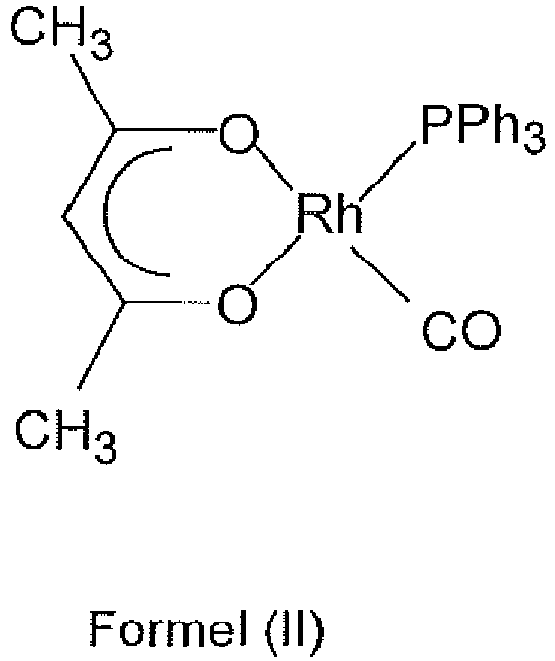
- Verfahren nach einem der Ansprüche 1 bis 17, wobei der Diketonato-carbonyl-triorganophosphin-rhodium(I)-Komplex die Formel (II) besitzt:
- Verfahren zur Homogenkatalyse von chemischen Reaktionen, insbesondere Hydroformylierungsreaktionen, durch Verwendung des Komplexes Rh(CO)(PPh3)acac als Katalysator oder Präkatalysator mit den Schritten- Bereitstellen des Komplexes Rh(CO)(PPh3)acac nach einem oder mehreren der Ansprüche 1 bis 18;- Durchführen der chemischen Reaktionen unter Verwendung des so erhaltenen Rh(CO)(PPh3)acac als als Katalysator oder Präkatalysator.
Applications Claiming Priority (2)
| Application Number | Priority Date | Filing Date | Title |
|---|---|---|---|
| DE102012008111 | 2012-04-25 | ||
| PCT/EP2013/058628 WO2013160401A1 (de) | 2012-04-25 | 2013-04-25 | Verfahren zur herstellung von diketonato-rhodium(i)-carbonylkomplexen |
Publications (2)
| Publication Number | Publication Date |
|---|---|
| EP2841440A1 EP2841440A1 (de) | 2015-03-04 |
| EP2841440B1 true EP2841440B1 (de) | 2016-07-20 |
Family
ID=48483026
Family Applications (1)
| Application Number | Title | Priority Date | Filing Date |
|---|---|---|---|
| EP13724527.0A Not-in-force EP2841440B1 (de) | 2012-04-25 | 2013-04-25 | Verfahren zur herstellung von diketonato-rhodium(i)-carbonylkomplexen |
Country Status (6)
| Country | Link |
|---|---|
| US (1) | US9163045B2 (de) |
| EP (1) | EP2841440B1 (de) |
| JP (1) | JP6157592B2 (de) |
| CN (1) | CN104169290B (de) |
| WO (1) | WO2013160401A1 (de) |
| ZA (1) | ZA201406287B (de) |
Families Citing this family (3)
| Publication number | Priority date | Publication date | Assignee | Title |
|---|---|---|---|---|
| CN106674285B (zh) * | 2016-11-14 | 2019-05-28 | 中海油天津化工研究设计院有限公司 | 一种制备乙酰丙酮三苯基膦羰基铑的方法 |
| CN112479842B (zh) * | 2020-11-27 | 2024-02-23 | 西安凯立新材料股份有限公司 | 一种4-叔丁基苯丙醛的制备方法 |
| CN115651030B (zh) * | 2022-10-28 | 2024-04-26 | 四川大学 | 一种一锅法合成乙酰丙酮三苯基膦羰基铑的方法 |
Family Cites Families (10)
| Publication number | Priority date | Publication date | Assignee | Title |
|---|---|---|---|---|
| GB1224740A (en) | 1967-11-01 | 1971-03-10 | British Petroleum Co | Oxo process |
| GB1243190A (en) * | 1967-12-05 | 1971-08-18 | British Petroleum Co | Oxo catalyst |
| GB1284615A (en) | 1970-01-02 | 1972-08-09 | Bp Chem Int Ltd | Hydroformylation process |
| IT1028547B (it) * | 1973-08-06 | 1979-02-10 | Johnson Matthey Co Ltd | Composto originario per catalizza tore specialmente catalizzatorre pre reazioni di formilazione all idrogeno e relativo procedimento |
| GB2075857A (en) | 1980-05-15 | 1981-11-25 | Davy Mckee Oil & Chem | Making hydroformylation catalysts |
| US4409149A (en) * | 1981-06-29 | 1983-10-11 | Union Carbide Corporation | Process for producing catalyst precursors |
| ZA875926B (en) | 1986-08-20 | 1988-02-15 | Hoechst Celanese Corporation | Process for making 1,3-glycols from epoxides |
| US5099047A (en) | 1989-11-17 | 1992-03-24 | Mitsubishi Kasei Corporation | Method for recovering a group viii metal solid complex and hydroformylation method |
| CN102372745A (zh) * | 2010-08-27 | 2012-03-14 | 中国石油化工股份有限公司 | 一种氢甲酰化催化剂前体的制备方法 |
| CN102093432A (zh) * | 2011-01-29 | 2011-06-15 | 杭州凯大催化金属材料有限公司 | 一种乙酰丙酮三苯基膦羰基铑的合成方法 |
-
2013
- 2013-04-25 US US14/397,131 patent/US9163045B2/en active Active
- 2013-04-25 JP JP2015507535A patent/JP6157592B2/ja not_active Expired - Fee Related
- 2013-04-25 WO PCT/EP2013/058628 patent/WO2013160401A1/de not_active Ceased
- 2013-04-25 CN CN201380015104.3A patent/CN104169290B/zh not_active Expired - Fee Related
- 2013-04-25 EP EP13724527.0A patent/EP2841440B1/de not_active Not-in-force
-
2014
- 2014-08-26 ZA ZA2014/06287A patent/ZA201406287B/en unknown
Also Published As
| Publication number | Publication date |
|---|---|
| US9163045B2 (en) | 2015-10-20 |
| ZA201406287B (en) | 2015-12-23 |
| CN104169290B (zh) | 2017-05-31 |
| JP6157592B2 (ja) | 2017-07-05 |
| EP2841440A1 (de) | 2015-03-04 |
| JP2015520134A (ja) | 2015-07-16 |
| CN104169290A (zh) | 2014-11-26 |
| US20150141685A1 (en) | 2015-05-21 |
| WO2013160401A1 (de) | 2013-10-31 |
Similar Documents
| Publication | Publication Date | Title |
|---|---|---|
| EP0510358B1 (de) | Verfahren zur Wiedergewinnung von Rhodium aus den Rückständen der Destillation von Produkten der Oxosynthese | |
| EP2542516A2 (de) | Herstellung von ethylenisch ungesättigten carbonsäuresalzen durch carboxylierung von alkenen | |
| WO2003029240A1 (de) | Verfahren zur herstellung von alkylencarbonaten | |
| DE2504397A1 (de) | Polymere organische reagentien, insbesondere fuer organische synthesen, zur abtrennung von metallen, zum ionenaustausch und zum abfangen von aldehyden und verfahren zu deren herstellung | |
| DE2355690C2 (de) | Verfahren zur Herstellung von Phenol oder substituierten Phenolen | |
| WO2013160401A1 (de) | Verfahren zur herstellung von diketonato-rhodium(i)-carbonylkomplexen | |
| EP3478696B1 (de) | Verfahren zur herstellung von tetrakis(trihydrocarbylphosphan)palladium(0) | |
| EP3317243B1 (de) | Herstellung von rhodium(iii)-2-ethylhexanoat | |
| DE102005024116A1 (de) | Verfahren zur Herstellung von Iridiumacetat | |
| DE19815323C2 (de) | Verfahren zur Herstellung von Isochroman-3-onen | |
| EP0424736B1 (de) | Verfahren zur Wiedergewinnung von Rhodium aus den Rückständen der Destillation von Produkten der Oxosynthese | |
| EP3166953B1 (de) | Verfahren zur herstellung von hydridocarbonyltris(triphenylphosphin)rhodium(i) | |
| EP0475036B1 (de) | Verfahren zur Wiedergewinnung von Rhodium aus den Rückständen der Destillation von Produkten der Oxosynthese | |
| DE2402383B2 (de) | Verfahren zur Herstellung von Palladium(II)acetylacetonat | |
| DE3017651A1 (de) | Verfahren zur hydroformylierung von olefinen | |
| EP0322661B1 (de) | Verfahren zur Rückgewinnung von Rhodium aus Rhodiumkomplexverbindungen enthaltenden wässrigen Lösungen | |
| DE2823127C3 (de) | Verfahren zur Herstellung von Alkandiolen und -triolen | |
| EP1174435B1 (de) | Verfahren zur Herstellung von Platin-Alkenylpolysiloxan-Komplexen, insbesondere von Platin-Divinyltetramethyldisiloxan | |
| DE2116159B2 (de) | Verfahren zur Herstellung von 4-Pyridylthio-essigsäure | |
| EP1088812B1 (de) | Verfahren zur Herstellung von Tris(acetylacetonato)-Iridium-(III) | |
| DE102004028183B4 (de) | Verfahren zum Regenerieren der Katalysatorverbindungen Rh(PX3)3(Y) | |
| DE1568863C (de) | Verschiedene Übergangsmetallatome enthaltende zweikernige Brückenkomplexverbindungen | |
| EP0778281B1 (de) | Verfahren zur Herstellung methylenverbrückter Heteroverbindungen sowie neue Bis(diorganylphosphino)methane | |
| DE3942789A1 (de) | Sulfoniertes triphenylphosphan enthaltende komplexverbindung des rhodiums | |
| WO2002068434A1 (de) | Neue diphosphine and verfahren zu ihrer herstellung |
Legal Events
| Date | Code | Title | Description |
|---|---|---|---|
| PUAI | Public reference made under article 153(3) epc to a published international application that has entered the european phase |
Free format text: ORIGINAL CODE: 0009012 |
|
| 17P | Request for examination filed |
Effective date: 20141125 |
|
| AK | Designated contracting states |
Kind code of ref document: A1 Designated state(s): AL AT BE BG CH CY CZ DE DK EE ES FI FR GB GR HR HU IE IS IT LI LT LU LV MC MK MT NL NO PL PT RO RS SE SI SK SM TR |
|
| AX | Request for extension of the european patent |
Extension state: BA ME |
|
| RIN1 | Information on inventor provided before grant (corrected) |
Inventor name: RIVAS-NASS, ANDREAS Inventor name: DOPPIU, ANGELINO Inventor name: WOERNER, EILEEN Inventor name: WIDMER, JUERGEN Inventor name: KARCH, RALF Inventor name: EBERT, TIMO |
|
| DAX | Request for extension of the european patent (deleted) | ||
| GRAP | Despatch of communication of intention to grant a patent |
Free format text: ORIGINAL CODE: EPIDOSNIGR1 |
|
| INTG | Intention to grant announced |
Effective date: 20160202 |
|
| GRAS | Grant fee paid |
Free format text: ORIGINAL CODE: EPIDOSNIGR3 |
|
| GRAA | (expected) grant |
Free format text: ORIGINAL CODE: 0009210 |
|
| AK | Designated contracting states |
Kind code of ref document: B1 Designated state(s): AL AT BE BG CH CY CZ DE DK EE ES FI FR GB GR HR HU IE IS IT LI LT LU LV MC MK MT NL NO PL PT RO RS SE SI SK SM TR |
|
| REG | Reference to a national code |
Ref country code: GB Ref legal event code: FG4D Free format text: NOT ENGLISH |
|
| REG | Reference to a national code |
Ref country code: CH Ref legal event code: EP |
|
| REG | Reference to a national code |
Ref country code: IE Ref legal event code: FG4D Free format text: LANGUAGE OF EP DOCUMENT: GERMAN |
|
| REG | Reference to a national code |
Ref country code: AT Ref legal event code: REF Ref document number: 813990 Country of ref document: AT Kind code of ref document: T Effective date: 20160815 |
|
| REG | Reference to a national code |
Ref country code: DE Ref legal event code: R096 Ref document number: 502013003804 Country of ref document: DE |
|
| REG | Reference to a national code |
Ref country code: LT Ref legal event code: MG4D |
|
| REG | Reference to a national code |
Ref country code: NL Ref legal event code: MP Effective date: 20160720 |
|
| PG25 | Lapsed in a contracting state [announced via postgrant information from national office to epo] |
Ref country code: IS Free format text: LAPSE BECAUSE OF FAILURE TO SUBMIT A TRANSLATION OF THE DESCRIPTION OR TO PAY THE FEE WITHIN THE PRESCRIBED TIME-LIMIT Effective date: 20161120 Ref country code: FI Free format text: LAPSE BECAUSE OF FAILURE TO SUBMIT A TRANSLATION OF THE DESCRIPTION OR TO PAY THE FEE WITHIN THE PRESCRIBED TIME-LIMIT Effective date: 20160720 Ref country code: RS Free format text: LAPSE BECAUSE OF FAILURE TO SUBMIT A TRANSLATION OF THE DESCRIPTION OR TO PAY THE FEE WITHIN THE PRESCRIBED TIME-LIMIT Effective date: 20160720 Ref country code: NO Free format text: LAPSE BECAUSE OF FAILURE TO SUBMIT A TRANSLATION OF THE DESCRIPTION OR TO PAY THE FEE WITHIN THE PRESCRIBED TIME-LIMIT Effective date: 20161020 Ref country code: NL Free format text: LAPSE BECAUSE OF FAILURE TO SUBMIT A TRANSLATION OF THE DESCRIPTION OR TO PAY THE FEE WITHIN THE PRESCRIBED TIME-LIMIT Effective date: 20160720 Ref country code: HR Free format text: LAPSE BECAUSE OF FAILURE TO SUBMIT A TRANSLATION OF THE DESCRIPTION OR TO PAY THE FEE WITHIN THE PRESCRIBED TIME-LIMIT Effective date: 20160720 Ref country code: LT Free format text: LAPSE BECAUSE OF FAILURE TO SUBMIT A TRANSLATION OF THE DESCRIPTION OR TO PAY THE FEE WITHIN THE PRESCRIBED TIME-LIMIT Effective date: 20160720 Ref country code: IT Free format text: LAPSE BECAUSE OF FAILURE TO SUBMIT A TRANSLATION OF THE DESCRIPTION OR TO PAY THE FEE WITHIN THE PRESCRIBED TIME-LIMIT Effective date: 20160720 |
|
| PG25 | Lapsed in a contracting state [announced via postgrant information from national office to epo] |
Ref country code: LV Free format text: LAPSE BECAUSE OF FAILURE TO SUBMIT A TRANSLATION OF THE DESCRIPTION OR TO PAY THE FEE WITHIN THE PRESCRIBED TIME-LIMIT Effective date: 20160720 Ref country code: PT Free format text: LAPSE BECAUSE OF FAILURE TO SUBMIT A TRANSLATION OF THE DESCRIPTION OR TO PAY THE FEE WITHIN THE PRESCRIBED TIME-LIMIT Effective date: 20161121 Ref country code: PL Free format text: LAPSE BECAUSE OF FAILURE TO SUBMIT A TRANSLATION OF THE DESCRIPTION OR TO PAY THE FEE WITHIN THE PRESCRIBED TIME-LIMIT Effective date: 20160720 Ref country code: ES Free format text: LAPSE BECAUSE OF FAILURE TO SUBMIT A TRANSLATION OF THE DESCRIPTION OR TO PAY THE FEE WITHIN THE PRESCRIBED TIME-LIMIT Effective date: 20160720 Ref country code: SE Free format text: LAPSE BECAUSE OF FAILURE TO SUBMIT A TRANSLATION OF THE DESCRIPTION OR TO PAY THE FEE WITHIN THE PRESCRIBED TIME-LIMIT Effective date: 20160720 Ref country code: GR Free format text: LAPSE BECAUSE OF FAILURE TO SUBMIT A TRANSLATION OF THE DESCRIPTION OR TO PAY THE FEE WITHIN THE PRESCRIBED TIME-LIMIT Effective date: 20161021 |
|
| REG | Reference to a national code |
Ref country code: FR Ref legal event code: PLFP Year of fee payment: 5 |
|
| REG | Reference to a national code |
Ref country code: DE Ref legal event code: R097 Ref document number: 502013003804 Country of ref document: DE |
|
| PG25 | Lapsed in a contracting state [announced via postgrant information from national office to epo] |
Ref country code: RO Free format text: LAPSE BECAUSE OF FAILURE TO SUBMIT A TRANSLATION OF THE DESCRIPTION OR TO PAY THE FEE WITHIN THE PRESCRIBED TIME-LIMIT Effective date: 20160720 Ref country code: EE Free format text: LAPSE BECAUSE OF FAILURE TO SUBMIT A TRANSLATION OF THE DESCRIPTION OR TO PAY THE FEE WITHIN THE PRESCRIBED TIME-LIMIT Effective date: 20160720 |
|
| PLBE | No opposition filed within time limit |
Free format text: ORIGINAL CODE: 0009261 |
|
| STAA | Information on the status of an ep patent application or granted ep patent |
Free format text: STATUS: NO OPPOSITION FILED WITHIN TIME LIMIT |
|
| PG25 | Lapsed in a contracting state [announced via postgrant information from national office to epo] |
Ref country code: DK Free format text: LAPSE BECAUSE OF FAILURE TO SUBMIT A TRANSLATION OF THE DESCRIPTION OR TO PAY THE FEE WITHIN THE PRESCRIBED TIME-LIMIT Effective date: 20160720 Ref country code: BG Free format text: LAPSE BECAUSE OF FAILURE TO SUBMIT A TRANSLATION OF THE DESCRIPTION OR TO PAY THE FEE WITHIN THE PRESCRIBED TIME-LIMIT Effective date: 20161020 Ref country code: SM Free format text: LAPSE BECAUSE OF FAILURE TO SUBMIT A TRANSLATION OF THE DESCRIPTION OR TO PAY THE FEE WITHIN THE PRESCRIBED TIME-LIMIT Effective date: 20160720 Ref country code: CZ Free format text: LAPSE BECAUSE OF FAILURE TO SUBMIT A TRANSLATION OF THE DESCRIPTION OR TO PAY THE FEE WITHIN THE PRESCRIBED TIME-LIMIT Effective date: 20160720 Ref country code: SK Free format text: LAPSE BECAUSE OF FAILURE TO SUBMIT A TRANSLATION OF THE DESCRIPTION OR TO PAY THE FEE WITHIN THE PRESCRIBED TIME-LIMIT Effective date: 20160720 |
|
| 26N | No opposition filed |
Effective date: 20170421 |
|
| PG25 | Lapsed in a contracting state [announced via postgrant information from national office to epo] |
Ref country code: SI Free format text: LAPSE BECAUSE OF FAILURE TO SUBMIT A TRANSLATION OF THE DESCRIPTION OR TO PAY THE FEE WITHIN THE PRESCRIBED TIME-LIMIT Effective date: 20160720 |
|
| REG | Reference to a national code |
Ref country code: CH Ref legal event code: PL |
|
| PG25 | Lapsed in a contracting state [announced via postgrant information from national office to epo] |
Ref country code: MC Free format text: LAPSE BECAUSE OF FAILURE TO SUBMIT A TRANSLATION OF THE DESCRIPTION OR TO PAY THE FEE WITHIN THE PRESCRIBED TIME-LIMIT Effective date: 20160720 |
|
| PG25 | Lapsed in a contracting state [announced via postgrant information from national office to epo] |
Ref country code: LU Free format text: LAPSE BECAUSE OF NON-PAYMENT OF DUE FEES Effective date: 20170425 Ref country code: CH Free format text: LAPSE BECAUSE OF NON-PAYMENT OF DUE FEES Effective date: 20170430 Ref country code: LI Free format text: LAPSE BECAUSE OF NON-PAYMENT OF DUE FEES Effective date: 20170430 |
|
| REG | Reference to a national code |
Ref country code: FR Ref legal event code: PLFP Year of fee payment: 6 |
|
| REG | Reference to a national code |
Ref country code: BE Ref legal event code: MM Effective date: 20170430 |
|
| PG25 | Lapsed in a contracting state [announced via postgrant information from national office to epo] |
Ref country code: BE Free format text: LAPSE BECAUSE OF NON-PAYMENT OF DUE FEES Effective date: 20170430 |
|
| PGFP | Annual fee paid to national office [announced via postgrant information from national office to epo] |
Ref country code: FR Payment date: 20180315 Year of fee payment: 6 |
|
| PG25 | Lapsed in a contracting state [announced via postgrant information from national office to epo] |
Ref country code: MT Free format text: LAPSE BECAUSE OF FAILURE TO SUBMIT A TRANSLATION OF THE DESCRIPTION OR TO PAY THE FEE WITHIN THE PRESCRIBED TIME-LIMIT Effective date: 20160720 |
|
| PG25 | Lapsed in a contracting state [announced via postgrant information from national office to epo] |
Ref country code: AL Free format text: LAPSE BECAUSE OF FAILURE TO SUBMIT A TRANSLATION OF THE DESCRIPTION OR TO PAY THE FEE WITHIN THE PRESCRIBED TIME-LIMIT Effective date: 20160720 |
|
| REG | Reference to a national code |
Ref country code: AT Ref legal event code: MM01 Ref document number: 813990 Country of ref document: AT Kind code of ref document: T Effective date: 20180425 |
|
| PG25 | Lapsed in a contracting state [announced via postgrant information from national office to epo] |
Ref country code: HU Free format text: LAPSE BECAUSE OF FAILURE TO SUBMIT A TRANSLATION OF THE DESCRIPTION OR TO PAY THE FEE WITHIN THE PRESCRIBED TIME-LIMIT; INVALID AB INITIO Effective date: 20130425 |
|
| PG25 | Lapsed in a contracting state [announced via postgrant information from national office to epo] |
Ref country code: AT Free format text: LAPSE BECAUSE OF NON-PAYMENT OF DUE FEES Effective date: 20180425 Ref country code: CY Free format text: LAPSE BECAUSE OF FAILURE TO SUBMIT A TRANSLATION OF THE DESCRIPTION OR TO PAY THE FEE WITHIN THE PRESCRIBED TIME-LIMIT Effective date: 20160720 |
|
| PG25 | Lapsed in a contracting state [announced via postgrant information from national office to epo] |
Ref country code: MK Free format text: LAPSE BECAUSE OF FAILURE TO SUBMIT A TRANSLATION OF THE DESCRIPTION OR TO PAY THE FEE WITHIN THE PRESCRIBED TIME-LIMIT Effective date: 20160720 |
|
| PG25 | Lapsed in a contracting state [announced via postgrant information from national office to epo] |
Ref country code: FR Free format text: LAPSE BECAUSE OF NON-PAYMENT OF DUE FEES Effective date: 20190430 |
|
| PG25 | Lapsed in a contracting state [announced via postgrant information from national office to epo] |
Ref country code: TR Free format text: LAPSE BECAUSE OF FAILURE TO SUBMIT A TRANSLATION OF THE DESCRIPTION OR TO PAY THE FEE WITHIN THE PRESCRIBED TIME-LIMIT Effective date: 20160720 |
|
| PGFP | Annual fee paid to national office [announced via postgrant information from national office to epo] |
Ref country code: IE Payment date: 20230310 Year of fee payment: 11 |
|
| P01 | Opt-out of the competence of the unified patent court (upc) registered |
Effective date: 20230602 |
|
| PGFP | Annual fee paid to national office [announced via postgrant information from national office to epo] |
Ref country code: GB Payment date: 20240307 Year of fee payment: 12 |
|
| PGFP | Annual fee paid to national office [announced via postgrant information from national office to epo] |
Ref country code: DE Payment date: 20240306 Year of fee payment: 12 |
|
| PG25 | Lapsed in a contracting state [announced via postgrant information from national office to epo] |
Ref country code: IE Free format text: LAPSE BECAUSE OF NON-PAYMENT OF DUE FEES Effective date: 20240425 |
|
| REG | Reference to a national code |
Ref country code: DE Ref legal event code: R119 Ref document number: 502013003804 Country of ref document: DE |
|
| GBPC | Gb: european patent ceased through non-payment of renewal fee |
Effective date: 20250425 |
|
| PG25 | Lapsed in a contracting state [announced via postgrant information from national office to epo] |
Ref country code: DE Free format text: LAPSE BECAUSE OF NON-PAYMENT OF DUE FEES Effective date: 20251104 |
|
| PG25 | Lapsed in a contracting state [announced via postgrant information from national office to epo] |
Ref country code: GB Free format text: LAPSE BECAUSE OF NON-PAYMENT OF DUE FEES Effective date: 20250425 |