EP2838941B1 - Flakes of ester mixtures and methods for their production - Google Patents
Flakes of ester mixtures and methods for their production Download PDFInfo
- Publication number
- EP2838941B1 EP2838941B1 EP13756929.9A EP13756929A EP2838941B1 EP 2838941 B1 EP2838941 B1 EP 2838941B1 EP 13756929 A EP13756929 A EP 13756929A EP 2838941 B1 EP2838941 B1 EP 2838941B1
- Authority
- EP
- European Patent Office
- Prior art keywords
- ester mixture
- ester
- pet
- flakes
- temperature
- Prior art date
- Legal status (The legal status is an assumption and is not a legal conclusion. Google has not performed a legal analysis and makes no representation as to the accuracy of the status listed.)
- Active
Links
Images
Classifications
-
- C—CHEMISTRY; METALLURGY
- C08—ORGANIC MACROMOLECULAR COMPOUNDS; THEIR PREPARATION OR CHEMICAL WORKING-UP; COMPOSITIONS BASED THEREON
- C08G—MACROMOLECULAR COMPOUNDS OBTAINED OTHERWISE THAN BY REACTIONS ONLY INVOLVING UNSATURATED CARBON-TO-CARBON BONDS
- C08G63/00—Macromolecular compounds obtained by reactions forming a carboxylic ester link in the main chain of the macromolecule
- C08G63/78—Preparation processes
-
- B—PERFORMING OPERATIONS; TRANSPORTING
- B01—PHYSICAL OR CHEMICAL PROCESSES OR APPARATUS IN GENERAL
- B01J—CHEMICAL OR PHYSICAL PROCESSES, e.g. CATALYSIS OR COLLOID CHEMISTRY; THEIR RELEVANT APPARATUS
- B01J2/00—Processes or devices for granulating materials, e.g. fertilisers in general; Rendering particulate materials free flowing in general, e.g. making them hydrophobic
- B01J2/12—Processes or devices for granulating materials, e.g. fertilisers in general; Rendering particulate materials free flowing in general, e.g. making them hydrophobic in rotating drums
-
- B—PERFORMING OPERATIONS; TRANSPORTING
- B01—PHYSICAL OR CHEMICAL PROCESSES OR APPARATUS IN GENERAL
- B01J—CHEMICAL OR PHYSICAL PROCESSES, e.g. CATALYSIS OR COLLOID CHEMISTRY; THEIR RELEVANT APPARATUS
- B01J2/00—Processes or devices for granulating materials, e.g. fertilisers in general; Rendering particulate materials free flowing in general, e.g. making them hydrophobic
- B01J2/24—Obtaining flakes by scraping a solid layer from a surface
-
- C—CHEMISTRY; METALLURGY
- C08—ORGANIC MACROMOLECULAR COMPOUNDS; THEIR PREPARATION OR CHEMICAL WORKING-UP; COMPOSITIONS BASED THEREON
- C08J—WORKING-UP; GENERAL PROCESSES OF COMPOUNDING; AFTER-TREATMENT NOT COVERED BY SUBCLASSES C08B, C08C, C08F, C08G or C08H
- C08J11/00—Recovery or working-up of waste materials
- C08J11/04—Recovery or working-up of waste materials of polymers
-
- C—CHEMISTRY; METALLURGY
- C08—ORGANIC MACROMOLECULAR COMPOUNDS; THEIR PREPARATION OR CHEMICAL WORKING-UP; COMPOSITIONS BASED THEREON
- C08J—WORKING-UP; GENERAL PROCESSES OF COMPOUNDING; AFTER-TREATMENT NOT COVERED BY SUBCLASSES C08B, C08C, C08F, C08G or C08H
- C08J11/00—Recovery or working-up of waste materials
- C08J11/04—Recovery or working-up of waste materials of polymers
- C08J11/10—Recovery or working-up of waste materials of polymers by chemically breaking down the molecular chains of polymers or breaking of crosslinks, e.g. devulcanisation
- C08J11/18—Recovery or working-up of waste materials of polymers by chemically breaking down the molecular chains of polymers or breaking of crosslinks, e.g. devulcanisation by treatment with organic material
- C08J11/22—Recovery or working-up of waste materials of polymers by chemically breaking down the molecular chains of polymers or breaking of crosslinks, e.g. devulcanisation by treatment with organic material by treatment with organic oxygen-containing compounds
- C08J11/24—Recovery or working-up of waste materials of polymers by chemically breaking down the molecular chains of polymers or breaking of crosslinks, e.g. devulcanisation by treatment with organic material by treatment with organic oxygen-containing compounds containing hydroxyl groups
-
- C—CHEMISTRY; METALLURGY
- C08—ORGANIC MACROMOLECULAR COMPOUNDS; THEIR PREPARATION OR CHEMICAL WORKING-UP; COMPOSITIONS BASED THEREON
- C08J—WORKING-UP; GENERAL PROCESSES OF COMPOUNDING; AFTER-TREATMENT NOT COVERED BY SUBCLASSES C08B, C08C, C08F, C08G or C08H
- C08J2367/00—Characterised by the use of polyesters obtained by reactions forming a carboxylic ester link in the main chain; Derivatives of such polymers
- C08J2367/02—Polyesters derived from dicarboxylic acids and dihydroxy compounds
-
- Y—GENERAL TAGGING OF NEW TECHNOLOGICAL DEVELOPMENTS; GENERAL TAGGING OF CROSS-SECTIONAL TECHNOLOGIES SPANNING OVER SEVERAL SECTIONS OF THE IPC; TECHNICAL SUBJECTS COVERED BY FORMER USPC CROSS-REFERENCE ART COLLECTIONS [XRACs] AND DIGESTS
- Y02—TECHNOLOGIES OR APPLICATIONS FOR MITIGATION OR ADAPTATION AGAINST CLIMATE CHANGE
- Y02W—CLIMATE CHANGE MITIGATION TECHNOLOGIES RELATED TO WASTEWATER TREATMENT OR WASTE MANAGEMENT
- Y02W30/00—Technologies for solid waste management
- Y02W30/50—Reuse, recycling or recovery technologies
- Y02W30/62—Plastics recycling; Rubber recycling
Definitions
- the present invention relates to methods relevant to polyethylene terephthalate processes. Particularly, the present invention relates to methods for producing the flakes of an ester mixture and methods for using ester mixtures having a low free glycol content.
- PET Polyethylene terephthalate
- ethane-1,2-diol also known as ethanediol, 1,2-dihydroxyethane, monoethylene glycol or MEG
- PTA purified terephthalic acid
- BHET bis-(hydroxyethyl) terephthalate ester
- PET has been used extensively because it can be formed into an oriented film or fibre, has high tenacity, good electrical resistance, low moisture absorption, and a melting point greater than 245°C. PET has been found to be particularly valuable for the manufacture of bottles for containing carbonated drinks where bottles must have good tensile strength, exhibit superior mechanical properties, contain pressure, and have a low mass convenient for transport and use. Such PET bottles are also extensively used for non-carbonated drinks.
- PET is mainly recycled using either of two distinct methods, namely mechanical and chemical.
- PET waste (which includes post-consumer PET) is cut and washed to obtain PET flakes. These flakes are then converted to various end products using conventional polyester processes. However, such flakes are frequently contaminated leading to products having a quality which is not comparable with product made from the high purity virgin petrochemical feedstocks typically used for making polyester.
- GB 610,136 discloses a process for obtaining BHET and higher oligomers through the de-polymerisation of polyester scraps by using ethylene glycol and then obtaining reconstituted polyester by polymerising the BHET and higher oligomers immediately. This is done because the BHET and higher oligomers, thus obtained, is unstable when stored at high temperature and degrades.
- US 4609680 discloses a process for depolymerisation of polyester scrap wherein PET scrap is depolymerised to bis-hydroxyethyl terephthalate (BHET) and/or its oligomers by supplying the scrap, together with ethylene glycol, to a reactor containing molten BHET from which a part of the product in the reactor is removed to a polymerising reactor.
- BHET bis-hydroxyethyl terephthalate
- polyester compositions that are suitable for molding, and that include polyester polymers or copolymers having incorporated therein metallic tungsten particles that improve the reheat properties of the compositions.
- the produced flakes of an ester mixture are crystalline, free flowing, non-sticky, stable, storable and reusable.
- the flakes of ester can also be used directly as major feedstocks for unsaturated polyester, polyurethane foams and polymer concrete or as a precursor for dimethyl terephthalate (DMT) by methanolysis or terephthalic acid by hydrolysis.
- DMT dimethyl terephthalate
- the flakes of the ester mixture have a melting point at or below about 150°C.
- the flakes of the ester mixture have a melting point in the range of from 120 to 150°C.
- the flakes of an ester mixture comprise 2.5% or less of diethylene glycol, 45 to 55% bis (hydroxyethyl) terephthalate, 25 to 35% dimers, 10 to 15% trimers, 3 to 8% tetramers, 1 to 2% pentamers and higher oligomers.
- a method for producing flakes of an ester mixture comprising bis-(hydroxyethyl)-terephthalate, dimers, trimers, tetramers, pentamers and higher oligomers of ethane-1,2-diol and terephthalate acid, the method comprising:
- free glycol is defined as ethane-1,2-diol (monoethylene glycol) that is not chemically bound to the ester molecules by any chemical bond. It can be identified and quantified as a separate and distinct known chemical compound using standard tests known to persons skilled in the art.
- the ester mixture of step (a) has a free glycol content of less than about 12%. More preferably, the free glycol content is less than about 5%. Most preferably, the free glycol content is about 2% or less.
- flash evaporation is used to refer to a phenomenon wherein the ester mixture containing free glycol is pumped from a high pressure zone to a reduced pressure zone. As soon as the ester mixture is exposed to the reduced pressure (eg vacuum) the ethane-1,2-diol immediately vaporizes. The extent of vaporization depends on the conditions used, namely the pressure and the temperature.
- the composition of the mixture of oligomers in the ester mixture can increase the boiling point of ethane-1,2-diol and thus influence the amount of ethane-1,2-diol removed.
- the flash evaporation in step (a) is typically carried out at reduced pressure and at a predetermined temperature.
- the reduced pressure for the flash evaporation is preferably in the range of from 100 to 300 mbar (10 to 30 kPa). More preferably, the flash evaporation is carried out at about 200 mbar (about 20 kPa).
- the predetermined temperature for the flash evaporation depends upon the reduced pressure.
- the reduced pressure is applied in such a way that the flash evaporation of the glycol takes place at or below about 220°C. More preferably, the flash evaporation is carried out at a temperature in the range of from 190°C to 220°C.
- Diethylene glycol is an impurity from a side reaction that cannot be removed by downstream polymerisation processes.
- the diethylene glycol is formed in the process due to chemical reaction between the ethane-1,2-diol molecules and/or ester molecules. Not all of the diethylene glycol is incorporated into the esters and some exists in a free form. Any increase in the diethylene glycol content would undermine the value of the downstream polyesters for applications such as filament yarns or bottles.
- the diethylene glycol content test is a test method to estimate total diethylene glycol in the ester mixture.
- the test dissociates the DEG from the ester molecules and measures them using conventional gas chromatographic techniques.
- the ester mixture of step (a) has a diethylene glycol (both free and bound) content of about 2.5% or less.
- the flakes can be produced in step (b) using any available method.
- a conventional rotary drum flaker is used to quench and solidify the ester mixture to obtain the flakes of the invention.
- the flakes can also be produced using any other known equipment or methods such as a quench belt or a prilling process.
- quenching refers to a process in which the molten ester mixture from step (a) is cooled such that there is adequate crystallization to change the nature of the flake on the flaker drum surface allowing a reduction in the adhesive force that holds the flake onto the drum metal surface and makes it easier to break off.
- the temperature of the ester mixture from step (a) and the temperature of the coolant used in step (b) directly impacts on the level of crystallinity obtained in the final ester flake.
- the rate of cooling on a rotating drum flaker can be controlled adequately to produce recycled ester flakes having thin outer crystalline faces to ensure free flowing of the crystalline flakes.
- the temperature of the cooling medium in the rotary flaker is preferably maintained in the range of from 8°C to 90°C. More preferably, the temperature of the cooling medium is maintained in the range of from 70°C and 80°C. Any known cooling media can be used to maintain the equipment at the desired temperature.
- the cooling media can be cold or chilled water, brine water, hot water, hot oil, ethane-1,2-diol or any other known cooling or refrigerant means.
- the method of the invention may be used in a continuous process, a batch process or a semi-continuous process.
- the ester mixture used to prepare the flakes is obtained from the glycolysis of PET waste.
- the PET waste which is used to form the recycled esters used in the invention can be PET of any form suitable for recycling, including, but not limited to, post-consumer PET bottles, PET film, polyester textile waste, rigid packaging, etc.
- the PET waste may be subjected to glycolysis using any methods known to persons skilled in the art. If the PET waste is contaminated then suitable methods include those disclosed in US5504121 , US5602187 , US6518322 and US 7214723 . The content of those patents is hereby incorporated in full by reference.
- ester mixture obtained from the flash evaporation in step (a) can be directly used for polymerisation to produce PET chips or other PET products.
- the lower free glycol content enables polymerisation to take place at a lower temperature and in less time compared to the present techniques discussed in the prior art.
- a method for producing PET products from an ester mixture comprising bis-(hydroxyethyl)-terephthalate, dimers, trimers, tetramers, pentamers and higher oligomers of ethane-1,2-diol and terephthalate acid, the method comprising the steps of:
- the present invention enables wide spread and cost-effective re-use of recycled feedstock at any customer site for the manufacture of polyester bottle resin, filament yarn or any application that requires polyesters. Further, the present invention is beneficial environmentally because it enables a broader use of decontaminated recyclable esters from PET waste.
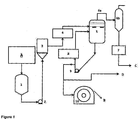
- Figure 1 shows a flowchart illustrating a method for producing flakes of recycled esters from PET waste according to a preferred embodiment of the present invention.
- Glycolysis (not shown) of the PET waste is carried out using ethane-1,2-diol.
- PET waste Prior to glycolysis, PET waste is subjected to pre-treatment using known methods including decontamination and reduction in size of the PET waste to facilitate physical transport of the PET waste.
- the glycolysis process disclosed in US 7214,723 produces recycled esters having a free glycol content in the range of 17 to 80% depending on the quantity of ethane-1,2-diol used for the glycolysis.
- the molten recycled esters (including excess ethane-1,2-diol) ( A ) from the decontamination and glycolysis of PET waste enters the proving vessel (1).
- the recycled esters proceed via a pump (2) to the filter (3) to remove solid particles, if any, and then sent to a preheater (4) before entering the flash evaporator (5) for flash evaporating the glycol to obtain recycled esters having a free glycol content of less than about 12%, preferably less than about 2%.
- the ethane-1,2-diol ( C ) removed during the flash evaporation is captured via a vapour line (6a) and spray condenser (6b) into a collection vessel (7) for recovery and recycling.
- the flash evaporation of glycol in the recycled ester obtained from the glycolysis of the PET waste is carried out below 220°C, there is no significant increase in the diethylene glycol (an impurity which often forms at higher temperatures) content in the recycled ester.
- the resultant diethylene glycol content in the recycled ester after the flash evaporation is preferably maintained below 2.5%.
- the relative proportion of the lower molecular weight esters including BHET, dimers, trimers, tetramer and pentamers in the recycled ester remains similar to that present prior to the flash evaporation.
- the ester mixture obtained from the flash evaporator (5) then proceeds via a pump (9) to the rotary drum flaker (10) to be quenched and solidified to obtain flakes of recycled ester ( B ).
- the ester mixture can be sent to polymerisation ( D ) for manufacturing PET products such as PET chips, bottles, textiles, PET film, etc.
- a conventional rotary drum flaker (10) is used for quenching and solidifying the ester mixture to obtain the flakes of the invention.
- Any known cooling media can be used to maintain the rotary drum flaker at the desired temperature.
- the cooling media can be cold or chilled water, brine water, hot water, hot oil or any other known cooling or refrigerant means.
- the ester mixture forms crystalline solid ester flakes ( B ) that are chipped off from the drum using a stationary blade in the rotary drum flaker.
- the chipped off material is in the form of an irregular shaped flake in the range of from 3 mm to 20 mm size.
- This irregular shaped flake then drops by gravity from the rotary drum flaker onto a conveyor belt (not shown) and is allowed to further cool to a temperature in the range of from about 50°C to room temperature on the conveyor belt (not shown).
- the material is then allowed to fall into a packing station (not shown) for packaging into bags as required by further end users after its sale.
- the flakes of the ester mixture are crystalline, free-flowing, non-sticky, stable at room temperature, storable and can be transported and reused.
- the ester flakes can be melted using a conventional stirred and heated reactor at about 150°C into a liquid. This liquid can then be injected into the pre-polymerisation step of any existing on-site or remotely located third party polyester plant for making PET products.
- the purified recycled ester was in crystalline form. Ester composition tests showed that the flakes comprised 50% bis (hydroxyethyl) terephthalate, 32% dimers, 10% trimers, 4% tetramers, 1% pentamers, with the remaining esters being higher oligomers. Further, the flakes had a free glycol content of 1.9% and a diethylene glycol content of 2.3%. The melting point was 120°C to 135°C.
- the flake was then stored for 7 days at 55 ⁇ 1°C / 90 ⁇ 2% relative humidity and then tested and re-used further downstream on-site. No changes in the ester were observed and it was reusable.
- Ester composition test results showed that flakes comprised 49.5% bis (hydroxyethyl) terephthalate, 32.27% dimers, 11.86% trimers, 7.12% tetramers, 1.11% pentamers with the remaining esters being higher oligomers. Further, the flakes had a free glycol content of 1.9% and a diethylene glycol content of 2.4%. The melting point was 120°C to 135°C.
- a molten ester mixture ( A ) obtained from the glycolysis and filtration of PET waste having a free glycol content of about 18% was collected into a proving vessel (1) and then led to the downstream process at the rate of 1300 kg/h via a pump (2) and final filter (3).
- This liquid was then passed continuously through a pre-heater (4) which increased the temperature of the ester mixture from about 185°C to about 220°C.
- the hot ester mixture at a temperature of about 220°C was then introduced continuously into a flash evaporator (5) operating under vacuum, at a pressure of 200 mbar.
- the glycol that flashed off was continuously led to a spray condenser (6b) where it was condensed, and sub-cooled to a temperature of 40°C.
- the condensed glycol was then collected into a collection vessel (7). This condensed glycol was then sent for recovery ( C ).
- the contents of the flash evaporator (5) were maintained at a level of about 50% and continuously re-circulated at a rate of 21,000 m 3 /hr via a re-boiler (8) and an ester circulation pump (9). At this point, the contents of the flash evaporator (5) had a free glycol content of about 1.0%.
- a portion of this re-circulating stream (flow rate 850 kg/h) was then led continuously to a continuous polymerisation plant for conversion into polyester melt with an intrinsic viscosity of 0.63 ⁇ 0.005. This polyester melt was then used to make high quality 100% recycled polyester filament yarn.
- a molten ester mixture ( A ) obtained from the glycolysis and filtration of PET waste having a free glycol content of about 18% was collected into a proving vessel (1) and then led to the downstream process at the rate of 1300 kg/h via a pump (2) and final filter (3).
- This liquid was then passed continuously through a pre-heater (4) which increased the temperature of the ester mixture from about 185°C to about 200°C.
- the hot ester mixture at a temperature of about 200°C was then introduced continuously into a flash evaporator (5) operating under vacuum, at a pressure of 300 mbar.
- the glycol that flashed off was continuously led to a spray condenser (6b) where it was condensed, and sub-cooled to a temperature of 40°C.
- the condensed glycol was then collected into a collection vessel (7). This condensed glycol was then sent for recovery ( C ).
- the contents of the flash evaporator (5) were maintained at a level of about 50% and continuously re-circulated at a rate of 21,000 m 3 /hr via a re-boiler (8) and an ester circulation pump (9).
- a portion of this re-circulating stream (flow rate 850 kg/h) was then led continuously to a conventional rotary drum flaker (10). At this point, this stream had a free glycol content of about 2.0%.
- the rotary drum flaker (10) was kept cooled by circulating hot water of about 80°C.
Landscapes
- Chemical & Material Sciences (AREA)
- Chemical Kinetics & Catalysis (AREA)
- Organic Chemistry (AREA)
- Health & Medical Sciences (AREA)
- Medicinal Chemistry (AREA)
- Polymers & Plastics (AREA)
- Life Sciences & Earth Sciences (AREA)
- Sustainable Development (AREA)
- Organic Low-Molecular-Weight Compounds And Preparation Thereof (AREA)
- Polyesters Or Polycarbonates (AREA)
- Separation, Recovery Or Treatment Of Waste Materials Containing Plastics (AREA)
Applications Claiming Priority (2)
| Application Number | Priority Date | Filing Date | Title |
|---|---|---|---|
| IN1271MU2012 | 2012-04-20 | ||
| PCT/IN2013/000256 WO2013175497A1 (en) | 2012-04-20 | 2013-04-18 | Flakes of ester mixtures and methods for their production |
Publications (2)
| Publication Number | Publication Date |
|---|---|
| EP2838941A1 EP2838941A1 (en) | 2015-02-25 |
| EP2838941B1 true EP2838941B1 (en) | 2019-11-06 |
Family
ID=49115547
Family Applications (1)
| Application Number | Title | Priority Date | Filing Date |
|---|---|---|---|
| EP13756929.9A Active EP2838941B1 (en) | 2012-04-20 | 2013-04-18 | Flakes of ester mixtures and methods for their production |
Country Status (14)
| Country | Link |
|---|---|
| US (1) | US9234074B2 (OSRAM) |
| EP (1) | EP2838941B1 (OSRAM) |
| CN (1) | CN104395383B (OSRAM) |
| BR (1) | BR112014026101B1 (OSRAM) |
| CO (1) | CO7141469A2 (OSRAM) |
| ES (1) | ES2767174T3 (OSRAM) |
| IN (1) | IN2014MN02312A (OSRAM) |
| MX (1) | MX368905B (OSRAM) |
| PH (1) | PH12014502342A1 (OSRAM) |
| SA (1) | SA113340483B1 (OSRAM) |
| SG (1) | SG11201406229PA (OSRAM) |
| TW (1) | TWI588178B (OSRAM) |
| WO (1) | WO2013175497A1 (OSRAM) |
| ZA (1) | ZA201407687B (OSRAM) |
Families Citing this family (11)
| Publication number | Priority date | Publication date | Assignee | Title |
|---|---|---|---|---|
| TWI630221B (zh) * | 2017-05-26 | 2018-07-21 | 遠東新世紀股份有限公司 | 聚酯的製法 |
| FR3106134B1 (fr) * | 2020-01-09 | 2022-12-16 | Ifp Energies Now | Procédé optimisé de dépolymérisation par glycolyse d’un polyester comprenant du polyéthylène téréphtalate |
| CN119384446A (zh) | 2022-05-10 | 2025-01-28 | 保利麦特瑞斯公司 | 用于制备聚酯的方法 |
| EP4276131A1 (en) | 2022-05-10 | 2023-11-15 | Polymetrix AG | Method for the preparation of a polyester |
| EP4342946B1 (en) | 2022-09-20 | 2024-07-17 | revalyu Resources GmbH | Process for recycling polyethylene terephthalate using a washing reactor |
| EP4342945B1 (en) | 2022-09-20 | 2024-07-17 | revalyu Resources GmbH | Process for recycling polyethylene terephthalate using different mono-ethylene glycol levels |
| EP4342939B1 (en) | 2022-09-20 | 2024-07-10 | revalyu Resources GmbH | Process for recycling polyethylene terephthalate using porous particulated filter material |
| ES2987865T3 (es) | 2022-09-20 | 2024-11-18 | Revalyu Resources Gmbh | Proceso para reciclar tereftalato de polietileno utilizando coordenadas de color específicas para el procesamiento de oligómeros |
| ES2987871T3 (es) | 2022-09-20 | 2024-11-18 | Revalyu Resources Gmbh | Proceso para reciclar tereftalato de polietileno determinado por la viscosidad intrínseca del tereftalato de polietileno |
| EP4342943B1 (en) | 2022-09-20 | 2024-07-17 | revalyu Resources GmbH | Process for recycling polyethylene terephthalate using a selected feedstock |
| EP4353774B1 (en) | 2022-10-10 | 2025-09-10 | Polykey Polymers, S.L. | Low-temperature organocatalyzed depolymerization of poly(ethylene terephthalate) |
Citations (1)
| Publication number | Priority date | Publication date | Assignee | Title |
|---|---|---|---|---|
| GB610136A (en) * | 1946-03-28 | 1948-10-12 | Royden Lewis Heath | Degradation of aromatic linear polyesters |
Family Cites Families (11)
| Publication number | Priority date | Publication date | Assignee | Title |
|---|---|---|---|---|
| JPS60248646A (ja) | 1984-05-25 | 1985-12-09 | Toray Ind Inc | ポリエステル屑の解重合方法 |
| ES2134261T3 (es) | 1992-05-18 | 1999-10-01 | Swig Pty Ltd | Mejoras en la descontaminacion de tereftalato de polietileno. |
| AUPM499394A0 (en) | 1994-04-11 | 1994-05-05 | Petwest Pty Ltd | Improved polyethylene terephthalate decontamination |
| US5635584A (en) | 1995-12-07 | 1997-06-03 | Eastman Chemical Company | Process including glycolysis and subsequent purification for recycling polyester materials |
| AUPP261498A0 (en) | 1998-03-27 | 1998-04-23 | Swig Pty Ltd | Improved conversion of contaminated polyethylene terephthalate to polybutylene terephthalate |
| AUPP598098A0 (en) | 1998-09-17 | 1998-10-08 | West, Simon Michael | Process for decontaminating ethanediol |
| AUPP610798A0 (en) | 1998-09-23 | 1998-10-15 | Swig Pty Ltd | Improved polymers |
| JPWO2003101929A1 (ja) | 2002-06-04 | 2005-09-29 | 株式会社アイエス | ビス(2−ヒドロキシエチル)テレフタレートの精製方法 |
| WO2005079140A2 (en) | 2003-02-27 | 2005-09-01 | Petrecycle Ltd | A method for the decontamination of polyethylene terephthalate |
| JP2005154671A (ja) * | 2003-11-28 | 2005-06-16 | Teijin Fibers Ltd | ポリエチレンテレフタレートの製造方法 |
| US20060110557A1 (en) * | 2004-09-03 | 2006-05-25 | Zhiyong Xia | Polyester polymer and copolymer compositions containing metallic tungsten particles |
-
2013
- 2013-04-18 MX MX2014012420A patent/MX368905B/es active IP Right Grant
- 2013-04-18 ES ES13756929T patent/ES2767174T3/es active Active
- 2013-04-18 BR BR112014026101-6A patent/BR112014026101B1/pt active IP Right Grant
- 2013-04-18 WO PCT/IN2013/000256 patent/WO2013175497A1/en not_active Ceased
- 2013-04-18 US US14/391,988 patent/US9234074B2/en active Active
- 2013-04-18 CN CN201380020725.0A patent/CN104395383B/zh active Active
- 2013-04-18 EP EP13756929.9A patent/EP2838941B1/en active Active
- 2013-04-18 SG SG11201406229PA patent/SG11201406229PA/en unknown
- 2013-04-18 IN IN2312MUN2014 patent/IN2014MN02312A/en unknown
- 2013-04-19 TW TW102113890A patent/TWI588178B/zh active
- 2013-04-20 SA SA113340483A patent/SA113340483B1/ar unknown
-
2014
- 2014-10-20 PH PH12014502342A patent/PH12014502342A1/en unknown
- 2014-10-22 ZA ZA2014/07687A patent/ZA201407687B/en unknown
- 2014-11-20 CO CO14255231A patent/CO7141469A2/es unknown
Patent Citations (1)
| Publication number | Priority date | Publication date | Assignee | Title |
|---|---|---|---|---|
| GB610136A (en) * | 1946-03-28 | 1948-10-12 | Royden Lewis Heath | Degradation of aromatic linear polyesters |
Also Published As
| Publication number | Publication date |
|---|---|
| SA113340483B1 (ar) | 2015-12-14 |
| TW201404800A (zh) | 2014-02-01 |
| US9234074B2 (en) | 2016-01-12 |
| TWI588178B (zh) | 2017-06-21 |
| MX368905B (es) | 2019-10-21 |
| ES2767174T3 (es) | 2020-06-16 |
| CN104395383B (zh) | 2017-10-10 |
| CN104395383A (zh) | 2015-03-04 |
| CO7141469A2 (es) | 2014-12-12 |
| BR112014026101B1 (pt) | 2021-02-02 |
| BR112014026101A2 (pt) | 2018-05-08 |
| IN2014MN02312A (OSRAM) | 2015-08-07 |
| SG11201406229PA (en) | 2014-11-27 |
| PH12014502342A1 (en) | 2014-12-22 |
| MX2014012420A (es) | 2015-01-12 |
| US20150065680A1 (en) | 2015-03-05 |
| WO2013175497A1 (en) | 2013-11-28 |
| ZA201407687B (en) | 2015-10-28 |
| EP2838941A1 (en) | 2015-02-25 |
Similar Documents
| Publication | Publication Date | Title |
|---|---|---|
| EP2838941B1 (en) | Flakes of ester mixtures and methods for their production | |
| EP3778744B1 (en) | Processes for recycling polyethylene terephthalate | |
| EP0174062A2 (en) | Process for the depolymerization of polyester scrap | |
| JP5219113B2 (ja) | ポリエステル樹脂回収品のリサイクル方法 | |
| CA1118570A (en) | Process for manufacturing shaped polyester article using scrap materials | |
| JP2008088096A (ja) | ビス−(2−ヒドロキシエチル)テレフタレートの製造方法およびポリエチレンテレフタレートの製造方法 | |
| KR102299757B1 (ko) | 폴리에스테르의 제조 공정 또는 락타이드의 제조 공정에서 환형 에스테르를 포함하는 축합된 상 조성물의 안정화 방법 | |
| JP2024539816A (ja) | 再生ビス(2-ヒドロキシエチル)テレフタラートを含む重合性原料及びその調製方法 | |
| US3305495A (en) | Process for the continuous re-use of polyethylene terephthalate waste | |
| Ngo et al. | Morphology control of waste polyesters for enhanced glycolysis reactivity and minimization of side reactions | |
| US20250215183A1 (en) | Method for producing polyester resin and fiber comprising regenerated bis(2-hydroxyethyl) terephthalate | |
| JPH0491126A (ja) | 高重合度ポリエステルの製造方法 | |
| JP3947206B2 (ja) | ポリエチレンテレフタレート樹脂ペレット | |
| JP7035473B2 (ja) | 3次元物体のラピッドプロトタイピング装置の使用方法 | |
| JP3799167B2 (ja) | ポリエステルの製造方法 | |
| KR102772460B1 (ko) | 화학적 재활용 pet의 제조 방법 | |
| EP4198075A1 (en) | Process for producing recycled pet resin and method for producing moulded articles | |
| Al-Sabagh et al. | Ionic liquids as Efficient Catalysts for The Glycolysis of Polyethylene Terephthalate | |
| KR20250029635A (ko) | 재생 원료 조성물 및 이의 제조방법 | |
| WO1997019975A1 (en) | Processes for the production of polycarbonate | |
| CN115340666A (zh) | 一种端羟基超支化聚合物及其制备方法和应用 | |
| TW200304921A (en) | Recycle process for polycondensation resins | |
| KR20240151401A (ko) | 재생 폴리에스테르 수지 및 필름, 및 이의 제조방법 | |
| JPWO2001021681A1 (ja) | 低分子量ポリカーボネートの結晶化方法及びそれを用いたポリカーボネート樹脂の製造方法 | |
| TH28754B (th) | วิธีการรีไซเคิลขวด pet |
Legal Events
| Date | Code | Title | Description |
|---|---|---|---|
| PUAI | Public reference made under article 153(3) epc to a published international application that has entered the european phase |
Free format text: ORIGINAL CODE: 0009012 |
|
| 17P | Request for examination filed |
Effective date: 20141008 |
|
| AK | Designated contracting states |
Kind code of ref document: A1 Designated state(s): AL AT BE BG CH CY CZ DE DK EE ES FI FR GB GR HR HU IE IS IT LI LT LU LV MC MK MT NL NO PL PT RO RS SE SI SK SM TR |
|
| AX | Request for extension of the european patent |
Extension state: BA ME |
|
| DAX | Request for extension of the european patent (deleted) | ||
| 17Q | First examination report despatched |
Effective date: 20160706 |
|
| STAA | Information on the status of an ep patent application or granted ep patent |
Free format text: STATUS: EXAMINATION IS IN PROGRESS |
|
| GRAP | Despatch of communication of intention to grant a patent |
Free format text: ORIGINAL CODE: EPIDOSNIGR1 |
|
| STAA | Information on the status of an ep patent application or granted ep patent |
Free format text: STATUS: GRANT OF PATENT IS INTENDED |
|
| INTG | Intention to grant announced |
Effective date: 20190613 |
|
| RIN1 | Information on inventor provided before grant (corrected) |
Inventor name: DEVRAJ, SHANKAR |
|
| GRAS | Grant fee paid |
Free format text: ORIGINAL CODE: EPIDOSNIGR3 |
|
| GRAA | (expected) grant |
Free format text: ORIGINAL CODE: 0009210 |
|
| STAA | Information on the status of an ep patent application or granted ep patent |
Free format text: STATUS: THE PATENT HAS BEEN GRANTED |
|
| AK | Designated contracting states |
Kind code of ref document: B1 Designated state(s): AL AT BE BG CH CY CZ DE DK EE ES FI FR GB GR HR HU IE IS IT LI LT LU LV MC MK MT NL NO PL PT RO RS SE SI SK SM TR |
|
| REG | Reference to a national code |
Ref country code: GB Ref legal event code: FG4D |
|
| REG | Reference to a national code |
Ref country code: AT Ref legal event code: REF Ref document number: 1198665 Country of ref document: AT Kind code of ref document: T Effective date: 20191115 Ref country code: CH Ref legal event code: EP |
|
| REG | Reference to a national code |
Ref country code: IE Ref legal event code: FG4D |
|
| REG | Reference to a national code |
Ref country code: DE Ref legal event code: R096 Ref document number: 602013062548 Country of ref document: DE |
|
| REG | Reference to a national code |
Ref country code: NL Ref legal event code: FP |
|
| REG | Reference to a national code |
Ref country code: LT Ref legal event code: MG4D |
|
| PG25 | Lapsed in a contracting state [announced via postgrant information from national office to epo] |
Ref country code: PL Free format text: LAPSE BECAUSE OF FAILURE TO SUBMIT A TRANSLATION OF THE DESCRIPTION OR TO PAY THE FEE WITHIN THE PRESCRIBED TIME-LIMIT Effective date: 20191106 Ref country code: PT Free format text: LAPSE BECAUSE OF FAILURE TO SUBMIT A TRANSLATION OF THE DESCRIPTION OR TO PAY THE FEE WITHIN THE PRESCRIBED TIME-LIMIT Effective date: 20200306 Ref country code: NO Free format text: LAPSE BECAUSE OF FAILURE TO SUBMIT A TRANSLATION OF THE DESCRIPTION OR TO PAY THE FEE WITHIN THE PRESCRIBED TIME-LIMIT Effective date: 20200206 Ref country code: GR Free format text: LAPSE BECAUSE OF FAILURE TO SUBMIT A TRANSLATION OF THE DESCRIPTION OR TO PAY THE FEE WITHIN THE PRESCRIBED TIME-LIMIT Effective date: 20200207 Ref country code: LT Free format text: LAPSE BECAUSE OF FAILURE TO SUBMIT A TRANSLATION OF THE DESCRIPTION OR TO PAY THE FEE WITHIN THE PRESCRIBED TIME-LIMIT Effective date: 20191106 Ref country code: LV Free format text: LAPSE BECAUSE OF FAILURE TO SUBMIT A TRANSLATION OF THE DESCRIPTION OR TO PAY THE FEE WITHIN THE PRESCRIBED TIME-LIMIT Effective date: 20191106 Ref country code: SE Free format text: LAPSE BECAUSE OF FAILURE TO SUBMIT A TRANSLATION OF THE DESCRIPTION OR TO PAY THE FEE WITHIN THE PRESCRIBED TIME-LIMIT Effective date: 20191106 Ref country code: BG Free format text: LAPSE BECAUSE OF FAILURE TO SUBMIT A TRANSLATION OF THE DESCRIPTION OR TO PAY THE FEE WITHIN THE PRESCRIBED TIME-LIMIT Effective date: 20200206 Ref country code: FI Free format text: LAPSE BECAUSE OF FAILURE TO SUBMIT A TRANSLATION OF THE DESCRIPTION OR TO PAY THE FEE WITHIN THE PRESCRIBED TIME-LIMIT Effective date: 20191106 |
|
| PG25 | Lapsed in a contracting state [announced via postgrant information from national office to epo] |
Ref country code: RS Free format text: LAPSE BECAUSE OF FAILURE TO SUBMIT A TRANSLATION OF THE DESCRIPTION OR TO PAY THE FEE WITHIN THE PRESCRIBED TIME-LIMIT Effective date: 20191106 Ref country code: HR Free format text: LAPSE BECAUSE OF FAILURE TO SUBMIT A TRANSLATION OF THE DESCRIPTION OR TO PAY THE FEE WITHIN THE PRESCRIBED TIME-LIMIT Effective date: 20191106 Ref country code: IS Free format text: LAPSE BECAUSE OF FAILURE TO SUBMIT A TRANSLATION OF THE DESCRIPTION OR TO PAY THE FEE WITHIN THE PRESCRIBED TIME-LIMIT Effective date: 20200306 |
|
| REG | Reference to a national code |
Ref country code: ES Ref legal event code: FG2A Ref document number: 2767174 Country of ref document: ES Kind code of ref document: T3 Effective date: 20200616 |
|
| PG25 | Lapsed in a contracting state [announced via postgrant information from national office to epo] |
Ref country code: AL Free format text: LAPSE BECAUSE OF FAILURE TO SUBMIT A TRANSLATION OF THE DESCRIPTION OR TO PAY THE FEE WITHIN THE PRESCRIBED TIME-LIMIT Effective date: 20191106 |
|
| PG25 | Lapsed in a contracting state [announced via postgrant information from national office to epo] |
Ref country code: DK Free format text: LAPSE BECAUSE OF FAILURE TO SUBMIT A TRANSLATION OF THE DESCRIPTION OR TO PAY THE FEE WITHIN THE PRESCRIBED TIME-LIMIT Effective date: 20191106 Ref country code: RO Free format text: LAPSE BECAUSE OF FAILURE TO SUBMIT A TRANSLATION OF THE DESCRIPTION OR TO PAY THE FEE WITHIN THE PRESCRIBED TIME-LIMIT Effective date: 20191106 Ref country code: CZ Free format text: LAPSE BECAUSE OF FAILURE TO SUBMIT A TRANSLATION OF THE DESCRIPTION OR TO PAY THE FEE WITHIN THE PRESCRIBED TIME-LIMIT Effective date: 20191106 Ref country code: EE Free format text: LAPSE BECAUSE OF FAILURE TO SUBMIT A TRANSLATION OF THE DESCRIPTION OR TO PAY THE FEE WITHIN THE PRESCRIBED TIME-LIMIT Effective date: 20191106 |
|
| REG | Reference to a national code |
Ref country code: DE Ref legal event code: R097 Ref document number: 602013062548 Country of ref document: DE |
|
| REG | Reference to a national code |
Ref country code: AT Ref legal event code: MK05 Ref document number: 1198665 Country of ref document: AT Kind code of ref document: T Effective date: 20191106 |
|
| PG25 | Lapsed in a contracting state [announced via postgrant information from national office to epo] |
Ref country code: SM Free format text: LAPSE BECAUSE OF FAILURE TO SUBMIT A TRANSLATION OF THE DESCRIPTION OR TO PAY THE FEE WITHIN THE PRESCRIBED TIME-LIMIT Effective date: 20191106 Ref country code: SK Free format text: LAPSE BECAUSE OF FAILURE TO SUBMIT A TRANSLATION OF THE DESCRIPTION OR TO PAY THE FEE WITHIN THE PRESCRIBED TIME-LIMIT Effective date: 20191106 |
|
| PLBE | No opposition filed within time limit |
Free format text: ORIGINAL CODE: 0009261 |
|
| STAA | Information on the status of an ep patent application or granted ep patent |
Free format text: STATUS: NO OPPOSITION FILED WITHIN TIME LIMIT |
|
| 26N | No opposition filed |
Effective date: 20200807 |
|
| PG25 | Lapsed in a contracting state [announced via postgrant information from national office to epo] |
Ref country code: MC Free format text: LAPSE BECAUSE OF FAILURE TO SUBMIT A TRANSLATION OF THE DESCRIPTION OR TO PAY THE FEE WITHIN THE PRESCRIBED TIME-LIMIT Effective date: 20191106 Ref country code: SI Free format text: LAPSE BECAUSE OF FAILURE TO SUBMIT A TRANSLATION OF THE DESCRIPTION OR TO PAY THE FEE WITHIN THE PRESCRIBED TIME-LIMIT Effective date: 20191106 Ref country code: AT Free format text: LAPSE BECAUSE OF FAILURE TO SUBMIT A TRANSLATION OF THE DESCRIPTION OR TO PAY THE FEE WITHIN THE PRESCRIBED TIME-LIMIT Effective date: 20191106 |
|
| REG | Reference to a national code |
Ref country code: CH Ref legal event code: PL |
|
| PG25 | Lapsed in a contracting state [announced via postgrant information from national office to epo] |
Ref country code: LU Free format text: LAPSE BECAUSE OF NON-PAYMENT OF DUE FEES Effective date: 20200418 Ref country code: IT Free format text: LAPSE BECAUSE OF FAILURE TO SUBMIT A TRANSLATION OF THE DESCRIPTION OR TO PAY THE FEE WITHIN THE PRESCRIBED TIME-LIMIT Effective date: 20191106 Ref country code: LI Free format text: LAPSE BECAUSE OF NON-PAYMENT OF DUE FEES Effective date: 20200430 Ref country code: CH Free format text: LAPSE BECAUSE OF NON-PAYMENT OF DUE FEES Effective date: 20200430 |
|
| REG | Reference to a national code |
Ref country code: BE Ref legal event code: MM Effective date: 20200430 |
|
| PG25 | Lapsed in a contracting state [announced via postgrant information from national office to epo] |
Ref country code: BE Free format text: LAPSE BECAUSE OF NON-PAYMENT OF DUE FEES Effective date: 20200430 |
|
| PG25 | Lapsed in a contracting state [announced via postgrant information from national office to epo] |
Ref country code: IE Free format text: LAPSE BECAUSE OF NON-PAYMENT OF DUE FEES Effective date: 20200418 |
|
| REG | Reference to a national code |
Ref country code: NL Ref legal event code: PD Owner name: PERPETUAL TECHNOLOGIES GMBH; DE Free format text: DETAILS ASSIGNMENT: CHANGE OF OWNER(S), ASSIGNMENT; FORMER OWNER NAME: PERPETUAL GLOBAL TECHNOLOGIES LIMITED Effective date: 20211224 |
|
| REG | Reference to a national code |
Ref country code: ES Ref legal event code: PC2A Owner name: PERPETUAL TECHNOLOGIES GMBH Effective date: 20220131 |
|
| REG | Reference to a national code |
Ref country code: GB Ref legal event code: 732E Free format text: REGISTERED BETWEEN 20220217 AND 20220223 |
|
| REG | Reference to a national code |
Ref country code: DE Ref legal event code: R081 Ref document number: 602013062548 Country of ref document: DE Owner name: PERPETUAL TECHNOLOGIES GMBH, DE Free format text: FORMER OWNER: PERPETUAL GLOBAL TECHNOLOGIES LTD., EBENE, MU Ref country code: DE Ref legal event code: R082 Ref document number: 602013062548 Country of ref document: DE Representative=s name: HOEFER & PARTNER PATENTANWAELTE MBB, DE |
|
| PG25 | Lapsed in a contracting state [announced via postgrant information from national office to epo] |
Ref country code: MT Free format text: LAPSE BECAUSE OF FAILURE TO SUBMIT A TRANSLATION OF THE DESCRIPTION OR TO PAY THE FEE WITHIN THE PRESCRIBED TIME-LIMIT Effective date: 20191106 Ref country code: CY Free format text: LAPSE BECAUSE OF FAILURE TO SUBMIT A TRANSLATION OF THE DESCRIPTION OR TO PAY THE FEE WITHIN THE PRESCRIBED TIME-LIMIT Effective date: 20191106 |
|
| PG25 | Lapsed in a contracting state [announced via postgrant information from national office to epo] |
Ref country code: MK Free format text: LAPSE BECAUSE OF FAILURE TO SUBMIT A TRANSLATION OF THE DESCRIPTION OR TO PAY THE FEE WITHIN THE PRESCRIBED TIME-LIMIT Effective date: 20191106 |
|
| P01 | Opt-out of the competence of the unified patent court (upc) registered |
Effective date: 20230524 |
|
| PGFP | Annual fee paid to national office [announced via postgrant information from national office to epo] |
Ref country code: NL Payment date: 20250426 Year of fee payment: 13 |
|
| PGFP | Annual fee paid to national office [announced via postgrant information from national office to epo] |
Ref country code: DE Payment date: 20250430 Year of fee payment: 13 |
|
| PGFP | Annual fee paid to national office [announced via postgrant information from national office to epo] |
Ref country code: GB Payment date: 20250426 Year of fee payment: 13 Ref country code: ES Payment date: 20250505 Year of fee payment: 13 |
|
| PGFP | Annual fee paid to national office [announced via postgrant information from national office to epo] |
Ref country code: FR Payment date: 20250426 Year of fee payment: 13 |
|
| PGFP | Annual fee paid to national office [announced via postgrant information from national office to epo] |
Ref country code: TR Payment date: 20250415 Year of fee payment: 13 |