EP2834712B1 - Barillet comprenant un ressort de barillet et un arbre de barillet - Google Patents
Barillet comprenant un ressort de barillet et un arbre de barillet Download PDFInfo
- Publication number
- EP2834712B1 EP2834712B1 EP13713910.1A EP13713910A EP2834712B1 EP 2834712 B1 EP2834712 B1 EP 2834712B1 EP 13713910 A EP13713910 A EP 13713910A EP 2834712 B1 EP2834712 B1 EP 2834712B1
- Authority
- EP
- European Patent Office
- Prior art keywords
- barrel
- spring
- shaft
- groove
- height
- Prior art date
- Legal status (The legal status is an assumption and is not a legal conclusion. Google has not performed a legal analysis and makes no representation as to the accuracy of the status listed.)
- Active
Links
Images



Classifications
-
- G—PHYSICS
- G04—HOROLOGY
- G04B—MECHANICALLY-DRIVEN CLOCKS OR WATCHES; MECHANICAL PARTS OF CLOCKS OR WATCHES IN GENERAL; TIME PIECES USING THE POSITION OF THE SUN, MOON OR STARS
- G04B1/00—Driving mechanisms
- G04B1/10—Driving mechanisms with mainspring
- G04B1/14—Mainsprings; Bridles therefor
-
- G—PHYSICS
- G04—HOROLOGY
- G04B—MECHANICALLY-DRIVEN CLOCKS OR WATCHES; MECHANICAL PARTS OF CLOCKS OR WATCHES IN GENERAL; TIME PIECES USING THE POSITION OF THE SUN, MOON OR STARS
- G04B1/00—Driving mechanisms
- G04B1/10—Driving mechanisms with mainspring
- G04B1/18—Constructions for connecting the ends of the mainsprings with the barrel or the arbor
-
- G—PHYSICS
- G04—HOROLOGY
- G04B—MECHANICALLY-DRIVEN CLOCKS OR WATCHES; MECHANICAL PARTS OF CLOCKS OR WATCHES IN GENERAL; TIME PIECES USING THE POSITION OF THE SUN, MOON OR STARS
- G04B1/00—Driving mechanisms
- G04B1/10—Driving mechanisms with mainspring
- G04B1/16—Barrels; Arbors; Barrel axles
Definitions
- the invention relates to a clockwork movement barrel shaft or a clockwork movement barrel shaft. It also relates to a clockwork movement barrel spring or a clockwork movement barrel spring. It also relates to a barrel comprising such a shaft and / or such a spring. Finally, it relates to a watch movement or a timepiece, in particular a wristwatch, comprising such a shaft and / or such a spring.
- the Illustrated Professional Dictionary of Watchmaking describes a conventional construction of a barrel shaft for attaching a barrel spring.
- the shaft serves as a support for the drum and the barrel cover: the bearing surfaces allow the drum and the cover to be wedged in the axial direction, and the contacts between the shaft, the drum and the cover allow the drum to pivot around the shaft. 'tree.
- the shaft further comprises a median cylindrical part which is called “bung” and which is provided with a hook to which the barrel spring is attached through a rectangular opening (called “squab”) made near the end. inside of the spring.
- the watch barrel must perform two apparently contradictory functions: on the one hand, to supply the energy necessary to drive the finishing gear train and to maintain the oscillations of the balance-spring by unwinding the spring, and on the other hand , allow the winding of this same spring at all times.
- the cover and the drum must be able to pivot on the shaft.
- the barrel shaft is connected to a ratchet, and a rotation of the ratchet (driven by the winding chain and / or the module chain automatic) is used to charge the spring, which is integral with the shaft.
- the spring when disarming, drives the drum and the cover and thus the finishing gear which leads to the escapement and the oscillator.
- the drum and the cover must thus be able to pivot on the shaft, which must itself be able to pivot in a stonework.
- This requirement is not trivial to put into practice, and is generally implemented by a stepped construction of the barrel shaft, with a succession of cylindrical surfaces of increasing diameters which define spans, forming pivot surfaces with stones for the pivoting of the shaft, with the drum and the cover, and finally a diameter to secure the spring to the shaft.
- DE 612 146 C reveals a watch barrel comprising a spring 3 and a shaft 1, the spring comprising two portions with two different heights, the first height corresponding to the portion containing the element 5 and the second height corresponding to the portion containing the element 4.
- the object of the invention is to provide a watch barrel comprising a barrel shaft and a barrel spring making it possible to remedy the aforementioned drawbacks and to improve the barrel shafts or barrel springs known from the prior art.
- a barrel shaft makes it possible to achieve a reliable, industrial, removable fixing without severe plastic deformation of the spring, while giving the possibility of minimizing the diameter of the bung without having to modify the standard arrangement of the barrel.
- a watch barrel according to the invention is defined by claim 1.
- Embodiments of the barrel are defined by claims 2 to 10.
- a movement according to the invention is defined by claim 11.
- a watch according to the invention is defined by claim 12.
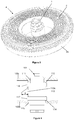
- the barrel mainly comprises a barrel shaft 1, a barrel spring 2, a barrel drum 3a and a barrel cover 3b (not shown in the figure. figure 3 ).
- the barrel drum has teeth making it possible to drive the cogs of a clockwork mechanism, in particular of a wristwatch mechanism.
- the barrel makes it possible to store the mechanical energy necessary for the operation of the watch mechanism. This energy is stored in the form of elastic potential energy, due to the deformation of the spring.
- the spring comprises a leaf spring wound in the drum around the shaft, the spring being mechanically linked to the shaft at its inner end 5 and being mechanically linked to the drum at its outer end. When the spring is fully charged, it is wound on the shaft and it tends to cause the drum to rotate relative to the shaft.
- the spring is shown unarmed at the figure 3 , the spring being wound on itself at the level of the inside of the diameter of the drum. In this configuration, the spring does not tend to drive the drum in rotation. To arm the spring, it suffices to drive the shaft in rotation around its axis.
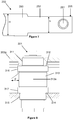
- a barrel spring 2 is shown partially at the bottom. figure 2 . It comprises a first portion 50 (or active part) of a first height H and a second portion 52 of a second height h less than the first height. It also includes at the second portion, for example at the inner end, a first hooking element 51 adapted for its attachment to the barrel shaft 1.
- the first fastening element has a maximum height h '.
- the second portion is intended to fit into a circumferentially extending groove provided on the barrel shaft. By “extending circumferentially” is meant that the groove extends at least over a part of the circumference of the shaft.
- the groove has a depth p.
- the first hooking element 51 is advantageously intended to cooperate with a second hooking element 13a provided on the shaft.
- the first fastening element may comprise a trapezoidal or substantially trapezoidal conformation 51a, 51b delimited by edges 51a, 51b.
- the two bases of the trapezoidal shape are oriented according to the height of the spring or substantially according to the height of the spring. Further, preferably, the trapezoidal shape is symmetrical or substantially symmetrical.
- the second portion can be obtained by implementing a step of machining the spring at its inner end, for example by mechanical cutting, grinding, stamping, laser machining or water jet cutting.
- the spring advantageously has, before implementation of this step, an elastic band of constant height H.
- a barrel shaft is described below with reference to figure 1 . It comprises a groove 13 extending over a circumference of the shaft and this groove is intended to receive the barrel spring 2.
- the tree is a solid tree. On either side of the groove, it preferably comprises shoulders 12 and 14 and bearing surfaces 11 and 15.
- the cylindrical portion 11 and cylindrical portion 15 allow rotation on the barrel shaft of the drum and of the barrel cover.
- the shoulder 12 makes it possible to axially stop the drum.
- the shoulder 14 makes it possible to axially stop the cover.
- the two shoulders allow the casing of the barrel (cover and drum assembled) to swing away from the shaft.
- the groove advantageously has a height comparable to the second height h of the spring.
- the groove comprises at least a portion whose height is less than the height of the active part of the barrel spring and the second portion 52 of the spring can be wound on the shaft in the groove.
- the section of the shaft has a shape of revolution centered on the axis of the shaft.
- the section of the shaft can also have the shape of a spiral envelope, the pitch of which is equal or substantially equal to the thickness of the spring.
- the length of the second portion may correspond to the length of a complete turn wound on the shaft.
- the groove has a depth at least locally greater than or equal to the thickness of the barrel spring, or even a depth greater than or equal to the thickness of the barrel spring over the entire extent of the groove, or even a depth equal or substantially equal to the thickness of the barrel spring.
- the groove can extend only part of the circumference of the shaft.
- the groove can extend over more than 180 ° around the axis of the barrel shaft.
- the groove may also preferably extend over the entire circumference of the barrel shaft.
- the groove bottom radius can be scalable, i.e. the groove bottom radius at a groove bottom point can have a value varying with the circumferential position of this point.
- the shaft comprises, in the groove, in particular at the bottom of the groove, a second hooking element 113a of the barrel spring, the second hooking element being intended to cooperate with the first hooking element 51 provided on the barrel spring.
- the second attachment element comprises, in the case of figures 1 to 3 a hollow conformation comprising edges 13b and 13c intended to cooperate with the trapezoidal conformation 51a, 51b of the spring. Indeed, the edges 13b and 13c come into contact against the edges 51a and 51b. Due to the trapezoidal shape and depending on the angle of the edges 13b and 13c, there may even be jamming of the end of the spring on the shaft.
- the trapezoidal shapes 13a and 51 are preferably oriented along the circumference.
- the second portion 52 of the spring is preferably a non-active part, that is to say a part which does not contribute or very little to the torque developed by the spring, that is to say an unsolicited part or little mechanically stressed in bending.
- the groove thus preferably has, at its bottom, a diameter less than the outside diameter of the shoulder 12 making it possible to stop the drum of the barrel and / or less than the outside diameter of the shoulder 14 making it possible to stop the cover of the barrel. .
- portions 16 and 17 are provided to receive the wound turns of the first portion (50) of the spring.
- the first and second hooking elements have been designed to reduce the bung diameter as much as possible.
- This reduction is therefore achieved by making a groove or groove on the shaft which advantageously has a height comparable to the second height h of the spring, with a clearance of diameter smaller than that of the shoulders necessary to maintain the drum and cover.
- the inner end of the spring is cut with a lower band height over a length roughly equivalent to that of the first turn, in order to increase the number of winding turns and therefore the power reserve.
- the groove or groove is machined inside the shaft and includes a hooking part, in particular a recess serving as a female part.
- the shape of the internal end of the spring must be adapted accordingly, by cutting a "tab" of lower height than the rest of the blade which allows the first turn to fit into the groove, with a terminal part in the form of a dovetail which acts as a male part.
- a shell is made, the first turn of which has an internal diameter smaller than the groove machined inside the shaft. This makes it possible to promote the grip by a clamping action of the band on the shaft.
- the spring is shelled over one turn, in the particular case shown over a height reduced to 0.9 mm with respect to the height of the first portion of 1.46 mm.
- This shell is pressed against the groove machined inside the shaft, provided with the clearance 13a for the attachment of the dovetail 51, 51a, 51b of the spring.
- the rotation of the spring is blocked on the shaft thanks to the clearance and its clearance angle.
- the spring portion is active and its height changes to 1.46 mm.
- the manufacture of the shaft is facilitated thanks to the elimination of the hook or the lug and the passage of a plug with an evolving diameter to a groove of revolution machinable on a lathe.
- the machining of the clearance for the hooking of the end is done simply by passing an angle milling cutter (or dovetail milling cutter).
- the radial and longitudinal supports of the cover and of the drum are done as traditionally on the shaft and the assembly of the barrel within the clockwork movement remains traditional. More particularly, the longitudinal bearing of the drum and of the cover is defined by the shoulders 12 and 14 of the shaft, while the longitudinal bearing of the barrel relative to the blanks is also effected by the shoulders, in this case by the shoulders adjacent to shoulders 12 and 14.
- the hooking elements also have undeniable advantages for assembling the spring on the barrel shaft.
- the radius of curvature of the inner coil of the spring before assembly is always less than the bung radius, so as to guarantee a good plating and tightening of the spring on the shaft and adequate fixing.
- the lower end of the spring must be opened a first time to cross the span and place the spring on the bung. It then takes a second manipulation of opening the spring to move it away from the shaft and thus allow it to pass over the lug by sliding it down.
- the shell must be placed precisely opposite the lug to ensure good grip of the spring on the shaft.
- a fixing of the eagle tail or dovetail type makes it possible to correctly position a shell spring without any other manipulation than to slightly open the coil or the internal winding of the formed spring to pass the bearing 12 or 14, then to rotate the shaft to engage the trapezoidal portion of the spring in the corresponding part of the shaft.
- a second embodiment of a watch barrel comprising a barrel shaft and a barrel spring according to the invention is described below with reference to figures 4 and 5 .
- the second embodiment differs from the first embodiment only by making the first hooking element 151 and the second hooking element, the first hooking element and the second hooking element being intended to cooperate with one another. with the other.
- a lug or hook 113a is produced on the shaft at the bottom of the groove 113.
- the production of such a lug or hook is relatively complicated.
- the lug or the hook cooperates with a squab or an opening 151 made at the end 105 of the spring.
- the opening has for example a substantially rectangular shape.
- the lug or hook is shaped to be inserted into the squab.
- the tree pivots in a stone at its upper end.
- the drum 103a pivots on the shaft at the level of the portion 111 and the bearing 112, while the cover 103b does the same on the portion 115 and the bearing 114.
- a third embodiment of a watch barrel comprising a barrel shaft and a barrel spring according to the invention is described below with reference to figures 6 and 7 .
- the third embodiment differs from the first embodiment only by the realization of the first hooking element 251 and the second hooking element 213a, the first hooking element and the second hooking element being intended to cooperate with the one with the other.
- a cutout 213a such as a bore, is made in the shaft at the bottom of the groove 213.
- This cutout is for example made perpendicular to the axis of the shaft.
- the cutout cooperates with a pin 251 fixed to the end 205 of the spring.
- the pin can in particular be riveted to the spring.
- a fourth embodiment of a watch barrel comprising a barrel shaft and a barrel spring according to the invention is described below with reference to figures 8 and 9 .
- the fourth embodiment differs from the first embodiment only by the realization of the first hooking element 351 and the second hooking element 313a, the first hooking element and the second hooking element being intended to cooperate with the one with the other.
- a notch 313a like a radial notch, is made in the shaft at the bottom of the groove 313.
- the notch cooperates with a fold 351 made at the end 305 of the spring.
- the second hooking element comprises a protuberance, for example a hook, or a particular conformation of the groove or a recess in the groove and the first hooking element comprises an opening or a conformation. particular of the inner end of the spring or a pin, in particular a riveted pin.
- the inner end of the spring forms a coil, in particular a diameter, having dimensions such that the coil is deformed when it is mounted on the shaft.
- the spring can be fixed to the shaft by clipping, wedging, or in the traditional manner with a lug.
- the hooking is done by means of a tab (male form) cut from the internal end of the leaf spring, which is retained by a corresponding female form machined inside the shaft.
- a tab male form
- Such a system therefore comprises an inversion of the male and female parts of the binding with respect to the standard solution: the male part is moved from the shaft onto the spring.
- the spring of the invention can in particular be made of a material with high mechanical strength, such as for example an amorphous metal alloy described in the application. WO2012010941 .
- a material with high mechanical strength such as for example an amorphous metal alloy described in the application. WO2012010941 .
- traditional high-performance metal alloys such as cobalt-based superalloys (Nivaflex or other) or alloys with a high nitrogen content (CrMnN alloys as described in the document CH703796 ) can also be used.
- the dimensioning of the bung diameter must however take into account the plastic deformation characteristics specific to the state of each material considered.
- the gain achieved by virtue of the invention can be more or less limited depending on the material chosen (and its hardening state for polycrystalline materials). For this reason, the increase in performance observed with a barrel according to the invention will probably be more marked with a spring of the type described in the application.
- WO2012010941 or in the document CH703796 only with a Ni
- the diameter of the groove so that the tab 52 of the inner end of the spring makes more than one turn on the shaft.
- the active portion of the spring also comprises a portion of reduced height which can be inserted into the groove of the shaft.
- each spring winding intended to be housed in these grooves has a different height.
- the heights of the windings can be smaller and smaller as one approaches the inner end of the spring.
- the shaft may have a groove 413 making it possible to accommodate therein more than one complete winding (or turn) of the spring.
- one or more winding of the spring can be housed in the groove without this winding protruding by a radial size defined by the diameter 16, 116, 216 or 316.
- the groove can be stepped.
- the groove can be seen as constituting several grooves of different heights, made one at the bottom of the other.
- This stepped groove case makes it possible to accommodate an extent of more than one coil of the spring in the groove without this spring extent projecting from a radial space defined by the diameter 16, 116, 216 or 316.
- the depth p of the groove is greater than the thickness of the spring.
- the barrel spring and / or the barrel shaft and / or the barrel of the invention is particularly suitable for taking advantage of the exceptional mechanical properties of amorphous metal alloys.
- the barrel according to the invention allows a saving of two turns of development with a spring in amorphous metal alloy as described in the application. WO2012010941 .
- the combination of the barrel according to the invention and of an amorphous metal alloy makes it possible to gain in the above example 40% autonomy, with an identical size of the barrel.
- the springs were made with the same blade length and flange. However, other factors like flange, shell shape and blade length come into play and the system could be optimized by changing parameters like blade length or flange characteristics.
- the maximum height h ′ of the first attachment element can advantageously be less than the height H of the first portion.
- the maximum height h 'of the first fastening element can also be advantageously less than the distance between the bearing surfaces 12 and 14 of the barrel shaft which define the part on which the first portion of the spring comes to rest.
- the maximum height h 'of the first fastening element can advantageously be greater than the height h of the second portion of the spring, and advantageously greater than the height of the groove 13 of the barrel shaft.
- the height of the spring on the first turn, including the end, can also be advantageously less than the height of the spring on its outer part (in other words, max (h ', h) ⁇ H where max (a, b) denotes the maximum value of the two parameters a, b).
- the depth p of the groove is preferably equal or substantially equal to the thickness of the spring.
- the depth of the groove may be greater than the thickness of the spring.
- the first hooking element comprises a trapezoidal or substantially trapezoidal part.
- This trapezoidal part may have a height which decreases as one moves away from the inner end of the spring.
- the trapezoidal part may have a height varying from the maximum height h 'to the height h.
- the spring is such that it respects the following condition: H> h '> h
- the groove intended to receive the spring has, as a second hooking element, a housing or a conformation or a recess complementary or substantially complementary to the first hooking element.
- the second height h can evolve along the second portion.
Landscapes
- Physics & Mathematics (AREA)
- General Physics & Mathematics (AREA)
- Engineering & Computer Science (AREA)
- Metallurgy (AREA)
- Springs (AREA)
Priority Applications (2)
| Application Number | Priority Date | Filing Date | Title |
|---|---|---|---|
| EP13713910.1A EP2834712B1 (fr) | 2012-04-04 | 2013-04-04 | Barillet comprenant un ressort de barillet et un arbre de barillet |
| EP21206061.0A EP3968093A1 (fr) | 2012-04-04 | 2013-04-04 | Arbre de barillet pour mouvement horloger, ressort de barillet et barillet comprenant un tel ressort et/ou un tel arbre |
Applications Claiming Priority (3)
| Application Number | Priority Date | Filing Date | Title |
|---|---|---|---|
| EP12002440 | 2012-04-04 | ||
| EP13713910.1A EP2834712B1 (fr) | 2012-04-04 | 2013-04-04 | Barillet comprenant un ressort de barillet et un arbre de barillet |
| PCT/EP2013/057064 WO2013150086A1 (fr) | 2012-04-04 | 2013-04-04 | Arbre de barillet pour mouvement horloger, ressort de barillet et barillet comprenant un tel ressort et/ou un tel arbre |
Related Child Applications (1)
| Application Number | Title | Priority Date | Filing Date |
|---|---|---|---|
| EP21206061.0A Division EP3968093A1 (fr) | 2012-04-04 | 2013-04-04 | Arbre de barillet pour mouvement horloger, ressort de barillet et barillet comprenant un tel ressort et/ou un tel arbre |
Publications (2)
| Publication Number | Publication Date |
|---|---|
| EP2834712A1 EP2834712A1 (fr) | 2015-02-11 |
| EP2834712B1 true EP2834712B1 (fr) | 2021-11-24 |
Family
ID=48045552
Family Applications (2)
| Application Number | Title | Priority Date | Filing Date |
|---|---|---|---|
| EP13713910.1A Active EP2834712B1 (fr) | 2012-04-04 | 2013-04-04 | Barillet comprenant un ressort de barillet et un arbre de barillet |
| EP21206061.0A Pending EP3968093A1 (fr) | 2012-04-04 | 2013-04-04 | Arbre de barillet pour mouvement horloger, ressort de barillet et barillet comprenant un tel ressort et/ou un tel arbre |
Family Applications After (1)
| Application Number | Title | Priority Date | Filing Date |
|---|---|---|---|
| EP21206061.0A Pending EP3968093A1 (fr) | 2012-04-04 | 2013-04-04 | Arbre de barillet pour mouvement horloger, ressort de barillet et barillet comprenant un tel ressort et/ou un tel arbre |
Country Status (5)
| Country | Link |
|---|---|
| US (2) | US9448533B2 (https=) |
| EP (2) | EP2834712B1 (https=) |
| JP (1) | JP6219925B2 (https=) |
| CN (2) | CN108196438B (https=) |
| WO (1) | WO2013150086A1 (https=) |
Families Citing this family (5)
| Publication number | Priority date | Publication date | Assignee | Title |
|---|---|---|---|---|
| CN105759588A (zh) * | 2016-04-01 | 2016-07-13 | 杭州手表有限公司 | 一种长走时的高频自动机械手表 |
| JP7133909B2 (ja) * | 2016-07-04 | 2022-09-09 | ロレックス・ソシエテ・アノニム | 時計用組立体の製造方法、及び該製造方法により得られる時計用組立体 |
| CH713389B1 (fr) * | 2017-01-27 | 2020-11-30 | Richemont Int Sa | Système de liaison d'un arbre à une pièce. |
| EP3499316B1 (fr) * | 2017-12-15 | 2024-08-07 | Nivarox-FAR S.A. | Ressort de barillet pour un mouvement horloger d'une pièce d'horlogerie et procédé de fabrication d'un tel ressort |
| CH716092B1 (fr) * | 2018-04-26 | 2022-10-31 | Patek Philippe Sa Geneve | Barillet d'horlogerie et procédé de modification de mouvement horloger. |
Family Cites Families (28)
| Publication number | Priority date | Publication date | Assignee | Title |
|---|---|---|---|---|
| DE612146C (de) * | 1935-10-29 | E H Jakob Kienzle Dr Ing | Zugfederbefestigung | |
| US381176A (en) * | 1888-04-17 | Mainspring for watches | ||
| DE471680C (de) * | 1929-02-15 | Feinbau Maschinen Akt Ges | Federachse | |
| CH24783A (fr) * | 1901-10-29 | 1903-02-15 | Jules Jequier Fils | Barillet moteur pour montres |
| US1110061A (en) * | 1914-04-02 | 1914-09-08 | Herbert Kienzle | Removable spring-housing for clocks. |
| US1435642A (en) * | 1921-05-06 | 1922-11-14 | Waterbury Clock Co | Mainspring arbor for timepieces |
| US1628668A (en) * | 1925-12-12 | 1927-05-17 | Bell & Howell Co | Flat-spiral power spring |
| US2233075A (en) * | 1938-06-17 | 1941-02-25 | Marx & Co Louis | Spring motor |
| DE859698C (de) * | 1938-09-01 | 1952-12-15 | Paillard Sa | Vorrichtung zur Befestigung einer Feder an einer Welle |
| US2644193A (en) * | 1950-11-17 | 1953-07-07 | Axel W Anderberg | Spring sash balance |
| CH295135A (de) | 1951-11-16 | 1953-12-15 | Ag Brac | Uhrwerk. |
| GB1148042A (en) * | 1966-02-18 | 1969-04-10 | Stamford Metallics Ltd | Improvements in or relating to clockwork motors |
| CH566044A (https=) | 1972-12-18 | 1975-08-29 | ||
| CH1147874A4 (https=) * | 1974-08-22 | 1977-05-13 | ||
| CH607738B (de) * | 1975-10-21 | Ebauchesfabrik Eta Ag | Arbre de barillet extractible pour mouvement de montre. | |
| JP3757826B2 (ja) * | 2000-07-05 | 2006-03-22 | セイコーエプソン株式会社 | カード型発電機及びそれを用いた電子機器 |
| DE10357228A1 (de) * | 2003-12-08 | 2005-07-07 | Lange Uhren Gmbh | Federhausvorrichtung |
| DE602004016282D1 (de) * | 2004-04-01 | 2008-10-16 | Richemont Int Sa | Uhrwerk mit mehreren Federhäusern |
| CH702035B1 (fr) * | 2006-10-20 | 2011-04-29 | Eterna Sa Fabrique D Horlogerie | Pièce d'horlogerie. |
| EP2060957A1 (fr) * | 2007-11-16 | 2009-05-20 | ETA SA Manufacture Horlogère Suisse | Organe moteur à ressorts pour mouvement d'horlogerie |
| EP2085833A1 (fr) * | 2008-01-31 | 2009-08-05 | CT Time S.A. | Mouvement d'horlogerie modulaire |
| CH698962B1 (fr) | 2008-06-10 | 2014-10-31 | Rolex Sa | Ressort de barillet et procédé pour sa mise en forme. |
| CH699988A2 (fr) * | 2008-11-28 | 2010-05-31 | Patek Philippe Sa Geneve | Organe moteur pour mouvement horloger. |
| CN201662690U (zh) * | 2010-03-30 | 2010-12-01 | 天津海鸥表业集团有限公司 | 一种大型机械表机芯的条轴结构 |
| EP2596140B1 (fr) | 2010-07-21 | 2018-05-16 | Rolex S.A. | Composant horloger comprenant un alliage métallique amorphe |
| CH703796B1 (fr) | 2010-10-28 | 2012-03-30 | Gen Ressorts Sa | Ressort. |
| EP2570862B1 (fr) * | 2011-09-15 | 2014-03-05 | ETA SA Manufacture Horlogère Suisse | Ensemble barillet d'horlogerie à diamètre de bonde réduit |
| CH706214B1 (fr) * | 2012-03-09 | 2016-09-30 | Sowind SA | Barillet de pièce d'horlogerie. |
-
2013
- 2013-04-04 WO PCT/EP2013/057064 patent/WO2013150086A1/fr not_active Ceased
- 2013-04-04 JP JP2015503873A patent/JP6219925B2/ja active Active
- 2013-04-04 CN CN201810147446.5A patent/CN108196438B/zh active Active
- 2013-04-04 EP EP13713910.1A patent/EP2834712B1/fr active Active
- 2013-04-04 CN CN201380018501.6A patent/CN104204965B/zh active Active
- 2013-04-04 US US14/390,699 patent/US9448533B2/en active Active
- 2013-04-04 EP EP21206061.0A patent/EP3968093A1/fr active Pending
-
2016
- 2016-08-08 US US15/231,303 patent/US10401796B2/en active Active
Non-Patent Citations (1)
| Title |
|---|
| None * |
Also Published As
| Publication number | Publication date |
|---|---|
| US20160349703A1 (en) | 2016-12-01 |
| WO2013150086A1 (fr) | 2013-10-10 |
| EP3968093A1 (fr) | 2022-03-16 |
| US9448533B2 (en) | 2016-09-20 |
| US10401796B2 (en) | 2019-09-03 |
| CN108196438B (zh) | 2020-09-08 |
| CN108196438A (zh) | 2018-06-22 |
| JP2015512519A (ja) | 2015-04-27 |
| US20150092523A1 (en) | 2015-04-02 |
| EP2834712A1 (fr) | 2015-02-11 |
| CN104204965B (zh) | 2018-03-27 |
| JP6219925B2 (ja) | 2017-10-25 |
| CN104204965A (zh) | 2014-12-10 |
Similar Documents
| Publication | Publication Date | Title |
|---|---|---|
| EP2834712B1 (fr) | Barillet comprenant un ressort de barillet et un arbre de barillet | |
| EP2657794B1 (fr) | Arbre et ressort de barillet | |
| EP2350745B1 (fr) | Organe moteur pour mouvement horloger | |
| EP3252542B1 (fr) | Pièce de fixation d'un ressort-spiral horloger | |
| EP3070537A1 (fr) | Base de temps comportant un echappement a impulsion directe et a force constante | |
| EP3889689B1 (fr) | Organe moteur pour pièce d'horlogerie | |
| CH713409B1 (fr) | Balancier pour balancier-spiral du type thermocompensé, balancier-spiral du type thermocompensé, mouvement et pièce d'horlogerie. | |
| CH715052A2 (fr) | Mécanisme à couple constant, mouvement de pièce d'horlogerie, et pièce d'horlogerie. | |
| CH716092B1 (fr) | Barillet d'horlogerie et procédé de modification de mouvement horloger. | |
| EP3598241B1 (fr) | Mecanisme horloger a dispositif a force constante | |
| WO2013104941A1 (fr) | Piece d'horlogerie a remontage automatique | |
| EP3781993B1 (fr) | Mécanisme d'échappement direct libre pour piece d'horlogerie | |
| EP2869134B1 (fr) | Système de barillet pour pièce d'horlogerie | |
| EP3218770B1 (fr) | Organe moteur pour mouvement d'horlogerie | |
| EP4075204A1 (fr) | Cliquet d'arret pour mouvement d'horlogerie | |
| EP3872576B1 (fr) | Barillet d'horlogerie a arbre vrille | |
| EP2443523A2 (fr) | Dispositif inverseur pour mouvement horloger | |
| CH701968B1 (fr) | Source d'énergie pour sonnerie et pièce d'horlogerie munie d'une telle source d'énergie. | |
| EP3470932B1 (fr) | Oscillateur pour mouvement horloger | |
| EP3432082A1 (fr) | Organe reglant | |
| EP4325303A1 (fr) | Mécanisme de quantième perpétuel à cames concentriques | |
| CH693516A5 (fr) | Dispositif moteur dans une montre mécanique. | |
| CH717288A2 (fr) | Cliquet d'arrêt pour mouvement d'horlogerie. | |
| CH305768A (fr) | Ressort moteur, en particulier pour montre à remontage automatique. | |
| WO2017005394A1 (fr) | Arbre de barillet d'horlogerie |
Legal Events
| Date | Code | Title | Description |
|---|---|---|---|
| PUAI | Public reference made under article 153(3) epc to a published international application that has entered the european phase |
Free format text: ORIGINAL CODE: 0009012 |
|
| 17P | Request for examination filed |
Effective date: 20141002 |
|
| AK | Designated contracting states |
Kind code of ref document: A1 Designated state(s): AL AT BE BG CH CY CZ DE DK EE ES FI FR GB GR HR HU IE IS IT LI LT LU LV MC MK MT NL NO PL PT RO RS SE SI SK SM TR |
|
| AX | Request for extension of the european patent |
Extension state: BA ME |
|
| DAX | Request for extension of the european patent (deleted) | ||
| GRAP | Despatch of communication of intention to grant a patent |
Free format text: ORIGINAL CODE: EPIDOSNIGR1 |
|
| STAA | Information on the status of an ep patent application or granted ep patent |
Free format text: STATUS: GRANT OF PATENT IS INTENDED |
|
| INTG | Intention to grant announced |
Effective date: 20201204 |
|
| GRAJ | Information related to disapproval of communication of intention to grant by the applicant or resumption of examination proceedings by the epo deleted |
Free format text: ORIGINAL CODE: EPIDOSDIGR1 |
|
| STAA | Information on the status of an ep patent application or granted ep patent |
Free format text: STATUS: REQUEST FOR EXAMINATION WAS MADE |
|
| INTC | Intention to grant announced (deleted) | ||
| GRAP | Despatch of communication of intention to grant a patent |
Free format text: ORIGINAL CODE: EPIDOSNIGR1 |
|
| STAA | Information on the status of an ep patent application or granted ep patent |
Free format text: STATUS: GRANT OF PATENT IS INTENDED |
|
| INTG | Intention to grant announced |
Effective date: 20210607 |
|
| RIN1 | Information on inventor provided before grant (corrected) |
Inventor name: VON NIEDERHAEUSERN, VINCENT Inventor name: GYGER, THOMAS Inventor name: BORTOLI, ALBERT Inventor name: BERTRAND, JEAN-LOUIS |
|
| GRAS | Grant fee paid |
Free format text: ORIGINAL CODE: EPIDOSNIGR3 |
|
| GRAA | (expected) grant |
Free format text: ORIGINAL CODE: 0009210 |
|
| STAA | Information on the status of an ep patent application or granted ep patent |
Free format text: STATUS: THE PATENT HAS BEEN GRANTED |
|
| AK | Designated contracting states |
Kind code of ref document: B1 Designated state(s): AL AT BE BG CH CY CZ DE DK EE ES FI FR GB GR HR HU IE IS IT LI LT LU LV MC MK MT NL NO PL PT RO RS SE SI SK SM TR |
|
| REG | Reference to a national code |
Ref country code: GB Ref legal event code: FG4D Free format text: NOT ENGLISH |
|
| REG | Reference to a national code |
Ref country code: AT Ref legal event code: REF Ref document number: 1450318 Country of ref document: AT Kind code of ref document: T Effective date: 20211215 |
|
| REG | Reference to a national code |
Ref country code: DE Ref legal event code: R096 Ref document number: 602013080175 Country of ref document: DE |
|
| REG | Reference to a national code |
Ref country code: IE Ref legal event code: FG4D Free format text: LANGUAGE OF EP DOCUMENT: FRENCH |
|
| REG | Reference to a national code |
Ref country code: LT Ref legal event code: MG9D |
|
| REG | Reference to a national code |
Ref country code: NL Ref legal event code: MP Effective date: 20211124 |
|
| REG | Reference to a national code |
Ref country code: AT Ref legal event code: MK05 Ref document number: 1450318 Country of ref document: AT Kind code of ref document: T Effective date: 20211124 |
|
| PG25 | Lapsed in a contracting state [announced via postgrant information from national office to epo] |
Ref country code: RS Free format text: LAPSE BECAUSE OF FAILURE TO SUBMIT A TRANSLATION OF THE DESCRIPTION OR TO PAY THE FEE WITHIN THE PRESCRIBED TIME-LIMIT Effective date: 20211124 Ref country code: LT Free format text: LAPSE BECAUSE OF FAILURE TO SUBMIT A TRANSLATION OF THE DESCRIPTION OR TO PAY THE FEE WITHIN THE PRESCRIBED TIME-LIMIT Effective date: 20211124 Ref country code: FI Free format text: LAPSE BECAUSE OF FAILURE TO SUBMIT A TRANSLATION OF THE DESCRIPTION OR TO PAY THE FEE WITHIN THE PRESCRIBED TIME-LIMIT Effective date: 20211124 Ref country code: BG Free format text: LAPSE BECAUSE OF FAILURE TO SUBMIT A TRANSLATION OF THE DESCRIPTION OR TO PAY THE FEE WITHIN THE PRESCRIBED TIME-LIMIT Effective date: 20220224 Ref country code: AT Free format text: LAPSE BECAUSE OF FAILURE TO SUBMIT A TRANSLATION OF THE DESCRIPTION OR TO PAY THE FEE WITHIN THE PRESCRIBED TIME-LIMIT Effective date: 20211124 |
|
| PG25 | Lapsed in a contracting state [announced via postgrant information from national office to epo] |
Ref country code: IS Free format text: LAPSE BECAUSE OF FAILURE TO SUBMIT A TRANSLATION OF THE DESCRIPTION OR TO PAY THE FEE WITHIN THE PRESCRIBED TIME-LIMIT Effective date: 20220324 Ref country code: SE Free format text: LAPSE BECAUSE OF FAILURE TO SUBMIT A TRANSLATION OF THE DESCRIPTION OR TO PAY THE FEE WITHIN THE PRESCRIBED TIME-LIMIT Effective date: 20211124 Ref country code: PT Free format text: LAPSE BECAUSE OF FAILURE TO SUBMIT A TRANSLATION OF THE DESCRIPTION OR TO PAY THE FEE WITHIN THE PRESCRIBED TIME-LIMIT Effective date: 20220324 Ref country code: PL Free format text: LAPSE BECAUSE OF FAILURE TO SUBMIT A TRANSLATION OF THE DESCRIPTION OR TO PAY THE FEE WITHIN THE PRESCRIBED TIME-LIMIT Effective date: 20211124 Ref country code: NO Free format text: LAPSE BECAUSE OF FAILURE TO SUBMIT A TRANSLATION OF THE DESCRIPTION OR TO PAY THE FEE WITHIN THE PRESCRIBED TIME-LIMIT Effective date: 20220224 Ref country code: NL Free format text: LAPSE BECAUSE OF FAILURE TO SUBMIT A TRANSLATION OF THE DESCRIPTION OR TO PAY THE FEE WITHIN THE PRESCRIBED TIME-LIMIT Effective date: 20211124 Ref country code: LV Free format text: LAPSE BECAUSE OF FAILURE TO SUBMIT A TRANSLATION OF THE DESCRIPTION OR TO PAY THE FEE WITHIN THE PRESCRIBED TIME-LIMIT Effective date: 20211124 Ref country code: HR Free format text: LAPSE BECAUSE OF FAILURE TO SUBMIT A TRANSLATION OF THE DESCRIPTION OR TO PAY THE FEE WITHIN THE PRESCRIBED TIME-LIMIT Effective date: 20211124 Ref country code: GR Free format text: LAPSE BECAUSE OF FAILURE TO SUBMIT A TRANSLATION OF THE DESCRIPTION OR TO PAY THE FEE WITHIN THE PRESCRIBED TIME-LIMIT Effective date: 20220225 Ref country code: ES Free format text: LAPSE BECAUSE OF FAILURE TO SUBMIT A TRANSLATION OF THE DESCRIPTION OR TO PAY THE FEE WITHIN THE PRESCRIBED TIME-LIMIT Effective date: 20211124 |
|
| PG25 | Lapsed in a contracting state [announced via postgrant information from national office to epo] |
Ref country code: SM Free format text: LAPSE BECAUSE OF FAILURE TO SUBMIT A TRANSLATION OF THE DESCRIPTION OR TO PAY THE FEE WITHIN THE PRESCRIBED TIME-LIMIT Effective date: 20211124 Ref country code: SK Free format text: LAPSE BECAUSE OF FAILURE TO SUBMIT A TRANSLATION OF THE DESCRIPTION OR TO PAY THE FEE WITHIN THE PRESCRIBED TIME-LIMIT Effective date: 20211124 Ref country code: RO Free format text: LAPSE BECAUSE OF FAILURE TO SUBMIT A TRANSLATION OF THE DESCRIPTION OR TO PAY THE FEE WITHIN THE PRESCRIBED TIME-LIMIT Effective date: 20211124 Ref country code: EE Free format text: LAPSE BECAUSE OF FAILURE TO SUBMIT A TRANSLATION OF THE DESCRIPTION OR TO PAY THE FEE WITHIN THE PRESCRIBED TIME-LIMIT Effective date: 20211124 Ref country code: DK Free format text: LAPSE BECAUSE OF FAILURE TO SUBMIT A TRANSLATION OF THE DESCRIPTION OR TO PAY THE FEE WITHIN THE PRESCRIBED TIME-LIMIT Effective date: 20211124 Ref country code: CZ Free format text: LAPSE BECAUSE OF FAILURE TO SUBMIT A TRANSLATION OF THE DESCRIPTION OR TO PAY THE FEE WITHIN THE PRESCRIBED TIME-LIMIT Effective date: 20211124 |
|
| REG | Reference to a national code |
Ref country code: DE Ref legal event code: R097 Ref document number: 602013080175 Country of ref document: DE |
|
| PLBE | No opposition filed within time limit |
Free format text: ORIGINAL CODE: 0009261 |
|
| STAA | Information on the status of an ep patent application or granted ep patent |
Free format text: STATUS: NO OPPOSITION FILED WITHIN TIME LIMIT |
|
| PG25 | Lapsed in a contracting state [announced via postgrant information from national office to epo] |
Ref country code: AL Free format text: LAPSE BECAUSE OF FAILURE TO SUBMIT A TRANSLATION OF THE DESCRIPTION OR TO PAY THE FEE WITHIN THE PRESCRIBED TIME-LIMIT Effective date: 20211124 |
|
| 26N | No opposition filed |
Effective date: 20220825 |
|
| PG25 | Lapsed in a contracting state [announced via postgrant information from national office to epo] |
Ref country code: SI Free format text: LAPSE BECAUSE OF FAILURE TO SUBMIT A TRANSLATION OF THE DESCRIPTION OR TO PAY THE FEE WITHIN THE PRESCRIBED TIME-LIMIT Effective date: 20211124 |
|
| REG | Reference to a national code |
Ref country code: BE Ref legal event code: MM Effective date: 20220430 |
|
| PG25 | Lapsed in a contracting state [announced via postgrant information from national office to epo] |
Ref country code: MC Free format text: LAPSE BECAUSE OF FAILURE TO SUBMIT A TRANSLATION OF THE DESCRIPTION OR TO PAY THE FEE WITHIN THE PRESCRIBED TIME-LIMIT Effective date: 20211124 Ref country code: LU Free format text: LAPSE BECAUSE OF NON-PAYMENT OF DUE FEES Effective date: 20220404 |
|
| PG25 | Lapsed in a contracting state [announced via postgrant information from national office to epo] |
Ref country code: BE Free format text: LAPSE BECAUSE OF NON-PAYMENT OF DUE FEES Effective date: 20220430 |
|
| PG25 | Lapsed in a contracting state [announced via postgrant information from national office to epo] |
Ref country code: IE Free format text: LAPSE BECAUSE OF NON-PAYMENT OF DUE FEES Effective date: 20220404 |
|
| PG25 | Lapsed in a contracting state [announced via postgrant information from national office to epo] |
Ref country code: IT Free format text: LAPSE BECAUSE OF FAILURE TO SUBMIT A TRANSLATION OF THE DESCRIPTION OR TO PAY THE FEE WITHIN THE PRESCRIBED TIME-LIMIT Effective date: 20211124 |
|
| P01 | Opt-out of the competence of the unified patent court (upc) registered |
Effective date: 20230529 |
|
| PG25 | Lapsed in a contracting state [announced via postgrant information from national office to epo] |
Ref country code: HU Free format text: LAPSE BECAUSE OF FAILURE TO SUBMIT A TRANSLATION OF THE DESCRIPTION OR TO PAY THE FEE WITHIN THE PRESCRIBED TIME-LIMIT; INVALID AB INITIO Effective date: 20130404 |
|
| PG25 | Lapsed in a contracting state [announced via postgrant information from national office to epo] |
Ref country code: MK Free format text: LAPSE BECAUSE OF FAILURE TO SUBMIT A TRANSLATION OF THE DESCRIPTION OR TO PAY THE FEE WITHIN THE PRESCRIBED TIME-LIMIT Effective date: 20211124 Ref country code: CY Free format text: LAPSE BECAUSE OF FAILURE TO SUBMIT A TRANSLATION OF THE DESCRIPTION OR TO PAY THE FEE WITHIN THE PRESCRIBED TIME-LIMIT Effective date: 20211124 |
|
| PG25 | Lapsed in a contracting state [announced via postgrant information from national office to epo] |
Ref country code: MT Free format text: LAPSE BECAUSE OF FAILURE TO SUBMIT A TRANSLATION OF THE DESCRIPTION OR TO PAY THE FEE WITHIN THE PRESCRIBED TIME-LIMIT Effective date: 20211124 |
|
| PGFP | Annual fee paid to national office [announced via postgrant information from national office to epo] |
Ref country code: DE Payment date: 20250411 Year of fee payment: 13 |
|
| PGFP | Annual fee paid to national office [announced via postgrant information from national office to epo] |
Ref country code: GB Payment date: 20250417 Year of fee payment: 13 |
|
| PGFP | Annual fee paid to national office [announced via postgrant information from national office to epo] |
Ref country code: FR Payment date: 20250429 Year of fee payment: 13 |
|
| PGFP | Annual fee paid to national office [announced via postgrant information from national office to epo] |
Ref country code: CH Payment date: 20250501 Year of fee payment: 13 |
|
| PG25 | Lapsed in a contracting state [announced via postgrant information from national office to epo] |
Ref country code: TR Free format text: LAPSE BECAUSE OF FAILURE TO SUBMIT A TRANSLATION OF THE DESCRIPTION OR TO PAY THE FEE WITHIN THE PRESCRIBED TIME-LIMIT Effective date: 20211124 |