EP2813282B1 - Mixing device, discharge device provided therewith, and discharge method - Google Patents
Mixing device, discharge device provided therewith, and discharge method Download PDFInfo
- Publication number
- EP2813282B1 EP2813282B1 EP13746864.1A EP13746864A EP2813282B1 EP 2813282 B1 EP2813282 B1 EP 2813282B1 EP 13746864 A EP13746864 A EP 13746864A EP 2813282 B1 EP2813282 B1 EP 2813282B1
- Authority
- EP
- European Patent Office
- Prior art keywords
- stirrer
- mixing device
- vessel
- discharge
- liquid
- Prior art date
- Legal status (The legal status is an assumption and is not a legal conclusion. Google has not performed a legal analysis and makes no representation as to the accuracy of the status listed.)
- Active
Links
Images



Classifications
-
- B—PERFORMING OPERATIONS; TRANSPORTING
- B01—PHYSICAL OR CHEMICAL PROCESSES OR APPARATUS IN GENERAL
- B01F—MIXING, e.g. DISSOLVING, EMULSIFYING OR DISPERSING
- B01F33/00—Other mixers; Mixing plants; Combinations of mixers
- B01F33/45—Magnetic mixers; Mixers with magnetically driven stirrers
-
- B—PERFORMING OPERATIONS; TRANSPORTING
- B01—PHYSICAL OR CHEMICAL PROCESSES OR APPARATUS IN GENERAL
- B01F—MIXING, e.g. DISSOLVING, EMULSIFYING OR DISPERSING
- B01F23/00—Mixing according to the phases to be mixed, e.g. dispersing or emulsifying
- B01F23/50—Mixing liquids with solids
- B01F23/53—Mixing liquids with solids using driven stirrers
-
- B—PERFORMING OPERATIONS; TRANSPORTING
- B01—PHYSICAL OR CHEMICAL PROCESSES OR APPARATUS IN GENERAL
- B01F—MIXING, e.g. DISSOLVING, EMULSIFYING OR DISPERSING
- B01F23/00—Mixing according to the phases to be mixed, e.g. dispersing or emulsifying
- B01F23/50—Mixing liquids with solids
-
- B—PERFORMING OPERATIONS; TRANSPORTING
- B01—PHYSICAL OR CHEMICAL PROCESSES OR APPARATUS IN GENERAL
- B01F—MIXING, e.g. DISSOLVING, EMULSIFYING OR DISPERSING
- B01F27/00—Mixers with rotary stirring devices in fixed receptacles; Kneaders
- B01F27/05—Stirrers
- B01F27/07—Stirrers characterised by their mounting on the shaft
- B01F27/072—Stirrers characterised by their mounting on the shaft characterised by the disposition of the stirrers with respect to the rotating axis
- B01F27/0721—Stirrers characterised by their mounting on the shaft characterised by the disposition of the stirrers with respect to the rotating axis parallel with respect to the rotating axis
-
- B—PERFORMING OPERATIONS; TRANSPORTING
- B01—PHYSICAL OR CHEMICAL PROCESSES OR APPARATUS IN GENERAL
- B01F—MIXING, e.g. DISSOLVING, EMULSIFYING OR DISPERSING
- B01F27/00—Mixers with rotary stirring devices in fixed receptacles; Kneaders
- B01F27/05—Stirrers
- B01F27/07—Stirrers characterised by their mounting on the shaft
- B01F27/072—Stirrers characterised by their mounting on the shaft characterised by the disposition of the stirrers with respect to the rotating axis
- B01F27/0724—Stirrers characterised by their mounting on the shaft characterised by the disposition of the stirrers with respect to the rotating axis directly mounted on the rotating axis
-
- B—PERFORMING OPERATIONS; TRANSPORTING
- B01—PHYSICAL OR CHEMICAL PROCESSES OR APPARATUS IN GENERAL
- B01F—MIXING, e.g. DISSOLVING, EMULSIFYING OR DISPERSING
- B01F27/00—Mixers with rotary stirring devices in fixed receptacles; Kneaders
- B01F27/05—Stirrers
- B01F27/11—Stirrers characterised by the configuration of the stirrers
- B01F27/112—Stirrers characterised by the configuration of the stirrers with arms, paddles, vanes or blades
- B01F27/1125—Stirrers characterised by the configuration of the stirrers with arms, paddles, vanes or blades with vanes or blades extending parallel or oblique to the stirrer axis
-
- B—PERFORMING OPERATIONS; TRANSPORTING
- B01—PHYSICAL OR CHEMICAL PROCESSES OR APPARATUS IN GENERAL
- B01F—MIXING, e.g. DISSOLVING, EMULSIFYING OR DISPERSING
- B01F27/00—Mixers with rotary stirring devices in fixed receptacles; Kneaders
- B01F27/05—Stirrers
- B01F27/11—Stirrers characterised by the configuration of the stirrers
- B01F27/19—Stirrers with two or more mixing elements mounted in sequence on the same axis
- B01F27/191—Stirrers with two or more mixing elements mounted in sequence on the same axis with similar elements
-
- B—PERFORMING OPERATIONS; TRANSPORTING
- B01—PHYSICAL OR CHEMICAL PROCESSES OR APPARATUS IN GENERAL
- B01F—MIXING, e.g. DISSOLVING, EMULSIFYING OR DISPERSING
- B01F33/00—Other mixers; Mixing plants; Combinations of mixers
- B01F33/45—Magnetic mixers; Mixers with magnetically driven stirrers
- B01F33/453—Magnetic mixers; Mixers with magnetically driven stirrers using supported or suspended stirring elements
- B01F33/4534—Magnetic mixers; Mixers with magnetically driven stirrers using supported or suspended stirring elements using a rod for supporting the stirring element, e.g. stirrer sliding on a rod or mounted on a rod sliding in a tube
-
- B—PERFORMING OPERATIONS; TRANSPORTING
- B01—PHYSICAL OR CHEMICAL PROCESSES OR APPARATUS IN GENERAL
- B01F—MIXING, e.g. DISSOLVING, EMULSIFYING OR DISPERSING
- B01F35/00—Accessories for mixers; Auxiliary operations or auxiliary devices; Parts or details of general application
- B01F35/75—Discharge mechanisms
- B01F35/754—Discharge mechanisms characterised by the means for discharging the components from the mixer
- B01F35/75425—Discharge mechanisms characterised by the means for discharging the components from the mixer using pistons or plungers
-
- B—PERFORMING OPERATIONS; TRANSPORTING
- B01—PHYSICAL OR CHEMICAL PROCESSES OR APPARATUS IN GENERAL
- B01F—MIXING, e.g. DISSOLVING, EMULSIFYING OR DISPERSING
- B01F35/00—Accessories for mixers; Auxiliary operations or auxiliary devices; Parts or details of general application
- B01F35/75—Discharge mechanisms
- B01F35/754—Discharge mechanisms characterised by the means for discharging the components from the mixer
- B01F35/75425—Discharge mechanisms characterised by the means for discharging the components from the mixer using pistons or plungers
- B01F35/754251—Discharge mechanisms characterised by the means for discharging the components from the mixer using pistons or plungers reciprocating in the mixing receptacle
-
- B—PERFORMING OPERATIONS; TRANSPORTING
- B01—PHYSICAL OR CHEMICAL PROCESSES OR APPARATUS IN GENERAL
- B01F—MIXING, e.g. DISSOLVING, EMULSIFYING OR DISPERSING
- B01F35/00—Accessories for mixers; Auxiliary operations or auxiliary devices; Parts or details of general application
- B01F35/75—Discharge mechanisms
- B01F35/754—Discharge mechanisms characterised by the means for discharging the components from the mixer
- B01F35/7543—Discharge mechanisms characterised by the means for discharging the components from the mixer using pneumatic pressure, overpressure or gas pressure in a closed receptacle or circuit system
Definitions
- the present invention relates to a mixing device for stirring a liquid mixed with solid particles and holding a uniformly mixed state, a discharge device provided with the mixing device, and a discharge method.
- the motor type in which a propeller-like member is disposed at a tip of a rod connected to a motor power shaft and is rotated for mixing in the liquid mixed with the solid particles
- the magnetic force type in which a stirrer incorporating a magnet or a magnetic body is put in the liquid mixed with the solid particles and is rotated for mixing by the action of a magnetic force exerted from the outside of the vessel.
- a discharge device When the liquid mixed with the solid particles is quantitatively discharged and dispensed from the vessel, a discharge device is used which is generally employed to discharge and dispense a liquid material. In the discharge device handling the liquid mixed with the solid particles, however, it is required to one of the various types of mixing devices mentioned above in order to hold the uniformly mixed state. If the liquid mixed with the solid particles is not stirred, a trouble may occur in that the liquid mixed with the solid particles is discharged in a non-uniform state, or that it cannot be discharged because of clogging of a discharge port.
- Patent Document 1 discloses a discharge device including a vessel, a stirrer for stirring a liquid, and stirrer rotating means for rotating the stirrer by a magnetic force, wherein the stirrer is arranged at a bottom in the vessel of the discharge device that discharges the liquid, and the stirrer has a through-hole penetrating from an upper surface to a lower surface thereof, a projection is formed in the upper surface, and a groove is formed in the lower surface to communicate an outer peripheral surface of the stirrer with the through-hole.
- Patent Document 2 discloses a magnetic driving device comprising a drive rotating member, a driven rotating member disposed in opposing relation to the drive rotating member, drive magnets disposed on an opposing surface of the drive rotating member, and driven magnets disposed on an opposing surface of the driven rotating member in the same number as the drive magnets, wherein the drive magnets and the driven magnets have substantially the same shape and are each constituted as a both-surface 2-pole magnet having one magnetic pole formed over one entire lateral peripheral surface and the other magnetic pole formed over the other entire lateral peripheral surface, the drive magnets and the driven magnets are each attached to the corresponding rotating members such that a central extension line passing the opposing surface of the drive magnet and the opposing surface of the driven magnet are parallel to each other, and when the drive rotating member is rotated, the driven rotating member is rotated by a magnetic force.
- Patent Document 2 further discloses a mixing device in which the above-mentioned magnetic driving device is used as a means for stirring a liquid in the mixing tank.
- Patent Document 3 which shows a mixing device in accordance with the preamble of claim 1, discloses an electric magnet ring with changing magnetic field on the outside of a membrane filter constituting the bottom of a raw liquid container, by which a stirrer retained on a frame provided right under the membrane filter is rotated to prevent the filter from clogging. A series of a pair of electric magnets are installed on the electric magnet ring and the direction of magnetic field generated each of a pair of electric magnets gradually varies to rotate the stirrer.
- Patent Documents 4 and 5 relate to similar stirrers.
- the stirrer is generally preferable to dispose the stirrer at the bottom of the vessel, like the device disclosed in Patent Document 1, from the viewpoint of generating convection and promoting the stirring in the vessel.
- the stirrer arranged at the bottom of the vessel is rotated by the magnetic force from below externally of the vessel, the stirrer comes into a state pressed against the bottom surface of the vessel by the action of its own dead weight and an attraction force exerted from a magnet.
- Patent Document 2 which includes a stirring mechanism at the bottom of the vessel, arrangement of the magnets, etc. are designed to reduce a thrust, i.e., a downward force in the direction of a rotation axis, even when a driving force is increased.
- a thrust i.e., a downward force in the direction of a rotation axis
- a support shaft has to be disposed at the bottom of the vessel (see Figs. 4 and 5 in Patent Document 2), or superconducting magnets have to be employed (see Figs. 6 to 8 in Patent Document 2). Therefore, the bottom shape of the vessel is complicated, or a large-scaled auxiliary device (such as a device for holding a low temperature) is needed. Thus, Patent Document 2 is not suitable for application to the discharge device.
- an object of the present invention is to provide a mixing device, which can solve the problems resulting from friction between a vessel and a stirrer, which can generate a circulatory flow even below the stirrer, and which allows a desired number of stirrers to be arranged at desired positions. Another object is to further provide a discharge device provided with the mixing device, and a discharge method.
- a mixing device comprising a stirrer incorporating a magnet, a stirrer holding mechanism that specifies a position of the stirrer by exerting a magnetic force on the stirrer from lateral side, and a rotation mechanism that rotates the stirrer holding mechanism, wherein the rotation mechanism rotates the stirrer holding mechanism, thereby rotating the stirrer.
- the stirrer includes a blade having a first acting surface that is widest and that generates flows in a liquid during rotation, and the first acting surface defines a tapered shape gradually narrowing toward an upper end of the blade.
- the blade of the stirrer has a second acting surface that is positioned adjacent to the first acting surface and that generates flows in the liquid during the rotation, and the second acting surface defines a tapered shape gradually narrowing toward a lower end of the blade.
- the stirrer has a cutout gradually spreading in an upper half thereof.
- the stirrer has a cutout formed in a lower half thereof.
- the stirrer may have a penetration hole that is communicated with the cutout and that is formed coaxially with the rotary shaft.
- the stirrer may be of two-blade type, or of four-blade type.
- a discharge device comprising the mixing device according to the invention, a liquid reservoir to which the stirrer holding mechanism is mounted, a nozzle communicating with the liquid reservoir, a compressed gas source, and a discharge controller that adjusts pressure of compressed gas supplied from the compressed gas source to a desired level and supplies the compressed gas.
- a discharge device comprising the mixing device according to the invention, a liquid reservoir to which the stirrer holding mechanism is mounted, a nozzle communicating with the liquid reservoir, a plunger arranged in the liquid reservoir, and a plunger driving mechanism that reciprocally moves the plunger.
- an inner space of the liquid reservoir may have a shape gradually narrowing toward a lower end thereof, and an outer lateral surface of the stirrer defines a gradually narrowing shape while a certain gap is kept between the outer lateral surface and an inner wall of a bottom portion of the liquid reservoir.
- the stirrer may be constituted by a plurality of stirrers, and the stirrer holding mechanism specifies respective positions of the plural stirrers.
- a discharge method using the discharge device according to the invention wherein the liquid is discharged from the nozzle while the stirrer is rotated at a constant speed.
- the stirrer can be arranged at the desired position within the vessel, the problems resulting from friction between the vessel and the stirrer can be solved.
- a circulatory flow can be generated even below the stirrer.
- the desired number of stirrers can be arranged at the desired positions.
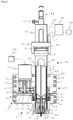
- Fig. 1 illustrates, in a way partially sectioned in principal parts, a discharge device provided with a mixing device according to a first embodiment
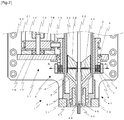
- Fig. 2 is an enlarged sectional view of a portion including the mixing device illustrated in Fig. 1
- Fig. 3 is a sectional view taken along A-A in Fig. 2
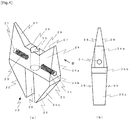
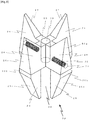
- Fig. 4 illustrates a stirrer used in the mixing device according to the first embodiment.
- Fig. 4(a) is a perspective view
- Fig. 4(b) is a side view looking at the stirrer from a direction denoted by an arrow B in Fig. 4(a) .
- the side including a stroke adjustment mechanism 54 in Fig. 1 is called the upper side
- the side including a nozzle 50 is called the lower side in some cases for convenience in explanation.
- a mixing device 1 includes, as main components, a stirrer holding mechanism 2, a rotation mechanism 11, and a stirrer 22.
- the stirrer holding mechanism 2 in this embodiment includes, as main components, a vessel cover 4, an outer tube 5, and a pair of magnets 7.
- a vessel 3 in which a liquid 32 mixed with solid particles is to be filled is covered at its outer side with the vessel cover 4 having a cylindrical shape.
- the vessel 3 and the vessel cover 4 are inserted in the outer tube 5 that is disposed coaxially with the vessel cover 4.
- a certain gap is kept between the outer tube 5 and the vessel cover 4 such that there occurs no friction between them while the outer tube 5 is rotated.
- the outer tube 5 is supported by a bearing 6 disposed on a rotation-mechanism supporting member 16, and is rotated by torque transmitted from a torque generator 12 through a belt 19 that is engaged in a groove formed in an upper outer circumference of the outer tube 5.
- the pair of magnets 7 are fitted in openings that are formed in a lower portion of the outer tube 5 in opposing relation.
- the magnets 7 are fitted in the openings of the outer tube 5 such that one end surface of each magnet is positioned in flush with an inner surface of the outer tube 5.
- a substantially half of the magnet 7 is fitted in a circumference wall of the outer tube 5, and the remaining half of the magnet 7 is fitted in a magnet supporting member 8 that is fixed to the outer side of the outer tube 5 by fastening members 10.
- a magnet fixing plate 9 is disposed at an outer end surface of the magnet 7. Because the magnet fixing plate 9 is detachably fixed by the fastening members 10, the relevant component, such as the magnet 7, can be readily attached and detached.
- the magnet supporting member 8 and the magnet fixing plate 9 are each made of a magnetic material such that they act to attract the magnet and to keep the magnet from moving inwards.
- An inner space of the vessel 3 has a gradually narrowing shape.
- a most part of the inner space has a cylindrical shape, but a portion of the inner space, which is connected to a discharge flow passage 71 in communication with a nozzle 50, has a conical shape.
- a stirrer 22 incorporating a pair of magnets 23 is disposed in the conical portion of the inner space.
- the above-mentioned magnets 7 are arranged at positions corresponding respectively to the magnets 23 of the stirrer 22 disposed in the vessel 3. In other words, the magnets 7 and the magnets 23 of the stirrer 22 are arranged to lie on one linear line passing a central axis of the vessel 3.
- respective polarities of the magnets 7 and 23 are arranged in such relation that the magnet 7 and the magnet 23 are attracted to each other (i.e., an attraction force acts between them), as denoted by "S" and "N” in Fig. 3 .
- the stirrer 22 can be held at a desired position by a magnetic force in a state suspended in the vessel 3. Therefore, the stirrer 22 can be rotated in a state where a gap is kept between the stirrer 22 and a sloped bottom surface of the vessel 3 without causing contact between them. It is hence possible to prevent the troubles attributable to friction, which have been discussed above.
- the gap between the stirrer 22 and the sloped bottom surface of the vessel 3 is preferably set to, for example, about 1/10 to 1/5 of the inner diameter of the vessel 3. With that setting, downward flows caused by the stirrer 22 can be utilized for mixing.
- the gap between the stirrer 22 and the sloped bottom surface of the vessel 3 can be set freely.
- magnets generating stronger magnetic forces are disposed in both the stirrer 22 and the outer tube 5.
- the rotation mechanism 11 will be described below with reference to Figs. 1 and 2 .
- the rotation mechanism 11 in this embodiment includes, as main components, a torque generator 12, a power shaft 13, a coupling 14, a rotary shaft 15, a pulley 18, and a belt 19.
- the torque generator 12 is fixed to the rotation-mechanism supporting member 16 with the aid of posts 21.
- the torque generator 12 may be, for example, an electromotor (motor) such as a servo motor or a stepping motor, an air motor rotated by the action of compressed air, or an ultrasonic motor rotated by the action of an ultrasonic wave, but it is not limited to those examples.
- the operation of the torque generator 12 is controlled by a mixing controller 20 that is separate from a discharge controller 58 described later.
- the torque generated by the torque generator 12 is transmitted, through the power shaft 13, to the rotary shaft 15 that is coupled to the power shaft 13 by the coupling 14.
- the rotary shaft 15 is rotatably supported by a bearing 17 that is disposed on the rotation-mechanism supporting member 16.
- the transmitted torque rotates a pulley 18 fixed to the rotary shaft 15.
- the torque is transmitted to the outer tube 5 by the belt 19 that is disposed to run around the pulley 18 and the upper part of the outer tube 5.
- the magnets 7 are rotated and the stirrer 22 inside the vessel 3 is then rotated by the magnetic force, thus stirring the liquid 32 mixed with the solid particles in the vessel 3.
- the belt 19 and the pulley 18 are used as a mechanism for transmitting motive power
- another mechanism using a combination of a chain and a sprocket, or gears can also be used instead.
- the stirrer 22 has such a shape as generating circulatory flows on both sides above and under the stirrer 22.
- the stirrer 22 includes, in its upper half part, a cutout spreading upwards and giving, to the stirrer 22, a shape gradually narrowing toward its upper end such that a surface acting to generate a flow in the liquid during the rotation (i.e., a widest surface extending vertically and being parallel to a line connecting a rotation axis and an inner circumference wall of the vessel) is tapered upwards.
- a lateral surface of the stirrer 22 opposing to a sloped surface of a bottom portion of the vessel 3 is formed as a sloped surface similar to the sloped surface of the bottom portion of the vessel 3, thus giving, to the stirrer 22, a shape gradually narrowing toward its lower end such that a surface acting to generate a flow in the liquid during the rotation (i.e., a surface being parallel to the line connecting the rotation axis and the inner circumference wall of the vessel and being adjacent to the above-mentioned widest surface) is tapered downwards.
- the stirrer 22 in this embodiment described below has a shape generating the circulatory flows on both the upper and lower sides.
- a surface of the stirrer opposing to the inner circumferential wall of the vessel and the opposing surface thereof are called outer lateral surfaces
- a surface of the stirrer, which intersect the outer lateral surfaces substantially at a right angle i.e., a surface being parallel to the line connecting the rotation axis and the inner circumferential wall of the vessel and extending vertically
- a front surface i.e., a surface being parallel to the line connecting the rotation axis and the inner circumferential wall of the vessel and extending vertically
- the stirrer 22 in this embodiment is of the two-blade type including two blades disposed on both sides of the rotation axis.
- the stirrer 22 is obtained by forming tapered surfaces 24 and 25, upper cutout surfaces 27, outer lateral surfaces 26, a lower cutout 28, a penetration hole 30, and holes 31 in a plate-like member having a relatively large thickness.
- the stirrer 22 has a shape like the feather of an arrow, as illustrated in Fig. 1 , when looking at the stirrer from the front.
- a widest flat surface generating flows in the liquid during the rotation is provided by the upper tapered surface 24 (of which right half or left half with the rotation axis interposed between them serves as an acting surface).
- a flat surface disposed adjacent to the upper tapered surface 24 on the lower side thereof provides the lower tapered surface 25 (of which right half or left half with the rotation axis interposed between them serves as an acting surface).
- the stirrer 22 When looking at the stirrer 22 from a direction facing the outer lateral surface thereof, the stirrer 22 has a shape obtained by joining respective long sides of a trapezoid having a steep taper and a trapezoid having a moderate taper to each other through an outer lateral surface 26b interposed between the two trapezoids.
- the reason why the tapered surfaces 24 and 25 are formed as mentioned above is that greater flows can be generated in comparison with the case of not forming those tapered surfaces.
- the upper tapered surface 24 serving to mix a larger amount of liquid is formed as a steeper sloped surface.
- the tapered surfaces 24 and 25 are preferably formed at the rear side as well such that the stirrer has a left-right symmetric shape when viewed from the direction facing the outer lateral surface.
- a lower portion of the stirrer 22 (i.e., a portion of the stirrer 22 below the outer lateral surface 26b) is formed to have outer lateral surfaces 26c such that a width between the outer lateral surfaces 26c is gradually narrowed downwards in conformity with the shape of the bottom portion of the vessel 3.
- the lower cutout 28 having a rectangular shape is form to extend from a lower end of the stirrer up to a position corresponding to about a half height of the stirrer (i.e., up to an upper end of the outer lateral surface 26b).
- a width of the lower cutout 28 is set equal to or slightly larger than the diameter of the penetration hole 30. With that setting, a flow can be generated in a gap between a plunger 52 and the lower cutout 28 as well.
- a stopper 66 described in a later-described second embodiment may be disposed.
- a flat portion 29 defining a surface parallel to a horizontal plane is formed at a position corresponding to about 1/4 of the height descending from an upper end of the stirrer.
- the penetration hole 30 is formed at a center of the flat portion 29.
- the upper cutout surfaces 27 are formed to obliquely extend from opposite ends of the flat portion 29 up to the upper end of the stirrer while approaching the outer lateral surfaces.
- the penetration hole 30 has a diameter allowing the plunger 52 of a later-described discharge device 46 to operate through the penetration hole 30, i.e., preferably about 1.5 to 2 times the diameter of the plunger.
- a pair of holes 31 are formed to extend perpendicularly to the penetration hole 30 toward the center from the outer lateral surfaces, and the magnets 23 are fitted in the holes 31, respectively.
- the hole 31 in which the magnet 23 is fitted has a depth not reaching the penetration hole 30.
- a length of the magnet 23 is set shorter than the depth of the hole 31, and a vacant portion of the hole 31 after fitting the magnet 23 is sealed off to fix the magnet.
- the holes 31 are closed such that an outer lateral surface 26a including each hole 31 becomes a flat surface, in order to prevent the solid particles from adhering to and being solidified in a recess, etc.
- the liquid 32 mixed with the solid particles from entering the inside of the stirrer 22, and to facilitate maintenance work such as cleaning.
- Fig. 5 diagrammatically illustrates flows within the vessel when the stirrer in this embodiment is actually rotated. Specifically, Fig. 5(a) illustrates the flows within the vessel when looking at the stirrer from the front side, and Fig. 5(b) illustrates the flows within the vessel when looking at the stirrer from the lateral side.
- a rising flow generated near the outer lateral surface 26b of the stirrer 22 rises along the inner circumferential wall of the vessel 3 and straightly reaches a height slightly under the liquid surface (denoted by symbol 40).
- a height is substantially the same level at the height at which the flow toward the center appears (denoted by symbol 37) when looking at the stirrer from the front side.
- the flow 40 turns to a falling flow (denoted by symbol 41) while involving the liquid near the liquid surface, and flows downwards to the vicinity of a boundary defined by the outer lateral surface 26b of the stirrer 22 (denoted by symbol 39).
- a rising flow 42 is generated in the lower cutout 28, and it rises while withdrawing a part of the liquid in the discharge flow passage 71 together (denoted by symbol 43).
- a falling flow 44 is generated in the gap between the stirrer 22 and the sloped bottom surface of the vessel 3.
- a falling flow 45 is generated near the outer lateral surface 26b of the stirrer 22.
- a rising flow 42 denoted by dotted lines in Fig. 5(b) are the above-mentioned flows in the lower cutout 28.
- the circulatory flows can be generated in both the upper and lower sides of the stirrer, and the solid particles dispersed in the liquid within the vessel can be stirred into a uniformly mixed state.
- the mixing device 1 of this embodiment is suitably applied to a discharge device 46 that quantitatively discharges and dispenses the liquid 32 mixed with the solid particles from the vessel 3.
- the mixing device 1 is particularly suitable for application to a plunger type discharge device in which a liquid is discharged by opening and closing the discharge port with operation of the plunger 52.
- the structure and the operation of the discharge device 46 provided with the mixing device 1 of this embodiment will be described below with reference to Figs. 1 and 2 .
- the discharge device 46 includes the vessel (syringe) 3 that stores the liquid 32 mixed with the solid particles.
- a tip of the syringe 3 is fitted to a connecting member 47 that includes a flow passage constituting a part of the discharge flow passage 71.
- a valve seat 48 and a tubular nozzle 50 are disposed in a portion of the connecting member 47, the portion defining a distal end of the discharge flow passage 71.
- the valve seat 48 and the nozzle 50 are supported by a nozzle fixing member 51.
- the nozzle fixing member 51 is fixed by screwing to the vessel cover 4 that covers the syringe 3.
- the valve seat 48 has a communication hole 49 formed at a center thereof, and the syringe 3 and the nozzle 50 are communicated with each other through the communication hole 49.
- the plunger 52 extending through the penetration hole 30 of the stirrer 22 is disposed within the vessel 3.
- the plunger 52 is operated to advance and retreat by a plunger driving mechanism 53 in such a manner that the plunger 52 closes and opens the communication hole 49 of the valve seat 48.
- a mechanism for specifying a most advanced position of the plunger 52 may be disposed to abruptly stop the plunger immediately before the plunger abuts against the valve seat, thus discharging droplets in a flying fashion.
- the plunger driving mechanism 53 includes a stroke adjusting mechanism 54 that adjusts a stroke of the plunger 52, i.e., a distance through which the plunger is moved, and a fixing screw 55 that fixedly maintains the adjusted stroke.
- the plunger driving mechanism 53 is connected to an adapter 56 and is mounted by inserting an inserted portion 57 of the adapter into an upper opening end of the syringe 3 and by fixing the adapter 56 and the vessel cover 4 together.
- the operation of the plunger driving mechanism 53 is controlled by a discharge controller 58 connected thereto via a control wiring line 59.
- the discharge controller 58 adjusts pressure of compressed gas supplied from a compressed gas source 60 to a desired level, and then supplies the compressed gas to the syringe 3 through a compressed gas pipe 61.
- the discharge device 46 is supported by an upper vessel supporting member 63 and a lower vessel supporting member 64, which are fixed to a base 62. On that occasion, the discharge device 46 is supported in a state where a certain gap is kept relative to the outer tube 5 of the mixing device 1 that is also fixed to the base 62.
- Fixing holes 65 used to fix the base 62 to, e.g., an XYZ driving mechanism or a stationary stand (not illustrated) by fastening members are formed in the base 62 at plural positions.
- the discharge device 46 constituted as described above operates as follows.
- a state where the tip of the plunger 52 is abutted against the valve seat 48 and the communication hole 49 is closed is assumed to be an initial state.
- the stirrer 22 is rotated to start stirring.
- the plunger driving mechanism 53 is operated to ascend the plunger 52.
- a distance through which the plunger 52 is ascended at that time is determined by the stroke adjusting mechanism 54.
- the plunger 52 is ascended and the communication hole 49 of the valve seat 48 is opened, the liquid 32 mixed with the solid particles in the syringe 3 is caused to flow into the nozzle 50 by the action of the compressed gas.
- the liquid 32 mixed with the solid particles passes through a flow passage in the nozzle and is then ejected to the outside from the discharge port. At that time, the liquid 32 mixed with the solid particles is in a state still connecting to a tip of the nozzle 50 (i.e., a state where the connection to the nozzle tip needs to be cut).
- the plunger driving mechanism 53 is operated to descend the plunger 52.
- the foregoing is the basic operation to perform one cycle of discharge.
- the above-described basic operation is repeated when performing plural cycles of discharge.
- a second embodiment relates to a discharge device including a plurality of stirrers.
- a discharge device including a plurality of stirrers.
- Such a discharge device is suitable for the case where the vessel (syringe) communicating with the nozzle has a large capacity, or the case using a liquid mixed with particles that tend to precipitate.
- a plurality of stirrers can be disposed in the lengthwise direction of the syringe 3 and can be rotated because magnetic forces are exerted on the syringe 3 from the lateral side instead of being exerted on the syringe 3 from below.
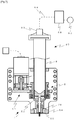
- Fig. 6 illustrates, in a way partially sectioned in principal parts, the discharge device provided with the mixing device according to the second embodiment. In the following, only different features from those in the first embodiment are described, and duplicate description of the same features is omitted.
- the mixing device 1 includes three stirrers 22 disposed within the vessel 3 at certain intervals.
- the stirrer 22 is disposed plural, the corresponding magnet 7 and magnet fixing member have to be also disposed plural. Therefore, this embodiment uses the outer tube 5, which has a length sufficient to cover a region corresponding to the three stirrers 22, and which is equipped with three sets of magnets 7, magnet supporting members 8, and magnet fixing members 9.
- the rotation mechanism 11 is disposed at an upper position than in the first embodiment.
- While the bearing 6 supporting the outer tube 5 may be disposed at one position on the side near the stirrer holding mechanism 2, it is preferably disposed at two positions, as illustrated in Fig. 6 , so that more stable rotation can be obtained.
- Stoppers 66 may be disposed on the plunger 52 at certain intervals to avoid the stirrers 22 from being contacted with each other within the vessel 3.
- the stoppers 66 are fixed to the plunger 52 to be not rotatable. Between an upper end of each stopper 66 and the stirrer 22, a gap is kept to such an extent as providing a distance longer than the intended stroke from the viewpoint of not impeding the discharge operation.
- the interval between the stirrers 22 is preferably about 0.5 to 1.5 times the inner diameter of the vessel 3.
- stirrers 22 are arranged in a coaxially aligned state (i.e., a state where the stirrers are completely overlapped with each other when viewed from above) in this embodiment, the stirrers 22 may be arranged in a state shifted from one another at a certain angle (e.g., 60 degrees).
- discharge work can be performed while solid particles are uniformly mixed in a liquid, even in the case where the vessel (syringe) communicating with the nozzle has a large capacity, or the case using a liquid mixed with particles that tend to precipitate.
- a third embodiment relates to an air type discharge device that discharges a liquid in the vessel (syringe) 3 by the action of compressed gas.
- Fig. 7 illustrates, in a way partially sectioned in principal parts, the discharge device provided with a mixing device according to the third embodiment. In the following, only different features from those in the first embodiment are described, and duplicate description of the same features is omitted.
- a discharge device 67 does not include the plunger 52 and the components associated with the plunger, and it includes, as main components, the vessel 3, the nozzle 50, the discharge controller 58 that adjusts pressure of the compressed gas supplied from the compressed gas source 60 to a desired level and then supplies the compressed gas, and the adapter 69 that supplies the compressed gas under the adjusted pressure to the vessel 3 through a tube 68.
- the discharge device 67 discharges the liquid by applying the compressed gas under the adjusted pressure to the liquid in the vessel for a predetermined time.
- the discharge device 67 is supported by a nozzle guide 70 that is disposed on the lower vessel supporting member 64. Because there is no plunger 52, the penetration hole 30 is not required to be formed in the stirrer 22. However, the penetration hole 30 may be formed to generate the flow passing through the penetration hole 30.
- discharge work can be performed for a liquid material that is not suitable for discharge using the plunger, while solid particles are uniformly mixed in the liquid material.
- a fourth embodiment relates to a discharge device including a four-blade type stirrer.
- Fig. 8 is a perspective view to explain the stirrer used in a mixing device according to the fourth embodiment. In the following, only different features from those in the first embodiment are described, and duplicate description of the same features is omitted.
- a stirrer 72 includes four blades that are positioned in opposing relation in two pairs about the penetration hole 30 at the center.
- the stirrer 72 has a crossed form when viewed from above.
- the each blade has the tapered surfaces 24 and 25, the upper cutout surfaces 27, the outer lateral surfaces 26, the lower cutout 28, the penetration hole 30, the flat portion 29, and the holes 31.
- Flows generated by the stirrer 72 are basically similar to the flows ( Fig. 5 ) generated by the stirrer 22. However, since the number of locations where the flows are generated are increased from two to four, finer flows can be generated in a state divided in a larger number, and the solid particles dispersed in the liquid within the vessel can be stirred into a more uniformly mixed state.
- hole 31 and magnet 23 are each disposed in one pair in this embodiment, two pairs of holes 31 and magnets 23 may be disposed when a greater magnetic force is required depending on the weight of the stirrer itself or the viscosity of the liquid, etc.
Landscapes
- Chemical & Material Sciences (AREA)
- Chemical Kinetics & Catalysis (AREA)
- Dispersion Chemistry (AREA)
- Mixers With Rotating Receptacles And Mixers With Vibration Mechanisms (AREA)
- Accessories For Mixers (AREA)
- Mixers Of The Rotary Stirring Type (AREA)
Applications Claiming Priority (2)
| Application Number | Priority Date | Filing Date | Title |
|---|---|---|---|
| JP2012024165A JP5792652B2 (ja) | 2012-02-07 | 2012-02-07 | 攪拌装置およびそれを備える吐出装置並びに吐出方法 |
| PCT/JP2013/052455 WO2013118673A1 (ja) | 2012-02-07 | 2013-02-04 | 攪拌装置およびそれを備える吐出装置並びに吐出方法 |
Publications (3)
| Publication Number | Publication Date |
|---|---|
| EP2813282A1 EP2813282A1 (en) | 2014-12-17 |
| EP2813282A4 EP2813282A4 (en) | 2015-10-14 |
| EP2813282B1 true EP2813282B1 (en) | 2018-06-20 |
Family
ID=48947437
Family Applications (1)
| Application Number | Title | Priority Date | Filing Date |
|---|---|---|---|
| EP13746864.1A Active EP2813282B1 (en) | 2012-02-07 | 2013-02-04 | Mixing device, discharge device provided therewith, and discharge method |
Country Status (9)
| Country | Link |
|---|---|
| US (1) | US10315173B2 (enExample) |
| EP (1) | EP2813282B1 (enExample) |
| JP (1) | JP5792652B2 (enExample) |
| KR (1) | KR102043769B1 (enExample) |
| CN (1) | CN104168992B (enExample) |
| MY (1) | MY167973A (enExample) |
| SG (2) | SG11201404617SA (enExample) |
| TW (1) | TWI574738B (enExample) |
| WO (1) | WO2013118673A1 (enExample) |
Families Citing this family (13)
| Publication number | Priority date | Publication date | Assignee | Title |
|---|---|---|---|---|
| GB201303806D0 (en) * | 2013-03-04 | 2013-04-17 | 3P Innovation Ltd | A mixing apparatus |
| US9101893B1 (en) * | 2014-03-17 | 2015-08-11 | Advanced Scientifics, Inc. | Mixing assembly and mixing method |
| JP6452147B2 (ja) * | 2015-01-19 | 2019-01-16 | 武蔵エンジニアリング株式会社 | 液体材料吐出装置 |
| JP6778426B2 (ja) * | 2016-09-20 | 2020-11-04 | 武蔵エンジニアリング株式会社 | 液体材料吐出装置 |
| CN107597461B (zh) * | 2017-09-30 | 2019-05-17 | 厦门大学 | 一种磁力搅拌微喷头以及微纳米直写平台 |
| CN109364776B (zh) * | 2018-10-23 | 2024-09-03 | 常州机电职业技术学院 | 粉体液体混合机 |
| USD934929S1 (en) * | 2020-09-18 | 2021-11-02 | Elliot Kremerman | Housing for spindles and rotary belt |
| USD934930S1 (en) * | 2021-08-02 | 2021-11-02 | Elliot Kremerman | Spinner |
| USD934316S1 (en) * | 2021-08-02 | 2021-10-26 | Elliot Kremerman | Spinner |
| USD935497S1 (en) * | 2021-08-02 | 2021-11-09 | Elliot Kremerman | Spinner |
| USD935496S1 (en) * | 2021-08-02 | 2021-11-09 | Elliot Kremerman | Spinner |
| CN113750856B (zh) * | 2021-09-09 | 2024-03-26 | 澳昌(武汉)生态科技有限公司 | 一种建筑涂料生产的定量出料装置 |
| CN114669208B (zh) * | 2022-03-18 | 2024-06-04 | 河北拓驰润滑油销售有限公司 | 一种润滑油生产设备 |
Family Cites Families (14)
| Publication number | Priority date | Publication date | Assignee | Title |
|---|---|---|---|---|
| US2495895A (en) * | 1945-10-31 | 1950-01-31 | Universal Oil Prod Co | Fluid circulating device |
| JPS4527958Y1 (enExample) | 1966-04-18 | 1970-10-28 | ||
| JPS60140638U (ja) * | 1984-02-28 | 1985-09-18 | 株式会社東芝 | 攪拌装置 |
| JPS62221427A (ja) * | 1986-03-24 | 1987-09-29 | Seiko Instr & Electronics Ltd | 液体流動撹拌装置 |
| KR100455952B1 (ko) * | 1998-03-31 | 2004-11-06 | 스미도모쥬기가이고교 가부시키가이샤 | 세로형 교반장치 |
| JP3632827B2 (ja) * | 1998-11-11 | 2005-03-23 | リンテック株式会社 | 撹拌装置 |
| US6758593B1 (en) * | 2000-10-09 | 2004-07-06 | Levtech, Inc. | Pumping or mixing system using a levitating magnetic element, related system components, and related methods |
| WO2001094027A2 (en) * | 2000-06-05 | 2001-12-13 | Nordson Corporation | Apparatus and methods for dispensing minute amounts of liquid |
| US6663276B2 (en) | 2000-10-10 | 2003-12-16 | Smithkline Beecham Corporation | Stirring element and associated metering gun |
| JP4087593B2 (ja) | 2001-11-19 | 2008-05-21 | 有限会社マグネオ技研 | 磁気駆動装置、撹拌装置、混合装置及び基板処理装置 |
| US20030185096A1 (en) * | 2002-11-26 | 2003-10-02 | Hollstein Thomas E. | Apparatus and methods for dispensing minute amounts of liquid |
| JP2005120956A (ja) | 2003-10-17 | 2005-05-12 | Fujisawa Pharmaceut Co Ltd | 吐出装置 |
| WO2011152781A1 (en) * | 2010-05-31 | 2011-12-08 | Ge Healthcare Bio-Sciences Ab | Adjustable volume mixer chamber and method of use |
| CN102230749B (zh) * | 2011-07-01 | 2012-11-07 | 山东华特磁电科技股份有限公司 | 一种风冷式复合磁场的铝溶液搅拌装置 |
-
2012
- 2012-02-07 JP JP2012024165A patent/JP5792652B2/ja active Active
-
2013
- 2013-02-04 MY MYPI2014702155A patent/MY167973A/en unknown
- 2013-02-04 CN CN201380008448.1A patent/CN104168992B/zh active Active
- 2013-02-04 EP EP13746864.1A patent/EP2813282B1/en active Active
- 2013-02-04 KR KR1020147024930A patent/KR102043769B1/ko active Active
- 2013-02-04 US US14/376,735 patent/US10315173B2/en active Active
- 2013-02-04 WO PCT/JP2013/052455 patent/WO2013118673A1/ja not_active Ceased
- 2013-02-04 SG SG11201404617SA patent/SG11201404617SA/en unknown
- 2013-02-04 SG SG10201604887RA patent/SG10201604887RA/en unknown
- 2013-02-06 TW TW102104545A patent/TWI574738B/zh active
Non-Patent Citations (1)
| Title |
|---|
| None * |
Also Published As
| Publication number | Publication date |
|---|---|
| US20140376328A1 (en) | 2014-12-25 |
| JP5792652B2 (ja) | 2015-10-14 |
| HK1200396A1 (zh) | 2015-08-07 |
| CN104168992B (zh) | 2016-08-17 |
| EP2813282A1 (en) | 2014-12-17 |
| KR20140122752A (ko) | 2014-10-20 |
| US10315173B2 (en) | 2019-06-11 |
| TWI574738B (zh) | 2017-03-21 |
| SG10201604887RA (en) | 2016-08-30 |
| EP2813282A4 (en) | 2015-10-14 |
| WO2013118673A1 (ja) | 2013-08-15 |
| JP2013158733A (ja) | 2013-08-19 |
| KR102043769B1 (ko) | 2019-11-12 |
| CN104168992A (zh) | 2014-11-26 |
| MY167973A (en) | 2018-10-09 |
| SG11201404617SA (en) | 2014-10-30 |
| TW201343259A (zh) | 2013-11-01 |
Similar Documents
| Publication | Publication Date | Title |
|---|---|---|
| US10315173B2 (en) | Mixing device, discharge device provided therewith, and discharge method | |
| JP5895853B2 (ja) | タンク装置、循環式分散システム、及び分散方法 | |
| JP5312641B1 (ja) | 撹拌装置の循環機構 | |
| CN112108055A (zh) | 一种可进行自动配比的化工生产用固液原料混合配比装置 | |
| CN111841374A (zh) | 一种药液不停机搅拌装置 | |
| CN111841372B (zh) | 一种药液连续化混合搅拌装置 | |
| CN104353381B (zh) | 搅拌装置 | |
| JP6928962B2 (ja) | 液体吐出装置、同吐出装置を備える塗布装置およびその塗布方法 | |
| CN112973492B (zh) | 一种防止药液残留瓶壁的混药装置 | |
| CN212576162U (zh) | 高速乳化分散设备 | |
| CN210079331U (zh) | 一种涂料搅拌机 | |
| CN216068146U (zh) | 一种pvb中间膜原料搅拌机 | |
| CN208130849U (zh) | 一种搅拌式乳化机 | |
| HK1200396B (en) | Mixing device, discharge device provided therewith, and discharge method | |
| CN222427798U (zh) | 一种显影液生产用快速稀释装置 | |
| CN221772140U (zh) | 一种便于下料的混合搅拌罐 | |
| CN217313140U (zh) | 一种超声波均质机 | |
| CN223127791U (zh) | 一种碳酸钙生产用搅拌装置 | |
| CN116637550B (zh) | 一种固液高效分散乳化机 | |
| JP5318606B2 (ja) | 遠心分離装置 | |
| CN222427881U (zh) | 一种沥青乳化设备 | |
| CN212188719U (zh) | 制浆设备 | |
| CN216137027U (zh) | 一种用于化妆品生产的真空乳化装置 | |
| KR20110010635U (ko) | 간극 조절형 고전단 분산기 | |
| CN207012848U (zh) | 一种纳米超声高速分散设备 |
Legal Events
| Date | Code | Title | Description |
|---|---|---|---|
| PUAI | Public reference made under article 153(3) epc to a published international application that has entered the european phase |
Free format text: ORIGINAL CODE: 0009012 |
|
| 17P | Request for examination filed |
Effective date: 20140814 |
|
| AK | Designated contracting states |
Kind code of ref document: A1 Designated state(s): AL AT BE BG CH CY CZ DE DK EE ES FI FR GB GR HR HU IE IS IT LI LT LU LV MC MK MT NL NO PL PT RO RS SE SI SK SM TR |
|
| AX | Request for extension of the european patent |
Extension state: BA ME |
|
| DAX | Request for extension of the european patent (deleted) | ||
| RA4 | Supplementary search report drawn up and despatched (corrected) |
Effective date: 20150914 |
|
| RIC1 | Information provided on ipc code assigned before grant |
Ipc: B01F 13/08 20060101AFI20150908BHEP Ipc: B01F 15/02 20060101ALI20150908BHEP |
|
| STAA | Information on the status of an ep patent application or granted ep patent |
Free format text: STATUS: EXAMINATION IS IN PROGRESS |
|
| 17Q | First examination report despatched |
Effective date: 20161209 |
|
| GRAP | Despatch of communication of intention to grant a patent |
Free format text: ORIGINAL CODE: EPIDOSNIGR1 |
|
| STAA | Information on the status of an ep patent application or granted ep patent |
Free format text: STATUS: GRANT OF PATENT IS INTENDED |
|
| INTG | Intention to grant announced |
Effective date: 20180104 |
|
| GRAS | Grant fee paid |
Free format text: ORIGINAL CODE: EPIDOSNIGR3 |
|
| GRAA | (expected) grant |
Free format text: ORIGINAL CODE: 0009210 |
|
| STAA | Information on the status of an ep patent application or granted ep patent |
Free format text: STATUS: THE PATENT HAS BEEN GRANTED |
|
| AK | Designated contracting states |
Kind code of ref document: B1 Designated state(s): AL AT BE BG CH CY CZ DE DK EE ES FI FR GB GR HR HU IE IS IT LI LT LU LV MC MK MT NL NO PL PT RO RS SE SI SK SM TR |
|
| REG | Reference to a national code |
Ref country code: GB Ref legal event code: FG4D |
|
| REG | Reference to a national code |
Ref country code: IE Ref legal event code: FG4D |
|
| REG | Reference to a national code |
Ref country code: AT Ref legal event code: REF Ref document number: 1010179 Country of ref document: AT Kind code of ref document: T Effective date: 20180715 |
|
| REG | Reference to a national code |
Ref country code: DE Ref legal event code: R096 Ref document number: 602013039169 Country of ref document: DE |
|
| REG | Reference to a national code |
Ref country code: NL Ref legal event code: MP Effective date: 20180620 |
|
| PG25 | Lapsed in a contracting state [announced via postgrant information from national office to epo] |
Ref country code: SE Free format text: LAPSE BECAUSE OF FAILURE TO SUBMIT A TRANSLATION OF THE DESCRIPTION OR TO PAY THE FEE WITHIN THE PRESCRIBED TIME-LIMIT Effective date: 20180620 Ref country code: LT Free format text: LAPSE BECAUSE OF FAILURE TO SUBMIT A TRANSLATION OF THE DESCRIPTION OR TO PAY THE FEE WITHIN THE PRESCRIBED TIME-LIMIT Effective date: 20180620 Ref country code: NO Free format text: LAPSE BECAUSE OF FAILURE TO SUBMIT A TRANSLATION OF THE DESCRIPTION OR TO PAY THE FEE WITHIN THE PRESCRIBED TIME-LIMIT Effective date: 20180920 Ref country code: FI Free format text: LAPSE BECAUSE OF FAILURE TO SUBMIT A TRANSLATION OF THE DESCRIPTION OR TO PAY THE FEE WITHIN THE PRESCRIBED TIME-LIMIT Effective date: 20180620 Ref country code: BG Free format text: LAPSE BECAUSE OF FAILURE TO SUBMIT A TRANSLATION OF THE DESCRIPTION OR TO PAY THE FEE WITHIN THE PRESCRIBED TIME-LIMIT Effective date: 20180920 |
|
| REG | Reference to a national code |
Ref country code: LT Ref legal event code: MG4D |
|
| PG25 | Lapsed in a contracting state [announced via postgrant information from national office to epo] |
Ref country code: RS Free format text: LAPSE BECAUSE OF FAILURE TO SUBMIT A TRANSLATION OF THE DESCRIPTION OR TO PAY THE FEE WITHIN THE PRESCRIBED TIME-LIMIT Effective date: 20180620 Ref country code: GR Free format text: LAPSE BECAUSE OF FAILURE TO SUBMIT A TRANSLATION OF THE DESCRIPTION OR TO PAY THE FEE WITHIN THE PRESCRIBED TIME-LIMIT Effective date: 20180921 Ref country code: LV Free format text: LAPSE BECAUSE OF FAILURE TO SUBMIT A TRANSLATION OF THE DESCRIPTION OR TO PAY THE FEE WITHIN THE PRESCRIBED TIME-LIMIT Effective date: 20180620 Ref country code: HR Free format text: LAPSE BECAUSE OF FAILURE TO SUBMIT A TRANSLATION OF THE DESCRIPTION OR TO PAY THE FEE WITHIN THE PRESCRIBED TIME-LIMIT Effective date: 20180620 |
|
| PG25 | Lapsed in a contracting state [announced via postgrant information from national office to epo] |
Ref country code: NL Free format text: LAPSE BECAUSE OF FAILURE TO SUBMIT A TRANSLATION OF THE DESCRIPTION OR TO PAY THE FEE WITHIN THE PRESCRIBED TIME-LIMIT Effective date: 20180620 |
|
| PG25 | Lapsed in a contracting state [announced via postgrant information from national office to epo] |
Ref country code: IS Free format text: LAPSE BECAUSE OF FAILURE TO SUBMIT A TRANSLATION OF THE DESCRIPTION OR TO PAY THE FEE WITHIN THE PRESCRIBED TIME-LIMIT Effective date: 20181020 Ref country code: SK Free format text: LAPSE BECAUSE OF FAILURE TO SUBMIT A TRANSLATION OF THE DESCRIPTION OR TO PAY THE FEE WITHIN THE PRESCRIBED TIME-LIMIT Effective date: 20180620 Ref country code: PL Free format text: LAPSE BECAUSE OF FAILURE TO SUBMIT A TRANSLATION OF THE DESCRIPTION OR TO PAY THE FEE WITHIN THE PRESCRIBED TIME-LIMIT Effective date: 20180620 Ref country code: EE Free format text: LAPSE BECAUSE OF FAILURE TO SUBMIT A TRANSLATION OF THE DESCRIPTION OR TO PAY THE FEE WITHIN THE PRESCRIBED TIME-LIMIT Effective date: 20180620 Ref country code: CZ Free format text: LAPSE BECAUSE OF FAILURE TO SUBMIT A TRANSLATION OF THE DESCRIPTION OR TO PAY THE FEE WITHIN THE PRESCRIBED TIME-LIMIT Effective date: 20180620 Ref country code: RO Free format text: LAPSE BECAUSE OF FAILURE TO SUBMIT A TRANSLATION OF THE DESCRIPTION OR TO PAY THE FEE WITHIN THE PRESCRIBED TIME-LIMIT Effective date: 20180620 |
|
| PG25 | Lapsed in a contracting state [announced via postgrant information from national office to epo] |
Ref country code: ES Free format text: LAPSE BECAUSE OF FAILURE TO SUBMIT A TRANSLATION OF THE DESCRIPTION OR TO PAY THE FEE WITHIN THE PRESCRIBED TIME-LIMIT Effective date: 20180620 Ref country code: SM Free format text: LAPSE BECAUSE OF FAILURE TO SUBMIT A TRANSLATION OF THE DESCRIPTION OR TO PAY THE FEE WITHIN THE PRESCRIBED TIME-LIMIT Effective date: 20180620 Ref country code: IT Free format text: LAPSE BECAUSE OF FAILURE TO SUBMIT A TRANSLATION OF THE DESCRIPTION OR TO PAY THE FEE WITHIN THE PRESCRIBED TIME-LIMIT Effective date: 20180620 |
|
| REG | Reference to a national code |
Ref country code: DE Ref legal event code: R097 Ref document number: 602013039169 Country of ref document: DE |
|
| PLBE | No opposition filed within time limit |
Free format text: ORIGINAL CODE: 0009261 |
|
| STAA | Information on the status of an ep patent application or granted ep patent |
Free format text: STATUS: NO OPPOSITION FILED WITHIN TIME LIMIT |
|
| 26N | No opposition filed |
Effective date: 20190321 |
|
| PG25 | Lapsed in a contracting state [announced via postgrant information from national office to epo] |
Ref country code: DK Free format text: LAPSE BECAUSE OF FAILURE TO SUBMIT A TRANSLATION OF THE DESCRIPTION OR TO PAY THE FEE WITHIN THE PRESCRIBED TIME-LIMIT Effective date: 20180620 |
|
| PG25 | Lapsed in a contracting state [announced via postgrant information from national office to epo] |
Ref country code: SI Free format text: LAPSE BECAUSE OF FAILURE TO SUBMIT A TRANSLATION OF THE DESCRIPTION OR TO PAY THE FEE WITHIN THE PRESCRIBED TIME-LIMIT Effective date: 20180620 |
|
| GBPC | Gb: european patent ceased through non-payment of renewal fee |
Effective date: 20190204 |
|
| PG25 | Lapsed in a contracting state [announced via postgrant information from national office to epo] |
Ref country code: LU Free format text: LAPSE BECAUSE OF NON-PAYMENT OF DUE FEES Effective date: 20190204 Ref country code: MC Free format text: LAPSE BECAUSE OF FAILURE TO SUBMIT A TRANSLATION OF THE DESCRIPTION OR TO PAY THE FEE WITHIN THE PRESCRIBED TIME-LIMIT Effective date: 20180620 |
|
| REG | Reference to a national code |
Ref country code: BE Ref legal event code: MM Effective date: 20190228 |
|
| REG | Reference to a national code |
Ref country code: IE Ref legal event code: MM4A |
|
| PG25 | Lapsed in a contracting state [announced via postgrant information from national office to epo] |
Ref country code: AL Free format text: LAPSE BECAUSE OF FAILURE TO SUBMIT A TRANSLATION OF THE DESCRIPTION OR TO PAY THE FEE WITHIN THE PRESCRIBED TIME-LIMIT Effective date: 20180620 |
|
| PG25 | Lapsed in a contracting state [announced via postgrant information from national office to epo] |
Ref country code: GB Free format text: LAPSE BECAUSE OF NON-PAYMENT OF DUE FEES Effective date: 20190204 Ref country code: IE Free format text: LAPSE BECAUSE OF NON-PAYMENT OF DUE FEES Effective date: 20190204 |
|
| PG25 | Lapsed in a contracting state [announced via postgrant information from national office to epo] |
Ref country code: FR Free format text: LAPSE BECAUSE OF NON-PAYMENT OF DUE FEES Effective date: 20190228 Ref country code: BE Free format text: LAPSE BECAUSE OF NON-PAYMENT OF DUE FEES Effective date: 20190228 |
|
| PG25 | Lapsed in a contracting state [announced via postgrant information from national office to epo] |
Ref country code: TR Free format text: LAPSE BECAUSE OF FAILURE TO SUBMIT A TRANSLATION OF THE DESCRIPTION OR TO PAY THE FEE WITHIN THE PRESCRIBED TIME-LIMIT Effective date: 20180620 |
|
| PG25 | Lapsed in a contracting state [announced via postgrant information from national office to epo] |
Ref country code: MT Free format text: LAPSE BECAUSE OF NON-PAYMENT OF DUE FEES Effective date: 20190204 Ref country code: PT Free format text: LAPSE BECAUSE OF FAILURE TO SUBMIT A TRANSLATION OF THE DESCRIPTION OR TO PAY THE FEE WITHIN THE PRESCRIBED TIME-LIMIT Effective date: 20181022 |
|
| PG25 | Lapsed in a contracting state [announced via postgrant information from national office to epo] |
Ref country code: CY Free format text: LAPSE BECAUSE OF FAILURE TO SUBMIT A TRANSLATION OF THE DESCRIPTION OR TO PAY THE FEE WITHIN THE PRESCRIBED TIME-LIMIT Effective date: 20180620 |
|
| PG25 | Lapsed in a contracting state [announced via postgrant information from national office to epo] |
Ref country code: HU Free format text: LAPSE BECAUSE OF FAILURE TO SUBMIT A TRANSLATION OF THE DESCRIPTION OR TO PAY THE FEE WITHIN THE PRESCRIBED TIME-LIMIT; INVALID AB INITIO Effective date: 20130204 |
|
| REG | Reference to a national code |
Ref country code: DE Ref legal event code: R079 Ref document number: 602013039169 Country of ref document: DE Free format text: PREVIOUS MAIN CLASS: B01F0013080000 Ipc: B01F0033450000 |
|
| REG | Reference to a national code |
Ref country code: AT Ref legal event code: UEP Ref document number: 1010179 Country of ref document: AT Kind code of ref document: T Effective date: 20180620 |
|
| PG25 | Lapsed in a contracting state [announced via postgrant information from national office to epo] |
Ref country code: MK Free format text: LAPSE BECAUSE OF FAILURE TO SUBMIT A TRANSLATION OF THE DESCRIPTION OR TO PAY THE FEE WITHIN THE PRESCRIBED TIME-LIMIT Effective date: 20180620 |
|
| P01 | Opt-out of the competence of the unified patent court (upc) registered |
Effective date: 20230519 |
|
| REG | Reference to a national code |
Ref country code: CH Ref legal event code: U11 Free format text: ST27 STATUS EVENT CODE: U-0-0-U10-U11 (AS PROVIDED BY THE NATIONAL OFFICE) Effective date: 20260301 |
|
| PGFP | Annual fee paid to national office [announced via postgrant information from national office to epo] |
Ref country code: DE Payment date: 20260218 Year of fee payment: 14 |
|
| PGFP | Annual fee paid to national office [announced via postgrant information from national office to epo] |
Ref country code: AT Payment date: 20260219 Year of fee payment: 14 |
|
| PGFP | Annual fee paid to national office [announced via postgrant information from national office to epo] |
Ref country code: CH Payment date: 20260301 Year of fee payment: 14 |