EP2811451A1 - Informationsverarbeitungsvorrichtung, informationsverarbeitungsverfahren und programm dafür - Google Patents
Informationsverarbeitungsvorrichtung, informationsverarbeitungsverfahren und programm dafür Download PDFInfo
- Publication number
- EP2811451A1 EP2811451A1 EP12856581.9A EP12856581A EP2811451A1 EP 2811451 A1 EP2811451 A1 EP 2811451A1 EP 12856581 A EP12856581 A EP 12856581A EP 2811451 A1 EP2811451 A1 EP 2811451A1
- Authority
- EP
- European Patent Office
- Prior art keywords
- image sensors
- attribute information
- control target
- target device
- image
- Prior art date
- Legal status (The legal status is an assumption and is not a legal conclusion. Google has not performed a legal analysis and makes no representation as to the accuracy of the status listed.)
- Withdrawn
Links
Images







Classifications
-
- H—ELECTRICITY
- H05—ELECTRIC TECHNIQUES NOT OTHERWISE PROVIDED FOR
- H05B—ELECTRIC HEATING; ELECTRIC LIGHT SOURCES NOT OTHERWISE PROVIDED FOR; CIRCUIT ARRANGEMENTS FOR ELECTRIC LIGHT SOURCES, IN GENERAL
- H05B47/00—Circuit arrangements for operating light sources in general, i.e. where the type of light source is not relevant
- H05B47/10—Controlling the light source
- H05B47/105—Controlling the light source in response to determined parameters
- H05B47/115—Controlling the light source in response to determined parameters by determining the presence or movement of objects or living beings
- H05B47/125—Controlling the light source in response to determined parameters by determining the presence or movement of objects or living beings by using cameras
-
- H—ELECTRICITY
- H05—ELECTRIC TECHNIQUES NOT OTHERWISE PROVIDED FOR
- H05B—ELECTRIC HEATING; ELECTRIC LIGHT SOURCES NOT OTHERWISE PROVIDED FOR; CIRCUIT ARRANGEMENTS FOR ELECTRIC LIGHT SOURCES, IN GENERAL
- H05B47/00—Circuit arrangements for operating light sources in general, i.e. where the type of light source is not relevant
- H05B47/10—Controlling the light source
- H05B47/105—Controlling the light source in response to determined parameters
-
- G—PHYSICS
- G06—COMPUTING OR CALCULATING; COUNTING
- G06F—ELECTRIC DIGITAL DATA PROCESSING
- G06F1/00—Details not covered by groups G06F3/00 - G06F13/00 and G06F21/00
- G06F1/26—Power supply means, e.g. regulation thereof
- G06F1/32—Means for saving power
- G06F1/3203—Power management, i.e. event-based initiation of a power-saving mode
- G06F1/3206—Monitoring of events, devices or parameters that trigger a change in power modality
- G06F1/3231—Monitoring the presence, absence or movement of users
-
- H—ELECTRICITY
- H04—ELECTRIC COMMUNICATION TECHNIQUE
- H04N—PICTORIAL COMMUNICATION, e.g. TELEVISION
- H04N7/00—Television systems
- H04N7/18—Closed-circuit television [CCTV] systems, i.e. systems in which the video signal is not broadcast
- H04N7/181—Closed-circuit television [CCTV] systems, i.e. systems in which the video signal is not broadcast for receiving images from a plurality of remote sources
-
- H—ELECTRICITY
- H05—ELECTRIC TECHNIQUES NOT OTHERWISE PROVIDED FOR
- H05B—ELECTRIC HEATING; ELECTRIC LIGHT SOURCES NOT OTHERWISE PROVIDED FOR; CIRCUIT ARRANGEMENTS FOR ELECTRIC LIGHT SOURCES, IN GENERAL
- H05B47/00—Circuit arrangements for operating light sources in general, i.e. where the type of light source is not relevant
- H05B47/10—Controlling the light source
- H05B47/155—Coordinated control of two or more light sources
-
- H—ELECTRICITY
- H05—ELECTRIC TECHNIQUES NOT OTHERWISE PROVIDED FOR
- H05B—ELECTRIC HEATING; ELECTRIC LIGHT SOURCES NOT OTHERWISE PROVIDED FOR; CIRCUIT ARRANGEMENTS FOR ELECTRIC LIGHT SOURCES, IN GENERAL
- H05B47/00—Circuit arrangements for operating light sources in general, i.e. where the type of light source is not relevant
- H05B47/10—Controlling the light source
- H05B47/175—Controlling the light source by remote control
-
- H—ELECTRICITY
- H05—ELECTRIC TECHNIQUES NOT OTHERWISE PROVIDED FOR
- H05B—ELECTRIC HEATING; ELECTRIC LIGHT SOURCES NOT OTHERWISE PROVIDED FOR; CIRCUIT ARRANGEMENTS FOR ELECTRIC LIGHT SOURCES, IN GENERAL
- H05B47/00—Circuit arrangements for operating light sources in general, i.e. where the type of light source is not relevant
- H05B47/10—Controlling the light source
- H05B47/175—Controlling the light source by remote control
- H05B47/198—Grouping of control procedures or address assignation to light sources
- H05B47/1985—Creation of lighting zones or scenes
-
- Y—GENERAL TAGGING OF NEW TECHNOLOGICAL DEVELOPMENTS; GENERAL TAGGING OF CROSS-SECTIONAL TECHNOLOGIES SPANNING OVER SEVERAL SECTIONS OF THE IPC; TECHNICAL SUBJECTS COVERED BY FORMER USPC CROSS-REFERENCE ART COLLECTIONS [XRACs] AND DIGESTS
- Y02—TECHNOLOGIES OR APPLICATIONS FOR MITIGATION OR ADAPTATION AGAINST CLIMATE CHANGE
- Y02B—CLIMATE CHANGE MITIGATION TECHNOLOGIES RELATED TO BUILDINGS, e.g. HOUSING, HOUSE APPLIANCES OR RELATED END-USER APPLICATIONS
- Y02B20/00—Energy efficient lighting technologies, e.g. halogen lamps or gas discharge lamps
- Y02B20/40—Control techniques providing energy savings, e.g. smart controller or presence detection
Definitions
- Embodiments of the present invention relate to an information processing apparatus, an information processing method, and a program.
- Patent Document 1 Japanese Patent Application Laid-open No. 2008-243806
- An information processing apparatus is communicatively connected to a plurality of image sensors that capture images of surroundings of a control target device which is to be a target of power controlling.
- the information processing apparatus includes: an attribute information generation unit that generates, by using the images captured by each of the image sensors, attribute information of the control target device which is under jurisdiction of at least one of the image sensors; and a management unit that manages the attribute information of the control target device generated by the attribute information generation unit in association with the control target device and the at least one of the image sensors having jurisdiction over the control target device.
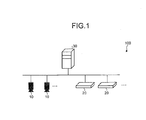
- FIG. 1 is a diagram illustrating an example of a configuration of an image sensor system 100 according to the embodiment.
- the image sensor system 100 includes image sensors 10, various electric devices 20, and a management terminal 30.
- the management terminal 30 is detachably connected to each of the image sensors 10 or to a line to which each of the image sensors 10 are connected, and transmits and receives various kinds of information to and from each of the image sensors 10.
- the management terminal 30 is detachably connected to each of the electric devices 20 or to a line to which each of the electric devices 20 are connected, and controls powering on and off, output values, and the like, of each of the electric devices 20.
- the number of image sensors 10 and the number of electric devices 20 are not particularly limited.
- the image sensor 10 includes a camera unit configured by an image sensor or the like such as a CCD (Charge Coupled Device) or a CMOS (Complementary Metal Oxide Semiconductor) (none of which is illustrated), and captures an image of a space in which the electric device 20 is installed by using the camera unit. Further, the image sensor 10 has a computer configuration of a CPU (Central Processing Unit), a ROM (Read Only Memory), a RAM (Random Access Memory), and the like, and includes a non-volatile storage unit that stores various kinds of information and a communication unit that communicates with an external device such as the management terminal 30 (none of which is illustrated). The image sensor 10 detects presence/absence or the like of people by sensing an acquired image and outputs the detection result to an external device (the management terminal 30).
- an image sensor or the like such as a CCD (Charge Coupled Device) or a CMOS (Complementary Metal Oxide Semiconductor) (none of which is illustrated)
- the electric device 20 is a control target device which is a target of power controlling, and an illumination device or an air-conditioning device is an example thereof.
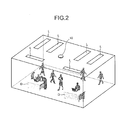
- FIG. 2 is a diagram schematically illustrating an installation example of the image sensor 10 and the electric devices 20.
- illumination devices L installed at the ceiling are illustrated as the electric devices 20.
- the image sensor 10 is installed at the ceiling as similar to the electric devices 20, and captures an image of a space from the ceiling to the surroundings of the electric devices 20.
- FIG. 2 illustrates an example in which two desks D are installed as objects in the room.
- a demand control unit 316 performs power controlling on the electric devices 20 based on a sensing result of the image sensor 10. For example, the demand control unit 316 performs control such that the electric device 20 (the illumination device L or the like) is turned on in an area, such as the surroundings of the desk D, in which people are present, and performs control such that the electric device 20 is turned off in an area in which people are absent (or an output is lowered). Further, when the density or an amount of activity of people is output as the sensing result of the image sensor 10, the demand control unit 316 performs control such that a light adjustment ratio of the illumination device is changed and the amount of wind of an air-conditioning device is changed, in accordance with the value. The density or the amount of activity of people is assumed to be calculated by using a known technique.
- the information of the image sensor 10 may include, for example, a sensor ID used to identify each image sensor 10, an IP address, an installation position in a building, and information of the electric device 20 which is under the jurisdiction of the image sensor 10.
- the information of the electric device 20 may include, for example, a device ID used to identify each electric device 20, an installation position in the building, and information of the image sensor 10 which has jurisdiction over the electric device 20.
- Such information is stored in a database or the like, and is used for the power controlling of the electric device 20.
- the management terminal 30 improves the efficiency of the operation for setting attribute information by: automatically generating an attribute information relevant to the above-described power controlling; and registering the attribute information in a predetermined data base.
- the image sensor 10 and the electric device 20 which is under the jurisdiction of this image sensor 10 are associated with each other based on each image captured by the image sensor 10.
- the management terminal 30 will be described.
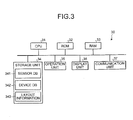
- FIG. 3 is a block diagram illustrating an example of a hardware configuration of the management terminal 30.
- the management terminal 30 is an information processing apparatus such as a PC (Personal Computer) or a server device. As illustrated in FIG. 3 , the management terminal 30 includes a CPU 31, a ROM 32, a RAM 33, a storage unit 34, an operation unit 35, a display unit 36, and a communication unit 37.
- a PC Personal Computer
- the management terminal 30 includes a CPU 31, a ROM 32, a RAM 33, a storage unit 34, an operation unit 35, a display unit 36, and a communication unit 37.
- the CPU 31 generally controls a process of each unit of the management terminal 30 by loading a predetermined program stored in the ROM 32 or the storage unit 34 on the RAM 33 and executing the predetermined program. Further, the CPU 31 realizes each functional unit to be described below by loading a predetermined program stored in the ROM 32 or the storage unit 34 on the RAM 33 and executing the predetermined program.
- the ROM 32 stores various programs to be executed by the CPU 31 and setting information.
- the RAM 33 is a main storage device and is used as a work memory of the management terminal 30.
- the storage unit 34 is an auxiliary storage device such as an HDD (Hard Disk Drive), and stores various programs to be executed by the CPU 31 and setting information. Further, the storage unit 34 stores a sensor DB (DataBase) 341 that retains information on the image sensor 10, a device DB 342 that retains information of the electric device 20, and layout information 343.
- a sensor DB DataBase
- device DB that retains information of the electric device 20
- FIG. 4 is a diagram illustrating an example of a data structure of the sensor DB 341.
- the sensor DB 341 has, as the attribute information of the image sensor 10 relevant to the power controlling, entry fields in which information on a sensor ID, an IP address, an installation position, a detection area, a device under jurisdiction, and the like is stored.
- an identifier used to identify each image sensor 10 is registered in the field of the "sensor ID,” an IP address to which each image sensor 10 is assigned is registered in the field of the "IP address,” and the installation position of the image sensor 10 in the building is registered in the field of the “installation position.” Further, a region (area) in which each image sensor 10 is sensed is registered in the field of the "detection area” and an identifier (device ID) of the electric device 20 under the jurisdiction in the detection area is registered in the field of the "device under jurisdiction.”
- FIG. 5 is a diagram illustrating an example of a data structure of the device DB 342.
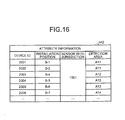
- the device DB 342 has, as the attribute information of the electric device 20 relevant to the power controlling, entry fields in which information on a device ID, an installation position, a sensor with jurisdiction, the detection area, and the like is stored.
- an identifier used to identify each electric device 20 is registered in the field of the "device ID” and the installation position of the electric device 20 in the building is registered in the field of the "installation position.” Further, the sensor ID of the image sensor 10 having jurisdiction over each electric device 20 is registered in the field of the "sensor with jurisdiction” and the detection area in which the electric device 20 is placed in the image sensor 10 having jurisdiction over the electric device 20 is registered in the field of the "detection area.”
- the attribute information registered in the sensor DB 341 and the device DB 342 is automatically generated by a function of each functional unit (a sensor attribute generation unit 312, a device attribute generation unit 313, and an installation position specifying unit 314, see FIG. 7 ) to be described below, and is registered in the corresponding entry fields.
- FIG. 6 is a diagram schematically illustrating an example of the layout information 343.
- the layout information 343 is information such as CAD (Computer Aided Design) data indicating the layout (design drawing) of each room in which the image sensor 10 and the electric devices 20 (illumination device L) are installed.
- the layout information is assumed to include: the layouts of the image sensor 10, the electric devices 20, and various objects (walls, windows, doors, desks D, and the like) installed indoors; and positional information (for example, a floor number, a room number, a position code, and coordinates) indicating the absolute position in the building.
- the operation unit 35 is an input device such as a keyboard or a mouse, and outputs an input operation received from a user of the management terminal 30 to the CPU 31.
- the display unit 36 is a display device such as an LCD (Liquid Crystal Display), and displays characters, images, or the like under the control of the CPU 31.
- the communication unit 37 is a network interface, and transmits and receives various kinds of information to and from the image sensor 10 connected via a network such as a LAN (Local Area Network) under the control of the CPU 31.
- FIG. 7 is a block diagram illustrating an example of the functional configuration of the management terminal 30.
- the management terminal 30 includes an image acquisition unit 311, a sensor attribute generation unit 312, a device attribute generation unit 313, an installation position specifying unit 314, a layout analysis unit 315, and a demand control unit 316, as functional units realized by cooperation of the CPU 31 and a predetermined program.
- the image acquisition unit 311 sequentially acquires images captured by the image sensors 10 via a network (not illustrated).
- An IP address used to communicate with each image sensor 10 may be assigned in advance to each image sensor 10.
- an IP address may be assigned to each image sensor 10 using a technique such as DHCP.
- the sensor attribute generation unit 312 recognizes a character string indicating the attribute information from an image of the image sensor 10 acquired by the image acquisition unit 311 by analyzing the image. Further, the sensor attribute generation unit 312 registers the recognized character string in a corresponding entry field of the sensor DB 341 as the attribute information.
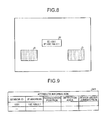
- FIG. 8 is a diagram illustrating an example of an image captured by the image sensor 10.
- the sensor attribute generation unit 312 recognizes the character strings "sensor ID: 1001" and "IP address: 192.168.0.1” described in the marker M in the image as the character strings indicated by the attribute information by analyzing the image of FIG. 8 .
- a describing method on the marker and the described contents are not particularly limited, but it is preferable to describe a pair of an entry name (the sensor ID, the IP address, and the like) of the attribute information and the contents of the entry name. Further, the character recognition is performed according to a known technique.
- the sensor attribute generation unit 312 registers the character strings "sensor ID: 1001" and "IP address: 192.168.0.1” recognized from the image of FIG. 8 in corresponding entry fields of the sensor DB 341. Specifically, “1001” is registered in the “sensor ID” field of the sensor DB 341 and "192.168.0.1” is registered in the "IP address” field thereof.
- FIG. 9 is a diagram illustrating an example of a state of the sensor DB 341 on which the process is performed by the sensor attribute generation unit 312. As illustrated in the drawing, the sensor ID and the IP address are registered by the sensor attribute generation unit 312. Thus, the sensor ID and the IP address are registered in association with each other for the same image sensor 10.
- the IP address recognized from the image is registered in the sensor DB 341, but the IP address acquired at the time of the communication with the image sensor 10 may be registered in the sensor DB 341. Further, the IP address may be used as the sensor ID.
- the IP address assigned to the image sensor 10 is different from the IP address described in the marker, the IP address is updated to the IP address described in the marker.
- the attribute information described in the marker is not limited to the above-described entries, but other entries may be described. Further, when the sensor attribute generation unit 312 has a decode function of decoding a code symbol such as a barcode or a two-dimensional code, the code symbol in which the attribute information is retained may be presented instead of the maker in which the characters are described.
- the device attribute generation unit 313 detects an image in which a change occurs from the images of the respective image sensors 10 obtained when the electric devices 20 are operated, and then specifies the image sensor 10 capturing this image as an image sensor with jurisdiction over the operated electric device 20. Further, the device attribute generation unit 313 registers a relationship between the image sensor 10 and the electric device 20 that is under jurisdiction of this image sensor 10 as attribute information, in the sensor DB 341 and the device DB 342.
- the device attribute generation unit 313 turns on the power of the electric devices 20 installed in the building one by one via control lines (not illustrated), and assigns unique device IDs to the powered-on electric devices 20. Further, the device attribute generation unit 313 detects images in which a change occurs when the electric devices 20 are turned on among images captured by the respective image sensors 10. Then, when the device attribute generation unit 313 detects the images in which the change occurs, the device attribute generation unit 313 determines that the powered-on electric device 20 is under jurisdiction of the image sensor 10 capturing the image.
- the device attribute generation unit 313 detects a change in luminance in the image by comparing images obtained before and after the target illumination device is turned on, and detects an image in which the amount of change is greater than a predetermined threshold value.
- the electric device 20 is an air-conditioning device, a streamer or the like is attached to a supply opening of the air-conditioning device, and then the device attribute generation unit 313 detects a swing motion of the streamer from the image obtained after the target air-conditioning device is turned on, and specifies an image in which the amount of motion is greater than a predetermined threshold value. Further, after detecting the image in which the change occurs, the device attribute generation unit 313 turns off the powered-on electric device 20, and then the process proceeds to the subsequent process of the electric device 20.
- the device attribute generation unit 313 specifies a relative positional relationship of the powered-on electric device 20 with respect to the image sensor 10 from a change state in the detected image.
- the device attribute generation unit 313 specifies a relative positional relationship (the distance and direction) of the illumination device L with respect to the image sensor 10 by analyzing the distribution (luminance distribution) of light in the image.
- FIG. 10 is a diagram illustrating an example of the image captured by the image sensor 10.
- the device attribute generation unit 313 specifies that the target electric device 20 is present at a position away by the distance of 6m in the 10 o'clock direction from the installation position (indicated by a dashed line in the figure) of the image sensor 10.
- the device attribute generation unit 313 can specify a relative positional relationship (the distance and direction) of the air-conditioning device with respect to the image sensor 10 from the position at which the streamer attached to the air-conditioning device swings.
- the device attribute generation unit 313 divides the detection area of the image sensor 10 based on the specified relative positional relationship of each electric device 20 with respect to the image sensor 10, and assigns an area number to each of the divided detection areas.
- the device attribute generation unit 313 divides the detection area into four detection areas indicated by dashed lines and assigns area numbers (A11 to A14) to the divided detection areas.
- FIG. 11 is a diagram illustrating an example of the division of the detection area.
- the device attribute generation unit 313 assigns the device ID of the powered-on electric device 20 to the corresponding detection area, and registers the device ID in the sensor DB 341 in association with the sensor ID of the image sensor 10 having jurisdiction over this electric device 20. Further, the device attribute generation unit 313 registers the device ID assigned to each electric device 20 in the device DB 342, and registers the sensor ID of the image sensor 10 having jurisdiction over this electric device 20 and the area number assigned to the electric device 20 in the device DB 342 in association with this device ID.
- FIG. 12 is a diagram illustrating an example of a state of the sensor DB 341 on which the process is performed by the device attribute generation unit 313.
- the device ID of the electric device 20 under the jurisdiction is registered in the field of the "device under jurisdiction" in association with the sensor ID of each image sensor 10 for each detection area (area number) of this image sensor 10 through the process of the device attribute generation unit 313.
- FIG. 13 is a diagram illustrating an example of a state of the device DB 342 on which the process is performed by the device attribute generation unit 313.
- the sensor ID of the image sensor 10 with jurisdiction over the electric device 20 and the detection area (area number) in which the electric device 20 is present are respectively registered in the fields of the "sensor with jurisdiction” and the "detection area” in association with the device ID of each electric device 20 through the process of the device attribute generation unit 313.
- the detection area of the image sensor 10 has been divided into the plurality of areas, but the invention is not limited thereto. The detection area may not be divided.
- the device attribute generation unit 313 has turned on/off the electric devices 20, but the invention is not limited thereto. A worker may manually turn on/off the electric devices.
- the installation position specifying unit 314 recognizes objects such as walls, windows, doors, or desks from images captured by the respective image sensors 10, and acquires a disposition relation (layout) of the objects.
- a method of recognizing the objects is not particularly limited and a known technique can be used.
- an object discrimination model may be generated by collecting images obtained by imaging a general office space and performing a learning based on the images, and objects may be recognized from actually captured images using the object discrimination model.
- edge detection may be performed from images, the boundaries of the walls, floors, ceilings of a building may be extracted, and thus a disposition relation of the objects may be recognized.
- the installation position specifying unit 314 checks the layout information 343 of the respective rooms using the layout acquired from the images of the image sensor 10 and the relative positional relationship of the electric devices 20 specified by the device attribute generation unit 313 with respect to this image sensor 10, and then retrieves layout information having a similar layout.
- a disposition relation of indoor objects or the electric devices 20 indicated by the layout information is extracted as a feature amount, the degree of similarity is calculated based on the extracted feature amount, and layout information with the highest similarity is acquired. Further, the layout information with the high similarity may be presented before a worker, and the worker selects the layout information matching actual layout information.
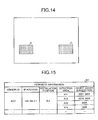
- the layout acquired from an image is assumed to be the layout of desks D illustrated in FIG. 14
- the relative positional relationship between the image sensor 10 which has captured this image and the electric devices 20 under jurisdiction of the this image sensor 10 is assumed to be the state illustrated in FIG. 11 .
- the installation position specifying unit 314 sets a pair of the layouts illustrated in FIGS. 14 and 11 as a retrieval condition, and retrieves the layout information corresponding (similar) to the retrieval condition.
- the device attribute generation unit 313 acquires the layout information of FIG. 6 corresponding to the retrieval condition.
- the installation position specifying unit 314 specifies the installation positions of the image sensor 10 and each electric device 20 installed in the room from the acquired layout information
- the installation position specifying unit 314 registers the specified installation position of the image sensor 10 in association with the corresponding sensor ID of the sensor DB 341, and registers the specified installation position of the electric device 20 in association with the corresponding device ID of the device DB 342.
- FIG. 15 is a diagram illustrating an example of a state of the sensor DB 341 on which the process is performed by the installation position specifying unit 314. As illustrated in the figure, the installation position of each image sensor 10 is registered in the "installation position" field in association with the sensor ID of the image sensor 10 through the process of the installation position specifying unit 314.
- FIG. 16 is a diagram illustrating an example of a state of the device DB 342 on which the process is performed by the installation position specifying unit 314. As illustrated in the figure, the installation positions of the electric devices 20 are registered in the "installation position" field in association with the device IDs of the electric devices 20 through the process of the installation position specifying unit 314.
- the attribute information of the sensor DB 341 and the device DB 342 is generated by the functions of the image acquisition unit 311, the sensor attribute generation unit 312, the device attribute generation unit 313, and the installation position specifying unit 314. Further, the information registered in the sensor DB 341 and the device DB 342 is not limited to the above-described attribute information, but may include a manually input entry. For example, a threshold value relevant to the sensing of the image sensor 10, an output level of the electric device 20, and the like may be registered as setting information relevant to control of each of the image sensors 10 and the electric devices 20.
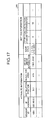
- FIG. 17 is a diagram illustrating another example of the sensor DB 341 with which the setting information of each image sensor 10 is integrated.
- the figure illustrates an example in which a mask area, various parameters (detection parameters 1 and 2) such as a threshold value or the like relevant to the sensing, and the like are registered as the setting information of the image sensor 10.
- the mask area indicates an area excluded from sensing target areas among the detection areas of the image sensor 10. For example, when the mask area is a rectangle, as illustrated in FIG. 17 , the coordinates of the diagonal points of the rectangle are registered.
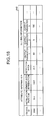
- FIG. 18 is a diagram illustrating another example of the device DB 342 with which the setting information of each electric device 20 is integrated.
- various parameters output parameters 1, 2, and 3
- output parameters 1, 2, and 3 such as a normal output value, a lower-limit output value, an upper-limit value are registered as the setting information of the electric device 20.
- Such setting information is used when the power controlling of the electric device 20 is performed.
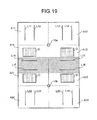
- the layout analysis unit 315 determines whether detection areas between the plurality of image sensors 10 overlap each other based on the identity of the device IDs associated with the detection areas of the respective image sensors 10, referring to the sensor DB 341.
- detection areas between the adjacent image sensors 10a and 10b overlap each other in some cases.
- the detection areas A13 and A22 overlap each other and the detection areas A14 and A21 overlap each other (see hatching areas).
- the overlap state is resolved by distributing each of the device IDs of the electric device 20 associated with the overlapping detection areas to one of the image sensors 10 which are under the overlapping relationship, and by reflecting the distribution result to the sensor DB 341 and the device DB 342.
- a method of distributing the electric devices 20 is not particularly limited. For example, in the state of FIG. 19 , among the illumination devices L11 to 22, the illumination devices L15 and L16 closer to the image sensor 10a may be set to be under jurisdiction of the image sensor 10a, and the illumination devices L17 and L18 closer to the image sensor 10b may be set to be under jurisdiction of the image sensor 10b.
- the illumination devices L15, L16, L17, and L18 are present in the detection areas A13 (A22) and A14 (A21). Further, all of the illumination devices L15 to L18 present in the overlap detection areas may be set to be under jurisdiction of one of the image sensors 10.
- both the image sensors 10a and 10b may be configured to sense the overlap detection areas.
- the detection result is used.
- the result may be configured to be used.
- the layout analysis unit 315 adds overlap information to the overlap detection areas in the sensor DB 341 to instruct the control target (see FIG. 20 ).
- FIG. 20 is a diagram illustrating an example of the sensor DB 341 in which the overlap information is added.
- the figure illustrates an example in which the sensor ID of the image sensor 10a illustrated in FIG. 19 is set to "1001" and the sensor ID of the image sensor 10b is set to "1002.”
- an example is schematically illustrated in which the overlap information OL is added to each of the detection areas A13 and A22 having the overlap relation and the detection areas A14 and A21 having the overlap relation among the detection areas of the image sensors 10a and 10b.
- the layout analysis unit 315 has determined whether the detection areas between the image sensors 10 overlap each other based on the identity of the device IDs associated with the detection areas of the respective image sensors 10, but the invention is not limited thereto.
- the image sensors 10 having an adjacent relation may be specified from the layout information 343 and it may be determined that the detection areas of the image sensors 10 having the adjacent relation overlap each other.
- the demand control unit 316 performs the power controlling according to the sensing result input from each of the image sensors 10 on each of the electric devices 20 under jurisdiction of the corresponding image sensors 10, referring to the sensor DB 341 and the device DB 342. Specifically, when the sensing results are input from the image sensors 10, the demand control unit 316 specifies which detection areas are associated with the sensing results, and extracts the device IDs of the electric devices 20 associated with the detection area from the sensor DB 341. Further, the demand control unit 316 controls the outputs of the electric devices 20 associated with the extracted device IDs according to the sensing results of the image sensors 10.
- the sensing results of the other image sensor 10 to which the overlap information is added are acquired, and the electric devices 20 under jurisdiction are controlled based on the pair of both the sensing results.
- FIG. 21 is a flowchart illustrating an example of a DB generation process performed by the management terminal 30.
- the image acquisition unit 311 sequentially acquires the images captured by the image sensors 10 (step S11).
- the process of step S11 is continuously performed during subsequent steps S12 to S25.
- the sensor attribute generation unit 312 recognizes the character string indicating the attribute information from the images acquired by the image acquisition unit 311 (step S12). Next, the sensor attribute generation unit 312 registers the character string recognized in step S12 as the attribute information in the corresponding entry field of the sensor DB 341 (step S13).
- the sensor attribute generation unit 312 determines whether the processes of steps S12 and S13 are performed on all of the installed image sensors 10 (step S14).
- the process returns to step S12.
- the process proceeds to step S 15.
- step S15 the device attribute generation unit 313 sequentially turns on the electric devices 20 (step S15).
- the device attribute generation unit 313 detects an image in which a change occurs in the process of step S15 among the images acquired by the image acquisition unit 311, the device attribute generation unit 313 determines that the image sensor 10 having captured this image is the image sensor having jurisdiction over the powered-on electric devices 20 (step S16).
- the device attribute generation unit 313 specifies the relative positional relationship of the powered-on electric devices 20 with respect to the image sensor 10 from the change in a state in the image detected in step S16 (step S17). Subsequently, the device attribute generation unit 313 registers the attribute information generated based on the processing results of steps S16 and S17 in the corresponding entry fields of the sensor DB 341 and the device DB 342 (step S18).
- the device attribute generation unit 313 determines whether the processes of steps S16 to S18 are performed on all of the electric devices 20 (step S19).
- the process returns to step S16.
- the process proceeds to step S20.
- step S20 the installation position specifying unit 314 recognizes the layout of objects from each image acquired by the image acquisition unit 311 (step S20). Subsequently, the installation position specifying unit 314 checks the layout information 343 using a pair of the layout recognized from each image and the relative positional relationship of the electric devices 20 of the image sensor 10 of this image, and retrieves the layout information having a similar layout (step S21). Next, when the installation position specifying unit 314 specifies the installation positions of the image sensor 10 and the electric devices 20 based on the similar layout information which is the retrieval result (step S22), the installation position specifying unit 314 registers the installation positions as the attribute information in the corresponding entry fields of the sensor DB 341 and the device DB 342 (step S23).
- the layout analysis unit 315 specifies the detection areas overlapping each other between the image sensors 10 based on the identity of the device IDs associated with the detection areas of the respective image sensors 10 (step S24). Then, the layout analysis unit 315 resolves the overlap state by distributing the device IDs of the electric devices 20 associated with the overlap detection areas between the image sensors 10 having the overlap relation (step S25), and then this process ends. Further, when the overlap information is configured to be added, the overlap information is added to the overlap detection areas in step S25 instead of the resolution of the overlap state.
- the management terminal 30 generates the attribute information in which the image sensor 10 is associated with the electric device 20 which is under jurisdiction of the image sensors 10 by using images captured by each image sensors 10, and then registers the attribute information in the corresponding entry fields of the sensor DB 341 and the device DB 342.
- the attribute information associated with the power controlling of the electric devices 20 can be automatically generated from the images captured by the image sensors 10, the attribute information can be efficiently set.
- this electric device 20 When the change in the image may not be confirmed by turning on the electric device 20 in the DB generation process, it may be determined that this electric device 20 is not under jurisdiction of the image sensor 10 and this electric device 20 may be associated with another sensor device located in the surroundings of this electric device 20.
- the device attribute generation unit 313 determines that the illumination devices La and Lb for which the change on the image is not confirmed are under jurisdiction of a sensor device (an infrared sensor 41 a, 41 b, or 41 c) other than the image sensors 10, after completing the generation of the attribution information on each of the image sensors 10, causes the sensor ID of the infrared sensor 41 a, 41b, or 41c to correspond to the device IDs of the illumination devices La and Lb, and registers the sensor ID and the device IDs in the sensor DB 341 and the device DB 342.
- a sensor device an infrared sensor 41 a, 41 b, or 41 c
- the infrared sensor 41 a, 41 b, or 41 c may be registered in the sensor DB 341 in advance or may be manually input by an operator each time. Further, the sensor ID or the IP address of the infrared sensor 41 a, 41 b, or 41 c may be configured to be automatically assigned by the device attribute generation unit 313 or may be configured to be set manually by the operator.
- the attribute information has sequentially been generated for the image sensors 10 and the electric devices 20 and have been registered in the sensor DB 341 and the device DB 342, but the invention is not limited thereto.
- the attribute information of the other image sensor 10 and the other electric devices 20 may be configured to be generated using the attribute information.
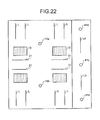
- this configuration will be described as a modification example of the above-described embodiment with reference to FIGS. 19 and 23 .
- the installation position specifying unit 314 retrieves the layout information 343 of another room similar to the layout of the room in which the image sensors 10a and 10b and the illumination devices L11 to L22 are installed based on this layout.
- layout information 343 having the same layout which is illustrated in FIG. 23 and is similar to the layout is retrieved.
- the installation position specifying unit 314 generates the attribute information on the image sensors 10 and the electric devices 20 included in the layout information of FIG. 23 using the attribute information on the image sensors 10a and 10b and the illumination devices L11 to L22 in FIG. 19 .
- the image sensor 10a in FIG. 19 corresponds to an image sensor 10c and the image sensor 10b in FIG. 19 corresponds to an image sensor 10d.
- illumination devices L31 to L42 in FIG. 23 correspond to the illumination devices L11 to L22 in FIG. 19 , respectively. Therefore, the installation position specifying unit 314 generates the attribute information on the image sensors 10c and 10d using the attribute information on the image sensors 10a and 10b and generates the attribute information on the illumination devices L31 to L42 using the attribute information on the illumination devices L11 to L22. Then, the installation position specifying unit 314 registers the attribute information generated for the image sensors 10c and 10d and the illumination devices L31 to L42 in the sensor DB 341 and the device DB 342.
- the attribute information on the image sensors 10 and the electric devices 20 with another layout similar to the layout can be generated using the attribute information generated for the image sensors 10 and the electric devices 20 having the specific layout, the attribute information can efficiently be generated.
- Values different from the values assigned to the image sensors 10a and 10b and the illumination devices L11 to L22 are assumed to be assigned for the identification IDs or the IP addresses of the image sensors 10c and 10d and the illumination devices L31 to L42. Further, when the setting information is registered for the image sensors 10a and 10b and the illumination devices L11 to L22, this setting information may be useful for the image sensors 10c and 10d and the illumination devices L31 to L42.
- the management terminal 30 has been configured to include the sensor DB 341 and the device DB 342, but the invention is not limited thereto.
- An external device for example, a DB server or the like which the management terminal 30 can access may be configured to include the sensor DB 341 and the device DB 342.
- the management terminal 30 has been configured to include the demand control unit 316 that performs the power controlling on the electric devices 20, but the invention is not limited thereto.
- An external device may be configured to include the demand control unit 316.
- a program executed by the management terminal 30 according to the above-described embodiment is provided to be incorporated in advance into the storage medium (the ROM 32 or the storage unit 34) included in the management terminal 30, but the invention is not limited thereto.
- An installable or executable file may be recorded in a computer-readable recording medium such as a CD-ROM, a flexible disk (FD), a CD-R, or a DVD (Digital Versatile Disk) so as to be supplied.
- the storage medium is not limited to a medium independent from a computer or an incorporated system, but an example of the storage medium may also include a storage medium that stores or temporarily stores a program delivered and downloaded via a LAN, the Internet, or the like.
- the program executed by the management terminal 30 according to the above-described embodiment may be stored on a computer connected to a network such as the Internet and downloaded via the network so as to be supplied.
- the program may be provided or distributed via a network such as the Internet.
Landscapes
- Engineering & Computer Science (AREA)
- Theoretical Computer Science (AREA)
- Physics & Mathematics (AREA)
- Signal Processing (AREA)
- General Engineering & Computer Science (AREA)
- General Physics & Mathematics (AREA)
- Multimedia (AREA)
- Circuit Arrangement For Electric Light Sources In General (AREA)
- Remote Monitoring And Control Of Power-Distribution Networks (AREA)
- Management, Administration, Business Operations System, And Electronic Commerce (AREA)
- Closed-Circuit Television Systems (AREA)
- Image Analysis (AREA)
- Power Sources (AREA)
- Alarm Systems (AREA)
Applications Claiming Priority (2)
| Application Number | Priority Date | Filing Date | Title |
|---|---|---|---|
| JP2012017145A JP5872306B2 (ja) | 2012-01-30 | 2012-01-30 | 情報処理装置、情報処理方法及びプログラム |
| PCT/JP2012/083150 WO2013114761A1 (ja) | 2012-01-30 | 2012-12-20 | 情報処理装置、情報処理方法及びプログラム |
Publications (2)
| Publication Number | Publication Date |
|---|---|
| EP2811451A1 true EP2811451A1 (de) | 2014-12-10 |
| EP2811451A4 EP2811451A4 (de) | 2016-06-08 |
Family
ID=48904819
Family Applications (1)
| Application Number | Title | Priority Date | Filing Date |
|---|---|---|---|
| EP12856581.9A Withdrawn EP2811451A4 (de) | 2012-01-30 | 2012-12-20 | Informationsverarbeitungsvorrichtung, informationsverarbeitungsverfahren und programm dafür |
Country Status (6)
| Country | Link |
|---|---|
| US (2) | US9442553B2 (de) |
| EP (1) | EP2811451A4 (de) |
| JP (1) | JP5872306B2 (de) |
| CN (2) | CN106102283A (de) |
| SG (1) | SG192567A1 (de) |
| WO (1) | WO2013114761A1 (de) |
Families Citing this family (17)
| Publication number | Priority date | Publication date | Assignee | Title |
|---|---|---|---|---|
| US9439268B2 (en) | 2013-09-13 | 2016-09-06 | Cooper Technologies Company | System and method for auto-commissioning based on smart sensors |
| JP2016095560A (ja) * | 2014-11-12 | 2016-05-26 | セイコーソリューションズ株式会社 | 電子機器、オーダーエントリーシステム、及びプログラム |
| JP2016095787A (ja) * | 2014-11-17 | 2016-05-26 | 株式会社リコー | 情報処理装置、情報処理システム、情報処理方法および情報処理プログラム |
| WO2016169060A1 (zh) * | 2015-04-24 | 2016-10-27 | 华为技术有限公司 | 一种存储m2m设备的位置信息的方法、m2m平台、设备及终端 |
| JPWO2017038364A1 (ja) * | 2015-09-03 | 2018-06-21 | 日本電気株式会社 | 情報出力装置、情報出力方法、及び、プログラム |
| KR102502449B1 (ko) * | 2015-10-05 | 2023-02-22 | 삼성전자주식회사 | 조명을 디스플레이하는 방법 및 장치 |
| US10607081B2 (en) * | 2016-01-06 | 2020-03-31 | Orcam Technologies Ltd. | Collaboration facilitator for wearable devices |
| KR20170087690A (ko) | 2016-01-21 | 2017-07-31 | 삼성전자주식회사 | 영상캡쳐장치 및 그 제어방법 |
| JP6692047B2 (ja) | 2016-04-21 | 2020-05-13 | パナソニックIpマネジメント株式会社 | 照明制御システム |
| JP6750430B2 (ja) * | 2016-09-26 | 2020-09-02 | 東芝ライテック株式会社 | 監視装置および照明システム |
| WO2018065229A1 (en) * | 2016-10-03 | 2018-04-12 | Philips Lighting Holding B.V. | Lighting control configuration |
| CN109983845B (zh) * | 2016-11-25 | 2021-08-13 | 昕诺飞控股有限公司 | 照明控制 |
| JP7021428B2 (ja) * | 2017-05-15 | 2022-02-17 | ダイキン工業株式会社 | 製品の情報生成システム |
| WO2018225576A1 (ja) * | 2017-06-06 | 2018-12-13 | オムロン株式会社 | スコア算出ユニット、検索装置、スコア算出方法、およびスコア算出プログラム |
| JP7228796B2 (ja) * | 2018-01-26 | 2023-02-27 | パナソニックIpマネジメント株式会社 | 機器管理システム及び機器管理方法 |
| JP2021068370A (ja) * | 2019-10-28 | 2021-04-30 | ソニー株式会社 | 情報処理装置、情報処理方法、及びプログラム |
| JP7700012B2 (ja) * | 2021-10-08 | 2025-06-30 | 旭化成ホームズ株式会社 | 建物内環境制御システム、環境センサ選定装置、環境センサ選定方法およびプログラム |
Family Cites Families (16)
| Publication number | Priority date | Publication date | Assignee | Title |
|---|---|---|---|---|
| US5586254A (en) * | 1992-02-13 | 1996-12-17 | Hitachi Software Engineering Co., Ltd. | System for managing and operating a network by physically imaging the network |
| JPH11304221A (ja) * | 1998-04-27 | 1999-11-05 | Tokyo Electric Power Co Inc:The | 室内環境制御装置 |
| JP2002289373A (ja) * | 2001-03-27 | 2002-10-04 | Matsushita Electric Works Ltd | 照明システムおよび照明システムのid設定方法 |
| JP4536299B2 (ja) * | 2001-08-29 | 2010-09-01 | パナソニック株式会社 | イベント映像記録・再生システム、イベント管理装置、およびローカル記録装置 |
| CN1838848A (zh) * | 2006-01-20 | 2006-09-27 | 大连水产学院 | 基于图象识别技术的教室节电系统 |
| JP2008243806A (ja) | 2007-03-01 | 2008-10-09 | Toshiba Lighting & Technology Corp | 照明制御システム及びこの照明制御システムに用いられる位置検出方法 |
| JP5062618B2 (ja) * | 2007-03-29 | 2012-10-31 | 学校法人同志社 | 照明システムにおける機器設定装置 |
| JP5336100B2 (ja) * | 2008-03-26 | 2013-11-06 | パナソニック株式会社 | 照明システム |
| JP2010039157A (ja) | 2008-08-05 | 2010-02-18 | Kyocera Mita Corp | 折り返しミラー及びこれを備えた光走査装置、画像形成装置 |
| JP5209512B2 (ja) | 2009-01-16 | 2013-06-12 | 株式会社マキタ | 電動工具用バッテリ監視システム、電動工具用バッテリパック、及び電動工具用充電器 |
| JP5717720B2 (ja) | 2009-04-15 | 2015-05-13 | コーネル ユニバーシティCornell University | シリカの高密度化で改良された蛍光シリカナノ粒子 |
| JP5388350B2 (ja) | 2009-11-17 | 2014-01-15 | イリソ電子工業株式会社 | 電気接続用端子及びこれを用いたコネクタ |
| JP5406683B2 (ja) * | 2009-11-25 | 2014-02-05 | パナソニック株式会社 | 照明制御装置、照明制御システムおよび点灯制御装置 |
| JP5701900B2 (ja) | 2009-12-18 | 2015-04-15 | コーニンクレッカ フィリップス エヌ ヴェ | 照明風景を作成するための照明ツール |
| JP5620707B2 (ja) | 2010-04-21 | 2014-11-05 | パナソニック株式会社 | 照明システム |
| JP2012028015A (ja) | 2010-07-20 | 2012-02-09 | Toshiba Corp | 照明制御システムおよび照明制御方法 |
-
2012
- 2012-01-30 JP JP2012017145A patent/JP5872306B2/ja not_active Expired - Fee Related
- 2012-12-20 CN CN201610683059.4A patent/CN106102283A/zh active Pending
- 2012-12-20 SG SG2013049986A patent/SG192567A1/en unknown
- 2012-12-20 WO PCT/JP2012/083150 patent/WO2013114761A1/ja not_active Ceased
- 2012-12-20 US US13/820,034 patent/US9442553B2/en not_active Expired - Fee Related
- 2012-12-20 CN CN201280004384.3A patent/CN103339650B/zh not_active Expired - Fee Related
- 2012-12-20 EP EP12856581.9A patent/EP2811451A4/de not_active Withdrawn
-
2016
- 2016-08-02 US US15/226,100 patent/US9829955B2/en not_active Expired - Fee Related
Also Published As
| Publication number | Publication date |
|---|---|
| US9442553B2 (en) | 2016-09-13 |
| CN103339650A (zh) | 2013-10-02 |
| CN106102283A (zh) | 2016-11-09 |
| JP2013156853A (ja) | 2013-08-15 |
| US20140333766A1 (en) | 2014-11-13 |
| WO2013114761A1 (ja) | 2013-08-08 |
| US9829955B2 (en) | 2017-11-28 |
| EP2811451A4 (de) | 2016-06-08 |
| SG192567A1 (en) | 2013-09-30 |
| CN103339650B (zh) | 2016-09-07 |
| JP5872306B2 (ja) | 2016-03-01 |
| US20160342190A1 (en) | 2016-11-24 |
Similar Documents
| Publication | Publication Date | Title |
|---|---|---|
| US9829955B2 (en) | Information processing apparatus and method to control a target device based on detection of people in the vicinity of the target device | |
| KR101603017B1 (ko) | 제스처 인식 장치 및 제스처 인식 장치의 제어 방법 | |
| US10122888B2 (en) | Information processing system, terminal device and method of controlling display of secure data using augmented reality | |
| CN105359516A (zh) | 视觉命令处理 | |
| US9854148B2 (en) | Micro-location of devices within a wireless network using room boundary images | |
| JP6104143B2 (ja) | 機器制御システム、および、機器制御方法 | |
| KR20140105812A (ko) | 제스쳐 제어 방법, 제스쳐 서버 장치 및 센서 입력 장치 | |
| US11563901B2 (en) | Method for commissioning a network of optical sensors across a floor space | |
| US20130293721A1 (en) | Imaging apparatus, imaging method, and program | |
| US10771716B2 (en) | Control device, monitoring system, and monitoring camera control method | |
| JP6670580B2 (ja) | 建築分野用システム | |
| JP6779315B2 (ja) | 判別装置、判別システム、判別方法及びプログラム | |
| CN113253622B (zh) | 基于HomeMap的网络环境视觉化控制方法及系统 | |
| US20220004264A1 (en) | Information processing apparatus, information processing method and control system | |
| CN101256707A (zh) | 网络系统 | |
| JP2017063320A (ja) | 出力制御装置、出力制御方法、設定装置、設定方法、及びプログラム | |
| KR102543742B1 (ko) | 이동 단말기 및 이동 단말기의 동작 방법을 기록한 컴퓨터로 읽을 수 있는 기록 매체 | |
| US9692918B2 (en) | Device control system and device control method for managing remote conference | |
| CN109492515B (zh) | 信息处理装置、图像文件的数据结构以及计算机可读介质 | |
| KR20210051392A (ko) | 영상 기반 설비 모니터링 장치 및 방법 | |
| JP5221580B2 (ja) | 画像表示システム、携帯情報端末及び画像表示プログラム | |
| JP6495696B2 (ja) | 画像収集装置、画像収集方法及びコンピュータプログラム | |
| WO2020115791A1 (ja) | 設備機器制御装置、設備機器制御方法および学習方法 | |
| CN106846778A (zh) | 家电设备控制方法及系统、移动终端、服务器 | |
| US20230419475A1 (en) | Information processing method, non-transitory computer readable recording medium and information processing device |
Legal Events
| Date | Code | Title | Description |
|---|---|---|---|
| PUAI | Public reference made under article 153(3) epc to a published international application that has entered the european phase |
Free format text: ORIGINAL CODE: 0009012 |
|
| 17P | Request for examination filed |
Effective date: 20130619 |
|
| AK | Designated contracting states |
Kind code of ref document: A1 Designated state(s): AL AT BE BG CH CY CZ DE DK EE ES FI FR GB GR HR HU IE IS IT LI LT LU LV MC MK MT NL NO PL PT RO RS SE SI SK SM TR |
|
| AX | Request for extension of the european patent |
Extension state: BA ME |
|
| DAX | Request for extension of the european patent (deleted) | ||
| RA4 | Supplementary search report drawn up and despatched (corrected) |
Effective date: 20160506 |
|
| RIC1 | Information provided on ipc code assigned before grant |
Ipc: H05B 37/02 20060101ALI20160429BHEP Ipc: G06F 1/32 20060101ALI20160429BHEP Ipc: H04N 7/18 20060101ALI20160429BHEP Ipc: G06Q 50/16 20120101AFI20160429BHEP Ipc: H02J 13/00 20060101ALI20160429BHEP |
|
| STAA | Information on the status of an ep patent application or granted ep patent |
Free format text: STATUS: EXAMINATION IS IN PROGRESS |
|
| 17Q | First examination report despatched |
Effective date: 20190705 |
|
| STAA | Information on the status of an ep patent application or granted ep patent |
Free format text: STATUS: THE APPLICATION IS DEEMED TO BE WITHDRAWN |
|
| 18D | Application deemed to be withdrawn |
Effective date: 20210615 |