EP2804844B1 - Verfahren zur herstellung von metallisiertes produkt - Google Patents
Verfahren zur herstellung von metallisiertes produkt Download PDFInfo
- Publication number
- EP2804844B1 EP2804844B1 EP12772352.6A EP12772352A EP2804844B1 EP 2804844 B1 EP2804844 B1 EP 2804844B1 EP 12772352 A EP12772352 A EP 12772352A EP 2804844 B1 EP2804844 B1 EP 2804844B1
- Authority
- EP
- European Patent Office
- Prior art keywords
- substrate
- glass
- silver
- ions
- diffused
- Prior art date
- Legal status (The legal status is an assumption and is not a legal conclusion. Google has not performed a legal analysis and makes no representation as to the accuracy of the status listed.)
- Active
Links
- 238000004519 manufacturing process Methods 0.000 title description 13
- 239000000758 substrate Substances 0.000 claims description 106
- 239000011521 glass Substances 0.000 claims description 99
- 238000000034 method Methods 0.000 claims description 70
- 229910052709 silver Inorganic materials 0.000 claims description 67
- 239000004332 silver Substances 0.000 claims description 67
- 230000008569 process Effects 0.000 claims description 39
- 238000005342 ion exchange Methods 0.000 claims description 37
- 238000000137 annealing Methods 0.000 claims description 29
- 150000002500 ions Chemical class 0.000 claims description 24
- 229910052751 metal Inorganic materials 0.000 claims description 17
- 239000002184 metal Substances 0.000 claims description 16
- 239000000463 material Substances 0.000 claims description 15
- 239000003513 alkali Substances 0.000 claims description 13
- 150000001455 metallic ions Chemical class 0.000 claims description 13
- OKTJSMMVPCPJKN-UHFFFAOYSA-N Carbon Chemical compound [C] OKTJSMMVPCPJKN-UHFFFAOYSA-N 0.000 claims description 9
- 238000010438 heat treatment Methods 0.000 claims description 8
- 238000006243 chemical reaction Methods 0.000 claims description 7
- 238000001465 metallisation Methods 0.000 claims description 7
- 229910002804 graphite Inorganic materials 0.000 claims description 6
- 239000010439 graphite Substances 0.000 claims description 6
- 239000005361 soda-lime glass Substances 0.000 claims description 4
- 230000033001 locomotion Effects 0.000 claims description 3
- BQCADISMDOOEFD-UHFFFAOYSA-N Silver Chemical compound [Ag] BQCADISMDOOEFD-UHFFFAOYSA-N 0.000 description 47
- 239000010410 layer Substances 0.000 description 39
- -1 Ag+ ions Chemical class 0.000 description 26
- 230000015572 biosynthetic process Effects 0.000 description 25
- FOIXSVOLVBLSDH-UHFFFAOYSA-N Silver ion Chemical compound [Ag+] FOIXSVOLVBLSDH-UHFFFAOYSA-N 0.000 description 24
- 239000002105 nanoparticle Substances 0.000 description 23
- 239000011159 matrix material Substances 0.000 description 18
- 238000009792 diffusion process Methods 0.000 description 15
- 230000003287 optical effect Effects 0.000 description 14
- 239000002245 particle Substances 0.000 description 14
- 238000002198 surface plasmon resonance spectroscopy Methods 0.000 description 12
- 238000002835 absorbance Methods 0.000 description 11
- 239000002131 composite material Substances 0.000 description 11
- 235000021251 pulses Nutrition 0.000 description 10
- 238000010521 absorption reaction Methods 0.000 description 9
- SQGYOTSLMSWVJD-UHFFFAOYSA-N silver(1+) nitrate Chemical compound [Ag+].[O-]N(=O)=O SQGYOTSLMSWVJD-UHFFFAOYSA-N 0.000 description 9
- 230000005684 electric field Effects 0.000 description 7
- 230000000694 effects Effects 0.000 description 6
- 239000002114 nanocomposite Substances 0.000 description 6
- 238000006722 reduction reaction Methods 0.000 description 6
- 229910018557 Si O Inorganic materials 0.000 description 5
- 230000008859 change Effects 0.000 description 5
- 239000002019 doping agent Substances 0.000 description 5
- 239000000203 mixture Substances 0.000 description 5
- 238000012545 processing Methods 0.000 description 5
- 230000009467 reduction Effects 0.000 description 5
- LIVNPJMFVYWSIS-UHFFFAOYSA-N silicon monoxide Inorganic materials [Si-]#[O+] LIVNPJMFVYWSIS-UHFFFAOYSA-N 0.000 description 5
- 239000010944 silver (metal) Substances 0.000 description 5
- 229910000108 silver(I,III) oxide Inorganic materials 0.000 description 5
- 229910001415 sodium ion Inorganic materials 0.000 description 5
- 230000002776 aggregation Effects 0.000 description 4
- QVGXLLKOCUKJST-UHFFFAOYSA-N atomic oxygen Chemical compound [O] QVGXLLKOCUKJST-UHFFFAOYSA-N 0.000 description 4
- 150000001768 cations Chemical class 0.000 description 4
- 230000007423 decrease Effects 0.000 description 4
- 238000009826 distribution Methods 0.000 description 4
- 238000005516 engineering process Methods 0.000 description 4
- 239000011888 foil Substances 0.000 description 4
- 229910052760 oxygen Inorganic materials 0.000 description 4
- 239000001301 oxygen Substances 0.000 description 4
- 238000001556 precipitation Methods 0.000 description 4
- 239000011734 sodium Substances 0.000 description 4
- 230000003595 spectral effect Effects 0.000 description 4
- 238000001228 spectrum Methods 0.000 description 4
- 239000000126 substance Substances 0.000 description 4
- 238000000862 absorption spectrum Methods 0.000 description 3
- 238000004220 aggregation Methods 0.000 description 3
- XEEYBQQBJWHFJM-UHFFFAOYSA-N iron Substances [Fe] XEEYBQQBJWHFJM-UHFFFAOYSA-N 0.000 description 3
- 239000002923 metal particle Substances 0.000 description 3
- 238000001000 micrograph Methods 0.000 description 3
- 230000005693 optoelectronics Effects 0.000 description 3
- 229910052708 sodium Inorganic materials 0.000 description 3
- 238000004416 surface enhanced Raman spectroscopy Methods 0.000 description 3
- 239000002344 surface layer Substances 0.000 description 3
- DGAQECJNVWCQMB-PUAWFVPOSA-M Ilexoside XXIX Chemical compound C[C@@H]1CC[C@@]2(CC[C@@]3(C(=CC[C@H]4[C@]3(CC[C@@H]5[C@@]4(CC[C@@H](C5(C)C)OS(=O)(=O)[O-])C)C)[C@@H]2[C@]1(C)O)C)C(=O)O[C@H]6[C@@H]([C@H]([C@@H]([C@H](O6)CO)O)O)O.[Na+] DGAQECJNVWCQMB-PUAWFVPOSA-M 0.000 description 2
- KFZMGEQAYNKOFK-UHFFFAOYSA-N Isopropanol Chemical compound CC(C)O KFZMGEQAYNKOFK-UHFFFAOYSA-N 0.000 description 2
- 238000001016 Ostwald ripening Methods 0.000 description 2
- VYPSYNLAJGMNEJ-UHFFFAOYSA-N Silicium dioxide Chemical compound O=[Si]=O VYPSYNLAJGMNEJ-UHFFFAOYSA-N 0.000 description 2
- 230000008901 benefit Effects 0.000 description 2
- 230000000903 blocking effect Effects 0.000 description 2
- 239000011248 coating agent Substances 0.000 description 2
- 238000000576 coating method Methods 0.000 description 2
- 239000013078 crystal Substances 0.000 description 2
- 230000003247 decreasing effect Effects 0.000 description 2
- 239000003989 dielectric material Substances 0.000 description 2
- 238000001035 drying Methods 0.000 description 2
- 238000002474 experimental method Methods 0.000 description 2
- 238000011049 filling Methods 0.000 description 2
- 230000003993 interaction Effects 0.000 description 2
- 229910052742 iron Inorganic materials 0.000 description 2
- 230000007246 mechanism Effects 0.000 description 2
- 239000000155 melt Substances 0.000 description 2
- 229910021645 metal ion Inorganic materials 0.000 description 2
- 239000002082 metal nanoparticle Substances 0.000 description 2
- 230000005012 migration Effects 0.000 description 2
- 238000013508 migration Methods 0.000 description 2
- 238000012986 modification Methods 0.000 description 2
- 230000004048 modification Effects 0.000 description 2
- 230000000149 penetrating effect Effects 0.000 description 2
- FGIUAXJPYTZDNR-UHFFFAOYSA-N potassium nitrate Chemical compound [K+].[O-][N+]([O-])=O FGIUAXJPYTZDNR-UHFFFAOYSA-N 0.000 description 2
- 238000011160 research Methods 0.000 description 2
- NDVLTYZPCACLMA-UHFFFAOYSA-N silver oxide Chemical compound [O-2].[Ag+].[Ag+] NDVLTYZPCACLMA-UHFFFAOYSA-N 0.000 description 2
- VWDWKYIASSYTQR-UHFFFAOYSA-N sodium nitrate Chemical compound [Na+].[O-][N+]([O-])=O VWDWKYIASSYTQR-UHFFFAOYSA-N 0.000 description 2
- 239000007787 solid Substances 0.000 description 2
- 241000894007 species Species 0.000 description 2
- 239000000725 suspension Substances 0.000 description 2
- 238000012546 transfer Methods 0.000 description 2
- 229920001817 Agar Polymers 0.000 description 1
- KKCBUQHMOMHUOY-UHFFFAOYSA-N Na2O Inorganic materials [O-2].[Na+].[Na+] KKCBUQHMOMHUOY-UHFFFAOYSA-N 0.000 description 1
- 229910014142 Na—O Inorganic materials 0.000 description 1
- 229910017502 Nd:YVO4 Inorganic materials 0.000 description 1
- 235000010627 Phaseolus vulgaris Nutrition 0.000 description 1
- 244000046052 Phaseolus vulgaris Species 0.000 description 1
- 238000001069 Raman spectroscopy Methods 0.000 description 1
- 230000009471 action Effects 0.000 description 1
- 239000008272 agar Substances 0.000 description 1
- 238000005054 agglomeration Methods 0.000 description 1
- 229910001413 alkali metal ion Inorganic materials 0.000 description 1
- 230000004075 alteration Effects 0.000 description 1
- PNEYBMLMFCGWSK-UHFFFAOYSA-N aluminium oxide Inorganic materials [O-2].[O-2].[O-2].[Al+3].[Al+3] PNEYBMLMFCGWSK-UHFFFAOYSA-N 0.000 description 1
- 238000004458 analytical method Methods 0.000 description 1
- 238000013459 approach Methods 0.000 description 1
- 238000000149 argon plasma sintering Methods 0.000 description 1
- 230000005540 biological transmission Effects 0.000 description 1
- 229910052799 carbon Inorganic materials 0.000 description 1
- 238000012512 characterization method Methods 0.000 description 1
- 238000001311 chemical methods and process Methods 0.000 description 1
- 239000003638 chemical reducing agent Substances 0.000 description 1
- 239000003795 chemical substances by application Substances 0.000 description 1
- 229910017052 cobalt Inorganic materials 0.000 description 1
- 239000010941 cobalt Substances 0.000 description 1
- GUTLYIVDDKVIGB-UHFFFAOYSA-N cobalt atom Chemical compound [Co] GUTLYIVDDKVIGB-UHFFFAOYSA-N 0.000 description 1
- 229910052681 coesite Inorganic materials 0.000 description 1
- 230000001427 coherent effect Effects 0.000 description 1
- 150000001875 compounds Chemical class 0.000 description 1
- 229910052593 corundum Inorganic materials 0.000 description 1
- 229910052906 cristobalite Inorganic materials 0.000 description 1
- 230000001419 dependent effect Effects 0.000 description 1
- 238000011161 development Methods 0.000 description 1
- 238000010894 electron beam technology Methods 0.000 description 1
- 230000005284 excitation Effects 0.000 description 1
- 239000010946 fine silver Substances 0.000 description 1
- 239000005329 float glass Substances 0.000 description 1
- 239000003574 free electron Substances 0.000 description 1
- 239000007789 gas Substances 0.000 description 1
- 230000009477 glass transition Effects 0.000 description 1
- PCHJSUWPFVWCPO-UHFFFAOYSA-N gold Chemical compound [Au] PCHJSUWPFVWCPO-UHFFFAOYSA-N 0.000 description 1
- 239000010931 gold Substances 0.000 description 1
- 229910052737 gold Inorganic materials 0.000 description 1
- 229910021389 graphene Inorganic materials 0.000 description 1
- 230000006872 improvement Effects 0.000 description 1
- 238000002329 infrared spectrum Methods 0.000 description 1
- JEIPFZHSYJVQDO-UHFFFAOYSA-N iron(III) oxide Inorganic materials O=[Fe]O[Fe]=O JEIPFZHSYJVQDO-UHFFFAOYSA-N 0.000 description 1
- 230000001678 irradiating effect Effects 0.000 description 1
- 150000002739 metals Chemical class 0.000 description 1
- 238000002156 mixing Methods 0.000 description 1
- 239000002159 nanocrystal Substances 0.000 description 1
- 230000007935 neutral effect Effects 0.000 description 1
- 229910000510 noble metal Inorganic materials 0.000 description 1
- 239000000382 optic material Substances 0.000 description 1
- 230000001590 oxidative effect Effects 0.000 description 1
- 238000005325 percolation Methods 0.000 description 1
- 238000002360 preparation method Methods 0.000 description 1
- 230000005855 radiation Effects 0.000 description 1
- 239000011347 resin Substances 0.000 description 1
- 229920005989 resin Polymers 0.000 description 1
- 150000003839 salts Chemical class 0.000 description 1
- 238000004626 scanning electron microscopy Methods 0.000 description 1
- 239000000377 silicon dioxide Substances 0.000 description 1
- 235000012239 silicon dioxide Nutrition 0.000 description 1
- 229910001923 silver oxide Inorganic materials 0.000 description 1
- HUAUNKAZQWMVFY-UHFFFAOYSA-M sodium;oxocalcium;hydroxide Chemical compound [OH-].[Na+].[Ca]=O HUAUNKAZQWMVFY-UHFFFAOYSA-M 0.000 description 1
- 238000004611 spectroscopical analysis Methods 0.000 description 1
- 230000007480 spreading Effects 0.000 description 1
- 238000003892 spreading Methods 0.000 description 1
- 229910052682 stishovite Inorganic materials 0.000 description 1
- 230000007704 transition Effects 0.000 description 1
- 238000000411 transmission spectrum Methods 0.000 description 1
- 229910052905 tridymite Inorganic materials 0.000 description 1
- 238000012800 visualization Methods 0.000 description 1
- 238000005303 weighing Methods 0.000 description 1
- 229910001845 yogo sapphire Inorganic materials 0.000 description 1
Images


Classifications
-
- C—CHEMISTRY; METALLURGY
- C03—GLASS; MINERAL OR SLAG WOOL
- C03C—CHEMICAL COMPOSITION OF GLASSES, GLAZES OR VITREOUS ENAMELS; SURFACE TREATMENT OF GLASS; SURFACE TREATMENT OF FIBRES OR FILAMENTS MADE FROM GLASS, MINERALS OR SLAGS; JOINING GLASS TO GLASS OR OTHER MATERIALS
- C03C21/00—Treatment of glass, not in the form of fibres or filaments, by diffusing ions or metals in the surface
- C03C21/008—Treatment of glass, not in the form of fibres or filaments, by diffusing ions or metals in the surface in solid phase, e.g. using pastes, powders
-
- C—CHEMISTRY; METALLURGY
- C03—GLASS; MINERAL OR SLAG WOOL
- C03C—CHEMICAL COMPOSITION OF GLASSES, GLAZES OR VITREOUS ENAMELS; SURFACE TREATMENT OF GLASS; SURFACE TREATMENT OF FIBRES OR FILAMENTS MADE FROM GLASS, MINERALS OR SLAGS; JOINING GLASS TO GLASS OR OTHER MATERIALS
- C03C23/00—Other surface treatment of glass not in the form of fibres or filaments
- C03C23/0005—Other surface treatment of glass not in the form of fibres or filaments by irradiation
- C03C23/0025—Other surface treatment of glass not in the form of fibres or filaments by irradiation by a laser beam
-
- Y—GENERAL TAGGING OF NEW TECHNOLOGICAL DEVELOPMENTS; GENERAL TAGGING OF CROSS-SECTIONAL TECHNOLOGIES SPANNING OVER SEVERAL SECTIONS OF THE IPC; TECHNICAL SUBJECTS COVERED BY FORMER USPC CROSS-REFERENCE ART COLLECTIONS [XRACs] AND DIGESTS
- Y10—TECHNICAL SUBJECTS COVERED BY FORMER USPC
- Y10T—TECHNICAL SUBJECTS COVERED BY FORMER US CLASSIFICATION
- Y10T428/00—Stock material or miscellaneous articles
- Y10T428/31—Surface property or characteristic of web, sheet or block
- Y10T428/315—Surface modified glass [e.g., tempered, strengthened, etc.]
Definitions
- the present invention relates to a method for metalizing a substrate.
- SPRs surface plasmon resonances
- the spectral position and shape of these SPRs can be designed within a wide spectral range throughout the visible and near infrared spectra regions of the electromagnetic spectrum by selection of the metal and the dielectric matrix or by manipulation of the size, shape and spatial distribution of the metal clusters. Therefore, these compound materials are promising candidates for many applications in the field of photonics.
- Glass with embedded nanoparticles has traditionally been fabricated using chemical ion-exchange techniques. These processes have been the subject of basic and applied research for the potential exploitation of new dopants in the preparation of passive and active glasses.
- metal dopants are usually introduced into the glass by immersing the matrix in a molten salt bath containing the dopant ions.
- soda-lime float glass (72.2 SiO2, 14.2 Na2O, 0.71 K2O, 6.5 CaO, 4.42 MgO, 1.49 Al 2 O 3 , 0.13 Fe 2 O 3 , 0.4 SO 3 , in wt.%) is a preferred substrate for the Ag + -Na + ion-exchange process.
- a glass substrate is placed in a mixed melt of AgNO 3 and KNO 3 (or AgNO 3 and NaNO 3 ) at 400 °C.
- the metallic ions are driven into the glass due to the chemical potential gradient and they replace alkali ions of the matrix that are released into the melt. In this way, metal concentration values well beyond the solubility limits may be achieved without clustering.
- the thickness of the glass substrate, time of the ion-exchange process, and weight concentration of AgNO 3 in the melt determine the concentration and distribution of Ag + ions in the glass.
- Multivalent ions come to substitute mono valent alkali ions (mostly Na) of the matrix, requiring structural modifications that come to depend crucially on the local composition of the glass.
- Stefan Wackerow et al "Homogenous silver-doped nanocomposite glass", OPTICAL MATERIALS EXPRESS, vol. 1, no. 7, 12 October 2011 (2011-1 o-1 2), pages 1224-1231, XP055048871 , describes the creation of a silver doped nanocomposite glass by driving silver ions into the glass by electric field-assisted ion exchange to create an as-diffused substrate. Subsequent annealing in air creates a silver nanoparticle layer beneath the surface of the glass.
- the post-annealing step comprises, heating the sample in air for 48 hours at 550 °C which causes a change of colour
- EP 1 051 365 41 (LPKF LASER & ELECTRONICS AG [DE]) 15 November 2000 (2000-11-15) Kickelhain and equivalent ( US6596966B1 ) (hereinafter referred to as D2) describes marking a thin plate of ordinary BK 7 glass by irradiating it with a 355 nm high fluence Nd-YAG laser with a relatively long pulse length of 100ns.
- a certain energy density threshold is very sharp, so that an abrupt transition occurs from linear absorption to the nonlinear absorption which causes an alteration in the glass to take place beyond the actual range of focus of the laser radiation.
- Spreading out of the mark means that marks are larger than desired and must be spaced a certain minimum distance from the surface of the glass body. Accordingly, high laser power on transparent glass causes inaccuracy and smudging of the markings created.
- a method for metalizing a substrate comprising the steps of: creating an as-diffused substrate which is suitable for metalization by:
- the method further comprises creating the ion exchange substrate by annealing a substrate having a suitable concentration of alkali ions and a metallic layer on a surface thereof.
- the metal atoms are contained in a mixed or percolated metal-dielectric layer.
- the step of annealing occurs at between 250°C and 350°C.
- the step of heating the ion exchange substrate occurs at a temperature of between 100°C and 350 °C.
- the applied voltage is between 10V and 2 kV.
- the process further comprises introducing a conducting layer between the negative electrode and the substrate to improve the electrical contact between them.
- the process further comprises introducing a receiving layer which captures ion exchange material removed from the substrate during the ion exchange process.
- the conducting layer is highly planar and malleable such that it fills voids which would otherwise exist between the relatively uneven surface of the glass substrate and the electrode.
- the conducting layer and the receiving layer comprise a graphite layer.
- the substrate comprises a soda lime glass.
- the metallic layer comprises ions of silver.
- the pulsed laser is a nanosecond or picosecond pulse laser.
- the pulsed laser operates at wavelengths from 355 nm to 1064 nm.
- the pulsed laser has an energy fluence up to a 5 J/cm 2 .
- the present invention provides methods for the creation of an as-diffused material in which ions of a metallic element are exchanged into an ion exchange substrate in place of alkali ions contained in the substrate in a dry fabrication technique which involves a solid state field assisted diffusion process.
- the present invention further processes the as-diffused material to create a metallized layer at or near the surface of the substrate.
- the as diffused substrate is annealed to create a substrate which has nano-particle clusters.
- Figure 1 shows an embodiment of the method of the present invention 1 with the following steps. As is apparent from figure 1 , the method may be separated into a first stage 3 wherein the as-diffused substrate is prepared and a second stage 5, wherein the as-diffused substrate is metallized.
- an ion exchange substrate is created by providing a substrate 7 having a suitable concentration of alkali ions and a metallic layer on a surface of the substrate.
- the substrate is then annealed 9 in order to create an ion exchange substrate.
- the ion exchange substrate is placed between the positive and negative electrodes of an electric circuit inside an oven to apply a voltage across the substrate 13 whilst heating the substrate 11.
- This process embeds metallic ions from the metallic layer within the ion exchange substrate by a process of ion exchange to create an as-diffused product 15 in which the metallic ions are distributed substantially homogeneously across the substrate.
- Metalization of the ion exchange substrate 1 is achieved by applying a pulsed laser beam 17 to a surface of the as-diffused substrate such that the energy of the laser causes the conversion of the metal ions in the as-diffused substrate into metal atoms at or near the point at which the laser pulse is incident upon the as-diffused substrate to convert silver ions into silver atoms and form a mixed or percolated metal-dielectric layer.
- Metal-dielectric mixtures consisting of metallic inclusions in an insulating matrix present a peculiar optical behavior that allows their use in different applications, both in linear and non-linear optics (diffraction gratings, surface enhanced Raman spectroscopy, second harmonic generation etc.).
- the optical properties of these composites are mainly dominated by the surface plasmon resonance of the free electrons of the inclusions and the effects of the percolation among inclusions.
- the optical behavior of these mixtures may depend on a large number of parameters, like the size, shape and distribution of the metallic inclusions, the interaction among them and the nature of the dielectric matrix.
- a widely used approach for modeling the optical properties consists of using effective optical constants for the composite, calculated in terms of the optical constants of the mixing materials (effective medium approximations).
- metallic nanoparticles When metallic nanoparticles are contained in, for example, a glass matrix the material is known as a glass with embedded metallic nanoparticles or a metal-glass nanocomposite. But if we have a mixture of metallic atoms in a substrate for example, silver with glass is created with a layered structure then this is known as a percolated layer of glass and silver.
- One side of the glass (a circular area with a diameter of 18 mm) has a coating of a fast drying silver suspension (Agar 301: very fine silver flakes dispersed in isopropanol).
- the sample is annealed at 300 °C for -30 minutes.
- the substrate comprises a coated silver layer formed a homogeneous stable solid film of beige colour and with a thickness of ⁇ 15 ⁇ m which is annealed to form the ion exchange substrate.
- the weight of the sample had increased by 29.1 mg.
- the thickness and weight increase after annealing indicated the formation of silver oxide (Ag 2 O with density of 7.14 g/cm 3 ).
- the sample is then pressed between two metal electrodes which in this example are circular in shape and with a diameter of 18 mm.
- a piece of graphite foil was inserted between the glass and the negative electrode. This has also the advantage that the substances coming out of the glass do not pollute the electrodes. Also graphite forms a non-blocking cathode since it accepts alkali ions.
- the electrodes with the samples are placed inside an oven and connected to a high-voltage power supply, with the positive voltage connected to the Ag side.
- FIG. 2 shows the apparatus used for field-assisted diffusion apparatus.
- the apparatus 21 comprises an electrical circuit 23 with a positive terminal 25 and a negative terminal 27.
- the circuit extends into an oven 29 where a glass substrate 35 is arranged between the positive electrode 31 and the negative electrode 33.
- the surface of the ion exchange glass substrate 35 adjoining the positive electrode 31 has a surface layer of silver ions 39.
- a layer of graphite foil 32 is situated upon the - negative electrode.
- field assisted diffusion used by applying a voltage of 1 kV across the sample for approximately one hour at an oven temperature of approximately 300°C.
- the foil 32 is positioned between the glass and the negative electrode and acts to receive ions which are moving out of the glass preventing them from polluting the electrodes.
- the layer is highly planar and malleable such that it fills voids which would otherwise exist between the relatively uneven surface of the glass substrate and the electrode. This assists in drawing the Na ions from the glass substrate at a more even rate across the surface of the substrate which in turn improves the homogeneity of the ion exchange process such that Ag ions are drawn into the glass in a substantially homogeneous manner.
- Other materials with similar functional properties such as graphene may be used for a similar purpose
- Figure 3 is a graph 41 which plots current per unit area 45 as a function of time 43 during the field-assisted diffusion process.
- the curve 49 is in three distinct sections. The first part of the curve 51 shows a rapid rise in current to ⁇ 420 ⁇ A/cm 2 . The second part of the curve 53 shows a more gradual rise to a maximum value of ⁇ 600 ⁇ A/cm 2 . The third part of the curve 55 shows a rapid fall in current. Integrating the current over time gives the total charge transfer of -2.01 A.s/cm 2 .
- Step II of the fabrication the current is ionic and is caused by the silver ions moving into the glass from the anode and alkali and alkaline ions moving out of the glass at the cathode.
- the current-time dynamics described in the present invention is in contrast to the previous works where Step I, namely annealing of the silver film in air before field-assisted diffusion, has not been performed. This led to the observation in figure 3 of a sharp rise in current in a few minutes followed by slow decrease. These observations may be attributed to the higher rate of the oxidizing reaction of silver on the anode at the beginning of the process to that of the migration rate of silver ions into the substrate.
- the field-assisted diffusion process may be understood as an electro-chemical process in a solid-state cell.
- the cations in the glass mainly Na + , K + , Ca 2+
- the applied direct current (dc) electric field leads to an ionic current flow and depletion of alkali and alkaline ions under the anode. This results in a space-charge region with a strong electric field, which drives silver into the glass.
- the oxidized silver film under anode acts as a source for silver ions. Cations are moving towards the cathode where they are neutralized, leaving negative voids near the anode.
- the amount of cations in the glass matrix is limited and they will deplete after a period. Close to the anode a large part of the current is carried by silver anions. The total charge transfer of 2.01 A.s/cm 2 is equivalent to the charge of 2.24 mg/cm 2 of Ag + ions. After the diffusion process, the residual silver film is mechanically removed from the surface.
- Step III of fabrication is a step included where the end point of the process is to create large sized silver nanoparticles within the substrate by applying heat.
- the as-diffused sample is annealed in air at 550 °C for 48 hours.
- Post annealing of the sample in air for 48 hours and at 550 °C provides a change of colour of the treated area. Therefore, as a result of the post-annealing process silver ions (Ag + ) are further reduced to silver atoms (Ag 0 ), which then in turn form silver nanoparticles with larger sizes.
- NBO non bridging oxygen
- FIG. 4 shows the cross section of the nanoparticle containing layer 61, distributed over four lines 63, 65, 67, 69.
- the thickness of the nanoparticle-containing layer is ⁇ 230 ⁇ m, and as it can be seen the nanoparticles-containing layer is homogenously distributed throughout the sample. Only at the border 71 (located in the top left corner of the slice) is the profile slightly disturbed due to the edge effects. This is where one of the edges of the electrode was placed.
- Figure 5 is a graph 70 which plots wavelength in nanometers 72 against depth in microns, 74. shows the absorbance spectra taken from different depths of the thin slice using the microscope spectrophotometer with a rectangular diaphragm of 10 ⁇ m ⁇ 100 ⁇ m. The spectra were taken every 10 ⁇ m across the cross section (20 spectra in total). The darker contours in Fig. 5 and in key 76 indicate higher absorbance. Each contour line is labelled with an individual value. In all depths shown in this figure there is a plasmon band centred around 410 nm, corresponding to the formation of nanoparticles with diameters ranging from ⁇ 6 to 12 nm.
- the plasmon band is narrower for the area closer to the surface and becomes wider for lower layers. This is attributed to the formation of larger particles with lower number density closer to the surface (due to the higher probability of the reactions 1 and 2 in the near surface layer) and smaller nanoparticles with higher number density in the deeper layers (reduction reaction).
- the SPR Surface Plasmon Resonances
- the width of the plasmon band shows the decay time of the coherent motion of the electrons constituting the plasmon upon external excitation.
- the plasmon band at its FWHM Full Width Half Maximum
- the plasmon band at its FWHM has the same value as the frequency of electron collisions. Therefore, decrease in particle size can result in the increase of the frequency of electron collisions and hence broadening of the plasmon band.
- This embodiment of the present invention shows the formation of larger particles with lower number density closer to the surface and smaller nanoparticles with higher number density in the deeper layers.
- the dc electric field-assisted fabrication of homogenous (island-free) silver-doped nanocomposites glass in air and via a three-step technique was demonstrated which allows for the formation of larger particles with lower number density closer to the surface and smaller nanoparticles with higher number density in the deeper layers.
- the amount of ions penetrating into the glass matrix and shape of the diffusion profile is dependent on the process parameters such as applied voltage and temperature.
- annealing parameters such as temperature and duration create the condition for metal-based nanocluster formation.
- an as-diffused substrate is created in a process similar to that described above but with certain improved novel features.
- Silver ions (Ag + ) are introduced into a soda-lime glass by a solid-state field-assisted diffusion process which used an external electric field to assist the migration of the silver ions into the substrate, making it possible to perform ion exchange with even multivalent ions that are driven by the gradient in the electrochemical potential.
- the metal dopant supplier is a metallic film directly deposited on the glass matrix. This technique prevents interdiffusion between the ionic species as in this case the dopant ions coming from the film replace the alkali ions of the glass substrate matrix.
- the process for creating an as-diffused substrate is as follows:
- the current-time dynamics of the process were monitored throughout the experiment. After the diffusion process, the residual silver film was mechanically removed from the surface.
- the as-diffused glass sample then contained silver ions and was transparent. The existence of silver ions in the as-diffused glass can be confirmed by annealing which leads to the formation of silver nanoparticles in the glass matrix.
- an as-diffused substrate in accordance with the present invention was metallized using the apparatus shown in figure 6 .
- the apparatus 73 comprises a pulsed laser source 75 which produces a nanosecond pulsed laser output 77.
- Suitable optics such as a lens 79 is used to focus the beam 77 onto the substrate 81.
- the laser beam 77 incident on the surface of the substrate 81 causes the formation of metallic silver on or near the surface of the substrate 81.
- metallization is highly localised to the area on the substrate 81 surface where the laser beam 77 is incident.
- the laser bean 77 has produced a series of three lines 83 of silver metal on or near the surface of the substrate 81.
- the as-diffused substrate containing silver ions may be irradiated using a range of pulsed laser systems at various available wavelengths (from 355 nm to 1064 nm) and various values for energy fluence - up to a few J/cm2.
- the use of a sufficiently intense and energetic laser source to irradiate the substrate provides a mechanism whereby electrons become available within the substrate for the conversion of Ag + to Ag 0 .
- This release of electrons from the glass matrix and their capture by silver ions constitutes the reduction of silver from ionic state to the metallic state as a result of irradiation.
- the Silver has been observed to form a glass silver composite or percolated layer of metallic silver on the surface of the glass where the laser irradiation was incident. This allows the creation of this product in a reproducible and scalable manner, making it useful for many applications.
- glass was doped with silver ions and silver-doped nanocomposites glasses were created using the above described solid-state field-assisted diffusion process to produce a substantially transparent piece of silver ion doped percolated (SID) glass.
- SID silver ion doped percolated
- the combined action of the applied electric field and temperature increased the mobility of alkali metal ions, such as sodium cations (Na + ), which are particularly mobile at elevated temperatures.
- alkali metal ions such as sodium cations (Na + )
- Na + sodium cations
- the process leads to an ionic current flow and depletion of alkali ions under the anode resulting in a space-charge region with a strong electric field which makes cations move toward the cathode where they are neutralized. It also leaves negative voids near the anode and paves the way for silver ions to migrate into the glass matrix and fill the voids.
- the diffusion process is also assisted by the thermal relaxation of the surface tensile stress during the ion exchange process, caused by the size difference between Ag + (with ionic radius of about 1.26 ⁇ ), and Na + (with ionic radius of about 1.02 ⁇ ). This process results in the formation of Ag-Si-O NBO (nonbridging oxygen) in the glass matrix.
- Annealing of the substrate at 550 °C for 48 hours resulted in a strong change of colour in the material due to the formation of embedded spherical silver nanoparticles as is shown in Fig. 7a .
- a thin slice of the sample, showing its cross section and the thickness of the nanoparticles-containing layer, is presented in Fig. 7b .
- the annealing process results in the silver ions (Ag + ) being further diffused into the glass matrix and being reduced to silver atoms (Ag 0 ), which then in turn formed silver nanoparticles with larger sizes.
- the electrons required for silver reduction are extracted from the non-bridging oxygen (NBO) atoms that are intrinsic to the glass.
- the concentration of silver ions in the substrate and its temperature due to the annealing process play a fundamental role in the formation and aggregation of silver atoms. During this process, more Ag-O bonds are broken to form neutral silver atoms that become the dominant state. The development of appreciable colour (as can be seen in Fig. 1a ) occurs only after aggregation of Ag atoms and formation of nanoclusters much larger than 1 nm.
- Metal particles exhibit different optical properties compared to bulk metals making dielectrics mixed with noble metal particles the subject of intensive research efforts across the globe.
- a metal particle is smaller than the wavelength of light, the light reflected from it is replaced by light scattering, which is particularly strong at the resonance frequencies of its collective electron excitations-surface plasmon resonances (SPRs). Therefore, the present invention provides a way of controlling the size of the nanoclusters by controlling the extent to which the SID sample is annealed when the SID is created with a substantially homogeneous distribution of silver ions using the above described process.
- a SID sample was cut into five pieces, and the pieces were annealed in air at 550°C, each for a different duration as follows: 1h, 2h, 4h, 8h, 48h.
- the glass substrate used here (B270) is known to have a very low concentration of Iron, which is often considered as a reducing agent for silver during annealing process.
- Thin slices of the cross sections allowed visualization of their depth profile. The resin cures at room temperature. Each section has been polished on both sides and providing slide thicknesses in the range of 30 - 33 ⁇ m.
- Figure 2(a) shows microscope images of the thin slices. These are the cross sections of the generated silver nanoparticle-containing layers.
- Figure 2(b) presents the absorbance profiles measured on these thin slices. These graphs show how the plasmon band changes in the depth of the glass with longer annealing times. For 1h annealing the plasmon band at the surface is centred at about 430 nm. In the lower layers the plasmon band becomes much wider, similar to the simulated plasmon bands for very small nanoparticles. In the deeper layers of the glass the absorbance decreases. Both effects are caused by a low amount of silver located in nanoparticles in these regions. It has to be pointed out that the maximum absorbance could only be measured correctly for the deepest layers with lower particle concentrations (since it was too high for most of the glass due to the very high volume filling factor of the NPs in these regions).
- Laser processing of the SID glass in air results in a space selective, one-step precipitation of silver particles, leading to the formation of a homogeneously scalable glass-silver composite (GSC).
- the laser was utilized at an output energy density (laser fluence) of 420 mJ cm -2 per pulse with a repetition frequency of 80 kHz and pulse duration of 8 ns.
- Figure 7c presents an image of the fabricated GSC material, produced by laser irradiation of the SID glass at the laser scanning speed of 14 mms-1. At this scanning speed, approximately 330 pulses per spot were fired into the SID glass.
- This large Rayleigh range (the distance from the beam waist of diameter d to the position where it is ⁇ 2 d ) provides a uniform irradiation trace throughout the experiments.
- the laser beam was focused using a flat-field scanning lens system, a specialized lens system in which the focal plane of the deflected laser beam is a flat surface which offsets the off-axis deflection of the beam through the focusing lens system. This ensured a precise energy input and a uniform irradiation trace throughout the process.
- Figure 8 is a graph of absorbance vs wavelength created by measuring the transmitted light.
- Curve A shows the absorbance of the GSC.
- Curve A shows a strong absorbance of about 5.2 over the whole spectral range, which is caused by silver-covered areas. This matches a transmission of 0.6 %, which is caused by the less-densely covered areas between the laser-written lines.
- the surface plasmon resonance (SPR) of silver nanoparticles causes an absorption band around 470 nm due to the formation of large particles in this process.
- Curve B shows the absorbance vs wavelength for annealed SID glass. This resulted in the formation of silver nanoparticles with a plasmon band centred at 405 nm due to the formation of small particles.
- Curve D shows absorbance Vs wavelength for the original glass before ion-exchange at less than 300 nm.
- Curve C The SID glass has a small additional absorbance over the whole measured spectral range and a considerable absorption at 350 nm.
- the optical characterizations were performed using a JASCO V-670 UV/VIS/NIR Spectrophotometer and a KEYENCE Digital Microscope VHX-1000
- the SID glass absorbs approximately 65 % of the laser light. This is indicated by Fig. 2 (Curve C), showing an increase and red shift in the absorption of the SID glass as compared to the original glass, shown in Fig. 2 (curve D). Therefore, the interaction between the laser beam and SID glass is thermal.
- the Ag-Si-O NBO atoms absorb the laser light. Absorption of the laser beam and intense irradiation allowed the vast majority of silver ions at or near the incident laser beam to be able to acquire sufficient energy to reduce to silver atoms, leading to the start of the silver aggregation process.
- the electron gas of the aggregated particles then further absorbs the light pulses leading to the fabrication of metallic silver. In the earliest moment of irradiation, there exist a large discrepancy between electron and lattice temperatures and before thermal equilibrium can be achieved. This process leads to a phase change mechanism resulting in the formation of metallic silver and fabrication of GSC.
- the as diffused substrate will have areas of its surface selectively converted into silver metal through the application of highly localised thermal energy from a laser. This can allow the laser to create metal surface patterns on the as-diffused substrate.
- the present invention provides a laser-assisted, fast technique for a one-step precipitation of silver from ionic state to metallic state in glass and spatially selective fabrication of a homogeneously structured composite material: glass-silver composite.
- the optical and structural properties of such composite material can be designed at will, which could have potential impact on light/plasmon wave and sensing technologies, optoelectronics, and surface enhanced Raman spectroscopy.
- the structural properties of the material are designed by the parameters of the laser, e.g., laser fluence and the irradiated number of pulses per spot.
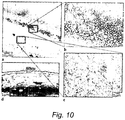
- the elementary composition and scanning electron microscopy of the GSC is shown in Fig. 10 .
- Silver inclusions with a size of 200 to 300 nm have been formed in the central part of the laser written lines, while the periphery of the beam led to the formation of fewer but much larger inclusions of up to 800 nm in diameter.
- the inclusions are formed on the surface of the sample.
- the GSC was coated with a carbon layer of a few nanometers to prevent charge buildup.
- the laser-written line is shown as a large brighter area going down from left to the right under an angle of 20°.
- ( b and c ) Show an image zoomed into that area.
- the speed of the processing can be as high as a few tens of mm per second.
- the formation of nanoparticles (metallic chains) as a result of either laser or even X-ray irradiation and subsequent annealing has been reported, the metallization a substrate in a one step laser assisted process was a wholly unexpected effect and is novel. This process leads to a controllable formation of percolated metallic films with tailored properties in terms of volume filling factor etc., which will then in turn affect the optical and electronic properties of the composite material.
- the present invention provides an area of homogenous silver-ion doped (SID) glass where the homogeneity extends across the whole sample which has been processed in accordance with the present invention. It also provides for the creation of homogenous (island-free) glass containing silver nanoparticles and for the irradiation of a processed sample with a laser leading to the fabrication of homogenous glass-silver composite (metallized area on the glass surface) samples.
- SID silver-ion doped
- the present invention provides a substrate upon which a metal layer is created at or in close proximity to the position upon the substrate at which the laser beam is incident.
- the optical absorption properties of the substrate and the final metalised material are different from those shown in the prior art as dempnstrated in the above mentioned figures.
- the present invention may find application in Technical Marking, Biomedical Applications, Sensors, Embedded Circuits (Optoelectronic circulates and light wave technology), Electro-Optic Materials with tailored nonlinearity, Stimulated Enhanced Raman Scattering (SERS) spectroscopy & related applications (nonlinear optics), and the creation of objects with an aesthetic silver layer.
- SERS Stimulated Enhanced Raman Scattering
Landscapes
- Chemical & Material Sciences (AREA)
- Geochemistry & Mineralogy (AREA)
- Life Sciences & Earth Sciences (AREA)
- Engineering & Computer Science (AREA)
- Chemical Kinetics & Catalysis (AREA)
- General Chemical & Material Sciences (AREA)
- Materials Engineering (AREA)
- Organic Chemistry (AREA)
- Health & Medical Sciences (AREA)
- Toxicology (AREA)
- Optics & Photonics (AREA)
- Physics & Mathematics (AREA)
- Surface Treatment Of Glass (AREA)
- Glass Compositions (AREA)
Claims (15)
- Verfahren zum Metallisieren eines Substrats, wobei das Verfahren die folgenden Schritte umfasst:
Erzeugen eines wie diffundierten Substrats, das für die Metallisierung geeignet ist, durch:Erhitzen und Anlegen einer Spannung über einem Ionenaustauschsubstrat, um Metallionen aus einer Metallschicht mittels eines lonenaustauschprozesses in dem lonenaustauschsubstrat einzubetten, um ein wie diffundiertes Substrat zu erzeugen, in dem die Metallionen homogen über dem Substrat verteilt sind; undMetallisieren des wie diffundierten Substrats durch:
Anwenden eines gepulsten Laserstrahls auf eine Oberfläche des wie diffundierten Substrats bei oder nahe einer Konzentration von Metallionen, sodass die Energie des Lasers die Umwandlung der Metallionen in dem wie diffundierten Substrat in Metallatome bei oder nahe dem Punkt, an dem der Laserimpuls auf das wie diffundierte Substrat auftrifft, bewirkt, wodurch ein metallisiertes Substrat mit einem Oberflächenmuster erzeugt wird, das durch die Bewegung des Laserstrahls über die Oberfläche des wie diffundierten Substrats definiert ist. - Verfahren nach Anspruch 1, das ferner das Erzeugen des lonenaustauschsubstrats durch Tempern eines Substrats mit einer geeigneten Konzentration an Alkaliionen und einer Metallschicht auf einer Oberfläche davon umfasst.
- Verfahren nach Anspruch 1, wobei die Metallatome in einer gemischten oder gefilterten Metall-Dielektrikum-Schicht enthalten sind.
- Verfahren nach Anspruch 2, wobei der Schritt des Temperns zwischen 250 °C und 350 °C erfolgt.
- Verfahren nach einem der vorhergehenden Ansprüche, wobei der Schritt des Erhitzens des Ionenaustauschsubstrats bei einer Temperatur zwischen 100 °C und 350 °C erfolgt.
- Verfahren nach einem der vorhergehenden Ansprüche, wobei die angelegte Spannung zwischen 10 V und 2 kV beträgt.
- Verfahren nach einem der vorhergehenden Ansprüche, wobei der Prozess ferner das Einführen einer leitenden Schicht zwischen die negative Elektrode und das Substrat umfasst, um den elektrischen Kontakt zwischen diesen zu verbessern.
- Verfahren nach einem der vorhergehenden Ansprüche, wobei der Prozess ferner das Einführen einer Empfangsschicht umfasst, die lonenaustauschmaterial einfängt, das während des Ionenaustauschprozesses aus dem Substrat entfernt wurde.
- Verfahren nach Anspruch 7, wobei die leitende Schicht hochgradig eben und verformbar ist, sodass sie Hohlräume füllt, die ansonsten zwischen der relativ unebenen Oberfläche des Glassubstrats und der Elektrode existieren würden.
- Verfahren nach Anspruche 7 und 8, wobei die leitende Schicht und die Empfangsschicht eine Graphitschicht umfassen.
- Verfahren nach einem der vorhergehenden Ansprüche, wobei das Substrat ein Kalknatronglas umfasst.
- Verfahren nach einem der vorhergehenden Ansprüche, wobei die Metallschicht Silberionen umfasst.
- Verfahren nach einem der vorhergehenden Ansprüche, wobei der gepulste Laser ein Nanosekunden- oder Pikosekunden-Pulslaser ist.
- Verfahren nach Anspruch 13, wobei der gepulste Laser bei Wellenlängen von 355 nm bis 1064 nm arbeitet.
- Verfahren nach Anspruch 13 oder Anspruch 14, wobei der gepulste Laser eine Energiefluenz von bis zu 5 J/cm2 aufweist.
Applications Claiming Priority (2)
| Application Number | Priority Date | Filing Date | Title |
|---|---|---|---|
| GBGB1200890.0A GB201200890D0 (en) | 2012-01-19 | 2012-01-19 | An ion exchange substrate and metalized product and apparatus and method for production thereof |
| PCT/GB2012/000717 WO2013107996A1 (en) | 2012-01-19 | 2012-09-14 | An ion exchange substrate and metalized product and apparatus and method for production thereof |
Publications (2)
| Publication Number | Publication Date |
|---|---|
| EP2804844A1 EP2804844A1 (de) | 2014-11-26 |
| EP2804844B1 true EP2804844B1 (de) | 2019-11-06 |
Family
ID=45814231
Family Applications (1)
| Application Number | Title | Priority Date | Filing Date |
|---|---|---|---|
| EP12772352.6A Active EP2804844B1 (de) | 2012-01-19 | 2012-09-14 | Verfahren zur herstellung von metallisiertes produkt |
Country Status (5)
| Country | Link |
|---|---|
| US (1) | US20150246847A1 (de) |
| EP (1) | EP2804844B1 (de) |
| CN (1) | CN104203857A (de) |
| GB (1) | GB201200890D0 (de) |
| WO (1) | WO2013107996A1 (de) |
Families Citing this family (11)
| Publication number | Priority date | Publication date | Assignee | Title |
|---|---|---|---|---|
| US9505654B2 (en) | 2013-06-06 | 2016-11-29 | Gyrotron Technology, Inc. | Method for the chemical strengthening of glass |
| US9790128B2 (en) * | 2013-08-07 | 2017-10-17 | Corning Incorporated | Laser controlled ion exchange process and glass articles formed therefrom |
| GB201401421D0 (en) * | 2014-01-28 | 2014-03-12 | Univ Dundee | Welded glass product and method of fabrication |
| RU2562619C1 (ru) * | 2014-02-20 | 2015-09-10 | Федеральное государственное бюджетное образовательное учреждение высшего профессионального образования "Санкт-Петербургский государственный политехнический университет" (ФГБОУ ВПО "СПбГПУ") | Способ получения структурированных сплошных и островковых пленок на поверхности стекла |
| CN107427258B (zh) * | 2015-04-15 | 2021-03-02 | 株式会社村田制作所 | 呼气传感器、呼气传感器单元及呼气检测方法 |
| FR3039701B1 (fr) * | 2015-07-30 | 2018-07-06 | Universite Pierre Et Marie Curie (Paris 6) | Dopage electrostatique d'une couche d'un materiau conducteur ou non-conducteur |
| CN106746743B (zh) * | 2016-12-06 | 2019-06-28 | 中国航空工业集团公司北京航空材料研究院 | 一种通过飞秒激光诱导玻璃表面选择性析晶的方法 |
| DE102016125544B4 (de) * | 2016-12-23 | 2020-10-01 | Glaswerke Arnold Gmbh & Co. Kg | Verfahren zur Herstellung einer biozid wirkenden Glasoberfläche eines Kalk-Natronsilicatglases |
| JPWO2018124097A1 (ja) * | 2016-12-27 | 2019-10-31 | 国立大学法人千葉大学 | 穴あき基板の製造方法および穴あき基板製造システム |
| US11522300B2 (en) | 2019-06-28 | 2022-12-06 | Corning Incorporated | Integral 5G antenna structure |
| US20260035293A1 (en) * | 2024-07-31 | 2026-02-05 | Corning Incorporated | Substrates with alkali depletion region |
Family Cites Families (52)
| Publication number | Priority date | Publication date | Assignee | Title |
|---|---|---|---|---|
| US2662035A (en) * | 1953-05-13 | 1953-12-08 | Verd A Ray Proc Company | Method of staining glass, glass staining compositions, and stained glass article |
| GB1266257A (de) * | 1969-03-27 | 1972-03-08 | ||
| JPS53303B2 (de) * | 1973-06-25 | 1978-01-07 | ||
| USRE31220E (en) * | 1977-11-30 | 1983-04-26 | Ppg Industries, Inc. | Electromigration method for making stained glass photomasks |
| US4297417A (en) * | 1978-07-14 | 1981-10-27 | Corning Glass Works | Photosensitive colored glasses exhibiting alterable photo-anisotropic effects |
| US4407891A (en) * | 1981-11-20 | 1983-10-04 | Ppg Industries, Inc. | Low temperature reduction process for large photomasks |
| US4390592A (en) * | 1981-11-20 | 1983-06-28 | Ppg Industries, Inc. | Low temperature reduction process for photomasks |
| US6261856B1 (en) * | 1987-09-16 | 2001-07-17 | Semiconductor Energy Laboratory Co., Ltd. | Method and system of laser processing |
| EP0548385A1 (de) * | 1991-12-20 | 1993-06-30 | Corning Incorporated | Verfahren zur Vergrabung optischer Wellenleiter |
| US5491708A (en) * | 1993-02-01 | 1996-02-13 | The United States Of America As Represented By The Secretary Of Commerce | Integrated optic laser |
| JPH11217237A (ja) * | 1996-03-25 | 1999-08-10 | Nippon Sheet Glass Co Ltd | レーザ加工用ガラス基材及びレーザ加工方法 |
| US6329270B1 (en) * | 1997-03-07 | 2001-12-11 | Sharp Laboratories Of America, Inc. | Laser annealed microcrystalline film and method for same |
| DE19841547B4 (de) * | 1998-09-11 | 2004-04-08 | Martin-Luther-Universität Halle-Wittenberg | Gläser mit farbigen Strukturen und Verfahren zu deren Herstellung |
| DE19855623C1 (de) * | 1998-12-02 | 2000-02-24 | Lpkf Laser & Electronics Ag | Verfahren zur Erzeugung einer Markierung in einem Glaskörper |
| JP2001048595A (ja) * | 1999-03-19 | 2001-02-20 | Inax Corp | ガラス層をもつ基体の表面処理方法及びその製品 |
| WO2003049175A1 (fr) * | 2001-12-07 | 2003-06-12 | Sony Corporation | Irradiateur a faisceaux et dispositif de recuit pour laser |
| US7104090B2 (en) * | 2002-01-24 | 2006-09-12 | Corning Incorporated | Method of making polarizing glasses |
| US20050044895A1 (en) * | 2002-04-16 | 2005-03-03 | Central Glass Company, Limited | Method for putting color to glass or erasing color from colored glass |
| KR20040000332A (ko) * | 2002-06-24 | 2004-01-03 | 아사히 가라스 가부시키가이샤 | 음극선관용 유리깔때기 및 그 제조방법 |
| WO2005042437A2 (en) * | 2003-09-30 | 2005-05-12 | Schott Ag | Antimicrobial glass and glass ceramic surfaces and their production |
| KR20060024047A (ko) * | 2004-09-13 | 2006-03-16 | 삼성코닝 주식회사 | 평면디스플레이장치용 유리기판 및 그 제조방법 |
| KR20070091288A (ko) * | 2004-11-17 | 2007-09-10 | 컬러 칩 (이스라엘) 리미티드. | 도파로 테이퍼링 및 최적화된 도파로 구조물 형성의프로세스 및 방법 |
| CN101111938B (zh) * | 2005-01-28 | 2010-08-11 | 株式会社半导体能源研究所 | 半导体器件和制造它的方法 |
| GB0506896D0 (en) * | 2005-04-05 | 2005-05-11 | Plastic Logic Ltd | Stack ablation |
| US8312743B2 (en) * | 2005-05-18 | 2012-11-20 | City University Of Hong Kong | Method for fabricating buried ion-exchanged waveguides using field-assisted annealing |
| JP5067747B2 (ja) * | 2005-08-08 | 2012-11-07 | 独立行政法人産業技術総合研究所 | 光線指向性化ガラス基板及びそれを用いた照明装置 |
| US7335611B2 (en) * | 2005-08-08 | 2008-02-26 | Applied Materials, Inc. | Copper conductor annealing process employing high speed optical annealing with a low temperature-deposited optical absorber layer |
| WO2008062656A1 (en) * | 2006-11-22 | 2008-05-29 | Konica Minolta Opto, Inc. | Glass substrate for information recording medium, method for manufacturing glass substrate for information recording medium, and information recording medium |
| GB2448338B (en) * | 2007-04-11 | 2012-02-29 | Dunwilco 1198 Ltd | Process for the preparation of coloured particulates |
| JP5467490B2 (ja) * | 2007-08-03 | 2014-04-09 | 日本電気硝子株式会社 | 強化ガラス基板の製造方法及び強化ガラス基板 |
| FR2920426B1 (fr) * | 2007-09-03 | 2011-05-06 | Saint Gobain | Substrat en verre a gradient d'indice de refraction et procede de fabrication |
| FI122878B (fi) * | 2007-12-20 | 2012-08-15 | Beneq Oy | Menetelmä lasin seostamiseksi |
| FR2929415B1 (fr) * | 2008-03-27 | 2010-03-12 | Saint Gobain | Procede de fabrication d'elements optiques plans et elements obtenus |
| US7810355B2 (en) * | 2008-06-30 | 2010-10-12 | Apple Inc. | Full perimeter chemical strengthening of substrates |
| JP2011527661A (ja) * | 2008-07-11 | 2011-11-04 | コーニング インコーポレイテッド | 民生用途のための圧縮面を有するガラス |
| CN102939269B (zh) * | 2009-11-25 | 2015-11-25 | 旭硝子株式会社 | 显示器保护玻璃用玻璃基板及其制造方法 |
| FR2953212B1 (fr) * | 2009-12-01 | 2013-07-05 | Saint Gobain | Procede de structuration de surface par gravure ionique reactive,surface structuree et utilisations. |
| ATE551719T1 (de) * | 2009-12-09 | 2012-04-15 | Abb Technology Ag | Verfahren zur herstellung von halbleiterbauelementen mittels laserglühen zur selektiven aktivierung von implantierten dotiersubstanzen |
| JP5649592B2 (ja) * | 2011-02-17 | 2015-01-07 | Hoya株式会社 | 携帯電子機器用カバーガラスのガラス基板の製造方法、携帯電子機器用カバーガラスのガラス基板および携帯電子機器 |
| JPWO2013027651A1 (ja) * | 2011-08-23 | 2015-03-19 | Hoya株式会社 | 強化ガラス基板の製造方法および強化ガラス基板 |
| US9487441B2 (en) * | 2011-10-28 | 2016-11-08 | Corning Incorporated | Glass articles with infrared reflectivity and methods for making the same |
| JP5930377B2 (ja) * | 2012-02-20 | 2016-06-08 | 日本電気硝子株式会社 | 強化ガラス |
| KR20140144212A (ko) * | 2012-04-10 | 2014-12-18 | 아사히 가라스 가부시키가이샤 | 강화 유리 물품 및 터치 센서체형 커버 유리 |
| US9472694B2 (en) * | 2012-04-23 | 2016-10-18 | The Board Of Trustees Of The Leland Stanford Junior University | Composition and method for upconversion of light and devices incorporating same |
| WO2013191164A1 (ja) * | 2012-06-22 | 2013-12-27 | 旭硝子株式会社 | ガラス基体の表面処理方法、およびガラス基体 |
| US9034442B2 (en) * | 2012-11-30 | 2015-05-19 | Corning Incorporated | Strengthened borosilicate glass containers with improved damage tolerance |
| DE112013006831T5 (de) * | 2013-03-15 | 2015-12-10 | Schott Glass Technologies (Suzhou) Co., Ltd. | Chemisch vorgespanntes flexibles ultradünnes Glas |
| JP2014208570A (ja) * | 2013-03-25 | 2014-11-06 | 日本電気硝子株式会社 | 強化ガラス基板及びその製造方法 |
| US20140356406A1 (en) * | 2013-05-31 | 2014-12-04 | Corning Incorporated | Antimicrobial Articles and Methods of Making and Using Same |
| EP3511161A1 (de) * | 2013-08-26 | 2019-07-17 | Corning Incorporated | Laminierte struktur |
| US20150362374A1 (en) * | 2014-06-16 | 2015-12-17 | The Government Of The United States Of America, As Represented By The Secretary Of The Navy | Atomic Layer Deposition of Vanadium Oxide for Microbolometer and Imager |
| WO2016176096A1 (en) * | 2015-04-30 | 2016-11-03 | Corning Incorporated | Electrically conductive articles with discrete metallic silver layers and methods for making same |
-
2012
- 2012-01-19 GB GBGB1200890.0A patent/GB201200890D0/en not_active Ceased
- 2012-09-14 CN CN201280071571.3A patent/CN104203857A/zh active Pending
- 2012-09-14 EP EP12772352.6A patent/EP2804844B1/de active Active
- 2012-09-14 US US14/373,258 patent/US20150246847A1/en not_active Abandoned
- 2012-09-14 WO PCT/GB2012/000717 patent/WO2013107996A1/en not_active Ceased
Non-Patent Citations (1)
| Title |
|---|
| None * |
Also Published As
| Publication number | Publication date |
|---|---|
| WO2013107996A1 (en) | 2013-07-25 |
| US20150246847A1 (en) | 2015-09-03 |
| EP2804844A1 (de) | 2014-11-26 |
| GB201200890D0 (en) | 2012-02-29 |
| CN104203857A (zh) | 2014-12-10 |
Similar Documents
| Publication | Publication Date | Title |
|---|---|---|
| US20150246847A1 (en) | Ion Exchange Substrate and Metalized Product and Apparatus and Method for Production Thereof | |
| Menazea et al. | Precipitation of silver nanoparticles in silicate glasses via Nd: YAG nanosecond laser and its characterization | |
| Kumar et al. | Optical limiting applications of resonating plasmonic Au nanoparticles in a dielectric glass medium | |
| Du et al. | Precipitation of CsPbBr3 quantum dots in borophosphate glasses inducted by heat-treatment and UV-NIR ultrafast lasers | |
| Kang et al. | One-step direct-laser metal writing of sub-100 nm 3D silver nanostructures in a gelatin matrix | |
| Xiang et al. | Valence state control and third-order nonlinear optical properties of copper embedded in sodium borosilicate glass | |
| Karthikeyan et al. | Optical and nonlinear optical properties of copper nanocomposite glasses annealed near the glass softening temperature | |
| JP2008094713A (ja) | ガラス基材の表面改質方法、および表面改質ガラス基材 | |
| DE19841547B4 (de) | Gläser mit farbigen Strukturen und Verfahren zu deren Herstellung | |
| Ajami et al. | Saturable absorption of silver nanoparticles in glass for femtosecond laser pulses at 400 nm | |
| Zamora-Romero et al. | Molybdenum nanoparticles generation by pulsed laser ablation and effects of oxidation due to aging | |
| Kotsedi et al. | Femtosecond laser surface structuring of molybdenum thin films | |
| EP2191976A2 (de) | Verfahren zum Markieren oder Beschriften eines Werkstücks | |
| Sendova et al. | Plasmonic coupling in silver nanocomposite glasses | |
| Iqbal et al. | Nonlinear photonics in glass systems doped with quantum dots and plasmonic nanoparticles | |
| Zeng et al. | Preparation and optical properties of silver nanoparticles induced by a femtosecond laser irradiation | |
| Teng et al. | Light and heat driven precipitation of copper nanoparticles inside Cu2+-doped borate glasses | |
| Sola et al. | Stress-induced buried waveguides in the 0.8 CaSiO3–0.2 Ca3 (PO4) 2 eutectic glass doped with Nd3+ ions | |
| Fahri et al. | Nonlinear optical response of zinc oxide nanorods with gold and silver alloy embedment | |
| Teng et al. | Controllable space selective precipitation of copper nanoparticles in borosilicate glasses using ultrafast laser irradiation | |
| Zeng et al. | Irradiation assisted fabrication of gold nanoparticles-doped glasses | |
| Blondeau et al. | Influence of pulsed laser irradiation on precipitation of silver nanoparticles in glass | |
| Wackerow et al. | Laser-assisted one-step fabrication of homogeneous glass–silver composite | |
| Zolotovskaya et al. | On second harmonic generation and multiphoton-absorption induced luminescence from laser-reshaped silver nanoparticles embedded in glass | |
| CN1273401C (zh) | 紫外脉冲激光辐照辅助纳米掺杂玻璃的制作方法 |
Legal Events
| Date | Code | Title | Description |
|---|---|---|---|
| PUAI | Public reference made under article 153(3) epc to a published international application that has entered the european phase |
Free format text: ORIGINAL CODE: 0009012 |
|
| 17P | Request for examination filed |
Effective date: 20140815 |
|
| AK | Designated contracting states |
Kind code of ref document: A1 Designated state(s): AL AT BE BG CH CY CZ DE DK EE ES FI FR GB GR HR HU IE IS IT LI LT LU LV MC MK MT NL NO PL PT RO RS SE SI SK SM TR |
|
| DAX | Request for extension of the european patent (deleted) | ||
| STAA | Information on the status of an ep patent application or granted ep patent |
Free format text: STATUS: EXAMINATION IS IN PROGRESS |
|
| 17Q | First examination report despatched |
Effective date: 20180709 |
|
| GRAP | Despatch of communication of intention to grant a patent |
Free format text: ORIGINAL CODE: EPIDOSNIGR1 |
|
| STAA | Information on the status of an ep patent application or granted ep patent |
Free format text: STATUS: GRANT OF PATENT IS INTENDED |
|
| INTG | Intention to grant announced |
Effective date: 20190502 |
|
| GRAS | Grant fee paid |
Free format text: ORIGINAL CODE: EPIDOSNIGR3 |
|
| GRAA | (expected) grant |
Free format text: ORIGINAL CODE: 0009210 |
|
| STAA | Information on the status of an ep patent application or granted ep patent |
Free format text: STATUS: THE PATENT HAS BEEN GRANTED |
|
| AK | Designated contracting states |
Kind code of ref document: B1 Designated state(s): AL AT BE BG CH CY CZ DE DK EE ES FI FR GB GR HR HU IE IS IT LI LT LU LV MC MK MT NL NO PL PT RO RS SE SI SK SM TR |
|
| REG | Reference to a national code |
Ref country code: GB Ref legal event code: FG4D |
|
| REG | Reference to a national code |
Ref country code: CH Ref legal event code: EP Ref country code: AT Ref legal event code: REF Ref document number: 1198530 Country of ref document: AT Kind code of ref document: T Effective date: 20191115 |
|
| REG | Reference to a national code |
Ref country code: IE Ref legal event code: FG4D |
|
| REG | Reference to a national code |
Ref country code: DE Ref legal event code: R096 Ref document number: 602012065463 Country of ref document: DE |
|
| REG | Reference to a national code |
Ref country code: NL Ref legal event code: MP Effective date: 20191106 |
|
| REG | Reference to a national code |
Ref country code: LT Ref legal event code: MG4D |
|
| PG25 | Lapsed in a contracting state [announced via postgrant information from national office to epo] |
Ref country code: PT Free format text: LAPSE BECAUSE OF FAILURE TO SUBMIT A TRANSLATION OF THE DESCRIPTION OR TO PAY THE FEE WITHIN THE PRESCRIBED TIME-LIMIT Effective date: 20200306 Ref country code: SE Free format text: LAPSE BECAUSE OF FAILURE TO SUBMIT A TRANSLATION OF THE DESCRIPTION OR TO PAY THE FEE WITHIN THE PRESCRIBED TIME-LIMIT Effective date: 20191106 Ref country code: LV Free format text: LAPSE BECAUSE OF FAILURE TO SUBMIT A TRANSLATION OF THE DESCRIPTION OR TO PAY THE FEE WITHIN THE PRESCRIBED TIME-LIMIT Effective date: 20191106 Ref country code: PL Free format text: LAPSE BECAUSE OF FAILURE TO SUBMIT A TRANSLATION OF THE DESCRIPTION OR TO PAY THE FEE WITHIN THE PRESCRIBED TIME-LIMIT Effective date: 20191106 Ref country code: LT Free format text: LAPSE BECAUSE OF FAILURE TO SUBMIT A TRANSLATION OF THE DESCRIPTION OR TO PAY THE FEE WITHIN THE PRESCRIBED TIME-LIMIT Effective date: 20191106 Ref country code: GR Free format text: LAPSE BECAUSE OF FAILURE TO SUBMIT A TRANSLATION OF THE DESCRIPTION OR TO PAY THE FEE WITHIN THE PRESCRIBED TIME-LIMIT Effective date: 20200207 Ref country code: NL Free format text: LAPSE BECAUSE OF FAILURE TO SUBMIT A TRANSLATION OF THE DESCRIPTION OR TO PAY THE FEE WITHIN THE PRESCRIBED TIME-LIMIT Effective date: 20191106 Ref country code: ES Free format text: LAPSE BECAUSE OF FAILURE TO SUBMIT A TRANSLATION OF THE DESCRIPTION OR TO PAY THE FEE WITHIN THE PRESCRIBED TIME-LIMIT Effective date: 20191106 Ref country code: FI Free format text: LAPSE BECAUSE OF FAILURE TO SUBMIT A TRANSLATION OF THE DESCRIPTION OR TO PAY THE FEE WITHIN THE PRESCRIBED TIME-LIMIT Effective date: 20191106 Ref country code: NO Free format text: LAPSE BECAUSE OF FAILURE TO SUBMIT A TRANSLATION OF THE DESCRIPTION OR TO PAY THE FEE WITHIN THE PRESCRIBED TIME-LIMIT Effective date: 20200206 Ref country code: BG Free format text: LAPSE BECAUSE OF FAILURE TO SUBMIT A TRANSLATION OF THE DESCRIPTION OR TO PAY THE FEE WITHIN THE PRESCRIBED TIME-LIMIT Effective date: 20200206 |
|
| PG25 | Lapsed in a contracting state [announced via postgrant information from national office to epo] |
Ref country code: RS Free format text: LAPSE BECAUSE OF FAILURE TO SUBMIT A TRANSLATION OF THE DESCRIPTION OR TO PAY THE FEE WITHIN THE PRESCRIBED TIME-LIMIT Effective date: 20191106 Ref country code: IS Free format text: LAPSE BECAUSE OF FAILURE TO SUBMIT A TRANSLATION OF THE DESCRIPTION OR TO PAY THE FEE WITHIN THE PRESCRIBED TIME-LIMIT Effective date: 20200306 Ref country code: HR Free format text: LAPSE BECAUSE OF FAILURE TO SUBMIT A TRANSLATION OF THE DESCRIPTION OR TO PAY THE FEE WITHIN THE PRESCRIBED TIME-LIMIT Effective date: 20191106 |
|
| PG25 | Lapsed in a contracting state [announced via postgrant information from national office to epo] |
Ref country code: AL Free format text: LAPSE BECAUSE OF FAILURE TO SUBMIT A TRANSLATION OF THE DESCRIPTION OR TO PAY THE FEE WITHIN THE PRESCRIBED TIME-LIMIT Effective date: 20191106 |
|
| PG25 | Lapsed in a contracting state [announced via postgrant information from national office to epo] |
Ref country code: RO Free format text: LAPSE BECAUSE OF FAILURE TO SUBMIT A TRANSLATION OF THE DESCRIPTION OR TO PAY THE FEE WITHIN THE PRESCRIBED TIME-LIMIT Effective date: 20191106 Ref country code: DK Free format text: LAPSE BECAUSE OF FAILURE TO SUBMIT A TRANSLATION OF THE DESCRIPTION OR TO PAY THE FEE WITHIN THE PRESCRIBED TIME-LIMIT Effective date: 20191106 Ref country code: EE Free format text: LAPSE BECAUSE OF FAILURE TO SUBMIT A TRANSLATION OF THE DESCRIPTION OR TO PAY THE FEE WITHIN THE PRESCRIBED TIME-LIMIT Effective date: 20191106 Ref country code: CZ Free format text: LAPSE BECAUSE OF FAILURE TO SUBMIT A TRANSLATION OF THE DESCRIPTION OR TO PAY THE FEE WITHIN THE PRESCRIBED TIME-LIMIT Effective date: 20191106 |
|
| REG | Reference to a national code |
Ref country code: DE Ref legal event code: R097 Ref document number: 602012065463 Country of ref document: DE |
|
| REG | Reference to a national code |
Ref country code: AT Ref legal event code: MK05 Ref document number: 1198530 Country of ref document: AT Kind code of ref document: T Effective date: 20191106 |
|
| PG25 | Lapsed in a contracting state [announced via postgrant information from national office to epo] |
Ref country code: SK Free format text: LAPSE BECAUSE OF FAILURE TO SUBMIT A TRANSLATION OF THE DESCRIPTION OR TO PAY THE FEE WITHIN THE PRESCRIBED TIME-LIMIT Effective date: 20191106 Ref country code: SM Free format text: LAPSE BECAUSE OF FAILURE TO SUBMIT A TRANSLATION OF THE DESCRIPTION OR TO PAY THE FEE WITHIN THE PRESCRIBED TIME-LIMIT Effective date: 20191106 |
|
| PLBE | No opposition filed within time limit |
Free format text: ORIGINAL CODE: 0009261 |
|
| STAA | Information on the status of an ep patent application or granted ep patent |
Free format text: STATUS: NO OPPOSITION FILED WITHIN TIME LIMIT |
|
| 26N | No opposition filed |
Effective date: 20200807 |
|
| PGFP | Annual fee paid to national office [announced via postgrant information from national office to epo] |
Ref country code: FR Payment date: 20200924 Year of fee payment: 9 Ref country code: GB Payment date: 20200904 Year of fee payment: 9 Ref country code: DE Payment date: 20200924 Year of fee payment: 9 |
|
| PG25 | Lapsed in a contracting state [announced via postgrant information from national office to epo] |
Ref country code: SI Free format text: LAPSE BECAUSE OF FAILURE TO SUBMIT A TRANSLATION OF THE DESCRIPTION OR TO PAY THE FEE WITHIN THE PRESCRIBED TIME-LIMIT Effective date: 20191106 Ref country code: AT Free format text: LAPSE BECAUSE OF FAILURE TO SUBMIT A TRANSLATION OF THE DESCRIPTION OR TO PAY THE FEE WITHIN THE PRESCRIBED TIME-LIMIT Effective date: 20191106 |
|
| PG25 | Lapsed in a contracting state [announced via postgrant information from national office to epo] |
Ref country code: IT Free format text: LAPSE BECAUSE OF FAILURE TO SUBMIT A TRANSLATION OF THE DESCRIPTION OR TO PAY THE FEE WITHIN THE PRESCRIBED TIME-LIMIT Effective date: 20191106 |
|
| PG25 | Lapsed in a contracting state [announced via postgrant information from national office to epo] |
Ref country code: MC Free format text: LAPSE BECAUSE OF FAILURE TO SUBMIT A TRANSLATION OF THE DESCRIPTION OR TO PAY THE FEE WITHIN THE PRESCRIBED TIME-LIMIT Effective date: 20191106 |
|
| REG | Reference to a national code |
Ref country code: CH Ref legal event code: PL |
|
| REG | Reference to a national code |
Ref country code: BE Ref legal event code: MM Effective date: 20200930 |
|
| PG25 | Lapsed in a contracting state [announced via postgrant information from national office to epo] |
Ref country code: LU Free format text: LAPSE BECAUSE OF NON-PAYMENT OF DUE FEES Effective date: 20200914 |
|
| PG25 | Lapsed in a contracting state [announced via postgrant information from national office to epo] |
Ref country code: CH Free format text: LAPSE BECAUSE OF NON-PAYMENT OF DUE FEES Effective date: 20200930 Ref country code: BE Free format text: LAPSE BECAUSE OF NON-PAYMENT OF DUE FEES Effective date: 20200930 Ref country code: IE Free format text: LAPSE BECAUSE OF NON-PAYMENT OF DUE FEES Effective date: 20200914 Ref country code: LI Free format text: LAPSE BECAUSE OF NON-PAYMENT OF DUE FEES Effective date: 20200930 |
|
| REG | Reference to a national code |
Ref country code: DE Ref legal event code: R119 Ref document number: 602012065463 Country of ref document: DE |
|
| GBPC | Gb: european patent ceased through non-payment of renewal fee |
Effective date: 20210914 |
|
| PG25 | Lapsed in a contracting state [announced via postgrant information from national office to epo] |
Ref country code: TR Free format text: LAPSE BECAUSE OF FAILURE TO SUBMIT A TRANSLATION OF THE DESCRIPTION OR TO PAY THE FEE WITHIN THE PRESCRIBED TIME-LIMIT Effective date: 20191106 Ref country code: MT Free format text: LAPSE BECAUSE OF FAILURE TO SUBMIT A TRANSLATION OF THE DESCRIPTION OR TO PAY THE FEE WITHIN THE PRESCRIBED TIME-LIMIT Effective date: 20191106 Ref country code: CY Free format text: LAPSE BECAUSE OF FAILURE TO SUBMIT A TRANSLATION OF THE DESCRIPTION OR TO PAY THE FEE WITHIN THE PRESCRIBED TIME-LIMIT Effective date: 20191106 |
|
| PG25 | Lapsed in a contracting state [announced via postgrant information from national office to epo] |
Ref country code: MK Free format text: LAPSE BECAUSE OF FAILURE TO SUBMIT A TRANSLATION OF THE DESCRIPTION OR TO PAY THE FEE WITHIN THE PRESCRIBED TIME-LIMIT Effective date: 20191106 |
|
| PG25 | Lapsed in a contracting state [announced via postgrant information from national office to epo] |
Ref country code: GB Free format text: LAPSE BECAUSE OF NON-PAYMENT OF DUE FEES Effective date: 20210914 Ref country code: FR Free format text: LAPSE BECAUSE OF NON-PAYMENT OF DUE FEES Effective date: 20210930 Ref country code: DE Free format text: LAPSE BECAUSE OF NON-PAYMENT OF DUE FEES Effective date: 20220401 |