EP2795155B1 - Riemen mit mehrschichtig imprägnierter textilauflage - Google Patents
Riemen mit mehrschichtig imprägnierter textilauflage Download PDFInfo
- Publication number
- EP2795155B1 EP2795155B1 EP12812170.4A EP12812170A EP2795155B1 EP 2795155 B1 EP2795155 B1 EP 2795155B1 EP 12812170 A EP12812170 A EP 12812170A EP 2795155 B1 EP2795155 B1 EP 2795155B1
- Authority
- EP
- European Patent Office
- Prior art keywords
- textile
- coating
- power transmission
- belt
- layer
- Prior art date
- Legal status (The legal status is an assumption and is not a legal conclusion. Google has not performed a legal analysis and makes no representation as to the accuracy of the status listed.)
- Active
Links
Images

Classifications
-
- F—MECHANICAL ENGINEERING; LIGHTING; HEATING; WEAPONS; BLASTING
- F16—ENGINEERING ELEMENTS AND UNITS; GENERAL MEASURES FOR PRODUCING AND MAINTAINING EFFECTIVE FUNCTIONING OF MACHINES OR INSTALLATIONS; THERMAL INSULATION IN GENERAL
- F16G—BELTS, CABLES, OR ROPES, PREDOMINANTLY USED FOR DRIVING PURPOSES; CHAINS; FITTINGS PREDOMINANTLY USED THEREFOR
- F16G1/00—Driving-belts
- F16G1/14—Driving-belts made of plastics
- F16G1/16—Driving-belts made of plastics with reinforcement bonded by the plastic material
-
- B—PERFORMING OPERATIONS; TRANSPORTING
- B29—WORKING OF PLASTICS; WORKING OF SUBSTANCES IN A PLASTIC STATE IN GENERAL
- B29D—PRODUCING PARTICULAR ARTICLES FROM PLASTICS OR FROM SUBSTANCES IN A PLASTIC STATE
- B29D29/00—Producing belts or bands
- B29D29/08—Toothed driving belts
-
- F—MECHANICAL ENGINEERING; LIGHTING; HEATING; WEAPONS; BLASTING
- F16—ENGINEERING ELEMENTS AND UNITS; GENERAL MEASURES FOR PRODUCING AND MAINTAINING EFFECTIVE FUNCTIONING OF MACHINES OR INSTALLATIONS; THERMAL INSULATION IN GENERAL
- F16G—BELTS, CABLES, OR ROPES, PREDOMINANTLY USED FOR DRIVING PURPOSES; CHAINS; FITTINGS PREDOMINANTLY USED THEREFOR
- F16G1/00—Driving-belts
- F16G1/06—Driving-belts made of rubber
- F16G1/08—Driving-belts made of rubber with reinforcement bonded by the rubber
-
- F—MECHANICAL ENGINEERING; LIGHTING; HEATING; WEAPONS; BLASTING
- F16—ENGINEERING ELEMENTS AND UNITS; GENERAL MEASURES FOR PRODUCING AND MAINTAINING EFFECTIVE FUNCTIONING OF MACHINES OR INSTALLATIONS; THERMAL INSULATION IN GENERAL
- F16G—BELTS, CABLES, OR ROPES, PREDOMINANTLY USED FOR DRIVING PURPOSES; CHAINS; FITTINGS PREDOMINANTLY USED THEREFOR
- F16G1/00—Driving-belts
- F16G1/06—Driving-belts made of rubber
- F16G1/08—Driving-belts made of rubber with reinforcement bonded by the rubber
- F16G1/10—Driving-belts made of rubber with reinforcement bonded by the rubber with textile reinforcement
-
- F—MECHANICAL ENGINEERING; LIGHTING; HEATING; WEAPONS; BLASTING
- F16—ENGINEERING ELEMENTS AND UNITS; GENERAL MEASURES FOR PRODUCING AND MAINTAINING EFFECTIVE FUNCTIONING OF MACHINES OR INSTALLATIONS; THERMAL INSULATION IN GENERAL
- F16G—BELTS, CABLES, OR ROPES, PREDOMINANTLY USED FOR DRIVING PURPOSES; CHAINS; FITTINGS PREDOMINANTLY USED THEREFOR
- F16G1/00—Driving-belts
- F16G1/28—Driving-belts with a contact surface of special shape, e.g. toothed
-
- F—MECHANICAL ENGINEERING; LIGHTING; HEATING; WEAPONS; BLASTING
- F16—ENGINEERING ELEMENTS AND UNITS; GENERAL MEASURES FOR PRODUCING AND MAINTAINING EFFECTIVE FUNCTIONING OF MACHINES OR INSTALLATIONS; THERMAL INSULATION IN GENERAL
- F16G—BELTS, CABLES, OR ROPES, PREDOMINANTLY USED FOR DRIVING PURPOSES; CHAINS; FITTINGS PREDOMINANTLY USED THEREFOR
- F16G5/00—V-belts, i.e. belts of tapered cross-section
- F16G5/20—V-belts, i.e. belts of tapered cross-section with a contact surface of special shape, e.g. toothed
-
- B—PERFORMING OPERATIONS; TRANSPORTING
- B29—WORKING OF PLASTICS; WORKING OF SUBSTANCES IN A PLASTIC STATE IN GENERAL
- B29L—INDEXING SCHEME ASSOCIATED WITH SUBCLASS B29C, RELATING TO PARTICULAR ARTICLES
- B29L2029/00—Belts or bands
Definitions
- the invention relates to a power transmission belt with an elastic substructure made of cast polyurethane and a force transmission zone formed thereon and with a textile support in contact with this power transmission zone, a plurality of methods for its production and an associated, multi-layer impregnated Riementextil.
- Textile coatings on belts have the primary purpose of reducing abrasion and, in the case of toothed belts, suppressing the tearing tendency at the tooth edges and the tearing tendency in the event of damage in the tooth outer edge.
- Polyurethane belts are generally poured directly onto the textile overlay so that the polyurethane on the overlay reacts, cross-links and solidifies. It penetrates at least partially into the textile and through it. If, in the course of use, the abrasion-resistant and optionally friction-reducing textile support is removed somewhat, the belt polyurethane, which generally has a very high coefficient of friction, comes into direct contact with the power transmission or toothed disk, so that the friction abruptly increases there. This is undesirable.
- the method is not suitable because it prevents the desired mechanical interlocking between polyurethane and textile and shortens the durability or maximum life of the belt.
- EP 1 180 615 A2 is another example of an endless power transmission belt in which on the power transmission side, in particular on there formed teeth a textile support is placed. A coating of thermoplastic material is interposed between the belt body and the fabric support to prevent passage of belt material through the fabric support to the belt surface.
- the WO 2005/080820 A1 discloses an oil-resistant toothed belt which has on the tooth side or on both sides a protective layer of a fluoroplastic mixed with an elastomer applied over a fabric support.
- the DE 10 2010 017782 A1 discloses a power transmission belt having an elastic body of an at least partially vulcanized rubber mixture, which in addition to at least one rubber component and at least one filler still contains a specific reactive diluent.
- a fluoropolymer-impregnated textile overlay, a coated textile overlay, or a non-textile two-ply coating may be provided on the force transfer zone.
- the invention has the object of developing a belt of the type mentioned so that a significant improvement in runtime is achieved over the life largely consistent performance characteristics.
- the abrasion resistance of Riementextils should be increased and an increase in the coefficient of friction over the term can be avoided or reduced.
- the above problem is solved by the belt on the outside Surface of the textile support at least partially penetrated into the textile, there has an impregnating first coating of a first thermoplastic material, further on the first coating, a second coating of a second thermoplastic material is present.
- the melting temperature of the second thermoplastic material is higher than that of the first thermoplastic material and preferably remains below 150 ° C, while the first thermoplastic material has a melting temperature of from 80 ° C to about 145 ° C.
- the melting point is determined, for example, by means of differential scanning calorimetry (DSC) at ambient pressure.
- the impregnation of the first coating serves at the same time to form a barrier zone for penetrating from the other side of the fabric when pouring polyurethane, thereby additionally to give by reinforcing the fabric with a filler material a further mechanical interlocking between polyurethane and impregnated textile and finally the fibers of Textile to the belt surface to fix.
- the latter happens below the second coating, which is preferably thin and will wear off quickly in the course of use, or which alternatively may be withdrawn prior to use of the belt if the coatings are peelable with each other.
- the two-layer finish of the fabric wherein the first coating at least partially forms an impregnation within the textile structure, causes the second coating, which forms a closed coating blanket as a coating with a thermoplastic material, to prevent the polyurethane from completely draining the textile cover during casting penetrates or even reaches its outer surface and forms a film there. Rather, the cast polyurethane is retained in the impregnated zone and penetrates maximally to the outer surface of the fabric support without fully penetrating or passing outside onto the surface.
- the second coating itself has a coefficient of friction which gives the belt good performance and, in any case, is well below the coefficient of friction of a polyurethane.
- the (sliding) coefficient of friction of the second coating is preferably below 0.45 and in each case preferably below 0.3. It is not a disadvantage if the second coating is thin and is removed relatively quickly by abrasion in use.
- the abrasion-resistant textile After removal of this second coating, the abrasion-resistant textile reaches the belt surface, primarily with its zone impregnated with the first coating. While cast belt polyurethane may have penetrated to this zone, this is only to a relatively minor extent so that the high coefficient of polyurethane friction can be offset by a low coefficient of friction of the second coating thermoplastic material and / or friction-reducing properties of the fabric cover abrasion resistant fabric ,
- the friction coefficient of the second coating is also below 0.45, more preferably below 0.3.
- thermoplastic materials of both the first and second coatings may be modified with a friction reducing additive.
- the friction reducing additive may be, in particular, polyolefin fluorides such as preferably PTFE, polyvinyl chloride, graphite, silicone, molybdenum disulfite or other known friction reducing additives or mixtures of these additives. Friction reducing additives are known in the art. The further additivation of thermoplastic materials, which is always possible, need not be specified here.
- thermoplastic material of the first coating or the first thermoplastic material is a copolyamide.
- Copolyamides here are understood as meaning both polymers of more than two different monomer types which polymerize to form polyamide, as well as mixtures of several such polymers.
- the copolyamides may in principle consist of one or more diamines in conjunction with one or more dicarboxylic acids or lactams, optionally in combination with one or more - aminocarboxylic acids, other amino-substituted carboxylic acids, etc.
- caprolactam / hexamethylenediamine / adipic acid For example only: caprolactam / hexamethylenediamine / adipic acid; Hexamethylenediamine / adipic acid / -Se baccinklare; Hexamethylenediamine / tetramethylenediamine / adipic acid; Hexamethylenediamine / tetramethylenediamine / Acelain-oic acid; and products of dicaboxylic acids, diamines and alpha-aminocarboxylic acids or lactams with aliphatic, cycloaliphatic or aromatic amines and / or carboxylic acid, preferably in each case having 6 to 20 carbon atoms per monomer unit.
- copolyamides are also understood mixtures of several of the aforementioned copolyamides.
- copolyamides are understood as meaning copolymers of polyamide units and further copolymerizable units and mixtures of copolyamides, as described above, with other polymers, each having a polyamide content of at least 50 wt .-% have.
- the thermoplastic material of the first coating preferably has a melting point between 80 and 145 ° C, more preferably between 90 and 145 ° C, more preferably between 90 and 135 ° C, more preferably between 100 and 135 ° C and especially between 100 and 130 ° C.
- thermoplastic material of the first coating is present in the power transmission belt according to the invention in the textile cover at least largely or completely melted, which as described in more detail below is effected by special manufacturing processes or pretreatment steps of the textile.
- the surface of the textile surface facing the adjoining polyurethane preferably remains practically free of the first thermoplastic material (the impregnation material).
- the thermoplastic material of the first coating is preferably present in the textile cover with a basis weight of up to 200 g / m 2, preferably up to 100 g / m 2.
- the second thermoplastic material for the second coating which preferably has a melting point below 150 ° C, more preferably to at most 145 ° C and especially to 140 ° C, for example, a polyolefin, such as a polyethylene or polypropylene, alternatively a polyamide or a Polyester.
- a polyolefin such as a polyethylene or polypropylene
- Suitable are all higher melting thermoplastic materials which form closed surfaces, that is impermeable to cast polyurethane, and which have relatively low coefficients of friction, as mentioned above, preferably in the range below 0.45.
- Suitable materials are in particular high-density polyethylenes and other crystalline or partially crystalline homopolymeric polyolefins.
- a third layer may be arranged as an intermediate layer between the first coating and the second coating of the textile support. This is preferably a primer layer between the first and the second thermoplastic material.
- the intermediate layer may preferably be a primer layer which effects adhesion between the first coating and the second coating.
- the first coating is a copolyamide and the second coating is a polyolefin, in particular HDPE
- the intermediate layer can consist, for example, of LDPE or modified LDPE. Suitable adhesion promoters for HDPE are known to the person skilled in the art.
- the modification of the LDPE may be a maleic acid modification.
- a layer peelable against copolyamide or HDPE can be provided instead of the adhesion promoter layer.
- the second coating has a thickness of up to 200 ⁇ m, preferably up to 100 ⁇ m. It is preferably thin and in a particularly preferred embodiment has a thickness of preferably 10 to 50 microns. In these preferred embodiments, it is contemplated that the thin second coatings remain on the power transmission belt and are rapidly removed, while in other embodiments the thick second coatings are preferably removed prior to use, for example peeled off.
- the textile of the textile cover may be a woven fabric, a knitted fabric, a knitted fabric or a nonwoven, preferably a fabric. These may be conventional belt textiles, as known to those skilled in the art. Preference is given to textiles made of synthetic fibers or a synthetic fiber mixture, wherein the textile cover consists of these fibers or contains them. Particularly preferred synthetic fiber materials are made of polyamide or polyester or contain such fibers as, for example, polyamide 6.6, meta-aramid, para-aramid, nylon 4.6, which may be provided with friction-reducing materials such as polytetrafluoroethylene (PTFE). In this case, PTFE threads are preferably incorporated into the textile, such as in the WO 03/031700 A1 shown.
- a belt textile containing PTFE threads or filaments is particularly advantageous in the power transmission belt according to the invention, because the impregnation zone of the first coating together with the PTFE-containing textile produces a particularly high abrasion resistance. Although small amounts of polyurethane can be penetrated into this zone. However, the adverse effect on the coefficient of friction is more than offset by the optionally friction-reducing modified thermoplastic material of the first coating in combination with the polytetrafluoroethylene fibers from the textile.
- the power transmission belt can basically correspond to any known type and in particular be a flat belt, V-belt or toothed belt. Timing belts are particularly preferred since Here are the benefits of the Riementextils particularly come to fruition.
- the invention further includes methods of making the multi-layered textile equipment.
- a first and a second coating are sequentially applied to a surface of the fabric overlay, wherein at least the first coating is thermally fixed such that the first coating at least partially, i. preferably to at least 50% of its weight penetrates into the textile cover and impregnates this surface, and that the polyurethane is poured in a further step on the opposite surface of the textile cover.
- the belt is manufactured in a known manner.
- the prepared by the process textile overlay is turned and placed in a corresponding shape, so that the double-coated side is in the form below, while the non-impregnated side is on top.
- the polyurethane is poured onto the textile support on the non-impregnated side and cures there in the desired shape.
- the polyurethane of the power transmission zone can, as usual, form the polyurethane of the entire substructure. It can at the same time incorporate the tension members, unless a separate mixture is provided for this purpose.
- the belt is then built up as usual and may optionally have a second cover on the back of the belt.
- thermoplastic materials are applied to the textile cover, on the later outer side, is initially arbitrary.
- the thermoplastic materials can be dissolved in solvent, brushed or scrape, or sprinkled as a powder or granules and thermally fixed. These However, procedures are not preferred.
- first and second coatings as films to the textile support and to fix them there. This is generally done with heat, wherein the film for the first coating melts or melts and thereby penetrates into the textile structure of the textile cover.
- the application of the coatings can be assisted with pressure. It is possible to work at a lower temperature with higher pressure or at a slightly higher temperature and lower pressure. A support of the fixation by negative pressure from the textile underside ago, is possible.
- the first coating is first applied, preferably in the form of a film, and fixed.
- the second coating is applied in the form of another film.
- the fixation of the second film on the first can be done with the help of adhesion promoter.
- the method is performed so that an at least two-layered film is applied to a surface of the textile cover prior to casting of the polyurethane, wherein a first, the textile-facing layer of this film has a melting point of from 80 ° C to about 145 ° C and a second textile facing layer of the film has a higher melting point than the first, and that the film is thermally fixed to the textile support, so that the first film layer at least partially - preferably at least 50% of their weight - in the textile melts while the layer is the impregnated textile covers.
- the second layer does not melt or does not melt significantly into the textile.
- the properties of the layers may be as described above for the coatings.
- the prepared textile is further used, as in the process already described above, i. the polyurethane is poured from the uncoated side.
- the multilayer film according to the last-mentioned method aspect is preferably provided completely or partially as a coextruded multilayer film and applied to the textile support.
- a three layer film two or three layers may be coextruded.
- the multilayer film is three-layered, it preferably has an adhesion promoter layer as intermediate layer between the first and second layer.
- the primer layer has already been described above.
- the second layer is peelable from the first.
- the second or more outer layers are then stripped from the belt after casting the polyurethane leaving the first layer as an impregnating coating on the fabric overlay.
- the second coating primarily serves the purpose of avoiding complete penetration of the polyurethane through to the surface of the textile support through the first impregnation. After this purpose is satisfied and that belt polyurethane is cured, the second layer can be removed.
- the invention further comprises a belt textile, in particular a Toothed belt textile, for use as a textile support in a power transmission belt according to the invention.
- the garment textile according to the invention is a synthetic fiber textile which optionally contains admixtures of other fibers, e.g. of natural fibers, such as cotton fibers. Preferably, the sum of the admixtures is at most 40% by volume.
- This Riementextil invention carries an at least two-layer coating with a first, at least partially penetrated into the textile first thermoplastic material having a melting point from 80 ° C to about 145 ° C, preferably from 90 ° C to about 145 ° C, more preferably from 90 ° C to about 135 ° C, especially 100 to 130 ° C and a second, lying on the belt surface thermoplastic material having a melting point which is higher than that of the first thermoplastic material, and preferably less than 150 ° C.
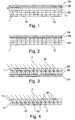
- FIG. 1 shows a schematic diagram of a cross section through a textile support (1) on which a three-layer film (2) from the film layers (22, 24, 26) is placed.
- the textile cover (1) facing and on the first surface (11), the later outer surface of the power transmission belt, resting, there is a first layer (22) made of a first thermoplastic material, after fixing the multilayer film (2) with the first coating one in FIG. 2 will form the impregnation zone, which will be described in more detail below.
- the second layer (24) is a closed thermoplastic layer even after fixing the multilayer film, and the layer (26) is an intermediate layer, here an adhesion promoter layer to the copolyamide of the layer (22), which allows peeling against layer (24).
- FIG. 2 shows that in FIG. 1 illustrated embodiment, after applying heat and optionally pressure on the surface of the multilayer film.
- the first layer (22) melts into the textile support (1), so that the thermoplastic material (22 ') of this first layer is distributed in a surface zone of the textile support (1) and forms an impregnation zone. This impregnation zone does not reach the opposite surface (12) the textile cover (1).
- FIG. 3 shows the example FIG. 2 turned. And after pouring the polyurethane (30), which forms an adjacent to the textile support (1) power transmission zone (3) of a power transmission belt, not shown.
- the belt polyurethane penetrates the textile cover (1) and, to a large extent, also the impregnation zone in which the textile is impregnated with the first thermoplastic material (22 ').
- the layers (26 and 24) prevent, however, that the polyurethane could completely penetrate through the textile support (1) or even spread on its surface. If the multilayer film (2) has been pressed under pressure onto the textile cover (1), an additional superficial compression of the textile material of the textile cover (1) can take place, which additionally retains the polyurethane and provides a polyurethane-free compacted surface.
- FIG. 4 shows the textile support (1) in contact with the power transmission zone (3) of the power transmission belt, not shown.
- the textile support (1) is penetrated in the border region by the polyurethane (30), which, however, does not extend completely to the outer surface (11), to which the layers (26 and 24) were previously bonded on the surface.
- the impregnation zone in which the first thermoplastic material (22 ') is located is partially penetrated by the polyurethane.
- the thermoplastic material (22 ') serves to fix the fibers (16) of the textile fabric over the entire region of the impregnation zone.
- FIGS. 5a) to 5c ) show the application of the invention to standard belts.
- the textile cover (1) covers each of the power transmission zones 3 of the belt substructures. Shown is also the typical arrangement of reinforcements 4.
- FIG. 5a ) shows a V-belt with complete textile casing.
- the textile cover 1 encloses the belt completely.
- FIG. 5b shows a toothed belt with transversely arranged teeth 5 and longitudinal reinforcements 4.
- the textile cover (1) covers the entire tooth surfaces with valleys, splashes and flanks.
- Figure 5c) shows a flat belt whose textile support (1) is limited to the inner surface.
- FIGS. 1 to 3 show clipping areas that are the dashed in Figures 5 correspond.
- the fiber fixation causes a significant increase in the life of the belt.
- the properties of the belt therefore remain unchanged for a long time.
- a polyurethane timing belt was equipped in the following way:
- Foil overlay multilayered:
Landscapes
- Engineering & Computer Science (AREA)
- General Engineering & Computer Science (AREA)
- Mechanical Engineering (AREA)
- Textile Engineering (AREA)
- Laminated Bodies (AREA)
- Belt Conveyors (AREA)
Priority Applications (1)
| Application Number | Priority Date | Filing Date | Title |
|---|---|---|---|
| PL12812170T PL2795155T3 (pl) | 2011-12-20 | 2012-12-17 | Pasy z warstwą wyrobu włókienniczego impregnowanego wielowarstwowo |
Applications Claiming Priority (2)
| Application Number | Priority Date | Filing Date | Title |
|---|---|---|---|
| DE102011121656A DE102011121656A1 (de) | 2011-12-20 | 2011-12-20 | Riemen mit mehrschichtig imprägnierter Textilauflage |
| PCT/EP2012/005191 WO2013091808A1 (de) | 2011-12-20 | 2012-12-17 | Riemen mit mehrschichtig imprägnierter textilauflage |
Publications (2)
| Publication Number | Publication Date |
|---|---|
| EP2795155A1 EP2795155A1 (de) | 2014-10-29 |
| EP2795155B1 true EP2795155B1 (de) | 2016-02-10 |
Family
ID=47520007
Family Applications (1)
| Application Number | Title | Priority Date | Filing Date |
|---|---|---|---|
| EP12812170.4A Active EP2795155B1 (de) | 2011-12-20 | 2012-12-17 | Riemen mit mehrschichtig imprägnierter textilauflage |
Country Status (11)
| Country | Link |
|---|---|
| US (1) | US9644706B2 (enExample) |
| EP (1) | EP2795155B1 (enExample) |
| CN (1) | CN104011429B (enExample) |
| AU (1) | AU2012359249B2 (enExample) |
| CA (1) | CA2858860C (enExample) |
| DE (1) | DE102011121656A1 (enExample) |
| ES (1) | ES2570563T3 (enExample) |
| IN (1) | IN2014KN01270A (enExample) |
| MX (1) | MX341862B (enExample) |
| PL (1) | PL2795155T3 (enExample) |
| WO (1) | WO2013091808A1 (enExample) |
Cited By (1)
| Publication number | Priority date | Publication date | Assignee | Title |
|---|---|---|---|---|
| WO2025125330A1 (de) | 2023-12-12 | 2025-06-19 | Arntz Beteiligungs Gmbh & Co. Kg | Gummiertes textilmaterial, kautschukmischung zur herstellung hiervon und antriebsriemen |
Families Citing this family (8)
| Publication number | Priority date | Publication date | Assignee | Title |
|---|---|---|---|---|
| WO2013105191A1 (ja) * | 2012-01-11 | 2013-07-18 | バンドー化学株式会社 | 摩擦伝動ベルト及びその製造方法、並びにベルト伝動装置 |
| FR3019609B1 (fr) * | 2014-04-03 | 2016-05-13 | Hutchinson | Courroie de transmission de puissance. |
| DE102014008622A1 (de) | 2014-06-17 | 2015-12-17 | Arntz Beteiligungs Gmbh & Co. Kg | Kraftübertragungsriemen mit einer Polyethylen-Beschichtung |
| JP6480392B2 (ja) * | 2015-09-29 | 2019-03-06 | 三ツ星ベルト株式会社 | Vリブドベルト及びその製造方法 |
| DE102016206029A1 (de) * | 2016-04-12 | 2017-10-12 | Contitech Antriebssysteme Gmbh | Zahnriemen mit Gewebebeschichtung |
| WO2020011342A1 (de) * | 2018-07-10 | 2020-01-16 | Walther Flender Gmbh | Verfahren zum herstellen von treibriemen |
| CN109989136A (zh) * | 2019-03-27 | 2019-07-09 | 江阴市斯强传动科技有限公司 | 一种羊毛纺织梳理设备专用皮带及其制备方法 |
| DE102021207025A1 (de) * | 2021-07-05 | 2023-01-05 | Contitech Antriebssysteme Gmbh | Riemen mit antistatischen Eigenschaften |
Family Cites Families (27)
| Publication number | Priority date | Publication date | Assignee | Title |
|---|---|---|---|---|
| US3894900A (en) * | 1973-09-07 | 1975-07-15 | Gates Rubber Co | Elastomer-free fabric surface for power transmission belt tooth facing |
| IT1136821B (it) * | 1981-03-16 | 1986-09-03 | Pirelli | Cinghia di trasmissione |
| DE3248776A1 (de) | 1982-12-31 | 1984-07-12 | Chemische Werke Hüls AG, 4370 Marl | Verwendung von copolyamiden zum heisssiegeln von textilien |
| ATE189778T1 (de) * | 1994-09-13 | 2000-03-15 | Pergaplastic Gmbh | Verwendung einer bei der durchführung von farbauftragsarbeiten auf eine farbzubehandelnde grundfläche aufbringbare kunststoff-folie als flächenbegrenzendes abdeckmittel |
| US5698650A (en) * | 1995-06-14 | 1997-12-16 | Exxon Chemical Patents Inc. | Elastomeric vehicle brake parts and power transmission belts |
| EP1185470B1 (en) | 1998-06-12 | 2004-03-03 | The Gates Corporation | High temperature flexible thermoplastic composites for endless belt driving surfaces |
| US6770004B1 (en) * | 1999-03-26 | 2004-08-03 | The Goodyear Tire & Rubber Company | Electrically conductive timing belt |
| GB2349113B (en) * | 1999-04-21 | 2003-07-02 | Gates Corp | Wear resistant belts and a process for their manufacture |
| US6465074B1 (en) * | 1999-08-25 | 2002-10-15 | Albany International Corp. | Base substrates for coated belts |
| US6409621B1 (en) * | 2000-05-12 | 2002-06-25 | The Goodyear Tire & Rubber Company | Power transmission belt |
| US6443866B1 (en) * | 2000-08-14 | 2002-09-03 | The Goodyear Tire & Rubber Company | Power transmission belt |
| WO2002084144A1 (en) * | 2001-04-12 | 2002-10-24 | The Gates Corporation | Thermoplastic jacket belt |
| GB0124267D0 (en) | 2001-10-10 | 2001-11-28 | John Heathcoat & Company Ltd | "Fabric" |
| DE10212889A1 (de) | 2002-03-22 | 2003-10-02 | Epurex Films Gmbh & Co Kg | Copolyamid Mischung und deren Verwendung zur Herstellung einer flexiblen Heissschmelzklebefolie |
| EP1531981A1 (de) * | 2002-06-22 | 2005-05-25 | ORTLIEB, Hartmut | Gewebe, gewirke oder gelege aus kunststoff, sowie verfahren zur herstellung eines solchen |
| US7025699B2 (en) | 2003-04-23 | 2006-04-11 | Dayco Products, Llc | Elastomer composition for power transmission belt tooth facing |
| BRPI0418562B1 (pt) | 2004-02-23 | 2017-10-24 | Dayco Europe S.R.L. | Toothed belt |
| EP1696150A1 (en) * | 2005-02-28 | 2006-08-30 | Megadyne S.r.l. | Toothed belt |
| DE102006025562A1 (de) * | 2006-06-01 | 2007-12-06 | Arntz Beteiligungs Gmbh & Co. Kg | Kraftübertragungsriemen und Verfahren zu seiner Herstellung |
| US8142316B2 (en) * | 2006-12-05 | 2012-03-27 | Veyance Technologies, Inc. | Power transmission belts |
| US8426524B2 (en) | 2006-12-06 | 2013-04-23 | Veyance Technologies, Inc | Elastomeric blend for vehicle timing belt |
| US9291237B2 (en) | 2007-06-20 | 2016-03-22 | Mitsuboshi Belting Ltd. | Toothed power transmission belt |
| FR2936291B1 (fr) | 2008-09-23 | 2011-06-03 | Hutchinson | Courroie de transmission de puissance. |
| DE102008055497B4 (de) | 2008-12-10 | 2020-06-18 | Contitech Antriebssysteme Gmbh | Elastischer Artikel, insbesondere Antriebsriemen, mit einer Textilauflage und einem Haftvermittler aus schmelzbarem Kunststoff |
| CN102472363A (zh) * | 2009-07-02 | 2012-05-23 | 盖茨公司 | 改善的用于齿动力传动带的织物和带 |
| DE102010017782A1 (de) * | 2010-05-03 | 2011-11-03 | Contitech Antriebssysteme Gmbh | Kraftübertragungsriemen, insbesondere Zahnriemen |
| DE102011121643A1 (de) * | 2011-12-20 | 2013-06-20 | Arntz Beteiligungs Gmbh & Co. Kg | Riemen mit Textilauflage |
-
2011
- 2011-12-20 DE DE102011121656A patent/DE102011121656A1/de not_active Withdrawn
-
2012
- 2012-12-17 WO PCT/EP2012/005191 patent/WO2013091808A1/de not_active Ceased
- 2012-12-17 CN CN201280062547.3A patent/CN104011429B/zh active Active
- 2012-12-17 AU AU2012359249A patent/AU2012359249B2/en active Active
- 2012-12-17 CA CA2858860A patent/CA2858860C/en active Active
- 2012-12-17 PL PL12812170T patent/PL2795155T3/pl unknown
- 2012-12-17 IN IN1270KON2014 patent/IN2014KN01270A/en unknown
- 2012-12-17 MX MX2014006946A patent/MX341862B/es active IP Right Grant
- 2012-12-17 US US14/366,703 patent/US9644706B2/en active Active
- 2012-12-17 ES ES12812170T patent/ES2570563T3/es active Active
- 2012-12-17 EP EP12812170.4A patent/EP2795155B1/de active Active
Cited By (1)
| Publication number | Priority date | Publication date | Assignee | Title |
|---|---|---|---|---|
| WO2025125330A1 (de) | 2023-12-12 | 2025-06-19 | Arntz Beteiligungs Gmbh & Co. Kg | Gummiertes textilmaterial, kautschukmischung zur herstellung hiervon und antriebsriemen |
Also Published As
| Publication number | Publication date |
|---|---|
| US9644706B2 (en) | 2017-05-09 |
| CA2858860A1 (en) | 2013-06-27 |
| US20140378255A1 (en) | 2014-12-25 |
| EP2795155A1 (de) | 2014-10-29 |
| WO2013091808A1 (de) | 2013-06-27 |
| AU2012359249B2 (en) | 2016-08-11 |
| MX341862B (es) | 2016-09-06 |
| MX2014006946A (es) | 2014-09-22 |
| CN104011429A (zh) | 2014-08-27 |
| ES2570563T3 (es) | 2016-05-19 |
| AU2012359249A1 (en) | 2014-07-03 |
| IN2014KN01270A (enExample) | 2015-10-16 |
| DE102011121656A1 (de) | 2013-06-20 |
| PL2795155T3 (pl) | 2016-08-31 |
| CA2858860C (en) | 2018-11-20 |
| CN104011429B (zh) | 2016-08-31 |
Similar Documents
| Publication | Publication Date | Title |
|---|---|---|
| WO2013091808A1 (de) | Riemen mit mehrschichtig imprägnierter textilauflage | |
| EP2795154B1 (de) | Riemen mit textilauflage | |
| DE69526214T2 (de) | Kunststoff folien | |
| DE602004013050T2 (de) | Zahnriemen | |
| EP2134425B1 (de) | Laufband mit einer schicht aus thermoplastischem schaum | |
| DE69903960T2 (de) | Atmungsfähiges, wasserdichtes laminat und verfahren zu dessen herstellung | |
| DE69710015T2 (de) | Transportband und Verfahren zur Herstellung | |
| EP2605908B1 (de) | Verbundwerkstoff mit beschichtungsmaterial | |
| DE2644454A1 (de) | Band und verfahren zum verbinden zweier enden des bandes | |
| DE3706404C2 (enExample) | ||
| DE10358409A1 (de) | Verbundstoff für einen elastischen Windelverschluss und Verfahren zu seiner Herstellung | |
| EP3158226B1 (de) | Kraftübertragungsriemen mit einer polyethylen-beschichtung | |
| DE2310962C3 (de) | Gegen hohe Temperaturen beständiger, flexibler Schichtkörper | |
| DE102017206844B4 (de) | Verfahren zur Herstellung eines Antriebsriemens mit einer Auflage aus Gewebeverbundmaterial | |
| DE102005016895A1 (de) | Verschlussstreifen für Windeln | |
| DE202004010591U1 (de) | Verbundfolie sowie Verpackung, enthaltend diese Verbundfolie | |
| DE68901987T2 (de) | Teppichunterlage. | |
| DE112009002487B4 (de) | Leistungstransmissionsriemen | |
| DE102011112656A1 (de) | Lederverbundstoff sowie Verfahren zu seiner Herstellung | |
| EP2933099B1 (de) | Wintersportgerät enthaltend eine Gummischicht beschichtet mit einem Fasermaterial, Verfahren zu deren Herstellung | |
| WO2017016904A1 (de) | Montageklebeband und verwendung des montageklebebands für die druckindustrie | |
| DE3413645C2 (de) | Verfahren zur Herstellung eines Förderbandes | |
| DE1704933B2 (de) | Verfahren zur herstellung von mehrschichtigen, mit kunststoffaeden verstaerkten kunststoffmaterialien | |
| DE4238764C2 (de) | Verfahren zum einseitigen Beschichten von Flächengebilden aus Fasern mit Kunststoff, Vorrichtung zur Durchführung des Verfahrens und Verwendung der Verfahrensprodukte | |
| DE10258918B3 (de) | Gasdichtes, chemikaliendichtes Laminat |
Legal Events
| Date | Code | Title | Description |
|---|---|---|---|
| PUAI | Public reference made under article 153(3) epc to a published international application that has entered the european phase |
Free format text: ORIGINAL CODE: 0009012 |
|
| 17P | Request for examination filed |
Effective date: 20140711 |
|
| AK | Designated contracting states |
Kind code of ref document: A1 Designated state(s): AL AT BE BG CH CY CZ DE DK EE ES FI FR GB GR HR HU IE IS IT LI LT LU LV MC MK MT NL NO PL PT RO RS SE SI SK SM TR |
|
| DAX | Request for extension of the european patent (deleted) | ||
| GRAP | Despatch of communication of intention to grant a patent |
Free format text: ORIGINAL CODE: EPIDOSNIGR1 |
|
| INTG | Intention to grant announced |
Effective date: 20150714 |
|
| GRAS | Grant fee paid |
Free format text: ORIGINAL CODE: EPIDOSNIGR3 |
|
| GRAA | (expected) grant |
Free format text: ORIGINAL CODE: 0009210 |
|
| AK | Designated contracting states |
Kind code of ref document: B1 Designated state(s): AL AT BE BG CH CY CZ DE DK EE ES FI FR GB GR HR HU IE IS IT LI LT LU LV MC MK MT NL NO PL PT RO RS SE SI SK SM TR |
|
| REG | Reference to a national code |
Ref country code: GB Ref legal event code: FG4D Free format text: NOT ENGLISH |
|
| REG | Reference to a national code |
Ref country code: AT Ref legal event code: REF Ref document number: 774812 Country of ref document: AT Kind code of ref document: T Effective date: 20160215 Ref country code: CH Ref legal event code: EP |
|
| REG | Reference to a national code |
Ref country code: IE Ref legal event code: FG4D Free format text: LANGUAGE OF EP DOCUMENT: GERMAN |
|
| REG | Reference to a national code |
Ref country code: DE Ref legal event code: R096 Ref document number: 502012006008 Country of ref document: DE |
|
| REG | Reference to a national code |
Ref country code: ES Ref legal event code: FG2A Ref document number: 2570563 Country of ref document: ES Kind code of ref document: T3 Effective date: 20160519 |
|
| REG | Reference to a national code |
Ref country code: SE Ref legal event code: TRGR |
|
| REG | Reference to a national code |
Ref country code: LT Ref legal event code: MG4D |
|
| REG | Reference to a national code |
Ref country code: NL Ref legal event code: MP Effective date: 20160210 |
|
| PG25 | Lapsed in a contracting state [announced via postgrant information from national office to epo] |
Ref country code: FI Free format text: LAPSE BECAUSE OF FAILURE TO SUBMIT A TRANSLATION OF THE DESCRIPTION OR TO PAY THE FEE WITHIN THE PRESCRIBED TIME-LIMIT Effective date: 20160210 Ref country code: HR Free format text: LAPSE BECAUSE OF FAILURE TO SUBMIT A TRANSLATION OF THE DESCRIPTION OR TO PAY THE FEE WITHIN THE PRESCRIBED TIME-LIMIT Effective date: 20160210 Ref country code: NO Free format text: LAPSE BECAUSE OF FAILURE TO SUBMIT A TRANSLATION OF THE DESCRIPTION OR TO PAY THE FEE WITHIN THE PRESCRIBED TIME-LIMIT Effective date: 20160510 Ref country code: GR Free format text: LAPSE BECAUSE OF FAILURE TO SUBMIT A TRANSLATION OF THE DESCRIPTION OR TO PAY THE FEE WITHIN THE PRESCRIBED TIME-LIMIT Effective date: 20160511 |
|
| PG25 | Lapsed in a contracting state [announced via postgrant information from national office to epo] |
Ref country code: IS Free format text: LAPSE BECAUSE OF FAILURE TO SUBMIT A TRANSLATION OF THE DESCRIPTION OR TO PAY THE FEE WITHIN THE PRESCRIBED TIME-LIMIT Effective date: 20160610 Ref country code: RS Free format text: LAPSE BECAUSE OF FAILURE TO SUBMIT A TRANSLATION OF THE DESCRIPTION OR TO PAY THE FEE WITHIN THE PRESCRIBED TIME-LIMIT Effective date: 20160210 Ref country code: LT Free format text: LAPSE BECAUSE OF FAILURE TO SUBMIT A TRANSLATION OF THE DESCRIPTION OR TO PAY THE FEE WITHIN THE PRESCRIBED TIME-LIMIT Effective date: 20160210 Ref country code: LV Free format text: LAPSE BECAUSE OF FAILURE TO SUBMIT A TRANSLATION OF THE DESCRIPTION OR TO PAY THE FEE WITHIN THE PRESCRIBED TIME-LIMIT Effective date: 20160210 Ref country code: NL Free format text: LAPSE BECAUSE OF FAILURE TO SUBMIT A TRANSLATION OF THE DESCRIPTION OR TO PAY THE FEE WITHIN THE PRESCRIBED TIME-LIMIT Effective date: 20160210 Ref country code: PT Free format text: LAPSE BECAUSE OF FAILURE TO SUBMIT A TRANSLATION OF THE DESCRIPTION OR TO PAY THE FEE WITHIN THE PRESCRIBED TIME-LIMIT Effective date: 20160613 |
|
| PG25 | Lapsed in a contracting state [announced via postgrant information from national office to epo] |
Ref country code: EE Free format text: LAPSE BECAUSE OF FAILURE TO SUBMIT A TRANSLATION OF THE DESCRIPTION OR TO PAY THE FEE WITHIN THE PRESCRIBED TIME-LIMIT Effective date: 20160210 Ref country code: DK Free format text: LAPSE BECAUSE OF FAILURE TO SUBMIT A TRANSLATION OF THE DESCRIPTION OR TO PAY THE FEE WITHIN THE PRESCRIBED TIME-LIMIT Effective date: 20160210 |
|
| REG | Reference to a national code |
Ref country code: DE Ref legal event code: R097 Ref document number: 502012006008 Country of ref document: DE |
|
| PG25 | Lapsed in a contracting state [announced via postgrant information from national office to epo] |
Ref country code: SM Free format text: LAPSE BECAUSE OF FAILURE TO SUBMIT A TRANSLATION OF THE DESCRIPTION OR TO PAY THE FEE WITHIN THE PRESCRIBED TIME-LIMIT Effective date: 20160210 Ref country code: RO Free format text: LAPSE BECAUSE OF FAILURE TO SUBMIT A TRANSLATION OF THE DESCRIPTION OR TO PAY THE FEE WITHIN THE PRESCRIBED TIME-LIMIT Effective date: 20160210 Ref country code: CZ Free format text: LAPSE BECAUSE OF FAILURE TO SUBMIT A TRANSLATION OF THE DESCRIPTION OR TO PAY THE FEE WITHIN THE PRESCRIBED TIME-LIMIT Effective date: 20160210 Ref country code: SK Free format text: LAPSE BECAUSE OF FAILURE TO SUBMIT A TRANSLATION OF THE DESCRIPTION OR TO PAY THE FEE WITHIN THE PRESCRIBED TIME-LIMIT Effective date: 20160210 |
|
| PLBE | No opposition filed within time limit |
Free format text: ORIGINAL CODE: 0009261 |
|
| STAA | Information on the status of an ep patent application or granted ep patent |
Free format text: STATUS: NO OPPOSITION FILED WITHIN TIME LIMIT |
|
| REG | Reference to a national code |
Ref country code: FR Ref legal event code: PLFP Year of fee payment: 5 |
|
| 26N | No opposition filed |
Effective date: 20161111 |
|
| PG25 | Lapsed in a contracting state [announced via postgrant information from national office to epo] |
Ref country code: BG Free format text: LAPSE BECAUSE OF FAILURE TO SUBMIT A TRANSLATION OF THE DESCRIPTION OR TO PAY THE FEE WITHIN THE PRESCRIBED TIME-LIMIT Effective date: 20160510 Ref country code: SI Free format text: LAPSE BECAUSE OF FAILURE TO SUBMIT A TRANSLATION OF THE DESCRIPTION OR TO PAY THE FEE WITHIN THE PRESCRIBED TIME-LIMIT Effective date: 20160210 |
|
| REG | Reference to a national code |
Ref country code: CH Ref legal event code: PL |
|
| PG25 | Lapsed in a contracting state [announced via postgrant information from national office to epo] |
Ref country code: MC Free format text: LAPSE BECAUSE OF FAILURE TO SUBMIT A TRANSLATION OF THE DESCRIPTION OR TO PAY THE FEE WITHIN THE PRESCRIBED TIME-LIMIT Effective date: 20160210 |
|
| REG | Reference to a national code |
Ref country code: IE Ref legal event code: MM4A |
|
| PG25 | Lapsed in a contracting state [announced via postgrant information from national office to epo] |
Ref country code: LI Free format text: LAPSE BECAUSE OF NON-PAYMENT OF DUE FEES Effective date: 20161231 Ref country code: LU Free format text: LAPSE BECAUSE OF NON-PAYMENT OF DUE FEES Effective date: 20161217 Ref country code: CH Free format text: LAPSE BECAUSE OF NON-PAYMENT OF DUE FEES Effective date: 20161231 |
|
| PG25 | Lapsed in a contracting state [announced via postgrant information from national office to epo] |
Ref country code: IE Free format text: LAPSE BECAUSE OF NON-PAYMENT OF DUE FEES Effective date: 20161217 |
|
| REG | Reference to a national code |
Ref country code: FR Ref legal event code: PLFP Year of fee payment: 6 |
|
| PG25 | Lapsed in a contracting state [announced via postgrant information from national office to epo] |
Ref country code: HU Free format text: LAPSE BECAUSE OF FAILURE TO SUBMIT A TRANSLATION OF THE DESCRIPTION OR TO PAY THE FEE WITHIN THE PRESCRIBED TIME-LIMIT; INVALID AB INITIO Effective date: 20121217 |
|
| PG25 | Lapsed in a contracting state [announced via postgrant information from national office to epo] |
Ref country code: CY Free format text: LAPSE BECAUSE OF FAILURE TO SUBMIT A TRANSLATION OF THE DESCRIPTION OR TO PAY THE FEE WITHIN THE PRESCRIBED TIME-LIMIT Effective date: 20160210 Ref country code: MK Free format text: LAPSE BECAUSE OF FAILURE TO SUBMIT A TRANSLATION OF THE DESCRIPTION OR TO PAY THE FEE WITHIN THE PRESCRIBED TIME-LIMIT Effective date: 20160210 |
|
| PG25 | Lapsed in a contracting state [announced via postgrant information from national office to epo] |
Ref country code: MT Free format text: LAPSE BECAUSE OF FAILURE TO SUBMIT A TRANSLATION OF THE DESCRIPTION OR TO PAY THE FEE WITHIN THE PRESCRIBED TIME-LIMIT Effective date: 20160210 |
|
| PG25 | Lapsed in a contracting state [announced via postgrant information from national office to epo] |
Ref country code: TR Free format text: LAPSE BECAUSE OF FAILURE TO SUBMIT A TRANSLATION OF THE DESCRIPTION OR TO PAY THE FEE WITHIN THE PRESCRIBED TIME-LIMIT Effective date: 20160210 Ref country code: AL Free format text: LAPSE BECAUSE OF FAILURE TO SUBMIT A TRANSLATION OF THE DESCRIPTION OR TO PAY THE FEE WITHIN THE PRESCRIBED TIME-LIMIT Effective date: 20160210 |
|
| REG | Reference to a national code |
Ref country code: AT Ref legal event code: MM01 Ref document number: 774812 Country of ref document: AT Kind code of ref document: T Effective date: 20171217 |
|
| PG25 | Lapsed in a contracting state [announced via postgrant information from national office to epo] |
Ref country code: AT Free format text: LAPSE BECAUSE OF NON-PAYMENT OF DUE FEES Effective date: 20171217 |
|
| REG | Reference to a national code |
Ref country code: DE Ref legal event code: R082 Ref document number: 502012006008 Country of ref document: DE Representative=s name: MEISSNER BOLTE PATENTANWAELTE RECHTSANWAELTE P, DE |
|
| PGFP | Annual fee paid to national office [announced via postgrant information from national office to epo] |
Ref country code: GB Payment date: 20251218 Year of fee payment: 14 |
|
| PGFP | Annual fee paid to national office [announced via postgrant information from national office to epo] |
Ref country code: FR Payment date: 20251218 Year of fee payment: 14 |
|
| PGFP | Annual fee paid to national office [announced via postgrant information from national office to epo] |
Ref country code: BE Payment date: 20251223 Year of fee payment: 14 |
|
| PGFP | Annual fee paid to national office [announced via postgrant information from national office to epo] |
Ref country code: SE Payment date: 20251217 Year of fee payment: 14 |
|
| PGFP | Annual fee paid to national office [announced via postgrant information from national office to epo] |
Ref country code: ES Payment date: 20260119 Year of fee payment: 14 |
|
| PGFP | Annual fee paid to national office [announced via postgrant information from national office to epo] |
Ref country code: DE Payment date: 20251222 Year of fee payment: 14 |
|
| PGFP | Annual fee paid to national office [announced via postgrant information from national office to epo] |
Ref country code: IT Payment date: 20251231 Year of fee payment: 14 |
|
| PGFP | Annual fee paid to national office [announced via postgrant information from national office to epo] |
Ref country code: PL Payment date: 20251208 Year of fee payment: 14 |