EP2784460A1 - Infrared sensor, heat sensing element, and heat sensing method using the same - Google Patents
Infrared sensor, heat sensing element, and heat sensing method using the same Download PDFInfo
- Publication number
- EP2784460A1 EP2784460A1 EP20140161094 EP14161094A EP2784460A1 EP 2784460 A1 EP2784460 A1 EP 2784460A1 EP 20140161094 EP20140161094 EP 20140161094 EP 14161094 A EP14161094 A EP 14161094A EP 2784460 A1 EP2784460 A1 EP 2784460A1
- Authority
- EP
- European Patent Office
- Prior art keywords
- heat sensing
- sensing element
- electrode
- dielectric film
- amount
- Prior art date
- Legal status (The legal status is an assumption and is not a legal conclusion. Google has not performed a legal analysis and makes no representation as to the accuracy of the status listed.)
- Withdrawn
Links
Images



Classifications
-
- G—PHYSICS
- G01—MEASURING; TESTING
- G01J—MEASUREMENT OF INTENSITY, VELOCITY, SPECTRAL CONTENT, POLARISATION, PHASE OR PULSE CHARACTERISTICS OF INFRARED, VISIBLE OR ULTRAVIOLET LIGHT; COLORIMETRY; RADIATION PYROMETRY
- G01J5/00—Radiation pyrometry, e.g. infrared or optical thermometry
- G01J5/10—Radiation pyrometry, e.g. infrared or optical thermometry using electric radiation detectors
- G01J5/20—Radiation pyrometry, e.g. infrared or optical thermometry using electric radiation detectors using resistors, thermistors or semiconductors sensitive to radiation, e.g. photoconductive devices
- G01J5/22—Electrical features thereof
-
- G—PHYSICS
- G01—MEASURING; TESTING
- G01J—MEASUREMENT OF INTENSITY, VELOCITY, SPECTRAL CONTENT, POLARISATION, PHASE OR PULSE CHARACTERISTICS OF INFRARED, VISIBLE OR ULTRAVIOLET LIGHT; COLORIMETRY; RADIATION PYROMETRY
- G01J5/00—Radiation pyrometry, e.g. infrared or optical thermometry
- G01J5/10—Radiation pyrometry, e.g. infrared or optical thermometry using electric radiation detectors
-
- G—PHYSICS
- G01—MEASURING; TESTING
- G01J—MEASUREMENT OF INTENSITY, VELOCITY, SPECTRAL CONTENT, POLARISATION, PHASE OR PULSE CHARACTERISTICS OF INFRARED, VISIBLE OR ULTRAVIOLET LIGHT; COLORIMETRY; RADIATION PYROMETRY
- G01J5/00—Radiation pyrometry, e.g. infrared or optical thermometry
- G01J5/10—Radiation pyrometry, e.g. infrared or optical thermometry using electric radiation detectors
- G01J5/34—Radiation pyrometry, e.g. infrared or optical thermometry using electric radiation detectors using capacitors, e.g. pyroelectric capacitors
-
- G—PHYSICS
- G01—MEASURING; TESTING
- G01K—MEASURING TEMPERATURE; MEASURING QUANTITY OF HEAT; THERMALLY-SENSITIVE ELEMENTS NOT OTHERWISE PROVIDED FOR
- G01K7/00—Measuring temperature based on the use of electric or magnetic elements directly sensitive to heat ; Power supply therefor, e.g. using thermoelectric elements
Definitions
- the present invention relates to an infrared sensor, a heat sensing element, and a heat sensing method using the same.
- An infrared sensor is divided into a quantum type and a heat type by a detection principle.
- the heat type of the two types attracts attention from the viewpoint of exclusion of cooling for noise measures, and is widely distributed in a motion sensor or the like.
- Such a heat type of infrared sensor includes a heat sensing element which absorbs heat energy of infrared light, causes temperature change and then changes electrical properties.
- JP-T-2003-530583 is said not to have sufficient sensitivity yet, and an infrared sensor with better sensitivity is required.
- An advantage of some aspects of the invention is that an infrared sensor and a heat sensing element and a heat sensing method using the same which can improve sensitivity of the infrared sensor are provided.
- an infrared sensor including: a heat sensing element in which a first electrode, a dielectric film, and a second electrode are sequentially laminated; and an electric charge detection device, in which the dielectric film represents antiferroelectricity and has a spontaneous polarization in a predetermined measurement environment, and in which the electric charge detection device calculates an amount of current flowing by a change of the spontaneous polarization, and senses heat of the heat sensing element based on temperature dependence of the amount of current.
- sensitivity of the infrared sensor which represents antiferroelectricity and uses the dielectric film having the spontaneous polarization in the predetermined measurement environment, can be improved.
- the dielectric film be configured in such a manner that the spontaneous polarization is gradually changed in the predetermined measurement environment.
- a speed of a current flowing by the spontaneous polarization can be decreased, and an amount of current can be accurately calculated.
- the dielectric film be preferentially oriented in a (111) plane. According to this, it is possible to reduce an amount of consumption of the voltage required for triggering a phase transition.
- one of the first electrode and the second electrode be connected to a power supply, and the other of the first electrode and the second electrode be connected to the electric charge detection device.
- heat sensing based on the temperature dependence of the amount of current can be realized using a simple configuration.
- a heat sensing element including: a first electrode; a dielectric film; and a second electrode, in which the first electrode, the dielectric film, and the second electrode are sequentially laminated, and in which the dielectric film represents antiferroelectricity, and has a spontaneous polarization in a predetermined measurement.
- the sensitivity of the infrared sensor which uses the dielectric film representing the antiferroelectricity and having the spontaneous polarization in the predetermined measurement environment, can be improved.
- a heat sensing method that uses the heat sensing element including the dielectric film which is formed between the first electrode and the second electrode, represents the antiferroelectricity, and has the spontaneous polarization in the predetermined measurement environment, the method including applying a voltage that generates the spontaneous polarization in the dielectric film; and calculating the amount of current flowing by the spontaneous polarization, and sensing heat of the heat sensing element based on the temperature dependence of the amount of current.
- the sensitivity of the infrared sensor which uses the dielectric film representing the antiferroelectricity and having the spontaneous polarization in the predetermined measurement environment, can be improved.
- the heat of the heat sensing element be sensed by using a difference obtained by comparing the calculated amount of current with a reference value. According to this, based on the temperature dependence of the obtained difference, the heat sensing of the heat sensing element can be performed.
- the reference value be an amount of current generated by the heat sensing element in a state where infrared light is shielded, or an amount of current generated by the heat sensing element for reference which does not cause a resistance change based on the infrared light. According to this, a difference between the amounts of currents can be determined, and influence due to errors caused when measuring can be decreased, and thus the sensitivity of the infrared sensor can be improved.
- a method of obtaining the difference a method of performing cancellation using a circuit configuration, a method of subtracting obtained data using calculation processing, or the like is used as a method of obtaining the difference.
- Figs. 1A and 1B are diagrams illustrating schematic configurations of infrared sensors according to embodiments of the invention.
- the infrared sensor 1 illustrated in Fig. 1A includes a heat sensing element 10, a power supply 20, and an electric charge detection device 21. Although omitted in Figs. 1A and 1B , it does not matter that a configuration of window material, a cap or the like which packages such members, uses a well-known art.
- the heat sensing element 10 sequentially includes a first electrode 11, a dielectric film 12 which represents antiferroelectricity, and a second electrode 13. Among these, the first electrode 11 is connected to the power supply 20, and the second electrode 13 is connected to the electric charge detection device 21.
- the heat sensing element 10 causes a temperature change according to heat energy of infrared light or a voltage signal to change an electrical property thereof to have a property which outputs a current signal.
- the heat energy or the like of the infrared light is detected as the current signal, and based on this, the received infrared light is detected.
- the dielectric film 12 has a property in which phase transition (AF ⁇ F) from an antiferroelectric phase AF to a ferroelectric phase F occurs.
- the predetermined voltage is a rectangular pulse having a voltage equal to or greater than a phase transition voltage V F which is the minimum required for the phase transition (AF ⁇ F). According to this, the applied voltage exceeds the phase transition voltage V F , and the phase transition (AF ⁇ F) is reliably triggered.
- the above-described predetermined voltage is not limited to such a rectangular pulse.
- the phase transition is reversely triggered, in response to the end of application of the rectangular pulse. That is, the dielectric film 12 performs phase-transition (F ⁇ AF) from the ferroelectric phase F to the antiferroelectric phase AF, according to an application end of the rectangular pulse.
- F ⁇ AF phase-transition
- a current (hereinafter, referred to as relaxation current) is generated from the heat sensing element 10.
- a total amount of the relaxation current depends on an amount of electric charges which are induced by the phase transition (AF ⁇ F), and the time during which the relaxation current flows depends on the temperature. For this reason, an amount of relaxation current flowing for a certain time has temperature dependence, and is calculated by the electric charge detection device 21. That is, the infrared sensor 1 according to the embodiment of the invention has a function of detecting heat of the heat sensing element 10, based on the temperature dependence of the relaxation current.
- the infrared sensor having such a function is not limited to the configuration of Fig. 1A , but may be a configuration of an infrared sensor 2 illustrated in Fig. 1B in which the power supply 20 and the electric charge detection device 21 are connected to a ground 22 or 23, respectively.
- the heat sensing element may also be configured by installing a resistor 14 which divides a voltage, with the dielectric film 12 in parallel, and the power supply, and the heat sensing element and the electric charge detection device may be connected in parallel with one another, within the scope of the invention.
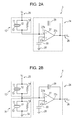
- the infrared sensor according to the embodiments of the invention may be configured to have an integration circuit 24 as the electric charge detection device, as illustrated in Figs. 2A and 2B .
- the infrared sensor 3 illustrated in Fig. 2A is configured to include an input power supply 25 which applies a voltage, the heat sensing element 10, the integration circuit 24 as the electric charge detection device, and a detection device 26 which detects a signal of the integration circuit 24.
- the integration circuit 24 includes an operational amplifier 27.
- the operational amplifier 27 has a positive input terminal 27a, a negative input terminal 27b and an output terminal 27c.
- the positive input terminal 27a is connected to a ground 28, the negative input terminal 27b is connected to the second electrode 13, and the output terminal 27c is connected to the detection device 26.
- a capacitor 29 is formed in parallel with the operational amplifier 27, and electric charges output from the operational amplifier 27 are stored in the capacitor 29. Meanwhile, as illustrated in Fig. 2A , the positive input terminal may be grounded through a capacitor 30.
- the current flowing from the heat sensing element 10 is converted into a voltage signal and amplified by the capacitor 29 and the operational amplifier 27, and the amplified voltage can be detected by the detection device 26.
- a configuration of the infrared sensor 4 illustrated in Fig. 2B includes a heat sensing element for reference, that is, a reference element 31, in addition to the configuration of Fig. 2A .
- the reference element 31 uses a heat sensing element the same as the heat sensing element 10, and is configured to have a shield plate formed on an incident surface of the infrared light.
- the reference element 31 which has the first electrode 11, a dielectric film 12 and the second electrode 13 is connected in parallel with the resistor 14, one side of each thereof is connected to a ground 32, and each of the other side of each thereof is connected to the heat sensing element 10. That is, in Fig. 2B , the reference element 31 and the heat sensing element 10 are connected in series with each other, and connected to the negative input terminal 27b of the operational amplifier 27 through a common connection line between them.
- a function of an infrared sensor 4 having the reference element 31 is as follows. That is, even when an error occurs in the current from the heat sensing element 10, by an installation environment or time degradation of the infrared sensor, such an error can occur even in the same manner as in the current from the reference element 31 which is configured using the same element as for the heat sensing element 10, for example.
- the error of the current caused in the same manner in both elements can be offset during integration, and thereby it is possible to prevent the error from occurring in an output voltage.
- a change of a resistance value can be accurately detected, and a sensitivity of the infrared sensor can be improved.
- a portion that calculates an amount of relaxation current and a portion that performs a heat detection using the amount of relaxation current depend on the electric charge detection device, but these two portions may be separately configured.
- the heat sensing element 10 sequentially includes the first electrode 11, the dielectric film 12 and the second electrode 13.
- the dielectric film 12 represents the antiferroelectricity, and has a spontaneous polarization in a predetermined measurement environment.
- Fig. 3 illustrates a schematic diagram of an energy state diagram of the dielectric film 12 in the predetermined measurement environment. As illustrated in Fig. 3 , the dielectric film 12 has the ferroelectric phase F which is in a metastable state, and the antiferroelectric phase AF which is in a stable state, in the predetermined measurement environment.
- the phase transition (AF ⁇ F) is generated from the stable state to the metastable state, and by the end of application of the rectangular pulse, the phase transition (F ⁇ AF) is generated from the metastable state to the stable state.
- a speed of the phase transition (F ⁇ AF) is regulated by activation energy E a , the phase transition (F ⁇ AF) is continued after the application end of the rectangular pulse, the ferroelectric phase F exists as the metastable state, and the dielectric film 12 has the spontaneous polarization.
- the embodiment of the invention attracts attention in that there is temperature dependence in the speed of the phase transition (F ⁇ AF), the relaxation current is found as a value correlating to the speed of this phase transition (F ⁇ AF), and heat of the heat sensing element 10 is sensed based on the amount of the relaxation current.
- a size of the activation energy E a can be adjusted by the configuration of the dielectric film.
- the dielectric film 12 be configured so as to have an activation energy E a in which the spontaneous polarization is gradually changed in the predetermined measurement environment. According to this, after the application end of the rectangular pulse, the time when the ferroelectric phase F exists as the metastable state becomes long, the speed of the relaxation current decreases, and the amount of relaxation current can be accurately calculated.
- the dielectric film 12 be configured so as to have an activation energy E a in which the spontaneous polarization is gradually changed at 0 V and near room temperature. According to this, in a main installation temperature environment of the infrared sensor, heat sensing can be performed based on the amount of relaxation current, and availability can be improved. Meanwhile, in this specification temperature near room temperature is 260 k to 320 k.
- the configuration of the dielectric film can be adjusted, and an infrared sensor with great sensitivity corresponding to a relatively wide temperature environment can be realized.
- the dielectric film 12 be preferentially oriented in a (111) plane. According to this, a ratio of an execution voltage valid for a change of a polarization can be increased, and consumption of a voltage required to trigger the phase transition can be reduced.
- the antiferroelectricity of BLFM or the like results from a superlattice structure of four times a period with respect to a unit lattice of ABO 3 structure, and deviation of a center of the electric charges of the unit lattice is present in the direction twisted from an a-axis and a b-axis.
- a thickness of the dielectric film 12 be 50 nm to 600 nm, and it is more preferable that the thickness of the dielectric film 12 be 150 nm to 400 nm. The reason is that if the thickness of the dielectric film is smaller than the above-described range, it can be difficult to absorb the infrared light, and if the thickness of the dielectric film is greater than the above-described range, a heat capacity becomes large, and as a result this influences the sensitivity and a response speed of the infrared sensor, and accordingly, it is not preferable.
- first electrode 11 and the second electrode 13 of the heat sensing element 10 can use a conductive material, and specifically can use Pt, Ti, Cr, Al, Au, Cu or the like.
- a first electrode 11 and a second electrode 13 are layer shapes or thin film shapes. Such shapes, materials, thicknesses and the like can be modified within the scope of the invention.
- the dielectric film represented in the above-described formulas (1) to (2) is configured as a composite oxide of an ABO 3 type structure having a perovskite structure.
- An A-site has oxygen of 12-fold coordination
- a B-site has oxygen of 6-fold coordination in the form of an octahedron.
- the dielectric film represented in the above-described formula (1) includes Bi, La, Fe and Mn, and is denoted as a composite oxide which includes bismuth ferrite (BiFeO 3 ), lanthanum ferrite (LaFeO 3 ), and manganese bismuth (BiMnO 3 ).
- the dielectric film represented in the above-described formula (2) includes Bi, La, Fe, Mn and Ti, and is formed of a composite oxide in which a portion of Fe in the above-described formula (2) is substituted with Ti.
- any one of x, y and z in the formulas (1) and (2) can take a value equal to or greater than "0" and equal to or less than "1".
- charge-in quantity of raw materials used when forming the dielectric film may be represented, and after the dielectric film is formed, a composition of the dielectric film may be represented.
- the dielectric film is not limited to the above-described configuration, but may include a different compound or metal, within the scope of the invention.
- each composite oxide includes a case where elements other than Bi, La, Fe, Mn, Ti and O 2 cannot be detected, a case where a trace amount is recognized, and a case where there is a deviation from a composition of a stoichiometry due to loss and surplus.
- Fig. 4 is a timing chart illustrating the heat sensing method according to the embodiment of the invention, and is a measured result of the example 1 described later.
- a vertical axis denotes a size of a current and a horizontal axis denotes time.
- the rectangular pulse P begins to be applied from time 0 ms. Then, a voltage value rises from 0 V to 20 V during a period of time 0 ms to 0.5 ms (S1). During this time, the phase transition (AF ⁇ F) is triggered from the antiferroelectric phase AF to the ferroelectric phase F, and based on this, a current flows.
- AF ⁇ F phase transition
- the application of the rectangular pulse P ends.
- the ferroelectric phase F exists as the metastable state, whereby the dielectric film has the spontaneous polarization, and the relaxation current denoted by a broken line area N flows.
- the voltage falls from 20 V to 0 V (S3), and after the voltage becomes 0 V, the relaxation current continues to flow.
- the embodiment of the invention calculates the amount of relaxation current by integrating the relaxation current, and compares the calculated amount of relaxation current with a predetermined reference value as the measured value for the heat sensing.
- the reference value be an amount of current generated by the heat sensing element in a state where the infrared light is shielded, or an amount of current generated by the heat sensing element which is used for reference and does not cause a resistance change according to the infrared light. According to this, it is possible to perform the heat sensing using a difference obtained by comparing the amounts of currents to each other, whereby even when a unique offset error, a stepwise error or the like occurs for each measurement, influence of the error can be reduced. But, a predetermined fixed value as the reference value can also be used, and in this case, a control load can be decreased.
- transmission and cutoff of the infrared light can be performed using a liquid crystal panel which switches transmission and non-transmission of light by controlling a liquid crystal orientation, or using a device such as a shutter that opens and closes a window portion which is a path of the infrared light, and that is driven by a motor.
- an integration time point of the relaxation current be a time point (time point of 2 ms illustrated in Fig. 4 ) at which a voltage in the heat sensing element 10 becomes 0 V. According to this, a ratio of the relaxation current included in the measured value for the heat sensing can be increased, the temperature dependence can be increased, and the sensitivity of the infrared sensor can be improved.
- the integration time point of the relaxation current may be a time point (for example, time point of 2.1 ms) later than the time point (time point of 2 ms illustrated in Fig. 4 ) when the voltage in the heat sensing element 10 becomes 0 V. According to this, when there is an error caused by a signal delay of a power supply circuit, the error can be avoided.
- the relaxation current may be included in the measured value for the heat sensing, and accordingly, a time point before the voltage in the heat sensing element becomes 0 V, for example, a time point (time point of 1.5 ms illustrated in Fig. 4 ) when the application of the rectangular pulse ends, can also be set as a starting point.
- an integration time of the relaxation current be time equal to or longer than 0 ms and equal to or shorter than 30 ms. According to this, for example, in a reception device which receives thirty units per second, it is possible to shorten the integration time to be less than a reception time (33 ms) per unit. From the viewpoint of suppressing an excessively long integration time, it is preferable that the integration time be 2 ms to 20 ms, and it is more preferable that the integration time be 4 ms to 15 ms.
- an ending point of the relaxation current integration be a time point equal to or less than a predetermined value based on the relaxation current speed - in other words, before the relaxation current will finish flowing in the predetermined measurement environment.
- the present invention is not limited thereto. If there is a correlation with the amount of relaxation current obtained by integrating the relaxation current, it does not matter that the relaxation current speed or the relaxation current density is set as the measured value for the heat sensing.
- the BLFMT precursor solutions (solutions 2 to 6) according to examples 2 to 6 are produced by the same steps as those of the above-described BLFM precursor solution.
- a silicon dioxide film is formed on a surface of a single crystal silicon substrate using a thermal oxide.
- a titanium nitride aluminum film with a thickness of 50 nm, an iridium film with a thickness of 100 nm, an iridium oxide film with a thickness of 30 nm, and a platinum film with a thickness of 150 nm are sequentially laminated on the silicon dioxide film, using a DC magnetron sputtering method, whereby the first electrode is produced.
- the above-described solution 1 is coated on the first electrode at 1500 rpm using the spin coat method. Next, after being heated on the hot plate for two minutes at 180°C, the coated first electrode is heated at 350°C for three minutes. After the coating-heating steps are repeated four times, the coated first electrode is heated at 650°C for five minutes in nitride using a Rapid Thermal Annealing (RTA) device. By carrying out this series of steps two times, the antiferroelectric film is produced.
- RTA Rapid Thermal Annealing
- a Pt electrode pattern with a thickness of 100 nm is formed on the produced antiferroelectric film using a metal through mask and the sputtering method.
- a baking process is performed at 650°C for five minutes in nitride using the Rapid Thermal Annealing (RTA) device, whereby the second electrode is produced.
- RTA Rapid Thermal Annealing
- the thicknesses of the heat sensing elements according to the examples 1 to 6 were observed on a fracture surface by a scanning electron microscope (SEM). As a result, the thicknesses of the heat sensing elements according to the examples 1 to 6 were values within a range of 357 nm to 389 nm. A specific measured result is represented in Table 1.
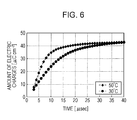
- phase transition (F ⁇ AF) ends more quickly in the measured result at 50°C, compared to that at 30°C.
- the time required for the phase transition (F ⁇ AF) depends on the heat energy.
- a time from when the application of the rectangular pulse ends is denoted on a horizontal axis, and the amount of electric charges are denoted on a vertical axis.
- the amount of electric charges which flow in the end are the same as each other, but times thereof are different from each other.
- the amount of electric charges flowing after the application end of the rectangular pulse has the time dependence.
- the amount of electric charges flowing between the time when the application of the rectangular pulse ends, and a time 10 ms after the time when the application of the rectangular pulse ends are -24 ⁇ Ccm -2 at 30°C and -35 ⁇ Ccm -2 at 50°C (positive and negative in voltage application direction as a reference). That is, the sensitivity with respect to the temperature is -545 nCcm -2 K -1 .
- a pyroelectricity coefficient is 30 nCcm -2 K -1 , and compared to the infrared sensor in which the amount of electric charge per 1°C is 0.12 pC, the infrared sensor of the example illustrated in Fig. 6 represents improvement of a temperature coefficient equal to or greater than 10 times.
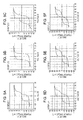
- Figs. 7A to 7E illustrate current-time curves with respect to the rectangular pulse, in the heat sensing elements according to the examples 2 to 6. It is found that as illustrated in Figs. 7A to 7E , in the examples 2 to 3 and 6, current behavior in an electric field zero at 30°C approximately matches that at 50°C. This indicates that the temperature dependence is small. On the other hand, it is found that the heat sensing element according to the example 4 represents the same behavior as that of the heat sensing element according to the example 1.
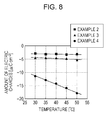
- Fig. 8 is a diagram illustrating a relationship between the amount of electric charges and the temperature in the heat sensing elements according to the examples 2 to 4.
- the heat sensing elements according to the examples 2 and 3 have relatively small slopes of the amount of electric charges according to the temperature, that is, this indicates that temperature dependences thereof are small.
- the heat sensing element according to the example 4 has a relatively large slope of the amount of electric charges according to the temperature, and this indicates that the temperature dependence is large. From this, it is found that among the examples 2 to 4, particularly, the heat sensing element according to the example 4 is excellent in terms of sensitivity improvement.
- the relaxation current at 30°C flows more than at 50°C, and thereafter is at almost the same level.
- the phase transition (F ⁇ AF) in the example 5 proceeds rapidly, but it is not fast enough to end before the voltage becomes zero through a voltage lowering process (period between time 1.5 ms to 2.0 ms illustrated in Fig. 4 ), and thus the relaxation current which flows at 30°C and has a slow phase transition (F ⁇ AF) speed is observed even after the application end of the rectangular pulse.
- a relaxation current coefficient obtained from the above-described result is as represented in Table 1. As represented in Table 1, it is clear that a sample which represents an amount of high spontaneous polarization and the double hysteresis, represents a high relaxation current coefficient.
- the heat sensing element according to the embodiment of the invention represents a good pyroelectric characteristic, and thus can be used in an temperature detector, a biological detector, an infrared detector, a terahertz detector, a thermoelectric converter, or the like.
- the invention can be used in an industrial field of the infrared sensor, the heat sensing element and the heat sensing method using the same.
- the heat sensing element can be configured using dielectric material which does not contain lead, and a burden on the environment can be decreased.
Landscapes
- Physics & Mathematics (AREA)
- General Physics & Mathematics (AREA)
- Spectroscopy & Molecular Physics (AREA)
- Engineering & Computer Science (AREA)
- Power Engineering (AREA)
- Photometry And Measurement Of Optical Pulse Characteristics (AREA)
- Radiation Pyrometers (AREA)
Applications Claiming Priority (1)
| Application Number | Priority Date | Filing Date | Title |
|---|---|---|---|
| JP2013062664A JP6264525B2 (ja) | 2013-03-25 | 2013-03-25 | 赤外線センサー、熱検知素子及びそれを用いた熱検知方法 |
Publications (1)
| Publication Number | Publication Date |
|---|---|
| EP2784460A1 true EP2784460A1 (en) | 2014-10-01 |
Family
ID=50336213
Family Applications (1)
| Application Number | Title | Priority Date | Filing Date |
|---|---|---|---|
| EP20140161094 Withdrawn EP2784460A1 (en) | 2013-03-25 | 2014-03-21 | Infrared sensor, heat sensing element, and heat sensing method using the same |
Country Status (4)
| Country | Link |
|---|---|
| US (1) | US9182287B2 (enExample) |
| EP (1) | EP2784460A1 (enExample) |
| JP (1) | JP6264525B2 (enExample) |
| CN (1) | CN104075810B (enExample) |
Families Citing this family (4)
| Publication number | Priority date | Publication date | Assignee | Title |
|---|---|---|---|---|
| CN109802033B (zh) * | 2018-12-19 | 2023-04-28 | 华南师范大学 | 一种利用离子注入诱导BiFeO3薄膜可逆相变的方法 |
| CN111297336B (zh) * | 2020-02-24 | 2021-08-06 | 清华大学 | 一种基于红外和太赫兹的体温测量方法、装置及安检设备 |
| US11933524B2 (en) * | 2020-09-10 | 2024-03-19 | The Regents Of The University Of California | Tandem-structured cooling device driven by electrostatic force |
| WO2024206081A1 (en) * | 2023-03-24 | 2024-10-03 | Sri International | Materials for temperature-actuated optical switching at infrared wavelengths |
Citations (6)
| Publication number | Priority date | Publication date | Assignee | Title |
|---|---|---|---|---|
| FR2223868A1 (en) * | 1973-03-26 | 1974-10-25 | Licentia Gmbh | Infra red detectors with improved sensitivity - using phase change in mixed crystal of lead and barium zirconates |
| EP0338639A2 (en) * | 1988-04-22 | 1989-10-25 | Gec-Marconi Limited | Temperature compensated thermal radiation detectors |
| JP2000019013A (ja) * | 1998-04-30 | 2000-01-21 | Nissan Motor Co Ltd | 赤外線検出装置 |
| US6093338A (en) * | 1997-08-21 | 2000-07-25 | Kabushiki Kaisha Toyota Chuo Kenkyusho | Crystal-oriented ceramics, piezoelectric ceramics using the same, and methods for producing the same |
| JP2003530538A (ja) | 1997-08-14 | 2003-10-14 | サンディア コーポレイション | 熱赤外線検出器 |
| JP2003530583A (ja) | 2000-01-03 | 2003-10-14 | エムイーエムエス・オプティカル・インコーポレイテッド | 双安定オプティカルスイッチを含むオプティカルルータおよびその方法 |
Family Cites Families (22)
| Publication number | Priority date | Publication date | Assignee | Title |
|---|---|---|---|---|
| JPS4923898Y1 (enExample) * | 1968-07-29 | 1974-06-27 | ||
| JPS5721802B2 (enExample) * | 1974-07-20 | 1982-05-10 | ||
| JPS60131703A (ja) * | 1983-12-20 | 1985-07-13 | 松下電器産業株式会社 | 焦電形熱検出素子 |
| US5141903A (en) * | 1989-03-31 | 1992-08-25 | Mitsubishi Mining And Cement Co. Ltd. | Pyroelectric ceramic composition |
| JPH04357888A (ja) * | 1991-06-04 | 1992-12-10 | Ube Ind Ltd | 焦電型赤外線検出素子 |
| US5293261A (en) * | 1992-12-31 | 1994-03-08 | The United States Of America As Represented By The Secretary Of The Navy | Device for low electric-field induced switching of Langmuir-Blodgett ferroelecric liquid crystal polymer films |
| JPH07106658A (ja) * | 1993-10-04 | 1995-04-21 | Matsushita Electric Ind Co Ltd | 薄膜材料 |
| US5612536A (en) * | 1994-02-07 | 1997-03-18 | Matsushita Electric Industrial Co., Ltd. | Thin film sensor element and method of manufacturing the same |
| JPH09126895A (ja) | 1995-11-07 | 1997-05-16 | Matsushita Electric Ind Co Ltd | 焦電型赤外線検出器 |
| DE19547934A1 (de) * | 1995-12-22 | 1997-06-26 | Deutsche Telekom Ag | Verfahren zur Herstellung einer pyroelektrischen Mischung |
| JP4257989B2 (ja) * | 1998-10-19 | 2009-04-30 | 三菱電機株式会社 | 赤外線検出装置及びそれを用いた赤外線検出器アレイ |
| JP4205674B2 (ja) * | 2003-03-07 | 2009-01-07 | 富士通株式会社 | 電磁放射線センサ及びその製造方法 |
| CN100545126C (zh) * | 2005-12-29 | 2009-09-30 | 同济大学 | 作为热释电材料的反铁电薄膜及其制备方法和应用 |
| CN101670691B (zh) * | 2005-12-29 | 2013-04-17 | 同济大学 | 工作温区可调且热释电系数较大的反铁电薄膜及其制备 |
| JP2009068863A (ja) | 2007-09-10 | 2009-04-02 | Toshiba Corp | 赤外線検出素子及びそれを用いた赤外線イメージセンサ |
| JP2011207202A (ja) | 2009-11-02 | 2011-10-20 | Seiko Epson Corp | 液体噴射ヘッド、液体噴射装置及び圧電素子並びに圧電材料 |
| JP5621964B2 (ja) | 2009-11-02 | 2014-11-12 | セイコーエプソン株式会社 | 液体噴射ヘッド、液体噴射装置及び圧電素子並びに超音波デバイス |
| JP5577844B2 (ja) | 2009-11-02 | 2014-08-27 | セイコーエプソン株式会社 | 液体噴射装置 |
| JP5736744B2 (ja) * | 2010-01-26 | 2015-06-17 | セイコーエプソン株式会社 | 熱センサーデバイス及び電子機器 |
| JP5733487B2 (ja) | 2010-03-09 | 2015-06-10 | セイコーエプソン株式会社 | 液体噴射ヘッド、液体噴射装置、超音波デバイス及び圧電素子並びに圧電材料 |
| JP5534179B2 (ja) | 2010-03-09 | 2014-06-25 | セイコーエプソン株式会社 | 圧電体膜、圧電素子、液体噴射ヘッド及び液体噴射装置 |
| JP5760406B2 (ja) | 2010-11-29 | 2015-08-12 | セイコーエプソン株式会社 | 検出回路、センサーデバイス及び電子機器 |
-
2013
- 2013-03-25 JP JP2013062664A patent/JP6264525B2/ja not_active Expired - Fee Related
-
2014
- 2014-03-20 CN CN201410105432.9A patent/CN104075810B/zh not_active Expired - Fee Related
- 2014-03-21 EP EP20140161094 patent/EP2784460A1/en not_active Withdrawn
- 2014-03-21 US US14/221,951 patent/US9182287B2/en not_active Expired - Fee Related
Patent Citations (6)
| Publication number | Priority date | Publication date | Assignee | Title |
|---|---|---|---|---|
| FR2223868A1 (en) * | 1973-03-26 | 1974-10-25 | Licentia Gmbh | Infra red detectors with improved sensitivity - using phase change in mixed crystal of lead and barium zirconates |
| EP0338639A2 (en) * | 1988-04-22 | 1989-10-25 | Gec-Marconi Limited | Temperature compensated thermal radiation detectors |
| JP2003530538A (ja) | 1997-08-14 | 2003-10-14 | サンディア コーポレイション | 熱赤外線検出器 |
| US6093338A (en) * | 1997-08-21 | 2000-07-25 | Kabushiki Kaisha Toyota Chuo Kenkyusho | Crystal-oriented ceramics, piezoelectric ceramics using the same, and methods for producing the same |
| JP2000019013A (ja) * | 1998-04-30 | 2000-01-21 | Nissan Motor Co Ltd | 赤外線検出装置 |
| JP2003530583A (ja) | 2000-01-03 | 2003-10-14 | エムイーエムエス・オプティカル・インコーポレイテッド | 双安定オプティカルスイッチを含むオプティカルルータおよびその方法 |
Also Published As
| Publication number | Publication date |
|---|---|
| CN104075810B (zh) | 2017-12-26 |
| JP6264525B2 (ja) | 2018-01-24 |
| CN104075810A (zh) | 2014-10-01 |
| US20150129765A1 (en) | 2015-05-14 |
| US9182287B2 (en) | 2015-11-10 |
| JP2014186002A (ja) | 2014-10-02 |
Similar Documents
| Publication | Publication Date | Title |
|---|---|---|
| Ali et al. | Recent progress on energy-related applications of HfO2-based ferroelectric and antiferroelectric materials | |
| EP2784459A1 (en) | Infrared sensor and heat sensing element | |
| Guggilla et al. | Pyroelectric ceramics for infrared detection applications | |
| Perumal et al. | Investigations on electrical and energy storage behaviour of PZN-PT, PMN-PT, PZN–PMN-PT piezoelectric solid solutions | |
| US9182287B2 (en) | Infrared sensor, heat sensing element, and heat sensing method using the same | |
| Zakhozheva et al. | Wide compositional range in situ electric field investigations on lead-free Ba (Zr 0.2 Ti 0.8) O 3-x (Ba 0.7 Ca 0.3) TiO 3 piezoceramic | |
| EP2924402A1 (en) | Infrared detecting device | |
| EP2017239A1 (en) | Pyroelectric ceramic composition, pyroelectric element, and infrared detector | |
| Fuentes-Fernandez et al. | The effect of poling conditions on the performance of piezoelectric energy harvesters fabricated by wet chemistry | |
| US9503656B2 (en) | Solid state imaging device and image acquisition method using solid state imaging elements having a PN junction | |
| Zhao et al. | Improved electrocaloric effect in (100)-oriented Pb0. 97La0. 02 (Zr0. 57Sn0. 38Ti0. 05) O3 antiferroelectric thick film by interface engineering | |
| US9735335B2 (en) | Thermoelectric conversion element and pyroelectric sensor | |
| Shi et al. | Investigation of crystallographic and pyroelectric properties of lead-based perovskite-type structure ferroelectric thin films | |
| Lim et al. | Frequency dependence of polarization and strain in Bi0. 5Na0. 5TiO3-SrTiO3/Bi0. 5 (Na0. 8K0. 2) 0.5 TiO3 composites | |
| Andika et al. | The electrical hysteresis loop and polarization value of BaZrxTi1-xO3 multilayer films material at different annealing temperature (x= 0.1 and 0.08) based on Sawyer Tower Circuit | |
| CN118255584B (zh) | 一种钛酸锶钡基固溶体系负温度系数热敏陶瓷制备方法 | |
| JP5545417B2 (ja) | 衝撃検知・記録装置 | |
| US20050161604A1 (en) | Electromagnetic radiation sensor and method for fabricating the same | |
| Chopra et al. | Synthesis and Characterization of Sol–Gel-Derived (Pb1-x La x) Ti1-x/4O3 Thin Films | |
| US8884227B2 (en) | Sensor | |
| JP6202245B2 (ja) | 赤外線センサー及び熱電変換素子 | |
| Cima et al. | Ferroelectric active sensors | |
| Kim | Pyroelectricity of BaTiO₃-doped PMNT ferroelectric system for pyroelectric sensor | |
| Shen et al. | New binary (1− x) Ba (Lu1/2Nb1/2) O3–xPbTiO3 solid solution with morphotropic phase boundary | |
| JP2571658B2 (ja) | 焦電性磁器組成物 |
Legal Events
| Date | Code | Title | Description |
|---|---|---|---|
| 17P | Request for examination filed |
Effective date: 20140321 |
|
| AK | Designated contracting states |
Kind code of ref document: A1 Designated state(s): AL AT BE BG CH CY CZ DE DK EE ES FI FR GB GR HR HU IE IS IT LI LT LU LV MC MK MT NL NO PL PT RO RS SE SI SK SM TR |
|
| AX | Request for extension of the european patent |
Extension state: BA ME |
|
| PUAI | Public reference made under article 153(3) epc to a published international application that has entered the european phase |
Free format text: ORIGINAL CODE: 0009012 |
|
| R17P | Request for examination filed (corrected) |
Effective date: 20150401 |
|
| RBV | Designated contracting states (corrected) |
Designated state(s): AL AT BE BG CH CY CZ DE DK EE ES FI FR GB GR HR HU IE IS IT LI LT LU LV MC MK MT NL NO PL PT RO RS SE SI SK SM TR |
|
| 17Q | First examination report despatched |
Effective date: 20180726 |
|
| STAA | Information on the status of an ep patent application or granted ep patent |
Free format text: STATUS: THE APPLICATION HAS BEEN WITHDRAWN |
|
| 18W | Application withdrawn |
Effective date: 20190322 |