EP2772577A2 - Verfahren zum Betreiben einer Waschmaschine und Waschmaschine - Google Patents
Verfahren zum Betreiben einer Waschmaschine und Waschmaschine Download PDFInfo
- Publication number
- EP2772577A2 EP2772577A2 EP20140401004 EP14401004A EP2772577A2 EP 2772577 A2 EP2772577 A2 EP 2772577A2 EP 20140401004 EP20140401004 EP 20140401004 EP 14401004 A EP14401004 A EP 14401004A EP 2772577 A2 EP2772577 A2 EP 2772577A2
- Authority
- EP
- European Patent Office
- Prior art keywords
- washing
- tub
- water reservoir
- washing liquid
- pump
- Prior art date
- Legal status (The legal status is an assumption and is not a legal conclusion. Google has not performed a legal analysis and makes no representation as to the accuracy of the status listed.)
- Granted
Links
Images
Classifications
-
- D—TEXTILES; PAPER
- D06—TREATMENT OF TEXTILES OR THE LIKE; LAUNDERING; FLEXIBLE MATERIALS NOT OTHERWISE PROVIDED FOR
- D06F—LAUNDERING, DRYING, IRONING, PRESSING OR FOLDING TEXTILE ARTICLES
- D06F39/00—Details of washing machines not specific to a single type of machines covered by groups D06F9/00 - D06F27/00
- D06F39/08—Liquid supply or discharge arrangements
- D06F39/083—Liquid discharge or recirculation arrangements
-
- D—TEXTILES; PAPER
- D06—TREATMENT OF TEXTILES OR THE LIKE; LAUNDERING; FLEXIBLE MATERIALS NOT OTHERWISE PROVIDED FOR
- D06F—LAUNDERING, DRYING, IRONING, PRESSING OR FOLDING TEXTILE ARTICLES
- D06F2105/00—Systems or parameters controlled or affected by the control systems of washing machines, washer-dryers or laundry dryers
- D06F2105/52—Changing sequence of operational steps; Carrying out additional operational steps; Modifying operational steps, e.g. by extending duration of steps
Definitions
- the invention relates to a method for operating a washing machine with a tub for receiving washing liquid for treating laundry and a water reservoir.
- the invention further relates to a washing machine with a tub for holding washing liquid and laundry, a heating body for heating the washing liquid in the tub, a water reservoir for receiving the detergent liquid from the tub and a control device for controlling a washing program.
- a pump is arranged, which can promote washing liquid from the tub.
- the washing liquid is a composition of water and detergent in the case of a washing phase of the washing machine and water in the case of a rinsing phase of the washing machine.
- washing liquid For washing laundry in a washing machine laundry is moved in a partially filled with washing liquid rotating drum, which is arranged in the tub. As a result, the laundry is moistened with the washing liquid, and causes the washing mechanism. Laundry of different materials, however, has a different suction behavior of the washing liquid. For example, terry toweling is highly absorbent, cotton absorbent and polyester low absorbency. Depending on the type and composition of the laundry, the washing liquid is therefore absorbed in different amounts with the same amount of laundry, so that a supernatant of washing liquid not taken up by the laundry varies in the tub depending on the type of laundry and influences the washing effect.
- the invention thus has the problem of providing a method and a washing machine whose washing action is independent of the type and composition of the laundry.
- the washing liquid is partly conducted out of the tub into the water reservoir. After the process step, the washing liquid from the water reservoir flows back into the tub at least partially.
- a further advantage is a reduced energy consumption during a process step of the washing program, if the process step is, for example, a heating process.
- washing liquid is partially passed from the tub in the water reservoir before performing a process step of a wash program, a more thorough mixing of the laundry and washing liquid can be achieved.
- the washing liquid from the water reservoir flows back into the tub at least partially and ensures that the complete washing liquid, possibly including washing chemistry, acts on the laundry.
- the process step is a heating process in which the washing liquid is heated in the tub. That is, washing liquid not required for the heating process is withdrawn from the tub. This avoids that superfluous washing liquid is heated and energy is spent on it.
- a predetermined by the washing program maximum temperature of the heating process is achieved faster, which saves washing time and energy costs for heating.
- a pump is arranged between the tub and the water reservoir, which promotes the washing liquid from the tub in the water reservoir when activated.
- the pump can be adjusted so that a predetermined amount of washing liquid is conveyed from the tub in the water reservoir. As a result, washing liquid not required for the process step is effectively removed from the tub.
- the speed of the pump is adjusted and kept substantially constant upon reaching a predetermined water reservoir level limit of the washing liquid in the water reservoir.
- the water reservoir level limit is selected so that the scrubbing liquid conducted into the water reservoir can not escape from the water reservoir but remains contained in the water reservoir during the process step. This ensures that the washing liquid is the Water reservoir and thus does not leave the washing machine before and / or during the process step.
- the pump is activated when a level of wash liquid in the tub is above a predetermined tub level limit.
- the liquor tank level limit is selected so that the level of wash liquor in the tub ensures optimum wash.
- the washing liquid is passed out of the tub through the water reservoir out of the washing machine.
- the water reservoir has a drain line leading out of the washing machine.
- the pump is activated in such a way that the washing liquid from the suds container is conveyed as far as possible out of the washing machine through the water reservoir into the discharge line from the washing machine.
- the water reservoir is formed by the drain line.
- the washing liquid can be passed out of the tub by means of a disposal line from the washing machine without passing through the water reservoir.
- the disposal line may be connected to the pump.
- the disposal line may be connected to the tub via a further pump, which may be activated to remove the washing liquid from the washing machine.
- the invention further relates to a washing machine with a tub for holding washing liquid and laundry, a heating body for heating the washing liquid in the tub, a water reservoir for receiving the detergent liquid from the tub and a control device for controlling a washing program. Between the tub and the water reservoir, a variable speed pump is arranged. The pump is therefore suitable for conveying wash liquid not required in the tub before and / or during a process step out of the tub.
- washing liquid When washing liquid is to be conveyed out of the tub, for example, because the level of the washing liquid in the tub is above a predetermined tub level limit, the speed of the pump is adjusted so that the level of the washing liquid is equal to the predetermined tub level limit. If the pumped into the water reservoir washing liquid is to flow back into the tub, the pump is either deactivated or at such a low Set speed that the washing liquid located in the water reservoir can flow back into the tub at least partially.
- the washing machine has sensor means for detecting a liquor container level of the washing liquid in the tub and / or sensor means for detecting a drain line level of the washing liquid in the water reservoir.
- the controller activates the pump to deliver wash liquor from the tub into the water reservoir until the level of wash liquor in the tub equals the predetermined tub level limit, until the sensor means detect a water reservoir level of the scrubbing liquid in the water reservoir that is equal to the water reservoir level limit, or until the process step is completed, ie until the control device deactivates the pump or adjusts it to such a low speed that washing liquid can flow back from the water reservoir into the tub.
- the water reservoir level limit value is preferably selected such that washing liquid from the water reservoir does not exit the washing machine before completion of a washing and / or rinsing step, or does not enter the drain line.
- the washing liquid conducted into the water reservoir is to be kept provided in the washing machine during the process step for flowing back into the tub.
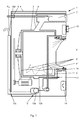
- Fig. 1 is a sketched sectional view of a washing machine 1 shown.
- the washing machine 1 has a tub 2 for receiving washing liquid 3 for treating laundry 8, which is arranged in a housing 4.
- the housing 4 has a door 5 for loading and unloading the laundry 8 from the tub 2.
- the washing machine 1 further has an inlet valve 6 for the entry of water from the supply network in a dispenser 7, in which detergent is optionally filled. Water from the inlet valve 6 and possibly detergent are passed through the connecting pipe 9 in the tub 2, in which the laundry is 8.
- the water and optionally detergent form the washing liquid 3, which accumulates in the lower region of the tub 2, in which also the laundry 8 accumulates.
- a drain device 12 is arranged, which conducts washing liquid 3 from the tub 2 when activated.
- the drain device 12 has a pump 12 a and Lase pump, which pumps off activated liquid from the tub 2 by activating them by passing them from a drain pipe 12 b to a water reservoir 12 c.
- the water reservoir 12c has a drain line 12d, which opens into a sewer or other drainage.
- the drain device 12 is controlled by a control device 13, which has a frequency converter 14.
- the control device 13 further controls the washing program of the washing machine.
- washing program After starting a washing program, water is introduced via the dispenser box 7 in a washing phase. There are washing powder therein and the water are introduced through the connecting pipe 9 in the tub 2. To be washed laundry 8 to be washed in the tub 2 sucks the washing liquid 3, which in the case of the washing phase, has water and detergent at least partially.
- a sensor means detects the level of the washing liquid 3 in the tub 2. When the level is above a predetermined tub level limit, the pump 12a is activated by the control means 13.
- the pump 12a conveys so much washing liquid 3 from the tub 2 into the water reservoir 12c until the level of the washing liquid 3 in the tub 2 is equal to the liquor tank level limit, with another sensor means ensuring that a level of the washing liquid 3 in the water reservoir 12c below a predetermined water reservoir level limit.
- a heating process as a process step in which the washing liquid 3 in the tub 2 is heated to the heating temperature selected by the washing program by means of a switched-on heating element 11.
- a Nachwasch intimid follows, in which the laundry 8 is moved by means of rotating drum of the tub 2 in the washing liquid 3, wherein the washing liquid 3 is cooled.
- the guided into the water reservoir 12 c washing liquid 3 is allowed to flow back into the tub 2. This is achieved by deactivating the pump 12a.
- the washing liquid 3 is conveyed from the tub 2 by means of the pump 12a through the water reservoir 12c in the drain line 12d and thus from the washing machine 1 out.
- the laundry can be spun to remove the washing liquid 3 from the laundry 8 as far as possible.
- at least one rinsing step is carried out, in which fresh washing liquid 3, in this case fresh water, if possible without detergent, is introduced into the suds container 2 and the laundry 8 is moved therein.
- Sensor means detect the level of the washing liquid 3 in the tub.
- the pump 12a is activated.
- the washing liquid 3 is conveyed out of the tub 2 by means of the pump 12a through the water reservoir 12c into the drain line 12d out of the washing machine 1.
- the laundry 8 can be spun to remove the washing liquid 3 of the laundry 8 as far as possible.
- the laundry 8 is thrown into the washing machine 1 in order to remove the washing liquid 3 from the laundry 8 as far as possible.
Landscapes
- Engineering & Computer Science (AREA)
- Textile Engineering (AREA)
- Detail Structures Of Washing Machines And Dryers (AREA)
- Control Of Washing Machine And Dryer (AREA)
Abstract
Description
- Die Erfindung betrifft ein Verfahren zum Betreiben einer Waschmaschine mit einem Laugenbehälter zur Aufnahme von Waschflüssigkeit zum Behandeln von Wäsche und einem Wasserreservoir. Die Erfindung betrifft weiterhin eine Waschmaschine mit einem Laugenbehälter zur Aufnahme von Waschflüssigkeit und von Wäsche, einem Heizkörper zum Aufheizen der Waschflüssigkeit in dem Laugenbehälter, einem Wasserreservoir zum Aufnehmen der Waschmittelflüssigkeit aus dem Laugenbehälter und einer Steuereinrichtung zum Steuern eines Waschprogramms. Zwischen dem Laugenbehälter und dem Wasserreservoir ist eine Pumpe angeordnet, die Waschflüssigkeit aus dem Laugenbehälter fördern kann. Bei der Waschflüssigkeit handelt es sich um eine Zusammensetzung aus Wasser und Waschmittel im Falle einer Waschphase der Waschmaschine und um Wasser im Falle einer Spülphase der Waschmaschine.
- Zum Waschen von Wäsche in einer Waschmaschine wird Wäsche in einer teilweise mit Waschflüssigkeit gefüllten sich drehenden Trommel bewegt, die in dem Laugenbehälter angeordnet ist. Dadurch wird die Wäsche mit der Waschflüssigkeit durchfeuchtet, und die Waschmechanik bewirkt. Wäsche aus unterschiedlichen Materialien weist jedoch ein unterschiedliches Saugverhalten der Waschflüssigkeit auf. Beispielsweise ist im Vergleich Frottierware sehr saugfähig, Baumwolle saugfähig und Polyester wenig saugfähig. Je nach Art und Zusammensetzung der Wäsche wird daher bei gleicher Menge an Wäsche die Waschflüssigkeit in unterschiedlichen Mengen aufgesaugt, sodass ein Überstand an nicht von der Wäsche aufgenommener Waschflüssigkeit in dem Laugenbehälter je nach Wäscheart variiert und die Waschwirkung beeinflusst. Insbesondere wenn ein Heizprozess in einem Waschprogramm zur Verbesserung der Waschwirkung eingesetzt wird, ist es möglich, dass sich die Waschwirkung aufgrund eines zu großen Überstands an Waschflüssigkeit in dem Laugenbehälter bei konstantem Energieeintrag verschlechtert oder bei einem gleichbleibenden Waschergebnis ein höherer Energieverbrauch die Folge ist.
- Der Erfindung stellt sich somit das Problem, ein Verfahren und eine Waschmaschine bereitzustellen, deren Waschwirkung von der Art und Zusammensetzung der Wäsche unabhängig ist.
- Erfindungsgemäß wird dieses Problem durch ein Verfahren mit den Merkmalen des Patentanspruchs 1 und eine Waschmaschine mit den Merkmalen des Patentanspruchs 8 gelöst. Vorteilhafte Ausgestaltungen und Weiterbildungen der Erfindung ergeben sich aus den nachfolgenden Unteransprüchen.
- In dem Verfahren wird vor Durchführung einer Waschphase und/oder mindestens einer Spülphase eines Prozessschrittes eines Waschprogramms die Waschflüssigkeit teilweise aus dem Laugenbehälter in das Wasserreservoir geleitet. Nach dem Prozessschritt fließt die Waschflüssigkeit aus dem Wasserreservoir in den Laugenbehälter zumindest teilweise zurück.
- Die mit der Erfindung erreichbaren Vorteile bestehen in der Bereitstellung einer von der Art und Zusammensetzung der Wäsche unabhängigen Waschwirkung aufgrund der Entziehung an in dem Laugenbehälter überflüssiger Waschflüssigkeit. Ein weiterer Vorteil ist ein verringerter Energieverbrauch während eines Prozessschritts des Waschprogramms, wenn der Prozessschritt beispielsweise ein Heizprozess ist.
- Dadurch, dass vor der Durchführung eines Prozessschrittes eines Waschprogramms die Waschflüssigkeit teilweise aus dem Laugenbehälter in das Wasserreservoir geleitet wird, kann eine intensivere Durchmischung der Wäsche und Waschflüssigkeit erreicht werden. Nach dem Prozessschritt fließt die Waschflüssigkeit aus dem Wasserreservoir in den Laugenbehälter zumindest teilweise zurück und gewährleistet, dass die vollständige Waschflüssigkeit ggf. inklusive Waschchemie auf die Wäsche wirkt.
- Vorzugsweise ist der Prozessschritt ein Heizprozess, beim dem die Waschflüssigkeit in dem Laugenbehälter aufgeheizt wird. D.h., für den Heizprozess nicht benötigte Waschflüssigkeit wird dem Laugenbehälter entzogen. Dadurch wird vermieden, dass überflüssige Waschflüssigkeit aufgeheizt wird und Energie dafür aufgewendet wird. Zudem wird eine von dem Waschprogramm vorgegebene maximale Temperatur des Heizprozesses schneller erreicht, wodurch Waschzeit und Energiekosten für das Aufheizen gespart werden.
- In einer bevorzugten Ausführungsform ist zwischen dem Laugenbehälter und dem Wasserreservoir eine Pumpe angeordnet, die bei Aktivierung die Waschflüssigkeit aus dem Laugenbehälter in das Wasserreservoir fördert. Die Pumpe kann derart eingestellt werden, dass eine vorbestimmte Menge an Waschflüssigkeit aus dem Laugenbehälter in das Wasserreservoir gefördert wird. Dadurch wird dem Laugenbehälter für den Prozessschritt nicht benötigte Waschflüssigkeit effektiv entzogen.
- Vorzugsweise wird die Drehzahl der Pumpe eingestellt und bei Erreichen eines vorbestimmten Wasserreservoirpegelgrenzwerts der Waschflüssigkeit in dem Wasserreservoir im Wesentlichen konstant gehalten. Der Wasserreservoirpegelgrenzwert wird derart ausgewählt, dass die in das Wasserreservoir geleitete Waschflüssigkeit aus dem Wasserreservoir nicht entweichen kann, sondern in dem Wasserreservoir während des Prozessschritts enthalten bleibt. Dadurch wird sichergestellt, dass die Waschflüssigkeit das Wasserreservoir und damit die Waschmaschine vor und/oder während des Prozessschritts nicht verlässt.
- In einer bevorzugten Ausführungsform wird die Pumpe aktiviert, wenn ein Pegel der Waschflüssigkeit in dem Laugenbehälter oberhalb eines vorbestimmten Laugenbehälterpegelgrenzwerts liegt. Der Laugenbehälterpegelgrenzwert wird derart ausgewählt, dass der Pegel der Waschflüssigkeit in dem Laugenbehälter eine optimale Waschwirkung gewährleistet.
- Vorzugsweise wird im Anschluss an die Waschphase und/oder mindestens die Spülphase des Waschprogramms die Waschflüssigkeit aus dem Laugenbehälter durch das Wasserreservoir aus der Waschmaschine geleitet. In diesem Fall weist das Wasserreservoir eine Ablaufleitung auf, die aus der Waschmaschine herausführt. Im Anschluss an eine Wasch- und/oder mindestens eine Spülphase wird beispielsweise die Pumpe derart aktiviert, dass die Waschflüssigkeit aus dem Laugenbehälter durch das Wasserreservoir in die Ablaufleitung aus der Waschmaschine weitestgehend heraus gefördert wird. Bevorzugterweise wird das Wasserreservoir durch die Ablaufleitung gebildet.
- Alternativ oder zusätzlich kann im Anschluss an die Waschphase und/oder mindestens die Spülphase des Waschprogramms die Waschflüssigkeit aus dem Laugenbehälter mittels einer Entsorgungsleitung aus der Waschmaschine geleitet werden ohne das Wasserreservoir zu passieren. Die Entsorgungsleitung kann mit der Pumpe verbunden sein. Alternativ kann die Entsorgungsleitung mit dem Laugenbehälter über eine weitere Pumpe verbunden sein, die zur Entfernung der Waschflüssigkeit aus der Waschmaschine aktiviert werden kann.
- Die Erfindung betrifft weiterhin eine Waschmaschine mit einem Laugenbehälter zur Aufnahme von Waschflüssigkeit und von Wäsche, einem Heizkörper zum Aufheizen der Waschflüssigkeit in dem Laugenbehälter, einem Wasserreservoir zum Aufnehmen der Waschmittelflüssigkeit aus dem Laugenbehälter und einer Steuereinrichtung zum Steuern eines Waschprogramms. Zwischen dem Laugenbehälter und dem Wasserreservoir ist eine drehzahlregelbare Pumpe angeordnet. Die Pumpe ist daher dazu geeignet, in dem Laugenbehälter nicht benötigte Waschflüssigkeit vor und/oder während eines Prozessschritts aus dem Laugenbehälter zu fördern.
- Wenn Waschflüssigkeit aus dem Laugenbehälter gefördert werden soll, weil der Pegel der Waschflüssigkeit in dem Laugenbehälter beispielsweise oberhalb eines vorbestimmten Laugenbehälterpegelgrenzwert liegt, wird die Drehzahl der Pumpe derart eingestellt, dass der Pegel der Waschflüssigkeit gleich dem vorbestimmten Laugenbehälterpegelgrenzwert ist. Wenn die in das Wasserreservoir geförderte Waschflüssigkeit in den Laugenbehälter zurückfließen soll, wird die Pumpe entweder deaktiviert oder auf eine derart niedrige Drehzahl eingestellt, dass die sich in dem Wasserreservoir befindende Waschflüssigkeit in den Laugenbehälter zumindest teilweise zurückfließen kann.
- In einer bevorzugten Ausführungsform weist die Waschmaschine Sensormittel zur Erfassung eines Laugenbehälterpegels der Waschflüssigkeit in dem Laugenbehälter und/oder Sensormittel zur Erfassung eines Ablaufleitungspegels der Waschflüssigkeit in dem Wasserreservoir auf. Wenn die Sensormittel einen Pegel der Waschflüssigkeit in dem Laugenbehälter erfassen, der oberhalb des vorbestimmten Laugenbehälterpegelgrenzwerts liegt, aktiviert die Steuereinrichtung die Pumpe, sodass Waschflüssigkeit aus dem Laugenbehälter in das Wasserreservoir gefördert wird, bis der Pegel der Waschflüssigkeit in dem Laugenbehälter gleich dem vorbestimmten Laugenbehälterpegelgrenzwert ist, bis die Sensormittel einen Wasserreservoirpegel der Waschflüssigkeit in dem Wasserreservoir erfassen, der gleich dem Wasserreservoirpegelgrenzwert ist, oder bis der Prozessschritt beendet ist, d.h. bis die Steuereinrichtung die Pumpe deaktiviert oder auf einen derart kleine Drehzahl einstellt, dass Waschflüssigkeit aus dem Wasserreservoir in den Laugenbehälter zurückfließen kann.
- Der Wasserreservoirpegelgrenzwert ist vorzugsweise derart ausgewählt, dass Waschflüssigkeit aus dem Wasserreservoir vor Vollendung eines Wasch- und/oder Spülschritts nicht aus der Waschmaschine austritt bzw. nicht in die Ablaufleitung gelangt. Die in das Wasserreservoir geleitete Waschflüssigkeit soll während des Prozessschritts zum Zurückfließen in den Laugenbehälter in der Waschmaschine bereitgestellt gehalten werden.
- Ein Ausführungsbeispiel der Erfindung ist in der Zeichnung rein schematisch dargestellt und wird nachfolgend näher beschrieben. Es zeigt
- Figur 1
- eine Waschmaschine in einer skizzierten Schnittdarstellung.
- In
Fig. 1 ist eine skizzierte Schnittansicht einer Waschmaschine 1 gezeigt. Die Waschmaschine 1 weist einen Laugenbehälter 2 zur Aufnahme von Waschflüssigkeit 3 zum Behandeln von Wäsche 8 auf, die in einem Gehäuse 4 angeordnet ist. Das Gehäuse 4 weist eine Tür 5 zum Be- und Entladen der Wäsche 8 aus dem Laugenbehälter 2 auf. Die Waschmaschine 1 weist weiterhin ein Einlassventil 6 zum Einlaufen von Wasser aus dem Versorgungsnetzwerk in einen Einspülkasten 7 auf, in den ggf. Waschmittel eingefüllt ist. Wasser aus dem Einlassventil 6 und ggf. Waschmittel werden über das Verbindungsrohr 9 in den Laugenbehälter 2 geleitet, in dem sich die Wäsche 8 befindet. Das Wasser und ggf. Waschmittel bilden die Waschflüssigkeit 3, die sich im unteren Bereich des Laugenbehälters 2 ansammelt, in dem sich ebenfalls die Wäsche 8 häuft. An dem Laugenbehälter 2 ist eine Ablaufeinrichtung 12 angeordnet, die bei Aktivierung Waschflüssigkeit 3 aus dem Laugenbehälter 2 leitet. Die Ablaufeinrichtung 12 weist eine Pumpe 12a beziehungsweise Laugenpumpe auf, die bei Aktivierung Waschflüssigkeit aus dem Laugenbehälter 2 abpumpt, indem sie diese aus einem Ablaufrohr 12b zu einem Wasserreservoir 12c leitet. Das Wasserreservoir 12c weist eine Ablaufleitung 12d auf, die in einen Abwasserkanal oder sonstigen Wasserabfluss mündet. Die Ablaufeinrichtung 12 wird durch eine Steuereinrichtung 13 gesteuert, die einen Frequenzumrichter 14 aufweist. Die Steuereinrichtung 13 steuert weiterhin das Waschprogramm der Waschmaschine. - Nachfolgend ist ein beispielhafter Ablauf eines Waschprogramms der Waschmaschine beschrieben. Nach Starten eines Waschprogramms wird in einer Waschphase Wasser über den Einspülkasten 7 eingelassen. Sich darin befindliches Waschpulver und das Wasser werden durch das Verbindungsrohr 9 in den Laugenbehälter 2 eingelassen. In den Laugenbehälter 2 eingefüllte zu waschende Wäsche 8 saugt die Waschflüssigkeit 3, die in dem Fall der Waschphase Wasser und Waschmittel aufweist, zumindest teilweise auf. Ein Sensormittel erfasst den Pegel der Waschflüssigkeit 3 in dem Laugenbehälter 2. Wenn der Pegel oberhalb eines vorbestimmten Laugenbehälterpegelgrenzwerts liegt, wird mittels der Steuereinrichtung 13 die Pumpe 12a aktiviert. Die Pumpe 12a fördert so viel Waschflüssigkeit 3 aus dem Laugenbehälter 2 in das Wasserreservoir 12c, bis der Pegel der Waschflüssigkeit 3 in dem Laugenbehälter 2 gleich dem Laugenbehälterpegelgrenzwert ist, wobei ein weiteres Sensormittel sicherstellt, dass ein Pegel der Waschflüssigkeit 3 in dem Wasserreservoir 12c unterhalb eines vorbestimmten Wasserreservoirpegelgrenzwerts liegt.
- Dann folgt ein Heizprozess als Prozessschritt, in dem die Waschflüssigkeit 3 in dem Laugenbehälter 2 auf die mit dem Waschprogramm gewählte Heiztemperatur mittels eines eingeschalteten Heizkörpers 11 aufgeheizt wird. Nach Erreichen der gewählten Heiztemperatur wird der Heizkörper 11 abgeschaltet und ein Nachwaschschritt folgt, in dem die Wäsche 8 mittels rotierender Trommel des Laugenbehälters 2 in der Waschflüssigkeit 3 bewegt wird, wobei sich die Waschflüssigkeit 3 abkühlt. Vor und/oder während des Nachwaschschritts wird die in das Wasserreservoir 12c geleitete Waschflüssigkeit 3 in den Laugenbehälter 2 zurückfließen gelassen. Dies wird durch Deaktivieren der Pumpe 12a erreicht. Nach Beenden des Nachwaschschritts wird die Waschflüssigkeit 3 aus dem Laugenbehälter 2 mittels der Pumpe 12a durch das Wasserreservoir 12c in die Ablaufleitung 12d und somit aus der Waschmaschine 1 heraus gefördert.
- Dabei kann die Wäsche geschleudert werden, um die Waschflüssigkeit 3 von der Wäsche 8 weitestgehend zu entfernen. Anschließend wird mindestens ein Spülschritt durchgeführt, bei dem frische Waschflüssigkeit 3, in diesem Fall frisches Wasser möglichst ohne Waschmittel, in den Laugenbehälter 2 eingelassen wird und die Wäsche 8 darin bewegt wird. Sensormittel erfassen den Pegel der Waschflüssigkeit 3 in dem Laugenbehälter. Wenn der Pegel der Waschflüssigkeit 3 oberhalb des vorbestimmten Laugenbehälterpegelgrenzwerts liegt, wird ggf. die Pumpe 12a aktiviert. Nach Beenden des Spülschritts wird die Waschflüssigkeit 3 aus dem Laugenbehälter 2 mittels der Pumpe 12a durch das Wasserreservoir 12c in die Ablaufleitung 12d aus der Waschmaschine 1 heraus gefördert. Dabei kann geschleudert werden, um die Waschflüssigkeit 3 von der Wäsche 8 weitestgehend zu entfernen. Nach dem letzten Spülschritt wird ggf. die Wäsche 8 in der Waschmaschine 1 geschleudert, um die Waschflüssigkeit 3 von der Wäsche 8 weitestgehend zu entfernen.
-
- PL
- Laugenbehälterpegelgrenzwert
- PW
- Wasserreservoirpegelgrenzwert
- 1
- Waschmaschine
- 2
- Laugenbehälter
- 3
- Waschflüssigkeit
- 4
- Gehäuse
- 5
- Tür
- 6
- Einlassventil
- 7
- Einspülkasten
- 8
- Wäsche
- 9
- Verbindungsrohr
- 11
- Heizkörper
- 12
- Ablaufeinrichtung
- 12a
- Pumpe
- 12b
- Ablaufrohr
- 12c
- Wasserreservoir
- 12d
- Ablaufleitung
- 13
- Steuereinrichtung
- 14
- Frequenzumrichter
Claims (9)
- Verfahren zum Betreiben einer Waschmaschine (1) mit einem Laugenbehälter (2) zur Aufnahme von Waschflüssigkeit (3) zum Behandeln von Wäsche (8) und einem Wasserreservoir (12c), dadurch gekennzeichnet, dass vor Durchführung eines Prozessschrittes einer Waschphase und/oder mindestens einer Spülphase eines Waschprogramms die Waschflüssigkeit (3) teilweise aus dem Laugenbehälter (2) in das Wasserreservoir (12c) geleitet wird und nach dem Prozessschritt die Waschflüssigkeit (3) aus dem Wasserreservoir (12c) in den Laugenbehälter (2) zumindest teilweise zurückfließt.
- Verfahren nach Anspruch 1, dadurch gekennzeichnet, dass der Prozessschritt ein Heizprozess ist, beim dem die Waschflüssigkeit (3) in dem Laugenbehälter (2) aufgeheizt wird.
- Verfahren nach Anspruch 1 oder 2, dadurch gekennzeichnet, dass zwischen dem Laugenbehälter (2) und dem Wasserreservoir (12c) eine Pumpe (12a) angeordnet ist, die bei Aktivierung die Waschflüssigkeit (3) aus dem Laugenbehälter (2) in das Wasserreservoir (12c) fördert.
- Verfahren nach Anspruch 3, dadurch gekennzeichnet, dass die Drehzahl der Pumpe (12a) eingestellt und bei Erreichen eines vorbestimmten Wasserreservoirpegelgrenzwerts (PW) der Waschflüssigkeit (3) in dem Wasserreservoir (12c) im Wesentlichen konstant gehalten wird.
- Verfahren nach Anspruch 3 oder 4, dadurch gekennzeichnet, dass die Pumpe (12a) aktiviert wird, wenn ein Pegel der Waschflüssigkeit (3) in dem Laugenbehälter (2) oberhalb eines vorbestimmten Laugenbehälterpegelgrenzwerts (PL) liegt.
- Verfahren nach einem der vorangehenden Ansprüche, dadurch gekennzeichnet, dass im Anschluss an die Waschphase und/oder mindestens die Spülphase des Waschprogramms die Waschflüssigkeit (3) aus dem Laugenbehälter (2) durch das Wasserreservoir (12c) aus der Waschmaschine (1) geleitet wird.
- Verfahren nach einem der vorangehenden Ansprüche, dadurch gekennzeichnet, dass im Anschluss an die Waschphase und/oder mindestens die Spülphase des Waschprogramms die Waschflüssigkeit (3) aus dem Laugenbehälter (2) mittels der Pumpe (12a) aus der Waschmaschine (1) gefördert wird.
- Waschmaschine (1) mit einem Laugenbehälter (2) zur Aufnahme von Waschflüssigkeit (3) und von Wäsche (8), einem Heizkörper (10) zum Aufheizen der Waschflüssigkeit (3) in dem Laugenbehälter (2), einem Wasserreservoir (12c) zum Aufnehmen der Waschmittelflüssigkeit (3) aus dem Laugenbehälter (2) und einer Steuereinrichtung (13, 14) zum Steuern eines Waschprogramms, wobei zwischen dem Laugenbehälter (2) und dem Wasserreservoir (12c) eine Pumpe (12a) angeordnet ist, dadurch gekennzeichnet, dass die Pumpe (12a) eine drehzahlregelbare Pumpe ist.
- Waschmaschine nach Anspruch 8, dadurch gekennzeichnet, dass sie Sensormittel (15) zur Erfassung eines Laugenbehälterpegels der Waschflüssigkeit (3) in dem Laugenbehälter (2) und Sensormittel zur Erfassung eines Ablaufleitungspegels der Waschflüssigkeit (3) in dem Wasserreservoir (12c) enthält.
Applications Claiming Priority (1)
| Application Number | Priority Date | Filing Date | Title |
|---|---|---|---|
| DE102013101921.8A DE102013101921A1 (de) | 2013-02-27 | 2013-02-27 | Verfahren zum Betreiben einer Waschmaschine und Waschmaschine |
Publications (3)
| Publication Number | Publication Date |
|---|---|
| EP2772577A2 true EP2772577A2 (de) | 2014-09-03 |
| EP2772577A3 EP2772577A3 (de) | 2014-10-22 |
| EP2772577B1 EP2772577B1 (de) | 2016-04-06 |
Family
ID=50150675
Family Applications (1)
| Application Number | Title | Priority Date | Filing Date |
|---|---|---|---|
| EP14401004.8A Active EP2772577B1 (de) | 2013-02-27 | 2014-01-15 | Verfahren zum Betreiben einer Waschmaschine |
Country Status (2)
| Country | Link |
|---|---|
| EP (1) | EP2772577B1 (de) |
| DE (1) | DE102013101921A1 (de) |
Family Cites Families (5)
| Publication number | Priority date | Publication date | Assignee | Title |
|---|---|---|---|---|
| KR890004928B1 (ko) * | 1983-06-20 | 1989-11-30 | 산요덴끼 가부시기가이샤 | 저수조부착세탁기에 있어서의 세정방법 |
| IT1263763B (it) * | 1993-01-19 | 1996-08-29 | Candy Spa | Macchina lavatrice, per biancheria o stoviglie,a parcheggio di liquido |
| IT1282413B1 (it) * | 1995-03-07 | 1998-03-23 | Zanussi Elettrodomestici | Lavabiancheria con serbatoio di recupero e ciclo perfezionato |
| IT237260Y1 (it) * | 1995-10-31 | 2000-09-05 | Candy Spa | Lavabiancheria con serbatoio di recupero dell'acqua di risciacquo |
| DE102009026825A1 (de) * | 2009-06-08 | 2010-12-09 | BSH Bosch und Siemens Hausgeräte GmbH | Verfahren zum Behandeln von Wäsche durch Beförderung von Waschlauge zwischen Laugenbehältern in einer Waschmaschine |
-
2013
- 2013-02-27 DE DE102013101921.8A patent/DE102013101921A1/de not_active Withdrawn
-
2014
- 2014-01-15 EP EP14401004.8A patent/EP2772577B1/de active Active
Non-Patent Citations (1)
| Title |
|---|
| None |
Also Published As
| Publication number | Publication date |
|---|---|
| EP2772577A3 (de) | 2014-10-22 |
| EP2772577B1 (de) | 2016-04-06 |
| DE102013101921A1 (de) | 2014-08-28 |
Similar Documents
| Publication | Publication Date | Title |
|---|---|---|
| EP3004448B1 (de) | Verfahren zum betrieb einer waschmaschine mit einer verbesserten restfeuchte der wäsche sowie hierzu geeignete waschmaschine | |
| EP2246469B1 (de) | Verfahren zum Betrieb einer Waschmaschine und Waschmaschine mit Zirkulationspumpe und Schleuderphase | |
| EP3481987B1 (de) | Wäschepflegegerät mit einer steuerung und verfahren dafür | |
| EP3172370B1 (de) | Haushaltsgerät | |
| EP3332059B1 (de) | Wäschepflegegerät mit einem zirkulationssystem | |
| DE102013104075A1 (de) | Verfahren zum Betreiben einer Waschmaschine und Waschmaschine | |
| DE102012105041B3 (de) | Waschmaschine oder Waschtrockner mit einer Einrichtung zum Umfluten und Aufheizen der Waschflotte | |
| EP3555356B1 (de) | Wäschepflegegerät mit einer steuerung | |
| DE102007052837A1 (de) | Verfahren zum Behandeln von Waschgut in einer Haushaltswaschmaschine mit einer schaumbildenden Flotte | |
| EP3701073A1 (de) | Wäschepflegegerät mit einer steuerung | |
| EP3481985A1 (de) | Wäschepflegegerät mit einer steuerung | |
| EP3255195B1 (de) | Verfahren zur verbesserung der waschleistung einer waschmaschine und hierfür geeignete waschmaschine | |
| DE102009002782B4 (de) | Verfahren zum Spülen in einer Waschmaschine mit einem Spülschritt bei hoher Trommeldrehzahl | |
| DE102012024761A1 (de) | Wasserführendes Haushaltsgerät mit einem Saugheber im Ablauf | |
| EP2930261B1 (de) | Verfahren zum betreiben einer waschmaschine und waschmaschine | |
| DE102012105091A1 (de) | Dampferzeugungseinrichtung zur Behandlung von Wäsche mit Dampf in einer Wäschebehandlungsmaschine | |
| EP3443156A1 (de) | Wäschepflegegerät mit einer steuerung | |
| EP2202343B1 (de) | Verfahren zur Behandlung von Wäsche sowie hierzu geeignete Waschmaschine | |
| EP2772577B1 (de) | Verfahren zum Betreiben einer Waschmaschine | |
| EP3186429B1 (de) | Wäschepflegegerät mit einer zuführeinrichtung | |
| EP3228740A1 (de) | Wäschepflegegerät mit einer steuerung | |
| DE102013106097B4 (de) | Verfahren zum Betreiben einer Waschmaschine und Waschmaschine | |
| EP3623517B1 (de) | Verfahren zum betreiben einer waschmaschine und waschmaschine | |
| DE102014100072A1 (de) | Waschmaschine oder Waschtrockner, sowie Verfahren zum Betreiben dazu | |
| EP3134570B1 (de) | Verfahren zur hybriden behandlung und spülung von wäschestücken sowie hierzu geeignete waschmaschine |
Legal Events
| Date | Code | Title | Description |
|---|---|---|---|
| PUAI | Public reference made under article 153(3) epc to a published international application that has entered the european phase |
Free format text: ORIGINAL CODE: 0009012 |
|
| 17P | Request for examination filed |
Effective date: 20140115 |
|
| AK | Designated contracting states |
Kind code of ref document: A2 Designated state(s): AL AT BE BG CH CY CZ DE DK EE ES FI FR GB GR HR HU IE IS IT LI LT LU LV MC MK MT NL NO PL PT RO RS SE SI SK SM TR |
|
| AX | Request for extension of the european patent |
Extension state: BA ME |
|
| PUAL | Search report despatched |
Free format text: ORIGINAL CODE: 0009013 |
|
| AK | Designated contracting states |
Kind code of ref document: A3 Designated state(s): AL AT BE BG CH CY CZ DE DK EE ES FI FR GB GR HR HU IE IS IT LI LT LU LV MC MK MT NL NO PL PT RO RS SE SI SK SM TR |
|
| AX | Request for extension of the european patent |
Extension state: BA ME |
|
| RIC1 | Information provided on ipc code assigned before grant |
Ipc: D06F 39/08 20060101ALI20140916BHEP Ipc: D06F 35/00 20060101AFI20140916BHEP |
|
| R17P | Request for examination filed (corrected) |
Effective date: 20150422 |
|
| RBV | Designated contracting states (corrected) |
Designated state(s): AL AT BE BG CH CY CZ DE DK EE ES FI FR GB GR HR HU IE IS IT LI LT LU LV MC MK MT NL NO PL PT RO RS SE SI SK SM TR |
|
| GRAP | Despatch of communication of intention to grant a patent |
Free format text: ORIGINAL CODE: EPIDOSNIGR1 |
|
| RIC1 | Information provided on ipc code assigned before grant |
Ipc: D06F 35/00 20060101AFI20150902BHEP Ipc: D06F 39/08 20060101ALI20150902BHEP |
|
| INTG | Intention to grant announced |
Effective date: 20151001 |
|
| GRAS | Grant fee paid |
Free format text: ORIGINAL CODE: EPIDOSNIGR3 |
|
| GRAA | (expected) grant |
Free format text: ORIGINAL CODE: 0009210 |
|
| AK | Designated contracting states |
Kind code of ref document: B1 Designated state(s): AL AT BE BG CH CY CZ DE DK EE ES FI FR GB GR HR HU IE IS IT LI LT LU LV MC MK MT NL NO PL PT RO RS SE SI SK SM TR |
|
| REG | Reference to a national code |
Ref country code: GB Ref legal event code: FG4D Free format text: NOT ENGLISH |
|
| REG | Reference to a national code |
Ref country code: DE Ref legal event code: R084 Ref document number: 502014000583 Country of ref document: DE |
|
| REG | Reference to a national code |
Ref country code: AT Ref legal event code: REF Ref document number: 787958 Country of ref document: AT Kind code of ref document: T Effective date: 20160415 Ref country code: CH Ref legal event code: EP |
|
| REG | Reference to a national code |
Ref country code: IE Ref legal event code: FG4D Free format text: LANGUAGE OF EP DOCUMENT: GERMAN |
|
| REG | Reference to a national code |
Ref country code: DE Ref legal event code: R096 Ref document number: 502014000583 Country of ref document: DE |
|
| REG | Reference to a national code |
Ref country code: GB Ref legal event code: 746 Effective date: 20160519 |
|
| REG | Reference to a national code |
Ref country code: LT Ref legal event code: MG4D Ref country code: NL Ref legal event code: MP Effective date: 20160406 |
|
| PG25 | Lapsed in a contracting state [announced via postgrant information from national office to epo] |
Ref country code: NL Free format text: LAPSE BECAUSE OF FAILURE TO SUBMIT A TRANSLATION OF THE DESCRIPTION OR TO PAY THE FEE WITHIN THE PRESCRIBED TIME-LIMIT Effective date: 20160406 |
|
| PG25 | Lapsed in a contracting state [announced via postgrant information from national office to epo] |
Ref country code: NO Free format text: LAPSE BECAUSE OF FAILURE TO SUBMIT A TRANSLATION OF THE DESCRIPTION OR TO PAY THE FEE WITHIN THE PRESCRIBED TIME-LIMIT Effective date: 20160706 Ref country code: IS Free format text: LAPSE BECAUSE OF FAILURE TO SUBMIT A TRANSLATION OF THE DESCRIPTION OR TO PAY THE FEE WITHIN THE PRESCRIBED TIME-LIMIT Effective date: 20160806 Ref country code: FI Free format text: LAPSE BECAUSE OF FAILURE TO SUBMIT A TRANSLATION OF THE DESCRIPTION OR TO PAY THE FEE WITHIN THE PRESCRIBED TIME-LIMIT Effective date: 20160406 Ref country code: PL Free format text: LAPSE BECAUSE OF FAILURE TO SUBMIT A TRANSLATION OF THE DESCRIPTION OR TO PAY THE FEE WITHIN THE PRESCRIBED TIME-LIMIT Effective date: 20160406 Ref country code: LT Free format text: LAPSE BECAUSE OF FAILURE TO SUBMIT A TRANSLATION OF THE DESCRIPTION OR TO PAY THE FEE WITHIN THE PRESCRIBED TIME-LIMIT Effective date: 20160406 |
|
| PG25 | Lapsed in a contracting state [announced via postgrant information from national office to epo] |
Ref country code: LV Free format text: LAPSE BECAUSE OF FAILURE TO SUBMIT A TRANSLATION OF THE DESCRIPTION OR TO PAY THE FEE WITHIN THE PRESCRIBED TIME-LIMIT Effective date: 20160406 Ref country code: PT Free format text: LAPSE BECAUSE OF FAILURE TO SUBMIT A TRANSLATION OF THE DESCRIPTION OR TO PAY THE FEE WITHIN THE PRESCRIBED TIME-LIMIT Effective date: 20160808 Ref country code: ES Free format text: LAPSE BECAUSE OF FAILURE TO SUBMIT A TRANSLATION OF THE DESCRIPTION OR TO PAY THE FEE WITHIN THE PRESCRIBED TIME-LIMIT Effective date: 20160406 Ref country code: SE Free format text: LAPSE BECAUSE OF FAILURE TO SUBMIT A TRANSLATION OF THE DESCRIPTION OR TO PAY THE FEE WITHIN THE PRESCRIBED TIME-LIMIT Effective date: 20160406 Ref country code: HR Free format text: LAPSE BECAUSE OF FAILURE TO SUBMIT A TRANSLATION OF THE DESCRIPTION OR TO PAY THE FEE WITHIN THE PRESCRIBED TIME-LIMIT Effective date: 20160406 Ref country code: RS Free format text: LAPSE BECAUSE OF FAILURE TO SUBMIT A TRANSLATION OF THE DESCRIPTION OR TO PAY THE FEE WITHIN THE PRESCRIBED TIME-LIMIT Effective date: 20160406 Ref country code: GR Free format text: LAPSE BECAUSE OF FAILURE TO SUBMIT A TRANSLATION OF THE DESCRIPTION OR TO PAY THE FEE WITHIN THE PRESCRIBED TIME-LIMIT Effective date: 20160707 |
|
| REG | Reference to a national code |
Ref country code: DE Ref legal event code: R097 Ref document number: 502014000583 Country of ref document: DE |
|
| REG | Reference to a national code |
Ref country code: FR Ref legal event code: PLFP Year of fee payment: 4 |
|
| PG25 | Lapsed in a contracting state [announced via postgrant information from national office to epo] |
Ref country code: DK Free format text: LAPSE BECAUSE OF FAILURE TO SUBMIT A TRANSLATION OF THE DESCRIPTION OR TO PAY THE FEE WITHIN THE PRESCRIBED TIME-LIMIT Effective date: 20160406 Ref country code: RO Free format text: LAPSE BECAUSE OF FAILURE TO SUBMIT A TRANSLATION OF THE DESCRIPTION OR TO PAY THE FEE WITHIN THE PRESCRIBED TIME-LIMIT Effective date: 20160406 Ref country code: CZ Free format text: LAPSE BECAUSE OF FAILURE TO SUBMIT A TRANSLATION OF THE DESCRIPTION OR TO PAY THE FEE WITHIN THE PRESCRIBED TIME-LIMIT Effective date: 20160406 Ref country code: EE Free format text: LAPSE BECAUSE OF FAILURE TO SUBMIT A TRANSLATION OF THE DESCRIPTION OR TO PAY THE FEE WITHIN THE PRESCRIBED TIME-LIMIT Effective date: 20160406 Ref country code: SK Free format text: LAPSE BECAUSE OF FAILURE TO SUBMIT A TRANSLATION OF THE DESCRIPTION OR TO PAY THE FEE WITHIN THE PRESCRIBED TIME-LIMIT Effective date: 20160406 |
|
| PLBE | No opposition filed within time limit |
Free format text: ORIGINAL CODE: 0009261 |
|
| STAA | Information on the status of an ep patent application or granted ep patent |
Free format text: STATUS: NO OPPOSITION FILED WITHIN TIME LIMIT |
|
| PG25 | Lapsed in a contracting state [announced via postgrant information from national office to epo] |
Ref country code: SM Free format text: LAPSE BECAUSE OF FAILURE TO SUBMIT A TRANSLATION OF THE DESCRIPTION OR TO PAY THE FEE WITHIN THE PRESCRIBED TIME-LIMIT Effective date: 20160406 |
|
| 26N | No opposition filed |
Effective date: 20170110 |
|
| PG25 | Lapsed in a contracting state [announced via postgrant information from national office to epo] |
Ref country code: BE Free format text: LAPSE BECAUSE OF NON-PAYMENT OF DUE FEES Effective date: 20170131 Ref country code: SI Free format text: LAPSE BECAUSE OF FAILURE TO SUBMIT A TRANSLATION OF THE DESCRIPTION OR TO PAY THE FEE WITHIN THE PRESCRIBED TIME-LIMIT Effective date: 20160406 |
|
| REG | Reference to a national code |
Ref country code: CH Ref legal event code: PL |
|
| PG25 | Lapsed in a contracting state [announced via postgrant information from national office to epo] |
Ref country code: MC Free format text: LAPSE BECAUSE OF FAILURE TO SUBMIT A TRANSLATION OF THE DESCRIPTION OR TO PAY THE FEE WITHIN THE PRESCRIBED TIME-LIMIT Effective date: 20160406 |
|
| PG25 | Lapsed in a contracting state [announced via postgrant information from national office to epo] |
Ref country code: CH Free format text: LAPSE BECAUSE OF NON-PAYMENT OF DUE FEES Effective date: 20170131 Ref country code: LI Free format text: LAPSE BECAUSE OF NON-PAYMENT OF DUE FEES Effective date: 20170131 |
|
| REG | Reference to a national code |
Ref country code: IE Ref legal event code: MM4A |
|
| PG25 | Lapsed in a contracting state [announced via postgrant information from national office to epo] |
Ref country code: LU Free format text: LAPSE BECAUSE OF NON-PAYMENT OF DUE FEES Effective date: 20170115 |
|
| REG | Reference to a national code |
Ref country code: FR Ref legal event code: PLFP Year of fee payment: 5 |
|
| REG | Reference to a national code |
Ref country code: BE Ref legal event code: MM Effective date: 20170131 |
|
| PG25 | Lapsed in a contracting state [announced via postgrant information from national office to epo] |
Ref country code: IE Free format text: LAPSE BECAUSE OF NON-PAYMENT OF DUE FEES Effective date: 20170115 |
|
| PG25 | Lapsed in a contracting state [announced via postgrant information from national office to epo] |
Ref country code: MT Free format text: LAPSE BECAUSE OF FAILURE TO SUBMIT A TRANSLATION OF THE DESCRIPTION OR TO PAY THE FEE WITHIN THE PRESCRIBED TIME-LIMIT Effective date: 20160406 |
|
| PG25 | Lapsed in a contracting state [announced via postgrant information from national office to epo] |
Ref country code: AL Free format text: LAPSE BECAUSE OF FAILURE TO SUBMIT A TRANSLATION OF THE DESCRIPTION OR TO PAY THE FEE WITHIN THE PRESCRIBED TIME-LIMIT Effective date: 20160406 |
|
| PG25 | Lapsed in a contracting state [announced via postgrant information from national office to epo] |
Ref country code: HU Free format text: LAPSE BECAUSE OF FAILURE TO SUBMIT A TRANSLATION OF THE DESCRIPTION OR TO PAY THE FEE WITHIN THE PRESCRIBED TIME-LIMIT; INVALID AB INITIO Effective date: 20140115 |
|
| PG25 | Lapsed in a contracting state [announced via postgrant information from national office to epo] |
Ref country code: BG Free format text: LAPSE BECAUSE OF FAILURE TO SUBMIT A TRANSLATION OF THE DESCRIPTION OR TO PAY THE FEE WITHIN THE PRESCRIBED TIME-LIMIT Effective date: 20160406 |
|
| PG25 | Lapsed in a contracting state [announced via postgrant information from national office to epo] |
Ref country code: CY Free format text: LAPSE BECAUSE OF NON-PAYMENT OF DUE FEES Effective date: 20160406 |
|
| PG25 | Lapsed in a contracting state [announced via postgrant information from national office to epo] |
Ref country code: MK Free format text: LAPSE BECAUSE OF FAILURE TO SUBMIT A TRANSLATION OF THE DESCRIPTION OR TO PAY THE FEE WITHIN THE PRESCRIBED TIME-LIMIT Effective date: 20160406 |
|
| REG | Reference to a national code |
Ref country code: AT Ref legal event code: MM01 Ref document number: 787958 Country of ref document: AT Kind code of ref document: T Effective date: 20190115 |
|
| PG25 | Lapsed in a contracting state [announced via postgrant information from national office to epo] |
Ref country code: AT Free format text: LAPSE BECAUSE OF NON-PAYMENT OF DUE FEES Effective date: 20190115 |
|
| P01 | Opt-out of the competence of the unified patent court (upc) registered |
Effective date: 20230529 |
|
| PGFP | Annual fee paid to national office [announced via postgrant information from national office to epo] |
Ref country code: GB Payment date: 20240123 Year of fee payment: 11 |
|
| PGFP | Annual fee paid to national office [announced via postgrant information from national office to epo] |
Ref country code: TR Payment date: 20240110 Year of fee payment: 11 Ref country code: IT Payment date: 20240123 Year of fee payment: 11 Ref country code: FR Payment date: 20240125 Year of fee payment: 11 |
|
| GBPC | Gb: european patent ceased through non-payment of renewal fee |
Effective date: 20250115 |
|
| PG25 | Lapsed in a contracting state [announced via postgrant information from national office to epo] |
Ref country code: GB Free format text: LAPSE BECAUSE OF NON-PAYMENT OF DUE FEES Effective date: 20250115 |
|
| PG25 | Lapsed in a contracting state [announced via postgrant information from national office to epo] |
Ref country code: FR Free format text: LAPSE BECAUSE OF NON-PAYMENT OF DUE FEES Effective date: 20250131 |
|
| PG25 | Lapsed in a contracting state [announced via postgrant information from national office to epo] |
Ref country code: IT Free format text: LAPSE BECAUSE OF NON-PAYMENT OF DUE FEES Effective date: 20250115 |
|
| PGFP | Annual fee paid to national office [announced via postgrant information from national office to epo] |
Ref country code: DE Payment date: 20260131 Year of fee payment: 13 |
|
| PG25 | Lapsed in a contracting state [announced via postgrant information from national office to epo] |
Ref country code: TR Free format text: LAPSE BECAUSE OF NON-PAYMENT OF DUE FEES Effective date: 20250115 |