EP2758794B1 - Sound source detecting system and sound source detecting method - Google Patents
Sound source detecting system and sound source detecting method Download PDFInfo
- Publication number
- EP2758794B1 EP2758794B1 EP12788633.1A EP12788633A EP2758794B1 EP 2758794 B1 EP2758794 B1 EP 2758794B1 EP 12788633 A EP12788633 A EP 12788633A EP 2758794 B1 EP2758794 B1 EP 2758794B1
- Authority
- EP
- European Patent Office
- Prior art keywords
- noise
- sound source
- unit
- sound
- vehicle
- Prior art date
- Legal status (The legal status is an assumption and is not a legal conclusion. Google has not performed a legal analysis and makes no representation as to the accuracy of the status listed.)
- Not-in-force
Links
Images




Classifications
-
- G—PHYSICS
- G10—MUSICAL INSTRUMENTS; ACOUSTICS
- G10K—SOUND-PRODUCING DEVICES; METHODS OR DEVICES FOR PROTECTING AGAINST, OR FOR DAMPING, NOISE OR OTHER ACOUSTIC WAVES IN GENERAL; ACOUSTICS NOT OTHERWISE PROVIDED FOR
- G10K11/00—Methods or devices for transmitting, conducting or directing sound in general; Methods or devices for protecting against, or for damping, noise or other acoustic waves in general
- G10K11/002—Devices for damping, suppressing, obstructing or conducting sound in acoustic devices
-
- G—PHYSICS
- G01—MEASURING; TESTING
- G01S—RADIO DIRECTION-FINDING; RADIO NAVIGATION; DETERMINING DISTANCE OR VELOCITY BY USE OF RADIO WAVES; LOCATING OR PRESENCE-DETECTING BY USE OF THE REFLECTION OR RERADIATION OF RADIO WAVES; ANALOGOUS ARRANGEMENTS USING OTHER WAVES
- G01S3/00—Direction-finders for determining the direction from which infrasonic, sonic, ultrasonic or electromagnetic waves, or particle emission, not having a directional significance, are being received
- G01S3/80—Direction-finders for determining the direction from which infrasonic, sonic, ultrasonic or electromagnetic waves, or particle emission, not having a directional significance, are being received using ultrasonic, sonic or infrasonic waves
- G01S3/802—Systems for determining direction or deviation from predetermined direction
- G01S3/808—Systems for determining direction or deviation from predetermined direction using transducers spaced apart and measuring phase or time difference between signals therefrom, i.e. path-difference systems
- G01S3/8083—Systems for determining direction or deviation from predetermined direction using transducers spaced apart and measuring phase or time difference between signals therefrom, i.e. path-difference systems determining direction of source
-
- G—PHYSICS
- G01—MEASURING; TESTING
- G01S—RADIO DIRECTION-FINDING; RADIO NAVIGATION; DETERMINING DISTANCE OR VELOCITY BY USE OF RADIO WAVES; LOCATING OR PRESENCE-DETECTING BY USE OF THE REFLECTION OR RERADIATION OF RADIO WAVES; ANALOGOUS ARRANGEMENTS USING OTHER WAVES
- G01S3/00—Direction-finders for determining the direction from which infrasonic, sonic, ultrasonic or electromagnetic waves, or particle emission, not having a directional significance, are being received
- G01S3/80—Direction-finders for determining the direction from which infrasonic, sonic, ultrasonic or electromagnetic waves, or particle emission, not having a directional significance, are being received using ultrasonic, sonic or infrasonic waves
- G01S3/86—Direction-finders for determining the direction from which infrasonic, sonic, ultrasonic or electromagnetic waves, or particle emission, not having a directional significance, are being received using ultrasonic, sonic or infrasonic waves with means for eliminating undesired waves, e.g. disturbing noises
-
- H—ELECTRICITY
- H04—ELECTRIC COMMUNICATION TECHNIQUE
- H04R—LOUDSPEAKERS, MICROPHONES, GRAMOPHONE PICK-UPS OR LIKE ACOUSTIC ELECTROMECHANICAL TRANSDUCERS; ELECTRIC HEARING AIDS; PUBLIC ADDRESS SYSTEMS
- H04R29/00—Monitoring arrangements; Testing arrangements
Definitions
- the invention relates to a sound source detecting system and sound source detecting method that detect a sound source on the basis of sounds collected by a plurality of sound collectors.
- a sound source detecting system an ambient sound is collected by a plurality of sound collectors, and the location of a sound source (particularly, the travelling sound of a vehicle) is identified on the basis of an arrival time interval between the collected sounds.
- electrical signals output from a plurality of microphones arranged at a predetermined interval are converted into corrected electrical signals by removing frequency components in a low-frequency band and a high-frequency band with the use of a band pass filter from the electrical signals, power in a predetermined frequency band in which the feature of the travelling sound of a vehicle appears is calculated from the corrected electrical signals, it is determined that there is an approaching vehicle when the power level is higher than a predetermined value, and corrected electrical signals are converted into noise reduction signals by removing unnecessary noise components from the corrected electrical signals, a crosscorrelation between the noise reduction signals of the plurality of microphones is computed, and the approaching direction of the approaching vehicle is computed from an arrival time interval at which the correlation is maximum.
- WO 2008/062854 describes determination of a sound location by using multiple microphones. In a first step, the overall sound is observed whether a minimum sound energy is present, secondly, a direction of the sound is determined and at third, background noise is identified and removed and the sound is classified. US 2002/048376 describes sound source direction determination, where frequency components comprising too much noise are filtered out or suppressed in parts. US 2009/285409 describes the sound source localization of a motor vehicle from an own motor vehicle by using multiple microphones. It analyzes the sound frequencies at different location directions by adjusting the time delay from the different microphones, and suppresses the components above a threshold which reflect the own vehicles engine noise.
- the invention provides a sound source detecting system and a sound source detecting method that are able to improve detection accuracy by reducing erroneous detections.
- a first aspect of the invention provides a sound source detecting system.
- the sound source detecting system detects a predetermined sound source on the basis of information about sounds collected by a plurality of sound collectors.
- the sound source detecting system includes: a noise extracting unit that extracts a noise, emitted from a sound source other than the predetermined sound source, from signals of the sounds collected by the plurality of sound collectors; a noise suppressing unit that suppresses a signal component of the noise extracted by the noise extracting unit from the signals of the sounds collected by the plurality of sound collectors; and a sound source detecting unit that detects a location of the predetermined sound source using information about the sounds having the signals of which the signal component of the noise is suppressed by the noise suppressing unit.
- a noise is extracted from the signals of the sounds collected by the sound collectors, a signal component of the extracted noise is suppressed, and a location of the predetermined sound source is detected using information about sounds having the signals of which the signal component of the noise is suppressed.
- the sound source detecting system may be mounted on a mobile unit, and the noise extracting unit may execute a noise emphasizing process over a noise from a noise source inside the mobile unit.
- the noise extracting unit may execute a noise emphasizing process over a noise from a noise source inside the mobile unit.
- extracting a noise by the noise extracting unit and suppressing a signal component of the noise by the noise suppressing unit may be alternately performed.
- a noise extracting process and a noise suppressing process are alternately executed, so it is possible to reduce a processing load on an ECU, or the like.
- extracting a noise by the noise extracting unit and suppressing a signal component of the noise by the noise suppressing unit may be performed in parallel with each other.
- a noise extracting process and a noise suppressing process are executed in parallel with each other, so it is possible to reduce a processing time.
- the noise suppressing process is executed immediately after noise extraction, so it is possible to improve the performance of noise suppression.
- the sound source detecting system may be mounted on a vehicle, the vehicle may include a vehicle state detecting unit that detects a vehicle state of the vehicle, and extracting a noise by the noise extracting unit and suppressing a signal component of the noise by the noise suppressing unit may be performed on the basis of the vehicle state detected by the vehicle state detecting unit.
- the noise extracting process and the noise suppressing process are executed on the basis of the vehicle state, it is possible to cancel these processes when not required and to execute these processes only when required. Therefore, it is possible to reduce a processing load on an ECU, or the like, and it is possible to execute the sound source detecting process in a further suitable condition.
- the sound source detecting system may be mounted on a vehicle, the vehicle may include a surrounding environment detecting unit that detects a surrounding environment around the vehicle, and, when there is a noise source in the surrounding environment detected by the surrounding environment detecting unit, the noise extracting unit may extract a noise emitted from the noise source.
- the noise extracting unit may extract a noise emitted from the noise source.
- the sound source detecting system may be mounted on a vehicle, the vehicle may include a stationary sound source detecting unit that detects a stationary sound source around the vehicle, and the noise extracting unit may extract a noise emitted from the stationary sound source detected by the stationary sound source detecting unit.
- the stationary sound source detecting unit detects a stationary sound source and it is possible to extract and suppress a sound, emitted from the stationary sound source, as a noise, so it is possible to execute the sound source detecting process in a further suitable condition.
- a second aspect of the invention provides a sound source detecting method.
- the sound source detecting method detects a predetermined sound source on the basis of information about sounds collected by a plurality of sound collectors.
- the sound source detecting method includes: extracting a noise, emitted from a sound source other than the predetermined sound source, from signals of the sounds collected by the plurality of sound collectors; suppressing a signal component of the extracted noise from the signals of the sounds collected by the plurality of sound collectors; and detecting a location of the predetermined sound source using information about sounds having the signals of which the signal component of the noise is suppressed.
- the sound source detecting systems according to the present embodiments are mounted on a vehicle, and detect a direction in which an approaching vehicle is present. Specifically, the sound source detecting systems according to the present embodiments detect an approaching vehicle (that is, identify the moving direction of a sound source, that is, the travelling sound of a surrounding vehicle) on the basis of sounds respectively collected by a plurality of sound collectors (microphones), and then provide information about the detected approaching vehicle to a drive assist system.
- the present embodiments include first to fifth embodiments in which the respective components and processing modes of the sound source detecting systems are different.
- the travelling sound of a vehicle is mostly formed of road noise (frictional noise between a tire surface and a road surface) and pattern noise (turbulence (compression or release) of air in a tire groove).
- the range of the frequency component of the travelling sound of the vehicle may be measured by an experiment, or the like, in advance.
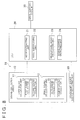
- FIG. 1 is a configuration diagram of the sound source detecting system according to the first embodiment.
- the sound source detecting system 1 includes four sound collectors, and a sound collector unit formed of two sound collectors (a pair of sound collectors) is arranged at each of the left side and right side in the vehicle width direction. In the sound source detecting system 1, a sound source is detected by utilizing the space between the two sound collectors in each of the sound collector units.
- the sound source detecting system 1 includes a sound collector array 10 (a left sound collector unit 11 (a first sound collector 13 and a second sound collector 14) and a right sound collector unit 12 (a third sound collector 15 and a fourth sound collector 16)) and an electronic control unit (ECU) 20 (a noise extracting unit 21, a noise suppressing unit 22, a microphone array processing unit 23 and a sound source detecting unit 24).
- ECU electronice control unit
- the sound collector array 10 includes the left sound collector unit 11 and the right sound collector unit 12.
- the left sound collector unit 11 includes the first sound collector 13 and the second sound collector 14.
- the first sound collector 13 is arranged at the outer left side in the vehicle width direction.
- the second sound collector 14 is arranged adjacent to the center of the vehicle at a predetermined space from the first sound collector 13.
- the right sound collector unit 12 includes the third sound collector 15 and the fourth sound collector 16.
- the fourth sound collector 16 is arranged at the outer right side in the vehicle width direction.
- the third sound collector 15 is arranged adjacent to the center of the vehicle at a predetermined space from the fourth sound collector 16.
- the space between the sound collectors in each of the sound collector units 11 and 12 is set to a narrow space.
- each of the sound collectors 13, 14, 15 and 16 has the function of an acoustic-electric converter, converts a collected sound to an electric signal, and transmits the electric signal to the ECU 20.
- each of the sound collectors 13, 14, 15 and 16 is desirably a nondirectional sound collector.
- the ECU 20 is an electronic control unit formed of a central processing unit (CPU), a read only memory (ROM), a random access memory (RAM), and the like, and comprehensively controls the sound source detecting system 1.
- CPU central processing unit
- ROM read only memory
- RAM random access memory
- the ECU 20 includes the noise extracting unit 21, the noise suppressing unit 22, the microphone array processing unit 23 and the sound source detecting unit 24.
- These noise extracting unit 21, noise suppressing unit 22, microphone array processing unit 23 and sound source detecting unit 24 correspond to the above described applications.
- the noise extracting unit 21 extracts a noise emitted from a sound source other than a predetermined sound source that is a sound source to be detected.
- the predetermined sound source is, for example, an approaching vehicle. That is, the noise extracting unit 21 has the function of extracting a noise emitted from a known noise source, such as an engine and fan of a host vehicle, from signals of sounds collected by the sound collector array 10, and executes noise emphasizing process over a noise from a noise source inside the host vehicle.
- the noise extracting process executed by the noise extracting unit 21 may be, for example, beamforming technique.
- the noise extracting unit 21 executes the noise emphasizing process in this way. By so doing, it is possible to further accurately extract a signal component of a noise to be suppressed, so it is possible to execute the sound source detecting process in a suitable condition.
- the noise suppressing unit 22 has the function of suppressing a signal component of a noise extracted by the noise extracting unit 21 from signals of sounds collected by the sound collector array 10.
- the noise suppressing process executed by the noise suppressing unit 22 may be, for example, spectral subtraction.
- the spectral subtraction is to suppress a noise component as follows.
- the mean value of power spectra of a noise of the engine, or the like, is estimated, and the power spectra of the noise are subtracted from the power spectra of electric signals, including the noise, from the sound collector array 10.
- the noise suppressing unit 22 executes the above described noise suppressing process. By so doing, it is possible to obtain electric signals, of which the noise component is suppressed, from the electric signals output from the sound collector array 10.
- the microphone array processing unit 23 calculates a crosscorrelation value of the electric signals of which the noise component is suppressed by the noise suppressing unit 22 for each of the pairs of sound collectors (the left sound collector unit 11 and the right sound collector unit 12). Specifically, a correlation value that indicates how much the electric signals of each pair of sound collectors are similar (waveforms are close) is calculated. Here, a crosscorrelation value between the electric signals of the first and second sound collectors 13 and 14 of the left sound collector unit 11 and a crosscorrelation value between the electric signals of the third and fourth sound collectors 15 and 16 of the right sound collector unit 12 are calculated. In addition, the microphone array processing unit 23 calculates a phase difference between two electric signals in each of the left sound collector unit 11 and the right sound collector unit 12.
- a variance (variations) of phase difference is calculated with the use of phase differences calculated at set intervals.
- a crosscorrelation value or a phase difference is calculated with the use of frequency information that is obtainable by crosscorrelation function or Fourier transform.
- a continuously present sound source is detected on the basis of a crosscorrelation value and a phase difference variance for each of the pairs of sound collectors.
- a crosscorrelation value is larger than or equal to a threshold (for crosscorrelation determination), and it is determined whether sounds respectively collected by the pairs of sound collectors are similar sounds.
- the threshold for crosscorrelation determination is used to determine whether the waveforms of electric signals are similar to each other on the basis of a crosscorrelation value, and is preset by an experiment, or the like.
- phase difference variance determination it is determined whether a phase difference variance is smaller than or equal to a threshold (for phase difference variance determination), and it is determined whether sounds respectively collected by the pairs of sound collectors are continuously present at a certain location.
- the threshold (for phase difference variance determination) is used to determine whether a sound source is continuously present at a certain location on the basis of a phase difference variance, and is preset by an experiment, or the like. Then, when the crosscorrelation value is larger than or equal to the threshold (for crosscorrelation value determination) and the phase difference variance is smaller than or equal to the threshold (for phase difference variance determination), it is determined that a sound source is continuously present; whereas, when the condition is not satisfied, it is determined that no sound source is present.
- the drive assist system 30 is a system that assists a driver in various driving operations.
- the drive assist system 30 receives approaching vehicle information from the sound source detecting system 1, and carries out drive assist in association with an approaching vehicle at this time. For example, when there is an approaching vehicle toward the host vehicle, it is determined whether the approaching vehicle is likely to collide with the host vehicle, and, when it is determined that the approaching vehicle is likely to collide with the host vehicle, an alarm is issued to the driver or information about the approaching vehicle is provided to the driver, and, furthermore, vehicle control, such as automatic braking, is carried out when the likelihood of the collision increases.
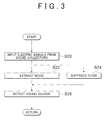
- FIG. 2 is a flowchart that shows the flow of processes executed by the ECU 20 of the sound source detecting system 1 according to the first embodiment.
- a series of processes shown in the flowchart of FIG. 2 are repeatedly executed by the ECU 20 at predetermined intervals.
- the series of processes are executed for each of the sound collector units 11 and 12. Specifically, a direction in which the predetermined sound source is present is detected by making a comparison between a sound collected by the first sound collector 13 and a sound collected by the second sound collector 14 and a comparison between a sound collected by the third sound collector 15 and a sound collected by the fourth sound collector 16.
- each of the sound collectors 13, 14, 15 and 16 collects a sound outside the vehicle, converts the collected sound to an electric signal and transmits the electric signal to the ECU 20.
- the control process of the flowchart is, for example, started by turning on the ignition of the vehicle, and an electric signal is input from each of the sound collectors 13, 14, 15 and 16 to the ECU 20 in step S10 (hereinafter, referred to as "S10", and the same applies to the other steps).
- filtering is performed by a filter (not shown) in the ECU 20 at this time, and a component in a high-frequency band and a component in a low-frequency band are removed from the electric signals.
- a noise extracting process for emphasizing a noise is executed over a noise from a noise source, such as an engine, by the noise extracting unit 21.
- the noise component in the electric signals that include the noise emphasized by the noise extracting unit 21 is suppressed by the noise suppressing unit 22.
- a crosscorrelation value and a phase difference variance are calculated by the microphone array processing unit 23 using the signals of which the noise component is suppressed, and it is determined by the sound source detecting unit 24 whether there is a sound source and in which direction the sound source is present on the basis of the crosscorrelation value and the phase difference variance. Then, the series of processes end.
- the sound source detecting system 1 includes the noise extracting unit 21 that extracts a noise emitted from an engine, or the like, from signals of sounds collected by the sound collector array 10 and the noise suppressing unit 22 that suppresses a signal component of the noise extracted by the noise extracting unit 21 from the signals of the sounds collected by the sound collector array 10, and the microphone array processing unit 23 and the sound source detecting unit 24 detect the location of a sound source, such as an approaching vehicle, with the use of the electric signals of which the signal component of the noise is suppressed.
- a sound source such as an approaching vehicle
- a noise is extracted by the noise' extracting unit 21 and then a signal component of the noise is suppressed by the noise suppressing unit 22. Therefore, noise extraction and noise suppression are alternately performed, so it is possible to suppress a processing load in comparison with the case where the noise extracting process and the noise suppressing process are simultaneously executed.
- the sequence of the noise extracting process and the noise suppressing process is not limited to the above, the noise extracting process may be executed after the noise suppressing process.
- the second embodiment has the same configuration as the sound source detecting system 1 according to the first embodiment, but the second embodiment differs from the first embodiment in that extracting a noise by the noise extracting unit 21 and suppressing a signal component of the noise by the noise suppressing unit 22 are performed in parallel with each other.
- noise extraction by the noise extracting unit 21 and noise suppression by the noise suppressing unit 22 are performed in parallel with each other, so it is possible to reduce a processing time.
- noise extraction and noise suppression are performed simultaneously, and noise suppression is performed on electric signals immediately after the electric signals are subjected to noise extraction, so it is possible to improve the accuracy of noise suppression.
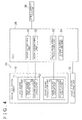
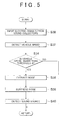
- the third embodiment has such a feature that a vehicle state detecting unit 40 that detects a vehicle state of the host vehicle is provided and noise extraction and noise suppression (hereinafter, referred to as noise processing) are performed with the use of the vehicle state of the host vehicle, detected by the vehicle state detecting unit 40.
- noise processing noise extraction and noise suppression
- a vehicle sensor or an acceleration sensor may be used as the vehicle state detecting unit 40.
- the vehicle sensor is used as the vehicle state detecting unit 40.
- the process proceeds to S36, and noise extraction by the noise extracting unit 21 is performed.
- the noise extracting unit 21 performs noise extraction over an operating engine and tires, and an emphasizing process is performed by regarding sounds emitted from the engine and the tires as noises.
- a vehicle state of the host vehicle is detected by the vehicle state detecting unit 40, and noise processing is performed on the basis of the detected vehicle state.
- noise processing is performed only when it is required in consideration of a vehicle state of the host vehicle, so it is possible to further reduce a processing load and execute sound source detection in an optimal condition.
- a detected vehicle state is not limited to a vehicle speed.
- an operating state of the engine, a usage condition of an air conditioner, or the like is detected as a vehicle state and it is determined whether noise processing is performed on the basis of the detected vehicle state.
- noise suppression. is performed after noise extraction. Instead, as in the case of the second embodiment, noise extraction and noise suppression may be performed in parallel with each other.
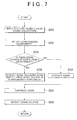
- the fourth embodiment has such a feature that a surrounding environment detecting unit 60 that detects a surrounding environment of the host vehicle is provided, it is determined whether there is a noise source, such as a construction site, on the basis of the surrounding environment detected by the surrounding environment detecting unit 60 and then noise extraction in a different mode is performed on the basis of the determined result.
- a noise source such as a construction site
- map information, or the like, obtained by, for example, a navigation system may be used as the surrounding environment detecting unit 60.
- electric signals are respectively input from the sound collectors 13, 14, 15 and 16 and are subjected to filtering: After that, in S52, a surrounding environment is detected by the surrounding environment detecting unit 60. At this time, the detected information about the surrounding environment is input to the ECU 20. Then, in S54, it is determined by the ECU 20 whether there is a noise source, such as a construction site, in the input surrounding environment.
- the process proceeds to S56, and noise extraction is performed by the noise extracting unit 21.
- the noise extracting unit 21 performs noise extraction on not only a noise source of the host vehicle but also a construction site, or the like, that is the noise source in the surrounding environment, and executes the process of emphasizing noises emitted from these noise sources.
- noise extraction is performed on the noise source of the host vehicle as in the case of S12, or the like.
- a surrounding environment is detected by the surrounding environment detecting unit 60, and the noise extracting process in a different mode is executed on the basis of whether there is a noise source around.
- the noise extracting process in a different mode is executed on the basis of whether there is a noise source around.
- the fifth embodiment has such a feature that a stationary sound source detecting unit 80 that detects a stationary sound source, such as a construction site, present around the host vehicle is provided and noise extraction in a different mode is performed on the basis of whether the stationary sound source detecting unit 80 has detected a stationary sound source.
- the process proceeds to S76, and noise extraction is performed by the noise extracting unit 21.
- the noise extracting unit 21 performs noise extraction on not only a noise of the host vehicle but also the detected stationary sound source, such as a construction site, and executes the process of emphasizing noises emitted from these noise sources.
- the noise extracting unit 21 performs noise extraction on the noise source of the host vehicle as in the case of S12, or the like.
- the stationary sound source detecting unit 80 is used to detect whether there is a stationary sound source around the host vehicle and the noise extracting process in a different mode is executed on the basis of the detected result.
- the stationary sound source detecting unit 80 is used to exclude in advance the influence of a sound emitted from a stationary sound source that does not need to be detected for the host vehicle, so an advantageous effect that the detection accuracy of a sound source improves is obtained.
- advantageous effects similar to those of the above described fourth embodiment are also obtained.
- noise suppression is performed after noise extraction; instead, as in the case of the second embodiment, noise extraction and noise suppression may be performed in parallel with each other.
- the description is made on an example in which the stationary sound source detecting unit 80 detects a stationary sound source and a noise emitted from the stationary sound source is extracted.
- a non-approaching sound source detecting unit that detects a non-approaching noise source that does not approaches the host vehicle, such as a vehicle that distances from the host vehicle, is provided and, when the non-approaching sound source detecting unit has detected a non-approaching noise source, the noise extracting unit 21 executes noise extracting process over a noise from the non-approaching noise source.
- the aspects of the invention are applied to the sound source detecting systems 1, 51, 71 and 91 that are mounted on the vehicle and that provide detected approaching vehicle information to the drive assist system 30.
- the configuration of each of the sound source detecting systems 1, 51, 71 and 91 may be another configuration.
- the aspects of the invention may be applies into a drive assist system as an approaching vehicle detecting function or a sound source detecting system may have an alarm function, or the like.
- aspects of the invention may be applied to a sound source detecting system that detects a sound source other than an approaching vehicle, and, furthermore, the aspects of the invention may be applied to a sound source detecting system that is mounted on a mobile unit, other than a vehicle, such as a robot.
- each of the left sound collector unit 11 and the right sound collector unit 12 includes the two sound collectors. Instead, other variations are applicable on the number of the sound collectors and the arrangement positions of the sound collectors.
Landscapes
- Physics & Mathematics (AREA)
- Engineering & Computer Science (AREA)
- General Physics & Mathematics (AREA)
- Radar, Positioning & Navigation (AREA)
- Remote Sensing (AREA)
- Acoustics & Sound (AREA)
- General Health & Medical Sciences (AREA)
- Otolaryngology (AREA)
- Health & Medical Sciences (AREA)
- Signal Processing (AREA)
- Multimedia (AREA)
- Measurement Of Velocity Or Position Using Acoustic Or Ultrasonic Waves (AREA)
- Soundproofing, Sound Blocking, And Sound Damping (AREA)
- Measurement Of Mechanical Vibrations Or Ultrasonic Waves (AREA)
Applications Claiming Priority (2)
| Application Number | Priority Date | Filing Date | Title |
|---|---|---|---|
| JP2011205322A JP6001248B2 (ja) | 2011-09-20 | 2011-09-20 | 音源検出装置 |
| PCT/IB2012/001826 WO2013041942A1 (en) | 2011-09-20 | 2012-09-19 | Sound source detecting system and sound source detecting method |
Publications (2)
| Publication Number | Publication Date |
|---|---|
| EP2758794A1 EP2758794A1 (en) | 2014-07-30 |
| EP2758794B1 true EP2758794B1 (en) | 2015-11-04 |
Family
ID=47216366
Family Applications (1)
| Application Number | Title | Priority Date | Filing Date |
|---|---|---|---|
| EP12788633.1A Not-in-force EP2758794B1 (en) | 2011-09-20 | 2012-09-19 | Sound source detecting system and sound source detecting method |
Country Status (5)
| Country | Link |
|---|---|
| US (1) | US9299334B2 (enExample) |
| EP (1) | EP2758794B1 (enExample) |
| JP (1) | JP6001248B2 (enExample) |
| CN (1) | CN103930791B (enExample) |
| WO (1) | WO2013041942A1 (enExample) |
Families Citing this family (29)
| Publication number | Priority date | Publication date | Assignee | Title |
|---|---|---|---|---|
| JP5516455B2 (ja) * | 2011-02-23 | 2014-06-11 | トヨタ自動車株式会社 | 接近車両検出装置及び接近車両検出方法 |
| JP6001248B2 (ja) * | 2011-09-20 | 2016-10-05 | トヨタ自動車株式会社 | 音源検出装置 |
| WO2013175637A1 (ja) * | 2012-05-25 | 2013-11-28 | トヨタ自動車株式会社 | 接近車両検出装置及び運転支援システム |
| GB2514184B (en) | 2013-05-17 | 2016-05-04 | Canon Kk | Method for determining a direction of at least one sound source from an array of microphones |
| US20160096475A1 (en) * | 2013-06-06 | 2016-04-07 | Douglas J. Wolfe | Light/audio component coordination |
| WO2015004781A1 (ja) * | 2013-07-11 | 2015-01-15 | トヨタ自動車株式会社 | 物体検出装置及び物体検出方法 |
| US9663031B2 (en) * | 2013-10-21 | 2017-05-30 | Harman International Industries, Inc. | Modifying an audio panorama to indicate the presence of danger or other events of interest |
| JP6206271B2 (ja) * | 2014-03-17 | 2017-10-04 | 株式会社Jvcケンウッド | 雑音低減装置、雑音低減方法及び雑音低減プログラム |
| CN105899965B (zh) * | 2014-08-29 | 2018-10-02 | 深圳市大疆创新科技有限公司 | 用于采集音频数据的无人飞行器 |
| US10575117B2 (en) | 2014-12-08 | 2020-02-25 | Harman International Industries, Incorporated | Directional sound modification |
| JP6550930B2 (ja) * | 2015-05-29 | 2019-07-31 | 日本電気株式会社 | アクティブソーナー装置及びその信号処理方法 |
| KR101748497B1 (ko) * | 2015-11-11 | 2017-06-19 | 한동대학교 산학협력단 | 소리 정보에 이용하여 차량의 후방 좌우 옆 차선 영역을 감지하는 방법 및 이를 이용한 차량용 시스템 |
| US9996080B2 (en) * | 2016-02-26 | 2018-06-12 | Ford Global Technologies, Llc | Collision avoidance using auditory data |
| KR101759143B1 (ko) * | 2016-03-10 | 2017-07-18 | 현대자동차주식회사 | 음향 추적 정보 제공 방법, 차량용 음향 추적 장치, 및 이를 포함하는 차량 |
| KR101768145B1 (ko) * | 2016-04-21 | 2017-08-14 | 현대자동차주식회사 | 음향 추적 정보 제공 방법, 차량용 음향 추적 장치, 및 이를 포함하는 차량 |
| CN105798917B (zh) * | 2016-04-29 | 2019-02-15 | 深圳市神州云海智能科技有限公司 | 一种社区安全报警方法及巡逻机器人 |
| CN105979442B (zh) * | 2016-07-22 | 2019-12-03 | 北京地平线机器人技术研发有限公司 | 噪声抑制方法、装置和可移动设备 |
| JP6888627B2 (ja) * | 2016-08-23 | 2021-06-16 | ソニーグループ株式会社 | 情報処理装置、情報処理方法及びプログラム |
| CN106248196B (zh) * | 2016-08-31 | 2019-10-15 | 哈尔滨工业大学 | 一种微声探测分析装置及基于该装置的阵列音频信号处理方法 |
| JP6809936B2 (ja) * | 2017-02-28 | 2021-01-06 | パナソニック インテレクチュアル プロパティ コーポレーション オブ アメリカPanasonic Intellectual Property Corporation of America | 雑音抽出装置およびマイクロホン装置 |
| CN106872945B (zh) * | 2017-04-19 | 2020-01-17 | 北京地平线信息技术有限公司 | 声源定位方法、装置和电子设备 |
| DE102017112761B3 (de) * | 2017-06-09 | 2018-09-20 | Ask Industries Gmbh | Verfahren zum Betrieb einer fahrzeugseitigen akustischen Signalerzeugungseinrichtung |
| US10170096B1 (en) * | 2017-11-01 | 2019-01-01 | GM Global Technology Operations LLC | Audio control systems and methods for mitigating structural noise borne from tires |
| JP7180447B2 (ja) * | 2019-02-26 | 2022-11-30 | 沖電気工業株式会社 | 方位推定装置、方位推定システム、方位推定方法およびプログラム |
| CN111833840B (zh) * | 2019-04-17 | 2024-06-11 | 北京地平线机器人技术研发有限公司 | 降噪方法和装置、系统、电子设备、存储介质 |
| US20220326332A1 (en) * | 2019-06-06 | 2022-10-13 | Nippon Telegraph And Telephone Corporation | Sound collecting apparatus, arrival direction estimating apparatus, and vibration information collecting apparatus |
| JP7531265B2 (ja) * | 2019-06-07 | 2024-08-09 | 本田技研工業株式会社 | 運転支援装置、運転支援方法および運転支援プログラム |
| CN112750457B (zh) * | 2019-10-31 | 2026-01-13 | 罗伯特·博世有限公司 | 用于标识车辆内噪声源的系统 |
| CN114495553B (zh) * | 2021-04-07 | 2024-01-05 | 时孝贺 | 一种双工通信中的干扰抑制系统 |
Family Cites Families (25)
| Publication number | Priority date | Publication date | Assignee | Title |
|---|---|---|---|---|
| JPH0592767U (ja) | 1992-05-18 | 1993-12-17 | 株式会社豊田中央研究所 | 接近車両認識装置 |
| JP3535533B2 (ja) * | 1992-11-16 | 2004-06-07 | 本田技研工業株式会社 | 能動振動騒音制御装置 |
| JP2899205B2 (ja) * | 1994-03-16 | 1999-06-02 | 本田技研工業株式会社 | 車両用能動振動騒音制御装置 |
| JP3089958B2 (ja) * | 1994-12-06 | 2000-09-18 | 三菱自動車工業株式会社 | 電気自動車の制動制御装置 |
| US5778082A (en) * | 1996-06-14 | 1998-07-07 | Picturetel Corporation | Method and apparatus for localization of an acoustic source |
| JP2001056693A (ja) * | 1999-08-20 | 2001-02-27 | Matsushita Electric Ind Co Ltd | 騒音低減装置 |
| JP2002008189A (ja) * | 2000-06-22 | 2002-01-11 | Matsushita Electric Ind Co Ltd | 車両検出装置および車両検出方法 |
| JP4815661B2 (ja) * | 2000-08-24 | 2011-11-16 | ソニー株式会社 | 信号処理装置及び信号処理方法 |
| KR100418763B1 (ko) * | 2000-12-28 | 2004-02-18 | 현대자동차주식회사 | 노면경사 측정방법 및 이를 이용한 차량 속도 제어 시스템 |
| JP2002351488A (ja) * | 2001-05-28 | 2002-12-06 | Matsushita Electric Ind Co Ltd | ノイズキャンセル装置および車載システム |
| JP4455379B2 (ja) * | 2005-03-16 | 2010-04-21 | 本田技研工業株式会社 | 車両用アンダーステア抑制装置 |
| JP4091083B2 (ja) * | 2006-01-19 | 2008-05-28 | 横浜ゴム株式会社 | タイヤ内部故障検知装置およびタイヤ内部故障検知方法 |
| JP2007208828A (ja) * | 2006-02-03 | 2007-08-16 | Denso Corp | 車両用音声入出力制御装置 |
| US8104845B2 (en) * | 2006-03-10 | 2012-01-31 | Nissan Motor Co., Ltd. | Vehicle braking apparatus |
| US8184827B2 (en) * | 2006-11-09 | 2012-05-22 | Panasonic Corporation | Sound source position detector |
| CN101193460B (zh) | 2006-11-20 | 2011-09-28 | 松下电器产业株式会社 | 检测声音的装置及方法 |
| TW200922272A (en) * | 2007-11-06 | 2009-05-16 | High Tech Comp Corp | Automobile noise suppression system and method thereof |
| CN101431706A (zh) | 2007-11-08 | 2009-05-13 | 宏达国际电子股份有限公司 | 车用噪声抑制系统及其方法 |
| JP5132376B2 (ja) * | 2008-03-19 | 2013-01-30 | アルパイン株式会社 | 音声改善装置および音声改善方法 |
| EP2312579A1 (en) * | 2009-10-15 | 2011-04-20 | Honda Research Institute Europe GmbH | Speech from noise separation with reference information |
| JP5593547B2 (ja) * | 2010-02-26 | 2014-09-24 | 日産自動車株式会社 | 波動源位置演算方法及び波動源位置演算装置 |
| US9460913B2 (en) * | 2010-12-27 | 2016-10-04 | Tokyo Electron Limited | Film-forming method for forming silicon oxide film on tungsten film or tungsten oxide film |
| US8737634B2 (en) * | 2011-03-18 | 2014-05-27 | The United States Of America As Represented By The Secretary Of The Navy | Wide area noise cancellation system and method |
| JP6001248B2 (ja) * | 2011-09-20 | 2016-10-05 | トヨタ自動車株式会社 | 音源検出装置 |
| US20150331095A1 (en) * | 2012-12-26 | 2015-11-19 | Toyota Jidosha Kabushiki Kaisha | Sound detection device and sound detection method |
-
2011
- 2011-09-20 JP JP2011205322A patent/JP6001248B2/ja not_active Expired - Fee Related
-
2012
- 2012-09-19 US US14/346,060 patent/US9299334B2/en not_active Expired - Fee Related
- 2012-09-19 EP EP12788633.1A patent/EP2758794B1/en not_active Not-in-force
- 2012-09-19 WO PCT/IB2012/001826 patent/WO2013041942A1/en not_active Ceased
- 2012-09-19 CN CN201280045689.9A patent/CN103930791B/zh not_active Expired - Fee Related
Also Published As
| Publication number | Publication date |
|---|---|
| US9299334B2 (en) | 2016-03-29 |
| EP2758794A1 (en) | 2014-07-30 |
| JP2013068434A (ja) | 2013-04-18 |
| CN103930791B (zh) | 2016-03-02 |
| US20140241532A1 (en) | 2014-08-28 |
| WO2013041942A1 (en) | 2013-03-28 |
| CN103930791A (zh) | 2014-07-16 |
| JP6001248B2 (ja) | 2016-10-05 |
Similar Documents
| Publication | Publication Date | Title |
|---|---|---|
| US9299334B2 (en) | Sound source detecting system and sound source detecting method | |
| EP2759843B1 (en) | Sound source detection device | |
| EP2697664B1 (en) | Approaching vehicle detecting system and approaching vehicle detecting method | |
| CN103380385B (zh) | 接近车辆检测装置及接近车辆检测方法 | |
| EP2758793B1 (en) | Sound source detection system | |
| RU2576339C2 (ru) | Устройство обнаружения источника звука | |
| US20150117652A1 (en) | Sound source detection device, noise model generation device, noise reduction device, sound source direction estimation device, approaching vehicle detection device and noise reduction method | |
| JP5641271B1 (ja) | 車両の運転支援装置及び車載コンピュータ | |
| WO2014102938A1 (ja) | 音検知装置及び音検知方法 | |
| CN105358382B (zh) | 物体检测装置以及物体检测方法 | |
| JP6711319B2 (ja) | 周辺監視レーダ装置 | |
| JP2013068424A (ja) | 音源検出装置 |
Legal Events
| Date | Code | Title | Description |
|---|---|---|---|
| PUAI | Public reference made under article 153(3) epc to a published international application that has entered the european phase |
Free format text: ORIGINAL CODE: 0009012 |
|
| 17P | Request for examination filed |
Effective date: 20140320 |
|
| AK | Designated contracting states |
Kind code of ref document: A1 Designated state(s): AL AT BE BG CH CY CZ DE DK EE ES FI FR GB GR HR HU IE IS IT LI LT LU LV MC MK MT NL NO PL PT RO RS SE SI SK SM TR |
|
| RIN1 | Information on inventor provided before grant (corrected) |
Inventor name: OGAWA, AKIRA Inventor name: HOSHINO, HIROYUKI Inventor name: ASAHI, KENSAKU Inventor name: FUNAYAMA, RYUJI Inventor name: TAKATANI, TOMOYA Inventor name: YAMAMOTO, OSAMI Inventor name: YAMADA, KEIICHI Inventor name: SATA, JUN Inventor name: TANAKA, YUICHI Inventor name: BANNO, HIDEKI |
|
| DAX | Request for extension of the european patent (deleted) | ||
| REG | Reference to a national code |
Ref country code: DE Ref legal event code: R079 Ref document number: 602012012232 Country of ref document: DE Free format text: PREVIOUS MAIN CLASS: G01S0003808000 Ipc: G01S0003860000 |
|
| GRAP | Despatch of communication of intention to grant a patent |
Free format text: ORIGINAL CODE: EPIDOSNIGR1 |
|
| RIC1 | Information provided on ipc code assigned before grant |
Ipc: G10K 11/00 20060101ALI20150429BHEP Ipc: H04R 29/00 20060101ALI20150429BHEP Ipc: G01S 3/86 20060101AFI20150429BHEP Ipc: G01S 3/808 20060101ALI20150429BHEP |
|
| INTG | Intention to grant announced |
Effective date: 20150518 |
|
| GRAS | Grant fee paid |
Free format text: ORIGINAL CODE: EPIDOSNIGR3 |
|
| GRAA | (expected) grant |
Free format text: ORIGINAL CODE: 0009210 |
|
| AK | Designated contracting states |
Kind code of ref document: B1 Designated state(s): AL AT BE BG CH CY CZ DE DK EE ES FI FR GB GR HR HU IE IS IT LI LT LU LV MC MK MT NL NO PL PT RO RS SE SI SK SM TR |
|
| RAP1 | Party data changed (applicant data changed or rights of an application transferred) |
Owner name: MEIJO UNIVERSITY Owner name: TOYOTA JIDOSHA KABUSHIKI KAISHA |
|
| REG | Reference to a national code |
Ref country code: GB Ref legal event code: FG4D |
|
| RIN1 | Information on inventor provided before grant (corrected) |
Inventor name: BANNO, HIDEKI Inventor name: TANAKA, YUICHI Inventor name: HOSHINO, HIROYUKI Inventor name: ASAHI, KENSAKU Inventor name: YAMADA, KEIICHI Inventor name: SATO, JUN Inventor name: FUNAYAMA, RYUJI Inventor name: YAMAMOTO, OSAMI Inventor name: TAKATANI, TOMOYA Inventor name: OGAWA, AKIRA |
|
| REG | Reference to a national code |
Ref country code: CH Ref legal event code: EP |
|
| REG | Reference to a national code |
Ref country code: AT Ref legal event code: REF Ref document number: 759587 Country of ref document: AT Kind code of ref document: T Effective date: 20151115 |
|
| REG | Reference to a national code |
Ref country code: IE Ref legal event code: FG4D |
|
| REG | Reference to a national code |
Ref country code: DE Ref legal event code: R096 Ref document number: 602012012232 Country of ref document: DE |
|
| REG | Reference to a national code |
Ref country code: NL Ref legal event code: MP Effective date: 20151104 |
|
| REG | Reference to a national code |
Ref country code: LT Ref legal event code: MG4D |
|
| REG | Reference to a national code |
Ref country code: AT Ref legal event code: MK05 Ref document number: 759587 Country of ref document: AT Kind code of ref document: T Effective date: 20151104 |
|
| PG25 | Lapsed in a contracting state [announced via postgrant information from national office to epo] |
Ref country code: LT Free format text: LAPSE BECAUSE OF FAILURE TO SUBMIT A TRANSLATION OF THE DESCRIPTION OR TO PAY THE FEE WITHIN THE PRESCRIBED TIME-LIMIT Effective date: 20151104 Ref country code: NO Free format text: LAPSE BECAUSE OF FAILURE TO SUBMIT A TRANSLATION OF THE DESCRIPTION OR TO PAY THE FEE WITHIN THE PRESCRIBED TIME-LIMIT Effective date: 20160204 Ref country code: NL Free format text: LAPSE BECAUSE OF FAILURE TO SUBMIT A TRANSLATION OF THE DESCRIPTION OR TO PAY THE FEE WITHIN THE PRESCRIBED TIME-LIMIT Effective date: 20151104 Ref country code: IS Free format text: LAPSE BECAUSE OF FAILURE TO SUBMIT A TRANSLATION OF THE DESCRIPTION OR TO PAY THE FEE WITHIN THE PRESCRIBED TIME-LIMIT Effective date: 20160304 Ref country code: IT Free format text: LAPSE BECAUSE OF FAILURE TO SUBMIT A TRANSLATION OF THE DESCRIPTION OR TO PAY THE FEE WITHIN THE PRESCRIBED TIME-LIMIT Effective date: 20151104 Ref country code: ES Free format text: LAPSE BECAUSE OF FAILURE TO SUBMIT A TRANSLATION OF THE DESCRIPTION OR TO PAY THE FEE WITHIN THE PRESCRIBED TIME-LIMIT Effective date: 20151104 Ref country code: HR Free format text: LAPSE BECAUSE OF FAILURE TO SUBMIT A TRANSLATION OF THE DESCRIPTION OR TO PAY THE FEE WITHIN THE PRESCRIBED TIME-LIMIT Effective date: 20151104 |
|
| PG25 | Lapsed in a contracting state [announced via postgrant information from national office to epo] |
Ref country code: PT Free format text: LAPSE BECAUSE OF FAILURE TO SUBMIT A TRANSLATION OF THE DESCRIPTION OR TO PAY THE FEE WITHIN THE PRESCRIBED TIME-LIMIT Effective date: 20160304 Ref country code: FI Free format text: LAPSE BECAUSE OF FAILURE TO SUBMIT A TRANSLATION OF THE DESCRIPTION OR TO PAY THE FEE WITHIN THE PRESCRIBED TIME-LIMIT Effective date: 20151104 Ref country code: RS Free format text: LAPSE BECAUSE OF FAILURE TO SUBMIT A TRANSLATION OF THE DESCRIPTION OR TO PAY THE FEE WITHIN THE PRESCRIBED TIME-LIMIT Effective date: 20151104 Ref country code: SE Free format text: LAPSE BECAUSE OF FAILURE TO SUBMIT A TRANSLATION OF THE DESCRIPTION OR TO PAY THE FEE WITHIN THE PRESCRIBED TIME-LIMIT Effective date: 20151104 Ref country code: PL Free format text: LAPSE BECAUSE OF FAILURE TO SUBMIT A TRANSLATION OF THE DESCRIPTION OR TO PAY THE FEE WITHIN THE PRESCRIBED TIME-LIMIT Effective date: 20151104 Ref country code: GR Free format text: LAPSE BECAUSE OF FAILURE TO SUBMIT A TRANSLATION OF THE DESCRIPTION OR TO PAY THE FEE WITHIN THE PRESCRIBED TIME-LIMIT Effective date: 20160205 Ref country code: LV Free format text: LAPSE BECAUSE OF FAILURE TO SUBMIT A TRANSLATION OF THE DESCRIPTION OR TO PAY THE FEE WITHIN THE PRESCRIBED TIME-LIMIT Effective date: 20151104 Ref country code: AT Free format text: LAPSE BECAUSE OF FAILURE TO SUBMIT A TRANSLATION OF THE DESCRIPTION OR TO PAY THE FEE WITHIN THE PRESCRIBED TIME-LIMIT Effective date: 20151104 |
|
| REG | Reference to a national code |
Ref country code: DE Ref legal event code: R084 Ref document number: 602012012232 Country of ref document: DE |
|
| PG25 | Lapsed in a contracting state [announced via postgrant information from national office to epo] |
Ref country code: CZ Free format text: LAPSE BECAUSE OF FAILURE TO SUBMIT A TRANSLATION OF THE DESCRIPTION OR TO PAY THE FEE WITHIN THE PRESCRIBED TIME-LIMIT Effective date: 20151104 |
|
| REG | Reference to a national code |
Ref country code: GB Ref legal event code: 746 Effective date: 20160712 |
|
| REG | Reference to a national code |
Ref country code: DE Ref legal event code: R097 Ref document number: 602012012232 Country of ref document: DE |
|
| REG | Reference to a national code |
Ref country code: FR Ref legal event code: PLFP Year of fee payment: 5 |
|
| PG25 | Lapsed in a contracting state [announced via postgrant information from national office to epo] |
Ref country code: SM Free format text: LAPSE BECAUSE OF FAILURE TO SUBMIT A TRANSLATION OF THE DESCRIPTION OR TO PAY THE FEE WITHIN THE PRESCRIBED TIME-LIMIT Effective date: 20151104 Ref country code: RO Free format text: LAPSE BECAUSE OF FAILURE TO SUBMIT A TRANSLATION OF THE DESCRIPTION OR TO PAY THE FEE WITHIN THE PRESCRIBED TIME-LIMIT Effective date: 20151104 Ref country code: SK Free format text: LAPSE BECAUSE OF FAILURE TO SUBMIT A TRANSLATION OF THE DESCRIPTION OR TO PAY THE FEE WITHIN THE PRESCRIBED TIME-LIMIT Effective date: 20151104 Ref country code: DK Free format text: LAPSE BECAUSE OF FAILURE TO SUBMIT A TRANSLATION OF THE DESCRIPTION OR TO PAY THE FEE WITHIN THE PRESCRIBED TIME-LIMIT Effective date: 20151104 Ref country code: EE Free format text: LAPSE BECAUSE OF FAILURE TO SUBMIT A TRANSLATION OF THE DESCRIPTION OR TO PAY THE FEE WITHIN THE PRESCRIBED TIME-LIMIT Effective date: 20151104 |
|
| PLBE | No opposition filed within time limit |
Free format text: ORIGINAL CODE: 0009261 |
|
| STAA | Information on the status of an ep patent application or granted ep patent |
Free format text: STATUS: NO OPPOSITION FILED WITHIN TIME LIMIT |
|
| 26N | No opposition filed |
Effective date: 20160805 |
|
| PG25 | Lapsed in a contracting state [announced via postgrant information from national office to epo] |
Ref country code: SI Free format text: LAPSE BECAUSE OF FAILURE TO SUBMIT A TRANSLATION OF THE DESCRIPTION OR TO PAY THE FEE WITHIN THE PRESCRIBED TIME-LIMIT Effective date: 20151104 |
|
| PG25 | Lapsed in a contracting state [announced via postgrant information from national office to epo] |
Ref country code: BE Free format text: LAPSE BECAUSE OF FAILURE TO SUBMIT A TRANSLATION OF THE DESCRIPTION OR TO PAY THE FEE WITHIN THE PRESCRIBED TIME-LIMIT Effective date: 20151104 |
|
| PG25 | Lapsed in a contracting state [announced via postgrant information from national office to epo] |
Ref country code: MC Free format text: LAPSE BECAUSE OF FAILURE TO SUBMIT A TRANSLATION OF THE DESCRIPTION OR TO PAY THE FEE WITHIN THE PRESCRIBED TIME-LIMIT Effective date: 20151104 |
|
| REG | Reference to a national code |
Ref country code: CH Ref legal event code: PL |
|
| REG | Reference to a national code |
Ref country code: IE Ref legal event code: MM4A |
|
| PG25 | Lapsed in a contracting state [announced via postgrant information from national office to epo] |
Ref country code: CH Free format text: LAPSE BECAUSE OF NON-PAYMENT OF DUE FEES Effective date: 20160930 Ref country code: LI Free format text: LAPSE BECAUSE OF NON-PAYMENT OF DUE FEES Effective date: 20160930 Ref country code: IE Free format text: LAPSE BECAUSE OF NON-PAYMENT OF DUE FEES Effective date: 20160919 |
|
| REG | Reference to a national code |
Ref country code: FR Ref legal event code: PLFP Year of fee payment: 6 |
|
| PG25 | Lapsed in a contracting state [announced via postgrant information from national office to epo] |
Ref country code: LU Free format text: LAPSE BECAUSE OF NON-PAYMENT OF DUE FEES Effective date: 20160919 |
|
| PG25 | Lapsed in a contracting state [announced via postgrant information from national office to epo] |
Ref country code: HU Free format text: LAPSE BECAUSE OF FAILURE TO SUBMIT A TRANSLATION OF THE DESCRIPTION OR TO PAY THE FEE WITHIN THE PRESCRIBED TIME-LIMIT; INVALID AB INITIO Effective date: 20120919 |
|
| PG25 | Lapsed in a contracting state [announced via postgrant information from national office to epo] |
Ref country code: MT Free format text: LAPSE BECAUSE OF NON-PAYMENT OF DUE FEES Effective date: 20160930 Ref country code: MK Free format text: LAPSE BECAUSE OF FAILURE TO SUBMIT A TRANSLATION OF THE DESCRIPTION OR TO PAY THE FEE WITHIN THE PRESCRIBED TIME-LIMIT Effective date: 20151104 Ref country code: CY Free format text: LAPSE BECAUSE OF FAILURE TO SUBMIT A TRANSLATION OF THE DESCRIPTION OR TO PAY THE FEE WITHIN THE PRESCRIBED TIME-LIMIT Effective date: 20151104 |
|
| PG25 | Lapsed in a contracting state [announced via postgrant information from national office to epo] |
Ref country code: BG Free format text: LAPSE BECAUSE OF FAILURE TO SUBMIT A TRANSLATION OF THE DESCRIPTION OR TO PAY THE FEE WITHIN THE PRESCRIBED TIME-LIMIT Effective date: 20151104 |
|
| REG | Reference to a national code |
Ref country code: FR Ref legal event code: PLFP Year of fee payment: 7 |
|
| PG25 | Lapsed in a contracting state [announced via postgrant information from national office to epo] |
Ref country code: AL Free format text: LAPSE BECAUSE OF FAILURE TO SUBMIT A TRANSLATION OF THE DESCRIPTION OR TO PAY THE FEE WITHIN THE PRESCRIBED TIME-LIMIT Effective date: 20151104 Ref country code: TR Free format text: LAPSE BECAUSE OF FAILURE TO SUBMIT A TRANSLATION OF THE DESCRIPTION OR TO PAY THE FEE WITHIN THE PRESCRIBED TIME-LIMIT Effective date: 20151104 |
|
| PGFP | Annual fee paid to national office [announced via postgrant information from national office to epo] |
Ref country code: GB Payment date: 20220728 Year of fee payment: 11 Ref country code: DE Payment date: 20220803 Year of fee payment: 11 |
|
| PGFP | Annual fee paid to national office [announced via postgrant information from national office to epo] |
Ref country code: FR Payment date: 20220808 Year of fee payment: 11 |
|
| REG | Reference to a national code |
Ref country code: DE Ref legal event code: R119 Ref document number: 602012012232 Country of ref document: DE |
|
| GBPC | Gb: european patent ceased through non-payment of renewal fee |
Effective date: 20230919 |
|
| PG25 | Lapsed in a contracting state [announced via postgrant information from national office to epo] |
Ref country code: GB Free format text: LAPSE BECAUSE OF NON-PAYMENT OF DUE FEES Effective date: 20230919 |
|
| PG25 | Lapsed in a contracting state [announced via postgrant information from national office to epo] |
Ref country code: GB Free format text: LAPSE BECAUSE OF NON-PAYMENT OF DUE FEES Effective date: 20230919 Ref country code: FR Free format text: LAPSE BECAUSE OF NON-PAYMENT OF DUE FEES Effective date: 20230930 Ref country code: DE Free format text: LAPSE BECAUSE OF NON-PAYMENT OF DUE FEES Effective date: 20240403 |