EP2744729B1 - Zigarettenpackung mit mikrokapseln und verfahren zum herstellen derselben - Google Patents
Zigarettenpackung mit mikrokapseln und verfahren zum herstellen derselben Download PDFInfo
- Publication number
- EP2744729B1 EP2744729B1 EP12726026.3A EP12726026A EP2744729B1 EP 2744729 B1 EP2744729 B1 EP 2744729B1 EP 12726026 A EP12726026 A EP 12726026A EP 2744729 B1 EP2744729 B1 EP 2744729B1
- Authority
- EP
- European Patent Office
- Prior art keywords
- pack
- microcapsules
- front wall
- lid
- blank
- Prior art date
- Legal status (The legal status is an assumption and is not a legal conclusion. Google has not performed a legal analysis and makes no representation as to the accuracy of the status listed.)
- Not-in-force
Links
- 239000003094 microcapsule Substances 0.000 title claims description 79
- 235000019504 cigarettes Nutrition 0.000 title claims description 37
- 238000004519 manufacturing process Methods 0.000 title description 6
- 239000002775 capsule Substances 0.000 claims description 17
- 239000013543 active substance Substances 0.000 claims description 13
- 239000000969 carrier Substances 0.000 claims description 13
- 239000000796 flavoring agent Substances 0.000 claims description 6
- 235000019505 tobacco product Nutrition 0.000 claims description 5
- 239000004005 microsphere Substances 0.000 claims description 3
- 239000000463 material Substances 0.000 claims description 2
- 235000019568 aromas Nutrition 0.000 claims 1
- 229940052609 legend Drugs 0.000 claims 1
- 239000000126 substance Substances 0.000 description 21
- 239000003292 glue Substances 0.000 description 11
- 239000004480 active ingredient Substances 0.000 description 10
- 239000003937 drug carrier Substances 0.000 description 8
- 239000011888 foil Substances 0.000 description 5
- 238000000034 method Methods 0.000 description 5
- 238000012856 packing Methods 0.000 description 5
- 239000000853 adhesive Substances 0.000 description 4
- 230000001070 adhesive effect Effects 0.000 description 4
- 230000006378 damage Effects 0.000 description 4
- 235000019634 flavors Nutrition 0.000 description 4
- 238000005429 filling process Methods 0.000 description 3
- 238000007789 sealing Methods 0.000 description 3
- 230000004913 activation Effects 0.000 description 2
- 238000004026 adhesive bonding Methods 0.000 description 2
- 238000001816 cooling Methods 0.000 description 2
- 238000011161 development Methods 0.000 description 2
- 230000000694 effects Effects 0.000 description 2
- 238000001704 evaporation Methods 0.000 description 2
- 230000008020 evaporation Effects 0.000 description 2
- 239000006260 foam Substances 0.000 description 2
- 238000003825 pressing Methods 0.000 description 2
- 241000208125 Nicotiana Species 0.000 description 1
- 235000002637 Nicotiana tabacum Nutrition 0.000 description 1
- 239000004820 Pressure-sensitive adhesive Substances 0.000 description 1
- ATJFFYVFTNAWJD-UHFFFAOYSA-N Tin Chemical compound [Sn] ATJFFYVFTNAWJD-UHFFFAOYSA-N 0.000 description 1
- 230000002745 absorbent Effects 0.000 description 1
- 239000002250 absorbent Substances 0.000 description 1
- 230000005540 biological transmission Effects 0.000 description 1
- 230000015572 biosynthetic process Effects 0.000 description 1
- 235000019506 cigar Nutrition 0.000 description 1
- 238000000576 coating method Methods 0.000 description 1
- 238000010276 construction Methods 0.000 description 1
- 239000002826 coolant Substances 0.000 description 1
- 230000001419 dependent effect Effects 0.000 description 1
- 238000001514 detection method Methods 0.000 description 1
- 238000006073 displacement reaction Methods 0.000 description 1
- 239000003814 drug Substances 0.000 description 1
- 229940079593 drug Drugs 0.000 description 1
- 238000004049 embossing Methods 0.000 description 1
- 238000005516 engineering process Methods 0.000 description 1
- 235000013355 food flavoring agent Nutrition 0.000 description 1
- 238000003780 insertion Methods 0.000 description 1
- 230000037431 insertion Effects 0.000 description 1
- 230000003993 interaction Effects 0.000 description 1
- 239000007788 liquid Substances 0.000 description 1
- 238000005070 sampling Methods 0.000 description 1
- 238000010008 shearing Methods 0.000 description 1
- 238000012546 transfer Methods 0.000 description 1
Images



Classifications
-
- A—HUMAN NECESSITIES
- A24—TOBACCO; CIGARS; CIGARETTES; SIMULATED SMOKING DEVICES; SMOKERS' REQUISITES
- A24C—MACHINES FOR MAKING CIGARS OR CIGARETTES
- A24C5/00—Making cigarettes; Making tipping materials for, or attaching filters or mouthpieces to, cigars or cigarettes
- A24C5/60—Final treatment of cigarettes, e.g. marking, printing, branding, decorating
-
- A—HUMAN NECESSITIES
- A24—TOBACCO; CIGARS; CIGARETTES; SIMULATED SMOKING DEVICES; SMOKERS' REQUISITES
- A24F—SMOKERS' REQUISITES; MATCH BOXES; SIMULATED SMOKING DEVICES
- A24F25/00—Devices used by the smoker for controlling the moisture content of, or for scenting, cigars, cigarettes or tobacco
-
- B—PERFORMING OPERATIONS; TRANSPORTING
- B65—CONVEYING; PACKING; STORING; HANDLING THIN OR FILAMENTARY MATERIAL
- B65D—CONTAINERS FOR STORAGE OR TRANSPORT OF ARTICLES OR MATERIALS, e.g. BAGS, BARRELS, BOTTLES, BOXES, CANS, CARTONS, CRATES, DRUMS, JARS, TANKS, HOPPERS, FORWARDING CONTAINERS; ACCESSORIES, CLOSURES, OR FITTINGS THEREFOR; PACKAGING ELEMENTS; PACKAGES
- B65D85/00—Containers, packaging elements or packages, specially adapted for particular articles or materials
- B65D85/07—Containers, packaging elements or packages, specially adapted for particular articles or materials for compressible or flexible articles
- B65D85/08—Containers, packaging elements or packages, specially adapted for particular articles or materials for compressible or flexible articles rod-shaped or tubular
- B65D85/10—Containers, packaging elements or packages, specially adapted for particular articles or materials for compressible or flexible articles rod-shaped or tubular for cigarettes
- B65D85/1036—Containers formed by erecting a rigid or semi-rigid blank
- B65D85/1045—Containers formed by erecting a rigid or semi-rigid blank having a cap-like lid hinged to an edge
-
- B—PERFORMING OPERATIONS; TRANSPORTING
- B65—CONVEYING; PACKING; STORING; HANDLING THIN OR FILAMENTARY MATERIAL
- B65D—CONTAINERS FOR STORAGE OR TRANSPORT OF ARTICLES OR MATERIALS, e.g. BAGS, BARRELS, BOTTLES, BOXES, CANS, CARTONS, CRATES, DRUMS, JARS, TANKS, HOPPERS, FORWARDING CONTAINERS; ACCESSORIES, CLOSURES, OR FITTINGS THEREFOR; PACKAGING ELEMENTS; PACKAGES
- B65D85/00—Containers, packaging elements or packages, specially adapted for particular articles or materials
- B65D85/07—Containers, packaging elements or packages, specially adapted for particular articles or materials for compressible or flexible articles
- B65D85/08—Containers, packaging elements or packages, specially adapted for particular articles or materials for compressible or flexible articles rod-shaped or tubular
- B65D85/10—Containers, packaging elements or packages, specially adapted for particular articles or materials for compressible or flexible articles rod-shaped or tubular for cigarettes
- B65D85/1081—Inserts or accessories added or joined to the container, e.g. coins, pens, cards, spacers
-
- B—PERFORMING OPERATIONS; TRANSPORTING
- B65—CONVEYING; PACKING; STORING; HANDLING THIN OR FILAMENTARY MATERIAL
- B65D—CONTAINERS FOR STORAGE OR TRANSPORT OF ARTICLES OR MATERIALS, e.g. BAGS, BARRELS, BOTTLES, BOXES, CANS, CARTONS, CRATES, DRUMS, JARS, TANKS, HOPPERS, FORWARDING CONTAINERS; ACCESSORIES, CLOSURES, OR FITTINGS THEREFOR; PACKAGING ELEMENTS; PACKAGES
- B65D2203/00—Decoration means, markings, information elements, contents indicators
- B65D2203/12—Audible, olfactory or visual signalling means
Definitions
- the invention relates to packs for tobacco products, in particular cigarette packs with the features of the preamble of claim 1. Furthermore, the invention relates to methods for producing the packs.
- Cigarette packs of the folding box type are provided with coatings of aroma-containing microcapsules in the area of selected inner surfaces of a lid. When opening the lid of the folding box, the microcapsules are destroyed due to the friction between the lid and collar of the pack, so that the aroma substances of the microcapsules are released.
- microcapsules are activated by a coupon, which is arranged in the box part together with the cigarette block.
- the activation takes place with the aid of a tear strip.
- the invention is concerned with a further development and deepening of the use of microcapsules or microspheres as carriers for active substances which are released or activated, in particular, when the (cigarette) pack is put into use.
- the invention has for its object to form packs for tobacco products, especially cigarette packs or equip that a reliable, easier for the consumer handling to release the active ingredients is achieved, but on the other hand, a trouble-free mechanical production of the packs is guaranteed.
- a special feature of the package according to the invention is that the carriers of the aroma or other active ingredients - microcapsules - are arranged in a not directly exposed to the consumer area of the pack.
- a separate carrier for the microcapsules is provided, in particular a (folded) coupon, a movable portion of an inner envelope of a cigarette pack (Stanniolzu premiere) or an externally mounted blank or a band.
- the collar of a cigarette pack of the folding box type is, according to a further alternative, a carrier for the microcapsules, the aroma substances being exposed by direct manual actuation or by a part of the lid when the pack is opened.
- microcapsules are destroyed when the package is put into use and the active substances are released, in particular due to the relative movement of carriers of the microcapsules.
- these can alternatively or additionally be destroyed by direct intervention by the consumer.
- a method can be used in which the microcapsules are destroyed during the folding and filling process of the package and the flavorings are released.
- flavorings can be integrated into the package, which - without destruction - due to corresponding technological properties, the active ingredient, in particular aroma, automatically release over a longer period of time, in particular by evaporation.
- Carriers of active ingredients may also be formed as a liquid-receiving workpiece, for example made of foam, non-woven or the like.
- a drug carrier may be positioned in a sealed portion of the package largely sealed, the use of the package, in particular by removing an outer sheath of foil, lead to the release of the drug carrier and thus to the activation of the drug.
- the active substances are preferably flavoring substances or substances which have a cooling effect.
- the exemplary embodiments illustrated in the drawings relate to cigarette packs of the folding box type.
- this type of packing consists of a (lower) box part 10, a lid 11 and a collar 12.
- Box part 10 and lid 11 are usually made of a one-piece blank by corresponding folding.
- the box part 10 forms a (large-scale) box front wall 13, opposite a box rear wall 14, narrow upright box side walls 15, 16 and a bottom wall 17.
- the lid 11 consists of lid front wall 18, lid rear wall 19th , Lid side walls 20, 21 and an end wall 22nd
- Box part 10 and lid 11 are connected to each other in the region of the box rear wall 14 and the lid rear wall 19 via a transverse line joint 23.
- the side walls 15, 16 on the one hand and 20, 21 on the other hand are double-layered, each consisting of an inner and outer side lobes, which are interconnected.
- the lid front wall 18 is formed in two layers, namely provided with a lid inner tab 24.
- the collar 12 is in the present packing examples of a separate blank and forms a collar front wall 25 and transverse collar side tabs 26.
- the collar 12 is disposed within the box part 10 and fixed by glue points 27 at least on the box front wall 13 so a collar upper part 28 protrudes from the box part 10 and is exposed when the lid 11 is open.
- the collar front wall 25 forms in the region of the collar upper part 28 a recess or recess 29, which is bounded by a partially curved edge.
- the contents of the package are a group of cigarettes which is surrounded by an inner blank 30, in particular by a tinfoil blank.
- the result is a cigarette block 31.
- the inner blank 30 is folded in such a way that at least lateral folds, namely side folds 32, arise with each other at least partially overlapping fold tabs. Furthermore, an endfold 33 is formed.
- This has an outer, in particular Trapezoidal folding tabs 34, which merges into a front side peeler - Flap 35 -. This part of the inner blank 30 can be pulled off by detecting the folding tab 34, so that a partial area of the front-side cigarettes is exposed ( Fig. 9 ).
- active ingredients are attached, in particular flavorings, which are activated by indirect or direct action of the user of the pack, for example pressure and / or friction or even by exposing a drug carrier.
- the active substances may also be substances which cause a cooling effect, for example by evaporation.
- the drug carriers in the embodiment as microcapsules or microspheres are arranged between two layers or layers of the pack. By exerting pressure on the area of the microcapsules or by relative displacement of the layers or walls, the microcapsules are destroyed and released the flavors.
- a pressure application by the consumer is required to activate the flavoring agents.
- These are attached to the correspondingly enlarged or extended collar front wall 25, in the area of the box front wall 13, that is in the box part 10.
- the box front wall 13 has an opening 36, in this case a rectangular or square punched in the area Box front wall 13.
- a corresponding surface area of the collar front wall 25 is free for external influences.
- Arranged on the collar front wall 25 in the opening 36 are carriers of aroma substances, in particular microcapsules. These are presently provided with a decorative cover, for example a printed film. Alternatively, the aroma carriers may directly have the shape of the image. By transfer of pressure and / or friction, the flavorings are released.
- the collar 12 may include in this embodiment in the visible part of the collar front wall 25 (collar top 28) with information about the aroma flavor used in each case.
- a separate blank as a carrier for the flavoring substances or microcapsules is integrated into the package.
- a blank or coupon 37 is arranged as a carrier of microcapsules 38 in the pack, namely in the box part 10, in such a way that the coupon 37 can be detected with the lid 11 open and completely or partially pulled out of the pack. This creates friction (and pressure) due to the contact forces between the package walls or between the contents of the package and the packing walls.
- the blank or coupon 37 is arranged between the cigarette block 31 on the one hand and the collar 12 or the collar front wall 25 on the other hand.
- the coupon 37 is designed and positioned so that a grip 39 in the region of the recess 29 of the collar front wall 25 is exposed for detection - with the cover 11 open.
- the blank or coupon 37 is arranged in a special formation, so that upon removal the microcapsules 38 are destroyed and the aroma substances are released.
- the (elongated, strip-shaped) coupon 37 is folded several times to form present three adjacent legs 40. Between the adjacent layers or legs 40 of the coupon 37, the microcapsules 38 are arranged to rest on both adjacent legs 40.
- the coupon 37 may additionally contain a decorative print and / or informational notes.
- the coupon 37 is formed or folded such that the microcapsules 38 are positioned exclusively between legs 40, 41 of the coupon 37.
- the cigarette block 31 on the one hand and the box part 10 or the collar front wall 25 on the other hand facing surfaces of the folded unit of the coupon 37 are free of microcapsules here.
- the coupon 37 with the microcapsules 38 may be inserted into the package as a separately prefabricated unit be, preferably such that a unit of collar 12 and associated with this coupon 37 is placed on the cigarette block 31.
- the unit thus formed is then - as known in principle - introduced into the partially folded blank of the folding box.
- the handle 39 is here formed as an extension of the cigarette block 31 facing leg 40 and is located in the recess 29 of the collar front wall 25.
- Fig. 4 shows a corresponding application example.
- Microcapsules 38 are between folding flaps of the pack - here: usual folding box - arranged and pressure is exerted on the adjacent folding flaps to connect the same or to stabilize the folding position.
- the microcapsules may be disposed between the lid front wall 18 and the lid inner tab 24 of the lid 11.
- the lid inner tab 34 is folded in the manufacture of the folding box against the inside of the lid front wall 18. In this case, pressure is exerted on the folding tabs 18, 24.
- a device according to DE 24 63 386 C2 The font shows the complete manufacturing and filling process for a folding box.
- Fig. 7 shows the detail of the folding of the lid inner flap 24 by a toggle assembly, which exerts sufficient for the destruction of the microcapsules pressure on the adjacent flaps 18, 24.
- the lid 11 and the lid front wall 18 is provided with a (one-piece) extension, namely a lid tongue 43.
- a lid tongue 43 is dimensioned so that it can be inserted with the lid 11 closed as insertion tongue in the area between the box front wall 13 and package contents, in this case in a gap between the box front wall 13 and collar front wall 25.
- the aroma carriers are arranged, here a number of microcapsules 38.
- the collar 12 is usually connected by glueing in the region of the collar front wall 25 with the box front wall 13. In the present case, this area is glue-free. Instead, the collar 12 is connected via glue points 44 in the region of the collar side tabs 26 to the inside of the box side walls 15, 16.
- a package member directly associated with the package causes the release of the flavorings by destroying microcapsules 38.
- the flap 35 is removed as part of the cigarette block 31, namely pulled upwards out of the package.
- the microcapsules 38 are arranged in the region of the flap 35. These are opposite to the inside of the collar 12, in particular on the collar front wall 25th
- the use of a separate aroma carrier, namely a capsule blank 45, is advantageous.
- the microcapsules 38 are attached to the capsule blank 45 on the side facing the flap 35.
- This is preferably formed as an adhesive blank, so as a piece of material with adhesive surface for receiving the microcapsules 38.
- the collar front wall 25 facing side of the blank 45 is preferably connected via at least one glue point 46 with the collar front wall 25.
- the microcapsules 38 are destroyed when the package is put into use by pulling out the flap 35.
- the Microcapsules 38 may be connected to the flap 35 and its front wall, respectively, so that the microcapsules are destroyed by shear forces.
- the aroma carrier, namely the capsule blank 45, is arranged so that this package detail is not visible from the outside, but is covered by the collar front wall 25.
- a blank is fixed by gluing, preferably a band 47, a preferably elongated, rectangular blank, which covers the line joint 23.
- glue points 48 the band 47 is connected on the one hand with the box rear wall 14 and on the other hand with the lid rear wall 19.
- a flavoring strip 49 is formed from microcapsules 38.
- Active substance carriers in particular microcapsules with flavorings, can also be applied to other pack forms for tobacco products for the release of the active substances. This applies to soft-cup packs, cap boxes, Shell and Slide packs, but also packs, such as foil bags, for cut tobacco.
- the microcapsules are mounted so that the microcapsules are destroyed by compressive force, by tensile force, by frictional force or by shear forces the first time the package or bag opening and the active ingredients are released.
- the picking device is suitable for attaching the microcapsules. This applies especially for packs according to DE 10 2009 053 202 A1 , A tote bag for the cigarettes is arranged between the cigarette block and the collar front wall.
- the microcapsules may be mounted on the inside and / or outside of the sampling tab.
- an opening or closing tab for a closed cigarette or inner block is suitable as a carrier for microcapsules.
- the multiple-actuated tab is releasably secured with permanently adhesive areas on the film of the cigarette block. In the area of the adhesive connection microcapsules may be attached, which are destroyed when first pressing the tab.
- the cigarette block or the inner or Stanniolumhüllung is provided with a Abziehlasche or a flap which extends approximately into the region of a bottom wall.
- This enlarged flap is advantageous as a carrier for microcapsules. These are destroyed when the flaps are removed.
- microcapsules For the attachment of destructible drug carriers, in particular microcapsules, at least two cooperating, flat packing parts are required, wherein the microcapsules are attached to one or both flat carriers, preferably by glue, for example PSA glue (pressure sensitive adhesive).
- glue for example PSA glue (pressure sensitive adhesive).
- a solution in which a separate capsule carrier is arranged in the package that when removing the separate capsule carrier due to interaction with an adjacent packing wall friction or shearing forces occur, which cause the destruction of the capsules.
- areas of a pack with (concealed) microcapsules can be activated by active participation of the consumer, namely by transmission of pressure or frictional forces.
- a planar substance carrier 50 is provided. This is designed so that the active substance can be stored.
- the Substance carrier 50 consist of a foam layer, a nonwoven, absorbent paper or the like.
- the thin-walled substance carrier 50 is attached to the respective active substance on the outside of the pack or folding box, in the present exemplary embodiment on the lid front wall 18.
- the substance-enriched substance carrier 50 is disposed in a sealed portion of the package.
- the lid front wall 18 is provided with a recess 52 formed by embossing.
- the planar substance carrier 50 is positioned, wherein the dimension of the recess 52, in particular the depth, is adapted to the dimensions of the substance carrier 50, so that it is preferably outside with the remaining part of the lid front wall 18 (approximately) flush.
- the cover inner tab 24 is shortened accordingly, is outside the range of the recess 52nd
- the recess 52 forms a space for receiving the drug carriers (microcapsules) or the substance carrier 50 in the described embodiment.
- the recess 52 is preferably surrounded by a sealing strip 53 around. At this is - to the putting into use of the pack - a recess 52 to the outside final cover.
- an outer envelope 51 of film or the like which is customary in cigarette packs is provided as a seal or cover.
- the outer sheath 51 is bonded to the sealing strip 53 by (thermal) sealing so that the substance carrier 50 is in a sealed chamber.
- an upper part of the outer sheath 51 is removed (by means of tear strips), namely a foil cap 54.
- the foil cap 54 or a front wall thereof serves as cover or seal of the depression 52 serves.
- the substance carrier 50 is exposed on the outside, so that the active ingredient, in particular a cooling medium, can unfold.
- This embodiment of the package or arrangement can also be used for the use of microcapsules as drug carriers.
Landscapes
- Engineering & Computer Science (AREA)
- Mechanical Engineering (AREA)
- Packaging Of Annular Or Rod-Shaped Articles, Wearing Apparel, Cassettes, Or The Like (AREA)
- Cartons (AREA)
Description
- Die Erfindung betrifft Packungen für Tabakprodukte, insbesondere Zigarettenpackungen mit den Merkmalen des Oberbegriffs des Anspruchs 1. Weiterhin bezieht sich die Erfindung auf Verfahren zum Herstellen der Packungen.
- Die Verwendung von Mikrokapseln als Aromaträger bzw. Aromaspeicher für Zigarettenpackungen ist grundsätzlich bekannt (
WO 03/000571 A1 - In der
EP 1 803 662 A1 werden die Mikrokapseln durch einen Coupon aktiviert, der im Schachtelteil zusammen mit dem Zigarettenblock angeordnet ist. In derWO 2007/026260 A2 erfolgt die Aktivierung mit Hilfe eines Aufreißstreifens. - Die Erfindung befasst sich mit einer Weiterentwicklung und Vertiefung der Anwendung von Mikrokapseln oder Mikrokugeln als Träger für Wirkstoffe, die insbesondere bei Ingebrauchnahme der (Zigaretten-)Packung freigegesetzt bzw. aktiviert werden.
- Der Erfindung liegt die Aufgabe zugrunde, Packungen für Tabakwaren, insbesondere Zigarettenpackungen so auszubilden oder auszustatten, dass eine zuverlässige, für den Verbraucher erleichterte Handhabung zum Freisetzen der Wirkstoffe erreicht wird, andererseits aber eine störungsfreie maschinelle Fertigung der Packungen gewährleistet bleibt.
- Zur Lösung dieser Aufgabe ist die erfindungsgemäße Packung mit den Merkmalen im Anspruch 1 ausgebildet. Weitere besondere Ausführungen von (Zigaretten-)Packungen mit Wirkstoffe enthaltenden Mikrokapseln oder anderen Trägern von Wirkstoffen sind Gegenstand der Unteransprüche.
- Eine Besonderheit der erfindungsgemäßen Packung besteht darin, dass die Träger der Aroma- oder sonstigen Wirkstoffe - Mikrokapseln - in einem für den Verbraucher nicht unmittelbar freiliegenden Bereich der Packung angeordnet sind. Vorzugsweise ist ein gesonderter Träger für die Mikrokapseln vorgesehen, insbesondere ein (gefalteter) Coupon, ein bewegbares Teilstück einer Innenumhüllung einer Zigarettenpackung (Stanniolzuschnitt) oder ein außen angebrachter Zuschnitt bzw. eine Banderole. Der Kragen einer Zigarettenpackung des Typs Klappschachtel ist gemäß einer weiteren Alternative Träger der Mikrokapseln, wobei durch unmittelbare manuelle Betätigung oder durch einen Teil des Deckels beim Öffnen der Packung die Aromastoffe freigelegt werden.
- Die Mikrokapseln werden bei Ingebrauchnahme der Packung zerstört und die Wirkstoffe freigesetzt, insbesondere aufgrund der Relativbewegung von Trägern der Mikrokapseln. Diese können aber alternativ oder zusätzlich durch unmittelbares Eingreifen des Verbrauchers zerstört werden. Weiterhin kann bei der Herstellung der Packungen ein Verfahren angewendet werden, bei dem die Mikrokapseln während des Falt- und Füllprozesses der Packung zerstört und die Aromastoffe freigesetzt werden. Schließlich können Aromastoffe in die Packung integriert werden, die - ohne Zerstörung - aufgrund entsprechender technologischer Eigenschaften den Wirkstoff, insbesondere Aroma, über einen längeren Zeitraum selbsttätig freisetzen, insbesondere durch Verdunsten.
- Träger von Wirkstoffen können auch als Flüssigkeit aufnehmendes Werkstück ausgebildet sein, zum Beispiel aus Schaumstoff, Vlies oder dergleichen. Ein derartiger Wirkstoffträger kann in einem abgeschlossenen Bereich der Packung weitgehend abgedichtet positioniert sein, wobei die Ingebrauchnahme der Packung, insbesondere durch Entfernen einer Außenumhüllung aus Folie, zum Freigeben des Wirkstoffträgers und damit zur Aktivierung des Wirkstoffs führen. Bei den Wirkstoffen handelt es sich vorzugsweise um Aromastoffe oder um solche Substanzen, die kühlende Wirkung haben.
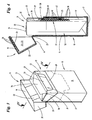
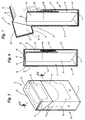
- Ausführungsbeispiele von Zigarettenpackungen werden nachfolgend anhand der Zeichnungen näher erläutert. Es zeigt:
- Fig. 1
- eine Zigarettenpackung des Typs Klappschachtel in geschlossener Stellung bei perspektivischer Darstellung,
- Fig. 2
- die Packung gemäß
Fig. 1 bei geöffnetem Deckel, - Fig. 3
- eine Klappschachtel für Zigaretten in einer anderen Ausführungsform bei geöffnetem Deckel in perspektivischer Darstellung,
- Fig. 4
- die Packung im Vertikalschnitt der Ebene IV-IV der
Fig. 3 , bei vergrößertem Maßstab, - Fig. 5
- ein weiteres Ausführungsbeispiel einer Zigarettenpackung des Typs Klappschachtel in perspektivischer Darstellung,
- Fig. 6
- die Packung gemäß
Fig. 5 im Vertikalschnitt VI-VI derFig. 5 , - Fig. 7
- die Packung gemäß
Fig. 5, Fig. 6 bei geöffnetem Deckel im Vertikalschnitt entsprechendFig. 6 , - Fig. 8
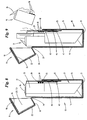
- ein weiteres Ausführungsbeispiel einer Klappschachtel für Zigaretten im Vertikalschnitt bei geöffnetem Deckel,
- Fig. 9
- die Packung gemäß
Fig. 8 bei fortgesetztem Öffnungsvorgang und Entnahme einer Zigarette im Vertikalschnitt derFig. 8 , - Fig. 10
- ein anderes Ausführungsbeispiel einer Klappschachtel in geschlossener Stellung bei perspektivischer Rückansicht,
- Fig. 11
- einen vertikalen Teilschnitt im Bereich des Deckels in der Schnittebene XI-XI der
Fig. 10 bei vergrößertem Maßstab, - Fig. 12
- eine Darstellung entsprechend
Fig. 11 bei geöffnetem Deckel, - Fig. 13
- eine Klappschachtel für Zigaretten in perspektivischer Darstellung mit Wirkstoffträger an der Außenseite,
- Fig. 14
- die Packung gemäß
Fig. 13 in einem Vertikalschnitt eines oberen Teilbereichs in der Schnittebene XIV-XIV derFig. 13 , in vergrößertem Maßstab, - Fig. 15
- eine Darstellung analog
Fig. 14 bei Ingebrauchnahme der Packung. - Die in den Zeichnungen dargestellten Ausführungsbeispiele beziehen sich auf Zigarettenpackungen des Typs Klappschachtel. In der Standardausführung besteht dieser Packungstyp aus einem (unteren) Schachtelteil 10, einem Deckel 11 und einem Kragen 12. Schachtelteil 10 und Deckel 11 sind üblicherweise aus einem einstückigen Zuschnitt durch entsprechende Faltung gefertigt. Der Schachtelteil 10 bildet eine (großflächige) Schachtel-Vorderwand 13, gegenüberliegend eine Schachtel-Rückwand 14, schmale aufrechte Schachtel-Seitenwände 15, 16 und eine Bodenwand 17. In analoger Weise besteht der Deckel 11 aus Deckel-Vorderwand 18, Deckel-Rückwand 19, Deckel-Seitenwänden 20, 21 und einer Stirnwand 22.
- Schachtelteil 10 und Deckel 11 sind im Bereich von Schachtel-Rückwand 14 und Deckel-Rückwand 19 über ein quergerichtetes Liniengelenk 23 miteinander verbunden. Die Seitenwände 15, 16 einerseits und 20, 21 andererseits sind doppellagig ausgebildet, bestehen jeweils aus einem inneren und äußeren Seitenlappen, die miteinander verbunden sind. Weiterhin ist die Deckel-Vorderwand 18 zweilagig ausgebildet, nämlich mit einem Deckel-Innenlappen 24 versehen.
- Der Kragen 12 besteht bei den vorliegenden Packungsbeispielen aus einem gesonderten Zuschnitt und bildet eine Kragen-Vorderwand 25 und quergerichtete Kragen-Seitenlappen 26. Der Kragen 12 ist innerhalb des Schachtelteils 10 so angeordnet und durch Leimstellen 27 mindestens an der Schachtel-Vorderwand 13 so fixiert, dass ein Kragen-Oberteil 28 aus dem Schachtelteil 10 herausragt und bei geöffnetem Deckel 11 freiliegt. Die Kragen-Vorderwand 25 bildet im Bereich des Kragen-Oberteils 28 eine Vertiefung bzw. Ausnehmung 29, die von einer teilweise geschwungenen Kante begrenzt ist.
- Der Packungsinhalt ist vorliegend eine Gruppe von Zigaretten, die durch einen Innenzuschnitt 30, insbesondere von einem Stanniolzuschnitt, umgeben ist. Es entsteht so ein Zigarettenblock 31. Der Innenzuschnitt 30 ist so gefaltet, dass mindestens seitliche Faltungen, nämlich Seitenfaltungen 32 miteinander mindestens teilweise überdeckenden Faltlappen entstehen. Des Weiteren ist eine Stirnfaltung 33 gebildet. Diese weist einen äußeren, insbesondere trapezförmigen Faltlappen 34 auf, der in einen frontseitig gebildeten Abziehlappen - Flap 35 - übergeht. Dieser Teil des Innenzuschnitts 30 kann durch Erfassen des Faltlappens 34 abgezogen werden, so dass ein Teilbereich der frontseitigen Zigaretten freiliegt (
Fig. 9 ). - In bzw. an der Packung sind Wirkstoffe angebracht, insbesondere Aromastoffe, die durch mittelbares oder unmittelbares Einwirken des Benutzers der Packung, zum Beispiel Druck und/oder Reibung oder auch nur durch Freilegen eines Wirkstoffträgers aktiviert werden. Bei den Wirkstoffen kann es sich auch um Substanzen handeln, die eine kühlende Wirkung verursachen, zum Beispiel durch Verdunsten. Die Wirkstoffträger in der Ausführung als Mikrokapseln oder Mikrokugeln sind zwischen zwei Lagen bzw. Schichten der Packung angeordnet. Durch Ausübung von Druck auf den Bereich der Mikrokapseln oder durch Relativverschiebung der Lagen bzw. Wandungen werden die Mikrokapseln zerstört und die Aromastoffe freigesetzt.
- Bei dem Ausführungsbeispiel gemäß
Fig. 1, Fig. 2 ist eine Druckbetätigung des Verbrauchers für die Aktivierung der Aromastoffe erforderlich. Diese sind an der entsprechend vergrößerten bzw. verlängerten Kragen-Vorderwand 25 angebracht, und zwar im Bereich der Schachtel-Vorderwand 13, also im Schachtelteil 10. Die Schachtel-Vorderwand 13 weist eine Öffnung 36 auf, vorliegend eine rechteckige oder quadratische Ausstanzung im Bereich der Schachtel-Vorderwand 13. Dadurch ist ein entsprechender Flächenbereich der Kragen-Vorderwand 25 für Einwirkungen von außen frei. An der Kragen-Vorderwand 25 sind in der Öffnung 36 Träger von Aromastoffen angeordnet, insbesondere Mikrokapseln. Diese sind vorliegend mit einer dekorativen Abdeckung versehen, zum Beispiel einer bedruckten Folie. Alternativ können die Aromaträger unmittelbar die Gestalt der Abbildung aufweisen. Durch Übertragung von Druck und/oder Reibung werden die Aromastoffe freigesetzt. Der Kragen 12 kann bei diesem Ausführungsbeispiel im sichtbaren Teil der Kragen-Vorderwand 25 (Kragen-Oberteil 28) mit einer Information über die jeweils verwendete Aromanote enthalten. - Gemäß Ausführungsbeispiel in
Fig. 3, Fig. 4 ist ein gesonderter Zuschnitt als Träger für die Aromastoffe bzw. Mikrokapseln in die Packung integriert. Vorliegend ist ein Zuschnitt bzw. Coupon 37 als Träger von Mikrokapseln 38 in der Packung, nämlich im Schachtelteil 10 angeordnet, und zwar so, dass der Coupon 37 bei geöffnetem Deckel 11 erfasst und ganz oder teilweise aus der Packung herausgezogen werden kann. Dabei entsteht Reibung (und Druck) aufgrund der Anlagekräfte zwischen Packungswänden bzw. zwischen Packungsinhalt und Packungswänden. Vorliegend ist der Zuschnitt bzw. Coupon 37 zwischen dem Zigarettenblock 31 einerseits und dem Kragen 12 bzw. der Kragen-Vorderwand 25 andererseits angeordnet. Der Coupon 37 ist so ausgebildet und positioniert, dass ein Griffstück 39 im Bereich der Ausnehmung 29 der Kragen-Vorderwand 25 zum Erfassen freiliegt - bei geöffnetem Deckel 11. - Der Zuschnitt bzw. Coupon 37 ist in besonderer Formation angeordnet, so dass bei der Entnahme die Mikrokapseln 38 zerstört und die Aromastoffe freigesetzt werden. Der (langgestreckte, streifenförmige) Coupon 37 ist mehrfach gefaltet unter Bildung von vorliegend drei aneinander liegenden Schenkeln 40. Zwischen den benachbarten Lagen bzw. Schenkeln 40 des Coupons 37 sind die Mikrokapseln 38 angeordnet unter Anlage an beiden benachbarten Schenkeln 40. Ein (verlängerter) Endschenkel 41 - vorliegend auf der der Kragen-Vorderwand 25 zugekehrten Seite - ist in der Packung (lösbar) fixiert durch (zwei) Leimpunkte 42. Dadurch ist sichergestellt, dass bei einem Herausziehen des Coupons 37 - durch Betätigen des Griffstücks 39 - die Lagen 38 nacheinander entfaltet werden und beim Herausziehen aneinander gleiten. Dadurch entsteht Reibung zwischen den benachbarten Schenkeln 40, 41, mit der Folge, dass die Mikrokapseln 38 zerstört werden. Der Coupon 37 kann zusätzlich eine dekorative Bedruckung und/oder informatorische Hinweise enthalten.
- Der Coupon 37 ist so ausgebildet bzw. gefaltet, dass die Mikrokapseln 38 ausschließlich zwischen Schenkeln 40, 41 des Coupons 37 positioniert sind. Die dem Zigarettenblock 31 einerseits und dem Schachtelteil 10 bzw. der Kragen-Vorderwand 25 andererseits zugekehrten Flächen der gefalteten Einheit des Coupons 37 sind hier frei von Mikrokapseln. Der Coupon 37 mit den Mikrokapseln 38 kann als separat vorgefertigte Einheit in die Packung eingeführt werden, vorzugsweise derart, dass eine Einheit aus Kragen 12 und mit diesem verbundenem Coupon 37 auf den Zigarettenblock 31 aufgelegt wird. Die so gebildete Einheit wird dann - wie im Prinzip bekannt - in den teilweise gefalteten Zuschnitt der Klappschachtel eingeführt. Das Griffstück 39 ist hier als Verlängerung des dem Zigarettenblock 31 zugekehrten Schenkels 40 ausgebildet und liegt im Bereich der Ausnehmung 29 der Kragen-Vorderwand 25. Dadurch kann der Coupon 37 beim (erstmaligen) Öffnen des Deckels 11 von Hand erfasst und vorzugsweise vollständig aus der Packung herausgezogen werden, unter Zerstörung der Mikrokapseln 38.
- Die Technologie der Entfaltung von Wirkstoffen, insbesondere Aromastoffen bei Packungen für Tabakprodukte kann auch in der Weise eingesetzt werden, dass die Mikrokapseln 38 gezielt bei der Fertigung der Packung bzw. beim Füllvorgang zerstört und somit die Wirkstoffe freigesetzt werden.
Fig. 4 zeigt ein entsprechendes Anwendungsbeispiel. Mikrokapseln 38 sind zwischen Faltlappen der Packung - hier: übliche Klappschachtel - angeordnet und Druck auf die aneinander liegenden Faltlappen ausgeübt wird zur Verbindung derselben bzw. zur Stabilisierung der Faltstellung. Vorzugsweise können die Mikrokapseln zwischen der Deckel-Vorderwand 18 und dem Deckel-Innenlappen 24 des Deckels 11 angeordnet sein. Der Deckel-Innenlappen 34 wird bei der Fertigung der Klappschachtel gegen die Innenseite der Deckel-Vorderwand 18 gefaltet. Dabei wird Druck auf die Faltlappen 18, 24 ausgeübt. Die zwischen diesen Faltlappen 18, 24 angeordneten Mikrokapseln werden dabei zerstört. Vorteilhaft ist für die Durchführung dieses Verfahrens eine Vorrichtung gemäßDE 24 63 386 C2 . Die Schrift zeigt den kompletten Fertigungs- und Füllvorgang für eine Klappschachtel.Fig. 7 zeigt die Einzelheit der Faltung des Deckel-Innenlappens 24 durch ein Kniehebel-Aggregat, welches den für die Zerstörung der Mikrokapseln ausreichenden Druck auf die aneinander liegenden Faltlappen 18, 24 ausübt. - Bei der Packung gemäß
Fig. 5 bis Fig. 7 ist die Packungskonstruktion gegenüber einer Standardausführung verändert. Der Deckel 11 bzw. die Deckel-Vorderwand 18 ist mit einem (einstückigen) Fortsatz versehen, und zwar einer Deckelzunge 43. Diese ist mit runder Kontur ausgebildet, kann aber auch eine andere Form aufweisen. Die Deckelzunge 43 ist so bemessen, dass sie bei geschlossenem Deckel 11 als Einsteckzunge in den Bereich zwischen Schachtel-Vorderwand 13 und Packungsinhalt eingeführt werden kann, vorliegend in einen Spalt zwischen Schachtel-Vorderwand 13 und Kragen-Vorderwand 25. Zwischen Deckelzunge 43 (Innenseite) und Kragen-Vorderwand 25 sind die Aromaträger angeordnet, vorliegend eine Anzahl von Mikrokapseln 38. Beim (erstmaligen) Öffnen des Deckels 11 bzw. beim Herausziehen der Deckelzunge 43 aus der Steckposition werden Reibungs- bzw. Scherkräfte auf die Mikrokapseln 38 übertragen. Diese werden dabei zerstört und setzen die Aromastoffe frei (Fig. 7 ). - Der Kragen 12 ist üblicherweise durch Leimstellen im Bereich der Kragen-Vorderwand 25 mit der Schachtel-Vorderwand 13 verbunden. Vorliegend ist dieser Bereich leimfrei. Stattdessen ist der Kragen 12 über Leimpunkte 44 im Bereich der Kragen-Seitenlappen 26 mit der Innenseite der Schachtel-Seitenwände 15, 16 verbunden.
- Bei dem Ausführungsbeispiel gemäß
Fig. 8, Fig. 9 bewirkt ein unmittelbar zur Packung gehörendes Packungsteil die Freisetzung der Aromastoffe durch Zerstören von Mikrokapseln 38. Beim Ingebrauchnehmen der Packung wird der Flap 35 als Teil des Zigarettenblocks 31 entfernt, nämlich nach oben aus der Packung herausgezogen. An der Außenseite sind im Bereich des Flaps 35 die Mikrokapseln 38 angeordnet. Diese liegen gegenüber an der Innenseite des Kragens 12 an, insbesondere an der Kragen-Vorderwand 25. - Vorteilhaft ist der Einsatz eines gesonderten Aromaträgers, nämlich eines Kapselzuschnitts 45. Die Mikrokapseln 38 sind auf der dem Flap 35 zugekehrten Seite an dem Kapselzuschnitt 45 angebracht. Dieser ist vorzugsweise als Klebezuschnitt ausgebildet, also als Materialstück mit klebender Fläche zur Aufnahme der Mikrokapseln 38. An der freien, der Kragen-Vorderwand 25 zugekehrten Seite ist der Zuschnitt 45 vorzugsweise über mindestens einen Leimpunkt 46 mit der Kragen-Vorderwand 25 verbunden.
- Bei diesem Anwendungsbeispiel werden die Mikrokapseln 38 bei Ingebrauchnahme der Packung durch Herausziehen des Flaps 35 zerstört. Die Mikrokapseln 38 können mit dem Flap 35 bzw. dessen Vorderwand verbunden sein, so dass die Mikrokapseln durch Scherkräfte zerstört werden. Der Aromaträger, nämlich der Kapselzuschnitt 45, ist so angeordnet, dass diese Packungseinzelheit von außen nicht sichtbar, sondern durch die Kragen-Vorderwand 25 abgedeckt ist.
- Bei der Packung gemäß
Fig. 10 bis Fig. 12 werden zur Freisetzung der Aromastoffe mechanische Kräfte auf Mikrokapseln 38 übertragen, und zwar aufgrund der Verformung eines Kapselträgers. Im Bereich der Packungsrückseite, und zwar an Schachtel-Rückwand 14 und Deckel-Rückwand 19, ist ein Zuschnitt durch Klebung fixiert, vorzugsweise eine Banderole 47, ein vorzugsweise langgestreckter, rechteckiger Zuschnitt, der das Liniengelenk 23 überdeckt. Durch Leimpunkte 48 ist die Banderole 47 einerseits mit der Schachtel-Rückwand 14 und andererseits mit der Deckel-Rückwand 19 verbunden. In einem Zwischenbereich, insbesondere mittig zum Liniengelenk 23, ist ein Aromastreifen 49 aus Mikrokapseln 38 gebildet. Beim Öffnen des Deckels 11 wird insbesondere der Bereich dieses Aromastreifens 49 der Banderole 47 verformt und von den Packungswänden 14 und 19 abgehoben, wodurch die Mikrokapseln 38 zerstört und die Aromastoffe freigesetzt werden. Auch bei dieser Ausführung ist der Bereich der Aromastoffe bzw. der Mikrokapseln 38 verdeckt. Die Banderole 47 bleibt in der gezeigten Stellung, auch nach mehrmaligem Öffnen und Schließen des Deckels 11. - Wirkstoffträger, insbesondere Mikrokapseln mit Aromastoffen, können auch an anderen Packungsformen für Tabakprodukte für die Freisetzung der Wirkstoffe angebracht werden. Dies gilt für Weichbecherpackungen, Kappenschachteln, Packungen des Typs Shell and Slide, aber auch für Packungen, zum Beispiel Folienbeutel, für Schnitttabak. Die Mikrokapseln sind dabei so angebracht, dass beim erstmaligen Öffnen der Packung oder des Beutels die Mikrokapseln durch Druckkraft, durch Zugkraft, durch Reibungskraft oder durch Scherkräfte zerstört und die Wirkstoffe so freigesetzt werden.
- Bei Klappschachteln mit Hilfsmitteln für die Entnahme von Zigaretten ist das Entnahmeorgan für die Anbringung der Mikrokapseln geeignet. Dies gilt besonders für Packungen gemäß
DE 10 2009 053 202 A1 . Eine Entnahmelasche für die Zigaretten ist zwischen Zigarettenblock und Kragen-Vorderwand angeordnet. Die Mikrokapseln können auf der Innenseite und/oder an der Außenseite der Entnahmelasche angebracht sein. - Bei einer Packung gemäß
DE 10 2009 034 705 A1 ist eine Öffnungs- bzw. Verschlusslasche für einen geschlossenen Zigaretten- bzw. Innenblock als Träger für Mikrokapseln geeignet. Die mehrfach betätigbare Lasche ist mit dauerhaft klebenden Bereichen an der Folie des Zigarettenblocks lösbar befestigt. Im Bereich der klebenden Verbindung können Mikrokapseln angebracht sein, die beim erstmaligen Betätigen der Lasche zerstört werden. - Bei der Packung gemäß
EP 0 589 289 B1 ist der Zigarettenblock bzw. die Innenoder Stanniolumhüllung mit einer Abziehlasche bzw. einem Flap versehen, der sich annähernd bis in den Bereich einer Bodenwand erstreckt. Dieser vergrößerte Flap ist als Träger für Mikrokapseln vorteilhaft. Diese werden beim Herausziehen des Flaps zerstört. - Für die Anbringung von zerstörbaren Wirkstoffträgern, insbesondere Mikrokapseln, sind mindestens zwei zusammenwirkende, flächige Packungsteile erforderlich, wobei die Mikrokapseln an einer oder an beiden flächigen Trägern angebracht sind, vorzugsweise durch Leim, zum Beispiel PSA-Leim (pressure sensitive adhesive). Vorteilhaft ist eine Lösung, bei der ein gesonderter Kapselträger so in der Packung angeordnet ist, dass beim Entfernen des separaten Kapselträgers aufgrund Zusammenwirkens mit einer benachbarten Packungswand Reibungs- oder Scherkräfte auftreten, die die Zerstörung der Kapseln bewirken. Alternativ oder zusätzlich können Bereiche einer Packung mit (verdeckt angeordneten) Mikrokapseln durch aktives Mitwirken des Verbrauchers, nämlich durch Übertragung von Druck- oder Reibungskräften, aktiviert werden.
- Bei dem Ausführungsbeispiel gemäß
Fig. 13 bis Fig. 15 ist als Alternative ein flächiger Substanzträger 50 vorgesehen. Dieser ist so ausgebildet, dass die Wirksubstanz gespeichert werden kann. Bei flüssiger Ausführung kann der Substanzträger 50 aus einer Schaumstofflage, einem Vlies, aus saugfähigem Papier oder dergleichen bestehen. Der dünnwandige Substanzträger 50 ist mit dem jeweiligen Wirkstoff an der Außenseite der Packung bzw. Klappschachtel angebracht, bei dem vorliegenden Ausführungsbeispiel an der Deckel-Vorderwand 18. - Der mit einer Substanz angereicherte Substanzträger 50 ist in einem geschlossenen bzw. abgedichteten Bereich der Packung angeordnet. Vorliegend ist die Deckel-Vorderwand 18 mit einer durch Prägung eingeformten Vertiefung 52 versehen. In dieser ist der flächige Substanzträger 50 positioniert, wobei die Abmessung der Vertiefung 52, insbesondere die Tiefe, an die Abmessungen des Substanzträgers 50 angepasst ist, so dass dieser vorzugsweise außen mit dem übrigen Teil der Deckel-Vorderwand 18 (etwa) bündig liegt. Der DeckelInnenlappen 24 ist entsprechend verkürzt, liegt außerhalb des Bereichs der Vertiefung 52.
- Die Vertiefung 52 bildet einen Raum für die Aufnahme der Wirkstoffträger (Mikrokapseln) bzw. des Substanzträgers 50 in der beschriebenen Ausführung. Die Vertiefung 52 ist vorzugsweise ringsherum von einem Dichtungsstreifen 53 umgeben. An diesem liegt - bis zur Ingebrauchnahme der Packung - eine die Vertiefung 52 nach außen abschließende Abdeckung an. Vorliegend ist eine bei Zigarettenpackungen übliche Außenumhüllung 51 aus Folie oder dergleichen als Abdichtung bzw. Abdeckung vorgesehen. Die Außenumhüllung 51 ist durch (thermisches) Siegeln mit dem Dichtungssstreifen 53 verbunden, so dass sich der Substanzträger 50 in einer abgedichteten Kammer befindet. Bei erstmaliger Ingebrauchnahme der Packung wird ein oberer Teil der Außenumhüllung 51 (mittels Aufreißstreifen) entfernt, nämlich eine Folienkappe 54. Diese ist so angeordnet, dass bis zum Öffnen der Packung die Folienkappe 54 bzw. eine Vorderwandung derselben als Abdeckung bzw. Abdichtung der Vertiefung 52 dient. Durch den üblichen Öffnungsvorgang wird der Substanzträger 50 an der Außenseite freigelegt, so dass der Wirkstoff, insbesondere ein Kühlmedium, sich entfalten kann. Diese Ausführung der Packung bzw. Anordnung kann auch für den Einsatz von Mikrokapseln als Wirkstoffträger eingesetzt werden.
Bezugszeichenliste 10 Schachtelteil 39 Griffstück 11 Deckel 40 Schenkel 12 Kragen 41 Endschenkel 13 Schachtel-Vorderwand 42 Leimpunkt 14 Schachtel-Rückwand 43 Deckelzunge 15 Schachtel-Seitenwand 44 Leimpunkt 16 Schachtel-Seitenwand 45 Kapselzuschnitt 17 Bodenwand 46 Leimpunkt 18 Deckel-Vorderwand 47 Banderole 19 Deckel-Rückwand 48 Leimpunkt 20 Deckel-Seitenwand 49 Aromastreifen 21 Deckel-Seitenwand 50 Substanzträger 22 Stirnwand 51 Außenumhüllung 23 Liniengelenk 52 Vertiefung 24 Deckel-Innenlappen 53 Dichtungsstreifen 25 Kragen-Vorderwand 54 Folienkappe 26 Kragen-Seitenlappen 27 Leimstelle 28 Kragen-Oberteil 29 Ausnehmung 30 Innenzuschnitt 31 Zigarettenblock 32 Seitenfaltung 33 Stirnfaltung 34 Faltlappen 35 Flap 36 Öffnung 37 Coupon 38 Mikrokapsel
Claims (8)
- Packung für Tabakprodukte, insbesondere Zigarettenpackung, aus mindestens einem Packungszuschnitt, insbesondere aus dünnem Karton, Papier oder mehrschichtigem Material, wobei in oder an der Packung Mikrokapseln (38), Mikrokugeln oder andere Träger von Wirkstoffen, wie Geruchs- oder Geschmacksstoffen, angebracht sind, die bei Ingebrauchnahme der Packung oder während des Gebrauchs Wirkstoffe freisetzen, und wobei in oder an der Packung angeordnete Bereiche mit Mikrokapseln (38) durch unmittelbaren oder mittelbaren Druck oder durch Reibung oder durch Entfernen eines Zuschnitts bzw. eines Zuschnittteils aus der Packung oder durch Verformen eines Zuschnitts mit Mikrokapseln (38) an der Packung zerstörbar sind, wobei:a) die Mikrokapseln (38) durch Herausziehen eines Teils der Innenumhüllung (30) des Zigarettenblocks (31) zerstörbar sind, hämlich durch Herausziehen eines Flaps (35) bei Ingebrauchnahme der Packung,b) die Mikrokapseln (38) an einem Kapselzuschnitt (45) als gesondertem Träger angebracht sind, wobei der Kapselzuschnitt (45) der mit einer Lage von Mikrokapseln (38) dem aus der Packung bzw. aus dem Schachtelteil (10) herausziehbaren Flap (35) zugekehrt ist, und wobei der Kapselzuschnitt (45) im Schachtelteil (10) durch Verbindung mit der Innenseite der Kragen-Vorderwand (25) fixiert ist.
- Packung nach Anspruch 1, dadurch gekennzeichnet, dass eine Packungswand, insbesondere eine Schachtel-Vorderwand (13) einer Packung des Typs Klappschachtel, eine Öffnung (36) aufweist, die eine innenliegende Packungswand freigibt, insbesondere eine Kragen-Vorderwand (25), wobei im Bereich der Öffnung (36) an der innenliegenden Wandung, insbesondere an der Kragen-Vorderwand (25), Bereiche aus Mikrokapseln oder anderen (von Hand) zerstörbaren Wirkstoffträgern angeordnet sind.
- Packung nach Anspruch 1 oder 2, dadurch gekennzeichnet, dass Mikrokapseln (38) mit Wirkstoffen zwischen mindestens bei geöffneter Packung freiliegenden Packungswänden angeordnet sind, insbesondere zwischen Deckel-Vorderwand (18) und Deckel-Innenlappen (24), wobei die Mikrokapseln durch (manuellen) Druck auf die Packungswände zerstörbar sind.
- Packung nach Anspruch 1 oder einem der weiteren Ansprüche, dadurch gekennzeichnet, dass Mikrokapseln (38) an einem gesonderten Kapselträger innerhalb der Packung angeordnet sind, insbesondere an einem Coupon (37), wobei die Kapseln (38) durch teilweises oder vollständiges Herausziehen des Kapselträgers aus der Packung aktivierbar sind.
- Packung nach Anspruch 4 oder einem der weiteren Ansprüche, dadurch gekennzeichnet, dass der Kapselträger, insbesondere der Coupon (37), als mehrlagiger, insbesondere gefalteter Zuschnitt ausgebildet ist, wobei Mikrokapseln (38) an den durch Faltung gebildeten Schenkeln (40, 41) des Coupons (37) angebracht sind, derart, dass durch Herausziehen des Coupons (37) aus der Packung und dadurch bewirktes Entfalten die Mikrokapseln (38) zerstörbar sind, wobei vorzugsweise mindestens drei Lagen bzw. Schenkel (40) des Coupons (37) in einem Bereich zwischen Kragen-Vorderwand (25) und Zigarettenblock (31) angeordnet sind und ein Griffstück (39) als Fortsetzung eines Schenkels (40) freiliegt, insbesondere im Bereich einer Ausnehmung (29) der Kragen-Vorderwand (25) und vorzugsweise ein anderer Schenkel - Endschenkel (41) - lösbar mit der Kragen-Vorderwand (25) verbunden ist.
- Packung nach Anspruch 5 oder einem der weiteren Ansprüche, dadurch gekennzeichnet, dass Mikrokapseln (38) ausschließlich zwischen benachbarten Schenkeln (40, 41) des Coupons (37) angeordnet sind und der gefaltete Coupon (37) in der Packung mit den die Mikrokapseln (38) aufweisenden Schenkel (40, 41) im Bereich des Kragens (12) bzw. der Kragen-Vorderwand (25) liegt, unterhalb der Ausnehmung (29).
- Packung nach Anspruch 1 oder einem der weiteren Ansprüche, dadurch gekennzeichnet, dass Mikrokapseln (38) an einer dem Zigarettenblock (31) zugekehrten Innenseite der Kragen-Vorderwand (25) und/oder der Kragen-Seitenlappen (26) angeordnet sind, insbesondere als Fläche bzw. Lage von Mikrokapseln (38) im Bereich des Flaps (35) der Innenumhüllung (30), derart, dass die Mikrokapseln beim Herausziehen des Flaps (35) zerstörbar sind.
- Packung nach Anspruch 1 oder einem der weiteren Ansprüche, dadurch gekennzeichnet, dass Mikrokapseln (38) beim (erstmaligen) Öffnen des Deckels (11) aufgrund Anordnung an einem äußeren Kapselträger zerstörbar sind, insbesondere durch Anordnung an einer an der Außenseite der Packung angeordneten Banderole (47), vorzugsweise im Bereich eines Liniengelenks (23) zwischen Schachtelteil (10) und Deckel (11), wobei die mit Schachtel-Rückwand (14) einerseits und Deckel-Rückwand (19) andererseits verbundene Banderole (47) im Bereich des Liniengelenks (23) einen Aromastreifen (49) mit Mikrokapseln (38) aufweist, die bei der Öffnungsbewegung des Deckels (11) durch Abheben von den Packungswänden (14, 19) und/oder durch Knicken des Kapselträgers zerstörbar sind.
Applications Claiming Priority (2)
| Application Number | Priority Date | Filing Date | Title |
|---|---|---|---|
| DE102011110634A DE102011110634A1 (de) | 2011-08-18 | 2011-08-18 | Zigarettenpackung und Verfahren zum Herstellen derselben |
| PCT/EP2012/002401 WO2013023716A1 (de) | 2011-08-18 | 2012-06-06 | Zigarettenpackung mit mikrokapseln und verfahren zum herstellen derselben |
Publications (2)
| Publication Number | Publication Date |
|---|---|
| EP2744729A1 EP2744729A1 (de) | 2014-06-25 |
| EP2744729B1 true EP2744729B1 (de) | 2016-04-27 |
Family
ID=46210198
Family Applications (1)
| Application Number | Title | Priority Date | Filing Date |
|---|---|---|---|
| EP12726026.3A Not-in-force EP2744729B1 (de) | 2011-08-18 | 2012-06-06 | Zigarettenpackung mit mikrokapseln und verfahren zum herstellen derselben |
Country Status (4)
| Country | Link |
|---|---|
| EP (1) | EP2744729B1 (de) |
| JP (1) | JP6144260B2 (de) |
| DE (1) | DE102011110634A1 (de) |
| WO (1) | WO2013023716A1 (de) |
Cited By (1)
| Publication number | Priority date | Publication date | Assignee | Title |
|---|---|---|---|---|
| US10986859B2 (en) | 2014-08-13 | 2021-04-27 | R.J. Reynolds Tobacco Company | Smokeless tobacco products |
Families Citing this family (9)
| Publication number | Priority date | Publication date | Assignee | Title |
|---|---|---|---|---|
| WO2015027386A1 (zh) * | 2013-08-27 | 2015-03-05 | 吉瑞高新科技股份有限公司 | 电子烟烟盒 |
| US9565875B2 (en) | 2014-08-05 | 2017-02-14 | Javad Ashjaee | Cigar chiller |
| DE112016000521T5 (de) * | 2015-01-29 | 2017-12-07 | G.D. Società per Azioni | Packung für Tabakwaren mit einer unter Druck versiegelten Verpackung und zugehöriges Verpackungsverfahren |
| GB201609392D0 (en) * | 2016-05-27 | 2016-07-13 | British American Tobacco Co | A tobacco industry product pack |
| RU175140U1 (ru) * | 2017-04-24 | 2017-11-22 | Беслан Шудиевич Дадакаев | Ароматизированная упаковка для табачных изделий |
| CN107637863A (zh) * | 2017-09-03 | 2018-01-30 | 深圳市凯神科技股份有限公司 | 爆珠烟嘴 |
| EP3693293A1 (de) * | 2019-02-07 | 2020-08-12 | Nerudia Limited | Verpackung für rauchersatzvorrichtung |
| RU206127U1 (ru) * | 2021-06-09 | 2021-08-24 | Беслан Шудиевич Дадакаев | Ароматизированная упаковка для курительных изделий |
| EP4709594A1 (de) * | 2023-05-08 | 2026-03-18 | Board Boys, LLC. | Schutzhülle |
Family Cites Families (23)
| Publication number | Priority date | Publication date | Assignee | Title |
|---|---|---|---|---|
| BE758391A (fr) * | 1969-11-24 | 1971-04-16 | Ncr Co | Emballage a ouverture par arrachement d'une bande ou d'un fil |
| DE2362427B2 (de) * | 1973-12-15 | 1976-02-05 | Maschinenfabrik Fr. Niepmann & Co, 5820 Gevelsberg | Zuschnitt fuer eine fuer zigaretten oder zigarillos bestimmte schachtel |
| DE2463386C2 (de) | 1974-08-21 | 1986-04-24 | Focke & Co, 2810 Verden | Vorrichtung zum Herstellen von Klappschachteln |
| US4720423A (en) * | 1986-08-25 | 1988-01-19 | Minnesota Mining And Manufacturing Company | Package opening system |
| US4717017A (en) * | 1987-03-23 | 1988-01-05 | Philip Morris Incorporated | Package with means for releasing aromatic substance on opening |
| US5249676A (en) * | 1991-05-07 | 1993-10-05 | R. J. Reynolds Tobacco Company | Flavor burst structure and method of making the same |
| DE4231591A1 (de) | 1992-09-21 | 1994-03-24 | Focke & Co | Verpackung für Zigaretten |
| BR9713382A (pt) * | 1996-11-21 | 2000-03-21 | Rothmans International Ltd | Embalagens, que pode ser novamente vedada, de artigos para fumantes |
| CA2202717A1 (en) * | 1997-04-15 | 1998-10-15 | Rothmans, Benson & Hedges Inc. | Cigarette or tobacco package with re-usable aroma releasent for multiple package openings |
| US6612429B2 (en) | 2001-06-22 | 2003-09-02 | Brown & Williamson Tobacco Corporation | Flip open package with microencapsulated flavor release |
| FR2864428B1 (fr) * | 2003-12-24 | 2006-09-22 | Tabacs & Allumettes Ind | Dispositif pour ajouter une substance volatile dans un produit a fumer et contenant de produit a fumer comportant un tel dispositif |
| JP4845123B2 (ja) * | 2004-10-19 | 2011-12-28 | 日本たばこ産業株式会社 | シガレットパッケージ及びその製造方法 |
| CA2583934C (en) * | 2004-10-19 | 2010-02-16 | Japan Tobacco Inc. | Cigarette package |
| US20080038544A1 (en) | 2004-10-22 | 2008-02-14 | Mitsubishi Rayon Co., Ltd. | Matt Acrylic Resin Filmy Product For Thermoforming, Process For Production Thereof, and Laminates Comprising the Product |
| US7798320B2 (en) | 2005-06-10 | 2010-09-21 | Philip Morris Usa Inc. | Aromatic pocket tear tape for cigarette pack |
| US7717261B2 (en) * | 2005-06-10 | 2010-05-18 | Philip Morris Usa Inc. | Hinge lid aroma pack |
| JP5193615B2 (ja) * | 2008-01-24 | 2013-05-08 | ブリティッシュ・アメリカン・タバコ・ジャパン合同会社 | フレーバー付きタバコ産業製品用パック |
| JP5323399B2 (ja) * | 2008-06-06 | 2013-10-23 | 日本たばこ産業株式会社 | スライド機能付きヒンジリッド型パッケージ |
| GB2467971A (en) * | 2009-02-24 | 2010-08-25 | British American Tobacco Co | Pack for tobacco industry products |
| DE102009034705A1 (de) | 2009-07-24 | 2011-01-27 | Focke & Co.(Gmbh & Co. Kg) | Zigarettenpackung und Verfahren zum Herstellen von Zigarettenpackungen |
| DE102009053202A1 (de) | 2009-11-06 | 2011-05-19 | Focke & Co.(Gmbh & Co. Kg) | Packung für Zigaretten sowie Vorrichtung zum Herstellen derselben |
| PH12012500952A1 (en) * | 2009-11-18 | 2013-01-07 | British American Tobacco Americas Prestacao De Servicos Ltda | A package for tobacco industry products |
| US8783454B2 (en) * | 2009-12-22 | 2014-07-22 | Philip Morris Usa Inc. | Wrapped container with adhesive label |
-
2011
- 2011-08-18 DE DE102011110634A patent/DE102011110634A1/de not_active Withdrawn
-
2012
- 2012-06-06 JP JP2014525332A patent/JP6144260B2/ja not_active Expired - Fee Related
- 2012-06-06 EP EP12726026.3A patent/EP2744729B1/de not_active Not-in-force
- 2012-06-06 WO PCT/EP2012/002401 patent/WO2013023716A1/de not_active Ceased
Cited By (1)
| Publication number | Priority date | Publication date | Assignee | Title |
|---|---|---|---|---|
| US10986859B2 (en) | 2014-08-13 | 2021-04-27 | R.J. Reynolds Tobacco Company | Smokeless tobacco products |
Also Published As
| Publication number | Publication date |
|---|---|
| EP2744729A1 (de) | 2014-06-25 |
| DE102011110634A1 (de) | 2013-02-21 |
| JP2014524391A (ja) | 2014-09-22 |
| WO2013023716A1 (de) | 2013-02-21 |
| JP6144260B2 (ja) | 2017-06-07 |
Similar Documents
| Publication | Publication Date | Title |
|---|---|---|
| EP2744729B1 (de) | Zigarettenpackung mit mikrokapseln und verfahren zum herstellen derselben | |
| EP1270448B1 (de) | Klappschachtel für Zigaretten | |
| EP3177547B1 (de) | Zigarettenpackung | |
| EP1204572B1 (de) | Klappschachtel für zigaretten | |
| EP1097092B1 (de) | Zigarettenpackung mit öffnungshilfe | |
| EP3393931B1 (de) | Packung für zigaretten | |
| DE69719795T2 (de) | Verpackung für rauchartikel | |
| DE2854443C2 (de) | Packung, insbesondere quaderförmige Packung für Zigaretten, Zigarillos oder dergleichen | |
| DE68917133T2 (de) | Zigarettenschachtel mit Klappdeckel. | |
| DE69703940T2 (de) | Verpackung für rauchwaren | |
| DE19506844B4 (de) | Klappschachtel für Zigaretten sowie Verfahren zum Einführen von Coupons in Klappschachteln | |
| EP2170734B1 (de) | Kappenschachtel für tabakprodukte | |
| WO2002048005A2 (de) | Packung, insbesondere zigarettenpackung sowie verfahren und vorrichtung zum herstellen derselben | |
| DE10115935C2 (de) | Cigarettenpackung | |
| DE112018004965T5 (de) | Starre Schachtel für Tabakartikel | |
| DE102016012300A1 (de) | Zigarettenpackung sowie Verfahren und Vorrichtung zum Herstellen derselben | |
| EP0530651B2 (de) | Verpackung für Zigaretten oder dergleichen | |
| EP2841358A1 (de) | Zigaretten-packung und verfahren zum herstellen derselben | |
| EP0709306B1 (de) | Quaderförmige Verpackung für Zigaretten oder dergleichen | |
| EP0214488A2 (de) | Packung für Zigaretten oder dergleichen | |
| DE102018007681A1 (de) | Zigarettenpackung sowie Verfahren und Vorrichtung zum Herstellen derselben | |
| DE10208026A1 (de) | Packung für Zigaretten | |
| EP1077879A1 (de) | Gebindepackung für zigaretten | |
| DE10109201C2 (de) | Cigarettenpackung oder Gebindekarton | |
| DE102016116974A1 (de) | Steife Rauchwaren-Packung mit einem gelenkig verbundenen Deckel |
Legal Events
| Date | Code | Title | Description |
|---|---|---|---|
| PUAI | Public reference made under article 153(3) epc to a published international application that has entered the european phase |
Free format text: ORIGINAL CODE: 0009012 |
|
| 17P | Request for examination filed |
Effective date: 20140312 |
|
| AK | Designated contracting states |
Kind code of ref document: A1 Designated state(s): AL AT BE BG CH CY CZ DE DK EE ES FI FR GB GR HR HU IE IS IT LI LT LU LV MC MK MT NL NO PL PT RO RS SE SI SK SM TR |
|
| DAX | Request for extension of the european patent (deleted) | ||
| TPAC | Observations filed by third parties |
Free format text: ORIGINAL CODE: EPIDOSNTIPA |
|
| 17Q | First examination report despatched |
Effective date: 20150123 |
|
| GRAP | Despatch of communication of intention to grant a patent |
Free format text: ORIGINAL CODE: EPIDOSNIGR1 |
|
| RIC1 | Information provided on ipc code assigned before grant |
Ipc: A24F 15/12 20060101ALI20151006BHEP Ipc: A24F 25/00 20060101ALI20151006BHEP Ipc: B65D 85/10 20060101AFI20151006BHEP Ipc: A24F 15/18 20060101ALI20151006BHEP Ipc: A24C 5/60 20060101ALI20151006BHEP |
|
| INTG | Intention to grant announced |
Effective date: 20151028 |
|
| GRAS | Grant fee paid |
Free format text: ORIGINAL CODE: EPIDOSNIGR3 |
|
| GRAA | (expected) grant |
Free format text: ORIGINAL CODE: 0009210 |
|
| AK | Designated contracting states |
Kind code of ref document: B1 Designated state(s): AL AT BE BG CH CY CZ DE DK EE ES FI FR GB GR HR HU IE IS IT LI LT LU LV MC MK MT NL NO PL PT RO RS SE SI SK SM TR |
|
| REG | Reference to a national code |
Ref country code: GB Ref legal event code: FG4D Free format text: NOT ENGLISH |
|
| REG | Reference to a national code |
Ref country code: CH Ref legal event code: EP |
|
| REG | Reference to a national code |
Ref country code: AT Ref legal event code: REF Ref document number: 794520 Country of ref document: AT Kind code of ref document: T Effective date: 20160515 |
|
| REG | Reference to a national code |
Ref country code: IE Ref legal event code: FG4D Free format text: LANGUAGE OF EP DOCUMENT: GERMAN |
|
| REG | Reference to a national code |
Ref country code: DE Ref legal event code: R096 Ref document number: 502012006910 Country of ref document: DE |
|
| REG | Reference to a national code |
Ref country code: LT Ref legal event code: MG4D |
|
| REG | Reference to a national code |
Ref country code: NL Ref legal event code: MP Effective date: 20160427 |
|
| PG25 | Lapsed in a contracting state [announced via postgrant information from national office to epo] |
Ref country code: NL Free format text: LAPSE BECAUSE OF FAILURE TO SUBMIT A TRANSLATION OF THE DESCRIPTION OR TO PAY THE FEE WITHIN THE PRESCRIBED TIME-LIMIT Effective date: 20160427 |
|
| PG25 | Lapsed in a contracting state [announced via postgrant information from national office to epo] |
Ref country code: PL Free format text: LAPSE BECAUSE OF FAILURE TO SUBMIT A TRANSLATION OF THE DESCRIPTION OR TO PAY THE FEE WITHIN THE PRESCRIBED TIME-LIMIT Effective date: 20160427 Ref country code: FI Free format text: LAPSE BECAUSE OF FAILURE TO SUBMIT A TRANSLATION OF THE DESCRIPTION OR TO PAY THE FEE WITHIN THE PRESCRIBED TIME-LIMIT Effective date: 20160427 Ref country code: LT Free format text: LAPSE BECAUSE OF FAILURE TO SUBMIT A TRANSLATION OF THE DESCRIPTION OR TO PAY THE FEE WITHIN THE PRESCRIBED TIME-LIMIT Effective date: 20160427 Ref country code: NO Free format text: LAPSE BECAUSE OF FAILURE TO SUBMIT A TRANSLATION OF THE DESCRIPTION OR TO PAY THE FEE WITHIN THE PRESCRIBED TIME-LIMIT Effective date: 20160727 |
|
| PG25 | Lapsed in a contracting state [announced via postgrant information from national office to epo] |
Ref country code: LV Free format text: LAPSE BECAUSE OF FAILURE TO SUBMIT A TRANSLATION OF THE DESCRIPTION OR TO PAY THE FEE WITHIN THE PRESCRIBED TIME-LIMIT Effective date: 20160427 Ref country code: ES Free format text: LAPSE BECAUSE OF FAILURE TO SUBMIT A TRANSLATION OF THE DESCRIPTION OR TO PAY THE FEE WITHIN THE PRESCRIBED TIME-LIMIT Effective date: 20160427 Ref country code: HR Free format text: LAPSE BECAUSE OF FAILURE TO SUBMIT A TRANSLATION OF THE DESCRIPTION OR TO PAY THE FEE WITHIN THE PRESCRIBED TIME-LIMIT Effective date: 20160427 Ref country code: PT Free format text: LAPSE BECAUSE OF FAILURE TO SUBMIT A TRANSLATION OF THE DESCRIPTION OR TO PAY THE FEE WITHIN THE PRESCRIBED TIME-LIMIT Effective date: 20160829 Ref country code: RS Free format text: LAPSE BECAUSE OF FAILURE TO SUBMIT A TRANSLATION OF THE DESCRIPTION OR TO PAY THE FEE WITHIN THE PRESCRIBED TIME-LIMIT Effective date: 20160427 Ref country code: GR Free format text: LAPSE BECAUSE OF FAILURE TO SUBMIT A TRANSLATION OF THE DESCRIPTION OR TO PAY THE FEE WITHIN THE PRESCRIBED TIME-LIMIT Effective date: 20160728 Ref country code: SE Free format text: LAPSE BECAUSE OF FAILURE TO SUBMIT A TRANSLATION OF THE DESCRIPTION OR TO PAY THE FEE WITHIN THE PRESCRIBED TIME-LIMIT Effective date: 20160427 |
|
| PG25 | Lapsed in a contracting state [announced via postgrant information from national office to epo] |
Ref country code: BE Free format text: LAPSE BECAUSE OF NON-PAYMENT OF DUE FEES Effective date: 20160630 |
|
| REG | Reference to a national code |
Ref country code: DE Ref legal event code: R097 Ref document number: 502012006910 Country of ref document: DE |
|
| PG25 | Lapsed in a contracting state [announced via postgrant information from national office to epo] |
Ref country code: CZ Free format text: LAPSE BECAUSE OF FAILURE TO SUBMIT A TRANSLATION OF THE DESCRIPTION OR TO PAY THE FEE WITHIN THE PRESCRIBED TIME-LIMIT Effective date: 20160427 Ref country code: SK Free format text: LAPSE BECAUSE OF FAILURE TO SUBMIT A TRANSLATION OF THE DESCRIPTION OR TO PAY THE FEE WITHIN THE PRESCRIBED TIME-LIMIT Effective date: 20160427 Ref country code: RO Free format text: LAPSE BECAUSE OF FAILURE TO SUBMIT A TRANSLATION OF THE DESCRIPTION OR TO PAY THE FEE WITHIN THE PRESCRIBED TIME-LIMIT Effective date: 20160427 Ref country code: EE Free format text: LAPSE BECAUSE OF FAILURE TO SUBMIT A TRANSLATION OF THE DESCRIPTION OR TO PAY THE FEE WITHIN THE PRESCRIBED TIME-LIMIT Effective date: 20160427 Ref country code: MC Free format text: LAPSE BECAUSE OF FAILURE TO SUBMIT A TRANSLATION OF THE DESCRIPTION OR TO PAY THE FEE WITHIN THE PRESCRIBED TIME-LIMIT Effective date: 20160427 Ref country code: DK Free format text: LAPSE BECAUSE OF FAILURE TO SUBMIT A TRANSLATION OF THE DESCRIPTION OR TO PAY THE FEE WITHIN THE PRESCRIBED TIME-LIMIT Effective date: 20160427 |
|
| REG | Reference to a national code |
Ref country code: CH Ref legal event code: PL |
|
| PG25 | Lapsed in a contracting state [announced via postgrant information from national office to epo] |
Ref country code: SM Free format text: LAPSE BECAUSE OF FAILURE TO SUBMIT A TRANSLATION OF THE DESCRIPTION OR TO PAY THE FEE WITHIN THE PRESCRIBED TIME-LIMIT Effective date: 20160427 |
|
| PLBE | No opposition filed within time limit |
Free format text: ORIGINAL CODE: 0009261 |
|
| STAA | Information on the status of an ep patent application or granted ep patent |
Free format text: STATUS: NO OPPOSITION FILED WITHIN TIME LIMIT |
|
| GBPC | Gb: european patent ceased through non-payment of renewal fee |
Effective date: 20160727 |
|
| REG | Reference to a national code |
Ref country code: IE Ref legal event code: MM4A |
|
| REG | Reference to a national code |
Ref country code: FR Ref legal event code: ST Effective date: 20170228 |
|
| 26N | No opposition filed |
Effective date: 20170130 |
|
| PG25 | Lapsed in a contracting state [announced via postgrant information from national office to epo] |
Ref country code: FR Free format text: LAPSE BECAUSE OF NON-PAYMENT OF DUE FEES Effective date: 20160630 Ref country code: CH Free format text: LAPSE BECAUSE OF NON-PAYMENT OF DUE FEES Effective date: 20160630 Ref country code: LI Free format text: LAPSE BECAUSE OF NON-PAYMENT OF DUE FEES Effective date: 20160630 |
|
| PG25 | Lapsed in a contracting state [announced via postgrant information from national office to epo] |
Ref country code: GB Free format text: LAPSE BECAUSE OF NON-PAYMENT OF DUE FEES Effective date: 20160727 Ref country code: SI Free format text: LAPSE BECAUSE OF FAILURE TO SUBMIT A TRANSLATION OF THE DESCRIPTION OR TO PAY THE FEE WITHIN THE PRESCRIBED TIME-LIMIT Effective date: 20160427 Ref country code: IE Free format text: LAPSE BECAUSE OF NON-PAYMENT OF DUE FEES Effective date: 20160606 |
|
| PG25 | Lapsed in a contracting state [announced via postgrant information from national office to epo] |
Ref country code: HU Free format text: LAPSE BECAUSE OF FAILURE TO SUBMIT A TRANSLATION OF THE DESCRIPTION OR TO PAY THE FEE WITHIN THE PRESCRIBED TIME-LIMIT; INVALID AB INITIO Effective date: 20120606 |
|
| PG25 | Lapsed in a contracting state [announced via postgrant information from national office to epo] |
Ref country code: MK Free format text: LAPSE BECAUSE OF FAILURE TO SUBMIT A TRANSLATION OF THE DESCRIPTION OR TO PAY THE FEE WITHIN THE PRESCRIBED TIME-LIMIT Effective date: 20160427 Ref country code: LU Free format text: LAPSE BECAUSE OF NON-PAYMENT OF DUE FEES Effective date: 20160606 Ref country code: IS Free format text: LAPSE BECAUSE OF FAILURE TO SUBMIT A TRANSLATION OF THE DESCRIPTION OR TO PAY THE FEE WITHIN THE PRESCRIBED TIME-LIMIT Effective date: 20160427 Ref country code: MT Free format text: LAPSE BECAUSE OF FAILURE TO SUBMIT A TRANSLATION OF THE DESCRIPTION OR TO PAY THE FEE WITHIN THE PRESCRIBED TIME-LIMIT Effective date: 20160427 Ref country code: CY Free format text: LAPSE BECAUSE OF FAILURE TO SUBMIT A TRANSLATION OF THE DESCRIPTION OR TO PAY THE FEE WITHIN THE PRESCRIBED TIME-LIMIT Effective date: 20160427 |
|
| PG25 | Lapsed in a contracting state [announced via postgrant information from national office to epo] |
Ref country code: BG Free format text: LAPSE BECAUSE OF FAILURE TO SUBMIT A TRANSLATION OF THE DESCRIPTION OR TO PAY THE FEE WITHIN THE PRESCRIBED TIME-LIMIT Effective date: 20160427 |
|
| REG | Reference to a national code |
Ref country code: AT Ref legal event code: MM01 Ref document number: 794520 Country of ref document: AT Kind code of ref document: T Effective date: 20170606 |
|
| PG25 | Lapsed in a contracting state [announced via postgrant information from national office to epo] |
Ref country code: TR Free format text: LAPSE BECAUSE OF FAILURE TO SUBMIT A TRANSLATION OF THE DESCRIPTION OR TO PAY THE FEE WITHIN THE PRESCRIBED TIME-LIMIT Effective date: 20160427 Ref country code: AL Free format text: LAPSE BECAUSE OF FAILURE TO SUBMIT A TRANSLATION OF THE DESCRIPTION OR TO PAY THE FEE WITHIN THE PRESCRIBED TIME-LIMIT Effective date: 20160427 |
|
| PG25 | Lapsed in a contracting state [announced via postgrant information from national office to epo] |
Ref country code: AT Free format text: LAPSE BECAUSE OF NON-PAYMENT OF DUE FEES Effective date: 20170606 |
|
| PGFP | Annual fee paid to national office [announced via postgrant information from national office to epo] |
Ref country code: IT Payment date: 20210526 Year of fee payment: 10 Ref country code: DE Payment date: 20210528 Year of fee payment: 10 |
|
| REG | Reference to a national code |
Ref country code: DE Ref legal event code: R119 Ref document number: 502012006910 Country of ref document: DE |
|
| PG25 | Lapsed in a contracting state [announced via postgrant information from national office to epo] |
Ref country code: DE Free format text: LAPSE BECAUSE OF NON-PAYMENT OF DUE FEES Effective date: 20230103 |
|
| PG25 | Lapsed in a contracting state [announced via postgrant information from national office to epo] |
Ref country code: IT Free format text: LAPSE BECAUSE OF NON-PAYMENT OF DUE FEES Effective date: 20220606 |