EP2718909B1 - Verfahren und vorrichtung zum anlernen mehrerer schlüssel an eine berechtigungseinrichtung eines fahrzeugs - Google Patents
Verfahren und vorrichtung zum anlernen mehrerer schlüssel an eine berechtigungseinrichtung eines fahrzeugs Download PDFInfo
- Publication number
- EP2718909B1 EP2718909B1 EP12727307.6A EP12727307A EP2718909B1 EP 2718909 B1 EP2718909 B1 EP 2718909B1 EP 12727307 A EP12727307 A EP 12727307A EP 2718909 B1 EP2718909 B1 EP 2718909B1
- Authority
- EP
- European Patent Office
- Prior art keywords
- key
- signal
- keys
- vehicle
- time window
- Prior art date
- Legal status (The legal status is an assumption and is not a legal conclusion. Google has not performed a legal analysis and makes no representation as to the accuracy of the status listed.)
- Not-in-force
Links
Images
Classifications
-
- G—PHYSICS
- G08—SIGNALLING
- G08C—TRANSMISSION SYSTEMS FOR MEASURED VALUES, CONTROL OR SIMILAR SIGNALS
- G08C19/00—Electric signal transmission systems
-
- B—PERFORMING OPERATIONS; TRANSPORTING
- B60—VEHICLES IN GENERAL
- B60R—VEHICLES, VEHICLE FITTINGS, OR VEHICLE PARTS, NOT OTHERWISE PROVIDED FOR
- B60R25/00—Fittings or systems for preventing or indicating unauthorised use or theft of vehicles
- B60R25/20—Means to switch the anti-theft system on or off
- B60R25/2072—Means to switch the anti-theft system on or off with means for preventing jamming or interference of a remote switch control signal
-
- G—PHYSICS
- G07—CHECKING-DEVICES
- G07C—TIME OR ATTENDANCE REGISTERS; REGISTERING OR INDICATING THE WORKING OF MACHINES; GENERATING RANDOM NUMBERS; VOTING OR LOTTERY APPARATUS; ARRANGEMENTS, SYSTEMS OR APPARATUS FOR CHECKING NOT PROVIDED FOR ELSEWHERE
- G07C9/00—Individual registration on entry or exit
- G07C9/00174—Electronically operated locks; Circuits therefor; Nonmechanical keys therefor, e.g. passive or active electrical keys or other data carriers without mechanical keys
- G07C9/00309—Electronically operated locks; Circuits therefor; Nonmechanical keys therefor, e.g. passive or active electrical keys or other data carriers without mechanical keys operated with bidirectional data transmission between data carrier and locks
-
- G—PHYSICS
- G07—CHECKING-DEVICES
- G07C—TIME OR ATTENDANCE REGISTERS; REGISTERING OR INDICATING THE WORKING OF MACHINES; GENERATING RANDOM NUMBERS; VOTING OR LOTTERY APPARATUS; ARRANGEMENTS, SYSTEMS OR APPARATUS FOR CHECKING NOT PROVIDED FOR ELSEWHERE
- G07C9/00—Individual registration on entry or exit
- G07C9/00174—Electronically operated locks; Circuits therefor; Nonmechanical keys therefor, e.g. passive or active electrical keys or other data carriers without mechanical keys
- G07C9/00658—Electronically operated locks; Circuits therefor; Nonmechanical keys therefor, e.g. passive or active electrical keys or other data carriers without mechanical keys operated by passive electrical keys
- G07C9/00674—Electronically operated locks; Circuits therefor; Nonmechanical keys therefor, e.g. passive or active electrical keys or other data carriers without mechanical keys operated by passive electrical keys with switch-buttons
-
- G—PHYSICS
- G07—CHECKING-DEVICES
- G07C—TIME OR ATTENDANCE REGISTERS; REGISTERING OR INDICATING THE WORKING OF MACHINES; GENERATING RANDOM NUMBERS; VOTING OR LOTTERY APPARATUS; ARRANGEMENTS, SYSTEMS OR APPARATUS FOR CHECKING NOT PROVIDED FOR ELSEWHERE
- G07C9/00—Individual registration on entry or exit
- G07C9/20—Individual registration on entry or exit involving the use of a pass
- G07C9/28—Individual registration on entry or exit involving the use of a pass the pass enabling tracking or indicating presence
Definitions
- Method and apparatus for teaching a plurality of keys to an authorization device of a vehicle wherein the keys located in a reception area of a transmission / reception unit of the authorization device receive from the latter an interrogation signal to which these emit a response signal to the authorization device.
- Such methods and devices are used in vehicle construction in order to teach the key belonging to a vehicle to an authorization device serving to protect theft, in particular an immobilizer.
- the trained keys are then authorized to put the vehicle into operation.
- the keys each have an integrated transponder, which can establish a radio link for exchanging data telegrams with a transmitting / receiving unit of the authorization device.
- the currently most widespread method for teaching several keys to a vehicle authorization device provides that the transmission / reception unit of the authorization device emits a training signal and all keys located in the reception area respond, only the key with the strongest response signal being recognized by the authorization device becomes. As a result, the keys have to be brought close to the transceiver one after the other, which results in a lot of manual intervention and a long process time.
- the DE 10 2008 052 239 A1 discloses a method of automatically teaching multiple keys to an immobilizer of a vehicle, wherein each key is previously assigned a different address and, during training, the respective key is selectively addressed by the immobilizer via the assigned address.
- This method thus requires an upstream step in which individual addresses must be assigned to the keys intended for the vehicle. This lengthens the time required to teach the keys and requires manual intervention in the process.
- the generic DE 101 12 573 A1 describes a method for initializing an anti-theft system for a motor vehicle, wherein the anti-theft system first emits an interrogation signal.
- a transmission time characteristic of the respective code transmitter is generated by means of a random principle, whereupon a response signal is transmitted within this transmission time. If not all encoders can be discriminated, for example because two or more encoders have generated an identical send time, then the procedure for the indistinguishable encoders restarts until all encoders are recognized.
- a random principle there is always the possibility that several process cycles must be performed until all encoders are recognized.
- the object of the present invention is therefore to provide a method and a device for fast and reliable teaching of several keys to a vehicle authorization device with as few manual interventions as possible.
- each key located in the receiving area of the interrogation signal measures the at least one depending on the spatial location of the key signal parameters and determines a key-specific time window, it is ensured that the response signals of the key does not overlap.
- the signal parameter depends directly on the location of the key in space, which can never be identical for two keys.
- the manual effort for teaching several keys is reduced by bringing the keys to be taught only in the receiving area and the procedure must be started.
- the authorization device registers the successive incoming response signals and leads these keys for future authorization requests as authorized.
- the key to be understood in this context, all means that can be carried by a user and used for radio-based determination of the use of the vehicle.
- the response signal contains a characteristic identification code for the respective key.
- the authorization device can draw conclusions about the sending key.
- the key-specific time window is calculated from the signal parameter by means of a mathematical algorithm.
- the mathematical algorithm is the same for all keys and constructed so that identical time slots for keys at different spatial locations can not arise.
- the signal parameter is formed by a value representing the field strength of the interrogation signal.
- the field strength of the interrogation signal is particularly well suited as a signal parameter, since it always changes over the spatial course.
- the invention also encompasses a device for teaching a plurality of keys to an authorization device of a vehicle, wherein the keys located in a reception area of a transmission / reception unit of the authorization device receive an interrogation signal from the latter and the respective key is dependent on at least one of the spatial position of the key Signal parameter of the interrogation signal determines a key-specific time window during which the respective key emits a response signal, wherein the transmitting / receiving unit (4) is configured to receive the response signal and the entitlement device (3) is configured to register the response signal.
- a device which has an authorization device with a transmitting / receiving unit.
- the transmitting / receiving unit is equipped with a coil for receiving and transmitting radio waves. If the method is started, the transmitting / receiving unit transmits an interrogation signal over a spatially limited reception range. All keys located in this reception area receive this signal and measure at least one specific signal parameter therefrom. Each key then independently determines a time slot for its response signal and sends that Response signal during this time window off. The response signals are successively received by the transmitting / receiving unit and forwarded to the authorization device for permanent registration.
- the signal parameter represents a value of the field strength, in particular a field strength vector, of the interrogation signal.
- the field strength changes starting from the transmitting / receiving unit over the spatial course and is very easily measurable by the keys. If a field strength vector is used, the result is an even more precise signal parameter. For this, either the strongest spatial axis can be used or an average of the three spatial axes can be formed.
- the keys each have a transponder, a computing unit, a non-volatile memory and an energy source.
- the energy source is preferably designed in the form of a battery and supplies the connected components with electrical energy.
- An alternative embodiment provides that the energy source is designed as a capacitor, which can be loaded, if necessary, by a coil pair of vehicle-side and key-side coil wirelessly.
- the transponder is used for transmitting and receiving data telegrams, in particular of the interrogation signal and the response signal, by means of radio waves.
- the non-volatile memory contains inter alia the identification code of the key and the algorithm for converting the signal parameter into a time window.
- the arithmetic unit controls the function of the components and performs the mathematical transformations.
- the authorization device is designed as an immobilizer.
- the immobilizer checks in an intended commissioning of the vehicle, whether an authorized key is used and releases depending on the test result, the startup process or denied.
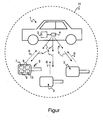
- the figure shows a schematic representation of a device for teaching a plurality of keys to an authorization device of a vehicle.
- a vehicle 1 has an authorization device 3 for preventing the vehicle 1 from being put into operation by unauthorized users who are in communication with a transceiver unit 4.
- the transmitting / receiving unit 4 transmits an interrogation signal 5 that can be triggered by a trigger, which receive all the keys 2 located in a receiving area 11.
- Each key 2 has an energy source 10, preferably in the form of a battery, which supplies a transponder 7, a computing unit 8 and a non-volatile memory 9 with electrical energy.
- the transponder 7 is used to receive and send data telegrams by means of radio waves.
- the field strength of the interrogation signal 5 determined by the transponder 7 is transmitted to the arithmetic unit 8, which in turn calculates a key-specific time window with the aid of the algorithm.
- the transponder 7 sends the identification code from the memory 9 during the time window in the form of a response signal 6 to the transmitting / receiving unit 4.
- the transmitting / receiving unit 4 receives the response signals 6 of the key 2 and forwards them to the authorization device 3 for registration. From now on, the authorization device 3 will lead the registered keys 2 as authorized for putting the vehicle 1 into operation.
Landscapes
- Physics & Mathematics (AREA)
- General Physics & Mathematics (AREA)
- Engineering & Computer Science (AREA)
- Computer Networks & Wireless Communication (AREA)
- Mechanical Engineering (AREA)
- Lock And Its Accessories (AREA)
Description
- Verfahren und Vorrichtung zum Anlernen mehrerer Schlüssel an eine Berechtigungseinrichtung eines Fahrzeugs, wobei die in einem Empfangsbereich einer Sende-/Empfangseinheit der Berechtigungseinrichtung befindlichen Schlüssel von dieser ein Abfragesignal empfangen, auf das diese ein Antwortsignal an die Berechtigungseinrichtung aussenden.
- Derartige Verfahren und Vorrichtungen werden im Fahrzeugbau dazu verwendet, um die zu einem Fahrzeug gehörigen Schlüssel an eine der Diebstahlsicherung dienenden Berechtigungseinrichtung, insbesondere einer Wegfahrsperre, anzulernen. Die angelernten Schlüssel sind daraufhin berechtigt das Fahrzeug in Betrieb zu nehmen. Dazu weisen die Schlüssel jeweils einen integrierten Transponder auf, der mit einer Sende-/Empfangseinheit der Berechtigungseinrichtung eine Funkverbindung zum Austausch von Datentelegrammen aufbauen kann.
- Die derzeit am weitesten verbreitete Methode zum Anlernen mehrerer Schlüssel an eine Berechtigungseinrichtung eines Fahrzeugs sieht vor, dass die Sende-/Empfangseinheit der Berechtigungseinrichtung ein Anlernsignal aussendet und alle im Empfangsbereich befindlichen Schlüssel darauf antworten, wobei nur derjenige Schlüssel mit dem stärksten Antwortsignal von der Berechtigungseinrichtung erkannt wird. Dies hat zur Folge, dass die Schlüssel nacheinander in die Nähe der Sende-/Empfangseinheit gebracht werden müssen, was viele manuelle Eingriffe und eine lange Verfahrensdauer zur Folge hat.
- Die
DE 10 2008 052 239 A1 offenbart ein Verfahren zum automatischen Anlernen mehrerer Schlüssel an eine Wegfahrsperre eines Fahrzeugs, wobei jedem Schlüssel im Vorfeld eine unterschiedliche Adresse zugewiesen wird und während des Anlernens der jeweilige Schlüssel von der Wegfahrsperre über die zugewiesene Adresse selektiv angesprochen wird. Dieses Verfahren erfordert folglich einen vorgelagerten Schritt, in dem den für das Fahrzeug bestimmten Schlüsseln individuelle Adressen zugewiesen werden müssen. Dadurch verlängert sich die Zeitdauer für das Anlernen der Schlüssel und es sind manuelle Eingriffe in den Ablauf notwendig. - Die gattungsbildende
DE 101 12 573 A1 beschreibt ein Verfahren zum Initialisieren eines Diebstahlschutzsystems für ein Kraftfahrzeug, wobei das Diebstahlschutzsystem zunächst ein Abfragesignal aussendet. In jedem Codegeber, der das Abfragesignal empfängt, wird eine für den jeweiligen Codegeber charakteristische Sendezeit mit Hilfe eines Zufallsprinzips erzeugt, worauf ein Antwortsignal innerhalb dieser Sendezeit ausgesendet wird. Wenn nicht alle Codegeber unterschieden werden können, beispielsweise weil zwei oder mehr Codegeber eine identische Sendezeit erzeugt haben, dann startet das Verfahren für die nicht unterscheidbaren Codegeber von neuem, bis alle Codegeber erkannt sind. Durch die Anwendung eines Zufallsprinzips besteht somit stets die Möglichkeit, dass mehrere Verfahrenszyklen durchgeführt werden müssen, bis alle Codegeber erkannt sind. - Aufgabe der vorliegenden Erfindung ist es daher ein Verfahren und eine Vorrichtung zum schnellen und zuverlässigen Anlernen mehrerer Schlüssel an eine Berechtigungseinrichtung eines Fahrzeugs mit möglichst wenig manuellen Eingriffen bereitzustellen.
- Diese Aufgabe wird durch die Merkmale des Patentanspruchs 1 bzw. 5 gelöst.
- Ein Verfahren zum Anlernen mehrerer Schlüssel an eine Berechtigungseinrichtung eines Fahrzeugs umfasst die folgenden Schritte:
- Aussenden eines Abfragesignals durch die Berechtigungseinrichtung;
- Messen eines von der räumlichen Lage des Schlüssels abhängigen Signalparameters des Abfragesignals durch die im Empfangsbereich befindlichen Schlüssel;
- Ermitteln eines schlüsselspezifischen Zeitfensters in Abhängigkeit des Signalparameters durch die jeweiligen Schlüssel;
- Senden eines Antwortsignals im schlüsselspezifischen Zeitfenster durch die jeweiligen Schlüssel und Registrieren der Antwortsignale in der Berechtigungseinrichtung;
- Indem jeder im Empfangsbereich des Abfragesignals befindliche Schlüssel für sich den mindestens einen von der räumlichen Lage des Schlüssels abhängigen Signalparameter misst und daraus ein schlüsselspezifisches Zeitfenster ermittelt, wird sichergestellt, dass sich die Antwortsignale der Schlüssel nicht überlappen. Der Signalparameter hängt direkt von der Lage des Schlüssels im Raum ab, die für zwei Schlüssel nie identisch sein kann. Der manuelle Aufwand für das Anlernen mehrerer Schlüssel wird dadurch reduziert, indem die anzulernenden Schlüssel nur in den Empfangsbereich gebracht und das Verfahren gestartet werden muss. Die Berechtigungseinrichtung registriert die nacheinander eingehenden Antwortsignale und führt diese Schlüssel für zukünftige Berechtigungsanfragen als berechtigt. Als Schlüssel sollen in diesem Zusammenhang alle Mittel verstanden werden, die von einem Nutzer mitgeführt und zur funkgestützten Feststellung der Nutzungsberechtigung des Fahrzeugs verwendet werden können.
- In einer bevorzugten Ausführung des Verfahrens enthält das Antwortsignal einen für den jeweiligen Schlüssel charakteristischen Identifikationscode. Durch den in das Antwortsignal eingebetteten Identifikationscode kann die Berechtigungseinrichtung Rückschlüsse auf den sendenden Schlüssel ziehen.
- In einer bevorzugten Ausführung des Verfahrens errechnet sich das schlüsselspezifische Zeitfenster mittels eines mathematischen Algorithmus aus dem Signalparameter. Der mathematische Algorithmus ist für alle Schlüssel gleich und so aufgebaut, dass sich keine identischen Zeitfenster für Schlüssel an unterschiedlichen räumlichen Positionen ergeben können.
- In einer bevorzugten Ausführung des Verfahrens wird der Signalparameter von einem die Feldstärke des Abfragesignals repräsentierenden Wert gebildet. Die Feldstärke des Abfragesignals eignet sich besonders gut als Signalparameter, da sie sich über den räumlichen Verlauf stets ändert.
- Die Erfindung umfasst auch eine Vorrichtung zum Anlernen mehrerer Schlüssel an eine Berechtigungseinrichtung eines Fahrzeugs, wobei die in einem Empfangsbereich einer Sende-/Empfangseinheit der Berechtigungseinrichtung befindlichen Schlüssel von dieser ein Abfragesignal empfangen und wobei der jeweilige Schlüssel aus mindestens einem von der räumlichen Lage des Schlüssels abhängigen Signalparameter des Abfragesignals ein schlüsselspezifisches Zeitfenster ermittelt, während dem der jeweilige Schlüssel ein Antwortsignal aussendet, wobei die Sende-/Empfangseinheit (4) ausgestaltet ist, das Antwortsignal zu empfangen und die Berechtigungseinrichtung (3) ausgestaltet ist, das Antwortsignal zu registrieren.
- Zur Umsetzung des erfindungsgemäßen Verfahrens ist eine Vorrichtung gezeigt, die eine Berechtigungseinrichtung mit einer Sende-/Empfangseinheit aufweist. Die Sende-/Empfangseinheit ist mit einer Spule zum Empfang und dem Versenden von Funkwellen ausgestattet. Wird das Verfahren gestartet, so sendet die Sende-/Empfangseinheit ein Abfragesignal über einen räumlich begrenzten Empfangsbereich aus. Alle in diesem Empfangsbereich befindlichen Schlüssel empfangen dieses Signal und messen mindestens einen bestimmten Signalparameter daraus. Jeder Schlüssel ermittelt daraufhin unabhängig voneinander ein Zeitfenster für sein Antwortsignal und sendet das Antwortsignal während dieses Zeitfensters aus. Die Antwortsignale werden nacheinander von der Sende-/Empfangseinheit empfangen und an die Berechtigungseinrichtung zur dauerhaften Registrierung weitergeleitet.
- In einer bevorzugten Ausführung der Vorrichtung repräsentiert der Signalparameter einen Wert der Feldstärke, insbesondere einen Feldstärkenvektor, des Abfragesignals. Die Feldstärke verändert sich ausgehend von der Sende-/Empfangseinheit über den räumlichen Verlauf und ist von den Schlüsseln sehr einfach messbar. Wird ein Feldstärkenvektor herangezogen, so ergibt sich ein noch präziserer Signalparameter. Dazu kann entweder die stärkste Raumachse herangezogen oder ein Mittelwert aus den drei Raumachsen gebildet werden.
- In einer bevorzugten Ausführung der Vorrichtung weisen die Schlüssel jeweils einen Transponder, eine Recheneinheit, einen nicht-flüchtigen Speicher und eine Energiequelle auf. Die Energiequelle ist vorzugsweise in Form einer Batterie ausgeführt und versorgt die angeschlossenen Bauteile mit elektrischer Energie. Eine alternative Ausführungsform sieht vor, dass die Energiequelle als ein Kondensator ausgebildet ist, der bedarfsweise von einem Spulenpaar aus fahrzeugseitiger und schlüsselseitiger Spule drahtlos geladen werden kann. Der Transponder dient dem Senden und Empfangen von Datentelegrammen, insbesondere des Abfragesignals und des Antwortsignals, mittels Funkwellen. Der nicht-flüchtige Speicher enthält unter anderem den Identifikationscode des Schlüssels und den Algorithmus zur Umrechnung des Signalparameters in ein Zeitfenster. Die Recheneinheit steuert die Funktion der Bauteile und führt die mathematischen Transformationen aus.
- In einer bevorzugten Ausführung der Vorrichtung ist die Berechtigungseinrichtung als Wegfahrsperre ausgebildet. Die Wegfahrsperre prüft bei einer beabsichtigten Inbetriebnahme des Fahrzeugs, ob dazu ein berechtigter Schlüssel verwendet wird und gibt in Abhängigkeit des Prüfergebnisses den Startvorgang frei oder verweigert diesen.
- Weitere Einzelheiten und Vorteile der Erfindung ergeben sich aus der nachstehenden Beschreibung eines bevorzugten Ausführungsbeispiels unter Bezugnahme auf die Zeichnung.
- Darin zeigt die Figur eine schematische Darstellung einer Vorrichtung zum Anlernen mehrerer Schlüssel an eine Berechtigungseinrichtung eines Fahrzeugs.
- Gemäß der Figur hat ein Fahrzeug 1 eine Berechtigungseinrichtung 3 zur Verhinderung einer Inbetriebnahme des Fahrzeugs 1 durch nicht berechtigte Nutzer, die mit einer Sende-/Empfangseinheit 4 in Verbindung steht. Die Sende-/Empfangseinheit 4 sendet manuell auslösbar ein Abfragesignal 5 aus, das alle in einem Empfangsbereich 11 befindlichen Schlüssel 2 empfangen. Jeder Schlüssel 2 weist eine Energiequelle 10, vorzugsweise in Form einer Batterie auf, die einen Transponder 7, eine Recheneinheit 8 und einen nicht-flüchtigen Speicher 9 mit elektrischer Energie versorgt. In dem Speicher 9 sind ein für den jeweiligen Schlüssel 2 charakteristischer Identifikationscode und ein mathematischer Algorithmus hinterlegt. Der Transponder 7 dient dem Empfang und Versand von Datentelegrammen mittels Funkwellen. Die vom Transponder 7 ermittelte Feldstärke des Abfragesignals 5 wird an die Recheneinheit 8 übermittelt, die wiederum mit Hilfe des Algorithmus ein schlüsselspezifisches Zeitfenster errechnet. Der Transponder 7 sendet den Identifikationscode aus dem Speicher 9 während des Zeitfensters in Form eines Antwortsignals 6 an die Sende-/Empfangseinheit 4 aus. Die Sende-/Empfangseinheit 4 empfängt die Antwortsignale 6 der Schlüssel 2 und leitet diese zur Registrierung an die Berechtigungseinrichtung 3 weiter. Fortan wird die Berechtigungseinrichtung 3 die registrierten Schlüssel 2 als berechtigt zur Inbetriebnahme des Fahrzeugs 1 führen.
-
- 1
- Fahrzeug
- 2
- Schlüssel
- 3
- Berechtigungseinrichtung
- 4
- Sende-/Empfangseinheit
- 5
- Abfragesignal
- 6
- Antwortsignal
- 7
- Transponder
- 8
- Recheneinheit
- 9
- Speicher
- 10
- Energiequelle
- 11
- Empfangsbereich
Claims (9)
- Verfahren zum Anlernen mehrerer Schlüssel (2) an eine Berechtigungseinrichtung (3) eines Fahrzeugs (1), umfassend die folgenden Schritte:- Aussenden eines Abfragesignals (5) durch die Berechtigungseinrichtung (3);- Messen eines von der räumlichen Lage des Schlüssels (2) abhängigen Signalparameters des Abfragesignals (5) durch die im Empfangsbereich (11) befindlichen Schlüssel (2);- Ermitteln eines schlüsselspezifischen Zeitfensters in Abhängigkeit des Signalparameters durch die jeweiligen Schlüssel (2);- Senden eines Antwortsignals (6) im schlüsselspezifischen Zeitfenster durch die jeweiligen Schlüssel (2) und Registrieren der Antwortsignale (6) in der Berechtigungseinrichtung (3);
- Verfahren nach Anspruch 1, dadurch gekennzeichnet, dass das Antwortsignal (6) einen für den jeweiligen Schlüssel (2) charakteristischen Identifikationscode enthält.
- Verfahren nach Anspruch 1 oder 2, dadurch gekennzeichnet, dass sich das schlüsselspezifische Zeitfenster mittels eines mathematischen Algorithmus aus dem Signalparameter errechnet.
- Verfahren nach einem der Ansprüche 1 bis 3, dadurch gekennzeichnet, dass der Signalparameter von einem die Feldstärke des Abfragesignals (5) repräsentierenden Wert gebildet wird.
- Vorrichtung zum Anlernen mehrerer Schlüssel (2) an eine Berechtigungseinrichtung (3) eines Fahrzeugs (1), wobei die in einem Empfangsbereich (11) einer Sende-/Empfangseinheit (4) der Berechtigungseinrichtung (3) befindlichen Schlüssel (2) von dieser ein Abfragesignal (5) empfangen, dadurch gekennzeichnet, dass der jeweilige Schlüssel (2) aus mindestens einem von der räumlichen Lage des Schlüssels (2) abhängigen Signalparameter des Abfragesignals (5) ein schlüsselspezifisches Zeitfenster ermittelt, während dem der jeweilige Schlüssel (2) ein Antwortsignal (6) aussendet, wobei die Sende/Empfangseinheit (4) ausgestaltet ist, das Antwortsignal (6) zu empfangen und die Berechtigungseinrichtung (3) ausgestaltet ist, das Antwortsignal (6) zu registrieren.
- Vorrichtung nach Anspruch 5, dadurch gekennzeichnet, dass der Signalparameter einen Wert der Feldstärke des Abfragesignals (5) repräsentiert.
- Vorrichtung nach Anspruch 6, dadurch gekennzeichnet, dass der Wert der Feldstärke ein Feldstärkenvektor ist.
- Vorrichtung nach einem der Ansprüche 5 bis 7, dadurch gekennzeichnet, dass die Schlüssel (2) jeweils einen Transponder (7), eine Recheneinheit (8), einen nicht-flüchtigen Speicher (9) und eine Energiequelle (10) aufweisen.
- Vorrichtung nach einem der Ansprüche 5 bis 8, dadurch gekennzeichnet, dass die Berechtigungseinrichtung (3) als Wegfahrsperre ausgebildet ist.
Applications Claiming Priority (2)
| Application Number | Priority Date | Filing Date | Title |
|---|---|---|---|
| DE201110103674 DE102011103674B3 (de) | 2011-06-09 | 2011-06-09 | Verfahren und Vorrichtung zum Anlernen mehrerer Schlüssel an eine Berechtigungseinrichtung eines Fahrzeugs |
| PCT/EP2012/002389 WO2012167915A1 (de) | 2011-06-09 | 2012-06-05 | Verfahren und vorrichtung zum anlemen mehrerer schlüssel an eine berechtigungseinrichtung eines fahrzeugs |
Publications (2)
| Publication Number | Publication Date |
|---|---|
| EP2718909A1 EP2718909A1 (de) | 2014-04-16 |
| EP2718909B1 true EP2718909B1 (de) | 2015-08-12 |
Family
ID=46275776
Family Applications (1)
| Application Number | Title | Priority Date | Filing Date |
|---|---|---|---|
| EP12727307.6A Not-in-force EP2718909B1 (de) | 2011-06-09 | 2012-06-05 | Verfahren und vorrichtung zum anlernen mehrerer schlüssel an eine berechtigungseinrichtung eines fahrzeugs |
Country Status (5)
| Country | Link |
|---|---|
| US (1) | US9007185B2 (de) |
| EP (1) | EP2718909B1 (de) |
| CN (1) | CN103608221B (de) |
| DE (1) | DE102011103674B3 (de) |
| WO (1) | WO2012167915A1 (de) |
Families Citing this family (9)
| Publication number | Priority date | Publication date | Assignee | Title |
|---|---|---|---|---|
| DE102011103674B3 (de) | 2011-06-09 | 2012-12-13 | Audi Ag | Verfahren und Vorrichtung zum Anlernen mehrerer Schlüssel an eine Berechtigungseinrichtung eines Fahrzeugs |
| CN105469470B (zh) * | 2014-08-12 | 2019-12-20 | 富顶精密组件(深圳)有限公司 | 感应钥匙及其校正系统、校正方法 |
| CN104408794B (zh) * | 2014-11-05 | 2017-01-18 | 联合汽车电子有限公司 | 一种多把智能钥匙的识别码获取方法及系统 |
| FR3030850B1 (fr) * | 2014-12-23 | 2020-01-24 | Valeo Comfort And Driving Assistance | Procede de controle de l'acces a au moins une fonctionnalite d'un vehicule automobile |
| DE102015211833B4 (de) * | 2015-06-25 | 2023-08-10 | Bayerische Motoren Werke Aktiengesellschaft | Verfahren, Computer-lesbares Medium, und System zum Erzeugen von Referenzdaten für eine Positionsbestimmung von Objekten relativ zu einem Fahrzeug |
| US9959690B2 (en) * | 2016-06-22 | 2018-05-01 | Ford Global Technologies, Llc | Expanding time window for remote commands |
| DE102016213867B4 (de) * | 2016-07-28 | 2022-12-29 | Continental Automotive Technologies GmbH | Verfahren und Vorrichtung zur Entfernungsmessung |
| CN106228653B (zh) * | 2016-07-29 | 2020-04-21 | 合肥西杰电子科技有限公司 | 虚拟车钥匙的解锁方法、请求终端、车钥匙及系统 |
| DE102016217642B4 (de) * | 2016-09-15 | 2020-07-09 | Volkswagen Aktiengesellschaft | Verfahren zum digitalen Rechtemanagement für ein Fahrzeug und digitales Rechtemanagementsystem |
Family Cites Families (11)
| Publication number | Priority date | Publication date | Assignee | Title |
|---|---|---|---|---|
| DE19941350A1 (de) | 1999-03-29 | 2000-10-05 | Mannesmann Vdo Ag | Vorrichtung und Verfahren zur Freigabe einer Sicherheitseinrichtung, insbesondere einer Zuganseinrichtung für ein Kraftfahrzeug |
| EP1041224A3 (de) * | 1999-03-29 | 2004-03-31 | Siemens Aktiengesellschaft | Vorrichtung und Verfahren zur Freigabe einer Sicherungseinrichtung, insbesondere einer Zugangseinrichtung für ein Kraftfahrzeug |
| DE10112573C2 (de) * | 2001-03-15 | 2003-09-04 | Siemens Ag | Verfahren zum Initialisieren eines Diebstahlschutzsystems für ein Kraftfahrzeug |
| DE50210061D1 (de) * | 2001-10-16 | 2007-06-14 | Siemens Ag | Verfahren zum Initialisieren eines Zugangskontrollsystems mit mehreren elektronischen Schlüsseln und mehreren Objekten |
| DE102005017458A1 (de) | 2004-04-24 | 2005-11-10 | Marquardt Gmbh | Schließsystem, insbesondere für ein Kraftfahrzeug |
| JP4598567B2 (ja) * | 2005-03-07 | 2010-12-15 | 本田技研工業株式会社 | 車両の盗難防止システム |
| US7629875B2 (en) * | 2005-03-18 | 2009-12-08 | Continental Automotive Systems Us, Inc. | Method to report LF remote signal strength via a RF link to an electronic control unit |
| KR101581975B1 (ko) * | 2008-01-31 | 2015-12-31 | 콘티넨탈 테베스 아게 운트 코. 오하게 | 차량 키, 및 차량 키의 도움에 의해 근거리 내의 자동차의 위치를 찾기 위한 방법 |
| DE102008011700B4 (de) | 2008-02-28 | 2018-01-25 | Volkswagen Ag | Verfahren und Vorrichtung zum Anlernen eines Funkschlüssels an ein Zugangssteuergerät für ein Kraftfahrzeug |
| DE102008052239A1 (de) | 2008-10-17 | 2010-04-22 | Volkswagen Ag | Verfahren zum automatischen Anlernen mehrerer Schlüssel an eine Wegfahrsperre sowie entsprechende Wegfahrsperre und Fahrzeug |
| DE102011103674B3 (de) | 2011-06-09 | 2012-12-13 | Audi Ag | Verfahren und Vorrichtung zum Anlernen mehrerer Schlüssel an eine Berechtigungseinrichtung eines Fahrzeugs |
-
2011
- 2011-06-09 DE DE201110103674 patent/DE102011103674B3/de not_active Withdrawn - After Issue
-
2012
- 2012-06-05 US US14/124,922 patent/US9007185B2/en not_active Expired - Fee Related
- 2012-06-05 WO PCT/EP2012/002389 patent/WO2012167915A1/de not_active Ceased
- 2012-06-05 EP EP12727307.6A patent/EP2718909B1/de not_active Not-in-force
- 2012-06-05 CN CN201280028143.2A patent/CN103608221B/zh not_active Expired - Fee Related
Also Published As
| Publication number | Publication date |
|---|---|
| CN103608221A (zh) | 2014-02-26 |
| CN103608221B (zh) | 2016-01-06 |
| DE102011103674B3 (de) | 2012-12-13 |
| EP2718909A1 (de) | 2014-04-16 |
| US20140184396A1 (en) | 2014-07-03 |
| US9007185B2 (en) | 2015-04-14 |
| WO2012167915A1 (de) | 2012-12-13 |
Similar Documents
| Publication | Publication Date | Title |
|---|---|---|
| DE102011103674B3 (de) | Verfahren und Vorrichtung zum Anlernen mehrerer Schlüssel an eine Berechtigungseinrichtung eines Fahrzeugs | |
| DE102011004959B4 (de) | Verfahren und System zum Ermöglichen eines autorisierten Fahrzeugwegfahrens | |
| EP3721645B1 (de) | Verfahren und system zum bestätigen der identität eines fahrzeugs | |
| DE102016222541B4 (de) | Verfahren zur Autorisierung eines Zugriffs auf ein Kraftfahrzeug zur Fremdnutzung und System | |
| DE112017005424T5 (de) | Elektronikschlüsselsystem | |
| DE102011054787B4 (de) | Steuervorrichtung für eine in einem Fahrzeug installierte Vorrichtung | |
| WO2018015455A1 (de) | System und verfahren zum sichern eines fahrzeugs | |
| DE102007041783B3 (de) | Flexible Schlüsselortung für passive Zugangs- und Fahrberechtigungssysteme | |
| DE102011116157A1 (de) | Verfahren zum Betreiben einer Berechtigungseinrichtung für schlüssellosen Zugang und Start eines Fahrzeugs | |
| DE102016207997A1 (de) | Sicherer Zugang zu einem Fahrzeug | |
| DE112009003536T5 (de) | Identifikation von kabellosen Sensoren | |
| DE102019123628A1 (de) | Authentifizierungssystem und Authentifizierungsverfahren | |
| DE102010050741A1 (de) | Schlüsselortungseinrichtung für ein elektronisches Schlüsselsystem | |
| DE19850176C1 (de) | Diebstahlschutzeinrichtung für ein Kraftfahrzeug und Verfahren zum Betreiben der Diebstahlschutzeinrichtung | |
| DE102013015478A1 (de) | Externe sichere Einheit | |
| DE102023100511B3 (de) | Verfahren zum Authentifizieren eines mobilen ID-Gebers, ID-Geber sowie System | |
| DE112018005336T5 (de) | Carsharing-System | |
| DE102015206628B4 (de) | Hinweis auf berechtigte Authentifizierungsmedien für ein Fahrzeug | |
| DE102011055358B4 (de) | Kollisions-Vermeidungs-Verfahren zur Datenübertragung mehrerer drahtloser Reifenzustandssensoren | |
| DE102020103104A1 (de) | Systeme und verfahren für eine sicherheitsherausforderung mit niedriger leistung des fahrzeugs | |
| EP3121068A1 (de) | Positionsbestimmung mit einem magnetfeldsensor für ein fahrzeug | |
| DE102007051961A1 (de) | Einrichtung zum Überwachen von sich in einem ausgezeichneten Bereich, insbesondere einem Werksgelände oder einem Parkhaus befindlichen Fahrzeugen | |
| DE112019004216T5 (de) | System zum Verhindern unautorisierten Kommunikationsaufbaus, und Verfahren zum Verhindern unautorisierten Kommunikationsaufbaus | |
| EP1835436B1 (de) | Transponderlesevorrichtung | |
| WO2019105609A1 (de) | VERFAHREN ZUM BETREIBEN EINER SCHLIEßEINRICHTUNG EINES KRAFTFAHRZEUGS, AUTORISIERUNGSEINRICHTUNG, ZUTRITTSKONTROLLEINRICHTUNG, STEUEREINRICHTUNG, UND MOBILES ENDGERÄT |
Legal Events
| Date | Code | Title | Description |
|---|---|---|---|
| PUAI | Public reference made under article 153(3) epc to a published international application that has entered the european phase |
Free format text: ORIGINAL CODE: 0009012 |
|
| 17P | Request for examination filed |
Effective date: 20140109 |
|
| AK | Designated contracting states |
Kind code of ref document: A1 Designated state(s): AL AT BE BG CH CY CZ DE DK EE ES FI FR GB GR HR HU IE IS IT LI LT LU LV MC MK MT NL NO PL PT RO RS SE SI SK SM TR |
|
| RIN1 | Information on inventor provided before grant (corrected) |
Inventor name: SASSMANNSHAUSEN, PATRICK Inventor name: OTT, TOBIAS |
|
| DAX | Request for extension of the european patent (deleted) | ||
| 17Q | First examination report despatched |
Effective date: 20141015 |
|
| REG | Reference to a national code |
Ref country code: DE Ref legal event code: R079 Ref document number: 502012004142 Country of ref document: DE Free format text: PREVIOUS MAIN CLASS: G07C0009000000 Ipc: G08C0019000000 |
|
| GRAP | Despatch of communication of intention to grant a patent |
Free format text: ORIGINAL CODE: EPIDOSNIGR1 |
|
| RIC1 | Information provided on ipc code assigned before grant |
Ipc: G08C 19/00 20060101AFI20150409BHEP Ipc: B60R 25/20 20130101ALI20150409BHEP Ipc: G07C 9/00 20060101ALI20150409BHEP |
|
| INTG | Intention to grant announced |
Effective date: 20150424 |
|
| GRAS | Grant fee paid |
Free format text: ORIGINAL CODE: EPIDOSNIGR3 |
|
| GRAA | (expected) grant |
Free format text: ORIGINAL CODE: 0009210 |
|
| AK | Designated contracting states |
Kind code of ref document: B1 Designated state(s): AL AT BE BG CH CY CZ DE DK EE ES FI FR GB GR HR HU IE IS IT LI LT LU LV MC MK MT NL NO PL PT RO RS SE SI SK SM TR |
|
| REG | Reference to a national code |
Ref country code: GB Ref legal event code: FG4D Free format text: NOT ENGLISH |
|
| REG | Reference to a national code |
Ref country code: CH Ref legal event code: EP |
|
| REG | Reference to a national code |
Ref country code: AT Ref legal event code: REF Ref document number: 742745 Country of ref document: AT Kind code of ref document: T Effective date: 20150815 |
|
| REG | Reference to a national code |
Ref country code: IE Ref legal event code: FG4D Free format text: LANGUAGE OF EP DOCUMENT: GERMAN |
|
| REG | Reference to a national code |
Ref country code: DE Ref legal event code: R096 Ref document number: 502012004142 Country of ref document: DE |
|
| REG | Reference to a national code |
Ref country code: LT Ref legal event code: MG4D |
|
| REG | Reference to a national code |
Ref country code: NL Ref legal event code: MP Effective date: 20150812 |
|
| PG25 | Lapsed in a contracting state [announced via postgrant information from national office to epo] |
Ref country code: LT Free format text: LAPSE BECAUSE OF FAILURE TO SUBMIT A TRANSLATION OF THE DESCRIPTION OR TO PAY THE FEE WITHIN THE PRESCRIBED TIME-LIMIT Effective date: 20150812 Ref country code: FI Free format text: LAPSE BECAUSE OF FAILURE TO SUBMIT A TRANSLATION OF THE DESCRIPTION OR TO PAY THE FEE WITHIN THE PRESCRIBED TIME-LIMIT Effective date: 20150812 Ref country code: LV Free format text: LAPSE BECAUSE OF FAILURE TO SUBMIT A TRANSLATION OF THE DESCRIPTION OR TO PAY THE FEE WITHIN THE PRESCRIBED TIME-LIMIT Effective date: 20150812 Ref country code: NO Free format text: LAPSE BECAUSE OF FAILURE TO SUBMIT A TRANSLATION OF THE DESCRIPTION OR TO PAY THE FEE WITHIN THE PRESCRIBED TIME-LIMIT Effective date: 20151112 Ref country code: GR Free format text: LAPSE BECAUSE OF FAILURE TO SUBMIT A TRANSLATION OF THE DESCRIPTION OR TO PAY THE FEE WITHIN THE PRESCRIBED TIME-LIMIT Effective date: 20151113 |
|
| PG25 | Lapsed in a contracting state [announced via postgrant information from national office to epo] |
Ref country code: PT Free format text: LAPSE BECAUSE OF FAILURE TO SUBMIT A TRANSLATION OF THE DESCRIPTION OR TO PAY THE FEE WITHIN THE PRESCRIBED TIME-LIMIT Effective date: 20151214 Ref country code: RS Free format text: LAPSE BECAUSE OF FAILURE TO SUBMIT A TRANSLATION OF THE DESCRIPTION OR TO PAY THE FEE WITHIN THE PRESCRIBED TIME-LIMIT Effective date: 20150812 Ref country code: SE Free format text: LAPSE BECAUSE OF FAILURE TO SUBMIT A TRANSLATION OF THE DESCRIPTION OR TO PAY THE FEE WITHIN THE PRESCRIBED TIME-LIMIT Effective date: 20150812 Ref country code: IS Free format text: LAPSE BECAUSE OF FAILURE TO SUBMIT A TRANSLATION OF THE DESCRIPTION OR TO PAY THE FEE WITHIN THE PRESCRIBED TIME-LIMIT Effective date: 20151212 Ref country code: ES Free format text: LAPSE BECAUSE OF FAILURE TO SUBMIT A TRANSLATION OF THE DESCRIPTION OR TO PAY THE FEE WITHIN THE PRESCRIBED TIME-LIMIT Effective date: 20150812 Ref country code: PL Free format text: LAPSE BECAUSE OF FAILURE TO SUBMIT A TRANSLATION OF THE DESCRIPTION OR TO PAY THE FEE WITHIN THE PRESCRIBED TIME-LIMIT Effective date: 20150812 Ref country code: HR Free format text: LAPSE BECAUSE OF FAILURE TO SUBMIT A TRANSLATION OF THE DESCRIPTION OR TO PAY THE FEE WITHIN THE PRESCRIBED TIME-LIMIT Effective date: 20150812 |
|
| PG25 | Lapsed in a contracting state [announced via postgrant information from national office to epo] |
Ref country code: NL Free format text: LAPSE BECAUSE OF FAILURE TO SUBMIT A TRANSLATION OF THE DESCRIPTION OR TO PAY THE FEE WITHIN THE PRESCRIBED TIME-LIMIT Effective date: 20150812 |
|
| PG25 | Lapsed in a contracting state [announced via postgrant information from national office to epo] |
Ref country code: CZ Free format text: LAPSE BECAUSE OF FAILURE TO SUBMIT A TRANSLATION OF THE DESCRIPTION OR TO PAY THE FEE WITHIN THE PRESCRIBED TIME-LIMIT Effective date: 20150812 Ref country code: DK Free format text: LAPSE BECAUSE OF FAILURE TO SUBMIT A TRANSLATION OF THE DESCRIPTION OR TO PAY THE FEE WITHIN THE PRESCRIBED TIME-LIMIT Effective date: 20150812 Ref country code: IT Free format text: LAPSE BECAUSE OF FAILURE TO SUBMIT A TRANSLATION OF THE DESCRIPTION OR TO PAY THE FEE WITHIN THE PRESCRIBED TIME-LIMIT Effective date: 20150812 Ref country code: EE Free format text: LAPSE BECAUSE OF FAILURE TO SUBMIT A TRANSLATION OF THE DESCRIPTION OR TO PAY THE FEE WITHIN THE PRESCRIBED TIME-LIMIT Effective date: 20150812 Ref country code: SK Free format text: LAPSE BECAUSE OF FAILURE TO SUBMIT A TRANSLATION OF THE DESCRIPTION OR TO PAY THE FEE WITHIN THE PRESCRIBED TIME-LIMIT Effective date: 20150812 |
|
| REG | Reference to a national code |
Ref country code: DE Ref legal event code: R097 Ref document number: 502012004142 Country of ref document: DE |
|
| PG25 | Lapsed in a contracting state [announced via postgrant information from national office to epo] |
Ref country code: RO Free format text: LAPSE BECAUSE OF FAILURE TO SUBMIT A TRANSLATION OF THE DESCRIPTION OR TO PAY THE FEE WITHIN THE PRESCRIBED TIME-LIMIT Effective date: 20150812 |
|
| PLBE | No opposition filed within time limit |
Free format text: ORIGINAL CODE: 0009261 |
|
| STAA | Information on the status of an ep patent application or granted ep patent |
Free format text: STATUS: NO OPPOSITION FILED WITHIN TIME LIMIT |
|
| REG | Reference to a national code |
Ref country code: FR Ref legal event code: PLFP Year of fee payment: 5 |
|
| 26N | No opposition filed |
Effective date: 20160513 |
|
| PG25 | Lapsed in a contracting state [announced via postgrant information from national office to epo] |
Ref country code: SI Free format text: LAPSE BECAUSE OF FAILURE TO SUBMIT A TRANSLATION OF THE DESCRIPTION OR TO PAY THE FEE WITHIN THE PRESCRIBED TIME-LIMIT Effective date: 20150812 |
|
| PG25 | Lapsed in a contracting state [announced via postgrant information from national office to epo] |
Ref country code: BE Free format text: LAPSE BECAUSE OF NON-PAYMENT OF DUE FEES Effective date: 20160630 |
|
| PG25 | Lapsed in a contracting state [announced via postgrant information from national office to epo] |
Ref country code: MC Free format text: LAPSE BECAUSE OF FAILURE TO SUBMIT A TRANSLATION OF THE DESCRIPTION OR TO PAY THE FEE WITHIN THE PRESCRIBED TIME-LIMIT Effective date: 20150812 |
|
| REG | Reference to a national code |
Ref country code: CH Ref legal event code: PL |
|
| REG | Reference to a national code |
Ref country code: IE Ref legal event code: MM4A |
|
| PG25 | Lapsed in a contracting state [announced via postgrant information from national office to epo] |
Ref country code: LI Free format text: LAPSE BECAUSE OF NON-PAYMENT OF DUE FEES Effective date: 20160630 Ref country code: CH Free format text: LAPSE BECAUSE OF NON-PAYMENT OF DUE FEES Effective date: 20160630 |
|
| PG25 | Lapsed in a contracting state [announced via postgrant information from national office to epo] |
Ref country code: IE Free format text: LAPSE BECAUSE OF NON-PAYMENT OF DUE FEES Effective date: 20160605 |
|
| REG | Reference to a national code |
Ref country code: FR Ref legal event code: PLFP Year of fee payment: 6 |
|
| PG25 | Lapsed in a contracting state [announced via postgrant information from national office to epo] |
Ref country code: CY Free format text: LAPSE BECAUSE OF FAILURE TO SUBMIT A TRANSLATION OF THE DESCRIPTION OR TO PAY THE FEE WITHIN THE PRESCRIBED TIME-LIMIT Effective date: 20150812 Ref country code: HU Free format text: LAPSE BECAUSE OF FAILURE TO SUBMIT A TRANSLATION OF THE DESCRIPTION OR TO PAY THE FEE WITHIN THE PRESCRIBED TIME-LIMIT; INVALID AB INITIO Effective date: 20120605 Ref country code: SM Free format text: LAPSE BECAUSE OF FAILURE TO SUBMIT A TRANSLATION OF THE DESCRIPTION OR TO PAY THE FEE WITHIN THE PRESCRIBED TIME-LIMIT Effective date: 20150812 |
|
| REG | Reference to a national code |
Ref country code: FR Ref legal event code: PLFP Year of fee payment: 7 |
|
| PG25 | Lapsed in a contracting state [announced via postgrant information from national office to epo] |
Ref country code: MK Free format text: LAPSE BECAUSE OF FAILURE TO SUBMIT A TRANSLATION OF THE DESCRIPTION OR TO PAY THE FEE WITHIN THE PRESCRIBED TIME-LIMIT Effective date: 20150812 Ref country code: LU Free format text: LAPSE BECAUSE OF NON-PAYMENT OF DUE FEES Effective date: 20160605 Ref country code: MT Free format text: LAPSE BECAUSE OF FAILURE TO SUBMIT A TRANSLATION OF THE DESCRIPTION OR TO PAY THE FEE WITHIN THE PRESCRIBED TIME-LIMIT Effective date: 20150812 Ref country code: TR Free format text: LAPSE BECAUSE OF FAILURE TO SUBMIT A TRANSLATION OF THE DESCRIPTION OR TO PAY THE FEE WITHIN THE PRESCRIBED TIME-LIMIT Effective date: 20150812 |
|
| PG25 | Lapsed in a contracting state [announced via postgrant information from national office to epo] |
Ref country code: BG Free format text: LAPSE BECAUSE OF FAILURE TO SUBMIT A TRANSLATION OF THE DESCRIPTION OR TO PAY THE FEE WITHIN THE PRESCRIBED TIME-LIMIT Effective date: 20150812 |
|
| REG | Reference to a national code |
Ref country code: AT Ref legal event code: MM01 Ref document number: 742745 Country of ref document: AT Kind code of ref document: T Effective date: 20170605 |
|
| PG25 | Lapsed in a contracting state [announced via postgrant information from national office to epo] |
Ref country code: AL Free format text: LAPSE BECAUSE OF FAILURE TO SUBMIT A TRANSLATION OF THE DESCRIPTION OR TO PAY THE FEE WITHIN THE PRESCRIBED TIME-LIMIT Effective date: 20150812 |
|
| PG25 | Lapsed in a contracting state [announced via postgrant information from national office to epo] |
Ref country code: AT Free format text: LAPSE BECAUSE OF NON-PAYMENT OF DUE FEES Effective date: 20170605 |
|
| PGFP | Annual fee paid to national office [announced via postgrant information from national office to epo] |
Ref country code: FR Payment date: 20190625 Year of fee payment: 8 |
|
| PGFP | Annual fee paid to national office [announced via postgrant information from national office to epo] |
Ref country code: GB Payment date: 20190627 Year of fee payment: 8 Ref country code: DE Payment date: 20190630 Year of fee payment: 8 |
|
| REG | Reference to a national code |
Ref country code: DE Ref legal event code: R119 Ref document number: 502012004142 Country of ref document: DE |
|
| GBPC | Gb: european patent ceased through non-payment of renewal fee |
Effective date: 20200605 |
|
| PG25 | Lapsed in a contracting state [announced via postgrant information from national office to epo] |
Ref country code: FR Free format text: LAPSE BECAUSE OF NON-PAYMENT OF DUE FEES Effective date: 20200630 Ref country code: GB Free format text: LAPSE BECAUSE OF NON-PAYMENT OF DUE FEES Effective date: 20200605 |
|
| PG25 | Lapsed in a contracting state [announced via postgrant information from national office to epo] |
Ref country code: DE Free format text: LAPSE BECAUSE OF NON-PAYMENT OF DUE FEES Effective date: 20210101 |