EP2696409A2 - High energy density lithium secondary battery having enhanced energy density characteristic - Google Patents
High energy density lithium secondary battery having enhanced energy density characteristic Download PDFInfo
- Publication number
- EP2696409A2 EP2696409A2 EP12790081.9A EP12790081A EP2696409A2 EP 2696409 A2 EP2696409 A2 EP 2696409A2 EP 12790081 A EP12790081 A EP 12790081A EP 2696409 A2 EP2696409 A2 EP 2696409A2
- Authority
- EP
- European Patent Office
- Prior art keywords
- lithium secondary
- secondary battery
- energy density
- high energy
- battery according
- Prior art date
- Legal status (The legal status is an assumption and is not a legal conclusion. Google has not performed a legal analysis and makes no representation as to the accuracy of the status listed.)
- Granted
Links
Images
Classifications
-
- H—ELECTRICITY
- H01—ELECTRIC ELEMENTS
- H01M—PROCESSES OR MEANS, e.g. BATTERIES, FOR THE DIRECT CONVERSION OF CHEMICAL ENERGY INTO ELECTRICAL ENERGY
- H01M4/00—Electrodes
- H01M4/02—Electrodes composed of, or comprising, active material
- H01M4/36—Selection of substances as active materials, active masses, active liquids
- H01M4/362—Composites
- H01M4/364—Composites as mixtures
-
- H—ELECTRICITY
- H01—ELECTRIC ELEMENTS
- H01M—PROCESSES OR MEANS, e.g. BATTERIES, FOR THE DIRECT CONVERSION OF CHEMICAL ENERGY INTO ELECTRICAL ENERGY
- H01M10/00—Secondary cells; Manufacture thereof
- H01M10/05—Accumulators with non-aqueous electrolyte
- H01M10/052—Li-accumulators
-
- C—CHEMISTRY; METALLURGY
- C01—INORGANIC CHEMISTRY
- C01G—COMPOUNDS CONTAINING METALS NOT COVERED BY SUBCLASSES C01D OR C01F
- C01G53/00—Compounds of nickel
- C01G53/40—Complex oxides containing nickel and at least one other metal element
- C01G53/42—Complex oxides containing nickel and at least one other metal element containing alkali metals, e.g. LiNiO2
- C01G53/44—Complex oxides containing nickel and at least one other metal element containing alkali metals, e.g. LiNiO2 containing manganese
- C01G53/50—Complex oxides containing nickel and at least one other metal element containing alkali metals, e.g. LiNiO2 containing manganese of the type (MnO2)n-, e.g. Li(NixMn1-x)O2 or Li(MyNixMn1-x-y)O2
-
- H—ELECTRICITY
- H01—ELECTRIC ELEMENTS
- H01M—PROCESSES OR MEANS, e.g. BATTERIES, FOR THE DIRECT CONVERSION OF CHEMICAL ENERGY INTO ELECTRICAL ENERGY
- H01M4/00—Electrodes
- H01M4/02—Electrodes composed of, or comprising, active material
- H01M4/36—Selection of substances as active materials, active masses, active liquids
- H01M4/48—Selection of substances as active materials, active masses, active liquids of inorganic oxides or hydroxides
- H01M4/50—Selection of substances as active materials, active masses, active liquids of inorganic oxides or hydroxides of manganese
- H01M4/505—Selection of substances as active materials, active masses, active liquids of inorganic oxides or hydroxides of manganese of mixed oxides or hydroxides containing manganese for inserting or intercalating light metals, e.g. LiMn2O4 or LiMn2OxFy
-
- H—ELECTRICITY
- H01—ELECTRIC ELEMENTS
- H01M—PROCESSES OR MEANS, e.g. BATTERIES, FOR THE DIRECT CONVERSION OF CHEMICAL ENERGY INTO ELECTRICAL ENERGY
- H01M4/00—Electrodes
- H01M4/02—Electrodes composed of, or comprising, active material
- H01M4/36—Selection of substances as active materials, active masses, active liquids
- H01M4/48—Selection of substances as active materials, active masses, active liquids of inorganic oxides or hydroxides
- H01M4/52—Selection of substances as active materials, active masses, active liquids of inorganic oxides or hydroxides of nickel, cobalt or iron
- H01M4/525—Selection of substances as active materials, active masses, active liquids of inorganic oxides or hydroxides of nickel, cobalt or iron of mixed oxides or hydroxides containing iron, cobalt or nickel for inserting or intercalating light metals, e.g. LiNiO2, LiCoO2 or LiCoOxFy
-
- H—ELECTRICITY
- H01—ELECTRIC ELEMENTS
- H01M—PROCESSES OR MEANS, e.g. BATTERIES, FOR THE DIRECT CONVERSION OF CHEMICAL ENERGY INTO ELECTRICAL ENERGY
- H01M4/00—Electrodes
- H01M4/02—Electrodes composed of, or comprising, active material
- H01M4/36—Selection of substances as active materials, active masses, active liquids
- H01M4/58—Selection of substances as active materials, active masses, active liquids of inorganic compounds other than oxides or hydroxides, e.g. sulfides, selenides, tellurides, halogenides or LiCoFy; of polyanionic structures, e.g. phosphates, silicates or borates
- H01M4/583—Carbonaceous material, e.g. graphite-intercalation compounds or CFx
-
- H—ELECTRICITY
- H01—ELECTRIC ELEMENTS
- H01M—PROCESSES OR MEANS, e.g. BATTERIES, FOR THE DIRECT CONVERSION OF CHEMICAL ENERGY INTO ELECTRICAL ENERGY
- H01M4/00—Electrodes
- H01M4/02—Electrodes composed of, or comprising, active material
- H01M4/36—Selection of substances as active materials, active masses, active liquids
- H01M4/58—Selection of substances as active materials, active masses, active liquids of inorganic compounds other than oxides or hydroxides, e.g. sulfides, selenides, tellurides, halogenides or LiCoFy; of polyanionic structures, e.g. phosphates, silicates or borates
- H01M4/583—Carbonaceous material, e.g. graphite-intercalation compounds or CFx
- H01M4/587—Carbonaceous material, e.g. graphite-intercalation compounds or CFx for inserting or intercalating light metals
-
- C—CHEMISTRY; METALLURGY
- C01—INORGANIC CHEMISTRY
- C01P—INDEXING SCHEME RELATING TO STRUCTURAL AND PHYSICAL ASPECTS OF SOLID INORGANIC COMPOUNDS
- C01P2006/00—Physical properties of inorganic compounds
- C01P2006/10—Solid density
-
- C—CHEMISTRY; METALLURGY
- C01—INORGANIC CHEMISTRY
- C01P—INDEXING SCHEME RELATING TO STRUCTURAL AND PHYSICAL ASPECTS OF SOLID INORGANIC COMPOUNDS
- C01P2006/00—Physical properties of inorganic compounds
- C01P2006/40—Electric properties
-
- H—ELECTRICITY
- H01—ELECTRIC ELEMENTS
- H01M—PROCESSES OR MEANS, e.g. BATTERIES, FOR THE DIRECT CONVERSION OF CHEMICAL ENERGY INTO ELECTRICAL ENERGY
- H01M4/00—Electrodes
- H01M4/02—Electrodes composed of, or comprising, active material
- H01M2004/021—Physical characteristics, e.g. porosity, surface area
-
- H—ELECTRICITY
- H01—ELECTRIC ELEMENTS
- H01M—PROCESSES OR MEANS, e.g. BATTERIES, FOR THE DIRECT CONVERSION OF CHEMICAL ENERGY INTO ELECTRICAL ENERGY
- H01M2220/00—Batteries for particular applications
- H01M2220/20—Batteries in motive systems, e.g. vehicle, ship, plane
-
- Y—GENERAL TAGGING OF NEW TECHNOLOGICAL DEVELOPMENTS; GENERAL TAGGING OF CROSS-SECTIONAL TECHNOLOGIES SPANNING OVER SEVERAL SECTIONS OF THE IPC; TECHNICAL SUBJECTS COVERED BY FORMER USPC CROSS-REFERENCE ART COLLECTIONS [XRACs] AND DIGESTS
- Y02—TECHNOLOGIES OR APPLICATIONS FOR MITIGATION OR ADAPTATION AGAINST CLIMATE CHANGE
- Y02E—REDUCTION OF GREENHOUSE GAS [GHG] EMISSIONS, RELATED TO ENERGY GENERATION, TRANSMISSION OR DISTRIBUTION
- Y02E60/00—Enabling technologies; Technologies with a potential or indirect contribution to GHG emissions mitigation
- Y02E60/10—Energy storage using batteries
-
- Y—GENERAL TAGGING OF NEW TECHNOLOGICAL DEVELOPMENTS; GENERAL TAGGING OF CROSS-SECTIONAL TECHNOLOGIES SPANNING OVER SEVERAL SECTIONS OF THE IPC; TECHNICAL SUBJECTS COVERED BY FORMER USPC CROSS-REFERENCE ART COLLECTIONS [XRACs] AND DIGESTS
- Y02—TECHNOLOGIES OR APPLICATIONS FOR MITIGATION OR ADAPTATION AGAINST CLIMATE CHANGE
- Y02T—CLIMATE CHANGE MITIGATION TECHNOLOGIES RELATED TO TRANSPORTATION
- Y02T10/00—Road transport of goods or passengers
- Y02T10/60—Other road transportation technologies with climate change mitigation effect
- Y02T10/70—Energy storage systems for electromobility, e.g. batteries
Definitions
- the present invention relates to a high energy density lithium secondary battery having enhanced energy density characteristics. More specifically, the present invention relates to a high energy density lithium secondary battery including: a cathode that includes, as cathode active materials, a first cathode active material represented by Formula 1 below and having a layered structure and a second cathode active material represented by Formula 2 below and having a spinel structure, wherein the amount of the first cathode active material is between 40 and 100 wt% based on the total weight of the cathode active materials; an anode including crystalline graphite and amorphous carbon as anode active materials, wherein the amount of the crystalline graphite is between 40 and 100 wt% based on the total weight of the anode active materials; and a separator.
- a cathode that includes, as cathode active materials, a first cathode active material represented by Formula 1 below and having a layered structure and a second cathode active material represented by Formula 2
- secondary batteries As mobile device technology continues to develop and demand therefor continues to increase, demand for secondary batteries as energy sources is rapidly increasing.
- secondary batteries have recently been used as power sources for electric vehicles (EVs), hybrid electric vehicles (HEVs), and the like. Accordingly, research into secondary batteries that can meet a variety of demands is underway and, in particular, demand for lithium secondary batteries having high energy density, high discharge voltage and high output stability is increasing.
- a lithium cobalt composite oxide having a layered structure is generally used as a cathode active material of a lithium secondary battery.
- a lithium cobalt composite oxide is used as a cathode active material, however, cobalt as a main component is very expensive, and the layered structure thereof undergoes changes in volume according to repeated intercalation and deintercalation of Li ions and collapses when more than half of the Li ions are deintercalated.
- lithium secondary batteries including such cathode active materials are not suitable for use in EVs or large capacity power storage devices in terms of safety.
- a battery including a lithium manganese composite oxide having a spinel structure is not suitable for use as an energy source for EVs requiring relatively high energy density since a travel distance thereof is determined by battery electric energy.
- carbonaceous active materials are mainly used as anode active materials, which have a very low discharge potential of about -3 V with respect to a standard hydrogen electrode potential, and exhibit reversible charge/discharge behavior due to uniaxial orientation of a graphene layer and thus have excellent cycle lifespan.
- Examples of carbonaceous active materials include crystalline graphite and amorphous carbon.
- Crystalline graphite has high energy density while having relatively poor output characteristics and thus batteries including such crystalline graphite are not suitable for use as an energy source for HEVs requiring high output.
- amorphous carbon has excellent output characteristics while having low energy density (i.e., less than 300 mAh/g) and thus batteries including such amorphous carbon are not suitable for use as an energy source for EVs.
- the present invention aims to address the aforementioned problems of the related art and to achieve technical goals that have long been sought.
- an object of the present invention is to provide a lithium secondary battery that satisfies output levels required of EVs and HEVs and has enhanced energy density.
- a high energy density lithium secondary battery including: a cathode including, as cathode active materials, a first cathode active material represented by Formula 1 below and having a layered structure and a second cathode active material represented by Formula 2 below and having a spinel structure, in which the amount of the first cathode active material is between 40 and 100 wt% based on the total weight of the cathode active materials; an anode including crystalline graphite and amorphous carbon as anode active materials, in which the amount of the crystalline graphite is between 40 and 100 wt% based on the total weight of the anode active materials; and a separator.
- Formula 1 Li x (Ni v Mn w Co y M z )O 2-t A t
- M' refers to at least one metal or transition metal cation having an oxidation number of +2 to +4; and A' is a monovalent or divalent anion.
- the crystalline graphite may be one selected from the group consisting of a first graphite having a specific surface area (with respect to capacity) of 0.007 to 0.011 and a second graphite having a specific surface area (with respect to capacity) of 0.005 to 0.013 or a mixture thereof.
- a weight ratio of the first graphite to the second graphite may be in the range of 1:9 to 9:1.
- the second graphite has the same powder conductivity as that of amorphous carbon and thus provides enhanced output characteristics to the lithium secondary battery.
- the second graphite has a similar internal structure to that of amorphous carbon, thus greatly extending battery lifespan.
- the amorphous carbon may be one selected from the group consisting of a first carbon having a specific surface area (with respect to capacity) of 0.01 to 0.031 and a second carbon having a specific surface area (with respect to capacity) of 0.0035 to 0.0170 or a mixture thereof.
- a weight ratio of the first carbon to the second carbon may be in the range of 1:9 to 9:1.
- the first carbon has a powder conductivity of 15 S/cm or greater to less than 100 S/cm at a powder density of 1.0 to 1.2 g/cc
- the second carbon has a powder conductivity of 30 S/cm or greater to less than 100 S/cm at a powder density of 1.4 to 1.6 g/cc.
- the amounts of the first cathode active material having a layered structure of Formula 1 and the second cathode active material having a spinel structure of Formula 2 may be in the range of 50 wt% to 90 wt% and in the range of 10 wt% to 50 wt%, respectively, based on the total weight of the first and second cathode active materials.
- the first cathode active material may be a layered-structure lithium transition metal oxide having an average particle diameter (with respect to capacity) of 0.03 to 0.1 ⁇ m/mAh and a powder conductivity of 1x10 -3 S/cm or greater to less than 10x10 -3 S/cm at a powder density of 2.65 to 2.85 g/cc.
- the first cathode active material of Formula 1 may be a layered crystalline structure lithium transition metal oxide satisfying conditions that the oxide includes mixed transition metals of Ni and Mn, an average oxidation number of the total transition metals excluding lithium exceeds +3, and the amount of Ni is the same as that of Mn on a molar ratio basis.
- the lithium transition metal oxide of Formula 1 may be Li(Ni 0.5 Mn 0.3 Co 0.2 )O 2 or Li(Ni 1/3 Mn 1/3 Co 1/3 )O 2 .
- the transition metal such as Ni, Mn, or Co may be substituted with a metal and/or other transition metal (M) elements having an oxidation number of +2 to +4.
- the transition metal may be substituted with at least one selected from the group consisting of Al, Mg, and Ti.
- a substitution amount may satisfy the condition: 0.3 ⁇ z ⁇ 0.6.
- the second cathode active material may be a spinel crystalline structure lithium transition metal oxide having an average particle diameter (with respect to capacity) of 0.1 to 0.2 ⁇ m/mAh and a powder conductivity of 1x10 -5 S/cm or greater to less than 10x10 -5 S/cm at a powder density of 2.65 to 2.85 g/cc.
- M' may be at least one selected from the group consisting of Co, Mn, Ni, Al, Mg, and Ti.
- the oxygen ion may be substituted with a monovalent or divalent anion (A, A') within a predetermined range, wherein A and A' may be each independently at least one selected from the group consisting of halogens such as F, Cl, Br, and I, S, and N.
- a and A' may be each independently at least one selected from the group consisting of halogens such as F, Cl, Br, and I, S, and N.
- the corresponding compound when O is substituted with a halogen or the transition metal such as Ni, Mn, or the like is substituted with another transition metal (M, M'), the corresponding compound may be added prior to high-temperature reaction.
- the lithium secondary battery that includes the cathode and anode active materials having the aforementioned particular physical quantities exhibits high energy density characteristics.
- the physical quantities may be measured using measurement methods known in the art.
- the specific surface area may be measured by BET
- the powder density may be measured using a true density measurement method
- the powder conductivity may be measured by measuring sheet resistance after forming a powder into a pellet.
- the high energy density lithium secondary battery including the cathode and anode active materials having the aforementioned particular physical quantities has a capacity with respect to volume of 0.05 to 0.09 Ah/cm 3 and an energy with respect to volume of 0.2 to 0.4 Wh/cm 3 .
- the separator is disposed between the cathode and the anode and, as the separator, a thin insulating film with high ion permeability and high mechanical strength is used.
- the separator generally has a pore diameter of 0.01 to 10 ⁇ m and a thickness of 5 to 300 ⁇ m.
- separator sheets or non-woven fabrics, made of an olefin polymer such as polypropylene; or glass fibers or polyethylene, which have chemical resistance and hydrophobicity, or kraft papers are used.
- olefin polymer such as polypropylene
- glass fibers or polyethylene which have chemical resistance and hydrophobicity, or kraft papers are used.
- commercially available separators include Celgard series such as Celgard R 2400 and 2300 (available from Hoechest Celanese Corp.), polypropylene separators (available from Ube Industries Ltd., or Pall RAI Co.) and polyethylene series (available from Tonen or Entek).
- the separator may be a polyolefin-based separator and an organic-inorganic composite separator including an inorganic material such as silicon.
- an organic-inorganic composite separator enables improved stability or the like of lithium secondary batteries.
- the present invention also provides a medium and large-scale battery module including the above-described high energy density lithium secondary battery as a unit battery and a medium and large-scale battery pack including the battery module.
- the present invention provides a device using the battery pack as a power source.
- the battery pack may be used as a power source of electric vehicles, hybrid electric vehicles, plug-in hybrid vehicles, or power storage devices.
- the cathode may be manufactured by coating, on a cathode current collector, a slurry prepared by mixing a cathode mixture including the cathode active material with a solvent such as NMP or the like and drying and rolling the coated cathode current collector.
- the cathode mixture may optionally include a conductive material, a binder, a filler, or the like, in addition to the cathode active material.
- the cathode current collector is generally fabricated to a thickness of 3 to 500 ⁇ m.
- the cathode current collector is not particularly limited so long as it does not cause chemical changes in the fabricated lithium secondary battery and has high conductivity.
- the cathode current collector may be made of copper, stainless steel, aluminum, nickel, titanium, sintered carbon, copper or stainless steel surface-treated with carbon, nickel, titanium, silver, or the like, an aluminum-cadmium alloy, or the like.
- the cathode current collector may have fine irregularities at a surface thereof to increase adhesion between the cathode active material and the cathode current collector.
- the cathode current collector may be used in any of various forms including films, sheets, foils, nets, porous structures, foams, and non-woven fabrics.
- the conductive material is typically added in an amount of 1 to 30 wt% based on the total weight of the mixture including the cathode active material.
- the conductive material there is no particular limit as to the conductive material, so long as it does not cause chemical changes in the fabricated battery and has conductivity.
- Examples of conductive materials include graphite such as natural or artificial graphite; carbon black such as carbon black, acetylene black, Ketjen black, channel black, furnace black, lamp black, and thermal black; conductive fibers such as carbon fibers and metallic fibers; metallic powders such as carbon fluoride powder, aluminum powder, and nickel powder; conductive whiskers such as zinc oxide and potassium titanate; conductive metal oxides such as titanium oxide; and polyphenylene derivatives.
- the binder is a component assisting in binding between the active material and the conductive material and in binding of the active material to the cathode current collector.
- the binder is typically added in an amount of 1 to 30 wt% based on the total weight of the mixture including the cathode active material.
- binder examples include, but are not limtied to, polyvinylidene fluoride, polyvinyl alcohols, carboxymethylcellulose (CMC), starch, hydroxypropylcellulose, regenerated cellulose, polyvinyl pyrrolidone, tetrafluoroethylene, polyethylene, polypropylene, ethylenepropylene-diene terpolymer (EPDM), sulfonated EPDM, styrene-butadiene rubber, fluorine rubber, and various copolymers.
- CMC carboxymethylcellulose
- EPDM ethylenepropylene-diene terpolymer
- EPDM ethylenepropylene-diene terpolymer
- EPDM ethylenepropylene-diene terpolymer
- sulfonated EPDM styrene-butadiene rubber
- fluorine rubber fluorine rubber
- the filler is optionally used as a component to inhibit cathode expansion.
- the filler is not particularly limited so long as it is a fibrous material that does not cause chemical changes in the fabricated battery.
- examples of the filler include olefin-based polymers such as polyethylene and polypropylene; and fibrous materials such as glass fiber and carbon fiber.
- isopropyl alcohol N-methylpyrrolidone (NMP), acetone, or the like may be used.
- NMP N-methylpyrrolidone
- Uniform coating of an electrode material paste on a metallic material may be performed using a method selected from among known methods or a new appropriate method in consideration of properties of the electrode material.
- the coating process may be performed by applying the paste to the cathode current collector and uniformly dispersing the paste thereon using a doctor blade.
- the application and dispersion processes may be implemented as a single process.
- the coating process may be performed by, for example, die-casting, comma coating, screen-printing, or the like.
- the paste may be molded on a separate substrate and then adhered to a current collector via pressing or lamination.
- the drying of the coated paste on a metallic plate may be performed in a vacuum oven at a temperature between 50 and 200°C for a period of one day.
- the anode may be manufactured by coating the anode active material on an anode current collector and drying the coated anode current collector.
- components such as the above-described conductive material, binder and filler may further be optionally added to the anode active material.
- the anode current collector is typically fabricated to a thickness of 3 to 500 ⁇ m.
- the anode current collector is not particularly limited so long as it does not cause chemical changes in the fabricated secondary battery and has conductivity.
- the anode current collector may be made of copper, stainless steel, aluminum, nickel, titanium, sintered carbon, copper or stainless steel surface-treated with carbon, nickel, titanium, or silver, aluminum-cadmium alloys, or the like.
- the anode current collector may also have fine irregularities at a surface thereof to enhance adhesion between the anode current collector and the anode active material.
- the anode current collector may be used in various forms including films, sheets, foils, nets, porous structures, foams, and non-woven fabrics.
- a lithium salt-containing non-aqueous electrolyte is composed of a non-aqueous electrolyte and a lithium salt.
- a non-aqueous electrolytic solution As the non-aqueous electrolyte, a non-aqueous electrolytic solution, an organic solid electrolyte, or an inorganic solid electrolyte may be used.
- the non-aqueous electrolytic solution may be an aprotic organic solvent such as N-methyl-2-pyrrolidone, propylene carbonate, ethylene carbonate, butylene carbonate, dimethyl carbonate, diethyl carbonate, ethyl methyl carbonate, gamma butyrolactone, 1,2-dimethoxy ethane, 1,2-diethoxy ethane, tetrahydrofuran, 2-methyl tetrahydrofuran, dimethylsulfoxide, 1,3-dioxolane, 4-methyl-1,3-dioxene, diethylether, formamide, dimethylformamide, dioxolane, acetonitrile, nitromethane, methyl formate, methyl acetate, phosphoric acid triester, trimethoxy methane, dioxolane derivatives, sulfolane, methyl sulfolane, 1,3-dimethyl-2-imidazolidinone, propy
- organic solid electrolyte examples include polyethylene derivatives, polyethylene oxide derivatives, polypropylene oxide derivatives, phosphoric acid ester polymers, poly agitation lysine, polyester sulfide, polyvinyl alcohols, polyvinylidene fluoride, and polymers containing ionic dissociation groups.
- Examples of the inorganic solid electrolyte include nitrides, halides and sulfates of lithium such as Li 3 N, LiI, Li 5 NI 2 , Li 3 N-LiI-LiOH, LiSiO 4 , LiSiO 4 -LiI-LiOH, Li 2 SiS 3 , Li 4 SiO 4 , Li 4 SiO 4 -LiI-LiOH, and Li 3 PO 4 -Li 2 S-SiS 2 .
- nitrides, halides and sulfates of lithium such as Li 3 N, LiI, Li 5 NI 2 , Li 3 N-LiI-LiOH, LiSiO 4 , LiSiO 4 -LiI-LiOH, Li 2 SiS 3 , Li 4 SiO 4 , Li 4 SiO 4 -LiI-LiOH, and Li 3 PO 4 -Li 2 S-SiS 2 .
- the lithium salt is a material that is readily soluble in the non-aqueous electrolyte and examples thereof include LiCl, LiBr, LiI, LiClO 4 , LiBF 4 , LiB 10 Cl 10 , LiPF 6 , LiCF 3 SO 3 , LiCF 3 CO 2 , LiAsF 6 , LiSbF 6 , LiAlCl 4 , CH 3 SO 3 Li, CF 3 SO 3 Li, LiSCN, LiC(CF 3 SO 2 ) 3 , (CF 3 SO 2 ) 2 NLi, chloroborane lithium, lower aliphatic carboxylic acid lithium, lithium tetraphenyl borate, and imide.
- pyridine triethylphosphite, triethanolamine, cyclic ether, ethylenediamine, n-glyme, hexaphosphoric triamide, nitrobenzene derivatives, sulfur, quinone imine dyes, N-substituted oxazolidinone, N,N-substituted imidazolidine, ethylene glycol dialkyl ether, ammonium salts, pyrrole, 2-methoxy ethanol, aluminum trichloride, or the like may be added to the electrolyte.
- the electrolyte may further include a halogen-containing solvent such as carbon tetrachloride and ethylene trifluoride.
- the electrolyte may further include carbon dioxide gas, fluoro-ethylene carbonate (FEC), propene sultone (PRS), fluoro-propylene carbonate (FPC), or the like.
- a cathode active material prepared by mixing LiNi 1/3 Co 1/3 Mn 1/3 O 2 having an average particle diameter (with respect to capacity) of 0.05 ⁇ m/mAh and LiMn 2 O 4 having an average particle diameter (with respect to capacity) of 0.14 ⁇ m/mAh in a mixing ratio of 70:30, a conductive material, and a binder were prepared in a weight ratio of 89:6.0:5.0 and then were added to NMP and mixed therein to prepare a cathode mixture. Subsequently, the cathode mixture was coated on an Al foil having a thickness of 20 ⁇ m and rolled and dried, thereby completing fabrication of a cathode.
- an anode active material prepared by mixing carbon having a specific surface area (with respect to capacity) of 0.020 m 2 /mAh and graphite having a specific surface area (with respect to capacity) of 0.009 m 2 /mAh in a mixing ratio of 30:70, a conductive material, and a binder were prepared in a weight ratio of 96:1.5:2.5, added to a mixer, and mixed therein to prepare an anode mixture. Subsequently, the anode mixture was coated on a Cu foil having a thickness of 10 ⁇ m and rolled and dried, thereby completing fabrication of an anode.
- LiNi 1/3 Co 1/3 Mn 1/3 O 2 had a powder conductivity of 1.0x10 -3 S/cm at a powder density of 2.75 g/cc
- LiMn 2 O 4 had a powder conductivity of 5x10 -5 S/cm at a powder density of 2.80 g/cc
- the carbon had a powder conductivity of 30 S/cm at a powder density of 1.1 g/cc
- the graphite had a powder conductivity of 250 S/cm at a powder density of 1.5 g/cc.
- the cathode, the anode, and a carbonate electrolytic solution containing 1M LiPF 6 as an electrolyte were used to manufacture a battery.
- a battery was manufactured in the same manner as in Example 1, except that the mixing ratio of LiNi 1/3 Co 1/3 Mn 1/3 O 2 to LiMn 2 O 4 in the cathode active material was 80:20.
- a battery was manufactured in the same manner as in Example 1, except that the mixing ratio of carbon to graphite in the anode active material was 20:80.
- a battery was manufactured in the same manner as in Example 1, except that carbon having a specific surface area (with respect to capacity) of 0.012 m 2 /mAh was used instead of the carbon having a specific surface area (with respect to capacity) of 0.020 m 2 /mAh.
- a battery was manufactured in the same manner as in Example 3, except that the mixing ratio of LiNi 1/3 Co 1/3 Mn 1/3 O 2 to LiMn 2 O 4 in the cathode active material was 80:20.
- a battery was manufactured in the same manner as in Example 4, except that the mixing ratio of carbon to graphite in the anode active material was 20:80.
- a battery was manufactured in the same manner as in Example 1, except that the mixing ratio of LiNi 1/3 Co 1/3 Mn 1/3 O 2 to LiMn 2 O 4 was 30:70.
- a battery was manufactured in the same manner as in Example 1, except that the mixing ratio of carbon to graphite was 65:35.
- a battery was manufactured in the same manner as in Example 1, except that a mixture of LiNi 1/3 Co 1/3 Mn 1/3 O 2 having an average particle diameter (with respect to capacity) of 0.12 ⁇ m/mAh and LiMn 2 O 4 having an average particle diameter (with respect to capacity) of 0.23 ⁇ m/mAh was used as the cathode active material.
- a battery was manufactured in the same manner as in Example 1, except that a mixture of LiNi 1/3 Co 1/3 Mn 1/3 O 2 having a powder conductivity of 9x10 -4 S/cm at a powder density of 2.75 g/cc and LiMn 2 O 4 having a powder conductivity of 5x10 -6 S/cm at a powder density of 2.80 g/cc was used as the cathode active material.
- a battery was manufactured in the same manner as in Example 1, except that a mixture of carbon having a specific surface area (with respect to capacity) of 0.007 m 2 /mAh and graphite having a specific surface area (with respect to capacity) of 0.004 m 2 /mAh was used as the anode active material.
- a battery was manufactured in the same manner as in Example 1, except that a mixture of carbon having a powder conductivity of 10 S/cm at a powder density of 1.1 g/cc and graphite having a powder conductivity of 50 S/cm at a powder density of 1.5 g/cc was used as the anode active material.
- a lithium secondary battery according to the present invention uses, as an anode active material, a mixture of amorphous carbon having a higher energy density (300 mAh/g or greater) than conventional amorphous carbon and having a specific physical quantity and crystalline graphite that is used in a decreased loading amount and thus provides enhanced output characteristics in a predetermined mixing ratio and uses, as a cathode active material well balanced with the anode active material, a mixture of a layered-structure lithium transition metal oxide and a spinel-structure lithium manganese oxide in a predetermined ratio, whereby the lithium secondary battery achieves output characteristics well suited to electric vehicles, and the like and also exhibits enhanced energy density characteristics.
Landscapes
- Chemical & Material Sciences (AREA)
- Chemical Kinetics & Catalysis (AREA)
- Electrochemistry (AREA)
- General Chemical & Material Sciences (AREA)
- Inorganic Chemistry (AREA)
- Composite Materials (AREA)
- Organic Chemistry (AREA)
- Engineering & Computer Science (AREA)
- Manufacturing & Machinery (AREA)
- Battery Electrode And Active Subsutance (AREA)
- Secondary Cells (AREA)
- Cell Separators (AREA)
Abstract
Description
- The present invention relates to a high energy density lithium secondary battery having enhanced energy density characteristics. More specifically, the present invention relates to a high energy density lithium secondary battery including: a cathode that includes, as cathode active materials, a first cathode active material represented by Formula 1 below and having a layered structure and a second cathode active material represented by Formula 2 below and having a spinel structure, wherein the amount of the first cathode active material is between 40 and 100 wt% based on the total weight of the cathode active materials; an anode including crystalline graphite and amorphous carbon as anode active materials, wherein the amount of the crystalline graphite is between 40 and 100 wt% based on the total weight of the anode active materials; and a separator.
- As mobile device technology continues to develop and demand therefor continues to increase, demand for secondary batteries as energy sources is rapidly increasing. In addition, secondary batteries have recently been used as power sources for electric vehicles (EVs), hybrid electric vehicles (HEVs), and the like. Accordingly, research into secondary batteries that can meet a variety of demands is underway and, in particular, demand for lithium secondary batteries having high energy density, high discharge voltage and high output stability is increasing.
- Conventionally, a lithium cobalt composite oxide having a layered structure is generally used as a cathode active material of a lithium secondary battery. When such lithium cobalt composite oxide is used as a cathode active material, however, cobalt as a main component is very expensive, and the layered structure thereof undergoes changes in volume according to repeated intercalation and deintercalation of Li ions and collapses when more than half of the Li ions are deintercalated. Thus, lithium secondary batteries including such cathode active materials are not suitable for use in EVs or large capacity power storage devices in terms of safety.
- In addition, a battery including a lithium manganese composite oxide having a spinel structure is not suitable for use as an energy source for EVs requiring relatively high energy density since a travel distance thereof is determined by battery electric energy.
- Meanwhile, carbonaceous active materials are mainly used as anode active materials, which have a very low discharge potential of about -3 V with respect to a standard hydrogen electrode potential, and exhibit reversible charge/discharge behavior due to uniaxial orientation of a graphene layer and thus have excellent cycle lifespan.
- Examples of carbonaceous active materials include crystalline graphite and amorphous carbon. Crystalline graphite has high energy density while having relatively poor output characteristics and thus batteries including such crystalline graphite are not suitable for use as an energy source for HEVs requiring high output. In addition, amorphous carbon has excellent output characteristics while having low energy density (i.e., less than 300 mAh/g) and thus batteries including such amorphous carbon are not suitable for use as an energy source for EVs.
- The present invention aims to address the aforementioned problems of the related art and to achieve technical goals that have long been sought.
- Thus, an object of the present invention is to provide a lithium secondary battery that satisfies output levels required of EVs and HEVs and has enhanced energy density.
- In accordance with one aspect of the present invention, provided is a high energy density lithium secondary battery including: a cathode including, as cathode active materials, a first cathode active material represented by Formula 1 below and having a layered structure and a second cathode active material represented by Formula 2 below and having a spinel structure, in which the amount of the first cathode active material is between 40 and 100 wt% based on the total weight of the cathode active materials;
an anode including crystalline graphite and amorphous carbon as anode active materials, in which the amount of the crystalline graphite is between 40 and 100 wt% based on the total weight of the anode active materials; and a separator.
Lix(NivMnwCoyMz)O2-tAt (1)
In Formula 1, - 0.8 < x≤1.3, 0≤v≤0.9, 0≤w≤0.9, 0≤y≤0.9, 0≤z≤0.9, x+v+w+y+z=2, and 0≤t < 0.2;
- M refers to at least one metal or transition metal cation having an oxidation number of +2 to +4; and A is a monovalent or divalent anion.
- In Formula 2, 0.8 < a≤1.3, 0≤b≤0.5, and 0≤c≤0.3; M' refers to at least one metal or transition metal cation having an oxidation number of +2 to +4; and A' is a monovalent or divalent anion.
- The crystalline graphite may be one selected from the group consisting of a first graphite having a specific surface area (with respect to capacity) of 0.007 to 0.011 and a second graphite having a specific surface area (with respect to capacity) of 0.005 to 0.013 or a mixture thereof. When the first graphite and the second graphite are used in combination, a weight ratio of the first graphite to the second graphite may be in the range of 1:9 to 9:1.
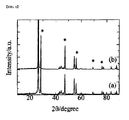
- In particular, the first graphite may be surface-modified graphite having a powder conductivity of 100 S/cm or greater to less than 1000 S/cm at a powder density of 1.4 to 1.6 g/cc and has 3R and 2H peaks distinguishable as a rhombohedral peak of a (101) plane at 2θ=43° based on XRD data.
- In addition, the second graphite has a powder conductivity of 10 S/cm or greater to less than 200 S/cm at a powder density of 1.4 to 1.6 g/cc and has a 2H peak as the rhombohedral peak of the (101) plane at 2θ=43° based on XRD data. The second graphite has the same powder conductivity as that of amorphous carbon and thus provides enhanced output characteristics to the lithium secondary battery. In addition, the second graphite has a similar internal structure to that of amorphous carbon, thus greatly extending battery lifespan.
- The amorphous carbon may be one selected from the group consisting of a first carbon having a specific surface area (with respect to capacity) of 0.01 to 0.031 and a second carbon having a specific surface area (with respect to capacity) of 0.0035 to 0.0170 or a mixture thereof. When the first carbon and the second carbon are used in combination, a weight ratio of the first carbon to the second carbon may be in the range of 1:9 to 9:1.
- In particular, the first carbon has a powder conductivity of 15 S/cm or greater to less than 100 S/cm at a powder density of 1.0 to 1.2 g/cc, and the second carbon has a powder conductivity of 30 S/cm or greater to less than 100 S/cm at a powder density of 1.4 to 1.6 g/cc.
- The amounts of the first cathode active material having a layered structure of Formula 1 and the second cathode active material having a spinel structure of Formula 2 may be in the range of 50 wt% to 90 wt% and in the range of 10 wt% to 50 wt%, respectively, based on the total weight of the first and second cathode active materials.
- In a specific embodiment of the present invention, the first cathode active material may be a layered-structure lithium transition metal oxide having an average particle diameter (with respect to capacity) of 0.03 to 0.1 µm/mAh and a powder conductivity of 1x10⁻³ S/cm or greater to less than 10x10-3 S/cm at a powder density of 2.65 to 2.85 g/cc.
- In a particular embodiment, the first cathode active material of Formula 1 may be a layered crystalline structure lithium transition metal oxide satisfying conditions that the oxide includes mixed transition metals of Ni and Mn, an average oxidation number of the total transition metals excluding lithium exceeds +3, and the amount of Ni is the same as that of Mn on a molar ratio basis.
- In addition, in another particular embodiment, the lithium transition metal oxide of Formula 1 may be Li(Ni0.5Mn0.3Co0.2)O2 or Li(Ni1/3Mn1/3Co1/3)O2.
- In Formula 1, the transition metal such as Ni, Mn, or Co may be substituted with a metal and/or other transition metal (M) elements having an oxidation number of +2 to +4. In particular, the transition metal may be substituted with at least one selected from the group consisting of Al, Mg, and Ti. In this case, a substitution amount may satisfy the condition: 0.3≤z≤0.6.
- In addition, in a specific embodiment of the present invention, the second cathode active material may be a spinel crystalline structure lithium transition metal oxide having an average particle diameter (with respect to capacity) of 0.1 to 0.2 µm/mAh and a powder conductivity of 1x10⁻⁵ S/cm or greater to less than 10x10-5 S/cm at a powder density of 2.65 to 2.85 g/cc.
- In Formula 2, M' may be at least one selected from the group consisting of Co, Mn, Ni, Al, Mg, and Ti.
- In addition, in Formulas 1 and 2, the oxygen ion may be substituted with a monovalent or divalent anion (A, A') within a predetermined range, wherein A and A' may be each independently at least one selected from the group consisting of halogens such as F, Cl, Br, and I, S, and N.
- Substitution of these anions enables high binding ability with the transition metals and structural transition of the compound is prevented, whereby the lithium secondary battery may have improved lifespan. On the other hand, when the substitution amounts of A and A' are too high (t > 2), the lifespan of the lithium secondary battery may rather be deteriorated due to unstable crystal structure.
- In the cathode active material of Formula 1 or 2, when O is substituted with a halogen or the transition metal such as Ni, Mn, or the like is substituted with another transition metal (M, M'), the corresponding compound may be added prior to high-temperature reaction.
- According to experimental results confirmed by the inventors of the present invention, the lithium secondary battery that includes the cathode and anode active materials having the aforementioned particular physical quantities exhibits high energy density characteristics. The physical quantities may be measured using measurement methods known in the art. In particular, the specific surface area may be measured by BET, the powder density may be measured using a true density measurement method, and the powder conductivity may be measured by measuring sheet resistance after forming a powder into a pellet.
- The high energy density lithium secondary battery including the cathode and anode active materials having the aforementioned particular physical quantities has a capacity with respect to volume of 0.05 to 0.09 Ah/cm3 and an energy with respect to volume of 0.2 to 0.4 Wh/cm3.
- The separator is disposed between the cathode and the anode and, as the separator, a thin insulating film with high ion permeability and high mechanical strength is used. The separator generally has a pore diameter of 0.01 to 10 µm and a thickness of 5 to 300 µm.
- As the separator, sheets or non-woven fabrics, made of an olefin polymer such as polypropylene; or glass fibers or polyethylene, which have chemical resistance and hydrophobicity, or kraft papers are used. Examples of commercially available separators include Celgard series such as CelgardR 2400 and 2300 (available from Hoechest Celanese Corp.), polypropylene separators (available from Ube Industries Ltd., or Pall RAI Co.) and polyethylene series (available from Tonen or Entek).
- In a specific embodiment of the present invention, the separator may be a polyolefin-based separator and an organic-inorganic composite separator including an inorganic material such as silicon. Prior patent applications of the present applicant disclose the fact that the organic-inorganic composite separator enables improved stability or the like of lithium secondary batteries.
- The present invention also provides a medium and large-scale battery module including the above-described high energy density lithium secondary battery as a unit battery and a medium and large-scale battery pack including the battery module.
- In addition, the present invention provides a device using the battery pack as a power source. In particular, the battery pack may be used as a power source of electric vehicles, hybrid electric vehicles, plug-in hybrid vehicles, or power storage devices.
- The configuration of the medium and large-scale battery module and battery pack and fabrication thereof are known in the art, and thus, a detailed description thereof will be omitted here.
- The cathode may be manufactured by coating, on a cathode current collector, a slurry prepared by mixing a cathode mixture including the cathode active material with a solvent such as NMP or the like and drying and rolling the coated cathode current collector.
- The cathode mixture may optionally include a conductive material, a binder, a filler, or the like, in addition to the cathode active material.
- The cathode current collector is generally fabricated to a thickness of 3 to 500 µm. The cathode current collector is not particularly limited so long as it does not cause chemical changes in the fabricated lithium secondary battery and has high conductivity. For example, the cathode current collector may be made of copper, stainless steel, aluminum, nickel, titanium, sintered carbon, copper or stainless steel surface-treated with carbon, nickel, titanium, silver, or the like, an aluminum-cadmium alloy, or the like. The cathode current collector may have fine irregularities at a surface thereof to increase adhesion between the cathode active material and the cathode current collector. In addition, the cathode current collector may be used in any of various forms including films, sheets, foils, nets, porous structures, foams, and non-woven fabrics.
- The conductive material is typically added in an amount of 1 to 30 wt% based on the total weight of the mixture including the cathode active material. There is no particular limit as to the conductive material, so long as it does not cause chemical changes in the fabricated battery and has conductivity. Examples of conductive materials include graphite such as natural or artificial graphite; carbon black such as carbon black, acetylene black, Ketjen black, channel black, furnace black, lamp black, and thermal black; conductive fibers such as carbon fibers and metallic fibers; metallic powders such as carbon fluoride powder, aluminum powder, and nickel powder; conductive whiskers such as zinc oxide and potassium titanate; conductive metal oxides such as titanium oxide; and polyphenylene derivatives.
- The binder is a component assisting in binding between the active material and the conductive material and in binding of the active material to the cathode current collector. The binder is typically added in an amount of 1 to 30 wt% based on the total weight of the mixture including the cathode active material. Examples of the binder include, but are not limtied to, polyvinylidene fluoride, polyvinyl alcohols, carboxymethylcellulose (CMC), starch, hydroxypropylcellulose, regenerated cellulose, polyvinyl pyrrolidone, tetrafluoroethylene, polyethylene, polypropylene, ethylenepropylene-diene terpolymer (EPDM), sulfonated EPDM, styrene-butadiene rubber, fluorine rubber, and various copolymers.
- The filler is optionally used as a component to inhibit cathode expansion. The filler is not particularly limited so long as it is a fibrous material that does not cause chemical changes in the fabricated battery. Examples of the filler include olefin-based polymers such as polyethylene and polypropylene; and fibrous materials such as glass fiber and carbon fiber.
- As a dispersion solution, isopropyl alcohol, N-methylpyrrolidone (NMP), acetone, or the like may be used.
- Uniform coating of an electrode material paste on a metallic material may be performed using a method selected from among known methods or a new appropriate method in consideration of properties of the electrode material. For example, the coating process may be performed by applying the paste to the cathode current collector and uniformly dispersing the paste thereon using a doctor blade. In some embodiments, the application and dispersion processes may be implemented as a single process. The coating process may be performed by, for example, die-casting, comma coating, screen-printing, or the like. In another embodiment, the paste may be molded on a separate substrate and then adhered to a current collector via pressing or lamination.
- The drying of the coated paste on a metallic plate may be performed in a vacuum oven at a temperature between 50 and 200°C for a period of one day.
- The anode may be manufactured by coating the anode active material on an anode current collector and drying the coated anode current collector. As desired, components such as the above-described conductive material, binder and filler may further be optionally added to the anode active material.
- The anode current collector is typically fabricated to a thickness of 3 to 500 µm. The anode current collector is not particularly limited so long as it does not cause chemical changes in the fabricated secondary battery and has conductivity. For example, the anode current collector may be made of copper, stainless steel, aluminum, nickel, titanium, sintered carbon, copper or stainless steel surface-treated with carbon, nickel, titanium, or silver, aluminum-cadmium alloys, or the like. As in the cathode current collector, the anode current collector may also have fine irregularities at a surface thereof to enhance adhesion between the anode current collector and the anode active material. In addition, the anode current collector may be used in various forms including films, sheets, foils, nets, porous structures, foams, and non-woven fabrics.
- A lithium salt-containing non-aqueous electrolyte is composed of a non-aqueous electrolyte and a lithium salt. As the non-aqueous electrolyte, a non-aqueous electrolytic solution, an organic solid electrolyte, or an inorganic solid electrolyte may be used.
- For example, the non-aqueous electrolytic solution may be an aprotic organic solvent such as N-methyl-2-pyrrolidone, propylene carbonate, ethylene carbonate, butylene carbonate, dimethyl carbonate, diethyl carbonate, ethyl methyl carbonate, gamma butyrolactone, 1,2-dimethoxy ethane, 1,2-diethoxy ethane, tetrahydrofuran, 2-methyl tetrahydrofuran, dimethylsulfoxide, 1,3-dioxolane, 4-methyl-1,3-dioxene, diethylether, formamide, dimethylformamide, dioxolane, acetonitrile, nitromethane, methyl formate, methyl acetate, phosphoric acid triester, trimethoxy methane, dioxolane derivatives, sulfolane, methyl sulfolane, 1,3-dimethyl-2-imidazolidinone, propylene carbonate derivatives, tetrahydrofuran derivatives, ether, methyl propionate, or ethyl propionate.
- Examples of the organic solid electrolyte include polyethylene derivatives, polyethylene oxide derivatives, polypropylene oxide derivatives, phosphoric acid ester polymers, poly agitation lysine, polyester sulfide, polyvinyl alcohols, polyvinylidene fluoride, and polymers containing ionic dissociation groups.
- Examples of the inorganic solid electrolyte include nitrides, halides and sulfates of lithium such as Li3N, LiI, Li5NI2, Li3N-LiI-LiOH, LiSiO4, LiSiO4-LiI-LiOH, Li2SiS3, Li4SiO4, Li4SiO4-LiI-LiOH, and Li3PO4-Li2S-SiS2.
- The lithium salt is a material that is readily soluble in the non-aqueous electrolyte and examples thereof include LiCl, LiBr, LiI, LiClO4, LiBF4, LiB10Cl10, LiPF6, LiCF3SO3, LiCF3CO2, LiAsF6, LiSbF6, LiAlCl4, CH3SO3Li, CF3SO3Li, LiSCN, LiC(CF3SO2)3, (CF3SO2)2NLi, chloroborane lithium, lower aliphatic carboxylic acid lithium, lithium tetraphenyl borate, and imide.
- In addition, in order to improve charge/discharge characteristics and flame retardancy, for example, pyridine, triethylphosphite, triethanolamine, cyclic ether, ethylenediamine, n-glyme, hexaphosphoric triamide, nitrobenzene derivatives, sulfur, quinone imine dyes, N-substituted oxazolidinone, N,N-substituted imidazolidine, ethylene glycol dialkyl ether, ammonium salts, pyrrole, 2-methoxy ethanol, aluminum trichloride, or the like may be added to the electrolyte. In some cases, in order to impart incombustibility, the electrolyte may further include a halogen-containing solvent such as carbon tetrachloride and ethylene trifluoride. In addition, in order to improve high-temperature storage characteristics, the electrolyte may further include carbon dioxide gas, fluoro-ethylene carbonate (FEC), propene sultone (PRS), fluoro-propylene carbonate (FPC), or the like.
- The above and other objects, features and other advantages of the present invention will be more clearly understood from the following detailed description taken in conjunction with the accompanying drawing, in which:
-
FIG. 1 is a graph showing X-ray diffraction (XRD) analysis results of surface-modified first graphite according to the present invention ((a): XRD analysis results of the first graphite prior to surface modification and (b): XRD analysis results of the first graphite after surface modification. - Now, the present invention will be described in more detail with reference to the following examples. These examples are provided only for illustration of the present invention and should not be construed as limiting the scope and spirit of the present invention.
- A cathode active material prepared by mixing LiNi1/3Co1/3Mn1/3O2 having an average particle diameter (with respect to capacity) of 0.05 µm/mAh and LiMn2O4 having an average particle diameter (with respect to capacity) of 0.14 µm/mAh in a mixing ratio of 70:30, a conductive material, and a binder were prepared in a weight ratio of 89:6.0:5.0 and then were added to NMP and mixed therein to prepare a cathode mixture. Subsequently, the cathode mixture was coated on an Al foil having a thickness of 20 µm and rolled and dried, thereby completing fabrication of a cathode.
- Similarly, an anode active material prepared by mixing carbon having a specific surface area (with respect to capacity) of 0.020 m2/mAh and graphite having a specific surface area (with respect to capacity) of 0.009 m2/mAh in a mixing ratio of 30:70, a conductive material, and a binder were prepared in a weight ratio of 96:1.5:2.5, added to a mixer, and mixed therein to prepare an anode mixture. Subsequently, the anode mixture was coated on a Cu foil having a thickness of 10 µm and rolled and dried, thereby completing fabrication of an anode.
- In this regard, LiNi1/3Co1/3Mn1/3O2 had a powder conductivity of 1.0x10⁻³ S/cm at a powder density of 2.75 g/cc, LiMn2O4 had a powder conductivity of 5x10⁻⁵ S/cm at a powder density of 2.80 g/cc, the carbon had a powder conductivity of 30 S/cm at a powder density of 1.1 g/cc, and the graphite had a powder conductivity of 250 S/cm at a powder density of 1.5 g/cc.
- The cathode, the anode, and a carbonate electrolytic solution containing 1M LiPF6 as an electrolyte were used to manufacture a battery.
- A battery was manufactured in the same manner as in Example 1, except that the mixing ratio of LiNi1/3Co1/3Mn1/3O2 to LiMn2O4 in the cathode active material was 80:20.
- A battery was manufactured in the same manner as in Example 1, except that the mixing ratio of carbon to graphite in the anode active material was 20:80.
- A battery was manufactured in the same manner as in Example 1, except that carbon having a specific surface area (with respect to capacity) of 0.012 m2/mAh was used instead of the carbon having a specific surface area (with respect to capacity) of 0.020 m2/mAh.
- A battery was manufactured in the same manner as in Example 3, except that the mixing ratio of LiNi1/3Co1/3Mn1/3O2 to LiMn2O4 in the cathode active material was 80:20.
- A battery was manufactured in the same manner as in Example 4, except that the mixing ratio of carbon to graphite in the anode active material was 20:80.
- A battery was manufactured in the same manner as in Example 1, except that the mixing ratio of LiNi1/3Co1/3Mn1/3O2 to LiMn2O4 was 30:70.
- A battery was manufactured in the same manner as in Example 1, except that the mixing ratio of carbon to graphite was 65:35.
- A battery was manufactured in the same manner as in Example 1, except that a mixture of LiNi1/3Co1/3Mn1/3O2 having an average particle diameter (with respect to capacity) of 0.12 µm/mAh and LiMn2O4 having an average particle diameter (with respect to capacity) of 0.23 µm/mAh was used as the cathode active material.
- A battery was manufactured in the same manner as in Example 1, except that a mixture of LiNi1/3Co1/3Mn1/3O2 having a powder conductivity of 9x10⁻⁴ S/cm at a powder density of 2.75 g/cc and LiMn2O4 having a powder conductivity of 5x10⁻⁶ S/cm at a powder density of 2.80 g/cc was used as the cathode active material.
- A battery was manufactured in the same manner as in Example 1, except that a mixture of carbon having a specific surface area (with respect to capacity) of 0.007 m2/mAh and graphite having a specific surface area (with respect to capacity) of 0.004 m2/mAh was used as the anode active material.
- A battery was manufactured in the same manner as in Example 1, except that a mixture of carbon having a powder conductivity of 10 S/cm at a powder density of 1.1 g/cc and graphite having a powder conductivity of 50 S/cm at a powder density of 1.5 g/cc was used as the anode active material.
- Energy per unit volume of each of the batteries manufactured according to Examples 1 to 6 and Comparative Examples 1 to 6 was measured and measurement results were compared. Charging and discharging were performed between 3.0 and 4.2 V, and charging was measured at a constant current and a constant voltage (CC/CV) and discharging was measured at CC. In the case of C-rates of the batteries, an energy of 3C was measured under the condition of 1C (13A).
<Table 1> Relative comparison between energies Vs. Example 1 (%) Example 1 100 Example 2 103.2 Example 3 104.8 Example 4 99.6 Example 5 102.8 Example 6 105.4 Comparative Example 1 89.5 Comparative Example 2 87.2 Comparative Example 3 94.9 Comparative Example 4 93.5 Comparative Example 5 93.3 Comparative Example 6 95.2 - From the results shown in Table 1 above, it can be confirmed that the batteries of Examples 1 to 6 have a higher energy density than the batteries of Comparative Examples 1 to 6.
- Although the preferred embodiments of the present invention have been disclosed for illustrative purposes, those skilled in the art will appreciate that various modifications, additions and substitutions are possible, without departing from the scope and spirit of the invention as disclosed in the accompanying claims.
- As described above, a lithium secondary battery according to the present invention uses, as an anode active material, a mixture of amorphous carbon having a higher energy density (300 mAh/g or greater) than conventional amorphous carbon and having a specific physical quantity and crystalline graphite that is used in a decreased loading amount and thus provides enhanced output characteristics in a predetermined mixing ratio and uses, as a cathode active material well balanced with the anode active material, a mixture of a layered-structure lithium transition metal oxide and a spinel-structure lithium manganese oxide in a predetermined ratio, whereby the lithium secondary battery achieves output characteristics well suited to electric vehicles, and the like and also exhibits enhanced energy density characteristics.
LiaMn2-bM'bO4-cA'c (2)
Claims (20)
- A high energy density lithium secondary battery comprising: a cathode comprising, as cathode active materials, a first cathode active material represented by Formula 1 below and having a layered structure and a second cathode active material represented by Formula 2 below and having a spinel structure, wherein an amount of the first cathode active material is between 40 and 100 wt% based on a total weight of the first and second cathode active materials; an anode comprising crystalline graphite and amorphous carbon as anode active materials, wherein an amount of the crystalline graphite is between 40 and 100 wt% based on a total weight of the anode active materials; and a separator:
Lix(NivMnwCoyMz)O2-tAt (1)
wherein 0.8 < x≤1.3, 0≤v≤0.9, 0≤w≤0.9, 0≤y≤0.9, 0≤z≤0.9, x+v+w+y+z=2, and 0≤t < 0.2;M refers to at least one metal or transition metal cation having an oxidation number of +2 to +4; andA is a monovalent or divalent anion,
LiaMn2-bM'bO4-cA'c (2)
wherein 0.8 < a≤1.3, 0≤b≤0.5, and 0≤c≤0.3;M' refers to at least one metal or transition metal cation having an oxidation number of +2 to +4; andA' is a monovalent or divalent anion. - The high energy density lithium secondary battery according to claim 1, wherein the crystalline graphite is one selected from the group consisting of a first graphite having a specific surface area with respect to capacity of 0.007 to 0.011 m2/mAh and a second graphite having a specific surface area with respect to capacity of 0.005 to 0.013 m2/mAh or a mixture thereof.
- The high energy density lithium secondary battery according to claim 2, wherein the first graphite has a powder conductivity of 100 S/cm or greater to less than 1000 S/cm at a powder density of 1.4 to 1.6 g/cc.
- The high energy density lithium secondary battery according to claim 3, wherein the first graphite is surface-modified graphite and has 3R and 2H peaks distinguishable as a rhombohedral peak of a (101) plane at 2θ=43° based on XRD data.
- The high energy density lithium secondary battery according to claim 2, wherein the second graphite has a powder conductivity of 10 S/cm or greater to less than 200 S/cm at a powder density of 1.4 to 1.6 g/cc.
- The high energy density lithium secondary battery according to claim 5, wherein the second graphite has a 2H peak as a rhombohedral peak of a (101) plane at 2θ=43° based on XRD data.
- The high energy density lithium secondary battery according to claim 1, wherein the amorphous carbon is one selected from the group consisting of a first carbon having a specific surface area with respect to capacity of 0.01 to 0.031 m2/mAh and a second carbon having a specific surface area with respect to capacity of 0.0035 to 0.0170 m2/mAh or a mixture thereof.
- The high energy density lithium secondary battery according to claim 7, wherein the first carbon has a powder conductivity of 15 S/cm or greater to less than 100 S/cm at a powder density of 1.0 to 1.2 g/cc.
- The high energy density lithium secondary battery according to claim 7, wherein the second carbon has a powder conductivity of 30 S/cm or greater to less than 100 S/cm at a powder density of 1.4 to 1.6 g/cc.
- The high energy density lithium secondary battery according to claim 1, wherein the first cathode active material has an average particle diameter with respect to capacity of 0.03 to 0.1 µm/mAh.
- The high energy density lithium secondary battery according to claim 10, wherein the first cathode active material has a powder conductivity of 1×10⁻³ S/cm or greater to less than 10x10-3 S/cm at a powder density of 2.65 to 2.85 g/cc.
- The high energy density lithium secondary battery according to claim 1, wherein the second cathode active material has an average particle diameter with respect to capacity of 0.1 to 0.2 µm/mAh.
- The high energy density lithium secondary battery according to claim 1, wherein the second cathode active material has a powder conductivity of 1x10⁻⁵ S/cm or greater to less than 10x10-5 S/cm at a powder density of 2.65 to 2.85 g/cc.
- The high energy density lithium secondary battery according to claim 1, wherein, in Formula 1, M is at least one selected from the group consisting of Al, Mg, and Ti and, in Formula 2, M' is at least one selected from the group consisting of Co, Mn, Ni, Al, Mg, and Ti.
- The high energy density lithium secondary battery according to claim 1, wherein, in Formulas 1 and 2, A and A' are each independently at least one selected from the group consisting of halogens, S, and N.
- The high energy density lithium secondary battery according to claim 1, wherein the lithium secondary battery has a capacity with respect to volume of 0.05 to 0.09 Ah/cm3 and an energy with respect to volume of 0.2 to 0.4 Wh/cm3.
- The high energy density lithium secondary battery according to claim 1, wherein the separator is an organic-inorganic composite separator.
- A battery module comprising the lithium secondary battery according to claim 1 as a unit battery.
- An electric vehicle or hybrid electric vehicle using the battery module according to claim 18 as a power source.
- A power storage device using the battery module according to claim 18 as a power source.
Applications Claiming Priority (2)
| Application Number | Priority Date | Filing Date | Title |
|---|---|---|---|
| KR20110048643 | 2011-05-23 | ||
| PCT/KR2012/003942 WO2012161476A2 (en) | 2011-05-23 | 2012-05-18 | High energy density lithium secondary battery having enhanced energy density characteristic |
Publications (3)
| Publication Number | Publication Date |
|---|---|
| EP2696409A2 true EP2696409A2 (en) | 2014-02-12 |
| EP2696409A4 EP2696409A4 (en) | 2014-10-22 |
| EP2696409B1 EP2696409B1 (en) | 2017-08-09 |
Family
ID=47217872
Family Applications (1)
| Application Number | Title | Priority Date | Filing Date |
|---|---|---|---|
| EP12790081.9A Active EP2696409B1 (en) | 2011-05-23 | 2012-05-18 | High energy density lithium secondary battery having enhanced energy density characteristic |
Country Status (6)
| Country | Link |
|---|---|
| US (1) | US9601756B2 (en) |
| EP (1) | EP2696409B1 (en) |
| JP (2) | JP2014517459A (en) |
| KR (1) | KR101336079B1 (en) |
| CN (1) | CN104011912B (en) |
| WO (1) | WO2012161476A2 (en) |
Cited By (1)
| Publication number | Priority date | Publication date | Assignee | Title |
|---|---|---|---|---|
| EP3780179A4 (en) * | 2018-08-31 | 2021-07-28 | Contemporary Amperex Technology Co., Limited | SECONDARY LITHIUM-ION BATTERY |
Families Citing this family (16)
| Publication number | Priority date | Publication date | Assignee | Title |
|---|---|---|---|---|
| KR101336674B1 (en) | 2011-05-23 | 2013-12-03 | 주식회사 엘지화학 | Lithium Secondary Battery of High Energy Density with Improved High Power Property |
| WO2012161479A2 (en) | 2011-05-23 | 2012-11-29 | 주식회사 엘지화학 | High output lithium secondary battery having enhanced output density characteristic |
| KR101336078B1 (en) | 2011-05-23 | 2013-12-03 | 주식회사 엘지화학 | Lithium Secondary Battery of High Power Property with Improved High Energy Density |
| EP2696409B1 (en) | 2011-05-23 | 2017-08-09 | LG Chem, Ltd. | High energy density lithium secondary battery having enhanced energy density characteristic |
| CN103548187B (en) * | 2011-05-23 | 2016-03-02 | 株式会社Lg化学 | High output lithium secondary battery with enhanced power density characteristics |
| JP2014517453A (en) | 2011-05-23 | 2014-07-17 | エルジー ケム. エルティーディ. | High power lithium secondary battery with improved power density characteristics |
| KR101336070B1 (en) | 2011-07-13 | 2013-12-03 | 주식회사 엘지화학 | Lithium Secondary Battery of High Energy with Improved energy Property |
| KR101558774B1 (en) * | 2013-05-23 | 2015-10-08 | 주식회사 엘지화학 | Lithium secondary battery comprising multilayered active materials |
| EP2897201B1 (en) | 2013-06-18 | 2019-05-15 | LG Chem, Ltd. | Manufacturing method of a cathode active material for a lithium secondary battery |
| WO2017013718A1 (en) * | 2015-07-17 | 2017-01-26 | 株式会社 東芝 | Non-aqueous electrolyte battery and battery pack |
| US10276856B2 (en) * | 2015-10-08 | 2019-04-30 | Nanotek Instruments, Inc. | Continuous process for producing electrodes and alkali metal batteries having ultra-high energy densities |
| US11127938B2 (en) * | 2018-02-06 | 2021-09-21 | Pacesetter, Inc. | Electrodes for batteries and methods for making same |
| CN108808068B (en) | 2018-05-10 | 2019-09-27 | 宁德时代新能源科技股份有限公司 | Secondary battery |
| CN110265622B (en) * | 2018-06-28 | 2020-12-08 | 宁德时代新能源科技股份有限公司 | Positive electrode and lithium ion secondary battery |
| WO2021059171A1 (en) * | 2019-09-24 | 2021-04-01 | Talga Technologies Limited | Anode material and method for producing same |
| KR102857425B1 (en) * | 2020-04-28 | 2025-09-08 | 삼성에스디아이 주식회사 | All-solid-state secondary battery |
Family Cites Families (112)
| Publication number | Priority date | Publication date | Assignee | Title |
|---|---|---|---|---|
| JPH0660880A (en) | 1992-08-05 | 1994-03-04 | Hitachi Maxell Ltd | Lithium secondary battery |
| JPH06333559A (en) * | 1993-03-26 | 1994-12-02 | Nikkiso Co Ltd | Non-aqueous lithium ion secondary battery |
| JPH08227714A (en) * | 1995-02-21 | 1996-09-03 | Mitsubishi Pencil Co Ltd | Carbon material for negative electrode of lithium ion secondary battery and method for producing the same |
| ID18173A (en) | 1996-05-09 | 1998-03-12 | Matsushita Electric Industrial Co Ltd | SECONDARY ELECTROLITE BATTERIES ARE NOT WATERED |
| JPH1012217A (en) * | 1996-06-26 | 1998-01-16 | Mitsubishi Pencil Co Ltd | Negative electrode for lithium ion secondary battery |
| JP3493962B2 (en) | 1996-08-22 | 2004-02-03 | 松下電器産業株式会社 | Lithium ion secondary battery |
| JPH1083818A (en) | 1996-09-06 | 1998-03-31 | Hitachi Ltd | Lithium secondary battery |
| JPH1097870A (en) | 1996-09-20 | 1998-04-14 | Fuji Elelctrochem Co Ltd | Lithium secondary battery |
| JPH10112318A (en) | 1996-10-08 | 1998-04-28 | Fuji Elelctrochem Co Ltd | Non-aqueous electrolyte secondary battery |
| JP3722318B2 (en) | 1996-12-12 | 2005-11-30 | 株式会社デンソー | Secondary battery electrode, manufacturing method thereof, and non-aqueous electrolyte secondary battery |
| JPH10241690A (en) | 1997-02-27 | 1998-09-11 | Toyota Central Res & Dev Lab Inc | Negative electrode for lithium secondary battery |
| JP3084256B2 (en) | 1997-07-03 | 2000-09-04 | 日本カーボン株式会社 | Material for negative electrode of Li-ion secondary battery |
| JPH1125982A (en) | 1997-07-04 | 1999-01-29 | Toyota Central Res & Dev Lab Inc | Anode materials for non-aqueous electrolyte batteries |
| JPH1131501A (en) | 1997-07-10 | 1999-02-02 | Matsushita Electric Ind Co Ltd | Method of manufacturing electrode for secondary battery, electrode for secondary battery, and secondary battery using the same |
| JP4379925B2 (en) * | 1998-04-21 | 2009-12-09 | 住友金属工業株式会社 | Graphite powder suitable for anode material of lithium ion secondary battery |
| US6482547B1 (en) | 1998-05-21 | 2002-11-19 | Samsung Display Devices Co., Ltd. | Negative active material for lithium secondary battery and lithium secondary battery using the same |
| JP2000012030A (en) | 1998-06-24 | 2000-01-14 | Shin Kobe Electric Mach Co Ltd | Non-aqueous electrolyte secondary battery |
| JP3120789B2 (en) * | 1998-08-27 | 2000-12-25 | 日本電気株式会社 | Non-aqueous electrolyte secondary battery |
| JP3152226B2 (en) | 1998-08-27 | 2001-04-03 | 日本電気株式会社 | Non-aqueous electrolyte secondary battery, method for producing the same, and carbon material composition |
| JP3869605B2 (en) | 1999-03-01 | 2007-01-17 | 三洋電機株式会社 | Nonaqueous electrolyte secondary battery |
| JP2000251892A (en) | 1999-03-02 | 2000-09-14 | Toyota Central Res & Dev Lab Inc | Positive active material for lithium secondary battery and lithium secondary battery using the same |
| US6083150A (en) | 1999-03-12 | 2000-07-04 | C. R. Bard, Inc. | Endoscopic multiple sample biopsy forceps |
| JP3088716B1 (en) | 1999-04-30 | 2000-09-18 | 同和鉱業株式会社 | Positive electrode active material and lithium secondary battery using the positive electrode active material |
| JP4497622B2 (en) | 2000-02-17 | 2010-07-07 | 株式会社Kri | Anode material for lithium secondary battery |
| JP3705728B2 (en) | 2000-02-29 | 2005-10-12 | 株式会社東芝 | Non-aqueous electrolyte secondary battery |
| FR2812119B1 (en) * | 2000-07-24 | 2002-12-13 | Commissariat Energie Atomique | CONDUCTIVE COMPOSITE MATERIAL AND ELECTRODE FOR FUEL CELL USING THE THERMO-COMPRESSED MATERIAL |
| JP2002117836A (en) | 2000-08-04 | 2002-04-19 | Matsushita Electric Ind Co Ltd | Negative electrode for nonaqueous electrolyte secondary battery and battery using it |
| JP4524881B2 (en) | 2000-08-14 | 2010-08-18 | ソニー株式会社 | Nonaqueous electrolyte secondary battery |
| JP4151210B2 (en) | 2000-08-30 | 2008-09-17 | ソニー株式会社 | Positive electrode active material and method for producing the same, non-aqueous electrolyte battery and method for producing the same |
| CA2320661A1 (en) | 2000-09-26 | 2002-03-26 | Hydro-Quebec | New process for synthesizing limpo4 materials with olivine structure |
| JP2002246023A (en) | 2001-02-20 | 2002-08-30 | Matsushita Electric Ind Co Ltd | Lithium secondary battery |
| JP2002270247A (en) * | 2001-03-14 | 2002-09-20 | Osaka Gas Co Ltd | Non-aqueous secondary battery |
| JP2002279987A (en) | 2001-03-15 | 2002-09-27 | Nikko Materials Co Ltd | Material of positive electrode for lithium secondary battery, and the lithium secondary battery using the material |
| JP2002289193A (en) * | 2001-03-27 | 2002-10-04 | Osaka Gas Co Ltd | Non-aqueous secondary battery |
| JP2003017060A (en) | 2001-04-25 | 2003-01-17 | Sony Corp | Cathode active material and non-aqueous electrolyte battery |
| JP2002358966A (en) | 2001-06-04 | 2002-12-13 | Hitachi Ltd | Lithium secondary battery positive plate and lithium secondary battery |
| JP2003031262A (en) * | 2001-07-10 | 2003-01-31 | Kansai Research Institute | Nonaqueous secondary battery |
| JP2003092108A (en) * | 2001-07-12 | 2003-03-28 | Mitsubishi Chemicals Corp | Positive electrode material for lithium secondary battery, positive electrode for lithium secondary battery, and lithium secondary battery |
| JP3979044B2 (en) | 2001-07-24 | 2007-09-19 | 新神戸電機株式会社 | Lithium secondary battery |
| US6878487B2 (en) * | 2001-09-05 | 2005-04-12 | Samsung Sdi, Co., Ltd. | Active material for battery and method of preparing same |
| JP2003176115A (en) | 2001-12-12 | 2003-06-24 | Adchemco Corp | Method of manufacturing graphite powder, graphite powder and lithium ion secondary battery |
| JP2003282139A (en) | 2002-03-26 | 2003-10-03 | Osaka Gas Co Ltd | Nonaqueous secondary battery |
| JP4085243B2 (en) | 2002-03-26 | 2008-05-14 | 大阪瓦斯株式会社 | Non-aqueous secondary battery |
| JP2003297338A (en) * | 2002-03-29 | 2003-10-17 | Japan Storage Battery Co Ltd | Positive electrode for non-aqueous electrolyte secondary battery and non-aqueous electrolyte secondary battery using the same |
| JP2004006094A (en) | 2002-05-31 | 2004-01-08 | Nec Corp | Nonaqueous electrolyte secondary battery |
| JP4183472B2 (en) * | 2002-10-10 | 2008-11-19 | 三洋電機株式会社 | Nonaqueous electrolyte secondary battery |
| JP2004259511A (en) | 2003-02-25 | 2004-09-16 | Shin Kobe Electric Mach Co Ltd | Lithium secondary battery |
| JP4424919B2 (en) * | 2003-03-25 | 2010-03-03 | 大阪瓦斯株式会社 | Non-aqueous secondary battery |
| JP4803486B2 (en) | 2003-05-15 | 2011-10-26 | 株式会社Gsユアサ | Non-aqueous electrolyte battery |
| KR100576221B1 (en) | 2003-05-15 | 2006-05-03 | 주식회사 엘지화학 | Anode active material for large capacity lithium secondary battery and large capacity lithium secondary battery comprising same |
| CN100438144C (en) | 2003-05-26 | 2008-11-26 | 日本电气株式会社 | Positive electrode active material for secondary battery, positive electrode for secondary battery, secondary battery and method for preparing positive electrode active material for secondary battery |
| TWI246212B (en) | 2003-06-25 | 2005-12-21 | Lg Chemical Ltd | Anode material for lithium secondary cell with high capacity |
| KR100560538B1 (en) | 2003-06-27 | 2006-03-15 | 삼성에스디아이 주식회사 | Anode Active Material for Lithium Ion Secondary Battery |
| JP5142452B2 (en) * | 2003-09-29 | 2013-02-13 | 三洋電機株式会社 | Non-aqueous electrolyte secondary battery charge / discharge control method |
| KR100548988B1 (en) * | 2003-11-26 | 2006-02-02 | 학교법인 한양학원 | Method for producing cathode active material for lithium secondary battery, reactor used in the method and cathode active material for lithium secondary battery manufactured by the method |
| JP5081375B2 (en) | 2004-02-12 | 2012-11-28 | 三菱化学株式会社 | Negative electrode material for lithium secondary battery, production method thereof, and negative electrode for lithium secondary battery and lithium secondary battery using the same |
| JP2005259617A (en) | 2004-03-15 | 2005-09-22 | Shin Kobe Electric Mach Co Ltd | Lithium ion secondary battery |
| JP2005285462A (en) | 2004-03-29 | 2005-10-13 | Sanyo Electric Co Ltd | Nonaqueous electrolyte secondary battery |
| JP2005285633A (en) | 2004-03-30 | 2005-10-13 | Osaka Gas Co Ltd | Non-aqueous secondary battery and charging method thereof |
| JP4748949B2 (en) | 2004-03-31 | 2011-08-17 | 三洋電機株式会社 | Nonaqueous electrolyte secondary battery |
| JP4841814B2 (en) | 2004-07-14 | 2011-12-21 | 株式会社Kri | Non-aqueous secondary battery |
| WO2006045339A2 (en) | 2004-10-21 | 2006-05-04 | Degussa Ag | Inorganic separator-electrode-unit for lithium-ion batteries, method for the production thereof and use thereof in lithium batteries |
| JP2006172778A (en) * | 2004-12-14 | 2006-06-29 | Hitachi Ltd | Energy storage device |
| JP2006236830A (en) | 2005-02-25 | 2006-09-07 | Ngk Insulators Ltd | Lithium secondary battery |
| JP5105393B2 (en) | 2005-03-02 | 2012-12-26 | 日立マクセルエナジー株式会社 | Nonaqueous electrolyte secondary battery |
| JP2006252895A (en) * | 2005-03-09 | 2006-09-21 | Sony Corp | battery |
| KR100660759B1 (en) * | 2005-03-11 | 2006-12-22 | 제일모직주식회사 | Cathode active material for non-aqueous electrolyte lithium secondary battery, manufacturing method thereof and lithium secondary battery comprising same |
| KR100674287B1 (en) | 2005-04-01 | 2007-01-24 | 에스케이 주식회사 | Anode active material for lithium secondary battery having a nuclear / shell multilayer structure, method for manufacturing the same and lithium secondary battery using same |
| JP4781004B2 (en) * | 2005-04-28 | 2011-09-28 | パナソニック株式会社 | Non-aqueous electrolyte secondary battery |
| KR101347671B1 (en) | 2005-06-07 | 2014-01-03 | 히다치 막셀 가부시키가이샤 | A secondary battery with nonaqueous electrolyte |
| CN102136574B (en) | 2005-08-16 | 2015-08-05 | 株式会社Lg化学 | Cathode active material and lithium secondary battery comprising same |
| KR100783293B1 (en) | 2005-08-16 | 2007-12-10 | 주식회사 엘지화학 | Positive electrode active material and lithium secondary battery containing the same |
| CN102931434B (en) | 2005-10-20 | 2015-09-16 | 三菱化学株式会社 | Lithium secondary battery and non-aqueous electrolyte used therein |
| JP5016814B2 (en) * | 2005-12-14 | 2012-09-05 | 株式会社日立製作所 | Non-aqueous secondary battery |
| JP5076316B2 (en) | 2005-12-27 | 2012-11-21 | ソニー株式会社 | Negative electrode for secondary battery and secondary battery |
| JP5309421B2 (en) | 2006-02-02 | 2013-10-09 | 日産自動車株式会社 | Lithium ion secondary battery |
| KR100801637B1 (en) * | 2006-05-29 | 2008-02-11 | 주식회사 엘지화학 | Positive electrode active material and lithium secondary battery containing the same |
| JP4989114B2 (en) | 2006-06-02 | 2012-08-01 | 日本カーボン株式会社 | Negative electrode and negative electrode active material for lithium secondary battery |
| JP2007335360A (en) * | 2006-06-19 | 2007-12-27 | Hitachi Ltd | Lithium secondary battery |
| JP2008010316A (en) | 2006-06-29 | 2008-01-17 | Sharp Corp | Lithium ion secondary battery |
| JP2008262768A (en) | 2007-04-11 | 2008-10-30 | Nec Tokin Corp | Lithium ion secondary battery |
| JP2009032682A (en) * | 2007-06-28 | 2009-02-12 | Hitachi Maxell Ltd | Lithium ion secondary battery |
| JP5205090B2 (en) | 2008-03-19 | 2013-06-05 | 日立ビークルエナジー株式会社 | Positive electrode for lithium secondary battery and lithium secondary battery using the same |
| US8119288B2 (en) | 2007-11-05 | 2012-02-21 | Nanotek Instruments, Inc. | Hybrid anode compositions for lithium ion batteries |
| JP5229472B2 (en) * | 2007-11-12 | 2013-07-03 | 戸田工業株式会社 | Lithium manganate particles for non-aqueous electrolyte secondary battery, method for producing the same, and non-aqueous electrolyte secondary battery |
| KR100999563B1 (en) * | 2008-01-14 | 2010-12-08 | 한양대학교 산학협력단 | Cathode active material for lithium secondary battery, preparation method thereof, and lithium secondary battery comprising same |
| JP5171283B2 (en) | 2008-01-22 | 2013-03-27 | 日立ビークルエナジー株式会社 | Non-aqueous electrolyte secondary battery |
| JP5430920B2 (en) * | 2008-03-17 | 2014-03-05 | 三洋電機株式会社 | Nonaqueous electrolyte secondary battery |
| JP5292885B2 (en) | 2008-03-27 | 2013-09-18 | 住友化学株式会社 | Positive electrode active material powder |
| US20110082024A1 (en) | 2008-06-10 | 2011-04-07 | Hansan Liu | Controllable Synthesis of Porous Carbon Spheres, and Electrochemical Applications Thereof |
| JP2010034024A (en) | 2008-06-25 | 2010-02-12 | Hitachi Maxell Ltd | Lithium-ion secondary battery |
| JP2010092845A (en) | 2008-09-10 | 2010-04-22 | Sumitomo Chemical Co Ltd | Non-aqueous electrolyte secondary cell |
| JP5231171B2 (en) | 2008-10-30 | 2013-07-10 | パナソニック株式会社 | Cathode active material for non-aqueous electrolyte secondary battery and method for producing the same |
| US20110053003A1 (en) | 2009-02-06 | 2011-03-03 | Masaki Deguchi | Lithium ion secondary battery and method for producing lithium ion secondary battery |
| JP5195499B2 (en) | 2009-02-17 | 2013-05-08 | ソニー株式会社 | Nonaqueous electrolyte secondary battery |
| KR101073619B1 (en) * | 2009-06-01 | 2011-10-14 | 재단법인 구미전자정보기술원 | Organic/inorganic composite separator for electrochemical cell and electrochemical cell including the same |
| CN102460778B (en) | 2009-06-05 | 2015-10-14 | 丰田自动车株式会社 | Lithium secondary battery |
| JP5574404B2 (en) | 2009-07-16 | 2014-08-20 | Necエナジーデバイス株式会社 | Lithium ion secondary battery |
| JP2011034675A (en) | 2009-07-29 | 2011-02-17 | Sony Corp | Cathode for secondary battery and secondary battery |
| JP5286200B2 (en) * | 2009-09-01 | 2013-09-11 | 日立ビークルエナジー株式会社 | Lithium ion secondary battery |
| WO2011027503A1 (en) * | 2009-09-01 | 2011-03-10 | 日立ビークルエナジー株式会社 | Nonaqueous electrolyte secondary battery |
| JP5084802B2 (en) | 2009-09-04 | 2012-11-28 | 株式会社日立製作所 | Lithium ion secondary battery |
| JP5495300B2 (en) | 2009-10-02 | 2014-05-21 | Necエナジーデバイス株式会社 | Lithium ion secondary battery |
| JP2011081960A (en) | 2009-10-05 | 2011-04-21 | Kri Inc | Nonaqueous secondary battery |
| CN102612495A (en) | 2009-11-20 | 2012-07-25 | 住友化学株式会社 | Transition-metal-containing hydroxide and lithium-containing metal oxide |
| KR101336078B1 (en) | 2011-05-23 | 2013-12-03 | 주식회사 엘지화학 | Lithium Secondary Battery of High Power Property with Improved High Energy Density |
| CN103548187B (en) | 2011-05-23 | 2016-03-02 | 株式会社Lg化学 | High output lithium secondary battery with enhanced power density characteristics |
| EP2696409B1 (en) | 2011-05-23 | 2017-08-09 | LG Chem, Ltd. | High energy density lithium secondary battery having enhanced energy density characteristic |
| WO2012161479A2 (en) | 2011-05-23 | 2012-11-29 | 주식회사 엘지화학 | High output lithium secondary battery having enhanced output density characteristic |
| KR101336674B1 (en) | 2011-05-23 | 2013-12-03 | 주식회사 엘지화학 | Lithium Secondary Battery of High Energy Density with Improved High Power Property |
| JP2014517453A (en) | 2011-05-23 | 2014-07-17 | エルジー ケム. エルティーディ. | High power lithium secondary battery with improved power density characteristics |
| KR101336070B1 (en) | 2011-07-13 | 2013-12-03 | 주식회사 엘지화학 | Lithium Secondary Battery of High Energy with Improved energy Property |
-
2012
- 2012-05-18 EP EP12790081.9A patent/EP2696409B1/en active Active
- 2012-05-18 JP JP2014510261A patent/JP2014517459A/en active Pending
- 2012-05-18 CN CN201280022734.9A patent/CN104011912B/en active Active
- 2012-05-18 KR KR1020120052973A patent/KR101336079B1/en active Active
- 2012-05-18 WO PCT/KR2012/003942 patent/WO2012161476A2/en not_active Ceased
-
2013
- 2013-11-22 US US14/087,394 patent/US9601756B2/en active Active
-
2016
- 2016-09-05 JP JP2016173167A patent/JP6402149B2/en active Active
Cited By (2)
| Publication number | Priority date | Publication date | Assignee | Title |
|---|---|---|---|---|
| EP3780179A4 (en) * | 2018-08-31 | 2021-07-28 | Contemporary Amperex Technology Co., Limited | SECONDARY LITHIUM-ION BATTERY |
| US11581579B2 (en) | 2018-08-31 | 2023-02-14 | Contemporary Amperex Technology Co., Limited | Lithium ion secondary battery |
Also Published As
| Publication number | Publication date |
|---|---|
| EP2696409A4 (en) | 2014-10-22 |
| CN104011912A (en) | 2014-08-27 |
| CN104011912B (en) | 2016-05-04 |
| WO2012161476A2 (en) | 2012-11-29 |
| KR101336079B1 (en) | 2013-12-03 |
| JP6402149B2 (en) | 2018-10-10 |
| WO2012161476A3 (en) | 2013-01-24 |
| JP2017022128A (en) | 2017-01-26 |
| KR20120130716A (en) | 2012-12-03 |
| US20140099551A1 (en) | 2014-04-10 |
| EP2696409B1 (en) | 2017-08-09 |
| JP2014517459A (en) | 2014-07-17 |
| US9601756B2 (en) | 2017-03-21 |
Similar Documents
| Publication | Publication Date | Title |
|---|---|---|
| EP2720302B1 (en) | High-energy lithium secondary battery having improved energy density characteristics | |
| EP2696409B1 (en) | High energy density lithium secondary battery having enhanced energy density characteristic | |
| EP2696408B1 (en) | High output lithium secondary battery having enhanced output density characteristic | |
| US9184447B2 (en) | Lithium secondary battery of high power property with improved high power density | |
| EP2685534B1 (en) | High-power lithium secondary battery having improved output density characteristics | |
| US9985278B2 (en) | Lithium secondary battery of high energy density with improved energy property | |
| EP2874227B1 (en) | Lithium secondary battery | |
| EP2879226A1 (en) | Electrolyte for lithium secondary battery and lithium secondary battery comprising same | |
| US9385372B2 (en) | Lithium secondary battery of high power property with improved high energy density | |
| EP2876722A1 (en) | Lithium secondary battery | |
| EP2874226B1 (en) | Lithium secondary battery |
Legal Events
| Date | Code | Title | Description |
|---|---|---|---|
| PUAI | Public reference made under article 153(3) epc to a published international application that has entered the european phase |
Free format text: ORIGINAL CODE: 0009012 |
|
| 17P | Request for examination filed |
Effective date: 20131104 |
|
| AK | Designated contracting states |
Kind code of ref document: A2 Designated state(s): AL AT BE BG CH CY CZ DE DK EE ES FI FR GB GR HR HU IE IS IT LI LT LU LV MC MK MT NL NO PL PT RO RS SE SI SK SM TR |
|
| RAP1 | Party data changed (applicant data changed or rights of an application transferred) |
Owner name: LG CHEM, LTD. |
|
| DAX | Request for extension of the european patent (deleted) | ||
| A4 | Supplementary search report drawn up and despatched |
Effective date: 20140924 |
|
| RIC1 | Information provided on ipc code assigned before grant |
Ipc: H01M 4/587 20100101ALI20140918BHEP Ipc: H01M 4/525 20100101AFI20140918BHEP Ipc: C01G 53/00 20060101ALI20140918BHEP Ipc: H01M 4/36 20060101ALI20140918BHEP Ipc: C01G 51/00 20060101ALI20140918BHEP Ipc: H01M 4/505 20100101ALI20140918BHEP Ipc: H01M 2/16 20060101ALI20140918BHEP Ipc: H01M 4/583 20100101ALI20140918BHEP Ipc: C01G 45/12 20060101ALI20140918BHEP Ipc: H01M 10/052 20100101ALI20140918BHEP |
|
| GRAP | Despatch of communication of intention to grant a patent |
Free format text: ORIGINAL CODE: EPIDOSNIGR1 |
|
| STAA | Information on the status of an ep patent application or granted ep patent |
Free format text: STATUS: GRANT OF PATENT IS INTENDED |
|
| INTG | Intention to grant announced |
Effective date: 20170504 |
|
| GRAS | Grant fee paid |
Free format text: ORIGINAL CODE: EPIDOSNIGR3 |
|
| GRAA | (expected) grant |
Free format text: ORIGINAL CODE: 0009210 |
|
| STAA | Information on the status of an ep patent application or granted ep patent |
Free format text: STATUS: THE PATENT HAS BEEN GRANTED |
|
| AK | Designated contracting states |
Kind code of ref document: B1 Designated state(s): AL AT BE BG CH CY CZ DE DK EE ES FI FR GB GR HR HU IE IS IT LI LT LU LV MC MK MT NL NO PL PT RO RS SE SI SK SM TR |
|
| REG | Reference to a national code |
Ref country code: GB Ref legal event code: FG4D |
|
| REG | Reference to a national code |
Ref country code: CH Ref legal event code: EP Ref country code: AT Ref legal event code: REF Ref document number: 917732 Country of ref document: AT Kind code of ref document: T Effective date: 20170815 |
|
| REG | Reference to a national code |
Ref country code: IE Ref legal event code: FG4D |
|
| REG | Reference to a national code |
Ref country code: DE Ref legal event code: R096 Ref document number: 602012035732 Country of ref document: DE |
|
| REG | Reference to a national code |
Ref country code: NL Ref legal event code: MP Effective date: 20170809 |
|
| REG | Reference to a national code |
Ref country code: LT Ref legal event code: MG4D |
|
| REG | Reference to a national code |
Ref country code: AT Ref legal event code: MK05 Ref document number: 917732 Country of ref document: AT Kind code of ref document: T Effective date: 20170809 |
|
| PG25 | Lapsed in a contracting state [announced via postgrant information from national office to epo] |
Ref country code: NL Free format text: LAPSE BECAUSE OF FAILURE TO SUBMIT A TRANSLATION OF THE DESCRIPTION OR TO PAY THE FEE WITHIN THE PRESCRIBED TIME-LIMIT Effective date: 20170809 Ref country code: HR Free format text: LAPSE BECAUSE OF FAILURE TO SUBMIT A TRANSLATION OF THE DESCRIPTION OR TO PAY THE FEE WITHIN THE PRESCRIBED TIME-LIMIT Effective date: 20170809 Ref country code: SE Free format text: LAPSE BECAUSE OF FAILURE TO SUBMIT A TRANSLATION OF THE DESCRIPTION OR TO PAY THE FEE WITHIN THE PRESCRIBED TIME-LIMIT Effective date: 20170809 Ref country code: AT Free format text: LAPSE BECAUSE OF FAILURE TO SUBMIT A TRANSLATION OF THE DESCRIPTION OR TO PAY THE FEE WITHIN THE PRESCRIBED TIME-LIMIT Effective date: 20170809 Ref country code: LT Free format text: LAPSE BECAUSE OF FAILURE TO SUBMIT A TRANSLATION OF THE DESCRIPTION OR TO PAY THE FEE WITHIN THE PRESCRIBED TIME-LIMIT Effective date: 20170809 Ref country code: NO Free format text: LAPSE BECAUSE OF FAILURE TO SUBMIT A TRANSLATION OF THE DESCRIPTION OR TO PAY THE FEE WITHIN THE PRESCRIBED TIME-LIMIT Effective date: 20171109 Ref country code: FI Free format text: LAPSE BECAUSE OF FAILURE TO SUBMIT A TRANSLATION OF THE DESCRIPTION OR TO PAY THE FEE WITHIN THE PRESCRIBED TIME-LIMIT Effective date: 20170809 |
|
| PG25 | Lapsed in a contracting state [announced via postgrant information from national office to epo] |
Ref country code: GR Free format text: LAPSE BECAUSE OF FAILURE TO SUBMIT A TRANSLATION OF THE DESCRIPTION OR TO PAY THE FEE WITHIN THE PRESCRIBED TIME-LIMIT Effective date: 20171110 Ref country code: RS Free format text: LAPSE BECAUSE OF FAILURE TO SUBMIT A TRANSLATION OF THE DESCRIPTION OR TO PAY THE FEE WITHIN THE PRESCRIBED TIME-LIMIT Effective date: 20170809 Ref country code: PL Free format text: LAPSE BECAUSE OF FAILURE TO SUBMIT A TRANSLATION OF THE DESCRIPTION OR TO PAY THE FEE WITHIN THE PRESCRIBED TIME-LIMIT Effective date: 20170809 Ref country code: LV Free format text: LAPSE BECAUSE OF FAILURE TO SUBMIT A TRANSLATION OF THE DESCRIPTION OR TO PAY THE FEE WITHIN THE PRESCRIBED TIME-LIMIT Effective date: 20170809 Ref country code: IS Free format text: LAPSE BECAUSE OF FAILURE TO SUBMIT A TRANSLATION OF THE DESCRIPTION OR TO PAY THE FEE WITHIN THE PRESCRIBED TIME-LIMIT Effective date: 20171209 Ref country code: ES Free format text: LAPSE BECAUSE OF FAILURE TO SUBMIT A TRANSLATION OF THE DESCRIPTION OR TO PAY THE FEE WITHIN THE PRESCRIBED TIME-LIMIT Effective date: 20170809 Ref country code: BG Free format text: LAPSE BECAUSE OF FAILURE TO SUBMIT A TRANSLATION OF THE DESCRIPTION OR TO PAY THE FEE WITHIN THE PRESCRIBED TIME-LIMIT Effective date: 20171109 |
|
| REG | Reference to a national code |
Ref country code: FR Ref legal event code: PLFP Year of fee payment: 7 |
|
| PG25 | Lapsed in a contracting state [announced via postgrant information from national office to epo] |
Ref country code: RO Free format text: LAPSE BECAUSE OF FAILURE TO SUBMIT A TRANSLATION OF THE DESCRIPTION OR TO PAY THE FEE WITHIN THE PRESCRIBED TIME-LIMIT Effective date: 20170809 Ref country code: CZ Free format text: LAPSE BECAUSE OF FAILURE TO SUBMIT A TRANSLATION OF THE DESCRIPTION OR TO PAY THE FEE WITHIN THE PRESCRIBED TIME-LIMIT Effective date: 20170809 Ref country code: DK Free format text: LAPSE BECAUSE OF FAILURE TO SUBMIT A TRANSLATION OF THE DESCRIPTION OR TO PAY THE FEE WITHIN THE PRESCRIBED TIME-LIMIT Effective date: 20170809 |
|
| REG | Reference to a national code |
Ref country code: DE Ref legal event code: R097 Ref document number: 602012035732 Country of ref document: DE |
|
| PG25 | Lapsed in a contracting state [announced via postgrant information from national office to epo] |
Ref country code: SK Free format text: LAPSE BECAUSE OF FAILURE TO SUBMIT A TRANSLATION OF THE DESCRIPTION OR TO PAY THE FEE WITHIN THE PRESCRIBED TIME-LIMIT Effective date: 20170809 Ref country code: EE Free format text: LAPSE BECAUSE OF FAILURE TO SUBMIT A TRANSLATION OF THE DESCRIPTION OR TO PAY THE FEE WITHIN THE PRESCRIBED TIME-LIMIT Effective date: 20170809 Ref country code: SM Free format text: LAPSE BECAUSE OF FAILURE TO SUBMIT A TRANSLATION OF THE DESCRIPTION OR TO PAY THE FEE WITHIN THE PRESCRIBED TIME-LIMIT Effective date: 20170809 Ref country code: IT Free format text: LAPSE BECAUSE OF FAILURE TO SUBMIT A TRANSLATION OF THE DESCRIPTION OR TO PAY THE FEE WITHIN THE PRESCRIBED TIME-LIMIT Effective date: 20170809 |
|
| PLBE | No opposition filed within time limit |
Free format text: ORIGINAL CODE: 0009261 |
|
| STAA | Information on the status of an ep patent application or granted ep patent |
Free format text: STATUS: NO OPPOSITION FILED WITHIN TIME LIMIT |
|
| 26N | No opposition filed |
Effective date: 20180511 |
|
| PG25 | Lapsed in a contracting state [announced via postgrant information from national office to epo] |
Ref country code: SI Free format text: LAPSE BECAUSE OF FAILURE TO SUBMIT A TRANSLATION OF THE DESCRIPTION OR TO PAY THE FEE WITHIN THE PRESCRIBED TIME-LIMIT Effective date: 20170809 |
|
| REG | Reference to a national code |
Ref country code: CH Ref legal event code: PL |
|
| REG | Reference to a national code |
Ref country code: BE Ref legal event code: MM Effective date: 20180531 |
|
| PG25 | Lapsed in a contracting state [announced via postgrant information from national office to epo] |
Ref country code: MC Free format text: LAPSE BECAUSE OF FAILURE TO SUBMIT A TRANSLATION OF THE DESCRIPTION OR TO PAY THE FEE WITHIN THE PRESCRIBED TIME-LIMIT Effective date: 20170809 |
|
| REG | Reference to a national code |
Ref country code: IE Ref legal event code: MM4A |
|
| PG25 | Lapsed in a contracting state [announced via postgrant information from national office to epo] |
Ref country code: CH Free format text: LAPSE BECAUSE OF NON-PAYMENT OF DUE FEES Effective date: 20180531 Ref country code: LI Free format text: LAPSE BECAUSE OF NON-PAYMENT OF DUE FEES Effective date: 20180531 |
|
| PG25 | Lapsed in a contracting state [announced via postgrant information from national office to epo] |
Ref country code: LU Free format text: LAPSE BECAUSE OF NON-PAYMENT OF DUE FEES Effective date: 20180518 |
|
| PG25 | Lapsed in a contracting state [announced via postgrant information from national office to epo] |
Ref country code: IE Free format text: LAPSE BECAUSE OF NON-PAYMENT OF DUE FEES Effective date: 20180518 |
|
| PG25 | Lapsed in a contracting state [announced via postgrant information from national office to epo] |
Ref country code: BE Free format text: LAPSE BECAUSE OF NON-PAYMENT OF DUE FEES Effective date: 20180531 |
|
| PG25 | Lapsed in a contracting state [announced via postgrant information from national office to epo] |
Ref country code: MT Free format text: LAPSE BECAUSE OF NON-PAYMENT OF DUE FEES Effective date: 20180518 |
|
| PG25 | Lapsed in a contracting state [announced via postgrant information from national office to epo] |
Ref country code: TR Free format text: LAPSE BECAUSE OF FAILURE TO SUBMIT A TRANSLATION OF THE DESCRIPTION OR TO PAY THE FEE WITHIN THE PRESCRIBED TIME-LIMIT Effective date: 20170809 |
|
| PG25 | Lapsed in a contracting state [announced via postgrant information from national office to epo] |
Ref country code: PT Free format text: LAPSE BECAUSE OF FAILURE TO SUBMIT A TRANSLATION OF THE DESCRIPTION OR TO PAY THE FEE WITHIN THE PRESCRIBED TIME-LIMIT Effective date: 20170809 Ref country code: HU Free format text: LAPSE BECAUSE OF FAILURE TO SUBMIT A TRANSLATION OF THE DESCRIPTION OR TO PAY THE FEE WITHIN THE PRESCRIBED TIME-LIMIT; INVALID AB INITIO Effective date: 20120518 |
|
| PG25 | Lapsed in a contracting state [announced via postgrant information from national office to epo] |
Ref country code: CY Free format text: LAPSE BECAUSE OF FAILURE TO SUBMIT A TRANSLATION OF THE DESCRIPTION OR TO PAY THE FEE WITHIN THE PRESCRIBED TIME-LIMIT Effective date: 20170809 Ref country code: MK Free format text: LAPSE BECAUSE OF NON-PAYMENT OF DUE FEES Effective date: 20170809 |
|
| PG25 | Lapsed in a contracting state [announced via postgrant information from national office to epo] |
Ref country code: AL Free format text: LAPSE BECAUSE OF FAILURE TO SUBMIT A TRANSLATION OF THE DESCRIPTION OR TO PAY THE FEE WITHIN THE PRESCRIBED TIME-LIMIT Effective date: 20170809 |
|
| REG | Reference to a national code |
Ref country code: DE Ref legal event code: R081 Ref document number: 602012035732 Country of ref document: DE Owner name: LG ENERGY SOLUTION LTD., KR Free format text: FORMER OWNER: LG CHEM, LTD., SEOUL, KR Ref country code: DE Ref legal event code: R081 Ref document number: 602012035732 Country of ref document: DE Owner name: LG ENERGY SOLUTION, LTD., KR Free format text: FORMER OWNER: LG CHEM, LTD., SEOUL, KR |
|
| P01 | Opt-out of the competence of the unified patent court (upc) registered |
Effective date: 20230512 |
|
| REG | Reference to a national code |
Ref country code: GB Ref legal event code: 732E Free format text: REGISTERED BETWEEN 20230824 AND 20230831 |
|
| REG | Reference to a national code |
Ref country code: DE Ref legal event code: R081 Ref document number: 602012035732 Country of ref document: DE Owner name: LG ENERGY SOLUTION, LTD., KR Free format text: FORMER OWNER: LG ENERGY SOLUTION LTD., SEOUL, KR |
|
| PGFP | Annual fee paid to national office [announced via postgrant information from national office to epo] |
Ref country code: DE Payment date: 20250422 Year of fee payment: 14 |
|
| PGFP | Annual fee paid to national office [announced via postgrant information from national office to epo] |
Ref country code: FR Payment date: 20250422 Year of fee payment: 14 |
|
| PGFP | Annual fee paid to national office [announced via postgrant information from national office to epo] |
Ref country code: GB Payment date: 20260324 Year of fee payment: 15 |