EP2664684A2 - Chromstahl mit hoher Härte und Korrosionsbeständigkeit sowie dessen Verwendung zum Beschichten metallischer Substrate - Google Patents
Chromstahl mit hoher Härte und Korrosionsbeständigkeit sowie dessen Verwendung zum Beschichten metallischer Substrate Download PDFInfo
- Publication number
- EP2664684A2 EP2664684A2 EP13167591.0A EP13167591A EP2664684A2 EP 2664684 A2 EP2664684 A2 EP 2664684A2 EP 13167591 A EP13167591 A EP 13167591A EP 2664684 A2 EP2664684 A2 EP 2664684A2
- Authority
- EP
- European Patent Office
- Prior art keywords
- weight
- chromium
- steel
- carbon
- manganese
- Prior art date
- Legal status (The legal status is an assumption and is not a legal conclusion. Google has not performed a legal analysis and makes no representation as to the accuracy of the status listed.)
- Granted
Links
Images

Classifications
-
- B—PERFORMING OPERATIONS; TRANSPORTING
- B23—MACHINE TOOLS; METAL-WORKING NOT OTHERWISE PROVIDED FOR
- B23K—SOLDERING OR UNSOLDERING; WELDING; CLADDING OR PLATING BY SOLDERING OR WELDING; CUTTING BY APPLYING HEAT LOCALLY, e.g. FLAME CUTTING; WORKING BY LASER BEAM
- B23K35/00—Rods, electrodes, materials, or media, for use in soldering, welding, or cutting
- B23K35/22—Rods, electrodes, materials, or media, for use in soldering, welding, or cutting characterised by the composition or nature of the material
- B23K35/24—Selection of soldering or welding materials proper
- B23K35/30—Selection of soldering or welding materials proper with the principal constituent melting at less than 1550°C
- B23K35/3053—Fe as the principal constituent
- B23K35/308—Fe as the principal constituent with Cr as next major constituent
-
- B—PERFORMING OPERATIONS; TRANSPORTING
- B23—MACHINE TOOLS; METAL-WORKING NOT OTHERWISE PROVIDED FOR
- B23K—SOLDERING OR UNSOLDERING; WELDING; CLADDING OR PLATING BY SOLDERING OR WELDING; CUTTING BY APPLYING HEAT LOCALLY, e.g. FLAME CUTTING; WORKING BY LASER BEAM
- B23K35/00—Rods, electrodes, materials, or media, for use in soldering, welding, or cutting
- B23K35/02—Rods, electrodes, materials, or media, for use in soldering, welding, or cutting characterised by mechanical features, e.g. shape
- B23K35/0255—Rods, electrodes, materials, or media, for use in soldering, welding, or cutting characterised by mechanical features, e.g. shape for use in welding
- B23K35/0261—Rods, electrodes or wires
-
- B—PERFORMING OPERATIONS; TRANSPORTING
- B32—LAYERED PRODUCTS
- B32B—LAYERED PRODUCTS, i.e. PRODUCTS BUILT-UP OF STRATA OF FLAT OR NON-FLAT, e.g. CELLULAR OR HONEYCOMB, FORM
- B32B15/00—Layered products comprising a layer of metal
- B32B15/01—Layered products comprising a layer of metal all layers being exclusively metallic
-
- C—CHEMISTRY; METALLURGY
- C22—METALLURGY; FERROUS OR NON-FERROUS ALLOYS; TREATMENT OF ALLOYS OR NON-FERROUS METALS
- C22C—ALLOYS
- C22C38/00—Ferrous alloys, e.g. steel alloys
- C22C38/001—Ferrous alloys, e.g. steel alloys containing N
-
- C—CHEMISTRY; METALLURGY
- C22—METALLURGY; FERROUS OR NON-FERROUS ALLOYS; TREATMENT OF ALLOYS OR NON-FERROUS METALS
- C22C—ALLOYS
- C22C38/00—Ferrous alloys, e.g. steel alloys
- C22C38/02—Ferrous alloys, e.g. steel alloys containing silicon
-
- C—CHEMISTRY; METALLURGY
- C22—METALLURGY; FERROUS OR NON-FERROUS ALLOYS; TREATMENT OF ALLOYS OR NON-FERROUS METALS
- C22C—ALLOYS
- C22C38/00—Ferrous alloys, e.g. steel alloys
- C22C38/04—Ferrous alloys, e.g. steel alloys containing manganese
-
- C—CHEMISTRY; METALLURGY
- C22—METALLURGY; FERROUS OR NON-FERROUS ALLOYS; TREATMENT OF ALLOYS OR NON-FERROUS METALS
- C22C—ALLOYS
- C22C38/00—Ferrous alloys, e.g. steel alloys
- C22C38/12—Ferrous alloys, e.g. steel alloys containing tungsten, tantalum, molybdenum, vanadium, or niobium
-
- C—CHEMISTRY; METALLURGY
- C22—METALLURGY; FERROUS OR NON-FERROUS ALLOYS; TREATMENT OF ALLOYS OR NON-FERROUS METALS
- C22C—ALLOYS
- C22C38/00—Ferrous alloys, e.g. steel alloys
- C22C38/16—Ferrous alloys, e.g. steel alloys containing copper
-
- C—CHEMISTRY; METALLURGY
- C22—METALLURGY; FERROUS OR NON-FERROUS ALLOYS; TREATMENT OF ALLOYS OR NON-FERROUS METALS
- C22C—ALLOYS
- C22C38/00—Ferrous alloys, e.g. steel alloys
- C22C38/18—Ferrous alloys, e.g. steel alloys containing chromium
-
- C—CHEMISTRY; METALLURGY
- C22—METALLURGY; FERROUS OR NON-FERROUS ALLOYS; TREATMENT OF ALLOYS OR NON-FERROUS METALS
- C22C—ALLOYS
- C22C38/00—Ferrous alloys, e.g. steel alloys
- C22C38/18—Ferrous alloys, e.g. steel alloys containing chromium
- C22C38/20—Ferrous alloys, e.g. steel alloys containing chromium with copper
-
- C—CHEMISTRY; METALLURGY
- C22—METALLURGY; FERROUS OR NON-FERROUS ALLOYS; TREATMENT OF ALLOYS OR NON-FERROUS METALS
- C22C—ALLOYS
- C22C38/00—Ferrous alloys, e.g. steel alloys
- C22C38/18—Ferrous alloys, e.g. steel alloys containing chromium
- C22C38/22—Ferrous alloys, e.g. steel alloys containing chromium with molybdenum or tungsten
-
- C—CHEMISTRY; METALLURGY
- C22—METALLURGY; FERROUS OR NON-FERROUS ALLOYS; TREATMENT OF ALLOYS OR NON-FERROUS METALS
- C22C—ALLOYS
- C22C38/00—Ferrous alloys, e.g. steel alloys
- C22C38/18—Ferrous alloys, e.g. steel alloys containing chromium
- C22C38/38—Ferrous alloys, e.g. steel alloys containing chromium with more than 1.5% by weight of manganese
-
- C—CHEMISTRY; METALLURGY
- C22—METALLURGY; FERROUS OR NON-FERROUS ALLOYS; TREATMENT OF ALLOYS OR NON-FERROUS METALS
- C22C—ALLOYS
- C22C38/00—Ferrous alloys, e.g. steel alloys
- C22C38/18—Ferrous alloys, e.g. steel alloys containing chromium
- C22C38/40—Ferrous alloys, e.g. steel alloys containing chromium with nickel
-
- C—CHEMISTRY; METALLURGY
- C22—METALLURGY; FERROUS OR NON-FERROUS ALLOYS; TREATMENT OF ALLOYS OR NON-FERROUS METALS
- C22C—ALLOYS
- C22C38/00—Ferrous alloys, e.g. steel alloys
- C22C38/18—Ferrous alloys, e.g. steel alloys containing chromium
- C22C38/40—Ferrous alloys, e.g. steel alloys containing chromium with nickel
- C22C38/42—Ferrous alloys, e.g. steel alloys containing chromium with nickel with copper
-
- C—CHEMISTRY; METALLURGY
- C22—METALLURGY; FERROUS OR NON-FERROUS ALLOYS; TREATMENT OF ALLOYS OR NON-FERROUS METALS
- C22C—ALLOYS
- C22C38/00—Ferrous alloys, e.g. steel alloys
- C22C38/18—Ferrous alloys, e.g. steel alloys containing chromium
- C22C38/40—Ferrous alloys, e.g. steel alloys containing chromium with nickel
- C22C38/44—Ferrous alloys, e.g. steel alloys containing chromium with nickel with molybdenum or tungsten
-
- C—CHEMISTRY; METALLURGY
- C22—METALLURGY; FERROUS OR NON-FERROUS ALLOYS; TREATMENT OF ALLOYS OR NON-FERROUS METALS
- C22C—ALLOYS
- C22C38/00—Ferrous alloys, e.g. steel alloys
- C22C38/18—Ferrous alloys, e.g. steel alloys containing chromium
- C22C38/40—Ferrous alloys, e.g. steel alloys containing chromium with nickel
- C22C38/48—Ferrous alloys, e.g. steel alloys containing chromium with nickel with niobium or tantalum
-
- C—CHEMISTRY; METALLURGY
- C22—METALLURGY; FERROUS OR NON-FERROUS ALLOYS; TREATMENT OF ALLOYS OR NON-FERROUS METALS
- C22C—ALLOYS
- C22C38/00—Ferrous alloys, e.g. steel alloys
- C22C38/18—Ferrous alloys, e.g. steel alloys containing chromium
- C22C38/40—Ferrous alloys, e.g. steel alloys containing chromium with nickel
- C22C38/54—Ferrous alloys, e.g. steel alloys containing chromium with nickel with boron
-
- C—CHEMISTRY; METALLURGY
- C22—METALLURGY; FERROUS OR NON-FERROUS ALLOYS; TREATMENT OF ALLOYS OR NON-FERROUS METALS
- C22C—ALLOYS
- C22C38/00—Ferrous alloys, e.g. steel alloys
- C22C38/18—Ferrous alloys, e.g. steel alloys containing chromium
- C22C38/40—Ferrous alloys, e.g. steel alloys containing chromium with nickel
- C22C38/58—Ferrous alloys, e.g. steel alloys containing chromium with nickel with more than 1.5% by weight of manganese
-
- C—CHEMISTRY; METALLURGY
- C23—COATING METALLIC MATERIAL; COATING MATERIAL WITH METALLIC MATERIAL; CHEMICAL SURFACE TREATMENT; DIFFUSION TREATMENT OF METALLIC MATERIAL; COATING BY VACUUM EVAPORATION, BY SPUTTERING, BY ION IMPLANTATION OR BY CHEMICAL VAPOUR DEPOSITION, IN GENERAL; INHIBITING CORROSION OF METALLIC MATERIAL OR INCRUSTATION IN GENERAL
- C23C—COATING METALLIC MATERIAL; COATING MATERIAL WITH METALLIC MATERIAL; SURFACE TREATMENT OF METALLIC MATERIAL BY DIFFUSION INTO THE SURFACE, BY CHEMICAL CONVERSION OR SUBSTITUTION; COATING BY VACUUM EVAPORATION, BY SPUTTERING, BY ION IMPLANTATION OR BY CHEMICAL VAPOUR DEPOSITION, IN GENERAL
- C23C4/00—Coating by spraying the coating material in the molten state, e.g. by flame, plasma or electric discharge
- C23C4/04—Coating by spraying the coating material in the molten state, e.g. by flame, plasma or electric discharge characterised by the coating material
- C23C4/06—Metallic material
-
- C—CHEMISTRY; METALLURGY
- C23—COATING METALLIC MATERIAL; COATING MATERIAL WITH METALLIC MATERIAL; CHEMICAL SURFACE TREATMENT; DIFFUSION TREATMENT OF METALLIC MATERIAL; COATING BY VACUUM EVAPORATION, BY SPUTTERING, BY ION IMPLANTATION OR BY CHEMICAL VAPOUR DEPOSITION, IN GENERAL; INHIBITING CORROSION OF METALLIC MATERIAL OR INCRUSTATION IN GENERAL
- C23C—COATING METALLIC MATERIAL; COATING MATERIAL WITH METALLIC MATERIAL; SURFACE TREATMENT OF METALLIC MATERIAL BY DIFFUSION INTO THE SURFACE, BY CHEMICAL CONVERSION OR SUBSTITUTION; COATING BY VACUUM EVAPORATION, BY SPUTTERING, BY ION IMPLANTATION OR BY CHEMICAL VAPOUR DEPOSITION, IN GENERAL
- C23C4/00—Coating by spraying the coating material in the molten state, e.g. by flame, plasma or electric discharge
- C23C4/04—Coating by spraying the coating material in the molten state, e.g. by flame, plasma or electric discharge characterised by the coating material
- C23C4/06—Metallic material
- C23C4/067—Metallic material containing free particles of non-metal elements, e.g. carbon, silicon, boron, phosphorus or arsenic
-
- C—CHEMISTRY; METALLURGY
- C23—COATING METALLIC MATERIAL; COATING MATERIAL WITH METALLIC MATERIAL; CHEMICAL SURFACE TREATMENT; DIFFUSION TREATMENT OF METALLIC MATERIAL; COATING BY VACUUM EVAPORATION, BY SPUTTERING, BY ION IMPLANTATION OR BY CHEMICAL VAPOUR DEPOSITION, IN GENERAL; INHIBITING CORROSION OF METALLIC MATERIAL OR INCRUSTATION IN GENERAL
- C23C—COATING METALLIC MATERIAL; COATING MATERIAL WITH METALLIC MATERIAL; SURFACE TREATMENT OF METALLIC MATERIAL BY DIFFUSION INTO THE SURFACE, BY CHEMICAL CONVERSION OR SUBSTITUTION; COATING BY VACUUM EVAPORATION, BY SPUTTERING, BY ION IMPLANTATION OR BY CHEMICAL VAPOUR DEPOSITION, IN GENERAL
- C23C4/00—Coating by spraying the coating material in the molten state, e.g. by flame, plasma or electric discharge
- C23C4/04—Coating by spraying the coating material in the molten state, e.g. by flame, plasma or electric discharge characterised by the coating material
- C23C4/06—Metallic material
- C23C4/08—Metallic material containing only metal elements
-
- C—CHEMISTRY; METALLURGY
- C23—COATING METALLIC MATERIAL; COATING MATERIAL WITH METALLIC MATERIAL; CHEMICAL SURFACE TREATMENT; DIFFUSION TREATMENT OF METALLIC MATERIAL; COATING BY VACUUM EVAPORATION, BY SPUTTERING, BY ION IMPLANTATION OR BY CHEMICAL VAPOUR DEPOSITION, IN GENERAL; INHIBITING CORROSION OF METALLIC MATERIAL OR INCRUSTATION IN GENERAL
- C23C—COATING METALLIC MATERIAL; COATING MATERIAL WITH METALLIC MATERIAL; SURFACE TREATMENT OF METALLIC MATERIAL BY DIFFUSION INTO THE SURFACE, BY CHEMICAL CONVERSION OR SUBSTITUTION; COATING BY VACUUM EVAPORATION, BY SPUTTERING, BY ION IMPLANTATION OR BY CHEMICAL VAPOUR DEPOSITION, IN GENERAL
- C23C4/00—Coating by spraying the coating material in the molten state, e.g. by flame, plasma or electric discharge
- C23C4/12—Coating by spraying the coating material in the molten state, e.g. by flame, plasma or electric discharge characterised by the method of spraying
-
- C—CHEMISTRY; METALLURGY
- C23—COATING METALLIC MATERIAL; COATING MATERIAL WITH METALLIC MATERIAL; CHEMICAL SURFACE TREATMENT; DIFFUSION TREATMENT OF METALLIC MATERIAL; COATING BY VACUUM EVAPORATION, BY SPUTTERING, BY ION IMPLANTATION OR BY CHEMICAL VAPOUR DEPOSITION, IN GENERAL; INHIBITING CORROSION OF METALLIC MATERIAL OR INCRUSTATION IN GENERAL
- C23C—COATING METALLIC MATERIAL; COATING MATERIAL WITH METALLIC MATERIAL; SURFACE TREATMENT OF METALLIC MATERIAL BY DIFFUSION INTO THE SURFACE, BY CHEMICAL CONVERSION OR SUBSTITUTION; COATING BY VACUUM EVAPORATION, BY SPUTTERING, BY ION IMPLANTATION OR BY CHEMICAL VAPOUR DEPOSITION, IN GENERAL
- C23C4/00—Coating by spraying the coating material in the molten state, e.g. by flame, plasma or electric discharge
- C23C4/12—Coating by spraying the coating material in the molten state, e.g. by flame, plasma or electric discharge characterised by the method of spraying
- C23C4/131—Wire arc spraying
-
- C—CHEMISTRY; METALLURGY
- C21—METALLURGY OF IRON
- C21D—MODIFYING THE PHYSICAL STRUCTURE OF FERROUS METALS; GENERAL DEVICES FOR HEAT TREATMENT OF FERROUS OR NON-FERROUS METALS OR ALLOYS; MAKING METAL MALLEABLE, e.g. BY DECARBURISATION OR TEMPERING
- C21D2211/00—Microstructure comprising significant phases
- C21D2211/004—Dispersions; Precipitations
-
- C—CHEMISTRY; METALLURGY
- C21—METALLURGY OF IRON
- C21D—MODIFYING THE PHYSICAL STRUCTURE OF FERROUS METALS; GENERAL DEVICES FOR HEAT TREATMENT OF FERROUS OR NON-FERROUS METALS OR ALLOYS; MAKING METAL MALLEABLE, e.g. BY DECARBURISATION OR TEMPERING
- C21D2211/00—Microstructure comprising significant phases
- C21D2211/008—Martensite
Definitions
- the invention relates to a chromium steel with high hardness and corrosion resistance and its use for coating metallic substrates.
- Chromium steels for thermal coating of metallic substrates are known in large numbers. This is how the German patent specification describes 10 2011 009 443 B3 a wire-shaped spray material consisting of 0.28 to 0.60 wt% carbon, 0.05 to 0.35 wt% chromium, 1 to 1.4 wt% manganese, 0.005 to 0.03 wt% nitrogen, 0.6 to 0.8 wt% silicon, to 0.03 wt% molybdenum, to 0.1 wt% nickel, 0.04 to 0.15 wt% copper, to 0.15 wt% vanadium , to 0.01 wt.% Sulfur, phosphorus and aluminum, balance iron.
- This steel is used to coat the raceways of cylinder crankcases, but lacks sufficient corrosion resistance because of its low chromium content.
- German patent 10 2010 021 300 B4 Another material for thermal coating describes the German patent 10 2010 021 300 B4 ; It consists of a niobium, titanium and boron-free steel with a very high carbon content of 0.7 to 1.2 wt.%, 0.01 to 2 wt.% Nitrogen, 0.01 to 1 wt.% Silicon, 0 , 8 to 2 wt.% Manganese, 12 to 20 wt.% Chromium, 0.4 to 1.3 wt.% Molybdenum, 0.01 to 1 wt.% Nickel, 0.01 to 0.4 wt.% Copper , 0.01 to 0.3% by weight of vanadium, 0.01 to 0.35% by weight of sulfur and 0.01 to 0.045% by weight of phosphorus, the remainder being iron.
- the European patent specification describes 1 022 351 B2 inter alia, a likewise applied by plasma spraying cylinder surface using a powder of 0.01 to 0.8 wt.% Carbon, 0.1 to 1.5 wt.% Manganese, 11 bis 18% by weight of chromium, 0.1 to 5% by weight of molybdenum, 0.01 to 0.2% by weight of sulfur and 0.01 to 0.1% by weight of phosphorus, the remainder being iron.
- this powder contains no other ingredients.
- the invention is directed to the problem of proposing a tribologically and functionally optimized coating material, which ensures in particular a martensitic transformation as far as possible.
- the solution to this problem consists in a chromium steel with high hardness and corrosion resistance, consisting of 0.1 to 0.3 wt.% Carbon, 0.01 to 0.1 wt.% Nitrogen, 0.01 to 1 wt.% Silicon, 0.01 to 2% by weight manganese, 11 to 16% by weight chromium, 0.1 to 2% by weight molybdenum, 0.01 to 0.5% by weight nickel, 0.01 to 0.4% by weight Copper, 0.01 to 0.1% by weight of niobium, to 0.1% by weight of titanium, to 0.1% by weight of vanadium, to 0.02% by weight of sulfur, 0 to 0.02% by weight of phosphorus, and up to 0.02% by weight of boron, the remainder being iron, including impurities caused by melting.
- This steel preferably contains 0.15 to 0.28% by weight of carbon, 0.3 to 1.5% by weight of manganese, up to 14% by weight of chromium, to 1.5% by weight of molybdenum, to 0.35% by weight.
- the steel contains up to 13% by weight of chromium.
- the steel contains 0.1 or more weight percent molybdenum.
- the steel according to the invention is particularly suitable for producing a wear coating with a martensitic structure and a hardness of at least 450 HVI by thermal coating of metallic substrates, in particular for coating Lagerlauf- and sliding surfaces, cylinder surfaces, piston rings, gears and gears.
- the carbon promotes the formation of austenite and reacts with chromium, titanium, vanadium and niobium to form carbides, thereby increasing the hardness, but reducing the corrosion resistance in connection with the chromium.
- a carbon content above 0.3 wt.% In an arc or plasma deposition smelting process, the stabilization of austenite increases, preventing the formation of martensite in the rapid cooling of a relatively thin wear layer. For this reason, this limit of 0.3 wt.% Carbon should not be exceeded.
- a lower limit of the carbon of 0.1 wt.% Is required, for example, to achieve a good oil wettability.
- Silicon stabilizes the ferrite and simultaneously acts as a deoxidizer, it also binds oxygen. For this, a minimum content of 0.1% by weight is required in the simultaneous presence of niobium and titanium. Since silicon tends to form intermetallic phases with other elements, an upper limit of 1% by weight should not be exceeded.
- Manganese is present at a level of 0.01 to 2% by weight. Together with carbon, nitrogen and nickel, it stabilizes the austenitic structure, which means that the upper limit of 2% by weight must not be exceeded.
- the synergistic effect of manganese is characterized by the formula relationship (1). Since an effect of manganese below 0.01 wt.% Is undetectable, this value is considered as the lower content limit.
- Chrome improves corrosion resistance.
- a minimum content of 11% by weight is required for a sufficient effect in the case of molten alloys which have necessarily cooled rapidly from the melt.
- Chromium forms carbides with carbon, which causes depletion of dissolved chromium in their environment, which locally reduces corrosion resistance.
- the invention therefore envisages setting the synergistic ratio of carbon to chromium through the range of values (6.2 to 27) x 10 -3 of formula (3) to very low values.
- the upper limit may not exceed 16% by weight.
- an upper limit of 14% by weight, more preferably 13% by weight is chosen to reduce the risk of blending and leaving the martensite area.
- Molybdenum in combination with chrome improves corrosion resistance. Contents above 2 wt.%, However, change the cooling behavior, which is not beneficial. Since molybdenum contents below 0.01% by weight show no effect, lower limit values are unnecessary.
- Nickel extends the gamma region and stabilizes austenite, which reduces the hardness and wear resistance of thermally applied layers. Therefore, the nickel content of 0.5 wt.% May not exceed.
- the lower limit may be 0.01% by weight, since lower contents are practically ineffective. Due to the synergetic effect with the elements carbon, nitrogen and manganese, the adherence to the formula 1 relationship is advantageous.
- Nitrogen reacts with chromium, titanium, vanadium and niobium to form nitrides. However, due to the simultaneous presence of carbon, carbonitrides form, which cause favorable oil wetting and are low in low concentration for the formation of tribological layers. Since nitrogen can be absorbed during thermal coating from the protective gas, an upper limit of 0.1% by weight in the coating material (wire, powder) need not be exceeded.
- Vanadium, titanium and niobium are strong carbide and nucleating agents as well as germs for martensite formation. They form nitrides with nitrogen and, in the presence of carbon, nitrogen and oxygen, also oxycarbonitrides, which are advantageous for oil wetting. However, the concentration of the sum of these elements in the coating material should not exceed the upper limit of 0.1% by weight. For the setting of nitrogen and for nucleation, a total or individual content of 0.01% by weight is sufficient, for example 0.01% by weight of niobium or 0.01% by weight (niobium + titanium + vanadium).
- the experimental alloys of Table 1 were melted in a medium frequency oven under inert gas, poured into elongated molds and annealed at 820 ° C for 6 hours. After cooling to room temperature, the cast skin was roughly ground and the obtained blanks were ground mechanically to thin rods using corundum abrasive discs. These rods formed the test material for thermal plasma spray coatings (samples E1 to E4 and V1 to V3).
- the coating was carried out in such a way that the test wires or the thin rods were introduced directly into a plasma jet generated by electric current in a PTWA system (PTWA: Plasma Transferred Arc Wire). Under the simultaneous action of an atomizing and transporting gas, the test steel molten in the plasma jet was accelerated in finely divided form at high speed and high kinetic energy onto the surface of square steel samples (substrate: fine grain C-steel) of size 20 ⁇ 20 ⁇ 10 mm thick, wherein the substrate received an approximately 200 ⁇ m thick coating.
- PTWA Plasma Transferred Arc Wire
- the coated test specimens (1) were clamped in a grinding wheel tester (cf. Fig.1 ).
- the contact pressure of the samples was kept constant in all experiments with a 2 kg weight (3) and the number of revolutions of the grinding wheel was set to 20 rpm. Since the fretting also depends on the temperature, this influence was eliminated by setting the friction wheel (4) and the sample (1) under water.
- Al2O3 (corundum) powder was added to the water to increase the abrasion wear and to achieve practicable trial times.
- the wings attached laterally on the grinding wheel had the task of whirling up the sedimentation-prone Al2O3.
- V is a number greater than 1 if the coated sample has a higher wear resistance, ie a smaller material loss (M b ⁇ M u ). If, on the other hand, the layer is worse in its abrasion resistance than an uncoated sample (eg because the layer is too soft), V assumes a numerical value ⁇ 1.
- the porosity of the coating was determined by measuring the maximum pore size under the microscope. For this, a measurement field of 200 ⁇ 200 ⁇ m was used and the maximum pore size occurring in this measurement field was used as a measure of the porosity.
- microhardness HV 0.2 was determined by measuring under the microscope. The results are shown in Table 3.
- the layer shows a high porosity with pores of a maximum size of 16 ⁇ m, whereby the microhardness HV 0.2 was no longer determinable (Table 3).
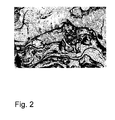
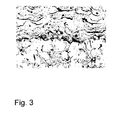
- Fig. 2 and Fig. 3 show the microstructure of samples E4 and V3.
Landscapes
- Chemical & Material Sciences (AREA)
- Engineering & Computer Science (AREA)
- Mechanical Engineering (AREA)
- Materials Engineering (AREA)
- Metallurgy (AREA)
- Organic Chemistry (AREA)
- Physics & Mathematics (AREA)
- Plasma & Fusion (AREA)
- Chemical Kinetics & Catalysis (AREA)
- Coating By Spraying Or Casting (AREA)
- Heat Treatment Of Steel (AREA)
- Laminated Bodies (AREA)
Abstract
Description
- Die Erfindung betrifft einen Chromstahl mit hoher Härte und Korrosionsbeständigkeit sowie dessen Verwendung zum Beschichten metallischer Substrate.
- Chromstähle zum thermischen Beschichten metallischer Substrate sind in großer Zahl bekannt. So beschreibt die deutsche Patentschrift
10 2011 009 443 B3 einen drahtförmigen Spritzwerkstoff, der aus 0,28 bis 0,60 Gew.% Kohlenstoff, 0,05 bis 0,35 Gew.% Chrom, 1 bis 1,4 Gew.% Mangan, 0,005 bis 0,03 Gew.% Stickstoff, 0,6 bis 0,8 Gew.% Silizium, bis 0,03 Gew.% Molybdän, bis 0,1 Gew.% Nickel, 0,04 bis 0,15 Gew.% Kupfer, bis 0,15 Gew.% Vanadium, bis 0,01 Gew.% Schwefel, Phosphor und Aluminium, Rest Eisen besteht. Dieser Stahl dient zum Beschichten der Laufbahnen von Zylinderkurbelgehäusen, es fehlt ihm jedoch wegen seines geringen Chromgehalts an einer ausreichenden Korrosionsbeständigkeit. - Einen weiteren Werkstoff zum thermischen Beschichten beschreibt die deutsche Patentschrift
10 2010 021 300 B4 ; er besteht aus einem niob-, titan- und borfreien Stahl mit einem sehr hohen Kohlenstoffgehalt von 0,7 bis 1,2 Gew.%, 0,01 bis 2 Gew.% Stickstoff, 0,01 bis 1 Gew.% Silizium, 0,8 bis 2 Gew.% Mangan, 12 bis 20 Gew.% Chrom, 0,4 bis 1,3 Gew.% Molybdän, 0,01 bis 1 Gew.% Nickel, 0,01 bis 0,4 Gew.% Kupfer, 0,01 bis 0,3 Gew.% Vanadium, 0,01 bis 0,35 Gew.% Schwefel und 0,01 0,045 Gew.% Phosphor, Rest Eisen. - Bei diesem Stahl besteht jedoch infolge des hohen Kohlenstoffgehalts die Gefahr, dass es zum Entstehen von stabilen Chromkarbiden und demgemäß zu einer Chromverarmung kommt, die zwangsläufig mit einer Beeinträchtigung der Korrosionsbeständigkeit verbunden ist. Des Weiteren führt der hohe Kohlenstoffgehalt des Stahls zu einer Stabilisierung des Austenitanteils im Gefüge der Beschichtung, der die Verschleißbeständigkeit und die Härte der Beschichtung erheblich beeinträchtigt und keine möglichst vollständige Umwandlung des Austenits in Martensit erlaubt. Das Verfahren ist daher lediglich auf eine überwiegend martensitische Schicht gerichtet.
- Des Weiteren ist aus der deutschen Patentschrift
195 39 640 C1 eine Zylinderlaufbuchse mit einer durch atmosphärisches Plasmaspritzen aufgebrachten Nickel-Chrom-Schutzschicht mit 60 bis 90 Gew.% Nickel und 5 bis 20 Gew.% Chrom bekannt, die zudem 2 bis 10 Gew.% Aluminium und 1 Gew.% Yttrium enthalten kann und darauf abzielt, kühlmittelbedingte Kavitations- und Korrosionsschäden zu vermeiden. - Schließlich beschreibt die europäische Patentschrift
1 022 351 B2 unter anderem eine ebenfalls durch Plasmaspritzen aufgebrachte Zylinderlauffläche unter Verwendung eines Pulvers aus 0,01 bis 0,8 Gew.% Kohlenstoff, 0,1 bis 1,5 Gew.% Mangan, 11 bis 18 Gew.% Chrom, 0,1 bis 5 Gew.% Molybdän, 0,01 bis 0,2 Gew.% Schwefel und 0,01 bis 0,1 Gew.% Phosphor, Rest Eisen. Dieses Pulver enthält jedoch keine weiteren Bestandteile. - Da sich keiner der bekannten Beschichtungen hinsichtlich der angestrebten Gefügeausbildung vollauf bewährt hat, ist die Erfindung auf das Problem gerichtet, einen tribologisch und funktional optimierten Beschichtungswerkstoff vorzuschlagen, der insbesondere eine weitestgehende Martensitumwandlung gewährleistet.
- Die Lösung dieses Problem besteht in einem Chromstahl mit hoher Härte und Korrosionsbeständigkeit, bestehend aus 0,1 bis 0,3 Gew.% Kohlenstoff, 0,01 bis 0,1 Gew.% Stickstoff, 0,01 bis 1 Gew.% Silizium, 0,01 bis 2 Gew.% Mangan, 11 bis 16 Gew.% Chrom, 0,1 bis 2 Gew.% Molybdän, 0,01 bis 0,5 Gew.% Nickel, 0,01 bis 0,4 Gew.% Kupfer, 0,01 bis 0,1 Gew.% Niob, bis 0,1 Gew.% Titan, bis 0,1 Gew.% Vanadium, bis 0,02 Gew.% Schwefel, 0bis 0,02 Gew.% Phosphor, und bis 0,02 Gew.% Bor, Rest Eisen einschließlich erschmelzungsbedingter Verunreinigungen. Dieser Stahl enthält vorzugsweise 0,15 bis 0,28 Gew.% Kohlenstoff, 0,3 bis 1,5 Gew.% Mangan, bis 14 Gew.% Chrom, bis 1,5 Gew.% Molybdän, bis 0,35 Gew.% Nickel, mindestens 0,01 Gew.% Titan und mindestens 0,001 Gew.% Bor einzeln oder nebeneinander. Insbesondere bevorzugt enthält der Stahl bis 13 Gew.% Chrom. Insbesondere bevorzugt enthält der Stahl 0,1 oder mehr Gew.% Molybdän.
- Des Weiteren sollte der Stahl der Bedingung

und/oder
genügen. Dabei können die Gehalte an Kohlenstoff und Chrom wie folgt eingestellt sein
- In einer bevorzugten Ausführungsform genügt der Stahl der Bedingung

und/oder
- In einer bevorzugten Ausführungsform genügt der Stahl der Bedingung

und/oder
- Der erfindungsgemäße Stahl eignet sich vor allem zum Herstellen einer Verschleißbeschichtung mit martensitischem Gefüge und einer Härte von mindestens 450 HVI durch thermisches Beschichten metallischer Substrate, insbesondere zum Beschichten von Lagerlauf- und Gleitflächen, Zylinderlaufflächen, Kolbenringen, Zahnrädern und Getrieben.
- Was die einzelnen Bestandteile des erfindungsgemäßen Stahls anbetrifft, fördert der Kohlenstoff die Bildung von Austenit und reagiert mit Chrom, Titan, Vanadium und Niob unter Bildung von Karbiden, wodurch die Härte gesteigert, in Verbindung mit dem Chrom jedoch die Korrosionsbeständigkeit herabgesetzt wird. Da jedoch bei einem Kohlenstoffgehalt oberhalb von 0,3 Gew.% bei einem Auftragsschmelzen im Lichtbogen oder im Plasma die Stabilisierung des Austenits verstärkt einsetzt, verhindert dies die Bildung von Martensit beim raschen Abkühlen einer verhältnismäßig dünnen Verschleißschicht. Aus diesem Grund soll dieser Grenzwert von 0,3 Gew.% Kohlenstoff nicht überschritten werden. Für das Entstehen von Feinstausscheidungen mit Titan und/oder Niob und/oder Vanadium ist hingegen ein unterer Grenzwert des Kohlenstoffs von 0,1 Gew.% erforderlich, um beispielsweise eine gute Ölbenetzbarkeit zu erreichen.
- Silizium stabilisiert den Ferrit und wirkt gleichzeitig als Desoxidationsmittel, es bindet auch Sauerstoff. Dafür ist bei gleichzeitiger Anwesenheit von Niob und Titan ein Mindestgehalt von 0,1 Gew.% erforderlich. Da Silizium mit anderen Elementen zur Bildung von intermetallischen Phasen neigt, soll ein oberer Grenzwert von 1 Gew.% nicht überschritten werden.
- Mangan ist mit einem Gehalt von 0,01 bis 2 Gew.% vertreten. Gemeinsam mit Kohlenstoff, Stickstoff und Nickel stabilisiert es das Austenitgefüge, weshalb der obere Grenzwert von 2 Gew.% nicht überschritten werden darf. Die synergetische Wirkung von Mangan kennzeichnet die Formelbeziehung (1). Da eine Wirkung von Mangan unterhalb von 0,01 Gew.% nicht nachweisbar ist, gilt dieser Wert als untere Gehaltsgrenze.
- Chrom verbessert die Korrosionsbeständigkeit. Für eine ausreichende Wirkung bei zwangsläufig rasch aus der Schmelze abgekühlten Aufschmelzlegierungen ist ein Mindestgehalt von 11 Gew.% erforderlich. Mit dem Kohlenstoff bildet Chrom Karbide, wodurch es in deren Umgebung zu einer Verarmung an gelöstem Chrom kommt, was die Korrosionsbeständigkeit lokal vermindert. Die Erfindung sieht deshalb vor, das synergetische Verhältnis von Kohlenstoff zu Chrom durch den Wertebereich (6,2 bis 27)x 10-3 der Formelbeziehung (3) auf sehr niedrige Werte festzulegen. Da Chrom jedoch ein ferritisches und damit weiches Gefüge fördert, darf der obere Grenzwert 16 Gew.% nicht übersteigen. In einer bevorzugten Ausführungsform wird ein oberer Grenzwert von 14 Gew.%, insbesondere bevorzugt 13 Gew.% gewählt, um das Risiko der Bildung von Mischgefügen und des Verlassens des Martensitgebiets zu reduzieren.
- Molybdän verbessert in Kombination mit Chrom die Korrosionsbeständigkeit. Gehalte über 2 Gew.% verändern jedoch das Abkühlungsverhalten, was nicht von Vorteil ist. Da Molybdängehalte unterhalb von 0,01 Gew.% keine Wirkung zeigen, erübrigen sich niedrigere Grenzwerte.
- Nickel erweitert das Gamma-Gebiet und stabilisiert den Austenit, was bei thermisch aufgetragenen Schichten deren Härte und Verschleißfestigkeit herabsetzt. Daher darf der Nickelgehalt von 0,5 Gew.% nicht übersteigen. Der untere Grenzwert kann hingegen bei 0,01 Gew.% liegen, da geringere Gehalte praktisch wirkungslos sind. Wegen der synergetischen Wirkung mit den Elementen Kohlenstoff, Stickstoff und Mangan ist die Einhaltung der Formelbeziehung 1 von Vorteil.
- Stickstoff reagiert mit Chrom, Titan, Vanadium und Niob unter Bildung von Nitriden. Wegen der gleichzeitigen Anwesenheit von Kohlenstoff bilden sich jedoch Karbonitride, die eine günstige Ölbenetzung bewirken und in geringer Konzentration für das Entstehen tribologischer Schichten günstig sind. Da Stickstoff beim thermischen Beschichten aus dem Schutzgas aufgenommen werden kann, braucht ein oberer Grenzwert von 0,1 Gew.% im Beschichtungswerkstoff (Draht, Pulver) nicht überschritten zu werden.
- Vanadium, Titan und Niob sind starke Karbid- und Keimbildner sowie als Keime für die Martensitbildung günstig. Sie bilden mit Stickstoff Nitride und bei gleichzeitiger Anwesenheit von Kohlenstoff, Stickstoff und Sauerstoff auch Oxikarbonitride, die vorteilhaft für eine Ölbenetzung sind. Die Konzentration der Summe dieser Elemente im Beschichtungswerkstoff sollte jedoch den oberen Grenzwert von 0,1 Gew.% nicht übersteigen. Zum Abbinden von Stickstoff und für eine Keimbildung ist ein Summen-oder Einzelgehalt von 0,01 Gew.% ausreichend, beispielsweise 0,01 Gew.% Niob oder mit 0,01 Gew.% (Niob + Titan + Vanadium).
- Bor erhöht in geringer Konzentration die Festigkeit und bildet feinst verteilte Ausscheidungen von Boriden. Bei höheren Gehalten entstehen jedoch Versprödungen, weshalb ein oberer Grenzwert von 0,02 Gew.% Bor nicht überschritten werden sollte. Bei einem Pulver könnte der Gehalt jedoch bis 1 Gew.% betragen.
- Die Versuchslegierungen der Tabelle 1 wurden in einem Mittelfrequenzofen unter Schutzgas erschmolzen, in längliche Gussformen abgegossen und bei 820 °C für 6 Stunden geglüht. Nach Abkühlung auf Raumtemperatur wurde die Gußhaut grob abgeschliffen und die erhaltenen Rohlinge maschinell unter Verwendung von Schleifscheiben aus Korund zu dünnen Stäben überschliffen. Diese Stäbe bildeten das Versuchsmaterial für thermische Plasmaspritzbeschichtungen (Proben E1 bis E4 und V1 bis V3).
- Die Beschichtung erfolgte dabei so, dass die Versuchsdrähte bzw. die dünnen Stäbe in einer PTWA Anlage (PTWA: Plasma Transferred Arc Wire) direkt in einen durch elektrischen Strom erzeugten Plasmastrahl eingeführt wurden. Unter der gleichzeitigen Einwirkung eines Zerstäuber- und Transportgases wurde der im Plasmastrahl erschmolzene Versuchsstahl in feinst verteilter Form mit hoher Geschwindigkeit und hoher kinetischer Energie auf die Oberfläche von quadratischen Stahlproben (Substrat: Feinkorn C-Stahl) der Größe 20x 20x 10 mm Dicke hin beschleunigt, wobei das Substrat eine ca. 200µm dicke Beschichtung erhielt.
- Für eine Bewertung der Abrieb- bzw. Verschleißfestigkeit wurden die beschichteten Versuchsproben (1) in einem Schleifradtestgerät eingespannt (vgl.
Fig.1 ). Der Anpressdruck der Proben wurde bei allen Versuchen mit einem 2 kg Gewichtstück (3) konstant gehalten und die Umdrehungszahl des Schleifrades auf 20 U/min eingestellt. Da der Reibverschleiß auch von der Temperatur abhängt, wurde dieser Einfluss dadurch ausgeschaltet, dass das Reibrad (4) sowie die Probe (1) unter Wasser gesetzt wurden. Zur Steigerung des Abriebverschleißes und zur Erzielung praktikabler Versuchszeiten wurde dem Wasser Al2O3 (Korund)-Pulver zugesetzt. Die am Schleifrad seitlich angebrachten Flügel hatten dabei die Aufgabe, das zur Sedimentation neigende Al2O3 stetig aufzuwirbeln. - Der Verschleißwiderstand der Beschichtung wurde durch Bestimmung der Gewichtsabnahme nach einer Prüfdauer von 6 Stunden im Schleifradtest ermittelt. Für eine zahlenmäßige Bewertung des Verschleißwiderstandes der Beschichtung wurde der Verschleißfaktor V nach der Formel

bestimmt bzw. berechnet. In dieser Formel bedeutet: - Mu
- Materialverlust in mg, einer nicht beschichteten Probe,
- Mb
- Materialverlust in mg einer beschichteten Probe.
- Nach dieser Formel ist V eine Zahl größer 1, wenn die beschichtete Probe einen höheren Verschleißwiderstand aufweist, also einen kleineren Materialverlust aufweist (Mb< Mu). Ist hingegen die Schicht in ihrer Abriebfestigkeit schlechter als eine nicht beschichtete Probe (z.B. weil die Schicht zu weich ist) nimmt V einen Zahlenwert < 1 ein.
- Die Bestimmung der Porosität der Beschichtung erfolgte durch Ausmessung der maximalen Porengröße unter dem Mikroskop. Dafür wurde ein Messfeld von 200 x 200 µm herangezogen und die in diesem Messfeld auftretende maximale Porengröße als Maßzahl für die Porosität verwendet.
- Für die Bestimmung der Härte der Beschichtung wurde die Mikrohärte HV 0,2 durch Ausmessung unter dem Mikroskop ermittelt. Die Ergebnisse sind in Tabelle 3 wiedergegeben.
- Bei der Probe V1 mit dem höchsten C- und Cr-Gehalt zeigt die Schicht eine hohe Porosität mit Poren einer Maximalgröße von 16 µm, wodurch die Mikrohärte HV 0,2 nicht mehr bestimmbar war (Tabelle3).
- Für die Bewertung der Güte der Schichten wurden Querschliffe angefertigt und das Gefüge beurteilt.
Fig. 2 undFig. 3 zeigen die Gefügestruktur der Proben E4 und V3. - Die Versuchsergebnisse der Tabelle 3 zeigen, dass die Verschleißfestigkeit von Plasmaspritzschichten innerhalb des Schutzumfanges der Erfindung günstige Werte annimmt. Aufgrund der beim Plasmaspritzen auftretenden extrem hohen Abschreckgeschwindigkeiten beim Auftreffen der aufgeschmolzenen Beschichtungspartikel auf der zu beschichtenden Oberfläche, kommt es zur Ausbildung von Ungleichgewichtszuständen. So kann z.B. bei einem hohen C- und Cr-Gehalt einer Spritzdrahtlegierung in der gebildeten Schicht die Bildung einer Beschichtung mit viel Chromkarbid unterdrückt werden. Vielmehr können sich Gefügezustände einstellen, die überraschend weich sein können und einen schlechten Verschleißwiderstand aufweisen. Dies zeigt, dass eine hohe Ausgangshärte eines Spritzdrahtes nicht zwingend auch eine harte und verschleißfeste Schicht ergeben muss (V1 bis V3 in Tab. 2 und 3).
Tabelle 1 Vers.Nr. %C %N %Si %Mn %Cr %Mo %Ni %Cu %Nb E1 0,14 0,09 0,45 1,10 11,30 0,08 0,03 0,22 0,06 E2 0,20 0,04 0,66 0,76 12,00 0,12 0,04 0,31 0,04 E3 0,26 0,03 0,40 0,60 12,08 0,20 0,04 0,12 0,08 E4 0,28 0,02 0,10 0,55 12,35 0,05 0,05 0,04 0,02 V1 0,85 0,08 1,22 1,65 16,00 2,50 1,25 0,02 0,00 V2 0,38 0,12 1,45 1,20 13,80 1,90 1,86 0,02 0,00 V3 0,08 0,05 0,86 1,25 14,50 0,35 0,99 0,06 0,00 Tabelle 2 Ausgangshärte Versuchs Nr. HRC E1 47 E2 47 E3 56 E4 57 V1 58 V2 56 V3 31 Tabelle 3 Versuch Nr. Max. Porosität HV 0,2 L Gefüge E1 10 560 3,4 Martensit + Karbide E2 10 550 3,2 Martensit + Karbide E3 7 605 3,9 Martensit + Karbide E4 8 635 4,2 Martensit + Karbide V1 16 n.b. 1,6 Austenit + Karbide V2 11 340 0,9 Austenit + Karbide V3 7 290 0,6 Ferrit
Claims (11)
- Chromstahl mit hoher Härte und Korrosionsbeständigkeit, bestehend aus0,1 bis 0,3 Gew.% Kohlenstoff0,01 bis 0,1 Gew.% Stickstoff0,01 bis 1 Gew.% Silizium0,01 bis 2 Gew.% Mangan11 bis 16 Gew.% Chrom0,01 bis 2 Gew.% Molybdän0,01 bis 0,5 Gew.% Nickel0,01 bis 0,4 Gew.% Kupfer0,01 bis 0,1 Gew.% Niobbis 0,1 Gew.% Titanbis 0,1 Gew.% Vanadiumbis 0,02 Gew.% Schwefel0bis 0,02 Gew.% Phosphorbis 0,02 Gew.% BorRest Eisen einschließlich erschmelzungsbedingter Verunreinigungen.
- Chromstahl nach Anspruch 1, der jedoch 0,15 bis 0,28 Gew.% Kohlenstoff, 0,3 bis 1,5 Gew.% Mangan, bis 14 Gew.% Chrom, bis 1,5 Gew.% Molybdän, bis 0,35 Gew.% Nickel, mindestens 0,01 Gew.% Titan und mindestens 0,001 Gew.% Bor einzeln oder nebeneinander enthält.
- Chromstahl nach Anspruch 1 oder 2. der jedoch der Bedingung

genügt. - Chromstahl nach einem der Ansprüche 1 bis 3, der jedoch der Bedingung

genügt. - Chromstahl nach einem der Ansprüche 1 bis 4, der jedoch der Bedingung

- Verwendung eines Drahts aus einem austenitischen Stahl mit0,1 bis 0,3 Gew.% Kohlenstoff0,01 bis 0,1 Gew.% Stickstoff0,01 bis 1 Gew.% Silizium0,01 bis 2 Gew.% Mangan11 bis 16 Gew.% Chrom0,01 bis 2 Gew.% Molybdän0,01 bis 0,5 Gew.% Nickel0,01 bis 0,4 Gew.% Kupfer0,01 bis 0,1 Gew.% Niobbis 0,1 Gew.% Titanbis 0,1 Gew.% Vanadiumbis 0,02 Gew.% Schwefel0bis 0,02 Gew.% Phosphorbis 0,02 Gew.% BorRest Eisen einschließlich erschmelzungsbedingter Verunreinigungenzum Herstellen von Verschleißbeschichtungen mit martensitischem Gefüge und einer Härte von mindestens 450 HVI durch thermisches Beschichten metallischer Substrate.
- Verwendung eines Drahts nach Anspruch 6, der jedoch 0,3 bis 1,5 Gew.% Mangan, bis 14 Gew.% Chrom, bis 1,5 Gew.% Molybdän, bis 0,35 Gew.% Nickel, mindestens 0,01 Gew.% Titan und mindestens 0,001 Gew.% Bor einzeln oder nebeneinander enthält.
- Verwendung eines Drahts nach Anspruch 6 oder 7, der jedoch der Bedingung 30 x (Gew.%C + Gew.%N) + 0,5 (Gew.%Mn + Gew.%Ni) = 7 bis 14 genügt.
- Verwendung eines Drahts nach einem der Ansprüche 6 bis 8, der jedoch der Bedingung 3 x (Gew.%Cr + Gew.%Mo) + 4,5 (Gew.%Si) = 30 bis 58 genügt.
- Verwendung eines Drahts nach einem der Ansprüche 6 bis 9, der jedoch der Bedingung (Gew.%C)/(Gew.%Cr) = (6,2 bis 27) x 10-3.genügt.
- Verwendung eines Drahts nach einem der Ansprüche 6 bis 10 zum Beschichten von Lagerlauf- und Gleitflächen, insbesondere Zylinderlaufflächen, Kolbenringen, Zahnräder und Getriebe.
Applications Claiming Priority (1)
| Application Number | Priority Date | Filing Date | Title |
|---|---|---|---|
| DE102012009496.5A DE102012009496B4 (de) | 2012-05-14 | 2012-05-14 | Chromstahl |
Publications (3)
| Publication Number | Publication Date |
|---|---|
| EP2664684A2 true EP2664684A2 (de) | 2013-11-20 |
| EP2664684A3 EP2664684A3 (de) | 2016-09-21 |
| EP2664684B1 EP2664684B1 (de) | 2018-07-11 |
Family
ID=48366227
Family Applications (1)
| Application Number | Title | Priority Date | Filing Date |
|---|---|---|---|
| EP13167591.0A Not-in-force EP2664684B1 (de) | 2012-05-14 | 2013-05-14 | Verwendung eines Chromstahls mit hoher Härte und Korrosionsbeständigkeit zum Beschichten metallischer Substrate |
Country Status (3)
| Country | Link |
|---|---|
| EP (1) | EP2664684B1 (de) |
| DE (1) | DE102012009496B4 (de) |
| ES (1) | ES2688722T3 (de) |
Cited By (11)
| Publication number | Priority date | Publication date | Assignee | Title |
|---|---|---|---|---|
| WO2014000849A3 (de) * | 2012-06-29 | 2014-03-27 | Daimler Ag | Verfahren zum beschichten eines substrats mit einem spritzwerkstoff und damit erzeugbare funktionsschicht |
| CN104476010A (zh) * | 2014-12-17 | 2015-04-01 | 西安理工大学 | 用于tig焊钛/不锈钢的高熵合金焊丝及应用 |
| CN104476011A (zh) * | 2014-12-17 | 2015-04-01 | 西安理工大学 | 用于tig焊钛/低碳钢的高熵合金焊丝及应用 |
| EP2896713A1 (de) * | 2014-01-16 | 2015-07-22 | Uddeholms AB | Edelstahl und Schneidwerkzeugkörper aus Edelstahl |
| WO2015135618A1 (de) * | 2014-03-11 | 2015-09-17 | Daimler Ag | Verfahren zum beschichten eines substrats, bei dem ein drahtförmiger spritzwerkstoff in einem lichtbogen aufgeschmolzen und als schicht auf dem substrat abgeschieden wird sowie lichtbogendrahtgespritze schicht |
| CN106695167A (zh) * | 2015-11-12 | 2017-05-24 | 海宁瑞奥金属科技有限公司 | 抗h2s和co2腐蚀管线用埋弧焊丝 |
| CN106695166A (zh) * | 2015-11-12 | 2017-05-24 | 海宁瑞奥金属科技有限公司 | 超高强度抗腐蚀管线用气保焊丝 |
| EP3369840A1 (de) * | 2017-03-04 | 2018-09-05 | MAN Truck & Bus AG | Brennkraftmaschine und verfahren zum herstellen eines kurbelgehäuses und/oder einer zylinderlaufbuchse für eine brennkraftmaschine |
| EP3642377A4 (de) * | 2017-06-21 | 2020-11-25 | Höganäs AB | Zur bereitstellung einer harten und korrosionsbeständigen beschichtung auf einem substrat geeignete, eisenbasierte legierung, artikel mit einer harten und korrosionsbeständigen beschichtung und verfahren zur herstellung davon |
| US20220282361A1 (en) * | 2020-04-09 | 2022-09-08 | Nissan Motor Co., Ltd. | Spray coating |
| US12338517B2 (en) | 2014-01-16 | 2025-06-24 | Uddeholms Ab | Stainless steel and a cutting tool body made of the stainless steel |
Families Citing this family (1)
| Publication number | Priority date | Publication date | Assignee | Title |
|---|---|---|---|---|
| DE102021104237A1 (de) | 2021-02-23 | 2022-08-25 | Robert Bosch Gesellschaft mit beschränkter Haftung | Reibbremskörper für eine Reibbremse eines Kraftfahrzeugs, Reibbremse und Verfahren zur Herstellung eines Reibbremskörpers |
Citations (2)
| Publication number | Priority date | Publication date | Assignee | Title |
|---|---|---|---|---|
| DE19539640C1 (de) | 1995-10-25 | 1997-03-27 | Daimler Benz Ag | Zylinderlaufbuchse mit Schutzschicht |
| EP1022351B1 (de) | 1999-01-19 | 2004-05-19 | Sulzer Metco AG | Durch Plasmaspritzen aufgebrachte Schicht für Zylinderlaufflächen von Motorblöcken und Verfahren zu deren Herstellung |
Family Cites Families (9)
| Publication number | Priority date | Publication date | Assignee | Title |
|---|---|---|---|---|
| DE4447514C2 (de) * | 1994-01-14 | 1996-07-25 | Castolin Sa | Verfahren zur Herstellung eines Hilfsmittels zum thermischen Spritzen und seine Verwendung als Pulverfüllung von Fülldraht |
| JP3375817B2 (ja) * | 1996-03-29 | 2003-02-10 | 株式会社神戸製鋼所 | 高クロムフェライト鋼用溶接ワイヤ |
| DE19808276C2 (de) * | 1998-02-27 | 2003-12-24 | Stahlwerk Ergste Westig Gmbh | Stahllegierung für Gleitelemente |
| JP4126979B2 (ja) * | 2002-07-15 | 2008-07-30 | 住友金属工業株式会社 | マルテンサイト系ステンレス継目無鋼管とその製造方法 |
| US20050279434A1 (en) * | 2002-08-16 | 2005-12-22 | Oskar Pacher | Spring element made from a ferritic chromium steel |
| US7491910B2 (en) * | 2005-01-24 | 2009-02-17 | Lincoln Global, Inc. | Hardfacing electrode |
| JP5235452B2 (ja) * | 2008-02-28 | 2013-07-10 | 新日鐵住金ステンレス株式会社 | 耐食性と耐磨耗性に優れる織機部材用マルテンサイト系ステンレス鋼とその鋼帯の製造方法 |
| DE102010021300B4 (de) * | 2010-05-22 | 2012-03-22 | Daimler Ag | Drahtförmiger Spritzwerkstoff, damit erzeugbare Funktionsschicht und Verfahren zum Beschichten eines Substrats mit einem Spritzwerkstoff |
| DE102011009443B3 (de) * | 2011-01-26 | 2012-03-29 | Daimler Ag | Drahtförmiger Spritzwerkstoff |
-
2012
- 2012-05-14 DE DE102012009496.5A patent/DE102012009496B4/de not_active Expired - Fee Related
-
2013
- 2013-05-14 ES ES13167591.0T patent/ES2688722T3/es active Active
- 2013-05-14 EP EP13167591.0A patent/EP2664684B1/de not_active Not-in-force
Patent Citations (2)
| Publication number | Priority date | Publication date | Assignee | Title |
|---|---|---|---|---|
| DE19539640C1 (de) | 1995-10-25 | 1997-03-27 | Daimler Benz Ag | Zylinderlaufbuchse mit Schutzschicht |
| EP1022351B1 (de) | 1999-01-19 | 2004-05-19 | Sulzer Metco AG | Durch Plasmaspritzen aufgebrachte Schicht für Zylinderlaufflächen von Motorblöcken und Verfahren zu deren Herstellung |
Cited By (19)
| Publication number | Priority date | Publication date | Assignee | Title |
|---|---|---|---|---|
| WO2014000849A3 (de) * | 2012-06-29 | 2014-03-27 | Daimler Ag | Verfahren zum beschichten eines substrats mit einem spritzwerkstoff und damit erzeugbare funktionsschicht |
| US9988701B2 (en) | 2012-06-29 | 2018-06-05 | Daimler Ag | Method for coating a substrate with a spray material and functional layer achievable with this method |
| US12338517B2 (en) | 2014-01-16 | 2025-06-24 | Uddeholms Ab | Stainless steel and a cutting tool body made of the stainless steel |
| EP2896713A1 (de) * | 2014-01-16 | 2015-07-22 | Uddeholms AB | Edelstahl und Schneidwerkzeugkörper aus Edelstahl |
| WO2015135618A1 (de) * | 2014-03-11 | 2015-09-17 | Daimler Ag | Verfahren zum beschichten eines substrats, bei dem ein drahtförmiger spritzwerkstoff in einem lichtbogen aufgeschmolzen und als schicht auf dem substrat abgeschieden wird sowie lichtbogendrahtgespritze schicht |
| CN106102988A (zh) * | 2014-03-11 | 2016-11-09 | 戴姆勒股份公司 | 涂布衬底的方法,其中线状喷涂材料在电弧中熔化并作为层沉积在所述衬底上,以及电弧线材喷涂的层 |
| CN106102988B (zh) * | 2014-03-11 | 2018-11-23 | 戴姆勒股份公司 | 涂布衬底的方法以及基于铁的电弧线材喷涂的层 |
| CN104476011A (zh) * | 2014-12-17 | 2015-04-01 | 西安理工大学 | 用于tig焊钛/低碳钢的高熵合金焊丝及应用 |
| CN104476010A (zh) * | 2014-12-17 | 2015-04-01 | 西安理工大学 | 用于tig焊钛/不锈钢的高熵合金焊丝及应用 |
| CN106695166A (zh) * | 2015-11-12 | 2017-05-24 | 海宁瑞奥金属科技有限公司 | 超高强度抗腐蚀管线用气保焊丝 |
| CN106695167A (zh) * | 2015-11-12 | 2017-05-24 | 海宁瑞奥金属科技有限公司 | 抗h2s和co2腐蚀管线用埋弧焊丝 |
| EP3369840A1 (de) * | 2017-03-04 | 2018-09-05 | MAN Truck & Bus AG | Brennkraftmaschine und verfahren zum herstellen eines kurbelgehäuses und/oder einer zylinderlaufbuchse für eine brennkraftmaschine |
| CN108546902A (zh) * | 2017-03-04 | 2018-09-18 | 曼卡车和巴士股份公司 | 内燃机和用于制造内燃机的曲轴箱和/或气缸衬套的方法 |
| US10550461B2 (en) | 2017-03-04 | 2020-02-04 | Man Truck & Bus Ag | Internal combustion engine and method for producing a crankcase and/or a cylinder liner for an internal combustion engine |
| RU2757087C2 (ru) * | 2017-03-04 | 2021-10-11 | Ман Трак Унд Бас Аг | Двигатель внутреннего сгорания и способ изготовления картера и/или гильзы цилиндра для двигателя внутреннего сгорания |
| EP3642377A4 (de) * | 2017-06-21 | 2020-11-25 | Höganäs AB | Zur bereitstellung einer harten und korrosionsbeständigen beschichtung auf einem substrat geeignete, eisenbasierte legierung, artikel mit einer harten und korrosionsbeständigen beschichtung und verfahren zur herstellung davon |
| US11326239B2 (en) | 2017-06-21 | 2022-05-10 | Höganäs Germany GmbH | Iron based alloy suitable for providing a hard and corrosion resistant coating on a substrate, article having a hard and corrosion resistant coating, and method for its manufacture |
| US20220282361A1 (en) * | 2020-04-09 | 2022-09-08 | Nissan Motor Co., Ltd. | Spray coating |
| US11866813B2 (en) * | 2020-04-09 | 2024-01-09 | Nissan Motor Co., Ltd. | Spray coating |
Also Published As
| Publication number | Publication date |
|---|---|
| ES2688722T3 (es) | 2018-11-06 |
| EP2664684B1 (de) | 2018-07-11 |
| EP2664684A3 (de) | 2016-09-21 |
| DE102012009496A1 (de) | 2013-11-14 |
| DE102012009496B4 (de) | 2017-05-11 |
Similar Documents
| Publication | Publication Date | Title |
|---|---|---|
| EP2664684B1 (de) | Verwendung eines Chromstahls mit hoher Härte und Korrosionsbeständigkeit zum Beschichten metallischer Substrate | |
| EP3976838B1 (de) | Bauteil, hergestellt durch umformen einer stahlblechplatine und verfahren zu seiner herstellung | |
| EP2253398B1 (de) | Verschleißbeständiger Werkstoff | |
| EP2432910B2 (de) | Verfahren zum schmelztauchbeschichten eines 2-35 gew.-% mn enthaltenden stahlflachprodukts und stahlflachprodukt | |
| EP3228724A1 (de) | Verfahren zur einstellung der wärmeleitfähigkeit eines stahls, werkzeugstahl, insbesondere warmarbeitsstahl, und stahlgegenstand | |
| DE60017059T2 (de) | Martensitischer rostfreier stahl für nahtloses stahlrohr | |
| EP2905348B1 (de) | Hochfestes Stahlflachprodukt mit bainitisch-martensitischem Gefüge und Verfahren zur Herstellung eines solchen Stahlflachprodukts | |
| DE69517533T2 (de) | Korrosionsfestes magnetmaterial | |
| EP3323902B1 (de) | Pulvermetallurgisch hergestellter, hartstoffpartikel enthaltender stahlwerkstoff, verfahren zur herstellung eines bauteils aus einem solchen stahlwerkstoff und aus dem stahlwerkstoff hergestelltes bauteil | |
| EP2208803A1 (de) | Höherfester, kaltumformbarer Stahl, Stahlflachprodukt, Verfahren zur Herstellung eines Stahlflachprodukts sowie Verwendung eines Stahlflachproduktes | |
| DE102015222183A1 (de) | Warmumformstahl und Verfahren zum Herstellen desselben | |
| EP4516955A2 (de) | Stahl mit verbesserten verarbeitungseigenschaften zur umformung bei erhöhten temperaturen | |
| DE4202828A1 (de) | Verschleissbestaendige legierung | |
| EP2441853B1 (de) | Verfahren zur Herstellung von Werkzeugen aus legiertem Stahl und Werkzeuge insbesondere zur spanabhebenden Bearbeitung von Metallen | |
| EP2103704B1 (de) | Warmgewalztes Langprodukt und Verfahren zu dessen Herstellung | |
| EP4473134A1 (de) | Hochfestes schmelztauchbeschichtetes stahlband mit durch gefügeumwandlung bewirkter plastizität und verfahren zu dessen herstellung | |
| EP1476586A1 (de) | Stahl, vollrad und radreifen für schienenfahrzeuge und verfahren zur herstellung derartiger bauelemente | |
| EP3225702B1 (de) | Stahl mit reduzierter dichte und verfahren zur herstellung eines stahlflach- oder -langprodukts aus einem solchen stahl | |
| DE69107439T2 (de) | Hochfester rostfreier Stahl mit guten Zähigkeitseigenschaften, und Verfahren zu seiner Herstellung. | |
| EP1185719A1 (de) | Sprühkompaktierter stahl, verfahren zu seiner herstellung und verbundwerkstoff | |
| DE4016385C2 (de) | Verwendung elektromagnetischer rostfreier Stähle hoher Korrosionsbeständigkeit | |
| DE2425187A1 (de) | Bruchzaehe vollraeder bzw. radreifen | |
| DE10231125A1 (de) | Hochfester Duplex-/Triplex-Leichtbaustahl und seine Verwendung | |
| EP2233596B1 (de) | Kaltarbeitsstahl-Gegenstand | |
| EP4093896A1 (de) | Stahlbauteil mit einer manganhaltigen korrosionsschutzschicht |
Legal Events
| Date | Code | Title | Description |
|---|---|---|---|
| PUAI | Public reference made under article 153(3) epc to a published international application that has entered the european phase |
Free format text: ORIGINAL CODE: 0009012 |
|
| AK | Designated contracting states |
Kind code of ref document: A2 Designated state(s): AL AT BE BG CH CY CZ DE DK EE ES FI FR GB GR HR HU IE IS IT LI LT LU LV MC MK MT NL NO PL PT RO RS SE SI SK SM TR |
|
| AX | Request for extension of the european patent |
Extension state: BA ME |
|
| PUAL | Search report despatched |
Free format text: ORIGINAL CODE: 0009013 |
|
| AK | Designated contracting states |
Kind code of ref document: A3 Designated state(s): AL AT BE BG CH CY CZ DE DK EE ES FI FR GB GR HR HU IE IS IT LI LT LU LV MC MK MT NL NO PL PT RO RS SE SI SK SM TR |
|
| AX | Request for extension of the european patent |
Extension state: BA ME |
|
| RIC1 | Information provided on ipc code assigned before grant |
Ipc: C22C 38/22 20060101ALI20160818BHEP Ipc: B23K 35/02 20060101ALI20160818BHEP Ipc: C22C 38/38 20060101ALI20160818BHEP Ipc: C22C 38/58 20060101ALI20160818BHEP Ipc: C22C 38/20 20060101ALI20160818BHEP Ipc: C22C 38/18 20060101ALI20160818BHEP Ipc: B23K 35/30 20060101ALI20160818BHEP Ipc: C22C 38/40 20060101ALI20160818BHEP Ipc: C22C 38/54 20060101ALI20160818BHEP Ipc: C22C 38/42 20060101ALI20160818BHEP Ipc: C21D 8/06 20060101AFI20160818BHEP Ipc: C23C 4/06 20060101ALI20160818BHEP Ipc: C22C 38/28 20060101ALI20160818BHEP Ipc: B32B 15/01 20060101ALI20160818BHEP Ipc: C23C 4/12 20060101ALI20160818BHEP |
|
| STAA | Information on the status of an ep patent application or granted ep patent |
Free format text: STATUS: REQUEST FOR EXAMINATION WAS MADE |
|
| 17P | Request for examination filed |
Effective date: 20170321 |
|
| RBV | Designated contracting states (corrected) |
Designated state(s): AL AT BE BG CH CY CZ DE DK EE ES FI FR GB GR HR HU IE IS IT LI LT LU LV MC MK MT NL NO PL PT RO RS SE SI SK SM TR |
|
| RAP1 | Party data changed (applicant data changed or rights of an application transferred) |
Owner name: ZAPP PRECISION METALS GMBH |
|
| REG | Reference to a national code |
Ref country code: DE Ref legal event code: R079 Ref document number: 502013010570 Country of ref document: DE Free format text: PREVIOUS MAIN CLASS: C21D0008060000 Ipc: C23C0004080000 |
|
| GRAP | Despatch of communication of intention to grant a patent |
Free format text: ORIGINAL CODE: EPIDOSNIGR1 |
|
| RIC1 | Information provided on ipc code assigned before grant |
Ipc: C22C 38/04 20060101ALI20180102BHEP Ipc: C23C 4/12 20160101ALI20180102BHEP Ipc: B32B 15/01 20060101ALI20180102BHEP Ipc: C23C 4/06 20160101ALI20180102BHEP Ipc: C22C 38/16 20060101ALI20180102BHEP Ipc: C22C 38/00 20060101ALI20180102BHEP Ipc: B23K 35/02 20060101ALI20180102BHEP Ipc: C22C 38/12 20060101ALI20180102BHEP Ipc: C23C 4/131 20160101ALI20180102BHEP Ipc: C22C 38/44 20060101ALI20180102BHEP Ipc: C22C 38/42 20060101ALI20180102BHEP Ipc: C23C 4/08 20160101AFI20180102BHEP Ipc: B23K 35/30 20060101ALI20180102BHEP Ipc: C22C 38/02 20060101ALI20180102BHEP Ipc: C23C 4/067 20160101ALI20180102BHEP |
|
| STAA | Information on the status of an ep patent application or granted ep patent |
Free format text: STATUS: GRANT OF PATENT IS INTENDED |
|
| INTG | Intention to grant announced |
Effective date: 20180208 |
|
| GRAS | Grant fee paid |
Free format text: ORIGINAL CODE: EPIDOSNIGR3 |
|
| GRAA | (expected) grant |
Free format text: ORIGINAL CODE: 0009210 |
|
| STAA | Information on the status of an ep patent application or granted ep patent |
Free format text: STATUS: THE PATENT HAS BEEN GRANTED |
|
| AK | Designated contracting states |
Kind code of ref document: B1 Designated state(s): AL AT BE BG CH CY CZ DE DK EE ES FI FR GB GR HR HU IE IS IT LI LT LU LV MC MK MT NL NO PL PT RO RS SE SI SK SM TR |
|
| REG | Reference to a national code |
Ref country code: GB Ref legal event code: FG4D Free format text: NOT ENGLISH |
|
| REG | Reference to a national code |
Ref country code: CH Ref legal event code: EP |
|
| REG | Reference to a national code |
Ref country code: AT Ref legal event code: REF Ref document number: 1016962 Country of ref document: AT Kind code of ref document: T Effective date: 20180715 |
|
| REG | Reference to a national code |
Ref country code: IE Ref legal event code: FG4D Free format text: LANGUAGE OF EP DOCUMENT: GERMAN |
|
| REG | Reference to a national code |
Ref country code: DE Ref legal event code: R096 Ref document number: 502013010570 Country of ref document: DE |
|
| REG | Reference to a national code |
Ref country code: ES Ref legal event code: FG2A Ref document number: 2688722 Country of ref document: ES Kind code of ref document: T3 Effective date: 20181106 |
|
| REG | Reference to a national code |
Ref country code: NL Ref legal event code: MP Effective date: 20180711 |
|
| REG | Reference to a national code |
Ref country code: LT Ref legal event code: MG4D |
|
| PG25 | Lapsed in a contracting state [announced via postgrant information from national office to epo] |
Ref country code: NL Free format text: LAPSE BECAUSE OF FAILURE TO SUBMIT A TRANSLATION OF THE DESCRIPTION OR TO PAY THE FEE WITHIN THE PRESCRIBED TIME-LIMIT Effective date: 20180711 |
|
| PG25 | Lapsed in a contracting state [announced via postgrant information from national office to epo] |
Ref country code: IS Free format text: LAPSE BECAUSE OF FAILURE TO SUBMIT A TRANSLATION OF THE DESCRIPTION OR TO PAY THE FEE WITHIN THE PRESCRIBED TIME-LIMIT Effective date: 20181111 Ref country code: RS Free format text: LAPSE BECAUSE OF FAILURE TO SUBMIT A TRANSLATION OF THE DESCRIPTION OR TO PAY THE FEE WITHIN THE PRESCRIBED TIME-LIMIT Effective date: 20180711 Ref country code: LT Free format text: LAPSE BECAUSE OF FAILURE TO SUBMIT A TRANSLATION OF THE DESCRIPTION OR TO PAY THE FEE WITHIN THE PRESCRIBED TIME-LIMIT Effective date: 20180711 Ref country code: BG Free format text: LAPSE BECAUSE OF FAILURE TO SUBMIT A TRANSLATION OF THE DESCRIPTION OR TO PAY THE FEE WITHIN THE PRESCRIBED TIME-LIMIT Effective date: 20181011 Ref country code: NO Free format text: LAPSE BECAUSE OF FAILURE TO SUBMIT A TRANSLATION OF THE DESCRIPTION OR TO PAY THE FEE WITHIN THE PRESCRIBED TIME-LIMIT Effective date: 20181011 Ref country code: SE Free format text: LAPSE BECAUSE OF FAILURE TO SUBMIT A TRANSLATION OF THE DESCRIPTION OR TO PAY THE FEE WITHIN THE PRESCRIBED TIME-LIMIT Effective date: 20180711 Ref country code: PL Free format text: LAPSE BECAUSE OF FAILURE TO SUBMIT A TRANSLATION OF THE DESCRIPTION OR TO PAY THE FEE WITHIN THE PRESCRIBED TIME-LIMIT Effective date: 20180711 Ref country code: FI Free format text: LAPSE BECAUSE OF FAILURE TO SUBMIT A TRANSLATION OF THE DESCRIPTION OR TO PAY THE FEE WITHIN THE PRESCRIBED TIME-LIMIT Effective date: 20180711 |
|
| REG | Reference to a national code |
Ref country code: CH Ref legal event code: PK Free format text: BERICHTIGUNGEN |
|
| REG | Reference to a national code |
Ref country code: GR Ref legal event code: EP Ref document number: 20180402662 Country of ref document: GR Effective date: 20190125 |
|
| RIC2 | Information provided on ipc code assigned after grant |
Ipc: C22C 38/42 20060101ALI20180102BHEP Ipc: C23C 4/067 20160101ALI20180102BHEP Ipc: C23C 4/06 20160101ALI20180102BHEP Ipc: B23K 35/02 20060101ALI20180102BHEP Ipc: B32B 15/01 20060101ALI20180102BHEP Ipc: C22C 38/02 20060101ALI20180102BHEP Ipc: C22C 38/16 20060101ALI20180102BHEP Ipc: B23K 35/30 20060101ALI20180102BHEP Ipc: C22C 38/00 20060101ALI20180102BHEP Ipc: C22C 38/04 20060101ALI20180102BHEP Ipc: C23C 4/131 20160101ALI20180102BHEP Ipc: C22C 38/12 20060101ALI20180102BHEP Ipc: C23C 4/08 20160101AFI20180102BHEP Ipc: C22C 38/44 20060101ALI20180102BHEP Ipc: C23C 4/12 20160101ALI20180102BHEP |
|
| PG25 | Lapsed in a contracting state [announced via postgrant information from national office to epo] |
Ref country code: LV Free format text: LAPSE BECAUSE OF FAILURE TO SUBMIT A TRANSLATION OF THE DESCRIPTION OR TO PAY THE FEE WITHIN THE PRESCRIBED TIME-LIMIT Effective date: 20180711 Ref country code: AL Free format text: LAPSE BECAUSE OF FAILURE TO SUBMIT A TRANSLATION OF THE DESCRIPTION OR TO PAY THE FEE WITHIN THE PRESCRIBED TIME-LIMIT Effective date: 20180711 Ref country code: HR Free format text: LAPSE BECAUSE OF FAILURE TO SUBMIT A TRANSLATION OF THE DESCRIPTION OR TO PAY THE FEE WITHIN THE PRESCRIBED TIME-LIMIT Effective date: 20180711 |
|
| REG | Reference to a national code |
Ref country code: DE Ref legal event code: R097 Ref document number: 502013010570 Country of ref document: DE |
|
| PG25 | Lapsed in a contracting state [announced via postgrant information from national office to epo] |
Ref country code: RO Free format text: LAPSE BECAUSE OF FAILURE TO SUBMIT A TRANSLATION OF THE DESCRIPTION OR TO PAY THE FEE WITHIN THE PRESCRIBED TIME-LIMIT Effective date: 20180711 Ref country code: EE Free format text: LAPSE BECAUSE OF FAILURE TO SUBMIT A TRANSLATION OF THE DESCRIPTION OR TO PAY THE FEE WITHIN THE PRESCRIBED TIME-LIMIT Effective date: 20180711 Ref country code: CZ Free format text: LAPSE BECAUSE OF FAILURE TO SUBMIT A TRANSLATION OF THE DESCRIPTION OR TO PAY THE FEE WITHIN THE PRESCRIBED TIME-LIMIT Effective date: 20180711 |
|
| PLBE | No opposition filed within time limit |
Free format text: ORIGINAL CODE: 0009261 |
|
| STAA | Information on the status of an ep patent application or granted ep patent |
Free format text: STATUS: NO OPPOSITION FILED WITHIN TIME LIMIT |
|
| PG25 | Lapsed in a contracting state [announced via postgrant information from national office to epo] |
Ref country code: SM Free format text: LAPSE BECAUSE OF FAILURE TO SUBMIT A TRANSLATION OF THE DESCRIPTION OR TO PAY THE FEE WITHIN THE PRESCRIBED TIME-LIMIT Effective date: 20180711 Ref country code: SK Free format text: LAPSE BECAUSE OF FAILURE TO SUBMIT A TRANSLATION OF THE DESCRIPTION OR TO PAY THE FEE WITHIN THE PRESCRIBED TIME-LIMIT Effective date: 20180711 Ref country code: DK Free format text: LAPSE BECAUSE OF FAILURE TO SUBMIT A TRANSLATION OF THE DESCRIPTION OR TO PAY THE FEE WITHIN THE PRESCRIBED TIME-LIMIT Effective date: 20180711 |
|
| 26N | No opposition filed |
Effective date: 20190412 |
|
| PGFP | Annual fee paid to national office [announced via postgrant information from national office to epo] |
Ref country code: IT Payment date: 20190521 Year of fee payment: 7 Ref country code: ES Payment date: 20190619 Year of fee payment: 7 |
|
| PG25 | Lapsed in a contracting state [announced via postgrant information from national office to epo] |
Ref country code: SI Free format text: LAPSE BECAUSE OF FAILURE TO SUBMIT A TRANSLATION OF THE DESCRIPTION OR TO PAY THE FEE WITHIN THE PRESCRIBED TIME-LIMIT Effective date: 20180711 |
|
| PGFP | Annual fee paid to national office [announced via postgrant information from national office to epo] |
Ref country code: FR Payment date: 20190521 Year of fee payment: 7 Ref country code: GR Payment date: 20190521 Year of fee payment: 7 |
|
| PGFP | Annual fee paid to national office [announced via postgrant information from national office to epo] |
Ref country code: DE Payment date: 20190624 Year of fee payment: 7 |
|
| REG | Reference to a national code |
Ref country code: CH Ref legal event code: PL |
|
| GBPC | Gb: european patent ceased through non-payment of renewal fee |
Effective date: 20190514 |
|
| PG25 | Lapsed in a contracting state [announced via postgrant information from national office to epo] |
Ref country code: MC Free format text: LAPSE BECAUSE OF FAILURE TO SUBMIT A TRANSLATION OF THE DESCRIPTION OR TO PAY THE FEE WITHIN THE PRESCRIBED TIME-LIMIT Effective date: 20180711 Ref country code: CH Free format text: LAPSE BECAUSE OF NON-PAYMENT OF DUE FEES Effective date: 20190531 Ref country code: LI Free format text: LAPSE BECAUSE OF NON-PAYMENT OF DUE FEES Effective date: 20190531 |
|
| REG | Reference to a national code |
Ref country code: BE Ref legal event code: MM Effective date: 20190531 |
|
| PG25 | Lapsed in a contracting state [announced via postgrant information from national office to epo] |
Ref country code: LU Free format text: LAPSE BECAUSE OF NON-PAYMENT OF DUE FEES Effective date: 20190514 |
|
| PG25 | Lapsed in a contracting state [announced via postgrant information from national office to epo] |
Ref country code: TR Free format text: LAPSE BECAUSE OF FAILURE TO SUBMIT A TRANSLATION OF THE DESCRIPTION OR TO PAY THE FEE WITHIN THE PRESCRIBED TIME-LIMIT Effective date: 20180711 |
|
| PG25 | Lapsed in a contracting state [announced via postgrant information from national office to epo] |
Ref country code: GB Free format text: LAPSE BECAUSE OF NON-PAYMENT OF DUE FEES Effective date: 20190514 Ref country code: IE Free format text: LAPSE BECAUSE OF NON-PAYMENT OF DUE FEES Effective date: 20190514 |
|
| PG25 | Lapsed in a contracting state [announced via postgrant information from national office to epo] |
Ref country code: BE Free format text: LAPSE BECAUSE OF NON-PAYMENT OF DUE FEES Effective date: 20190531 |
|
| PG25 | Lapsed in a contracting state [announced via postgrant information from national office to epo] |
Ref country code: PT Free format text: LAPSE BECAUSE OF FAILURE TO SUBMIT A TRANSLATION OF THE DESCRIPTION OR TO PAY THE FEE WITHIN THE PRESCRIBED TIME-LIMIT Effective date: 20181111 |
|
| REG | Reference to a national code |
Ref country code: AT Ref legal event code: MM01 Ref document number: 1016962 Country of ref document: AT Kind code of ref document: T Effective date: 20190514 |
|
| PG25 | Lapsed in a contracting state [announced via postgrant information from national office to epo] |
Ref country code: AT Free format text: LAPSE BECAUSE OF NON-PAYMENT OF DUE FEES Effective date: 20190514 |
|
| REG | Reference to a national code |
Ref country code: DE Ref legal event code: R119 Ref document number: 502013010570 Country of ref document: DE |
|
| PG25 | Lapsed in a contracting state [announced via postgrant information from national office to epo] |
Ref country code: GR Free format text: LAPSE BECAUSE OF NON-PAYMENT OF DUE FEES Effective date: 20201209 |
|
| PG25 | Lapsed in a contracting state [announced via postgrant information from national office to epo] |
Ref country code: FR Free format text: LAPSE BECAUSE OF NON-PAYMENT OF DUE FEES Effective date: 20200531 |
|
| PG25 | Lapsed in a contracting state [announced via postgrant information from national office to epo] |
Ref country code: CY Free format text: LAPSE BECAUSE OF FAILURE TO SUBMIT A TRANSLATION OF THE DESCRIPTION OR TO PAY THE FEE WITHIN THE PRESCRIBED TIME-LIMIT Effective date: 20180711 Ref country code: DE Free format text: LAPSE BECAUSE OF NON-PAYMENT OF DUE FEES Effective date: 20201201 |
|
| PG25 | Lapsed in a contracting state [announced via postgrant information from national office to epo] |
Ref country code: MT Free format text: LAPSE BECAUSE OF FAILURE TO SUBMIT A TRANSLATION OF THE DESCRIPTION OR TO PAY THE FEE WITHIN THE PRESCRIBED TIME-LIMIT Effective date: 20180711 Ref country code: HU Free format text: LAPSE BECAUSE OF FAILURE TO SUBMIT A TRANSLATION OF THE DESCRIPTION OR TO PAY THE FEE WITHIN THE PRESCRIBED TIME-LIMIT; INVALID AB INITIO Effective date: 20130514 |
|
| REG | Reference to a national code |
Ref country code: ES Ref legal event code: FD2A Effective date: 20210929 |
|
| PG25 | Lapsed in a contracting state [announced via postgrant information from national office to epo] |
Ref country code: IT Free format text: LAPSE BECAUSE OF NON-PAYMENT OF DUE FEES Effective date: 20200514 |
|
| PG25 | Lapsed in a contracting state [announced via postgrant information from national office to epo] |
Ref country code: ES Free format text: LAPSE BECAUSE OF NON-PAYMENT OF DUE FEES Effective date: 20200515 |
|
| PG25 | Lapsed in a contracting state [announced via postgrant information from national office to epo] |
Ref country code: MK Free format text: LAPSE BECAUSE OF FAILURE TO SUBMIT A TRANSLATION OF THE DESCRIPTION OR TO PAY THE FEE WITHIN THE PRESCRIBED TIME-LIMIT Effective date: 20180711 |