EP2634528A1 - Measurement apparatus for measuring shape of test object and measurement method - Google Patents
Measurement apparatus for measuring shape of test object and measurement method Download PDFInfo
- Publication number
- EP2634528A1 EP2634528A1 EP13000561.4A EP13000561A EP2634528A1 EP 2634528 A1 EP2634528 A1 EP 2634528A1 EP 13000561 A EP13000561 A EP 13000561A EP 2634528 A1 EP2634528 A1 EP 2634528A1
- Authority
- EP
- European Patent Office
- Prior art keywords
- interference fringe
- test surface
- vibration
- light
- interference
- Prior art date
- Legal status (The legal status is an assumption and is not a legal conclusion. Google has not performed a legal analysis and makes no representation as to the accuracy of the status listed.)
- Withdrawn
Links
- 238000012360 testing method Methods 0.000 title claims abstract description 82
- 238000005259 measurement Methods 0.000 title claims abstract description 64
- 238000000691 measurement method Methods 0.000 title claims description 4
- 238000001514 detection method Methods 0.000 claims abstract description 62
- 238000000034 method Methods 0.000 claims description 17
- 230000010363 phase shift Effects 0.000 claims description 11
- 230000003287 optical effect Effects 0.000 claims description 5
- 239000000284 extract Substances 0.000 claims description 2
- 238000001914 filtration Methods 0.000 claims description 2
- 238000001228 spectrum Methods 0.000 claims 1
- BJQHLKABXJIVAM-UHFFFAOYSA-N bis(2-ethylhexyl) phthalate Chemical compound CCCCC(CC)COC(=O)C1=CC=CC=C1C(=O)OCC(CC)CCCC BJQHLKABXJIVAM-UHFFFAOYSA-N 0.000 description 13
- 238000004422 calculation algorithm Methods 0.000 description 8
- 238000000411 transmission spectrum Methods 0.000 description 5
- 239000011295 pitch Substances 0.000 description 4
- 230000001133 acceleration Effects 0.000 description 3
- 238000004364 calculation method Methods 0.000 description 3
- 230000015572 biosynthetic process Effects 0.000 description 2
- 230000007423 decrease Effects 0.000 description 2
- 239000006185 dispersion Substances 0.000 description 2
- 238000006073 displacement reaction Methods 0.000 description 2
- 230000001678 irradiating effect Effects 0.000 description 2
- 238000010521 absorption reaction Methods 0.000 description 1
- 238000007796 conventional method Methods 0.000 description 1
- 238000012937 correction Methods 0.000 description 1
- 239000011521 glass Substances 0.000 description 1
- 239000000463 material Substances 0.000 description 1
- 238000012986 modification Methods 0.000 description 1
- 230000004048 modification Effects 0.000 description 1
- 239000007787 solid Substances 0.000 description 1
- 230000003595 spectral effect Effects 0.000 description 1
- 230000001360 synchronised effect Effects 0.000 description 1
Images

Classifications
-
- G—PHYSICS
- G01—MEASURING; TESTING
- G01B—MEASURING LENGTH, THICKNESS OR SIMILAR LINEAR DIMENSIONS; MEASURING ANGLES; MEASURING AREAS; MEASURING IRREGULARITIES OF SURFACES OR CONTOURS
- G01B11/00—Measuring arrangements characterised by the use of optical techniques
- G01B11/24—Measuring arrangements characterised by the use of optical techniques for measuring contours or curvatures
- G01B11/2441—Measuring arrangements characterised by the use of optical techniques for measuring contours or curvatures using interferometry
-
- G—PHYSICS
- G01—MEASURING; TESTING
- G01B—MEASURING LENGTH, THICKNESS OR SIMILAR LINEAR DIMENSIONS; MEASURING ANGLES; MEASURING AREAS; MEASURING IRREGULARITIES OF SURFACES OR CONTOURS
- G01B9/00—Measuring instruments characterised by the use of optical techniques
- G01B9/02—Interferometers
- G01B9/02015—Interferometers characterised by the beam path configuration
- G01B9/02032—Interferometers characterised by the beam path configuration generating a spatial carrier frequency, e.g. by creating lateral or angular offset between reference and object beam
-
- G—PHYSICS
- G01—MEASURING; TESTING
- G01B—MEASURING LENGTH, THICKNESS OR SIMILAR LINEAR DIMENSIONS; MEASURING ANGLES; MEASURING AREAS; MEASURING IRREGULARITIES OF SURFACES OR CONTOURS
- G01B9/00—Measuring instruments characterised by the use of optical techniques
- G01B9/02—Interferometers
- G01B9/02055—Reduction or prevention of errors; Testing; Calibration
- G01B9/02075—Reduction or prevention of errors; Testing; Calibration of particular errors
- G01B9/02076—Caused by motion
-
- G—PHYSICS
- G01—MEASURING; TESTING
- G01B—MEASURING LENGTH, THICKNESS OR SIMILAR LINEAR DIMENSIONS; MEASURING ANGLES; MEASURING AREAS; MEASURING IRREGULARITIES OF SURFACES OR CONTOURS
- G01B2290/00—Aspects of interferometers not specifically covered by any group under G01B9/02
- G01B2290/60—Reference interferometer, i.e. additional interferometer not interacting with object
Definitions
- the present invention relates to a measurement apparatus for measuring the shape of a test object and a measurement method.
- Japanese Patent Laid-Open No. 8-219738 has disclosed a method of detecting a relative vibration between a reference surface and test surface by using an acceleration sensor, and moving at least one of the reference surface and test surface so as to cancel the fluctuation in the relative position, thereby reducing measurement errors caused during measurement by vibrations.
- an interference signal generated by a reflected light beam from an error detection surface positioned around a test surface and a reflected light beam from a part of a reference surface is measured simultaneously with an interference signal generated by the test surface and reference surface, and the phase distribution on the error detection surface is measured by the phase shift method.
- the coefficients a and b in equation (1) are calculated from the measured phase distribution on the error detection surface, and a measurement error generated on the shape of the test surface by a disturbance vibration is corrected by using the coefficients a and b.
- the present invention provides a measurement apparatus capable of inexpensively and accurately correcting a measurement error caused by a disturbance vibration.
- the present invention in its first aspect provides a measurement apparatus as specified in claims 1 to 7.
- the present invention in its second aspect provides a measurement method as specified in claim 8.
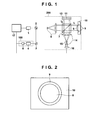
- Fig. 1 is a view showing a measurement apparatus according to the first embodiment
- Fig. 2 is a view showing the positional relationship between a test surface and vibration detection surface
- Fig. 3 is a view showing a measurement sequence according to the first embodiment
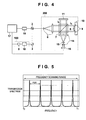
- Fig. 4 is a view showing a measurement apparatus according to the second embodiment
- Fig. 5 is a view showing the transmission spectrum of an etalon
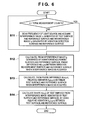
- Fig. 6 is a view showing a measurement sequence according to the second embodiment.
- Fig. 1 is an exemplary view showing an example of a measurement apparatus for measuring the shape of a test surface by detecting interference fringes (first interference fringes) generated by interference between reference light irradiating a reference surface and measurement light irradiating the test surface according to the first embodiment.
- interference fringes first interference fringes
- the measurement apparatus may also use a synthetic wavelength having a measurement range enlarged by using a plurality of light sources having different wavelengths.
- a non-polarizing beam splitter 2 divides a light beam emitted from a light source 1.
- One divided light beam is guided to a wavelength measurement unit 100, and the other divided light beam is guided to an interferometer unit 200.
- the light beam guided to the wavelength measurement unit 100 is reflected by a mirror 3, transmitted through a gas cell 4, and incident on a detector 5.
- a control unit 17 Based on the light intensity detected by the detector 5, a control unit 17 performs control such that the wavelength of the light beam emitted from the light source 1 is stabilized to a wavelength reference as the absorption line of the gas cell 4.
- the light beam guided to the interferometer unit 200 is expanded to a desired beam diameter by a beam expander 6.
- a non-polarizing beam splitter 7 divides the expanded light beam into a light beam (measurement light) I 1 and a light beam (reference light) I 2 .
- a part of the light beam (measurement light) I 1 is incident on a test surface 8, and the other part is incident on a vibration detection surface 9.
- the light beam (reference light) I 2 is incident on a reference surface 11.
- the reference surface 11 is positioned on a piezoelectric element 13 as an element for shifting the phase of the light beam I 2 , and changing the difference between the optical path lengths of the light beams I 1 and I 2 .
- the control unit (processor) 17 applies a voltage to the piezoelectric element 13. This enables fringe scan synchronized with the sensing timing of a image sensor 16 (ex. CCD sensor, CMOS sensor).
- the image sensor 16 senses an image of two dimensions.
- the image sensor 16 may comprise plural sensors.
- the vibration detection surface 9 is positioned outside the test surface 8, and fixed to a mounting base 10 on which a test object is mounted, such that a relative position with respect to the test surface 8 is constant.
- the vibration detection surface 9 is a plane mirror and inclined to a plane perpendicular to the optical axis of the light beam (measurement light) I 1 . Consequently, the vibration detection surface 9 is inclined relative to the reference surface 11.
- the first embodiment uses the inclined vibration detection surface 9, it is also possible to use a vibration detection surface 9 having stair-casing steps.
- the light beam I 1 is reflected by the test surface 8 and vibration detection surface 9, and returns to the non-polarizing beam splitter 7.
- the light beam I 2 is reflected by the reference surface 11, and returns to the non-polarizing beam splitter 7.
- the solid lines of the light beams I 1 and I 2 indicate light beams corresponding to the test surface 8
- the dotted lines indicate light beams corresponding to the vibration detection surface 9.
- the light beams I 1 and I 2 are combined by the non-polarizing beam splitter 7, and incident on the image sensor 16 via an image formation lens 14 and spatial filter 15.
- the image sensor 16 simultaneously acquires a first interference fringe image generated by the reflected light beams from the test surface 8 and reference surface 11 and a second interference fringe image generated by the reflected light beams from the vibration detection surface 9 and reference surface 11 at once.
- the image sensor 16 and test surface 8 are positioned to be optically conjugate with each other via the image formation lens 14.
- the spatial filter 15 prevents unnecessary light from mixing in the image sensor 16.
- x and y indicate a pixel address in the image sensor 16
- a(x,y) is the bias intensity
- b(x,y) is the amplitude intensity
- H(x,y) is the shape of the test surface
- ⁇ is the amount of phase shift of the light beam I 2 , which is caused by the piezoelectric element 13.
- the control unit 17 can accurately calculate the shape H(x,y) of the test surface by using equation (3).
- the object of the first embodiment is to correct a measurement error caused by a disturbance vibration in accordance with a measurement sequence shown in Fig. 3 , and accurately calculate the shape of the test surface 8 even when there is a disturbance vibration.
- the measurement sequence according to the first embodiment will be explained below with reference to Fig. 3 .
- step S1 the control unit 17 drives the piezoelectric element 13 to acquire the first interference fringe image generated by the reflected light beams from the test surface 8 and reference surface 11, and the second interference fringe image generated by the reflected light beams from the vibration detection surface 9 and reference surface 11.
- the driving of the piezoelectric element 13 and the acquisition of the interference fringe images are alternately repeated until the number of times of phase shift reaches a predetermined number N.
- N is at least 3 in order to separate a(x,y) and b(x,y).
- ⁇ is the wavelength
- H(x,y) is the shape of the test surface 8
- ⁇ z(x,y,n) is a relative vibration between the test surface 8 and reference surface 11 when the nth interference image is acquired
- ⁇ (n) is the phase shift amount of the nth interference image.
- H'(x,y) is the shape of the vibration detection surface 9
- f x and f y are respectively carrier frequencies formed in the x and y directions by the vibration detection surface 9 and reference surface 11
- ⁇ z'(x,y,n) is a relative vibration between the vibration detection surface 9 and reference surface 11 when the nth second interference fringe image is acquired.
- the carrier frequencies f x and f y are determined by a relative inclination
- step S2 the control unit 17 calculates a phase difference ⁇ (x,y,n) between the vibration detection surface 9 and reference surface 11 when each interference image is acquired, from the second interference fringe image I 2 (x,y,n) generated by the vibration detection surface 9 and reference surface 11.
- the carrier frequencies f x and f y are superposed on the second interference fringe image I 2 (x,y,n).
- the control unit 17 calculates the phase difference ⁇ (x,y,n) by using the Fourier-transform method of fringe-pattern analysis.
- the Fourier-transform method of fringe-pattern analysis is a method of obtaining a phase from one second interference fringe image by introducing the carrier frequencies f x and f y .
- c(x,y,n) is the complex amplitude of the second interference fringe
- c * (x,y,n) is the conjugate of c(x,y,n).
- the phase difference ⁇ (x,y,n) between the vibration detection surface 9 and reference surface 11 is a phase distribution having information about the shape H'(x,y) of the vibration detection surface, the relative vibration ⁇ z'(x,y,n) between the vibration detection surface 9 and reference surface 11, and the phase shift amount ⁇ (n) between the light beams I 1 and I 2 .
- A( ⁇ , ⁇ ) is the Fourier transform of a(x,y)
- C( ⁇ - f x , ⁇ - f y ) and C * ( ⁇ - f x , ⁇ - f y ) are respectively the Fourier transforms of c(x,y,n) and c * (x,y,n).
- control unit 17 extracts C( ⁇ - f x , ⁇ - f y ) by filtering, moves a spectral peak positioned at coordinates (f x ,f y ) to the origin of a frequency coordinate system, and eliminates the carrier frequencies f x and f y .
- step S3 the control unit 17 calculates a relative vibration ⁇ z'(x,y,n) between the vibration detection surface 9 and reference surface 11 when each image is acquired, from the phase difference ⁇ (x,y,n) between the vibration detection surface 9 and reference surface 11 calculated in step S2.
- phase differences ⁇ (x,y,1) and ⁇ (x,y,n) between the vibration detection surface 9 and the reference surface 11 and the phase shift amounts ⁇ (1) and ⁇ (n) are known parameters. Accordingly, the relative vibration ⁇ z'(x,y,n) between the vibration detection surface 9 and reference surface 11 can be calculated by using these values.
- the relative vibration ⁇ z'(x,y,n) between the vibration detection surface 9 and reference surface 11 is calculated following the procedures described above.
- the target of calculation is the relative vibration between the test surface 8 and reference surface 11.
- the relative positions of the test surface 8 and vibration detection surface 9 are constant, so the piston component and tilt component of the relative vibration with respect to the reference surface 11 are the same. Therefore, the control unit 17 calculates the piston component and tilt component by performing plane approximation on the relative vibration of the vibration detection surface 9, and calculates the relative vibration of the test surface 8 from the calculated piston component and tilt component.
- the control unit 17 defines a merit function M 1 below by using the relative vibration ⁇ z'(x,y,n) between the vibration detection surface 9 and reference surface 11. Then, the control unit 17 calculates the piston component p(n) and tilt components t x (n) and t y (n) of the relative vibration, which minimize the merit function M 1 , and calculates the relative vibration ⁇ z(x,y,n) between the test surface 8 and reference surface 11 by using the calculated components in accordance with the equation (5).
- M 1 ⁇ x , y ⁇ z ⁇ x ⁇ y ⁇ n - p n + t x n ⁇ x + t y n ⁇ y 2
- step S4 the control unit 17 calculates the shape of the test surface 8 from the first interference fringe image generated by the test surface 8 and reference surface 11, by using the relative vibration ⁇ z(x,y,n) between the test surface 8 and reference surface 11 calculated in step S3. More specifically, the control unit 17 defines a merit function M 2 below by using the first interference fringe image I 1 (x,y,n) generated by the test surface 8 and reference surface 11, and the relative vibration ⁇ z(x,y,n) between the test surface 8 and reference surface 11. Then, the control unit 17 obtains H(x,y) that minimizes the merit function M 2 as a surface position at the point (x,y) on the test surface 8.
- a(x,y), b(x,y), and H(x,y) are unknown constants at the point (x,y) on the test surface 8. Since there are three unknowns including H(x,y) to be obtained, the number N of the first interference fringe images must be three or more.
- the measurement sequence according to the first embodiment has been explained above.
- the first embodiment is inexpensive because it is unnecessary to add any acceleration sensor for vibration detection unlike in Japanese Patent Laid-Open No. 8-219738 .
- the first embodiment does not use any approximate calculation unlike in Japanese Patent Laid-Open No. 2000-275021 . This makes it possible to accurately correct a measurement error caused by a disturbance vibration even in a large-vibration environment.
- the second embodiment includes a frequency scanning interferometer.
- Fig. 4 is a schematic view showing an example of a measurement apparatus of the second embodiment. As in the first embodiment, the most basic arrangement including one light source will be explained, but a plurality of light sources may also be used.
- the measurement apparatus according to the second embodiment is the same as that of the first embodiment except that the light source 1 is replaced with a frequency scanning light source 19, no piezoelectric element 13 is necessary, and a wavelength measurement unit 100 is changed. Therefore, only the wavelength measurement unit 100 of the measurement apparatus will be explained below.
- a light beam guided to the wavelength measurement unit 100 is reflected by a mirror 3, transmitted through a Fabry-perot etalon 18, and incident on a detector 5.
- a control unit 17 controls the wavelength of a light beam emitted from the frequency scanning light source 19. It is necessary to ensure the relative value of each peak of the transmission spectrum of the Fabry-perot etalon 18.
- a vacuum-medium etalon having a guaranteed transmission spectrum interval is used as the Fabry-perot etalon 18. Since the vacuum-medium etalon has neither the refractive index nor the dispersion of an internal medium, it is readily possible to ensure the relative value of the wavelength.
- low-thermal-expansion glass or the like as the material of the etalon, it is possible to reduce the expansion ratio with respect to the temperature, and implement a wavelength reference element that is stable for a long time period.
- the Fabry-perot etalon 18 is not limited to the vacuum-medium etalon, and may also be an air-gap etalon or solid etalon. In this case, it is necessary to guarantee the internal refractive index and dispersion by, for example, measuring the etalon temperature. Also, to ensure the wavelength at each time during frequency scanning, the Fabry-perot etalon 18 desirably has at least two transmission spectra within the frequency scanning range of the frequency scanning light source 19.
- Fig. 5 shows an example in which a scanning range from a light source frequency f 0 to a light source frequency f 1 contains five transmission spectra.
- c is the light speed
- ⁇ f is the frequency scanning amount of the light source 19 between images
- ⁇ 0 (x,y) is the initial phase of an interference signal
- n 1 to N (N is at least 3).
- a sine-wave interference signal having a frequency corresponding to a shape H(x,y) of the test surface 8 is obtained by each pixel of the image sensor 16.
- the shape H(x,y) of the test surface 8 is calculated following the above procedures. However, if a relative fluctuation occurs between the test surface 8 and reference surface 11 due to a disturbance vibration or the like, a phase error is added to equation (15), and the measurement accuracy decreases in the same manner as that for the phase shift interferometer of the first embodiment. In the second embodiment, therefore, a measurement error generated by a disturbance vibration is corrected and the shape of the test surface 8 is accurately calculated even when there is a disturbance vibration, in accordance with a measurement sequence shown in Fig. 6 .
- the measurement sequence according to the second embodiment will be explained below with reference to Fig. 6 . Since this measurement sequence shown in Fig. 6 is basically the same as the measurement sequence of the first embodiment, only portions different from the first embodiment will briefly be explained.
- step S11 the control unit 17 scans the frequency of the frequency scanning light source 19, and acquires a first interference fringe image generated by reflected light beams from the test surface 8 and reference surface 11, and a second interference fringe image generated by reflected light beams from a vibration detection surface 9 and the reference surface 11.
- the control unit 17 acquires interference fringe images by scanning the frequency of the light source 19, until a predetermined frequency scanning amount (a total sensing count: N times) is reached.
- step S12 the control unit 17 calculates a phase difference ⁇ (x,y,n) between the vibration detection surface 9 and reference surface 11 when each image is acquired, from the second interference fringe image I 2 (x,y,n) generated by the vibration detection surface 9 and reference surface 11.
- the control unit 17 calculates the phase difference ⁇ (x,y,n) based on the Carre algorithm. Note that the method of calculating the phase difference ⁇ (x,y,n) is not limited to the Carre algorithm, and the Fourier-transform method of fringe-pattern analysis may also be used as in the first embodiment.
- the Carre algorithm is a method of obtaining a phase by using four interference signals having phase differences at a predetermined pitch in one direction.
- the Carre algorithm will briefly be explained below.
- the phase can be calculated from four interference signals having phase differences at equal pitches by using the Carre algorithm.
- the second interference fringe image I 2 (x,y,n) generated by the vibration detection surface 9 and reference surface 11 is an interference fringe image spatially given phase differences at equal pitches.
- the control unit 17 can calculate the phase difference ⁇ (x,y,n) between the vibration detection surface 9 and reference surface 11 when each image is acquired from one second interference fringe image.
- step S13 the control unit 17 calculates the relative vibration between the test surface 8 and reference surface 11 when each second interference fringe image is acquired, from the phase difference ⁇ (x,y,n) between the vibration detection surface 9 and reference surface 11 calculated in step S2.
- the control unit 17 can calculate the relative vibration ⁇ z'(x,y,n) between the vibration detection surface 9 and reference surface 11 by using these values.
- the method of calculating the relative vibration ⁇ z(x,y,n) between the test surface 8 and reference surface 11 from the relative vibration ⁇ z'(x,y,n) between the vibration detection surface 9 and reference surface 11 is the same as that of the first embodiment, so an explanation thereof will be omitted.
Landscapes
- Physics & Mathematics (AREA)
- General Physics & Mathematics (AREA)
- Length Measuring Devices By Optical Means (AREA)
- Instruments For Measurement Of Length By Optical Means (AREA)
Applications Claiming Priority (1)
| Application Number | Priority Date | Filing Date | Title |
|---|---|---|---|
| JP2012045786A JP5894464B2 (ja) | 2012-03-01 | 2012-03-01 | 計測装置 |
Publications (1)
| Publication Number | Publication Date |
|---|---|
| EP2634528A1 true EP2634528A1 (en) | 2013-09-04 |
Family
ID=47713816
Family Applications (1)
| Application Number | Title | Priority Date | Filing Date |
|---|---|---|---|
| EP13000561.4A Withdrawn EP2634528A1 (en) | 2012-03-01 | 2013-02-04 | Measurement apparatus for measuring shape of test object and measurement method |
Country Status (3)
| Country | Link |
|---|---|
| US (1) | US9052189B2 (enExample) |
| EP (1) | EP2634528A1 (enExample) |
| JP (1) | JP5894464B2 (enExample) |
Families Citing this family (2)
| Publication number | Priority date | Publication date | Assignee | Title |
|---|---|---|---|---|
| JP2023143276A (ja) * | 2022-03-25 | 2023-10-06 | 株式会社東京精密 | 表面形状測定装置及び表面形状測定方法 |
| CN116429017A (zh) * | 2023-05-10 | 2023-07-14 | 东北大学 | 一种被测体振动的相移数字全息三维测量方法及装置 |
Citations (2)
| Publication number | Priority date | Publication date | Assignee | Title |
|---|---|---|---|---|
| JPH08219738A (ja) | 1995-02-16 | 1996-08-30 | Nikon Corp | 干渉測定装置 |
| JP2000275021A (ja) | 1999-03-25 | 2000-10-06 | Nikon Corp | 面形状測定装置 |
Family Cites Families (4)
| Publication number | Priority date | Publication date | Assignee | Title |
|---|---|---|---|---|
| DE19944021A1 (de) * | 1998-09-14 | 2000-05-04 | Nikon Corp | Interferometrische Vorrichtung und Verfahren zum Vermessen der Oberflächentopographie einer Testoberfläche |
| US6495819B1 (en) * | 2000-08-08 | 2002-12-17 | Southwest Research Institute | Dual-interferometer method for measuring bending of materials |
| JP2002202112A (ja) * | 2000-11-06 | 2002-07-19 | Fujitsu Ltd | 形状計測装置 |
| US8531677B2 (en) * | 2010-05-27 | 2013-09-10 | Corning Incorporated | Frequency-shifting interferometer with selective data processing |
-
2012
- 2012-03-01 JP JP2012045786A patent/JP5894464B2/ja not_active Expired - Fee Related
-
2013
- 2013-02-04 EP EP13000561.4A patent/EP2634528A1/en not_active Withdrawn
- 2013-02-07 US US13/761,349 patent/US9052189B2/en not_active Expired - Fee Related
Patent Citations (2)
| Publication number | Priority date | Publication date | Assignee | Title |
|---|---|---|---|---|
| JPH08219738A (ja) | 1995-02-16 | 1996-08-30 | Nikon Corp | 干渉測定装置 |
| JP2000275021A (ja) | 1999-03-25 | 2000-10-06 | Nikon Corp | 面形状測定装置 |
Non-Patent Citations (2)
| Title |
|---|
| MELOZZI M ET AL: "VIBRATION-INSENSITIVE INTERFEROMETER FOR ON-LINE MEASUREMENTS", APPLIED OPTICS, OPTICAL SOCIETY OF AMERICA, WASHINGTON, DC; US, vol. 34, no. 25, 1 September 1995 (1995-09-01), pages 5595 - 5601, XP000522985, ISSN: 0003-6935, DOI: 10.1364/AO.34.005595 * |
| TAKEDA M ET AL: "FOURIER-TRANSFORM METHOD OF FRINGE-PATTERN ANALYSIS FOR COMPUTER-BASED TOPOGRAPHY AND INTERFEROMETRY", JOURNAL OF THE OPTICAL SOCIETY OF AMERICA, AMERICAN INSTITUTE OF PHYSICS, NEW YORK; US, vol. 72, no. 1, 1 January 1982 (1982-01-01), pages 156 - 160, XP000570893, ISSN: 0093-5433, DOI: 10.1364/JOSA.72.000156 * |
Also Published As
| Publication number | Publication date |
|---|---|
| US9052189B2 (en) | 2015-06-09 |
| US20130229664A1 (en) | 2013-09-05 |
| JP5894464B2 (ja) | 2016-03-30 |
| JP2013181828A (ja) | 2013-09-12 |
Similar Documents
| Publication | Publication Date | Title |
|---|---|---|
| KR101590241B1 (ko) | 광학특성 측정장치 및 광학특성 측정방법 | |
| CN104797903B (zh) | 通过校准测量头的方向来获得表面形貌的光学测量方法以及具有测量头的测量装置 | |
| JP4378533B2 (ja) | 光コヒーレンストモグラフィーの構成機器の較正方法 | |
| US6532073B2 (en) | Fringe analysis error detection method and fringe analysis error correction method | |
| EP2306144A1 (en) | Surface shape measurement apparatus | |
| US10746537B2 (en) | Radius-of-curvature measurement by spectrally-controlled interferometry | |
| JP2013092402A (ja) | 多波長干渉計、計測装置および計測方法 | |
| EP1209442A2 (en) | Automated radius of curvature measurements | |
| JP5648961B2 (ja) | 分光特性測定装置及びその校正方法 | |
| CN103162621A (zh) | 包括多波长干涉计的测量装置 | |
| EP2420796B1 (en) | Shape measuring method and shape measuring apparatus using white light interferometry | |
| EP1717546B1 (en) | Interferometer and method of calibrating the interferometer | |
| JP2013152191A (ja) | 多波長干渉計 | |
| US20150077759A1 (en) | Compact, Slope Sensitive Optical Probe | |
| US9052189B2 (en) | Measurement apparatus for measuring shape of test object and measurement method | |
| EP2636988A1 (en) | Surface shape measurement method and measurement apparatus using wavelength scanning interferometry | |
| JP2012173218A (ja) | 干渉計及び測定方法 | |
| JP2013029317A (ja) | 光断層画像測定装置および光断層画像測定システム | |
| JP5079755B2 (ja) | 光コヒーレンストモグラフィーの構成機器の較正方法 | |
| RU2491505C1 (ru) | Способ определения шероховатости поверхности | |
| JPH09196619A (ja) | 微小変位量の測定方法及び装置 | |
| JP5376284B2 (ja) | 干渉測定方法および干渉計 | |
| JP2014169983A (ja) | 計測装置、計測方法、および物品の製造方法 | |
| US7898672B1 (en) | Real-time scanner-nonlinearity error correction for HDVSI | |
| JP2015161501A (ja) | 計測装置、および物品の製造方法 |
Legal Events
| Date | Code | Title | Description |
|---|---|---|---|
| PUAI | Public reference made under article 153(3) epc to a published international application that has entered the european phase |
Free format text: ORIGINAL CODE: 0009012 |
|
| AK | Designated contracting states |
Kind code of ref document: A1 Designated state(s): AL AT BE BG CH CY CZ DE DK EE ES FI FR GB GR HR HU IE IS IT LI LT LU LV MC MK MT NL NO PL PT RO RS SE SI SK SM TR |
|
| AX | Request for extension of the european patent |
Extension state: BA ME |
|
| 17P | Request for examination filed |
Effective date: 20140304 |
|
| RBV | Designated contracting states (corrected) |
Designated state(s): AL AT BE BG CH CY CZ DE DK EE ES FI FR GB GR HR HU IE IS IT LI LT LU LV MC MK MT NL NO PL PT RO RS SE SI SK SM TR |
|
| STAA | Information on the status of an ep patent application or granted ep patent |
Free format text: STATUS: THE APPLICATION HAS BEEN WITHDRAWN |
|
| 18W | Application withdrawn |
Effective date: 20150529 |