EP2632614B1 - Superhydrophobic film constructions - Google Patents
Superhydrophobic film constructions Download PDFInfo
- Publication number
- EP2632614B1 EP2632614B1 EP11785823.3A EP11785823A EP2632614B1 EP 2632614 B1 EP2632614 B1 EP 2632614B1 EP 11785823 A EP11785823 A EP 11785823A EP 2632614 B1 EP2632614 B1 EP 2632614B1
- Authority
- EP
- European Patent Office
- Prior art keywords
- film
- microstructures
- degrees
- superhydrophobic
- angle
- Prior art date
- Legal status (The legal status is an assumption and is not a legal conclusion. Google has not performed a legal analysis and makes no representation as to the accuracy of the status listed.)
- Not-in-force
Links
- 230000003075 superhydrophobic effect Effects 0.000 title claims description 66
- 238000010276 construction Methods 0.000 title description 12
- XLYOFNOQVPJJNP-UHFFFAOYSA-N water Substances O XLYOFNOQVPJJNP-UHFFFAOYSA-N 0.000 claims description 58
- 229920000435 poly(dimethylsiloxane) Polymers 0.000 claims description 26
- 239000000463 material Substances 0.000 claims description 24
- 238000012360 testing method Methods 0.000 claims description 24
- 239000004576 sand Substances 0.000 claims description 20
- 238000005530 etching Methods 0.000 claims description 17
- 229920005573 silicon-containing polymer Polymers 0.000 claims description 17
- 239000000758 substrate Substances 0.000 claims description 9
- 239000004205 dimethyl polysiloxane Substances 0.000 claims 2
- 235000013870 dimethyl polysiloxane Nutrition 0.000 claims 2
- CXQXSVUQTKDNFP-UHFFFAOYSA-N octamethyltrisiloxane Chemical group C[Si](C)(C)O[Si](C)(C)O[Si](C)(C)C CXQXSVUQTKDNFP-UHFFFAOYSA-N 0.000 claims 2
- 238000004987 plasma desorption mass spectroscopy Methods 0.000 claims 2
- 238000000576 coating method Methods 0.000 description 36
- 239000011248 coating agent Substances 0.000 description 30
- 239000002105 nanoparticle Substances 0.000 description 30
- VYPSYNLAJGMNEJ-UHFFFAOYSA-N Silicium dioxide Chemical compound O=[Si]=O VYPSYNLAJGMNEJ-UHFFFAOYSA-N 0.000 description 29
- 238000000034 method Methods 0.000 description 28
- 229910044991 metal oxide Inorganic materials 0.000 description 20
- 150000004706 metal oxides Chemical class 0.000 description 20
- 239000002245 particle Substances 0.000 description 12
- 230000002209 hydrophobic effect Effects 0.000 description 9
- 238000005259 measurement Methods 0.000 description 7
- 230000008569 process Effects 0.000 description 7
- 239000000725 suspension Substances 0.000 description 7
- 238000004140 cleaning Methods 0.000 description 6
- -1 poly(dimethylsiloxane) Polymers 0.000 description 6
- 230000000052 comparative effect Effects 0.000 description 5
- AMGQUBHHOARCQH-UHFFFAOYSA-N indium;oxotin Chemical compound [In].[Sn]=O AMGQUBHHOARCQH-UHFFFAOYSA-N 0.000 description 5
- 239000011859 microparticle Substances 0.000 description 5
- 235000012239 silicon dioxide Nutrition 0.000 description 5
- 239000000377 silicon dioxide Substances 0.000 description 5
- KFZMGEQAYNKOFK-UHFFFAOYSA-N Isopropanol Chemical compound CC(C)O KFZMGEQAYNKOFK-UHFFFAOYSA-N 0.000 description 4
- PXHVJJICTQNCMI-UHFFFAOYSA-N Nickel Chemical compound [Ni] PXHVJJICTQNCMI-UHFFFAOYSA-N 0.000 description 4
- 238000005266 casting Methods 0.000 description 4
- 229920001971 elastomer Polymers 0.000 description 4
- 229920000642 polymer Polymers 0.000 description 4
- 230000003068 static effect Effects 0.000 description 4
- 240000002853 Nelumbo nucifera Species 0.000 description 3
- 235000006508 Nelumbo nucifera Nutrition 0.000 description 3
- 235000006510 Nelumbo pentapetala Nutrition 0.000 description 3
- BLRPTPMANUNPDV-UHFFFAOYSA-N Silane Chemical compound [SiH4] BLRPTPMANUNPDV-UHFFFAOYSA-N 0.000 description 3
- 239000011324 bead Substances 0.000 description 3
- 230000009286 beneficial effect Effects 0.000 description 3
- 230000000694 effects Effects 0.000 description 3
- 239000000806 elastomer Substances 0.000 description 3
- 230000006872 improvement Effects 0.000 description 3
- 239000007788 liquid Substances 0.000 description 3
- 229910052751 metal Inorganic materials 0.000 description 3
- 239000002184 metal Substances 0.000 description 3
- 239000002086 nanomaterial Substances 0.000 description 3
- 230000010076 replication Effects 0.000 description 3
- NIXOWILDQLNWCW-UHFFFAOYSA-M Acrylate Chemical compound [O-]C(=O)C=C NIXOWILDQLNWCW-UHFFFAOYSA-M 0.000 description 2
- 241000251730 Chondrichthyes Species 0.000 description 2
- XUIMIQQOPSSXEZ-UHFFFAOYSA-N Silicon Chemical group [Si] XUIMIQQOPSSXEZ-UHFFFAOYSA-N 0.000 description 2
- GWEVSGVZZGPLCZ-UHFFFAOYSA-N Titan oxide Chemical compound O=[Ti]=O GWEVSGVZZGPLCZ-UHFFFAOYSA-N 0.000 description 2
- MCMNRKCIXSYSNV-UHFFFAOYSA-N Zirconium dioxide Chemical compound O=[Zr]=O MCMNRKCIXSYSNV-UHFFFAOYSA-N 0.000 description 2
- 238000005299 abrasion Methods 0.000 description 2
- 238000013459 approach Methods 0.000 description 2
- 230000008901 benefit Effects 0.000 description 2
- 238000003618 dip coating Methods 0.000 description 2
- 239000002270 dispersing agent Substances 0.000 description 2
- 238000009826 distribution Methods 0.000 description 2
- PGFXOWRDDHCDTE-UHFFFAOYSA-N hexafluoropropylene oxide Chemical compound FC(F)(F)C1(F)OC1(F)F PGFXOWRDDHCDTE-UHFFFAOYSA-N 0.000 description 2
- 238000004519 manufacturing process Methods 0.000 description 2
- 239000000203 mixture Substances 0.000 description 2
- 229910052759 nickel Inorganic materials 0.000 description 2
- 150000001282 organosilanes Chemical class 0.000 description 2
- 229920001296 polysiloxane Polymers 0.000 description 2
- 230000009467 reduction Effects 0.000 description 2
- 229910052990 silicon hydride Inorganic materials 0.000 description 2
- 238000004088 simulation Methods 0.000 description 2
- 239000007787 solid Substances 0.000 description 2
- 239000004094 surface-active agent Substances 0.000 description 2
- 125000000391 vinyl group Chemical group [H]C([*])=C([H])[H] 0.000 description 2
- 229920002554 vinyl polymer Polymers 0.000 description 2
- HDYFAPRLDWYIBU-UHFFFAOYSA-N 1-silylprop-2-en-1-one Chemical class [SiH3]C(=O)C=C HDYFAPRLDWYIBU-UHFFFAOYSA-N 0.000 description 1
- 241000931705 Cicada Species 0.000 description 1
- 239000004593 Epoxy Substances 0.000 description 1
- YCKRFDGAMUMZLT-UHFFFAOYSA-N Fluorine atom Chemical compound [F] YCKRFDGAMUMZLT-UHFFFAOYSA-N 0.000 description 1
- CERQOIWHTDAKMF-UHFFFAOYSA-M Methacrylate Chemical compound CC(=C)C([O-])=O CERQOIWHTDAKMF-UHFFFAOYSA-M 0.000 description 1
- 239000002253 acid Substances 0.000 description 1
- 238000013006 addition curing Methods 0.000 description 1
- 125000000217 alkyl group Chemical group 0.000 description 1
- 150000001343 alkyl silanes Chemical class 0.000 description 1
- PNEYBMLMFCGWSK-UHFFFAOYSA-N aluminium oxide Inorganic materials [O-2].[O-2].[O-2].[Al+3].[Al+3] PNEYBMLMFCGWSK-UHFFFAOYSA-N 0.000 description 1
- 150000008064 anhydrides Chemical class 0.000 description 1
- 230000003373 anti-fouling effect Effects 0.000 description 1
- 125000003710 aryl alkyl group Chemical group 0.000 description 1
- 125000003118 aryl group Chemical group 0.000 description 1
- 238000003287 bathing Methods 0.000 description 1
- 239000011230 binding agent Substances 0.000 description 1
- 125000000484 butyl group Chemical group [H]C([*])([H])C([H])([H])C([H])([H])C([H])([H])[H] 0.000 description 1
- 230000015556 catabolic process Effects 0.000 description 1
- CETPSERCERDGAM-UHFFFAOYSA-N ceric oxide Chemical compound O=[Ce]=O CETPSERCERDGAM-UHFFFAOYSA-N 0.000 description 1
- 229910000422 cerium(IV) oxide Inorganic materials 0.000 description 1
- 125000004965 chloroalkyl group Chemical group 0.000 description 1
- 229910052681 coesite Inorganic materials 0.000 description 1
- 230000000295 complement effect Effects 0.000 description 1
- 238000009833 condensation Methods 0.000 description 1
- 238000013005 condensation curing Methods 0.000 description 1
- 238000005536 corrosion prevention Methods 0.000 description 1
- 229910052593 corundum Inorganic materials 0.000 description 1
- 229910052906 cristobalite Inorganic materials 0.000 description 1
- 229920006037 cross link polymer Polymers 0.000 description 1
- 238000001723 curing Methods 0.000 description 1
- 238000006731 degradation reaction Methods 0.000 description 1
- 238000001312 dry etching Methods 0.000 description 1
- 239000000428 dust Substances 0.000 description 1
- 125000001495 ethyl group Chemical group [H]C([H])([H])C([H])([H])* 0.000 description 1
- 229910052731 fluorine Inorganic materials 0.000 description 1
- 239000011737 fluorine Substances 0.000 description 1
- 229920001973 fluoroelastomer Polymers 0.000 description 1
- 229920002313 fluoropolymer Polymers 0.000 description 1
- 239000004811 fluoropolymer Substances 0.000 description 1
- 239000011521 glass Substances 0.000 description 1
- 230000009477 glass transition Effects 0.000 description 1
- 230000005661 hydrophobic surface Effects 0.000 description 1
- 230000003993 interaction Effects 0.000 description 1
- 238000010884 ion-beam technique Methods 0.000 description 1
- 239000012948 isocyanate Substances 0.000 description 1
- 150000002513 isocyanates Chemical class 0.000 description 1
- 238000000608 laser ablation Methods 0.000 description 1
- 230000007774 longterm Effects 0.000 description 1
- 238000003801 milling Methods 0.000 description 1
- 230000003278 mimic effect Effects 0.000 description 1
- 238000012986 modification Methods 0.000 description 1
- 230000004048 modification Effects 0.000 description 1
- 125000002347 octyl group Chemical group [H]C([*])([H])C([H])([H])C([H])([H])C([H])([H])C([H])([H])C([H])([H])C([H])([H])C([H])([H])[H] 0.000 description 1
- 150000002978 peroxides Chemical class 0.000 description 1
- 125000001997 phenyl group Chemical group [H]C1=C([H])C([H])=C(*)C([H])=C1[H] 0.000 description 1
- 238000001020 plasma etching Methods 0.000 description 1
- 239000004033 plastic Substances 0.000 description 1
- 229920003023 plastic Polymers 0.000 description 1
- 229920000058 polyacrylate Polymers 0.000 description 1
- 239000002861 polymer material Substances 0.000 description 1
- 229920000193 polymethacrylate Polymers 0.000 description 1
- 229920002635 polyurethane Polymers 0.000 description 1
- 239000004814 polyurethane Substances 0.000 description 1
- 125000001436 propyl group Chemical group [H]C([*])([H])C([H])([H])C([H])([H])[H] 0.000 description 1
- 230000001681 protective effect Effects 0.000 description 1
- 230000005855 radiation Effects 0.000 description 1
- 238000002310 reflectometry Methods 0.000 description 1
- 238000001878 scanning electron micrograph Methods 0.000 description 1
- 230000011218 segmentation Effects 0.000 description 1
- 238000007493 shaping process Methods 0.000 description 1
- SCPYDCQAZCOKTP-UHFFFAOYSA-N silanol Chemical group [SiH3]O SCPYDCQAZCOKTP-UHFFFAOYSA-N 0.000 description 1
- 229910052710 silicon Inorganic materials 0.000 description 1
- 239000010703 silicon Substances 0.000 description 1
- 238000004528 spin coating Methods 0.000 description 1
- 238000005507 spraying Methods 0.000 description 1
- 238000004544 sputter deposition Methods 0.000 description 1
- 229910052682 stishovite Inorganic materials 0.000 description 1
- 239000000126 substance Substances 0.000 description 1
- PXQLVRUNWNTZOS-UHFFFAOYSA-N sulfanyl Chemical class [SH] PXQLVRUNWNTZOS-UHFFFAOYSA-N 0.000 description 1
- 229920001169 thermoplastic Polymers 0.000 description 1
- 239000004416 thermosoftening plastic Substances 0.000 description 1
- 229910052905 tridymite Inorganic materials 0.000 description 1
- 238000007740 vapor deposition Methods 0.000 description 1
- 210000003462 vein Anatomy 0.000 description 1
- 235000012431 wafers Nutrition 0.000 description 1
- 238000005406 washing Methods 0.000 description 1
- 238000001039 wet etching Methods 0.000 description 1
- 229910001845 yogo sapphire Inorganic materials 0.000 description 1
Images



Classifications
-
- B—PERFORMING OPERATIONS; TRANSPORTING
- B08—CLEANING
- B08B—CLEANING IN GENERAL; PREVENTION OF FOULING IN GENERAL
- B08B17/00—Methods preventing fouling
- B08B17/02—Preventing deposition of fouling or of dust
- B08B17/06—Preventing deposition of fouling or of dust by giving articles subject to fouling a special shape or arrangement
- B08B17/065—Preventing deposition of fouling or of dust by giving articles subject to fouling a special shape or arrangement the surface having a microscopic surface pattern to achieve the same effect as a lotus flower
-
- B—PERFORMING OPERATIONS; TRANSPORTING
- B44—DECORATIVE ARTS
- B44C—PRODUCING DECORATIVE EFFECTS; MOSAICS; TARSIA WORK; PAPERHANGING
- B44C1/00—Processes, not specifically provided for elsewhere, for producing decorative surface effects
- B44C1/22—Removing surface-material, e.g. by engraving, by etching
- B44C1/227—Removing surface-material, e.g. by engraving, by etching by etching
-
- B—PERFORMING OPERATIONS; TRANSPORTING
- B82—NANOTECHNOLOGY
- B82Y—SPECIFIC USES OR APPLICATIONS OF NANOSTRUCTURES; MEASUREMENT OR ANALYSIS OF NANOSTRUCTURES; MANUFACTURE OR TREATMENT OF NANOSTRUCTURES
- B82Y30/00—Nanotechnology for materials or surface science, e.g. nanocomposites
-
- B—PERFORMING OPERATIONS; TRANSPORTING
- B29—WORKING OF PLASTICS; WORKING OF SUBSTANCES IN A PLASTIC STATE IN GENERAL
- B29K—INDEXING SCHEME ASSOCIATED WITH SUBCLASSES B29B, B29C OR B29D, RELATING TO MOULDING MATERIALS OR TO MATERIALS FOR MOULDS, REINFORCEMENTS, FILLERS OR PREFORMED PARTS, e.g. INSERTS
- B29K2019/00—Use of rubber not provided for in a single one of main groups B29K2007/00 - B29K2011/00, as moulding material
-
- B—PERFORMING OPERATIONS; TRANSPORTING
- B29—WORKING OF PLASTICS; WORKING OF SUBSTANCES IN A PLASTIC STATE IN GENERAL
- B29K—INDEXING SCHEME ASSOCIATED WITH SUBCLASSES B29B, B29C OR B29D, RELATING TO MOULDING MATERIALS OR TO MATERIALS FOR MOULDS, REINFORCEMENTS, FILLERS OR PREFORMED PARTS, e.g. INSERTS
- B29K2083/00—Use of polymers having silicon, with or without sulfur, nitrogen, oxygen, or carbon only, in the main chain, as moulding material
-
- Y—GENERAL TAGGING OF NEW TECHNOLOGICAL DEVELOPMENTS; GENERAL TAGGING OF CROSS-SECTIONAL TECHNOLOGIES SPANNING OVER SEVERAL SECTIONS OF THE IPC; TECHNICAL SUBJECTS COVERED BY FORMER USPC CROSS-REFERENCE ART COLLECTIONS [XRACs] AND DIGESTS
- Y10—TECHNICAL SUBJECTS COVERED BY FORMER USPC
- Y10T—TECHNICAL SUBJECTS COVERED BY FORMER US CLASSIFICATION
- Y10T428/00—Stock material or miscellaneous articles
- Y10T428/24—Structurally defined web or sheet [e.g., overall dimension, etc.]
- Y10T428/24355—Continuous and nonuniform or irregular surface on layer or component [e.g., roofing, etc.]
Definitions
- the present description relates to superhydrophobic films having both microstructured and nanofeatured surfaces.
- the present description further relates to constructions utilizing such superhydrophobic films, and methods of producing such superhydrophobic films.
- Hydrophobic films and coatings and more particularly, superhydrophobic films and coatings have garnered considerable attention in recent years due to a number of attractive qualities.
- Highly hydrophobic surfaces have been recognized in nature, perhaps most prevalently on lotus leaves and also on cicada wings. Because of its hydrophobic properties, the lotus leaf is capable of self-cleaning by the washing away of dust particles and debris as water droplets roll off its surface. This ability to self-clean is desirable in a number of modern-day applications. However, it may be difficult to produce a self-cleaning superhydrophobic film that is capable of extended use in certain environments.
- the present specification relates to a superhydrophobic film as claimed in claim 1.
- the superhydrophobic film has a surface that includes a plurality of microstructures.
- Each microstructure includes a plurality of nanofeatures, where both the microstructures and nanofeatures are made of a material that is a majority silicone polymer by weight.
- the film has a water contact angle of at least 150 degrees, and a sliding angle of less than 10 degrees.
- the description of the present specification relates to a method of producing a superhydrophobic film.
- the method includes providing a film that is a majority by weight silicone polymer, such as poly(dimethylsiloxane) (PDMS), and has microstructures on its first surface.
- the method further includes applying a layer of metal oxide nanoparticles directly onto the microstructures.
- the metal oxide nanoparticles serve as an etch mask as the film is etched, and the etching results in nanofeatures formed on the microstructures on the film.
- the description of the present specification relates to a method of producing a superhydrophobic film.
- the method includes providing a first film comprising microstructures on a first surface of film.
- the method further includes applying a uniform layer of metal oxide nanoparticles directly onto the microstructures and etching the film, using the metal oxide nanoparticles as an etch mask. The etching results in nanofeatures formed on the microstructures of the first film.
- a casting material is deposited onto the first film and a mold is formed with the casting material, where the mold is, at least in part, a negative of the microstructures and nanostructures of the first film.
- a silicone polymer is applied to the mold and cured to form a second film.
- the second film when removed, exhibits a water contact angle of at least 150 degrees and a sliding angle of less than 10 degrees.
- the description of the present specification relates to superhydrophobic film.
- the superhydrophobic film has a surface that includes a plurality of microstructures. Each microstructure includes a plurality of nanofeatures, where both the microstructures and nanofeatures are made of a material that is an elastomer.
- the film has a water contact angle of at least 150 degrees, and a sliding angle of less than 10 degrees.
- Superhydrophobic films and surfaces are very desirable in a number of applications due to their ability to self-clean.
- a film may be considered "superhydrophobic" where the water contact angle is greater than 140 degrees.
- Superhydrophobic films may further be understood as generally nonwettable, as water beads off of the surface of the film upon contact.
- a further desirable quality for such films may be low contact angle hysteresis, that is, a small difference between the advancing and receding contact angles of the water droplet.
- a low contact angle hysteresis, or “sliding angle” allows for water beads to roll off of the surface of a film or other construction more easily. The combination of the ability to bead water that comes into contact with the surface of a structure and further roll the beaded water off of the surface is what makes the surface "self-cleaning.”
- self-cleaning superhydrophobic surfaces may be useful on the sun-facing surfaces of solar (photovoltaic) cells, anti-icing applications, corrosion prevention, anti-condensation applications, wind blades, traffic signals, edge seals, anti-fouling applications, and drag reduction and/or noise reduction for automobiles, aircraft, boats and microfluidic devices, just to name a few.
- Such films may also have valuable anti-reflection properties.
- a superhydrophobic film construction that is transparent to visible or near-visible light.
- a superhydrophobic film that is used as a front panel of a solar panel or as a protective film over a camera lens needs to be transparent in order to function effectively.
- the film described herein offers improvement in transparency compared to other superhydrophobic constructions in the art, along with the benefits of high superhydrophobic performance, and improved durability.
- Superhydrophobic film construction 100 has a superhydrophobic film 110 with a plurality of microstructures 102.
- the microstructures 102 are shaped as prisms.
- the microstructures 102 and nanofeatures 104 will be composed of all, or substantially all the same material. More specifically, the microstructures 102 and nanofeatures 104 of superhydrophobic film 100 may both be made of a material that is a majority silicone polymer by weight.
- the silicone polymer will be poly(dimethylsiloxane) (PDMS), such that both the microstructures and nanofeatures are made of a material that is a majority PDMS by weight. More specifically, the microstructures 102 and nanofeatures 104 may be all or substantially all PDMS. For example, the microstructures and nanofeatures may each be over 95wt.% PDMS.
- PDMS poly(dimethylsiloxane)
- silicone polymers besides PDMS may be useful, for example, silicones in which some of the silicon atoms have other groups that may be aryl, for example phenyl, alkyl, for example ethyl, propyl, butyl or octyl, , fluororalkyl, for example 3,3,3-trifluoropropyl, or arylalkyl, for example 2-phenylpropyl.
- the silicone polymers may also contain reactive groups, such as vinyl, silicon-hydride (Si-H), silanol (Si-OH), acrylate, methacrylate, epoxy, isocyanate, anhydride, mercapto and chloroalkyl.
- silicones may be thermoplastic or they may be cured, for example, by condensation cure, addition cure of vinyl and Si-H groups, or by free-radical cure of pendant acrylate groups. They may also be cross-linked with the use of peroxides. Such curing may be accomplished with the addition of heat or actinic radiation.
- Other useful polymers include polyurethanes, fluoropolymers including fluoroelastomers, polyacrylates and polymethacrylates. In another embodiment, polymers with a glass transition temperature of at least 25 degrees C are useful. In at least some embodiments, the film may be an elastomer.
- An elastomer may be understood as a polymer with the property of viscoelasticity (or elasticity) generally having notably low Young's modulus and high yield strain compared with other materials.
- the term is often used interchangeably with the term rubber, although the latter is preferred when referring to cross-linked polymers.
- the nanofeatures and/or microstructures may also be composed of less than 1% of another material, for example indium tin oxide (ITO).
- ITO indium tin oxide
- the small amount of ITO on the microstructures 102 and nanofeatures 104 may be a remnant of an etching step used to create the nanofeatures, as discussed further below.
- the small amount of ITO may be either an ITO nanoparticle or remnant of an ITO nanoparticle.
- the ITO nanoparticles used for etching the nanofeatures may generally have an appropriate diameter desired for surface area coverage during etching.
- the nanoparticles may have an average diameter of between about 10nm and about 300nm, or more potentially an average diameter of between about 70nm and about 100nm.
- the nanoparticles may be applied as an etch mask as part of a suitable coating suspension.
- the liquid mixed with the ITO nanoparticles may be isopropanol.
- the water contact angle may be measured with a static contact angle measurement device, such as the Video Contact Angle System: DSA100 Drop Shape Analysis System from Kruess GmbH (Hamburg, Germany).
- a machine is equipped with a digital camera, automatic liquid dispensers, and sample stages allowing a hands-free contact angle measurement via automated placement of a drop of water (where the water drop has a size of approximately 5 ⁇ l).
- the drop shape is captured automatically and then analyzed via Drop Shape Analysis by a computer to determine the static, advancing, and receding water contact angle.
- Static water contact angle may be generally understood as the general "water contact angle” described and claimed herein.
- the water contact angle may most simply be understood as the angle at which a liquid meets a solid surface.
- a surface of film 610a is not very hydrophobic
- the water drop 601a will flatten on the surface.
- a tangential line 603a may be drawn from interface point of the drop along the edge of the drop.
- the contact angle ⁇ C1 is the angle between this tangent line 603a, and the plane of the drop 601a and film 610a interface.
- Fig. 6a shows a water droplet that is not beading along the surface and therefore a contact angle ⁇ C1 that is well below 90 degrees.
- film 610b in Fig. 6b is hydrophobic.
- the water droplet 601b experiences more of a beading effect off of the surface. Therefore the tangent line 603b along the drop's edge angles out away from the drop, and a water contact angle ⁇ C2 of greater than 90 degrees, and potentially greater than 140 or 150 degrees is achieved.
- the “sliding angle” or “contact angle hysteresis” is defined as the difference between the advancing and receding water contact angles. Advancing water contact angle and receding water contact angles relate not just to static conditions, but to dynamic conditions. With reference to Fig. 6c , the advancing water contact angle ⁇ CA is measured by adding further water volume 611c into the drop 601c. As more water is added, the droplet increases in volume and the water contact angle also increases. When a critical volume is reached, the intersection of the droplet surface with the film will jump outward such that droplet 601c will reform into a droplet with shape 613c, and the intersection of the droplet and film surfaces will move from position 621c to position 623c.
- the water contact angle ⁇ CA is the angle of the drop immediately before the intersection jumps.
- water receding angle is shown in Fig. 6d .
- the higher volume drop has water 611d slowly removed from it.
- the surface of initial drop 601 d intersects the film 610d at position 621d.
- the intersection jumps to position 623c.
- the tangent line 603d that traces the edge of the drop immediately before this jump defines the receding water contact angle ⁇ CR .
- the film of the present description exhibits a water contact angle of at least 150 degrees.
- the film may further exhibit a sliding angle (or contact angle hysteresis) of less than 10 degrees.
- the film exhibits a water contact angle of at least 160 degrees, and in other embodiments the film exhibits a water contact angle of at least 170 degrees. Water contact angles of over 175 degrees may be achieved.
- the sliding angles may be less than 10 degrees, or less than 7.5 degrees or less than 5 degrees.
- the sliding angle may also be less than 2 degrees or less than 1 degree.
- the water contact angle of a film according to the current description may be reduced by no more than 20 degrees, or less than 10 degrees, or less than 5 degrees, or potentially even less than 3 degrees when subjected a severe durability test such as falling sand.
- the superhydrophobicity is caused by an application of a low-surface-energy coating application placed on the surface of a film.
- Another manner of creating superhydrophobicity on a surface is by creating surface features that may achieve high water contact angles and low sliding angles (or contact angle hysteresis).
- often even structured films may utilize some sort of low-surface-energy coating.
- the film of the present description provides a structured surface that may be very superhydrophobic without any need for a low-surface-energy coating.
- a low-surface-energy coating 108 may optionally be applied over microstructures 102 and nanofeatures 104.
- the material properties and structural make-up of the films contemplated herein allow for great superhydrophobicity absent such a coating.
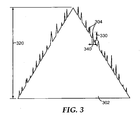
- the specific size and shape features of microstructures and nanofeatures according to the present description may be understood by reference to the nanofeatured microstructure of Fig. 3 described further below.
- the microstructured and nanofeatured silicone polymer films described herein may exhibit very low reflectivity and therefore be highly transmissive. This is a highly beneficial property for applications where films are applied to solar cells, or any sort of window or light transmissive usage where the films are used for self-cleaning or anti-icing properties.
- the films described herein may reflect less than 5% of incident light, and may reflect less than 2% of incident light. In some application, only approximately 1% of light incident on the films is reflected.
- Fig. 1 illustrates prism-shaped microstructures 102
- a number of different microstructure shapes are contemplated for superhydrophobic film 100.
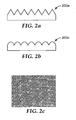
- Microstructures may be prism-shaped as illustrated in film 200a, microlenses, as shown on film 200c in Fig. 2b , a pattern that mimics shark skin, as shown on SEM image in Fig. 2c , or any other number of suitable shapes.
- nanofeatures are formed into the microstructures to create a superhydrophobic film.
- microstructures may be created that vary in one, two or three dimensions. A better understanding of this may be gained by reference to Figs. 8a-c .
- the microstructures may be structures that identically run the length 880 of the film at the same height along the vertical direction 890 without any segmentation. However, across the width 870 of the film, or across a first dimension, the film is segmented into different discrete microstructures.
- the microstructure may vary in two directions.
- the structures may be segmented as in Fig. 8a along the width 870 of the film, but also be segmented along the length 880 of the film (or second dimension).
- the structures are all the same height in the vertical direction (or third dimension) 890.
- the structures may be segmented along both the width and length of the film, but may also vary in the height of the microstructures across the film in the vertical direction 890 (or third dimension).
- the microstructures may be directly adjacent to one another or may be spaced apart by some portion of film that is flat.
- the microstructures may contain any combination of linear, curved (such as spherical, hemispherical or parabolic), or other geometries, in any of the three dimensions. For example, they could be a series of round posts protruding from a portion of flat film.
- the prisms may have a peak angle ⁇ P (or angle between the two facets of the prism) of 90 degrees. As the prisms are isosceles triangles, the angle of intersection of the two facets with the plane of the film will then be an angle of 45 degrees. In other embodiments, the peak angle may be greater or less than 90 degrees. For example, the peak angle may be between 90 degrees and 100 degrees, or between 80 degrees and 90 degrees. In one embodiment, the peak angle may be between 70 degrees and 80 degrees. For example, the peak angle may be between about 74 degrees and 76 degrees, perhaps about 74 degrees.
- angles of the facets of the pyramid to the plane of the film ⁇ FAC will be 53 degrees.
- the specific angle chosen for the prism peak angle may allow for a better distribution of nanoparticles on the surface of the microstructures, as will be discussed further below.
- superhydrophobic film 110 may be positioned on a substrate 106.
- the substrate may be made from any number of suitable materials.
- substrate 106 may be made from the same materials as microstructures 102 and nanofeatures 104.
- the substrate may be a material that is a majority silicone polymer by weight.
- the substrate may be made of PDMS.
- the substrate may be made of polymide or more commonly used substrates. Specifically, glass, metal or plastic substrates may be appropriate, as well as other suitable alternatives such as silicon wafers.
- the microstructure 302 is prism-shaped.
- the microstructure may be a lens, sharkskin-like structure or any other number of appropriate shapes depending upon the application.
- the microstructure 310 may have a height 320 that is between about 0.15 microns and about 1,000 microns. In some embodiments, the microstructure height 320 may be between 1 micron and 500 microns. Adjacent microstructures may be spaced a distance of between about 0.15 microns and about 1000 microns. Microstructures may further have a base width of between about 0.15 microns and about 1,000 microns, or more narrowly between about 1 micron and about 500 microns.
- a number of embodiments as illustrated by the figures herein may include microstructures that are directly adjacent to one another, such that the base of a microstructure is directly in contact with the base of an adjacent microstructure.
- the microstructures may be further spaced apart, such that the facets of the microstructures are not in contact and are spaced apart by a segment of film surface that may, for example, be flat.
- This film surface that lies between the microstructures may also have nanofeatures on its surface.
- Nanofeatures 304 are formed into or onto the microstructure 302 and should cover a great deal of the surface of the microstructure. It should be noted that nanofeatures 304 are not drawn to scale in relation to microstructure 302. Nanofeatures 304 may generally have an average width 340 of between about 5nm to about 250nm. Nanofeatures 304 generally have an average height 330 of between about 10 nm and about 1000nm, and potentially between about 100 nm and about 1000nm As such, nanofeatures 304 may be understood as having high aspect ratios in a number of applications. The nanofeatures exhibit an average aspect ratio of at least about 4 to 1, or at least about 5 to 1, or at least about 6 to 1.
- the nanofeatures may have the high aspect ratios discussed but be much larger in size.
- the nanofeatures may be of a width that is on the order of one-fifth the width of the microstructure upon which it is positioned.
- the present description relates to a method of producing a superhydrophobic film.
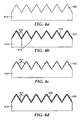
- a method of producing a superhydrophobic film One particular embodiment of such a method is illustrated in Figs. 4a - d .
- the first step in the method is providing a film 410, illustrated in Fig. 4a .
- the film may be made of a majority by weight silicone polymer, and in many embodiments, may be a majority by weight PDMS.
- the film has a plurality of microstructures 402 on a first surface of the film.
- the microstructures 402 are illustrated as prisms.
- any number of suitable microstructures 402 and microstructure patterns are contemplated, such as those illustrated in Figs. 2b-c , e.g.
- microlenses and sharkskin-like shape/pattern (i.e. patterns that mimic shark skin).
- either microprisms, microlenses, or any other shape may be varied in three dimensions as explained with respect to Figs. 8a-c above.
- the next step in the method of producing a superhydrophobic film involves applying a layer of metal oxide nanoparticles 412 directly onto the microstructures 402, as shown in Fig. 4b .
- Application methods may include roll coating, dip coating, and spraying.
- the metal oxide nanoparticles will be indium tin oxide (ITO) nanoparticles.
- ITO indium tin oxide
- other metal oxides are contemplated, such as ZrO 2 , CeO 2 , Al 2 O 3 , or TiO 2 , just to name a few.
- the metal oxide nanoparticles may be applied as part of a binder or coating suspension.
- the metal oxide particles 412 are suspended in a coating suspension 414 containing isopropanol.
- the metal oxide particles generally make up between about 0.1% and about 2% of the coating suspension by weight.
- applying particles to a structured surface in an effective manner is difficult to do, primarily because of the difficulties in achieving uniformity of the particles 412.
- particles 412 may be prone to accumulating in the valleys 416 of the structured surface.
- it may be useful to adjust coating methods, process conditions, or compositions, or to include a surfactant or dispersant in the coating suspension.
- uniformity problems may still be present.
- nanoparticles composed of metal oxide, and particularly ITO are capable of coating microstructures 402 in a highly uniform manner, even without applying a great deal of dispersants or surfactants to space the particles in the coating suspension.
- This effect is all the more important because of the low surface energy of PDMS.
- This low surface energy generally makes it difficult to coat a PDMS surface with particles with any sort of uniformity.
- the metal oxide nanoparticles provide a highly uniform coating along the microstructures.
- the ITO nanoparticles have an average diameter of between about 10nm and about 300nm.
- the indium tin oxide nanoparticles may have an average diameter of between about 70nm and about 100nm, potentially between about 75nm and about 95nm.
- Fig. 4c The next step after applying the uniform layer of metal oxide nanoparticles to the film is illustrated in Fig. 4c .
- This step involves etching the film, using the metal oxide nanoparticles 412 from Fig. 4b as an etch mask.
- the etching step etches away some or all of the metal oxide nanoparticles and etches into the microstructures 402 of the film 410 in those surface areas not covered by etch mask.
- the result of the etching is a plurality of nanofeatures 404 formed into (or onto, depending on the understanding) the surface of the microstructures 402.
- a number of known etching techniques may be used for the etching step.
- the etching step may involve any number wet etching techniques, such as acid bathing or placing in a developer. Dry etching techniques such as laser ablation or ion beam milling may also be used.
- One particularly useful etching method for the etching step is reactive ion etching.
- indium tin oxide nanoparticles exhibit other desirable properties for etching.
- metal oxide nanoparticles such as indium tin oxide nanoparticles generally etch at a substantially slower rate than the silicone polymer material used for the film (e.g. PDMS).
- the mask remains in place while etchant moves deep into the microstructured surface.
- the etched nanofeatures may have a height of between about 10nm to about 1000nm and potentially between about 100nm to about 1000nm.
- This large etch rate ratio also allows for nanofeatures with high aspect ratios, such as 4 to 1, 5 to 1, 6 to 1 or greater as discussed with respect to the description of the article in Fig. 3 .
- Such aspect ratios for nanofeatures 404 contribute to the superhydrophobic performance that the produced film ultimately achieves.
- a great number of applications that etch features into the surface of a film, in order to create hydrophobic structures or any other sort of microstructures or nanostructures often utilize silicon dioxide particles as an etch mask. The present description does not contemplate using silicon dioxide particles as an etch mask.
- a low surface energy coating 408 may be applied to the microstructures 402 and nanofeatures 404 of film 410 as shown in Fig. 4d .
- a low surface energy coating may generally be understood as a coating that, on a flat surface, has a water contact angle of greater than 110 degrees. As discussed, however, such a coating is not necessary to achieve highly superhydrophobic performance.
- Exemplary low surface energy coating materials may include materials such as hexafluoropropylene oxide (HFPO), or organosilanes such as, alkylsilane, alkoxysilane, acrylsilanes, polyhedral oligomeric silsequioxane (POSS) and fluorine-containing organosilanes, just to name a few.
- HFPO hexafluoropropylene oxide
- organosilanes such as, alkylsilane, alkoxysilane, acrylsilanes, polyhedral oligomeric silsequioxane (POSS) and fluorine-containing organosilanes, just to name a few.
- PES polyhedral oligomeric silsequioxane
- fluorine-containing organosilanes just to name a few.
- a number of other suitable low surface energy coatings may also be used to further enhance the superhydrophobicity
- the films of the current description may also be made by some sort of replication method as illustrated in Fig. 5a-e .
- the current method repeats the steps of Figs. 4a-c . That is, a microstructured silicone polymer film 410 is provided and a uniform layer of metal oxide nanoparticles is applied to the microstructures. The film is then etched, resulting in a film with nanofeatures formed into the microstructures. The film 510 after this step is illustrated in Fig. 5a with microstructures 502 and nanofeatures 504. In the next step of this process, a casting material 520 is deposited onto the first film 510. The resulting casting is then removed and used as a mold 530, illustrated in Fig. 5c .
- the mold 530 is formed as a negative of the microstructures and nanofeatures of the first film 510.
- the mold may be made of some sort of polymeric material. In other embodiments, however, the mold will be made of a suitable metal, e.g., nickel.
- a silicone polymer such as PDMS, is applied to the mold, and cured into a second film 540, as shown in Fig. 5d .
- the second film 540 is then removed from mold 530, as in Fig. 5e .
- the second film 540 may exhibit a water contact angle of at least 150 degrees and a sliding angle of less than 10 degrees.
- the second film may further exhibit water contact angles of at least 160 degrees or at least 170 degrees, or at least 175 degrees.
- the second film 540 may also exhibit a sliding angle of equal to or less than 5 degrees.
- Figs. 5a-5e may be understood as a production by "replication.” It should be understood that in such a process, negative molds and masters may be created for purposes of greater production efficiency. As such the second film 540 may instead also serve as a "master” in order to form negative molds, and ultimately PDMS microstructured and nanofeatured superhydrophobic films. In such a situation, the master may be made of a material capable of shaping to the requisite features. A metal, such as nickel, may be preferred. It should further be understood, also, that a "mold” for purposes of the replication process described herein, may be the primary mold 530, or a secondary mold master, or "daughter mold", which is formed from the primary mold.
- FIG. 7 provides a general illustration of the apparatus 700 used to test the films by falling sand.
- one kilogram of standardized sand is placed in reservoir 731.
- Reservoir 731 is connected to a support beam 745 by first connecting means 741.
- a given amount of sand constantly moves from reservoir 731 into tube 733. It falls within the tube 733 a distance 763 of 90cm.
- the steady stream of sand then exits tube 733 at tube exit 735 and travels toward film 751.
- Film 751 is securely positioned beneath the stream of sand by film support structure 747.
- the film support structure may also be positioned in place by securing to support beam 745 through second connecting means 749.
- the film support structure 747 positions the film such that the plane of the film is at a 45 degree angle with the primary direction of the stream of sand. Therefore, with reference to Fig. 7 , the angle ⁇ F is 45 degrees.
- the primary contact point on film 751 may be placed a predetermined distance 753 from the tube exit 735 having a diameter of 2cm. In this test, the distance 753 is 25mm.
- the film of the current description may, after exposure to the falling sand test still exhibit a water contact angle of greater than 145 degrees, or 150 degrees, or potentially even 160 degrees.
- the sliding angle after the falling sand test may be less than 10 degrees or less than 5 degrees.
- the comparative film includes 4.5 micrometer silicon dioxide microparticles coated with 190 nanometer silicon dioxide nanoparticles. Measurements of a PDMS film according to the current and then the prior art particle film were both taken prior to exposure to the falling sand test. Next, each of the films was exposed to the falling sand test as described above and the water contact angle and roll-off angle measurements were once again taken. The results of the test are provided in Table 1 below. Table 1 Water Contact Angle Roll-Off Angle Sample Original After Test Original After Test PDMS (prisms with nanofeatures) 156° 152° ⁇ 1° ⁇ 1° Comparative example (190nm SiO2NP+4.5um SiO2 microparticle) 151° 81° ⁇ 1° >60°
- the "roll-off angle” is a comparable measurement to sliding angle.
- a tilt angle (the angle of the liquid-solid interfacial line) for a water drop on the above sample was conducted. The sample was placed on the Automated Tilting Base and adjusted for leveling with a bubble level. Then 5uL DI water was delivered using a 10uL syringe (Hamilton). The tilting base was then turned-on manually and off when the water droplet rolls off. The tilt angle was recorded and the tilt base back to 0° for next measurement. As clearly shown in the table, the PDMS film lost very little water contact angle performance (only 4 degrees), and had a roll-off angle that remained below 1 degree after the falling sand test.
- the prior art film had an initially high water contact angle of 151 degrees that was reduced by 70 degrees to 81 degrees after the falling sand test.
- the roll-off angle of the comparative film drastically increased from less than 1 degree to greater than 60 degrees. The results provide a dramatic illustration of the durability of the film of the present description while maintaining a high and acceptable superhydrophobic performance.
- the film of the prior art is rendered non-hydrophobic by exposure to the test.
Landscapes
- Engineering & Computer Science (AREA)
- Chemical & Material Sciences (AREA)
- Nanotechnology (AREA)
- Condensed Matter Physics & Semiconductors (AREA)
- Physics & Mathematics (AREA)
- General Physics & Mathematics (AREA)
- Materials Engineering (AREA)
- Crystallography & Structural Chemistry (AREA)
- Composite Materials (AREA)
- Mechanical Engineering (AREA)
- Laminated Bodies (AREA)
- Shaping Of Tube Ends By Bending Or Straightening (AREA)
- Manufacture Of Macromolecular Shaped Articles (AREA)
- Micromachines (AREA)
- Optical Elements Other Than Lenses (AREA)
- Surface Treatment Of Optical Elements (AREA)
Applications Claiming Priority (2)
| Application Number | Priority Date | Filing Date | Title |
|---|---|---|---|
| US40780610P | 2010-10-28 | 2010-10-28 | |
| PCT/US2011/057048 WO2012058086A1 (en) | 2010-10-28 | 2011-10-20 | Superhydrophobic film constructions |
Publications (2)
| Publication Number | Publication Date |
|---|---|
| EP2632614A1 EP2632614A1 (en) | 2013-09-04 |
| EP2632614B1 true EP2632614B1 (en) | 2015-09-02 |
Family
ID=45003041
Family Applications (1)
| Application Number | Title | Priority Date | Filing Date |
|---|---|---|---|
| EP11785823.3A Not-in-force EP2632614B1 (en) | 2010-10-28 | 2011-10-20 | Superhydrophobic film constructions |
Country Status (5)
| Country | Link |
|---|---|
| US (1) | US20130295327A1 (OSRAM) |
| EP (1) | EP2632614B1 (OSRAM) |
| JP (1) | JP2013543990A (OSRAM) |
| CN (1) | CN103180060A (OSRAM) |
| WO (1) | WO2012058086A1 (OSRAM) |
Families Citing this family (45)
| Publication number | Priority date | Publication date | Assignee | Title |
|---|---|---|---|---|
| EP2595764A1 (en) * | 2010-07-19 | 2013-05-29 | President and Fellows of Harvard College | Hierarchically structured surfaces to control wetting characteristics |
| KR102115940B1 (ko) * | 2010-10-06 | 2020-05-27 | 쓰리엠 이노베이티브 프로퍼티즈 컴파니 | 나노실리카계 코팅 및 배리어층을 갖는 반사방지 물품 |
| US20140083482A1 (en) | 2011-05-09 | 2014-03-27 | 3M Innovative Properties Company | Architectural article with photovoltaic cell and visible light-transmitting reflector |
| CN102751445B (zh) * | 2012-05-31 | 2015-07-22 | 昆山工研院新型平板显示技术中心有限公司 | 一种封装薄膜及制造该封装薄膜的方法 |
| JP6360660B2 (ja) * | 2013-05-23 | 2018-07-18 | 日揮触媒化成株式会社 | 反射防止膜付基材およびその製造方法 |
| KR20160027103A (ko) | 2013-07-01 | 2016-03-09 | 쓰리엠 이노베이티브 프로퍼티즈 캄파니 | 태양 에너지 장치 |
| EP3036355A1 (en) * | 2013-08-21 | 2016-06-29 | Ozyegin Universitesi | Nanostructure chemical mechanical polishing induced live nano-structures for lime-scale prevention on heating elements |
| CN103576451A (zh) * | 2013-11-08 | 2014-02-12 | 无锡英普林纳米科技有限公司 | 一种复制微纳结构的方法 |
| CN103728675B (zh) * | 2013-12-31 | 2015-08-26 | 江苏大学 | 一种超疏水自清洁树脂镜片的制备方法 |
| WO2015177589A1 (en) * | 2014-05-20 | 2015-11-26 | Indian Institute Of Technology Hyderabad | High aspect ratio hierarchical superhydrophobic and antireflective polymeric surfaces fabricated by biomimicking canna indica plant |
| US10317578B2 (en) * | 2014-07-01 | 2019-06-11 | Honeywell International Inc. | Self-cleaning smudge-resistant structure and related fabrication methods |
| US10503063B2 (en) * | 2014-09-01 | 2019-12-10 | Industry-University Cooperation Foundation Hanyang University | Super water repellent polymer hierarchical structure, heat exchanger having super water repellency, and manufacturing method therefor |
| DE102014113097A1 (de) * | 2014-09-11 | 2016-03-17 | Fraunhofer-Gesellschaft zur Förderung der angewandten Forschung e.V. | Verfahren zum Reduzieren der Schmutzhaftung an einem Substrat |
| CN104300091B (zh) * | 2014-09-17 | 2017-02-15 | 合肥京东方光电科技有限公司 | Oled器件封装结构及其制作方法 |
| TWI566941B (zh) * | 2015-06-12 | 2017-01-21 | 國立清華大學 | 導流超疏水結構及其製作方法 |
| EP3313458A1 (en) * | 2015-06-29 | 2018-05-02 | 3M Innovative Properties Company | Anti-microbial articles and methods of using same |
| US20170050343A1 (en) * | 2015-08-17 | 2017-02-23 | National Tsing Hua University | Superhydrophobic structure and method of making the same |
| KR101764017B1 (ko) | 2015-10-30 | 2017-08-02 | 엘지디스플레이 주식회사 | 액정 표시장치 및 그 제조방법 |
| KR101641585B1 (ko) * | 2015-11-24 | 2016-07-22 | 한국기계연구원 | 초소수성 폴리이미드 필름의 제조 방법 |
| RU2688736C1 (ru) * | 2016-02-05 | 2019-05-22 | Хави Глобал Солюшенз, Ллк | Поверхность с микроструктурами, обладающая улучшенными изоляционными свойствами и сопротивлением конденсации |
| KR101641207B1 (ko) * | 2016-02-15 | 2016-07-20 | 한국기계연구원 | 비침투성과 초소수성을 갖는 폴리이미드 필름의 제조 방법 |
| KR20170105708A (ko) * | 2016-03-10 | 2017-09-20 | 광주과학기술원 | 미세 구조를 가지는 광학 필름 및 이의 제조방법 |
| KR101839676B1 (ko) * | 2016-03-31 | 2018-03-16 | 주식회사 지유디이에스 | 연잎의 표면구조 형성을 위한 초소수성 신소재 |
| DE102016207466A1 (de) * | 2016-04-29 | 2017-11-02 | Deutsche Institute Für Textil- Und Faserforschung Denkendorf | Gegenstand mit einer reibungsmindernden und insbesondere die Entgasung von Flüssigkeiten bewirkenden Oberfläche |
| WO2018005995A1 (en) * | 2016-07-01 | 2018-01-04 | United States Of America As Represented By The Adminstrator Of The National Aeronautics And Space Administration | Influence on surface interactions by substructure topography |
| US10322436B2 (en) | 2016-10-06 | 2019-06-18 | Nano And Advanced Materials Institute Limited | Method of coating interior surfaces with riblets |
| WO2018070977A1 (en) * | 2016-10-10 | 2018-04-19 | Halliburton Energy Services, Inc. | Optical interface with surface coating |
| CN106423789B (zh) * | 2016-11-01 | 2019-10-29 | 南京理工大学 | 一种耐久性抗冰超疏水涂层及其制备方法 |
| KR101871073B1 (ko) * | 2016-12-29 | 2018-06-25 | 인천대학교 산학협력단 | Pdms와 마이크로 파우더를 이용한 초소수성 코팅방법 |
| CN106622908A (zh) * | 2017-02-28 | 2017-05-10 | 吉林大学 | 一种基于仿生耦合理论的材料表面防结冰方法 |
| WO2018234841A1 (en) * | 2017-06-21 | 2018-12-27 | Nikon Corporation | Nanostructured transparent article with both hydrophobic and antifog properties and methods for making it |
| CN107459668B (zh) * | 2017-08-24 | 2020-05-01 | 西北工业大学 | 一种自修复超疏水减阻弹性体薄膜及制备方法 |
| US20190177857A1 (en) * | 2017-09-13 | 2019-06-13 | Kookmin University Industry Academy Cooperation Foundation | Surface structure having function freezing delay and icing layer separation and manufacturing method thereof |
| CN107689193B (zh) | 2017-09-28 | 2020-03-17 | 京东方科技集团股份有限公司 | 一种显示屏用玻璃层及显示屏 |
| CN108082388B (zh) * | 2017-11-30 | 2020-07-14 | 中国船舶工业系统工程研究院 | 一种微纳结构与疏水改质改性相复合的仿生减阻表面结构 |
| CN108097553B (zh) * | 2017-12-11 | 2021-04-20 | 大连理工大学 | 一种混合蒸气冷凝传热强化表面、制备方法及其应用 |
| CN108313971A (zh) * | 2017-12-29 | 2018-07-24 | 西北工业大学 | 一种仿秦岭箭竹叶防寒绒毛微结构 |
| WO2019176695A1 (ja) * | 2018-03-13 | 2019-09-19 | 日本板硝子株式会社 | 皮脂との親和性が高い有機ポリマーを含む層を備えた物品 |
| JP2020016862A (ja) * | 2018-07-27 | 2020-01-30 | 京セラ株式会社 | カメラ装置、カメラシステム、移動体およびカメラ装置の製造方法 |
| JP2020056926A (ja) * | 2018-10-03 | 2020-04-09 | 大日本印刷株式会社 | 採光シート、および採光具 |
| CN109748237B (zh) * | 2019-01-18 | 2021-01-19 | 南京航空航天大学 | 一种具有防冰和减阻一体化功能的微结构及其构建方法 |
| WO2020225717A1 (en) * | 2019-05-08 | 2020-11-12 | 3M Innovative Properties Company | Nanostructured article |
| JP2022550967A (ja) * | 2019-10-01 | 2022-12-06 | アールト-コルケアコウルサーティオ・レキステロイテュ・サーティオ | 超疎水性表面を有する基板、その製造方法、およびその使用 |
| CN116715188B (zh) * | 2023-06-07 | 2025-10-03 | 电子科技大学 | 抗冷凝失效的水下超疏水表面微纳复合结构及制备方法 |
| CN119833378B (zh) * | 2025-03-14 | 2025-08-12 | 中国人民解放军国防科技大学 | 一种基于离散点迭代分析轮廓演变的三维微结构刻蚀方法 |
Family Cites Families (14)
| Publication number | Priority date | Publication date | Assignee | Title |
|---|---|---|---|---|
| JP2001207123A (ja) * | 1999-11-16 | 2001-07-31 | Sentan Kagaku Gijutsu Incubation Center:Kk | 高硬度高滑水性膜およびその製造方法 |
| US20080090010A1 (en) | 2004-01-15 | 2008-04-17 | Newsouth Innovations Pty Limited | Hydrophobic Coating Composition |
| US7143709B2 (en) * | 2004-02-17 | 2006-12-05 | University Of Florida Research Foundation, Inc. | Surface topography for non-toxic bioadhesion control |
| JP2005343016A (ja) * | 2004-06-03 | 2005-12-15 | Nippon Sheet Glass Co Ltd | 超撥水性被膜被覆物品 |
| US20060078724A1 (en) * | 2004-10-07 | 2006-04-13 | Bharat Bhushan | Hydrophobic surface with geometric roughness pattern |
| CN100412115C (zh) * | 2005-04-20 | 2008-08-20 | 中国科学院化学研究所 | 超疏水性聚合物薄膜及其制备方法 |
| US20070141306A1 (en) * | 2005-12-21 | 2007-06-21 | Toshihiro Kasai | Process for preparing a superhydrophobic coating |
| US8354160B2 (en) | 2006-06-23 | 2013-01-15 | 3M Innovative Properties Company | Articles having durable hydrophobic surfaces |
| US20090114618A1 (en) * | 2007-06-21 | 2009-05-07 | 3M Innovative Properties Company | Method of making hierarchical articles |
| US7891636B2 (en) * | 2007-08-27 | 2011-02-22 | 3M Innovative Properties Company | Silicone mold and use thereof |
| KR20090039179A (ko) * | 2007-10-17 | 2009-04-22 | 엘지마이크론 주식회사 | 초발수 필름 및 이의 제조 방법 |
| KR101033273B1 (ko) * | 2008-03-27 | 2011-05-09 | 서울대학교산학협력단 | 초소수성 폴리머 구조물의 제조 |
| US9108880B2 (en) * | 2008-08-18 | 2015-08-18 | The Regents Of The University Of California | Nanostructured superhydrophobic, superoleophobic and/or superomniphobic coatings, methods for fabrication, and applications thereof |
| CN101537682B (zh) * | 2009-03-16 | 2011-06-29 | 浙江工业大学 | 一种纳米颗粒辅助微模塑制备超疏水表面的方法 |
-
2011
- 2011-10-20 JP JP2013536675A patent/JP2013543990A/ja active Pending
- 2011-10-20 CN CN2011800521450A patent/CN103180060A/zh active Pending
- 2011-10-20 US US13/881,971 patent/US20130295327A1/en not_active Abandoned
- 2011-10-20 WO PCT/US2011/057048 patent/WO2012058086A1/en not_active Ceased
- 2011-10-20 EP EP11785823.3A patent/EP2632614B1/en not_active Not-in-force
Also Published As
| Publication number | Publication date |
|---|---|
| CN103180060A (zh) | 2013-06-26 |
| JP2013543990A (ja) | 2013-12-09 |
| US20130295327A1 (en) | 2013-11-07 |
| WO2012058086A1 (en) | 2012-05-03 |
| EP2632614A1 (en) | 2013-09-04 |
Similar Documents
| Publication | Publication Date | Title |
|---|---|---|
| EP2632614B1 (en) | Superhydrophobic film constructions | |
| CN103282133B (zh) | 超疏水性膜 | |
| US9993948B2 (en) | Superhydrophobic films | |
| KR101114798B1 (ko) | 나노 구조 표면 코팅방법, 나노 구조 코팅 및 그 코팅을포함하는 물품 | |
| EP3334541B1 (en) | Article having a nanotextured surface with hydrophobic properties | |
| JP5220066B2 (ja) | 機能性表面の製造方法 | |
| Cao et al. | Fabrication of highly antireflective silicon surfaces with superhydrophobicity | |
| Aytug et al. | Optically transparent, mechanically durable, nanostructured superhydrophobic surfaces enabled by spinodally phase-separated glass thin films | |
| EP3209841B1 (en) | Insulated glazing units and microoptical layer comprising microstructured diffuser and methods | |
| JP2000071290A (ja) | 反射防止物品の製造方法 | |
| CN109263151B (zh) | 多层复合材料制品 | |
| KR101283665B1 (ko) | 고투광성, 초발수성 표면 구현을 위한 나노구조물 형성 방법 | |
| EP3211458B1 (en) | Optical element, optical composite element, and optical composite element having attached protective film | |
| TW201434738A (zh) | 防霧之奈米紋理化表面及含其之物件 | |
| JP2009042714A (ja) | 撥水性反射防止構造及びその製造方法 | |
| Choi et al. | Antireflective gradient-refractive-index material-distributed microstructures with high haze and superhydrophilicity for silicon-based optoelectronic applications | |
| Xie et al. | Tunable fabrication of biomimetic polypropylene nanopillars with robust superhydrophobicity and antireflectivity | |
| US20200172433A1 (en) | High transparency, high haze nanostructured structures | |
| KR20120019545A (ko) | 초발수성 폴리머 필름의 제작방법 | |
| Chung et al. | Fabricating transparent nanomesh-structured hydrophobic films by nanoimprinting UV-curable fluorinated polyurethane acrylates | |
| KR101769183B1 (ko) | 금속층을 포함하는 전도성 필름의 제조방법 및 이를 이용하여 제조된 전도성 필름 | |
| Pham | Analyze the shaping characteristics of micro-cylindrical-post in manufacturing process of a superhydrophobicity film |
Legal Events
| Date | Code | Title | Description |
|---|---|---|---|
| PUAI | Public reference made under article 153(3) epc to a published international application that has entered the european phase |
Free format text: ORIGINAL CODE: 0009012 |
|
| 17P | Request for examination filed |
Effective date: 20130430 |
|
| AK | Designated contracting states |
Kind code of ref document: A1 Designated state(s): AL AT BE BG CH CY CZ DE DK EE ES FI FR GB GR HR HU IE IS IT LI LT LU LV MC MK MT NL NO PL PT RO RS SE SI SK SM TR |
|
| DAX | Request for extension of the european patent (deleted) | ||
| 17Q | First examination report despatched |
Effective date: 20140214 |
|
| GRAP | Despatch of communication of intention to grant a patent |
Free format text: ORIGINAL CODE: EPIDOSNIGR1 |
|
| INTG | Intention to grant announced |
Effective date: 20141121 |
|
| GRAP | Despatch of communication of intention to grant a patent |
Free format text: ORIGINAL CODE: EPIDOSNIGR1 |
|
| INTG | Intention to grant announced |
Effective date: 20150325 |
|
| GRAS | Grant fee paid |
Free format text: ORIGINAL CODE: EPIDOSNIGR3 |
|
| GRAA | (expected) grant |
Free format text: ORIGINAL CODE: 0009210 |
|
| AK | Designated contracting states |
Kind code of ref document: B1 Designated state(s): AL AT BE BG CH CY CZ DE DK EE ES FI FR GB GR HR HU IE IS IT LI LT LU LV MC MK MT NL NO PL PT RO RS SE SI SK SM TR |
|
| REG | Reference to a national code |
Ref country code: GB Ref legal event code: FG4D |
|
| REG | Reference to a national code |
Ref country code: AT Ref legal event code: REF Ref document number: 746225 Country of ref document: AT Kind code of ref document: T Effective date: 20150915 Ref country code: CH Ref legal event code: EP |
|
| REG | Reference to a national code |
Ref country code: IE Ref legal event code: FG4D |
|
| REG | Reference to a national code |
Ref country code: DE Ref legal event code: R096 Ref document number: 602011019441 Country of ref document: DE |
|
| REG | Reference to a national code |
Ref country code: AT Ref legal event code: MK05 Ref document number: 746225 Country of ref document: AT Kind code of ref document: T Effective date: 20150902 |
|
| PG25 | Lapsed in a contracting state [announced via postgrant information from national office to epo] |
Ref country code: LV Free format text: LAPSE BECAUSE OF FAILURE TO SUBMIT A TRANSLATION OF THE DESCRIPTION OR TO PAY THE FEE WITHIN THE PRESCRIBED TIME-LIMIT Effective date: 20150902 Ref country code: LT Free format text: LAPSE BECAUSE OF FAILURE TO SUBMIT A TRANSLATION OF THE DESCRIPTION OR TO PAY THE FEE WITHIN THE PRESCRIBED TIME-LIMIT Effective date: 20150902 Ref country code: GR Free format text: LAPSE BECAUSE OF FAILURE TO SUBMIT A TRANSLATION OF THE DESCRIPTION OR TO PAY THE FEE WITHIN THE PRESCRIBED TIME-LIMIT Effective date: 20151203 Ref country code: NO Free format text: LAPSE BECAUSE OF FAILURE TO SUBMIT A TRANSLATION OF THE DESCRIPTION OR TO PAY THE FEE WITHIN THE PRESCRIBED TIME-LIMIT Effective date: 20151202 Ref country code: FI Free format text: LAPSE BECAUSE OF FAILURE TO SUBMIT A TRANSLATION OF THE DESCRIPTION OR TO PAY THE FEE WITHIN THE PRESCRIBED TIME-LIMIT Effective date: 20150902 |
|
| REG | Reference to a national code |
Ref country code: LT Ref legal event code: MG4D Ref country code: NL Ref legal event code: MP Effective date: 20150902 |
|
| PG25 | Lapsed in a contracting state [announced via postgrant information from national office to epo] |
Ref country code: RS Free format text: LAPSE BECAUSE OF FAILURE TO SUBMIT A TRANSLATION OF THE DESCRIPTION OR TO PAY THE FEE WITHIN THE PRESCRIBED TIME-LIMIT Effective date: 20150902 Ref country code: PL Free format text: LAPSE BECAUSE OF FAILURE TO SUBMIT A TRANSLATION OF THE DESCRIPTION OR TO PAY THE FEE WITHIN THE PRESCRIBED TIME-LIMIT Effective date: 20150902 Ref country code: AT Free format text: LAPSE BECAUSE OF FAILURE TO SUBMIT A TRANSLATION OF THE DESCRIPTION OR TO PAY THE FEE WITHIN THE PRESCRIBED TIME-LIMIT Effective date: 20150902 Ref country code: SE Free format text: LAPSE BECAUSE OF FAILURE TO SUBMIT A TRANSLATION OF THE DESCRIPTION OR TO PAY THE FEE WITHIN THE PRESCRIBED TIME-LIMIT Effective date: 20150902 Ref country code: ES Free format text: LAPSE BECAUSE OF FAILURE TO SUBMIT A TRANSLATION OF THE DESCRIPTION OR TO PAY THE FEE WITHIN THE PRESCRIBED TIME-LIMIT Effective date: 20150902 |
|
| PG25 | Lapsed in a contracting state [announced via postgrant information from national office to epo] |
Ref country code: IT Free format text: LAPSE BECAUSE OF FAILURE TO SUBMIT A TRANSLATION OF THE DESCRIPTION OR TO PAY THE FEE WITHIN THE PRESCRIBED TIME-LIMIT Effective date: 20150902 Ref country code: SK Free format text: LAPSE BECAUSE OF FAILURE TO SUBMIT A TRANSLATION OF THE DESCRIPTION OR TO PAY THE FEE WITHIN THE PRESCRIBED TIME-LIMIT Effective date: 20150902 Ref country code: IS Free format text: LAPSE BECAUSE OF FAILURE TO SUBMIT A TRANSLATION OF THE DESCRIPTION OR TO PAY THE FEE WITHIN THE PRESCRIBED TIME-LIMIT Effective date: 20160102 Ref country code: NL Free format text: LAPSE BECAUSE OF FAILURE TO SUBMIT A TRANSLATION OF THE DESCRIPTION OR TO PAY THE FEE WITHIN THE PRESCRIBED TIME-LIMIT Effective date: 20150902 Ref country code: EE Free format text: LAPSE BECAUSE OF FAILURE TO SUBMIT A TRANSLATION OF THE DESCRIPTION OR TO PAY THE FEE WITHIN THE PRESCRIBED TIME-LIMIT Effective date: 20150902 Ref country code: CZ Free format text: LAPSE BECAUSE OF FAILURE TO SUBMIT A TRANSLATION OF THE DESCRIPTION OR TO PAY THE FEE WITHIN THE PRESCRIBED TIME-LIMIT Effective date: 20150902 |
|
| PG25 | Lapsed in a contracting state [announced via postgrant information from national office to epo] |
Ref country code: RO Free format text: LAPSE BECAUSE OF FAILURE TO SUBMIT A TRANSLATION OF THE DESCRIPTION OR TO PAY THE FEE WITHIN THE PRESCRIBED TIME-LIMIT Effective date: 20150902 Ref country code: PT Free format text: LAPSE BECAUSE OF FAILURE TO SUBMIT A TRANSLATION OF THE DESCRIPTION OR TO PAY THE FEE WITHIN THE PRESCRIBED TIME-LIMIT Effective date: 20160104 |
|
| REG | Reference to a national code |
Ref country code: CH Ref legal event code: PL |
|
| REG | Reference to a national code |
Ref country code: DE Ref legal event code: R097 Ref document number: 602011019441 Country of ref document: DE |
|
| PG25 | Lapsed in a contracting state [announced via postgrant information from national office to epo] |
Ref country code: MC Free format text: LAPSE BECAUSE OF FAILURE TO SUBMIT A TRANSLATION OF THE DESCRIPTION OR TO PAY THE FEE WITHIN THE PRESCRIBED TIME-LIMIT Effective date: 20150902 |
|
| PLBE | No opposition filed within time limit |
Free format text: ORIGINAL CODE: 0009261 |
|
| STAA | Information on the status of an ep patent application or granted ep patent |
Free format text: STATUS: NO OPPOSITION FILED WITHIN TIME LIMIT |
|
| REG | Reference to a national code |
Ref country code: IE Ref legal event code: MM4A |
|
| PG25 | Lapsed in a contracting state [announced via postgrant information from national office to epo] |
Ref country code: LI Free format text: LAPSE BECAUSE OF NON-PAYMENT OF DUE FEES Effective date: 20151031 Ref country code: CH Free format text: LAPSE BECAUSE OF NON-PAYMENT OF DUE FEES Effective date: 20151031 |
|
| REG | Reference to a national code |
Ref country code: FR Ref legal event code: ST Effective date: 20160630 |
|
| 26N | No opposition filed |
Effective date: 20160603 |
|
| GBPC | Gb: european patent ceased through non-payment of renewal fee |
Effective date: 20151202 |
|
| PG25 | Lapsed in a contracting state [announced via postgrant information from national office to epo] |
Ref country code: SI Free format text: LAPSE BECAUSE OF FAILURE TO SUBMIT A TRANSLATION OF THE DESCRIPTION OR TO PAY THE FEE WITHIN THE PRESCRIBED TIME-LIMIT Effective date: 20150902 Ref country code: DK Free format text: LAPSE BECAUSE OF FAILURE TO SUBMIT A TRANSLATION OF THE DESCRIPTION OR TO PAY THE FEE WITHIN THE PRESCRIBED TIME-LIMIT Effective date: 20150902 Ref country code: FR Free format text: LAPSE BECAUSE OF NON-PAYMENT OF DUE FEES Effective date: 20151102 |
|
| PG25 | Lapsed in a contracting state [announced via postgrant information from national office to epo] |
Ref country code: IE Free format text: LAPSE BECAUSE OF NON-PAYMENT OF DUE FEES Effective date: 20151020 Ref country code: GB Free format text: LAPSE BECAUSE OF NON-PAYMENT OF DUE FEES Effective date: 20151202 |
|
| PG25 | Lapsed in a contracting state [announced via postgrant information from national office to epo] |
Ref country code: BE Free format text: LAPSE BECAUSE OF FAILURE TO SUBMIT A TRANSLATION OF THE DESCRIPTION OR TO PAY THE FEE WITHIN THE PRESCRIBED TIME-LIMIT Effective date: 20150902 |
|
| PG25 | Lapsed in a contracting state [announced via postgrant information from national office to epo] |
Ref country code: HU Free format text: LAPSE BECAUSE OF FAILURE TO SUBMIT A TRANSLATION OF THE DESCRIPTION OR TO PAY THE FEE WITHIN THE PRESCRIBED TIME-LIMIT; INVALID AB INITIO Effective date: 20111020 Ref country code: SM Free format text: LAPSE BECAUSE OF FAILURE TO SUBMIT A TRANSLATION OF THE DESCRIPTION OR TO PAY THE FEE WITHIN THE PRESCRIBED TIME-LIMIT Effective date: 20150902 Ref country code: BG Free format text: LAPSE BECAUSE OF FAILURE TO SUBMIT A TRANSLATION OF THE DESCRIPTION OR TO PAY THE FEE WITHIN THE PRESCRIBED TIME-LIMIT Effective date: 20150902 |
|
| PG25 | Lapsed in a contracting state [announced via postgrant information from national office to epo] |
Ref country code: CY Free format text: LAPSE BECAUSE OF FAILURE TO SUBMIT A TRANSLATION OF THE DESCRIPTION OR TO PAY THE FEE WITHIN THE PRESCRIBED TIME-LIMIT Effective date: 20150902 |
|
| PG25 | Lapsed in a contracting state [announced via postgrant information from national office to epo] |
Ref country code: HR Free format text: LAPSE BECAUSE OF FAILURE TO SUBMIT A TRANSLATION OF THE DESCRIPTION OR TO PAY THE FEE WITHIN THE PRESCRIBED TIME-LIMIT Effective date: 20150902 |
|
| PG25 | Lapsed in a contracting state [announced via postgrant information from national office to epo] |
Ref country code: MT Free format text: LAPSE BECAUSE OF FAILURE TO SUBMIT A TRANSLATION OF THE DESCRIPTION OR TO PAY THE FEE WITHIN THE PRESCRIBED TIME-LIMIT Effective date: 20150902 |
|
| PG25 | Lapsed in a contracting state [announced via postgrant information from national office to epo] |
Ref country code: LU Free format text: LAPSE BECAUSE OF NON-PAYMENT OF DUE FEES Effective date: 20151020 |
|
| PGFP | Annual fee paid to national office [announced via postgrant information from national office to epo] |
Ref country code: DE Payment date: 20171018 Year of fee payment: 7 |
|
| PG25 | Lapsed in a contracting state [announced via postgrant information from national office to epo] |
Ref country code: TR Free format text: LAPSE BECAUSE OF FAILURE TO SUBMIT A TRANSLATION OF THE DESCRIPTION OR TO PAY THE FEE WITHIN THE PRESCRIBED TIME-LIMIT Effective date: 20150902 Ref country code: MK Free format text: LAPSE BECAUSE OF FAILURE TO SUBMIT A TRANSLATION OF THE DESCRIPTION OR TO PAY THE FEE WITHIN THE PRESCRIBED TIME-LIMIT Effective date: 20150902 |
|
| PG25 | Lapsed in a contracting state [announced via postgrant information from national office to epo] |
Ref country code: AL Free format text: LAPSE BECAUSE OF FAILURE TO SUBMIT A TRANSLATION OF THE DESCRIPTION OR TO PAY THE FEE WITHIN THE PRESCRIBED TIME-LIMIT Effective date: 20150902 |
|
| REG | Reference to a national code |
Ref country code: DE Ref legal event code: R119 Ref document number: 602011019441 Country of ref document: DE |
|
| PG25 | Lapsed in a contracting state [announced via postgrant information from national office to epo] |
Ref country code: DE Free format text: LAPSE BECAUSE OF NON-PAYMENT OF DUE FEES Effective date: 20190501 |