EP2623496A1 - Verfahren zur Herstellung von 3,5-bis (fluoralkyl)-pyrazol-4-carbonsäure-Derivaten und 3,5-bis(fluoralkyl)-pyrazolen - Google Patents
Verfahren zur Herstellung von 3,5-bis (fluoralkyl)-pyrazol-4-carbonsäure-Derivaten und 3,5-bis(fluoralkyl)-pyrazolen Download PDFInfo
- Publication number
- EP2623496A1 EP2623496A1 EP12356001.3A EP12356001A EP2623496A1 EP 2623496 A1 EP2623496 A1 EP 2623496A1 EP 12356001 A EP12356001 A EP 12356001A EP 2623496 A1 EP2623496 A1 EP 2623496A1
- Authority
- EP
- European Patent Office
- Prior art keywords
- formula
- group
- alkyl
- cooh
- compounds
- Prior art date
- Legal status (The legal status is an assumption and is not a legal conclusion. Google has not performed a legal analysis and makes no representation as to the accuracy of the status listed.)
- Withdrawn
Links
Classifications
-
- C—CHEMISTRY; METALLURGY
- C07—ORGANIC CHEMISTRY
- C07D—HETEROCYCLIC COMPOUNDS
- C07D231/00—Heterocyclic compounds containing 1,2-diazole or hydrogenated 1,2-diazole rings
- C07D231/02—Heterocyclic compounds containing 1,2-diazole or hydrogenated 1,2-diazole rings not condensed with other rings
- C07D231/10—Heterocyclic compounds containing 1,2-diazole or hydrogenated 1,2-diazole rings not condensed with other rings having two or three double bonds between ring members or between ring members and non-ring members
- C07D231/14—Heterocyclic compounds containing 1,2-diazole or hydrogenated 1,2-diazole rings not condensed with other rings having two or three double bonds between ring members or between ring members and non-ring members with hetero atoms or with carbon atoms having three bonds to hetero atoms with at the most one bond to halogen, e.g. ester or nitrile radicals, directly attached to ring carbon atoms
-
- A—HUMAN NECESSITIES
- A61—MEDICAL OR VETERINARY SCIENCE; HYGIENE
- A61P—SPECIFIC THERAPEUTIC ACTIVITY OF CHEMICAL COMPOUNDS OR MEDICINAL PREPARATIONS
- A61P17/00—Drugs for dermatological disorders
-
- A—HUMAN NECESSITIES
- A61—MEDICAL OR VETERINARY SCIENCE; HYGIENE
- A61P—SPECIFIC THERAPEUTIC ACTIVITY OF CHEMICAL COMPOUNDS OR MEDICINAL PREPARATIONS
- A61P31/00—Antiinfectives, i.e. antibiotics, antiseptics, chemotherapeutics
-
- C—CHEMISTRY; METALLURGY
- C07—ORGANIC CHEMISTRY
- C07C—ACYCLIC OR CARBOCYCLIC COMPOUNDS
- C07C229/00—Compounds containing amino and carboxyl groups bound to the same carbon skeleton
- C07C229/02—Compounds containing amino and carboxyl groups bound to the same carbon skeleton having amino and carboxyl groups bound to acyclic carbon atoms of the same carbon skeleton
- C07C229/30—Compounds containing amino and carboxyl groups bound to the same carbon skeleton having amino and carboxyl groups bound to acyclic carbon atoms of the same carbon skeleton the carbon skeleton being acyclic and unsaturated
Definitions
- the present invention relates to novel 3,5-bis (fluoroalkyl) -pyrazole-4-carboxylic acid derivatives and to a process for the preparation of 3,5-bis (fluoroalkyl) -pyrazole-4-carboxylic acid derivatives and 3,5-bis ( fluoroalkyl) aminopyrazoles.
- Polyfluroalkylpyrazolylcarboxylic acid derivatives and 3,5-bis (fluoroalkyl) -pyrazoles are valuable precursors of fungicidal active compounds (cf. WO 03/070705 and WO 2008/013925 ).
- Pyrazolecarboxylic acid derivatives are usually prepared by reacting acrylic acid derivatives which have two leaving groups with hydrazines (cf. WO 2009/112157 and WO 2009/106230 ).
- WO 2005/042468 discloses a process for the preparation of 2-dihaloacyl-3-aminoacrylic acid esters by reacting acid halides with dialkylaminoacrylic acid esters and their subsequent cyclization with alkylhydrazines.
- WO 2008/022777 describes a process for the preparation of 3-dihalomethyl-pyrazole-4-carboxylic acid derivatives by reacting ⁇ , ⁇ -difluoroamines in the presence of Lewis acids with acrylic acid derivatives and their subsequent reaction with alkylhydrazines.
- 3,5-bis (fluoroalkyl) -pyrazoles are prepared by reacting bisperfluoroalkyldiketones (eg 1,1,1,5,5,5-hexafluoroacetylacetone) with hydrazines (see Pashkevich et al., Zhurnal Vsesoyuznogo Khimicheskogo Obshchestva im. DI Mendeleeva (1981), 26 (1), 105-7 ), the yield being only 27-40%.
- the synthesis, isolation and purification of Polyfluoralkyldiketonen is very expensive, since the compounds are usually very volatile and highly toxic.
- 3,5-Bisperfluoroalkylpyrazole-4-carboxylic acid esters are not known.
- the object of the present invention is to provide a process which does not have the abovementioned disadvantages and thus a regioselective approach to 3,5-bis (fluoroalkyl) -pyrazole-4-carboxylic acid Derivatives and 3,5-bis (fluoroalkyl) -pyrazoles in high yields.
- the pyrazoles of the formula (I) can be prepared under the conditions according to the invention with good yields, regioselectivities and in high purity, whereby the process according to the invention overcomes the abovementioned disadvantages of the preparation processes described above in the prior art.
- halogens includes those elements selected from the group consisting of fluorine, chlorine, bromine and iodine, preferably fluorine, chlorine and bromine, more preferably fluorine and chlorine.
- Optionally substituted groups may be monosubstituted or polysubstituted, with multiple substituents the substituents may be the same or different.
- Haloalkyl straight-chain or branched alkyl groups having 1 to 6 and preferably 1 to 3 carbon atoms (as mentioned above), in which groups the hydrogen atoms may be partially or completely replaced by halogen atoms as mentioned above, for example (but not limited to) C 1 - C 3 haloalkyl such as chloromethyl, bromomethyl, dichloromethyl, trichloromethyl, fluoromethyl, difluoromethyl, trifluoromethyl, chlorofluoromethyl, dichlorofluoromethyl, chlorodifluoromethyl, 1-chloroethyl, 1-bromoethyl, 1-fluoroethyl, 2-fluoroethyl, 2,2-difluoroethyl, 2,2 , 2-trifluoroethyl, 2-chloro-2-fluoroethyl, 2-chloro, 2-difluoroethyl, 2,2-dichloro-2-fluoroethyl, 2,
- haloalkyl as a constituent of a composite substituent such as haloalkylaminoalkyl etc. unless otherwise defined elsewhere.
- Alkyl groups are in the context of the present invention, unless otherwise defined, linear, branched or cyclic saturated hydrocarbon groups.
- the definition C 1 -C 12 alkyl includes the largest range defined herein for an alkyl group. In detail, this definition includes, for example, the meanings methyl, ethyl, n-, iso-propyl, n-, iso-, sec- and t-butyl, n-pentyl, n-hexyl, 1,3-dimethylbutyl, 3,3- Dimethylbutyl, n-heptyl, n-nonyl, n-decyl, n-undecyl or n-dodecyl.
- Alkenyl groups are in the context of the present invention, unless otherwise defined, linear, branched or cyclic hydrocarbon groups containing at least one simple unsaturation (double bond).
- the definition C 2 -C 12 alkenyl includes the largest range defined herein for an alkenyl group.
- this definition includes, for example, the meanings vinyl, allyl (2-propenyl), isopropenyl (1-methylethenyl), but-1-enyl (crotyl), but-2-enyl, but-3-enyl; Hex-1-enyl, hex-2-enyl, hex-3-enyl, hex-4-enyl, hex-5-enyl; Hept-1-enyl, hept-2-enyl, hept-3-enyl, hept-4-enyl, hept-5-enyl, hept-6-enyl; Oct-1-enyl, oct-2-enyl, oct-3-enyl, oct-4-enyl, oct-5-enyl, oct-6-enyl, oct-7-enyl; Non-1-enyl, non-2-enyl, non-3-enyl, non-4-enyl
- Alkynyl groups are in the context of the present invention, unless otherwise defined, linear, branched or cyclic hydrocarbon groups containing at least two-fold unsaturation (triple bond).
- the definition C 2 -C 12 alkynyl includes the largest range defined herein for an alkynyl group. Specifically, this definition includes, for example, the meanings ethynyl (acetylenyl); Prop-1-ynyl and prop-2-ynyl.
- Cycloalkyl monocyclic saturated hydrocarbon groups having 3 to 8 and preferably 3 to 6 carbon ring members, eg (but not limited to) cyclopropyl, cyclopentyl and cyclohexyl. This definition also applies to cycloalkyl as a constituent of a composite substituent such as cycloalkylalkyl, etc. unless otherwise defined elsewhere;
- Aryl groups in the context of the present invention are, unless otherwise defined, aromatic hydrocarbon groups containing one, two or more heteroatoms, the are selected from O, N, P and S, may have.
- the definition C 6-18 aryl includes the largest range defined herein for an aryl group having 5 to 18 skeleton atoms, where the C atoms may be substituted for heteroatoms.
- this definition includes, for example, the meanings phenyl, cycloheptatrienyl, cyclooctatetraenyl, naphthyl and anthracenyl; 2-furyl, 3-furyl, 2-thienyl, 3-thienyl, 2-pyrrolyl, 3-pyrrolyl, 3-isoxazolyl, 4-isoxazolyl, 5-isoxazolyl, 3-isothiazolyl, 4-isothiazolyl, 5-isothiazolyl, 3 Pyrazolyl, 4-pyrazolyl, 5-pyrazolyl, 2-oxazolyl, 4-oxazolyl, 5-oxazolyl, 2-thiazolyl, 4-thiazolyl, 5-thiazolyl, 2-imidazolyl, 4-imidazolyl, 1,2,4-oxadiazole 3-yl, 1,2,4-oxadiazol-5-yl, 1,2,4-thiadiazol-3-yl, 1,2,4-thiadiazol-5-yl;
- Arylalkyl groups are in the context of the present invention, unless otherwise defined, substituted by aryl groups alkyl groups which may have a C 1-8 alkylene chain and in the aryl skeleton one or more heteroatoms selected are from O, N, P and S, may have.
- the definition C 7-19 aralkyl group includes the largest range defined herein for an arylalkyl group having a total of 7 to 19 atoms in the backbone and alkylene chain. Specifically, this definition includes, for example, the meanings benzyl and phenylethyl.
- Alkylaryl groups are in the context of the present invention, unless otherwise defined, substituted by alkyl groups aryl groups which may have a C 1-8 alkylene chain and in the aryl skeleton one or more heteroatoms selected are from O, N, P and S, may have.
- the definition C 7-19 alkylaryl group includes the largest range defined herein for an alkylaryl group having a total of 7 to 19 atoms in the backbone and alkylene chain. Specifically, this definition includes, for example, the meanings tolyl, 2,3-, 2,4-, 2,5-, 2,6-, 3,4- or 3,5-dimethylphenyl.
- intermediate used in connection with the present invention describes the substances occurring in the process according to the invention, which are produced for the chemical processing and consumed or used here in order to be converted into another substance.
- the intermediates can often be isolated and intermediately stored or used without prior isolation in the subsequent reaction step.
- the term intermediate also includes the generally unstable and short-lived intermediates, which occur temporarily in multi-stage reactions (stage reactions) and which can be assigned local minima in the energy scheme of the reaction process.
- the compounds according to the invention can be present as mixtures of various possible isomeric forms, in particular of stereoisomers, such as, for example, E and Z, threo and erythro, as well as optical isomers, but optionally also of tautomers. It will be both the E- as also the Z-isomers, as well as the threo- and erythro-, as well as the optical isomers, any mixtures of these isomers, as well as the possible tautomeric forms disclosed and claimed.
- stereoisomers such as, for example, E and Z, threo and erythro
- optical isomers but optionally also of tautomers.
- step A first in step A) ⁇ , ⁇ -dihaloamines of the formula (II), if appropriate in the presence of a Lewis acid [L], are reacted with compounds of the formula (III).
- Preferred compounds of the general formula (II) are 1,1,2,2-tetrafluoroethyl-N, N-dimethylamine (TFEDMA), 1, 1,2,2-tetrafluoroethyl-N, N-diethylamine, 1,1,2- Trifluoro-2- (trifluoromethyl) ethyl-N, N-dimethylamine, 1,1,2-trifluoro-2- (trifluoromethyl) ethyl-N, N-diethylamine (Ishikawa reagent), 1,1,2-trifluoro-2 -chloro-ethyl-N, N-dimethylamine and 1,1,2-trifluoro-2-chloro-ethyl-N, N-diethylamine (Yarovenko reagent).
- TFEDMA 1, 1,2,2-tetrafluoroethyl-N, N-diethylamine
- TFEDMA 1,1,2,2-tetrafluoroethyl-N, N-dimethylamine
- ⁇ , ⁇ -Dihaloamines such as TFEDMA and Ishikawa reagent are commercially available or can be prepared (cf. Yarovenko et al., Zh. Obshch. Khim. 1959, 29, 2159 . Chem. Abstr. 1960, 54, 9724h or Petrov et al., J. Fluor. Chem. 109 (2011) 25-31 ).
- the ⁇ , ⁇ -dihaloamine is first reacted with Lewis acid [L], such as, for example, BF 3 , AlCl 3 , SbCl 5 , SbF 5 , ZnCl 2 and then the mixture of the compound of the formula ( III) and a base, in substance or dissolved in a suitable solvent, are added (see. WO 2008/022777 ).
- Lewis acid [L] such as, for example, BF 3 , AlCl 3 , SbCl 5 , SbF 5 , ZnCl 2
- the reaction of ⁇ , ⁇ -dihaloamines with Lewis acids is carried out according to the teaching of WO 2008/022777 ,
- the reaction is carried out according to the invention at temperatures of -20 ° C to + 40 ° C, preferably at temperatures from -20 ° C to + 30 ° C, more preferably at -10 to 20 ° C and under normal pressure. Due to the sensitivity to hydrolysis of the ⁇ , ⁇ -dihaloamines, the reaction is carried out in anhydrous apparatus under an inert gas atmosphere.
- reaction time is not critical and can be chosen in a range of a few minutes to several hours, depending on the batch size and temperature.
- the aminoalkylation is preferably carried out in the presence of a base.
- a base Preferred are organic bases such as trialkylamines, pyridines, alkylpyridines, phosphazenes and 1,8-diazabicyclo [5.4.0] undecene (DBU); Alkali metal hydroxides such as lithium, sodium or potassium hydroxide, Alkalimetallalcarobonate (Na 2 CO 3 , K 2 CO 3 ) and alcoholates, such as NaOMe, NaOEt, NaOt-Bu, KOt-Bu or KF.
- organic bases such as trialkylamines, pyridines, alkylpyridines, phosphazenes and 1,8-diazabicyclo [5.4.0] undecene (DBU); Alkali metal hydroxides such as lithium, sodium or potassium hydroxide, Alkalimetallalcarobonate (Na 2 CO 3 , K 2 CO 3 ) and alcoholates, such as NaOMe, NaOEt
- keto compounds of the formula (III) which are selected from the group comprising ethyl 4,4,4-trifluoro-3-oxobutanoate, methyl 4,4,4-trifluoro-3-oxobutanoate, ethyl 4,4 -difluoro-3-oxobutanoate, ethyl 4-chloro-4,4-difluoro-3-oxobutanoate, 1,1,1-trifluoroacetone or 4-chloro-4,4-difluoro-3-oxobutanenitrile.
- Suitable solvents are, for example, aliphatic, alicyclic or aromatic hydrocarbons, e.g. Petroleum ether, n-hexane, n-heptane, cyclohexane, methylcyclohexane, benzene, toluene, xylene or decalin and halogenated hydrocarbons, e.g.
- the formed intermediates of the formula (VI) can be used without prior work-up in the cyclization step with hydrazines.
- the intermediates can be isolated and characterized by suitable work-up steps and optionally further purification.
- step B) by reaction with compound (IV) is carried out in the process according to the invention at temperatures of -40 ° C to + 80 ° C, preferably at temperatures from -10 ° C to +60 ° C, particularly preferably -10 to 50 ° C and under normal pressure.
- reaction time is not critical and can be chosen in a wider range depending on the batch size.
- 1 to 2 mol, preferably 1 to 1.5, of the hydrazines of the formula (IV) are used for 1 mol of the compound of the formula (III).
- reaction steps of the process according to the invention are preferably carried out in the same solvent.
- hydrazine hydrate for example, methylhydrazines, ethylhydrazines, phenylhydrazines, tert-butylhydrazines, methyl or Ethylhydrazinoacetatehydrochloride or hydrazinoacetonitrile are used.
- hydrazines of the formula (IV) mentioned are commercially available or can be used as described, for example, in US Pat Niedrich et al, Journal of Practical Chemistry (Leipzig) (1962), 17 273-81 , Carmi, A .; Pollak, Journal of Organic Chemistry (1960), 25, 44-46 getting produced.
- Suitable solvents are, for example, aliphatic, alicyclic or aromatic hydrocarbons, e.g. Petroleum ether, n-hexane, n-heptane, cyclohexane, methylcyclohexane, benzene, toluene, xylene or decalin, and halogenated hydrocarbons, e.g.
- acetonitrile for example, acetonitrile, toluene, xylene, chlorobenzene, n-hexane, cyclohexane or methylcyclohexane
- very particularly preferred are, for example, acetonitriles, THF, toluene, xylene.
- the conversion is usually carried out under acidic or basic conditions.
- Preferred for acid hydrolysis are mineral acids, for example H 2 SO 4 , HCl, HSO 3 Cl, HF, HBr, HI, H 3 PO 4 or organic acids, for example CF 3 COOH, p-toluenesulfonic acid, methanesulfonic acid, trifluoromethanesulfonic acid.
- the reaction can be achieved by the addition of catalysts such as FeCl 3 , AlCl 3 , BF 3 , SbCl 3 , NaH 2 PO 4 are accelerated.
- the reaction can also be carried out only in water without addition of acid.
- Basic hydrolysis takes place in the presence of inorganic bases such as alkali metal hydroxides such as lithium, sodium or potassium hydroxide, alkali metal carbonates such as Na 2 CO 3 , K 2 CO 3 and alkali metal acetates such as NaOAc, KOAc, LiOAc, and alkali metal alkoxides, such as NaOMe, NaOEt, NaOt-Bu, KOt-Bu of organic bases such as trialkylamines, alkylpyridines, phosphazenes and 1,8-diazabicyclo [5.4.0] undecene (DBU).
- the inorganic bases such as NaOH, KOH, Na 2 CO 3 or K 2 CO 3 .
- the conversion preferably takes place by means of basic hydrolysis.
- the process step according to the invention is preferably carried out within a temperature range of 20 ° C to + 150 ° C, more preferably at temperatures of 30 ° C to +1 10 ° C, most preferably at 30 to 80 ° C.
- the process step according to the invention is generally carried out under normal pressure. Alternatively, however, it is also possible to work under vacuum or under overpressure (e.g., autoclave reaction with aqueous HCl).
- the reaction time can be chosen in a range between 1 hour and several hours, depending on the batch size and the temperature.
- the reaction step may be carried out in bulk or in a solvent.
- the reaction is carried out in a solvent.
- Suitable solvents are for example selected from the group consisting of water, alcohols such as metanol, ethanol, isopropanol or butanol, aliphatic and aromatic hydrocarbons, such as e.g. n-hexane, benzene or toluene which may be substituted by fluorine and chlorine atoms, such as methylene chloride, dichloroethane, chlorobenzene or dichlorobenzene; Ethers, e.g.
- DME dimethoxyethane
- NMP N-methylpyrollidone
- the compounds (Ia) and (Ib) according to the invention are used for the production of fungicidal active compounds.
- BF 3 .OEt 2 (0.12 mL, 1.0 mmol) was added to a solution of TFEDMA (0.12 mL, 1.0 mmol) in dry dichloromethane (1 mL) under argon in a Teflon flask. The solution was stirred for 15 min at room temperature before removing the dichloromethane under vacuum. The residue was then taken up in perdeuterated acetonitrile (1 mL).
- ethyl 4-chloro-4,4-difluoroacetoacetate (0.20 g, 1.0 mmol) was added to a solution of potassium fluoride (0.18 g, 3.0 mmol) in CD3CN (2 mL) and stirred at room temperature for 15 min.
- the content of the first Teflon flask was then added dropwise at -30 ° C and the reaction mixture was stirred overnight at room temperature and then analyzed by 1 H and 13 C NMR spectroscopy.
- the intermediate ethyl 2- (2-chloro-2,2-difluoroacetyl) -3- (dimethylamino) -4,4-difluorobut-2-enoate) could be prepared as a 2: 1 mixture ( 1 H NMR) in the presence of ethyl Be characterized 3- (dimethylamino) -4,4-difluorobut-2-enoate.
- BF 3 .OEt 2 (0.62 mL, 5.0 mmol) was added to a solution of TFEDMA (0.59 mL, 5.0 mmol) in dry dichloromethane (5 mL) under argon in a Teflon flask. The solution was stirred for 15 min at room temperature before removing the dichloromethane under vacuum. The residue was then taken up in dry acetonitrile (5 mL).
- ethyl trifluoroacetoacetate (0.73 mL, 5.0 mmol) was added to a solution of potassium fluoride (0.88 g, 15.0 mmol) in dry acetonitrile (10 mL) and stirred at room temperature for 15 min.
- the contents of the first flask was added dropwise at -30 ° C.
- the reaction mixture was brought to room temperature in a cold bath and stirred overnight.
- Methylhydrazine (0.32 mL, 6.0 mmol) was then added dropwise at room temperature and the mixture was stirred overnight.
- N -methyl-5-trifluoromethyl-3-difluoromethyl-4-pyrazolecarboxylic acid ethyl ester (0.5 g, 1.84 mmol) was slowly added in ethanol (3 mL) with an 8N aqueous sodium hydroxide solution (0.7 mL) and stirred at room temperature for 3 h. The solvent was removed by rotary evaporation, the residue was taken up in water (10 ml) and extracted with diethyl ether (10 ml). After acidification to pH 1 with 1M HCl, it was extracted with ethyl acetate (3 x 10 mL). The combined organic phases were dried over sodium sulfate, filtered and the solvent was removed by rotary evaporation. N -Methyl-3-difluoromethyl-5-trifluoromethyl-4-pyrazolecarboxylic acid (0.44 g, 1.80 mmol, 98%) was isolated as a yellowish solid.
- BF 3 .OEt 2 (0.31 mL, 2.5 mmol) was added to a solution of TFEDMA (0.30 mL, 2.5 mmol) in dry dichloromethane (2.5 mL) under argon in a Teflon flask. The solution was stirred for 15 min at room temperature before removing the dichloromethane under vacuum. The residue was then taken up in dry acetonitrile (2.5 mL).
- ethyl trifluoroacetoacetate (0.37 mL, 2.5 mmol) was added to a solution of potassium fluoride (0.44 g, 7.5 mmol) in dry acetonitrile (5 mL) and stirred at room temperature for 15 min.
- the contents of the first flask was added dropwise at -30 ° C.
- the reaction mixture was brought to room temperature in a cold bath and stirred overnight. Hydrazine hydrate (0.15 mL, 3.0 mmol) was then added dropwise at room temperature and the mixture was stirred for 24 h.
- BF 3 .OEt 2 (1.24 mL, 10.0 mmol) was added to a solution of TFEDMA (1.20 mL, 10.0 mmol) in dry dichloromethane (10 mL) under argon in a Teflon flask. The solution was stirred for 15 min at room temperature before removing the dichloromethane under vacuum. The residue was then taken up in dry acetonitrile (10 mL).
- ethyl 4,4-difluoroacetoacetate (1.03 mL, 10.0 mmol) was added to a solution of pyridine (1.6 mL, 20.0 mmol) in dry acetonitrile (20 mL) and stirred at room temperature for 15 min.
- pyridine 1.6 mL, 20.0 mmol
- dry acetonitrile 20 mL
- Methylhydrazine (0.79 mL, 15.0 mmol was then added dropwise at room temperature and the mixture was stirred overnight.
- N -methyl-3,5-difluoromethyl-4-pyrazolecarboxylic acid ethyl ester (0.5 g, 2.0 mmol) was slowly added in ethanol (3 mL) with an 8N aqueous sodium hydroxide solution (0.8 mL) and stirred for 2 h at room temperature. The solvent was removed by rotary evaporation, the residue was taken up in water (10 ml) and extracted with diethyl ether (10 ml). After acidification to pH 1 with 6M HCl, it was extracted with ethyl acetate (3 x 10 mL). The combined organic phases were over sodium sulfate dried, filtered and the solvent is removed by rotary evaporation. N -Methyl-3,5-difluoromethyl-4-pyrazolecarboxylic acid (0.44 g, 1.95 mmol, 97%) was isolated as a colorless solid.
- BF 3 .OEt 2 (1.85 mL, 15.0 mmol) was added to a solution of TFEDMA (1.76 mL, 15.0 mmol) in dry dichloromethane (15 mL) under argon in a teflon flask. The solution was stirred for 15 min at room temperature before removing the dichloromethane under vacuum. The residue was then taken up in dry acetonitrile (15 mL).
- ethyl 4,4-difluoroacetoacetate (1.55 mL, 15 mmol) was added to a solution of potassium fluoride (2.61 g, 45 mmol) in dry acetonitrile (30 mL) and stirred at room temperature for 15 min.
- the contents of the first flask was added dropwise at -30 ° C.
- the reaction mixture was brought to room temperature in a cold bath and stirred overnight. Hydrazine hydrate (1.1 mL, 22.5 mmol) was then added dropwise at room temperature and the mixture was stirred overnight.
- BF 3 .OEt 2 (1.24 mL, 10.0 mmol) was added to a solution of TFEDMA (1.20 mL, 10.0 mmol) in dry dichloromethane (10 mL) under argon in a Teflon flask. The solution was stirred for 15 min at room temperature before removing the dichloromethane under vacuum. The residue was then taken up in dry acetonitrile (10 mL).
- ethyl 4-chloro-4,4-difluoroacetoacetate (2.0 g, 10.0 mmol) was added to a solution of pyridine (2.42 mL, 30.0 mmol) in dry acetonitrile (20 mL) and stirred at room temperature for 15 min.
- pyridine (2.42 mL, 30.0 mmol)
- dry acetonitrile (20 mL)
- the contents of the first flask was added dropwise at -30 ° C.
- Methylhydrazine (0.79 mL, 15.0 mmol) was then added dropwise at room temperature and the mixture was stirred overnight.
- N -Methyl-3-difluoromethyl-5-chlorodifluoromethyl-4-pyrazolecarboxylic acid ethyl ester (0.5 g, 1.73 mmol) was slowly added in ethanol (3 mL) with an 8N aqueous sodium hydroxide solution (0.7 mL) and stirred at room temperature for 3 h. The solvent was removed by rotary evaporation, the residue was taken up in water (10 ml) and extracted with diethyl ether (10 ml). After acidification to pH 1 with 6M HCl, it was extracted with ethyl acetate (3 x 10 mL).
- N -Methyl-3-difluoromethyl-5-chlorodifluoromethyl-4-pyrazolecarboxylic acid (0.36 g, 1.38 mmol, 80%) was isolated as a colorless solid.
- BF 3 .OEt 2 (0.62 mL, 5.0 mmol) was added to a solution of TFEDMA (0.59 mL, 5.0 mmol) in dry dichloromethane (5 mL) under argon in a Teflon flask. The solution was stirred for 15 min at room temperature before removing the dichloromethane under vacuum. The residue was then taken up in dry acetonitrile (5 mL).
- ethyl 4-chloro-4,4-difluoroacetoacetate (1.0 g, 5.0 mmol) was added to a solution of pyridine (1.19 g, 15 mmol) in dry acetonitrile (10 mL) and stirred for 15 min at room temperature.
- pyridine (1.19 g, 15 mmol
- dry acetonitrile 10 mL
- the contents of the first flask was added dropwise at -30 ° C.
- the reaction mixture was brought to room temperature in a cold bath and stirred overnight. Hydrazine hydrate (0.37 mL, 7.5 mmol) was then added dropwise at room temperature and the mixture was stirred overnight.
- BF 3 .OEt 2 (1.24 mL, 10.0 mmol) was added to a solution of TFEDMA (1.20 mL, 10.0 mmol) in dry dichloromethane (10 mL) under argon in a Teflon flask. The solution was stirred for 15 min at room temperature before removing the dichloromethane under vacuum. The residue was then taken up in dry acetonitrile (10 mL).
- ethyl 4,4,5,5,5-pentafluoroacetoacetate (1.75 mL, 10.0 mmol) was added to a solution of pyridine (2.42 mL, 30.0 mmol) in dry acetonitrile (20 mL) and at room temperature for 15 min touched.
- pyridine 2.42 mL, 30.0 mmol
- the contents of the first flask was added dropwise at -30 ° C.
- the reaction mixture was brought to room temperature in a cold bath and stirred overnight.
- Methylhydrazine (0.79 mL, 15.0 mmol) was then added dropwise at room temperature and the mixture was stirred overnight.
- BF 3 .OEt 2 (1.24 mL, 10.0 mmol) was added to a solution of TFEDMA (1.20 mL, 10.0 mmol) in dry dichloromethane (10 mL) under argon in a Teflon flask. The solution was stirred for 15 min at room temperature before removing the dichloromethane under vacuum. The residue was then taken up in dry acetonitrile (10 mL).
- ethyl 4,4,5,5,5-pentafluoroacetoacetate (1.75 mL, 10.0 mmol) was added to a solution of pyridine (2.42 mL, 30.0 mmol) in dry acetonitrile (20 mL) and at room temperature for 15 min touched.
- pyridine 2.42 mL, 30.0 mmol
- the contents of the first flask was added dropwise at -30 ° C.
- the reaction mixture was brought to room temperature in a cold bath and stirred overnight. Hydrazine hydrate (0.74 mL, 15.0 mmol) was then added dropwise at room temperature and the mixture was stirred overnight.
- BF 3 . (0.34 g, 5 mmol) as a 17% solution in acetonitrile (0.76 mL) was added to a solution of TFEDMA (0.59 mL, 5.0 mmol) in CH 3 CN (5 mL) under argon in a Teflon flask. The solution was stirred for 15 min at room temperature.
- ethyl trifluoroacetoacetate (0.73 mL, 5.0 mmol) was added to a solution of potassium fluoride (0.88 g, 15.0 mmol) in dry acetonitrile (10 mL) and stirred at room temperature for 15 min.
- the content of the first flask was added dropwise at -30 ° C.
- the reaction mixture was brought to room temperature in a cold bath and stirred overnight.
- Methylhydrazine (0.32 mL, 6.0 mmol) was then added dropwise at room temperature and the mixture was stirred overnight.
- the solvent was removed in vacuo and the residue was purified by flash chromatography on silica gel with a pentane / diethyl ether mixture (9: 1-8: 2).
- N -Methyl-5-trifluoromethyl-3-difluoromethyl-4-pyrazolecarboxylic acid ethyl ester (0.95 g,) was obtained as a yellow oil.
Landscapes
- Chemical & Material Sciences (AREA)
- Organic Chemistry (AREA)
- Health & Medical Sciences (AREA)
- Life Sciences & Earth Sciences (AREA)
- Public Health (AREA)
- General Chemical & Material Sciences (AREA)
- Medicinal Chemistry (AREA)
- Nuclear Medicine, Radiotherapy & Molecular Imaging (AREA)
- Chemical Kinetics & Catalysis (AREA)
- Pharmacology & Pharmacy (AREA)
- Veterinary Medicine (AREA)
- Animal Behavior & Ethology (AREA)
- General Health & Medical Sciences (AREA)
- Oncology (AREA)
- Communicable Diseases (AREA)
- Engineering & Computer Science (AREA)
- Bioinformatics & Cheminformatics (AREA)
- Dermatology (AREA)
- Plural Heterocyclic Compounds (AREA)
- Organic Low-Molecular-Weight Compounds And Preparation Thereof (AREA)
- Pharmaceuticals Containing Other Organic And Inorganic Compounds (AREA)
- Cosmetics (AREA)
- Low-Molecular Organic Synthesis Reactions Using Catalysts (AREA)
Abstract
Description
- Die vorliegende Erfindung betrifft neue 3,5-Bis(fluoralkyl)-pyrazol-4-carbonsäure-Derivate sowie ein Verfahren zur Herstellung von 3,5-Bis(fluoralkyl)-pyrazol-4-carbonsäure-Derivaten und 3,5-Bis(fluoralkyl)-pyrazolen.
- Polyfluroalkylpyrazolylcarbonsäure-Derivate und 3,5-Bis(fluoralkyl)-pyrazole sind wertvolle Vorstufen von fungiziden Wirkstoffen (vgl.
WO 03/070705 WO 2008/013925 ). - Pyrazolcarbonsäure-Derivate werden üblicherweise hergestellt, indem man Acrylsäure-Derivate, die zwei Abgangsgruppen aufweisen, mit Hydrazinen umsetzt (vgl.
WO 2009/112157 undWO 2009/106230 ).WO 2005/042468 offenbart ein Verfahren zur Herstellung von 2-Dihalogenacyl-3-amino- acrylsäureestern durch Umsetzung von Säurehalogeniden mit Dialkylaminoacrylsäureestern und deren anschließender Cyclisierung mit Alkylhydrazinen.WO 2008/022777 beschreibt ein Verfahren zur Herstellung von 3-Dihalomethyl-pyrazol-4-carbonsäure-Derivaten durch Umsetzung von α,α-Difluoraminen in Gegenwart von Lewissäuren mit Acrylsäurederivaten und deren anschließender Umsetzung mit Alkylhydrazinen. - 3,5-Bis(fluoralkyl)-pyrazole werden hergestellt indem Bisperfluoralkyldiketone (z.B. 1,1,1,5,5,5-Hexafluoracetylaceton) mit Hydrazinen umgesetzt werden (vgl. Pashkevich et al., Zhurnal Vsesoyuznogo Khimicheskogo Obshchestva im. D. I. Mendeleeva (1981), 26(1), 105-7), wobei die Ausbeute lediglich 27 - 40 % beträgt. Die Synthese, die Isolierung und die Aufreinigung der Polyfluoralkyldiketonen ist sehr aufwendig, da die Verbindungen in der Regel sehr flüchtig und hoch toxisch sind. 3,5-Bisperfluoralkylpyrazol-4-carbonsäureester sind nicht bekannt.
- Im Lichte des zuvor beschriebenen Standes der Technik liegt der vorliegenden Erfindung die Aufgabe zugrunde, ein Verfahren zur Verfügung zu stellen, dass die zuvor genannten Nachteile nicht aufweist und somit einen regioselektiven Zugang zu 3,5-Bis(fluoralkyl)-pyrazol-4-carbonsäure-Derivaten und 3,5-bis(fluoralkyl)-pyrazolen in hohen Ausbeuten gewährt.
- Die zuvor beschriebene Aufgabe wurde gelöst durch ein Verfahren zur "Herstellung von 3,5-Bis(fluoralkyl)-pyrazolen der Formel (Ia) sowie (Ib),

- R1
- ausgewählt ist aus der Gruppe enthaltend H, C1-12-Alkyl, C3-8-Cycloalkyl, C6-18-Aryl, C7-9-Arylalkyl oder C7-19-Alkylaryl, CH2CN, CH2CX3, CH2COOH, CH2COO(C1-12)-Alkyl, und
X steht unabhängig voneinander für F, Cl, Br, I; - R2 und R3
- unabhängig voneinander ausgewählt ist aus C1-C6-Halogenalkylgruppen;
- R4
- ausgewählt ist aus der Gruppe enthaltend H, Hal, COOH, (C=O)OR5, CN und (C=O)NR5R6, wobei R5 und R6 unabhängig voneinander ausgewählt sind aus der Gruppe enthaltend C1-12-Alkyl, C3-8-Cycloalkyl, C6-18-Aryl-, C7-19-Arylalkyl oder C7-19-Alkylaryl oder wobei R5 und R6 gemeinsam mit dem N-Atom an das sie geknüpft sind einen fünf oder sechsgliedrigen Ring bilden können;
- Überraschenderweise lassen sich die Pyrazole der Formel (I) unter den erfindungsgemäßen Bedingungen mit guten Ausbeuten, Regioselektivitäten und in hoher Reinheit herstellen, womit das erfindungsgemäße Verfahren die oben genannten Nachteile der im Stand der Technik vorbeschriebenen Herstellungsverfahren überwindet.
- Bevorzugt ist das erfindungsgemäße Verfahren, in welchem die Reste der Verbindung der Formel (Ia) und (Ib) folgend Bedeutung haben:
- R1
- ist ausgewählt aus der Gruppe enthaltend H, C1-12-Alkyl, CH2CN, CH2COO-(C1-12)-Alkyl, und
- R2 und R3
- sind unabhängig voneinander ausgewählt aus der Gruppe enthaltend CF3, CF2H, CF2Cl;
- R4
- ist ausgewählt aus der Gruppe enthaltend COOH, (C=O)OR5, CN und (C=O)NR5R6, wobei R5 und R6 unabhängig voneinander ausgewählt sind aus der Gruppe enthaltend C1-12-Alkyl, C3-8-Cycloalkyl, CC6-18-Aryl-,C7-19-Arylalkyl oder C7-19-Alkylaryl oder wobei R5 und R6 gemeinsam mit dem N-Atom an das sie geknüpft sind einen fünf oder sechsgliedrigen Ring bilden können.
- Besonders bevorzugt ist das erfindungsgemäße Verfahren, in welchem die Reste der Verbindung der Formel (Ia) und (Ib) folgend Bedeutung haben:
- R1
- ist ausgewählt ist aus der Gruppe enthaltend H, CH3, CH2COO-(C1-12)-Alkyl, und
- R2 und R3
- sind unabhängig voneinander ausgewählt aus der Gruppe enthaltend CF3, CF2H, CF2Cl;
- R4
- ist ausgewählt aus der Gruppe enthaltend COOH, (C=O)OR5.
- Im Zusammenhang mit der vorliegenden Erfindung umfasst der Begriff Halogene (Hal), soweit nicht anders definiert, solche Elemente, die ausgewählt sind aus der Gruppe enthaltend Fluor, Chlor, Brom und Iod, bevorzugt Fluor, Chlor und Brom, besonders bevorzugt Fluor und Chlor.
- Gegebenenfalls substituierte Gruppen können einfach oder mehrfach substituiert sein, wobei bei Mehrfachsubstitutionen die Substituenten gleich oder verschieden sein können.
- Halogenalkyl: geradkettige oder verzweigte Alkylgruppen mit 1 bis 6 und bevorzugt 1 bis 3 Kohlenstoffatomen (wie vorstehend genannt), wobei in diesen Gruppen teilweise oder vollständig die Wasserstoffatome durch Halogenatome wie vorstehend genannt ersetzt sein können, z.B. (aber nicht beschränkt auf) C1-C3-Halogenalkyl wie Chlormethyl, Brommethyl, Dichlormethyl, Trichlormethyl, Fluormethyl, Difluormethyl, Trifluormethyl, Chlorfluormethyl, Dichlorfluormethyl, Chlordifluormethyl, 1-Chlorethyl, 1-Bromethyl, 1-Fluorethyl, 2-Fluorethyl, 2,2-Difluorethyl, 2,2,2-Trifluorethyl, 2-Chlor-2-fluorethyl, 2-Chlor,2-difluorethyl, 2,2-Dichlor-2-fluorethyl, 2,2,2-Trichlorethyl, Pentafluorethyl und 1,1,1-Trifluorprop-2-yl. Diese Definition gilt auch für Halogenalkyl als Bestandteil eines zusammengesetzen Substitutenten wie z.B. Halogenalkylaminoalkyl etc. sofern an anderer Stelle nicht definiert. Bevorzugt sind mit einem oder mehreren Halogenatomen substituierte Alkyl-Gruppen wie beispielsweise Trifluormethyl (CF3), Difluormethyl (CHF2), CF3CH2, CF2Cl oder CF3CCl2.
- Alkyl-Gruppen sind im Zusammenhang mit der vorliegenden Erfindung, soweit nicht abweichend definiert, lineare, verzweigte oder ringförmige gesättigte Kohlenwasserstoff-Gruppen. Die Definition C1-C12-Alkyl umfasst den größten hierin definierten Bereich für einen Alkyl-Gruppe. Im Einzelnen umfasst diese Definition beispielsweise die Bedeutungen Methyl, Ethyl, n-, iso-Propyl, n-, iso-, sec- und t-Butyl, n-Pentyl, n-Hexyl, 1,3-Dimethylbutyl, 3,3-Dimethylbutyl, n-Heptyl, n-Nonyl, n-Decyl, n-Undecyl oder n-Dodecyl.
- Alkenyl-Gruppen sind im Zusammenhang mit der vorliegenden Erfindung, soweit nicht abweichend definiert, lineare, verzweigte oder ringförmige Kohlenwasserstoff-Gruppen, die wenigstens eine einfache Unsättigung (Doppelbindung) enthalten. Die Definition C2-C12-Alkenyl umfasst den größten hierin definierten Bereich für einen Alkenyl-Gruppe. Im Einzelnen umfasst diese Definition beispielsweise die Bedeutungen Vinyl, Allyl (2-Propenyl), Isopropenyl (1-Methylethenyl), But-1-enyl (Crotyl), But-2-enyl, But-3-enyl; Hex-1-enyl, Hex-2-enyl, Hex-3-enyl, Hex-4-enyl, Hex-5-enyl; Hept-1-enyl, Hept-2-enyl, Hept-3-enyl, Hept-4-enyl, Hept-5-enyl, Hept-6-enyl; Oct-1-enyl, Oct-2-enyl, Oct-3-enyl, Oct-4-enyl, Oct-5-enyl, Oct-6-enyl, Oct-7-enyl; Non-1-enyl, Non-2-enyl, Non-3-enyl, Non-4-enyl, Non-5-enyl, Non-6-enyl, Non-7-enyl, Non-8-enyl; Dec-1-enyl, Dec-2-enyl, Dec-3-enyl, Dec-4-enyl, Dec-5-enyl, Dec-6-enyl, Dec-7-enyl, Dec-8-enyl, Dec-9-enyl; Undec-1-enyl, Undec-2-enyl, Undec-3-enyl, Undec-4-enyl, Undec-5-enyl, Undec-6-enyl, Undec-7-enyl, Undec-8-enyl, Undec-9-enyl, Undec-10-enyl, Dodec-1-enyl, Dodec-2-enyl, Dodec-3-enyl, Dodec-4-enyl, Dodec-5-enyl, Dodec-6-enyl, Dodec-7-enyl, Dodec-8-enyl, Dodec-9-enyl, Dodec-10-enyl, Dodec-11-enyl; Buta-1,3-dienyl oder Penta-1,3-dienyl.
- Alkinyl-Gruppen sind im Zusammenhang mit der vorliegenden Erfindung, soweit nicht abweichend definiert, lineare, verzweigte oder ringförmige Kohlenwasserstoff-Gruppen, die wenigstens eine zweifache Unsättigung (Dreifachbindung) enthalten. Die Definition C2-C12-Alkinyl umfasst den größten hierin definierten Bereich für einen Alkinyl-Gruppe. Im Einzelnen umfasst diese Definition beispielsweise die Bedeutungen Ethinyl (Acetylenyl); Prop-1-inyl und Prop-2-inyl.
- Cycloalkyl: monocyclische, gesättigte Kohlenwasserstoffgruppen mit 3 bis 8 und bevorzugt 3 bis 6 Kohlenstoffringgliedern, z.B. (aber nicht beschränkt auf) Cyclopropyl, Cyclopentyl und Cyclohexyl. Diese Definition gilt auch für Cycloalkyl als Bestandteil eines zusammengesetzen Substitutenten wie z.B. Cycloalkylalkyl etc. sofern an anderer Stelle nicht definiert;
- Aryl-Gruppen sind im Zusammenhang mit der vorliegenden Erfindung, soweit nicht abweichend definiert, aromatische Kohlenwasserstoff-Gruppen, die ein, zwei oder mehrere Heteroatome, die ausgewählt sind aus O, N, P und S, aufweisen können. Die Definition C6-18-Aryl umfasst den größten hierin definierten Bereich für eine Aryl-Gruppe mit 5 bis 18 Gerüst-Atomen, wobei die C-Atome gegen Heteroatome ausgetauscht sein können. Im Einzelnen umfasst diese Definition beispielsweise die Bedeutungen Phenyl, Cycloheptatrienyl, Cyclooctatetraenyl, Naphthyl und Anthracenyl; 2-Furyl, 3-Furyl, 2-Thienyl, 3-Thienyl, 2-Pyrrolyl, 3-Pyrrolyl, 3-Isoxazolyl, 4-Isoxazolyl, 5-Isoxazolyl, 3-Isothiazolyl, 4-Isothiazolyl, 5-Isothiazolyl, 3-Pyrazolyl, 4-Pyrazolyl, 5-Pyrazolyl, 2-Oxazolyl, 4-Oxazolyl, 5- Oxazolyl, 2-Thiazolyl, 4-Thiazolyl, 5-Thiazolyl, 2-Imidazolyl, 4-Imidazolyl, 1,2,4-Oxadiazol-3-yl, 1,2,4-Oxadiazol-5-yl, 1,2,4-Thiadiazol-3-yl, 1,2,4-Thiadiazol-5-yl, 1,2,4-Triazol-3-yl, 1,3,4-Oxadiazol-2-yl, 1,3,4-Thiadiazol-2-yl und 1,3,4-Triazol-2-yl; 1-Pyrrolyl, 1-Pyrazolyl, 1,2,4-Triazol-1-yl, 1-Imidazolyl, 1,2,3-Triazol-1-yl, 1,3,4-Triazol-1-yl; 3-Pyridazinyl, 4-Pyridazinyl, 2-Pyrimidinyl, 4-Pyrimidinyl, 5-Pyrimidinyl, 2-Pyrazinyl, 1,3,5-Triazin-2-yl und 1,2,4-Triazin-3-yl.
- Arylalkyl-Gruppen (Aralkyl-Gruppen) sind im Zusammenhang mit der vorliegenden Erfindung, soweit nicht abweichend definiert, durch Aryl-Gruppen substituierte Alkyl-Gruppen, die eine C1-8-Alkylenkette aufweisen können und im Arylgerüst ein oder mehrere Heteroatome, die ausgewählt sind aus O, N, P und S, aufweisen können. Die Definition C7-19-Aralkyl-Gruppe umfasst den größten hierin definierten Bereich für einen Arylalkyl-Gruppe mit insgesamt 7 bis 19 Atomen in Gerüst und Alkylenkette. Im Einzelnen umfasst diese Definition beispielsweise die Bedeutungen Benzyl und Phenylethyl.
- Alkylaryl-Gruppen (Alkaryl-Gruppen) sind im Zusammenhang mit der vorliegenden Erfindung, soweit nicht abweichend definiert, durch Alkyl-Gruppen substituierte Aryl-Gruppen, die eine C1-8-Alkylenkette aufweisen können und im Arylgerüst ein oder mehrere Heteroatome, die ausgewählt sind aus O, N, P und S, aufweisen können. Die Definition C7-19-Alkylaryl-Gruppe umfasst den größten hierin definierten Bereich für einen Alkylaryl-Gruppe mit insgesamt 7 bis 19 Atomen in Gerüst und Alkylenkette. Im Einzelnen umfasst diese Definition beispielsweise die Bedeutungen Tolyl-, 2,3-, 2,4-, 2,5-, 2,6-, 3,4- oder 3,5-Dimethylphenyl.
- Der im Zusammenhang mit der vorliegenden Erfindung verwendete Begriff Zwischenprodukt beschreibt die im erfindungsgemäßen Verfahren auftretenden Stoffe, die für die chemische Weiterverarbeitung hergestellt und hierbei verbraucht oder verwendet werden, um in einen anderen Stoff umgewandelt zu werden. Die Zwischenprodukte können oftmals isoliert und zwischengelagert werden oder ohne vorherige Isolierung in den darauf folgenden Reaktionsschritt eingesetzt werden. Der Begriff Zwischenprodukt umfasst auch die im allgemeinen instabilen und kurzlebigen Intermediate, die bei mehrstufigen Reaktionen (Stufenreaktionen) vorübergehend auftreten und denen lokale Minima im Energieschema des Reaktionsverlaufs zugeordnet werden können.
- Die erfindungsgemäßen Verbindungen können gegebenenfalls als Mischungen verschiedener möglicher isomerer Formen, insbesondere von Stereoisomeren, wie z.B. E- und Z-, threo- und erythro-, sowie optischen Isomeren, gegebenenfalls aber auch von Tautomeren vorliegen. Es werden sowohl die E- als auch die Z-Isomeren, wie auch die threo- und erythro-, sowie die optischen Isomeren, beliebige Mischungen dieser Isomeren, sowie die möglichen tautomeren Formen offenbart und beansprucht.
- Das Verfahren wird in Schema 1 abgebildet:
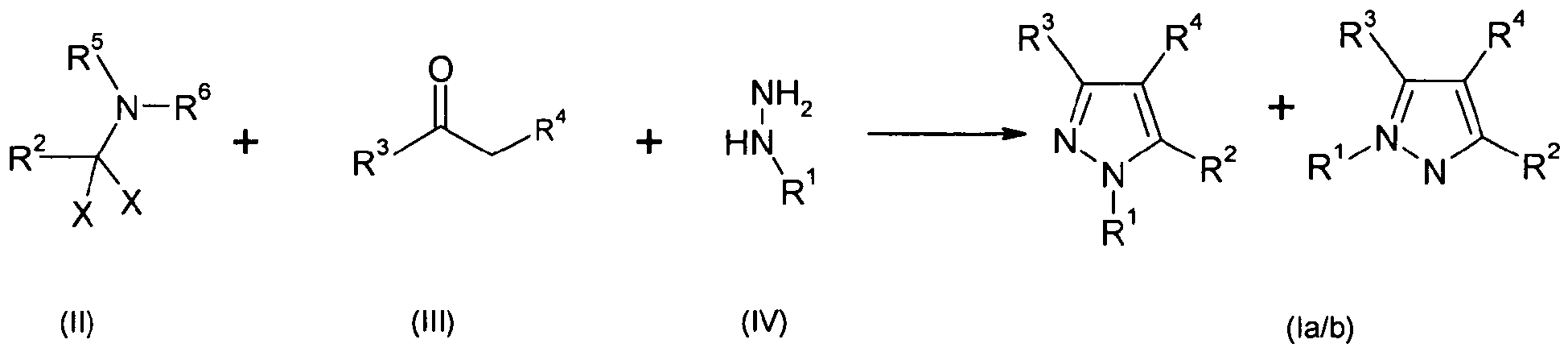
- Ebenfalls Gegenstand der vorliegenden Erfindung sind 3,5-Bis(fluoralkyl)-pyrazole der Formel (Ia) oder (Ib)

- R1
- ausgewählt ist aus H, C1-12-Alkyl, C3-8-Cycloalkyl, C6-18-Aryl, C7-19-Arylalkyl oder C7-19-Alkylaryl, CH2CN, CH2CX3, CH2COOH, CH2COO-(C1-12)-Alkyl;
X steht unabhängig voneinander für F, Cl, Br, I; - R2 und R3
- ausgewählt ist aus C1-C6-Haloalkylgruppen,
- R4
- ausgewählt ist aus der Gruppe H, F, Cl, Br, COOH, (C=O)OR5, CN und (C=O)NR5R6, wobei R5 und R6 unabhängig voneinander ausgewählt sind aus der Gruppe enthaltend C1-12-Alkyl, C3-8-Cycloalkyl, C6-18-Aryl-, C7-19-Arylalkyl oder C7-19-Alkylaryl oder wobei R5 und R6 gemeinsam mit dem N-Atom an das sie geknüpft sind einen fünf oder sechsgliedrigen Ring bilden können.
- In einer bevorzugten Ausführungsform der vorliegenden Erfindung haben die Reste in Formel (Ia) und (Ib) die folgenden Bedeutungen:
- R1
- ist ausgewählt aus H, Methyl, -CH2COOH, CH2COOR5, CH2CN, CH2CX3:
X steht unabhängig voneinander für F, Cl; - R2 und R3
- sind ausgewählt aus Difluormethyl, Trifluormethyl, Chlorfluormethyl, Dichlorfluormethyl, Chlordifluormethyl, 1-Fluorethyl, 2-Fluorethyl, 2,2-Difluorethyl, 2,2,2-Trifluorethyl, 2-Chlor-2-fluorethyl, 2-Chlor,2-difluorethyl, 2,2-Dichlor-2-fluorethyl, 2,2,2-Trichlorethyl, Pentafluorethyl und 1,1,1-Trifluorprop-2-yl;
- R4
- ist ausgewählt aus der Gruppe enthaltend H, Br, COOCH3, COOEt, COOC3H7, CN und CONMe2, CONEt2.
- In einer besonders bevorzugten Ausführungsform der vorliegenden Erfindung haben die Reste in Formel (Ia) und (Ib) die folgenden Bedeutungen:
- R1
- ist ausgewält aus H, CH2COOH, CH2COOMe, CH2CN,
- R2 und R3
- sind ausgewählt aus der Gruppe bestehend aus Trifluormethyl, Difluormethyl, Difluorchlormethyl, Pentafluoroethyl;
- R4
- ist ausgewählt aus der Gruppe bestehend aus H, Br, COOH.
- Ganz besonders bevorzugt sind Verbindungen der allgemeinen Formel (I) in welcher R1=H; R2=R3=CF2H und R4= COOEt ist oder
R1=H; R2=R3=CF2H und R4=COOH ist oder
R1=CH2COOEt, R2=R3= CF2H und R4 =COOEt ist. -

- In einer Ausführungsform des erfindungsgemäßen Verfahrens werden zuerst in Schritt A) α,α-Dihalogenaminen der Formel (II), gegebenenfalls in Gegenwart einer Lewis Säure [L], mit Verbindungen der Formel (III) umgesetzt.
- Bevorzugte Verbindungen der allgemeinen Formel (II) sind 1,1,2,2-Tetrafluorethyl-N,N-dimethylamin (TFEDMA), 1, 1,2,2-Tetrafluorethyl-N,N-diethylamin, 1,1,2-Trifluor-2-(trifluormethyl)ethyl-N,N-dimethylamin, 1,1,2-Trifluor-2-(trifluormethyl)ethyl-N,N-diethylamin (Ishikawa-Reagenz), 1,1,2-Trifluor-2-chlor-ethyl-N,N-dimethylamin und 1,1,2-Trifluor-2-chlor-ethyl-N,N-diethylamin (Yarovenko-Reagenz).
- Verbindungen der allgemeinen Formel (II) werden als Aminoalkylierungsmittel eingesetzt. Dabei sind 1,1,2,2-Tetrafluorethyl-N,N-dimethylamin (TFEDMA) und 1,1,2,2-Tetrafluorethyl-N,N-diethylamin bevorzugt und 1,1,2,2-Tetrafluorethyl-N,N-dimethylamin besonders bevorzugt. α,α-Dihalogenamine wie TFEDMA und Ishikawa-Reagenz sind kommerziell erhältlich oder können hergestellt werden (vgl. Yarovenko et al., Zh. Obshch. Khim. 1959, 29, 2159, Chem. Abstr. 1960, 54, 9724h oder Petrov et al., J. Fluor. Chem. 109 (2011) 25-31).
- Von Yagupolskii et al. (Zh. Organicheskoi Khim. (1978), 14(12), 2493-6) wird gezeigt, dass die Umsetzung des Yarovenko Reagenzes (FClCHCF2NEt2) mit Nitrilen der Formel RCH2CN (R = CN, CO2Et) die Derivate der Formel (NC)RC=C(NEt2)CHFCl in ca. 70 % Ausbeute liefert. Ketoverbindungen der Formel (III) reagieren unter diese Bedingung mit α,α-Dihalogenaminen der Formel (II) nicht.
- Von Petrov et al. (J. of Fluorine Chem. (2011), 132(12), 1198-1206) wird gezeigt, dass TFEDMA (HCF2CF2NMe2) mit cyclischen β-Diketonen reagiert und dabei eine Difluoracetylgruppe überträgt.
- In einer bevorzugten Ausführungsform des erfindungsgemäßen Verfahrens wird das α,α-Dihalogenamin zuerst mit Lewis Säure [L], wie z.B. BF3, AlCl3, SbCl5, SbF5, ZnCl2, umgesetzt und dann das Gemisch aus der Verbindung der Formel (III) und einer Base, in Substanz oder gelöst in einem geeigneten Lösungsmittel, zugegeben (vgl.
WO 2008/022777 ). - Die Umsetzung von α,α-Dihalogenaminen mit Lewis Säuren (Herstellung der Imminium Salzen der Formel (V)) erfolgt entsprechend der Lehre der
WO 2008/022777 . Die Umsetzung erfolgt erfindungsgemäß bei Temperaturen von -20°C bis +40°C, bevorzugt bei Temperaturen von -20°C bis +30°C, besonders bevorzugt bei -10 bis 20°C und unter Normaldruck. Aufgrund der Hydrolyseempfindlichkeit der α,α-Dihalogenaminen, wird die Umsetzung in wasserfreien Apparaturen unter Inertgasatmosphäre durchgeführt. - Die Reaktionszeit ist nicht kritisch und kann, in Abhängigkeit von der Ansatzgröße und Temperatur, in einem Bereich zwischen wenigen Minuten und mehreren Stunden gewählt werden.
- Erfindungsgemäß wird 1 Mol der Lewis Säure [L] mit äquimolaren Mengen der α,α-Dihalogenamin der Formel (II) umgesetzt.
- Die Aminoalkylierung (Umsetzung mit Verbindung der Formel (II)) erfolgt bevorzugt in Gegenwart einer Base. Bevorzugt sind organische Basen wie Trialkylamine, Pyridine, Alkylpyridine, Phosphazene und 1,8-Diazabicyclo[5.4.0]undecen (DBU); Alkalimetallhydroxide wie z.B. Lithium-, Natrium- oder Kaliumhydroxid, Alkalimetallalcarobonate (Na2CO3, K2CO3) und Alkoholate, wie z.B. NaOMe, NaOEt, NaOt-Bu, KOt-Bu oder KF.
- Für das erfindungsgemäße Verfahren werden 1 Mol der Base für die Verbindung der Formel (III) mit äquimolaren Mengen der α,α-Dihalogenamin der Formel (II) umgesetzt.
- Bevorzugt werden Ketoverbindungen der Formel (III) verwendet, die ausgewählt sind aus der Gruppe enthaltend Ethyl-4,4,4-trifluoro-3-oxobutanoate, Methyl-4,4,4-trifluoro-3-oxobutanoate, Ethyl-4,4-difluoro-3-oxobutanoate, Ethyl-4-chloro-4,4-difluoro-3-oxobutanoate, 1,1,1-Trifluoraceton oder 4-Chloro-4,4-difluoro-3-oxobutanenitrile.
- Geeignete Lösungsmittel sind beispielsweise aliphatische, alicyclische oder aromatische Kohlenwasserstoffe, wie z.B. Petrolether, n-Hexan, n-Heptan, Cyclohexan, Methylcyclohexan, Benzol, Toluol, Xylol oder Decalin und halogenierte Kohlenwasserstoffe, wie z.B. Chlorbenzol, Dichlorbenzol, Dichlormethan, Chloroform, Tetrachlormethan, Dichlorethan oder Trichlorethan, Ether, wie Diethylether, Diisopropylether, Methyl-tert-butylether, Methyl-tert-amylether, Dioxan, Tetrahydrofuran, 1,2-Dimethoxyethan, 1,2-Diethoxyethan oder Anisol; Nitrile, wie Acetonitril, Propionitril, n- oder iso-Butyronitril oder Benzonitril; Amide, wie N,N-Dimethylformamid, N,N-Dimethylacetamid, N-Methylformanilid, N-Methylpyrrolidon oder Hexamethylphosphorsäuretriamid; Sulfoxide, wie Dimethylsulfoxid oder Sulfone, wie Sulfolan. Besonders bevorzugt sind beispielsweise THF, Acetonitrile, Ether, Toluol, Xylol, Chlorbenzol, n-Hexan, Cyclohexan oder Methylcyclohexan, ganz besonders bevorzugt sind beispielsweise Acetonitrile, THF, Ether oder Dichlormethan.
- Die gebildeten Zwischenprodukte der Formel (VI) können ohne vorherige Aufarbeitung in den Cyclisierungsschritt mit Hydrazinen eingesetzt werden.
- Alternativ können die Zwischenprodukte durch geeignete Aufarbeitungsschritte und gegebenenfalls weiterer Reinigung isoliert und charakterisiert werden.
- Die Cyclisierung in Schritt B) durch Umsetzung mit Verbindung (IV) erfolgt im erfindungsgemäßen Verfahren bei Temperaturen von -40°C bis +80°C, bevorzugt bei Temperaturen von -10°C bis +60 °C, besonders bevorzugt bei -10 bis 50°C und unter Normaldruck.
- Die Reaktionszeit ist nicht kritisch und kann in Abhängigkeit von der Ansatzgröße in einem größeren Bereich gewählt werden.
- Üblicherweise erfolgt der Cylisierungsschritt B) ohne Lösemittelwechsel.
- Erfindungsgemäß werden 1 bis 2 Mol, bevorzugt 1 bis 1,5 der Hydrazine der Formel (IV) für 1 Mol der Verbindung der Formel (III) eingesetzt.
- Bevorzugt werden alle Reaktionsschritte des erfindungsgemäßen Verfahrens im selben Lösungsmittel durchgeführt. Im Zusammenhang mit der vorliegenden Erfindung werden beispielsweise Hydrazinhydrat, Methylhydrazine, Ethylhydrazine, Phenylhydrazine, tert-Butylhydrazine, Methyl- oder Ethylhydrazinoacetatehydrochloride oder Hydrazinoacetonitrilehydrochlorid eingesetzt.
- Die genannten Hydrazine der Formel (IV) sind kommerziell erhältlich oder können wie zum Beispiel in Niedrich et al, Journal fuer Praktische Chemie (Leipzig) (1962), 17 273-81. Carmi, A.; Pollak, Journal of Organic Chemistry (1960), 25 44-46 hergestellt werden.
- Geeignete Lösungsmittel sind beispielsweise aliphatische, alicyclische oder aromatische Kohlenwasserstoffe, wie z.B. Petrolether, n-Hexan, n-Heptan, Cyclohexan, Methylcyclohexan, Benzol, Toluol, Xylol oder Decalin, und halogenierte Kohlenwasserstoffe, wie z.B. Chlorbenzol, Dichlorbenzol, Dichlormethan, Chloroform, Tetrachlormethan, Dichlorethan oder Trichlorethan, Ether, wie Diethylether, Diisopropylether, Methyl-tert-butylether, Methyl-tert-amylether, Dioxan, Tetrahydrofuran, 1,2-Dimethoxyethan, 1,2-Diethoxyethan oder Anisol; Alkohole wie Metanol, Ethanol, Isopropanol oder Buthanol, Nitrile, wie Acetonitril, Propionitril, n- oder iso-Butyronitril oder Benzonitril; Amide, wie N,N-Dimethylformamid, N,N-Dimethylacetamid, N-Methylformanilid, N-Methylpyrrolidon oder Hexamethylphosphorsäuretriamid; Sulfoxide, wie Dimethylsulfoxid oder Sulfone, wie Sulfolan. Besonders bevorzugt sind beispielsweise AcetonitrileToluol, Xylol, Chlorbenzol, n-Hexan, Cyclohexan oder Methylcyclohexan, ganz besonders bevorzugt sind beispielsweise Acetonitrile, THF, Toluol, Xylol. Nach beendeter Reaktion wird beispielsweise die Lösemitteln entfernt und das Produkt durch Filtration isoliert oder zunächst das Produkt mit Wasser gewaschen, extrahiert, die organische Phase abgetrennt und das Lösungsmittel in Vakuum entfernt.
- Die Verbindungen der Formel (I) mit R4 = COOR5 können dann zu Pyrazolsäuren der Formel (I) R4=COOH umgewandelt werden.
- Die Umwandlung wird in der Regel unter sauren oder basischen Bedingungen durchgeführt.
- Für saure Hydrolyse bevorzugt sind mineralische Säuren, beispielsweise H2SO4, HCl, HSO3Cl, HF, HBr, HI, H3PO4 oder organische Säuren, beispielsweise CF3COOH, p-Toluolsulfonsäure, Methansulfonsäure, Trifluormethansulfonsäure. Die Reaktion kann durch der Zusatz von Katalysatoren wie beispielsweise FeCl3, AlCl3, BF3, SbCl3, NaH2PO4 beschleunigt werden. Die Reaktion kann ebenfalls ohne Zusatz von Säure nur in Wasser durchgeführt werden.
- Basische Hydrolyse erfolgt in Gegenwart von anorganischen Basen wie Alkalimetallhydroxide wie z.B. Lithium-, Natrium- oder Kaliumhydroxid, Alkalimetallcarbonate, wie beispielsweise Na2CO3, K2CO3 und Alkalimetall-Acetate wie beispielsweise NaOAc, KOAc, LiOAc, sowie Alkalimetall-Alkoholate, wie z.B. NaOMe, NaOEt, NaOt-Bu, KOt-Bu von organischen Basen wie Trialkylamine, Alkylpyridine, Phosphazene und 1,8-Diazabicyclo[5.4.0]undecen (DBU). Bevorzugt sind die anorganische Basen wie z.B. NaOH, KOH, Na2CO3 oder K2CO3.
- Bevorzugt erfolgt die Umwandlung mittels basischer Hydrolyse.
- Die Durchführung des erfindungsgemäßen Verfahrensschritts erfolgt bevorzugt innerhalb eines Temperaturbereichs von 20°C bis +150°C, besonders bevorzugt bei Temperaturen von 30°C bis +1 10 °C, ganz besonders bevorzugt bei 30 bis 80°C.
- Der erfindungsgemäße Verfahrensschritt wird im Allgemeinen unter Normaldruck durchgeführt. Alternativ ist es jedoch auch möglich, im Vakuum oder unter Überdruck (z.B. Umsetzung im Autoklav mit wässriger HCl) zu arbeiten.
- Die Reaktionszeit kann, in Abhängigkeit von der Ansatzgröße und der Temperatur, in einem Bereich zwischen 1 Stunde und mehreren Stunden gewählt werden.
- Der Reaktionsschritt kann in Substanz oder in einem Lösungsmittel durchgeführt werden. Bevorzugt wird die Reaktion in einem Lösungsmittel durchgeführt. Geeignete Lösungsmittel sind beispielsweise ausgewählt aus der Gruppe enthaltend Wasser, Alkohole wie Metanol, Ethanol, Isopropanol oder Buthanol, aliphatischen und aromatischen Kohlenwasserstoffen, wie z.B. n-Hexan, Benzol oder Toluol, die durch Fluor- und Chloratome substituiert sein können, wie Methylenchlorid, Dichlorethan, Chlorbenzol oder Dichlorbenzol; Ethern, wie z.B. Diethylether, Diphenylether Methyl-tert-butylether, Isopropylethylether, Dioxan, Diglym, Dimethylglycol, Dimethoxyethane (DME) oder THF; Nitrilen wie Methylnitril, Butylnitril oder Phenylnitril; Amide wir Dimethylformamid (DMF) oder N-methlypyrollidon (NMP) oder Mischungen solcher Lösungsmittel, wobei Wasser, Acetonitril, Dichlormethan und Alkohole (Ethanol) besonders bevorzugt sind.
- Die erfindungsgemäßen Verbindungen (Ia) und (Ib) werden zur Herstellung fungizider Wirkstoffe verwendet.
- Ebenfalls Gegenstand der vorliegenden Erfindung sind Verbindung der Formel (VI)

- R2 und R3
- unabhängig voneinander ausgewählt sind aus der Gruppe enthaltend CF3, CF2H, CF2Cl;
- R4
- ausgewählt ist aus der Gruppe enthaltend (C=O)OR5;
- R5 und R6
- unabhängig voneinander ausgewählt sind aus der Gruppe enthaltend C1-6-Alkyl.
- Das erfindungsgemäße Verfahren wird in den nachstehenden Beispielen weiter beschrieben. Die Beispiele sind jedoch nicht in einschränkender Weise zu interpretieren.
- BF3.OEt2 (0.12 mL, 1.0 mmol) wurde zu einer Lösung von TFEDMA (0.12 mL, 1.0 mmol) in trockenem Dichlormethan (1 mL) unter Argon in einem Teflonkolben gegeben. Die Lösung wurde 15 min bei Raumtemperatur gerührt, bevor das Dichlormethan unter Vakuum entfernt wurde. Der Rückstand wurde dann in perdeuteriertem Acetonitril (1 mL) aufgenommen. In einem zweiten Teflonkolben wurde Ethyl-4-chloro-4,4-difluoroacetoacetat (0.20 g, 1.0 mmol) zu einer Lösung von Kaliumfluorid (0.18 g, 3.0 mmol) in CD3CN (2 mL) gegeben und 15 min bei Raumtemperatur gerührt. Hierzu wurde dann bei -30°C der Inhalt des ersten Teflonkolben zugetropft und die Reaktionsmischung über Nacht bei Raumtemperatur gerührt und dann durch 1H und 13C NMR Spektroskopie analysiert. Die Zwischenverbindung (Ethyl 2-(2-chloro-2,2-difluoroacetyl)-3-(dimethylamino)-4,4-difluorobut-2-enoate) konnte als 2:1 Mischung (1H NMR) in Gegenwart von Ethyl-3-(dimethylamino)-4,4-difluorobut-2-enoate charakterisiert werden.

- 1H NMR (CD3CN, 300 MHz, 25 °C): δ = 6.36 (t, 1H, CHF2, JH-F = 53.2 Hz), 4.21 (q, 2H, CH2, J = 7.2 Hz), 3.07 (t, 3H, NMe, JH-F = 1.2 Hz), 2.95 (t, 3H, NMe, JH-F = 1.2 Hz), 1.26 (t, 3H, CH3, J = 7.2 Hz) ppm.
- 13C NMR (CD3CN, 75 MHz, 25 °C): δ = 185.3 (F2ClC-CO), 164.9 (CO), 161.7 (t, C IV -NMe 2 , JC-F = 25.1 Hz), 119.4 (t, CF2Cl, JC-F = 304.3 Hz), 108.1 (t, CHF2, JC-F = 244.4 Hz), 98.1 (t, CIV, JC-F = 4.8 Hz), 61.9 (CH2), 35.0 (N-Me2), 13.3 (CH3) ppm.

- 1H NMR (CD3CN, 300 MHz, 25 °C): δ = 6.65 (t, 1H, CHF2, JH-F = 51.9 Hz), 5.70 (s, 1H, CH), 4.31 (q, 2H, CH2, J = 7.1 Hz), 3.91 (t, 3H, NMe, JH-F = 0.8 Hz), 3.22 (t, 3H, NMe, JH-F = 1.2 Hz), 1.31 (t, 3H, CH3, J = 7.1 Hz) ppm.
- 13C NMR (CD3CN, 75 MHz, 25 °C): δ = 171.3 (CO), 163.4 (t, C IV -NMe2, JC-F = 21.3 Hz), 110.5 (t, CHF2, JC-F = 246.7 Hz), 91.1 (t, CIV, JC-F = 4.4 Hz), 61.2 (CH2), 36.4 (N-Me2), 13.3 (CH3) ppm.
-

- BF3.OEt2 (0.62 mL, 5.0 mmol) wurde zu einer Lösung von TFEDMA (0.59 mL, 5.0 mmol) in trockenem Dichlormethane (5 mL) under Argon in einem Teflonkolben gegeben. Die Lösung wurde 15 min bei Raumtemperatur gerührt, bevor das Dichlormethan unter Vakuum entfernt wurde. Der Rückstand wurde dann in trockenem Acetonitril (5 mL) aufgenommen. In einem zweiten Teflonkolben wurde Ethyltrifluoroacetoacetate (0.73 mL, 5.0 mmol) zu einer Lösung von Kaliumfluoride (0.88g, 15.0 mmol) in trockenem Acetonitril (10 mL) gegeben und 15 min bei Raumtemperatur gerührt. Hierzu wurde bei -30°C der Inhalt des ersten Kolbens zugetropft. Die Reaktionsmischung wurde im Kältebad auf Raumtemperatur gebracht und über Nacht gerührt. Methylhydrazin (0.32 mL, 6.0 mmol) wurde dann bei Raumtemperatur zugetropft und die Mischung über Nacht gerührt. Das Lösemittel wurde im Vakuum entfernt und der Rückstand durch Flashchromatographie auf Kieselgel mit einer Pentane/Diethylether Mischung (9:1 - 8:2) gereinigt. N-Methyl-5-trifluoromethyl-3-difluoromethyl-4-pyrazolcarbonsäureethylester (0.99 g, 3.64 mmol, 73%) wurde als gelbes Öl erhalten.
- 1H NMR (CDCl3, 300 MHz, 25 °C): δ = 7.00 (t, 1H, CHF2, JH-F= 54 Hz), 4.37 (q, 2H, CH2, J = 7.2 Hz), 4.12 (s, 3H, N-CH3), 1.37 (t, 3H, CH3, J = 7.2 Hz) ppm. 13C NMR (CDCl3, 75 MHz, 25 °C): δ = 160.2 (CO), 145.7 (t, CIVarom, JC-F = 25.6 Hz), 133.2 (q, CIVarom, JC-F = 40.3 Hz), 119.0 (q, CF3, JC-F = 271.2 Hz), 114.4 (CIVarom), 109.0 (t, CHF2, JC-F = 237.9 Hz), 61.9 (CH2), 40.8 (q, N-CH3, J C-F = 3.2 Hz), 13.8 (CH3) ppm. 19F NMR (CDCl3, 282MHz, 25°C): δ = -57.6 (CF3), -116.4 (CHF2) ppm.
-

- N-Methyl-5-trifluoromethyl-3-difluoromethyl-4-pyrazolcarbonsäureethylester (0.5g, 1.84 mmol) wurde in Ethanol (3 mL) langsam mit einer 8N wässrigen Natriumhydroxid Lösung (0.7 mL) versetzt und 3h bei Raumtemperatur gerührt. Das Lösemittel wurde abrotiert, der Rückstand in Wasser (10 mL) aufgenommen und mit Diethylether (10 mL) extrahiert. Nach Ansäuern auf pH 1 mit 1M HCl wurde mit Ethylacetat (3 x 10 mL) extrahiert. Die vereinigten organischen Phasen wurden über Natriumsulfat getrocknet, filtriert und das Lösemittel abrotiert. N-Methyl-3-difluoromethyl-5-trifluoromethyl-4-pyrazolcarbonsäure (0.44g, 1.80 mmol, 98%) wurde als gelblicher Feststoff isoliert.
- 1H NMR (CDCl3, 300 MHz, 25 °C): δ = 7.08 (t, 1H, CHF2, JH-F= 53.5 Hz), 4.16 (s, 3H, N-CH3) ppm.
- 13C NMR (CDCl3, 75 MHz, 25 °C): δ = 165.5 (CO), 146.7 (t, CIVarom, JC-F = 18.8 Hz), 134.4 (q, CIVarom, JC-F = 30.8 Hz), 118.8 (q, CF3, JC-F = 202.5 Hz), 112.9 (CIVarom), 108.7 (t, CHF2, JC-F = 177.0 Hz), 41.1 (q, N-CH3, J C-F = 2.3 Hz) ppm. 19F NMR (CDCl3, 282MHz, 25°C): δ = -57.9 (CF3), -117.3 (CHF2, JF-H = 53.5 Hz) ppm.
-

- BF3.OEt2 (0.31 mL, 2.5 mmol) wurde zu einer Lösung von TFEDMA (0.30 mL, 2.5 mmol) in trockenem Dichlormethane (2.5 mL) unter Argon in einem Teflonkolben gegeben. Die Lösung wurde 15 min bei Raumtemperatur gerührt, bevor das Dichlormethan unter Vakuum entfernt wurde. Der Rückstand wurde dann in trockenem Acetonitril (2.5 mL) aufgenommen. In einem zweiten Teflonkolben wurde Ethyltrifluoroacetoacetate (0.37 mL, 2.5 mmol) zu einer Lösung von Kaliumfluoride (0.44 g, 7.5 mmol) in trockenem Acetonitril (5 mL) gegeben und 15 min bei Raumtemperatur gerührt. Hierzu wurde bei -30°C der Inhalt des ersten Kolbens zugetropft. Die Reaktionsmischung wurde im Kältebad auf Raumtemperatur gebracht und über Nacht gerührt. Hydrazinhydrat (0.15 mL, 3.0 mmol) wurde dann bei Raumtemperatur zugetropft und die Mischung 24h gerührt. Das Lösemittel wurde im Vakuum entfernt und der Rückstand durch Flashchromatographie auf Kieselgel mit einer Pentane/Diethylether Mischung (9:1 - 7:3) gereinigt. N-H-3-Difluoromethyl-5-trifluoromethyl-4-pyrazolcarbonsäureethylester (0.48 g, 1.88 mmol, 75%) wurde als gelbliches Öl erhalten welches beim Stehenlassen auskristallisiert.
- 1H NMR (CDCl3, 300 MHz, 25 °C): δ = 11.07 (brs, 1H, NH), 7.22 (t, 1H, CHF2, JH-F = 53.5 Hz), 4.39 (q, 2H, CH2, J = 6.9 Hz), 1.38 (t, 3H, CH3, J = 6.9 Hz) ppm. 13C NMR (CDCl3, 75 MHz, 25 °C): δ = 160.4 (CO), 142.2 (t, CIVarom, JC-F = 18.3 Hz), 142.2 (q, CIVarom, JC-F = 32.0 Hz), 119.7 (q, CF3, JC-F = 268.1 Hz), 111.7 (CIVarom), 107.4 (t, CHF2, JC-F = 237.5 Hz), 62.0 (CH2), 13.7 (CH3) ppm. 19F NMR (CDCl3, 282MHz, 25°C): δ = -62.5 (CF3), -117.1 (CHF2, JF-H = 53.5 Hz) ppm.
-

- BF3.OEt2 (1.24 mL, 10.0 mmol) wurde zu einer Lösung von TFEDMA (1.20 mL, 10.0 mmol) in trockenem Dichlormethane (10 mL) unter Argon in einem Teflonkolben gegeben. Die Lösung wurde 15 min bei Raumtemperatur gerührt, bevor das Dichlormethan unter Vakuum entfernt wurde. Der Rückstand wurde dann in trockenem Acetonitril (10 mL) aufgenommen. In einem zweiten Teflonkolben wurde Ethyl-4,4-difluoroacetoacetate (1.03 mL, 10.0 mmol) zu einer Lösung von Pyridin (1.6 mL, 20.0 mmol) in trockenem Acetonitril (20 mL) gegeben und 15 min bei Raumtemperatur gerührt. Hierzu wurde bei -30°C der Inhalt des ersten Kolbens zugetropft. Die Reaktionsmischung wurde im Kältebad auf Raumtemperatur gebracht und über Nacht gerührt. Methylhydrazin (0.79 mL, 15.0 mmol) wurde dann bei Raumtemperatur zugetropft und die Mischung über Nacht gerührt. Das Lösemittel wurde im Vakuum entfernt und der Rückstand durch Flashchromatographie auf Kieselgel mit einer Pentane/Diethylether Mischung (10:0 - 8:2) gereinigt. (10:0 to 8:2). N-Methyl-3,5-difluoromethyl-4-pyrazolcarbonsäureethylester (1.75 g, 6.89 mmol, 69%) wurde als farbloses ÖI erhalten welches beim Stehenlassen auskristallisiert.
- 1H NMR (CDCl3, 300 MHz, 25 °C): δ = 7.48 (t, 1H, CHF2, JH-F = 52.6 Hz,), 7.04 (t, 1H, CHF2, JH-F = 53.8 Hz), 4.38 (q, 2H, CH2, J = 7.1 Hz), 4.12 (s, 3H, N-CH3), 1.39 (t, 3H, CH3, J = 7.2 Hz) ppm. 13C NMR (CDCl3, 75 MHz, 25 °C): δ = 161.1 (CO), 145.3 (t, CIVarom, JC-F = 24.9 Hz), 138.2 (t, CIVarom, JC-F = 24.1 Hz), 112.9 (m, CIVarom), 109.1 (t, CHF2, JC-F = 237.6 Hz), 107.2 (t, CHF2, JC-F = 236.3 Hz), 61.5 (CH2), 39.6 (t, N-CH3, J C-F = 3.1 Hz), 13.9 (CH3) ppm. 19F NMR (CDCl3, 282MHz, 25°C): δ = - 117.00 (CHF2, JF-H = 53.8 Hz), -117.04 (CHF2, JF-H = 52.6 Hz) ppm.
-

- N-Methyl-3,5-difluoromethyl-4-pyrazolcarbonsäureethylester (0.5 g, 2.0 mmol) wurde in Ethanol (3 mL) langsam mit einer 8N wässrigen Natriumhydroxid Lösung (0.8 mL) versetzt und 2h bei Raumtemperatur gerührt. Das Lösemittel wurde abrotiert, der Rückstand in Wasser (10 mL) aufgenommen und mit Diethylether (10 mL) extrahiert. Nach Ansäuern auf pH 1 mit 6M HCl wurde mit Ethylacetat (3 x 10 mL) extrahiert. Die vereinigten organischen Phasen wurden über Natriumsulfat getrocknet, filtriert und das Lösemittel abrotiert. N-Methyl-3,5-difluoromethyl-4-pyrazolcarbonsäure (0.44g, 1.95 mmol, 97%) wurde als farbloser Feststoff isoliert.
- 1H NMR (CDCl3, 300 MHz, 25 °C): δ = 12.16 (brs, 1H, COOH), 7.48 (t, 1H, CHF2, JH-F= 52.4 Hz), 7.08 (t, 1H, CHF2, JH-F= 53.6 Hz), 4.16 (s, 3H, N-CH3) ppm. 13C NMR (CDCl3, 75 MHz, 25 °C): δ = 166.9 (CO), 146.4 (t, CIVarom, JC-F = 25.1 Hz), 139.2 (t, CIVarom, JC-F = 24.4 Hz), 111.5 (CIVarom), 108.8 (t, CHF2, JC-F = 238.1 Hz), 106.9 (t, CHF2, JC-F = 237.0 Hz), 39.9 (t, N-CH3, J C-F = 3.1 Hz) ppm. 19F NMR (CDCl3, 282MHz, 25°C): δ = -117.1 (CHF2, JF-H = 52.6 Hz), -117.3 (CHF2, JF-H = 53.7 Hz) ppm.
-

- BF3.OEt2 (1.85 mL, 15.0 mmol) wurde zu einer Lösung von TFEDMA (1.76 mL, 15.0 mmol) in trockenem Dichlormethane (15 mL) unter Argon in einem Teflonkolben gegeben. Die Lösung wurde 15 min bei Raumtemperatur gerührt, bevor das Dichlormethan unter Vakuum entfernt wurde. Der Rückstand wurde dann in trockenem Acetonitril (15 mL) aufgenommen. In einem zweiten Teflonkolben wurde Ethyl-4,4-difluoroacetoacetat (1.55 mL, 15 mmol) zu einerr Lösung von Kaliumfluoride (2.61 g, 45 mmol) in trockenem Acetonitril (30 mL) gegeben und 15 min bei Raumtemperatur gerührt. Hierzu wurde bei -30°C der Inhalt des ersten Kolbens zugetropft. Die Reaktionsmischung wurde im Kältebad auf Raumtemperatur gebracht und über Nacht gerührt. Hydrazinhydrat (1.1 mL, 22.5 mmol) wurde dann bei Raumtemperatur zugetropft und die Mischung über Nacht gerührt. Das Lösemittel wurde im Vakuum entfernt und der Rückstand durch Flashchromatographie auf Kieselgel mit einer Pentane/Diethylether Mischung (9:1 - 7:3) gereinigt. N-H-3,5-Difluoromethyl-4-pyrazolcarbonsäureethylester (2.02 g, 8.40 mmol, 56%) wurde als farbloser Feststoff isoliert.
- 1H NMR (CDCl3, 300 MHz, 25 °C): δ = 7.15 (t, 2H, CHF2, JH-F = 53.6 Hz), 4.39 (q, 2H, CH2, J = 7.1 Hz), 1.39 (t, 3H, CH3, J = 7.1 Hz) ppm. 13C NMR (CDCl3, 75 MHz, 25 °C): δ = 161.1 (CO), 143.8 (t, CIVarom, JC-F = 23.1 Hz), 111.6 (CIVarom), 108.2 (t, CHF2, JC-F = 238.4 Hz), 61.7 (CH2), 13.9 (CH3) ppm. 19F NMR (CDCl3, 282MHz, 25°C): δ = -117.3 (CHF2, JF-H = 53.6 Hz) ppm.
- N-Methyl-3-difluoromethyl-5-chlorodifluoromethyl-4-pyrazolcarbonsäureethylester:

- BF3.OEt2 (1.24 mL, 10.0 mmol) wurde zu einer Lösung von TFEDMA (1.20 mL, 10.0 mmol) in trockenem Dichlormethane (10 mL) unter Argon in einem Teflonkolben gegeben. Die Lösung wurde 15 min bei Raumtemperatur gerührt, bevor das Dichlormethan unter Vakuum entfernt wurde. Der Rückstand wurde dann in trockenem Acetonitril (10 mL) aufgenommen. In einem zweiten Teflonkolben wurde Ethyl-4-chloro-4,4-difluoroacetoacetat (2.0 g, 10.0 mmol) zu einer Lösung von Pyridin (2.42 mL, 30.0 mmol) in trockenem Acetonitril (20 mL) gegeben und 15 min bei Raumtemperatur gerührt. Hierzu wurde bei -30°C der Inhalt des ersten Kolbens zugetropft. Die Reaktionsmischung wurde im Kältebad auf Raumtemperatur gebracht und über Nacht gerührt. Methylhydrazin (0.79 mL, 15.0 mmol) wurde dann bei Raumtemperatur zugetropft und die Mischung über Nacht gerührt. Das Lösemittel wurde im Vakuum entfernt und der Rückstand durch Flashchromatographie auf Kieselgel mit einer Pentane/Diethylether Mischung (10:0 - 8:2) gereinigt. N-Methyl-3-difluoromethyl-5-chlorodifluoromethyl-4-pyrazolcarbonsäureethylester (2.07 g, 7.18 mmol, 72%) wurde als farblose Flüssigkeit isoliert.
- 1H NMR (CDCl3, 300 MHz, 25 °C): δ = 6.97 (t, 1H, CHF2, JH-F = 53.9 Hz,), 4.37 (q, 2H, CH2, J = 7.1 Hz), 4.10 (t, 3H, N-CH3, JH-F = 2.2 Hz), 1.38 (t, 3H, CH3, J = 7.1 Hz) ppm. 13C NMR (CDCl3, 75 MHz, 25 °C): δ = 160.3 (CO), 145.3 (t, CIVarom, JC-F = 25.7 Hz), 137.5 (t, CIVarom, JC-F = 33.3 Hz), 119.9 (t, CF2Cl, JC-F = 288.8 Hz), 112.7 (CIVarom), 109.1 (t, CHF2, JC-F = 237.8 Hz), 61.8 (CH2), 40.6 (t, N-CH3, J C-F = 4.6 Hz), 13.7 (CH3) ppm. 19F NMR (CDCl3, 282MHz, 25°C): δ = -47.9 (CF2Cl), -116.7 (CHF2, JF-H = 53.9 Hz) ppm.
-

- N-Methyl-3-difluoromethyl-5-chlorodifluoromethyl-4-pyrazolcarbonsäureethylester (0.5g, 1.73 mmol) wurde in Ethanol (3 mL) langsam mit einer 8N wässrigen Natriumhydroxid Lösung (0.7 mL ) versetzt und 3h bei Raumtemperatur gerührt. Das Lösemittel wurde abrotiert, der Rückstand in Wasser (10 mL) aufgenommen und mit Diethylether (10 mL) extrahiert. Nach Ansäuern auf pH 1 mit 6M HCl wurde mit Ethylacetat (3 x 10 mL) extrahiert. Die vereinigten organischen Phasen wurden über Natriumsulfat getrocknet, filtriert und das Lösemittel abrotiert. N-Methyl-3-difluoromethyl-5-chlorodifluoromethyl-4-pyrazolcarbonsäure (0.36g, 1.38 mmol, 80%) wurde als farbloser Feststoff isoliert.
- 1H NMR (CDCl3, 300 MHz, 25 °C): δ = 12.15 (brs, 1H, COOH), 7.07 (t, 1H, CHF2, JH-F = 53.6 Hz), 4.15 (t, 3H, N-CH3, JH-F = 2.1 Hz) ppm. 13C NMR (CDCl3, 75 MHz, 25 °C): δ = 165.8 (CO), 146.4 (t, CIVarom, JC-F = 25.3 Hz), 138.9 (t, CIVarom, JC-F = 33.6 Hz), 119.6 (t, CF2Cl, JC-F = 289.4 Hz), 111.15 (CIVarom), 108.8 (t, CHF2, JC-F = 238.4 Hz), 41.0 (t, N-CH3, J C-F = 4.9 Hz) ppm. 19F NMR (CDCl3, 282MHz, 25°C): δ = -48.1 (CF2Cl), -117.2 (CHF2, JF-H = 53.6 Hz) ppm.
-

- BF3.OEt2 (0.62 mL, 5.0 mmol) wurde zu einer Lösung von TFEDMA (0.59 mL, 5.0 mmol) in trockenem Dichlormethane (5 mL) unter Argon in einem Teflonkolben gegeben. Die Lösung wurde 15 min bei Raumtemperatur gerührt, bevor das Dichlormethan unter Vakuum entfernt wurde. Der Rückstand wurde dann in trockenem Acetonitril (5 mL) aufgenommen. In einem zweiten Teflonkolben wurde Ethyl-4-chloro-4,4-difluoroacetoacetat (1.0 g, 5.0 mmol) zu einer Lösung von Pyridin (1.19 g, 15 mmol) in trockenem Acetonitril (10 mL) gegeben und 15 min bei Raumtemperatur gerührt. Hierzu wurde bei -30°C der Inhalt des ersten Kolbens zugetropft. Die Reaktionsmischung wurde im Kältebad auf Raumtemperatur gebracht und über Nacht gerührt. Hydrazinhydrat (0.37 mL, 7.5 mmol) wurde dann bei Raumtemperatur zugetropft und die Mischung über Nacht gerührt. Das Lösemittel wurde im Vakuum entfernt und der Rückstand durch Flashchromatographie auf Kieselgel mit einer Pentane/Diethylether Mischung (9:1 - 7:3) gereinigt. N-H-3-Difluoromethyl-5-chlorodifluoromethyl-4-pyrazolcarbonsäureethylester (0.99 g, 3.61 mmol, 72%) wurde als leicht gelbliches Öl isoliert.
- 1H NMR (CDCl3, 300 MHz, 25 °C): δ = 11.62 (brs, 1H, NH), 7.25 (t, 2H, CHF2, JH-F = 53.5 Hz), 4.41 (q, 2H, CH2, J = 7.1 Hz), 1.41 (t, 3H, CH3, J = 7.1 Hz) ppm. 13C NMR (CDCl3, 75 MHz, 25 °C): δ = 160.6 (CO), 146.3 (t, CIVarom, JC-F = 32.3 Hz), 142.7 (t, CHF2, JC-F = 29.3 Hz), 121.3 (t, CF2Cl, JC-F = 287.3 Hz), 110.8 (CIVarom), 109.1 (t, CHF2, JC-F = 240.2 Hz), 62.0 (CH2), 13.6 (CH3) ppm. 19F NMR (CDCl3, 282MHz, 25°C): δ = -49.6 (CF2Cl), -116.8 (CHF2, JF-H = 53.5 Hz) ppm.
-

- BF3.OEt2 (1.24 mL, 10.0 mmol) wurde zu einer Lösung von TFEDMA (1.20 mL, 10.0 mmol) in trockenem Dichlormethane (10 mL) unter Argon in einem Teflonkolben gegeben. Die Lösung wurde 15 min bei Raumtemperatur gerührt, bevor das Dichlormethan unter Vakuum entfernt wurde. Der Rückstand wurde dann in trockenem Acetonitril (10 mL) aufgenommen. In einem zweiten Teflonkolben wurde Ethyl-4,4,5,5,5-pentafluoroacetoacetat (1.75 mL, 10.0 mmol) zu einer Lösung von Pyridin (2.42 mL, 30.0 mmol) in trockenem Acetonitril (20 mL) gegeben und 15 min bei Raumtemperatur gerührt. Hierzu wurde bei -30°C der Inhalt des ersten Kolbens zugetropft. Die Reaktionsmischung wurde im Kältebad auf Raumtemperatur gebracht und über Nacht gerührt. Methylhydrazin (0.79 mL, 15.0 mmol) wurde dann bei Raumtemperatur zugetropft und die Mischung über Nacht gerührt. Das Lösemittel wurde im Vakuum entfernt und der Rückstand durch Flashchromatographie auf Kieselgel mit einer Pentane/Diethylether Mischung (10:0 - 8:2) gereinigt. N-Methyl-3-difluoromethyl-5-pentafluoroethyl-4-pyrazolcarbonsäureethylester (2.42 g, 7.52 mmol, 75%) wurde als farblose Flüssigkeit isoliert.
- 1H NMR (CDCl3, 300 MHz, 25 °C): δ = 7.00 (t, 1H, CHF2, JH-F = 53.9 Hz,), 4.35 (q, 2H, CH2, J = 7.1 Hz), 4.10 (t, 3H, N-CH3, JH-F = 2.2 Hz), 1.35 (t, 3H, CH3, J = 7.1 Hz) ppm. 13C NMR (CDCl3, 75 MHz, 25 °C): δ = 160.2 (CO), 146.1 (t, CIVarom, JC-F = 25.6 Hz), 131.1 (t, CIVarom, JC-F = 29.6 Hz), 118.6 (qt, CF2 CF 3 , J1 C-F = 287.1 Hz, J3 C-F = 37.7 Hz), 116.3 (CIVarom), 109.98 (tq, CF 2 CF3, J1 C-F = 192.0 Hz, J3 C-F = 41.7 Hz), 109.1 (t, CHF2, J1 C-F = 238.1 Hz), 61.9 (CH2), 41.0 (t, N-CH3, J C-F = 4.3 Hz), 13.8 (CH3) ppm. 19F NMR (CDCl3, 282MHz, 25°C): δ = -83.7 (CF2 CF 3 ), -109.5 (CF 2 CF3), -116.8 (CHF2, JF-H = 53.9 Hz) ppm.
-

- BF3.OEt2 (1.24 mL, 10.0 mmol) wurde zu einer Lösung von TFEDMA (1.20 mL, 10.0 mmol) in trockenem Dichlormethane (10 mL) under Argon in einem Teflonkolben gegeben. Die Lösung wurde 15 min bei Raumtemperatur gerührt, bevor das Dichlormethan unter Vakuum entfernt wurde. Der Rückstand wurde dann in trockenem Acetonitril (10 mL) aufgenommen. In einem zweiten Teflonkolben wurde Ethyl-4,4,5,5,5-pentafluoroacetoacetat (1.75 mL, 10.0 mmol) zu einerr Lösung von Pyridin (2.42 mL, 30.0 mmol) in trockenem Acetonitril (20 mL) gegeben und 15 min bei Raumtemperatur gerührt. Hierzu wurde bei -30°C der Inhalt des ersten Kolbens zugetropft. Die Reaktionsmischung wurde im Kältebad auf Raumtemperatur gebracht und über Nacht gerührt. Hydrazinhydrat (0.74 mL, 15.0 mmol) wurde dann bei Raumtemperatur zugetropft und die Mischung über Nacht gerührt. Das Lösemittel wurde im Vakuum entfernt und der Rückstand durch Flashchromatographie auf Kieselgel mit einer Pentane/Diethylether Mischung (10:0 - 8:2) gereinigt. N-H-3-difluoromethyl-5-pentafluoroethyl-4-pyrazolcarbonsäureethylester (2.06 g, 6.70 mmol, 67%) wurde als farbloses Öl isoliert.
- 1H NMR (CDCl3, 300 MHz, 25 °C): δ = 12.69 (brs, 1H, COOH), 7.26 (t, 1H, CHF2, JH-F = 53.5 Hz,), 4.40 (q, 2H, CH2, J = 7.1 Hz), 1.39 (t, 3H, CH3, J = 7.1 Hz) ppm. 13C NMR (CDCl3, 75 MHz, 25 °C): δ = 160.6 (CO), 141.8 (t, CIVarom, JC-F = 25.9 Hz), 141.1 (t, CIVarom, JC-F = 31.7 Hz), 118.7 (qt, CF2 CF 3 , J1 C-F = 286.6 Hz, J3 C-F = 36.3 Hz), 113.2 (CIVarom), 110.1 (tq, CF 2 CF3, J1 C-F = 252.9 Hz, J3 C-F = 39.5 Hz), 107.5 (t, CHF2, J1 C-F = 238.8 Hz), 62.0 (CH2), 13.6 (CH3) ppm. 19F NMR (CDCl3, 282MHz, 25°C): δ = - 83.2 (CF2 CF 3 ), -110.1 (CF 2 CF3), -117.2 (CHF2, JF-H = 53.5 Hz) ppm.
-
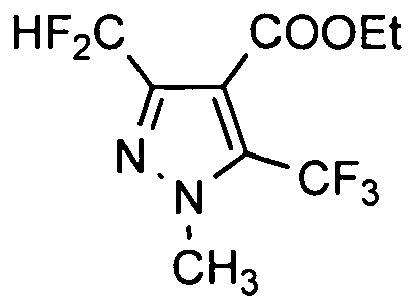
- BF3. (0,34 g, 5 mmol) als 17 % Lösung in Acetonitrile (0,76 ml) wurde zu einer Lösung von TFEDMA (0.59 mL, 5.0 mmol) in CH3CN (5 mL) under Argon in einem Teflonkolben gegeben. Die Lösung wurde 15 min bei Raumtemperatur gerührt. In einem zweiten Teflonkolben wurde Ethyltrifluoroacetoacetate (0.73 mL, 5.0 mmol) zu einer Lösung von Kaliumfluoride (0.88g, 15.0 mmol) in trockenem Acetonitril (10 mL) gegeben und 15 min bei Raumtemperatur gerührt. Hierzu wurde bei - 30°C der Inhalt des ersten Kolbens zugetropft. Die Reaktionsmischung wurde im Kältebad auf Raumtemperatur gebracht und über Nacht gerührt. Methylhydrazin (0.32 mL, 6.0 mmol) wurde dann bei Raumtemperatur zugetropft und die Mischung über Nacht gerührt. Das Lösemittel wurde im Vakuum entfernt und der Rückstand durch Flashchromatographie auf Kieselgel mit einer Pentane/Diethylether Mischung (9:1 - 8:2) gereinigt. N-Methyl-5-trifluoromethyl-3-difluoromethyl-4-pyrazolcarbonsäureethylester (0.95 g,) wurde als gelbes Öl erhalten.


Claims (11)
- Verfahren zur Herstellung von 3,5-Bis(fluoralkyl)-pyrazolen der Formel (Ia) sowie (Ib),
 R1 ausgewählt ist aus der Gruppe enthaltend H, C1-12-Alkyl, C3-8-Cycloalkyl, C6-18-Aryl, C7-19-Arylalkyl oder C7-19-Alkylaryl, CH2CN, CH2CX3, CH2COOH, CH2COO-(C1-12)-Alkyl, und
X steht unabhängig voneinander für F, Cl, Br, I;R2 und R3 unabhängig voneinander ausgewählt ist aus C1-C6-Halogenalkylgruppen;R4 ausgewählt ist aus der Gruppe enthaltend H, Hal, COOH, (C=O)OR5, CN und (C=O)NR5R6, wobei R5 und R6 unabhängig voneinander ausgewählt sind aus der Gruppe enthaltend C1-12-Alkyl, C3-8-Cycloalkyl, C6-18-Aryl-, C7-19-Arylalkyl oder C7-19-Alkylaryl oder wobei R5und R6 gemeinsam mit dem N-Atom an das sie geknüpft sind einen fünf oder sechsgliedrigen Ring bilden können;dadurch gekennzeichnet, dass in Schritt A) die Umsetzung von α, α -Dihalogenaminen der Formel (II)


- Verfahren gemäß Anspruch 1, dadurch gekennzeichnet, dassR1 ausgewählt ist aus der Gruppe enthaltend H, C1-12-Alkyl, CH2CN, CH2COO-(C1-12)-Alkyl, undR2 und R3 unabhängig voneinander ausgewählt sind aus der Gruppe enthaltend CF3, CF2H, CF2Cl;R4 ausgewählt ist aus der Gruppe enthaltend COOH, (C=O)OR5, CN und (C=O)NR5R6, wobei R5 und R6 unabhängig voneinander ausgewählt sind aus der Gruppe enthaltend C1-12-Alkyl, C3-8-Cycloalkyl, C6-18-Aryl-, C7-19-Arylalkyl oder C7-19-Alkylaryl oder wobei R5und R6 gemeinsam mit dem N-Atom an das sie geknüpft sind einen fünf oder sechsgliedrigen Ring bilden können.
- Verfahren gemäß Anspruch 1, dadurch gekennzeichnet, dassR1 ausgewählt ist aus der Gruppe enthaltend H, CH3, CH2COO-(C1-12)-Alkyl, undR2 und R3 unabhängig voneinander ausgewählt sind aus der Gruppe enthaltend CF3, CF2H, CF2Cl;R4 ausgewählt ist aus der Gruppe enthaltend COOH, (C=O)OR5.
- 3,5-Bis(fluoralkyl)-pyrazole der Formel (Ia) oder (Ib)
 R1 ausgewählt ist aus H, C1-12-Alkyl, C3-8-Cycloalkyl, C6-18-Aryl, C7-19-Arylalkyl oder C7-19-Alkylaryl, CH2CN, CH2CX3, CH2COOH, CH2COO-(C1-12)-Alkyl;
X steht unabhängig voneinander für F, Cl, Br, I;R2 und R3 ausgewählt ist aus C1-C6-Haloalkylgruppen,R4 ausgewählt ist aus der Gruppe H, F, Cl, Br, COOH, (C=O)OR5, CN und (C=O)NR5R6, wobei R5 und R6 unabhängig voneinander ausgewählt sind aus der Gruppe enthaltend C1-12-Alkyl, C3-8-Cycloalkyl, C6-18-Aryl-, C7-19-Arylalkyl oder C7-19-Alkylaryl oder wobei R5und R6 gemeinsam mit dem N-Atom an das sie geknüpft sind einen fünf oder sechsgliedrigen Ring bilden können. - Verbindungen der Formel (Ia) und (Ib) gemäß Anspruch 4, dadurch gekennzeichnet, dassR1 ausgewählt ist aus H, Methyl, CH2COOH, CH2COOR5, CH2CN, CH2CX3:
X unabhängig voneinander für F, Cl steht;R2 und R3 ausgewählt sind aus Difluormethyl, Trifluormethyl, Chlorfluormethyl, Dichlorfluormethyl, Chlordifluormethyl, 1-Fluorethyl, 2-Fluorethyl, 2,2-Difluorethyl, 2,2,2-Trifluorethyl, 2-Chlor-2-fluorethyl, 2-Chlor,2-difluorethyl, 2,2-Dichlor-2-fluorethyl, 2,2,2-Trichlorethyl, Pentafluorethyl und 1,1,1-Trifluorprop-2-yl;R4 ausgewählt ist aus der Gruppe enthaltend H, BR, COOCH3, COOEt, COOC3H7, CN und CONMe2, CONEt2. - Verbindungen der Formel (Ia) und (Ib) gemäß Anspruch 4, dadurch gekennzeichnet, dassR1 ausgewählt ist aus H, CH2COOH, CH2COOMe, CH2CN,R2 und R3 ausgewählt sind aus der Gruppe bestehend aus Trifluormethyl, Difluormethyl, Difluorchlormethyl, Pentafluoroethyl;R4 ausgewählt ist aus der Gruppe bestehend aus H, Br, COOH.
- Verbindungen der Formel (la) und (Ib) gemäß Anspruch 4, dadurch gekennzeichnet, dass R1= H; R2=R3= CF2H und R4 = COOEt ist.
- Verbindungen der Formel (Ia) und (Ib) gemäß Anspruch 4, dadurch gekennzeichnet, dass R1= H; R2=R3= CF2H und R4 = COOH ist.
- Verbindungen der Formel (Ia) und (Ib) gemäß Anspruch 4, dadurch gekennzeichnet, dass R1 = CH2COOEt; R2=R3= CF2H und R4 =COOEt ist.
- Verbindung der Formel (VI)
 R2 und R3 unabhängig voneinander ausgewählt sind aus der Gruppe enthaltend CF3, CF2H, CF2Cl;R4 ausgewählt ist aus der Gruppe enthaltend (C=O)OR5R5 und R6 unabhängig voneinander ausgewählt sind aus der Gruppe enthaltend C1-6-Alkyl.
 - Verwendung der Verbindungen der Formel (Ia) und (Ib) gemäß Anspruch 4 zur Herstellung von fungiziden Wirkstoffen.
Priority Applications (15)
| Application Number | Priority Date | Filing Date | Title |
|---|---|---|---|
| EP12356001.3A EP2623496A1 (de) | 2012-02-01 | 2012-02-01 | Verfahren zur Herstellung von 3,5-bis (fluoralkyl)-pyrazol-4-carbonsäure-Derivaten und 3,5-bis(fluoralkyl)-pyrazolen |
| IN7129DEN2014 IN2014DN07129A (de) | 2012-02-01 | 2013-01-31 | |
| MX2014009203A MX362689B (es) | 2012-02-01 | 2013-01-31 | Procedimiento de preparacion de derivados de acido 3,5-bis(fluoroalquil)pirazol-4-carboxilico y 3,5-bis(fluoroalquil) pirazoles. |
| EP13701669.7A EP2809653B1 (de) | 2012-02-01 | 2013-01-31 | Verfahren zur herstellung von 3,5-bis(fluoralkyl)-pyrazol-4-carbonsäure-derivaten und 3,5-bis(fluoralkyl)-pyrazolen |
| DK13701669.7T DK2809653T3 (da) | 2012-02-01 | 2013-01-31 | Fremgangsmåde til fremstilling af 3,5-bis(fluoralkyl)-pyrazol-4-carboxylsyre-derivativer og 3,5-bis(fluoralkyl)-pyrazoler |
| ES13701669.7T ES2647348T3 (es) | 2012-02-01 | 2013-01-31 | Procedimiento para la preparación de derivados de ácido 3,5-bis(fluoroalquil)pirazol-4-carboxílico y 3,5-bis(fluoroalquil)pirazoles |
| US14/375,450 US9309202B2 (en) | 2012-02-01 | 2013-01-31 | Method for producing 3,5-bis(fluoroalkyl)-pyrazol-4-carboxylic acid derivatives and 3,5-bis(fluoroalkyl)-pyrazoles |
| KR1020147023406A KR101861116B1 (ko) | 2012-02-01 | 2013-01-31 | 3,5-비스(플루오로알킬)피라졸-4-카복실산 유도체 및 3,5-비스(플루오로알킬)피라졸의 제조방법 |
| JP2014555208A JP6155283B2 (ja) | 2012-02-01 | 2013-01-31 | 3,5−ビス(フルオロアルキル)ピラゾール−4−カルボン酸誘導体および3,5−ビス(フルオロアルキル)ピラゾール類の製造方法 |
| PCT/EP2013/051930 WO2013113829A1 (de) | 2012-02-01 | 2013-01-31 | Verfahren zur herstellung von 3,5-bis(fluoralkyl)-pyrazol-4-carbonsäure-derivaten und 3,5-bis(fluoralkyl)-pyrazolen |
| BR112014019036-4A BR112014019036B1 (pt) | 2012-02-01 | 2013-01-31 | Processo depreparação de derivados do ácido 3,5-bis(fluoroalquil)pirazole-4-carboxílico e 3,5-bis(fluoroalquil)pirazóis |
| CN201380007228.7A CN104245676B (zh) | 2012-02-01 | 2013-01-31 | 用于制备3,5-双(氟烷基)吡唑-4-甲酸衍生物和3,5-双(氟烷基)吡唑类化合物的方法 |
| TW102103944A TWI609006B (zh) | 2012-02-01 | 2013-02-01 | 製備3,5-雙(氟烷基)吡唑-4-羧酸衍生物及3,5-雙(氟烷基)吡唑類之方法 |
| IL233926A IL233926B (en) | 2012-02-01 | 2014-08-03 | A method for producing derivatives of 5,3-bis(fluoroalkyl)-pyrazole-4-carboxylic acid and 5,3-bis(fluoroalkyl)-pyrazoles |
| US15/059,759 US10035773B2 (en) | 2012-02-01 | 2016-03-03 | Method for producing 3,5-bis(fluoroalkyl)-pyrazol-4-carboxylic acid derivatives and 3,5-bis(fluoroalkyl)-pyrazoles |
Applications Claiming Priority (1)
| Application Number | Priority Date | Filing Date | Title |
|---|---|---|---|
| EP12356001.3A EP2623496A1 (de) | 2012-02-01 | 2012-02-01 | Verfahren zur Herstellung von 3,5-bis (fluoralkyl)-pyrazol-4-carbonsäure-Derivaten und 3,5-bis(fluoralkyl)-pyrazolen |
Publications (1)
| Publication Number | Publication Date |
|---|---|
| EP2623496A1 true EP2623496A1 (de) | 2013-08-07 |
Family
ID=47624109
Family Applications (2)
| Application Number | Title | Priority Date | Filing Date |
|---|---|---|---|
| EP12356001.3A Withdrawn EP2623496A1 (de) | 2012-02-01 | 2012-02-01 | Verfahren zur Herstellung von 3,5-bis (fluoralkyl)-pyrazol-4-carbonsäure-Derivaten und 3,5-bis(fluoralkyl)-pyrazolen |
| EP13701669.7A Active EP2809653B1 (de) | 2012-02-01 | 2013-01-31 | Verfahren zur herstellung von 3,5-bis(fluoralkyl)-pyrazol-4-carbonsäure-derivaten und 3,5-bis(fluoralkyl)-pyrazolen |
Family Applications After (1)
| Application Number | Title | Priority Date | Filing Date |
|---|---|---|---|
| EP13701669.7A Active EP2809653B1 (de) | 2012-02-01 | 2013-01-31 | Verfahren zur herstellung von 3,5-bis(fluoralkyl)-pyrazol-4-carbonsäure-derivaten und 3,5-bis(fluoralkyl)-pyrazolen |
Country Status (13)
| Country | Link |
|---|---|
| US (2) | US9309202B2 (de) |
| EP (2) | EP2623496A1 (de) |
| JP (1) | JP6155283B2 (de) |
| KR (1) | KR101861116B1 (de) |
| CN (1) | CN104245676B (de) |
| BR (1) | BR112014019036B1 (de) |
| DK (1) | DK2809653T3 (de) |
| ES (1) | ES2647348T3 (de) |
| IL (1) | IL233926B (de) |
| IN (1) | IN2014DN07129A (de) |
| MX (1) | MX362689B (de) |
| TW (1) | TWI609006B (de) |
| WO (1) | WO2013113829A1 (de) |
Cited By (2)
| Publication number | Priority date | Publication date | Assignee | Title |
|---|---|---|---|---|
| EP3015458A1 (de) * | 2014-11-03 | 2016-05-04 | Bayer CropScience AG | Verfahren zur Herstellung von 3,5-bis(haloalkyl)pyrazolderivaten aus alpha,alpha-Dihaloaminen und Ketiminen |
| US9701640B2 (en) | 2014-03-24 | 2017-07-11 | Bayer Cropscience Aktiengesellschaft | Process for preparing 3,5-bis(haloalkyl)pyrazole derivatives from α,α-dihaloamines and ketimines |
Families Citing this family (8)
| Publication number | Priority date | Publication date | Assignee | Title |
|---|---|---|---|---|
| KR102233203B1 (ko) | 2013-05-22 | 2021-03-26 | 바이엘 크롭사이언스 악티엔게젤샤프트 | 3,5-비스(플루오로알킬)피라졸 유도체의 제조방법 |
| TWI647215B (zh) * | 2013-11-11 | 2019-01-11 | 德商拜耳作物科學股份有限公司 | 自α,α-二鹵胺製備3,5-雙鹵烷基吡唑衍生物之方法 |
| ES2672581T3 (es) * | 2014-06-11 | 2018-06-15 | Bayer Cropscience Aktiengesellschaft | Proceso para la preparación de 3,5-bis(haloalquil)pirazoles por medio de la acilación de cetiminas |
| MX377282B (es) * | 2014-06-11 | 2025-03-07 | Bayer Cropscience Ag | Proceso para preparar derivados de 3,5-bis(haloalquil)pirazol por medio de la acilación de hidrazonas. |
| US10701937B2 (en) | 2015-02-11 | 2020-07-07 | Basf Se | Pesticidal mixture comprising a pyrazole compound, an insecticide and a fungicide |
| MX2017017140A (es) * | 2015-06-26 | 2018-03-09 | Bayer Cropscience Ag | Proceso para la preparacion de pirazoles sustituidos que contienen grupos haloalcoxi-y haloalquiltio a partir de a,a-dihaloalquilaminas y quetiminas. |
| TW202014410A (zh) | 2018-06-18 | 2020-04-16 | 德商拜耳廠股份有限公司 | 二取代的5(3)-吡唑羧酸酯及由烯醇鹽與氟烷基胺基試劑(far)製備其之方法 |
| EP3953336A4 (de) * | 2019-04-06 | 2023-05-03 | Trinapco, Inc | Sulfonyldiazole und n-(fluorsulfonyl)azole und verfahren zu ihrer herstellung |
Citations (11)
| Publication number | Priority date | Publication date | Assignee | Title |
|---|---|---|---|---|
| EP1072576A1 (de) * | 1999-02-15 | 2001-01-31 | Mitsui Chemicals, Inc. | Fluorierungsmittel, verfahren zu seiner herstellung und seine anwendung |
| JP2001192369A (ja) * | 2000-01-12 | 2001-07-17 | Mitsui Chemicals Inc | フッ素含有複素環式芳香族化合物の製造方法および新規ピラゾール環化合物 |
| WO2003070705A1 (de) | 2002-02-19 | 2003-08-28 | Bayer Cropscience Aktiengesellschaft | Disubstituierte pyrazolylcarboxanilide |
| US20040162282A1 (en) * | 2002-06-12 | 2004-08-19 | Chemocentryx, Inc. | Substituted piperazines |
| WO2005042468A1 (de) | 2003-10-23 | 2005-05-12 | Bayer Cropscience Aktiengesellschaft | Verfahren zum herstellen von 2-dihalogenacyl-3-amino-acrylsäureestern und 3-dihalogenmethyl-pyrazol-4-carbonsäureestern |
| WO2008013925A2 (en) | 2006-07-27 | 2008-01-31 | E. I. Du Pont De Nemours And Company | Fungicidal azocyclic amides |
| WO2008022777A2 (de) | 2006-08-25 | 2008-02-28 | Bayer Cropscience Ag | Verfahren zum herstellen von 3-dihalomethyl-pyrazol-4-carbonsäurederivaten |
| WO2008091594A2 (en) * | 2007-01-24 | 2008-07-31 | E. I. Du Pont De Nemours And Company | Fungicidal mixtures |
| US20090042726A1 (en) * | 2005-12-21 | 2009-02-12 | Syngenta Limited | Novel Herbicides |
| WO2009106230A2 (de) | 2008-02-25 | 2009-09-03 | Bayer Cropscience Aktengesellschaft | Verfahren zur regioselektiven synthese von 1-alkyl-3-haloalkyl-pyrazol-4-carbonsäur e-derivaten |
| WO2009112157A1 (de) | 2008-03-10 | 2009-09-17 | Bayer Cropscience Aktiengesellschaft | Verfahren zur regioselektiven synthese von l-alkvl-3-haloalkyl-pvrazol-4-carbonsäure-derivaten |
Family Cites Families (3)
| Publication number | Priority date | Publication date | Assignee | Title |
|---|---|---|---|---|
| ES2004460A6 (es) * | 1987-07-29 | 1989-01-01 | Consejo Superior Investigacion | Procedimiento para la preparacion de derivados de 3-5-bis-(halometil) pirazol |
| TW200738701A (en) * | 2005-07-26 | 2007-10-16 | Du Pont | Fungicidal carboxamides |
| JP2010083763A (ja) * | 2008-09-29 | 2010-04-15 | Mitsui Chemicals Inc | ピラゾール誘導体およびその製造方法、ならびに殺菌剤 |
-
2012
- 2012-02-01 EP EP12356001.3A patent/EP2623496A1/de not_active Withdrawn
-
2013
- 2013-01-31 WO PCT/EP2013/051930 patent/WO2013113829A1/de not_active Ceased
- 2013-01-31 KR KR1020147023406A patent/KR101861116B1/ko not_active Expired - Fee Related
- 2013-01-31 DK DK13701669.7T patent/DK2809653T3/da active
- 2013-01-31 CN CN201380007228.7A patent/CN104245676B/zh active Active
- 2013-01-31 BR BR112014019036-4A patent/BR112014019036B1/pt active IP Right Grant
- 2013-01-31 EP EP13701669.7A patent/EP2809653B1/de active Active
- 2013-01-31 MX MX2014009203A patent/MX362689B/es active IP Right Grant
- 2013-01-31 JP JP2014555208A patent/JP6155283B2/ja active Active
- 2013-01-31 US US14/375,450 patent/US9309202B2/en active Active
- 2013-01-31 IN IN7129DEN2014 patent/IN2014DN07129A/en unknown
- 2013-01-31 ES ES13701669.7T patent/ES2647348T3/es active Active
- 2013-02-01 TW TW102103944A patent/TWI609006B/zh active
-
2014
- 2014-08-03 IL IL233926A patent/IL233926B/en active IP Right Grant
-
2016
- 2016-03-03 US US15/059,759 patent/US10035773B2/en active Active
Patent Citations (11)
| Publication number | Priority date | Publication date | Assignee | Title |
|---|---|---|---|---|
| EP1072576A1 (de) * | 1999-02-15 | 2001-01-31 | Mitsui Chemicals, Inc. | Fluorierungsmittel, verfahren zu seiner herstellung und seine anwendung |
| JP2001192369A (ja) * | 2000-01-12 | 2001-07-17 | Mitsui Chemicals Inc | フッ素含有複素環式芳香族化合物の製造方法および新規ピラゾール環化合物 |
| WO2003070705A1 (de) | 2002-02-19 | 2003-08-28 | Bayer Cropscience Aktiengesellschaft | Disubstituierte pyrazolylcarboxanilide |
| US20040162282A1 (en) * | 2002-06-12 | 2004-08-19 | Chemocentryx, Inc. | Substituted piperazines |
| WO2005042468A1 (de) | 2003-10-23 | 2005-05-12 | Bayer Cropscience Aktiengesellschaft | Verfahren zum herstellen von 2-dihalogenacyl-3-amino-acrylsäureestern und 3-dihalogenmethyl-pyrazol-4-carbonsäureestern |
| US20090042726A1 (en) * | 2005-12-21 | 2009-02-12 | Syngenta Limited | Novel Herbicides |
| WO2008013925A2 (en) | 2006-07-27 | 2008-01-31 | E. I. Du Pont De Nemours And Company | Fungicidal azocyclic amides |
| WO2008022777A2 (de) | 2006-08-25 | 2008-02-28 | Bayer Cropscience Ag | Verfahren zum herstellen von 3-dihalomethyl-pyrazol-4-carbonsäurederivaten |
| WO2008091594A2 (en) * | 2007-01-24 | 2008-07-31 | E. I. Du Pont De Nemours And Company | Fungicidal mixtures |
| WO2009106230A2 (de) | 2008-02-25 | 2009-09-03 | Bayer Cropscience Aktengesellschaft | Verfahren zur regioselektiven synthese von 1-alkyl-3-haloalkyl-pyrazol-4-carbonsäur e-derivaten |
| WO2009112157A1 (de) | 2008-03-10 | 2009-09-17 | Bayer Cropscience Aktiengesellschaft | Verfahren zur regioselektiven synthese von l-alkvl-3-haloalkyl-pvrazol-4-carbonsäure-derivaten |
Non-Patent Citations (17)
| Title |
|---|
| A. BECKER: "Zur Wanderung von Brom in beta-Ketosäureestern und 1,3-Diketonen und über Versuche zur Darstellung eines Cyclopentan-1,3-dions. 1. Mitteilung", HELVETICA CHIMICA ACTA, vol. 32, no. 3, 1 January 1949 (1949-01-01), pages 1114 - 1122, XP055026568, ISSN: 0018-019X, DOI: 10.1002/hlca.19490320368 * |
| BO LIU ET AL: "Copper (II) hydroxide complexes of N-heterocyclic carbenes and catalytic oxidative amination of arylboronic acids", ORGANOMETALLICS, ACS, WASHINGTON, DC, US, vol. 29, no. 6, 22 March 2010 (2010-03-22), pages 1457 - 1464, XP002663340, ISSN: 0276-7333, [retrieved on 20100223], DOI: 10.1021/OM100009U * |
| CARMI, A.; POLLAK, JOURNAL OF ORGANIC CHEMISTRY, vol. 25, 1960, pages 44 - 46 |
| CHEM. ABSTR., vol. 54, 1960, pages 9724H |
| HAROLD WEINGARTEN ET AL: "Reactions of .beta.-dicarbonyl compounds with tetrakis(dimethylamino)titanium", THE JOURNAL OF ORGANIC CHEMISTRY, vol. 33, no. 4, 1 April 1968 (1968-04-01), pages 1506 - 1508, XP055026528, ISSN: 0022-3263, DOI: 10.1021/jo01268a042 * |
| IGOR I. GERUS ET AL: ""Reported, but Still Unknown." A Closer Look into 3,4-Bis- and 3,4,5-Tris(trifluoromethyl)pyrazoles", THE JOURNAL OF ORGANIC CHEMISTRY, vol. 77, no. 1, 6 January 2012 (2012-01-06), pages 47 - 56, XP055026674, ISSN: 0022-3263, DOI: 10.1021/jo202305c * |
| ITURRINO L ET AL: "Synthesis, cytostatic and trichomonacide activities of 3,5-bis-(halomethyl)pyrazoles", EUROPEAN JOURNAL OF MEDICINAL CHEMISTRY, EDITIONS SCIENTIFIQUE ELSEVIER, PARIS, FR, vol. 22, no. 5, 1 September 1987 (1987-09-01), pages 445 - 451, XP023871045, ISSN: 0223-5234, [retrieved on 19870901], DOI: 10.1016/0223-5234(87)90034-1 * |
| MICHAEL D. THREADGILL ET AL: "The reaction of 1,1,1,5,5,5-hexafluoropentane-2,4-dione with hydrazines: a re-investigation", JOURNAL OF FLUORINE CHEMISTRY, vol. 65, no. 1-2, 1 November 1993 (1993-11-01), pages 21 - 23, XP055026673, ISSN: 0022-1139, DOI: 10.1016/S0022-1139(00)80467-4 * |
| NIEDRICH ET AL., JOURNAL FUER PRAKTISCHE CHEMIE, vol. 17, 1962, pages 273 - 81 |
| PASHKEVICH ET AL., ZHURNAL VSESOYUZNOGO KHIMICHESKOGO OBSHCHESTVA IM. D. I. MENDELEEVA, vol. 26, no. 1, 1981, pages 105 - 7 |
| PEREVALOV V P ET AL: "Bromination of 4-chloro-1,3,5-trimethylpyrazole", CHIMIJA GETEROCIKLIÈESKICH SOEDINENIJ : NAUÈNO-TEORETIÈESKIJ URNAL = CHEMISTRY OF HETEROCYCLIC COMPOUNDS, AKADEMIJA NAUK LATVIJSKOJ SSR <RIGA>, no. 1, 1 January 1988 (1988-01-01), pages 40 - 42, XP009162800, ISSN: 0453-8234 * |
| PETROV ET AL., J. FLUOR. CHEM., vol. 109, 2011, pages 25 - 31 |
| PETROV ET AL., J. OF FLUORINE CHEM., vol. 132, no. 12, 2011, pages 1198 - 1206 |
| SLOOP J C ET AL: "Synthesis of fluorinated heterocycles", JOURNAL OF FLUORINE CHEMISTRY, ELSEVIER, NL, vol. 118, no. 1-2, 1 December 2002 (2002-12-01), pages 135 - 147, XP004393618, ISSN: 0022-1139, DOI: 10.1016/S0022-1139(02)00221-X * |
| YAGUPOLSKII ET AL., ZH. ORGANICHESKOI KHIM., vol. 14, no. 12, 1978, pages 2493 - 6 |
| YAROVENKO ET AL., ZH. OBSHCH. KHIM., vol. 29, 1959, pages 2159 |
| YU H B ET AL: "A convenient synthesis of 3-polyfluoroalkyl pyrazoles and 6-polyfluoroalkyl pyrimidines from beta-polyfluoroalkyl enaminones", JOURNAL OF FLUORINE CHEMISTRY, ELSEVIER, NL, vol. 84, no. 1, 31 August 1997 (1997-08-31), pages 65 - 67, XP027447290, ISSN: 0022-1139, [retrieved on 19970831], DOI: 10.1016/S0022-1139(97)00027-4 * |
Cited By (2)
| Publication number | Priority date | Publication date | Assignee | Title |
|---|---|---|---|---|
| US9701640B2 (en) | 2014-03-24 | 2017-07-11 | Bayer Cropscience Aktiengesellschaft | Process for preparing 3,5-bis(haloalkyl)pyrazole derivatives from α,α-dihaloamines and ketimines |
| EP3015458A1 (de) * | 2014-11-03 | 2016-05-04 | Bayer CropScience AG | Verfahren zur Herstellung von 3,5-bis(haloalkyl)pyrazolderivaten aus alpha,alpha-Dihaloaminen und Ketiminen |
Also Published As
| Publication number | Publication date |
|---|---|
| US20150011779A1 (en) | 2015-01-08 |
| US9309202B2 (en) | 2016-04-12 |
| JP2015511227A (ja) | 2015-04-16 |
| US20160185731A1 (en) | 2016-06-30 |
| ES2647348T3 (es) | 2017-12-21 |
| US10035773B2 (en) | 2018-07-31 |
| BR112014019036A2 (pt) | 2017-08-22 |
| TW201336826A (zh) | 2013-09-16 |
| MX362689B (es) | 2019-02-01 |
| KR20140128344A (ko) | 2014-11-05 |
| IL233926B (en) | 2018-08-30 |
| DK2809653T3 (da) | 2017-11-27 |
| IL233926A0 (en) | 2014-09-30 |
| CN104245676B (zh) | 2016-09-21 |
| TWI609006B (zh) | 2017-12-21 |
| WO2013113829A1 (de) | 2013-08-08 |
| MX2014009203A (es) | 2014-11-12 |
| CN104245676A (zh) | 2014-12-24 |
| IN2014DN07129A (de) | 2015-04-24 |
| BR112014019036B1 (pt) | 2019-10-08 |
| EP2809653A1 (de) | 2014-12-10 |
| JP6155283B2 (ja) | 2017-06-28 |
| EP2809653B1 (de) | 2017-08-16 |
| KR101861116B1 (ko) | 2018-05-25 |
Similar Documents
| Publication | Publication Date | Title |
|---|---|---|
| EP2809653B1 (de) | Verfahren zur herstellung von 3,5-bis(fluoralkyl)-pyrazol-4-carbonsäure-derivaten und 3,5-bis(fluoralkyl)-pyrazolen | |
| EP2247577B2 (de) | Verfahren zur regioselektiven synthese von 1-alkyl-3-haloalkyl-pyrazol-4-carbonsäur e-derivaten | |
| EP2257532B1 (de) | Verfahren zur regioselektiven synthese von l-alkvl-3-haloalkyl-pvrazol-4-carbonsäure-derivaten | |
| EP2890682B1 (de) | Verfahren zur decarboxylierung von 3,5-bis(haloalkyl)-pyrazol-4-carbonsäure- derivaten | |
| EP2456760B1 (de) | Verfahren zum herstellen von aryl-substituierten pyrazolen | |
| EP2414345B1 (de) | Verfahren zum herstellen von pyridyl-substituierten pyrazolen | |
| EP3068769B1 (de) | Verfahren zur herstellung von 3,5-bis(fluoralkyl)pyrazolderivaten aus alpha,alpha-dihaloaminen | |
| EP3122727B1 (de) | Verfahren zur herstellung von 3,5-bis(haloalkyl)pyrazol-derivaten aus alpha,alpha-dihaloaminen und ketiminen | |
| WO2014187774A1 (de) | Verfahren zur herstellung von 3,5-bis(fluoralkyl)-pyrazol-derivaten | |
| EP3015458A1 (de) | Verfahren zur Herstellung von 3,5-bis(haloalkyl)pyrazolderivaten aus alpha,alpha-Dihaloaminen und Ketiminen | |
| EP0788484A1 (de) | 2-chlor-n- 1-(2,6-dichlor-4-difluormethyl-phenyl)-1h-pyrazol-5-yl]-propanamid und ein verfahren zu seiner herstellung |
Legal Events
| Date | Code | Title | Description |
|---|---|---|---|
| PUAI | Public reference made under article 153(3) epc to a published international application that has entered the european phase |
Free format text: ORIGINAL CODE: 0009012 |
|
| AK | Designated contracting states |
Kind code of ref document: A1 Designated state(s): AL AT BE BG CH CY CZ DE DK EE ES FI FR GB GR HR HU IE IS IT LI LT LU LV MC MK MT NL NO PL PT RO RS SE SI SK SM TR |
|
| AX | Request for extension of the european patent |
Extension state: BA ME |
|
| 17P | Request for examination filed |
Effective date: 20140207 |
|
| RBV | Designated contracting states (corrected) |
Designated state(s): AL AT BE BG CH CY CZ DE DK EE ES FI FR GB GR HR HU IE IS IT LI LT LU LV MC MK MT NL NO PL PT RO RS SE SI SK SM TR |
|
| STAA | Information on the status of an ep patent application or granted ep patent |
Free format text: STATUS: THE APPLICATION IS DEEMED TO BE WITHDRAWN |
|
| 18D | Application deemed to be withdrawn |
Effective date: 20140208 |