EP2614149B1 - Modifications for antisense compounds - Google Patents
Modifications for antisense compounds Download PDFInfo
- Publication number
- EP2614149B1 EP2614149B1 EP11760620.2A EP11760620A EP2614149B1 EP 2614149 B1 EP2614149 B1 EP 2614149B1 EP 11760620 A EP11760620 A EP 11760620A EP 2614149 B1 EP2614149 B1 EP 2614149B1
- Authority
- EP
- European Patent Office
- Prior art keywords
- misc
- feature
- dna
- ifq
- rna
- Prior art date
- Legal status (The legal status is an assumption and is not a legal conclusion. Google has not performed a legal analysis and makes no representation as to the accuracy of the status listed.)
- Not-in-force
Links
- 238000012986 modification Methods 0.000 title claims description 112
- 230000004048 modification Effects 0.000 title claims description 107
- 150000001875 compounds Chemical class 0.000 title description 45
- 230000000692 anti-sense effect Effects 0.000 title description 14
- RYYWUUFWQRZTIU-UHFFFAOYSA-K thiophosphate Chemical compound [O-]P([O-])([O-])=S RYYWUUFWQRZTIU-UHFFFAOYSA-K 0.000 claims description 116
- 108091034117 Oligonucleotide Proteins 0.000 claims description 107
- 239000000074 antisense oligonucleotide Substances 0.000 claims description 90
- 238000012230 antisense oligonucleotides Methods 0.000 claims description 90
- 101710163270 Nuclease Proteins 0.000 claims description 50
- 125000003342 alkenyl group Chemical group 0.000 claims description 16
- 125000003545 alkoxy group Chemical group 0.000 claims description 16
- 125000002877 alkyl aryl group Chemical group 0.000 claims description 16
- 125000000217 alkyl group Chemical group 0.000 claims description 16
- 125000000304 alkynyl group Chemical group 0.000 claims description 16
- 125000003118 aryl group Chemical group 0.000 claims description 16
- 125000000753 cycloalkyl group Chemical group 0.000 claims description 16
- 125000004404 heteroalkyl group Chemical group 0.000 claims description 16
- 125000001072 heteroaryl group Chemical group 0.000 claims description 16
- 239000001257 hydrogen Substances 0.000 claims description 16
- 229910052739 hydrogen Inorganic materials 0.000 claims description 16
- 125000000547 substituted alkyl group Chemical group 0.000 claims description 16
- 125000003107 substituted aryl group Chemical group 0.000 claims description 16
- 239000002773 nucleotide Substances 0.000 claims description 15
- 125000003729 nucleotide group Chemical group 0.000 claims description 15
- 229910052799 carbon Chemical group 0.000 claims description 14
- 125000006575 electron-withdrawing group Chemical group 0.000 claims description 12
- 150000002431 hydrogen Chemical class 0.000 claims description 12
- 125000004209 (C1-C8) alkyl group Chemical group 0.000 claims description 4
- UFHFLCQGNIYNRP-UHFFFAOYSA-N Hydrogen Chemical compound [H][H] UFHFLCQGNIYNRP-UHFFFAOYSA-N 0.000 claims description 4
- 125000005647 linker group Chemical group 0.000 claims description 4
- 229910052757 nitrogen Inorganic materials 0.000 claims description 4
- IJGRMHOSHXDMSA-UHFFFAOYSA-N nitrogen Substances N#N IJGRMHOSHXDMSA-UHFFFAOYSA-N 0.000 claims description 4
- QJGQUHMNIGDVPM-UHFFFAOYSA-N nitrogen group Chemical group [N] QJGQUHMNIGDVPM-UHFFFAOYSA-N 0.000 claims description 4
- 125000001424 substituent group Chemical group 0.000 claims description 4
- 125000004432 carbon atom Chemical group C* 0.000 claims 6
- 108020004414 DNA Proteins 0.000 description 283
- 108091032973 (ribonucleotides)n+m Proteins 0.000 description 235
- 102000039446 nucleic acids Human genes 0.000 description 143
- 108020004707 nucleic acids Proteins 0.000 description 143
- 150000007523 nucleic acids Chemical class 0.000 description 143
- 239000003607 modifier Substances 0.000 description 95
- 108091034201 anti-miRNA oligonucleotide Proteins 0.000 description 66
- 102000018251 Hypoxanthine Phosphoribosyltransferase Human genes 0.000 description 57
- 108010091358 Hypoxanthine Phosphoribosyltransferase Proteins 0.000 description 57
- 210000004027 cell Anatomy 0.000 description 55
- 108020000948 Antisense Oligonucleotides Proteins 0.000 description 48
- 230000000694 effects Effects 0.000 description 47
- JLCPHMBAVCMARE-UHFFFAOYSA-N [3-[[3-[[3-[[3-[[3-[[3-[[3-[[3-[[3-[[3-[[3-[[5-(2-amino-6-oxo-1H-purin-9-yl)-3-[[3-[[3-[[3-[[3-[[3-[[5-(2-amino-6-oxo-1H-purin-9-yl)-3-[[5-(2-amino-6-oxo-1H-purin-9-yl)-3-hydroxyoxolan-2-yl]methoxy-hydroxyphosphoryl]oxyoxolan-2-yl]methoxy-hydroxyphosphoryl]oxy-5-(5-methyl-2,4-dioxopyrimidin-1-yl)oxolan-2-yl]methoxy-hydroxyphosphoryl]oxy-5-(6-aminopurin-9-yl)oxolan-2-yl]methoxy-hydroxyphosphoryl]oxy-5-(6-aminopurin-9-yl)oxolan-2-yl]methoxy-hydroxyphosphoryl]oxy-5-(6-aminopurin-9-yl)oxolan-2-yl]methoxy-hydroxyphosphoryl]oxy-5-(6-aminopurin-9-yl)oxolan-2-yl]methoxy-hydroxyphosphoryl]oxyoxolan-2-yl]methoxy-hydroxyphosphoryl]oxy-5-(5-methyl-2,4-dioxopyrimidin-1-yl)oxolan-2-yl]methoxy-hydroxyphosphoryl]oxy-5-(4-amino-2-oxopyrimidin-1-yl)oxolan-2-yl]methoxy-hydroxyphosphoryl]oxy-5-(5-methyl-2,4-dioxopyrimidin-1-yl)oxolan-2-yl]methoxy-hydroxyphosphoryl]oxy-5-(5-methyl-2,4-dioxopyrimidin-1-yl)oxolan-2-yl]methoxy-hydroxyphosphoryl]oxy-5-(6-aminopurin-9-yl)oxolan-2-yl]methoxy-hydroxyphosphoryl]oxy-5-(6-aminopurin-9-yl)oxolan-2-yl]methoxy-hydroxyphosphoryl]oxy-5-(4-amino-2-oxopyrimidin-1-yl)oxolan-2-yl]methoxy-hydroxyphosphoryl]oxy-5-(4-amino-2-oxopyrimidin-1-yl)oxolan-2-yl]methoxy-hydroxyphosphoryl]oxy-5-(4-amino-2-oxopyrimidin-1-yl)oxolan-2-yl]methoxy-hydroxyphosphoryl]oxy-5-(6-aminopurin-9-yl)oxolan-2-yl]methoxy-hydroxyphosphoryl]oxy-5-(4-amino-2-oxopyrimidin-1-yl)oxolan-2-yl]methyl [5-(6-aminopurin-9-yl)-2-(hydroxymethyl)oxolan-3-yl] hydrogen phosphate Polymers Cc1cn(C2CC(OP(O)(=O)OCC3OC(CC3OP(O)(=O)OCC3OC(CC3O)n3cnc4c3nc(N)[nH]c4=O)n3cnc4c3nc(N)[nH]c4=O)C(COP(O)(=O)OC3CC(OC3COP(O)(=O)OC3CC(OC3COP(O)(=O)OC3CC(OC3COP(O)(=O)OC3CC(OC3COP(O)(=O)OC3CC(OC3COP(O)(=O)OC3CC(OC3COP(O)(=O)OC3CC(OC3COP(O)(=O)OC3CC(OC3COP(O)(=O)OC3CC(OC3COP(O)(=O)OC3CC(OC3COP(O)(=O)OC3CC(OC3COP(O)(=O)OC3CC(OC3COP(O)(=O)OC3CC(OC3COP(O)(=O)OC3CC(OC3COP(O)(=O)OC3CC(OC3COP(O)(=O)OC3CC(OC3COP(O)(=O)OC3CC(OC3CO)n3cnc4c(N)ncnc34)n3ccc(N)nc3=O)n3cnc4c(N)ncnc34)n3ccc(N)nc3=O)n3ccc(N)nc3=O)n3ccc(N)nc3=O)n3cnc4c(N)ncnc34)n3cnc4c(N)ncnc34)n3cc(C)c(=O)[nH]c3=O)n3cc(C)c(=O)[nH]c3=O)n3ccc(N)nc3=O)n3cc(C)c(=O)[nH]c3=O)n3cnc4c3nc(N)[nH]c4=O)n3cnc4c(N)ncnc34)n3cnc4c(N)ncnc34)n3cnc4c(N)ncnc34)n3cnc4c(N)ncnc34)O2)c(=O)[nH]c1=O JLCPHMBAVCMARE-UHFFFAOYSA-N 0.000 description 41
- 238000013461 design Methods 0.000 description 34
- 238000003780 insertion Methods 0.000 description 31
- 230000037431 insertion Effects 0.000 description 30
- 108091062762 miR-21 stem-loop Proteins 0.000 description 30
- 108091041631 miR-21-1 stem-loop Proteins 0.000 description 30
- 108091044442 miR-21-2 stem-loop Proteins 0.000 description 30
- 238000001890 transfection Methods 0.000 description 27
- 102100034343 Integrase Human genes 0.000 description 26
- 230000001965 increasing effect Effects 0.000 description 25
- 125000006850 spacer group Chemical group 0.000 description 25
- 108020004999 messenger RNA Proteins 0.000 description 24
- 101710203526 Integrase Proteins 0.000 description 23
- 230000015556 catabolic process Effects 0.000 description 23
- 238000006731 degradation reaction Methods 0.000 description 23
- 238000000034 method Methods 0.000 description 20
- 230000014509 gene expression Effects 0.000 description 19
- 238000003197 gene knockdown Methods 0.000 description 18
- 238000002844 melting Methods 0.000 description 18
- 230000008018 melting Effects 0.000 description 18
- 239000002679 microRNA Substances 0.000 description 18
- 239000000523 sample Substances 0.000 description 18
- 230000001976 improved effect Effects 0.000 description 17
- 108010052090 Renilla Luciferases Proteins 0.000 description 15
- 230000006907 apoptotic process Effects 0.000 description 15
- 230000001988 toxicity Effects 0.000 description 14
- 231100000419 toxicity Toxicity 0.000 description 14
- 230000002829 reductive effect Effects 0.000 description 13
- 210000002966 serum Anatomy 0.000 description 13
- 108700011259 MicroRNAs Proteins 0.000 description 12
- 238000005251 capillar electrophoresis Methods 0.000 description 12
- 230000007423 decrease Effects 0.000 description 11
- 230000003389 potentiating effect Effects 0.000 description 11
- 238000007385 chemical modification Methods 0.000 description 10
- 239000003153 chemical reaction reagent Substances 0.000 description 10
- 230000006870 function Effects 0.000 description 10
- 239000013612 plasmid Substances 0.000 description 10
- 238000004007 reversed phase HPLC Methods 0.000 description 10
- 241000894007 species Species 0.000 description 10
- 239000000758 substrate Substances 0.000 description 10
- 108020004459 Small interfering RNA Proteins 0.000 description 9
- 230000000295 complement effect Effects 0.000 description 9
- 231100000135 cytotoxicity Toxicity 0.000 description 9
- 230000003013 cytotoxicity Effects 0.000 description 9
- 239000012091 fetal bovine serum Substances 0.000 description 9
- 150000008300 phosphoramidites Chemical class 0.000 description 9
- 238000006467 substitution reaction Methods 0.000 description 9
- 239000006144 Dulbecco’s modified Eagle's medium Substances 0.000 description 8
- 238000011529 RT qPCR Methods 0.000 description 8
- FAPWRFPIFSIZLT-UHFFFAOYSA-M Sodium chloride Chemical compound [Na+].[Cl-] FAPWRFPIFSIZLT-UHFFFAOYSA-M 0.000 description 8
- 230000015572 biosynthetic process Effects 0.000 description 8
- HVYWMOMLDIMFJA-DPAQBDIFSA-N cholesterol Chemical compound C1C=C2C[C@@H](O)CC[C@]2(C)[C@@H]2[C@@H]1[C@@H]1CC[C@H]([C@H](C)CCCC(C)C)[C@@]1(C)CC2 HVYWMOMLDIMFJA-DPAQBDIFSA-N 0.000 description 8
- 230000006698 induction Effects 0.000 description 8
- 238000005259 measurement Methods 0.000 description 8
- 230000001629 suppression Effects 0.000 description 8
- 108060002716 Exonuclease Proteins 0.000 description 7
- 108090000331 Firefly luciferases Proteins 0.000 description 7
- 230000001413 cellular effect Effects 0.000 description 7
- 238000005516 engineering process Methods 0.000 description 7
- 102000013165 exonuclease Human genes 0.000 description 7
- 239000000203 mixture Substances 0.000 description 7
- 108090000623 proteins and genes Proteins 0.000 description 7
- 238000002835 absorbance Methods 0.000 description 6
- 238000003556 assay Methods 0.000 description 6
- 150000001721 carbon Chemical group 0.000 description 6
- 230000030833 cell death Effects 0.000 description 6
- 238000006243 chemical reaction Methods 0.000 description 6
- 239000002299 complementary DNA Substances 0.000 description 6
- 238000000132 electrospray ionisation Methods 0.000 description 6
- 238000004128 high performance liquid chromatography Methods 0.000 description 6
- 239000003446 ligand Substances 0.000 description 6
- 238000004895 liquid chromatography mass spectrometry Methods 0.000 description 6
- 239000013642 negative control Substances 0.000 description 6
- 238000002515 oligonucleotide synthesis Methods 0.000 description 6
- 230000009467 reduction Effects 0.000 description 6
- 239000007790 solid phase Substances 0.000 description 6
- 238000003786 synthesis reaction Methods 0.000 description 6
- 101001024703 Homo sapiens Nck-associated protein 5 Proteins 0.000 description 5
- 108060001084 Luciferase Proteins 0.000 description 5
- 239000005089 Luciferase Substances 0.000 description 5
- 102100036946 Nck-associated protein 5 Human genes 0.000 description 5
- 238000012228 RNA interference-mediated gene silencing Methods 0.000 description 5
- 230000008901 benefit Effects 0.000 description 5
- 238000004113 cell culture Methods 0.000 description 5
- 230000003833 cell viability Effects 0.000 description 5
- 230000008859 change Effects 0.000 description 5
- 239000003795 chemical substances by application Substances 0.000 description 5
- 238000002474 experimental method Methods 0.000 description 5
- 230000009368 gene silencing by RNA Effects 0.000 description 5
- 108091070501 miRNA Proteins 0.000 description 5
- 230000035772 mutation Effects 0.000 description 5
- -1 phosphoramidite compound Chemical class 0.000 description 5
- 238000000746 purification Methods 0.000 description 5
- 238000003762 quantitative reverse transcription PCR Methods 0.000 description 5
- 231100000331 toxic Toxicity 0.000 description 5
- 102000040650 (ribonucleotides)n+m Human genes 0.000 description 4
- 108091003079 Bovine Serum Albumin Proteins 0.000 description 4
- 108090000397 Caspase 3 Proteins 0.000 description 4
- 108090000567 Caspase 7 Proteins 0.000 description 4
- 102100029855 Caspase-3 Human genes 0.000 description 4
- 102100038902 Caspase-7 Human genes 0.000 description 4
- 108010042407 Endonucleases Proteins 0.000 description 4
- 102000004190 Enzymes Human genes 0.000 description 4
- 108090000790 Enzymes Proteins 0.000 description 4
- 108091027305 Heteroduplex Proteins 0.000 description 4
- 101000988834 Homo sapiens Hypoxanthine-guanine phosphoribosyltransferase Proteins 0.000 description 4
- 102100029098 Hypoxanthine-guanine phosphoribosyltransferase Human genes 0.000 description 4
- 230000009471 action Effects 0.000 description 4
- 238000004458 analytical method Methods 0.000 description 4
- 230000000903 blocking effect Effects 0.000 description 4
- 230000007541 cellular toxicity Effects 0.000 description 4
- 235000012000 cholesterol Nutrition 0.000 description 4
- 238000003776 cleavage reaction Methods 0.000 description 4
- 230000003247 decreasing effect Effects 0.000 description 4
- 230000000368 destabilizing effect Effects 0.000 description 4
- 238000010348 incorporation Methods 0.000 description 4
- 238000004020 luminiscence type Methods 0.000 description 4
- 230000007017 scission Effects 0.000 description 4
- 239000011780 sodium chloride Substances 0.000 description 4
- 102000053602 DNA Human genes 0.000 description 3
- IAZDPXIOMUYVGZ-UHFFFAOYSA-N Dimethylsulphoxide Chemical compound CS(C)=O IAZDPXIOMUYVGZ-UHFFFAOYSA-N 0.000 description 3
- 108091005804 Peptidases Proteins 0.000 description 3
- 239000004365 Protease Substances 0.000 description 3
- 108020004682 Single-Stranded DNA Proteins 0.000 description 3
- HEMHJVSKTPXQMS-UHFFFAOYSA-M Sodium hydroxide Chemical compound [OH-].[Na+] HEMHJVSKTPXQMS-UHFFFAOYSA-M 0.000 description 3
- 230000003213 activating effect Effects 0.000 description 3
- 230000004913 activation Effects 0.000 description 3
- 230000000996 additive effect Effects 0.000 description 3
- 230000008033 biological extinction Effects 0.000 description 3
- 238000002784 cytotoxicity assay Methods 0.000 description 3
- 231100000263 cytotoxicity test Toxicity 0.000 description 3
- 239000000284 extract Substances 0.000 description 3
- 230000006872 improvement Effects 0.000 description 3
- 238000001727 in vivo Methods 0.000 description 3
- 238000011534 incubation Methods 0.000 description 3
- 230000003834 intracellular effect Effects 0.000 description 3
- 238000003670 luciferase enzyme activity assay Methods 0.000 description 3
- 238000003468 luciferase reporter gene assay Methods 0.000 description 3
- 238000010606 normalization Methods 0.000 description 3
- 238000002264 polyacrylamide gel electrophoresis Methods 0.000 description 3
- 238000002360 preparation method Methods 0.000 description 3
- ULWHHBHJGPPBCO-UHFFFAOYSA-N propane-1,1-diol Chemical group CCC(O)O ULWHHBHJGPPBCO-UHFFFAOYSA-N 0.000 description 3
- 102000004169 proteins and genes Human genes 0.000 description 3
- 108010068698 spleen exonuclease Proteins 0.000 description 3
- 230000006641 stabilisation Effects 0.000 description 3
- 238000011105 stabilization Methods 0.000 description 3
- 230000000087 stabilizing effect Effects 0.000 description 3
- 239000000126 substance Substances 0.000 description 3
- 230000002588 toxic effect Effects 0.000 description 3
- 102100040881 60S acidic ribosomal protein P0 Human genes 0.000 description 2
- 108091093088 Amplicon Proteins 0.000 description 2
- 108010014303 DNA-directed DNA polymerase Proteins 0.000 description 2
- 102000016928 DNA-directed DNA polymerase Human genes 0.000 description 2
- 101000617550 Dictyostelium discoideum Presenilin-A Proteins 0.000 description 2
- 102100031780 Endonuclease Human genes 0.000 description 2
- 102000004533 Endonucleases Human genes 0.000 description 2
- LYCAIKOWRPUZTN-UHFFFAOYSA-N Ethylene glycol Chemical compound OCCO LYCAIKOWRPUZTN-UHFFFAOYSA-N 0.000 description 2
- ZHNUHDYFZUAESO-UHFFFAOYSA-N Formamide Chemical compound NC=O ZHNUHDYFZUAESO-UHFFFAOYSA-N 0.000 description 2
- 101000673456 Homo sapiens 60S acidic ribosomal protein P0 Proteins 0.000 description 2
- 239000012124 Opti-MEM Substances 0.000 description 2
- 229910019142 PO4 Inorganic materials 0.000 description 2
- 238000010802 RNA extraction kit Methods 0.000 description 2
- 108010092799 RNA-directed DNA polymerase Proteins 0.000 description 2
- 102100037486 Reverse transcriptase/ribonuclease H Human genes 0.000 description 2
- 101710123442 Serine/arginine-rich splicing factor 9 Proteins 0.000 description 2
- 102100029288 Serine/arginine-rich splicing factor 9 Human genes 0.000 description 2
- 230000005775 apoptotic pathway Effects 0.000 description 2
- 230000037429 base substitution Effects 0.000 description 2
- 239000011230 binding agent Substances 0.000 description 2
- 230000004071 biological effect Effects 0.000 description 2
- 229920001222 biopolymer Polymers 0.000 description 2
- 238000001816 cooling Methods 0.000 description 2
- 230000001351 cycling effect Effects 0.000 description 2
- 239000003814 drug Substances 0.000 description 2
- 229940079593 drug Drugs 0.000 description 2
- 239000012636 effector Substances 0.000 description 2
- 230000008030 elimination Effects 0.000 description 2
- 238000003379 elimination reaction Methods 0.000 description 2
- 238000011013 endotoxin removal Methods 0.000 description 2
- 230000002708 enhancing effect Effects 0.000 description 2
- 230000005714 functional activity Effects 0.000 description 2
- 238000010438 heat treatment Methods 0.000 description 2
- 238000009396 hybridization Methods 0.000 description 2
- 230000006882 induction of apoptosis Effects 0.000 description 2
- 230000001939 inductive effect Effects 0.000 description 2
- 230000003993 interaction Effects 0.000 description 2
- 238000004255 ion exchange chromatography Methods 0.000 description 2
- NLYAJNPCOHFWQQ-UHFFFAOYSA-N kaolin Chemical compound O.O.O=[Al]O[Si](=O)O[Si](=O)O[Al]=O NLYAJNPCOHFWQQ-UHFFFAOYSA-N 0.000 description 2
- 230000000670 limiting effect Effects 0.000 description 2
- 230000007246 mechanism Effects 0.000 description 2
- 230000010534 mechanism of action Effects 0.000 description 2
- 230000017074 necrotic cell death Effects 0.000 description 2
- 231100000252 nontoxic Toxicity 0.000 description 2
- 230000003000 nontoxic effect Effects 0.000 description 2
- 125000003835 nucleoside group Chemical group 0.000 description 2
- 230000036961 partial effect Effects 0.000 description 2
- 239000010452 phosphate Substances 0.000 description 2
- 150000004713 phosphodiesters Chemical class 0.000 description 2
- SCVFZCLFOSHCOH-UHFFFAOYSA-M potassium acetate Chemical compound [K+].CC([O-])=O SCVFZCLFOSHCOH-UHFFFAOYSA-M 0.000 description 2
- 230000037452 priming Effects 0.000 description 2
- 239000000243 solution Substances 0.000 description 2
- 231100000440 toxicity profile Toxicity 0.000 description 2
- ZIBGPFATKBEMQZ-UHFFFAOYSA-N triethylene glycol Chemical compound OCCOCCOCCO ZIBGPFATKBEMQZ-UHFFFAOYSA-N 0.000 description 2
- 230000000007 visual effect Effects 0.000 description 2
- YIMATHOGWXZHFX-WCTZXXKLSA-N (2r,3r,4r,5r)-5-(hydroxymethyl)-3-(2-methoxyethoxy)oxolane-2,4-diol Chemical compound COCCO[C@H]1[C@H](O)O[C@H](CO)[C@H]1O YIMATHOGWXZHFX-WCTZXXKLSA-N 0.000 description 1
- JKMHFZQWWAIEOD-UHFFFAOYSA-N 2-[4-(2-hydroxyethyl)piperazin-1-yl]ethanesulfonic acid Chemical compound OCC[NH+]1CCN(CCS([O-])(=O)=O)CC1 JKMHFZQWWAIEOD-UHFFFAOYSA-N 0.000 description 1
- YWPUISQUVRHKHT-ZDUSSCGKSA-N 2-amino-n-[(2s)-1-(4-amino-3-fluoro-2-oxochromen-5-yl)-1-oxo-3-phenylpropan-2-yl]acetamide Chemical compound C([C@H](NC(=O)CN)C(=O)C=1C=2C(N)=C(F)C(=O)OC=2C=CC=1)C1=CC=CC=C1 YWPUISQUVRHKHT-ZDUSSCGKSA-N 0.000 description 1
- 108020005345 3' Untranslated Regions Proteins 0.000 description 1
- RZVHIXYEVGDQDX-UHFFFAOYSA-N 9,10-anthraquinone Chemical group C1=CC=C2C(=O)C3=CC=CC=C3C(=O)C2=C1 RZVHIXYEVGDQDX-UHFFFAOYSA-N 0.000 description 1
- 102100027211 Albumin Human genes 0.000 description 1
- 108010088751 Albumins Proteins 0.000 description 1
- 108010017384 Blood Proteins Proteins 0.000 description 1
- 102000004506 Blood Proteins Human genes 0.000 description 1
- QCMYYKRYFNMIEC-UHFFFAOYSA-N COP(O)=O Chemical class COP(O)=O QCMYYKRYFNMIEC-UHFFFAOYSA-N 0.000 description 1
- CURLTUGMZLYLDI-UHFFFAOYSA-N Carbon dioxide Chemical compound O=C=O CURLTUGMZLYLDI-UHFFFAOYSA-N 0.000 description 1
- 238000003731 Caspase Glo 3/7 Assay Methods 0.000 description 1
- 102100034330 Chromaffin granule amine transporter Human genes 0.000 description 1
- 108020004635 Complementary DNA Proteins 0.000 description 1
- HMFHBZSHGGEWLO-SOOFDHNKSA-N D-ribofuranose Chemical compound OC[C@H]1OC(O)[C@H](O)[C@@H]1O HMFHBZSHGGEWLO-SOOFDHNKSA-N 0.000 description 1
- 108010069091 Dystrophin Proteins 0.000 description 1
- ZGTMUACCHSMWAC-UHFFFAOYSA-L EDTA disodium salt (anhydrous) Chemical compound [Na+].[Na+].OC(=O)CN(CC([O-])=O)CCN(CC(O)=O)CC([O-])=O ZGTMUACCHSMWAC-UHFFFAOYSA-L 0.000 description 1
- 108700024394 Exon Proteins 0.000 description 1
- 101000641221 Homo sapiens Chromaffin granule amine transporter Proteins 0.000 description 1
- 101000700734 Homo sapiens Serine/arginine-rich splicing factor 9 Proteins 0.000 description 1
- 108091070493 Homo sapiens miR-21 stem-loop Proteins 0.000 description 1
- DGAQECJNVWCQMB-PUAWFVPOSA-M Ilexoside XXIX Chemical compound C[C@@H]1CC[C@@]2(CC[C@@]3(C(=CC[C@H]4[C@]3(CC[C@@H]5[C@@]4(CC[C@@H](C5(C)C)OS(=O)(=O)[O-])C)C)[C@@H]2[C@]1(C)O)C)C(=O)O[C@H]6[C@@H]([C@H]([C@@H]([C@H](O6)CO)O)O)O.[Na+] DGAQECJNVWCQMB-PUAWFVPOSA-M 0.000 description 1
- 108091008065 MIR21 Proteins 0.000 description 1
- 108091027974 Mature messenger RNA Proteins 0.000 description 1
- 241001465754 Metazoa Species 0.000 description 1
- 206010028980 Neoplasm Diseases 0.000 description 1
- 102000035195 Peptidases Human genes 0.000 description 1
- 108010010677 Phosphodiesterase I Proteins 0.000 description 1
- 108010021757 Polynucleotide 5'-Hydroxyl-Kinase Proteins 0.000 description 1
- 102000008422 Polynucleotide 5'-hydroxyl-kinase Human genes 0.000 description 1
- PYMYPHUHKUWMLA-LMVFSUKVSA-N Ribose Natural products OC[C@@H](O)[C@@H](O)[C@@H](O)C=O PYMYPHUHKUWMLA-LMVFSUKVSA-N 0.000 description 1
- 108091081021 Sense strand Proteins 0.000 description 1
- RYYWUUFWQRZTIU-UHFFFAOYSA-N Thiophosphoric acid Chemical group OP(O)(S)=O RYYWUUFWQRZTIU-UHFFFAOYSA-N 0.000 description 1
- XSQUKJJJFZCRTK-UHFFFAOYSA-N Urea Chemical compound NC(N)=O XSQUKJJJFZCRTK-UHFFFAOYSA-N 0.000 description 1
- 238000011481 absorbance measurement Methods 0.000 description 1
- 230000002378 acidificating effect Effects 0.000 description 1
- 239000000654 additive Substances 0.000 description 1
- 101150084233 ago2 gene Proteins 0.000 description 1
- HMFHBZSHGGEWLO-UHFFFAOYSA-N alpha-D-Furanose-Ribose Natural products OCC1OC(O)C(O)C1O HMFHBZSHGGEWLO-UHFFFAOYSA-N 0.000 description 1
- 238000000137 annealing Methods 0.000 description 1
- 230000003466 anti-cipated effect Effects 0.000 description 1
- 125000000751 azo group Chemical group [*]N=N[*] 0.000 description 1
- 230000008275 binding mechanism Effects 0.000 description 1
- 238000010804 cDNA synthesis Methods 0.000 description 1
- 201000011510 cancer Diseases 0.000 description 1
- 239000004202 carbamide Substances 0.000 description 1
- 235000011089 carbon dioxide Nutrition 0.000 description 1
- 230000006652 catabolic pathway Effects 0.000 description 1
- 125000003636 chemical group Chemical group 0.000 description 1
- 239000007795 chemical reaction product Substances 0.000 description 1
- 231100000481 chemical toxicant Toxicity 0.000 description 1
- 230000002596 correlated effect Effects 0.000 description 1
- 230000001086 cytosolic effect Effects 0.000 description 1
- 239000007857 degradation product Substances 0.000 description 1
- 230000000593 degrading effect Effects 0.000 description 1
- 238000004925 denaturation Methods 0.000 description 1
- 230000036425 denaturation Effects 0.000 description 1
- 230000001687 destabilization Effects 0.000 description 1
- 230000001627 detrimental effect Effects 0.000 description 1
- BNIILDVGGAEEIG-UHFFFAOYSA-L disodium hydrogen phosphate Chemical compound [Na+].[Na+].OP([O-])([O-])=O BNIILDVGGAEEIG-UHFFFAOYSA-L 0.000 description 1
- 229910000397 disodium phosphate Inorganic materials 0.000 description 1
- 238000010864 dual luciferase reporter gene assay Methods 0.000 description 1
- HKSZLNNOFSGOKW-UHFFFAOYSA-N ent-staurosporine Natural products C12=C3N4C5=CC=CC=C5C3=C3CNC(=O)C3=C2C2=CC=CC=C2N1C1CC(NC)C(OC)C4(C)O1 HKSZLNNOFSGOKW-UHFFFAOYSA-N 0.000 description 1
- 230000029142 excretion Effects 0.000 description 1
- GNBHRKFJIUUOQI-UHFFFAOYSA-N fluorescein Chemical compound O1C(=O)C2=CC=CC=C2C21C1=CC=C(O)C=C1OC1=CC(O)=CC=C21 GNBHRKFJIUUOQI-UHFFFAOYSA-N 0.000 description 1
- 238000002523 gelfiltration Methods 0.000 description 1
- 230000030279 gene silencing Effects 0.000 description 1
- 230000002068 genetic effect Effects 0.000 description 1
- 238000003306 harvesting Methods 0.000 description 1
- IIRDTKBZINWQAW-UHFFFAOYSA-N hexaethylene glycol Chemical compound OCCOCCOCCOCCOCCOCCO IIRDTKBZINWQAW-UHFFFAOYSA-N 0.000 description 1
- 238000000338 in vitro Methods 0.000 description 1
- 230000005764 inhibitory process Effects 0.000 description 1
- 230000000977 initiatory effect Effects 0.000 description 1
- 238000010253 intravenous injection Methods 0.000 description 1
- 150000002500 ions Chemical class 0.000 description 1
- 238000002372 labelling Methods 0.000 description 1
- 150000002632 lipids Chemical class 0.000 description 1
- 238000011068 loading method Methods 0.000 description 1
- 231100000053 low toxicity Toxicity 0.000 description 1
- 238000004519 manufacturing process Methods 0.000 description 1
- 239000000463 material Substances 0.000 description 1
- 230000035800 maturation Effects 0.000 description 1
- 230000001404 mediated effect Effects 0.000 description 1
- 125000002496 methyl group Chemical group [H]C([H])([H])* 0.000 description 1
- 238000001690 micro-dialysis Methods 0.000 description 1
- 230000003278 mimic effect Effects 0.000 description 1
- 231100000324 minimal toxicity Toxicity 0.000 description 1
- 238000002156 mixing Methods 0.000 description 1
- 201000006938 muscular dystrophy Diseases 0.000 description 1
- 239000001301 oxygen Substances 0.000 description 1
- 229910052760 oxygen Inorganic materials 0.000 description 1
- NBIIXXVUZAFLBC-UHFFFAOYSA-K phosphate Chemical compound [O-]P([O-])([O-])=O NBIIXXVUZAFLBC-UHFFFAOYSA-K 0.000 description 1
- 125000002467 phosphate group Chemical group [H]OP(=O)(O[H])O[*] 0.000 description 1
- 150000008298 phosphoramidates Chemical class 0.000 description 1
- 238000003322 phosphorimaging Methods 0.000 description 1
- 238000013492 plasmid preparation Methods 0.000 description 1
- 229920002401 polyacrylamide Polymers 0.000 description 1
- 239000013641 positive control Substances 0.000 description 1
- 235000011056 potassium acetate Nutrition 0.000 description 1
- 230000008569 process Effects 0.000 description 1
- 238000012545 processing Methods 0.000 description 1
- 239000000047 product Substances 0.000 description 1
- 238000000163 radioactive labelling Methods 0.000 description 1
- 238000004153 renaturation Methods 0.000 description 1
- 108091008146 restriction endonucleases Proteins 0.000 description 1
- 230000002441 reversible effect Effects 0.000 description 1
- 108010034467 ribosomal protein P0 Proteins 0.000 description 1
- 239000011734 sodium Substances 0.000 description 1
- 229910052708 sodium Inorganic materials 0.000 description 1
- AJPJDKMHJJGVTQ-UHFFFAOYSA-M sodium dihydrogen phosphate Chemical compound [Na+].OP(O)([O-])=O AJPJDKMHJJGVTQ-UHFFFAOYSA-M 0.000 description 1
- 229910000162 sodium phosphate Inorganic materials 0.000 description 1
- 159000000000 sodium salts Chemical class 0.000 description 1
- HKSZLNNOFSGOKW-FYTWVXJKSA-N staurosporine Chemical compound C12=C3N4C5=CC=CC=C5C3=C3CNC(=O)C3=C2C2=CC=CC=C2N1[C@H]1C[C@@H](NC)[C@@H](OC)[C@]4(C)O1 HKSZLNNOFSGOKW-FYTWVXJKSA-N 0.000 description 1
- CGPUWJWCVCFERF-UHFFFAOYSA-N staurosporine Natural products C12=C3N4C5=CC=CC=C5C3=C3CNC(=O)C3=C2C2=CC=CC=C2N1C1CC(NC)C(OC)C4(OC)O1 CGPUWJWCVCFERF-UHFFFAOYSA-N 0.000 description 1
- 235000000346 sugar Nutrition 0.000 description 1
- 150000008163 sugars Chemical class 0.000 description 1
- 230000009897 systematic effect Effects 0.000 description 1
- 230000008685 targeting Effects 0.000 description 1
- 230000001225 therapeutic effect Effects 0.000 description 1
- 210000001519 tissue Anatomy 0.000 description 1
- 239000003440 toxic substance Substances 0.000 description 1
- 230000007704 transition Effects 0.000 description 1
- 238000000870 ultraviolet spectroscopy Methods 0.000 description 1
- 230000035899 viability Effects 0.000 description 1
- 239000002023 wood Substances 0.000 description 1
Images



Classifications
-
- C—CHEMISTRY; METALLURGY
- C12—BIOCHEMISTRY; BEER; SPIRITS; WINE; VINEGAR; MICROBIOLOGY; ENZYMOLOGY; MUTATION OR GENETIC ENGINEERING
- C12N—MICROORGANISMS OR ENZYMES; COMPOSITIONS THEREOF; PROPAGATING, PRESERVING, OR MAINTAINING MICROORGANISMS; MUTATION OR GENETIC ENGINEERING; CULTURE MEDIA
- C12N15/00—Mutation or genetic engineering; DNA or RNA concerning genetic engineering, vectors, e.g. plasmids, or their isolation, preparation or purification; Use of hosts therefor
- C12N15/09—Recombinant DNA-technology
- C12N15/11—DNA or RNA fragments; Modified forms thereof; Non-coding nucleic acids having a biological activity
- C12N15/113—Non-coding nucleic acids modulating the expression of genes, e.g. antisense oligonucleotides; Antisense DNA or RNA; Triplex- forming oligonucleotides; Catalytic nucleic acids, e.g. ribozymes; Nucleic acids used in co-suppression or gene silencing
-
- C—CHEMISTRY; METALLURGY
- C12—BIOCHEMISTRY; BEER; SPIRITS; WINE; VINEGAR; MICROBIOLOGY; ENZYMOLOGY; MUTATION OR GENETIC ENGINEERING
- C12N—MICROORGANISMS OR ENZYMES; COMPOSITIONS THEREOF; PROPAGATING, PRESERVING, OR MAINTAINING MICROORGANISMS; MUTATION OR GENETIC ENGINEERING; CULTURE MEDIA
- C12N15/00—Mutation or genetic engineering; DNA or RNA concerning genetic engineering, vectors, e.g. plasmids, or their isolation, preparation or purification; Use of hosts therefor
- C12N15/09—Recombinant DNA-technology
- C12N15/11—DNA or RNA fragments; Modified forms thereof; Non-coding nucleic acids having a biological activity
- C12N15/111—General methods applicable to biologically active non-coding nucleic acids
-
- C—CHEMISTRY; METALLURGY
- C12—BIOCHEMISTRY; BEER; SPIRITS; WINE; VINEGAR; MICROBIOLOGY; ENZYMOLOGY; MUTATION OR GENETIC ENGINEERING
- C12Q—MEASURING OR TESTING PROCESSES INVOLVING ENZYMES, NUCLEIC ACIDS OR MICROORGANISMS; COMPOSITIONS OR TEST PAPERS THEREFOR; PROCESSES OF PREPARING SUCH COMPOSITIONS; CONDITION-RESPONSIVE CONTROL IN MICROBIOLOGICAL OR ENZYMOLOGICAL PROCESSES
- C12Q1/00—Measuring or testing processes involving enzymes, nucleic acids or microorganisms; Compositions therefor; Processes of preparing such compositions
- C12Q1/68—Measuring or testing processes involving enzymes, nucleic acids or microorganisms; Compositions therefor; Processes of preparing such compositions involving nucleic acids
- C12Q1/6876—Nucleic acid products used in the analysis of nucleic acids, e.g. primers or probes
-
- C—CHEMISTRY; METALLURGY
- C12—BIOCHEMISTRY; BEER; SPIRITS; WINE; VINEGAR; MICROBIOLOGY; ENZYMOLOGY; MUTATION OR GENETIC ENGINEERING
- C12N—MICROORGANISMS OR ENZYMES; COMPOSITIONS THEREOF; PROPAGATING, PRESERVING, OR MAINTAINING MICROORGANISMS; MUTATION OR GENETIC ENGINEERING; CULTURE MEDIA
- C12N2310/00—Structure or type of the nucleic acid
- C12N2310/10—Type of nucleic acid
- C12N2310/11—Antisense
-
- C—CHEMISTRY; METALLURGY
- C12—BIOCHEMISTRY; BEER; SPIRITS; WINE; VINEGAR; MICROBIOLOGY; ENZYMOLOGY; MUTATION OR GENETIC ENGINEERING
- C12N—MICROORGANISMS OR ENZYMES; COMPOSITIONS THEREOF; PROPAGATING, PRESERVING, OR MAINTAINING MICROORGANISMS; MUTATION OR GENETIC ENGINEERING; CULTURE MEDIA
- C12N2310/00—Structure or type of the nucleic acid
- C12N2310/10—Type of nucleic acid
- C12N2310/14—Type of nucleic acid interfering nucleic acids [NA]
- C12N2310/141—MicroRNAs, miRNAs
-
- C—CHEMISTRY; METALLURGY
- C12—BIOCHEMISTRY; BEER; SPIRITS; WINE; VINEGAR; MICROBIOLOGY; ENZYMOLOGY; MUTATION OR GENETIC ENGINEERING
- C12N—MICROORGANISMS OR ENZYMES; COMPOSITIONS THEREOF; PROPAGATING, PRESERVING, OR MAINTAINING MICROORGANISMS; MUTATION OR GENETIC ENGINEERING; CULTURE MEDIA
- C12N2310/00—Structure or type of the nucleic acid
- C12N2310/30—Chemical structure
- C12N2310/31—Chemical structure of the backbone
- C12N2310/315—Phosphorothioates
-
- C—CHEMISTRY; METALLURGY
- C12—BIOCHEMISTRY; BEER; SPIRITS; WINE; VINEGAR; MICROBIOLOGY; ENZYMOLOGY; MUTATION OR GENETIC ENGINEERING
- C12N—MICROORGANISMS OR ENZYMES; COMPOSITIONS THEREOF; PROPAGATING, PRESERVING, OR MAINTAINING MICROORGANISMS; MUTATION OR GENETIC ENGINEERING; CULTURE MEDIA
- C12N2310/00—Structure or type of the nucleic acid
- C12N2310/30—Chemical structure
- C12N2310/32—Chemical structure of the sugar
- C12N2310/321—2'-O-R Modification
-
- C—CHEMISTRY; METALLURGY
- C12—BIOCHEMISTRY; BEER; SPIRITS; WINE; VINEGAR; MICROBIOLOGY; ENZYMOLOGY; MUTATION OR GENETIC ENGINEERING
- C12N—MICROORGANISMS OR ENZYMES; COMPOSITIONS THEREOF; PROPAGATING, PRESERVING, OR MAINTAINING MICROORGANISMS; MUTATION OR GENETIC ENGINEERING; CULTURE MEDIA
- C12N2310/00—Structure or type of the nucleic acid
- C12N2310/30—Chemical structure
- C12N2310/34—Spatial arrangement of the modifications
- C12N2310/344—Position-specific modifications, e.g. on every purine, at the 3'-end
-
- C—CHEMISTRY; METALLURGY
- C12—BIOCHEMISTRY; BEER; SPIRITS; WINE; VINEGAR; MICROBIOLOGY; ENZYMOLOGY; MUTATION OR GENETIC ENGINEERING
- C12N—MICROORGANISMS OR ENZYMES; COMPOSITIONS THEREOF; PROPAGATING, PRESERVING, OR MAINTAINING MICROORGANISMS; MUTATION OR GENETIC ENGINEERING; CULTURE MEDIA
- C12N2310/00—Structure or type of the nucleic acid
- C12N2310/30—Chemical structure
- C12N2310/35—Nature of the modification
- C12N2310/352—Nature of the modification linked to the nucleic acid via a carbon atom
-
- C—CHEMISTRY; METALLURGY
- C12—BIOCHEMISTRY; BEER; SPIRITS; WINE; VINEGAR; MICROBIOLOGY; ENZYMOLOGY; MUTATION OR GENETIC ENGINEERING
- C12N—MICROORGANISMS OR ENZYMES; COMPOSITIONS THEREOF; PROPAGATING, PRESERVING, OR MAINTAINING MICROORGANISMS; MUTATION OR GENETIC ENGINEERING; CULTURE MEDIA
- C12N2310/00—Structure or type of the nucleic acid
- C12N2310/30—Chemical structure
- C12N2310/35—Nature of the modification
- C12N2310/352—Nature of the modification linked to the nucleic acid via a carbon atom
- C12N2310/3529—Aromatic substituent
-
- C—CHEMISTRY; METALLURGY
- C12—BIOCHEMISTRY; BEER; SPIRITS; WINE; VINEGAR; MICROBIOLOGY; ENZYMOLOGY; MUTATION OR GENETIC ENGINEERING
- C12N—MICROORGANISMS OR ENZYMES; COMPOSITIONS THEREOF; PROPAGATING, PRESERVING, OR MAINTAINING MICROORGANISMS; MUTATION OR GENETIC ENGINEERING; CULTURE MEDIA
- C12N2320/00—Applications; Uses
- C12N2320/50—Methods for regulating/modulating their activity
- C12N2320/51—Methods for regulating/modulating their activity modulating the chemical stability, e.g. nuclease-resistance
Definitions
- This invention pertains to modifications for antisense oligonucleotides, wherein the modifications are used to improve stability and provide protection from nuclease degradation.
- Antisense oligonucleotides are synthetic nucleic acids that bind to a complementary target and suppress function of that target.
- ASOs are used to reduce or alter expression of RNA targets, particularly messenger RNA (mRNA) or microRNA (miRNA) species.
- mRNA messenger RNA
- miRNA microRNA
- ASOs can suppress gene expression via two different mechanisms of action, including: 1) by steric blocking, wherein the ASO tightly binds the target nucleic acid and inactivates that species, preventing its participation in cellular biology, or 2) by triggering degradation, wherein the ASO binds the target and leads to activation of a cellular nuclease that degrades the targeted nucleic acid species.
- RNase H active formation of heteroduplex nucleic acids by hybridization of the target RNA with a DNA-containing "RNase H active” ASO forms a substrate for the enzyme RNase H.
- RNase H degrades the RNA portion of the heteroduplex molecule, thereby reducing expression of that species. Degradation of the target RNA releases the ASO, which is not degraded, which is then free to recycle and can bind another RNA target of the same sequence.
- Unmodified DNA oligonucleotides have a half-life of minutes when incubated in human serum. Therefore, unmodified DNA oligonucleotides have limited utility as ASOs.
- the primary nuclease present in serum has a 3'-exonuclease activity ( Eder et al., 1991, Antisense Res. Dev. 1(2): 141-51 ).
- the first functional ASOs to gain widespread use comprised DNA modified with phosphorothioate groups (PS). PS modification of the internucleotide linkages confers nuclease resistance, making the ASOs more stable both in serum and in cells.
- PS phosphorothioate groups
- the PS modification also increases binding of the ASO to serum proteins, such as albumin, which decreases the rate of renal excretion following intravenous injection, thereby improving pharmacokinetics and improving functional performance ( Geary et al., 2001, Curr. Opin. Investig. Drugs, 2(4): 562-73 ).
- serum proteins such as albumin
- PS-modified ASOs are limited to a 1-3 day half-life in tissue, and the PS modifications reduce the binding affinity of the ASO for the target RNA, which can decrease potency ( Stein et al., 1988, Nucleic Acids Res. 16(8): 3209-21 ).
- the PS modification is unique in that it confers nuclease stability yet still permits formation of a heteroduplex with RNA that is a substrate for RNase H action.
- Most other modifications that confer nuclease resistance such as methyl phosphonates or phosphoramidates, are modifications that do not form heteroduplexes that are RNase H substrates when hybridized to a target mRNA. Improved potency could be obtained using compounds that were both nuclease resistant and showed higher affinity to the target RNA yet retain the ability to activate RNase H mediated degradation pathways.
- a single ASO can contain a domain that confers both increased nuclease stability and increased binding affinity but itself does not form an RNase H active substrate; a second domain in the same ASO can be RNase H activating. Having both functional domains in a single molecule improves performance and functional potency in antisense applications.
- One successful strategy is to build the ASO from different chemical groups with a domain on each end intended to confer increased binding affinity and increased nuclease resistance that flank a central domain comprising different modifications which provides for RNase H activation. This so-called "end blocked” or “gapmer” design is the basis for the improved function "second generation" ASOs. Compounds of this design are typically significantly more potent as gene knockdown agents than the "first generation" PS-DNA ASOs.
- ASOs that function using steric blocking mechanisms of action show higher potency when made to maximize binding affinity. This can be accomplished using chemical modifications that increase binding affinity, such as many of the 2'-ribose modifications discussed herein, minor groove binders, or the internal non-base modifiers of the present invention. Alternatively, increased binding affinity can be achieved by using longer sequences. However, some targets are short, such as miRNAs, which are typically only 20-24 bases long. In this ease, making ASOs longer to increase binding affinity is not possible.
- short synthetic oligonucleotides gain access into cells more efficiently than long oligonucleotides, making it desirable to employ short sequences with modifications that increase binding affinity (see, e.g., Straarup et al., 2010, Nucleic Acids Res. 38(20): 7100-11 ).
- the chemical modification and methods of the present invention enable synthesis of relatively short ASOs having increased binding affinity that show improved functional performance.
- modified nucleosides typically include locked nucleic acids (LNA), wherein a methyl bridge connects the 2'-oxygen and the 4'-carbon, locking the ribose in an A-form conformation; variations of LNA are also available, such as ethylene-bridged nucleic acids (ENA) that contain an additional methyl group, amino-LNA and thio-LNA.
- LNA locked nucleic acids
- EDA ethylene-bridged nucleic acids
- other 2'-modifications such as 2'-O-methoxyethyl (MOE) or 2'-fluoro (2'-F), can also be incorporated into ASOs.
- MOE 2'-O-methoxyethyl
- 2'-F 2'-fluoro
- the present invention provides for non-nucleotide modifying groups that can be inserted between bases in an ASO to improve nuclease resistance and binding affinity, thereby increasing potency.
- novel modifications of the present invention can be employed with previously described chemical modifications (such as PS internucleotide linkages, LNA bases, MOE bases, etc.) and with naturally occurring nucleic acid building blocks, such as DNA or 2'- O -Methyl RNA (2'OMe), which are inexpensive and non-toxic.
- the invention provides non-nucleotide modifications for antisense oligonucleotides as specified in independent claim 1 wherein the modifications are used to increase binding affinity and provide protection from nuclease degradation.
- the invention also provides an antisense oligonucleotide as specified in independent claim 1 comprising at least one modification that is incorporated between two bases of the antisense oligonucleotide, wherein the modification increases binding affinity and nuclease resistance of the antisense oligonucleotide.
- the antisense oligonucleotide comprises at least one modification that is located within three bases of a terminal nucleotide.
- the antisense oligonucleotide comprises at least one modification that is located between a terminal base and a penultimate base of either the 3'- or the 5'-end of the oligonucleotide.
- the antisense oligonucleotide comprises a modification between the terminal base and the penultimate base of both the 3'- and the 5'-ends of the antisense oligonucleotide.
- the invention further provides an antisense oligonucleotide as specified in independent claim 1 comprising at least one modification that is incorporated between two bases of the antisense oligonucleotide, wherein the modification increases binding affinity and nuclease resistance of the antisense oligonucleotide, and wherein the modification is a napthylene-azo compound.
- the invention further provides an antisense oligonucleotide as specified in independent claim 1 comprising at least one modification that is incorporated between two bases of the antisense oligonucleotide, wherein the modification increases binding affinity and nuclease resistance of the antisense oligonucleotide, and wherein the modification has the structure: wherein the linking groups L, and L 2 positioning the modification at an internal position of the oligonucleotide are independently an alkyl, alkynyl, alkenyl, heteroalkyl, substituted alkyl, aryl, heteroaryl, substituted aryl, cycloalkyl, alkylaryl, or alkoxy groups; R 1 , R 2 , R 4 , R 5 are independently a hydrogen, alkyl, alkynyl, alkenyl, heteroalkyl, substituted alkyl, aryl, heteroaryl, substituted aryl, cycloalkyl, alkylaryl, alkoxy, an electron withdrawing
- the invention further provides an antisense oligonucleotide as specified in independent claim 1 comprising at least one modification that is incorporated between two bases of the antisense oligonucleotide, wherein the modification increases binding affinity and nuclease resistance of the antisense oligonucleotide, and wherein the modification has the structure:
- the antisense oligonucleotides of the invention can include natural, non-natural, or modified bases known in the art.
- the antisense oligonucleotides of the invention can also include, typically but not necessarily on the 3' or 5' ends of the oligonucleotide, additional modifications such as minor groove binders, spacers, labels, or other non-base entities.
- the antisense oligonucleotide further comprises 2-O-methyl RNA, and optionally comprises at least one napthylene-azo compound.
- the antisense oligonucleotide further comprises phosphorothioate linkages.
- the antisense oligonucleotide comprises a region of bases linked through phosphodiester bonds, wherein the region is flanked at one or both ends by regions containing phosphorothioate linkages.
- the invention further provides an antisense oligonucleotide having the structure: 5'-X 1 -Z-X 2 -X 3 -X 4 -Z-X 5 -3' Formula 4 wherein X 1 and X 5 are independently 1-3 nucleotides wherein the internucleotide linkages are optionally phosphorothioate; X 2 and X 4 are independently 1-5 nucleotides wherein the internucleotide linkages are optionally phosphorothioate; and X 3 is 10-25 nucleotidesl, wherein Z has the structure as specified in claim 1.
- a third modification can be inserted around the middle of the antisense oligonucleotide.
- additional modifications could be used at intervals to confer greater stability.
- a modifying group is inserted between adjacent bases, thereby generating an ASO with reduced toxicity and improved affinity and stability.
- the bases can be DNA, 2'OMe RNA, or other modified bases. However, modified bases do not need to be employed. Because the modifications are inserted between the bases, they can be added as a phosphoramidite compound using standard phosphoramidite synthesis chemistry.
- the antisense oligonucleotides of the invention have modifications placed between nucleotides, wherein the modifications increase affinity to the complementary target and provide nuclease resistance.
- the compounds are the same as those described in US 2011/0236898 .
- compositions and methods of the invention involve modification of an oligonucleotide by placing non-base modifying group(s) as insertions between bases while retaining the ability of that sequence to hybridize to a complementary sequence.
- non-base modifying group(s) typically, insertion of non-base modifying groups between bases results in a significant loss of affinity of the modified sequence to its complement.
- the unique compositions of the invention increase affinity of the modified sequence to its complement, increasing stability and increasing T m . Placement of such non-base modifying group(s) between bases prevents nucleases from initiating degradation at the modified linkage(s).
- the sequence When placed between the first and second bases at both ends of the oligonucleotide, the sequence is protected from attack by both 5'-exonucleases and 3'-exonucleases. Placement at central position(s) within the sequence can additionally confer some resistance to endonucleases.
- compounds of the class of Formula 2 above impede nuclease attack for several flanking internucleotide phosphate bonds adjacent to the modified linkage, creating a protected "zone" where unmodified linkages are less susceptible to nuclease cleavage.
- the modifications also prevent nucleases from cleaving terminal bases.
- the compositions and methods of the invention permit synthesis of ASOs having increased T m and increased nuclease resistance yet do not employ modified but instead employ a non-base modifying group inserted between residues.
- modifying groups of the present invention to increase binding affinity ( T m ) of duplexed nucleic acids is demonstrated in Example 1, where melting studies were conducted for a series of unmodified and modified 10-mer duplex DNA oligomers. Using compositions and methods of the present invention, an increase of + 11°C was achieved using only two modifying groups (between the two terminal bases on each end of the oligomer). Similar duplexes made with insertions of a propanediol group show significant destabilization, consistent with the expected results for non-base insertions.
- Example 2 The ability of the modifying groups of the present invention to improve nuclease stability is demonstrated in Example 2, where single-stranded DNA oligomers were incubated in serum (subjected to degradation by serum nucleases) and then examined for integrity by polyacrylamide gel electrophoresis (PAGE). Unmodified DNA oligomers are rapidly degraded in serum whereas a 10-mer DNA oligonucleotide with an insertion of the napthylene-azo modifier between the terminal bases on each end resulted in a compound that was not degraded after 4 hours incubation.
- Other modifying groups such as a propanediol spacer, only slowed the rate of degradation slightly.
- T m -enhancing, nuclease blocking modifications can be inserted into single-stranded oligomers to improve properties.
- Stabilized, increased binding affinity oligomers of this type can have a variety of uses, as is well appreciated by those with skill in the art.
- such oligomers can be used as ASOs to promote reduction of mRNA or miRNA levels in a cell or animal. Such examples are demonstrated in Examples 3 and 4 below.
- the modifications could also be incorporated into double-stranded nucleic acids, such as synthetic siRNAs and miRNAs.
- Careful placement of the modifying group should lead to improvements in nuclease stability and could alter local thermal stability, which if employed asymmetrically in an RNA duplex, is well known to influence strand loading into RISC ( Peek and Behlke, 2007, Curr. Opin. Mol. Ther. 9(2): 110-18 ), and therefore impact relative biological potency of the compound as a synthetic trigger of RNAi.
- Oligonucleotides antisense in orientation to miRNAs will bind the miRNA and functionally remove that species from participation in the microRNA-Induced Silencing Complex (miRISC) ( Krutzfeldt et al., 2007, Nucleic Acids Res. 35(9): 2885-92 ).
- miRISC microRNA-Induced Silencing Complex
- AMOs anti-miRNA oligonucleotides
- ASOs of the present invention can function as anti-miRNA oligonucleotides.
- a modifying group is inserted between adjacent bases, thereby generating an ASO with reduced toxicity and improved binding affinity and nuclease stability.
- the bases can be DNA, 2'OMe RNA, LNA, or other modified bases. However, modified bases do not need to be employed. Because the modifications are inserted between the bases, they can be added as a phosphoramidite compound using standard phosphoramidite synthesis chemistry.
- the ASOs are designed to be complementary to a pre-mRNA species at sites at or near an intron/exon splice junction. Binding of the ASO at or near splice sites can alter processing at this intron/exon junction by the nuclear splicing machinery thereby changing splice patterns present in the final mature mRNA ( i . e ., can be used to alter the exons that are included or excluded in the final processed mRNA). Following mRNA maturation, the altered mRNA will direct synthesis of an altered protein species as a result of this ASO treatment.
- SBOs splice-blocking oligonucleotides
- SBOs induces exon-skipping in the dystrophin gene in individuals having a mutant form of this gene which causes Duchene's Muscular Dystrophy ( see Muntoni and Wood, 2011, Nat. Rev. Drug Discov. 10(8): 621-37 ; and Goemans et al., 2011, N. Engl. J. Med. 364(16): 1513-22 ).
- Synthetic oligonucleotides using the design and chemistries of the present invention can be employed as SBOs.
- a synthetic oligonucleotide comprises a non-nucleotide modifier of the present invention positioned at or near one or both ends of the sequence.
- a synthetic oligonucleotide comprises a non-nucleotide modifier of the present invention positioned between a terminal base and a penultimate base of either the 3'- or the 5'-end of the oligonucleotide.
- the oligonucleotide contains a modification between the terminal base and the penultimate base of both the 3'- and 5'-ends.
- the modification is a napthylene-azo compound.
- the oligonucleotide is made using modified bases such that the complex of the SBO with the target pre-mRNA does not form a substrate for RNase H, using chemically-modified residues that are well known to those with skill in the art, including, for example, 2'-O-methyl RNA, 2'-methyoxyethyl RNA (2'-MOE), 2'-F RNA, LNA, and the like.
- SBOs made using the non-nucleotide modifiers of the present invention have increased binding affinity compared to the cognate unmodified species. This can permit use of shorter sequences, which can show improved uptake into cells and improved biological activity.
- the antisense oligonucleotides of the invention may be conjugated to other ligands, which may aid in the delivery of the antisense oligonucleotide to a cell or organism.
- the ligand is 5' cholesterol monoethyleneglycol (/5CholMEG/): In another embodiment of the invention, the ligand is 5' cholesterol triethyleneglycol (/5Chol-TEG/): In a further embodiment of the invention, the ligand is 3' cholesterol monoethyleneglycol (/3CholMEG/): In another embodiment of the invention, the ligand is 3' cholesterol triethyleneglycol (/3CholTEG/):
- the ligand may be conjugated to the antisense oligonucleotide with or without an additional S18 (hexaethyleneglycol) spacer.
- the antisense oligonucleotide is an anti-miRNA oligonucleotide (AMO).
- AMO anti-miRNA oligonucleotide
- the non-nucleotide modification is a FQ napthylene-azo compound (also referred to as iFQ or ZEN in this disclosure).
- This example demonstrates the improved thermal stability of internal napthylene-azo-containing oligomers compared to other compounds.
- Oligonucleotide synthesis and preparation DNA oligonucleotides were synthesized using solid phase phosphoramidite chemistry, deprotected and desalted on NAP-5 columns (Amersham Pharmacia Biotech, Piscataway, NJ) according to routine techniques ( Caruthers et al., 1992, Methods Enzymol. 211: 3-20 ). The oligomers were purified using reversed-phase high performance liquid chromatography (RP-HPLC). The purity of each oligomer was determined by capillary electrophoresis (CE) carried out on a Beckman P/ACE MDQ system (Beckman Coulter, Inc., Fullerton, CA). All single-strand oligomers were at least 90% pure.
- RP-HPLC reversed-phase high performance liquid chromatography
- Electrospray-ionization liquid chromatography mass spectrometry (ESI-LCMS) of the oligonucleotides was conducted using an Oligo HTCS system (Novatia, Princeton, NJ), which consisted of ThermoFinnigan TSQ7000, Xcalibur data system, ProMass data processing software, and Paradigm MS4TM HPLC (Michrom BioResources, Auburn, CA). Protocols recommended by the manufacturers were followed. Experimental molar masses for all single-strand oligomers were within 1.5 g/mol of expected molar mass. These results confirm identity of the oligomers.
- Concentrations of DNA oligomers were estimated from the samples' UV absorbance at 260 nm in a spectrophotometer (Beckman Coulter, Inc., Fullerton, CA), using extinction coefficients for each oligonucleotide that were estimated using the nearest neighbor model for calculating extinction coefficients (see Warshaw et al., 1966, J. Mol. Biol. 20(1): 29-38 ).
- the FQ napthylene-azo compound (Formula 3, Integrated DNA Technologies, Inc., sometimes referred to as "iFQ” or “ZEN” in this disclosure), was introduced into oligonucleotides using phosphoramidite reagents at the time of synthesis.
- the iFQ group was placed as an insertion between bases in the duplex so that a 10-base top strand annealed to a 10-base bottom strand and the iFQ group was not aligned to a base.
- 10-mer oligonucleotides with C3 spacer insertions were also synthesized and studied.
- the C3 spacer represents the control wherein a linear insertion of a phosphate group plus propanediol is placed between bases, which is similar to the iFQ insertions without having the napthylene-azo ring structures present. Extinction coefficients at 260 nm of iFQ were estimated to be 13340; the C3 spacer does not contribute to UV absorbance.
- the iFQ group was placed as a substitution for a base in the duplex so that a 9-base top strand annealed to a 10-base bottom strand and the iFQ group was aligned to a base. Additionally, 10-mer oligonucleotides with C3 spacer substitutions were also synthesized and studied.
- oligomer concentrations were measured at least twice for each sample. If the estimated concentrations for any sample differed more than 4%, the results were discarded and new absorbance measurements were performed.
- complementary DNA oligomers were mixed in 1:1 molar ratio, heated to 367 K (i.e., 94°C) and slowly cooled to an ambient temperature. Each solution of duplex DNA was diluted with melting buffer to a total DNA concentration (C T ) of 2 ⁇ M.
- Sample temperatures were collected from the internal probe located inside the Peltier holder, and recorded with each sample's UV-absorbance data. Melting profiles were also recorded for samples of buffer alone (no oligonucleotide), and these "blank" profiles were digitally subtracted from melting curves of the DNA samples. To minimize systematic errors, at least two melting curves were collected for each sample in different cuvettes and in different positions within the Peltier holder.
- Table 1 lists the melting temperatures of the oligonucleotides tested. Table 1: Melting temperatures for nucleic acids containing a single internal modifying group as an insertion SEQ ID NO: Sequence T m ⁇ T m Avg ⁇ T m 1 5' ATCGTTGCTA 43.9 - 2 3' TAGCAACGAT 3 5' ATC/GTTGCTA iFQ "/" 48.0 4.1 +3.7 2 3' TAG CAACGAT 4 5' ATCG/TTGCTA iFQ "/" 48.6 4.7 2 3' TAGC AACGAT 5 5' ATCGT/TGCTA iFQ "/" 46.3 2.4 2 3' TAGCA ACGAT 6 5' A/TCGTTGCTA iFQ "/" 51.75 7.9 +7.2 2 3' T AGCAACGAT 7 5' ATCGTTGCT/A i
- T m When the iFQ (ZEN) modifier was inserted centrally within a 10-mer oligonucleotide (between bases 3/4, 4/5, or 5/6), T m was increased by an average of 3.7°C. When placed between terminal residues (between bases 1/2 or 9/10), T m was increased by an average of 7.2°C. In contrast, insertion of a small propanediol group (C3 spacer) had a significant negative impact on the T m of the duplex (average ⁇ T m of -8.7°C).
- the average ⁇ T m for iFQ (ZEN) insertion was +3.7°C while the average ⁇ T m for iFQ (ZEN) substitution was -6°C.
- the average ⁇ T m for iC3 spacer insertion was -8.7°C while the average ⁇ T m for iC3 spacer substitution was more than -20°C (accurate measurements were not possible as the T m was below room temperature). Therefore insertion placement is preferred to substitution placement.
- the napthylene-azo modifier was introduced into the same 10-mer oligomer sequence at 2 or 3 sites, either adjacent to or separated by several bases. Duplexes were formed and T m values were measured as before. Results are shown in Table 3. Some of the singly modified duplexes from Table 1 are also included in Table 3 to improve clarity of comparisons between modification patterns.
- Table 3 Melting temperatures for nucleic acids containing multiple internal modifying groups as insertions SEQ ID NO: Sequence T m ⁇ Tm 1 5' ATCGTTGCTA 43.87 - 2 3' TAGCAACGAT 3 5' ATC/GTTGCTA 1x iFQ "/" 48.02 4.15 2 3' TAG CAACGAT 21 5' ATC//GTTGCTA 2x iFQ "//" 39.62 -4.25 2 3' TAG CAACGAT 22 5' ATC/GTT/GCTA 2x iFQ "/.../” 46.72 2.85 2 3' TAG CAA CGAT 23 5' ATC/GT/TG/CTA 3x iFQ "/../../” 43.36 -0.51 2 3' TAG CA AC GAT 13 5' ATCG/TTGCTA 1x iFQ "/" 48.57 4.70 2 3' TAGC AACGAT 24 5' ATCG//TTGCTA 2x i
- T m was found to change by -4 to -8.9°C depending on sequence context. Placing two napthylene-azo modifying groups in the same sequence separated by 3 bases was slightly stabilizing ( T m +2.9°C); however, this was less stabilizing than use of a single modifier alone (T m +4.7°C). Use of 3 modifier groups separated by 2 bases between groups was destabilizing. However, when two napthylene-azo modifier groups were placed at the ends (between both bases 1/2 and 9/10), T m was increased by 11°C. Thus, an additive effect can be obtained by placing multiple insertions of the modifying group into a sequence so long as a sufficient number of bases separate the groups. End effects are particularly potent.
- This example demonstrates the improved nuclease stability of internal napthylene-azo-containing oligomers compared to other compounds.
- Oligonucleotide synthesis and purification DNA oligonucleotides were synthesized using solid phase phosphoramidite chemistry, deprotected and desalted on NAP-5 columns (Amersham Pharmacia Biotech, Piscataway, NJ) according to routine techniques (Caruthers et al., 1992). The oligomers were purified using reversed-phase high performance liquid chromatography (RP-HPLC). The purity of each oligomer was determined by capillary electrophoresis (CE) carried out on a Beckman P/ACE MDQ system (Beckman Coulter, Inc., Fullerton, CA). All single-strand oligomers were at least 90% pure.
- CE capillary electrophoresis
- Electrospray-ionization liquid chromatography mass spectrometry (ESI-LCMS) of the oligonucleotides was conducted using an Oligo HTCS system (Novatia, Princeton, NJ), which consisted of ThermoFinnigan TSQ7000, Xcalibur data system, ProMass data processing software, and Paradigm MS4TM HPLC (Michrom BioResources, Auburn, CA). Protocols recommended by the manufacturers were followed. Experimental molar masses for all single-strand oligomers were within 1.5 g/mol of expected molar mass. These results confirm identity of the oligomers.
- the synthesized oligonucleotides are listed in Table 4.
- Table 4 Synthetic oligomers employed in Example 2 SEQ ID NO: Name Sequence 1 DNA 5' ATCGTTGCTA 3' 26 5' iFQ 5' A(iFQ)TCGTTGCTA 3' 27 3' iFQ 5' ATCGTTGCT(iFQ)A 3' 28 5'+3'iFQ 5' A(iFQ)TCGTTGCT(iFQ)A 3' 29 5' iC3 5' A(iSpC3)TCGTTGCTA 3' 30 3' iC3 5' ATCGTTGCT(iSpC3)A 3' 31 5'+3'iC3 5' A (iSpC3) TCGTTGCT (iSpC3) A 3'
- Radiolabeling of oligomers Single-stranded oligomers were radiolabeled at the 5'-end using polynucleotide kinase. Briefly, 5 pmoles of each oligonucleotide were incubated with 10 units of OptiKinase (USB, Cleveland, OH) and 10 pmoles of alpha 32 P ⁇ -ATP (3000 Ci/mmol) (Perkin Elmer, Waltham, MA) for 30 minutes at 37°C, followed by 65°C for 10 minutes. Excess radionucleotide was removed by gel filtration using two sequential passes through MicroSpin G-25 columns (GE Healthcare, Buckinghamshire, UK). Isotope incorporation was measured in a Perkin Elmer TriCarb 2800 TR scintillation counter (Perkin Elmer, Waltham, MA).
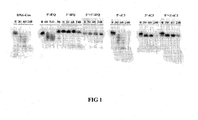
- the unmodified DNA oligomer was rapidly degraded and no intact full-length material was present after 30 minutes incubation. The sample was fully degraded by 4 hours. A similar pattern of degradation was seen for the oligomer having a single internal C3 spacer positioned near the 5'-end. In contrast, only incomplete degradation was observed for the oligomer bearing a single internal FQ modifier near the 5'-end. The degradation pattern observed is most consistent with processive 3'-exonuclease cleavage that stopped before the oligomer was fully degraded. This suggests the possibility that the iFQ modifier protects neighboring DNA residues from exonuclease degradation, providing a small zone of protection around the 5'-end.
- the oligomer having a single internal C3 spacer near the 3'-end shows prompt removal of what appears to be a single base and then was slowly degraded. Slightly greater protection was seen in the oligomer having an internal C3 spacer placed near both ends. In contrast, no evidence was seen for single base cleavage at the 3'-end of the oligomer having a single internal FQ modifier near the 3'-end, and no evidence for degradation was observed after 4 hours incubation in 50% serum for the oligomer having an internal FQ modifier placed near both ends.
- the FQ modifier will block exonuclease attack from the enzymes present in fetal bovine serum, and can confer relative nuclease resistance to neighboring unmodified bases, creating a protected "zone" in its vicinity.
- This example demonstrates improved functional activity of internal napthylene-azo-containing ASOs at reducing microRNA activity compared to other compounds.
- Oligonucleotide synthesis and purification DNA, 2'OMe RNA, and LNA containing oligonucleotides were synthesized using solid phase phosphoramidite chemistry, deprotected and desalted on NAP-5 columns (Amersham Pharmacia Biotech, Piscataway, NJ) according to routine techniques (Caruthers et al., 1992).
- the oligomers were purified using reversed-phase high performance liquid chromatography (RP-HPLC). The purity of each oligomer was determined by capillary electrophoresis (CE) carried out on a Beckman P/ACE MDQ system (Beckman Coulter, Inc., Fullerton, CA). All single-strand oligomers were at least 85% pure.
- Electrospray-ionization liquid chromatography mass spectrometry (ESI-LCMS) of the oligonucleotides was conducted using an Oligo HTCS system (Novatia, Princeton, NJ), which consisted of ThermoFinnigan TSQ7000, Xcalibur data system, ProMass data processing software, and Paradigm MS4TM HPLC (Michrom BioResources, Auburn, CA). Protocols recommended by the manufacturers were followed. Experimental molar masses for all single-strand oligomers were within 1.5 g/mol of expected molar mass. These results confirm identity of the oligomers. Table 5 lists the synthetic oligomers used in this Example.
- Plasmid preparation The psiCHECKTM-2 vector (Promega, Madison, WI) was restriction enzyme digested sequentially with Xho1 and Not1 (New England Biolabs, Ipswitch, MA) and purified with a Qiaquick PCR purification column (Qiagen, Valencia, CA). A perfect complement hsa-miR-21 binding site was created by annealing two synthetic duplexed oligonucleotides (Integrated DNA Technologies, Coralville, IA) and was cloned into the Xho1/Not1 sites in the 3'UTR of Renilla luciferase. This miR-21 reporter construct was sequence verified on a 3130 Genetic Analyzer (AB, Foster City, CA).
- Plasmids were purified using a Plasmid Midiprep Kit (Bio-Rad, Hercules, CA) and treated twice for endotoxin removal with the MiraCLEAN Endotoxin Removal Kit (Mirus Corporation, Madison, WI). Plasmids were filtered through a 0.2 ⁇ filter and quantified by measurement of the absorbance at 260 nm using UV spectrophotometry. This reporter plasmid having a perfect match miRNA binding site is denoted as psiCHECKTM-2-miR21.
- HeLa cells were plated in a 100 mm dish in DMEM containing 10% FBS to achieve 90% confluency the next day. The following morning, 5 ⁇ g of the psiCHECKTM-2-miR21 plasmid was transfected with LipofectamineTM 2000 (Invitrogen, Carlsbad, CA). After 6 hours, cells were washed with 1X PBS, trypsinized, counted, and replated in DMEM with 10% FBS in 48-well plates to achieve ⁇ 70% confluency the next day.
- the miR-21 AMOs were transfected at various concentrations in triplicate with 1 ⁇ l TriFECTin ® (Integrated DNA Technologies) per well in DMEM without serum. After 6 hours, the transfection media was removed and replenished with DMEM containing 10% FBS. The following morning, (48 hours after plasmid transfection, 24 hours after miRNA AMO transfection) the cells were analyzed for luciferase luminescence using the Dual-Luciferase ® Reporter Assay System (Promega, Madison, WI) per the manufacturer's instructions. Renilla luciferase was measured as a fold increase in expression compared to the TriFECTin ® reagent-only negative controls. Values for Renilla luciferase luminescence were normalized to levels concurrently measured for firefly luciferase, which is present as a separate expression unit on the same plasmids as an internal control (RLuc/FLuc ratio).
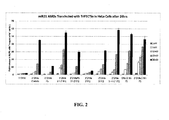
- the unmodified 2'OMe RNA AMO showed essentially no inhibition of miR-21 activity, probably due to rapid nuclease degradation of this unprotected oligomer during transfection or in the intracellular environment.
- the addition of 3 PS linkages on each end of the AMO blocks exonuclease attack and the "2'OMe-PSends" AMO showed good potency for functional knockdown of miR-21.
- this AMO is changed to be fully PS modified (“2'OMe-PS"), potency drops, which is probably due to having lower binding affinity (lower T m ) that accompanies extensive PS modification.
- Each substitution of a PS bond for a standard phosphodiester bond reduces T m , and there are 21 PS bonds in this oligomer compared with only 6 PS bonds in the "2'OMe PSends" version.
- a desirable modification chemistry or modification pattern is one that both increases nuclease stability and increases T m .
- the internal napthylene-azo modifier meets these criteria.
- the 2'OMe oligomer having an internal napthylene-azo modifier placed between the terminal and adjacent bases on each end (2'OMe 5'+3'iFQ) showed markedly improved anti-miR21 activity and was more potent than any of the PS modified 2'OMe AMOs tested.
- Adding PS modification to this design (2'OMePS 5'+3'iFQ) reduced potency, likely due to the lower binding affinity caused by the addition of 19 PS linkages. This compound was nevertheless still significantly more potent than the 2'OMe-PS version without the 2 iFQ modifications.
- the "DNA/LNA-PS" AMO is a design employed by Exiqon as its preferred anti-miRNA agent and is widely accepted as the "gold standard” for miRNA knockdown studies performed today.
- the DNA/LNA compound showed the same potency as the dual-modified "2'OMe 5'+3'iFQ" AMO.
- the "2'OMe/LNA-PS” AMO showed highest potency within the set studied.
- the LNA modification confers nuclease resistance and gives very large increases in T m , resulting in AMOs with higher potency but also having lower specificity than AMOs without LNA bases with lower binding affinity.
- the relative specificity of the different AMOs is presented in Example 4 below.
- the LNA-PS modified AMOs show some toxicity and cell cultures transfected with the highest doses (50 nM) had dysmorphic, unhealthy appearing cells at the time of harvest.
- the "2'OMe 5'+3'iFQ" AMO did not show any visual evidence for toxicity at any of the doses tested.
- toxicity effects were evaluated at high doses by measuring cell viability, cytotoxicity, and induction of apoptosis (see Example 7).
- the "2'OMe 5'+3'iFQ" chemistry showed no cellular toxicity, compared to the substantial cellular toxicity that occurred upon transfection of single-stranded oligonucleotides containing LNA bases, extensive PS modification (all 21 linkages), or both LNA and PS modifications (the "gold standard” AMO).
- the "2'OMe 5'+3'iFQ” may be a new class of AMO that achieves high potency yet maintains low toxicity.
- T m The melting temperatures, T m , of the AMOs described above were measured using the same methods described in Example 1. Synthetic AMO oligonucleotides were annealed to a synthetic RNA complement (mature miR21 sequence). Measurements were done at 2 ⁇ M duplex concentration in 150 mM NaCl to approximate intracellular ion concentration.
- the 22-mer 2'OMe miR21 AMO showed a T m of 72.1°C when hybridized to an RNA perfect complement in 150 mM NaCl. Substitution of 6 PS bonds for native PO linkages lowered T m by 1.2°C ("2'OMe PSends") and complete PS modified lowered T m by 5.0°C (“2'OMe PS”), a change of -0.20 to -0.25°C per modified internucleotide linkage.
- the relative potency of the various miR21 AMOs correlated with increased binding affinity ( T m ). All variations in potency observed between compounds could be explained by relative contributions of improvements in binding affinity and nuclease stability between the different modification patterns studied.
- the AMO having 2'OMe bases with an iFQ modification placed near each end (“2'OMe 5'+3'iFQ”) provided an excellent balance of nuclease stability with increased T m and the only AMO showing higher potency was the "2'OMe/LNA-PS" compound.
- the "2'OMe/LNA-PS” compound showed reduced specificity due to its extreme elevation in binding affinity (see Example 4) and increased cellular toxicity (see Example 7). Therefore, the novel "2'OMe 5'+3'iFQ" design of the present invention is superior.
- This example demonstrates improved specificity of internal napthylene-azo-containing oligomers when reducing microRNA activity compared to other compounds containing modifications that increase binding affinity.
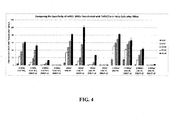
- the perfect match AMO showed significant suppression of miR-21 activity as evidenced by increases in luciferase levels (increase in the RLuc to FLuc ratio indicating de-repression of the RLuc mRNA).
- the "2'OMe/LNA-PS” compound showed the highest potency as evidenced by suppression of miR-21 at low dose (1 nM and 5 nM data points).
- the "2'OMe 5'+3'iFQ" and "DNA/LNA-PS" AMOs showed relatively similar performance both in wild-type (perfect match) and mutant (mismatch) versions.
- This example demonstrates improved functional activity of internal napthylene-azo-containing oligomers at reducing cellular mRNA levels when incorporated into RNase H active ASOs as compared to other related compounds.
- Oligonucleotides antisense in orientation to cellular messenger RNAs will hybridize to the mRNA and form an RNA/DNA heteroduplex, which is a substrate for cellular RNase H.
- Degradation by RNase H leads to a cut site in the mRNA and subsequently to total degradation of that RNA species, thereby functionally lowering effective expression of the targeted transcript and the protein it encodes.
- ASOs of this type require a domain containing at least 4 bases of DNA to be a substrate for RNase H, and maximal activity is not seen until 8-10 DNA bases are present.
- ASOs must be chemically modified to resist degradation by serum and cellular nucleases.
- Phosphorothioate (PS) modification of the internucleotide linkages is compatible with RNase H activation, however most other nuclease resistant modifications prevent RNase H activity, including all 2'-modifications, such as 2'OMe RNA, LNA, MOE, etc.
- the PS modification lowers binding affinity ( T m ).
- T m binding affinity
- modifications that lower T m decrease potency while modifications that increase T m improve potency.
- One strategy to improve potency of ASOs is to employ a chimeric design where a low T m , RNase H activating domain made of PS-modified DNA is flanked by end domains that contain 2'-modified sugars which confer high binding affinity but are not RNase H activating ("gapmer" design).
- One commonly employed strategy is to place five 2'-modified bases at the 5'-end, ten PS-modified DNA bases in the middle, and five 2'-modified bases at the 3'-end of the ASO (so called "5-10-5" design).
- a modification that confers nuclease resistance, increases binding affinity, and does not impair the reagent's ability to activate RNase H would be ideal.
- the present example demonstrates the utility of the internal napthylene-azo modifier to improve the nuclease stability and increase binding affinity of ASOs, enhancing their function as gene knockdown reagents.
- Oligonucleotide synthesis and purification DNA, 2'OMe RNA, and LNA containing oligonucleotides were synthesized using solid phase phosphoramidite chemistry, deprotected and desalted on NAP-5 columns (Amersham Pharmacia Biotech, Piscataway, NJ) according to routine techniques (Caruthers et al., 1992).
- the oligomers were purified using reversed-phase high performance liquid chromatography (RP-HPLC). The purity of each oligomer was determined by capillary electrophoresis (CE) carried out on a Beckman P/ACE MDQ system (Beckman Coulter, Inc., Fullerton, CA). All single-strand oligomers were at least 85% pure.
- Electrospray-ionization liquid chromatography mass spectrometry (ESI-LCMS) of the oligonucleotides was conducted using an Oligo HTCS system (Novatia, Princeton, NJ), which consisted of ThermoFinnigan TSQ7000, Xcalibur data system, ProMass data processing software, and Paradigm MS4TM HPLC (Michrom BioResources, Auburn, CA). Protocols recommended by the manufacturers were followed. Experimental molar masses for all single-strand oligomers were within 1.5 g/mol of expected molar mass. These results confirm identity of the oligomers.
- HeLa cell culture, transfections, and RT-qPCR methods HeLa cells were split into 48-well plates and were transfected the next day at ⁇ 60% confluency in serum-free Dulbecco's Modified Eagle Medium (Invitrogen, Carlsbad, CA) using TriFECTin ® (Integrated DNA Technologies, Coralville, IA) at a concentration of 2% (1 ⁇ L per 50 ⁇ L OptiMEM ® I) (Invitrogen, Carlsbad, CA) with ASOs at the indicated concentrations. All transfections were performed in triplicate. After 6 hours, media was exchanged with Dulbecco's Modified Eagle Medium containing 10% fetal bovine serum.
- TriFECTin ® Integrated DNA Technologies, Coralville, IA
- Quantitative real-time PCR was performed using 10 ng cDNA per 10 ⁇ L reaction with Immolase TM DNA Polymerase (Bioline, Randolph, MA), 200 nM primers, and 200 nM probe.
- Immolase TM DNA Polymerase Bioline, Randolph, MA
- 200 nM primers 200 nM probe.
- Hypoxanthine phosphoribosyltransferase 1 (HPRT1) (GenBank Acc. No. NM_000194) specific primers were:
- Results were transfected into HeLa cells at 1 nM, 5 nM, and 20 nM concentrations. RNA was prepared 24 hours post transfection, converted to cDNA, and HPRT expression levels were measured using qPCR. Results are shown in Figure 5 for the set of anti-HPRT ASOs made from DNA bases. Unmodified single-stranded DNA oligos are rapidly degraded by exonucleases and endonucleases. No knockdown of HPRT was observed using this design (HPRT DNA), presumably due to rapid degradation of the unprotected compound.
- ASOs with a single iFQ modification near the 3'-end HPRT DNA 3'iFQ
- a single iFQ modification near the 5'-end HPRT DNA 5'iFQ
- two iFQ modifications inserted near both ends HPRT DNA 5'+3'iFQ
- three iFQ modifications inserted in the center and near both ends HPRT DNA 5'+I+3'iFQ
- DNA-PS oligos were among the first effective antisense compounds studied. This modification increases nuclease stability; however, it also lowers binding affinity ( T m ) and as a result this so-called "first generation” antisense chemistry usually shows relatively low potency.
- the "DNA-PS” ASO reduced HPRT levels by 50% at 20 nM concentration; however, no reduction in HPRT levels was observed at lower doses.
- a second set of ASOs was synthesized using a chimeric "5-10-5 gapmer" design where five base end domains were made of 2'OMe RNA and a central ten base RNase H active domain were made of DNA. Oligonucleotides had zero, one, two, or three iFQ modifiers inserted at the same positions as the DNA ASOs in Figure 5 . These oligonucleotides were transfected into HeLa cells as before and HPRT mRNA levels were examined 24 hours post-transfection. Results are shown in Figure 6 .
- the three gapmer ASOs with a phosphodiester DNA central domain showed no activity in reducing HPRT mRNA levels, regardless of whether the sequence was modified with the iFQ group or not ("5-10-5", 5-10-5.2x iFQ” and "5-10-5 3x iFQ").
- the same sequence fully PS modified (“5-10-5-PS”) showed good potency with 75% knockdown of HPRT at 20 nM concentration.
- the addition of two iFQ groups near the ends of this design (“5-10-5-PS 2xiFQ”) showed the best potency of this set, with >90% knockdown of HPRT at 20 nM and >70% knockdown at 5 nM concentration.
- gapmer ASOs of this design are usually made with full PS modification to prevent exonuclease degradation. Consistent with this idea, an ASO with the DNA domain protected by PS internucleotide linkages but having phosphodiester bonds in the 2'OMe flanking domains showed no gene knockdown activity ("5-10-5 gapPS").
- Use of the iFQ modification at the ends permits use of this new design by providing protection from exonuclease attack; this new design should also increase binding affinity and lower toxicity by reducing PS content.
- the most potent antisense design in current use are LNA-modified gapmers, where very strong T m enhancing LNA modifications are used in the flanking domains in place of the 2'OMe RNA bases used in the present example. While potent, this design is expensive and can show significant toxicity in certain contexts.
- the same anti-HPRT sequence was made as an LNA 5-10-5 gapmer (fully PS modified). As expected, this compound showed the highest relative potency of any of the ASOs tested ("5-10-5 LNA PS") but the observed potency was only marginally higher than the best of the iFQ compositions ("5-10-5-PS 2xiFQ").
- the very high binding affinity LNA reagents usually result in decreased specificity, so use of the iFQ designs of the present invention may show improved specificity at a small cost in potency.
- This example demonstrates use of the iFQ modification in RNA duplexes with application in suppressing gene expression via an RNAi mechanism of action.
- dsRNA double-stranded RNA
- RNAi RNA interference
- Synthetic dsRNAs that mimic natural cellular products small interfering RNAs, or siRNAs
- siRNAs small interfering RNAs
- slightly larger synthetic oligonucleotides can be used that are substrates for the cytoplasmic nuclease Dicer, which processes these species into 21-mer siRNAs.
- these reagents are asymmetric and have a 25 base top (Sense strand, "S") and a 27 base bottom strand (Antisense strand, "AS”) with a single 2-base 3'-overhang on the AS strand.
- S sense strand
- AS Antisense strand
- DsiRNAs Dicer-substrate siRNAs
- dsRNA is far more stable to nuclease attack than single-stranded RNA (ssRNA)
- ssRNA single-stranded RNA
- Incorporation of chemical modifications, such as 2'OMe RNA, 2'F RNA, or LNA bases improves nuclease stability and can improve function of the siRNA.
- nuclease-resistant phosphorothioate bonds can also help stabilize the siRNA, especially when used near the terminal 3'-internucleotide linkages.
- PS nuclease-resistant phosphorothioate bonds
- careful placement of modified groups is essential as extensive chemical modification usually lowers functional potency of the compound even though nuclease stabilization has been achieved, probably through disrupting interaction of the RNA duplex with key protein mediators of RNAi, like Dicer or Ago2.
- iEQ modifier can be introduced into DsiRNAs.
- iFQ insertion can lead to increased potency, decreased potency, or no change in potency depending upon placement.
- RNA and modified RNA oligonucleotides were synthesized using solid phase phosphoramidite chemistry, deprotected and desalted according to routine techniques (Caruthers et al., 1992). The oligomers were purified using ion-exchange high performance liquid chromatography (IE-HPLC) and were handled under RNase-free conditions. All RNA oligonucleotides were prepared as a sodium salt. The purity of each oligomer was determined by capillary electrophoresis (CE) carried out on a Beckman P/ACE MDQ system (Beckman Coulter, Inc., Fullerton, CA). All single-strand oligomers were at least 85% pure.
- CE capillary electrophoresis
- Electrospray-ionization liquid chromatography mass spectrometry (ESI-LCMS) of the oligonucleotides was conducted using an Oligo HTCS system (Novatia, Princeton, NJ), which consisted of ThermoFinnigan TSQ7000, Xcalibur data system, ProMass data processing software, and Paradigm MS4TM HPLC (Michrom BioResources, Auburn, CA). Protocols recommended by the manufacturers were followed. Experimental molar masses for all single-strand oligomers were within 1.5 g/mol of expected molar mass. These results confirm identity of the oligomers.
- Duplexes were formed by mixing equal molar amounts of the top and bottom strands in 30 mM Hepes, pH 7.5, 100 mM potassium acetate, heating at 95°C for 2 minutes, then cooling to room temperature. Table 10 lists the duplexes synthesized for Example 6.
- RNA duplexes employed in Example 6 SEQ ID NO: Name Sequence 85 NC1 Negative Control 5' CGUUAAUCGCGUAUAAUACGCGUat 3' S 86 3' CAGCAAUUAGCGCAUAUUAUGCGCAUA 5' AS 87 HPRT unmod 5' GCCAGACUUUGUUGGAUUUGAAAtt 3' S 88 3' UUCGGUCUGAAACAACCUAAACUUUAA 5' AS 89 HPRT iFQ v1 5' GCCAGACUUUGUUGGAUUUGAAAtt 3' S 90 3' U z UCGGUCUGAAACAACCUAAACUUUAA 5' AS 91 HPRT iFQ v2 5' GCCAGACUUUGUUGGAUUUGAAAtt 3' S 92 3' UUC GGUCUGAAACAACCUAAACUUUAA 5' AS 93 HPRT iFQ v3 5' G z
- HeLa cell culture, transfections, and RT-qPCR methods HeLa cells were transfected in "reverse format" at ⁇ 60% confluency (Invitrogen, Carlsbad, CA) using 1 ⁇ L LipofectamineTM RNAiMAX per 50 ⁇ L OptiMEM TM I (Invitrogen, Carlsbad, CA) with RNA duplexes at the indicated concentrations. All transfections were performed in triplicate.
- the anti-HPRT DsiRNA employed in the present study is extremely potent and typically shows detectable knockdown of target mRNA at low picomolar levels. Consistent with this expectation, the unmodified duplex reduced HPRT levels by ⁇ 40% at a 10 pM dose at 24 hours post-transfection in HeLa cells. A series of modified duplexes containing the iFQ group positioned at various locations in the S strand, AS strand, or both were similarly transfected into HeLa cells and HPRT mRNA levels were measured 24 hour post-transfection.
- duplex HPRT iFQ v1 Placing the iFQ group near the 3'-end of the AS strand was well tolerated; insertion between bases 1 and 2 from the 3'-end (in the single-stranded 3'-overhang domain) (duplex HPRT iFQ v1) or between bases 3 and 4 from the 3'-end (at the start of the duplex domain) (duplex HPRT iFQ v4) showed similar potency to the unmodified duplex. Placing the iFQ group near the 5'-end of the S strand was similarly well tolerated (duplex HPRT iFQ v2) as was placing the iFQ group near both ends of the S strand (duplex HPRT iFQ v3). In contrast, duplexes having an iFQ group near the 5'-end of the AS strand showed reduced potency (duplexes HPRT iFQ v5 and v7), so modification at this position should be avoided.
- the iFQ modified and unmodified duplexes showed similar potency (except for those duplexes modified at the 5'-end of the AS strand, as noted above).
- Benefit from the iFQ group is most likely to be evident in settings where nuclease stabilization is needed, which is not appreciated in the present in vitro system, but based on the results of Examples 1 and 2, greater benefit would be expected from use of this modification when used in vivo where exposure to serum nucleases is more problematic.
- This example demonstrates decreased cellular toxicity from lipid transfected internal napthylene-azo-containing oligomers compared with other compounds.
- Toxicity from chemical modification of synthetic oligomers can be problematic as it can give unwanted side effects, cause unreliable results, and limit therapeutic utility of the oligomer.
- Cellular death can result from toxic chemical modifications by inducing necrosis or apoptosis.
- Toxicity was ascertained with oligomers containing a non-targeting, negative control ("NC1") sequence using chemical modification patterns employed in the AMOs examined in Examples 3 and 4 ( see Table 11).
- NC1 non-targeting, negative control
- cytotoxicity from necrosis and/or apoptosis was measured by quantifying the relative number of live and dead cells after treatment with the chemically modified oligomers, while cytotoxicity resulting from the induction of the apoptotic pathway was determined by measuring the levels of caspase-3 and -7 after oligomer treatment.
- Oligonucleotide synthesis and preparation DNA oligonucleotides were synthesized using solid phase phosphoramidite chemistry, deprotected and desalted on NAP-5 columns (Amersham Pharmacia Biotech, Piscataway, NJ) according to routine techniques (Caruthers et al., 1992). The oligomers were purified using reversed-phase high performance liquid chromatography (RP-HPLC). The purity of each oligomer was determined by capillary electrophoresis (CE) carried out on a Beckman P/ACE MDQ system (Beckman Coulter, Inc., Fullerton, CA). All single-strand oligomers were at least 90% pure.
- RP-HPLC reversed-phase high performance liquid chromatography
- Electrospray-ionization liquid chromatography mass spectrometry (ESI-LCMS) of the oligonucleotides was conducted using an Oligo HTCS system (Novatia, Princeton, NJ), which consisted of ThermoFinnigan TSQ7000, Xcalibur data system, ProMass data processing software, and Paradigm MS4TM HPLC (Michrom BioResources, Auburn, CA). Protocols recommended by the manufacturers were followed. Experimental molar masses for all single-strand oligomers were within 1.5 g/mol of expected molar mass. These results confirm identity of the oligomers.
- HeLa cells were plated in 48-well plates in DMEM containing 10% FBS to achieve 90% confluency the next day.
- NC1 AMOs were transfected at 100 nM or 50 nM concentrations in triplicate wells in two sets (one for measuring general cytotoxicity, one for measuring apoptosis induction) with 1 ⁇ l TriFECTin ® (Integrated DNA Technologies) per well in DMEM containing 10% FBS.
- An apoptosis-inducing agent, Staurosporine (1 mM in DMSO) was incubated at 1 ⁇ M on the cells for 24 hours as a positive control.
- the first set of cells was analyzed for viability using the MultiTox-Glo Multiplex Cytotoxicity Assay (Promega, Madison, WI) with the peptide-substrate GF-AFC (glycyl-phenylalanylaminofluorocoumarin), which generates a fluorescence signal upon cleavage by a "live-cell" specific protease, measured at 405nm Ex /505nm Em in a SpectraFluor Microplate Reader (Tecan Group Ltd, Mannedorf, Switzerland).
- MultiTox-Glo Multiplex Cytotoxicity Assay Promega, Madison, WI
- peptide-substrate GF-AFC glycyl-phenylalanylaminofluorocoumarin
- the same cells were subsequently analyzed for cytotoxicity by detecting a "dead-cell" protease activity in a luciferase-based assay measured on a GloMax® 96 Microplate Luminometer (Promega) per the manufacturer's recommendations.
- the Caspase-Glo® 3/7 Assay was performed with the second set of cells to measure caspase-3 and -7 levels according to the manufacturer's recommendations on a GloMax® 96 Microplate Luminometer (Promega).
- results For the cytoxocity analysis graphed in Figure 8 , data is presented as a ratio of live/dead cells as calculated from the abundance of "live-cell” and "dead-cell” proteases described above.
- the ratio of live/dead cells serves as an internal normalizing control providing data independent of cell number, and a reduction of live/dead cells correlates with cytotoxicity.
- the "2'OMe 5'+3' iFQ" and "2'OMe PSends” compounds are the least toxic oligomers and there is minimal toxicity even at the high 100 nM dose.
- the "DNA/PS" oligomer which is entirely comprised of PS linkages, shows substantial cell death at both doses suggesting that PS modification is toxic to the cells.
- Luminescence is proportional to the abundance of the apoptosis effectors and an increase in RLUs correlates with an increase in apoptosis.
- the data in Figure 9 mirrors the cytotoxicity profiles from the NC1 AMOs assayed in Figure 8 .
- the NC1 AMOs that do not trigger apoptosis are the "2'OMe 5'+3' iFQ" and "2'OMe PSends" compounds.
- DNA/PS DNA/LNA PO
- DNA/LNA PS LNA bases
- substitution of DNA bases for 2'OMe bases reduces apoptosis induction.
- the "2'OMe/LNA PS” still demonstrates apoptosis induction at the 100 nM dose.
Landscapes
- Life Sciences & Earth Sciences (AREA)
- Health & Medical Sciences (AREA)
- Engineering & Computer Science (AREA)
- Genetics & Genomics (AREA)
- Chemical & Material Sciences (AREA)
- Biomedical Technology (AREA)
- Organic Chemistry (AREA)
- Wood Science & Technology (AREA)
- Zoology (AREA)
- Molecular Biology (AREA)
- Biotechnology (AREA)
- General Engineering & Computer Science (AREA)
- Bioinformatics & Cheminformatics (AREA)
- Physics & Mathematics (AREA)
- Microbiology (AREA)
- Biochemistry (AREA)
- General Health & Medical Sciences (AREA)
- Biophysics (AREA)
- Plant Pathology (AREA)
- Proteomics, Peptides & Aminoacids (AREA)
- Analytical Chemistry (AREA)
- Immunology (AREA)
- Pharmaceuticals Containing Other Organic And Inorganic Compounds (AREA)
- Medicines That Contain Protein Lipid Enzymes And Other Medicines (AREA)
Priority Applications (1)
| Application Number | Priority Date | Filing Date | Title |
|---|---|---|---|
| EP15157497.7A EP2896696B1 (en) | 2010-09-07 | 2011-09-07 | Modifications for antisense compounds |
Applications Claiming Priority (2)
| Application Number | Priority Date | Filing Date | Title |
|---|---|---|---|
| US38058610P | 2010-09-07 | 2010-09-07 | |
| PCT/US2011/050710 WO2012033848A1 (en) | 2010-09-07 | 2011-09-07 | Modifications for antisense compounds |
Related Child Applications (2)
| Application Number | Title | Priority Date | Filing Date |
|---|---|---|---|
| EP15157497.7A Division EP2896696B1 (en) | 2010-09-07 | 2011-09-07 | Modifications for antisense compounds |
| EP15157497.7A Division-Into EP2896696B1 (en) | 2010-09-07 | 2011-09-07 | Modifications for antisense compounds |
Publications (2)
| Publication Number | Publication Date |
|---|---|
| EP2614149A1 EP2614149A1 (en) | 2013-07-17 |
| EP2614149B1 true EP2614149B1 (en) | 2015-04-08 |
Family
ID=44674883
Family Applications (2)
| Application Number | Title | Priority Date | Filing Date |
|---|---|---|---|
| EP11760620.2A Not-in-force EP2614149B1 (en) | 2010-09-07 | 2011-09-07 | Modifications for antisense compounds |
| EP15157497.7A Not-in-force EP2896696B1 (en) | 2010-09-07 | 2011-09-07 | Modifications for antisense compounds |
Family Applications After (1)
| Application Number | Title | Priority Date | Filing Date |
|---|---|---|---|
| EP15157497.7A Not-in-force EP2896696B1 (en) | 2010-09-07 | 2011-09-07 | Modifications for antisense compounds |
Country Status (6)
| Country | Link |
|---|---|
| US (3) | US20120108799A1 (enExample) |
| EP (2) | EP2614149B1 (enExample) |
| JP (2) | JP6053684B2 (enExample) |
| AU (1) | AU2011299233B2 (enExample) |
| CA (1) | CA2809457C (enExample) |
| WO (1) | WO2012033848A1 (enExample) |
Families Citing this family (10)
| Publication number | Priority date | Publication date | Assignee | Title |
|---|---|---|---|---|
| AU2011299233B2 (en) | 2010-09-07 | 2016-09-15 | Integrated Dna Technologies, Inc. | Modifications for antisense compounds |
| WO2014130945A1 (en) * | 2013-02-25 | 2014-08-28 | Integrated Dna Technologies, Inc. | Modifications for antisense compounds |
| AU2014222150A1 (en) * | 2013-03-01 | 2015-09-10 | National University Corporation Tokyo Medical And Dental University | Chimeric single-stranded antisense polynucleotides and double-stranded antisense agent |
| TW201620526A (zh) | 2014-06-17 | 2016-06-16 | 愛羅海德研究公司 | 用於抑制α-1抗胰蛋白酶基因表現之組合物及方法 |
| CN110268060B (zh) | 2017-01-10 | 2024-07-26 | 箭头药业股份有限公司 | α-1抗胰蛋白酶(AAT)RNAi物质、包含AAT RNAi物质的组合物和使用方法 |
| WO2019090110A1 (en) * | 2017-11-03 | 2019-05-09 | Lentigen Technology, Inc. | Compositions and methods for treating cancer with anti-ror1 immunotherapy |
| AU2021244687A1 (en) * | 2020-03-24 | 2022-11-10 | Flagship Pioneering Innovations Vi, Llc | Bifunctional molecules and methods of using thereof |
| WO2021216728A1 (en) | 2020-04-22 | 2021-10-28 | President And Fellows Of Harvard College | Isothermal methods, compositions, kits, and systems for detecting nucleic acids |
| WO2023028085A2 (en) * | 2021-08-23 | 2023-03-02 | Cold Spring Harbor Laboratory | Antisense oligonucleotide therapy for h3.3 k27m diffuse midline gliomas |
| CN120418446A (zh) | 2022-12-01 | 2025-08-01 | 贝克顿迪金森公司 | 用于核酸检测的不对称发夹探针 |
Family Cites Families (134)
| Publication number | Priority date | Publication date | Assignee | Title |
|---|---|---|---|---|
| US2264303A (en) | 1940-03-27 | 1941-12-02 | Eastman Kodak Co | Azo compounds and material colored therewith |
| US3407189A (en) | 1956-07-25 | 1968-10-22 | Sandoz Ltd | Water-insoluble monoazo dyestuffs |
| US3218309A (en) | 1961-08-14 | 1965-11-16 | Parke Davis & Co | Azo compounds |
| GB1394368A (en) | 1972-12-14 | 1975-05-14 | Ici Ltd | Disperse azo dyestuffs |
| US3970617A (en) | 1974-03-07 | 1976-07-20 | E. I. Du Pont De Nemours And Company | Navy-blue nitrophenylazonaphthylamino dyes |
| GB1533121A (en) | 1975-08-04 | 1978-11-22 | Ici Ltd | Disperse nitro disazo dyestuffs |
| DE2546535A1 (de) | 1975-10-17 | 1977-04-28 | Bayer Ag | Azofarbstoffe |
| JPS5288681A (en) | 1976-01-12 | 1977-07-25 | Mitsubishi Chem Ind | Dyeing method of synthetic fibers |
| JPS5291031A (en) | 1976-01-27 | 1977-08-01 | Mitsubishi Chem Ind Ltd | Production of monoazo dye |
| US4358535A (en) | 1980-12-08 | 1982-11-09 | Board Of Regents Of The University Of Washington | Specific DNA probes in diagnostic microbiology |
| US4439356A (en) | 1981-03-03 | 1984-03-27 | Syva Company | Unsymmetrical fluorescein derivatives |
| US4711955A (en) | 1981-04-17 | 1987-12-08 | Yale University | Modified nucleotides and methods of preparing and using same |
| CA1180647A (en) | 1981-07-17 | 1985-01-08 | Cavit Akin | Light-emitting polynucleotide hybridization diagnostic method |
| CA1185177A (en) | 1981-07-17 | 1985-04-09 | Larry E. Morrison | Non-radiative energy transfer immunochemical technique |
| CA1190838A (en) | 1981-07-17 | 1985-07-23 | Cavit Akin | Homogeneous nucleic acid hybridization diagnostics by non-radiative energy transfer |
| FR2540122B1 (fr) | 1983-01-27 | 1985-11-29 | Centre Nat Rech Scient | Nouveaux composes comportant une sequence d'oligonucleotide liee a un agent d'intercalation, leur procede de synthese et leur application |
| CA1223222A (en) | 1984-02-22 | 1987-06-23 | Nanibhushan Dattagupta | Immobilized nucleic acid-containing probes |
| US4683194A (en) | 1984-05-29 | 1987-07-28 | Cetus Corporation | Method for detection of polymorphic restriction sites and nucleic acid sequences |
| US4820630A (en) | 1984-11-23 | 1989-04-11 | Digene Diagnostics, Incorporated | Assay for nucleic acid sequences, particularly genetic lesions, using interactive labels |
| US4883750A (en) | 1984-12-13 | 1989-11-28 | Applied Biosystems, Inc. | Detection of specific sequences in nucleic acids |
| US4683202A (en) | 1985-03-28 | 1987-07-28 | Cetus Corporation | Process for amplifying nucleic acid sequences |
| US4683195A (en) | 1986-01-30 | 1987-07-28 | Cetus Corporation | Process for amplifying, detecting, and/or-cloning nucleic acid sequences |
| DE3526565A1 (de) | 1985-07-25 | 1987-02-05 | Boehringer Mannheim Gmbh | Resorufin-derivate, verfahren zu deren herstellung sowie deren verwendung in fluoreszenzimmunoassays |
| US5011769A (en) | 1985-12-05 | 1991-04-30 | Meiogenics U.S. Limited Partnership | Methods for detecting nucleic acid sequences |
| US4868105A (en) | 1985-12-11 | 1989-09-19 | Chiron Corporation | Solution phase nucleic acid sandwich assay |
| US4996143A (en) | 1985-12-23 | 1991-02-26 | Syngene, Inc. | Fluorescent stokes shift probes for polynucleotide hybridization |
| US4868103A (en) | 1986-02-19 | 1989-09-19 | Enzo Biochem, Inc. | Analyte detection by means of energy transfer |
| GB8612087D0 (en) | 1986-05-19 | 1986-06-25 | Ici Plc | Hybridisation probes |
| US4889818A (en) | 1986-08-22 | 1989-12-26 | Cetus Corporation | Purified thermostable enzyme |
| JP2527340B2 (ja) | 1986-12-15 | 1996-08-21 | アプライド バイオシステムズ インコーポレイテッド | ロ―ダミン染料の5−及び6−スクシニミジルカルボキシレ―ト異性体 |
| US6270961B1 (en) | 1987-04-01 | 2001-08-07 | Hyseq, Inc. | Methods and apparatus for DNA sequencing and DNA identification |
| US5525464A (en) | 1987-04-01 | 1996-06-11 | Hyseq, Inc. | Method of sequencing by hybridization of oligonucleotide probes |
| US5202231A (en) | 1987-04-01 | 1993-04-13 | Drmanac Radoje T | Method of sequencing of genomes by hybridization of oligonucleotide probes |
| US5585481A (en) | 1987-09-21 | 1996-12-17 | Gen-Probe Incorporated | Linking reagents for nucleotide probes |
| US4914210A (en) | 1987-10-02 | 1990-04-03 | Cetus Corporation | Oligonucleotide functionalizing reagents |
| US5124246A (en) | 1987-10-15 | 1992-06-23 | Chiron Corporation | Nucleic acid multimers and amplified nucleic acid hybridization assays using same |
| ATE151467T1 (de) | 1987-11-30 | 1997-04-15 | Univ Iowa Res Found | Durch modifikationen an der 3'-terminalen phosphodiesterbindung stabilisierte dna moleküle, ihre verwendung als nukleinsäuresonden sowie als therapeutische mittel zur hemmung der expression spezifischer zielgene |
| AU622426B2 (en) | 1987-12-11 | 1992-04-09 | Abbott Laboratories | Assay using template-dependent nucleic acid probe reorganization |
| WO1989009284A1 (en) | 1988-03-24 | 1989-10-05 | University Of Iowa Research Foundation | Catalytic hybridization systems for the detection of nucleic acid sequences based on their activity as cofactors in catalytic reactions in which a complementary labeled nucleic acid probe is cleaved |
| JPH03504199A (ja) | 1988-05-10 | 1991-09-19 | イー・アイ・デユポン・ド・ネモアース・アンド・コンパニー | 迅速な核酸検出法 |
| AU629845B2 (en) | 1988-08-30 | 1992-10-15 | Abbott Laboratories | Detection and amplification of target nucleic acid sequences |
| US5849482A (en) | 1988-09-28 | 1998-12-15 | Epoch Pharmaceuticals, Inc. | Crosslinking oligonucleotides |
| US5824796A (en) | 1988-09-28 | 1998-10-20 | Epoch Pharmaceuticals, Inc. | Cross-linking oligonucleotides |
| US5118801A (en) | 1988-09-30 | 1992-06-02 | The Public Health Research Institute | Nucleic acid process containing improved molecular switch |
| US5272259A (en) | 1988-12-23 | 1993-12-21 | Bayer Aktiengesellschaft | Stilbene dyestuffs and light-polarizing films or sheets containing stilbene |
| WO1990014353A1 (en) | 1989-05-18 | 1990-11-29 | Microprobe Corporation | Crosslinking oligonucleotides |
| DE3916595A1 (de) | 1989-05-22 | 1990-11-29 | Boehringer Mannheim Gmbh | Verfahren zur nichtradioaktiven messung der nucleinsaeuresynthese in eukaryontischen zellen |
| US5108892A (en) | 1989-08-03 | 1992-04-28 | Promega Corporation | Method of using a taq dna polymerase without 5'-3'-exonuclease activity |
| US5451463A (en) | 1989-08-28 | 1995-09-19 | Clontech Laboratories, Inc. | Non-nucleoside 1,3-diol reagents for labeling synthetic oligonucleotides |
| US5366860A (en) | 1989-09-29 | 1994-11-22 | Applied Biosystems, Inc. | Spectrally resolvable rhodamine dyes for nucleic acid sequence determination |
| US5188934A (en) | 1989-11-14 | 1993-02-23 | Applied Biosystems, Inc. | 4,7-dichlorofluorescein dyes as molecular probes |
| EP0439182B1 (en) | 1990-01-26 | 1996-04-24 | Abbott Laboratories | Improved method of amplifying target nucleic acids applicable to both polymerase and ligase chain reactions |
| US5214136A (en) | 1990-02-20 | 1993-05-25 | Gilead Sciences, Inc. | Anthraquinone-derivatives oligonucleotides |
| US5494810A (en) | 1990-05-03 | 1996-02-27 | Cornell Research Foundation, Inc. | Thermostable ligase-mediated DNA amplifications system for the detection of genetic disease |
| ATE167523T1 (de) | 1990-05-11 | 1998-07-15 | Microprobe Corp | Teststreifen zum eintauchen für nukleinsäure- hybridisierungsassays und verfahren zur kovalenten immobilisierung von oligonucleotiden |
| US5210015A (en) | 1990-08-06 | 1993-05-11 | Hoffman-La Roche Inc. | Homogeneous assay system using the nuclease activity of a nucleic acid polymerase |
| US5512667A (en) | 1990-08-28 | 1996-04-30 | Reed; Michael W. | Trifunctional intermediates for preparing 3'-tailed oligonucleotides |
| EP0834575B1 (en) | 1990-12-06 | 2001-11-28 | Affymetrix, Inc. (a Delaware Corporation) | Identification of nucleic acids in samples |
| EP0528512A1 (en) | 1991-08-20 | 1993-02-24 | Pioneer Electronic Corporation | Recording medium |
| ES2159282T3 (es) | 1991-11-07 | 2001-10-01 | Nanotronics Inc | Hibridacion de polinucleotidos conjugados con cromoforas y fluoroforos con el fin de generar sistemas de transferencia de energia de donador a donador. |
| US5484908A (en) | 1991-11-26 | 1996-01-16 | Gilead Sciences, Inc. | Oligonucleotides containing 5-propynyl pyrimidines |
| TW393513B (en) | 1991-11-26 | 2000-06-11 | Isis Pharmaceuticals Inc | Enhanced triple-helix and double-helix formation with oligomers containing modified pyrimidines |
| CA2126691C (en) | 1991-12-24 | 2003-05-06 | Phillip Dan Cook | Gapped 2' modified oligonucleotides |
| US5502177A (en) | 1993-09-17 | 1996-03-26 | Gilead Sciences, Inc. | Pyrimidine derivatives for labeled binding partners |
| US5801154A (en) | 1993-10-18 | 1998-09-01 | Isis Pharmaceuticals, Inc. | Antisense oligonucleotide modulation of multidrug resistance-associated protein |
| US5925517A (en) | 1993-11-12 | 1999-07-20 | The Public Health Research Institute Of The City Of New York, Inc. | Detectably labeled dual conformation oligonucleotide probes, assays and kits |
| US5538848A (en) | 1994-11-16 | 1996-07-23 | Applied Biosystems Division, Perkin-Elmer Corp. | Method for detecting nucleic acid amplification using self-quenching fluorescence probe |
| US5556752A (en) | 1994-10-24 | 1996-09-17 | Affymetrix, Inc. | Surface-bound, unimolecular, double-stranded DNA |
| DE19509038A1 (de) | 1995-03-14 | 1996-09-19 | Boehringer Mannheim Gmbh | C-Nukleosid-Derivate und deren Verwendung in der Detektion von Nukleinsäuren |
| US6312894B1 (en) | 1995-04-03 | 2001-11-06 | Epoch Pharmaceuticals, Inc. | Hybridization and mismatch discrimination using oligonucleotides conjugated to minor groove binders |
| US5801155A (en) | 1995-04-03 | 1998-09-01 | Epoch Pharmaceuticals, Inc. | Covalently linked oligonucleotide minor grove binder conjugates |
| EP0826066B1 (en) | 1995-05-05 | 2000-09-13 | The Perkin-Elmer Corporation | Methods and reagents for combined pcr amplification and hybridization probing assay |
| US6531589B1 (en) | 1995-06-01 | 2003-03-11 | Hybridon, Inc. | Base protecting groups and synthons for oligonucleotide synthesis |
| WO1996040662A2 (en) | 1995-06-07 | 1996-12-19 | Cellpro, Incorporated | Aminooxy-containing linker compounds and their application in conjugates |
| US6147205A (en) | 1995-12-15 | 2000-11-14 | Affymetrix, Inc. | Photocleavable protecting groups and methods for their use |
| US20010018514A1 (en) | 1998-07-31 | 2001-08-30 | Mcgall Glenn H. | Nucleic acid labeling compounds |
| GB9602265D0 (en) | 1996-02-05 | 1996-04-03 | Amersham Int Plc | Benzophenoxazine dyes |
| AU713667B2 (en) | 1996-04-12 | 1999-12-09 | Phri Properties, Inc. | Detection probes, kits and assays |
| US6582921B2 (en) | 1996-07-29 | 2003-06-24 | Nanosphere, Inc. | Nanoparticles having oligonucleotides attached thereto and uses thereof |
| US6576752B1 (en) | 1997-02-14 | 2003-06-10 | Isis Pharmaceuticals, Inc. | Aminooxy functionalized oligomers |
| US6117973A (en) | 1997-02-24 | 2000-09-12 | Georgia Tech Research Corp. | PNA monomers with electron donor or acceptor |
| US5846726A (en) | 1997-05-13 | 1998-12-08 | Becton, Dickinson And Company | Detection of nucleic acids by fluorescence quenching |
| EP1009852A2 (en) | 1997-09-04 | 2000-06-21 | Bayer Corporation | Oligonucleotide probes bearing quenchable fluorescent labels, and methods of use thereof |
| ATE293123T1 (de) | 1997-09-12 | 2005-04-15 | Exiqon As | Bi- und tri-zyklische - nukleosid, nukleotid und oligonukleotid-analoga |
| US6485901B1 (en) | 1997-10-27 | 2002-11-26 | Boston Probes, Inc. | Methods, kits and compositions pertaining to linear beacons |
| US6028183A (en) | 1997-11-07 | 2000-02-22 | Gilead Sciences, Inc. | Pyrimidine derivatives and oligonucleotides containing same |
| US6007992A (en) | 1997-11-10 | 1999-12-28 | Gilead Sciences, Inc. | Pyrimidine derivatives for labeled binding partners |
| US6080868A (en) | 1998-01-23 | 2000-06-27 | The Perkin-Elmer Corporation | Nitro-substituted non-fluorescent asymmetric cyanine dye compounds |
| JP4388694B2 (ja) | 1998-02-04 | 2009-12-24 | アプライド バイオシステムズ, エルエルシー | 複数のアレル部位における増幅産物のゲノム型決定 |
| DE19811618C1 (de) | 1998-03-17 | 2000-08-31 | Andreas Jenne | Ribozym codierende DNA und ein Oligonucleotidsubstrat enthaltende Zusammensetzung und Verfahren zur Messung von Transkriptionsraten |
| US5952202A (en) | 1998-03-26 | 1999-09-14 | The Perkin Elmer Corporation | Methods using exogenous, internal controls and analogue blocks during nucleic acid amplification |
| US6127121A (en) | 1998-04-03 | 2000-10-03 | Epoch Pharmaceuticals, Inc. | Oligonucleotides containing pyrazolo[3,4-D]pyrimidines for hybridization and mismatch discrimination |
| US6117986A (en) | 1998-06-10 | 2000-09-12 | Intergen Company, L.P. | Pyrimidines linked to a quencher |
| US6875858B1 (en) | 1999-01-05 | 2005-04-05 | Bio Merieux | Functionalized polynucleotide compound, optionally marked and method for detecting a target nucleic acid |
| US6255476B1 (en) | 1999-02-22 | 2001-07-03 | Pe Corporation (Ny) | Methods and compositions for synthesis of labelled oligonucleotides and analogs on solid-supports |
| KR20020013519A (ko) * | 1999-04-08 | 2002-02-20 | 추후제출 | 보편적 및/또는 축퇴성 염기를 포함하는 안티센스올리고뉴클레오티드 |
| EP1090073B1 (en) | 1999-04-23 | 2003-03-05 | Molecular Probes Inc. | Xanthene dyes and their application as luminescence quenching compounds |
| US6151241A (en) | 1999-05-19 | 2000-11-21 | Symetrix Corporation | Ferroelectric memory with disturb protection |
| US6531591B1 (en) | 1999-07-07 | 2003-03-11 | Exiqon A/S | Synthesis of stable quinone and photoreactive ketone phosphoramidite reagents for solid phase synthesis of photoreactive-oligomer conjugates |
| AU5805900A (en) | 1999-07-07 | 2001-01-30 | Exiqon A/S | Synthesis of stable quinone and photoreactive ketone phosphoramidite reagents for solid phase synthesis of photoreactive-oligomer conjugates |
| US6339147B1 (en) | 1999-07-29 | 2002-01-15 | Epoch Biosciences, Inc. | Attachment of oligonucleotides to solid supports through Schiff base type linkages for capture and detection of nucleic acids |
| US6114518A (en) | 1999-09-30 | 2000-09-05 | Becton, Dickinson And Company | Synthesis and use of labelled phosphoramidite compositions |
| US6727356B1 (en) | 1999-12-08 | 2004-04-27 | Epoch Pharmaceuticals, Inc. | Fluorescent quenching detection reagents and methods |
| US20040081959A9 (en) | 1999-12-08 | 2004-04-29 | Epoch Biosciences, Inc. | Fluorescent quenching detection reagents and methods |
| US6686461B1 (en) | 2000-03-22 | 2004-02-03 | Solulink Bioscience, Inc. | Triphosphate oligonucleotide modification reagents and uses thereof |
| JP2004501869A (ja) | 2000-03-22 | 2004-01-22 | ソルリンク・インコーポレイテッド | ヒドラジンベース及びカルボニルベースの二官能性架橋剤 |
| US6465644B1 (en) | 2000-05-02 | 2002-10-15 | Applera Corporation | Sulfonated [8,9] benzophenoxazine dyes and the use of their labelled conjugates |
| US7019129B1 (en) | 2000-05-09 | 2006-03-28 | Biosearch Technologies, Inc. | Dark quenchers for donor-acceptor energy transfer |
| US6323337B1 (en) | 2000-05-12 | 2001-11-27 | Molecular Probes, Inc. | Quenching oligonucleotides |
| US6448407B1 (en) | 2000-11-01 | 2002-09-10 | Pe Corporation (Ny) | Atropisomers of asymmetric xanthene fluorescent dyes and methods of DNA sequencing and fragment analysis |
| AU2002250262B9 (en) | 2001-03-09 | 2006-11-30 | Boston Probes, Inc. | Methods, kits and compositions of combination oligomers |
| KR20040010610A (ko) | 2001-03-16 | 2004-01-31 | 큐티엘 바이오시스템즈 엘엘씨 | 형광 폴리머 수퍼퀀칭-기초로 한 생물학적 어세이 |
| US20030082547A1 (en) * | 2001-08-27 | 2003-05-01 | Ewing Gregory J. | Non-fluorescent quencher compounds and biomolecular assays |
| JP2005514005A (ja) | 2001-09-04 | 2005-05-19 | エクシコン エ/エス | 新規のlna組成物およびその使用 |
| AU2003275018B2 (en) | 2002-09-20 | 2009-10-01 | Integrated Dna Technologies, Inc. | Anthraquinone quencher dyes, their methods of preparation and use |
| US20040180343A1 (en) | 2003-03-12 | 2004-09-16 | Weber Georg F. | Compositions and methods for detecting nucleic acids |
| DK1633883T3 (da) | 2003-06-17 | 2009-01-26 | Medical Res Council | Fremgangsmåde til analyse af LKB1-phosphoryleringsaktivitet |
| US8012944B2 (en) * | 2003-10-30 | 2011-09-06 | Pharmascience Inc. | Method for treating cancer using IAP antisense oligomer and chemotherapeutic agent |
| WO2005049849A2 (en) | 2003-11-14 | 2005-06-02 | Integrated Dna Technologies, Inc. | Fluorescence quenching azo dyes, their methods of preparation and use |
| CA2494571C (en) | 2003-12-02 | 2010-02-09 | F.Hoffmann-La Roche Ag | Oligonucleotides containing molecular rods |
| US20050288246A1 (en) * | 2004-05-24 | 2005-12-29 | Iversen Patrick L | Peptide conjugated, inosine-substituted antisense oligomer compound and method |
| US20060178507A1 (en) | 2004-12-30 | 2006-08-10 | Berry & Associates, Inc. | Fluorous oligonucleotide reagents and affinity purification of oligonucleotides |
| JP5288681B2 (ja) | 2005-04-05 | 2013-09-11 | シキボウ株式会社 | 超微粒子シリカ分散液、超微粒子シリカ分散体及びこれらの製造方法 |
| CA2601554A1 (en) | 2005-05-20 | 2006-11-30 | Integrated Dna Technologies, Inc. | Compounds and methods for labeling oligonucleotides |
| US20070218490A1 (en) | 2006-03-15 | 2007-09-20 | Integrated Dna Technologies, Inc. | Nucleic acid monomers with 2'-chemical moieties |
| US7629124B2 (en) * | 2006-06-30 | 2009-12-08 | Canon U.S. Life Sciences, Inc. | Real-time PCR in micro-channels |
| PL2757091T3 (pl) | 2008-04-01 | 2017-10-31 | Biosearch Tech Inc | Stabilizowane ciemne wygaszające sondy fluoroforowe kwasu nukleinowego |
| JP5291031B2 (ja) | 2009-03-27 | 2013-09-18 | 株式会社エクシング | カラオケシステム、カラオケシステムの制御方法、及びカラオケシステムの制御プログラム |
| EP2430187A2 (en) * | 2009-05-12 | 2012-03-21 | Abacus Diagnostica OY | Method for detecting nucleic acids |
| WO2010147673A2 (en) | 2009-06-19 | 2010-12-23 | University Of Florida Research Foundation, Inc. | Single-dna molecule nanomotor regulated by photons |
| US20110117559A1 (en) | 2009-11-13 | 2011-05-19 | Integrated Dna Technologies, Inc. | Small rna detection assays |
| WO2011120049A1 (en) * | 2010-03-26 | 2011-09-29 | Integrated Dna Technologies, Inc. | Methods for enhancing nucleic acid hybridization |
| US8618253B2 (en) | 2010-05-25 | 2013-12-31 | Samsung Techwin Co., Ltd. | Modified RNAse H and detection of nucleic acid amplification |
| AU2011299233B2 (en) | 2010-09-07 | 2016-09-15 | Integrated Dna Technologies, Inc. | Modifications for antisense compounds |
-
2011
- 2011-09-07 AU AU2011299233A patent/AU2011299233B2/en not_active Ceased
- 2011-09-07 WO PCT/US2011/050710 patent/WO2012033848A1/en not_active Ceased
- 2011-09-07 CA CA2809457A patent/CA2809457C/en not_active Expired - Fee Related
- 2011-09-07 JP JP2013528272A patent/JP6053684B2/ja not_active Expired - Fee Related
- 2011-09-07 EP EP11760620.2A patent/EP2614149B1/en not_active Not-in-force
- 2011-09-07 EP EP15157497.7A patent/EP2896696B1/en not_active Not-in-force
- 2011-09-07 US US13/227,286 patent/US20120108799A1/en not_active Abandoned
-
2014
- 2014-09-26 US US14/281,646 patent/US9506059B2/en active Active
-
2016
- 2016-11-23 US US15/360,382 patent/US10087445B2/en active Active
- 2016-12-01 JP JP2016233800A patent/JP2017070299A/ja active Pending
Also Published As
| Publication number | Publication date |
|---|---|
| EP2896696B1 (en) | 2017-12-27 |
| JP2017070299A (ja) | 2017-04-13 |
| AU2011299233A1 (en) | 2013-03-21 |
| EP2614149A1 (en) | 2013-07-17 |
| WO2012033848A1 (en) | 2012-03-15 |
| US20150011744A1 (en) | 2015-01-08 |
| US9506059B2 (en) | 2016-11-29 |
| EP2896696A2 (en) | 2015-07-22 |
| US20170204412A1 (en) | 2017-07-20 |
| AU2011299233B2 (en) | 2016-09-15 |
| JP6053684B2 (ja) | 2016-12-27 |
| JP2013539967A (ja) | 2013-10-31 |
| CA2809457C (en) | 2019-07-30 |
| CA2809457A1 (en) | 2012-03-15 |
| EP2896696A3 (en) | 2015-10-28 |
| US10087445B2 (en) | 2018-10-02 |
| US20120108799A1 (en) | 2012-05-03 |
Similar Documents
| Publication | Publication Date | Title |
|---|---|---|
| EP2614149B1 (en) | Modifications for antisense compounds | |
| Lennox et al. | Improved performance of anti-miRNA oligonucleotides using a novel non-nucleotide modifier | |
| EP3507366B1 (en) | Chemically modified single-stranded rna-editing oligonucleotides | |
| Lennox et al. | A direct comparison of anti-microRNA oligonucleotide potency | |
| Lennox et al. | Chemical modification and design of anti-miRNA oligonucleotides | |
| EP2203559B1 (en) | Combination treatment for the treatment of hepatitis c virus infection | |
| KR101838308B1 (ko) | 피롤린-5-카르복실레이트 환원효소 1(pycr1)에 대한 천연 안티센스 전사체의 억제에 의한 pycr1과 관련된 질환의 치료 | |
| EP4023228A1 (en) | Genome editing oligonucleotide without programmable nucleases | |
| CA2704560A1 (en) | Use of oligonucleotides with modified bases in hybridization of nucleic acids | |
| EP1730309B1 (en) | Compositions and methods for optimizing cleavage of rna by rnase h | |
| AU2024247459A1 (en) | Chemically modified antisense oligonucleotides for use in rna editing | |
| JP2025527531A (ja) | ユニバーサル非標的sirna組成物およびその使用方法 | |
| US9506057B2 (en) | Modifications for antisense compounds | |
| EP2959000B1 (en) | Naphthyl-azo modifications for antisense compounds | |
| WO2019004420A1 (ja) | ヘテロ二本鎖型antimiR | |
| EP3928799A1 (en) | Optimal ps modification pattern for heteronucleic acids | |
| CN120476207A (zh) | 反义寡核苷酸治疗遗传性hfe血色素沉着症 | |
| JP2021502059A (ja) | 部分的に立体定義されたオリゴヌクレオチドのサブライブラリーを使用することによる、アンチセンスオリゴヌクレオチドの、改良された立体定義されたホスホロチオエートオリゴヌクレオチド変異体を同定するための方法 | |
| Takagi-Sato et al. | Fine-Tuning of ENA® Gapmers as Antisense Oligonucleotides for Sequence-Specific Inhibition | |
| EP4581141A1 (en) | Threose nucleic acid antisense oligonucleotides and methods thereof | |
| NL2017295B1 (en) | Antisense oligomeric compound for Pompe disease | |
| JP2025540146A (ja) | 心血管疾患の治療のためのアンチセンスオリゴヌクレオチド |
Legal Events
| Date | Code | Title | Description |
|---|---|---|---|
| PUAI | Public reference made under article 153(3) epc to a published international application that has entered the european phase |
Free format text: ORIGINAL CODE: 0009012 |
|
| 17P | Request for examination filed |
Effective date: 20130226 |
|
| AK | Designated contracting states |
Kind code of ref document: A1 Designated state(s): AL AT BE BG CH CY CZ DE DK EE ES FI FR GB GR HR HU IE IS IT LI LT LU LV MC MK MT NL NO PL PT RO RS SE SI SK SM TR |
|
| DAX | Request for extension of the european patent (deleted) | ||
| RIC1 | Information provided on ipc code assigned before grant |
Ipc: C12N 15/113 20100101AFI20140711BHEP Ipc: C12N 15/11 20060101ALI20140711BHEP |
|
| GRAP | Despatch of communication of intention to grant a patent |
Free format text: ORIGINAL CODE: EPIDOSNIGR1 |
|
| INTG | Intention to grant announced |
Effective date: 20141022 |
|
| GRAS | Grant fee paid |
Free format text: ORIGINAL CODE: EPIDOSNIGR3 |
|
| GRAA | (expected) grant |
Free format text: ORIGINAL CODE: 0009210 |
|
| AK | Designated contracting states |
Kind code of ref document: B1 Designated state(s): AL AT BE BG CH CY CZ DE DK EE ES FI FR GB GR HR HU IE IS IT LI LT LU LV MC MK MT NL NO PL PT RO RS SE SI SK SM TR |
|
| REG | Reference to a national code |
Ref country code: GB Ref legal event code: FG4D |
|
| REG | Reference to a national code |
Ref country code: CH Ref legal event code: EP |
|
| REG | Reference to a national code |
Ref country code: IE Ref legal event code: FG4D |
|
| REG | Reference to a national code |
Ref country code: AT Ref legal event code: REF Ref document number: 720612 Country of ref document: AT Kind code of ref document: T Effective date: 20150515 |
|
| REG | Reference to a national code |
Ref country code: DE Ref legal event code: R096 Ref document number: 602011015521 Country of ref document: DE Effective date: 20150521 |
|
| REG | Reference to a national code |
Ref country code: AT Ref legal event code: MK05 Ref document number: 720612 Country of ref document: AT Kind code of ref document: T Effective date: 20150408 |
|
| REG | Reference to a national code |
Ref country code: NL Ref legal event code: VDEP Effective date: 20150408 |
|
| REG | Reference to a national code |
Ref country code: LT Ref legal event code: MG4D |
|
| PG25 | Lapsed in a contracting state [announced via postgrant information from national office to epo] |
Ref country code: NL Free format text: LAPSE BECAUSE OF FAILURE TO SUBMIT A TRANSLATION OF THE DESCRIPTION OR TO PAY THE FEE WITHIN THE PRESCRIBED TIME-LIMIT Effective date: 20150408 |
|
| PG25 | Lapsed in a contracting state [announced via postgrant information from national office to epo] |
Ref country code: NO Free format text: LAPSE BECAUSE OF FAILURE TO SUBMIT A TRANSLATION OF THE DESCRIPTION OR TO PAY THE FEE WITHIN THE PRESCRIBED TIME-LIMIT Effective date: 20150708 Ref country code: ES Free format text: LAPSE BECAUSE OF FAILURE TO SUBMIT A TRANSLATION OF THE DESCRIPTION OR TO PAY THE FEE WITHIN THE PRESCRIBED TIME-LIMIT Effective date: 20150408 Ref country code: PT Free format text: LAPSE BECAUSE OF FAILURE TO SUBMIT A TRANSLATION OF THE DESCRIPTION OR TO PAY THE FEE WITHIN THE PRESCRIBED TIME-LIMIT Effective date: 20150810 Ref country code: LT Free format text: LAPSE BECAUSE OF FAILURE TO SUBMIT A TRANSLATION OF THE DESCRIPTION OR TO PAY THE FEE WITHIN THE PRESCRIBED TIME-LIMIT Effective date: 20150408 Ref country code: HR Free format text: LAPSE BECAUSE OF FAILURE TO SUBMIT A TRANSLATION OF THE DESCRIPTION OR TO PAY THE FEE WITHIN THE PRESCRIBED TIME-LIMIT Effective date: 20150408 Ref country code: FI Free format text: LAPSE BECAUSE OF FAILURE TO SUBMIT A TRANSLATION OF THE DESCRIPTION OR TO PAY THE FEE WITHIN THE PRESCRIBED TIME-LIMIT Effective date: 20150408 |
|
| PG25 | Lapsed in a contracting state [announced via postgrant information from national office to epo] |
Ref country code: AT Free format text: LAPSE BECAUSE OF FAILURE TO SUBMIT A TRANSLATION OF THE DESCRIPTION OR TO PAY THE FEE WITHIN THE PRESCRIBED TIME-LIMIT Effective date: 20150408 Ref country code: LV Free format text: LAPSE BECAUSE OF FAILURE TO SUBMIT A TRANSLATION OF THE DESCRIPTION OR TO PAY THE FEE WITHIN THE PRESCRIBED TIME-LIMIT Effective date: 20150408 Ref country code: IS Free format text: LAPSE BECAUSE OF FAILURE TO SUBMIT A TRANSLATION OF THE DESCRIPTION OR TO PAY THE FEE WITHIN THE PRESCRIBED TIME-LIMIT Effective date: 20150808 Ref country code: GR Free format text: LAPSE BECAUSE OF FAILURE TO SUBMIT A TRANSLATION OF THE DESCRIPTION OR TO PAY THE FEE WITHIN THE PRESCRIBED TIME-LIMIT Effective date: 20150709 Ref country code: RS Free format text: LAPSE BECAUSE OF FAILURE TO SUBMIT A TRANSLATION OF THE DESCRIPTION OR TO PAY THE FEE WITHIN THE PRESCRIBED TIME-LIMIT Effective date: 20150408 |
|
| REG | Reference to a national code |
Ref country code: DE Ref legal event code: R097 Ref document number: 602011015521 Country of ref document: DE |
|
| PG25 | Lapsed in a contracting state [announced via postgrant information from national office to epo] |
Ref country code: DK Free format text: LAPSE BECAUSE OF FAILURE TO SUBMIT A TRANSLATION OF THE DESCRIPTION OR TO PAY THE FEE WITHIN THE PRESCRIBED TIME-LIMIT Effective date: 20150408 Ref country code: EE Free format text: LAPSE BECAUSE OF FAILURE TO SUBMIT A TRANSLATION OF THE DESCRIPTION OR TO PAY THE FEE WITHIN THE PRESCRIBED TIME-LIMIT Effective date: 20150408 |
|
| PLBE | No opposition filed within time limit |
Free format text: ORIGINAL CODE: 0009261 |
|
| STAA | Information on the status of an ep patent application or granted ep patent |
Free format text: STATUS: NO OPPOSITION FILED WITHIN TIME LIMIT |
|
| PG25 | Lapsed in a contracting state [announced via postgrant information from national office to epo] |
Ref country code: RO Free format text: LAPSE BECAUSE OF NON-PAYMENT OF DUE FEES Effective date: 20150408 Ref country code: SK Free format text: LAPSE BECAUSE OF FAILURE TO SUBMIT A TRANSLATION OF THE DESCRIPTION OR TO PAY THE FEE WITHIN THE PRESCRIBED TIME-LIMIT Effective date: 20150408 Ref country code: PL Free format text: LAPSE BECAUSE OF FAILURE TO SUBMIT A TRANSLATION OF THE DESCRIPTION OR TO PAY THE FEE WITHIN THE PRESCRIBED TIME-LIMIT Effective date: 20150408 Ref country code: CZ Free format text: LAPSE BECAUSE OF FAILURE TO SUBMIT A TRANSLATION OF THE DESCRIPTION OR TO PAY THE FEE WITHIN THE PRESCRIBED TIME-LIMIT Effective date: 20150408 |
|
| 26N | No opposition filed |
Effective date: 20160111 |
|
| PG25 | Lapsed in a contracting state [announced via postgrant information from national office to epo] |
Ref country code: MC Free format text: LAPSE BECAUSE OF FAILURE TO SUBMIT A TRANSLATION OF THE DESCRIPTION OR TO PAY THE FEE WITHIN THE PRESCRIBED TIME-LIMIT Effective date: 20150408 Ref country code: IT Free format text: LAPSE BECAUSE OF FAILURE TO SUBMIT A TRANSLATION OF THE DESCRIPTION OR TO PAY THE FEE WITHIN THE PRESCRIBED TIME-LIMIT Effective date: 20150408 Ref country code: LU Free format text: LAPSE BECAUSE OF FAILURE TO SUBMIT A TRANSLATION OF THE DESCRIPTION OR TO PAY THE FEE WITHIN THE PRESCRIBED TIME-LIMIT Effective date: 20150907 |
|
| REG | Reference to a national code |
Ref country code: CH Ref legal event code: PL |
|
| PG25 | Lapsed in a contracting state [announced via postgrant information from national office to epo] |
Ref country code: SI Free format text: LAPSE BECAUSE OF FAILURE TO SUBMIT A TRANSLATION OF THE DESCRIPTION OR TO PAY THE FEE WITHIN THE PRESCRIBED TIME-LIMIT Effective date: 20150408 |
|
| REG | Reference to a national code |
Ref country code: IE Ref legal event code: MM4A |
|
| PG25 | Lapsed in a contracting state [announced via postgrant information from national office to epo] |
Ref country code: IE Free format text: LAPSE BECAUSE OF NON-PAYMENT OF DUE FEES Effective date: 20150907 Ref country code: LI Free format text: LAPSE BECAUSE OF NON-PAYMENT OF DUE FEES Effective date: 20150930 Ref country code: CH Free format text: LAPSE BECAUSE OF NON-PAYMENT OF DUE FEES Effective date: 20150930 |
|
| REG | Reference to a national code |
Ref country code: FR Ref legal event code: PLFP Year of fee payment: 6 |
|
| PG25 | Lapsed in a contracting state [announced via postgrant information from national office to epo] |
Ref country code: MT Free format text: LAPSE BECAUSE OF FAILURE TO SUBMIT A TRANSLATION OF THE DESCRIPTION OR TO PAY THE FEE WITHIN THE PRESCRIBED TIME-LIMIT Effective date: 20150408 |
|
| PG25 | Lapsed in a contracting state [announced via postgrant information from national office to epo] |
Ref country code: HU Free format text: LAPSE BECAUSE OF FAILURE TO SUBMIT A TRANSLATION OF THE DESCRIPTION OR TO PAY THE FEE WITHIN THE PRESCRIBED TIME-LIMIT; INVALID AB INITIO Effective date: 20110907 Ref country code: SM Free format text: LAPSE BECAUSE OF FAILURE TO SUBMIT A TRANSLATION OF THE DESCRIPTION OR TO PAY THE FEE WITHIN THE PRESCRIBED TIME-LIMIT Effective date: 20150408 Ref country code: BG Free format text: LAPSE BECAUSE OF FAILURE TO SUBMIT A TRANSLATION OF THE DESCRIPTION OR TO PAY THE FEE WITHIN THE PRESCRIBED TIME-LIMIT Effective date: 20150408 |
|
| PG25 | Lapsed in a contracting state [announced via postgrant information from national office to epo] |
Ref country code: CY Free format text: LAPSE BECAUSE OF FAILURE TO SUBMIT A TRANSLATION OF THE DESCRIPTION OR TO PAY THE FEE WITHIN THE PRESCRIBED TIME-LIMIT Effective date: 20150408 Ref country code: SE Free format text: LAPSE BECAUSE OF FAILURE TO SUBMIT A TRANSLATION OF THE DESCRIPTION OR TO PAY THE FEE WITHIN THE PRESCRIBED TIME-LIMIT Effective date: 20150408 |
|
| REG | Reference to a national code |
Ref country code: FR Ref legal event code: PLFP Year of fee payment: 7 |
|
| PG25 | Lapsed in a contracting state [announced via postgrant information from national office to epo] |
Ref country code: MK Free format text: LAPSE BECAUSE OF FAILURE TO SUBMIT A TRANSLATION OF THE DESCRIPTION OR TO PAY THE FEE WITHIN THE PRESCRIBED TIME-LIMIT Effective date: 20150408 Ref country code: TR Free format text: LAPSE BECAUSE OF FAILURE TO SUBMIT A TRANSLATION OF THE DESCRIPTION OR TO PAY THE FEE WITHIN THE PRESCRIBED TIME-LIMIT Effective date: 20150408 |
|
| REG | Reference to a national code |
Ref country code: FR Ref legal event code: PLFP Year of fee payment: 8 |
|
| PG25 | Lapsed in a contracting state [announced via postgrant information from national office to epo] |
Ref country code: AL Free format text: LAPSE BECAUSE OF FAILURE TO SUBMIT A TRANSLATION OF THE DESCRIPTION OR TO PAY THE FEE WITHIN THE PRESCRIBED TIME-LIMIT Effective date: 20150408 |
|
| PGFP | Annual fee paid to national office [announced via postgrant information from national office to epo] |
Ref country code: FR Payment date: 20180925 Year of fee payment: 8 Ref country code: DE Payment date: 20180927 Year of fee payment: 8 |
|
| PGFP | Annual fee paid to national office [announced via postgrant information from national office to epo] |
Ref country code: GB Payment date: 20180927 Year of fee payment: 8 |
|
| PGFP | Annual fee paid to national office [announced via postgrant information from national office to epo] |
Ref country code: BE Payment date: 20180927 Year of fee payment: 8 |
|
| REG | Reference to a national code |
Ref country code: DE Ref legal event code: R082 Ref document number: 602011015521 Country of ref document: DE Representative=s name: ZWICKER SCHNAPPAUF & PARTNER PATENTANWAELTE PA, DE |
|
| REG | Reference to a national code |
Ref country code: DE Ref legal event code: R119 Ref document number: 602011015521 Country of ref document: DE |
|
| PG25 | Lapsed in a contracting state [announced via postgrant information from national office to epo] |
Ref country code: DE Free format text: LAPSE BECAUSE OF NON-PAYMENT OF DUE FEES Effective date: 20200401 |
|
| REG | Reference to a national code |
Ref country code: BE Ref legal event code: MM Effective date: 20190930 |
|
| PG25 | Lapsed in a contracting state [announced via postgrant information from national office to epo] |
Ref country code: BE Free format text: LAPSE BECAUSE OF NON-PAYMENT OF DUE FEES Effective date: 20190930 |
|
| GBPC | Gb: european patent ceased through non-payment of renewal fee |
Effective date: 20190907 |
|
| PG25 | Lapsed in a contracting state [announced via postgrant information from national office to epo] |
Ref country code: FR Free format text: LAPSE BECAUSE OF NON-PAYMENT OF DUE FEES Effective date: 20190930 Ref country code: GB Free format text: LAPSE BECAUSE OF NON-PAYMENT OF DUE FEES Effective date: 20190907 |
|
| P01 | Opt-out of the competence of the unified patent court (upc) registered |
Effective date: 20230516 |