EP2612788A2 - Fahrdrahtaufhängung - Google Patents
Fahrdrahtaufhängung Download PDFInfo
- Publication number
- EP2612788A2 EP2612788A2 EP12008444.7A EP12008444A EP2612788A2 EP 2612788 A2 EP2612788 A2 EP 2612788A2 EP 12008444 A EP12008444 A EP 12008444A EP 2612788 A2 EP2612788 A2 EP 2612788A2
- Authority
- EP
- European Patent Office
- Prior art keywords
- arms
- legs
- catenary system
- busbars
- recess
- Prior art date
- Legal status (The legal status is an assumption and is not a legal conclusion. Google has not performed a legal analysis and makes no representation as to the accuracy of the status listed.)
- Granted
Links
Images


Classifications
-
- B—PERFORMING OPERATIONS; TRANSPORTING
- B60—VEHICLES IN GENERAL
- B60M—POWER SUPPLY LINES, AND DEVICES ALONG RAILS, FOR ELECTRICALLY- PROPELLED VEHICLES
- B60M1/00—Power supply lines for contact with collector on vehicle
- B60M1/30—Power rails
-
- B—PERFORMING OPERATIONS; TRANSPORTING
- B60—VEHICLES IN GENERAL
- B60M—POWER SUPPLY LINES, AND DEVICES ALONG RAILS, FOR ELECTRICALLY- PROPELLED VEHICLES
- B60M1/00—Power supply lines for contact with collector on vehicle
- B60M1/12—Trolley lines; Accessories therefor
- B60M1/20—Arrangements for supporting or suspending trolley wires, e.g. from buildings
- B60M1/24—Clamps; Splicers; Anchor tips
Definitions
- the invention relates to a busbar for catenary systems and a catenary system with busbars.
- busbars For traction power supply electrically operated tracks in addition to overhead lines busbars are known.
- the busbars are part of the catenary system.
- the EP 0 828 629 B 1 describes a similar busbar, which has essentially the same profile as that from the EP 2 255 991 A2 has known busbar.
- the two busbars mentioned above are characterized in that they have a flat cross member, on the underside of the downwardly facing legs are formed, which merge into the clamping arms for receiving the contact wire.
- busbars Although the known busbars have proven successful in practice, there is the fundamental problem of sagging of the busbars. In order to keep the slack as low as possible, the busbars should have the highest possible moment of inertia with the lowest possible weight. In addition, the busbars should hang up with the least possible assembly work on the jibs of the masts.
- the invention has for its object to provide a busbar that can be hung up to a relatively low cost of installation on the arms of the masts and is characterized on the other by a high moment of inertia at a low weight.
- an object of the invention to provide a catenary system with busbars that are easy to install and have a high moment of inertia with low weight, so that the sag of the busbars is low.
- the busbar according to the invention is characterized in that the upper carrier in the installed position has on the upper side a recess which runs in the longitudinal direction of the carrier and which is undercut on the opposite longitudinal sides.
- the longitudinal recess in the carrier allows the mounting of the busbars to the cantilevers of the catenary system by means of connecting elements which engage in the recesses to create a positive connection. This makes a fast and safe installation of the busbars on the jibs possible.
- the busbar with the special design of the upper beam is characterized by a higher moment of inertia at the same weight compared to the known busbars, which have a flat upper carrier.
- the sag can be reduced or the longitudinal support width can be increased.
- the bus bar according to the invention thus not only simplifies the assembly, but also improves the catenary system as such.
- the longitudinal recess of the upper carrier is adapted to mating the hook head of a hook head screw, that is, the recess is adapted to the shape of the head of the hook head screw.
- the busbar can be attached to the boom in a particularly simple and cost-effective manner.
- the hook head screws are themselves preferably bolted to profiles of the boom. Preferably, the profiles of the boom U-profiles to which the hook head screws are attached. Instead of But hook screws can also find all other known fasteners use, with which a positive connection can be established.
- the busbar is preferably statically calculated as a continuous carrier with direct line load, wherein the connecting elements are arranged at the moment zero points. This positioning of the connecting elements reduces the sag of the busbar to a minimum.
- a particularly preferred embodiment of the busbar provides that the upper support has a lower profile piece that connects the upper ends of the two downwardly pointing leg with each other, wherein the ends of the lower profile piece to form the undercut on the opposite longitudinal sides recess upwards connect extending legs, are formed on the projecting to both sides of the upper arms.
- the two upper arms allow the attachment of the busbar to the boom not only with engaging in the recesses connecting elements, but also with clamping elements that engage the side arms.
- the busbar according to the invention is universally applicable.
- lower arms are formed on both sides in the transition region to the clamping arms on both sides.
- the busbar 1 has an upper mounting 2 in the installed position.
- the upper support 2 has at the top a running in the longitudinal direction of the carrier recess 3, which is undercut at the two opposite longitudinal sides 4, 5.
- the longitudinal recess 3 with the undercuts 6, 7 is formed such that the hook head 9 of a hook head screw 8 can be suitably inserted into the recess. Width and height of the recess 3 are therefore conventional to the dimensions of the hook head Adjusted hook-head screws, wherein the contour of the undercuts 6, 7 corresponds to the contour of the hook of the hook head of the hook head screws.
- Fig. 1 shows the busbar 1 together with the hook-head screw 8, the hook head 9 is seated in the recess 3.
- the storm bar 1 is attached to the hook head screw 8, in which the nut 8A of the hook head screw 8 is tightened.
- the upper carrier 2 of the busbar 1 has a lower profile piece 10, at the ends of which join the undercut recess 3 upwardly extending legs 11, 12. To the two upper legs 11, 12 are on both sides projecting upper arms 13, 14 are formed.
- the upper leg 3 has a width a of 85 mm and a thickness b of 27.5 mm.
- the thickness c of the lower profile piece 10 of the carrier 2 is 7 mm in the present embodiment.
- the width d of the busbar is 130 mm.
- the upper support 2 includes with the two legs 15, 16 and the clamping arms 17, 18 a gap 19 for receiving two connecting pieces 20, 21, with which the individual bus bars are connected together.
- the connecting pieces 20, 21 are screwed with screws, not shown, which extend through bores 22, 23 of the legs 15, 16.
- On the legs 15, 16 of the busbar 1 are in the transition region to the clamping arms 17, 18 on both sides projecting lower arms 24, 25 integrally formed.
- Fig. 1 shows hook screw 8 done, but also with others Fasteners.
- Fig. 2 shows an alternative connection element for fixing the busbar.
- the attachment of the busbar takes place in the alternative embodiment with a laterally engaging on the upper arms 13, 14 clamping device 26.
- the clamping device 26 has a clamping plate 27, secured to the underside of the upper arms 13, 14 of the busbar 1 cross-clamping parts 28, 29 are.
- the clamping parts 28, 29 can be screwed to the clamping plate 27, for example, to hold the upper arms 13, 14 by clamping.
- the clamping plate 27 itself can be fixed with a screw 30 to the boom again.
- the busbar 1 thus allows not only the attachment by means of a hook screw 8, but also by means of a clamping device 26, to which the busbar is fixedly secured with clamping members 28, 29.
- the attachment with the clamping device 26 is not the preferred embodiment, which allows a particularly simple and quick installation.
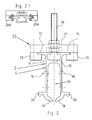
- the busbar with the in Fig. 2.1 shown clamping device which provides a sliding attachment of the busbar with the clamping parts 28A and 28B.
- Fig. 4 shows a part of a catenary system, in which the busbar 1 is fixed to a boom 31, which in turn is attached to the ceiling of a tunnel.
- the boom 31 has a vertical fixed to the ceiling arm 31 A and a horizontal arm 31 B to which an insulator 31 C, a U-profile 31 D is attached. With the U-profile 31D, the hook-head screw 8 is screwed, to which in turn the busbar 1 is attached.
- the hook screws 8 for fixing the bus bars 1 are arranged along the route at the moment zero points of the individual bus bars, so that the sag of the bus bar is reduced to a minimum.
Landscapes
- Engineering & Computer Science (AREA)
- Mechanical Engineering (AREA)
- Leg Units, Guards, And Driving Tracks Of Cranes (AREA)
- Current-Collector Devices For Electrically Propelled Vehicles (AREA)
- Clamps And Clips (AREA)
- Details Of Indoor Wiring (AREA)
Abstract
Description
- Die Erfindung betrifft eine Stromschiene für Fahrleitungssysteme sowie ein Fahrleitungssystem mit Stromschienen.
- Zur Fahrstromversorgung elektrisch betriebener Bahnen sind neben Oberleitungen Stromschienen bekannt. Die Stromschienen sind Teil des Fahrleitungssystems.
- Aus der
EP 2 255 991 A2 ist eine Stromschiene mit einem Querträger bekannt, von dem zwei Spannarme ausgehen, an die Klemmarme zur Aufnahme eines Fahrdrahtes angeformt sind. Die Spannarme und Klemmarme schließen einen Zwischenraum ein, der Laschen zur Verbindung der Stromschienen aufnimmt. DieEP 0 828 629 B 1 beschreibt eine ähnliche Stromschiene, die im Wesentlichen das gleiche Profil wie die aus derEP 2 255 991 A2 bekannte Stromschiene hat. - Die beiden oben genannten Stromschienen zeichnen sich dadurch aus, dass sie einen flachen Querträger aufweisen, an dessen Unterseite die nach unten weisenden Schenkel angeformt sind, die in die Klemmarme zur Aufnahme des Fahrdrahtes übergehen.
- Obwohl sich die bekannten Stromschienen in der Praxis bewährt haben, besteht das grundsätzliche Problem des Durchhangs der Stromschienen. Um den Durchhang möglichst gering gehalten zu können, sollten die Stromschienen ein möglichst hohes Trägheitsmoment bei einem möglichst geringen Gewicht haben. Darüber hinaus sollten sich die Stromschienen mit möglichst geringem Montageaufwand an den Auslegern der Maste aufhängen lassen.
- Der Erfindung liegt die Aufgabe zugrunde, eine Stromschiene zu schaffen, die sich zu einem mit verhältnismäßig geringem Montageaufwand an den Auslegern der Maste aufhängen lässt und sich zum anderen durch ein hohes Trägheitsmoment bei einem geringen Gewicht auszeichnet.
- Darüber hinaus ist eine Aufgabe der Erfindung, ein Fahrleitungssystem mit Stromschienen zu schaffen, die leicht montierbar sind und ein hohes Trägheitsmoment bei geringem Gewicht haben, sodass der Durchhang der Stromschienen gering ist.
- Die Lösung dieser Aufgaben erfolgt erfindungsgemäß mit den Merkmalen der unabhängigen Patentansprüche. Vorteilhafte Ausführungsformen der Erfindung sind Gegenstand der Unteransprüche.
- Die erfindungsgemäße Stromschiene zeichnet sich dadurch aus, dass der in der Einbaulage obere Träger an der Oberseite eine in Längsrichtung des Trägers verlaufende Ausnehmung aufweist, die an den gegenüberliegenden Längsseiten hinterschnitten ist.
- Die längslaufende Ausnehmung in dem Träger erlaubt die Befestigung der Stromschienen an den Auslegern des Fahrleitungssystems mittels Verbindungselementen, die in die Ausnehmungen greifen, um eine formschlüssige Verbindung zu schaffen. Damit ist eine schnelle und sichere Montage der Stromschienen an den Auslegern möglich.
- Darüber hinaus zeichnet sich die Stromschiene mit der besonderen Ausbildung des oberen Trägers im Vergleich zu den bekannten Stromschienen, die einen flachen oberen Träger aufweisen, durch ein höheres Trägheitsmoment bei gleichem Gewicht aus. Damit kann der Durchhang reduziert bzw. die Längsstützweite vergrößert werden. Die erfindungsgemäße Stromschiene vereinfacht also nicht nur die Montage, sondern verbessert auch das Fahrleitungssystem als solches.
- Bei einer bevorzugten Ausführungsform ist die in Längsrichtung verlaufende Ausnehmung des oberen Trägers zur passenden Aufnahme des Hakenkopfes einer Hakenkopfschraube ausgebildet, d. h. die Ausnehmung ist an die Form des Kopfes der Hakenkopfschraube angepasst. Mit der Hakenkopfschraube kann die Stromschiene besonders einfach und kostengünstig am Ausleger befestigt werden. Die Hakenkopfschrauben sind selbst vorzugsweise mit Profilen der Ausleger verschraubt. Vorzugsweise sind die Profile der Ausleger U-Profile, an denen die Hakenkopfschrauben befestigt sind. Anstelle von Hakenkopfschrauben können aber auch alle anderen bekannten Verbindungselemente Verwendung finden, mit denen sich eine formschlüssige Verbindung herstellen lässt.
- Die Stromschiene wird vorzugsweise statisch als Durchlaufträger mit Gleichstreckenlast berechnet, wobei die Verbindungselemente an den Momenten-Nullpunkten angeordnet werden. Diese Positionierung der Verbindungselemente reduziert den Durchhang der Stromschiene auf ein Minimum.
- Eine besonders bevorzugte Ausführungsform der Stromschiene sieht vor, dass der obere Träger ein unteres Profilstück aufweist, dass die oberen Enden der beiden nach unten weisenden Schenkel miteinander verbindet, wobei sich an die Enden des unteren Profilstücks unter Bildung der an den gegenüberliegenden Längsseiten hinterschnittenen Ausnehmung nach oben erstreckende Schenkel anschließen, an die zu beiden Seiten abstehende obere Arme angeformt sind.
- Die beiden oberen Arme ermöglichen die Befestigung der Stromschiene an dem Ausleger nicht nur mit in die Ausnehmungen greifenden Verbindungselementen, sondern auch mit Klemmelementen, die an den Seitenarmen angreifen. Damit ist die erfindungsgemäße Stromschiene universell einsetzbar.
- Bei einer weiteren besonders bevorzugten Ausführungsform sind an die beiden Schenkel im Übergangsbereich zu den Klemmarmen zu beiden Seiten abstehende untere Arme angeformt.
- Die besondere Ausbildung des oberen Trägers mit der längslaufenden Ausnehmung und den seitlich abstehenden oberen Armen in Verbindung mit den beiden Schenkeln und Klemmarmen sowie den seitlich abstehenden unteren Armen führt zu einem in Längsrichtung ausreichend steifen Profil, das den Fahrdraht klemmend aufnimmt und sicher hält.
- Im Folgenden wird ein Ausführungsbeispiel der Erfindung unter Bezugnahme auf die Zeichnungen im Einzelnen erläutert.
- Es zeigen:
- Fig. 1
- ein Ausführungsbeispiel der erfindungsgemäßen Stromschiene zusammen mit einem ersten Ausführungsbeispiel des erfindungsgemäßen Verbindungselements zur Befestigung der Stromschiene an einem Ausleger in geschnittener Darstellung, wobei in die Stromschiene ein Verbindungsstück zur Verbindung der Stromschienen untereinander eingesetzt ist,
- Fig. 2
- die Stromschiene von
Fig. 1 zusammen mit einem zweiten Ausführungsbeispiel des Verbindungselements zur Befestigung der Stromschiene an einem Ausleger in geschnittener Darstellung, - Fig. 2.1
- eine Teilansicht der Stromschiene von
Fig. 1 zusammen mit einem dritten Ausführungsbeispiel des Verbindungselements zur Befestigung der Stromschiene an einem Ausleger, - Fig. 3
- eine Seitenansicht eines Abschnitts der Stromschiene von
Fig. 1 und - Fig. 4
- ein Ausführungsbeispiel des erfindungsgemäßen Fahrleitungssystems mit der erfindungsgemäßen Stromschiene.
- Nachfolgend wird die Stromschiene in der Einbaulage beschrieben, in der die Stromschiene hängend an einem Ausleger befestigt ist. Die Stromschiene 1 weist einen in der Einbaulage oberen Träger 2 auf. Der obere Träger 2 weist an der Oberseite eine in Längsrichtung des Trägers verlaufende Ausnehmung 3 auf, die an den beiden gegenüberliegenden Längsseiten 4, 5 hinterschnitten ist. Die längslaufende Ausnehmung 3 mit den Hinterschneidungen 6, 7 ist derart ausgebildet, dass der Hakenkopf 9 einer Hakenkopfschraube 8 passend in die Ausnehmung eingesetzt werden kann. Breite und Höhe der Ausnehmung 3 sind also an die Abmessungen des Hakenkopfs konventionelle Hakenkopfschrauben angepasst, wobei die Kontur der Hinterschneidungen 6, 7 der Kontur der Haken des Hakenkopfes der Hakenkopfschrauben entspricht.
-
Fig. 1 zeigt die Stromschiene 1 zusammen mit der Hakenkopfschraube 8, deren Hakenkopf 9 in der Ausnehmung 3 sitzt. Die Stormschiene 1 wird an der Hakenkopfschraube 8 befestigt, in dem die Mutter 8A der Hakenkopfschraube 8 festgezogen wird. - Der obere Träger 2 der Stromschiene 1 weist ein unteres Profilstück 10 auf, an dessen Enden sich unter Bildung der hinterschnittenen Ausnehmung 3 nach oben erstreckende Schenkel 11, 12 anschließen. An die beiden oberen Schenkel 11, 12 sind zu beiden Seiten abstehende obere Arme 13, 14 angeformt.
- Bei dem vorliegenden Ausführungsbeispiel hat der obere Schenkel 3 eine Breite a von 85 mm und eine Stärke b von 27,5 mm. Die Stärke c des unteren Profilstücks 10 des Trägers 2 ist bei dem vorliegenden Ausführungsbeispiel 7 mm. Dabei ist die Breite d der Stromschiene 130 mm.
- An das untere Profilstück 10 des oberen Trägers 2 schließen sich zu beiden Seiten nach unten erstreckende Schenkel 15, 16 an, deren Querschnitt nach unten abnimmt. Die unteren Enden der beiden Schenkel 15, 16 gehen in sich nach innen erstreckende Klemmarme 17, 18 über, die den nicht dargestellten Fahrdraht klemmend aufnehmen.
- Der obere Träger 2 schließt mit den beiden Schenkeln 15, 16 und den Klemmarmen 17, 18 einen Zwischenraum 19 zur Aufnahme von zwei Verbindungsstücken 20, 21 ein, mit denen die einzelnen Stromschienen miteinander verbunden werden. Die Verbindungsstücke 20, 21 werden mit nicht dargestellten Schrauben verschraubt, die sich durch Bohrungen 22, 23 der Schenkel 15, 16 erstrecken. An die Schenkel 15, 16 der Stromschiene 1 sind im Übergangsbereich zu den Klemmarmen 17, 18 zu beiden Seiten abstehende untere Arme 24, 25 angeformt.
- Die Befestigung der erfindungsgemäßen Stromschiene kann nicht nur mit der in
Fig. 1 dargestellten Hakenkopfschraube 8 erfolgen, sondern auch mit anderen Verbindungselementen.Fig. 2 zeigt ein alternatives Verbindungselement zur Befestigung der Stromschiene. Die Befestigung der Stromschiene erfolgt bei dem alternativen Ausführungsbeispiel mit einer seitlich an den oberen Armen 13, 14 angreifenden Klemmvorrichtung 26. Die Klemmvorrichtung 26 weist eine Klemmplatte 27 auf, an dessen Unterseite die oberen Arme 13, 14 der Stromschiene 1 untergreifende Klemmteile 28, 29 befestigt sind. Die Klemmteile 28, 29 können mit der Klemmplatte 27 beispielsweise verschraubt werden, um die oberen Arme 13, 14 klemmend zu halten. Die Klemmplatte 27 selbst kann wieder mit einer Schraube 30 an dem Ausleger befestigt werden. Die Stromschiene 1 erlaubt also nicht nur die Befestigung mittels einer Hakenkopfschraube 8, sondern auch mittels einer Klemmvorrichtung 26, an der die Stromschiene fest mit Klemmteilen 28, 29 befestigt ist. Die Befestigung mit der Klemmvorrichtung 26 ist allerdings nicht die bevorzugte Ausführungsform, die eine besonders einfache und schnelle Montage erlaubt. Anstelle der Klemmvorrichtung 26 kann die Stromschiene auch mit der inFig. 2.1 gezeigten Klemmvorrichtung befestigt werden, die eine gleitende Befestigung der Stromschiene mit den Klemmteilen 28A und 28B vorsieht. -
Fig. 4 zeigt einen Teil eines Fahrleitungssystems, bei dem die Stromschiene 1 an einem Ausleger 31 befestigt ist, der wiederum an der Decke eines Tunnels befestigt ist. Der Ausleger 31 weist einen vertikalen an der Decke befestigten Arm 31 A und einen horizontalen Arm 31 B auf, an dem über einen Isolator 31C ein U-Profil 31 D befestigt ist. Mit dem U-Profil 31D ist die Hakenkopfschraube 8 verschraubt, an der wiederum die Stromschiene 1 befestigt ist. - Die Hakenkopfschrauben 8 zur Befestigung der Stromschienen 1 sind entlang der Fahrstrecke an den Momenten-Nullpunkten der einzelnen Stromschienen angeordnet, sodass der Durchhang der Stromschiene auf ein Minimum reduziert wird.
Claims (10)
- Stromschiene mit einem in der Einbaulage oberen Träger (2), an den sich zwei nach unten erstreckende Schenkel (15, 16) anschließen, die in sich nach innen ersteckende Klemmarme (17, 18) zur Aufnahme eines Fahrdrahtes übergehen, wobei der obere Träger (2) sowie die beiden Schenkel (15, 16) und Klemmarme (17, 18) einen Zwischenraum (19) zur Aufnahme von Verbindungsstücken (20, 21) einschließen,
dadurch gekennzeichnet,
der obere Träger (2) an der Oberseite eine in Längsrichtung des Trägers verlaufende Ausnehmung (3) aufweist, die an den gegenüberliegenden Längsseiten (11, 12) hinterschnitten ist. - Stromschiene nach Anspruch 1, dadurch gekennzeichnet, dass die in Längsrichtung verlaufende Ausnehmung (3) des oberen Trägers (2) zur passenden Aufnahme des Hakenkopfes (9) einer Hakenkopfschraube (8) ausgebildet ist.
- Stromschiene nach Anspruch 1 oder 2, dadurch gekennzeichnet, dass der obere Träger (2) ein unteres Profilstück (10) aufweist, das die oberen Enden der beiden Schenkel (15, 16) miteinander verbindet, wobei sich an die Enden des unteren Profilstücks (10) unter Bildung der an den gegenüberliegenden Längsseiten hinterschnittenen Ausnehmung (3) nach oben erstreckende Schenkel (11, 12) anschließen, an die zu beiden Seiten abstehende obere Arme (13, 14) angeformt sind.
- Stromschiene nach einem der Ansprüche 1 bis 3, dadurch gekennzeichnet, dass an die Schenkel (15, 16) im Übergangsbereich zu den Klemmarmen (17, 18) zu beiden Seiten abstehende untere Arme (24, 25) angeformt sind.
- Fahrleitungssystem mit Auslegern, an denen Stromschienen (1) nach einem der Ansprüche 1 bis 4 hängen.
- Fahrleitungssystem nach Anspruch 1, dadurch gekennzeichnet, dass die Stromschienen (1) an den Auslegern (31) mittels Verbindungselementen (8, 30) befestigt sind, die in die in Längsrichtung der Stromschienen verlaufenden Ausnehmungen (3) der Stromschienen (1) greifen.
- Fahrleitungssystem nach Anspruch 6, dadurch gekennzeichnet, dass die Verbindungselemente (8, 30) an den Momenten-Nullpunkten der Stromschienen (1) angeordnet sind.
- Fahrleitungssystem nach Anspruch 6 oder 7, dadurch gekennzeichnet, dass die Verbindungselemente Hakenkopfschrauben (8) sind.
- Fahrleitungssystem nach Anspruch 8, dadurch gekennzeichnet, dass die Hakenkopfschrauben (8) mit Profilen (31C) der Ausleger (31) verschraubt sind.
- Fahrleitungssystem nach Anspruch 9, dadurch gekennzeichnet, dass die Profile (31 C) der Ausleger (31) U-Profile sind.
Applications Claiming Priority (1)
| Application Number | Priority Date | Filing Date | Title |
|---|---|---|---|
| DE102012000117A DE102012000117B3 (de) | 2012-01-05 | 2012-01-05 | Stromschiene |
Publications (4)
| Publication Number | Publication Date |
|---|---|
| EP2612788A2 true EP2612788A2 (de) | 2013-07-10 |
| EP2612788A3 EP2612788A3 (de) | 2014-12-31 |
| EP2612788B1 EP2612788B1 (de) | 2016-05-11 |
| EP2612788B8 EP2612788B8 (de) | 2016-07-20 |
Family
ID=47664041
Family Applications (1)
| Application Number | Title | Priority Date | Filing Date |
|---|---|---|---|
| EP12008444.7A Active EP2612788B8 (de) | 2012-01-05 | 2012-12-19 | Fahrdrahtaufhängung |
Country Status (7)
| Country | Link |
|---|---|
| EP (1) | EP2612788B8 (de) |
| KR (1) | KR102025870B1 (de) |
| DE (1) | DE102012000117B3 (de) |
| DK (1) | DK2612788T3 (de) |
| ES (1) | ES2586286T3 (de) |
| PL (1) | PL2612788T3 (de) |
| PT (1) | PT2612788E (de) |
Cited By (2)
| Publication number | Priority date | Publication date | Assignee | Title |
|---|---|---|---|---|
| CN106314206A (zh) * | 2015-06-18 | 2017-01-11 | 李雷 | 刚性悬挂曲臂双线接触网 |
| EP3321146A1 (de) * | 2016-11-15 | 2018-05-16 | ALSTOM Transport Technologies | Vorrichtung für die befestigung eines elements an einem schienenfahrzeug |
Families Citing this family (6)
| Publication number | Priority date | Publication date | Assignee | Title |
|---|---|---|---|---|
| DE102013015874B3 (de) * | 2013-09-23 | 2015-02-12 | Bicc Holdings Gmbh | Anordnung zum Verbinden von Stromschienen-Elementen eines Fahrleitungssystems |
| DE102014001456B4 (de) | 2014-02-05 | 2017-12-21 | Rail Power Systems Gmbh | Befestigungsvorrichtung für eine Stromschiene und Fahrleitungssystem |
| KR101644499B1 (ko) * | 2014-04-30 | 2016-08-10 | 김종운 | 트롤리 바 커버의 고정 기기 |
| KR101616407B1 (ko) * | 2014-05-07 | 2016-04-28 | 삼성중공업 주식회사 | 오버헤드 타입의 후크 레일 설치방법 및 그 방법에 의해 오버헤드 타입의 후크 레일이 설치된 크레인 페디스털 |
| DE202020101875U1 (de) | 2020-04-06 | 2020-04-16 | Rail Power Systems Gmbh | Oberleitungs-Stromschiene und Fahrleitungsanlage |
| DE202020101873U1 (de) | 2020-04-06 | 2020-04-16 | Rail Power Systems Gmbh | Oberleitungs-Stromschiene und Fahrleitungsanlage |
Citations (2)
| Publication number | Priority date | Publication date | Assignee | Title |
|---|---|---|---|---|
| EP0828629B1 (de) | 1996-04-01 | 2000-03-29 | Furrer + Frey AG Ingenieurbüro | Verfahren und vorrichtung zur kopplung von elastischen und starren fahrleitungssystemen |
| EP2255991A2 (de) | 2009-05-28 | 2010-12-01 | Siemens Aktiengesellschaft | Stromschiene |
Family Cites Families (5)
| Publication number | Priority date | Publication date | Assignee | Title |
|---|---|---|---|---|
| JP3382671B2 (ja) * | 1993-06-29 | 2003-03-04 | 三和テッキ株式会社 | π形剛体電車線及びπ形合体電車線ユニット |
| KR100671076B1 (ko) * | 2001-06-18 | 2007-01-17 | 푸러 운트 프레이 아게 인게니오이르뷰로 파르라이퉁스바우 | 컨덕터 레일 피쉬-플레이트 |
| ES2254897T3 (es) * | 2003-06-05 | 2006-06-16 | Metro De Madrid, S.A. | Perfil para sostener el hilo de contacto en un sistema de electrificaccion aereo de un ferrocarril. |
| DE202004009416U1 (de) * | 2004-06-16 | 2004-10-21 | Furrer + Frey AG Ingenieurbüro Fahrleitungsbau | Stromschienenhaltevorrichtung |
| DE102009033447A1 (de) * | 2009-05-29 | 2010-12-02 | Siemens Aktiengesellschaft | Oberleitungsanlage |
-
2012
- 2012-01-05 DE DE102012000117A patent/DE102012000117B3/de not_active Expired - Fee Related
- 2012-12-19 DK DK12008444.7T patent/DK2612788T3/en active
- 2012-12-19 PL PL12008444.7T patent/PL2612788T3/pl unknown
- 2012-12-19 EP EP12008444.7A patent/EP2612788B8/de active Active
- 2012-12-19 PT PT120084447T patent/PT2612788E/pt unknown
- 2012-12-19 ES ES12008444.7T patent/ES2586286T3/es active Active
- 2012-12-28 KR KR1020120156639A patent/KR102025870B1/ko active Active
Patent Citations (2)
| Publication number | Priority date | Publication date | Assignee | Title |
|---|---|---|---|---|
| EP0828629B1 (de) | 1996-04-01 | 2000-03-29 | Furrer + Frey AG Ingenieurbüro | Verfahren und vorrichtung zur kopplung von elastischen und starren fahrleitungssystemen |
| EP2255991A2 (de) | 2009-05-28 | 2010-12-01 | Siemens Aktiengesellschaft | Stromschiene |
Cited By (3)
| Publication number | Priority date | Publication date | Assignee | Title |
|---|---|---|---|---|
| CN106314206A (zh) * | 2015-06-18 | 2017-01-11 | 李雷 | 刚性悬挂曲臂双线接触网 |
| EP3321146A1 (de) * | 2016-11-15 | 2018-05-16 | ALSTOM Transport Technologies | Vorrichtung für die befestigung eines elements an einem schienenfahrzeug |
| FR3058699A1 (fr) * | 2016-11-15 | 2018-05-18 | Alstom Transport Technologies | Dispositif de fixation d'un element a un vehicule ferroviaire |
Also Published As
| Publication number | Publication date |
|---|---|
| KR20130080770A (ko) | 2013-07-15 |
| DE102012000117B3 (de) | 2013-04-04 |
| EP2612788B1 (de) | 2016-05-11 |
| ES2586286T3 (es) | 2016-10-13 |
| EP2612788B8 (de) | 2016-07-20 |
| KR102025870B1 (ko) | 2019-09-26 |
| PL2612788T3 (pl) | 2016-11-30 |
| EP2612788A3 (de) | 2014-12-31 |
| PT2612788E (pt) | 2016-06-03 |
| DK2612788T3 (en) | 2016-06-27 |
Similar Documents
| Publication | Publication Date | Title |
|---|---|---|
| EP2612788B1 (de) | Fahrdrahtaufhängung | |
| EP0139915B1 (de) | Tragschienenanordnung für Hängebahnen od. dgl. | |
| EP2616378A1 (de) | Anordnung aus einer schiene und einem daran befestigten schleifleitungshalter | |
| EP2171817B1 (de) | Vorrichtung zum anordnen und befestigen von elektrischen einheiten insbesondere in einem schaltschrank, sowie ein montagesystem mit einer solchen vorrichtung | |
| EP3102458A1 (de) | Befestigungsvorrichtung für eine stromschiene und fahrleitungssystem | |
| EP2819879B1 (de) | Isolationsträger für eine stromschiene für elektrisch getriebene schienenfahrzeuge | |
| EP2612789B1 (de) | Verfahren zur Verbindung von Stromschienen | |
| EP2171816B1 (de) | Halteinrichtung für einen querträger in einem elektrischen schaltschrank und schaltschrank | |
| EP3936663A1 (de) | Gleisschutzzaunsystem | |
| EP0206972A2 (de) | Aufhängevorrichtung für eine Laufschiene einer Hängebahn | |
| EP3737582B1 (de) | Klemme und fahrdrahtträgeranordnung | |
| DE102013015874B3 (de) | Anordnung zum Verbinden von Stromschienen-Elementen eines Fahrleitungssystems | |
| DE19631994B4 (de) | Stromschienenhalter für Stromschienen zur Stromversorgung elektrischer Triebfahrzeuge | |
| EP0534578B1 (de) | Traganordnung für elektrische Geräte | |
| EP3740399A1 (de) | Klemme und fahrdrahtträgeranordnung | |
| DE102015111592B3 (de) | Stromschienenaufhängung an Balken | |
| DE19860218C2 (de) | Vorrichtung zur Fahrdrahtführung im Bereich einer Fahrdrahtkreuzung | |
| CH558914A (de) | Mit mindestens einer beleuchtungsarmatur versehene stromzufuehrungseinrichtung. | |
| DE102018207998A1 (de) | Hängerklemme für windschiefe Oberleitungen | |
| DE202016003333U1 (de) | Befestigungssystem | |
| DE202011109417U1 (de) | Dachhaken zur Befestigung von Montageeinrichtungen | |
| DE3113786A1 (de) | "justierbare aufhaengeeinrichtung fuer tragschienen" | |
| EP1315260B1 (de) | Verfahren und Vorrichtung zum Führen von Leitungen zu Arbeitsplätzen in einem Raum | |
| DE9304297U1 (de) | Anschlußklemme für Kabelschuhe o.dgl. | |
| WO2019029925A1 (de) | Streckentrennvorrichtung und verwendung einer solchen |
Legal Events
| Date | Code | Title | Description |
|---|---|---|---|
| PUAI | Public reference made under article 153(3) epc to a published international application that has entered the european phase |
Free format text: ORIGINAL CODE: 0009012 |
|
| AK | Designated contracting states |
Kind code of ref document: A2 Designated state(s): AL AT BE BG CH CY CZ DE DK EE ES FI FR GB GR HR HU IE IS IT LI LT LU LV MC MK MT NL NO PL PT RO RS SE SI SK SM TR |
|
| AX | Request for extension of the european patent |
Extension state: BA ME |
|
| PUAL | Search report despatched |
Free format text: ORIGINAL CODE: 0009013 |
|
| AK | Designated contracting states |
Kind code of ref document: A3 Designated state(s): AL AT BE BG CH CY CZ DE DK EE ES FI FR GB GR HR HU IE IS IT LI LT LU LV MC MK MT NL NO PL PT RO RS SE SI SK SM TR |
|
| AX | Request for extension of the european patent |
Extension state: BA ME |
|
| RIC1 | Information provided on ipc code assigned before grant |
Ipc: B60M 1/24 20060101AFI20141126BHEP |
|
| 17P | Request for examination filed |
Effective date: 20150529 |
|
| RBV | Designated contracting states (corrected) |
Designated state(s): AL AT BE BG CH CY CZ DE DK EE ES FI FR GB GR HR HU IE IS IT LI LT LU LV MC MK MT NL NO PL PT RO RS SE SI SK SM TR |
|
| GRAP | Despatch of communication of intention to grant a patent |
Free format text: ORIGINAL CODE: EPIDOSNIGR1 |
|
| INTG | Intention to grant announced |
Effective date: 20150921 |
|
| GRAS | Grant fee paid |
Free format text: ORIGINAL CODE: EPIDOSNIGR3 |
|
| GRAA | (expected) grant |
Free format text: ORIGINAL CODE: 0009210 |
|
| AK | Designated contracting states |
Kind code of ref document: B1 Designated state(s): AL AT BE BG CH CY CZ DE DK EE ES FI FR GB GR HR HU IE IS IT LI LT LU LV MC MK MT NL NO PL PT RO RS SE SI SK SM TR |
|
| REG | Reference to a national code |
Ref country code: GB Ref legal event code: FG4D Free format text: NOT ENGLISH |
|
| REG | Reference to a national code |
Ref country code: CH Ref legal event code: EP |
|
| REG | Reference to a national code |
Ref country code: AT Ref legal event code: REF Ref document number: 798362 Country of ref document: AT Kind code of ref document: T Effective date: 20160515 |
|
| REG | Reference to a national code |
Ref country code: IE Ref legal event code: FG4D Free format text: LANGUAGE OF EP DOCUMENT: GERMAN |
|
| REG | Reference to a national code |
Ref country code: PT Ref legal event code: SC4A Free format text: AVAILABILITY OF NATIONAL TRANSLATION Effective date: 20160530 |
|
| RAP2 | Party data changed (patent owner data changed or rights of a patent transferred) |
Owner name: RAIL POWER SYSTEMS GMBH |
|
| REG | Reference to a national code |
Ref country code: DE Ref legal event code: R096 Ref document number: 502012007041 Country of ref document: DE |
|
| REG | Reference to a national code |
Ref country code: DK Ref legal event code: T3 Effective date: 20160620 |
|
| REG | Reference to a national code |
Ref country code: CH Ref legal event code: NV Representative=s name: AMMANN PATENTANWAELTE AG BERN, CH |
|
| REG | Reference to a national code |
Ref country code: RO Ref legal event code: EPE |
|
| REG | Reference to a national code |
Ref country code: DE Ref legal event code: R082 Ref document number: 502012007041 Country of ref document: DE Representative=s name: OANDO OPPERMANN & OPPERMANN LLP, DE |
|
| REG | Reference to a national code |
Ref country code: EE Ref legal event code: FG4A Ref document number: E012039 Country of ref document: EE Effective date: 20160629 |
|
| REG | Reference to a national code |
Ref country code: SE Ref legal event code: TRGR |
|
| REG | Reference to a national code |
Ref country code: NL Ref legal event code: FP |
|
| REG | Reference to a national code |
Ref country code: NO Ref legal event code: T2 Effective date: 20160511 |
|
| REG | Reference to a national code |
Ref country code: GR Ref legal event code: EP Ref document number: 20160401356 Country of ref document: GR Effective date: 20160729 |
|
| REG | Reference to a national code |
Ref country code: ES Ref legal event code: FG2A Ref document number: 2586286 Country of ref document: ES Kind code of ref document: T3 Effective date: 20161013 |
|
| PG25 | Lapsed in a contracting state [announced via postgrant information from national office to epo] |
Ref country code: RS Free format text: LAPSE BECAUSE OF FAILURE TO SUBMIT A TRANSLATION OF THE DESCRIPTION OR TO PAY THE FEE WITHIN THE PRESCRIBED TIME-LIMIT Effective date: 20160511 Ref country code: HR Free format text: LAPSE BECAUSE OF FAILURE TO SUBMIT A TRANSLATION OF THE DESCRIPTION OR TO PAY THE FEE WITHIN THE PRESCRIBED TIME-LIMIT Effective date: 20160511 |
|
| REG | Reference to a national code |
Ref country code: FR Ref legal event code: PLFP Year of fee payment: 5 |
|
| PG25 | Lapsed in a contracting state [announced via postgrant information from national office to epo] |
Ref country code: SK Free format text: LAPSE BECAUSE OF FAILURE TO SUBMIT A TRANSLATION OF THE DESCRIPTION OR TO PAY THE FEE WITHIN THE PRESCRIBED TIME-LIMIT Effective date: 20160511 Ref country code: CZ Free format text: LAPSE BECAUSE OF FAILURE TO SUBMIT A TRANSLATION OF THE DESCRIPTION OR TO PAY THE FEE WITHIN THE PRESCRIBED TIME-LIMIT Effective date: 20160511 |
|
| REG | Reference to a national code |
Ref country code: DE Ref legal event code: R097 Ref document number: 502012007041 Country of ref document: DE |
|
| PG25 | Lapsed in a contracting state [announced via postgrant information from national office to epo] |
Ref country code: SM Free format text: LAPSE BECAUSE OF FAILURE TO SUBMIT A TRANSLATION OF THE DESCRIPTION OR TO PAY THE FEE WITHIN THE PRESCRIBED TIME-LIMIT Effective date: 20160511 |
|
| PLBE | No opposition filed within time limit |
Free format text: ORIGINAL CODE: 0009261 |
|
| STAA | Information on the status of an ep patent application or granted ep patent |
Free format text: STATUS: NO OPPOSITION FILED WITHIN TIME LIMIT |
|
| 26N | No opposition filed |
Effective date: 20170214 |
|
| PG25 | Lapsed in a contracting state [announced via postgrant information from national office to epo] |
Ref country code: SI Free format text: LAPSE BECAUSE OF FAILURE TO SUBMIT A TRANSLATION OF THE DESCRIPTION OR TO PAY THE FEE WITHIN THE PRESCRIBED TIME-LIMIT Effective date: 20160511 |
|
| PG25 | Lapsed in a contracting state [announced via postgrant information from national office to epo] |
Ref country code: MC Free format text: LAPSE BECAUSE OF FAILURE TO SUBMIT A TRANSLATION OF THE DESCRIPTION OR TO PAY THE FEE WITHIN THE PRESCRIBED TIME-LIMIT Effective date: 20160511 |
|
| REG | Reference to a national code |
Ref country code: IE Ref legal event code: MM4A |
|
| PG25 | Lapsed in a contracting state [announced via postgrant information from national office to epo] |
Ref country code: IE Free format text: LAPSE BECAUSE OF NON-PAYMENT OF DUE FEES Effective date: 20161219 |
|
| REG | Reference to a national code |
Ref country code: FR Ref legal event code: PLFP Year of fee payment: 6 |
|
| PG25 | Lapsed in a contracting state [announced via postgrant information from national office to epo] |
Ref country code: CY Free format text: LAPSE BECAUSE OF FAILURE TO SUBMIT A TRANSLATION OF THE DESCRIPTION OR TO PAY THE FEE WITHIN THE PRESCRIBED TIME-LIMIT Effective date: 20160511 Ref country code: HU Free format text: LAPSE BECAUSE OF FAILURE TO SUBMIT A TRANSLATION OF THE DESCRIPTION OR TO PAY THE FEE WITHIN THE PRESCRIBED TIME-LIMIT; INVALID AB INITIO Effective date: 20121219 |
|
| PG25 | Lapsed in a contracting state [announced via postgrant information from national office to epo] |
Ref country code: IS Free format text: LAPSE BECAUSE OF FAILURE TO SUBMIT A TRANSLATION OF THE DESCRIPTION OR TO PAY THE FEE WITHIN THE PRESCRIBED TIME-LIMIT Effective date: 20160511 Ref country code: MK Free format text: LAPSE BECAUSE OF FAILURE TO SUBMIT A TRANSLATION OF THE DESCRIPTION OR TO PAY THE FEE WITHIN THE PRESCRIBED TIME-LIMIT Effective date: 20160511 |
|
| PG25 | Lapsed in a contracting state [announced via postgrant information from national office to epo] |
Ref country code: MT Free format text: LAPSE BECAUSE OF FAILURE TO SUBMIT A TRANSLATION OF THE DESCRIPTION OR TO PAY THE FEE WITHIN THE PRESCRIBED TIME-LIMIT Effective date: 20160511 |
|
| PG25 | Lapsed in a contracting state [announced via postgrant information from national office to epo] |
Ref country code: AL Free format text: LAPSE BECAUSE OF FAILURE TO SUBMIT A TRANSLATION OF THE DESCRIPTION OR TO PAY THE FEE WITHIN THE PRESCRIBED TIME-LIMIT Effective date: 20160511 |
|
| REG | Reference to a national code |
Ref country code: AT Ref legal event code: MM01 Ref document number: 798362 Country of ref document: AT Kind code of ref document: T Effective date: 20171219 |
|
| PG25 | Lapsed in a contracting state [announced via postgrant information from national office to epo] |
Ref country code: AT Free format text: LAPSE BECAUSE OF NON-PAYMENT OF DUE FEES Effective date: 20171219 |
|
| REG | Reference to a national code |
Ref country code: GB Ref legal event code: 732E Free format text: REGISTERED BETWEEN 20221103 AND 20221109 |
|
| PGFP | Annual fee paid to national office [announced via postgrant information from national office to epo] |
Ref country code: LT Payment date: 20241205 Year of fee payment: 13 |
|
| PGFP | Annual fee paid to national office [announced via postgrant information from national office to epo] |
Ref country code: NO Payment date: 20241216 Year of fee payment: 13 |
|
| PGFP | Annual fee paid to national office [announced via postgrant information from national office to epo] |
Ref country code: DK Payment date: 20241217 Year of fee payment: 13 |
|
| PGFP | Annual fee paid to national office [announced via postgrant information from national office to epo] |
Ref country code: NL Payment date: 20241217 Year of fee payment: 13 Ref country code: FI Payment date: 20241216 Year of fee payment: 13 Ref country code: PT Payment date: 20241218 Year of fee payment: 13 Ref country code: GR Payment date: 20241213 Year of fee payment: 13 Ref country code: BE Payment date: 20241216 Year of fee payment: 13 Ref country code: LU Payment date: 20241216 Year of fee payment: 13 |
|
| PGFP | Annual fee paid to national office [announced via postgrant information from national office to epo] |
Ref country code: GB Payment date: 20241218 Year of fee payment: 13 |
|
| PGFP | Annual fee paid to national office [announced via postgrant information from national office to epo] |
Ref country code: BG Payment date: 20241212 Year of fee payment: 13 |
|
| PGFP | Annual fee paid to national office [announced via postgrant information from national office to epo] |
Ref country code: EE Payment date: 20241212 Year of fee payment: 13 Ref country code: LV Payment date: 20241213 Year of fee payment: 13 |
|
| PGFP | Annual fee paid to national office [announced via postgrant information from national office to epo] |
Ref country code: RO Payment date: 20241209 Year of fee payment: 13 |
|
| PGFP | Annual fee paid to national office [announced via postgrant information from national office to epo] |
Ref country code: SE Payment date: 20241217 Year of fee payment: 13 |
|
| PGFP | Annual fee paid to national office [announced via postgrant information from national office to epo] |
Ref country code: ES Payment date: 20250117 Year of fee payment: 13 |
|
| PGFP | Annual fee paid to national office [announced via postgrant information from national office to epo] |
Ref country code: TR Payment date: 20241211 Year of fee payment: 13 |
|
| REG | Reference to a national code |
Ref country code: CH Ref legal event code: U11 Free format text: ST27 STATUS EVENT CODE: U-0-0-U10-U11 (AS PROVIDED BY THE NATIONAL OFFICE) Effective date: 20260101 |
|
| PGFP | Annual fee paid to national office [announced via postgrant information from national office to epo] |
Ref country code: DE Payment date: 20251205 Year of fee payment: 14 |
|
| PGFP | Annual fee paid to national office [announced via postgrant information from national office to epo] |
Ref country code: FR Payment date: 20251217 Year of fee payment: 14 |
|
| PGFP | Annual fee paid to national office [announced via postgrant information from national office to epo] |
Ref country code: PL Payment date: 20251205 Year of fee payment: 14 |
|
| PGFP | Annual fee paid to national office [announced via postgrant information from national office to epo] |
Ref country code: IT Payment date: 20251231 Year of fee payment: 14 |
|
| PGFP | Annual fee paid to national office [announced via postgrant information from national office to epo] |
Ref country code: CH Payment date: 20260101 Year of fee payment: 14 |