EP2603319B1 - Verfahren zur herstellung von urethanen - Google Patents
Verfahren zur herstellung von urethanen Download PDFInfo
- Publication number
- EP2603319B1 EP2603319B1 EP11746221.8A EP11746221A EP2603319B1 EP 2603319 B1 EP2603319 B1 EP 2603319B1 EP 11746221 A EP11746221 A EP 11746221A EP 2603319 B1 EP2603319 B1 EP 2603319B1
- Authority
- EP
- European Patent Office
- Prior art keywords
- group
- cyclic
- acyclic
- hydrogen
- aryl
- Prior art date
- Legal status (The legal status is an assumption and is not a legal conclusion. Google has not performed a legal analysis and makes no representation as to the accuracy of the status listed.)
- Not-in-force
Links
- 238000000034 method Methods 0.000 title claims description 61
- 230000008569 process Effects 0.000 title claims description 54
- 238000002360 preparation method Methods 0.000 title claims description 13
- 239000003446 ligand Substances 0.000 claims description 93
- -1 acyclic amines Chemical class 0.000 claims description 86
- PAYRUJLWNCNPSJ-UHFFFAOYSA-N Aniline Chemical compound NC1=CC=CC=C1 PAYRUJLWNCNPSJ-UHFFFAOYSA-N 0.000 claims description 42
- 239000003054 catalyst Substances 0.000 claims description 40
- 125000003118 aryl group Chemical group 0.000 claims description 38
- 238000006243 chemical reaction Methods 0.000 claims description 36
- 125000004122 cyclic group Chemical group 0.000 claims description 34
- 150000003673 urethanes Chemical class 0.000 claims description 31
- OKKJLVBELUTLKV-UHFFFAOYSA-N Methanol Chemical compound OC OKKJLVBELUTLKV-UHFFFAOYSA-N 0.000 claims description 30
- 125000000217 alkyl group Chemical group 0.000 claims description 30
- 150000001412 amines Chemical class 0.000 claims description 29
- 235000013877 carbamide Nutrition 0.000 claims description 29
- 125000004432 carbon atom Chemical group C* 0.000 claims description 29
- 230000007935 neutral effect Effects 0.000 claims description 29
- 125000002887 hydroxy group Chemical group [H]O* 0.000 claims description 28
- 150000003672 ureas Chemical class 0.000 claims description 28
- 229910052723 transition metal Inorganic materials 0.000 claims description 25
- 150000003624 transition metals Chemical class 0.000 claims description 25
- 229910052739 hydrogen Inorganic materials 0.000 claims description 23
- 239000001257 hydrogen Substances 0.000 claims description 23
- 238000005832 oxidative carbonylation reaction Methods 0.000 claims description 20
- 229910052760 oxygen Inorganic materials 0.000 claims description 19
- QTBSBXVTEAMEQO-UHFFFAOYSA-M Acetate Chemical compound CC([O-])=O QTBSBXVTEAMEQO-UHFFFAOYSA-M 0.000 claims description 18
- NHNBFGGVMKEFGY-UHFFFAOYSA-N Nitrate Chemical compound [O-][N+]([O-])=O NHNBFGGVMKEFGY-UHFFFAOYSA-N 0.000 claims description 18
- 239000001301 oxygen Substances 0.000 claims description 18
- QVGXLLKOCUKJST-UHFFFAOYSA-N atomic oxygen Chemical compound [O] QVGXLLKOCUKJST-UHFFFAOYSA-N 0.000 claims description 17
- 125000001072 heteroaryl group Chemical group 0.000 claims description 17
- 229910052757 nitrogen Inorganic materials 0.000 claims description 16
- 125000001424 substituent group Chemical group 0.000 claims description 16
- AFVFQIVMOAPDHO-UHFFFAOYSA-N Methanesulfonic acid Chemical compound CS(O)(=O)=O AFVFQIVMOAPDHO-UHFFFAOYSA-N 0.000 claims description 15
- WPYMKLBDIGXBTP-UHFFFAOYSA-N benzoic acid Chemical compound OC(=O)C1=CC=CC=C1 WPYMKLBDIGXBTP-UHFFFAOYSA-N 0.000 claims description 15
- 239000000203 mixture Substances 0.000 claims description 15
- UGFAIRIUMAVXCW-UHFFFAOYSA-N Carbon monoxide Chemical compound [O+]#[C-] UGFAIRIUMAVXCW-UHFFFAOYSA-N 0.000 claims description 14
- 229910002091 carbon monoxide Inorganic materials 0.000 claims description 14
- LFQSCWFLJHTTHZ-UHFFFAOYSA-N Ethanol Chemical compound CCO LFQSCWFLJHTTHZ-UHFFFAOYSA-N 0.000 claims description 12
- LRHPLDYGYMQRHN-UHFFFAOYSA-N N-Butanol Chemical compound CCCCO LRHPLDYGYMQRHN-UHFFFAOYSA-N 0.000 claims description 12
- 229910002651 NO3 Inorganic materials 0.000 claims description 11
- XLJMAIOERFSOGZ-UHFFFAOYSA-M cyanate Chemical compound [O-]C#N XLJMAIOERFSOGZ-UHFFFAOYSA-M 0.000 claims description 11
- QAOWNCQODCNURD-UHFFFAOYSA-M hydrogensulfate Chemical compound OS([O-])(=O)=O QAOWNCQODCNURD-UHFFFAOYSA-M 0.000 claims description 11
- 125000001931 aliphatic group Chemical group 0.000 claims description 10
- 150000002431 hydrogen Chemical class 0.000 claims description 10
- JOXIMZWYDAKGHI-UHFFFAOYSA-M toluene-4-sulfonate Chemical compound CC1=CC=C(S([O-])(=O)=O)C=C1 JOXIMZWYDAKGHI-UHFFFAOYSA-M 0.000 claims description 10
- XLYOFNOQVPJJNP-UHFFFAOYSA-N water Substances O XLYOFNOQVPJJNP-UHFFFAOYSA-N 0.000 claims description 10
- UFHFLCQGNIYNRP-UHFFFAOYSA-N Hydrogen Chemical compound [H][H] UFHFLCQGNIYNRP-UHFFFAOYSA-N 0.000 claims description 9
- 230000005595 deprotonation Effects 0.000 claims description 9
- 238000010537 deprotonation reaction Methods 0.000 claims description 9
- 239000012948 isocyanate Substances 0.000 claims description 9
- JZMJDSHXVKJFKW-UHFFFAOYSA-M methyl sulfate(1-) Chemical compound COS([O-])(=O)=O JZMJDSHXVKJFKW-UHFFFAOYSA-M 0.000 claims description 9
- 125000004433 nitrogen atom Chemical group N* 0.000 claims description 9
- KFZMGEQAYNKOFK-UHFFFAOYSA-N Isopropanol Chemical compound CC(C)O KFZMGEQAYNKOFK-UHFFFAOYSA-N 0.000 claims description 8
- 125000002015 acyclic group Chemical group 0.000 claims description 8
- ZXEKIIBDNHEJCQ-UHFFFAOYSA-N isobutanol Chemical compound CC(C)CO ZXEKIIBDNHEJCQ-UHFFFAOYSA-N 0.000 claims description 8
- 150000002825 nitriles Chemical class 0.000 claims description 8
- 125000002924 primary amino group Chemical group [H]N([H])* 0.000 claims description 8
- BDERNNFJNOPAEC-UHFFFAOYSA-N propan-1-ol Chemical compound CCCO BDERNNFJNOPAEC-UHFFFAOYSA-N 0.000 claims description 8
- 150000003462 sulfoxides Chemical class 0.000 claims description 8
- 150000007942 carboxylates Chemical class 0.000 claims description 7
- 229910017052 cobalt Inorganic materials 0.000 claims description 7
- 239000010941 cobalt Substances 0.000 claims description 7
- GUTLYIVDDKVIGB-UHFFFAOYSA-N cobalt atom Chemical compound [Co] GUTLYIVDDKVIGB-UHFFFAOYSA-N 0.000 claims description 7
- ZMZDMBWJUHKJPS-UHFFFAOYSA-N hydrogen thiocyanate Natural products SC#N ZMZDMBWJUHKJPS-UHFFFAOYSA-N 0.000 claims description 7
- 150000002513 isocyanates Chemical class 0.000 claims description 7
- 125000004430 oxygen atom Chemical group O* 0.000 claims description 7
- ZMZDMBWJUHKJPS-UHFFFAOYSA-M Thiocyanate anion Chemical compound [S-]C#N ZMZDMBWJUHKJPS-UHFFFAOYSA-M 0.000 claims description 6
- 150000001540 azides Chemical class 0.000 claims description 6
- BTANRVKWQNVYAZ-UHFFFAOYSA-N butan-2-ol Chemical compound CCC(C)O BTANRVKWQNVYAZ-UHFFFAOYSA-N 0.000 claims description 6
- UQSQSQZYBQSBJZ-UHFFFAOYSA-M fluorosulfonate Chemical compound [O-]S(F)(=O)=O UQSQSQZYBQSBJZ-UHFFFAOYSA-M 0.000 claims description 6
- 150000002894 organic compounds Chemical class 0.000 claims description 6
- 125000002577 pseudohalo group Chemical group 0.000 claims description 6
- 150000003871 sulfonates Chemical class 0.000 claims description 6
- XFXPMWWXUTWYJX-UHFFFAOYSA-N Cyanide Chemical compound N#[C-] XFXPMWWXUTWYJX-UHFFFAOYSA-N 0.000 claims description 5
- 150000003998 acyclic ketones Chemical class 0.000 claims description 5
- 150000004982 aromatic amines Chemical class 0.000 claims description 5
- 125000003178 carboxy group Chemical group [H]OC(*)=O 0.000 claims description 5
- 150000003997 cyclic ketones Chemical class 0.000 claims description 5
- 125000004435 hydrogen atom Chemical group [H]* 0.000 claims description 5
- 150000004985 diamines Chemical class 0.000 claims description 3
- 229910052799 carbon Inorganic materials 0.000 claims description 2
- 150000003948 formamides Chemical class 0.000 claims description 2
- 150000001875 compounds Chemical class 0.000 description 35
- 229910052736 halogen Inorganic materials 0.000 description 32
- 150000002367 halogens Chemical class 0.000 description 31
- FVAUCKIRQBBSSJ-UHFFFAOYSA-M sodium iodide Chemical compound [Na+].[I-] FVAUCKIRQBBSSJ-UHFFFAOYSA-M 0.000 description 15
- 239000002904 solvent Substances 0.000 description 15
- IJGRMHOSHXDMSA-UHFFFAOYSA-N Atomic nitrogen Chemical compound N#N IJGRMHOSHXDMSA-UHFFFAOYSA-N 0.000 description 14
- 0 CC(C(CC*)=C(*)C=CC=N)=NC(C(C=C*)=C*)=C(C=CN)O Chemical compound CC(C(CC*)=C(*)C=CC=N)=NC(C(C=C*)=C*)=C(C=CN)O 0.000 description 10
- 150000003254 radicals Chemical class 0.000 description 9
- 229920000768 polyamine Polymers 0.000 description 8
- 150000003141 primary amines Chemical class 0.000 description 8
- RTZKZFJDLAIYFH-UHFFFAOYSA-N Diethyl ether Chemical compound CCOCC RTZKZFJDLAIYFH-UHFFFAOYSA-N 0.000 description 7
- QAOWNCQODCNURD-UHFFFAOYSA-N Sulfuric acid Chemical compound OS(O)(=O)=O QAOWNCQODCNURD-UHFFFAOYSA-N 0.000 description 7
- DTQVDTLACAAQTR-UHFFFAOYSA-M Trifluoroacetate Chemical compound [O-]C(=O)C(F)(F)F DTQVDTLACAAQTR-UHFFFAOYSA-M 0.000 description 7
- 239000013522 chelant Substances 0.000 description 7
- ITMCEJHCFYSIIV-UHFFFAOYSA-M triflate Chemical compound [O-]S(=O)(=O)C(F)(F)F ITMCEJHCFYSIIV-UHFFFAOYSA-M 0.000 description 7
- UHOVQNZJYSORNB-UHFFFAOYSA-N Benzene Chemical compound C1=CC=CC=C1 UHOVQNZJYSORNB-UHFFFAOYSA-N 0.000 description 6
- YXFVVABEGXRONW-UHFFFAOYSA-N Toluene Chemical compound CC1=CC=CC=C1 YXFVVABEGXRONW-UHFFFAOYSA-N 0.000 description 6
- 150000001298 alcohols Chemical class 0.000 description 6
- 125000001997 phenyl group Chemical group [H]C1=C([H])C([H])=C(*)C([H])=C1[H] 0.000 description 6
- IVRMZWNICZWHMI-UHFFFAOYSA-N Azide Chemical compound [N-]=[N+]=[N-] IVRMZWNICZWHMI-UHFFFAOYSA-N 0.000 description 5
- YMWUJEATGCHHMB-UHFFFAOYSA-N Dichloromethane Chemical compound ClCCl YMWUJEATGCHHMB-UHFFFAOYSA-N 0.000 description 5
- 125000003277 amino group Chemical group 0.000 description 5
- 238000005810 carbonylation reaction Methods 0.000 description 5
- MVPPADPHJFYWMZ-UHFFFAOYSA-N chlorobenzene Chemical compound ClC1=CC=CC=C1 MVPPADPHJFYWMZ-UHFFFAOYSA-N 0.000 description 5
- 229910052751 metal Inorganic materials 0.000 description 5
- 239000002184 metal Substances 0.000 description 5
- JZMJDSHXVKJFKW-UHFFFAOYSA-N methyl sulfate Chemical compound COS(O)(=O)=O JZMJDSHXVKJFKW-UHFFFAOYSA-N 0.000 description 5
- 125000002950 monocyclic group Chemical group 0.000 description 5
- 235000009518 sodium iodide Nutrition 0.000 description 5
- VOZKAJLKRJDJLL-UHFFFAOYSA-N 2,4-diaminotoluene Chemical compound CC1=CC=C(N)C=C1N VOZKAJLKRJDJLL-UHFFFAOYSA-N 0.000 description 4
- HEDRZPFGACZZDS-UHFFFAOYSA-N Chloroform Chemical compound ClC(Cl)Cl HEDRZPFGACZZDS-UHFFFAOYSA-N 0.000 description 4
- QUSNBJAOOMFDIB-UHFFFAOYSA-N Ethylamine Chemical compound CCN QUSNBJAOOMFDIB-UHFFFAOYSA-N 0.000 description 4
- YNQLUTRBYVCPMQ-UHFFFAOYSA-N Ethylbenzene Chemical compound CCC1=CC=CC=C1 YNQLUTRBYVCPMQ-UHFFFAOYSA-N 0.000 description 4
- KYQCOXFCLRTKLS-UHFFFAOYSA-N Pyrazine Chemical compound C1=CN=CC=N1 KYQCOXFCLRTKLS-UHFFFAOYSA-N 0.000 description 4
- JUJWROOIHBZHMG-UHFFFAOYSA-N Pyridine Chemical compound C1=CC=NC=C1 JUJWROOIHBZHMG-UHFFFAOYSA-N 0.000 description 4
- 229910018286 SbF 6 Inorganic materials 0.000 description 4
- RHQDFWAXVIIEBN-UHFFFAOYSA-N Trifluoroethanol Chemical compound OCC(F)(F)F RHQDFWAXVIIEBN-UHFFFAOYSA-N 0.000 description 4
- 230000006315 carbonylation Effects 0.000 description 4
- XLJKHNWPARRRJB-UHFFFAOYSA-N cobalt(2+) Chemical compound [Co+2] XLJKHNWPARRRJB-UHFFFAOYSA-N 0.000 description 4
- 230000000694 effects Effects 0.000 description 4
- 150000004820 halides Chemical class 0.000 description 4
- 125000005842 heteroatom Chemical group 0.000 description 4
- 229910052755 nonmetal Inorganic materials 0.000 description 4
- 230000035484 reaction time Effects 0.000 description 4
- 229910052717 sulfur Inorganic materials 0.000 description 4
- VEUMANXWQDHAJV-UHFFFAOYSA-N 2-[2-[(2-hydroxyphenyl)methylideneamino]ethyliminomethyl]phenol Chemical compound OC1=CC=CC=C1C=NCCN=CC1=CC=CC=C1O VEUMANXWQDHAJV-UHFFFAOYSA-N 0.000 description 3
- WEVYAHXRMPXWCK-UHFFFAOYSA-N Acetonitrile Chemical compound CC#N WEVYAHXRMPXWCK-UHFFFAOYSA-N 0.000 description 3
- MYMOFIZGZYHOMD-UHFFFAOYSA-N Dioxygen Chemical compound O=O MYMOFIZGZYHOMD-UHFFFAOYSA-N 0.000 description 3
- XEKOWRVHYACXOJ-UHFFFAOYSA-N Ethyl acetate Chemical compound CCOC(C)=O XEKOWRVHYACXOJ-UHFFFAOYSA-N 0.000 description 3
- JOYRKODLDBILNP-UHFFFAOYSA-N Ethyl urethane Chemical compound CCOC(N)=O JOYRKODLDBILNP-UHFFFAOYSA-N 0.000 description 3
- ZMXDDKWLCZADIW-UHFFFAOYSA-N N,N-Dimethylformamide Chemical compound CN(C)C=O ZMXDDKWLCZADIW-UHFFFAOYSA-N 0.000 description 3
- SJRJJKPEHAURKC-UHFFFAOYSA-N N-Methylmorpholine Chemical compound CN1CCOCC1 SJRJJKPEHAURKC-UHFFFAOYSA-N 0.000 description 3
- ISWSIDIOOBJBQZ-UHFFFAOYSA-N Phenol Chemical compound OC1=CC=CC=C1 ISWSIDIOOBJBQZ-UHFFFAOYSA-N 0.000 description 3
- WCUXLLCKKVVCTQ-UHFFFAOYSA-M Potassium chloride Chemical compound [Cl-].[K+] WCUXLLCKKVVCTQ-UHFFFAOYSA-M 0.000 description 3
- RWRDLPDLKQPQOW-UHFFFAOYSA-N Pyrrolidine Chemical compound C1CCNC1 RWRDLPDLKQPQOW-UHFFFAOYSA-N 0.000 description 3
- FAPWRFPIFSIZLT-UHFFFAOYSA-M Sodium chloride Chemical compound [Na+].[Cl-] FAPWRFPIFSIZLT-UHFFFAOYSA-M 0.000 description 3
- NINIDFKCEFEMDL-UHFFFAOYSA-N Sulfur Chemical compound [S] NINIDFKCEFEMDL-UHFFFAOYSA-N 0.000 description 3
- ZMANZCXQSJIPKH-UHFFFAOYSA-N Triethylamine Chemical compound CCN(CC)CC ZMANZCXQSJIPKH-UHFFFAOYSA-N 0.000 description 3
- 150000005840 aryl radicals Chemical class 0.000 description 3
- 125000004429 atom Chemical group 0.000 description 3
- 230000015572 biosynthetic process Effects 0.000 description 3
- QARVLSVVCXYDNA-UHFFFAOYSA-N bromobenzene Chemical compound BrC1=CC=CC=C1 QARVLSVVCXYDNA-UHFFFAOYSA-N 0.000 description 3
- 230000000052 comparative effect Effects 0.000 description 3
- RAXXELZNTBOGNW-UHFFFAOYSA-N imidazole Natural products C1=CNC=N1 RAXXELZNTBOGNW-UHFFFAOYSA-N 0.000 description 3
- 239000012535 impurity Substances 0.000 description 3
- 239000011261 inert gas Substances 0.000 description 3
- 239000000543 intermediate Substances 0.000 description 3
- 229960004592 isopropanol Drugs 0.000 description 3
- 238000004519 manufacturing process Methods 0.000 description 3
- 125000002496 methyl group Chemical group [H]C([H])([H])* 0.000 description 3
- IAGUPODHENSJEZ-UHFFFAOYSA-N methyl n-phenylcarbamate Chemical compound COC(=O)NC1=CC=CC=C1 IAGUPODHENSJEZ-UHFFFAOYSA-N 0.000 description 3
- 239000011541 reaction mixture Substances 0.000 description 3
- 230000002829 reductive effect Effects 0.000 description 3
- 150000003839 salts Chemical class 0.000 description 3
- 239000007858 starting material Substances 0.000 description 3
- 238000006467 substitution reaction Methods 0.000 description 3
- 239000011593 sulfur Substances 0.000 description 3
- 238000001149 thermolysis Methods 0.000 description 3
- 125000001544 thienyl group Chemical group 0.000 description 3
- PAMIQIKDUOTOBW-UHFFFAOYSA-N 1-methylpiperidine Chemical compound CN1CCCCC1 PAMIQIKDUOTOBW-UHFFFAOYSA-N 0.000 description 2
- UXVMQQNJUSDDNG-UHFFFAOYSA-L Calcium chloride Chemical compound [Cl-].[Cl-].[Ca+2] UXVMQQNJUSDDNG-UHFFFAOYSA-L 0.000 description 2
- OKTJSMMVPCPJKN-UHFFFAOYSA-N Carbon Chemical group [C] OKTJSMMVPCPJKN-UHFFFAOYSA-N 0.000 description 2
- XTHFKEDIFFGKHM-UHFFFAOYSA-N Dimethoxyethane Chemical compound COCCOC XTHFKEDIFFGKHM-UHFFFAOYSA-N 0.000 description 2
- IAZDPXIOMUYVGZ-UHFFFAOYSA-N Dimethylsulphoxide Chemical compound CS(C)=O IAZDPXIOMUYVGZ-UHFFFAOYSA-N 0.000 description 2
- PXGOKWXKJXAPGV-UHFFFAOYSA-N Fluorine Chemical compound FF PXGOKWXKJXAPGV-UHFFFAOYSA-N 0.000 description 2
- ZHNUHDYFZUAESO-UHFFFAOYSA-N Formamide Chemical compound NC=O ZHNUHDYFZUAESO-UHFFFAOYSA-N 0.000 description 2
- BDAGIHXWWSANSR-UHFFFAOYSA-M Formate Chemical compound [O-]C=O BDAGIHXWWSANSR-UHFFFAOYSA-M 0.000 description 2
- VEXZGXHMUGYJMC-UHFFFAOYSA-N Hydrochloric acid Chemical compound Cl VEXZGXHMUGYJMC-UHFFFAOYSA-N 0.000 description 2
- BAVYZALUXZFZLV-UHFFFAOYSA-N Methylamine Chemical class NC BAVYZALUXZFZLV-UHFFFAOYSA-N 0.000 description 2
- YNAVUWVOSKDBBP-UHFFFAOYSA-N Morpholine Chemical compound C1COCCN1 YNAVUWVOSKDBBP-UHFFFAOYSA-N 0.000 description 2
- CUHBEXMJJKENAB-UHFFFAOYSA-N N#[C-].OC(=O)C1=CC=CC=C1 Chemical compound N#[C-].OC(=O)C1=CC=CC=C1 CUHBEXMJJKENAB-UHFFFAOYSA-N 0.000 description 2
- JLTDJTHDQAWBAV-UHFFFAOYSA-N N,N-dimethylaniline Chemical compound CN(C)C1=CC=CC=C1 JLTDJTHDQAWBAV-UHFFFAOYSA-N 0.000 description 2
- AFBPFSWMIHJQDM-UHFFFAOYSA-N N-methylaniline Chemical compound CNC1=CC=CC=C1 AFBPFSWMIHJQDM-UHFFFAOYSA-N 0.000 description 2
- UFWIBTONFRDIAS-UHFFFAOYSA-N Naphthalene Chemical compound C1=CC=CC2=CC=CC=C21 UFWIBTONFRDIAS-UHFFFAOYSA-N 0.000 description 2
- JFEVWPNAOCPRHQ-BUHFOSPRSA-N Oc(cccc1)c1/N=N/c1ccccc1O Chemical compound Oc(cccc1)c1/N=N/c1ccccc1O JFEVWPNAOCPRHQ-BUHFOSPRSA-N 0.000 description 2
- BHHGXPLMPWCGHP-UHFFFAOYSA-N Phenethylamine Chemical class NCCC1=CC=CC=C1 BHHGXPLMPWCGHP-UHFFFAOYSA-N 0.000 description 2
- YGYAWVDWMABLBF-UHFFFAOYSA-N Phosgene Chemical compound ClC(Cl)=O YGYAWVDWMABLBF-UHFFFAOYSA-N 0.000 description 2
- OAICVXFJPJFONN-UHFFFAOYSA-N Phosphorus Chemical compound [P] OAICVXFJPJFONN-UHFFFAOYSA-N 0.000 description 2
- NQRYJNQNLNOLGT-UHFFFAOYSA-N Piperidine Chemical compound C1CCNCC1 NQRYJNQNLNOLGT-UHFFFAOYSA-N 0.000 description 2
- CZPWVGJYEJSRLH-UHFFFAOYSA-N Pyrimidine Chemical compound C1=CN=CN=C1 CZPWVGJYEJSRLH-UHFFFAOYSA-N 0.000 description 2
- SMWDFEZZVXVKRB-UHFFFAOYSA-N Quinoline Chemical compound N1=CC=CC2=CC=CC=C21 SMWDFEZZVXVKRB-UHFFFAOYSA-N 0.000 description 2
- WYURNTSHIVDZCO-UHFFFAOYSA-N Tetrahydrofuran Chemical compound C1CCOC1 WYURNTSHIVDZCO-UHFFFAOYSA-N 0.000 description 2
- 230000002378 acidificating effect Effects 0.000 description 2
- 229910052783 alkali metal Inorganic materials 0.000 description 2
- 150000001340 alkali metals Chemical class 0.000 description 2
- 229910052784 alkaline earth metal Inorganic materials 0.000 description 2
- 150000001342 alkaline earth metals Chemical class 0.000 description 2
- 125000002947 alkylene group Chemical group 0.000 description 2
- 150000001448 anilines Chemical class 0.000 description 2
- 150000001450 anions Chemical class 0.000 description 2
- WATWJIUSRGPENY-UHFFFAOYSA-N antimony atom Chemical compound [Sb] WATWJIUSRGPENY-UHFFFAOYSA-N 0.000 description 2
- RQNWIZPPADIBDY-UHFFFAOYSA-N arsenic atom Chemical compound [As] RQNWIZPPADIBDY-UHFFFAOYSA-N 0.000 description 2
- 125000002785 azepinyl group Chemical group 0.000 description 2
- SGUXGJPBTNFBAD-UHFFFAOYSA-L barium iodide Chemical compound [I-].[I-].[Ba+2] SGUXGJPBTNFBAD-UHFFFAOYSA-L 0.000 description 2
- 239000002585 base Substances 0.000 description 2
- WGQKYBSKWIADBV-UHFFFAOYSA-N benzylamine Chemical class NCC1=CC=CC=C1 WGQKYBSKWIADBV-UHFFFAOYSA-N 0.000 description 2
- 229910052794 bromium Inorganic materials 0.000 description 2
- 239000000460 chlorine Substances 0.000 description 2
- 229910052801 chlorine Inorganic materials 0.000 description 2
- 150000001868 cobalt Chemical class 0.000 description 2
- YMHQVDAATAEZLO-UHFFFAOYSA-N cyclohexane-1,1-diamine Chemical group NC1(N)CCCCC1 YMHQVDAATAEZLO-UHFFFAOYSA-N 0.000 description 2
- PAFZNILMFXTMIY-UHFFFAOYSA-N cyclohexylamine Chemical class NC1CCCCC1 PAFZNILMFXTMIY-UHFFFAOYSA-N 0.000 description 2
- ZZTCPWRAHWXWCH-UHFFFAOYSA-N diphenylmethanediamine Chemical compound C=1C=CC=CC=1C(N)(N)C1=CC=CC=C1 ZZTCPWRAHWXWCH-UHFFFAOYSA-N 0.000 description 2
- JBKVHLHDHHXQEQ-UHFFFAOYSA-N epsilon-caprolactam Chemical compound O=C1CCCCCN1 JBKVHLHDHHXQEQ-UHFFFAOYSA-N 0.000 description 2
- 150000002148 esters Chemical class 0.000 description 2
- 150000002170 ethers Chemical class 0.000 description 2
- 229910052731 fluorine Inorganic materials 0.000 description 2
- 239000007789 gas Substances 0.000 description 2
- 150000002366 halogen compounds Chemical class 0.000 description 2
- NAQMVNRVTILPCV-UHFFFAOYSA-N hexane-1,6-diamine Chemical compound NCCCCCCN NAQMVNRVTILPCV-UHFFFAOYSA-N 0.000 description 2
- IXCSERBJSXMMFS-UHFFFAOYSA-N hydrogen chloride Substances Cl.Cl IXCSERBJSXMMFS-UHFFFAOYSA-N 0.000 description 2
- 229910000041 hydrogen chloride Inorganic materials 0.000 description 2
- 229910052740 iodine Inorganic materials 0.000 description 2
- 125000000842 isoxazolyl group Chemical group 0.000 description 2
- 150000004658 ketimines Chemical class 0.000 description 2
- 125000000468 ketone group Chemical group 0.000 description 2
- 150000002576 ketones Chemical class 0.000 description 2
- 150000007522 mineralic acids Chemical class 0.000 description 2
- 229910000510 noble metal Inorganic materials 0.000 description 2
- 125000002971 oxazolyl group Chemical group 0.000 description 2
- 239000007800 oxidant agent Substances 0.000 description 2
- DPBLXKKOBLCELK-UHFFFAOYSA-N pentan-1-amine Chemical compound CCCCCN DPBLXKKOBLCELK-UHFFFAOYSA-N 0.000 description 2
- VLTRZXGMWDSKGL-UHFFFAOYSA-N perchloric acid Chemical compound OCl(=O)(=O)=O VLTRZXGMWDSKGL-UHFFFAOYSA-N 0.000 description 2
- 125000003367 polycyclic group Chemical group 0.000 description 2
- 239000000047 product Substances 0.000 description 2
- PBMFSQRYOILNGV-UHFFFAOYSA-N pyridazine Chemical compound C1=CC=NN=C1 PBMFSQRYOILNGV-UHFFFAOYSA-N 0.000 description 2
- UMJSCPRVCHMLSP-UHFFFAOYSA-N pyridine Natural products COC1=CC=CN=C1 UMJSCPRVCHMLSP-UHFFFAOYSA-N 0.000 description 2
- 230000009467 reduction Effects 0.000 description 2
- SMQUZDBALVYZAC-UHFFFAOYSA-N salicylaldehyde Chemical group OC1=CC=CC=C1C=O SMQUZDBALVYZAC-UHFFFAOYSA-N 0.000 description 2
- 238000000926 separation method Methods 0.000 description 2
- JHJLBTNAGRQEKS-UHFFFAOYSA-M sodium bromide Chemical compound [Na+].[Br-] JHJLBTNAGRQEKS-UHFFFAOYSA-M 0.000 description 2
- YJPVTCSBVRMESK-UHFFFAOYSA-L strontium bromide Chemical compound [Br-].[Br-].[Sr+2] YJPVTCSBVRMESK-UHFFFAOYSA-L 0.000 description 2
- 239000000758 substrate Substances 0.000 description 2
- 238000003786 synthesis reaction Methods 0.000 description 2
- XFNJVJPLKCPIBV-UHFFFAOYSA-N trimethylenediamine Chemical compound NCCCN XFNJVJPLKCPIBV-UHFFFAOYSA-N 0.000 description 2
- 239000008096 xylene Substances 0.000 description 2
- 150000003738 xylenes Chemical class 0.000 description 2
- BYEAHWXPCBROCE-UHFFFAOYSA-N 1,1,1,3,3,3-hexafluoropropan-2-ol Chemical compound FC(F)(F)C(O)C(F)(F)F BYEAHWXPCBROCE-UHFFFAOYSA-N 0.000 description 1
- GEYOCULIXLDCMW-UHFFFAOYSA-N 1,2-phenylenediamine Chemical compound NC1=CC=CC=C1N GEYOCULIXLDCMW-UHFFFAOYSA-N 0.000 description 1
- JIHQDMXYYFUGFV-UHFFFAOYSA-N 1,3,5-triazine Chemical compound C1=NC=NC=N1 JIHQDMXYYFUGFV-UHFFFAOYSA-N 0.000 description 1
- WZCQRUWWHSTZEM-UHFFFAOYSA-N 1,3-phenylenediamine Chemical compound NC1=CC=CC(N)=C1 WZCQRUWWHSTZEM-UHFFFAOYSA-N 0.000 description 1
- RYHBNJHYFVUHQT-UHFFFAOYSA-N 1,4-Dioxane Chemical compound C1COCCO1 RYHBNJHYFVUHQT-UHFFFAOYSA-N 0.000 description 1
- CBCKQZAAMUWICA-UHFFFAOYSA-N 1,4-phenylenediamine Chemical compound NC1=CC=C(N)C=C1 CBCKQZAAMUWICA-UHFFFAOYSA-N 0.000 description 1
- YFOOEYJGMMJJLS-UHFFFAOYSA-N 1,8-diaminonaphthalene Chemical compound C1=CC(N)=C2C(N)=CC=CC2=C1 YFOOEYJGMMJJLS-UHFFFAOYSA-N 0.000 description 1
- DURPTKYDGMDSBL-UHFFFAOYSA-N 1-butoxybutane Chemical compound CCCCOCCCC DURPTKYDGMDSBL-UHFFFAOYSA-N 0.000 description 1
- MCTWTZJPVLRJOU-UHFFFAOYSA-N 1-methyl-1H-imidazole Chemical compound CN1C=CN=C1 MCTWTZJPVLRJOU-UHFFFAOYSA-N 0.000 description 1
- GGYVTHJIUNGKFZ-UHFFFAOYSA-N 1-methylpiperidin-2-one Chemical compound CN1CCCCC1=O GGYVTHJIUNGKFZ-UHFFFAOYSA-N 0.000 description 1
- AVFZOVWCLRSYKC-UHFFFAOYSA-N 1-methylpyrrolidine Chemical compound CN1CCCC1 AVFZOVWCLRSYKC-UHFFFAOYSA-N 0.000 description 1
- JWAWEQBUZOGIBZ-UHFFFAOYSA-N 1-methyltriazole Chemical compound CN1C=CN=N1 JWAWEQBUZOGIBZ-UHFFFAOYSA-N 0.000 description 1
- CJVYYDCBKKKIPD-UHFFFAOYSA-N 1-n,1-n,2-n,2-n-tetramethylbenzene-1,2-diamine Chemical compound CN(C)C1=CC=CC=C1N(C)C CJVYYDCBKKKIPD-UHFFFAOYSA-N 0.000 description 1
- 125000001637 1-naphthyl group Chemical group [H]C1=C([H])C([H])=C2C(*)=C([H])C([H])=C([H])C2=C1[H] 0.000 description 1
- RQEUFEKYXDPUSK-UHFFFAOYSA-N 1-phenylethylamine Chemical class CC(N)C1=CC=CC=C1 RQEUFEKYXDPUSK-UHFFFAOYSA-N 0.000 description 1
- DYSXLQBUUOPLBB-UHFFFAOYSA-N 2,3-dinitrotoluene Chemical compound CC1=CC=CC([N+]([O-])=O)=C1[N+]([O-])=O DYSXLQBUUOPLBB-UHFFFAOYSA-N 0.000 description 1
- JFJNVIPVOCESGZ-UHFFFAOYSA-N 2,3-dipyridin-2-ylpyridine Chemical compound N1=CC=CC=C1C1=CC=CN=C1C1=CC=CC=N1 JFJNVIPVOCESGZ-UHFFFAOYSA-N 0.000 description 1
- RLYCRLGLCUXUPO-UHFFFAOYSA-N 2,6-diaminotoluene Chemical compound CC1=C(N)C=CC=C1N RLYCRLGLCUXUPO-UHFFFAOYSA-N 0.000 description 1
- OHKOAJUTRVTYSW-UHFFFAOYSA-N 2-[(2-aminophenyl)methyl]aniline Chemical compound NC1=CC=CC=C1CC1=CC=CC=C1N OHKOAJUTRVTYSW-UHFFFAOYSA-N 0.000 description 1
- UTNMPUFESIRPQP-UHFFFAOYSA-N 2-[(4-aminophenyl)methyl]aniline Chemical compound C1=CC(N)=CC=C1CC1=CC=CC=C1N UTNMPUFESIRPQP-UHFFFAOYSA-N 0.000 description 1
- CDAWCLOXVUBKRW-UHFFFAOYSA-N 2-aminophenol Chemical compound NC1=CC=CC=C1O CDAWCLOXVUBKRW-UHFFFAOYSA-N 0.000 description 1
- 125000001622 2-naphthyl group Chemical group [H]C1=C([H])C([H])=C2C([H])=C(*)C([H])=C([H])C2=C1[H] 0.000 description 1
- RNLHGQLZWXBQNY-UHFFFAOYSA-N 3-(aminomethyl)-3,5,5-trimethylcyclohexan-1-amine Chemical compound CC1(C)CC(N)CC(C)(CN)C1 RNLHGQLZWXBQNY-UHFFFAOYSA-N 0.000 description 1
- YBRVSVVVWCFQMG-UHFFFAOYSA-N 4,4'-diaminodiphenylmethane Chemical compound C1=CC(N)=CC=C1CC1=CC=C(N)C=C1 YBRVSVVVWCFQMG-UHFFFAOYSA-N 0.000 description 1
- WNISVGSZMGXKHE-UHFFFAOYSA-N 4-hydroxy-3-phenyl-1h-quinolin-2-one Chemical compound OC=1NC2=CC=CC=C2C(=O)C=1C1=CC=CC=C1 WNISVGSZMGXKHE-UHFFFAOYSA-N 0.000 description 1
- ZCYVEMRRCGMTRW-UHFFFAOYSA-N 7553-56-2 Chemical compound [I] ZCYVEMRRCGMTRW-UHFFFAOYSA-N 0.000 description 1
- WKBOTKDWSSQWDR-UHFFFAOYSA-N Bromine atom Chemical compound [Br] WKBOTKDWSSQWDR-UHFFFAOYSA-N 0.000 description 1
- HFTBNMIETSNLEF-RQJHMYQMSA-N CC[C@@H](C)C[C@@H](CO)N Chemical compound CC[C@@H](C)C[C@@H](CO)N HFTBNMIETSNLEF-RQJHMYQMSA-N 0.000 description 1
- KXDHJXZQYSOELW-UHFFFAOYSA-M Carbamate Chemical compound NC([O-])=O KXDHJXZQYSOELW-UHFFFAOYSA-M 0.000 description 1
- ZAMOUSCENKQFHK-UHFFFAOYSA-N Chlorine atom Chemical compound [Cl] ZAMOUSCENKQFHK-UHFFFAOYSA-N 0.000 description 1
- YYLLIJHXUHJATK-UHFFFAOYSA-N Cyclohexyl acetate Chemical compound CC(=O)OC1CCCCC1 YYLLIJHXUHJATK-UHFFFAOYSA-N 0.000 description 1
- OIFBSDVPJOWBCH-UHFFFAOYSA-N Diethyl carbonate Chemical compound CCOC(=O)OCC OIFBSDVPJOWBCH-UHFFFAOYSA-N 0.000 description 1
- PIICEJLVQHRZGT-UHFFFAOYSA-N Ethylenediamine Chemical compound NCCN PIICEJLVQHRZGT-UHFFFAOYSA-N 0.000 description 1
- FXHOOIRPVKKKFG-UHFFFAOYSA-N N,N-Dimethylacetamide Chemical compound CN(C)C(C)=O FXHOOIRPVKKKFG-UHFFFAOYSA-N 0.000 description 1
- SECXISVLQFMRJM-UHFFFAOYSA-N N-Methylpyrrolidone Chemical compound CN1CCCC1=O SECXISVLQFMRJM-UHFFFAOYSA-N 0.000 description 1
- AHVYPIQETPWLSZ-UHFFFAOYSA-N N-methyl-pyrrolidine Natural products CN1CC=CC1 AHVYPIQETPWLSZ-UHFFFAOYSA-N 0.000 description 1
- ZWXPDGCFMMFNRW-UHFFFAOYSA-N N-methylcaprolactam Chemical compound CN1CCCCCC1=O ZWXPDGCFMMFNRW-UHFFFAOYSA-N 0.000 description 1
- USOLSBOHLPAEHY-WOJGMQOQSA-N Oc1c(/C=N/c(ccc2c3cccc2)c3O)cccc1 Chemical compound Oc1c(/C=N/c(ccc2c3cccc2)c3O)cccc1 USOLSBOHLPAEHY-WOJGMQOQSA-N 0.000 description 1
- ZCQWOFVYLHDMMC-UHFFFAOYSA-N Oxazole Chemical compound C1=COC=N1 ZCQWOFVYLHDMMC-UHFFFAOYSA-N 0.000 description 1
- PCNDJXKNXGMECE-UHFFFAOYSA-N Phenazine Natural products C1=CC=CC2=NC3=CC=CC=C3N=C21 PCNDJXKNXGMECE-UHFFFAOYSA-N 0.000 description 1
- BUGBHKTXTAQXES-UHFFFAOYSA-N Selenium Chemical compound [Se] BUGBHKTXTAQXES-UHFFFAOYSA-N 0.000 description 1
- FZWLAAWBMGSTSO-UHFFFAOYSA-N Thiazole Chemical compound C1=CSC=N1 FZWLAAWBMGSTSO-UHFFFAOYSA-N 0.000 description 1
- XSQUKJJJFZCRTK-UHFFFAOYSA-N Urea Chemical compound NC(N)=O XSQUKJJJFZCRTK-UHFFFAOYSA-N 0.000 description 1
- GKXVJHDEWHKBFH-UHFFFAOYSA-N [2-(aminomethyl)phenyl]methanamine Chemical compound NCC1=CC=CC=C1CN GKXVJHDEWHKBFH-UHFFFAOYSA-N 0.000 description 1
- FDLQZKYLHJJBHD-UHFFFAOYSA-N [3-(aminomethyl)phenyl]methanamine Chemical compound NCC1=CC=CC(CN)=C1 FDLQZKYLHJJBHD-UHFFFAOYSA-N 0.000 description 1
- ISKQADXMHQSTHK-UHFFFAOYSA-N [4-(aminomethyl)phenyl]methanamine Chemical compound NCC1=CC=C(CN)C=C1 ISKQADXMHQSTHK-UHFFFAOYSA-N 0.000 description 1
- CIUQDSCDWFSTQR-UHFFFAOYSA-N [C]1=CC=CC=C1 Chemical compound [C]1=CC=CC=C1 CIUQDSCDWFSTQR-UHFFFAOYSA-N 0.000 description 1
- JQRKXCVPHOTAHT-UHFFFAOYSA-N [Co+2].OC1=NC2=CC=CC=C2C(O)=C1C1=CC=CC=C1 Chemical compound [Co+2].OC1=NC2=CC=CC=C2C(O)=C1C1=CC=CC=C1 JQRKXCVPHOTAHT-UHFFFAOYSA-N 0.000 description 1
- 239000002253 acid Substances 0.000 description 1
- 238000006136 alcoholysis reaction Methods 0.000 description 1
- 150000001338 aliphatic hydrocarbons Chemical class 0.000 description 1
- 229910001508 alkali metal halide Inorganic materials 0.000 description 1
- 150000008045 alkali metal halides Chemical class 0.000 description 1
- 229910052782 aluminium Inorganic materials 0.000 description 1
- XAGFODPZIPBFFR-UHFFFAOYSA-N aluminium Chemical compound [Al] XAGFODPZIPBFFR-UHFFFAOYSA-N 0.000 description 1
- 125000002178 anthracenyl group Chemical group C1(=CC=CC2=CC3=CC=CC=C3C=C12)* 0.000 description 1
- 229910052787 antimony Inorganic materials 0.000 description 1
- 150000004945 aromatic hydrocarbons Chemical class 0.000 description 1
- 229910052785 arsenic Inorganic materials 0.000 description 1
- 125000000732 arylene group Chemical group 0.000 description 1
- 229940075444 barium iodide Drugs 0.000 description 1
- 229910001638 barium iodide Inorganic materials 0.000 description 1
- 230000008901 benefit Effects 0.000 description 1
- 125000003785 benzimidazolyl group Chemical group N1=C(NC2=C1C=CC=C2)* 0.000 description 1
- 125000004603 benzisoxazolyl group Chemical group O1N=C(C2=C1C=CC=C2)* 0.000 description 1
- 125000005605 benzo group Chemical group 0.000 description 1
- 125000005873 benzo[d]thiazolyl group Chemical group 0.000 description 1
- 125000003354 benzotriazolyl group Chemical group N1N=NC2=C1C=CC=C2* 0.000 description 1
- 125000004541 benzoxazolyl group Chemical group O1C(=NC2=C1C=CC=C2)* 0.000 description 1
- 125000002619 bicyclic group Chemical group 0.000 description 1
- GDTBXPJZTBHREO-UHFFFAOYSA-N bromine Substances BrBr GDTBXPJZTBHREO-UHFFFAOYSA-N 0.000 description 1
- CODNYICXDISAEA-UHFFFAOYSA-N bromine monochloride Chemical compound BrCl CODNYICXDISAEA-UHFFFAOYSA-N 0.000 description 1
- 244000309464 bull Species 0.000 description 1
- HQABUPZFAYXKJW-UHFFFAOYSA-N butan-1-amine Chemical compound CCCCN HQABUPZFAYXKJW-UHFFFAOYSA-N 0.000 description 1
- 125000000484 butyl group Chemical group [H]C([*])([H])C([H])([H])C([H])([H])C([H])([H])[H] 0.000 description 1
- 239000006227 byproduct Substances 0.000 description 1
- 239000001110 calcium chloride Substances 0.000 description 1
- 229910001628 calcium chloride Inorganic materials 0.000 description 1
- 229960002713 calcium chloride Drugs 0.000 description 1
- 150000004657 carbamic acid derivatives Chemical class 0.000 description 1
- 239000004202 carbamide Substances 0.000 description 1
- 125000000609 carbazolyl group Chemical group C1(=CC=CC=2C3=CC=CC=C3NC12)* 0.000 description 1
- 125000004623 carbolinyl group Chemical group 0.000 description 1
- 150000001732 carboxylic acid derivatives Chemical class 0.000 description 1
- 239000003153 chemical reaction reagent Substances 0.000 description 1
- 125000003016 chromanyl group Chemical group O1C(CCC2=CC=CC=C12)* 0.000 description 1
- 238000003776 cleavage reaction Methods 0.000 description 1
- ZBYYWKJVSFHYJL-UHFFFAOYSA-L cobalt(2+);diacetate;tetrahydrate Chemical compound O.O.O.O.[Co+2].CC([O-])=O.CC([O-])=O ZBYYWKJVSFHYJL-UHFFFAOYSA-L 0.000 description 1
- AVWLPUQJODERGA-UHFFFAOYSA-L cobalt(2+);diiodide Chemical compound [Co+2].[I-].[I-] AVWLPUQJODERGA-UHFFFAOYSA-L 0.000 description 1
- 238000009833 condensation Methods 0.000 description 1
- 230000005494 condensation Effects 0.000 description 1
- 239000000470 constituent Substances 0.000 description 1
- 238000005260 corrosion Methods 0.000 description 1
- 230000007797 corrosion Effects 0.000 description 1
- 150000001896 cresols Chemical class 0.000 description 1
- 238000002425 crystallisation Methods 0.000 description 1
- 230000008025 crystallization Effects 0.000 description 1
- HPXRVTGHNJAIIH-UHFFFAOYSA-N cyclohexanol Chemical compound OC1CCCCC1 HPXRVTGHNJAIIH-UHFFFAOYSA-N 0.000 description 1
- 150000003946 cyclohexylamines Chemical class 0.000 description 1
- XCIXKGXIYUWCLL-UHFFFAOYSA-N cyclopentanol Chemical compound OC1CCCC1 XCIXKGXIYUWCLL-UHFFFAOYSA-N 0.000 description 1
- 230000007423 decrease Effects 0.000 description 1
- 150000004816 dichlorobenzenes Chemical class 0.000 description 1
- HPNMFZURTQLUMO-UHFFFAOYSA-N diethylamine Chemical compound CCNCC HPNMFZURTQLUMO-UHFFFAOYSA-N 0.000 description 1
- 125000000723 dihydrobenzofuranyl group Chemical group O1C(CC2=C1C=CC=C2)* 0.000 description 1
- IEJIGPNLZYLLBP-UHFFFAOYSA-N dimethyl carbonate Chemical compound COC(=O)OC IEJIGPNLZYLLBP-UHFFFAOYSA-N 0.000 description 1
- 229910001882 dioxygen Inorganic materials 0.000 description 1
- CZZYITDELCSZES-UHFFFAOYSA-N diphenylmethane Chemical class C=1C=CC=CC=1CC1=CC=CC=C1 CZZYITDELCSZES-UHFFFAOYSA-N 0.000 description 1
- 238000004821 distillation Methods 0.000 description 1
- 230000008030 elimination Effects 0.000 description 1
- 238000003379 elimination reaction Methods 0.000 description 1
- 125000001495 ethyl group Chemical group [H]C([H])([H])C([H])([H])* 0.000 description 1
- 238000004880 explosion Methods 0.000 description 1
- 238000000605 extraction Methods 0.000 description 1
- 238000001914 filtration Methods 0.000 description 1
- 239000011737 fluorine Substances 0.000 description 1
- 125000002541 furyl group Chemical group 0.000 description 1
- 238000004817 gas chromatography Methods 0.000 description 1
- 238000010438 heat treatment Methods 0.000 description 1
- 239000012433 hydrogen halide Substances 0.000 description 1
- 229910000039 hydrogen halide Inorganic materials 0.000 description 1
- 125000002883 imidazolyl group Chemical group 0.000 description 1
- 125000003453 indazolyl group Chemical group N1N=C(C2=C1C=CC=C2)* 0.000 description 1
- 125000003387 indolinyl group Chemical group N1(CCC2=CC=CC=C12)* 0.000 description 1
- 125000003406 indolizinyl group Chemical group C=1(C=CN2C=CC=CC12)* 0.000 description 1
- 125000001041 indolyl group Chemical group 0.000 description 1
- 239000011630 iodine Substances 0.000 description 1
- PNDPGZBMCMUPRI-UHFFFAOYSA-N iodine Chemical compound II PNDPGZBMCMUPRI-UHFFFAOYSA-N 0.000 description 1
- 150000002500 ions Chemical class 0.000 description 1
- 230000002427 irreversible effect Effects 0.000 description 1
- 125000000959 isobutyl group Chemical group [H]C([H])([H])C([H])(C([H])([H])[H])C([H])([H])* 0.000 description 1
- 125000004594 isoindolinyl group Chemical group C1(NCC2=CC=CC=C12)* 0.000 description 1
- 125000000904 isoindolyl group Chemical group C=1(NC=C2C=CC=CC12)* 0.000 description 1
- 125000001972 isopentyl group Chemical group [H]C([H])([H])C([H])(C([H])([H])[H])C([H])([H])C([H])([H])* 0.000 description 1
- 125000001449 isopropyl group Chemical group [H]C([H])([H])C([H])(*)C([H])([H])[H] 0.000 description 1
- 125000002183 isoquinolinyl group Chemical group C1(=NC=CC2=CC=CC=C12)* 0.000 description 1
- 150000004715 keto acids Chemical class 0.000 description 1
- 238000011068 loading method Methods 0.000 description 1
- 229940018564 m-phenylenediamine Drugs 0.000 description 1
- 239000012528 membrane Substances 0.000 description 1
- 229910001507 metal halide Inorganic materials 0.000 description 1
- 150000005309 metal halides Chemical class 0.000 description 1
- WSFSSNUMVMOOMR-NJFSPNSNSA-N methanone Chemical compound O=[14CH2] WSFSSNUMVMOOMR-NJFSPNSNSA-N 0.000 description 1
- 238000002156 mixing Methods 0.000 description 1
- IMNDHOCGZLYMRO-UHFFFAOYSA-N n,n-dimethylbenzamide Chemical compound CN(C)C(=O)C1=CC=CC=C1 IMNDHOCGZLYMRO-UHFFFAOYSA-N 0.000 description 1
- 125000004108 n-butyl group Chemical group [H]C([H])([H])C([H])([H])C([H])([H])C([H])([H])* 0.000 description 1
- 125000003136 n-heptyl group Chemical group [H]C([H])([H])C([H])([H])C([H])([H])C([H])([H])C([H])([H])C([H])([H])C([H])([H])* 0.000 description 1
- 125000001280 n-hexyl group Chemical group C(CCCCC)* 0.000 description 1
- 125000000740 n-pentyl group Chemical group [H]C([H])([H])C([H])([H])C([H])([H])C([H])([H])C([H])([H])* 0.000 description 1
- 125000004123 n-propyl group Chemical group [H]C([H])([H])C([H])([H])C([H])([H])* 0.000 description 1
- NTNWKDHZTDQSST-UHFFFAOYSA-N naphthalene-1,2-diamine Chemical class C1=CC=CC2=C(N)C(N)=CC=C21 NTNWKDHZTDQSST-UHFFFAOYSA-N 0.000 description 1
- OKBVMLGZPNDWJK-UHFFFAOYSA-N naphthalene-1,4-diamine Chemical compound C1=CC=C2C(N)=CC=C(N)C2=C1 OKBVMLGZPNDWJK-UHFFFAOYSA-N 0.000 description 1
- KQSABULTKYLFEV-UHFFFAOYSA-N naphthalene-1,5-diamine Chemical compound C1=CC=C2C(N)=CC=CC2=C1N KQSABULTKYLFEV-UHFFFAOYSA-N 0.000 description 1
- 125000001971 neopentyl group Chemical group [H]C([*])([H])C(C([H])([H])[H])(C([H])([H])[H])C([H])([H])[H] 0.000 description 1
- 229910052756 noble gas Inorganic materials 0.000 description 1
- 150000002835 noble gases Chemical class 0.000 description 1
- 150000004010 onium ions Chemical class 0.000 description 1
- 150000002896 organic halogen compounds Chemical class 0.000 description 1
- 125000001715 oxadiazolyl group Chemical group 0.000 description 1
- 150000002926 oxygen Chemical class 0.000 description 1
- JYVLIDXNZAXMDK-UHFFFAOYSA-N pentan-2-ol Chemical compound CCCC(C)O JYVLIDXNZAXMDK-UHFFFAOYSA-N 0.000 description 1
- 125000003538 pentan-3-yl group Chemical group [H]C([H])([H])C([H])([H])C([H])(*)C([H])([H])C([H])([H])[H] 0.000 description 1
- 229940100684 pentylamine Drugs 0.000 description 1
- 230000000737 periodic effect Effects 0.000 description 1
- ISWSIDIOOBJBQZ-UHFFFAOYSA-M phenolate Chemical compound [O-]C1=CC=CC=C1 ISWSIDIOOBJBQZ-UHFFFAOYSA-M 0.000 description 1
- 229940031826 phenolate Drugs 0.000 description 1
- 150000002989 phenols Chemical class 0.000 description 1
- WVDDGKGOMKODPV-ZQBYOMGUSA-N phenyl(114C)methanol Chemical compound O[14CH2]C1=CC=CC=C1 WVDDGKGOMKODPV-ZQBYOMGUSA-N 0.000 description 1
- 150000004986 phenylenediamines Chemical class 0.000 description 1
- DYFXGORUJGZJCA-UHFFFAOYSA-N phenylmethanediamine Chemical class NC(N)C1=CC=CC=C1 DYFXGORUJGZJCA-UHFFFAOYSA-N 0.000 description 1
- 229910052698 phosphorus Inorganic materials 0.000 description 1
- 239000011574 phosphorus Substances 0.000 description 1
- 125000004592 phthalazinyl group Chemical group C1(=NN=CC2=CC=CC=C12)* 0.000 description 1
- 229920001343 polytetrafluoroethylene Polymers 0.000 description 1
- 239000004810 polytetrafluoroethylene Substances 0.000 description 1
- 150000004032 porphyrins Chemical class 0.000 description 1
- 239000001103 potassium chloride Substances 0.000 description 1
- 235000011164 potassium chloride Nutrition 0.000 description 1
- FVSKHRXBFJPNKK-UHFFFAOYSA-N propionitrile Chemical compound CCC#N FVSKHRXBFJPNKK-UHFFFAOYSA-N 0.000 description 1
- 125000001436 propyl group Chemical group [H]C([*])([H])C([H])([H])C([H])([H])[H] 0.000 description 1
- RUOJZAUFBMNUDX-UHFFFAOYSA-N propylene carbonate Chemical compound CC1COC(=O)O1 RUOJZAUFBMNUDX-UHFFFAOYSA-N 0.000 description 1
- AOHJOMMDDJHIJH-UHFFFAOYSA-N propylenediamine Chemical compound CC(N)CN AOHJOMMDDJHIJH-UHFFFAOYSA-N 0.000 description 1
- 238000000746 purification Methods 0.000 description 1
- 125000004309 pyranyl group Chemical group O1C(C=CC=C1)* 0.000 description 1
- 125000003373 pyrazinyl group Chemical group 0.000 description 1
- 125000003226 pyrazolyl group Chemical group 0.000 description 1
- 125000002098 pyridazinyl group Chemical group 0.000 description 1
- 125000004076 pyridyl group Chemical group 0.000 description 1
- 125000000714 pyrimidinyl group Chemical group 0.000 description 1
- 125000000168 pyrrolyl group Chemical group 0.000 description 1
- 125000002294 quinazolinyl group Chemical group N1=C(N=CC2=CC=CC=C12)* 0.000 description 1
- 125000002943 quinolinyl group Chemical group N1=C(C=CC2=CC=CC=C12)* 0.000 description 1
- 125000001567 quinoxalinyl group Chemical group N1=C(C=NC2=CC=CC=C12)* 0.000 description 1
- 238000011084 recovery Methods 0.000 description 1
- 238000004064 recycling Methods 0.000 description 1
- YGSDEFSMJLZEOE-UHFFFAOYSA-M salicylate Chemical compound OC1=CC=CC=C1C([O-])=O YGSDEFSMJLZEOE-UHFFFAOYSA-M 0.000 description 1
- 229960001860 salicylate Drugs 0.000 description 1
- 229930195734 saturated hydrocarbon Natural products 0.000 description 1
- 230000007017 scission Effects 0.000 description 1
- 125000002914 sec-butyl group Chemical group [H]C([H])([H])C([H])([H])C([H])(*)C([H])([H])[H] 0.000 description 1
- 150000003335 secondary amines Chemical class 0.000 description 1
- 229910052711 selenium Inorganic materials 0.000 description 1
- 239000011669 selenium Substances 0.000 description 1
- 238000007086 side reaction Methods 0.000 description 1
- 239000011780 sodium chloride Substances 0.000 description 1
- 230000006641 stabilisation Effects 0.000 description 1
- 238000011105 stabilization Methods 0.000 description 1
- 229910001220 stainless steel Inorganic materials 0.000 description 1
- 239000010935 stainless steel Substances 0.000 description 1
- 229940074155 strontium bromide Drugs 0.000 description 1
- 229910001625 strontium bromide Inorganic materials 0.000 description 1
- 239000000126 substance Substances 0.000 description 1
- 125000000999 tert-butyl group Chemical group [H]C([H])([H])C(*)(C([H])([H])[H])C([H])([H])[H] 0.000 description 1
- YLQBMQCUIZJEEH-UHFFFAOYSA-N tetrahydrofuran Natural products C=1C=COC=1 YLQBMQCUIZJEEH-UHFFFAOYSA-N 0.000 description 1
- 125000003831 tetrazolyl group Chemical group 0.000 description 1
- 238000005979 thermal decomposition reaction Methods 0.000 description 1
- 125000001113 thiadiazolyl group Chemical group 0.000 description 1
- 125000000335 thiazolyl group Chemical group 0.000 description 1
- XJDNKRIXUMDJCW-UHFFFAOYSA-J titanium tetrachloride Chemical compound Cl[Ti](Cl)(Cl)Cl XJDNKRIXUMDJCW-UHFFFAOYSA-J 0.000 description 1
- 150000004992 toluidines Chemical class 0.000 description 1
- 125000004306 triazinyl group Chemical group 0.000 description 1
- 150000003852 triazoles Chemical class 0.000 description 1
- 125000001425 triazolyl group Chemical group 0.000 description 1
- JBWKIWSBJXDJDT-UHFFFAOYSA-N triphenylmethyl chloride Chemical compound C=1C=CC=CC=1C(C=1C=CC=CC=1)(Cl)C1=CC=CC=C1 JBWKIWSBJXDJDT-UHFFFAOYSA-N 0.000 description 1
- 230000007306 turnover Effects 0.000 description 1
- 125000002348 vinylic group Chemical group 0.000 description 1
- PAPBSGBWRJIAAV-UHFFFAOYSA-N ε-Caprolactone Chemical compound O=C1CCCCCO1 PAPBSGBWRJIAAV-UHFFFAOYSA-N 0.000 description 1
Classifications
-
- B—PERFORMING OPERATIONS; TRANSPORTING
- B01—PHYSICAL OR CHEMICAL PROCESSES OR APPARATUS IN GENERAL
- B01J—CHEMICAL OR PHYSICAL PROCESSES, e.g. CATALYSIS OR COLLOID CHEMISTRY; THEIR RELEVANT APPARATUS
- B01J31/00—Catalysts comprising hydrides, coordination complexes or organic compounds
- B01J31/16—Catalysts comprising hydrides, coordination complexes or organic compounds containing coordination complexes
- B01J31/22—Organic complexes
- B01J31/2204—Organic complexes the ligands containing oxygen or sulfur as complexing atoms
- B01J31/2208—Oxygen, e.g. acetylacetonates
- B01J31/2226—Anionic ligands, i.e. the overall ligand carries at least one formal negative charge
- B01J31/2243—At least one oxygen and one nitrogen atom present as complexing atoms in an at least bidentate or bridging ligand
-
- C—CHEMISTRY; METALLURGY
- C07—ORGANIC CHEMISTRY
- C07C—ACYCLIC OR CARBOCYCLIC COMPOUNDS
- C07C263/00—Preparation of derivatives of isocyanic acid
-
- C—CHEMISTRY; METALLURGY
- C07—ORGANIC CHEMISTRY
- C07C—ACYCLIC OR CARBOCYCLIC COMPOUNDS
- C07C245/00—Compounds containing chains of at least two nitrogen atoms with at least one nitrogen-to-nitrogen multiple bond
- C07C245/02—Azo compounds, i.e. compounds having the free valencies of —N=N— groups attached to different atoms, e.g. diazohydroxides
- C07C245/06—Azo compounds, i.e. compounds having the free valencies of —N=N— groups attached to different atoms, e.g. diazohydroxides with nitrogen atoms of azo groups bound to carbon atoms of six-membered aromatic rings
- C07C245/08—Azo compounds, i.e. compounds having the free valencies of —N=N— groups attached to different atoms, e.g. diazohydroxides with nitrogen atoms of azo groups bound to carbon atoms of six-membered aromatic rings with the two nitrogen atoms of azo groups bound to carbon atoms of six-membered aromatic rings, e.g. azobenzene
-
- C—CHEMISTRY; METALLURGY
- C07—ORGANIC CHEMISTRY
- C07C—ACYCLIC OR CARBOCYCLIC COMPOUNDS
- C07C251/00—Compounds containing nitrogen atoms doubly-bound to a carbon skeleton
- C07C251/02—Compounds containing nitrogen atoms doubly-bound to a carbon skeleton containing imino groups
- C07C251/24—Compounds containing nitrogen atoms doubly-bound to a carbon skeleton containing imino groups having carbon atoms of imino groups bound to carbon atoms of six-membered aromatic rings
-
- C—CHEMISTRY; METALLURGY
- C07—ORGANIC CHEMISTRY
- C07C—ACYCLIC OR CARBOCYCLIC COMPOUNDS
- C07C269/00—Preparation of derivatives of carbamic acid, i.e. compounds containing any of the groups, the nitrogen atom not being part of nitro or nitroso groups
- C07C269/04—Preparation of derivatives of carbamic acid, i.e. compounds containing any of the groups, the nitrogen atom not being part of nitro or nitroso groups from amines with formation of carbamate groups
-
- C—CHEMISTRY; METALLURGY
- C07—ORGANIC CHEMISTRY
- C07D—HETEROCYCLIC COMPOUNDS
- C07D213/00—Heterocyclic compounds containing six-membered rings, not condensed with other rings, with one nitrogen atom as the only ring hetero atom and three or more double bonds between ring members or between ring members and non-ring members
- C07D213/02—Heterocyclic compounds containing six-membered rings, not condensed with other rings, with one nitrogen atom as the only ring hetero atom and three or more double bonds between ring members or between ring members and non-ring members having three double bonds between ring members or between ring members and non-ring members
- C07D213/04—Heterocyclic compounds containing six-membered rings, not condensed with other rings, with one nitrogen atom as the only ring hetero atom and three or more double bonds between ring members or between ring members and non-ring members having three double bonds between ring members or between ring members and non-ring members having no bond between the ring nitrogen atom and a non-ring member or having only hydrogen or carbon atoms directly attached to the ring nitrogen atom
- C07D213/24—Heterocyclic compounds containing six-membered rings, not condensed with other rings, with one nitrogen atom as the only ring hetero atom and three or more double bonds between ring members or between ring members and non-ring members having three double bonds between ring members or between ring members and non-ring members having no bond between the ring nitrogen atom and a non-ring member or having only hydrogen or carbon atoms directly attached to the ring nitrogen atom with substituted hydrocarbon radicals attached to ring carbon atoms
- C07D213/28—Radicals substituted by singly-bound oxygen or sulphur atoms
- C07D213/30—Oxygen atoms
-
- C—CHEMISTRY; METALLURGY
- C07—ORGANIC CHEMISTRY
- C07D—HETEROCYCLIC COMPOUNDS
- C07D215/00—Heterocyclic compounds containing quinoline or hydrogenated quinoline ring systems
- C07D215/02—Heterocyclic compounds containing quinoline or hydrogenated quinoline ring systems having no bond between the ring nitrogen atom and a non-ring member or having only hydrogen atoms or carbon atoms directly attached to the ring nitrogen atom
- C07D215/16—Heterocyclic compounds containing quinoline or hydrogenated quinoline ring systems having no bond between the ring nitrogen atom and a non-ring member or having only hydrogen atoms or carbon atoms directly attached to the ring nitrogen atom with hetero atoms or with carbon atoms having three bonds to hetero atoms with at the most one bond to halogen, e.g. ester or nitrile radicals, directly attached to ring carbon atoms
- C07D215/20—Oxygen atoms
- C07D215/24—Oxygen atoms attached in position 8
- C07D215/26—Alcohols; Ethers thereof
-
- B—PERFORMING OPERATIONS; TRANSPORTING
- B01—PHYSICAL OR CHEMICAL PROCESSES OR APPARATUS IN GENERAL
- B01J—CHEMICAL OR PHYSICAL PROCESSES, e.g. CATALYSIS OR COLLOID CHEMISTRY; THEIR RELEVANT APPARATUS
- B01J2231/00—Catalytic reactions performed with catalysts classified in B01J31/00
- B01J2231/70—Oxidation reactions, e.g. epoxidation, (di)hydroxylation, dehydrogenation and analogues
-
- B—PERFORMING OPERATIONS; TRANSPORTING
- B01—PHYSICAL OR CHEMICAL PROCESSES OR APPARATUS IN GENERAL
- B01J—CHEMICAL OR PHYSICAL PROCESSES, e.g. CATALYSIS OR COLLOID CHEMISTRY; THEIR RELEVANT APPARATUS
- B01J2531/00—Additional information regarding catalytic systems classified in B01J31/00
- B01J2531/02—Compositional aspects of complexes used, e.g. polynuclearity
- B01J2531/0238—Complexes comprising multidentate ligands, i.e. more than 2 ionic or coordinative bonds from the central metal to the ligand, the latter having at least two donor atoms, e.g. N, O, S, P
- B01J2531/0241—Rigid ligands, e.g. extended sp2-carbon frameworks or geminal di- or trisubstitution
-
- B—PERFORMING OPERATIONS; TRANSPORTING
- B01—PHYSICAL OR CHEMICAL PROCESSES OR APPARATUS IN GENERAL
- B01J—CHEMICAL OR PHYSICAL PROCESSES, e.g. CATALYSIS OR COLLOID CHEMISTRY; THEIR RELEVANT APPARATUS
- B01J2531/00—Additional information regarding catalytic systems classified in B01J31/00
- B01J2531/10—Complexes comprising metals of Group I (IA or IB) as the central metal
- B01J2531/16—Copper
-
- B—PERFORMING OPERATIONS; TRANSPORTING
- B01—PHYSICAL OR CHEMICAL PROCESSES OR APPARATUS IN GENERAL
- B01J—CHEMICAL OR PHYSICAL PROCESSES, e.g. CATALYSIS OR COLLOID CHEMISTRY; THEIR RELEVANT APPARATUS
- B01J2531/00—Additional information regarding catalytic systems classified in B01J31/00
- B01J2531/80—Complexes comprising metals of Group VIII as the central metal
- B01J2531/82—Metals of the platinum group
- B01J2531/821—Ruthenium
-
- B—PERFORMING OPERATIONS; TRANSPORTING
- B01—PHYSICAL OR CHEMICAL PROCESSES OR APPARATUS IN GENERAL
- B01J—CHEMICAL OR PHYSICAL PROCESSES, e.g. CATALYSIS OR COLLOID CHEMISTRY; THEIR RELEVANT APPARATUS
- B01J2531/00—Additional information regarding catalytic systems classified in B01J31/00
- B01J2531/80—Complexes comprising metals of Group VIII as the central metal
- B01J2531/82—Metals of the platinum group
- B01J2531/822—Rhodium
-
- B—PERFORMING OPERATIONS; TRANSPORTING
- B01—PHYSICAL OR CHEMICAL PROCESSES OR APPARATUS IN GENERAL
- B01J—CHEMICAL OR PHYSICAL PROCESSES, e.g. CATALYSIS OR COLLOID CHEMISTRY; THEIR RELEVANT APPARATUS
- B01J2531/00—Additional information regarding catalytic systems classified in B01J31/00
- B01J2531/80—Complexes comprising metals of Group VIII as the central metal
- B01J2531/82—Metals of the platinum group
- B01J2531/827—Iridium
-
- B—PERFORMING OPERATIONS; TRANSPORTING
- B01—PHYSICAL OR CHEMICAL PROCESSES OR APPARATUS IN GENERAL
- B01J—CHEMICAL OR PHYSICAL PROCESSES, e.g. CATALYSIS OR COLLOID CHEMISTRY; THEIR RELEVANT APPARATUS
- B01J2531/00—Additional information regarding catalytic systems classified in B01J31/00
- B01J2531/80—Complexes comprising metals of Group VIII as the central metal
- B01J2531/82—Metals of the platinum group
- B01J2531/828—Platinum
-
- B—PERFORMING OPERATIONS; TRANSPORTING
- B01—PHYSICAL OR CHEMICAL PROCESSES OR APPARATUS IN GENERAL
- B01J—CHEMICAL OR PHYSICAL PROCESSES, e.g. CATALYSIS OR COLLOID CHEMISTRY; THEIR RELEVANT APPARATUS
- B01J2531/00—Additional information regarding catalytic systems classified in B01J31/00
- B01J2531/80—Complexes comprising metals of Group VIII as the central metal
- B01J2531/84—Metals of the iron group
- B01J2531/845—Cobalt
-
- B—PERFORMING OPERATIONS; TRANSPORTING
- B01—PHYSICAL OR CHEMICAL PROCESSES OR APPARATUS IN GENERAL
- B01J—CHEMICAL OR PHYSICAL PROCESSES, e.g. CATALYSIS OR COLLOID CHEMISTRY; THEIR RELEVANT APPARATUS
- B01J2531/00—Additional information regarding catalytic systems classified in B01J31/00
- B01J2531/80—Complexes comprising metals of Group VIII as the central metal
- B01J2531/84—Metals of the iron group
- B01J2531/847—Nickel
Definitions
- the invention relates to a process for the preparation of urethanes or ureas or mixtures of urethanes and ureas by oxidative carbonylation of organic amines in the presence of carbon monoxide, oxygen and a catalyst, wherein the catalyst is a transition metal complex containing the structural feature [M n + (O - N - O) 2- ] ( n-2) + (L) m (Z - ) n-2 where M is Co, and the process is carried out under halogen-free reaction conditions.
- the invention further relates to the use of transition metal complexes containing the above structural feature as catalysts in the production of urethanes or ureas or mixtures of urethanes and ureas.
- a reaction step in the production of isocyanates, urethanes (which are also referred to as carbamates) and also ureas on an industrial scale is the reaction of the corresponding primary amine with phosgene.
- large amounts of hydrogen chloride are produced as coproduct, which must be disposed of or used in coupled processes relatively expensive further.
- Ottmann et al. (U.S. Patent 3,481,967 ) describe a process for the preparation of aromatic isocyanates in which aromatic nitro compounds and carbon monoxide can be used in the presence of transition metal catalysts.
- transition metal catalysts include cobalt iodide and titanium tetrachloride.
- industrially useful processes must be characterized by a high conversion and a selectivity of more than 90%, if possible, in order to be used successfully. These requirements could previously only be met by reductive carbonylation processes starting from aromatic nitro compounds and using expensive noble metal catalysts ( BK Nefedov, VI Manov-Yuvenskii, SS Novikov, Doklady Chem. (Proc Acad Sci USSR), 234, (1977), 347 .). It is usually difficult to recover the noble metal catalysts, so that these processes are not economically viable.
- WO 2006 131381 A1 discloses the reductive carbonylation of aromatic nitro compounds in the presence of alcohols and acidic promoters to obtain urethanes.
- the need to use acidic promoters is a disadvantage.
- the reductive carbonylation of nitroaromatics with economically priced cobalt complexes proceeds in the absence of Aniline only very slowly. There is no good turn-over frequency (TOF). Only when aniline or an amino aromatic from the nitroaromatic, CO and protons has formed as an intermediate, the reaction rate of the conversion of nitroaromatic to carbamate increases.
- the disadvantage of the cited patent application is that the best results are achieved if the components aniline and nitroaromatic are present in a molar ratio of 2: 1.
- the blending of aromatic amines and aromatic nitro compounds is not always readily possible. For example, it is well known that the thermal stability of dinitrotoluene decreases in the presence of amines, which can lead to safety risks.
- U.S. Patent 5,194,660 which describes the oxidative carbonylation of aromatic amines in the presence of carbon monoxide and an organic hydroxyl group-containing compound as well as oxygen as the oxidizing agent, discloses the use of transition metal complex catalysts consisting of central metal and macrocyclic ligands.
- the latter are preferably tetradentate ligands from the group of porphyrins, phthalocyanines or Schiff's Bases.
- the six-dentate (or even higher) is also revealed (Col. 7, lines 9-11).
- Examples of preferred azaaromatics as neutral ligands L are pyridine, quinoline, 1,2-diazine (pyridazine), 1,3-diazine (pyrimidine), 1,4-diazine (pyrazine), 1,3,5-triazine, imidazole, N-methylimidazole, oxazole, thiazole, triazole, N-methyltriazole.
- Examples of preferred cyclic or acyclic amines as neutral ligands L are n-butylamine, ethylamine, diethylamine, triethylamine, aniline, N-methylaniline, N, N-dimethylaniline, pyrrolidine, N-methylpyrrolidine, piperidine, N-methyl-piperidine, morpholine , N-methylmorpholine.
- L is preferably identical to the starting amine used as starting material in order to avoid undesired reactions.
- Such primary amines are particularly preferably aniline and toluenediamine.
- Examples of preferred cyclic or acyclic carboxylic acid amides as neutral ligands L are N, N-dimethylformamide, N, N-dimethylacetamide, N, N-dimethylbenzamide, 1-methyl-2-pyrrolidone, 1-methyl-2-piperidone, ⁇ -caprolactam , 1-methylcaprolactam.
- Examples of preferred cyclic or acyclic carboxylic acid esters as neutral ligands L are ⁇ -caprolactone, ethyl acetate, methyl butoxide, cyclohexyl acetate.
- Examples of preferred aliphatic ethers as neutral ligands L are diethyl ether, dibutyl ether, tetrahydrofuran, 1,2-dimethoxyethane, 1,4-dioxane.
- Examples of preferred aliphatic or aromatic alcohols as neutral ligands L are methanol, ethanol, n-butanol, 2,2,2-trifluoroethanol, phenol. Particularly preferred are methanol, ethanol, n-butanol and phenol.
- An example of preferred sulfoxides as neutral ligands L is dimethylsulfoxide.
- Examples of preferred cyclic or acyclic organocarbonates as neutral ligands L are dimethyl carbonate, diethyl carbonate, propylene carbonate.
- Examples of preferred nitriles as neutral ligands L are acetonitrile, propionitrile.
- the ligands L may also be absent in the catalyst isolated as a substance.
- the ligands L may be solvent molecules that are readily substitutable by the starting amine to be reacted.
- Examples of preferred carboxylates as monoanionic ligands Z - are benzoate, acetate, trifluoroacetate, formate. Particularly preferred are benzoate, acetate and formate.
- Examples of preferred sulfonates as monoanionic ligands Z - are triflate (CF 3 SO 3 - ), tosylate (CH 3 -C 6 H 4 -SO 3 - , all isomers). Particularly preferred is tosylate.
- Examples of preferred pseudohalides as monoanionic ligands Z are CN -, SCN -, OCN -, N 3 -.
- Examples of preferred perfluorinated nonmetal coordination compounds as monoanionic ligands Z - are [BF 4 ] - [PF 6 ] - , [SbF 6 ] - .
- the invention further relates to a process in which the dianionic chelating ligand (O ⁇ N ⁇ O) 2- consists of deprotonating all OH functions which are not part of the substituents R 1 or R 2 of neutral chelating ligands selected from the group consisting out: (for the exact definitions of R 1 and R 2 reference is made to the detailed explanations below).
- halogen-containing compounds originating from impurities and formally regarded as halogen-containing promoters is in each case lower in the process according to the invention as 0.04 mass%, preferably less than 0.03 mass%, more preferably less than 0.02 mass% and most preferably less than 0.001 mass%, based on the total mass of the reaction mixture. If starting materials and solvents which are free of halogen-containing promoters are available at an economically justifiable price, their use is extremely particularly preferred.
- transition metal complexes which have the smallest common structural motif of the (O-N-O) 2- chelate ligands shown in formula scheme (i) are preferably suitable for the oxidative carbonylation of organic amines without the addition of halogen-containing promoters.
- R 1 in the context of this invention means hydrogen, an alkyl radical having 1 to 20 carbon atoms, an aryl or heteroaryl group, an OR group in which R is hydrogen or an alkyl group having 1 to 20 carbon atoms, or an NRR 'group, in which R and R 'independently of one another denote hydrogen or an aryl or alkyl group having 1 to 20 C atoms or together can form a ring system with nitrogen atom as heteroatom.
- R 1 is an alkyl group of 1 to 20 carbon atoms, an aryl or heteroaryl group, an OR group in which R is hydrogen or an alkyl group of 1 to 20 carbon atoms, or an NRR 'group in which R and R 'independently of one another are hydrogen or an aryl or alkyl group having 1 to 20 C atoms or together can form a ring system with nitrogen atom as heteroatom.
- ⁇ stands for organic radicals, as specified below. These radicals are also preferably halogen-free here and below.
- [M] stands here and below as a placeholder for divalent or trivalent cobalt and implies that the coordination sphere on the metal in addition to the dianionic chelating ligand with other neutral ligands L or monoanionic ligands Z - to a coordination number of 4, 5 , 6 or 7, according to the general structural feature defined above [M n + (O - N - O) 2- ] (n-2) + (L) m (Z - ) n-2 .
- the indices 1 to 3 for the neutral ligands (L) i refer to the coordination sites of these ligands, ie, a tridentate ligand ("1 x L ⁇ L ⁇ L,” eg, terpyridine) is used as (L 3 denotes three monodentate ligands ("3 x L", eg, pyridine).
- [M] here and in all the following equation schemes is preferably M n + (L) m (Z - ) n-2 , where M is Co and m and n have the meanings defined above.
- the reason for choosing cobalt as the central metal is its low price and the high activity of the cobalt complexes.
- alkyl in the context of the present invention comprises acyclic and cyclic saturated hydrocarbon radicals which may be branched or straight-chain and unsubstituted or at least monosubstituted.
- Suitable alkyl radicals which may be unsubstituted or monosubstituted or polysubstituted are, for example, methyl, ethyl, n-propyl, isopropyl, n-butyl, isobutyl, 2-butyl, tert-butyl, n-pentyl, 2-pentyl, 3-pentyl, iso-pentyl, neo-pentyl, n-hexyl, 2-hexyl, 3-hexyl, n-heptyl, n-octyl, -C (H) (C 2 H 5 ) 2 ,. -C (H) (nC 3 H 7 ) 2 and -CH 2 -CH 2 -
- aryl in the context of the present invention means a mono- or polycyclic, preferably a monocyclic or bicyclic, aromatic hydrocarbon radical having preferably 6, 10 or 14 carbon atoms.
- An aryl radical can be unsubstituted or monosubstituted or polysubstituted by identical or different substituents.
- suitable aryl radicals are phenyl, 1-naphthyl, 2-naphthyl and anthracenyl. Particularly preferred is a phenyl radical.
- heteroaryl in the context of the present invention means a monocyclic or polycyclic, preferably a mono-, bi- or tricyclic, aromatic hydrocarbon radical with preferably 5, 6, 7, 8, 9, 10, 11, 12, 13 or 14 carbon atoms, more preferably having 5, 6, 9, 10, 13 or 14 carbon atoms, most preferably having 5 or 6 carbon atoms, in which one or more carbon atoms are each independently selected from the group consisting of oxygen, sulfur and heteroatom Nitrogen (NH) were replaced.
- Heteroaryl radicals can preferably have 1, 2, 3, 4 or 5, particularly preferably 1, 2 or 3, heteroatom (s) independently of one another selected from the group consisting of oxygen, sulfur and nitrogen (NH) as ring member (s).
- a heteroaryl radical can be unsubstituted or monosubstituted or polysubstituted by identical or different substituents.
- suitable heteroaryl radicals are indolizinyl, benzimidazolyl, tetrazolyl, triazinyl, isoxazolyl, phthalazinyl, carbazolyl, carbolinyl, diaza-naphthyl, thienyl, furyl, pyrrolyl, pyrazolyl, pyrazinyl, pyranyl, triazolyl, pyridinyl, imidazolyl, indolyl, isoindolyl, benzo [b] furanyl, benzo [b] thiophenyl, benzo [d] thiazolyl, benzodiazolyl, benzotriazolyl, benzoxazolyl, benzisoxazolyl, thiazolyl, thiadiazolyl, oxazolyl
- aryl or heteroaryl radicals may be condensed (fused) with a monocyclic or bicyclic ring system.
- aryl radicals which are condensed with a monocyclic or bicyclic ring system are (2,3) -dihydrobenzo [b] thiophenyl, (2,3) -dihydro-1H-indenyl, indolinyl, (2,3) Dihydrobenzofuranyl, (2,3) -dihydrobenzo [d] oxazolyl, benzo [d] [1,3] dioxolyl, benzo [d] [1,3] oxathiolyl, isoindolinyl, (1,3) -diyhydroisobenzofuranyl, (1, 3) dihydrobenzo [c] thiophenyl, (1,2,3,4) -tetrahydronaphthyl, (1,2,3,4) -tetrahydr
- a typical structural motif of such chelating ligands is the 1-amino-2-hydroxy-phenylene ligand moiety. Since N, O ligands with this backbone themselves have redox activity, they are described as "redox-active" (English: redox non-innocent) (for the term "redox activity” cf. K. Wieghardt et al., Dalton Transactions, 2003, 1126-1132
- the chelating ligands generally depicted in formula scheme (i) and described in more detail below fulfill the criterion of ligand redox activity.
- transition metal complexes corresponding to the specific embodiments of types (1) to (5) (corresponding to ligand types (L1) to (L5)) shown in formula scheme (ii) are useful for the oxidative carbonylation of organic amines without addition of halogen-containing promoters are particularly preferably suitable.
- R 2 in the context of this invention means hydrogen, an alkyl group having 1 to 20 carbon atoms, an aryl group or heteroaryl group, wherein the aryl group or heteroaryl group in each case either via a bond with the tridentate ligand (which preferably contains a salicylate component) linked or with this two C-C bonds is fused, a keto group -COR, furthermore -COOR, -COOH, OH, OR or NRR ', where R and R' have the abovementioned meanings and R 2 can 1 to 4 times replace the aromatic ring ,
- R 3 and R 4 independently of one another, denote hydrogen, an alkyl group having 1 to 20 carbon atoms, an aryl or heteroaryl group, a keto group - COR, furthermore -COOR, -COOH, OH, OR or NRR ', where R or R 'have the meanings given above.
- transition metal complexes which have one of the structures shown in formula scheme (iii) are likewise particularly preferably suitable for the oxidative carbonylation of organic amines without the addition of halogen-containing promoters.
- X is here and below any alkylene or arylene unit. This unit X can also be linked via its central substituents R 3 or R 4 with other molecular, macromolecular or inorganic components.
- [M] is [Co]. See also: RK Parashar, RC Sharma, A. Kumar, G. Mohan, Inorg. Chim. Acta 1988, 151, 201-208 ; T. Abe, Bull. Chem. Soc. Jpn. 1958, 31, 904-907 ,
- transition metal complexes according to the formula schemes (i) to (iii) with (O ⁇ N ⁇ O) 2- chelate ligands include those in which the chelating ligands occupy three meridional coordination sites of the central metal cobalt, the remaining three meridional coordination sites either O-ligand functionality of an adjacent M (O ⁇ N ⁇ O) complex in the dinuclear associate or occupied by solvent molecules or substrate molecules with donor functionality or any other ligands.
- a meridional (abbreviated: mer) ligand arrangement is meant that the three coordinating ligand and the metal central atom are approximately in one plane (see also Joan Ribas Gispert, Coordination Chemistry, Wiley-VCH Weinheim 2008, Chapter 4.3.2 Geometrical Isomers, page 102 ). Very particular preference is given to those transition metal complexes of the formula formulas (i) to (iii) in which the chelate ligands occupy three meridional coordination sites of the cobalt.
- R 1 is particularly preferably H, methyl (Me) or phenyl (Ph) and very particularly preferably represents methyl (Me) or phenyl (Ph).
- Catalysts which can be used in the process according to the invention are also transition metal complex compounds with other dianionic N 1 O 2 chelates which combine carboxylate, azaromatic, phenolate and / or metalated carboxylic acid amide functions.
- Suitable ligands with particularly preferred structural elements are described in more detail in the following formula schemes (iv) and (v):
- R 1 , R 2 , R 3 , R 4 , X and [M] are defined as previously described.
- [M] is again [Co].
- the chelating ligands occupy preferably three meridional coordination sites of the cobalt, the remaining three meridional coordination sites being occupied either by the O-ligand functionality of an adjacent M (O ⁇ N ⁇ O) complex in the dinuclear associate or by solvent molecules or substrate molecules with donor functionality or any other ligands L are occupied.
- the invention also relates in particular to transition metal complexes in which the tridentate, dianionic, halogen-free ligands (O.sup.N.sup.O) 2- occupy three meridional coordination sites of the cobalt.
- R 5 is a primary or secondary aliphatic radical or an aromatic radical. It is also possible to use mixtures of different amines R 5 -NH 2 , so that the urea formed is unsymmetrically substituted.
- aliphatic radicals are to be understood as meaning both linear and branched as well as cyclic aliphatic radicals.
- the process according to the invention is preferably carried out in the presence of organic compounds carrying hydroxyl groups.
- This embodiment of the invention accordingly relates to a process in which the oxidative carbonylation of the organic amines is carried out in the presence of organic compounds carrying hydroxyl groups and for the preparation of Urethanes or mixtures of urethanes and ureas leads.
- the urethane formation is carried out according to the following general equation: R 5 -NH 2 + CO + 0.5 O 2 + R 6 OH ⁇ R 5 -NH-CO-OR 6 + H 2 O (2)
- R 6 is a primary or secondary aliphatic radical or an aromatic radical.
- R 5 and R 6 may also be the same.
- R 6 OH stands not only for a monofunctional hydroxyl compound, but also for a hydroxyl group equivalent of a di- or polyhydroxy compound.
- Suitable organic amines for the process according to the invention for the preparation of urethanes and / or ureas are primary and secondary amines, primary amines (ie, organic amines containing primary amino groups "-NH 2 ") being preferred, since the urethanes and / or ureas obtained therefrom are in a further process step, for. B. by thermolysis with elimination of the hydroxyl compound R 6 OH or the amine compound R 5 NH 2 , can be converted into the corresponding isocyanates.
- Suitable primary amines are in particular aliphatic mono-, di- and / or polyamines, mixed aliphatic-cycloaliphatic mono-, di- and / or polyamines, cycloaliphatic mono-, di- and / or polyamines, aromatic mono-, di- and / or Polyamines, araliphatic mono-, di- and / or polyamines or mixtures containing two or more of the above primary amines.
- the invention thus furthermore relates to a process for the oxidative carbonylation of organic amines, in which aliphatic, cycloaliphatic, araliphatic and / or aromatic mono- or diamines are used as organic amines.
- suitable primary monoamines are aniline, anilines mono- or polysubstituted on the aromatic ring, such as the isomeric toluidines or halogenated anilines, benzylamine, 2-phenylethylamine, 1-phenylethylamine, cyclohexylamine, substituted cyclohexylamines, methylamine, ethylamine, the isomeric propyl, butyl , Pentylamine and their higher homologues.
- suitable primary diamines are o-phenylenediamine, m-phenylenediamine, p-phenylenediamine, on the aromatic ring singly or multiply substituted phenylenediamines such.
- the isomeric diaminotoluenes such.
- naphthalenediamines such as 1,4-naphthalenediamine, 1,5-naphthalenediamine or 1,8-naphthalenediamine, o-xylylenediamine, m-xylylenediamine, p-xylylenediamine, the isomeric diaminocyclohexanes, diaminocyclohexanes substituted on the cycloaliphatic ring, isophoronediamine, ethylenediamine, 1,2-diaminopropane, .alpha.,.
- omega.-diaminoalkanes such as 1,3-diaminopropane, and higher homologs, eg. For example, 1,6-hexamethylenediamine, substituted ⁇ , ⁇ -diaminoalkanes.
- the invention particularly relates to a process for the oxidative carbonylation of organic amines, in which aniline or toluenediamine, preferably aniline, are used as aromatic amines.
- Preferred examples of suitable primary polyamines are mixtures of the isomeric diaminodiphenylmethanes obtained by condensation of aniline with formaldehyde, with their higher homologs and their isomers of the polyfunctional amines of the diphenylmethane series.
- the invention further relates to a process in which the transition metal complex catalyst containing the structural feature [M n + (O - N - O) 2- ] (n-2) + (L) m (Z - ) n-2 in a concentration of 0.01 mol% to 10 mol%, preferably 0.05 mol% to 5.0 mol%, particularly preferably 0.1 mol% to 3.0 mol%, based on one mole of primary amino groups, is present.
- the hydroxyl-containing compound is used in at least a stoichiometric amount, based on the amount of amino groups. Preference is given to using an excess of the hydroxyl-containing compound, based on the amount of amino groups. Particularly preferred are 2 moles-100 moles of hydroxyl groups per mole of primary amino groups, and most preferably 5 moles-50 moles of hydroxyl groups per mole of primary amino groups.
- the hydroxyl group-containing compound especially when used in excess, serves as a solvent.
- another solvent As additional solvent, all solvents which are inert under the reaction conditions in question.
- suitable solvents are aliphatic and aromatic hydrocarbons and their halogenated derivatives such.
- Particularly preferred solvents are benzene, toluene, the isomeric xylenes, ethylbenzene, halogen-free ethers and halogen-free esters.
- water-containing solvents can also be used.
- the reaction is preferably carried out in the temperature range from 20 ° C to 260 ° C, more preferably at 80 ° C to 220 ° C.
- the amount of carbon monoxide is so dimensioned that at least the stoichiometric amount required for the reaction, based on the amino groups present, is present. Preferably, at least 10 times, more preferably at least 15 times, the stoichiometrically required amount of carbon monoxide is used. In general, a maximum of 200 times the stoichiometrically required amount of carbon monoxide is used.
- the absolute partial pressure of the carbon monoxide used is preferably 1.0 bar to 150 bar, particularly preferably 10 bar to 100 bar, at room temperature.
- the amount of oxygen is such that at least the stoichiometric amount required for the reaction, based on the amino groups present, is present. Preferably, at least 1.2 times, more preferably at least 1.6 times, the stoichiometrically required amount of oxygen is used. In general, a maximum of 20 times the stoichiometrically required amount of oxygen is used.
- the absolute partial pressure of the oxygen used is preferably 0.1 bar to 20 bar at room temperature, more preferably 1.0 bar to 10 bar. However, it is always worked outside the explosion limits of the system CO / O 2 .
- the invention thus furthermore relates to a process in which the oxidative carbonylation is carried out at temperatures of 20 ° C. to 260 ° C. and at an absolute carbon monoxide partial pressure of 1.0 bar to 150 bar and at an absolute oxygen partial pressure of 0.10 bar to 20 bar becomes.
- the oxygen can either be as pure oxygen or in admixture with inert gases under the reaction conditions, such as. As nitrogen, CO 2 , noble gases, etc., are provided. In this case, either one of these inert gases or a mixture of two or more of said inert gases can be used. Preferably, either pure oxygen or air is used.
- the corresponding urethanes are formed by oxidative carbonylation of an amine in the presence of a compound containing hydroxyl groups.
- the reaction may occur as intermediates and / or by-products, if necessary, the amine-based ureas, which can react further in the course of the reaction by alcoholysis with the hydroxyl-containing compound partially or completely to the corresponding urethanes.
- the ureas can also be produced selectively by oxidative carbonylation of organic amines in the presence of carbon monoxide and oxygen in the absence of organic compounds carrying hydroxyl groups.
- the process can be carried out batchwise (batchwise), semi-continuous or continuous.
- the urethane obtained may preferably in a further process stage z. B. thermally or chemically converted into the corresponding isocyanate.
- the thermolysis z. B catalyzed or uncatalyzed in bulk or in the presence of a suitable solvent.
- the hydroxyl-containing compound can be recovered and used again in the urethane synthesis. By closing the cycle of the hydroxyl-containing compound, the overall process can be made more economically attractive, since only losses of hydroxyl-containing compound must be compensated by irreversible side reactions.
- ureas may, albeit under severe conditions, be subjected to such cleavage into the isocyanate. However, the use of the urethanes is preferred.
- the invention thus also relates to a process for the preparation of isocyanates by thermal decomposition of urethanes or ureas in which urethanes or ureas by oxidative Carbonylation of the corresponding amines are prepared by the novel process using the transition metal complexes of the invention and then the urethanes or ureas are thermally converted to the corresponding isocyanates.
- the carbonylation and the thermolysis preferably take place in one process step.
- the autoclave reached a reaction temperature of 165 ° C, which was then kept constant. After a reaction time of 3 hours, the autoclave was cooled by cold water and ice until it reached room temperature after about 5 minutes. The reaction mixture was then analyzed qualitatively and quantitatively by gas chromatography using naphthalene as an internal standard. The conversion of aniline was 100%, the yield of methyl N-phenylcarbamate 99%.
- Example 1 The reaction mentioned in Example 1 was repeated under otherwise identical conditions with 0.22 mmol azobisphenol cobalt (II) ([Co II (Abp)], see also formula scheme (vi)) as a catalyst.
- Example 1 The reaction mentioned in Example 1 was repeated under otherwise identical conditions with 0.22 mmol Naphthalydenaminophenol cobalt (II) ([Co II (Nap)], see also formula scheme (vi)) as a catalyst.
- Example 1 The reaction mentioned in Example 1 was repeated under otherwise identical conditions with 0.22 mmol hydroxyphenylquinolinol cobalt (II) ([Co II (Pqo)], see also formula scheme (vi)) as a catalyst.
- Example 1 The reaction mentioned in Example 1 was repeated under otherwise identical conditions without a catalyst.
- Example 2 The reaction mentioned in Example 1 was repeated under otherwise identical conditions with 0.22 mmol cobalt (II) acetate tetrahydrate Co II (OAc) 2 as a catalyst.
- the catalyst from example 2 was used in a molar ratio of catalyst to aniline of 1/200 under otherwise identical conditions.
- Example 8 was repeated with the addition of NaI in a molar ratio NaI to aniline of 1/10.
- Example 8 the reduction in catalyst loading results in a reduction in yield and selectivity (see Example 8 with Example 2).
- the catalysts according to the invention are so powerful that they make the use of halogen-containing promoters superfluous even under such difficult conditions (compare Example 8 with Example 9).
Landscapes
- Chemical & Material Sciences (AREA)
- Organic Chemistry (AREA)
- Inorganic Chemistry (AREA)
- Engineering & Computer Science (AREA)
- Materials Engineering (AREA)
- Chemical Kinetics & Catalysis (AREA)
- Organic Low-Molecular-Weight Compounds And Preparation Thereof (AREA)
- Low-Molecular Organic Synthesis Reactions Using Catalysts (AREA)
Description
- Die Erfindung betrifft ein Verfahren zur Herstellung von Urethanen oder Harnstoffen oder Gemischen aus Urethanen und Harnstoffen durch oxidative Carbonylierung von organischen Aminen in Gegenwart von Kohlenmonoxid, Sauerstoff und eines Katalysators, worin als Katalysator ein Übergangsmetallkomplex enthaltend das Strukturmerkmal
[Mn+(O~N~O)2-](n-2)+(L)m(Z-)n-2
eingesetzt wird, wobei M Co bezeichnet, und das Verfahren unter halogenfreien Reaktionsbedingungen durchgeführt wird. Die Erfindung betrifft ferner die Verwendung von Übergangsmetallkomplexen enthaltend obiges Strukturmerkmal als Katalysatoren in der Herstellung von Urethanen oder Harnstoffen oder Gemischen aus Urethanen und Harnstoffen. - Ein Reaktionsschritt bei der Herstellung von Isocyanaten, Urethanen (die auch als Carbamate bezeichnet werden) und auch Harnstoffen im technischen Maßstab ist die Umsetzung des entsprechenden primären Amins mit Phosgen. Hierbei fallen große Mengen Chlorwasserstoff als Koppelprodukt an, die entsorgt oder in gekoppelten Verfahren relativ aufwändig weiter verwendet werden müssen. Seitens der Industrie besteht deshalb großes Interesse an der Entwicklung nichtgekoppelter Syntheseverfahren, die ohne die Verwendung von Phosgen auskommen und das Koppelprodukt Chlorwasserstoff vermeiden.
-
Ottmann et al. (US-Patentschrift 3 481 967 ) beschreiben ein Verfahren zur Herstellung von aromatischen Isocyanaten, bei dem aromatische Nitroverbindungen und Kohlenmonoxyd in Gegenwart von Übergangsmetallkatalysatoren eingesetzt werden können. Diese Übergangsmetallkatalysatoren umfassen Cobaltiodid und Titantetrachlorid. Technisch brauchbare Verfahren müssen sich jedoch durch einen hohen Umsatz und eine Selektivität von möglichst über 90 % auszeichnen, um mit Erfolg einsetzbar zu sein. Diese Anforderungen konnten bisher nur von Verfahren der reduktiven Carbonylierung erfüllt werden, die von aromatischen Nitroverbindungen ausgehen und teure Edelmetallkatalysatoren verwenden (B. K. Nefedov, V. I. Manov-Yuvenskii, S. S. Novikov, Doklady Chem. (Proc. Acad. Sci. USSR), 234, (1977), 347.). Meist ist es schwierig, die Edelmetallkatalysatoren wieder zu gewinnen, so dass diese Verfahren vom wirtschaftlichen Standpunkt gesehen nicht tragbar sind. - In
WO 2006 131381 A1 wird die reduktive Carbonylierung von aromatischen Nitroverbindungen in Gegenwart von Alkoholen und sauren Promotoren zur Gewinnung von Urethanen offenbart. Die Notwendigkeit der Verwendung saurer Promotoren ist ein Nachteil. Die reduktive Carbonylierung von Nitroaromaten mit ökonomisch preisgünstigen Cobaltkomplexen verläuft in Abwesenheit von Anilin nur sehr langsam. Es wird keine gute Turn-Over-Frequency (TOF) erzielt. Erst wenn sich Anilin bzw. ein Aminoaromat aus dem Nitroaromaten, CO und Protonen als Zwischenprodukt gebildet hat, nimmt die Reaktionsrate der Konvertierung von Nitroaromat zum Carbamat zu. Nachteil der genannten Patentanmeldung ist, dass die besten Ergebnisse erzielt werden, wenn die Komponenten Anilin und Nitroaromat im molaren Verhältnis 2 : 1 vorliegen. Das Vermischen von aromatischen Aminen und aromatischen Nitroverbindungen ist jedoch nicht immer ohne weiteres möglich. So ist beispielsweise hinlänglich bekannt, dass die thermische Stabilität von Dinitrotoluol in Gegenwart von Aminen abnimmt, was zu Sicherheitsrisiken führen kann. - Deshalb hat sich die industrielle und wissenschaftliche Forschung ganz überwiegend auf die Entwicklung von Verfahren konzentriert, bei denen aromatische Aminoverbindungen in Gegenwart von Kohlenmonoxid und einer organischen, Hydroxylgruppen enthaltenden Verbindung durch oxidative Carbonylierung in Gegenwart von Sauerstoff in N-Arylurethane umgewandelt werden, die in einem weiteren Verfahrensschritt in die entsprechenden N-Arylisocyanate überführt werden können.
- Ein Beispiel hierfür ist das
US-Patent 4 266 070 , bei dem aromatische Amine in Gegenwart von Co2(CO)8 als Katalysator, einer organischen Hydroxylgruppen enthaltenden Verbindung und einer ungesättigten organischen Komponente umgesetzt werden. Letztere ist notwendig, um hohe Selektivitäten zu gewährleisten. Zudem wird ausdrücklich darauf hingewiesen, dass kein Oxidationsmittel, wie z. B. Sauerstoff, zur Anwendung kommt. - Benedini et al. setzten erstmalig [CoII(Salen)] (Salen = N,N'-Disalicyliden-ethylendiamin) als Katalysator ein, um aromatische oder aliphatische primäre Amine in Gegenwart von Methanol in die entsprechenden Urethane bzw. Harnstoffe zu transformieren (F. Benedini, M. Nali, B. Rindone, S. Tollari, J. Mol. Catal, 1986, 34, 155 - 161; G. Maddinelli, M. Nali, B. Rindone, S. Tollari, J. Mol. Catal, 1987, 39, 71 - 77). Nachteilig an diesem Verfahren sind vor allem die langen Reaktionszeiten von bis zu 48 Stunden wie auch immens hohe Katalysatorkonzentrationen (bis zu 20 Mol-%). Die Selektivitäten sind moderat bis gut, wobei in der Regel ein Produktgemisch der entsprechenden Urethane und Harnstoffe erhalten wird.
- In dem
US-Patent 5 194 660 , welches die oxidative Carbonylierung von aromatischen Aminen in Gegenwart von Kohlenmonoxid und einer organischen Hydroxylgruppen enthaltenden Verbindung sowie Sauerstoff als Oxidationsmittel beschreibt, wird der Einsatz von Übergangsmetallkomplexkatalysatoren offenbart, die aus Zentrallmetall und makrozyklischen Liganden bestehen. Letztere sind bevorzugt vierzähnige Liganden aus der Gruppe der Porphyrine, Phthalocyanine oder Schiff'-schen Basen. Bei den Liganden aus der Gruppe der Schiff'-schen Basen wird auch die Sechs-Zähnigkeit (oder noch höher) offenbart (Spalte 7, Z. 9 - 11). Zu den Nachteilen dieses Verfahrens ist der Einsatz großer Mengen an Alkalimetallhalogenid, meist Natriumiodid, als Promotor zu zählen. Das Alkalimetall wird dabei im Überschuss zum eigentlichen Katalysator eingesetzt (siehe Beispiele). Aufgrund der großen Halogenmengen sind kaum zu beherrschende Korrosionsprobleme ein weiterer Schwachpunkt dieses Verfahrens. - Es stellte sich deshalb die Aufgabe, ein Verfahren zur Herstellung von Urethanen und/oder Harnstoffen durch oxidative Carbonylierung der entsprechenden primären Amine in Gegenwart von Sauerstoff zur Verfügung zu stellen, das sich durch hohe Umsätze und Selektivitäten bei Verzicht auf halogenhaltige Promotoren auszeichnet.
- Die Aufgabe wurde gelöst durch ein Verfahren zur Herstellung von Urethanen oder Harnstoffen oder Gemischen aus Urethanen und Harnstoffen durch oxidative Carbonylierung von organischen Aminen enthaltend primäre Aminogruppen in Gegenwart von Kohlenmonoxid, Sauerstoff und eines Katalysators, worin
als Katalysator ein Übergangsmetallkomplex, bevorzugt ein einkerniger Übergangsmetallkomplex, enthaltend das Strukturmerkmal [Mn+(O~N~O)2-](n-2)+(L)m(Z-)n-2 eingesetzt wird, wobei
M Co bezeichnet,
n = 2 oder 3 ist;
(O~N~O)2- für einen dreizähnigen, dianionischen, bevorzugt halogenfreien, mit M über zwei Sauerstoffatome und ein Stickstoffatom koordinierenden Chelatliganden steht,
L für einen neutralen Liganden steht;
m = 0, 1, 2 oder 3 ist;
Z- für einen monoanionischen Liganden außer Halogenid steht (siehe weiter unten für Details);
und
das Verfahren unter halogenfreien Reaktionsbedingungen, die weiter unten noch im Detail erläutert werden, durchgeführt wird. - Die Nomenklatur der Gruppen des Periodensystems erfolgt in dieser Anmeldung nach der IUPAC-Empfehlung von 1988 (siehe G. J. Leigh, Nomenclature of Inorganic Chemistry, Blackwell Scientific Publications, London, 1990, S. 282). Zu den Begriffen "Zähnigkeit", "Chelatligand" und "Kernigkeit" von Komplexen vgl. Hollemann, Wiberg, Lehrbuch der Anorganischen Chemie, 101. Auflage,Walter de Gruyter & Co. Berlin, 1995, S.1206, 1208 bis 1211.
- Die Erfindung betrifft insbesondere weiterhin ein Verfahren, bei dem der neutrale Ligand L ausgewählt ist aus der Gruppe bestehend aus:
- Wasser, Azaaromaten, cyclische oder acyclische Amine, cyclische oder acyclische Carbonsäureamide, cyclische oder acyclische Carbonsäureester, cyclische oder acyclische Ketone, cyclische oder acyclische Ketimine, aliphatische Ether, aliphatische oder aromatische Alkohole, Sulfoxide, cyclische oder acyclische Organocarbonate, Nitrile, wobei halogenfreie Vertreter der genannten Verbindungsklassen bevorzugt sind.
- Ferner betrifft die Erfindung ein Verfahren, bei dem der monoanionische Ligand Z- ausgewählt ist aus der Gruppe bestehend aus:
- Sulfonaten, bevorzugt Triflat, Tosylat, Mesylat, besonders bevorzugt Tosylat und Mesylat;
- Carboxylaten, bevorzugt Acetat, Trifluoracetat, Benzoat, besonders bevorzugt Acetat und Benzoat;
- Pseudohalogeniden, bevorzugt Cyanid, Cyanat, Thiocyanat, Azid;
- perfluorierten Nichtmetall-Koordinationsverbindungen, bevorzugt [BF4]- [PF6]-, [SbF6]-;
- Anionen anorganischer Säuren, bevorzugt Nitrat, Hydrogensulfat, Fluorosulfat, besonders bevorzugt Nitrat und Hydrogensulfat; und
- Methylsulfat,
- wobei Tosylat, Mesylat, Acetat, Benzoat, Cyanid, Cyanat, Thiocyanat, Azid, Nitrat, Hydrogensulfat und Methylsulfat ganz besonders bevorzugt sind,
- Beispiele für bevorzugte Azaaromaten als neutrale Liganden L sind Pyridin, Chinolin, 1,2-Diazin (Pyridazin), 1,3-Diazin (Pyrimidin), 1,4-Diazin (Pyrazin), 1,3,5-Triazin, Imidazol, N-Methylimidazol, Oxazol, Thiazol, Triazol, N-Methyltriazol.
- Beispiele für bevorzugte cyclische bzw. acyclische Amine als neutrale Liganden L sind n-Butylamin, Ethylamin, Diethylamin, Triethylamin, Anilin, N-Methylanilin, N,N-Dimethylanilin, Pyrrolidin, N-Metylpyrrolidin, Piperidin, N-Methyl-piperidin, Morpholin, N-Methylmorpholin. Im Fall von primären Aminen als Ligand L ist L bevorzugt identisch mit dem als Edukt eingesetzten Ausgangsamin, um unerwünschte Reaktionen zu vermeiden. Solche primären Amine sind besonders bevorzugt Anilin und Toluylendiamin.
- Beispiele für bevorzugte cyclische bzw. acyclische Carbonsäureamide als neutrale Liganden L sind N,N-Dimethylformamid, N,N-Dimethylacetamid, N,N-Dimethylbenzamid, 1-Methyl-2-pyrrolidon, 1-Methyl-2-piperidon, ε-Caprolactam, 1-Methylcaprolactam.
- Beispiele für bevorzugte cyclische bzw. acyclische Carbonsäureester als neutrale Liganden L sind ε-Caprolacton, Ethylacetat, Methylbutylat, Cyclohexylacetat.
- Beispiele für bevorzugte cyclische bzw. acyclische Ketimine als neutrale Liganden L sind Verbindungen der allgemeinen Formel RIRIIC=NRIII, worin RI, RII und RIII unabhängig voneinander für zyklische oder azyklische Alkylgruppen, Aryl- oder Heteroarylgruppen oder eine verbrückende Alkylengruppe stehen. Besonders bevorzugt enthalten die Reste RI, RII und RIII keine Halogene.
- Beispiele für bevorzugte aliphatische Ether als neutrale Liganden L sind Diethylether, Dibutylether, Tetrahydrofuran, 1,2-Dimethoxyethan, 1,4-Dioxan.
- Beispiele für bevorzugte aliphatische bzw. aromatische Alkohole als neutrale Liganden L sind Methanol, Ethanol, n-Butanol, 2,2,2-Trifluoroethanol, Phenol. Besonders bevorzugt sind Methanol, Ethanol, n-Butanol und Phenol.
- Ein Beispiel für bevorzugte Sulfoxide als neutrale Liganden L ist Dimethylsulfoxid.
- Beispiele für bevorzugte cyclische bzw. acyclische Organocarbonate als neutrale Liganden L sind Dimethylcarbonat, Diethylcarbonat, Propylencarbonat.
- Beispiele für bevorzugte Nitrile als neutrale Liganden L sind Acetonitril, Proprionitril.
- Die Liganden L können in der als Substanz isolierten Katalysatorstufe auch fehlen. In Lösung können die Liganden L Solvensmoleküle sein, die leicht durch die umzusetzenden Ausgangsamin substituierbar sind.
- Beispiele für bevorzugte Carboxylate als monoanionische Liganden Z- sind Benzoat, Acetat, Trifluoracetat, Formiat. Besonders bevorzugt sind Benzoat, Acetat und Formiat.
- Beispiele für bevorzugte Sulfonate als monoanionische Liganden Z- sind Triflat (CF3SO3 -), Tosylat (CH3-C6H4-SO3 -, alle Isomere). Besonders bevorzugt ist Tosylat.
- Beispiele für bevorzugte Pseudohalogenide als monoanionische Liganden Z- sind CN-, SCN-, OCN-, N3 -.
- Beispiele für bevorzugte perfluorierte Nichtmetall-Koordinationsverbindungen als monoanionische Liganden Z- sind [BF4]- [PF6]-, [SbF6]-.
- Die Erfindung betrifft insbesondere weiterhin ein Verfahren, bei dem sich der dianionische Chelatligand (O~N~O)2- durch Deprotonierung aller OH-Funktionen, welche nicht Bestandteil der Substituenten R1 oder R2 sind, von neutralen Chelatliganden ausgewählt aus der Gruppe bestehend aus:


- Besonders bevorzugt sind dabei Ausführungsformen des erfindungsgemäßen Verfahrens, bei denen sich der dianionische Chelatligand (O~N~O)2- durch Deprotonierung aller OH-Funktionen von neutralen Chelatliganden ausgewählt aus der Gruppe bestehend aus:


- Die Erfindung betrifft insbesondere weiterhin die Verwendung von Übergangsmetallkomplexen, bevorzugt einkernigen Übergangsmetallkomplexen, enthaltend das Strukturmerkmal [Mn+(O~N~O)2-](n-2)+(L)m(Z-)n-2, worin
MCo bezeichnet;
n = 2 oder 3 ist;
(O~N~O)2- für einen dreizähnigen, dianionischen, halogenfreien, mit M über zwei Sauerstoffatome und ein Stickstoffatom koordinierenden Chelatliganden steht, welcher sich durch Deprotonierung aller OH-Funktionen von neutralen Chelatliganden ausgewählt aus der Gruppe bestehend aus:


- L
- für einen neutralen Liganden ausgewählt aus der Gruppe bestehend aus:
Wasser, Azaaromaten, cyclische oder acyclische Amine, cyclische oder acyclische Carbonsäureamide, cyclische oder acyclische Carbonsäureester, cyclische oder acyclische Ketone, cyclische oder acyclische Ketimine, aliphatische Ether, aliphatische oder aromatische Alkohole, Sulfoxide, Formamide, cyclische oder acyclische Organocarbonate, Nitrile, wobei die halogenfreien Vertreter der genannten Verbindungsklassen bevorzugt sind, - Z-
- für einen monoanionischen Liganden ausgewählt aus der Gruppe bestehend aus:
Sulfonaten, bevorzugt Triflat, Tosylat, Mesylat, besonders bevorzugt Tosylat und Mesylat; - als Katalysatoren in Verfahren zur Herstellung von Urethanen oder Harnstoffen oder Gemischen aus Urethanen und Harnstoffen.
- In bevorzugten Übergangsmetallkomplexen steht (O~N~O)2- für einen dreizähnigen, dianionischen, mit M über zwei Sauerstoffatome und ein Stickstoffatom koordinierenden Chelatliganden, welcher sich durch Deprotonierung aller OH-Funktionen von neutralen Chelatliganden ausgewählt aus der Gruppe bestehend aus:


Ganz besonders bevorzugte spezifische Vertreter der einzelnen Bestandteile der Übergangsmetallkomplexe (neutrale Liganden L und monoanionische Liganden Z-) sind die gleichen wie bereits zuvor definiert. Daher betrifft die Erfindung ganz besonders bevorzugt die Verwendung von Übergangsmetallkomplexen wie zuvor definiert, bei denen
sich die dianionischen Chelatliganden (O~N~O)2 ~ durch Deprotonierung aller OH-Funktionen von neutralen Chelatliganden ausgewählt aus der Gruppe bestehend aus: - V und VII
- Das erfindungsgemäße Verfahren wird unter halogenfreien Reaktionsbedingungen durchgeführt. Dies bedeutet, dass unter den Reaktionsbedingungen Halogene ("Hal") in
- (1) elementarer Form (Hal2 - einschließlich Interhalogenverbindungen - oder Hal) oder
- (2) ionischer Form (Hal- oder Polyhalogenide Haln - - wie z. B. I3 - -) oder
- (3) in Form ihrer Sauerstoffsäuren einschließlich deren Salze
- Dies beinhaltet zum einen, dass auf den Zusatz von halogenhaltigen Promotoren im Sinne von
US 5 194 660 vollständig verzichtet wird. Dadurch hebt sich das erfindungsgemäße Verfahren von dieser US-Patentschrift ab, worin 0,05 Massen-% bis 10 Massen-%, bevorzugt 0,1 Massen-%, bis 5 Massen-%, (bezogen auf die eingewogene Menge aller Komponenten) eines halogenhaltigen Promotors eingesetzt werden (Spalte 9, Z. 49 - 53). Unter "halogenhaltigen Promotoren" werden im Rahmen der vorliegenden Erfindung verstanden: - ionische Metall-Halogenide, bspw. der Alkalimetalle (z. B.: Natriumchlorid, Kaliumchlorid, Natriumbromid, Natriumiodid) oder der Erdalkalimetalle (z. B.: Calciumchlorid, Strontiumbromid, Bariumiodid);
- so genannte "Oniumionen" der allgemeinen Formel [(RIV)1(RV)1(RVI)1(RVI)uY]+Hal-, wobei RIV bis RVII unabhängig voneinander für Wasserstoff, aliphatische bzw. aromatische Reste jeglicher Substitution, Y für die Elemente Stickstoff, Phosphor, Arsen, Antimon, Schwefel, Selen, Telur und Hal für die Halogenide Fluor, Chlor, Brom und Iod stehen und u = 0 oder 1 sein kann;
- Oxo-Säuren (= Sauerstoffsäuren) von Halogenen und ihre Salze (z. B. Perchlorsäure und ihre Salze);
- Komplexverbindungen enthaltend Halogenidionen (Hal-);
- organische Halogenverbindungen ("Org-Hal"), bei denen die Kohlenstoff-Halogen-Bindung leicht homolytisch (Org-Hal → Org· + Hal·) oder heterolytisch (Org-Hal → Org++ Hal- - organische "Halogenide") gespalten werden kann als Folge von Resonanzstabilisierung der resultierenden Radikale (Org·) oder Carbokationen (Org+), wie z. B. in Ph3CCl, sowie
- Halogenmoleküle.
- Ein Vorteil des Arbeitens ohne halogenhaltige Promotoren liegt - neben der Kostenersparnis bei der Bereitstellung der nötigen Reagenzien - in der Vermeidung der Abtrennung, Rückgewinnung und/oder Rückführung der genannten halogenhaltigen Promotoren. Auch in ökologischer Hinsicht ist der Verzicht auf halogenhaltige Promotoren begrüßenswert.
- Dass Halogene im erfindungsgemäßen Verfahren weder zugesetzt noch freigesetzt werden, beinhaltet zum anderen, dass solche Halogenverbindungen, in denen das Grundmolekül über eine starke Bindung mit dem Halogen verknüpft ist, die unter den erfindungsgemäß üblichen Reaktionsbedingungen (siehe weiter unten für Details) stabil ist, sodass keine Halogene, Halogenide oder Halogenwasserstoff freigesetzt werden, nicht als halogenhaltige Promotoren verstanden werden. Der Einsatz solcher Verbindungen bedeutet daher keine Abweichung von den "halogenfreien Reaktionsbedingungen" im Sinne dieser Erfindung. Solche stabilen halogenhaltigen Verbindungen, die nicht als Promotoren einzustufen sind, sind insbesondere
- als Monoanion Z- eingesetzte halogenhaltige Ionen, wie perfluorierte Nichtmetall-Koordinationsverbindungen ([BF4]- [PF6]-, [SbF6]-), Triflat, Trifluoracetat, Fluorosulfat;
- halogenhaltige Lösungsmittel (wie beispielsweise Dichlormethan, Chloroform, Chlorbenzol, Brombenzol u. a.);
- Alkohole mit Halogensubstitution am Kohlenstoffgrundgerüst (wie beispielsweise Trifluorethanol).
- Es ist jedoch in der technischen Praxis denkbar, dass bei der Carbonylierungsreaktion ein bestimmter Gehalt an solchen halogenhaltigen Verbindungen, die prinzipiell unter die oben genannte Definition von halogenhaltigen Promotoren fallen, zwangsläufig vorhanden ist, beispielsweise infolge von Verunreinigungen im ggf. verwendeten Lösungsmittel, in den Edukten, oder stammend aus der Herstellung des Katalysators und/oder des/der Liganden. Solche Spuren an halogenhaltigen Verbindungen, die formal als halogenhaltige Promotoren gelten, sind für das Funktionieren des erfindungsgemäßen Verfahrens nicht erforderlich; sie stören aber im Allgemeinen auch nicht. Daher ist es in der technischen Praxis im Allgemeinen unverhältnismäßig und unökonomisch, durch aufwändige Reinigungsprozesse die Anwesenheit solcher aus Verunreinigungen stammenden Spuren an halogenhaltigen Verbindungen völlig vermeiden zu wollen. Ein solcher Gehalt an aus Verunreinigungen stammenden, nicht bewusst zugesetzten, halogenhaltigen Verbindungen, die formal als halogenhaltige Promotoren gelten, ist im erfindungsgemäßen Verfahren jedoch in jedem Fall geringer als 0,04 Massen-%, bevorzugt geringer als 0,03 Massen-%, besonders bevorzugt geringer als 0,02 Massen-% und ganz besonders bevorzugt geringer als 0,001 Massen-%, bezogen auf die Gesamtmasse des Reaktionsgemisches. Stehen Edukte und Lösungsmittel, die frei von halogenhaltigen Promotoren sind, zu einem wirtschaftlich vertretbaren Preis zur Verfügung, so ist deren Verwendung außerordentlich ganz besonders bevorzugt.
- Es wurde gefunden, dass Übergangsmetallkomplexe, die das in Formelschema (i) dargestellte, kleinste gemeinsame Strukturmotiv der (O~N~O)2--Chelatliganden aufweisen, für die oxidative Carbonylierung von organischen Aminen ohne Zusatz von halogenhaltigen Promotoren bevorzugt geeignet sind.

- E steht hier und im Folgenden für N oder C-R1.
- R1 bedeutet im Rahmen dieser Erfindung Wasserstoff, ein Alkylrest mit 1 bis 20 Kohlenstoffatomen, eine Aryl- oder Heteroarylgruppe, eine OR-Gruppe, in der R für Wasserstoff oder eine Alkylgruppe mit 1 bis 20 Kohlenstoffatomen steht, oder eine NRR'-Gruppe, in der R und R' unabhängig voneinander Wasserstoff oder eine Aryl- oder Alkylgruppe mit 1 bis 20 C-Atomen bedeutet oder gemeinsam ein Ringsystem mit Stickstoffatom als Heteroatom bilden können. Bevorzugt steht R1 für einen Alkylrest mit 1 bis 20 Kohlenstoffatomen, eine Aryl- oder Heteroarylgruppe, eine OR-Gruppe, in der R für Wasserstoff oder eine Alkylgruppe mit 1 bis 20 Kohlenstoffatomen steht, oder eine NRR'-Gruppe, in der R und R' unabhängig voneinander Wasserstoff oder eine Aryl- oder Alkylgruppe mit 1 bis 20 C-Atomen bedeutet oder gemeinsam ein Ringsystem mit Stickstoffatom als Heteroatom bilden können. Hier und im Folgenden sind sämtliche Reste R, R' und Ri (i = arabische Ziffer) bevorzugt halogenfrei.
- Generell gilt im Folgenden, dass sämtliche Reste R, R' und Ri (i = arabische Ziffer) einer gegebenen Struktur, wenn sie mehrfach auftreten, gleich sein können aber nicht gleich sein müssen, sondern unabhängig voneinander aus den jeweiligen Definitionsbereichen für die Reste R, R' und Ri (i = arabische Ziffer) ausgewählt sein können.
- "~~~" steht für organische Reste, wie sie weiter unten noch näher spezifiziert werden. Auch diese Reste sind hier und im Folgenden bevorzugt halogenfrei.
- Die Bezeichnung [M] steht hier und im Folgenden als Platzhalter für zwei- oder dreiwertiges Cobalt und schließt mit ein, dass die Koordinationssphäre am Metall zusätzlich zu dem dianionischen Chelatliganden mit weiteren neutralen Liganden L oder monoanionischen Liganden Z- zu einer Koordinationszahl von 4, 5, 6 oder 7 ergänzt ist, entsprechend dem oben definierten allgemeinen Strukturmerkmal [Mn+(O~N~O)2-](n-2)+(L)m(Z-)n-2. Es bedeutet also: [M] = M2+(L)1 (= Koordinationszahl 4) oder [M] = M2+(L)2 (= Koordinationszahl 5) oder [M] = M2+(L)3 (= Koor-dinationszahl 6) oder [M] = M2+(L)4 (= Koordinationszahl 7) oder [M] = M3+(Z-)1 (= Koor-dinationszahl 4) oder [M] = M3+(L)1(Z-)1 (= Koordinationszahl 5) oder [M] = M3+(L)2(Z-)1 (= Koordinationszahl 6) oder [M] = M3+(L)3(Z-)1 (= Koordinationszahl 7). In dieser Nomenklatur beziehen sich die Indices 1 bis 3 bei den neutralen Liganden (L)i auf die Koordinationsstellen dieser Liganden, d. h. ein dreizähniger Ligand ("1 x L~L~L", z. B. Terpyridin) wird genauso als (L)3 bezeichnet wie drei einzähnige Liganden ("3 x L", z. B. Pyridin).
- [M] steht hier und in allen folgenden Formelschemata bevorzugt für Mn+(L)m(Z-)n-2, worin M für Co steht und m und n die zuvor definierten Bedeutungen haben. Der Grund für die Wahl von Cobalt als Zentralmetall ist in seinem geringem Preis und der hohen Aktivität der Cobalt-Komplexe zu sehen.
- Der Begriff "Alkyl" umfasst im Sinne der vorliegenden Erfindung azyklische und zyklische gesättigte Kohlenwasserstoffreste, die verzweigt oder geradkettig sowie unsubstituiert oder wenigstens einfach substituiert sein können. Als geeignete Alkyl-Reste, die unsubstituiert oder einfach oder mehrfach substituiert sein können, seien beispielsweise Methyl, Ethyl, n-Propyl, Isopropyl, n-Butyl, Isobutyl, 2-Butyl, tert-Butyl, n-Pentyl, 2-Pentyl, 3-Pentyl, iso-Pentyl, neo-Pentyl, n-Hexyl, 2-Hexyl, 3-Hexyl, n-Heptyl, n-Octyl, -C(H)(C2H5)2, . -C(H)(n-C3H7)2 und -CH2-CH2-C(H)(CH3)-(CH2)3-CH3 genannt.
- Der Begriff "Aryl" bedeutet im Sinne der vorliegenden Erfindungen einen mono- oder polyzyklischen, bevorzugt einen mono- oder bizyklischen, aromatischen Kohlenwasserstoff-Rest mit bevorzugt 6, 10 oder 14 Kohlenstoffatomen. Ein Aryl-Rest kann unsubstituiert oder einfach substituiert oder mehrfach gleich oder verschieden substituiert sein. Als geeignete Aryl-Reste seien beispielsweise Phenyl-, 1-Naphthyl, 2-Naphthyl und Anthracenyl genannt. Besonders bevorzugt ist ein Phenyl-Rest.
- Der Begriff "Heteroaryl" bedeutet im Sinne der vorliegenden Erfindung einen monozyklischen oder polyzyklischen, bevorzugt einen mono-, bi- oder trizyklischen, aromatischen Kohlenwasserstoff-Rest mit bevorzugt 5, 6, 7, 8, 9, 10, 11, 12, 13 oder 14 Kohlenstoffatomen, besonders bevorzugt mit 5, 6, 9, 10, 13 oder 14 Kohlenstoffatomen, ganz besonders bevorzugt mit 5 oder 6 Kohlenstoffatomen, in dem ein oder mehrere Kohlenstoffatome jeweils durch ein Heteroatom unabhängig voneinander ausgewählt aus der Gruppe bestehend aus Sauerstoff, Schwefel und Stickstoff (NH) ersetzt wurden. Heteroaryl-Reste können bevorzugt 1, 2, 3, 4 oder 5, besonders bevorzugt 1, 2 oder 3, Heteroatom(e) unabhängig voneinander ausgewählt aus der Gruppe bestehend aus Sauerstoff, Schwefel und Stickstoff (NH) als Ringglied(er) aufweisen. Ein Heteroaryl-Rest kann unsubstituiert oder einfach substituiert oder mehrfach gleich oder verschieden substituiert sein. Als geeignete Heteroaryl-Reste seien beispielsweise Indolizinyl, Benzimidazolyl, Tetrazolyl, Triazinyl, Isoxazolyl, Phthalazinyl, Carbazolyl, Carbolinyl, Diaza-naphthyl, Thienyl, Furyl, Pyrrolyl, Pyrazolyl, Pyrazinyl, Pyranyl, Triazolyl, Pyridinyl, Imidazolyl, Indolyl, Isoindolyl, Benzo[b]furanyl, Benzo[b]thiophenyl, Benzo[d]thiazolyl, Benzodiazolyl, Benzotriazolyl, Benzoxazolyl, Benzisoxazolyl, Thiazolyl, Thiadiazolyl, Oxazolyl, Oxadiazolyl, Isoxazolyl, Pyridazinyl, Pyrimidinyl, Indazolyl, Chinoxalinyl, Chinazolinyl, Chinolinyl, Naphthridinyl und Isochinolinyl genannt.
- Aryl- oder Heteroaryl-Reste können im Sinne der vorliegenden Erfindung mit einem mono- bzw. bizyklischem Ringsystem kondensiert (anneliert) sein. Beispielhaft für Aryl-Reste, die mit einem mono- bzw. bizyklischen Ringsystem kondensiert sind, seien (2,3)-Dihydrobenzo[b]thiophenyl, (2,3)-Dihydro-1H-indenyl, Indolinyl, (2,3)-Dihydrobenzofuranyl, (2,3)-Dihydrobenzo[d]oxazolyl, Benzo[d][1,3]dioxolyl, Benzo[d][1,3]oxathiolyl, Isoindolinyl, (1,3)-Diyhydroisobenzofuranyl, (1,3)-Dihydrobenzo[c]thiophenyl, (1,2,3,4)-Tetrahydronaphthyl, (1,2,3,4)-Tetrahydrochinolinyl, Chromanyl, Thiochromanyl, (1,2,3,4)-Tetrahydroisochinolinyl, (1,2,3,4)-Tetrahydrochinoxalinyl, (3,4)-Dihydro-2H-benzo[b][1,4]oxazinyl, (3,4)-Dihydro-2H-benzo[b][1,4]thiazinyl, (2,3)-Dihydro-benzo[b][1,4]dioxinyl, (2,3)-Dihydrobenzo[b][1,4]oxathiinyl, (6,7,8,9)-Tetrahydro-5H-benzo[7]annulenyl, (2,3,4,5)-Tetrahydro-1H-benzo[b]azepinyl und (2,3,4,5)-Tetrahydro-1H-benzo[c]azepinyl genannt.
- Sofern einer der oben genannten Reste einfach oder mehrfach substiuiert ist, kommen als Substituenten alle dem Fachmann geläufigen in Betracht, bevorzugt solche, die unabhängig voneinander ausgewählt sind aus der Gruppe bestehend aus F, Cl, Br, I, -NO2, -CN, -OH, -SH, -NH2, -N(C1-5-Alkyl)2, -N(C1-5-Alkyl)(Phenyl), -N(C1-5-Alkyl)(CH2-Phenyl), -N(C1-5-Alkyl)(CH2-CH2-Phenyl), -NH-C(=O)-O-C1-5-Alkyl, -C(=O)-H, -C(=O)-C1-5-Alkyl, -C(=O)-Phenyl, -C(=S)-C1-5-Alkyl, -C(=S)-Phenyl, -C(=O)-OH, -C(=O)-O-C1-5-Alkyl, -C(=O)-O-Phenyl, -C(=O)-NH2, -C(=O)-NH-C1-5-Alkyl, -C(=O)-N(C1-5-Alkyl)2, -S(=O)-C1-5-Alkyl, -S(=O)- Phenyl, -S(=O)2- C1-5-Alkyl, -S(=O)2-Phenyl, -S(=O)2-NH2 und -SO3H. Besonders bevorzugte Substituenten können unabhängig voneinander ausgewählt werden aus der Gruppe bestehend aus -NO2, -CN, -OH, -SH, -NH2, -N(C1-5-Alkyl)2, -N(C1-5-Alkyl)(Phenyl), -N(C1-5-Alkyl)(CH2-Phenyl), -N(C1-5-Alkyl)(CH2-CH2-Phenyl), -NH-C(=O)-O-C1-5-Alkyl, -C(=O)-H, -C(=O)-C1-5-Alkyl, -C(=O)-Phenyl, -C(=S)-C1-5-Alkyl, -C(=S)-Phenyl, -C(=O)-OH, -C(=O)-O-C1-5-Alkyl, -C(=O)-O-Phenyl, -C(=O)-NH2, -C(=O)-NH-C1-5-Alkyl, -C(=O)-N(C1-5-Alkyl)2, -S(=O)-C1-5-Alkyl, -S(=O)- Phenyl, -S(=O)2- C1-5-Alkyl, -S(=O)2-Phenyl, -S(=O)2-NH2 und -SO3H. Ganz besonders bevorzugt sind die Substituenten halogenfrei.
- Gemeinsames Strukturelement der in Formelschema (i) dargestellten Chelatliganden ist das Vorhandensein einer aromatischen, heteroaromatischen oder vinylischen Baugruppe [-O-C=C-N=], in der eines der beiden O-Ligandhaftatome von dem N-Ligandhaftatom durch zwei sp2-hybridisiedrte Kohlenstoffatome getrennt ist. So ist ein typisches Strukturmotiv solcher Chelatliganden beispielsweise die 1-Amino-2-hydroxy-phenylen-Ligandbaugruppe. Da N,O-Liganden mit diesem Rückgrat selbst Redoxaktivität aufweisen, werden sie als "redox-aktiv" (engl. "redox non-innocent") beschrieben (für den Begriff der "Redoxaktivität" vgl. K. Wieghardt et al., Dalton Transactions, 2003, 1126 - 1132) Die in Formelschema (i) allgemein dargestellten und im Folgenden näher beschriebenen Chelatliganden erfüllen das Kriterium der Ligand-Redoxaktivität.
- Es wurde insbesondere gefunden, dass Übergangsmetallkomplexe, die den in Formelschema (ii) dargestellten, speziellen Ausführungsformen des Typs (1) bis (5) (korrespondierend zu den Liganden-Typen (L1) bis (L5)) entsprechen, für die oxidative Carbonylierung von organischen Aminen ohne Zusatz von halogenhaltigen Promotoren besonders bevorzugt geeignet sind.

- R2 bedeutet im Rahmen dieser Erfindung Wasserstoff, eine Alkylgruppe mit 1 bis 20 Kohlenstoffatomen, eine Arylgruppe oder Heteroarylgruppe, wobei die Arylgruppe oder Heteroarylgruppe jeweils entweder über eine Bindung mit dem dreizähnigen Liganden (der bevorzugt einen Salicylat-Baustein enthält) verknüpft oder mit diesem über zwei C-C-Bindungen anelliert ist, eine Ketogruppe -COR, weiterhin -COOR, -COOH, OH, OR oder NRR', wobei R bzw. R' die vorgenannten Bedeutungen haben und R2 1- bis 4-fach den aromatischen Ring substituieren kann.
- R3 und R4 bedeuten im Rahmen dieser Erfindung unabhängig voneinander Wasserstoff, eine Alkylgruppe mit 1 bis 20 Kohlenstoffatomen, eine Aryl- oder Heteroarylgruppe, eine Ketogruppe - COR, weiterhin -COOR, -COOH, OH, OR oder NRR', wobei R bzw. R' die vorgenannten Bedeutungen haben.
- Es wurde weiterhin gefunden, dass Übergangsmetallkomplexe, die eine der in Formelschema (iii) dargestellten Strukturen aufweisen, für die oxidative Carbonylierung von organischen Aminen ohne Zusatz von halogenhaltigen Promotoren ebenfalls besonders bevorzugt geeignet sind.

- X ist hier und im Folgenden eine beliebige Alkylen- oder Arylen-Baueinheit. Diese Einheit X kann über ihre zentralen Substituenten R3 bzw. R4 auch mit weiteren molekularen, makromolekularen oder anorganischen Bauelementen verknüpft sein.
- Besonders bevorzugt steht [M] für [Co]. Siehe hierzu auch: R. K. Parashar, R. C. Sharma, A. Kumar, G. Mohan, Inorg. Chim. Acta 1988, 151, 201 - 208; T. Abe, Bull. Chem. Soc. Jpn. 1958, 31, 904 - 907.
- Zu den ganz besonders bevorzugten Übergangsmetallkomplexen gemäß den Formelschemata (i) bis (iii) mit (O~N~O)2--Chelatliganden zählen solche, in denen die Chelatliganden drei meridionale Koordinationsstellen des Zentralmetalls Cobalt besetzen, wobei die restlichen drei meridionalen Koordinationsstellen entweder durch die über freie O-Elektronenpaare zusätzlich verbrückende O-Ligandfunktionalität eines benachbarten M(O~N~O) Komplexes im dinuclearen Assoziat oder durch Lösungsmittelmoleküle oder Substratmoleküle mit Donorfunktionalität oder beliebige andere Liganden belegt sind. Unter einer meridionalen (abgekürzt: mer-) Ligandanordnung versteht man, dass die drei koordinierenden Ligandhaftatome und das Metall-Zentralatom näherungsweise in einer Ebene liegen (siehe hierzu auch Joan Ribas Gispert, Coordination Chemistry, Wiley-VCH Weinheim 2008, Chapter 4.3.2 Geometrical Isomers, Seite 102). Außerordentlich besonders bevorzugt sind solche Übergangsmetallkomplexe der Formelschemata (i) bis (iii), in denen die Chelatliganden drei meridionale Koordinationsstellen des Cobalts besetzen.
- Ganz besonders bevorzugt von den Verbindungen aus Formelschema (iii) sind die hochaktiven Übergangsmetallkomplexe vom Sap-Typ (Sap = Salicyliden-aminophenol, Formel A), wobei R1 besonders bevorzugt für H, Methyl (Me) oder Phenyl (Ph) und ganz besonders bevorzugt für Methyl (Me) oder Phenyl (Ph) steht.

- Ebenfalls ganz besonders bevorzugt von den Verbindungen aus Formelschema (iii) ist der Abp-Typ (Abp = Azobisphenol, Formel B).

- Als ganz besonders geeignet haben sich Komplexe vom Cobalt-Sap- und Cobalt-Abp-Typ ([M] = [Co] in Formel A und B) als Katalysatoren erwiesen. Ihr gemeinsames Strukturelement sind eine Salicylaldehyd- sowie Aminophenol-Baugruppe, die durch ein zusätzliches Atom (Kohlenstoff, Stickstoff) verknüpft sind.
- Im erfindungsgemäßen Verfahren einsetzbare Katalysatoren sind auch Übergangsmetallkomplexverbindungen mit anderen dianionischen N1O2-Chelatliganden, die Carboxylat-, Azaromat-, Phenolat- und/oder metallierte Carbonsäureamidfunktionen in sich vereinen. Geeignete Liganden mit besonders bevorzugten Strukturelementen sind in den folgenden Formelschemata (iv) und (v), genauer beschrieben:
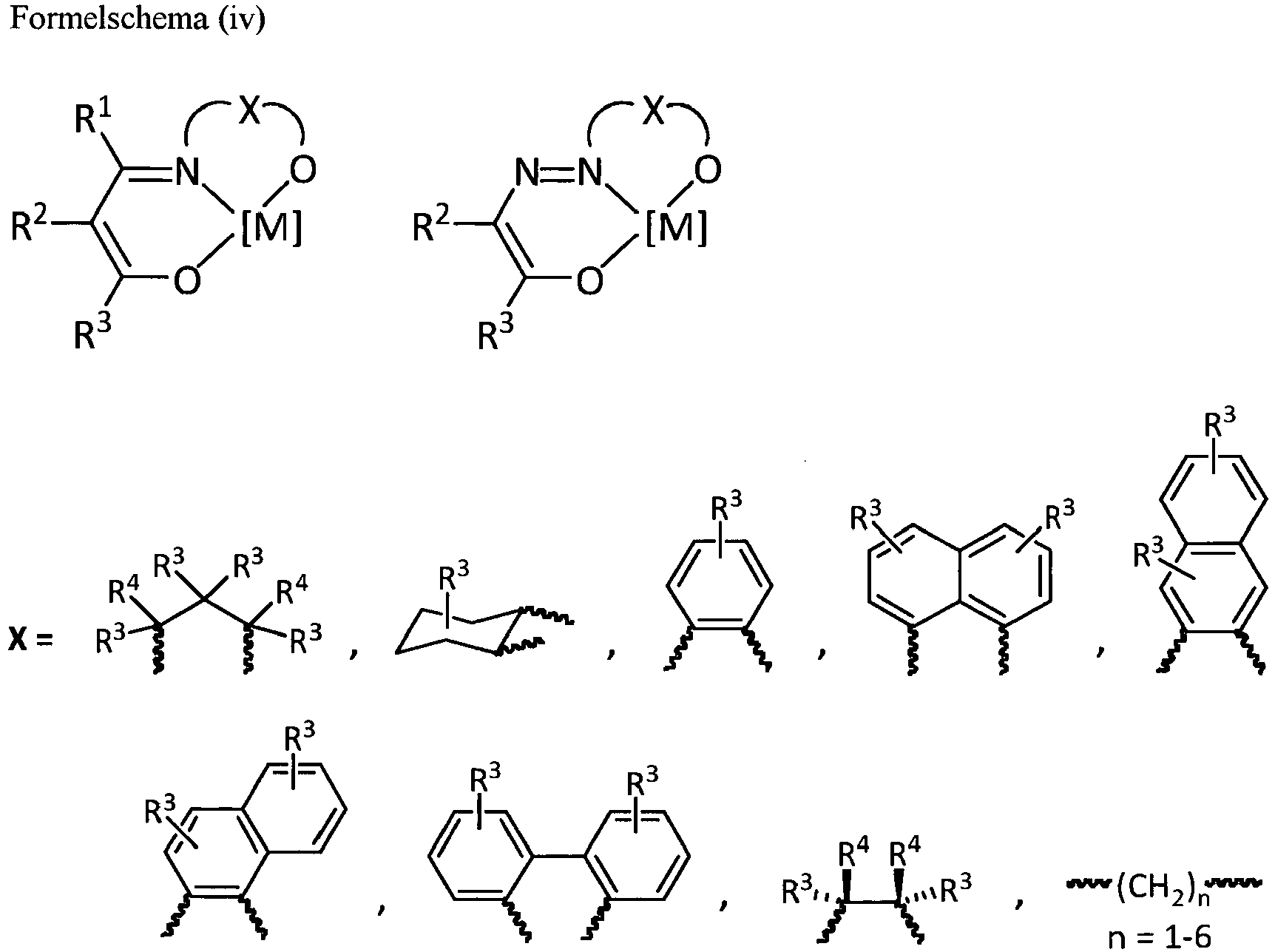
- In Formelschema (iv) sind R1, R2, R3, R4, X und [M] genauso definiert wie bereits zuvor ausgeführt.

- In Formelschema (v) steht W für NH, N-Alkyl, N-Aryl, O, S, CO, CH2, CHR mit R = C1-C20-Alkyl, CR2 oder -Aryl.
- In den Formelschemata (iv) und (v) ist [M] wiederum [Co]. Wie in den Formelschemata (i) bis (iii) besetzen auch hier die Chelatliganden bevorzugt drei meridionale Koordinationsstellen des Cobalts, wobei die restlichen drei meridionalen Koordinationsstellen entweder durch die über freie O-Elektronenpaare zusätzlich verbrückende O-Ligandfunktionalität eines benachbarten M(O~N~O) Komplexes im dinuclearen Assoziat oder durch Lösungsmittelmoleküle oder Substratmoleküle mit Donorfunktionalität oder beliebige andere Liganden L belegt sind.
- Die Erfindung betrifft demnach insbesondere auch Übergangsmetallkomplexe, bei denen die dreizähnigen, dianionischen, halogenfreien Liganden (O~N~O)2- drei meridionale Koordinationsstellen des Cobalts besetzen.
- Mit den vorstehend beschriebenen Katalysatoren lassen sich bei der oxidativen Carbonylierung eines Amins unter halogenfreien Reaktionsbedingungen zu den entsprechenden Harnstoffen Umsätze und Selektivitäten bis zu 99 %, d. h. Ausbeuten bis zu 99 %, bezogen auf das eingesetzte Amin, nach folgender allgemeiner Reaktionsgleichung erzielen:
2 R5-NH2 + CO + 0,5 O2 → R5-NH-CO-NHR5 + H2O (1)
- R5 ist ein primärer oder sekundärer aliphatischer Rest oder ein aromatischer Rest. Es ist auch möglich, Gemische unterschiedlicher Amine R5-NH2 einzusetzen, so dass der gebildete Harnstoff unsymmetrisch substituiert ist. R5-NH2 steht dabei nicht nur für ein monofunktionelles Amin, sondern auch für ein Aminogruppenäquivalent einer Di- oder Polyaminverbindung (z. B. R5 = CH3-C6H3-NH2, also R5-NH2 = Toluylendiamin). In Di- oder Polyaminverbindungen reagieren bevorzugt alle primären Aminogruppen gemäß Gleichung (1). Unter aliphatischen Resten sind im Rahmen dieser Erfindung sowohl lineare als auch verzweigte als auch cyclische aliphatische Reste zu verstehen.
- Bevorzugt wird das erfindungsgemäße Verfahren in Gegenwart organischer, Hydroxylgruppen tragender Verbindungen durchgeführt. Diese Ausführungsform der Erfindung betrifft demnach ein Verfahren, bei dem die oxidative Carbonylierung der organischen Amine in Gegenwart von organischen, Hydroxylgruppen tragenden Verbindungen durchgeführt wird und zur Herstellung von Urethanen oder Gemischen aus Urethanen und Harnstoffen führt. Die Urethanbildung erfolgt dabei gemäß folgender allgemeiner Reaktionsgleichung:
R5-NH2 + CO + 0,5 O2 + R6OH → R5-NH-CO-OR6 + H2O (2)
- R6 ist ein primärer oder sekundärer aliphatischer Rest oder ein aromatischer Rest. R5 und R6 können auch gleich sein. R6 OH steht dabei nicht nur für eine monofunktionelle Hydroxylverbindung, sondern auch für ein Hydroxylgruppenäquivalent einer Di- oder Polyhydroxyverbindung.
- Die Reaktionen gemäß der Gleichungen (1) und (2) können auch parallel nebeneinander ablaufen und zu Gemischen aus Urethanen und Harnstoffen führen.
- Geeignete organische Amine für das erfindungsgemäße Verfahren zur Herstellung von Urethanen und/oder Harnstoffen sind primäre und sekundäre Amine, wobei primäre Amine (d. h. organische Amine enthaltend primäre Aminogruppen "-NH2") bevorzugt sind, da sich die daraus erhaltenen Urethane und/oder Harnstoffe in einem weiteren Verfahrensschritt, z. B. durch Thermolyse unter Abspaltung der Hydroxylverbindung R6OH bzw. der Aminverbindung R5NH2, in die entsprechenden Isocyanate überführen lassen. Geeignete primäre Amine sind insbesondere aliphatische Mono-, Di- und/oder Polyamine, gemischt aliphatisch-cycloaliphatische Mono-, Di- und/oder Polyamine, cycloaliphatische Mono-, Di- und/oder Polyamine, aromatische Mono-, Di- und/oder Polyamine, araliphatische Mono-, Di- und/oder Polyamine oder Gemische, die zwei oder mehr der vorstehenden primären Amine enthalten. Die Erfindung betrifft also weiterhin ein Verfahren zur oxidativen Carbonylierung von organischen Aminen, bei dem als organische Amine aliphatische, cycloaliphatische, araliphatische und / oder aromatische Mono- oder Diamine eingesetzt werden.
- Bevorzugte Beispiele geeigneter primärer Monoamine sind Anilin, am aromatischen Ring einfach oder mehrfach substituierte Aniline wie die isomeren Toluidine oder halogenierte Aniline, Benzylamin, 2-Phenylethylamin, 1-Phenylethylamin, Cyclohexylamin, substituierte Cyclohexylamine, Methylamin, Ethylamin, die isomeren Propyl-, Butyl-, Pentylamine sowie deren höhere Homologe.
- Bevorzugte Beispiele geeigneter primärer Diamine sind o-Phenylendiamin, m-Phenylendiamin, p-Phenylendiamin, am aromatischen Ring einfach oder mehrfach substituierte Phenylendiamine wie z. B. Tetramethylphenylendiamin, die isomeren Diaminotoluole wie z. B. 2,4-Diaminotoluol und 2,6-Diaminotoluol, die isomeren Diaminodiphenylmethane wie z. B. 4,4'-Diaminodiphenylmethan, 2,4'-Diaminodiphenylmethan oder 2,2'-Diaminodiphenylmethan, Naphthalindiamine wie z. B. 1,4-Naphthalindiamin, 1,5-Naphthalindiamin oder 1,8-Naphthalindiamin, o-Xylylendiamin, m-Xylylendiamin, p-Xylylendiamin, die isomeren Diaminocyclohexane, am cycloaliphatischen Ring substituierte Diaminocyclohexane, Isophorondiamin, Ethylendiamin, 1,2-Diaminopropan, α,ω-Diaminoalkane wie 1,3-Diaminopropan sowie höhere Homologe wie z. B. 1,6-Hexamethylendiamin, substituierte α,ω-Diaminoalkane.
- Gegenstand der Erfindung ist insbesondere ein Verfahren zur oxidativen Carbonylierung von organischen Aminen, bei dem Anilin oder Toluylendiamin, bevorzugt Anilin, als aromatische Amine eingesetzt werden.
- Bevorzugte Beispiele geeigneter primärer Polyamine sind durch Kondensation von Anilin mit Formaldehyd erhaltene Gemische der isomeren Diaminodiphenylmethane mit ihren höheren Homologen und deren Isomeren der polyfunktionellen Amine der Diphenylmethanreihe.
- Bevorzugte Beispiele organischer, eine oder mehrere Hydroxylgruppen enthaltender Verbindungen sind Alkohole, insbesondere die aliphatischen Alkohole wie Methanol, Ethanol sowie die höheren homologen Alkanole und deren Isomere wie n-Propanol, iso-Propanol, n-Butanol, iso-Butanol, sek-Butanol etc., einfach oder mehrfach Halogen-substituierte Derivate der vorstehenden Alkohole wie z. B. Trifluoroethanol oder Hexafluoroisopropanol, cycloaliphatische Alkohole wie Cylcopentanol oder Cyclohexanol, Benzylalkohol, Phenol oder substituierte Phenole (z. B. Kresole). Besonders bevorzugt betrifft die Erfindung ein Verfahren, bei dem die organischen, Hydroxylgruppen tragenden Verbindungen ausgewählt sind aus der Gruppe bestehend aus:
- Methanol, Ethanol, n-Butanol, iso-Butanol, sek-Butanol, n-Propanol, iso-Propanol.
- Die Erfindung betrifft weiterhin ein Verfahren, bei dem der Übergangsmetallkomplex-Katalysator enthaltend das Strukturmerkmal [Mn+(O~N~O)2-](n-2)+(L)m(Z-)n-2 in einer Konzentration von 0,01 Mol% bis 10 Mol-%, bevorzugt 0,05 Mol-% bis 5,0 Mol%, besonders bevorzugt 0,1 Mol% bis 3,0 Mol%, bezogen auf ein Mol primärer Aminogruppen, vorliegt.
- Bei der oxidativen Carbonylierung eines Amins in Gegenwart einer Hydroxylgruppen enthaltenden Verbindung zu den entsprechenden Urethanen wird die Hydroxylgruppen enthaltende Verbindung in mindestens stöchiometrischer Menge, bezogen auf die Menge an Aminogruppen, eingesetzt. Bevorzugt wird ein Überschuss der Hydroxylgruppen enthaltenden Verbindung, bezogen auf die Menge an Aminogruppen, verwendet. Besonders bevorzugt werden 2 Mol- 100 Mol Hydroxylgruppen pro Mol primärerer Aminogruppen, und ganz besonders bevorzugt 5 Mol- 50 Mol Hydroxylgruppen pro Mol primärerer Aminogruppen eingesetzt.
- Im Allgemeinen dient die Hydroxylgruppen enthaltende Verbindung, insbesondere wenn sie im Überschuss eingesetzt wird, als Lösungsmittel. Es ist jedoch auch möglich, ein weiteres Lösungsmittel einzusetzen. Als zusätzliches Lösungsmittel kommen alle Lösungsmittel, die unter den Reaktionsbedingungen inert sind, in Frage. Bevorzugte Beispiele geeigneter Lösungsmittel, sind aliphatische und aromatische Kohlenwasserstoffe und ihre halogenierten Derivate wie z. B. Benzol, Toluol, die isomeren Xylole, Ethylbenzol, Chlorbenzol, die isomeren Dichlorbenzole, Ether, Ester, etc. Besonders bevorzugte Lösungsmittel sind Benzol, Toluol, die isomeren Xylole, Ethylbenzol, halogenfreie Ether und halogenfreie Ester.
- In einer weiteren Ausführungsform können auch wasserhaltige Lösungsmittel eingesetzt werden.
- Die Umsetzung wird bevorzugt im Temperaturbereich von 20 °C bis 260 °C, besonders bevorzugt bei 80 °C bis 220 °C durchgeführt.
- Die Menge an Kohlenmonoxid wird so bemessen, dass mindestens die für die Umsetzung benötigte stöchiometrische Menge, bezogen auf die vorhandenen Aminogruppen, vorhanden ist. Bevorzugt wird mindestens das 10-fache, besonders bevorzugt mindestens das 15-fache der stöchiometrisch benötigten Menge an Kohlenmonoxid eingesetzt. Im Allgemeinen wird dabei maximal das 200-fache der stöchiometrisch benötigten Menge an Kohlenmonoxid eingesetzt. Der absolute Partialdruck des eingesetzten Kohlenmonoxids beträgt bei Raumtemperatur bevorzugt 1,0 bar bis 150 bar, besonders bevorzugt 10 bar bis 100 bar.
- Die Menge an Sauerstoff wird so bemessen, dass mindestens die für die Umsetzung benötigte stöchiometrische Menge, bezogen auf die vorhandenen Aminogruppen, vorhanden ist. Bevorzugt wird mindestens das 1,2-fache, besonders bevorzugt mindestens das 1,6-fache der stöchiometrisch benötigten Menge an Sauerstoff eingesetzt. Im Allgemeinen wird dabei maximal das 20-fache der stöichometrisch benötigten Menge an Sauerstoff eingesetzt. Der absolute Partialdruck des eingesetzten Sauerstoffs beträgt bei Raumtemperatur bevorzugt 0,1 bar bis 20 bar, besonders bevorzugt 1,0 bar bis 10 bar. Es wird jedoch in jedem Fall außerhalb der Explosionsgrenzen des Systems CO/O2 gearbeitet.
- Die Erfindung betrifft also weiterhin ein Verfahren, bei dem die oxidative Carbonylierung bei Temperaturen von 20 °C bis 260 °C und bei einem absoluten Kohlenmonoxidpartialdruck von 1,0 bar bis 150 bar sowie bei einem absoluten Sauerstoffpartialdruck von 0,10 bar bis 20 bar durchgeführt wird.
- Der Sauerstoff kann entweder als reiner Sauerstoff oder im Gemisch mit unter den Reaktionsbedingungen inerten Gasen, wie z. B. Stickstoff, CO2, Edelgase etc., bereitgestellt werden. Dabei kann entweder eines dieser inerten Gase oder ein Gemisch aus zwei oder mehr der genannten inerten Gase zum Einsatz kommen. Vorzugsweise werden entweder reiner Sauerstoff oder Luft verwendet.
- Bei dem erfindungsgemäßen Verfahren werden durch oxidative Carbonylierung eines Amins in Gegenwart einer Hydroxylgruppen enthaltenden Verbindung die entsprechenden Urethane gebildet. Im Zuge der Reaktion können als Intermediate und/oder Nebenprodukte ggf. auch die auf dem Amin basierenden Harnstoffe auftreten, die im weiteren Verlauf der Umsetzung durch Alkoholyse mit der Hydroxylgruppen enthaltenden Verbindung teilweise oder vollständig zu den entsprechenden Urethanen weiterreagieren können.
- Grundsätzlich können die Harnstoffe aber auch durch oxidative Carbonylierung von organischen Aminen in Gegenwart von Kohlenmonoxid und Sauerstoff unter Abwesenheit von organischen, Hydroxylgruppen tragenden Verbindungen gezielt hergestellt werden.
- Zur Aufarbeitung des Reaktionsgemisches und zur Isolierung des Produktes können die dem Fachmann bekannten Verfahren oder beliebige Kombinationen der bekannten Verfahren herangezogen werden, z. B. Destillation, Kristallisation, Filtration, Extraktion, Separation mittels Membranverfahren etc. Edukte, Zwischenprodukte, Lösungsmittel und/oder Katalysatoren können zurück gewonnen und wieder an geeigneter Stelle in den Prozess eingespeist werden.
- Das Verfahren kann Batch-weise (diskontinuierlich in Chargen), halbkontinuierlich oder kontinuierlich durchgeführt werden.
- Das erhaltene Urethan kann bevorzugt in einer weiteren Verfahrensstufe z. B. thermisch oder chemisch in das entsprechende Isocyanat überführt werden. Die Thermolyse kann z. B. katalysiert oder unkatalysiert in Substanz oder in Gegenwart eines geeigneten Lösungsmittels erfolgen. Die Hydroxylgruppen enthaltende Verbindung kann dabei zurückgewonnen und wieder in der Urethansynthese eingesetzt werden. Durch das Schließen des Kreislaufs der Hydroxylgruppen enthaltenden Verbindung kann der Gesamtprozess wirtschaftlich attraktiver gestaltet werden, da nur Verluste an Hydroxylgruppen enthaltender Verbindung durch irreversible Nebenreaktionen ausgeglichen werden müssen. Auch Harnstoffe können, wenngleich unter verschärften Bedingungen, einer solchen Spaltung in das Isocyanat unterworfen werden. Die Verwendung der Urethane ist jedoch bevorzugt.
- Die Erfindung betrifft somit auch ein Verfahren zur Herstellung von Isocyanaten durch thermische Spaltung von Urethanen oder Harnstoffen, bei dem Urethane oder Harnstoffe durch oxidative Carbonylierung der entsprechenden Amine nach dem erfindungsgemäßen Verfahren unter Verwendung der erfindungsgemäßen Übergangsmetallkomplexe hergestellt werden und anschließend die Urethane oder Harnstoffe thermisch in die entsprechenden Isocyanate überführt werden.
- Bevorzugt erfolgen dabei die Carbonylierung und die Thermolyse in einem Verfahrensschritt.
- Das erfindungsgemäße Verfahren wird durch die nachfolgenden Beispiele näher erläutert.
- In einem 100-cm3-Edelstahlautoklaven mit Polytetrafluorethylenbecher als Insert wurden 0,0592 g (0,22 mmol) Salicyliden-aminophenol-Cobalt (II) ([CoII(Sap)], siehe auch Formelschema (vi)), 1,023 g (11,0 mmol) Anilin und 10,692 g (297,2 mmol) Methanol gemischt. Der Autoklav wurde bei Raumtemperatur (ca. 25 °C) mit einem Gemisch aus Sauerstoffgas (4 bar) und Kohlenmonoxidgas (36 bar) befüllt. Nachdem die Gaszufuhr des Autoklaven unterbrochen worden war, wurde der Autoklav in einen Aluminiumheizblock eingesetzt, der auf 200 °C erhitzt war. Innerhalb von 5 Minuten erreichte der Autoklav eine Reaktionstemperatur von 165 °C, die dann konstant gehalten wurde. Nach einer Reaktionsdauer von 3 Stunden wurde der Autoklav durch kaltes Wasser und Eis abgekühlt, bis er nach etwa 5 Minuten Raumtemperatur erreichte. Die Reaktionsmischung wurde dann qualitativ und quantitativ gaschromatographisch untersucht, wobei Naphthalin als interner Standard diente. Der Umsatz an Anilin betrug 100 %, die Ausbeute an Methyl-N-phenylcarbamat 99 %.
- Die im Beispiel 1 genannte Reaktion wurde unter ansonsten gleichen Bedingungen mit 0,22 mmol Azobisphenol-Cobalt (II) ([CoII(Abp)], siehe auch Formelschema (vi)) als Katalysator wiederholt.
- Die im Beispiel 1 genannte Reaktion wurde unter ansonsten gleichen Bedingungen mit 0,22 mmol Naphthalydenaminophenol-Cobalt (II) ([CoII(Nap)], siehe auch Formelschema (vi)) als Katalysator wiederholt.
- Die im Beispiel 1 genannte Reaktion wurde unter ansonsten gleichen Bedingungen mit 0,22 mmol Salicylidenaminonapthalenol-Cobalt (II) ([CoII(San)], siehe auch Formelschema (vi)) als Katalysator wiederholt.
- Die im Beispiel 1 genannte Reaktion wurde unter ansonsten gleichen Bedingungen mit 0,22 mmol Hydroxyphenylquinolinol-Cobalt (II) ([CoII(Pqo)], siehe auch Formelschema (vi)) als Katalysator wiederholt.

- Die im Beispiel 1 genannte Reaktion wurde unter ansonsten gleichen Bedingungen ohne Katalysator wiederholt.
- Die im Beispiel 1 genannte Reaktion wurde unter ansonsten gleichen Bedingungen mit 0,22 mmol Cobalt(II)-acetat-Tetrahydrat CoII(OAc)2 als Katalysator wiederholt.
- Die folgende Tabelle fasst die Resultate zusammen:
Tabelle 1[a]: Ergebnisse der Beispiele 1 bis 8 Beispiel Nr. Katalysator[b] Umsatz[c] [%] Selektivität[d] [%] Ausbeute[d] [%] 1 [CoII(Sap)] 100 99 99 2 [CoII(Abp)] 100 93 93 3 [CoII(Nap)] 99 91 90 4 [CoII(San)] 93 80 74 5 [CoII(Pqo)] 88 87 77 6 (Vergleich) - 12 Nicht bestimmt. Nicht bestimmt. 7 (Vergleich) CoII(OAc)2 66 45 30 [a] Reaktionsbedingungen: 165 °C, 4 bar O2, 36 bar CO, Reaktionszeit 3 h, molares Verhältnis Katalysator zu Anilin = 1/50, molares Verhältnis Methanol zu Anilin = 27/1.
[b] Abp = Azobisphenol, Nap = Naphthalydenaminophenol, Pqo = Hydroxyphenylquinolinol, Sap = Salicylidenaminophenol, San = Salicylidenaminonapthalenol, OAc = Acetat.
[c] An Anilin.
[d] Bezogen auf Methyl-N-phenylcarbamat. - Der Katalysator aus Beispiel 2 wurde in einem molaren Verhältnis von Katalysator zu Anilin von 1/200 unter ansonsten gleichen Bedingungen eingesetzt.
- Beispiel 8 wurde unter Zusatz von NaI im molaren Verhältnis NaI zu Anilin von 1/10 wiederholt.
- Tabelle 2 stellt die Resultate einander gegenüber:
Tabelle 2[a]: Ergebnisse der Beispiele 8 und 9 Beispiel Nr. Katalysator[b] Umsatz[c] [%] Selektivität[d] [%] Ausbeute[d] [%] 8 [CoII(Abp)] 65 69 45 9[e] (Vergleich) [CoII(Abp)] 63 67 42 [a] Reaktionsbedingungen: 165 °C, 4 bar O2, 36 bar CO, Reaktionszeit 3 h, molares Verhältnis Katalysator zu Anilin = 1/200, molares Verhältnis Methanol zu Anilin = 27/1.
[b] Abp = Azobisphenol.
[c] An Anilin.
[d] Bezogen auf Methyl-N-phenylcarbamat.
[e] Unter Zusatz von 10 mol-% NaI (bezogen auf Anilin) durchgeführt. - Wie man der Tabelle 2 entnehmen kann, führt die Verringerung der Katalysatorbeladung zu einer Verringerung an Ausbeute und Selektivität (vgl. Beispiel 8 mit Beispiel 2). Die erfindungsgemäßen Katalysatoren sind jedoch so leistungsfähig, dass sie selbst unter solchen erschwerten Bedingungen den Einsatz halogenhaltiger Promotoren überflüssig machen (vgl. Beispiel 8 mit Beispiel 9).
m = 0, 1, 2 oder 3 ist
und
Pseudohalogeniden, bevorzugt Cyanid, Cyanat, Thiocyanat, Azid;
perfluorierten Nichtmetall-Koordinationsverbindungen, bevorzugt [BF4]- [PF6]-, [SbF6]-;
Anionen anorganischer Säuren, bevorzugt Nitrat, Hydrogensulfat, Fluorosulfat, besonders bevorzugt Nitrat und Hydrogensulfat; und
Methylsulfat,
wobei Tosylat, Mesylat, Acetat, Benzoat, Cyanid, Cyanat, Thiocyanat, Azid, Nitrat, Hydrogensulfat und Methylsulfat ganz besonders bevorzugt sind,
steht,
die monoanionischen Liganden Z- ausgewählt sind aus der Gruppe bestehend aus
Tosylat, Mesylat, Acetat, Benzoat Cyanid, Cyanat, Thiocyanat, Azid, Nitrat, Hydrogensulfat und Methylsulfat.
Claims (14)
- Verfahren zur Herstellung von Urethanen oder Harnstoffen oder Gemischen aus Urethanen und Harnstoffen durch oxidative Carbonylierung von organischen Aminen enthaltend primäre Aminogruppen in Gegenwart von Kohlenmonoxid, Sauerstoff und eines Katalysators, dadurch gekennzeichnet, dass
als Katalysator ein Übergangsmetallkomplex enthaltend das Strukturmerkmal [Mn+(O~N~O)1-](n-2)+(L)m(Z-)n-2 eingesetzt wird, wobei
M Co bezeichnet,
n = 2 oder 3 ist;
(O~N~O)2- für einen dreizähnigen, dianionischen, mit M über zwei Sauerstoffatome und ein Stickstoffatom koordinierenden Chelatliganden steht,der sich durch Deprotonierung aller OH-Funktionen, welche nicht Bestandteil der Substituenten R1 oder R2 sind, von neutralen Chelatliganden ausgewählt aus der Gruppe bestehend aus:


 R1 für einen Substituenten ausgewählt aus der Gruppe bestehend aus:steht;
Wasserstoff, eine Alkylgruppe mit 1 bis 20 Kohlenstoffatomen, eine Aryl- oder Heteroarylgruppe, eine OR-Gruppe, in der R für Wasserstoff oder eine Alkylgruppe mit 1 bis 20 Kohlenstoffatomen steht, eine NRR'-Gruppe, in der R und R' unabhängig voneinander Wasserstoff oder eine Aryl- oder Alkylgruppe mit 1 bis 20 C-Atomen bedeuten,R2 für einen Substituenten ausgewählt der Gruppe bestehend aus:steht und
Wasserstoff, eine Alkylgruppe mit 1 bis 20 Kohlenstoffatomen, eine Aryl-gruppe oder Heteroarylgruppe, wobei die Arylgruppe oder Heteroarylgruppe jeweils entweder über eine Bindung mit dem dreizähnigen Liganden verknüpft oder mit diesem über zwei C-C-Bindungen anelliert ist, -COR, -COOR, -COOH, OH, OR, NRR', wobei R und R' unabhängig voneinander Wasserstoff oder eine Aryl- oder Alkylgruppe mit 1 bis 20 C-Atomen bedeuten,
R2 den aromatischen Ring ein- oder mehrfach substituieren kann;
L für einen neutralen Liganden steht;
m = 0, 1, 2 oder 3 ist;
Z- für einen monoanionischen Liganden ausgewählt aus der Gruppe bestehend aus: Sulfonaten, Carboxylaten, Pseudohalogeniden, [BF4]- [PF6]-, [SbF6]-, Nitrat, Hydrogensulfat, Fluorosulfat und Methylsulfat steht;
und
das Verfahren unter halogenfreien Reaktionsbedingungen durchgeführt wird. - Verfahren nach Anspruch 1, bei dem L ausgewählt ist aus der Gruppe bestehend aus:Wasser, Azaaromaten, cyclische oder acyclische Amine, cyclische oder acyclische Carbonsäureamide, cyclische oder acyclische Carbonsäureester, cyclische oder acyclische Ketone, cyclische oder acyclische Ketimine, aliphatische Ether, aliphatische oder aromatische Alkohole, Sulfoxide, Formamide, cyclische oder acyclische Organocarbonate, Nitrile.
- Verfahren nach Anspruch 1 oder 2, bei dem Z- ausgewählt ist aus der Gruppe bestehend aus:Tosylat, Mesylat, Acetat, Benzoat, Cyanid, Cyanat, Thiocyanat, Azid, Nitrat, Hydrogensulfat und Methylsulfat.
- Verfahren nach Anspruch 1, bei dem sich der dianionische Chelatligand (O~N~O)2- durch Deprotonierung aller OH-Funktionen von neutralen Chelatliganden ausgewählt aus der Gruppe bestehend aus:


- Verfahren nach einem der Ansprüche 1 bis 4, bei dem der Katalysator in einer Konzentration von 0,01 Mol-% bis 10 Mol%, bezogen auf ein Mol primärerer Aminogruppen, vorliegt.
- Verfahren nach einem der Ansprüche 1 bis 5, bei dem die oxidative Carbonylierung bei Temperaturen von 20 °C bis 260 °C und bei einem absoluten Kohlenmonoxidpartialdruck von 1,0 bar bis 150 bar sowie bei einem absoluten Sauerstoffpartialdruck von 0,10 bar bis 20 bar durchgeführt wird.
- Verfahren nach einem der Ansprüche 1 bis 6, bei dem die oxidative Carbonylierung der organischen Amine in Gegenwart von organischen, Hydroxylgruppen tragenden Verbindungen durchgeführt wird und zur Herstellung von Urethanen oder Gemischen aus Urethanen und Harnstoffen führt.
- Verfahren nach Anspruch 7, bei dem die organischen, Hydroxylgruppen tragenden Verbindungen ausgewählt sind aus der Gruppe bestehend aus:Methanol, Ethanol, n-Butanol, iso-Butanol, sek-Butanol, n-Propanol, iso-Propanol.
- Verfahren nach einem der Ansprüche 1 bis 8, bei dem als organische Amine aliphatische, cycloaliphatische, araliphatische und / oder aromatische Mono- oder Diamine eingesetzt werden.
- Verfahren nach Anspruch 9, bei dem Anilin oder Toluylendiamin als aromatische Amine eingesetzt werden.
- Verwendung von Übergangsmetallkomplexen enthaltend das Strukturmerkmal
[Mn+(O~N~O)2-](n-2)+(L)m(Z-)n-2, worin
M Co bezeichnet;
n = 2 oder 3 ist;
(O~N~O)2- für einen dreizähnigen, dianionischen, mit M über zwei Sauerstoffatome und ein Stickstoffatom koordinierenden Chelatliganden steht, welcher sich durch Deprotonierung aller OH-Funktionen, welche nicht Bestandteil der Substituenten R1 oder R2 sind, von neutralen Chelatliganden ausgewählt aus der Gruppe bestehend aus:


 R1 für einen Substituenten ausgewählt aus der Gruppe bestehend aus:steht;
Wasserstoff, eine Alkylgruppe mit 1 bis 20 Kohlenstoffatomen, eine Aryl- oder Heteroarylgruppe, eine OR-Gruppe, in der R für Wasserstoff oder eine Alkylgruppe mit 1 bis 20 Kohlenstoffatomen steht, eine NRR'-Gruppe, in der R und R' unabhängig voneinander Wasserstoff oder eine Aryl- oder Alkylgruppe mit 1 bis 20 C-Atomen bedeuten,R2 für einen Substituenten ausgewählt der Gruppe bestehend aus:steht und
Wasserstoff, eine Alkylgruppe mit 1 bis 20 Kohlenstoffatomen, eine Arylgruppe oder Heteroarylgruppe, wobei die Arylgruppe oder Heteroarylgruppe jeweils entweder über eine Bindung mit dem dreizähnigen Liganden verknüpft oder mit diesem über zwei C-C-Bindungen anelliert ist, -COR, -COOR, -COOH, OH, OR, NRR', wobei R und R' unabhängig voneinander Wasserstoff oder eine Aryl- oder Alkylgruppe mit 1 bis 20 C-Atomen bedeuten,R2 den aromatischen Ring ein- oder mehrfach substituieren kann;L für einen neutralen Liganden ausgewählt aus der Gruppe bestehend aus:steht;
Wasser, Azaaromaten, cyclische oder acyclische Amine, cyclische oder acyclische Carbonsäureamide, cyclische oder acyclische Carbonsäureester, cyclische oder acyclische Ketone, cyclische oder acyclische Ketimine, aliphatische Ether, aliphatische oder aromatische Alkohole, Sulfoxide, cyclische oder acyclische Organocarbonate, Nitrilem = 0, 1, 2 oder 3 istundZ- für einen monoanionischen Liganden ausgewählt aus der Gruppe bestehend aus:steht
Sulfonaten, Carboxylaten, Pseudohalogeniden, [BF4]- [PF6]-, [SbF6]-, Nitrat, Hydrogensulfat, Fluorosulfat und Methylsulfat,
als Katalysatoren in Verfahren zur Herstellung von Urethanen oder Harnstoffen oder Gemischen aus Urethanen und Harnstoffen. - Verwendung von Übergangsmetallkomplexen enthaltend das Strukturmerkmal
[Mn+(O~N~O)2-](n-2)+(L)m(Z-)n-2, worin
M Co bezeichnet;
n = 2 oder 3 ist;
(O∼N∼O)2- für einen dreizähnigen, dianionischen, mit M über zwei Sauerstoffatome und ein Stickstoffatom koordinierenden Chelatliganden steht, welcher sich durch Deprotonierung aller OH-Funktionen, welche nicht Bestandteil der Substituenten R1 oder R2 sind, von neutralen Chelatliganden ausgewählt aus der Gruppe bestehend aus:


 R1 für einen Substituenten ausgewählt aus der Gruppe bestehend aus:steht;
Wasserstoff, eine Alkylgruppe mit 1 bis 20 Kohlenstoffatomen, eine Aryl- oder Heteroarylgruppe, eine OR-Gruppe, in der R für Wasserstoff oder eine Alkylgruppe mit 1 bis 20 Kohlenstoffatomen steht, eine NRR'-Gruppe, in der R und R' unabhängig voneinander Wasserstoff oder eine Aryl- oder Alkylgruppe mit 1 bis 20 C-Atomen bedeuten,R2 für einen Substituenten ausgewählt der Gruppe bestehend aus:steht und
Wasserstoff, eine Alkylgruppe mit 1 bis 20 Kohlenstoffatomen, eine Arylgruppe oder Heteroarylgruppe, wobei die Arylgruppe oder Heteroarylgruppe jeweils entweder über eine Bindung mit dem dreizähnigen Liganden verknüpft oder mit diesem über zwei C-C-Bildungen anelliert ist, -COR, -COOR, -COOH, OH, OR, NRR', wobei R und R' unabhängig voneinander Wasserstoff oder eine Aryl- oder Alkylgruppe mit 1 bis 20 C-Atomen bedeuten,
R2 den aromatischen Ring ein- oder mehrfach substituieren kann;
L für einen neutralen Liganden ausgewählt aus der Gruppe bestehend aus:
Wasser Azaaromaten, cyclische oder acyclische Amine, cyclische oder acyclische Carbonsäureamide, cyclische oder acyclische Carbonsäureester, cyclische oder acyclische Ketone, cyclische oder acyclische Ketimine, aliphatische Ether, aliphatische oder aromatische Alkohole, Sulfoxide, cyclische oder acyclische Organocarbonate, Nitrile
steht;
m = 0, 1, 2 oder 3 ist
undZ- für einen monoanionischen Liganden ausgewählt aus der Gruppe bestehend aus:steht
Sulfonaten Carboxylaten Pseudohalogeniden, [BF4]- FPF6]-, [SbF6]-, Nitrat, Hydrogensulfat, Fluorosulfat und Methylsulfat,
in der Herstellung von Isocyanaten. - Verwendung nach Anspruch 11 oder 12, worin
(O∼N-O)2- für einen dreizähnigen, dianionischen, mit M über zwei Sauerstoffatome und ein Stickstoffatom koordinierenden Chelatliganden steht, welcher sich durch Deprotonierung aller OH-Funktionen von neutralen Chelatliganden ausgewählt aus der Gruppe bestehend aus:





- Verwendung nach Anspruch 11, 12 oder 13, bei der die dreizähnigen, dianionischen, Liganden (O∼N∼O)2- drei meridionale Koordinationsstellen des Cobalts besetzen.
Applications Claiming Priority (2)
| Application Number | Priority Date | Filing Date | Title |
|---|---|---|---|
| DE102010039250 | 2010-08-12 | ||
| PCT/EP2011/063718 WO2012020028A1 (de) | 2010-08-12 | 2011-08-09 | Verfahren zur herstellung von urethanen |
Publications (2)
| Publication Number | Publication Date |
|---|---|
| EP2603319A1 EP2603319A1 (de) | 2013-06-19 |
| EP2603319B1 true EP2603319B1 (de) | 2014-10-22 |
Family
ID=44584149
Family Applications (1)
| Application Number | Title | Priority Date | Filing Date |
|---|---|---|---|
| EP11746221.8A Not-in-force EP2603319B1 (de) | 2010-08-12 | 2011-08-09 | Verfahren zur herstellung von urethanen |
Country Status (6)
| Country | Link |
|---|---|
| US (1) | US9199924B2 (de) |
| EP (1) | EP2603319B1 (de) |
| CN (1) | CN103201035B (de) |
| ES (1) | ES2525736T3 (de) |
| PT (1) | PT2603319E (de) |
| WO (1) | WO2012020028A1 (de) |
Families Citing this family (3)
| Publication number | Priority date | Publication date | Assignee | Title |
|---|---|---|---|---|
| EP3075788A1 (de) | 2015-04-02 | 2016-10-05 | Evonik Degussa GmbH | Funktionalisierte keton-aldehyd-kondensationsharze |
| CN107488133B (zh) * | 2017-08-18 | 2019-08-09 | 福州大学 | 一种氮化碳光催化合成氨基甲酸酯类化合物的方法 |
| CN113292532B (zh) * | 2021-06-25 | 2022-06-28 | 中山大学 | 一种多取代萘醌衍生物及其制备方法与应用 |
Family Cites Families (9)
| Publication number | Priority date | Publication date | Assignee | Title |
|---|---|---|---|---|
| US3481967A (en) | 1966-04-01 | 1969-12-02 | Olin Mathieson | Process for preparing aromatic isocyanates |
| US4266070A (en) | 1979-05-25 | 1981-05-05 | Halcon Research And Development Corp. | Catalytic process for the manufacture of urethanes |
| US5194660A (en) | 1990-12-21 | 1993-03-16 | Union Carbide Chemicals & Plastics Technology Corporation | Processes for producing carbamates and isocyanates |
| EP0967215B1 (de) | 1998-06-26 | 2003-04-02 | Degussa AG | Cu(II)- und Zn(II)-Phenoxylkomplexe und Radikalkomplexe hiervon, Verfahren zu deren Herstellung und deren Verwendung |
| WO2001068724A2 (en) | 2000-03-10 | 2001-09-20 | E.I. Dupont De Nemours And Company | Polymerization of olefins |
| GB0120743D0 (en) | 2001-08-25 | 2001-10-17 | Ici Plc | Catalysts and curable compositions |
| DE102005026500B4 (de) | 2005-06-09 | 2008-05-15 | Philipps-Universität Marburg | Herstellung von N-Arylcarbamaten und N-Arylisocyanaten |
| DE102008006881A1 (de) | 2008-01-31 | 2009-08-06 | Bayer Materialscience Ag | Verfahren zur Herstellung von Urethanen |
| CN101863800B (zh) * | 2009-04-14 | 2015-06-24 | 拜耳材料科技(中国)有限公司 | 合成氨基甲酸酯的方法、适用于该方法的催化剂及其制备方法和用途 |
-
2011
- 2011-08-09 PT PT117462218T patent/PT2603319E/pt unknown
- 2011-08-09 US US13/816,526 patent/US9199924B2/en not_active Expired - Fee Related
- 2011-08-09 CN CN201180049440.0A patent/CN103201035B/zh not_active Expired - Fee Related
- 2011-08-09 ES ES11746221.8T patent/ES2525736T3/es active Active
- 2011-08-09 WO PCT/EP2011/063718 patent/WO2012020028A1/de not_active Ceased
- 2011-08-09 EP EP11746221.8A patent/EP2603319B1/de not_active Not-in-force
Also Published As
| Publication number | Publication date |
|---|---|
| CN103201035B (zh) | 2015-08-12 |
| WO2012020028A1 (de) | 2012-02-16 |
| PT2603319E (pt) | 2014-12-19 |
| US20130303740A1 (en) | 2013-11-14 |
| US9199924B2 (en) | 2015-12-01 |
| EP2603319A1 (de) | 2013-06-19 |
| ES2525736T3 (es) | 2014-12-29 |
| CN103201035A (zh) | 2013-07-10 |
Similar Documents
| Publication | Publication Date | Title |
|---|---|---|
| EP2507206B1 (de) | Verfahren zur herstellung von isocyanaten | |
| DE112009000076B4 (de) | Verfahren zur Herstellung von Urethanen | |
| DE2623694C2 (de) | Verfahren zur Herstellung von aromatischen Urethanen | |
| EP2603319A1 (de) | Verfahren zur herstellung von urethanen | |
| EP0003989B1 (de) | Verfahren zur Herstellung von Urethanen | |
| EP1690851B1 (de) | Verfahren zur Herstellung von Di-und Polyaminen der Diphenylmethanreihe | |
| EP0018583B1 (de) | Verfahren zur Herstellung von Aryl-mono-,-di- und/oder-polyurethanen | |
| EP0014845B1 (de) | Verfahren zur Herstellung von Urethanen | |
| WO2005087705A1 (de) | Verfahren zur herstellung von aminen aus carbodiimidgruppen aufweisenden verbindungen durch hydrolyse mit wasser | |
| EP1893563B1 (de) | Herstellung von n-arylcarbamaten und n-arylisocyanaten | |
| DE3046982A1 (de) | Verfahren zur herstellung von urethanen | |
| EP0129759B1 (de) | Verfahren zur Herstellung von Urethanen | |
| EP0016948B1 (de) | Verfahren zur Herstellung von Urethanen | |
| DE2819826A1 (de) | Verfahren zur herstellung von urethanen | |
| AT369729B (de) | Verfahren zur herstellung von isocyansaeureestern | |
| EP0010585B1 (de) | Verfahren zur Herstellung von Urethanen | |
| DE102006000995A1 (de) | Verfahren zur kontinuierlichen Herstellung eines primären aromatischen Amins | |
| KR101609191B1 (ko) | 디카바메이트 화합물의 제조방법 | |
| DE1768184C3 (de) | Verfahren zur Herstellung aromatischer Isocyanate | |
| DE3406230A1 (de) | Verfahren zur herstellung monomerer aromatischer hydroxyurethane | |
| DE2453367C3 (de) | Verfahren zur Herstellung von aromatischen oder aromatisch-aliphatisch substituierten Harnstoffen | |
| DE1253262B (de) | Verfahren zur Herstellung von organischen Mono- oder Polyisocyanaten | |
| DD268936A1 (de) | Verfahren zur herstellung von n-arylcarbamaten | |
| DD151160A5 (de) | Verfahren zur herstellung von isocyansaeureestern | |
| DD268934A1 (de) | Verfahren zur herstellung von n-arylcarbamaten |
Legal Events
| Date | Code | Title | Description |
|---|---|---|---|
| PUAI | Public reference made under article 153(3) epc to a published international application that has entered the european phase |
Free format text: ORIGINAL CODE: 0009012 |
|
| 17P | Request for examination filed |
Effective date: 20130312 |
|
| AK | Designated contracting states |
Kind code of ref document: A1 Designated state(s): AL AT BE BG CH CY CZ DE DK EE ES FI FR GB GR HR HU IE IS IT LI LT LU LV MC MK MT NL NO PL PT RO RS SE SI SK SM TR |
|
| DAX | Request for extension of the european patent (deleted) | ||
| 17Q | First examination report despatched |
Effective date: 20140304 |
|
| GRAP | Despatch of communication of intention to grant a patent |
Free format text: ORIGINAL CODE: EPIDOSNIGR1 |
|
| INTG | Intention to grant announced |
Effective date: 20140610 |
|
| GRAS | Grant fee paid |
Free format text: ORIGINAL CODE: EPIDOSNIGR3 |
|
| GRAA | (expected) grant |
Free format text: ORIGINAL CODE: 0009210 |
|
| AK | Designated contracting states |
Kind code of ref document: B1 Designated state(s): AL AT BE BG CH CY CZ DE DK EE ES FI FR GB GR HR HU IE IS IT LI LT LU LV MC MK MT NL NO PL PT RO RS SE SI SK SM TR |
|
| REG | Reference to a national code |
Ref country code: GB Ref legal event code: FG4D Free format text: NOT ENGLISH |
|
| REG | Reference to a national code |
Ref country code: CH Ref legal event code: EP |
|
| REG | Reference to a national code |
Ref country code: AT Ref legal event code: REF Ref document number: 692343 Country of ref document: AT Kind code of ref document: T Effective date: 20141115 |
|
| REG | Reference to a national code |
Ref country code: IE Ref legal event code: FG4D Free format text: LANGUAGE OF EP DOCUMENT: GERMAN |
|
| REG | Reference to a national code |
Ref country code: DE Ref legal event code: R096 Ref document number: 502011004767 Country of ref document: DE Effective date: 20141204 |
|
| REG | Reference to a national code |
Ref country code: PT Ref legal event code: SC4A Free format text: AVAILABILITY OF NATIONAL TRANSLATION Effective date: 20141209 |
|
| REG | Reference to a national code |
Ref country code: ES Ref legal event code: FG2A Ref document number: 2525736 Country of ref document: ES Kind code of ref document: T3 Effective date: 20141229 |
|
| REG | Reference to a national code |
Ref country code: NL Ref legal event code: T3 |
|
| REG | Reference to a national code |
Ref country code: LT Ref legal event code: MG4D |
|
| PG25 | Lapsed in a contracting state [announced via postgrant information from national office to epo] |
Ref country code: FI Free format text: LAPSE BECAUSE OF FAILURE TO SUBMIT A TRANSLATION OF THE DESCRIPTION OR TO PAY THE FEE WITHIN THE PRESCRIBED TIME-LIMIT Effective date: 20141022 Ref country code: LT Free format text: LAPSE BECAUSE OF FAILURE TO SUBMIT A TRANSLATION OF THE DESCRIPTION OR TO PAY THE FEE WITHIN THE PRESCRIBED TIME-LIMIT Effective date: 20141022 Ref country code: NO Free format text: LAPSE BECAUSE OF FAILURE TO SUBMIT A TRANSLATION OF THE DESCRIPTION OR TO PAY THE FEE WITHIN THE PRESCRIBED TIME-LIMIT Effective date: 20150122 Ref country code: IS Free format text: LAPSE BECAUSE OF FAILURE TO SUBMIT A TRANSLATION OF THE DESCRIPTION OR TO PAY THE FEE WITHIN THE PRESCRIBED TIME-LIMIT Effective date: 20150222 |
|
| PG25 | Lapsed in a contracting state [announced via postgrant information from national office to epo] |
Ref country code: PL Free format text: LAPSE BECAUSE OF FAILURE TO SUBMIT A TRANSLATION OF THE DESCRIPTION OR TO PAY THE FEE WITHIN THE PRESCRIBED TIME-LIMIT Effective date: 20141022 Ref country code: HR Free format text: LAPSE BECAUSE OF FAILURE TO SUBMIT A TRANSLATION OF THE DESCRIPTION OR TO PAY THE FEE WITHIN THE PRESCRIBED TIME-LIMIT Effective date: 20141022 Ref country code: LV Free format text: LAPSE BECAUSE OF FAILURE TO SUBMIT A TRANSLATION OF THE DESCRIPTION OR TO PAY THE FEE WITHIN THE PRESCRIBED TIME-LIMIT Effective date: 20141022 Ref country code: GR Free format text: LAPSE BECAUSE OF FAILURE TO SUBMIT A TRANSLATION OF THE DESCRIPTION OR TO PAY THE FEE WITHIN THE PRESCRIBED TIME-LIMIT Effective date: 20150123 Ref country code: RS Free format text: LAPSE BECAUSE OF FAILURE TO SUBMIT A TRANSLATION OF THE DESCRIPTION OR TO PAY THE FEE WITHIN THE PRESCRIBED TIME-LIMIT Effective date: 20141022 Ref country code: CY Free format text: LAPSE BECAUSE OF FAILURE TO SUBMIT A TRANSLATION OF THE DESCRIPTION OR TO PAY THE FEE WITHIN THE PRESCRIBED TIME-LIMIT Effective date: 20141022 Ref country code: SE Free format text: LAPSE BECAUSE OF FAILURE TO SUBMIT A TRANSLATION OF THE DESCRIPTION OR TO PAY THE FEE WITHIN THE PRESCRIBED TIME-LIMIT Effective date: 20141022 |
|
| REG | Reference to a national code |
Ref country code: DE Ref legal event code: R097 Ref document number: 502011004767 Country of ref document: DE Ref country code: FR Ref legal event code: PLFP Year of fee payment: 5 |
|
| PG25 | Lapsed in a contracting state [announced via postgrant information from national office to epo] |
Ref country code: SK Free format text: LAPSE BECAUSE OF FAILURE TO SUBMIT A TRANSLATION OF THE DESCRIPTION OR TO PAY THE FEE WITHIN THE PRESCRIBED TIME-LIMIT Effective date: 20141022 Ref country code: CZ Free format text: LAPSE BECAUSE OF FAILURE TO SUBMIT A TRANSLATION OF THE DESCRIPTION OR TO PAY THE FEE WITHIN THE PRESCRIBED TIME-LIMIT Effective date: 20141022 Ref country code: EE Free format text: LAPSE BECAUSE OF FAILURE TO SUBMIT A TRANSLATION OF THE DESCRIPTION OR TO PAY THE FEE WITHIN THE PRESCRIBED TIME-LIMIT Effective date: 20141022 Ref country code: DK Free format text: LAPSE BECAUSE OF FAILURE TO SUBMIT A TRANSLATION OF THE DESCRIPTION OR TO PAY THE FEE WITHIN THE PRESCRIBED TIME-LIMIT Effective date: 20141022 Ref country code: RO Free format text: LAPSE BECAUSE OF FAILURE TO SUBMIT A TRANSLATION OF THE DESCRIPTION OR TO PAY THE FEE WITHIN THE PRESCRIBED TIME-LIMIT Effective date: 20141022 |
|
| PLBE | No opposition filed within time limit |
Free format text: ORIGINAL CODE: 0009261 |
|
| REG | Reference to a national code |
Ref country code: HU Ref legal event code: AG4A Ref document number: E023769 Country of ref document: HU |
|
| STAA | Information on the status of an ep patent application or granted ep patent |
Free format text: STATUS: NO OPPOSITION FILED WITHIN TIME LIMIT |
|
| PG25 | Lapsed in a contracting state [announced via postgrant information from national office to epo] |
Ref country code: IT Free format text: LAPSE BECAUSE OF FAILURE TO SUBMIT A TRANSLATION OF THE DESCRIPTION OR TO PAY THE FEE WITHIN THE PRESCRIBED TIME-LIMIT Effective date: 20141022 |
|
| 26N | No opposition filed |
Effective date: 20150723 |
|
| PGFP | Annual fee paid to national office [announced via postgrant information from national office to epo] |
Ref country code: NL Payment date: 20150809 Year of fee payment: 5 |
|
| PGFP | Annual fee paid to national office [announced via postgrant information from national office to epo] |
Ref country code: ES Payment date: 20150727 Year of fee payment: 5 Ref country code: GB Payment date: 20150805 Year of fee payment: 5 |
|
| REG | Reference to a national code |
Ref country code: DE Ref legal event code: R081 Ref document number: 502011004767 Country of ref document: DE Owner name: COVESTRO DEUTSCHLAND AG, DE Free format text: FORMER OWNER: BAYER INTELLECTUAL PROPERTY GMBH, 40789 MONHEIM, DE |
|
| PG25 | Lapsed in a contracting state [announced via postgrant information from national office to epo] |
Ref country code: SI Free format text: LAPSE BECAUSE OF FAILURE TO SUBMIT A TRANSLATION OF THE DESCRIPTION OR TO PAY THE FEE WITHIN THE PRESCRIBED TIME-LIMIT Effective date: 20141022 |
|
| PGFP | Annual fee paid to national office [announced via postgrant information from national office to epo] |
Ref country code: BE Payment date: 20150811 Year of fee payment: 5 |
|
| PG25 | Lapsed in a contracting state [announced via postgrant information from national office to epo] |
Ref country code: MC Free format text: LAPSE BECAUSE OF FAILURE TO SUBMIT A TRANSLATION OF THE DESCRIPTION OR TO PAY THE FEE WITHIN THE PRESCRIBED TIME-LIMIT Effective date: 20141022 Ref country code: LU Free format text: LAPSE BECAUSE OF FAILURE TO SUBMIT A TRANSLATION OF THE DESCRIPTION OR TO PAY THE FEE WITHIN THE PRESCRIBED TIME-LIMIT Effective date: 20150809 |
|
| REG | Reference to a national code |
Ref country code: CH Ref legal event code: PL |
|
| PG25 | Lapsed in a contracting state [announced via postgrant information from national office to epo] |
Ref country code: CH Free format text: LAPSE BECAUSE OF NON-PAYMENT OF DUE FEES Effective date: 20150831 Ref country code: LI Free format text: LAPSE BECAUSE OF NON-PAYMENT OF DUE FEES Effective date: 20150831 |
|
| REG | Reference to a national code |
Ref country code: IE Ref legal event code: MM4A |
|
| PG25 | Lapsed in a contracting state [announced via postgrant information from national office to epo] |
Ref country code: IE Free format text: LAPSE BECAUSE OF NON-PAYMENT OF DUE FEES Effective date: 20150809 |
|
| REG | Reference to a national code |
Ref country code: FR Ref legal event code: PLFP Year of fee payment: 6 |
|
| PGFP | Annual fee paid to national office [announced via postgrant information from national office to epo] |
Ref country code: PT Payment date: 20160809 Year of fee payment: 6 Ref country code: FR Payment date: 20160729 Year of fee payment: 6 Ref country code: HU Payment date: 20160811 Year of fee payment: 6 |
|
| REG | Reference to a national code |
Ref country code: FR Ref legal event code: TP Owner name: COVESTRO DEUTSCHLAND AG, DE Effective date: 20161115 |
|
| PG25 | Lapsed in a contracting state [announced via postgrant information from national office to epo] |
Ref country code: BE Free format text: LAPSE BECAUSE OF NON-PAYMENT OF DUE FEES Effective date: 20160831 |
|
| PG25 | Lapsed in a contracting state [announced via postgrant information from national office to epo] |
Ref country code: MT Free format text: LAPSE BECAUSE OF FAILURE TO SUBMIT A TRANSLATION OF THE DESCRIPTION OR TO PAY THE FEE WITHIN THE PRESCRIBED TIME-LIMIT Effective date: 20141022 |
|
| REG | Reference to a national code |
Ref country code: NL Ref legal event code: MM Effective date: 20160901 |
|
| GBPC | Gb: european patent ceased through non-payment of renewal fee |
Effective date: 20160809 |
|
| PG25 | Lapsed in a contracting state [announced via postgrant information from national office to epo] |
Ref country code: SM Free format text: LAPSE BECAUSE OF FAILURE TO SUBMIT A TRANSLATION OF THE DESCRIPTION OR TO PAY THE FEE WITHIN THE PRESCRIBED TIME-LIMIT Effective date: 20141022 Ref country code: BG Free format text: LAPSE BECAUSE OF FAILURE TO SUBMIT A TRANSLATION OF THE DESCRIPTION OR TO PAY THE FEE WITHIN THE PRESCRIBED TIME-LIMIT Effective date: 20141022 |
|
| PG25 | Lapsed in a contracting state [announced via postgrant information from national office to epo] |
Ref country code: NL Free format text: LAPSE BECAUSE OF NON-PAYMENT OF DUE FEES Effective date: 20160901 |
|
| PG25 | Lapsed in a contracting state [announced via postgrant information from national office to epo] |
Ref country code: GB Free format text: LAPSE BECAUSE OF NON-PAYMENT OF DUE FEES Effective date: 20160809 |
|
| REG | Reference to a national code |
Ref country code: AT Ref legal event code: MM01 Ref document number: 692343 Country of ref document: AT Kind code of ref document: T Effective date: 20160809 |
|
| PG25 | Lapsed in a contracting state [announced via postgrant information from national office to epo] |
Ref country code: AT Free format text: LAPSE BECAUSE OF NON-PAYMENT OF DUE FEES Effective date: 20160809 |
|
| PG25 | Lapsed in a contracting state [announced via postgrant information from national office to epo] |
Ref country code: HU Free format text: LAPSE BECAUSE OF NON-PAYMENT OF DUE FEES Effective date: 20170810 |
|
| REG | Reference to a national code |
Ref country code: FR Ref legal event code: ST Effective date: 20180430 |
|
| PG25 | Lapsed in a contracting state [announced via postgrant information from national office to epo] |
Ref country code: ES Free format text: LAPSE BECAUSE OF NON-PAYMENT OF DUE FEES Effective date: 20160810 Ref country code: PT Free format text: LAPSE BECAUSE OF NON-PAYMENT OF DUE FEES Effective date: 20180209 |
|
| PG25 | Lapsed in a contracting state [announced via postgrant information from national office to epo] |
Ref country code: TR Free format text: LAPSE BECAUSE OF FAILURE TO SUBMIT A TRANSLATION OF THE DESCRIPTION OR TO PAY THE FEE WITHIN THE PRESCRIBED TIME-LIMIT Effective date: 20141022 Ref country code: MK Free format text: LAPSE BECAUSE OF FAILURE TO SUBMIT A TRANSLATION OF THE DESCRIPTION OR TO PAY THE FEE WITHIN THE PRESCRIBED TIME-LIMIT Effective date: 20141022 |
|
| PG25 | Lapsed in a contracting state [announced via postgrant information from national office to epo] |
Ref country code: FR Free format text: LAPSE BECAUSE OF NON-PAYMENT OF DUE FEES Effective date: 20170831 |
|
| PG25 | Lapsed in a contracting state [announced via postgrant information from national office to epo] |
Ref country code: AL Free format text: LAPSE BECAUSE OF FAILURE TO SUBMIT A TRANSLATION OF THE DESCRIPTION OR TO PAY THE FEE WITHIN THE PRESCRIBED TIME-LIMIT Effective date: 20141022 |
|
| REG | Reference to a national code |
Ref country code: ES Ref legal event code: FD2A Effective date: 20181106 |
|
| PGFP | Annual fee paid to national office [announced via postgrant information from national office to epo] |
Ref country code: DE Payment date: 20220608 Year of fee payment: 12 |
|
| REG | Reference to a national code |
Ref country code: DE Ref legal event code: R119 Ref document number: 502011004767 Country of ref document: DE |
|
| PG25 | Lapsed in a contracting state [announced via postgrant information from national office to epo] |
Ref country code: DE Free format text: LAPSE BECAUSE OF NON-PAYMENT OF DUE FEES Effective date: 20240301 |