EP2602513A2 - Kontinuierlich variable Riemenübertragung und Riemenscheiben - Google Patents
Kontinuierlich variable Riemenübertragung und Riemenscheiben Download PDFInfo
- Publication number
- EP2602513A2 EP2602513A2 EP12178658.6A EP12178658A EP2602513A2 EP 2602513 A2 EP2602513 A2 EP 2602513A2 EP 12178658 A EP12178658 A EP 12178658A EP 2602513 A2 EP2602513 A2 EP 2602513A2
- Authority
- EP
- European Patent Office
- Prior art keywords
- driving
- driven
- axis line
- pulley sheave
- tubular portion
- Prior art date
- Legal status (The legal status is an assumption and is not a legal conclusion. Google has not performed a legal analysis and makes no representation as to the accuracy of the status listed.)
- Granted
Links
- 230000005540 biological transmission Effects 0.000 title claims description 48
- 230000007246 mechanism Effects 0.000 claims description 60
- 238000003825 pressing Methods 0.000 claims description 19
- 230000002093 peripheral effect Effects 0.000 claims description 7
- 230000004044 response Effects 0.000 claims description 7
- 230000007935 neutral effect Effects 0.000 description 15
- 230000004048 modification Effects 0.000 description 12
- 238000012986 modification Methods 0.000 description 12
- 238000004519 manufacturing process Methods 0.000 description 5
- 230000009467 reduction Effects 0.000 description 5
- 230000008859 change Effects 0.000 description 4
- 238000003466 welding Methods 0.000 description 4
- 239000000463 material Substances 0.000 description 2
- 238000005520 cutting process Methods 0.000 description 1
- 230000000694 effects Effects 0.000 description 1
- 239000002783 friction material Substances 0.000 description 1
- 230000000149 penetrating effect Effects 0.000 description 1
Images






Classifications
-
- F—MECHANICAL ENGINEERING; LIGHTING; HEATING; WEAPONS; BLASTING
- F16—ENGINEERING ELEMENTS AND UNITS; GENERAL MEASURES FOR PRODUCING AND MAINTAINING EFFECTIVE FUNCTIONING OF MACHINES OR INSTALLATIONS; THERMAL INSULATION IN GENERAL
- F16H—GEARING
- F16H55/00—Elements with teeth or friction surfaces for conveying motion; Worms, pulleys or sheaves for gearing mechanisms
- F16H55/32—Friction members
- F16H55/52—Pulleys or friction discs of adjustable construction
- F16H55/56—Pulleys or friction discs of adjustable construction of which the bearing parts are relatively axially adjustable
Definitions
- the present invention relates to a belt type continuously variable transmission (hereinafter, referred to as CVT) including a driving pulley supported on a driving shaft, a driven pulley supported on a driven shaft, and an endless element such as V-belt passing between the pulleys, wherein a continuously speed change of the driven shaft is achieved by varying an effective diameter of the driving pulley and/or an effective diameter of the driven pulley.
- CVT continuously variable transmission
- the present invention also relates to a pulley half or a pulley sheave that is a component of the CVT.
- CVTs see, for example, Japanese unexamined patent application publication H01-283454 , which is hereinafter referred to as prior art document 1
- each of which includes a driving pulley supported on a driving shaft, a driven pulley supported on a driven shaft and an endless element passing between the pulleys, wherein a rotational power which has been transmitted from the driving shaft to the driven shaft is continuously changed in speed by varying an effective diameter of the driving pulley and/or an effective diameter of the driven pulley.
- the effective diameter is a radial distance between a position on which the endless element runs in the corresponding pulley and an axial center of the corresponding shaft.
- the driving pulley includes a driving-side fixed pulley sheave supported on the driving shaft in a relatively non-rotatable manner with respect thereto and in an axially immovable manner, and a driving-side movable pulley sheave supported on the driving shaft in a relatively non-rotatable manner with respect thereto and in an axially movable manner only within a predetermined range, wherein the effective diameter of the driving pulley is changed in accordance with an axial movement of the driving-side movable pulley sheave.
- the driven pulley includes a driven-side fixed pulley sheave supported on the driven shaft in a relatively non-rotatable manner with respect thereto and in an axially immovable manner, and a driven-side movable pulley sheave supported on the driven shaft in a relatively no-rotatable manner with respect thereto and in an axially movable manner only within a predetermined range, wherein the effective diameter of the driven pulley is changed in accordance with an axial movement of the driven-side movable pulley sheave.
- the fixed and movable pulley sheaves include respective tubular portions and respective main body portions extending radially outward from the corresponding tubular portions.
- the tubular portion of the fixed pulley sheave is inserted around the corresponding shaft, while the tubular portion of the movable pulley sheave is inserted around the tubular portion of the fixed pulley sheave. That is, in the configuration disclosed in the prior art document 1, the tubular portion of the fixed pulley sheave and the tubular portion of the movable pulley sheave have different dimensions with respect to inner and outer diameters.
- the difference between the outer diameters of the tubular portions of the fixed pulley sheave and the movable pulley sheave also causes a difference of inner diameters between the main body portion fixed to the tubular portion of the fixed pulley sheave and the main body portion fixed to the tubular portion of the movable pulley sheave.
- a braking function is not taken into consideration. Accordingly, in order to apply a braking force to a travelling system power transmission path in which the CVT is arranged, it is needed to have a braking mechanism that is independent from the CVT, resulting in an enlargement and a cost increase in the traveling system power transmission path as a whole.
- a first object of the present invention to provide a belt type continuously variable transmission including a driving pulley that has a driving-side fixed pulley sheave and a driving-side movable pulley sheave and a driven pulley that has a driven-side fixed pulley sheave and a driven-side movable pulley sheave, the belt type continuously variable transmission capable of reducing a manufacturing cost by way of standardization of the four types of pulley sheaves with respect to structure.
- the present invention provide a belt type continuously variable transmission that continuously varies a speed of a rotational power transmitted from a driving shaft to a driven shaft, the belt type continuously variable transmission including a driving-side fixed pulley sheave supported by the driving shaft in a relatively non-rotatable manner with respect thereto and in an axially immovable manner along an axis line, a driving-side movable pulley sheave supported by the driving shaft in a relatively non-rotatable manner with respect thereto and in an axially movable manner along the axis line only within a predetermined distance while facing the driving-side fixed pulley sheave, a driving-side biasing member pressing the driving-side movable pulley sheave toward the driving-side fixed pulley sheave, a driven-side fixed pulley sheave supported by the driven shaft in a relatively non-rotatable manner with respect thereto and in an axially immovable manner along an axis line, a driven-side fixed pulley she
- the tubular portion of each of the pulley forming bodies that forms the driving-side and driven-side fixed pulley sheaves may include a large diameter portion that is positioned on one side in an axis line direction and has a large diameter, and a small diameter portion that extends towards the other side in the axis line direction from the large diameter portion through a step and has a diameter smaller than that of the large diameter portion.
- the sliding slot provided at the tubular portion of the pulley forming body that forms the driven-side movable pulley sheave may include a cam region that allows the tubular portion to move from the one side to the other side in the axis line direction of the corresponding driven shaft and also causes the tubular portion to rotate from one side to the other side around the axis line of the driven shaft in response to the movement of the tubular portion from the one side to the other side in the axis line direction.
- the main body portion is made from a main body portion forming member
- the tubular portion is made from a tubular portion forming member that is separate from the main body portion forming member.
- the main body portion forming member includes a radially-inward portion that is formed with a center hole having a predetermined diameter, and a radially-outward portion that extends radially outward from the radially-inward portion and has the friction surface
- the tubular portion forming member includes an inserted portion that is inserted into the center hole while being come into contact with an inner circumference surface of the center hole, and a flange portion that extends radially outward from one side of the inserted portion in the axis line direction.
- the radially-inward portion includes an outer surface and an inner surface that faces to one direction same as and the other direction opposite to the friction surface with respect to the axis line direction.
- the tubular portion forming member is fixed to the main body portion forming member in a state where the flange portion is come into contact with the outer surface and the inserted portion is inserted into the center hole, so that the inner surface of the radially-inward portion functions as a stopper that directly or indirectly engages with one end of the corresponding biasing member.
- the radially-inward portion is concaved from a radially inner end of the radially-outward portion, so that the flange portion of the tubular portion forming member is disposed within a concave portion defined by the radially-inward portion.
- the belt type continuously variable transmission preferably further includes plural engaged portions that are arranged over the whole outer peripheral edge of the main body portion of any one of the driving-side fixed pulley sheave, the driving-side movable pulley sheave, the driven-side fixed pulley sheave and the driven-side movable pulley sheave, the engaged portion being formed into a concave shape opening radially outward or a convex shape projecting radially outward, a brake actuating arm capable of being swung around a swinging axis line parallel to a rotational axis line of the one pulley sheave, and an engaging portion that is provided at the brake actuating arm and has a shape capable of engaging with the engaged portion.
- the brake actuating arm can take a brake applying position and a brake released position around the swinging axis line in accordance with an operation from an outside, the brake actuating arm being positioned at the brake applying position so that the engaging portion engages with any one of the plural engaged portions, and being positioned at the brake released position so that the engaging portion is apart from the plural engaged portions.
- the preferable configuration can achieve the second object. That is, the preferable configuration can realize miniaturization and cost down for the traveling system power transmission path as a whole, in comparison with a conventional configuration including a brake mechanism independent from the belt type continuously variable transmission.
- the one pulley sheave at which the plural engaged portions are arranged may be the driving-side fixed pulley sheave or the driven-side fixed pulley sheave.
- the present invention also provides a pulley sheave supported by one of a driving shaft or a driven shaft in a relatively non-rotatable manner around an axis line with respect thereto and in an axially immovable manner along the axis line, the pulley sheave cooperating with another pulley sheave to form a pulley in which an endless element engages, another pulley sheave being supported by the one shaft in a relatively non-rotatable manner around the axis line with respect thereto and in an axially movable manner only within a predetermined distance, wherein the pulley sheave includes a tubular portion supported by the one shaft in a relatively non-rotatable manner around the axis line with respect thereto and in an axially immovable manner along the axis line, and a main body portion extending radially outward from the tubular portion, and wherein the main body portion includes a conical friction surface and plural engaged portions, the friction surface being inclined in
- the pulley sheave according to the present invention can function as one component of a belt type continuously variable transmission as well as one component of a brake structure. Accordingly, it is possible to provide the brake structure in a traveling system power transmission path including the belt type continuously variable transmission while preventing the power transmission path from increasing in size and cost.
- CVT continuously variable transmission
- the CVT 100 according to the present embodiment is inserted in a traveling system power transmission path in a working vehicle 1.
- An overall configuration of the working vehicle 1 to which the CVT 100 according to the present embodiment is applied will be first explained.
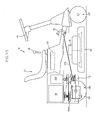
- Fig. 1 illustrates a side view of the working vehicle 1A.
- the working vehicle is embodied as a riding lawn mower. More specifically, the working vehicle 1 includes a vehicle frame 10, front wheels 15F and rear wheels 15R supported by the vehicle frame 10, a driver's seat 20 supported by the vehicle frame 10, a driving power source 25 supported by the vehicle frame 10 and having an output shaft that extends vertically, the CVT 100 interposed within the traveling system power transmission path extending from the driving power source 25 to wheels of the front wheels 15F and the rear wheels 15R that function as driving wheels, a mower device 30 supported by the vehicle frame 10 while being operatively driven by rotational power from the driving power source 25, a speed-change operating member 35 disposed in the vicinity of the driver's seat 20, and a steering member 40 disposed in the vicinity of the driver's seat 20.
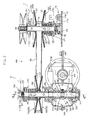
- Fig. 2 illustrates a vertical cross sectional view of the CVT 100.
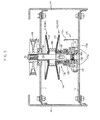
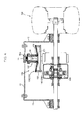
- Figs. 3 and 4 illustrate cross sectional views taken along the line III-III and the line IV-IV in Fig. 1 , respectively,
- the working vehicle 1 further includes a forward-rearward movement switching mechanism 300 and a differential gear mechanism 400, which are interposed in the traveling system power transmission path.
- the rear wheels 15 R function as the driving wheels.
- the CVT 100, the forward-rearward switching mechanism 300 and the differential gear mechanism 400 are interposed in the power transmission path extending from the driving power source 25 to the rear wheels 15 R.
- the front wheels 15F function as steering wheels that are steered in accordance with a manual operation on the steering member 40. Further, in the present embodiment, a rotational power is transmitted from the driving power source 25 to the mower device 30 by way of an endless element 185 such as V belt.
- the CVT 100 transmits rotational power from a driving shaft 50 to a driven shaft 55, both the shafts being arranged vertically in the traveling system power transmission path, and continuously changes a speed of the rotational power that is transmitted to the driven shaft 55.
- the CVT 10 includes a driving-side fixed pulley half or pulley sheave 110, a driving-side movable pulley half or pulley sheave 120, a driving-side biasing member 130, a driven-side fixed pulley half or pulley sheave 140, a driven-side movable pulley half or pulley sheave 150, a driven-side biasing member 160, a speed-change operating mechanism 170 and an endless element 180 such as V belt.
- the driving-side fixed pulley sheave 110 is supported on the driving shaft 50 in a relatively non-rotatable manner with respect thereto and in an axially immovable manner.
- the driving-side movable pulley sheave 120 is supported on the driving shaft 50 in a relatively non-rotatable manner with respect thereto and in an axially movable manner only within a predetermined distance while facing the driving-side fixed pulley sheave 110.
- the driving-side biasing member 130 presses the driving-side movable pulley sheave 120 toward the driving-side fixed pulley sheave 110.
- the driven-side fixed pulley sheave 140 is supported on the driven shaft 55 in a relatively non-rotatable manner with respect thereto and in an axially immovable manner.
- the driven-side movable pulley sheave 150 is supported on the driven shaft 55 in a relatively non-rotatable manner with respect thereto and in an axially movable manner only within a predetermined distance while facing the driven-side fixed pulley sheave 140.
- the driven-side biasing member 160 presses the driven-side movable pulley sheave 150 toward the driven-side fixed pulley sheave 140, and has a pressing force or a biasing force larger than the driving-side biasing member 130.
- the speed-change operating mechanism 170 increases the pressing force of the driven-side biasing member 130 in response to an operating force applied from an outside.
- the endless element 180 runs between a driving pulley and a driven pulley, the driving pulley including the driving-side fixed pulley sheave 110 and the driving-side movable pulley sheave 120, and the driven pulley including the driven-side fixed pulley sheave 140 and the driven-side movable pulley sheave 150.
- Bearing members 51a and 51b supporting upper and lower sides of the driving shaft 50 are supported by a cross members 11 and 12 that are fixed to the vehicle frame 10.
- a bearing member 56a supporting an upper side of the driven shaft 55 is supported by a cross member 13 that is fixed to the vehicle frame 10.
- the speed-change operating mechanism 170 includes an operating arm portion 170a, a pivotal shaft portion 170b and a fork portion 170c, wherein the pivotal shaft portion 170b is supported by the cross member 102 so as to be along a substantially horizontal direction.
- the CVT operates as follows. Since the driven-side biasing member 160 has the pressing force larger than the driving-side biasing member 130, a distance between the driven-side movable pulley sheave 150 and the driven-side fixed pulley sheave 140 becomes shortest when the speed-change operating mechanism 170 is at an initial state in which no operating force from an outside is applied thereto, so that a distance between the driving-side movable pulley sheave 120 and the driving-side fixed pulley sheave 110 becomes longest.
- the CVT 100 is in a minimum speed state (see Fig. 2 ) in which an effective diameter of the driving pulley formed by the driving-side fixed pulley sheave 110 and the driving-side movable pulley sheave 120 becomes smallest while an effective diameter of the driven pulley formed by the driven-side fixed pulley sheave 140 and the driven-side movable pulley sheave 150 becomes largest.
- the effective diameter is a distance from an axial center of the corresponding shaft to a position on which the endless element 180 runs in the corresponding pulley sheave.
- the speed-change operating mechanism 170 increases the pressing force of the driving-side biasing member 130 in accordance with the amount of the operating force. This causes the driving-side movable pulley sheave 120 to move towards the driving-side fixed pulley sheave 110 along the axial direction of the driving shaft 50, and the driven-side movable pulley sheave 150 accordingly moves apart from the driven-side fixed pulley sheave 140 along the axial direction of the driven shaft 55.
- a portion of the driving shaft 50 in which the driving-side movable pulley sheave 120 moves and a portion of the driven shaft 55 in which the driven-side movable pulley sheave 150 moves are preferably coated with low friction material.
- the driving shaft 50 is provided with a driving-side end cap 135 on a rear side (a side opposite to the driving-side fixed pulley sheave 110) of the driving-side movable pulley sheave 120.
- a coil spring forming the driving-side biasing member 130 has a first end engaged with the rear side of the driving-side movable pulley sheave 120 and a second end engaged with the driving-side end cap 135.
- the first end of the driving-side biasing member 130 is engaged with the rear side of the driving-side movable pulley sheave 120 via a contacting plate 136 (see Fig. 2 ) inserted around the driving shaft 50 in an axially movable manner.
- the driven shaft 55 is provided with a driven-side end cap 165 on a rear side (a side opposite to the driven-side fixed pulley sheave 140) of the driven-side movable pulley sheave 150.
- a coil spring forming the driven-side biasing member 160 has a first end engaged with the rear side of the driven-side movable pulley sheave 150 and a second end engaged with the driven-side end cap 165.
- the driven-side end cap 165 receives the pressing force from the driven-side biasing member 160 through an adjusting threaded mechanism 167 (see Fig. 2 ).
- the first end of the driven-side biasing member 160 is engaged with the rear side of the driven-side movable pulley sheave 150 via a contacting plate 166 (see Fig. 2 ) inserted around the driven shaft 55 in an axially movable manner.
- the driving-side end cap 135 is supported by the driving shaft 50 while being operatively connected to the speed-change operating mechanism 170 in such a manner that the cap 135 is positioned at an initial position in the axial direction when the speed-change operating mechanism 170 applies no pressing force thereto, and moves to one side in the axial direction that is towards the driving-side fixed pulley sheave 110 as the pressing force by the speed-change operating mechanism 170 increases.
- the initial position is defined by an adjusting threaded mechanism 138 that is engaged with the driving-side end cap 135 through a pressure plate 137.
- the fork portion 170c of the speed-change operating mechanism 170 has a free end engaged with a rear side of the pressure plate 137, so that the operating force that is transmitted from the speed-change operating mechanism 170 through the pressure plate 137 to the driving-side end cap 135 causes the driving-side end cap 135 to move to the one side (the upper side in Fig. 2 ) in the axial direction against the pressing force.
- the driven-side end cap 165 is supported by the driven shaft 55 in such a manner as to be immovable from a predetermined position in the axial direction to a side opposite to one side in the axial direction that is towards the driven-side fixed pulley sheave 140.
- the predetermined position is defined by the adjusting threaded mechanism 167 that comes into contact with the driven-side end cap 165.
- the adjusting threaded mechanism 138 and 167 define a maximum reduction position of the CVT shown in Fig. 2 .
- the speed-change operating mechanism 170 may take various configurations as long as it increases the pressing force of the driving-side biasing member 130 in accordance with a manual operation on the speed-change operating member 35.
- the speed-change operating mechanism 170 is operatively connected to the speed-change operating member 35 through a mechanical link 175.
- the working vehicle may be provided with a sensor (not shown) that detects an operating amount of the speed-change operating member 35, an actuator (not shown) that actuates the speed-change operating mechanism 170 and a control device (not shown).
- the control device operates the actuator based on a signal from the sensor.
- the forward-rearward movement switching mechanism 300 changes a driving direction of the driving wheels in accordance with an operation from an outside.
- the forward-rearward movement switching mechanism 300 is arranged between the CVT 100 and the differential gear mechanism 400 with respect to a power transmission direction.
- the forward-rearward movement switching mechanism 300 selectively realizes a forward movement state, a rearward movement or a neutral state.
- the forward movement state is a power transmission state in which the rotational power for the forward movement is transmitted from the driven shaft 55 to the differential gear mechanism 400.
- the rearward movement state is a power transmission state in which the rotational power for the rearward movement is transmitted from the driven shaft 55 the differential gear mechanism 400.
- the neutral state is a state in which the power transmission from the driven shaft 55 to the differential gear mechanism 400 is interrupted.
- the forward-rearward movement switching mechanism 300 includes a forward-rearward movement input shaft 310 operatively connected to the driven shaft 55, a forward-rearward movement output shaft 350 operatively connected to the differential gear mechanism 400, a forward movement bevel gear 320, a rearward movement bevel gear 325, a switching slider 330 and a driven-side bevel gear.
- the forward movement bevel gear 320 and the rearward movement bevel gear 325 are supported by the forward-rearward movement input shaft 310 in a relatively rotatable manner around an axis line with respect thereto while being apart from each other.
- the switching slider 330 is supported by the forward-rearward movement input shaft 310 between the forward movement bevel gear 320 and the rearward movement bevel gear 325.
- the switching slider 330 is relatively non-rotatable around the axis line with respect to the shaft 310 and axially movable along the axis line, and moved along the axis line in accordance with an operation from an outside.
- the driven-side bevel gear 340 is supported by the forward-rearward movement output shaft 350 in a relatively non-rotatable manner with respect thereto while being engaged with the forward movement bevel gear 320 and the rearward movement bevel gear 325.
- the forward-rearward movement input shaft 310 is integrally formed with the driven shaft 55. That is, a single shaft functions as both the driven shaft 55 and the forward-rearward movement input shaft 310. It is, of course, possible that the two shafts are formed separately and connected to each other in a relatively non-rotatable manner around an axis line.
- the forward movement bevel gear 320 and the rearward movement bevel gear 325 have engagement protrusions 321 and 326 at respective surfaces facing the switching slider 330.
- the switching slider 330 has a forward movement engagement protrusion 331 capable of engaging with the engagement protrusion 321 of the forward movement bevel gear 320, and a rearward movement engagement protrusion 332 capable of engaging with the engagement protrusion 326 of the rearward movement bevel gear 325.
- the switching slider 330 selectively takes a neutral position (see Fig. 2 ), a forward position or a rearward position in accordance with an operation from an outside.
- the forward movement engagement protrusion 331 does not engage with the engagement protrusion 321 of the forward movement bevel gear 320 and the rearward movement engagement protrusion 332 also does not engage with the engagement protrusion 326 of the rearward movement bevel gear 325.
- the switching slider 330 is moved to one side in the axis line from the neutral position to be positioned at the forward position
- the forward movement engagement protrusion 331 engages with the engagement protrusion 321 of the forward movement bevel gear 320.
- the rearward movement engagement protrusion 332 engages with the engagement protrusion 326 of the rearward movement bevel gear 325.
- the switching slider 330 receives the operating force from the outside through an operating arm 335 (see Fig. 1 ).
- the forward-rearward movement switching mechanism 300 is preferably provided with a detent mechanism 360.
- the detent mechanism 360 prevents the switching slider 330 from unintentionally moving along the axis line while allowing the switching slider 360 to move along the axis line among the forward position, the neutral position and the rearward position when an operating force larger than a predetermined amount is applied to the switching slider 330.
- FIG. 5 illustrates a vertical cross sectional rear view of a forward-rearward movement switching mechanism 300B according to a first modification.
- the same reference numerals are denoted for the same components as those of the forward-rearward movement switching mechanism 300 to omit the detailed explanation thereof.
- the forward-rearward movement switching mechanism 300B includes the forward-rearward movement input shaft 310, the forward-rearward movement output shaft 350, a forward movement bevel gear 320B, a rearward movement bevel gear 325B, a switching slider 330B and the driven-side bevel gear 340.
- the forward movement bevel gear 320B and the rearward movement bevel gear 325B are supported by the forward-rearward movement input shaft 310 in a relatively rotatable manner around the axis line with respect thereto while being apart from each other.
- the switching slider 330B is supported by the forward-rearward movement input shaft 310 between the forward movement bevel gear 320B and the rearward movement bevel gear 325B.
- the switching slider 330B is relatively non-rotatable around the axis line with respect to the shaft 310 and axially movable along the axis line, and moved along the axis line in accordance with an operation from an outside.
- the forward movement engagement protrusion 331 or the rearward movement engagement protrusion 332 engages with the engagement protrusion 321 of the forward movement bevel gear 320 or the engagement protrusion 326 of the rearward movement bevel gear 325, so that the rotational power is transmitted from the forward-rearward movement input shaft 310 to the corresponding bevel gear 320 or 325 through the switching slider 330, as described earlier.
- the switching slider 330B transmits the rotational power from the forward-rearward movement input shaft 310 to the corresponding bevel gear 320B or 325B by a frictional engagement.
- the forward movement bevel gear 320B and the rearward movement bevel gear 325B have concave frictional engagement surfaces 321B and 326B at respective surfaces facing the switching slider 330B.
- the switching slider 330B has a convex frictional engagement surface for forward movement 331B at a surface facing the forward movement bevel gear 320B, and a convex frictional engagement surface for rearward movement 332B at a surface facing the rearward movement bevel gear 325B.
- the switching slider 33B selectively takes a neutral position (see Fig. 5 ), a forward position or a rearward position in accordance with an operation from an outside.
- a neutral position see Fig. 5
- the frictional engagement surface for forward movement 331B does not engage with the frictional engagement surface 321B of the forward movement bevel gear 320B and the frictional engagement surface for rearward movement 332B also does not engage with the frictional engagement surface 326B of the rearward movement bevel gear 3258.
- the switching slider 330B is moved to one side in the axis line from the neutral position to be positioned at the forward position, the frictional engagement surface for forward movement 331B engages with the frictional engagement surface 321B of the forward movement bevel gear 320B.
- Fig. 6 illustrates a vertical cross sectional rear view of a forward-rearward movement switching mechanism 300C according to a second modification.
- the same reference numerals are denoted for the same components as those of the forward-rearward movement switching mechanism 300 or the first modification 300B to omit the detailed explanation thereof.
- the switching slider 330, 330B is supported by the forward-rearward movement input shaft 310.
- the switching slider 330C is supported by the forward-rearward movement output shaft 350.
- the forward-rearward movement switching mechanism 300C includes the forward-rearward movement input shaft 310, the forward-rearward movement output shaft 350, a driving-side bevel gear 315 supported by the forward-rearward movement input shaft 310 in a relatively non-rotatable manner around the axis line with respect thereto, a forward movement bevel gear 320C, a rearward movement bevel gear 325C, and a switching slider 330C.
- the forward movement bevel gear 320C and the rearward movement bevel gear 325C are supported by the forward-rearward movement output shaft 350 in a relatively rotatable manner around the axis line with respect thereto while being engaged with the driving-side bevel gear 315 and being apart from each other.
- the switching slider 330C is supported by the forward-rearward movement output shaft 350 between the forward movement bevel gear 320C and the rearward movement bevel gear 325C.
- the switching slider 330C is relatively non-rotatable around the axis line with respect to the shaft 350 and axially movable along the axis line, and moved along the axis line in accordance with an operation from an outside.
- the forward movement bevel gear 320C and the rearward movement bevel gear 325C have concave frictional engagement surfaces 321C and 326C at respective surfaces facing the switching slider 330C.
- the switching slider 330C has a convex frictional engagement surface for forward movement 331C at a surface facing the forward movement bevel gear 320C, and a convex frictional engagement surface for rearward movement 332C at a surface facing the rearward movement bevel gear 325C.
- the switching slider 330C selectively takes a neutral position (see Fig. 6 ), a forward position or a rearward position in accordance with an operation from an outside.
- the frictional engagement surface for forward movement 331C does not engage with the frictional engagement surface 321C of the forward movement bevel gear 320C and the frictional engagement surface for rearward movement 332C also does not engage with the frictional engagement surface 326C of the rearward movement bevel gear 325C.
- the switching slider 330C is moved to one side in the axis line from the neutral position to be positioned at the forward position, the frictional engagement surface for forward movement 331C engages with the frictional engagement surface 321C of the forward movement bevel gear 320C.
- Figs. 7A and 7B illustrate cross sectional views of the fixed pulley sheave 110, 14o and the movable pulley sheave 120, 150, respectively.
- the pulley sheaves 110, 120, 140, 150 are common one another in that each of them includes a pulley forming body 200 having a tubular portion 210 and a main body portion 230.
- the tubular portion 210 is inserted around the corresponding shaft in an axially movable manner.
- the main body portion 230 extends radially outward from one side of the tubular portion 210 in an axis line direction, and have a conical friction surface 231 inclined in such a manner as to be positioned closer to the other side of the tubular portion in the axis line direction as it goes from an inner side to an outer side in a radial direction.
- Fig. 8 illustrates a vertical cross sectional view of the pulley forming body 200. As shown in Figs. 7A and 8 , each of the pulley forming bodies 200 that forms the driving-side and driven-side fixed pulley sheaves 110, 140 is formed with a fixing hole 211 at the tubular portion 210.
- the fixing hole 211 is formed so that a pin 58 provided at the corresponding shaft 50 (55) is inserted therein so that each of the driving-side and driven-side fixed pulley sheaves 110, 140 is relatively non-rotatable around the axis line with respect to the corresponding shaft 50 (55) and immovable along the axis line.
- each of the pulley forming bodies 200 that forms the driving-side and driven-side movable pulley sheaves 120, 150 is formed with a sliding slot 212 at the tubular portion 210.
- the sliding slot 212 is formed so that a pin 59 provided at the corresponding shaft 50 (55) is inserted therein and allow the tubular portion 210 to be moved in the axis line of the corresponding shaft 50 (55) only within a predetermined distance.
- the engagement of the pin 59 into the sliding slot 212 causes the driving-side and driven-side movable pulley sheave 120, 150 to be relatively non-rotatable around the axis line with respect to the corresponding shaft 50 (55) but axially movable along the axis line only within the distance corresponding to a length of the sliding slot 212 in the axis line direction.
- the driving-side fixed pulley sheave 110 and the driven-side fixed pulley sheave 140 are obtained by forming the fixing hole 211 in the pulley forming body 200, while the driving-side movable pulley sheave 120 and the driven-side movable pulley sheave 150 are obtained by forming the sliding slot 212 in the pulley forming body 200.
- all of the two pulley sheaves 110, 120 forming the driving pulley and the two pulley sheaves 140, 150 forming the driven pulley are common one another in that they have the pulley forming bodies as base materials, thereby realizing cost reduction as much as possible by common use of the pulley forming body.
- a driving-side fixed pulley sheave, a driving-side movable pulley sheave, a driven-side fixed pulley sheave and a driven-side movable pulley sheave incudes tubular portions and main body portions extending radially outward from the tubular portions.
- the tubular portion of the driving-side fixed pulley sheave is inserted around a corresponding driving shaft, while the tubular portion of the driving-side movable pulley sheave is inserted around the tubular portion of the driving-side fixed pulley sheave.
- the tubular portion of the driven-side fixed pulley sheave is inserted around a corresponding driven shaft, while the tubular portion of the driven-side movable pulley sheave is inserted around the tubular portion of the driven-side fixed pulley sheave.
- the tubular portion of the fixed pulley sheave and the tubular portion of the movable pulley sheave are different from each other with respect to dimensions of inner and outer diameters. Further, the difference between the outer diameters of the tubular portion of the fixed pulley sheave and the tubular portion of the movable pulley sheave causes a difference between the main body portion fixed to the tubular portion of the fixed pulley sheave and the main body portion fixed to the tubular portion of the movable pulley sheave with respect to a dimension of an inner diameter.
- the conventional CVT needs an exclusive tubular portion and an exclusive main body portion for forming the fixed pulley sheave, and another exclusive tubular portion and another exclusive main body portion for forming the movable pulley sheave, resulting in increase of manufacturing cost.
- the driving-side fixed pulley sheave 110, the driving-side movable pulley sheave 120, the driven-side fixed pulley sheave 140 and the driven-side movable pulley sheave 150 are made from the common materials, i.e. the pulley forming bodies 200 including the tubular portions 210 and the main body portions 230. Accordingly, the present embodiment can realize a cost reduction as much as possible by common application of the pulley forming body.
- the tubular portion 210 of the pulley forming body 200 that forms the driving-side fixed pulley sheave 110 and the driven-side fixed pulley sheave 140 includes a large diameter portion that is positioned on one side in an axis line direction and has a large diameter, and a small diameter portion 225 that extends towards the other side in the axis line direction from the large diameter portion 220 through a step 226 and has a diameter smaller than that of the large diameter portion 220.
- the configuration can utilize the step 226 as an engagement portion with which an inner ring of the bearing member 51a (see Fig. 1 ) engages, so that the fixed pulley sheave 110 (140) can be effectively prevented from moving to the other side in the axis line direction while being relatively rotatable around the axis line with respect to the corresponding shaft 50 (55).
- the small diameter portion 225 can be easily formed by, for example, cutting a predetermined area out of an outer surface of the tubular portion 210 of the pulley forming body 200.
- the tubular portion 210 of the pulley forming body 200 that forms the movable pulley sheave 150 may be preferably formed with a sliding slot 213 in place of the sliding slot 212.
- the sliding slot 213 includes a cam region 214 that allows the tubular portion 210 to move from the one side to the other side in the axis line direction of the corresponding driven shaft 55 and also causes the tubular portion 210 to rotate from one side to the other side around the axis line of the corresponding driven shaft 55 in response to the movement of the tubular portion 210 from the one side to the other side in the axis line direction.
- the configuration can realize an automatic speed change in response to a travelling load or resistance applied to the driving wheels (the rear wheels 15R in the present embodiment) that are operatively connected to the driven shaft 55, in addition to a speed change based on a manual operation through the speed change operating mechanism 170.
- the main body portion 230 and the tubular portion 210 of the pulley forming body 200 are formed separately, and are fixed to each other by welding or the like.
- the main body portion 230 is made from a main body portion forming member 235, while the tubular portion 210 is made from a tubular portion forming member 215 that is separate from the main body portion forming member 235.
- the main body portion forming member 235 includes a radially-inward portion 236 that is formed with a center hole having a predetermined diameter, and a radially-outward portion 237 that extends radially outward from the radially-inward portion 236 and has the friction surface 231.
- the tubular portion forming member 215 includes an inserted portion 216 that is inserted into the center hole while being come into contact with an inner circumference surface of the center hole, and a flange portion 217 that extends radially outward from one side of the inserted portion 216 in the axis line direction.
- the large diameter portion 220 functions as the inserted portion 216 (see Fig. 7A ).
- the radially-inward portion 236 includes an outer surface 236a and an inner surface 236b that faces to one direction same as and the other direction opposite to the friction surface 231 with respect to the axis line direction.
- the outer surface 236a functions as a flange portion-engagement surface that engages with the flange portion 217. That is, the tubular portion forming member 215 is fixed to the main body portion forming member 235 by welding or the like in a state where the flange portion 217 is come into contact with the outer surface 236a and the inserted portion 216 is inserted into the center hole.
- the inner surface 236b functions as a stopper that directly or indirectly engages with a first end of the corresponding biasing member 130, 160.
- the inner surface 236b engages with the first end of the corresponding biasing member 130, 160 through the contacting plate 136, 166.
- the outer surface 236a and the inner surface 236b are preferably formed to be substantially orthogonal to the axis line of the tubular portion 210.
- the configuration can realize a stable engagement between the flange portion 217 and the outer surface 236a, and a stable engagement between the biasing member 130, 160 and the inner surface 236b.
- the radially-inward portion 236 is concaved from a radially inner end of the radially-outward portion 237, and the flange portion 217 is disposed within a concave portion defined by the radially-inward portion 236.
- the preferable configuration can stably fix the tubular portion 210 and the main body portion 230 to each other while preventing the tubular portion from protruding axially outward from the friction surface 231.
- a CVT 100B according to the present embodiment is mainly different from the CVT 100 according to the first embodiment in that the CVT 100B includes a brake structure 250 capable of selectively applying a braking force to a travelling system power transmission path in which the CVT 100B is arranged.
- FIG. 10 illustrates a side view of the working vehicle 1B.
- the same reference numerals are denoted for the same components as those of the first embodiment to omit the detailed explanation thereof.
- the working vehicle 1B is embodied as a riding lawn mower. More specifically, the working vehicle 1B includes the vehicle frame 10, the front wheels 15F, the rear wheels 15R, the driver's seat 20, a driving power source 25B supported by the vehicle frame 10 and having an output shaft that extends vertically, the CVT 100B, the mower device 30, the speed-change operating member 35 and the steering member 40.
- the driving power source 25B is embodied as an electric motor capable of switching a rotational direction of an output to a forward direction or a reverse direction.
- the working vehicle 1B is further provided with a battery 26 that functions as a power source of the electric motor 25B.
- the working vehicle 1B is further provided with a control device 80.
- the control device 80 controls the electric motor 25B so as to output a constant rotational power in one direction of the forward and reverse directions that is defined by a manual operation on a forward-rearward movement switching operating member 36 arranged in the vicinity of the driver's seat 20.
- the mower device 30 is operatively driven by an electric motor for mower device 31 that is separate from the electric motor 25B.
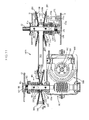
- Fig. 11 illustrates a vertical cross sectional view of the CVT 100B.
- the CVT 100B as well as the CVT 100 can transmit the rotational power from the driving shaft 50 to the driven shaft 55, and continuously vary the speed of the rotational power that is transmitted to the driven shaft 55.
- the CVT 100B includes a driving-side fixed pulley half or pulley sheave 110B, a driving-side movable pulley half or pulley sheave 120B, the driving-side biasing member 130, a driven-side fixed pulley half or pulley sheave 140B, a driven-side movable pulley half or pulley sheave 150B, the driven-side biasing member 160, the speed-change operating mechanism 170 and the endless element 180.
- the pulley sheaves 110B, 120B, 140B, 150B have the substantially same configurations as the pulley sheaves 110, 120, 140, 150, respectively, except that the main body portion 230 is formed with engaged portions 260 at an outer peripheral edge.
- the paired fixed pulley sheave 110B (140B) and the movable pulley sheave 120B (150B) arranged to face each other are supported by the corresponding shaft 50 (55) in such a manner that the distance between the respective friction surfaces 231 becomes larger as it goes from the inner side to the outer side in the radial direction.
- the working vehicle 1B further includes a differential gear device 500 that is interposed in the traveling system power transmission path so as to be positioned on a downstream side of the CVT 1008 with respect to the power transmission direction.
- the differential gear device 500 differentially transmits to paired right and left driving axles 501 the rotational power that has been input from the CVT 100B.
- the paired right and left rear wheels 15R functioning as the driving wheels are operatively and respectively driven by the paired driving axles 501.
- Fig. 11 also shows a switching slider 550 that switches a power transmission state of the differential gear device 500 between a differential state and a differential-lock state, and a pressing mechanism 600 that presses the switching slider 550 in accordance with an operation from an outside.
- the pressing mechanism 600 is operatively connected to a differential switching operating member (not shown) arranged in the vicinity of the driver's seat 20 through a suitable link mechanism 629 (see Fig. 12 , which is explained later).
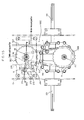
- Fig. 12 illustrates a cross sectional view taken along the line XII-XII in Fig. 11 .
- the brake structure 250 includes the plural engaged portions 260, a brake actuating arm 270 and an engaging portion 280.
- the plural engaged portions 260 are arranged over the whole outer peripheral edge of any one of the pulley sheaves 110B, 120B, 140B, 150B.
- the brake actuating arm 270 can be swung around a swinging axis line 250X parallel to a rotational axis line of the one pulley sheave.
- the engaging portion is provided at the brake actuating arm 270.
- the plural engaged portions 260 are provided in the driven-side fixed pulley sheave 140B.
- the engaged portion 260 is formed to have a concave shape opening radially outward or a convex shape projecting radially outward.
- the plural engaged portions 260 are formed in such a manner that an area between the adjacent engaged portions 260 has a different radius from that of the engaged portion 260.
- the engaged portion 260 has a concave shape opening radially outward.
- the engaging portion 280 has a shape capable of engaging with the engaged portion 260.
- the engaged portion 260 has the concave shape opening radially outward. Accordingly, the engaging portion 280 is formed to have a convex shape.
- the brake actuating arm 270 can selectively take a brake applying position (shown with dashed line in Fig. 12 ) and a brake released position (shown with solid line in Fig. 12 ) around the swinging axis line 250X in accordance with an operation from an outside.
- the engaging portion 280 engages with any one of the plural engaged portions 260.
- the engaging portion 280 is apart from the plural engaged portions 260.
- a supporting shaft 255 is provided in the vicinity of the pulley sheave 140B that is formed with the plural engaged portions 260, the shaft 255 being parallel to the rotational axis line of the pulley sheave 140B.
- the brake actuating arm 270 is supported by the supporting shaft 255.
- the supporting shaft 255 is supported by a housing 60 that accommodates the differential gear device 500.
- the brake actuating arm 270 includes a proximal portion 271 which is supported by the supporting shaft 255, and a first arm portion 272 which extends radially outward from the proximal portion 271 and at which the engaging portion 280 is provided.
- the brake actuating arm 270 further includes a second arm portion 273 extending radially outward from the proximal portion 271.
- the second arm portion 273 is operatively connected through a suitable link mechanism 275 to a brake operating member (not shown) that is arrange in the vicinity of the driver's seat 20.
- the engaging portion 280 provided at the brake actuating arm 270 engages with any one of the plural engaged portions 260 provided at the outer peripheral edge of one pulley sheave out of the plural pulley sheaves 110B, 120B, 140B, 150B, so that the braking force is applied to the traveling system power transmission path.
- the CVT 100B can realize miniaturization and cost reduction with respect to the whole traveling system power transmission path in comparison with the conventional configuration that includes a brake mechanism separate from the corresponding CVT.
- the plural engaged portions 260 are provided at the driven-side fixed pulley sheave 140B that is supported by the corresponding driven shaft 102 in a relatively immovable manner in the axis line with respect thereto.
- the configuration makes it possible that the engaging portion 280 stably engages with any one of the plural engaged portions 260.
- Figs. 13A and 13B illustrate a plan view and a partially vertical cross sectional side view of the driven-side fixed pulley sheave 140B, respectively.
- the driving-side fixed pulley sheave 110B has the same configuration as the driven-side fixed pulley sheave 140B. Therefore, a following explanation can be also applied to the driving-side fixed pulley sheave 110B.
- the driven-side fixed pulley sheave 140B includes the tubular portion 210 and the main body portion 230, the tubular portion 210 being supported by the corresponding driven shaft 55 in a relatively non-rotatable manner around the axis line with respect thereto and in an axially immovable manner along the axis line, the main body portion 230 extending radially outward from the tubular portion 210.
- the tubular portion 210 is formed with the fixing hole 211 penetrating between the inner and outer circumferential surfaces thereof, and is immovable along the axis line of the corresponding driven shaft 55 by way of the pin 58 (see Fig. 11 ) that is inserted into the fixing hole 211.
- the main body portion 230 is fixed to the tubular portion 210 on one side of the tubular portion 210 in the axis line direction, and has the conical friction surface 231 inclined in such a manner as to be positioned closer to the other side in the axis line direction as it goes from the inner side to the outer side in the radial direction.
- the plural engaged portions 260 are provided so as to be all over the outer peripheral edge of the main body portion thus configured.
- the tubular portion 210 and the main body portion 230 are formed separately to each other.
- the main body portion 230 is inserted around the tubular portion 210 at one side thereof in the axis line direction and fixed thereto by welding or the like.
- the driving-side fixed pulley sheave 110B, the driving-side movable pulley sheave 120B, the driven-side fixed pulley sheave 140B and the driven-side movable pulley sheave 150B have common base structures, thereby reducing the manufacturing cost.
- the pulley sheaves 110B, 120B, 140B, 150B are common one another in that they include pulley forming bodies 200B.
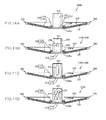
- Fig. 14A illustrates a vertical cross sectional view of the pulley forming body 200B. As shown in Fig. 14A , the pulley forming body 200B is different from the pulley forming body 200 only in that it is provided with the plural engaged portions 260.
- Figs. 14B and 14C illustrate vertical cross sectional side views of the fixed pulley sheave 110B (140B) and the movable pulley sheave 120B (150B), respectively.
- Fig. 14D illustrates a vertical cross sectional view of the movable pulley sheave 150B modified so as to have the sliding slot 213 with the cam region 214 in place of the sliding slot 212.
- the main body portion 230 and the tubular portion 210 are formed separately and fixed to each other by welding or the like.
- the main body portion 230 is made from the main body portion forming member 235 while the tubular portion 210 is made from the tubular portion forming member 215 that is separate from the main body portion forming member 235.
- the main body portion forming member 235 includes the radially-inward portion 236 that is formed with the center hole having a predetermined diameter, and the radially-outward portion 237 that extends radially outward from the radially-inward portion 236 and has the friction surface 231.
- the plural engaged portions 260 are provided at the outer peripheral edge of the radially-outward portion 237.
- Fig. 15 illustrates a partially horizontal cross sectional view of a working vehicle to which a CVT 100C according to the present embodiment is applied.
- Fig. 15 corresponds to Fig. 12 in the first embodiment.
- Fig. 16 illustrates a cross sectional view taken along the line XVI-XVI in Fig. 15 .
- the same reference numerals are denoted for the same components as those of the aforementioned embodiments to omit the detailed explanation thereof.
- the CVT 100C according to the present embodiment includes a brake structure 250' in place of the brake structure 250 in comparison with the CVT 100B according to the second embodiment.
- the brake structure 250' applies the braking force to the traveling system power transmission path using the driving-side fixed pulley sheave 110B rather than the driven-side fixed pulley sheave 140B.
- the plural engaged portions 260 are provided at the driving-side fixed pulley sheave 110B.
- the brake actuating arm 270 is supported by the supporting shaft 255.
- the supporting shaft 255 is supported by the cross member 11 so as to be positioned in the vicinity of the corresponding pulley sheave 110B and be parallel to the rotational axis of the pulley sheave 110B.
- the CVT 100C according to the present embodiment can realize the same effect as the CVT 100B according to the second embodiment.
Landscapes
- Engineering & Computer Science (AREA)
- General Engineering & Computer Science (AREA)
- Mechanical Engineering (AREA)
- Transmissions By Endless Flexible Members (AREA)
- Pulleys (AREA)
Applications Claiming Priority (2)
| Application Number | Priority Date | Filing Date | Title |
|---|---|---|---|
| JP2011270405A JP5842238B2 (ja) | 2011-12-09 | 2011-12-09 | プーリー式無段変速機構 |
| JP2012023001A JP5870333B2 (ja) | 2012-02-06 | 2012-02-06 | プーリー式無段変速機構及びプーリー半体 |
Publications (3)
| Publication Number | Publication Date |
|---|---|
| EP2602513A2 true EP2602513A2 (de) | 2013-06-12 |
| EP2602513A3 EP2602513A3 (de) | 2013-07-31 |
| EP2602513B1 EP2602513B1 (de) | 2014-10-22 |
Family
ID=46603702
Family Applications (1)
| Application Number | Title | Priority Date | Filing Date |
|---|---|---|---|
| EP12178658.6A Not-in-force EP2602513B1 (de) | 2011-12-09 | 2012-07-31 | Kontinuierlich variable Riemenübertragung |
Country Status (2)
| Country | Link |
|---|---|
| US (1) | US20130150190A1 (de) |
| EP (1) | EP2602513B1 (de) |
Families Citing this family (5)
| Publication number | Priority date | Publication date | Assignee | Title |
|---|---|---|---|---|
| WO2015039231A1 (en) * | 2013-09-20 | 2015-03-26 | Transmission Cvtcorp Inc. | Drive assembly provided with a continuously variable transmission and a direction reversing mechanism |
| US20150133247A1 (en) * | 2013-11-13 | 2015-05-14 | Shawn Watling | Snow mobile drive assembly |
| ITUB20156910A1 (it) * | 2015-12-10 | 2017-06-10 | Piaggio & C Spa | Dispositivo di trasmissione a variazione continua con dispositivo di variazione della curva di cambiata |
| US11732786B2 (en) * | 2021-07-30 | 2023-08-22 | Textron Innovations Inc. | Continuously variable transmission having tunable acceleration and deceleration |
| WO2023192166A1 (en) * | 2022-03-29 | 2023-10-05 | Gates Corporation | Cam-controlled continuously variable transmission systems |
Citations (1)
| Publication number | Priority date | Publication date | Assignee | Title |
|---|---|---|---|---|
| JPH01283454A (ja) | 1988-05-10 | 1989-11-15 | Yamaha Motor Co Ltd | Vベルト無段変速機 |
Family Cites Families (3)
| Publication number | Priority date | Publication date | Assignee | Title |
|---|---|---|---|---|
| US3638506A (en) * | 1970-08-03 | 1972-02-01 | Avco Corp | Variable pulley assembly |
| TWI225912B (en) * | 2003-09-12 | 2005-01-01 | Ind Tech Res Inst | The mechanism for reverse gear of a belt-type continuously variable transmission |
| JP5030815B2 (ja) * | 2008-02-28 | 2012-09-19 | アイシン・エィ・ダブリュ株式会社 | プーリ構造およびベルト式の無段変速機 |
-
2012
- 2012-07-11 US US13/546,886 patent/US20130150190A1/en not_active Abandoned
- 2012-07-31 EP EP12178658.6A patent/EP2602513B1/de not_active Not-in-force
Patent Citations (1)
| Publication number | Priority date | Publication date | Assignee | Title |
|---|---|---|---|---|
| JPH01283454A (ja) | 1988-05-10 | 1989-11-15 | Yamaha Motor Co Ltd | Vベルト無段変速機 |
Also Published As
| Publication number | Publication date |
|---|---|
| EP2602513A3 (de) | 2013-07-31 |
| EP2602513B1 (de) | 2014-10-22 |
| US20130150190A1 (en) | 2013-06-13 |
Similar Documents
| Publication | Publication Date | Title |
|---|---|---|
| USRE50828E1 (en) | Driving-side pulley | |
| KR101791012B1 (ko) | 무한 가변 변속기들, 연속 가변 변속기들, 이들에 대한 방법들, 어셈블리들, 서브어셈블리들, 및 구성요소들 | |
| EP2602513B1 (de) | Kontinuierlich variable Riemenübertragung | |
| US9005058B2 (en) | Belt-type stepless transmission | |
| US7674197B2 (en) | Continuously variable transmission driven-pulley cam having three cam surfaces and roller therefor | |
| JP2013160287A (ja) | デファレンシャルギヤ装置 | |
| EP2653748B1 (de) | Stufenloses Getriebe und Nutzfahrzeug | |
| JPH08240250A (ja) | ベルト式自動変速機 | |
| US20160047457A1 (en) | Shaft supporting structure of belt-driven continuously variable transmission | |
| US5848949A (en) | Infinitely variable speed transmission | |
| US20140031155A1 (en) | Driven-Side Pulley | |
| WO2010083019A1 (en) | Automatic drive system for lawn tractor having single lever control for vehicle drive belt | |
| US8790199B2 (en) | Radial diaphragm spring clutch | |
| JP5842238B2 (ja) | プーリー式無段変速機構 | |
| JP2005172115A (ja) | 車軸駆動装置の歯車切換機構 | |
| JP6060121B2 (ja) | プーリ装置 | |
| JPH07117133B2 (ja) | Vベルト式無段変速機 | |
| JP5870333B2 (ja) | プーリー式無段変速機構及びプーリー半体 | |
| JP2005106080A (ja) | ベルト式無段変速機の変速プーリおよびベルト式無段変速機用平プーリ | |
| JP2001349404A (ja) | 円錐摩擦伝動式無断変速機 | |
| JP2014139471A (ja) | 出力回転方向切換装置 | |
| KR20100024754A (ko) | 무단변속기 | |
| KR20140113091A (ko) | 무단 변속기 | |
| JPH058113U (ja) | 無段変速機 | |
| JPH11294578A (ja) | 変速機のニュートラル保持装置 |
Legal Events
| Date | Code | Title | Description |
|---|---|---|---|
| PUAI | Public reference made under article 153(3) epc to a published international application that has entered the european phase |
Free format text: ORIGINAL CODE: 0009012 |
|
| AK | Designated contracting states |
Kind code of ref document: A2 Designated state(s): AL AT BE BG CH CY CZ DE DK EE ES FI FR GB GR HR HU IE IS IT LI LT LU LV MC MK MT NL NO PL PT RO RS SE SI SK SM TR |
|
| AX | Request for extension of the european patent |
Extension state: BA ME |
|
| PUAL | Search report despatched |
Free format text: ORIGINAL CODE: 0009013 |
|
| AK | Designated contracting states |
Kind code of ref document: A3 Designated state(s): AL AT BE BG CH CY CZ DE DK EE ES FI FR GB GR HR HU IE IS IT LI LT LU LV MC MK MT NL NO PL PT RO RS SE SI SK SM TR |
|
| AX | Request for extension of the european patent |
Extension state: BA ME |
|
| RIC1 | Information provided on ipc code assigned before grant |
Ipc: F16H 55/56 20060101AFI20130627BHEP |
|
| 17P | Request for examination filed |
Effective date: 20131220 |
|
| RBV | Designated contracting states (corrected) |
Designated state(s): AL AT BE BG CH CY CZ DE DK EE ES FI FR GB GR HR HU IE IS IT LI LT LU LV MC MK MT NL NO PL PT RO RS SE SI SK SM TR |
|
| GRAP | Despatch of communication of intention to grant a patent |
Free format text: ORIGINAL CODE: EPIDOSNIGR1 |
|
| INTG | Intention to grant announced |
Effective date: 20140611 |
|
| GRAS | Grant fee paid |
Free format text: ORIGINAL CODE: EPIDOSNIGR3 |
|
| GRAA | (expected) grant |
Free format text: ORIGINAL CODE: 0009210 |
|
| AK | Designated contracting states |
Kind code of ref document: B1 Designated state(s): AL AT BE BG CH CY CZ DE DK EE ES FI FR GB GR HR HU IE IS IT LI LT LU LV MC MK MT NL NO PL PT RO RS SE SI SK SM TR |
|
| REG | Reference to a national code |
Ref country code: GB Ref legal event code: FG4D |
|
| REG | Reference to a national code |
Ref country code: CH Ref legal event code: EP |
|
| REG | Reference to a national code |
Ref country code: AT Ref legal event code: REF Ref document number: 692812 Country of ref document: AT Kind code of ref document: T Effective date: 20141115 |
|
| REG | Reference to a national code |
Ref country code: IE Ref legal event code: FG4D |
|
| REG | Reference to a national code |
Ref country code: DE Ref legal event code: R096 Ref document number: 602012003477 Country of ref document: DE Effective date: 20141204 |
|
| REG | Reference to a national code |
Ref country code: NL Ref legal event code: VDEP Effective date: 20141022 |
|
| REG | Reference to a national code |
Ref country code: AT Ref legal event code: MK05 Ref document number: 692812 Country of ref document: AT Kind code of ref document: T Effective date: 20141022 |
|
| REG | Reference to a national code |
Ref country code: LT Ref legal event code: MG4D |
|
| PG25 | Lapsed in a contracting state [announced via postgrant information from national office to epo] |
Ref country code: PT Free format text: LAPSE BECAUSE OF FAILURE TO SUBMIT A TRANSLATION OF THE DESCRIPTION OR TO PAY THE FEE WITHIN THE PRESCRIBED TIME-LIMIT Effective date: 20150223 Ref country code: ES Free format text: LAPSE BECAUSE OF FAILURE TO SUBMIT A TRANSLATION OF THE DESCRIPTION OR TO PAY THE FEE WITHIN THE PRESCRIBED TIME-LIMIT Effective date: 20141022 Ref country code: NO Free format text: LAPSE BECAUSE OF FAILURE TO SUBMIT A TRANSLATION OF THE DESCRIPTION OR TO PAY THE FEE WITHIN THE PRESCRIBED TIME-LIMIT Effective date: 20150122 Ref country code: NL Free format text: LAPSE BECAUSE OF FAILURE TO SUBMIT A TRANSLATION OF THE DESCRIPTION OR TO PAY THE FEE WITHIN THE PRESCRIBED TIME-LIMIT Effective date: 20141022 Ref country code: FI Free format text: LAPSE BECAUSE OF FAILURE TO SUBMIT A TRANSLATION OF THE DESCRIPTION OR TO PAY THE FEE WITHIN THE PRESCRIBED TIME-LIMIT Effective date: 20141022 Ref country code: LT Free format text: LAPSE BECAUSE OF FAILURE TO SUBMIT A TRANSLATION OF THE DESCRIPTION OR TO PAY THE FEE WITHIN THE PRESCRIBED TIME-LIMIT Effective date: 20141022 Ref country code: IS Free format text: LAPSE BECAUSE OF FAILURE TO SUBMIT A TRANSLATION OF THE DESCRIPTION OR TO PAY THE FEE WITHIN THE PRESCRIBED TIME-LIMIT Effective date: 20150222 |
|
| PG25 | Lapsed in a contracting state [announced via postgrant information from national office to epo] |
Ref country code: AT Free format text: LAPSE BECAUSE OF FAILURE TO SUBMIT A TRANSLATION OF THE DESCRIPTION OR TO PAY THE FEE WITHIN THE PRESCRIBED TIME-LIMIT Effective date: 20141022 Ref country code: CY Free format text: LAPSE BECAUSE OF FAILURE TO SUBMIT A TRANSLATION OF THE DESCRIPTION OR TO PAY THE FEE WITHIN THE PRESCRIBED TIME-LIMIT Effective date: 20141022 Ref country code: LV Free format text: LAPSE BECAUSE OF FAILURE TO SUBMIT A TRANSLATION OF THE DESCRIPTION OR TO PAY THE FEE WITHIN THE PRESCRIBED TIME-LIMIT Effective date: 20141022 Ref country code: RS Free format text: LAPSE BECAUSE OF FAILURE TO SUBMIT A TRANSLATION OF THE DESCRIPTION OR TO PAY THE FEE WITHIN THE PRESCRIBED TIME-LIMIT Effective date: 20141022 Ref country code: SE Free format text: LAPSE BECAUSE OF FAILURE TO SUBMIT A TRANSLATION OF THE DESCRIPTION OR TO PAY THE FEE WITHIN THE PRESCRIBED TIME-LIMIT Effective date: 20141022 Ref country code: HR Free format text: LAPSE BECAUSE OF FAILURE TO SUBMIT A TRANSLATION OF THE DESCRIPTION OR TO PAY THE FEE WITHIN THE PRESCRIBED TIME-LIMIT Effective date: 20141022 Ref country code: GR Free format text: LAPSE BECAUSE OF FAILURE TO SUBMIT A TRANSLATION OF THE DESCRIPTION OR TO PAY THE FEE WITHIN THE PRESCRIBED TIME-LIMIT Effective date: 20150123 Ref country code: PL Free format text: LAPSE BECAUSE OF FAILURE TO SUBMIT A TRANSLATION OF THE DESCRIPTION OR TO PAY THE FEE WITHIN THE PRESCRIBED TIME-LIMIT Effective date: 20141022 |
|
| REG | Reference to a national code |
Ref country code: DE Ref legal event code: R097 Ref document number: 602012003477 Country of ref document: DE |
|
| PG25 | Lapsed in a contracting state [announced via postgrant information from national office to epo] |
Ref country code: CZ Free format text: LAPSE BECAUSE OF FAILURE TO SUBMIT A TRANSLATION OF THE DESCRIPTION OR TO PAY THE FEE WITHIN THE PRESCRIBED TIME-LIMIT Effective date: 20141022 Ref country code: SK Free format text: LAPSE BECAUSE OF FAILURE TO SUBMIT A TRANSLATION OF THE DESCRIPTION OR TO PAY THE FEE WITHIN THE PRESCRIBED TIME-LIMIT Effective date: 20141022 Ref country code: EE Free format text: LAPSE BECAUSE OF FAILURE TO SUBMIT A TRANSLATION OF THE DESCRIPTION OR TO PAY THE FEE WITHIN THE PRESCRIBED TIME-LIMIT Effective date: 20141022 Ref country code: DK Free format text: LAPSE BECAUSE OF FAILURE TO SUBMIT A TRANSLATION OF THE DESCRIPTION OR TO PAY THE FEE WITHIN THE PRESCRIBED TIME-LIMIT Effective date: 20141022 Ref country code: RO Free format text: LAPSE BECAUSE OF FAILURE TO SUBMIT A TRANSLATION OF THE DESCRIPTION OR TO PAY THE FEE WITHIN THE PRESCRIBED TIME-LIMIT Effective date: 20141022 |
|
| PLBE | No opposition filed within time limit |
Free format text: ORIGINAL CODE: 0009261 |
|
| STAA | Information on the status of an ep patent application or granted ep patent |
Free format text: STATUS: NO OPPOSITION FILED WITHIN TIME LIMIT |
|
| PG25 | Lapsed in a contracting state [announced via postgrant information from national office to epo] |
Ref country code: IT Free format text: LAPSE BECAUSE OF FAILURE TO SUBMIT A TRANSLATION OF THE DESCRIPTION OR TO PAY THE FEE WITHIN THE PRESCRIBED TIME-LIMIT Effective date: 20141022 |
|
| 26N | No opposition filed |
Effective date: 20150723 |
|
| PG25 | Lapsed in a contracting state [announced via postgrant information from national office to epo] |
Ref country code: MC Free format text: LAPSE BECAUSE OF FAILURE TO SUBMIT A TRANSLATION OF THE DESCRIPTION OR TO PAY THE FEE WITHIN THE PRESCRIBED TIME-LIMIT Effective date: 20141022 Ref country code: SI Free format text: LAPSE BECAUSE OF FAILURE TO SUBMIT A TRANSLATION OF THE DESCRIPTION OR TO PAY THE FEE WITHIN THE PRESCRIBED TIME-LIMIT Effective date: 20141022 |
|
| REG | Reference to a national code |
Ref country code: CH Ref legal event code: PL |
|
| PG25 | Lapsed in a contracting state [announced via postgrant information from national office to epo] |
Ref country code: LU Free format text: LAPSE BECAUSE OF FAILURE TO SUBMIT A TRANSLATION OF THE DESCRIPTION OR TO PAY THE FEE WITHIN THE PRESCRIBED TIME-LIMIT Effective date: 20150731 |
|
| PG25 | Lapsed in a contracting state [announced via postgrant information from national office to epo] |
Ref country code: CH Free format text: LAPSE BECAUSE OF NON-PAYMENT OF DUE FEES Effective date: 20150731 Ref country code: LI Free format text: LAPSE BECAUSE OF NON-PAYMENT OF DUE FEES Effective date: 20150731 |
|
| REG | Reference to a national code |
Ref country code: FR Ref legal event code: ST Effective date: 20160331 |
|
| REG | Reference to a national code |
Ref country code: IE Ref legal event code: MM4A |
|
| PG25 | Lapsed in a contracting state [announced via postgrant information from national office to epo] |
Ref country code: FR Free format text: LAPSE BECAUSE OF NON-PAYMENT OF DUE FEES Effective date: 20150731 |
|
| PG25 | Lapsed in a contracting state [announced via postgrant information from national office to epo] |
Ref country code: IE Free format text: LAPSE BECAUSE OF NON-PAYMENT OF DUE FEES Effective date: 20150731 |
|
| GBPC | Gb: european patent ceased through non-payment of renewal fee |
Effective date: 20160731 |
|
| PG25 | Lapsed in a contracting state [announced via postgrant information from national office to epo] |
Ref country code: MT Free format text: LAPSE BECAUSE OF FAILURE TO SUBMIT A TRANSLATION OF THE DESCRIPTION OR TO PAY THE FEE WITHIN THE PRESCRIBED TIME-LIMIT Effective date: 20141022 |
|
| PG25 | Lapsed in a contracting state [announced via postgrant information from national office to epo] |
Ref country code: SM Free format text: LAPSE BECAUSE OF FAILURE TO SUBMIT A TRANSLATION OF THE DESCRIPTION OR TO PAY THE FEE WITHIN THE PRESCRIBED TIME-LIMIT Effective date: 20141022 Ref country code: HU Free format text: LAPSE BECAUSE OF FAILURE TO SUBMIT A TRANSLATION OF THE DESCRIPTION OR TO PAY THE FEE WITHIN THE PRESCRIBED TIME-LIMIT; INVALID AB INITIO Effective date: 20120731 Ref country code: GB Free format text: LAPSE BECAUSE OF NON-PAYMENT OF DUE FEES Effective date: 20160731 Ref country code: BG Free format text: LAPSE BECAUSE OF FAILURE TO SUBMIT A TRANSLATION OF THE DESCRIPTION OR TO PAY THE FEE WITHIN THE PRESCRIBED TIME-LIMIT Effective date: 20141022 |
|
| PG25 | Lapsed in a contracting state [announced via postgrant information from national office to epo] |
Ref country code: BE Free format text: LAPSE BECAUSE OF FAILURE TO SUBMIT A TRANSLATION OF THE DESCRIPTION OR TO PAY THE FEE WITHIN THE PRESCRIBED TIME-LIMIT Effective date: 20141022 |
|
| PGFP | Annual fee paid to national office [announced via postgrant information from national office to epo] |
Ref country code: DE Payment date: 20170731 Year of fee payment: 6 |
|
| PG25 | Lapsed in a contracting state [announced via postgrant information from national office to epo] |
Ref country code: MK Free format text: LAPSE BECAUSE OF FAILURE TO SUBMIT A TRANSLATION OF THE DESCRIPTION OR TO PAY THE FEE WITHIN THE PRESCRIBED TIME-LIMIT Effective date: 20141022 Ref country code: TR Free format text: LAPSE BECAUSE OF FAILURE TO SUBMIT A TRANSLATION OF THE DESCRIPTION OR TO PAY THE FEE WITHIN THE PRESCRIBED TIME-LIMIT Effective date: 20141022 |
|
| PG25 | Lapsed in a contracting state [announced via postgrant information from national office to epo] |
Ref country code: AL Free format text: LAPSE BECAUSE OF FAILURE TO SUBMIT A TRANSLATION OF THE DESCRIPTION OR TO PAY THE FEE WITHIN THE PRESCRIBED TIME-LIMIT Effective date: 20141022 |
|
| REG | Reference to a national code |
Ref country code: DE Ref legal event code: R119 Ref document number: 602012003477 Country of ref document: DE |
|
| PG25 | Lapsed in a contracting state [announced via postgrant information from national office to epo] |
Ref country code: DE Free format text: LAPSE BECAUSE OF NON-PAYMENT OF DUE FEES Effective date: 20190201 |