EP2601243B1 - Polymere triazine utilisable comme membrane dans une pile a combustible - Google Patents
Polymere triazine utilisable comme membrane dans une pile a combustible Download PDFInfo
- Publication number
- EP2601243B1 EP2601243B1 EP11743204.7A EP11743204A EP2601243B1 EP 2601243 B1 EP2601243 B1 EP 2601243B1 EP 11743204 A EP11743204 A EP 11743204A EP 2601243 B1 EP2601243 B1 EP 2601243B1
- Authority
- EP
- European Patent Office
- Prior art keywords
- polymer
- triazine
- membrane
- structural units
- formula
- Prior art date
- Legal status (The legal status is an assumption and is not a legal conclusion. Google has not performed a legal analysis and makes no representation as to the accuracy of the status listed.)
- Active
Links
- 0 CC(C1)CC1C1*[C@@](C)CC1 Chemical compound CC(C1)CC1C1*[C@@](C)CC1 0.000 description 3
Images









Classifications
-
- C—CHEMISTRY; METALLURGY
- C08—ORGANIC MACROMOLECULAR COMPOUNDS; THEIR PREPARATION OR CHEMICAL WORKING-UP; COMPOSITIONS BASED THEREON
- C08G—MACROMOLECULAR COMPOUNDS OBTAINED OTHERWISE THAN BY REACTIONS ONLY INVOLVING UNSATURATED CARBON-TO-CARBON BONDS
- C08G73/00—Macromolecular compounds obtained by reactions forming a linkage containing nitrogen with or without oxygen or carbon in the main chain of the macromolecule, not provided for in groups C08G12/00 - C08G71/00
- C08G73/06—Polycondensates having nitrogen-containing heterocyclic rings in the main chain of the macromolecule
- C08G73/0622—Polycondensates containing six-membered rings, not condensed with other rings, with nitrogen atoms as the only ring hetero atoms
- C08G73/0638—Polycondensates containing six-membered rings, not condensed with other rings, with nitrogen atoms as the only ring hetero atoms with at least three nitrogen atoms in the ring
- C08G73/0644—Poly(1,3,5)triazines
-
- C—CHEMISTRY; METALLURGY
- C08—ORGANIC MACROMOLECULAR COMPOUNDS; THEIR PREPARATION OR CHEMICAL WORKING-UP; COMPOSITIONS BASED THEREON
- C08G—MACROMOLECULAR COMPOUNDS OBTAINED OTHERWISE THAN BY REACTIONS ONLY INVOLVING UNSATURATED CARBON-TO-CARBON BONDS
- C08G65/00—Macromolecular compounds obtained by reactions forming an ether link in the main chain of the macromolecule
- C08G65/34—Macromolecular compounds obtained by reactions forming an ether link in the main chain of the macromolecule from hydroxy compounds or their metallic derivatives
- C08G65/38—Macromolecular compounds obtained by reactions forming an ether link in the main chain of the macromolecule from hydroxy compounds or their metallic derivatives derived from phenols
- C08G65/40—Macromolecular compounds obtained by reactions forming an ether link in the main chain of the macromolecule from hydroxy compounds or their metallic derivatives derived from phenols from phenols (I) and other compounds (II), e.g. OH-Ar-OH + X-Ar-X, where X is halogen atom, i.e. leaving group
-
- C—CHEMISTRY; METALLURGY
- C08—ORGANIC MACROMOLECULAR COMPOUNDS; THEIR PREPARATION OR CHEMICAL WORKING-UP; COMPOSITIONS BASED THEREON
- C08G—MACROMOLECULAR COMPOUNDS OBTAINED OTHERWISE THAN BY REACTIONS ONLY INVOLVING UNSATURATED CARBON-TO-CARBON BONDS
- C08G75/00—Macromolecular compounds obtained by reactions forming a linkage containing sulfur with or without nitrogen, oxygen, or carbon in the main chain of the macromolecule
- C08G75/02—Polythioethers
- C08G75/0204—Polyarylenethioethers
-
- C—CHEMISTRY; METALLURGY
- C08—ORGANIC MACROMOLECULAR COMPOUNDS; THEIR PREPARATION OR CHEMICAL WORKING-UP; COMPOSITIONS BASED THEREON
- C08G—MACROMOLECULAR COMPOUNDS OBTAINED OTHERWISE THAN BY REACTIONS ONLY INVOLVING UNSATURATED CARBON-TO-CARBON BONDS
- C08G75/00—Macromolecular compounds obtained by reactions forming a linkage containing sulfur with or without nitrogen, oxygen, or carbon in the main chain of the macromolecule
- C08G75/02—Polythioethers
- C08G75/0204—Polyarylenethioethers
- C08G75/0209—Polyarylenethioethers derived from monomers containing one aromatic ring
- C08G75/0213—Polyarylenethioethers derived from monomers containing one aromatic ring containing elements other than carbon, hydrogen or sulfur
- C08G75/0222—Polyarylenethioethers derived from monomers containing one aromatic ring containing elements other than carbon, hydrogen or sulfur containing nitrogen
-
- C—CHEMISTRY; METALLURGY
- C08—ORGANIC MACROMOLECULAR COMPOUNDS; THEIR PREPARATION OR CHEMICAL WORKING-UP; COMPOSITIONS BASED THEREON
- C08G—MACROMOLECULAR COMPOUNDS OBTAINED OTHERWISE THAN BY REACTIONS ONLY INVOLVING UNSATURATED CARBON-TO-CARBON BONDS
- C08G75/00—Macromolecular compounds obtained by reactions forming a linkage containing sulfur with or without nitrogen, oxygen, or carbon in the main chain of the macromolecule
- C08G75/02—Polythioethers
- C08G75/0204—Polyarylenethioethers
- C08G75/0227—Polyarylenethioethers derived from monomers containing two or more aromatic rings
-
- C—CHEMISTRY; METALLURGY
- C08—ORGANIC MACROMOLECULAR COMPOUNDS; THEIR PREPARATION OR CHEMICAL WORKING-UP; COMPOSITIONS BASED THEREON
- C08G—MACROMOLECULAR COMPOUNDS OBTAINED OTHERWISE THAN BY REACTIONS ONLY INVOLVING UNSATURATED CARBON-TO-CARBON BONDS
- C08G75/00—Macromolecular compounds obtained by reactions forming a linkage containing sulfur with or without nitrogen, oxygen, or carbon in the main chain of the macromolecule
- C08G75/02—Polythioethers
- C08G75/0204—Polyarylenethioethers
- C08G75/0236—Polyarylenethioethers containing atoms other than carbon or sulfur in a linkage between arylene groups
-
- C—CHEMISTRY; METALLURGY
- C08—ORGANIC MACROMOLECULAR COMPOUNDS; THEIR PREPARATION OR CHEMICAL WORKING-UP; COMPOSITIONS BASED THEREON
- C08G—MACROMOLECULAR COMPOUNDS OBTAINED OTHERWISE THAN BY REACTIONS ONLY INVOLVING UNSATURATED CARBON-TO-CARBON BONDS
- C08G75/00—Macromolecular compounds obtained by reactions forming a linkage containing sulfur with or without nitrogen, oxygen, or carbon in the main chain of the macromolecule
- C08G75/02—Polythioethers
- C08G75/0204—Polyarylenethioethers
- C08G75/0286—Chemical after-treatment
-
- C—CHEMISTRY; METALLURGY
- C08—ORGANIC MACROMOLECULAR COMPOUNDS; THEIR PREPARATION OR CHEMICAL WORKING-UP; COMPOSITIONS BASED THEREON
- C08G—MACROMOLECULAR COMPOUNDS OBTAINED OTHERWISE THAN BY REACTIONS ONLY INVOLVING UNSATURATED CARBON-TO-CARBON BONDS
- C08G75/00—Macromolecular compounds obtained by reactions forming a linkage containing sulfur with or without nitrogen, oxygen, or carbon in the main chain of the macromolecule
- C08G75/12—Polythioether-ethers
-
- C—CHEMISTRY; METALLURGY
- C08—ORGANIC MACROMOLECULAR COMPOUNDS; THEIR PREPARATION OR CHEMICAL WORKING-UP; COMPOSITIONS BASED THEREON
- C08G—MACROMOLECULAR COMPOUNDS OBTAINED OTHERWISE THAN BY REACTIONS ONLY INVOLVING UNSATURATED CARBON-TO-CARBON BONDS
- C08G75/00—Macromolecular compounds obtained by reactions forming a linkage containing sulfur with or without nitrogen, oxygen, or carbon in the main chain of the macromolecule
- C08G75/20—Polysulfones
-
- C—CHEMISTRY; METALLURGY
- C08—ORGANIC MACROMOLECULAR COMPOUNDS; THEIR PREPARATION OR CHEMICAL WORKING-UP; COMPOSITIONS BASED THEREON
- C08G—MACROMOLECULAR COMPOUNDS OBTAINED OTHERWISE THAN BY REACTIONS ONLY INVOLVING UNSATURATED CARBON-TO-CARBON BONDS
- C08G75/00—Macromolecular compounds obtained by reactions forming a linkage containing sulfur with or without nitrogen, oxygen, or carbon in the main chain of the macromolecule
- C08G75/20—Polysulfones
- C08G75/23—Polyethersulfones
-
- C—CHEMISTRY; METALLURGY
- C08—ORGANIC MACROMOLECULAR COMPOUNDS; THEIR PREPARATION OR CHEMICAL WORKING-UP; COMPOSITIONS BASED THEREON
- C08J—WORKING-UP; GENERAL PROCESSES OF COMPOUNDING; AFTER-TREATMENT NOT COVERED BY SUBCLASSES C08B, C08C, C08F, C08G or C08H
- C08J5/00—Manufacture of articles or shaped materials containing macromolecular substances
- C08J5/20—Manufacture of shaped structures of ion-exchange resins
- C08J5/22—Films, membranes or diaphragms
- C08J5/2206—Films, membranes or diaphragms based on organic and/or inorganic macromolecular compounds
- C08J5/2218—Synthetic macromolecular compounds
- C08J5/2256—Synthetic macromolecular compounds based on macromolecular compounds obtained by reactions other than those involving carbon-to-carbon bonds, e.g. obtained by polycondensation
- C08J5/2262—Synthetic macromolecular compounds based on macromolecular compounds obtained by reactions other than those involving carbon-to-carbon bonds, e.g. obtained by polycondensation containing fluorine
-
- C—CHEMISTRY; METALLURGY
- C08—ORGANIC MACROMOLECULAR COMPOUNDS; THEIR PREPARATION OR CHEMICAL WORKING-UP; COMPOSITIONS BASED THEREON
- C08L—COMPOSITIONS OF MACROMOLECULAR COMPOUNDS
- C08L81/00—Compositions of macromolecular compounds obtained by reactions forming in the main chain of the macromolecule a linkage containing sulfur with or without nitrogen, oxygen or carbon only; Compositions of polysulfones; Compositions of derivatives of such polymers
- C08L81/02—Polythioethers; Polythioether-ethers
-
- C—CHEMISTRY; METALLURGY
- C08—ORGANIC MACROMOLECULAR COMPOUNDS; THEIR PREPARATION OR CHEMICAL WORKING-UP; COMPOSITIONS BASED THEREON
- C08L—COMPOSITIONS OF MACROMOLECULAR COMPOUNDS
- C08L81/00—Compositions of macromolecular compounds obtained by reactions forming in the main chain of the macromolecule a linkage containing sulfur with or without nitrogen, oxygen or carbon only; Compositions of polysulfones; Compositions of derivatives of such polymers
- C08L81/06—Polysulfones; Polyethersulfones
-
- H—ELECTRICITY
- H01—ELECTRIC ELEMENTS
- H01M—PROCESSES OR MEANS, e.g. BATTERIES, FOR THE DIRECT CONVERSION OF CHEMICAL ENERGY INTO ELECTRICAL ENERGY
- H01M8/00—Fuel cells; Manufacture thereof
- H01M8/10—Fuel cells with solid electrolytes
- H01M8/1016—Fuel cells with solid electrolytes characterised by the electrolyte material
- H01M8/1018—Polymeric electrolyte materials
- H01M8/102—Polymeric electrolyte materials characterised by the chemical structure of the main chain of the ion-conducting polymer
- H01M8/103—Polymeric electrolyte materials characterised by the chemical structure of the main chain of the ion-conducting polymer having nitrogen, e.g. sulfonated polybenzimidazoles [S-PBI], polybenzimidazoles with phosphoric acid, sulfonated polyamides [S-PA] or sulfonated polyphosphazenes [S-PPh]
-
- H—ELECTRICITY
- H01—ELECTRIC ELEMENTS
- H01M—PROCESSES OR MEANS, e.g. BATTERIES, FOR THE DIRECT CONVERSION OF CHEMICAL ENERGY INTO ELECTRICAL ENERGY
- H01M8/00—Fuel cells; Manufacture thereof
- H01M8/10—Fuel cells with solid electrolytes
- H01M8/1016—Fuel cells with solid electrolytes characterised by the electrolyte material
- H01M8/1018—Polymeric electrolyte materials
- H01M8/1058—Polymeric electrolyte materials characterised by a porous support having no ion-conducting properties
- H01M8/106—Polymeric electrolyte materials characterised by a porous support having no ion-conducting properties characterised by the chemical composition of the porous support
-
- C—CHEMISTRY; METALLURGY
- C08—ORGANIC MACROMOLECULAR COMPOUNDS; THEIR PREPARATION OR CHEMICAL WORKING-UP; COMPOSITIONS BASED THEREON
- C08J—WORKING-UP; GENERAL PROCESSES OF COMPOUNDING; AFTER-TREATMENT NOT COVERED BY SUBCLASSES C08B, C08C, C08F, C08G or C08H
- C08J2381/00—Characterised by the use of macromolecular compounds obtained by reactions forming in the main chain of the macromolecule a linkage containing sulfur with or without nitrogen, oxygen, or carbon only; Polysulfones; Derivatives of such polymers
- C08J2381/06—Polysulfones; Polyethersulfones
-
- H—ELECTRICITY
- H01—ELECTRIC ELEMENTS
- H01M—PROCESSES OR MEANS, e.g. BATTERIES, FOR THE DIRECT CONVERSION OF CHEMICAL ENERGY INTO ELECTRICAL ENERGY
- H01M2300/00—Electrolytes
- H01M2300/0017—Non-aqueous electrolytes
- H01M2300/0065—Solid electrolytes
- H01M2300/0082—Organic polymers
-
- Y—GENERAL TAGGING OF NEW TECHNOLOGICAL DEVELOPMENTS; GENERAL TAGGING OF CROSS-SECTIONAL TECHNOLOGIES SPANNING OVER SEVERAL SECTIONS OF THE IPC; TECHNICAL SUBJECTS COVERED BY FORMER USPC CROSS-REFERENCE ART COLLECTIONS [XRACs] AND DIGESTS
- Y02—TECHNOLOGIES OR APPLICATIONS FOR MITIGATION OR ADAPTATION AGAINST CLIMATE CHANGE
- Y02E—REDUCTION OF GREENHOUSE GAS [GHG] EMISSIONS, RELATED TO ENERGY GENERATION, TRANSMISSION OR DISTRIBUTION
- Y02E60/00—Enabling technologies; Technologies with a potential or indirect contribution to GHG emissions mitigation
- Y02E60/30—Hydrogen technology
- Y02E60/50—Fuel cells
Definitions
- the present invention relates to the polymers which can be used, in sulphonated form, as solid electrolyte or membrane in a fuel cell.
- a fuel cell is an electrochemical energy generator in which a chemical reaction is maintained under control between hydrogen and oxygen which will produce water (reverse reaction of electrolysis). ). It produces electrical energy and heat.
- the electrolyte typically consists of a polymer membrane PEM (abbreviation for "Polymer Electrolyte Membranes” ) proton-conducting and capable of separating the reactive species, consisting of two distinct nanophases: on the one hand a hydrophobic part ensuring the mechanical integrity, watertight and gas (H 2 and O 2 ), on the other hand a sulfonated part consisting of narrow hydrophilic channels allowing the passage of protons and thus ensuring the ionic conductivity of the battery.
- This polymer membrane is disposed between the anode and the cathode of the cell, such an assembly being commonly called “MEA” ( Membrane Electrode Assembly ).
- a good candidate polymeric material for a PEM fuel cell must meet very high requirements with respect to its mechanical, physical and chemical properties.
- the MEA assembly is expected to operate for thousands of hours at relatively high temperatures (60 to 100 ° C in the case of PEM batteries, up to 160 ° C in the case of DMFC methanol) while being exposed to particularly high humidity and acid pH values close to zero.
- Most of the known polymers undergo decomposition under such conditions, whether of aliphatic or aromatic type.
- Aliphatic copolymers derived from perfluorosulfonic acid commercialized for example under the name Nafion ® or Flemion ®, have been used extensively as conducting membranes in fuel cells the hydrogen / air type, hydrogen / oxygen or methanol / air.
- Nafion ® type polymers is firstly not suitable for use in fuel cells methanol type, this due to a reduced performance for the highest use temperatures, due to a significant increase in permeability of the membrane to methanol.
- a second fluorinated polymer especially a PTFE (polytetrafluoroethylene) of the expanded microporous type (or "ePTFE").
- ePTFE polytetrafluoroethylene
- Nafion ® type polymers are their cost of synthesis, not to mention a basic chemistry which no longer meets the latest requirements in terms of environment, hygiene and security.
- polystyrene resin examples of such polymers are for example poly (arylene-ether-sulfone), sold in particular under the names “Udel”, “Radel” or poly (ether-ether-ketone) marketed for example under the name “PEEK”.
- the above aromatic polymers once sulfonated, still do not allow today to reach the compromise of performance and cost offered with Nafion ® type fluorinated aliphatic polymers.
- these aromatic polymers are generally poorly mixed with an ePTFE-type polymer and the resulting membranes can not therefore be easily reinforced by an ePTFE polymer, such reinforcement requiring a prior surface treatment of the ePTFE polymer by plasma or by in very aggressive chemical environments (see eg article entitled “ Challenging reinforced composite polymer electrolyte membranes based on disulfonated poly (arylene-ether-sulfone) -impregnated expanded PTFE for fuel cell applications ", Xiaobing Zhu et al., J. Mat. Chem., 2007, 386-397 ).
- this polymer of the invention has significantly improved chemical stability and oxidation resistance. It makes it possible to manufacture PEM membranes which unexpectedly, compared to commercial membranes of Nafion ® type developed for a long time, have at least equivalent chemical and dimensional stability and ionic conductivity.
- the polymer of the invention is derived from inexpensive monomers and is capable of being prepared according to simple and economical synthetic methods. Finally, which is not its least advantage, it can be made compatible with a microporous polymer ePTFE for an optimal reinforcement of the membrane, without requiring the surface treatments which have been mentioned above.
- the subject of the invention is also the use of a triazine polymer according to the invention, in sulphonated form, as a membrane (solid electrolyte) in a fuel cell.
- the subject of the invention is also a fuel cell membrane comprising a triazine polymer according to the invention, as well as a composite type membrane comprising a triazine polymer according to the invention and reinforced with a layer of ePTFE (expanded microporous polytetrafluoroethylene) ).
- ePTFE expanded microporous polytetrafluoroethylene
- the invention also relates to a fuel cell whose membrane is in accordance with the invention.
- polymer is intended to be understood herein any homopolymer or copolymer, especially a block copolymer, comprising the basic structural units of formula (I) above.
- 1,3,5-triazine also called “triazine s”
- triazine s has the formula:
- Triphenyl-1,3,5-triazine is therefore represented in formula (I) above by:
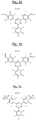
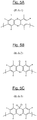
- the central unit of general formula (I) of the basic structural units corresponds to one of the three formulas I-1, I-2 and I -3 represented respectively in FIGS. 1A, 1B and 1C attached.
- the unit of the basic structural units of general formula (I) corresponds to the particular formula (IA): in which the symbols Ar 4 and Ar 5 , which are identical or different, represent (like the previous symbols Ar 1 and Ar 2 ) a substituted or unsubstituted phenylene group.
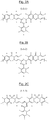
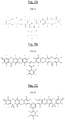
- the central unit of general formula (IA) of the basic structural units corresponds to one of the three formulas IA-1, IA-2 and IA-3 represented respectively to the FIGS. 2A, 2B and 2C attached.
- the central unit of general formula (I) of the basic structural units of formula (I) corresponds to the particular formula (IB): in which the symbols Y 1 and Y 2 , which are identical or different, represent a perfluorinated hydrocarbon chain.
- the perfluorinated hydrocarbon chain above is a perfluoroalkylene of formula (CF 2 ) m in which m varies from 1 to 20, more preferably from 2 to 20, in particular from 2 to 8.
- the perfluorinated hydrocarbon chain is a perfluorocyclobutylene, as a reminder of the formula:
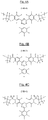
- the unit of formula (IB) of the basic structural units corresponds to one of the three formulas IB-4, IB-5 and IB-6 represented respectively in Figures 4A, 4B and 4C attached.
- the phenyl or phenylene groups Ar 1 , Ar 2 , Ar 3 , Ar 4 and Ar 5 previously described may be substituted or unsubstituted.
- the invention applies in particular to the case where only one of the phenyl or phenylene groups per basic structural unit of formula (I) (or triazine ring) is substituted, as well as in cases where several of the phenyl groups are substituted. or phenylene per triazine ring are substituted, one or more substituents, which may be identical or different, may be present on the same phenyl or phenylene group or on the same phenyl or phenylene groups.
- substituents are preferably chosen from the group consisting of the substituents -F, -CN, -CF 3 , -PO 3 H, -PO 3 M, -SO 3 H, -SO 3 M and the mixtures of these substituents.
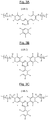
- FIGS 7A, 7B and 7C are examples of triazine polymer sequences according to the invention, of respective formulas (III-1), (III-2) and (III-3), comprising both basic structural units comprising units of formula ( I-1) as previously described and additional structural units of the respective formulas (II-A-1), (II-A-2) and (II-A-3) above.
- FIGS 8A, 8B and 8C represent other examples of triazine polymer sequences according to the invention, of respective formulas (IV-1), (IV-2) and (IV-3), comprising both basic structural units comprising respective formulas (I-1), (I-2) and (I-3) as previously described and additional structural units of formula (II-B-3) above.
- the phenylene groups Ar 6 , Ar 7 , Ar 8 , Ar 9 , Ar 10 , Ar 11 , Ar 12 and Ar 13 can be substituted or unsubstituted.
- the invention applies in particular to cases where only one of the phenylene groups per additional structural unit of formula (II) is substituted, as in the case where several of the phenylene groups per additional structural unit of formula (II) are substituted, one or more substituents, identical or different, may be present on the same group (s) phenylene.
- substituents are preferably chosen from the group consisting of the substituents -F, -CN, -CF 3 , -PO 3 H, -PO 3 M, -SO 3 H, -SO 3 M and the mixtures of these substituents.
- the different basic structural units comprising units of formula (I) and, where appropriate, the additional structural units of formula (II) of the triazine polymer of the invention may be interconnected by any appropriate chemical bonds.
- At least a portion of the basic structural units and, where appropriate, additional structural units are connected to each other by bridges selected from the group consisting of ether bonds (-O-), thioether bonds (-S-), sulfoxide bonds (-SO-), sulphone bonds (-SO 2 -) and mixtures of such bonds, because of the high chemical stability of such bonds with respect to the risks of degradation of the polymer by hydrolysis.
- bridges selected from the group consisting of ether bonds (-O-), thioether bonds (-S-), sulfoxide bonds (-SO-), sulphone bonds (-SO 2 -) and mixtures of such bonds, because of the high chemical stability of such bonds with respect to the risks of degradation of the polymer by hydrolysis.
- all the basic structural units and, where appropriate, all the additional structural units are connected to each other by bridges selected from the group consisting of ether bonds (-O-), thio-ether bonds (- S-), sulfoxide bonds (-SO-), sulphone bonds (-SO 2 -) and mixtures of such bonds.
- triazine polymers according to the invention comprising basic structural units comprising units of formula (I) and, where appropriate, additional structural units of formula (II), linked together by ether bonds (-O -) were represented at Figures 9 to 14 , 16 and 17 , which will be described in detail later.
- the triazine polymer of the invention comprises terminators or ends of blocked chains, preferably by so-called “blocking" groups of the hydrophobic type, sterically bulky, capable of reducing the solubility of the membrane in the water.
- aromatic blocking groups include, in particular, groups which are selected from the group consisting of substituted phenyls, substituted benzophenones, substituted diphenylsulfones, substituted phenyl-perfluoroalkylsulfones and mixtures of such groups, these groups being more preferably monosubstituted.
- Examples of such monosubstituted aromatic blocking groups which may be present on all or part of the chain ends of the triazine polymer of the invention, are for example those represented in the formulas below (with m integer varying preferably from 1 to 20):
- Triazine polymers according to the invention having blocked chain ends are illustrated for example in figures 24 and 25 (The symbol B signifying in these figures the benzophenone group) which will be described in detail later.
- BOPOB BSPSB B-N-P-B-SO B-SO 2 -P-SO 2 -B comprises, at least one and more preferably at each of the ends of its molecular chains, a blocking group; this blocking group noted above “B” is preferentially bound to the polymer P by ether (-O-), thioether (-S-), sulphoxide (-SO-), sulphone (-SO 2 -) bridges, such bridges resulting for example from the reaction between end groups hydroxyl or thiol (-OH or -SH) present on the one hand at the ends of the chains of the initial starting triazine polymer (thus, at this stage, in an unblocked form), on the other hand on the sterically hindered hydrophobic aromatic molecules previously described for reacting with the chain ends of said initial triazine polymer.
- the triazine polymer of the invention is particularly useful as an electrolyte, in particular in a PEM fuel cell, when it is in sulphonated form.
- sulphonated polymer is meant, by definition, and in a well-known manner, a polymer carrying one or more sulphonic groups (-SO 3 H), sulphonates (-SO 3 M), or mixtures of such groups, M representing an alkali metal cation preferably chosen from lithium (Li), cesium (Cs) sodium (Na) and potassium (K), more preferably from sodium (Na) and potassium (K). It will be briefly recalled here that, in a well-known manner, it is the sulphonic groups which in the PEM stack ensure the proton conductivity of the polymer.
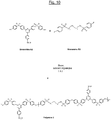
- the triazine polymer (hereinafter referred to as "Polymer 1") of the figure 9 has the characteristic of comprising basic structural units with units of formula (IA-3) and additional structural units of formula (II-B-3) interconnected by ether bridges (-O-). It may be noted that Polymer 1 is here present in sulphonated form, the sulphonate groups -SO 3 M (M being preferably Na + or K + ) being provided by the additional structural units of formula (II-B-3).
- This Polymer 1 can be prepared by polycondensation of the monomers A1 and B1 (disulfonated B1) represented in FIG. figure 9 in the presence of a base and an organic solvent, according to a procedure which will be described in detail below.
- the triazine polymer (hereinafter referred to as "Polymer 2") of the figure 10 comprises basic structural units with units of formula (IA-3) and additional structural units of formula (II-B-3) linked together by ether bridges, such as the above Polymer 1. It may be noted that Polymer 2 is in a sulphonated form, the sulphonate groups - SO 3 M (M being preferably Na + or K + ) being here provided by the basic structural units with units of formula (IA-3).
- This Polymer 2 can be prepared by polycondensation of monomers A2 (sulfonated) and B2 represented in figure 10 as previously for Polymer 1, in the presence of a suitable base and organic solvent.
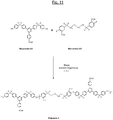
- the triazine polymer (hereinafter referred to as "Polymer 3") of the figure 11 comprises both basic structural units with units of formula (IA-3) and additional structural units of formula (II-B-3) interconnected by ether bridges.
- Polymer 3 is here in sulphonated form, its sulphonate groups (-SO 3 M, M being preferably Na + or K + ) being provided both by the basic structural units with units of formula (IA-3) and by the additional structural units (II-B-3).
- This Polymer 3 may be prepared by polycondensation of the monomers denoted A3 (sulfonated, identical to monomer A2) and B3 (disulfonated, identical to monomer B1) represented in FIG. figure 11 as previously for Polymers 1 and 2, in the presence of a suitable base and organic solvent.
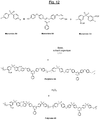
- the triazine polymers (hereinafter referred to as "Polymer 4A” and “Polymer 4B") of the figure 12 comprise both basic structural units with units of formula (IA-1) or (IA-3), respectively, and additional structural units of formula (II-A-3), all interconnected by ether bridges the sulphonate groups (-SO 3 M, M being preferably Na + or K + ) being, for example, carried by a part of the additional structural units of formula (II-A-3).
- Polymers 4A and 4B can be prepared by copolymerization of three monomers denoted A4, B4 and C4 (disulfonated C4 monomer) on the figure 12 in the presence of a base and an appropriate organic solvent, as previously for Polymers 1, 2 or 3.
- the first polymer (Polymer 4A) thus obtained is then oxidized by hydrogen peroxide (hydrogen peroxide) to obtain of the final polymer (Polymer 4B).
- the monomers A4 and C4 are known, commercially available monomer B-4 is prepared according to a procedure which will be described in detail later.
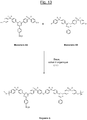
- the triazine polymer (denoted “Polymer 5”) of the figure 13 comprises only basic structural units with units of formula (IA-3) interconnected by ether bridges, the sulphonate groups (-SO 3 M, M being preferably Na + or K + ) being for example carried by a only part of these basic structural units with formula units (IA-3).
- This Polymer 5 can be prepared by polycondensation of the two triazine monomers denoted A5 (monosulphonated, identical to the monomer A2) and B5 (identical to the monomer B1) on the figure 13 in the presence of a suitable base and organic solvent.
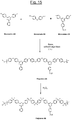
- the figure 14 illustrates yet another example of a method of possible synthesis of Polymer 5, by polycondensation of two triazine monomers here denoted C5 and E5 (monomer E5 monosulphonated) and an aromatic dithiol monomer (monomer D5) as represented in FIG. figure 14 .
- the polymer (Polymer 5A) obtained initially comprises only basic structural units with units of formula (IA-1) connected to each other by thio-ether bridges. Polymer 5A is then oxidized with hydrogen peroxide to obtain the final polymer (Polymer 5B identical to the above Polymer).
- This Polymer 6B can be prepared by polycondensation of two triazine monomers denoted here A6 (identical to the preceding monomer C5) and C6 (disulfonated C6 monomer, identical to the previous monomer E5) and an aromatic dithiol monomer (monomer B6, identical to the monomer D5 ) as represented in figure 15 in the presence of a suitable base and organic solvent.
- the polymer (Polymer 6A) obtained initially comprises only basic structural units with units of formula (IA-1) connected to each other by thio-ether bridges.
- Polymer 6A is then oxidized with hydrogen peroxide to obtain the final polymer (Polymer 6B) comprising only basic structural units with units of formula (IA-3) linked together, this time, by sulphone bridges.
- the triazine polymer (hereinafter referred to as "Polymer 7") of the figure 16 comprises both basic structural units with units of formula (IA-1) and additional structural units of formula (II-B-3) interconnected by ether bridges.
- Polymer 7 is here in sulphonated form, the sulphonate groups (SO 3 M, M ant preferably Na + or K + ) being provided by the additional structural units (II-B-3).
- This Polymer 7 can be prepared by polycondensation of the monomers A7 and B7 (disulfonated B7, identical to the monomer B1 above) as represented in FIG. figure 16 as previously indicated in the presence of a suitable base and organic solvent, according to a procedure which will be described in more detail later.
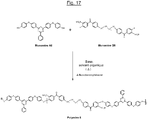
- the triazine polymer (hereinafter referred to as "Polymer 8") of the figure 17 comprises both basic structural units with units of formula (IA-1) and additional structural units of formula (II-C) connected to each other by ether bridges.
- Polymer 8 is here in sulphonated form, the sulphonate groups (SO 3 M, M being preferably Na + or K + ) being provided by monomer B8.
- This Polymer 8 can be prepared by polycondensation of the monomers A8 (identical to the monomer A7 above) and B8 (disulfonated) represented in FIG. figure 17 as previously indicated in the presence of a suitable base and organic solvent, according to a procedure which will be described in more detail later.
- Polymer 1 and Polymer 8 are characterized and tested as a proton-conducting membrane in a PEM-type fuel cell.
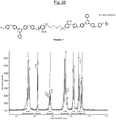
- the monomer A1 is 2,4 - [(4-hydroxy-phenylsulfonyl phenyl)] - 6- (phenyl) - [1,3,5] -triazine, whose formula (already reproduced at figure 9 ) is the following :
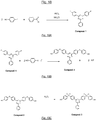
- This monomer A1 (or compound 3 at Fig. 18 ) was prepared according to the procedure schematized in figure 18 , in three successive steps, as detailed below.
- Compound 1 or 2,4-bis- (p -fluorophenyl) -6-phenyl- [1,3,5] -triazine is prepared, according to the following procedure and schematized at figure 18A .
- the reaction product is cooled to room temperature (about 23 ° C) and hydrolyzed by adding 300 g of ice and 60 g of 36% HCl.
- the solid is filtered, then dispersed in water and washed until a neutral pH is obtained.
- the white solid is stirred in 500 ml of methanol heated at reflux for 30 min, then allowed to cool to room temperature. Finally, the product is filtered and dried at 60 ° C. under vacuum.
- Compound 2 (also referred to as monomer B4 - see, for example Fig. 12 ) or 2,4 - [(4-hydroxy-phenylsulfanyl phenyl)] - 6- (phenyl) - [1,3,5] -triazine, according to the following procedure and schematized at figure 18B .
- 4-hydroxythiophenol 4-HTP (99%, Acros) is stored under nitrogen and in solid form.
- Compound 1 and K 2 CO 3 are dried separately overnight at 150 ° C under vacuum.
- a magnetic bar is placed in a round flask of 2 (equipped with a refrigerant, a thermometer and a nitrogen inlet / outlet). The apparatus is placed under vacuum and dried.
- a two-way valve is used to replace the vacuum with nitrogen and continuously purge with the inert gas during addition of reagents.
- the purification of the product can not be done in a single step: about 250 ml of aliquot of the reaction are collected and poured into an extraction bulb (3 liters) containing 2.6 liters of ethyl acetate / water (ratio 1/1). The rest of the product is kept under a constant stream of nitrogen. The mixture placed in the extraction funnel is shaken (the color changes from orange to lemon yellow) and the desired product is extracted into the ethyl acetate phase (the DMSO / H 2 O phase contains only traces of the desired product ). The organic phase is washed with 100 ml of NaHCO 3 solution, followed by washing with 100 ml of H 2 O; the organic phase is then dried with anhydrous MgSO 4 . The process is repeated twice with the other two remaining 250 ml aliquots of the reaction mixture.
- the ethyl acetate phase is evaporated using the rotary evaporator, there remains a slightly orange viscous liquid such as honey (containing a small amount of DMSO).
- DMSO residues are removed at 100 ° C under reduced pressure.
- a small amount of acetone (10 ml) is added followed by 40 ml of diethyl ether.
- the solid becomes immediately creamy white, it is filtered on a ceramic filter.
- the residual thiol is removed from the reaction product by column chromatography using hexane / CH 2 Cl 2 / ethyl acetate / methanol (4/2/1/1 weight ratios) as the mobile phase.
- the molecular weight of the product as measured by Matrix-assisted Lasser Desorption / Ionization mass spectrometry (positive mode, dithranol matrix) is equal to 558.1 (calculated theoretical value equal to 557.7).
- a round 250 ml round ball is equipped with a magnetic bar, a thermometer, a refrigerant and an opening for the addition of reagents.
- a suspension is prepared by adding 6.69 g of Compound 2 (12 mmol) in 150 ml of glacial acetic acid. Once the reagent is added, the suspension is heated to 70 ° C, the reagent dissolves giving a slight, transparent yellow color. Subsequently, 18.0 g of 50% hydrogen peroxide (264 mmol) is added dropwise to the reaction (no exotherm is observed). The solution is refluxed (100 ° C.) for 1 hour (slightly yellow coloration).
- acetic acid are removed by distillation at reduced pressure (vacuum generated by water pump). After distillation, during cooling, white crystals begin to precipitate in the solution as soon as the temperature falls below 80 ° C. The solution is left overnight at room temperature so that the product crystallizes in acetic acid. Then the acetic acid is removed by filtration and the final white product is washed with 300 ml of distilled water. Then, about 18 g of wet product thus obtained is transferred to a round bottom flask and 75 ml of distilled water are added, all stirred for about 15 minutes. The product is then filtered and washed to a neutral pH value. The still wet product is dried for 2 hours at 60 ° C. under vacuum and then at 100 ° C. overnight (about 12 hours) under vacuum.
- the endothermic peak is about 294 ° C ( 1st run ( "run” ) of DSC). It is noted that the monomer immediately polymerizes during the second "run” of DSC; the glass transition temperature (Tg) of the polymer thus formed is about 145 ° C.
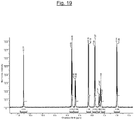
- the figure 19 reproduces the 1 H NMR spectrum (360 MHz) of the monomer A1 thus obtained, dissolved in DMSO- d 6 .
- the molecular weight of the product as measured by mass spectrometry “ESI” Electrospray Ionization ) (negative mode, water / acetone 1/1 mixture) is equal to 620.7 (theoretical calculated value equal to 621.7).
- the monomer B1 is disulfonated 3,3'-bis (4-fluorophenylsulfonyl) perfluorobutane, whose formula (already reproduced in FIG. figure 9 ) is the following :
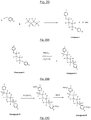
- This monomer B1 (or compound 6 at Fig. 20 ) was prepared according to the procedure schematized in figure 20 , in three successive steps, as detailed below.
- Compound 4 or 1,4-bis- (4-fluorophenylthio) -perfluorobutane is prepared, according to the following procedure and schematized at figure 20A .
- the product is distilled under vacuum at 120 ° C. After removing the impurities, a colorless liquid is recovered, ie 37.9 g (75.6%). The remaining traces of impurities (thiol) are removed by column chromatography using hexane as the mobile phase, giving a product resembling solid wax and transparent at room temperature. The melting point of the product is about 50 ° C (measured by DSC).
- the product is extracted with 7 liters of chloroform.
- the hydrolysed MnO 2 is filtered each time on a filter paper plus a textile filter.
- the solvent chloroform / acetic acid
- the product is dissolved in 1 liter of chloroform.
- the organic phase is then washed successively with 200 ml of a saturated solution of NaHCO 3 , then with 200 ml of distilled water, finally dried with MgSO 4 .
- the solvent is removed on a rotary evaporator and the product is then purified by column chromatography using hexane / ethyl acetate / methanol (15/3/2) as eluent to give Compound 5.
- the product in the form of white crystals is dried overnight at 60 ° C under vacuum. It is then recrystallized from acetone to obtain transparent crystals. DSC analysis reveals a melting point of about 127 ° C.
- Compound 6 or monomer B1 (3,3'-bis (4-fluorophenyl sulfonyl) -perfluorobutane disulfonated) is prepared according to the following procedure and schematized at figure 20C .
- the reaction mixture is cooled to 90 ° C and then poured still hot into 250 g of ice. The whole is left stirring; once all the ice has melted, 15 g of NaCl is added precipitating the disulfonated monomer. The precipitate is then filtered and then dried at 80 ° C. under vacuum.
- the dry product is then mixed with 250 ml of distilled water and heated to 90 ° C. After all the product has dissolved, the pH is adjusted to 7.0 by adding 1% NaOH (aq). The solution is cooled to room temperature; at that time, most of the product precipitated.
- the white product is separated from the aqueous phase by filtration. The product remaining in the aqueous phase is precipitated by adding 15 g of NaCl. The product is filtered and dried overnight at 150 ° C under vacuum. No further purification is necessary.
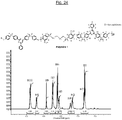
- the figure 21 reproduces the 1 H NMR spectrum (500 MHz) of the monomer B1 thus obtained, dissolved in DMSO- d 6 .
- the monomer B8 is disulfonated 1,4-bis- (4-fluorobenzophenone) -perfluorobutane the formula of which is as follows:
- This monomer B8 (or Compound 9) was prepared according to the procedure schematized in FIG. figure 22 , in three successive steps, as detailed below.
- Compound 7 or 4-iodo-4'-fluorobenzophenone is prepared in accordance with figure 22A .
- the final product (about 30 g) is purified by silica chromatography (300 g) using hexane / ethyl acetate (16/4 weight ratio) as the mobile phase. The product is separated from the mobile phase on a rotary evaporator and dried at 80 ° C overnight (under vacuum). The final cream-colored product (25 g) was found to be pure by NMR analysis and TLC chromatography in hexane / ethyl acetate (16/4 ratio), with a melting point (measured by DSC) of about 137 °. vs.
- the reaction mixture is cooled to ambient temperature and then poured into 500 ml of cold water; the product precipitates, then it is filtered and dissolved with 1 liter of dichloromethane. The organic phase is then dried with anhydrous Na 2 SO 4 .
- the final product is purified by chromatography on silica (300 g) in a dichloromethane / cyclohexane mixture (1/1).
- the melting temperature of the product (measured by DSC) is about 222 ° C.
- the disulfonated Compound 9 or 1,4-bis- (4-fluorobenzophenone) -perfluorobutane is prepared, according to the following procedure and schematized in FIG. figure 22C .
- Compound 8 (2.5 g, ie 4.18 mmol) is placed in a 50 ml 4-neck flask dried beforehand with the aid of a hot-air gun and put under a stream of nitrogen. 6 g of sulfuric acid (twice distilled, Sigma-Aldrich) and 10 g of oleum (65%, Merck) are added directly to the solid. The reaction medium immediately becomes dark. The output of the gaseous products is purged in an empty glass door followed by a trap filled with 30% NaOH. The reaction medium is heated at about 130 ° C. (approximately 138 ° C. in the oil bath) for 4 hours under an average flow of nitrogen flowing over the solution.
- the reaction mixture is allowed to cool to room temperature and then poured into 63 g of ice and allowed to stir. Once all the ice melted, 6.25g of NaCl are added. The solution is heated to 100 ° C and then cooled to room temperature so that the sulfonated monomer precipitates. The precipitate is then dissolved again in 15 ml of water and heated again to 100 ° C to iron in liquid form. After all the product has dissolved, the pH is adjusted to 7.0 by adding 10% NaOH (aq) dropwise. The solution is allowed to cool to room temperature. The white-cream solid thus obtained is separated from the aqueous phase by filtration. The product is dried at 150 ° C overnight (under vacuum).
- the figure 23 reproduces the 1 H NMR spectrum (500 MHz) of the monomer B8 thus obtained, dissolved in DMSO- d 6 .
- the molecular weight of the product as measured by mass spectrometry “ESI” Electrospray Ionization ) (negative mode, water / acetone 1/1 mixture) is equal to 778.9 (theoretical calculated value equal to 779.6).
- This example describes in detail the synthesis, from the previously described monomers A1 and B1, of the sulfonated polymer 1, blocked by benzophenone groups, as shown in FIG. figure 24 .
- the monomer A1 is dried at 60 ° C under vacuum overnight.
- the monomer B1 and Na 2 CO 3 are dried separately at 150 ° C under vacuum overnight.
- the three compounds are mixed and dried at 160 ° C under vacuum for one hour.
- the copolymerization of the monomers A1 and B1 is carried out in a three-neck round flask of 100 ml.
- the flask is equipped with a nitrogen inlet, a thermometer, a magnetic stirrer and a "Dean Stark" separator surmounted by a coolant.
- the glass parts of the apparatus are dried under vacuum using a hot air gun to reach a temperature of at least 100 ° C in the reaction flask.
- the reaction flask is charged with the monomer A1 (1.89 g or 3.04 mmol or 1 eq.), The monomer B1 (2.20 g or 3.04 mmol or 1 eq.), The anhydrous sodium carbonate. (0.97 g, 9.13 mmol or 3 eq.), Anhydrous N, N-dimethylacetamide (20 ml) and toluene (4.0 ml, azeotropic agent).
- the reaction flask is heated at 100 ° C in an oil bath for one hour (azeotropic distillation).
- the toluene circulation valve is then closed and the toluene is distilled at 100 ° C.
- the temperature of the oil bath is then raised to about 148 ° C and the toluene residues are distilled off for an additional 60 minutes so that all toluene is removed from the reaction and the temperature increases to 140 ° C. inside the balloon.
- the toluene is drained from the "Dean Stark" separator, the temperature of the oil bath is increased to about 159 ° C and maintained at this value overnight.
- the temperature of the oil bath is raised to about 168 ° C (about 152 ° C inside the flask) and the polymerization continues for 4 hours.
- the temperature of the reaction was lowered to about 130 ° C inside the flask, removing the flask from the oil bath.
- the monomer denoted A7 or B4 (Compound 2) is dried at 80 ° C under vacuum overnight.
- the monomer designated B7 or B1 (Compound 6) and Na 2 CO 3 are dried separately at 150 ° C, mixed and then dried at 160 ° C under vacuum for one hour.
- the copolymerization of the monomers A7 and B7 is carried out in a three-neck round flask of 100 ml. The flask is equipped with a nitrogen inlet, a thermometer, a magnetic stirrer and a "Dean Stark" separator surmounted by a coolant. The glass parts of the apparatus are dried under vacuum.
- the flask is charged with the monomer A7 (1.695 g or 3.04 mmol or 1 eq.), The monomer B7 (2.196 g or 3.04 mmol or 1 eq.), The carbonate of anhydrous sodium (0.968 g, 9.13 mmol, 3 eq.), anhydrous N, N-dimethylacetamide (20 ml) and toluene (4.0 ml, azeotropic agent).
- the reaction flask is heated at 100 ° C in an oil bath for two hours (azeotropic distillation).
- the toluene circulation valve is then closed and the toluene is distilled at 100 ° C.
- the temperature of the oil bath is then raised to 148 ° C and the toluene residues are distilled off for an additional 1 hour so that all the toluene is removed from the reaction and the temperature increases to 140 ° C. inside the balloon.
- the toluene is drained from the "Dean Stark" separator and the temperature of the oil bath is increased to 159 ° C and then maintained at this value overnight.
- the flask is removed from the oil bath and allowed to cool to about 130 ° C inside the reaction flask. 8 mg of 4-fluorobenzophenone are then dissolved in 5 ml of anhydrous N, N-dimethylacetamide, all added to the reaction by means of a syringe. The flask is returned to the oil bath and the reaction continues at about 145 ° C (about 158 ° C in the oil bath) for another 4 hours. The reaction mixture is allowed to cool to room temperature; the product obtained is then poured into 200 ml of isopropanol. The fibrous precipitate is recovered by filtration.
- the polymer is then dried under vacuum at 80 ° C overnight.
- the sodium carbonate is extracted from the polymer by immersing the latter in 50 ml of distilled water while stirring with a magnetic bar for 30 minutes.
- the pH of the solution is adjusted to 7 by dropwise addition of 10% HCl (aq).
- the polymer is then dried at 80 ° C under vacuum (about 12 hours).
- the monomer B8 and Na 2 CO 3 are first dried at 150 ° C overnight (under vacuum), separately, and then mixed together for 1 h at 160 ° C. Monomer A8 is also dried at 80 ° C (under vacuum) overnight.
- the polymerization is conducted in a three-necked flask of 100 ml.
- the balloon is surmounted by a nitrogen inlet, a thermometer, a stirrer and a "Dean Stark” separator surmounted by a refrigerant.
- the glass parts of the equipment (including the coolant and the "Dean Stark” separator) are dried under vacuum using a hot air gun.
- the flask is charged with the monomer A8 (0.848 g or 1.52 mmol), the monomer B8 (1.22 g or 1.52 mmol), the anhydrous sodium carbonate (0.48 g or 4.57 mmol; three times), dry N, N-dimethylacetamide, DMA (20 ml) and toluene (4 ml, azeotropic agent).
- the reaction flask is heated in an oil bath at 100 ° C. The temperature of the oil bath is then increased to about 148 ° C and the residual toluene is distilled (140 ° C inside the reaction flask).
- the "Dean Stark” trap door is emptied (toluene drained) and the temperature of the oil bath is increased to about 159 ° C (about 150 ° C inside the flask), then held at this temperature for about 20 minutes. hours.
- the temperature of the reaction is lowered to 100 ° C inside (the flask is mounted above the oil bath) and then 4 mg of 4-fluorobenzophenone dissolved in 5 ml of DMA are injected into the reaction. using a syringe.
- the blocking reaction is then continued in an oil bath set at about 145 ° C (internal temperature) for 4 hours.
- the reaction mixture was allowed to cool to room temperature, and then the polymer was poured into 300 ml of isopropanol.
- the fibrous precipitate is recovered by filtration and oven dried at 80 ° C overnight (under vacuum).
- Sodium carbonate is removed from the polymer by washing in 30 ml of water and acidified by dropwise addition of 10% HCl to pH 7.
- the final polymer thus obtained is dried at 100 ° C in vacuo.
- membranes of Polymer 1, Polymer 2 and Polymer 8 are prepared according to the so-called "solvent casting” technique as described below.
- the polymer (625 mg) previously dissolved in 8 ml of N, N-dimethylacetamide is filtered through a microfilter (company "Millipore") PTFE (polytetrafluoroethylene) having a pore size of about 0.45 microns.
- PTFE polytetrafluoroethylene
- the polymer solution thus filtered is poured into a mold consisting of two superimposed glass plates, the upper plate having a recess (dimensions 9 cm ⁇ 9 cm) of depth equal to 1 mm; it is then heated at 50 ° C for 24 h and then 2 h at 60 ° C.
- traces of organic solvent are removed from the membrane thus formed by immersing the latter in a distilled water bath for about 12 hours.
- the proton conductivity of the membrane expressed in S / cm (Siemens per centimeter) is determined as indicated below.
- Disk-shaped membranes 2 cm in diameter (thickness 50 ⁇ m) are cut using a punch.
- the proton conductivity of the membrane is determined by the measurement of the real part (Ohmic) and the imaginary part (Capacitance) of the complex impedance, in the frequency range between 100 kHz and 10 Hz (with amplitude of 100 mV AC). Measurements are made with an impedance / AC potentiostat (Zahner, Germany).
- Nyquist plots are generated by the measurements of a successive stack of one, two, three and up to six membranes (totally moistened) sandwiched between two platinum electrodes of the same circular shape as the membranes.
- the value intercepting the real axis of Nyquist graph is reported, that is to say a value of the imaginary component of the impedance at zero.
- these points are aligned on an affine line whose slope directly determines the value of the resistance of the membrane. Its ordinate at the origin determines the contact resistance between the membranes and the platinum electrodes.
- the membranes resulting from Polymer 1, Polymer 2 and Polymer 8 showed remarkable proton conductivity values, respectively equal to 89 mS / cm, 73 mS / cm and 35 mS / cm at 25 ° C. (100% humidity). , of the same order of magnitude as or even greater than the conductivity value (about 70 mS / cm) measured on the commercial membrane ("Nafion ® 112") of the same thickness and rigorously tested under the same conditions.
- the membrane is acidified, it is dried under vacuum at 100 ° C. for 2 hours. Its weight is immediately measured before it captures moisture from the air. Then the membrane samples are immersed in distilled water at room temperature until saturation (no additional weight gain due to water is then observed).
- the water absorption capacity is calculated as the difference between the weights of the wet membrane and the dry membrane.
- the dimensional stability also expressed in%, is the ratio between the main dimension of the dry membrane and the main dimension of the totally humidified membrane.
- the membranes of Polymer 1, Polymer 2 and Polymer 8 have a water absorption capacity respectively equal to 27%, 17% and 20% of their weight, compared to a value of approximately 23% for the membrane.
- commercial (“Nafion ® 112").
- Their stability dimensional is respectively 20%, 5% and 1%, compared to a value of 7% for the commercial control membrane.
- the membranes according to the invention unexpectedly have not only a reduced water absorption capacity but also a remarkable dimensional stability, all of which are determining factors for endurance and durability. chemical stability of the membrane in operation in a PEM fuel cell.
- Horizontal and transverse sections of membrane are made (each sample of thickness approximately 70 nm), then are coated in a liquid epoxy resin.
- the resin is then polymerized at 60 ° C. for 48 hours in the presence of a hardener and an accelerator.
- An average pore size of 2.4 nm with a standard deviation of 0.5 nm is a particularly remarkable and unexpected result for those skilled in the art.
- the invention thus makes it possible to obtain a highly improved surface morphology, with on the one hand pore sizes very substantially reduced, on the other hand a particularly narrow size distribution; such characteristics are decisive for the overall electrical performance of the membrane, for its gas impermeability properties and its ultimate endurance.
- the performance of the membranes is tested on a test stand for fuel cells on which the temperature, pressure, flow and humidity of the gases can be adjusted.
- the gases used are pure hydrogen and oxygen at a temperature of 65 ° C.
- the battery used in these tests consists of a single cell comprising the polymer membrane to be tested, arranged between two layers "GDE” ( Gas-Diffusion Electrode ), two bipolar graphite plates and two standard electrodes ("ELE 0107” by Johnson Matthey) having a platinum content of about 0.4 mg / cm 2 .
- GDE Gas-Diffusion Electrode
- ELE 0107 by Johnson Matthey
- the membrane to be tested is first dried between two nonwovens (sterile chamber quality, "Sontara Micropure 100" - DuPont supplier). It is then pressed between two glass plates, at 60 ° C for 3 hours.
- the MEA assembly is obtained by hot pressing a Pt / C catalyst layer disposed on each side of the membrane (115 ° C, 125 MPa). At this stage the MEA assembly can be assembled between two bipolar plates to form a fuel cell ready to operate when it is fed with hydrogen and oxygen.
- the cell is subjected to stationary conditions (0.7 V) or to stop and start situations or "OCV" ( Open Circuit Voltage ), so as to know how to subject the membrane to the conditions of most aggressive operation (eg peroxides, free radicals, etc.) and finally deduce its overall chemical resistance.
- OCV Open Circuit Voltage
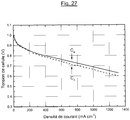
- the figure 27 reproduces the so-called polarization curve, the cell voltage being recorded as a function of the current density delivered by the cell, on the one hand for the membrane constituted by Polymer 1 (curve C A ), on the other hand for the membrane commercial (polymer "Nafion ® 112" C curve B).
- the figure 28 reproduces the results recorded on a membrane (curve C A ) constituted by Polymer 1 this time reinforced with a layer (thickness 10 ⁇ m) of ePTFE (porosity 80%, Donaldson supplier) to constitute a composite membrane according to the invention, compared to the same commercial membrane (unreinforced) as before (curve C B ).
- a membrane constituted by Polymer 1 this time reinforced with a layer (thickness 10 ⁇ m) of ePTFE (porosity 80%, Donaldson supplier) to constitute a composite membrane according to the invention, compared to the same commercial membrane (unreinforced) as before (curve C B ).
- the invention enables the production of PEM membranes, unexpectedly, have a chemical and dimensional stability, ionic conductivity at least equivalent if not superior to those of commercial Nafion ® membrane type yet developed a long time.
- the polymer of the invention is derived from relatively inexpensive monomers and is capable of being prepared according to simple, economical and environmentally friendly synthesis methods. Finally, it has a remarkable chemical stability and oxidation resistance in comparison with the prior art triazine polymers.
Landscapes
- Chemical & Material Sciences (AREA)
- Chemical Kinetics & Catalysis (AREA)
- Medicinal Chemistry (AREA)
- Polymers & Plastics (AREA)
- Organic Chemistry (AREA)
- Health & Medical Sciences (AREA)
- Manufacturing & Machinery (AREA)
- Engineering & Computer Science (AREA)
- General Chemical & Material Sciences (AREA)
- Electrochemistry (AREA)
- Life Sciences & Earth Sciences (AREA)
- Sustainable Development (AREA)
- Sustainable Energy (AREA)
- Materials Engineering (AREA)
- Crystallography & Structural Chemistry (AREA)
- Inorganic Chemistry (AREA)
- Polyethers (AREA)
- Macromolecular Compounds Obtained By Forming Nitrogen-Containing Linkages In General (AREA)
- Conductive Materials (AREA)
- Manufacture Of Macromolecular Shaped Articles (AREA)
- Polyoxymethylene Polymers And Polymers With Carbon-To-Carbon Bonds (AREA)
- Fuel Cell (AREA)
Applications Claiming Priority (2)
| Application Number | Priority Date | Filing Date | Title |
|---|---|---|---|
| FR1056437A FR2963623B1 (fr) | 2010-08-04 | 2010-08-04 | Polymere triazine utilisable comme membrane dans une pile a combustible |
| PCT/EP2011/061423 WO2012016777A1 (fr) | 2010-08-04 | 2011-07-06 | Polymere triazine utilisable comme membrane dans une pile a combustible |
Publications (2)
| Publication Number | Publication Date |
|---|---|
| EP2601243A1 EP2601243A1 (fr) | 2013-06-12 |
| EP2601243B1 true EP2601243B1 (fr) | 2017-03-08 |
Family
ID=43608170
Family Applications (1)
| Application Number | Title | Priority Date | Filing Date |
|---|---|---|---|
| EP11743204.7A Active EP2601243B1 (fr) | 2010-08-04 | 2011-07-06 | Polymere triazine utilisable comme membrane dans une pile a combustible |
Country Status (8)
| Country | Link |
|---|---|
| US (1) | US8889817B2 (enExample) |
| EP (1) | EP2601243B1 (enExample) |
| JP (1) | JP5963747B2 (enExample) |
| CN (1) | CN103210017B (enExample) |
| BR (1) | BR112013001608A2 (enExample) |
| CA (1) | CA2805556A1 (enExample) |
| FR (1) | FR2963623B1 (enExample) |
| WO (1) | WO2012016777A1 (enExample) |
Families Citing this family (10)
| Publication number | Priority date | Publication date | Assignee | Title |
|---|---|---|---|---|
| FR2965808B1 (fr) * | 2010-08-04 | 2013-10-18 | Michelin Soc Tech | Monomere triazine soufre utilisable pour la synthese d'une membrane polymere pour pile a combustible |
| FR3005054B1 (fr) | 2013-04-26 | 2016-07-01 | Michelin & Cie | Polymere utilisable notamment comme primaire d'adhesion pour le collage de metal a du caoutchouc |
| FR3005050A1 (fr) | 2013-04-26 | 2014-10-31 | Michelin & Cie | Compose polyol soufre utilisable comme monomere pour la synthese de polyurethane |
| JP5960763B2 (ja) * | 2014-08-22 | 2016-08-02 | タカハタプレシジョンジャパン株式会社 | 陰イオン交換樹脂、燃料電池用電解質膜、電極触媒層形成用バインダー、電池電極触媒層および燃料電池 |
| KR102222055B1 (ko) | 2014-09-30 | 2021-03-03 | 꽁빠니 제네날 드 에따블리세망 미쉘린 | 황 함유 방향족 폴리올 화합물 |
| KR101771323B1 (ko) | 2014-10-28 | 2017-08-24 | 주식회사 엘지화학 | 브랜처용 불소계 화합물, 이를 이용한 고분자 및 이를 이용한 고분자 전해질막 |
| US20170279130A1 (en) | 2016-03-24 | 2017-09-28 | United Technologies Corporation | Separator layer for flow battery |
| US11056698B2 (en) | 2018-08-02 | 2021-07-06 | Raytheon Technologies Corporation | Redox flow battery with electrolyte balancing and compatibility enabling features |
| CN111416140B (zh) * | 2020-01-11 | 2021-04-13 | 山东理工大学 | 2,4,6-三氧代-1,3,5-三嗪-三磷酸盐掺杂pbi质子交换膜的制备方法 |
| US11271226B1 (en) | 2020-12-11 | 2022-03-08 | Raytheon Technologies Corporation | Redox flow battery with improved efficiency |
Family Cites Families (20)
| Publication number | Priority date | Publication date | Assignee | Title |
|---|---|---|---|---|
| DE19636692A1 (de) * | 1996-09-10 | 1998-03-12 | Hoechst Ag | Verfahren zur Oxidation von Thiothergruppen enthaltenden Polyarylenverbindungen |
| US6495209B1 (en) | 1998-02-20 | 2002-12-17 | Lynntech, Inc. | Process of making a composite membrane |
| JP2001081303A (ja) * | 1999-09-16 | 2001-03-27 | Hitachi Chem Co Ltd | 高分子固体電解質、高分子固体電解質の製造法及び電気化学的デバイス |
| JP3617802B2 (ja) * | 2000-03-30 | 2005-02-09 | 富士写真フイルム株式会社 | 光情報記録媒体及び情報記録方法 |
| JP2002341520A (ja) * | 2001-05-14 | 2002-11-27 | Fuji Photo Film Co Ltd | 紫外線吸収剤前駆体を含有する組成物、及び画像形成方法 |
| US7135537B2 (en) | 2003-05-01 | 2006-11-14 | E.I. Du Pont De Nemours And Company | Sulfonimide-containing poly(arylene ether)s and poly(arylene ether sulfone)s, methods for producing the same, and uses thereof |
| AU2003250029A1 (en) | 2003-07-10 | 2005-01-28 | Conception Et Developpement Michelin S.A. | Method and device for the stacking of fuel cells |
| JP4828096B2 (ja) * | 2004-03-30 | 2011-11-30 | 富士通株式会社 | スルホン酸基含有プロトン伝導性ポリマー組成物、固体電解質膜および固体高分子型燃料電池 |
| FR2873498B1 (fr) | 2004-07-20 | 2007-08-10 | Conception & Dev Michelin Sa | Arret d'une pile a combustible alimentee en oxygene pur |
| US20080160363A1 (en) | 2004-07-20 | 2008-07-03 | Akinori Tsukada | Control of the Polymer Humidifying Membrane of a Fuel Cell |
| FR2883666B1 (fr) | 2005-03-25 | 2013-07-05 | Conception & Dev Michelin Sa | Pile a combustible a membrane polymere |
| JP4237156B2 (ja) * | 2005-03-28 | 2009-03-11 | 富士通株式会社 | 電解質組成物、固体電解質膜、固体高分子型燃料電池および固体電解質膜の製造方法 |
| EP1883671A2 (en) * | 2005-05-27 | 2008-02-06 | Polyfuel, Inc. | End-capped ion-conductive polymers |
| JP2006338928A (ja) * | 2005-05-31 | 2006-12-14 | Hitachi Chem Co Ltd | 補強高分子電解質、電極−高分子電解質膜接合体、燃料電池並びにそれらの製造方法 |
| FR2914111B1 (fr) | 2007-03-20 | 2009-05-15 | Conception Dev Michelin S A | Pile a combustible a electrolyte polymere |
| JP2010272363A (ja) | 2008-05-21 | 2010-12-02 | Sumitomo Chemical Co Ltd | ポリマー、ポリアリーレン系ブロック共重合体、高分子電解質、高分子電解質膜及び燃料電池 |
| CN101733005B (zh) * | 2009-12-10 | 2011-03-09 | 山东东岳神舟新材料有限公司 | 一种改性的交联全氟离子交换膜 |
| FR2963622B1 (fr) * | 2010-08-04 | 2012-08-17 | Michelin Soc Tech | Monomere perfluoroalcane aromatique soufre et sulfone |
| FR2963621B1 (fr) * | 2010-08-04 | 2012-08-17 | Soc Tech Michelin | Monomere perfluoroalcane aromatique |
| FR2965808B1 (fr) * | 2010-08-04 | 2013-10-18 | Michelin Soc Tech | Monomere triazine soufre utilisable pour la synthese d'une membrane polymere pour pile a combustible |
-
2010
- 2010-08-04 FR FR1056437A patent/FR2963623B1/fr active Active
-
2011
- 2011-07-06 CA CA2805556A patent/CA2805556A1/fr not_active Abandoned
- 2011-07-06 CN CN201180038238.8A patent/CN103210017B/zh active Active
- 2011-07-06 WO PCT/EP2011/061423 patent/WO2012016777A1/fr not_active Ceased
- 2011-07-06 EP EP11743204.7A patent/EP2601243B1/fr active Active
- 2011-07-06 JP JP2013522168A patent/JP5963747B2/ja active Active
- 2011-07-06 BR BR112013001608A patent/BR112013001608A2/pt not_active IP Right Cessation
- 2011-07-06 US US13/812,885 patent/US8889817B2/en active Active
Non-Patent Citations (1)
| Title |
|---|
| None * |
Also Published As
| Publication number | Publication date |
|---|---|
| US8889817B2 (en) | 2014-11-18 |
| CN103210017A (zh) | 2013-07-17 |
| US20130217851A1 (en) | 2013-08-22 |
| JP5963747B2 (ja) | 2016-08-03 |
| WO2012016777A1 (fr) | 2012-02-09 |
| CN103210017B (zh) | 2015-06-03 |
| FR2963623A1 (fr) | 2012-02-10 |
| FR2963623B1 (fr) | 2012-08-17 |
| BR112013001608A2 (pt) | 2016-05-17 |
| EP2601243A1 (fr) | 2013-06-12 |
| JP2013533364A (ja) | 2013-08-22 |
| CA2805556A1 (fr) | 2012-02-09 |
Similar Documents
| Publication | Publication Date | Title |
|---|---|---|
| EP2601172B1 (fr) | Monomère perfluoroalcane aromatique soufré et sulfoné | |
| EP2601700B1 (fr) | Monomère triazine soufré utilisable pour la synthèse d'une membrane polymère pour pile à combustible | |
| WO2012016777A1 (fr) | Polymere triazine utilisable comme membrane dans une pile a combustible | |
| EP2601167B1 (fr) | Monomère perfluoroalcane aromatique | |
| EP1527118B1 (fr) | Polymeres de type polyphenylenes, leur procede de preparation, membranes et dispositif de pile a combustible comprenant ces membranes | |
| EP1805227B1 (fr) | Polymeres fluores et membranes preparees a partir de tels polymeres, notamment pour piles a combustible et procede de synthese de tels polymeres | |
| FR2983480A1 (fr) | Monomere alcane aromatique soufre et fluore | |
| FR2983479A1 (fr) | Monomere alcane aromatique soufre et sulfone |
Legal Events
| Date | Code | Title | Description |
|---|---|---|---|
| PUAI | Public reference made under article 153(3) epc to a published international application that has entered the european phase |
Free format text: ORIGINAL CODE: 0009012 |
|
| 17P | Request for examination filed |
Effective date: 20130304 |
|
| AK | Designated contracting states |
Kind code of ref document: A1 Designated state(s): AL AT BE BG CH CY CZ DE DK EE ES FI FR GB GR HR HU IE IS IT LI LT LU LV MC MK MT NL NO PL PT RO RS SE SI SK SM TR |
|
| DAX | Request for extension of the european patent (deleted) | ||
| GRAP | Despatch of communication of intention to grant a patent |
Free format text: ORIGINAL CODE: EPIDOSNIGR1 |
|
| INTG | Intention to grant announced |
Effective date: 20161124 |
|
| GRAS | Grant fee paid |
Free format text: ORIGINAL CODE: EPIDOSNIGR3 |
|
| GRAA | (expected) grant |
Free format text: ORIGINAL CODE: 0009210 |
|
| AK | Designated contracting states |
Kind code of ref document: B1 Designated state(s): AL AT BE BG CH CY CZ DE DK EE ES FI FR GB GR HR HU IE IS IT LI LT LU LV MC MK MT NL NO PL PT RO RS SE SI SK SM TR |
|
| REG | Reference to a national code |
Ref country code: GB Ref legal event code: FG4D Free format text: NOT ENGLISH |
|
| REG | Reference to a national code |
Ref country code: CH Ref legal event code: EP Ref country code: AT Ref legal event code: REF Ref document number: 873461 Country of ref document: AT Kind code of ref document: T Effective date: 20170315 |
|
| REG | Reference to a national code |
Ref country code: IE Ref legal event code: FG4D Free format text: LANGUAGE OF EP DOCUMENT: FRENCH |
|
| REG | Reference to a national code |
Ref country code: DE Ref legal event code: R096 Ref document number: 602011035718 Country of ref document: DE |
|
| REG | Reference to a national code |
Ref country code: LT Ref legal event code: MG4D |
|
| REG | Reference to a national code |
Ref country code: NL Ref legal event code: MP Effective date: 20170308 |
|
| REG | Reference to a national code |
Ref country code: FR Ref legal event code: PLFP Year of fee payment: 7 |
|
| PG25 | Lapsed in a contracting state [announced via postgrant information from national office to epo] |
Ref country code: NO Free format text: LAPSE BECAUSE OF FAILURE TO SUBMIT A TRANSLATION OF THE DESCRIPTION OR TO PAY THE FEE WITHIN THE PRESCRIBED TIME-LIMIT Effective date: 20170608 Ref country code: FI Free format text: LAPSE BECAUSE OF FAILURE TO SUBMIT A TRANSLATION OF THE DESCRIPTION OR TO PAY THE FEE WITHIN THE PRESCRIBED TIME-LIMIT Effective date: 20170308 Ref country code: GR Free format text: LAPSE BECAUSE OF FAILURE TO SUBMIT A TRANSLATION OF THE DESCRIPTION OR TO PAY THE FEE WITHIN THE PRESCRIBED TIME-LIMIT Effective date: 20170609 Ref country code: HR Free format text: LAPSE BECAUSE OF FAILURE TO SUBMIT A TRANSLATION OF THE DESCRIPTION OR TO PAY THE FEE WITHIN THE PRESCRIBED TIME-LIMIT Effective date: 20170308 Ref country code: LT Free format text: LAPSE BECAUSE OF FAILURE TO SUBMIT A TRANSLATION OF THE DESCRIPTION OR TO PAY THE FEE WITHIN THE PRESCRIBED TIME-LIMIT Effective date: 20170308 |
|
| REG | Reference to a national code |
Ref country code: AT Ref legal event code: MK05 Ref document number: 873461 Country of ref document: AT Kind code of ref document: T Effective date: 20170308 |
|
| PG25 | Lapsed in a contracting state [announced via postgrant information from national office to epo] |
Ref country code: ES Free format text: LAPSE BECAUSE OF FAILURE TO SUBMIT A TRANSLATION OF THE DESCRIPTION OR TO PAY THE FEE WITHIN THE PRESCRIBED TIME-LIMIT Effective date: 20170308 Ref country code: BG Free format text: LAPSE BECAUSE OF FAILURE TO SUBMIT A TRANSLATION OF THE DESCRIPTION OR TO PAY THE FEE WITHIN THE PRESCRIBED TIME-LIMIT Effective date: 20170608 Ref country code: SE Free format text: LAPSE BECAUSE OF FAILURE TO SUBMIT A TRANSLATION OF THE DESCRIPTION OR TO PAY THE FEE WITHIN THE PRESCRIBED TIME-LIMIT Effective date: 20170308 Ref country code: RS Free format text: LAPSE BECAUSE OF FAILURE TO SUBMIT A TRANSLATION OF THE DESCRIPTION OR TO PAY THE FEE WITHIN THE PRESCRIBED TIME-LIMIT Effective date: 20170308 Ref country code: LV Free format text: LAPSE BECAUSE OF FAILURE TO SUBMIT A TRANSLATION OF THE DESCRIPTION OR TO PAY THE FEE WITHIN THE PRESCRIBED TIME-LIMIT Effective date: 20170308 |
|
| PG25 | Lapsed in a contracting state [announced via postgrant information from national office to epo] |
Ref country code: NL Free format text: LAPSE BECAUSE OF FAILURE TO SUBMIT A TRANSLATION OF THE DESCRIPTION OR TO PAY THE FEE WITHIN THE PRESCRIBED TIME-LIMIT Effective date: 20170308 |
|
| PG25 | Lapsed in a contracting state [announced via postgrant information from national office to epo] |
Ref country code: AT Free format text: LAPSE BECAUSE OF FAILURE TO SUBMIT A TRANSLATION OF THE DESCRIPTION OR TO PAY THE FEE WITHIN THE PRESCRIBED TIME-LIMIT Effective date: 20170308 Ref country code: CZ Free format text: LAPSE BECAUSE OF FAILURE TO SUBMIT A TRANSLATION OF THE DESCRIPTION OR TO PAY THE FEE WITHIN THE PRESCRIBED TIME-LIMIT Effective date: 20170308 Ref country code: SK Free format text: LAPSE BECAUSE OF FAILURE TO SUBMIT A TRANSLATION OF THE DESCRIPTION OR TO PAY THE FEE WITHIN THE PRESCRIBED TIME-LIMIT Effective date: 20170308 Ref country code: RO Free format text: LAPSE BECAUSE OF FAILURE TO SUBMIT A TRANSLATION OF THE DESCRIPTION OR TO PAY THE FEE WITHIN THE PRESCRIBED TIME-LIMIT Effective date: 20170308 Ref country code: EE Free format text: LAPSE BECAUSE OF FAILURE TO SUBMIT A TRANSLATION OF THE DESCRIPTION OR TO PAY THE FEE WITHIN THE PRESCRIBED TIME-LIMIT Effective date: 20170308 Ref country code: IT Free format text: LAPSE BECAUSE OF FAILURE TO SUBMIT A TRANSLATION OF THE DESCRIPTION OR TO PAY THE FEE WITHIN THE PRESCRIBED TIME-LIMIT Effective date: 20170308 |
|
| PG25 | Lapsed in a contracting state [announced via postgrant information from national office to epo] |
Ref country code: PT Free format text: LAPSE BECAUSE OF FAILURE TO SUBMIT A TRANSLATION OF THE DESCRIPTION OR TO PAY THE FEE WITHIN THE PRESCRIBED TIME-LIMIT Effective date: 20170710 Ref country code: PL Free format text: LAPSE BECAUSE OF FAILURE TO SUBMIT A TRANSLATION OF THE DESCRIPTION OR TO PAY THE FEE WITHIN THE PRESCRIBED TIME-LIMIT Effective date: 20170308 Ref country code: IS Free format text: LAPSE BECAUSE OF FAILURE TO SUBMIT A TRANSLATION OF THE DESCRIPTION OR TO PAY THE FEE WITHIN THE PRESCRIBED TIME-LIMIT Effective date: 20170708 Ref country code: SM Free format text: LAPSE BECAUSE OF FAILURE TO SUBMIT A TRANSLATION OF THE DESCRIPTION OR TO PAY THE FEE WITHIN THE PRESCRIBED TIME-LIMIT Effective date: 20170308 |
|
| REG | Reference to a national code |
Ref country code: DE Ref legal event code: R097 Ref document number: 602011035718 Country of ref document: DE |
|
| PLBE | No opposition filed within time limit |
Free format text: ORIGINAL CODE: 0009261 |
|
| STAA | Information on the status of an ep patent application or granted ep patent |
Free format text: STATUS: NO OPPOSITION FILED WITHIN TIME LIMIT |
|
| PG25 | Lapsed in a contracting state [announced via postgrant information from national office to epo] |
Ref country code: DK Free format text: LAPSE BECAUSE OF FAILURE TO SUBMIT A TRANSLATION OF THE DESCRIPTION OR TO PAY THE FEE WITHIN THE PRESCRIBED TIME-LIMIT Effective date: 20170308 |
|
| 26N | No opposition filed |
Effective date: 20171211 |
|
| PG25 | Lapsed in a contracting state [announced via postgrant information from national office to epo] |
Ref country code: SI Free format text: LAPSE BECAUSE OF FAILURE TO SUBMIT A TRANSLATION OF THE DESCRIPTION OR TO PAY THE FEE WITHIN THE PRESCRIBED TIME-LIMIT Effective date: 20170308 |
|
| REG | Reference to a national code |
Ref country code: CH Ref legal event code: PL |
|
| GBPC | Gb: european patent ceased through non-payment of renewal fee |
Effective date: 20170706 |
|
| REG | Reference to a national code |
Ref country code: IE Ref legal event code: MM4A |
|
| PG25 | Lapsed in a contracting state [announced via postgrant information from national office to epo] |
Ref country code: GB Free format text: LAPSE BECAUSE OF NON-PAYMENT OF DUE FEES Effective date: 20170706 Ref country code: LI Free format text: LAPSE BECAUSE OF NON-PAYMENT OF DUE FEES Effective date: 20170731 Ref country code: IE Free format text: LAPSE BECAUSE OF NON-PAYMENT OF DUE FEES Effective date: 20170706 Ref country code: CH Free format text: LAPSE BECAUSE OF NON-PAYMENT OF DUE FEES Effective date: 20170731 |
|
| REG | Reference to a national code |
Ref country code: BE Ref legal event code: MM Effective date: 20170731 |
|
| PG25 | Lapsed in a contracting state [announced via postgrant information from national office to epo] |
Ref country code: LU Free format text: LAPSE BECAUSE OF NON-PAYMENT OF DUE FEES Effective date: 20170706 |
|
| REG | Reference to a national code |
Ref country code: FR Ref legal event code: PLFP Year of fee payment: 8 |
|
| PG25 | Lapsed in a contracting state [announced via postgrant information from national office to epo] |
Ref country code: BE Free format text: LAPSE BECAUSE OF NON-PAYMENT OF DUE FEES Effective date: 20170731 |
|
| PG25 | Lapsed in a contracting state [announced via postgrant information from national office to epo] |
Ref country code: MT Free format text: LAPSE BECAUSE OF FAILURE TO SUBMIT A TRANSLATION OF THE DESCRIPTION OR TO PAY THE FEE WITHIN THE PRESCRIBED TIME-LIMIT Effective date: 20170308 |
|
| PG25 | Lapsed in a contracting state [announced via postgrant information from national office to epo] |
Ref country code: HU Free format text: LAPSE BECAUSE OF FAILURE TO SUBMIT A TRANSLATION OF THE DESCRIPTION OR TO PAY THE FEE WITHIN THE PRESCRIBED TIME-LIMIT; INVALID AB INITIO Effective date: 20110706 Ref country code: MC Free format text: LAPSE BECAUSE OF FAILURE TO SUBMIT A TRANSLATION OF THE DESCRIPTION OR TO PAY THE FEE WITHIN THE PRESCRIBED TIME-LIMIT Effective date: 20170308 |
|
| PG25 | Lapsed in a contracting state [announced via postgrant information from national office to epo] |
Ref country code: CY Free format text: LAPSE BECAUSE OF NON-PAYMENT OF DUE FEES Effective date: 20170308 |
|
| PG25 | Lapsed in a contracting state [announced via postgrant information from national office to epo] |
Ref country code: MK Free format text: LAPSE BECAUSE OF FAILURE TO SUBMIT A TRANSLATION OF THE DESCRIPTION OR TO PAY THE FEE WITHIN THE PRESCRIBED TIME-LIMIT Effective date: 20170308 |
|
| PG25 | Lapsed in a contracting state [announced via postgrant information from national office to epo] |
Ref country code: TR Free format text: LAPSE BECAUSE OF FAILURE TO SUBMIT A TRANSLATION OF THE DESCRIPTION OR TO PAY THE FEE WITHIN THE PRESCRIBED TIME-LIMIT Effective date: 20170308 |
|
| PG25 | Lapsed in a contracting state [announced via postgrant information from national office to epo] |
Ref country code: AL Free format text: LAPSE BECAUSE OF FAILURE TO SUBMIT A TRANSLATION OF THE DESCRIPTION OR TO PAY THE FEE WITHIN THE PRESCRIBED TIME-LIMIT Effective date: 20170308 |
|
| REG | Reference to a national code |
Ref country code: DE Ref legal event code: R081 Ref document number: 602011035718 Country of ref document: DE Owner name: COMPAGNIE GENERALE DES ETABLISSEMENTS MICHELIN, FR Free format text: FORMER OWNERS: COMPAGNIE GENERALE DES ETABLISSEMENTS MICHELIN, CLERMONT-FERRAND, FR; MICHELIN RECHERCHE ET TECHNIQUE S.A., GRANGES-PACCOT, CH |
|
| PGFP | Annual fee paid to national office [announced via postgrant information from national office to epo] |
Ref country code: DE Payment date: 20250722 Year of fee payment: 15 |
|
| PGFP | Annual fee paid to national office [announced via postgrant information from national office to epo] |
Ref country code: FR Payment date: 20250725 Year of fee payment: 15 |