EP2599109B1 - Films minces nanoorganisés à base de copolymères à blocs polysaccharidiques pour des applications en nanotechnologie - Google Patents
Films minces nanoorganisés à base de copolymères à blocs polysaccharidiques pour des applications en nanotechnologie Download PDFInfo
- Publication number
- EP2599109B1 EP2599109B1 EP11755386.7A EP11755386A EP2599109B1 EP 2599109 B1 EP2599109 B1 EP 2599109B1 EP 11755386 A EP11755386 A EP 11755386A EP 2599109 B1 EP2599109 B1 EP 2599109B1
- Authority
- EP
- European Patent Office
- Prior art keywords
- block
- bipyridine
- copolymer
- substrate
- blocks
- Prior art date
- Legal status (The legal status is an assumption and is not a legal conclusion. Google has not performed a legal analysis and makes no representation as to the accuracy of the status listed.)
- Active
Links
Images


Classifications
-
- G—PHYSICS
- G03—PHOTOGRAPHY; CINEMATOGRAPHY; ANALOGOUS TECHNIQUES USING WAVES OTHER THAN OPTICAL WAVES; ELECTROGRAPHY; HOLOGRAPHY
- G03F—PHOTOMECHANICAL PRODUCTION OF TEXTURED OR PATTERNED SURFACES, e.g. FOR PRINTING, FOR PROCESSING OF SEMICONDUCTOR DEVICES; MATERIALS THEREFOR; ORIGINALS THEREFOR; APPARATUS SPECIALLY ADAPTED THEREFOR
- G03F7/00—Photomechanical, e.g. photolithographic, production of textured or patterned surfaces, e.g. printing surfaces; Materials therefor, e.g. comprising photoresists; Apparatus specially adapted therefor
- G03F7/004—Photosensitive materials
-
- B—PERFORMING OPERATIONS; TRANSPORTING
- B82—NANOTECHNOLOGY
- B82Y—SPECIFIC USES OR APPLICATIONS OF NANOSTRUCTURES; MEASUREMENT OR ANALYSIS OF NANOSTRUCTURES; MANUFACTURE OR TREATMENT OF NANOSTRUCTURES
- B82Y30/00—Nanotechnology for materials or surface science, e.g. nanocomposites
-
- C—CHEMISTRY; METALLURGY
- C08—ORGANIC MACROMOLECULAR COMPOUNDS; THEIR PREPARATION OR CHEMICAL WORKING-UP; COMPOSITIONS BASED THEREON
- C08G—MACROMOLECULAR COMPOUNDS OBTAINED OTHERWISE THAN BY REACTIONS ONLY INVOLVING UNSATURATED CARBON-TO-CARBON BONDS
- C08G81/00—Macromolecular compounds obtained by interreacting polymers in the absence of monomers, e.g. block polymers
- C08G81/02—Macromolecular compounds obtained by interreacting polymers in the absence of monomers, e.g. block polymers at least one of the polymers being obtained by reactions involving only carbon-to-carbon unsaturated bonds
-
- C—CHEMISTRY; METALLURGY
- C09—DYES; PAINTS; POLISHES; NATURAL RESINS; ADHESIVES; COMPOSITIONS NOT OTHERWISE PROVIDED FOR; APPLICATIONS OF MATERIALS NOT OTHERWISE PROVIDED FOR
- C09D—COATING COMPOSITIONS, e.g. PAINTS, VARNISHES OR LACQUERS; FILLING PASTES; CHEMICAL PAINT OR INK REMOVERS; INKS; CORRECTING FLUIDS; WOODSTAINS; PASTES OR SOLIDS FOR COLOURING OR PRINTING; USE OF MATERIALS THEREFOR
- C09D105/00—Coating compositions based on polysaccharides or on their derivatives, not provided for in groups C09D101/00 or C09D103/00
-
- C—CHEMISTRY; METALLURGY
- C09—DYES; PAINTS; POLISHES; NATURAL RESINS; ADHESIVES; COMPOSITIONS NOT OTHERWISE PROVIDED FOR; APPLICATIONS OF MATERIALS NOT OTHERWISE PROVIDED FOR
- C09D—COATING COMPOSITIONS, e.g. PAINTS, VARNISHES OR LACQUERS; FILLING PASTES; CHEMICAL PAINT OR INK REMOVERS; INKS; CORRECTING FLUIDS; WOODSTAINS; PASTES OR SOLIDS FOR COLOURING OR PRINTING; USE OF MATERIALS THEREFOR
- C09D153/00—Coating compositions based on block copolymers containing at least one sequence of a polymer obtained by reactions only involving carbon-to-carbon unsaturated bonds; Coating compositions based on derivatives of such polymers
-
- C—CHEMISTRY; METALLURGY
- C09—DYES; PAINTS; POLISHES; NATURAL RESINS; ADHESIVES; COMPOSITIONS NOT OTHERWISE PROVIDED FOR; APPLICATIONS OF MATERIALS NOT OTHERWISE PROVIDED FOR
- C09D—COATING COMPOSITIONS, e.g. PAINTS, VARNISHES OR LACQUERS; FILLING PASTES; CHEMICAL PAINT OR INK REMOVERS; INKS; CORRECTING FLUIDS; WOODSTAINS; PASTES OR SOLIDS FOR COLOURING OR PRINTING; USE OF MATERIALS THEREFOR
- C09D187/00—Coating compositions based on unspecified macromolecular compounds, obtained otherwise than by polymerisation reactions only involving unsaturated carbon-to-carbon bonds
- C09D187/005—Block or graft polymers not provided for in groups C09D101/00 - C09D185/04
-
- G—PHYSICS
- G03—PHOTOGRAPHY; CINEMATOGRAPHY; ANALOGOUS TECHNIQUES USING WAVES OTHER THAN OPTICAL WAVES; ELECTROGRAPHY; HOLOGRAPHY
- G03F—PHOTOMECHANICAL PRODUCTION OF TEXTURED OR PATTERNED SURFACES, e.g. FOR PRINTING, FOR PROCESSING OF SEMICONDUCTOR DEVICES; MATERIALS THEREFOR; ORIGINALS THEREFOR; APPARATUS SPECIALLY ADAPTED THEREFOR
- G03F1/00—Originals for photomechanical production of textured or patterned surfaces, e.g., masks, photo-masks, reticles; Mask blanks or pellicles therefor; Containers specially adapted therefor; Preparation thereof
-
- G—PHYSICS
- G03—PHOTOGRAPHY; CINEMATOGRAPHY; ANALOGOUS TECHNIQUES USING WAVES OTHER THAN OPTICAL WAVES; ELECTROGRAPHY; HOLOGRAPHY
- G03F—PHOTOMECHANICAL PRODUCTION OF TEXTURED OR PATTERNED SURFACES, e.g. FOR PRINTING, FOR PROCESSING OF SEMICONDUCTOR DEVICES; MATERIALS THEREFOR; ORIGINALS THEREFOR; APPARATUS SPECIALLY ADAPTED THEREFOR
- G03F7/00—Photomechanical, e.g. photolithographic, production of textured or patterned surfaces, e.g. printing surfaces; Materials therefor, e.g. comprising photoresists; Apparatus specially adapted therefor
- G03F7/26—Processing photosensitive materials; Apparatus therefor
- G03F7/40—Treatment after imagewise removal, e.g. baking
-
- H—ELECTRICITY
- H10—SEMICONDUCTOR DEVICES; ELECTRIC SOLID-STATE DEVICES NOT OTHERWISE PROVIDED FOR
- H10D—INORGANIC ELECTRIC SEMICONDUCTOR DEVICES
- H10D30/00—Field-effect transistors [FET]
- H10D30/60—Insulated-gate field-effect transistors [IGFET]
- H10D30/68—Floating-gate IGFETs
- H10D30/681—Floating-gate IGFETs having only two programming levels
-
- H—ELECTRICITY
- H10—SEMICONDUCTOR DEVICES; ELECTRIC SOLID-STATE DEVICES NOT OTHERWISE PROVIDED FOR
- H10D—INORGANIC ELECTRIC SEMICONDUCTOR DEVICES
- H10D30/00—Field-effect transistors [FET]
- H10D30/60—Insulated-gate field-effect transistors [IGFET]
- H10D30/68—Floating-gate IGFETs
- H10D30/6891—Floating-gate IGFETs characterised by the shapes, relative sizes or dispositions of the floating gate electrode
- H10D30/6893—Floating-gate IGFETs characterised by the shapes, relative sizes or dispositions of the floating gate electrode wherein the floating gate has multiple non-connected parts, e.g. multi-particle floating gate
-
- Y—GENERAL TAGGING OF NEW TECHNOLOGICAL DEVELOPMENTS; GENERAL TAGGING OF CROSS-SECTIONAL TECHNOLOGIES SPANNING OVER SEVERAL SECTIONS OF THE IPC; TECHNICAL SUBJECTS COVERED BY FORMER USPC CROSS-REFERENCE ART COLLECTIONS [XRACs] AND DIGESTS
- Y10—TECHNICAL SUBJECTS COVERED BY FORMER USPC
- Y10T—TECHNICAL SUBJECTS COVERED BY FORMER US CLASSIFICATION
- Y10T428/00—Stock material or miscellaneous articles
- Y10T428/31504—Composite [nonstructural laminate]
- Y10T428/31551—Of polyamidoester [polyurethane, polyisocyanate, polycarbamate, etc.]
- Y10T428/31645—Next to addition polymer from unsaturated monomers
-
- Y—GENERAL TAGGING OF NEW TECHNOLOGICAL DEVELOPMENTS; GENERAL TAGGING OF CROSS-SECTIONAL TECHNOLOGIES SPANNING OVER SEVERAL SECTIONS OF THE IPC; TECHNICAL SUBJECTS COVERED BY FORMER USPC CROSS-REFERENCE ART COLLECTIONS [XRACs] AND DIGESTS
- Y10—TECHNICAL SUBJECTS COVERED BY FORMER USPC
- Y10T—TECHNICAL SUBJECTS COVERED BY FORMER US CLASSIFICATION
- Y10T428/00—Stock material or miscellaneous articles
- Y10T428/31504—Composite [nonstructural laminate]
- Y10T428/31652—Of asbestos
- Y10T428/31667—Next to addition polymer from unsaturated monomers, or aldehyde or ketone condensation product
-
- Y—GENERAL TAGGING OF NEW TECHNOLOGICAL DEVELOPMENTS; GENERAL TAGGING OF CROSS-SECTIONAL TECHNOLOGIES SPANNING OVER SEVERAL SECTIONS OF THE IPC; TECHNICAL SUBJECTS COVERED BY FORMER USPC CROSS-REFERENCE ART COLLECTIONS [XRACs] AND DIGESTS
- Y10—TECHNICAL SUBJECTS COVERED BY FORMER USPC
- Y10T—TECHNICAL SUBJECTS COVERED BY FORMER US CLASSIFICATION
- Y10T428/00—Stock material or miscellaneous articles
- Y10T428/31504—Composite [nonstructural laminate]
- Y10T428/31678—Of metal
- Y10T428/31692—Next to addition polymer from unsaturated monomers
-
- Y—GENERAL TAGGING OF NEW TECHNOLOGICAL DEVELOPMENTS; GENERAL TAGGING OF CROSS-SECTIONAL TECHNOLOGIES SPANNING OVER SEVERAL SECTIONS OF THE IPC; TECHNICAL SUBJECTS COVERED BY FORMER USPC CROSS-REFERENCE ART COLLECTIONS [XRACs] AND DIGESTS
- Y10—TECHNICAL SUBJECTS COVERED BY FORMER USPC
- Y10T—TECHNICAL SUBJECTS COVERED BY FORMER US CLASSIFICATION
- Y10T428/00—Stock material or miscellaneous articles
- Y10T428/31504—Composite [nonstructural laminate]
- Y10T428/31971—Of carbohydrate
Definitions
- the self-assembly of block copolymers makes it possible to control the organization of nanodomains, and thus to prepare films with an integration density of various nanometric objects (holes, blocks, lamellae, pillars, layers, etc.) appropriate to specific uses that require materials with a high density of active areas.
- This approach is particularly interesting in industrial sectors whose economic stakes require going beyond the limits of conventional processes to develop more and more miniaturized objects.
- the growth of microelectronics is limited by optical lithography techniques, or etching. This is also the case of LED lighting to exceed the LCD technologies, plasma.
- the "micro-array" and micro-fluidic technologies are not suitable for the development of efficient systems of simultaneous multidetection and / or direct detection (SPR, SERS, fluorescent nanosondes, etc.) of molecules or even scale of isolated molecules.
- the patent US 7,045,851 discloses the use of a synthetic diblock copolymer, consisting of polystyrene (PS) and methyl poly (meth) acrylate (PMMA), deposited on a silicon oxide layer to form a discrete floating gate of a solid state transistor. field effect.
- a synthetic diblock copolymer consisting of polystyrene (PS) and methyl poly (meth) acrylate (PMMA), deposited on a silicon oxide layer to form a discrete floating gate of a solid state transistor. field effect.
- Organized nanodomains based on PMMA blocks have a lattice period of the order of 40 nm.
- EP 2 088 618 discloses the use of a diblock copolymer polystyrene (PS) -poly (meth) acrylate methyl (PMMA) for the preparation of a mask lithographic.
- PS polystyrene
- PMMA poly (meth) acrylate methyl
- Zhang et al. discloses the use of a diblock polystyrene (PS) -polyethyleneoxide (PEO) copolymer for the preparation of a lithographic mask useful for microelectronics.
- PS polystyrene
- PEO polyethyleneoxide
- Organized nanodomains based on PEO blocks have a lattice period of the order of 22 nm.
- the ITRS Roadmap (“ International Technology Roadmap for Semiconductors, 2005 Editi one ") indicates that a network of nanodomains with a period of less than 22 nm is the" technological node "to be surpassed by 2020 to meet the economic challenges of the microelectronics sector.
- An object of the present invention is to provide materials (M) comprising a network of nanodomains having a lower period than existing materials.
- the material (M) comprises a substrate, one of whose surfaces is partially or totally covered with a layer based on an organized network block copolymer comprising block-based nanodomains (B) and / or nanodomains based on blocks (A).
- a "network” is a set of three-dimensional points that has the following property: when one translates into space according to certain vectors, one finds exactly the same environment. There is a spatial periodicity.
- the organized network according to the invention is characterized by a network period which corresponds to the distance between two nanodomains of blocks of the same nature of self-assembled block copolymers.
- This organization in nanodomains is due to the self-assembly of blocks presenting antagonistic properties.
- self-assembly of the blocks it is meant that the blocks of the same nature of the block copolymer are arranged in order spontaneously on the support to form the organized network, thanks to the antagonistic properties of the blocks of different natures (for example hydrophilic / hydrophobic, charged / neutral, polar / apolar, flexible / rigid ).
- the inventors have indeed discovered in the context of the present invention that replacing one of the blocks of a block copolymer of the prior art and able to self-assemble to form an organized network, by a poly- or oligosaccharide block and keeping the total molecular weight of the block copolymer, the network period of the resulting organized network is lower.
- the layer of the material (M) according to the invention comprising the ordered film advantageously has a small grating period, generally less than 22 nm, typically less than or equal to 20 nm, in particular less than 15 nm, which can even reach 11 nm.
- This network period is lower than in the films formed from other block copolymers of the prior art, which allows applications of the material (M) for the production of very miniaturized objects for the needs of nanotechnologies, and microelectronics, in particular.
- the block copolymer has a weight average molecular weight of less than or equal to 40,000 g / mol. Weight average molecular weights of less than 40,000 g / mol favor a low network period.
- Blocks (A) and (B) of the block copolymer are covalently bonded.
- block copolymer is meant that the copolymer consists of blocks in linear sequence.
- comb copolymers which comprise branched chains are not block copolymers.
- the block copolymer is typically diblock or triblock, preferably diblock.
- Block (A) is a hydrophobic polymer, especially chosen from polystyrene, polyalkylstyrene, poly (alkyl (meth) acrylate), polyalkylene, polyacetylene, poly (polyphenylene oxide or sulfide), polydialkylsiloxane, a polyvinylpyridine, a polyalkylene oxide, a poly (alkylthiophene) such as a poly (3-hexylthiophene), a polypyrrole, a poly-N-isopropylacrylamide, a polycaprolactone, a polyimide or a preferably biodegradable polyester, such as a polyhydroxyalkanoate or a polylactide; .
- (meth) acrylate is meant a methacrylate or an acrylate.
- alkyl may be linear or branched and generally comprises from 1 to 6 carbon atoms.
- Alkylene generally comprises from 1 to 6 carbon atoms.
- Polyethylene, polyisoprene, polybutadiene and polyisobutylene are the preferred polyalkylenes.
- Polybutylstyrene is the preferred polylalkylstyrene.
- Polymethylmethacrylate, polybutylmethacrylate, polybutylacrylate and polyhexylacrylate are the preferred polyalkyl (meth) acrylates.
- Polydimethylsiloxane is the preferred polydialkysiloxane.
- Polyethylene oxide is the preferred polyalkylene oxide.
- the block (A) is made of polystyrene, poly (alkyl (meth) acrylate or poly (3-hexylthiophene), and in particular polystyrene or poly (alkyl (meth) acrylate.
- the block (A) is preferably composed of a polystyrene with a degree of polymerization of 10 to 30, in particular from 15 to 20, in particular 18.
- the polysaccharide of the block (B) preferably has a degree of polymerization (DP) of from 2 to 40, in particular from 2 to 20, preferably from 5 to 9, in particular of the order of 7.
- the self-assembly of Block copolymers are in fact favored when the (B) polysaccharide block of 2 to 40 units, especially 2 to 20 units.
- the polysaccharide of the block copolymer block (B) may be an oligosaccharide (typically, an oligosaccharide has a degree of polymerization of less than or equal to 10).
- the units of the block (B) may be composed of the same saccharide or different saccharides. These saccharides may especially be chosen from maltose, cellulose and its derivatives such as carboxymethylcellulose, cellulose acetate, hydroxyethylcellulose, starch, chitin, chitosan, xyloglucan, pectin, carrageenans, dextrans, glucans, especially beta 1,3 and beta 1,6, and O-glycans, N-glycans or C-glycans.
- the block (B) is maltoheptaose or maltooctadecaose, in particular maltoheptaose.
- the polysaccharides are advantageously derived from plant species and make it possible to efficiently conserve the biomass.
- the polysaccharides can be synthesized chemically or recombinantly (by engineering glycosyltransferases or glycosylhydrolases). They can come from biomasses of various origins: plants, algae, bacteria, fungi, industrial co-products, agricultural waste, etc ... Biomass can be enhanced by the use of its components at the nanoscale, especially for the manufacture of high value-added materials useful in nanotechnology.
- a diblock copolymer where the block (A) is polystyrene and where the block (B) is maltoheptaose is particularly preferred according to the invention.
- diblock copolymers used according to the invention can be synthesized according to any method known per se, described, for example, by the method described in " Block copolymers. I. Advances in polymer science, vol.189; Ed. Volker Abetz (Institute for Polymerforschung, Geesthacht, Germany). "Springer: Berlin, Heidelberg, New York. .
- the blocks (A) and (B) can be synthesized separately, then reactive terminal functions are chemically introduced on each of the blocks (unless these functions are already present at the end of the synthesis of the block).
- the reactive terminal functions are chosen so that they are orthogonal (that is, the function of a block can not react with the function of a block of the same nature but is able to react exclusively with different block functions).
- the blocks are then reacted together.
- This synthetic route (“click" route) is often preferred to other techniques because it avoids a step of protecting the OH groups contained on the polysaccharide.
- the volume fraction of the block (A) in the block copolymer is between 0.1 and 0.4, especially when the degree of polymerization of the polysaccharide block (B) is between 2 and 20.
- the block (B) is hydrogen bonded to at least one molecule comprising an amine, amide, hydroxyl function and / or a carboxylic acid function. These functions are in fact particularly suitable for bonding by hydrogen bonding to the hydroxyl functions of the polysaccharide.
- the molecule generally has a low molecular weight, typically less than 500 g / mol.
- the molecule is not a saccharide block of another block copolymer. This molecule may for example be 4 ', 4-bipyridine, 2', 2-bipyridine, 2- (2,4-difluoro phenyl) pyridine or 9-anthracene carboxylic acid, preferably 4 ', 4' bipyridine.
- Hydrogen bonds can be formed between the molecule and the polysaccharide block (B) of the copolymer by dissolving the molecule and the copolymer at blocks in an aprotic solvent, for example tetrahydrofuran, dioxane, toluene, chloroform, acetone, ether or dimethylformamide.
- an aprotic solvent for example tetrahydrofuran, dioxane, toluene, chloroform, acetone, ether or dimethylformamide.
- Protic solvents of water or alcohol type are to be avoided, because the formation of hydrogen bonds between the molecule and the oligo-polysaccharide would be in competition with the formation of hydrogen bonds between the molecule and the protic solvent, on the one hand, and between the polysaccharide and the protic solvent, on the other hand.
- the self-assembly of block copolymers is favored by the presence of this molecule, although it is not essential. For example, it was verified in X-ray diffraction (SAXS spectrum) that the amylose-block-polystyrene system, and in particular polystyrene-maltooctadecaose, could self-organize without the aid of 4 ', 4-bypiridine.
- SAXS spectrum X-ray diffraction
- the molecule may be photoluminescent, i.e., capable of absorbing photons and then re-emitting absorbed energy in the form of longer wavelength light.
- the molar proportion between the molecule and the block (B) varies between 0.1 and 1.0.
- the substrate of the material (M) is typically a solid support of low roughness and dimensions and / or variable shapes.
- the substrate comprises silicon.
- the material (M) according to this embodiment will be designated (M Si ) hereinafter for reasons of brevity.
- the substrate may consist of silicon, for example a silicon wafer, or be silicon covered with an insulating or dielectric material, for example SiO 2 microbeads.
- the layer of insulating or dielectric material covering the silicon has in particular a thickness of 2 to 5 nm. This first embodiment is particularly suitable for applications in electronics.
- the substrate is a polymer (for example poly (3,4-ethylenedioxythiophene) (PEDT)), glass, metal (for example gold, titanium, platinum) or a metal oxide (eg titanium dioxide).
- PEDT poly (3,4-ethylenedioxythiophene)
- metal for example gold, titanium, platinum
- a metal oxide eg titanium dioxide.
- M PVM metal oxide
- This second embodiment is particularly suitable for OLED, OPV and nanobiosensor applications.
- the invention relates to the method for preparing a material (M) as defined above, comprising a phase separation step, in particular by heat treatment (annealing step).
- the preparation of the material (M) is part of a sustainable industrial development by valuing the biomass at the nanoscale (with the replacement of synthetic polymers derived from oil by polysaccharides) and by preferentially using green chemistry processes.
- the solvent of the solution used in step ⁇ is typically an aprotic solvent, for example tetrahydrofuran.
- the ⁇ step is typically performed by depositing the solution spin coating ("spin coating" in English), by screen printing or inkjet.
- the ink jet deposition is particularly suitable for reducing the amount of solution used and thus the cost of the process and also makes it possible to deposit the solution on areas located on the surface of the substrate.
- step ⁇ which corresponds to an annealing step
- the blocks of the copolymer self-assemble, whereby a material (M) comprising a substrate, one of whose surfaces is covered with a layer, is obtained.
- a material (M) comprising a substrate, one of whose surfaces is covered with a layer
- M a material comprising a substrate, one of whose surfaces is covered with a layer
- a block copolymer in the form of an ordered film comprising nanodomains consisting of blocks (B), and generally nanodomains consisting of blocks (A) and nanodomains consisting of blocks (B).
- the person skilled in the art knows how to adapt the conditions of this step by taking into account the antagonistic chemical properties of the blocks (A) and (B) [(hydrophilic / hydrophobic, charged / neutral, polar / apolar, flexible / rigid ... ); (The block (B) polysaccharide being hydrophilic, polar and rigid and the block (A) being hydrophobic)
- the temperature during step ⁇ is 140 to 220 ° C, preferably 150 to 200 ° C.
- the annealing can be carried out under a controlled atmosphere, for example in a supercritical CO 2 medium.
- the self-assembly of the blocks and therefore the geometry of the network obtained depends on several factors, such as the length of the copolymer chains, the thickness of the layer, the temperature and the annealing time.
- the characterization of the layer can be carried out by various techniques such as atomic force microscopy (AFM), transmission electron microscopy (TEM or TEM), ellipsometry, small-angle X-ray scattering technique (SAXS , Small Angle X-ray Scattering), the technique of grazing Incidence Small Angle X Ray Scattering (GISAXS) or high-resolution scanning electron microscopy (SEM).
- AFM atomic force microscopy
- TEM or TEM transmission electron microscopy
- SAXS small-angle X-ray scattering technique
- GISAXS Small Angle X-ray Scattering
- SEM high-resolution scanning electron microscopy
- the layer formed during step ⁇ ) generally has a thickness of the order of the periodicity of the nanodomains formed.
- the parallel or perpendicular morphology of the periodic structure is controllable by the heat treatment, the nature of the solvents and by various factors. ratio with the composition of the blocks, and in particular by the block (B) / block (A) volume fraction.
- the copolymer comprises an equimolar amount of molecule bonded by hydrogen bonding to the polysaccharide block (B) and saccharide units in the polysaccharide block (B)
- the nanodomains generally form lines parallel to the plane of the substrate.
- the copolymer comprises an equimolar amount of molecule bonded by hydrogen bonding to the polysaccharide block (B) and hydroxyl groups in the polysaccharide block (B)
- the nanodomains generally form lines perpendicular to the plane of the substrate.
- the nanodomains When the copolymer has fewer molecules bonded by hydrogen bonding to the polysaccharide block (B) than saccharide units in the polysaccharide block (B), the nanodomains generally form cylinders whose axes are perpendicular to the plane of the substrate.
- blocks (A) and (B) of the block copolymer their respective volume fractions, the presence or absence of molecules bonded by hydrogen bonding to block (B) and the conditions of steps ⁇ and ⁇ are chosen so to obtain the most suitable crystalline system for the intended application.
- an organization perpendicular to the substrate (M ⁇ ), in particular a compact hexagonal phase of cylinders whose axis is perpendicular to the substrate plane, is preferred for vertical transistor applications, memories and nanobiosensors, which require the realization of pads, holes and pillars, while a parallel organization to the substrate (M //), lamellar phase type, is desired for OLED or OPV applications that require organization of the nanodomains parallel to the substrate.
- the invention relates to the use of a material as defined above as a precursor of a lithographic mask in electronics.
- the selective removal of one of the blocks can be done by plasma reactive etching (in particular oxygen plasma), by chemical or enzymatic treatment or by exposure to deep UV (“deep-UV”).
- plasma reactive etching in particular oxygen plasma
- chemical or enzymatic treatment or by exposure to deep UV (“deep-UV”).
- step a) is carried out by bringing the material (M) into contact with an acid chosen from H 5 10 6 , HCl or TFA (trifluoroacetic acid).
- an acid chosen from H 5 10 6 , HCl or TFA trifluoroacetic acid.
- This treatment differs from those previously described in the documents US 2004/0256662 and FR 2 927 467 . Furthermore, this treatment is easily implemented, unlike reactive ion etching processes taking place in a plasma with specific equipment that require the control of many parameters (choice of gases, pressure, power, temperature, polarization) .
- the invention also relates to the use of the material (M TROU ) as a lithographic mask in electronics, in particular for the preparation of a flash memory, a vertical transistor or a non-sequential access memory.
- the remaining copolymer block of step c) consists of the blocks (B).
- the remaining block of copolymer of step c) consists of the blocks (A).
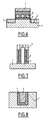
- the material (M ⁇ ) is particularly suitable for the preparation of a grid of a vertical transistor ( figure 7 ) or RAM ( figure 8 ) whereas a material (M //) is particularly suitable for the manufacture of a floating gate of a flash memory ( figure 6 ).
- the substrate of the material (M), and therefore of the material (M TROU ) which is derived therefrom comprises or consists of silicon, for example a silicon wafer, or consists of a plate of silicon covered by an insulating or dielectric material (for example microbeads of SiO 2 ), the layer of said insulating or dielectric material covering the plate having for example a thickness of 2 to 5 nm.
- the material (M TROU ) was then obtained from the material (M Si ) as defined above. Silicon is indeed the semiconductor most used in electronics.
- the flash memories, vertical transistor and RAM obtained from the material (M TROU ) (and thus the material (M)) are thus obtained by a simple and inexpensive method.
- the flash memory, vertical transistor and RAM obtained have a high density of nanoscale organized patterns due to the short network period of the nanodomains of the material (M) used in their preparation process, and are therefore very miniaturized.
- the invention relates to the use of the material (M TROU ) for the manufacture of nanobiosensors and nanobiopiles.
- the material (M TROU ) can be used in a process for preparing a nanobiotech or a nanobiotech, comprising the step b ') of grafting biomolecules (such as peptides or proteins, antibodies, deoxyribonucleic acids, oligo- or polysaccharides ...) in the cavities formed in step a) on the material (M TROU ).
- biomolecules such as peptides or proteins, antibodies, deoxyribonucleic acids, oligo- or polysaccharides
- the nanobiosensor and the nanobiota formed can be integrated into detection devices used in the medical field, in the food industry or in chemistry.
- the invention relates to an organic light-emitting diode (OLED) or an organic photovoltaic cell (OPV) comprising a material (M) in which the block (B) is linked by hydrogen bonding to a photoluminescent molecule comprising an amine function , amide, hydroxyl and / or a carboxylic acid function.
- OLED organic light-emitting diode
- OCV organic photovoltaic cell
- the photoluminescent molecules are hydrogen-bonded to the block-based nanodomains (B) of the material (M) and therefore have a highly ordered spatial organization on the material (M).
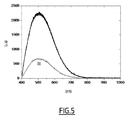
- the signal emitted by an OLED comprising such a material (M) is therefore interesting.
- the polystyrene-maltoheptaose copolymer was finally precipitated twice in methanol to remove excess reagent, and then dried at 60 ° C under vacuum.
- FTIR Fourier transform infrared spectra
- the film was made from the diblock copolymer of Example 2, including 4,4'-bipyridine.
- the freshly deposited film was annealed overnight at 170 ° C under vacuum to allow phase separation leading to the formation of nanodomains consisting of hydrogen bonded oligosaccharides at 4 ', 4-bipyridine organized in a network. cubic centered ( figure 2 ).
- the phase of a sectional view corresponding to a continuous line on the image by atomic force microscopy of the figure 2 is represented in figure 3 .
- Each peak corresponds to a nanodomain consisting of blocks of oligosaccharides linked to 4,4 'bipyridine.
- the period of the grating obtained is 11 nm.
- a film prepared from the copolymer of Example 2 comprising 4,4'-bipyridine was organized following the protocol of Example 2 (annealing at 170 ° C. for 24 h) by spin coating (spin coating ) on a silicon substrate of a solution of the copolymer (volume fraction 30%) in a solvent THF / DMSO: 1/1, v / v.
- the material obtained has nanodomains organized parallel to the plane of the substrate ( figure 4 ).
- EXAMPLE 6 Selective removal of polysaccharide nanodomains from the film to obtain the material (M TROU ) that can be used in micro- or nanoelectronics applications.
- Example 3 The treatment of the material of Example 3 was treated with a solution of trifluoroacetic acid to selectively remove maltoheptaose nanodomains and form cavities separated from each other by the remaining polystyrene, which could be used to prepare a flash memory ( figure 6 ), a vertical transistor ( figure 7 ), a non-sequential access memory ( figure 8 ) or to produce nanobiosensors.
- the treatment may be effected with hydrochloric acid instead of trifluoroacetic acid.
Landscapes
- Chemical & Material Sciences (AREA)
- Engineering & Computer Science (AREA)
- Materials Engineering (AREA)
- Organic Chemistry (AREA)
- Physics & Mathematics (AREA)
- General Physics & Mathematics (AREA)
- Chemical Kinetics & Catalysis (AREA)
- Wood Science & Technology (AREA)
- Life Sciences & Earth Sciences (AREA)
- Nanotechnology (AREA)
- Composite Materials (AREA)
- Polymers & Plastics (AREA)
- Medicinal Chemistry (AREA)
- Condensed Matter Physics & Semiconductors (AREA)
- Crystallography & Structural Chemistry (AREA)
- Health & Medical Sciences (AREA)
- Other Resins Obtained By Reactions Not Involving Carbon-To-Carbon Unsaturated Bonds (AREA)
- Semiconductor Memories (AREA)
- Laminated Bodies (AREA)
- Electroluminescent Light Sources (AREA)
- Electrodes Of Semiconductors (AREA)
- Non-Volatile Memory (AREA)
- Insulated Gate Type Field-Effect Transistor (AREA)
- Manufacture Of Macromolecular Shaped Articles (AREA)
Applications Claiming Priority (2)
| Application Number | Priority Date | Filing Date | Title |
|---|---|---|---|
| FR1056336A FR2963355B1 (fr) | 2010-07-30 | 2010-07-30 | Films minces nanoorganises a base de copolymeres a blocs polysaccharidiques pour des applications en nanotechnologie. |
| PCT/FR2011/051843 WO2012013911A1 (fr) | 2010-07-30 | 2011-07-29 | Films minces nanoorganisés à base de copolymères à blocs polysaccharidiques pour des applications en nanotechnologie |
Publications (2)
| Publication Number | Publication Date |
|---|---|
| EP2599109A1 EP2599109A1 (fr) | 2013-06-05 |
| EP2599109B1 true EP2599109B1 (fr) | 2015-11-04 |
Family
ID=43501578
Family Applications (1)
| Application Number | Title | Priority Date | Filing Date |
|---|---|---|---|
| EP11755386.7A Active EP2599109B1 (fr) | 2010-07-30 | 2011-07-29 | Films minces nanoorganisés à base de copolymères à blocs polysaccharidiques pour des applications en nanotechnologie |
Country Status (6)
| Country | Link |
|---|---|
| US (1) | US9377684B2 (enExample) |
| EP (1) | EP2599109B1 (enExample) |
| JP (1) | JP6008854B2 (enExample) |
| ES (1) | ES2561673T3 (enExample) |
| FR (1) | FR2963355B1 (enExample) |
| WO (1) | WO2012013911A1 (enExample) |
Families Citing this family (6)
| Publication number | Priority date | Publication date | Assignee | Title |
|---|---|---|---|---|
| CN109071823B (zh) * | 2015-12-25 | 2021-03-23 | 王子控股株式会社 | 图案形成用自身组织化组合物及图案形成方法 |
| TWI732825B (zh) * | 2016-05-20 | 2021-07-11 | 日商王子控股股份有限公司 | 圖案形成用定向自組裝組成物、圖案形成用定向自組裝組成物用單體及圖案形成方法 |
| JP2018046202A (ja) * | 2016-09-15 | 2018-03-22 | 東芝メモリ株式会社 | パターン形成方法、自己組織化材料、半導体装置の製造方法 |
| JP6813028B2 (ja) * | 2016-10-28 | 2021-01-13 | 王子ホールディングス株式会社 | パターン形成方法、下地剤及び積層体 |
| WO2019182978A1 (en) * | 2018-03-19 | 2019-09-26 | Virginia Polytechnic Institute And State University | Copolymer compatibilizers and uses thereof |
| CN114420787B (zh) * | 2021-12-22 | 2024-06-14 | 西安隆基乐叶光伏科技有限公司 | 一种太阳能电池退火方法及退火设备 |
Family Cites Families (8)
| Publication number | Priority date | Publication date | Assignee | Title |
|---|---|---|---|---|
| JPH0884769A (ja) * | 1994-09-14 | 1996-04-02 | Case Western Reserve Univ | 非トロンボゲン形成インプラント表面 |
| US6794245B2 (en) | 2002-07-18 | 2004-09-21 | Micron Technology, Inc. | Methods of fabricating double-sided hemispherical silicon grain electrodes and capacitor modules |
| US7045851B2 (en) | 2003-06-20 | 2006-05-16 | International Business Machines Corporation | Nonvolatile memory device using semiconductor nanocrystals and method of forming same |
| US20070155907A1 (en) * | 2005-12-30 | 2007-07-05 | Zhao Jonathon Z | Biologically active block copolymers |
| US7964107B2 (en) * | 2007-02-08 | 2011-06-21 | Micron Technology, Inc. | Methods using block copolymer self-assembly for sub-lithographic patterning |
| FR2927467B1 (fr) | 2008-02-08 | 2011-09-23 | Commissariat Energie Atomique | Procede de realisation d'une grille flottante ayant une alternance de lignes en premier et second materiaux |
| FR2932485A1 (fr) | 2008-06-12 | 2009-12-18 | Univ Pasteur | Polymere a liberation colique specifique quel que soit le ph |
| US20130022785A1 (en) * | 2011-06-21 | 2013-01-24 | Board of Regents, The University of the Texas System | Oligosaccharide/silicon-containing block copolymers for lithography applications |
-
2010
- 2010-07-30 FR FR1056336A patent/FR2963355B1/fr active Active
-
2011
- 2011-07-29 US US13/812,904 patent/US9377684B2/en active Active
- 2011-07-29 WO PCT/FR2011/051843 patent/WO2012013911A1/fr not_active Ceased
- 2011-07-29 JP JP2013522283A patent/JP6008854B2/ja active Active
- 2011-07-29 ES ES11755386.7T patent/ES2561673T3/es active Active
- 2011-07-29 EP EP11755386.7A patent/EP2599109B1/fr active Active
Also Published As
| Publication number | Publication date |
|---|---|
| WO2012013911A1 (fr) | 2012-02-02 |
| FR2963355A1 (fr) | 2012-02-03 |
| JP2013539420A (ja) | 2013-10-24 |
| EP2599109A1 (fr) | 2013-06-05 |
| US9377684B2 (en) | 2016-06-28 |
| US20130189609A1 (en) | 2013-07-25 |
| FR2963355B1 (fr) | 2013-07-12 |
| ES2561673T3 (es) | 2016-02-29 |
| JP6008854B2 (ja) | 2016-10-19 |
Similar Documents
| Publication | Publication Date | Title |
|---|---|---|
| EP2599109A1 (fr) | Films minces nanoorganisés à base de copolymères à blocs polysaccharidiques pour des applications en nanotechnologie | |
| Wu et al. | Asymmetric giant “bolaform-like” surfactants: precise synthesis, phase diagram, and crystallization-induced phase separation | |
| He et al. | Fluorinated polyhedral oligomeric silsesquioxane-based shape amphiphiles: Molecular design, topological variation, and facile synthesis | |
| Isono et al. | Synthesis, self-assembly, and thermal caramelization of maltoheptaose-conjugated polycaprolactones leading to spherical, cylindrical, and lamellar morphologies | |
| FR3060023A1 (fr) | Procede d'integration de materiaux 2d sur un substrat nanostructure, filme mince suspendu de materiaux 2d et utilisations associes. | |
| WO2009127896A1 (en) | Synthesis of an ordered covalent monolayer network onto a surface | |
| EP3565672A1 (fr) | Procédé de fabrication d'une membrane multicouche sur support solide à base de copolymère à blocs amphiphile | |
| WO2015189495A1 (fr) | Procédé de contrôle de la période d'un film de copolymère a blocs nanostructuré a base de styrene, et de methacrylate de methyle, et film de copolymère a blocs nanostructure | |
| Toomari et al. | Fabrication of biodendrimeric β-cyclodextrin via click reaction with potency of anticancer drug delivery agent | |
| EP3395859A1 (en) | Self-assembling composition for pattern formation use, and pattern formation method | |
| FR3014877A1 (fr) | Procede de nanostructuration d'un film de copolymere a blocs a partir d'un copolymere a blocs non structure a base de styrene et de methacrylate de methyle, et film de copolymere a blocs nanostructure | |
| Chen et al. | Self-assembly behavior of sugar-based block copolymers in the complex phase window modulated by molecular architecture and configuration | |
| Liu et al. | Self-organized ordered microporous thin films from grafting copolymers | |
| FR3053043A1 (fr) | Film de copolymere a blocs nanostructure comprenant un bloc biodegradable de type polyester | |
| Meng et al. | Hollow nanospheres based on the self-assembly of alginate-graft-poly (ethylene glycol) and α-cyclodextrin | |
| Deepak et al. | Self-organization-induced three-dimensional honeycomb pattern in structure-controlled bulky methacrylate polymers: Synthesis, morphology, and mechanism of pore formation | |
| Bu et al. | Preparation of optically active substituted polyacetylene@ CdSe quantum dots composites and their application for low infrared emissivity | |
| EP3105295B1 (fr) | Procede de controle de l'energie de surface d'un substrat | |
| EP3554992A1 (fr) | Film de compolymere a blocs nanostructure comprenant un bloc amorphe | |
| Grancharov et al. | Nanoporous poly (3-hexylthiophene) thin films based on “click” prepared degradable diblock copolymers | |
| EP2666747B1 (en) | Film which is formed of hemispherical particles, method for producing same, and use of same | |
| FR3118037A1 (fr) | Acide hyaluronique modifié et sa mise en œuvre comme dopant de polymères de type PEDOT et/ou PProDOT | |
| WO2006112358A1 (ja) | ハニカム状多孔質体の製造方法。 | |
| Avila-Gutierrez et al. | Multifunctional polymer-assisted spontaneous transformation of thin gold films into nanoparticles | |
| US10883003B2 (en) | Methods for producing polymer gels, and uses thereof |
Legal Events
| Date | Code | Title | Description |
|---|---|---|---|
| PUAI | Public reference made under article 153(3) epc to a published international application that has entered the european phase |
Free format text: ORIGINAL CODE: 0009012 |
|
| 17P | Request for examination filed |
Effective date: 20130130 |
|
| AK | Designated contracting states |
Kind code of ref document: A1 Designated state(s): AL AT BE BG CH CY CZ DE DK EE ES FI FR GB GR HR HU IE IS IT LI LT LU LV MC MK MT NL NO PL PT RO RS SE SI SK SM TR |
|
| DAX | Request for extension of the european patent (deleted) | ||
| REG | Reference to a national code |
Ref country code: DE Ref legal event code: R079 Ref document number: 602011021204 Country of ref document: DE Free format text: PREVIOUS MAIN CLASS: H01L0021280000 Ipc: B82Y0030000000 |
|
| RIC1 | Information provided on ipc code assigned before grant |
Ipc: C09D 187/00 20060101ALI20150423BHEP Ipc: B82Y 30/00 20110101AFI20150423BHEP Ipc: H01L 29/423 20060101ALI20150423BHEP Ipc: H01L 29/788 20060101ALI20150423BHEP Ipc: C08G 81/02 20060101ALI20150423BHEP |
|
| GRAP | Despatch of communication of intention to grant a patent |
Free format text: ORIGINAL CODE: EPIDOSNIGR1 |
|
| INTG | Intention to grant announced |
Effective date: 20150602 |
|
| GRAS | Grant fee paid |
Free format text: ORIGINAL CODE: EPIDOSNIGR3 |
|
| GRAA | (expected) grant |
Free format text: ORIGINAL CODE: 0009210 |
|
| AK | Designated contracting states |
Kind code of ref document: B1 Designated state(s): AL AT BE BG CH CY CZ DE DK EE ES FI FR GB GR HR HU IE IS IT LI LT LU LV MC MK MT NL NO PL PT RO RS SE SI SK SM TR |
|
| REG | Reference to a national code |
Ref country code: GB Ref legal event code: FG4D Free format text: NOT ENGLISH |
|
| REG | Reference to a national code |
Ref country code: CH Ref legal event code: EP |
|
| REG | Reference to a national code |
Ref country code: AT Ref legal event code: REF Ref document number: 759040 Country of ref document: AT Kind code of ref document: T Effective date: 20151115 |
|
| REG | Reference to a national code |
Ref country code: IE Ref legal event code: FG4D Free format text: LANGUAGE OF EP DOCUMENT: FRENCH |
|
| REG | Reference to a national code |
Ref country code: DE Ref legal event code: R096 Ref document number: 602011021204 Country of ref document: DE |
|
| REG | Reference to a national code |
Ref country code: ES Ref legal event code: FG2A Ref document number: 2561673 Country of ref document: ES Kind code of ref document: T3 Effective date: 20160229 |
|
| REG | Reference to a national code |
Ref country code: NL Ref legal event code: MP Effective date: 20151104 |
|
| REG | Reference to a national code |
Ref country code: LT Ref legal event code: MG4D |
|
| REG | Reference to a national code |
Ref country code: AT Ref legal event code: MK05 Ref document number: 759040 Country of ref document: AT Kind code of ref document: T Effective date: 20151104 |
|
| PG25 | Lapsed in a contracting state [announced via postgrant information from national office to epo] |
Ref country code: LT Free format text: LAPSE BECAUSE OF FAILURE TO SUBMIT A TRANSLATION OF THE DESCRIPTION OR TO PAY THE FEE WITHIN THE PRESCRIBED TIME-LIMIT Effective date: 20151104 Ref country code: IS Free format text: LAPSE BECAUSE OF FAILURE TO SUBMIT A TRANSLATION OF THE DESCRIPTION OR TO PAY THE FEE WITHIN THE PRESCRIBED TIME-LIMIT Effective date: 20160304 Ref country code: HR Free format text: LAPSE BECAUSE OF FAILURE TO SUBMIT A TRANSLATION OF THE DESCRIPTION OR TO PAY THE FEE WITHIN THE PRESCRIBED TIME-LIMIT Effective date: 20151104 Ref country code: NL Free format text: LAPSE BECAUSE OF FAILURE TO SUBMIT A TRANSLATION OF THE DESCRIPTION OR TO PAY THE FEE WITHIN THE PRESCRIBED TIME-LIMIT Effective date: 20151104 Ref country code: NO Free format text: LAPSE BECAUSE OF FAILURE TO SUBMIT A TRANSLATION OF THE DESCRIPTION OR TO PAY THE FEE WITHIN THE PRESCRIBED TIME-LIMIT Effective date: 20160204 |
|
| PG25 | Lapsed in a contracting state [announced via postgrant information from national office to epo] |
Ref country code: PL Free format text: LAPSE BECAUSE OF FAILURE TO SUBMIT A TRANSLATION OF THE DESCRIPTION OR TO PAY THE FEE WITHIN THE PRESCRIBED TIME-LIMIT Effective date: 20151104 Ref country code: PT Free format text: LAPSE BECAUSE OF FAILURE TO SUBMIT A TRANSLATION OF THE DESCRIPTION OR TO PAY THE FEE WITHIN THE PRESCRIBED TIME-LIMIT Effective date: 20160304 Ref country code: RS Free format text: LAPSE BECAUSE OF FAILURE TO SUBMIT A TRANSLATION OF THE DESCRIPTION OR TO PAY THE FEE WITHIN THE PRESCRIBED TIME-LIMIT Effective date: 20151104 Ref country code: AT Free format text: LAPSE BECAUSE OF FAILURE TO SUBMIT A TRANSLATION OF THE DESCRIPTION OR TO PAY THE FEE WITHIN THE PRESCRIBED TIME-LIMIT Effective date: 20151104 Ref country code: GR Free format text: LAPSE BECAUSE OF FAILURE TO SUBMIT A TRANSLATION OF THE DESCRIPTION OR TO PAY THE FEE WITHIN THE PRESCRIBED TIME-LIMIT Effective date: 20160205 Ref country code: FI Free format text: LAPSE BECAUSE OF FAILURE TO SUBMIT A TRANSLATION OF THE DESCRIPTION OR TO PAY THE FEE WITHIN THE PRESCRIBED TIME-LIMIT Effective date: 20151104 Ref country code: LV Free format text: LAPSE BECAUSE OF FAILURE TO SUBMIT A TRANSLATION OF THE DESCRIPTION OR TO PAY THE FEE WITHIN THE PRESCRIBED TIME-LIMIT Effective date: 20151104 Ref country code: SE Free format text: LAPSE BECAUSE OF FAILURE TO SUBMIT A TRANSLATION OF THE DESCRIPTION OR TO PAY THE FEE WITHIN THE PRESCRIBED TIME-LIMIT Effective date: 20151104 |
|
| REG | Reference to a national code |
Ref country code: FR Ref legal event code: PLFP Year of fee payment: 6 |
|
| PG25 | Lapsed in a contracting state [announced via postgrant information from national office to epo] |
Ref country code: CZ Free format text: LAPSE BECAUSE OF FAILURE TO SUBMIT A TRANSLATION OF THE DESCRIPTION OR TO PAY THE FEE WITHIN THE PRESCRIBED TIME-LIMIT Effective date: 20151104 |
|
| REG | Reference to a national code |
Ref country code: DE Ref legal event code: R097 Ref document number: 602011021204 Country of ref document: DE |
|
| PG25 | Lapsed in a contracting state [announced via postgrant information from national office to epo] |
Ref country code: EE Free format text: LAPSE BECAUSE OF FAILURE TO SUBMIT A TRANSLATION OF THE DESCRIPTION OR TO PAY THE FEE WITHIN THE PRESCRIBED TIME-LIMIT Effective date: 20151104 Ref country code: SK Free format text: LAPSE BECAUSE OF FAILURE TO SUBMIT A TRANSLATION OF THE DESCRIPTION OR TO PAY THE FEE WITHIN THE PRESCRIBED TIME-LIMIT Effective date: 20151104 Ref country code: DK Free format text: LAPSE BECAUSE OF FAILURE TO SUBMIT A TRANSLATION OF THE DESCRIPTION OR TO PAY THE FEE WITHIN THE PRESCRIBED TIME-LIMIT Effective date: 20151104 Ref country code: SM Free format text: LAPSE BECAUSE OF FAILURE TO SUBMIT A TRANSLATION OF THE DESCRIPTION OR TO PAY THE FEE WITHIN THE PRESCRIBED TIME-LIMIT Effective date: 20151104 Ref country code: RO Free format text: LAPSE BECAUSE OF FAILURE TO SUBMIT A TRANSLATION OF THE DESCRIPTION OR TO PAY THE FEE WITHIN THE PRESCRIBED TIME-LIMIT Effective date: 20151104 |
|
| PLBE | No opposition filed within time limit |
Free format text: ORIGINAL CODE: 0009261 |
|
| STAA | Information on the status of an ep patent application or granted ep patent |
Free format text: STATUS: NO OPPOSITION FILED WITHIN TIME LIMIT |
|
| 26N | No opposition filed |
Effective date: 20160805 |
|
| PG25 | Lapsed in a contracting state [announced via postgrant information from national office to epo] |
Ref country code: SI Free format text: LAPSE BECAUSE OF FAILURE TO SUBMIT A TRANSLATION OF THE DESCRIPTION OR TO PAY THE FEE WITHIN THE PRESCRIBED TIME-LIMIT Effective date: 20151104 |
|
| PG25 | Lapsed in a contracting state [announced via postgrant information from national office to epo] |
Ref country code: BE Free format text: LAPSE BECAUSE OF NON-PAYMENT OF DUE FEES Effective date: 20160731 |
|
| REG | Reference to a national code |
Ref country code: CH Ref legal event code: PL |
|
| PG25 | Lapsed in a contracting state [announced via postgrant information from national office to epo] |
Ref country code: MC Free format text: LAPSE BECAUSE OF FAILURE TO SUBMIT A TRANSLATION OF THE DESCRIPTION OR TO PAY THE FEE WITHIN THE PRESCRIBED TIME-LIMIT Effective date: 20151104 |
|
| PG25 | Lapsed in a contracting state [announced via postgrant information from national office to epo] |
Ref country code: LI Free format text: LAPSE BECAUSE OF NON-PAYMENT OF DUE FEES Effective date: 20160731 Ref country code: CH Free format text: LAPSE BECAUSE OF NON-PAYMENT OF DUE FEES Effective date: 20160731 |
|
| REG | Reference to a national code |
Ref country code: IE Ref legal event code: MM4A |
|
| REG | Reference to a national code |
Ref country code: FR Ref legal event code: PLFP Year of fee payment: 7 |
|
| PG25 | Lapsed in a contracting state [announced via postgrant information from national office to epo] |
Ref country code: IE Free format text: LAPSE BECAUSE OF NON-PAYMENT OF DUE FEES Effective date: 20160729 |
|
| PG25 | Lapsed in a contracting state [announced via postgrant information from national office to epo] |
Ref country code: LU Free format text: LAPSE BECAUSE OF NON-PAYMENT OF DUE FEES Effective date: 20160729 |
|
| PG25 | Lapsed in a contracting state [announced via postgrant information from national office to epo] |
Ref country code: HU Free format text: LAPSE BECAUSE OF FAILURE TO SUBMIT A TRANSLATION OF THE DESCRIPTION OR TO PAY THE FEE WITHIN THE PRESCRIBED TIME-LIMIT; INVALID AB INITIO Effective date: 20110729 Ref country code: CY Free format text: LAPSE BECAUSE OF FAILURE TO SUBMIT A TRANSLATION OF THE DESCRIPTION OR TO PAY THE FEE WITHIN THE PRESCRIBED TIME-LIMIT Effective date: 20151104 |
|
| PG25 | Lapsed in a contracting state [announced via postgrant information from national office to epo] |
Ref country code: MK Free format text: LAPSE BECAUSE OF FAILURE TO SUBMIT A TRANSLATION OF THE DESCRIPTION OR TO PAY THE FEE WITHIN THE PRESCRIBED TIME-LIMIT Effective date: 20151104 Ref country code: MT Free format text: LAPSE BECAUSE OF FAILURE TO SUBMIT A TRANSLATION OF THE DESCRIPTION OR TO PAY THE FEE WITHIN THE PRESCRIBED TIME-LIMIT Effective date: 20151104 Ref country code: TR Free format text: LAPSE BECAUSE OF FAILURE TO SUBMIT A TRANSLATION OF THE DESCRIPTION OR TO PAY THE FEE WITHIN THE PRESCRIBED TIME-LIMIT Effective date: 20151104 |
|
| REG | Reference to a national code |
Ref country code: FR Ref legal event code: PLFP Year of fee payment: 8 |
|
| PG25 | Lapsed in a contracting state [announced via postgrant information from national office to epo] |
Ref country code: BG Free format text: LAPSE BECAUSE OF FAILURE TO SUBMIT A TRANSLATION OF THE DESCRIPTION OR TO PAY THE FEE WITHIN THE PRESCRIBED TIME-LIMIT Effective date: 20151104 |
|
| PG25 | Lapsed in a contracting state [announced via postgrant information from national office to epo] |
Ref country code: AL Free format text: LAPSE BECAUSE OF FAILURE TO SUBMIT A TRANSLATION OF THE DESCRIPTION OR TO PAY THE FEE WITHIN THE PRESCRIBED TIME-LIMIT Effective date: 20151104 |
|
| PGFP | Annual fee paid to national office [announced via postgrant information from national office to epo] |
Ref country code: ES Payment date: 20250929 Year of fee payment: 15 |
|
| PGFP | Annual fee paid to national office [announced via postgrant information from national office to epo] |
Ref country code: DE Payment date: 20250825 Year of fee payment: 15 |
|
| PGFP | Annual fee paid to national office [announced via postgrant information from national office to epo] |
Ref country code: IT Payment date: 20250725 Year of fee payment: 15 |
|
| PGFP | Annual fee paid to national office [announced via postgrant information from national office to epo] |
Ref country code: GB Payment date: 20250729 Year of fee payment: 15 |
|
| PGFP | Annual fee paid to national office [announced via postgrant information from national office to epo] |
Ref country code: FR Payment date: 20250729 Year of fee payment: 15 |
|
| REG | Reference to a national code |
Ref country code: DE Ref legal event code: R082 Ref document number: 602011021204 Country of ref document: DE |