EP2569441B2 - Kit and method for measuring the activity of deoxynucleoside kinase using dna-dependent dna polymerase and natural deoxynucleosides - Google Patents
Kit and method for measuring the activity of deoxynucleoside kinase using dna-dependent dna polymerase and natural deoxynucleosides Download PDFInfo
- Publication number
- EP2569441B2 EP2569441B2 EP11780890.7A EP11780890A EP2569441B2 EP 2569441 B2 EP2569441 B2 EP 2569441B2 EP 11780890 A EP11780890 A EP 11780890A EP 2569441 B2 EP2569441 B2 EP 2569441B2
- Authority
- EP
- European Patent Office
- Prior art keywords
- dna
- mix
- probe
- activity
- fluorescent moiety
- Prior art date
- Legal status (The legal status is an assumption and is not a legal conclusion. Google has not performed a legal analysis and makes no representation as to the accuracy of the status listed.)
- Active
Links
Images




Classifications
-
- C—CHEMISTRY; METALLURGY
- C12—BIOCHEMISTRY; BEER; SPIRITS; WINE; VINEGAR; MICROBIOLOGY; ENZYMOLOGY; MUTATION OR GENETIC ENGINEERING
- C12Q—MEASURING OR TESTING PROCESSES INVOLVING ENZYMES, NUCLEIC ACIDS OR MICROORGANISMS; COMPOSITIONS OR TEST PAPERS THEREFOR; PROCESSES OF PREPARING SUCH COMPOSITIONS; CONDITION-RESPONSIVE CONTROL IN MICROBIOLOGICAL OR ENZYMOLOGICAL PROCESSES
- C12Q1/00—Measuring or testing processes involving enzymes, nucleic acids or microorganisms; Compositions therefor; Processes of preparing such compositions
- C12Q1/48—Measuring or testing processes involving enzymes, nucleic acids or microorganisms; Compositions therefor; Processes of preparing such compositions involving transferase
- C12Q1/485—Measuring or testing processes involving enzymes, nucleic acids or microorganisms; Compositions therefor; Processes of preparing such compositions involving transferase involving kinase
-
- C—CHEMISTRY; METALLURGY
- C12—BIOCHEMISTRY; BEER; SPIRITS; WINE; VINEGAR; MICROBIOLOGY; ENZYMOLOGY; MUTATION OR GENETIC ENGINEERING
- C12N—MICROORGANISMS OR ENZYMES; COMPOSITIONS THEREOF; PROPAGATING, PRESERVING, OR MAINTAINING MICROORGANISMS; MUTATION OR GENETIC ENGINEERING; CULTURE MEDIA
- C12N9/00—Enzymes; Proenzymes; Compositions thereof; Processes for preparing, activating, inhibiting, separating or purifying enzymes
- C12N9/10—Transferases (2.)
- C12N9/12—Transferases (2.) transferring phosphorus containing groups, e.g. kinases (2.7)
- C12N9/1241—Nucleotidyltransferases (2.7.7)
- C12N9/1252—DNA-directed DNA polymerase (2.7.7.7), i.e. DNA replicase
-
- G—PHYSICS
- G01—MEASURING; TESTING
- G01N—INVESTIGATING OR ANALYSING MATERIALS BY DETERMINING THEIR CHEMICAL OR PHYSICAL PROPERTIES
- G01N21/00—Investigating or analysing materials by the use of optical means, i.e. using sub-millimetre waves, infrared, visible or ultraviolet light
- G01N21/62—Systems in which the material investigated is excited whereby it emits light or causes a change in wavelength of the incident light
- G01N21/63—Systems in which the material investigated is excited whereby it emits light or causes a change in wavelength of the incident light optically excited
- G01N21/64—Fluorescence; Phosphorescence
- G01N21/6428—Measuring fluorescence of fluorescent products of reactions or of fluorochrome labelled reactive substances, e.g. measuring quenching effects, using measuring "optrodes"
-
- C—CHEMISTRY; METALLURGY
- C12—BIOCHEMISTRY; BEER; SPIRITS; WINE; VINEGAR; MICROBIOLOGY; ENZYMOLOGY; MUTATION OR GENETIC ENGINEERING
- C12Y—ENZYMES
- C12Y207/00—Transferases transferring phosphorus-containing groups (2.7)
- C12Y207/07—Nucleotidyltransferases (2.7.7)
- C12Y207/07007—DNA-directed DNA polymerase (2.7.7.7), i.e. DNA replicase
-
- G—PHYSICS
- G01—MEASURING; TESTING
- G01N—INVESTIGATING OR ANALYSING MATERIALS BY DETERMINING THEIR CHEMICAL OR PHYSICAL PROPERTIES
- G01N2333/00—Assays involving biological materials from specific organisms or of a specific nature
- G01N2333/90—Enzymes; Proenzymes
- G01N2333/91—Transferases (2.)
- G01N2333/912—Transferases (2.) transferring phosphorus containing groups, e.g. kinases (2.7)
- G01N2333/91205—Phosphotransferases in general
- G01N2333/91235—Phosphotransferases in general with a phosphate group as acceptor (2.7.4)
-
- G—PHYSICS
- G01—MEASURING; TESTING
- G01N—INVESTIGATING OR ANALYSING MATERIALS BY DETERMINING THEIR CHEMICAL OR PHYSICAL PROPERTIES
- G01N2333/00—Assays involving biological materials from specific organisms or of a specific nature
- G01N2333/90—Enzymes; Proenzymes
- G01N2333/91—Transferases (2.)
- G01N2333/912—Transferases (2.) transferring phosphorus containing groups, e.g. kinases (2.7)
- G01N2333/91205—Phosphotransferases in general
- G01N2333/91245—Nucleotidyltransferases (2.7.7)
- G01N2333/9125—Nucleotidyltransferases (2.7.7) with a definite EC number (2.7.7.-)
- G01N2333/9126—DNA-directed DNA polymerase (2.7.7.7)
Definitions
- the present invention relates to kit and method for homogenous, i.e. non-solidphase, determination in real-time of one or several deoxyribonucleoside kinases in a sample for the diagnosis of disease, disorder, infection, both viral and bacterial, or cancer.
- telomere kinases there exist at least three deoxyribonucleoside kinases, thymidine kinase 1 and 2, TK and TK2, deoxycytidine kinase, dCK and deoxyguanosine kinase, dGK.
- Thymidine kinase can be found in the cytosol of the cell. Thymidine kinase 2 is localized in the mitochondrion and participates in mitochondrial DNA synthesis.
- TK2 has a different amino acid sequence, substrate specificity and expression profile from thymidine kinase 1.
- Thymidine kinase 1 activity is most pronounced from the end of the G1 phase and through the S phase of the cell cycle.
- TK and dCK are responsible for regulating the pools of TTP and dCTP in the cell through the salvage pathway.
- the TK enzyme is the enzyme that catalyses the transformation of thymidine to thymidine monophosphate (TMP) in the presence of adenosine triphosphate (ATP).
- Deoxycytidine kinase activity is found during the whole cell cycle and is primarily identified in cells of lymphoid origin. TK2 is located in the mitochondrion and has an almost equal affinity for dC as dCK.
- thymidine kinase activity not only can be detected in serum from patients affected with various tumour diseases but varied extensively from healthy human individuals that normally exhibit very low TK activity
- TK as a single tumour marker for the diagnosis and prognosis of haematological cancer diseases is now widely accepted. In certain instances TK has shown direct diagnostic capabilities.
- TK and other deoxyribonucleoside kinases were early correlated to disease, which is summarised in reviews by Eriksson et al. 2002 and by Topolcan and Holubec 2008.
- TK2 has been connected to mitochondrial diseases.
- Radioactive substrates such as 3 H-thymidine have been widely used for determination of TK and dCK activity in the filter-binding assays. For routine clinical diagnostics, radioactive based assays are not an attractive option.
- TK activity based assay based on competitive mono-phosphorylation of azidothymidine (AZT) is presented.
- This technology has been further developed into an automated 2-step LIAISON ® luminometric diagnostic assay by Diasorin S.r.l.
- AZT is first phosphorylated to monophosphorylated AZTMP by the TK present in a sample. Then luminescence is next detected from AZTMP conjugated to isoluminol (AZTMP-ABEI) which is competing with the TK phosphorylated AZTMP on solid surface substrate bound anti-AZTMP antibodies.
- the major drawback of this two-step assay is the limited dynamic reading. Another drawback is the use if modified nucleoside substrate in place of the natural thymidine.
- US2008/248472 discloses a solid phase assay utilizing complementation of TK activity, in a sample, by deoxyribonucleoside kinases in the reagent mix for production of Br-dUTP, which is a derivative of the natural TTP.
- the Br-dUTP is subsequently incorporated by primer extension using a RNA-dependent DNA polymerase.
- the solid phase bound RNA template is build of the monomer rA and is 200 - 400 monomers long, and attached to solid phase.
- Incorporated [Br]U is detected in the second step using an anti-[Br]dU alkaline phosphatase conjugated antibody in an ELISA for final determination of TK activity.
- This two-step assay is cumbersome to perform with many manual interaction steps and takes excessively long time to execute.
- Thymidine and deoxythymidine is used inter changeable during the entire invention, unless otherwise indicated.
- Homogenous assay is a non-solid phase assay which generates signal while the primer-template system is being extended, requiring minimal post-primer extension handling. These assays require no separation steps. The reactions occur completely in solution without beads or solid phase attachments to interfere with low affinity interactions. Homogeneous assay methods are essential for the throughputs required in drug discovery and for assay miniaturisation. In any homogeneous assay, all the components of the assay are present during measurement.
- Deoxynucleoside is a molecule composed of a nitrogenous base attached to the five-carbon sugar deoxyribose. Deoxynucleosides are often referred to as simply base bound to a deoxyribose sugar. Natural deoxynucleosides are defined as non-modified deoxynucleosides. Examples of these include cytidine, uridine, adenosine, guanosine, thymidine and inosine.
- Natural deoxynucleosides are deoxynucleosides in the form present in wild type living organisms, such as humans.
- Modified deoxynucleosides also called nucleoside analogues, are deoxynucleosides with any type of modification on the glycosylamine or the nucleobase. In medicine several nucleoside analogues are used as antiviral or anticancer agents.
- modified deoxynucleoside are azidothymidine (AZT), Bromo-deoxyUridine (Br-dU), Iodo-deoxyUridine, Vinyl-deoxythymidine and fluoro-deoxyuridine.
- DNA-dependent DNA Polymerase is an enzyme that catalyzes the assembly of deoxyribonucleoside triphosphates into deoxyribonucleic acid, with single-stranded DNA serving as the template.
- DNA dependent DNA polymerases may also be called DNA-directed DNA polymerase.
- a DNA-dependent DNA polymerase may have three distinct enzymatic activities: (a) a 5' to 3' polymerase activity which, under the direction of a template DNA, catalyzes the addition of mononucleotide units, produced from deoxynucleoside 5'-triphosphates, to the 3'-hydroxyl terminus of a primer chain; (b) a 5' to 3' exonuclease active only on duplex DNA; (c) a 3' to 5' exonuclease primarily active on single-stranded DNA which can selectively remove mismatched terminal nucleotides.
- DNA template molecule is a ssDNA molecule serving as a template for a DNA dependent DNA polymerase.
- DNA primer molecule is a short DNA molecule complementary to a stretch of a DNA template molecule and serves as a primer for the DNA polymerisation by a DNA dependent DNA polymerase.
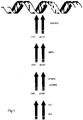
- Intact form A DNA probe used in the present invention is said to be in its intact form when it is in the form it is in before any polymerase reaction according the invention is performed. Salvage synthesis pathway is depicted in Figure 1 .
- TTP and dCTP are triphosphates of the corresponding deoxynucleosides of thymidine and deoxycytidine. These are produced by firstly by transferring a phosphate group from e.g. ATP with help of a deoxyribonucleoside kinase, which will generate the corresponding monophosphate, TMP or dCMP.
- dTMP kinase and cytidylate kinase catalyses the formation to the of the corresponding diphosphate nucleoside, TDP and dCDP.
- RNA-dependent DNA polymerase is the enzyme which catalyses the assembly of deoxyribonucleoside triphosphates into deoxyribonucleic acid, with single-stranded RNA serving as the template during the first strand synthesis.
- the invention aims to provide a general and improved method and kit for detection of deoxyribonucleoside kinase activity(ies).
- the present inventors have found that there is still a need for an activity based deoxyribonucleoside kinase activity assay kit and method that can detect, not only TK in a sample, but also to testing for dCK e.g. for drug resistance development monitoring during cancer treatment, and which is robust in performance, fast, simple, user-friendly and which is safe for clinical use.
- dCK dCK deficiency
- Taq DNA polymerase is a DNA-dependent DNA polymerase from Thermus aquaticus .
- Taq polymerase or simply Taq, has an optimal temperature interval between 65 to 75 °C.
- the Taq DNA polymerase also incorporates 5' to 3' nuclease activity.
- Real-time determination in nucleic acid amplification assay systems has, besides improved sensitivity, the advantages of rapidity, improved resolution, and better precision.
- TK displays characteristic TTP inhibition. This could render the two-step assay difficult to perform for high TK activity containing samples, i.e. a dilution step would be required. Now this can be omitted since the TTP or dCTP produced is constantly being removed by the Taq DNA polymerase through the incorporation of TTP or dCTP into the primer-template system(s).
- T thymidine
- dC deoxycytidine
- a DNA-dependent DNA polymerase is essential reagents needed for measuring deoxyribonucleoside kinases catalytic concentration(s) such as TK or dCK. This can be done in a homogenous mix with other known components for a TK or dCK activity assay.
- the assay is made robust in performance, rapid and simple to perform and clinically safe by coupling complementation of TK or dCK catalytic activity, in a sample, with activities from other nucleoside kinases such as dTMP kinase, or cytidylate kinase, and nucleoside-diphosphate kinase present in a reaction mix.
- dTMP kinase or cytidylate kinase
- nucleoside-diphosphate kinase present in a reaction mix.
- These reagents can conveniently be included in a kit and in a buffer for the production of TTP, or dCTP, with primer extension using a primer-template-detector system, each with fixed concentrations.
- the reagents in the reaction mix without sample will, in the rest of this document, be referred to as the master mix, abbreviated MMX.
- a DNA-dependent DNA polymerase may also be included in the MMX.
- Table 1 summarizes current prior art situation with respect to kit components incorporating a method for the determination of deoxyribonucleoside kinases. In summery none of the previous deoxyribonucleoside kinase kit claims incorporates a DNA-dependent DNA polymerase and a natural T and/or dC substrate, or a mixture thereof, or a method using the same. Table 1.
- Homogenous PCR assays for detection and measurement of nucleic acid target in a sample have become an extremely important assay method in clinical diagnostics.
- Different detecting technologies have been applied to homogenous PCR assays. These include quenching technologies using intercalating molecular detectors, and quenching probe technologies such as dually labelled FRET nucleic acid probes and the so called molecular beacon method which utilizes contact quenching nucleic acid probes.
- kits comprising a DNA-dependent DNA polymerase and natural T or dC as substrate can be used in combination with several detection moieties to measure in a sample the catalytic concentrations of TK or dCK.
- the kit may also be completed with a phosphotransferases such as TMPK or dCMPK and the NdPK.
- the primer-template-probe system In all preferred aspects of the invention it is important to design the primer-template-probe system.
- the choice of DNA-dependant DNA polymerase has to match the choice of the primer-template-detector.
- the present invention does not require temperature cycling shifts, as with the case of real-time PCR.
- the primer-template-probe system is here designed to direct the probe to hybridize before the primer to the template by constructing the probe sequence to attain a 3-15°C higher Tm than the primer thus preferentially binding faster than the primer to the template. Even more preferred is 5-10°C higher Tm. Most preferred is 7-9°C higher Tm.
- the pre-requisite for a TTP or dCTP to initiate the primer extension may impose a short delay in order for the probe to preferentially bind to the template before the primer.
- Taq DNA polymerase is the most preferred DNA-dependent DNA polymerase of the invention.
- concentration of Taq DNA polymerase may range from 0,01- 4U per reaction. More preferred is 0,1- 2 U per reaction. Even more preferred is 0,3-1 U of Taq DNA polymerase per reaction. Most preferred is 0,5 U per reaction of Taq polymerase.
- the design of the primer has to take the Förster radius between the quencher and the 5'-fluorphor using the 5' nuclease assay in consideration.
- a fluorescently dual labelled single stranded DNA probe which in its intact and non-hybridized form is quenched such as an molecular beacon probe, figure 3 , imposes the same temperature strategy for the hybridisation step.
- the primer-template-probe system is designed to direct the probe to hybridize before the primer to the template by constructing the probe sequence to attain a 3-15°C higher Tm than the primer thus preferentially binding faster than the primer to the template. Even more preferred is 5-10°C higher Tm. Most preferred is 7-9°C higher Tm.
- the pre-requisite for a TTP or dCTP to initiate the primer extension may impose a short delay in order for the probe to preferentially bind to the template before the primer.
- the DNA-dependent DNA polymerase has to carry a DNA strand displacement activity.
- concentration of displacing DNA polymerase may range from 0.01- 5 U per reaction with respect to DNA polymerase used. More preferred is 0.1- 3 U per reaction.
- figure 4 double stranded DNA generated through by primer extension, allows for the binding of a surface binding or intercalating fluorescent molecule, to be detected upon binding, figure 4 .
- the DNA polymerase used for this detection system might preferably be a 3' ⁇ 5' exo- DNA-dependant DNA polymerase exemplified with Klenow exo- DNA polymerase.
- the concentration of the DNA polymerase may range from 0.01- 4 U per reaction depending on enzyme preferred. More preferred is 0.1- 2 U per reaction.
- the instrument for signal detection can preferentially be a real-time PCR instrument. No preference with respect to the heating-cooling principle or exiting and light emitting detection principle of the instrument applies to the method according to the invention.
- the method according to the invention can use C t values which are subsequently converted to the catalytic concentration definitions such as Unit enzyme activity per liter (U/I). It should be understood that the method according to the invention can chose between Ct value and time-unit during the signal sampling. The method uses agreed definitions for catalytic concentration.
- the amount of TK or dCK in the sample is preferably determined by any of the detection methods by correlating the cycle number, at which the sum of the fluorescence increase or decrease, depending on detection system used, reaches a threshold detectable level.
- the DNA-dependent DNA polymerase and the natural T or dC substrate may be dispensed into one or a plurality of reaction containers.
- Reaction container suitable for carrying out the method according to the invention in a fluorescent detection instrument is preferably capable to keep a total volume of 20 ⁇ l's to 200 ⁇ l's. Even more preferred the reaction container is capable to keep a volume of 25 ⁇ l or 50 ⁇ l.
- the reaction volume of the method according to the invention can preferably range from 5 ⁇ l to 100 ⁇ l. Even more preferred reaction volume is 25 ⁇ l to 50 ⁇ l.
- the sample is added to the container.
- the container is closed and put into the measuring instrument and incubated. Fluorescent sampling commences and continues for the selected number cycles.
- the TK/dCK sample can preferably constitute serum or plasma. Even more preferred is serum and citrate plasma.
- the proportion of sample of the reaction volume shall preferably be between 1-20%.
- TTP or dCTP is produced by TK or dCK, from the sample, together with the complementing activities of TMPK, or dCMPK, and NdPK comprising the kit.
- TMPK, or dCMPK, and NdPK are preferably present in the reaction in excess to the highest suspected concentration of TK or dCK in a sample, e.g. >3000 U/I.
- NdPK from 1X to 1000X the catalytic concentration represented by 2000pg hrTK1 (ca. 10000U/l).
- a concentration of NdPK that is between 50X to 1000X the catalytic concentration represented by 2000pg of hrTK1.
- TMPK or dCMPK
- TMPK or dCMPK
- TMPK or dCMPK
- TMPK or dCMPK
- TMPK or dCMPK
- TMPK or dCMPK
- TMPK or dCMPK
- TMPK or dCMPK
- TMPK dCMPK
- TMPK dCMPK
- TMPK dCMPK
- TMPK dCMPK
- TMPK or dCMPK
- TTP or dCTP substrate is continuously utilized by the DNA-dependent DNA polymerase, conveniently comprising the kit, to execute the primer extension reaction according to any of the three detection system to create a fluorescent signal which can subsequently be correlated to the TK or dCK catalytic concentration in the sample.
- the template has one or a plurality of "A"'s or a "G”'s in the template nucleotide sequence downstream of the primer binding complementary sequence, i.e. in the 5'-direction of the template sequence, depending on what the deoxyribonucleoside kinase which is to be measured.
- the template needs one or a plurality of "C"s downstream of the primer.
- each primer-probe-detector set irrespective of detection system used, is at least specific with regards to template and the deoxyribonucleoside kinase this is intended to detect.
- Multiplex detection i.e. detection of a plurality of deoxyribonucleoside kinases in the same reaction container, using the 5'nuclease detection system also requires specific probe sequences and labels.
- figure 2 also referred to as detection system 1
- the fluorescence from a single stranded oligonucleotide probe having a 5'- covalently bound fluorophor and a quencher fluorophor covalently bound to the same probe in the 3'-direction is quenched by the action of dynamic quenching or FRET.
- FRET dynamic quenching
- detection system 2 In another detection system, also referred to as detection system 2, figure 4 , the fluorescence from intercalating or surface binding fluorogenic molecules exemplified but not limited to SYBR Green I ® , Picogreen ® and Eva Green Dye®, is quenched, in its free or unbound state.
- the primer extension reaction which uses pre-determined amounts of template and one primer fluorogenic molecules are intercalated or surface bound to the double stranded DNA produced at which it start to fluoresce.
- a third detection system also referred to as detection system 3" figure 3
- the fluorescence from a single stranded oligonucleotide probe comprising a so called molecular beacon having a 5'- covalently bound fluorophor, a quencher fluorophore covalently bound to the same probe 3'-distal to the 5'-bound fluorophore which is quenched by the action of contact quenching or static quenching.
- the molecular beacon probe Prior to the onset of the incubation and real-time cycling the molecular beacon probe is denatured and allowed to hybridize to the target template. When hybridised to the template the contact quenching is released and maximum fluorescence is reached at time zero. During the course of the primer extension, using pre-determined amounts of primer, template and probe, the probe is displaced by the action of the ⁇ 29 DNA polymerase or the Bsm large fragment DNA polymerase or the Bst Large Fragment DNA Polymerase. The two latter DNA polyermases are lacking the 3' ⁇ 5' exonuclease activity.
- a kit related to the detection system 1 may comprise a DNA-dependent DNA polymerase and a natural T or dC substrate, or Br-dU or dC, most preferably a natural T or dC substrate.
- the DNA-dependent DNA polymerase is devoid of 3' ⁇ 5' exonuclease.
- the kit includes the TMPK, or dCMPK, to a concentration of 0,001 - 100 ng/reaction, even more preferably 0,01- 10 ng; 0,02-0,002 U/L NdPK/reaction; a y-phosphate donor such as ATP, UTP, CTP or GTP between 0,5- 15 mM, more preferably 3 - 6 mM most preferred 4 - 5 mM ATP.
- a primer 10-20 nucleotides long, more preferred 10-15 nucleotides long.
- the primer may be minor groove binding modified primer.
- Example of primer is SEQ ID: 9
- a template 50-1000 nucleotides, more preferably 75-250 nucleotides, having a 3'-proximal sequence complementary to the primer sequence; preferably the template sequence has, for the detection of TK or dCK, one or a plurality of "A"'s or “G”s 1-10 nucleotides downstream of the primer binding site i.e. in the template 5'-direction, even more preferred, at the position immediately downstream of the 3'-end of the complement to the primer sequence. Most preferred one A, or one G, is positioned at the position immediately downstream of the 3'-end of the complement to the primer sequence.
- the nucleotide composition forming the rest of the template sequence is preferably a mixture of T's, C's and G's, for the detection of TK activity, or A's in place of G, for the detection of dCK activity, at a preferred ratio of 60-40% GC.
- Example of templates is SEQ ID: 7
- An intercalating or surface binding fluorogenic molecule exemplified by e.g. SYBR Green I ® , Picogreen ® , or Eva Green Dye®.
- the kit may include deoxynucleotide triphosphates, dGTP, dATP, TTP and dCTP.
- the kit may include enzyme stabilizing reagents such as DTT or DTE, to a final concentration between 2- 8 mM; BSA to a final concentration between 0.2 - 1% (W/V); Mg 2+ as MgCl 2 , to a concentration of 5 mM to 12 mM; most preferably 5 - 10 mM.
- enzyme stabilizing reagents such as DTT or DTE, to a final concentration between 2- 8 mM; BSA to a final concentration between 0.2 - 1% (W/V); Mg 2+ as MgCl 2 , to a concentration of 5 mM to 12 mM; most preferably 5 - 10 mM.
- the DNA-dependent DNA polymerase is preferably at a concentration between 0,01-5U/reaction.
- the natural T or dC substrate is preferably between 0,01 mM - 1 mM even more preferably 0.1 mM.
- the mixture of the MMX and the sample is preferably incubated, at 36 - 42°C or even more preferred at 37°C for 30-220 min and determining the amount TK, or dCK, in a sample in real-time by correlating the number of fluorescence capturing cycles (Ct's) needed for the normalized fluorescence to cross a selected threshold level of fluorescence.
- a kit for the detection of TK or dCK using the detection system 2 may comprise a DNA-dependent DNA polymerase and a natural T, or dC, substrate, or BrdU or dC. Most preferred is a natural T, or dC, substrate.
- the DNA-dependent DNA polymerase is devoid of 3' ⁇ 5' exonuclease, but has a 5' ⁇ 3' exonuclease activity such as e.g. Taq DNA polymerase or Tth DNA polymerase.
- the kit includes TMPK or dCMPK to a concentration of 0,001 - 100 ng/reaction, even more preferably 0,01-10ng; 0,02-0,002 U/L NdPK.
- a ⁇ -phosphate donor is required, such as ATP, UTP, CTP or GTP, at a concentration between 0.5 - 15 mM, more preferably between and 4 - 6 mM. Most preferred 5 mM ATP.
- a primer 10 to 20 nucleotides long, may be included in the kit. Primers are exemplified of in SEQ ID: 2 and SEQ ID: 5. Most preferred the primer is 10-15 nucleotides long. The primer may be a minor groove binding modified primer.
- a template for use in detection system 2 may be included in the kit with a length of 25-200 nucleotides. Examples of the templates are shown in SEQ ID: 1 and SEQ ID: 4.
- the template comprises a 3'-sequence complementary to the primer and a downstream, i.e. towards the template 5' end, a sequence complementary to the dually labelled nucleic acid probe.
- the template sequence may comprise one or a plurality of "A"'s, or "G"'s, positioned 1-10 nucleotides downstream from the 3'-end of the primer, even more preferably immediately downstream from the 3'-end of the primer.
- the nucleotide composition forming the rest of the template sequence is preferably a mixture of T's, C's , G's and A's at a preferred ratio of 60-40% GC.
- the 5' bound fluorophor of the probe may comprise a 6-FAM fluorophor label and the 3'-distal nucleotide may carry a BHQ1 quenching fluorophor label (Biosearch Technologies Inc.).
- the probe may carry a TET fluorophor label in place of 6-FAM together with BHQ1 bound to the 3'-distal nucleotide.
- the spectral difference between 6-FAM and TET is great enough (11 nm) to make it possible to distinguish between the light emitted from the two fluorophors even when running in a multiplex format.
- the nucleotides TTP, dCTP, dGTP and dATP may be included in the kit.
- the kit may include an enzyme stabilizing reagents such as DTT or DTE, to a final concentration between 2-10 mM; BSA to a final concentration between 0,2-1% (W/V); monovalent cations as salt e.g K- as KCl, to concentration between 40-100mM, most preferably 50 mM; divalent cations e.g. Mg2+ as MgCl 2 or MgSO 4 , to a concentration of 5 mM to 14 mM; most preferably 7-12 mM.
- the DNA-dependent DNA polymerase is preferably present at a concentration between 0,01-2U per reaction.
- the T or BrdU or dC substrate or the natural T or dC substrate is preferably present at a concentration between 0,01 mM - 1 mM even more preferably 0,1mM.
- a method described in figure 2 using these kit components comprises incubating the sample and MMX preferably at 33°C to 42°C even more preferably at 37°C for 30-200 minutes and in real-time and continuously capture and measure the increase in signal from the detector.
- Determine the amount TK or dCK in a sample preferably by correlating the number of fluorescence capturing cycles (Ct's) needed for the normalized fluorescence (i.e. the remaining fluorescence from a sample after the background fluorescence has been deducted from the total fluorescence, at least, over the first five capturing cycles after start of fluorescence capturing) to cross a selected threshold level, or by correlating to the time needed to reach the same threshold.
- Determination of the threshold level can be done either prior to the run, by setting a fix threshold, or after the run has completed by setting the threshold level for the lowest included deoxyribonucleoside kinase activity control e.g. the negative control containing 0 U/l crossing at the last minute of the run.
- a kit for the detection of TK or dCK using the detection system 3, depicted in figure 3 may comprise a DNA-dependent DNA polymerase and the natural substrate T or dC or BrdU or dC, most preferably T or dC natural substrates.
- the DNA-dependent DNA polymerase is a displacing active polymerase such as exemplified with ⁇ 29 DNA polymerase or the large fragment of the Bsm DNA polymerase from Bacillus smithii (K.K. DNAFORM) or Bst DNA Polymerase Large Fragment from Bacillus stearothermophilus (New England Biolabs Inc.).
- the kit includes TMPK or dCMPK to a concentration of 0,001 - 100 ng/reaction, even more preferably 0,01-10ng; 0,02-0,002 U/L NdPK.
- a ⁇ -phosphate donor is required, such as ATP, UTP, CTP or GTP, at a concentration between 2-8 mM, more preferably between and 4-6 mM. Most preferred is a concentration of 4 mM ATP.
- a primer 7 to 20 nucleotides long, may be included in the kit.
- Example of the primer is shown in SEQ ID: 9.
- the primer sequence may be a minor groove binding primer. Most preferred the primer is 10-16 nucleotides long.
- a template may be included in the kit with a length of 30-1000 nucleotides.
- Example of template sequence are shown in SEQ ID:8.
- the template comprises a 3'-sequence complementary to the primer and a downstream, i.e. towards the template 5' end, a sequence complementary to the dually labelled nucleic acid probe.
- the template sequence may comprise one or a plurality of "A"'s, or a "G"'s, positioned 1-10, more preferred is that the nucleotides are between 2 - 4 nucleotides downstream from the 3'-end of the primer, even more preferably immediately downstream from the 3'-end of the primer.
- the nucleotide composition forming the rest of the template sequence is preferably a mixture of T's, C's , G's and A's at a preferred ratio of 60-40% GC.
- the kit may contain a molecular beacon probe.
- the structure of the probe is exemplified in figure 3 .
- the probe may comprise a 5' covalently bound fluorophore and quencher fluorophore towards the 3'-end.
- the quencher is contact quencher fluorophore such as Dabcyl and functions according to the contact quenching principle. Examples of probe sequences are shown in SEQ ID:10.
- the nucleotide composition forming the rest of the template sequence is preferably a mixture of T's, C's and G's or A's at a preferred ratio of 60-40% GC.
- kits may be TTP, dCTP, dGTP, dATP or other modified nucleotides; enzyme stabilizing reagents such as DTT or DTE, to a final concentration between 2-8mM; BSA to a final concentration between 0,2-1% (W/V); monovalent cations as salt e.g. K- as KCl, to concentration between 5-100mM, most preferably 10 mM; divalent cations e.g. Mg 2+ as MgCl 2 , to a concentration of 5 mM to 12 mM; most preferably 5-10 mM.
- enzyme stabilizing reagents such as DTT or DTE, to a final concentration between 2-8mM
- BSA to a final concentration between 0,2-1% (W/V)
- monovalent cations as salt e.g. K- as KCl, to concentration between 5-100mM, most preferably 10 mM
- the kit may contain a DNA polymerase having DNA strand displacement characteristics exemplified with large fragment of the Bsm DNA polymerase DNA polymerase. Even more preferred is a DNA dependant DNA polymerase having strand displacement characteristics and devoid of 3' ⁇ 5' exonuclease activity.
- the displacing DNA-dependent DNA polymerase is preferably at a concentration between 0,01-2U/reaction.
- the T or BrdU or dC substrate or the natural T or dC substrate is preferably between 0,01 mM - 1 mM even more preferably 0,1 mM.
- a method described in figure 3 using these kit components comprises incubating the sample and MMX preferably at 33°C to 42°C even more preferably at 37°C and in n real-time continuously measure the decrease in fluorescence.
- Determine the amount TK or dCK in a sample preferably by correlating the number of fluorescence capturing cycles (Ct's) needed for the normalized fluorescence (i.e. the remaining fluorescence from a sample after the background fluorescence has been deducted from the total fluorescence, at least, over the first five to 18 cycles after start) to cross a selected threshold level, or by correlating to the time needed to reach the same threshold. Fitting the threshold Ct of the sample to a standard curve constructed from pre-selected standards of known catalytic concentrations of TK or dCK expressed in U/l.
- WO10036359 a kit is described for assays of polymerase activities.
- the method and kit in WO10036359 does not discuss how polymerase activities can be detected in a sample with serum. There is a need for a kit that can detect polymerase activity in samples with serum.
- a standard curve was constructed representing hrTK1catalytic activity values from 200pg, 20pg and 2pg of hrTK1.
- a 0pg standard point was included as a hrTK1 negative control and for determination of the threshold level of normalised fluorescence. Specific activity of the hrTK1 was 2,1 ⁇ mol min -1 mg -1 .
- Each standard point was run in triplicates.
- hrTK1 was diluted in TK dilution buffer, Table 2. Table 2.
- Reagens Final koncentration Tris-HCLpH 7,6 5.00E-02 M
- BSA 0,50% Triton X-100 0,1% DTT 5,00E-03 M
- enzyme mixes were prepared to contain each standard point of hrTK1 together with: NdPK from yeast diluted 500X giving a final catalytic concentration of 0,01 Unit per reaction and TMPK, diluted 50X equal to 36ng per reaction. Specific activity for the yeast NdPK and recombinant TMPK is estimated to 5,4 and 3 ⁇ mol/min/mg respectively. Buffer-, substrate- and oligonucleotide mixes were prepared according to Table 4.
- a 3,2 * 25 ⁇ l MMX for each standard point was prepared at room temperature in a 1,5 ml polypropylene micro centrifuge tube (including the 0pg hrTK1 negative control) by mixing: buffer-, substrate-, and oligonucleotide mixes (Table 3) together with 0,8 U of Klenow exo-DNA polymerase. Table 3. MMX and enzyme mix for TK determination according to detection system 1. Reagent Assay concentration mix Comments deionised water - - Buffer: Tris-HCl pH 8,0 (25°C) 50mM Buffer mix Ambion. 1 M stock, AM9855G MgCl 2 5,0 mM Buffer mix Ambion. 1 M stock, AM9530G Sigma-Aldrich AG, A-6003.
- Protein expressed and purified from E. coli host BL21-(DE3) pLys Provided by Dr. Liya Wang NdPK 0,01 U per reaction Enzyme mix From Sigma Aldrich AG N0379 purified from bakers yeast. Recombinant human TK 2pg; 20pg; 200pg Enzyme mix hrTK1, Met-106 variant. Original human cDNA cloned into pPET14b vector to yield pETKW3. Protein expressed and purified from E.coli host BL21-(DE3) pLys. Provided by Dr. Liya Wang, Swedish University of Agricultural Sciences, department of Anatomy, Biochemistry and Physiology.
- the 200pg enzyme mix of was included in the No-Template-Control MMX. 25 ⁇ l was dispensed into 100 ⁇ l PCR tubes (Qiagen GmbH) in triplicates. Tubes were closed and placed into a Rotor-Gene Q 3000 (Qiagen GmbH) real-time PCR instrument. Run profile was: (1) Hold at 42°C for 2 min, (2) Hold at 35°C for 1 min, (3) Hold at 37°C for 15min (4) Cycling: 37°C for 30s ⁇ 37°C 30s with signal acquisition to the SYBR Greenl ® /FAM channel (excitation at 470nm detection at 510nm). Each cycle was repeated 90 times. Total assay time is 108min.
- a standard curve was constructed representing hrdCK catalytic activity values from 20000pg; 2000pg, 200pg, 20pg and 2pg of enzyme.
- a 0pg standard point was included as a hrdCK negative control and for determination of threshold level for normalised fluorescence.
- enzyme mixes were prepared to contain each standard point of hrTK1; NdPK as in Example 1 and dCMPK diluted 50X, equal to 48ng of enzyme per reaction (Table 4). Specific activity of recombinant dCMPK is estimated to 35 ⁇ mol/min/mg..
- MMX preparation was the same as for Example 1 except that dCTP is replaced by TTP in the MMX.
- Oligonucleotide mix is according to Table 4. Table 4. Oligonucleotides and enzyme mixes for measurement of hrdCK catalytic concentration according to fig.4 and different from example 1.
- the 2000pg enzyme mix of hrdCK was included in the NTC MMX.
- 25 ⁇ l was dispensed into three separate PCR tubes. Tubes were closed and placed into the real-time PCR instrument. Cycling profile was: (1) Hold at 42°C for 2 min, (2) Hold at 35°C for 1 min, (3) Hold at 37°C for 15min (4) Cycling: 37°C for 30s ⁇ 37°C 30s with signal acquisition to the SYBR GreenI ® /FAM channel (excitation at 470nm detection at 510nm). Each cycle was repeated 90 times. Total assay time 108min.
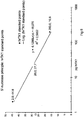
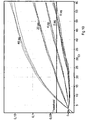
- Fluorescence normalisation is from cycle 1. Threshold selected for 0pg after 90min. Threshold was set at 0,017 normative fluorescence units. On the X-axis are given the activity from respective standard point given as pg of deoxyribonucleoside kinase. Each standard point carries the pg(X);Ct(y) value, Figure 4 .
- a standard curve was constructed representing catalytic activity values from, 200pg, 20pg and 2pg of hrTK1.
- a 0pg standard point was included as a negative control.
- enzyme mixes were prepared to contain the hrTK1 standard point; NdPK and TMPK as for Example 1.
- MMX's were prepared as for Example 1 except that 0,4 U of Taq DNA polymerase replaces the Klenow DNA polymerase and that oligonucleotides were according to Table 5.
- respective standard point enzyme mix was added to the each dedicated MMX.
- the 200pg enzyme mix of was included in the NTC. From each standard point mix 25 ⁇ l was dispensed into three PCR tubes. Tubes were capped and placed into the PCR instrument.
- Cycling profile was: (1) Hold at 42°C for 1 min, (2) Hold at 35°C for 1 min, (3) Cycling: 37°C for 30s ⁇ 37°C 30s with signal acquisition to the SYBR GreenI ® /FAM channel (excitation at 470 nm detection at 510 nm). Each 1 min cycle was repeated 60 times. Total assay time 65 minutes. Table 5. Oligonucleotides and DNA polymerase for hrTK1 determination according to detection system 2 different from Example1. Reagent Assay concentration mix Comments SEQ ID: 2 Primer O25XTTM 400nM Oligonucleotide mix Delivered by Cybergene AB, Sweden.
- SEQ ID: 1 Template O24TTTM 500nM Oligonucleotide mix Delivered by Cybergene AB, Sweden.
- SEQ ID: 3 Probe O26PTTM 300nM Oligonucleotide mix 5'-nucleotide labelled with 6-FAM. 3'-nucleotide labelled with -BHQ1. Delivered by Cybergene AB, Sweden. Taq DNA polymerase 0,4U per reaction From Fermentas UAB. Dreamtaq ® EP0701.
- Figure 12 depicts the raw fluorescence obtained from this experiment.
- the raw fluorescence was standard normalised i.e. only calculated over the first five cycles and linearized, starting from cycle 1, Figure 5 .
- a threshold level was selected for 2pg after approx. 60minutes.
- the threshold was found to be 0,12 of normative fluorescence units (Y-axis).
- Ct values was determined using the built in software Rotor-gene v. 6.01 for the chosen threshold.
- hrTK1 standardpoints - performance characteristics
- Example 4 Amount of TK activity given in equivalent picograms Ct X s CV% 200 20,65 20,22 0,38 1,88% 200 19,93 200 20,08 20 34,65 34,76 0,22 0,63% 20 35,01 20 34,61 2 59,66 58,05 1,44 2,48% 2 56,89 2 57,61
- a standard curve was constructed representing HrdCK catalytic activity values from 20000pg; 2000pg; 200pg, 20pg and 2pg of enzyme.
- a 0pg standard point was included as a negative control.
- enzyme mixes were prepared to contain the standard point; NdPK and dCMPK as given in Example's 1 and 2. 3,2 * 25 ⁇ l MMX's were prepared at room temperature in a 1,5 ml polypropylene micro centrifuge tube for each standard point (including the 0pg dCK negative control) by mixing buffer-, substrate-, oligonucleotide mix (Table 7), together with 0,4 U of Taq DNA polymerase. Note that oligonucleotides were replaced with those given in Table 7 below.
- the enzyme mix from respective standard point was added to the MMX.
- the 20000pg enzyme mix of was included in the NTC MMX.
- 25 ⁇ l of MMX and standard point mix was dispensed into three PCR tubes. Tubes were capped and placed into the real-time PCR instrument. Cycling profile was: (1) Hold at 42°C for 1 min, (2) Hold at 35°C for 1 min, (3) Cycling: 37°C for 30s ⁇ 37°C 30s with signal acquisition to the JOE channel (excitation at 530nm detection at 555nm). Each cycle was repeated 60 times. Total assay time 65 minutes. Table 7. MMX for determination of dCK catalytic concentration according to detection system2.
- SEQ ID: 6 Probe O29PCTM 400nM Oligonucleotide mix 5'-nucleotide labelled with TET. The 3'-nucleotide labelled with -BHQ1. Delivered by Cybergene AB, Sweden.
- hrdCK standardpoints Precision performance Activity from: -- of hrdCK Ct X S CV% 20000pg 21,76 21,61 0,17 0,80% 20000pg 21,65 20000pg 21,42 2000pg 29,30 29,91 0,81 2,69% 2000pg 30,82 2000pg 29,60 200pg 43,13 43,15 0,87 2,01% 200pg 42,30 200pg 44,03 20pg 46,99 46,46 0,47 1,02% 20pg 46,33 20pg 46,07 2pg 58,10 58,09 1,24 2,13% 2pg 56,85 2pg 59,33
- Standard curve were constructed representing hrTK1 catalytic activity values from, 200pg, 20pg and 2pg of enzyme. Briefly, enzyme mixes for respective nucleoside kinase were prepared to contain the nucleoside standard point together with NdPK and TMPK as described in Example 3. A 3,2 * 25 ⁇ l MMX's were prepared according to Example 3 with the following exceptions: DNA-dependant DNA polymerase and oligonucleotides were replaced by those given in Table 9 below. Table 9. MMX for determination of hrTK1 according to detection system 3 and different from Example 3.
- the enzyme mix from respective standard point was added to respective MMX.
- the 200pg enzyme mix of was included in the NTC. Tubes were closed and placed into the real-time PCR instrument. Cycling profile was: (1) Hold at 42°C for 1 min, (2) Hold at 35°C for 1 min, (3) Hold at 37°C for 15min, (4) Cycling: 37°C for 30s ⁇ 37°C 30s with signal acquisition to the FAM channel repeated 90 times. Total assay time 108minutes. Threshold selected for 0pg at 90minutes.
- Figure x depicts the decrease in raw fluorescence from displaced FAM/Dabcyl molecular beacon probes in real-time. Threshold is set at 0,012 normative fluorescence units.
- Figure 14 shows the logarithmic regression of mean of obtained C t values from the three standard points. R 2 value is 0,96. The logarithmic regression of the linear fluorescence gives an R 2 value of 0,98 indicating the validity of using this standard curve to determine dCK activity values from real clinical samples.
- Standard curve were constructed representing hrdCK catalytic activity values from 2000pg, 200pg; and 20pg and 2pg of enzyme.
- a 0pg standard point was included as a negative control and for setting of the threshold normalised fluorescence value.
- enzyme mixes for respective nucleoside kinase were prepared to contain the nucleoside standard point; NdPK and dCMPK according to Examples 2 and 4.
- a 3,2 25 ⁇ l MMX's were prepared according to Example 5 with the exception of the oligonucleotides which were according to Table 10 below. Table 10.
- Table 10 Table 10. MMX for determination of hrdCK catalytic concentration according to detection system 3 and different from Example 2 and 4.
- the enzyme mix from respective nucleoside and respective standard point were added to respective MMX.
- the 200pg enzyme mix of was included in the NTC MMX.
- 25 ⁇ l was dispensed into three 100 ⁇ l PCR tubes from each standard point, capped and placed into the real-time PCR instrument. Cycling profile was: (1) Hold at 42°C for 1 min, (2) Hold at 35°C for 1 min, (3) Cycling: 37°C for 30s ⁇ 37°C 30s with signal acquisition to the JOE channel. Each cycle was repeated 90 times. Total assay time 108 minutes.
- Standard curves were constructed from a mix with different hrTK1 and hrdCK catalytic activity values given in Table 11 below. Briefly, enzyme mixes were prepared to comprise each standard point hrTK1/hrdCK point together with NdPK, TMPK and dCMPK according to Examples 1 and 2. MMX was prepared according to Examples 3 with the following exceptions: oligonuclotides from Example 4 was included and NdPK was 0,02U/reaction. Table 11.
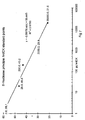
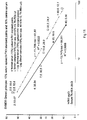
- Figure 8 shows the linear regression on a logarithmic scale results from the multiplexing experiment.
- On the Y-axis is number of Ct's needed for detection.
- X-axis is the arbitrary "pg" activity from respective deoxyribonucleoside kinase. The results clearly indicate that the amount of either deoxyribonucleoside kinase has no affect on the primer extension efficiency of the other. The different slopes of the two deoxyribonucleoside kinase involved are probably due to the different specific activities that these enzymes may exhibit.
- Canine serum samples with a previous diagnosed malignant disease were tested for hrTK1 catalytic concentrations according to detection system 2. Each serum has previously been measured by the TK-REA method. A standard curve was included with catalytic activities from 200pg, 20pg and 2pg of hrTK1. The experiment was carried out according to Example 2 with the following exceptions: 1) Serum samples TK dilution buffer replaced hrTK1 and serum was added to a final concentration of 5% i.e. 1,25 ⁇ l of serum was included in each reaction (4 ⁇ l of serum per MMX/enzyme mix); 2) Cycling profile was according to Example 1. Normalisation was from cycle 1. Threshold selected for 0pg TK after 90minutes.
- Serum from canines for which TK1 activity previously had been measured using the TK-REA product from Diasorin s.r.l., (Saluggia Italy), was tested using the SYBR Green technical principle.
- Standard curve samples representing catalytic activity from 40 pg, 20 pg, 4 pg, 2 pg and 0 pg of hrTK1, spiked with 10% human normal serum from a blood donor, were measured alongside the serum samples (final 10%),.
- the 0 pg spiked standard point sample was included as a negative control and threshold determinant of normalised fluorescence.
- enzyme mixes were prepared to contain 0,002 U NdPK, and 18 ng per reaction of dTMP kinase, each hrTK1standard point sample or each serum sample.
- Buffer-, substrate- and oligonucleotide mixes were prepared according to Table 3.
- a MMX for each sample was prepared at room temperature in a 1,5 ml polypropylene microcentrifuge tube by mixing water, mixe's and 0,5 U of Klenow exo- DNA polymerase (Fermentas AG).
- a MMX 200 pg hrTK1 the enzyme mix standard point sample was used as No-Template-Control (NTC).
- NTC No-Template-Control
- Reagent Assay concentration mix Comments deionised water - - Buffer: Tris-HCl pH 8,0 (25°C) 50 mM Buffer mix Ambion 1 M stock, AM9855G MgCl 2 5,0 mM Buffer mix Ambion 1M stock, AM9530G Sigma-Aldrich AG, A-6003. BSA 0,5% Buffer mix 10% stock solution. Heat inactivated @ 56°C 20'.
- NdPK 0,002 U per reaction Enzyme mix Sigma-Aldrich AG N0379, purified from bakers yeast. hrTK1 2 pg; 4 pg; 20 pg; 40 pg Enzyme mix Met-106. Original human cDNA cloned into pPET14b to yield pETKW3. Protein expressed and purified from E.coli host BL21-(DE3) pLys. Klenow exo - fragment 0,5 U per reaction Fermentas AG, EP0422
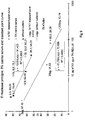
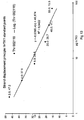
- TK-REA U/1 On the X-axis are given the activity from respective sample, either as pg of hrTK1 or as TK-REA U/1. Each sample point carries the pg/TK-REA U/l(X);Ct(y) value.
- An linear regression and R 2 score of 0,9688 was obtained for the serum spiked hrTK1 standard point samples indicating that the correlation is good enough for determining the amount of TK U/l in a sample.
- a Students t-test was applied to the two separate regression curves in order to further determine the relationship between the slopes. Due to the small data-set the t-test was calculated manually. The test was performed with equal variance but with unequal sample size. A score of 0,07 on the data set indicated that there is a high probability that the slopes may be considered as being equal.
- hrTK1 standard curve obtained using the Strand displacement technical principle, i.e. according to detection system 3.
- a standard curve was constructed representing catalytic activity values from, 80 pg, 40 pg, 20 pg, 8 pg, 4 pg, 2 pg and 0 pg of hrTK1. Briefly, MMX's were prepared for each standard point as described in example 2 and Table 7. Table 15.
- Stock 0,1 M R0151 dGTP 100 ⁇ M Substrate mix Fermentas AG.
- the 80 pg hrTK1 containing enzyme mix of was included in the NTC.
- MMX's were dispensed, tubes were closed and placed into the real-time PCR instrument. Cycling profile was: (1) Hold at 42°C for 1 min, (2) Hold at 35°C for 1 min, (3) Hold at 37°C for 15min, (4) Cycling: 37°C for 30s ⁇ 37°C 30s with signal acquisition to the FAM channel repeated 90 times. Total assay time 108minutes. Threshold selected for 0 pg at 90 minutes.
- Figure 12 depicts the decrease from normalised fluorescence from displaced FAM molecular beacon hairpin probes in real-time.
- the normalisation method used was Dynamic tube normalisation according to the software providers instruction (Corbett-Research) Threshold is set at - (minus) 0,02118 normative fluorescence units.
- Figure 13 shows the linear regression on a logarithmic scale of the mean C t values obtained from the six standard points. R 2 value is 0,9422 indicating that the standard curve may be applied for determination of TK activities in clinical samples from serum or plasma.
Landscapes
- Chemical & Material Sciences (AREA)
- Health & Medical Sciences (AREA)
- Life Sciences & Earth Sciences (AREA)
- Organic Chemistry (AREA)
- Wood Science & Technology (AREA)
- Zoology (AREA)
- Engineering & Computer Science (AREA)
- Genetics & Genomics (AREA)
- Molecular Biology (AREA)
- Bioinformatics & Cheminformatics (AREA)
- Biochemistry (AREA)
- General Health & Medical Sciences (AREA)
- Immunology (AREA)
- Physics & Mathematics (AREA)
- Proteomics, Peptides & Aminoacids (AREA)
- Microbiology (AREA)
- Biotechnology (AREA)
- General Engineering & Computer Science (AREA)
- Analytical Chemistry (AREA)
- Biophysics (AREA)
- Biomedical Technology (AREA)
- Medicinal Chemistry (AREA)
- Chemical Kinetics & Catalysis (AREA)
- Optics & Photonics (AREA)
- Pathology (AREA)
- General Physics & Mathematics (AREA)
- Nuclear Medicine, Radiotherapy & Molecular Imaging (AREA)
- Measuring Or Testing Involving Enzymes Or Micro-Organisms (AREA)
- Enzymes And Modification Thereof (AREA)
- Investigating Or Analysing Materials By The Use Of Chemical Reactions (AREA)
Applications Claiming Priority (2)
| Application Number | Priority Date | Filing Date | Title |
|---|---|---|---|
| SE1050473 | 2010-05-14 | ||
| PCT/SE2011/050605 WO2011142719A1 (en) | 2010-05-14 | 2011-05-13 | Kit and method |
Publications (4)
| Publication Number | Publication Date |
|---|---|
| EP2569441A1 EP2569441A1 (en) | 2013-03-20 |
| EP2569441A4 EP2569441A4 (en) | 2013-11-27 |
| EP2569441B1 EP2569441B1 (en) | 2014-11-19 |
| EP2569441B2 true EP2569441B2 (en) | 2017-09-13 |
Family
ID=44641364
Family Applications (1)
| Application Number | Title | Priority Date | Filing Date |
|---|---|---|---|
| EP11780890.7A Active EP2569441B2 (en) | 2010-05-14 | 2011-05-13 | Kit and method for measuring the activity of deoxynucleoside kinase using dna-dependent dna polymerase and natural deoxynucleosides |
Country Status (6)
| Country | Link |
|---|---|
| US (2) | US9429518B2 (enExample) |
| EP (1) | EP2569441B2 (enExample) |
| JP (2) | JP2013526273A (enExample) |
| CN (1) | CN103038361B (enExample) |
| DK (1) | DK2569441T4 (enExample) |
| WO (1) | WO2011142719A1 (enExample) |
Families Citing this family (3)
| Publication number | Priority date | Publication date | Assignee | Title |
|---|---|---|---|---|
| EP2569441B2 (en) | 2010-05-14 | 2017-09-13 | cSens AB | Kit and method for measuring the activity of deoxynucleoside kinase using dna-dependent dna polymerase and natural deoxynucleosides |
| CN110904187A (zh) * | 2019-11-05 | 2020-03-24 | 翌圣生物科技(上海)有限公司 | 一种Taq酶活性测定方法 |
| WO2023208361A1 (en) | 2022-04-29 | 2023-11-02 | Biovica International Ab | Thymidine kinase as a marker for immune checkpoint inhibitor efficacy |
Family Cites Families (19)
| Publication number | Priority date | Publication date | Assignee | Title |
|---|---|---|---|---|
| US5273879A (en) * | 1987-07-23 | 1993-12-28 | Syntex (U.S.A.) Inc. | Amplification method for polynucleotide assays |
| US5328827A (en) * | 1987-08-27 | 1994-07-12 | Institut National De La Recherche Agronomique - Inra | Specific DNA molecular probes for Bos-type male genome |
| DE4020529A1 (de) * | 1989-09-12 | 1991-03-21 | Roxana Vasiloiu | Multifunktionelle(s) enzym(e) mit nucleosid-didesoxyribosyltransferase(n) und/oder nucleoside-desoxyribosyltransferasen(n) und/oder kinease- und/oder reduktase- und/oder desaminase- und/oder polymerase-aktivitaet |
| US5189019A (en) * | 1990-04-23 | 1993-02-23 | Merck & Co., Inc. | Antistasin derived anticoagulant protein |
| US5321010A (en) * | 1991-12-10 | 1994-06-14 | Merck & Co., Inc. | Proteins for inhibiting adhesion of platelets to collagen |
| EP0726708A1 (en) * | 1993-11-05 | 1996-08-21 | Pathogenesis Corporation | Virus associated multiple sclerosis: treatments, prevention and diagnosis thereof |
| EP0745686A1 (en) * | 1995-06-01 | 1996-12-04 | Roche Diagnostics GmbH | The use of DNA polymerase 3'-intrinsic editing activity |
| GB0022458D0 (en) * | 2000-09-13 | 2000-11-01 | Medical Res Council | Directed evolution method |
| US7045319B2 (en) | 2001-10-30 | 2006-05-16 | Ribomed Biotechnologies, Inc. | Molecular detection systems utilizing reiterative oligonucleotide synthesis |
| DE60217665T2 (de) | 2002-07-27 | 2007-10-11 | Diasorin Ab | Verfahren zur Bestimmung der Aktivität von Thymidinkinase-1 und dessen Verwendung |
| US9505846B2 (en) | 2005-01-28 | 2016-11-29 | Life Technologies Corporation | Multi-component inhibitors of nucleic acid polymerases |
| DK1856275T3 (da) * | 2005-02-25 | 2009-12-07 | Roennerbol Internat Ab | Fremgangsmåde og kit til bestemmelse af thymidinkinase-aktivitet og anvendelse deraf |
| WO2008024052A1 (en) | 2006-08-24 | 2008-02-28 | Rönnerbol International Ab | A method and a kit for determination of an enzyme activity involved in metabolic production of a deoxynucleoside triphosphate and use thereof |
| GB0722449D0 (en) | 2007-11-15 | 2007-12-27 | Univ Abertay Dundee | bIOASSAY |
| US20090197254A1 (en) * | 2007-12-14 | 2009-08-06 | Ming-Chou Lee | Variant scorpion primers for nucleic acid amplification and detection |
| JP2009268381A (ja) | 2008-05-01 | 2009-11-19 | Univ Of Fukui | 癌特異的酢酸代謝を標的とした癌バイオマーカー・検査方法・治療剤 |
| GB0814591D0 (en) * | 2008-08-08 | 2008-09-17 | Randox Lab Ltd | Assay |
| WO2010036359A2 (en) * | 2008-09-25 | 2010-04-01 | Allelogic Biosciences Corporation | Methods of polymerase activity assay |
| EP2569441B2 (en) | 2010-05-14 | 2017-09-13 | cSens AB | Kit and method for measuring the activity of deoxynucleoside kinase using dna-dependent dna polymerase and natural deoxynucleosides |
-
2011
- 2011-05-13 EP EP11780890.7A patent/EP2569441B2/en active Active
- 2011-05-13 WO PCT/SE2011/050605 patent/WO2011142719A1/en not_active Ceased
- 2011-05-13 JP JP2013510047A patent/JP2013526273A/ja active Pending
- 2011-05-13 CN CN201180024021.1A patent/CN103038361B/zh active Active
- 2011-05-13 US US13/697,279 patent/US9429518B2/en active Active
- 2011-05-13 DK DK11780890.7T patent/DK2569441T4/en active
-
2016
- 2016-08-22 US US15/243,764 patent/US10190149B2/en active Active
- 2016-09-30 JP JP2016192924A patent/JP6409233B2/ja active Active
Also Published As
| Publication number | Publication date |
|---|---|
| EP2569441A4 (en) | 2013-11-27 |
| EP2569441B1 (en) | 2014-11-19 |
| JP6409233B2 (ja) | 2018-10-24 |
| JP2017042169A (ja) | 2017-03-02 |
| WO2011142719A1 (en) | 2011-11-17 |
| US20130071846A1 (en) | 2013-03-21 |
| DK2569441T3 (en) | 2015-01-05 |
| US20170029867A1 (en) | 2017-02-02 |
| EP2569441A1 (en) | 2013-03-20 |
| DK2569441T4 (en) | 2017-12-18 |
| US10190149B2 (en) | 2019-01-29 |
| CN103038361A (zh) | 2013-04-10 |
| US9429518B2 (en) | 2016-08-30 |
| CN103038361B (zh) | 2017-02-08 |
| JP2013526273A (ja) | 2013-06-24 |
Similar Documents
| Publication | Publication Date | Title |
|---|---|---|
| EP2867366B1 (en) | Method for isothermal dna amplification starting from an rna template in a single reaction mixture | |
| DK2660336T3 (en) | ISOTERM NUCLEIC ACID AMPLIFICATION | |
| RU2630999C2 (ru) | Композиции для реакции обратной транскрипции с горячим стартом или для полимеразной цепной реакции с обратной транскрипцией с горячим стартом | |
| JP2002536981A (ja) | 核酸標的配列の存在を測定する方法およびその応用 | |
| JPS61254856A (ja) | ポリヌクレオチド置換、分離、酵素開裂、およびアデノシンリン酸検出を用いる診断用試薬、キットおよび方法 | |
| CN1318606C (zh) | 检测靶序列的方法和组合物 | |
| JP2003210199A (ja) | 高度ダイナミックレンジを有する定量的多重pcr | |
| US20180327819A1 (en) | Biosensor comprising tandem reactions of structure switching, nucleolytic digestion and amplification of a nucleic acid assembly | |
| KR20230012467A (ko) | 표적 핵산을 검출하기 위한 루프형 프라이머 및 루프-드-루프 방법 | |
| CN101932731A (zh) | 亚硫酸氢化核酸的扩增 | |
| US10190149B2 (en) | Kit and method for measuring the activity of deoxynucleoside kinase | |
| US9617606B2 (en) | Oligonucleotide for HIV detection, HIV detection kit, and HIV detection method | |
| US9777319B2 (en) | Method for isothermal DNA amplification starting from an RNA template | |
| JPH04211400A (ja) | 修飾核酸の製造方法 | |
| JP2025098095A (ja) | 核酸を検出するための係留酵素の使用 | |
| WO2025122063A1 (en) | Methods of detecting target nucleic acids | |
| JP2023552693A (ja) | 標的遺伝子変異及びウイルスゲノムの検出システム並びにその製造及び使用の方法 | |
| Zhao et al. | Advances in the detection of RNA modification | |
| PT99177B (pt) | Processo para a deteccao especifica de acidos nucleicos | |
| JP7417985B2 (ja) | プライマーセット | |
| CN104513850A (zh) | 一种脱氧核糖核酸酶催化合成方法 | |
| KR20240141182A (ko) | 열안정성 rna 중합효소 | |
| ES2642940T3 (es) | Amplificación isotérmica de ácido nucleico | |
| CN104513849A (zh) | 一种核酸检测方法 |
Legal Events
| Date | Code | Title | Description |
|---|---|---|---|
| PUAI | Public reference made under article 153(3) epc to a published international application that has entered the european phase |
Free format text: ORIGINAL CODE: 0009012 |
|
| 17P | Request for examination filed |
Effective date: 20121214 |
|
| AK | Designated contracting states |
Kind code of ref document: A1 Designated state(s): AL AT BE BG CH CY CZ DE DK EE ES FI FR GB GR HR HU IE IS IT LI LT LU LV MC MK MT NL NO PL PT RO RS SE SI SK SM TR |
|
| DAX | Request for extension of the european patent (deleted) | ||
| A4 | Supplementary search report drawn up and despatched |
Effective date: 20131025 |
|
| RIC1 | Information provided on ipc code assigned before grant |
Ipc: C12N 9/12 20060101ALI20131021BHEP Ipc: C12Q 1/48 20060101AFI20131021BHEP |
|
| GRAP | Despatch of communication of intention to grant a patent |
Free format text: ORIGINAL CODE: EPIDOSNIGR1 |
|
| INTG | Intention to grant announced |
Effective date: 20140605 |
|
| GRAS | Grant fee paid |
Free format text: ORIGINAL CODE: EPIDOSNIGR3 |
|
| GRAA | (expected) grant |
Free format text: ORIGINAL CODE: 0009210 |
|
| RAP1 | Party data changed (applicant data changed or rights of an application transferred) |
Owner name: CSENS AB |
|
| RIN1 | Information on inventor provided before grant (corrected) |
Inventor name: STALHANDSKE PER Inventor name: LENNERSTRAND JOHAN |
|
| AK | Designated contracting states |
Kind code of ref document: B1 Designated state(s): AL AT BE BG CH CY CZ DE DK EE ES FI FR GB GR HR HU IE IS IT LI LT LU LV MC MK MT NL NO PL PT RO RS SE SI SK SM TR |
|
| REG | Reference to a national code |
Ref country code: GB Ref legal event code: FG4D |
|
| REG | Reference to a national code |
Ref country code: CH Ref legal event code: EP |
|
| REG | Reference to a national code |
Ref country code: AT Ref legal event code: REF Ref document number: 697080 Country of ref document: AT Kind code of ref document: T Effective date: 20141215 |
|
| REG | Reference to a national code |
Ref country code: IE Ref legal event code: FG4D |
|
| REG | Reference to a national code |
Ref country code: DE Ref legal event code: R096 Ref document number: 602011011627 Country of ref document: DE Effective date: 20141231 |
|
| REG | Reference to a national code |
Ref country code: DK Ref legal event code: T3 Effective date: 20141216 |
|
| REG | Reference to a national code |
Ref country code: NL Ref legal event code: T3 |
|
| REG | Reference to a national code |
Ref country code: SE Ref legal event code: TRGR |
|
| REG | Reference to a national code |
Ref country code: LT Ref legal event code: MG4D |
|
| PG25 | Lapsed in a contracting state [announced via postgrant information from national office to epo] |
Ref country code: LT Free format text: LAPSE BECAUSE OF FAILURE TO SUBMIT A TRANSLATION OF THE DESCRIPTION OR TO PAY THE FEE WITHIN THE PRESCRIBED TIME-LIMIT Effective date: 20141119 Ref country code: PT Free format text: LAPSE BECAUSE OF FAILURE TO SUBMIT A TRANSLATION OF THE DESCRIPTION OR TO PAY THE FEE WITHIN THE PRESCRIBED TIME-LIMIT Effective date: 20150319 Ref country code: IS Free format text: LAPSE BECAUSE OF FAILURE TO SUBMIT A TRANSLATION OF THE DESCRIPTION OR TO PAY THE FEE WITHIN THE PRESCRIBED TIME-LIMIT Effective date: 20150319 Ref country code: NO Free format text: LAPSE BECAUSE OF FAILURE TO SUBMIT A TRANSLATION OF THE DESCRIPTION OR TO PAY THE FEE WITHIN THE PRESCRIBED TIME-LIMIT Effective date: 20150219 Ref country code: ES Free format text: LAPSE BECAUSE OF FAILURE TO SUBMIT A TRANSLATION OF THE DESCRIPTION OR TO PAY THE FEE WITHIN THE PRESCRIBED TIME-LIMIT Effective date: 20141119 |
|
| PG25 | Lapsed in a contracting state [announced via postgrant information from national office to epo] |
Ref country code: CY Free format text: LAPSE BECAUSE OF FAILURE TO SUBMIT A TRANSLATION OF THE DESCRIPTION OR TO PAY THE FEE WITHIN THE PRESCRIBED TIME-LIMIT Effective date: 20141119 Ref country code: GR Free format text: LAPSE BECAUSE OF FAILURE TO SUBMIT A TRANSLATION OF THE DESCRIPTION OR TO PAY THE FEE WITHIN THE PRESCRIBED TIME-LIMIT Effective date: 20150220 Ref country code: RS Free format text: LAPSE BECAUSE OF FAILURE TO SUBMIT A TRANSLATION OF THE DESCRIPTION OR TO PAY THE FEE WITHIN THE PRESCRIBED TIME-LIMIT Effective date: 20141119 Ref country code: PL Free format text: LAPSE BECAUSE OF FAILURE TO SUBMIT A TRANSLATION OF THE DESCRIPTION OR TO PAY THE FEE WITHIN THE PRESCRIBED TIME-LIMIT Effective date: 20141119 Ref country code: LV Free format text: LAPSE BECAUSE OF FAILURE TO SUBMIT A TRANSLATION OF THE DESCRIPTION OR TO PAY THE FEE WITHIN THE PRESCRIBED TIME-LIMIT Effective date: 20141119 Ref country code: HR Free format text: LAPSE BECAUSE OF FAILURE TO SUBMIT A TRANSLATION OF THE DESCRIPTION OR TO PAY THE FEE WITHIN THE PRESCRIBED TIME-LIMIT Effective date: 20141119 |
|
| REG | Reference to a national code |
Ref country code: FR Ref legal event code: PLFP Year of fee payment: 5 |
|
| PG25 | Lapsed in a contracting state [announced via postgrant information from national office to epo] |
Ref country code: SK Free format text: LAPSE BECAUSE OF FAILURE TO SUBMIT A TRANSLATION OF THE DESCRIPTION OR TO PAY THE FEE WITHIN THE PRESCRIBED TIME-LIMIT Effective date: 20141119 Ref country code: EE Free format text: LAPSE BECAUSE OF FAILURE TO SUBMIT A TRANSLATION OF THE DESCRIPTION OR TO PAY THE FEE WITHIN THE PRESCRIBED TIME-LIMIT Effective date: 20141119 Ref country code: RO Free format text: LAPSE BECAUSE OF FAILURE TO SUBMIT A TRANSLATION OF THE DESCRIPTION OR TO PAY THE FEE WITHIN THE PRESCRIBED TIME-LIMIT Effective date: 20141119 Ref country code: CZ Free format text: LAPSE BECAUSE OF FAILURE TO SUBMIT A TRANSLATION OF THE DESCRIPTION OR TO PAY THE FEE WITHIN THE PRESCRIBED TIME-LIMIT Effective date: 20141119 |
|
| REG | Reference to a national code |
Ref country code: DE Ref legal event code: R026 Ref document number: 602011011627 Country of ref document: DE |
|
| PLBI | Opposition filed |
Free format text: ORIGINAL CODE: 0009260 |
|
| 26 | Opposition filed |
Opponent name: BIOVICA INTERNATIONAL AB Effective date: 20150817 |
|
| PLAX | Notice of opposition and request to file observation + time limit sent |
Free format text: ORIGINAL CODE: EPIDOSNOBS2 |
|
| PG25 | Lapsed in a contracting state [announced via postgrant information from national office to epo] |
Ref country code: MC Free format text: LAPSE BECAUSE OF FAILURE TO SUBMIT A TRANSLATION OF THE DESCRIPTION OR TO PAY THE FEE WITHIN THE PRESCRIBED TIME-LIMIT Effective date: 20141119 |
|
| PLAF | Information modified related to communication of a notice of opposition and request to file observations + time limit |
Free format text: ORIGINAL CODE: EPIDOSCOBS2 |
|
| PG25 | Lapsed in a contracting state [announced via postgrant information from national office to epo] |
Ref country code: SI Free format text: LAPSE BECAUSE OF FAILURE TO SUBMIT A TRANSLATION OF THE DESCRIPTION OR TO PAY THE FEE WITHIN THE PRESCRIBED TIME-LIMIT Effective date: 20141119 |
|
| PLBB | Reply of patent proprietor to notice(s) of opposition received |
Free format text: ORIGINAL CODE: EPIDOSNOBS3 |
|
| PLBP | Opposition withdrawn |
Free format text: ORIGINAL CODE: 0009264 |
|
| REG | Reference to a national code |
Ref country code: FR Ref legal event code: PLFP Year of fee payment: 6 |
|
| PG25 | Lapsed in a contracting state [announced via postgrant information from national office to epo] |
Ref country code: MT Free format text: LAPSE BECAUSE OF FAILURE TO SUBMIT A TRANSLATION OF THE DESCRIPTION OR TO PAY THE FEE WITHIN THE PRESCRIBED TIME-LIMIT Effective date: 20141119 |
|
| REG | Reference to a national code |
Ref country code: FR Ref legal event code: PLFP Year of fee payment: 7 |
|
| PG25 | Lapsed in a contracting state [announced via postgrant information from national office to epo] |
Ref country code: BG Free format text: LAPSE BECAUSE OF FAILURE TO SUBMIT A TRANSLATION OF THE DESCRIPTION OR TO PAY THE FEE WITHIN THE PRESCRIBED TIME-LIMIT Effective date: 20141119 Ref country code: SM Free format text: LAPSE BECAUSE OF FAILURE TO SUBMIT A TRANSLATION OF THE DESCRIPTION OR TO PAY THE FEE WITHIN THE PRESCRIBED TIME-LIMIT Effective date: 20141119 Ref country code: HU Free format text: LAPSE BECAUSE OF FAILURE TO SUBMIT A TRANSLATION OF THE DESCRIPTION OR TO PAY THE FEE WITHIN THE PRESCRIBED TIME-LIMIT; INVALID AB INITIO Effective date: 20110513 |
|
| PUAH | Patent maintained in amended form |
Free format text: ORIGINAL CODE: 0009272 |
|
| STAA | Information on the status of an ep patent application or granted ep patent |
Free format text: STATUS: PATENT MAINTAINED AS AMENDED |
|
| PG25 | Lapsed in a contracting state [announced via postgrant information from national office to epo] |
Ref country code: TR Free format text: LAPSE BECAUSE OF FAILURE TO SUBMIT A TRANSLATION OF THE DESCRIPTION OR TO PAY THE FEE WITHIN THE PRESCRIBED TIME-LIMIT Effective date: 20141119 |
|
| 27A | Patent maintained in amended form |
Effective date: 20170913 |
|
| AK | Designated contracting states |
Kind code of ref document: B2 Designated state(s): AL AT BE BG CH CY CZ DE DK EE ES FI FR GB GR HR HU IE IS IT LI LT LU LV MC MK MT NL NO PL PT RO RS SE SI SK SM TR |
|
| REG | Reference to a national code |
Ref country code: DE Ref legal event code: R102 Ref document number: 602011011627 Country of ref document: DE |
|
| REG | Reference to a national code |
Ref country code: CH Ref legal event code: AELC |
|
| REG | Reference to a national code |
Ref country code: SE Ref legal event code: RPEO |
|
| REG | Reference to a national code |
Ref country code: BE Ref legal event code: FP Effective date: 20141217 |
|
| REG | Reference to a national code |
Ref country code: DK Ref legal event code: T4 Effective date: 20171212 |
|
| REG | Reference to a national code |
Ref country code: NL Ref legal event code: FP |
|
| REG | Reference to a national code |
Ref country code: FR Ref legal event code: PLFP Year of fee payment: 8 |
|
| PG25 | Lapsed in a contracting state [announced via postgrant information from national office to epo] |
Ref country code: MK Free format text: LAPSE BECAUSE OF FAILURE TO SUBMIT A TRANSLATION OF THE DESCRIPTION OR TO PAY THE FEE WITHIN THE PRESCRIBED TIME-LIMIT Effective date: 20141119 |
|
| PG25 | Lapsed in a contracting state [announced via postgrant information from national office to epo] |
Ref country code: AL Free format text: LAPSE BECAUSE OF FAILURE TO SUBMIT A TRANSLATION OF THE DESCRIPTION OR TO PAY THE FEE WITHIN THE PRESCRIBED TIME-LIMIT Effective date: 20141119 |
|
| REG | Reference to a national code |
Ref country code: AT Ref legal event code: UEP Ref document number: 697080 Country of ref document: AT Kind code of ref document: T Effective date: 20170913 |
|
| PGFP | Annual fee paid to national office [announced via postgrant information from national office to epo] |
Ref country code: NL Payment date: 20250522 Year of fee payment: 15 |
|
| PGFP | Annual fee paid to national office [announced via postgrant information from national office to epo] |
Ref country code: FI Payment date: 20250515 Year of fee payment: 15 |
|
| PGFP | Annual fee paid to national office [announced via postgrant information from national office to epo] |
Ref country code: DE Payment date: 20250520 Year of fee payment: 15 |
|
| PGFP | Annual fee paid to national office [announced via postgrant information from national office to epo] |
Ref country code: LU Payment date: 20250522 Year of fee payment: 15 Ref country code: BE Payment date: 20250522 Year of fee payment: 15 |
|
| PGFP | Annual fee paid to national office [announced via postgrant information from national office to epo] |
Ref country code: FR Payment date: 20250516 Year of fee payment: 15 |
|
| PGFP | Annual fee paid to national office [announced via postgrant information from national office to epo] |
Ref country code: CH Payment date: 20250601 Year of fee payment: 15 |
|
| PGFP | Annual fee paid to national office [announced via postgrant information from national office to epo] |
Ref country code: AT Payment date: 20250520 Year of fee payment: 15 |
|
| PGFP | Annual fee paid to national office [announced via postgrant information from national office to epo] |
Ref country code: SE Payment date: 20260311 Year of fee payment: 16 |
|
| PGFP | Annual fee paid to national office [announced via postgrant information from national office to epo] |
Ref country code: GB Payment date: 20260311 Year of fee payment: 16 |
|
| PGFP | Annual fee paid to national office [announced via postgrant information from national office to epo] |
Ref country code: DK Payment date: 20260311 Year of fee payment: 16 Ref country code: IE Payment date: 20260311 Year of fee payment: 16 |
|
| PGFP | Annual fee paid to national office [announced via postgrant information from national office to epo] |
Ref country code: IT Payment date: 20260311 Year of fee payment: 16 |