EP2556493B1 - Darstellungssteuerungsvorrichtung, steuerverfahren dafür, aufzeichnungsmedium, darstellungsserver und darstellungssystem - Google Patents
Darstellungssteuerungsvorrichtung, steuerverfahren dafür, aufzeichnungsmedium, darstellungsserver und darstellungssystem Download PDFInfo
- Publication number
- EP2556493B1 EP2556493B1 EP12756343.5A EP12756343A EP2556493B1 EP 2556493 B1 EP2556493 B1 EP 2556493B1 EP 12756343 A EP12756343 A EP 12756343A EP 2556493 B1 EP2556493 B1 EP 2556493B1
- Authority
- EP
- European Patent Office
- Prior art keywords
- rendering
- data
- objects
- detailed information
- information
- Prior art date
- Legal status (The legal status is an assumption and is not a legal conclusion. Google has not performed a legal analysis and makes no representation as to the accuracy of the status listed.)
- Active
Links
Images


Classifications
-
- A—HUMAN NECESSITIES
- A63—SPORTS; GAMES; AMUSEMENTS
- A63F—CARD, BOARD, OR ROULETTE GAMES; INDOOR GAMES USING SMALL MOVING PLAYING BODIES; VIDEO GAMES; GAMES NOT OTHERWISE PROVIDED FOR
- A63F13/00—Video games, i.e. games using an electronically generated display having two or more dimensions
- A63F13/30—Interconnection arrangements between game servers and game devices; Interconnection arrangements between game devices; Interconnection arrangements between game servers
- A63F13/35—Details of game servers
- A63F13/355—Performing operations on behalf of clients with restricted processing capabilities, e.g. servers transform changing game scene into an encoded video stream for transmitting to a mobile phone or a thin client
-
- G—PHYSICS
- G06—COMPUTING OR CALCULATING; COUNTING
- G06T—IMAGE DATA PROCESSING OR GENERATION, IN GENERAL
- G06T15/00—3D [Three Dimensional] image rendering
-
- A—HUMAN NECESSITIES
- A63—SPORTS; GAMES; AMUSEMENTS
- A63F—CARD, BOARD, OR ROULETTE GAMES; INDOOR GAMES USING SMALL MOVING PLAYING BODIES; VIDEO GAMES; GAMES NOT OTHERWISE PROVIDED FOR
- A63F13/00—Video games, i.e. games using an electronically generated display having two or more dimensions
-
- A—HUMAN NECESSITIES
- A63—SPORTS; GAMES; AMUSEMENTS
- A63F—CARD, BOARD, OR ROULETTE GAMES; INDOOR GAMES USING SMALL MOVING PLAYING BODIES; VIDEO GAMES; GAMES NOT OTHERWISE PROVIDED FOR
- A63F13/00—Video games, i.e. games using an electronically generated display having two or more dimensions
- A63F13/30—Interconnection arrangements between game servers and game devices; Interconnection arrangements between game devices; Interconnection arrangements between game servers
-
- A—HUMAN NECESSITIES
- A63—SPORTS; GAMES; AMUSEMENTS
- A63F—CARD, BOARD, OR ROULETTE GAMES; INDOOR GAMES USING SMALL MOVING PLAYING BODIES; VIDEO GAMES; GAMES NOT OTHERWISE PROVIDED FOR
- A63F13/00—Video games, i.e. games using an electronically generated display having two or more dimensions
- A63F13/30—Interconnection arrangements between game servers and game devices; Interconnection arrangements between game devices; Interconnection arrangements between game servers
- A63F13/35—Details of game servers
-
- A—HUMAN NECESSITIES
- A63—SPORTS; GAMES; AMUSEMENTS
- A63F—CARD, BOARD, OR ROULETTE GAMES; INDOOR GAMES USING SMALL MOVING PLAYING BODIES; VIDEO GAMES; GAMES NOT OTHERWISE PROVIDED FOR
- A63F13/00—Video games, i.e. games using an electronically generated display having two or more dimensions
- A63F13/30—Interconnection arrangements between game servers and game devices; Interconnection arrangements between game devices; Interconnection arrangements between game servers
- A63F13/35—Details of game servers
- A63F13/358—Adapting the game course according to the network or server load, e.g. for reducing latency due to different connection speeds between clients
-
- A—HUMAN NECESSITIES
- A63—SPORTS; GAMES; AMUSEMENTS
- A63F—CARD, BOARD, OR ROULETTE GAMES; INDOOR GAMES USING SMALL MOVING PLAYING BODIES; VIDEO GAMES; GAMES NOT OTHERWISE PROVIDED FOR
- A63F13/00—Video games, i.e. games using an electronically generated display having two or more dimensions
- A63F13/50—Controlling the output signals based on the game progress
- A63F13/52—Controlling the output signals based on the game progress involving aspects of the displayed game scene
-
- A—HUMAN NECESSITIES
- A63—SPORTS; GAMES; AMUSEMENTS
- A63F—CARD, BOARD, OR ROULETTE GAMES; INDOOR GAMES USING SMALL MOVING PLAYING BODIES; VIDEO GAMES; GAMES NOT OTHERWISE PROVIDED FOR
- A63F13/00—Video games, i.e. games using an electronically generated display having two or more dimensions
- A63F13/50—Controlling the output signals based on the game progress
- A63F13/52—Controlling the output signals based on the game progress involving aspects of the displayed game scene
- A63F13/525—Changing parameters of virtual cameras
-
- A—HUMAN NECESSITIES
- A63—SPORTS; GAMES; AMUSEMENTS
- A63F—CARD, BOARD, OR ROULETTE GAMES; INDOOR GAMES USING SMALL MOVING PLAYING BODIES; VIDEO GAMES; GAMES NOT OTHERWISE PROVIDED FOR
- A63F13/00—Video games, i.e. games using an electronically generated display having two or more dimensions
- A63F13/60—Generating or modifying game content before or while executing the game program, e.g. authoring tools specially adapted for game development or game-integrated level editor
- A63F13/63—Generating or modifying game content before or while executing the game program, e.g. authoring tools specially adapted for game development or game-integrated level editor by the player, e.g. authoring using a level editor
-
- A—HUMAN NECESSITIES
- A63—SPORTS; GAMES; AMUSEMENTS
- A63F—CARD, BOARD, OR ROULETTE GAMES; INDOOR GAMES USING SMALL MOVING PLAYING BODIES; VIDEO GAMES; GAMES NOT OTHERWISE PROVIDED FOR
- A63F13/00—Video games, i.e. games using an electronically generated display having two or more dimensions
- A63F13/60—Generating or modifying game content before or while executing the game program, e.g. authoring tools specially adapted for game development or game-integrated level editor
- A63F13/65—Generating or modifying game content before or while executing the game program, e.g. authoring tools specially adapted for game development or game-integrated level editor automatically by game devices or servers from real world data, e.g. measurement in live racing competition
- A63F13/655—Generating or modifying game content before or while executing the game program, e.g. authoring tools specially adapted for game development or game-integrated level editor automatically by game devices or servers from real world data, e.g. measurement in live racing competition by importing photos, e.g. of the player
-
- G—PHYSICS
- G06—COMPUTING OR CALCULATING; COUNTING
- G06T—IMAGE DATA PROCESSING OR GENERATION, IN GENERAL
- G06T1/00—General purpose image data processing
- G06T1/20—Processor architectures; Processor configuration, e.g. pipelining
-
- G—PHYSICS
- G06—COMPUTING OR CALCULATING; COUNTING
- G06T—IMAGE DATA PROCESSING OR GENERATION, IN GENERAL
- G06T15/00—3D [Three Dimensional] image rendering
- G06T15/005—General purpose rendering architectures
-
- A—HUMAN NECESSITIES
- A63—SPORTS; GAMES; AMUSEMENTS
- A63F—CARD, BOARD, OR ROULETTE GAMES; INDOOR GAMES USING SMALL MOVING PLAYING BODIES; VIDEO GAMES; GAMES NOT OTHERWISE PROVIDED FOR
- A63F13/00—Video games, i.e. games using an electronically generated display having two or more dimensions
- A63F13/20—Input arrangements for video game devices
- A63F13/21—Input arrangements for video game devices characterised by their sensors, purposes or types
- A63F13/213—Input arrangements for video game devices characterised by their sensors, purposes or types comprising photodetecting means, e.g. cameras, photodiodes or infrared cells
-
- A—HUMAN NECESSITIES
- A63—SPORTS; GAMES; AMUSEMENTS
- A63F—CARD, BOARD, OR ROULETTE GAMES; INDOOR GAMES USING SMALL MOVING PLAYING BODIES; VIDEO GAMES; GAMES NOT OTHERWISE PROVIDED FOR
- A63F2300/00—Features of games using an electronically generated display having two or more dimensions, e.g. on a television screen, showing representations related to the game
- A63F2300/50—Features of games using an electronically generated display having two or more dimensions, e.g. on a television screen, showing representations related to the game characterized by details of game servers
- A63F2300/53—Features of games using an electronically generated display having two or more dimensions, e.g. on a television screen, showing representations related to the game characterized by details of game servers details of basic data processing
- A63F2300/538—Features of games using an electronically generated display having two or more dimensions, e.g. on a television screen, showing representations related to the game characterized by details of game servers details of basic data processing for performing operations on behalf of the game client, e.g. rendering
-
- A—HUMAN NECESSITIES
- A63—SPORTS; GAMES; AMUSEMENTS
- A63F—CARD, BOARD, OR ROULETTE GAMES; INDOOR GAMES USING SMALL MOVING PLAYING BODIES; VIDEO GAMES; GAMES NOT OTHERWISE PROVIDED FOR
- A63F2300/00—Features of games using an electronically generated display having two or more dimensions, e.g. on a television screen, showing representations related to the game
- A63F2300/50—Features of games using an electronically generated display having two or more dimensions, e.g. on a television screen, showing representations related to the game characterized by details of game servers
- A63F2300/55—Details of game data or player data management
- A63F2300/5593—Details of game data or player data management involving scheduling aspects
-
- A—HUMAN NECESSITIES
- A63—SPORTS; GAMES; AMUSEMENTS
- A63F—CARD, BOARD, OR ROULETTE GAMES; INDOOR GAMES USING SMALL MOVING PLAYING BODIES; VIDEO GAMES; GAMES NOT OTHERWISE PROVIDED FOR
- A63F2300/00—Features of games using an electronically generated display having two or more dimensions, e.g. on a television screen, showing representations related to the game
- A63F2300/60—Methods for processing data by generating or executing the game program
- A63F2300/66—Methods for processing data by generating or executing the game program for rendering three dimensional images
- A63F2300/6615—Methods for processing data by generating or executing the game program for rendering three dimensional images using models with different levels of detail [LOD]
-
- A—HUMAN NECESSITIES
- A63—SPORTS; GAMES; AMUSEMENTS
- A63F—CARD, BOARD, OR ROULETTE GAMES; INDOOR GAMES USING SMALL MOVING PLAYING BODIES; VIDEO GAMES; GAMES NOT OTHERWISE PROVIDED FOR
- A63F2300/00—Features of games using an electronically generated display having two or more dimensions, e.g. on a television screen, showing representations related to the game
- A63F2300/60—Methods for processing data by generating or executing the game program
- A63F2300/66—Methods for processing data by generating or executing the game program for rendering three dimensional images
- A63F2300/6661—Methods for processing data by generating or executing the game program for rendering three dimensional images for changing the position of the virtual camera
Definitions
- the present invention relates to a rendering control apparatus, a control method thereof, a recording medium, a rendering server, and a rendering system and, more particularly, to a technique of providing a rendered screen for a client device connected to a network.
- Client devices such as personal computers (PCs) connectable to networks are widely used. With the spread of these devices, the network population of the Internet is increasing. Recently, various services using the Internet have been developed for network users, and entertainment services such as games are also provided.
- PCs personal computers
- MMORPG Massively Multiplayer Online Role-Playing Game
- a user can perform a match-up play or team play with another user using a client device connected to a server for providing the game, by connecting his or her client device to the server.
- a client device exchanges the data necessary to render the game with a server.
- the client device executes a rendering process by using received data necessary for rendering, and displays a generated game screen on a display device connected to the client device, thereby providing the user with the game screen.
- information input by the user by operating an input interface is transmitted to the server, and used in calculation processing in the server, or transmitted to another client device connected to the server.
- a server acquires information of an operation performed on a client device, and provides a client device with a game screen obtained by executing a rendering process by using the information. That is, when performing the rendering process on the server in response to an operation performed on the client device, it is necessary to increase the response speed, that is, rapidly provide a game screen reflecting the operation, in order to allow a user to play the game without any stress.
- a server simultaneously generates game screens to be provided for a plurality of client devices. Therefore, it is desirable to reduce the time required for the rendering process of the plurality of game screens.
- the International Publication No. 2009/138878 does not mention any practical method of increasing the efficiency of the game screen rendering process.
- US 2002/063704 A1 discloses a system and method for processing scene-graph-based data and/or programs using a render bin.
- the system may be configured to generate a plurality of structures and threads that manage the data originally received as part of the scene graph.
- the structures and threads may be configured to convey information about state changes through the use of messaging.
- the system may include support for messaging between threads, messaging with time and/or event stamps, epochs to ensure consistency, and ancillary structures such as render bins, geometry structures, and rendering environment structures.
- One of the structures may be a render bin that may be used to implement parallel rendering.
- the present invention is a rendering control apparatus as defined in Claim 1 of the appended claims. Also provided is a control method as defined in Claim 4, a program as defined in Claim 5, a computer-readable storage medium as defined in Claim 6, a rendering server as defined in Claim 7, and a rendering system as defined in Claim 8.
- the present invention has been made in consideration of the problem of the prior art as described above.
- the present invention provides a method of performing an efficient rendering process having high responsiveness, in a rendering system that provides a game screen for one or more client devices.
- a service provided for a client device by the center server is a massively multiplayer type network game as described above.
- the rendering server generates a game screen to be provided for a client device, and the game screen is distributed to the client device via the center server.
- the rendering system need not always provide a service like this, and need only have an arrangement that renders and distributes a screen to a client device.
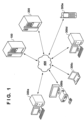
- Fig. 1 is a view showing the system arrangement of a rendering system according to the embodiment of the present invention.
- client devices 300a to 300e for receiving a provided service and a center server 200 for providing the service are connected across a network 400 such as the Internet.
- a rendering server 100 for rendering a screen to be provided for the client device 300 is connected to the center server 200 across the network 400. Note that in the following explanation, "the client device 300" indicates all the client devices 300a to 300e unless otherwise specified.
- the client device 300 is not limited to, e.g., a PC, home game machine, or portable game machine, and may be an device such as a cell phone, PDF, or tablet.
- the rendering server 100 generates a game screen corresponding to operation input caused on a client device, and the center server 200 distributes the screen to the client device 300.
- the client device 300 need not have any rendering function of generating a game screen. That is, the client device 300 need only be an apparatus including a user interface for detecting operation input and a display device for displaying a screen, or an apparatus connectable to the user interface and display device and capable of displaying a received game screen on the display device.
- the present invention provides a game independent of the rendering performance of a client device by transmitting a game screen generated by a server to the client device.
- the center server 200 executes and manages a game processing program, instructs the rendering server 100 to perform a rendering process, and exchanges data with the client device 300. More specifically, the center server 200 executes game processing of a massively multiplayer type network game as a service to be provided for the client device 300.
- the center server 200 manages information such as the position and direction on a map of a character operated by the user of each client device, and an event to be provided for each character.
- the center server 200 causes the rendering server 100 to generate a game screen corresponding to the state of a character being managed. For example, when information of operation input caused by the user on each connected client device is input across the network 400, the center server 200 executes a process of reflecting this information on information of a character being managed. Then, the center server 200 determines a rendering object to be rendered on the game screen based on the character information reflecting the information of operation input, and transmits a rendering instruction to the rendering server 100.
- the rendering server 100 is a server for executing a rendering process, and includes four GPUs in this embodiment as will be described later.
- the rendering server 100 renders a game screen in accordance with the rendering instruction received from the center server 200, and outputs the generated game screen to the center server 200.
- the rendering server 100 can simultaneously form a plurality of game screens.
- the rendering server 100 executes a game screen rendering process by a GPU.
- "detailed information indicating data necessary to render a rendering object” contains information indicating the following attribute data.
- the detailed information containing the above-mentioned information is transmitted from the center server 200 to the rendering server 100 in this embodiment, but information to be contained in the detailed information is not limited to the above information.
- the detailed information may contain at least one of the five pieces of information described above, and may also contain information to be used in the process of rendering a rendering object in addition to the above information.
- the data for calculations contains numerical values such as a constant and variable to be used in a calculation in the rendering process.
- the center server 200 distributes the game screen, which is received from the rendering server 100 in accordance with the transmitted rendering instruction including the rendering object identification information and detailed information, to a corresponding client device.
- the rendering system of this embodiment can generate a game screen corresponding to operation input caused on a client device, and provide the game screen to the user via the display device of the client device.
- the rendering system of this embodiment includes one rendering server 100 and one center server 200, but the present invention is not limited to this arrangement.
- the center server 200 can also designate a rendering server 100 or a GPU of a rendering server 100 to be used to execute a rendering instruction, in accordance with information indicating the number of game screens simultaneously generated by a rendering server 100 or each GPU of a rendering server 100.
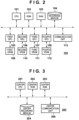
- Fig. 2 is a block diagram showing the functional arrangement of the rendering server 100 according to the embodiment of the present invention.
- a CPU 101 controls the operation of each block of the rendering server 100. More specifically, the CPU 101 reads out a rendering process operation program stored in a ROM 102 or recording medium 104, expands the program on a RAM 103, and executes the program, thereby controlling the operation of each block.
- the ROM 102 is, for example, a programmable nonvolatile memory.
- the ROM 102 stores the rendering process operation program, other operation programs, and information such as a constant required for the operation of each block of the rendering server 100.
- the RAM 103 is a volatile memory.
- the RAM 103 is used not only as an operation program expansion area, but also as a storage area for temporarily storing, for example, intermediate data output during the operation of each block of the rendering server 100.
- the recording medium 104 is, for example, a recording device such as an HDD detachable from the rendering server 100.
- the recording medium 104 stores the following data to be used to generate a screen in the rendering process.
- a communication unit 113 is a communication interface of the rendering server 100.
- the communication unit 113 exchanges data with another apparatus, for example, the center server 200 connected across the network 400.
- the communication unit 113 converts the data into a data transmission format determined with respect to the network 400 or a transmission destination apparatus, and transmits the data to the transmission destination apparatus.
- the communication unit 113 converts data received across the network 400 into an arbitrary data format readable by the rendering server 100, and stores the data in, for example, the RAM 103.
- First, second, third, and fourth GPUs 105, 106, 107, and 108 each generate a game screen to be provided for the client device 300 in the rendering process.
- Each GPU is connected to a video memory (one of first, second, third, and fourth VRAMs 109, 110, 111, and 112) as a game screen rendering area.
- each GPU includes a cache memory. When performing rendering on the connected VRAM, each GPU expands a rendering object on the cache memory, and writes the mapped rendering object in the corresponding VRAM.
- one video memory is connected to one GPU in this embodiment, but the present invention is not limited to this. That is, the number of video memories connected to the GPU can be any arbitrary number.
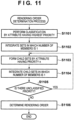
- FIG. 3 is a block diagram showing the functional arrangement of the center server 200 according to the embodiment of the present invention.
- a center CPU 201 controls the operation of each block of the center server 200. More specifically, the CPU 201 reads out a game processing program from, for example, a ROM 202 or center recording medium 204, expands the program on a center RAM 203, and executes the program, thereby controlling the operation of each block.
- a game processing program from, for example, a ROM 202 or center recording medium 204
- expands the program on a center RAM 203 and executes the program, thereby controlling the operation of each block.
- the center ROM 202 is, for example, a programmable nonvolatile memory.
- the center ROM 202 stores the game processing program, and may also store other programs.
- the center ROM 202 also stores information such as a constant required for the operation of each block of the center server 200.
- the center RAM 203 is a volatile memory.
- the center RAM 203 is used not only as a game processing program expansion area, but also as a storage area for temporarily storing, for example, intermediate data output during the operation of each block of the center server 200.
- the center recording medium 204 is, for example, a recording device such as an HDD detachable from the center server 200.
- the center recording medium 204 is used as, for example, a database for managing users and client devices using the game, and a database for managing various kinds of information on the game, which are required to generate a game screen to be provided for each connected client device.
- the center communication unit 205 is a communication interface of the center server 200.
- the center communication unit 205 exchanges data with the rendering server 100 and client device 300 connected across the network 400.
- the center communication unit 205 converts data into a data format complying with the communication specifications, like the communication unit 113.
- this game processing is started when, for example, the center server 200 is activated, and repetitively executed for each frame of a provided game.
- the client devices 300a to 300e are already connected to the center server 200.
- the center server 200 provides a game screen for each client device.
- step S401 the center CPU 201 determines whether information indicating operation input caused on each client device 300 is received. More specifically, the center CPU 201 determines whether information received by the center communication unit 205 and stored in the center RAM 203 is information indicating operation input caused on the client device 300.
- the information indicating operation input caused on the client device 300 may have, for example, a data structure as shown in Fig. 5A .
- the operation input information of this embodiment contains, for example,
- the operation input information may also be information indicating an input signal detected by a client device by operating a button or the like by the user.
- the process of conversion into a numerical value or parameter in the game need only be performed in accordance with the information indicating the input signal received by the center CPU 201, and the type of client device.
- the center CPU 201 determines that the information indicating operation input caused on the client device 300 is received, the center CPU 201 advances the process to step S402; if not, the center CPU 201 advances the process to step S403.
- step S402 the center CPU 201 updates game information based on the information indicating operation input on the client device 300, which is received in step S401. More specifically, the center CPU 201 reads out, from the center recording medium 204, state information corresponding to a character in the game, which is an operation target of the user of the corresponding client device 300.
- the character state information is information of the action and appearance of the character that can be changed by a user's operation, for example, the position (coordinate information) of the character on the map, the gazing direction of the character, and a character's action.
- the center CPU 201 refers to the received operation input information, and updates a parameter that changes by operation input, among parameters contained in the state information, by the received operation input information. Accordingly, the center CPU 201 can reflect, on the game, the information of operation input caused on the client device 300.
- the center CPU 201 associates information that is not used to update the character state information with the client device identification information, and records the information on the center recording medium 204.
- step S403 the center CPU 201 updates state information of a rendering object as a state management target in the game, except for the character as an operation target of the user of each client device 300.
- Examples of the rendering object as a state management target in the game are a character called an NPC (Non Player Character) that is not a target of a user's operation, and a background object such as a landform.
- a rendering object as a state management target in the game changes with time or by the action of a character as a user's operation target.
- the center CPU 201 updates the state information of a rendering object as a state management target in the game, in accordance with the elapse of time or the character state information updated in step S402.
- step S404 the center CPU 201 specifies rendering objects contained in the game screen provided for each client device 300.
- the rendering objects contained in the game screen are an above-described rendering object as a state management target in the game, and a character's rendering object as a user's operation target.
- the center CPU 201 selects each client device 300 presently connected to the center server 200, and reads out, from the center recording medium 204, information of the game screen rendering range with which the identification information of the client device 300 is associated.
- the information of the game screen rendering range contains camera parameters corresponding to the game screen.
- the center CPU 201 refers to the camera parameters, and specifies, as a rendering object contained in the game screen, a rendering object such as a character whose state information contains coordinate information included in the camera's rendering range.
- identification information is assigned to a rendering object, and the center CPU 201 associates the identification information of the specified rendering object contained in the game screen with the identification information of the client device, and records the information on the center recording medium 204.
- step S405 the center CPU 201 transmits, to the rendering server 100, an instruction to render game screens to be provided for all the client devices 300, and causes the rendering server 100 to execute the rendering process. More specifically, the center CPU 201 first reads out the identification information, which is recorded on the center recording medium 204 in association with the identification information of each client device 300, of the rendering object contained in the game screen to be provided for the client device 300. The center CPU 201 also reads out, from the center recording medium 204, the detailed information set for each rendering object contained in the game screen.
- the center CPU 201 associates the identification information of the rendering objects contained in the game screen to be provided for each client device 300, and the detailed information of each rendering object, with the identification information of the client device 300, and transmits the information as a rendering instruction to the center server 200 via the center communication unit 205.
- the center CPU 201 reads out, from the center recording medium 204, the information of rendering range of the game screen and the display setting information of the display device of each client device, which are associated with the identification information of the client device, and transmits the readout information to the rendering server 100.
- the rendering instruction transmitted to the center server 200 in order to render a game screen to be provided for one client device contains
- the rendering instruction is transmitted to the rendering server 100 for each client device 300.
- the rendering server 100 for each client device 300.
- step S406 the center CPU 201 determines whether the game screen generated by the rendering server 100 in accordance with the rendering instruction is received from the rendering server 100. More specifically, the center CPU 201 determines whether the center communication unit 205 has received the game screen generated and output by the rendering server 100 for each client device 300. If it is determined that the game screen is received, the center CPU 201 advances the process to step S407; if not, the center CPU 201 repeats the processing of this step. That is, the center CPU 201 waits in this step until the game screen of each client device 300 is received.
- the game screen received in this step is preferably a game screen generated based on the rendering instruction transmitted to the rendering server 100 in step S404 as an immediately preceding step, but the game screen is not limited to this. That is, this game processing is executed for each frame. Therefore, if rendering of the game screen is not complete within one frame time defined by the frame rate of the provided game, the game screen received in this step may also be a screen generated in accordance with a rendering instruction transmitted in a frame preceding the present frame by a few frames.
- step S407 the center CPU 201 distributes the game screen received in step S406 to the corresponding client device 300. More specifically, the center CPU 201 refers to identification information of the client device 300 contained in, for example, the header of the game screen received by the center communication unit 205 and stored in the center RAM 203. Then, the center CPU 201 transmits the game screen to the client device 300 indicated by the identification information via the center communication unit 205, and completes this game processing.
- the center server 200 can generate a game screen reflecting operation input caused on each client device 300, and distribute the obtained game screen to the client device 300, by transmitting the rendering instruction to the rendering server 100.
- the rendering process is performed by reading out, for each rendering object, "identification information for specifying model data”, “identification information for specifying texture data”, “specific information of a rendering program”, and "data for calculations to be used in the rendering program" contained in the detailed information. That is, when a plurality of rendering objects are contained in the game screen, each rendering object is selected, detailed information is read out, and rendering is performed in accordance with the detailed information. After that, rendering for the next rendering object is performed. That is, whenever rendering objects to be rendered are switched during the rendering process, the rendering server 100 executes processes pertaining to initialization, for example, transfers model data and texture data to a GPU, converts the data, reads out a rendering program, and sets data for calculations.
- the processing time (switching cost) for initialization for rendering one rendering object is required for the number of rendering objects included in the rendering range of the game screen.
- the switching cost further increases when simultaneously generating game screens to be distributed to a plurality of client devices 300.
- rendering objects having at least partial data indicated by the detailed information in common sometimes exist particularly in, for example, the background.
- objects such as trees contained in the game screen are rendered by using one texture data for a few patterns of model data.
- the same rendering program and the same data for calculations are used for, for example, objects having the same material or texture, or objects existing under the same light source.
- the camera positions and directions on the map in the game are similar in game screens to be provided for different client devices, it is highly likely that common rendering objects exist in the rendering range and the same detailed information is used.
- This embodiment reduces the switching cost during the rendering process by allocating consecutive ordinal numbers as a rendering order to rendering objects having at least partial data indicated by detailed information in common as described above. That is, when switching rendering objects to be rendered, the time required for common processing is shortened by using the result of a calculation performed on a rendering object rendered in front or data read out for it, thereby reducing the switching cost.
- step S601 the CPU 101 classifies the generation of game screens to be provided for the client devices 300a to 300e to the GPUs of the rendering server 100. That is, in this step, the CPU 101 determines a GPU to be used to process the received rendering instruction, from the first, second, third, and fourth GPUs 105, 106, 107, and 108.
- Examples of the method of classifying client devices as game screen generation targets to be allocated to one GPU are as follows.
- the game screen rendering range (visual field) is defined by a camera parameter for a game screen to be provided for each client device 300.
- the visual field of one camera is normally defined by a quadrangular pyramid or truncated quadrangular pyramid.
- Game screens in which the visual fields overlap each other presumably contain the same rendering object. Therefore, the efficiency of the rendering process can be increased by classifying client devices as game screen generation targets to be allocated to the same GPU, by taking account of the overlap of the visual fields.
- a triangle obtained by projecting a quadrangular pyramid defined by the visual field onto a two-dimensional plane is calculated in accordance with the coordinates and direction of a camera defining a game screen to be provided for each client device, game screens in which the triangular ranges overlap each other by a predetermined ratio or more are classified as one group, and the rendering process of the group is allocated to the same GPU.
- game screens in each of which the distance between camera coordinates defining the game screen falls within a predetermined distance may be classified into one group, and the rendering process of the group may be allocated to the same GPU.
- an area using the same background object such as a mountain, wood, or sea exists on the map in a game. That is, when the camera coordinates defining a game screen exist in a specific area in which this background object is arranged, or when the camera direction is the direction of this specific area, generated game screens contain a common background object. Therefore, the efficiency of the rendering process can be increased by classifying game screens containing a common background object into one group, and allocating the rendering process of the group to the same GPU.
- the same rendering object may be used as a background in various areas on the map in a game. That is, even when the camera coordinates and directions defining game screens are different, the same background object may be included in the rendering range. Accordingly, the camera positions or the like in game screens to be generated by one GPU need not always be close.
- information predetermining a GPU for performing the rendering process may be recorded as a lookup table on the recording medium 104, for a combination of, for example, the camera coordinates and direction information.
- information of a GPU to be allocated information of a GPU for performing processing may also be obtained by, for example, a function using the values of the camera position and direction as arguments.
- the switching cost in the rendering process reduces as the coincidence of detailed information of rendering objects having consecutive ordinal numbers as a rendering order increases. Therefore, the CPU 201 refers to the detailed information of all rendering objects contained in each of game screens to be provided for all the client devices 300, and calculates the coincidence of rendering objects between the game screens on a detailed information level. The CPU 201 then classifies the generation of game screens having a high coincidence into one group, and allocates the rendering process of the group to the same GPU.
- the coincidence of detailed information can also be obtained as the similarity of a distribution formed for rendering objects contained in each game screen, based on a combination of, for example, texture data and model data in detailed information. It is also possible to classify rendering objects contained in each game screen based on specific attribute data indicated by detailed information, and, for only classification in which the number of rendering objects belonging to each set is equal to or larger than a threshold value, compare detailed information in a round robin manner between game screens, thereby calculating the coincidence of the detailed information.
- a specific condition for example, when an object exists in a specific point on the map in a game, an event may occur and the game screen may forcedly be changed to a screen different from a normal one.
- a character as a user's operation target fights the enemy character in a dedicated battlefield. Since events like this may simultaneously occur in arbitrary positions on the map, the switching cost can be reduced by classifying game screens to be provided for client devices 300 on which events of the same kind have occurred into one group, and allocating the rendering process of the group to the same GPU.
- the types of objects to be rendered may be limited in accordance with the progress status of the game. For example, in a story in which the field changes like the inside of a building ⁇ an open space ⁇ a grassy plain ⁇ a forest, it is possible to classify groups whenever the field changes, and allocate game screen rendering to different GPUs.
- rendering objects contained in a game screen are classified into a plurality of groups having similar rendering contents by using the similarity of the rendering objects as a determination criterion, and the rendering of game screens of each group is allocated to the same GPU. Then, a rendering order determination process (to be described later) is executed.
- This allows each GPU to generate a game screen more efficiently.
- the aforementioned method of determining a GPU for generating a game screen to be provided for the client device 300 is merely an example. Accordingly, it is also possible to use a method capable of increasing the efficiency of the rendering process by allocating the rendering of game screens regarded as having similar rendering contents to the same CPU.
- This embodiment uses method 1 described above by which a GPU for performing the rendering process is determined in accordance with the camera position and coordinate information defining a game screen.
- the generation of game screens to be provided for the five client devices 300a to 300e is classified into one group and executed by the first GPU 105.
- the number of game screens (the number of client devices) classified into one group is determined by the processability of the GPU and the capacity of the VRAM.
- information of client devices classified into each group can be managed by, for example, adding identification information of the client devices to a table having one group ID, and storing the table in the RAM 103.
- step S602 the CPU 101 executes the rendering order determination process of determining the rendering order of rendering objects contained in all game screens to be rendered, for each group allocated to each GPU.
- the rendering order determination process of this embodiment will be explained in detail below with reference to a flowchart shown in Fig. 7 . Note that a process of determining the rendering order of rendering objects contained in game screens of one group to be rendered by the first GPU 105 will be explained below, but it will readily be understood that the same process is applicable to other GPUs.
- step S701 the CPU 101 forms pairs of all combinations each including two rendering objects, for all rendering objects contained in game screens of one group to be rendered by the first GPU 105.
- step S702 the CPU 101 scores the coincidence of detailed information of two rendering objects of all the pairs formed in step S701, by using scores obtained by unbalanced allocation by arranging attributes of detailed information in descending order of priority.
- the attribute of each data indicated by detailed information is given priority by the following order.
- the priority of the attribute of each data indicated by detailed information is determined in accordance with the data size on a cache memory when the data having the attribute is read out and expanded on the memory.
- Data having a high-order attribute has a large data size and requires a high switching cost, that is, when this data is switched to different data, it takes a long time to, for example, expand the data on the cache memory, read out the data from the cache memory, and set parameters. That is, the switching cost can efficiently be reduced by performing rendering by a rendering order that decreases the switching frequency (increases the reuse frequency) of data having a high-priority attribute.
- scoring in this step gives a high score to a pair of rendering objects having a high detailed information coincidence, that is, to a pair of rendering objects by which the switching cost is reduced by increasing the reuse frequency for attribute data having a high priority.
- step S703 the CPU 101 refers to the coincidence scores of all the pairs, and determines the rendering order of all rendering objects contained in game screens of one group to be rendered by the first GPU 105. More specifically, the CPU 101 determines a rendering order that maximizes the total sum of scores for a combination of continuous rendering objects when all the rendering objects are arranged in the rendering order.
- Fig. 8 shows rendering objects contained in a game screen to be provided for each client device, which are used in an example of the rendering object rendering order determination procedure in step S703.
- the same GPU generates game screens to be provided for three client devices, and the GPU renders two rendering objects for each game screen, that is, renders a total of six rendering objects.
- the number is 6 C 2 - 15. That is, the CPU 101 performs coincidence scoring for all the fifteen pairs.
- the score is two points for the coincidence of texture data, and one point for the coincidence of model data. In this case, the scores of these pairs are as shown in Fig. 9 .
- the CPU 101 first notes pairs having a highest score of 3.
- three pairs (A-1, B-1), (A-1, C-2), and (B-1, C-2) have a highest score of 3.
- the number of pairs having the highest score is equal to the number of rendering objects (three-point objects) forming the pairs. This demonstrates that all the pairs are formed by three-point objects having the same detailed information.
- the CPU 101 then refers to the scores of other pairs including each of the three-point objects, and determines the rendering order of the three-point objects.
- the score of another pair including the three-point objects is two as the second highest score or score 0 of a pair with A-2. That is, when allocating a rendering object other than A-2 as a rendering object following the three-point objects in the rendering order, the switching cost remains the same regardless of the rendering object. Therefore, the CPU 101 determines the order based on, for example, the sorting order of identification information, without particularly taking account of the rendering order of the three three-point objects described above.
- a rendering object included in the pair, among the three three-point objects is determined as the third, that is, the last in the three-point object rendering order, and the other rendering object included in the pair is allocated as the fourth.
- the CPU 101 determines the rendering order of rendering objects (two-point objects B-2 and C-1), other than the three-point objects, included in a pair having the second highest score.
- a pair with rendering object A-2 is only the pair including a two-point object and having the second highest score or less.
- only the score of a pair with two-point object B-2 is 1 for rendering object A-2.
- rendering object B-2 is determined as the fifth, that is, the last of the two-point objects in the rendering order
- rendering object A-2 is determined as the sixth.
- the CPU 101 can determine the rendering order of all rendering objects contained in game screens of one group. In this example, the CPU 101 finally determines A-1 ⁇ B-1 ⁇ C-2 ⁇ C-1 ⁇ B-2 ⁇ A-2 as the rendering order as shown in Fig. 10 .
- ordinal numbers of the rendering order that reduces the switching cost can be allocated to all rendering objects contained in game screens classified into one group.
- the ordinal numbers of the rendering order can be allocated by, for example, associating identification information of rendering objects with the rendering order, and storing the result as a list in the RAM 103 or the like.
- the CPU 101 renders rendering objects in accordance with the determined rendering order in step S603, thereby generating a game screen to be provided for each client device 300. More specifically, the CPU 101 refers to detailed information of rendering objects in the rendering order, reads out data specified by the detailed information from the recording medium 104, and transfers the data to a GPU for performing rendering. In this process, the CPU 101 reads out and transfers only data different from data already expanded in an expansion area; the CPU 101 does not read out the same data as the already expanded data, and uses the already expanded data instead.
- a game screen is generated by using state information containing coordinate information and action information of each rendering object, and game screen rendering range/display setting information including camera parameters. Since the use of these pieces of information is well known as processing contents, an explanation thereof will be omitted.
- step S604 the CPU 101 adds, to the header of a game screen generated by each GPU, identification information of a client device for which the game screen is to be provided, and transmits the game screen to the center server 200 via the communication unit 113.
- a game screen having high responsiveness to user's operation input can be provided for a user operating a client device.
- a game screen is simply transmitted from the center server 200 to the client device 300.
- a game screen may be simple still image data
- a game screen may also be transmitted as frame image data of moving image data to which an encoding process such as interframe prediction that further decreases the data size is applied.
- the encoding process can, of course, be performed by either the rendering server 100 or center server 200.
- the present invention is explained by taking a massively multiplayer type network game as an example.
- the present invention is applicable to an arbitrary apparatus and arbitrary system capable of simultaneously generating screens to be provided for one or more client devices, and is not limited to the above embodiment.
- game contents corresponding to a single user are independently provided for each client device in a rendering system
- similar game screens may be output to a plurality of client devices. That is, common rendering objects are perhaps contained in game screens provided when the positions or directions on the map are similar, when the statuses of progress of the game are similar, or when the same action is executed. Therefore, the efficiency of the rendering process can be increased by applying the present invention.
- rendering server 100 and center server 200 are separated in the rendering system of this embodiment, but the present invention is not limited to this. That is, the present invention may also be carried out by one server having the functions of both the rendering server 100 and center server 200.
- the rendering control apparatus of this embodiment can perform an efficient rendering process having high responsiveness in a rendering system that provides a game screen to one or more client devices. More specifically, the rendering control apparatus acquires identification information and detailed information indicating data necessary for rendering, for each of a plurality of rendering objects to be used to generate a screen to be provided for a client device. By referring to detailed information of each of the plurality of rendering objects, the rendering control apparatus determines the rendering order of all the rendering objects so as to allocate consecutive ordinal numbers to rendering objects having at least partial data indicated by the detailed information in common. The rendering control apparatus reads out the data indicated by the detailed information of the rendering objects in accordance with the rendering order, and transfers the data to a GPU. In this case, of the data indicated by the detailed information of rendering objects that are continuous in the rendering order, the rendering control apparatus reads out and transfers only data that are not the same as data already transferred to the GPU.
- the processing as described above makes it possible to reduce the time required for the game screen rendering process, and efficiently perform rendering.
- the rendering order determination process of determining the rendering order by making pairs of all combinations of all rendering objects contained in game screens classified into one group and performing scoring on these pairs is explained.
- this modification which does not represent an embodiment of the present invention but is provided as a comparative example useful for understanding the present invention, a method of simply performing scoring by sorting and classifying rendering objects by arranging attributes of detailed information in descending order of priority will be explained.
- step S1101 for all rendering objects contained in game screens of one group to be rendered by the first GPU 105, the CPU 101 classifies by arranging attributes indicated by detailed information in descending order of priority, based on attribute data having the highest priority.
- the attribute of each data indicated by detailed information is given priority by the following order in this modification as well.
- the CPU 101 classifies all rendering objects by identification information for specifying texture data.
- step S1102 the CPU 101 refers to the number of members belonging to each set of rendering objects using the same texture data, which is generated by the classification in step S1101, and specifies sets in which the number of members is 1. Then, the CPU 101 integrates the sets in which the number of members is 1 into one set (a texture non-coincidence set).
- step S1103 the CPU 101 classifies rendering objects in each of the sets of rendering objects using the same texture data and the texture non-coincidence set, by using identification information for specifying model data having the second highest priority. That is, in this step, rendering objects belonging to each of the sets of rendering objects using the same texture data and the texture non-coincidence set are classified into child sets of rendering objects using the same model data.
- step S1104 the CPU 101 refers to the number of members belonging to each set of rendering objects using the same model data, which is generated by the classification in step S1103, and specifies sets in which the number of members is 1. Then, for each of the sets of rendering objects using the same texture data and the texture non-coincidence set, the CPU 101 integrates rendering objects in sets in which the number of members is 1 into one set (a model non-coincidence set).
- step S1105 the CPU 101 determines whether there is an attribute not used in set classification. If there is an attribute not used in set classification, the CPU 101 selects an attribute not used in set classification in priority order, and returns the process to step S1103. That is, the CPU 101 then classifies rendering objects in each of the sets of rendering objects using the same model data and the model non-coincidence set, by using rendering program designating information.
- steps S1101 and step S1102 and the repetitive processing from steps S1103 to step S1105 it is possible to classify rendering objects for each attribute data indicated by detailed information, and finally classify, into a set, rendering objects having at least partial data of data indicated by detailed information in common.
- step S1106 Note that if the CPU 101 determines in this step that there is no attribute not used in set classification, the CPU 101 advances the process to step S1106.
- step S1106 the CPU 101 determines the rendering order of all rendering objects contained in game screens of one group to be rendered by the first GPU 105. That is, the CPU 101 determines a rendering order that reduces the switching cost, in accordance with information of rendering object classification performed in step S1101 to step S1105.
- the CPU 101 first selects one set, other than the texture non-coincidence set, from sets classified for "identification information for specifying texture data" having the highest priority. Then, the CPU 101 sequentially selects child sets included in the set, and allocates ordinal numbers of the rendering order to rendering objects in the child sets. In this process, the child sets can be selected by, for example, representing each set by using a binary number, and selecting sets in descending order of binary value.
- scoring is performed by adding 2 3 to a set in which rendering objects have the attribute having the second highest priority in common, 2 2 to a set in which rendering objects have the attribute having the third highest priority in common, 2 1 to a set in which rendering objects have the attribute having the fourth highest priority in common, and 2° to a set in which rendering objects have the attribute having the lowest priority in common, and the rendering order is determined in descending order of score.
- the rendering order of rendering objects is determined for one set classified for "identification information for specifying texture data"
- the rendering order is similarly determined for the next set using the same texture data.
- the rendering orders of rendering objects are determined for all sets other than the texture non-coincidence set, the rendering order is similarly determined for rendering objects included in the texture non-coincidence set.
- rendering orders that reduce the switching cost can be allocated to all rendering objects.
Landscapes
- Engineering & Computer Science (AREA)
- Multimedia (AREA)
- Physics & Mathematics (AREA)
- General Physics & Mathematics (AREA)
- Theoretical Computer Science (AREA)
- Computer Graphics (AREA)
- Processing Or Creating Images (AREA)
- Image Generation (AREA)
Claims (10)
- Rendering-Steuergerät, umfassend:ein Bezugsmittel zum Beziehen von Informationen einer Vielzahl von zu verwendenden Rendering-Objekten, um einen Bildschirm zu erzeugen, der für eine Client-Vorrichtung (300) bereitzustellen ist, und das dazu konfiguriert ist, die Informationen in einem Speichermittel zu speichern, wobei die Informationen jedes Rendering-Objekts Identifizierungsinformationen des Rendering-Objekts und detaillierte Informationen beinhalten, die Daten angeben, die für das Rendern des Rendering-Objekts erforderlich sind;ein Bestimmungsmittel zum Verweisen auf die detaillierten Informationen jedes der Vielzahl von Rendering-Objekten, die von dem besagten Bezugsmittel bezogen wurden, und das dazu konfiguriert ist, eine Rendering-Reihenfolge der Vielzahl von Rendering-Objekten in einem Bildschirm-Rendering zu bestimmen; undein Übermittlungsmittel zum Beziehen der Identifizierungsinformationen eines Rendering-Objekts gemäß der Rendering-Reihenfolge, die von dem besagten Bestimmungsmittel bestimmt wurde, und das dazu konfiguriert ist, Daten, die von den detaillierten Informationen eines Rendering-Objekts entsprechend den Identifizierungsinformationen angegeben werden, aus einem Datenspeichermittel auszulesen und die Daten an ein Rendering-Mittel zum Erzeugen eines Bildschirms durch Rendern der Vielzahl von Rendering-Objekten auf der Basis der Rendering-Reihenfolge zu übermitteln;wobei das besagte Bestimmungsmittel dazu konfiguriert ist, eine Rendering-Reihenfolge zu den Rendering-Objekten aus der Vielzahl von Rendering-Objekten zuzuweisen, die zumindest partielle Daten, die durch detaillierte Informationen angegeben werden, gemein haben, unddas besagte Übermittlungsmittel dazu konfiguriert ist, bei Durchführen eines Renderns gemäß der Rendering-Reihenfolge Daten, die nicht mit Daten identisch sind, die bereits an das besagte Rendering-Mittel übermittelt wurden, aus den Daten, die durch die detaillierten Informationen der Rendering-Objekte, die in der Rendering-Reihenfolge fortlaufend sind, angegeben werden, aus dem besagten Datenspeichermittel auszulesen und die ausgelesenen Daten zu übermitteln;wobei die detaillierten Informationen eines Rendering-Objekts eine Vielzahl von Attributdaten angeben, die für das Rendern des Rendering-Objekts erforderlich sind, wobei jedes der Vielzahl von Attributdaten eine jeweilige Priorität aufweist, unddas besagte Bestimmungsmittel dazu konfiguriert ist, eine Koinzidenz der detaillierten Informationen aller Paare der Rendering-Objekte zu benoten;wobei das Benoten einem Paar der Rendering-Objekte mit einer hohen Koinzidenz von detaillierten Informationen für Attributdaten hoher Priorität eine hohe Benotung gibt unddas besagte Bestimmungsmittel dazu konfiguriert ist, Rendering-Objekte, die Attributdaten hoher Priorität, die durch detaillierte Informationen angegeben werden, gemein haben, bevorzugt in der Rendering-Reihenfolge der Rendering-Objekte zuzuweisen, so dass eine Gesamtsumme von Benotungen für eine Kombination von fortlaufenden Rendering-Objekten maximiert wird, wenn alle der Rendering-Objekte in der Rendering-Reihenfolge angeordnet sind; undwobei die Priorität in Bezug auf jedes der Vielzahl von Attributdaten eingestellt wird, so dass, wenn eine Vielzahl von Attributdaten, die durch die detaillierten Informationen angegeben werden, aus dem besagten Datenspeichermittel ausgelesen und in einem Datenerweiterungsbereich erweitert wird, einem Attribut, dessen Daten einen großen Bereich in dem Erweiterungsbereich belegen, eine hohe Priorität gegeben wird, um dadurch die Schaltfrequenz derartiger Daten in dem Erweiterungsbereich zu verringern.
- Gerät nach Anspruch 1, wobei die detaillierten Informationen eines Rendering-Objekts mindestens eines von Texturdaten, Modelldaten, einem Rendering-Programm und Daten zum Rendern von Berechnungen angeben.
- Gerät nach Anspruch 1 oder Anspruch 2, wobeidas besagte Bezugsmittel dazu konfiguriert ist, Informationen der zu verwendenden Rendering-Objekte zu beziehen, um den Bildschirm zu erzeugen, der für jede einer Vielzahl von Client-Vorrichtungen (300a-e) bereitzustellen ist, unddas besagte Bestimmungsmittel dazu konfiguriert ist, eine Rendering-Reihenfolge aller zu verwendenden Rendering-Objekte zu bestimmen, um den Bildschirm zu erzeugen, der für jede der Vielzahl von Client-Vorrichtungen (300a-e) bereitzustellen ist.
- Steuerverfahren eines Rendering-Steuergeräts, umfassend:einen Bezugsschritt zum Beziehen von Informationen einer Vielzahl von zu verwendenden Rendering-Objekten, um einen Bildschirm zu erzeugen, der für eine Client-Vorrichtung (300) bereitzustellen ist, und Speichern der Informationen in einem Speichermittel, wobei die Informationen jedes Rendering-Objekts Identifizierungsinformationen des Rendering-Objekts und detaillierte Informationen beinhalten, die Daten angeben, die für das Rendern des Rendering-Objekts erforderlich sind;einen Bestimmungsschritt zum Verweisen auf die detaillierten Informationen jedes der Vielzahl von Rendering-Objekten, die in dem Bezugsschritt bezogen wurden, und Bestimmen einer Rendering-Reihenfolge der Vielzahl von Rendering-Objekten in einem Bildschirm-Rendering; undeinen Übermittlungsschritt zum Beziehen der Identifizierungsinformationen eines Rendering-Objekts gemäß der Rendering-Reihenfolge, die in dem Bestimmungsschritt bestimmt wurde, und Auslesen von Daten, die von den detaillierten Informationen eines Rendering-Objekts entsprechend den Identifizierungsinformationen angegeben werden, aus einem Datenspeichermittel und Übermitteln der Daten an ein Rendering-Mittel zum Erzeugen eines Bildschirms durch Rendern der Vielzahl von Rendering-Objekten auf der Basis der Rendering-Reihenfolge;wobei in dem Bestimmungsschritt eine Rendering-Reihenfolge zu den Rendering-Objekten aus der Vielzahl von Rendering-Objekten zugewiesen wird, die zumindest partielle Daten, die durch detaillierte Informationen angegeben werden, gemein haben, undin dem Übermittlungsschritt bei Durchführen eines Renderns gemäß der Rendering-Reihenfolge Daten, die nicht mit Daten identisch sind, die bereits an das Rendering-Mittel übermittelt wurden, aus den Daten, die durch die detaillierten Informationen der Rendering-Objekte, die in der Rendering-Reihenfolge fortlaufend sind, angegeben werden, aus dem Datenspeichermittel ausgelesen und übermittelt werden;wobei die detaillierten Informationen eines Rendering-Objekts eine Vielzahl von Attributdaten angeben, die für das Rendern des Rendering-Objekts erforderlich sind, wobei jedes der Vielzahl von Attributdaten eine jeweilige Priorität aufweist, undder Bestimmungsschritt ein Benoten einer Koinzidenz der detaillierten Informationen aller Paare der Rendering-Objekte beinhaltet;wobei das Benoten einem Paar der Rendering-Objekte mit einer hohen Koinzidenz von detaillierten Informationen für Attributdaten hoher Priorität eine hohe Benotung gibt undder Bestimmungsschritt ein bevorzugtes Zuweisen von Rendering-Objekten, die Attributdaten hoher Priorität, die durch detaillierte Informationen angegeben werden, gemein haben, in der Rendering-Reihenfolge der Rendering-Objekte beinhaltet, so dass eine Gesamtsumme von Benotungen für eine Kombination von fortlaufenden Rendering-Objekten maximiert wird, wenn alle der Rendering-Objekte in der Rendering-Reihenfolge angeordnet sind; undwobei die Priorität in Bezug auf jedes der Vielzahl von Attributdaten eingestellt wird, so dass, wenn eine Vielzahl von Attributdaten, die durch die detaillierten Informationen angegeben werden, aus dem besagten Datenspeichermittel ausgelesen und in einem Datenerweiterungsbereich erweitert wird, einem Attribut, dessen Daten einen großen Bereich in dem Erweiterungsbereich belegen, eine hohe Priorität gegeben wird, um dadurch die Schaltfrequenz derartiger Daten in dem Erweiterungsbereich zu verringern.
- Programm, das bewirkt, dass ein Computer als jedes Mittel eines Rendering-Steuergeräts nach einem der Ansprüche 1 bis 3 funktioniert.
- Computerlesbares Speichermedium, in dem ein Programm gespeichert ist, das bewirkt, dass ein Computer als jedes Mittel eines Rendering-Steuergeräts nach einem der Ansprüche 1 bis 3 funktioniert.
- Rendering-Server (100), umfassend ein Rendering-Steuergerät nach einem der Ansprüche 1 bis 3.
- Rendering-System, das einen Bildschirm, der von einem Rendering-Server (100) erzeugt wird, für jede von einer oder mehreren Client-Vorrichtungen (300a-e) bereitstellt, die mit einem zentralen Server (200) verbunden sind,
wobei der zentrale Server (200) umfasst:ein Empfangsmittel zum Empfangen von Eingangsdaten von der besagten einen oder den besagten mehreren Client-Vorrichtungen (300a-e);ein Spezifizierungsmittel zum Spezifizieren eines Rendering-Objekts für jede von der besagten einen oder den besagten mehreren Client-Vorrichtungen (300a-e), das in einem Bildschirm enthalten ist, der für die Client-Vorrichtung (300) bereitzustellen ist, gemäß den Eingangsdaten, die von dem besagten Empfangsmittel empfangen wurden;ein Übermittlungsmittel zum Übermitteln von Informationen einer Vielzahl von Rendering-Objekten and den besagten Rendering-Server (100), die in einem Bildschirm enthalten sind, der für die besagte eine oder die besagten mehreren Client-Vorrichtungen (300a-e) bereitzustellen sind, wobei die Informationen jedes Rendering-Objekts Identifizierungsinformationen des Rendering-Objekts und detaillierte Informationen beinhalten, die Daten angeben, die für das Rendern des Rendering-Objekts erforderlich sind; undein Verteilungsmittel zum Empfangen eines Bildschirms, der für jede von der besagten einen oder den besagten mehreren Client-Vorrichtungen (300a-e) bereitzustellen ist und der von dem besagten Rendering-Server (100) gerendert wird, und das dazu konfiguriert ist, den Bildschirm an eine entsprechende Client-Vorrichtung (300) zu verteilen, undwobei der Rendering-Server (100) umfasst:ein Bezugsmittel zum Beziehen von Informationen der Vielzahl von Rendering-Objekten, die von dem besagten Übertragungsmittel übertragen wurden, und das dazu konfiguriert ist, die Informationen in einem Speichermittel zu speichern;ein Rendering-Mittel zum Rendern der Vielzahl von Rendering-Objekten der Reihenfolge nach, und das dazu konfiguriert ist, einen Bildschirm zu erzeugen, der für jede der besagten einen oder der besagten mehreren Client-Vorrichtungen (300a-e) bereitzustellen ist;ein Bestimmungsmittel, das dazu konfiguriert ist, auf die detaillierten Informationen jedes der Vielzahl von Rendering-Objekten, die von dem besagten Bezugsmittel bezogen wurden, zu verweisen und eine Rendering-Reihenfolge der Vielzahl von Rendering-Objekten in einem Bildschirm-Rendering zu bestimmen; undein Übermittlungsmittel zum Beziehen der Identifizierungsinformationen eines Rendering-Objekts gemäß der Rendering-Reihenfolge, die von dem besagten Bestimmungsmittel bestimmt wurde, und das dazu konfiguriert ist, Daten, die von den detaillierten Informationen eines Rendering-Objekts entsprechend den Identifizierungsinformationen angegeben werden, aus einem Datenspeichermittel auszulesen und die Daten an das besagte Rendering-Mittel zu übermitteln;wobei das besagte Bestimmungsmittel dazu konfiguriert ist, eine Rendering-Reihenfolge zu den Rendering-Objekten aus der Vielzahl von Rendering-Objekten zuzuweisen, die zumindest partielle Daten, die durch detaillierte Informationen angegeben werden, gemein haben, unddas besagte Übermittlungsmittel dazu konfiguriert ist, bei Durchführen eines Renderns gemäß der Rendering-Reihenfolge Daten, die nicht mit Daten identisch sind, die bereits an das besagte Rendering-Mittel übermittelt wurden, aus den Daten, die durch die detaillierten Informationen der Rendering-Objekte, die in der Rendering-Reihenfolge fortlaufend sind, angegeben werden, aus dem besagten Datenspeichermittel auszulesen und die ausgelesenen Daten zu übermitteln;wobei die detaillierten Informationen eines Rendering-Objekts eine Vielzahl von Attributdaten angeben, die für das Rendern des Rendering-Objekts erforderlich sind, wobei jedes der Vielzahl von Attributdaten eine jeweilige Priorität aufweist, unddas besagte Bestimmungsmittel dazu konfiguriert ist, eine Koinzidenz der detaillierten Informationen aller Paare der Rendering-Objekte zu benoten;wobei das Benoten einem Paar der Rendering-Objekte mit einer hohen Koinzidenz von detaillierten Informationen für Attributdaten hoher Priorität eine hohe Benotung gibt unddas besagte Bestimmungsmittel dazu konfiguriert ist, Rendering-Objekte, die Attributdaten hoher Priorität, die durch detaillierte Informationen angegeben werden, gemein haben, bevorzugt in der Rendering-Reihenfolge der Rendering-Objekte zuzuweisen, so dass eine Gesamtsumme von Benotungen für eine Kombination von fortlaufenden Rendering-Objekten maximiert wird, wenn alle der Rendering-Objekte in der Rendering-Reihenfolge angeordnet sind; undwobei die Priorität in Bezug auf jedes der Vielzahl von Attributdaten eingestellt wird, so dass, wenn eine Vielzahl von Attributdaten, die durch die detaillierten Informationen angegeben werden, aus dem besagten Datenspeichermittel ausgelesen und in einem Datenerweiterungsbereich erweitert wird, einem Attribut, dessen Daten einen großen Bereich belegen, eine hohe Priorität gegeben wird, um dadurch die Schaltfrequenz derartiger Daten in dem Erweiterungsbereich zu verringern. - System nach Anspruch 8, wobei die detaillierten Informationen eines Rendering-Objekts mindestens eines von Texturdaten, Modelldaten, einem Rendering-Programm und Daten zum Rendern von Berechnungen angeben.
- System nach Anspruch 8 oder Anspruch 9, wobeidas besagte Bezugsmittel dazu konfiguriert ist, die Informationen der zu verwendenden Rendering-Objekte zu beziehen, um die Bildschirme zu erzeugen, die für jede einer Vielzahl von Client-Vorrichtungen (300a-e) bereitzustellen sind,das besagte Bestimmungsmittel dazu konfiguriert ist, eine Rendering-Reihenfolge aller zu verwendenden Rendering-Objekte zu bestimmen, um den Bildschirm zu erzeugen, der für jede der Vielzahl von Client-Vorrichtungen (300a-e) bereitzustellen ist, unddas besagte Rendering-Mittel dazu konfiguriert ist, den Bildschirm gleichzeitig zu rendern, der für jede der Vielzahl von Client-Vorrichtungen (300a-e) bereitzustellen ist.
Applications Claiming Priority (4)
| Application Number | Priority Date | Filing Date | Title |
|---|---|---|---|
| US201161489761P | 2011-05-25 | 2011-05-25 | |
| JP2011260976A JP5076132B1 (ja) | 2011-05-25 | 2011-11-29 | 描画制御装置、その制御方法、プログラム、記録媒体、描画サーバ、及び描画システム |
| US13/453,212 US8698813B2 (en) | 2011-05-25 | 2012-04-23 | Rendering control apparatus, control method thereof, recording medium, rendering server, and rendering system |
| PCT/JP2012/062720 WO2012161102A1 (en) | 2011-05-25 | 2012-05-11 | Rendering control apparatus, control method thereof, recording medium, rendering server, and rendering system |
Publications (3)
| Publication Number | Publication Date |
|---|---|
| EP2556493A1 EP2556493A1 (de) | 2013-02-13 |
| EP2556493A4 EP2556493A4 (de) | 2016-08-31 |
| EP2556493B1 true EP2556493B1 (de) | 2025-01-29 |
Family
ID=47262860
Family Applications (1)
| Application Number | Title | Priority Date | Filing Date |
|---|---|---|---|
| EP12756343.5A Active EP2556493B1 (de) | 2011-05-25 | 2012-05-11 | Darstellungssteuerungsvorrichtung, steuerverfahren dafür, aufzeichnungsmedium, darstellungsserver und darstellungssystem |
Country Status (7)
| Country | Link |
|---|---|
| US (2) | US8698813B2 (de) |
| EP (1) | EP2556493B1 (de) |
| JP (3) | JP5076132B1 (de) |
| KR (1) | KR101342228B1 (de) |
| CN (1) | CN103098099B (de) |
| CA (1) | CA2768900C (de) |
| WO (1) | WO2012161102A1 (de) |
Families Citing this family (62)
| Publication number | Priority date | Publication date | Assignee | Title |
|---|---|---|---|---|
| US9044677B2 (en) * | 2011-07-11 | 2015-06-02 | Roblox Corporation | System for optimizing processing capacity for a group of gaming appliances engaged in play of an online game |
| JP5155462B2 (ja) | 2011-08-17 | 2013-03-06 | 株式会社スクウェア・エニックス・ホールディングス | 動画配信サーバ、動画再生装置、制御方法、プログラム、及び記録媒体 |
| JP5937957B2 (ja) | 2011-12-05 | 2016-06-22 | 株式会社スクウェア・エニックス | リアルタイム大局照明レンダリングシステム |
| JP6333180B2 (ja) * | 2012-02-07 | 2018-05-30 | エンパイア テクノロジー ディベロップメント エルエルシー | オンラインゲーム |
| CN103392189B (zh) | 2012-02-23 | 2017-10-31 | 史克威尔·艾尼克斯控股公司 | 动态图像传输服务器、动态图像播放装置以及控制方法 |
| KR101536501B1 (ko) | 2012-04-12 | 2015-07-13 | 신라 테크놀로지스, 인크. | 동화상 배포 서버, 동화상 재생 장치, 제어 방법, 기록 매체, 및 동화상 배포 시스템 |
| US9873045B2 (en) * | 2012-05-25 | 2018-01-23 | Electronic Arts, Inc. | Systems and methods for a unified game experience |
| JP2014008158A (ja) | 2012-06-28 | 2014-01-20 | Square Enix Holdings Co Ltd | ゲームシステム及びその制御方法 |
| US8961302B2 (en) | 2012-07-20 | 2015-02-24 | Microsoft Technology Licensing, Llc | Game browsing |
| US9381432B2 (en) | 2012-08-24 | 2016-07-05 | Microsoft Technology Licensing, Llc | Game migration |
| US9526980B2 (en) | 2012-12-21 | 2016-12-27 | Microsoft Technology Licensing, Llc | Client side processing of game controller input |
| US9717982B2 (en) | 2012-12-21 | 2017-08-01 | Microsoft Technology Licensing, Llc | Client rendering of latency sensitive game features |
| CA2860177A1 (en) | 2013-02-06 | 2014-08-14 | Square Enix Holdings Co., Ltd. | Information processing apparatus, method of controlling the same, program, and storage medium |
| EP2954494A4 (de) * | 2013-02-06 | 2016-07-27 | Square Enix Holdings Co Ltd | Bildverarbeitungsvorrichtung, verfahren zur steuerung davon sowie programm und speichermedium |
| WO2014136920A1 (en) * | 2013-03-05 | 2014-09-12 | Square Enix Holdings Co., Ltd. | Information processing apparatus, rendering apparatus, method and program |
| US9564102B2 (en) * | 2013-03-14 | 2017-02-07 | Microsoft Technology Licensing, Llc | Client side processing of player movement in a remote gaming environment |
| US9694277B2 (en) | 2013-03-14 | 2017-07-04 | Microsoft Technology Licensing, Llc | Client side processing of character interactions in a remote gaming environment |
| CA2886282C (en) * | 2013-05-23 | 2019-07-23 | Stephan Georgiev | Dynamic allocation of rendering resources in a cloud gaming system |
| CA2917962A1 (en) * | 2013-07-25 | 2015-01-29 | Square Enix Holdings Co., Ltd. | Image processing program, server device, image processing system, and image processing method |
| JP6200062B2 (ja) | 2013-08-06 | 2017-09-20 | 株式会社スクウェア・エニックス・ホールディングス | 情報処理装置、制御方法、プログラム及び記録媒体 |
| EP3044765A4 (de) * | 2013-09-11 | 2017-05-10 | Square Enix Holdings Co., Ltd. | Darstellungsvorrichtung, darstellungsverfahren dafür, programm und aufzeichnungsmedium |
| EP3046079B1 (de) * | 2013-09-13 | 2021-02-24 | Square Enix Holdings Co., Ltd. | Renderingvorrichtung |
| US9805479B2 (en) | 2013-11-11 | 2017-10-31 | Amazon Technologies, Inc. | Session idle optimization for streaming server |
| US9641592B2 (en) | 2013-11-11 | 2017-05-02 | Amazon Technologies, Inc. | Location of actor resources |
| JP2017504986A (ja) * | 2013-11-11 | 2017-02-09 | アマゾン テクノロジーズ インコーポレイテッド | 複数の表示生成のためのデータコレクション |
| US9634942B2 (en) | 2013-11-11 | 2017-04-25 | Amazon Technologies, Inc. | Adaptive scene complexity based on service quality |
| US9604139B2 (en) | 2013-11-11 | 2017-03-28 | Amazon Technologies, Inc. | Service for generating graphics object data |
| US9582904B2 (en) | 2013-11-11 | 2017-02-28 | Amazon Technologies, Inc. | Image composition based on remote object data |
| US9413830B2 (en) | 2013-11-11 | 2016-08-09 | Amazon Technologies, Inc. | Application streaming service |
| US9773293B2 (en) | 2013-12-24 | 2017-09-26 | Empire Technology Development Llc | Composition data dispatcher |
| JP6310073B2 (ja) * | 2013-12-26 | 2018-04-11 | 株式会社スクウェア・エニックス・ホールディングス | 描画システム、制御方法、及び記憶媒体 |
| EP3089113A4 (de) | 2013-12-26 | 2017-11-15 | Kabushiki Kaisha Square Enix (also trading as "Square Enix Co., Ltd." | Darstellungssystem, steuerungsverfahren, programm und aufzeichnungsmedium |
| US9344733B2 (en) | 2013-12-27 | 2016-05-17 | Samsung Electronics Co., Ltd. | Feature-based cloud computing architecture for physics engine |
| EP3092623A4 (de) | 2014-01-09 | 2017-08-30 | Square Enix Holdings Co., Ltd. | Serverarchitektur für online-spiele unter verwendung von gemeinsamer darstellung |
| JP6265337B2 (ja) * | 2014-06-03 | 2018-01-24 | 株式会社スクウェア・エニックス | プログラム、記録媒体及び描画装置決定方法 |
| US20160006835A1 (en) * | 2014-07-03 | 2016-01-07 | Comcast Cable Communications, Llc | Distributed Cloud Computing Platform |
| US20160044139A1 (en) * | 2014-08-07 | 2016-02-11 | Hsiu-Ping Lin | Methods and systems for communications between apps and virtual machines |
| KR102445859B1 (ko) * | 2014-08-12 | 2022-09-20 | 소니그룹주식회사 | 정보 처리 장치, 정보 처리 방법 및 프로그램 |
| WO2016073035A1 (en) * | 2014-11-05 | 2016-05-12 | Super League Gaming, Inc. | Game system |
| US20160259453A1 (en) * | 2015-03-06 | 2016-09-08 | Sony Computer Entertainment America Llc | Dynamic adjustment of cloud game data streams to output device and network quality |
| US11071919B2 (en) * | 2015-06-30 | 2021-07-27 | Amazon Technologies, Inc. | Joining games from a spectating system |
| US20170140570A1 (en) * | 2015-11-13 | 2017-05-18 | Intel Corporation | Facilitating efficeint centralized rendering of viewpoint-agnostic graphics workloads at computing devices |
| US10456672B2 (en) | 2016-05-19 | 2019-10-29 | Google Llc | Methods and systems for facilitating participation in a game session |
| CN106227709B (zh) * | 2016-07-14 | 2019-03-29 | 北京小米移动软件有限公司 | 细线绘制方法、装置及终端 |
| CN107789836B (zh) * | 2016-09-06 | 2021-03-26 | 盛趣信息技术(上海)有限公司 | 一种在线游戏千人同屏的实现方法以及客户端 |
| JP6550418B2 (ja) * | 2017-04-03 | 2019-07-24 | エンパイア テクノロジー ディベロップメント エルエルシー | オンラインゲーム |
| US10290141B2 (en) | 2017-04-17 | 2019-05-14 | Intel Corporation | Cloud based distributed single game calculation of shared computational work for multiple cloud gaming client devices |
| EP3600581B1 (de) | 2017-10-10 | 2024-02-21 | Google LLC | Spielprofilierung basierend auf verteilten proben mit spielmetadaten und metriken und api-spielplattform mit unterstützung von inhalten dritter |
| US11140207B2 (en) | 2017-12-21 | 2021-10-05 | Google Llc | Network impairment simulation framework for verification of real time interactive media streaming systems |
| EP4276814A3 (de) | 2018-03-22 | 2023-12-20 | Google LLC | Verfahren und systeme zur darstellung und kodierung von inhalten für interaktive online-spielsitzungen |
| JP7073526B2 (ja) | 2018-04-02 | 2022-05-23 | グーグル エルエルシー | インタラクティブなクラウドゲームのための方法、デバイス、およびシステム |
| EP3740292A2 (de) | 2018-04-02 | 2020-11-25 | Google LLC | Eingabevorrichtung für ein elektronisches system |
| US11077364B2 (en) | 2018-04-02 | 2021-08-03 | Google Llc | Resolution-based scaling of real-time interactive graphics |
| CN119693217A (zh) | 2018-04-10 | 2025-03-25 | 谷歌有限责任公司 | 游戏渲染中的内存管理 |
| US11260295B2 (en) | 2018-07-24 | 2022-03-01 | Super League Gaming, Inc. | Cloud-based game streaming |
| WO2020102493A1 (en) | 2018-11-16 | 2020-05-22 | Google Llc | Shadow tracking of real-time interactive simulations for complex system analysis |
| WO2021181454A1 (ja) * | 2020-03-09 | 2021-09-16 | 株式会社A.L.I. Technologies | 画像処理システム、プログラムおよび画像処理方法 |
| CN113970334A (zh) * | 2020-07-23 | 2022-01-25 | 阿里巴巴集团控股有限公司 | 地图渲染方法、架构、设备及存储介质 |
| US12337232B2 (en) * | 2021-01-04 | 2025-06-24 | Microsoft Technology Licensing, Llc | Systems and methods for streaming interactive applications |
| CN112870711B (zh) * | 2021-04-28 | 2021-07-16 | 腾讯科技(深圳)有限公司 | 一种云游戏的处理方法、装置、设备及存储介质 |
| US20240226729A1 (en) * | 2021-05-26 | 2024-07-11 | Google Llc | Hybrid cloud and local rendering |
| KR102793569B1 (ko) * | 2023-11-23 | 2025-04-09 | 주식회사 인디고 | 오브젝트의 셰이더 편집 시스템 |
Family Cites Families (26)
| Publication number | Priority date | Publication date | Assignee | Title |
|---|---|---|---|---|
| JP3548396B2 (ja) | 1997-09-24 | 2004-07-28 | キヤノン株式会社 | 描画処理装置、描画処理方法、及び記憶媒体 |
| JP3078792B1 (ja) * | 1999-03-31 | 2000-08-21 | 株式会社スクウェア | ポリゴン画像生成装置、ポリゴン画像生成方法、コンピュータ読取可能な記録媒体及びコンピュータデータ信号 |
| JP3605317B2 (ja) | 1999-06-07 | 2004-12-22 | 株式会社ソニー・コンピュータエンタテインメント | 画像描画方法、画像描画装置及び記録媒体 |
| JP2001067062A (ja) * | 1999-08-24 | 2001-03-16 | Enix Corp | 画像表示装置、方法および記録媒体 |
| JP3871011B2 (ja) | 1999-09-06 | 2007-01-24 | 富士ゼロックス株式会社 | 情報処理装置および情報処理方法 |
| US7184038B2 (en) | 1999-09-24 | 2007-02-27 | Sun Microsystems, Inc. | Using render bin parallelism for rendering scene graph based graphics data |
| US6734852B2 (en) * | 1999-09-24 | 2004-05-11 | Sun Microsystems, Inc. | Using rendering molecules to manage scene-based rendering |
| JP2001331792A (ja) | 2000-05-18 | 2001-11-30 | Canon Inc | 画像処理装置及び画像処理方法、記憶媒体 |
| JP4047011B2 (ja) * | 2002-01-10 | 2008-02-13 | 三菱電機株式会社 | サーバ及び伝送システム及び歩行方向予測方法及び移動方向予測方法 |
| AU2003208477A1 (en) * | 2002-03-01 | 2003-09-16 | T5 Labs Ltd | Centralised interactive graphical application server |
| JP2004258264A (ja) * | 2003-02-25 | 2004-09-16 | Matsushita Electric Works Ltd | 画面作成方法、画面作成装置、表示器 |
| JP4424008B2 (ja) * | 2004-03-03 | 2010-03-03 | ソニー株式会社 | プログラム、データ処理装置およびその方法 |
| KR100452089B1 (ko) * | 2004-06-23 | 2004-10-13 | 엔에이치엔(주) | 게임 화면을 갱신하기 위한 오브젝트를 로딩하는 이미지리소스 로딩 시스템 및 이미지 리소스 로딩 방법 |
| JP2006252292A (ja) * | 2005-03-11 | 2006-09-21 | Namco Bandai Games Inc | プログラム、情報記憶媒体及び画像生成システム |
| JP4663363B2 (ja) * | 2005-03-18 | 2011-04-06 | シャープ株式会社 | 表示装置、表示プログラム、および表示プログラムを記録する記録媒体 |
| WO2007004837A1 (en) * | 2005-07-01 | 2007-01-11 | Nhn Corporation | Method for rendering objects in game engine and recordable media recording programs for enabling the method |
| US20070013694A1 (en) * | 2005-07-13 | 2007-01-18 | Microsoft Corporation | Optimized meshlet ordering |
| US8400444B2 (en) | 2005-12-08 | 2013-03-19 | Agency 9AB | Method to render a root-less scene graph with a user controlled order of rendering |
| WO2011065929A1 (en) * | 2007-11-23 | 2011-06-03 | Mercury Computer Systems, Inc. | Multi-user multi-gpu render server apparatus and methods |
| US8117617B2 (en) | 2007-11-26 | 2012-02-14 | Xerox Corporation | Energy-aware print job management |
| JP2009132082A (ja) * | 2007-11-30 | 2009-06-18 | Canon Inc | 画像形成装置 |
| EP2364190B1 (de) | 2008-05-12 | 2018-11-21 | GameFly Israel Ltd. | Zentralisierter streaming-spielserver |
| US8154553B2 (en) | 2008-05-22 | 2012-04-10 | Playcast Media System, Ltd. | Centralized streaming game server |
| US8264493B2 (en) | 2008-05-12 | 2012-09-11 | Playcast Media Systems, Ltd. | Method and system for optimized streaming game server |
| CN101369345B (zh) * | 2008-09-08 | 2011-01-05 | 北京航空航天大学 | 一种基于绘制状态的多属性对象绘制顺序优化方法 |
| US8411319B2 (en) | 2009-03-30 | 2013-04-02 | Sharp Laboratories Of America, Inc. | Methods and systems for concurrent rendering of graphic-list elements |
-
2011
- 2011-11-29 JP JP2011260976A patent/JP5076132B1/ja active Active
-
2012
- 2012-02-23 CA CA2768900A patent/CA2768900C/en active Active
- 2012-04-23 US US13/453,212 patent/US8698813B2/en active Active
- 2012-05-11 CN CN201280002592.XA patent/CN103098099B/zh active Active
- 2012-05-11 EP EP12756343.5A patent/EP2556493B1/de active Active
- 2012-05-11 KR KR1020127027701A patent/KR101342228B1/ko active Active
- 2012-05-11 WO PCT/JP2012/062720 patent/WO2012161102A1/en not_active Ceased
- 2012-07-31 JP JP2012170334A patent/JP6026169B2/ja active Active
-
2014
- 2014-02-19 US US14/183,840 patent/US9649561B2/en active Active
-
2015
- 2015-03-02 JP JP2015040655A patent/JP5937711B2/ja active Active
Also Published As
| Publication number | Publication date |
|---|---|
| KR101342228B1 (ko) | 2013-12-16 |
| JP5937711B2 (ja) | 2016-06-22 |
| EP2556493A4 (de) | 2016-08-31 |
| US20120299938A1 (en) | 2012-11-29 |
| EP2556493A1 (de) | 2013-02-13 |
| JP2012245363A (ja) | 2012-12-13 |
| CN103098099A (zh) | 2013-05-08 |
| US20140168226A1 (en) | 2014-06-19 |
| CN103098099B (zh) | 2016-06-22 |
| US8698813B2 (en) | 2014-04-15 |
| WO2012161102A1 (en) | 2012-11-29 |
| US9649561B2 (en) | 2017-05-16 |
| JP5076132B1 (ja) | 2012-11-21 |
| KR20130028084A (ko) | 2013-03-18 |
| CA2768900A1 (en) | 2012-11-25 |
| JP6026169B2 (ja) | 2016-11-16 |
| JP2012245347A (ja) | 2012-12-13 |
| JP2015146198A (ja) | 2015-08-13 |
| CA2768900C (en) | 2015-09-29 |
Similar Documents
| Publication | Publication Date | Title |
|---|---|---|
| EP2556493B1 (de) | Darstellungssteuerungsvorrichtung, steuerverfahren dafür, aufzeichnungsmedium, darstellungsserver und darstellungssystem | |
| JP5977023B2 (ja) | 描画システム、プログラム、及び記録媒体 | |
| JP6181917B2 (ja) | 描画システム、描画サーバ、その制御方法、プログラム、及び記録媒体 | |
| US9724610B2 (en) | Creation and prioritization of multiple virtual universe teleports in response to an event | |
| JP6535159B2 (ja) | プログラム、ゲームシステム、制御方法及び記録媒体 | |
| CN106502670A (zh) | 一种游戏场景切换方法与装置 | |
| WO2023142587A1 (zh) | 虚拟对象的控制方法、装置、设备、介质及程序产品 | |
| US10051084B2 (en) | Methods and systems for bandwidth-efficient remote procedure calls | |
| EP2065854A1 (de) | Bildverarbeitungseinrichtung, steuerverfahren für eine bildverarbeitungseinrichtung und informationsaufzeichnungsmedium | |
| KR100510339B1 (ko) | 역학 정보를 이용한 화면 갱신 방법 및 시스템 | |
| CN114768260A (zh) | 游戏中虚拟角色的数据处理方法、装置以及电子设备 | |
| CN113713381A (zh) | 对象管理方法、装置、设备、存储介质及系统 | |
| CN116637358B (zh) | 一种数据传输的方法、相关装置、设备以及存储介质 | |
| US20250182405A1 (en) | Reducing performance requirements for articifial intelligence (ai) objects in virtual environments | |
| JP7660441B2 (ja) | 情報処理装置、プログラム、及びゲーム画像生成方法 | |
| US20240316451A1 (en) | Turn-based battle-based interface display method, turn-based battle-based information providing method, and system | |
| KR102769927B1 (ko) | 인공지능을 이용하여 게임 데이터를 생성하기 위한 컴퓨터-구현 방법, 장치, 및 컴퓨터 프로그램 | |
| WO2024198669A1 (zh) | 基于虚拟世界的渲染方法、装置、设备和存储介质 | |
| JP2015143893A (ja) | サーバシステム | |
| KR20060000732A (ko) | 화면 갱신 방법 및 그 시스템 |
Legal Events
| Date | Code | Title | Description |
|---|---|---|---|
| PUAI | Public reference made under article 153(3) epc to a published international application that has entered the european phase |
Free format text: ORIGINAL CODE: 0009012 |
|
| 17P | Request for examination filed |
Effective date: 20120919 |
|
| AK | Designated contracting states |
Kind code of ref document: A1 Designated state(s): AL AT BE BG CH CY CZ DE DK EE ES FI FR GB GR HR HU IE IS IT LI LT LU LV MC MK MT NL NO PL PT RO RS SE SI SK SM TR |
|
| REG | Reference to a national code |
Ref country code: HK Ref legal event code: DE Ref document number: 1181906 Country of ref document: HK |
|
| DAX | Request for extension of the european patent (deleted) | ||
| RIC1 | Information provided on ipc code assigned before grant |
Ipc: A63F 13/00 20140101ALI20160414BHEP Ipc: G06T 1/20 20060101ALI20160414BHEP Ipc: G06T 15/00 20110101AFI20160414BHEP Ipc: A63F 13/355 20140101ALI20160414BHEP |
|
| RA4 | Supplementary search report drawn up and despatched (corrected) |
Effective date: 20160729 |
|
| STAA | Information on the status of an ep patent application or granted ep patent |
Free format text: STATUS: EXAMINATION IS IN PROGRESS |
|
| 17Q | First examination report despatched |
Effective date: 20190920 |
|
| GRAP | Despatch of communication of intention to grant a patent |
Free format text: ORIGINAL CODE: EPIDOSNIGR1 |
|
| RIC1 | Information provided on ipc code assigned before grant |
Ipc: G06T 1/20 20060101ALI20240923BHEP Ipc: A63F 13/355 20140101ALI20240923BHEP Ipc: A63F 13/00 20060101ALI20240923BHEP Ipc: G06T 15/00 20110101AFI20240923BHEP |
|
| STAA | Information on the status of an ep patent application or granted ep patent |
Free format text: STATUS: GRANT OF PATENT IS INTENDED |
|
| INTG | Intention to grant announced |
Effective date: 20241031 |
|
| GRAS | Grant fee paid |
Free format text: ORIGINAL CODE: EPIDOSNIGR3 |
|
| GRAA | (expected) grant |
Free format text: ORIGINAL CODE: 0009210 |
|
| STAA | Information on the status of an ep patent application or granted ep patent |
Free format text: STATUS: THE PATENT HAS BEEN GRANTED |
|
| AK | Designated contracting states |
Kind code of ref document: B1 Designated state(s): AL AT BE BG CH CY CZ DE DK EE ES FI FR GB GR HR HU IE IS IT LI LT LU LV MC MK MT NL NO PL PT RO RS SE SI SK SM TR |
|
| REG | Reference to a national code |
Ref country code: GB Ref legal event code: FG4D |
|
| REG | Reference to a national code |
Ref country code: CH Ref legal event code: EP |
|
| P01 | Opt-out of the competence of the unified patent court (upc) registered |
Free format text: CASE NUMBER: APP_1443/2025 Effective date: 20250109 |
|
| REG | Reference to a national code |
Ref country code: DE Ref legal event code: R096 Ref document number: 602012081342 Country of ref document: DE |
|
| REG | Reference to a national code |
Ref country code: IE Ref legal event code: FG4D |
|
| PGFP | Annual fee paid to national office [announced via postgrant information from national office to epo] |
Ref country code: GB Payment date: 20250327 Year of fee payment: 14 |
|
| PG25 | Lapsed in a contracting state [announced via postgrant information from national office to epo] |
Ref country code: NL Free format text: LAPSE BECAUSE OF FAILURE TO SUBMIT A TRANSLATION OF THE DESCRIPTION OR TO PAY THE FEE WITHIN THE PRESCRIBED TIME-LIMIT Effective date: 20250129 |
|
| PG25 | Lapsed in a contracting state [announced via postgrant information from national office to epo] |
Ref country code: RS Free format text: LAPSE BECAUSE OF FAILURE TO SUBMIT A TRANSLATION OF THE DESCRIPTION OR TO PAY THE FEE WITHIN THE PRESCRIBED TIME-LIMIT Effective date: 20250429 |
|
| PG25 | Lapsed in a contracting state [announced via postgrant information from national office to epo] |
Ref country code: FI Free format text: LAPSE BECAUSE OF FAILURE TO SUBMIT A TRANSLATION OF THE DESCRIPTION OR TO PAY THE FEE WITHIN THE PRESCRIBED TIME-LIMIT Effective date: 20250129 |
|
| PG25 | Lapsed in a contracting state [announced via postgrant information from national office to epo] |
Ref country code: PL Free format text: LAPSE BECAUSE OF FAILURE TO SUBMIT A TRANSLATION OF THE DESCRIPTION OR TO PAY THE FEE WITHIN THE PRESCRIBED TIME-LIMIT Effective date: 20250129 |
|
| PGFP | Annual fee paid to national office [announced via postgrant information from national office to epo] |
Ref country code: DE Payment date: 20250402 Year of fee payment: 14 |
|
| PG25 | Lapsed in a contracting state [announced via postgrant information from national office to epo] |
Ref country code: ES Free format text: LAPSE BECAUSE OF FAILURE TO SUBMIT A TRANSLATION OF THE DESCRIPTION OR TO PAY THE FEE WITHIN THE PRESCRIBED TIME-LIMIT Effective date: 20250129 |
|
| REG | Reference to a national code |
Ref country code: LT Ref legal event code: MG9D |
|
| PG25 | Lapsed in a contracting state [announced via postgrant information from national office to epo] |
Ref country code: IS Free format text: LAPSE BECAUSE OF FAILURE TO SUBMIT A TRANSLATION OF THE DESCRIPTION OR TO PAY THE FEE WITHIN THE PRESCRIBED TIME-LIMIT Effective date: 20250529 Ref country code: NO Free format text: LAPSE BECAUSE OF FAILURE TO SUBMIT A TRANSLATION OF THE DESCRIPTION OR TO PAY THE FEE WITHIN THE PRESCRIBED TIME-LIMIT Effective date: 20250429 |
|
| REG | Reference to a national code |
Ref country code: AT Ref legal event code: MK05 Ref document number: 1764222 Country of ref document: AT Kind code of ref document: T Effective date: 20250129 |
|
| PG25 | Lapsed in a contracting state [announced via postgrant information from national office to epo] |
Ref country code: HR Free format text: LAPSE BECAUSE OF FAILURE TO SUBMIT A TRANSLATION OF THE DESCRIPTION OR TO PAY THE FEE WITHIN THE PRESCRIBED TIME-LIMIT Effective date: 20250129 |
|
| PG25 | Lapsed in a contracting state [announced via postgrant information from national office to epo] |
Ref country code: LV Free format text: LAPSE BECAUSE OF FAILURE TO SUBMIT A TRANSLATION OF THE DESCRIPTION OR TO PAY THE FEE WITHIN THE PRESCRIBED TIME-LIMIT Effective date: 20250129 Ref country code: PT Free format text: LAPSE BECAUSE OF FAILURE TO SUBMIT A TRANSLATION OF THE DESCRIPTION OR TO PAY THE FEE WITHIN THE PRESCRIBED TIME-LIMIT Effective date: 20250529 |
|
| PGFP | Annual fee paid to national office [announced via postgrant information from national office to epo] |
Ref country code: FR Payment date: 20250401 Year of fee payment: 14 |
|
| PG25 | Lapsed in a contracting state [announced via postgrant information from national office to epo] |
Ref country code: GR Free format text: LAPSE BECAUSE OF FAILURE TO SUBMIT A TRANSLATION OF THE DESCRIPTION OR TO PAY THE FEE WITHIN THE PRESCRIBED TIME-LIMIT Effective date: 20250430 Ref country code: BG Free format text: LAPSE BECAUSE OF FAILURE TO SUBMIT A TRANSLATION OF THE DESCRIPTION OR TO PAY THE FEE WITHIN THE PRESCRIBED TIME-LIMIT Effective date: 20250129 |
|
| PG25 | Lapsed in a contracting state [announced via postgrant information from national office to epo] |
Ref country code: AT Free format text: LAPSE BECAUSE OF FAILURE TO SUBMIT A TRANSLATION OF THE DESCRIPTION OR TO PAY THE FEE WITHIN THE PRESCRIBED TIME-LIMIT Effective date: 20250129 |
|
| PG25 | Lapsed in a contracting state [announced via postgrant information from national office to epo] |
Ref country code: SE Free format text: LAPSE BECAUSE OF FAILURE TO SUBMIT A TRANSLATION OF THE DESCRIPTION OR TO PAY THE FEE WITHIN THE PRESCRIBED TIME-LIMIT Effective date: 20250129 |
|
| PG25 | Lapsed in a contracting state [announced via postgrant information from national office to epo] |
Ref country code: SM Free format text: LAPSE BECAUSE OF FAILURE TO SUBMIT A TRANSLATION OF THE DESCRIPTION OR TO PAY THE FEE WITHIN THE PRESCRIBED TIME-LIMIT Effective date: 20250129 |
|
| PG25 | Lapsed in a contracting state [announced via postgrant information from national office to epo] |
Ref country code: DK Free format text: LAPSE BECAUSE OF FAILURE TO SUBMIT A TRANSLATION OF THE DESCRIPTION OR TO PAY THE FEE WITHIN THE PRESCRIBED TIME-LIMIT Effective date: 20250129 |
|
| PG25 | Lapsed in a contracting state [announced via postgrant information from national office to epo] |
Ref country code: IT Free format text: LAPSE BECAUSE OF FAILURE TO SUBMIT A TRANSLATION OF THE DESCRIPTION OR TO PAY THE FEE WITHIN THE PRESCRIBED TIME-LIMIT Effective date: 20250129 |
|
| PG25 | Lapsed in a contracting state [announced via postgrant information from national office to epo] |
Ref country code: EE Free format text: LAPSE BECAUSE OF FAILURE TO SUBMIT A TRANSLATION OF THE DESCRIPTION OR TO PAY THE FEE WITHIN THE PRESCRIBED TIME-LIMIT Effective date: 20250129 Ref country code: CZ Free format text: LAPSE BECAUSE OF FAILURE TO SUBMIT A TRANSLATION OF THE DESCRIPTION OR TO PAY THE FEE WITHIN THE PRESCRIBED TIME-LIMIT Effective date: 20250129 |
|
| PG25 | Lapsed in a contracting state [announced via postgrant information from national office to epo] |
Ref country code: RO Free format text: LAPSE BECAUSE OF FAILURE TO SUBMIT A TRANSLATION OF THE DESCRIPTION OR TO PAY THE FEE WITHIN THE PRESCRIBED TIME-LIMIT Effective date: 20250129 |
|
| PG25 | Lapsed in a contracting state [announced via postgrant information from national office to epo] |
Ref country code: SK Free format text: LAPSE BECAUSE OF FAILURE TO SUBMIT A TRANSLATION OF THE DESCRIPTION OR TO PAY THE FEE WITHIN THE PRESCRIBED TIME-LIMIT Effective date: 20250129 |
|
| REG | Reference to a national code |
Ref country code: DE Ref legal event code: R097 Ref document number: 602012081342 Country of ref document: DE |
|
| PLBE | No opposition filed within time limit |
Free format text: ORIGINAL CODE: 0009261 |
|
| REG | Reference to a national code |
Ref country code: HK Ref legal event code: WD Ref document number: 1181906 Country of ref document: HK |
|
| STAA | Information on the status of an ep patent application or granted ep patent |
Free format text: STATUS: NO OPPOSITION FILED WITHIN TIME LIMIT |