EP2554545B1 - Carbazolbasierte Verbindung und diese enthaltende organische lichtemittierende Diode - Google Patents
Carbazolbasierte Verbindung und diese enthaltende organische lichtemittierende Diode Download PDFInfo
- Publication number
- EP2554545B1 EP2554545B1 EP12164736.6A EP12164736A EP2554545B1 EP 2554545 B1 EP2554545 B1 EP 2554545B1 EP 12164736 A EP12164736 A EP 12164736A EP 2554545 B1 EP2554545 B1 EP 2554545B1
- Authority
- EP
- European Patent Office
- Prior art keywords
- group
- substituted
- unsubstituted
- salt
- compound
- Prior art date
- Legal status (The legal status is an assumption and is not a legal conclusion. Google has not performed a legal analysis and makes no representation as to the accuracy of the status listed.)
- Active
Links
- 0 CC1(C)c(cc(*(c2ccc(C(C3)C=CC4=C3c3ccccc3*4c3ccccc3)cc2)c(cc2)ccc2C2=C*C=C*2)cc2)c2-c2ccccc12 Chemical compound CC1(C)c(cc(*(c2ccc(C(C3)C=CC4=C3c3ccccc3*4c3ccccc3)cc2)c(cc2)ccc2C2=C*C=C*2)cc2)c2-c2ccccc12 0.000 description 8
- HGSPONANIJHOKJ-UHFFFAOYSA-N BN(C)C1=CC(C)C=CC=C1 Chemical compound BN(C)C1=CC(C)C=CC=C1 HGSPONANIJHOKJ-UHFFFAOYSA-N 0.000 description 1
- AWJPULCSDFBFDR-UHFFFAOYSA-N Brc1ccc(-c2ccccn2)nc1 Chemical compound Brc1ccc(-c2ccccn2)nc1 AWJPULCSDFBFDR-UHFFFAOYSA-N 0.000 description 1
- GDRFJBGTUCXZSR-UHFFFAOYSA-N CC1(C)C2c3ccccc3C(C=C(CC3)S)=C3C12 Chemical compound CC1(C)C2c3ccccc3C(C=C(CC3)S)=C3C12 GDRFJBGTUCXZSR-UHFFFAOYSA-N 0.000 description 1
Images


Classifications
-
- C—CHEMISTRY; METALLURGY
- C07—ORGANIC CHEMISTRY
- C07D—HETEROCYCLIC COMPOUNDS
- C07D401/00—Heterocyclic compounds containing two or more hetero rings, having nitrogen atoms as the only ring hetero atoms, at least one ring being a six-membered ring with only one nitrogen atom
- C07D401/02—Heterocyclic compounds containing two or more hetero rings, having nitrogen atoms as the only ring hetero atoms, at least one ring being a six-membered ring with only one nitrogen atom containing two hetero rings
- C07D401/12—Heterocyclic compounds containing two or more hetero rings, having nitrogen atoms as the only ring hetero atoms, at least one ring being a six-membered ring with only one nitrogen atom containing two hetero rings linked by a chain containing hetero atoms as chain links
-
- C—CHEMISTRY; METALLURGY
- C07—ORGANIC CHEMISTRY
- C07D—HETEROCYCLIC COMPOUNDS
- C07D401/00—Heterocyclic compounds containing two or more hetero rings, having nitrogen atoms as the only ring hetero atoms, at least one ring being a six-membered ring with only one nitrogen atom
- C07D401/14—Heterocyclic compounds containing two or more hetero rings, having nitrogen atoms as the only ring hetero atoms, at least one ring being a six-membered ring with only one nitrogen atom containing three or more hetero rings
-
- C—CHEMISTRY; METALLURGY
- C07—ORGANIC CHEMISTRY
- C07D—HETEROCYCLIC COMPOUNDS
- C07D403/00—Heterocyclic compounds containing two or more hetero rings, having nitrogen atoms as the only ring hetero atoms, not provided for by group C07D401/00
- C07D403/02—Heterocyclic compounds containing two or more hetero rings, having nitrogen atoms as the only ring hetero atoms, not provided for by group C07D401/00 containing two hetero rings
- C07D403/12—Heterocyclic compounds containing two or more hetero rings, having nitrogen atoms as the only ring hetero atoms, not provided for by group C07D401/00 containing two hetero rings linked by a chain containing hetero atoms as chain links
-
- C—CHEMISTRY; METALLURGY
- C07—ORGANIC CHEMISTRY
- C07D—HETEROCYCLIC COMPOUNDS
- C07D487/00—Heterocyclic compounds containing nitrogen atoms as the only ring hetero atoms in the condensed system, not provided for by groups C07D451/00 - C07D477/00
- C07D487/02—Heterocyclic compounds containing nitrogen atoms as the only ring hetero atoms in the condensed system, not provided for by groups C07D451/00 - C07D477/00 in which the condensed system contains two hetero rings
- C07D487/04—Ortho-condensed systems
Definitions
- the present invention relates to carbazole-based compounds and an organic light-emitting diode including the carbazole-based compounds.
- OLEDs which are self emitting devices, have advantages such as a wide viewing angle, excellent contrast, quick response, high brightness, excellent driving voltage characteristics, and the ability to provide multicolored images.
- a general organic light-emitting diode has a structure including a substrate, an anode, a hole transport layer (HTL), an emission layer (EML), an electron transport layer (ETL), and a cathode which are sequentially stacked on the substrate.
- the HTL, the EML, and the ETL are organic thin films formed of organic compounds.
- An operating principle of an organic light-emitting diode having the above-described structure is as follows.
- EP 1 862 524 A1 discloses carbazole-based compounds and OLEDs comprising the same in one of its organic layers.
- the carbazole-based compounds comprise at least one carbazole group and at least one fluorine group which are either directly linked to each other via a nitrogen hetero atom or via a -N-phenyl- linking group.
- EP 2 298 740 A1 discloses carbazole-based compounds and OLEDs comprising the same in one of its organic layers.
- the carbazole-based compounds comprise one carbazole group and at least one fluorine group which are directly linked to each other via a nitrogen hetero atom.
- the present invention provides carbazole-based compounds and an organic light-emitting diode including the carbazole-based compounds.
- carbazole-based compounds represented by Formula 1 below:
- the carbazole-based compound according to the invention is used in an organic light-emitting diode.
- an organic light-emitting diode comprising a first electrode; a second electrode disposed opposite to the first electrode; and an organic layer interposed between the first electrode and the second electrode, wherein the organic layer comprises a carbazole-based compound according to the present invention as a single material or in a mixture of different materials.
- a carbazole-based compound according to an embodiment of the present invention is represented by Formula 1 below.
- Ar 1 to Ar 3 are each independently a substituted or unsubstituted C 5 -C 60 arylene group.
- Ar1 to Ar3 may be each independently a substituted or unsubstituted phenylene group, a substituted or unsubstituted pentalenylene group, a substituted or unsubstituted indenylene group, a substituted or unsubstituted naphthylene group, a substituted or unsubstituted azulenylene group, a substituted or unsubstituted heptalenylene group, a substituted or unsubstituted indacenylene group, a substituted or unsubstituted acenaphthylene group, a substituted or unsubstituted fluorenylene group, a substituted or unsubstituted phenalenylene group, a substituted or unsubstituted phenanthrenylene group, a substituted or unsubstituted anthrylene group, a substituted or unsubstituted fluoranthenylene group,
- Ar 1 to Ar 3 may be each independently one of Formulae 2A to 2I below, but are not limited thereto.
- Z 1 to Z 4 may be each independently a hydrogen atom, a deuterium atom, a halogen atom, a hydroxyl group, a cyano group, a nitro group, an amino group, an amidino group, hydrazine, hydrazone, a carboxyl group or a salt thereof, a sulfonic acid group or a salt thereof, a phosphoric acid or a salt thereof, a substituted or unsubstituted C 1 -C 60 alkyl group, a substituted or unsubstituted C 2 -C 60 alkenyl group, a substituted or unsubstituted C 2 -C 60 alkynyl group, a substituted or unsubstituted C 1 -C 60 alkoxy group, a substituted or unsubstituted C 3 -C 60 cycloalkyl group, a substituted or unsubstituted C 5 -C 60 ary
- Q 1 to Q 5 may be each independently a hydrogen atom, a deuterium atom, a halogen atom, a hydroxyl group, a cyano group, a nitro group, an amino group, an amidino group, hydrazine, hydrazone, a carboxyl group of a salt thereof, a sulfonic acid group or a salt thereof, a phosphoric acid or a salt thereof, a substituted or unsubstituted C 1 -C 60 alkyl group, a substituted or unsubstituted C 2 -C 60 alkenyl group, a substituted or unsubstituted C 2 -C 60 alkynyl group, a substituted or unsubstituted C 1 -C 60 alkoxy group, a substituted or unsubstituted C 3 -C 60 cycloalkyl group, a substituted or unsubstituted C 5 -C 60 aryl group, a
- Z 1 to Z 4 may be each independently a hydrogen atom, a deuterium atom, a halogen atom, a hydroxyl group, a cyano group, a nitro group, an amino group, an amidino group, hydrazine, hydrazone, a carboxyl group of a salt thereof, a sulfonic acid group or a salt thereof, a phosphoric acid or a salt thereof, a substituted or unsubstituted C 1 -C 10 alkyl group, a substituted or unsubstituted C 1 -C 10 alkoxy group, or a substituted or unsubstituted C 5 -C 20 aryl group.
- Z 1 to Z 4 may be each independently a hydrogen atom; a deuterium atom; a halogen atom; a hydroxyl group; a cyano group; a nitro group; an amino group; an amidino group; a hydrazine; a hydrazone; a carboxyl group or a salt thereof; a sulfonic acid group or a salt thereof; a phosphoric acid or a salt thereof; a C 1 -C 10 alkyl group, e.g., a methyl group, an ethyl group, a propyl group, a butyl group, a pentyl group, and a hexyl group; a C 1 -C 10 alkoxy group, e.g., a methoxy group, an ethoxy group, a propoxy group, a butoxy group, and a pentoxy group; a C 1 -C 10 alkyl group, e.g., a
- Z 1 and Z 2 may be each independently a hydrogen atom, a methyl group, or a phenyl group.
- x is an integer from 1 to 8
- y is an integer from 1 to 3.
- the x and y may vary within the ranges described above according to the structures of Formulae 2A to 2I. If x is 2 or greater, Z 1 s may be the same or different from each other. If y is 2 or greater, Z 2 s may be the same or different from each other.
- * is a binding site with nitrogen positioned at the center of Formula 1
- *' is a binding with R 1 , a carbazole ring, or a fluorene ring in Formula 1.
- a and b may be each independently an integer from 0 to 5. If a and/or b is 0, the carbazole ring and/or fluorene ring of Formula 1 may be directly bound to the nitrogen positioned at the center of Formula 1. For example, a and b may be 0, 1 or 2, but are not limited thereto. If a is 2 or greater, Ar 1 s may be the same or different from each other. Ifb is 2 or greater, Ar 2 s may be the same or different from each other.
- c may be an integer from 1 to 5. That is, in Formula 1, Ar 3 always exists. For example, c may be 1 or 2, but is not limited thereto. If c is 2 or greater, Ar 3 s may be the same or different from each other.
- R 1 to R 5 may be each independently a hydrogen atom, a deuterium atom, a halogen atom, a hydroxyl group, a cyano group, a nitro group, an amino group, an amidino group, hydrazine, hydrazone, a carboxyl group or a salt thereof, a sulfonic acid group or a salt thereof, a phosphoric acid or a salt thereof, a substituted or unsubstituted C 1 -C 60 alkyl group, a substituted or unsubstituted C 2 -C 60 alkenyl group, a substituted or unsubstituted C 2 -C 60 alkynyl group, a substituted or unsubstituted C 1 -C 60 alkoxy group, a substituted or unsubstituted C 3 -C 60 cycloalkyl group, a substituted or unsubstituted C 5 -C 60 aryl group, a substituted or
- R 1 to R 5 may be each independently a hydrogen atom, a deuterium atom, a halogen atom, a hydroxyl group, a cyano group, a nitro group, an amino group, an amidino group, hydrazine, hydrazone, a carboxyl group of a salt thereof, a sulfonic acid group or a salt thereof, a phosphoric acid or a salt thereof, a substituted or unsubstituted C 1 -C 10 alkyl group, a substituted or unsubstituted C 1 -C 10 alkoxy group, a substituted or unsubstituted C 5 -C 20 aryl group, or a nitrogen-containing group, wherein at least one of R 1 to R 5 is a nitrogen-containing group.
- the nitrogen-containing group is a 5-membered aromatic ring group, a 6-membered aromatic ring group, a 9-membered aromatic ring group in which a 5-membered aromatic ring group and a 6-membered aromatic ring group are fused to each other.
- Each of the aforementioned nitrogen-containing groups includes at least one nitrogen atom as a ring atom.
- the term "ring atom” used herein indicates an atom forming a ring, i.e. a heteroatom.
- the nitrogen-containing group may be one of Formulae 3A to 3M below.
- Z 11 to Z 15 may be each independently a hydrogen atom, a deuterium atom, a halogen atom, a hydroxyl group, a cyano group, a nitro group, an amino group, an amidino group, hydrazine, hydrazone, a carboxyl group or a salt thereof, a sulfonic acid group or a salt thereof, a phosphoric acid or a salt thereof, a substituted or unsubstituted C 1 -C 60 alkyl group, a substituted or unsubstituted C 2 -C 60 alkenyl group, a substituted or unsubstituted C 2 -C 60 alkynyl group, a substituted or unsubstituted C 1 -C 60 alkoxy group, a substituted or unsubstituted C 3 -C 60 cycloalkyl group, a substituted or unsubstituted C 5 -C 60 ary
- Z 11 to Z 15 may be each independently a hydrogen atom, a deuterium atom, a halogen atom, a hydroxyl group, a cyano group, a nitro group, an amino group, an amidino group, hydrazine, hydrazone, a carboxyl group or a salt thereof, a sulfonic acid group or a salt thereof, a phosphoric acid or a salt thereof, a substituted or unsubstituted C 1 -C 10 alkyl group, a substituted or unsubstituted C 1 -C 10 alkoxy group, or a substituted or unsubstituted C 5 -C 20 aryl group.
- Z 11 to Z 15 may be each independently a hydrogen atom; a deuterium atom; a halogen atom; a hydroxyl group; a cyano group; a nitro group; an amino group; an amidino group; a hydrazine; a hydrazone; a carboxyl group of a salt thereof; a sulfonic acid group or a salt thereof; a phosphoric acid or a salt thereof; a C 1 -C 10 alkyl group, e.g., a methyl group, an ethyl group, a propyl group, a butyl group, a pentyl group, and a hexyl group; a C 1 -C 10 alkoxy group, e.g., a methoxy group, an ethoxy group, a propoxy group, a butoxy group, and a pentoxy group; a C 1 -C 10 alkyl group or a C 1 -
- the nitrogen-containing group may be one of Formulae 4A to 4P below.
- Z 12 , Z 13 , Z 14 , and Z 15 are defined as described above.
- Z 12 , Z 13 , Z 14 , and Z 15 may be a hydrogen atom, a deuterium atom, a halogen atom, a hydroxyl group, a cyano group, a nitro group, an amino group, an amidino group, hydrazine, hydrazone, a carboxyl group of a salt thereof, a sulfonic acid group or a salt thereof, a phosphoric acid or a salt thereof, a methyl group, an ethyl group, a propyl group, or a butyl group.
- Z 12 , Z 13 , Z 14 , and Z 15 may be hydrogen.
- p is an integer from 1 to 6.
- the p may vary within the range described above according to the structures of Formulae 4A to 4P. If p is 2 or greater, Z 12 s may be the same or different from each other. * is a chemical bond.
- d may be an integer from 0 to 5.
- d may be 0, 1, or 2, but is not limited thereto.
- the d may vary within the range described above according to the structure of Ar 3 . If d is 2 or greater, R 1 s may be the same or different from each other.
- R 11 to R 23 may be each independently a hydrogen atom, a deuterium atom, a halogen atom, a hydroxyl group, a cyano group, a nitro group, an amino group, an amidino group, hydrazine, hydrazone, a carboxyl group or a salt thereof, a sulfonic acid group or a salt thereof, a phosphoric acid or a salt thereof, a substituted or unsubstituted C 1 -C 60 alkyl group, a substituted or unsubstituted C 2 -C 60 alkenyl group, a substituted or unsubstituted C 2 -C 60 alkynyl group, a substituted or unsubstituted C 1 -C 60 alkoxy group, a substituted or unsubstituted C 3 -C 60 cycloalkyl group, a substituted or unsubstituted C 5 -C 60 aryl group, a substituted or
- R 11 to R 23 may be each independently a hydrogen atom, a deuterium atom, a halogen atom, a hydroxyl group, a cyano group, a nitro group, an amino group, an amidino group, hydrazine, hydrazone, a carboxyl group or a salt thereof, a sulfonic acid group or a salt thereof, a phosphoric acid or a salt thereof, a substituted or unsubstituted C 1 -C 10 alkyl group, a substituted or unsubstituted C 1 -C 10 alkoxy group, or a substituted or unsubstituted C 5 -C 20 aryl group.
- R 11 to R 23 may be each independently a hydrogen atom; a deuterium atom; a halogen atom; a hydroxyl group; a cyano group; a nitro group; an amino group; an amidino group; a hydrazine; a hydrazone; a carboxyl group or a salt thereof; a sulfonic acid group or a salt thereof; a phosphoric acid or a salt thereof; a C 1 -C 10 alkyl group, e.g., a methyl group, an ethyl group, a propyl group, a butyl group, a pentyl group, and a hexyl group; a C 1 -C 10 alkoxy group, e.g., a methoxy group, an ethoxy group, a propoxy group, a butoxy group, and a pentoxy group; a C 1 -C 10 alkyl group or a C 1 -
- R 12 to R 18 and R 21 to R 23 may be each independently a hydrogen atom, a deuterium atom, a halogen atom, a hydroxyl group, a cyano group, a nitro group, an amino group, an amidino group, hydrazine, hydrazone, a carboxyl group of a salt thereof, a sulfonic acid group or a salt thereof, or a phosphoric acid or a salt thereof, and R 11 , R 19 and R 20 may be each independently a hydrogen atom, a methyl group, an ethyl group, a propyl group, a butyl group, a pentyl group, a phenyl group, a naphthyl group, an anthryl group, a fluorenyl group, or a pyrenyl group, but are not limited thereto.
- R 31 to R 40 may be each independently a hydrogen atom, a deuterium atom, a halogen atom, a hydroxyl group, a cyano group, a nitro group, an amino group, an amidino group, hydrazine, hydrazone, a carboxyl group or a salt thereof, a sulfonic acid group or a salt thereof, a phosphoric acid or a salt thereof, a substituted or unsubstituted C 1 -C 60 alkyl group, a substituted or unsubstituted C 2 -C 60 alkenyl group, a substituted or unsubstituted C 2 -C 60 alkynyl group, a substituted or unsubstit
- R 31 to R 40 may be each independently a hydrogen atom, a deuterium atom, a halogen atom, a hydroxyl group, a cyano group, a nitro group, an amino group, an amidino group, hydrazine, hydrazone, a carboxyl group or a salt thereof, a sulfonic acid group or a salt thereof, a phosphoric acid or a salt thereof, a substituted or unsubstituted C 1 -C 10 alkyl group, a substituted or unsubstituted C 1 -C 10 alkoxy group, or a substituted or unsubstituted C 5 -C 20 aryl group.
- R 31 to R 40 may be each independently a hydrogen atom; a deuterium atom; a halogen atom; a hydroxyl group; a cyano group; a nitro group; an amino group; an amidino group; a hydrazine; a hydrazone; a carboxyl group or a salt thereof; a sulfonic acid group or a salt thereof; a phosphoric acid or a salt thereof; a C 1 -C 10 alkyl group, e.g., a methyl group, an ethyl group, a propyl group, a butyl group, a pentyl group, and a hexyl group; a C 1 -C 10 alkoxy group, e.g., a methoxy group, an ethoxy group, a propoxy group, a butoxy group, and a pentoxy group; a C 1 -C 10 alkyl group or a C 1 -
- Q 1 to Q 5 are defined as described above with reference to R 31 .
- R 1 may be a nitrogen-containing group, and c and d may be each independently 1 or 2. Alternatively, in Formula 1, at least one of R 2 to R 5 may be a nitrogen-containing group.
- the carbazole-based compound may be represented by one of Formulae 1A to 1K below.
- Ar 1 , Ar 2 , a, b, R 11 , R 19 , R 20 , Z 1 to Z 4 , Q 1 to Q 5 , x, and y are defined as described above.
- R 1a , R 1b , and R 3 are the nitrogen-containing group as described above.
- the nitrogen-containing group is defined as described above.
- R 11 , R 19 and R 20 are each independently a substituted or unsubstituted C 1 -C 60 alkyl group or a substituted or unsubstituted C 5 -C 60 aryl group.
- the carbazole-based compound represented by Formula 1 may be any one compound of Compounds 1 to 33 below, but is not limited thereto.
- the carbazole-based compound represented by Formula 1 may be any one compound of Compounds 2, 3, 14, 15, 16, 20, 31 and 33.
- the carbazole-based compound represented by Formula 1 has a triarylamine structure, wherein at least one of R 1 to R 5 is essentially a nitrogen-containing group as described above.
- the carbazole-based compound has high glass transition temperature and/or high melting point, and is stable during electron injection.
- the carbazole-based compound may have excellent thermal resistance against Joule's heat generated in organic layers between the pair of electrodes, between the organic layers, or between the organic layer and the electrode during an operation of the organic light-emitting diode.
- the carbazole-based compound when interposed between an emission layer (EML) and an anode, the carbazole-based compound does not substantially deteriorate by electrons transmitted thereto through the EML.
- the carbazole-based compound when interposed between the EML and a cathode, the carbazole-based compound does not substantially deteriorate by holes transmitted thereto through the EML.
- the carbazole-based compound represented by Formula 1 essentially includes a fluorene ring, a film including the carbazole-based compound has high degree of planarization. Thus, an organic light-emitting diode including the carbazole-based compound has excellent electrical characteristics.
- At least one of R 1 to R 5 of the carbazole-based compound represented by Formula 1 is a nitrogen-containing group as described above. Since mobility of holes may be efficiently controlled by the nitrogen-containing group, the balance of charges (electrons and holes) is increased in an organic light-emitting diode including the carbazole-based compound. Thus, light-emitting efficiency in the EML may be increased. Since holes move relatively faster than electrons, excessive holes may be injected into the EML from the anode compared to electrons. Accordingly, exciton-forming regions in the EML are distributed close to the cathode, or the organic layers such as the EML deteriorate by the excessively injected holes, resulting in reducing lifetime of the organic light-emitting diode.
- R 1 to R 5 of the carbazole-based compound represented by Formula 1 is a nitrogen-containing group
- the mobility of holes is controlled, for example, the mobility of holes is relatively reduced, and the balance of holes and electrons arrived at the EML may be increased.
- the lifetime of the organic light-emitting diode may be increased.
- R 1 to R 5 of the carbazole-based compound represented by Formula 1 is a nitrogen-containing group, electrons diffused from the EML are stabilized. Thus, the lifetime of the organic light-emitting diode may be increased.
- the nitrogen-containing group contained in at least one of R 1 to R 5 of the carbazole-based compound represented by Formula 1 is not directly bound to the nitrogen positioned at the center of Formula 1, but bound to the central nitrogen via a fluorene ring of Formula 1 or Ar 3 .
- changes in hole-related characteristics, such as hole mobility, caused when the nitrogen-containing group contained in at least one of R 1 to R 5 is directly bound to the central nitrogen may be prevented, so that efficiency of the organic light-emitting diode may be increased.
- Examples of the unsubstituted C 1 -C 60 alkyl group (or C 1 -C 60 alkyl group) used herein are a C 1 -C 60 linear or branched alkyl group such as methyl, ethyl, propyl, isobutyl, sec-butyl, pentyl, iso-amyl, and hexyl.
- the substituted C 1 -C 60 alkyl group is obtained by substituting at least one hydrogen atom of the unsubstituted C 1 -C 60 alkyl group with a deuterium atom, a halogen atom, a hydroxyl group, a nitro group, a cyano group, an amino group, an amidino group, hydrazine, hydrazone, a carboxyl group and a salt thereof, a sulfonic acid group or a salt thereof, a phosphoric acid group or a salt thereof, a C 1 -C 60 alkyl group, a C 2 -C 60 alkenyl group, a C 2 -C 60 alkynyl group, a C 6 -C 60 aryl group, a C 2 -C 60 heteroaryl group, - N(Q 11 )(Q 12 ), or -Si(Q 13 )(Q 14 )(Q 15 ), wherein Q 11 to Q 15 are each independently selected from the
- the unsubstituted C 1 -C 60 alkoxy group (or C 1 -C 60 alkoxy group) used herein may be represented by -OA, wherein A is an unsubstituted C 1 -C 60 alkyl group.
- Examples of the C 1 -C 60 alkoxy group include methoxy, ethoxy, or isopropyloxy, and at least one hydrogen atom of the C 1 -C 60 alkoxy group may be substituted with the same substituent groups described above with reference to the C 1 -C 60 alkyl group.
- the unsubstituted C 2 -C 60 alkenyl group (or C 2 -C 60 alkenyl group) used herein refers to a hydrocarbon chain having at least one carbon-carbon double bond within or at a terminal of the unsubstituted C 2 -C 60 alkyl group.
- Examples of the C 2 -C 60 alkenyl group include ethenyl, propenyl, and butenyl.
- At least one hydrogen atom in the unsubstituted C 2 -C 60 alkenyl group may be substituted with the same substituent groups described above with reference to the C 1 -C 60 alkyl group.
- the unsubstituted C 2 -C 60 alkynyl group refers to a hydrocarbon chain having at least one carbon-carbon triple bond within or at a terminal of the C 2 -C 60 alkyl group defined above.
- Examples of the C 2 -C 60 alkynyl group include ethynyl and propynyl.
- At least one hydrogen atom in the unsubstituted C 2 -C 60 alkynyl group may be substituted with the same substituent groups described above with reference to the C 1 -C 60 alkyl group.
- the unsubstituted C 5 -C 60 aryl group used herein refers to a monovalent group having a C 5 -C 60 carbocyclic aromatic system including at least one aromatic ring.
- the unsubstituted C 5 -C 60 arylene group used herein refers to a divalent group having a C 5 -C 60 carbocyclic aromatic system including at least one aromatic ring. If the aryl group and arylene group include at least two rings, they may be fused to each other. At least one hydrogen atom in the aryl group and arylene group may be substituted with the same substituent groups described above with reference to the C 1 -C 60 alkyl group.
- Examples of the substituted or unsubstituted C 5 -C 60 aryl group are a phenyl group, a C 1 -C 10 alkylphenyl group (e.g., an ethylphenyl group), a C 1 -C 10 alkylbiphenyl group (e.g., an ethylbiphenyl group), a halophenyl group (e.g., an o-, m- or p-fluorophenyl group and a dichlorophenyl group), a dicyanophenyl group, a trifluoromethoxyphenyl group, an o-, m- or p-tolyl group, an o-, m- or p-cumenyl group, a mesityl group, a phenoxyphenyl group, a ( ⁇ , ⁇ -dimethylbenzene)phenyl group, a (N,N'-dimethyl)aminoph
- the unsubstituted C 2 -C 60 heteroaryl group is a monovalent group having at least one aromatic ring having at least one of the heteroatoms selected from the group consisting of N, O, P, and S.
- the unsubstituted C 2 -C 60 heteroarylene group is a divalent group having at least one aromatic ring having at least one of the heteroatoms selected from the group consisting of N, O, P, and S.
- the heteroaryl group and the heteroarylene group when they may be fused to each other.
- At least one hydrogen atom in the heteroaryl group and the heteroarylene group may be substituted with the same substituent groups described above with reference to the C 1 -C 60 alkyl group.
- Examples of the unsubstituted C 2 -C 60 heteroaryl group are a pyrazolyl group, an imidazolyl group, an oxazolyl group, a thiazolyl group, a triazolyl group, a tetrazolyl group, an oxadiazolyl group, a pyridinyl group, a pyridazinyl group, a pyrimidinyl group, a triazinyl group, a carbazolyl group, an indolyl group, a quinolinyl group, an isoquinolinyl group, a benzoimidazolyl group, an imidazopyridinyl group, and an imidazopyrimidinyl group.
- Examples of the unsubstituted C 2 -C 60 heteroarylene group may be easily derived from examples of the substituted or unsubstituted C 2 -C 60 arylene group.
- the substituted or unsubstituted C 5 -C 60 aryloxy group is -OA 2 , wherein A 2 is a substituted or unsubstituted C 5 -C 60 aryl group.
- the substituted or unsubstituted C 5 -C 60 arylthio group is -OA 3 , wherein A 3 is a substituted or unsubstituted C 5 -C 60 aryl group.
- the carbazole-based compound of Formula 1 may be synthesized using a known organic synthesis method.
- the method of synthesizing the carbazole-based compound will be clear to one of ordinary skill in the art with reference to the examples that follow.
- the carbazole-based compound of Formula 1 may be interposed between a pair of electrodes of an organic light-emitting diode.
- the carbazole-based compound may be used in an EML, between the EML and an anode, and/or between the EML and a cathode.
- the carbazole-based compound may be used in a hole injection layer (HIL), a hole transport layer (HTL), or a functional layer having both hole injecting and hole transporting capabilities.
- HIL hole injection layer
- HTL hole transport layer
- an organic light-emitting diode includes a first electrode, a second electrode disposed opposite to the first electrode, and an organic layer interposed between the first electrode and the second electrode, wherein the organic layer includes the carbazole-based compound represented by Formula 1.
- the carbazole-based compound may be contained in the organic layer as a single material or a mixture of different materials.
- the organic light-emitting diode may include Compound 2 alone or a mixture of Compounds 2 and 8 as the carbazole-based compounds.
- Compounds 2 and 8 may be contained in the same layer, e.g., the HTL.
- Compounds 2 and 8 may be contained in different layers, e.g., Compound 2 is contained in the HTL and Compound 8 is contained in an electron transport layer (ETL).
- ETL electron transport layer
- the organic layer may include at least one layer selected from the group consisting of a hole injection layer (HIL), a hole transport layer (HTL), a functional layer having both hole injecting and hole transporting capabilities (hereinafter, referred to as "H-functional layer”), a buffer layer, an electron blocking layer (EBL), an emission layer (EML), a hole blocking layer (HBL), an electron transport (ETL), an electron injection layer (EIL), and a functional layer having both electron injecting and electron transporting capabilities (hereinafter, referred to as "E-functional layer”).
- HIL hole injection layer
- HTL hole transport layer
- E-functional layer a functional layer having both hole injecting and hole transporting capabilities
- organic layer refers to a single layer and/or a plurality of layers interposed between the first electrode and the second electrode of the organic light-emitting diode. Moreover, when the present description refers to a layer being disposed on another layer, the former layer may be directly disposed on the other layer or there may be one or more layers disposed in-between.
- the organic layer may include at least one of the HIL, the HTL, and the H-functional layer, and the EML.
- the at least one of the HIL, the HTL, and the H-functional layer may include the carbazole-based compound.
- the organic layer may include a HTL or H-functional layer including the carbazole-based compound.
- At least one of the HIL, the HTL, and the H-functional layer may further include a bipolar compound that has higher hole mobility and higher conductivity than the carbazole-based compound in addition to the carbazole-based compound.
- a bipolar compound that has higher hole mobility and higher conductivity than the carbazole-based compound in addition to the carbazole-based compound.
- efficiency and lifetime of the organic light-emitting diode may be improved, driving voltage may be reduced, and efficiency and lifetime may be increased by simultaneously using the bipolar compound and the carbazole-based compound of Formula 1, for example, between the anode and the EML.
- the bipolar compound may be represented by Formula 300 below.
- Ar 11 and Ar 12 are each independently a substituted or unsubstituted C 5 -C 60 arylene group. Ar 11 and Ar 12 are defined as described above with reference to Ar 1 .
- e and f are each independently an integer from 0 to 5.
- the e and f are defined as described above with reference to "a”.
- R 51 to R 58 and R 61 to R 69 may be each independently a hydrogen atom, a deuterium atom, a halogen atom, a hydroxyl group, a cyano group, a nitro group, an amino group, an amidino group, hydrazine, hydrazone, a carboxyl group or a salt thereof, a sulfonic acid group or a salt thereof, a phosphoric acid or a salt thereof, a substituted or unsubstituted C 1 -C 60 alkyl group, a substituted or unsubstituted C 2 -C 60 alkenyl group, a substituted or unsubstituted C 2 -C 60 alkynyl group, a substituted or unsubstituted C 1 -C 60 alkoxy group, a substituted or unsubstituted C 3 -C 60 cycloalkyl group, a substituted or unsubstituted C 5 -
- R 59 may be a phenyl group; a naphthyl group; an anthryl group; a biphenyl group; a pyridyl group; or a phenyl group, a naphthyl group, an anthryl group, a biphenyl group, or a pyridyl group substituted with at least one of a deuterium atom, a halogen atom, a hydroxyl group, a cyano group, a nitro group, an amino group, an amidino group, hydrazine, hydrazone, a carboxyl group or a salt thereof, a sulfonic acid group or a salt thereof, a phosphoric acid or a salt thereof, a substituted or unsubstituted C 1 -C 20 alkyl group, and a substituted or unsubstituted C 1 -C 20 alkoxy group.
- the bipolar compound may be represented by Formula 300A below, but is not limited thereto.
- R 51 , R 61 , R 62 , and R 59 are defined as described above.
- the bipolar compound may be Compound 300 below, but is not limited thereto.
- At least one of the HIL, the HTL, and the H-functional layer may further include a charge-generating material in addition to the carbazole-based compound represented by Formula 1 (and, optionally, the bipolar compound), known hole injecting materials, known hole transporting materials, and/or materials having both hole injecting and hole transporting capabilities in order to improve conductivity.
- a charge-generating material in addition to the carbazole-based compound represented by Formula 1 (and, optionally, the bipolar compound), known hole injecting materials, known hole transporting materials, and/or materials having both hole injecting and hole transporting capabilities in order to improve conductivity.
- the charge-generating material may be a p-dopant.
- the p-dopant include a quinine derivative such as tetracyanoquinonedimethane (TCNQ) and 2,3,5,6-tetrafluorotetracyano-1,4-benzoquinonedimethane (F4TCNQ); a metal oxide such as tungsten oxide and molybdenum oxide; and a cyano group-containing compound such as Compound 200 below, but are not limited thereto.
- the HIL, the HTL, or the H-functional layer further includes the charge-generating material
- the charge-generating material may be homogeneously or non-homogeneously dispersed in the HIL, the HTL, or the H-functional layer, or a variety of modifications may be possible.
- a buffer layer may be interposed between the EML and at least one of the HIL, the HTL, and the H-functional layer.
- the buffer layer may increase efficiency by compensating an optical resonance length according to a wavelength of light emitted from the EML.
- the buffer layer may include known hole injecting materials and known hole transporting materials.
- the buffer layer may also include a material that is the same as one of the materials contained in the HIL, the HTL, and the H-functional layer disposed under the buffer layer.
- the thickness of the buffer layer may be in the range of 10 ⁇ to 700 ⁇ , for example, 20 A to 500 ⁇ , but is not limited thereto. If the thickness of the buffer layer is within the range described above, an optical resonance length according to the wavelength of the light emitted from the EML is efficiently compensated, thereby increasing efficiency of the organic light-emitting diode.
- the HTL may have a single-layered or multi-layered structure.
- the HTL may be a single layer including the carbazole-based compound represented by Formula 1, or a single layer including the carbazole-based compound of Formula 1 and the bipolar compound represented by Formula 300.
- the organic light-emitting diode may have the following structures 1) to 4) between the first electrode and the EML, but is not limited thereto:
- the HTL may further include the charge-generating material as described above.
- the HTL may include a first HTL and a second HTL which are sequentially stacked from the first electrode.
- the first HTL and the second HTL may include at least one of the carbazole-based compound of Formula 1 and the bipolar compound of Formula 300.
- the organic light-emitting diode may have the following structures 5) to 16) between the first electrode and the EML, but is not limited thereto:
- the thickness ratio between the first HTL and the second HTL may be in the range of 1:9 to 9:1, for example, 3:7 to 7:3.
- the thickness ratio between the first HTL and the second HTL may be about 5:5.
- the H-functional layer may have a single-layered or multi-layered structure.
- the H-functional layer may be a single layer including the carbazole-based compound represented by Formula 1, or a single layer including the carbazole-based compound of Formula 1 and the bipolar compound represented by Formula 300.
- the organic light-emitting diode may have the following structures 17) to 20) between the first electrode and the EML, but is not limited thereto:
- the H-functional layer may further include the charge-generating material as described above.
- the H-functional layer may include a first H-functional layer and a second H-functional layer which are sequentially stacked from the first electrode.
- the first H-functional layer and the second H-functional layer may include at least one of the carbazole-based compound of Formula 1 and the bipolar compound of Formula 300.
- the organic light-emitting diode may have the following structures 21) to 32) between the first electrode and the EML, but is not limited thereto:
- At least one of the first H-functional layer and the second H-functional layer may further include the charge-generating material as described above.
- the thickness ratio between the first H-functional layer and the second H-functional layer may be in the range of 1:9 to 9:1, for example, 3:7 to 7:3.
- the thickness ratio between the first H-functional layer and the second H-functional layer may be about 5:5.
- the EML may further include a phosphorescent dopant, and the carbazole-based compound contained in the EML may function as a phosphorescent host.
- the phosphorescent dopant may be an organic metal complex including Ir, Pt, Os, Re, Ti, Zr, Hf, or any combination of at least two thereof, but is not limited thereto.
- the EML may be a red, green, or blue EML.
- the EML may be a blue EML.
- the carbazole-based compound may be used with a blue EML including a phosphorescent dopant, resulting in providing an organic light-emitting diode emitting blue light and having high efficiency, high brightness, high color purity, and long lifetime.
- the organic layer may include an ETL that include the carbazole-based compound.
- the ETL may further include a metal-containing compound in addition to the carbazole-based compound.
- the organic layer may include an ETL that includes known electron transporting organic compounds and metal-containing compounds.
- the metal-containing compound may include a Li complex.
- Li complex examples include lithium quinolate (LiQ) or Compound 203 below, but are not limited thereto.
- FIG. 1 is a schematic sectional view of an organic light-emitting diode 10 according to an embodiment of the present invention.
- the organic light-emitting diode 10 and a method of fabricating the organic light-emitting diode 10 will be described with reference to FIG. 1 .
- the substrate 11 which may be any substrate that is commonly used in organic light emitting devices, may be a glass substrate or a transparent plastic substrate with excellent mechanical strength, thermal stability, transparency, surface smoothness, ease of handling, and waterproofness.
- the first electrode 13 may be formed on the substrate 11 by depositing or sputtering a material that is used to form the first electrode 13.
- the material used to form the first electrode 13 may be a high work-function material so as to facilitate hole injection.
- the first electrode 13 may be a reflective electrode or a transmissive electrode.
- Transparent and conductive materials such as indium tin oxide (ITO), indium zinc oxide (IZO), tin oxide (SnO 2 ), and zinc oxide (ZnO) may be used to form the first electrode 13.
- the first electrode 13 may be formed as a reflective electrode using magnesium (Mg), aluminum (Al), aluminum-lithium (Al-Li), calcium (Ca), magnesium-indium (Mg-In), magnesium-silver (Mg-Ag), or the like.
- the first electrode 13 may have a single-layered or a multi-layered structure.
- the first electrode 13 may have a triple-layer structure of ITO/Ag/ITO, but is not limited thereto.
- the organic layer 15 may be disposed on the first electrode 13.
- the organic layer 15 may include a HIL, a HTL, a buffer layer, an EML, an ETL, and an EIL.
- the HIL may be formed on the first electrode 13 by vacuum deposition, spin coating, casting, Langmuir-Blodgett (LB) deposition, or the like.
- LB Langmuir-Blodgett
- the deposition conditions may vary according to a compound that is used to form the HIL, and the structure and thermal characteristics of the HIL to be formed.
- the deposition conditions may include a deposition temperature of 100 to 500°C, a vacuum pressure of 10 -8 to 10 -3 torr, and a deposition rate of 0.01 to 100 ⁇ /sec, but are not limited thereto.
- coating conditions may vary according to a compound that is used to form the HIL, and the structure and thermal properties of the HIL to be formed.
- the coating conditions may include a coating speed of about 2000 rpm to about 5000 rpm, and a thermal treatment temperature of about 80°C to about 200°C, wherein the thermal treatment is for removing a solvent after coating.
- the coating conditions are not limited thereto.
- the HIL may be formed of any material that is commonly used to form a HIL.
- hole injecting materials include, but are not limited to, N,N'-diphenyl-N,N'-bis-[4-(phenyl-m-tolyl-amino)-phenyl]-biphenyl-4,4'-diamine (DNTPD), a phthalocyanine compound such as copperphthalocyanine, 4,4',4"-tris (3-methylphenylphenylamino) triphenylamine (m-MTDATA), N,N'-di(1-naphthyl)-N,N'-diphenylbenzidine (NPB), TDATA, 2-TNATA, polyaniline/dodecylbenzenesulfonic acid (Pani/DBSA), poly(3,4-ethylenedioxythiophene)/poly(4-styrenesulfonate) (PEDOT/PSS), polyaniline/camphor sulfonic
- the thickness of the HIL may be about 100 to about 10,000 ⁇ , and for example, about 100 to about 1,000 ⁇ . When the thickness of the HIL is within this range, the HIL may have excellent hole injecting ability without a substantial increase in driving voltage
- the HTL may be formed on the HIL by using vacuum deposition, spin coating, casting, LB deposition, or the like.
- the conditions for deposition and coating may be similar to those for the formation of the HIL, although the conditions for the deposition and coating may vary according to the material that is used to form the HTL.
- the hole transporting materials may include at least one of the carbazole-based compound of Formula 1, the bipolar compound, or known hole transporting materials.
- the known hole transporting material include a carbazole derivative such as N-phenylcarbazole and polyvinyl carbazole, N,N'-bis(3-methylphenyl)-N,N'-diphenyl-[1,1-biphenyl]-4,4'-diamine (TPD), 4,4',4"-tris(N-carbazolyl)triphenylamine (TCTA), and N,N'-di(1-naphthyl)-N,N'-diphenylbenzidine (NPB), but are not limited thereto.
- a carbazole derivative such as N-phenylcarbazole and polyvinyl carbazole, N,N'-bis(3-methylphenyl)-N,N'-diphenyl-[1,1-biphenyl]-4,4'-diamine
- the thickness of the HTL may be in a range of about 50 to about 2000 A, for example, about 100 to about 1500 ⁇ . When the thickness of the HTL is within this range, the HTL may have excellent hole transporting ability without a substantial increase in driving voltage
- the buffer layer may be formed on the HTL by vacuum deposition, spin coating, casting, LB deposition, or the like.
- the conditions for deposition and coating may be similar to those for the formation of the HIL, although the conditions for the deposition and coating may vary according to the material that is used to form the buffer layer.
- the buffer layer is defined as described above.
- the EML may be formed on the buffer layer by vacuum deposition, spin coating, casting, LB deposition, or the like.
- the deposition and coating conditions may be similar to those used to form the HIL, although the deposition and coating conditions may vary according to a compound that is used to form the EML.
- the material for forming the EML may include at least one of known emitting materials (host and/or dopant).
- Examples of known host include tris(8-quinolinolate)aluminum (Alq3), 4,4'-N,N'-dicarbazole-biphenyl (CBP), poly(n-vinylcarbazole) (PVK), 9,10-di(naphthalene-2-yl)anthracene (ADN), TCTA, 1,3,5-tris(N-phenylbenzimidazole-2-yl)benzene (TPBI), 3-tert-butyl-9,10-di-2-naphthylanthracene (TBADN), E3, and distyrylarylene (DSA), but are not limited thereto.
- Alq3 tris(8-quinolinolate)aluminum
- CBP 4,4'-N,N'-dicarbazole-biphenyl
- PVK poly(n-vinylcarbazole)
- ADN 9,10-di(naphthalene-2-yl)
- the dopant may include at least one of a fluorescent dopant and a phosphorescent dopant.
- red dopants examples include PtOEP, Ir(piq) 3 , and Btp 2 Ir(acac), but are not limited thereto.
- Examples of known green dopants include Ir(ppy) 3 (where "ppy” denotes phenylpyridine), Ir(ppy) 2 (acac), Ir(mpyp) 3 , and C545T, but are not limited thereto.
- blue dopants examples include F 2 Irpic, (F 2 ppy) 2 Ir(tmd), Ir(dfppz) 3 , terfluorene, 4,4'-bis(4-diphenylaminostyryl)biphenyl (DPAVBi), and 2,5,8,11-tetra-t-butyl pherylene (TBPe), but are not limited thereto.
- the amount of the dopant may be in the range of about 0.01 to about 15 parts by weight based on 100 parts by weight of the host, but is not limited thereto.
- the thickness of the EML may be in the range of about 100 ⁇ to about 1,000 ⁇ , for example, about 200 ⁇ to about 600 ⁇ . When the thickness of the EML is within this range, the EML may have excellent light emitting ability without a substantial increase in driving voltage.
- the ETL may be formed on the EML by vacuum deposition, spin coating, casting, or the like.
- the deposition and coating conditions may be similar to those for formation of the HIL, although the deposition and coating conditions may vary according to a compound that is used to form the ETL.
- Electron transporting materials may include a material that can stably transport electrons injected from the electron injecting electrode (cathode) and the carbazole-based compound of Formula 1 may be used.
- Examples of known electron transporting materials include quinoline derivatives, such as Alq3, TAZ, Balql, beryllium bis(benzoquinolin-10-olate) (Balq 2 ), ADN, Compound 201, and Compound 202, but are not limited thereto.
- quinoline derivatives such as Alq3, TAZ, Balql, beryllium bis(benzoquinolin-10-olate) (Balq 2 ), ADN, Compound 201, and Compound 202, but are not limited thereto.
- the thickness of the ETL may be in the range of about 100 ⁇ to about 1,000 ⁇ , for example, about 150 ⁇ to about 500 ⁇ . When the thickness of the ETL is within the range described above, the ETL may have excellent electron transporting ability without a substantial increase in driving voltage.
- the ETL may further include a metal-containing material in addition to known electron transporting organic compounds or the carbazole-based compound of Formula 1.
- the EIL may be formed on the ETL using any material that allows electrons to be easily injected from the cathode.
- Examples of electron injecting materials include LiF, NaCl, CsF, Li 2 O, and BaO, which are known in the art.
- the conditions for deposition of the EIL are similar to those for formation of the HIL, although the deposition conditions may vary according to a material that is used to form the EIL.
- the thickness of the EIL may be in the range of about 1 to about 100 ⁇ , for example, in the range of about 3 to about 90 ⁇ . When the thickness of the EIL is within this range, the EIL may have excellent electron injecting ability without a substantial increase in driving voltage.
- the second electrode 17 is disposed on the organic layer 15.
- the second electrode 17 may be a cathode, which is an electron-injecting electrode.
- a metal for forming the second electrode 17 may be a metal, an alloy, or an electrically conductive compound, which have a low-work function, or a mixture thereof.
- the second electrode 17 may be a transmissive electrode formed of lithium (Li), magnesium (Mg), aluminum (Al), aluminum (Al)-lithium (Li), calcium (Ca), magnesium (Mg)-indium (In), magnesium (Mg)-silver (Ag), or the like.
- a transmissive electrode formed of ITO or IZO may be used.
- the organic light-emitting diode is described with reference to FIG. 1 , but is not limited thereto.
- the organic light-emitting diode may have one of the structures 1) to 32) above between the first electrode 13 and the EML.
- the thickness of the H-functional layer may be in the range of 100 ⁇ to 10000 ⁇ , for example, 500 ⁇ to 5000 ⁇ . If the thickness of the H-functional layer is within the range described above, the organic light-emitting diode may have excellent electrical characteristics without an increase in driving voltage.
- a HBL may be formed between the HTL and the EML or between the H-functional layer and the EML by using vacuum deposition, spin coating, casting, LB deposition, or the like, in order to prevent diffusion of triplet excitons or holes into the ETL.
- the HBL is formed using vacuum deposition or spin coating, the conditions for deposition and coating may be similar to those for the formation of the HIL, although the conditions for deposition and coating may vary according to the material that is used to form the HBL. Any material that is commonly used to form a HBL may be used. Examples of electron blocking materials include an oxadiazole derivative, a triazole derivative, and a phenanthroline derivative.
- BCP may be used as the hole blocking material.
- the thickness of the HBL may be in a range of about 20 to about 1,000 ⁇ , for example, about 30 to about 300 ⁇ . When the thickness of the HBL is within this range, the HBL may have excellent hole blocking ability without a substantial increase in driving voltage.
- ITO glass substrate was cut to a size of 50 mm x 50 mm x 0.7 mm, sonicated using isopropyl alcohol and pure water for five minutes each, and then cleaned by irradiation of UV rays for 30 mintues and exposure to ozone. Then, resulting glass substrate was disposed in a vacuum deposition apparatus.
- 2-TNATA was deposited on the ITO glass substrate to form a HIL having a thickness of 600 ⁇ , and then Compound 2 was deposited on the HIL to form a HTL having a thickness of 300 ⁇ .
- ADN and DPVBi were co-deposited on the HTL in a weight ratio of 98:2 to form an EML with a thickness of 300 ⁇ .
- An organic light-emitting diode was manufactured in the same manner as in Example 1, except that Compound 8 was used instead of Compound 2 when the HTL is formed.
- An organic light-emitting diode was manufactured in the same manner as in Example 1, except that Compound 14 was used instead of Compound 2 when the HTL is formed.
- An organic light-emitting diode was manufactured in the same manner as in Example 1, except that Compound 15 was used instead of Compound 2 when the HTL is formed.
- An organic light-emitting diode was manufactured in the same manner as in Example 1, except that Compound 16 was used instead of Compound 2 when the HTL is formed.
- An organic light-emitting diode was manufactured in the same manner as in Example 1, except that Compound 20 was used instead of Compound 2 when the HTL is formed.
- An organic light-emitting diode was manufactured in the same manner as in Example 1, except that Compound 31 was used instead of Compound 2 when the HTL is formed.
- An organic light-emitting diode was manufactured in the same manner as in Example 1, except that Compound 3 was used instead of Compound 2 when the HTL is formed.
- An organic light-emitting diode was manufactured in the same manner as in Example 1, except that Compound 33 was used instead of Compound 2 when the HTL is formed.
- An organic light-emitting diode was manufactured in the same manner as in Example 1, except that Compound A was used instead of Compound 2 when the HTL is formed.
- An organic light-emitting diode was manufactured in the same manner as in Example 1, except that Compound B was used instead of Compound 2 when the HTL is formed.
- An organic light-emitting diode was manufactured in the same manner as in Example 1, except that Compound C was used instead of Compound 2 when the HTL is formed.
- An organic light-emitting diode was manufactured in the same manner as in Example 1, except that Compound D was used instead of Compound 2 when the HTL is formed.
- An organic light-emitting diode was manufactured in the same manner as in Example 1, except that Compound E was used instead of Compound 2 when the HTL is formed.
- An organic light-emitting diode was manufactured in the same manner as in Example 1, except that Compound F was used instead of Compound 2 when the HTL is formed.
- An organic light-emitting diode was manufactured in the same manner as in Example 1, except that Compound G was used instead of Compound 2 when the HTL is formed.
- ITO glass substrate was cut to a size of 50 mm x 50 mm x 0.7 mm, sonicated using isopropyl alcohol and pure water for five minutes each, and then cleaned by irradiation of UV rays for 30 minutes and exposure to ozone. Then, resulting glass substrate was disposed in a vacuum deposition apparatus.
- 2-TNATA was deposited on the ITO glass substrate to form a HIL having a thickness of 600 ⁇ , and then Compound 300, Compound 15, and F4-CTNQ (p-dopant) were co-deposited on the HIL to form a HTL having a thickness of 1140 ⁇ , wherein the weight ratio of Compound 300:Compound 15 was 70:30, and the amount of the p-dopant was 1% by weight based on 100% by weight of the total amount of Compound 300 and Compound 15.
- Compound 300 was deposited on the HTL to form a buffer layer having a thickness of 230 ⁇ , and ADN and DPVBi were co-deposited on the buffer layer in a weight ratio of 98:2 to form an EML having a thickness of 300 ⁇ .
- An organic light-emitting diode was prepared in the same manner as in Example 11, except that Compound 300 and Compound 16 were co-deposited to form a HTL having a thickness of 1320 ⁇ , and the thickness of the buffer layer was 50 ⁇ , wherein the weight ratio of Compound 300:Compound 16 was 70:30.
- An organic light-emitting diode was prepared in the same manner as in Example 12, except that Compound 300 and Compound 16 were co-deposited to form a HTL having a thickness of 1270 ⁇ , and the thickness of the buffer layer was 100 ⁇ , wherein the weight ratio of Compound 300:Compound 16 was 70:30.
- An organic light-emitting diode was manufactured in the same manner as in Example 11, except that NPB was used instead of Compound 300 and Compound 15 during formation of the HTL and NPB was used instead of Compound 300 during formation of the buffer layer.
- FIG. 2 is a time-brightness graph of organic light-emitting diodes prepared according to Examples 11 to 13 and Comparative Example 11.
- the organic light-emitting diode including the carbazole-based compound may have low driving voltage, high brightness, high efficiency, and long lifetime.
Landscapes
- Chemical & Material Sciences (AREA)
- Organic Chemistry (AREA)
- Electroluminescent Light Sources (AREA)
- Plural Heterocyclic Compounds (AREA)
- Indole Compounds (AREA)
Claims (16)
- Carbazolbasierte Verbindung, dargestellt durch die Formel 1:
 wobei Ar1 bis Ar3 jeweils unabhängig eine substituierte oder nicht substituierte C5-C60-Arylengruppe sind;a und b jeweils unabhängig eine ganze Zahl von 0 bis 5 sind;c eine ganze Zahl von 1 bis 5 ist;R1 bis R5 jeweils unabhängig ein Wasserstoffatom, ein Deuteriumatom, ein Halogenatom, eine Hydroxygruppe, eine Cyanogruppe, eine Nitrogruppe, eine Aminogruppe, eine Amidinogruppe, Hydrazin, Hydrazon, eine Carboxygruppe oder ein Salz davon, eine Sulfonsäuregruppe oder ein Salz davon, eine Phosphorsäure oder ein Salz davon, eine substituierte oder nicht substituierte C1-C60-Alkylgruppe, eine substituierte oder nicht substituierte C2-C60-Alkenylgruppe, eine substituierte oder nicht substituierte C2-C60-Alkynylgruppe, eine substituierte oder nicht substituierte C1-C60-Alkoxygruppe, eine substituierte oder nicht substituierte C3-C60-Cycloalkylgruppe, eine substituierte oder nicht substituierte C5-C60-Arylgruppe, eine substituierte oder nicht substituierte C5-C60-Aryloxygruppe, eine substituierte oder nicht substituierte C5-C60-Arylthiogruppe, -Si(R31)(R32)(R33), -N(R34)(R35) oder eine Stickstoff enthaltende Gruppe sind, wobei mindestens einer von R1 bis R5 eine Stickstoff enthaltende Gruppe ist;d eine ganze Zahl von 0 bis 5 ist;R11 bis R23 jeweils unabhängig ein Wasserstoffatom, ein Deuteriumatom, ein Halogenatom, eine Hydroxygruppe, eine Cyanogruppe, eine Nitrogruppe, eine Aminogruppe, eine Amidinogruppe, Hydrazin, Hydrazon, eine Carboxygruppe oder ein Salz davon, eine Sulfonsäuregruppe oder ein Salz davon, eine Phosphorsäure oder ein Salz davon, eine substituierte oder nicht substituierte C1-C60-Alkylgruppe, eine substituierte oder nicht substituierte C2-C60-Alkenylgruppe, eine substituierte oder nicht substituierte C2-C60-Alkynylgruppe, eine substituierte oder nicht substituierte C1-C60-Alkoxygruppe, eine substituierte oder nicht substituierte C3-C60-Cycloalkylgruppe, eine substituierte oder nicht substituierte C5-C60-Arylgruppe, eine substituierte oder nicht substituierte C5-C60-Aryloxygruppe, eine substituierte oder nicht substituierte C5-C60-Arylthiogruppe, -Si(R36)(R37)(R38) oder -N(R39)(R40) sind;R31 bis R40 jeweils unabhängig ein Wasserstoffatom, ein Deuteriumatom, ein Halogenatom, eine Hydroxygruppe, eine Cyanogruppe, eine Nitrogruppe, eine Aminogruppe, eine Amidinogruppe, Hydrazin, Hydrazon, eine Carboxygruppe oder ein Salz davon, eine Sulfonsäuregruppe oder ein Salz davon, eine Phosphorsäure oder ein Salz davon, eine substituierte oder nicht substituierte C1-C60-Alkylgruppe, eine substituierte oder nicht substituierte C2-C60-Alkenylgruppe, eine substituierte oder nicht substituierte C2-C60-Alkynylgruppe, eine substituierte oder nicht substituierte C1-C60-Alkoxygruppe, eine substituierte oder nicht substituierte C3-C60-Cycloalkylgruppe, eine substituierte oder nicht substituierte C5-C60-Arylgruppe, eine substituierte oder nicht substituierte C5-C60-Aryloxygruppe, eine substituierte oder nicht substituierte C5-C60-Arylthiogruppe oder eine substituierte oder nicht substituierte C2-C60-Heteroarylgruppe sind;die Stickstoff enthaltende Gruppe eine 5-gliedrige aromatische Ringgruppe, eine 6-gliedrige aromatische Ringgruppe oder eine 9-gliedrige aromatische Ringgruppe, in der eine 5-gliedrige aromatische Ringgruppe und eine 6-gliedrige aromatische Ringgruppe aneinander kondensiert sind, ist, die jeweils mindestens ein Stickstoffatom als Ringatom umfassen; undwobei die Substituenten der vorgenannten Gruppen ausgewählt sind aus einem Deuteriumatom, einem Halogenatom, einer Hydroxygruppe, einer Nitrogruppe, einer Cyanogruppe, einer Aminogruppe, einer Amidinogruppe, Hydrazin, Hydrazon, einer Carboxygruppe und einem Salz davon, einer Sulfonsäuregruppe oder einem Salz davon, einer Phosphorsäuregruppe oder einem Salz davon, einer C1-C60-Alkylgruppe, einer C2-C60-Alkenylgruppe, einer C2-C60-Alkynylgruppe, einer C6-C60-Arylgruppe, einer C2-C60-Heteroarylgruppe, -N(Q11)(Q12) oder -Si(Q13)(Q14)(Q15), wobei Q11 bis Q15 jeweils unabhängig ausgewählt sind aus der Gruppe bestehend aus einem Wasserstoffatom, einer C1-C60-Alkylgruppe, einer C2-C60-Alkenylgruppe, einer C2-C60-Alkynylgruppe, einer C5-C60-Arylgruppe und einer C2-C60-Heteroarylgruppe.
 - Carbazolbasierte Verbindung nach Anspruch 1, wobei Ar1 bis Ar3 jeweils unabhängig eine substituierte oder nicht substituierte Phenylengruppe, eine substituierte oder nicht substituierte Pentalenylengruppe, eine substituierte oder nicht substituierte Indenylengruppe, eine substituierte oder nicht substituierte Naphthylengruppe, eine substituierte oder nicht substituierte Azulenylengruppe, eine substituierte oder nicht substituierte Heptalenylengruppe, eine substituierte oder nicht substituierte Indacenylengruppe, eine substituierte oder nicht substituierte Acenaphthylengruppe, eine substituierte oder nicht substituierte Fluorenylengruppe, eine substituierte oder nicht substituierte Phenalenylengruppe, eine substituierte oder nicht substituierte Phenanthrenylengruppe, eine substituierte oder nicht substituierte Anthrylengruppe, eine substituierte oder nicht substituierte Fluoranthenylengruppe, eine substituierte oder nicht substituierte Triphenylengruppe, eine substituierte oder nicht substituierte Pyranylengruppe, eine substituierte oder nicht substituierte Chrysenylengruppe, eine substituierte oder nicht substituierte Naphthacenylengruppe, eine substituierte oder nicht substituierte Picenylengruppe, eine substituierte oder nicht substituierte Perylenylengruppe, eine substituierte oder nicht substituierte Pentaphenylengruppe oder eine substituierte oder nicht substituierte Hexacenylengruppe sind, und
wobei die Substituenten der vorgenannten Gruppen aus den in Anspruch 1 definierten ausgewählt sind. - Carbazolbasierte Verbindung nach Anspruch 1 oder 2, wobei Ar1 bis Ar3 jeweils unabhängig eine der nachstehenden Formeln 2A bis 2I sind:

 wobei Z1 bis Z4 jeweils unabhängig ein Wasserstoffatom, ein Deuteriumatom, ein Halogenatom, eine Hydroxygruppe, eine Cyanogruppe, eine Nitrogruppe, eine Aminogruppe, eine Amidinogruppe, Hydrazin, Hydrazon, eine Carboxygruppe oder ein Salz davon, eine Sulfonsäuregruppe oder ein Salz davon, eine Phosphorsäure oder ein Salz davon, eine substituierte oder nicht substituierte C1-C60-Alkylgruppe, eine substituierte oder nicht substituierte C2-C60-Alkenylgruppe, eine substituierte oder nicht substituierte C2-C60-Alkynylgruppe, eine substituierte oder nicht substituierte C1-C60-Alkoxygruppe, eine substituierte oder nicht substituierte C3-C60-Cycloalkylgruppe, eine substituierte oder nicht substituierte C5-C60-Arylgruppe, eine substituierte oder nicht substituierte C5-C60-Aryloxygruppe, eine substituierte oder nicht substituierte C5-C60-Arylthiogruppe, -Si(Q1)(Q2)(Q3) oder -N(Q4)(Q5) sind;Q1 bis Q5 jeweils unabhängig ein Wasserstoffatom, ein Deuteriumatom, ein Halogenatom, eine Hydroxygruppe, eine Cyanogruppe, eine Nitrogruppe, eine Aminogruppe, eine Amidinogruppe, Hydrazin, Hydrazon, eine Carboxygruppe oder ein Salz davon, eine Sulfonsäuregruppe oder ein Salz davon, eine Phosphorsäure oder ein Salz davon, eine substituierte oder nicht substituierte C1-C60-Alkylgruppe, eine substituierte oder nicht substituierte C2-C60-Alkenylgruppe, eine substituierte oder nicht substituierte C2-C60-Alkynylgruppe, eine substituierte oder nicht substituierte C1-C60-Alkoxygruppe, eine substituierte oder nicht substituierte C3-C60-Cycloalkylgruppe, eine substituierte oder nicht substituierte C5-C60-Arylgruppe, eine substituierte oder nicht substituierte C5-C60-Aryloxygruppe, eine substituierte oder nicht substituierte C5-C60-Arylthiogruppe oder eine substituierte oder nicht substituierte C2-C60-Heteroarylgruppe sind;x eine ganze Zahl von 1 bis 8 ist;y eine ganze Zahl von 1 bis 3 ist;* eine Bindungsstelle mit Stickstoff im Zentrum von Formel 1 ist und *' eine Bindungsstelle mit R1, einem Carbazolring oder einem Fluorenring in Formel 1 ist; undwobei die Substituenten der vorgenannten Gruppen ausgewählt sind aus einem Deuteriumatom, einem Halogenatom, einer Hydroxygruppe, einer Nitrogruppe, einer Cyanogruppe, einer Aminogruppe, einer Amidinogruppe, Hydrazin, Hydrazon, einer Carboxygruppe und einem Salz davon, einer Sulfonsäuregruppe oder einem Salz davon, einer Phosphorsäuregruppe oder einem Salz davon, einer C1-C60-Alkylgruppe, einer C2-C60-Alkenylgruppe, einer C2-C60-Alkynylgruppe, einer C6-C60-Arylgruppe, einer C2-C60-Heteroarylgruppe, -N(Q11)(Q12) oder -Si(Q13)(Q14)(Q15), wobei Q11 bis Q15 jeweils unabhängig ausgewählt sind aus der Gruppe bestehend aus einem Wasserstoffatom, einer C1-C60-Alkylgruppe, einer C2-C60-Alkenylgruppe, einer C2-C60-Alkynylgruppe, einer C5-C60-Arylgruppe und einer C2-C60-Heteroarylgruppe.
 - Carbazolbasierte Verbindung nach einem der Ansprüche 1 bis 3, wobei die Stickstoff enthaltende Gruppe eine der nachstehenden Formeln 3A bis 3M ist:


 wobei Y1 bis Y6 jeweils unabhängig =N- oder =C(Z12)- sind;T1 -N(Z13)- oder -C(Z14)(Z15)- ist;Z11 bis Z15 jeweils unabhängig ein Wasserstoffatom, ein Deuteriumatom, ein Halogenatom, eine Hydroxygruppe, eine Cyanogruppe, eine Nitrogruppe, eine Aminogruppe, eine Amidinogruppe, Hydrazin, Hydrazon, eine Carboxygruppe oder ein Salz davon, eine Sulfonsäuregruppe oder ein Salz davon, eine Phosphorsäure oder ein Salz davon, eine substituierte oder nicht substituierte C1-C60-Alkylgruppe, eine substituierte oder nicht substituierte C2-C60-Alkenylgruppe, eine substituierte oder nicht substituierte C2-C60-Alkynylgruppe, eine substituierte oder nicht substituierte C1-C60-Alkoxygruppe, eine substituierte oder nicht substituierte C3-C60-Cycloalkylgruppe, eine substituierte oder nicht substituierte C5-C60-Arylgruppe, eine substituierte oder nicht substituierte C5-C60-Aryloxygruppe oder eine substituierte oder nicht substituierte C5-C60-Arylthiogruppe sind;* eine chemische Bindung darstellt; undwobei die Substituenten der vorgenannten Gruppen ausgewählt sind aus einem Deuteriumatom, einem Halogenatom, einer Hydroxygruppe, einer Nitrogruppe, einer Cyanogruppe, einer Aminogruppe, einer Amidinogruppe, Hydrazin, Hydrazon, einer Carboxygruppe und einem Salz davon, einer Sulfonsäuregruppe oder einem Salz davon, einer Phosphorsäuregruppe oder einem Salz davon, einer C1-C60-Alkylgruppe, einer C2-C60-Alkenylgruppe, einer C2-C60-Alkynylgruppe, einer C6-C60-Arylgruppe, einer C2-C60-Heteroarylgruppe, -N(Q11)(Q12) oder -Si(Q13)(Q14)(Q15), wobei Q11 bis Q15 jeweils unabhängig ausgewählt sind aus der Gruppe bestehend aus einem Wasserstoffatom, einer C1-C60-Alkylgruppe, einer C2-C60-Alkenylgruppe, einer C2-C60-Alkynylgruppe, einer C5-C60-Arylgruppe und einer C2-C60-Heteroarylgruppe.
 - Carbazolbasierte Verbindung nach einem der Ansprüche 1 bis 4, wobei die Stickstoff enthaltende Gruppe eine der nachstehenden Formeln 4A bis 4P ist:


 wobei Z12, Z13, Z14 und Z15 jeweils unabhängig ein Wasserstoffatom, ein Deuteriumatom, ein Halogenatom, eine Hydroxygruppe, eine Cyanogruppe, eine Nitrogruppe, eine Aminogruppe, eine Amidinogruppe, Hydrazin, Hydrazon, eine Carboxygruppe oder ein Salz davon, eine Sulfonsäuregruppe oder ein Salz davon, eine Phosphorsäure oder ein Salz davon, eine substituierte oder nicht substituierte C1-C60-Alkylgruppe, eine substituierte oder nicht substituierte C2-C60-Alkenylgruppe, eine substituierte oder nicht substituierte C2-C60-Alkynylgruppe, eine substituierte oder nicht substituierte C1-C60-Alkoxygruppe, eine substituierte oder nicht substituierte C3-C60-Cycloalkylgruppe, eine substituierte oder nicht substituierte C5-C60-Arylgruppe, eine substituierte oder nicht substituierte C5-C60-Aryloxygruppe oder eine substituierte oder nicht substituierte C5-C60-Arylthiogruppe sind;p eine ganze Zahl von 1 bis 6 ist;* eine chemische Bindung darstellt; undwobei die Substituenten der vorgenannten Gruppen ausgewählt sind aus einem Deuteriumatom, einem Halogenatom, einer Hydroxygruppe, einer Nitrogruppe, einer Cyanogruppe, einer Aminogruppe, einer Amidinogruppe, Hydrazin, Hydrazon, einer Carboxygruppe und einem Salz davon, einer Sulfonsäuregruppe oder einem Salz davon, einer Phosphorsäuregruppe oder einem Salz davon, einer C1-C60-Alkylgruppe, einer C2-C60-Alkenylgruppe, einer C2-C60-Alkynylgruppe, einer C6-C60-Arylgruppe, einer C2-C60-Heteroarylgruppe, -N(Q11)(Q12) oder -Si(Q13)(Q14)(Q15), wobei Q11 bis Q15 jeweils unabhängig ausgewählt sind aus der Gruppe bestehend aus einem Wasserstoffatom, einer C1-C60-Alkylgruppe, einer C2-C60-Alkenylgruppe, einer C2-C60-Alkynylgruppe, einer C5-C60-Arylgruppe und einer C2-C60-Heteroarylgruppe.
 - Carbazolbasierte Verbindung nach einem der Ansprüche 1 bis 5, wobei R1 eine Stickstoff enthaltende Gruppe ist und c und d jeweils unabhängig 1 oder 2 sind.
- Carbazolbasierte Verbindung nach einem der Ansprüche 1 bis 5, wobei mindestens einer von R2 bis R5 eine Stickstoff enthaltende Gruppe ist.
- Carbazolbasierte Verbindung nach einem der Ansprüche 1 bis 7, dargestellt durch eine der nachstehenden Formeln 1A bis 1K:


 wobei Ar1 und Ar2 jeweils unabhängig eine substituierte oder nicht substituierte C5-C60-Arylengruppe sind;a und b jeweils unabhängig eine ganze Zahl von 0 bis 5 sind;R1a, R1b und R3 die Stickstoff enthaltende Gruppe sind;R11, R19 und R20 jeweils unabhängig eine substituierte oder nicht substituierte C1-C60-Alkylgruppe oder eine substituierte oder nicht substituierte C5-C60-Arylgruppe sind;Z1 bis Z4 jeweils unabhängig ein Wasserstoffatom, ein Deuteriumatom, ein Halogenatom, eine Hydroxygruppe, eine Cyanogruppe, eine Nitrogruppe, eine Aminogruppe, eine Amidinogruppe, Hydrazin, Hydrazon, eine Carboxygruppe oder ein Salz davon, eine Sulfonsäuregruppe oder ein Salz davon, eine Phosphorsäure oder ein Salz davon, eine substituierte oder nicht substituierte C1-C60-Alkylgruppe, eine substituierte oder nicht substituierte C2-C60-Alkenylgruppe, eine substituierte oder nicht substituierte C2-C60-Alkynylgruppe, eine substituierte oder nicht substituierte C1-C60-Alkoxygruppe, eine substituierte oder nicht substituierte C3-C60-Cycloalkylgruppe, eine substituierte oder nicht substituierte C5-C60-Arylgruppe, eine substituierte oder nicht substituierte C5-C60-Aryloxygruppe, eine substituierte oder nicht substituierte C5-C60-Arylthiogruppe, -Si(Q1)(Q2)(Q3) oder -N(Q4)(Q5) sind;Q1 bis Q5 jeweils unabhängig ein Wasserstoffatom, ein Deuteriumatom, ein Halogenatom, eine Hydroxygruppe, eine Cyanogruppe, eine Nitrogruppe, eine Aminogruppe, eine Amidinogruppe, Hydrazin, Hydrazon, eine Carboxygruppe oder ein Salz davon, eine Sulfonsäuregruppe oder ein Salz davon, eine Phosphorsäure oder ein Salz davon, eine substituierte oder nicht substituierte C1-C60-Alkylgruppe, eine substituierte oder nicht substituierte C2-C60-Alkenylgruppe, eine substituierte oder nicht substituierte C2-C60-Alkynylgruppe, eine substituierte oder nicht substituierte C1-C60-Alkoxygruppe, eine substituierte oder nicht substituierte C3-C60-Cycloalkylgruppe, eine substituierte oder nicht substituierte C5-C60-Arylgruppe, eine substituierte oder nicht substituierte C5-C60-Aryloxygruppe, eine substituierte oder nicht substituierte C5-C60-Arylthiogruppe oder eine substituierte oder nicht substituierte C2-C60-Heteroarylgruppe sind;x eine ganze Zahl von 1 bis 8 ist;y eine ganze Zahl von 1 bis 3 ist; undwobei die Substituenten der vorgenannten Gruppen ausgewählt sind aus einem Deuteriumatom, einem Halogenatom, einer Hydroxygruppe, einer Nitrogruppe, einer Cyanogruppe, einer Aminogruppe, einer Amidinogruppe, Hydrazin, Hydrazon, einer Carboxygruppe und einem Salz davon, einer Sulfonsäuregruppe oder einem Salz davon, einer Phosphorsäuregruppe oder einem Salz davon, einer C1-C60-Alkylgruppe, einer C2-C60-Alkenylgruppe, einer C2-C60-Alkynylgruppe, einer C6-C60-Arylgruppe, einer C2-C60-Heteroarylgruppe, -N(Q11)(Q12) oder -Si(Q13)(Q14)(Q15), wobei Q11 bis Q15 jeweils unabhängig ausgewählt sind aus der Gruppe bestehend aus einem Wasserstoffatom, einer C1-C60-Alkylgruppe, einer C2-C60-Alkenylgruppe, einer C2-C60-Alkynylgruppe, einer C5-C60-Arylgruppe und einer C2-C60-Heteroarylgruppe.
 - Carbazolbasierte Verbindung nach einem der Ansprüche 1 bis 9 mit einer der Strukturen 2, 3, 8, 14, 15, 16, 20, 31 oder 33:


- Organische lichtemittierende Diode (10), umfassend eine erste Elektrode (13); eine gegenüber der ersten Elektrode (13) angeordnete zweite Elektrode (17); und eine zwischen der ersten Elektrode (13) und der zweiten Elektrode (17) angeordnete organische Schicht (15), wobei die organische Schicht (15) eine carbazolbasierte Verbindung nach einem der Ansprüche 1 bis 9 umfasst.
- Organische lichtemittierende Diode (10) nach Anspruch 10, wobei die organische Schicht (15) mindestens eine einer Lochinjektionsschicht, einer Lochtransportschicht, einer Schicht mit Lochinjektions- sowie Lochtransportfähigkeiten, einer Pufferschicht, einer Elektronensperrschicht, einer Emissionsschicht, einer Lochsperrschicht, einer Elektronentransportschicht, einer Elektroneninjektionsschicht oder einer Schicht mit Elektroneninjektions- sowie Elektronentransportfähigkeiten umfasst.
- Organische lichtemittierende Diode (10) nach Anspruch 11, wobei die organische Schicht (15) mindestens eine der Lochinjektionsschicht, der Lochtransportschicht und der Schicht mit Lochinjektions- sowie Lochtransportfähigkeiten und die Emissionsschicht umfasst, wobei mindestens eine der Lochinjektionsschicht, der Lochtransportschicht und der Schicht mit Lochinjektions- sowie Lochtransportfähigkeiten die carbazolbasierte Verbindung umfasst.
- Organische lichtemittierende Diode (10) nach Anspruch 12, wobei mindestens eine der Lochinjektionsschicht, der Lochtransportschicht und der Schicht mit Lochinjektionssowie Lochtransportfähigkeiten weiterhin eine bipolare Verbindung umfasst, die eine höhere Löchermobilität und eine höhere Leitfähigkeit aufweist als die carbazolbasierte Verbindung.
- Organische lichtemittierende Diode (10) nach Anspruch 13, wobei die bipolare Verbindung durch die nachstehende Formel 300 dargestellt ist:
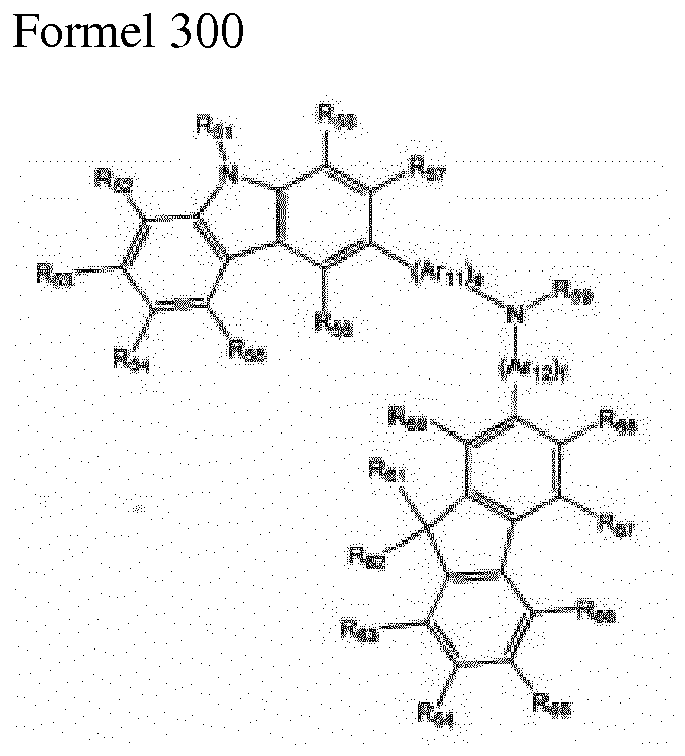 wobei Ar11 und Ar12 jeweils unabhängig eine substituierte oder nicht substituierte C5-C60-Arylenegruppe sind;e und f jeweils unabhängig eine ganze Zahl von 0 bis 5 sind;R51 bis R58 und R61 bis R69 jeweils unabhängig ein Wasserstoffatom, ein Deuteriumatom, ein Halogenatom, eine Hydroxygruppe, eine Cyanogruppe, eine Nitrogruppe, eine Aminogruppe, eine Amidinogruppe, Hydrazin, Hydrazon, eine Carboxygruppe oder ein Salz davon, eine Sulfonsäuregruppe oder ein Salz davon, eine Phosphorsäure oder ein Salz davon, eine substituierte oder nicht substituierte C1-C60-Alkylgruppe, eine substituierte oder nicht substituierte C2-C60-Alkenylgruppe, eine substituierte oder nicht substituierte C2-C60-Alkynylgruppe, eine substituierte oder nicht substituierte C1-C60-Alkoxygruppe, eine substituierte oder nicht substituierte C3-C60-Cycloalkylgruppe, eine substituierte oder nicht substituierte C5-C60-Arylgruppe, eine substituierte oder nicht substituierte C5-C60-Aryloxygruppe oder eine substituierte oder nicht substituierte C5-C60-Arylthiogruppe sind; undR59 eine Phenylgruppe; eine Naphthylgruppe; eine Anthrylgruppe; eine Biphenylgruppe; eine Pyridylgruppe; oder eine Phenylgruppe, eine Naphthylgruppe, eine Anthrylgruppe, eine Biphenylgruppe oder eine Pyridylgruppe, die mit mindestens einem/r eines Deuteriumatoms, eines Halogenatoms, einer Hydroxygruppe, einer Cyanogruppe, einer Nitrogruppe, einer Aminogruppe, einer Amidinogruppe, Hydrazin, Hydrazon, einer Carboxygruppe oder eines Salzes davon, einer Sulfonsäuregruppe oder eines Salz davon, einer Phosphorsäure oder eines Salz davon, einer substituierten oder nicht substituierten C1-C20-Alkylgruppe oder einer substituierten oder nicht substituierten C1-C20-Alkoxygruppe substituiert ist, ist.
 - Organische lichtemittierende Diode (10) nach Anspruch 11, wobei die organische Schicht (15) eine die carbazolbasierte Verbindung umfassende Elektronentransportschicht umfasst.
- Verwendung einer carbazolbasierten Verbindung nach einem der Ansprüche 1 bis 9 in einer organischen lichtemittierenden Diode (10).
Applications Claiming Priority (2)
| Application Number | Priority Date | Filing Date | Title |
|---|---|---|---|
| KR20110078200 | 2011-08-05 | ||
| KR1020120002021A KR101701246B1 (ko) | 2011-08-05 | 2012-01-06 | 카바졸계 화합물 및 이를 포함한 유기 발광 소자 |
Publications (2)
| Publication Number | Publication Date |
|---|---|
| EP2554545A1 EP2554545A1 (de) | 2013-02-06 |
| EP2554545B1 true EP2554545B1 (de) | 2014-11-12 |
Family
ID=45976831
Family Applications (1)
| Application Number | Title | Priority Date | Filing Date |
|---|---|---|---|
| EP12164736.6A Active EP2554545B1 (de) | 2011-08-05 | 2012-04-19 | Carbazolbasierte Verbindung und diese enthaltende organische lichtemittierende Diode |
Country Status (4)
| Country | Link |
|---|---|
| US (1) | US9403795B2 (de) |
| EP (1) | EP2554545B1 (de) |
| JP (1) | JP6008648B2 (de) |
| CN (1) | CN102911159B (de) |
Families Citing this family (17)
| Publication number | Priority date | Publication date | Assignee | Title |
|---|---|---|---|---|
| KR101908384B1 (ko) * | 2011-06-17 | 2018-10-17 | 삼성디스플레이 주식회사 | 유기 발광 소자 및 이를 포함하는 평판 표시 장치 |
| KR101927943B1 (ko) * | 2011-12-02 | 2018-12-12 | 삼성디스플레이 주식회사 | 다층 구조의 정공수송층을 포함하는 유기 발광 소자 및 이를 포함하는 평판 표시 장치 |
| KR101927941B1 (ko) | 2011-12-19 | 2018-12-12 | 삼성디스플레이 주식회사 | 다층 구조의 정공수송층을 포함하는 유기 발광 소자 및 이를 포함하는 평판 표시 장치 |
| KR101563047B1 (ko) * | 2012-02-27 | 2015-10-23 | 주식회사 엘지화학 | 유기 발광 소자 |
| KR102017745B1 (ko) * | 2012-10-12 | 2019-09-04 | 삼성디스플레이 주식회사 | 유기 발광 소자, 이의 제조 방법 및 이를 포함하는 유기 발광 표시 장치 |
| KR102131961B1 (ko) * | 2013-02-08 | 2020-07-09 | 삼성디스플레이 주식회사 | 유기 발광 소자 |
| KR102191992B1 (ko) | 2014-01-22 | 2020-12-17 | 삼성디스플레이 주식회사 | 유기 발광 소자 |
| KR101931250B1 (ko) * | 2014-05-13 | 2018-12-20 | 제일모직 주식회사 | 화합물, 이를 포함하는 유기 광전자 소자 및 표시장치 |
| WO2016017514A1 (ja) * | 2014-07-31 | 2016-02-04 | コニカミノルタ株式会社 | 有機エレクトロルミネッセンス素子、発光性薄膜、表示装置及び照明装置 |
| KR102635062B1 (ko) * | 2016-09-30 | 2024-02-07 | 엘지디스플레이 주식회사 | 유기 화합물과 이를 이용한 발광다이오드 및 유기발광다이오드 표시장치 |
| CN108269947A (zh) * | 2016-12-30 | 2018-07-10 | 广东阿格蕾雅光电材料有限公司 | 有机发光二极管器件 |
| CN109004102B (zh) * | 2018-06-11 | 2020-10-27 | 吉林奥来德光电材料股份有限公司 | 一种化合物的应用 |
| CN109053690B (zh) * | 2018-08-03 | 2021-04-16 | 大连理工大学 | 含有咔唑基团的双极性电致发光材料及其应用 |
| CN110845501B (zh) * | 2018-12-10 | 2021-03-19 | 广州华睿光电材料有限公司 | 一种芳胺化合物及其在有机电子器件上的应用 |
| CN109860425B (zh) * | 2019-03-12 | 2021-07-13 | 江苏三月科技股份有限公司 | 一种含有覆盖层的有机电致发光装置及用途 |
| CN109761967B (zh) * | 2019-03-12 | 2021-06-01 | 江苏三月科技股份有限公司 | 一种基于杂芳基胺类结构的有机化合物及其在oled上的应用 |
| KR102792637B1 (ko) * | 2019-11-29 | 2025-04-09 | 삼성디스플레이 주식회사 | 유기 전계 발광 소자 및 유기 전계 발광 소자용 아민 화합물 |
Family Cites Families (31)
| Publication number | Priority date | Publication date | Assignee | Title |
|---|---|---|---|---|
| DE69511755T2 (de) | 1994-04-26 | 2000-01-13 | Tdk Corp | Phenylanthracenderivat und organisches EL-Element |
| JP3816969B2 (ja) | 1994-04-26 | 2006-08-30 | Tdk株式会社 | 有機el素子 |
| US5645948A (en) | 1996-08-20 | 1997-07-08 | Eastman Kodak Company | Blue organic electroluminescent devices |
| US5972247A (en) | 1998-03-20 | 1999-10-26 | Eastman Kodak Company | Organic electroluminescent elements for stable blue electroluminescent devices |
| JP2000003782A (ja) | 1998-06-12 | 2000-01-07 | Casio Comput Co Ltd | 電界発光素子 |
| US6465115B2 (en) | 1998-12-09 | 2002-10-15 | Eastman Kodak Company | Electroluminescent device with anthracene derivatives hole transport layer |
| EP1009043A3 (de) | 1998-12-09 | 2002-07-03 | Eastman Kodak Company | Elektrolumineszente Vorrichtung mit Polyphenyl-Kohlenwasserstoff Ladungslöchertransportschicht |
| US6998487B2 (en) * | 2001-04-27 | 2006-02-14 | Lg Chem, Ltd. | Double-spiro organic compounds and organic electroluminescent devices using the same |
| JP4300176B2 (ja) | 2003-11-13 | 2009-07-22 | ローム株式会社 | 有機エレクトロルミネッセント素子 |
| DE10357044A1 (de) | 2003-12-04 | 2005-07-14 | Novaled Gmbh | Verfahren zur Dotierung von organischen Halbleitern mit Chinondiiminderivaten |
| KR100573137B1 (ko) * | 2004-04-02 | 2006-04-24 | 삼성에스디아이 주식회사 | 플루오렌계 화합물 및 이를 이용한 유기 전계 발광 소자 |
| KR100846586B1 (ko) * | 2006-05-29 | 2008-07-16 | 삼성에스디아이 주식회사 | 유기 발광 소자 및 이를 구비한 평판 표시 장치 |
| KR100669716B1 (ko) | 2004-07-14 | 2007-01-16 | 삼성에스디아이 주식회사 | 페닐카르바졸 화합물 및 이를 이용한 유기 전계 발광 소자 |
| US8188315B2 (en) | 2004-04-02 | 2012-05-29 | Samsung Mobile Display Co., Ltd. | Organic light emitting device and flat panel display device comprising the same |
| KR100787425B1 (ko) | 2004-11-29 | 2007-12-26 | 삼성에스디아이 주식회사 | 페닐카바졸계 화합물 및 이를 이용한 유기 전계 발광 소자 |
| WO2006109719A1 (ja) * | 2005-04-08 | 2006-10-19 | Matsushita Electric Industrial Co., Ltd. | プラズマディスプレイパネル及びその製造方法 |
| US20060240280A1 (en) * | 2005-04-21 | 2006-10-26 | Eastman Kodak Company | OLED anode modification layer |
| WO2007029403A1 (ja) * | 2005-09-08 | 2007-03-15 | Idemitsu Kosan Co., Ltd. | 有機エレクトロルミネッセンス素子 |
| KR100879477B1 (ko) * | 2007-10-11 | 2009-01-20 | 삼성모바일디스플레이주식회사 | 유기 발광 소자 |
| TW200935639A (en) | 2007-11-28 | 2009-08-16 | Fuji Electric Holdings | Organic EL device |
| KR101026171B1 (ko) | 2008-07-01 | 2011-04-05 | 덕산하이메탈(주) | 신규의 축합 카바졸 유도체 및 이를 포함하는 유기전계발광 소자 |
| CN105294538A (zh) * | 2008-10-08 | 2016-02-03 | 株式会社Lg化学 | 新化合物及使用该化合物的有机电子元件 |
| KR20100043994A (ko) | 2008-10-21 | 2010-04-29 | 경희대학교 산학협력단 | 인광 유기발광다이오드 및 그 제조방법 |
| KR20100094819A (ko) | 2009-02-19 | 2010-08-27 | 엘지디스플레이 주식회사 | 유기전계 발광 디스플레이 장치 및 그 구동방법 |
| CN102482215B (zh) * | 2009-08-19 | 2015-04-15 | 出光兴产株式会社 | 芳胺衍生物及使用该芳胺衍生物的有机电致发光元件 |
| KR101127579B1 (ko) * | 2009-08-28 | 2012-03-23 | 삼성모바일디스플레이주식회사 | 헤테로아릴아민 화합물 및 이를 이용한 유기 발광 소자 |
| KR101137384B1 (ko) * | 2009-08-28 | 2012-04-20 | 삼성모바일디스플레이주식회사 | 헤테로아릴아민 화합물 및 이를 이용한 유기 발광 소자 |
| KR101117938B1 (ko) | 2009-09-10 | 2012-02-29 | 주식회사 엘지화학 | 신규한 헤테로고리 유도체 및 이를 이용한 유기 발광 소자 |
| KR20110088898A (ko) | 2010-01-29 | 2011-08-04 | 주식회사 이엘엠 | 유기 전기 발광 조성물 및 이를 포함하는 유기 전기 발광 소자 |
| EP2371828B1 (de) * | 2010-04-01 | 2018-01-10 | Samsung Display Co., Ltd. | Kondensierte zyklische Verbindung und organische lichtemittierende Vorrichtung damit |
| KR101007516B1 (ko) | 2010-04-23 | 2011-01-14 | 주식회사 이엘엠 | 유기 전기 발광 조성물 및 이를 포함하는 유기 전기 발광 소자 |
-
2012
- 2012-01-31 US US13/362,841 patent/US9403795B2/en active Active
- 2012-03-22 CN CN201210077815.0A patent/CN102911159B/zh active Active
- 2012-04-19 EP EP12164736.6A patent/EP2554545B1/de active Active
- 2012-08-06 JP JP2012174393A patent/JP6008648B2/ja active Active
Also Published As
| Publication number | Publication date |
|---|---|
| JP2013035839A (ja) | 2013-02-21 |
| JP6008648B2 (ja) | 2016-10-19 |
| EP2554545A1 (de) | 2013-02-06 |
| CN102911159A (zh) | 2013-02-06 |
| US9403795B2 (en) | 2016-08-02 |
| CN102911159B (zh) | 2018-04-27 |
| US20130032788A1 (en) | 2013-02-07 |
Similar Documents
| Publication | Publication Date | Title |
|---|---|---|
| EP2554545A1 (de) | Carbazolbasierte Verbindung und diese enthaltende organische lichtemittierende Diode | |
| KR101701246B1 (ko) | 카바졸계 화합물 및 이를 포함한 유기 발광 소자 | |
| EP2308843B1 (de) | Kondensiert-cyclische verbindung und organische lichtemittierende diode mit einer organischen schicht mit der kondensiert-cyclischen verbindung | |
| KR101673521B1 (ko) | 파이렌계 화합물, 이를 포함한 유기 발광 소자 및 이를 포함한 유기 발광 장치 | |
| KR102120890B1 (ko) | 헤테로고리 화합물 및 이를 포함한 유기 발광 소자 | |
| EP2292618B1 (de) | Polycyclische Heteroaryl Verbindungen enthaltenden organische lichtemittierende Vorrichtung | |
| KR102116491B1 (ko) | 파이렌계 화합물 및 이를 포함한 유기 발광 소자 | |
| KR20130100634A (ko) | 유기 발광 소자 | |
| KR102203102B1 (ko) | 화합물 및 이를 포함한 유기 발광 소자 | |
| KR101853875B1 (ko) | 헤테로고리 화합물 및 이를 포함한 유기발광 소자 | |
| KR20140142088A (ko) | 아릴 아민계 화합물 및 이를 포함한 유기 발광 소자 | |
| EP2392563B1 (de) | Stickstoffhaltige polyzyklische derivate verwendbar in organischen lichtemitterende vorrichtungen | |
| KR20150000357A (ko) | 유기 발광 소자 | |
| KR20140091348A (ko) | 아민계 화합물 및 파이렌계 화합물을 포함하는 유기 발광 소자 | |
| KR102052071B1 (ko) | 유기 발광 소자 | |
| KR102134844B1 (ko) | 아민계 화합물 및 이를 포함한 유기 발광 소자 | |
| KR102131960B1 (ko) | 축합환 화합물 및 이를 포함하는 유기 전계 발광 소자 | |
| KR102075526B1 (ko) | 플루오렌계 화합물 및 이를 포함한 유기 발광 소자 | |
| EP2535331B1 (de) | Kondensierte zyklische Verbindung und organische lichtemittierende Vorrichtung damit | |
| KR20150124050A (ko) | 카바졸계 화합물 및 이를 포함한 유기 발광 소자 | |
| US20130001522A1 (en) | Heterocyclic compound and organic light-emitting device including the same | |
| KR20140122613A (ko) | 헤테로아릴계 화합물 및 이를 포함한 유기 발광 소자 | |
| KR20140091344A (ko) | 아민계 화합물 및 안트라센계 화합물을 포함하는 유기 발광 소자 | |
| KR20140052757A (ko) | 유기금속 화합물 및 이를 포함하는 유기 발광 소자 | |
| KR102235598B1 (ko) | 축합환 화합물 및 이를 포함하는 유기 전계 발광 소자 |
Legal Events
| Date | Code | Title | Description |
|---|---|---|---|
| PUAI | Public reference made under article 153(3) epc to a published international application that has entered the european phase |
Free format text: ORIGINAL CODE: 0009012 |
|
| 17P | Request for examination filed |
Effective date: 20121018 |
|
| AK | Designated contracting states |
Kind code of ref document: A1 Designated state(s): AL AT BE BG CH CY CZ DE DK EE ES FI FR GB GR HR HU IE IS IT LI LT LU LV MC MK MT NL NO PL PT RO RS SE SI SK SM TR |
|
| AX | Request for extension of the european patent |
Extension state: BA ME |
|
| GRAP | Despatch of communication of intention to grant a patent |
Free format text: ORIGINAL CODE: EPIDOSNIGR1 |
|
| INTG | Intention to grant announced |
Effective date: 20140528 |
|
| GRAS | Grant fee paid |
Free format text: ORIGINAL CODE: EPIDOSNIGR3 |
|
| GRAA | (expected) grant |
Free format text: ORIGINAL CODE: 0009210 |
|
| AK | Designated contracting states |
Kind code of ref document: B1 Designated state(s): AL AT BE BG CH CY CZ DE DK EE ES FI FR GB GR HR HU IE IS IT LI LT LU LV MC MK MT NL NO PL PT RO RS SE SI SK SM TR |
|
| REG | Reference to a national code |
Ref country code: GB Ref legal event code: FG4D |
|
| REG | Reference to a national code |
Ref country code: CH Ref legal event code: EP |
|
| REG | Reference to a national code |
Ref country code: AT Ref legal event code: REF Ref document number: 695669 Country of ref document: AT Kind code of ref document: T Effective date: 20141115 |
|
| REG | Reference to a national code |
Ref country code: IE Ref legal event code: FG4D |
|
| REG | Reference to a national code |
Ref country code: DE Ref legal event code: R096 Ref document number: 602012003721 Country of ref document: DE Effective date: 20141231 |
|
| REG | Reference to a national code |
Ref country code: NL Ref legal event code: VDEP Effective date: 20141112 |
|
| REG | Reference to a national code |
Ref country code: AT Ref legal event code: MK05 Ref document number: 695669 Country of ref document: AT Kind code of ref document: T Effective date: 20141112 |
|
| PG25 | Lapsed in a contracting state [announced via postgrant information from national office to epo] |
Ref country code: FI Free format text: LAPSE BECAUSE OF FAILURE TO SUBMIT A TRANSLATION OF THE DESCRIPTION OR TO PAY THE FEE WITHIN THE PRESCRIBED TIME-LIMIT Effective date: 20141112 Ref country code: NL Free format text: LAPSE BECAUSE OF FAILURE TO SUBMIT A TRANSLATION OF THE DESCRIPTION OR TO PAY THE FEE WITHIN THE PRESCRIBED TIME-LIMIT Effective date: 20141112 Ref country code: ES Free format text: LAPSE BECAUSE OF FAILURE TO SUBMIT A TRANSLATION OF THE DESCRIPTION OR TO PAY THE FEE WITHIN THE PRESCRIBED TIME-LIMIT Effective date: 20141112 Ref country code: PT Free format text: LAPSE BECAUSE OF FAILURE TO SUBMIT A TRANSLATION OF THE DESCRIPTION OR TO PAY THE FEE WITHIN THE PRESCRIBED TIME-LIMIT Effective date: 20150312 Ref country code: IS Free format text: LAPSE BECAUSE OF FAILURE TO SUBMIT A TRANSLATION OF THE DESCRIPTION OR TO PAY THE FEE WITHIN THE PRESCRIBED TIME-LIMIT Effective date: 20150312 Ref country code: LT Free format text: LAPSE BECAUSE OF FAILURE TO SUBMIT A TRANSLATION OF THE DESCRIPTION OR TO PAY THE FEE WITHIN THE PRESCRIBED TIME-LIMIT Effective date: 20141112 Ref country code: NO Free format text: LAPSE BECAUSE OF FAILURE TO SUBMIT A TRANSLATION OF THE DESCRIPTION OR TO PAY THE FEE WITHIN THE PRESCRIBED TIME-LIMIT Effective date: 20150212 |
|
| PG25 | Lapsed in a contracting state [announced via postgrant information from national office to epo] |
Ref country code: LV Free format text: LAPSE BECAUSE OF FAILURE TO SUBMIT A TRANSLATION OF THE DESCRIPTION OR TO PAY THE FEE WITHIN THE PRESCRIBED TIME-LIMIT Effective date: 20141112 Ref country code: CY Free format text: LAPSE BECAUSE OF FAILURE TO SUBMIT A TRANSLATION OF THE DESCRIPTION OR TO PAY THE FEE WITHIN THE PRESCRIBED TIME-LIMIT Effective date: 20141112 Ref country code: PL Free format text: LAPSE BECAUSE OF FAILURE TO SUBMIT A TRANSLATION OF THE DESCRIPTION OR TO PAY THE FEE WITHIN THE PRESCRIBED TIME-LIMIT Effective date: 20141112 Ref country code: RS Free format text: LAPSE BECAUSE OF FAILURE TO SUBMIT A TRANSLATION OF THE DESCRIPTION OR TO PAY THE FEE WITHIN THE PRESCRIBED TIME-LIMIT Effective date: 20141112 Ref country code: HR Free format text: LAPSE BECAUSE OF FAILURE TO SUBMIT A TRANSLATION OF THE DESCRIPTION OR TO PAY THE FEE WITHIN THE PRESCRIBED TIME-LIMIT Effective date: 20141112 Ref country code: SE Free format text: LAPSE BECAUSE OF FAILURE TO SUBMIT A TRANSLATION OF THE DESCRIPTION OR TO PAY THE FEE WITHIN THE PRESCRIBED TIME-LIMIT Effective date: 20141112 Ref country code: GR Free format text: LAPSE BECAUSE OF FAILURE TO SUBMIT A TRANSLATION OF THE DESCRIPTION OR TO PAY THE FEE WITHIN THE PRESCRIBED TIME-LIMIT Effective date: 20150213 Ref country code: AT Free format text: LAPSE BECAUSE OF FAILURE TO SUBMIT A TRANSLATION OF THE DESCRIPTION OR TO PAY THE FEE WITHIN THE PRESCRIBED TIME-LIMIT Effective date: 20141112 |
|
| PG25 | Lapsed in a contracting state [announced via postgrant information from national office to epo] |
Ref country code: RO Free format text: LAPSE BECAUSE OF FAILURE TO SUBMIT A TRANSLATION OF THE DESCRIPTION OR TO PAY THE FEE WITHIN THE PRESCRIBED TIME-LIMIT Effective date: 20141112 Ref country code: DK Free format text: LAPSE BECAUSE OF FAILURE TO SUBMIT A TRANSLATION OF THE DESCRIPTION OR TO PAY THE FEE WITHIN THE PRESCRIBED TIME-LIMIT Effective date: 20141112 Ref country code: SK Free format text: LAPSE BECAUSE OF FAILURE TO SUBMIT A TRANSLATION OF THE DESCRIPTION OR TO PAY THE FEE WITHIN THE PRESCRIBED TIME-LIMIT Effective date: 20141112 Ref country code: CZ Free format text: LAPSE BECAUSE OF FAILURE TO SUBMIT A TRANSLATION OF THE DESCRIPTION OR TO PAY THE FEE WITHIN THE PRESCRIBED TIME-LIMIT Effective date: 20141112 Ref country code: EE Free format text: LAPSE BECAUSE OF FAILURE TO SUBMIT A TRANSLATION OF THE DESCRIPTION OR TO PAY THE FEE WITHIN THE PRESCRIBED TIME-LIMIT Effective date: 20141112 |
|
| REG | Reference to a national code |
Ref country code: DE Ref legal event code: R097 Ref document number: 602012003721 Country of ref document: DE |
|
| PLBE | No opposition filed within time limit |
Free format text: ORIGINAL CODE: 0009261 |
|
| STAA | Information on the status of an ep patent application or granted ep patent |
Free format text: STATUS: NO OPPOSITION FILED WITHIN TIME LIMIT |
|
| RAP2 | Party data changed (patent owner data changed or rights of a patent transferred) |
Owner name: SAMSUNG DISPLAY CO., LTD. |
|
| 26N | No opposition filed |
Effective date: 20150813 |
|
| PG25 | Lapsed in a contracting state [announced via postgrant information from national office to epo] |
Ref country code: LU Free format text: LAPSE BECAUSE OF FAILURE TO SUBMIT A TRANSLATION OF THE DESCRIPTION OR TO PAY THE FEE WITHIN THE PRESCRIBED TIME-LIMIT Effective date: 20150419 Ref country code: MC Free format text: LAPSE BECAUSE OF FAILURE TO SUBMIT A TRANSLATION OF THE DESCRIPTION OR TO PAY THE FEE WITHIN THE PRESCRIBED TIME-LIMIT Effective date: 20141112 |
|
| REG | Reference to a national code |
Ref country code: CH Ref legal event code: PL |
|
| PG25 | Lapsed in a contracting state [announced via postgrant information from national office to epo] |
Ref country code: IT Free format text: LAPSE BECAUSE OF FAILURE TO SUBMIT A TRANSLATION OF THE DESCRIPTION OR TO PAY THE FEE WITHIN THE PRESCRIBED TIME-LIMIT Effective date: 20141112 |
|
| REG | Reference to a national code |
Ref country code: IE Ref legal event code: MM4A |
|
| PG25 | Lapsed in a contracting state [announced via postgrant information from national office to epo] |
Ref country code: LI Free format text: LAPSE BECAUSE OF NON-PAYMENT OF DUE FEES Effective date: 20150430 Ref country code: CH Free format text: LAPSE BECAUSE OF NON-PAYMENT OF DUE FEES Effective date: 20150430 |
|
| PG25 | Lapsed in a contracting state [announced via postgrant information from national office to epo] |
Ref country code: SI Free format text: LAPSE BECAUSE OF FAILURE TO SUBMIT A TRANSLATION OF THE DESCRIPTION OR TO PAY THE FEE WITHIN THE PRESCRIBED TIME-LIMIT Effective date: 20141112 |
|
| REG | Reference to a national code |
Ref country code: FR Ref legal event code: PLFP Year of fee payment: 5 |
|
| PG25 | Lapsed in a contracting state [announced via postgrant information from national office to epo] |
Ref country code: IE Free format text: LAPSE BECAUSE OF NON-PAYMENT OF DUE FEES Effective date: 20150419 |
|
| PG25 | Lapsed in a contracting state [announced via postgrant information from national office to epo] |
Ref country code: MT Free format text: LAPSE BECAUSE OF FAILURE TO SUBMIT A TRANSLATION OF THE DESCRIPTION OR TO PAY THE FEE WITHIN THE PRESCRIBED TIME-LIMIT Effective date: 20141112 |
|
| REG | Reference to a national code |
Ref country code: FR Ref legal event code: PLFP Year of fee payment: 6 |
|
| PG25 | Lapsed in a contracting state [announced via postgrant information from national office to epo] |
Ref country code: SM Free format text: LAPSE BECAUSE OF FAILURE TO SUBMIT A TRANSLATION OF THE DESCRIPTION OR TO PAY THE FEE WITHIN THE PRESCRIBED TIME-LIMIT Effective date: 20141112 Ref country code: BG Free format text: LAPSE BECAUSE OF FAILURE TO SUBMIT A TRANSLATION OF THE DESCRIPTION OR TO PAY THE FEE WITHIN THE PRESCRIBED TIME-LIMIT Effective date: 20141112 Ref country code: HU Free format text: LAPSE BECAUSE OF FAILURE TO SUBMIT A TRANSLATION OF THE DESCRIPTION OR TO PAY THE FEE WITHIN THE PRESCRIBED TIME-LIMIT; INVALID AB INITIO Effective date: 20120419 |
|
| PG25 | Lapsed in a contracting state [announced via postgrant information from national office to epo] |
Ref country code: TR Free format text: LAPSE BECAUSE OF FAILURE TO SUBMIT A TRANSLATION OF THE DESCRIPTION OR TO PAY THE FEE WITHIN THE PRESCRIBED TIME-LIMIT Effective date: 20141112 |
|
| PG25 | Lapsed in a contracting state [announced via postgrant information from national office to epo] |
Ref country code: BE Free format text: LAPSE BECAUSE OF FAILURE TO SUBMIT A TRANSLATION OF THE DESCRIPTION OR TO PAY THE FEE WITHIN THE PRESCRIBED TIME-LIMIT Effective date: 20141112 |
|
| REG | Reference to a national code |
Ref country code: FR Ref legal event code: PLFP Year of fee payment: 7 |
|
| PG25 | Lapsed in a contracting state [announced via postgrant information from national office to epo] |
Ref country code: MK Free format text: LAPSE BECAUSE OF FAILURE TO SUBMIT A TRANSLATION OF THE DESCRIPTION OR TO PAY THE FEE WITHIN THE PRESCRIBED TIME-LIMIT Effective date: 20141112 |
|
| PG25 | Lapsed in a contracting state [announced via postgrant information from national office to epo] |
Ref country code: AL Free format text: LAPSE BECAUSE OF FAILURE TO SUBMIT A TRANSLATION OF THE DESCRIPTION OR TO PAY THE FEE WITHIN THE PRESCRIBED TIME-LIMIT Effective date: 20141112 |
|
| P01 | Opt-out of the competence of the unified patent court (upc) registered |
Effective date: 20230515 |
|
| PGFP | Annual fee paid to national office [announced via postgrant information from national office to epo] |
Ref country code: DE Payment date: 20250320 Year of fee payment: 14 |
|
| PGFP | Annual fee paid to national office [announced via postgrant information from national office to epo] |
Ref country code: GB Payment date: 20260324 Year of fee payment: 15 |
|
| PGFP | Annual fee paid to national office [announced via postgrant information from national office to epo] |
Ref country code: FR Payment date: 20260323 Year of fee payment: 15 |